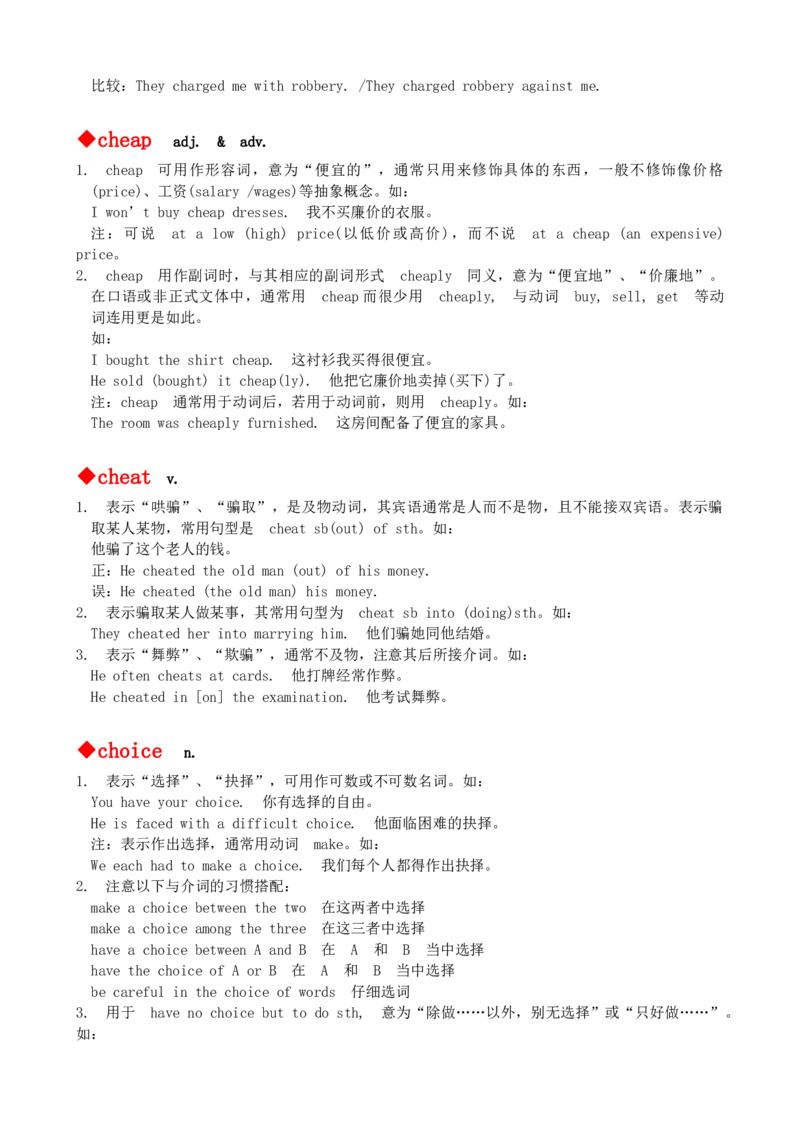
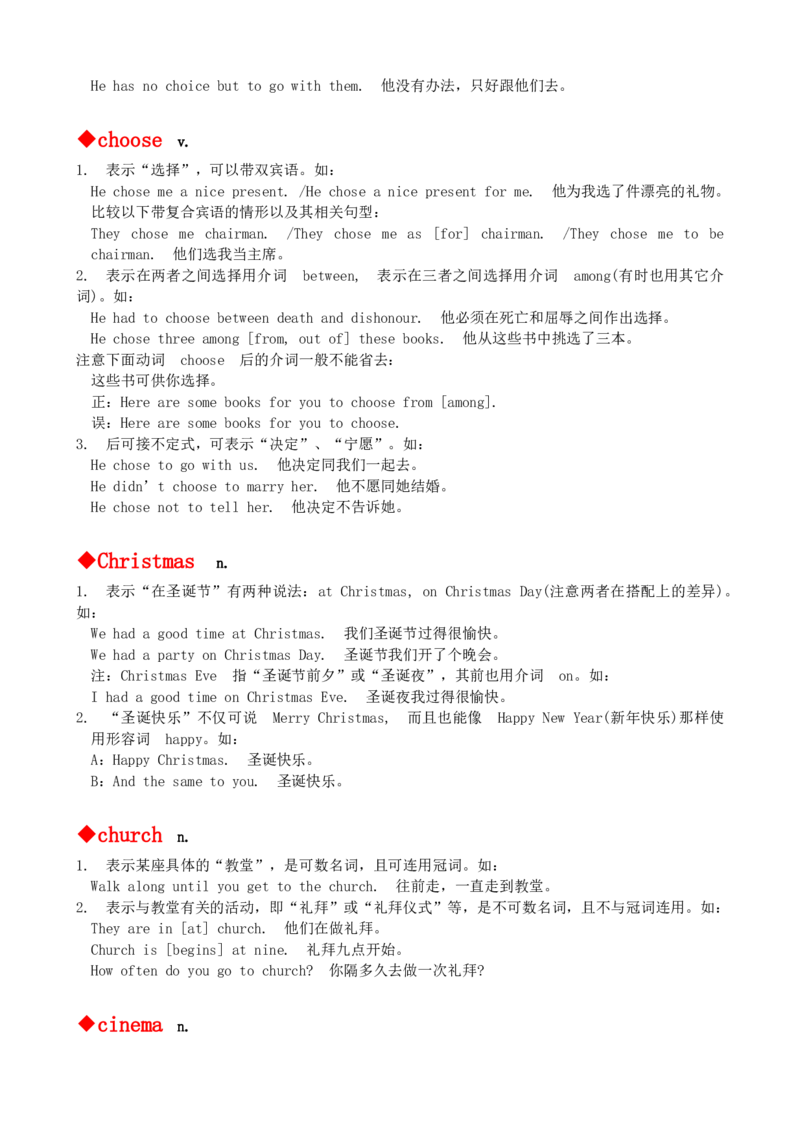
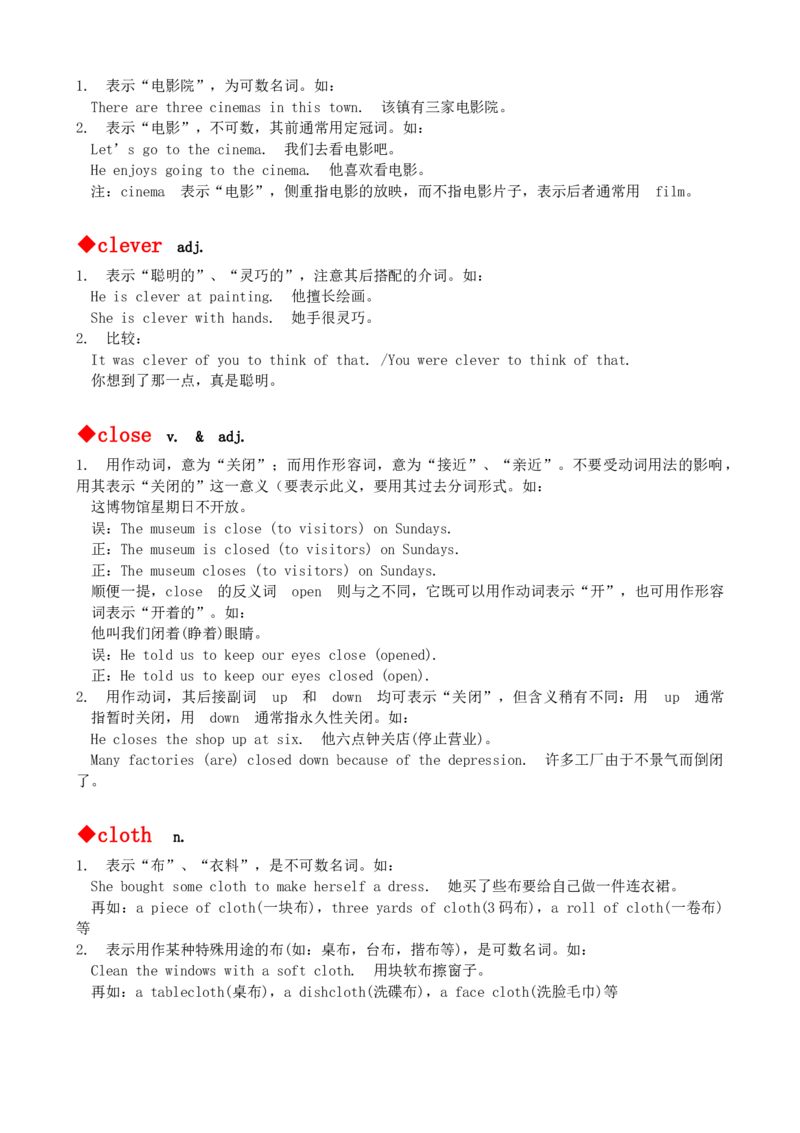
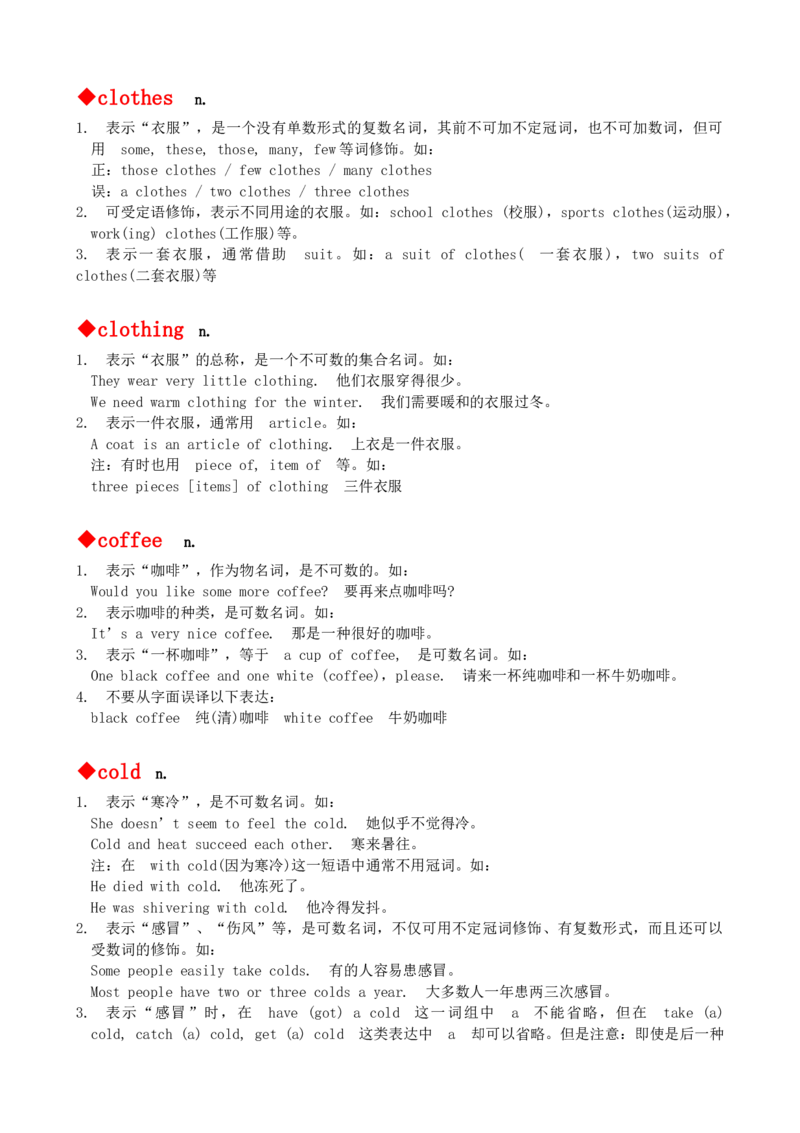
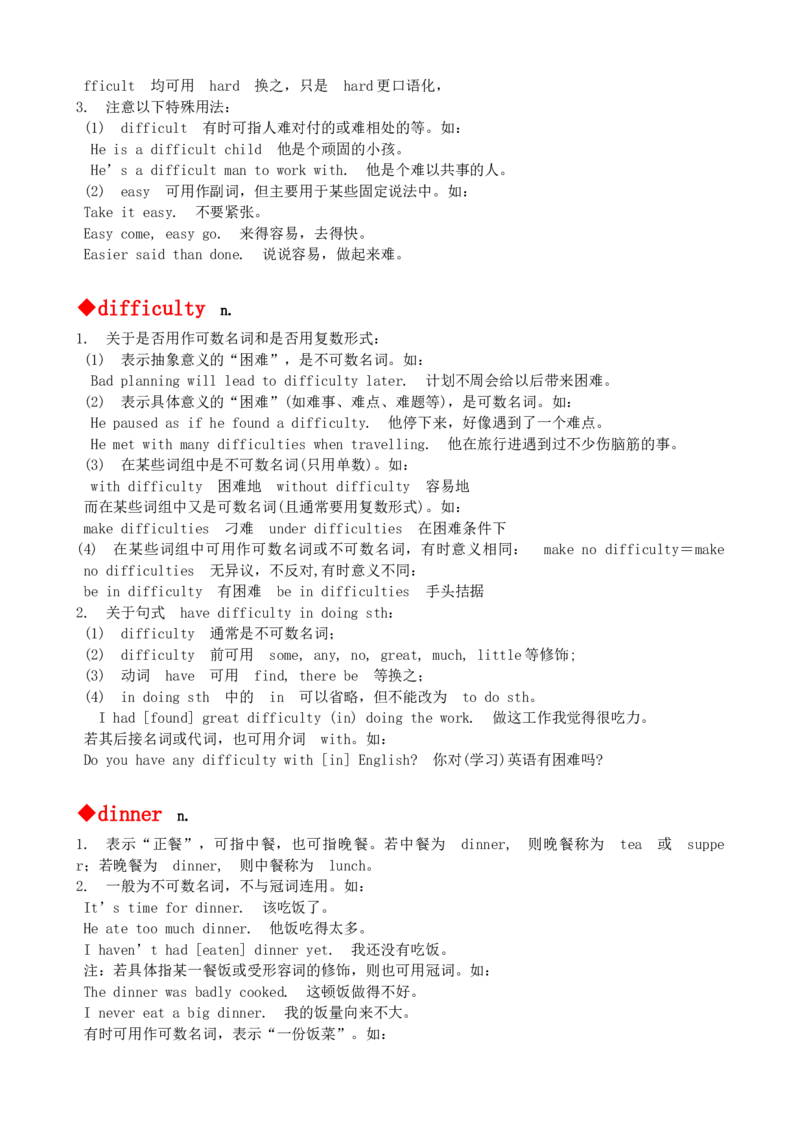
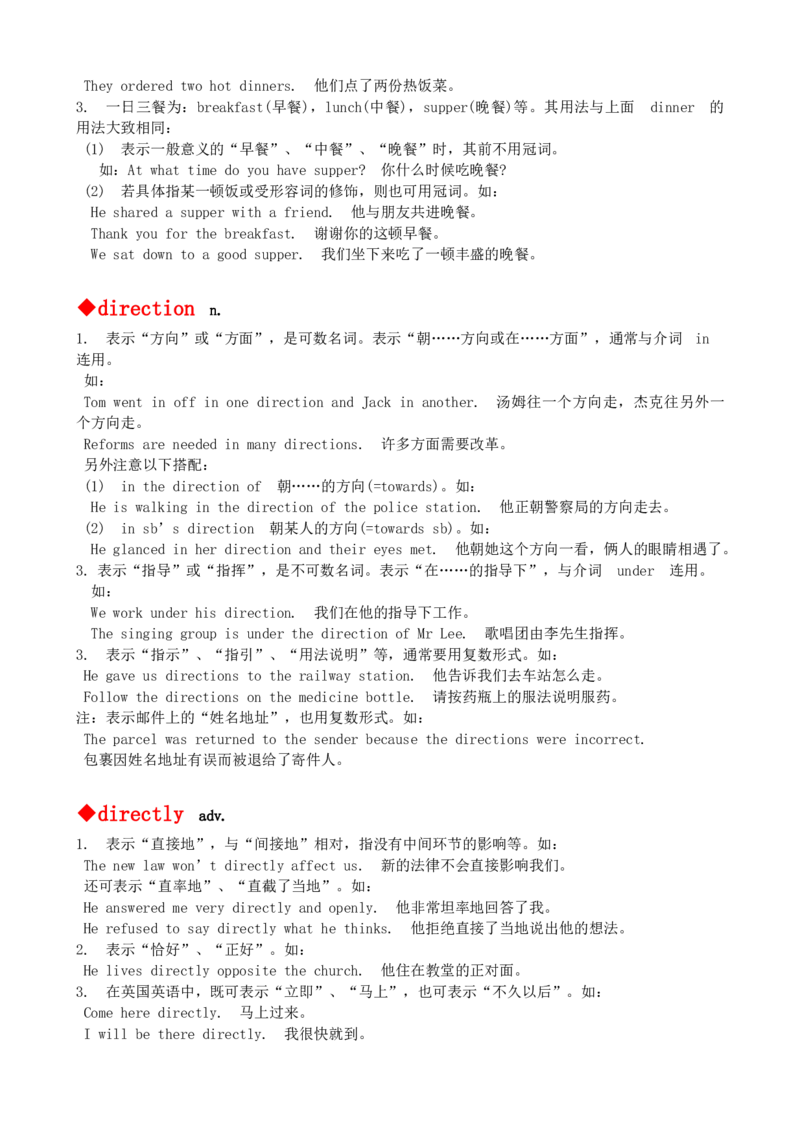
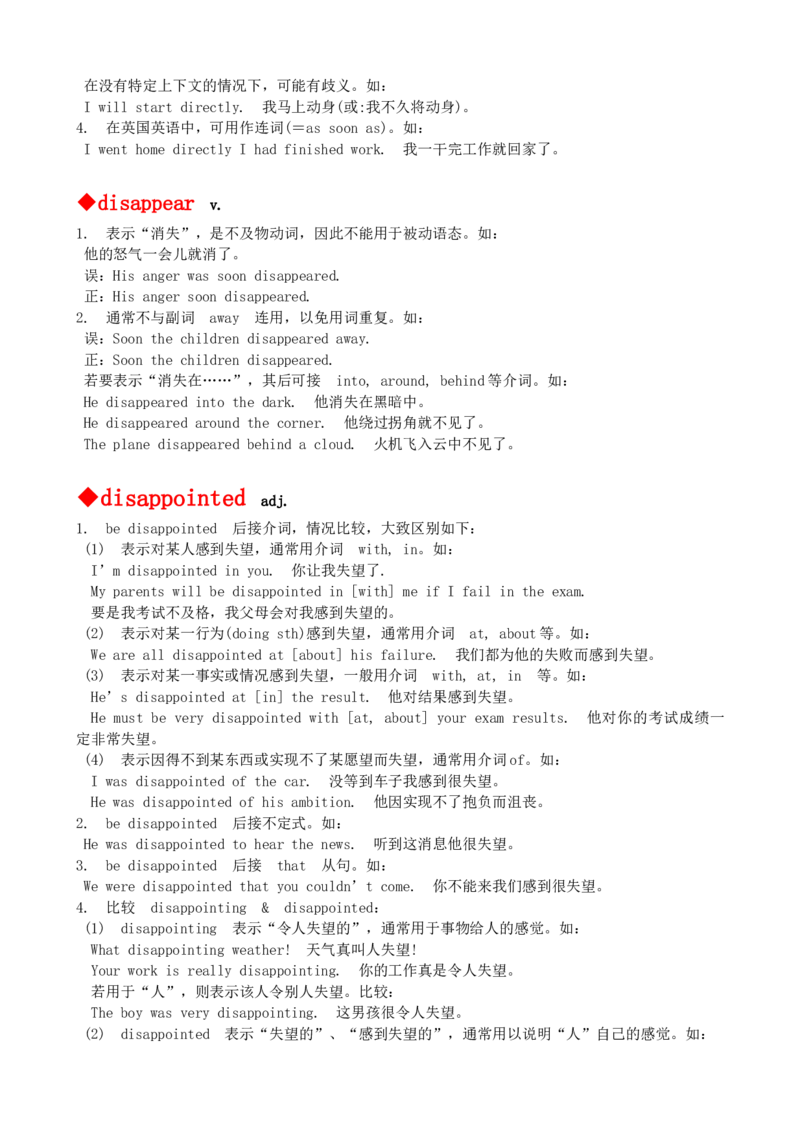
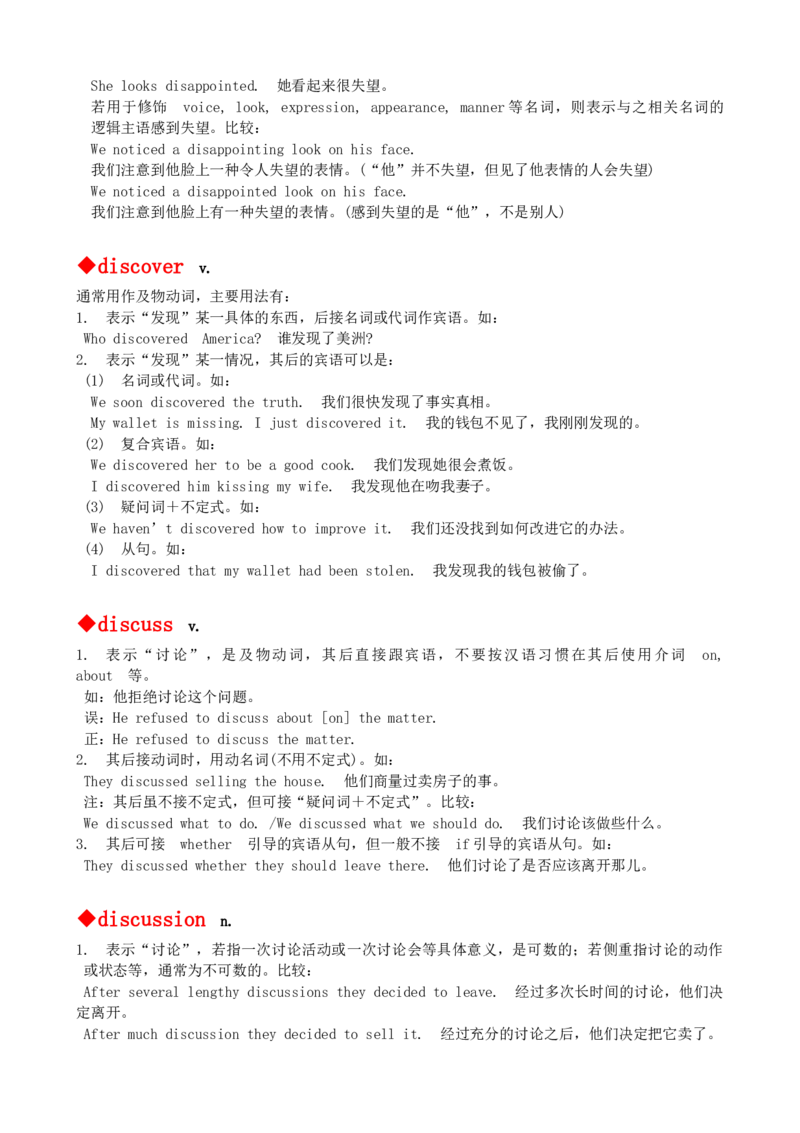
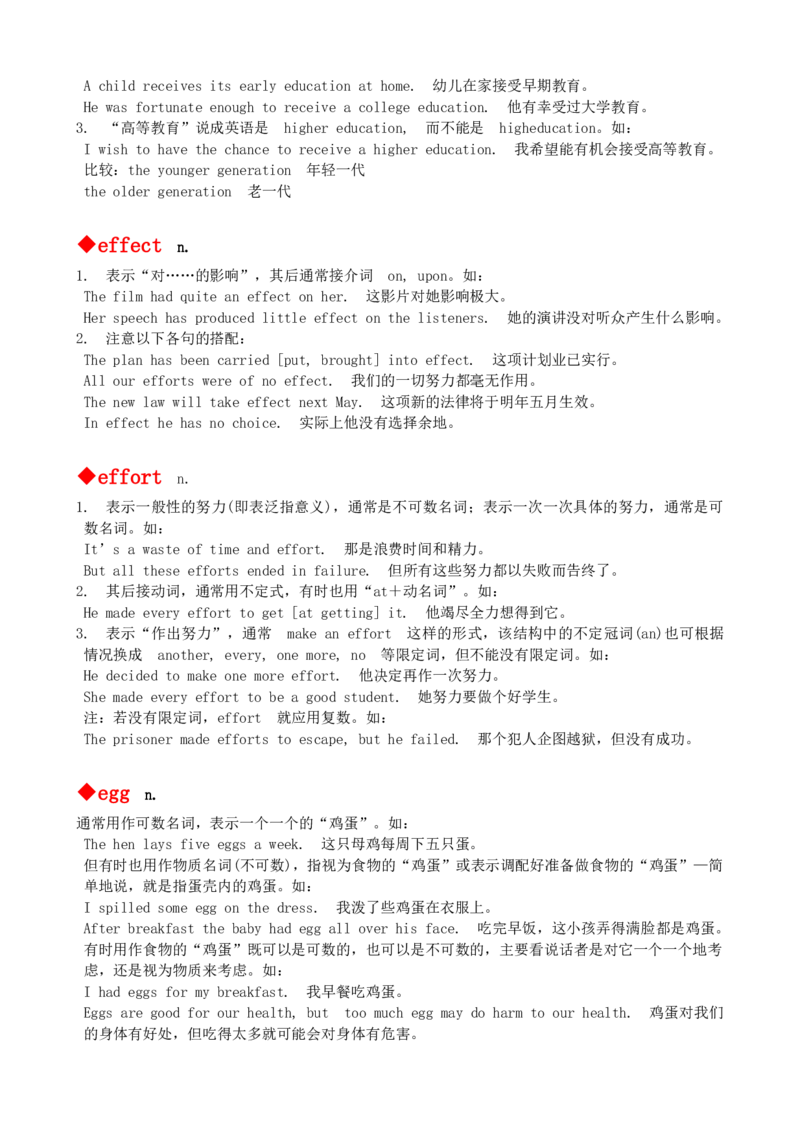
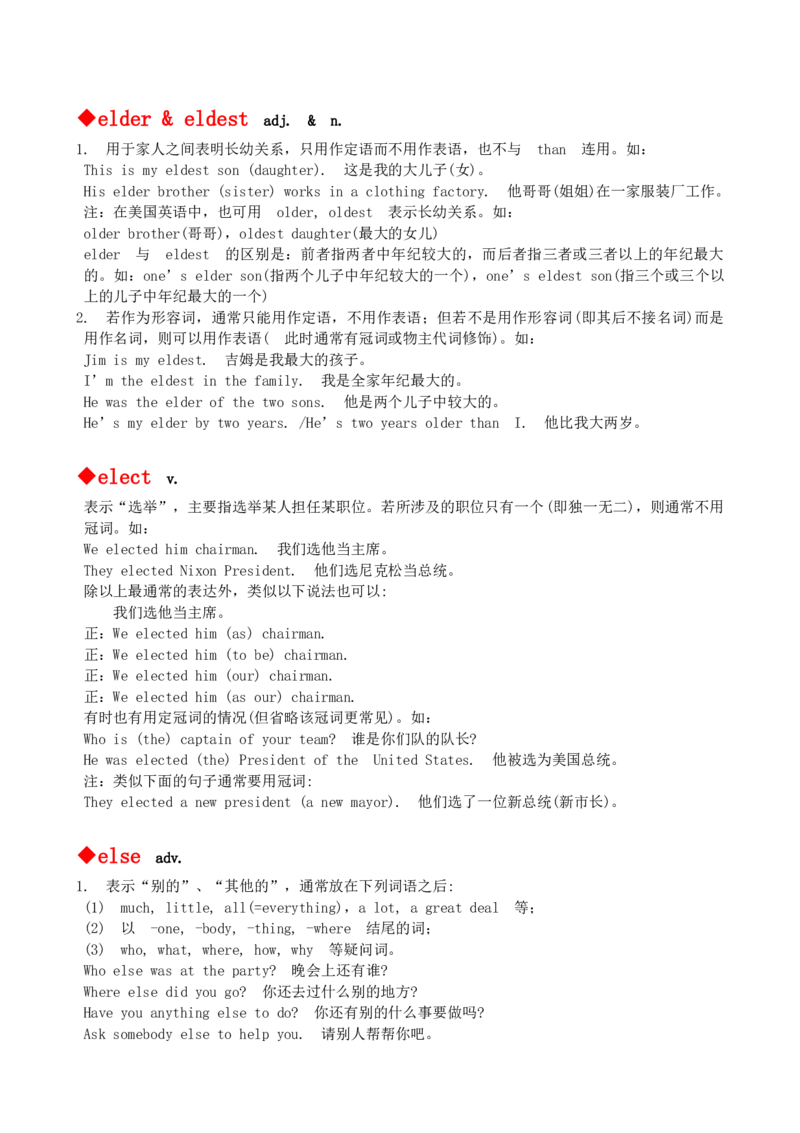
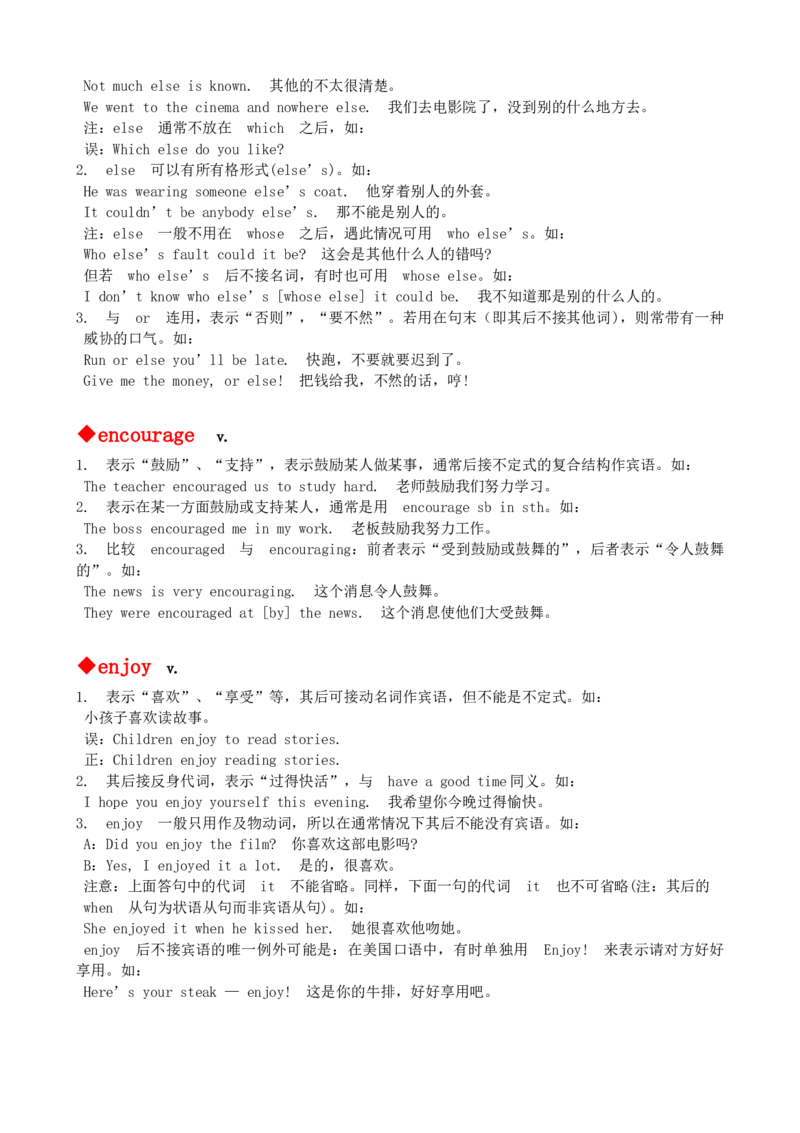
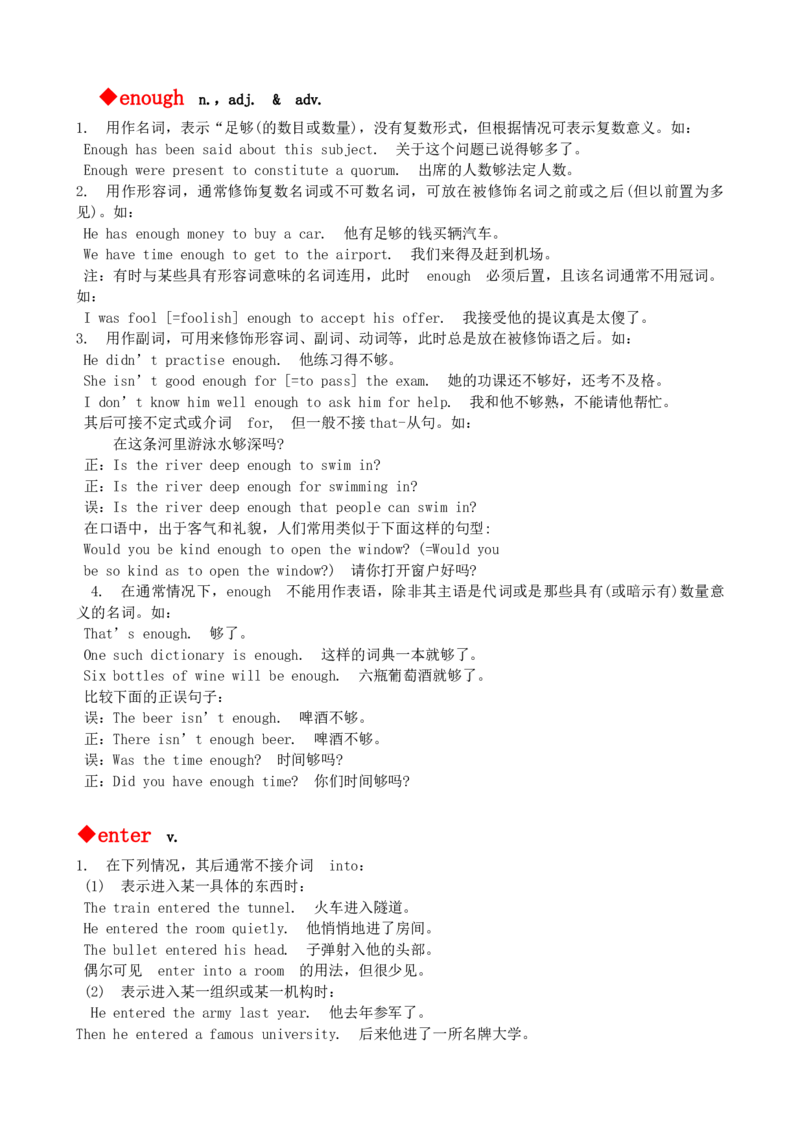
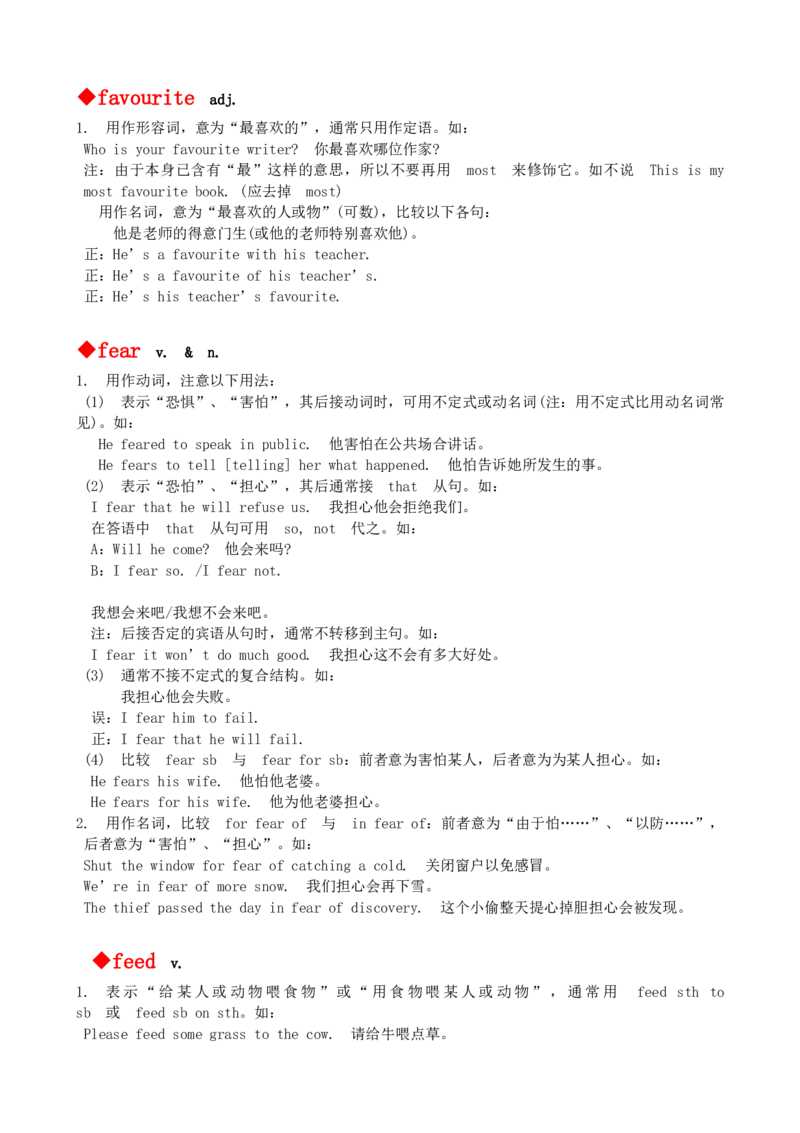
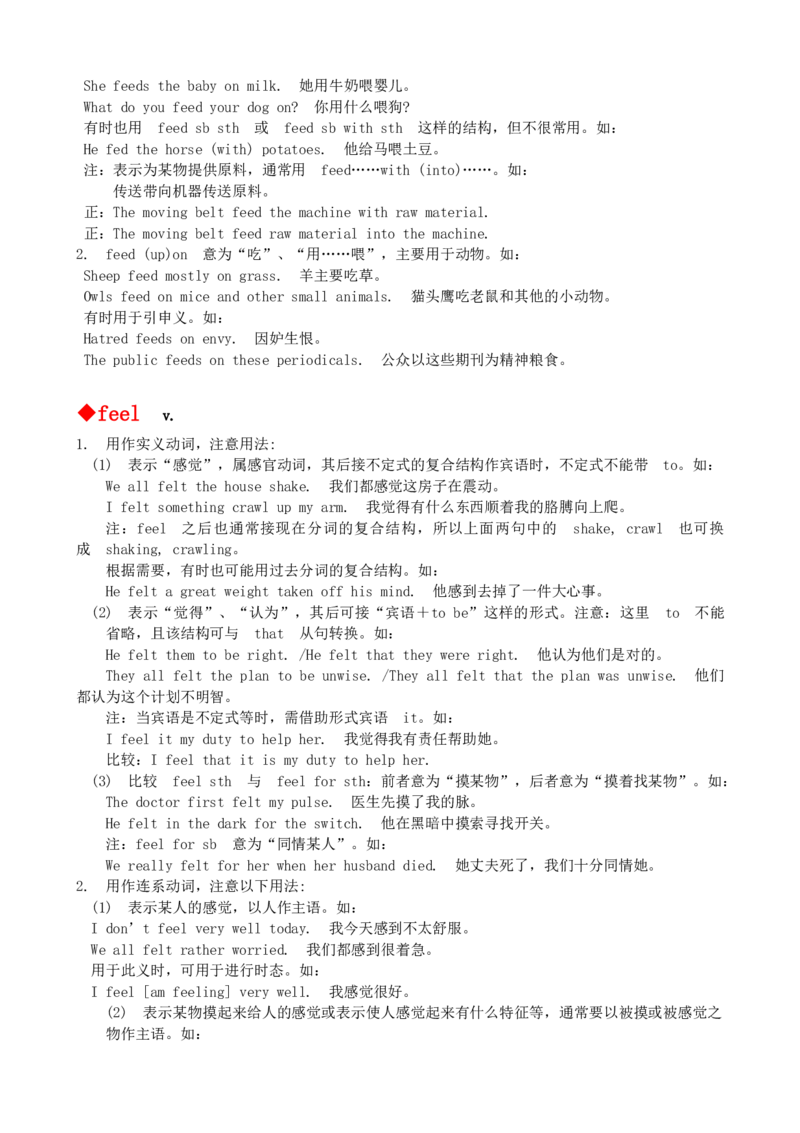
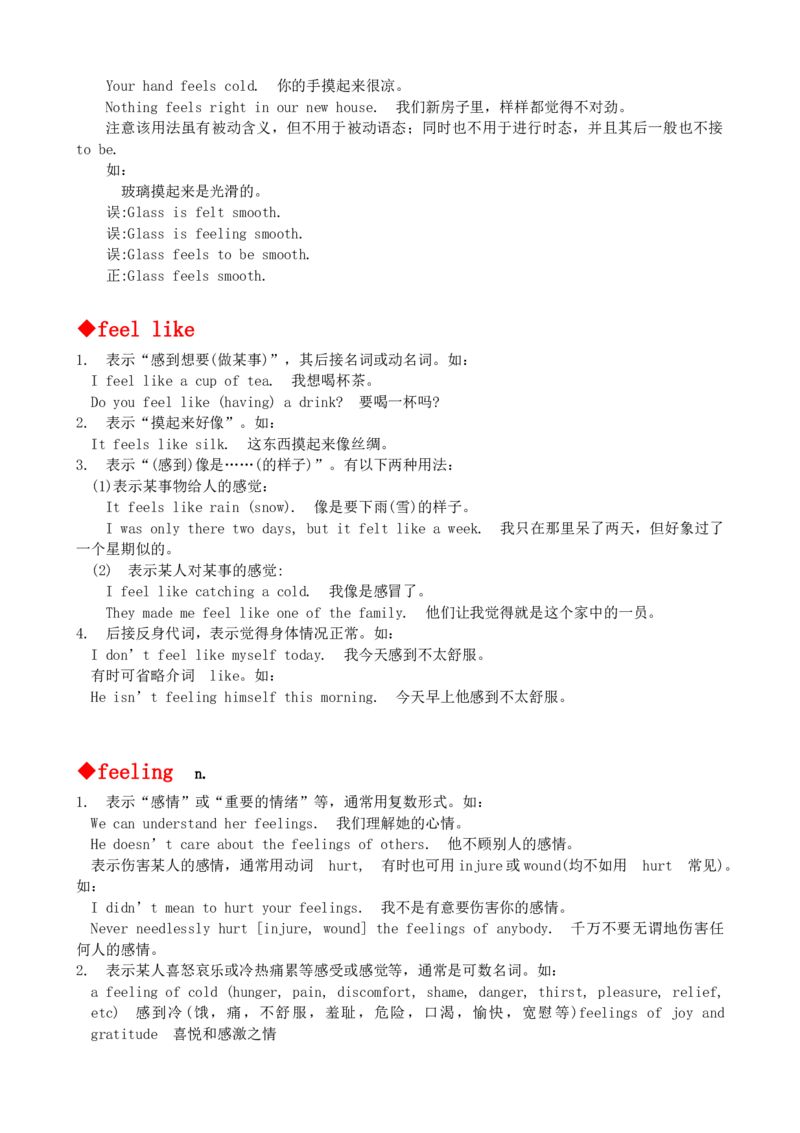
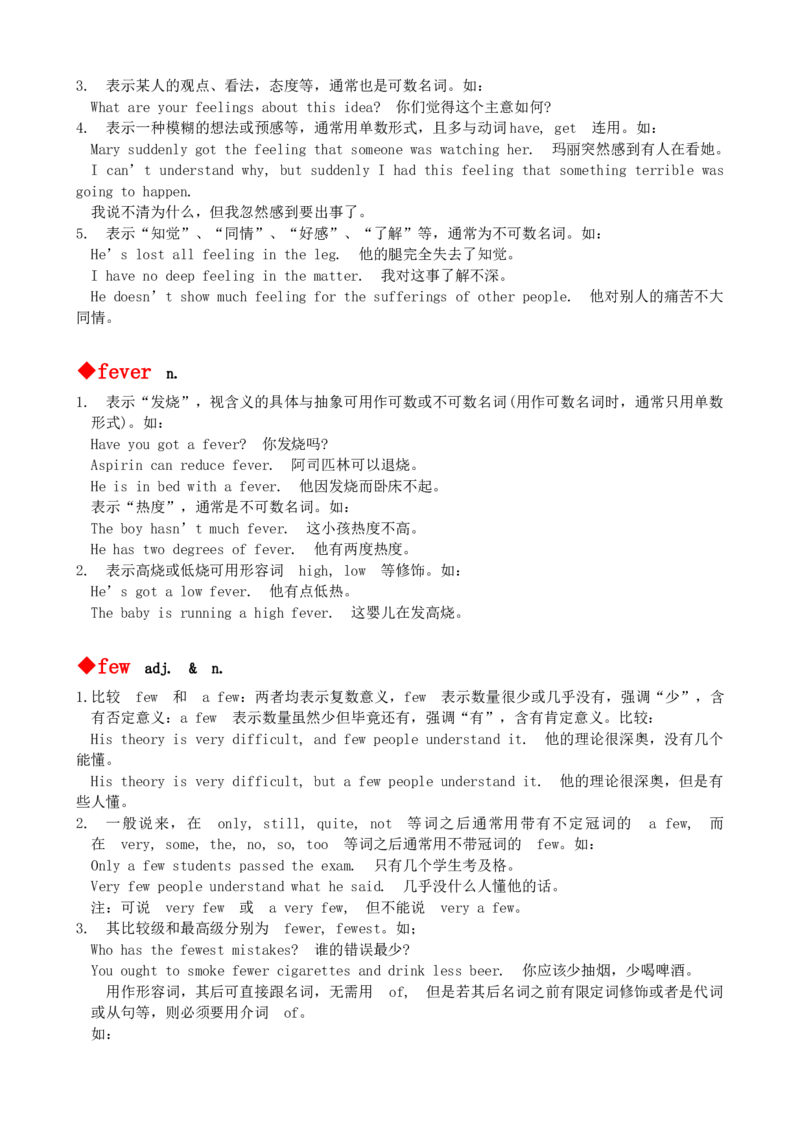
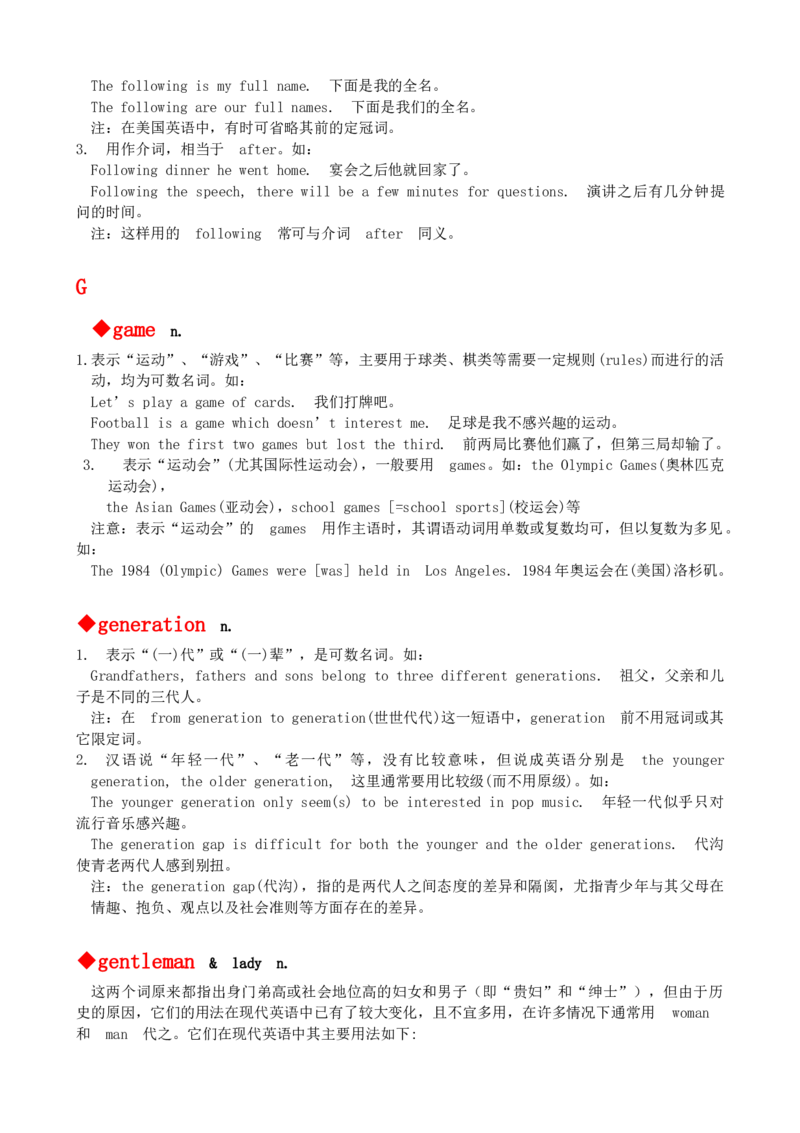
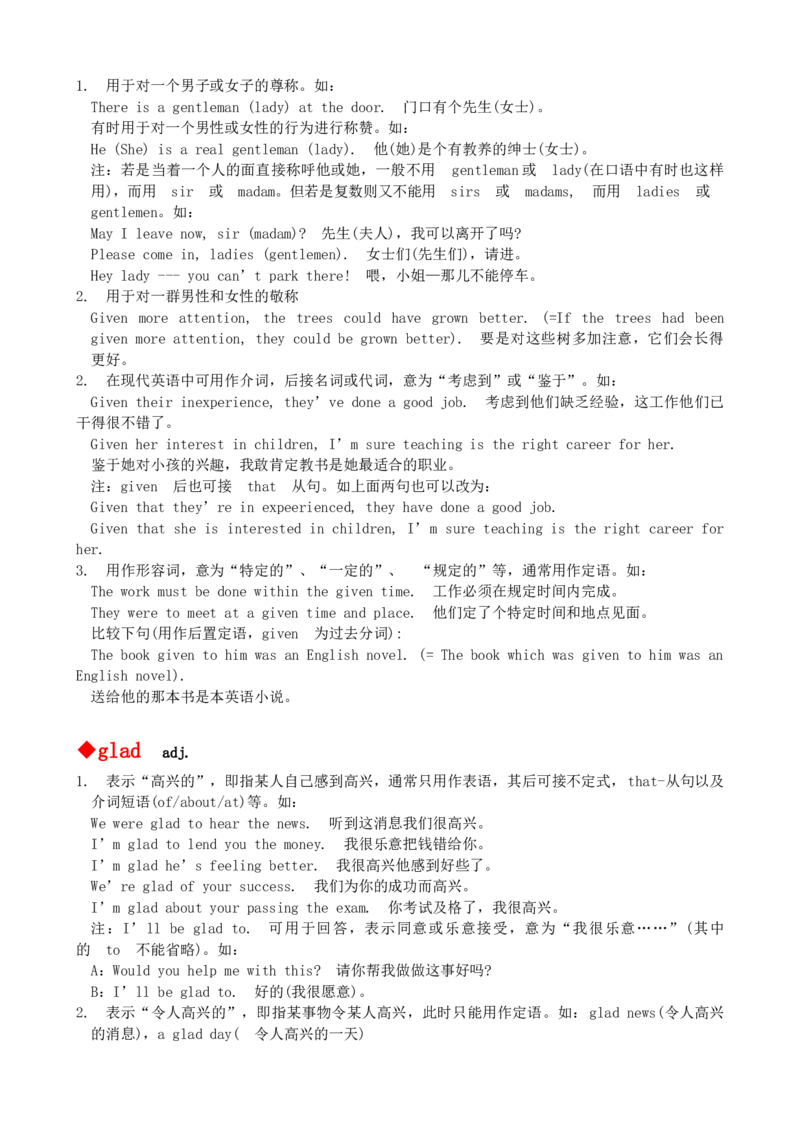
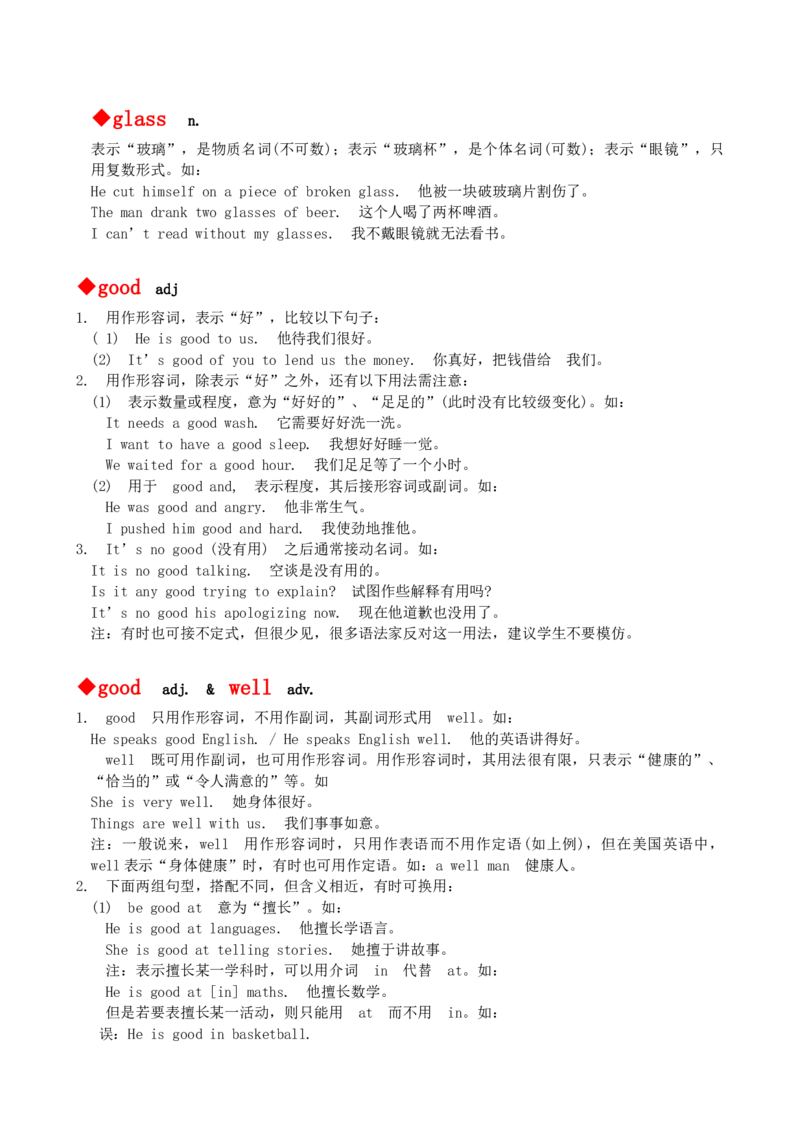
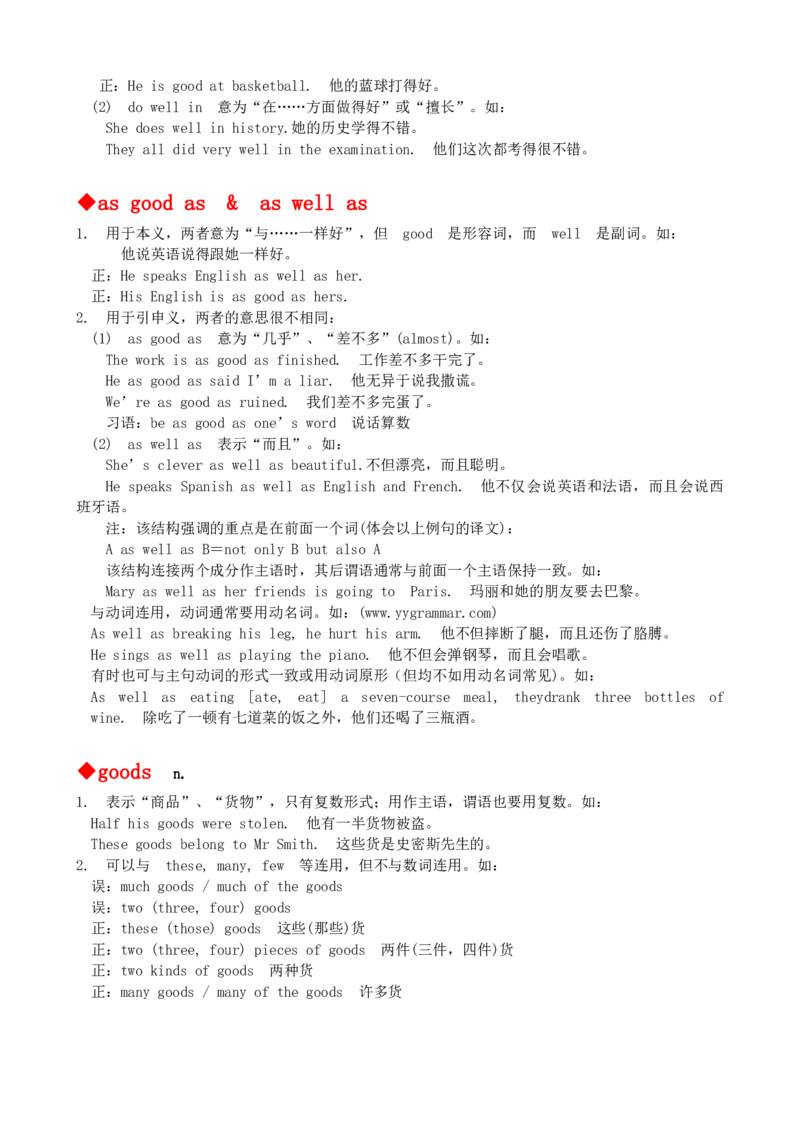
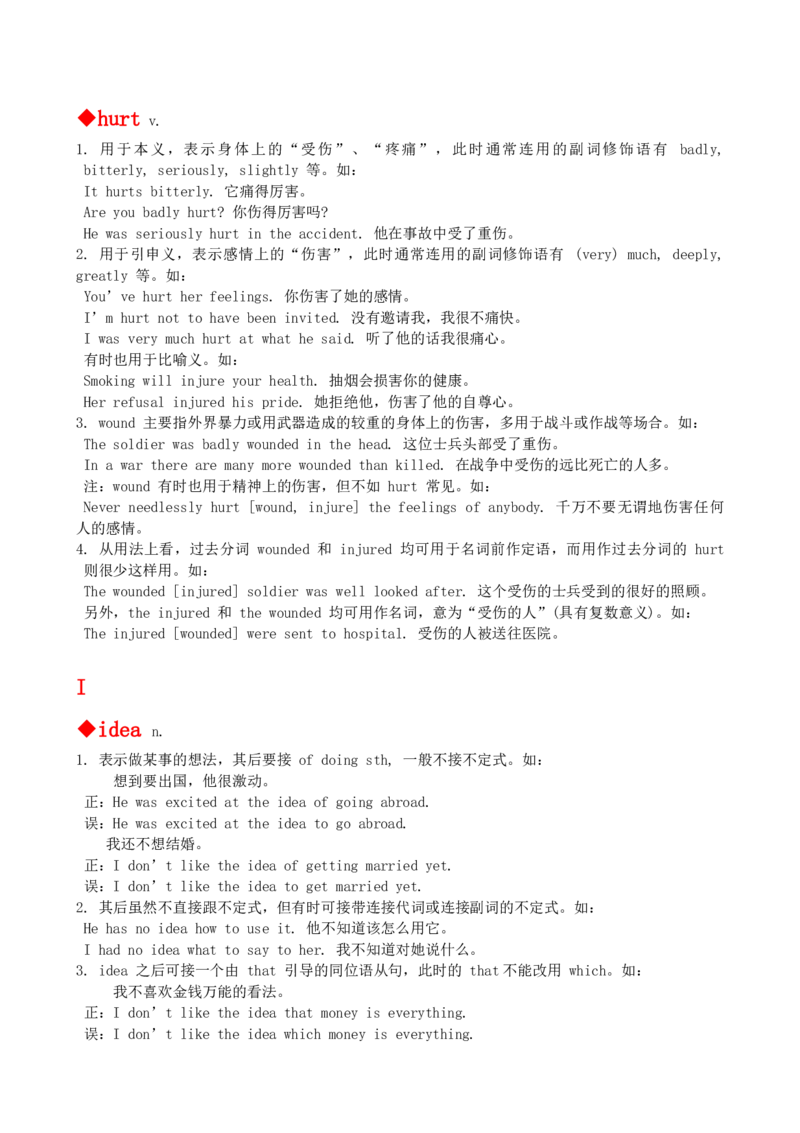
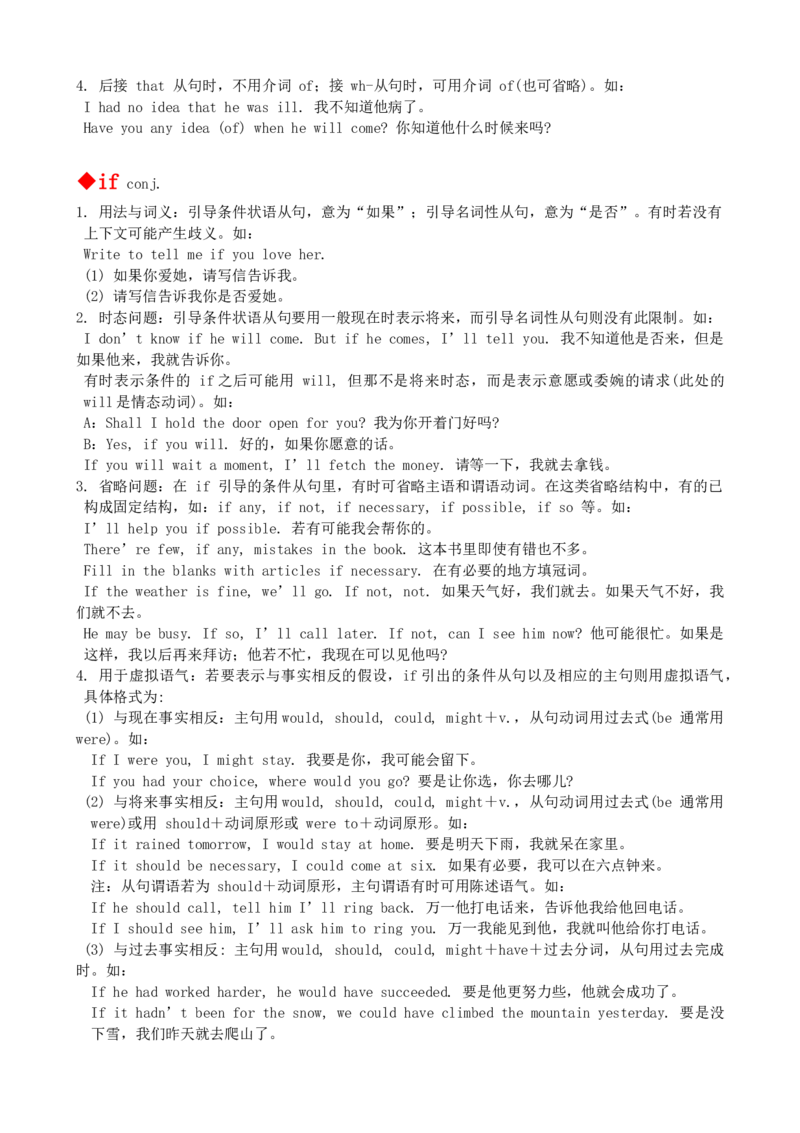
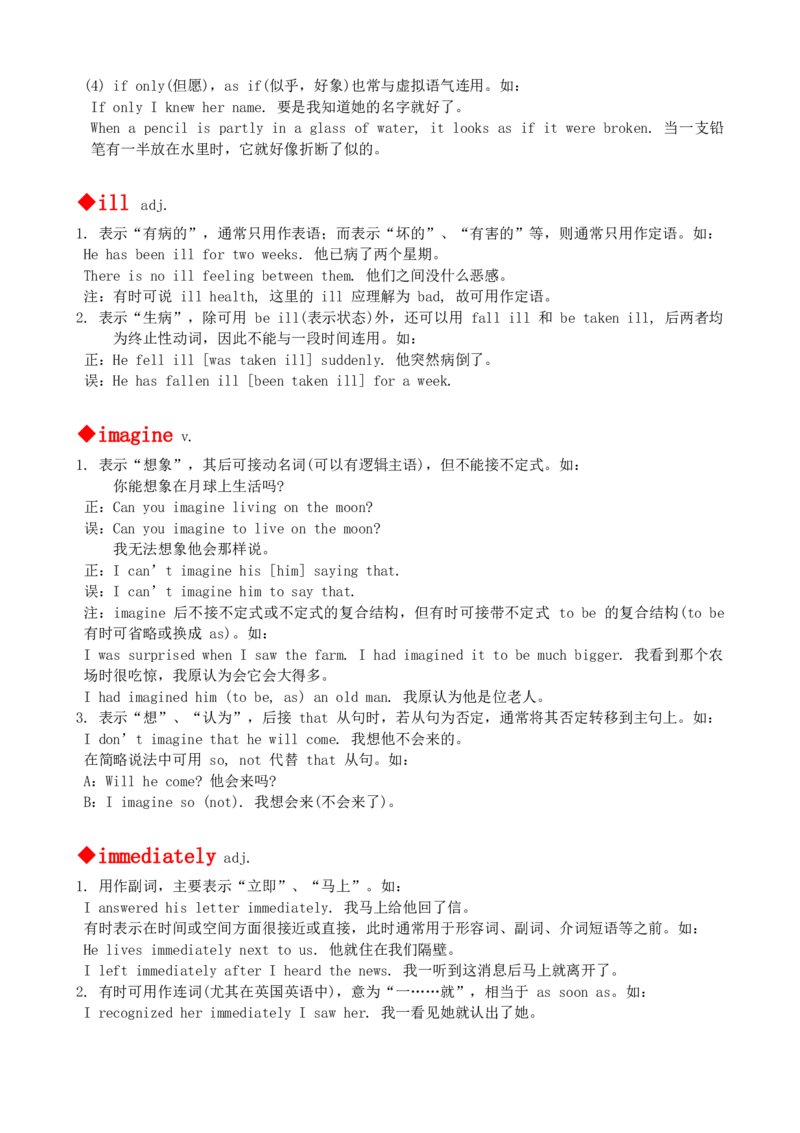
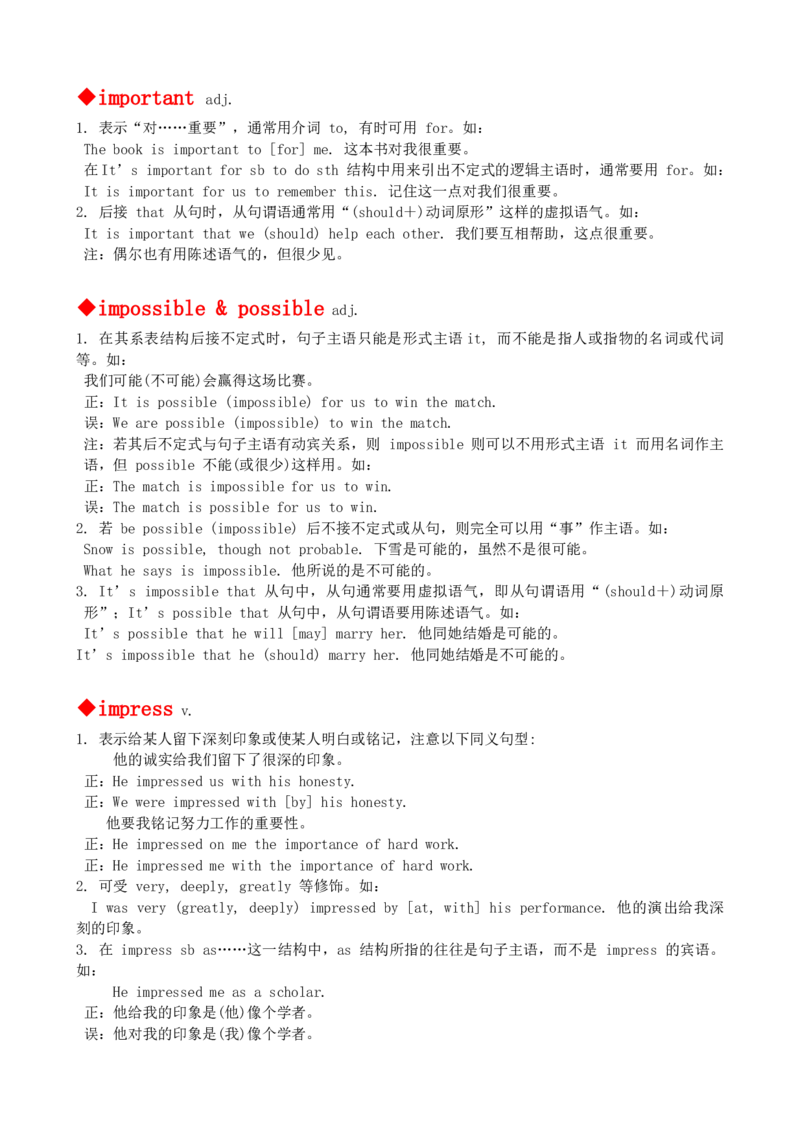
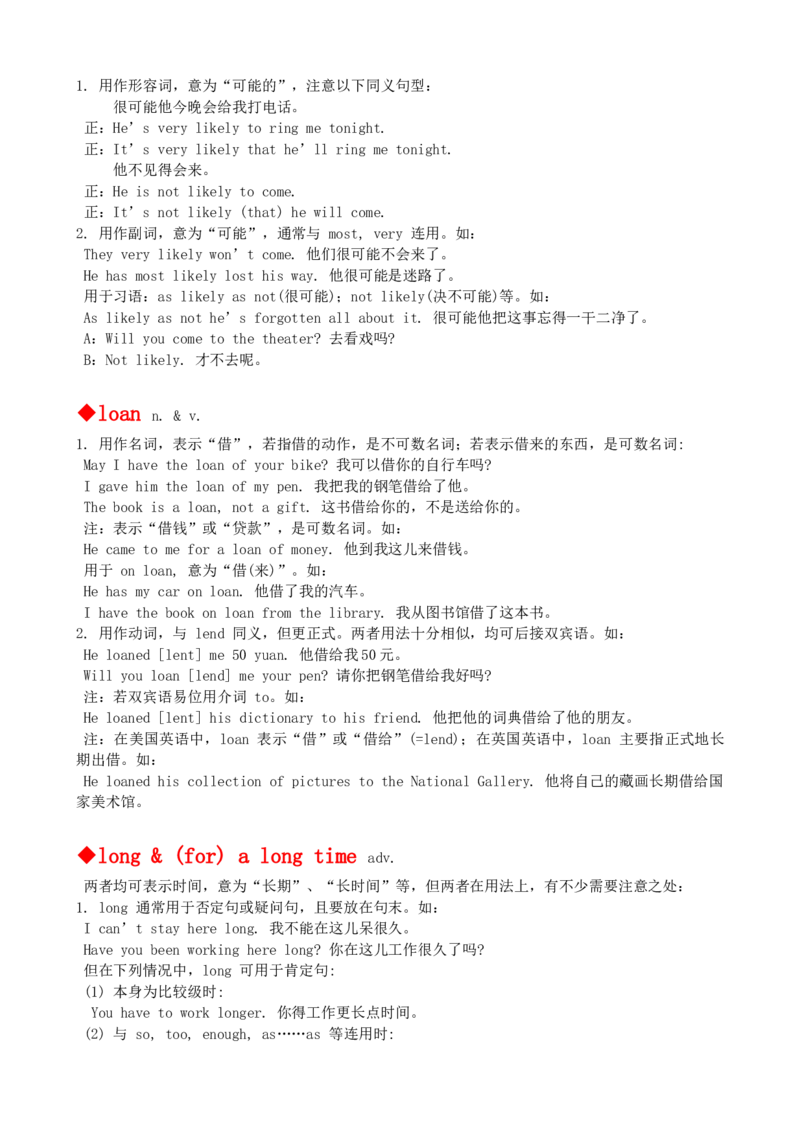
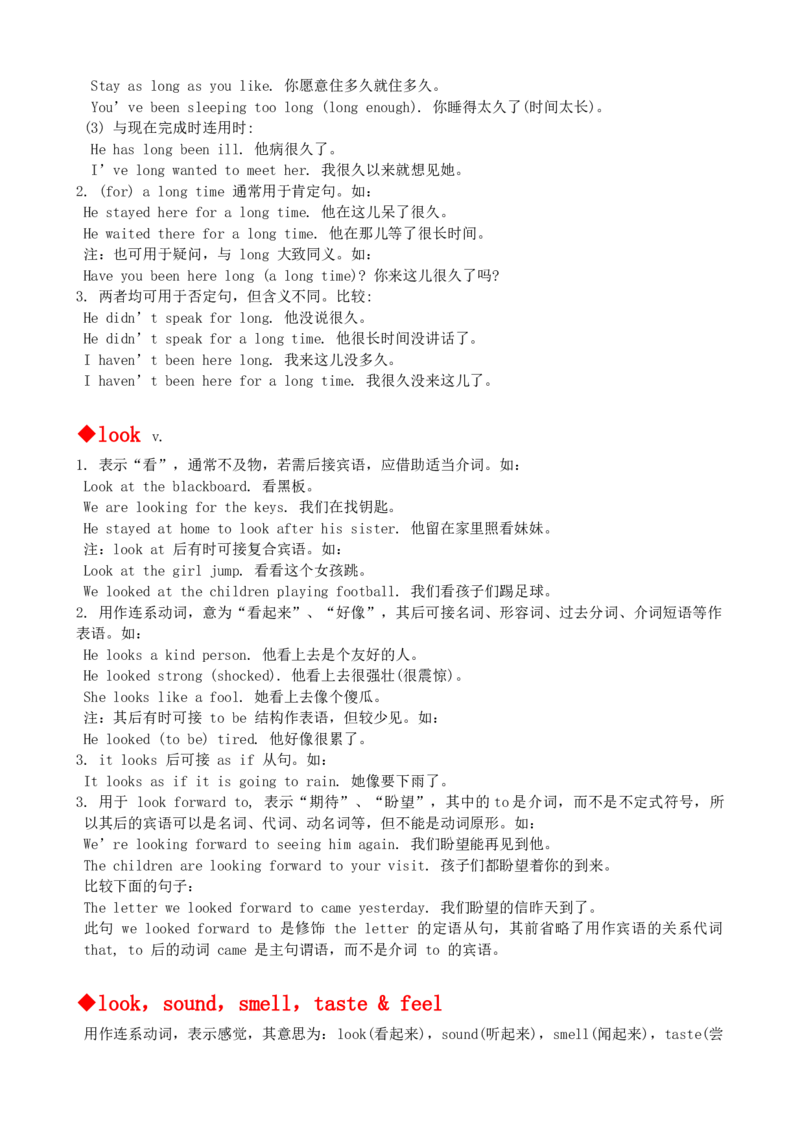
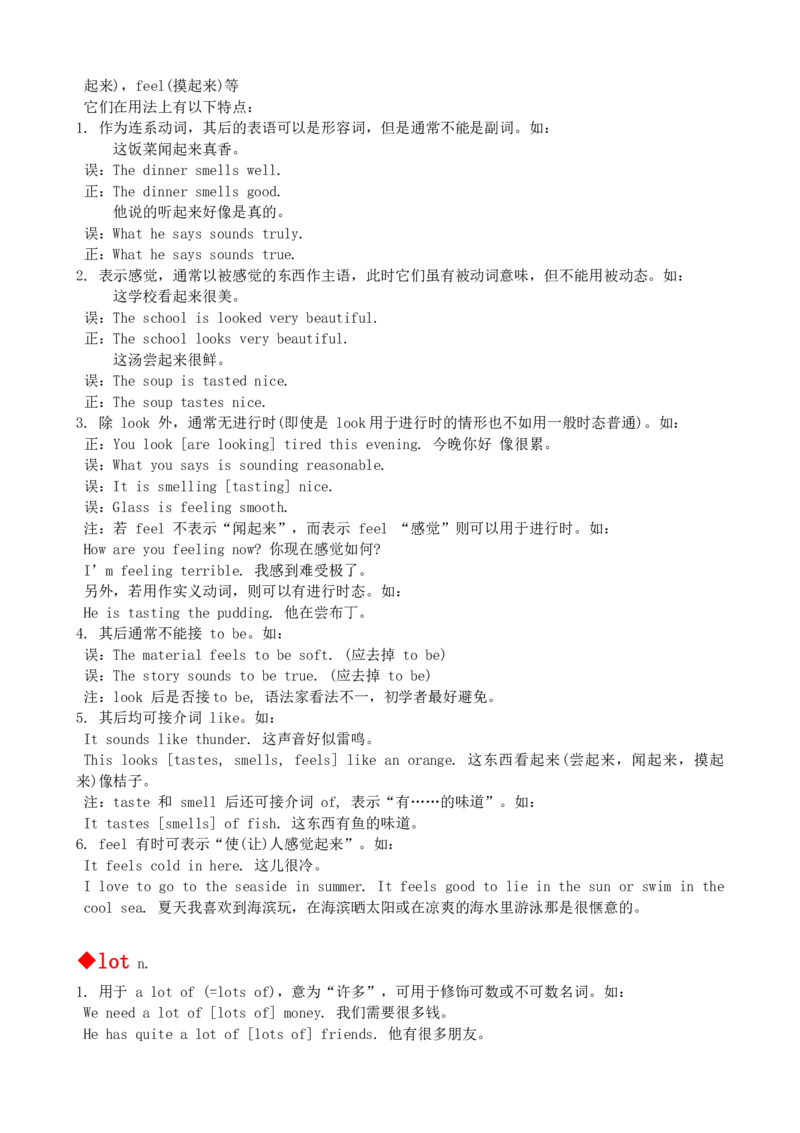
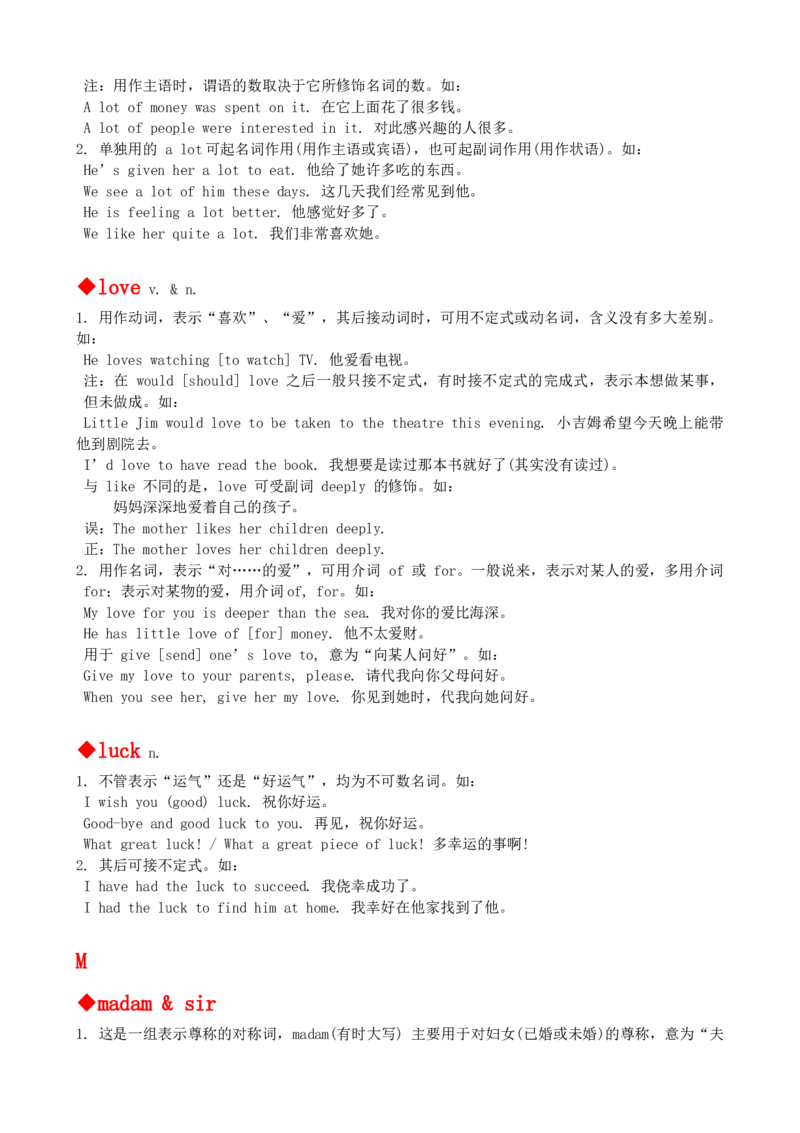
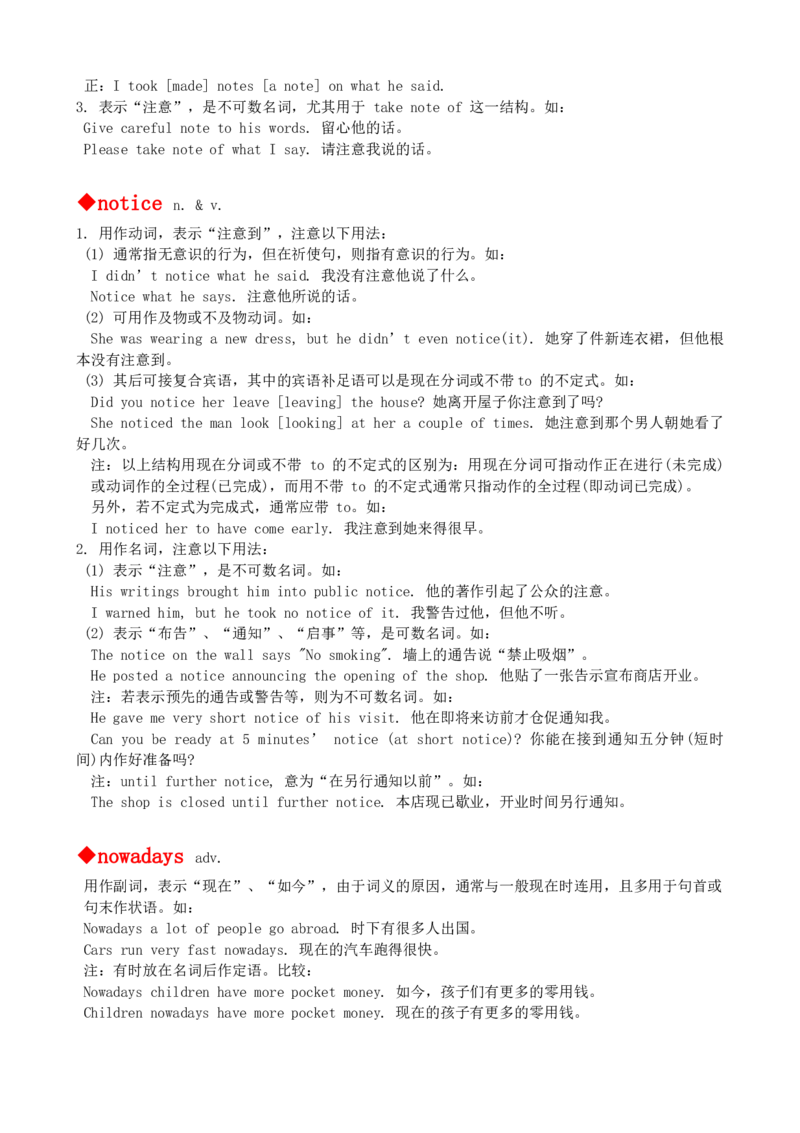
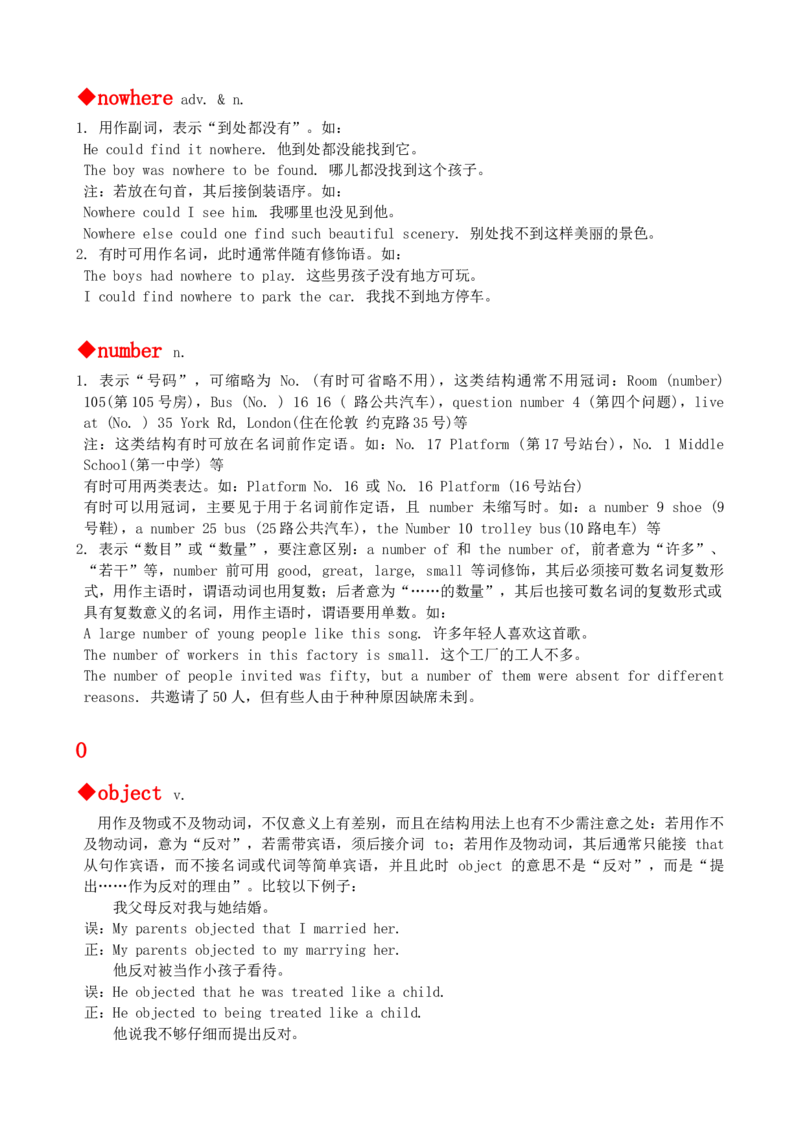
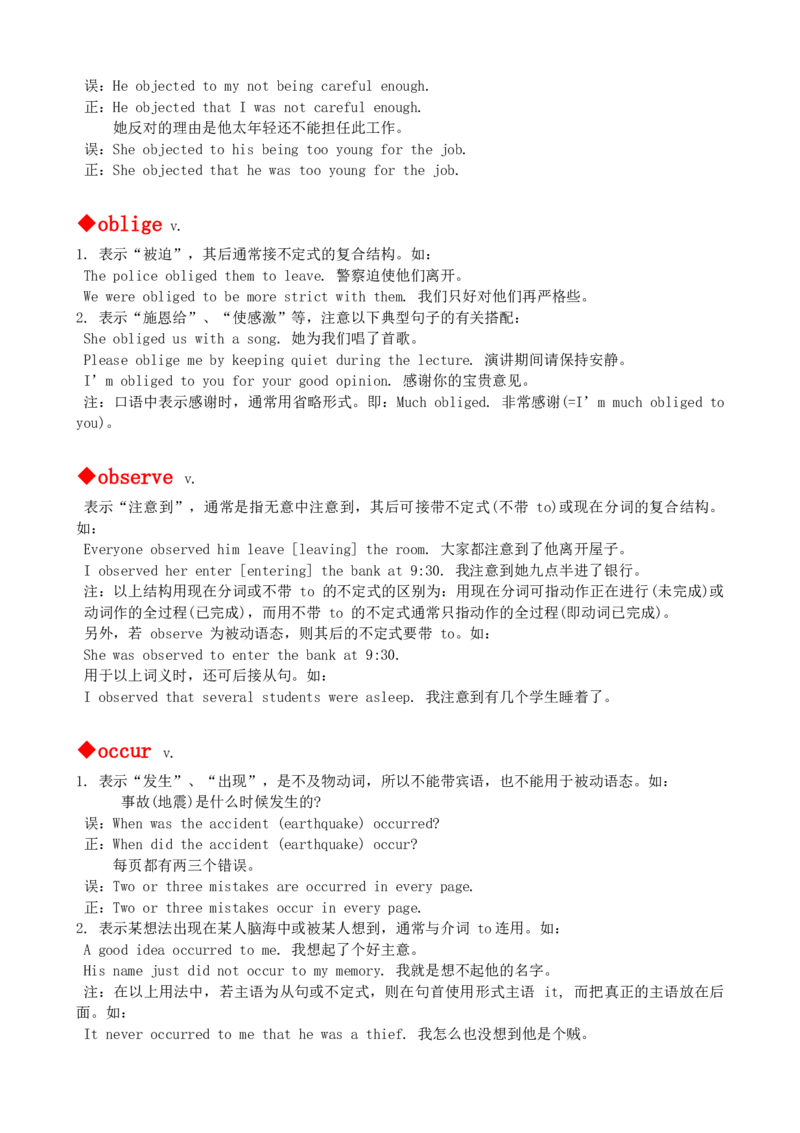
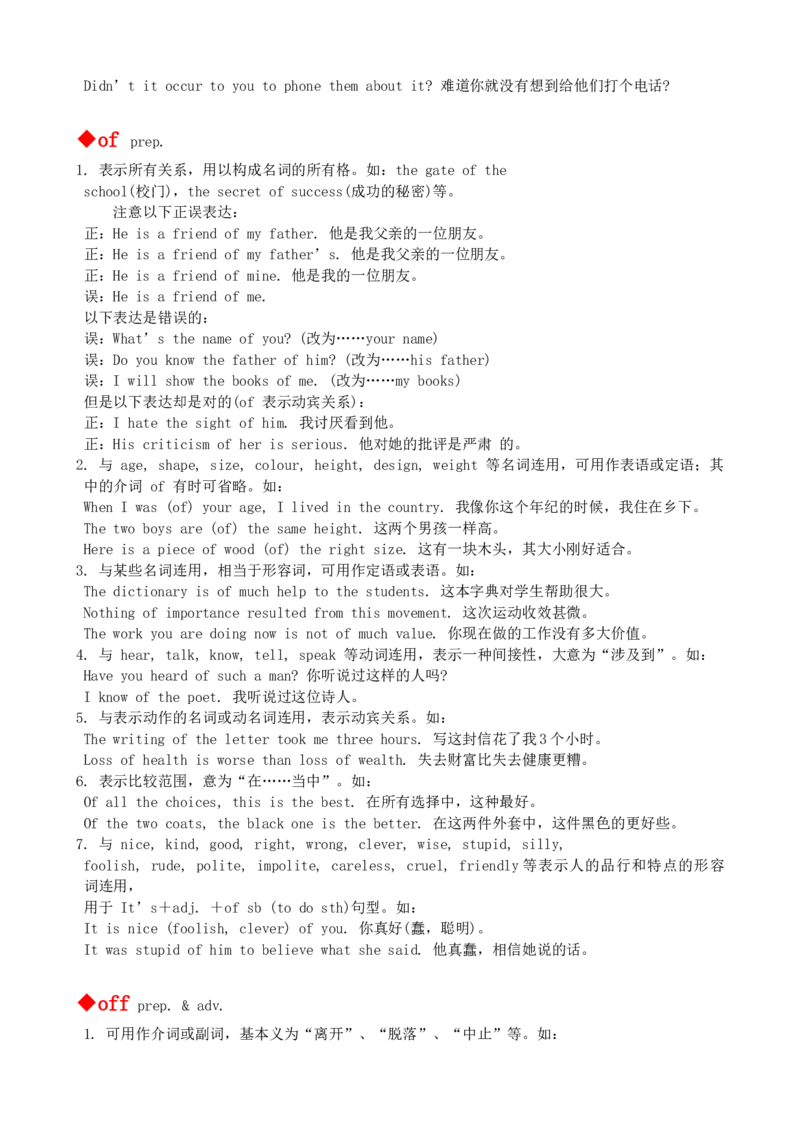
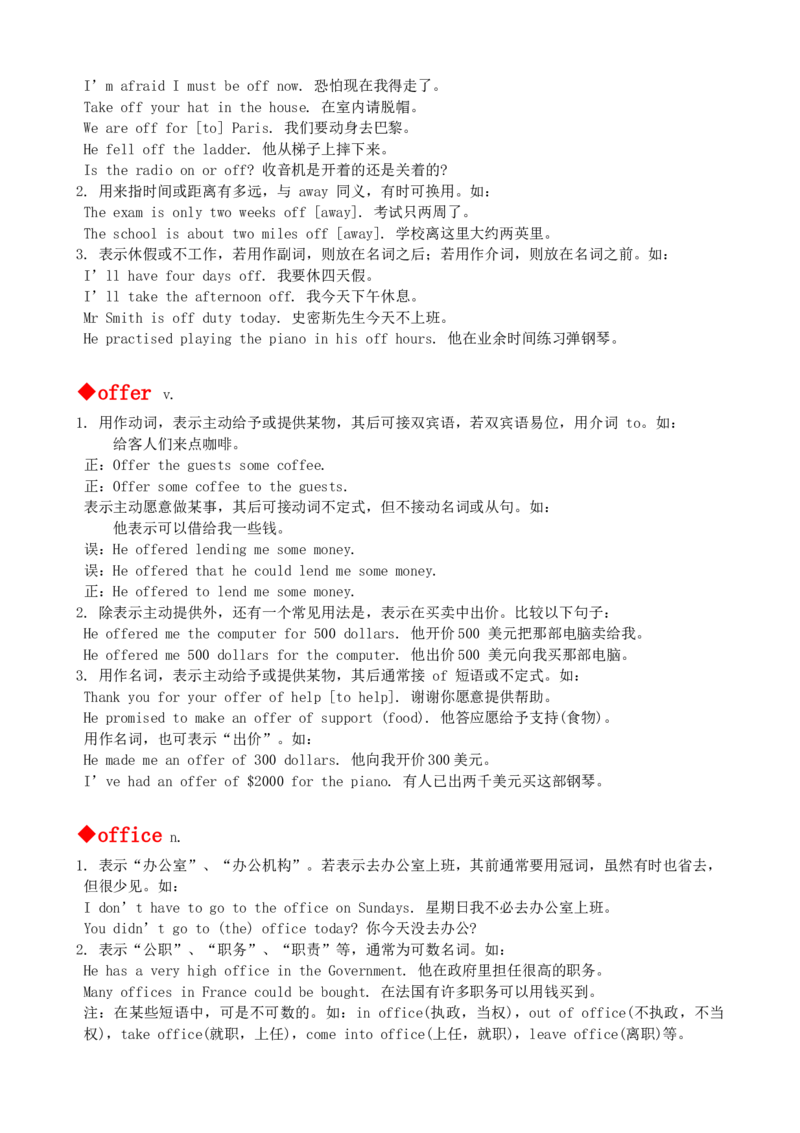
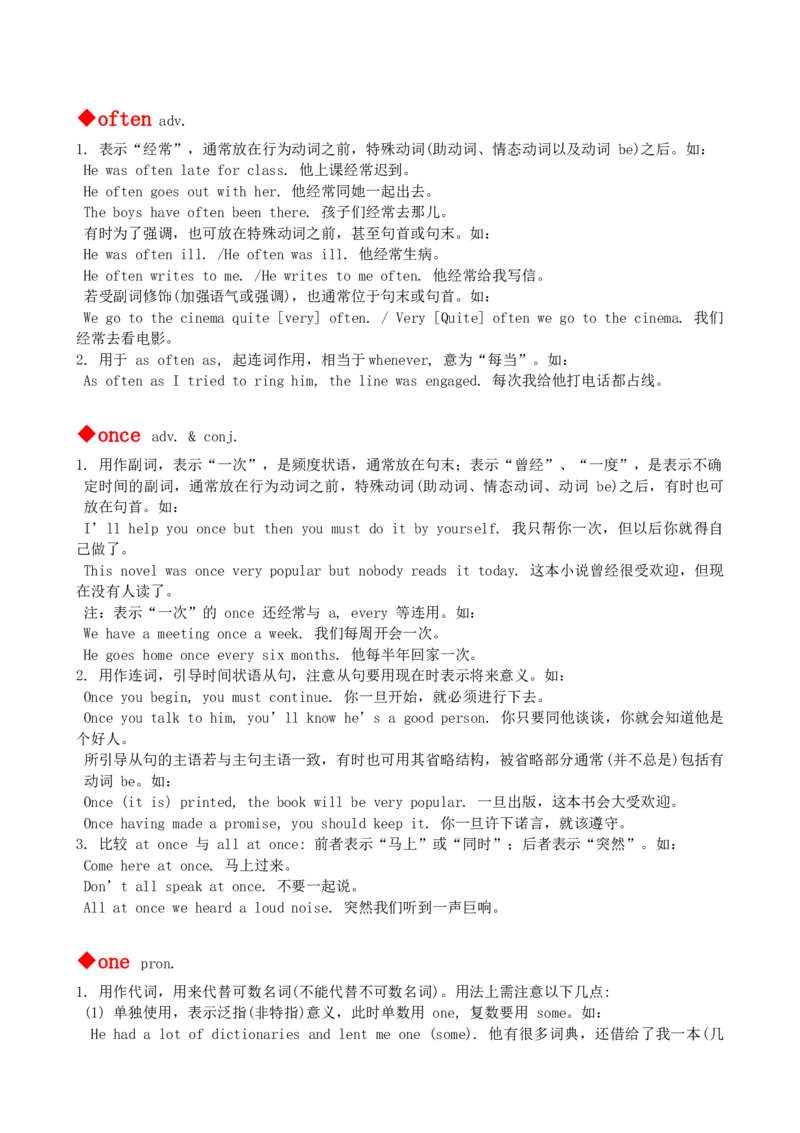
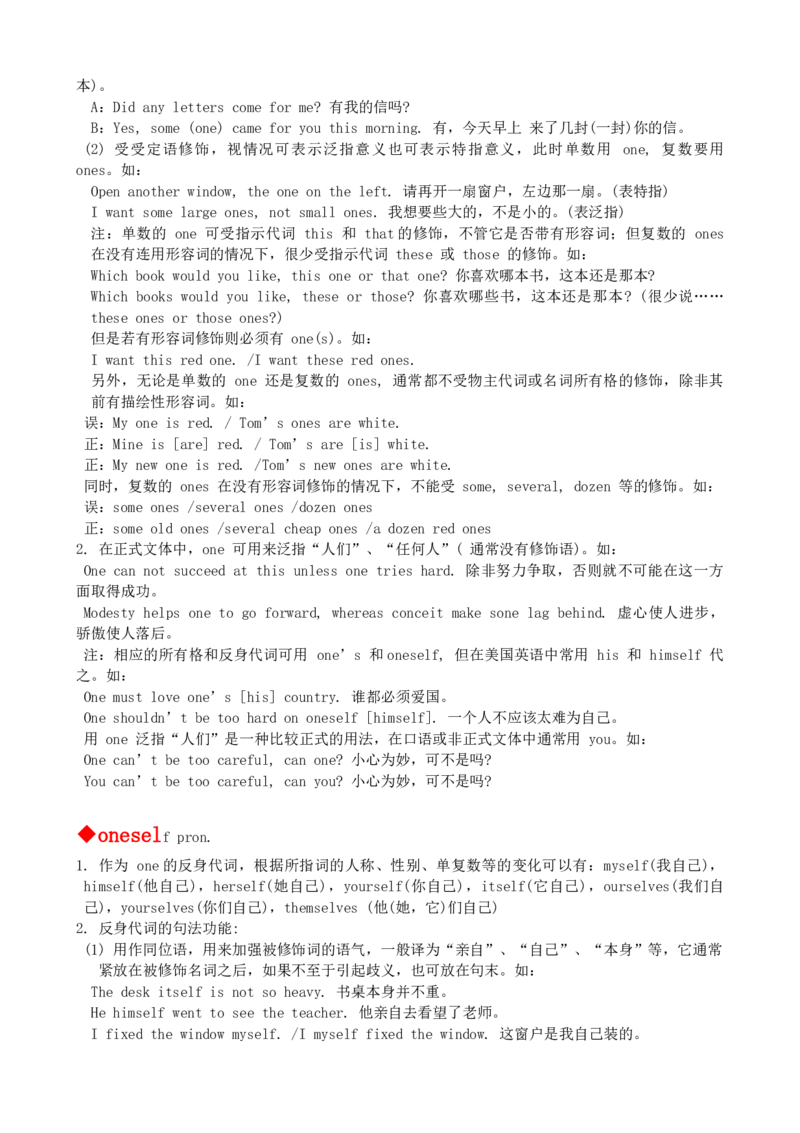
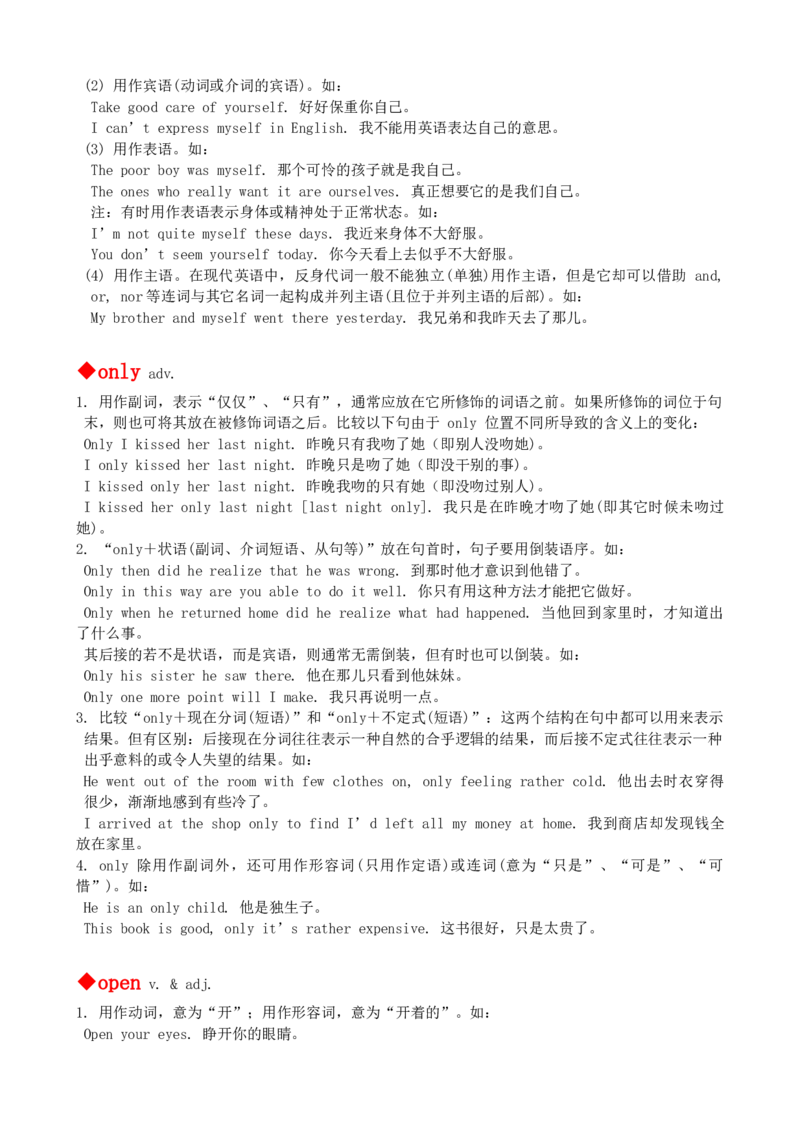
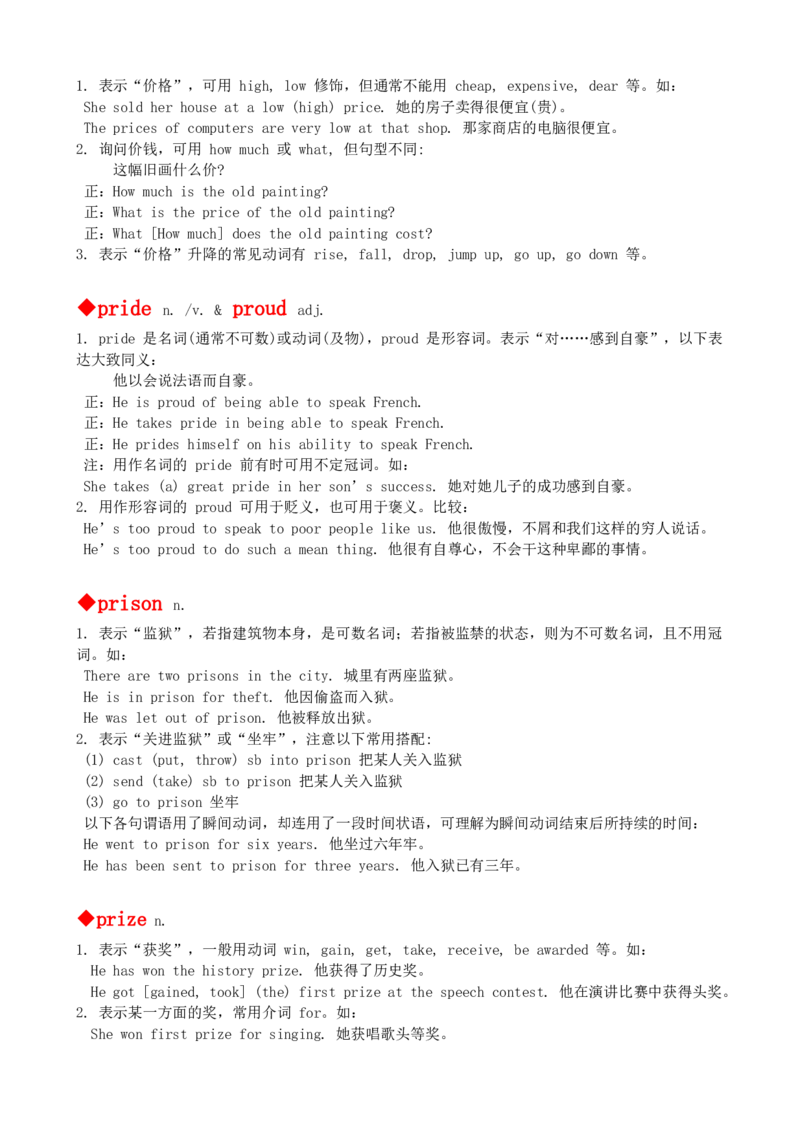
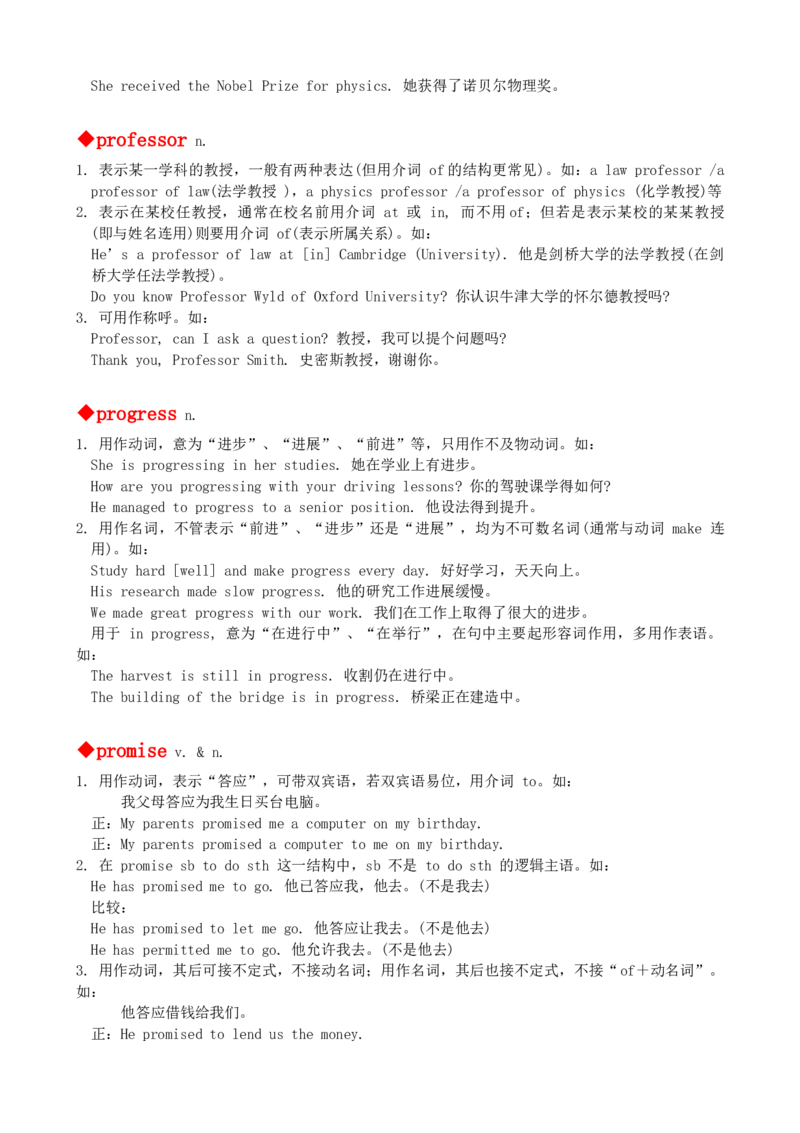
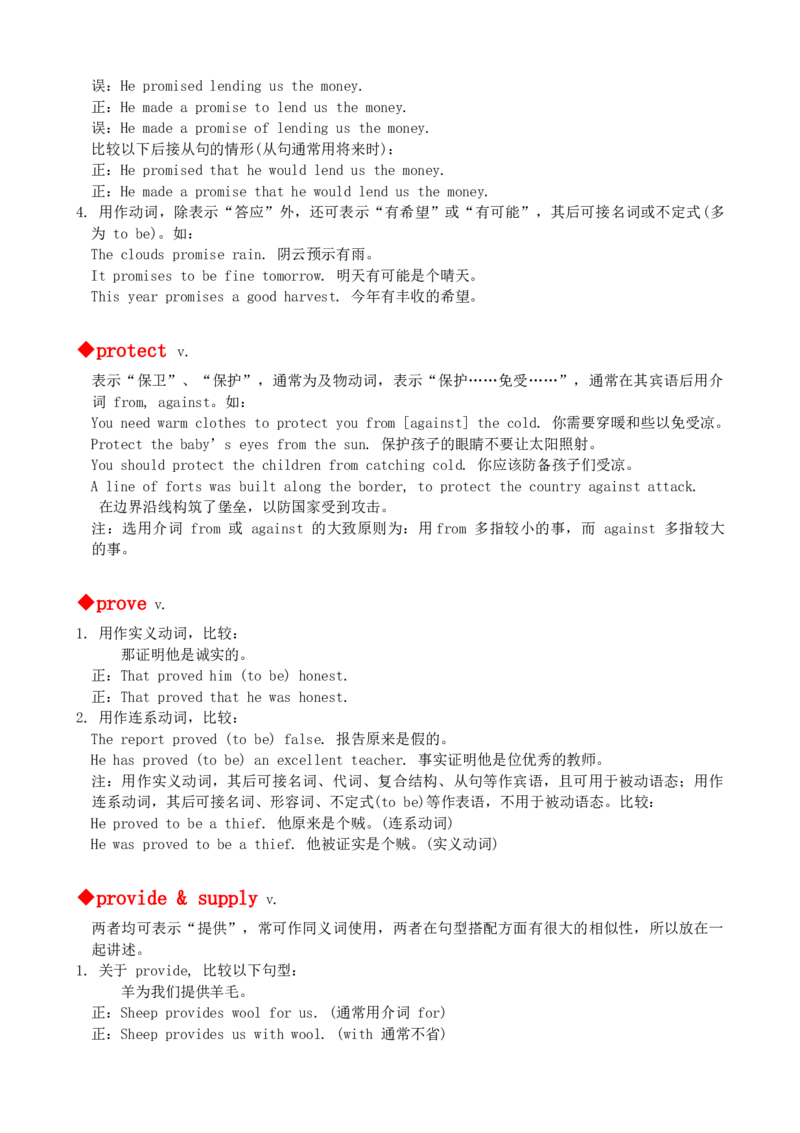
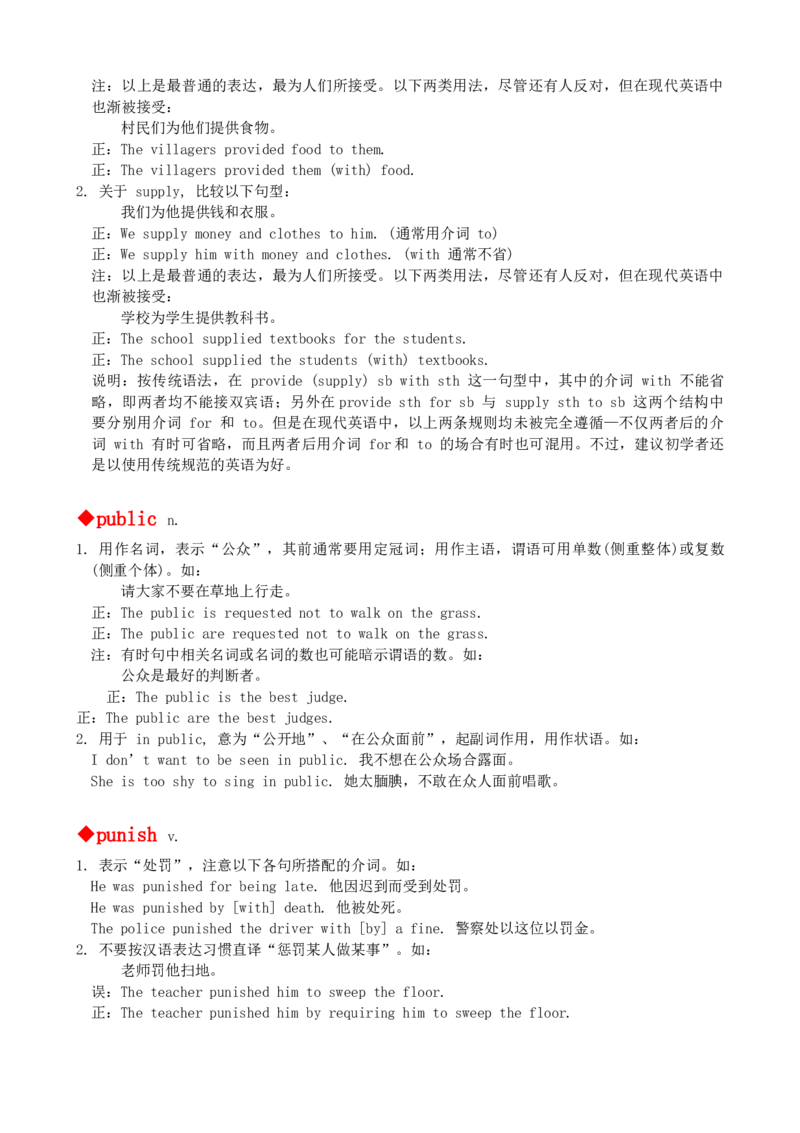

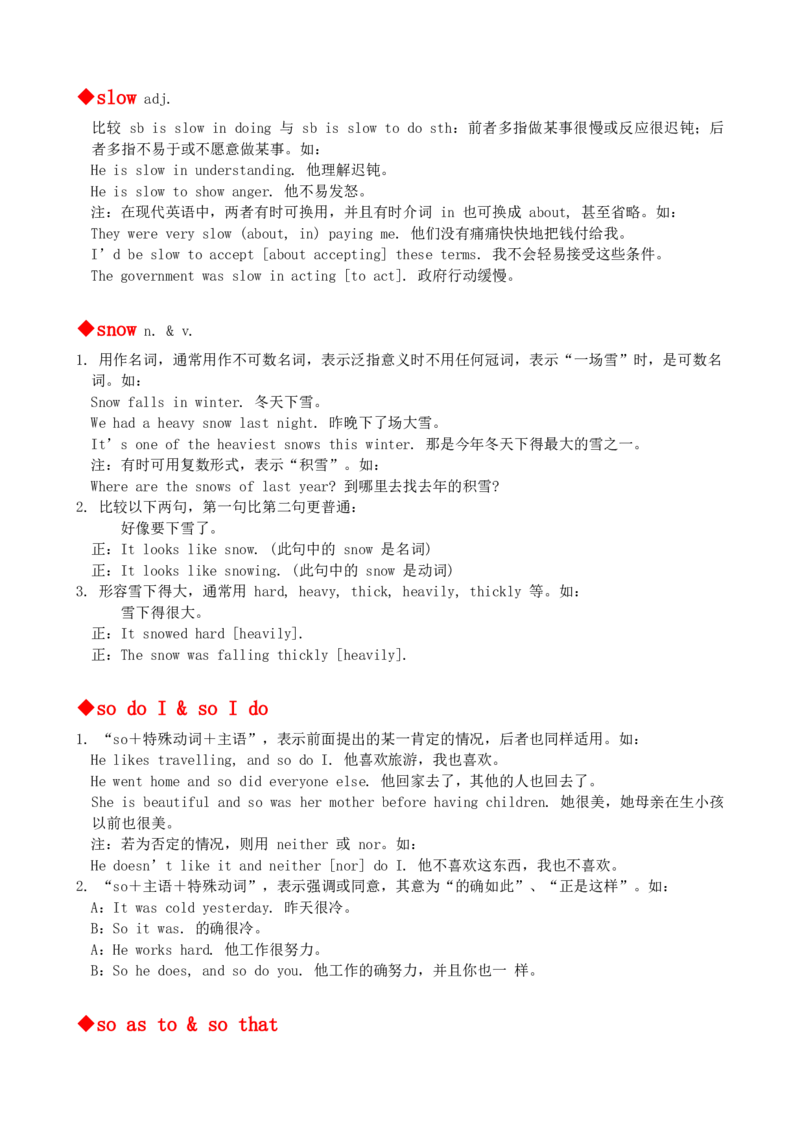
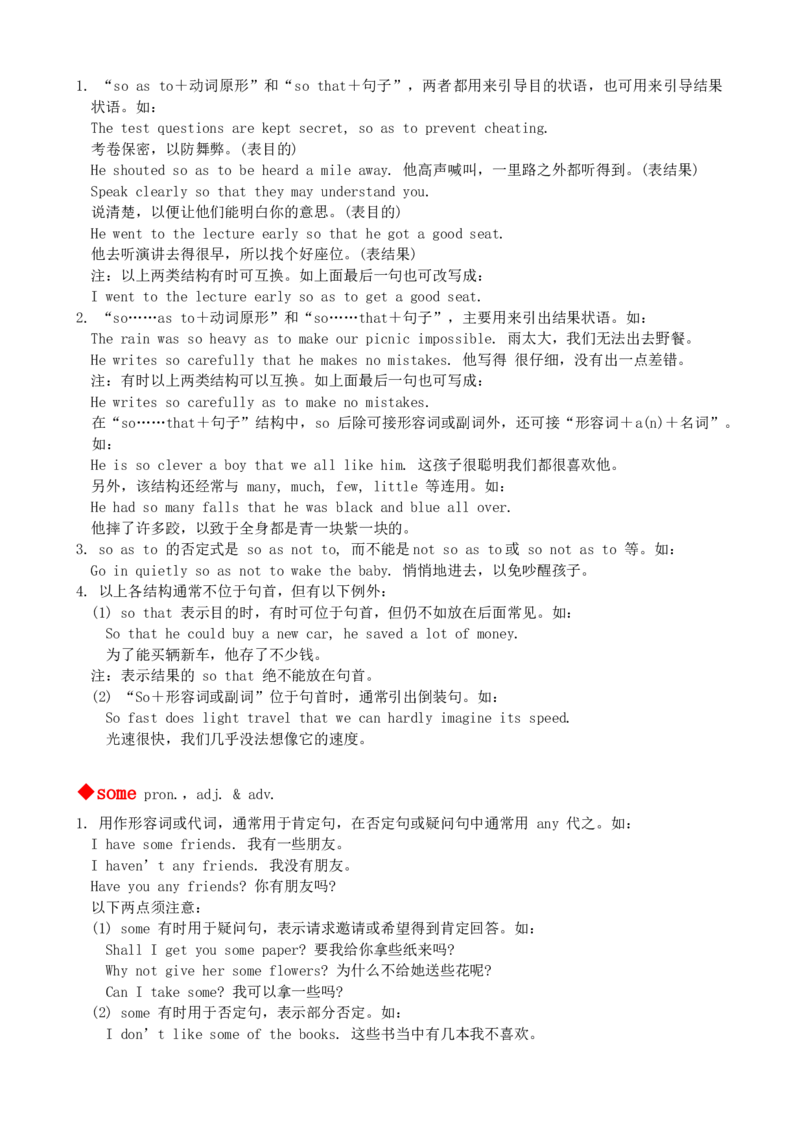
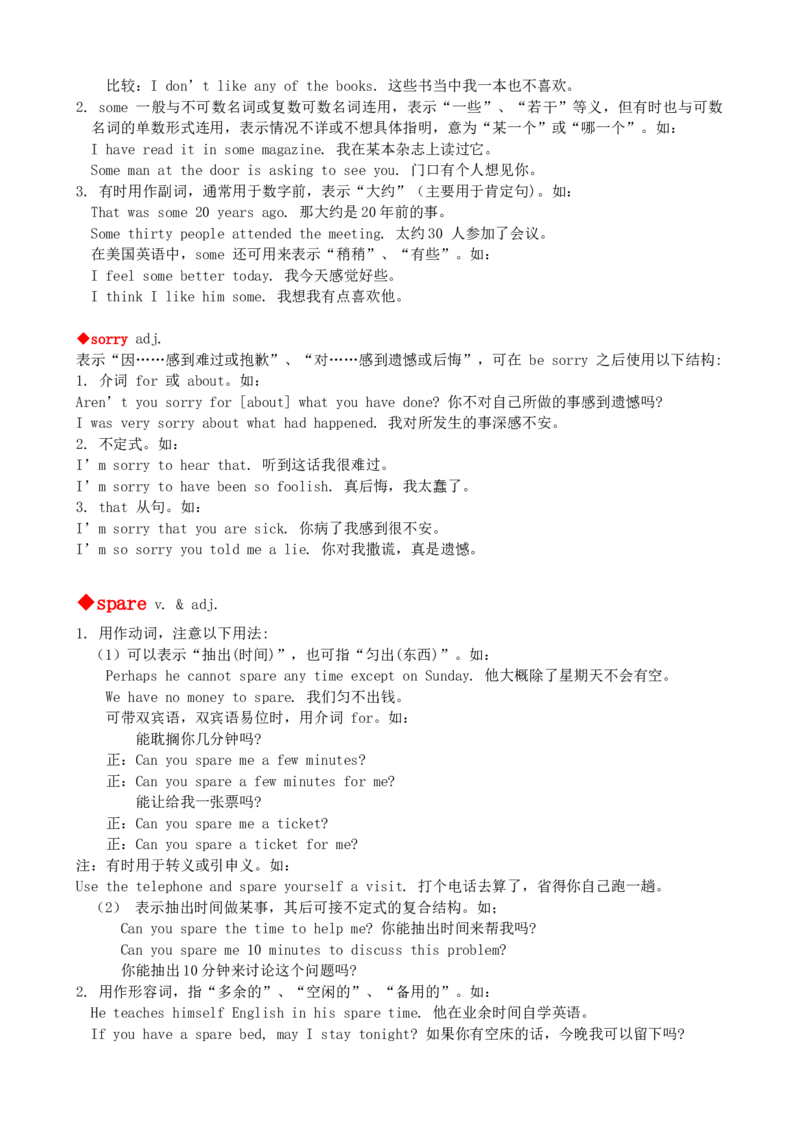
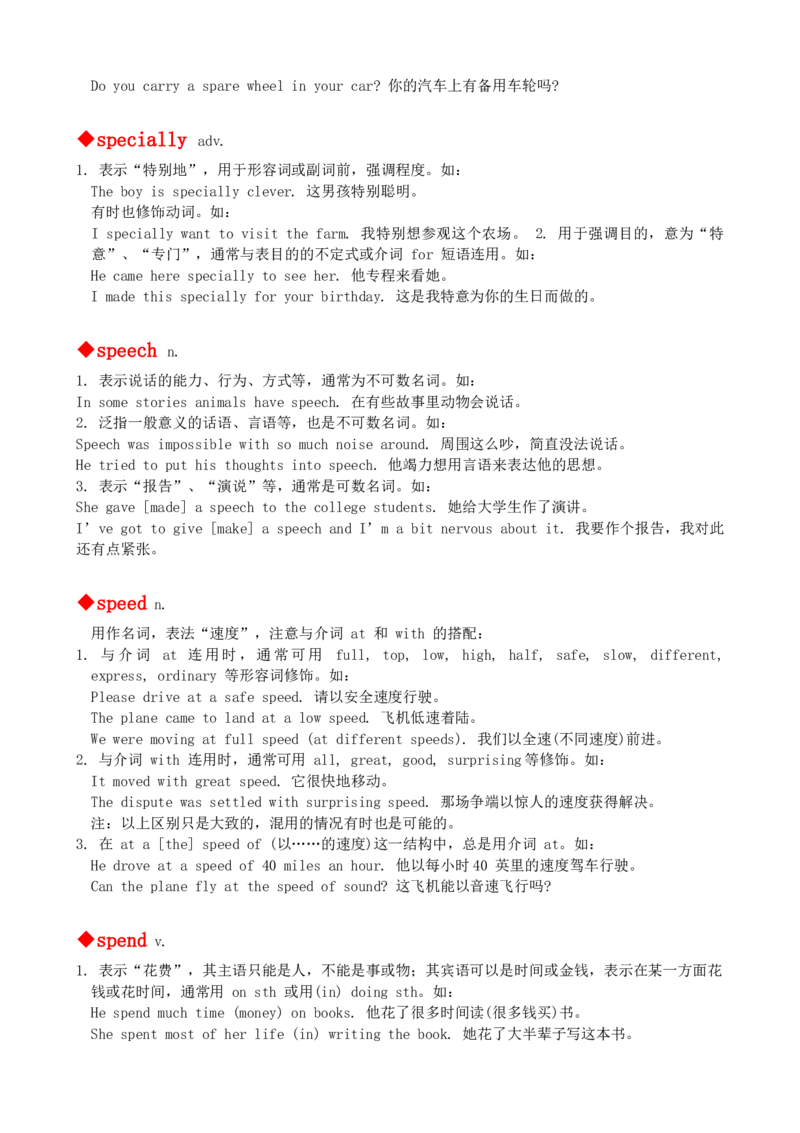
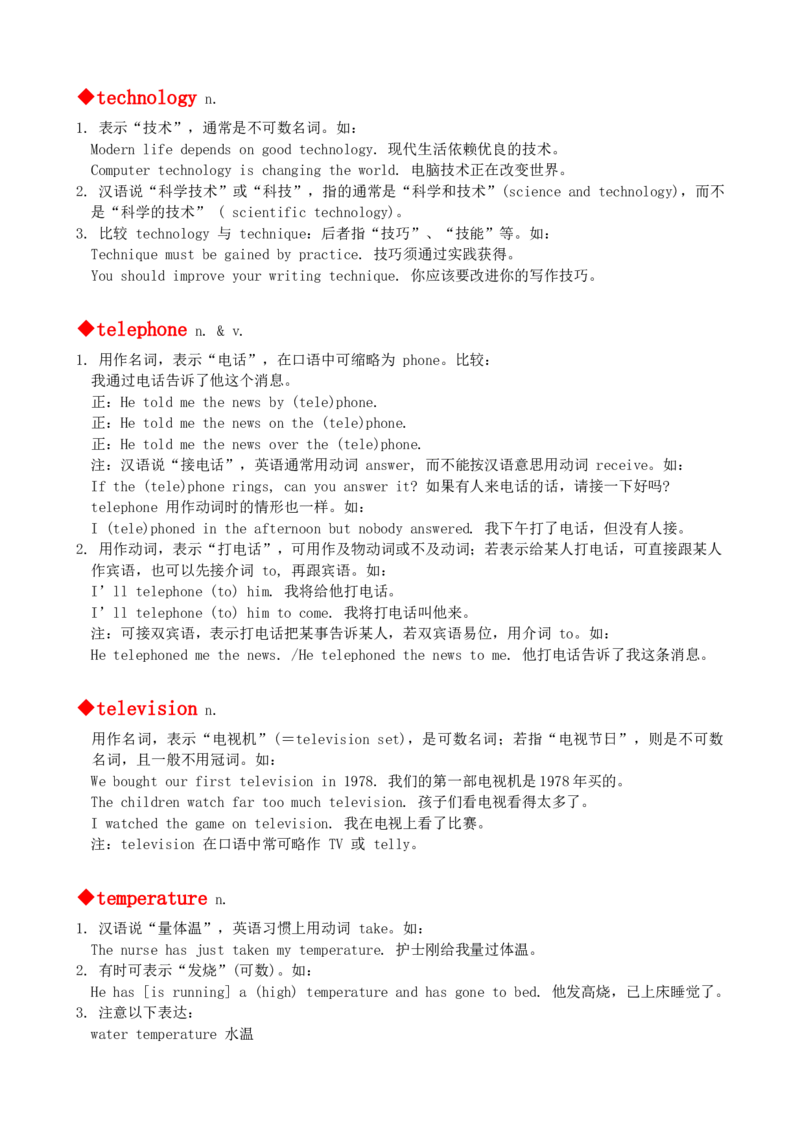
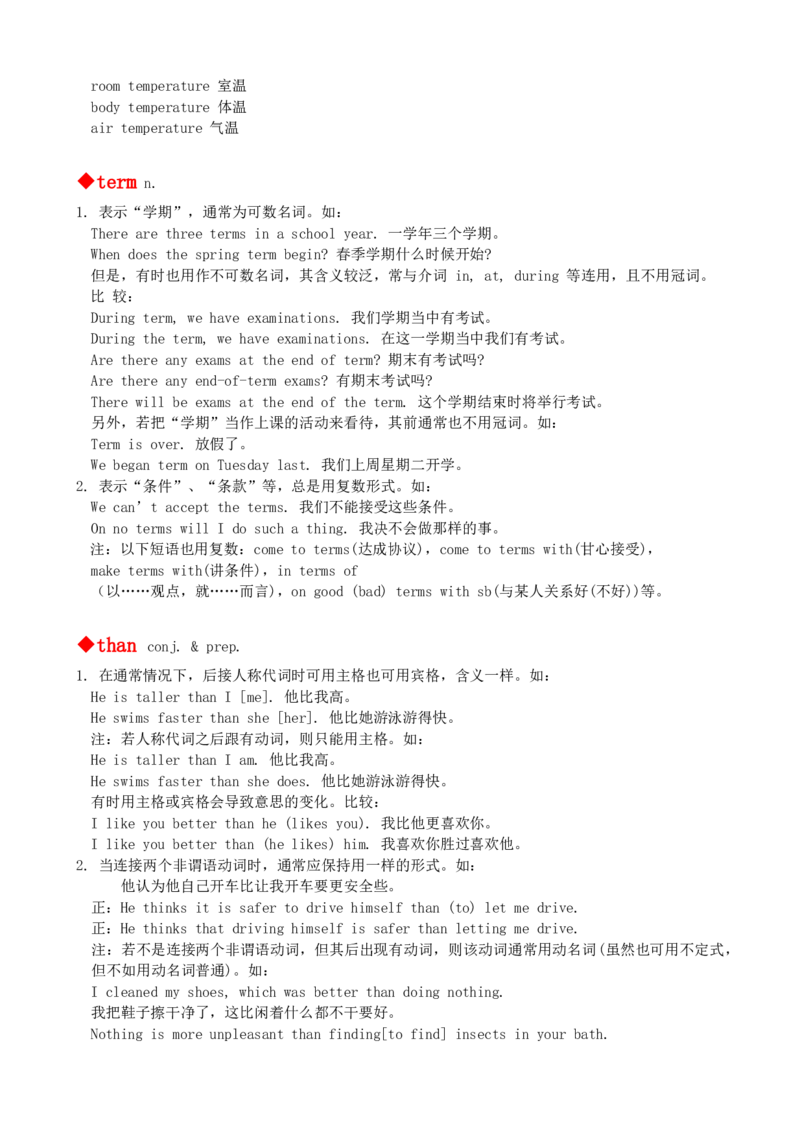
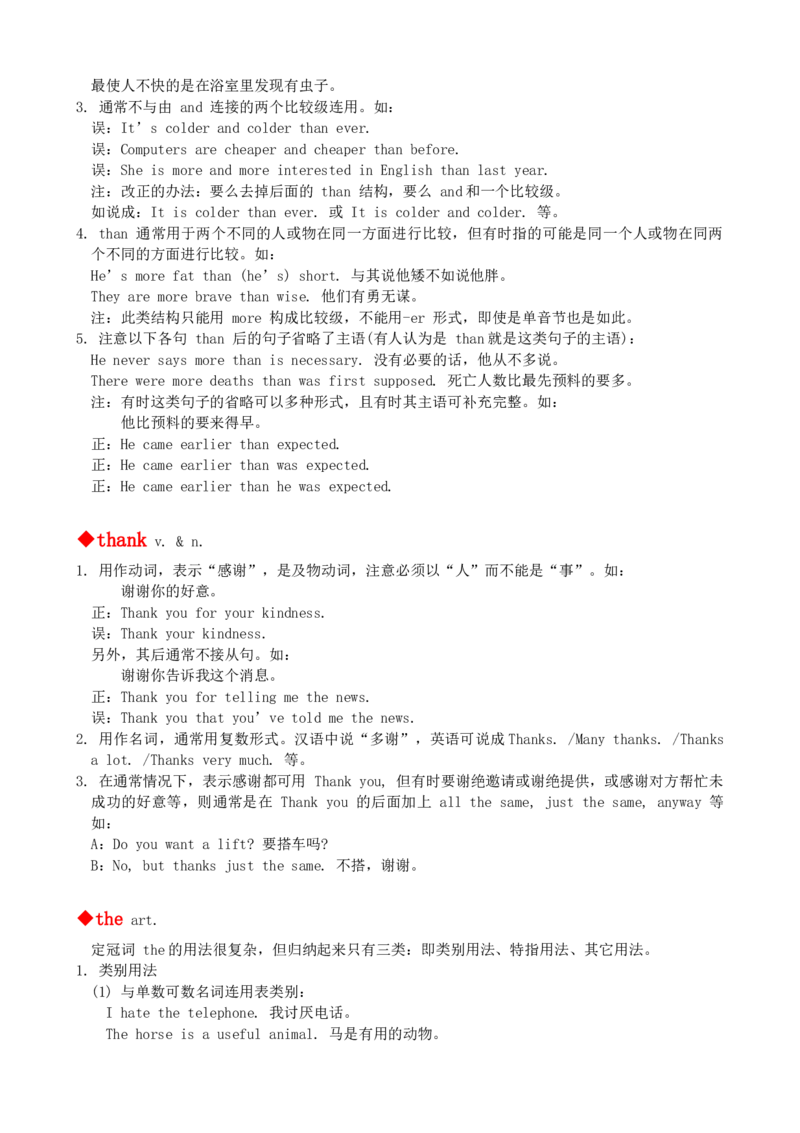

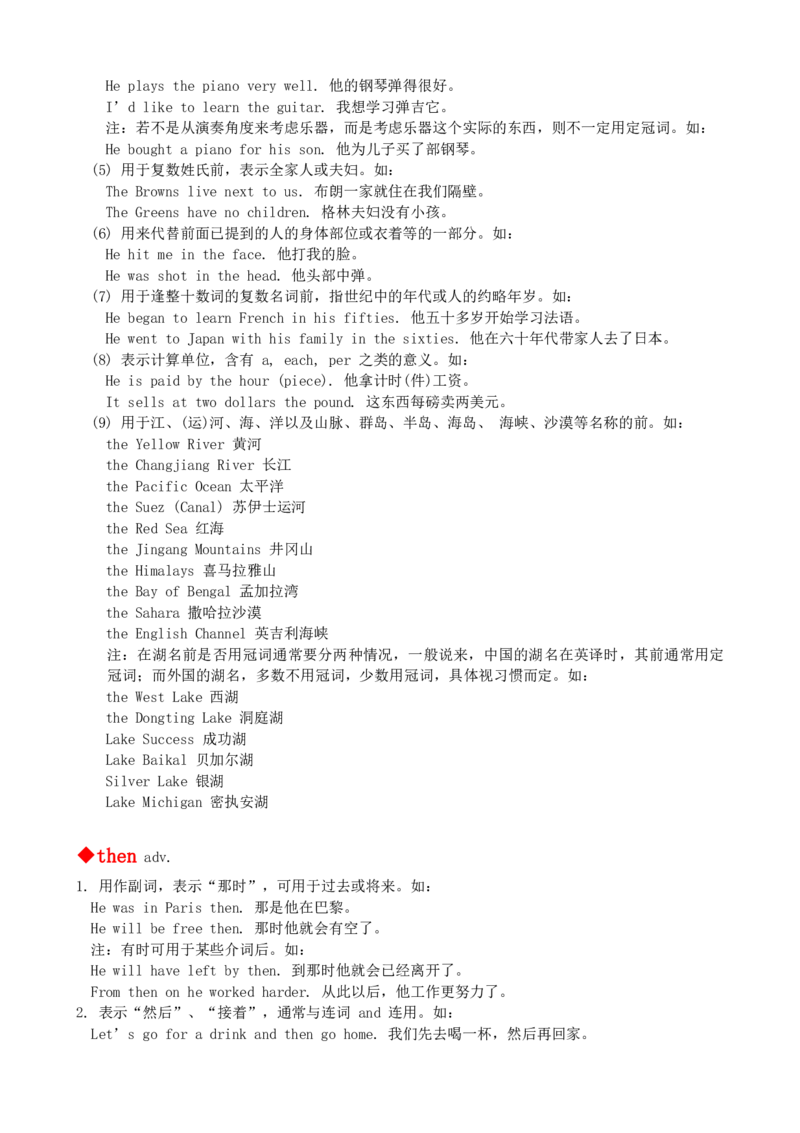
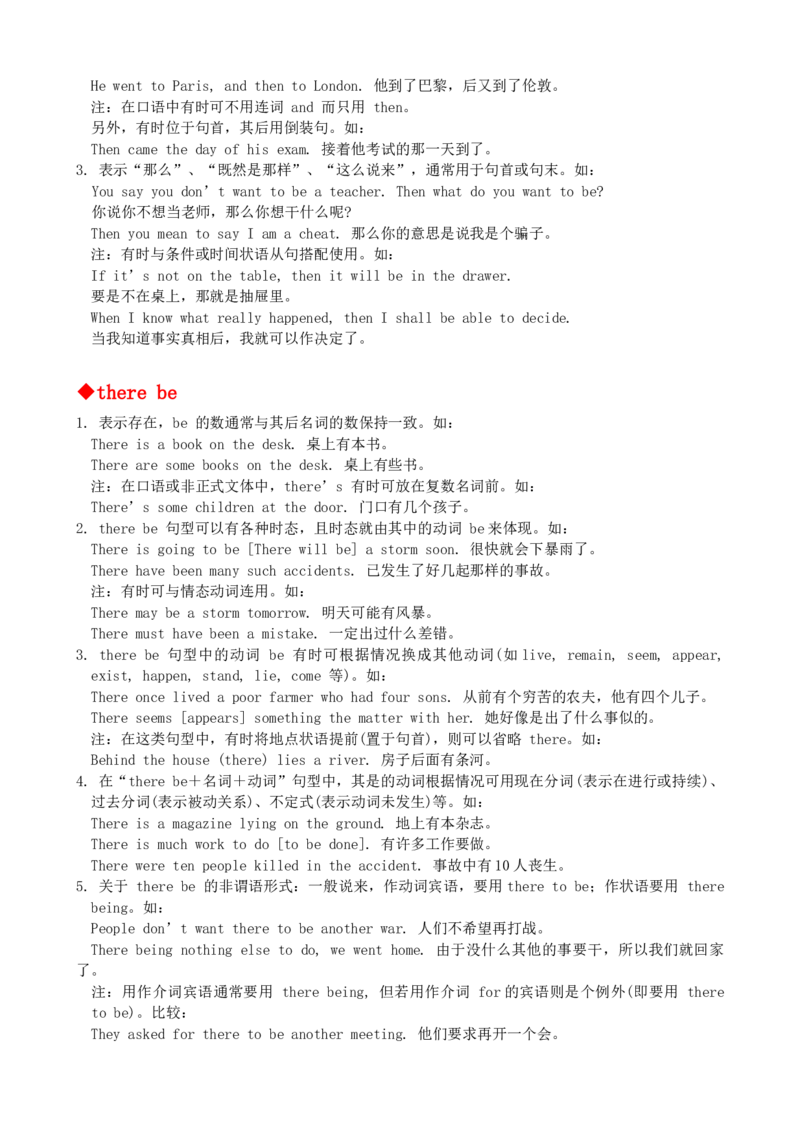
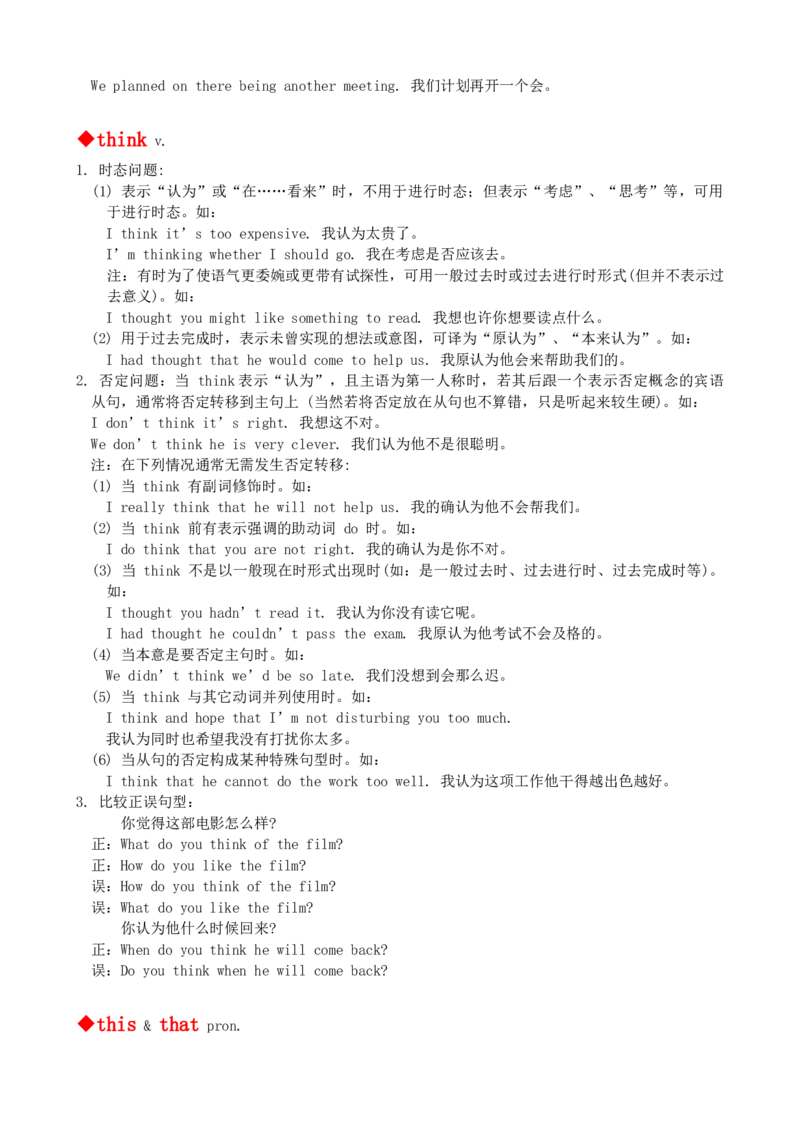
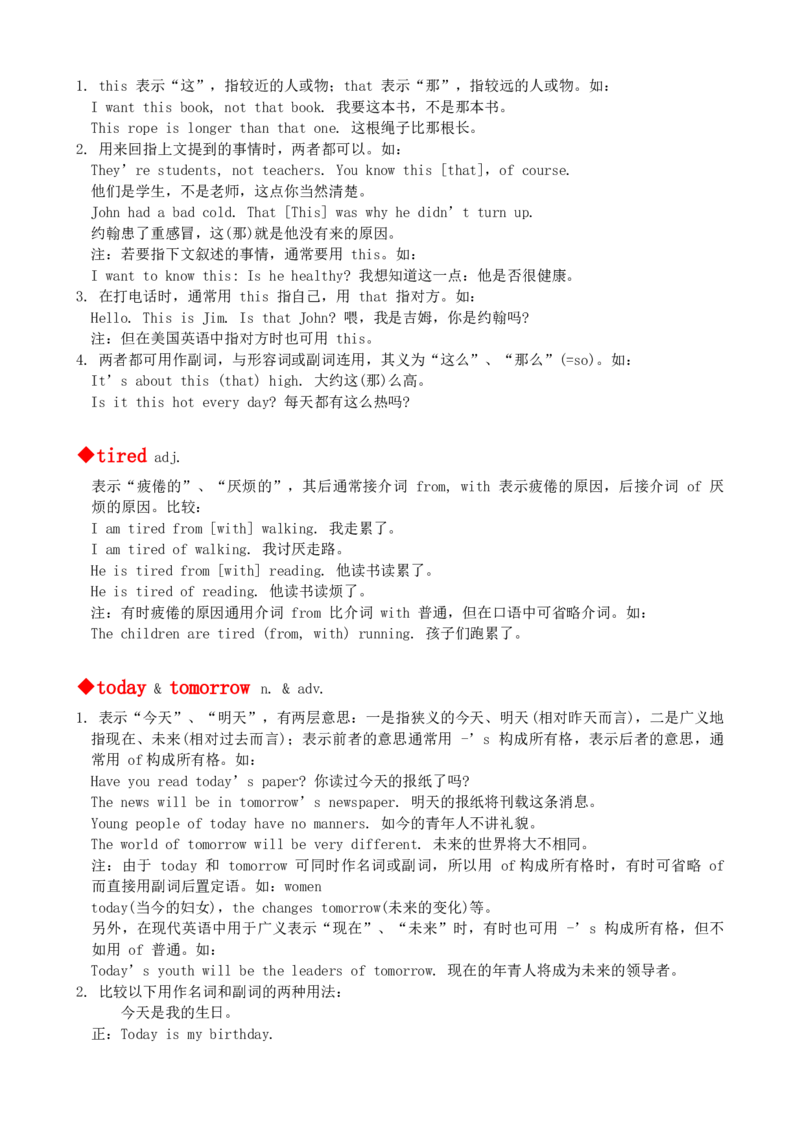
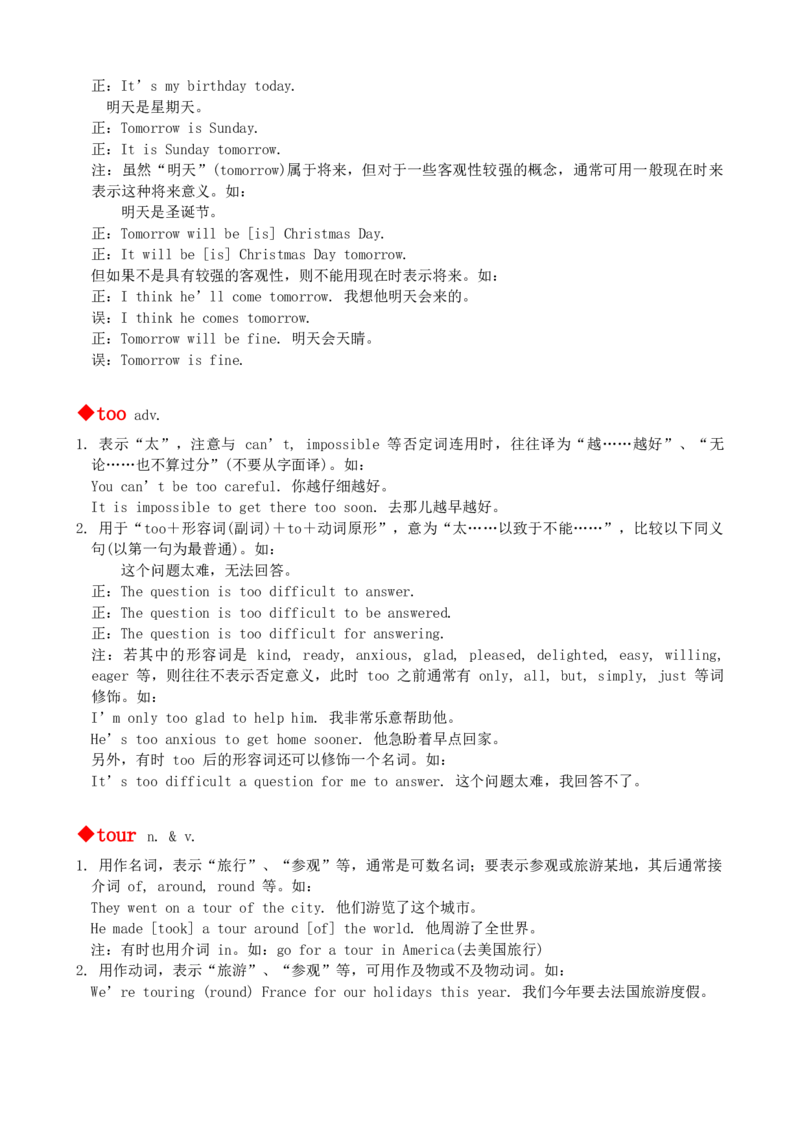
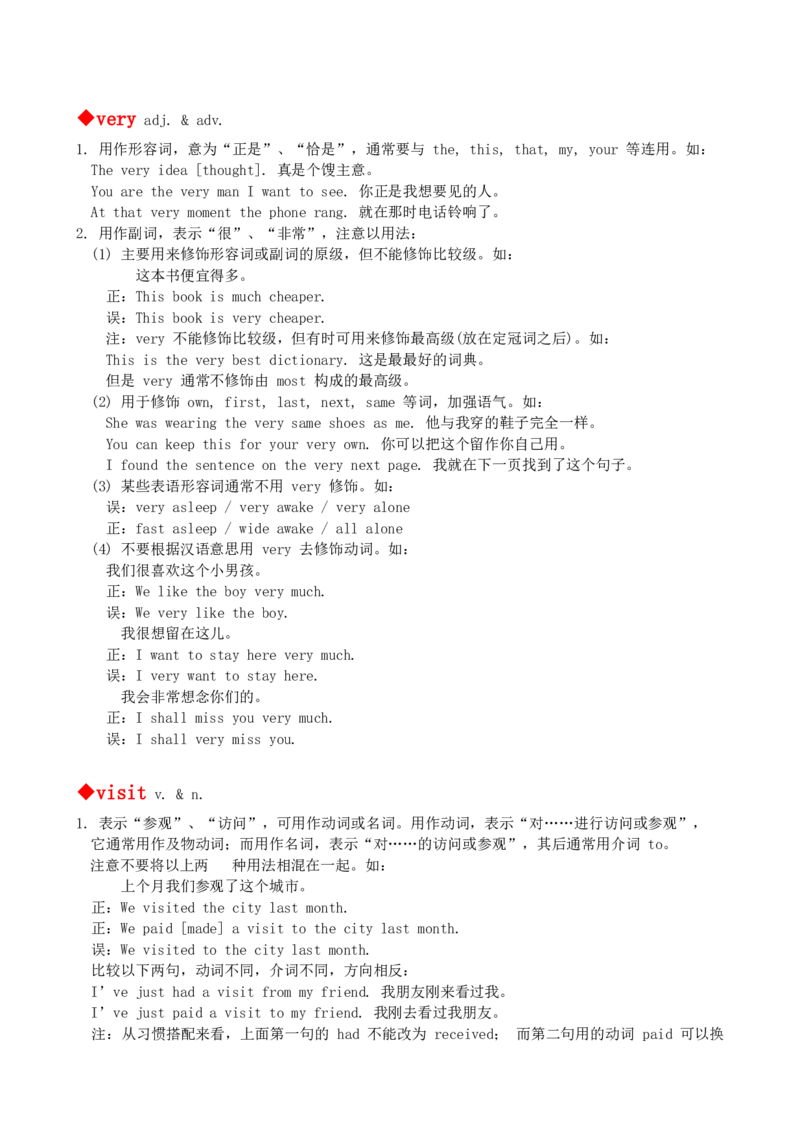
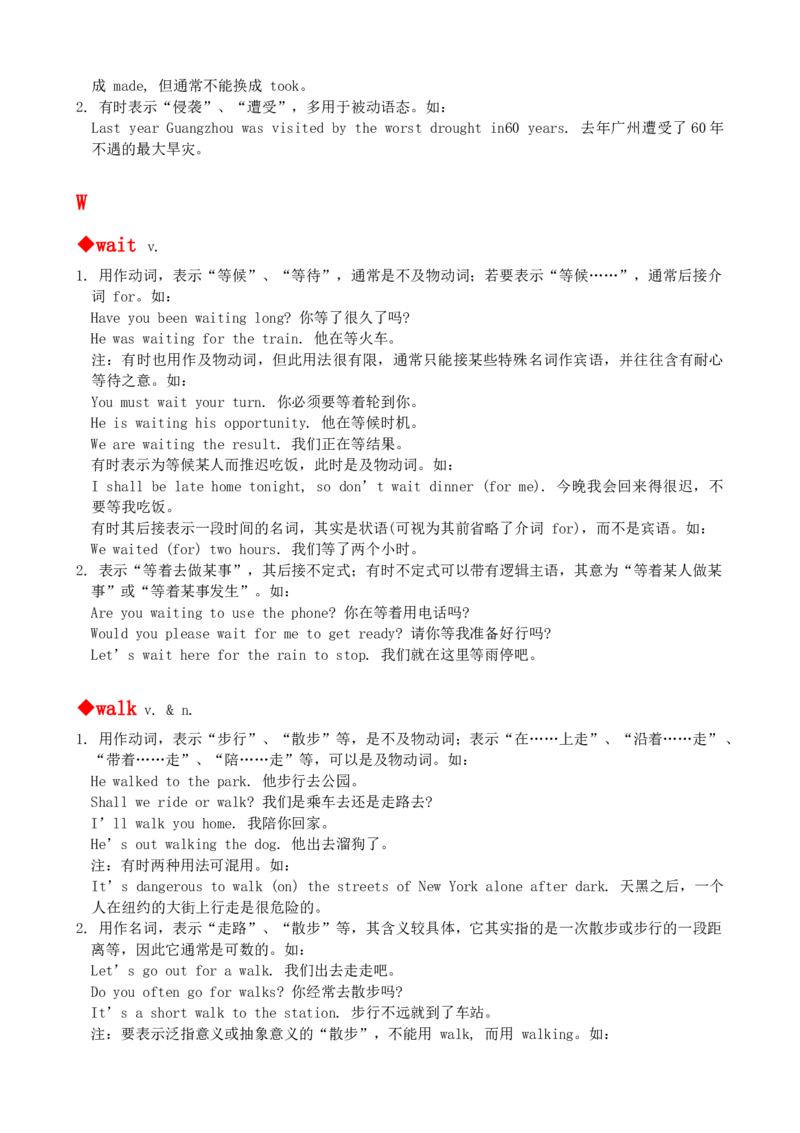
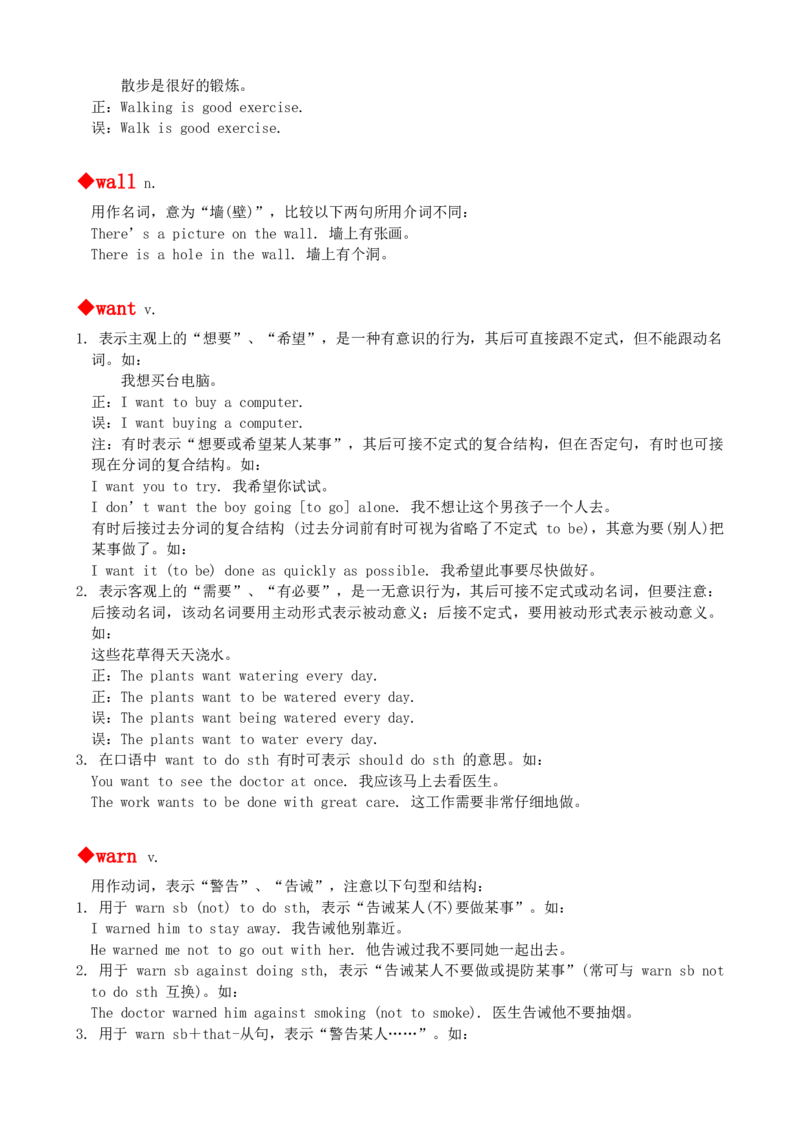
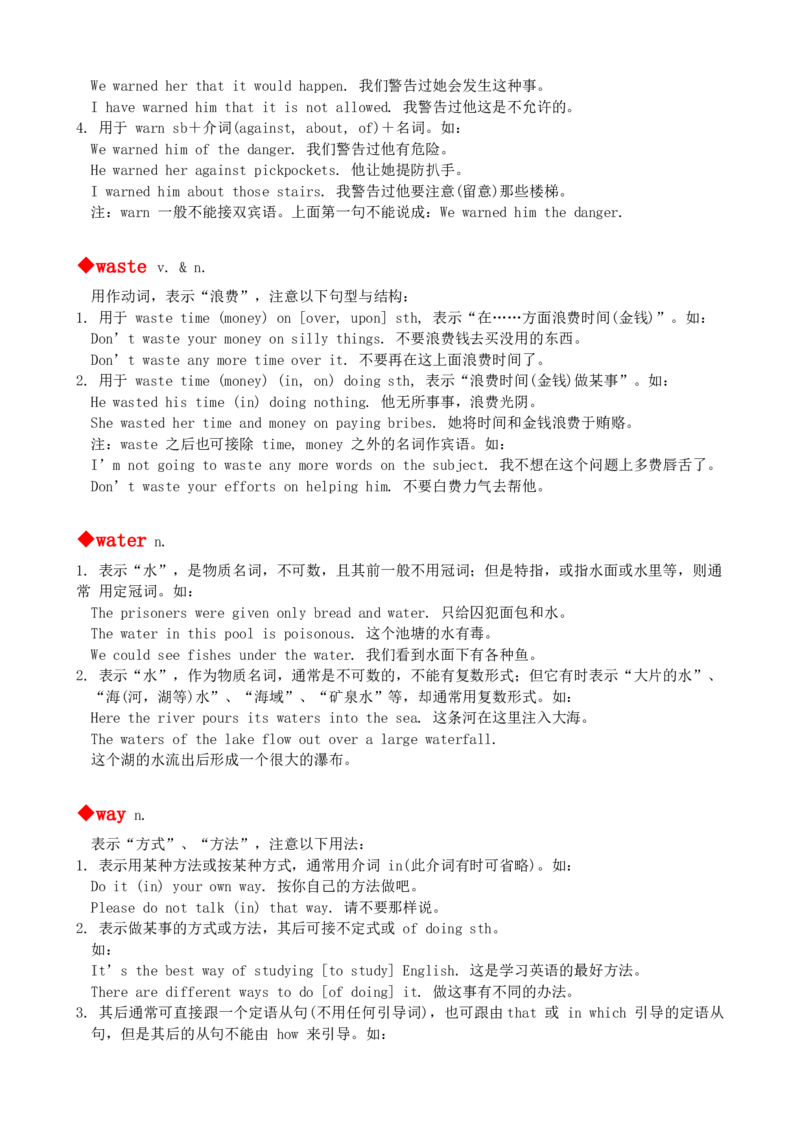

文档内容
最新最实用、初中英语单词用法讲解大全
A
◆a / an
art.
英语不定冠词(a/an)的用法较复杂,以下几点须注意:
1. 用 a还是 an:一般说来,辅音或半元音[j, w]开头的词要前用a。如:
He has a computer (watch). 他有一台电脑(一块手表)。
He’s a university student (European). 他是大学生(欧洲人)。
元音开头的词前要用 an。如:
This is an egg (honest boy). 这是一只鸡蛋(诚实的男孩)。
注意,有的字母(如 a, e, f, h, i等)或缩略词,若第一个音是元音也应用an。如:
He missed an “n” in the word. 他写的这个单词漏了一个 n。
2. 不要从汉语习惯出发,漏掉必用的 a/an。如:
他父亲是著名诗人。
误:His father is famous poet.
正:His father is a famous poet.
3. 用于转化为普通名词的专有名词前,表示某某人或某某人的一部作品、艺术品等。如:
A Mr Smith wants to see you. 一位叫史密斯先生的人想见你。
He bought a complete Lu Hsun. 他买了一套鲁迅全集。
4. 用于转化为普通名词的物质名词前,表示相应的产品或种类,有时表示数量关系。如:
It’s a good wine. 这是(一种)好酒。
Two coffees and a tea, please. 请来两杯咖啡和一杯茶。
5. 用于具体化的抽象名词前,表示与该抽象名词意义相关的人或事等。如:
The party was a great success. 晚会开得非常成功。
It’s a pleasure to talk with you. 同你谈话是件愉快的事。
6. 用于某些由动词转化来或具有动作意味的名词前,表示一次、一番等意义。如:
Let me have a look. 让我看看吧。
I’ll give the car a good wash. 我要把车好好洗一洗。
7. 用于序数词前表示数量或序数的增加。如:
He bought a second computer. 他又买了一台(即第二台)电脑。
Later she borne a third son. 后来她又生了第三个儿子。
8. 有的不可数名词或本来应该带定冠词(the)的名词,由于受定语(尤其是形容词)的修饰,其前一
般要用不定冠词或改用不定冠词,表示某种状态,此时的不定冠词通常含有 a kind of 的意思。
如:
have breakfast 吃早餐→have a quick breakfast 吃快餐
the world 世界→a world like ours 像我们这样的世界
注:有些不可数名词即使受形容词的修饰也不能用不定冠词,容易弄错的有:news(消息),
advice(忠告),luck(运气),fortune(运气),work(工作),fun(娱乐,有趣的事),weather(天
气),homework(家庭作业),housework(家务活),information(情报),behavior(行为),
harm(伤害),damage(损害),progress(进步),furniture (家具),baggage(行李),luggage(行
李),poetry(诗),scenery(风景)等。
9. 两个单数可数名词连用表示一个整体时,只用一个不定冠词。如:
He is a teacher and poet. 他既是老师又是诗人。
There’s a horse and cart on the road. 路上有一辆马车。10. 不定冠词可用来表示“类属”,这是其基本用法,它表明的是某一类属中的每一个人和东西都
能说明该类属的整体情况 (有类似汉语的“举一反三”或“以此类推”的含义)。此时也可用定
冠词或名词复数形式来表示。如:
马是有用的动物。
正:A horse is a useful animal.
正:The horse is a useful animal.
正:Horses are useful animals.
若不是说明每一个人和东西的情况,而是说整个类属,则不能用不定冠词,而要用定冠词:
The tiger is in danger of becoming extinct. 老虎面临绝种的危险。
◆ability
n.
1. 表示“能力”、“能够”,多为不可数名词;表示“才能”、“才干”,多用复数形式。如:
He is a man of ability. 他是位有能力的人。
He is a man of many abilities. 他是位多才多艺的人。
2. 表示有能力做某事或具有做某事的能力等,其后通常要接不定式。如:
He has the ability to speak English fluently. 他能流利地说英语。
The ability to be clearly heard is extremely important for newsreaders. 声音宏亮清晰
对新闻广播员来说极为重要。
但在现代英语中,也可后接 of doing sth(不如接不定式普遍,建议初学者谨用)。如:
I admire his ability of doing the work quickly. 我羡慕他工作做得快。
3. ability的反义词是inability,不是disability——inability表示没有能力或没有才能,而
disability则指因先天缺陷或受伤变残而导致的无能。如:
Physical disability causes mental anguish. 生理伤残会引起心理苦闷。
His inability to speak French puts him at a disadvantage.
他不会说法语,这使他很吃亏。
◆able
adj.
1. 表示“有能力的”、“能干的”,可用作表语或定语。如:
He is an able manager. 他是位有能力的经理。
He is old but still able. 他虽年老,但仍有很能干。
2. 用于 be able to do sth(能或会做做某事)。如:
He is able to speak English. 他会说英语。
Everyone here is able to type. 这儿的每一个人都会打字。
He will be able to get about in a week or two.
再过一两个星期左右他就能走动了。
He studied hard and was able to pass his examinations.
他学习很努力,所以考试及了格。
注:be able to 不仅有多种时态形式(通常不用于进行时或与 be going to 连用),而且还
可以与某些情态动词连用(通常不与 can 连用),甚至还可以有非谓语形式。如:
Since his accident he hasn’t been able to leave the house. 自出事之后,他一直未能
离开家。
You might be able to persuade him. 你也许能够说服他。
I hope to be able to do the work. 我希望能干得了这项工作。
I regret not being able to help her. 我很遗憾未能帮助她。3. able 的比较级和最高级通常是 abler 和 ablest,也可以是 more able 和 most
able,有时还可用 better able和best able。如:
You are better able to do it than I (am). 你比我更有能力做这件事。
She’s the person best able to cope. 她是个最能妥善处理问题的人。
4. 若要加强语气,其前除可very, quite, perfectly等修饰外,有时还可用well修饰。如:
He is quite [well] able to take care of himself. 他完全有能力照顾自己。
He’s a very able student; he’s just too lazy.
他是个很有能力的学生,只是太懒了。
若受just, only just修饰,则表示“只能”“仅能”。如:
I was just able to make out a dark figure in the distance.
我只能看见远处有个黑影。
5. able的反义词是unable(不能的,不会的),不是disable,后者是动词,其意为“使残废”
“使无能力”。比较:
They were unable to reach a decision. 他们没法做出决定。
Now that he was disabled, his house had become a prison to him. 因为他残废了,他的房
子就成了他的牢笼。
◆about
prep. & adv.
1. 表示“大约”,通常用于数字前。如:
He arrived at about 10 o’clock. 他大约10点钟到达。
2. 在动词 know, hear, speak 等之后用不用介词 about, 含义有差别。如:
I have heard about him, but I don’t know him.
我听到过一些关于他的事,但不认识他这个人。
I’ve heard of him, but I don’t know about him.
我听说过他,但我不知道有关他的情况。
试比较:
He knows her. 他认识她。
He knows of her. 他知道有她这样一个人。
He knows about her. 他知道有关她的情况。
3. be about to (do),意为“即将”、“马上”。注意该短语不与具体的时间状语(如:soon,
tomorrow, immediately 等)连用。如:
We are about to leave for Beijing. 我们正要动身去北京。
不说:He is about to leave here tomorrow.
注意该短语可与并列连词 when(这时)连用。如:
I was (just) about to go to bed when the telephone rang. 我正要上床睡觉,这时电话铃
突然响了起来。
在美国英语中,be about to do sth 的否定式,可表示“不愿意做某事”。如:
I am not about to admit defeat. 我还不想认输。
4. about和on均可表示“关于”,但about主要指泛泛地或非正式地谈论某事,其谈论的内容也
较为普通;而on则指比较有系统地或理论性较强地论述某事,其论述的内容较正式或较严肃。比
较:
He wrote on mathematics. 他撰写数学著作。
He wrote about the school. 他报道有关这所学校的情况。
It is a book on birds. 那是一本论及鸟类的书。(可能是一本学术著作)
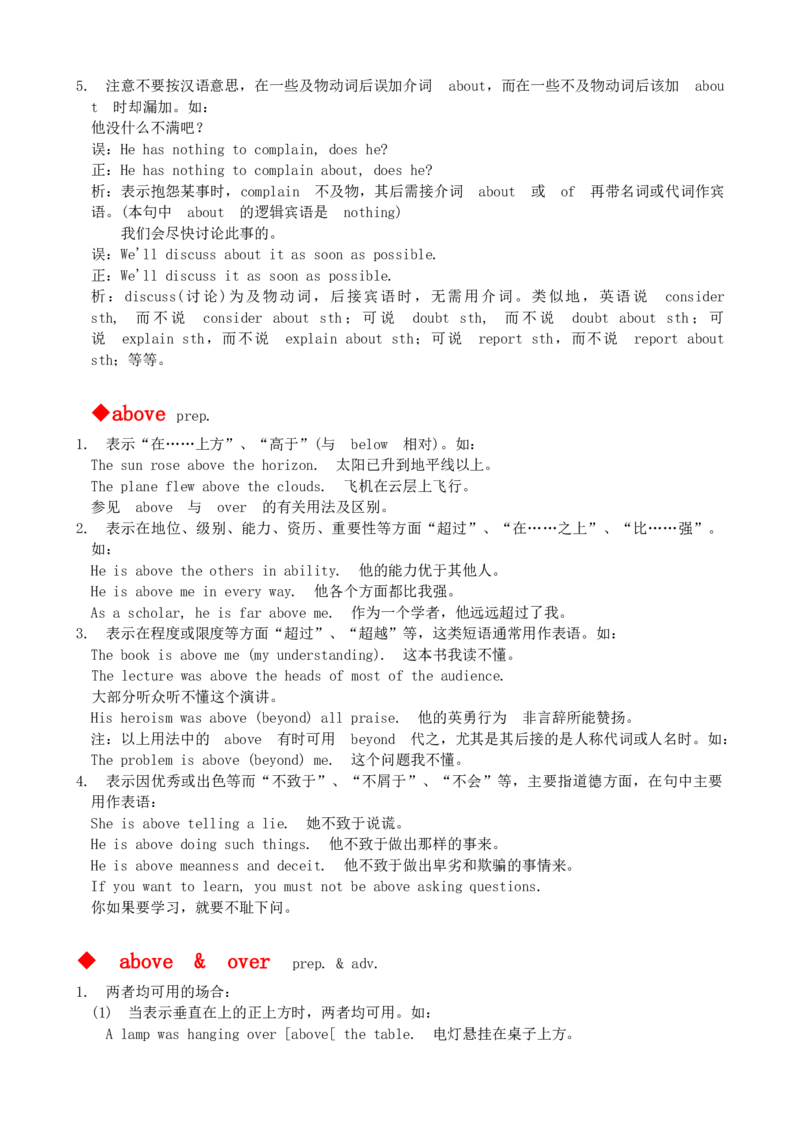
It is a book about birds. 那是一本关于鸟的书。(可能是一本供小孩看的关于鸟类的故事书)5. 注意不要按汉语意思,在一些及物动词后误加介词 about,而在一些不及物动词后该加 abou
t 时却漏加。如:
他没什么不满吧?
误:He has nothing to complain, does he?
正:He has nothing to complain about, does he?
析:表示抱怨某事时,complain 不及物,其后需接介词 about 或 of 再带名词或代词作宾
语。(本句中 about 的逻辑宾语是 nothing)
我们会尽快讨论此事的。
误:We'll discuss about it as soon as possible.
正:We'll discuss it as soon as possible.
析:discuss(讨论)为及物动词,后接宾语时,无需用介词。类似地,英语说 consider
sth, 而不说 consider about sth;可说 doubt sth, 而不说 doubt about sth;可
说 explain sth,而不说 explain about sth;可说 report sth,而不说 report about
sth;等等。
◆above
prep.
1. 表示“在……上方”、“高于”(与 below 相对)。如:
The sun rose above the horizon. 太阳已升到地平线以上。
The plane flew above the clouds. 飞机在云层上飞行。
参见 above 与 over 的有关用法及区别。
2. 表示在地位、级别、能力、资历、重要性等方面“超过”、“在……之上”、“比……强”。
如:
He is above the others in ability. 他的能力优于其他人。
He is above me in every way. 他各个方面都比我强。
As a scholar, he is far above me. 作为一个学者,他远远超过了我。
3. 表示在程度或限度等方面“超过”、“超越”等,这类短语通常用作表语。如:
The book is above me (my understanding). 这本书我读不懂。
The lecture was above the heads of most of the audience.
大部分听众听不懂这个演讲。
His heroism was above (beyond) all praise. 他的英勇行为 非言辞所能赞扬。
注:以上用法中的 above 有时可用 beyond 代之,尤其是其后接的是人称代词或人名时。如:
The problem is above (beyond) me. 这个问题我不懂。
4. 表示因优秀或出色等而“不致于”、“不屑于”、“不会”等,主要指道德方面,在句中主要
用作表语:
She is above telling a lie. 她不致于说谎。
He is above doing such things. 他不致于做出那样的事来。
He is above meanness and deceit. 他不致于做出卑劣和欺骗的事情来。
If you want to learn, you must not be above asking questions.
你如果要学习,就要不耻下问。
◆ above & over
prep. & adv.
1. 两者均可用的场合:
(1) 当表示垂直在上的正上方时,两者均可用。如:
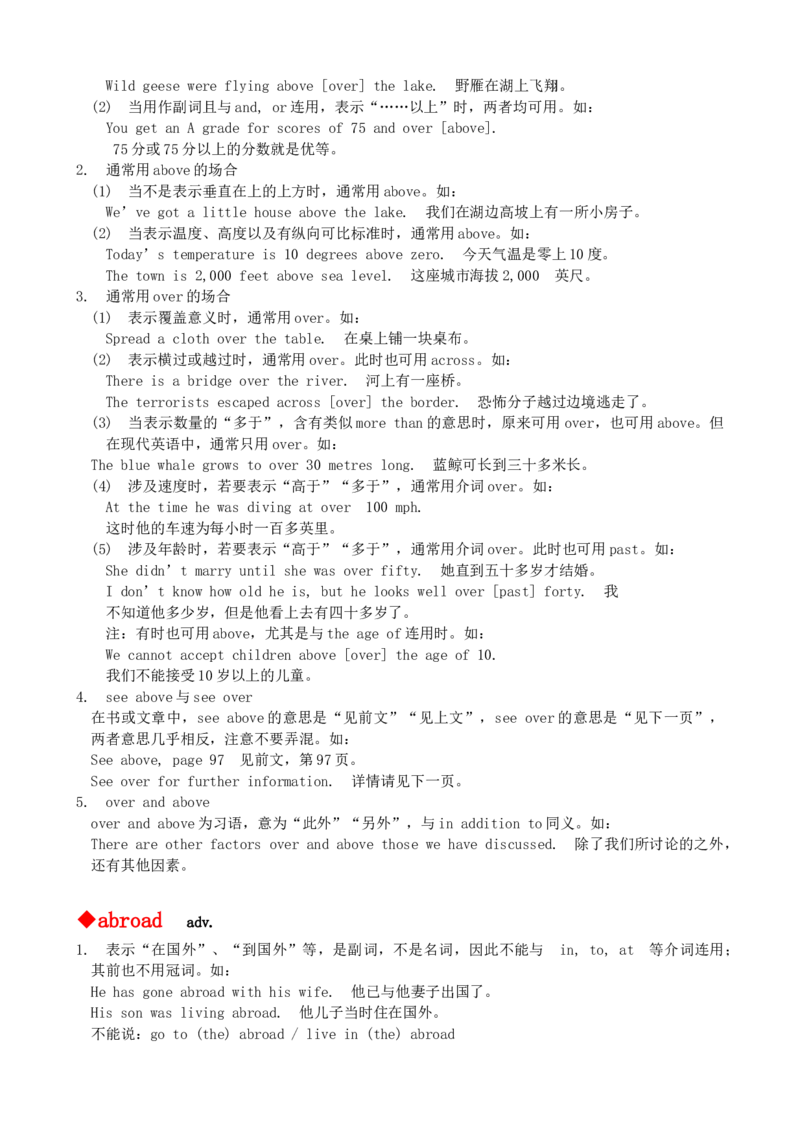
A lamp was hanging over [above[ the table. 电灯悬挂在桌子上方。Wild geese were flying above [over] the lake. 野雁在湖上飞翔。
(2) 当用作副词且与and, or连用,表示“……以上”时,两者均可用。如:
You get an A grade for scores of 75 and over [above].
75分或75分以上的分数就是优等。
2. 通常用above的场合
(1) 当不是表示垂直在上的上方时,通常用above。如:
We’ve got a little house above the lake. 我们在湖边高坡上有一所小房子。
(2) 当表示温度、高度以及有纵向可比标准时,通常用above。如:
Today’s temperature is 10 degrees above zero. 今天气温是零上10度。
The town is 2,000 feet above sea level. 这座城市海拔2,000 英尺。
3. 通常用over的场合
(1) 表示覆盖意义时,通常用over。如:
Spread a cloth over the table. 在桌上铺一块桌布。
(2) 表示横过或越过时,通常用over。此时也可用across。如:
There is a bridge over the river. 河上有一座桥。
The terrorists escaped across [over] the border. 恐怖分子越过边境逃走了。
(3) 当表示数量的“多于”,含有类似more than的意思时,原来可用over,也可用above。但
在现代英语中,通常只用over。如:
The blue whale grows to over 30 metres long. 蓝鲸可长到三十多米长。
(4) 涉及速度时,若要表示“高于”“多于”,通常用介词over。如:
At the time he was diving at over 100 mph.
这时他的车速为每小时一百多英里。
(5) 涉及年龄时,若要表示“高于”“多于”,通常用介词over。此时也可用past。如:
She didn’t marry until she was over fifty. 她直到五十多岁才结婚。
I don’t know how old he is, but he looks well over [past] forty. 我
不知道他多少岁,但是他看上去有四十多岁了。
注:有时也可用above,尤其是与the age of连用时。如:
We cannot accept children above [over] the age of 10.
我们不能接受10岁以上的儿童。
4. see above与see over
在书或文章中,see above的意思是“见前文”“见上文”,see over的意思是“见下一页”,
两者意思几乎相反,注意不要弄混。如:
See above, page 97 见前文,第97页。
See over for further information. 详情请见下一页。
5. over and above
over and above为习语,意为“此外”“另外”,与in addition to同义。如:
There are other factors over and above those we have discussed. 除了我们所讨论的之外,
还有其他因素。
◆abroad
adv.
1. 表示“在国外”、“到国外”等,是副词,不是名词,因此不能与 in, to, at 等介词连用;
其前也不用冠词。如:
He has gone abroad with his wife. 他已与他妻子出国了。
His son was living abroad. 他儿子当时住在国外。
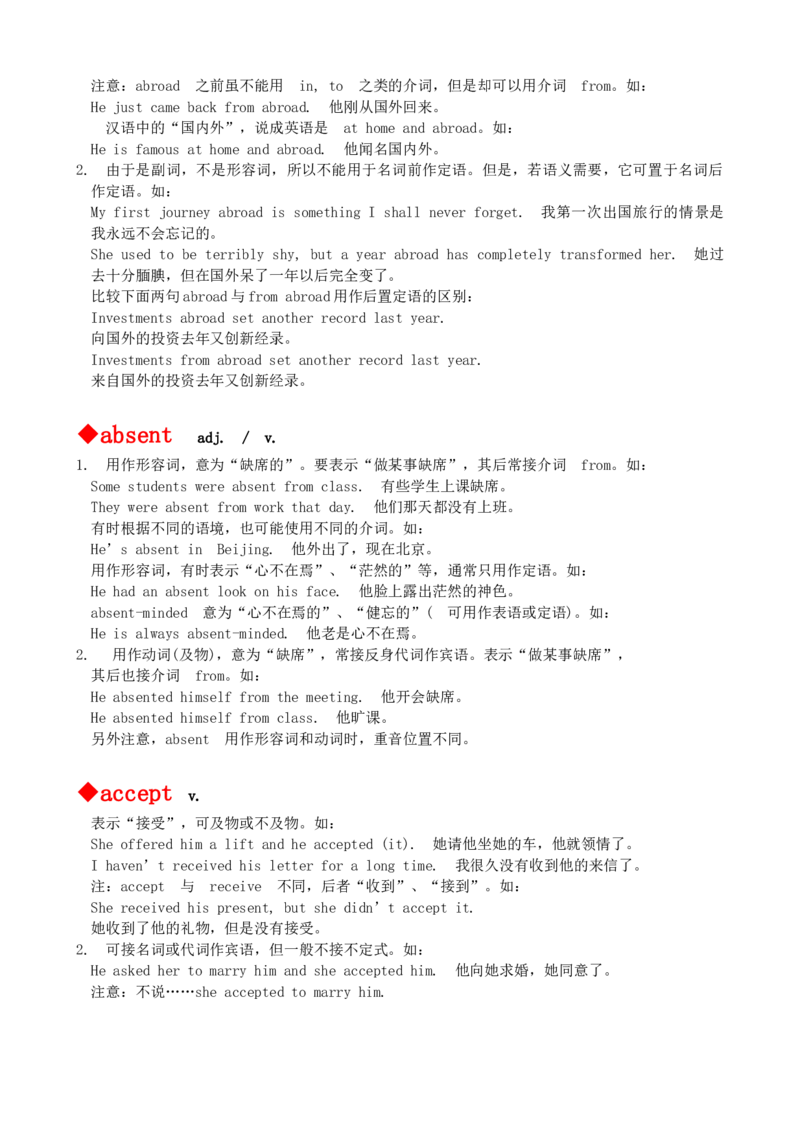
不能说:go to (the) abroad / live in (the) abroad注意:abroad 之前虽不能用 in, to 之类的介词,但是却可以用介词 from。如:
He just came back from abroad. 他刚从国外回来。
汉语中的“国内外”,说成英语是 at home and abroad。如:
He is famous at home and abroad. 他闻名国内外。
2. 由于是副词,不是形容词,所以不能用于名词前作定语。但是,若语义需要,它可置于名词后
作定语。如:
My first journey abroad is something I shall never forget. 我第一次出国旅行的情景是
我永远不会忘记的。
She used to be terribly shy, but a year abroad has completely transformed her. 她过
去十分腼腆,但在国外呆了一年以后完全变了。
比较下面两句abroad与from abroad用作后置定语的区别:
Investments abroad set another record last year.
向国外的投资去年又创新经录。
Investments from abroad set another record last year.
来自国外的投资去年又创新经录。
◆absent
adj. / v.
1. 用作形容词,意为“缺席的”。要表示“做某事缺席”,其后常接介词 from。如:
Some students were absent from class. 有些学生上课缺席。
They were absent from work that day. 他们那天都没有上班。
有时根据不同的语境,也可能使用不同的介词。如:
He’s absent in Beijing. 他外出了,现在北京。
用作形容词,有时表示“心不在焉”、“茫然的”等,通常只用作定语。如:
He had an absent look on his face. 他脸上露出茫然的神色。
absent-minded 意为“心不在焉的”、“健忘的”( 可用作表语或定语)。如:
He is always absent-minded. 他老是心不在焉。
2. 用作动词(及物),意为“缺席”,常接反身代词作宾语。表示“做某事缺席”,
其后也接介词 from。如:
He absented himself from the meeting. 他开会缺席。
He absented himself from class. 他旷课。
另外注意,absent 用作形容词和动词时,重音位置不同。
◆accept
v.
表示“接受”,可及物或不及物。如:
She offered him a lift and he accepted (it). 她请他坐她的车,他就领情了。
I haven’t received his letter for a long time. 我很久没有收到他的来信了。
注:accept 与 receive 不同,后者“收到”、“接到”。如:
She received his present, but she didn’t accept it.
她收到了他的礼物,但是没有接受。
2. 可接名词或代词作宾语,但一般不接不定式。如:
He asked her to marry him and she accepted him. 他向她求婚,她同意了。
注意:不说……she accepted to marry him.◆accident
n.
1. 主要表示偶然发生的意外事件或意外事故。如:
I’m sorry I broke the glass. It was an accident.
我很抱歉打破了玻璃杯,这完全是无意的。
About ten people were killed in the car accident.
在这次车祸中大约有10个人丧生。
2. 用于 by accident(偶然地)。如:
I only found it by accident. 我只是碰巧找到它的。
◆according to
prep.
1. 主要用来表示“根据”某学说、某书刊、某文件、某人所说等或表示“按照”某法律、某规定、
某惯例、某情况等。如:
According to the radio, it will rain tomorrow. 据电台广播,明天有雨。
Each man will be paid according to his ability.
每个人将根据他的能力获得报酬。
2. according to 表示“根据”,通常是指根据别人或别处,而不能根据自己,所以其后不能接
表示第一人称的代词(如me, us),同时也很少接表示第二人称的代词(you),但用于第三人称
(如 him, her, Jim, Mary, the doctor 等)则属正常用法。如:
误:According to me, the film is wonderful.
正:In my opinion, the film is wonderful. 依我看,这部电影很不错。
另外注意:according to 后也不接 view(看法) 和 opinion(意见)这类词表示看法的词。如:
误:According to my opinion, he did it very well.
正:In my opinion, he did it very well. 在我看来,他干得很不错。
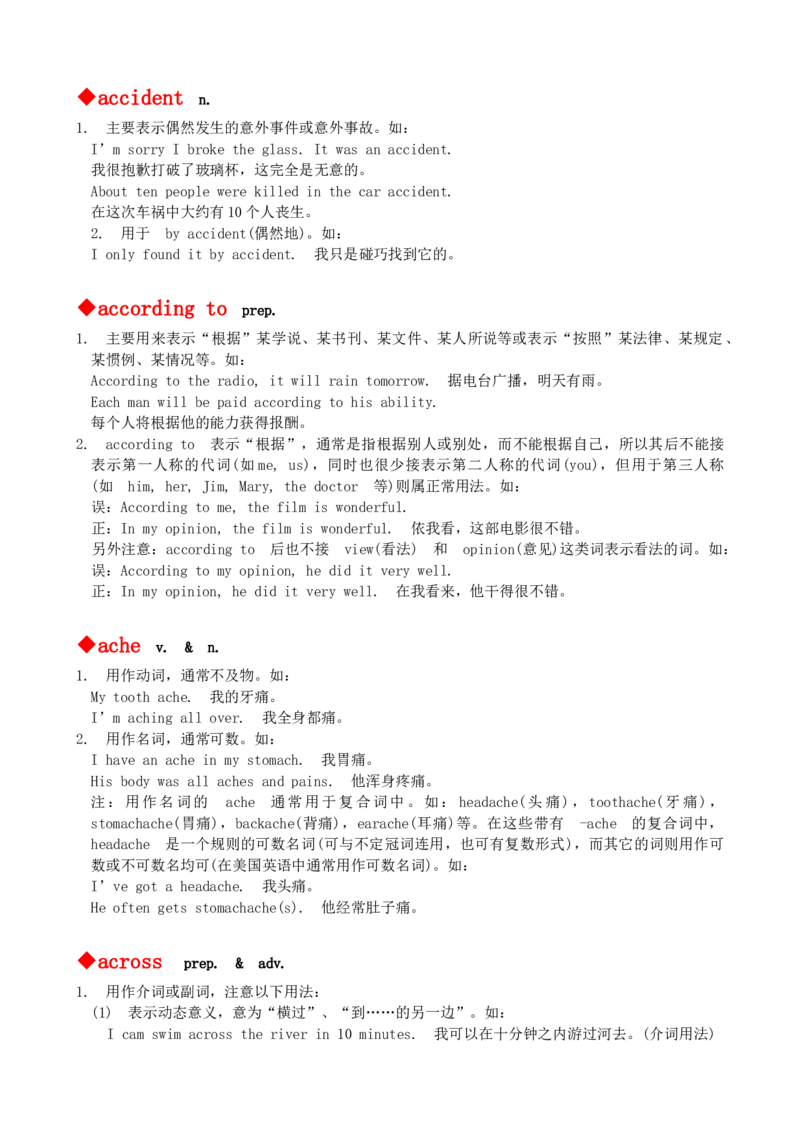
◆ache
v. & n.
1. 用作动词,通常不及物。如:
My tooth ache. 我的牙痛。
I’m aching all over. 我全身都痛。
2. 用作名词,通常可数。如:
I have an ache in my stomach. 我胃痛。
His body was all aches and pains. 他浑身疼痛。
注:用作名词的 ache 通常用于复合词中。如:headache(头痛),toothache(牙痛),
stomachache(胃痛),backache(背痛),earache(耳痛)等。在这些带有 -ache 的复合词中,
headache 是一个规则的可数名词(可与不定冠词连用,也可有复数形式),而其它的词则用作可
数或不可数名均可(在美国英语中通常用作可数名词)。如:
I’ve got a headache. 我头痛。
He often gets stomachache(s). 他经常肚子痛。
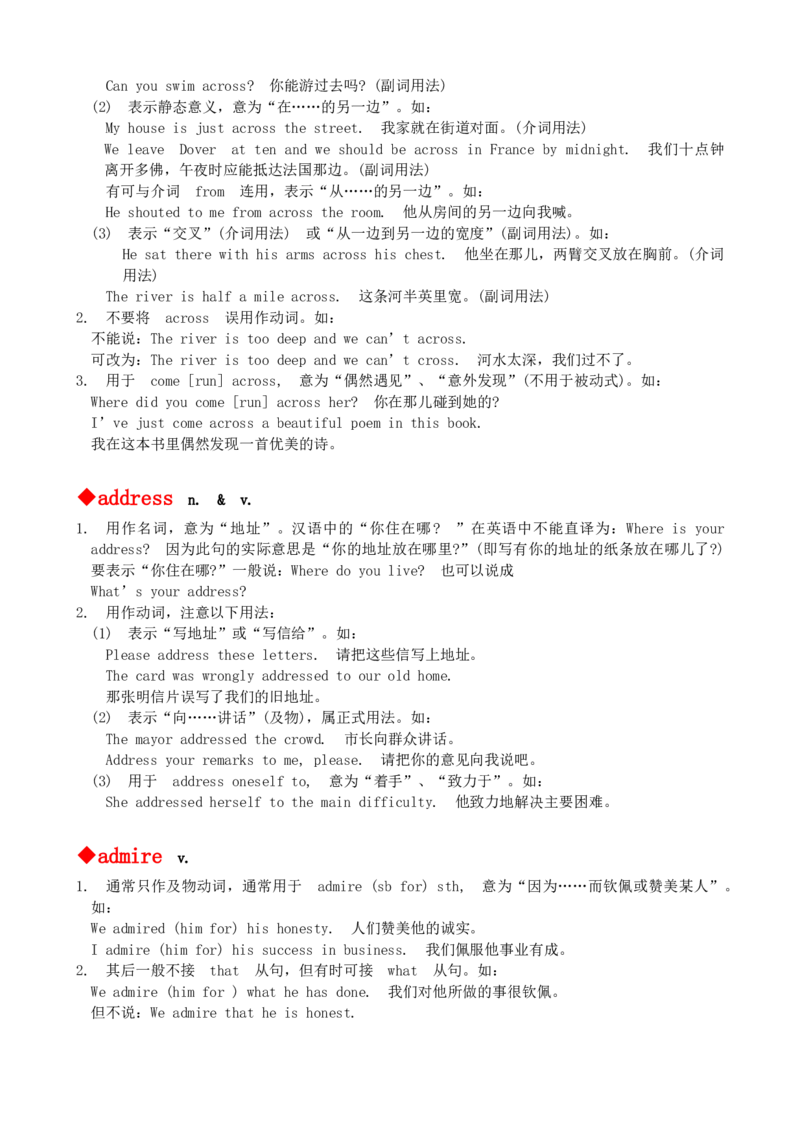
◆across
prep. & adv.
1. 用作介词或副词,注意以下用法:
(1) 表示动态意义,意为“横过”、“到……的另一边”。如:
I cam swim across the river in 10 minutes. 我可以在十分钟之内游过河去。(介词用法)Can you swim across? 你能游过去吗? (副词用法)
(2) 表示静态意义,意为“在……的另一边”。如:
My house is just across the street. 我家就在街道对面。(介词用法)
We leave Dover at ten and we should be across in France by midnight. 我们十点钟
离开多佛,午夜时应能抵达法国那边。(副词用法)
有可与介词 from 连用,表示“从……的另一边”。如:
He shouted to me from across the room. 他从房间的另一边向我喊。
(3) 表示“交叉”(介词用法) 或“从一边到另一边的宽度”(副词用法)。如:
He sat there with his arms across his chest. 他坐在那儿,两臂交叉放在胸前。(介词
用法)
The river is half a mile across. 这条河半英里宽。(副词用法)
2. 不要将 across 误用作动词。如:
不能说:The river is too deep and we can’t across.
可改为:The river is too deep and we can’t cross. 河水太深,我们过不了。
3. 用于 come [run] across, 意为“偶然遇见”、“意外发现”(不用于被动式)。如:
Where did you come [run] across her? 你在那儿碰到她的?
I’ve just come across a beautiful poem in this book.
我在这本书里偶然发现一首优美的诗。
◆address
n. & v.
1. 用作名词,意为“地址”。汉语中的“你住在哪? ”在英语中不能直译为:Where is your
address? 因为此句的实际意思是“你的地址放在哪里?”(即写有你的地址的纸条放在哪儿了?)
要表示“你住在哪?”一般说:Where do you live? 也可以说成
What’s your address?
2. 用作动词,注意以下用法:
(1) 表示“写地址”或“写信给”。如:
Please address these letters. 请把这些信写上地址。
The card was wrongly addressed to our old home.
那张明信片误写了我们的旧地址。
(2) 表示“向……讲话”(及物),属正式用法。如:
The mayor addressed the crowd. 市长向群众讲话。
Address your remarks to me, please. 请把你的意见向我说吧。
(3) 用于 address oneself to, 意为“着手”、“致力于”。如:
She addressed herself to the main difficulty. 他致力地解决主要困难。
◆admire
v.
1. 通常只作及物动词,通常用于 admire (sb for) sth, 意为“因为……而钦佩或赞美某人”。
如:
We admired (him for) his honesty. 人们赞美他的诚实。
I admire (him for) his success in business. 我们佩服他事业有成。
2. 其后一般不接 that 从句,但有时可接 what 从句。如:
We admire (him for ) what he has done. 我们对他所做的事很钦佩。
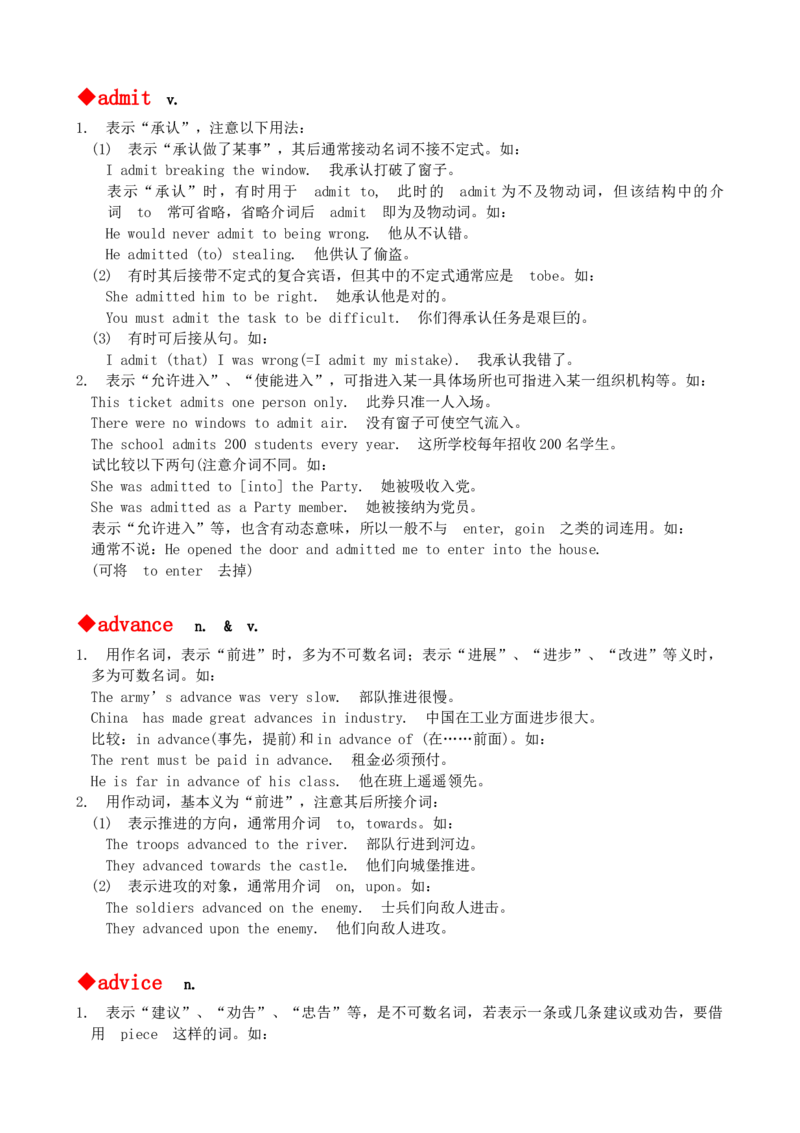
但不说:We admire that he is honest.◆admit
v.
1. 表示“承认”,注意以下用法:
(1) 表示“承认做了某事”,其后通常接动名词不接不定式。如:
I admit breaking the window. 我承认打破了窗子。
表示“承认”时,有时用于 admit to, 此时的 admit 为不及物动词,但该结构中的介
词 to 常可省略,省略介词后 admit 即为及物动词。如:
He would never admit to being wrong. 他从不认错。
He admitted (to) stealing. 他供认了偷盗。
(2) 有时其后接带不定式的复合宾语,但其中的不定式通常应是 tobe。如:
She admitted him to be right. 她承认他是对的。
You must admit the task to be difficult. 你们得承认任务是艰巨的。
(3) 有时可后接从句。如:
I admit (that) I was wrong(=I admit my mistake). 我承认我错了。
2. 表示“允许进入”、“使能进入”,可指进入某一具体场所也可指进入某一组织机构等。如:
This ticket admits one person only. 此券只准一人入场。
There were no windows to admit air. 没有窗子可使空气流入。
The school admits 200 students every year. 这所学校每年招收200名学生。
试比较以下两句(注意介词不同。如:
She was admitted to [into] the Party. 她被吸收入党。
She was admitted as a Party member. 她被接纳为党员。
表示“允许进入”等,也含有动态意味,所以一般不与 enter, goin 之类的词连用。如:
通常不说:He opened the door and admitted me to enter into the house.
(可将 to enter 去掉)
◆advance
n. & v.
1. 用作名词,表示“前进”时,多为不可数名词;表示“进展”、“进步”、“改进”等义时,
多为可数名词。如:
The army’s advance was very slow. 部队推进很慢。
China has made great advances in industry. 中国在工业方面进步很大。
比较:in advance(事先,提前)和in advance of (在……前面)。如:
The rent must be paid in advance. 租金必须预付。
He is far in advance of his class. 他在班上遥遥领先。
2. 用作动词,基本义为“前进”,注意其后所接介词:
(1) 表示推进的方向,通常用介词 to, towards。如:
The troops advanced to the river. 部队行进到河边。
They advanced towards the castle. 他们向城堡推进。
(2) 表示进攻的对象,通常用介词 on, upon。如:
The soldiers advanced on the enemy. 士兵们向敌人进击。
They advanced upon the enemy. 他们向敌人进攻。
◆advice
n.
1. 表示“建议”、“劝告”、“忠告”等,是不可数名词,若表示一条或几条建议或劝告,要借
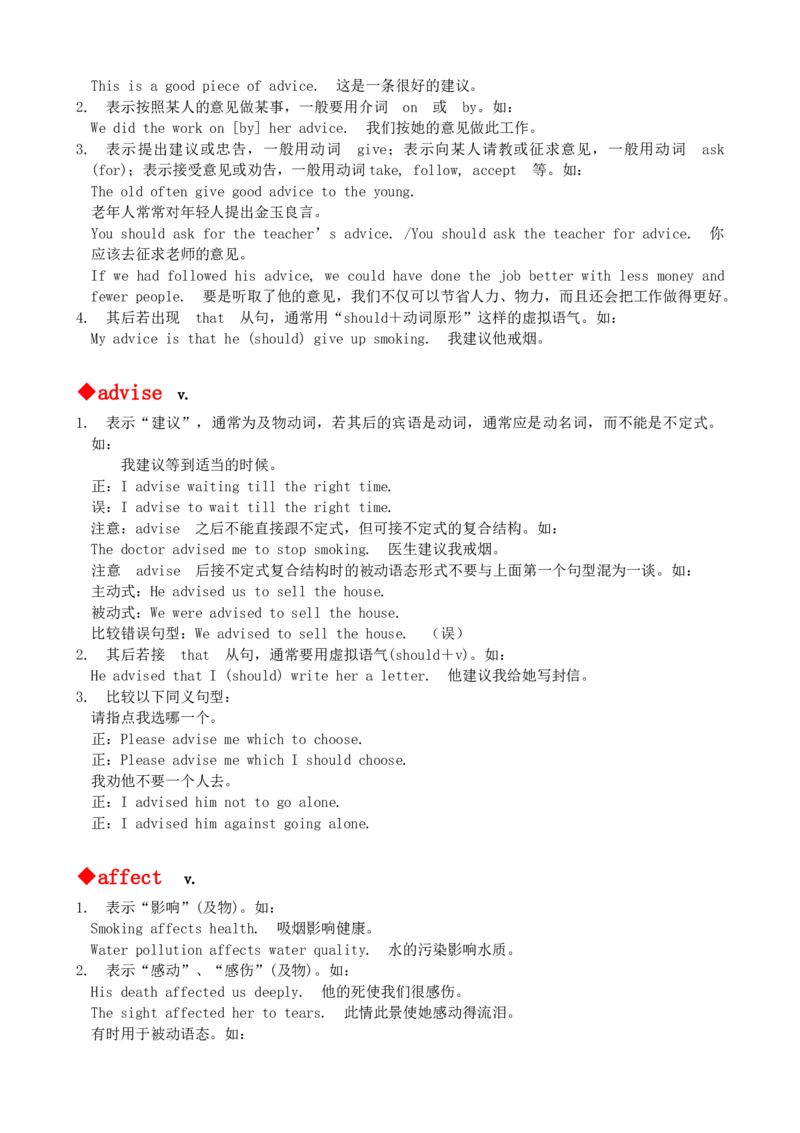
用 piece 这样的词。如:This is a good piece of advice. 这是一条很好的建议。
2. 表示按照某人的意见做某事,一般要用介词 on 或 by。如:
We did the work on [by] her advice. 我们按她的意见做此工作。
3. 表示提出建议或忠告,一般用动词 give;表示向某人请教或征求意见,一般用动词 ask
(for);表示接受意见或劝告,一般用动词take, follow, accept 等。如:
The old often give good advice to the young.
老年人常常对年轻人提出金玉良言。
You should ask for the teacher’s advice. /You should ask the teacher for advice. 你
应该去征求老师的意见。
If we had followed his advice, we could have done the job better with less money and
fewer people. 要是听取了他的意见,我们不仅可以节省人力、物力,而且还会把工作做得更好。
4. 其后若出现 that 从句,通常用“should+动词原形”这样的虚拟语气。如:
My advice is that he (should) give up smoking. 我建议他戒烟。
◆advise
v.
1. 表示“建议”,通常为及物动词,若其后的宾语是动词,通常应是动名词,而不能是不定式。
如:
我建议等到适当的时候。
正:I advise waiting till the right time.
误:I advise to wait till the right time.
注意:advise 之后不能直接跟不定式,但可接不定式的复合结构。如:
The doctor advised me to stop smoking. 医生建议我戒烟。
注意 advise 后接不定式复合结构时的被动语态形式不要与上面第一个句型混为一谈。如:
主动式:He advised us to sell the house.
被动式:We were advised to sell the house.
比较错误句型:We advised to sell the house. (误)
2. 其后若接 that 从句,通常要用虚拟语气(should+v)。如:
He advised that I (should) write her a letter. 他建议我给她写封信。
3. 比较以下同义句型:
请指点我选哪一个。
正:Please advise me which to choose.
正:Please advise me which I should choose.
我劝他不要一个人去。
正:I advised him not to go alone.
正:I advised him against going alone.
◆affect
v.
1. 表示“影响”(及物)。如:
Smoking affects health. 吸烟影响健康。
Water pollution affects water quality. 水的污染影响水质。
2. 表示“感动”、“感伤”(及物)。如:
His death affected us deeply. 他的死使我们很感伤。
The sight affected her to tears. 此情此景使她感动得流泪。
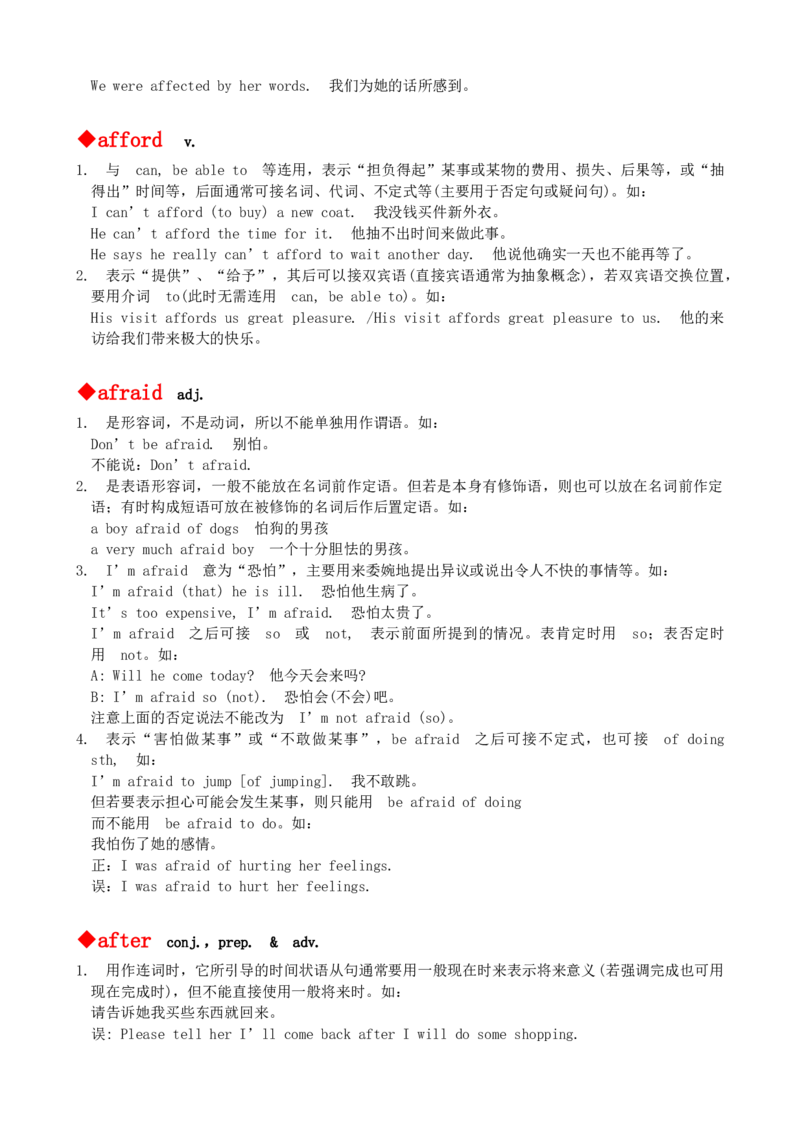
有时用于被动语态。如:We were affected by her words. 我们为她的话所感到。
◆afford
v.
1. 与 can, be able to 等连用,表示“担负得起”某事或某物的费用、损失、后果等,或“抽
得出”时间等,后面通常可接名词、代词、不定式等(主要用于否定句或疑问句)。如:
I can’t afford (to buy) a new coat. 我没钱买件新外衣。
He can’t afford the time for it. 他抽不出时间来做此事。
He says he really can’t afford to wait another day. 他说他确实一天也不能再等了。
2. 表示“提供”、“给予”,其后可以接双宾语(直接宾语通常为抽象概念),若双宾语交换位置,
要用介词 to(此时无需连用 can, be able to)。如:
His visit affords us great pleasure. /His visit affords great pleasure to us. 他的来
访给我们带来极大的快乐。
◆afraid
adj.
1. 是形容词,不是动词,所以不能单独用作谓语。如:
Don’t be afraid. 别怕。
不能说:Don’t afraid.
2. 是表语形容词,一般不能放在名词前作定语。但若是本身有修饰语,则也可以放在名词前作定
语;有时构成短语可放在被修饰的名词后作后置定语。如:
a boy afraid of dogs 怕狗的男孩
a very much afraid boy 一个十分胆怯的男孩。
3. I’m afraid 意为“恐怕”,主要用来委婉地提出异议或说出令人不快的事情等。如:
I’m afraid (that) he is ill. 恐怕他生病了。
It’s too expensive, I’m afraid. 恐怕太贵了。
I’m afraid 之后可接 so 或 not, 表示前面所提到的情况。表肯定时用 so;表否定时
用 not。如:
A: Will he come today? 他今天会来吗?
B: I’m afraid so (not). 恐怕会(不会)吧。
注意上面的否定说法不能改为 I’m not afraid (so)。
4. 表示“害怕做某事”或“不敢做某事”,be afraid 之后可接不定式,也可接 of doing
sth, 如:
I’m afraid to jump [of jumping]. 我不敢跳。
但若要表示担心可能会发生某事,则只能用 be afraid of doing
而不能用 be afraid to do。如:
我怕伤了她的感情。
正:I was afraid of hurting her feelings.
误:I was afraid to hurt her feelings.
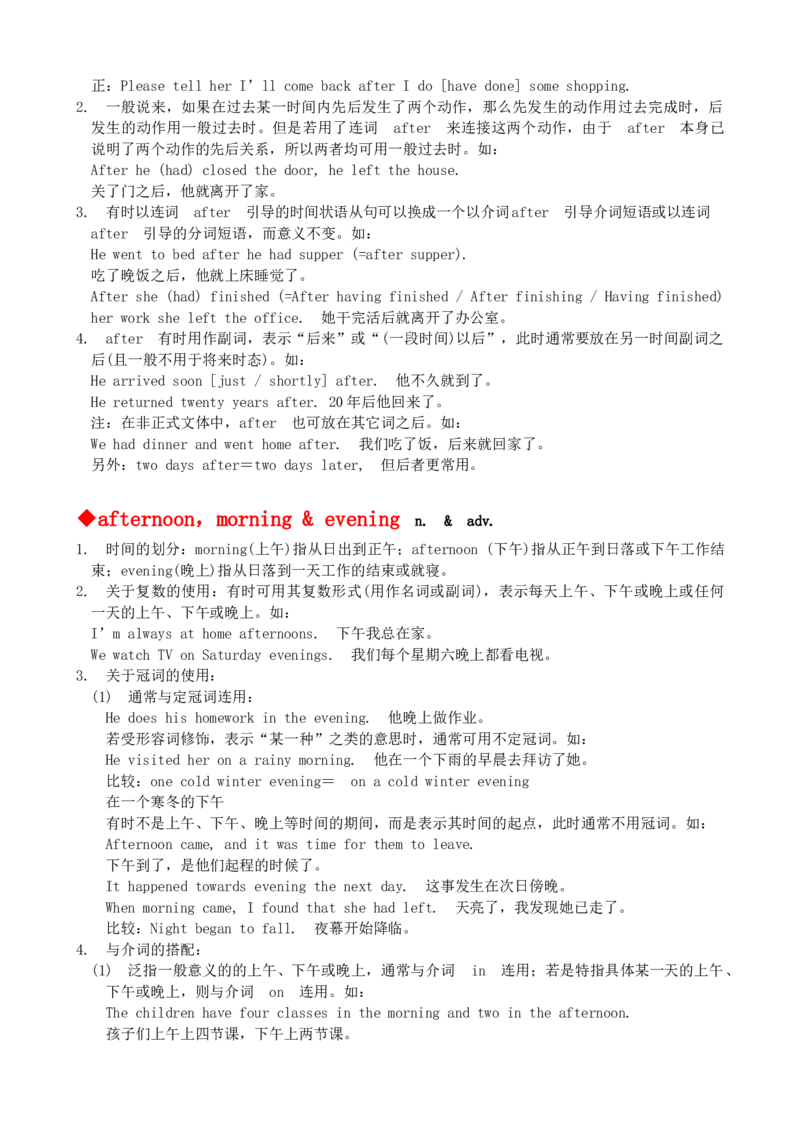
◆after
conj.,prep. & adv.
1. 用作连词时,它所引导的时间状语从句通常要用一般现在时来表示将来意义(若强调完成也可用
现在完成时),但不能直接使用一般将来时。如:
请告诉她我买些东西就回来。
误: Please tell her I’ll come back after I will do some shopping.正:Please tell her I’ll come back after I do [have done] some shopping.
2. 一般说来,如果在过去某一时间内先后发生了两个动作,那么先发生的动作用过去完成时,后
发生的动作用一般过去时。但是若用了连词 after 来连接这两个动作,由于 after 本身已
说明了两个动作的先后关系,所以两者均可用一般过去时。如:
After he (had) closed the door, he left the house.
关了门之后,他就离开了家。
3. 有时以连词 after 引导的时间状语从句可以换成一个以介词after 引导介词短语或以连词
after 引导的分词短语,而意义不变。如:
He went to bed after he had supper (=after supper).
吃了晚饭之后,他就上床睡觉了。
After she (had) finished (=After having finished / After finishing / Having finished)
her work she left the office. 她干完活后就离开了办公室。
4. after 有时用作副词,表示“后来”或“(一段时间)以后”,此时通常要放在另一时间副词之
后(且一般不用于将来时态)。如:
He arrived soon [just / shortly] after. 他不久就到了。
He returned twenty years after. 20年后他回来了。
注:在非正式文体中,after 也可放在其它词之后。如:
We had dinner and went home after. 我们吃了饭,后来就回家了。
另外:two days after=two days later, 但后者更常用。
◆afternoon,morning & evening
n. & adv.
1. 时间的划分:morning(上午)指从日出到正午;afternoon (下午)指从正午到日落或下午工作结
束;evening(晚上)指从日落到一天工作的结束或就寝。
2. 关于复数的使用:有时可用其复数形式(用作名词或副词),表示每天上午、下午或晚上或任何
一天的上午、下午或晚上。如:
I’m always at home afternoons. 下午我总在家。
We watch TV on Saturday evenings. 我们每个星期六晚上都看电视。
3. 关于冠词的使用:
(1) 通常与定冠词连用:
He does his homework in the evening. 他晚上做作业。
若受形容词修饰,表示“某一种”之类的意思时,通常可用不定冠词。如:
He visited her on a rainy morning. 他在一个下雨的早晨去拜访了她。
比较:one cold winter evening= on a cold winter evening
在一个寒冬的下午
有时不是上午、下午、晚上等时间的期间,而是表示其时间的起点,此时通常不用冠词。如:
Afternoon came, and it was time for them to leave.
下午到了,是他们起程的时候了。
It happened towards evening the next day. 这事发生在次日傍晚。
When morning came, I found that she had left. 天亮了,我发现她已走了。
比较:Night began to fall. 夜幕开始降临。
4. 与介词的搭配:
(1) 泛指一般意义的的上午、下午或晚上,通常与介词 in 连用;若是特指具体某一天的上午、
下午或晚上,则与介词 on 连用。如:
The children have four classes in the morning and two in the afternoon.
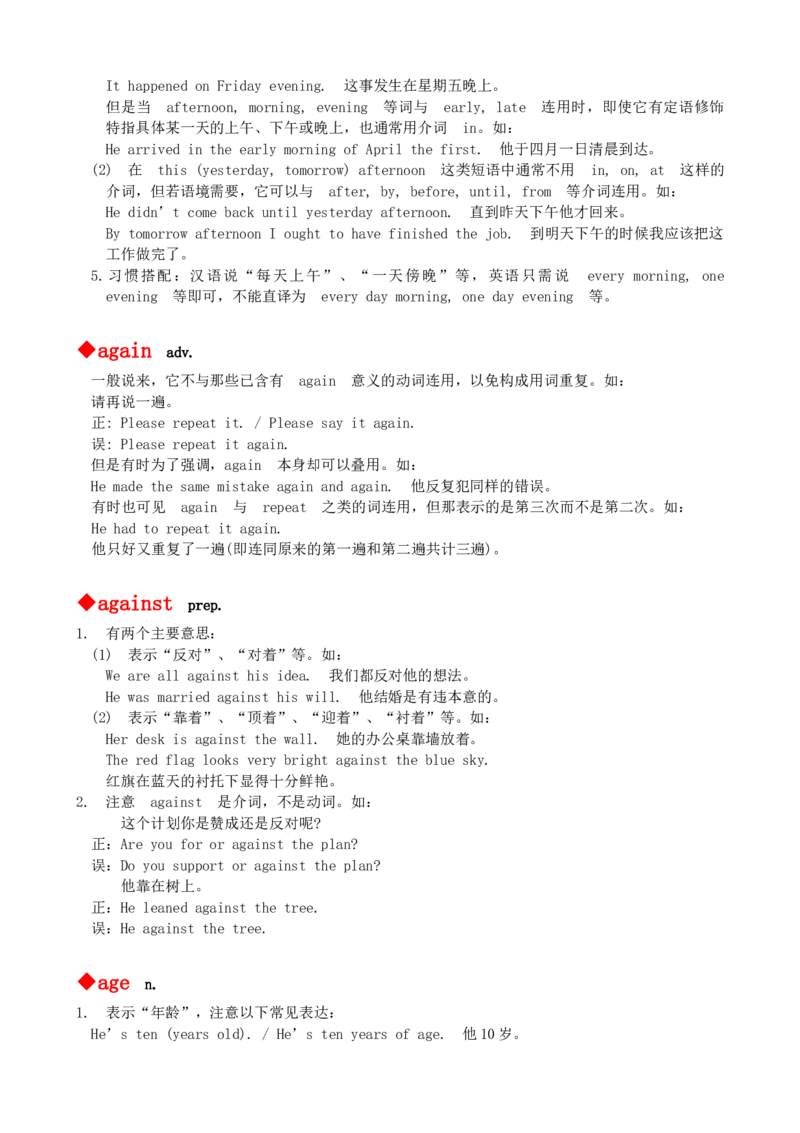
孩子们上午上四节课,下午上两节课。It happened on Friday evening. 这事发生在星期五晚上。
但是当 afternoon, morning, evening 等词与 early, late 连用时,即使它有定语修饰
特指具体某一天的上午、下午或晚上,也通常用介词 in。如:
He arrived in the early morning of April the first. 他于四月一日清晨到达。
(2) 在 this (yesterday, tomorrow) afternoon 这类短语中通常不用 in, on, at 这样的
介词,但若语境需要,它可以与 after, by, before, until, from 等介词连用。如:
He didn’t come back until yesterday afternoon. 直到昨天下午他才回来。
By tomorrow afternoon I ought to have finished the job. 到明天下午的时候我应该把这
工作做完了。
5.习惯搭配:汉语说“每天上午”、“一天傍晚”等,英语只需说 every morning, one
evening 等即可,不能直译为 every day morning, one day evening 等。
◆again
adv.
一般说来,它不与那些已含有 again 意义的动词连用,以免构成用词重复。如:
请再说一遍。
正: Please repeat it. / Please say it again.
误: Please repeat it again.
但是有时为了强调,again 本身却可以叠用。如:
He made the same mistake again and again. 他反复犯同样的错误。
有时也可见 again 与 repeat 之类的词连用,但那表示的是第三次而不是第二次。如:
He had to repeat it again.
他只好又重复了一遍(即连同原来的第一遍和第二遍共计三遍)。
◆against
prep.
1. 有两个主要意思:
(1) 表示“反对”、“对着”等。如:
We are all against his idea. 我们都反对他的想法。
He was married against his will. 他结婚是有违本意的。
(2) 表示“靠着”、“顶着”、“迎着”、“衬着”等。如:
Her desk is against the wall. 她的办公桌靠墙放着。
The red flag looks very bright against the blue sky.
红旗在蓝天的衬托下显得十分鲜艳。
2. 注意 against 是介词,不是动词。如:
这个计划你是赞成还是反对呢?
正:Are you for or against the plan?
误:Do you support or against the plan?
他靠在树上。
正:He leaned against the tree.
误:He against the tree.
◆age
n.
1. 表示“年龄”,注意以下常见表达:
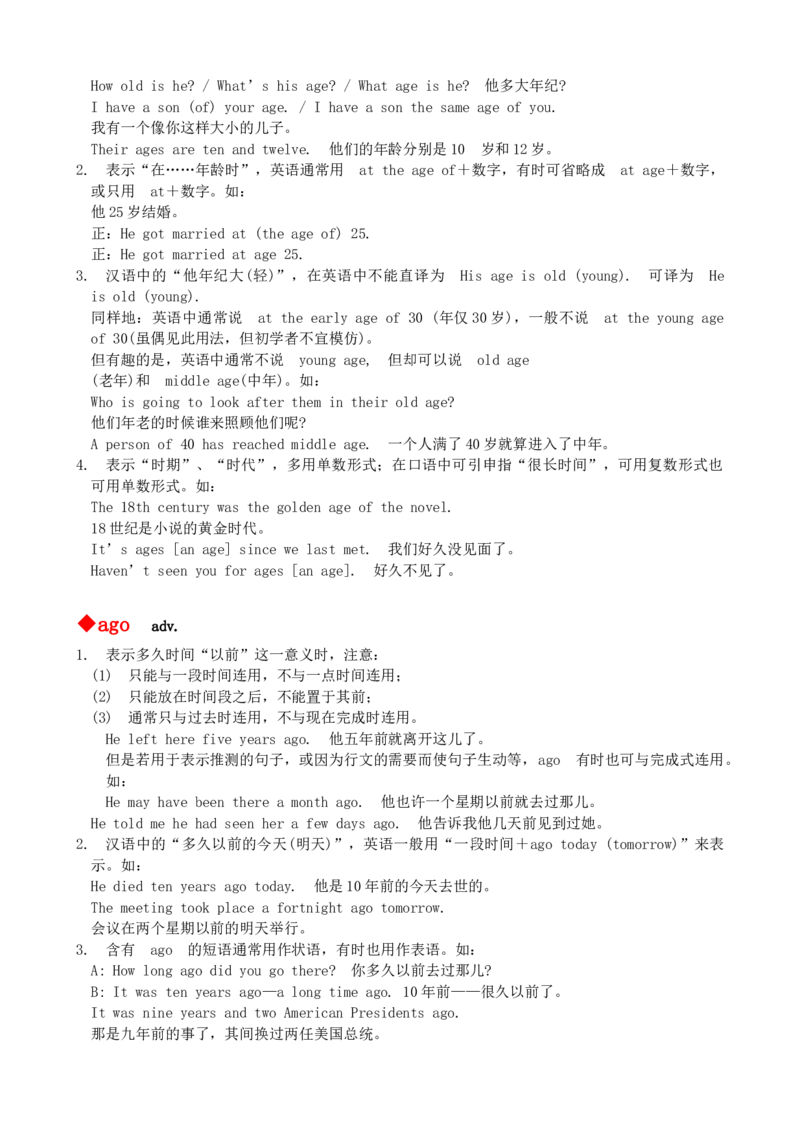
He’s ten (years old). / He’s ten years of age. 他10岁。How old is he? / What’s his age? / What age is he? 他多大年纪?
I have a son (of) your age. / I have a son the same age of you.
我有一个像你这样大小的儿子。
Their ages are ten and twelve. 他们的年龄分别是10 岁和12岁。
2. 表示“在……年龄时”,英语通常用 at the age of+数字,有时可省略成 at age+数字,
或只用 at+数字。如:
他25岁结婚。
正:He got married at (the age of) 25.
正:He got married at age 25.
3. 汉语中的“他年纪大(轻)”,在英语中不能直译为 His age is old (young). 可译为 He
is old (young).
同样地:英语中通常说 at the early age of 30 (年仅30岁),一般不说 at the young age
of 30(虽偶见此用法,但初学者不宜模仿)。
但有趣的是,英语中通常不说 young age, 但却可以说 old age
(老年)和 middle age(中年)。如:
Who is going to look after them in their old age?
他们年老的时候谁来照顾他们呢?
A person of 40 has reached middle age. 一个人满了40岁就算进入了中年。
4. 表示“时期”、“时代”,多用单数形式;在口语中可引申指“很长时间”,可用复数形式也
可用单数形式。如:
The 18th century was the golden age of the novel.
18世纪是小说的黄金时代。
It’s ages [an age] since we last met. 我们好久没见面了。
Haven’t seen you for ages [an age]. 好久不见了。
◆ago
adv.
1. 表示多久时间“以前”这一意义时,注意:
(1) 只能与一段时间连用,不与一点时间连用;
(2) 只能放在时间段之后,不能置于其前;
(3) 通常只与过去时连用,不与现在完成时连用。
He left here five years ago. 他五年前就离开这儿了。
但是若用于表示推测的句子,或因为行文的需要而使句子生动等,ago 有时也可与完成式连用。
如:
He may have been there a month ago. 他也许一个星期以前就去过那儿。
He told me he had seen her a few days ago. 他告诉我他几天前见到过她。
2. 汉语中的“多久以前的今天(明天)”,英语一般用“一段时间+ago today (tomorrow)”来表
示。如:
He died ten years ago today. 他是10年前的今天去世的。
The meeting took place a fortnight ago tomorrow.
会议在两个星期以前的明天举行。
3. 含有 ago 的短语通常用作状语,有时也用作表语。如:
A: How long ago did you go there? 你多久以前去过那儿?
B: It was ten years ago—a long time ago. 10年前——很久以前了。
It was nine years and two American Presidents ago.
那是九年前的事了,其间换过两任美国总统。◆agree
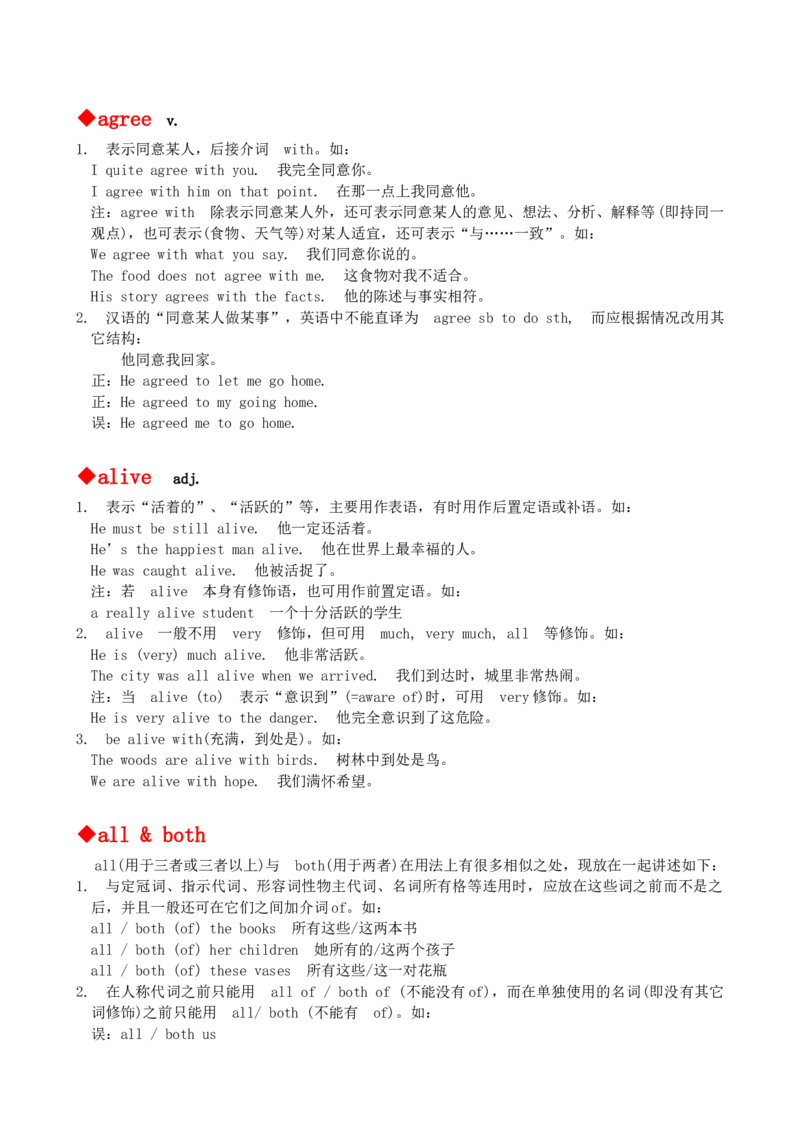
v.
1. 表示同意某人,后接介词 with。如:
I quite agree with you. 我完全同意你。
I agree with him on that point. 在那一点上我同意他。
注:agree with 除表示同意某人外,还可表示同意某人的意见、想法、分析、解释等(即持同一
观点),也可表示(食物、天气等)对某人适宜,还可表示“与……一致”。如:
We agree with what you say. 我们同意你说的。
The food does not agree with me. 这食物对我不适合。
His story agrees with the facts. 他的陈述与事实相符。
2. 汉语的“同意某人做某事”,英语中不能直译为 agree sb to do sth, 而应根据情况改用其
它结构:
他同意我回家。
正:He agreed to let me go home.
正:He agreed to my going home.
误:He agreed me to go home.
◆alive
adj.
1. 表示“活着的”、“活跃的”等,主要用作表语,有时用作后置定语或补语。如:
He must be still alive. 他一定还活着。
He’s the happiest man alive. 他在世界上最幸福的人。
He was caught alive. 他被活捉了。
注:若 alive 本身有修饰语,也可用作前置定语。如:
a really alive student 一个十分活跃的学生
2. alive 一般不用 very 修饰,但可用 much, very much, all 等修饰。如:
He is (very) much alive. 他非常活跃。
The city was all alive when we arrived. 我们到达时,城里非常热闹。
注:当 alive (to) 表示“意识到”(=aware of)时,可用 very修饰。如:
He is very alive to the danger. 他完全意识到了这危险。
3. be alive with(充满,到处是)。如:
The woods are alive with birds. 树林中到处是鸟。
We are alive with hope. 我们满怀希望。
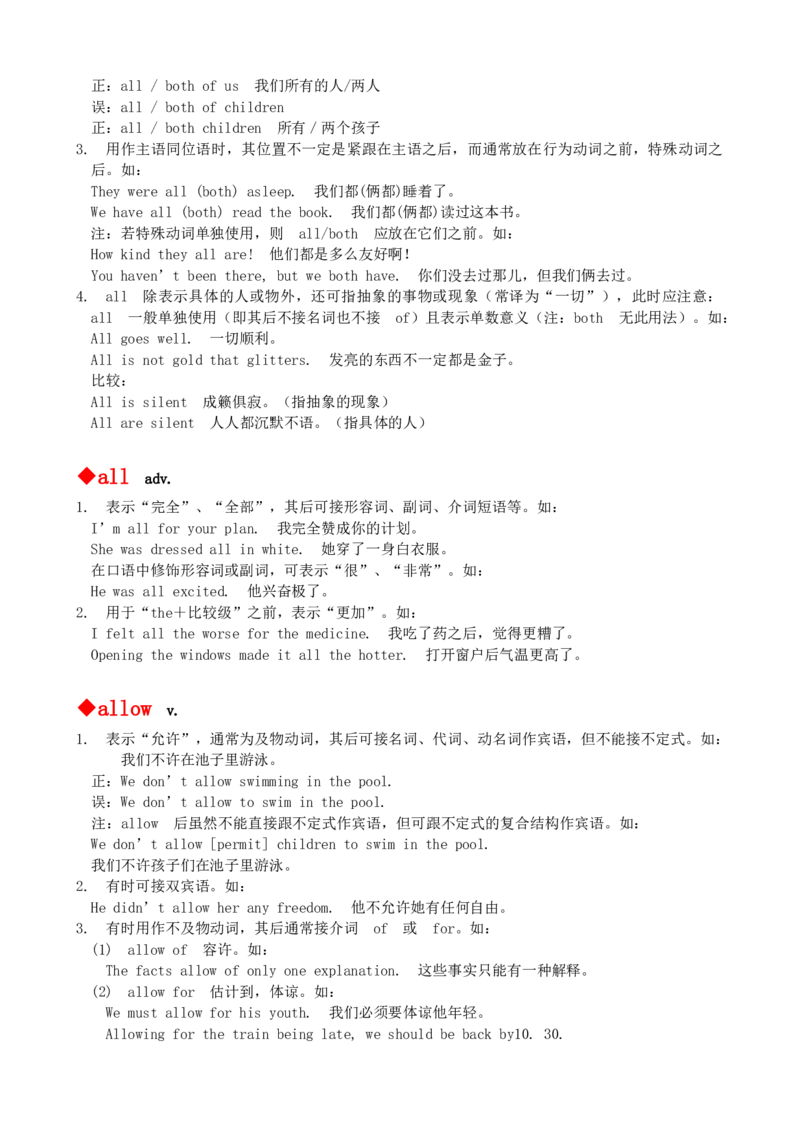
◆all & both
all(用于三者或三者以上)与 both(用于两者)在用法上有很多相似之处,现放在一起讲述如下:
1. 与定冠词、指示代词、形容词性物主代词、名词所有格等连用时,应放在这些词之前而不是之
后,并且一般还可在它们之间加介词of。如:
all / both (of) the books 所有这些/这两本书
all / both (of) her children 她所有的/这两个孩子
all / both (of) these vases 所有这些/这一对花瓶
2. 在人称代词之前只能用 all of / both of (不能没有of),而在单独使用的名词(即没有其它
词修饰)之前只能用 all/ both (不能有 of)。如:
误:all / both us正:all / both of us 我们所有的人/两人
误:all / both of children
正:all / both children 所有/两个孩子
3. 用作主语同位语时,其位置不一定是紧跟在主语之后,而通常放在行为动词之前,特殊动词之
后。如:
They were all (both) asleep. 我们都(俩都)睡着了。
We have all (both) read the book. 我们都(俩都)读过这本书。
注:若特殊动词单独使用,则 all/both 应放在它们之前。如:
How kind they all are! 他们都是多么友好啊!
You haven’t been there, but we both have. 你们没去过那儿,但我们俩去过。
4. all 除表示具体的人或物外,还可指抽象的事物或现象(常译为“一切”),此时应注意:
all 一般单独使用(即其后不接名词也不接 of)且表示单数意义(注:both 无此用法)。如:
All goes well. 一切顺利。
All is not gold that glitters. 发亮的东西不一定都是金子。
比较:
All is silent 成籁俱寂。(指抽象的现象)
All are silent 人人都沉默不语。(指具体的人)
◆all
adv.
1. 表示“完全”、“全部”,其后可接形容词、副词、介词短语等。如:
I’m all for your plan. 我完全赞成你的计划。
She was dressed all in white. 她穿了一身白衣服。
在口语中修饰形容词或副词,可表示“很”、“非常”。如:
He was all excited. 他兴奋极了。
2. 用于“the+比较级”之前,表示“更加”。如:
I felt all the worse for the medicine. 我吃了药之后,觉得更糟了。
Opening the windows made it all the hotter. 打开窗户后气温更高了。
◆allow
v.
1. 表示“允许”,通常为及物动词,其后可接名词、代词、动名词作宾语,但不能接不定式。如:
我们不许在池子里游泳。
正:We don’t allow swimming in the pool.
误:We don’t allow to swim in the pool.
注:allow 后虽然不能直接跟不定式作宾语,但可跟不定式的复合结构作宾语。如:
We don’t allow [permit] children to swim in the pool.
我们不许孩子们在池子里游泳。
2. 有时可接双宾语。如:
He didn’t allow her any freedom. 他不允许她有任何自由。
3. 有时用作不及物动词,其后通常接介词 of 或 for。如:
(1) allow of 容许。如:
The facts allow of only one explanation. 这些事实只能有一种解释。
(2) allow for 估计到,体谅。如:
We must allow for his youth. 我们必须要体谅他年轻。
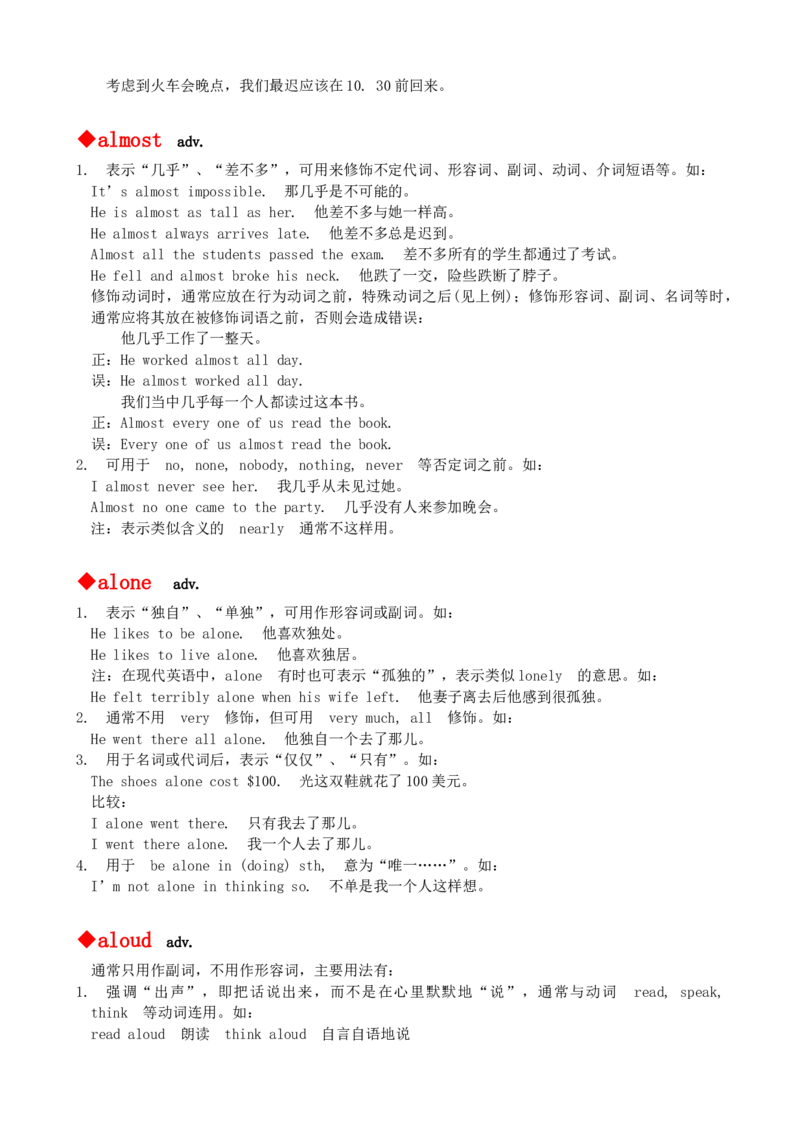
Allowing for the train being late, we should be back by10. 30.考虑到火车会晚点,我们最迟应该在10. 30前回来。
◆almost
adv.
1. 表示“几乎”、“差不多”,可用来修饰不定代词、形容词、副词、动词、介词短语等。如:
It’s almost impossible. 那几乎是不可能的。
He is almost as tall as her. 他差不多与她一样高。
He almost always arrives late. 他差不多总是迟到。
Almost all the students passed the exam. 差不多所有的学生都通过了考试。
He fell and almost broke his neck. 他跌了一交,险些跌断了脖子。
修饰动词时,通常应放在行为动词之前,特殊动词之后(见上例);修饰形容词、副词、名词等时,
通常应将其放在被修饰词语之前,否则会造成错误:
他几乎工作了一整天。
正:He worked almost all day.
误:He almost worked all day.
我们当中几乎每一个人都读过这本书。
正:Almost every one of us read the book.
误:Every one of us almost read the book.
2. 可用于 no, none, nobody, nothing, never 等否定词之前。如:
I almost never see her. 我几乎从未见过她。
Almost no one came to the party. 几乎没有人来参加晚会。
注:表示类似含义的 nearly 通常不这样用。
◆alone
adv.
1. 表示“独自”、“单独”,可用作形容词或副词。如:
He likes to be alone. 他喜欢独处。
He likes to live alone. 他喜欢独居。
注:在现代英语中,alone 有时也可表示“孤独的”,表示类似lonely 的意思。如:
He felt terribly alone when his wife left. 他妻子离去后他感到很孤独。
2. 通常不用 very 修饰,但可用 very much, all 修饰。如:
He went there all alone. 他独自一个去了那儿。
3. 用于名词或代词后,表示“仅仅”、“只有”。如:
The shoes alone cost $100. 光这双鞋就花了100美元。
比较:
I alone went there. 只有我去了那儿。
I went there alone. 我一个人去了那儿。
4. 用于 be alone in (doing) sth, 意为“唯一……”。如:
I’m not alone in thinking so. 不单是我一个人这样想。
◆aloud
adv.
通常只用作副词,不用作形容词,主要用法有:
1. 强调“出声”,即把话说出来,而不是在心里默默地“说”,通常与动词 read, speak,
think 等动词连用。如:
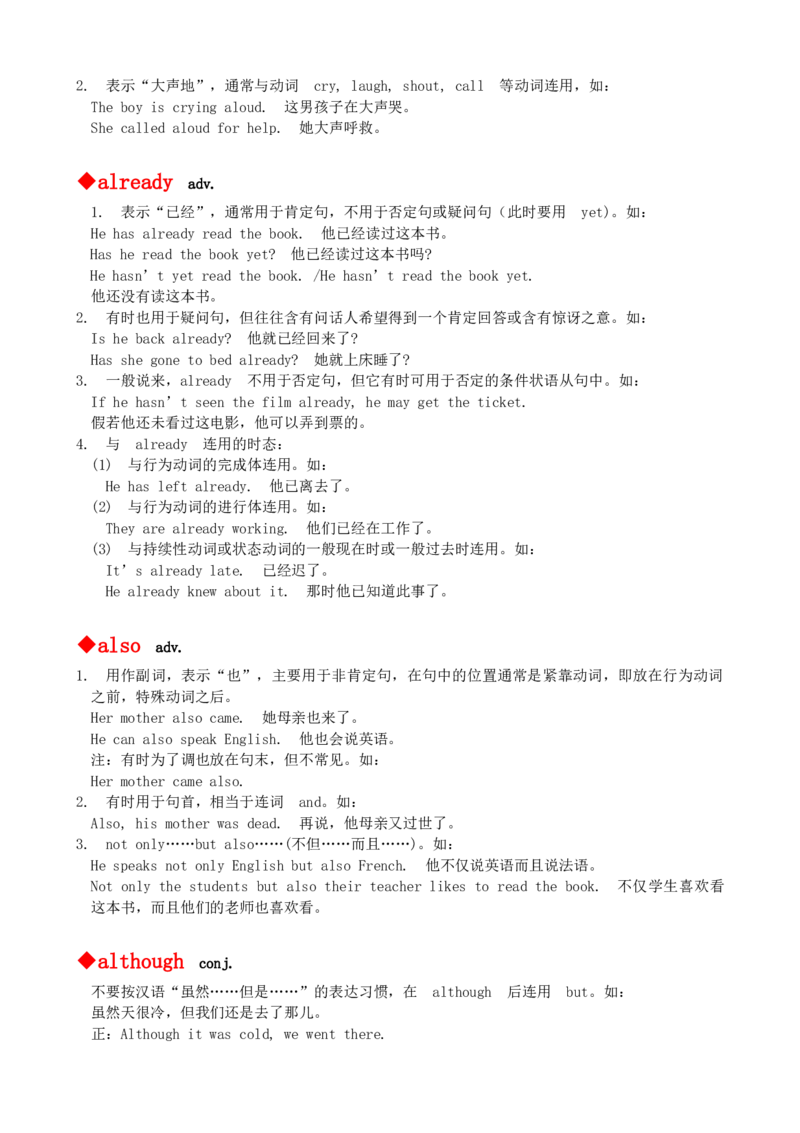
read aloud 朗读 think aloud 自言自语地说2. 表示“大声地”,通常与动词 cry, laugh, shout, call 等动词连用,如:
The boy is crying aloud. 这男孩子在大声哭。
She called aloud for help. 她大声呼救。
◆already
adv.
1. 表示“已经”,通常用于肯定句,不用于否定句或疑问句(此时要用 yet)。如:
He has already read the book. 他已经读过这本书。
Has he read the book yet? 他已经读过这本书吗?
He hasn’t yet read the book. /He hasn’t read the book yet.
他还没有读这本书。
2. 有时也用于疑问句,但往往含有问话人希望得到一个肯定回答或含有惊讶之意。如:
Is he back already? 他就已经回来了?
Has she gone to bed already? 她就上床睡了?
3. 一般说来,already 不用于否定句,但它有时可用于否定的条件状语从句中。如:
If he hasn’t seen the film already, he may get the ticket.
假若他还未看过这电影,他可以弄到票的。
4. 与 already 连用的时态:
(1) 与行为动词的完成体连用。如:
He has left already. 他已离去了。
(2) 与行为动词的进行体连用。如:
They are already working. 他们已经在工作了。
(3) 与持续性动词或状态动词的一般现在时或一般过去时连用。如:
It’s already late. 已经迟了。
He already knew about it. 那时他已知道此事了。
◆also
adv.
1. 用作副词,表示“也”,主要用于非肯定句,在句中的位置通常是紧靠动词,即放在行为动词
之前,特殊动词之后。
Her mother also came. 她母亲也来了。
He can also speak English. 他也会说英语。
注:有时为了调也放在句末,但不常见。如:
Her mother came also.
2. 有时用于句首,相当于连词 and。如:
Also, his mother was dead. 再说,他母亲又过世了。
3. not only……but also……(不但……而且……)。如:
He speaks not only English but also French. 他不仅说英语而且说法语。
Not only the students but also their teacher likes to read the book. 不仅学生喜欢看
这本书,而且他们的老师也喜欢看。
◆although
conj.
不要按汉语“虽然……但是……”的表达习惯,在 although 后连用 but。如:
虽然天很冷,但我们还是去了那儿。
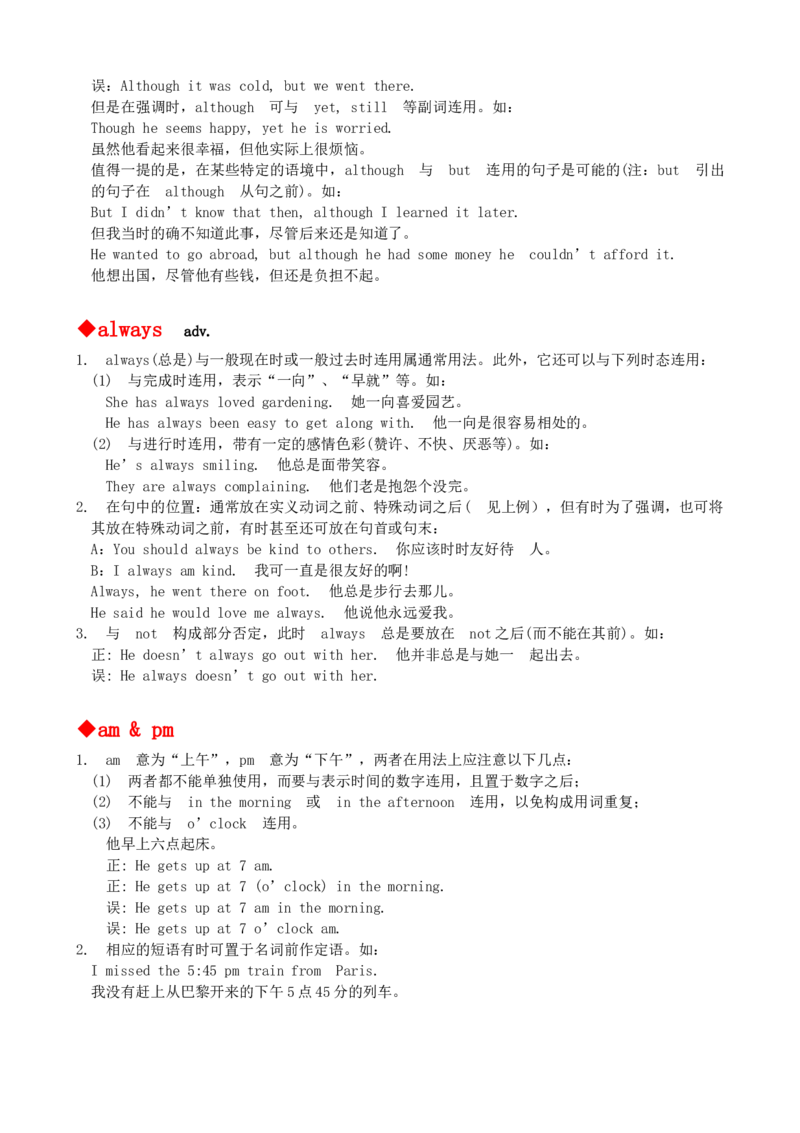
正:Although it was cold, we went there.误:Although it was cold, but we went there.
但是在强调时,although 可与 yet, still 等副词连用。如:
Though he seems happy, yet he is worried.
虽然他看起来很幸福,但他实际上很烦恼。
值得一提的是,在某些特定的语境中,although 与 but 连用的句子是可能的(注:but 引出
的句子在 although 从句之前)。如:
But I didn’t know that then, although I learned it later.
但我当时的确不知道此事,尽管后来还是知道了。
He wanted to go abroad, but although he had some money he couldn’t afford it.
他想出国,尽管他有些钱,但还是负担不起。
◆always
adv.
1. always(总是)与一般现在时或一般过去时连用属通常用法。此外,它还可以与下列时态连用:
(1) 与完成时连用,表示“一向”、“早就”等。如:
She has always loved gardening. 她一向喜爱园艺。
He has always been easy to get along with. 他一向是很容易相处的。
(2) 与进行时连用,带有一定的感情色彩(赞许、不快、厌恶等)。如:
He’s always smiling. 他总是面带笑容。
They are always complaining. 他们老是抱怨个没完。
2. 在句中的位置:通常放在实义动词之前、特殊动词之后( 见上例),但有时为了强调,也可将
其放在特殊动词之前,有时甚至还可放在句首或句末:
A:You should always be kind to others. 你应该时时友好待 人。
B:I always am kind. 我可一直是很友好的啊!
Always, he went there on foot. 他总是步行去那儿。
He said he would love me always. 他说他永远爱我。
3. 与 not 构成部分否定,此时 always 总是要放在 not之后(而不能在其前)。如:
正: He doesn’t always go out with her. 他并非总是与她一 起出去。
误: He always doesn’t go out with her.
◆am & pm
1. am 意为“上午”,pm 意为“下午”,两者在用法上应注意以下几点:
(1) 两者都不能单独使用,而要与表示时间的数字连用,且置于数字之后;
(2) 不能与 in the morning 或 in the afternoon 连用,以免构成用词重复;
(3) 不能与 o’clock 连用。
他早上六点起床。
正: He gets up at 7 am.
正: He gets up at 7 (o’clock) in the morning.
误: He gets up at 7 am in the morning.
误: He gets up at 7 o’clock am.
2. 相应的短语有时可置于名词前作定语。如:
I missed the 5:45 pm train from Paris.
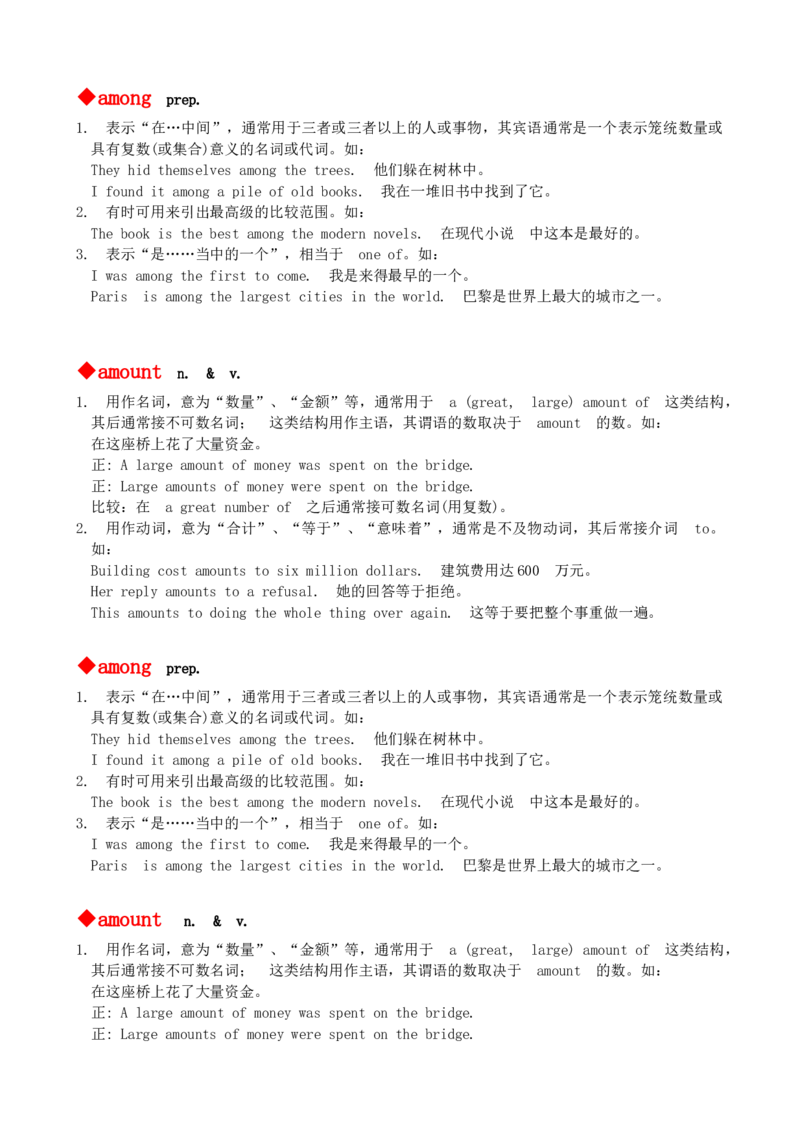
我没有赶上从巴黎开来的下午5点45分的列车。◆among
prep.
1. 表示“在…中间”,通常用于三者或三者以上的人或事物,其宾语通常是一个表示笼统数量或
具有复数(或集合)意义的名词或代词。如:
They hid themselves among the trees. 他们躲在树林中。
I found it among a pile of old books. 我在一堆旧书中找到了它。
2. 有时可用来引出最高级的比较范围。如:
The book is the best among the modern novels. 在现代小说 中这本是最好的。
3. 表示“是……当中的一个”,相当于 one of。如:
I was among the first to come. 我是来得最早的一个。
Paris is among the largest cities in the world. 巴黎是世界上最大的城市之一。
◆amount
n. & v.
1. 用作名词,意为“数量”、“金额”等,通常用于 a (great, large) amount of 这类结构,
其后通常接不可数名词; 这类结构用作主语,其谓语的数取决于 amount 的数。如:
在这座桥上花了大量资金。
正: A large amount of money was spent on the bridge.
正: Large amounts of money were spent on the bridge.
比较:在 a great number of 之后通常接可数名词(用复数)。
2. 用作动词,意为“合计”、“等于”、“意味着”,通常是不及物动词,其后常接介词 to。
如:
Building cost amounts to six million dollars. 建筑费用达600 万元。
Her reply amounts to a refusal. 她的回答等于拒绝。
This amounts to doing the whole thing over again. 这等于要把整个事重做一遍。
◆among
prep.
1. 表示“在…中间”,通常用于三者或三者以上的人或事物,其宾语通常是一个表示笼统数量或
具有复数(或集合)意义的名词或代词。如:
They hid themselves among the trees. 他们躲在树林中。
I found it among a pile of old books. 我在一堆旧书中找到了它。
2. 有时可用来引出最高级的比较范围。如:
The book is the best among the modern novels. 在现代小说 中这本是最好的。
3. 表示“是……当中的一个”,相当于 one of。如:
I was among the first to come. 我是来得最早的一个。
Paris is among the largest cities in the world. 巴黎是世界上最大的城市之一。
◆amount
n. & v.
1. 用作名词,意为“数量”、“金额”等,通常用于 a (great, large) amount of 这类结构,
其后通常接不可数名词; 这类结构用作主语,其谓语的数取决于 amount 的数。如:
在这座桥上花了大量资金。
正: A large amount of money was spent on the bridge.
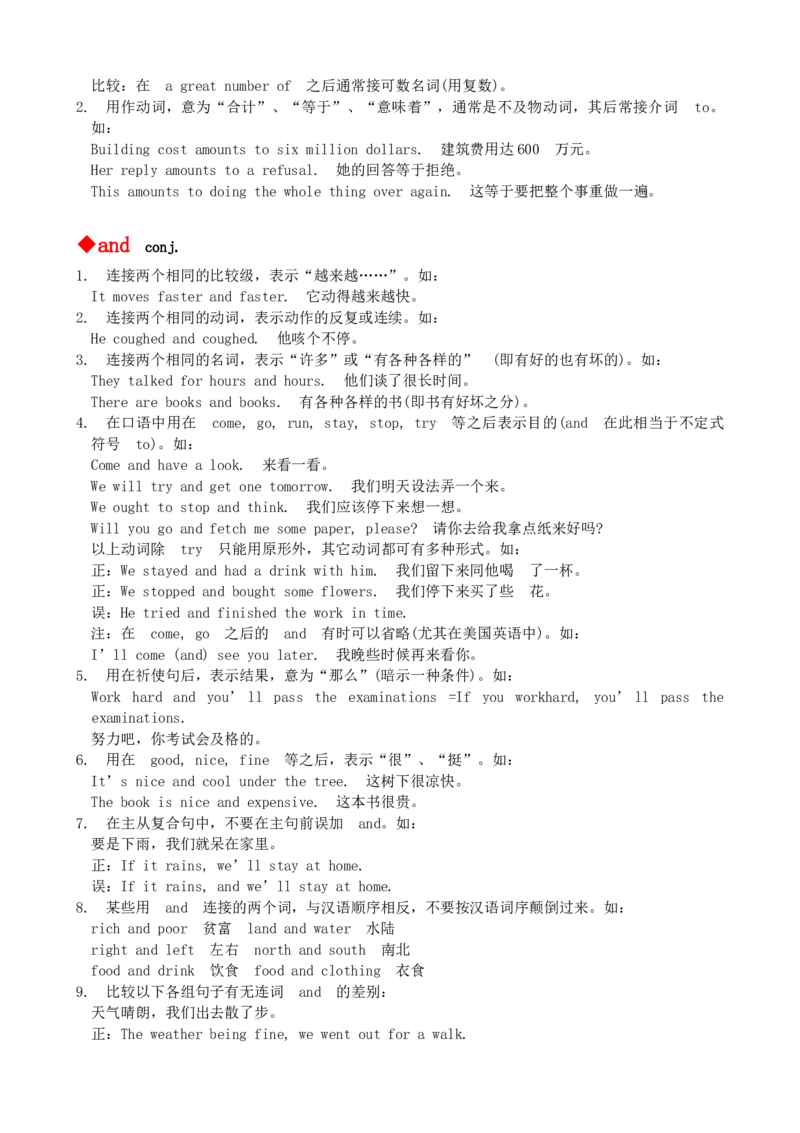
正: Large amounts of money were spent on the bridge.比较:在 a great number of 之后通常接可数名词(用复数)。
2. 用作动词,意为“合计”、“等于”、“意味着”,通常是不及物动词,其后常接介词 to。
如:
Building cost amounts to six million dollars. 建筑费用达600 万元。
Her reply amounts to a refusal. 她的回答等于拒绝。
This amounts to doing the whole thing over again. 这等于要把整个事重做一遍。
◆and
conj.
1. 连接两个相同的比较级,表示“越来越……”。如:
It moves faster and faster. 它动得越来越快。
2. 连接两个相同的动词,表示动作的反复或连续。如:
He coughed and coughed. 他咳个不停。
3. 连接两个相同的名词,表示“许多”或“有各种各样的” (即有好的也有坏的)。如:
They talked for hours and hours. 他们谈了很长时间。
There are books and books. 有各种各样的书(即书有好坏之分)。
4. 在口语中用在 come, go, run, stay, stop, try 等之后表示目的(and 在此相当于不定式
符号 to)。如:
Come and have a look. 来看一看。
We will try and get one tomorrow. 我们明天设法弄一个来。
We ought to stop and think. 我们应该停下来想一想。
Will you go and fetch me some paper, please? 请你去给我拿点纸来好吗?
以上动词除 try 只能用原形外,其它动词都可有多种形式。如:
正:We stayed and had a drink with him. 我们留下来同他喝 了一杯。
正:We stopped and bought some flowers. 我们停下来买了些 花。
误:He tried and finished the work in time.
注:在 come, go 之后的 and 有时可以省略(尤其在美国英语中)。如:
I’ll come (and) see you later. 我晚些时候再来看你。
5. 用在祈使句后,表示结果,意为“那么”(暗示一种条件)。如:
Work hard and you’ll pass the examinations =If you workhard, you’ll pass the
examinations.
努力吧,你考试会及格的。
6. 用在 good, nice, fine 等之后,表示“很”、“挺”。如:
It’s nice and cool under the tree. 这树下很凉快。
The book is nice and expensive. 这本书很贵。
7. 在主从复合句中,不要在主句前误加 and。如:
要是下雨,我们就呆在家里。
正:If it rains, we’ll stay at home.
误:If it rains, and we’ll stay at home.
8. 某些用 and 连接的两个词,与汉语顺序相反,不要按汉语词序颠倒过来。如:
rich and poor 贫富 land and water 水陆
right and left 左右 north and south 南北
food and drink 饮食 food and clothing 衣食
9. 比较以下各组句子有无连词 and 的差别:
天气晴朗,我们出去散了步。
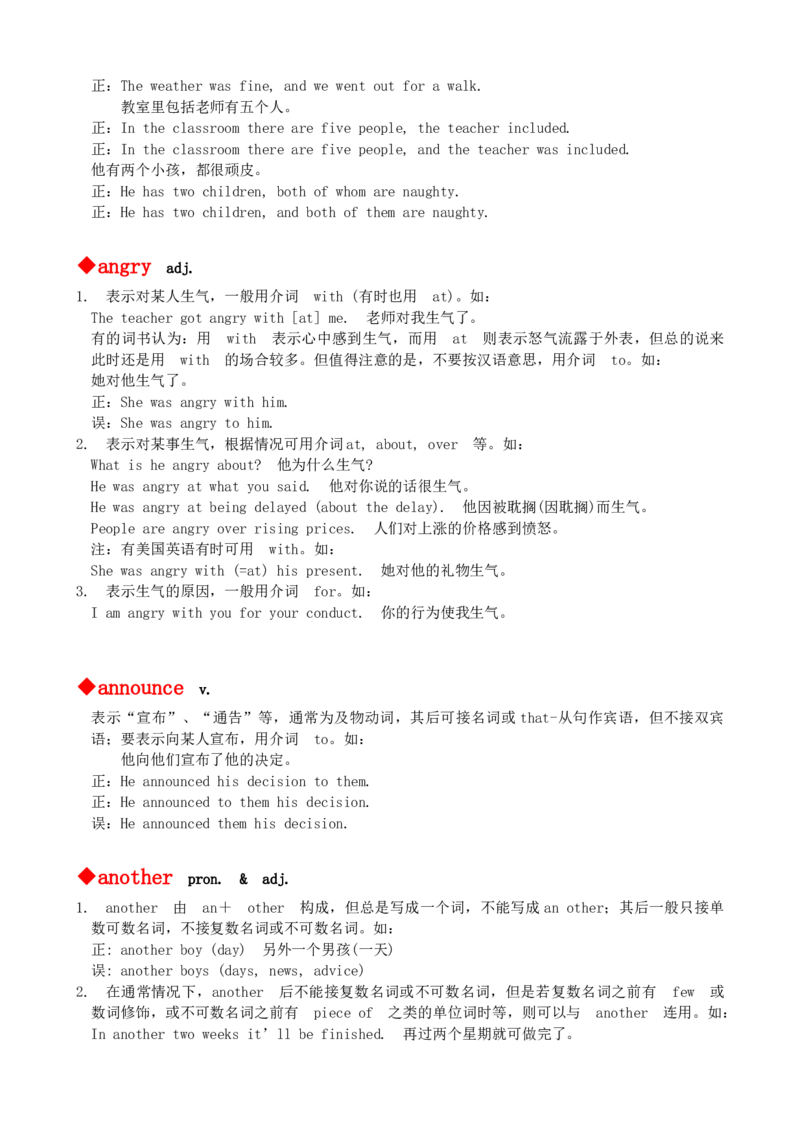
正:The weather being fine, we went out for a walk.正:The weather was fine, and we went out for a walk.
教室里包括老师有五个人。
正:In the classroom there are five people, the teacher included.
正:In the classroom there are five people, and the teacher was included.
他有两个小孩,都很顽皮。
正:He has two children, both of whom are naughty.
正:He has two children, and both of them are naughty.
◆angry
adj.
1. 表示对某人生气,一般用介词 with (有时也用 at)。如:
The teacher got angry with [at] me. 老师对我生气了。
有的词书认为:用 with 表示心中感到生气,而用 at 则表示怒气流露于外表,但总的说来
此时还是用 with 的场合较多。但值得注意的是,不要按汉语意思,用介词 to。如:
她对他生气了。
正:She was angry with him.
误:She was angry to him.
2. 表示对某事生气,根据情况可用介词at, about, over 等。如:
What is he angry about? 他为什么生气?
He was angry at what you said. 他对你说的话很生气。
He was angry at being delayed (about the delay). 他因被耽搁(因耽搁)而生气。
People are angry over rising prices. 人们对上涨的价格感到愤怒。
注:有美国英语有时可用 with。如:
She was angry with (=at) his present. 她对他的礼物生气。
3. 表示生气的原因,一般用介词 for。如:
I am angry with you for your conduct. 你的行为使我生气。
◆announce
v.
表示“宣布”、“通告”等,通常为及物动词,其后可接名词或 that-从句作宾语,但不接双宾
语;要表示向某人宣布,用介词 to。如:
他向他们宣布了他的决定。
正:He announced his decision to them.
正:He announced to them his decision.
误:He announced them his decision.
◆another
pron. & adj.
1. another 由 an+ other 构成,但总是写成一个词,不能写成an other;其后一般只接单
数可数名词,不接复数名词或不可数名词。如:
正: another boy (day) 另外一个男孩(一天)
误: another boys (days, news, advice)
2. 在通常情况下,another 后不能接复数名词或不可数名词,但是若复数名词之前有 few 或
数词修饰,或不可数名词之前有 piece of 之类的单位词时等,则可以与 another 连用。如:
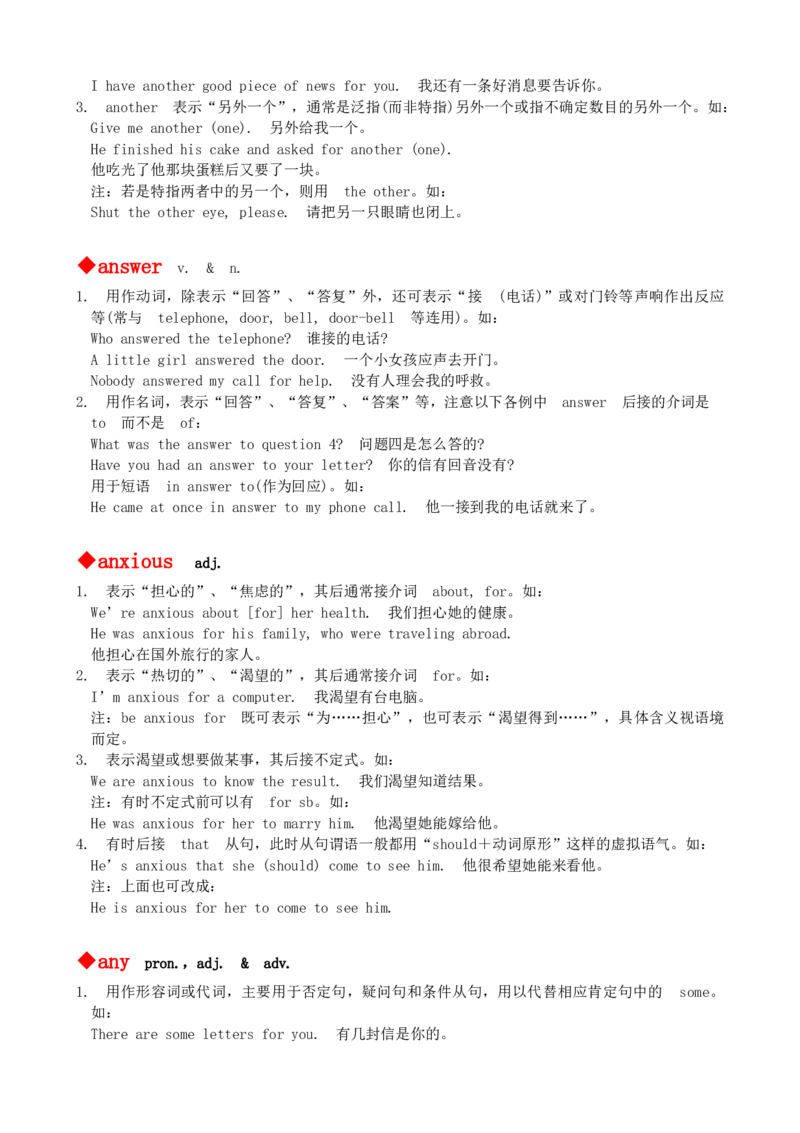
In another two weeks it’ll be finished. 再过两个星期就可做完了。I have another good piece of news for you. 我还有一条好消息要告诉你。
3. another 表示“另外一个”,通常是泛指(而非特指)另外一个或指不确定数目的另外一个。如:
Give me another (one). 另外给我一个。
He finished his cake and asked for another (one).
他吃光了他那块蛋糕后又要了一块。
注:若是特指两者中的另一个,则用 the other。如:
Shut the other eye, please. 请把另一只眼睛也闭上。
◆answer
v. & n.
1. 用作动词,除表示“回答”、“答复”外,还可表示“接 (电话)”或对门铃等声响作出反应
等(常与 telephone, door, bell, door-bell 等连用)。如:
Who answered the telephone? 谁接的电话?
A little girl answered the door. 一个小女孩应声去开门。
Nobody answered my call for help. 没有人理会我的呼救。
2. 用作名词,表示“回答”、“答复”、“答案”等,注意以下各例中 answer 后接的介词是
to 而不是 of:
What was the answer to question 4? 问题四是怎么答的?
Have you had an answer to your letter? 你的信有回音没有?
用于短语 in answer to(作为回应)。如:
He came at once in answer to my phone call. 他一接到我的电话就来了。
◆anxious
adj.
1. 表示“担心的”、“焦虑的”,其后通常接介词 about, for。如:
We’re anxious about [for] her health. 我们担心她的健康。
He was anxious for his family, who were traveling abroad.
他担心在国外旅行的家人。
2. 表示“热切的”、“渴望的”,其后通常接介词 for。如:
I’m anxious for a computer. 我渴望有台电脑。
注:be anxious for 既可表示“为……担心”,也可表示“渴望得到……”,具体含义视语境
而定。
3. 表示渴望或想要做某事,其后接不定式。如:
We are anxious to know the result. 我们渴望知道结果。
注:有时不定式前可以有 for sb。如:
He was anxious for her to marry him. 他渴望她能嫁给他。
4. 有时后接 that 从句,此时从句谓语一般都用“should+动词原形”这样的虚拟语气。如:
He’s anxious that she (should) come to see him. 他很希望她能来看他。
注:上面也可改成:
He is anxious for her to come to see him.
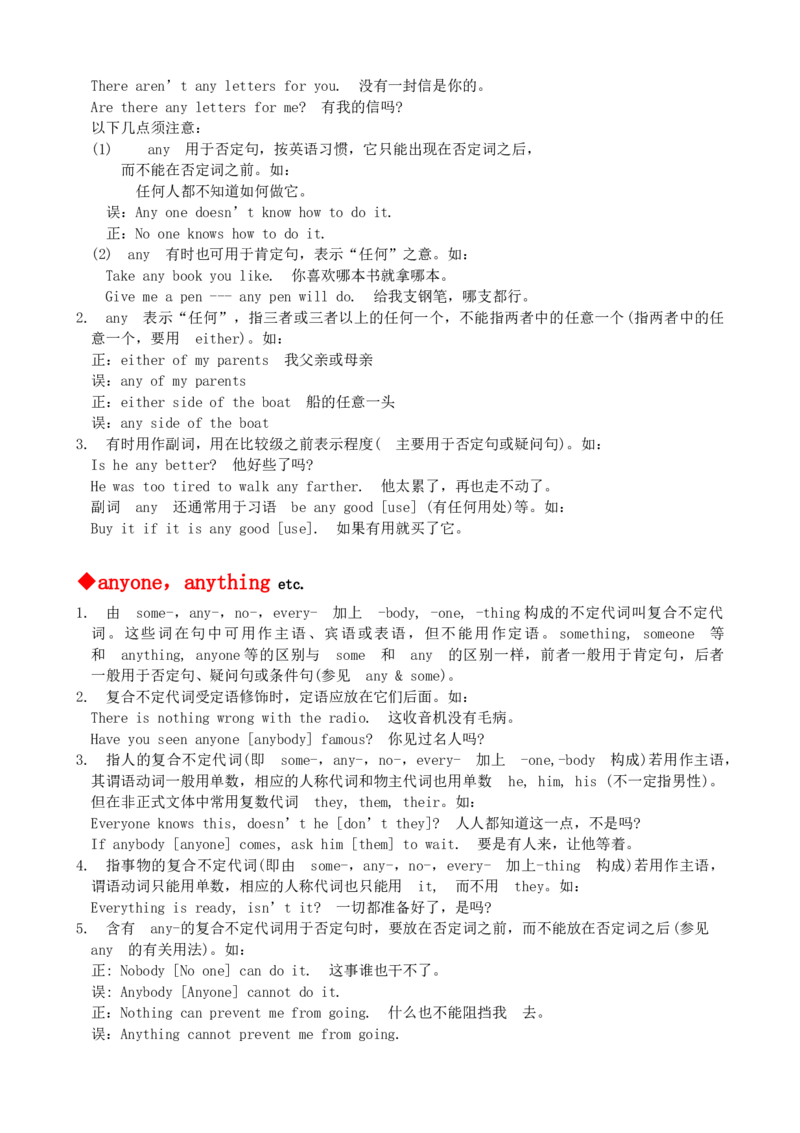
◆any
pron.,adj. & adv.
1. 用作形容词或代词,主要用于否定句,疑问句和条件从句,用以代替相应肯定句中的 some。
如:
There are some letters for you. 有几封信是你的。There aren’t any letters for you. 没有一封信是你的。
Are there any letters for me? 有我的信吗?
以下几点须注意:
(1) any 用于否定句,按英语习惯,它只能出现在否定词之后,
而不能在否定词之前。如:
任何人都不知道如何做它。
误:Any one doesn’t know how to do it.
正:No one knows how to do it.
(2) any 有时也可用于肯定句,表示“任何”之意。如:
Take any book you like. 你喜欢哪本书就拿哪本。
Give me a pen --- any pen will do. 给我支钢笔,哪支都行。
2. any 表示“任何”,指三者或三者以上的任何一个,不能指两者中的任意一个(指两者中的任
意一个,要用 either)。如:
正:either of my parents 我父亲或母亲
误:any of my parents
正:either side of the boat 船的任意一头
误:any side of the boat
3. 有时用作副词,用在比较级之前表示程度( 主要用于否定句或疑问句)。如:
Is he any better? 他好些了吗?
He was too tired to walk any farther. 他太累了,再也走不动了。
副词 any 还通常用于习语 be any good [use] (有任何用处)等。如:
Buy it if it is any good [use]. 如果有用就买了它。
◆anyone,anything
etc.
1. 由 some-,any-,no-,every- 加上 -body, -one, -thing构成的不定代词叫复合不定代
词。这些词在句中可用作主语、宾语或表语,但不能用作定语。something, someone 等
和 anything, anyone等的区别与 some 和 any 的区别一样,前者一般用于肯定句,后者
一般用于否定句、疑问句或条件句(参见 any & some)。
2. 复合不定代词受定语修饰时,定语应放在它们后面。如:
There is nothing wrong with the radio. 这收音机没有毛病。
Have you seen anyone [anybody] famous? 你见过名人吗?
3. 指人的复合不定代词(即 some-,any-,no-,every- 加上 -one,-body 构成)若用作主语,
其谓语动词一般用单数,相应的人称代词和物主代词也用单数 he, him, his (不一定指男性)。
但在非正式文体中常用复数代词 they, them, their。如:
Everyone knows this, doesn’t he [don’t they]? 人人都知道这一点,不是吗?
If anybody [anyone] comes, ask him [them] to wait. 要是有人来,让他等着。
4. 指事物的复合不定代词(即由 some-,any-,no-,every- 加上-thing 构成)若用作主语,
谓语动词只能用单数,相应的人称代词也只能用 it, 而不用 they。如:
Everything is ready, isn’t it? 一切都准备好了,是吗?
5. 含有 any-的复合不定代词用于否定句时,要放在否定词之前,而不能放在否定词之后(参见
any 的有关用法)。如:
正: Nobody [No one] can do it. 这事谁也干不了。
误: Anybody [Anyone] cannot do it.
正:Nothing can prevent me from going. 什么也不能阻挡我 去。
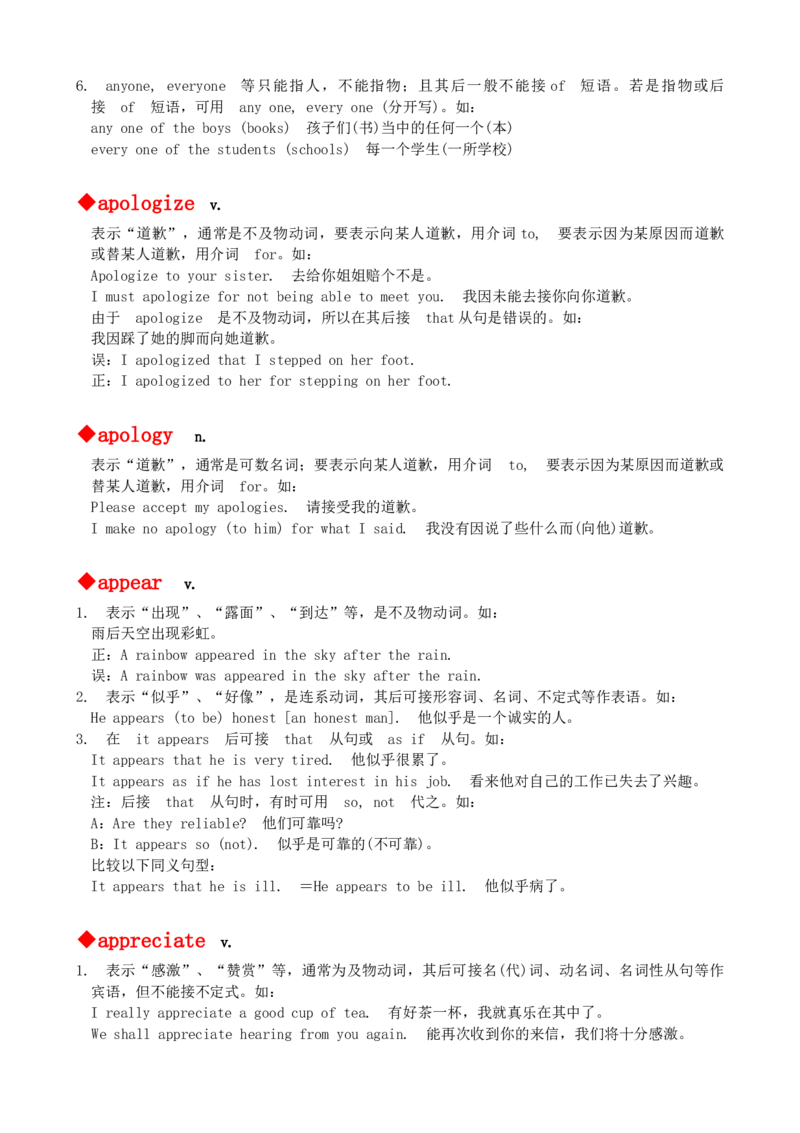
误:Anything cannot prevent me from going.6. anyone, everyone 等只能指人,不能指物;且其后一般不能接 of 短语。若是指物或后
接 of 短语,可用 any one, every one (分开写)。如:
any one of the boys (books) 孩子们(书)当中的任何一个(本)
every one of the students (schools) 每一个学生(一所学校)
◆apologize
v.
表示“道歉”,通常是不及物动词,要表示向某人道歉,用介词 to, 要表示因为某原因而道歉
或替某人道歉,用介词 for。如:
Apologize to your sister. 去给你姐姐赔个不是。
I must apologize for not being able to meet you. 我因未能去接你向你道歉。
由于 apologize 是不及物动词,所以在其后接 that从句是错误的。如:
我因踩了她的脚而向她道歉。
误:I apologized that I stepped on her foot.
正:I apologized to her for stepping on her foot.
◆apology
n.
表示“道歉”,通常是可数名词;要表示向某人道歉,用介词 to, 要表示因为某原因而道歉或
替某人道歉,用介词 for。如:
Please accept my apologies. 请接受我的道歉。
I make no apology (to him) for what I said. 我没有因说了些什么而(向他)道歉。
◆appear
v.
1. 表示“出现”、“露面”、“到达”等,是不及物动词。如:
雨后天空出现彩虹。
正:A rainbow appeared in the sky after the rain.
误:A rainbow was appeared in the sky after the rain.
2. 表示“似乎”、“好像”,是连系动词,其后可接形容词、名词、不定式等作表语。如:
He appears (to be) honest [an honest man]. 他似乎是一个诚实的人。
3. 在 it appears 后可接 that 从句或 as if 从句。如:
It appears that he is very tired. 他似乎很累了。
It appears as if he has lost interest in his job. 看来他对自己的工作已失去了兴趣。
注:后接 that 从句时,有时可用 so, not 代之。如:
A:Are they reliable? 他们可靠吗?
B:It appears so (not). 似乎是可靠的(不可靠)。
比较以下同义句型:
It appears that he is ill. =He appears to be ill. 他似乎病了。
◆appreciate
v.
1. 表示“感激”、“赞赏”等,通常为及物动词,其后可接名(代)词、动名词、名词性从句等作
宾语,但不能接不定式。如:
I really appreciate a good cup of tea. 有好茶一杯,我就真乐在其中了。
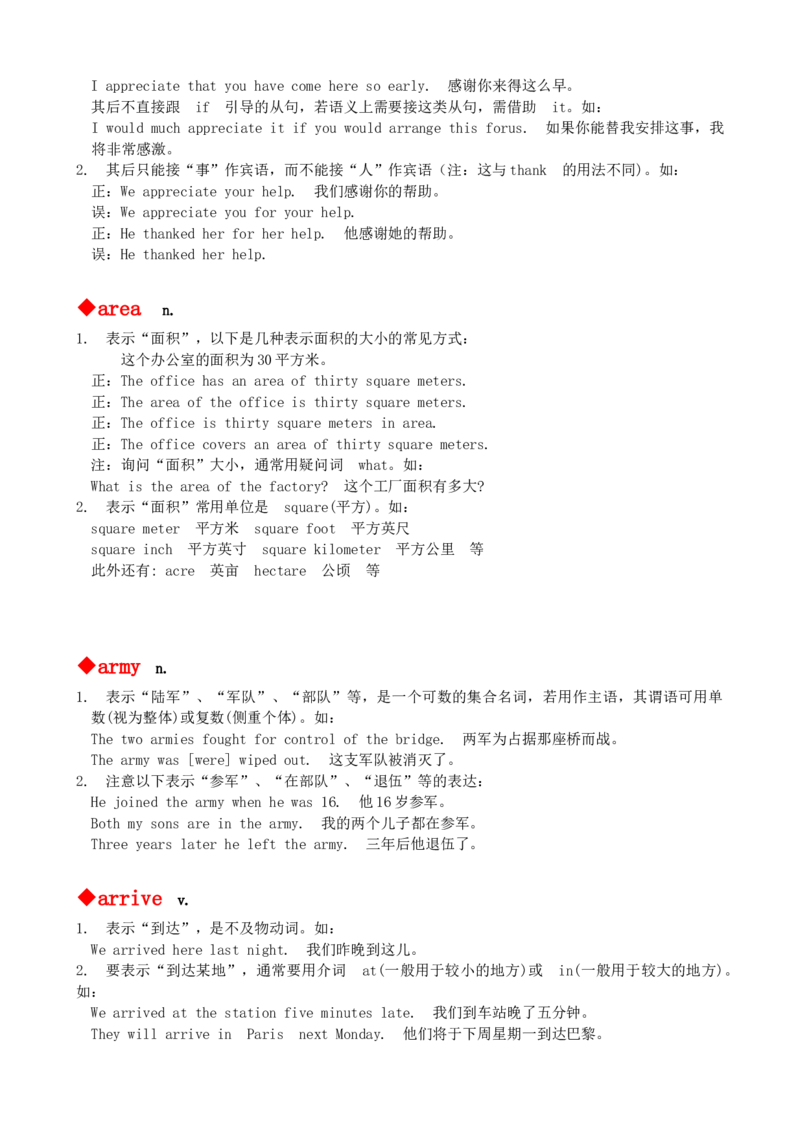
We shall appreciate hearing from you again. 能再次收到你的来信,我们将十分感激。I appreciate that you have come here so early. 感谢你来得这么早。
其后不直接跟 if 引导的从句,若语义上需要接这类从句,需借助 it。如:
I would much appreciate it if you would arrange this forus. 如果你能替我安排这事,我
将非常感激。
2. 其后只能接“事”作宾语,而不能接“人”作宾语(注:这与thank 的用法不同)。如:
正:We appreciate your help. 我们感谢你的帮助。
误:We appreciate you for your help.
正:He thanked her for her help. 他感谢她的帮助。
误:He thanked her help.
◆area
n.
1. 表示“面积”,以下是几种表示面积的大小的常见方式:
这个办公室的面积为30平方米。
正:The office has an area of thirty square meters.
正:The area of the office is thirty square meters.
正:The office is thirty square meters in area.
正:The office covers an area of thirty square meters.
注:询问“面积”大小,通常用疑问词 what。如:
What is the area of the factory? 这个工厂面积有多大?
2. 表示“面积”常用单位是 square(平方)。如:
square meter 平方米 square foot 平方英尺
square inch 平方英寸 square kilometer 平方公里 等
此外还有: acre 英亩 hectare 公顷 等
◆army
n.
1. 表示“陆军”、“军队”、“部队”等,是一个可数的集合名词,若用作主语,其谓语可用单
数(视为整体)或复数(侧重个体)。如:
The two armies fought for control of the bridge. 两军为占据那座桥而战。
The army was [were] wiped out. 这支军队被消灭了。
2. 注意以下表示“参军”、“在部队”、“退伍”等的表达:
He joined the army when he was 16. 他16岁参军。
Both my sons are in the army. 我的两个儿子都在参军。
Three years later he left the army. 三年后他退伍了。
◆arrive
v.
1. 表示“到达”,是不及物动词。如:
We arrived here last night. 我们昨晚到这儿。
2. 要表示“到达某地”,通常要用介词 at(一般用于较小的地方)或 in(一般用于较大的地方)。
如:
We arrived at the station five minutes late. 我们到车站晚了五分钟。
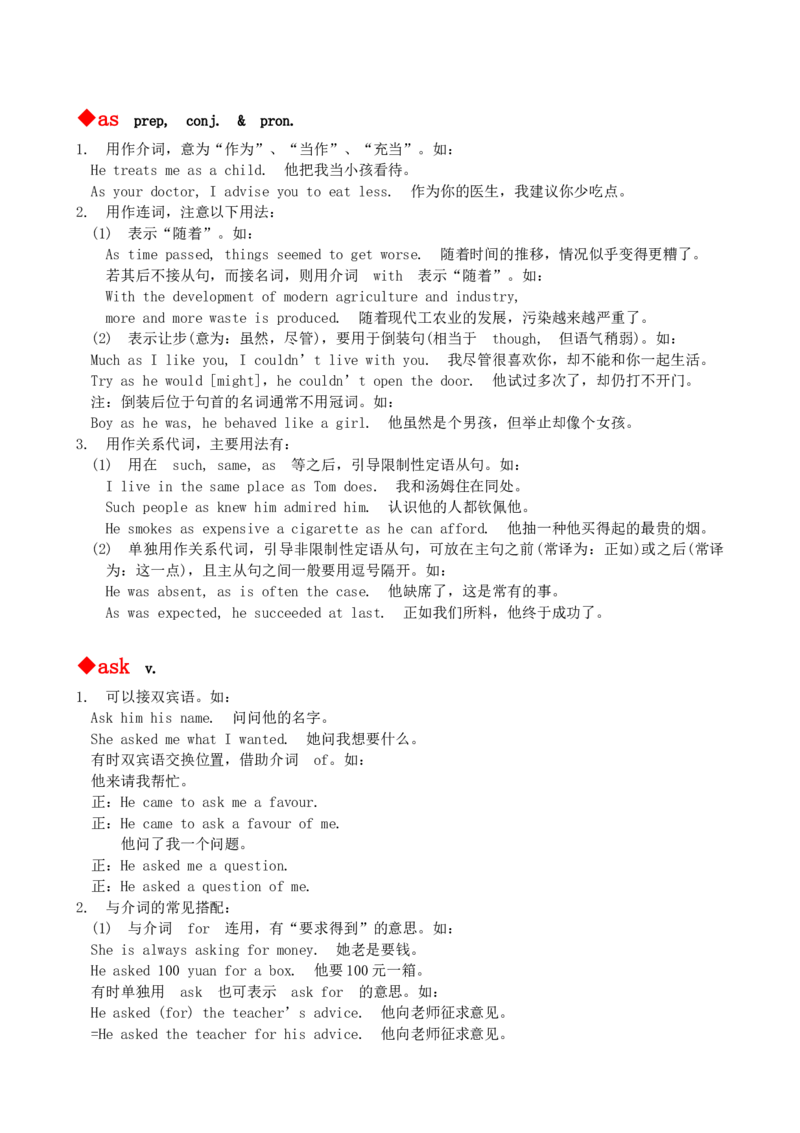
They will arrive in Paris next Monday. 他们将于下周星期一到达巴黎。◆as
prep, conj. & pron.
1. 用作介词,意为“作为”、“当作”、“充当”。如:
He treats me as a child. 他把我当小孩看待。
As your doctor, I advise you to eat less. 作为你的医生,我建议你少吃点。
2. 用作连词,注意以下用法:
(1) 表示“随着”。如:
As time passed, things seemed to get worse. 随着时间的推移,情况似乎变得更糟了。
若其后不接从句,而接名词,则用介词 with 表示“随着”。如:
With the development of modern agriculture and industry,
more and more waste is produced. 随着现代工农业的发展,污染越来越严重了。
(2) 表示让步(意为:虽然,尽管),要用于倒装句(相当于 though, 但语气稍弱)。如:
Much as I like you, I couldn’t live with you. 我尽管很喜欢你,却不能和你一起生活。
Try as he would [might],he couldn’t open the door. 他试过多次了,却仍打不开门。
注:倒装后位于句首的名词通常不用冠词。如:
Boy as he was, he behaved like a girl. 他虽然是个男孩,但举止却像个女孩。
3. 用作关系代词,主要用法有:
(1) 用在 such, same, as 等之后,引导限制性定语从句。如:
I live in the same place as Tom does. 我和汤姆住在同处。
Such people as knew him admired him. 认识他的人都钦佩他。
He smokes as expensive a cigarette as he can afford. 他抽一种他买得起的最贵的烟。
(2) 单独用作关系代词,引导非限制性定语从句,可放在主句之前(常译为:正如)或之后(常译
为:这一点),且主从句之间一般要用逗号隔开。如:
He was absent, as is often the case. 他缺席了,这是常有的事。
As was expected, he succeeded at last. 正如我们所料,他终于成功了。
◆ask
v.
1. 可以接双宾语。如:
Ask him his name. 问问他的名字。
She asked me what I wanted. 她问我想要什么。
有时双宾语交换位置,借助介词 of。如:
他来请我帮忙。
正:He came to ask me a favour.
正:He came to ask a favour of me.
他问了我一个问题。
正:He asked me a question.
正:He asked a question of me.
2. 与介词的常见搭配:
(1) 与介词 for 连用,有“要求得到”的意思。如:
She is always asking for money. 她老是要钱。
He asked 100 yuan for a box. 他要100元一箱。
有时单独用 ask 也可表示 ask for 的意思。如:
He asked (for) the teacher’s advice. 他向老师征求意见。
=He asked the teacher for his advice. 他向老师征求意见。(2) 与 about 连用,表示询问或打听关于某事的情况。如:
Ask (him) about the ring — he may have found it. 问问(他)你丢的戒指——也许他捡到
了。
(3) 与 after 连用,表问候或问好。如:
He always asks after you in his letters. 他每次来信都向你问候。
比较:
He asked her something. 他问她一个问题(或一件事)。
He asked her for something. 他问她要某东西。
He asked her about something. 他问她关于某事的问题。
3. 后接不定式或不定式的复合结构,表示要求做某事或要求某人做某事。如:
He asked to stay with us. 他要求和我们一起留下。
She asked me to post some letters. 她叫我寄几封信。
4. 其后可接 that 从句,从句谓语通常用 should+v。如:
He asked that he (should) be given a chance to explain it. 他要求给他机会解释这件事。
以上一句也可用不定式来改写:
He asked to be given a chance to explain it.
5. 有时后接带介词短语或副词的复合结构。如:
He asked us to dinner. 他请我们吃饭。
You’d better ask him in (out, over). 你最好叫他进来(出来,过来)。
◆at
prep.
用法较复杂,以下几点需引起注意:
1. 表示“从事”或“正在做”,其后接的名词往往(并不总是)不用冠词。如:
at cards 在玩牌 at work 在工作 at war 在交战
at lunch 在吃中饭 at table 在吃饭 at school 在上课
at the desk 在读书 at the telephone 在打电话
2. 表示原因,意为“因……而……”、“因听到……而……”。如:
He was pleased at the news. 他听到那消息很高兴。
He was surprised at what she said. 他听到她的话很吃惊。
3. 表示对某事物的回应,有“一……就……”之意。如:
At a sign from him, I went over. 一看到他示意,我就走了过去。
4. 表示价格、速度、数额、程度等。如:
I bought the necktie at (the price of) 10 dollars each. 我以每条10美元(的价格)买下
了这些领带。
He was driving at 70 mph. 当时他在以每小时70英里的速度驾驶。
We are flying at 16500 feet. 我们在16500英尺的高空飞行。
5. 表示目的或目标,在某些搭配中,at 往往含有主观上的不友好意味或恶意(比较用介词 to
的情形)。比较:
a. The dog came at me. 狗向我扑来。(意即咬人)
The dog came to me. 狗向我走过来。(无咬人之意)
b. He threw the ball at me. 他把球向我砸来。(意欲打人)
He threw the ball to me. 他把球抛给我。(无打人之意)
c. He shouted at me. 他对我吼叫。(意在训人)
He shouted to me. 他朝着我大声喊。(无训人之意)
注:表示目标时,at 只表示行为本身,并不表示行为的结果。比较:He shot at the bird, but missed. 他向鸟射击,但未射中。
He shot the bird. 他射中了那只鸟。
◆attempt
v. & n.
表示“企图”、“试图”、“尝试”等,可用作动词或名词:
1. 用作动词,其后可接不定式或动名词作宾语(但用不定式比用动名词常见)。如:
He attempted to leave but was stopped. 他试图要走,但被拦住了。
比较以下同义句型(注意后接名词的情形):
囚犯企图逃跑,但没有成功。
正:The prisoner attempted to escape, but failed.
正:The prisoner attempted an escape, but failed.
他没有企图回答最后一个问题。
正:He didn’t attempt to answer the last question.
正:He didn’t attempt the last question.
2. 用作名词,其后通常接不定式或介词 at。如:
He failed in his attempt to finish [at finishing] it intime. 他企图要及时完成它,没
失败了。
He made an attempt to win [at winning] the first prize. 他试图要获头奖。
◆attention
n.
1. 表示“注意”、“专心”等,是不可数名词,因此不能与不定冠词连用,也没有复数形式。如:
Pay great attention to these points. 要特别注意这几点。
He talked loudly, but no one paid him any attention. 他大声说话,但没有听他。
2. 在 pay attention to, give attention to, bring attentionto 等结构中的 to 是介词,
所以若接动词,应用动名词。如:
We should pay more attention to uniting and working withthe comrades who differ with
us.
我们应该更注意团结那些与自己意见不同的同志工作。
He gives all his attention to making money. 他的注意力完全集中在赚钱上。
3. 口语常用句:
May [Could] I have your attention, please? 请各位注意。
Attention, please. 请注意。
Thank you for your attention. 谢谢。(发言或演讲结束时用)
◆aunt & uncle
n.
1. 可用于称呼,可单独使用,也可与教名连用。如:
Hi, Aunt (Uncle)! 姑姑(叔叔),你好!
Aunt Mary is my mother’s sister. 玛丽姑妈是我母亲的妹妹。
Take me with you, Uncle Jack. 杰克叔叔,带我一起去吧。
2. 注意以下表达:
(1) Uncle Sam 意为“山姆大叔”,是美国或美国人的绰号。
比较: John Bull 意为“约翰牛”,是英国或英国人的绰号。
(2) Uncle Tom, 意为“汤姆大伯”,指与白人交往且竭力讨好白人的黑人,常带有贬义。◆average
n.,adj. & v.
1. 用作名词,有两个主要意思:
(1) 表示“平均”、“平均数”。如:
The average of 2,4 and 6 is 4. 2,4,6 的平均数是4。
An average of 10 students are absent each day. 平均每天有10个学生缺席。
(2) 表示“普通”、“标准”、“平常”。如:
These marks are well above (below) average. 这些分数远在平均分数之上(下)。
(3) 用于 on average, on an [the] average, 意为“平均起来”、“在一般情况下”。如:
On (the) average he works eight hours a day. 他平均每工作八小时。
He smokes 20 cigarettes a day on an average. 他平均每天要抽20支烟。
2. 用作形容词,也有两个主要意思:
(1) 表示“平均的”,通常只用作定语。如:
The average age of the students is 20. 学生的平均年龄为二十岁。
(2) 表示“一般的”、“普通的”,可用作定语也可用作表语。如:
It is just an average dictionary. 那只是本普通的词典。
He is an average teacher. 他是个普通的教师。
3. 用作动词,意为“平均有”、“平均为”。如:
He averages two trips a year. 他平均每年旅游两次。
The children average 10 years of age. 这些小孩平均年龄为10岁。
B
◆back
n. & adv.
1. 短语 at the back of 可以表示“在……的后面(范围之外)”,此时相当于 behind;也可
以表示“在……的后部(范围之内)”,此时不能用 behind。比较:
There is a little garden at the back of the house. 房屋后有个小花园。(小花园在房屋之
外)
There is a little room at the back of the house. 房屋后部有个小房间。(小房间在房屋之
内)有时也用介词 in。如:
He sat in [at] the back of the car. 他坐在小汽车后部。
在美国英语中也可将以上两个短语中的 at [in] the 省略,只用back of。如:
My home lies back of the school. 我家就在学校后面。
2. 通常不与那些已含有 back 含义的动词连用。如:
半小时后他就回来了。
正:Half an hour later he returned [=came back].
误:Half an hour later he returned back.
◆bad
adj.
1. 除表示“坏的”之外,还有不少引申用法“不舒服”、“糟糕的”、“严重的”、“腐烂的”
等。如:
He feels bad. 他感到不舒服(难过)。
He has got a bad cold. 他了患重感冒。It’s a bad mistake (accident). 那是一个严重的错误(一次严重的事故)。
The fish will go bad if you don’t put it in the fridge. 这鱼要是不放入冰箱就会腐烂。
2. 注意以下各句与介词的搭配。如:
He is bad at telling stories. 他不善于讲故事。
Reading in the sun is bad for you (your eyes). 在太阳下看书对你(你的眼睛)有害。
We were hoping for an improvement but things have gone from bad to worse.
我们本希望有所改善,但事情却每况愈下。
◆badly
adv.
1. 其比较等级变化不规则(worse, worst)。如:
谁的工作做得最差?
误:Who did his work the most badly?
正:Who did his work worst?
2. 与 want, need, be in need of 等连用,可表示“迫切地”、“非常”。如:
We want to see her badly. 我们非常想见她。
He needs money badly. /He is badly in need of money. 他急需要钱。
3. badly 是形容词 bad 的副词形式,通常用来修饰动词。如:
The furniture is badly made. 这家具做得很差。
He did his work very badly. 他的工作做得很差。
4. 在现代英语口语中,badly 有时可像形容词 bad 那样用于某些连系动词(如 feel,
be 等)后用作表语。如:
He felt badly about being late. 他因迟到感到难过。
◆baggage
n.
1. 是不可数名词。如
正:some baggage / a lot of baggage / much baggage
误:a baggage / two baggages / many baggages
要表示具体数量,可用单位词 piece (article)。如:
five pieces [articles] of baggage 五件行李
2. baggage 主要用于美国英语,在英国英语中多用 luggage, 两者含义及用法均一样。
◆basketball,football,volleyball,
etc
1. 把“篮球”、“足球”、“排球”等看作一种具体的东西时,是可数名词,可与限定词连用。
如:
The basketball is mine. 这个篮球是我的。
The PE teacher bought five footballs yesterday. 体育老师昨天买了五个足球。
This is my volleyball, not yours. 这是我的排球,不是你的。
2. 若把“篮球”、“足球”、“排球”等看成一种体育活动,则为不可数名词,且一般不与限定
词连用。如:
They all like to play basketball. 他们都喜欢打篮球。
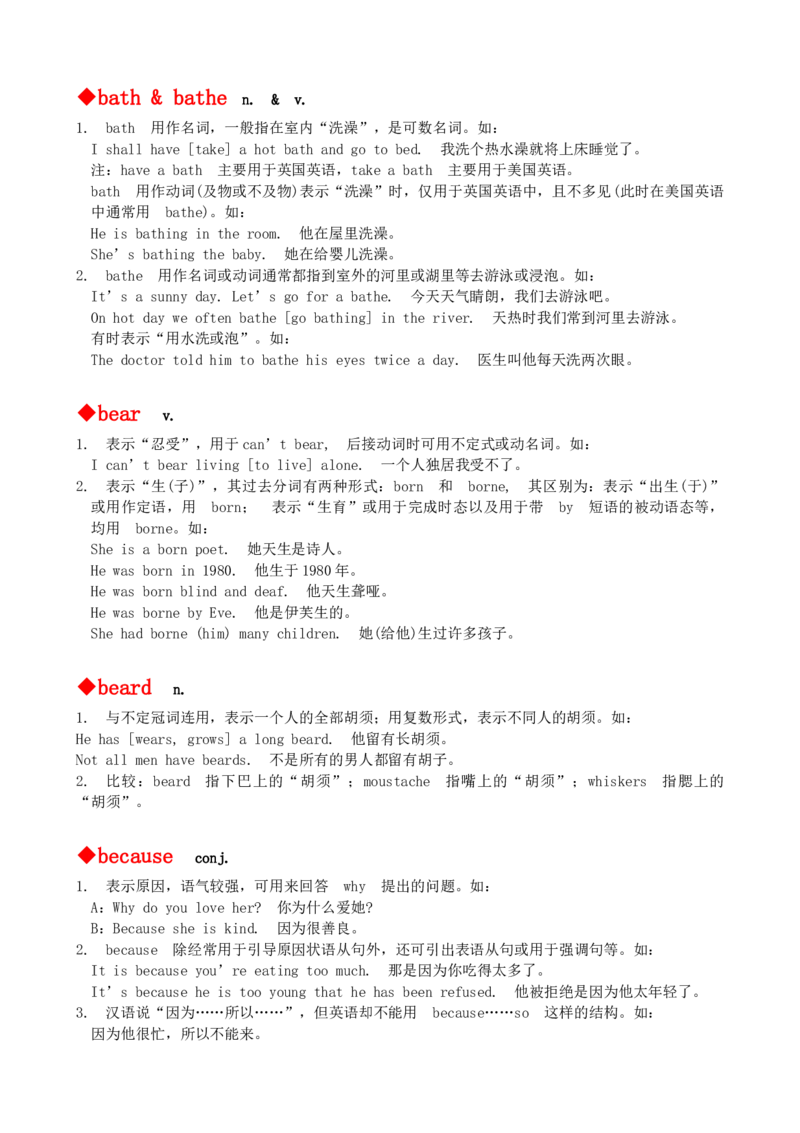
Football is my favourite game. 足球是我最喜欢的体育项目。◆bath & bathe
n. & v.
1. bath 用作名词,一般指在室内“洗澡”,是可数名词。如:
I shall have [take] a hot bath and go to bed. 我洗个热水澡就将上床睡觉了。
注:have a bath 主要用于英国英语,take a bath 主要用于美国英语。
bath 用作动词(及物或不及物)表示“洗澡”时,仅用于英国英语中,且不多见(此时在美国英语
中通常用 bathe)。如:
He is bathing in the room. 他在屋里洗澡。
She’s bathing the baby. 她在给婴儿洗澡。
2. bathe 用作名词或动词通常都指到室外的河里或湖里等去游泳或浸泡。如:
It’s a sunny day. Let’s go for a bathe. 今天天气睛朗,我们去游泳吧。
On hot day we often bathe [go bathing] in the river. 天热时我们常到河里去游泳。
有时表示“用水洗或泡”。如:
The doctor told him to bathe his eyes twice a day. 医生叫他每天洗两次眼。
◆bear
v.
1. 表示“忍受”,用于can’t bear, 后接动词时可用不定式或动名词。如:
I can’t bear living [to live] alone. 一个人独居我受不了。
2. 表示“生(子)”,其过去分词有两种形式:born 和 borne, 其区别为:表示“出生(于)”
或用作定语,用 born; 表示“生育”或用于完成时态以及用于带 by 短语的被动语态等,
均用 borne。如:
She is a born poet. 她天生是诗人。
He was born in 1980. 他生于1980年。
He was born blind and deaf. 他天生聋哑。
He was borne by Eve. 他是伊芙生的。
She had borne (him) many children. 她(给他)生过许多孩子。
◆beard
n.
1. 与不定冠词连用,表示一个人的全部胡须;用复数形式,表示不同人的胡须。如:
He has [wears, grows] a long beard. 他留有长胡须。
Not all men have beards. 不是所有的男人都留有胡子。
2. 比较:beard 指下巴上的“胡须”;moustache 指嘴上的“胡须”;whiskers 指腮上的
“胡须”。
◆because
conj.
1. 表示原因,语气较强,可用来回答 why 提出的问题。如:
A:Why do you love her? 你为什么爱她?
B:Because she is kind. 因为很善良。
2. because 除经常用于引导原因状语从句外,还可引出表语从句或用于强调句等。如:
It is because you’re eating too much. 那是因为你吃得太多了。
It’s because he is too young that he has been refused. 他被拒绝是因为他太年轻了。
3. 汉语说“因为……所以……”,但英语却不能用 because……so 这样的结构。如:
因为他很忙,所以不能来。误:Because he is very busy, so he can’t come.
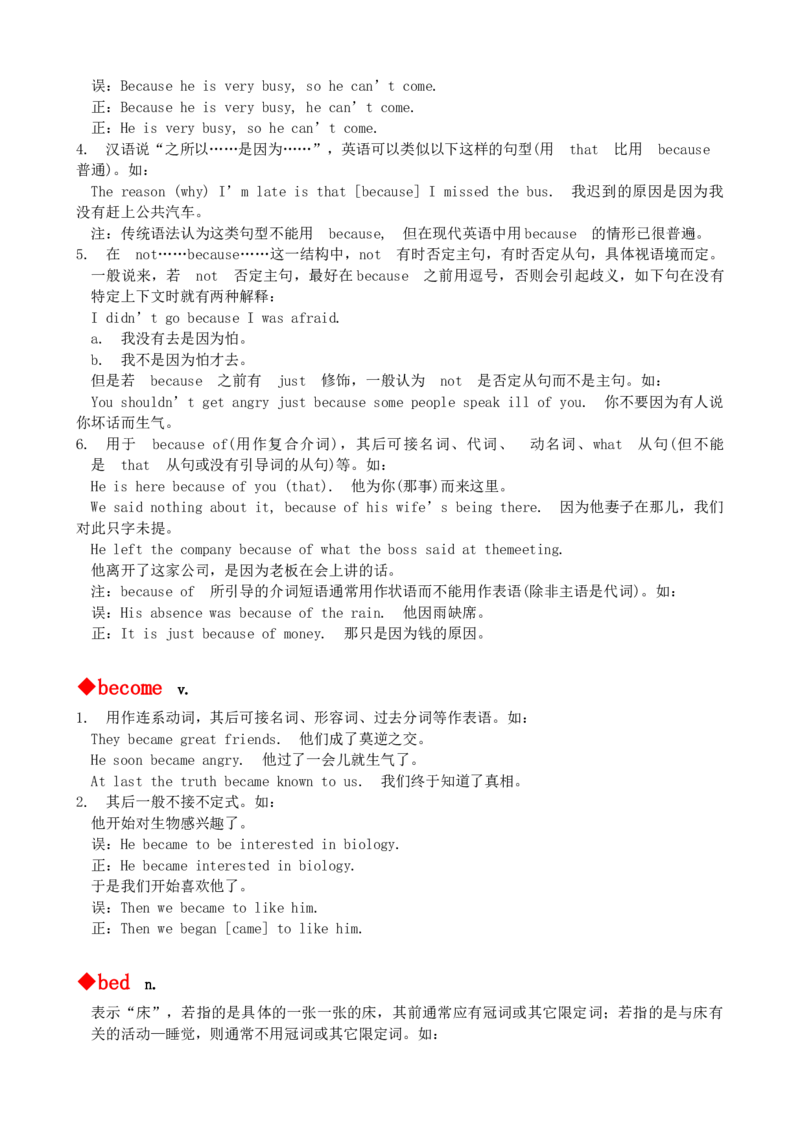
正:Because he is very busy, he can’t come.
正:He is very busy, so he can’t come.
4. 汉语说“之所以……是因为……”,英语可以类似以下这样的句型(用 that 比用 because
普通)。如:
The reason (why) I’m late is that [because] I missed the bus. 我迟到的原因是因为我
没有赶上公共汽车。
注:传统语法认为这类句型不能用 because, 但在现代英语中用because 的情形已很普遍。
5. 在 not……because……这一结构中,not 有时否定主句,有时否定从句,具体视语境而定。
一般说来,若 not 否定主句,最好在because 之前用逗号,否则会引起歧义,如下句在没有
特定上下文时就有两种解释:
I didn’t go because I was afraid.
a. 我没有去是因为怕。
b. 我不是因为怕才去。
但是若 because 之前有 just 修饰,一般认为 not 是否定从句而不是主句。如:
You shouldn’t get angry just because some people speak ill of you. 你不要因为有人说
你坏话而生气。
6. 用于 because of(用作复合介词),其后可接名词、代词、 动名词、what 从句(但不能
是 that 从句或没有引导词的从句)等。如:
He is here because of you (that). 他为你(那事)而来这里。
We said nothing about it, because of his wife’s being there. 因为他妻子在那儿,我们
对此只字未提。
He left the company because of what the boss said at themeeting.
他离开了这家公司,是因为老板在会上讲的话。
注:because of 所引导的介词短语通常用作状语而不能用作表语(除非主语是代词)。如:
误:His absence was because of the rain. 他因雨缺席。
正:It is just because of money. 那只是因为钱的原因。
◆become
v.
1. 用作连系动词,其后可接名词、形容词、过去分词等作表语。如:
They became great friends. 他们成了莫逆之交。
He soon became angry. 他过了一会儿就生气了。
At last the truth became known to us. 我们终于知道了真相。
2. 其后一般不接不定式。如:
他开始对生物感兴趣了。
误:He became to be interested in biology.
正:He became interested in biology.
于是我们开始喜欢他了。
误:Then we became to like him.
正:Then we began [came] to like him.
◆bed
n.
表示“床”,若指的是具体的一张一张的床,其前通常应有冠词或其它限定词;若指的是与床有
关的活动—睡觉,则通常不用冠词或其它限定词。如:It is time for bed. 是睡觉的时候了。
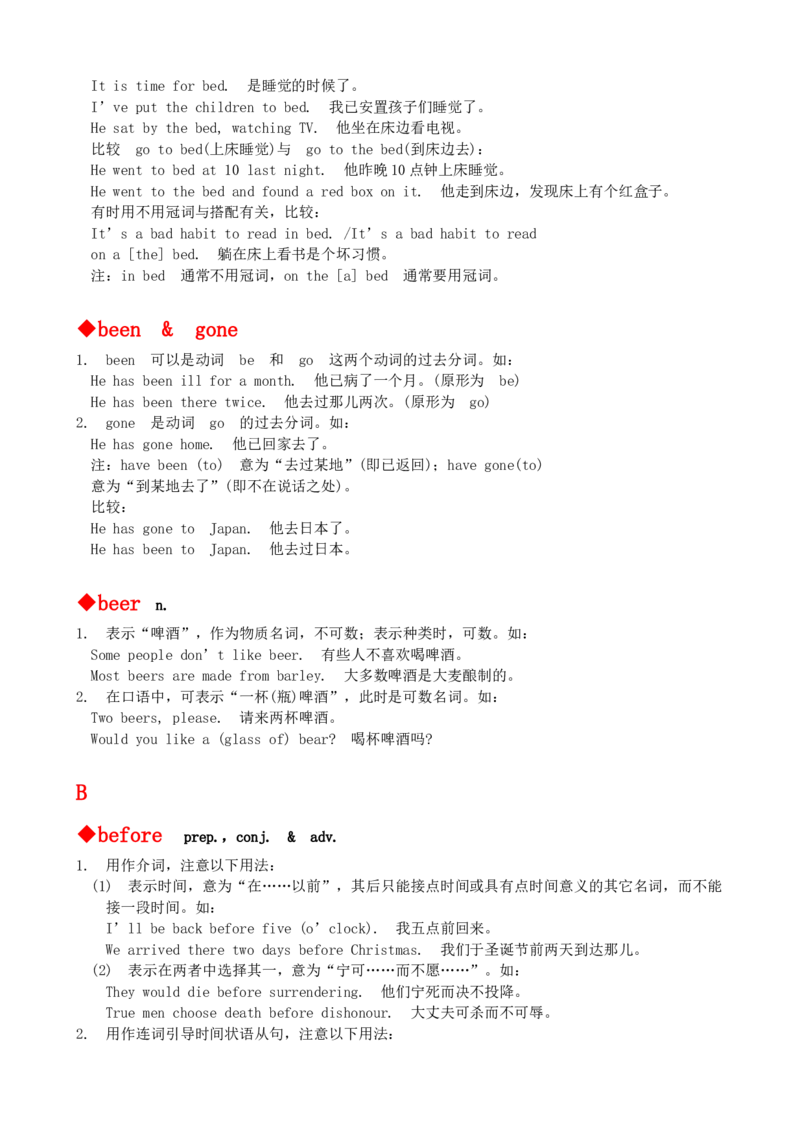
I’ve put the children to bed. 我已安置孩子们睡觉了。
He sat by the bed, watching TV. 他坐在床边看电视。
比较 go to bed(上床睡觉)与 go to the bed(到床边去):
He went to bed at 10 last night. 他昨晚10点钟上床睡觉。
He went to the bed and found a red box on it. 他走到床边,发现床上有个红盒子。
有时用不用冠词与搭配有关,比较:
It’s a bad habit to read in bed. /It’s a bad habit to read
on a [the] bed. 躺在床上看书是个坏习惯。
注:in bed 通常不用冠词,on the [a] bed 通常要用冠词。
◆been & gone
1. been 可以是动词 be 和 go 这两个动词的过去分词。如:
He has been ill for a month. 他已病了一个月。(原形为 be)
He has been there twice. 他去过那儿两次。(原形为 go)
2. gone 是动词 go 的过去分词。如:
He has gone home. 他已回家去了。
注:have been (to) 意为“去过某地”(即已返回);have gone(to)
意为“到某地去了”(即不在说话之处)。
比较:
He has gone to Japan. 他去日本了。
He has been to Japan. 他去过日本。
◆beer
n.
1. 表示“啤酒”,作为物质名词,不可数;表示种类时,可数。如:
Some people don’t like beer. 有些人不喜欢喝啤酒。
Most beers are made from barley. 大多数啤酒是大麦酿制的。
2. 在口语中,可表示“一杯(瓶)啤酒”,此时是可数名词。如:
Two beers, please. 请来两杯啤酒。
Would you like a (glass of) bear? 喝杯啤酒吗?
B
◆before
prep.,conj. & adv.
1. 用作介词,注意以下用法:
(1) 表示时间,意为“在……以前”,其后只能接点时间或具有点时间意义的其它名词,而不能
接一段时间。如:
I’ll be back before five (o’clock). 我五点前回来。
We arrived there two days before Christmas. 我们于圣诞节前两天到达那儿。
(2) 表示在两者中选择其一,意为“宁可……而不愿……”。如:
They would die before surrendering. 他们宁死而决不投降。
True men choose death before dishonour. 大丈夫可杀而不可辱。
2. 用作连词引导时间状语从句,注意以下用法:(1) 从句要用一般现在时表示将来,而不能直接用将来时态。如:
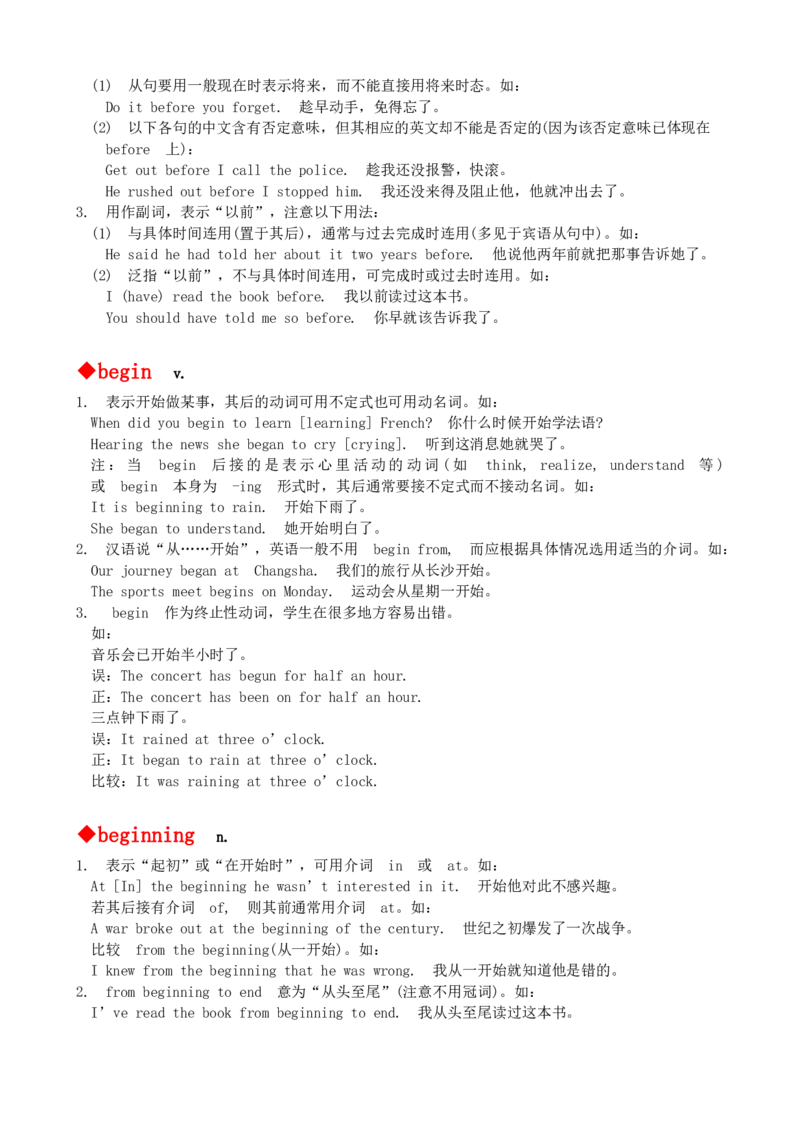
Do it before you forget. 趁早动手,免得忘了。
(2) 以下各句的中文含有否定意味,但其相应的英文却不能是否定的(因为该否定意味已体现在
before 上):
Get out before I call the police. 趁我还没报警,快滚。
He rushed out before I stopped him. 我还没来得及阻止他,他就冲出去了。
3. 用作副词,表示“以前”,注意以下用法:
(1) 与具体时间连用(置于其后),通常与过去完成时连用(多见于宾语从句中)。如:
He said he had told her about it two years before. 他说他两年前就把那事告诉她了。
(2) 泛指“以前”,不与具体时间连用,可完成时或过去时连用。如:
I (have) read the book before. 我以前读过这本书。
You should have told me so before. 你早就该告诉我了。
◆begin
v.
1. 表示开始做某事,其后的动词可用不定式也可用动名词。如:
When did you begin to learn [learning] French? 你什么时候开始学法语?
Hearing the news she began to cry [crying]. 听到这消息她就哭了。
注:当 begin 后接的是表示心里活动的动词(如 think, realize, understand 等)
或 begin 本身为 -ing 形式时,其后通常要接不定式而不接动名词。如:
It is beginning to rain. 开始下雨了。
She began to understand. 她开始明白了。
2. 汉语说“从……开始”,英语一般不用 begin from, 而应根据具体情况选用适当的介词。如:
Our journey began at Changsha. 我们的旅行从长沙开始。
The sports meet begins on Monday. 运动会从星期一开始。
3. begin 作为终止性动词,学生在很多地方容易出错。
如:
音乐会已开始半小时了。
误:The concert has begun for half an hour.
正:The concert has been on for half an hour.
三点钟下雨了。
误:It rained at three o’clock.
正:It began to rain at three o’clock.
比较:It was raining at three o’clock.
◆beginning
n.
1. 表示“起初”或“在开始时”,可用介词 in 或 at。如:
At [In] the beginning he wasn’t interested in it. 开始他对此不感兴趣。
若其后接有介词 of, 则其前通常用介词 at。如:
A war broke out at the beginning of the century. 世纪之初爆发了一次战争。
比较 from the beginning(从一开始)。如:
I knew from the beginning that he was wrong. 我从一开始就知道他是错的。
2. from beginning to end 意为“从头至尾”(注意不用冠词)。如:
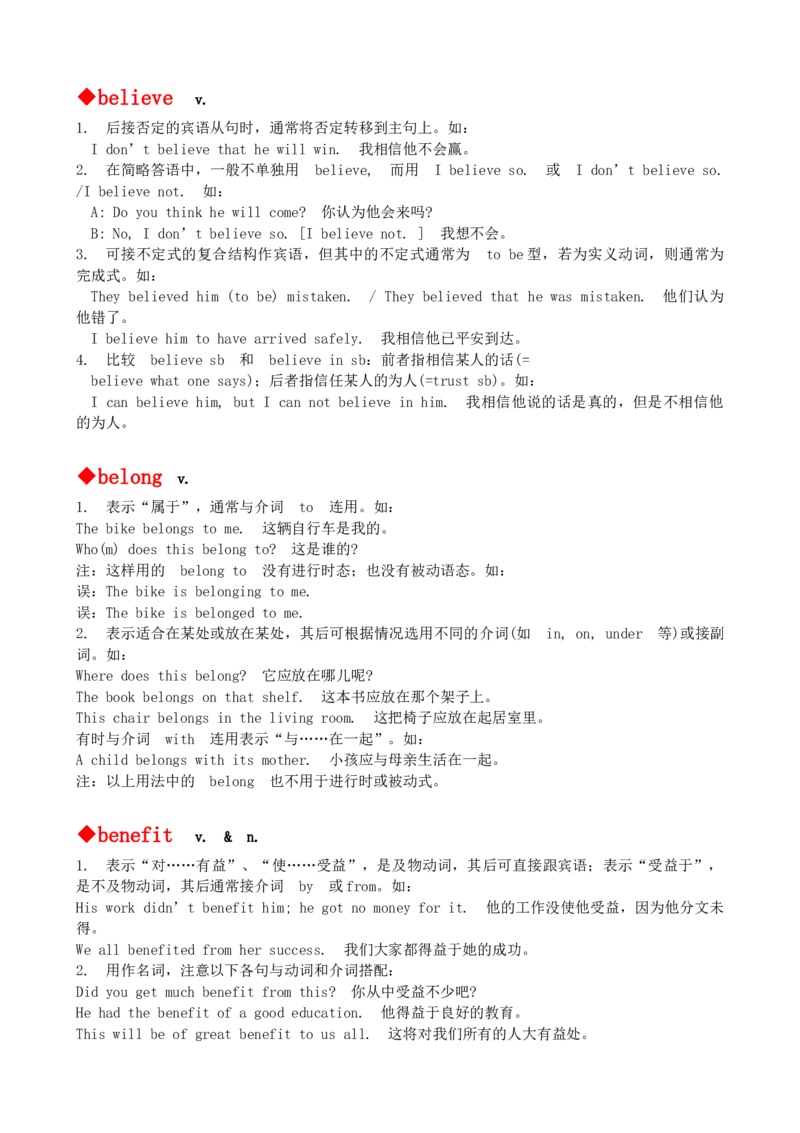
I’ve read the book from beginning to end. 我从头至尾读过这本书。◆believe
v.
1. 后接否定的宾语从句时,通常将否定转移到主句上。如:
I don’t believe that he will win. 我相信他不会赢。
2. 在简略答语中,一般不单独用 believe, 而用 I believe so. 或 I don’t believe so.
/I believe not. 如:
A: Do you think he will come? 你认为他会来吗?
B: No, I don’t believe so. [I believe not. ] 我想不会。
3. 可接不定式的复合结构作宾语,但其中的不定式通常为 to be型,若为实义动词,则通常为
完成式。如:
They believed him (to be) mistaken. / They believed that he was mistaken. 他们认为
他错了。
I believe him to have arrived safely. 我相信他已平安到达。
4. 比较 believe sb 和 believe in sb:前者指相信某人的话(=
believe what one says);后者指信任某人的为人(=trust sb)。如:
I can believe him, but I can not believe in him. 我相信他说的话是真的,但是不相信他
的为人。
◆belong
v.
1. 表示“属于”,通常与介词 to 连用。如:
The bike belongs to me. 这辆自行车是我的。
Who(m) does this belong to? 这是谁的?
注:这样用的 belong to 没有进行时态;也没有被动语态。如:
误:The bike is belonging to me.
误:The bike is belonged to me.
2. 表示适合在某处或放在某处,其后可根据情况选用不同的介词(如 in, on, under 等)或接副
词。如:
Where does this belong? 它应放在哪儿呢?
The book belongs on that shelf. 这本书应放在那个架子上。
This chair belongs in the living room. 这把椅子应放在起居室里。
有时与介词 with 连用表示“与……在一起”。如:
A child belongs with its mother. 小孩应与母亲生活在一起。
注:以上用法中的 belong 也不用于进行时或被动式。
◆benefit
v. & n.
1. 表示“对……有益”、“使……受益”,是及物动词,其后可直接跟宾语;表示“受益于”,
是不及物动词,其后通常接介词 by 或from。如:
His work didn’t benefit him; he got no money for it. 他的工作没使他受益,因为他分文未
得。
We all benefited from her success. 我们大家都得益于她的成功。
2. 用作名词,注意以下各句与动词和介词搭配:
Did you get much benefit from this? 你从中受益不少吧?
He had the benefit of a good education. 他得益于良好的教育。
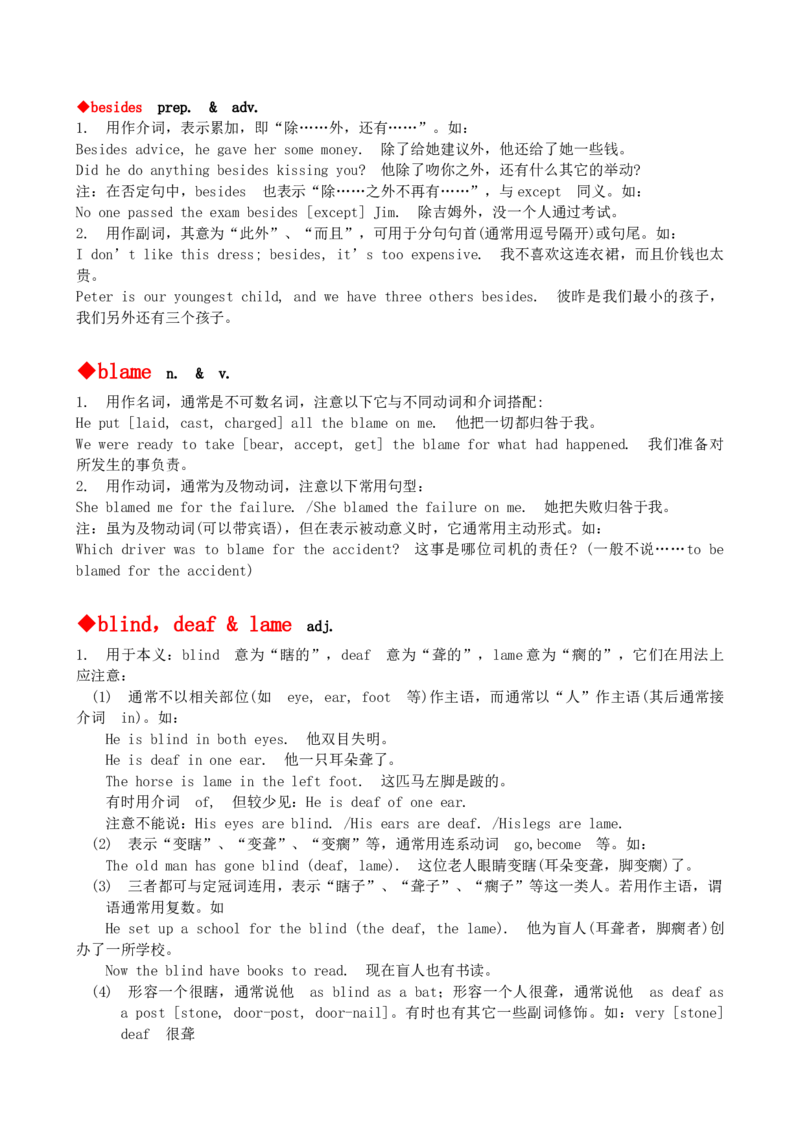
This will be of great benefit to us all. 这将对我们所有的人大有益处。◆besides prep. & adv.
1. 用作介词,表示累加,即“除……外,还有……”。如:
Besides advice, he gave her some money. 除了给她建议外,他还给了她一些钱。
Did he do anything besides kissing you? 他除了吻你之外,还有什么其它的举动?
注:在否定句中,besides 也表示“除……之外不再有……”,与except 同义。如:
No one passed the exam besides [except] Jim. 除吉姆外,没一个人通过考试。
2. 用作副词,其意为“此外”、“而且”,可用于分句句首(通常用逗号隔开)或句尾。如:
I don’t like this dress; besides, it’s too expensive. 我不喜欢这连衣裙,而且价钱也太
贵。
Peter is our youngest child, and we have three others besides. 彼昨是我们最小的孩子,
我们另外还有三个孩子。
◆blame
n. & v.
1. 用作名词,通常是不可数名词,注意以下它与不同动词和介词搭配:
He put [laid, cast, charged] all the blame on me. 他把一切都归咎于我。
We were ready to take [bear, accept, get] the blame for what had happened. 我们准备对
所发生的事负责。
2. 用作动词,通常为及物动词,注意以下常用句型:
She blamed me for the failure. /She blamed the failure on me. 她把失败归咎于我。
注:虽为及物动词(可以带宾语),但在表示被动意义时,它通常用主动形式。如:
Which driver was to blame for the accident? 这事是哪位司机的责任? (一般不说……to be
blamed for the accident)
◆blind,deaf & lame
adj.
1. 用于本义:blind 意为“瞎的”,deaf 意为“聋的”,lame意为“瘸的”,它们在用法上
应注意:
(1) 通常不以相关部位(如 eye, ear, foot 等)作主语,而通常以“人”作主语(其后通常接
介词 in)。如:
He is blind in both eyes. 他双目失明。
He is deaf in one ear. 他一只耳朵聋了。
The horse is lame in the left foot. 这匹马左脚是跛的。
有时用介词 of, 但较少见:He is deaf of one ear.
注意不能说:His eyes are blind. /His ears are deaf. /Hislegs are lame.
(2) 表示“变瞎”、“变聋”、“变瘸”等,通常用连系动词 go,become 等。如:
The old man has gone blind (deaf, lame). 这位老人眼睛变瞎(耳朵变聋,脚变瘸)了。
(3) 三者都可与定冠词连用,表示“瞎子”、“聋子”、“瘸子”等这一类人。若用作主语,谓
语通常用复数。如
He set up a school for the blind (the deaf, the lame). 他为盲人(耳聋者,脚瘸者)创
办了一所学校。
Now the blind have books to read. 现在盲人也有书读。
(4) 形容一个很瞎,通常说他 as blind as a bat;形容一个人很聋,通常说他 as deaf as
a post [stone, door-post, door-nail]。有时也有其它一些副词修饰。如:very [stone]
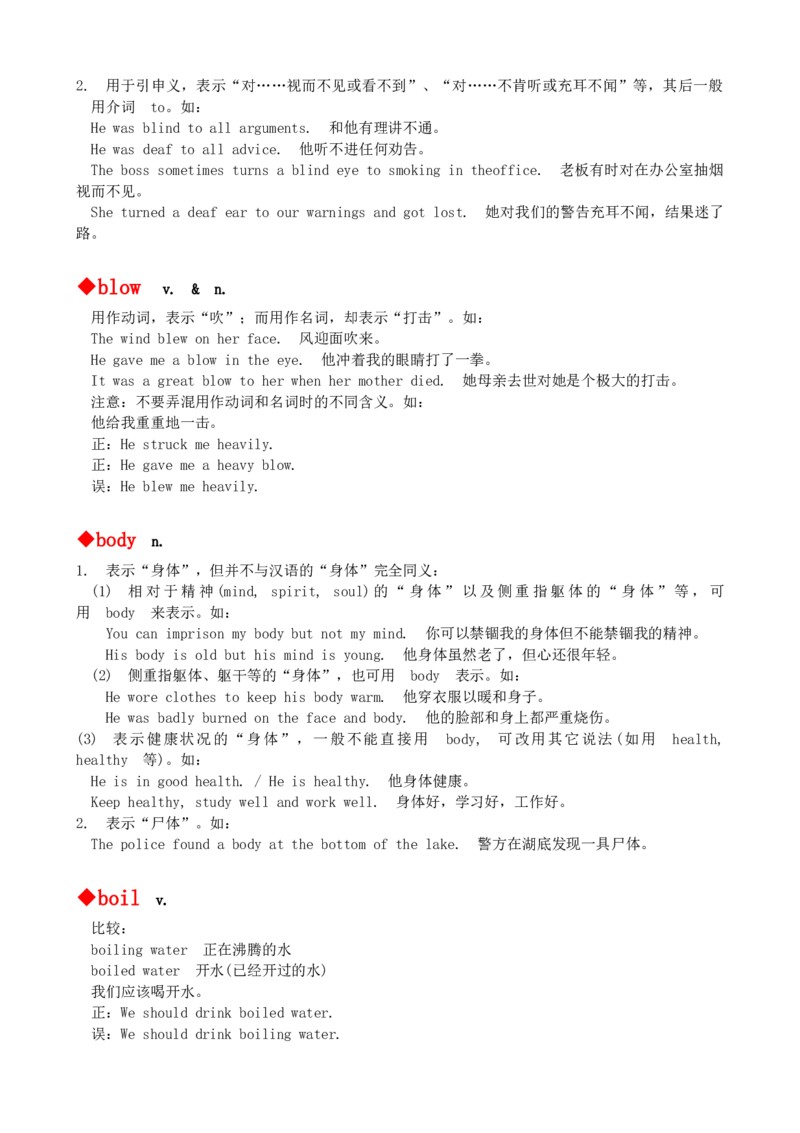
deaf 很聋2. 用于引申义,表示“对……视而不见或看不到”、“对……不肯听或充耳不闻”等,其后一般
用介词 to。如:
He was blind to all arguments. 和他有理讲不通。
He was deaf to all advice. 他听不进任何劝告。
The boss sometimes turns a blind eye to smoking in theoffice. 老板有时对在办公室抽烟
视而不见。
She turned a deaf ear to our warnings and got lost. 她对我们的警告充耳不闻,结果迷了
路。
◆blow
v. & n.
用作动词,表示“吹”;而用作名词,却表示“打击”。如:
The wind blew on her face. 风迎面吹来。
He gave me a blow in the eye. 他冲着我的眼睛打了一拳。
It was a great blow to her when her mother died. 她母亲去世对她是个极大的打击。
注意:不要弄混用作动词和名词时的不同含义。如:
他给我重重地一击。
正:He struck me heavily.
正:He gave me a heavy blow.
误:He blew me heavily.
◆body
n.
1. 表示“身体”,但并不与汉语的“身体”完全同义:
(1) 相对于精神(mind, spirit, soul)的“身体”以及侧重指躯体的“身体”等,可
用 body 来表示。如:
You can imprison my body but not my mind. 你可以禁锢我的身体但不能禁锢我的精神。
His body is old but his mind is young. 他身体虽然老了,但心还很年轻。
(2) 侧重指躯体、躯干等的“身体”,也可用 body 表示。如:
He wore clothes to keep his body warm. 他穿衣服以暖和身子。
He was badly burned on the face and body. 他的脸部和身上都严重烧伤。
(3) 表示健康状况的“身体”,一般不能直接用 body, 可改用其它说法(如用 health,
healthy 等)。如:
He is in good health. / He is healthy. 他身体健康。
Keep healthy, study well and work well. 身体好,学习好,工作好。
2. 表示“尸体”。如:
The police found a body at the bottom of the lake. 警方在湖底发现一具尸体。
◆boil
v.
比较:
boiling water 正在沸腾的水
boiled water 开水(已经开过的水)
我们应该喝开水。
正:We should drink boiled water.
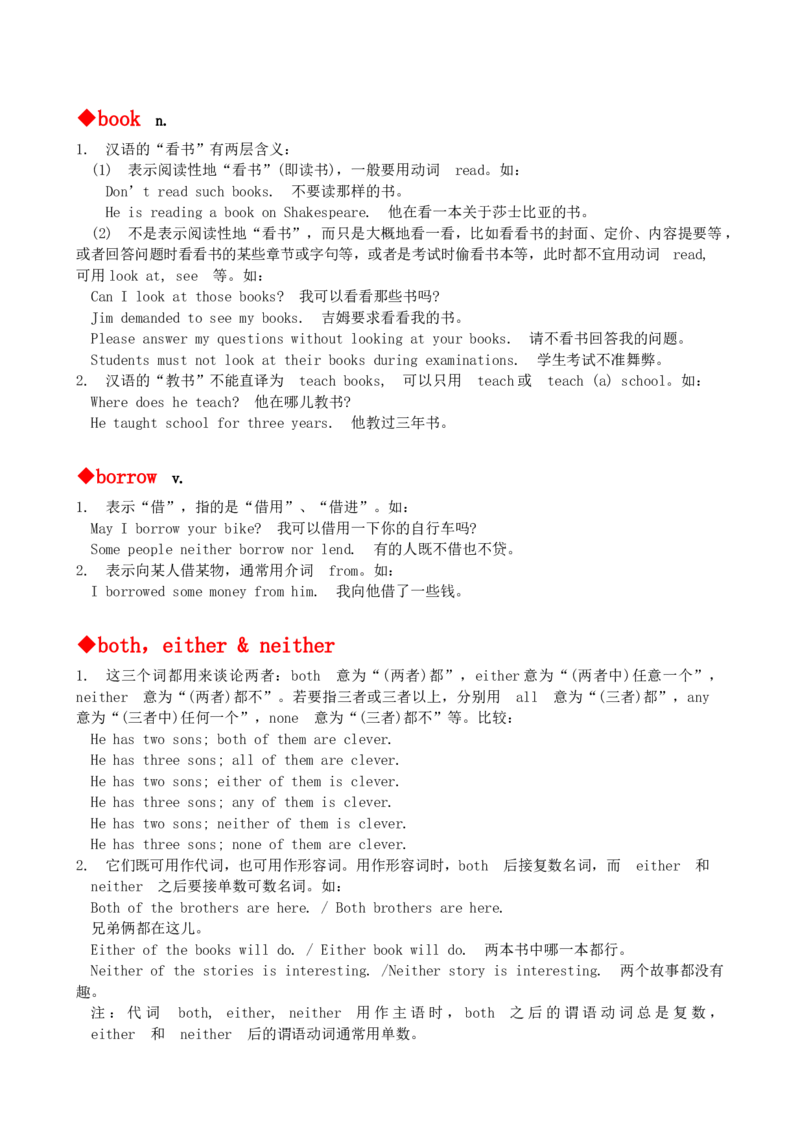
误:We should drink boiling water.◆book
n.
1. 汉语的“看书”有两层含义:
(1) 表示阅读性地“看书”(即读书),一般要用动词 read。如:
Don’t read such books. 不要读那样的书。
He is reading a book on Shakespeare. 他在看一本关于莎士比亚的书。
(2) 不是表示阅读性地“看书”,而只是大概地看一看,比如看看书的封面、定价、内容提要等,
或者回答问题时看看书的某些章节或字句等,或者是考试时偷看书本等,此时都不宜用动词 read,
可用look at, see 等。如:
Can I look at those books? 我可以看看那些书吗?
Jim demanded to see my books. 吉姆要求看看我的书。
Please answer my questions without looking at your books. 请不看书回答我的问题。
Students must not look at their books during examinations. 学生考试不准舞弊。
2. 汉语的“教书”不能直译为 teach books, 可以只用 teach或 teach (a) school。如:
Where does he teach? 他在哪儿教书?
He taught school for three years. 他教过三年书。
◆borrow
v.
1. 表示“借”,指的是“借用”、“借进”。如:
May I borrow your bike? 我可以借用一下你的自行车吗?
Some people neither borrow nor lend. 有的人既不借也不贷。
2. 表示向某人借某物,通常用介词 from。如:
I borrowed some money from him. 我向他借了一些钱。
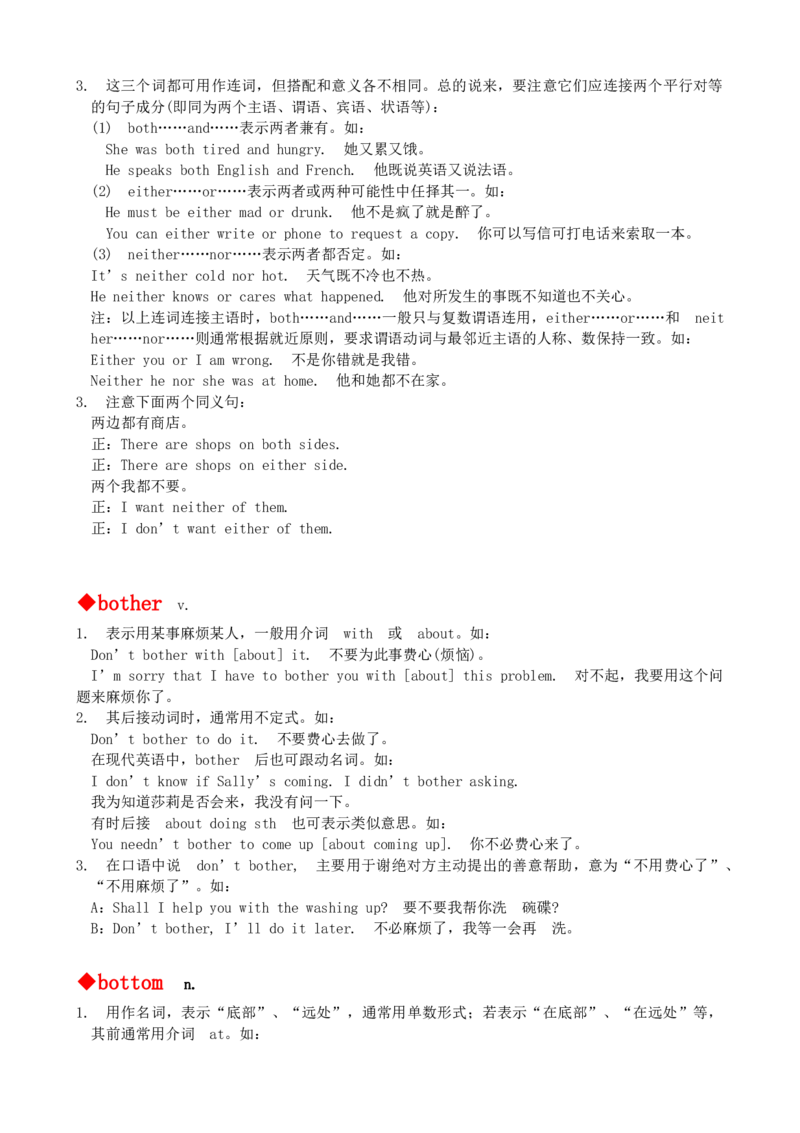
◆both,either & neither
1. 这三个词都用来谈论两者:both 意为“(两者)都”,either意为“(两者中)任意一个”,
neither 意为“(两者)都不”。若要指三者或三者以上,分别用 all 意为“(三者)都”,any
意为“(三者中)任何一个”,none 意为“(三者)都不”等。比较:
He has two sons; both of them are clever.
He has three sons; all of them are clever.
He has two sons; either of them is clever.
He has three sons; any of them is clever.
He has two sons; neither of them is clever.
He has three sons; none of them are clever.
2. 它们既可用作代词,也可用作形容词。用作形容词时,both 后接复数名词,而 either 和
neither 之后要接单数可数名词。如:
Both of the brothers are here. / Both brothers are here.
兄弟俩都在这儿。
Either of the books will do. / Either book will do. 两本书中哪一本都行。
Neither of the stories is interesting. /Neither story is interesting. 两个故事都没有
趣。
注:代词 both, either, neither 用作主语时,both 之后的谓语动词总是复数,
either 和 neither 后的谓语动词通常用单数。3. 这三个词都可用作连词,但搭配和意义各不相同。总的说来,要注意它们应连接两个平行对等
的句子成分(即同为两个主语、谓语、宾语、状语等):
(1) both……and……表示两者兼有。如:
She was both tired and hungry. 她又累又饿。
He speaks both English and French. 他既说英语又说法语。
(2) either……or……表示两者或两种可能性中任择其一。如:
He must be either mad or drunk. 他不是疯了就是醉了。
You can either write or phone to request a copy. 你可以写信可打电话来索取一本。
(3) neither……nor……表示两者都否定。如:
It’s neither cold nor hot. 天气既不冷也不热。
He neither knows or cares what happened. 他对所发生的事既不知道也不关心。
注:以上连词连接主语时,both……and……一般只与复数谓语连用,either……or……和 neit
her……nor……则通常根据就近原则,要求谓语动词与最邻近主语的人称、数保持一致。如:
Either you or I am wrong. 不是你错就是我错。
Neither he nor she was at home. 他和她都不在家。
3. 注意下面两个同义句:
两边都有商店。
正:There are shops on both sides.
正:There are shops on either side.
两个我都不要。
正:I want neither of them.
正:I don’t want either of them.
◆bother
v.
1. 表示用某事麻烦某人,一般用介词 with 或 about。如:
Don’t bother with [about] it. 不要为此事费心(烦恼)。
I’m sorry that I have to bother you with [about] this problem. 对不起,我要用这个问
题来麻烦你了。
2. 其后接动词时,通常用不定式。如:
Don’t bother to do it. 不要费心去做了。
在现代英语中,bother 后也可跟动名词。如:
I don’t know if Sally’s coming. I didn’t bother asking.
我为知道莎莉是否会来,我没有问一下。
有时后接 about doing sth 也可表示类似意思。如:
You needn’t bother to come up [about coming up]. 你不必费心来了。
3. 在口语中说 don’t bother, 主要用于谢绝对方主动提出的善意帮助,意为“不用费心了”、
“不用麻烦了”。如:
A:Shall I help you with the washing up? 要不要我帮你洗 碗碟?
B:Don’t bother, I’ll do it later. 不必麻烦了,我等一会再 洗。
◆bottom
n.
1. 用作名词,表示“底部”、“远处”,通常用单数形式;若表示“在底部”、“在远处”等,
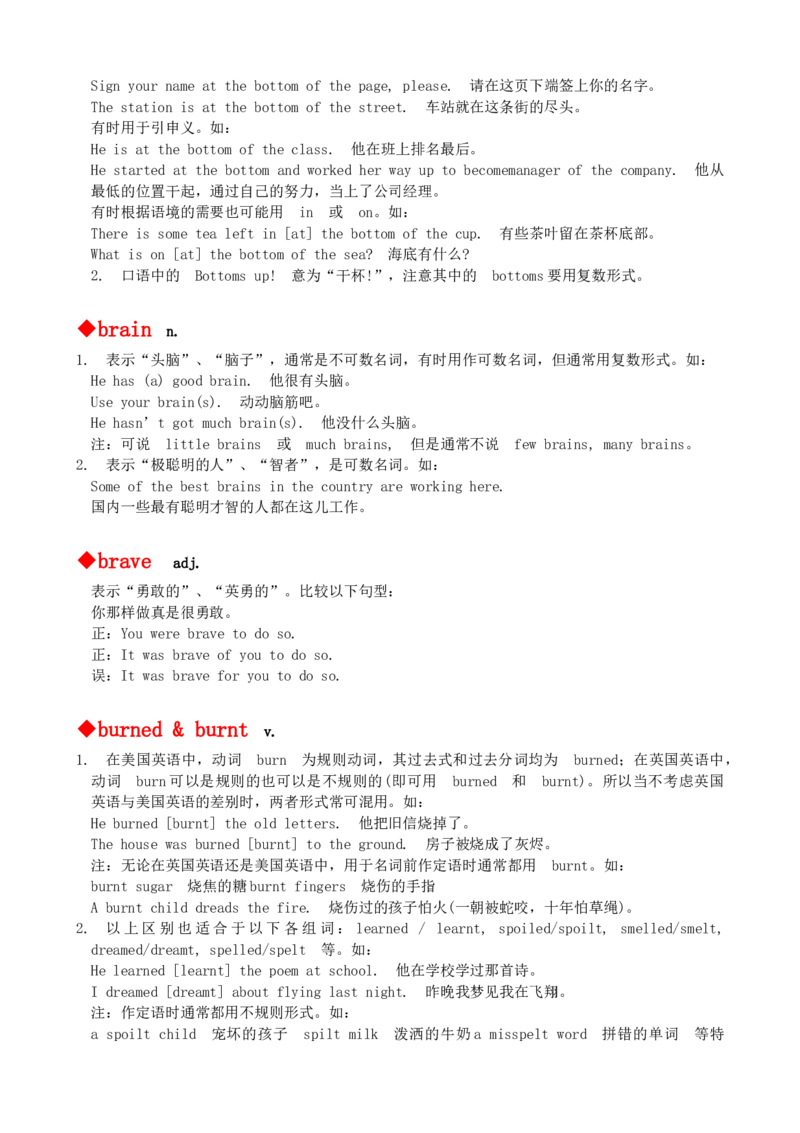
其前通常用介词 at。如:Sign your name at the bottom of the page, please. 请在这页下端签上你的名字。
The station is at the bottom of the street. 车站就在这条街的尽头。
有时用于引申义。如:
He is at the bottom of the class. 他在班上排名最后。
He started at the bottom and worked her way up to becomemanager of the company. 他从
最低的位置干起,通过自己的努力,当上了公司经理。
有时根据语境的需要也可能用 in 或 on。如:
There is some tea left in [at] the bottom of the cup. 有些茶叶留在茶杯底部。
What is on [at] the bottom of the sea? 海底有什么?
2. 口语中的 Bottoms up! 意为“干杯!”,注意其中的 bottoms要用复数形式。
◆brain
n.
1. 表示“头脑”、“脑子”,通常是不可数名词,有时用作可数名词,但通常用复数形式。如:
He has (a) good brain. 他很有头脑。
Use your brain(s). 动动脑筋吧。
He hasn’t got much brain(s). 他没什么头脑。
注:可说 little brains 或 much brains, 但是通常不说 few brains, many brains。
2. 表示“极聪明的人”、“智者”,是可数名词。如:
Some of the best brains in the country are working here.
国内一些最有聪明才智的人都在这儿工作。
◆brave
adj.
表示“勇敢的”、“英勇的”。比较以下句型:
你那样做真是很勇敢。
正:You were brave to do so.
正:It was brave of you to do so.
误:It was brave for you to do so.
◆burned & burnt
v.
1. 在美国英语中,动词 burn 为规则动词,其过去式和过去分词均为 burned;在英国英语中,
动词 burn可以是规则的也可以是不规则的(即可用 burned 和 burnt)。所以当不考虑英国
英语与美国英语的差别时,两者形式常可混用。如:
He burned [burnt] the old letters. 他把旧信烧掉了。
The house was burned [burnt] to the ground. 房子被烧成了灰烬。
注:无论在英国英语还是美国英语中,用于名词前作定语时通常都用 burnt。如:
burnt sugar 烧焦的糖burnt fingers 烧伤的手指
A burnt child dreads the fire. 烧伤过的孩子怕火(一朝被蛇咬,十年怕草绳)。
2. 以上区别也适合于以下各组词:learned / learnt, spoiled/spoilt, smelled/smelt,
dreamed/dreamt, spelled/spelt 等。如:
He learned [learnt] the poem at school. 他在学校学过那首诗。
I dreamed [dreamt] about flying last night. 昨晚我梦见我在飞翔。
注:作定语时通常都用不规则形式。如:
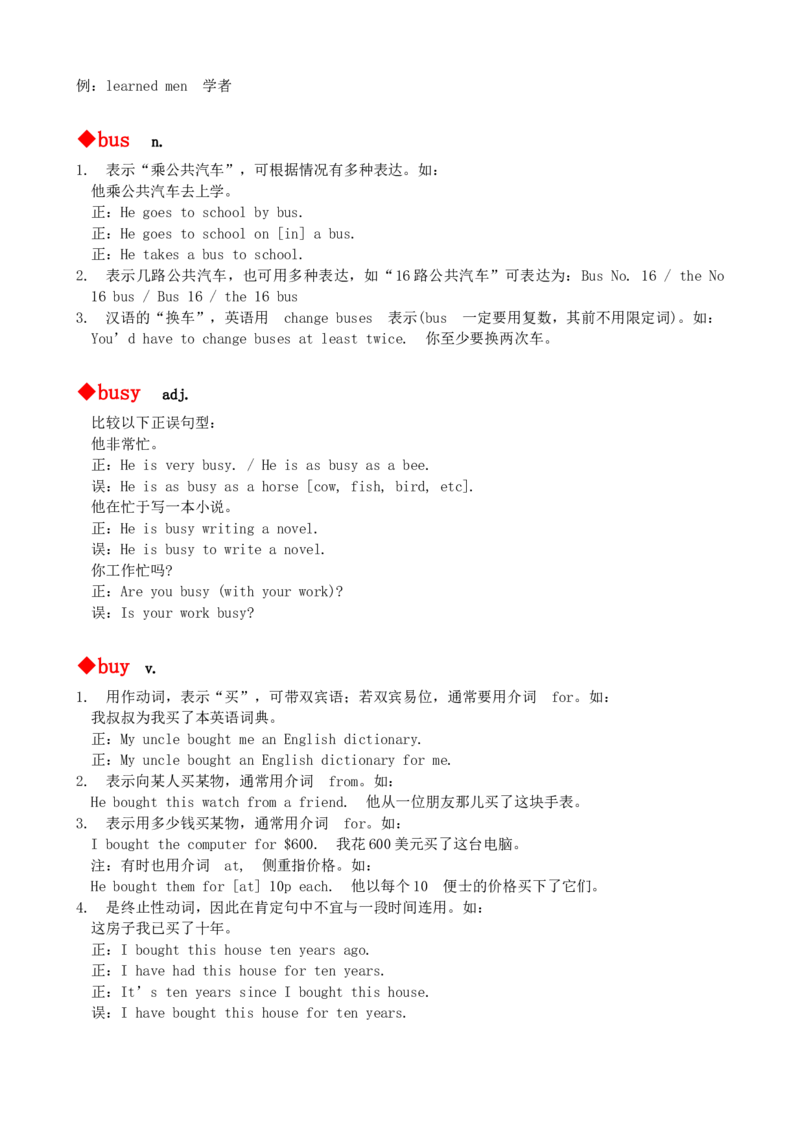
a spoilt child 宠坏的孩子 spilt milk 泼洒的牛奶a misspelt word 拼错的单词 等特例:learned men 学者
◆bus
n.
1. 表示“乘公共汽车”,可根据情况有多种表达。如:
他乘公共汽车去上学。
正:He goes to school by bus.
正:He goes to school on [in] a bus.
正:He takes a bus to school.
2. 表示几路公共汽车,也可用多种表达,如“16路公共汽车”可表达为:Bus No. 16 / the No
16 bus / Bus 16 / the 16 bus
3. 汉语的“换车”,英语用 change buses 表示(bus 一定要用复数,其前不用限定词)。如:
You’d have to change buses at least twice. 你至少要换两次车。
◆busy
adj.
比较以下正误句型:
他非常忙。
正:He is very busy. / He is as busy as a bee.
误:He is as busy as a horse [cow, fish, bird, etc].
他在忙于写一本小说。
正:He is busy writing a novel.
误:He is busy to write a novel.
你工作忙吗?
正:Are you busy (with your work)?
误:Is your work busy?
◆buy
v.
1. 用作动词,表示“买”,可带双宾语;若双宾易位,通常要用介词 for。如:
我叔叔为我买了本英语词典。
正:My uncle bought me an English dictionary.
正:My uncle bought an English dictionary for me.
2. 表示向某人买某物,通常用介词 from。如:
He bought this watch from a friend. 他从一位朋友那儿买了这块手表。
3. 表示用多少钱买某物,通常用介词 for。如:
I bought the computer for $600. 我花600美元买了这台电脑。
注:有时也用介词 at, 侧重指价格。如:
He bought them for [at] 10p each. 他以每个10 便士的价格买下了它们。
4. 是终止性动词,因此在肯定句中不宜与一段时间连用。如:
这房子我已买了十年。
正:I bought this house ten years ago.
正:I have had this house for ten years.
正:It’s ten years since I bought this house.
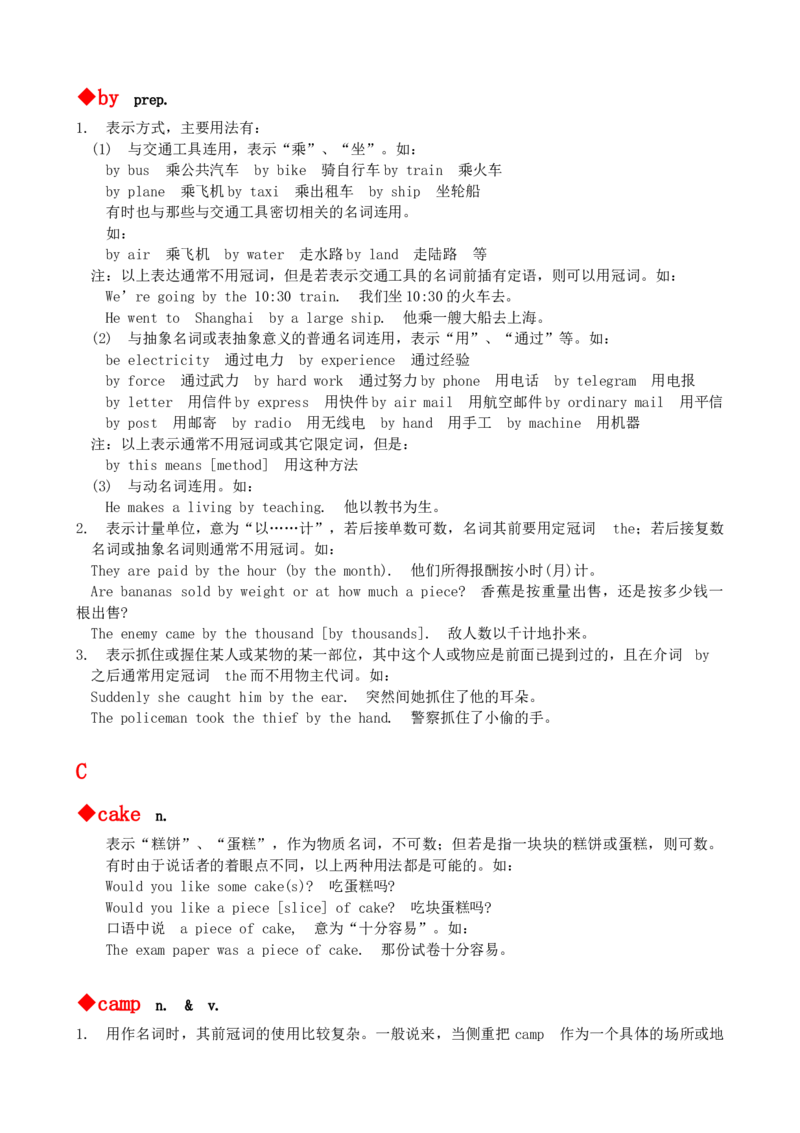
误:I have bought this house for ten years.◆by
prep.
1. 表示方式,主要用法有:
(1) 与交通工具连用,表示“乘”、“坐”。如:
by bus 乘公共汽车 by bike 骑自行车by train 乘火车
by plane 乘飞机by taxi 乘出租车 by ship 坐轮船
有时也与那些与交通工具密切相关的名词连用。
如:
by air 乘飞机 by water 走水路by land 走陆路 等
注:以上表达通常不用冠词,但是若表示交通工具的名词前插有定语,则可以用冠词。如:
We’re going by the 10:30 train. 我们坐10:30的火车去。
He went to Shanghai by a large ship. 他乘一艘大船去上海。
(2) 与抽象名词或表抽象意义的普通名词连用,表示“用”、“通过”等。如:
be electricity 通过电力 by experience 通过经验
by force 通过武力 by hard work 通过努力by phone 用电话 by telegram 用电报
by letter 用信件by express 用快件by air mail 用航空邮件by ordinary mail 用平信
by post 用邮寄 by radio 用无线电 by hand 用手工 by machine 用机器
注:以上表示通常不用冠词或其它限定词,但是:
by this means [method] 用这种方法
(3) 与动名词连用。如:
He makes a living by teaching. 他以教书为生。
2. 表示计量单位,意为“以……计”,若后接单数可数,名词其前要用定冠词 the;若后接复数
名词或抽象名词则通常不用冠词。如:
They are paid by the hour (by the month). 他们所得报酬按小时(月)计。
Are bananas sold by weight or at how much a piece? 香蕉是按重量出售,还是按多少钱一
根出售?
The enemy came by the thousand [by thousands]. 敌人数以千计地扑来。
3. 表示抓住或握住某人或某物的某一部位,其中这个人或物应是前面已提到过的,且在介词 by
之后通常用定冠词 the而不用物主代词。如:
Suddenly she caught him by the ear. 突然间她抓住了他的耳朵。
The policeman took the thief by the hand. 警察抓住了小偷的手。
C
◆cake
n.
表示“糕饼”、“蛋糕”,作为物质名词,不可数;但若是指一块块的糕饼或蛋糕,则可数。
有时由于说话者的着眼点不同,以上两种用法都是可能的。如:
Would you like some cake(s)? 吃蛋糕吗?
Would you like a piece [slice] of cake? 吃块蛋糕吗?
口语中说 a piece of cake, 意为“十分容易”。如:
The exam paper was a piece of cake. 那份试卷十分容易。
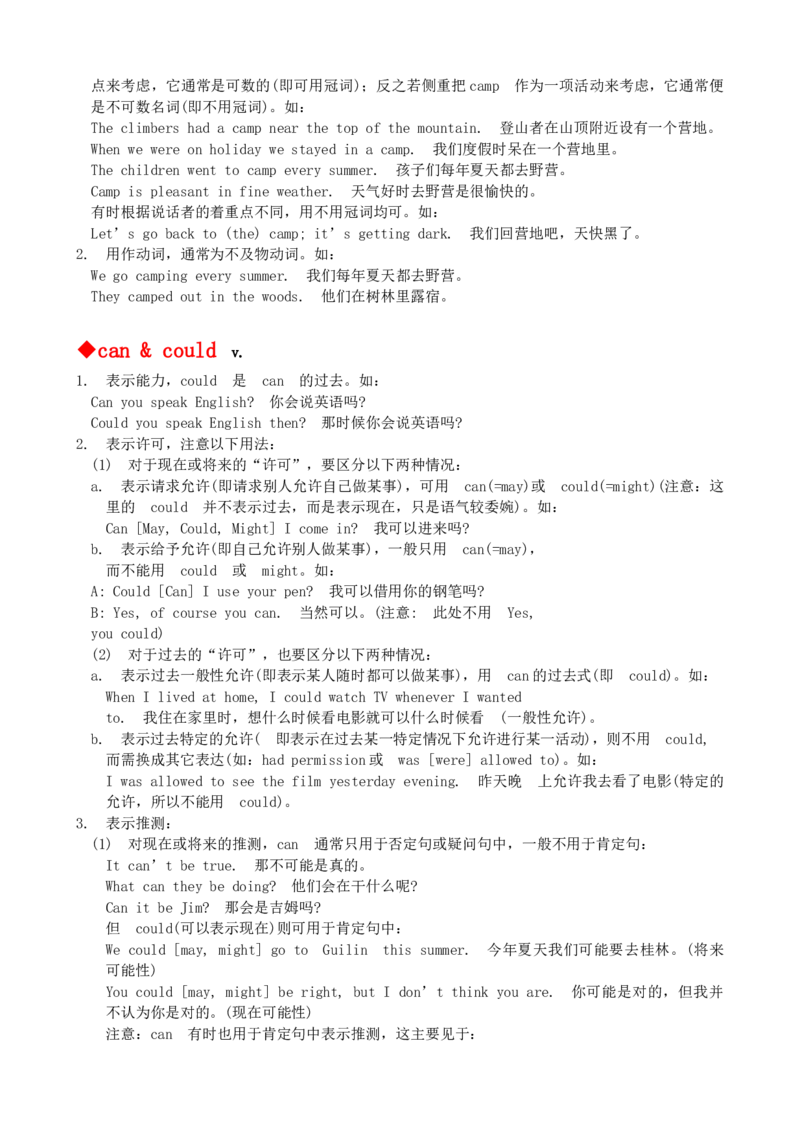
◆camp
n. & v.
1. 用作名词时,其前冠词的使用比较复杂。一般说来,当侧重把 camp 作为一个具体的场所或地点来考虑,它通常是可数的(即可用冠词);反之若侧重把camp 作为一项活动来考虑,它通常便
是不可数名词(即不用冠词)。如:
The climbers had a camp near the top of the mountain. 登山者在山顶附近设有一个营地。
When we were on holiday we stayed in a camp. 我们度假时呆在一个营地里。
The children went to camp every summer. 孩子们每年夏天都去野营。
Camp is pleasant in fine weather. 天气好时去野营是很愉快的。
有时根据说话者的着重点不同,用不用冠词均可。如:
Let’s go back to (the) camp; it’s getting dark. 我们回营地吧,天快黑了。
2. 用作动词,通常为不及物动词。如:
We go camping every summer. 我们每年夏天都去野营。
They camped out in the woods. 他们在树林里露宿。
◆can & could
v.
1. 表示能力,could 是 can 的过去。如:
Can you speak English? 你会说英语吗?
Could you speak English then? 那时候你会说英语吗?
2. 表示许可,注意以下用法:
(1) 对于现在或将来的“许可”,要区分以下两种情况:
a. 表示请求允许(即请求别人允许自己做某事),可用 can(=may)或 could(=might)(注意:这
里的 could 并不表示过去,而是表示现在,只是语气较委婉)。如:
Can [May, Could, Might] I come in? 我可以进来吗?
b. 表示给予允许(即自己允许别人做某事),一般只用 can(=may),
而不能用 could 或 might。如:
A: Could [Can] I use your pen? 我可以借用你的钢笔吗?
B: Yes, of course you can. 当然可以。(注意: 此处不用 Yes,
you could)
(2) 对于过去的“许可”,也要区分以下两种情况:
a. 表示过去一般性允许(即表示某人随时都可以做某事),用 can的过去式(即 could)。如:
When I lived at home, I could watch TV whenever I wanted
to. 我住在家里时,想什么时候看电影就可以什么时候看 (一般性允许)。
b. 表示过去特定的允许( 即表示在过去某一特定情况下允许进行某一活动),则不用 could,
而需换成其它表达(如:had permission或 was [were] allowed to)。如:
I was allowed to see the film yesterday evening. 昨天晚 上允许我去看了电影(特定的
允许,所以不能用 could)。
3. 表示推测:
(1) 对现在或将来的推测,can 通常只用于否定句或疑问句中,一般不用于肯定句:
It can’t be true. 那不可能是真的。
What can they be doing? 他们会在干什么呢?
Can it be Jim? 那会是吉姆吗?
但 could(可以表示现在)则可用于肯定句中:
We could [may, might] go to Guilin this summer. 今年夏天我们可能要去桂林。(将来
可能性)
You could [may, might] be right, but I don’t think you are. 你可能是对的,但我并
不认为你是对的。(现在可能性)
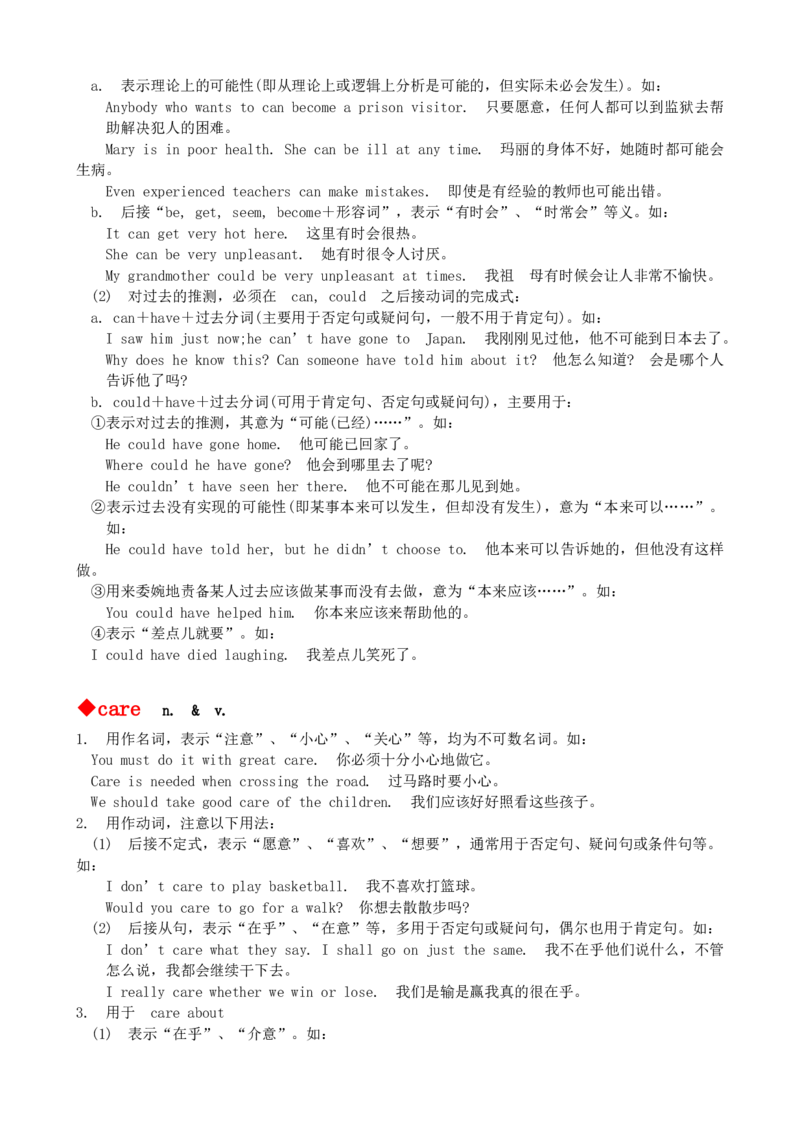
注意:can 有时也用于肯定句中表示推测,这主要见于:a. 表示理论上的可能性(即从理论上或逻辑上分析是可能的,但实际未必会发生)。如:
Anybody who wants to can become a prison visitor. 只要愿意,任何人都可以到监狱去帮
助解决犯人的困难。
Mary is in poor health. She can be ill at any time. 玛丽的身体不好,她随时都可能会
生病。
Even experienced teachers can make mistakes. 即使是有经验的教师也可能出错。
b. 后接“be, get, seem, become+形容词”,表示“有时会”、“时常会”等义。如:
It can get very hot here. 这里有时会很热。
She can be very unpleasant. 她有时很令人讨厌。
My grandmother could be very unpleasant at times. 我祖 母有时候会让人非常不愉快。
(2) 对过去的推测,必须在 can, could 之后接动词的完成式:
a. can+have+过去分词(主要用于否定句或疑问句,一般不用于肯定句)。如:
I saw him just now;he can’t have gone to Japan. 我刚刚见过他,他不可能到日本去了。
Why does he know this? Can someone have told him about it? 他怎么知道? 会是哪个人
告诉他了吗?
b. could+have+过去分词(可用于肯定句、否定句或疑问句),主要用于:
①表示对过去的推测,其意为“可能(已经)……”。如:
He could have gone home. 他可能已回家了。
Where could he have gone? 他会到哪里去了呢?
He couldn’t have seen her there. 他不可能在那儿见到她。
②表示过去没有实现的可能性(即某事本来可以发生,但却没有发生),意为“本来可以……”。
如:
He could have told her, but he didn’t choose to. 他本来可以告诉她的,但他没有这样
做。
③用来委婉地责备某人过去应该做某事而没有去做,意为“本来应该……”。如:
You could have helped him. 你本来应该来帮助他的。
④表示“差点儿就要”。如:
I could have died laughing. 我差点儿笑死了。
◆care
n. & v.
1. 用作名词,表示“注意”、“小心”、“关心”等,均为不可数名词。如:
You must do it with great care. 你必须十分小心地做它。
Care is needed when crossing the road. 过马路时要小心。
We should take good care of the children. 我们应该好好照看这些孩子。
2. 用作动词,注意以下用法:
(1) 后接不定式,表示“愿意”、“喜欢”、“想要”,通常用于否定句、疑问句或条件句等。
如:
I don’t care to play basketball. 我不喜欢打篮球。
Would you care to go for a walk? 你想去散散步吗?
(2) 后接从句,表示“在乎”、“在意”等,多用于否定句或疑问句,偶尔也用于肯定句。如:
I don’t care what they say. I shall go on just the same. 我不在乎他们说什么,不管
怎么说,我都会继续干下去。
I really care whether we win or lose. 我们是输是赢我真的很在乎。
3. 用于 care about
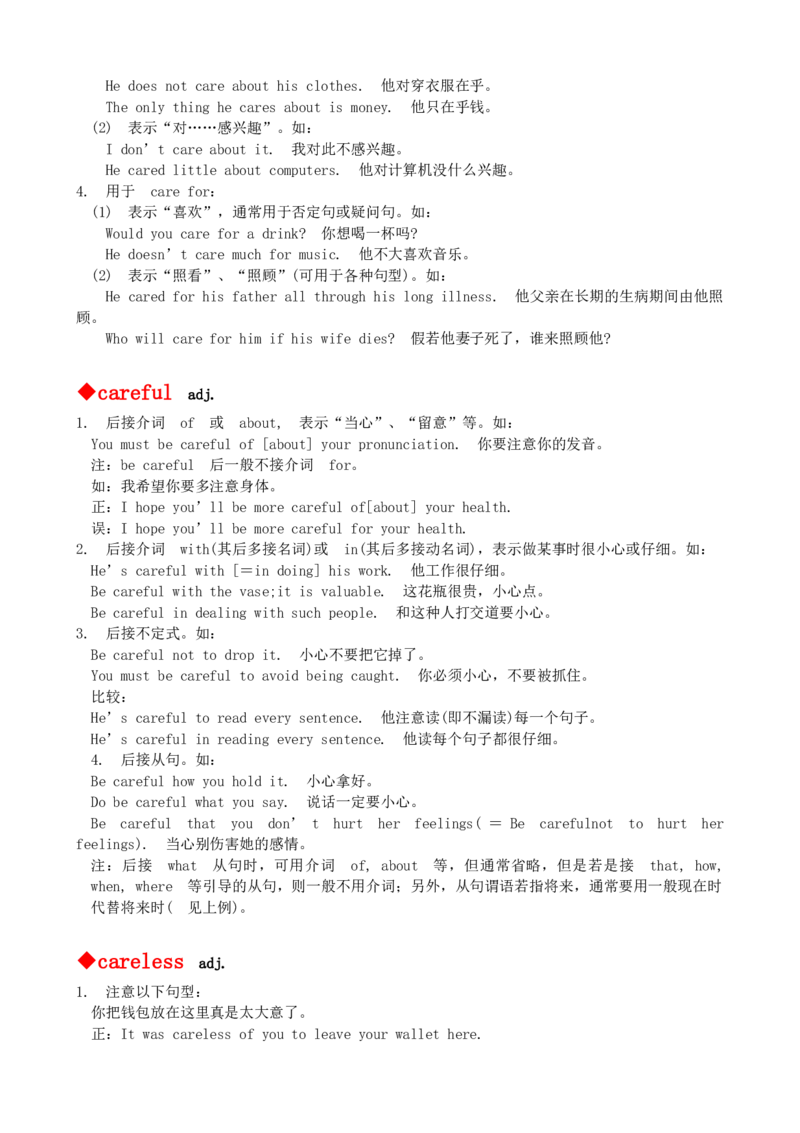
(1) 表示“在乎”、“介意”。如:He does not care about his clothes. 他对穿衣服在乎。
The only thing he cares about is money. 他只在乎钱。
(2) 表示“对……感兴趣”。如:
I don’t care about it. 我对此不感兴趣。
He cared little about computers. 他对计算机没什么兴趣。
4. 用于 care for:
(1) 表示“喜欢”,通常用于否定句或疑问句。如:
Would you care for a drink? 你想喝一杯吗?
He doesn’t care much for music. 他不大喜欢音乐。
(2) 表示“照看”、“照顾”(可用于各种句型)。如:
He cared for his father all through his long illness. 他父亲在长期的生病期间由他照
顾。
Who will care for him if his wife dies? 假若他妻子死了,谁来照顾他?
◆careful
adj.
1. 后接介词 of 或 about, 表示“当心”、“留意”等。如:
You must be careful of [about] your pronunciation. 你要注意你的发音。
注:be careful 后一般不接介词 for。
如:我希望你要多注意身体。
正:I hope you’ll be more careful of[about] your health.
误:I hope you’ll be more careful for your health.
2. 后接介词 with(其后多接名词)或 in(其后多接动名词),表示做某事时很小心或仔细。如:
He’s careful with [=in doing] his work. 他工作很仔细。
Be careful with the vase;it is valuable. 这花瓶很贵,小心点。
Be careful in dealing with such people. 和这种人打交道要小心。
3. 后接不定式。如:
Be careful not to drop it. 小心不要把它掉了。
You must be careful to avoid being caught. 你必须小心,不要被抓住。
比较:
He’s careful to read every sentence. 他注意读(即不漏读)每一个句子。
He’s careful in reading every sentence. 他读每个句子都很仔细。
4. 后接从句。如:
Be careful how you hold it. 小心拿好。
Do be careful what you say. 说话一定要小心。
Be careful that you don’ t hurt her feelings( = Be carefulnot to hurt her
feelings). 当心别伤害她的感情。
注:后接 what 从句时,可用介词 of, about 等,但通常省略,但是若是接 that, how,
when, where 等引导的从句,则一般不用介词;另外,从句谓语若指将来,通常要用一般现在时
代替将来时( 见上例)。
◆careless
adj.
1. 注意以下句型:
你把钱包放在这里真是太大意了。
正:It was careless of you to leave your wallet here.正:You were careless to leave your wallet here.
以上第一句句首的 it 为形式主语,不能改为 that。但是若以上句型后面不出现不定式,那
么句首的 it 也可换为 that。如:
他太粗心了。
正:It was very careless of him.
正:That’s very careless of him.
2. 比较:
正:He was careless to make the mistake. 他很粗心,结果出 了错。(句中的不定式为结果
状语)
正:He was so careless as to make the mistake. (同上)
正:He was careless in typing the letter. 他打这封信时很 粗心。(句中的 in typing
the letter有类似 when he was typing the letter 的意思)
误:He was careless to type the letter. (若此句视为正句,则只能理解为:他很粗心,结果
把那封信打印了出来)
3. 表示“不在意的”、“不关心的”等,其后可接介词 about, of, with 等。如:
He’s careless of [about] his speech. 他讲话随便。
She is careless of [with] his health. 她不注意身体。
He is careless with his pronunciation. 他对语音不注意。
Don’t be so careless with your money. 你花钱不要这样随便。
◆carry
v.
1. 表示“带”、“携带”,通常与方向无关。如:
Let me carry it for you. 让我替你扛吧。
How much baggage can I carry with me? 我可以随身带多少行李?
注:要表示方向,需借助有关介词。如:
Carry it to the station. 把它带到车站去。
2. 比较其后接 on, out, through 所表示的不同含义。如:
We will carry on our discussion tomorrow. 我们明天将继续讨论。(carry on=继续进行)
We expect her to carry out her promises. 我们希望她履行诺言。(carry out=实现,执行,
实行)
He carried through the work in a month. 他在一个月之内就完成了工作。(carry through=
完成,进行到底)
◆case
n.
1. 比较 in case 与 in case of
(1) in case 通常用作连词,表示目的或条件,意为“万一”、“以防万一”。如:
In case he comes, let me know. 万一他来,告诉我一声。
Take your umbrella (just) in case it rains. 带上雨伞,以防下雨。
有时用作副词,意为“以防万一”。如:
It may not rain, but you had better take an umbrella in case.
可能不会下雨,但你最好还是带把雨伞,以防万一。
(2) in case of 是复合介词,意为“万一”、“以防万一”。如:
In case of fire, ring the alarm bell. 万一失火,请按警铃。
2. 常用短语:(1) in any case 意为“不管怎样”、“无论如何”。如:
In any case, come in time. 无论如何你要及时来。
(2) in no case 意为“绝不”、“在任何情况下都不(若置于句首,句子用倒装)。如:
In no case should you tell him. 你绝不能告诉他。
(3) in that case 意为“既然如此”、“假若如此”。如:
You have finished, haven’t you? In that case, you may go.
你已完工了,是不是? 既然如此,你可走了。
◆catch v.
1. 表示“抓住”、“捉住”,注意以下习惯用法:
(1) 通常只表示“抓住”的结果,不表示“抓”的过程。如:
他在小河边坐了几个小时,在钓鱼。
误:He sat by the stream for hours, catching fish.
正:He sat by the stream for hours, trying to catch fish.
正:He sat by the stream for hours, fishing.
(2) 是一时的动作,不能与一段时间连用。如:
他被抓住有一年了。
误:He was caught for a year.
正:He was caught a year ago.
(3) 一般不与表示方向的词连用。如:
我们把这个小偷抓到了警察局去。
误:We caught the thief to the police station.
正:We caught the thief and took him to the police station.
2. 表示“听懂”、“理解”,多用于否定结构或疑问结构。如:
Did you catch what he said? 你听清了他说的是什么意思吗?
It’s noisy and I can’t catch a word. 太吵了,我一句都听不清。
3. 表示“(意外地)碰上”,其后常接现在分词的复合结构或介词短语的复合结构等。如:
He was caught stealing from the shop. 他在这家店子偷东西时,被当场抓住。
I’d like to catch them saying anything like that again. 我倒要看看他们再说这样的话。
下面一句(多用被动式)与以上用法类似:
He was caught in the rain and got wet. 他碰上大雨,被淋湿了。
4. 表示“染上(疾病)”,一般以疾病名词作 catch 的宾语,而不作catch 的主语。如:
几天前他患了重感冒。
正:He caught a bad cold the other day.
误:A bad cold caught him the other day.
5. 句式 catch up with sb 与 catch sb up 同义,意为“赶上某人”。如:
Soon he caught us up. /Soon he caught up with us. 不久他就赶上了我们。
◆cattle
n.
1. 表示“牲畜”(在美国英语只指牛类),是一个表示复数意义的集体名词(但不能有复数词尾-
s)。如:
The cattle are grazing. 牛在吃草。
Many cattle died in the drought. 许多牛在旱灾时死了。
2. 要表示“牛”的头数,可借助 head(头)这个词。如:ten head of cattle(10头牛),fortyhead of cattle(40头牛)等,这些表达中的 head of 也可省略,即可说 ten cattle, forty
cattle 等,但是我们通常不说 one cattle, 而应说成 one head of cattle, 因为
cattle 是一个表复数意义的集合名词。同时应注意:以上各例中的 head(头)是一个单复数同形
的名词,所以没用 heads 这样的形式。
◆cause
v. & n.
1. 用作动词,有两类用法需注意:
(1) 表示“造成”、“使(发生)”,其后可直接用造成的结果或发生的事情作宾语,也可接双宾
语或接不定式的复合结构作宾语。如:
Smoking can cause lung cancer. 吸烟可导致肺癌。
He caused his parents much unhappiness. 他弄得他父母很不愉快。
The cold weather caused the plants to die. 天气寒冷冻死了植物。
(2) 表示“使”、“迫使”,通常接不定式的复合结构作宾语,注意不要受动词 make 的影响
而用错句型。比较:
是什么使她哭了?
正:What caused her to cry? / What made her cry?
误:What caused her cry [crying]? / What made her to cry?
这个坏消息使她伤心。
正:The bad news caused her to be sad.
正:The bad news made her sad.
误:The bad news caused her sad.
2. 用作名词,也有两类用法需注意:
(1) 表示“原因”,通常可数。如:
Smoking is one of the causes of heart disease. 吸烟是引起心脏病的一种原因。
(2) 表示“理由”,通常不可数。如:
There is no cause for anxiety [to be anxious]. 没有理由焦虑。
比较:
There is no effect without a cause. 没有无因之果。
Don’t complain without (good) cause. 不要无故抱怨。
◆certain
adj.
1. 表示“一定”或“确信”,通常用作表语,注意:
(1) 后接不定式时,表示说话人的看法,意为“一定会”、“肯定会”。如:
He’s certain to succeed (come). 他一定会成功(来)。
注:这类句型可作以下转换:
It’s certain that he will succeed (come).
(2) 后接“of+名词(或动名词)”或后接 that /whether从句等,表示句子主语的信念,意为
“确信”、“自信”。如:
He is certain of success (winning). / He is certain that he can succeed (win). 他确
信会成功(赢)。
注:有时后接介词 about。如:
I’m quite certain about it. 我对此很有把握。
2. 表示“某一”、“某些”,通常用作定语。如:
A certain Mr Smiths called this afternoon. 有个叫史密斯先生的人今天下午来过电话。He was absent for certain reasons. 由于种种原因他没有出席。
3. 用于 for certain, 意为“肯定地”、“确切地”等。如:
I can’t say for certain where he lives. 我不敢肯定地说他住在什么地方。
4. 用于 make certain, 意为“弄清楚”、“弄得有把握”。如:
They made certain (that) they weren’t late. 他们有把握不迟到。
Arrive early at the cinema to make certain of getting a seat. 早点去电影院以便能弄个
座位。
◆chance
n.
1. 表示“机会”,是可数名词,要表示“做某事的机会”,其后可接 to do sth 或 of doing
sth。如:
It is a good chance to study [of studying] English. 这是学习英语的好机会。
注:有时用 a chance for doing sth, 但较少见。
2. 表示“希望”、“可能性”,可用作可数名词或不可数名词。要表示“做某事的可能性”,通
常后接“of+(动)名词”或由that引导的同位语从句。如:
He has a good chance (no chance, not much chance) of winning. 他很有希望(没有希望,
没多大希望)获胜。
There is still chance that you will pass the exam. 你考试及格还是有希望的。
注:在现代英语中,chance 表示“可能性”时,其后有时也可接不定式,但不如用 of doing
sth 普通。
3. 用于 by chance, 意为“偶然地”、“无意中”。如:
He met her by chance. 他是偶然遇到她的。
Did he do so on purpose or by chance? 他这样做是有意还是无意?
◆change
n. & v.
1. 用作名词,表示“变化”、“改变”,多用作可数名词,有时也可用作不可数名词:
自1978年以来这里发生了巨大的变化。
正:Great changes have taken place here since 1978.
正:Much change has taken place here since 1978.
2. 表示在某一方面的变化或改变,通常用介词 in。如:
There has been a change in the programme. 节目已有变动。
We hope there will be a change in the weather. 我们希望天气会变好。
比较以下用介词 of 的情形:
a change of meaning 词义的变化
a change of leadership 更换领导人
a change of address 住址的变更
3. 表示“零钱”、“找头”,是不可数名词。如:
Don’t forget your change. 不要忘记找给你的钱。
I have no (small) change about me. 我身边没带零钱。
4. 用于 for a change, 意为“为了变化”。如:
We usually go there by bus, but this time we’ll go by bike for a change.
我们通常是乘公共汽车去那儿,但这次我们想个方式骑自行车去。
5. 用作动词,比较以下句型:
(1) change……for……意为“用……换来……”。如:I’m thinking of changing my car for a new one. 我正考虑换辆新车。
(2) change……into……意为“把……变成(换成)……”。如:
We can change ice into water by heating it. 通过加热我们可以把冰变成水。
注意以下受汉语思维影响所导致的错误:
这部照相机不够好,我想换一部。
正:The camera isn’t good enough; I want to change it (for another).
误:The camera isn’t good enough; I want to change another.
6. 在下列表达中,change 后的名词用复数形式:
change trains (hands) 转车(手) change seats [places] 换座位
◆character
n.
1. 表示人的“性格”或“品质”,或表示事物的“特性”或“特征”等,可用作可数或不可数名
词。如:
They are twins but have quite different characters. 他们虽为双胞胎,但性格却相当不同。
他有坚强的性格(他是个性格坚强的人)。
2. 表示小说或戏剧等中的“人物”或“角色”,是可数名词。如:
Who is the main character in the play? 这出戏中的主要人物是谁?
有时指“人”,根据语境有时有褒义(如指有个性的人等),有时有贬义(如指古怪或令人讨厌的人
等)。如:
He is quite a man. 他真是个怪人(他这人真有个性)。
3. 表示“文字”,指书写符号或印刷符号等,是可数名词。如:
He writes beautiful characters. 他能写一手漂亮的字。
◆charge
n. & v.
1. 用作名词,注意以下用法:
(1) 表示“收费”,是可数名词,通常(但不一定)用复数形式。如:
Your charges are too high. 你收费太贵了。
What is the charge in the hotel? / What are the charges in the hotel? 这旅馆收费多
少?
(2) 表示“负责”、“管理”,通常为不可数名词。如:
Doctors have charge of the sick people. 医生负责照顾病人。
Soon he will take charge of the department. 他很快会来负责管理这个部门。
区别并比较(有 the 表被动,无 the 表主动):
这个工厂由格林先生负责。
Mr Green is in charge of this factory.
This factory is in the charge of Mr Green.
(3) 表示“控告”,是可数名词。如:
They made a charge against the boss. 他们控告老板。
He was arrested on a charge of murder. 他因谋杀罪被逮捕。
2. 用作动词,无论是表示“收(费)”、“索(价)”还是“控告”等,都是及物动词。用法上注意:
表示“收(费)”,通常与介词 for连用,并且可以带双宾语;而表示“指控”通常与介词 wit
h 连用。如:
He charged me 100 dollars for this coat. 这件外套他要我一百美元。
The driver was charged with speeding. 司机被控超速驾车。比较:They charged me with robbery. /They charged robbery against me.
◆cheap
adj. & adv.
1. cheap 可用作形容词,意为“便宜的”,通常只用来修饰具体的东西,一般不修饰像价格
(price)、工资(salary /wages)等抽象概念。如:
I won’t buy cheap dresses. 我不买廉价的衣服。
注:可说 at a low (high) price(以低价或高价),而不说 at a cheap (an expensive)
price。
2. cheap 用作副词时,与其相应的副词形式 cheaply 同义,意为“便宜地”、“价廉地”。
在口语或非正式文体中,通常用 cheap而很少用 cheaply, 与动词 buy, sell, get 等动
词连用更是如此。
如:
I bought the shirt cheap. 这衬衫我买得很便宜。
He sold (bought) it cheap(ly). 他把它廉价地卖掉(买下)了。
注:cheap 通常用于动词后,若用于动词前,则用 cheaply。如:
The room was cheaply furnished. 这房间配备了便宜的家具。
◆cheat
v.
1. 表示“哄骗”、“骗取”,是及物动词,其宾语通常是人而不是物,且不能接双宾语。表示骗
取某人某物,常用句型是 cheat sb(out) of sth。如:
他骗了这个老人的钱。
正:He cheated the old man (out) of his money.
误:He cheated (the old man) his money.
2. 表示骗取某人做某事,其常用句型为 cheat sb into (doing)sth。如:
They cheated her into marrying him. 他们骗她同他结婚。
3. 表示“舞弊”、“欺骗”,通常不及物,注意其后所接介词。如:
He often cheats at cards. 他打牌经常作弊。
He cheated in [on] the examination. 他考试舞弊。
◆choice
n.
1. 表示“选择”、“抉择”,可用作可数或不可数名词。如:
You have your choice. 你有选择的自由。
He is faced with a difficult choice. 他面临困难的抉择。
注:表示作出选择,通常用动词 make。如:
We each had to make a choice. 我们每个人都得作出抉择。
2. 注意以下与介词的习惯搭配:
make a choice between the two 在这两者中选择
make a choice among the three 在这三者中选择
have a choice between A and B 在 A 和 B 当中选择
have the choice of A or B 在 A 和 B 当中选择
be careful in the choice of words 仔细选词
3. 用于 have no choice but to do sth, 意为“除做……以外,别无选择”或“只好做……”。
如:He has no choice but to go with them. 他没有办法,只好跟他们去。
◆choose
v.
1. 表示“选择”,可以带双宾语。如:
He chose me a nice present. /He chose a nice present for me. 他为我选了件漂亮的礼物。
比较以下带复合宾语的情形以及其相关句型:
They chose me chairman. /They chose me as [for] chairman. /They chose me to be
chairman. 他们选我当主席。
2. 表示在两者之间选择用介词 between, 表示在三者之间选择用介词 among(有时也用其它介
词)。如:
He had to choose between death and dishonour. 他必须在死亡和屈辱之间作出选择。
He chose three among [from, out of] these books. 他从这些书中挑选了三本。
注意下面动词 choose 后的介词一般不能省去:
这些书可供你选择。
正:Here are some books for you to choose from [among].
误:Here are some books for you to choose.
3. 后可接不定式,可表示“决定”、“宁愿”。如:
He chose to go with us. 他决定同我们一起去。
He didn’t choose to marry her. 他不愿同她结婚。
He chose not to tell her. 他决定不告诉她。
◆Christmas
n.
1. 表示“在圣诞节”有两种说法:at Christmas, on Christmas Day(注意两者在搭配上的差异)。
如:
We had a good time at Christmas. 我们圣诞节过得很愉快。
We had a party on Christmas Day. 圣诞节我们开了个晚会。
注:Christmas Eve 指“圣诞节前夕”或“圣诞夜”,其前也用介词 on。如:
I had a good time on Christmas Eve. 圣诞夜我过得很愉快。
2. “圣诞快乐”不仅可说 Merry Christmas, 而且也能像 Happy New Year(新年快乐)那样使
用形容词 happy。如:
A:Happy Christmas. 圣诞快乐。
B:And the same to you. 圣诞快乐。
◆church
n.
1. 表示某座具体的“教堂”,是可数名词,且可连用冠词。如:
Walk along until you get to the church. 往前走,一直走到教堂。
2. 表示与教堂有关的活动,即“礼拜”或“礼拜仪式”等,是不可数名词,且不与冠词连用。如:
They are in [at] church. 他们在做礼拜。
Church is [begins] at nine. 礼拜九点开始。
How often do you go to church? 你隔多久去做一次礼拜?
◆cinema
n.1. 表示“电影院”,为可数名词。如:
There are three cinemas in this town. 该镇有三家电影院。
2. 表示“电影”,不可数,其前通常用定冠词。如:
Let’s go to the cinema. 我们去看电影吧。
He enjoys going to the cinema. 他喜欢看电影。
注:cinema 表示“电影”,侧重指电影的放映,而不指电影片子,表示后者通常用 film。
◆clever
adj.
1. 表示“聪明的”、“灵巧的”,注意其后搭配的介词。如:
He is clever at painting. 他擅长绘画。
She is clever with hands. 她手很灵巧。
2. 比较:
It was clever of you to think of that. /You were clever to think of that.
你想到了那一点,真是聪明。
◆close
v. & adj.
1. 用作动词,意为“关闭”;而用作形容词,意为“接近”、“亲近”。不要受动词用法的影响,
用其表示“关闭的”这一意义(要表示此义,要用其过去分词形式。如:
这博物馆星期日不开放。
误:The museum is close (to visitors) on Sundays.
正:The museum is closed (to visitors) on Sundays.
正:The museum closes (to visitors) on Sundays.
顺便一提,close 的反义词 open 则与之不同,它既可以用作动词表示“开”,也可用作形容
词表示“开着的”。如:
他叫我们闭着(睁着)眼睛。
误:He told us to keep our eyes close (opened).
正:He told us to keep our eyes closed (open).
2. 用作动词,其后接副词 up 和 down 均可表示“关闭”,但含义稍有不同:用 up 通常
指暂时关闭,用 down 通常指永久性关闭。如:
He closes the shop up at six. 他六点钟关店(停止营业)。
Many factories (are) closed down because of the depression. 许多工厂由于不景气而倒闭
了。
◆cloth
n.
1. 表示“布”、“衣料”,是不可数名词。如:
She bought some cloth to make herself a dress. 她买了些布要给自己做一件连衣裙。
再如:a piece of cloth(一块布),three yards of cloth(3码布),a roll of cloth(一卷布)
等
2. 表示用作某种特殊用途的布(如:桌布,台布,揩布等),是可数名词。如:
Clean the windows with a soft cloth. 用块软布擦窗子。
再如:a tablecloth(桌布),a dishcloth(洗碟布),a face cloth(洗脸毛巾)等◆clothes
n.
1. 表示“衣服”,是一个没有单数形式的复数名词,其前不可加不定冠词,也不可加数词,但可
用 some, these, those, many, few等词修饰。如:
正:those clothes / few clothes / many clothes
误:a clothes / two clothes / three clothes
2. 可受定语修饰,表示不同用途的衣服。如:school clothes (校服),sports clothes(运动服),
work(ing) clothes(工作服)等。
3. 表示一套衣服,通常借助 suit。如:a suit of clothes( 一套衣服),two suits of
clothes(二套衣服)等
◆clothing
n.
1. 表示“衣服”的总称,是一个不可数的集合名词。如:
They wear very little clothing. 他们衣服穿得很少。
We need warm clothing for the winter. 我们需要暖和的衣服过冬。
2. 表示一件衣服,通常用 article。如:
A coat is an article of clothing. 上衣是一件衣服。
注:有时也用 piece of, item of 等。如:
three pieces [items] of clothing 三件衣服
◆coffee
n.
1. 表示“咖啡”,作为物名词,是不可数的。如:
Would you like some more coffee? 要再来点咖啡吗?
2. 表示咖啡的种类,是可数名词。如:
It’s a very nice coffee. 那是一种很好的咖啡。
3. 表示“一杯咖啡”,等于 a cup of coffee, 是可数名词。如:
One black coffee and one white (coffee),please. 请来一杯纯咖啡和一杯牛奶咖啡。
4. 不要从字面误译以下表达:
black coffee 纯(清)咖啡 white coffee 牛奶咖啡
◆cold
n.
1. 表示“寒冷”,是不可数名词。如:
She doesn’t seem to feel the cold. 她似乎不觉得冷。
Cold and heat succeed each other. 寒来暑往。
注:在 with cold(因为寒冷)这一短语中通常不用冠词。如:
He died with cold. 他冻死了。
He was shivering with cold. 他冷得发抖。
2. 表示“感冒”、“伤风”等,是可数名词,不仅可用不定冠词修饰、有复数形式,而且还可以
受数词的修饰。如:
Some people easily take colds. 有的人容易患感冒。
Most people have two or three colds a year. 大多数人一年患两三次感冒。
3. 表示“感冒”时,在 have (got) a cold 这一词组中 a 不能省略,但在 take (a)
cold, catch (a) cold, get (a) cold 这类表达中 a 却可以省略。但是注意:即使是后一种情况,cold 若有了形容词的修饰,则其中的 a 也不能省略。如:
误:take (catch, get) bad cold
正:take (catch, get) a bad cold 患重感冒
◆college
n.
1. college 主要有两个意思:一是指高等专科学校或(独立的)学院,二是指综合性大学内部的学
院。如:
She goes to the Teachers’ College. 她上师范学院。
There are many colleges at Harvard and Yale. 在哈佛和耶鲁大学有许多学院。
2. 在日常生活用语中,college 可用来泛指“大学”,此时其前通常不用冠词。如:
He is a college student. 他是大学生。
He’s going to college in the autumn. 他今年秋要上大学。
We were at [in] college together. 我们大学是同学。
◆colour
n.
1. 表示“颜色”,注意英语中各种颜色(colour)的表示法:
(1) 英语中表示颜色的常用词:red(红),black(黑),blue(蓝),white(白),green(绿),
yellow(黄),grey [gray](灰),pink(粉红),orange(橙),purple(紫),brown(棕色,褐色)
等
(2) 表示浅(淡)色,英语通常在颜色词前加 light 或 pale。如:
light green(浅绿),pale yellow(淡黄),pale blue(浅蓝)等
(3) 表示深色,英语通常在颜色词前加 dark 或 deep。如:deep red(深红),dark
green(深绿)等
(4) 表示带某种颜色,英语通常是在颜色词之后加后缀-ish。如:reddish(带红色),
yellowish(带黄色)等。
2. colour 一词的用法:
(1) 询问颜色,用疑问词 what colour, 注意表达习惯:
正:What colour is your bike? 你的自行车是什么颜色?
正:What is the colour of your bike? (同上)
误:What colour has your bike?
(2) 当表示颜色的含义比较清楚时,一般不用 colour 一词:
正:The box is red. 那个盒子是红色的。
正:The box is red in colour. (去掉 in colour 更自然)
误:The box is red colour.
(3) 当表示颜色的含义不很确定时,通常用 colour 一词,且常与表示不确定意义的不定冠词
连用。如:
That thing is of a green colour. 那东西呈绿色。
It was a reddish-brown colour. 它是红棕色的。
3. 注意区别作定语用的 colour, coloured, colourful:
(1) colour 作定语,表示它所修饰名词能产生 colour 的效果。如:colour TV(彩电),
colour film(彩色电影)等
(2) coloured 作定语,指它所修饰的名词具有 colour 的特征。如:coloured flags(彩旗),
coloured chalk(彩色粉笔)等(3) colourful 作定语,主要指颜色的多样性或色彩的鲜艳性,意为“丰富多彩的”、“多彩
的”、“艳丽的”。如:colourful wings (五颜六色的翅膀),colourful clouds(彩云)等
4. 颜色词的“颜”外之意:颜色词除表示各种颜色外,还可有各种引申意义。如:red 可引申为
“生气”、 “紧张”;blue 可引申为“沮丧”,“无望”、“下流”;black 可引申为“发
怒”、“污脏”;white 可引申为“纯洁”、“诚实”;yellow 可引申为“胆怯”、“妒忌”
等等。如:
He was black with rage. 他怒容满面。
He is white and can be relied on. 他诚实可靠。
I’m feeling rather blue today. 今天我情绪低落。
He is too yellow to stand up and fight. 他太胆怯而也敢奋起反抗。
5. 容易译错的颜色词:
(1) black and blue 通常不能直译为“黑色和蓝色”,而是指“(全身)青一块紫一块的”、
“遍体鳞伤的”。如:
He was beaten black and blue. 他被打得遍体鳞伤。
(2) black and white 指“黑白相间的”、“白纸黑字”( 即书面形式)。如:
The cows are black and white. 这些奶牛是黑白花色的。
I want this agreement in black and white as soon as possible. 我要这个协议尽早写成
白纸黑字。
(3) yellow press, 尽管有的词典将它译为“黄色报刊”、“黄色新闻”等,但这里的“黄
色”与汉语表示下流或淫秽的“黄色”是不同的。该词组的实际含义是:登刺激新闻而非如实
报道的报纸或耸人听闻的报道。
(4) 汉语的“黄色电影”,译成英语不是 yellow films, 但可以是 blue films 或 sex
films。
◆come & go
v.
1. come 和 go 是一对反义词,come(来) 所表示的方向是朝向说话者的位置,而go(去)所表
示的方向是离开说话者的位置。如:come here(来这儿),come to school(来上学),go
there(去那儿),go to school(去上学)。
2. 两者之后均可用 and 来代替一个表目的的不定式。如:
Come and have a drink. 来喝一杯。
He went and bought some envelopes. 他去买了些信封。
3. come 之后可接不定式,表示经过某一过程而发生某一情况,常译为“开始”、“渐渐地”、
“终于”,但 go 不能这样用。如:
How did you come to know it? 你怎么知道这事的?
Thus I came to like her. 就这样我就慢慢喜欢她起来了。
4. come 和 go 之后均可接现在分词,但有区别:
(1) come+现在分词,主要用来说明“来”的方式。如:
He came running to welcome us. 他跑过来欢迎我们。
She came crying to her mother. 她哭着向她妈妈走来。
类例:come blowing (吹来),come rushing (冲来) 等
(2) go+现在分词,表示“去做……”,这类词组大多与体育或娱乐有关。如:
We often go swimming together. 我们常一道去游泳。
类例:go skating(去滑冰),go skiing(去滑雪),go dancing(去跳舞),go climbing(去爬
山),go fishing(去钓鱼),go hunting,(去打猎),go shopping(去买东西),go
sight-seeing(去游览)等。注:有时 come 也可以用于以上场合,但它与 go 表示的方向不同。如:
Come swimming with us tomorrow. 明天同我们一道去游泳吧。
5. come 和 go 都可用作连系动词,表示事物状态的变化。
The handle has come loose. 这个把柄松了。
The children went wild with excitement. 孩子们欣喜若狂。
两者之后所接形容词通常各有其特点,有时还可从好坏方面去区别:即 come 用于“好”的变
化,go 用于“坏”的变化。如:
The meat has gone bad. 这肉变味了。
Things will come right. 一切会顺利地进行。
Her dream has come true. 她的梦想实现了。
注:表示人的生理变化通常用 go。如:
go blind 变瞎 go deaf 变聋 go grey 两鬓渐白
但是 go 通常不与 old, ill, tired 等连用。
6. come 有时可以表示参加到对方的活动之中去(即使这种运动方向本身要求用 go)。如:
A:Will you come to see me tonight? 今晚来看我好吗?
B:Yes, I’ll come. 好,我来。
A:Please come at once. Dinner is ready. 晚餐准备好了,请快来。
B:OK, I’m coming. 好,我就来,(若用 Oh, I’m going. 对方可 能会理解为“噢,我要
出去”)。
一般说来,在这种情况有以下三点需注意:
(1) 表示到听话人(包括收信人)那儿去,通常用 come。如:
I’ll come to see you this Saturday. 我这周星期六来看你。
(2) 邀请对方一起去某地,可用 come 或 go。一般说来,用 come含有一种自己决定要去
的意味,而用 go 则含有一种请求和商量的意味。如:
Would you like to come [go] with us? 你和我们一起去好吗?
(3) 表示“我同你一起去”这样的意义时,可用 come 或 go。如:
I will come [go] with you. 我和你一起去。
◆comfort
n. & v.
1. 用作名词,表示抽象意义的“安慰”,是不可数名词(通常与动词 get, find, take, seek,
bring, offer 等连用); 表示具体的给人以安慰的人或东西,是可数名词(多用作表语)。如:
The news brought comfort to us all. 我消息给我们大家带来了安慰。
Her children are a great comfort to her. 她的孩子是她极大的安慰。
同样地,表示抽象意义的“舒适”,是不可数名词;表示具体的使人舒适的东西,是可数名词。
如:
He lives in comfort. 他生活舒适。
The hotel has all modern comforts. 这家旅馆有各种现代化的舒适设施。
2. 注意:形容词 comfortable, 可以表示“舒适的”,但并不表示“安慰的”。如:
I do not feel comfortable here. 我在这儿感到不舒服。
◆command
n. & v.
1. 用作动词,表示“命令”,后接宾语从句通常用虚拟语气。如:
He commanded that the soldiers should go to the front. 他命令士兵奔赴前线。
比较:He commanded the soldiers to go to the front.2. 用作名词,注意区别两类易混结构:
(1) in command of 指挥……(带有主动意味)
(2) in [at, under] the command of 由……指挥(带有被动意味) General Smith is in
command of the army. 史密斯将军指挥这支军队。
The army is in [at, under] the command of General Smith. 这支军队由是史密斯将军指
挥。
◆company
n.
1. 表示“客人”、“陪伴”、“交往”等,是不可数名词。如:
Company is coming for dinner. 有客人要来吃饭。
I’m glad to have her company. 我很高兴有她作伴。
He keeps [is in] good company. 他与好人交朋友。
A man is known by the company he keeps. 观友见其人。
2. 表示“公司”,注意以下用法:
(1) 通常为可数名词。如:
He is working for an insurance company. 他在一家保险公司工作。
(2) 用作主语时,其谓语可用单数(视为整体)或复数(视为个体)均可。如:
The company is expecting to expand its operations abroad.
/The company are expecting to expand their operations abroad.
该公司想扩大在国外的业务。
比较:
A company of travellers is [are] expected to arrive soon.
预计一批旅客很快就会到来。
(3) 有时表示公司名称中未列出姓名的合伙人,此时是不可数名词(可略为 Co. )。比如:
Smith 与其合作者共同开办的公司便可以叫做 Smith & Co.,也可以叫 The Smith
Company。
注:凡是带有& [=and]的公司名,其前都不能用定冠词;若没有& ,则用不用定冠词均可。另
外,没有姓氏的公司名中不能用& :
正:(The) Smith Company 史密斯公司
误:The Smith & Co.
正:The Cinema Company 电影公司
误:The Cinema & Co.
◆compare
v.
1. 表示“把……与……比较”,通常用 compare……with……,但在现代英语中,也可用 comp
are……to……,或者用 compare……and……。如:
If you compare his work with [and] hers, you’ll find hers is much better.
要是把他俩的工作比较一下,就会发 现她的好得多。
Having compared the new dictionary with [to] the old one, he found the new one more
helpful.
将新旧词典比较之后,他发现新词典更有用。
Compared with [to] many women, she was indeed very fortunate. 和许多女人相比,她的确
算是很幸运的了。
2. 表示“把……比作……”,通常用 compare……to……。如:The poet compares the woman he loves to a rose. 诗人把他所爱的女人比作玫瑰。
3. 表示“比得上”、“能与……比美”,通常用 compare with, 多与情态动词 can 连用,
且主要用于否定句或疑问句中。如:
My English can’t compare with his. 我的英语不能与他比。
Nothing can compare with wool for warmth. 没有比羊毛更暖和的东西了。
◆complete
v. & adj.
1. 用作动词,表示“完成”,通常只用作及物动词,因此要么有宾语,要么用被动语态。如:
He has completed his work. 他的工作完成了。
When will the railway be completed? 铁路什么时候峻工?
2. 用作形容词,表示“完成的”、“结束的”等,只用作表语。如:
When will the work be complete? 工作什么时候完成?
表示“彻底的”、“全面的”,通常用作定语。如:
He was a complete idiot. 他是个十足的白痴。
表示“完整的”或“全部的”等,可用作表语或定语。如:
This set of tools is not complete. 这套工具不齐全。
He bought a set of Shakespeare’s plays. 他买了一套完整的莎士比亚戏剧集。
◆conclude
v.
1. 表示“结束”,可用作及物或不及物动词,表示以某种方式结束通常用介词 with, by 等。
如:
He has concluded his research. 他已完成了他的研究工作。
He concluded his talk with a funny story. 他以一个有趣的故事结束讲话。
He concluded by giving us some advice. 他结束时给我们提了些建议。
2. 表示“断定”或“推出”,是及物动词,但通常只接 that 从句或不定式的复合结构(且不定
式只能是 to be 型)作宾语,通常不接简单宾语,也不用于进行时态。如:
我们断定是他错了。
正:We concluded that he was wrong.
正:We concluded him to be wrong.
我断定他一定是出事了。
正:I concluded that he must have met with an accident.
误:I concluded him to have met with an accident.
3. 表示“决定”,其后通常接不定式或 that 从句。如:
We concluded to wait for fair weather. /We concluded that we would wait for fair
weather.
我们决定等待好天气。
4. 期刊杂志等在连载文章时,表示“待续”用 to be continued, 表示“下期续完”用 to be
concluded, 表示“全部载完”则通常用 concluded。
◆condition
n.
1. 表示“情况”、“环境”时,通常用复数形式。如:
Economic conditions were very bad. 经济情况非常糟糕。
We are interested in working conditions in Africa. 我们对非洲的工作环境感兴趣。表示“在……情况或环境下”,通常用介词 in, under。如:
in [under] war conditions 在战争环境中
in [under] favourable conditions 在有利形势下
2. 用于“on [upon] condition that+从句”,表示“如果”、“只要”、“在……条件下”。
如:
I’ll come on condition (that) she is invited too. 如果她也受到邀请,那我就来。
He can use the bicycle upon condition that he return(s)it tomorrow.
自行车可以借给他,条件是明天必须归还。
◆congratulate
v.
表示“祝贺”,通常用于 congratulate sb on [upon] sth, 其意为“因为某事而祝贺某人”
(注意用介词on/upon)。如:
I congratulate you on your success. 我祝贺你的成功。
He congratulated us on getting married. 他祝贺我们结婚大喜。
有时接反身代词作宾语。如:
You can congratulate yourself on having done a good job. 你的工作干得出色,你应该感
到自豪。
但是一般不说:I congratulate your success.
◆congratulation
n.
通 常用复形式,表示祝贺的原因用介词 on。如:
Congratulations on winning the prize. 祝贺你获奖。
You’ve passed your driving test? Congratulations! 你驾驶考试合格了? 祝贺祝贺。
Please accept my congratulations on your success. 请接受我对你成功的祝贺。
注:如果 congratulation 表示的是抽象意义的祝贺,则不用复数形式。如:
It’s a matter for congratulation. 那是件可喜可贺的事。
◆connect
v.
1. 表示“连接”,通常与介词 with, to 连用。如:
Will you connect this wire to the television? 请你把这根电线和电视机连上好吗?
A good student must connect what he reads with what he sees around him.
一个好学生必须将他所读到的东西与他周围所看到的东西联系起来。
注:有时可用连词 and 代替介词 with, to。如:
A railway connects Beijing and (=with/to) Shanghai. 北京和上海之间有铁路相连。
2. 下列情况,通常用介词 with。如:
(1) 表示关系方面的“联系时:
He’s connected with our school. 他与我们学校有联系。
He is connected with the Smiths. 他与史密斯家有姻亲。
Mathematics is connected with astronomy. 数学与天文学有联系。
(2) 表示汽车、火车、飞机等交通方面的“相通”、“衔接”时:
The trolleybus connects here with a bus for the airport. 这辆无轨电车与开往机场的
公共汽车衔接。
This early bus from the village connects with the 8:30train. 这辆从村里开来的早班车与8:30的火车衔接。
◆consider
v.
1. 表示“考虑”,其后可接名词、动名词或从句作宾语(但不能接不定式作宾语)。如:
Please consider my suggestion. 请考虑我的建议。
She is considering going to Europe. 她在考虑去欧洲。
虽然 consider(考虑)之后不能直接跟不定式作宾语,但却可以接“疑问词+不定式”。如:
He considered how to answer. /He considered how he could answer. 他考虑如何回答。
但是不说:She is considering to answer (the question).
2. 表示“认为”、“把……看作”,比较以下同义句型:
我们认为他是我们的朋友。
正:We consider him (as) our friend.
正:We consider him (to be) our friend.
正:We consider that he is our friend.
注:后接不定式的复合结构作宾语时,其不定式通常为 to be, 有时也可能是行为动词,但通
常为完成式。如:
We consider him to have left. 我们认为他已离开。
注意这类句型变为被动语态:He is considered to have left.
◆content
n.,adj. & v.
1. 用作名词,表示“满足”,是不可数名词。如:
He takes content in nothing. 他这个人从不满足。
2. 用作形容词,表示“满足的”或“满意的”,只用作表语,其后多接不定式或介词 with。如:
Are you content with your salary? 你对你的薪水满意吗?
I should be well content to stay here. 我很乐意呆在这儿。
若要用作定语,要用 contented(它也可用表语)。如:
There was a contented smile on his face. 他脸上露出了满意的微笑。
3. 用作动词,表示“使满足”或“使满意”,是及物动词。如:
Nothing could content him. 什么也不能使他满足。
We should never content ourselves with book knowledge only.
我们切不可只满足于书本知识。(注意用介词 with)
◆continue
v.
1. 表示“继续”,可指一直不停地继续,也可指中断后再继续,其后可接不定式或动名词。如:
He continued to write [writing] while in hospital. 他住院时他继续写作。
We continued working [to work] after the break. 休息后我们继续工作。
有时后接名词时可用介词 with。如:
We will continue (with) the payments for another year. 我们这样的报酬还要维持一年。
2. 比较 continue doing sth 与 continue by doing sth :前者表示“继续做某事”,后者
表示“接着做某事”。如:
He continued reading (=to read) all night. 他通霄在看书。
He talked about Keats, and continued by reading us a poem. 他谈了济慈,接着给我们朗
诵了一首诗。3. 可用作连系动词,其后可接形容词、介词短语等。如:
We hope the weather will continue fine. 我们希望天气继续很好。
Mother continues in weak health. 母亲身体仍然很虚弱。
◆control
n. & v.
1. 用作名词,表示“控制”、“管理”等,通常不可数,比较以下句子与介词的搭配:
Her son was beyond control. 她的儿子不听管教。
These children got out of control. 这些孩子管不住了。
It’s not easy to bring these children under control. 要管住这些孩子不容易。
These students are no longer under my control. 这些学生不服我的管教了。
The city is in [under] the control of the enemy forces. 该城现处于敌军的控制之下。
The enemy forces are in control of the city. 敌军现控制了该城。
2. 用作动词,通常为及物动词,注意不要受名词影响,在其后误加介词。如:
他不能控制自己。
误:He can’t control over [of] himself.
正:He has no control over [of] himself.
◆convenient
adj.
1. 表示“便利的”、“不远的”或表示“方便的”、“合适的”,均可与介词 for, to 连用。
如:
Our school is convenient for [to] the station. 我们学校离车站很近便。
If it is convenient for [to] you, we’ll come tomorrow. 如果你方便的话,我们就明天来
吧。
2. 表示“方便的”、“合适的”,其后可接不定式,句子应带有形式主语或形式宾语 it。如:
I think it (is) convenient to leave at once. 我认为马上离开较适合。
Will it be convenient for you to start work tomorrow? 明天就开始工作你觉得方便吗?
注:这样用 convenient 时,句子必须带有 it 作形式主语或形式宾语,而不能直接以
“人”或“物”作主语。如:
你什么时候方便就什么时候来看我。
正:Come and see me whenever it is convenient to you.
误:Come and see me whenever you are convenient.
有时也可能用“人”或“物”作主语,但此时句子的主语必须是其后不定式的逻辑宾语。如:
Mary is convenient to see on Sunday. = It’s convenient to see Mary on Sunday. 星期
天见玛丽较为方便。
The furniture is convenient to move. = It is convenient to move the furniture. 这家
具搬起来很方便。
◆cook
v. & n.
1. 用作动词,意为“烹调”、“煮”、“做(饭)”等,比较以下句型:
Who cooks? 谁煮饭?
Who cooks for me? 谁给我煮饭?
Who cooks the food? 谁煮这食物?
Who cooks me the food? 谁给我煮这食物?Who cooks the food for me? 谁给我煮这食物?
2. 用作名词,意思是“厨师”、“炊事员”。注意:千万不要与cooker(炊具)混淆起来。比较:
Father is a good cook. 父亲是一位优秀的厨师。
He bought a pressure cooker. 他买了一个压力锅。
◆corner
n.
表示“在角落里”,常与介词 in 连用;表示“在拐角处”,常与介词 at, on 连用,有时
也用 round, around。如:
She found her keys in the corner of the room. 她在屋角落找到了她的钥匙。
There is a shop at [on] the street corner. 在街道拐角处有家商店。
He lives round [around] the corner. 他住在拐弯的地方。
比较:He hit his knee on the corner of the table. 他把的膝盖撞在桌子角上。
◆cost
v.
1. 表示“花费”,其主语通常是事或物(包括形式主语it),不能是人。如:
The computer cost (me) $2000. 这部电脑花了(我)2000美元。
It cost me $1000 a year to run a car. 使用一辆车每年要花(我)1000美元。
注:表示主观上的“花费”,cost 通常不以人作主语,但是若表示客观上的“耗费”,有时也
可用人作主语。如:
Smokers cost the government a lot of money every year. 吸烟的人每年要耗费政府一大笔
钱。
2. cost 的宾语通常是钱。如:
How much did it cost to build the bridge? 建这座桥花了多少钱?
注:cost 有时也用于时间,但通常用于笼统时间(一般不用于具体明确的时间)。如:
Making experiments like this cost much time and labour. 做这样的实验要花很多时间和劳
力。
3. 通常不用于被动语态。如:
正:The coat cost thirty dollars. 这外套花了30美元。
误:Thirty dollars was cost by the coat.
4. 有时用于比喻用法中。如:
His mistake cost him his job. 他的错误使他丢了工作。
Careless driving will cost you your life. 粗心开车会使你丧命。
◆crowd
n. & v.
1. 用作名词,是集合名词。作主语时,谓语用单数(视为整体)或复数(考虑其个体成员)均可。如:
The crowd moves on, and no one tries to stop it. 人群向前移动,谁也没试图阻止。
The crowd were running in all directions. 人群往四面八方跑去。
强调人数多时,可用复数形式。如:
There were crowds of people waiting to get in. 有许许多多的人在等着进去。
2. 用作动词,表示“聚集”、“挤满”,可用作及物或不及物动词。如:
Shoppers crowded the streets. 买东西的人挤满了大街。
He managed to crowd into the train. 他总算挤上了火车。
常用结构 be crowded with。如:The hall was crowded with people. 大厅挤满了人。
3. 派生形容词 crowded 意为“拥挤的”。如:
crowded trains (hotels, roads, shops) 拥挤的火车(旅馆,道路,商店)
但是,汉语的“拥挤的交通”不能直译为 crowded traffic, 而是用 busy [heavy]
traffic。
◆curious
adj.
1. 表示“好奇的”、“感兴趣的”,其后通常介词 about或不定式。如:
The boy was curious about everything he saw. 这个小男孩对他所看到的一切都很好奇。
He’s curious to know what she said. 他想知道她说了什么。
be curious 之后还可接从句,表示“感兴趣”,其谓语可用陈述语气也可用虚拟语气。如:
They are curious how it is [should be] made. 他们很想知道这是怎么做成的。
2. 表示“奇怪的”、“不寻常的”。如:
I heard a curious noise coming from above. 我从上面听到传来一个奇怪的声音。
有时后接从句,其谓语可以用陈述语气或虚拟语气。如:
It is curious that he didn’t tell you. 他没有告诉你,真是奇怪。
It’s curious that he should have asked such a question. 他居然问那样的问题,真是奇
怪。
D
◆daily
adj.,adv. & n.
1. 虽以-ly 结尾,不仅可用作副词(意为“每日地”),而且可用作形容词(意为“每日的”,通
常只用作定语),还可用作名词( 意为“日报”,可数名数)。比较:
They are all daily newspapers. 它们都是日报。
Most newspapers appear daily. 大多数报纸每天出版。
The story was in all the dailies. 所有的日报都登载过这个故事。
2. 常见的含有 daily 的报名:the People’s Daily(人民日报),China Daily(中国日报),
Hunan Daily(湖南日报),Daily Mail(每日邮报),Daily News(每日新闻),Daily Mirror(每日
镜报)等。
◆damage
n. & v.
1. 用作名词,表示“损害”、“毁坏”等,是不可数名词。如:
The earthquake caused great damage. 这次地震造成了很大的损失。
The heavy rain didn’t do much damage to the crops. 这次暴风雨没有对农作物造成很大的
损失。
注:表示以上意义的 damage 是不可数名词,其前不能用不定冠词,也不能有复数形式。但是
它若表示“价钱”或“费用”,则可以用复数形式,若表示“赔偿费”,则必须用复数形式。如:
What is the damage for it? /What are the damages for it?这要多少钱?
We paid 500 dollars to cover the damages. 我们付了500 美元的赔偿费。
2. 用作动词,表示“损害”、“损坏”,通常及物动词。如:
The bridge was badly damaged by the flood. 那座桥被洪水损坏得很严重。
Smoking will damage your health. 抽烟会损坏你的健康。The car was badly damaged when it hit the wall. 汽车撞到墙上,损失得很严重。
◆dance
n.
1. 表示“舞会”、“跳舞”、“舞曲”等,均为可数名词。如:
They asked me to a dance. 他们请我参加舞会。
He composed many dances. 他创作了许多舞曲。
May I have the next dance? 下一曲我可以和你跳舞吗?
注:dance 表示“跳舞”,通常只表示具体意义的“跳舞” (可数),而不表示抽象意义或泛指意
义的“跳舞”。如:
大多数女孩子喜欢跳舞。
正:Most girls are fond of dancing.
误:Most girls are fond of dance.
◆danger
n.
1. 泛指一般意义的“危险”,通常是不可数名词。表示做某事的危险或发生某情况的危险等,通
常后接of (doing) sth, 而不接不定式。如:
The children didn’t realize the danger of swimming in the river. 孩子们没有意识到在
这河里游泳的危险。
注意通常不说……the danger to swim in the river.
比较以下后接 in doing sth 的句型:
Is there any danger in climbing the tree? 爬这树有危险吗?
用于短语 in danger (of),意为“在危险中”。如:
His life is in danger. 他有生命危险。
He is in danger of losing his life. 他有生命危险。
2. 表示具体意义的造成危险的原因或人(物)等,或指威胁、危害等。是可数名词。如:
He is a danger to society. 他对社会是个危险人物。
Do you know the dangers of smoking? 你知道吸烟的危害吗?
◆dangerous
adj.
1. 表示“危险的”,指本身对他人或他物有危险。如:
The dog looks dangerous. 这狗看来有(咬人的)危险。
It’s a dangerous bridge. 那是座危险的桥。
比较:
The man is dangerous. 这人很危险。(即对他人造成危险)
The man is in danger. 这人有危险。(即自己处于危险中)
2. 可用于 It’s dangerous for sb to do sth, 但不用于 Sb is dangerous to do sth 或
后接 that 从句。如:
人们在这条河里游泳很危险。
误:It’s dangerous that people swim in the river.
误:People are dangerous to swim in the river.
正:It’s dangerous for people to swim in the river.
比较:The river is dangerous to swim in. (正)
The river is dangerous for swimmers. (正)◆dare
v.
1. 用作情态动词,主要用于否定句、疑问句或条件从句中。如:
Dare you ask him? 你敢问他吗?
They dared not come. 他们不敢来了。
If you dare speak to me like that again, you will be sorry. 你敢再这样对我说,你会后
悔的。
注:I dare say 是习惯说法,并不一定要译为“我敢说”。它所表示的是一种不肯定的语气,
常译为“很可能”、“大概”、“我想”等。有时用作反语。如:
I dare say (that) you are right. 我想你是对的。
Oh, you mean to win? I dare say you will. 啊,你想打赢?我且看你赢吧。
作为情态动词,dare 没有单数第三人称形式,但有过去式。如:
No one dared speak of it. 没有人敢谈及此事。
但是尽管有过去式,人们还是常用现在式表示过去或后接完成式动词。如:
Mother dare(d) not tell father she’d given away his old jacket. 母亲不敢告诉父亲她
把他的旧上衣送人了。
I didn’t like their new house though I daren’t have said so. 我不喜欢他们的新房子,
虽然我没敢这样说过。
2. 用作实义动词,意为“敢于”,可以有各种词形变化,其后多接带 to 的不定式(有时 to
也可省去),
可用于肯定句、否定句、疑问句以及各种从句。如:
He didn’t dare (to) go. 他不敢去。
We must dare to think, speak and act. 我们必须敢想,敢说,敢做。
I wonder how he dares (to) say such things. 我纳闷他怎么竟敢说出这样的话来。
The boy stood before the teacher, not daring to look up. 这个小男孩站在老师面前不敢
抬头。
◆dawn
n.
1. 用作名词,表示“黎明”或“拂晓”,通常是不可数名词,其前通常不用冠词。如:
It’s almost dawn. 天快亮了。
We started at (before) dawn. 我们天亮时(前)出发。
When dawn broke we had already got there. 天亮时我们已到达那儿了。
3. 短语 from dawn till dark [dusk],意为“从早到晚”,属书面用语,在口语或非正式文体
中通常用
from morning to night。如:
They worked from dawn to dark. 他们起早摸黑地工作。
◆deal
n. & v.
1. 用作名词,注意两条短语:
(1) a great [good] deal of 意为“许多”,其后通常接不可数名词(包括动名词)。如:
He spent a great deal of money on it. 他为此花了很多钱。
He’s done a great deal of travelling. 他旅游了很多地方。
(2) a great [good] deal, 可用作主语、宾语、状语(修饰动词分词或比较级等)。如:He smokes a great deal. 他经常见面。
He was a good deal surprised. 他非常吃惊。
I’ve heard a great deal about it. 对此事我听说了不少。
He knew a great deal more than I did. 他懂的比我比得多。
At the end of the year there was a great deal to do. 年底有很多事要做。
2. 用作动词,注意以下短语:
(1) deal in 意为“做……买卖”、“出售”、“经营”。如:
The shop deals in furniture. 这家商店经营家具。
We deal in hardware but not software. 我们只经营硬件而不经营软件。
(2) deal out 意为“分给”、“分配”。如:
The food must be dealt out fairly. 这食物必须公平分配。
The Red Cross dealt food to hungry soldiers. 红十字会把食物分发给饥饿的士兵。
(3) deal with 意为“处理”、“对付”、“对待”、“论述”、“做买卖”等。如:
How shall we deal with this matter? 这事我们怎么处理?
I don’t know how to deal with him. 我不知怎样与他相处。
He often deals with that shop. 他经常在那家商店买东西。
We have no time to deal with such details. 我们没有时间来讨论这种细节问题。
◆death
n.
1. 表示抽象意义的“死”,通常为不可数名词。如:
Death comes to all men. 人皆有一死。
Food poisoning can cause death. 食物中毒可导致死亡。
2. 表示具体的死亡人数等,则为可数名词。如:
A great many deaths have taken place here lately. 这里近来死了很多人。
The earthquake has caused fifteen thousand deaths. 地震已造成15000人死亡。
注:表示某种类型的死,也可用作可数名词。如:
When we die for the people it is a worthy death. 为人民 而死,死得其所。
◆debt
n.
1. 表示具体意义的一笔欠款或债务等,是可数名词。如:
I owe him a debt of $100. 我欠他200美元。
If I pay all my debts I shall have no money left. 如果把所有的借款都还了,我就分文不
剩了。
2. 表示抽象意义的欠款或债务,尤指无法偿还的债务或欠款的状态等,通常是不可数名词。如:
Out of debt, out of danger. 无债一身轻。
I was poor, but I avoided debt. 我穷是穷,但还不至于借债。
It’s much easier to get into debt than to get out of it. 借债容易还债难。
◆decide
v.
1. 表示“决定做某事”,其后要接不定式,不能接动名词;若要接动名词,应先接介词 on
(但不如用不定 式结构常见)。如:
He decided to go abroad. /He decided on going abroad. 他决定出国。
注:decide on 之后还可接名词或代词,表示“对…作出决定”或“选定…”。如:We have decided on Paris (=that we will go to Paris) for our next holiday. 我们已
决定下次去巴黎度假。
2. 表示“决定不做某事”,可用 decide not to do 或 decide against doing。如:
He decided not to do it. / He decided against doing it.
他决定不干这件事。
注:decide against 之后也可接名词或代词。如:
After talking the matter over, they decided against the plan. 经过反复讨论,他们决定
不采用该计划。
◆defence
n.
1. 表示“保卫”或“防御”,注意其后所用介词:后接入侵者或造成危害者用介词 against;若
后接被保护者用介词 of。比较:
A thick coat is a good defence against the cold. 一件厚衣服足可以御寒。
People used to build strong walls round their towns as a defence against enemies.
人们从前在城镇四周修筑城墙来抵御敌人。
This fort was once the main defence of the island. 这座堡垒曾经是这个岛上的要主要防
御设施。
2. 短语 in defence of, 意为“保卫……”、“为……辨护”。如:
They fought in defence of their country. 他们为保卫祖国而战。
Hundreds gave their lives in defence of freedom. 千百人为了自由献出了自己的生命。
◆defend
v.
1. 表示“保卫”,通常为及物动词,其宾语就是被保卫的对象。如:
They fought to defend their country. 他们为保卫祖国而战斗。
When the dog attacked me, I defended myself with a stick. 那狗向我扑来时,我用棍子自
卫。
2. 表示“保卫……免受或抵抗……”,用介词from, against。如:
The wall was built to defend the road from being was washed away by the sea.
建这座堤是为了保护这条路不被海水冲跨。
Our duty is to defend the country against the enemies.
我们的职责是保卫祖国不受敌人侵袭。
◆delay
v. & n.
1. 用作动词,表示“推迟”、“耽误”、“延误”等,其后可接名词或动名词作宾语,但一般不
接不定式(偶尔可见,学生不宜用)。如:
We decided to delay (going on) our holiday till [until, to] next month. 我们决定把假
期推迟到下个月。
注:有时用作不及物动词。如:
It’s getting late. Don’t delay. 很晚了,别耽搁了。
2. 用作名词,表示“耽误”、“延期”等,可用作可数或不可数名词。如:
We must leave without delay. 我们必须马上离开。
There was a delay of two hours before the plane took off. 飞机起飞推迟了两小时。
比较正误句型(注意正确句型 delay in doing sth):这就是我推迟动身的原因。
误:That is the reason of my delay to leave.
误:That is the reason of my delay of leaving.
正:That is the reason of my delay in leaving.
◆delight
n. & v.
1. 用作名词时,表示具体意义的“乐事”,是可数名词;表示抽象意义的“快乐”、“高兴”等,
是不可数名词。如:
Travelling is a great delight. 旅行是一件令人愉快的事。
Music gives delight to many people. 音乐给许多人以享受。
To our great delight, the day turned out fine. 使我们高兴的是天气转晴了。
用于短语 take (a) delight in(其中的冠词通常省略)。如:
He takes great delight in painting. 他爱好画画。
2. 用作动词,通常为及物动词,且常用过去分词作表语,比较:
I’m delighted at [by] your success. 我对你的成功感到高兴。
I’m delighted to hear your success. 我听到你成功的消息感到高兴。
I’m delighted that you have succeeded. 你获得成功我感到很高兴。
We are delighted with this novel. 我们喜欢这本小说。
3. 有时用作不及物动词,其后通常接 in (doing) sth。如:
He delights in watching TV. 他喜欢看电视。
Children delight in (listening to) stories. 小孩子喜欢听故事。
3. delighted 意为“感到高兴的”,若要表示“使人高兴的”,不用 delighting, 而用 del
ightful。如:
No news could be more delightful to me. 这消息最令我高兴。
◆demand
n. & v.
1. 用作名词,意为“要求”、“需求”,注意以下与介词的习惯搭配:
These goods are in good demand. 这些货物销量很大。
There is a great demand for these goods. 对这些货物的需求量很大。
She is in great demand as a singer. 作为歌后很受欢迎。
I have many demands on my money [purse]. 我有许多地方要花钱。D22
2. 用作动词,意为“要求”、“需求”,通常为及物动词,其宾语可以是名词、不定式、that
从句(从句谓语通常为虚拟的)。如:
He demanaded an immediate answer. /He demanded to get an immediate answer. 他要求马
上得到答复。
He demanded to be told everything. /He demanded that he (should) be told
everything.
他要求把一切都告诉他。
注:demand可后接不定式,但通常不接不定式的复合结构,若意义上需要这类结构,可换成 th
at 从句或在 demand 后接 of。如:
他要求她同我们一起去。
误:He demanded her to go with us.
正:He demanded that she (should) go with us.
正:He demanded of her to go with us.3. 表示“向某人要求某物”,可用 demand sth of [from] sb。如:
He demanded too high a price of me. 他向我要价太高。
He demanded an apology from the boss. 他要求老板道歉。
◆depend
v.
主要意思为“依靠”、“依赖”、“取决于”等,只用作不及物动词,通常与介词 on,
upon 连用,
主要用法有:
1. depend on [upon]+某人或某物
I haven’t got a car, so I have to depend on the buses. 我没有汽车,所以我得乘公共汽
车。
有时可在某人或某物后用介词 for。如:
Children depend on their parents for food and clothing. 儿童的衣食靠父母。
2. depend on [upon]+某人或某物+不定式或动名词
I’m depending on you to do the work. 我指望你做这工作。
You can’t depend on the train arriving on time. 千万不要认为火车能正点到达。
3. depend on [upon]+从句
Our success depends on whether everyone works hard or not. 我们的成功取决于每个人是
否努力。
在 It (all) depends on [upon]+从句中,介词 on, upon 有时可省略(主要见于口语中)。
如:
It depends how you do it. 那要看你怎么办。
It depends (on) whether you can afford it. 这要看你是否买得起。
注:depend on [upon] 后不接 that-从句(此时须用 it)。如:
You may depend on it that he will join our club. /You may depend on him to join our
club.
你可以指望他加入我们的俱乐部。
4. 口语中说 It (all) depends. /That depends. 意为“那要看情况”。如:
A:Are you going too? 你也去吗?
B:That depends. 那要看情况。
I want to leave early but it depends. 我想早点离开,但那要看情况。
◆dependent
adj.
1. 表示“依靠的”、“依赖的”,注意以下习惯搭配:
He is dependent on his parents (for support). 他依靠父母(养活)。
Success is dependent on hard work. /Success is dependent on how hard you work. 成功
取决于努力与否。
2. 比较其派生名词为 dependence(依靠,依赖)的有关搭配:
We put no dependence on him. 我们不信赖他。
He lives in dependence on his friends. 他依靠朋友生活。
3. 值得注意的是:以上两词的反义词 independent(独立的,自立的)和 independence(独立,
自主,自立;不可数)却通常不连用介词on, upon, 而分别连用 of 和 from。如:
He is now independent of his parents. 他现在不依赖父母。
This money gives me independence from my family. 这笔钱可以让我不依赖家庭了。◆describe
v.
表示“描述”,通常只用作及物动词,用法注意:
1. 除接名词作宾语外,还通常接 wh-从句。如:
Words can’t describe her beauty. 言语无法形容她的美丽。
Please describe exactly what happened. 发生了什么事,请原原本本说出来。
2. 不接双宾语。若语义需要,可用介词 to/for 引出间接宾语。
如:
你能将你所见到的情况描述给我听听吗?
误:Can you describe me what you saw?
正:Can you describe what you saw to me?
正:Can you describe to me what you saw?
3. 表示“把……形容为(说成是)……”,通常与 as 连用。如:
She described him as shy. 她说他很害羞。
He describes himself as an artist. 他自称是艺术家。
He was described as (being) very clever. 据说他很聪明。
4. 在现代英语中,其后可接动名词。如:
He described going downstairs and finding his mother lying on the floor. 他描述了他
走下楼梯,发现他母亲躺在地板上。
◆determine
v.
1. 表示“决心”、“决定”,是及物动词,其后可接:
(1) 名词或代词。如:
We’ll have to determine a date for the meeting. 我们得确定会议日期。
(2) 不定式。如:
He determined to go to the front. 他决定去前线。
有时不定式前可用连接代词(副词)。如:
I haven’t determined what to do next. 下一步干什么我还没决定。
(3) 不定式的复合结构。如:
What determined her to marry him? 是什么使她下定决心要嫁给他?
(4) 从句。如:
He determined that he should stay. 他决定留下。
2. 用于 be determined+不定式或从句。如:
I am determined to go and nothing will stop me. 我已决定要去,什么也阻止不了我。
My mother is determined that I shall [should] marry the singer. 我母亲决意要我嫁给这
位歌手。
比较下面两句在含义上的差别:
I have determined to go abroad. 我已决定出国。
I am determined to go abroad. 我已下定决心要出国。
在前一句里,determine 是界限动词,强调一时的动作;在第二句里,determined 用作形容词,
说明的是一种状态,即一种坚定不移的决心。
3. 用于 determine on [upon],表示“决心”、“决定”。如:
I determined on an early start. 我决定早点出发。
I determined on going abroad. 我决定出国。◆develop
v.
1. 基本义为“发展”,若表示“(由……)发展成为……”,通常与介词 from, into 等连用。
如:
The argument developed into a bitter quarrel. 这场辩论逐渐变成了激烈的争吵。
Land animals are thought to have developed from sea animals. 陆地动物被认为是从海洋
动物进化而来的。
比较:
Plants develop from seeds. 植物从种子长成。
Seeds develop into plants. 种子长成植物。
2. 比较 developing 与 developed:前者指“发展中的”,后者指“发达的”。如:
The United States is a developed country while China is a developing one.
美国是一个发达国家,而中国是一个发展中国家。
◆devote
v.
表示“把……献给(用在)……”,通常只用作及物动词。表示把时间、金钱、精力、劳力、生命等
奉献于……,或专心于或致力于……。常与介词 to 连用(注意不要将此介词误认为是不定式符
号)。主要用于以下结构:
1. devote oneself to……
She devoted herself to tennis in her teens. 她少女时代热爱网球。
The man devoted himself to helping the poor. 这个人致力于帮助穷人。
2. devote sth to……
Please devote more time to your work. 请在工作上多花点时间。
Mary devoted her life to caring for the sick. 玛丽献身于为病人服务。
3. be devoted to……
He is devoted to himself alone. 他只顾自己。
She is devoted to her children. 她深爱她的孩子。
This dictionary is devoted to explaining word usage. 这本词典是解释词的用法的。
◆diary
n.
表示“写日记”,英语通常用动词 keep, 但有时也用 write。用不同动词含义稍有差别:keep
a diary 侧重指记日记的习惯(write things in a diary regularly),而 write a diary则侧
重指“写”这一动作,因此要表示往日记里写什么东西时,要用 write。如:
Did you keep a diary while you were traveling in Europe?你在欧洲旅行时记日记吗?
He wrote everything he saw in his diary. 他把所看到的情况都写进日记里。
有时两者都可用。如:
I keep [write] a diary in English. 我用英语写日记。
◆dictation
n.
1. 表示“听写”这一行为或过程,是不可数名词。如:
We have dictation today. 今天我们要听写了。
2. 表示“听写”的内容或材料,是可数名词。如:Please hand in your dictations. 请把你们的听写(材料)交上来。
The teacher gave us two dictations today. 老师要我们听写了两次(或两份材料)。
◆dictionary
n.
汉语中的“查字典”,通常的表达是:
a. look up sth in a (the) dictionary
b. consult a [the] dictionary
Look up these words in the dictionary. 在字典查查这些词。
注:不少人认为不能直接说 look up the dictionary, 其实这种表达在现代英语中也可以用,请
看以下摘自权威词书的实例:
I spend more time looking up the dictionary than reading the book. 我读这本书时查字典
的时间还多些。
◆die
v.
1. 表示“死”,不及物,因此不能带宾语或用于被动语态。如:
误:He died his father. /His father was died.
正:His father is dead. 他父亲死了。
但可接同源宾语:He died a heroic death. 他英勇就义。
2. 表示死的原因,其后通常接介词 of/from, 其区别大致为:
(1) 若死因存在于人体之上或之内(主要指疾病、衰老等自身的原因),一般用介词 of。
如:die of illness (heart trouble, cancer, a fever, etc) 死于疾病 (心脏病,癌症,
发烧等)
(2) 若死因不是存在人体之内或之上,而是由环境造成的(主要指事故等方面的外部原因),一般
用介词 from。
如:die from an earthquake (a traffic accident, a lightning, a stroke, etc) 死于地
震(交通事故,雷击等)
(3) 若死因是环境影响到体内,即两方面共有的原因,则可用 of, from 均可。如:die of
[from] a drink ( a wound, overwork, starvation, hunger and cold, etc) 死于饮酒(受伤,
劳累过度,饥饿,饥寒等)
但是在实际运用中,两者混用的情况较多。
◆difference
n.
1. 表示“区别”、“差异”,根据情况可用作可数名词或不可数名词。如:
There are many differences between the two languages. 这两种语言有很多不同之处。
There is much difference of opinion on the subject. 在这个问题上意见分歧很大。
2. 表示某两者之间的区别或差异,用介词 between。如:
The difference between 5 and 8 is 3. 5与8相差3。
根据情况有时也可用其它介词。如:
differences among men 人们之间的不同意见
the difference of night and day 昼与夜的差异
3. 用于 make a (no) difference, 意为“有(没有)差别”、“有(没有)影响”、“起(不起)重
要作用”等。如:
The sea air has made a difference to her health. 海上的空气改善了她的健康状况。It makes no difference to me whether he goes or not. 他去不去对我没影响。
有时可用其它限定词。如:
A:Does that make any difference? 那很重要吗?
B:Yes, it makes all the difference. 是的,很重要。
The rain didn’t make much difference to the game. 这场雨对比赛没什么影响。
◆different
adj.
1. 表示“与……不同”,其后一般接介词 from, 有时也用 to(英)或 than(美),但均不及用
from 普遍。
如:City life is very different from [to, than] country life.
城市生活与农村生活很不相同。
Their tastes are different from [to, than] mine. 他们的的爱好与我不同。
注:副词 differently 的情形也是一样。如:
He thinks differently from [to, than] you. 他的想法与你的不同。
2. 副词 much 通常不修饰形容词原级,但 different 是个例外,它可受 much 的修饰。如:
He is much different from you. 他与你大不相同。
其它修饰 different 的常见副词如下:
He is very different from me. 他与我很不相同。
This is quite different from that. 这个与那个很不相同。
Those two boys are completely different. 那两个男孩完全不一样。
为了加强否定的语气,可用 no 代替 not。比较:
This is not different from that. 这个与那个没有差别。
This is no different from that. 这个与那个完全一样。
注:no different from = the same as
2. different(不同的)的反义词是 same(相同的),而不能想当然地认为是 indifferent(不关心
的,冷淡的)。
比较:
He’s indifferent to this problem. 他对这个问题不感兴趣。
He is indifferent to suffering and poverty. 他不在乎苦与穷。
注:indifferent 后通常接介词 to, 而不是 from/than。
◆difficult & easy
adj.
这是一对反义词,由于其用法较为相似,所以下面一起讲解:
1. 表示做某事很困难(容易),英语通常用 be difficult (easy)(for sb) to do sth, 注意该
结构通常要用 it 作式主语,而不直接以人或物作主语。如:
这工作我很难(容易)做。
误:I’m difficult (easy) to do the work.
正:It’s difficult (easy) for me to do the work.
注:若 be difficult (easy)之后的不定式与句子主语有动宾关系,则句子可以用人或物作主语,
但注意此时该不定式通常只用主动形式表被动意义,而不直接用被动式。如:
这小孩很难(容易)教。
误:The child is difficult (easy) to be taught.
正:The child is difficult (easy) to teach.
注:形容词 hard 表示“困难的”时,与上面 difficult的用法特点一样,以上各句中的 difficult 均可用 hard 换之,只是 hard更口语化,
3. 注意以下特殊用法:
(1) difficult 有时可指人难对付的或难相处的等。如:
He is a difficult child 他是个顽固的小孩。
He’s a difficult man to work with. 他是个难以共事的人。
(2) easy 可用作副词,但主要用于某些固定说法中。如:
Take it easy. 不要紧张。
Easy come, easy go. 来得容易,去得快。
Easier said than done. 说说容易,做起来难。
◆difficulty
n.
1. 关于是否用作可数名词和是否用复数形式:
(1) 表示抽象意义的“困难”,是不可数名词。如:
Bad planning will lead to difficulty later. 计划不周会给以后带来困难。
(2) 表示具体意义的“困难”(如难事、难点、难题等),是可数名词。如:
He paused as if he found a difficulty. 他停下来,好像遇到了一个难点。
He met with many difficulties when travelling. 他在旅行进遇到过不少伤脑筋的事。
(3) 在某些词组中是不可数名词(只用单数)。如:
with difficulty 困难地 without difficulty 容易地
而在某些词组中又是可数名词(且通常要用复数形式)。如:
make difficulties 刁难 under difficulties 在困难条件下
(4) 在某些词组中可用作可数名词或不可数名词,有时意义相同: make no difficulty=make
no difficulties 无异议,不反对,有时意义不同:
be in difficulty 有困难 be in difficulties 手头拮据
2. 关于句式 have difficulty in doing sth:
(1) difficulty 通常是不可数名词;
(2) difficulty 前可用 some, any, no, great, much, little等修饰;
(3) 动词 have 可用 find, there be 等换之;
(4) in doing sth 中的 in 可以省略,但不能改为 to do sth。
I had [found] great difficulty (in) doing the work. 做这工作我觉得很吃力。
若其后接名词或代词,也可用介词 with。如:
Do you have any difficulty with [in] English? 你对(学习)英语有困难吗?
◆dinner
n.
1. 表示“正餐”,可指中餐,也可指晚餐。若中餐为 dinner, 则晚餐称为 tea 或 suppe
r;若晚餐为 dinner, 则中餐称为 lunch。
2. 一般为不可数名词,不与冠词连用。如:
It’s time for dinner. 该吃饭了。
He ate too much dinner. 他饭吃得太多。
I haven’t had [eaten] dinner yet. 我还没有吃饭。
注:若具体指某一餐饭或受形容词的修饰,则也可用冠词。如:
The dinner was badly cooked. 这顿饭做得不好。
I never eat a big dinner. 我的饭量向来不大。
有时可用作可数名词,表示“一份饭菜”。如:They ordered two hot dinners. 他们点了两份热饭菜。
3. 一日三餐为:breakfast(早餐),lunch(中餐),supper(晚餐)等。其用法与上面 dinner 的
用法大致相同:
(1) 表示一般意义的“早餐”、“中餐”、“晚餐”时,其前不用冠词。
如:At what time do you have supper? 你什么时候吃晚餐?
(2) 若具体指某一顿饭或受形容词的修饰,则也可用冠词。如:
He shared a supper with a friend. 他与朋友共进晚餐。
Thank you for the breakfast. 谢谢你的这顿早餐。
We sat down to a good supper. 我们坐下来吃了一顿丰盛的晚餐。
◆direction
n.
1. 表示“方向”或“方面”,是可数名词。表示“朝……方向或在……方面”,通常与介词 in
连用。
如:
Tom went in off in one direction and Jack in another. 汤姆往一个方向走,杰克往另外一
个方向走。
Reforms are needed in many directions. 许多方面需要改革。
另外注意以下搭配:
(1) in the direction of 朝……的方向(=towards)。如:
He is walking in the direction of the police station. 他正朝警察局的方向走去。
(2) in sb’s direction 朝某人的方向(=towards sb)。如:
He glanced in her direction and their eyes met. 他朝她这个方向一看,俩人的眼睛相遇了。
3. 表示“指导”或“指挥”,是不可数名词。表示“在……的指导下”,与介词 under 连用。
如:
We work under his direction. 我们在他的指导下工作。
The singing group is under the direction of Mr Lee. 歌唱团由李先生指挥。
3. 表示“指示”、“指引”、“用法说明”等,通常要用复数形式。如:
He gave us directions to the railway station. 他告诉我们去车站怎么走。
Follow the directions on the medicine bottle. 请按药瓶上的服法说明服药。
注:表示邮件上的“姓名地址”,也用复数形式。如:
The parcel was returned to the sender because the directions were incorrect.
包裹因姓名地址有误而被退给了寄件人。
◆directly
adv.
1. 表示“直接地”,与“间接地”相对,指没有中间环节的影响等。如:
The new law won’t directly affect us. 新的法律不会直接影响我们。
还可表示“直率地”、“直截了当地”。如:
He answered me very directly and openly. 他非常坦率地回答了我。
He refused to say directly what he thinks. 他拒绝直接了当地说出他的想法。
2. 表示“恰好”、“正好”。如:
He lives directly opposite the church. 他住在教堂的正对面。
3. 在英国英语中,既可表示“立即”、“马上”,也可表示“不久以后”。如:
Come here directly. 马上过来。
I will be there directly. 我很快就到。在没有特定上下文的情况下,可能有歧义。如:
I will start directly. 我马上动身(或:我不久将动身)。
4. 在英国英语中,可用作连词(=as soon as)。如:
I went home directly I had finished work. 我一干完工作就回家了。
◆disappear
v.
1. 表示“消失”,是不及物动词,因此不能用于被动语态。如:
他的怒气一会儿就消了。
误:His anger was soon disappeared.
正:His anger soon disappeared.
2. 通常不与副词 away 连用,以免用词重复。如:
误:Soon the children disappeared away.
正:Soon the children disappeared.
若要表示“消失在……”,其后可接 into, around, behind等介词。如:
He disappeared into the dark. 他消失在黑暗中。
He disappeared around the corner. 他绕过拐角就不见了。
The plane disappeared behind a cloud. 火机飞入云中不见了。
◆disappointed
adj.
1. be disappointed 后接介词,情况比较,大致区别如下:
(1) 表示对某人感到失望,通常用介词 with, in。如:
I’m disappointed in you. 你让我失望了.
My parents will be disappointed in [with] me if I fail in the exam.
要是我考试不及格,我父母会对我感到失望的。
(2) 表示对某一行为(doing sth)感到失望,通常用介词 at, about等。如:
We are all disappointed at [about] his failure. 我们都为他的失败而感到失望。
(3) 表示对某一事实或情况感到失望,一般用介词 with, at, in 等。如:
He’s disappointed at [in] the result. 他对结果感到失望。
He must be very disappointed with [at, about] your exam results. 他对你的考试成绩一
定非常失望。
(4) 表示因得不到某东西或实现不了某愿望而失望,通常用介词of。如:
I was disappointed of the car. 没等到车子我感到很失望。
He was disappointed of his ambition. 他因实现不了抱负而沮丧。
2. be disappointed 后接不定式。如:
He was disappointed to hear the news. 听到这消息他很失望。
3. be disappointed 后接 that 从句。如:
We were disappointed that you couldn’t come. 你不能来我们感到很失望。
4. 比较 disappointing & disappointed:
(1) disappointing 表示“令人失望的”,通常用于事物给人的感觉。如:
What disappointing weather! 天气真叫人失望!
Your work is really disappointing. 你的工作真是令人失望。
若用于“人”,则表示该人令别人失望。比较:
The boy was very disappointing. 这男孩很令人失望。
(2) disappointed 表示“失望的”、“感到失望的”,通常用以说明“人”自己的感觉。如:She looks disappointed. 她看起来很失望。
若用于修饰 voice, look, expression, appearance, manner等名词,则表示与之相关名词的
逻辑主语感到失望。比较:
We noticed a disappointing look on his face.
我们注意到他脸上一种令人失望的表情。(“他”并不失望,但见了他表情的人会失望)
We noticed a disappointed look on his face.
我们注意到他脸上有一种失望的表情。(感到失望的是“他”,不是别人)
◆discover
v.
通常用作及物动词,主要用法有:
1. 表示“发现”某一具体的东西,后接名词或代词作宾语。如:
Who discovered America? 谁发现了美洲?
2. 表示“发现”某一情况,其后的宾语可以是:
(1) 名词或代词。如:
We soon discovered the truth. 我们很快发现了事实真相。
My wallet is missing. I just discovered it. 我的钱包不见了,我刚刚发现的。
(2) 复合宾语。如:
We discovered her to be a good cook. 我们发现她很会煮饭。
I discovered him kissing my wife. 我发现他在吻我妻子。
(3) 疑问词+不定式。如:
We haven’t discovered how to improve it. 我们还没找到如何改进它的办法。
(4) 从句。如:
I discovered that my wallet had been stolen. 我发现我的钱包被偷了。
◆discuss
v.
1. 表示“讨论”,是及物动词,其后直接跟宾语,不要按汉语习惯在其后使用介词 on,
about 等。
如:他拒绝讨论这个问题。
误:He refused to discuss about [on] the matter.
正:He refused to discuss the matter.
2. 其后接动词时,用动名词(不用不定式)。如:
They discussed selling the house. 他们商量过卖房子的事。
注:其后虽不接不定式,但可接“疑问词+不定式”。比较:
We discussed what to do. /We discussed what we should do. 我们讨论该做些什么。
3. 其后可接 whether 引导的宾语从句,但一般不接 if引导的宾语从句。如:
They discussed whether they should leave there. 他们讨论了是否应该离开那儿。
◆discussion
n.
1. 表示“讨论”,若指一次讨论活动或一次讨论会等具体意义,是可数的;若侧重指讨论的动作
或状态等,通常为不可数的。比较:
After several lengthy discussions they decided to leave. 经过多次长时间的讨论,他们决
定离开。
After much discussion they decided to sell it. 经过充分的讨论之后,他们决定把它卖了。2. 表示进行或开展讨论,通常与动词 have, hold, lead, cause等连用;表示讨论的内容,通
常与介词 on, about, over 等连用。如:
We had [held] a discussion with her about [over] it. 对此我们同她进行了讨论。
3. 用于 under discussion(正在讨论中),其中不用限定词。如:
The plan is under discussion. =The plan is beingdiscussed. 该计划正在讨论当中。
◆disease
n.
1. 表示“疾病”,通常指具体的“疾病”(可数)。如:
Most diseases could be wiped out. 多数疾病是可以消灭的。
I caught the disease from you. 这病我是从你那传染来的。
注:有时指具体疾病的总称(不可数),即通称的“疾病”。如:
Rats spread disease. 老鼠传染疾病。
Cleanliness helps prevent disease. 清洁有助于预防疾病。
2. 用于医学上表示各种病称。如:lung disease(肺病),heart disease(心脏病),a nervous
disease(神经病),a sex disease(性病),skin disease(皮肤病),contagious diseases(传染
病)等
注:有个别搭配也用 illness。
如:
mental illness [sickness] 精神病
3. 有关“疾病”的表达习惯:
你生了什么病?
正:What’s your trouble?
误:What’s your disease?
假期中他害了一场大病。
正:While on holiday he caught a serious disease.
误:While on holiday he caught a big (heavy) disease.
◆dislike
n. & v.
1. 用作名词,表示“不喜欢”、“讨厌”,注意区别两个短语的搭配:
(1) have [show] a dislike for [of] 不喜欢,讨厌。如:
I have a dislike for [of] cats. 我不喜欢猫。
(2) take a dislike to 不喜欢,讨厌。如:
He takes a dislike to her. 他不喜欢她。
2. 用作名词的 dislike 通常不接不定式,而接 to doing sth。如:
我非常讨厌打牌赌钱。
误:I have a strong dislike to play cards for money.
正:I have a strong dislike to playing cards for money.
3. 用作动词,其后通常接名词或动名词作宾语,在现代英语中通常不接不定式(这与其反义词 li
ke 不同)。如:
We dislike cold weather. 我们不喜欢寒冷的天气。
He dislikes being spoken like that. 他讨厌那样跟他讲话。
通常不说:He dislikes to be spoken like that.
4. 动词 dislike 在现代英语中不仅不接不定式作宾语,而且通常也不接不定式的复合结构。如:
我讨厌他开我的车。误:I dislike him to drive my car.
正:I dislike him [his] driving my car.
5. dislike 通常只用作及物动词,所以下面一句中其后的 it 不能省略(注:其后的 when
从句为状语从句而非宾语从句):
I dislike it when you whistle. 我讨厌你吹口哨。
◆divide
v.
1. 表示“分开”、“划分”,通常指把整体分为若干部分,其后常接介词 into。如:
Let’s divide ourselves into groups. 我们分成几个小组吧。
He divided the cake into three parts. 他把蛋糕分成三块。
注:有时也可表示把原来连在一起或靠近的东西分隔开来,与介词 from 连用(此用法以用 sep
arate 更为常见)。如:
The Red Sea divides Africa from Asia. 红海把非洲和亚洲分开。
2. 表示“分配”、“分享”、“分担”等意义,其后根据情况可用 between, among, with 等
介词。
如:
Divide the cake among you. 这块蛋糕你们几个人分了吧。
He divided his time between work and study. 他把时间分别花在工作和学习上。
They divided the money between [among] themselves. 他们把那笔钱分了。
◆do
v.
用法较多,较复杂,在具体使用中以下几点需注意:
1. 用来强调句中的谓语动词(要重读),以加强语气,此时谓语的时态由 do 来体现,其后的谓
语动词用原形。如:
He does speak well. 他的确说得好。
He said he would come and he did come. 他说他会来的,他果然来了。
以上用法若用于祈使句中,可使语气更客气友好或更有说服力。如:
Do sit down. 请坐请坐!
Do be careful. 一定要仔细。
注:以上用 do 表示强调的用法只见于肯定句,不见于否定句或疑问句。如:
误:You don’t do look nice today.
误:Don’t do be careless.
2. 用于 do +动名词:表示一项需要一段时间的活动或经常性的活动(如日常生活,业余爱好
等)。注意:在这类用法中,在 do与动名词之间往往有一个限定词(如:the, some, my, much,
a lot of 等)。如:
Mother does her washing on Sunday. 母亲星期天洗衣服。
Can you do the shopping for me? 你可以替我买买东西吗?
He did a lot of running when he was young. 他年轻时经常跑步。
I’d like to stay at home and do some reading. 我想留在家里看看书。
3. 用于 do with, 主要用法有:
(1) 表示需要或希望得到某物,通常与 could 连用,有时与 can 甚至 will 等连用。如:
I could do with a cup of coffee. 我想喝一杯咖啡。
You look as if you could do with a good night’s sleep. 你看来似乎需要好好睡上一夜。
若用于否定式,可表示“忍受”。如:I can’t do with loud music. 我受不了喧闹的音乐。
(2) 用来询问如何处理某事物(通常含有把某物弄到哪儿去之意),此时通常要与 what 连用。
如:
A:What have you done with my pen? 你把我的钢笔弄到哪儿 去了?
B:I put it away. 我把它收起来了。
What are we going to do with the food left over from the party?
我们宴会上剩下的食物怎么办?
比较 do with 与 do to:
What did you do with my book? 你把我的书弄到哪里去了?
What did you do to my book? 你把我书怎样了? (弄坏了还是丢掉了?)
与 what 连用的 do with有时还可以表示“利用”或“对付”。如:
I don’t know what to do with this strange object. 我不知道这怪东西有什么用。
What are you going to do with these hooligans? 你打算怎样处置这些小流氓?
(3) 表示打发时间或安排时间,其后通常接反身代词。如:
Tell me what you did with yourselves on Sunday. 告诉我你们星期天是怎样过的。
后接反身代词,有时表示“控制”。如:
The children didn’t know what to do with themselves for excitement. 孩子们兴奋得无
法控制自己。
(4) 表示将就或凑合,意为“对付过去”、“凑合着”等。如:
Can you do with a five-yuan note? 给你五块钱够了吗?
If we can’t afford meat we shall have to do with fish. 要是我们买不起肉,就只得吃鱼
了。
◆doctor
n.
1. 表示“医生”,可直接用作称呼,也可与姓或姓名连用。如:
Good morning, doctor. 大夫,早上好!
Doctor [Dr] Smith will see you now. 史密斯医生现在可以给你看病了。
在英国,doctor 主要指内科医生(physician),而不包括外科医生(surgeon)和牙科医生
(dentist);而在美国,doctor 则可视为“医生”的总称,既指内科医生和外科医生,也指牙科
医生。
2. 表示“博士”。如:a doctor’s degree(博士学位),a Doctorof Science(理科博士),a
Doctor of Medicine(医学博士)
注:表示“博士”的 doctor 与人的姓或姓名连用时,与表示医生时的情形有所不同,它通常只
用缩略式而不用完整形式。如“李博士”说成英语通常是 Dr Li, 而不是 Doctor Li。
◆door
n.
比较以下表达:
1. open the door 与 answer the door:前者表示一般意义的“开门”,与“关门”(close
the door)相对;
后者指听到门铃响或敲门声而去开门。如:
He opened the door and went out. 他打开门就出去了。
Will you answer the door? There’s someone knocking. 请你去开门,有人在敲门。
2. show sb the door 与 show sb to the door :前者意为指着门要某人出去,即把某人撵走
或下逐客令;后者意为送某人到门口,即相当于汉语中的送客。如:After a long argument he showed me the door. 争论了好一阵之后,他向我下了逐客令。
Mr Brown is leaving now. Will you show him to the door? 布朗先生要走了,你送他去门口
好吗?
注:show sb to the door 也可说成 see sb to the door。如:
Goodbye, Mr Carter. My secretary will see you to the door. 再见,卡特先生,我的秘书将
送你到门口。
◆double
det.,adj.,adv.,n.,& v.
注意以下不同词性的不同用法:
1. 用作限定词,意为“两倍”,是前位限定词,其用法与其它前位限定词(如倍数词、分数词、以
及 all, both, half等)的用法一样,不仅要放在所有形容词的前面,而且要放在中位限定词
(如冠词、指示代词、物主代词等)和后位限定词(序数词、基数词等)之前。如:
His income is double hers. 他的收入是她的两倍。
I bought double the amount of milk. 我买了两倍的牛奶。
有时可放在 what- 从句之前。如:
He earns double what she does. 他挣的比她挣的多一倍。
2. 用作形容词,主要表示“双的”( 指包括两个相同或结合在一起的东西)、“双人的”(指供两
个人用的)、“双重的”(指具有两种不同用途、性质等)。如:
The room has double doors. 这房间有双层门。
We bought a double bed. 我们买了一张双人床。
The word has a double meaning. 这个词有双重意思。
注:用作形容词的 double 与用作限定词时的 double 不仅意思不一样,而且词序也不一样:
按照现代英语语法,形容词总是放在限定词之后,所以用作形容词的 doulbe 总是放在冠词、物
主代词、指示代词等限定词之后。比较:
Do you like this double bed. 你喜欢这铺双人床吗?
We cannot pay double this amount. 我们不能付双倍的数目。
3. 用作副词,主要表示“双倍的”、“两人一道地”。如:
They say they can pay double. 他们说他们可以加倍付钱。
The two children sleep double. 这两个小孩合睡一床。
注:用作副词的 double 主要用来修饰动词,若是修饰形容词,则通常用 doubly 这一副词形
式。如:
You have to be doubly careful next time. 你们下次要加倍小心。
4. 用作名词,主要“两倍(的数或量)”、“加倍之物”、“酷似的人或物”等。如:
What is the double of five? 五的两倍是多少?
He is the double of his brother. 他与他兄弟极为相像。
5. 用作动词,主要“(使)加倍”、“对折”。如:
Sales doubled in three years. 三年之内销售额增加了一倍。
Don’t double the pages. 不要折书页。
◆doubt
v. & n.
1. 用作动词,在肯定句中,其后通常接 whether, if 引导的宾语从句,在否定句或疑问句中通
常接 that 从句。如:
I doubt if [whether] he’ll come. 我拿不准他是否会来。
I don’t doubt that he will succeed. 我敢肯定他会成功。Do you doubt that he will win? 你不相信他会赢吗?
注:在现代英语中,在肯定句中也可接 that 从句。如以下两例摘自朗文词典:
I doubt that [if, whether] he’s coming. 我怀疑他是否会来。
I doubt that we’ll ever see George again. 我怀疑我们是否还会见到乔治。
2. 用作名词,与用作动词类似,在肯定句中后接 whether从句,在否定句中或疑问句后接 tha
t-从句。如:
I have no doubt that it is true. 我敢肯定这是真的。
There is some doubt whether he will come to help us. 他是否会来帮助我们还有些疑虑。
◆down & up
adv. & prep.
这是一组反义词,因其用法相似,故放在一起讲述:
1. 用作副词,down 的基本义为“向下”或“在下面”;up 的基本义为“向上”或“在上面”。
如:
He jumped up and caught the ball. 他跳起来接住了球。
He looked the girl up and down. 他上下打量着这个姑娘。
He sat down but she stood up. 他坐下,但她却站了起来。
A:It’s hot up here. 这上面很热。
B:Really? But it’s cool down here. 真的吗? 但这下面却很凉快。
A:Is he up yet? 他起床了吗?
B:Yes, he’s up but not down. 起床了,但还没有下楼来。
2. 表示北到南、从中央到地方、从内地到沿海、从城市到乡村、从学校到社会等,用 down;而
表示从南到北、从地方到中央、 从沿海到内地、从乡村到城市、从中学到大学等,用 up。如:
He lives down south. 他住在南方。
He’s just come down from the university. 他刚大学毕业。
They have gone up to the city. 他们上城里去了。
He is up from the country. 他是从乡下来的。
When is he going up to Oxford (Beijing)? 他什么时候去牛津(北京)?
3. 表示由大到小、由多到少、由高到低、由浓变淡、由强到弱、由动到静、由近而远等,用 dow
n;而表示由小到大、由少到多、 由低到高、由弱到强、由远而近等。如:
The wind died down [away]. 风平静下来了。
Speak up, Jack. 杰克,说得大声些。
A:Are prices coming down? 物价在下跌吗?
B:No, they are still going up. 不,还在上涨。
I asked him to turn the radio down, but he turned it up. 我叫他把收音机的音量关小,但
他却把它开大了。
4. 用于句首,其后引出倒装句。如:
Down came the hammer. 锤子突然掉了下来。
Up went the arrow into the sky. 飕地一声,箭飞上了天。
注:若主语是代词,则不倒装。如:
Down it came. 它一下子掉了下来。
Up you come. 你上来。
5. 两者都可用作介词(其后接有名词作宾语):
(1) 表示静态意义,down 指“在……下面”、“在……的末端”; up 指“在……上面”。
如:
The bathroom is down the stairs. 洗澡间在楼梯下面。They live just down the road. 他们就住在马路那头。
They live up the hill. 他们住在山上。
His office is up the stairs. 他的办公室在楼上。
(2) 表示动态意义,down 指“沿着……往下(或往远处)”;up表示“沿着……往上(或往近
处)”。如:
Tears ran down her face. 眼泪顺着她的脸流了下来。
The boy climbed up (down) the tree. 这男孩爬上(下)树。
I carried the bag up (down) the stairs. 我把袋子扛上(下)了楼梯。
比较以下正误句型:
他下了梯子。
正:He got down the ladder.
误:He got down the horse. (一个人不可能“沿马而下”)
比较:He got down from the horse. 他从马上跳下来。
他爬上了屋顶
正:He climbed up on the roof.
正:He climbed up to the roof.
误:He climbed up the roof. (此句的意思是:沿着屋顶往上爬,不合逻辑)
比较:He climbed up the hill. 他爬上山(即沿着山往上爬)。
◆downstairs & upstairs
adv.
1. 用作副词时,两者除可用作状语外,还可用作表语或放在名词后作定语。如:
He lives downstairs (upstairs). 他住在楼下(上)。
Is anyone downstairs (upstairs)? 楼下(上)有人吗?
Our neighbours downstairs (upstairs) are very noisy. 我们楼下(上)的邻居很吵闹。
2. 用作形容词时,只能放在名词前作定语。如:
The downstairs (upstairs) rooms are already full of people. 楼上的房间已住满了人。
注:由于 downstairs 用作副词时要放在名词后作定语,而用作形容词时要放在名词前作定语,
所以类似“楼上(下) 的厕所”这样的表达可有两种译法:the upstairs toilets /the toilets
upstairs
3. 两者都可用作名词。如:
The downstairs (upstairs) isn’t inhabited. 楼下(楼上) 还没有人住。
We haven’t painted the downstairs (upstairs) yet. 我们还没有给楼下(上)的房间刷漆。
注:虽然可用作名词,但其前不能用 in, at, to 之类的介词:
他们在楼下(上)等你。
正:They’re waiting for you downstairs (upstairs).
误:They’re waiting for you at downstairs (upstairs).
◆dozen,score,hundred,thousand & million
这些词的用法极为相似,需注意的用法有:
1. 当这些词与具体数字连用时,通常不加复数词尾-s, 也不后接介词 of,
I want three score eggs. 我要60只鸡蛋。
He is a man of three score years. 他六十岁。
Two hundred (thousand) students went there. 有两百(千)学生去了那儿。
About three million workers were on strike. 参加罢工的大约有三百万工人。注:有人认为 score, dozen 之后有时也接 of, 但惯用法认为省略 of 则常见。
另外,当 million 用作中心词(即其后不接名词或数词)时,有时也可带复数词尾-s。如:
The population of New Zealand is now three million(s). 新西兰现有人口三百万。
2. 当这些词不与具体数字连用,而是表示不确定的泛指数时,则不仅要加复数词尾-s, 而且要后
接介词 of, 然后才能接名词。如:
I’ve read it dozens (scores) of times. 我读过它几十次。
Thousands of students entered the contest. 数千名学生参加了这次比赛。
Millions of people died in the war. 有数百万人在这次战争中丧生。
注:若不出现名词,则不用介词 of。如:
Millions (of people) are homeless. 千千万万的人无家可归。
3. 当这些词与 a few, several, many 等数目不很具体的词连用时,带不带复数词尾 -s 均
可,但是注意:若不带复数词 -s, 其后的介词 of 可以省略;若带复数词尾-s, 则其后介词
of 不能省略。如:
在那儿我见到了数百外宾。
正:There I saw several hundred(s) of foreign guests.
正:There I saw several hundred foreign guests.
注意 some hundred persons 与 some hundreds of persons 含义不同:前者指“大约一百
人”,其中 some=about a;后者指“几百人”。
4. 当这些词后面的名词有了 the, these, those等特指限定词修饰时,或其后的接的是 us,
them 这样的人称代词时,则此时必须用介词 of。如:
two dozen of them 它们中的两打
three scores of these eggs 这些鸡蛋中的三打
five hundred of the workers 这些工人中的五百人
5. 注意以下与介词 by 连用的例子:
The eggs are sold by the dozen. 鸡蛋按打出售。
The ants arrived at the picnic by the hundred(s). 成群的蚂蚁来到野餐的地方。
They were sold by the thousand(s). 它们被大批大批地(论千地)出售。
比较:
Pack them in dozens. 把它们成打地包起来(即每12个一包)。
◆dream
v.
表示“想见”或“梦想”,注意以下用法:
1. 后接介词 of 或 about。如:
He often dreams of [about] home. 他经常梦见自己的故乡。
He had always dreamed about [of] a trip to this country. 他曾一直梦想到这个国家来游览。
2. 接 that 从句。如:
I dreamed that I could fly. 我梦见自己能飞翔。
She dreams she’ll marry a rich man. 她梦想嫁给一个富翁。
(3) 其后可接 of doing sth, 但不接不定式。如:
We dream of buying a computer. 我们想买台电脑。
He dreams of becoming a teacher. 他梦想当教师。
注:用作名词的 dream 用法也是如此。如:
Will he ever realize his dream of going to college? 他会实现他上大学的梦想吗?
3. 与 not, little, never 等否定词连用,表示强烈的否定。如:
I wouldn’t dream of going with her. 我不会同她一起去。Little did I dream of succeeding so well. 我做梦也想不到会这样成功。
I never dreamed that I should see you here. 我做梦也没想到会在这儿见到你。
◆dress
n. & v.
1. 用作名词,表示“衣服”,注意两种用法:
(1) 用作可数名词,主要指妇女穿的连衣裙或上下连身的女装,也可指小孩穿的衣服,但不指男
人穿的衣服。如:
She makes all her own dresses. 她的连衣裙都是自己做的。
She was wearing a beautiful dress. 她当时穿着一身漂亮的衣服。
(2) 用作不可数名词,表示“衣服”的总称(不论男女)。如:
He doesn’t care much about dress. 他不太注意衣着。
注:在现代英语中,dress 用作不可数名词的用法已不常见。它主要用来指某些特殊种类的衣服
(如礼服等)。如:evening dress(晚礼服),full dress(大礼服),national dress(民族服装),
fancy dress(化装服装)等
2. 用作动词,可以是不及物的,意为“穿衣”,也可以是及物的,意为“给……穿衣服”。用作
及物动词时,其宾语通常只能是人,而不能是衣服。如:
Wait a minute, I’m dressing. 等一下,我在穿衣.
She dressed her children well. 她给孩子们穿得很好。
用于 be dressed in, 意为“穿……”。如:
The lady was dressed in white. 这位女士身穿白衣。
另外,dress 还通常用于被动语态。如:
The girl was poorly dressed. 这女孩衣着寒酸。
He was dressed as a woman. 他男扮女装。
◆drink
n. & v.
1. 用作名词,注意以下用法:
(1) 表示“饮料”,尤其是表示饮料的一种、一杯、一份、一口等时,通常是可数名词。如:
I want a drink of water. 我想喝杯水。
He brought us two drinks. 他给我们端来了两杯饮料。
We have plenty of bottled drinks. 我们有大量的瓶装饮料。
Tea is a popular drink in this area. 茶是本地的大众饮料。
注:有时也用作不可数名词,泛指一般意义的“饮料”,尤其是用于 food and drink(饮食)这一
搭配时。如:
Man must die without food and drink. 人无饮食必死。
There was lots of food and drink left over from the party. 晚会过后剩下许多食物和饮料。
(2) 表示“饮酒”,通常是不可数名词。如:
He is too fond of drink. 他太喜欢饮酒。
He is a good husband except when he is in drink. 他不喝酒时是个好丈夫。
若表示喝一次酒、一杯酒、一种酒等,则可用作可数名词。如:
He became excited and talkative after two drinks. 两杯酒一下肚,他变得兴奋话多起来了。
2. 用作动词,表示“喝”,主要用于直接用口(不是用匙子)喝饮料(如 water, milk, beer,
coffee, tea 等)的场合。如:
Babies drink milk. 婴儿喝牛奶。
Drink your coffee before it gets cold. 趁热把咖啡喝了。I didn’t say anything. I went on drinking my tea. 我什么也没说,我继续喝我的茶。
汉语里的“喝酒”,在通常情况下英语一般只用 drink即可,而不必说成 drink wine。如:
He doesn’t smoke or drink. 他不抽烟也不喝酒。
You may drink, but don’t let the drink overcome you. 酒你可以喝,但不要醉倒。
3. 动词 drink 的过去式和过去分词分别是 drank和 drunk。如:
He drank two bottles of beer. 他喝了两瓶啤酒。
Someone has drunk my juice. 有人把我的果汁喝完了。
比较:drunk 与 drunken, 两者都可用作形容词,前者通常用作表语,后者通常用作定语。如:
He is blind [dead] drunk. 他已烂醉如泥。
There I met a drunken man. 在那儿我遇到一个醉汉。
The driver was fined for drunken driving. 这位司机因酒后开车而被罚款。
◆drown
v.
表示“淹死”、“淹没”,可用作及物或不及物动词。如:
She drowned herself in the lake. 她投湖自杀了。
A drowning man will catch at a straw. 溺水者稻草也想攀。
He drowned while swimming in the sea. 他在大海里游泳时淹死了。
由于用作及物或不及物动词,在表示某人被淹死时,用主动语态或被动语态均可。如:
他上周星期日被淹死了。
正:He drowned last Sunday. (主动语态,不及物用法)
正:He was drowned last Sunday. (被动语态,及物用法)
注:比较而言,在现代英语中 drown用作及物动词的情形比用作不及物动词的情形要多。
◆due
adj.
1. 表示“到期的”、“应付(给)的”、“到期应付的”,通常只用作表语。如:
The bill is due. 这张票据已到期。
My salary is due tomorrow. 我明天领薪。
表示应付给或应给予某人,通常与介词 to 连用。如:
A great deal of money is due to you. 要付给你一大笔钱。
Respect is due to older people. 年长者应受到尊重。
Our grateful thanks are due to you. 我们衷心感谢你。
2. 表示“预定的”、“约定的”、“预定要到达或发生的”,也通常用作表语。如:
When is the train due? 火车什么时候到?
I’m due for a pay rise soon. 我不久就要加薪了。
其后可接不定式。如:
The guests are due to arrive very soon. 客人很快就会到。
The meeting isn’t due to start until four. 会议预定要到四点才召开。
3. 表示“适当的”、“合适的”、“应得的”,通常只放在名词前作定语。如:
We should pay due attention to this problem. 我们应对这个问题给予适当的注意。
You must put these things in due order. 你必须把这些东西按适当的顺序放好。
4. 用于 due to(由于,因为)。按照传统语法 due to 主要引导表语,一般不引导状语。如:
His absence was due to the storm. 他因暴风雨而缺席。
Her success was due to her hard work. 她成功是因为她努力工作。
但是在现代英语中,due to 也可用来引导状语。如:He was late due to the very heavy traffic. 由于交通拥挤他迟到了。
◆during
prep.
1. 表示“在……期间”,是介词,不要将其误用作连词。如:
他在巴黎期间,与他的朋友住在一起。
误:During he was in Paris, he lived with his friends.
正:While he was in Paris, he lived with his friends.
正:During his stay in Paris, he lived with his friends.
由于 during 本身为介词,其后通常不再接介词短语。如:
误:During in Paris, he lived with his friends.
2. during 和 for 均可表示一段时间,但两者有差别:during 通常表示事件发生的在何时
(when),而 for则表示事件持续了多长时间(how long)。如:
He was in hospital for six weeks during the summer. 他在夏天住了六个星期的医院。
A:When did he die? 他是什么时候死的?
B:During the last war. 是在上次战争中。(此句不能用 for)
A:How long did you live there? 你在那儿住过多久?
B:For about three years. 大约三年。(此句不能用 during)
◆duty
n.
1. 表示“责任”、“义务”,视含义的具体或抽象可用作可数或不可数名词。如:
Everyone has a duty to his country. 为国效劳,人人有责。
He did it out of a sense of duty. 他做此事是出于一种责任感。
注:表示作为工作一部分的“职责”或“职务”等,通常用复数形式。如:
His duties include taking letters to the post and making coffee. 他的任务就是寄信和泡
咖啡。
2. 表示有责任或义务做某事,其后可接 to do sth 或 of doing sth。如:
A man has a duty to earn money for his family. 男人有挣钱养家的责任。
Every citizen has the duty of defending his country. 每个公民都有保卫祖国的责任。
3. 比较 do duty for sb(代替某人)与 do duty for sth(充当或当作某物用)。如:
He did duty for a sick comrade. 他接替一位患病的同志工作。
An old wooden box did duty for a table. 一个旧木箱子被当作桌子用。
4. 用于 on (off) duty, 意为“值(不值)班”、“当(不当)班”等(注意不用冠词)。如:
Who’s on duty today? 今天谁值日?
When I am off duty, I play tennis. 我下班后打网球。
E
◆each
pron. & adj. & adv.
1. 关于 each of:其后接的名词或代词必须是复数,而不能是单数;其后所接名词必须要有冠词、
物主代词、指示代词等之类的限定词修饰;反过来,若是名词前有了限定词修饰,则必须要用 ea
ch of而不能只用 each:
正:each of the (my, your, these) children
误:each the (my, your, these) children (因为没有of而错)误:each of children(因 of 后的名词没有限定词而错)
2. 主语中使用 each 时,需注意以下主谓一致和代词一致:
(1) 几个并列的“each+单数名词”结构用作主语时,谓语通常用单数。如:
Each boy and each girl likes the book. 每个男孩和每个女孩都喜欢这本书。
(2) 在反意问句中,其谓语可以用单数(强调个体 )也可以用复数(强调整体)。如:
Each of the students has seen the film, haven’t they [hasn’t he]? 每个学生都看过这
部电影了,是吗?
(3) 用于复数主语后作同位语,其后的谓语要用复数。如:
We each have an umbrella. 我们每人都有一把雨伞。
比较:Each of us has an umbrella.
(4) 用代词代替 each 时,原则上用单数,但有时为了避免男女人称使用上的不便,也可用复
数。如:
Each member of the party must do their best. 队里每个人都要尽他们所能。
3. 不要因受汉语“每个……都……”的影响,将 each 与 all 连用。如:
误:Each student all wants to go.
正:Each student wants to go. 每个学生都想去。
但是 each and all 是固定短语,意为“全部”。如:
Each and all have gone to see the play. 大伙都去看戏了。
4. 用于 each other 与 one another:一般认为 each other 指两者,other another指三
者或三者以上。但在实际运用中,这两个短语常可互换。如:
We see each other [one another] every day. 我们彼此每天都见面。
The sea and the sky seem to melt into one another [each other]. 大海和蓝天似乎融为一
体。
◆eager
adj.
表示“热切的”、“渴望的”,注意以下结构:
1. 表示渴望得到某物,后接介词 for, after, about 等。如:
We are all eager for [after] knowledge. 我们都求知心切。
He is eager for [after, about] success. 他渴望成功。
注:以上三个介词中,以介词 for 最为普通。
2. 表示渴望做某事,后接不定式。如:
He is eager to go abroad. 他渴望出国。
She is eager to see her parents. 她渴望见到她父母。
注:有时不定式前可以有 for sb。如:
He’s eager for her to go with him. 他渴望她同他一起去。
3. 有时可后接 that 从句,此时从句谓语一般都用“should+动词原形”这样的虚拟语气。如:
He’s eager that they (should) come to see him. 他很希望他们来看他。
上面也可改成:
He is eager for them to come to see him.
◆east,west,north & south
1. 其前通常加 the;表示在某个方位,通常介词 in。如:
He lives in the south (north). 他住在南(北)方。
The sun rises in the east and sets in the west. 太阳从东方升起,从西方落下。注:有时也不用冠词(尤其是表示纯方位或进行反义对比时)。如:
I’m lost; which direction is south? 我迷路了,哪边是南?
South is opposite north on a compass. 罗盘上南与北相对。
East or west, home is best. 东好西好不如自己的家好。
2. 表示“在……的东(南,西,北)”,通常应根据情况选用不同介词 in(表示在范围之内),
to(表示在范围之外),on(表示毗连)。如:
China is in the east of Asia. 中国位于亚洲的东部。
Mexico is to the south of the U. S. A. 墨西哥在美国以南。
China faces the Pacific on the east. 中国东临太平洋
3. 用作副词,其前不用介词,但有时其后可接介词短语。如:
The room faces east, so we get the morning sun. 这房间朝东,所以我们上午能照到太阳。
The village lies east of the woods. 村庄位于树林东面。
比较:The village lies to the east of the woods.
有的词书把 east of 之类的结构当作固定短语看待,将其用作表语、状语或后置定语等。如:
Is the Atlantic Ocean east or west of the United States?大西洋是在美国的东面还是西面?
The Smiths live (five miles) southeast of the town. 史密斯一家住在城镇东面(五英里的地
方)。
4. 汉语中说“东南西北”或“东西南北”,但在英语中却要说成 north, south, east and
west(北南东西) 或 north, east, south and west(北东南西),也有人说 north, east, west
and south(北东西南),该说法中各词的第一个字母合起来是 news(消息)。
注:以下各表达中,其方位习惯与汉语完全相反:northeast(东北),southeast(东南),
northwest(西北),southwest(西南)
◆eat
v.
1. 汉语中的“请随便吃”,译成英语不能是 Please eat, 可用Please help yourself.
2. 汉语中的“吃饭”,英语通常用 have 或 take, 其实也可以用eat, 只是不那么常见。
如:
He ate his breakfast quickly. 他快快地吃了早餐。
We have [take, eat] three meals a day. 我们每天吃三餐。
3. 比较 eat up 与 eat out:前者意为“吃完”、“消灭”;后者表示“在外面吃”、“下馆
子”。如:
Eat up your dinner. 把你的饭吃完。
The flames ate up the forest. 大火把树林烧光了。
I’m too tired to cook tonight; shall we eat out? 今晚我累得不想做饭了,咱们出去吃饭
好吗?
◆education
n.
1. 表示“教育”,作为抽象名词,一般不可数。如:
He has had very little education. 他几乎没受过什么教育。
但特指某个人的教育或某一种或一段教育(通常有定语修饰)时,有时可与不定冠词连用。如:
He’s had a good education. 他受过良好的教育。
2. 表示“接受礼物”,英语用 accept 不用 receive, 但是表示“接受教育”,英语通常是
用 receive 而不用 accept。如:A child receives its early education at home. 幼儿在家接受早期教育。
He was fortunate enough to receive a college education. 他有幸受过大学教育。
3. “高等教育”说成英语是 higher education, 而不能是 higheducation。如:
I wish to have the chance to receive a higher education. 我希望能有机会接受高等教育。
比较:the younger generation 年轻一代
the older generation 老一代
◆effect
n.
1. 表示“对……的影响”,其后通常接介词 on, upon。如:
The film had quite an effect on her. 这影片对她影响极大。
Her speech has produced little effect on the listeners. 她的演讲没对听众产生什么影响。
2. 注意以下各句的搭配:
The plan has been carried [put, brought] into effect. 这项计划业已实行。
All our efforts were of no effect. 我们的一切努力都毫无作用。
The new law will take effect next May. 这项新的法律将于明年五月生效。
In effect he has no choice. 实际上他没有选择余地。
◆effort
n.
1. 表示一般性的努力(即表泛指意义),通常是不可数名词;表示一次一次具体的努力,通常是可
数名词。如:
It’s a waste of time and effort. 那是浪费时间和精力。
But all these efforts ended in failure. 但所有这些努力都以失败而告终了。
2. 其后接动词,通常用不定式,有时也用“at+动名词”。如:
He made every effort to get [at getting] it. 他竭尽全力想得到它。
3. 表示“作出努力”,通常 make an effort 这样的形式,该结构中的不定冠词(an)也可根据
情况换成 another, every, one more, no 等限定词,但不能没有限定词。如:
He decided to make one more effort. 他决定再作一次努力。
She made every effort to be a good student. 她努力要做个好学生。
注:若没有限定词,effort 就应用复数。如:
The prisoner made efforts to escape, but he failed. 那个犯人企图越狱,但没有成功。
◆egg
n.
通常用作可数名词,表示一个一个的“鸡蛋”。如:
The hen lays five eggs a week. 这只母鸡每周下五只蛋。
但有时也用作物质名词(不可数),指视为食物的“鸡蛋”或表示调配好准备做食物的“鸡蛋”—简
单地说,就是指蛋壳内的鸡蛋。如:
I spilled some egg on the dress. 我泼了些鸡蛋在衣服上。
After breakfast the baby had egg all over his face. 吃完早饭,这小孩弄得满脸都是鸡蛋。
有时用作食物的“鸡蛋”既可以是可数的,也可以是不可数的,主要看说话者是对它一个一个地考
虑,还是视为物质来考虑。如:
I had eggs for my breakfast. 我早餐吃鸡蛋。
Eggs are good for our health, but too much egg may do harm to our health. 鸡蛋对我们
的身体有好处,但吃得太多就可能会对身体有危害。◆elder & eldest
adj. & n.
1. 用于家人之间表明长幼关系,只用作定语而不用作表语,也不与 than 连用。如:
This is my eldest son (daughter). 这是我的大儿子(女)。
His elder brother (sister) works in a clothing factory. 他哥哥(姐姐)在一家服装厂工作。
注:在美国英语中,也可用 older, oldest 表示长幼关系。如:
older brother(哥哥),oldest daughter(最大的女儿)
elder 与 eldest 的区别是:前者指两者中年纪较大的,而后者指三者或三者以上的年纪最大
的。如:one’s elder son(指两个儿子中年纪较大的一个),one’s eldest son(指三个或三个以
上的儿子中年纪最大的一个)
2. 若作为形容词,通常只能用作定语,不用作表语;但若不是用作形容词(即其后不接名词)而是
用作名词,则可以用作表语( 此时通常有冠词或物主代词修饰)。如:
Jim is my eldest. 吉姆是我最大的孩子。
I’m the eldest in the family. 我是全家年纪最大的。
He was the elder of the two sons. 他是两个儿子中较大的。
He’s my elder by two years. /He’s two years older than I. 他比我大两岁。
◆elect
v.
表示“选举”,主要指选举某人担任某职位。若所涉及的职位只有一个(即独一无二),则通常不用
冠词。如:
We elected him chairman. 我们选他当主席。
They elected Nixon President. 他们选尼克松当总统。
除以上最通常的表达外,类似以下说法也可以:
我们选他当主席。
正:We elected him (as) chairman.
正:We elected him (to be) chairman.
正:We elected him (our) chairman.
正:We elected him (as our) chairman.
有时也有用定冠词的情况(但省略该冠词更常见)。如:
Who is (the) captain of your team? 谁是你们队的队长?
He was elected (the) President of the United States. 他被选为美国总统。
注:类似下面的句子通常要用冠词:
They elected a new president (a new mayor). 他们选了一位新总统(新市长)。
◆else
adv.
1. 表示“别的”、“其他的”,通常放在下列词语之后:
(1) much, little, all(=everything),a lot, a great deal 等;
(2) 以 -one, -body, -thing, -where 结尾的词;
(3) who, what, where, how, why 等疑问词。
Who else was at the party? 晚会上还有谁?
Where else did you go? 你还去过什么别的地方?
Have you anything else to do? 你还有别的什么事要做吗?
Ask somebody else to help you. 请别人帮帮你吧。Not much else is known. 其他的不太很清楚。
We went to the cinema and nowhere else. 我们去电影院了,没到别的什么地方去。
注:else 通常不放在 which 之后,如:
误:Which else do you like?
2. else 可以有所有格形式(else’s)。如:
He was wearing someone else’s coat. 他穿着别人的外套。
It couldn’t be anybody else’s. 那不能是别人的。
注:else 一般不用在 whose 之后,遇此情况可用 who else’s。如:
Who else’s fault could it be? 这会是其他什么人的错吗?
但若 who else’s 后不接名词,有时也可用 whose else。如:
I don’t know who else’s [whose else] it could be. 我不知道那是别的什么人的。
3. 与 or 连用,表示“否则”,“要不然”。若用在句末(即其后不接其他词),则常带有一种
威协的口气。如:
Run or else you’ll be late. 快跑,不要就要迟到了。
Give me the money, or else! 把钱给我,不然的话,哼!
◆encourage
v.
1. 表示“鼓励”、“支持”,表示鼓励某人做某事,通常后接不定式的复合结构作宾语。如:
The teacher encouraged us to study hard. 老师鼓励我们努力学习。
2. 表示在某一方面鼓励或支持某人,通常是用 encourage sb in sth。如:
The boss encouraged me in my work. 老板鼓励我努力工作。
3. 比较 encouraged 与 encouraging:前者表示“受到鼓励或鼓舞的”,后者表示“令人鼓舞
的”。如:
The news is very encouraging. 这个消息令人鼓舞。
They were encouraged at [by] the news. 这个消息使他们大受鼓舞。
◆enjoy
v.
1. 表示“喜欢”、“享受”等,其后可接动名词作宾语,但不能是不定式。如:
小孩子喜欢读故事。
误:Children enjoy to read stories.
正:Children enjoy reading stories.
2. 其后接反身代词,表示“过得快活”,与 have a good time同义。如:
I hope you enjoy yourself this evening. 我希望你今晚过得愉快。
3. enjoy 一般只用作及物动词,所以在通常情况下其后不能没有宾语。如:
A:Did you enjoy the film? 你喜欢这部电影吗?
B:Yes, I enjoyed it a lot. 是的,很喜欢。
注意:上面答句中的代词 it 不能省略。同样,下面一句的代词 it 也不可省略(注:其后的
when 从句为状语从句而非宾语从句)。如:
She enjoyed it when he kissed her. 她很喜欢他吻她。
enjoy 后不接宾语的唯一例外可能是:在美国口语中,有时单独用 Enjoy! 来表示请对方好好
享用。如:
Here’s your steak — enjoy! 这是你的牛排,好好享用吧。◆enough
n.,adj. & adv.
1. 用作名词,表示“足够(的数目或数量),没有复数形式,但根据情况可表示复数意义。如:
Enough has been said about this subject. 关于这个问题已说得够多了。
Enough were present to constitute a quorum. 出席的人数够法定人数。
2. 用作形容词,通常修饰复数名词或不可数名词,可放在被修饰名词之前或之后(但以前置为多
见)。如:
He has enough money to buy a car. 他有足够的钱买辆汽车。
We have time enough to get to the airport. 我们来得及赶到机场。
注:有时与某些具有形容词意味的名词连用,此时 enough 必须后置,且该名词通常不用冠词。
如:
I was fool [=foolish] enough to accept his offer. 我接受他的提议真是太傻了。
3. 用作副词,可用来修饰形容词、副词、动词等,此时总是放在被修饰语之后。如:
He didn’t practise enough. 他练习得不够。
She isn’t good enough for [=to pass] the exam. 她的功课还不够好,还考不及格。
I don’t know him well enough to ask him for help. 我和他不够熟,不能请他帮忙。
其后可接不定式或介词 for, 但一般不接that-从句。如:
在这条河里游泳水够深吗?
正:Is the river deep enough to swim in?
正:Is the river deep enough for swimming in?
误:Is the river deep enough that people can swim in?
在口语中,出于客气和礼貌,人们常用类似于下面这样的句型:
Would you be kind enough to open the window? (=Would you
be so kind as to open the window?) 请你打开窗户好吗?
4. 在通常情况下,enough 不能用作表语,除非其主语是代词或是那些具有(或暗示有)数量意
义的名词。如:
That’s enough. 够了。
One such dictionary is enough. 这样的词典一本就够了。
Six bottles of wine will be enough. 六瓶葡萄酒就够了。
比较下面的正误句子:
误:The beer isn’t enough. 啤酒不够。
正:There isn’t enough beer. 啤酒不够。
误:Was the time enough? 时间够吗?
正:Did you have enough time? 你们时间够吗?
◆enter
v.
1. 在下列情况,其后通常不接介词 into:
(1) 表示进入某一具体的东西时:
The train entered the tunnel. 火车进入隧道。
He entered the room quietly. 他悄悄地进了房间。
The bullet entered his head. 子弹射入他的头部。
偶尔可见 enter into a room 的用法,但很少见。
(2) 表示进入某一组织或某一机构时:
He entered the army last year. 他去年参军了。
Then he entered a famous university. 后来他进了一所名牌大学。(3) 表示报名参加考试(比赛等)时:
All his friends entered the examination (race). 他所有的朋友都报名参加了考试(比赛)。
注:也可说 enter for an examination。
2. 下列情况,enter 后通常接介词 into:
(1) 表示开始做某事时:
He entered into business (politics) at the age of 25. 他25岁时开始经商(进入政界)。
The two old men entered into a long conversation. 两位老人开始长谈起来。
(2) 表示讨论、研究或处理某问题时:
Let’s enter into the subject of taxes. 咱们来讨论一下税款问题。
We need not enter into details. 我们不必讨论(研究、处理)细节。
(3) 表示领会或体会时:
He didn’t enter into her mood. 他不体谅她的心情。
I can enter into your feelings at the loss of your wife. 我能理解你失去妻子后的心情。
(4) 表示进入某种状态时:
The two countries entered into a state of war. 这两个国家进入战备状态。
(5) 表示进入某具体东西且强调深入其内时(若不强调则可不用):
The arrow entered into his head. 箭射进了他的头。
We entered into a woody mountain. 我们进入了一片山林里。
◆entirely
adv.
1. 用于否定句中构成的是部分否定。如:
His work was not entirely satisfactory. 他的工作并非完全令人满意。
I’m not entirely happy with that idea. 我对那个主意并不十分满意。
2. 一般不与 very 连用,但可以与 almost 连用。如:
他对自己所做的事差不多全忘了。
误:He had very entirely forgotten what he had done.
误:He had forgotten what he had done very entirely.
正:He had almost entirely forgotten what he had done.
◆entrance
n.
1. 表示“在入口处”,通常用介词 at;表示“……的入口”,通常用介词 to, 有时也用介词
of。如:
Where is the entrance to the park, please? 请问公园的入口在什么地方?
All entrances to the city are guarded by the police. 进城的所有入口都有警察守卫。
The entrance of the hall is on your right. 大厅的入口在你右边。
一般说来,用介词 to 多用来指方向,即指“通向”,用介词 of多用来指位置(但不绝对,总
的说来,用 to 的情形较多)。比较:
There is a front and a back entrance to the theatre. 这家剧院有一个前门和一个后门。
I met her at the front entrance of the theatre. 我在剧院的前门口遇见了她。
2. 表示准许进入某场所、某组织、某机构等(此时的 entrance是不可数名词),通常只用介词
to。如:
They were refused entrance to the club. 他们被拒于俱乐部门外。
Entrance to the exhibit is on weekdays only. 只有在周日才能参观本展览。◆equal
adj.,v. & n.
1. 用作形容词,表示“相同的”、“相等的”等。如:
They are of equal height. 他们一样高。
The two men are equal in ability. 这两个人能力相等。
Cut the cake into six equal parts. 把蛋糕分成六等分。
用于be equal to 表示“等于”、“能胜任”、“能应付”等,其中的 to 是介词(其后接动
词时应用动名词)。如:
This is equal to saying that he knows her well. 这就等于说他很熟悉她。
He is equal to (the job of) running the office. 他能胜任管理办公室(的工作)。
有时可用其他连系动词代替 be。如:
She didn’t feel equal to receiving visitors. 她感到身体不适,不能会客。
2. 用作动词,意为“等于”、“比得上”等,是及物动词,不要受其形容词用法的影响,在其后
加介词 to。如:
Six times eight equals forty-eight. 6乘以8等于48。
No man equals him in strength. 没有谁的力气比得上他。
但是不说:No man equals to him in strength.
3. 用作名词,意为“相等的事物”、“(地位等)相同的人”等,是可数名词。如:
Let x be the equal of y. 假设 x 等于 y。
No one could be his equal at telling a story. 讲故事没有比得上他。
The teacher is popular because he treats the students as (his) equals.
这位教师受人欢迎,因为他平等地对待学生。
◆equip
v.
表示“装备”、“配备”,要以被装备的对象作宾语,而不能以装备物作宾语;其句型通常为:
equip+装备对象+with+装备物(有时使用被动语态形式)。如:
Every room is equipped with air conditioning. 每个房间都装了空调。 (不说 Air
conditioning is equipped in……)
Please equip yourself with a sharp pencil and a rubberfor the exam.
请准备一枝尖的铅笔和一块橡皮参加考试。
常用于引申义。如:
He equipped himself for the journey. 他为旅行准备了行装。
Many politicians are not equipped for public speaking. 许多政治家没有演说才能。
We should equip our children with a good education. 我们应该使孩子们得到良好的教育。
Your education will equip you to earn a good living. 你受的教育将能使你谋得好的生计。
◆equipment
n.
表示“装备”、“设备”、“配备”,是一个不可数名词的集合名词,若要表示一件或几件设备,
可借助单位词 piece。如:
We have all the equipment we need now. 我们需要的设备现在都有了。
It is a useful piece of equipment and I want to have itrepaired. 这是一件很有用的设备,
我想拿去把它修一修。
其它搭配:sports equipment(体育器材),farm equipment (农用设备),heating equipment(供
暖设备),radar equipment(雷达装置),photographic equipment(照相器材)等◆escape
v.
1. 表示“逃走”或“逃脱”,已含有“脱离”的意思,因此通常不与 away, off 等副词连用。
如:
小偷逃走了。
误:The thief has escaped away.
正:The thief has escaped.
2. 下列情况,通常是不及物动词,其后可接介词 from:
(1) 表示从具体的某一场所逃走。如:
They escaped from the burning house (prison). 他们从着火的房子里(监狱里)逃了出来。
(2) 表示液体或气体等漏出或泄漏。如:
Some gas is escaping from the pipe. 煤气管在漏气。
(3) 表示从监禁或管制等状态中逃脱或逃走。如:
A lion has escaped from its cage. 有一只狮子从笼子里逃走了。
The boy longed to escape from his mother’s domination. 这男孩渴望摆脱母亲的操纵。
3. 下列用法,通常是及物动词,其后无需接介词 from 或其它介词:
(1) 表示被遗忘或未被注意等。如:
Nothing escaped his attention. 任何东西逃不过他的注意。
I’ve met her before, but her name escapes me. 我以前见过她,但她的名字我忘记了。
(2) 表示逃避或躲避不愉快的事(如危险,处罚,不幸,灾难等)。如:
He tried to escape punishment. 他设法躲避惩罚。
Where can we go to escape the crowds? 我们到哪里才能避开这些人群?
若后接动词,要用动名词,而不能用不定式。如:
He narrowly escaped being drowned. 他险些被溺死。
There is no way to escape doing the work. 没有办法逃脱做这项工作。
注:逃避或躲避监禁或管制等不愉快的事,是及物动词,其后无需用介词;但若是指从监禁或管制
等状态中逃脱或逃走,则为不及物动词,其后可接介词(如 from 等)。比较:
He escaped prison. 他躲避了监禁(即本该入狱但逃避了)。
He escaped from prison. 他越狱了(即已经入狱但逃走了)。
◆especially
adv.
1. 表示“特别地”,用于修饰形容词或副词,强调程度。如:
It is especially cold today. 今天特别冷。
I’m feeling especially tired this evening. 今天晚上我特别累。
有时也修饰动词。如:
I especially want to see that film. 我特别想看那部电影。
2. 用于强调目的,意为“特意”、“专门”,通常与表目的的不定式或介词 for 短语连用。如:
We bought it especially for you. 这是我们特意为你买的。
The book is written especially for children. 这本书是专门为孩子们写的。
3. 表示陈述某一事实之后,列举一个具有代表性的例子,作进一步强调,其后可接名词、介词短
语、从句等。如:
We want to invite some friends, especially Jim and John. 我们想邀请几个朋友,尤其是吉
姆和约翰。
This street is very crowd, especially on Sundays. 这条街很拥挤,尤其是星期天。I hate interruptions, especially when I’m trying to work.
我讨厌别人打扰,尤其是当我要工作的时候。
◆even
adv.
1. 表示“甚至”,通常应放在被修饰词语之前,否则会引起含义的变化。比较:
Even now he doesn’t believe me. 甚至到现在他还不相信我。
(其它时候就不用说了)
Now even he doesn’t believe me. 现在连他都不相信我了。(其他人就更不会相信我了)
Now he doesn’t even believe me. 现在他甚至不相信我了。
(其他方面的事就更不可能了)
Now he doesn’t believe even me. 现在他甚至连我都不相信了。
(其他人就更不会相信了)
2. 用来修饰形容词或副词的比较级,表示“比(已经……的)更加……”。如:
This film is even more interesting than that one. 这部电影比那部更有趣。
I often drive fast, but he drives even faster. 我经常开车开得很快,但他却开得更快。
3. even 是副词,不是连词,所以不要用它引导从句。如:
即使正雨我也会来。
误:I will come even it rains.
正:I will come even if [even though] it rains.
即使你不喜欢喝酒,也不妨尝尝这一杯。
误:Even you don’t like wine, try a glass of this.
正:Even if you don’t like wine, try a glass of this.
◆ever
adv.
1. 主要用于否定句、疑问句、条件句、比较句等,其意大致相当于汉语的“曾经”、“以前”等,
有时往往有较活的译法。如:
Nothing ever makes him angry. 从来没有任何事使他生过气。
We hardly ever go out at night. 我们晚上几乎从不出去。
Do you ever wish you were rich? 你曾希望过自己很富吗?
It is colder than ever today. 今天比以往更冷。
He studies as hard as ever. 他仍像以前一样用功。
If you ever visit London, you must come and stay with us. 你要是到伦敦来,一定要到我
们这里住住。
2. 在通常情况下,ever(曾经)不能用于肯定句中(包括肯定回答中)。如:
他曾经住在巴黎。
误:I ever lived in Paris.
正:He once lived in Paris.
你曾见过他吗?—是的,(曾经)见过。
误:Have you ever met him? —Yes, I ever.
正:Have you ever met him? —Yes, I have.
有时 ever 也可用肯定句,主要见于以下情况:
(1) 修饰“最高级+名词”结构的定语从句中。如:
It is the most interesting film that I (have) ever seen. 那是我所看过的最有趣的电影。
(2) 具有较强怀疑语气的句子中。如:I wonder if he’d ever stopped to think how I felt. 我不知道他是否曾经想过我的感受。
(3) 修饰比较级,表示“越来越”、“日益”。如:
The situation there is becoming ever more complicated. 那儿的情况越来越复杂了。
(4) 表示“总是”、“经常”(=always)。如:
He is ever ready to find fault. 他老是喜欢挑毛病。
注:这种用法在现代英语中已很少见,通常用 always 代之。
用于某些习语: for ever(永远),ever since(自从……以来),ever so(非常),ever such(非
常)等
◆every
adj.
1. 表示“每(个)”,其后通常接单数可数名词。如:
I go there every day. 我每天去那儿。
I believe every work he says. 我相信他说的每一句话。
注意以下两种情况:
(1) every 通常不能用于复数名词前,但若复数名词前有基数词或few 的修饰,则也可用 eve
ry 修饰,表示“每(隔)……”。如:
We go there every three days. 我们每三天(每隔两天)去那儿一次。
(2) every 通常不能用于不可数名词前,但在少数情况下,它可用于抽象名词前,表示“所有可
能的”、“充分的”、“完全的”等。如:
We have every reason to do so. 我们有充分的理由这样做。
I wish you both every happiness. 祝你们俩位幸福美满。
2. every 指的是三个或三个以上的“每个”,不能指两者中的每个。如:
路的两边都种有树。
误:There are trees on every side of the road.
正:There are trees on each side of the road.
3. 并列的“every+名词”结构用作主语时,谓语要用单数。如:
Every boy and (every) girl has read the story. 每个男孩女孩都读过这个故事。
4. 与 not 连用通常构成部分否定。如:
Every student doesn’t like it. 并非每个学生都喜欢它。
Every man is not perfect. 并非每个人都是十全十美的。
◆everyday a
dj.
1. 是形容词,不是副词,不要与 every day 混淆。如:
他每天练习英语口语。
误:He practises spoken English everyday.
正:He practises spoken English every day.
2. 只用作定语,一般不用作表语。如:
He is practising everyday English. 他在练习日常英语。
Cooking is her everyday job. 煮饭是她的日常工作。D18
◆everyone /everybody
pron.
1. 两者意思相同,均表示“人人”、“每人”等,但 everybody比 everyone 更常用、更口
语化。用作主语,谓语用单数。如:Is everyone [everybody] here now? 现在都到齐了吗?
但是在使用代词时,通常可用复数代词。如:
Everyone [everybody] can do it if they try. 任何人想做都能做到。
Has everyone [everybody] finished their work? 大家都把工作干完了吗?
2. 指三者或三者以上的“每人”,不能用来指两者。如:
来了两个男孩,我给他们每人一个苹果。
正:Two boys came, and I gave an apple to each.
误:Two boys came, and I gave an apple to everyone.
3. 一般不后接 of 短语,若接可用 every one。如:
Every one of the children was tired. 每个孩子都累了。
注:everyone 与 every one 的另一点区别是:前者只能用来指人,后者可用来指人或指物。
如:
every one of the books( 这些书中的每一本)
4. 与 not 连用,通常构成部分否定。如:
Not everyone has seen it. /Everyone hasn’t seen it. 并非每个人都见过它。
5. 受形容词的修饰时,形容词置于其后。如:
Everyone intelligent can do the work. 每一个有智力的人都可以做这工作。
◆everything
pron.
1. 用作主语,谓语用单数;使用代词时,用 it。如:
Everything is ready, isn’t it? 一切都准备好了,是吗?
2. 与 not 连用,通常构成部分否定。如:
Everything hasn’t been stolen. 并非所有的东西都被盗了。
Everything he says is not true. 并非他说的一切都是对的。
3. 受形容词修饰时,形容词应后置。如:
There is everything wrong with this place. 这个地方全不对头了。
Everything useful should be kept. 每一件有用的东西都应该保存好。
◆everywhere
adv.
1. 通常用作副词,不要在其前使用 in, at, to之类的介词。如:
I’ve looked everywhere for it. 我到处都找过它了。
He takes his dog with him everywhere.
他无论到哪儿都带着他的狗。
注:有时根据需要可介词 from 连用。如:
Congratulations poured in from everywhere. 祝贺象潮水一样从四面八方涌来。
2. 有时可用作表语,表示某种情况很普遍。如:
Girls with long hair were everywhere in the 1960s. 在上个世纪六十年代女孩子留长发的现
象相当普遍。
3. 有时用作名词(用作主语)或用作连词(引导状语从句)。如:
Everywhere seemed to be silent. 万籁俱寂。
The dog followed me everywhere I went. 无论我走到哪,这条狗就跟到哪。
◆examination
n.1. 表示“检查”,注意以下与动词和介词的常用搭配:
He made an examination of the room. 他检查了房间。
We carried out a medical examination. 我们进行了体格检查。
2. 表示具体的一次一次的“检查”或“考试”,它通常是可数名词,但有时表示抽象意义的检查
或考试,则为不可数名词。如:
Admission to this school is by examination. 进入该校须经过考试。
On examination I found the goods of poor quality. 我一检查就发现了这些货物质量不行。
注:under examination 在检查中,在审查中。如:
The prisoner is still under examination (=being examined). 囚犯仍在受审。
3. 表示“考试”,还需注意以下几点:
(1) 表示参加考试,通常用动词 take, sit (for),enter (for) 等;表示通过考试或考试及
格,通常用动词 pass; 表示考试没通过或没及格,通常用动词 fail (in)。如:
About 500 students took [sat, sat for] the examination. 大约有五百学生参加了考试。
Of those who took the exam, only thirty percent passed. 参加考试的人中间,只有百分之
三十的人通过了。
Both of them failed (in) the examination. 他们俩人考试都没有及格。
注:“参加考试”可用动词 take, 但不用 take part in。如:
不说:I didn’t take part in the examination.
(2) 表示某一方面的考试,可直接用名词用定语,也可在其后接介词 in。如:
a maths examination(数学考试),an examination in chemistry(化学考试)
(3) “高考”或“大学入学考试”
说成英语是:college entrance examinatons /examinations for college entrance
/examinationsfor admission to college
◆examine
v.
1. 表示“检查”,可以指一般性检查也可指医生为病人检查,可用于人也可用于物。如:
Examine the machine carefully. 仔细检查机器。
My bags were examined when I entered the country. 入境时我的提包被检查了。
The doctor examined the patient carefully. 医生对病人作了仔细检查。
2. 用于 examine sb on (in) sth, 用介词 in 通常指在某一学科方面进行测试,用介
词 on 通常指在某一问题上进行测试。如:
He examined the students in English (Grammar). 他测试学生的英语(语法)。
I’ll examine you on the work you have done. 我将对所做的工作进行测验。
注意以下两句同义:
老师测试了学生的化学。
正:The teacher examined the students in Chemistry.
正:The teacher examined the students on their knowlage of Chemistry.
◆example
n.
1. 有两个主要意义:例子;榜样。
(1) 表示给某人举例,一般用动词 give。如:
Give me an example of what you mean. 给我举个例子说明你的意思。
You’ve said there are several suitable machines to dothis job; can you give us anyexamples?
你说有几种适合的机器可以做这项工作,你能给我们举几个例子吗?
(2) 表示给某人树立榜样,一般用 set, 可带双宾语,若双宾语易位,通常用介词 to。如:
他给我们树立了一个好榜样。
正:He set us a good example.
正:He set a good example to us.
类似下列情况也通常用介词 to。如:
He was an example to them. 他是他们的榜样。
His bravery should be an example to all of us. 他的勇敢应该成为我们大家学习的榜样。
(3) 表示学习某人的榜样或照某人的样子,通常用动词 follow 或copy。如:
He is a good example for us to follow. 他是我们学习的好榜样。
I’ll show you how to hit the ball and then you must follow [copy] my example.
我先做给你看如何击球,然后你必须照我的示范去做。
2. for example 意为“例如”,用作插入语,在句中位置比较灵活。如:
I know many women who have a career and a family—for example Alison [Alison for
example].
我知道有许多妇女能兼顾事业和家庭,比如艾莉森就是其中一例。
Each situation is different. For example, a man with arich wife doesn’t have to work.
情况各有不同,例如,娶了有钱妻子的男人就不必工作。
◆excellent
adj.
1. 表示“极好”等义,含有绝对无疑的意味,因此通常只用于肯定句,一般不用于否定句、疑问
句或条件句。如:
He speaks excellent French. 他的法语说得相当漂亮。
She made an excellent speech. 他作了一次相当精彩的演讲。
即使在肯定句中,若用了 perhaps, maybe 等表示不确定语气的语,也最好不用 excellent。
如:
Perhaps it is an interesting film. 也 许 那 是 一 部 很 有 趣 的 电 影 ( 最 好 不
用 excellent 代 interesting)。
2. 表示“极好的”,本身已有“极”、“最”这样的极限意义,所以一般不用于比较结构,并且
一般不用 very, extremely 等副词修饰。
◆except
prep.
1. 表示“除……外”,表示排除,指的是所说的不包括在内。如:
Everyone except me got an invitation
除我之外,所有人都收到了请柬。
The window is never opened except in summer. 除了在夏天外,这扇窗户从不打开。
2. 其后可接不定式,有时带to(此时其前通常没有do),有时不带to(此时其前通常有do)。如:
He did everything except wash clothes. 除了洗衣服外,他什么都做。
He likes nothing except to watch TV. 除了看电视外,他什么都不喜欢。
3. 其后除可接名词、代词、介词短语、不定式等外(见上例),还可接各类从句(what, that,
when, where, why 等从句)。如:
We knew nothing about it except what he told us.
除了他告诉我们的情况外,我们对此一无所知。We know nothing about him except that he is from Paris.
我们除了知道他来自巴黎外,其余的情况则一无所知。
I like her except when she was angry
. 除了她生气的时候,我挺喜欢她的。
I understand everything except why he stole the money.
我什么都明白,只是不理解他为什么要偷那笔钱。
My papers seem to be everywhere except where they oughtto be.
我的文件似乎完全不在它们应该在的地方。
4. except 通常不能置于句首。若需置于句首,则应换成 except for。如:
Except for me, everyone waslate. 除我外,大家都迟到了。
注:用于句首时 except for 与 except 同义,但除此之外,两者用法有差别:except 主要
用来谈论同类的东西,而 except for则主要用来谈论不同类的东西,有时含有惋惜之意。如:
All compositions are well written except yours. 除了你的作文外,其他的作文都写得很好。
His composition is good except for a few spellingmistakes. 他的作文写得不错,只是有几
处拼写错误。
◆excited & exciting
adj.
1. excited 意为“激动的”、“兴奋的”,主要指人自己感到激动或兴奋,涉及的对象往往是指
人的名词。要表示某人对于(因为)某事而激动,根据情况可用介词 at, about, by, over 等。
如:
It’s nothing to get excited about. 这没什么值得兴奋的。
He was excited over the outing. 他为这次远足而感到激动。
They were excited at (hearing) the news. 听到这个消息他们很激动。
注:有时与 air, appearance, cry, face, voice 等名词连用,表示相关的“人”的激动或兴
奋。如:
He spoke in a very excited voice. 他说话时声音很激动。
2. exciting 意为“令人激动的”、“振奋人心的”,指的是某事物令某人感到激动或兴奋。如:
It’s an exciting discovery. 那是一项振奋人心的发现。
It’s exciting to read adventure stories.
读探险故事是令人兴奋的。
◆excuse
n. & v.
1. 用作名词,表示“借口”或“理由”,是可数名词;表示做某事的借口或理由,通常用介词 f
or。如:
There is no excuse for such rudeness. 做出那样粗鲁的行为是没有理由的。
She’s always making excuses for being late. 她迟到总是有借口。
有时其后可接不定式(尤其是表示未发生的动作时)。如:
She wanted an excuse to be at the bus stop when Bill got off. 当比尔走时,她想找个借
口去车站。
注:在某些固定短语,excuse 是不可数名词。如:
Those who are absent without (good) excuse will be dismissed. 那些无故不到的人将被除
名。
2. 用作动词,通常是及物动词,其后除接名词或代词作宾语外,还接动名词(常带有逻辑主语)作宾语(注:不接不定式作宾语)。如:
Can you excuse his fault? 你能原谅他的错误吗?
I won’t excuse you a second time. 下一次我可不原谅你。
Excuse my opening your letter by mistake. 请原谅我错开了你的信。
表示原谅的原因,通常用介词 for。如:
He excused her for being late. /He excused her being late.
他原谅她迟到。
◆exercise
n.
1. 表示为了健康而进行的体格方面的锻炼或运动,通常是不可数名词(常与 take, do, get 等
动词连用)。如:
Exercise makes one strong. 运动使人强壮。
If you don’t take [get] more exercise you’ll get fat. 你如果不多作运动,你会发胖的。
Do at least fifteen minutes’ exercise each day. 每天至少做15分钟的锻炼。
偶尔也可与不定冠词连用,表示一种运动。如:
Walking is (a) good exercise. 散步是(一种)很好的运动。
2. 表示身体各部位的训练以及各种技能技巧的训练等,通常是可数名词。如:
He does exercises to strengthen his voice. 他训练嗓音。
We’ll do some exercises in grammar this afternoon. 今天下午我们要做一些语法练习。
3. 表示“体操”、“典礼”等,通常用复数形式。如:
We do morning exercises every day. 我们每天做早操。
Will you attend the graduation exercises? 你将出席毕业典礼吗?
◆exhibition
n.
1. 表示“举办展览”,通常用动词 have, hold, give, put on 等。如:
She will have [hold, give, put on] an exhibition of herpictures. 她将举办个人作品画
展。
2. 用于 on exhibition(在展览)这一短语,通常不用冠词或其他限定词。如:
Some of the students’ paintings are now on exhibition at the school. 有些学生的画现
正在学校展出。
注:有时也用 on exhibit(在展出)。如:
On exhibit are new products of industry and agriculture. 展出的是工农业的新产品。
◆exist
v.
1. 表示“存在”、“有”、“活着”,通常只用作不及物动词,因此没有被动语态,且通常不用
于进行时。如:
We don’t believe ghosts exist. 我们不相信有鬼的存在。
Salt exists in many things. 许多东西中含有盐。
要表示“靠……生活”,通常用介词 on。如:
He exists on rice and water. 他靠吃米饭和喝水过活。
I can hardly exist on the wage I’m getting. 我挣的工资简直难以糊口。
2. 可用于 There exist……句式。如:
There always exists a force of attraction between two bodies. 两个物体之间永远存在着吸引力。
◆expect
v.
表示“期待”、“期望”,通常用作及物动词,不要受汉语的影响在其后误加介词 for。如:
我在等她的电话。
误:I’m expecting for a telephone call from her.
正:I’m expecting a telephone call from her.
我们不能期望一夜之间就取得成功。
误:We should not expect for success overnight.
正:We should not expect success overnight.
2. 不要认为 expect只表示“期待”或“期望”,它还可以表示“预计”、“预料”等。如:
I expect a storm. 我预计会有场暴风雨来。
I expect to be back on Sunday. /I expect that I will be back on Sunday. 我预计星期日
回来。
有时可用于不好的方面。如:
He expects to fail the exam. 他预料自己考试不会及格。
3. 其后可接不定式或不定式的复合结构,但不能接动名词。如:
I expect to finish the work by Friday. 我期望能在星期五以前完成此工作。
He expected her to go with him. 他期望她同他一起去。
4. 其后可接 that 从句,若从句谓语为否定,注意否定的转移。如:
I don’t expect that he has done such a thing. 我预料他不会干出这种事来。
在口语中有可表示“想”或“揣想”。如:
I expect you’re tired. 我想你是累了吧。
其后可接 that 从句,但不接 wh 从句,若遇有疑问词,则要使用“疑问词+do you
expect……”这样的句式。如:
你想什么时候离开?
误:Do you expect when you will leave?
误:Do you expect when to leave?
正:When do you expect to leave?
在简略回答中,expect后的 that 从句可用so(肯定)或 not(否定)代替。如:
A:Will he come back soon? 他很快会回来吗?
B:I expect so (I expect not). 我想是的(我看不会)。
4. 表示过去未曾实现的想法或打算,通常用过去完成时,但在一定的上下文当中,只要意思清楚,
也可只用一般过去时。如:
I had expected to come early, but I missed the early bus. 我本来想早点来的,但未赶上
早班车。
We expected him to arrive yesterday. 我们原以为他昨天就会到的。
有时在其后接不定式的完成式。如上面第一句也可改成:
I expected to have come early, but I missed the early bus.
5. 注意以下与 as 和 than 连用的句子:
He returned three days earlier than (he was) expected. 他回来的时间比预料的要早三天。
As might have been expected, he won first prize. 正如所料,他获得了一等奖。
The machine, as might be expected, has stopped operating. 正如所料,这台机器已停止运
转。◆experience
n.
1. 用作名词,表示“经验”、“体验”,是不可数名词;而表示“经历”、“感受”,通常是可
数名词。如:
Experience is the best teacher. 经验是最好的老师。
I know from experience that he will arrive late. 据我的经验,他会迟到的。
He had many interesting experiences while travelling inAfrica. 他在非洲旅行时,有很
多有趣的经历。
表示做某事的经验,其后通常不接不定式,而接 in [of] doingsth。如:
He has had many years’ experience in [of] wheat planting[planting wheat].
他有多年种小麦的经验。
He has had much experience in [of] this kind of work. 他有丰富的经验做这项工作。
比较:experience in [of] teaching=teaching experience(教学经验)
2. 用作动词,表示“体验”、“经历”等,只用作及物动词。如:
The child had never experienced kindness. 这孩子从未受过善待。
He experienced great hardships for the first time in his life. 他有生以来第一次体验
到巨大的艰苦。
注:有时其过去分词用作形容词。如:
He’s quite experienced in [at] teaching beginners. 他在教初学者方面很有经验。
Even experienced teachers can make mistakes. 即使有经验的教师也可能犯错误。
◆experiment
n. & v.
1. 用作名词,表示抽象意义的“试验”或“尝试”,通常是不可数名词;表示具体意义的“实
验”或“试验”,通常是可数名词;要表示“做实验”,通常用动词 do, make, carry out,
perform 等。如:
Some people learn by experiment and others by experience. 有的人通过实验学习,有的人
通过经验学习。
They are doing [making] a physical experiment. 他们在做物理实验。
They carried out an experiment on him (on the monkey). 他们对他(猴子)做了个实验。
2. 有时用作动词,通常只用作不及物动词。如:
We experiments on [upon] animals. 我们用动物做实验。
◆expert
n. & adj.
既可用作名词(意为“专家”),也可以用作形容词(意为“熟练的”)。表示某一方面的专家或能
手,通常用介词 at, in, on。比较:
她是教小孩的能手。
正:She is an expert at [in, on] teaching children.
正:She is expert at [in, on] teaching children.
比较:an expert with the sword (needle, gun) 击剑(缝纫,射击)能手
注:表示某一方面的能手或专家,通常不用介词 of。如:
他是一位火箭专家。
误:He is an expert of rockets.
正:He is an expert at [in, on] rockets.◆explain
v.
表示“解释”,通常不接双宾语(若语义上需要这类结构,
可以改用 explain sth tosb)。如:
请把这条规则给我们解释一下。
误:Please explain us this rule.
正:Please explain this rule to us.
若其中的 sth 较长或较复杂 (比如是不定式或从句),也可以用explain to sb sth。如:
He explained to us why he was late. 他给我们解释了他迟到的原因。
2. 其后可接反身代词宾语,意为把自己的意思解释清楚或为自己的行为作出解释等。如:
Could you explain yourself a bit more? 你能把意思说得更清楚点吗?
explain yourself. Why did you do it? 你解释一下,你为什么干那样的事?
◆express
v.
1. 表示“表达”、“表示”等,通常不接双宾语。如:
他对她表示了他的谢意。
误:He expressed her his thanks.
正:He expressed his thanks to her.
2. 有时可接反身代词作宾语,其意为表达自己的意思、思想、感情等。如:
Have I expressed myself clearly? 我的意思讲清了吗?
He is still unable to express himself in English. 他还不能用英语表达自己的意思。
3. 其后一般不接 that-从句,但可接疑问词引导的从句。如:
I can’t express (to you) how grateful I am for your help. 你对我的帮助,我感激不尽。
他表示对我们的工作很满意。
误:He expressed that he was satisfied with our work.
正:He said that he was satisfied with our work.
正:He expressed himself (as) satisfied with our work.
注意以下词类的用法:
(1) 用作形容词,表示运送或传递等迅速的或快捷的等。如:an express train(快车),an
express letter(快信)
(2) 用作副词,表示用快邮寄送或乘快车等。如:
The parcel was sent express. 这包裹是用快邮寄的。
He likes to travel express. 他喜欢乘快车旅行。
(3) 用作名词,表示快车或快邮等。如:
He came by the midnight express. 他乘午夜的快车来的。
The letter was sent by express. 这信是用快件邮寄的。
◆extra
adj. & adv.
1. 用作形容词,表示“额外的”、“另加的”,通常用作定语。如:
We need extra money. 我们另外还需要一些钱。
The bus company provided extra buses because there wereso many people.
因为人太多,汽车公司派出了加班车。
表示“另外收费的”,通常用作表语。如:
Dinner costs 30 dollars, and wine is extra. 饭菜30美元,酒费在外。In our hotel room service is not extra. 在我们的旅馆里不另收房间服务费。
2. 用作副词,表示“特别地”、“格外地”、“非常”,主要用来修饰形容词或副词。如:
They worked extra hard. 他们工作特别努力。(www.yygrammar.com)
He is extra polite to his boss. 他对他的老板特别有客气。
表示“额外地”、“另加地”,主要用于收费方面,通常用来修饰动词(有时也放在名词后)。如:
They charge extra for wine. 他们对酒另外收费。
I had to pay 5 yuan extra. 我不得不另外付了5元。
3. 用作名词,意为“额外的钱或费用(即附加费)”、“另收费项目”等,通常为可数名词。如:
Breakfast is an extra at this hotel. 这家旅馆早餐要另外收费。
有时表示“(演群众角色的)临时演员”、“(报纸的)号外”等。
F
◆face
n. & v.
1. 用作名词,表示“脸”,注意其前连用介词的大致情形:
(1)表示打在脸上,通常用介词in。如:
He hit me in the face. 他打了我的耳光。
His wife slapped him in the face. 他妻子打他耳光。
注:有时也可能用介词 on, 如下面两句均摘自权威英美词典:
He was struck on the face. 他被打了一记耳光。
She hit [struck] him hard on the face. 她用力地打他耳光。
(2) 表示面部表情等,通常用介词 on。如:
He had a surprised expression on his face. 他脸上露出了惊讶的表情。
He came with a smile on his face. 他微笑着走来。
比较:He came with a smiling face. 他微笑着走来。
(3) 表示直视某人的脸,通常用介词 in。如:
He looked her in the face. 他直视她的脸。
注:这里的不及物动词 look 后不用介词 at。
(4) 表示当着某人的面,通常用介词 in, to, before 等。如:
He slammed the door in my face. 他当着我的面把门砰地关上了。
He wouldn’t say rude things about her to her face.
当着她的面说她的粗鲁话。
2. 与汉语一致的习惯表达:face to face (with) (与……) 面对面,面临,have the face to
do sth(居然有脸做某事),save face(顾全面子),lose one’s face(丢脸)等
有些表达与汉语意思相差较大:make faces [a face] at [to] sb(对某人做鬼脸或做苦相),
pull [wear, put on] a long face(板着脸,哭丧着脸),have two faces(口是心非,耍两面手
法),in (the) face of(在……面前)等
3. 用作动词,用于本义,表示“朝向”,可用作及物或不及物动词。如:
Turn round and face me. 转过身来面对着我。
The window faces (on) the street. 窗户对着街道。
The building faces (toward the) north. 建筑物座南朝北。
注:用作引申义,表示“面临”、“正视”等,通常只用作及物动词。如:
He faced the danger bravely. 他勇敢地面对困难。
有时用于 be faced with 表示“面临”等。如:They are all faced with the same problem. 他们都面临同样的问题。
◆fact
n.
1. 除极个别的介词(如 except, but, in等)外,一般的介词之后均不能直接接 that 从句。
如要接,通常的做法是,借助 the fact that 这一结构。如:
She remembered nothing (about him) except that he livesin Paris. 她(对他)什么都不记
得,只记得他住在巴黎。
法官根本不理会她刚刚失去丈夫这事实。
误:The judge paid no attention to that she had just lost her husband.
正:The judge paid no attention to the fact that she had just lost her husband.
2. 为了避免直接用从句放在句首作主语(因为这样显得头重脚轻且太正式),常用“the fact+
that-从句”这一结构作主语。如:
The fact that he has no girl-friends worried him a lot. 他没有女朋友,这事使他很伤脑
筋。
注:在“the fact+that-从句”这一结构中,that 引导的是同位语从句,其中的that不能换
为 which。
3. 用于 in fact / as a matter of fact, 意为“事实上”、“实际上”。如:
In fact, he didn’t come at all. 事实上他根本没有来。
A:You must have told her about it today. 你今天一定把情 况告诉她了。
B:As a matter of fact, I haven’t. 事实上我还没有。
◆fail
v.
1. 表示“失败”,通常是不及物动词。表示在某一方面失败,通常用介词 in。如:
He failed in business. 他经商失败。
He failed in everything he tried. 他想的一切办法都没成功。
2. 表示“(考试)不及格”,fail 可用作及物或不及物动词(以及物动词为多见),所以以下各例
中 fail in后的介词均可以省略:
He failed (in) his driving-test. 他驾驶考试没及格。
She failed (in) her exams again. 她考试又没有及格。
有时表示“使某人不及格”(及物)。如:
The teacher failed half the class. 老师让班上一半的学生未能及格。
注:在现代英语中,有时也用介词 on。如:
I passed the written paper but failed on my oral. 我的书面考试通过了,但口语考试没有
及格。
The teacher failed me on the written paper. 老师给我的笔试评了个不及格。
2. 其后可接不定式,意为“不能”、“没有”、“忘记”等。如:
He failed to pass the exam. 他考试没有及格。
He failed to get there on time. 他未能准时赶到那儿。
Don’t fail to ring me up. 别忘记给我打电话。
表示“不能成功地做某事”,有时可后接 in doing sth。比较:
他未能说服她。
正:He failed to persuade her.
正:He failed in persuading her.◆failure & success
n.
failure(失败) 和 success(成功)是一对反义词,但用法上有不少相似之处和需注意之处:
1. 泛指一般意义的“失败”或“成功”,通常是不可数名词;指具体的失败(成功)的人或事等,
或指一次失败或成功等,通常是可数名词。如:
Failure is the mother of success. 失败是成功之母。
If you fail, make failure a stepping stone to success. 假若你失败,就把它当作通向成功
的垫脚石。
Success came after many failures. 多次失败之后,终于获得了成功。
He is a failure (success) in business. 他在生意上很失败(成功)。
It was said that the party was a failure (success). 据说晚会开得不成功(很成功)。
表示未能做某事,通常用 one’s failure to do sth;表示成功地做了某事,通常用
have success in doing sth。如:
His failure to help us was disappointing. 他未能帮助我们真是令人失望。
Did you have any success in persuading her to come? 你说服了她来吗?
表示在某一方面的失败或考试不及格等,可用介词 in。如:a failure in duty(失职),
failure in love(失恋),one’s failure in an exam(考试不及格)
◆familiar
adj.
表示“熟悉的”。若是指某人熟悉某事物,通常只用作表语,其后通常连用介词 with;若是指
某事物为某人所熟悉,此时可用作表语或定语,其后通常连用介词 to:
Are you familiar with these details? 你熟悉这些细节吗?
It’s a familiar face. 那是一张熟悉的面孔。
His voice on the phone sounded familiar to me. 他在电话上的声音我听起来很熟悉。
比较:
We are familiar with his name. 我们熟悉他的名字。
His name is familiar to us. 他的名字我们熟悉。
有时由某人熟悉某事物引申表示某人精通某事物,此时也只用作表语,也通常与介词 with 连用。
如:
He is familiar with English. 他精通英语。
2. 表示“友好的”、“不拘礼节的”等,可用作表语或定语,通常与介词 with 连用:
He’s familiar with us. (=He’s on familiar terms with us).他与我们关系很友好。
She greeted them by their first names in a familiar way. 她与他们打招呼时亲切地直呼其
名。
有时表示“过分亲密的”、“放肆的”,也常与 with 连用。如:
The man makes himself [=is] too familiar with my wife. 这个人对我妻子太随便(太放肆)。
◆family
n.
1. 表示“家庭”或“家人”,是集合名词,若视为整体,具有单数意义,若逐个考虑其个体,则
具有复数意义。如:
His family are all tall. 他家的人都很高。
His family is very large [big]. 他家是个大家庭。
注:侧重指家庭成员的 family 有时还可以用 all, some之类的词修饰。如:All my family enjoy skiing. 我全家都喜欢滑雪。
I’m moving to London because I have some family there. 我要搬到伦敦去住,因为我的
一些家人住在那儿。
2. 有时 family 本身可有复数形式,但它表示的不是家里的多个人,而是指多个家庭。如:
The house was built for five families. 这座房子是盖成五户人家住的。
表示“子女”,也是集合名词,一般不用复数形式。如:
A:Have you any family? 你有子女吗?
B:I have a large family. 我子女众多。
3. 汉语中说“王家”、“张家”等,英语中通常说成:the Wangfamily, the Zhang family。比
较:
The Brown family lived next to us. 布朗一家住在我们隔壁。
The Browns lived next to us. 布朗一家住在我们隔壁。
◆famous
adj.
1. 表示“以……出名或著称”,用介词 for;表示“作为……出名或著称”,用介词 as。如:
France is famous for its wine. 法国以其葡萄酒出名。
He is rather famous as a writer. 他是著名作家。
2. famous 是一个语气很强的词,通常指在很大范围内为人所知,它一般不用于小有名气的普通
人或物---此时可用 well-known。如:
He is a well-known businessman in our town. 他是我们镇一位有名的商人。
(此句不宜用 a famous businessman)
infamous 的意思是“声名狼籍的”、“臭名昭彰的”等,不要想当然地认为它是famous的反
义词。
◆far
adj. & adv.
1. 用作形容词,表示“遥远的”,通常不与具体数字连用。如:
车站离这儿有两公里远。
误:The station is two kilometers far (away) from here.
正:The station is two kilometers away from here.
2. 用作副词,可用来修饰动词、副词、介词短语、比较级、最高级、以及与 too(太)连用等。
如:
Did you drive far? 你开车走了很远吗?
They didn’t walk far. 他们没有走多远。
He is far past fifty. 他大大超过了五十岁。
He worked far into the night. 他工作到深夜。
My friend lives far away [off]. 我的朋友住在很远。
He is far more careful than I am. 他比我仔细得多。
He runs far faster than you. 他比你跑得快得多。
It is far the best film that I’ve ever seen. 那是我看过的最最好的电影。
He was at the station far too early. 他去车站去得太早。
注:far 可修饰比较级或最高级,但除极个别情况外,一般不能修饰原级,如不能说 far good,
far difficult 等。能受 far 修饰的原级形容词主要的有 wrong, short, different 等。
如:
This edition is far different from the earlier one. 这个版本与早先那个版本大不相同。同样地,far 修饰副词,主要用来修饰 away, off, out, back 等表示“位置”的副词,一般
不用来修饰 quickly, hardly, recently等原级副词。
3. 在口语或非正式文体中,far 表示场所或距离时,主要用于否定句或疑问句,很少用于肯定句。
在肯定句中通常用 a long way 代之。如:
He did not walk far. 他没走很远。
(比较:He walked a long way. 他走了很远。)
Is it far from here? 从这儿去远吗?
(比较: It is a long way from here. 从这儿去很远。)
但是若 far连用了与场所有关的副词或介词短语等,或与 too, so, as…as 等词语连用时,
则也可用于肯定句中。如:
The lightning was far away. 闪电很远。
They walked much too far. 他们走得远了。
We walked as far as the church. 我们一直走到教堂。
◆as far as
prep. & conj.
1. 用于本义,意为“与……一样远”、“一直到……” (在否定句中也可用 so far as)。如:
We walked as far as the river. 我们一直走到河边。
We didn’t go as [so] far as the others. 我们走得不如其他人远。
I’ve read as far as the third chapter. 我已读到第三章。
2. 用于引申义,意为“就……而言”、“从……来看”、“尽……所能”、“只要”(有时可用
so far as)。如:
We’ll help you as far as is possible. 我们会尽可能帮你。
As [So] far as I know, that is highly unlikely. 就我所知,那是极不可能的。
As [So] far as I can see, there are no mistakes. 据我看 没有什么差错。
◆by far
adv.
用于强调,意为“……得多”、“最最……”、“显然”等,可修饰形容词或副词的比较级和最高
级,通常置于其后,但是若比较级或最高级前有冠词,则可置于其前或其后。如:
It’s quicker by far to go by train. 乘火车要快得多。
She ran fastest by far. 她跑得最最快(显然她跑得最快)。
He’s by far the cleverer student. 他是个聪明得多的孩子。
He is by far the best teacher. =He is the best teacher byfar. 他是最最好的老师(或他显
然是最好的老师)。
比较:far 修饰比较级或最高级,通常要前置。
◆so far
adv.
1. 表示“到目前为止”、“至今”等(=until now),通常与现在完成时连用。如:
We haven’t had any trouble so far. 到上前为止,我们还没有遇到任何麻烦。
So far the work has been easy but things may change. 到目前为此,这工作还很容易,但情
况可能有变化。
注:有时可用一般现在时(尤其是某些状态动词)。如:
So far, it is only talk. 至今还只是空谈。
This is likely to be the biggest conference so far. 这很可能是迄今为止规模最大的一次会议了。
有时用于省略句。如:
So far, so good. 到目前为止,一切顺利。
2. 表示“到这种程度或范围”,根据情况选用适当时态。如:
I can only help him so far. 我只能帮他到这种程度。
I trust you only so far (and no further). 我对你的信任只到这个程度。
Was it wise to push things so far? 把事情弄到这种地步明智吗?
注:有时 so far 不是一个固定短语,而只是用 so 来加强 far的意思。如:
We didn’t walk so far. 我们没有走那么远。
◆far from
1. 用于本义,意为“离……远”。如:
The moon is far from the earth. 月亮离地球很远。
Your birthday is not far from mine. 你的生日离我的生日不远。
2. 用于引申义,意为“远非”、“决不”,其后可接名词、动名词、形容词等。如:
He is far from a fool. 他决不是笨蛋。
The problem is far from (being) easy. 这个问题远非容易。
Far from helping the situation, you’ve just made it worse. 非但没有起到帮助作用,反
而使情况更糟。
3. 口语中用于 far from it,表示否定,意为“当然不”、“一点也不”、“几乎相反”。如:
A:Is he a good driver? 他是位优秀的司机吗?
B:Far from it. 当然不是。
◆farm
n.
1. 表示“在农场”,通常用介词 on。如:
He worked on the farm all his life. 他在农场干了一辈子。
I’ve lived on this farm for 20 years. 我已在这个农场住了二十年。
2. 若不是在农场干农活,而是干其它方面的工作或在某个具体的(比如有定语修饰或是专有名词
等)农场工作等,可用介词 at。如:
The carpenters are working at the farm. 木匠们在农场工作。
They work at the Red Star State Farm. 他们在红星国营农场工作。
◆father & mother
n.
汉语中说“父母”,一般不说“母父”,但在英语中两者的顺序却可以颠倒。如:
Father and mother [Mother and father] are out shopping. 父母出去买东西了。
His father and mother [His mother and father] are bothdoctors. 他父母都是医生。
将“父母”用一个词表示,英语是 parents。
2. 两者都可直接用作呼语。如:
Good night, father. 爸爸,晚安。
What’s the matter, mother? 妈妈,出什么事了?
在口语中,也常用 pa, dad, daddy 以及 ma, mum, mom, mummy, mommy 等称呼父母。
在家庭里或在熟人之间谈及自己的 father, mother 时,其前通常不用物主代词(但通常大写第一个字母)。如:
Why is Father out of work? 父亲为什么失业了?
Mother is waiting for us. 母亲在等我们。
在家庭之外谈及自己的 father, mother 时,通常要使用物主代词(但有时也省略)。如:
(My) Father used to take us to the seaside every year. (我)父亲过去每年带我们去海边。
但是若谈到别人的 father, mother, 则必须用物主代词。如:
How is your mother? 你母亲好吗?
Where is his father? 他父亲在哪?
3. 汉语说有几个孩子的母亲或父亲,英语用类似以下的表达:
a father of two (three) 有两个(三个)孩子的父亲
a mother of two (three) 有两个(三个)孩子的母亲
4. 两者都可用于引申义,表示“……之父”、“……之母”。如:
Chaucer is the father of English poetry. 乔叟是英诗的鼻祖。
Failure is the mother of success. 失败是成功之母。
5. 按美国风俗,每年六月的第三个星期日为“父亲节”(Father’sDay);五月的第二个星期日为
“母亲节”(Mother’s Day)。
6. 汉语的“继父”、“继母”,英语用 stepfather, stepmother表示;汉语的“岳父”、“岳
母”,英语用 father-in-law, mother-in-law 表示;汉语的“养父”、“养母”,英语
用 adoptive father, adoptive mother 表示。
◆favo(u)r n
. & v.
1. 表示抽象意义的“好感”、“欢心”、“宠爱”、等,通常是不可数名词;表示具体的“帮
忙”、“善行”、“恩惠”等,通常是可数名词。如:
The queen soon lost favour. 皇后很快就失宠了。
May I ask a favour of you? /May I ask you a favour? 可以请你帮个忙吗?
2. do sb a favour 或 do a favour for sb, 意为“帮某人一个忙”、“为某人做件事”,在
这两个结构中,通常用不定冠词,但是若 favour之后跟有表示具体内容的不定式(短语)或 of
doing sth, 则其前的不定冠词往往要改用定冠词。如:
劳驾请把窗户打开。
正:Do me a favour and open the window.
正:Do me a favour by opening the window.
正:Do me a favour — open the window, please.
正:Do me the favour to open the window.
正:Do me the favour of opening the window.
3. favour 通常用于请别人帮忙或指别人的好心行为,若是指自己为别人做事,则不用 favou
r。如:
我将替你做(此事
误:I’ll do you a favour to do it.
正:I’ll do it for you.
4. favour 可用作动词(属正式用法),一般不接双宾语。要表示为某人做某事,通常用 faour
sb with sth。如:
若蒙早日赐复则不胜感激。
误:I should be grateful if you would favour me an early reply.
正:I should be grateful if you would favour me with an early reply.◆favourite
adj.
1. 用作形容词,意为“最喜欢的”,通常只用作定语。如:
Who is your favourite writer? 你最喜欢哪位作家?
注:由于本身已含有“最”这样的意思,所以不要再用 most 来修饰它。如不说 This is my
most favourite book. (应去掉 most)
用作名词,意为“最喜欢的人或物”(可数),比较以下各句:
他是老师的得意门生(或他的老师特别喜欢他)。
正:He’s a favourite with his teacher.
正:He’s a favourite of his teacher’s.
正:He’s his teacher’s favourite.
◆fear
v. & n.
1. 用作动词,注意以下用法:
(1) 表示“恐惧”、“害怕”,其后接动词时,可用不定式或动名词(注:用不定式比用动名词常
见)。如:
He feared to speak in public. 他害怕在公共场合讲话。
He fears to tell [telling] her what happened. 他怕告诉她所发生的事。
(2) 表示“恐怕”、“担心”,其后通常接 that 从句。如:
I fear that he will refuse us. 我担心他会拒绝我们。
在答语中 that 从句可用 so, not 代之。如:
A:Will he come? 他会来吗?
B:I fear so. /I fear not.
我想会来吧/我想不会来吧。
注:后接否定的宾语从句时,通常不转移到主句。如:
I fear it won’t do much good. 我担心这不会有多大好处。
(3) 通常不接不定式的复合结构。如:
我担心他会失败。
误:I fear him to fail.
正:I fear that he will fail.
(4) 比较 fear sb 与 fear for sb:前者意为害怕某人,后者意为为某人担心。如:
He fears his wife. 他怕他老婆。
He fears for his wife. 他为他老婆担心。
2. 用作名词,比较 for fear of 与 in fear of:前者意为“由于怕……”、“以防……”,
后者意为“害怕”、“担心”。如:
Shut the window for fear of catching a cold. 关闭窗户以免感冒。
We’re in fear of more snow. 我们担心会再下雪。
The thief passed the day in fear of discovery. 这个小偷整天提心掉胆担心会被发现。
◆feed
v.
1. 表示“给某人或动物喂食物”或“用食物喂某人或动物”,通常用 feed sth to
sb 或 feed sb on sth。如:
Please feed some grass to the cow. 请给牛喂点草。She feeds the baby on milk. 她用牛奶喂婴儿。
What do you feed your dog on? 你用什么喂狗?
有时也用 feed sb sth 或 feed sb with sth 这样的结构,但不很常用。如:
He fed the horse (with) potatoes. 他给马喂土豆。
注:表示为某物提供原料,通常用 feed……with (into)……。如:
传送带向机器传送原料。
正:The moving belt feed the machine with raw material.
正:The moving belt feed raw material into the machine.
2. feed (up)on 意为“吃”、“用……喂”,主要用于动物。如:
Sheep feed mostly on grass. 羊主要吃草。
Owls feed on mice and other small animals. 猫头鹰吃老鼠和其他的小动物。
有时用于引申义。如:
Hatred feeds on envy. 因妒生恨。
The public feeds on these periodicals. 公众以这些期刊为精神粮食。
◆feel
v.
1. 用作实义动词,注意用法:
(1) 表示“感觉”,属感官动词,其后接不定式的复合结构作宾语时,不定式不能带 to。如:
We all felt the house shake. 我们都感觉这房子在震动。
I felt something crawl up my arm. 我觉得有什么东西顺着我的胳膊向上爬。
注:feel 之后也通常接现在分词的复合结构,所以上面两句中的 shake, crawl 也可换
成 shaking, crawling。
根据需要,有时也可能用过去分词的复合结构。如:
He felt a great weight taken off his mind. 他感到去掉了一件大心事。
(2) 表示“觉得”、“认为”,其后可接“宾语+to be”这样的形式。注意:这里 to 不能
省略,且该结构可与 that 从句转换。如:
He felt them to be right. /He felt that they were right. 他认为他们是对的。
They all felt the plan to be unwise. /They all felt that the plan was unwise. 他们
都认为这个计划不明智。
注:当宾语是不定式等时,需借助形式宾语 it。如:
I feel it my duty to help her. 我觉得我有责任帮助她。
比较:I feel that it is my duty to help her.
(3) 比较 feel sth 与 feel for sth:前者意为“摸某物”,后者意为“摸着找某物”。如:
The doctor first felt my pulse. 医生先摸了我的脉。
He felt in the dark for the switch. 他在黑暗中摸索寻找开关。
注:feel for sb 意为“同情某人”。如:
We really felt for her when her husband died. 她丈夫死了,我们十分同情她。
2. 用作连系动词,注意以下用法:
(1) 表示某人的感觉,以人作主语。如:
I don’t feel very well today. 我今天感到不太舒服。
We all felt rather worried. 我们都感到很着急。
用于此义时,可用于进行时态。如:
I feel [am feeling] very well. 我感觉很好。
(2) 表示某物摸起来给人的感觉或表示使人感觉起来有什么特征等,通常要以被摸或被感觉之
物作主语。如:Your hand feels cold. 你的手摸起来很凉。
Nothing feels right in our new house. 我们新房子里,样样都觉得不对劲。
注意该用法虽有被动含义,但不用于被动语态;同时也不用于进行时态,并且其后一般也不接
to be.
如:
玻璃摸起来是光滑的。
误:Glass is felt smooth.
误:Glass is feeling smooth.
误:Glass feels to be smooth.
正:Glass feels smooth.
◆feel like
1. 表示“感到想要(做某事)”,其后接名词或动名词。如:
I feel like a cup of tea. 我想喝杯茶。
Do you feel like (having) a drink? 要喝一杯吗?
2. 表示“摸起来好像”。如:
It feels like silk. 这东西摸起来像丝绸。
3. 表示“(感到)像是……(的样子)”。有以下两种用法:
(1)表示某事物给人的感觉:
It feels like rain (snow). 像是要下雨(雪)的样子。
I was only there two days, but it felt like a week. 我只在那里呆了两天,但好象过了
一个星期似的。
(2) 表示某人对某事的感觉:
I feel like catching a cold. 我像是感冒了。
They made me feel like one of the family. 他们让我觉得就是这个家中的一员。
4. 后接反身代词,表示觉得身体情况正常。如:
I don’t feel like myself today. 我今天感到不太舒服。
有时可省略介词 like。如:
He isn’t feeling himself this morning. 今天早上他感到不太舒服。
◆feeling
n.
1. 表示“感情”或“重要的情绪”等,通常用复数形式。如:
We can understand her feelings. 我们理解她的心情。
He doesn’t care about the feelings of others. 他不顾别人的感情。
表示伤害某人的感情,通常用动词 hurt, 有时也可用injure或wound(均不如用 hurt 常见)。
如:
I didn’t mean to hurt your feelings. 我不是有意要伤害你的感情。
Never needlessly hurt [injure, wound] the feelings of anybody. 千万不要无谓地伤害任
何人的感情。
2. 表示某人喜怒哀乐或冷热痛累等感受或感觉等,通常是可数名词。如:
a feeling of cold (hunger, pain, discomfort, shame, danger, thirst, pleasure, relief,
etc) 感到冷(饿,痛,不舒服,羞耻,危险,口渴,愉快,宽慰等)feelings of joy and
gratitude 喜悦和感激之情3. 表示某人的观点、看法,态度等,通常也是可数名词。如:
What are your feelings about this idea? 你们觉得这个主意如何?
4. 表示一种模糊的想法或预感等,通常用单数形式,且多与动词have, get 连用。如:
Mary suddenly got the feeling that someone was watching her. 玛丽突然感到有人在看她。
I can’t understand why, but suddenly I had this feeling that something terrible was
going to happen.
我说不清为什么,但我忽然感到要出事了。
5. 表示“知觉”、“同情”、“好感”、“了解”等,通常为不可数名词。如:
He’s lost all feeling in the leg. 他的腿完全失去了知觉。
I have no deep feeling in the matter. 我对这事了解不深。
He doesn’t show much feeling for the sufferings of other people. 他对别人的痛苦不大
同情。
◆fever
n.
1. 表示“发烧”,视含义的具体与抽象可用作可数或不可数名词(用作可数名词时,通常只用单数
形式)。如:
Have you got a fever? 你发烧吗?
Aspirin can reduce fever. 阿司匹林可以退烧。
He is in bed with a fever. 他因发烧而卧床不起。
表示“热度”,通常是不可数名词。如:
The boy hasn’t much fever. 这小孩热度不高。
He has two degrees of fever. 他有两度热度。
2. 表示高烧或低烧可用形容词 high, low 等修饰。如:
He’s got a low fever. 他有点低热。
The baby is running a high fever. 这婴儿在发高烧。
◆few
adj. & n.
1.比较 few 和 a few:两者均表示复数意义,few 表示数量很少或几乎没有,强调“少”,含
有否定意义:a few 表示数量虽然少但毕竟还有,强调“有”,含有肯定意义。比较:
His theory is very difficult, and few people understand it. 他的理论很深奥,没有几个
能懂。
His theory is very difficult, but a few people understand it. 他的理论很深奥,但是有
些人懂。
2. 一般说来,在 only, still, quite, not 等词之后通常用带有不定冠词的 a few, 而
在 very, some, the, no, so, too 等词之后通常用不带冠词的 few。如:
Only a few students passed the exam. 只有几个学生考及格。
Very few people understand what he said. 几乎没什么人懂他的话。
注:可说 very few 或 a very few, 但不能说 very a few。
3. 其比较级和最高级分别为 fewer, fewest。如;
Who has the fewest mistakes? 谁的错误最少?
You ought to smoke fewer cigarettes and drink less beer. 你应该少抽烟,少喝啤酒。
用作形容词,其后可直接跟名词,无需用 of, 但是若其后名词之前有限定词修饰或者是代词
或从句等,则必须要用介词 of。
如:Few of them know this. 他们当中没几个人知道这一点。
A few of these books are mine. 这些书当中有几本是我的。
4. a man [person] of few words (沉默寡言的人)是习词,
其中的 few 前不用冠词或其它限定词。
◆fight
v.
1. 用作动词,表示“与……斗争(或战斗)”,以下三类表达大致同义:
士兵们勇敢地同敌人作战。
正:The soldiers fought the enemy bravely.
正:The soldiers fought with the enemy bravely.
正:The soldiers fought against the enemy bravely.
用于此义时,fight with 与 fight against 大致同义,但用后者语气更强。但除此用法外,
fight with 还有一些其它的用法,此时不能与 fight against 替换。如:
The children fought with snow-balls. 孩子们打雪战。
England fought with France against Germany in World War I. 英国在第一次世界大
战与法国一起对德作战。
比较:England fought with [against] France. 英国与法国作战。
2. 表示“为……而奋斗、斗争或战斗等”,通常与介词 for 连用或与不定式连用。如:
If you want the job you’ll have to fight for it. 你若想得到这份工作,你就得去争取。
They were fighting for [to gain] their freedom. 他们(获得)自由而斗争。
有时接介词 about, over 表示“为……而争吵或相争”。如:
The two dogs fought for [over, about] a bone. 这两条狗为一根骨头争斗。
◆fill
v.
1. 表示“装满”、“填满”,可用作及物和不及物动词,通常与介词 with 连用。如:
The hole filled with water. 坑里全是水。
He filled the glass with water. 他把杯子装满了水。
比较:
People filled the room. 人们把房间挤得满满的。
The room filled with people. 房间里挤满了人。
The room was filled with people. 房间里挤满了人。
He filled the room with his friends. 房间里挤满了他请来的朋友。
2. 有时可带双宾语,双宾语交换位置时用介词 for。如:
去给我倒一杯啤酒来。
正:Go and fill me a glass of beer.
正:Go and fill a glass of beer for me.
3. 表示填洞等,其后可接 in 或 up, 也可不用。如:
He filled (in/up) the hole with small stones. 他用小石块把洞填满了。
4. 表示“填表”,其后可接 in, out, up 等。如:
He told me to fill in [out, up] the form. 他叫我填那张表。
◆find
v.
1. 表示“发现”。根据情况其后可接各种形式的复合结构(如:名词的复合结构、形容词的复合结构、现在分词的复合结构、过去分词的复合结构、不定式的复合结构等)。如:
You will find it a very difficult book. 你会发现这是本很难的书。
He found her alone in the room. 他发现她一个人在屋里。
We find the story (to be) very interesting. 我们发现这个故事很有趣。
I found the girl crying at the gate. 我们在大门口发现有个女孩在哭。
He found the city much changed. 他发现这个城市发生了巨大的变化。
注:接不定式的复合结构,其不定式通常为 to be, 但在被动语态中有时也可用其它动词。如:
He was found to have helped himself to public money. 他被发现挪用了公款。
2. 其后有时可接 that 从句。如:
I found that the book was very interesting. 我发现这本书很有趣。
They found that he was no longer working there. 他们发现他已经不在那儿工作了。
He found (that) no one could answer his question. 他发现没有人能回答他的问题。
When he arrived, he found that she had gone. 当他到达时,他发现她已经走了。
注:后接 that 从句时,只要句型适合且不影响原意,有时可转换成复合结构,如上面的前面
两句可转换为(但后面两句则适合这种转换,因为从句中用了情态动词或完成时态):
I found the book very interesting.
They found him no longer working there.
3. 可以带双宾语,若双宾语交换位置用介词 for。如:
Please find me my key. /Please find my key for me. 请给我找到我的钥匙。
We found him a good job. /We found a good job for him.
我们为他找了份好工作。
比较下句(此句 found 后为复合宾语):
We found him a good teacher. (=We found (that) he was agood teacher. ) 我们发现他是
位好老师
4. 用于find out, 表示通过调查或观察询问等而查明情况或弄清事实真相等。如:
We must find out the truth of the matter. 我们必须查明事实真相。
If you pretend, you may be found out. 如果你假装,有可能会被揭露的。
5. 用于 find oneself, 主要用法:
(1) 表示(突然)发现自己处于某种状态或来到某地方,通常带有一种出乎意料的意味。如:
He woke up and found himself in hospital. 他醒来时发现自己在医院里。
He returned to England to find himself famous. 他回到英国,发现自己竟出了名。
(2) 表示发现自己的真实能力、性格、愿望等。如:
Mary tried several jobs but at last found herself as a teacher.
玛丽试做了几种工作,但最后发现自己还是适合于当老师。
(3) 指某人身体方面的自我感觉。如:
How do you find yourself today?今天你觉得身体怎样?
◆fine
adj.
1. 用作形容词,fine 是一个用法十分广泛的词,除表示天气晴朗外,还可表示“好的
(=good)”、“美丽的(beautiful)”、“优秀的(=excellent)”、“令人愉快的(=pleasant)”等,
这样用的 fine可以有比较级,也可以受副词 very 的修饰。如:
The painting is really very fine. 这幅画的确很美。
He is a fine pianist. 他是位出色的钢琴家。
I’ve never seen a finer animal. 这是我见过最美的动物。
We had a fine holiday in Paris. 我们在巴黎度过了一个愉快的假期。2. 在口语中可用来表示身体或情况令人满意,此时通常只用作表语,且一般没有比较等级,也不
受副词 very 的修饰。如:
A:How’s your mother? 你妈妈好吗?
B:She’s fine, thank you. 她很好,谢谢。
A:How’s the new job?新的工作怎么样?
B: It’s fine, thank you. 很好,谢谢。
3. 用于 fine and, 后接形容词或副词,用以加强语气(=very)。如:
The room is fine and cold. 这房间很冷。
The boy ran fine and fast. 这男孩跑得很快。
4. 在口语中有时用作副词(=very well)。如:
It suits me fine. 这很适合我。
The machine works fine if you oil it. 如果你给这部机器上点油,它就能很好地运转。
5. 用于其它词词性:
1) 用作形容词或副词,表示“细小的(地)”。如:
fine rain (sand, dust, powder) 细雨(细沙,细灰尘,细粉沫)
Cut up the vegetables very fine. 把菜切得碎碎的。
(2) 用动词(及物)或名词(可数),表示“罚款”。如:
He paid a fine of $30. /He paid a $30 fine. 他付了30美元的罚款。
The court fined him $200. 法庭罚他200美元。
The driver was fined 30 pounds for speeding. 这位司机因超速被罚款30英镑。
◆finish
v.
1. 表示“完成”,其后接动词作宾语时,要用动名词,而不能用不定式。如:
He hasn’t finished writing his book. 他那本书还没写完。
注:当 finish 之后的动名词带有宾语时,有时可省去动名词(如果意义清楚的话)。如:
He has finished (doing) his work. 他把工作做完了。
2. 用作不及物动词,表示“结束”或“完成”。如:
He didn’t finish in time. 他没有及时完成。
The meeting will finish at 3 o’clock. 会议三点结束。
The party finished with a song. 晚会最后唱了首歌结束了。
3. 用过去分词作表语,表示“准备好了”、“做完了”。如:
At last she was finished too. 最后她也做完了。
◆fire
n.
1. 泛指一般意义的“火”,是不可数名词。如:
Paper catches fire easily. 纸很容易着火。
比较以下各句(注意动词与介词的不同搭配):
The house was on fire. 房子着火了(着重状态)。
The house took [caught] fire. 房子着火了(着重动作)。
He set fire to the house. =He set the house on fire. 他放火烧了房子(着重动作,且强调
有意放火)。
2. 表示具体意义的“火灾”或“炉火”等,是可数名词。如:
A fire took place in that street. 那条街发生了火灾。
There were several fires in this city last month. 上个月这个城市发生了好几起火灾。It’s too cold, and I’ll make [build, light] a fire in the room. 我要屋里生个火。
注:即使表示“火灾”,若不是指具体的一起一起的“火灾”,而是指意义较为抽象的“火灾”,
它也通常是不可数名词。如:
Look out for fire. 小心火灾。
In case of fire ring the bell. 万一发生火灾,请按铃。
3. 香烟、火柴、打火机等的“火”,在英语中不能用 fire 来表示,而用 light。如:
Can you give me a light, please? 劳驾,能借个火吗?
◆first
adj.
1. 类似以下这样的句子,first 后面的名词可以省略(若意思明确),但其后接的动词不定式通
常不能改为动名词。如:
He is always the first (guest) to arrive and the last to leave. 他总是第一个到最后一
个离开(的客人)。
He was the first in his family to go to college. 他是他们家第一个上大学的人。
2. 用于“It’s the first time+that 从句”这类句型,此类句型的从句谓语一般要用现在
完成时(若将主句的
it is 改为 it was, 则从句谓语通常用过去完成时)。如:
It is the first time I’ve seen an elephant. 这是我第一次看到大象。
That was my third time I had visited China that year. 那是那一年我第三次访问中国。
有时也可不用完成时而用其它时态,但较少见,学生宜慎用。
3. 比较 first 与 at first:
主要用于介绍或列举事项,意为“如下”,其中的 follows必须带有词尾 -s;通常用作表语,
有时也用作状语。如:
His words (The rules) are as follows. 他的话(规则)如下。
The results are as follows:First was Sweden, then Japan, then Germany.
结果如下:第一名是瑞典,接下来是日本,再接下来是德国。
Just before the battle the general addressed his army as follows.
就在战斗打响之前,将军对部队讲了下面这番话。
比较:
他的解释如下。
正:His explanation is as follows.
正:He explains it as follows.
◆following
adj.,n. & prep.
1. 用作形容词,意为“下列的”、“接着的”,通常只用作定语(不用作表语),且其前通常要用
定冠词。如:
Answer the following questions. 回答下列问题。
The following comrades will stay. 下列同志请留下。
类似表达:
the following day (afternoon) 第二天(第二天下午)
the following page (chapter) 下面一页(一章)
the following way (example) 下面的方式(例子)
2. 用作名词,意为“下面的人或物”,其前通常要用定冠词,位于主语位置时,谓语的数要视具
体含义确定。如:The following is my full name. 下面是我的全名。
The following are our full names. 下面是我们的全名。
注:在美国英语中,有时可省略其前的定冠词。
3. 用作介词,相当于 after。如:
Following dinner he went home. 宴会之后他就回家了。
Following the speech, there will be a few minutes for questions. 演讲之后有几分钟提
问的时间。
注:这样用的 following 常可与介词 after 同义。
G
◆game
n.
1.表示“运动”、“游戏”、“比赛”等,主要用于球类、棋类等需要一定规则(rules)而进行的活
动,均为可数名词。如:
Let’s play a game of cards. 我们打牌吧。
Football is a game which doesn’t interest me. 足球是我不感兴趣的运动。
They won the first two games but lost the third. 前两局比赛他们赢了,但第三局却输了。
3. 表示“运动会”(尤其国际性运动会),一般要用 games。如:the Olympic Games(奥林匹克
运动会),
the Asian Games(亚动会),school games [=school sports](校运会)等
注意:表示“运动会”的 games 用作主语时,其谓语动词用单数或复数均可,但以复数为多见。
如:
The 1984 (Olympic) Games were [was] held in Los Angeles. 1984年奥运会在(美国)洛杉矶。
◆generation
n.
1. 表示“(一)代”或“(一)辈”,是可数名词。如:
Grandfathers, fathers and sons belong to three different generations. 祖父,父亲和儿
子是不同的三代人。
注:在 from generation to generation(世世代代)这一短语中,generation 前不用冠词或其
它限定词。
2. 汉语说“年轻一代”、“老一代”等,没有比较意味,但说成英语分别是 the younger
generation, the older generation, 这里通常要用比较级(而不用原级)。如:
The younger generation only seem(s) to be interested in pop music. 年轻一代似乎只对
流行音乐感兴趣。
The generation gap is difficult for both the younger and the older generations. 代沟
使青老两代人感到别扭。
注:the generation gap(代沟),指的是两代人之间态度的差异和隔阂,尤指青少年与其父母在
情趣、抱负、观点以及社会准则等方面存在的差异。
◆gentleman
& lady n.
这两个词原来都指出身门弟高或社会地位高的妇女和男子(即“贵妇”和“绅士”),但由于历
史的原因,它们的用法在现代英语中已有了较大变化,且不宜多用,在许多情况下通常用 woman
和 man 代之。它们在现代英语中其主要用法如下:1. 用于对一个男子或女子的尊称。如:
There is a gentleman (lady) at the door. 门口有个先生(女士)。
有时用于对一个男性或女性的行为进行称赞。如:
He (She) is a real gentleman (lady). 他(她)是个有教养的绅士(女士)。
注:若是当着一个人的面直接称呼他或她,一般不用 gentleman或 lady(在口语中有时也这样
用),而用 sir 或 madam。但若是复数则又不能用 sirs 或 madams, 而用 ladies 或
gentlemen。如:
May I leave now, sir (madam)? 先生(夫人),我可以离开了吗?
Please come in, ladies (gentlemen). 女士们(先生们),请进。
Hey lady --- you can’t park there! 喂,小姐—那儿不能停车。
2. 用于对一群男性和女性的敬称
Given more attention, the trees could have grown better. (=If the trees had been
given more attention, they could be grown better). 要是对这些树多加注意,它们会长得
更好。
2. 在现代英语中可用作介词,后接名词或代词,意为“考虑到”或“鉴于”。如:
Given their inexperience, they’ve done a good job. 考虑到他们缺乏经验,这工作他们已
干得很不错了。
Given her interest in children, I’m sure teaching is the right career for her.
鉴于她对小孩的兴趣,我敢肯定教书是她最适合的职业。
注:given 后也可接 that 从句。如上面两句也可以改为:
Given that they’re in expeerienced, they have done a good job.
Given that she is interested in children, I’m sure teaching is the right career for
her.
3. 用作形容词,意为“特定的”、“一定的”、 “规定的”等,通常用作定语。如:
The work must be done within the given time. 工作必须在规定时间内完成。
They were to meet at a given time and place. 他们定了个特定时间和地点见面。
比较下句(用作后置定语,given 为过去分词):
The book given to him was an English novel. (= The book which was given to him was an
English novel).
送给他的那本书是本英语小说。
◆glad
adj.
1. 表示“高兴的”,即指某人自己感到高兴,通常只用作表语,其后可接不定式,that-从句以及
介词短语(of/about/at)等。如:
We were glad to hear the news. 听到这消息我们很高兴。
I’m glad to lend you the money. 我很乐意把钱错给你。
I’m glad he’s feeling better. 我很高兴他感到好些了。
We’re glad of your success. 我们为你的成功而高兴。
I’m glad about your passing the exam. 你考试及格了,我很高兴。
注:I’ll be glad to. 可用于回答,表示同意或乐意接受,意为“我很乐意……”(其中
的 to 不能省略)。如:
A:Would you help me with this? 请你帮我做做这事好吗?
B:I’ll be glad to. 好的(我很愿意)。
2. 表示“令人高兴的”,即指某事物令某人高兴,此时只能用作定语。如:glad news(令人高兴
的消息),a glad day( 令人高兴的一天)◆glass
n.
表示“玻璃”,是物质名词(不可数);表示“玻璃杯”,是个体名词(可数);表示“眼镜”,只
用复数形式。如:
He cut himself on a piece of broken glass. 他被一块破玻璃片割伤了。
The man drank two glasses of beer. 这个人喝了两杯啤酒。
I can’t read without my glasses. 我不戴眼镜就无法看书。
◆good
adj
1. 用作形容词,表示“好”,比较以下句子:
( 1) He is good to us. 他待我们很好。
(2) It’s good of you to lend us the money. 你真好,把钱借给 我们。
2. 用作形容词,除表示“好”之外,还有以下用法需注意:
(1) 表示数量或程度,意为“好好的”、“足足的”(此时没有比较级变化)。如:
It needs a good wash. 它需要好好洗一洗。
I want to have a good sleep. 我想好好睡一觉。
We waited for a good hour. 我们足足等了一个小时。
(2) 用于 good and, 表示程度,其后接形容词或副词。如:
He was good and angry. 他非常生气。
I pushed him good and hard. 我使劲地推他。
3. It’s no good (没有用) 之后通常接动名词。如:
It is no good talking. 空谈是没有用的。
Is it any good trying to explain? 试图作些解释有用吗?
It’s no good his apologizing now. 现在他道歉也没用了。
注:有时也可接不定式,但很少见,很多语法家反对这一用法,建议学生不要模仿。
◆good well
adj. & adv.
1. good 只用作形容词,不用作副词,其副词形式用 well。如:
He speaks good English. / He speaks English well. 他的英语讲得好。
well 既可用作副词,也可用作形容词。用作形容词时,其用法很有限,只表示“健康的”、
“恰当的”或“令人满意的”等。如
She is very well. 她身体很好。
Things are well with us. 我们事事如意。
注:一般说来,well 用作形容词时,只用作表语而不用作定语(如上例),但在美国英语中,
well表示“身体健康”时,有时也可用作定语。如:a well man 健康人。
2. 下面两组句型,搭配不同,但含义相近,有时可换用:
(1) be good at 意为“擅长”。如:
He is good at languages. 他擅长学语言。
She is good at telling stories. 她擅于讲故事。
注:表示擅长某一学科时,可以用介词 in 代替 at。如:
He is good at [in] maths. 他擅长数学。
但是若要表擅长某一活动,则只能用 at 而不用 in。如:
误:He is good in basketball.正:He is good at basketball. 他的蓝球打得好。
(2) do well in 意为“在……方面做得好”或“擅长”。如:
She does well in history.她的历史学得不错。
They all did very well in the examination. 他们这次都考得很不错。
◆as good as & as well as
1. 用于本义,两者意为“与……一样好”,但 good 是形容词,而 well 是副词。如:
他说英语说得跟她一样好。
正:He speaks English as well as her.
正:His English is as good as hers.
2. 用于引申义,两者的意思很不相同:
(1) as good as 意为“几乎”、“差不多”(almost)。如:
The work is as good as finished. 工作差不多干完了。
He as good as said I’m a liar. 他无异于说我撒谎。
We’re as good as ruined. 我们差不多完蛋了。
习语:be as good as one’s word 说话算数
(2) as well as 表示“而且”。如:
She’s clever as well as beautiful.不但漂亮,而且聪明。
He speaks Spanish as well as English and French. 他不仅会说英语和法语,而且会说西
班牙语。
注:该结构强调的重点是在前面一个词(体会以上例句的译文):
A as well as B=not only B but also A
该结构连接两个成分作主语时,其后谓语通常与前面一个主语保持一致。如:
Mary as well as her friends is going to Paris. 玛丽和她的朋友要去巴黎。
与动词连用,动词通常要用动名词。如:(www.yygrammar.com)
As well as breaking his leg, he hurt his arm. 他不但摔断了腿,而且还伤了胳膊。
He sings as well as playing the piano. 他不但会弹钢琴,而且会唱歌。
有时也可与主句动词的形式一致或用动词原形(但均不如用动名词常见)。如:
As well as eating [ate, eat] a seven-course meal, theydrank three bottles of
wine. 除吃了一顿有七道菜的饭之外,他们还喝了三瓶酒。
◆goods
n.
1. 表示“商品”、“货物”,只有复数形式;用作主语,谓语也要用复数。如:
Half his goods were stolen. 他有一半货物被盗。
These goods belong to Mr Smith. 这些货是史密斯先生的。
2. 可以与 these, many, few 等连用,但不与数词连用。如:
误:much goods / much of the goods
误:two (three, four) goods
正:these (those) goods 这些(那些)货
正:two (three, four) pieces of goods 两件(三件,四件)货
正:two kinds of goods 两种货
正:many goods / many of the goods 许多货◆graduate graduation
v. /n. & n.
1. graduate 用作名词,意为“毕业生”(可数);用作动词,意为“毕业”(通常不及物,但在美
国英语中可用作及物),graduation 是其相应的名词形式。两者表示“毕业”,在英国和美国用
法有所差别:在英国主要指取得学位的大学毕业,在美国可指所有学校(包括大学中学等)毕业。
在英国,除大学以外的毕业,通常用 finish school, leave school 等。
They were grouped according to age. 他们按年龄分了组。
◆grow
v.
1. 比较 grow 与 grow up:前者指“长”、“生长”、“成长”等;后者指“长大(成人或成
熟)”。如:
Children grow rapidly. 小孩长得很快。
The wheat is growing well. 麦子长得很好。
What are you going to be when you grow up? 你长大后想干什么?
2. 用作连系动词,其后可接:
(1) 形容词或过去分词。如:
It began to grow dark. 天色渐渐黑了。
I grew tired of waiting and left. 我等得不耐烦就走了。
(2) 不定式(尤其是 be, like, hate, believe 等动词)。如:
You’ll soon grow to like her. 你很快就会喜欢她的。
The little girl is growing to be more and more like her mother. 这个小姑娘长得越来
越像她妈妈了
(3) 介词短语。如:
The little plant grew into a tree. 幼苗长成了一棵树。
Some plants grow from seeds and some from cuttings. 有的植物由种子发芽生长,有的是
插枝长成的。
◆greatly
adv.
意为“非常”,主要用来修饰动词,尤其是过去分词。如:
We greatly regret the trouble we have caused. 我们对所带来的麻烦深感遗憾。
They were greatly moved by [at] the story. 他们被这个故事深深地感动了。(21)
Her reading has improved greatly since she changed schools. 自从她转校以来,她的阅读
水平提高了很多。
◆group
n. & v.
1.用作名词,表示“群”、“组”等,具有集合意义。用作主语时,谓语根据情况可用单数(侧重整
体)或复数(侧重个体)。如:
A group of girls was [were] waiting at the school gate. 一群女孩子在校门口等着。
Our discussion group is [are] meeting this week. 我们的讨论小组本周开会。
2. 用作动词,意为使集合、聚集、成群、归类等。如:
The police grouped (themselves) round the building. 警察包围了那座房子。
They were grouped according to age. 他们按年龄分了组。◆guess
v.
1. 用作动词,表示“猜”,其后可接名词、代词、复合结构、从句等。如:
He guessed the answer at once. 他马上就猜出了答案。
Guess how much [what] it cost. 猜一猜它要多少钱。
I guessed (that) he was a doctor by the way he spoke. 我从他讲话的方式推测他是位医生。
I should guess him to be about 50. 我猜他大约50岁。
有时用作不及物动词。如:
He guessed right (wrong). 他猜对(错)了。
You don’t know. You’re just guessing. 你不知道,只是猜。
有时后接介词 at。如:
I can only guess (at) his age. 我只能猜猜他的年龄。
I can’t guess (at) what you mean.
我猜不出你的意思。
2. 在美国口语中,可表示“想”或“估计”;此时其后通常要接that-从句(不接名词或代词),
且不用于进行时态,大致与 suppose 同义。如:
I guess he’ll be late. 我想会迟到。
A:Is he married? 他结婚了吧?
B:I guess so (not). 我想是吧(我想还没有)。
◆guest
n.
1. 表示“客人”(与 host 相对),主要指社交上的客人或被邀请的客人,也可指住旅店的客人。
如:
I invited five guests to dinner. 我邀请了五位客人吃饭。
The hotel takes very good care of its guests. 这家旅馆对客人照顾很周到。
注:guest通常不指商店的客人(customer)、来访的客人(caller, visitor)、交通工具上的客人
(passenger)
,所以以下各句均不宜用guest。如:
The store has more customers than it can take care of. 这个商店的顾客多得应接不暇。
He is a frequent visitor to the gallery. 他经常参观这家美术馆。
Neither the driver nor the passengers were hurt. 司机和乘客都没有受伤。
2. 用于名词前作定语,表示“特邀的”、“客座的”等。如:a guest professor(客座教授),a
guest editor(特约编辑),a guest speaker(特邀演讲者)等
3. 口语中说 be my guest, 用于回答请求,意为“请便”。如:
A:May I see the newspaper? 我可以看这份报纸吗?
B:Be my guest. 请便。
◆guide
n. & v.
1.可用作名词(意为“导游”或“向导”等),也可用作动词(意为“引导”、“引路”等)。如:
I know this place very well, so let me be your guide. 我对这个地方很熟悉,我来给你们
当向导。
A blind man is sometimes guided by a dog. 盲人有时靠狗来引路。
The government will guide the country through the difficulties ahead. 政府将带领国家
克服困难向前进。注:不要误认为 guider 是 guide 的名词形式,误用其表示“导游”或“向导”。在现代英
语中已不存在 guider 这个词。
Neither the driver nor the passengers were hurt. 司机和乘客都没有受伤。
2. 用于名词前作定语,表示“特邀的”、“客座的”等。如:
a guest professor 客座教授 a guest editor 特约编辑
a guest speaker 特邀演讲者 等
3. 口语中说 be my guest, 用于回答请求,意为“请便”。如:
A:May I see the newspaper? 我可以看这份报纸吗?
B:Be my guest. 请便。
H
◆habit
n.
1. 表示做某事的习惯,其后通常要接 of doing sth, 而不接不定式。如:
他有个令人讨厌吃饭时抽烟的习惯。
误:He has the annoying habit to smoke during meals.
正:He has the annoying habit of smoking during meals.
注:下句情况不同(其中的不定式是主语,it 为形式主语):
It is her habit to go for a walk after supper. 晚饭后散步是她的习惯。
2. 表示具有(养成或改掉)某种习惯,注意与动词的搭配。如:
He is in [has] the habit of listening to music while studying. 他有边学习边听音乐的习
惯。
He fell [got] into the habit of resting after lunch. 他养成了午饭后休息的习惯。
Once you form a habit, it comes natural to you. 习惯成自然。
You must break off [get rid of] the habit of telling lies. 你必须戒掉说谎的习惯。
3. 表示“出于习惯”,一般用介词 out of/from。如:
I smoke only out of [from] habit. 我抽烟只是出于习惯。
◆hair
n.
1. 表示头发”或“毛发”的总称,是集合名词,不可数;表示一根根的“头发”或“毛发”,是个
体名词,可数。如:
Her hair is beginning to fall out. 她开始脱发了。
My hair has grown very long. 我的头发已长得很长了。
The police found two hairs there. 警察在那儿找到了两根头发。
The cat has left her loose hairs all over my clothes. 猫掉的毛弄得我衣服上到处都是。
比较下面一组句子(用单数和复数在意义上的差别):
He has grey hair. 他满头白发。
He has grey hairs. 他有些白发了。
2. hair 与动词 have 或 wear 搭配,含义稍有不同:用 have表示“有……头发”,用 wear 表
示“留(做)……发型”。如:
He has golden hair. 他有一头金发。
He likes to wear his hair long. 他喜欢留长发。
She wears his hair in the latest style. 她梳最新发型。
3. 下面两句均含有“理发”之意,但含义不同。如:I shall cut my hair. 我将理发(自己给自己理发)。
I shall have my hair cut. 我将理发(请别人给我理发)。
4. 与 beard(胡须)不同:一个人的胡须是 a beard, 多个人的胡须是 beards, 但不管是一个人还
是几个人的头发却都是 hair。如:
These old men have long beards. 这些老人都有很长的胡须。
These young men wear long hair. 这些年轻人留长发。
◆half
adj. & pron.
1. 关于词序:
(1) 与不定冠词连用时,在英美语中词序不同。如:half an hour(英)=a half hour(美)(半小
时) / half a mile(英)=a half mile(美)(半英里) / half a pound(英)=a half pound(美)
(半磅)
(2) 与定冠词、形容词性物主代词、指示代词等词连用时,应放在这些词之前(此时也可用 half
of)。如:
Half (of) the fruit is bad. 水果有一半是坏的。
More than half (of) my friends are foreigners. 我的朋友一大半是外国人。
注:用于代词时前必须有介词 of。如:half of them, half of it 等。
2. 关于主谓一致:
(1) 在“half of+名词或代词” 结构后动词的数与该结构中名词或代词的数保持一致。如:
Half (of) the apples are bad. 这些苹果当中有一半是坏的。
Half (of) the apple is bad. 这个苹果有半边是坏的。
Half of them have left. 他们当中一半人已离开了。
(2) 对于“one and a half+复数名词”以及“a+单数名词+and a half”用作主语:国内出版
的书几乎都认为一律用单数谓语,但近年来一些国外的权威词书(如《朗文当代英语词典》、 夸
克等的《英语语法大全》等) 都认为其谓语要根据该结构中名词的单复数而分别使用单数或复数。
如:
One and a half months have passed since I saw him. / A month and a half has passed
since I saw him.
我已有一个半月没看到他了。
3. 汉语说“半小时”,英语一般用 half an hour 或 a half hour, 只是在特别准确地讲时,才说
thirty minutes; 但表示“半年”,通常用 six months, 则较少用 half a year。
4. 表示把某物分成两半,英语可用 cut sth in half或 cut sth into halves, 但一般不说 cut
sth in halves [into half]。
5. not half 有两个几乎完全相反的意思
(1) 表示“很”,“非常”,主要用于口语中。如:
It isn’t half hot today. 今天很热。
A:Would you like to come? 你愿意来吗?
B:Not half. 非常愿意。
(2) 表示“一点也不”,主要用来修饰 bad /badly 等。如:
The film is not half bad. 这部电影很好。
◆hand
n. & v.
1. 用作名词,本义为“手”,可引申指“人手”、“劳工”、“援助之手”等。如:
We are short of hands. 我们缺乏人手。He is a new (an old, a green) hand. 他是新(老,生)手。
Many hands make light work. (谚语)人多好做事。
Can you give [lend] me a hand? 你帮一下忙好吗?
2. 汉语说“握手”,英语通常用 shake hands (with) 或 shake one’s hand(注意单复数的使用)。
如:
He shook hands warmly with me. / He shook my hand warmly. 他同我热情握手。
有时也说 shake sb by the hand。如:
He came forward and shook me warmly by the hand. 他走向前来,热情地和我握手。
注:不要按汉语字面意思将“握手”直译为 hold hands(指手搀手,尤指互相爱慕地),hold
sb’s hand(给某人以手把手的指导或支持,或帮助克服困难等)。
3. 汉语说“举手”,一是指表示同意或准备提问或回答问题(举一只手),二是命令对方举双手(如
表示投降等),两种情况下英语通常都用 hands up。如:
Hands up, those who know the answer. 知道答案的请举手。
Hands up and drop your arms. 举起手来,把枪放下。
有时也用其他表达。如:
Put up your hand(s) if you have any questions. 有问题请举手。
4. 用作动词,表示“递给”,可带双宾语,若双宾语易位时,通常用介词 to。如:
Please hand me the dictionary. /Please the dictionary tome. 请把词典递给我。
He handed her his drink. /He handed his drink to her. 他把他的饮料递给她。
◆by hand with one’s hand(s)
&
1. by hand 是固定短语,有两个意思: 一是指“用手工”( 而不是用机器或其它手段);二是指信
件之类的东西由专人递送(而不是通常邮寄等)。如:
The letter was written by hand. 这封信是用手写的(即不是打印的)。
I don’t think these shoes are made by hand. 我想这些鞋不是手工做的吧(即是机器做的)。
Did the letter come by hand or through the post? 这封信是专人送来的还是邮寄来的?
2. with one’s hand(s) 不是固定短语(即是自由短语),只表示一般意义的“用手”(而不是用口,
用脚,用眼睛等)。如:
We work with our hands. 我们用手工作。
He stroke the child with his hand. 他用手打这个小孩。
◆hang
v.
1. 注意词义不同,其过去式和过去分词的形式也不同:
hang(绞死)—hanged—hanged (规则变化)
hang(悬挂)—hung—hung (不规则变化)
A lamp hung above the table. 桌上吊着一盏灯。
A full moon hung in the sky. 圆圆的月亮挂在天上。
The man was hanged for murder. 这个人因杀人罪被判绞刑。
2. 表示“悬挂”,可用作及物或不及物动词。如:
His portrait (was) hung above the fireplace. 他的肖像挂在壁炉上。
由于可用作及物或不及物动词,所以用于名词后作后位定语时,用现在分词或过去分词均可。如:
There we saw a picture hanging [hung] on the wall. 在那儿我们看到墙上挂着一幅画。◆happen
v.
1. 表示“发生”,是不及物动词,因此既不能带宾语,也不能用于被动语态。如:
事故是怎样发生的?
误:How was the accident happened?
正:How did the accident happen?
2. 表示某事发生某人身上,其后接介词 to。如:
What happened to you (the radio)? 你(收音机)怎么样了?
She hoped nothing bad would happen to him. 她希望不会有坏事发生在他头上。
3. 表示“碰巧”,也是不及物动词,比较以下同义句型:
他打电话时,她碰巧不在家。
正:She happened to be out when he called.
正:It (so) happened that she was out when he called.
他碰巧听说过那个地方。
正:He happened to have heard of the place.
正:It happened that he had heard of the place.
4. 后接介词 on / upon, 表示“巧遇”、“偶然发现”。如:
I happened upon her in the street the other day. 几天前我在街上碰巧遇见了她。
He happened on the book in the bookstore. 他在书店偶然发现了这本书。
◆happily
adv.
1. 表示“幸福地”、“高兴地”,用于修饰句中动词,且通常位于所修饰的动词之后或句末。如:
She lives happily in the country. 她在乡下过得很幸福。
He went to the front happily. 他高高兴兴地上前线了。
2. 表示“幸亏”、“幸运地”,用于修饰句子,通常位于句首。如:
Happily he didn’t met her there. 幸亏他在那儿没遇到她。
Happily this never happened. 幸好这事从未发生。
比较以下句子,由于 happily 的位置不同,其意义也不同:
Happily he didn’t die. 幸亏他没死。
He didn’t die happily. 他死得很惨。
◆happy
adj.
1. 表示高兴的原因,be happy 之后可接不定式、that 从句、 介词 at, about 等。如:
I’m very happy to see you all. 我很高兴见到你们大家。
We’re happy at [about] his letter. 收到他的信我们很高兴。
I am happy that you could go with us.
你能与我们一起去,我很高兴。
注:be happy with 意为“对……满意”。如:
He is not happy with his new work (her explanation). 他对他新找的工作(她的解释)不满意。
2. 用于某些祝愿语中:
Many happy returns of the day. 祝你寿比南山。
Happy New Year (Christmas, Birthday). 祝新年(圣诞节,生日)快乐。
注:在 Christmas 前可用 happy, 也可用 merry, 有人认为只能用 merry, 不能用 happy, 其实
这种看法是片面的。3. 可表示某人自己感到高兴或幸福,也可表示某事物令人感到高兴或幸福。如:a happy smile(幸
福的微笑),a happy ending(圆满的结尾)
◆hardly
adv.
1. 不要将 hardly 误认为是 hard 的副词形式(其实 hard可用作形容词也可用作副词):
误:We must study hardly.
正:We must study hard. 我们必须努力学习。
正:It’s hardly possible. 那几乎不可能。
2. 通常位于句中的实义动词之前,特殊动词之后。如:
I can hardly understand her. 我简直无法理解她。
He hardly had time to eat breakfast. 他几乎没时间吃早餐。
有时将 hardly 置于句首(这是相当正式的用法),此时其后应跟倒装句式。如:
Hardly could he wait to hear the news. 他迫不及待要听这消息。
3. 用于 any, anything, anyone 等之前,表示“几乎没有”。如:
Hardly anyone came. 几乎没来什么人。
There’s hardly any coal left. 几乎没剩什么煤了。
4. 用于 hardly……when [before]……,表示“一……就……”。注意:在该结构中,主句通常用
过去完成时,从句通常用一般过去时。若需强调,可将 hardly 置于句首(此时主句用倒装语序)。
另外,该句式中的 hardly 也可以换为 scarcely。如:
We had hardly started when it began to rain. 我们刚出发,天就开始下雨了。
Hardly had we begun when we were told to stop. 我们刚开始就被叫停。
注:no sooner……than 与 hardly……when 的含义和用法相同。
◆harm
n. & v.
1. 用作名词,表示“危害”、“害处”,是不可数名词。如:
It does much more harm than good. 它害多益少。
I meant no harm to you. 我对你并无恶意。
常用句式 do sb harm / do harm to sb (对某人有危害)。如:
暴风雨给庄稼造成了很大的危害。
正:The storm did the crops a lot of harm.
正:The storm did a lot of harm to the crops.
比较以下同义句型:
去问一问他没什么害处。
正:There’s no harm in asking him.
正:It does no harm to ask him.
你同他们去没什么不好。
正:There’s no harm in your going with them.
正:It does no harm for you to go with them.
2. 用作动词,意为“损害”“对……有害”,可用于本义或引申义,通常为及物动词,如:
Were the children harmed? 孩子们受到了伤害吗?
It has harmed relations between the two countries. 这已损害了两国的关系。
比较:
医生说吸烟损害我们的健康。
Doctors say smoking harms our health.Doctors say smoking does harm to our health.
◆harvest
n.
用作名词,表示“收获”、“收成”,侧重指收获的量,通常是可数名词。如:
We have brought in a good cotton harvest. 我们获得了棉花丰收。
They are expecting a large apple harvest. 他们有望获得苹果丰收。
表示“收获”、“收割”的动作,或指“收获季节”等,通常为不可数名词。如:
Rice will be cheap after harvest. 稻子收割之后米会便宜。
Farmers are very busy during (the) harvest. 在收获季节里农民们非常忙碌。
◆hate
v.
1. 表示“不喜欢”、“不愿意”等,其后可接不定式或动名词,含义大致相同。如:
I hate to be interrupted [being interrupted]. 我对在讲话中被打断很反感。
Some people hate working [to work] in the early morning. 有些人不爱在清晨工作。
根据情况其后不定式或动名词可以带逻辑主语。如:
I hate young people smoking [to smoke]. 我讨厌年轻人抽烟。
表示具体的某一次动作,或表示还未发生的动作,可能用不定式的情形较多,但动名词依然是可能
的。如:
I hate to say it, but you are mistaken. 我很不愿这样说,但你的确错了。
I hate (having) to tell you this, but I’ve damaged your car. 我真不想告诉你,我把你的
汽车弄坏了。
若与 would 连用,其后通常要接不定式。如:
I would hate to spend Christmas alone. 我不喜欢一个人过圣诞节。
2. hate 用作动词,通常只用作及物动词,所以下面各句中 hate后的 it 不可以没有:
I hate it when people ask me for money. 我不喜欢别人向我要钱。
I hate it when people talk with their mouths full. 我不喜欢人们嘴里含着饭说话。
注:有的词典把 hate it when 作为一个固定结构看待。
◆have
v.
1. 表示状态(如表示:拥有,患病等)或表示“必须”(即用于 haveto)时,用法上应注意:
(1) 不用于进行时态或被动语态。如:
误:We are having a piano. / A bad cold is had by him.
(2) 在否定句或疑问句中,可以不用助动词 do(在非正式文体中可在have 之后加 got)(主要见于
英国英语中),也可用助动词 do(主要见于美国英语中)。如:
He hasn’t (got) a computer. / He doesn’t have a computer. 他没有电脑。
注:在非正式的美国英语中,有时也用 have got 的形式,且有时还可将 have 省去。如:
I(’ve) got a problem. 我有个问题。
(3) 即使在英国英语中,若指经常性的现象,也通常用助动词 do 来构成疑问式和否定式。且不与
got
搭配;若指暂时现象,则不用助动词 do 来构成疑问式和否定式,且可以与 got 连用(注: 在美
国英语中则无此区别,一般都用 do 构成疑问式和否定式)。如:
Have you (got) a cold now? 你感冒了吗?
Do you often have colds? 你感冒了吗?I haven’t got to work tomorrow. 我明天不必上班。
I don’t usually have to work on Sundays. 星期天我通常不必上班。
(4) 表示“拥有”时,构成否定式有两种可能:若其后的名词没有限定词修饰,则通常用 have
no;若有限定词(如:a, any, much, many, enough 等)修饰。则通常用 have not。如:
I have no friends. / I haven’t any friends. 我没有朋友。
He hasn’t much money. 他没有很多钱。
2. 表 示 动 作 , 如 表 示 “ 吃 (=eat)” 、 “ 喝 (=drink) ” 、 “ 拿 ( =take)” 、 “ 收 到
(=receive)”、“度过 (=spend)”等时,应注意以下几点:
(1) 可用于进行时态,但一般不用于被动语态。如:
误:Lunch is had by him.
正:He is having lunch. 他在吃中饭。
(2) 不与 got 连用。如:
误:I’d like to have got a look at it.
正:I’d like to have a look at it. 我想看看它。
(3) 一般不用缩略式。如:
误:We’d a good time at the party.
正:We had a good time at the party. 我们在晚会上玩得很 高兴。
(4) 构成否定式和疑问式时,必须用助动词 do。如:
误:When had you breakfast?
正:When did you have breakfast? 你什么时候吃早餐?
◆have+宾语+动词
“have+宾语+动词”这结构中的动词可以有多种形式,且表示的含义也各不相同,现分述于下:
1. have+宾语+不定式
表示有某事要做,其中的不定式用作定语修饰其前的名词。如:
I have a few letters to write. 我有几封信要写。
He has a lot of homework to do. 他有许多家庭作业要做。
2. have+宾语+动词原形
(1) 表示叫(使,让)某人做某事,其中的 have 是使役动词。如:
He had his son clean the car. 他叫他的儿子擦车。
I’ll have Hudson show you to your room. 我让哈德逊带你去看你的房间。
(2) 用于否定式,表示“不能让”或“从未有人”,通常与 won’t 连用。如:
I won’t have you tell me what to do. 我不能让你对我做的事指手划脚。
3. have+宾语+现在分词
(1) 表示使(让)某人或某物一直不停地做某事,即表示使其一直处于做某事的状态之中。如:
He had the others waiting outside. 他让其他人在外面等着。
(2) 表示使(让)某人开始做起某事来。如:
Within minutes he had the whole audience laughing and clapping.
没出几分钟他就让全体听众笑起来,鼓起掌来。
(3) 表示说服或命令某人做某事。如:
He had me doing all kinds of jobs for her. 他叫我为她做各种事情。
(4) 用于否定式,表示“不能让”、“不允许”,一般与 won’t, can’t 连用。如:
She won’t have the boys arriving late. 她不允许这些男孩子迟到。
4. have+宾语+过去分词
(1) 表示请(让)某人做某事,此时过去分词所表示的动作不是由主语执行的。如:They are going to have their house painted. 他们准备把房子粉刷一下。
(2) 表示主语的经历或遭遇,这种动作往往是违背主语意愿的。如:
I had my wallet stolen. 我的钱包被人偷去了。
They have had their request refused. 他们的请求遭到拒绝。
(3) 表示完成或解决某事,此时过去分词表示的动作主语也可能参加。如:
He had 1000 yuan saved last year. 他去年存了1000元钱。
I’ve had all my mistakes corrected. 我已把所有的错误都改正过来了。
(4) 表示拒绝或不允许发生某事,多与 won’t 连用。如:
We won’t have anything said against the Party. 我们不允许有人这样攻击党。
◆head
n.
1. 表示“头”或“头脑”,是可数名词。如:
He is taller than me by a head. 他比我高出一个头。
Two heads are better than one. 三个臭皮匠胜过诸葛亮(或两人智慧胜一人)。
2. 表示“(牛的)头数”,单复数同形。如:
He raised 50 head of cattle. 他养有50头牛。
注:可以说 10 head of cattle, 也可说 10 cattle。但只能说one head of cattle, 不说 one
cattle, 因为 cattle 是表复数意义的集合名词。
◆health
n.
1. 表示“健康”或“健康状况”,是不可数名词:
误:He is in [has, enjoys] a good health.
正:He is in [has, enjoys] good health. 他身体健康。
注:以上正句中的介词 in 不能改为 on, for, with 等。
2. 泛指一般意义的“健康”,通常不用定冠词。如:
Health is better than wealth. 健康胜于财富。
Laughing promotes health. 笑能增进健康。
有时也可用冠词。如:
Fresh air is good for (the) health. 新鲜空气对健康有益。
表示某人的健康,通常在其前用物主代词。如:
Walking is good for your health. 散步对你的健康有益。
3. 汉语说“身体”、“健康”或“身体健康”等,有时可能指的是一回事,即都指“健康”,此时
要注意英语的表达习惯。如:
注意身体(健康)。
误:Take care of your body.
误:Take care of the health of your body.
正:Take care of your health.
4. 有时我们说“健康”,其实是指“不健康”,英语也是如此。比较:
His health does not permit him to come. 他的健康(状况)不允许他来。
5. 敬酒时常用语:
Good health! 祝你健康!
Your health! 祝你健康!
To your health! 祝你健康!
Your (very) good health! 祝你健康!◆healthy & healthful
adj.
1. healthy 有两个意思,一是指“健康的”,二是指“有益于健康的”。如:
She is very healthy. 她很健康。
Look at the healthy children. 你瞧这些健康的孩子。
有时用于比喻义。如:
That book is not healthy reading for children. 那本书供小孩读不健康。
2. healthful 在现代英语中通常只表示“有益于健康的”。如:
Doing morning exercises is very healthful. 做早操对健康很有益。
Why don’t you eat such healthy [healthful] foods? 你为什么不吃那些有益于健康的食物?
◆hear
v.
1. 表示“听见”,通常为及物动词,多指无意识的动作。如:
I hear a sound, listen! 我听见有个声音,你听!
He listened but heard nothing. 他注意听,但什么也没听见。
注:有时也表示有意识的动作,指“倾听”、“听取”等。如:
We’d better hear what they have to say. 我们还是听听他们要说什么吧。
另外,hear 通常为及物动词,但有时也用作不及物动词。如:
He doesn’t [can’t] hear very well. 他听觉不灵。
2. 后接复合宾语,复合宾语中的动词可以用现在分词(指动作正在进行)或省去 to 的不定式(指一
个完整的动作)。如:
I heard him sing [singing]. 我听见他唱歌。
注:以上句型变为被动语态,不定式要带 to。如:
He was heard to sing. 有人听见他唱歌。
若宾语与其后动词有动宾关系,则用过去分词。如:
Every day we hear it said. 我们每天都听人这么说。
Have you ever heard the song sung in Japanese? 你听过这首歌用日语唱吗?
◆heart
n.
1. 表示“心”、“心脏”,汉语的“心脏病”说成英语是 heart trouble [disease];表示心脏的
跳动通常用动词 beat。
2. 比较 lose heart 与 lose one’s heart :两者只差一个物主代词,但含义截然不同:前者意
为“灰心”,后者意为“倾心于”、“爱上”。如:
My parents told me not to lose heart. 父母叫我不要灰心。
Mary lost her heart to her cousin. 玛丽爱上了她的表兄。
3. 用于 by heart, 意为“默记地”、“记下”,通常与 know, learn, get 等动词连用。如:
He asked me to learn it by heart. 他叫我把它记下来。
4. 用于 heart and soul(全心全意,全部心思),可相当于副词用作状语,也可相当于名词用作主
语(谓语通常用单数,有时也用复数)或宾语(主要用作介词 with 的宾语)。如:
We must serve the people heart and soul. 我们必须全心全意地为人民服务。
He plays tennis badly, but with heart and soul. 他的网球打得很糟糕,但打得很投入。
When he plays the piano, his heart and soul is in it. 他弹钢琴时,全神贯注。
He is a man whose heart and soul were clearly in the venture from the start.他是一个从一开始就把全身心精力都扑在冒险事业上的人。
◆heavy
adj.
1. 用作形容词,本义为“重的”,有不少引申用法,注意不要直译。如:heavy rain/snow(大
雨/雪),a heavy smoker(烟瘾大的人),
heavy traffic(交通拥挤),heavy smoke(浓烟)等
但也有些比喻用法与汉语习惯一样,可直译。如:a heavy cold(重感冒),heavy losses(重大损
失)等。
2. 询问重量,可用 how heavy。如:
How heavy is the parcel? 这个包裹有多重?
比较:How old is he? 他多大?
How long is it? 它有多长?
但是值得注意的是,heavy 有一点与 old, long, wide, high, tall等形容词不同,即 heavy 一
般不用于表度量的名词之后。如:
正:The rope is five meters long. 这根绳子长五米。
正:The parcel is five kilos. 这个包裹重五公斤。
误:The parcel is five kilos heavy.
◆height
n.
用作名词,表示“高度”,可指人的高度,也可以指事物的高度或海拨高度等。注意以下各句的搭
配:
He is two meters in height. 他身高两米。
He is of ordinary (middle) height. 他普通(中等)身材。
The tree grew to a height of ten meters. 这树长有10米高。
Such birds can fly at a height of 4000 feet. 这种鸟能在4000英尺的高空飞翔。
询问人或事物的高度,可用类似以下这样的句型:
What’s your height? 你有多高?
What is the height of the mountain? 这山有多高?
◆hello
interj. & n.
1. 用作感叹词,主要用于打招呼、引起注意、表示惊讶或用作电话招呼语等,具体意思视场合而定。
如:
Hello! How are you? 嘿,你好!
Hullo! Is anyone there? 喂! 有人吗?
Hallo, can you hear me? 哎,你听得见我的话吗?
Hello, who is speaking, please? 喂! 你是哪位?
Hello! Somebody’s left their hat behind. 哟,有人忘了拿帽子了。
2. 用作名词,常与 say, tell, give 等动词连用。如:
Tell your wife hello for me. 代我向你妻子问好。
He gave me a warm hello. 他热情地向我打招呼。
He didn’t say hello to me. 他没向我打招呼。
She gave a loud hello to let us know where she was. 她高喊一声“喂”以便让我知道她在哪
里。◆help
n. & v.
1. 用作名词,泛指一般意义的“帮助”,是不可数名词;表示具体的有帮助的人或事物,是可数名
词。如:
He gave me a lot of help. 他给了我许多帮助。
It wasn’t (of) much help. 这并无多大帮助。
You are a great help to me. 你对我帮助很大。
Her advice is a great help. 她的建议大有益处.
表示“在……的帮助下”,通常用介词 with(不用 under)。如:
I can read the French book with the help of a dictionary. 我可以借助字典阅读这本法语书。
2. 用作动词,表示“帮助”,其后可接不定式或不定式的复合结构作宾语,其中的不定式可以带
to 也可以不带 to。
He helped (to) wash the car. 他帮忙洗车。
I helped him (to) find his things. 我帮他找东西。
注:在被动语态中,不定式要带 to。如:
The boy was helped by a woman to collect his scattered coins. 那男孩由一个女人帮他捡拾
散一地的钱币。
另外,当 help 之后接一个较长的名词词组作宾语,或当其中的不定式所表示的动作主语不直接参
加时,不定式一般都要带 to。如:
Help the little boys at the back of the hall to carry the chairs out. 请帮大厅后面那些
小男孩把椅子搬出去。
The book helps (you) to speak English. 这本书有助于(你)说英语。
注意,help 后不能接动名词或动名词的复合结构。如:
误:He helped washing the car.
误:I helped him [his] finding his things.
但是若在一定的句型中用了介词,则可用动名词。如:
The book will help you in improving [= to improve] your English. 这本书会有助于提高你
的英语水平。
3. 用于 help oneself (sb) (to sth),表示请人吃东西或自己拿取某物。如:
Help yourself to the fruit. 吃点水果吧。
A:Can I have a drink? 我可以喝一杯吗?
B:Help yourself. 自己倒吧。
You just help yourself as you walk. (在自动售货商店)你就边走边挑你所要的东西好了。
注:有时表示不经允许擅自拿取或偷。如:
They broke into the shop and helped themselves to the stock. 他们闯入商店,随心所欲地
偷取商店的货品。
4. 用于 can’t help (doing, to do, but),根据含义的不同,其后所接词语也不同:
(1) 表示禁不住或情不自禁地做某事,其后接动名词。如:
I couldn’t help laughing at his words. 听了他的话我禁不住笑了。
We can’t help thinking he’s still alive. 我们总是认为他还活着。
注:有时后接反身代词或代词 it。如:
She burst out laughing; she couldn’t help it [herself]. 她突然大笑起来,无法克制自己。
(2) 表示不能帮助做某事,其后接不定式。如:
I’m too busy, and I really can’t help to do it. 我很忙,我真的不能帮忙做此事。
The medicine can’t help to get rid of your cold. 这药不能帮你消除感冒。(3) can’t help but 是固定结构,意为“不得不”、“不会不”、“必须”等,其后接动词原形。
如:
We can’t help but admire his courage. 我们不得不赞赏他的勇气。
◆here & there
adv.
从含义上看,两者是一组反义词,但它们在用法却极为相似:
1. 两者均可用于句首引出某人或某事物,此时若主语是名词,则倒装(即主语放在谓语动词之后),
若主语是代词,则不要倒装。如:
Look, here comes the teacher! 瞧,老师来了。
There she goes! 她过去了。
2. 两者均可放在名词后作定语,以引人注意。如:
My friend here saw it happen. 我这位朋友就看见了它是怎样发生的。
I live in that house there. 我住在那儿的那所房子里。
3. 两者虽然都是副词,但却可用于某些介词后作宾语。如:
It’s very cold in here. 这里面很冷。
He lives somewhere near there. 他就住在那一带。
注:here 和 there 放在介词后作宾语的用法是有限制的,一般只能放在 from, in, near, over,
out of, round, through, down, around等之后,而不能随意与其它介词连用。如:
误:I’ve never been to here (there). (应去掉 to)
4. 在口语或非正式文体中,here’s 和 there’s 可用在复数名词前。如:
Here’s your books. 这是你的书。
There’s twenty minutes before the train leaves. 离火车开动还有20分钟。
5. 两者均可用作感叹词:here 主要用来引起对方注意,通常译为“喂”;there 主要用来安慰某
人,可译为“好啦”、“得啦”。如:
Here, let me try it. 喂!让我来试试看。
There, there! Stop crying. 好啦,好啦! 别哭了。
◆history
n
1. 泛指一般意义的“历史”,是不可数名词。如:
History repeats itself. 历史往往重演。
People make their own history. 人民创造了自己的历史。
但若表示“一段历史”或“一种历史”,可用不定冠词。如:
The English language has an interesting history. 英语有(一段)有趣的历史。
China is a country with a long history. 中国是一个具有悠久历史的国家。
2. 下列说法通常不用冠词: ancient history(古代史),modern history(近代史),world
history(世界史),Chinese history(中国史)
但下列说法要用定冠词(注意其后有 of 短语):the history of China(中国史),the history of
the English language (英语的历史)
类似地,以下情况由于其含义较为抽象,history 前通常也不用冠词:the science of
history(史学),conception of history(历史观),the tide of history(历史的潮流),the
makers of history
(历史的创造者)◆holiday
n.
1. 表示“假日”、“节日”,主要指象元旦、国庆、星期日、圣诞节等国家喜庆日和因宗教而设立
的法定节假日,一般假期较短( 通常为一天),是可数名词。如:
Friday is a holiday in Muslim countries. 在穆斯林国家星期五是假日。
New Year’s Day is a holiday for everyone. 元旦是所有人的节日。
2. 除表示法定节假日外,还可表示人们不上班或不上学或外出旅游等的“假期”,则指一段较长的
时间(此时的 holiday 有时可用复数)。如:
He took (a) ten days’ holiday. 他请假10天。
Where are you going for your holiday(s)? 你打算到哪里去度假?
3. 用于 on holiday(度假),可用作表语或状语,其中通常不用冠词(偶尔用 a, 但以不用为常见),
但有时可用物主代词。如:
They’re on holiday in France. / They are in France on holiday. 他们在法国度假。
We’re touring Italy on our holiday. 我们正在意大利观光度假。
4. 注意:three holidays 是“三个假期”,不是“三天假期”。表示后者可以用: a holiday of
three days / three days’ holiday / a three-day holiday。
◆home
n. & adv.
1. 可用作名词或副词,但要注意:用于 go, come, get, arrive, send, take, bring, return,
drive 等表示运动的动词之后的 home 是副词,不能在其前用介词 to, at之类的介词。如以下各
误句中的 home前的介词均应去掉:
误:Let’s go to home.
误:He arrived at home at seven.
误:When did he return to home?
注:在 on one’s way home 这类短语中,home 仍为副词,所以其前也不用介词 to。(比较:on
one’s way to the factory)
但是值得注意的是,若 home 前有物主代词修饰,home 则为名词,其前可用介词。如:
She went to her parents’ home. 她去了她父母家。
2. 正如上面已说,作为副词 home 前不能用介词 to, 同样也不用介词 on, in 等。但值得注意的
是,它可用下列介词 at, from, near, for, without 等:stay at home(呆在家里),far from
home(离家很远),leave for home(动身回家),without friends and without home(无亲无友)等。
3. 表示“在家”这一概念,英国英语一般用 at home, 而美国英语却只用 home(不用介词)。如:
Is anybody (at) home? 有人在家吗?
注意以下说法均不合英语习惯:
误:He is in home. /He is at the home. /He is in the home.
表示“在……的家里”,可用“at+所有格”这一形式。如:at the Smiths’ (在史密斯家),at
my uncle’s(在我叔叔家)
另外须注意的是,at home除表示“在家”外,还可表示(在规定时间)在家接待客人或指像在家一
样舒服自在。如:
He’s in, but he’s not at home. 他在家,但他不会客。
Make yourself at home. 请别拘束(别客气)。
有时还可表示“熟悉”、“精通”、“运用自如”。如:
She was at home with everyone in this place. 她和这个地方的每一个人都混得很熟。
He is quite at home in modern history. 他精通现代史。◆homework
n.
表示“家庭作业”、“课外作业”,为不可数名词。如:
He never did any homework. 他从不做作业。
I have a lot of homework to do. 我有许多家庭作业要做。
◆hono(u)r
n. .
1. 泛指一般意义的“荣誉”、“光荣”、“信誉”等,是不可数名词;具体指“使感到光荣的事或
人”或“荣幸”等,是可数名词,但多用单数形式。如:
To lose honour is more than to lose life. 失去信誉(荣誉)甚于失去生命。
It’s a great honour to receive that prize. 能获得那个奖中无上的荣耀。
比较:
He brought honour to his family. 他为家庭争了光。
He is an honour to his family. 他是全家人的光荣。
2. 注意以下同义句型(同时注意其搭配特点),多为正式用法:
我们参加了他的生日晚会以表示对他的敬意。
正:We attended his birthday party to do him honour.
正:We attended his birthday party to do honour to him.
可否赏光和我一起吃饭?
正:Will you do me the honour of dining with me?
正:Will you do me the honour to dine with me?
我很荣幸地通知您,您已被接纳为国际网球俱乐部成员。
正:I have the honour to inform you that you have been accepted as a member of the
International Tennis Club.
正:I have the honour of informing you that you have been accepted as a member of the
International Tennis Club.
3. 用于 in honour of, 相当于一个复合介词,其意为“为向……表示敬意”、“为纪念……”、
“为祝贺……”、“为欢迎……”、 “为招待……”等。如:
They held a party in honour of the visiting president. 他们向来访的总统表示敬意而举行
了欢迎宴会。
◆hope
v. & n.
1. 表示“希望”、可用作及物或不及物动词,使用时注意:
(1) 用作及物动词,其宾语通常只能是不定式或 that从句。如:
I hope to visit this place again. 我希望能再次探访此地。
We hope that he will come tomorrow. 我们希望他明天能来。
注:其后可接不定式,注意不要按汉语习惯后接不定式的复合结构,因此不能说:
误:He hopes her to go with him.
正:He hopes that she will go with him. 他希望她能同他一 起去。
(2) 用作及物动词后接 that 从句时,还有以下几点需注意:
a. 从句谓语可用一般现在时代替将来时。如:
I hope that you (will) like it. 希望你会希望它。
b. 后接否定的宾语从句时,其否定通常不能转移到主句上。如:
I hope you didn’t say that. 我希望你没有那样说。c. 用于简略回答时,要用 I hope not, 一般不说 I don’t hope so。如:
A:Will it rain tomorrow? 明天会下雨吗?
B:I hope so (not). 希望如此(希望不会)。
比较:I don’t hope so(我不希望是这样)。
(3) 用作不及物动词,其后通常接介词 for。比较:
我希望有台电脑。
正:I hope for a computer. /I hope to have a computer.
误:I hope a computer. /I hope having a computer.
我们希望他能及时赶到。
正:We hope for him to arrive in time.
误:We hope him to arrive in time.
2. 用作名词(可数或不可数),注意以下用法:
(1) 表示做某事的愿望或希望,其后不接不定式,而接 of doing sth。如:
He has no hope of succeeding [success]. 他没有成功的希望。
They have great hopes of winning. 他们大有获胜的希望。
(2) 与动词用法相似,表示希望有或得到某物,后接介词for。如:
Our hopes for fine weather were not disappointed. 我们盼望天气好,这倒并未落空。
(3) 注意以下各组表达大致同义,但结构不同:即用冠词,hope用单数,不用冠词,hope 用复数:
in the hope of doing / in hopes of doing 希望……
in the hope that……/ in hopes that……希望……
have the hope of doing / have hopes of doing 有希望……
have the hope that……/ have hopes that……有希望……
◆hospital
n.
1. 表示“住院”、“进医院”、“出院”等与住院治病有关的概念,在英国英语中不用冠词,而在
美国英语中可用冠词。如:
After the accident, he was taken to (the) hospital. 事故发生之后,他被送进了医院。
注:不要将“住院”直译为 live in (the) hospital.
2. 若不是表示与“住院”有关的概念,则无论是在美国英语还是在英国英语中都必须要有冠词。如:
我去医院看望我兄弟。
误:I went to hospital to see my brother.
正:I went to the hospital to see my brother.
◆hotel
n.
1. 表示“在旅馆”,可用介词 in 或 at。如:
He is staying at [in] a hotel. 他住在一家旅馆里。
注:汉语中说“住旅馆”,英语可用 put up [stay] at (in) a hotel, 但不能按汉语习惯直译成
live at [in] a hotel。
2. 构成专有名词时,通常要用定冠词。如:the Grand Hotel(大饭店),the Friendship Hotel(友
谊宾馆),the Peace Hotel (和平饭店),the Anchor Hotel(安克尔饭店)
注:有时可将 hotel 前置,此时也需用定冠词。如:the Hotel Waldort(沃尔多特饭店)
◆hour
n.1. 在下列情况,hour 通常要用复数形式:
(1) 表示一天中固定从事某活动(如工作、营业等)的时间。如:
Business hours are from 9 am to 5 pm. 营业时间从上午9 点到下午5点。
You mustn’t take up his time in office hours. 办公的时候你不能占用他的时间。
类例:school hours(上课时间),visiting hours(探视时间),rest hours(休息时间),banking
hours(银行营业时间),after hours(下班后),out of hours(在通常工作时间之外)等。
注:work long (short, regular) hours 指“工作时间长(短,正常)”。另外,在 lunch
(dinner) hour 中,hour 通常用单数。
(2) 用于24小时计时制里。如:
0000 hour(s) 午夜零点(读作:zero hour(s))
0010 hours 凌晨零点10分(读作:zero ten hours)
1430 hours 下午2点30分(读作:fourteen thirty hours)
(3) 在某些习语中。如:keep early hours(早睡早起),keep latehours(晚睡晚起),
the small hours(下半夜,凌晨(1至4点))
2. 比较 by the hour 与 on the hour :前者意为“按小时”或“按钟点”,后者意为“在某一钟
点正”、“准时”。如:
He was paid by the hour. 他按钟点领薪。
There are flights to Boston every hour on the hour. 去波斯顿的航班每小时零分有一趟。
3. 比较 within an hour 与 within the hour:前者意为“在一小时内”,后者指“在本小时内”
(如在3点10分说或在3点50 分前都是指在4点钟以前)。
4. rush hour(s) 指公共汽车或营业的“高峰时间”或指上下班时的交通“拥挤时间”。
◆how
adv.
1. 在某些动词(如:know, show, discover, see, explain, find out等)之后不宜直接跟不定式,
但可跟“疑问词+不定式”,在这类结构中,不要忘记必要的 how(因为 how 在汉语中往往译不
出):
他会游泳。
误:He knows to swim.
正:He knows how to swim.
你能说明一下蛋糕的作法吗?
误:Can you explain to make a cake?
正:Can you explain how to make a cake?
2. 通常不能用作关系副词,所以不能引导定语从句:
那就是他跟他父母说话的样子。
误:That’s the way how he speaks to his parents.
正:That’s how he speaks to his parents.
正:That’s the way (that) he speaks to his parents.
正:That’s the way (in which) he speaks to his parents.
◆how & what
在许多情况下,两者用法极为相似,只是句型结构稍有不同:
1. 两者均可用来引出感叹句,how用于修饰形容词、副词或动词,而 what 用于修饰名词。如:
How difficult it is! 它是多难啊!
How well he plays the violin. 他的小提琴拉得真好!How they cried! 他们哭得多厉害!
What a clever boy he is! 他真是个聪明的孩子!
注:有时也说 How clever a boy he is! 但不是很常见。
2. 在询问看法时,以下两句型同义,注意搭配的动词不同:
你觉得这部电影怎么样?
正:How do you like the film?
正:What do you think of the film?
3. 在询问天气时,以下两类句型同义,但句型结构不同:
今天天气怎么样?
正:How is the weather today?
正:What is the weather like today?
4. 询问某人或事物的暂时现象通常用 how;询问某人或事物的持久特征通常用 what……like。如:
How’s work these days? 近来工作情况如何?
A:What’s your mother like? 你母亲是怎样一个人?
B:She is a very nice person. 她这个人非常好。
5. 询问某人的健康情况时用 how, 询问某人职业时用 what。如:
A:How is your mother? 你母亲好吗?
B:She is very well. 她很好。
A:What’s your father? 你父亲是干什么的?
B:He’s a doctor. 当医生的。
6. 表示“如何(说)”,用 how 和 what 均可,但搭配不同。如:
它用英语怎么说?
正:How do you say it in English?
正:What do you call it in English?
7. 在询问“长短”、“宽窄”、“高低”、“多少”等意义时,以下两类句型同义,用 what 比用
what 更正式。如:
你多大年纪?
正:How old are you?
正:What’s your age?
这河有多宽?
正:How wide is the river?
正:What’s the width of the river?
这个村子有多少人口?
正:How many people are there in this village?
正:What is the population of of the village?
8. 有个别情况,两者都可用,结构一样,含义一样。如:
How [What] about Friday? 星期五怎么样?
How [What] about having a rest? 休息一会儿怎么样?
How [What] do you mean? 你是什么意思?
◆however
adv.
1. 表示让步,意为“无论如何”、“不管怎样”,用来修饰形容词或副词,其词序为:however+
形容词或副词+主语+谓语。如:
However cold it is, he always goes swimming.
不管天有多冷,他都去游泳。You won’t move the stone, however strong you are. 不管你力气有多大,也休想搬动那块石
头。
注:这样用的 however 与 no matter how 大致同义。如:
No matter how cold it is, he always goes swimming.
有时其后可以不出现形容词或副词(此时起连词作用,用以引导一个让步状语从句)。如:
However you travel, it’ll take you at least two days. 无论你怎么走法,至少要两天时间。
However you come, be sure to come early. 不管你怎么来,一定要早来。
2. 表示转折,尤其用于谈及一个既成事实时,表示转折,其意为“可是”、“仍然”等。可放在句
首、句中或句末,通常用逗号与句子其它成分隔开。如:
He may, however, come later. 不过,他也许一会儿就到。
My room is small; however, it’s comfortable. 我的房间很小,但却很舒服。
He said that it was so; he was mistaken, however. 他说情况如此,可是他错了。
注:however不能像 but(但是)那样直接连接两个句子(注意正句中的标点符号)。如:
我们都已尽了最大的努力,不过我们还是输了。
误:We all tried our best, however we lost the game.
正:We all tried our best, but we lost the game.
正:We all tried our best; however, we lost the game.
正:We all tried our best. However, we lost the game.
◆hurry
v. & n.
1. 用作动词,注意以下用法:
(1) 表示匆忙到某处去,hurry 之后只需直接表示方向的副词或介词短语即可,习惯上不接 go,
come, move 等之类的表示运动方向的动词。如:
误:He hurried to go home (to go to school).
正:He hurried home (to school). 他匆忙回家(去上学)。
(2) 在肯定句中可以连用副词 up, 但在否定句中通常不连用 up。如:
Hurry up. 快点。
He told us to hurry (up). 他叫我们赶快。
Don’t hurry. There’s plenty of time. 别急,有的是时间。
注:hurry up 后有时可接“and+动词”来代替表示目的的不定式(很少直接跟不定式)。如:
Hurry up and get dressed. 赶快穿好衣服。
(3) 注意以下及物动词用法:
Hurry him up. 催他快点。
He hurried his steps. 他加快了脚步。
Her parents are trying to hurry her into marriage. 她父母正设法催她快点结婚。
注:有时用于被动语态。如:
I was hurried into making an unwise decision. 我在催逼之下草率地作出了不明智的决定。
2. 用作名词,注意用于 in a hurry(匆忙,急切),注意其中必须有冠词,在句中可用作状语或表
语。如:
She dressed in a hurry. 她匆忙穿好衣服。
He was in a hurry to leave. 他急于要离开。
比较以下各句(用了物主代词):
In my hurry I forgot to take my wallet with me. 匆忙间我忘了带钱包。
In his hurry to catch the train, he left his baggage in the taxi.
他慌忙去赶火车的时候,把行李忘在出租车里了。◆hurt
v.
1. 用于本义,表示身体上的“受伤”、“疼痛”,此时通常连用的副词修饰语有 badly,
bitterly, seriously, slightly 等。如:
It hurts bitterly. 它痛得厉害。
Are you badly hurt? 你伤得厉害吗?
He was seriously hurt in the accident. 他在事故中受了重伤。
2. 用于引申义,表示感情上的“伤害”,此时通常连用的副词修饰语有 (very) much, deeply,
greatly 等。如:
You’ve hurt her feelings. 你伤害了她的感情。
I’m hurt not to have been invited. 没有邀请我,我很不痛快。
I was very much hurt at what he said. 听了他的话我很痛心。
有时也用于比喻义。如:
Smoking will injure your health. 抽烟会损害你的健康。
Her refusal injured his pride. 她拒绝他,伤害了他的自尊心。
3. wound 主要指外界暴力或用武器造成的较重的身体上的伤害,多用于战斗或作战等场合。如:
The soldier was badly wounded in the head. 这位士兵头部受了重伤。
In a war there are many more wounded than killed. 在战争中受伤的远比死亡的人多。
注:wound 有时也用于精神上的伤害,但不如 hurt 常见。如:
Never needlessly hurt [wound, injure] the feelings of anybody. 千万不要无谓地伤害任何
人的感情。
4. 从用法上看,过去分词 wounded 和 injured 均可用于名词前作定语,而用作过去分词的 hurt
则很少这样用。如:
The wounded [injured] soldier was well looked after. 这个受伤的士兵受到的很好的照顾。
另外,the injured 和 the wounded 均可用作名词,意为“受伤的人”(具有复数意义)。如:
The injured [wounded] were sent to hospital. 受伤的人被送往医院。
I
◆idea
n.
1. 表示做某事的想法,其后要接 of doing sth, 一般不接不定式。如:
想到要出国,他很激动。
正:He was excited at the idea of going abroad.
误:He was excited at the idea to go abroad.
我还不想结婚。
正:I don’t like the idea of getting married yet.
误:I don’t like the idea to get married yet.
2. 其后虽然不直接跟不定式,但有时可接带连接代词或连接副词的不定式。如:
He has no idea how to use it. 他不知道该怎么用它。
I had no idea what to say to her. 我不知道对她说什么。
3. idea 之后可接一个由 that 引导的同位语从句,此时的 that不能改用 which。如:
我不喜欢金钱万能的看法。
正:I don’t like the idea that money is everything.
误:I don’t like the idea which money is everything.4. 后接 that 从句时,不用介词 of;接 wh-从句时,可用介词 of(也可省略)。如:
I had no idea that he was ill. 我不知道他病了。
Have you any idea (of) when he will come? 你知道他什么时候来吗?
◆if
conj.
1. 用法与词义:引导条件状语从句,意为“如果”;引导名词性从句,意为“是否”。有时若没有
上下文可能产生歧义。如:
Write to tell me if you love her.
(1) 如果你爱她,请写信告诉我。
(2) 请写信告诉我你是否爱她。
2. 时态问题:引导条件状语从句要用一般现在时表示将来,而引导名词性从句则没有此限制。如:
I don’t know if he will come. But if he comes, I’ll tell you. 我不知道他是否来,但是
如果他来,我就告诉你。
有时表示条件的 if之后可能用 will, 但那不是将来时态,而是表示意愿或委婉的请求(此处的
will是情态动词)。如:
A:Shall I hold the door open for you? 我为你开着门好吗?
B:Yes, if you will. 好的,如果你愿意的话。
If you will wait a moment, I’ll fetch the money. 请等一下,我就去拿钱。
3. 省略问题:在 if 引导的条件从句里,有时可省略主语和谓语动词。在这类省略结构中,有的已
构成固定结构,如:if any, if not, if necessary, if possible, if so 等。如:
I’ll help you if possible. 若有可能我会帮你的。
There’re few, if any, mistakes in the book. 这本书里即使有错也不多。
Fill in the blanks with articles if necessary. 在有必要的地方填冠词。
If the weather is fine, we’ll go. If not, not. 如果天气好,我们就去。如果天气不好,我
们就不去。
He may be busy. If so, I’ll call later. If not, can I see him now? 他可能很忙。如果是
这样,我以后再来拜访;他若不忙,我现在可以见他吗?
4. 用于虚拟语气:若要表示与事实相反的假设,if引出的条件从句以及相应的主句则用虚拟语气,
具体格式为:
(1) 与现在事实相反:主句用would, should, could, might+v.,从句动词用过去式(be 通常用
were)。如:
If I were you, I might stay. 我要是你,我可能会留下。
If you had your choice, where would you go? 要是让你选,你去哪儿?
(2) 与将来事实相反:主句用would, should, could, might+v.,从句动词用过去式(be 通常用
were)或用 should+动词原形或 were to+动词原形。如:
If it rained tomorrow, I would stay at home. 要是明天下雨,我就呆在家里。
If it should be necessary, I could come at six. 如果有必要,我可以在六点钟来。
注:从句谓语若为 should+动词原形,主句谓语有时可用陈述语气。如:
If he should call, tell him I’ll ring back. 万一他打电话来,告诉他我给他回电话。
If I should see him, I’ll ask him to ring you. 万一我能见到他,我就叫他给你打电话。
(3) 与过去事实相反: 主句用would, should, could, might+have+过去分词,从句用过去完成
时。如:
If he had worked harder, he would have succeeded. 要是他更努力些,他就会成功了。
If it hadn’t been for the snow, we could have climbed the mountain yesterday. 要是没
下雪,我们昨天就去爬山了。(4) if only(但愿),as if(似乎,好象)也常与虚拟语气连用。如:
If only I knew her name. 要是我知道她的名字就好了。
When a pencil is partly in a glass of water, it looks as if it were broken. 当一支铅
笔有一半放在水里时,它就好像折断了似的。
◆ill
adj.
1. 表示“有病的”,通常只用作表语;而表示“坏的”、“有害的”等,则通常只用作定语。如:
He has been ill for two weeks. 他已病了两个星期。
There is no ill feeling between them. 他们之间没什么恶感。
注:有时可说 ill health, 这里的 ill 应理解为 bad, 故可用作定语。
2. 表示“生病”,除可用 be ill(表示状态)外,还可以用 fall ill 和 be taken ill, 后两者均
为终止性动词,因此不能与一段时间连用。如:
正:He fell ill [was taken ill] suddenly. 他突然病倒了。
误:He has fallen ill [been taken ill] for a week.
◆imagine
v.
1. 表示“想象”,其后可接动名词(可以有逻辑主语),但不能接不定式。如:
你能想象在月球上生活吗?
正:Can you imagine living on the moon?
误:Can you imagine to live on the moon?
我无法想象他会那样说。
正:I can’t imagine his [him] saying that.
误:I can’t imagine him to say that.
注:imagine 后不接不定式或不定式的复合结构,但有时可接带不定式 to be 的复合结构(to be
有时可省略或换成 as)。如:
I was surprised when I saw the farm. I had imagined it to be much bigger. 我看到那个农
场时很吃惊,我原认为会它会大得多。
I had imagined him (to be, as) an old man. 我原认为他是位老人。
3. 表示“想”、“认为”,后接 that 从句时,若从句为否定,通常将其否定转移到主句上。如:
I don’t imagine that he will come. 我想他不会来的。
在简略说法中可用 so, not 代替 that 从句。如:
A:Will he come? 他会来吗?
B:I imagine so (not). 我想会来(不会来了)。
◆immediately
adj.
1. 用作副词,主要表示“立即”、“马上”。如:
I answered his letter immediately. 我马上给他回了信。
有时表示在时间或空间方面很接近或直接,此时通常用于形容词、副词、介词短语等之前。如:
He lives immediately next to us. 他就住在我们隔壁。
I left immediately after I heard the news. 我一听到这消息后马上就离开了。
2. 有时可用作连词(尤其在英国英语中),意为“一……就”,相当于 as soon as。如:
I recognized her immediately I saw her. 我一看见她就认出了她。◆important
adj.
1. 表示“对……重要”,通常用介词 to, 有时可用 for。如:
The book is important to [for] me. 这本书对我很重要。
在It’s important for sb to do sth 结构中用来引出不定式的逻辑主语时,通常要用 for。如:
It is important for us to remember this. 记住这一点对我们很重要。
2. 后接 that 从句时,从句谓语通常用“(should+)动词原形”这样的虚拟语气。如:
It is important that we (should) help each other. 我们要互相帮助,这点很重要。
注:偶尔也有用陈述语气的,但很少见。
◆impossible & possible
adj.
1. 在其系表结构后接不定式时,句子主语只能是形式主语it, 而不能是指人或指物的名词或代词
等。如:
我们可能(不可能)会赢得这场比赛。
正:It is possible (impossible) for us to win the match.
误:We are possible (impossible) to win the match.
注:若其后不定式与句子主语有动宾关系,则 impossible 则可以不用形式主语 it 而用名词作主
语,但 possible 不能(或很少)这样用。如:
正:The match is impossible for us to win.
误:The match is possible for us to win.
2. 若 be possible (impossible) 后不接不定式或从句,则完全可以用“事”作主语。如:
Snow is possible, though not probable. 下雪是可能的,虽然不是很可能。
What he says is impossible. 他所说的是不可能的。
3. It’s impossible that 从句中,从句通常要用虚拟语气,即从句谓语用“(should+)动词原
形”;It’s possible that 从句中,从句谓语要用陈述语气。如:
It’s possible that he will [may] marry her. 他同她结婚是可能的。
It’s impossible that he (should) marry her. 他同她结婚是不可能的。
◆impress
v.
1. 表示给某人留下深刻印象或使某人明白或铭记,注意以下同义句型:
他的诚实给我们留下了很深的印象。
正:He impressed us with his honesty.
正:We were impressed with [by] his honesty.
他要我铭记努力工作的重要性。
正:He impressed on me the importance of hard work.
正:He impressed me with the importance of hard work.
2. 可受 very, deeply, greatly 等修饰。如:
I was very (greatly, deeply) impressed by [at, with] his performance. 他的演出给我深
刻的印象。
3. 在 impress sb as……这一结构中,as 结构所指的往往是句子主语,而不是 impress 的宾语。
如:
He impressed me as a scholar.
正:他给我的印象是(他)像个学者。
误:他对我的印象是(我)像个学者。◆improve
v.
1. 表示“改善”、“改进”,等于 make better 或 get better等,因此一般不再与 better 连
用,以免造成用词重复。
2. 后接反身代词作宾语,意为“提高自己”。如:
I wish to improve myself in English. 我希望提高自己的英语水平。
3. 比较 improve in 与 improve on :前者表示在某一方面有所改进或提高,后者表示在原有基础
上进行改进或提高或做得比原来更好(其否定式意为已经够好了或无法再好了)。比较:
She improved in English. 她的英有进步。
He has improved in health. 他的健康状况已有好转。
He has never improved on his first book. 他再也没有写出比他的处女作更好的作品来。
比较:
He has improved her poem. 他已经修改了她的诗。
He has improved on her poem. 他写的一首诗比她的诗更好。
The poem cannot be improved. 这首诗没有什么可改的地方。
This poem cannot be improved on. 这首诗已经够好了,再也 写不出比这更好的了。
◆in
prep.
用法比较复杂,以下几点须注意:
1. 表示“穿着”、“戴着”,其后通常接颜色词或表示衣服的词(一般不用冠词)。如:
There we saw a boy in black (jacket). 在那儿我们看到一个穿黑衣(茄克衣)的男孩。
He is a wolf in sheep’s clothing. 他是只披着羊皮的狼。
2. 表示说话、书写、绘画等的途径或所用的原料,意为“用”、“以”。如:
We talked in English. 我们用英语交谈。
He wrote the letter in ink (code). 他用钢笔(代码)写此信。
注:with 也可表示“用”、“以”,但一般是指用工具或手段。如:
write with a pencil 用铅笔写 (比较 write in pencil)
write with a pen 用钢笔写 (比较 write in ink)
3. 用于 in doing sth, 意为“在……时”、“在做……的过程中”(=when/while)。如:
In doing this, we can improve our English. 当我们这样做时,可以提高我们的英语水平。
In attempting to save a child from drowning, she nearly lost her life. 她在抢救溺水的
孩子时,自己几乎丧了命。
4. 用以引出某人,表示能力、素质、身体等包含在其中。如:
You will always find a good friend in me. 我永远是你的好朋友。
We have lost a good teacher in Jim. 我们失去了吉姆这样一位好教师。
◆include
v.
1. 表示“包括”,是及物动词。如:
The list includes my name. 这个表上包括我的名字。
Does the price include VAT? 这价钱是否包括增值税在内?
He includes me among his friends. 他把我当作他的朋友。
注:后接动词,通常用动名词。如:
Your duties will include putting the children to bed. 你的职责包括照顾孩子就寝。2. 比较以下句子:
我们所有的人都去,包括老师在内。
正:All of us went, including the teacher.
正:All of us went, the teacher included.
定价10美元,包括邮资。
正:Price $10,postage included.
正:Price $10,including postage.
◆increase
n. / v.
1. 表示“增加”、“增长”,可用作名词或动词,主要指数量或程度等方面的增加。表示在某一方
面的增加,一般介词 in。比较:
It has increased 20 percent in price. 它的价格已上涨20%。
Increase in population caused a shortage of food. 人口增加导致食品短缺。
2. 表示增加了多少,若是用作动词,一般与介词 by连用(有时可省略);若是用作名词,一般与介
词 of 连用,比较:
数目增加了1000。
正:The number increased by 1000.
正:The number had an increase of 1000.
这个城市的人口增加了五个百分点。
正:The population of this city has increased (by) 5 per cent.
正:The population of this city shows an increase of 5 per cent.
3. 表示增加到多少,一般用介词 to。如:
His salary has been increased to $3000. 他的工资已增加到3000美元。
4. 用于 on the increase(在不断增加),注意其中的冠词。如:
Traffic accidents here are on the increase. 这里的交通事故在不断增加。
◆indeed
adv.
1. 用于强调肯定回答的语气,这是一种相当正式的用法,大致等于 certainly, really 等。如:
A:It’s cold. 天很冷。
B:It is indeed. 的确很冷。
A:Do you agree? 你同意吗?
B:Yes, indeed. 当然同意。
2. 用于“very+形容词或副词”之后加强语气,其意大致相当于really。如:
Thank you very much indeed. 的确非常感谢你。
She spoke very clearly indeed. 她说得很清楚。
I was very pleased indeed to get your letter. 收到你的来信我确实很高兴。
注:在该用法中,形容词或副词前的 very 一般不能少。如:
误:Thank you indeed.
误:She spoke clearly indeed.
误:I was pleased indeed to get your letter.
虽然偶尔也可见到以上没有 very 的例子,但学生在应试最好避免。
3. 表示对对方所说的事感兴趣、吃惊、讽刺、轻蔑等心情,主要用于口语中。如:
A:He expects to win. 他希望赢哩。
B:Does he, indeed! 哦,他还想赢。A:Who is this woman? 这个女人是谁?
B:Who is she, indeed! 她是谁,那还用问吗?
4. 表示更进一层的意思,可译为“甚至”,“实际上”。如:
I didn’t mind. Indeed, I was pleased. 我不介意,甚至我还高兴呢!
5. indeed 一般不用于疑问句中,也不用于说明想法或期望的句子中。如下面这样的句子一般是不
可接受的:
误:Is he very angry indeed?
误:I wonder if he is sad indeed.
◆industry
n.
1. 有两个意思:一是表示“勤奋”、“勤劳”(不可数),二是表示“工业”、“产业”(泛指,不
可数;指某类工业,可数)。如:
He won the prize through his industry. 他靠勤奋获奖。
One cannot succeed without industry. 不勤勉就不能成功。
New industries sprang up. 出现了许多新兴工业。
The country is supported by industry. 工业是该国的支柱。
2. 词义不同,所派生出的形容词也不同:industrial(工业的)、industrious(勤劳的)。如:
This is an industrial area. 这是工业区。
What industrious people they are! 他们真勤奋啊!
◆information
n.
1. 表示“情报”、“消息”、“资料”等,是不可数名词。表示关于某人或某物的情报、消息或资
料等,根据情况可选用介词 on 或about。如:
Can you give me any information about the writer? 你能给我提供一些关于这位作家的情况吗?
The book gives all sorts of useful information on how to repair cars. 这本书介绍修理小
汽车的各种有用资料。
I want some information on [about] the matter. 我想打听关于这件事的消息。
2. 用于 for your information, 表示告诉对方某一情况或某一事实,尤其用于告诉对方认识有误
的事实,有时具有反语意味。如:
For your information, the library is on the second floor. 谨奉告,图书馆在二楼。
I’m perfectly able to look after myself, for your information. 告诉你吧,我完全能自己
照顾自己。
◆insist
v.
1. 表示“坚持”、“主张”等,可及物或不及物。用作及物动词时,其后通常只接 that 从句作宾
语,而不能接名词或代词作宾语,也不能接不定式或动名词作宾语。如:
误:We must insist this point.
误:He insists going [to go] with us.
但是若其后接有介词 on 或 upon, 则可后接名词、代词、 动名词。如:
We must insist on this point. 我们要坚持这一点。
He insisted on seeing us home. 他一定要送我们回家。
2. 其后可接 that-从句,但要根据意思的不同而分清两种情况:
(1) 表示“坚持要”、“一定要”,从句所指的一般是尚未实现的事实,此时谓语通常用虚拟语气(即should+动词原形),而且引导词that 一般不省略(尤其是当已经省略 should 时)。如:
She insisted that I (should) stay for supper. 她一定要我留下吃晚饭。
注:有时从句谓语也可用其它形式,但少见。
(2) 表示“坚持说”、“坚持认为”,从句所指的通常是已经发生的事或已存在的状态,谓语一般
用陈述语气,引导词 that 可省略。如:
He still insisted he wasn’t there at the time. 他仍然坚持说他当时不在那儿。
比较:
He insists that she is careful. 他力言她是小心的。
He insists that she should be careful. 他坚持要她小心。
He insisted that he was not ill, but the doctor insisted that he should take the
medicine.
他坚持说他没有病,但医生却坚持要他服药。
3. 不要受汉语的影响,在其后接用不定式的复合结构:
他坚持要我同他一起去。
误:He insisted (on) us to go with him.
正:He insisted on my [me] going with him.
正:He insisted that I (should) go with him.
正:He insisted on it that I (should) go with him.
◆instead
adv.
1. 用作副词,其基本义为“取而代之”。如:
We’ve no coffee. Would you like tea instead? 我们没有咖啡,改喝茶好吗?
He never studies. Instead he plays tennis all day. 他从不学习,而是整天打网球。
2. 用于 instead of, 是复合介词,除含有“代替”之意外,还含有否定概念“而不”的意思,其
后可接名词、代词、动名词(有时根据情况也可接动词的其它形式)、形容词、副词、介词短语等。
如:
Will you go to the party instead of me? 你替我赴宴好吗?
Let’s play cards instead of watching TV. 咱们玩纸牌吧,别看电视了。
We went there on foot instead of by bus. 我们没乘公共汽车而走路去那儿的。
The situation is better instead of worse. 形势是更好了,而不是更坏了。
That increased instead of decreased our courage. 那不但没有减弱反而增强了我们的勇气。
◆instruction
n.
1. 表示“讲授”、“指导”等,是不可数名词;表示在某一方面的讲授或指导,用介词 in。如:
He gives instruction in English. 他教授英语。
表示在某人的指导下或接受指导,用介词 under。如:
We work under Mr. Smith’s instruction. 我们在史密斯先生的指导下工作。
2. 表示“命令”、“指示”等,是可数名词,但多用复数形式。如:
Since it is an instruction, I will carry it out. 既然是命令,我遵照执行。
注:表示做某事的指示或命令,后接不定式或 that 从句。如:
He gave us instructions to finish the work as soon as possible. 他指示我们尽快完成工作。
We received instructions that we (shall, should) arrest him. 我们接到了逮捕他的命令。
表示按照某人的指示或奉某人的命令,通常用介词 on。如:
I did it on his instructions. 我是奉他的指示做此事的。3. 表示“说明”、“须知”等,通常只用复数形式。如:
Read the instructions on the bottle before you take the medicine. 吃药前先看药瓶上的说
明。
注:若用于名词前作定语,用单数。如:
Read the instruction book. 读读说明书吧。
◆interest
n. & v.
1. 用作名词,注意以下用法:
(1) 表示一般意义的“兴趣”、“爱好”,为不可数名词,但可与不定冠词连用。如:
He doesn’t show much interest in sports. 他对运动没什么兴趣。
He seems to have (an) interest in music. 他似乎对音乐有兴趣。
注:有时可用复数形式,表示多种兴趣。如:
He has many interests. 他兴趣广泛。
(2) 表示具体意义的“感兴趣的事”、“爱好”,是可数名词。如:
Tennis is one of his main interests. 打网球是他的主要爱好之一。
His two great interests in life are music and painting. 他人生的两大爱好是音乐和绘画。
(3) 注意以下各句介词 of 的使用:
The question is of great interest to me. 我对这个问题很感兴趣。
He has been to many places of interest. 他去过许多名胜。
2. 用作动词,是及物动词,通常以人作宾语。如:
The film interested us all. 这部电影使我们大家都感兴趣。
注:不管用作动词还是名词,表示在某一方面的兴趣,均有介词in。如:
He tried to interest me in football. 他设法使我对足球感兴趣。
His interest in languages has become deeper than ever. 他对语言的兴趣比以往更浓了。
◆interested & interesting
adj.
1. interesting 表示使人感兴趣,interested 表示某人自己本身感兴趣。如:
The story is very interesting, so all the children are interested in it.
这个故事很有趣,所以所有的孩子都对它感兴趣。
2. 不要认为 interesting 一定指物,interested 一定指人。如:
The man is very interesting. 这个人很有趣。
I read an interested expression on his face. 我看到他脸上露出一种感兴趣的表情。
3. be interested 之后可接 in doing sth 或 to do sth, 含义稍有差别:接前者意为“对做某事
感兴趣”,接后者意为“有兴趣地做某事”。如:
He is interested in becoming a painter. 他对当画家很感兴趣(即一心想当画家)。
We are interested to hear your remark. 我们很有兴趣听听你的意见。
◆introduce
v.
1. 表示“介绍”,通常是及物动词,注意不带双宾语。如:
让我把我的朋友介绍给你。
正:Let me introduce my friend to you.
误:Let me introduce you my friend.
汉语中说“作自我介绍”,英语用 introduce oneself。如:Let me introduce myself: my name is (John) Smith. 请让我自我介绍一下:我名叫(约翰•)史
密斯。
2. 表示“使认识”、“使了解”等,通常用于 introduce sb to sth 这一结构。如:
The teacher introduced the students to the pleasure of reading. 老师让学生们尝到了读书
的乐趣。
He introduced us to a new method of work. 他使我们了解了(介绍了)一种了新的工作方法。
比较:introduce sb to sb(把一人介绍给另一人)。如:
The chairman introduced the lecturer to the audience. 主席把演讲者介绍给听众。
3. 表示“引进”、“引入”、“采用”等,通常与介词 into 等连用。如:
Many new designs have been introduced. 已经采用了许多新设计。
Potatoes were introduced into Europe from America. 马铃署是从美洲引进欧洲的。
4. 有时汉语说“介绍”,其实是指“推荐”,此时不用introduce, 而用 recommend。如:
你能(为我)介绍一本好字典吗?
误:Can you introduce (me) a good dictionary?
正:Can you recommend (me) a good dictionary?
◆invite
v.
1. 表示“邀请”,通常为及物动词,注意以下搭配:
(1) invite sb to [for] sth 邀请某人(参加)做某事
He invited me to dinner (a party, a wedding). 他邀请我参加宴会(晚会,婚礼)。
Why don’t you invite him for a drink (a meal, coffee)? 你为什么不邀请他喝一杯(吃餐饭,
喝咖啡)?
(2) invite sb to do sth 邀请某人做某事
They invited her to go for a walk. 他们请她一起去散步。
I’ve been invited to speak at the meeting. 我受到邀请在会上发言。
注:有时若意思明确可省略不定式。如:
He didn’t invite us (to come) in. 他没有请我们进屋。
He invited us (to come) to a party. 他邀请我们参加聚会。
有时以上几类结构可互换:
他邀请我们吃饭。
正:He invited us to [for] dinner.
正:He invited us to have dinner.
2. 有时不以人宾语,而以事作宾语。如:
Questions are invited after the lecture. 演讲完之后欢迎提问。
有时转指招致不好的东西(并非本意)。如:
Leaving the windows open is inviting thieves to enter. 窗户不关犹如开门揖盗。
◆it pron.
1. 有时可用来指人,但主要限于指性别不明的婴儿或指身份不明的人。如:
They got a baby and it was very lovely. 他们生了个孩子,很可爱。
Someone is knocking at the door. It must be Jim. 有人在敲门,一定是吉姆。
注:下面这样的句子也用 it 指人。如:
A:Who is it? 是谁呀?
B:It’s me, Mary. 是我玛丽呀。
2. 用于强调句型:It is (was)……that (who)……。如:He bought a shirt at this shop yesterday. 昨天他在这家商店买了一件衬衫。
下面四句分别对上句主语、宾语、地点状语、时间状语的强调:
It was he who bought a shirt at this shop yesterday.
It was a shirt that he bought at this shop yesterday.
It was at this shop that he bought a shirt yesterday.
It was yesterday that he bought a shirt at this shop.
3. 用作形式主语或形式宾语:
(1) 当不定式、动名词、从句等结构用作主语时,为了避免“头重脚轻”,往往用it作形式主语,
而把真正的主语放在句子末尾。如:
It’s no use quarreling with her. 同她争吵是没有用的。
Is it important to keep the balance of nature. 保持自然平衡是很重要的。
It is said that there was a church here. 据说这里原来有座教堂。
(2) 当不定式、动名词、从句等结构用作宾语时,若其后跟有宾语补足语,则往往使用 it作形式
宾语,而把真正主语放在句末。如:
I don’t think it possible to finish it in a week. 我认为要想在一周之内完成它是不可能
的。
He took it for granted that she loved him. 他想当然地认为他爱她。
4. 某些及物动词(如 like, love, enjoy, prefer, hate, appreciate等)之后若没有出现宾语,
而直接跟 if/when 引导的状语从句,要在从句前使用代词 it。如:
She hates it when you use her books. 她讨厌别人用她的书。
I don’t like it when she tells me how to do things. 我不喜欢她对我做事指手划脚。
She doesn’t enjoy it when her husband drives fast. 她不喜欢她丈夫开快车。
I should much appreciate it if you would arrange this for us. 如果你能替我安排这事我
将非常感激。
4. 某些及物动词(如 like, love, enjoy, prefer, hate, appreciate等)之后若没有出现宾语,
而直接跟 if/when 引导的状语从句,要在从句前使用代词 it。如:
She hates it when you use her books. 她讨厌别人用她的书。
I don’t like it when she tells me how to do things. 我不喜欢她对我做事指手划脚。
She doesn’t enjoy it when her husband drives fast. 她不喜欢她丈夫开快车。
I should much appreciate it if you would arrange this for us. 如果你能替我安排这事我将
非常感激。
5. 在某些特殊表达中的使用。如:
It doesn’t matter. 没关系。
It seems that he doesn’t love her. 似乎他并不爱她。
It happened that I didn’t meet her there. 碰巧我在那儿没碰到她。
J
◆joke
n. & v.
1. 用作名词,注意以下与动词的常见搭配:
He told [made] some very funny jokes. 他讲了一些很滑稽的笑话。
Let’s play a joke on the teacher and lock the door so that he can’t get in.
我们来给老师开个玩笑,把门锁起来,让他进不去。
注:以下各句所用动词不同,介词也不同:
不要跟老人开玩笑。正:Don’t make a joke about an old man.
正:Don’t play a joke on an old man.
正:Don’t have a joke with an old man.
2. 用作动词,是不及物动词。若表示跟某人开玩笑或拿某事开玩笑,分别用介词 with(+sb)或
about(+sth)。如:
He must be joking. 他一定在开玩笑。
They joked with me about what I said. 他们拿我说的话给我开玩笑。
◆joy
n.
1. 表示抽象意义的“欢乐”或“高兴”等,是不可数名词; 表示具体意义的“使人高兴的人或事”,
是可数名词。比较:
它令我非常高兴。
正:It is a great joy to me.
正:It gives me great joy.
注:to one’s joy, 意为“使某人高兴的是”。如:
To our joy, we succeeded at last. 使我们高兴的是我们最后成功了。
2. 下例中用介词 for 或 with 大致同义:
He jumped for [with] joy. 他高兴得跳了起来。
She sang and danced for [with] joy. 她高兴得载歌载舞。
◆judge
v.
1. 表示评价或判断的依据,通常连接介词 from 或 by。如:
Don’t judge by [from] appearances. 不要从外表下判断。
2. 用于 judging from [by],意为“根据……来看”,在句中用作插入语,此时该短语无需与句子
主语保持一致。如:
Judging from what you say, he ought to succeed. 根据你所说的,他应该会成功。
Judging from [by] his accent, he may be from the south.听他的口音,他可能是南方人。
注:以上结构有时也用 judge的过去分词或不定式形式,但不如以上用现在分词的情形常见。如:
To judge from the evidence of the experts, the man was still alive at three o’clock.
从专家们提供的证据来判断,这个人3点钟还活着。
Judged by the ordinary standards, he was reliable. 用一般的标准来衡量,他是可信赖的。
◆just
adv.
注意以下各用法所经常连用的时态和句型:
1. 表示“刚刚”、“刚才”,在英国英语中通常与现在完成时连用,而在美国英语中通常与一般过
去时连用。一般要放在动词之前,不能放在句末。如:
He (has) just arrived in Japan. 他刚到日本。
He (has) just finished his work. 他刚刚做完工作。
2. 用于请求对方注意或理解等,尤其用于祈使句,意为“请”、“且请”、“……看”。如:
Just listen to him! 听他说说看!
Just a moment, please. 请稍等片刻。
3. 表示“正好”、“恰好”(=exactly),后面通常接名词、名词词组或句子。如:
It’s just my size. 那正是我的尺码。This is just what I wanted. 这正是我所要的。
4. 表示“现在”、“即刻”,通常用于进行时态。如:
Please wait; I’m just finishing the letter. 请稍候,我马上就写完信。
5. 表示“只是”、“不过”(=only),通常与不定式或 for sth 连用。如:
He said it just for fun. 他那样说只是好玩。
I’ve come here just to see you. 我专程来此看望你。
6. 表示“好不容易才”、“差点儿就不能”(=hardly),常与only连用。如:
I (only) just caught the train. 我好不容易才赶上火车。
7. 用于 just now:
(1) 表示“刚刚”、“刚才”,通常与过去时连用,且一般应放在句末。如:
He came back just now. 他刚刚回来。
I saw her in the street just now. 我刚才在街上见到她。
(2) 表示“眼下”、“此刻”、“现在”等意义,是 now的加强说法。多用于否定句或隐含有否
定意思的句子中,表示现在由于某种原因不能做某事,以后或许可以。句子可用现在时(多为状态
动词)或将来时。如:
I know nothing about it just now. 目前我什么也不知道。
Come and see me later, but not just now. 以后再来找我,但现在不行。
K
◆keep
v.
1. 表示“保持”,用作连系动词,其后可接形容词或介词短语等作表语。如:
Here’s my card. Let’s keep in touch. 这是我的名片,请保持联系。
It’s hard to keep warm in this cold weather. 在这样冷的天气里保暖是很困难的。
2. 表示“保持”,用作实义动词,其后可接动名词,但不能接不定式。如:
你为什么老是笑?
误:Why do you keep to laugh all the time?
正:Why do you keep laughing all the time?
注:在“keep+名词”之后可接形容词、副词、介词短语、现在分词、过去分词等,但不能接不定
式。如:
Keep the door open. 让门开着。
He kept the fire burning. 他让火燃着。
The cold kept me in bed for three days. 这次感冒使我三天没起床。
Keep you mouth shut and your eyes open. 少说话,多观察。
但是不能说:He kept me to wait.
比较:keep sb from doing 意为“不让某人做某事”。如:
下雨使我们没法出去。
正:The rain kept(=stopped/prevented) us from going out.
误:The rain kept us not to go out.
3. 比较 keep doing & keep on doing:
(1) 两者均可表示反复发生的动作(即动作之间略有间隔)。如:
They kept (on) talking about it. 他们一直在谈论此事。
(2) 表示持续的状态或连续不断的动作(动作之间没有间隔)时,通常只用 keep doing sth。如:
He kept standing during the meeting. 开会时他一直站着。
(3) 表示将一直在做的事继续做下去,通常只用 keep on doing。如:He kept on working after dark. 天黑了我们还继续干。
Don’t give up; keep on trying. 别灰心,继续努力。
◆key
n.
1. 表示“……的钥匙”,其后用介词 to 或 of。如:
Have you got the key to [of] the door? 你有这门的钥匙吗?
注:为了简洁起见,有时直接将名词放在 key之前作定语。如:
I’ve lost the car key. 我把小汽车的钥匙丢了。
2. 用于比喻义,表示“答案”、“解答”、“秘诀”、“关键”等等义时,一般只与介词 to 连用。
如:
The key to the grammar exercises is at the back of the book. 语法练习的答案在书后。
The key to good health is to eat and sleep regularly. 保持身体健康的秘诀是饮食和睡眠要
有规律。
◆kick
v.
表示“踢”,注意汉语的“踢”并一定都用 kick 来译。比较:
He played football with his classmates. 他同他的同学踢足球。(“踢足球”是一项活动,用
动词 play)
He kicked the football out of the field. 他把足球踢出了球场。(指用脚踢球的一次动作)
◆kind
adj. & n.
1. 用作形容词,意为“仁慈的”、“善良的”、“亲切的”,注意以下各句所搭配的介词:
The teacher is kind to [towards] us. 老师对我们很好。
It’s very kind of your brother to help us. 多谢你哥哥帮了我们的忙。
比较以下同义句型:
你这样说,真是太好了。
正:It is kind of you to say that.
正:You are kind to say that.
请你关一下门好吗?
正:Will you be kind enough to shut the door?
正:Will you be so kind as to shut the door?
2. 用作名词,表示“种类”,在用法上注意以下几点:
(1) 以下两类表达基本同义,但第二种表达更正式:
这种电脑质量很好。
正:This kind of computer is of good quality.
正:Computers of this kind are of good quality.
非洲有很多种蛇。
正:Many kinds of snakes are found in Africa.
正:Snakes of many kinds are found in Africa.
(2) kind(s) of 通常用于单数可数名词和不可数名词前。如:
one kind of flower (bread) 一种花(面包)
many kinds of car (bread) 许多种车(面包)
注:在非正式英语中,复数形式的 kinds of 和 sorts of 也可用于复数名词前(较少见),但单数形式的 kind of 和 sort of 通常不能用于复数名词前。如:
正:these kinds [sorts] of flowers (people) 这些种花(人)
误:this kind [sort] of flowers (people)
不过可以说:flowers (people) of this kind [sort]
◆knock
v. & n.
1. 用作动词,表示“敲”,可及物或不及物。用于“敲门”之类的意义时,knock 通常为不及物动
词,后面一般接介词 on, at。如:
Someone is knocking at [on] the door. 有人在敲门。
Please knock (at/on the door) before entering. 进屋之前请先敲门。
用作及物动词。如:
The car knocked the old man down. 汽车把老人撞倒。
She knocked her head on [against] the wall. 她把头撞到了墙上。
2. 用作名词时,其后也常接介词 at, on。如:
There was a knock at [on] the door. 有人敲门。
◆know
v.
1. 其后一般不直接跟不定式,但可接“疑问词(why 除外)+不定式”。如:
I didn’t know what to say. 我不知道说什么。
We don’t know when to start. 我们不知道什么时候出发。
注:若要表示懂得如何做某事(即会做某事),英语一般用 know
how to do sth。由于这里的 how(如何) 在汉语中常可不译,所以初学者往往把这个 how 漏掉。
如:
他会弹钢琴。
误:He knows to play the piano.
正:He knows how to play the piano.
另外,虽然 know 之后一般不直接跟不定式,但有时可跟不定式的否定式。如:
She knows not to tell anyone about it. 她知道不该告诉任何人。
2. 比较 know 与 get [come] to know:前者意为“认识”,是持续性动词;后者意为“开始认
识”,是终止性动词。如:
We’ve known each other for 10 years. 我们俩认识10年了。
We got to know each other ten years ago. 我们俩是10年前认识的。
3. know 之后可接不定式的复合结构,主要句型为:
(1) know+宾语+to be (to be 通常不省略),这类句型可转换为以 that 引导的宾语从句。如:
I know him to be a fool. /I know (that) he is a fool. 我知道他是个傻瓜。
(2) know+宾语+to do(有时可省略 to),在这类句型中 know 一般只限于用过去时或完成时。常
译为“听说过”、“见过”等。如:
I never knew him (to) do such a thing. 我从未见过他干那种事。
I’ve never known it (to) snow in July before. 我以前从未听说过七月份会下雪。
注:在被动语态中,不定式必须带 to。如:
He has never been known to tell a lie. 从未有人听说过他说谎。
4. 比较:be known as, be known for 与 be known to:
(1) be known as 意为“作为……出名”。如:
She was well known as an excellent dancer. 她作为一个杰出的舞蹈家非常有名。(2) be known for 意为“因为……出名”。如:
He is known for his poems. 他以他的诗出名。
(3) be known to 意为“为……所知”。如:
He is known to everyone. 大家都熟悉他。
◆knowledge
n.
1. 表示“知识”,是不可数名词;表泛指意义时,其前不用任何冠词。如:
Knowledge is power. 知识就是力量。
Young people are eager for knowledge. 年轻人喝望知识。
要表示对知识了解的程度,可用 a little, some, much 等修饰,但不可用 a few, many 等修饰,
也不能用复数形式。如:
A little knowledge is a dangerous thing. (谚语)一知半解是很危险的。
2. 表示某人对某一具体事物或具体学科的知识时,也是不可数名词,但可在其前使用不定冠词(此
时的不定冠词大致相当于 some)。如:
He has a wide knowledge of history. 他有广泛的历史知识。
A knowledge of language is always useful. 关于语言的知识总是有用的。
当然,不用不定冠词而用其它类似词也是可能的。如:
He has much knowledge of music. 他很懂音乐知识。
3. 表示“有关……的知识”,通常要用 the knowledge of 这样的结构,一般不直接用有关名词
(形容词)置于其前作定语。如:
He is interested in the knowledge of chemistry. 他对化学知识很感兴趣。
My knowledge of English is poor. 我的英语知识很贫乏。
比较:
误:French (physics, history, music) knowledge
正:the knowledge of French (physics, history, music)
4. 汉语常说“学习知识”,但英语中一般不将 knowledge与动词learn, study 连用,而用 get,
gain, obtain, acquire 等来表示“获得(学到)知识”。如:
When he was in France he got [gained]an excellent knowledge of French. 他在法国期间学
会了地道的法语。
L
◆lack
n. & v.
1. 表示“缺乏”,用作名词,是不可数名词;表示某一方面的缺乏,其后接介词 of。如:
Lack of rest made her tired. 她因缺乏休息而感到疲倦。
That was another example of their lack of experience. 那是他们缺乏经验的又一个例子。
注:有时可与不定冠词连用。如:
That shows a lack of common sense. 那表明缺乏常识。
表示“因缺乏……”,通常用介词 because of, for, through 等:
I can’t buy it because of my lack of money. 我不能买它是因为没钱。
The plants died for [through] lack of water. 这些植物因为缺水而死了。
2. 用作动词,表示“缺乏”,一般为及物动词,不要受名词用法的影响,在其后用介词 of。如:
他们没钱送他上大学。
误:They lacked of the money to send him to university.正:They lacked the money to send him to university.
注:虽为及物动词,但通常不用于被动语态。如:
那儿的人缺乏食物。
误:Food is lacked by the people there.
正:The people there lack food.
用于 be lacking, 意为“缺乏”、“不够”等,可用人或物作主语;要表示在某一方面缺乏,用
介词 in。如:
He is lacking in responsibility. 他缺乏责任心。
Money was lacking for the plan. 这项计划缺乏资金。
注:be lacking in sth 与 lack sth 同义。如:
He’s lacking in courage. /He lacks courage. 他缺乏勇气。
◆lake
n.
1. 中国的湖名在英译时,其前通用定冠词。如:the West Lake (西湖),the Dongting Lake(洞庭
湖)等。
2. 外国的湖名前,通常不加定冠词。如:Success Lake(成功湖),Lake Baikal(贝加尔湖),
Silver Lake(银湖),Lake Michigan(密执安湖)等。
注:有个别外国湖名也用冠词。如:the Lake of Geneva (日内瓦湖)
◆language
n.
1. 表示“语言”,表示某种具体的语言,是可数名词;表示抽象意义的语言或指某一方面的语言,
通常为不可数名词。如:
English is a useful language. 英语是一种有用的语言。
Language is an instrument for communication. 语言是交际的工具。
注:有时指“话语”。如:
Watch your language --- there are ladies present. 你说话注意点,有女士们在场。
2. 英语中表示“语言”的常见名词有:English(英语),French(法语),Chinese(汉语),
German(德语),Japanese(日语),Russian(俄语),Spanish(西班牙语)等。
使用这些名词时注意以下几点:
(1) 表示语言的名词均为不可数名词。如:
误:He speaks a good English.
正:He speaks good English. 他英语说得好。
(2) 表示说某种语言时,一般用动词 speak;表示用某种语言,一般用介词 in。如:
The man speaks French. 这个人说法语。
They talked in Japanese. 他们用日语交谈。
(3) 语言名词前一般不用物主代词。如:
误:We speak our Chinese.
正:We speak Chinese. 我们说汉语。
误:Who teaches your French?
正:Who teaches (you) French? 谁教(你们)法语?
注:当语言名词表示某人使用语言的水平或能力时,可在其前用物主代词。如:
My English is poor. 我的英语(水平)很差。
(4) 语言名词前一般不用冠词。如:
误:She speaks the German.正:She speaks German. 她说德语。
但是在以下情况,语言名词前通常要用冠词 the:
①表特指意义时:
the English spoken in America and Canada 在美国和加拿大讲的英语
the English of Shakespeare 莎士比亚时代的英语
②表示某一语言中的对应词语时:
What’s the English for this? 这个东西用英语怎么说?
What’s the French for "book"? book 用法语怎么说?
③在语言名词后加上 language 一词时:
the English language 英语 the Chinese language 汉语
(5) 表示某种语言的老师,有以下两类表达:
a teacher of English 英语教师
an English teacher 英语教师;英国(人)教师
◆last
adj.
用作形容词,意为“最后的”、“最近过去的”等,注意:
1. 与 morning, afternoon, night 等搭配,注意其表达习惯:
正:yesterday morning 昨天早上 误:last morning
正:yesterday afternoon 昨天下午 误:last afternoon
正:last night 昨天夜晚误:yesterday night
正:yesterday evening(常见)/last evening(少见) 昨天晚上
2. 与 week, month, year, Sunday, spring 等之类的词连用时,其前一般不用 in, on, at 等介
词。如:
他去年出国了。
误:He went abroad in last year.
正:He went abroad last year.
但是以下表达是正确的:
since last week 自上个星期以来
on Tuesday last 上周星期二(=last Tuesday)
in [during] the last two years 在过去的两年中
3. 表示“在过去(最近)多少时间里(即迄今为止的一段时间里)”这一意义时,通常用“介词+the
last+一段时间”这一结构,此时应注意:
(1) 该结构中的介词可以是 in, for, during, over, within 等,有时也可省去;
(2) the last 也可换为 the past 意义不变。其中的 the 有时也可根据其后名词的单复数情况改
用 this 或 these 等。
(3) 其中的“一段时间” 可以是 two hours, four weeks, a fewmonths, ten years 等,但若是
one week, one month, one year 等单数形式,则应省去 one;
(4) 该结构一般与现在完成时态连用。
I have been here (for) the last [past] month. 最近一个月里我都在这儿。
We’ve been having bad weather these last few weeks. 这几周来天气一直不好。
My business has decreased during the last two months. 最近两个月内,我的生意减少了。
注:在一定的上下文里,若是以过去时间为起点,也可用过去完成时。如:
In the past two years I had seen him little. 在过去两年里,我很少见到他。
5. last 有时可引申指“最不可能的”、“最不合适的”。如:
He’s the last man I want to see. 他是我最不想见的人。He’s the last person to tell a lie. 他是最不可能说谎的。
That is the last thing I should expect him to do. 我怎么也没想到他会做出那种事来。
◆last
v.
用作动词,表示“持续”,是不及物动词,其后常接表示时间的名词或副词(主要是 long);后接
名词时根据情况可用介词 for(可省去),till, until, into, from……to 等。如:
The war lasted (for) five years. 战争打了五年。
The hot weather will last until September. 炎热的天气将会一直持续到九月。
有时可用人作主语。如:
He won’t last long in that job — it’s too tough. 他做那工作坚持不了多久 — 那工作太
难了。
有时表示“够用(多久)”或“用了(多久)”,此时可带一个间接宾语,但不用于被动语态。如:
The food will last (us) (for) three days. 这食物可以供(我们)吃三天。
Will the petrol last (out) till we reach London? 我们的汽油够开到伦敦吗?
◆late
adj. & adv.
1. 表示“迟”、“晚”,可用作形容词和副词。如:
Nobody was late. 没有人迟到。
Mr Smith married late. 史密斯先生结婚很晚。
He came in the late afternoon [late in the afternoon]. 他傍晚才来。
注:不要认为 lately 是 late 的副词形式。
2. 用于 be late (in) doing sth 或 be late with sth, 意为“做某事做晚了或做迟了”。如:
He was late (in) getting up this morning. 今天早上他起床起得迟。
We were late with lunch [in having lunch] today. 我们今天午饭吃得迟。
比较:be late for 意为“做……迟到”。如:
He’s never late for work (school). 他上班(上学)从不迟到。
3. 表示迟到多久,一般用“一段时间+late”。如:
She was five minutes late. 她迟到5分钟。
The train arrived five minutes late. 火车晚点5分钟。
◆later
adv.
1. 用作形容词和副词 late 的比较级。如:
He came later than usual. 他比平常来得晚。
Let’s take a later train. 我们搭晚一点的火车吧。
2. 用于一段具体时间之后,表示从过去或将来算起的多长时间以后,但通常不指从现在算起的多久
以后。如:
误:I’ll call again a week later. (可改为……in a week)
正:I called again a week later. 一周后我又打了电话。
正:I’ll call her on March 5 and will call again a week later.
我将在3月5日给她打个电话,过一周后我将再打个电 话。
但是 later单独使用(即不连用具体时间),可以表示从现在算起的“以后”(具有泛指意义)。如:
See you later. 再见。
I’ll tell you all about it later. 以后我把这一切都告诉你。3. 用于 later on: 表示“以后”、“后来”,可用于过去或将来。如:
We’ll discuss the matter later on. 我们以后将讨论这件事。
Later on he realized his mistake. 后来他认识到了自己的错误。
◆lead
v.
用作动词,主要表示“带领”、“引导”、“领导”、“导致”等,使用时注意以下句型和结构:
1. 表示把某人带到或领到某地,通常用“lead+sb+介词短词或副词”结构。如:
He led the guests into his room. 他把客人带到了自己的房间。
A local peasant led the soldiers through the forest. 一位当地的农民领着士兵们穿过森林。
注:汉语说“引路”,英语可直译为 lead the way。
2. 表示使(导致)某人做某事(有时含有误导之意),通常用 lead sb to (do) sth。如:
What led you to this conclusion? 你是怎么得出这个结论的?
He led me to believe that he had a lot of influence. 他让我相信他很有影响力。
Her constant lying led me to distrust everything she said. 他经常撒谎,我完全不相信她
的话了。
注:lead to 表示“导致(某种结果)”。如:
Smoking cigarettes leads to lung disease. 抽烟会导致肺部疾病。
3. 表示领导或带领某人做某事,通常用 lead sb in (doing) sth。如:
Our Party leads us in building socialism. / Our Party leads us in the building of
socialism.
党领导我们建设社会主义。
He’ll lead the party of scientists (in) going to Paris. 他将带领这些科学家去巴黎。
注:表示以上含义时,有时也可用 lead sb to do sth, 但因有不少人反对这样用,建议学生不要
仿用。
4. 表示过着某种生活,一般用 lead a……life。如:
She led a rather hard life. 她当时过着相当艰苦的生活。
He decided to lead a new life. 他决定要过新生活。
5. 表示通向某地,一般用 lead to。如:
All roads lead to Rome. 条条道路通罗马。
This road leads to wealth. 这是一条致富路。
比较:This door leads into the garden. 此门通往花园。
◆leave
v.
1. 表示“离开”,注意以下用法:
(1) 表示离开某地,leave 为及物动词,后面可直接跟表示地点的名词,不要按汉语习惯在其后用
from 或 off。如:
误:He left from [off] China in 1995.
正:He left China in 1995. 他于1995年离开中国。
另外,汉语说“离开”,英语用 leave就行了,不要将其直译为leave away。
(2) 表示离开去某地,其后一般接介词 for(通常不用to),表示方向。如:
He left for Paris last month. 他上个月动身去巴黎了。
The plane leaves Heathrow for Orly at 12. 35. 飞机于12点35分离开希思罗机场飞往奥利。
2. 表示“留下”,注意带双宾语的用法:
(1) 表示给某人留下某物(若双宾语交换位置,用介词 for)。如:The left me no food. / They left no food for me. 他们没有给我留下食物。
Someone left you this note. / Someone left this note foryou. 有人给你留下了这张条子。
(2) 表示某人死后留下某物(若双宾语交换位置,用介词 to)。如:
My aunt left me a large fortune. / My aunt left a large fortune to me. 我姑妈死后给我
留下一大笔财产。
3. 表示“交给”、“留给”、“让(处于某种状态)”等,注意以下句型:
(1) 用于 leave sth to [with] sb, 意为“把某物交给 (委托给)某人”。如:
You’d better leave the matter to [with] me. 你最好把这事交给我办。
I’ll leave everything to [with] you then. 那么我就把一切都交给你了。
(2) 用于 leave sb to do sth, 意为“让某人去做某事”。如:
He left me to wash the clothes. 他让我去洗衣服。
She left me to take care of her baby. 她托我照看她的婴儿。
(3) 用于 leave sb doing sth, 意为“让某人做某事(处于做某事的状态中)”。如:
His letter left me feeling pretty bad. 他的信让我感到很难受。
They walked off and left me sitting there all by myself. 他们走开了,让我孤零零一个人
坐在那儿。
◆left & right
n.,adj. & adv.
1. 用作名词,left 表示“左边”,right 表示“右边”,是一组反义词,但其用法较为相似:
(1) 其前通常有物主代词或定冠词修饰。如:
He doesn’t know his left from his right. 他分不清左右。
(2) 表示“在左(右)边”,根据情况可用介词 on, at, to。如:
Keep to the left (right). 靠左(右)通行。
He sat on [at, to] my left. 他坐在我的左边。
The shop is on [at] the left of the road. 商店在马路左边。
注:若表示动态地“向”左(右)边,或指较远的距离时,通常要用介词 to。如:
Then he looked to the left. 然后他向左边看。
The post office is a few yards to the right of therailway station. 邮局在火车站右边几
百码处。
2. 用作形容词,通常只用作定语。如:one’s left hand(左手),the right side of the
street(街右边)等。
3. 用作副词,注意其前不用介词或冠词。比较:
Turn left at the corner. /Turn to the left at the corner. 在拐角处向左拐。
◆less
n.,adj. & adv.
1. 用作名词或形容词,作为 little 的比较级,通常与不可数名词连用。如:
Less noise, please. 请不要大声吵闹。
He has less money than you. 他不如你有钱。
注:口语中有时可用于可数名词前,但不少语法学家反对这一用法,建议学生不要仿用。
2. 用作副词,可修饰形容词或副词,表示程度;也可修饰动词,表示次数、程度或数量。如:
This is less important. 这个不那么重要。
My head aches less now. 我的头不那么痛了。
Eat less, drink less, and sleep more. 少吃,少饮酒,多睡觉。
I hope the next train will be less crowded than this one. 我希望下一趟火车不象这一趟这样拥挤。
3. 比较 less than & less……than:前者表示“不到”、“不足”;后者表示“不象(如)……”、
“与其……不如……”。如:
It’s less than a mile to the ocean. 去大海不到一英里。
He is less honest than his brother. 他不如他哥哥诚实。
I regard him less as my teacher than as my friend. 与其说我把他当作老师,不如说我是把
他当作朋友。
4. 比较 no less than, no less……than & not less than:
(1) no less than 有两个意思:
a. 表示“多达”、“有……之多”(强调数量之多)。如:
We walked no less than three miles. 我们走了三英里之远。
We won no less than £500 in a competition. 我们在一次比赛中就赢了500英镑。
b. 表示“简直”、“与……没差别”。如:
It is no less than robbery to ask for so much. 要这么多, 简直跟抢劫没两样。
(2) no less……than 意为“与……一样”、“不比……差”(强调两者具有同等性)。如:
He is no less wise than you. 他跟你一样聪明(他并不比你笨)。
A dolphin is no less a clever animal than a dog is. 海豚与狗同样都是聪明的动物。
比较:A whale is no more a fish than a horse is. 马不是鱼,鲸也不是鱼(即鲸不是鱼就如
同马不是鱼一样)。
(3) not less than 意为“不下于”、“至少”。比较:
He has no less than seven daughters. 他有七个女儿之多。
He has not less than seven daughters. 他至少有七个女儿。
◆let
v.
1. 用作使役动词,表示“让”,其后接不定式的复合结构时,不定式不带 to。如:
Let me have a look at it. 让我看看。
We can’t let this go on. 我们不能让这事继续下去了。
注:用作宾语补足语的动词与副词连合使用时,若意思明确,往往省略动词而只保留副词。如:
Let him (come) in. 让他进来。
Let her (pass) by. 让她过去。
另外,let 很少用于被动语态。在被动语态中可改用 allow或其它表达。如:
He was allowed to stay here. 他被允许留在这儿。
2. 比较 let us 与 let’s:let us 的 us 既可指说话者一方(此时表示请求或命令),也可以指说
话者和听话者双方(此时表示建议或劝诱,此用法在语体上较正式);而 let’s 中的 ‘s(=us) 则
只能指说话者和听话者双方(表示建议或劝诱),不能指说话者一方(即不能用来表示命令或请求)。
比较:
让我们告诉你我们在博物馆里看到的情况。
误:Let’s tell you what we saw in the museum.
正:Let us tell you what we saw in the museum.
我们做朋友吧。
正:Let’s be friends. (较口语化)
正:Let us be friends. (较正式)
在反意问句中,表示请求或命令时,用 will you; 表示建议或劝诱时,用 shall we。如:
我们一起去游泳好吗?
正:Let’s go swimming together, shall we? (较口语化)正:Let us go swimming together, shall we? (较正式)
让我们跟你一起去好吗?
正:Let us go with you, will you?
误:Let’s go with you, will you [shall we]?
let’s 的否定式可以是 let’s not, don’t let’s。如:
Let’s not hurry. / Don’t let’s hurry. 我们不要太急。
◆life
n.
1. 泛指一般意义的“生活”、“生命”、“人生”等,通常是不可数名词。如:
Life is not all fun. 人生并非总是享乐。
How did life begin? 生命是怎样开始的?
He doesn’t want much from life. 他对生活所求不多。
2. 表示某种方式的生活(通常有定语修饰),是可数名词( 但通常用单数形式)。如:
They have very busy lives. 他们过着繁忙的生活。
He leads a happy life in the country. 他在乡下过着幸福的生活。
3. 表示一条条的生命,是可数名词。如:
Three lives were lost in the accident. 那件意外事故使3个人丧了命。
◆ligh
t n.
1. 用作名词,表示“光线”、“亮光”,一般为不可数名词;表示“在……亮光下”,可用介词
in 或 by。其区别是:用 in 通常只客观地表示“在……亮光下”,而用 by 则暗示“凭借亮光
做……”之意。如:
They went out for a walk in the moon light. 他们在月光下到外面散了步。
He worked by the light of the moon. 他在月光下工作(即:凭借月光工作)。
The light is too weak to read by. 光线太暗不能看书。
2. 表示“灯”,注意搭配:
The light is [goes] out. 灯熄了。
The light is [comes, goes] on. 灯亮了。
He turns [switches, puts] on the light. 他打开灯。
He turns [switches, puts] off the light. 他关掉灯。
3. 表示“火”,通常只指抽烟用的“火”,注意不要与 fire 弄混。如:
能借个火吗?
误:Have you got a fire, please?
误:Can you give me a fire, please?
正:Have you got a light, please?
正:Can you give me a light, please?
◆lighted & lit
v.
1. 从理论上说,light 的过去式或过去分词有两种形式 lighted或lit。但在通常情况下 lit 比
lighted 用得更经常。
He lit [lighted] a cigarette. 他点燃了一支烟。
Our streets are lit [lighted] by electricity. 我们的街道用电照明。
2. 若转化成形容词,则作表语时通常用 lit, 而作定语时通常用lighted。如:The match is lit. 火柴已点燃了。
He was holding a lighted match. 他手里拿着根点燃的火柴。
注:若是放在名词前作定语同时又受到一个副词的修饰,则通常lit。如:
a badly lit street 照明很差的大街
a brightly lit reception-room 灯火通明的接待室
◆like
v.
1. 用作动词,表示“喜欢”,后接动词时,用不定式或动名词均可,且在意义上没有多大差别。如:
I like walking [to walk] in the rain. 我喜欢在雨中行走。
注:不定式或动名词前可以有逻辑主语。如:
我不喜欢你抽烟。
正:I don’t like you to smoke.
正:I don’t like you [your] smoking.
但是若 like 与 would, should 连用,表示“想要”、“希望”等,其后通常只接不定式,而不
接动名词;如果是表示过去未曾实现的想法,其后可接不定式的完成式。如:
Would you like to come swimming with us? 你愿同我们一起去游泳吗?
I’d like to have gone to the party last night but I had to work extra hours to finish
a report. 昨晚我本想去参加晚会的,但我要加班写一个报告。
2. 如果要加强喜欢的程度,不能用 very 修饰,而通常是用very much(其位置是放在 like 之前
或 like 的宾语之后)。如:
我很喜欢这部电影。
正:I very much like this film.
正:I like this film very much.
误:I very like this film. /I like very much this film.
注:关于 like 的修饰语还有以下两点须注意:
(1) much 也可修饰like, 但只限于否定句和疑问句,不用于肯定句(参见much):
误:She likes him much. /She much likes him.
正:She doesn’t like him much. 她不怎么喜欢他。
正:Does she like him much? 她很喜欢他吗?
(2) 有趣的是,deeply 可以修饰动词 love, 但不能修饰 like。如:
误:She likes her husband deeply.
正:She loves her husband deeply. 她深深地爱着她丈夫。
(3) 表示“更(最)喜欢……”这一意义时,一般用 like……better(best)。如:
A:Which do you like better, coffee or tea? 咖啡和茶,你 更喜欢哪种?
B:I like tea better than coffee. 比起咖啡来我更喜欢茶。
3. 在通常情况下(即除了一些固定表达外),like 一般只用作及物动词,所以在以下各句中 like
后的 it 通常不能省略(参见 it):
A:Do you like English? 你喜欢英语吗?
B:Yes, I like it. (or Yes, I do). 喜欢。
She won’t like it if you arrive late. 她不喜欢人迟到。
I don’t like it when she tells me how to do things. 我不喜欢她对我做事指手划脚。
注:有的词典将 like it if (when)……. 作为一个句型看待。
◆likely
adj. & adv.1. 用作形容词,意为“可能的”,注意以下同义句型:
很可能他今晚会给我打电话。
正:He’s very likely to ring me tonight.
正:It’s very likely that he’ll ring me tonight.
他不见得会来。
正:He is not likely to come.
正:It’s not likely (that) he will come.
2. 用作副词,意为“可能”,通常与 most, very 连用。如:
They very likely won’t come. 他们很可能不会来了。
He has most likely lost his way. 他很可能是迷路了。
用于习语:as likely as not(很可能);not likely(决不可能)等。如:
As likely as not he’s forgotten all about it. 很可能他把这事忘得一干二净了。
A:Will you come to the theater? 去看戏吗?
B:Not likely. 才不去呢。
◆loan
n. & v.
1. 用作名词,表示“借”,若指借的动作,是不可数名词;若表示借来的东西,是可数名词:
May I have the loan of your bike? 我可以借你的自行车吗?
I gave him the loan of my pen. 我把我的钢笔借给了他。
The book is a loan, not a gift. 这书借给你的,不是送给你的。
注:表示“借钱”或“贷款”,是可数名词。如:
He came to me for a loan of money. 他到我这儿来借钱。
用于 on loan, 意为“借(来)”。如:
He has my car on loan. 他借了我的汽车。
I have the book on loan from the library. 我从图书馆借了这本书。
2. 用作动词,与 lend 同义,但更正式。两者用法十分相似,均可后接双宾语。如:
He loaned [lent] me 50 yuan. 他借给我50元。
Will you loan [lend] me your pen? 请你把钢笔借给我好吗?
注:若双宾语易位用介词 to。如:
He loaned [lent] his dictionary to his friend. 他把他的词典借给了他的朋友。
注:在美国英语中,loan 表示“借”或“借给”(=lend);在英国英语中,loan 主要指正式地长
期出借。如:
He loaned his collection of pictures to the National Gallery. 他将自己的藏画长期借给国
家美术馆。
◆long & (for) a long time
adv.
两者均可表示时间,意为“长期”、“长时间”等,但两者在用法上,有不少需要注意之处:
1. long 通常用于否定句或疑问句,且要放在句末。如:
I can’t stay here long. 我不能在这儿呆很久。
Have you been working here long? 你在这儿工作很久了吗?
但在下列情况中,long 可用于肯定句:
(1) 本身为比较级时:
You have to work longer. 你得工作更长点时间。
(2) 与 so, too, enough, as……as 等连用时:Stay as long as you like. 你愿意住多久就住多久。
You’ve been sleeping too long (long enough). 你睡得太久了(时间太长)。
(3) 与现在完成时连用时:
He has long been ill. 他病很久了。
I’ve long wanted to meet her. 我很久以来就想见她。
2. (for) a long time 通常用于肯定句。如:
He stayed here for a long time. 他在这儿呆了很久。
He waited there for a long time. 他在那儿等了很长时间。
注:也可用于疑问,与 long 大致同义。如:
Have you been here long (a long time)? 你来这儿很久了吗?
3. 两者均可用于否定句,但含义不同。比较:
He didn’t speak for long. 他没说很久。
He didn’t speak for a long time. 他很长时间没讲话了。
I haven’t been here long. 我来这儿没多久。
I haven’t been here for a long time. 我很久没来这儿了。
◆look
v.
1. 表示“看”,通常不及物,若需后接宾语,应借助适当介词。如:
Look at the blackboard. 看黑板。
We are looking for the keys. 我们在找钥匙。
He stayed at home to look after his sister. 他留在家里照看妹妹。
注:look at 后有时可接复合宾语。如:
Look at the girl jump. 看看这个女孩跳。
We looked at the children playing football. 我们看孩子们踢足球。
2. 用作连系动词,意为“看起来”、“好像”,其后可接名词、形容词、过去分词、介词短语等作
表语。如:
He looks a kind person. 他看上去是个友好的人。
He looked strong (shocked). 他看上去很强壮(很震惊)。
She looks like a fool. 她看上去像个傻瓜。
注:其后有时可接 to be 结构作表语,但较少见。如:
He looked (to be) tired. 他好像很累了。
3. it looks 后可接 as if 从句。如:
It looks as if it is going to rain. 她像要下雨了。
3. 用于 look forward to, 表示“期待”、“盼望”,其中的to是介词,而不是不定式符号,所
以其后的宾语可以是名词、代词、动名词等,但不能是动词原形。如:
We’re looking forward to seeing him again. 我们盼望能再见到他。
The children are looking forward to your visit. 孩子们都盼望着你的到来。
比较下面的句子:
The letter we looked forward to came yesterday. 我们盼望的信昨天到了。
此句 we looked forward to 是修饰 the letter 的定语从句,其前省略了用作宾语的关系代词
that, to 后的动词 came 是主句谓语,而不是介词 to 的宾语。
◆look,sound,smell,taste & feel
用作连系动词,表示感觉,其意思为:look(看起来),sound(听起来),smell(闻起来),taste(尝起来),feel(摸起来)等
它们在用法上有以下特点:
1. 作为连系动词,其后的表语可以是形容词,但是通常不能是副词。如:
这饭菜闻起来真香。
误:The dinner smells well.
正:The dinner smells good.
他说的听起来好像是真的。
误:What he says sounds truly.
正:What he says sounds true.
2. 表示感觉,通常以被感觉的东西作主语,此时它们虽有被动词意味,但不能用被动态。如:
这学校看起来很美。
误:The school is looked very beautiful.
正:The school looks very beautiful.
这汤尝起来很鲜。
误:The soup is tasted nice.
正:The soup tastes nice.
3. 除 look 外,通常无进行时(即使是 look用于进行时的情形也不如用一般时态普通)。如:
正:You look [are looking] tired this evening. 今晚你好 像很累。
误:What you says is sounding reasonable.
误:It is smelling [tasting] nice.
误:Glass is feeling smooth.
注:若 feel 不表示“闻起来”,而表示 feel “感觉”则可以用于进行时。如:
How are you feeling now? 你现在感觉如何?
I’m feeling terrible. 我感到难受极了。
另外,若用作实义动词,则可以有进行时态。如:
He is tasting the pudding. 他在尝布丁。
4. 其后通常不能接 to be。如:
误:The material feels to be soft. (应去掉 to be)
误:The story sounds to be true. (应去掉 to be)
注:look 后是否接to be, 语法家看法不一,初学者最好避免。
5. 其后均可接介词 like。如:
It sounds like thunder. 这声音好似雷鸣。
This looks [tastes, smells, feels] like an orange. 这东西看起来(尝起来,闻起来,摸起
来)像桔子。
注:taste 和 smell 后还可接介词 of, 表示“有……的味道”。如:
It tastes [smells] of fish. 这东西有鱼的味道。
6. feel 有时可表示“使(让)人感觉起来”。如:
It feels cold in here. 这儿很冷。
I love to go to the seaside in summer. It feels good to lie in the sun or swim in the
cool sea. 夏天我喜欢到海滨玩,在海滨晒太阳或在凉爽的海水里游泳那是很惬意的。
◆lot
n.
1. 用于 a lot of (=lots of),意为“许多”,可用于修饰可数或不可数名词。如:
We need a lot of [lots of] money. 我们需要很多钱。
He has quite a lot of [lots of] friends. 他有很多朋友。注:用作主语时,谓语的数取决于它所修饰名词的数。如:
A lot of money was spent on it. 在它上面花了很多钱。
A lot of people were interested in it. 对此感兴趣的人很多。
2. 单独用的 a lot可起名词作用(用作主语或宾语),也可起副词作用(用作状语)。如:
He’s given her a lot to eat. 他给了她许多吃的东西。
We see a lot of him these days. 这几天我们经常见到他。
He is feeling a lot better. 他感觉好多了。
We like her quite a lot. 我们非常喜欢她。
◆love
v. & n.
1. 用作动词,表示“喜欢”、“爱”,其后接动词时,可用不定式或动名词,含义没有多大差别。
如:
He loves watching [to watch] TV. 他爱看电视。
注:在 would [should] love 之后一般只接不定式,有时接不定式的完成式,表示本想做某事,
但未做成。如:
Little Jim would love to be taken to the theatre this evening. 小吉姆希望今天晚上能带
他到剧院去。
I’d love to have read the book. 我想要是读过那本书就好了(其实没有读过)。
与 like 不同的是,love 可受副词 deeply 的修饰。如:
妈妈深深地爱着自己的孩子。
误:The mother likes her children deeply.
正:The mother loves her children deeply.
2. 用作名词,表示“对……的爱”,可用介词 of 或 for。一般说来,表示对某人的爱,多用介词
for;表示对某物的爱,用介词of, for。如:
My love for you is deeper than the sea. 我对你的爱比海深。
He has little love of [for] money. 他不太爱财。
用于 give [send] one’s love to, 意为“向某人问好”。如:
Give my love to your parents, please. 请代我向你父母问好。
When you see her, give her my love. 你见到她时,代我向她问好。
◆luck
n.
1. 不管表示“运气”还是“好运气”,均为不可数名词。如:
I wish you (good) luck. 祝你好运。
Good-bye and good luck to you. 再见,祝你好运。
What great luck! / What a great piece of luck! 多幸运的事啊!
2. 其后可接不定式。如:
I have had the luck to succeed. 我侥幸成功了。
I had the luck to find him at home. 我幸好在他家找到了他。
M
◆madam & sir
1. 这是一组表示尊称的对称词,madam(有时大写) 主要用于对妇女(已婚或未婚)的尊称,意为“夫人”、“女士”、“小姐”等;而sir 主要用于对男性的尊称,意为“先生”。如:
Can I help you, madam (sir)? 夫人(先生),你要买什么?
This way, please, madam (sir). 小姐(先生),请这边走。
另外,在正式书信或讲演等场合,也用它们表示尊称。如:
Dear Madam (Sir) (书信用语)亲爱的女士(先生)
注:若是复数,则通常用 ladies, gentlemen 代之。如:
Good morning, ladies (gentlemen). 女士们(先生们),早上好。
2. 表示以上用法的 madam 和 sir 通常都不与姓或姓名连用,但以下情况需注意:
(1) madam 可用于妇女(已婚或未婚)的职位前表示尊称。如:
Madam President, may I ask a question? 总统女士,我可以提个问题吗?
(2) sir 若不表示“先生”而表示“爵士”,则通常要用于姓名或名之前,但一般不用于姓之前。
如:
正:This is Sir James (Wilson). 这是詹姆斯(·威尔逊)爵士。
误:This is Sir Wilson.
◆majority
n.
1. 表示“大多数(人)”,具有复数意义,单独用作主语,谓语可用单数(侧重整体)或复数(侧重个
体)。如:
The majority agree(s) with me. 大多数人同意我的意见。
The majority were [was] against the plan. 大多数人反对这个计划。
注:若表语是复数,则谓语通常也要用复数。如:
The majority are young people. 大多数是年轻人。
2. 与复数名词或具有复数意义的名词连用用作主语,其谓语动词通常用复数。如:
The [A] majority of people seem to prefer TV to radio. 大部人似乎喜欢看电视而不喜欢听
收音机。
3. 按传统语法,majority 通常与可数名词复数或具有复数意义的集合名词连用,但在现代英语中
也可与不可数名词连用。如:
The majority of the damage is easy to repair. 这次的损害大部分容易补救。
The majority of the work has been finished. 大部分工作已完成。
注:此用法学生在应试时宜慎用。
4. 用于 in the majority, 意为“占大多数”。如:
Men are in the majority in their college. 在他们大学里男生占大多数。
◆make
v.
1. 用作使役动词,表示“使”,在其宾语后接不定式作宾语补足语时该不定式不能带 to。但是若
make 为被动语态,则不定式必须带 to。如:
Though he had often made his little sister cry, today he was made to cry by his little
sister.
虽然他曾经常把他小妹妹弄哭,但今天他被他小妹妹弄哭了。
注:若 make 不表示“使”,而表示其它意思(如:做、制造等)则情况不同。如:
We make candles to give light. 我们做蜡烛照明。
He made a box to put his money in. 他做了个盒子来装钱。
2. 除后接不带 to 的不定式作宾语补足语外,还可接过去分词、形容词、介词短语等作宾语补足语。
如:He could not make his voice heard. 他讲话别人听不清。
When you speak English, you must make yourself understood. 你说英语时一定要让人懂得你
的意思。
Have I made myself clear? 我的意思说清楚了吗?
We’ll do our best to make you happy. 我们会尽一切努力使你幸福。
Sit down and make yourself at home. 请坐,不要拘束。
注:其后通常不接现在分词作宾语补足语。如:
他让司机在外面等他。
误:He made the driver waiting for him outside.
正:He had the driver waiting for him outside.
3. 有时可用作连系动词,表示“成为”、“变成”等。如:
She will make a good wife. 她会成为一位好妻子。
If you train hard, you’ll make a good footballer. 如果你努力训练,你会成为一位优秀的
足球运动员。
4. 以下各表达中的 make 在译成中文较灵活,需注意:make tea (泡茶),make money(赚钱),
make the train(赶上火车),make the party(参加聚会),make 20 miles in an hour(一小时走
20英里) 等
5. 用于“be made+介词”:
(1) 比较 be made of 与 be made from:两者均表示“由……制成”,但前者通常表示在制成品
中还看得出原材料,而后者则通常表示在制成品中看不出原材料。如:
The chair is made of wood. 这椅子是用木头做的。
Some paper is made from wood. 有些纸是用木头做的。
注:在现代英语中有时不完全按此区分。
2. 比较 be make out of 与 be made into:前者表示“由……制成”,后者表示“制成……”。
两者有时可互换,并且根据情况也可与上面两个句型互换(注意词序的变化)。如:
Rice can be made into wine. 米可以酿成酒。
Wine can be made out of [from] rice. 酒可以由米酿成。
6. 用于 make it:
(1) 表示“及时赶到”。如:
If we run, we should make it. 要是我们跑一下,我们应该可以及时赶到。
We just made it to the station before the train started. 我们刚好在火车开动之前赶到火
车站。
(2) 表示“成功”、“达到目标”等。如:
He wants to make it as a poet. 他想作为诗人而一举成名。
After years of hard work, he’s finally made it. 经过多年的艰苦努力,他终于成功了。
◆man & woman
n.
1. 一般说来,用名词放在另一名词前作定语时,若被修饰的名词为复数形式,作定语的名词不能变
为复数。如:
boy friend/boy friends 男朋友(不说:boys friends)
bus driver/bus drivers 公共汽车司机(不说:buses drivers)
但是 man 和 woman 是例外:当 man 和 woman 用在名词前表示性别时,若其后的名词为复数,
man 和 woman 也要用复数。如:
man servant / men servants 男仆
woman doctor / women doctors 女医生2. 一般说来,用单数可数名词表示泛指时要用冠词或改用复数形式。如:
马是有用动物
正:A horse is a useful animal.
正:The horse is a useful animal.
正:Horses are useful animals.
误:Horse is a useful animal.
但是 man 和 woman 又是例外:当它们要表示泛指时,可以不加冠词(但在现代英语中也可在其前
用不定冠词或用复数形式)。如:
God created man and woman for each other. 上帝为男人创造了女人,也为女人创造了男人。
Men and women have similar abilities and needs. 男人和女人的能力和需要是相似的。
A woman does not envy a man for his fighting courage, nor a man a woman for her
beauty.
女人不会羡慕男人的勇武,男人不会羡慕女人的漂亮。
注:用 man表示“人类”时,一般不用冠词。如:
Man will conquer nature. 人定胜天。
Man and the monkey have many things in common. 人和猴子有很多共同之处。
有时也可用复数形式。如:
Man has [Men have] made history. 人创造了历史。
◆manage
v.
1. 表示能够做某事或成功地做某事,其后可接不定式,但不接动名词。如:
How did you manage to finish it so soon? 你怎么这样快就完成了?
Unfortunately I didn’t manage to pass the exam. 不幸的是我未能通过考试。
注:有时用作反语,意为“竟做出”。如:
He managed to break at least six windows. 他竟至少打破了六个窗户。
2. 表示能对付、能做到、拿得动、吃得下等义,通常与情态动词can, could 连用。如:
I can’t manage another mouthful. 我一口也吃不下了。
A:Do you need any help with the heavy bag? 要帮忙提这个 重袋子吗?
B:No, thanks. I can manage (it). 不用了,谢谢,我能行。
◆manner n.
1. 表示“礼貌”、“规矩”,通常用复数形式。用作主语时,谓语一般也用复数。如:
Where are your manners? 你还有没有礼貌?
Mind [Remember] your manners. 注意礼貌(规矩)。
It’s bad manners to stare at people. 瞪着眼睛看人是不礼貌的。
注:有时表示彬彬有礼的样子或表示“风度”。如:
His manners were charming. 他风度翩翩。
2. 表示“态度”,一般只用单数。如:
I don’t like his manner. 我不喜欢他的态度。
3. 表示“方式”、“方法”,通常用单数形式,有时可与 way换用。表示以某种方式或方法,通
常用介词 in。如:
Do it in this manner (=way). 用这种方法做。
I don’t like the manner (=way) in which you do it. / I don’t like your manner (=way)
of doing it.我不喜欢你这种做法。
◆many & much
adj. & pron.
1. 两者都表示“许多”,但 many 修饰或代替可数名词(复数),与 few(少数)相对;而 much 用来
修饰或代替不可数名词(单数),与little(少量)相对。在口语中两者主要用于非肯定句中。如:
Did you see many people there? 你在那儿看见许多人了吗?
We don’t have much time. 我们没有许多时间。
How many children do you have? 你有几个小孩?
在肯定句中,一般用 a lot of, lots of, plenty of等代之。如:
We don’t plant many trees, but we plant a lot of flowers. 他们树种得不多、但花栽了不
少。
但是,在下列情况两者也常见于肯定句。如:
(1) 用作主语或主语的定语时:
Many of us left early. 我们有许多人离开得很早。
Much work has been done. 许多工作都已经做也。
(2) 其前有 how, too, as, so, a good, a great 等修饰时:
You’ve given me too much. 你已给我太多了。
Take as many (much) as you want. 你要多少拿多少。
I asked her a great many questions. 我问了她许多问题。
注:在正式文体中,many, much 用于肯定句的情况也很普遍。
2. many of 和 much of之后接名词时,该名词必须有表特指的限定词(the, these, those, my,
our 等)修饰。如:
误:Many of students have read it.
正:Many of the students have read it. 许多学生读过它。
误:Much of time was wasted.
正:Much of the time was wasted. 大部分时间都浪费了。
3. 两者都可与 more 连用,其区别仍然是 many more之后接复数名词,much more 之后接不可数
名词。如:
There are many more people than I expected. 到的人比我预计的要多得多。
There’s much more water in the river than usual. 河里的水比往常多得多。
4. 一般不单独用作表语,但在正式文体中,有时也可以用作表语(尤其是与 few 对比使用时)。如:
His faults are many. 他的错误很多。
We are many but they are few. 我们人多而他们人少。
注:在口语中或非正式文体中一般不这样用。如:
屋里有许多人。
不说:The people in the room are many.
应说:There are many people in the room.
5. 注意“many a+单数可数名词”的用法:形式上为单数,但意义上为复数(意为“许多”),若用
作主语,其谓语通常与形式一致而不与意义一致(即谓语用单数)。如:
Many a student has seen the film. 许多学生看过这部电影。
We have been there many a time. 我们去过那儿许多次。
注:“many a+单数名词”是一个十分正式的结构,在口语或非正式文体中一般都用 many+复数
名词”代之。◆map
n.
表示“在地图上”,可用介词 in 或 on。如:
You can see it in the map. 你可以在地图上看到它。
Look it out in the map. 把它从地图上找出来。
If you don’t know where it is, look it up on the map. 如果你不知道它在什么地方,请查
地图。
◆market
n.
1. 表示具体的买卖东西的“市场”,是可数名词。如:
There are a lot of small markets in this town. 这个镇里有许多小市场。
2. 表示“去市场”,通常可省略冠词。如:
He went to (the) market to sell what he had made. 他去市场卖自制品。
有时表示“赶集”。如:
The market is held twice a week. 每周有两次赶集。
3. 有时用于引申义,表示相对于商品和销售意义上的“市场”或“市场需求”(可数或不可数)。如:
The product will find a good market in Europe. 这种产品会在欧洲有好的销路。
There is no (not much, a poor) market for these goods. 这些商品没有销路(销路不好,销路
很差)。
4. 用于 on the market, 意为“出售”、“上市”等。如:
These computers aren’t yet on the market. 这些计算机还未上市。
注:有时用介词 in。如:
The house is in the market. 这座房子待售。
◆marriage
n.
1. 表示“结婚”、“婚姻”,视含义的具体与抽象可用作可数或不可数名词。如:
Marriage is for life. 结婚是终身大事。
Their marriage is a happy one. 他们的婚姻是幸福的。
2. 表示与某人结婚,可用介词 to或 with。一般说来,强调动作时多用 to, 强调状态时多用
with。如:
I was surprised at her marriage to her teacher. 听说她嫁给了她的老师,我感到很惊讶。
My marriage with Mary is a happy one. 我与玛丽的婚姻生活很幸福。
以下同义表达大致同义,均表示 A 与 B 的结婚:
the marriage of [between] A and B=the marriage of A to [with] B
比较:动词 marry 作为及物动词,其后一般不用介词 to, with等介词。
◆marry v.
1. 表示与某人结婚,marry 通常用作及物动词,不要受汉语的影响,在其后用介词 with 或 to。
如:
正:She married a teacher. 她同一位教师结了婚。
误:She married with [to] a teacher.
有时不说出结婚的对象,也可用作不及物动词。不过此时多半会有状语修饰。如:
Her father married again. 她爸爸又结婚了。
He married (when he was) very early. 他结婚很早。在口语或非正式文体中,不及物用法的 marry 通常用 get married。如:
They got married in 1987. 他们是1980年结婚的。
2. 表示婚姻的状况,通常用 be married。注意:其中的 married是形容词而不是过去分词。如:
她结婚没有?
正:Is she married?
误:Did she marry? /Has she married?
3. marry 和 get married 均为非延续性动词,通常不与一段时间连用。若要表示某人结婚有多久,
可用 be married。如:
误:They’ve (got) married for 20 years.
正:They’ve been married for 20 years. 他们结婚20年了。
4. be married 和 get married 之后可接介词 to(不能用 with)引出结婚的对象。如:
误:She was [got] married with him.
正:She was [got] married to him. 她同他结了婚。
◆matter
n. & v.
1. 用作名词,与 the 连用,表示“乱子”、“毛病”(相当于形容词 wrong),其后通常连用的介
词是 with。如:
What’s the matter with her? 她怎么啦?
Is (there) anything the matter? 出了什么事吗?
He has something the matter with his stomach. 他的肚子有点不舒服。
注:在 What’s the matter (with……)? 这一结构里,what 是主语,the matter 是表语
(=wrong)。因此在宾语从句中应注意其语序: I don’t know what is the matter. 我不知道出了
什么事。
比较:I don’t know what the matter is. 我不知道这种物质是什么。
2. 表示“事情”、“问题”,在以下表达中,用介词of 或 for 均可:
It’s a matter of [for] congratulation (complaint, regret).
那是件是值得庆贺(令人抱怨、令人遗憾)的事。
但是以下表达通常用介词 of:
It’s a matter of time (money, habit, form). 那是一个时间(钱、习惯、形式)问题。
3. 用作动词,是不及物动词,主要用于否定句、疑问句或条件句中,意为“要紧”、“关系重要”,
多用 it 作主语。如:
It matters little who is elected. 谁当选无关紧要。
It will not matter if you come home late. 即使你回家晚了也没关系。
针对某人而言,后接介词 to;针对某事或做事而言,后接介词about。如:
What does it matter to you? 这对你有什么关系?
It doesn’t matter about closing the window. 关上窗子没有关系。
偶尔也用于肯定句中。如:
Some things matter more than others. 有些事情更重要。
◆no matter +疑问词
no matter 后接 who, what, which, who, when, where等,用来引导让步状语从句,意为“不
管”、“无论”等。如:
Don’t open the door, no matter who comes. 无论谁来,都不能开门。
No matter when you come, you’re welcome. 无论你何时来,我们都欢迎你。We’ll have to finish it, no matter how long it takes. 不管要花多长时间,我们都要完成
它。
注:“no matter+疑问词”只能引导状语从句,不能引导名词性从句,因此此时要注意它与
whoever, whatever(可引导状语从句和名词性从句)的异同:
不管你说什么,我都不会相信你。
正:No matter what you say, I won’t believe you.
正:Whatever you say, I won’t believe you.
注:引导状语从句,用 no matter what 或 whatever 均可。
不管你给什么我都吃。
误:I’ll eat no matter what you give me.
正:I’ll eat whatever you give me.
注:引导宾语从句,可用 whatever 但不用 no matter what。
◆may & might
v.
1. 表示允许,注意以下几点:
(1) 表示请求允许(即请求别人允许自己做某事),两者都可用,只是 might 表示的语气较委婉(但
并不表示过去)。如:
May [Might] I sit here? 我可以坐在这里吗?
I wonder if I might ask you a favor? 不知能否请你帮个忙?
I’d like to ask a question if I may. 如果可以的话,我想提个问题。
(2) 表示给予允许(即自己允许别人做某事),只用能 may而不能用might。如:
You may come in now. 你现在可以进来了。
You may not tell him this. 你不可以告诉他这件事。
体会以下对话的问句与答句:
A:May [Might] I stay? 我可以留下吗? (表请求,可用两者)
B:Yes, you may. 可以。(表允许,不能用 might)
注:might 表示允许通常不表示过去,但是在间接引语 (即宾语从句)中可以用作 may 的过去式
来转述已给予的允许。如:
He asked me if he might stay. 他问我他是否可以留下。
2. 表示推测,两者都可用,只是 might 比 may 语气更不确定,表示的可能性更小(注:might 并
不表过去)。在句型使用方面:may通常用于肯定句或否定陈述句,一般不用于疑问句(疑问句中用
can, 参见 can),而 might 则可用于肯定句、否定句或疑问句。在用法方面注意以下几点:
(1) 后接动词原形,表示对现在或将来的推测。如:
He may [might] come tomorrow. 他可能明天来。
Might he know the answer? 他可能知道答案吗?
(2) 后接动词进行式,表示动作正在进行或将要发生。如:
Might he be waiting for us at the station? 他会不会在车站等我们?
They may [might] be going abroad next month. 他们可能在下个月出国。
(3) 后接动词完成式,表示对过去可能发生的事进行推测。如:
She may [might] have read it in the papers. 她可能在报上已读到过此事。
Might the bank have made a mistake? 会不会是银行出了差错呢?
注:若不是单纯地对过去可能发生的事进行推测,而是表示一种委婉的批评或责备等,则只能用
“might+完成式”,而不能用“may+完成式”。如:
You might have made greater progress. 你的进步本来可更大一些的。
You might at least have answered my letter. 你至少可以回我一封信嘛。3. 用于 may [might] (just) as well……,意为“不妨”、“还是……为好”等,用 might 比用
may 语气更委婉。如:
We may [might] (just) walk there. 我们不妨步行去。
There’s nothing to do, so I may [might] as well go to bed. 既然没什么事可做,我还是去
睡觉为好。
注:might as well 还可用于指过去的情况或用于比较两个令人不愉快的情况。如:
Now that they were all there she might as well speak her mind.
由于大家都在,她不妨把自己的想法都说出来。
This holiday isn’t much fun; we might as well be back home.
这个假日过得真没意思,我们还不如呆在家里。
4. 正式场合或书面语中,may 可用来表示祝愿。如:
May you be happy! 祝你幸福!
May God bless you! 愿上帝保佑你!
◆mean
v.
1. 表示“打算”,主语只能是人,其后可接不定式,但不接动名词。如:
What do you mean to do with it? 你打算怎样处理它?
He did not mean to hurt you. 他不是有意要伤害你。
注:若表示过去未曾实现的打算,即表示本来打算做但并未做成的事,通常用过去完成时,有时在
不引起误解的情况下也可用一般过去时。如:
We had meant to be early, but we got up too late. 我们本来想早点来的,但起床起迟了。
I (had) meant to call on you, but I was so busy. 我本想来看你的,但是我太忙了。
以上意思有时也用“meant to have+过去分词”来表示。如:
I meant to have told you about it yesterday. /I had meant to tell you about it
yesterday. 我本来打算昨天把这事告诉你的。
2. 表示“意味着”、“需要”等,句子主语一般是事物(有时也可用 it, this, that 等),其后
可接动名词,但不接不定式。如:
This illness will mean going to hospital. 得了这种病就意味着要住院。
比较并体会以下句子:
If we mean to catch the early bus, that means getting up before five.
要想赶早班车,我们就得在五点钟以前起床。
3. 表示“有意义”、“有价值”,通常与 much, little, a lot, a great deal, nothing,
everything, anything 等词连用。如:
Money means nothing to me. 钱对我来说是无所谓的。
You don’t know how much you mean to me. 你不知道我多么喜欢你。
◆means
n.
用作名词,主要表示“方式”、“方法”、“手段”等,使用时注意以下几点:
1. 单复数同形(永远有词尾-s)。若用作主语,其谓语的数需根据句意来确定。如:
All possible means have been tried. 所有可能的办法都已经试过了。
Every possible means has been tried. 每种可能的办法都已经试过了。
有时用作主语其单复数意思不明,则谓语可用单数或复数。如:
Is [Are] there any other means of doing it? 做这事还有其它的什么办法吗?
2. 表示做某事的方法,其后通常接“of+(动)名词”。如:There is no means of finding out what happened. 无法弄清发生了什么事情。
Taking a plane is the quickest means of getting there. 去那儿最快的办法是坐飞机。
注:有时也可后接不定式,但不如接 of doing sth 常见。另外有时也可后接 for doing sth, 也
不如用 of doing sth 常见。
3. 表示以某种方式、方法或手段,通常用介词 by。如:
This money wasn’t earned by honest means. 这笔钱不是通过正当手段得来的(=这笔钱来路不
正)。
He explained to us the means by which he persuaded her to come. 他给我们说明了他是如何
说服她来的。
注:与介词 by 连用的常用词组:
(1) by means of 意为“依靠”、“通过”。如:
He made a fortune by means of industry. 他靠勤劳致富。
He got into the house by means of an open window. 他从一扇开着的窗户爬进屋去。
(2) by all means 意为“一定要”、“当然可以”。如:
A:Can I have a look at it? 我可以看看吗?
B:By all means. 当然可以。
(3) by no means 意为“绝不”、“一点也不”(用于句首,句子要倒装)。如:
I’m by no means happy about his work. 我对他的工作一点也不满意。
By no means should he be left alone. 绝不能把他单独留下。
◆medicine
n.
表示“药”,尤指内服药。通常为不可数名词,但指种类时,可用作可数名词。表示吃药或服药,
通常用动词 take。如:
The cough will pass away without medicine. 这种咳嗽不服药也会好的。
She has taken a lot of different medicines, but none have
cured her disease. 她已服用了许多药,但没有一种药能治好她的药。
注:表示“治……的药”,一般用介词 for。如:
It’s a good medicine for cough. 这是一种治咳嗽的良药。
There’s no medicine for curing a fool. 没有治傻瓜的药。
◆meeting
n.
1. 表示“会议”、“集会”,是可数名词。表示“在会上”,通常用介词 at, 有时也用介词 in。
如:
Were you at the meeting last Sunday? 你参加了上周星期日的会议吗?
She is in a meeting at the moment. 此刻她正在开会。
He said it in [at] an open meeting. 这是他在一次公开会议 上说的。
2. 一般不用来表示“晚会”。如:
孩子们在晚会上玩得很开心。
正:The children had a good time at the party.
误:The children had a good time at the evening meeting.
◆memory
n.
1. 表示“记忆(力)”,若指具体某人的记忆(力),通常为可数名词,若指抽象意义的记忆(力),通常为不可数名词。如:
The boy has a good (bad) memory. 这孩子记忆力好(不好)。
Memory is a quality which is not highly developed inmost animals.
记忆这种特性在大多数动物身上都不发达。
注:表示“对……的记忆”,一般用介词 for。如:
John has a good memory for names (faces, figures). 约翰对人的名字(面孔,数字)有很好的
记忆力。
2. 注意正确理解以下各句。如:
His name escaped my memory. 他的名字我记不起了。
If my memory serves me right (=If my memory doesn’t fail me),he is 55 years old this
year.
如果我没记错的话,他今年55岁了。
3. 用于 in memory of, 意为“为了纪念”(注意不用冠词)。如:
They’re going to erect a monument in memory of the dead. 他们打算树碑纪念死者。
◆mention
v.
1. 表示“提到”、“提及”,是及物动词,其后接名词或代词作宾语时,无需用任何介词;另外注
意不接双宾语。如:
不要在孩子们面前提及此事。
误:Don’t mention about it before the children.
正:Don’t mention it before the children.
他从未向我提及他有个女朋友。
误:He never mentioned me his girl friend.
正:He never mentioned his girl friend to me.
正:He never mentioned to me that he had a girl friend.
2. 若后接动词,要用动名词,不能用不定式。如:
我一提起踢足球,他就说太忙。
误:Whenever I mention to play football, he says he’s too busy.
正:Whenever I mention playing football, he says he’s too busy.
3. 口语中说 Don’t mention it. 主要用来回答感谢,有时也用来回答道歉。如:
A:Thank you very much. 多谢你了。
B:Don’t mention it. 不客气。
A:I’m sorry to have troubled you. 对不起打扰你了。
B:Don’t mention it. 没关系。
4. 用于 not to mention, 意为“更不用说”、“还不算”。如:
He can speak French, German and Japanese, not to mention English.
他会说法语,德语和日语,更不用说英语。
There’re ten of us ready to help, not to mention [without mentioning] the children.
我们有10个人愿意帮忙,还不算小孩。
◆mercy
n.
1. 表示泛指意义的“怜悯”、“仁慈”、“宽容”等,通常为不可数名词;表示具体的幸运的事值
得感激的事(通常译为“幸亏”、“幸运”等),是可数名词。如:
We were given little (no) mercy. 我们没得到宽恕。It’s a mercy (that) she wasn’t hurt in the accident. 她在事故中没受伤,真是幸运。
2. 注意以下各句所搭配的介词:
Have mercy on us! 可怜可怜我们吧(饶了我们吧)!
He has little (some, no) mercy on the poor. 他对穷人几乎没有(有些,没有)同情心。
He showed no mercy to [on] his enemies. 他对仇敌毫不心慈手软。
◆method
n.
1. 表示方式或方法,通常是可数名词;表示条理或秩序,通常是不可数名词。如:
We should use different methods to solve different problems. 我们应该用不同的方法解决
不同的问题。
His idea is all right, but he lacks method. 他的思想不错,但缺乏条理。
2. 表示做某事的方法,其后通常接 of doing sth。如:
Do you know any new method of teaching a language? 你知道教语言有什么新方法吗?
He tried to change the normal methods of work. 他设法要改变通常的工作方法。
注:有时也可后接不定式,但不如接 of doing sth 常见。另外有时也可后接 for doing sth, 也
不如用 of doing sth 常见。
3. 表示用某种方法,通常用介词 by。如:
The examination is conducted by the oral method. 考试以口试方式进行。
◆mind
v. & n.
1. 用作动词,表示“介意”、“在乎”等,其后接动词时要用动名词;表示“注意”、“当心”等,
其后接动词时要用不定式。如:
Do you mind helping us? 请你帮我们一下忙好吗?
I’m sure he wouldn’t mind your going with us. 我肯定他不会反对你同我们一起去。
There will be a meeting tonight. Mind not to be late. 今晚有会议,注意别迟到。
2. 用作名词,表示“脑子”、“心思”等,通常用作可数名词。如:
I’ve a good mind to go home. 我很想回家。
He has a mind for science. 他有学科学的头脑。
We are all of one mind on this subject. 在这个问题上我们大家意见一致。
注:在某些谚语或固定短语中,可能是不可数的。如:
Out of sight, out of mind. 眼不见,心不烦。
You must keep this in mind. 你必须记住这一点。
3. 用于 Would [Do] you mind……?
(1) 该句型意为“请你……好不好?”、“倘若……你见怪吗?”,用would 比用 do 更客气委婉,
但通常不用 will;其后可接动名词(但不接不定式)或 if从句;接动名词时,根据情况可以带逻
辑主语;接if 从句时,若句首用的是 Would, 从句谓语通常要用过去式。比较:
我在这儿抽烟你介意吗?
正:Would [Do] you mind my smoking here?
正:Do you mind if I smoke here?
正:Would you mind if I smoked here?
(2) 对该句型的回答与汉语的习惯不同,注意回答是针对 mind 而言的,即:
①表示不同意,可用:Yes, I do mind. /Please don’t…… /Better not, please. /I’d
rather you didn’t. /I’m sorry, but……等
② 表示同意,可用:Oh, no, please. /No, not at all. /Not at all. Certainly not. /Ofcourse not.
/No, go ahead. 等
以上回答大部分语气都比较客气,但有的语气较生硬(如 Yes, I do mind),要注意具体语境适当
选用。
4. 用于 make up one’s mind(决定,决心):
I’ve made up my mind to be a doctor. 我决定当医生。
We made up our minds to spend our holiday in the country. 我们决定到乡下去度假。
◆minute
n.
1. 表示“几点过(差)几分”,是否用 minute 一词,在英国英语和美国英语中有所不同:
(1) 在英国英语中,要表示几点过(差)几分,一般是用介词 to 或past, 其中分钟数之后一般应
有 minute(s),只有在 ten, twenty, twenty-five 之后才可省略(当然不省略也可以):
8:17 seventeen minutes past eight
10:50 ten (minutes) to eleven
(2) 在美国英语中,要表示几点过(差)几分,通常用 after 代替past, 用 of 或 before 代替
to, 且 minute(s) 一词一般可以省略(不管分钟数是否为 ten, twenty, twenty-five 等):
8:17 seventeen (minutes) after eight
10:50 ten (minutes) of [before] eleven
2. the minute (that) 有时可用作连词,引导时间状语从句,含义相当于 as soon as。如:
I’ll tell him the minute (that) he gets here. 他一来我就告诉他。
◆miss
v.
1. 表示“错过”、“未做到”、“幸免于”,其后可接名词或动名词(但不能接不定式)。如:
He just missed being run over by a truck. 他差点儿被一辆卡车压了。
We only missed (seeing) each other by five minutes. 我们只因差五分钟而未能见面。
不说:He just missed to be run over by a truck.
2. 表示“丢失”,通常用其现在分词(转化为形容词)作表语或定语。如:
The book has two missing pages [two pages missing]. 这本书缺两页。
The child has been missing for a week. 这孩子下落不明已有一周了。
注:不能用过去分词转化来的形容词。如:
误:The child has been missed for a week.
◆mistake
n. & v.
1. 表示“错误”,通常为可数名词;表示犯错误,通常用动词 make;另外注意与介词常用搭配。
如:
You made a mistake about the time. 你弄错了时间。
She made a mistake over the bill. 她把账算错了。
Don’t make any mistake about me. 不要误解我的意思。
注:用于 by mistake, 意为“错误地”、“弄错地”。如:
The nurse gave me the wrong medicine by mistake. 护士给我吃错了药。
2. 用作动词,表示“把……误认为是……”,一般用介词 for。如:
We mistook her for her sister. 我们把她错当作她姐姐。
She mistook a rope for a snake. 她把一条绳子误认为蛇。◆mistaken
adj.
1. 表示某人的误会、误解或弄错等,通常用作表语。如:
You’re mistaken (about it). (这事)你完全错了。
You’re mistaken about him. 你错看他了(误会他了)。
You are mistaken in thinking that they will help you. 你要是认为他们会帮助你,那你就错
了。
2. 表示错误的行为、想法或犯错误的人等,多用作定语。如:
That’s a mistaken idea. 那是个错误的想法。
A mistaken person should admit his error. 一个犯错误的人应该要承认错误。
◆money
n.
1. 表示“钱”,是不可数名词。如:
Can you lend me some money? 你能借些钱给我吗?
Money makes the mare (to) go. 有钱能使鬼推磨。
2. 汉语说“零钱”,英语用 small money 或 (small) change表示,也是不可数名词。另外,不
要按中文意思直译以下各表达:make money(挣钱,发财),ready money(现钱),public money(公
款),dear money(高利贷款),drink money(赏钱),easy money(容易赚来的钱)
◆month
n.
1. 英语中表示“月份”的名词如下:January(一月),February(二月),March(三月),April(四
月),May(五月),June( 六月 ),July(七月),August(八月),September(九月),October(十月
),November(十一月),December(十二月)
2. 月份词之前一般不用冠词,但若特指,可加定冠词,若表示某一个或有形容词修饰,可用不定冠
词。如:
He died in March 1989. /He died in the March of 1989. 他于1989年3月去世。
It happened in a cold December. 这事发生在一个寒冬腊月。
表示在某月,用介词 in;具体表示某月几日,用介词 on。如:
He was born in September, 1988. 他生于1988年9月。
He arrived here on October 23. 他于10月23日到达这儿。
月份名词与星期名词并列时,通常要先说星期后说月份。如:
The meeting was held on Wednesday, March 16. 会议于3月16日(星期三)召开。
◆most
adj. & pron.
1. 直接放在名词前作定语(没有介词of)时,其前不用限定词(my, our, the, these 等)。如:
大多数人喜欢看电视。
正:Most people like watching TV.
误:The most people like watching TV.
2. 与介词 of 连用,放在名词前作定语时,该名词前应有限定词(my, our, the, these 等)。如:
他大部分时间在巴黎。
正:He was in Paris most of the time.
误:He was in Paris most of time.3. 在人称代词前,用 most of 而不用 most。如:
我们大多数人都去过那儿。
正:Most of us have been there.
误:Most us have been there.
4. most (of)……用作主语时,其谓语的数需根据它所修饰或代表的名词的数来确定。如:
Most of her books were stolen. 她的大部分书被偷走了。
Most of her money was stolen. 她的大部分钱被走偷了。
Most like it. 大多数人都喜欢它。
5. “most+名词”与“most+of+名词”这两个结构有时在含义上有差别:一般说来,前者多表示
泛指,后者多表示特指。比较:
Most people like to spend Christmas at home. 多数人喜欢在家里过圣诞节。
Most of the people I know like to spend Christmas at home. 我所认识的人当中,多数人喜
欢在家里过圣诞节。
◆Mr & Mrs
1. Mr 意为“先生”,是 mister 之略,用于男子的姓(名) 或职务之前;Mrs 意为“夫人”,是
mistress 之略,用于已婚妇女,其后接丈夫姓(名)或自己婚后的姓名。如:
Mr (John) Brown (约翰•)布朗先生
Mr President 主席先生
Mrs (Henry) Smith (亨利•)史密斯太太
Mrs Mary Jones 玛丽•琼斯太太
注:Mrs 之后接妇女自己婚后姓名的情况主要见于法律文件,另外对有的寡妇也这样称呼。另外注
意,Mr 要用于姓前或姓名前,但不用于教名前,比如一个名叫 John Smith 的人,我们可以称他
为 Mr Smith 或 Mr John Smith, 但不能称他为 Mr John。
2. 在正式场合,介绍自己时也可用 Mr 或 Mrs。如:
I’m Mr (Mrs) Smith. 我是史密斯先生(夫人)。
3. 在称呼某某夫妇时,用“Mr and Mrs+夫姓”的形式,其中的Mr 与 Mrs 一般不能倒过来。如:
Mr and Mrs Black will come soon. 布莱克夫妇很快就会来。
4. 有时可用于地方、运动或职业的名称前。如:
Mr America 美国先生(指美国男子健美冠军)
Mrs America 美国太太(指美国已婚妇女的选美冠军)
Mr Baseball 棒球先生(由于表现出色而被评选出的棒球运动员)
5. 在口语中(尤其是美国英语中) Mr 的完整形式(mister)可独立地用作呼语。如:
What’s the time, mister? 先生,请问几点了?
◆much
adv.
用作副词,主要用来修饰以下词语:
1. 修饰形容词或副词的比较级。如:
It is much colder today. 今天冷得多了。
It was much worse than I thought. 比我想象的还糟得多。
注:有时可修饰最高级,但要放在定冠词之前。如:
This is much the most important. 这是最最重要的。
2. 修饰被动结构中的过去分词(也可用very much)。如:
The car was (very) much damaged. 汽车损坏十分严重。He was (very) much shocked by the news. 他听到这消息感到非常震惊。
3. 修饰副词 too(太)。如:
It’s much too expensive. 这太贵了。
The book is much too difficult. 这本书太难了。
4. 修饰介词短语。如:
He is much like his father. 他很像他父亲。
Much to our surprise, he left without saying goodbye. 使我们大为惊奇的是,他竟没打个招
呼就走了。
5. 修饰动词,通常只用于否定句或疑问句中,不能用于肯定句中(除非其前有 very, too, so 等之
类的修饰语)。如:
He wants to see the film very much. 他很想看这部电影。
注意以下各正误句型:
正:He doesn’t like her much. (用于否定句,对)
正:He doesn’t much like her. (用于否定句,对)
正:Does he like her much?(用于疑问句,对)
正:Does he much like her?(用于疑问句,对)
正:He likes her very [too, so] much. (有修饰语,对)
误:He likes her much. /He much likes her. (用于肯定句,无 修饰语,错)
注:单个的 much 有时也能在肯定句中修饰动词。但这类动词只限于 regret, admire, prefer,
appreciate 等个别动词,且只能放在句中,不可放在句末。如:
正:We much appreciate your invitation. 我们非常感激你的 邀请。
误:We appreciate your invitation much. (若改用 very much 则完全可以)
6. 比较 much too & too much:两者结构相似,很容易混淆。它们在用法上的区别是:much too=
too, 但前者语气更强;too much=much, 但前者语气更强。如:
He drives much too fast. 他开车开得太快了。
The shoes are much too small for me. 这鞋子我穿太小了。
There is too much rain. 雨水太多了。
You have given me too much. 你已经给我太多了。
◆must v.
1. 表示“必须”、“一定要”,用法注意:
(1) 可用于肯定句、否定句或疑问句;用于否定句时,mustn’t 意为“一定不要”、“(可)不
能”。如:
You must finish it today. 你一定要在今天完成它。
Cars mustn’t park here. 小汽车不准停在这里。
Must you go so soon? 你一定得这么早就走吗?
注:回答 must 引起的一般疑问句,如果要作否定回答,一般是用 needn’t(不能用
mustn’t)。如:
A:Must I go there today? 我必须今天去吗?
B:Yes, you must. 是的,你必须今天去。
B:No, you needn’t. 不,你不必今天去。
(2) 含有 must 的陈述句,其反意问句有两种可能:若 must 表示“必须”,反意问句用
mustn’t;若 must 表示“有必要”,反意问句用 needn’t, 但是由于在没有上下文的情况下,
很难分清 must 是表示“必须”还是表示“有必要”,所以有时两者都可用。如:
You must go there at once, needn’t [mustn’t] you? 你必须(有必要)马上去那儿,不是吗?2. 表示推测,意为“准是”、“一定是”,注意以下用法:
(1) 对现在情况作推测,后接动词原形;对现在正在进行的情况作推测,后接动词进行式;对一直
在进行的情况作推测,后接动词完成进行式;对过去情况作推测,后接动词完成式。如:
He must be wrong. 他一定错了。
He must be writing a letter. 他一定在写信。
He must have been sleeping. 他准是一直在睡觉。
He must have told her about it. 他一定把这事告诉她了。
比较:
He must be rich. (现在)他一定很有钱。
He must have been rich. (当时)他一定很有钱。
He must know the result. (现在)他一定知道结果。
He must have known the result. (当时)他一定知道结果。
He must be waiting for us. 他一定在等我们。
He must have been waiting for us. 他一定一直在等我们。
注:must 表示对现在情况的推测后接动词原形时,该动词通常为状态动词(如 be, have, know
等),若为动作动词,通常要转换其它说法。如:
他一定会赢。
正:He is sure to win.
误:He must win. (若视为正句,可理解为:他必须要赢)
(2) 表示推测的 must 通常只用于肯定句,在否定句或疑问句中要用 can 代之。如:
It must be true. 这一定是真的。
Can it be true? 这会是真的吗?
It can’t be true. 这不可能是真的。
(3) 表示推测用于反意疑问句时要注意,反意问句的助动词不能用 must, 而要根据其后动词的形
式来决定。如:
He must be mad, isn’t he? 他一定是疯了,不是吗?
He must have gone home, hasn’t [didn’t] he? 他准是回家去了,是吗?
He must have left here yesterday, didn’t he? 他一定在昨天就离开这儿了,不是吗?
当“must+have+过去分词”不连用具体的过去时间状语时,反意问句通常用完成式,有时也用
过去时;但是若连用了具体的时间状语,通常只用过去时。
3. 有时可表示“偏偏”(常指令人不快的事)。如:
The machine must break down at this busy hour. 正忙的时候,机器偏偏又坏了。
As I was sitting down to supper, the telephone must ring.
当我正在坐下来吃饭的时候,电话机偏偏响了起来。
N
◆name
n.
用作名词,表示“名字”、“姓名”,注意以下用法:
1. 以下各句均可用来询问对方姓名,但使用场合不同:
What’s your name? 你叫什么名字?(多用于对同辈以下的提问)
Please tell me your name. 请告诉我你的名字。(较客气说法)
May I ask [have] your name? 请问尊姓大名? (更客气的说法)
Your name, please? 请问如何称呼? (多用在公务场合)
2. 注意避免以下受汉语习惯导致的误句:他名叫约翰•史密斯。
误:His name is called John Smith.
正:His name is John Smith.
正:He is called John Smith.
3. 比较 by name 与 in name:前者意为“名叫”、“凭名字”;后者意为“名义上”、“有名无
实”。如:
I only know the man by name. 我只知道这个人的名字。
He’s a specialist in name but not in reality. 他是个有名无实的专家。
◆natural
adj.
1. 表示“自然的”,it’s natural 后接主语从句时,从句谓语通常要用虚拟语气(should+动词
原形),此时也可用不定式转换。如:
他这样说是很自然的。
正:It’s natural that he (should) say so.
正:It’s natural for him to say so.
孩子爱母亲,这是人之常情。
正:It is natural that a child (should) love its mother.
正:It is natural for a child to love its mother.
2. 表示“天生的”、“与生俱来的”,常与介词 to 连用。如: Fighting is natural to dogs.
狗天生喜欢打架。
Speaking comes natural to him. 他天生善于演讲。
◆nature
n.
1. 表示“(大)自然”、“自然界”等,是不可数名词,有时大写第一个字母。如:
Isn’t Nature wonderful? 大千世界不奇妙吗?
Nature is at its best in spring. 春天万物欣欣向荣。
He enjoys the beauties of nature. 他喜欢自然界的美景。
2. 表示“天性”、“本性”、“性格”等,通常为不可数名词;偶尔用作可数名词,主要指种类。
如:
He is generous by nature. /He has a generous nature. 他生性慷慨。
Cats and dogs have quite different natures. 猫和狗有着很不相同的天性。
It’s against nature for a mother to hurt her child. 母亲伤害自己的孩子是违背人性的。
3. 比较 by nature 与 in nature:前者指“天生地”,后者指“性质上”。如:
Tigers are cruel by nature. 老虎天性残忍。
It wasn’t a change in nature. 那不是本质上的变化。
◆near
adj. & prep.
1. 用作形容词,意为“临近的”;用作副词,意为“在附近”;用作介词,意为“在……附近”。
如:
He lives quite near. 他住得很近。
Christmas is getting near. 圣诞节快要到了。
He is coming in the near future. 他不久就会来。
Our school is near the river. 我们学校在河的附近。2. 由于可同时用作介词和形容词,所以要表示“靠近某处”,其后可以连用介词 to, 也可以不用。
如:
He stood near (to) the door. 他站在门附近。
Who lives nearest (to) the school? 谁家离学校最近?
I tried to get nearer (to) the fire. 我试图向火边靠近些。
Call me again nearer (to) the time of the meeting. 接近开会的时候再给我来个电话。
注:从使用的具体情况来看,near 之后不用 to的情况居多;而nearer, nearest 之后用介词 to
的情况居多。
另外,在引申用法中,则通常带有介词 to。如:
She came near to tears. / She came near to crying. / She was near to tears. 她差点儿哭
了。
◆nearby
adj. & adv.
1. 用作形容词,意为“附近的”,修饰名词时,可放在名词之前也可放在名词之后。如:
She lives in a nearby town [a town nearby]. 她住在附近的一个城镇。
2. 用作副词,意为“在附近”,此时也可分开写(near by)。如:
She lives nearby [near by]. 她住在附近。
There is a hospital nearby [near by]. 附近有家医院。
◆nearly
adv.
1. 可用于修饰数字、不定代词、形容词、动词、介词短语等。如:
It’s nearly 10 o’clock. 差不多10点钟了。
It’s nearly empty (finished). 它差不多是空的(完成了)。
Nearly all the students were late. 差不多所有学生都迟到了。
2. 其前可用 very, pretty, not 等词修饰。如:
The car is pretty nearly new. 这汽车几乎是全新的。
Your work is not nearly completed. 你的工作远远没有完成。
注:not nearly 意为“远非”,very [pretty] nearly 意为“几乎”,都是习语。
3. 不能用在 any 以及 no, none, never, nobody, nothing等否定词之前。如:
差不多没有人通过考试。
误:Nearly no one passed the exam.
误:Almost no one passed the exam.
◆necessary
adj.
1. 在系表结构后接不定式时,不能按汉语意思用“人”作主语,而用形式主语 it。如:
他有必要同我们一走去。
误:He’s necessary to go with us.
正:It’s necessary for him to go with us.
正:It’s necessary that he (should) go with us.
注:在以上后接 that 从句的句型中,从句谓语通常要用虚拟语气。又如:
It’s necessary that he (should) buy a computer. 他有必要买台电脑。
It’s necessary that we (should) ask for her advice. 我们有必要去征求一下她的意见。
2. 表示“对……有必要”,其后可接介词 to 或 for。如:Sleep is necessary to health. 睡眠对健康是必要的。
Food is necessary for [to] life. 食物对生命是必要的。
注:当后接不定式的复合结构时,引导不定式逻辑主语的介词通常只用 for 而不用 to。如:
It’s necessary for us learn a foreign language. 我们有必要学习一门外语。
3. 可与 if, when, whenever, though 等连词构成省略句(可以看成是省略了it is)。如:
I’ll stay up all night, if necessary, to get it finished. 如有必要,我将熬个通霄把它
搞完。
Tell him all about it when necessary. 在必须的时候把一切都告诉他。
◆need
v.
1. 用作情态动词,注意以下用法:
(1) 其后接动词原形;通常只用于否定句或疑问句,一般不用于肯定句;本身无词形变化。如:
A:Need I go with them? 我有必要同他们去吗?
B:No, you needn’t. 不必了。
(2) needn’t 可用作以 must 开头的疑句的否定回答。如:
A: Must I go there now? 我必须现在去吗?
B: No, you needn’t. 不必了(也可用 No, you don’t have to, 但不能用 mustn’t)。
注意以下一般疑问句的回答:
A:Need he stay here? 他有必要留在这儿吗?
B:No, he needn’t. 不必了。
B:Yes, he must. 是的,必须留在这儿。
B:Yes, he need. (此回答错误:因为用作情态动词的 need 不 能用于肯定句中)
(3) 当要谈论过去情况时,其后要接动词完成式。如:
You needn’t have come in person. 你当时不必亲自来的。
Need you have paid so much? 你当时真需付那么多钱吗?
2. 用作实义动词,注意以下用法:
(1) 既可用于否定句、疑问句,也可用于肯定句;可以有词形的变化;其后可跟名词、代词、不定
式等。如:
Do you need any help? 你需要帮助吗?
This plan needs careful thought. 这个计划需要好好考虑。
We need to buy a new car. 我们有必要买辆新汽车。
比较以下句子:need 表示客观上的需要,其后可接不定式或动名词,但接动名词时要用主动形式
表示被动含义:
这个句子需要解释。
正:This sentence needs explaining [to be explained].
误:This sentence needs to explain [being explained].
再比较以下句子,第二句中的 mending虽为主动形式,也表示被动含义:
我得把我的外套去补一下。
正:I need my coat mended.
正:I need my coat mending.
(2) 构成否定式、疑问式要用助动词 do。如:
Does he need to come? 他必须来吗?
You didn’t need to go alone. 你不必一个人单独去。
3. need 既可用作情态动词,也可用作实义动词,注意以下用法:
(1) 一般说来,need用作情态动词和用作实义动词,在意思上没有多大差别,只是用法上差别较大。如:
He needn’t come. 他不必来。
He doesn’t need to come. 他不必来。
但是,在个别情况下两者在意义上也有差别。如:
He needn’t be told. 没有必要告诉他。
He doesn’t need to be told. 不需要告诉他了。(即:他已知道了)
(2) 比较 didn’t need to do 与 needn’t have done :前者表示因为没有做某事的必要,所以
没有去做;后者表示某事已经做了,但后来觉得没必要去做,含有责备或遗憾之味。如:
I didn’t need to get up early this morning, so I stayed in bed until 9 a. m. . 今天
早上我不必早起,所以我一直睡到上午9点钟才起床。
I got up early, but I needn’t have done so, because I had no work to do that
morning.
我起床起得很早,但我本来不必起那么早的,因为我那天早上没什么事做。
◆need
n.
1. 表示“对……的需要”,可用介词 of 或 for。如:
There is no need for [of] help. 不需要帮助。
We have no need of money (doctors). 我们不需要钱(医生)。
We feel the need of [for] better education. 我们感到有必要接受更好的教育。
There is a growing need for new housing in this area. 这一地区对新房的需求在不断增长。
注:There’s no (some) need for [of]……结构中,用介词 for比用 of 常见;在 have (no)
need of [for]……结构中,用介词 of比用 for 常见。
2. 表示做某事的必要,其后一般接不定式,有时也接“of+动名词”。如:
We have no need to be afraid of them. 我们没必要他们。
There’s no need of hurrying [to hurry]. 没必要匆匆忙忙。
I feel a need to talk to you about it. 我觉得有必要和你谈谈那件事。
3. 用于 in need of, 意为“需要”,可看作复合介词,注意中间不用限定词。如:
他们急需英语教师。
正:They are in great need of English teachers.
正:They are badly in need of English teachers.
误:They are badly in the need of English teachers.
比较:in need(穷困,家境困难)。如:
Most of the people are in great need. 大多数人还很困难。
◆never
adv.
1. 根据不同语境,可与不同时态连用:与一般现在时或一般过去时连用,表示现在或过去的一般性
情况;与现在完成连用,表示“至今从未”;与一般将来时连用,表示“今后永不”。如:
He never gets up early in the morning. 他从不早起。
I never had a chance to meet him. 我始终没机会与他见面。
I’ve never met him and I hope I never will meet him. 我从未见过他,并希望永远不要见到
他。
2. 在句中的位置通常为:放在行为动词之前,特殊动词(动词be、情态动词、助动词)之后;若句
中不止一个特殊动词,则应放在第一个特殊动词之后。这只是一般规则,有时可能有例外:
(1) 为加强语气,never 也可放在特殊动词之前。如:He said he would never tell them, and he never has toldthem.
他说他永远不会告诉他们,他也的确从未告诉他们。
(2) 如果特殊动词单独使用,never 应置于其前。如:
A:Have you ever been to Paris? 你去过巴黎吗?
B:No, I never have. 从未去过。
3. 属含有否定意义的副词,若用于陈述句句首,句子要用倒装语序。如:
Never has he read the book before. 他以前从未读过此书。
以上两句若将 never 置于句中,则不需倒装:
He has never read the book before.
注:有时 never 用于祈使句句首。如:
Never come to school late. 上学千万不要迟到。
◆nervous
adj.
表示对某事感到紧张或害怕等,通常用与介词 about, of 连用。如:
Don’t be nervous (about it). The doctor will help you. 医生会帮助你的。
We’re nervous about [of] our first trip abroad. 我们对初次出国旅行感到很紧张。
He’s nervous about [of] staying alone at night. 他害怕晚上一个人呆着。
◆news
n.
1. 表示“消息”、“报道”,是不可数名词。如:
现在报道几条有趣的新闻。
误:Here are some interesting news.
正:Here is some interesting news.
正:Here are some interesting pieces [items] of news.
2. 表示“有关……的消息或报道等”,通常后接介词 of, about。如:
Have you heard the news about [of] him (the accident)? 你听说过他(这个事故)的消息吗?
What’s the latest news about the election? 选举的最新消 息是什么?
◆newspaper
n.
1. 表示“报纸”,可视为 news(消息) 和 paper(纸)组合而成,但两者均为不可数名词,而
newspaper作为供人阅读或传递信息的一种东西—报纸,它是可数的。如:
我进来时他在读报纸。
误:When I entered he was reading a piece of newspaper.
正:When I entered he was reading a newspaper.
比较:a piece of news (paper) 一条新闻(一张纸)
但是值得注意的是:若不是将 newspaper当作是供阅读或传递信息的一种东西,而是把它仅仅当
成一种“纸”来看待,则也可用作不可数名词。如:
Wrap it in (a sheet of) newspaper. 用(张)报纸把它包起来。
2. 其前用介词 in 和 on, 含义有差别:
Look, there is a photo in the newspaper. 瞧,报上登有一张照片。
Look, there is a photo on the newspaper. 瞧,报上放有一张照片。◆next
adj.,adv. & n.
1. 表示“下一个(次)”等,可用作形容词、副词、名词等。如:
Next Sunday is May 10. 下一个星期天是五月十日。
When you come next, bring it. 你下次来时,把它带来。
Next, please. 下一位。(主要用于招呼依次等候者)
2. 与 week, month, year, term, Monday 等表示时间的名词连用时,由于本身已具有副词性质,
在句中用作状语时,其前无需用介词。如:
I will go abroad next year. 我明年要出国。
We’ll study physics next term. 下期我们将学物理。
注:若将 next 置于时间名词之后,则可用介词。如:
I will return on Monday next (=next Monday). 我下周星期一回来。
3. 用于 (the) next time, 可用作连词,引导时间状语从句,意为“下一次”。其中的冠词可以省
略。如:
I’ll tell him about it (the) next time I see him. 我下一次见到他时,我就把这个情况告
诉他。
Next time I take a cab, I’ll be more careful. 下次坐出租车我会更小心了。
注:有时用作副词,表示“下一次”,在句中作状语,与单独用的 next 大致同义。比较:
你下次来时,务必要把你的女朋友带来。
正:Next time you come, be sure to bring your girlfriend.
正:When you come next, be sure to bring your girlfriend.
正:When you come next time, be sure to bring your girl friend.
3. 用于 next to, 其基本义为“紧挨着”、“在……旁边”、 “仅次于”等。如:
The hotel is next to the church. 旅馆就在教堂隔壁。
It is the largest city next to London. 它是仅次于伦敦的最大城市。
Next to your mother, who do you love most? 除你母亲外,你最爱谁?
有时用于引申义,表示“几乎”、“近于”。如:
A:How much did these things cost? 这些东西花了多少钱?
B:Next to nothing. 几乎没花钱。
It’s next to impossible to cure his illness. 要治好他的病几乎是不可能的。
◆nice
adj.
1. 表示“友好的”、“好心的”,注意以下正误句型:
你来看我,实在太好了。
正:You are very nice to come and see me.
正:It’s very nice of you to come and see me.
误:That’s very nice of you to come and see me.
注:以上各句句首的 it为形式主语,不能改为 that;但是若以上句型后面不出现不定式,那么
句首的 it 也可换为 that。如:
你太好了。
正:It’s very nice of you.
正:That’s very nice of you.
表示对某人友好,后接介词 to。如:
Try to be nice to my father when he visits. 我父亲到这里来时要尽量对他好些。
2. 表示“令人愉快的”(=pleasant),注意以下正误句型:到陌生地方去玩真是有意思。
正:It is nice to visit new places.
正:It is nice visiting new places.
正:New places are nice to visit.
误:New places are nice to be visited.
3. 用于 nice and, 相当于 very。如:
It’s nice and warm by the fire. 坐在火边暖烘烘的。
You’ll have to get up nice and early. 你得起床很早。
4. 在口语中,nice 是一个使用频率很高的词。如:
It’s a nice day. 天气很好(谈论天气)。
Have a nice day. 祝你快乐(上午分别时的祝愿语)。
Nice to see you (again). 见到你真高兴(熟人或朋友之间见面时的惯用问候语)。
Nice seeing you. 真高兴与你相见(分别时用语)。
◆night
n.
基本义为“晚上”、“夜间”,严格说来有以下三层意思:
1. 与day(白天)相对,指日落到日出之间的这段时间,可译为“夜晚”、“夜间”。如:
We sleep during the night and work during the day. 我们夜晚睡觉,白天工作。
2. 与 evening 同义,指日落到就寝这段时间,可译为“傍晚”、“黄昏”。如:
They didn’t reach home before night. 他们天黑才到家。
3. 指就寝到日出这段时间,可译为“夜里”。如:
The man woke up twice in the night. 这个人夜里醒过两次。
◆none
pron. & adv.
1. 用作代词,以下用法要注意:
(1) 可指可数名词,也可指不可数名词。用于“none of +名词”时,该名词前必须要用表特指的
限定词(如 the, my, these 等)如:
He likes none of these books. 这些书他一本也不喜欢。
None of the food was left. 没剩一点食物。
注:指可数名词时,只能指三者或三者以上,不能指两者。如:
正:Neither of my parents went there. 我父母都没去那儿。
误:None of my parents went there.
(2) 用作主语时,若指不可数名词,谓语动词用单数;若指可数名词,谓语可用单数(较正式),也
可用复数(用于非正式文体,且更符合惯用法)。如:
None of the money is mine. 这笔钱没有一点是我的。
None of the boys like [likes] it. 孩子们谁也不喜欢它。
3. 用于类似祈使句的结构中。如:
None of that! 不许那样!
None of your business! 不关你的事!
2. 用作副词,主要用来修饰以下结构:
(1) “the+比较级”,意为“并不因为……更……”。如:
I’m afraid I’m none the wiser for your explanation. 恐怕你的解释没使我有所开窍。
(2) “too 或 so+形容词”,意为“不太”或“一点也不”。如:
He’s none so fond of her. 他并不十分喜欢她。The salary they pay me is none too high. 他们付给我的薪水一点也不高。
◆noon
n.
1. 指中午或正午12点,指的是一点时间而不是一段时间,因此表示“在中(正)午”时,用介词 at
而不用 in, during 等。如:
我们中午12点出发。
误:We started in [during] noon.
正:We started at noon.
2. 是不可数名词,注意以下各句 noon 前不用限定词。如:
Snow fell before noon. 午前降了雪。
He stayed until noon. 他呆到中午才走。
He has been working since noon. 他从中午就开始工作了。
Noon is the earliest time I can come. 我最早要到中午才能来。
◆nor
conj.
1. 用来连接否定的并列成分,放在 not, no, never 等否定词后,表示“也不”,与 or 的用法类
似。如:
The house was never clean nor tidy. 这房子从未扫干净也没弄整齐。
I can get no rest by night nor by day. 我晚上得不到休息,白天也得不到休息。
注:nor 还通常用于 neither 之后,构成并列连词。如:
I like neither English nor French. 我既不喜欢英语也不喜欢法语。
Neither the teacher nor students are interested in it. 无论老师还是学生都对此不感兴趣。
2. 用于否定句之后引出另一个否定句,注意要用倒装语序。如:
I don’t want to go; nor will I. 我不想去,也不会去。
I never saw him again, and nor did I hear from him. 我再也没有见到过他,也没有收到过他
的来信。
注:以上各句均为前后两句主语相同,但谓语不同。比较以下各句,句子主语不同,但谓语相同:
He didn’t go there, and nor [=neither] did I. 他没有去,我也没有去。
The teacher doesn’t like the film; nor [neither] do his students. 老师不喜欢这部电影,
他的学生也不喜欢。
以上两种情况,不管前后两句主语是否相同,但有个共同点是:前后均为否定句。有时 nor还可
以用于肯定句之后,表示“也不”。如:
I thought of him; nor did I forget you. 我想到了他,也没有忘记你。
◆note
n.
1. 表示“注释”,是可数名词,表示“对……的注释”,其后可接介词 to 或 on。如:
Here’s a note to [on] this word. 这是该词的一条注释。
Now let’s look at the notes to [on] the text. 现在我们来看看课文注释。
2. 表示“笔记”,是可数名词,通常用复数,也可用单数。如:
He spoke for an hour without notes. 他没用稿子(不看笔记)讲了一个小时。
Can I have a look at your history notes? 我可以看看你的历史笔记吗?
我记下了他说的话。
正:I took [made] notes [a note] of what he said.正:I took [made] notes [a note] on what he said.
3. 表示“注意”,是不可数名词,尤其用于 take note of 这一结构。如:
Give careful note to his words. 留心他的话。
Please take note of what I say. 请注意我说的话。
◆notice
n. & v.
1. 用作动词,表示“注意到”,注意以下用法:
(1) 通常指无意识的行为,但在祈使句,则指有意识的行为。如:
I didn’t notice what he said. 我没有注意他说了什么。
Notice what he says. 注意他所说的话。
(2) 可用作及物或不及物动词。如:
She was wearing a new dress, but he didn’t even notice(it). 她穿了件新连衣裙,但他根
本没有注意到。
(3) 其后可接复合宾语,其中的宾语补足语可以是现在分词或不带to 的不定式。如:
Did you notice her leave [leaving] the house? 她离开屋子你注意到了吗?
She noticed the man look [looking] at her a couple of times. 她注意到那个男人朝她看了
好几次。
注:以上结构用现在分词或不带 to 的不定式的区别为:用现在分词可指动作正在进行(未完成)
或动词作的全过程(已完成),而用不带 to 的不定式通常只指动作的全过程(即动词已完成)。
另外,若不定式为完成式,通常应带 to。如:
I noticed her to have come early. 我注意到她来得很早。
2. 用作名词,注意以下用法:
(1) 表示“注意”,是不可数名词。如:
His writings brought him into public notice. 他的著作引起了公众的注意。
I warned him, but he took no notice of it. 我警告过他,但他不听。
(2) 表示“布告”、“通知”、“启事”等,是可数名词。如:
The notice on the wall says "No smoking". 墙上的通告说“禁止吸烟”。
He posted a notice announcing the opening of the shop. 他贴了一张告示宣布商店开业。
注:若表示预先的通告或警告等,则为不可数名词。如:
He gave me very short notice of his visit. 他在即将来访前才仓促通知我。
Can you be ready at 5 minutes’ notice (at short notice)? 你能在接到通知五分钟(短时
间)内作好准备吗?
注:until further notice, 意为“在另行通知以前”。如:
The shop is closed until further notice. 本店现已歇业,开业时间另行通知。
◆nowadays
adv.
用作副词,表示“现在”、“如今”,由于词义的原因,通常与一般现在时连用,且多用于句首或
句末作状语。如:
Nowadays a lot of people go abroad. 时下有很多人出国。
Cars run very fast nowadays. 现在的汽车跑得很快。
注:有时放在名词后作定语。比较:
Nowadays children have more pocket money. 如今,孩子们有更多的零用钱。
Children nowadays have more pocket money. 现在的孩子有更多的零用钱。◆nowhere
adv. & n.
1. 用作副词,表示“到处都没有”。如:
He could find it nowhere. 他到处都没能找到它。
The boy was nowhere to be found. 哪儿都没找到这个孩子。
注:若放在句首,其后接倒装语序。如:
Nowhere could I see him. 我哪里也没见到他。
Nowhere else could one find such beautiful scenery. 别处找不到这样美丽的景色。
2. 有时可用作名词,此时通常伴随有修饰语。如:
The boys had nowhere to play. 这些男孩子没有地方可玩。
I could find nowhere to park the car. 我找不到地方停车。
◆number
n.
1. 表示“号码”,可缩略为 No. (有时可省略不用),这类结构通常不用冠词:Room (number)
105(第105号房),Bus (No. ) 16 16 ( 路公共汽车),question number 4 (第四个问题),live
at (No. ) 35 York Rd, London(住在伦敦 约克路35号)等
注:这类结构有时可放在名词前作定语。如:No. 17 Platform (第17号站台),No. 1 Middle
School(第一中学) 等
有时可用两类表达。如:Platform No. 16 或 No. 16 Platform (16号站台)
有时可以用冠词,主要见于用于名词前作定语,且 number 未缩写时。如:a number 9 shoe (9
号鞋),a number 25 bus (25路公共汽车),the Number 10 trolley bus(10路电车) 等
2. 表示“数目”或“数量”,要注意区别:a number of 和 the number of, 前者意为“许多”、
“若干”等,number 前可用 good, great, large, small 等词修饰,其后必须接可数名词复数形
式,用作主语时,谓语动词也用复数;后者意为“……的数量”,其后也接可数名词的复数形式或
具有复数意义的名词,用作主语时,谓语要用单数。如:
A large number of young people like this song. 许多年轻人喜欢这首歌。
The number of workers in this factory is small. 这个工厂的工人不多。
The number of people invited was fifty, but a number of them were absent for different
reasons. 共邀请了50人,但有些人由于种种原因缺席未到。
O
◆object
v.
用作及物或不及物动词,不仅意义上有差别,而且在结构用法上也有不少需注意之处:若用作不
及物动词,意为“反对”,若需带宾语,须后接介词 to;若用作及物动词,其后通常只能接 that
从句作宾语,而不接名词或代词等简单宾语,并且此时 object 的意思不是“反对”,而是“提
出……作为反对的理由”。比较以下例子:
我父母反对我与她结婚。
误:My parents objected that I married her.
正:My parents objected to my marrying her.
他反对被当作小孩子看待。
误:He objected that he was treated like a child.
正:He objected to being treated like a child.
他说我不够仔细而提出反对。误:He objected to my not being careful enough.
正:He objected that I was not careful enough.
她反对的理由是他太年轻还不能担任此工作。
误:She objected to his being too young for the job.
正:She objected that he was too young for the job.
◆oblige
v.
1. 表示“被迫”,其后通常接不定式的复合结构。如:
The police obliged them to leave. 警察迫使他们离开。
We were obliged to be more strict with them. 我们只好对他们再严格些。
2. 表示“施恩给”、“使感激”等,注意以下典型句子的有关搭配:
She obliged us with a song. 她为我们唱了首歌。
Please oblige me by keeping quiet during the lecture. 演讲期间请保持安静。
I’m obliged to you for your good opinion. 感谢你的宝贵意见。
注:口语中表示感谢时,通常用省略形式。即:Much obliged. 非常感谢(=I’m much obliged to
you)。
◆observe
v.
表示“注意到”,通常是指无意中注意到,其后可接带不定式(不带 to)或现在分词的复合结构。
如:
Everyone observed him leave [leaving] the room. 大家都注意到了他离开屋子。
I observed her enter [entering] the bank at 9:30. 我注意到她九点半进了银行。
注:以上结构用现在分词或不带 to 的不定式的区别为:用现在分词可指动作正在进行(未完成)或
动词作的全过程(已完成),而用不带 to 的不定式通常只指动作的全过程(即动词已完成)。
另外,若 observe 为被动语态,则其后的不定式要带 to。如:
She was observed to enter the bank at 9:30.
用于以上词义时,还可后接从句。如:
I observed that several students were asleep. 我注意到有几个学生睡着了。
◆occur
v.
1. 表示“发生”、“出现”,是不及物动词,所以不能带宾语,也不能用于被动语态。如:
事故(地震)是什么时候发生的?
误:When was the accident (earthquake) occurred?
正:When did the accident (earthquake) occur?
每页都有两三个错误。
误:Two or three mistakes are occurred in every page.
正:Two or three mistakes occur in every page.
2. 表示某想法出现在某人脑海中或被某人想到,通常与介词 to连用。如:
A good idea occurred to me. 我想起了个好主意。
His name just did not occur to my memory. 我就是想不起他的名字。
注:在以上用法中,若主语为从句或不定式,则在句首使用形式主语 it, 而把真正的主语放在后
面。如:
It never occurred to me that he was a thief. 我怎么也没想到他是个贼。Didn’t it occur to you to phone them about it? 难道你就没有想到给他们打个电话?
◆of
prep.
1. 表示所有关系,用以构成名词的所有格。如:the gate of the
school(校门),the secret of success(成功的秘密)等。
注意以下正误表达:
正:He is a friend of my father. 他是我父亲的一位朋友。
正:He is a friend of my father’s. 他是我父亲的一位朋友。
正:He is a friend of mine. 他是我的一位朋友。
误:He is a friend of me.
以下表达是错误的:
误:What’s the name of you? (改为……your name)
误:Do you know the father of him? (改为……his father)
误:I will show the books of me. (改为……my books)
但是以下表达却是对的(of 表示动宾关系):
正:I hate the sight of him. 我讨厌看到他。
正:His criticism of her is serious. 他对她的批评是严肃 的。
2. 与 age, shape, size, colour, height, design, weight 等名词连用,可用作表语或定语;其
中的介词 of 有时可省略。如:
When I was (of) your age, I lived in the country. 我像你这个年纪的时候,我住在乡下。
The two boys are (of) the same height. 这两个男孩一样高。
Here is a piece of wood (of) the right size. 这有一块木头,其大小刚好适合。
3. 与某些名词连用,相当于形容词,可用作定语或表语。如:
The dictionary is of much help to the students. 这本字典对学生帮助很大。
Nothing of importance resulted from this movement. 这次运动收效甚微。
The work you are doing now is not of much value. 你现在做的工作没有多大价值。
4. 与 hear, talk, know, tell, speak 等动词连用,表示一种间接性,大意为“涉及到”。如:
Have you heard of such a man? 你听说过这样的人吗?
I know of the poet. 我听说过这位诗人。
5. 与表示动作的名词或动名词连用,表示动宾关系。如:
The writing of the letter took me three hours. 写这封信花了我3个小时。
Loss of health is worse than loss of wealth. 失去财富比失去健康更糟。
6. 表示比较范围,意为“在……当中”。如:
Of all the choices, this is the best. 在所有选择中,这种最好。
Of the two coats, the black one is the better. 在这两件外套中,这件黑色的更好些。
7. 与 nice, kind, good, right, wrong, clever, wise, stupid, silly,
foolish, rude, polite, impolite, careless, cruel, friendly等表示人的品行和特点的形容
词连用,
用于 It’s+adj. +of sb (to do sth)句型。如:
It is nice (foolish, clever) of you. 你真好(蠢,聪明)。
It was stupid of him to believe what she said. 他真蠢,相信她说的话。
◆off
prep. & adv.
1. 可用作介词或副词,基本义为“离开”、“脱落”、“中止”等。如:I’m afraid I must be off now. 恐怕现在我得走了。
Take off your hat in the house. 在室内请脱帽。
We are off for [to] Paris. 我们要动身去巴黎。
He fell off the ladder. 他从梯子上摔下来。
Is the radio on or off? 收音机是开着的还是关着的?
2. 用来指时间或距离有多远,与 away 同义,有时可换用。如:
The exam is only two weeks off [away]. 考试只两周了。
The school is about two miles off [away]. 学校离这里大约两英里。
3. 表示休假或不工作,若用作副词,则放在名词之后;若用作介词,则放在名词之前。如:
I’ll have four days off. 我要休四天假。
I’ll take the afternoon off. 我今天下午休息。
Mr Smith is off duty today. 史密斯先生今天不上班。
He practised playing the piano in his off hours. 他在业余时间练习弹钢琴。
◆offer
v.
1. 用作动词,表示主动给予或提供某物,其后可接双宾语,若双宾语易位,用介词 to。如:
给客人们来点咖啡。
正:Offer the guests some coffee.
正:Offer some coffee to the guests.
表示主动愿意做某事,其后可接动词不定式,但不接动名词或从句。如:
他表示可以借给我一些钱。
误:He offered lending me some money.
误:He offered that he could lend me some money.
正:He offered to lend me some money.
2. 除表示主动提供外,还有一个常见用法是,表示在买卖中出价。比较以下句子:
He offered me the computer for 500 dollars. 他开价500 美元把那部电脑卖给我。
He offered me 500 dollars for the computer. 他出价500 美元向我买那部电脑。
3. 用作名词,表示主动给予或提供某物,其后通常接 of 短语或不定式。如:
Thank you for your offer of help [to help]. 谢谢你愿意提供帮助。
He promised to make an offer of support (food). 他答应愿给予支持(食物)。
用作名词,也可表示“出价”。如:
He made me an offer of 300 dollars. 他向我开价300美元。
I’ve had an offer of $2000 for the piano. 有人已出两千美元买这部钢琴。
◆office
n.
1. 表示“办公室”、“办公机构”。若表示去办公室上班,其前通常要用冠词,虽然有时也省去,
但很少见。如:
I don’t have to go to the office on Sundays. 星期日我不必去办公室上班。
You didn’t go to (the) office today? 你今天没去办公?
2. 表示“公职”、“职务”、“职责”等,通常为可数名词。如:
He has a very high office in the Government. 他在政府里担任很高的职务。
Many offices in France could be bought. 在法国有许多职务可以用钱买到。
注:在某些短语中,可是不可数的。如:in office(执政,当权),out of office(不执政,不当
权),take office(就职,上任),come into office(上任,就职),leave office(离职)等。◆often
adv.
1. 表示“经常”,通常放在行为动词之前,特殊动词(助动词、情态动词以及动词 be)之后。如:
He was often late for class. 他上课经常迟到。
He often goes out with her. 他经常同她一起出去。
The boys have often been there. 孩子们经常去那儿。
有时为了强调,也可放在特殊动词之前,甚至句首或句末。如:
He was often ill. /He often was ill. 他经常生病。
He often writes to me. /He writes to me often. 他经常给我写信。
若受副词修饰(加强语气或强调),也通常位于句末或句首。如:
We go to the cinema quite [very] often. / Very [Quite] often we go to the cinema. 我们
经常去看电影。
2. 用于 as often as, 起连词作用,相当于whenever, 意为“每当”。如:
As often as I tried to ring him, the line was engaged. 每次我给他打电话都占线。
◆once
adv. & conj.
1. 用作副词,表示“一次”,是频度状语,通常放在句末;表示“曾经”、“一度”,是表示不确
定时间的副词,通常放在行为动词之前,特殊动词(助动词、情态动词、动词 be)之后,有时也可
放在句首。如:
I’ll help you once but then you must do it by yourself. 我只帮你一次,但以后你就得自
己做了。
This novel was once very popular but nobody reads it today. 这本小说曾经很受欢迎,但现
在没有人读了。
注:表示“一次”的 once 还经常与 a, every 等连用。如:
We have a meeting once a week. 我们每周开会一次。
He goes home once every six months. 他每半年回家一次。
2. 用作连词,引导时间状语从句,注意从句要用现在时表示将来意义。如:
Once you begin, you must continue. 你一旦开始,就必须进行下去。
Once you talk to him, you’ll know he’s a good person. 你只要同他谈谈,你就会知道他是
个好人。
所引导从句的主语若与主句主语一致,有时也可用其省略结构,被省略部分通常(并不总是)包括有
动词 be。如:
Once (it is) printed, the book will be very popular. 一旦出版,这本书会大受欢迎。
Once having made a promise, you should keep it. 你一旦许下诺言,就该遵守。
3. 比较 at once 与 all at once: 前者表示“马上”或“同时”;后者表示“突然”。如:
Come here at once. 马上过来。
Don’t all speak at once. 不要一起说。
All at once we heard a loud noise. 突然我们听到一声巨响。
◆one
pron.
1. 用作代词,用来代替可数名词(不能代替不可数名词)。用法上需注意以下几点:
(1) 单独使用,表示泛指(非特指)意义,此时单数用 one, 复数要用 some。如:
He had a lot of dictionaries and lent me one (some). 他有很多词典,还借给了我一本(几本)。
A:Did any letters come for me? 有我的信吗?
B:Yes, some (one) came for you this morning. 有,今天早上 来了几封(一封)你的信。
(2) 受受定语修饰,视情况可表示泛指意义也可表示特指意义,此时单数用 one, 复数要用
ones。如:
Open another window, the one on the left. 请再开一扇窗户,左边那一扇。(表特指)
I want some large ones, not small ones. 我想要些大的,不是小的。(表泛指)
注:单数的 one 可受指示代词 this 和 that的修饰,不管它是否带有形容词;但复数的 ones
在没有连用形容词的情况下,很少受指示代词 these 或 those 的修饰。如:
Which book would you like, this one or that one? 你喜欢哪本书,这本还是那本?
Which books would you like, these or those? 你喜欢哪些书,这本还是那本? (很少说……
these ones or those ones?)
但是若有形容词修饰则必须有 one(s)。如:
I want this red one. /I want these red ones.
另外,无论是单数的 one 还是复数的 ones, 通常都不受物主代词或名词所有格的修饰,除非其
前有描绘性形容词。如:
误:My one is red. / Tom’s ones are white.
正:Mine is [are] red. / Tom’s are [is] white.
正:My new one is red. /Tom’s new ones are white.
同时,复数的 ones 在没有形容词修饰的情况下,不能受 some, several, dozen 等的修饰。如:
误:some ones /several ones /dozen ones
正:some old ones /several cheap ones /a dozen red ones
2. 在正式文体中,one 可用来泛指“人们”、“任何人”( 通常没有修饰语)。如:
One can not succeed at this unless one tries hard. 除非努力争取,否则就不可能在这一方
面取得成功。
Modesty helps one to go forward, whereas conceit make sone lag behind. 虚心使人进步,
骄傲使人落后。
注:相应的所有格和反身代词可用 one’s 和oneself, 但在美国英语中常用 his 和 himself 代
之。如:
One must love one’s [his] country. 谁都必须爱国。
One shouldn’t be too hard on oneself [himself]. 一个人不应该太难为自己。
用 one 泛指“人们”是一种比较正式的用法,在口语或非正式文体中通常用 you。如:
One can’t be too careful, can one? 小心为妙,可不是吗?
You can’t be too careful, can you? 小心为妙,可不是吗?
◆onesel
f pron.
1. 作为 one的反身代词,根据所指词的人称、性别、单复数等的变化可以有:myself(我自己),
himself(他自己),herself(她自己),yourself(你自己),itself(它自己),ourselves(我们自
己),yourselves(你们自己),themselves (他(她,它)们自己)
2. 反身代词的句法功能:
(1) 用作同位语,用来加强被修饰词的语气,一般译为“亲自”、“自己”、“本身”等,它通常
紧放在被修饰名词之后,如果不至于引起歧义,也可放在句末。如:
The desk itself is not so heavy. 书桌本身并不重。
He himself went to see the teacher. 他亲自去看望了老师。
I fixed the window myself. /I myself fixed the window. 这窗户是我自己装的。(2) 用作宾语(动词或介词的宾语)。如:
Take good care of yourself. 好好保重你自己。
I can’t express myself in English. 我不能用英语表达自己的意思。
(3) 用作表语。如:
The poor boy was myself. 那个可怜的孩子就是我自己。
The ones who really want it are ourselves. 真正想要它的是我们自己。
注:有时用作表语表示身体或精神处于正常状态。如:
I’m not quite myself these days. 我近来身体不大舒服。
You don’t seem yourself today. 你今天看上去似乎不大舒服。
(4) 用作主语。在现代英语中,反身代词一般不能独立(单独)用作主语,但是它却可以借助 and,
or, nor等连词与其它名词一起构成并列主语(且位于并列主语的后部)。如:
My brother and myself went there yesterday. 我兄弟和我昨天去了那儿。
◆only
adv.
1. 用作副词,表示“仅仅”、“只有”,通常应放在它所修饰的词语之前。如果所修饰的词位于句
末,则也可将其放在被修饰词语之后。比较以下句由于 only 位置不同所导致的含义上的变化:
Only I kissed her last night. 昨晚只有我吻了她(即别人没吻她)。
I only kissed her last night. 昨晚只是吻了她(即没干别的事)。
I kissed only her last night. 昨晚我吻的只有她(即没吻过别人)。
I kissed her only last night [last night only]. 我只是在昨晚才吻了她(即其它时候未吻过
她)。
2. “only+状语(副词、介词短语、从句等)”放在句首时,句子要用倒装语序。如:
Only then did he realize that he was wrong. 到那时他才意识到他错了。
Only in this way are you able to do it well. 你只有用这种方法才能把它做好。
Only when he returned home did he realize what had happened. 当他回到家里时,才知道出
了什么事。
其后接的若不是状语,而是宾语,则通常无需倒装,但有时也可以倒装。如:
Only his sister he saw there. 他在那儿只看到他妹妹。
Only one more point will I make. 我只再说明一点。
3. 比较“only+现在分词(短语)”和“only+不定式(短语)”:这两个结构在句中都可以用来表示
结果。但有区别:后接现在分词往往表示一种自然的合乎逻辑的结果,而后接不定式往往表示一种
出乎意料的或令人失望的结果。如:
He went out of the room with few clothes on, only feeling rather cold. 他出去时衣穿得
很少,渐渐地感到有些冷了。
I arrived at the shop only to find I’d left all my money at home. 我到商店却发现钱全
放在家里。
4. only 除用作副词外,还可用作形容词(只用作定语)或连词(意为“只是”、“可是”、“可
惜”)。如:
He is an only child. 他是独生子。
This book is good, only it’s rather expensive. 这书很好,只是太贵了。
◆open
v. & adj.
1. 用作动词,意为“开”;用作形容词,意为“开着的”。如:
Open your eyes. 睁开你的眼睛。I’m so tired that I can hardly keep my eyes open. 我很累了,几乎睁不开眼睛。
(注意不说……keep my eyes opening)
2. 汉语的“开”不一定都可用 open 来表达,而要根据英语的习惯搭配来定。如:“开会”是
hold [attend] a meeting, “开车”是 drive a car, “开灯”是 turn on a light, “开饭”
是 serve a meal,
“开玩笑”是 make [cut] a joke 等。
◆operate
v.
1. 表示“做手术”,为不及物动词。要表达给某人(或部位)做手术,后接介词 on, 一般不直接跟
人或部位作宾语。如:
The doctor decided to operate on him (his nose) at once. 医生决定马上给他(他的鼻子)动
手术。
2. 表示操作或开动(机器),或经营或管理(公司等),可用作及物或不及物动词。如:
Can you operate this computer? 你会操作这台电脑吗?
This machine operates night and day. 这机器日夜运转。
He operates three factories. 他经营三家工厂。
◆opposite
adj.,adv.,prep. & n.
1. 用作形容词,表示“对面的”,可放在被修饰名词之前或之后(但以放在被修饰名词之后为普通);
但表示“相反的”,则只能置于被修饰名词之前。如:
I asked the man opposite if he would open the door. 我问对面的那个人是否愿意开门。
She hurried away in the opposite direction. 她匆匆忙忙朝相反的方向走了。
2. 用作介词,意为“在……的对面”。如:
The store is opposite the station. 商店在车站对面。
The people sitting opposite us looked very familiar. 坐在我们对面的那些人看上去很面熟。
注:用作介词的 opposite 有时也可后接介词 to。如:
He sat opposite (to) her during the meal. 吃饭的时候他坐在她的对面。
3. 用作副词,意为“在对面”、“在相反位置”。如:
The Browns live just opposite. 布朗一家就住在对面。
4. 用作名词,意为“相反的事物”,是可数名词,但其单数形式常与 the 连用。如:
Hot and cold are opposites. 冷与热相反。
Light is the opposite of heavy. 轻与重相反。
◆order
v. & n.
1. 表示“命令”、“吩咐”,可用作动词或名词;注意相应的宾语从句、表语从句、同位语从句等
用虚拟语气(should+v. )。如:
The policeman ordered her to stop. 警察命令她停下。
His order is that all the soldiers should start at once. 他的命令就是所有的士兵马上出
发。
他命令她马上去。
正:He ordered her to go at once.
正:He ordered that she (should) go at once.
老板吩咐这工作必须按时完成。正:The boss ordered the work (to be) finished in time.
正:The boss ordered that the work (should) be finished in time.
2. 表示“订购”,也可用作动作和名词,注意以下常用句型:
我向这家工厂定购了500双鞋。
正:They ordered 500 pairs of shoes from the factory.
正:They placed an order for 500 pairs of shoes with the factory.
注:有时表示“点菜”(也可用作名词或动词)。如:
May I have your order, please? 请问你要点什么菜?
What shall I order for you? Steak or fish? 我给你叫什么菜? 是牛排还是鱼?
3. 表示“顺序”、“秩序”、“整齐”,只用作名词(不可数),注意以下常见搭配:in order(按
序,整齐),in good (bad) order(有/无条理),keep order(维持秩序),out of order(坏了,不
运转),in order of size (date, time) (按大小/年代/时间顺序排列)
4. 比较 in order to & in order that:两者都表示目的,但结构不同:前者后接动词原形,后者
后接句子。如:
In order to make money, he went to the South. 为了赚钱,他去了南方。
In order that he should not be late, his mother woke him at 6. 为了让他不让迟到,他母
亲六点就叫醒了他。
注:in order to do sth 的否定式为 in order not to do sth 而不是 not in order to do
sth。如:
He came in quietly in order not to wake his wife. 他轻轻 进来,以免把他妻子吵醒。
注:以上两类句型常可互换。如:
我们使用计算机是为了节约时间。
正:We used the computer in order to save time.
正:We used the computer in order that we might save time.
我努力工作是为了让儿子上大学。
正:I worked hard in order for my son to go to college.
正:I worked hard in order that my son can go to college.
◆other
pron. & adj.
1. 基本义为“其他的(人或物)”、“别的(人或物)”,表特指时其前用定冠词,表泛指时其前不用
冠词;用于单数时后接单数名词或不接词(即用作代词),用于复数时后接复数名词或用 others 这
样的形式。如:
Shut the other eye, too. 另一只眼也闭上。(单数特指)
It is not Tom but some other boy. 那不是汤姆,而是别的哪个男孩。(单数泛指)
Other people [Others] may not think that way. 别的人可能不这样想。(复数泛指)
I have seen two of the films, but not the others. 我只看过其中的两部电影,其余的没看过。
(复数特指)
注:可以说 one other friend(另外一个朋友),some other
place(另外某个地方)等,但是不能说 an other book, 要表示此义,须用 another book。
2. other 与数词连用时,通常应放在数词之后;但若有定冠词修饰,则也可放数词之前。如:
他又买了两本英语词典。
正: He’s bought two other English dictionaries.
误: He’s bought other two English dictionaries.
我不喜欢另外的那两本书。
正: I don’t like the other two books.正: I don’t like the two other books.
以上句子有时也可用 more 或 another 的适当结构替换。如:
正: He’s bought two more English dictionaries.
正: He’s bought another two English dictionaries.
3. other 与 all, some, any, every, no, the 以及物主代词等限定词连用时,应置于其后;其后
若需再接名词,该名词根据情况可用单数或复数。如:
Ask some other people. 问问别人吧。
Come some other day. 改日再来吧。
Open your other eye. 睁开另一只眼睛。
Have you any other question(s)? 你还有其他的问题吗?
All other boys are in the classroom. 所有其他的男孩子都在教室里。
注:every other 还可用来表示“每隔一……”的意思。如:
every other day 每隔一天
every other year 每隔一年
every other line 每隔一行
4. others 与 some 对比使用时,others 表示 some(一些) 的含义。如:
Some say yes, and others say no. (=Some say yes, and some say no. ) 有人说对,有人说不
对。
Some people came by car; others came on foot. 有些人是坐汽车来的,有些人是走路来的。
◆otherwise
adv. & conj.
1. 用作连词,意为“否则”、“要不然”,其后的句子根据情况可用陈述语气或虚拟语气。如:
Do as you are told, otherwise you’ll be in trouble. 叫你怎么做就怎么做,否则有麻烦。
He worked very hard, otherwise he would have failed. 当初他学习非常刻苦,要不然他就会
不及格了。
2. 用作副词,主要用法有:
(1) 表示“除此以外”或“从其他方面来讲”。如:
The boy is noisy, but otherwise a nice boy. 这男孩爱吵闹,但在其他方面倒是个很好的孩
子。
(2) 表示“不同地”或“采取别的方式”。如:
I think it will rain this afternoon, but he thinks otherwise. 我认为今天下午会下雨,
但他却不这样想。
3. 用作形容词,主要表示“不是那样的”或“另外的”。如:
The truth is quite otherwise. 实情大有出入。
◆ought
v.
1. 用作情态动词,后接动词不定式(带to),意为“应该”。如:
Such things ought not to be allowed. 不容许有这类事。
We really ought to buy a new car, oughtn’t we? 我们确实应该买辆新车了,是不是?
注:在美国英语中,ought to 用于非肯定句时,其中的 to有时可省略(但在肯定句中 to 不能
省);
另外在简略回答中其中的 to 也可以省去。如:
Ought we (to) have done it? 我们本该做此事吗?
A:Ought I (to) go? 我该去吗?B:Yes, you ought (to). 对,你该去。
2. 在谈到过去的情况时,其后动词完成式,表示本来应该做而没有做的事(常译为“本来应该”)。
如:
He ought to have told us that yesterday. 这种事他本来昨天就应该说的。
You ought not to have allowed her to go out alone. 你本不该让她一个人出去的。
◆owe
v.
1. 主要意思有“欠(钱)”、“应感激”、“应给予”、“应归功于”。在现代英语中,用于以上
各义时,通常都只 用作及物动词(表示“欠钱”时偶尔用作不及物动词)。在句型使用上:均可
接双宾语,且双宾语易位时,用介词 to 来引出间接宾语,但有时可能用一个句型比用另一个句
型更合适、更常见。如:
他欠我100美元。
正:He owes me 100 dollars. (常见)
正:He owes 100 dollars to me. (常见)
我们应大大感谢我们的父母。
正:We owe our parents a great deal. (常见)
正:We owe a great deal to our parents. (常见)
我应该向他道歉。
正:I owe him an apology. (常见)
正:I owe an apology to him. (不太常见)
我的成功要归功于他。
正:I owe my success to him. (常见)
正:I owe him my success. (不太常见)
2. 表示由于某方面的欠款,用介词 for。如:
He still owes (us) for the goods he received last month. 他上个月收到货物,现在还欠
着(我们)的款呢。
表示“欠款”,有时用作不及物动词。如:
He owes (me) for my work. 他欠我的工资。
3. 表示“应归功于”时,若其直接宾语是一个从句,注意用形式宾语 it。如:
I owe it to you that I am still alive. 多亏有你我才仍然活着。
◆own
adj.
1. 用于形容词性物主代词之后以加强语气。如:
The house is my own. 这房子是我自己的。
This is my own house. 这是我自己的房子。
注:以下两句同义:
我喜欢有一个(完全)属于自己的房间。
正:I’d love to have my (very) own room.
正:I’d love to have a room of my (very) own.
2. 其前通常不能没有物主代词。如:
他煮了自己的早饭。
误:He cooked (an, the) own breakfast.
正:He cooked his own breakfast.
3. 其后不接代词 one。如:不要用我的梳子,用你自己的。
误:Don’t use my comb. Use your own one.
正:Don’t use my comb. Use your own.
P
◆page
n.
1. 表示“页”,注意以下各句搭配的介词:
Open your books at [to] page 15. 请翻到15页。
There’s a picture of a ship on page 15. 在第15页有张一艘船的照片。
It is found at pages 128 to 130 of this book. 它在本书的128页至130页上。
2. 使用缩略式时注意:单数略作p.,复数略作pp.。比较:
“第55页”可译为 page 55 或 p. 55
“第 3,4,5 页”可译为 pages 3,4,and 5 或 pp. 3-5
◆pain
n. & v.
1. 表示身体某部位的疼痛,可用作可数或不可数名词。如:
I have (a) pain in the stomach. /I have pains in the stomach. 我胃痛。
但是若泛指一般意义的疼痛(通常与某些介词连用),则为不可数名词。如:
The boy cried with pain. 这男孩痛得哭了起来。
I couldn’t sleep for pain. 我痛得睡不着。
2. 表示精神或感情上的痛苦,是不可数名词。如:
It gave us much pain to learn of the sad news. 听到这个不幸的消息我们十分痛苦。
3. 用于引申义,表示“努力”、“劳苦”,要用复数形式;用作主语,谓语通常用复数;可用 no,
great, much 等修饰(但是不能用many 修饰)。如:
Great pains have been taken to do it. 干这事费了不少苦心。
He wrote the book with great [much] pains. 他沤心呖血写了这本书。
比较以下同义句型:
他尽力设法做好自己的工作。
正:He was at great pains to do his work well.
正:He took great pains to do his work well.
正:He went to great pains to do his work well.
正:He took great pains in doing his work well.
正:He took great pains with [over] his work.
4. 用作动词,多用作及物动词,可指身体方面的疼痛(不用于被动形式)也可指精神方面的痛苦(可
以有被动形式)。如:
My foot is still paining me. 我的脚还在痛。
It pains me to see you living this way. 看到你这样生活,我很痛心。
She was pained to hear of his death. 听到他的死讯,她很痛苦。
◆paper
n.
1. 表示“纸”,是不可数名词。如:
It is made of paper. 它是纸做的。Give me a piece [sheet] of paper. 给我一张纸。
2. 表示“报纸”、“文件”、“证件”、“试题”、“考卷”、“书面作业”、“论文”等,均为
可数名词。如:
Get me an evening paper, please. 请给我拿张晚报来。
The teacher was marking the papers. 教师在批改考卷。
Professor Li read a paper on how to teach English. 李教授宣读了一篇如何教授英语的论文。
注:表示“文件”、“证件”、“身份证”,多用复数形式。如:
Can I see your papers, please? 我可以看看你的证件吗?
Some important papers were stolen. 有一些重要的文件被盗。
◆pardon
v.
1. 用作动词,表示“原谅”,通常是及物动词,其后除接名词或代词作宾语外,还接动名词(常带
有逻辑主语)作宾语(注:不接不定式作宾语)。如:
He asked her to pardon him (his rudeness). 他请求她原谅他(他的无礼)。
Pardon my opening your letter by mistake. 请原谅我错开了你的信。
Pardon my interrupting you. / Pardon me for interrupting you. 请原谅我打断你的话。
2. 用于 I beg your pardon, 主要表示道歉或没听清对方说话时叫对方重说。如:
I beg your pardon, I meant the green one. 对不起,我指的是那个绿色的。
A:Where’s the post office, please? 请问邮局在什么地方?
B:I beg your pardon? 请问,你说什么?
A:I asked where the post office is. 我问邮局在什么地方。
◆parent
n.
1. 表示“父亲”或“母亲”,要表示“父母双亲”,须用其复数形式。如:
Being a parent can be hard work. 为人父(母)可能很不容易。
John and Mary have become parents. 约翰和玛丽已做父母了。
2. 因父母双亲只有两个,所以连用某些不定代词时要注意: 可与both, either, neither 连用,
但不能与 all, any, none 连用。如:
我父母都喜欢他。
误:All my parents like him.
正:Both my parents like him.
父母亲中随便哪个都可以参加学校会议。
误:Any parent can attend the school meeting.
正:Either parent can attend the school meeting.
他父母都不知道他在哪儿。
误:None of his parents knows where he lives.
误:Neither of his parents knows where he lives.
◆park
n. & v.
1. 用作名词,表示“公园”,在用于“……Park”构成专有名词时,其前通常不用冠词。如:Hyde
Park ([伦敦]海德公园),Central Park ([纽约]中央公园),Beihai Park(北海公园)等
但是:the People’s Park 人民公园
2. 用作动词,表示“停车”,可用作及物或不及物动词,所以其后的宾语可保留也可省略。如:Where can we park (the car)? 我们在哪儿停(车)呢?
常见标志:
Parking. 停车处。
No parking (here). (此处)不准停车。
◆particularly
adv.
1. 表示“特别”,用于形容词或副词前,强调程度。如:
He is particularly good at maths. 他特别擅长数学。
有时也修饰动词。如:
I particularly want to go with her. 我特别想同她一起去。
2. 表示陈述某一事实之后,列举一个具有代表性的例子,作进一步强调。如:
We are hoping to expand our business, particularly in Europe. 我们希望扩大我们的生意,
尤其是欧洲。
◆pass
v.
1. 用作动词,表示“传递”,可跟双宾语;若双宾语易位,要用介词 to。如:
Please pass me the salt. /Please pass the salt to me. 请把盐递给我。
2. 表示“通过”考试,有时及物,有时不及物。如:
He passed the exam. 他考试及了格。(通常不用 in)
He passed in English. 他英语考及了格。(通常不省略 in)
He passed in only three subjects. 他只通过了三科的考试。
(句中的 in 通常不省略)
3. 表示“通过”某地,比较以下句子:
We passed the city at night. 我们在夜里经过该城。(在城外经过)
We passed through the city at night. 我们在夜里经过该城。(从城内穿过)
但是,pass a desert(穿过沙漠),pass an ocean(渡过大海)等均指从中穿过。
4. 表示“度过(时间)”,通常侧重指消极地度过时间,因此常有消磨时间或打发时间之意。如:
Where did you pass (=spend) the summer holidays? 你暑假是在哪里度过的?
They passed the evenings (in) playing cards. /They played cards to pass the evenings.
我们晚上经常打牌消磨时间。
◆patient
adj. & n.
1. 用作形容词,表示“有耐心的”,若指对某人有耐心,其后通常接介词 with;若指对某事有忍
耐力,其后通常接介词 of。如:
We must be patient with children. 我们对孩子要有耐心。
They are all patient of hardships. 他们都能吃苦耐劳。
2. 用作名词,意为“病人”。如:
Any doctor will say something to please his patients. 任何医生都会说些话来安慰病人。
The patient has improved slightly since the operation. 手术以来病人的情况稍有好转。
◆pay
v. & n.
1. 用作动词,表示付钱给(某人),其宾语通常是人或钱,或以这两者为双宾语。如:I paid him. 我给他付了钱。
I paid 100 dollars. 我付了100美元。
I paid him 100 dollars. / I paid 100 dollars to him. 我给他付了100美元。
注:bill(帐),debt(债),wage(工资),school fees(学费) 等也属于钱的范畴,所以也用 pay。
如:
Have you paid the electricity bill yet? 你付电费了吗?
2. 表示“因……而付钱”,一般用介词 for 或用不定式。如:
I paid three yuan for the book. 我花了3元钱买这本书。
I’ll pay you $10 to clean the car. 我将给你10 美元来清洗我的车。
注:pay for 有时可引申指为某种过失而付出代价。如:
John paid dearly for his mistake. 约翰为自己的错误付出了很大的代价。
比较:pay off 意为“还清(债务等)”。如:
He expects to pay all his debts off shortly. 他预计不久就能还清全部欠债。
◆people
n.
1. 表示“人”,是一个只表示复数意义的可数名词( 注意不用词尾 -s),可以说 some people(一
些人),
many people(许多人)等,但不能说 a people 或 one people。
2表示“民族”,此时为可数名词,其前可用不定冠词,也可有复数形式。如:
The Chinese are a hard-working people. 中国人是一个勤劳的民族。
The peoples of the world are against it. 世界各国人民都反对它。
比较下面两句:
How many peoples live in Asia? 亚洲有多少个民族?
How many people live in the room? 这房间住了多少人?
◆percent
n. & adj.
可合写 percent 也可分写为 per cent, 其符号为%。
1. 表示整体中的部分,通常用于“基数词+percent+of +名词或代词”这一结构(此时的
percent 为名词);若用作主语,其谓语动词的数原则上与 of 后的名词或代词的数保持一致。如:
Forty percent of it is gone. 其中的40%不见了。
Forty percent of them are gone. 其中的40%不见了。
注:在现代英语中,即使 of 后的名词为复数,其后谓语也可能用单数(视为整体)。如:
Over sixty per cent of families own [owns] a television. 百分之六十的家庭已拥有电视机。
What per cent of the population read [reads] books? 识字的人占人口的百分之几?
2. 若不是表示整体中的部分,则通常直接放在名词前作定语(此时为形容词)。如:
He lent me the money at 6% interest. 他按6分的利息把钱借给了我。
Last year our factory achieved a 5 percent increase over1995. 去年我们工厂比1995年增
产百分之五。
We have a 60% chance of winning the next election. 在下次的选举中我们有百分之六十的机
会获胜。
◆perfect
adj.
1. 用作形容词,表示“完美的”、“极好的”等,因本身已含有“极”和“最”的意义,所以通常不用于比较等级,也不受副词very的修饰。如:
他英语说得很好。
误:He speaks very perfect English.
正:He speaks perfect [=very good] English.
我将更加努力把工作做好。
误:I’ll try harder to make my work more perfect.
正:I’ll try harder to make my work perfect.
注:在口语中有人将 perfect 用作一般意义的“好”(good),并将之用于比较等级和用 very 修
饰,但学生最好不要模仿。
2. 用作动词,是及物动词。如:
He went to England to perfect his English. 他为提高英语水平而去了英国。
She practised hard to perfect her technique. 她努力练习以提高技巧。
◆perhaps
adv.
1. 用作副词,表示“也许”,表示不确定语气,通常位于句首,有时也放在句中或句末。如:
Perhaps it will, perhaps it won’t. 也许会,也许不会。
You’d better go now, perhaps. 也许你最好现在去。
This is perhaps the best dish in this restaurant. 这也许是这个餐馆最好的菜。
2. 可用于省略句中,尤其是简略答语中。如:
A:Will he lend us the money? 他会借钱给我们吗?
B:Perhaps so (not). 也许会(不会)吧。
◆permit
v.
1. 表示“允许”或“许可”,其后可接动名词或不定式的复合结构作宾语,但不能直接跟不定式作
宾语:
我们不准(人们)在办公室吸烟。
正:We do not permit smoking in the office.
正:We do not permit people to smoke in the office.
正:We do not permit people’s smoking office.
误:We do not permit to smoke in the office.
注:有时还可接双宾语。如:
Will you permit me a few words? 请允许我说几句话好吗?
2. 有时用作不及物动词。如:
I’ll call you today if time permits. 如果时间允许我今天给你打电话。
尤其注意惯用语 weather permitting(如果天气允许的话)。如:
I’ll come tomorrow, weather permitting. 要是天气允许,我明天就来。
◆persuade v
.
1. 表示“说服某人做某事”,一般用 persuade sb to do sth /persuade sb into doing sth,
也可以用 persuade sb+ that-从句(从句前的 sb 不能省去,且谓语要用“should+v. ”)。如:
他说服了她嫁给他。
正:He persuaded her to marry him.
正:He persuaded her into marrying him.正:He persuaded her that she should marry him.
2. persuade 表示“劝服”,若表示 “劝而不服或劝说不一定成功”时,应用 try [want] to
persuade 或 advise。如:
They tried to persuade him to stay, but he just wouldn’t listen. 他们劝他留下,可他不
听。
3. 表示“使相信”(=convince),常用于 persuade sb of sth /persuade sb+that-从句(从句前
的 sb 仍不能省去,但从句谓语用陈述语气)。如:
我无法使他相信我是诚实的。
正:I could not persuade him of my honesty.
正:I could not persuade him that I was honest.
◆photo
n.
比较下面的句子:
This is a photo of Mr Smith. 这是史密斯先生的照片。
This is a photo of Mr Smith’s. 这是史密斯先生所收藏的一张照片。
I shall take my photo. 我将给自己拍一张照片(指我自己给自己拍照)。
I shall have my photo taken. 我将请人给我拍一张照片(指我请别人给我自己拍照)。
◆physics
n.
作为一门学科的“物理”或“物理学”,是不可数名词,表示单数意义;若表示某人在物理这门学
科方面的实际能力或运用水平,则可以表示复数意义(也可表示单数意义)。如:
Physics is taught by Mr Wang. 物理由王先生教。
He has a degree in physics. 他有物理方面的学位。
My physics is [are] not very good. 我的物理不太很好。
◆piano
n.
表示“钢琴”,若是表示钢琴这种具体的东西,是可数名词;若是表示钢琴演奏、钢琴理论、钢琴
技巧等较为抽象的意义,则通常为不可数名词(其前一般用定冠词)。如:
He has two pianos. 他有两部钢琴。
She plays the piano very well. 她钢琴弹得好。
She studies the piano under Mr Smith. 她在史密斯先生的指导下学习钢琴。
注:piano 的复数形式为 pianos 不是 pianoes。
◆picnic
n. & v.
1. 用作名词,表示“野餐”、“郊游”,是可数名词。如:
He went on [for] a picnic in the country. 他去了乡下郊游(野餐)。
注:用于引申义,用于 be no picnic, 意为“不是轻松愉快的事或工作”。如:
It’s no picnic taking 60 kids to the museum. 要带60个小孩去博物馆可不是件轻松的事。
2. 用作动词,意为“去野餐”、“去郊游”,是不及物动词,注意它的过去式、过去分词以及现在
分词等,须先在其后先加字母 k再加词尾 -ed 或 -ing。如:
They are picnicking in the woods. 他们正在树林里野餐。◆piece
n.
表 示“(一)块”、“(一)张”、“(一)片”等,用于a piece of之类的结构,其后常接 bread,
chalk, paper, wood, glass, coal 等非 液体性的物质名词,或 news, advice, work,
information, music 等抽象名词。如:a piece of cloth(一块布),a piece of bread( 一块面
包),a piece of news(一条消息),two pieces of advice( 两条建议)等。
注:不要受中文影响,将 a piece of 用于具有“块”、“张”等意义的单数可数名词前。如:
一张票(一张邮票、一篇作文、一块手帕)
误:a piece of ticket (stamp, composition, handkerchief)
正:a ticket (stamp, composition, handkerchief)
2. 与形容词连用时,形容词一般应放在 piece 之前。如:
a small piece of paper 一张小纸条
a large piece of meat 一大块肉
有时可将形容词置于 piece 前或置于其后名词前。如:
a good piece of advice/a piece of good advice 一条好建议
有时从语义上考虑,可能置于其后名词前更合适。如:
pieces of broken glass 破玻璃片
◆pity
n.
1. 表示一般意义的“同情”、“怜悯”等,是不可数名词;表示具体意义的“可惜的事”、“遗憾
的事”等,是可数名词。如:
We helped her out of pity. 我们是出于同情而帮助她。
What a pity you can’t come. 你不能来真是遗憾。
2. 表示同情某人,其后通常用介词 for。如:
I feel no pity for you at all. 我一点也不同情你。
He was full of pity for the poor. 他很同情穷人。
但是,have (take) pity on 中通常用介词 on。如:
Do have [take] pity on me. 千万要可怜可怜我。
She took pity on him and gave him some money. 她同情他,给了他一些钱。
3. 在“It’s a pity+that 从句”这一句式中,有时可省略句首的 It’s a。如:
他没有及早想到这一点真是遗憾。
正:Pity that he didn’t think of this earlier.
正:It’s a pity that he didn’t think of this earlier.
注:有时其后的从句可用虚拟语气,尤其是当从句有“竟然”之意时。如:
Pity [It’s a pity] that you should have to leave. 你非走不可真是可惜。
It’s a pity that he should have failed in the exam. 他竟然没有考及格真是遗憾。
◆place
n.
1. 表示“地方”,后接不及物动词的不定式作定语时,可以不用介词。如:
He has no place to live (in). 他没有地方住。
There is no place to go (to). 没有地方去。
由于以上原因,后接定语从句时,有时也可将关系副词 where改为 that 或省略,或将其后有关
介词省略。如:
This is the place (where) we met yesterday. 这就是我们昨天碰头的地方。She talked to us about all the places she had been (to). 她给我们谈起了她所去过的所有
地方。
但若不是 place 而是其它名词,则不能省略其后必用的介词。
误:He has no room to live. (应在 live 后加 in)
误:There is no room to sleep. (应在 sleep 后加 in)
2. 比较 in place of 和 take the place of:两者均可以表示“代替”,前者为介词短语,而后
者为动词短语。如:
Who is here in place of the manager? 谁在这里代理经理?
Who will take the place of the manager? 谁将代替经理?
3. 比较 take place 和 take the place of:前者意为“发生”(不及物,不能跟有宾语,也不能
有被动语态),后者意为“代替”。如:
Great changes have taken place in my hometown since 1978. 1978 年以来我的家乡发生了巨
大的变化。
The helicopter may take the place of the car some day. 也许有一天直升飞机会取代汽车。
◆plan
n. & v.
1. 用作名词,表示“计划”、“打算”、“办法”等,是可数名词;要表示做某事的计划、打算、
办法等,其后通常接不定式或 for(有时是 of)短语。如:
The police have a plan to catch the thief. 警察有一个捉拿那个小偷的计划。
They have a special plan to make [for making, of making]money. 他有赚钱的特殊办法。
注:以下各句 plan 均用了复数形式,但不表示复数意义:
What are your plans for the holidays? 你假期打算干什么?
Thank you for your advice, but we have our own plans. 谢谢你给我们提的意见,但我们有我
们的计划。
Everyone made plans for going abroad. 每个人都制定了出国计划。
I wonder why he changed his plans at the last moment. 我不知他为什么在最后一刻改变了主
意。
2. 用作动词,意为“打算”、“计划”等;表示“打算做某事”时,其后可接 to do sth 或 on
doing sth。如:
I had planned to do [on doing] some work this afternoon. 我曾计划今天下午要做些工作。
注:plan for [on] sth 意为“为某事作好准备”。如:
We hadn’t planned on [for] so many guests. 我们没指望会有这么多客人。
◆plastic
adj. & n.
1. 用作形容词,意为“用塑料制的”。如:a plastic toy(塑料玩具),a plastic raincoat(塑料
雨衣)等。
2. 用作名词,指“塑料”或“塑料制品”,常以复数形式出现,作主语时,谓语通常用复数。如:
Plastics don’t rust like metal. 塑料不象金属那样生锈。
注:有时也用单数形式,表示“可塑性物质(即塑料)”。比较:
塑料有时可以代替皮革。
正:Plastics are sometimes used instead of leather.
正:Plastic is sometimes used instead of leather.
3. 比较形容词作定语和名词作定语时含义上的区别:
a plastic watch 塑料手表(指用塑料做的手表)plastics industry 塑料工业
◆play
v. & n.
1. 用作不及物动词,表示“玩”,通常只用于儿童或动物,或者用于玩笑的场合。如:
正:Her child is playing outside. 她孩子在外面玩。
误:Her parents are playing outside. 她父母在外面玩。
注:说成年人“玩”可用 have a good time 或 enjoy oneself等其它表达。注意:不要一遇到
汉语的“玩”字就机械地将其英译为play, 而应按英语习惯用适当的方式来表达。如:
有空请到我家玩。
正:Please come and [to] see me when [if] you have time.
误:Please come to my house and play when you have time.
我们在晚会上玩得很开心。
正:We had a good time [enjoyed ourselves] at the party.
误:We played very well at the party.
2. 用作及物动词,主要用于音乐方面的弹(拉、演奏)某种乐器等(注:乐器名词前要用定冠词),或
用于体育方面的打(球)、打(牌)、下(棋)等,此时相关名词前不用冠词。如:
He plays the piano very well. 他的钢琴弹得很好。
They like to play basketball. 他们喜欢打篮球。
They played bridge after dinner. 他们吃饭后打了桥牌。
要表示与某人打球、下棋、比赛等,要注意以下正误句型:
他同她下了盘棋
正:He played (against) her at chess.
正:He played chess with her.
误:He played with her at chess
注:play with 意为“玩耍……”或“与……一起玩”。如:
The girl is playing with a toy. 小女孩在玩玩具。
The girl is playing with her kitten. 这个小女孩在玩小猫(与小猫一起玩)。
3. 用作名词,表示“玩耍”,是不可数名词。如:
The children are at play in the yard. 孩子们在院子里玩。
All work and no play makes Jack a dull boy. 只工作不玩耍,聪明孩子也变傻。
注:名词 play 泛指一般意义的“玩”(不可数),动名词 playing指特定的某次玩耍。比较:
所有孩子都喜欢玩。
误:All children are fond of playing.
正:All children are fond of play.
比较:The children are fond of playing in the garden.
顺便一提,有些情形与以上情形相反。如:
他喜欢跳舞(散步,游泳)。
正:He is fond of dancing (walking, swimming).
误:He is fond of dance (walk, swim).
◆playground
n.
表示“运动场”、“操场”,其前可用介词 in 或 on。如:
The children were running about in the playground. 孩子们在运动场上跑来跑去。
He has just lost his watch on the playground. 他刚在操场上把手表丢了。◆pleasant
adj.
1. 用于说明事物,表示“令人愉快的”或“舒适的”。如:
The weather was cold, but the trip was pleasant. 虽然天气很冷,但旅途还是很愉快。
It was a pleasant surprise to see her again. 再次见到她真是又惊又喜。
2. 用于说明人,表示“友好的”、“讨人喜欢的”。如:
What a pleasant girl! 多么讨人喜欢的姑娘啊!
Make an effort to be pleasant at the party. 在晚会上要尽力友善待人(或尽量使人高兴)。
3. 比较 pleasant 与 pleased:后者表示“感到高兴或满意”。如:
I’m very pleased at [about, with] your success. 我对你的成功感到满意。
We’re very pleased that you’ve decided to go with us. 你决定同我们一起去我们很高兴。
◆please
interj. & v.
1. 用作感叹词,表示“请”,用于客气的请求或吩咐,可用于祈使句、疑问句以及名词词组等。如:
Tickets, please. 请把票拿出来。
Please don’t touch it. 请不要摸它。
Please may I come in? 请问我可以进来吗?
What’s your name, please? 请问你叫什么名字?
请把那本书给我好吗?
正:Will you please give me that book?
正:Will you give me that book, please?
正:Please will you give me that book?
2. 用作动词,表示“使人高兴或满意”,是及物动词。如:
One can’t please everybody. 一人难合百人意。
Our main aim is to please the customers. 我们的目的是要让顾客满意。
3. 不要一概将汉语的“请”译为 please。如:
我请他留下,但他不愿留下。
误:I pleased him to stay, but he wouldn’t.
正:I asked him to stay, but he wouldn’t.
我打算请几个朋友吃饭。
误:I’m going to please some friends to dinner.
正:I’m going to invite some friends to dinner.
最后我们决定去请医生。
误:At last we decided to please a doctor.
正:At last we decided to send for a doctor.
◆pleasure n.
1. 表示一般意义的“愉快”、“高兴”、“快乐”等,是不可数名词;表示具体的“乐事”、“快
事”等,是可数名词。比较:
同你谈话(我们)很愉快。
正:It gives us much pleasure to talk with you.
正:It is a pleasure to talk with you.
2. 其后一般不接不定式,但可接“of+动名词”(此时 pleasure前一般有定冠词)或“in+动名词”(此时 pleasure前通常不用冠词)。如:
When may I have the pleasure of seeing you again? 什么时候我能有幸再见到你?
He takes great pleasure in teaching children. 他很喜欢教小孩。
注:当句首有形式主语 it 时,pleasure 后通常可接不定式(用作句子真正主语)。如:
It gives me great pleasure to grow flowers. 种花给很大的乐趣。
3. 注意:下面两句从语法结构上看是一样的,但是从交际角度上看,第二句不可接受的:
正:May I have the pleasure of dancing with you? 我可以 和你跳舞吗?
误:Will you have the pleasure of dancing with me?
4. 比较 my pleasure和 with pleasure:前者用来回答感谢,意为“不用谢”;后者用来答应对
方的请求或邀请等,意为“可以”、“没问题”。如:
A:Thank you for helping me. 谢谢你帮了我。
B:My pleasure. 别客气。
A:Will you lend me the book? 这本书你借给我好吗?
B:With pleasure. 可以。
注:回答感谢,除可用 my pleasure 外,还可用:(It’s) a pleasure. /(It’s) my pleasure.
/Pleasure was all mine. 等。
◆plenty of
1. 意为“许多”、“充分”,其后可接可数名词或不可数名词;用作主语,谓语与其后名词的数保
持一致。比较:
There is plenty of money. 有足够的钱。
There are plenty of books. 有足够的书。
2. 通常用于肯定句中,在否定句或疑问句中常用 enough, much, many 等代之:
There is plenty of time. 时间还很多。
There isn’t much time. 时间不多了。
Is there enough time? 时间还够吗?
3. 若省略其后的名词,则通常要省略其中的介词(of)。如:
A:Have we got enough plates? 咱们的盘子够用吗?
B:Yes, there’re plenty (of them). 是的,有很多。
◆police
n.
1. 表示“警察”,通常表总称,其前通常用定冠词,形式上是单数,但含义上为复数;用作主语时,
谓语用复数。如:
The police are looking for him. 警方正在找他。
The police checked all the cars entering the city. 警察检察了所有进城的汽车。
注:在现代英语中有时也可不用冠词。如:
Police had to break up the crowd. 警察不得不驱散人群。
Police warned drivers that the roads were icy. 警方提醒司机路面已结了冰。
2. 有时也可表示个体意义的“警察”(=policeman),其复数仍不能加词尾-s。如:
More police are needed here. 这里还需要更多的警察。
Several hundred police were sent there to keep order. 有几百名警察被派去维持秩序。
注:与数词连用表示“若干名警察”时,用 police 和 police-man 均可,所以上面两例中的
police 也可换成 policemen, 但是与较小数字连用时,似乎用 policeman 更常见,如 two
policemen 就比 two police 常见。表示“一个警察”时,通常只说 a policeman 而不说 apolice。
◆polite
adj.
1. 表示“有礼貌的”,要表示对某人有礼貌,后接介词to。如:
Be more polite to ladies. 对女士要更有礼貌。
2. 比较以下两句:
他那样做很有礼貌。
正:It’s polite of him to do so.
正:He is polite to do so.
正:He is polite enough to do so.
◆politics
n.
1. 表示抽象意义的政治或政治学,是不可数名词,且表示单数意义。如:
Politics is an important subject. 政治是一门重要学科。
He is studying politics at university. 他在大学学政治。
2. 表示政治活动之类的比较具体的意义,可以表示单数意义,也可以表示复数意义。如:
Politics has [have] never interested me. 我对政治从来就不感兴趣。
3. 表示政治观点或政见之类的意义,通常表示复数意义。如:
What are your politics? 你的政见如何?
◆poor
adj.
1. 用于 the poor, 相当于名词,表示“穷人”,具有复数意义。如:
The poor were looked down upon in the old days. 在旧社会穷人受人瞧不起。
2. 比较 be poor in 与 be poor at :前者表示在某方面贫乏;后者表示做某事很差劲或不行。如:
He was poor in money but rich in knowledge. 他金钱贫乏,但知识丰富。
The man is poor at swimming. /The man is a poor swimmer. 这个人不善于游泳。
◆popular
adj.
1. 表示“受欢迎的”、“讨人喜欢的”,若表示受某人欢迎或讨某人喜欢,其后通常接 with(有时
也接 among)。如:
The singer is very popular with [among] young people. 这位歌手很受年轻人的欢迎。
He is popular among men, though not, perhaps, with ladies.
他很受男士们的欢迎,虽然也许不一定讨女士们的喜欢。
2. 表示“大众化的”、“民众的”、“流行的”等义,通常只用作定语,一般不用作表语。如:
popular science 大众科学popular music 流行音乐
popular newspaper 大众报纸 popular opinion 民意
◆population
n.
1. 表示“人口”,是集合名词,通常用单数形式。用作主语时,其谓语动词通常用单数。如:
The population of the country is only ten million. 这个国家的人口仅有一千万。
Half the world’s population doesn’t get enough to eat. 世界有一半人口没有足够的食物吃。
注:有时谓语用单数(侧重整体)或复数(侧重个体)均可,尤其是其前有几分之几或百分之几十之类
的修饰语时。如:
What per cent of the population read [reads] books? 识字的人占人口的百分之几?
2. 其前不能用数词修饰,也不能与 many, few 之类的词连用,但在说明数量多少时可用 large,
small 等修饰。若表示“某地拥有多少人口”,一般用“have a population of+基数词”这样的
结构。如:
这个城市人口很多。
误:The population of this city is very many.
正:The population of this city is very large.
中国有12亿多人口。
误:China has more than twelve hundred million population.
正:China has a population of more than twelve hundred million.
3. 若要打听某地的人口数,一般用类似下面这样的句型:
How large [What] is the population of China? 中国有多少人口?
◆possession
n.
1. 表示“拥有”、“占有”等,是不可数名词。比较以下各组句子有无修饰语(定冠词或物主代词
等)所导致的含义上的区别 (主动或被动):
这房子是李先生的。
正:Mr Li was in possession of the house.
正:The house was in the possession of Mr Li.
他得了一大笔财产。
正:He came into possession of a large fortune.
正:A large fortune came into his possession.
注:take possession of 和 have possession of 这两个结构中通常不用冠词。如:
He has had possession of the house for ten years. 他拥有这房子已有十年了。
The policeman took possession of the thief’s bag. 警察拿下了那个小偷的包。
2. 表示“财产”、“所有物”等,是可数名词,但通常要用复数形式。如:
He has few possessions. 他的财产很少。
He is a man of great possessions. 他是个大财主。
He lost all his possessions in the fire. 他在火灾中失去了他所有的财产。
◆pound
n.
1. 用作重量单位,表示“磅”,可用单数形式表示复数(尤其是在其后接有数词时)。如:
Two pound(s) of apples, please. 我要两磅苹果。
注:表示“按磅出售”,用 by the pound。如:
Tea is sold by the pound. 茶叶按磅出售。
2. 用作货币单位,表示“镑”或“英镑”,其复数一般要加-s, 但是如果其后接有数词时,其复数
也可以不加-s。如:
The ticket costs only two pound(s) fifty. 票价只两镑半。
She paid two pounds or perhaps two pound(s) ten. 她付了2英镑或许2英镑10便士。◆practise
v.
1. 表示“练习”,其后可接动名词作宾语,但不接不定式。如:
The boy practises (playing) the piano every day. 这男孩每天练习弹钢琴。
They are practising singing the new song. 他们正在练习唱新歌。
注:有时用作不及物动词,其后可接介词 on, upon, at 等。如:
She practises (on, upon, at) the piano every day. 她每天练习弹钢琴。
2. 表示“实行”,其后也接动名词作宾语而不接不定式。如:
He advised me to practise getting up early. 他劝我早起。
◆praise
v. & n.
1. 用作动词,表示“表扬”或“赞扬”,注意以下搭配:
He praised her. 他表扬她。
He praised her courage. 他表扬她有勇气。
He praised her for her courage. 他表扬她有勇气。
注:praise 后一般不接 that 从句。如:
误:He praised that she had courage.
2. 用作名词,通常为不可数名词。如:
He didn’t receive much praise. 他受到的赞扬不多。
She wrote a book in praise of country life. 她写了一本赞美乡村生活的书。
注:在某些固定短语中要用复数形式。如:
sing sb’s (sth’s) praises 歌颂或赞扬某人(某事物)
◆prefer
v.
1. 用作动词,表示“更喜欢”、“宁愿”等,后接动词时,可用不定式或动名词,其区别大致为:
表示一般情况用动名词,表示特定动作用不定式。比较:
I prefer walking alone. 我喜欢一个人溜达。
A:Can I give you a lift? 你顺便坐我的车走吗?
B: No, thanks. I prefer to walk. 不用了,谢谢,我喜欢步行。
注:与 would 或 should连用时,它总是表示特定的想法,所以其后总是接不定式。如:
正:We would prefer to do it later. 我们宁愿以后做它。
误:We would prefer doing it later.
另外,后接不定式时,不定式有时可带逻辑主语。如:
We (should) prefer her not to go with us. 我们宁愿她不同我们一去。
2. 表示“宁愿……而不愿……”、“喜欢……而不喜欢……”、“与……相比,更喜欢……”等。
要注意以下两类句型:
(1) prefer+名词或动名词+to+名词或动名词 2)prefer+不定式(带to)+rather than+不定
式(常不带 to)或动名词(注:以不带 to 的不定式为最常见)
He prefers tea to coffee. 他喜欢喝茶而不喜欢喝咖啡。
我宁愿同他去而不愿留在这儿。
正:I prefer going with him to staying here.
正:I prefer to go with him rather than (to) stay here.
正:I prefer to go with him rather than staying here.
注:一般说来,would [should] prefer 之后只能接不定式,而不能接动名词。但是若它与介词to 连用,则不能接不定式但可以接动名词。如:
We would prefer playing outdoors to watching television. 我们宁愿在外面玩而不愿看电视。
3. 可用副词 much 修饰,但只能放在 prefer 之前,而不能置于其后(置于其后应用very much):
正:He much preferred coffee. 他很喜欢喝咖啡。
正:He preferred coffee very much. 他很喜欢喝咖啡。
误:He preferred coffee much.
4. 其它应注意的几点:
(1) 其过去式、过去分词、现在分词等,均应双写 r。
(2) 由于本身已含有比较意味,不连用比较级或 than。
(3) 在 prefer…rather than…结构中,不要省略 rather。
◆prepare
v.
1. 表示“准备”,可用作及物或不及物动词,用作不及物动词时,其后通常接介词 for。如:
We must prepare (for) the party. 我们必须为聚会做准备。
The children are preparing (for) their lessons. 孩子们正在预习功课。
注:prepare sth 与 prepare for sth 的细微区别是:前者表示“准备……”,相当于 get sth
ready, 常暗示所需时间较短;后者表示“为……作准备”,相当于 make preparations for, 常
暗示所需时间较长。如:
I’d better go upstairs and prepare her room. 我最好上楼去给她准备房间。
We only heard about the meeting yesterday, so we haven’t started preparing for it
yet. 我们只在昨天才听说开会的事,所以到现在还没有开始准备。
2. 其后可接不定式,表示准备做某事。如:
Have you prepared to go on a trip? 你准备好去旅行了吗?
He prepared to write a novel about the war. 他准备写一本战争小说。
3. 表示“准备”,可接双宾语,双宾语易位时用介词 for。如:
She is preparing us a meal. /She is preparing a meal for us. 她在给我们准备饭菜。
4. 有时用人作宾语。注意搭配:
They’re preparing the children for the examination. 他们在指导孩子准备考试。
We’ll prepare the child to face the difficulty. 我们要教孩子准备面对困难。
5. 用于 be prepared, 其后可接:
(1) 不定式。表示“准备”、“打算”、“愿意”。如:
I’m prepared to accept it. 我准备接受。
How much is she prepared to pay? 他准备付多少钱?
(2) for 短语。表示“准备(有某种情况)”或“防备(某情况)”。如:
We were not prepared for the heavy rain. 我们没有提防要下这么大一场雨。
(3) against 短语。表示“对(某种不好的东西)作好准备”。如:
We must be prepared against war. 我们必须备战。
注意以下两句在含义上的差别:
We are prepared to do it. 我们已准备好(或愿意)做此事。
We are preparing to do it. 我们正在准备要做此事。
◆presently
adv.
1. 表示“不久”,通常与将来时或过去时连用(=soon),通常位于句末。如:
The doctor will be here presently. 医生一会儿就来。注:与过去时连用时,有时可位于句首。如:
Presently I heard her leave the house. 不一会儿我听到她离开了房间。
2. 表示“现在”、“目前”,通常与现在时连用(=now),通常位于句中。如:
He is presently living in Japan. 他目前住在日本。
He’s presently working on this problem. 他目前正在研究这个问题。
◆president
n.
表示“总统”、“会长”、“大学校长”、“主席”、“总裁”以及“董事长”等,若作为“职
位”看待,其前通常不用冠词。如:
They elected him as President. 他们选他当总统。
He succeeded his father as president of the company. 他继承他父亲任公司总裁。
若不是作为“职位”看待(比如作为身份等),则通常用冠词。如:
The President addressed the nation. 总统向全国发表讲话。
◆pretend
v.
1. 表示“假装”,其后可接名词、不定式或 that-从句作宾语,但不接动名词。如:
他假装生病了。
正:He pretended illness.
正:He pretended to be ill.
正:He pretended that he was ill.
误:He pretended being ill.
注:后接不定式时,除可接不定式的一般式外,根据情况也可用进行式或完成式。如:
She pretended to be crying. 她假装在哭。
He pretended not to have seen me. 他假装没看见我。
2. 下面两句否定词位置不同,含义也有所不同:
He did not pretend to be ill. 他没有装病。
He pretended not to be ill. 他假装没有生病。
◆prevent
v.
1. 表示阻止某人做某事,不能后接不定式的复合结构。比较:
谁也阻止不了我们结婚。
误:Nobody can prevent us to get married.
正:Nobody can prevent us (from) getting married.
正:Nobody can prevent our [us] getting married.
注:上面第二句中的介词 from 可以省略,但在被动语态中通常不省。如:
He was prevented by illness from taking the exam. 他因病未能参加考试。
2. prevent 指成功地阻止,若阻止不成,则不能单独用它。如:
他父母阻他去,但他还是去了。
误:His parents prevented him from going, but he still went.
正:His parents tried to prevent him from going, but he still went.
◆price
n.1. 表示“价格”,可用 high, low 修饰,但通常不能用 cheap, expensive, dear 等。如:
She sold her house at a low (high) price. 她的房子卖得很便宜(贵)。
The prices of computers are very low at that shop. 那家商店的电脑很便宜。
2. 询问价钱,可用 how much 或 what, 但句型不同:
这幅旧画什么价?
正:How much is the old painting?
正:What is the price of the old painting?
正:What [How much] does the old painting cost?
3. 表示“价格”升降的常见动词有 rise, fall, drop, jump up, go up, go down 等。
◆pride proud
n. /v. & adj.
1. pride 是名词(通常不可数)或动词(及物),proud 是形容词。表示“对……感到自豪”,以下表
达大致同义:
他以会说法语而自豪。
正:He is proud of being able to speak French.
正:He takes pride in being able to speak French.
正:He prides himself on his ability to speak French.
注:用作名词的 pride 前有时可用不定冠词。如:
She takes (a) great pride in her son’s success. 她对她儿子的成功感到自豪。
2. 用作形容词的 proud 可用于贬义,也可用于褒义。比较:
He’s too proud to speak to poor people like us. 他很傲慢,不屑和我们这样的穷人说话。
He’s too proud to do such a mean thing. 他很有自尊心,不会干这种卑鄙的事情。
◆prison
n.
1. 表示“监狱”,若指建筑物本身,是可数名词;若指被监禁的状态,则为不可数名词,且不用冠
词。如:
There are two prisons in the city. 城里有两座监狱。
He is in prison for theft. 他因偷盗而入狱。
He was let out of prison. 他被释放出狱。
2. 表示“关进监狱”或“坐牢”,注意以下常用搭配:
(1) cast (put, throw) sb into prison 把某人关入监狱
(2) send (take) sb to prison 把某人关入监狱
(3) go to prison 坐牢
以下各句谓语用了瞬间动词,却连用了一段时间状语,可理解为瞬间动词结束后所持续的时间:
He went to prison for six years. 他坐过六年牢。
He has been sent to prison for three years. 他入狱已有三年。
◆prize
n.
1. 表示“获奖”,一般用动词 win, gain, get, take, receive, be awarded 等。如:
He has won the history prize. 他获得了历史奖。
He got [gained, took] (the) first prize at the speech contest. 他在演讲比赛中获得头奖。
2. 表示某一方面的奖,常用介词 for。如:
She won first prize for singing. 她获唱歌头等奖。She received the Nobel Prize for physics. 她获得了诺贝尔物理奖。
◆professor
n.
1. 表示某一学科的教授,一般有两种表达(但用介词 of的结构更常见)。如:a law professor /a
professor of law(法学教授 ),a physics professor /a professor of physics (化学教授)等
2. 表示在某校任教授,通常在校名前用介词 at 或 in, 而不用of;但若是表示某校的某某教授
(即与姓名连用)则要用介词 of(表示所属关系)。如:
He’s a professor of law at [in] Cambridge (University). 他是剑桥大学的法学教授(在剑
桥大学任法学教授)。
Do you know Professor Wyld of Oxford University? 你认识牛津大学的怀尔德教授吗?
3. 可用作称呼。如:
Professor, can I ask a question? 教授,我可以提个问题吗?
Thank you, Professor Smith. 史密斯教授,谢谢你。
◆progress
n.
1. 用作动词,意为“进步”、“进展”、“前进”等,只用作不及物动词。如:
She is progressing in her studies. 她在学业上有进步。
How are you progressing with your driving lessons? 你的驾驶课学得如何?
He managed to progress to a senior position. 他设法得到提升。
2. 用作名词,不管表示“前进”、“进步”还是“进展”,均为不可数名词(通常与动词 make 连
用)。如:
Study hard [well] and make progress every day. 好好学习,天天向上。
His research made slow progress. 他的研究工作进展缓慢。
We made great progress with our work. 我们在工作上取得了很大的进步。
用于 in progress, 意为“在进行中”、“在举行”,在句中主要起形容词作用,多用作表语。
如:
The harvest is still in progress. 收割仍在进行中。
The building of the bridge is in progress. 桥梁正在建造中。
◆promise
v. & n.
1. 用作动词,表示“答应”,可带双宾语,若双宾语易位,用介词 to。如:
我父母答应为我生日买台电脑。
正:My parents promised me a computer on my birthday.
正:My parents promised a computer to me on my birthday.
2. 在 promise sb to do sth 这一结构中,sb 不是 to do sth 的逻辑主语。如:
He has promised me to go. 他已答应我,他去。(不是我去)
比较:
He has promised to let me go. 他答应让我去。(不是他去)
He has permitted me to go. 他允许我去。(不是他去)
3. 用作动词,其后可接不定式,不接动名词;用作名词,其后也接不定式,不接“of+动名词”。
如:
他答应借钱给我们。
正:He promised to lend us the money.误:He promised lending us the money.
正:He made a promise to lend us the money.
误:He made a promise of lending us the money.
比较以下后接从句的情形(从句通常用将来时):
正:He promised that he would lend us the money.
正:He made a promise that he would lend us the money.
4. 用作动词,除表示“答应”外,还可表示“有希望”或“有可能”,其后可接名词或不定式(多
为 to be)。如:
The clouds promise rain. 阴云预示有雨。
It promises to be fine tomorrow. 明天有可能是个晴天。
This year promises a good harvest. 今年有丰收的希望。
◆protect
v.
表示“保卫”、“保护”,通常为及物动词,表示“保护……免受……”,通常在其宾语后用介
词 from, against。如:
You need warm clothes to protect you from [against] the cold. 你需要穿暖和些以免受凉。
Protect the baby’s eyes from the sun. 保护孩子的眼睛不要让太阳照射。
You should protect the children from catching cold. 你应该防备孩子们受凉。
A line of forts was built along the border, to protect the country against attack.
在边界沿线构筑了堡垒,以防国家受到攻击。
注:选用介词 from 或 against 的大致原则为:用from 多指较小的事,而 against 多指较大
的事。
◆prove
v.
1. 用作实义动词,比较:
那证明他是诚实的。
正:That proved him (to be) honest.
正:That proved that he was honest.
2. 用作连系动词,比较:
The report proved (to be) false. 报告原来是假的。
He has proved (to be) an excellent teacher. 事实证明他是位优秀的教师。
注:用作实义动词,其后可接名词、代词、复合结构、从句等作宾语,且可用于被动语态;用作
连系动词,其后可接名词、形容词、不定式(to be)等作表语,不用于被动语态。比较:
He proved to be a thief. 他原来是个贼。(连系动词)
He was proved to be a thief. 他被证实是个贼。(实义动词)
◆provide & supply
v.
两者均可表示“提供”,常可作同义词使用,两者在句型搭配方面有很大的相似性,所以放在一
起讲述。
1. 关于 provide, 比较以下句型:
羊为我们提供羊毛。
正:Sheep provides wool for us. (通常用介词 for)
正:Sheep provides us with wool. (with 通常不省)注:以上是最普通的表达,最为人们所接受。以下两类用法,尽管还有人反对,但在现代英语中
也渐被接受:
村民们为他们提供食物。
正:The villagers provided food to them.
正:The villagers provided them (with) food.
2. 关于 supply, 比较以下句型:
我们为他提供钱和衣服。
正:We supply money and clothes to him. (通常用介词 to)
正:We supply him with money and clothes. (with 通常不省)
注:以上是最普通的表达,最为人们所接受。以下两类用法,尽管还有人反对,但在现代英语中
也渐被接受:
学校为学生提供教科书。
正:The school supplied textbooks for the students.
正:The school supplied the students (with) textbooks.
说明:按传统语法,在 provide (supply) sb with sth 这一句型中,其中的介词 with 不能省
略,即两者均不能接双宾语;另外在provide sth for sb 与 supply sth to sb 这两个结构中
要分别用介词 for 和 to。但是在现代英语中,以上两条规则均未被完全遵循—不仅两者后的介
词 with 有时可省略,而且两者后用介词 for和 to 的场合有时也可混用。不过,建议初学者还
是以使用传统规范的英语为好。
◆public
n.
1. 用作名词,表示“公众”,其前通常要用定冠词;用作主语,谓语可用单数(侧重整体)或复数
(侧重个体)。如:
请大家不要在草地上行走。
正:The public is requested not to walk on the grass.
正:The public are requested not to walk on the grass.
注:有时句中相关名词或名词的数也可能暗示谓语的数。如:
公众是最好的判断者。
正:The public is the best judge.
正:The public are the best judges.
2. 用于 in public, 意为“公开地”、“在公众面前”,起副词作用,用作状语。如:
I don’t want to be seen in public. 我不想在公众场合露面。
She is too shy to sing in public. 她太腼腆,不敢在众人面前唱歌。
◆punish
v.
1. 表示“处罚”,注意以下各句所搭配的介词。如:
He was punished for being late. 他因迟到而受到处罚。
He was punished by [with] death. 他被处死。
The police punished the driver with [by] a fine. 警察处以这位以罚金。
2. 不要按汉语表达习惯直译“惩罚某人做某事”。如:
老师罚他扫地。
误:The teacher punished him to sweep the floor.
正:The teacher punished him by requiring him to sweep the floor.◆purpose
n.
用作名词,主要意思为“目的”、“目标”,用法注意:
1. 表示做某事的目的,通常用 the purpose of 的结构。如:
What was the purpose of his visit? 他来访的目的是什么?
He came here with [for] the purpose of seeing his family. 他来这里的目的是探亲。
注:若 purpose 前用了物主代词,则通常连用介词 in。如:
What is your purpose in being here? 你在这儿干什么?
Her purpose in going to Japan is to look for her uncle. 她去日本的目的是找她叔叔。
以下结构也用介词 in:
I have a purpose in making this trip to Europe. 我这次欧洲之行是有目的的。
2. 表示为了某种目的,通常用 for……purposes(其中的 purpose通常用复数)。如:
He keeps a horse for pleasure purposes. 他为消遣而养马。
He learns Japanese for business purposes. 他学习日语是为做生意。
类似的例子有:for medical purposes(为了医学的目的),for defence purposes(为了防御之目
的),for scientific purposes(为了科学的目的),English for commercial purposes(商业英
语)等。
3. 用于 on purpose, 意为“有意地”、“故意地”。如:
I came here on purpose to see you. 我是特意来看你的。
She broke the dish on purpose just to show her anger. 她故意打破碟子以表示她的愤怒。
study well and progress every day. 好好学习,天天向上。
His research made slow progress. 他的研究工作进展缓慢。
We made great progress with our work. 我们在工作上取得了很大的进步。
用于 in progress, 意为“在进行中”、“在举行”,在句中主要起形容词作用,多用作表语。
如:
The harvest is still in progress. 收割仍在进行中。
The building of the bridge is in progress. 桥梁正在建造中。
Q
◆quality
n.
1. 表示“质量”,是不可数名词;表示某物质量的好坏,以下几句均可说,但第一句为最常见:
这种材料质量很好。
正:This material is (of) good quality.
正:This material is good in quality.
正:The quality of this material is good.
2. 表示“品质”、“特点”,通常为可数名词:
She has many fine qualities. 她有很多优良的品质。
Courage is one of the qualities of a good soldier. 勇敢 是一个优秀士兵的品质之一。
注:下面是一句广告语,不可数的 quality 指“质量”,复数的qualities 指“性能”或“品
质”等:
The Quality Is The Same, But The Qualities Are Different. 质量稳定,性能更新。
◆quantity
n.1. 表示“数量”,若是指相对于质量来说的“数量”,是不可数名词。如:
Quality is more important than quantity, but without quantity there can be no
quality. 质量比数量更重要,但没有数量就没有质量。
2. 若指具体的数量,通常为可数名词,此时可以连用不定冠词或用复数形式;要表示数量的多少可
用 great, large, huge, small 等形容词修饰;通常修饰不可数名词,有时也修饰复数可数名词。
如:
They gave us a large quantity of food. 他们给了我们大量食品。
Quantities of books were on the desk. 桌上有很多很多书。
3. 注意以下各句所搭配的介词,以及单复数的使用:
大批量购物较便宜。
正:It’s cheaper to buy goods in quantity.
正:It’s cheaper to buy goods in large quantities.
比较:
We don’t sell coal in small quantities. 小批的煤我们不卖。
◆quarrel
v. & n.
可用作动词或名词,意为“争吵”,注意以下有用搭配:
1. 表示与某人争吵,用介词 with。如:
She quarreled with her husband. /She had a quarrel with her husband. 她与她丈夫吵架了。
2. 表示为某事而争吵,用介词 about, over 等。如:
They often quarrel about [over] trifles. 他们经常为小事争吵。
The brothers had a quarrel about [over] the division of the money.
这几兄弟为分钱的事吵了起来。
◆quarter
n.
1. 表示“一刻钟”,通常要说 a quarter of an hour, 其中的不定冠词(an)不能省略,也不能只
说 a quarter;但是可说a quarter past three(三点过一刻),a quarter to six(六点差一刻)
等,且这类表达中的不定冠词(a)通常可以省略。如:
我们在那儿等了一刻钟。
正:We waited there for a quarter of an hour.
误:He stood there for a quarter (of hour).
我们是六点一刻出发的。
正:We started at a quarter to six.
正:We started at quarter to six.
2. 通常不说 a quarter hour, 但却可说:
a quarter mile (=a quarter of a mile) 四分之一英里
a quarter century (=a quarter of a century) 四分之一世纪
◆quite
adv.
1. 表示“颇”或“相当”,通常可用于修饰:
(1) 形容词、副词。如:
It’s quite interesting. 它相当有趣。
He plays quite well. 他表演得相当不错。注:通常不用来修饰形容词或副词的比较级,也不修饰副词 too(太),唯一的例外可能是
quite better(身体好)。
(2) 某些动词。如:
I quite agree with you. 我完全同意你。
She quite likes him, but not enough to marry him.
她相当喜欢他,但还没有到愿嫁给他的程度。
2. 与“冠词+形容词+名词”连用时,通常置于冠词之前,有时也可放在冠词之后。如:
It’s quite a difficult book. /It’s a quite difficult book.
那是一本相当难的书。
注:若该结构不出现形容词,则 quite 只能出现在冠词之前。如:
He is quite a fool. 他是一个大笨蛋。
3. 修饰不可分级的形容词(如:right, wrong, ready, full, empty, perfect, impossible,
alone, unique等,表示“完全”。如:
You’re quite right (wrong). 你完全正确(错了)。
That’s quite impossible. 那完全不可能。
R
◆radio
n.
1. 表示“收音机”,是可数名词,复数是 radios。如:
Radios are sold over there. 收音机在那儿出售。
2. 注意以下两句因搭配的介词不同,冠词使用也不同:
The police are talking to each other by radio. 警察在通过无线电谈话。
He heard the news on [over] the radio. 他从无线电广播中听到这个消息。
◆rain
n. & v.
1. 用作名词,表示“雨”,通常是不可数名词,表示泛指意义时不用任何冠词;但表特指意义时,
可用定冠词;表示某种状形式的雨(通常有定语修饰),可用不定冠词。如:
The crops need rain. 庄稼需要雨水。
Has the rain stopped yet? 雨停了吗?
There was a heavy rain last night. 昨晚下了场大雨。
注:表示“大阵雨”、“雨季”时,可用复数形式。如:
The river rises after heavy rains. 河水在暴雨后上涨。
2. 形容雨下得大,根据其词性和修饰关系可用 heavy, heavily, hard 等。如:
The rain was very heavy. 雨下得很大。
It began to rain heavily. 开始下大雨了。
The rain was not falling so heavily now. 雨下得不是那么大了。
It was a cold winter night and was raining hard. 那是个寒冬的夜晚,雨下得很大。
3. 下面两句都对,但第一句比第二句更普通:
好像要下雨了。
正:It looks like rain. (其中的 rain 是名词)
正:It looks like raining. (其中的 raining 是动名词)◆rather
adv.
1. 表示“十分”、“相当”,语气较重,可与褒义或贬义形容词的词连用。与褒义词连用,表示一
种愉快的心情,与贬义 (包括不褒不贬)词连用,表示一种不赞成或不满意的心情。如:a rather
good play(相当好的戏),rather poor work(相当差的工作)
2. 可用来修饰比较等级或副词 too(太)。如:
It’s rather warmer today. 今天暖和多了。
The exercise was rather too difficult. 这练习太难了点。
3. 可修饰某些动词。如:
I rather like the book. 我很喜欢这本书。
It rather surprised me. 那事使我相当惊讶。
We are rather hoping that you’d be free on Friday. 我们 很希望你星期五能有空。
4. 与“冠词+形容词+名词”连用时,通常置于冠词之前,有时也可放在冠词之后。如:
It was rather a cold day. /It was a rather cold day. 那是 相当冷的一天。
It seems rather a good idea. /It seems a rather good idea. 那似乎是个相当好的主意。
注:若这类结构中不出现形容词,则 rather 只能出现在冠词之前。如:
He is rather a fool. 他是个大笨蛋。(不说 a rather fool)
◆would rather
表示“宁愿”,用法上注意:
1. 后接动词原形,其中的 would 不可用 should代换,即使是第一人称也是如此。would 都常缩
写成 ‘d。如:
I’d rather stay at home. 我宁愿呆在家里。
注:在美国英语中,有时也说 had rather, 但不是很常见。
2. 用于否定句时,not 一般应放在 rather 之后,但在否定疑问句、反意疑问句、以及简略答语中,
可以在 would 之后加 not(注:在简略答语中,一般只用 would 就行了)。如:
We’d rather not go. 我们宁愿不去。
A:Wouldn’t you rather live here? 你不愿住在这儿?
B:No, I would not. 是的。
3. 谈论过去的情况时,后接完成式动词,意为“本要”。如:
I’d rather have gone to the theatre last night. 昨晚我本来要去看戏的。
We’d rather have told her the news. 我们本来是要告诉她这个消息的。
4. 后接从句时,常用虚拟语气(用过去式表示现在或将来,用过去完成时表示过去)。如:
I’d rather you went now (tomorrow). 我宁愿你现在(明天)去。
I’d rather he hadn’t done that. 我希望他没有做过那事。
5. 表示“宁愿(做)……而不愿(做)……”,应用 would rather……than……(注:than 之后也接
动词原形,不过若与rather后的动词相同时,通常省去)。如:
He would rather walk than take a bus. 他愿走路而不愿坐公共汽车。
She would rather have the small one than the large one. 她宁愿要小的那个,而不愿要大
的。
6. 当 rather 用作程度副词时,可用来修饰 like, enjoy, hope, appreciate 等动词,所以若
would rather 与这些动词连用,它并不表示“宁愿”,而应把 rather 理解为“相当”。如:
I’d rather like the film. 我相当喜欢这部电影。◆rather than
1. 用作连词(=but not),意为“而不”、“不是……(而是)”、“与其……(不如)”,前后连接
的成分应该是平行的。如:
He ran rather than walked. 他不是在走而是在跑。
He is a writer rather than a teacher. 与其说他是教师还不如说他是作家。
You are doing this for yourself rather than for others.
你做这件事不是为别人而是为你自己。
It was what he meant rather than what he said. 这是他的意思,而不是他说的话。
2. 用来连接不定式时应注意:若主句有不定式,则 rather than之后可接不带 to 的不定式,也
可接带 to 的不定式(较正式)或动词的 -ing 形式。如:
I decided to stay at home rather than (to) go [going] to the cinema.
我宁愿呆在家里也不愿去看电影。
注:若 rather than 位于句首,其后的不定式通常不带to(但有时可接-ing 动词)。如:
Rather than go there by air, I’d take the slowest train.
我宁可乘最慢的火车去也不愿坐飞机去。
Rather than waste [wasting] your time doing it yourself, why don’t you call in a
builder? 你为什么宁愿浪费时间自己去干而不去请一个包工的呢?
◆reach
v. & n.
1. 表示“到达”,通常为及物动词,表示到达某地,其后应直接跟地点名词作宾语,不能使用任何
介词。如:
你什么时候到达北京的?
误:When did you reach at [in] Beijing?
正:When did you reach Beijing?
注:有时后接副词 reach here(到达这儿),reach home(到家) 等。
2. 表示“伸(手)”、“伸手拿或碰到”,可用作及物和不及物动词。表示“伸手去拿……”,其后
常接介词 for(=to get);表示“伸手碰到……”,其后不用介词。注意以下各句型的不同表达:
他伸手去拿那本书。
正:He reached (out) for the book.
正:He reached (out) his hand for the book.
正:He reached his hand (out) for the book.
他不够高,伸手碰不到门顶。
正:He wasn’t tall enough to reach the top of the door.
误:He wasn’t tall enough to reach for the top of the door.
3. 表示“递给”(=get and pass to),可接双宾语,双宾语易位时用介词 for。如:
Please reach me the book. /Please reach the book for me. 请把书递给我。
4. 用作名词,意为“伸手可拿到的范围”或“可以到达的地方”等。如:
Put the bottle within (beyond, out of) (his) reach. 把瓶子放在(他)拿得到(拿不到)的地
方。
The hotel is within easy reach of the beach. 这家旅馆离海滩很近。
◆read
v.
1. 表示“读”,可带双宾语,双宾语易位时用介词 to。如:Please read us the letter. /Please read the letter to us. 请把信念给我们听。
比较:Please read the letter for me. 请替我读这封信。
2. 表示“读到”、“获悉”,后接介词 of, about。如:
I have read of [about] your accident in the paper. 我在报上读到了你们出事的消息。
3. 表示“读起来”,用被读的东西作主语,往往含有被动意味。如:
The story reads well. 这个故事读起来不错。
The play reads better than it acts. 这个剧本读起来比演起来要更好些。
4. 表示“应读作”、“内容是”、“上面写着或显示着”。如:
The name reads "Jim" not "Tim". 这个名字应读作吉姆而不是提姆。
The sign reads "Keep left". 牌子上写着“向左行驶”。
◆ready
adj.
1. 表示“准备好的”,通常只用作表语,其后可接不定式或介词for 短语。如:
We are ready to start. 我们已准备好出发。
Everything is ready for the party. 有关晚会的一切事宜均已准备就绪。
注:有时构成复合宾语。如:
Go and get the boat ready. 去把船准备好。
He always kept a gun ready. 他总是备着一支枪。
另外注意,后接不定式且不定式的逻辑宾语就是句子的主语时,该不定式用主动式或被动式均可。
如:
The cake is ready to eat [to be eaten]. 这饼可以吃了。
The letters are ready to post [to be posted]. 这信已准备好可以寄了。
2. 表示“愿意(做某事)的”、“老爱”等,通常只用作表语,其后常接不定式或介词 with 短语。
如:
He’s always ready to help others. 他总是乐于助人。
Don’t be so ready to find fault. 不要动不动就挑毛病。
He is very ready to give advice. / He is very ready with advice. 他老爱给人提建议。
3. 表示“简直要”、“就要”,通常只用作表语,其后通常接不定式。如:
She seems ready to cry. 她似乎要哭了。
The rope is ready to break. 这绳子要断了。
4. 表示“反应快的”、“敏捷的”、“迅速的”、“现成的”等义,主要用作定语。如:
He has a ready tongue. 他能说会道。
He always has a ready answer. 他总能脱口而出地作出回答。
Pay him ready money [ready cash]. 付给他现款。
◆realize
v.
1. 表示“明白”、“意识到”,是及物动词,其后可接名词、代词或从句等作宾语,但不用于进行
时态,也不用于被动语态。如:
He didn’t realize his mistake. 他没有意识到他的错误。
Finally I realized what he meant. 最后我明白了他的意思。
She realized that he had been lying. 她明白了他一直都在说谎。
2. 表示“实现”,也是及物动词,其宾语通常为 dream(梦想), hope(愿望),wish(愿望),
aim(目的),plan(计划),ideal(理想),goal(目标),intention(愿望),ambition(雄心,野心)
等,通常用于被动语态。如:His dream of becoming a policeman was realized. 他当警察的梦想实现了。
He realized his intention of becoming an actor. 他实现了当演员的愿望。
注:有时指恐惧、不安等成为现实。如:
Her worst fears were realized. 他最担心的事终于发生了。
◆really
adv.
表示“真正地”、“的确”、“确实”等,注意它在句中位置不同可能会导致含义上的变化。如:
He is really a foolish fellow. 他的确是个笨蛋。
He is a really foolish fellow. 他是个真正的笨蛋。
We really don’t like her. 我们确实不喜欢她。
We don’t really like her. 我们不大喜欢她。
I really don’t mind waiting. 要我等,我一点不在乎。
I don’t really mind waiting. 要我等,我不是一点不在乎。
Really, I didn’t mean to hurt you. 其实呀,我不是有意要伤害你。
I didn’t really mean to hurt you. 我真的不是有意要伤害你。
◆reduce
v.
1. 表示“减少”、“缩小”等,通常用作及物动词。如:
They have reduced the expenses this year. 他们今年压缩了开支。
She’s too fat and she must reduce her weight. 她太胖了,必须减肥。
注:在非正式文体中,reduce有时可用作不及物动词,表示“减肥”。如:
Please don’t give me any cake because I’m trying to reduce.
请不要给我甜饼,因为我在减肥。
2. 比较下面两句因所用介词不同,所导致的意思改变:
We reduced the price by 40 percent. 我们把价格降低了40%。
We reduced the price to 40 percent. 我们把价格降低到40%。
3. 与介词 to 连用,表示“使陷入某种状态”、“使变成”等。如:
Hunger reduced them to stealing. 饥饿使他们沦落为盗贼。
This reduced her to silence (tears). 这使她无话可说(哭了起来)。
◆refer
v.
1. 用作不及物动词,主要用于 refer to, 主要用法有:
(1) 表示“提到”、“谈到”。如:
Don’t refer to the matter again. 不要再谈这事了。
(2) 表示“意指”、“指……而言”。如:
I don’t know what she referred to. 我不知她指的是什么。
When I said some people are stupid, I wasn’t referring to you.
我说有些人很愚蠢,并不是指你。
(3) 表示“查阅”、“参考”、“看”。如:
You can refer to your notes when you are speaking. 你发言时可以看稿子。
If you don’t know what this word means, refer to the dictionary.
如果你不知道这个词的意思,查一下词典吧。
(4) 表示“适用于”、“与……有关”。如:The regulations refer only to children. 这些规定只适用于小孩。
What I have to say refers to all of you. 我要说的事与你们大家都有关。
2. 用作及物动词,表示“归功于”、“使……参考或查询”等,若其宾语后需要接介词通常还是
to。如:
He referred his wealth to hard work. 他说他是勤劳致富。
He referred me to the Enquiry Office. 他要我去找问讯处。
比较下面的句子:
He referred to the dictionary. 他查了字典。
He referred me to the dictionary. 他叫我查字典。
◆refuse
v.
1. 表示“拒绝”,若后接名词或代词作宾语,通常表示拒绝接受某物;若后接双宾语,则通常表示
给予某物。如:
He refused the money. 他拒绝收钱。
He refused her nothing. 她要什么他就给什么。
注:双宾语易位时,通常用介词 to。如:
We refused him admittance. /We refused admittance to him. 我们不让他入场。
2. 表示拒绝做某事,其后可接不定式,但是不接动名词、不定式的复合结构或 that从句。如:
他拒绝我用他的词典。
正:He refused to let me use his dictionary.
误:He refused me to use his dictionary.
误:He refused my using his dictionary.
误:He refused that I should use his dictionary.
◆regard
v. & n.
1. 用作动词,表示“把……看作……”,与介词 as 连用;as 之后可接名词、代词、形容词、分
词、介词短语等。如:
I regard him as a friend. 我把他当朋友。
He regarded the situation as (being) serious. 他认为形势严重。
We can’t regard the matter as settled. 我们不能认为这事已经解决。
He regarded her as (being) without principles. 他认为她没有原则。
注:不要把以上各句中的 as 均不能省略,也不能改为 to be或that 从句。如:
误:I regard him (to be) a friend.
误:I regard him that he is a friend.
2. 表示“注视”、“看待”,通常与介词 with 连用。如:
Now they regard her with a new respect. 现在他们对她有了新的崇敬心情。
3. 用作名词,表示“关心”、“关怀”等,是不可数名词;表示“尊重”、“赞赏”,也是不可数
名词,但有时可与不定冠词连用。如:
He shows little regard for others. 他很少关心别人。
I have (a) great regard for him. 我很尊重他。
4. 表示“问候”,要用复数形式。如:
Please give him my (best) regards. 请代我向他问好。
My father sends his regards to you. 我父亲向你问好。
5. 用于 as regards 或 with [in] regard to, 意为“关于”、“至于”。如:As regards money, I have enough. 至于钱,我有的是。
I have something to say with [in] regard to his conduct. 对于他的行为,我有一点意见。
◆regret
v.
1. 表示“遗憾”、“抱歉”,是及物动词,不要按汉语意思在其后连用介词 about 或 for。如:
假若你现在就走,你会后悔的。
误:If you go now, you will regret about [for] it.
正:If you go now, you will regret it.
2. 表示对将要发生的事感到“遗憾”或“抱歉”,其后要接不定式。如:
I regret to tell you that he can’t come. 很抱歉他不能来。
We regret to say that we can’t accept your kind offer. 很抱歉我们不能接受你的友好提
供。
注:其后所接不定式通常是 to say, to tell, to inform 等,此时主语一般是第一人称,且
regret 通常用现在时。
3. 表示对已经发生的事感到“后悔”或“遗憾”,其后通常接动名词的一般式或完成式(有时也接
不定式的完成式)。如:
He regretted doing [having done] it. 他后悔做了此事。
I regret not having [to have] worked harder. 我后悔当初没有更努力些。
注:若句中含有具体的过去时间状语,则以用动名词的一般式表示已发生的动作。如:
I regret going there yesterday. 我后悔昨天去了那儿。
4. 其后可接 that 从句,比较以下同义句型。如:
我不能来,觉得很遗憾。
正:I regret being unable to come.
正:I regret that I can’t come.
他后悔说了那样的话。
正:He regretted having said that.
正:He regretted that he had said that.
◆remain
v.
1. 表示“剩下”、“留下”、“尚需”等,均为不及物动词,因此不能跟有宾语,也没有被动语态,
并且一般不用于进行时态。如:
地震之后,没剩几座房子。
误:Few houses were remained after the earthquake.
误:Few houses were remaining after the earthquake.
正:Few houses remained after the earthquake.
2. 其后可接不定式,根据意思的需要选用主动或被动。如:
Nobody remained to help him. 没有人留下来帮助他。
That remains to be proved. 那有待证实。
3. 与 there 连用,构成类似于 there be 之类的句型。如:
There remained in the village only women and children. 村里只剩下妇女和儿童。
There remained just a little food. /There’s just a little food left.
只剩下一点点食品了。
4. 用作连系动词,意为“(继续)保持”、“仍处于(某种状态),其后可接名词、形容词、分词、介
词短语等。如:He remains poor [a poor man]. 他仍然很穷。
She remained sitting [seated]. 她一直坐着。
There she remained under the care of Aunt Liu. 在那里她 一直受到刘大娘的照顾。
注:remain 一般不与 continue, still 连用,以免语义重复。
◆remembe
r v.
1. 表示“记住”将要做的事,其后接不定式;表示“记得”曾经做过的事,其后接动名词的一般式
或完成式( 有时也接不定式的完成式)。比较:
Remember to pay him. 记住付给他钱。
Remember paying [having paid] him. 记住已经付给他钱了。
I remember posting the letter. 我记得我寄了那封信。
I remembered to post the letter. 我没有忘记寄那封信。
2. 其后接不定式或动名词时,有时可带逻辑主语。比较:
我记得她曾经这样说过。
正:I remember her to have said so.
正:I remember that she said so.
我记不起你这样说过。
正:I can’t remember you [your] saying so.
正:I can’t remember that you have said so.
3. 比较以下两句分介词 to 和 as 含义不同:
Please remember me to your parents. 请代我向你父母问好。
I remember him as a naughty little boy. 在我印象中,他是个小淘气鬼。
◆remind
v.
1. 表示使某人想起某事或提醒某人某事,通常与介词 of 连用。如:
It reminded me of the mistakes I had made before. 这使我想起了我以前犯过的一些错误。
We must remind you of your promise. 我们必须提醒你答应过的事。
注:表示“提醒”时,有时可连用介词 about。如:
If I forget, please remind me about it. 我要是忘了, 请提醒我。
2. 表示“提醒”,其后可接不定式的复合结构。如:
Be sure to remind her to come back early. 一定要提醒她早点回来。
The sight of the clock reminded me to leave at once. 一看钟使我想起我得马上走了。
比较 remind sb to do sth 与 remind sb of doing sth:前者意为“提醒某人去做某事”,其
中的不定式所表示的动作尚未发生;后者表示“提醒某人或使某人想起已经做过某事”,其中的
不定式所表示的动作已经发生。比较:
He reminded me to see the film. 他提醒我去看这部电影。
He reminded me of my seeing the film. 他提醒我说, 我曾看过这部电影。
He reminded me to tell her. 他提醒我,叫我告诉她。
He reminded me of telling her. 他使我想起我曾告诉过她。
◆reply
v. & n.
1. 用作动词,表示“回答”或“答复”,通常为不及物动词。要表示“对……回答”,其后通常接介词 to。如:
He didn’t reply to my letter. 他没有回我的信。
He gave me no chance to reply to his question. 他没有给我回答他问题的机会。
有时用作及物动词,主要用于引出直接引语或后接 that 从句。如:
"That’s what I expected",he replied. “那正是我期望的”他回答说。
He replied that he didn’t like it. 他回答说他不喜欢它。
2. 用作名词,表示“回答”、“答复”,通常为可数名词。如:
You must make a reply to the question. 你必须回答这个问题。
We have got several replies to the advertisement. 我们已收到了好几份回应广告的来信。
注:在某些固定短语,reply 为不可数名词。如:
What did you say in reply? 你是怎样回答的?
What did you say in reply to his suggestion? 你在答复他的建议时说了些什么?
◆report
v. & n.
1. 用作动词,表示“报告”、“报道”。比较以下正误句型:
你必须要马上向老师报告。
误:You must report the teacher at once.
正:You must report to the teacher at once.
注:report sb 意为“告发某人”。
2. 有时可后接动名词。如:
他们报告说他们看见了飞碟。
正:They reported seeing [having seen] UFOs.
正:They reported that they had seen UFOs.
3. 比较以下同义句型:
据说司机受了重伤。
正:It’s reported that the driver was seriously injured.
正:The driver was reported (to be) seriously injured.
据说他已离开日本去了巴黎。
正:Report has it that he has left Japan for Paris.
正:Report says that he has left Japan for Paris.
注:这样用的 report 前通常不用冠词。
◆require
v.
1. 表示“要求”,比较以下结构:
He requires my appearance. /He requires me to appear. / He requires that I (should)
appear. 他要求我出场。
注:后接 that 从句时,从句谓语通常用“should+动词原形”这样的虚拟语气形式(如上例)。
2. 表示“需要”,比较以下结构:
This plan requires careful thought. / This plan requires to be thought carefully.
/This plan requires being thought carefully. 这个计划需要仔细考虑。
再比较:
The children require looking after [to be looked after]. 这些孩子需要照看。
The floor requires washing [to be washed]. 地板需要拖洗了。
注:这类结构的特点是:主语与其后动词有动宾关系,该动词若用不定式,用被动式;若用动名词,则用主动形式表示被动意义。
3. 表示向某人要求某物,通常用 require sth of [from] sb(用介词 of 比用介词 from 更常见)。
如:
What do you require of me? 你要求我做什么?
I have done everything that was required of me. 一切要我做的事情我都已经做好了。
◆research
n. & v.
1. 用作名词,表示“研究”、“调查”等,是不可数名词,但有时可用复数形式,要表示在某一方
面进行研究,通常用介词 on, into, in 等。如:
Research has shown that women live longer than men. 调查表明女人比男人活得长。
His researches are nearly finished now. 他的研究工作已基本完成。
They’re doing research(es) into the causes of cancer. 他们在研究癌症的病因。
注:对人或动物进行研究,通常用介词 on。如:
do research on monkeys 对猴子进行研究
在现代英语中,research通常用作不可数名词或用复数形式,注意,虽然可用复数形式,但不能
用数词或 many 修饰。另外偶尔可见到 a research 的用例,但不属普通用法。
2. 用作动词,表示“研究”、“调查”等,可用作及物或不及物动词;用作不及物动词时,要表示
“对……进行研究”,通常用介词into, on 等。如:
He’s researching (into) Old English poetry. 他在研究古英语诗歌。
They are researching into [on] the effects of cigarette smoking. 他们在研究吸烟的影响。
注:对人或动物进行研究,通常用介词 on。如:
research on monkeys 对猴子进行研究
◆respect
v.
1. 用作动词,表示“尊敬”、“尊重”,是及物动词。如:
He became respected everywhere. 他到处受到尊重。
I promise to respect your wishes. 我保证尊重你的意愿。
有时接反身代词,意为“自尊”、“自重”等。如:
If you don’t respect yourself, how can you expect others to respect you?
自己不自重,又怎能受到别人的尊重呢?
2. 用作名词,表示“尊敬”、“尊重”等,是不可数名词,但有时其前有形容词修饰,也可与不定
冠词连用。如:
I had much [a great] respect for him. 我非常尊敬他。
Children should show respect for their teachers. 学生要尊敬老师。
注:若表示“问候”、“敬意”,则要用复数形式。如:
Please give [send] her my respects. / Please give [send]my respects to her.
请代我问候她。
◆rest
n. & v.
1. 用作名词,表示“休息”,若泛指一般意义的“休息”,是不可数名词;表示“一次休息”、
“一段 休 息”,是可数名词。如:
Rest is necessary after hard work. 辛苦工作之后休息是必要的。
We had several rests on our way up the mountain. 我们在上山的途中休息了几次。2. 表示“其余的人或物”、“剩下的部分”,其前必须有 the;用作主语时,其谓语要根据它所指
的内容,可用单数或复数。如:
The rest needs no telling. 其余的就不用说了。
All the rest (of them) are coming later. 所有(他们)其余的人过后就来。
3. 用作动词,表示“休息”,是不及物动词。如:
She rested (=had a rest) from her work. 她停下手中的工作休息了一会儿。
注:若表示“使休息”,则为及物动词。如:
We stopped to rest the horse. 我们停下来给马休息。
◆result
v. & n.
1. 用作动词,表示“产生结果”或“有某种结果”,是不及物动词,表示先因后果后接介词 in;
表示先果后因后接介词 from。如:
Love results in marriage, naturally. 恋爱终归于婚姻(有情人终成眷属)。
His failure resulted from his carelessness. 他的失败是由他的粗心造成的。
比较:
Success results from hard work. 成功来自于努力工作。
Hard work results in success. 努力工作可以导致成功。
2. 用作名词,用于as a result, 意为“结果”、“因此”。如:
As a result he was forced to leave home. 结果他被迫离开了家。
He had some bad fish. As a result, he felt ill. 他吃了些坏鱼,结果感到不舒服。
表示“由于……的结果”,后接介词 of。如:
He was late as a result of(=because of) the snow. 由于下雪,他迟到了。
注:as a result 这一结构中,用不定冠词,但在 as a [the] result 这一结构中,却用不定冠
词或定冠词均可。如:
As a [the] result of his hard work, he got a pay rise. 由于他工作勤奋,所以他加了工资。
◆return
v.
1. 用作动词,表示“回来”、“返回”,其义相当于 go (come)back, 所以一般不再与副词 back
连用,以免构成用词重复。
2. 表示“归还”,可接双宾语;若双宾语易位,用介词 to。如:
He didn’t return me the book. =He didn’t return the book to me. 他没有还书给我。
3. 用作名词,表示“归来”、“归还”、“回报”,通常用作不可数名词,但有时可与不定冠词连
用。如:
We look forward to your return from Japan. 我们盼望你从日本回来。
He didn’t expect any return from what he had done. 他对他所做的一切,一点不图回报。
These flowers are a small return for your kindness. 向你献花聊表谢忱。
比较 in return (for) 与 on [upon] one’s return:前者意为“作为……的报答(交换)”;后
者意为“回来的时候”。如:
What can I do in return for your kindness? 我怎样做才能报答你的好意呢?
On his return from work he found her asleep. 他下班回来,发现她睡着了。
4. 比较:a returned student(归国留学生),a return ticket
(来回票,双程票)◆rich
adj.
1. 用于 the rich, 表示“富人”,表示复数意义。如:
The rich are not always happy. 有钱人并不一定总很快乐。
注:the rich 可以有修饰语。如:
You can tell the very rich by their evening dress. 你可以从晚礼服认出那些极有钱的富人。
2. 比较 rich and poor 与 rich or poor:前者相当于名词,意为“穷人和富人”,后者相当于副
词,用作状语(表示让步),意为“不管是穷人还是富人”。如:
Rich and poor celebrate the Spring Festival. 穷人和富人都庆祝春节。
Rich or poor, they are all my friends. 不管是穷人还是富人,他们都是我的朋友。
3. 用于 be rich in, 意为“盛产……”、“充满……”、 “有丰富的……”等。如:
This country is rich in oil. 这个国家盛产石油。
Oranges are rich in vitamin C. 桔子含有丰富的维生素C。
The library is rich in historical books. 这个图书馆拥有大量史书。
◆ride
v. & n.
1. 用作动词,除表示骑自行车或骑某种动物(如马,大象,骆驼等)之外,也可指乘坐车船等。如:
I ride to school on my bike. 我骑自行车上学。
He likes to ride (on) a camel. 他喜欢骑骆驼。
I get sick when I ride (in) a bus. 我坐公共汽车时晕车。
2. 用作名词,表示“乘坐”,是可数名词;有时它还可表示“乘坐的路程”,也是可数名词。如:
We’ve had a pleasant ride. 我们骑马(或乘车)玩得很高兴。
Can I have a ride on your bike? 我可以骑你的自行车吗?
It’s about a 15-minute bus ride. 大约15分钟的公共汽车路程。
◆right
adj.,adv. & n.
1. 用作形容词,表示“正确的”、“对的”等,比较同义句型:
你把汽车卖掉是对的。
正:You are right in selling the car.
正:You are right to sell the car.
正:It is right for you to sell the car.
你做这件事是对的。
正:It’s right for you to do this. (侧重动作或行为方面)
正:It’s right of you to do this. (侧重道义方面)
2. 用作名词,表示“权利”,比较以下同义句型:
他有权保持沉默。
正:He has the [a] right to keep silent.
正:He has the [a] right of keeping silent.
注:上面第一句后接不定式比第二句后接 of doing 更常见。
3. 用作副词,表示“就在”、“恰好”或表示“一直”、“直接”等,通常都用于修饰其它副词或
介词短语,以加强语气。如:
He was standing right in the middle of the room. 他刚好站在屋子中间。
You should come right home after school. 你放学后应该直接回家。◆ring
v.
1. 表示“按(铃)”、“铃响”等,可用作及物或不及物动词,可指铃自动响或被按响。如:
Ring (your bell) for the nurse. 按铃叫护士来。
Who is ringing (at) the bell? 谁在按门铃?
The telephone is ringing. 电话铃在响。
2. 表示给某人打电话,ring 可用作及物动词,不要受汉语影响在ring 后加介词 to。如:
我今晚给我打电话。
误:I will ring to you tonight.
正:I will ring you tonight.
注:有时 ring 的宾语可以不是人,而是号码或地方。如:
Please ring the number again. 请再拨这个号码。
I’ll ring the hospital at once. 我马上给医院打电话。
◆river
n.
1. 与介词 on 连用,有时表示“在河上”、“在河里”,有时表示“在河畔”。比较:
Let’s go boating on the river. 我们去河里划船吧。
London is on the River Thames. 伦敦位于泰晤士河岸。
2. 用于专有名词时,英国英语通常将 River加在名称之前;而美国英语则通常将 River加在名称
之后,但不管是英国英语还是美国英语,在含有 River 的专有名词前,一般都用定冠词。如:
the River Thames(泰晤士河),the Hudson River(哈德逊河),the Changjiang River(长江),
the Yellow River(黄河)等。
注:有时用于专有名词的 River 可以用小写或被省略。如:the Hudson(哈德逊河),
the river Thames(泰晤士河)
◆road
n.
1. 表示“在路上”、“在……路”,其前可用介词 in(英) 或 on(美)。如:
Don’t play in [on] the road. 不要在路上玩。
I live in [on] Marston Road. 我住在马斯顿路。
比较:in the street(英) / on the street(美) 在街上
2. by road 意为“走公路”,与 by rail(乘火车)相对。如:
Did you come by road or by rail? 你是坐汽车来的还是坐火车来的?
3. 用于专有名词,有两种情况,分别与略写和用冠词有关:
(1) 表示通向某个具体地点的路名,通常不略写,且其前通常用定冠词。如:
the Dover Road=the road to Dover 多佛路(通向多佛的路)
the Oxford Road=the road to Oxford 牛津路(通向牛津的路)
(2) 用于普通的街道名称,一般可略作 Rd.,此时通常不用冠词。如:
York Rd. 约克路(仅指叫约克的街道名,它并不通往约克城)
Guangdong Road 广东路(仅指路名,它并不通往广东)
以上说的是个原则,例外的情况也有(视习惯而定)。如:
Station Road=the road to the station 车站路
4. 关于含有 Road 的街道名称前介词的使用:一般说来,若没有门牌号码,可用介词 in(英)或
on(美);若有门牌号码,则通常用介词 at。如:
He lives in [on] Nangjing Road. 他住在南京路。He lives at 62 Nangjing Road. 他住在南京路62号。
◆rob
v.
1. 用作动词,表示“抢劫”、“剥夺”等,是及物动词,注意其宾语通常只能是人或场所,而不能
是被抢的东西;若要表示所抢的东西,用介词 of 引出。如:
这个人抢了她的钱包。
正:The man robbed her of her wallet.
误:The man robbed her wallet.
他们劫富济贫。
正:They robbed the rich to help the poor.
误:They robbed the money from the rich to help the poor.
注:They robbed the boy. 指“他们抢了这个小孩的东西”,不是“把这个小孩抢走了”,表示
后者的意思要用 They kidnapped the boy. (他们绑架了这个小孩)等。
2. 可用于比喻,指“剥夺”某人有权利享用的东西。如:
They’ve robbed me of my happiness. 他们夺走了我的幸福。
They robbed the people of their liberty. 他们剥夺了人民的自由。
◆rule
n.
表示“习惯”、“惯例”、“常规”等,比较以下同义句型:
他有早起的习惯。
正:He makes it a rule to get up early.
正:He makes a rule of getting up early.
正:It is his rule to get up early.
正:His rule is to get up early.
正:It’s a rule with him to get up early.
S
◆safe
adj.
1. 基本义为“安全的”,注意:有时指相关的人或物自己本身是安全的,有时指对其他人或他物来
说是安全的。比较:
Is your son safe? 你儿子现在安全吗?
Is your dog safe? 你的狗不会咬人吧?
He’s safe here. 他在这儿很安全(不会受别人的伤害)。
He’s safe in prison. 他已关在牢房里(不会为害人了)。
2. 用于 be safe from, 意为“免受(遭)……”。如:
They were safe from attack. 他们很安全,未受到攻击。
The house is not safe from theft. 这房子不安全,容易被盗。
3. 比较以下结构:
(1) be safe to do sth 一定会,必定会(指说话人有把握的推测)
(2) be safe in doing sth 完全可以做某事,做某事不会错
He’s safe to buy the house. 他一定会买下这座房子。
He’s safe in buying the house. 他把这座房子买下不会错。◆sail
v.
1. 表示乘船去某地或船只驶往某地,其后常接介词 for。如:
He has sailed for New York. 他已乘船去了纽约。
The ship sails for Shanghai tomorrow. 这船明天驶往上海。
2. 比较:“驾船”用动词 sail;“驾车”用动词drive;“驾驶飞机”用动词 fly;“骑自行车
或马”用动词 ride。如:
Do you know how to sail this boat? 你会驾驶这只船吗?
My father drives a taxi. 我父亲开计程车。
I ride a bicycle to work every day. 我每天骑自行车去上班。
Only experienced pilots fly large passenger aircraft.
只有有经验的飞行员才能驾驶大型客机。
◆same
adj.
1. 表示“相同的”、“同样的”等,通常与定冠词连用。如:
They both said the same thing. 他们俩说的一样。
He’s made the same mistake again. 他又犯了同样的错误。
注:口语中有时可省略 the。如:
A:Happy Christmas. 祝圣诞快乐。
B:Same to you. 也祝你圣诞快乐。
A:I’ll have a coffee. 我要一杯咖啡。
B:Same for me, please. 我也要一杯。
2. 表示“与……一样”,要用 the same as, 不能用 as same as或 the same with [like]。如:
这本词典与那本词典一样。
正:This dictionary is the same as that one.
误:This dictionary is as same as that one.
误:This dictionary is the same like that one.
误:This dictionary is the same with that one.
比较下面用介词 with 的句子:
He wants to go abroad, and it is the same with me. 他想出国,我也一样。
3. 为了加强 the same 的语气,可说 much the same(大致一样)或 exactly the same(完全一样),
但通常不说 quite the same, 但有趣的是在否定句中却可以说 not quite the same(不完全一
样)。
4. 用于 all the same, 主要用法有:
(1) 用作形容词,意为“……一样”、“无所谓”。如:
A:When shall we meet again? 我们什么时候再次碰头?
B:Make it any day you like;it’s all the same to me. 随 你定在哪天,我无所谓。
(2) 用作副词,意为“仍然”、“还是”。如:
Thank you all the same. (不管怎样)我还是要谢谢你。
It is a hot day but I shall enjoy a walk all [just] the same.
天气很热,但我还是要出去走走。
5. 比较 the same……as & the same……that:一般说来,用 as 表示同类物,用 that 表示同一
物。如:
This is the same watch as I lost yesterday. 这块表与我昨天丢失的一模一样。This is the same watch that I lost yesterday. 这正是我昨天丢失的那块表。
以上区别只是原则性的,在实际运用中,有时可混用。
◆sand
n.
1. 表示“沙(子)”,是物质名词(不可数)。如:
The sand on the beach was white and clean. 海滨的沙又白又干净。
注:表示“一粒沙”,用 a grain of sand。
2. 表示“沙滩”、“沙漠”等,通常用复数形式。如:
Children like to play on the sand(s). 小孩子喜欢在沙滩上玩。
They walked on the burning sands of the desert. 他们走在沙漠滚烫的沙子上。
比较:play in the sand 与 play on the sand:前者表示在一堆沙子上玩或玩沙子(=play in
a pile of sand);后者表示在沙滩上玩(=play by the seashore),其实后者也可用(而且通常
用)复数形式 play on the sands。
◆satisfaction
n.
1. 表示一般意义的“满意”,是不可数名词;表示具体意义的“令人满意的事或东西”等,是可数
名词。如:
I heard the news with much satisfaction. 我听到这个消息非常满意。
His satisfaction at [with] this result is obvious. 他对结果感到满意是显然易见的。
Living here is one of the greatest satisfactions of her life.
住在这儿是她生命中的一大快事。
It is a satisfaction (to me) to know (that) he is well again.
得知他已痊愈,(我)深感欣慰。
2. 用于 have [get] the satisfaction of doing sth, 意为“对……感到满意”。如:
I have the satisfaction of knowing that I have done my best.
我知道自己已尽力了,所以也就心满意足了。
3. 用于to one’s satisfaction, 意为“使某人感到满意”。如:
The war came to an end, to the satisfaction of everybody. 战争结束,人人均感满意。
◆satisfy
v.
1. 用作动词,表示“使满意(满足)”,是及物动词。比较:
The answer didn’t satisfy them. 这个答案没使他们满意。
They weren’t satisfied with the answer. 他们对这个回答并不满意。(注意用介词 with)
2. 比较 satisfying 与 satisfied:两者都可用作形容词,前者意为“令人满意的”,后者意为
“(人)感到满意的”。比较:
The story had a satisfying ending. 故事结局令人满意。
Everyone was satisfied with it. 大家对此都很满意。
注:与 satisfying 同义的另一个表示“令人满意的”的形容词是 satisfactory。如:
Your work is satisfactory. 你的工作干得不错。
另外,satisfied 有时可修饰 air, smile, expression 等,用以说明其相应的逻辑主语“感到
满意”。如:
The woman left with a satisfied smile. 这个女人带着满意的笑容离开了。◆save
v.
1. 表示“挽救……免受……”或“从……救出……”,其后接用介词from。如:
He saved the boy from drowning. 他救起了这个男孩,使他免于溺死。
We saved the animals from the flood. 我们把动物从洪水中救出来。
2. 表示“节省”、“省去”,可以接双宾语,若双宾语易位,用介词 for。如:
That will save me a lot of trouble. 那会省去我很多麻烦。
Save me some milk. /Save some milk for me. 给我留点牛奶。
3. 其后可接动名词(通常有逻辑主语)。如:
If you lend me a pound, it’ll save (me) having to go to the bank.
你如果借给我一英镑,我就不必去银行了。
I will telephone and that will save me writing a letter.
我将打个电话,这可以省得我写信。
注:有时可用 save sb from doing sth(其中的 from 省略即为上面的句型)。如:
If you do it tonight, it will save you from having to getup early.
你如果今晚做这事,明天早上你就不必早起了。
◆scenery
n.
表示“风景”,为不可数的集合名词。如:
What beautiful scenery! 真是风景如画!
We all enjoy mountain scenery. 我们都喜欢山景。
The driver stopped now and again so that we could enjoy the scenery.
司机不时地停车,以便让我们欣赏风景。
◆school
n.
1. 表示“学校”,是可数名词。如:
The school is beautiful. 这所学校很美。
This is a modern school. 这是一所现代化的学校。
注:若不是表示“学校”本身,而是指与之有关的一些活动(如:上课,学习等),是不可数名词,
且此时通常不用冠词。如:
School begins in September. 学校九月开学。
School begins at eight. 学校八点开始上课。
He is at school now. 他现在在上课。
He finished school last year. 他去年完成学业。
比较下面的句子:
He goes to school every day. 他每天都去上学(读书)。
He goes to the school every day. 他每天都去这所学校。
She likes school. 她喜欢上学。
She likes the school. 她喜欢这所学校。
2. 汉语说“上学”,英语用 go to school, 注意该表达可以有修饰语。如:
I go to night school to learn French. 我去夜校学法语。
He went to No. 6 Middle School of Changsha. 他上长沙六中(在长沙六中学习)。
注:这样用时,偶尔其前可用冠词。如:
She goes to (an) art school. 她上艺术专科学校。◆science
n.
1. 表示一般意义的“科学”或“自然科学”,具有总称意义,是不可数名词。如:
It was one of the greatest discoveries in science. 那是科学上最伟大的一项发现。
Science means honest, solid knowledge. 科学是老老实实的学问。
注:“自然科学”在一定的上下文可直接用 science 表示,也可以用 natural science 或
physical science 表示。
2. 表示一门科学或自然科学,通常是可数名词。如:
The chief sciences are biology, chemistry and physics.
主要的自然科学是生物学、化学和物理学。
Biology is a science. 生物学是一门(自然)科学。
注:表示一门或几门科学,通常是可数的,但若具体地指明是某门科学且含义较泛时,它仍然是
不可数的。如以下各例,它们都具体指明了是某门科学,由于含义较泛,所以不可数(注意没有用
冠词):
computer science 计算机科学 medical science 医学
political science 政治学 social science 社会科学
但是我们可以说:
a social science 一门社会科学(因为社会科学包含多门学科)
a natural science 一门自然科学(因为自然科学包含多门学科)
同样的道理,我们还可以说(用了复数和定冠词):
the social sciences 各门社会科学
the natural sciences 各门自然科学
3. 用于 the science of, 表示“……学”。如:
the science of history 历史学
the science of cooking 烹调学
◆sea
n.
1. 表示“海”、“海洋”,与淡水河、湖及陆地相对,其前一般要用定冠词。如:
Fish swim in the sea. 鱼生活在海里。
Ships sail on the sea. 轮船在海上航行。
比较以下说法中冠词的有无以及含义的变化:
(1) by sea 由海路 / by the sea 在海边
(2) go to sea 去当水手 / go to the sea 到海滨去
注:有时用不用冠词均可。如:
Most of the earth’s surface is covered by (the) sea. 地球表面大部分是海洋。
2. 表示海洋的状态、海浪、风浪、波涛等,通常用冠词或用复数形式。如:
There is a heavy sea today. 今天海面上波浪汹涌。
The ship ran into strong winds and heavy seas. 船遇上了强风巨浪。
3. 构成专有名词时,表示“……海”时,通常要用定冠词。如:
the Black Sea(黑海),the East China Sea(东海),the Dead Sea
(死海),the Sea of Japan(日本海)等。◆search
v. & n.
1. 用作动词,表示“搜”,其后是否接介词 for意思有区别。比较以下各句:
They are searching him. 他们正在搜查他。(指搜身)
They are searching for him. 他们正在搜找他。(指找他)
They are searching the house. 他们正在搜查这座房子。
They are searching for the house. 他们正在搜找这座房子。
注:在美国英语中可用 search after 代替 search for。
2. 用作名词,表示“搜”,表示对某人或某物的搜找,其后一般接介词 for。如:
The search for the missing men was given up. 搜找失踪者的行动已放弃了。
I’ve made a search for the missing letter. 我已查找过那封遗失的信。
注:有时不用介词 for 而用介词 of, after 等,但这在现代英语中很少见。但值得注意的是,
在 in search of(搜找) 这一短语中通常要用介词 of 而不用介词 for。比较:
They went out in search of food. 他们出去找食物。
We started at once in search of the missing child. 我们马上出发去找失踪的孩子。
◆season
n.
1. 基本义为“季节”,是可数名词。如:
There are four seasons in a year. 一年有四个季节。
Spring and autumn are my favorite seasons. 春季和秋季是我最喜欢的季节。
注:有时用于转义,表示“季节”、“时节”、“时期”、“旺期”等。如:
It is just the season for shooting now. 现在正是狩猎的好时节。
This is the season for sleeveless dresses. 这是穿无袖连衣裙的时候了。
3. 比较 in season与 out of season:前者意为“当令”、“及时”、“正是时候”、“在旺
季”等,后者意为“不当令”、“不上市”、“在淡季”、“不是时候”等。如:
Oranges are in (out of) season. 桔子正当令(已不当令)。
Fruit is cheapest in season. 水果在上市季节最便宜。
Hotels cost more in season. 在旺季旅馆收费较高。
4. 表示季节的名词(即:spring, summer, autumn, winter)通常不与冠词连用。如:
In spring the weather gets warmer. 春天天气变暖和。
It usually snows here in winter. 这里冬天通常会下雪。
但是要注意以下特殊情况:
(1) 特指某一季节时,通常要用定冠词。如:
He left in the autumn of 1980. 他是1980年秋离开的。
He will come back in the winter. 他将于(今年)冬天回来。
(2) 季节名词前有形容词修饰,泛指“某一个或某一种”这样的概念时,可用不定冠词。如:
It was a very cold winter. 那是一个非常寒冷的冬天。
(3) 季节名词前有 during, through, all through, throughout 等词时,一般要用定冠词。如:
We worked on the farm during the autumn. 秋季我们在农场工作。
(4) 季节名词与 all 连用时,用不用 the 均可,不过在否定句中一般不用the。如:
We haven’t seen him all autumn. 我们整个秋天都没看到他。
(5) 当不强调时间而强调季节的内涵时,通常要用 the。比较:
冬天要来了。
正:Winter is coming. (单纯指冬天的时间)
正:The winter is coming. (暗示寒冷)春天他到河里游泳。
正:In spring he swam in the rivers. (单纯指春天的时间)
正:In the spring he swam in the rivers. (暗示春回大地,冰融雪化,天气转暖等内涵)
◆seat
n. & v.
1. 用作名词,表示“座位”,是可数名词。如:
He changed seats with me. 他同我换了座位。
Excuse me, is this seat taken? 请问这座位有人坐吗?
2. 用作动词,表示“使坐下”、“能坐(或容纳下)”,是及物动词。如:
Seat the people here, please. 让人们在这里就座吧。
He seated himself at the desk. 他在桌子旁坐了下来。
The room can seat 200 people. 这房间能坐200人。
注:在很多情况下,seated 相当于 sitting。如:
I found him seated [sitting] in the corner. 我发现他坐在角落里。
3. 口语中说“请坐”,英语可有以下表达:
正:Please have [take] a seat. (名词用法)
正:Please seat yourself. (动词用法)
正:Please be seated. (动词用法)
◆secret
n.
1. 用作名词,意为“秘密”;用作形容词,意为“秘密的”。比较以下各组句子(有冠词为名词,
没有冠词为形容词):
我不知道那是秘密。
正:I didn’t know it was a secret.
正:I didn’t know it was secret.
这事请(对他)保密。
正:Please keep it a secret (from him).
正:Please keep it secret (from him).
注:表示“对某人保密”,一般用介词 from。如:
I have no secrets from you. 我对你毫无隐瞒。
He kept his illness secret from his family. 他没让他的家人知道他生病了。
2. 比较 in secret和 in the secret:前者指“秘密地”、“偷偷地”,主要用作状语;后者指
“知道秘密”、“知道内情”,主要用作表语。如:
They often meet in secret. 他们经常私下见面。
Is your father in the secret? 你父亲知道内情吗?
◆secretary
n.
用作名词,表示“秘书”、“书记”。若表示担任某人的秘书,一般后接介词 to;若表示担任某
组织、 机构或团体等的秘书或书记等,一般后接介词 of。如:
He is private secretary to the Minister. 他是部长的私人秘书。
He was secretary of this Party branch. 他是这个党支部的书记。
注:用作表语、补足语或同位语等,表示一个独一无二的职位,其前通常不用冠词,如上例。◆seem
v.
1. 用作连系动词,表示“似乎”、“好像”,其后用作表语的可以是名词、形容词、介词短语、不
定式等。如:
He seems (to be) ill. 他似乎病了。
It seemed (to be) a good idea. 那似乎是个好主意。
It seems like yesterday. 这仿佛是昨天发生的事。
注:后接不定式时,不定式根据情况可以是一般式,也可以是进行式或完成式等。如:
She seems to be crying. 她好像在哭。
He didn’t seem to have changed much. 他似乎没多大变化。
2. 在 it seems 后可接 as if 从句或 that 从句。如:
It seems as if he is mad. 他好像是疯了。
It seems that he likes the girl. 他好像喜欢这个女孩。
注:后接 that 从句时,有时可用 so, not 代之。如:
A:Does he know her? 他认识她吗?
B:It seems so (not). 好像是认识(不认识)。
3. 有时还可用于 there seems (to be)。如:
There seems (to be) something wrong with it. 好像有什么问题。
4. 比较以下同义句型:
It seems that he has a lot of money. =He seems to have a lot of money. 他似乎很有钱。
◆seldom
adv.
1. 用作副词,表示“不常”、“很少”,在句中的位置一般是紧靠动词(放在实义动词之前,特殊
动词之后)。如:
He seldom comes late. 他很少迟到。
Mary is seldom ill. 玛丽很少生病。
He seldom, if ever, reads a book. 他很少看书。
注:有时放在句末,此时通常有 very, quite 等修饰。如:
I see her very seldom now. 我现在极少见到她。
在较正式的文体中,可放在句首,并引出倒装句。比较:
我最近很少见到她。
正:I have seldom seen her recently.
正:Seldom have I seen her recently.
2. 含有 seldom 的句子变反意问句,疑问部分要用肯定式。如:
He seldom goes out, does he? 他很少出去,是吗?
◆sell
v.
1. 用作动词,表示“卖”,可接双宾语;若双宾语易位,通常用介词 to。如:
He sold me his bike. / He sold his bike to me. 他把他的自行车卖给了我。
注:有时用作不及物动词,表示“有销路”、“被出售”等,一般用主动形式表示被动意义。如:
Such goods sell well. 那样的货销路好。
The novels won’t sell. 这些小说卖不出去。
注:以上各句有时也可直接用被动语态,但很少见。
2. 表示售价,可用介词 at(指价格)或 for(指钱)。比较:He sold his house for 800 dollars. 他的房子卖了800美元。
He sold his house at a low price. 他低价卖掉了他的房子。
注:有时两者均可用。如:
This newspaper sells for [at] 10p. 这报纸售价10便士。
◆send
v.
1. 用作动词,表示“送”、“寄”等,可以带双宾语,若双宾语易位,通常用介词 to。如:
我将给他送些蔬菜去。
正:I’ll send him some vegetables.
正:I’ll send some vegetables to him.
我们已给他发了一份电报。
正:We have sent him a telegram.
正:We have sent a telegram to him.
注:send表示“送”是指通过他人或通过某种手段间接地去送,而不是指自己亲自去送。比较:
I’ll send it to him. 我将把它给他送去。(指托人送)
I’ll take it to him. 我将把它送到他那儿去。(指亲自送)
2. 比较下列结构:
(1) send sb 与 send for sb (sth):前者表示“派遣某人”,后者表示“派人去请某人或找某
物”,两者之后均可接不定式作宾语补足语。如:
We must send him (to repair the machine). 我们必须派他去(修理机器)。
We must send for him (to repair the machine). 我们必须派人去请他来(修理机器)。
(2) send sb to do sth 与 send sb (sth) doing sth: 前者表示“派某人去做某事”;后者表
示“使某人或某物很快地或失去控制地做某事”。如:
He sent his son to buy some milk. 他叫他儿子去买牛奶。
The sound of the gun sent the birds flying away. 枪声把鸟吓飞了。
◆serve
v.
1. 表示“为……服务”,是及物动词,不要按汉语意思在其后用介词 for。如:
现在计算机也开始为农业服务了。
正:Now computers have also begun serving agriculture.
误:Now computers have also begun serving for agriculture.
有时用于比喻义。如:
This desk has served me well. 这张桌子对我来说用途很大。
2. 表示“服役”、“供职”等,通常是不及物动词,其后可接介词(根据情况选用)。如:
He served in the army for five years. 他曾在部队服役5年。
Is he willing to serve on the committee? 他愿意参加委员会工作吗?
3. 表示“招待(顾客)”、“侍候(吃饭)”、“端(菜)”等,是及物动词。如:
Dinner is now served. 现在开饭了。
Serve the guests first. 先给客人盛饭(菜)。
比较以下同义句型:
她给客人们上了饭菜和饮品。
正:She served the guests (with) food and drink.
正:She served food and drink to the guests.
注:第一句中的 with 省略,即为双宾语句型,若双宾语易位,用介词 to, 如上面的第二句。4. 用于 serve as, 意为“充当……”、“起……作用”。如:
Let those who can serve as teachers. 能者为师。
It serves as a lesson to him. 这对他来说是一个教训。
有时也用 serve for。如:
This room can serve as [for] a study. 这房间可用作书房。
◆service
n.
1. 表示具体意义的“服务”、“帮忙”等,通常是可数名词,且多用复数形式。如:
They offer their services free. 他们主动提供免费服务。
Do you need the services of a doctor (a lawyer)? 你需要医生诊治(律师帮忙)吗?
但若表示抽象意义的“服务”,则为不可数名词。如:
Service First. 服务第一。
We must try to improve our service. 我们必须设法提高服务质量。
另外,表示“服务”或“帮忙”,还需注意以下结构:
(1) be of service 有帮助。如:
Can I be of any service to you? 我能帮上你的忙吗?
It’s of great service to us. 它对我们的帮助很大。
(2) do sb a service 帮某人一个忙。如:
Will you do me a service? 帮我个忙好吗?
He did us a great service. 他帮了我一个大忙。
2. 表示旅馆、饭店、商店等的服务时,通常总是不可数的。如:
The service in this place is bad; sometimes you have to wait 10 minutes for service.
这个地方的服务很差,有时得等10分钟才有人接待。
This computer supplier provides very good after-sales service.
这家电脑供应商提供很好的售后服务。
3. 表示交通车辆、供电供水、电话通信、电视电影等方面的“服务”,通常是可数的,有时也可以
是不可数的。如:
Is there a good bus service into the city? 到市内坐公共汽车方便吗?
There’s (a) train service between the two cities. 这两个城市之间通火车。
The telephone service is out of order. 电话设施出了故障。
◆set
v.
1. 用作动词,含义很多,注意以下体现常见用法的例句:
The sun rises in the east and sets in the west. 太阳从东方升起,从西方落下。(注:set
后不加 down)
Who will be setting the English exam? 谁出英语试题? (注:set 后不接 out)
He set the wedding day. /He set the date for the wedding. 他选定了婚礼日期。
Please set the table for dinner. 请摆好餐桌,准备吃饭。
2. 比较 set sb to do sth 与 set sb (sth) doing sth :前者表示“使某人做某事”,后者表示
“使某人(物)开始做某事或处于做某事的状态”。如:
He set the boy to do it. 他要这男孩去做此事。
What he said set me thinking. 他的话使我思考(起来)。
3. 比较 set about 与 set out :两者都可表示“开始或着手做某事”,但前者之后接名词或动名
词,而后者之后接不定式。如:然后他开始为此作准备。
正:Then he set about preparing for it.
正:Then he set out to prepare for it.
注:set out 除后接不定式表示“开始做某事”外,还可以表示“出发”,此时也可用 set
off。如:
Then he set out [off] for Paris. 然后他就动身去巴黎了。
◆several
adj. & pron.
1. 表示“几个”,一般不与 only 连用,遇此情况可用 a few。如:
正:He has only a few friends. 他只有几个朋友。
误:He has only several friends.
2. 与 other, such, more 等连用,通常要置于其前。如:
I shall need several more. 我还要几个。
Can you give several other examples? 你能再举几个例子吗?
◆shade
n.
1. 表示“荫凉(处)”,是不可数名词;若表示“在阴凉处”,通常用介词 in。如:
The trees give some pleasant shade from the sun. 这些树遮住了阳光,很舒适凉快。
Let’s have a rest in the shade of the tree. 我们在树阴下休息一下吧。
注:有时可用 under 代替介词 in, 但这在现代英语已很少见。
2. 有形容词修饰时,可以用不定冠词。如:
What a pleasant shade these trees give us! 这些树下多么荫凉舒服啊!
◆shake
v.
1. 表示“握手”时,通常用 shake hands (with),或用 shake one’s hand。如:
他同我握手。
误:He shook hand with me.
正:He shook hands with me.
正:He shook my hand.
2. 汉语说“摇头”、“挥动拳头”等,译成相应的英语时不要受汉语习惯影响漏掉必用的物主代词。
如:
他听到这事时,笑了笑,摇了摇头。
误:When he heard this, he smiled and shook head.
正:When he heard this, he smiled and shook his head.
◆shall
v.
在现代英语(尤其是美国英语)中,shall 是一个不太常用的词。在许多情况下,它都可用 will
代替。具体应注意以下用法:
1. 用来构成将来时态,表示单纯的未来,用于第一人称。如:
I shall be back in five minutes. 我五分钟就回来。
Shall we be there in time? 我们能及时赶到那儿吗?
2. 用于疑问句征求意见,主要用于第一人称(在英国英语中,也用于第三人称),其意为“要不要……”、 “……好吗”。如:
Shall I drive? 我来开车好吗?
Let’s go together, shall we? 我们一起去吧,好不好?
Shall he wait for us? 要不要他等我们?
3. 用于陈述句,表示说话者的意愿、允诺、告诫、威胁、命令、决心等,可用于各种人称,意为
“一定会”、“必须”、“应该”、“可以”。如:
You shall suffer for this. 你会为此事吃苦头的。
Tell him that he shall have the book tomorrow. 告诉他这本书明天给他。
4. 用于某些从句中,其作用接近 should。如:
He demands that you too shall go there. 他要求你也去。
◆shame
n.
表示一般意义的“羞耻”、“耻辱”等,是不可数名词;表示具体意义的“可耻的事”、“遗憾
的事”等,是可数名词( 可与不定冠词连用,但通常不用复数)。如:
He has no shame. 他不要脸。
He felt shame at having told a lie. 他因说谎而感到羞耻。
What a shame you didn’t win. 你没有赢,真是遗憾!
It’s a great shame to treat him like that. 这样对待他太不像话了。
◆share
v. & n.
1. 用作动词,表示“分配”、“分发”等,其后可接 (也可以不接)副词 out。如:
He shared (out) $100 among [between] the five men. 他把100美元分给了这5个人。
2. 表示“分享”、“分担”、“共用”等,若宾语为具体名词,通常只用 share;若宾语为抽象名
词,则可在其后接(也可不接)介词in。在其宾语后通常使用的介词有 among, between, with 等。
如:
We share a small room between us. 我们俩合用一个小房间。
I will share (in) the cost with you. 我将与你分担费用。
She shares (in) my troubles as well as my joys. 她与我同甘共苦。
◆sheep
n.
1. 表示“绵羊”,单复数同形。如:one sheep(一只绵羊),ten sheep(十只绵羊)。
2. 不要从字面理解以下两短语的意思:a black sheep(害群之马,败家子),
the sheep and the goats(好人与坏人,能人与笨人,成功者与失败者)。
◆shoot
v.
用作动词,表示“射击”,比较 shoot at 与 shoot:前者表示“向……射击或开枪”,后者表
示“打中”或“打死”。如:
He shot at a bird, but missed it. 他向鸟开枪,但未打中。
He shot a bird and killed it. 他把一只鸟打死了。
He was shot three times in the leg. 他的腿中了三枪。◆short
adj.
1. 用于 short of, 意为“缺少”,主要用作表语。如:
They are short of money (time). 他们缺少钱(时间)。
注:有时省略其后的介词短语。如:
We can’t lend you any money, we are a bit short (of it) ourselves.
我们无法借给你钱,我们(的钱)也不太够。
2. 比较 in short 与 for short:前者意为“总之”,后者意为“为了简短”或“简称”。如:
In short, he is a cheat. 总之,他是个骗子。
Jonathan is called Jon for short. 乔纳森被简称为乔。
比较:Jon is short for Jonathan. 乔是乔纳森的简称。
◆shortly
adv.
1. 表示“不久”、“一会儿”等,相当于 soon 或 in a short time, 主要用于将来。如:
He will be back shortly. 他很快就会回来。
He is shortly to leave for London. 不久他要去伦敦。
但若其后接用 after, before 等,则也用于过去。如:
He returned to work shortly after his operation. 手术后不久他就回去上班了。
The accident happened shortly before midday. 事故发生在中午前不久。
2. 表示“无礼地”、“不客气地”。如:
He answered very shortly. 他回答得很无礼。
注:有时表示“简短地”,但这在现代英语中已不常见。
◆should
adv.
1. 用作情态动词,表示“应该”、“应当”,其后接动词原形,主要用来谈论现在或将来,不能谈
论过去;若要谈论过去,其后应接完成式,其意为“本该”或“大概已经”。比较:
You should tell the truth. 你应该讲真话。
You should have told the truth. 你本来应该讲真话的。
He should leave now. 他现在应该离开了。
He should have already left. 他大概已经离开了。
注:若表示动作在进行,则可也可接进行式。如:
He should be working now. 他现在应该在工作。
2. 用于某些动词(如 order, recommend, demand, command, suggest, propose, recommend,
advise, ask等)、形容词(如 eager, anxious, important, necessary)等之后。如:
I suggest that he (should) come to the meeting. 我建议要他来参加会议。
It’s important that he (should) remember this. 他记住这一点很有必要。
My suggestion is that we (should) start a little earlier. 我建议我们早点出发。
注:有时用于某些从句中,表示一种惊奇语气。如:
How should he think that? 他怎么会那样想呢?
It’s strange that he should come so late. 他竟然来这么迟真是奇怪。
比较:
It’s a pity that he failed in the exam. 他考试没有及格真是遗憾。
It is a pity that he should have failed in the exam. 他考试竟然没有及格,真是遗憾。
3. 用于含有虚拟条件句(包括含蓄条件句)的主句 (主语是第一人称)中,但在此种情况下,美国人多用 would。如:
If I had time, I should go. 我要是有时间,我就去。
I shouldn’t have won without you. 没有你我不可能获胜。
4. 用于可能性极小的条件句中(主语可以是各种人称),表示将来情况,通常译为“万一”,此时主
句谓语可用虚拟语气,也可用陈述语气或祈使语气。如:
If you should change your mind, do let me know. 你万一改变主意,一定要告诉我。
If I should be free tomorrow, I will come. 万一明天有空,我就来。
◆shoulder
n.
1. 用作名词,表示“肩”,比较:
She looked over her shoulder. 她回过头来看。
She looked over his shoulder. 她通过他肩膀往前看。
2. 用于 shoulder to shoulder 意为“肩并肩地”、“齐心协力地”。如:
They were standing shoulder to shoulder. 他们并肩而立。
We should work shoulder to shoulder. 我们应该齐心协力地工作。
比较 side by side(并肩,并排),注意所用介词不同。如:
He sat side by side with her. 他与她并肩坐着。
These shops were side by side. 这些商店挨在一起。
◆show
v.
1. 表示“拿……给人看”,可以带双宾语。双宾语易位时,要用介词 to。如:
把你收集的邮票拿给我们看看好吗?
正:Will you please show us your stamp collection?
正:Will you please show your stamp collection to us?
误:Will you please show us your stamp collection to see?
2. 比较以下句型:
He showed me the room. 他带我看那房间。
He showed me into the room. 他领我进了那房间。
He showed me the door. 他将我逐出门外。
He showed me to the door. 他送我到门口。
注:show sb (a)round 意为“陪某人参观”或“带某人到处看看”等。如:
He showed us round the factory. 他带我们参观了工厂。
3. 表示“(通过做示范)教”,比较以下正误句型:
他教我们种菜。
正:He showed us how to plant vegetables.
误:He showed us to plant vegetables.
注:表示“表明”、“证明”,其后可接不定式的复合结构。如:
This showed him to be honest. 这说明他是诚实的。
His record shows him to have worked hard at school. 他的成绩证明他在校学习很用功。
◆shy
adj.
1. 用作形容词,有两方面的意思,一是表示“害羞的”、“羞怯的”等,此时可以指人,也可以指
行为态度等;二是指“提防的”、“躲避的”、“犹豫的”、“畏缩的”等,此时通常用作表语,且其后通常接介词 of。如:
The shy girl gave him a shy smile. 这个害羞的姑娘对他害羞地一笑。
He is shy of [about] talking about the prize he has won. 他羞于谈起他获得的奖。
We are all a bit shy of that sort of person. 我们对那种人有点怀疑(有所提防)。
This made me shy of trying it again. 这使我不敢再试了。
比较:
He was shy of strangers. 他怕见生人。
He was shy with strangers. 他和生人在一起怕羞。
2. 在美国口语中,可以表示“不足的”、“欠缺的”,此时通常也用作表语,其后一般接介词
of(有时用 on)。如:
The house is shy of [on] a bathroom. 这房间缺一个浴室。
We have plenty of wine, but we are shy of [on] beer. 我们有很多葡萄酒,但啤酒不够。
◆sick
adj.
1. 表示“有病的”,可用作表语或定语。如:
He has been sick for weeks. 他已病了好几个星期了。
Take good care of these sick children. 好好照顾好这些有病的孩子。
注:在英国英语中,用作表语的 sick 有时可表示“呕吐”。如:
She feels sick in buses. 她在公共汽车上觉得想呕。
2. 表示“厌烦的”,通常只用作表语,其后通常接介词 of, 与 be tired of 大致同义。如:
I’m sick of waiting around like this. 我腻烦像这样在一旁等着。
3. 与定冠词连用,表示“病人们”(具有复数意义)。如:
We’re going to visit the sick in hospital. 我们打算去看望住院的病人。
The sick were allowed to pass free. 病人可以免费通过。
◆sign
n.
1. 用作名词,表示“符号”、“标牌”、“手势”、“迹象”等均为可数名词。如:
We hung a sign on the door. 我们在门上挂了一个招牌。
He gave me a sign to leave the room. 他示意我离开房间。
There are signs of sales increasing. 有迹象表明销售额在增长。
2. 用作动词,表示“打手势”,可用作及物或不及物动词。比较以下同义句型:
警察打手势(示意)叫我停下。
正:The policeman signed me to stop.
正:The policeman signed to [for] me to stop.
另外还可以表示“签(名)”或“在……上签字”,也可以是及物或不及物动词。比较:
你在支票上签名了吗?
正:Have you signed (your name on) the cheque?
正:Have you signed (your name to) the cheque?
正:Have you signed (on) the cheque?
误:Have you signed your name in the cheque?
误:Have you signed in the cheque?
注:表示“签名”时,sign 只用作动词,不用作名词。其相应的名词为 signature。◆silence
n.
1. 泛指一般意义的“安静”、“沉默”,是不可数名词;表示“一段沉默的时间”,是可数名词。
如:
Silence means [gives] consent. 沉默意味着同意。
There was a long silence before he spoke again. 沉默了很久之后他才再次说话。
During the meeting there were many silences. 会议期间出现过好几次冷场。
2. 比较 in silence, 意为“默默地”。如:
He left the room in silence. 他默默地离开了房间。
He waited there in silence. 他默默在那儿等着。
3. 口语中用 Silence! 表示请人安静,是一个十分正式的用法,通常用于法庭以及大型集会等正式
场合,在一般情况下(在教室等)通常不用它,而用 Please be quiet. 之类的。
◆silent
adj.
用作形容词,其本义指“安静的”或“没有声音的”,也可引引申指“不讲话的”、“不表态
的”、“不谈到”等。如:
The children went out and the room was silent. 孩子们出去了,房里十分安静。
This letter in this word is silent. 这个单词里的这个字母不发音。
He was silent for a moment, then began his answer. 他沉默了一会儿,然后开始回答。
You’d better be silent about what happened. 对所发生的事你最好只字不提。
◆similar
adj.
用作形容词,表示“类似的”、“相似的”等。如:
We have similar opinions. 我们的看法相似。
The brothers look very similar. 他们兄弟看上去很相像。
表示“与……相似或类似”,通常用介词 to, 注意不要受语思维影响而用介词 as, with 或与
as……as 连用等。如:
他的观点与你的观点差不多。
正:His views are similar to yours.
误:His views are similar as [with] yours.
误:His views are as similar as yours.
◆since
1. 关于时态:不管用作介词、连词还是副词,句子(主句)谓语通常都与现在完成时连用。如:
He has lived here since 1999. 自1999年以来,他就一直住在这儿。
He left home two weeks ago and we haven’t heard from him
since. 他两周前离开了家,到现在我们一直没有他的消息。
Where have you been since I last saw? 自我上次见到你之后你到哪里去了?
注:有时可用其它时态的情况,但须注意:
(1) 有时(特别是在口语中)可用过去时,但很不普通。建议初学者不要模仿。如:
Since leaving home, he wrote to his parents just once.
离开家之后,他只给他父母写过一封信。
(2) 对于某些表示状态(如 seem 等)的动词,或因语义等方面的原因,有时可能用一般现在时比较现在完成时更合适。如:
It seems like years since we last met. 我们似乎几年未见面了。
Since when does the $42 plus $5 service charge come to $48?
从什么什候开始42元加5元的服务费等于48元了?
(3) 若不是指从过去持续到现在,而是指从较远的过去持续到在一个较近的过去,则用过去完成
时。比较:
He hasn’t eaten anything since Tuesday.
自星期二以来他一直未吃东西。(指从星期二至现在未吃东西)
Yesterday he told me that he hadn’t eaten anything since Tuesday.
他昨天告诉我自星期二以来他一直未吃任何东西。(指从星期二至昨天未吃东西)
(4) 表示时间长度时,通常用一般现在时代替现在完成时。如:
It’s ten years since he left here. 他离开这儿已10年了。
How long is it since you arrived? 你到来多久了?
2. 关于后续词:用作介词,其后除可接名词代词外,有时可接介词短语。比较:
He had been there since her death. 自从她死以来他就一直在那儿。
He had been there since before her death. 自从她死以前他就一直在那儿。
有时可接 then, when。如:
He’s been ill since then. 自那以来他一直病着。
Since when have you lived here? 从什么时候开始你就住在这里了?
像一般介词一样,其后也可接动名词( 注意动名词的逻辑主语应是句子主语)。比较:
自上次写信以来我已收到她三封来信。
正:I’ve had three letters from her since I wrote last.
正:I’ve had three letters from her since writing last.
3. 关于翻译:用作连词,它所引导从句的谓语通常应是非延续性动词,但有时也可以是延续性动词
或状态动词,不过此时应注意:若为延续性动词或状态动词,那么它所表示的通常是动作或状态
的完成或结束(而不是其开始)。如:
I haven’t heard from him since he lived in Beijing.
正译:自从他离开北京以来,我一直未收到他的信。
误译:自从他住在北京以来,我一直未收到他的信。
He has never come to see me since I was ill.
正译:自我病愈以来他还没来看过我。
误译:自我生病以来他还没来看过我。
若要表示从句中的动作或状态延续至今,就应该用持续性动词的现在完成时,而不是用一般过去
时。如:
I haven’t had a good meal (ever) since I’ve been here.
我自从来到这里后还没吃过一顿好的。
注:两种例外的情况:
(1) 有个别句型(主要是……since I was a child 等),从句即使用了状态动词的一般过去时,
它也指状态一直持续到现在。如:
I have wanted to visit Disney World since I was a child.
自孩提时代起我就想去看看迪斯尼乐园。
(2) 有个别句型(主要是 it’s some time since……等),从句即使用了持续性动词的现在完成
时,它也指动作的结束( 但从句不能用否定式)。如:
It’s a long time since I (have) studied English. 我很久没学英语了。◆sing
v.
表示“唱歌”,可接双宾语,若双宾语易位用介词 for。如:
她给我们唱了首英语歌。
正:She sang us an English song.
正:She sang an English song for us.
◆size
n.
表示大小或尺寸,根据情况可用作可数或不可数名词。如:
What size is the box? 这个盒子的尺寸是多少?
The two houses are of a size. 这两座房子一样大。
It is equal in size to a book. 他的大小与一本书相同。
注:有时专指服装鞋帽等的“号”、“码”、“尺寸”。如:
他穿9号鞋。
正:His shoes are size 9.
正:He takes [wears] a size nine shoe.
◆sky
n.
1. 表示“天(空)”,通常与定冠词连用;若其前有形容词修饰,表示某种性质的天空,则也可用不
定冠词。如:
There were no clouds in the sky. 天上没有一丝云。
The painting showed a bright blue sky. 画里的天空是碧蓝的。
注:在感叹句中通常用不定冠词,表示性质或特征。如:
What a beautiful sky! 多美的天空呀!
2. 指与天气或气候有关的天空,通常用复数形式。如:
We expect sunny skies for the next two days. 预料明后两天天晴。
The skies were gray when we arrived in London. 我们到达伦敦时天气阴沉。
◆sleep
v. & n.
1. 用作动词,表示“睡(觉)”,是延续性动词,通常不与时间点连用。如:
正:I slept (for) eight hours. 我睡八个小时。
误:I sleep at eight o’clock.
比较:I go to bed at eight o’clock. 我八点上床睡觉。
注:汉语中的“睡得迟”,说成英语是 go to bed late, 不能是 sleep late, 后者表示的意思
是“睡到很迟的时候”,也就是“起得迟”或“睡懒觉”。
2. 用作名词,表示一般意义的“睡眠”,是不可数名词;但有时可与不定冠词连用,表示“一段睡
眠”或“一种……的睡眠”(其前通常有形容词修饰)。如:
He didn’t get much sleep. 他睡眠不足。
I often have a short sleep after lunch. 午饭后我通常要睡一会儿。
比较 go to sleep 与 go to bed:前者表示“入睡”,后者表示“上床睡觉”。如:
I usually go to bed at nine o’clock and go to sleep ten minutes afterwards.
我通常是九点上床睡觉,并且在10分钟后入睡。◆slow
adj.
比较 sb is slow in doing 与 sb is slow to do sth:前者多指做某事很慢或反应很迟钝;后
者多指不易于或不愿意做某事。如:
He is slow in understanding. 他理解迟钝。
He is slow to show anger. 他不易发怒。
注:在现代英语中,两者有时可换用,并且有时介词 in 也可换成 about, 甚至省略。如:
They were very slow (about, in) paying me. 他们没有痛痛快快地把钱付给我。
I’d be slow to accept [about accepting] these terms. 我不会轻易接受这些条件。
The government was slow in acting [to act]. 政府行动缓慢。
◆snow
n. & v.
1. 用作名词,通常用作不可数名词,表示泛指意义时不用任何冠词,表示“一场雪”时,是可数名
词。如:
Snow falls in winter. 冬天下雪。
We had a heavy snow last night. 昨晚下了场大雪。
It’s one of the heaviest snows this winter. 那是今年冬天下得最大的雪之一。
注:有时可用复数形式,表示“积雪”。如:
Where are the snows of last year? 到哪里去找去年的积雪?
2. 比较以下两句,第一句比第二句更普通:
好像要下雪了。
正:It looks like snow. (此句中的 snow 是名词)
正:It looks like snowing. (此句中的 snow 是动词)
3. 形容雪下得大,通常用 hard, heavy, thick, heavily, thickly 等。如:
雪下得很大。
正:It snowed hard [heavily].
正:The snow was falling thickly [heavily].
◆so do I & so I do
1. “so+特殊动词+主语”,表示前面提出的某一肯定的情况,后者也同样适用。如:
He likes travelling, and so do I. 他喜欢旅游,我也喜欢。
He went home and so did everyone else. 他回家去了,其他的人也回去了。
She is beautiful and so was her mother before having children. 她很美,她母亲在生小孩
以前也很美。
注:若为否定的情况,则用 neither 或 nor。如:
He doesn’t like it and neither [nor] do I. 他不喜欢这东西,我也不喜欢。
2. “so+主语+特殊动词”,表示强调或同意,其意为“的确如此”、“正是这样”。如:
A:It was cold yesterday. 昨天很冷。
B:So it was. 的确很冷。
A:He works hard. 他工作很努力。
B:So he does, and so do you. 他工作的确努力,并且你也一 样。
◆so as to & so that1. “so as to+动词原形”和“so that+句子”,两者都用来引导目的状语,也可用来引导结果
状语。如:
The test questions are kept secret, so as to prevent cheating.
考卷保密,以防舞弊。(表目的)
He shouted so as to be heard a mile away. 他高声喊叫,一里路之外都听得到。(表结果)
Speak clearly so that they may understand you.
说清楚,以便让他们能明白你的意思。(表目的)
He went to the lecture early so that he got a good seat.
他去听演讲去得很早,所以找个好座位。(表结果)
注:以上两类结构有时可互换。如上面最后一句也可改写成:
I went to the lecture early so as to get a good seat.
2. “so……as to+动词原形”和“so……that+句子”,主要用来引出结果状语。如:
The rain was so heavy as to make our picnic impossible. 雨太大,我们无法出去野餐。
He writes so carefully that he makes no mistakes. 他写得 很仔细,没有出一点差错。
注:有时以上两类结构可以互换。如上面最后一句也可写成:
He writes so carefully as to make no mistakes.
在“so……that+句子”结构中,so 后除可接形容词或副词外,还可接“形容词+a(n)+名词”。
如:
He is so clever a boy that we all like him. 这孩子很聪明我们都很喜欢他。
另外,该结构还经常与 many, much, few, little 等连用。如:
He had so many falls that he was black and blue all over.
他摔了许多跤,以致于全身都是青一块紫一块的。
3. so as to 的否定式是 so as not to, 而不能是not so as to或 so not as to 等。如:
Go in quietly so as not to wake the baby. 悄悄地进去,以免吵醒孩子。
4. 以上各结构通常不位于句首,但有以下例外:
(1) so that 表示目的时,有时可位于句首,但仍不如放在后面常见。如:
So that he could buy a new car, he saved a lot of money.
为了能买辆新车,他存了不少钱。
注:表示结果的 so that 绝不能放在句首。
(2) “So+形容词或副词”位于句首时,通常引出倒装句。如:
So fast does light travel that we can hardly imagine its speed.
光速很快,我们几乎没法想像它的速度。
◆some
pron.,adj. & adv.
1. 用作形容词或代词,通常用于肯定句,在否定句或疑问句中通常用 any 代之。如:
I have some friends. 我有一些朋友。
I haven’t any friends. 我没有朋友。
Have you any friends? 你有朋友吗?
以下两点须注意:
(1) some 有时用于疑问句,表示请求邀请或希望得到肯定回答。如:
Shall I get you some paper? 要我给你拿些纸来吗?
Why not give her some flowers? 为什么不给她送些花呢?
Can I take some? 我可以拿一些吗?
(2) some 有时用于否定句,表示部分否定。如:
I don’t like some of the books. 这些书当中有几本我不喜欢。比较:I don’t like any of the books. 这些书当中我一本也不喜欢。
2. some 一般与不可数名词或复数可数名词连用,表示“一些”、“若干”等义,但有时也与可数
名词的单数形式连用,表示情况不详或不想具体指明,意为“某一个”或“哪一个”。如:
I have read it in some magazine. 我在某本杂志上读过它。
Some man at the door is asking to see you. 门口有个人想见你。
3. 有时用作副词,通常用于数字前,表示“大约”(主要用于肯定句)。如:
That was some 20 years ago. 那大约是20年前的事。
Some thirty people attended the meeting. 太约30 人参加了会议。
在美国英语中,some 还可用来表示“稍稍”、“有些”。如:
I feel some better today. 我今天感觉好些。
I think I like him some. 我想我有点喜欢他。
◆sorry adj.
表示“因……感到难过或抱歉”、“对……感到遗憾或后悔”,可在 be sorry 之后使用以下结构:
1. 介词 for 或 about。如:
Aren’t you sorry for [about] what you have done? 你不对自己所做的事感到遗憾吗?
I was very sorry about what had happened. 我对所发生的事深感不安。
2. 不定式。如:
I’m sorry to hear that. 听到这话我很难过。
I’m sorry to have been so foolish. 真后悔,我太蠢了。
3. that 从句。如:
I’m sorry that you are sick. 你病了我感到很不安。
I’m so sorry you told me a lie. 你对我撒谎,真是遗憾。
◆spare
v. & adj.
1. 用作动词,注意以下用法:
(1)可以表示“抽出(时间)”,也可指“匀出(东西)”。如:
Perhaps he cannot spare any time except on Sunday. 他大概除了星期天不会有空。
We have no money to spare. 我们匀不出钱。
可带双宾语,双宾语易位时,用介词 for。如:
能耽搁你几分钟吗?
正:Can you spare me a few minutes?
正:Can you spare a few minutes for me?
能让给我一张票吗?
正:Can you spare me a ticket?
正:Can you spare a ticket for me?
注:有时用于转义或引申义。如:
Use the telephone and spare yourself a visit. 打个电话去算了,省得你自己跑一趟。
(2) 表示抽出时间做某事,其后可接不定式的复合结构。如;
Can you spare the time to help me? 你能抽出时间来帮我吗?
Can you spare me 10 minutes to discuss this problem?
你能抽出10分钟来讨论这个问题吗?
2. 用作形容词,指“多余的”、“空闲的”、“备用的”。如:
He teaches himself English in his spare time. 他在业余时间自学英语。
If you have a spare bed, may I stay tonight? 如果你有空床的话,今晚我可以留下吗?Do you carry a spare wheel in your car? 你的汽车上有备用车轮吗?
◆specially
adv.
1. 表示“特别地”,用于形容词或副词前,强调程度。如:
The boy is specially clever. 这男孩特别聪明。
有时也修饰动词。如:
I specially want to visit the farm. 我特别想参观这个农场。 2. 用于强调目的,意为“特
意”、“专门”,通常与表目的的不定式或介词 for 短语连用。如:
He came here specially to see her. 他专程来看她。
I made this specially for your birthday. 这是我特意为你的生日而做的。
◆speech
n.
1. 表示说话的能力、行为、方式等,通常为不可数名词。如:
In some stories animals have speech. 在有些故事里动物会说话。
2. 泛指一般意义的话语、言语等,也是不可数名词。如:
Speech was impossible with so much noise around. 周围这么吵,简直没法说话。
He tried to put his thoughts into speech. 他竭力想用言语来表达他的思想。
3. 表示“报告”、“演说”等,通常是可数名词。如:
She gave [made] a speech to the college students. 她给大学生作了演讲。
I’ve got to give [make] a speech and I’m a bit nervous about it. 我要作个报告,我对此
还有点紧张。
◆speed
n.
用作名词,表法“速度”,注意与介词 at 和 with 的搭配:
1. 与介词 at 连用时,通常可用 full, top, low, high, half, safe, slow, different,
express, ordinary 等形容词修饰。如:
Please drive at a safe speed. 请以安全速度行驶。
The plane came to land at a low speed. 飞机低速着陆。
We were moving at full speed (at different speeds). 我们以全速(不同速度)前进。
2. 与介词 with 连用时,通常可用 all, great, good, surprising等修饰。如:
It moved with great speed. 它很快地移动。
The dispute was settled with surprising speed. 那场争端以惊人的速度获得解决。
注:以上区别只是大致的,混用的情况有时也是可能的。
3. 在 at a [the] speed of (以……的速度)这一结构中,总是用介词 at。如:
He drove at a speed of 40 miles an hour. 他以每小时40 英里的速度驾车行驶。
Can the plane fly at the speed of sound? 这飞机能以音速飞行吗?
◆spend
v.
1. 表示“花费”,其主语只能是人,不能是事或物;其宾语可以是时间或金钱,表示在某一方面花
钱或花时间,通常用 on sth 或用(in) doing sth。如:
He spend much time (money) on books. 他花了很多时间读(很多钱买)书。
She spent most of her life (in) writing the book. 她花了大半辈子写这本书。以下几点用法须注意:
(1) 以上 in doing sth 中的介词 in 在口语中通常可以省略,但是若其后接的不是动名词,而
是表示动作意义的名词,则此介词不能省略。如:
We spent two hours in discussion. 我们花了两小时来讨论。
(2) 有时也可后接 for sth /on doing sth(尤指花钱时)。如:
She spent a lot of money on [for] clothes. 她花了很多钱买衣服。
He spends a lot of money on [in] entertaining friends. 他把许多钱花在招待朋友上。
(3) 在美国英语中有时还可后接不定式(尤其是用于花钱或花精力等时)。如:
But your government has spent a lot of money to send you over to study.
可你们的政府已花了很多钱送你们来学习。
They spent great efforts to help us. 他们花了很大的精力来帮助我们。
2. 用于比喻义,表示“消耗”、“用完”。如:
The storm soon spent its force. 暴风雨很快就停了下来。
I’ve spent all my energy on this. 我对此事已呕心呖血。
3. 表示“度过”。如:
Come and spend the weekend with us. 来和我们一起过周末吧。
◆square
n. & adj.
1. 用作名词,表示“正方形”或“广场”等,用于专有名词时,其前通常不用冠词。如:
Tian An Men Square 天安门广场 George Square 乔治广场
He lives at (No) 82 Green Square. 他住格林广场82号。
例外:the Red Square 红场
2. 用作形容词,表示“方的”、“平方的”等,在表示面积时经常用到它。如:
144 square inches equals 1 square foot. 144平方英寸等于1平方英尺。
注意以下两句词序不同,含义不同:
The room is five square metres. 这个房间5平方米。
The room is five metres square. 这个房间5米见方(即25平方米)。
再看一例:
A board 4 feet square contains 16 square feet. 4英尺见方的木板面积为16平方英尺。
◆stay
v. & n.
1. 用作实义动词,表示“停留”、“留下”、“呆(在某处)”等义,是不及物动词。如:
I can only stay a few minutes. 我只能呆几分钟。
Stay here until I come back. 我回来之前你别走。
Won’t you stay for [to] supper? 留下来吃晚饭好吗?
2. 用作连系动词,其后可接名词、形容词、介词短语等作表语。如:
They stay friends for years. 他们的友谊维持了多年。
The shop stays open till eight o’clock. 商店开门到8点。
The patient’s temperature stayed around 40℃. 病人的体温持续在40摄氏度左右。
3. 用作名词,表示“停留”,是可数名词,但通常用单数形式。如:
He had a short stay here. 他曾在这里短期停留过。
I hope you will have a pleasant stay here. 我希望你在此停留期间过得愉快。
注:表示在某地的停留期间,其前可用介词during, 但一般不用in。如:
He went to see her during my stay in Beijing. 在北京逗留期间他去看过她。◆still
adv.
1. 表示“仍然”、“仍旧”,表示动作、状态、情形等的延续或反复,通常位于特殊动词之后,实
义动词之前,有时也放在句末。如:
He is still busy. 他仍然很忙。
He still hopes for a letter from her. 他仍盼望她的来信。
We could still change our minds. 我们还可以改变主意。
Are you on page one still? 你还在看第1页?
注:若用于否定句,通常应放在否定词之前。如:
I still don’t understand what you mean. 我还是不明白你的意思。
When I came back at midnight he still hadn’t finished. 我半夜回来时,他还没有做完。
2. 有时用来修饰句子,表示让步,可以置于句首,意为“尽管如此,还……”。如:
She is not pretty nor clever, but still she is loved by everybody.
她既不漂亮也不聪明,但还是人见人爱。
He treated you badly; still, he’s your brother and you should help him.
他待你不好,但他终归是你兄弟,你应该帮助他。
3. 用来修饰比较级加强语气(可置于比较级之前或之后),意为“更加”、“越发”等。如:
That would be still nicer [nicer still]. 那就更好了。
He works hard, but she works still harder [harder still]. 他工作很努力,但她工作更努
力。
◆stomach
n.
1. 用作名词,表示“胃”、“肚子”,其复数是 stomachs 而不是stomaches。如:
The children are lying on their stomachs. 孩子们俯卧着。
2. 注意以下两句通常用介词 on:
It’s unwise to swim on a full stomach. 饱腹不宜游泳。
I don’t like going to work on an empty stomach. 我不愿空着肚子去上班。
◆stop
v. & n.
1. 用作动词,表示“停止”,其后接不定式或动名词均可,但含义有差别:接不定式时,stop是
不及物动词,其后的不定式为表目的状语,其意为“停下来去做某事”;后接动名词,stop是及
物动词,其后的动名词是宾语,其意为“停止做某事”。如:
He stopped to have a rest. 他停下来休息。
He’s stopped smoking. 他戒烟了。
比较:
He stopped to read. 他停下来(目的是为了)读书。
He stopped reading. 他停止读书(把正在读的书停下来)。
2. 表示“阻止”、“阻拦”,注意以下句型:
要是我们想去,你是阻拦不了的。
正:You can’t stop our going if we want to.
正:You can’t stop us (from) going if we want to.
3. 用作名词,表示“停止”、“停留”等,是可数名词。如:
The train came to a sudden stop. 火车突然停了下来。The train goes from London to Leeds with only two stops.
这列火车从伦敦到开往利兹只停两站。
◆storey
n.
1. 表示房子的“层”,在美国英语中被拼为 story (注意两者词尾的不同变化)。如:
The building has ten storeys [stories]. 这建筑物有十层。
She lives in a five-storied [five-storeyed] building. 她住在一幢五层的楼房里。
2. 表示“在第几层或第几楼”,可用介词 in(侧重空间)或 on(侧重层面)。如:
He’s living in the second storey. 他住在二楼。
My room is on the second story. 我的房间在二楼。
3. “一座六层的房子”,以下说法均可:
正:a six-story house /a six-storey house
正:a six-storied house /a six-storeyed house
正:a house of six stories /a house of six storeys
正:a house six stories high /a house six stroeys high
◆straight
adj. & adv.
用于本义,表示“直”、“垂直”、“笔直”等;用于引申义,表示“直截了当”、“直接”、
“直率”等,可用作形容词也可用作副词。如:
The streets were straight and narrow. 街道既直又窄。
Go straight on for two miles. 径直往前走2英里。
He went straight home after school. 放学后他直接回了家。
I want a straight answer to my question. 我要求对我的问题作出直截了当的回答。
The smoke rose straight up because there was no wind. 因为没有风,所以烟笔直上升。
I told him straight that I didn’t like him. 我坦率地告诉他我不喜欢他。
注:straight既可用作形容词,也可用作副词,注意不要想当然地用 straightly作其副词形式,
后者在现代英语中已被废弃(一般词典已不收录此词)。
◆street
n.
1. 表示“在街道上”,可用介词 in(英)或 on(美)。如:
He lives in [on] our street. 我住在我们那条街。
Don’t play in [on] the street. 不要在街上玩。
2. 在由 street 构成的专有名词前一般不用冠词。如:
She lives in Oxford Street. 她住在牛津街。
He lives on Baker Street. 他住在贝克街。
注:英国英语中的 the High Street(大街,正街)通常有定冠词,但与之同义的美国英语用词
Main Street 却通常不用冠词。
◆strict
adj.
用作形容词,表示“严格的”、“严厉的”等,其后通常接介词with(对人)或 in(对事)。如:
He’s very strict with his children. 他对他的孩子很严格。
He is strict with himself in his work. 他在工作上对自己要求很严。用于事物,有时也接介词 on 或 about。如:
He’s not very strict about it. 他对这件事不很严肃。
She was very strict on [in] the observance of the rules. 她严格遵守规则。
◆strike
v.
用作动词,注意以下用法:
1. 表示“给人以某种印象或感觉”,比较以下同义句:
我认为这个意很蠢。
正:The idea strikes me as (being) stupid.
正:It strikes me that the idea is stupid.
我被她的美貌打动了。
正:I was struck by [with] her beauty.
正:What struck me was her beauty.
2. 表示“突然出现”或“突然想起”,主语可以是人,也可以是主意或想法等之类的东西。如:
If a better idea strikes you, let me know. 如果你想到更好的办法,请告诉我。
I struck on the idea when at work yesterday. 我昨天干活时突然想到了这个主意。
3. 表示灾难、疾病等的“侵袭”或“攻击”,通常用被动语态。如:
Drought struck that village. 那个村庄遭旱灾。
He was struck by a heart attack. 他心脏病突然发作。
◆struggle
v. & n.
1. 用作动词,表示“斗争”、“挣扎”;要表示“与……作斗争或搏斗”,其后通常接 with,
against, 两者区别在于:用 against语气较强,带有明显的反对和抗挣的意味;而用 with 只
是客观地表示斗争的对象。如:
I struggled with him for the wallet. 我和他为得到那个钱包而博斗。
He struggled against a desire for sleep. 他与睡意作斗争。
注:但有时区别不是很明显,也可换用。如:
Mary has been struggling against [with] illness for many years. 玛丽与疾病博斗了多年。
2. 表示“为……而斗争或奋斗”,其后通常接不定式或介词for。比较:
为使事业成功,他一直努力奋斗着。
正:He has been struggling for success in his business.
正:He has been struggling to succeed in his business.
3. 用作名词,表示抽象意义的“斗争”,是不可数名词;表示具体意义的“斗争”、“战斗”等,
是可数名词。如:
We learn through struggle. 我们在斗争中学习。
I had a hard struggle with poverty during my youth. 我在年轻时为摆脱贫穷而艰苦奋斗。
◆succeed
v.
1. 表示“成功”(不及物),注意以下正误句型:
他成功地通过了考试。
正:He succeeded in (passing) the exam.
误:He succeeded to pass the exam.
你说服她改变主意了吗?正:Did you succeed in persuading her to change her mind?
误:Did you succeed to persuade her to change her mind?
2. 表示“接着是”,通常为及物动词。如:
Night succeeds day. 黑夜过后是白天(夜以继日)。
The announcement was succeeded by silence. 消息宣布后,全场鸦雀无声。
注:有时也用作不及物动词(通常与介词 to 连用)。如:
Spring succeeds (to) winter. 冬去春来。
3. 表示“接替”或“继承”,可用作及物或不及物动词(通常与介词 to 连用)。如:
I will succeed him to his position. 我将接替他的职位。
◆success
n.
表示“成功”,是不可数名词;而表示“成功的人或事”,是可数名词。如:
We are sure of success. 我们肯定会成功。
Failure is the mother of success. 失败是成功之母。
His new book was a great success. 他的新书获得巨大成功。
He was a success as a leader. 作为领导,他干得很成功。
He has had several successes with his plays. 他的几个剧本都很成功。
注:表示在某一方面的成功,通常用介词 in。如:
I wish success in your new position. 祝你在新工作岗位上获得成功。
Did you have any success in persuading her to change her mind? 你说服她改变主意了吗?
◆successful
adj.
用作形容词,表示“成功的”,表示在某一方面的成功,用介词in。如:
He was successful in the examination. 他考试成绩很好。
Were you successful in finding a new house? 你想找所新房子你找到了吗?
比较正误句型:
他成功地达到了目的。
正:He is successful in gaining the object.
误:He is successful to gain the object.
◆such
adj.
1. 表示“那样的”、“这样的”,与 no, any, some, all, few, many, each, every, several,
other, another, one, two 等词语连用,应置于其后,但是与不定冠词连用时,要置于其前。如:
All such books are interesting. 这类书全都很有趣。
I have met many such people. 我见过许多那样的人。
I need one such dictionary. 我需要一本这样的词典。
He is such a helpful person. 他真是个热心人。
受no such修饰的名词无需再用冠词:
没有这么一回事。
正:There is no such thing.
误:There is no such a thing.
2. 在“such+名词”之前,可用 some, all, many等修饰,但通常不用 some of, many of, all
of 等修饰。如:所有这些可能性都必须考虑。
正:All such possibilities must be considered.
误:All of such possibilities must be considered.
3. 用于 such as:表示举例或列举,意为“像这样的”、“诸如此类的”、“例如”等,用来引出
同位语,通常应放在所修饰的名词之后。如:
Don’t do anything silly such as marry him. 不要做什么蠢事,比如说去嫁给他。
There are few poets such as Keats and Shelly. 像济慈和雪莱这样的诗人现在很少了。
◆such…as such…that
&
such……as 中的 as 是关系代词,用以引导定语从句,在句中充当主语或宾语等,而 such……
that 中的 that 只起引导词的作用,用以引导结果状语。如:
我从未听过他讲那样的故事。
正:I’ve never heard such stories as he tells.
误:I’ve never heard such stories that he tells.
这石头那么重,我搬不动。
正:It’s such a heavy stone that I can’t move it.
误:It’s such a heavy stone as I can’t move it.
比较:
He is such a good teacher as we all respect. 他是一位我们大家都尊敬的好老师。(as引导
的是定语从句,as 在该定语从句用作 respect 的宾语)
He is such a good teacher that we all respect him. 他是那样一位好老师,以致于我们大家
都尊敬他。(that 引导的是结果状语从句,that 在该状语从句中不充当句子成分,另外注意句中
的 respect 带有宾语 him)
◆suffer
v.
1. 用作不及物动词,表示“遭受痛苦(疼痛,苦难等)”。如:
The patient is still suffering. 病人仍很痛苦。
He suffered terribly when his mother died. 他母亲去世时,他很悲痛。
2. 用作及物动词,表示“遭受(痛苦、苦难等)”。如:
Fortunately he suffered no pain. 幸好他不感到痛。
Britain had suffered a defeat. 英国吃了次败战。
The car suffered great damage in the accident. 汽车在事故中损坏严重。
3. 用于 suffer from, 表示“受……之苦”或“患……病”。如:
Trade is suffering from war. 贸易由于战争而受到损失。
Perhaps you suffer from overwork. 也许你是工作过度了。
Do you suffer from headaches? 你经常头痛吗?
注:表示“遭受(痛苦)”,用 suffer(及物)与用 suffer from 略有差别:前者指遭受痛苦,多
半直接以表示“痛苦”的名词作其宾语;后者指“受……之苦”或“因……而感到不舒服或受到
损害”,其后多半是接能导致痛苦或不幸的东西(见以上例句)。但是若表示“患……病”,一般
要用 suffer from。
另外,有时不是用介词 from 而是用介词 for, with。如:
He suffers terribly with his feet. 他的脚痛得不得了。
The piano suffers for want of use. 这部钢琴因使用太少而在损坏。
4. 不要受汉语习惯的影响使用下面这样的被动句:误:He was suffered from a bad cold.
误:He was suffered great pain.
◆suggest
v.
1. 用作动词,表示“建议”、“提议”,其后接动词时要用动名词(而不能用不定式);
若是后接从句, 多用虚拟语气(should+v. )。但是注意,不要按汉语习惯在其后接不定式的复
合结构。如:
He suggested taking the children to the zoo. 他提议带孩子去动物园。
He suggested that we (should) come another day. 他建议们改日再来。
他建议我们买台电脑。
正:He suggested our buying a computer.
正:He suggested that we (should) buy a computer.
误:He suggested us to buy a computer.
注:在现代英语中 suggest表示“建议”时,其后所接的从句也可不用“should+v. ”的虚拟
语气形式,但不算很普通,初学者最好不要仿用。如:
I suggest that you don’t go. 我建议你不要去。
2. 表示“暗示”、“表明”、“指出”、“提出(看法)”等义,若后接that-从句,通常用陈述语
气。如:
His smile suggested that he was satisfied. 他的微笑表明他是满意的。
I’m not suggesting that the accident was your fault. 我并不是说这个事故是你的错。
Others suggest that they two will be equals. 其他人认为他们俩将是势均力敌。
3. 不能接双宾语,若含义上需要接双宾语,可用介词 to。如:
What did you suggest to the manager? 你向经理提了什么建议?
He suggested to us that we should go by train. 他向我们提议坐火车去。
比较以下用介词 for, as 的例子:
Whom would suggest for the job? 你建议由谁来做这工作?
I suggest Paris as a good place for honeymoon. 我建议去巴黎,那是个度蜜月的好地方。
◆suit
v.
1. 用作动词,表示“适合”、“合适”,主要有两方面的意思,一是指合某人的意或使某人满意;
二是指衣服、颜色等与某人相称或适合等。如:
The seven o’clock train suits will suit us very well. 七点钟的那一班火车对我们很合适。
Will it suit you if we eat now? 如果我们现在吃饭,你觉得合适吗?
The change of plan did not suit him at all. 改变计划一点不合他意。
Would it suit you to come at five? 你五点钟来行吗?
This climate does not suit me. 这种气候对我不适宜。
The new dress suits her very well. 这件新衣她穿很合适。
This color doesn’t suit her. 这种颜色她穿不合适。
2. 用于 be suited for [to],意为“适合”。如:
He is not quite suited for [to be] a teacher. 他不太适合当老师。
He is not suited to such a hard life. 他不适合过那样艰苦的生活。
This car is not well suited for [to] rough roads. 这种车不适合在崎岖的道路上行驶。
3. 注意以下同义句型:
她很适合于这一工作。正:She is quite suited for [to] the work.
正:She is quite suited for doing the work.
正:She is quite suited to do the work.
◆sun
n.
1. 表示“太阳”,其前要用定冠词;若其前有形容词修饰表示具有某种特征的太阳,
也可用不定冠词。 如:
The earth goes around the sun. 地球绕着太阳转。
A watery sun shone through the rain-clouds. 太阳透过雨云发生有雨意的阳光。
2. 表示“阳光”,是不可数名词,有时也用定冠词。如:
Let’s sit out of the sun. 我们坐到阳光照不到的地方。
The room is flooded with sun. 房间里洒满阳光。
There isn’t much sun today. 今天阳光不强。
注:表示“在阳光下”,通常用介词 in。如:
Don’t read in the sun. 不要在阳光下看书。
The clothes are drying in the sun. 衣服在阳光下晒干。
比较 under the sun, 意为“世界上”、“到底”,主要用以加强语气。如:
What under the sun do you mean? 你到底是什么意思?
He tried everything under the sun. 他什么办法都试过了。
◆suppose
v.
1. 表示“想”、“认为”、“料想”等,后接否定的宾语从句时通常将否定转移到主句上。如:
I don’t suppose he is really ill. 我看他不是真病了。
I don’t suppose that he will come in time. 我看他不会及时来的。
注意以下简略答语的使用:
A:Will he win? 他会赢吗?
B:I suppose so. 我想他会赢吧。
B:I don’t suppose so. [I suppose not. ] 我想他不会赢。
2. 注意以下正误句型的词序:
你认为他会去了哪里呢?
正:Where do you suppose he has gone?
误:Do you suppose where he has gone?
你认为是谁偷了这钱呢?
正:Who do you suppose has stolen the money?
误:Do you suppose who has stolen the money?
3. 用于 be supposed to, 意为“应该”、“理应”,其后接动词原形(有时为进行式或完成式)。
如:
You are supposed to be there before dark. 你应该在天黑前赶到那儿。
He’s supposed to be doing his homework at home now. 他现在应该在家里做作业。
He is supposed to have written us a letter. 他本来应该给我们写封信的。
注:用于否定句,有时表示委婉地禁止,意为“不应当”、“不可”、“不许”。如:
You’re not supposed to smoke in here. 此地不准吸烟。
另外请比较:
他们本来应该在一小时以前赶到这儿的。正:They were supposed to be here an hour ago.
正:They are supposed to have been here an hour ago.
4. 用来表示条件(相当于连词 if),意为“假设”,也可用 -ing的形式,若语气不肯定,有时还
可用虚拟语气。试比较:
假若他不来,那我们怎么办?
正:Suppose [Supposing] he is absent, what shall we do?
正:Suppose [Supposing] he was absent, what should we do?
5.用来表示建议,意为“……吧”、“……怎么样”,后接从句时可用现在时态或过去时态,
相比之下 用过去时语气更委婉。如:
Suppose we have [had] a rest. 我们休息一会儿吧。
Suppose we start [started] tomorrow. 我们明天动身吧。
◆sure
adj.
1. 表示“一定”或“确信”,通常用作表语。其后可接:
(1) 不定式,表示说话人的看法,意为“一定会”。如:
He’s sure to win (agree). 他一定会成功(同意)。
(2) of (doing) sth 或 that / whether从句,表示句子主语的信念,意为“确信”、“自信”。
如:
He is sure of success (winning). 他确信能成功(赢)。
I’m not sure (whether) I’ll be able to come. 我不敢肯定是否能来。
注:有时后接介词 about。如:
I’m not sure about it. 我对此没有把握。
2. 用于 Be sure (not) to do sth. (一定要或不要做某事)。如:
Be sure not to forget it. 千万别忘记啦。
Be sure to turn off the light when you go to bed. 上床睡觉时一定要关灯。
3. 用于 for certain, 意为“肯定地”、“确切地”等。如:
No one knows for certain what happened to her. 没有确切地知道她出了什么事。
4. 用于 make certain, 意为“弄清楚”、“弄得有把握”。如:
Make sure of the time. 把时间弄清楚。
You must make sure that you have enough money. 你必须要确保有足够的钱。
◆surprise
v. & n.
1. 用作动词,通常是及物动词,意为“使惊奇”,通常以“人”作宾语,或用被动形式(其实是系
表结构)。如:
What he said surprised everyone. 他说的话使大家很惊奇。
I was greatly surprised to hear [at hearing] she was in prison.
听说她坐牢了,我大吃一惊。
I was surprised at you (the news). 我对你的举止(听到这个消息)感到吃惊。
We were surprised that he didn’t come to the party. 我们对他没来参加晚会感到很意外。
2. 用作名词,表示一般意义的“惊奇”、“吃惊”,是不可数名词;表示具体意义的“使人惊奇的
事或东西”,是可数名词。如:
His face showed surprise at the news. 他听到这个消息脸上露出吃惊的神色。
What a surprise to see you here! 真想不到在这里见到你!
We had some unpleasant surprises. 我们得到了一些令人不愉快的意外消息。注意以下各句与介词的有用搭配:
He stood up in surprise. 他惊奇地站起来。
Their visit took us by surprise. 他们的来访使我们感到很意外。
To my surprise, the plan succeeded. 使我吃惊的是,这个计划竟然成功了。
3. 比较 surprising 与 surprised的区别:前者表示“令人吃惊的”,后者表示“感到吃惊的”。
如:
He was surprised at the surprising news. 一听到这个令人吃惊的消息,他感到很吃惊。
◆swim
v. & n.
1. 用作动词,表示“游泳”,通常为不及物动词;但若表示“使(某人)游过”、“游(一段距离)”、
“参加(游泳比赛)”等,则可以是及物动词。如:
Some snakes can swim. 有些蛇会游泳。
He swam (across) the river. 他游过了这条河。
She swam the 100 metres race faster than anyone else. 她游100米比任何人都快。
2. 用作名词,表示“游泳”,通常指的是“一次游泳”或指“游泳的一次时间”等,因此它是可数
名词。如:
Let’s go for a swim. 我们去游泳吧。
I only had two swims last year. 去年我游泳两次。
注:名词 swim 通常只表示具体意义的一次游泳或游泳的一段距离等,但并不表示泛指意义的游
泳,表示后者要用 swimming。如:
游泳有很好的锻炼。
正:Swimming is very good exercise.
正:Swim is very good exercise.
T
◆table
n.
比较 at table 与 at the (a) table:前者(无冠词) 表示的是与桌子有关的一项活动,即“吃
饭”;而后者(用冠词)通常只是客观地表示“在桌子旁”(不一定是吃饭)。如:
He never talks at table. 他吃饭时从不讲话。
They were at table when I called. 我来访时,他们在吃饭。
I saw her writing at the table. 我发现她在旁边写字。
注:在美国英语中有时也可用 at the table 表示“在吃饭”这一意思。再比较:
sit down at [to] table 坐下用餐
sit down at the [a] table 在桌子旁坐下
◆take
v.
1. 表示“拿去”、“带去”等,与 bring(拿来)方向相反。如:
Please take the empty cup away and bring me a cup of tea.
请把这个空杯拿走,给我倒杯茶来。
有时可带双宾语。如:
Please take him a cup of tea. /Please take a cup of tea to him. 请给他端杯茶去。注:有时表示“拿去”可能与方向无关。如:
He took the box to the farm. 他把那个箱子带到了农场。
2. 表示“搭乘(交通工具)”,比较:
他决定乘出租车去火车站。
正:He decided to take a taxi to the railway station.
正:He decided to go to the railway station by taxi.
3. 表示“认为”或“当作”,通常与 for, to be, as 连用。如:
He took me for my brother. 他错把我当成是我兄弟。
I took him for an honest man [to be honest]. 我看他为人老实。
注:按传统说法,take……for 往往指不合事实地“误认为”,而 take……to be [as] 则可能
指正确地也可能指不正确地“认为”;但现代英语已不完全遵循此规则。
4. 表示“花费”,主要用于时间,比较以下句型:
他写这本书花了五年时间。
正:It took him five years to write the book.
正:It took five years for him to write the book.
正:The book took him five years to write.
正:He took five years to write the book.
正:He took five years writing the book.
注:以上各句均可说,但以第一句最为普通。
在现代英语中 take 有时可用于金钱。如:
It takes a lot of money to buy a house. 买一所房子要花一
◆task
n.
用作名词,表示“工作”、“任务”、“苦差事”等,是可数名词,不要受 work(工作)的影响,
将 task 误认为不可数名词。如:
I have many household tasks to do today. 我今天有很多家务要做。
It’s a difficult task, but I think you can do it. 这是个艰巨的任务,但我想你能完成。
◆tea
n.
1. 表示“茶”,若视为物质名词,是不可数名词;若表示“( 一杯)茶”,则为个体名词,是可数
的。如:
Mother buys tea at the grocery. 母亲在杂货店买茶。
A:Can I help you, sir? 先生,要吃什么?
B:Two cups of tea [Two teas],please. 请来两杯茶。
注:用作物质名词,表示种类时也可用作可数名词。
2. 汉语的“沏茶”或“泡茶”,英语通常用 make (the) tea, 有时也用 draw tea, 但一般不用
cook tea。如:
Shall I make (the) tea? 我沏点儿茶好吗?
3. 汉语的“喝茶”,英语可用动词 drink, have, take 等。如:
Have some more tea. 再喝点茶吧。
It’s an English custom to drink tea in the afternoon. 下午喝茶是英国人的习惯。
注:英语中说 eat tea, 通常不是指“吃茶”,而是指“吃茶点”。
4. 英语说 green tea, 译成汉语是“绿茶”,但相应的“红茶”却是 black tea 而不是 red
tea。◆teach
v.
1. 表示“教”,可以只跟直接宾语或只跟间接宾语,也可以跟双宾语(双宾语易位时要用介词
to)。如:
Who teaches English? 谁教英语?
Who teaches you? 谁教你?
Who teaches you English? /Who teaches English to you? 谁教你英语?
注意不说 Who teaches your English?
2. 可用不定式的复合结构作宾语(不定式前有时可加 how)。如:
He teaches the children (how) to play football. 他教孩子们踢足球。
My parents taught me never to tell lies. 我父母教我决不能说谎。
注:有时也可以接动名词的复合结构。比较:
He teaches us singing. / He teaches us (how) to sing. 他教我们游泳。
3. 汉语的“教书”,可以说 teach (at a) school, 但不可直译为 teach books。如:
He is teaching at a middle school in Shanghai. 他在上海的一所中学教书。
◆teacher
n.
1. 表示某一学科的教师,有两种表达。如:a maths teacher /
a teacher of maths(数学教师),a history teacher / a teacher of history(历史教师)等。
2. 汉语习惯称呼“周老师”、“陈老师”等,但在英语中通常不能类似地说 Teacher Zhou,
Teacher Chen 等,而应根据其性别称之为 Mr (Mrs, Miss) Zhou 等之类的。
◆team
n.
1. 表示“队”、“组”,指在某个队或是某个队的队员,其前可用介词 on 或 in。如:
They are in [on] the same football team. 他们是同一个足球队的(成员)。
2. 表示由若干人组成的一个“队”或“组”等,具有集合意义。若用作主语,其谓语根据情况可用
单数(侧重整体)或复数(侧重个体)。如:
Which team is the best? 哪个队打得最好?
The football team are having a rest. 足球队队员们在休息。
注:有时没有一定的上下文,用单复数都是可能的。如:
Our team is [are] winning. 我们队会赢。
◆tear
n.
用作名词,表示“眼泪”,其实是指“一滴眼泪”,所以是可数名词,不要认为“泪水”是
“水”,不可数。如:
一滴眼泪沿着他的面颊流了下来。
正:A tear rolled down his cheek.
误:A drop of tear rolled down his cheek.
泪水模糊了她的眼睛。
正:Her eyes were dimmed with tears.
误:Her eyes were dimmed with tear.◆technology
n.
1. 表示“技术”,通常是不可数名词。如:
Modern life depends on good technology. 现代生活依赖优良的技术。
Computer technology is changing the world. 电脑技术正在改变世界。
2. 汉语说“科学技术”或“科技”,指的通常是“科学和技术”(science and technology),而不
是“科学的技术” ( scientific technology)。
3. 比较 technology 与 technique:后者指“技巧”、“技能”等。如:
Technique must be gained by practice. 技巧须通过实践获得。
You should improve your writing technique. 你应该要改进你的写作技巧。
◆telephone
n. & v.
1. 用作名词,表示“电话”,在口语中可缩略为 phone。比较:
我通过电话告诉了他这个消息。
正:He told me the news by (tele)phone.
正:He told me the news on the (tele)phone.
正:He told me the news over the (tele)phone.
注:汉语说“接电话”,英语通常用动词 answer, 而不能按汉语意思用动词 receive。如:
If the (tele)phone rings, can you answer it? 如果有人来电话的话,请接一下好吗?
telephone 用作动词时的情形也一样。如:
I (tele)phoned in the afternoon but nobody answered. 我下午打了电话,但没有人接。
2. 用作动词,表示“打电话”,可用作及物动词或不及动词;若表示给某人打电话,可直接跟某人
作宾语,也可以先接介词 to, 再跟宾语。如:
I’ll telephone (to) him. 我将给他打电话。
I’ll telephone (to) him to come. 我将打电话叫他来。
注:可接双宾语,表示打电话把某事告诉某人,若双宾语易位,用介词 to。如:
He telephoned me the news. /He telephoned the news to me. 他打电话告诉了我这条消息。
◆television
n.
用作名词,表示“电视机”(=television set),是可数名词;若指“电视节日”,则是不可数
名词,且一般不用冠词。如:
We bought our first television in 1978. 我们的第一部电视机是1978年买的。
The children watch far too much television. 孩子们看电视看得太多了。
I watched the game on television. 我在电视上看了比赛。
注:television 在口语中常可略作 TV 或 telly。
◆temperature
n.
1. 汉语说“量体温”,英语习惯上用动词 take。如:
The nurse has just taken my temperature. 护士刚给我量过体温。
2. 有时可表示“发烧”(可数)。如:
He has [is running] a (high) temperature and has gone to bed. 他发高烧,已上床睡觉了。
3. 注意以下表达:
water temperature 水温room temperature 室温
body temperature 体温
air temperature 气温
◆term
n.
1. 表示“学期”,通常为可数名词。如:
There are three terms in a school year. 一学年三个学期。
When does the spring term begin? 春季学期什么时候开始?
但是,有时也用作不可数名词,其含义较泛,常与介词 in, at, during 等连用,且不用冠词。
比 较:
During term, we have examinations. 我们学期当中有考试。
During the term, we have examinations. 在这一学期当中我们有考试。
Are there any exams at the end of term? 期末有考试吗?
Are there any end-of-term exams? 有期末考试吗?
There will be exams at the end of the term. 这个学期结束时将举行考试。
另外,若把“学期”当作上课的活动来看待,其前通常也不用冠词。如:
Term is over. 放假了。
We began term on Tuesday last. 我们上周星期二开学。
2. 表示“条件”、“条款”等,总是用复数形式。如:
We can’t accept the terms. 我们不能接受这些条件。
On no terms will I do such a thing. 我决不会做那样的事。
注:以下短语也用复数:come to terms(达成协议),come to terms with(甘心接受),
make terms with(讲条件),in terms of
(以……观点,就……而言),on good (bad) terms with sb(与某人关系好(不好))等。
◆than
conj. & prep.
1. 在通常情况下,后接人称代词时可用主格也可用宾格,含义一样。如:
He is taller than I [me]. 他比我高。
He swims faster than she [her]. 他比她游泳游得快。
注:若人称代词之后跟有动词,则只能用主格。如:
He is taller than I am. 他比我高。
He swims faster than she does. 他比她游泳游得快。
有时用主格或宾格会导致意思的变化。比较:
I like you better than he (likes you). 我比他更喜欢你。
I like you better than (he likes) him. 我喜欢你胜过喜欢他。
2. 当连接两个非谓语动词时,通常应保持用一样的形式。如:
他认为他自己开车比让我开车要更安全些。
正:He thinks it is safer to drive himself than (to) let me drive.
正:He thinks that driving himself is safer than letting me drive.
注:若不是连接两个非谓语动词,但其后出现有动词,则该动词通常用动名词(虽然也可用不定式,
但不如用动名词普通)。如:
I cleaned my shoes, which was better than doing nothing.
我把鞋子擦干净了,这比闲着什么都不干要好。
Nothing is more unpleasant than finding[to find] insects in your bath.最使人不快的是在浴室里发现有虫子。
3. 通常不与由 and 连接的两个比较级连用。如:
误:It’s colder and colder than ever.
误:Computers are cheaper and cheaper than before.
误:She is more and more interested in English than last year.
注:改正的办法:要么去掉后面的 than 结构,要么 and和一个比较级。
如说成:It is colder than ever. 或 It is colder and colder. 等。
4. than 通常用于两个不同的人或物在同一方面进行比较,但有时指的可能是同一个人或物在同两
个不同的方面进行比较。如:
He’s more fat than (he’s) short. 与其说他矮不如说他胖。
They are more brave than wise. 他们有勇无谋。
注:此类结构只能用 more 构成比较级,不能用-er 形式,即使是单音节也是如此。
5. 注意以下各句 than 后的句子省略了主语(有人认为是 than就是这类句子的主语):
He never says more than is necessary. 没有必要的话,他从不多说。
There were more deaths than was first supposed. 死亡人数比最先预料的要多。
注:有时这类句子的省略可以多种形式,且有时其主语可补充完整。如:
他比预料的要来得早。
正:He came earlier than expected.
正:He came earlier than was expected.
正:He came earlier than he was expected.
◆thank
v. & n.
1. 用作动词,表示“感谢”,是及物动词,注意必须以“人”而不能是“事”。如:
谢谢你的好意。
正:Thank you for your kindness.
误:Thank your kindness.
另外,其后通常不接从句。如:
谢谢你告诉我这个消息。
正:Thank you for telling me the news.
误:Thank you that you’ve told me the news.
2. 用作名词,通常用复数形式。汉语中说“多谢”,英语可说成Thanks. /Many thanks. /Thanks
a lot. /Thanks very much. 等。
3. 在通常情况下,表示感谢都可用 Thank you, 但有时要谢绝邀请或谢绝提供,或感谢对方帮忙未
成功的好意等,则通常是在 Thank you 的后面加上 all the same, just the same, anyway 等
如:
A:Do you want a lift? 要搭车吗?
B:No, but thanks just the same. 不搭,谢谢。
◆the art.
定冠词 the的用法很复杂,但归纳起来只有三类:即类别用法、特指用法、其它用法。
1. 类别用法
(1) 与单数可数名词连用表类别:
I hate the telephone. 我讨厌电话。
The horse is a useful animal. 马是有用的动物。注:不定冠词与单数可数名词连用“类别”(见 a/an)。
(2)与某些形容词连用表示类别。如:the rich(富人),the poor(穷人),the blind(盲人),
the sick(病人),the old(老人),the young(年轻人),the deaf(聋子),the dead(死者),
the weak(弱者),the strong(强者),the wounded(伤员)等。
注:这类用法通常表示复数概念。如:
The old are more likely to catch cold than the young. 老年人比年轻人容易感冒。
另外,有时表示抽象概念,则表示单数意义。如:the good(善良),the true(真实),the
right(正义)等。如:
The beautiful is not always the same as the good. 美的东西不一定都是好的东西。
(3) 与某些表示国籍的形容词连用。如:the Chinese(中国人),
the Japanese(日本人),the British(英国人),the English( 英国人),the French(法国人)等。
注:这类表达通常也表示复数意义。如:
The British are very proud of their sense of humour. 英国人为自己的幽默感而自豪。
2. 特指用法
(1) 特指前面已提到的人或物。如:
A boy and a girl in my class fell in love. The boy told the girl that he wanted to
see her parents. 我班上一个男孩和一个女孩恋爱了。那男孩告诉那女孩说他想要见见她父母。
(2) 特指说话双方都知道或能体会到的人或物。如:
Open the door, please. 请把门打开。
Pass me the dictionary, please. 请把词典递给我。
(3) 用于带后置定语的名词前,表示特定的人或物。如:
Pass me the magazine on the desk. 请把桌上的杂志递给我。
The man who wrote the book is a friend of mine. 写这本书的那个人是我的一个朋友。
比较:
We need the boy who knows French.
我们需要这个懂法语的男孩。(特指谈到的某个懂法语的男孩)
We need a boy who knows French. 我们需要一个懂法语的男孩。(泛指任意一个懂法语的男
孩)
(4) 用于比较级前,特指两个被比较的对象的一个。如:
Of the two brothers, the younger is more interesting. 在这两兄弟中,年轻的这个更有
趣。
There are two books on this subject, but I am not sure which is the better (one).
关于这个题目的书有两本,但我不肯定哪一本更好。
3. 其它用法
(1) 用于独一无二的事物名词前。如:
The earth goes around the sun. 地球绕着太阳转。
The sky was blue and clear. 天空清澈湛蓝。
(2) 用于方向或方位等名词前。如:
He looked towards the east. 他朝东望。
Turn to the right at the second crossing. 在第二十字路口向右拐。
(3) 用于序数词或形容词的最高级前。如:
You will be the second to speak. 你第二个发言。
Autumn is the best season here. 秋季是这里最好的季节。
注:副词最高级前可以用定冠词,但也可省略。如:
Who works (the) hardest? 谁工作最努力?
(4) 用于乐器名词前表示演奏。如:He plays the piano very well. 他的钢琴弹得很好。
I’d like to learn the guitar. 我想学习弹吉它。
注:若不是从演奏角度来考虑乐器,而是考虑乐器这个实际的东西,则不一定用定冠词。如:
He bought a piano for his son. 他为儿子买了部钢琴。
(5) 用于复数姓氏前,表示全家人或夫妇。如:
The Browns live next to us. 布朗一家就住在我们隔壁。
The Greens have no children. 格林夫妇没有小孩。
(6) 用来代替前面已提到的人的身体部位或衣着等的一部分。如:
He hit me in the face. 他打我的脸。
He was shot in the head. 他头部中弹。
(7) 用于逢整十数词的复数名词前,指世纪中的年代或人的约略年岁。如:
He began to learn French in his fifties. 他五十多岁开始学习法语。
He went to Japan with his family in the sixties. 他在六十年代带家人去了日本。
(8) 表示计算单位,含有 a, each, per 之类的意义。如:
He is paid by the hour (piece). 他拿计时(件)工资。
It sells at two dollars the pound. 这东西每磅卖两美元。
(9) 用于江、(运)河、海、洋以及山脉、群岛、半岛、海岛、 海峡、沙漠等名称的前。如:
the Yellow River 黄河
the Changjiang River 长江
the Pacific Ocean 太平洋
the Suez (Canal) 苏伊士运河
the Red Sea 红海
the Jingang Mountains 井冈山
the Himalays 喜马拉雅山
the Bay of Bengal 孟加拉湾
the Sahara 撒哈拉沙漠
the English Channel 英吉利海峡
注:在湖名前是否用冠词通常要分两种情况,一般说来,中国的湖名在英译时,其前通常用定
冠词;而外国的湖名,多数不用冠词,少数用冠词,具体视习惯而定。如:
the West Lake 西湖
the Dongting Lake 洞庭湖
Lake Success 成功湖
Lake Baikal 贝加尔湖
Silver Lake 银湖
Lake Michigan 密执安湖
◆then
adv.
1. 用作副词,表示“那时”,可用于过去或将来。如:
He was in Paris then. 那是他在巴黎。
He will be free then. 那时他就会有空了。
注:有时可用于某些介词后。如:
He will have left by then. 到那时他就会已经离开了。
From then on he worked harder. 从此以后,他工作更努力了。
2. 表示“然后”、“接着”,通常与连词 and 连用。如:
Let’s go for a drink and then go home. 我们先去喝一杯,然后再回家。He went to Paris, and then to London. 他到了巴黎,后又到了伦敦。
注:在口语中有时可不用连词 and 而只用 then。
另外,有时位于句首,其后用倒装句。如:
Then came the day of his exam. 接着他考试的那一天到了。
3. 表示“那么”、“既然是那样”、“这么说来”,通常用于句首或句末。如:
You say you don’t want to be a teacher. Then what do you want to be?
你说你不想当老师,那么你想干什么呢?
Then you mean to say I am a cheat. 那么你的意思是说我是个骗子。
注:有时与条件或时间状语从句搭配使用。如:
If it’s not on the table, then it will be in the drawer.
要是不在桌上,那就是抽屉里。
When I know what really happened, then I shall be able to decide.
当我知道事实真相后,我就可以作决定了。
◆there be
1. 表示存在,be 的数通常与其后名词的数保持一致。如:
There is a book on the desk. 桌上有本书。
There are some books on the desk. 桌上有些书。
注:在口语或非正式文体中,there’s 有时可放在复数名词前。如:
There’s some children at the door. 门口有几个孩子。
2. there be 句型可以有各种时态,且时态就由其中的动词 be来体现。如:
There is going to be [There will be] a storm soon. 很快就会下暴雨了。
There have been many such accidents. 已发生了好几起那样的事故。
注:有时可与情态动词连用。如:
There may be a storm tomorrow. 明天可能有风暴。
There must have been a mistake. 一定出过什么差错。
3. there be 句型中的动词 be 有时可根据情况换成其他动词(如live, remain, seem, appear,
exist, happen, stand, lie, come 等)。如:
There once lived a poor farmer who had four sons. 从前有个穷苦的农夫,他有四个儿子。
There seems [appears] something the matter with her. 她好像是出了什么事似的。
注:在这类句型中,有时将地点状语提前(置于句首),则可以省略 there。如:
Behind the house (there) lies a river. 房子后面有条河。
4. 在“there be+名词+动词”句型中,其是的动词根据情况可用现在分词(表示在进行或持续)、
过去分词(表示被动关系)、不定式(表示动词未发生)等。如:
There is a magazine lying on the ground. 地上有本杂志。
There is much work to do [to be done]. 有许多工作要做。
There were ten people killed in the accident. 事故中有10人丧生。
5. 关于 there be 的非谓语形式:一般说来,作动词宾语,要用 there to be;作状语要用 there
being。如:
People don’t want there to be another war. 人们不希望再打战。
There being nothing else to do, we went home. 由于没什么其他的事要干,所以我们就回家
了。
注:用作介词宾语通常要用 there being, 但若用作介词 for的宾语则是个例外(即要用 there
to be)。比较:
They asked for there to be another meeting. 他们要求再开一个会。We planned on there being another meeting. 我们计划再开一个会。
◆think
v.
1. 时态问题:
(1) 表示“认为”或“在……看来”时,不用于进行时态;但表示“考虑”、“思考”等,可用
于进行时态。如:
I think it’s too expensive. 我认为太贵了。
I’m thinking whether I should go. 我在考虑是否应该去。
注:有时为了使语气更委婉或更带有试探性,可用一般过去时或过去进行时形式(但并不表示过
去意义)。如:
I thought you might like something to read. 我想也许你想要读点什么。
(2) 用于过去完成时,表示未曾实现的想法或意图,可译为“原认为”、“本来认为”。如:
I had thought that he would come to help us. 我原认为他会来帮助我们的。
2. 否定问题:当 think表示“认为”,且主语为第一人称时,若其后跟一个表示否定概念的宾语
从句,通常将否定转移到主句上 (当然若将否定放在从句也不算错,只是听起来较生硬)。如:
I don’t think it’s right. 我想这不对。
We don’t think he is very clever. 我们认为他不是很聪明。
注:在下列情况通常无需发生否定转移:
(1) 当 think 有副词修饰时。如:
I really think that he will not help us. 我的确认为他不会帮我们。
(2) 当 think 前有表示强调的助动词 do 时。如:
I do think that you are not right. 我的确认为是你不对。
(3) 当 think 不是以一般现在时形式出现时(如:是一般过去时、过去进行时、过去完成时等)。
如:
I thought you hadn’t read it. 我认为你没有读它呢。
I had thought he couldn’t pass the exam. 我原认为他考试不会及格的。
(4) 当本意是要否定主句时。如:
We didn’t think we’d be so late. 我们没想到会那么迟。
(5) 当 think 与其它动词并列使用时。如:
I think and hope that I’m not disturbing you too much.
我认为同时也希望我没有打扰你太多。
(6) 当从句的否定构成某种特殊句型时。如:
I think that he cannot do the work too well. 我认为这项工作他干得越出色越好。
3. 比较正误句型:
你觉得这部电影怎么样?
正:What do you think of the film?
正:How do you like the film?
误:How do you think of the film?
误:What do you like the film?
你认为他什么时候回来?
正:When do you think he will come back?
误:Do you think when he will come back?
◆this that
& pron.1. this 表示“这”,指较近的人或物;that 表示“那”,指较远的人或物。如:
I want this book, not that book. 我要这本书,不是那本书。
This rope is longer than that one. 这根绳子比那根长。
2. 用来回指上文提到的事情时,两者都可以。如:
They’re students, not teachers. You know this [that],of course.
他们是学生,不是老师,这点你当然清楚。
John had a bad cold. That [This] was why he didn’t turn up.
约翰患了重感冒,这(那)就是他没有来的原因。
注:若要指下文叙述的事情,通常要用 this。如:
I want to know this: Is he healthy? 我想知道这一点:他是否很健康。
3. 在打电话时,通常用 this 指自己,用 that 指对方。如:
Hello. This is Jim. Is that John? 喂,我是吉姆,你是约翰吗?
注:但在美国英语中指对方时也可用 this。
4. 两者都可用作副词,与形容词或副词连用,其义为“这么”、“那么”(=so)。如:
It’s about this (that) high. 大约这(那)么高。
Is it this hot every day? 每天都有这么热吗?
◆tired
adj.
表示“疲倦的”、“厌烦的”,其后通常接介词 from, with 表示疲倦的原因,后接介词 of 厌
烦的原因。比较:
I am tired from [with] walking. 我走累了。
I am tired of walking. 我讨厌走路。
He is tired from [with] reading. 他读书读累了。
He is tired of reading. 他读书读烦了。
注:有时疲倦的原因通用介词 from 比介词 with 普通,但在口语中可省略介词。如:
The children are tired (from, with) running. 孩子们跑累了。
◆today tomorrow
& n. & adv.
1. 表示“今天”、“明天”,有两层意思:一是指狭义的今天、明天(相对昨天而言),二是广义地
指现在、未来(相对过去而言);表示前者的意思通常用 -’s 构成所有格,表示后者的意思,通
常用 of构成所有格。如:
Have you read today’s paper? 你读过今天的报纸了吗?
The news will be in tomorrow’s newspaper. 明天的报纸将刊载这条消息。
Young people of today have no manners. 如今的青年人不讲礼貌。
The world of tomorrow will be very different. 未来的世界将大不相同。
注:由于 today 和 tomorrow 可同时作名词或副词,所以用 of构成所有格时,有时可省略 of
而直接用副词后置定语。如:women
today(当今的妇女),the changes tomorrow(未来的变化)等。
另外,在现代英语中用于广义表示“现在”、“未来”时,有时也可用 -’s 构成所有格,但不
如用 of 普通。如:
Today’s youth will be the leaders of tomorrow. 现在的年青人将成为未来的领导者。
2. 比较以下用作名词和副词的两种用法:
今天是我的生日。
正:Today is my birthday.正:It’s my birthday today.
明天是星期天。
正:Tomorrow is Sunday.
正:It is Sunday tomorrow.
注:虽然“明天”(tomorrow)属于将来,但对于一些客观性较强的概念,通常可用一般现在时来
表示这种将来意义。如:
明天是圣诞节。
正:Tomorrow will be [is] Christmas Day.
正:It will be [is] Christmas Day tomorrow.
但如果不是具有较强的客观性,则不能用现在时表示将来。如:
正:I think he’ll come tomorrow. 我想他明天会来的。
误:I think he comes tomorrow.
正:Tomorrow will be fine. 明天会天睛。
误:Tomorrow is fine.
◆too
adv.
1. 表示“太”,注意与 can’t, impossible 等否定词连用时,往往译为“越……越好”、“无
论……也不算过分”(不要从字面译)。如:
You can’t be too careful. 你越仔细越好。
It is impossible to get there too soon. 去那儿越早越好。
2. 用于“too+形容词(副词)+to+动词原形”,意为“太……以致于不能……”,比较以下同义
句(以第一句为最普通)。如:
这个问题太难,无法回答。
正:The question is too difficult to answer.
正:The question is too difficult to be answered.
正:The question is too difficult for answering.
注:若其中的形容词是 kind, ready, anxious, glad, pleased, delighted, easy, willing,
eager 等,则往往不表示否定意义,此时 too 之前通常有 only, all, but, simply, just 等词
修饰。如:
I’m only too glad to help him. 我非常乐意帮助他。
He’s too anxious to get home sooner. 他急盼着早点回家。
另外,有时 too 后的形容词还可以修饰一个名词。如:
It’s too difficult a question for me to answer. 这个问题太难,我回答不了。
◆tour
n. & v.
1. 用作名词,表示“旅行”、“参观”等,通常是可数名词;要表示参观或旅游某地,其后通常接
介词 of, around, round 等。如:
They went on a tour of the city. 他们游览了这个城市。
He made [took] a tour around [of] the world. 他周游了全世界。
注:有时也用介词 in。如:go for a tour in America(去美国旅行)
2. 用作动词,表示“旅游”、“参观”等,可用作及物或不及物动词。如:
We’re touring (round) France for our holidays this year. 我们今年要去法国旅游度假。◆train
v.
表示“训练”、“培养”,比较以下各句:
She trained as a nurse. 她受训练当护士。
They trained her as a nurse. 他们把她培养成护士。
She was trained as a nurse. 她被培养成护士。
She trained to be a nurse. 她在接受训练当护士。
They trained her for nursing. 他们培养她当护士。
She was trained for nursing. 她被训练当护士。
They trained the dog to obey. 他们训练狗听从命令。
They trained the dog to obedience. 他们训练狗听从命令。
◆travel
v. & n.
1. 用作动词,表示“旅行”,可及物或不及物。如:
He has never travelled abroad. 他从未到海外旅行过。
He traveled the country on foot. 他徒步旅行全国。
注:有时走过一段距离或引申指传播等。如:
We travel 40 miles to work each day. 我们每天走40 英里去上班。
Nothing travels faster than light. 没有什么东西比光传播得快。
2. 用作名词,通常是泛指一般意义的“旅行”,不可数。如:
He is fond of travel (=travelling). 他喜欢旅行。
Travel is much cheaper than it used to be. 现在旅行比过去便宜多了。
若是具体指某人的旅行,通常用复数形式,且通常有物主代词修饰。如:
He’s gone off on his travels again. 他又外出旅行了。
He wrote a book about his travels in South Africa. 他写了一本关于他南非之行的书。
◆treat
v.
1. 用作动词,表示“对待”、“看作”,注意以下搭配:
They treated us with kindness. 他们对我们很好。
They treat me with respect. 他们尊重我。
Don’t treat me as [like] a child. /Don’t treat me as if I were a child.
别把我当小孩对待。
2. 表示“治疗”,通常只表示治疗的过程,并不强调治疗的结果(即不表明治好与否)。如:
Which doctor is treating her? 哪个医生在给她治病?
He is being treated with a new drug. 他正在接受一种新药的治疗。
注:表示“治愈”的结果,要用动词 cure(参见 cure)。
3. 表示“论述”、“探讨”等,用作及物或不及物(后接介词of)动词。如:
The article treats (of) an important subject. 这本书论述一个重要问题。
注:用作不及物动词后接介词 of 的用法,主要见于较正式或较旧的文体。
4. 表示“请客(吃)”、“给人(享受)”,通常用作及物动词;要表示用什么请客或给人以什么享受,
通常用介词 to。如:
He treated me to the theatre. 他请我看戏。
He treated each of the children to an ice-cream. 他请每个孩子吃冰淇淋。
注:有时可用于自己。如:I decided to treat myself a taxi. 我决定坐一次计程车。
注:表示“请客”,还可用作名词。如:
It’s my treat. 我请客(由我付帐)。
◆tree
n.
表示“在树上”,可用介词 on 或 in。其大致区别是:若指树本身的东西多用介词 on, 指树外
的东西在树上多用介词 in。如:
Fruits grow on trees. 果实长在树上。
Look, there’s a monkey in the tree. 瞧,树上有只猴子。
◆troop
n.
表示“军队”、“部队”,通常用复数形式(troops)。如:
The troops forced an entrance into the town. 部队强行进入这市镇。
注:与 army(侧重指军队的整体)相比,troops 侧重指构成军队的士兵成员,所以像汉语的“驻
军”、“撤军”、“派兵”等,英语通常用 troops。如:
He decided to send troops to the front. 他决定派兵上前线。
The troops are assembling. 部队集合。
虽然 troops 侧重指构成军队的士兵成员,但并不指个别士兵,因此它一般不与数字(尤其是较小
的数字)连用。比如:“两个士兵”一般不说 two troops, 可说 two soldiers。不过 troops 有
时可与较大的数词连用。如可说:
a hundred troops 一百个士兵
Forty-four troops were killed. 44名士兵阵亡。
◆trouble
n. & v.
1. 用作名词,表示“烦恼”、“苦恼”、“困难”、“困境”、“辛劳”、“辛苦”等,通常是不
可数名词,使用时注意以下句型或结构:
(1) have trouble (in) doing sth 表示“做某事有困难”,其中的介词 in 在口语中通常可省
略,但通常不能改用不定式。如:
我们没花吹灰之力就找到了他的办公室。
正:We had no trouble (in) finding his office.
误:We had no trouble to find his office.
(2) take (the) trouble to do sth 在这一结构中,其中的冠词用不用均可,但含义稍有不同:
用冠词,表示不怕费事或不怕麻烦而去做某事;不用冠词,表示尽心尽力或费尽心血而去做某
事。如:
He took the trouble to show me the way to the station. 他不嫌麻烦为我去邮局指路。
You might have taken the trouble to tell me the meeting was put off.
你本来可以费心告诉我一声会议推迟了的。
They took a lot of trouble to find the right person for the job.
他们费尽心血找适合做这项工作的人。
注:take trouble to do sth 有时也可说成take trouble over sth。如:
He took a lot of trouble over the design. 他花了许多工夫 设计这份图样。
根据以上区别,比较并体会以下正误句型:
他不愿麻烦去开门。正:He refused to take the trouble to open the door.
误:He refused to take trouble to open the door.
(3) go to (the) trouble to do [of doing] sth 意为“不辞辛劳做某事”、“费心做某事”。
如:
He went to the trouble of finding out when our train was leaving.
他费心给我们打听到了我们火车开车的时间。
Thank you for going to so much trouble to find what I was looking for.
多谢你这么费心找到了我要找的东西。
(4) give sb trouble / put sb to trouble 表示“麻烦某人”、“打扰某人”。如:
I’m sorry to give you so much trouble. /I’m sorry to put you to so much trouble.
对不起,给你添了这么多麻烦。
I don’t like giving trouble to people I don’t know. 我不愿意给我不认识的人添麻烦。
(5) have trouble with 表示“有……毛病”、“同……闹纠纷”。如:
He is having trouble with teeth. 他正牙痛。
The man often has trouble with his wife. 这个人经常同他的妻子闹矛盾。
(6) get into trouble 意为“陷入困境”、“引起指责”。如:
He’s always getting into trouble (with the teacher). 他老闯祸(挨老师的骂)。
(7) be in trouble 意为“处于不幸(苦恼,困境)之中”。如:
Please telephone us when you are in trouble. 有困难给我们来电话。
He was said to be in trouble with his boss. 据说他受到老板的训斥。
(8) The trouble is (that)……意为“麻烦是……”、“困难在于……”。如:
The trouble is (that) we don’t know where he is. 问题是我们不知道他在哪里。
The trouble is that he doesn’t have enough money. 困难在于他没有足够的钱。
2. 用作动词,意为“(使)烦恼”、“麻烦”、“费心”等,可用作及物或不及物动词,注意以下句
型结构:
(1) trouble about 意为“为……费心”,通常用于否定句或疑问句。如:
A:Do you want me to post it for you? 要我帮你寄吗?
B:No, don’t trouble (about it),thank you. 不必费心了,谢谢你。
(2) trouble to do sth 意为“费心做某事”,通常用于否定句或疑问句。如:
Don’t trouble to come out, please. 请留步,别出来啦。
If it’s difficult for you to get away, don’t trouble to come.
如果实在抽不出身,就不必费心来了。
(3) trouble sb for [to do] sth 意为“麻烦某人做某事”,通常用于疑问句,句首通常用
may, might, can, could 等情态动词,表示客气的请求。如:
Can I trouble you for the time? My watch seems to have stopped.
请问现在几点钟了?我的表好像停了。
May I trouble you to pass me the salt?/May I trouble you for the salt?
请把盐递给我好吗?
◆trouser
n.
1. 表示“裤子”、“长裤”,通常只用复数形式,若用作主语,其谓语也用复数;要表示几条裤子
用单位词pair, 此时用作主语,其谓语的数与 pair 保持一致。如:
My trousers are very old. 我的裤子很旧了。
This pair of trousers is his. 这条裤子是他的。
Three pairs of trousers were stolen. 有三条裤子被盗。注:虽为复数,但不可直接受数词修饰(与 pair 连用则可以),不过它可直接用 these, those
等修饰。
2. 使用代词时,trousers要用复数代词 them, 而是 it;另外对于 a pair of trousers 之类的
则用 pair 替代,而不用 one, ones等。如:
Your trousers are dirty. You should wash them. 你的裤子很脏了,你应该把它洗一洗。
I don’t like this pair of trousers. Would you show me another pair.
我不喜欢这条裤子,请另外拿条给我看看好吗?
3. 以下表达中 trouser 用了单数,因此它在此用作形容词:a
trouser pocket(裤袋),trouser legs(裤管),trouser buttons(裤扣),trouser press(裤子压
平器)等。
◆trust
n. & v.
1. 用作名词,表示“信任”、“信赖”等,是不可数名词,其后常接介词 in。如:
Her trust in him was complete. 她完全信任他。
The people’s trust in the government has been shaken. 人民对政府的信任已经动摇。
注:名词 trust 通常用于 have [put, place] trust in。如:
I have no trust in his promises. 我不相信他的诺言。
He put his trust in his parents. 他信赖自己的父母。
Please put [place, have] (your) trust in her. 请信任她。
2. 用作动词,注意下列句型:
(1) trust sb to do sth 表示“放心让某人做某事”。如:
Do you trust the child to go out alone at night? 你放心让孩子一个人晚上出去吗?
I went straight past the dog and didn’t trust myself to stop.
我赶快从那条狗旁边走过去,不敢停下。
(2) trust sb with sth /trust sth to sb 意为“把某事或某物交给某人办理或保管”。如:
我们把钥匙交给他行吗?
正:Can we trust the keys to him?
正:Can we trust him with the keys?
◆truth
n.
1. 与动词 tell, speak, say 等连用,表示说实话。如:
I don’t think he has told the truth. 我认为他没说真话。
You must always tell [speak, say] the truth. 你要永远讲实话。
2. 用于 to tell (you) the truth, 意为“说实话”,用作插入语。如:
To tell (you) the truth, I don’t like it. 说实话,我并不喜欢它。
注:有时也说 truth to tell, 但不是很常见。
◆try
v.
其后接不定式或动名词均可,但含义有差别:后接不定式表示设法或尽力去做某事;后接动名词
表示试着做某事看是否会有什么结果或效果。如:
He tried to read, but he was too tired to read much. 他设法想看书,但太疲倦了没看多少。
He tried reading, but that could not make him forget his trouble.
他试着看书,但这并没使他忘记他的烦恼。注:口语中“try+不定式”通常可用“try and+动词”代之。但要注意,此时 try 通常只能用
原形,不用 tries, tried, trying等形式。如:
正:Try and (=to) do it well. 设法把它做好。
正:I’ll try and (=to) do it well. 我会想法把它做好。
误:He tries and does it well.
误:He is trying and doing it well.
◆turn
v.
1. 用作连系动词,表示“变成”、“成为”等,其后通常接形容词作表语。如:
Leaves turn brown in autumn. 秋天树叶变黄。
The weather has burned cold and windy. 天气变得寒冷而且多风。
2. 有时后接名词作表语,该名词一般为单数且其前不用冠词,多用来指没有预料到或并非人们所希
望的变化。如:
He turned traitor. 他成了叛徒。
He was a medical student before he turned writer. 他在成为作家之前是学医的学生。
3. 比较 by turns & in turn:前者表示“轮流”、“交替”; 后者表示“依次”。如:
We did the work by turns. 我们轮流做这项工作。
We will cross the bridge in turn. 我们将依次过桥。
◆by turns in turn
&
1. by turns 意为“轮流”、“交替”。如:
We did the work by turns. 我们轮流做这项工作。
They laughed and cried by turns. 他们一时哭一时笑。
2. in turn 意为“依次”。如:
We will cross the bridge in turn. 我们将依次过桥。
They answered the teacher’s questions in turn. 他们依次回答老师的问题。
◆turn down turn up
&
1. turn down 表示“关小”(收音机等的音量),turn up 表示“开大”(收音机等的音量),是一组
反义词。如:
The TV is pretty loud. Can you turn it down a little? 电视机声音太大了,能关小一点吗?
I can’t hear the radio very well; could you turn it up a bit?
收音机我听不太清楚,你把它开大一点行吗?
2. turn down 还可表示“拒不接受或采纳”。如:
He asked her to marry him but she turned him down. 他叫她嫁给他,但她拒绝了他。
3. turn up 还可表示“赴约”、“到达”、“出现”、“(被)找到”、“查阅”等。如:
He turns up late for everything. 他干什么都迟到。
For some reason he didn’t turn up. 由于某种原因他没有来。
Turn up the dictionary if you can’t spell the word. 这个词如果不会拼,可以查字典。
◆turn in turn into
&1. turn in 意为“上交”、“上床睡觉”。如:
Turn in your homework, please. 请把家庭作业交上来。
We turned the thief to the police. 我们把小偷交给警察。
We turn in at nine and get up at six. 我们9点钟上床睡觉,6点钟起床。
2. turn into 意为“(使)成为”、“翻译”。如:
Water can turn [be turned into] ice. 水可以变成冰。
We must turn grief into strength. 我们必须化悲痛为力量。
Can you turn it into English? 你能把它译成英语吗?
◆turn off turn on
&
turn off 表示“关掉(收音机,电灯,水龙头等)”,turn on 表示“打开(收音机,电灯,水龙
头等)”。如:
Turn off the light before you go out. 出去时请关灯。
Please turn on the radio (the music, the water). 请把收音机(音乐,自来水)打开。
注:有时用作不及物动词。比较:
I can’t turn off the tap. 我无法把龙头关上。
The tap won’t turn off. 这龙头关不上。
◆turn out prove
&
1. 两者都可用作连系动词,表示“结果是”,有时可互换,只是 turn out 往往有较强的出人意料
之意。如:
That man turned out [proved] to be a thief. 那个人原来是个贼。
2. 比较 turn out 的两个句型:
她原来是我妹妹的朋友。
正:She turned out to be a friend of my sister.
正:It turned out that she was a friend of my sister.
◆type typewrite
&
1. 两者都可表示“打字”,但现在一般只用 type。如:
Can you type? 你会打字吗?
This will need to be typed (out) again. 这份文稿要重打一遍。
2. 在现代英语中,typewrite 通常只于两个派生词:
(1) typewriter 打字机(比较:typist 指“打字员”)
(2) typewritten 打印的(指用打字机打印的)
U
◆under
prep.
1. 用作介词,基本义为“在……下”。如:under the table(在桌下),under the bed(在床下),
under the tree(在树下)等。
注意:under 在很多情况下含义较抽象。如:
under [in] the circumstances 在这些情况下under present conditions 在目前情况下
under sb’s leadership 在某人的领导下
under one’s direction 在某人的指导下
under the care of……在某人的照顾下
under one’s control 在某人的控制下
2. 有时英语虽然用了介词 under, 但在汉语中却并不译为“在……下”。如:
He wore a vest under his jacket. 他在夹克里穿了件背心。
I was under the impression that he was honest, but in fact he was a thief.
我认为他很诚实,但实际上他是个贼。
注:有时后接某些具有动作意义的名词,表示“在……中”。如:
under discussion(在讨论中),under repair(在修缮中),under construction(在建设中),
under consideration(在考虑中)等。
3. 在很多情况下汉语中“在……下”并不能用英语的 under 来套译。如:
(1) 表示在某人的帮助下,一般用介词 with。如:
He got back his wallet with the help of the police.
在警察的帮助下,他找回了自己的钱包。
(2) 表示在(太)阳光下,一般用介词 in。如:
Don’t read in the sun. 不要在阳光下看书。
The cat likes to sit in the sun. 猫喜欢坐在阳光下(即晒太阳)。
注:若要强调“太阳直射”或“炎热”,有时也用 under。如:
under the burning sun of midsummer 在盛夏的灼热阳光下
成语 under the sun, 不是指在太阳下,而是指“天下”、“世上”等。如:
It’s the best wine under the sun. 这是世上最好的酒。
(3) 表示借光做某事,一般用介词 by。如:
He worked by the light of a candle. 他在烛光下工作。
◆understand
v.
1. 表示“明白”、“理解”,其后可接动名词(可带逻辑主语),但通常不接不定式。如:
那样对待孩子,我不能理解。
正:I can’t understand treating children like that.
误:I can’t understand to treat children like that.
有时可接从句。比较:
你需要换一换环境,这一点我完全理解。
正:I quite understand that you need a change.
正:I quite understand your needing a change.
我不明白他为什么抢劫自己的朋友。
正:I can’t understand why he robbed his friend.
正:I can’t understand his robbing his friend.
2. 表示“听说”、“得知”、“推断”等,可接不定式的复合结构或从句等。比较:
我听说他在巴黎。
正:I understand him to be in Paris.
正:I understand that he is in Paris.
我认为他愿意来。
正:I understand him to say that he would come.
正:I understand him as saying that he would come.注:在简略回答中可用 so 代替前面已出现的 that 从句。如:
A:They are going to get married. 他们要结婚了。
B: I understand so. / So I understand. 听说如此。
3. 用于 make oneself understood, 意为“清楚地表达自己的意思”,注意这里必须用反身代词,
同时 understand 要用过去分词形式,而不能用原形。如:
I can’t make myself understood in English. 我不能用英语表达自己的意思。
◆unless
conj.
1. 表示“除非”、“如果不”,用以引导条件状语从句( 注意用一般现在时表示将来),通常放在
主句之后,有时为了加强从句语气,也可放到主句之前。如:
You will fail unless you work hard. 你若不努力就会失败。
Unless you go at once, you will be late. 你如果不马上去,你就会迟到了。
注:若主、从句的主语相同,且从句谓语包含有动词 be, 有时可用省略形式(即省略主语和动词
be)。如:
I won’t go unless (I’m) invited. 除非请我,不然我就不去。
Unless (you are) arriving by train, please let me know.
你若不打算坐火车来,请告诉我一声。
2. 由于 unless 本身已含有否定意义,因此不要受 if……not 的影响而在 unless 后误加 not。
如:
如果他不是傻瓜的话,他会这样做的。
正:He will do it if he is not a fool.
正:He will do it unless he is a fool.
误:He will do it unless he is not a fool.
◆until, till
prep. & conj.
表示“直到(……为止)”,两者常可换用,只是 until 比 till稍正式,所以在正式文体中,一
般用 until, 而在口语或非正式文体中则两者都可用。从其后所接成分来看,till多与名词或较
短的从句连用,而较长较复杂的成分多用 until, 位于句首时也多用 until。
两者在用法上应注意以下几点:
1. 相关主句谓语必须是持续性动词,若是终止性动词,则应为否定式(因为终上性动词一旦被否定
就成为状态,便可持续)。如:
We waited until [till] he came. 我们一直等到他来。
We didn’t leave until [till] he came. 直到他来我们才走。
2. 引导时间状语从句时,其谓语要用现在时表示将来意义。如:
I won’t leave until he comes back tomorrow. 我要等他明天回来后再走。
3. 有时其后可跟副词、介词短语或从句等。如:
He has been ill until recently. 他最近一直生病。
She didn’t return until after twelve o’clock. 直到12点过后她才回来。
They didn’t reach the station until after the train had left.
直到火车开走之后,他们才到达车站。
Until when are you going to stay here? 你在这儿要待到什么时候?
4. 用于 not……until [till]……
(1) 若主句动词为终止性动词,其意为“直到……才……”;若主句为持续性动词,其意为“不
到……就……”。比较:They didn’t find her till the next day. 他们直到第二天才找到她。
He didn’t wait until I returned. 他没等到我回来(没等我回来他就走了)。
注:有时 until 或 till 可换成 before。如:
Until [Before] you told me, I had no idea of it.
在你告诉我之前,我对此一无所知。(即直到你告诉我,我才知道)
(2) 可用于强调句型或倒装句型:
强调句型:It is (was) not until [till]……that……
倒装句型:Not until [till]……. do (does, did)……
他直到昨天才回来。
正:He didn’t come back till yesterday.
正:It was not till yesterday that he came back.
正:Not until yesterday did he come back.
◆be used to
1. 表示“习惯于……”,其中的 to 是介词,所以其后要接名词或动名词(不能接动词原形);
若要强 调从不习惯到习惯的过程,可用 get, become 等代替动词 be。如:
He is used to looking after himself. 他已习惯于自己照顾自己。
I’m sure I’ll get used to the hard work. 我想信我会习惯这艰苦的工作的。
2. 表示“被用来……”,其中的 to是不定式符号,其后要接动词原形。如:
A hammer is used to drive in nails. 锤子是用来钉钉子的。
◆used to
1. 表示“过去经常”,其中的 to 是不定式符号,而不是介词,所以其后只接动词原形(不能接动
名词)。如:
He used to live in Paris. 他过去一直住在巴黎。
2. 通常不能与表示具体次数(如 twice, three times等) 或一段时间(如 three months, five
years 等)的词或短语连用,但是它却可以与 always, often 表示经常性的副词连用。如:
正:I went to Paris three times. 我去巴黎去过三次。
误:I used to go to Paris three times.
正:I lived in the country for three years. 我在乡下住过 三年。
误:I used to live in the country for three years.
正:I always used [used always] to be afraid of dogs. 我 过去总是怕狗。
3. 构成否定式和疑问式时通常有两种方式:即借助助动词did 或直接将 used 用作助动词。如:
He usedn’t [didn’t use] to come. 他过去不常来。
You used to go there, usedn’t [didn’t] you? 你过去常到那儿去,是吗?
另外,有时也可见到以下样的否定式和疑问式,但不是很普通:
Did you use(d) to be a teacher? 你过去是当老师的吗?
They didn’t use(d) to live here. 他们过去没住在这儿。
There used to be a cinema here, use(d)n’t there? 往日这里曾有家电影院,是吗?
◆useful
adj.
表示“对……来说是有用的”,其后可接介词 to 或 for。一般认为:对于人,用介词 to;对于
目的,用介词 for。如:Your suggestions have been most useful to me. 你的建议对我一直十分有用。
This book will come in use for studying history. 这本书对研究历史会有作用。
但是在现代英语中,表示对某人有用时,用介词 to, for 均可。如:
This book is useful to [for] young students. 这本书对年轻学生很有用。
不过像下面这样的句子,通常用介词 for。如:
It’s useful for you to know this. 知道这一点对你很有用。
This is a useful book for young students. 这本书对年轻学生有用。
(注意此句 useful 后接有名词)
◆use…for… use…as…
&
1. use…for… 意为“把……用作……”或“用来做(某事)”(有时用于被动语态)。如:
These plants are used for food. 这些是食用植物。
What is this thing used for? 这东西是作什么用的?
She often uses her bike for (going) shopping. 她买东西时经常骑自行车去。
注:use…for 表示“用来做……”时,有时可换成 use…to do sth。如:
We use a clock for telling [to tell] us the time. 我们用闹钟来掌握时间。
A knife is used for cutting [to cut] things. 小刀是用来切东西的。
2. use…as… 意为“把……用作……”(有时用于被动语态)。如:
Mother uses old soaks as dusters. 母亲用旧袜子作抹布。
She used the bad weather as an excuse for not coming. 她拿天气不好作不来的借口。
注:use…for 和 use…as 表示“用作”时有时可换用。如:
He decided to use it for [as] a gift. 他决定用它作礼物。
但 use…as…往往有“借用作”之意。如:
You can use it as a bookmark. 你可把它用作书签(本来不是书签,但被用作书签)。
◆be used to used to
&
1. be used to 意为“习惯于……”,其中的 to 是介词,所以其后要接名词或动名词(不能接动词
原形);若要强调从不习惯到习惯的过程,可用 get, become 等代替动词 be。如:
He is used to looking after himself. 他已习惯于自己照顾自己。
I’m sure I’ll get used to the hard work. 我想信我会习惯这艰苦的工作的。
注:be used to 有时可能是被动语态结构(此时 to 之后要接动词原形)。如:
A hammer is used to drive in nails. 锤子是用来钉钉子的。
2. used to 意为“过去经常”,其中的 to 是不定式符号,而不是介词,所以其后只接动词原形
(不能接动名词)。如:
He used to live in Paris. 他过去一直住在巴黎。
注:used to 通常不能与表示具体次数(如 twice, three times 等)或一段时间(如 three
months, five years 等)的词或短语连用,但是它却可以与 always, often 表示经常性的副词连
用。如:
正:I went to Paris three times. 我去巴黎去过三次。
误:I used to go to Paris three times.
正:I lived in the country for three years. 我在乡下住过 三年。
误:I used to live in the country for three years.
正:I always used [used always] to be afraid of dogs. 我 过去总是怕狗。
used to 构成否定式和疑问式时通常有两种方式:即借助助动词did 或直接将 used 用作助动词。如:
He usedn’t [didn’t use] to come. 他过去不常来。
You used to go there, usedn’t [didn’t] you? 你过去常到那儿去,是吗?
另外,有时也可见到以下样的否定式和疑问式,但不是很普通:
Did you use(d) to be a teacher? 你过去是当老师的吗?
They didn’t use(d) to live here. 他们过去没住在这儿。
There used to be a cinema here, use(d)n’t there? 往日这里曾有家电影院,是吗?
◆used to, would
两者都表示过去的习惯,区别如下:
1. 若表示过去习惯性的动作,两者常可换用。如:
When we were children we would [used to] go skating every winter.
我们小时候,每年冬天都去溜冰。
2. 若表示过去持续的状态或表示过去与现在的对比,则通常要用used to 而不用 would。如:
He used to like you. 他原来还是喜欢你的。
He is not what he used to be. 他已不是从前的他了。
He doesn’t work here now, but he used to. 他现在不在这儿工作了,但他曾经在这工作过。
◆useful
表示“对……来说是有用的”,其后可接介词 to 或 for。一般认为:对于人,用介词 to;对于
目的,用介词 for。如:
Your suggestions have been most useful to me. 你的建议对我一直十分有用。
This book will come in use for studying history. 这本书对研究历史会有作用。
但是在现代英语中,表示对某人有用时,用介词 to, for 均可。如:
This book is useful to [for] young students. 这本书对年轻学生很有用。
不过像下面这样的句子,通常用介词 for。如:
It’s useful for you to know this. 知道这一点对你很有用。
This is a useful book for young students. 这本书对年轻学生有用。
(注意此句 useful 后接有名词)
◆as usual than usual
&
1. as usual 意为“像平常一样”。如:
As usual, he arrived last. 他照例是最后一个到。
He would go home, as usual, for Christmas. 他像往常一样要回家过圣诞节。
2. than usual 意为“比平常”。如:
He came earlier than usual. 他比平常来得更早。
There’re more people here than usual. 这儿的人比往常多。
V
◆variety
n.
1. 表示“变化”、“多样性”,是不可数名词。如:We all need variety in our diet. 我们都需要饮食多样化。
I didn’t like the work, because it lacked variety; I was doing the same thing all
the time. 我不喜欢那工作,因为它缺少变化,我老是做着同样的事情。
2. 表示“种种”、“各种各样”,是可数名词,但通常只用单数形式,且主要用于 a variety of
这样的结构。如:
They were late for a variety of reasons. 他们因种种原因而迟到。
You may do it in a great variety of ways. 你可以用许多不同的方法去做这事。
注:a variety of 后通常接复数可数名词,但有时也接不可数名词(见上例)。但是注意以下结构
由于所用冠词不同,它所表示的数的概念也不同:
“a variety of+复数名词”用作主语,谓语要用复数
“the variety of+复数名词”用作主语,谓语要用单数
A variety of books have been published. 出版了各种各样的书。
The variety of goods in this shop is rich. 这家商店的货物品种丰富。
比较:“a number of+复数名词”与“the number of+复数名词”用作主语时的差别(参见
number)。
3. 表示“种类”、“品种”,是可数名词。如:
An apple is a variety of fruit. 苹果是一种水果。
We’re going to grow a new variety of wheat this year. 今年我们要种植一种新品种的小麦。
◆various
adj.
1. 表示“许多”、“多个”,通常只用作定语。如:
I have various letters to write. 我有好几封信要写。
Various people said they had seen the accident. 许多人都说目睹了这次事故。
2. 表示“各种各样的”、“形形色色的”、“种种的”等,多用于名词前作定语,但有时也用作表
语。如:
For various reasons I’d prefer not to meet him. 由于种种原因我还是不见他为好。
His excuses are many and various. 他的理由(借口)既多又是五花八门。
◆vegetable
n.
表示“蔬菜”,通常是可数名词,但通常用复数形式。如:
她买了许多新鲜水果和蔬菜。
正:She bought a lot of fresh fruit and vegetables.
误:She bought a lot of fresh fruit and vegetable.
你每天都吃蔬菜吗?
正:Do you eat vegetables every day?
误:Do you eat vegetable every day?
注:在口语中有时可表示用蔬菜做成的“一道菜”。如:
Dinner includes soup, entree, salad, and two vegetables.
正餐包括汤、主菜、沙拉、还有两个蔬菜。
正餐包括汤、主菜、沙拉、还有两个蔬菜。
2. 表示“植物”,通常是不可数名词。如:
Is the object animal, vegetable or mineral? 那东西是动物、植物还是矿物?
3. 有时可置于名词作定语(具有形容词的性质)。如:
vegetable garden 菜园 vegetable oil 植物油◆very
adj. & adv.
1. 用作形容词,意为“正是”、“恰是”,通常要与 the, this, that, my, your 等连用。如:
The very idea [thought]. 真是个馊主意。
You are the very man I want to see. 你正是我想要见的人。
At that very moment the phone rang. 就在那时电话铃响了。
2. 用作副词,表示“很”、“非常”,注意以用法:
(1) 主要用来修饰形容词或副词的原级,但不能修饰比较级。如:
这本书便宜得多。
正:This book is much cheaper.
误:This book is very cheaper.
注:very 不能修饰比较级,但有时可用来修饰最高级(放在定冠词之后)。如:
This is the very best dictionary. 这是最最好的词典。
但是 very 通常不修饰由 most 构成的最高级。
(2) 用于修饰 own, first, last, next, same 等词,加强语气。如:
She was wearing the very same shoes as me. 他与我穿的鞋子完全一样。
You can keep this for your very own. 你可以把这个留作你自己用。
I found the sentence on the very next page. 我就在下一页找到了这个句子。
(3) 某些表语形容词通常不用 very 修饰。如:
误:very asleep / very awake / very alone
正:fast asleep / wide awake / all alone
(4) 不要根据汉语意思用 very 去修饰动词。如:
我们很喜欢这个小男孩。
正:We like the boy very much.
误:We very like the boy.
我很想留在这儿。
正:I want to stay here very much.
误:I very want to stay here.
我会非常想念你们的。
正:I shall miss you very much.
误:I shall very miss you.
◆visit
v. & n.
1. 表示“参观”、“访问”,可用作动词或名词。用作动词,表示“对……进行访问或参观”,
它通常用作及物动词;而用作名词,表示“对……的访问或参观”,其后通常用介词 to。
注意不要将以上两 种用法相混在一起。如:
上个月我们参观了这个城市。
正:We visited the city last month.
正:We paid [made] a visit to the city last month.
误:We visited to the city last month.
比较以下两句,动词不同,介词不同,方向相反:
I’ve just had a visit from my friend. 我朋友刚来看过我。
I’ve just paid a visit to my friend. 我刚去看过我朋友。
注:从习惯搭配来看,上面第一句的 had 不能改为 received; 而第二句用的动词 paid 可以换成 made, 但通常不能换成 took。
2. 有时表示“侵袭”、“遭受”,多用于被动语态。如:
Last year Guangzhou was visited by the worst drought in60 years. 去年广州遭受了60年
不遇的最大旱灾。
W
◆wait
v.
1. 用作动词,表示“等候”、“等待”,通常是不及物动词;若要表示“等候……”,通常后接介
词 for。如:
Have you been waiting long? 你等了很久了吗?
He was waiting for the train. 他在等火车。
注:有时也用作及物动词,但此用法很有限,通常只能接某些特殊名词作宾语,并往往含有耐心
等待之意。如:
You must wait your turn. 你必须要等着轮到你。
He is waiting his opportunity. 他在等候时机。
We are waiting the result. 我们正在等结果。
有时表示为等候某人而推迟吃饭,此时是及物动词。如:
I shall be late home tonight, so don’t wait dinner (for me). 今晚我会回来得很迟,不
要等我吃饭。
有时其后接表示一段时间的名词,其实是状语(可视为其前省略了介词 for),而不是宾语。如:
We waited (for) two hours. 我们等了两个小时。
2. 表示“等着去做某事”,其后接不定式;有时不定式可以带有逻辑主语,其意为“等着某人做某
事”或“等着某事发生”。如:
Are you waiting to use the phone? 你在等着用电话吗?
Would you please wait for me to get ready? 请你等我准备好行吗?
Let’s wait here for the rain to stop. 我们就在这里等雨停吧。
◆walk
v. & n.
1. 用作动词,表示“步行”、“散步”等,是不及物动词;表示“在……上走”、“沿着……走”、
“带着……走”、“陪……走”等,可以是及物动词。如:
He walked to the park. 他步行去公园。
Shall we ride or walk? 我们是乘车去还是走路去?
I’ll walk you home. 我陪你回家。
He’s out walking the dog. 他出去溜狗了。
注:有时两种用法可混用。如:
It’s dangerous to walk (on) the streets of New York alone after dark. 天黑之后,一个
人在纽约的大街上行走是很危险的。
2. 用作名词,表示“走路”、“散步”等,其含义较具体,它其实指的是一次散步或步行的一段距
离等,因此它通常是可数的。如:
Let’s go out for a walk. 我们出去走走吧。
Do you often go for walks? 你经常去散步吗?
It’s a short walk to the station. 步行不远就到了车站。
注:要表示泛指意义或抽象意义的“散步”,不能用 walk, 而用 walking。如:散步是很好的锻炼。
正:Walking is good exercise.
误:Walk is good exercise.
◆wall
n.
用作名词,意为“墙(壁)”,比较以下两句所用介词不同:
There’s a picture on the wall. 墙上有张画。
There is a hole in the wall. 墙上有个洞。
◆want
v.
1. 表示主观上的“想要”、“希望”,是一种有意识的行为,其后可直接跟不定式,但不能跟动名
词。如:
我想买台电脑。
正:I want to buy a computer.
误:I want buying a computer.
注:有时表示“想要或希望某人某事”,其后可接不定式的复合结构,但在否定句,有时也可接
现在分词的复合结构。如:
I want you to try. 我希望你试试。
I don’t want the boy going [to go] alone. 我不想让这个男孩子一个人去。
有时后接过去分词的复合结构 (过去分词前有时可视为省略了不定式 to be),其意为要(别人)把
某事做了。如:
I want it (to be) done as quickly as possible. 我希望此事要尽快做好。
2. 表示客观上的“需要”、“有必要”,是一无意识行为,其后可接不定式或动名词,但要注意:
后接动名词,该动名词要用主动形式表示被动意义;后接不定式,要用被动形式表示被动意义。
如:
这些花草得天天浇水。
正:The plants want watering every day.
正:The plants want to be watered every day.
误:The plants want being watered every day.
误:The plants want to water every day.
3. 在口语中 want to do sth 有时可表示 should do sth 的意思。如:
You want to see the doctor at once. 我应该马上去看医生。
The work wants to be done with great care. 这工作需要非常仔细地做。
◆warn
v.
用作动词,表示“警告”、“告诫”,注意以下句型和结构:
1. 用于 warn sb (not) to do sth, 表示“告诫某人(不)要做某事”。如:
I warned him to stay away. 我告诫他别靠近。
He warned me not to go out with her. 他告诫过我不要同她一起出去。
2. 用于 warn sb against doing sth, 表示“告诫某人不要做或提防某事”(常可与 warn sb not
to do sth 互换)。如:
The doctor warned him against smoking (not to smoke). 医生告诫他不要抽烟。
3. 用于 warn sb+that-从句,表示“警告某人……”。如:We warned her that it would happen. 我们警告过她会发生这种事。
I have warned him that it is not allowed. 我警告过他这是不允许的。
4. 用于 warn sb+介词(against, about, of)+名词。如:
We warned him of the danger. 我们警告过他有危险。
He warned her against pickpockets. 他让她提防扒手。
I warned him about those stairs. 我警告过他要注意(留意)那些楼梯。
注:warn 一般不能接双宾语。上面第一句不能说成:We warned him the danger.
◆waste
v. & n.
用作动词,表示“浪费”,注意以下句型与结构:
1. 用于 waste time (money) on [over, upon] sth, 表示“在……方面浪费时间(金钱)”。如:
Don’t waste your money on silly things. 不要浪费钱去买没用的东西。
Don’t waste any more time over it. 不要再在这上面浪费时间了。
2. 用于 waste time (money) (in, on) doing sth, 表示“浪费时间(金钱)做某事”。如:
He wasted his time (in) doing nothing. 他无所事事,浪费光阴。
She wasted her time and money on paying bribes. 她将时间和金钱浪费于贿赂。
注:waste 之后也可接除 time, money 之外的名词作宾语。如:
I’m not going to waste any more words on the subject. 我不想在这个问题上多费唇舌了。
Don’t waste your efforts on helping him. 不要白费力气去帮他。
◆water
n.
1. 表示“水”,是物质名词,不可数,且其前一般不用冠词;但是特指,或指水面或水里等,则通
常 用定冠词。如:
The prisoners were given only bread and water. 只给囚犯面包和水。
The water in this pool is poisonous. 这个池塘的水有毒。
We could see fishes under the water. 我们看到水面下有各种鱼。
2. 表示“水”,作为物质名词,通常是不可数的,不能有复数形式;但它有时表示“大片的水”、
“海(河,湖等)水”、“海域”、“矿泉水”等,却通常用复数形式。如:
Here the river pours its waters into the sea. 这条河在这里注入大海。
The waters of the lake flow out over a large waterfall.
这个湖的水流出后形成一个很大的瀑布。
◆way
n.
表示“方式”、“方法”,注意以下用法:
1. 表示用某种方法或按某种方式,通常用介词 in(此介词有时可省略)。如:
Do it (in) your own way. 按你自己的方法做吧。
Please do not talk (in) that way. 请不要那样说。
2. 表示做某事的方式或方法,其后可接不定式或 of doing sth。
如:
It’s the best way of studying [to study] English. 这是学习英语的最好方法。
There are different ways to do [of doing] it. 做这事有不同的办法。
3. 其后通常可直接跟一个定语从句(不用任何引导词),也可跟由that 或 in which 引导的定语从
句,但是其后的从句不能由 how 来引导。如:我不喜欢他说话的态度。
正:I don’t like the way he spoke.
正:I don’t like the way that he spoke.
正:I don’t like the way in which he spoke.
误:I don’t like the way how he spoke.
4. 注意以下各句 the way 的用法:
That’s the way (=how) he spoke. 那就是他说话的方式。
Nobody else loves you the way(=as) I do. 没有人像我这样爱你。
The way (=According as) you are studying now, you won’t make much progress. 根据你现
在学习情况来看,你不会有多大的进步。
◆wealth
n.
表示“财富”、“金钱”,是不可数名词。如:
He is a man of great wealth. 他是富豪。
Wealth had not brought them happiness. 他们的财富并没有给他们带来幸福。
◆wear
v.
1. 表示“穿(衣)”,通常表示穿着的状态。如:
She wore a red dress. 她穿着一件红连衣裙。
He was wearing a new jacket. 他当时穿着一件新夹克。
2. wear 除可表示穿衣外,还可表示戴表(花、纪念章等)以及留头发或胡须等。如:
He seldom wears a watch. 他很少戴表。
He wears his hair long. 他留着长发。
◆weather
n.
1. 表示“天气”,是不可数名词。如:
What good [nice] weather! 天气多好啊!
We’ve had too much wet weather. 最近雨下得太多了。
We’ll play the match tomorrow, weather permitting. 如果明天天气好,我们就进行比赛。
注:在 in all weathers(无论天气好坏,无论任何情况下)这一习语中,weather 要用复数形式。
如:
She goes out in all weathers. 无论天气如何,她都要外出。
He remained a good friend in all weathers. 他始终是位患难与共的好朋友。
2. 在表示“下雨”、“下雪”等自然现象时,一般用 it 作主语而不用 the weather 作主语;但
是若表示天气的冷暖等,则两者都可用。如:
It’s going to rain. 要下雨了。
It was snowing heavily. 当时下着大雪。
The weather [It] is getting very hot. 天气热起来了。
3. 以下两句都可用来询问天气情况,含义相同但搭配不同:
今天天气怎样?
正:What is the weather like today?
正:How is the weather today?
4. under the weather 是习语,意为“不舒服”。如:He is (looks, feels) under the weather. 他显得(感觉)有些不舒服。
◆week
n.
英语中表示“星期”的名词为:Monday, Tuesday, Wednesday, Thursday, Friday, Saturday,
Sunday 等,在用法上注意:
1. 星期名词前一般用介词 on, 但在非正式文体(尤其是美国英语中)常可省去;但是若其前用了
this, last, next, every 等词,则不用任何介词。如:
He’ll arrive (on) Monday. 他将于星期一到。
We go there every Sunday. 我们每周星期天都去那儿。
He went home last Friday. 他上周星期五回家去了。
2. 询问星期几,有以下表达:
今天是星期几?
正:What’s today?
正:What day is it today?
正:What day of the week is it today?
误:What is the date? (此句用于问日期)
3. 与月份名词连用时,通常是星期名词置前面。如:
They got married on Friday, September 10. 他们于9月10日(星期五)结婚。
4. 有时可用复数形式,表泛指性或经常性(其前可用介词 on, 也可省略)。如:
We get paid (on) Fridays. 我们每星期五领工资。
Many people do their week’s washing (on) Saturdays. 许多人在星期六洗一周的衣服。
比较以下两句在含义上的差别:
I don’t go there on Fridays. 我星期五不去那儿。
I don’t go there every Friday. 我并非每个星期五都去那儿。
5. 星期名词一般不与冠词连用,但有时为了表示特指,可用定冠词;若表示某一个,可用不定冠词。
如:
He arrived on the Friday and left on the Sunday.
他那周(指说话者谈到的那一周)星期五来,星期日离开。
My birthday is on a Sunday this year. 我今年的生日是在一个星期天。
◆weekday & weekend
weekday 指“周日”,weekend 指“周末”。如:
The library is open on weekdays only. 图书馆只在周日开放(即在周末不开放)。
This office is closed on [at] the weekend. 这个办公室周末(即星期六和星期日)不办公。
注:表示“在周末”,可用介词 at(英)或 on(美)。如:
She doesn’t work at [on] weekends. / She doesn’t work at[on] the weekend.
他周末不工作。
在美国英语中,有时可将 weekends 用作副词(即其前的介词 on可以省略)。
比较以下两句所用介词:
He has gone away for the weekend. 他度周末去了。
What did you do over the weekend? 整个周末你在干什么?
◆weigh
v.1. 表示“称……的重量”,是及物动词;表示“重(多少)”,是不及物动词。如:
He weighed the fish. 他称了这条鱼。
Do you often weigh yourself? 你经常称体重吗?
He weighs 60 kilos. 他体重60公斤。
The meat weighs five pounds. 这肉重五磅。
2. 比较 by weight & in weight:前者表示“按重量”,后者表示“重量上”。如:
Do they charge carriage by weight? 他们是按重量收取运费吗?
It’s smaller in size but greater in weight. 它体积比较小,但分量比较重。
◆welcome
adj.,n. & v.
1. 用作形容词,基本义为“受欢迎的”。如:
It’s a welcome suggestion. 那是一条受欢迎的建议。
You’re always welcome at [in] my house. 任何时候都欢迎你来我家。
注:用于 be welcome to (do) sth, 其中 welcome 的不是表示“受欢迎的”而是指“被允许
的”。如:
你随时可以用我的车。
正:You are welcome to my car any time.
正:You are welcome to use my car any time.
正:You are welcome to the use of my car any time.
用于习语 You are welcome! 意为“不用谢”。如:
A:Thank you for your help. 谢谢你的帮助。
B:You’re welcome. 不用谢。
3. 用作动词,表示“欢迎”,是规则动词,其过去式和过去分词均为 welcomed,
注意不要模仿 come→came→come 的变化形式。如:
He was welcomed by the students. 他受到同学们的欢迎。
She welcomed the guests warmly. 他热情欢迎客人。
注:不要根据汉语习惯直译“欢迎某人做某事”。如:
我们欢迎史密斯先生讲话。
正:Let’s welcome Mr Smith and ask him to speak.
误:Let’s welcome Mr Smith to speak.
欢迎你们到我们学校来。
正:Welcome to our school.
误:Welcome you to come to our school.
3. 用作名词,表示“欢迎”,通常是可数名词。如:
She received a warm welcome. 她受到热烈欢迎。
He had rather a cold welcome. 他受到相当冷淡的接待。
4. 用作感叹词,其后常接副词或介词短语(一般是介词to)。如:
Welcome home (back)! 欢迎归来!
Welcome to our factory (London). 欢迎来我们工厂(来伦敦)
◆well-known
adj.
1. 用作形容词,意为“有名的”、“众所周知的”,比较以下各所用介词。如:
This place is well-known for its scenery. 这个地方以风景出名。(介词 for 表示原因)
He is rather well-known as a poet. 作为一位诗人他是相当有名气的。(介词 as 表示身份)It’s well-known to us that he is a thief.
他是个贼,这点我们很清楚。(介词 to 表示对某人来说)
2. 其比较等级形式可以是 better-known, best-known 或 more well-known, most well-known。
如:
Mr Smith has written some short stories, but he’s better-known [more well-known] for
his plays. 史密斯先生写过一些短篇小说,但他的剧本更出名。
◆what
pron. & adj.
1. 表示“什么”。如:
What does he do? 他是干什么的?
What time is it? 现在是几点钟了?
What happened to him? 他出什么事了?
2. 表示“……的事(人)”,可视为特殊的关系代词,此时它既包括先行词又包括关系代词(=先行
词+关系代词)。如:
What he says is not important. 他说的并不重要。
I don’t believe what he says. 我不相信所说的话。
That’s what we should do. 这是我们应该做的。
China is not what it used to be. 中国已不是过去的中国了。
He is not what he used to be. 他已不是过去的他了。
注:由于这样用的 what 在意义上相当于一个先行词加上一个关系代词,所以它前面不能再有先
行词。如:
你喜欢什么就拿什么吧。
正:You can have what you like.
正:You can have everything (that) you like.
误:You can have everything what you like.
◆when, where, why
三者都可用作关系副词,引导定语从句,注意以下几点:
1. when 表示时间,where 表示地点,why 表示原因。如:
Sunday is the day when very few people go to work. 星期天是没什么人上班的日子。
This is the factory where my father works. 这就是我父亲工作的地方。
Do you know the reason why he left so soon? 你知道他为什么那么快就离开吗?
注:关系副词有时可换成“介词+which”。如:
I’ll never forget the day when [on which] we first met.
我永远不会忘记我们第一次见面的那一天。
That’s the house where [in which] he lived 10 years ago. 那就是他10年前住过的房子。
That’s the reason why [for which] he came. 那就是他为什么来的原因。
2. 注意不要一见到先行词为时间、地点、原因等,就用关系副词 when, where, why 等,还要看它
们在定语从句中充当什么成分。关系副词在定语从句中通常只能作状语,所以若定语从句缺主语
或宾语,则不能选用关系副词,而要用关系代词,即使其前的先行词是时间、地点、原因等。如:
Don’t forget the time (that, which) I’ve told you. 不要忘记我告诉你的时间。(that,
which 用作定语从句 told的宾语,由于是作宾语,所以也可可省略)
He works in a factory that [which] makes TV sets.
他在一家电视机厂工作。(that, which 用作定语从句的主语)The reason that [which] he gave is different from yours.
他说的理由与你说的理由不同。(that, which 用作定语从句中gave 的宾语)
注:在先行词 the reason 后除用关系副词 why外,也可用that(即使用作状语也是如此)。如:
That’s the reason why [that] she cried. 那就是她哭的原因
◆whatever,whoever,whichever,whenever,wherever & however
1. 它们都可用来引导状语从句(让步状语从句),其大意为“无论什么(是谁、哪一个、什么时候、
什么地方、如何)”等,相当于英语中的 no matter what (who, which, when, where, how)。如:
Whatever [No matter what] you say, I believe you. 无论你说什么,我都相信你。
Whoever [No matter who] telephones, tell them I’m out. 不管是谁打电话,都说我出去了。
Whichever [No matter which] day you come, I’ll be pleased to see you.
无论你哪天来,我都欢迎。
Whenever [No matter when] you come, you are welcome. 你什么时候来,我们都欢迎。
We found the people friendly wherever [no matter where] we went.
无论我们走到哪里,我们都发现人们很友好。
However [No matter how] much he eats, he never gets fat. 无论他吃多少,他都不发胖。
注:有时从句谓语可用情态动词:
无论他在哪里,我都要找到他。
正:I’ll find him, wherever he is.
正:I’ll find him, wherever he may be.
无论发生什么事都要保持冷静。
正:Keep calm, whatever happens.
正:Keep calm, whatever may happen.
另外,whoever 的宾格也是 whoever, 而不是 whomever, 后者在现代英语已基本不用,有的词典
已不收录此词。如:
Whoever you marry, make sure he can cook. 不管你跟谁结婚,他一定要会做饭才行。
2. 除引导状语从句外,whatever, whoever, whichever等还可引导名词性从句(主语从句或宾语从
句)。如:
He does whatever she asks him to do. 她要他做什么,他就做什么。
I will just say whatever comes into my mind. 我想到什么就说什么。
Whoever breaks the rules will be punished. 谁违反这些规则都将受到处罚。
I’ll give the ticket to whoever wants it. 请想要这票,我就把它给谁。
Whichever team gains the most points wins. 哪个队得分最多,哪个队就赢。
Whichever of us gets home first starts cooking.
我们当中无论哪个先到家,哪个就先开始做饭。
3. 有时用于加强语气,含有“究竟”、“到底”之义。如:
Whatever [What ever] do you mean? 你到底是什么意思?
Whenever [When ever] did you find time to do it? 你什么时候有空做这事?
Wherever [Where ever] can the children be? 孩子们究竟会在哪里呢?
Whoever [Who ever] told you that? 到底是谁告诉你的呢?
Whichever [Which ever] did you choose? 你到底选了哪个?
However [How ever] did you escape? 你到底是怎样逃出来的?
◆which & that
pron.两者都可用作关系代词引导定语从句,指物时有时可互换。如:
Did you see the letter that [which] came today? 你看到今天来的那封信了吗?
This is the book which [that] I told you about. 这就是我曾跟你谈起过的那本书。
但要注意,下列情况一般不宜换用:
1. 通常只用 which 的场合:
(1) 引导非限制性定语从句时:
I lost my watch, which is not found yet. 我把表丢了,到现在还没有找到。
He changed his mind again, which made us all angry.
他又改变了主意,这使我们大家很生气。
(2) 直接放在介词后作宾语时:
This is the book of which I was speaking. 这本书就是我跟你们提到过的那本书。
The tool with which he is working is called a hammer. 他干活用的那个工具叫做锤子。
2. 通常要用 that 的场合(偶尔也可能用 which, 但较少见):
(1) 当 先 行 词 是 下 列 不 定 代 词 或 被 它 们 修 饰 时 : much, little, none, all, few,
every(thing),any(thing),no(thing)等。如:
All that glitters is not gold. 发光的不一定都是金子。
I never took anything that didn’t belong to me. 我从来不拿不属于我的东西。
All [Everything] that can be done must be done. 凡能做的事都必须做。
(2) 当先行词有the very, the only, the same 等修饰时。如:
Those are the very words that he used. 那是他的原话。
This is the only example that I know. 我知道的例子只有这一个。
(3) 当先行词有形容词最高级或序数词(包括last, next等)等修饰时。如:
This is the most interesting story that I’ve ever read. 这是我所读过的最有趣的故事。
The first thing that we should do is to work out a plan.
我们应该做的第一件事是订个计划。
(4) 当关系代词在定语从句中用作表语时。如:
China is not the country (that) it was. 中国已不是过去的中国了。
(5) 当先行词是一个既指人又指物的并列词组时。如:
The train ran over a boy and his dog that were just crossing the track.
火车压死了正穿越轨道的一个男孩和他的狗。
(6) 当要避免重复时。如:
Which is the car that overtook us? 超过我们的是哪辆车?
◆who & that
pron.
两者都可用作关系代词指人,有时可互换,但以下几点需注意:
1. 在 all, nobody, no one, somebody, someone, anybody 等词之后两者都可用,但以用 that
较普通。如:
All that [who] heard him were delighted. 所有听了他讲话的人都很高兴。
Have you met anybody that [who] has been to Paris? 你遇见过到过巴黎的人吗?
2. 在序数词、形容词最高级以及 the only, the same, the very 等之后两者都可用,但以用
that 较普通。如:
Newton was one of the greatest men that [who] ever lived. 牛顿是世界上最伟大的人物之
一。
He is the only one among us that [who] knows Russian. 他是我们中间唯一懂俄语的人。
3. 引导非限制性定语从句时,通常只用 who。如:Mrs Smith, who has a lot of teaching experience, will be joining us next term. 史密斯
夫人很有教学经验,她下个学期将来与我们一道工作。
4. 但是在下列情况,通常只用 that:
(1) 当先行词是一个既指人又指物的并列词组时。如:
I made a speech on the men and things that I had seen abroad. 我就我在国外所见到的人
和事作了报告。
(2) 当先行词是 who 时(为避免重复)。如:
Who that has sympathy can laugh on that occasion? 有同情心的人谁会在那个时候发笑呢?
(3) 当关系代词在定语从句中作表语时(可省略)。如:
Tom is not the boy (that) he was. 汤姆这孩子已不是以前那个汤姆了。
◆whose
pron. & adj.
用作关系代词,在定语从句作定语,注意以下用法:
1. 既可以指人也可以指物。如:
Do you know anyone whose family is in Beijing? 你认识什么人家住北京的吗?
The river whose banks are covered with trees is very long. 两岸蔽满树木的那条河很长。
The deer whose leg had been hurt couldn’t run fast. 那只腿受伤的鹿不能跑得很快。
2. 引导定语从句的“whose+名词”,有时可换成其它结构,注意词序的变化。比较:
破了窗户的那座房子是空的。
正:The house whose windows are broken is empty.
正:The house the windows of which are broken is empty.
正:The house of which the windows are broken is empty.
正:The house with broken windows is empty.
3. 不仅可引导限制性定语从句,也可引导非限制性定语从句。如:
This is Tom, whose father is a doctor. 这是汤姆,他父亲是医生。
Y
◆year
n.
1. 表示“年”,注意在类似以下这样的句子中其前的冠词通常省略。如:
We are lucky to be in Paris at this time of (the) year. 我们很幸运能在一年的这个时候来
到巴黎。
It’s the time of (the) year for the rice harvest. 这是一年收获稻子的时节。
注:成语 all the year round(一年到头,整年) 中的定冠词有时也可省略(有时 round 也省略)。
如:
The farmers are busy all (the) year (round). 农民们一年到头都很忙。
The weather is so good here that we can swim all (the)year round. 这里天气很好,我们整
年都可以游泳。
2. the year 有时可用作连词,引导时间状语从句。如:
His father died the year he was born. 他父亲在他出生那年去世。
He left Europe the year World War II broke out. 他是第二次世界大战爆发那一年离开欧洲的。
3. 复数的 years 可以表示“多年”。如:
I’ve known her for years. 我认识她多年了。
He left here years ago. 他已离开这儿多年。◆yet
adv.
1. 用作副词,表示“已经”、“至今”、“仍然”等,通常用于否定句、疑问句(包括一些表示怀
疑的动词),且通常位于句末。如:
Is your mother back yet? 你母亲回来了吗?
I don’t want to go away yet. 我还不想离开。
I doubt if he has read it yet. 我怀疑他是否读过它。
注:在否定句中,有时也位于句中(紧跟在否定词之后),这种用法比句末位置的用法更正式。如:
我们还不知道答案。
正:We don’t know the answer yet. (口语或非正式)
正:We do not yet know the answer. (正式)
误:We don’t know yet the answer.
但有时可紧跟在动词后的从句前。如:
I don’t know yet whether he’ll come or not. 我还不知道他来不来。
比较以下两句的时态,与英国英语和美国英语有关:
我还没收到他的来信。
正:I haven’t received a letter from him yet. (英)
正:I didn’t receive a letter from him yet. (美)
2. 有时与情态动词连用,表示“迟早”、“早晚”。如:
We may win yet. 我们迟早会获胜的。D(8)
The plan may even yet succeed. 该计划将来说不定会成功。
3. 用作连词,表示转折,意为“但是”、“然而”,往往含有“尽管如此但……”之意。如:
He said he would be late, yet he arrived on time. 他说他会迟到,但他却准时到了。
注:有时可与另一个连词 and, but 连用(位于其后)。如:
The boy is fat and yet he runs very fast. 这男孩很胖,但却跑得很快。
I agree with you, but yet I can’t consent. 我同意你的意见,但是我不能答应。
4. 用于 not (just) yet, 意为“尚未”、“还不(没有)”。如:
A:Are you ready to start? 你准备出发了吗?
B:Not just yet. 还没有。
A:Has he ever been to a foreign country? 他出过国吗?
B:Not yet. 没有。
◆young
adj.
1. 用作形容词,表示“年轻的”,与 old(年老的)相对,两者在并列时,其位置可颠倒。如:
This is a book for young and old. 这是一本老少皆宜的书。
Both young and old like ice cream. 不论老少都喜欢吃冰淇淋。
People, old and young, were delighted. 不管老少所有的人都很高兴。
2. 用于 the young, 表示“年轻人”,具有复数意义。如:
That music is popular with the young. 那样的音乐年轻人喜欢。
The young are mostly ambitious. 年轻人多半有雄心。
◆youth
adj.
注意以下用法及其可数性:1. 表示“青春”,是不可数名词。如:
She lost (kept) her youth. 她青春不再(青春依旧)。
2. 表示“青年时代”、“年轻时候”,是不可数名词。如:
I often went there in my youth. 我小时候常去那儿。
At the party I met a friend of my youth. 在晚会上我遇到了一个我年轻时候的朋友。
3. 表示“青年人”,有两种用法:
(1) 用作个体名词(可数),主要用来指男青年而不指女青年。如:
As a youth he showed little promise. 他这个小伙子看不出有什么出息。
Several youths and girls were standing at street corner.
有几个小伙子和姑娘站在街道拐角处。
注:这样用的 youth 有时带有贬义。如:
The police are looking for five youths (=five people). 警察正在找五个青年人。
(2) 用作集合名词,表整体(可指男女青年),用作主语时谓语可用单数或复数。如:
The youth of today is [are] fond of dancing. 现在的年青人都喜欢跳舞。
The youth of the country is [are]ready to fight. 全国的青年都准备战斗。
young, 表示“年轻人”,具有复数意义。如:
That music is popular with the young. 那样的音乐年轻人喜欢。
The young are mostly ambitious. 年轻人多半有雄心。
◆youth
n.
注意以下用法及其可数性:
1. 表示“青春”,是不可数名词。如:
She lost (kept) her youth. 她青春不再(青春依旧)。
2. 表示“青年时代”、“年轻时候”,是不可数名词。如:
I often went there in my youth. 我小时候常去那儿。
At the party I met a friend of my youth. 在晚会上我遇到了一个我年轻时候的朋友。
3. 表示“青年人”,有两种用法:
(1) 用作个体名词(可数),主要用来指男青年而不指女青年。如:
As a youth he showed little promise. 他这个小伙子看不出有什么出息。
Several youths and girls were standing at street corner.
有几个小伙子和姑娘站在街道拐角处。
注:这样用的 youth 有时带有贬义。如:
The police are looking for five youths (=five people). 警察正在找五个青年人。
(2) 用作集合名词,表整体(可指男女青年),用作主语时谓语可用单数或复数。如:
The youth of today is [are] fond of dancing. 现在的年青人都喜欢跳舞。
The youth of the country is [are] ready to fight. 全国的青年都准备战斗。