文档文本内容
Unit 5 Topic 1 小结
一.重点单词。
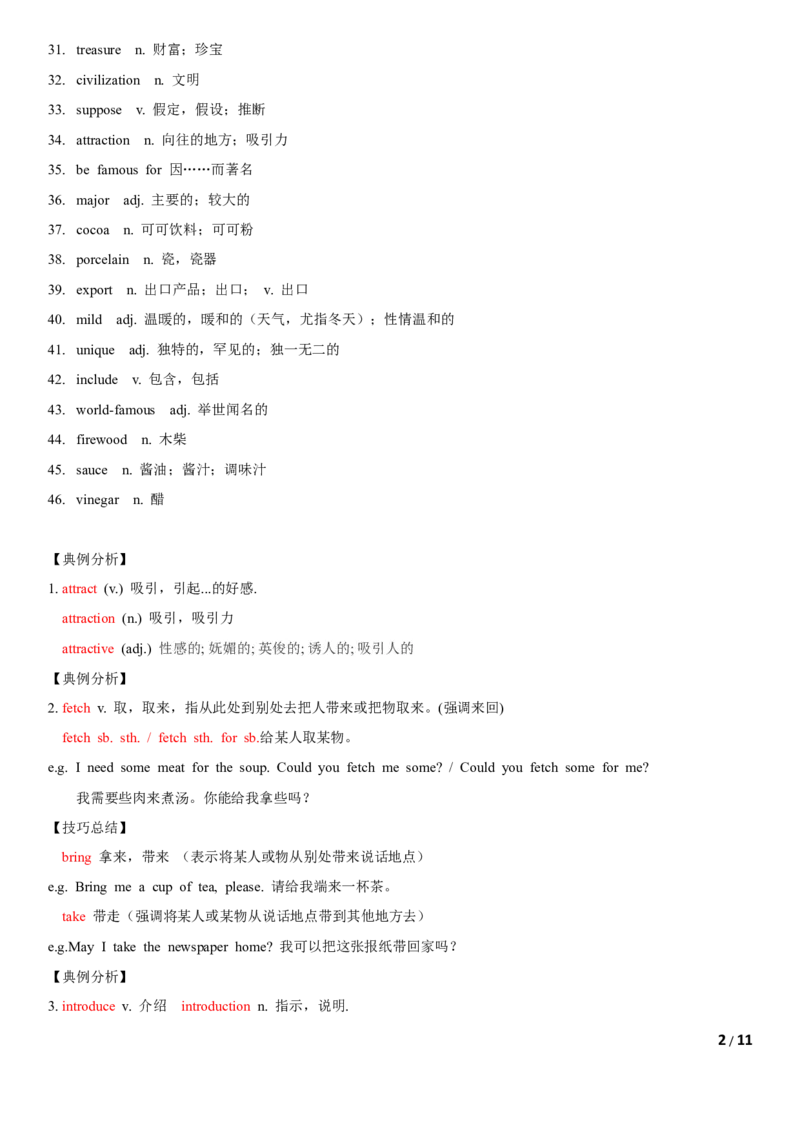
1. attract v. 吸引,引起……的好感
2. a great number of 许多,大量
3. fetch v. (去)拿来;(去)请来
4. introduce v. 介绍,引见
5. detail n. 详情;全部细节
6. strange adj. 奇怪的;陌生的
7. pine n. 松树
8. lie in 位于
9. length n. 长,长度
10. waterfall n. 瀑布
11. height n. 高度;身高
12. grand adj. 宏伟的
13. imperial adj. 帝王的;帝国的
14. carve v. 刻,雕刻
15. stone n. 石头,石料,岩石
16. guard v. 守卫,保卫;看守
17. heaven n. 天堂(Heaven上帝)
18. comment n. 评论 v. 做评论
19. responsibility n.责任;义务
20. gradually adv. 逐步地,渐进地
21. marble n. 大理石
22. entire adj. 全部的;整个的
23. branch n. 支线;分支
24. construction n. 建筑(物)
25. state n. 国家;州;政府;状态 v. 陈述,说明
26. remain v. 剩余,遗留;仍然是
27. brick n. 砖,砖块
28. separate v. (使)分开,分离
29. enemy n. 敌人;反对者
30. expect v. 预料,预期;期待,盼望
1 / 1131. treasure n. 财富;珍宝
32. civilization n. 文明
33. suppose v. 假定,假设;推断
34. attraction n. 向往的地方;吸引力
35. be famous for 因……而著名
36. major adj. 主要的;较大的
37. cocoa n. 可可饮料;可可粉
38. porcelain n. 瓷,瓷器
39. export n. 出口产品;出口; v. 出口
40. mild adj. 温暖的,暖和的(天气,尤指冬天);性情温和的
41. unique adj. 独特的,罕见的;独一无二的
42. include v. 包含,包括
43. world-famous adj. 举世闻名的
44. firewood n. 木柴
45. sauce n. 酱油;酱汁;调味汁
46. vinegar n. 醋
【典例分析】
1. attract (v.) 吸引,引起...的好感.
attraction (n.) 吸引,吸引力
attractive (adj.) 性感的; 妩媚的; 英俊的; 诱人的; 吸引人的
【典例分析】
2. fetch v. 取,取来,指从此处到别处去把人带来或把物取来。(强调来回)
fetch sb. sth. / fetch sth. for sb.给某人取某物。
e.g. I need some meat for the soup. Could you fetch me some? / Could you fetch some for me?
我需要些肉来煮汤。你能给我拿些吗?
【技巧总结】
bring 拿来,带来 (表示将某人或物从别处带来说话地点)
e.g. Bring me a cup of tea, please. 请给我端来一杯茶。
take 带走(强调将某人或某物从说话地点带到其他地方去)
e.g.May I take the newspaper home? 我可以把这张报纸带回家吗?
【典例分析】
3. introduce v. 介绍 introduction n. 指示,说明.
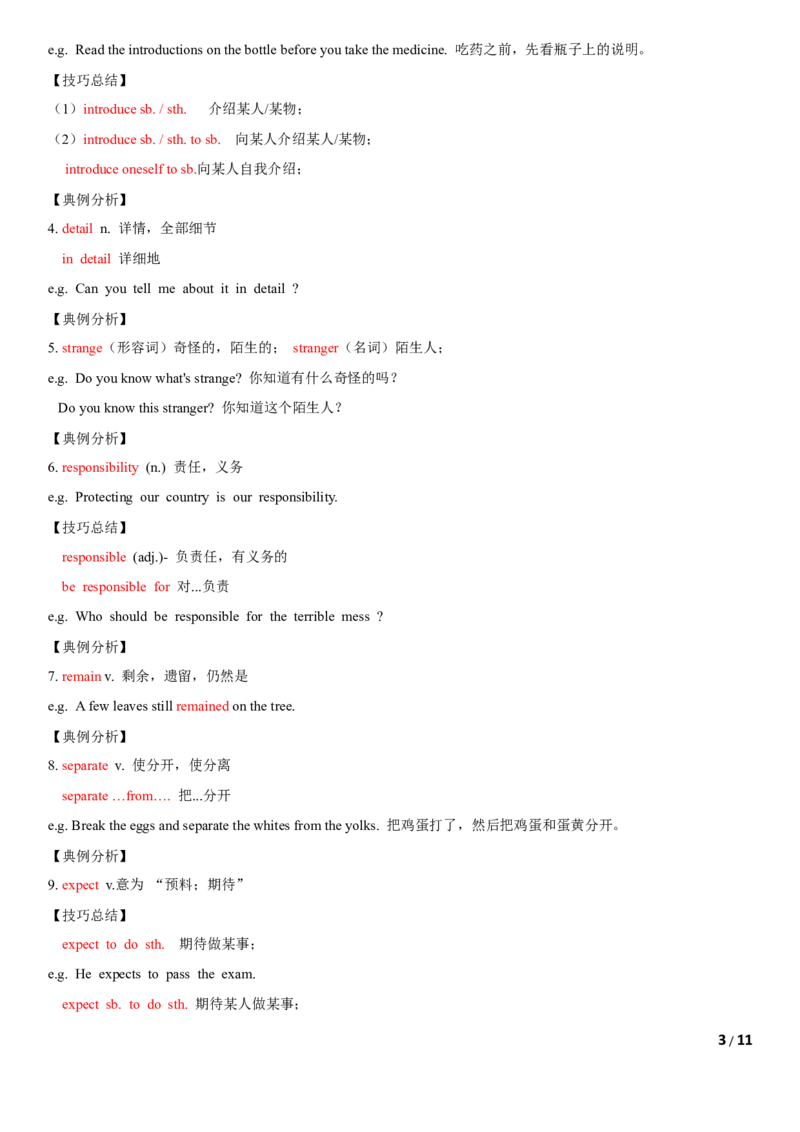
2 / 11e.g. Read the introductions on the bottle before you take the medicine. 吃药之前,先看瓶子上的说明。
【技巧总结】
(1)introduce sb. / sth. 介绍某人/某物;
(2)introduce sb. / sth. to sb. 向某人介绍某人/某物;
introduce oneself to sb.向某人自我介绍;
【典例分析】
4. detail n. 详情,全部细节
in detail 详细地
e.g. Can you tell me about it in detail ?
【典例分析】
5. strange(形容词)奇怪的,陌生的; stranger(名词)陌生人;
e.g. Do you know what's strange? 你知道有什么奇怪的吗?
Do you know this stranger? 你知道这个陌生人?
【典例分析】
6. responsibility (n.) 责任,义务
e.g. Protecting our country is our responsibility.
【技巧总结】
responsible (adj.)- 负责任,有义务的
be responsible for 对...负责
e.g. Who should be responsible for the terrible mess ?
【典例分析】
7. remain v. 剩余,遗留,仍然是
e.g. A few leaves still remained on the tree.
【典例分析】
8. separate v. 使分开,使分离
separate …from…. 把...分开
e.g. Break the eggs and separate the whites from the yolks. 把鸡蛋打了,然后把鸡蛋和蛋黄分开。
【典例分析】
9. expect v.意为 “预料;期待”
【技巧总结】
expect to do sth. 期待做某事;
e.g. He expects to pass the exam.
expect sb. to do sth. 期待某人做某事;
3 / 11e.g. Tom expects Lucy to help him.
expect +that引导的宾语从句。
e.g. I expect I can pass the exam.
二.重点短语。
1. It's two years since+过去时的句子 自从……已经有两年了;
2. live with sb. 和…居住;
3. about 5000 years of history 大约5000年的历史;
4. many places of interest 许多名胜古迹;
5. millions of tourists 数以百万计的游客;
6. know much/little about...... 对……(不)太了解;
7. has......years of history 有……年的历史;
8. a number of......... 许多的/大量的……(饰复数名词,做主语时谓复);
9. the number of… ……的数量(饰复数名词,做主语时谓单);
10. the second longest river 第二长的河;
11. the birthplace of ...... …… 的出生地/发源地;
12. fetch sb. sth.=fetch sth. for sb. 给某人取某物;
13. in detail 详尽地;
14. lie in… 位于…(之内);
15. lie on… 位于…(相邻);
16. lie to… 位于…(之外);
17. go through 穿过;
18. a height of..... ……的高度;
19. a length of...... ……的长度;
20. all over the world = around the world 全世界;
21. be worth doing sth. 值得做某事;
22. the roofs of most building 大部分建筑的屋顶;
23. a symbol of imperial power 帝王权力的象征;
24. carve on the stones 刻在石头上;
25. guard the whole nation 守护整个国家;
26. the real dragons and the sons of Heaven 真龙天子;
27. become a symbol of the Chinese nation 成为中华民族的象征;
28. play a / an..... part = play a / an.....role 扮演一个……角色,起……作用, 有……影响;
29. show sb, around 带某人参观;
4 / 1130. powerful animals 强悍的动物;
31. the Palace Museum 故宫;
32. people's comments 人们的评语;
33. the greatest wonders of the world 世界最伟大的奇观;
34. stretch from...... To..... 从…… 延伸到……;
35. be made of/from 由……制成,
36. a treasure of Chinese civilization 中华文明的瑰宝;
37. about 8800 kilometers long 大约8800米长;
38. the Warring States Period 战国时期;
39. join all the these smaller walls together 把所有这些小城墙连在一起;
40. join ..........together 将……连在一起;
41. wear away (使)磨灭,(使)磨损,(使)磨掉;
42. separate......from 把……分开;
43. regard…......as 把……看作;
44. the first emperor 第一个皇帝;
45. the Ming dynasty 明代;
46. wear away 消逝; 磨损; 消耗殆尽;
47. wear out 穿破; 磨损; (使)筋疲力尽; 耗尽;
48. wear off 磨损;磨掉; 逐渐减弱; 逐渐消失;
49. be famous for 以……而著名;
50. divide.....into...... 把……分成;
51. tourist attraction 旅游景点;
52. be interested in 对……感到兴趣;
53. be famous as = be known as 作为……而著称;
54. the home of tea 茶的故乡;
55. the three major drinks 三种主要饮品;
56. along with........ 与……在一起,与……同样地;除……以外(还);
57. tea planting 种茶;
58. tea-leaf picking 摘茶;
59. tea making 制茶;
60. tea drinking 喝茶;
61. sound similar to the pronunciation of 听起来与……的发音相似;
62. an important Chinese export 中国的重要出口产品;
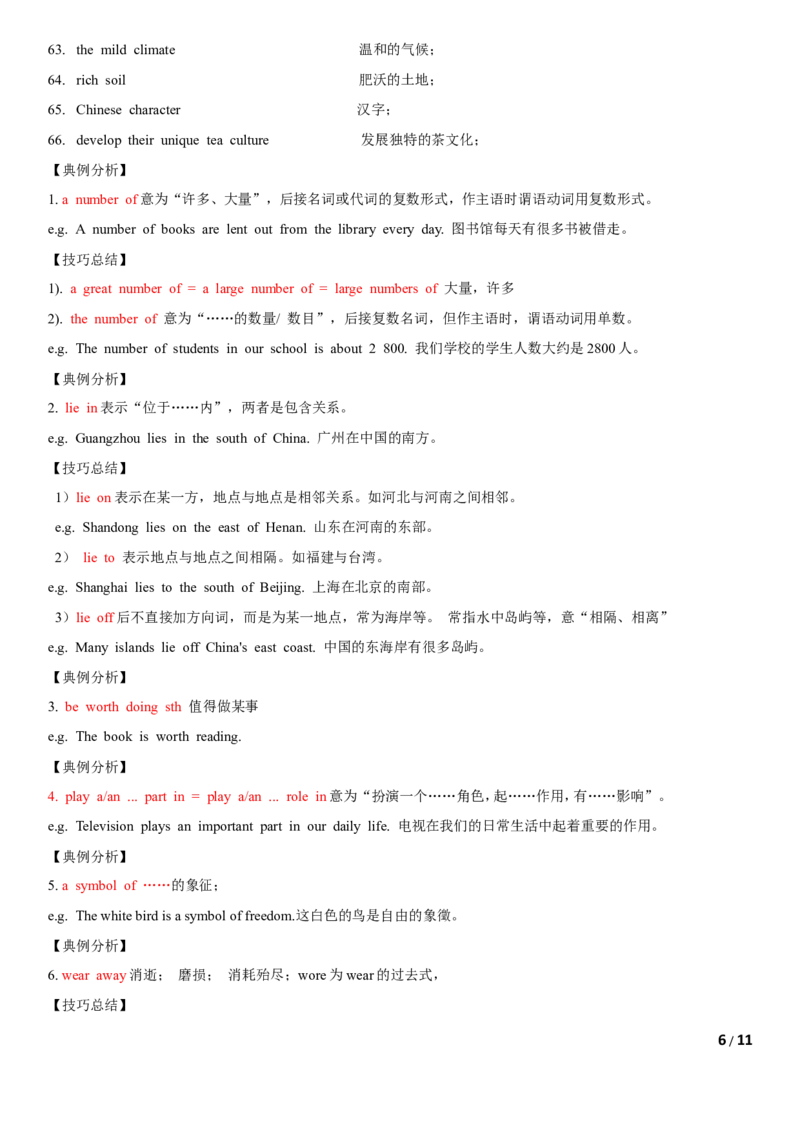
5 / 1163. the mild climate 温和的气候;
64. rich soil 肥沃的土地;
65. Chinese character 汉字;
66. develop their unique tea culture 发展独特的茶文化;
【典例分析】
1. a number of意为“许多、大量”,后接名词或代词的复数形式,作主语时谓语动词用复数形式。
e.g. A number of books are lent out from the library every day. 图书馆每天有很多书被借走。
【技巧总结】
1). a great number of = a large number of = large numbers of 大量,许多
2). the number of 意为“……的数量/ 数目”,后接复数名词,但作主语时,谓语动词用单数。
e.g. The number of students in our school is about 2 800. 我们学校的学生人数大约是2800人。
【典例分析】
2. lie in表示“位于……内”,两者是包含关系。
e.g. Guangzhou lies in the south of China. 广州在中国的南方。
【技巧总结】
1)lie on表示在某一方,地点与地点是相邻关系。如河北与河南之间相邻。
e.g. Shandong lies on the east of Henan. 山东在河南的东部。
2) lie to 表示地点与地点之间相隔。如福建与台湾。
e.g. Shanghai lies to the south of Beijing. 上海在北京的南部。
3)lie off后不直接加方向词,而是为某一地点,常为海岸等。 常指水中岛屿等,意“相隔、相 离”
e.g. Many islands lie off China's east coast. 中国的东海岸有很多岛屿。
【典例分析】
3. be worth doing sth 值得做某事
e.g. The book is worth reading.
【典例分析】
4. play a/an ... part in = play a/an ... role in意为“扮演一个……角色,起……作用,有……影响”。
e.g. Television plays an important part in our daily life. 电视在我们的日常生活中起着重要的作用。
【典例分析】
5. a symbol of ……的象征;
e.g. The white bird is a symbol of freedom.这白色的鸟是自由的象徵。
【典例分析】
6. wear away消逝; 磨损; 消耗殆尽;wore为wear的过去式,
【技巧总结】
6 / 11wear out穿破; 磨损; (使)筋疲力尽; 耗尽;
wear off 磨损;磨掉; 逐渐减弱; 逐渐消失;
【典例分析】
7. stretch from…to…. 从….延伸至…
e.g. It stretches from Shanhaiguan in the east to Jiayuguan in the west.
【典例分析】
8. be made of/from 由……制成,可以看出制成的原材料用介词of,看不出用from。
e.g. Paper is made from grass and trees. 纸张由和树制成。
The table is made of wood. 桌子由木头制成。
【典例分析】
9. be famous for 因而出名;
e.g. Hangzhou is famous for West Lake. 杭州因西湖而出名。
be famous as = be known as作为……而著称;
e.g. Luxun is famous as a writer. 鲁迅作为作家而著称。
【典例分析】
10. along with........意为“与……在一起,与……同样地;除……以外(还)”,相当together with /
with;
【技巧总结】
together / along with + 名词 放在主语之后作插入语时,谓语动词的单复数由主语的单复数决
定------就远原则。
e.g. The boy along with the twins goes to the library.那个男孩和双胞胎一起去图书馆。
三.重难点详解
1. It's been two years since Mr. And Mrs. came to China.格林夫妇来中国已经两年了。
“It's been +时间段+ since+从句.”句型,表示“自从……有……时间了。”
划线部分是定语从句,修饰先行词country。关系代词that在从句中作主语,不能省略,此处还可以用which。
2. China is a great country that has about 5000 years of history. 中国是一个拥有约五千年历史的大国。
that has about 5000 years of history 是定语从句,修饰名词country,country 是先行词,that是关系代词,在定语
从句中作主语,也可以用which。
3. Among them, the Changjiang River is the longest one and the second longest is the Huanghe River. 其中长江
是中国最 长的河流,黄河位居第二。
the second longest 意为“第二长”,在形容词的最高级家上序数词second,表示第二……
e.g. Shanghai is the biggest city in China and Beijing is second biggest one. 上海是中国最大的城市,北京位居第
二。
7 / 114. They're the birthplaces of Chinese culture.她们是中国文化的发源地。
the birthplaces of ...的发源地
5. It's a mountain with lots of strange pine trees.它是一座长着很多奇松的山。
with+名词,作后置定语“长着,有着,带着”。
e.g. I like the chair with three legs. 我喜欢那把三条腿的椅子。
6. It’s said that they’re powerful animals which guard the whole nation.
It’s said that… 据说……
关系代词which引导的定语从句修饰先行词animals。
7. real dragons and the sons of Heaven 真龙天子
8. That’s correct! 很正确!
9.The Great Wall of China is one of the greatest wonders of the world.
one of the greatest wonders译成.最伟大的奇观之一
one of+adj最高级+可数名词复数,最…之一…
e.g. He is one of the tallest boys in my class. 他是我班最高男孩之一。
10.Those Ming Dynasty rulers did not expect that it would later be used to bring tourists into China.
那些明朝的统治者们不曾设想到后来万里长城为中国带来游客。
that 是连词,引导宾语从句。expect是动词,意为“期待,期望”,通常其后加名词作宾语。
expect to do sth. 期待做某事;
expect sb. to do sth.期待某人做某事;
expect +that引导的宾语从句。
11. bring …into…译成:带进…..拿进…,领进…
e.g. Please bring that book into my office.
12. It is regarded as a symbol of the Chinese nation.
regard…as… 把…当作…
e.g. He regards Tom as his best friends.
13.The home of tea,which was more than 4000 years of history ,is China.
which 引导的非限制性定语从句,可代表先行词或主句,用逗号隔开
e.g. Tom came back safely,which made us happy.
注意:非限制性定语从句不能用that引导
14. People throughout China drink tea daily
throughout意为: “遍及,在…各处”相当于all over,around
e.g. People throughout the world love peace
15. the same as 与…一样
8 / 11四.重点语法。
定语从句(Ⅱ)
1.who指人,在从句中做主语或宾语。作主语时不能省略,作宾语时可省略。
(1)The boys who are playing football are from Class One.
(2)Yesterday I helped an old man who lost his way.
2. whom指人,为who的宾格形式,在句中只能作宾语。其前面没有介词时,也可用who/that代替,也可省略。
(1) Mr. Liu is the person (whom) you talked about.
注意:关系代词whom在口语和非正式语体中常用who代替,可省略。
(2) The man (who/whom )you met just now is my friend.
3. which指物,在定语从句中做主语或者宾语,做宾语时可省略。
(1) Football is a game which is liked by most boys. ( which 在句子中做主语)
(2) This is the pen (which) he bought yesterday. ( which 在句子中做宾语)
4. that指人时,相当于who或者whom;指物时,相当于which,在定语从句中做主语或者宾语,做宾语时可省略。
(1) The people that/who come to visit the city are all here. (在句子中做主语)
(2) Where is the man (that/whom )I saw this morning? (在句子中做宾语)
5. whose通常指人,也可指物,在定语从句中做定语,不可省略。
(1) He has a friend whose father is a doctor.
(2) I lived in a house whose roof has fallen in.
whose指物时,常用以下结构来代替
(3)The classroom whose door is broken will soon be repaired.
=The classroom the door of which is broken will soon be repaired.
(4)Do you like the book whose color is yellow?
=Do you like the book the color of which is yellow?
具体使用时还要注意下列问题:
1、只能使用that,不用which 的情况:
1) 当先行词是:all , any , anything , everything , nothing或被它们修饰时。
Is there anything that I can do for you ? 有什么可以为你做的吗?
2)当先行词被形容词的最高级或序数词修饰时。
That is one of the most interesting books that are sold in the bookshop .
那是这家书店出售的最有趣的书之一。
3)当先行词有:the only , the very , the same , the last 等修饰时。例如:
My necklace is not the only thing that's missing .我的项链不仅是丢掉的东西。
4)当主句以who或which开头时,定语从句中引导词用that ,不用which 或
9 / 11who ,以避免重复。例如:
Who is the girl that is wearing a red coat ?正穿一件红色外套的女孩子是谁?
5)当先行词既有人又有物时,用that 。例如:
The writer and his novel that you have just talked about are really well known .
你刚才谈起的那位作家以及他的小说确实很著名。
2、只用which不用that的情况:
1) 关系代词前有介词时;
This is the room in which Lu Xun lived.
2) 非限定性定语从句中;作宾语用的关系代词也不能省略。
That necklace, which you gave me as a present, was lost yesterday.
3) 先行词本身是that时;
The clock is that which tells the time
非限定性定语从句的作用是对所修饰的成分作进一步说明,通常是引导词和先行词之间用逗号隔开,将从句拿掉后
其他部分仍可成立。
Charles Smith, who was my former teacher, retired last year. 查理史密斯去年退休了,他曾经是我的老师。(非限)
There is somebody here who wants to speak to you这里有人要和你说话(限制性)
4) which还有一种特殊用法,它可以引导从句修饰前面的整个主句,代替主句所表示的整体概念或部分概念。在这种
从句中,which可以作主语,也可以作宾语或表语,多数情况下意思是与and this 相似,并可以指人。
He did very well in the competition, which made his parents very happy. 在比赛中他做的很好,这使他的父母很开心。
关系代词 whom, which 在定语从句中作介词宾语时,可以和介词一起放于先行词与定语从句之间,有时为了关系
紧凑也可以将 whom 与 which 与先行词紧挨着书写,而将介词置于定语从句的后面,
That was the room in which we had lived for ten years.= That was the room which we had lived in for ten years. 这个房间
我们住了十年。
像listen to, look at, take care of等固定短语动词,在定语从句中一般不宜将介词与动词分开。
e.g. This is the boy whom she has taken care of.
10 / 1111 / 11