专题 04 考点拓展 4&介词、There be 句型&写作指导(家庭生活)
目录
一.词汇拓展...............................................................................................................................................................1
二.考点拓展...............................................................................................................................................................2
三.语法考点...............................................................................................................................................................7
四.写作考点.............................................................................................................................................................12
五.阅读拓展.............................................................................................................................................................14
一.词汇拓展
1.art n.美术;艺术→________ n.艺术家;画家
2.difficult adj.困难的,难懂的→________ n.困难;困境→________(复数)
3.interesting adj.有趣的→________ n.兴趣→________ adj.关心的;感兴趣的
4.begin v.开始→________ n.开头;开端 (动名词)
5.work n.& v.学习;工作→________ n.工人
6.watch v.看,观看→________(第三人称单数)
7.do v.做;干→________(第三人称单数)
8.sleep n.& v. 睡觉→________ adj.睡着的→________ adj.困的;想睡的
9.read v.阅读;看懂→________ n.阅读
10.colour n.颜色→________ adj.五彩缤纷的;五颜六色的
11.left n.左边,左侧 adj.左边的,左侧的→________(反义词) n.右边,右侧 adj.右边的,右侧的
续表
12.monkey n.猴子→________(复数)
13.come v.来→________(现在分词)
14.different adj.不同的→________ adv.不同地→________ n.差别;差异
15.country n.国家→________(复数)
16.dangerous adj.危险的→________ n.危险;危害→________(反义词) adj.安全的
17.tall adj.高的→________(反义词) adj.矮的
18.fun n.娱乐;乐趣→________ adj.有趣的
19.Africa 非洲→________ adj.非洲的 n.非洲人
20.Asia 亚洲→________ adj.& n.亚洲的;亚洲人
21.leaf n.叶子→________(复数)
1.artist 2.difficulty difficulties3.interest interested 4.beginning5.worker 6.watches 7.does8.sleptasleep sleepy 9.reading 10.colourful 11.right12.monkeys 13.coming 14.differently difference
15.countries 16.danger safety 17.short 18.funny 19.African 20.Asian 21.leaves
二.考点拓展
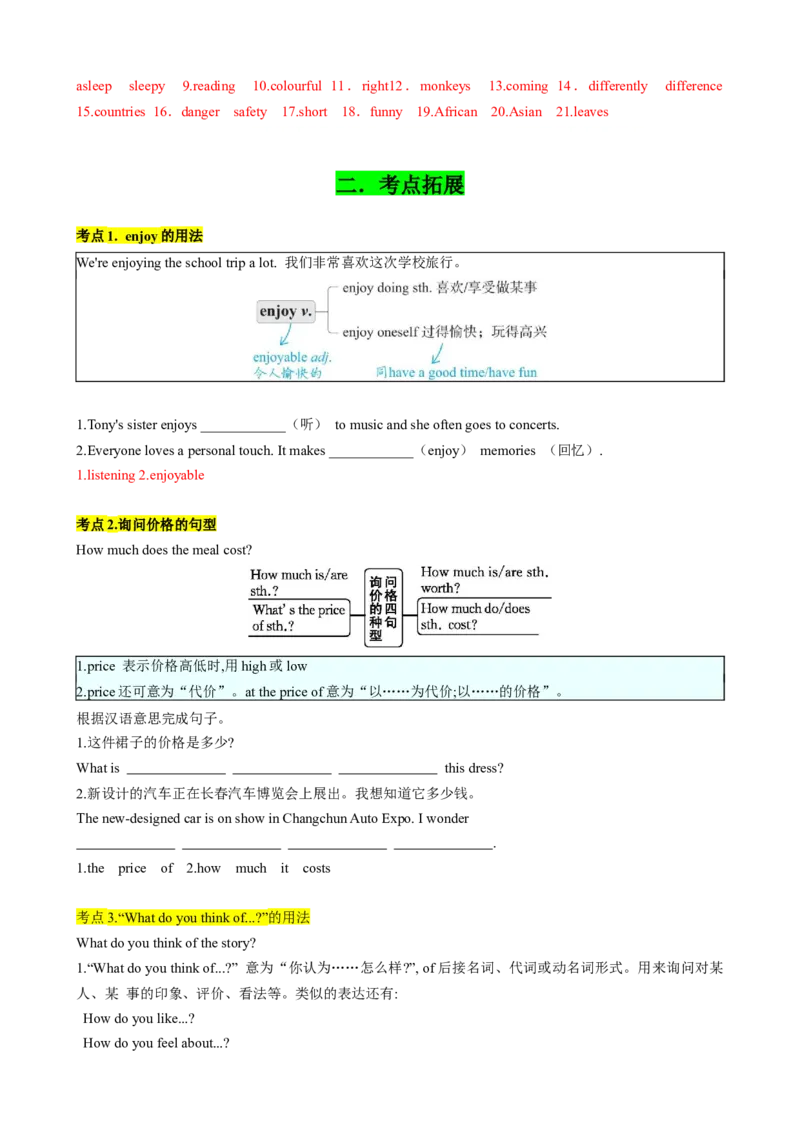
考点1. enjoy的用法
We're enjoying the school trip a lot. 我们非常喜欢这次学校旅行。
1.Tony's sister enjoys ____________(听) to music and she often goes to concerts.
2.Everyone loves a personal touch. It makes ____________(enjoy) memories (回忆).
1.listening 2.enjoyable
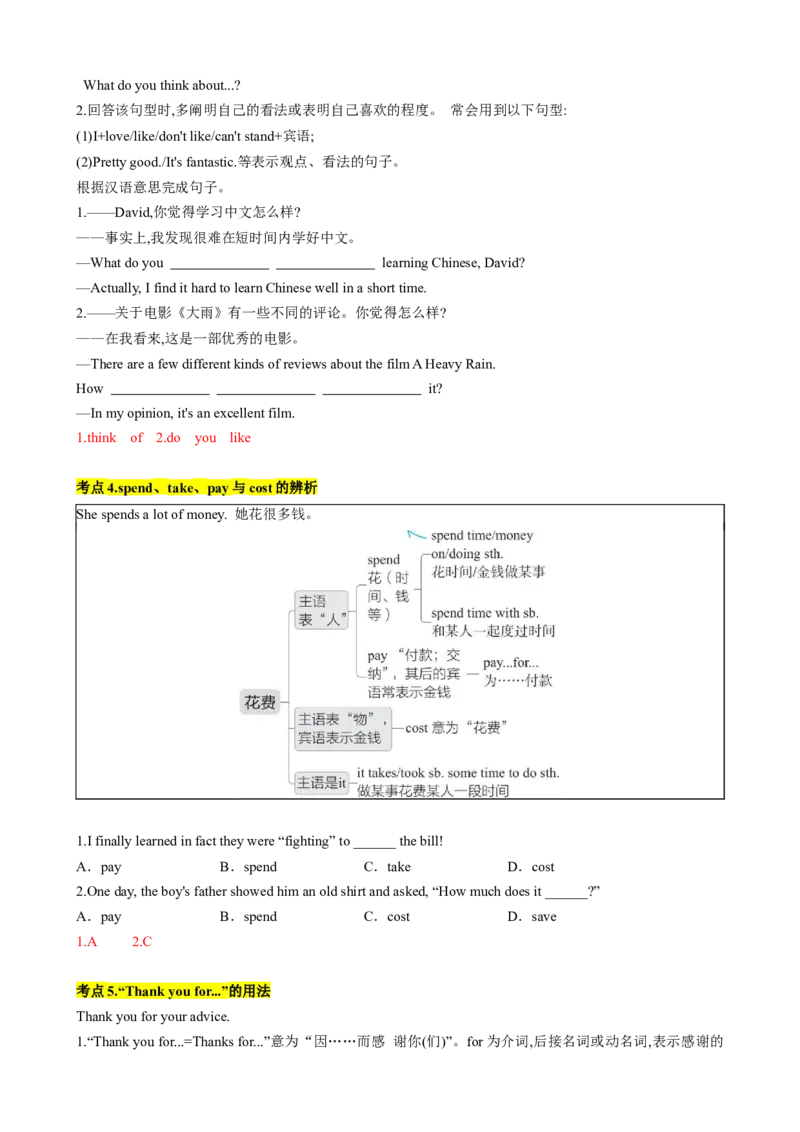
考点2.询问价格的句型
How much does the meal cost?
1.price 表示价格高低时,用high或low
2.price还可意为“代价”。at the price of意为“以……为代价;以……的价格”。
根据汉语意思完成句子。
1.这件裙子的价格是多少?
What is this dress?
2.新设计的汽车正在长春汽车博览会上展出。我想知道它多少钱。
The new-designed car is on show in Changchun Auto Expo. I wonder
.
1.the price of 2.how much it costs
考点3.“What do you think of...?”的用法
What do you think of the story?
1.“What do you think of...?” 意为“你认为……怎么样?”, of后接名词、代词或动名词形式。用来询问对某
人、某 事的印象、评价、看法等。类似的表达还有:
How do you like...?
How do you feel about...?What do you think about...?
2.回答该句型时,多阐明自己的看法或表明自己喜欢的程度。 常会用到以下句型:
(1)I+love/like/don't like/can't stand+宾语;
(2)Pretty good./It's fantastic.等表示观点、看法的句子。
根据汉语意思完成句子。
1.——David,你觉得学习中文怎么样?
——事实上,我发现很难在短时间内学好中文。
—What do you learning Chinese, David?
—Actually, I find it hard to learn Chinese well in a short time.
2.——关于电影《大雨》有一些不同的评论。你觉得怎么样?
——在我看来,这是一部优秀的电影。
—There are a few different kinds of reviews about the film A Heavy Rain.
How it?
—In my opinion, it's an excellent film.
1.think of 2.do you like
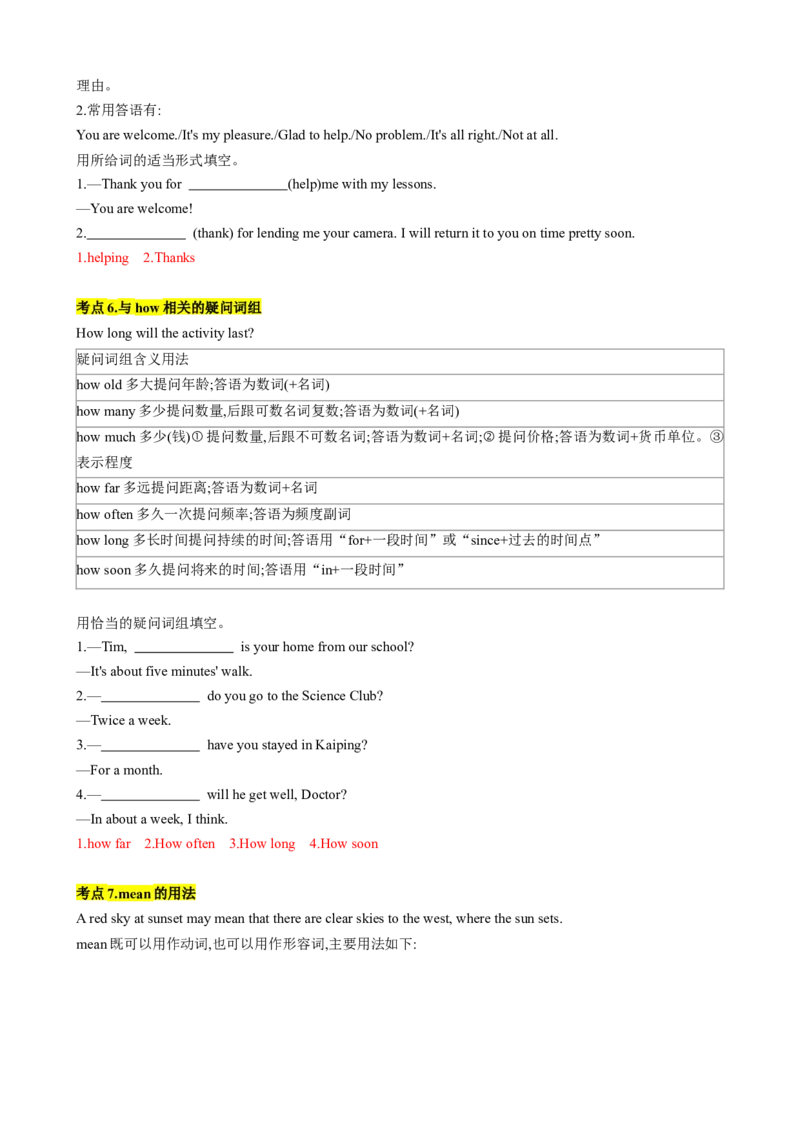
考点4.spend、take、pay与cost的辨析
She spends a lot of money. 她花很多钱。
1.I finally learned in fact they were “fighting” to ______ the bill!
A.pay B.spend C.take D.cost
2.One day, the boy's father showed him an old shirt and asked, “How much does it ______?”
A.pay B.spend C.cost D.save
1.A 2.C
考点5.“Thank you for...”的用法
Thank you for your advice.
1.“Thank you for...=Thanks for...”意为“因……而感 谢你(们)”。for为介词,后接名词或动名词,表示感谢的理由。
2.常用答语有:
You are welcome./It's my pleasure./Glad to help./No problem./It's all right./Not at all.
用所给词的适当形式填空。
1.—Thank you for (help)me with my lessons.
—You are welcome!
2. (thank) for lending me your camera. I will return it to you on time pretty soon.
1.helping 2.Thanks
考点6.与how相关的疑问词组
How long will the activity last?
疑问词组含义用法
how old多大提问年龄;答语为数词(+名词)
how many多少提问数量,后跟可数名词复数;答语为数词(+名词)
how much多少(钱)①提问数量,后跟不可数名词;答语为数词+名词;②提问价格;答语为数词+货币单位。③
表示程度
how far多远提问距离;答语为数词+名词
how often多久一次提问频率;答语为频度副词
how long多长时间提问持续的时间;答语用“for+一段时间”或“since+过去的时间点”
how soon多久提问将来的时间;答语用“in+一段时间”
用恰当的疑问词组填空。
1.—Tim, is your home from our school?
—It's about five minutes' walk.
2.— do you go to the Science Club?
—Twice a week.
3.— have you stayed in Kaiping?
—For a month.
4.— will he get well, Doctor?
—In about a week, I think.
1.how far 2.How often 3.How long 4.How soon
考点7.mean的用法
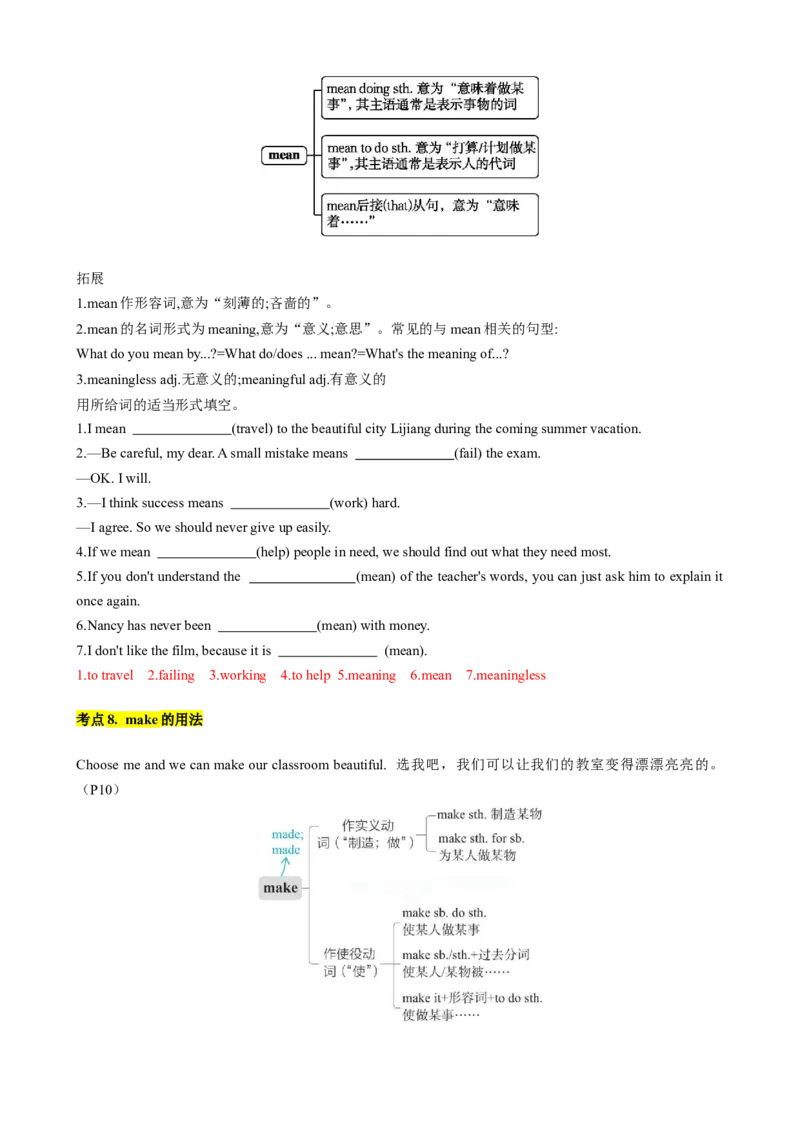
A red sky at sunset may mean that there are clear skies to the west, where the sun sets.
mean既可以用作动词,也可以用作形容词,主要用法如下:拓展
1.mean作形容词,意为“刻薄的;吝啬的”。
2.mean的名词形式为meaning,意为“意义;意思”。常见的与mean相关的句型:
What do you mean by...?=What do/does ... mean?=What's the meaning of...?
3.meaningless adj.无意义的;meaningful adj.有意义的
用所给词的适当形式填空。
1.I mean (travel) to the beautiful city Lijiang during the coming summer vacation.
2.—Be careful, my dear. A small mistake means (fail) the exam.
—OK. I will.
3.—I think success means (work) hard.
—I agree. So we should never give up easily.
4.If we mean (help) people in need, we should find out what they need most.
5.If you don't understand the (mean) of the teacher's words, you can just ask him to explain it
once again.
6.Nancy has never been (mean) with money.
7.I don't like the film, because it is (mean).
1.to travel 2.failing 3.working 4.to help 5.meaning 6.mean 7.meaningless
考点8. make的用法
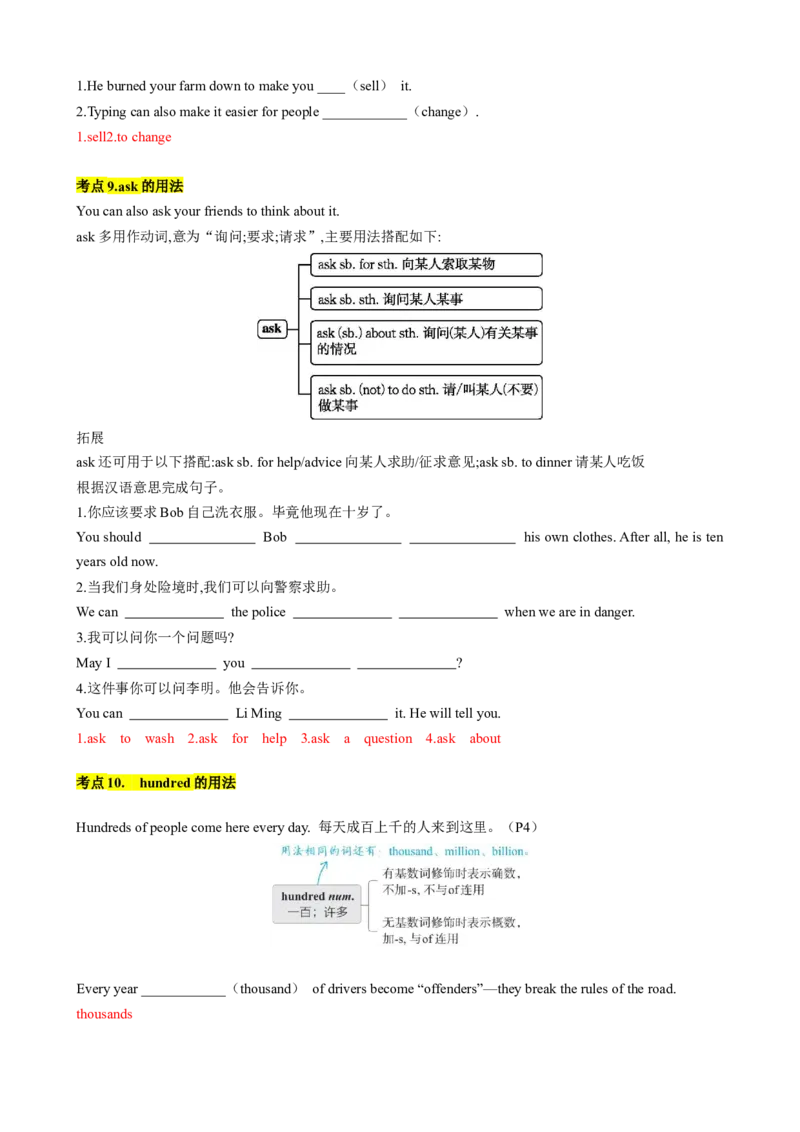
Choose me and we can make our classroom beautiful. 选我吧,我们可以让我们的教室变得漂漂亮亮的。
(P10)1.He burned your farm down to make you ____(sell) it.
2.Typing can also make it easier for people ____________(change).
1.sell2.to change
考点9.ask的用法
You can also ask your friends to think about it.
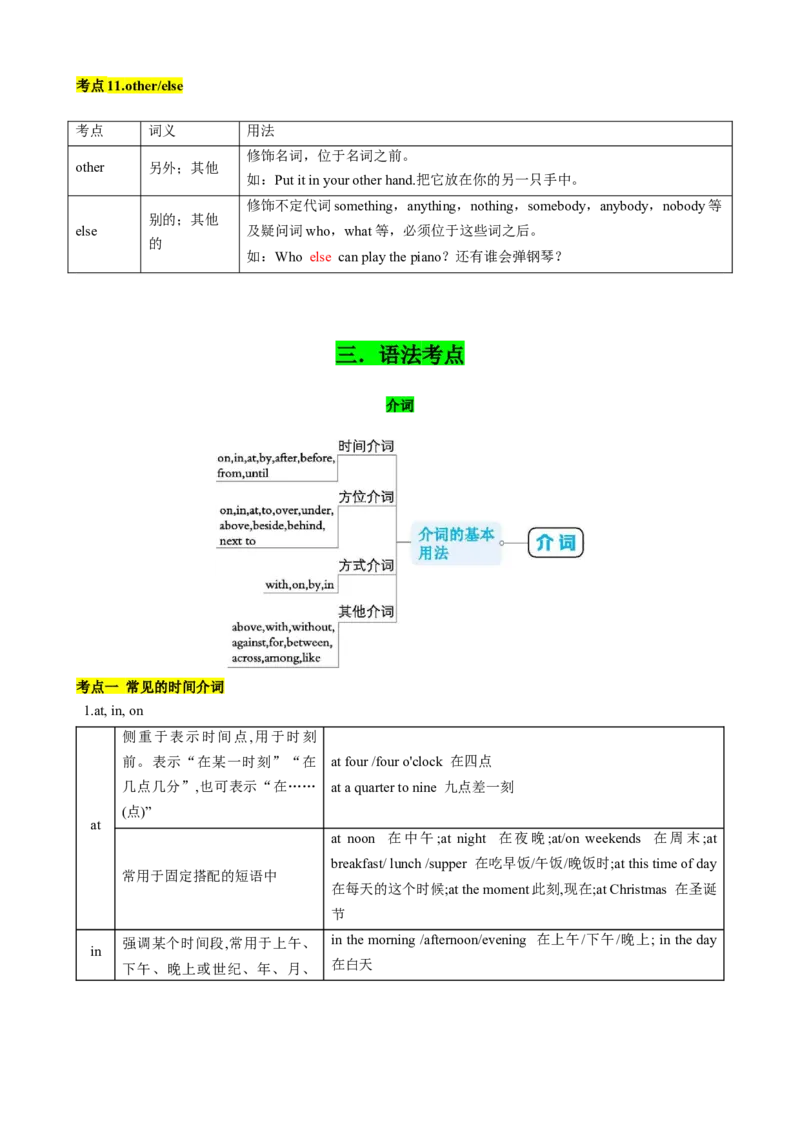
ask多用作动词,意为“询问;要求;请求”,主要用法搭配如下:
拓展
ask还可用于以下搭配:ask sb. for help/advice向某人求助/征求意见;ask sb. to dinner请某人吃饭
根据汉语意思完成句子。
1.你应该要求Bob自己洗衣服。毕竟他现在十岁了。
You should Bob his own clothes. After all, he is ten
years old now.
2.当我们身处险境时,我们可以向警察求助。
We can the police when we are in danger.
3.我可以问你一个问题吗?
May I you ?
4.这件事你可以问李明。他会告诉你。
You can Li Ming it. He will tell you.
1.ask to wash 2.ask for help 3.ask a question 4.ask about
考点10. hundred的用法
Hundreds of people come here every day. 每天成百上千的人来到这里。(P4)
Every year ____________(thousand) of drivers become “offenders”—they break the rules of the road.
thousands考点11.other/else
考点 词义 用法
修饰名词,位于名词之前。
other 另外;其他
如:Put it in your other hand.把它放在你的另一只手中。
修饰不定代词something,anything,nothing,somebody,anybody,nobody等
别的;其他
else 及疑问词who,what等,必须位于这些词之后。
的
如:Who else can play the piano?还有谁会弹钢琴?
三.语法考点
介词
考点一 常见的时间介词
1.at, in, on
侧重于表示时间点,用于时刻
前。表示“在某一时刻”“在 at four /four o'clock 在四点
几点几分”,也可表示“在…… at a quarter to nine 九点差一刻
(点)”
at
at noon 在中午;at night 在夜晚;at/on weekends 在周末;at
breakfast/ lunch /supper 在吃早饭/午饭/晚饭时;at this time of day
常用于固定搭配的短语中
在每天的这个时候;at the moment此刻,现在;at Christmas 在圣诞
节
强调某个时间段,常用于上午、 in the morning /afternoon/evening 在上午/下午/晚上; in the day
in
下午、晚上或世纪、年、月、 在白天in July 在 七 月 ;in 2012 在 2012 年 ;in March 在 三 月 ;in
季节等之前。in+一段时间,一般
spring/summer/autumn/winter 在春天/夏天/秋天/冬天; in the 21st
用于一般将来时
century 在21世纪; in ten years十年后
表示具体的某一天,后接具体的 on Sunday 在 星 期 天 ;on weekdays 在 工 作 日 ;on Friday
日期,表示某一天的上午、下 morning/afternoon/evening 在星期五早上/上午/下午/晚上;on the
午、晚上,或用于有形容词修饰 afternoon of March 5th 在三月五日下午;on a cold winter evening
on
的某一天前等 在一个寒冷冬天的晚上; on September 28th 在九月二十八日
on New Year's Day 在元旦;on Children's Day 在儿童节;on
用于公共节假日前
Christmas Eve在圣诞节前夕
考点二 常见的地点介词
表示地点的介词有in、 on、 at、 to等,对其考查侧重于at、 on、 in的区别。at着重把所处的位置看作
是某一个点,范围不明确,意为“在……内;在……上”,一般与较小的地方连用。in表示在某一区域或某一
个立体的地方内,意为“在……(里)”,一般与较大的地方连用。on表示在一条线或一个平面上,意为
“在……上”,如on the ground, on the wall, on the farm。
考点三 常见的方位介词
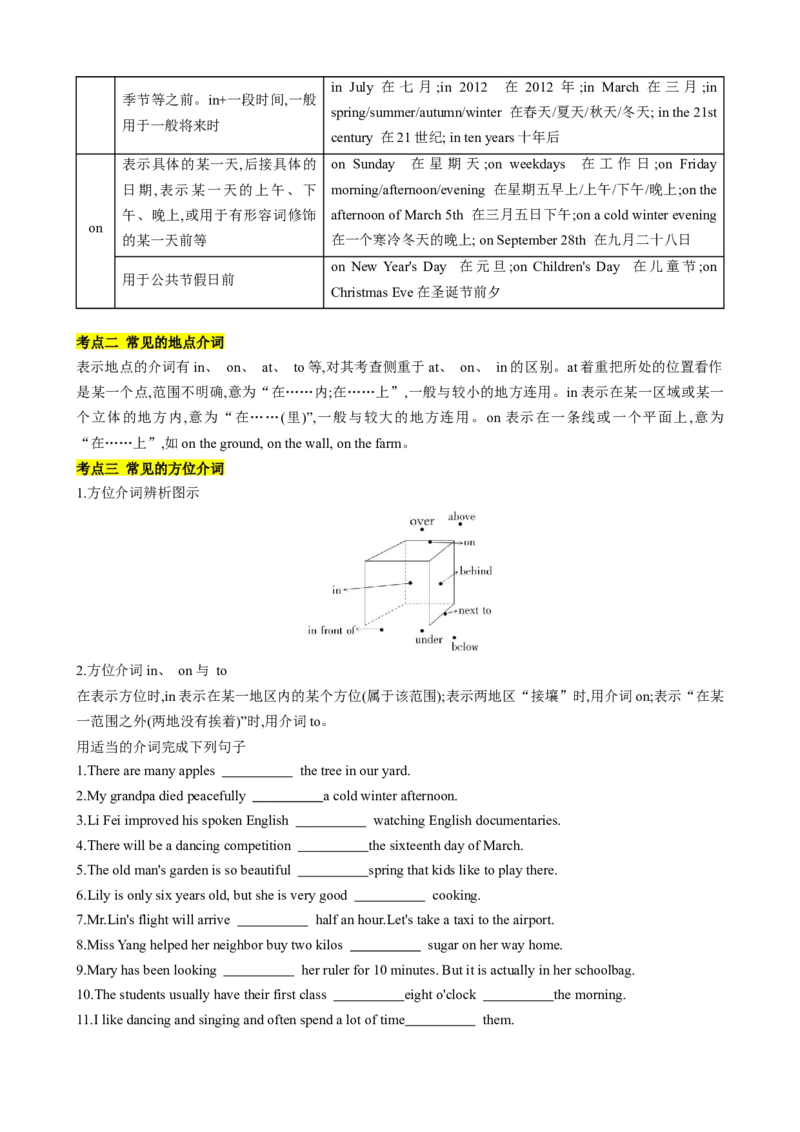
1.方位介词辨析图示
2.方位介词in、 on与 to
在表示方位时,in表示在某一地区内的某个方位(属于该范围);表示两地区“接壤”时,用介词on;表示“在某
一范围之外(两地没有挨着)”时,用介词to。
用适当的介词完成下列句子
1.There are many apples the tree in our yard.
2.My grandpa died peacefully a cold winter afternoon.
3.Li Fei improved his spoken English watching English documentaries.
4.There will be a dancing competition the sixteenth day of March.
5.The old man's garden is so beautiful spring that kids like to play there.
6.Lily is only six years old, but she is very good cooking.
7.Mr.Lin's flight will arrive half an hour.Let's take a taxi to the airport.
8.Miss Yang helped her neighbor buy two kilos sugar on her way home.
9.Mary has been looking her ruler for 10 minutes. But it is actually in her schoolbag.
10.The students usually have their first class eight o'clock the morning.
11.I like dancing and singing and often spend a lot of time them.12.Where is the key the front door?
13.After school, I like playing computer games and chatting my friends the Internet.
14.I learned a lot the other students in this class.
15.What do you think my new car?
16.I hurried to school breakfast this morning, so I feel hungry now.
17.The man is a great basketball player.We are all proud him.
18.My mother will come home the morning of August 8.
19.I grew up the foot of the mountain.
20.That naughty boy hid the door and waited for his friends to find him.
【参考答案】1.on 2.on 3.by 4.on 5.in 6.at 7.in 8.of 9.for 10.at in 11.on 12.to
13.with on14.from 15.of 16.without 17.of 18.on 19.at 20.behind
There be句型
考点一 基本用法
1.There be句型主要用来表达“某地或某时有某人或某物”,其基本句型为“ There be+某物/某人+某地某
时”,其中 there没有实际意义;be是谓语动词;“某人或某物”做句子的主语;“某地或某时”做句子
的状语,一般是介词短语。
There is a football under the chair.椅子下面有个足球。
2.There be句型中的be动词在人称和数上应与其后的主语保持一致。主语是不可数名词或可数名词单数时
用is,是复数时用are。
There is a flower in the bottle.瓶子里有一朵花。
There are some books in the backpack.背包里有些书。
3.There be句型的否定结构在is/are后面加not,一般疑问句把is或are放在there之前,肯定回答“Yes,
there is/are.”,否定回答“No,there isn't/aren't.”。如果肯定句中有some,否定句和疑问句一般要改成any。
There aren't any children on the playground.操场上没有一些孩子。
—Is there a bank near here?在这附近有银行吗?
—Yes,there is.是的,有。/No,there isn't.不,没有。
There are some children in the picture.照片里有一些孩子。
There aren't any children in the picture.照片里没有一些孩子。
考点二 特殊用法
1.若句子中有几个并列的主语时,be动词要与离其最近的一个主语在人称和数上保持一致。(就近原则)
There is a boy,a girl and two women in the house.房子里有一个男孩、一个女孩和两个妇女。
There are ten students and a teacher in the office.办公室里有十个学生和一个教师。
2.“There be+名词或代词+动词-ing形式”意思是“有某人或某物正在做……”。
There are some teachers playing basketball on the playground.有些老师正在操场上打篮球。
3.There be句型的一般将来时的肯定结构为“There will be+名词+其他成分.”或“There is going to be+名词+其他成分.”,意为“将要有……或“将举行……”。(注意:不论be后的名词是单数还是复数,be不能
写成is/are)
There will be a meeting tomorrow morning.明天上午有个会议。
考点三 难点突破
There be句型与 have/has都可以意为“有”,但它们的含义不同。There be句型表示的是“存在关
系”,而 have/has表示的却是“所有关系”,have/has的主语一般是人,有时也可以是物。
There is a car in front of the school gate.学校门前有辆小汽车。(强调车在门前)
I have a car.我有一辆小汽车。(强调车归我所有)
注意(1)如果这两个表示“有”的句型中含有some,改为否定句或疑问句时some要改为any。
There is some water in the glass.杯子里有一些水。
→ There isn't any water in the glass.杯子里没有水。
(2)表示“构成”关系时,have/has与 There be结构常常表示相同的意思,可以进行同义句转换。
A week has seven days.
=There are seven days in a week.一周有七天。
一.用括号内所给词的适当形式填空
1.There (be) fifty books here.
2.There (be) some water in the glass.
3.There (be) a lot of apples on the table.
4.There (be) an old building in front of our school.
5.There (be) some cups of tea on the table.
二..按要求完成句子,每空一词
1.There is a library across from the school.(改为否定句)
a library across from the school.
2.There are some birds in the tree.(改为一般疑问句)
birds in the tree?
3.Is there a baseball under the chair?(作肯定回答)
Yes, .
4.There are some children in the street. (改为一般疑问句)
children in the street?
5.There is a cat under the tree.(改为一般疑问句)
a cat under the tree?
三.用have,has,there is或there are填空
1.I a good father and a good mother.
2. a basketball in the playground.
3.They a nice garden.
4. a reading room in the building.
5. some books in the bookcase.
6.My father a storybook.7. a storybook on the table.
8. some flowers in the vase.
9.My parents some nice pictures.
10. a map of the world on the wall.
1.are there be句型中由be动词后面的名词是可数名词复数books可知设空处应用are。
2.is there be句型中由be动词后面的名词是不可数名词water可知设空处应用is。
3.are there be句型中由be动词后面的名词是可数名词复数apples可知设空处应用are。
4.is there be句型中由be动词后面的名词是可数名词单数building可知设空处应用is。
5.are there be句型中由be动词后面的cups可知设空处应用are。
二.1.There isn’t 2.Are there any 3.there is 4.Are there any 5.Is there
三.1.have 设空处表示“拥有”,主语是I,故填have。
2.There is 设空处表示“存在”,用there be句型,be动词后面的名词是可数名词单数basketball,故be动词
用is。
3.have 设空处表示“拥有”,主语是They,故填have。
4.There is 设空处表示“存在”,用there be句型,be动词后面的名词是可数名词单数reading room,故be动
词用is。
5.There are 设空处表示“存在”,用there be句型,be动词后面的名词是可数名词复数books,故be动词用
are。
6.has 设空处表示“拥有”,主语是My father,故谓语动词用第三人称单数形式has。
7.There is 设空处表示“存在”,用there be句型,be动词后面的名词是可数名词单数storybook,故be动词
用is。
8.There are 设空处表示“存在”,用there be句型,be动词后面的名词是可数名词复数flowers,故be动词用
are。
9.have 设空处表示“拥有”,主语是My parents,故填have。
10.There is 设空处表示“存在”,用there be句型,be动词后面的名词是可数名词单数map,故be动词用
is。
四.写作考点
围绕“家庭关系”展开,描述了家人之间深沉而又无私的爱。与其相关的写作通常有:
1.描述一件家人之间难忘的事情;
2.描述家人之间怎样互相支持。
某英语网站举办以“父亲节”为主题的征文活动。假如你是李华,请你根据下列提示给父亲写一封信,
和他
说说心里话,并参加此次活动。
提示:1.你与父亲之间难忘的一件事;2.你的收获或感受;3.你对父亲的感谢和祝福。
要求:1.信中应包含所有提示要点,可适当发挥;
2.100词左右,开头和结尾已给出,不计入总词数。佳作展示
Dear Dad,
Father’s Day is coming. I’d like to say something to you.You are always strict with me and I thought you
didn’t care for me. But one thing changed my mind.Once I got a “C” in English. You said nothing but invited me
to climb a mountain. It was hard for me to climb and I wanted to give up. You encouraged me and gave me a
hand.
At last, we got to the top. Then I understood you. You wanted to tell me not to give up easily.Your love is like
a mountain, silent but always there.
Thank you for your silent love. I wish you good health and happiness every day.
Happy Father’s Day!
Love,
Li Hua
写作迁移训练
假设你是李华,你校英语杂志社正在举办“亲子空间”征稿活动。请你以“An unforgettable family
experience”为题,根据以下提示,用英语写一篇文章投稿。
提示:
要求:
1. 包含图中所有内容,可以适当增加细节,以使行文连贯;
2. 文中不得出现真实人名或地名;
3. 词数应不少于100。
______________________________________________________________________________________________________________________________________________________________________________________
___________________________________________________________________________________________
___________________________________________________________________________________________
___________________________________________________________________________________________
___________________________________________________________________________________________
___________________________________________________________________________________________
___________________________________________________________________________________________
___________________________________________________________________________________________
_________________________________________________
【写作提示】
1. 主题:家庭活动经历
2. 人称:第一人称
3. 时态:以一般过去时为主
4. 要点:时间、地点、人物、做了什么、感受如何
5. 写作思路:开头部分简单点明是哪次经历;中间部分描述家人一起做了什么,以及如何做的;最后介
绍自己的收获和感受。
【范文赏读】
An unforgettable family experience
Last summer, my family went on a camping trip to a nearby forest. It was an experience that I will never
forget.
We put up our tent under the shade/ʃeɪd/(阴凉处)of tall trees and spent the day enjoying the
beautiful nature around us. We also collected some beautiful leaves and stones. In the evening, we built a
campfire and sat around it, sharing stories and laughter.
During this experience, I felt very happy and relaxed. Being away from the hustle/ˈhʌsl/ and bustle
/ˈbʌsl/(熙熙攘攘)of city life made me feel peaceful. From this experience, I learned the importance of
spending time with loved ones and enjoying the simple things in life. This camping trip was not only an
unforgettable family experience but also a valuable lesson for me.
五.阅读拓展
一
There are many floating markets(水上市场)in Thailand. Damnoen
Saduak outside Bangkok is one of them.
The floating market opens at 6:30 am. Before it opens. the farmers
transport fruits and vegetables from their farms. Then their wives(妻
子)sell them on the boats. The best time to go to the market is the early
morning because the vegetables and fruits are the freshest at that time. At about 10:00 pm. the market closes.A lot of people visit the market every day. The floating market is colorful. You can find fruits and vegetables
in different colors on the small boats.
Visiting the floating market is a good way to relax yourself. You can take a one-day trip there. The tour bus
usually leaves Bangkok at about 5:50 am and arrives there at about7:00 am. Then you need to take a boat to visit
the market. At the market, you can enjoy the river view, talk with the villagers and buy things you like. Come and
have a trip if you're interested!
1.Why is the early morning the best time to visit the market?
A. Because there are the most visitors at that time.
B. Because the things are the most at that time.
C. Because you can buy the freshest food at that time.
D. Because you can pick fruits and vegetables yourself at that time.
2.How long does the market open a day?
A.15 and a half hours. B. 15 hours.
C. 16 and a half hours. D. 16 hours.
3.what does the underlined word“transport”mean?
A.运输 B. 派送 C. 提供 D. 售卖
4. Why does the writer write the text?
A. To tell people when the floating market opens.
B. To show people where the floating market is.
C. To help sell things in the floating market.
D. To ask people to visit the floating market.
4.What can we know from the text?
A. You can buy great clothes in the floating market.
B. Farmers' wives sell things in the floating market.
C. You can visit the floating market at any time.
D. To visit the floating market, you need to learn to boat.
长难句分析
原句:(第二段第四句)The best time to go to the market is the early morning because the vegetables and fruits
are the freshest at that time.
译文:去这个市场的最佳时间是清晨,因为那时的蔬菜和水果是最新鲜的。
分析:这是一个复合句。because the vegetables and fruits are the freshest at that time是because 引导的原因
状语从句。
答案详析
1.C 细节理解题。由第二段中的“The best time to go to the market is the early morning because the vegetables
and fruits are the freshest at that time.”可知.清晨是去市场的最佳时间,因为那时的食物是最新鲜的。
2.A细节理解题。由第二段中的“The floating market opens at 6.30 am.”和“At about 10:00pm,the market
closes.”可知,这个水上市场早上6:30营业,晚上10:00停业。故这个市场每天营业15.5个小时。
3.A词义猜测题;根据Before it opens. the farmers transport fruits and vegetables from their farms.可推测;每
天农民会从农场运输蔬菜水果过来。4.D 推理判断题。由最后一段中的“Come and have a trip if you're interested!”可推知,作者写这篇文章的
目的是邀请人们来游览这个水上市场。
5.B 细节理解题。由第二段中的“Then their wives sell them on the boats.”可知,农夫的妻子在这个水上市
场卖东西。
二
Fiji is a small island country in the Pacific Ocean. Now people in Fiji face a big 1 . The sea
level 2 and the sea water flows(流动)into people's homes and
gardens because of the climate change(气候变化).So they can't grow
anything and have to move 3 .
Some people are 4 to leave their village, but some older people
don't like it. They want to 5 because they hope to live in the
village all their lives.
In 2014 . one village moved from the seaside to a 6 place on the island. It was the first time
that people had left their homes 7 sea levels rise. But some of them still come back to 8 old
village almost every day.
Now more and more people in Fiji have to leave their village and 9 new homes in other
places. They hope to get 10 from the government to adapt to(适应new environments.
1.A.difficulty B. problem C. hope D. result
2. A. goes up B. comes down C. stands up D. breaks down
3.A. onto B. off C. away D. into
4.A. happy B. sorry C. dangerous D. beautiful
5.A. work B. play C. start D. stay
6.A. bigger B. higher C. smaller D. further
7.A.because B. so C. but D. and
8.A. his B. your C. their D. our
9. A. change B. bring C. save D. buy
10.A. surprise B. information C. wish D. help
长难句分析
原句:(第二段最后一句)They want to stay because they hope to live in the village all their lives.
译文:他们想留下来,因为他们希望一辈子都住在村子里。
分析:本句是一个复合句。because they hope to live in the village all their lives是because 引导的原因状语
从句。
答案详析
1.B根据2空后的“the sea water flows into people's homes and gardens”可知,海水流入了人们的家里和花园
里,由此可知此处指现在斐济人民面临一个大问题。
2.A根据空后的“the sea water flows into people's homes and gardens”可知,海水流入了人们的家里和花园
里;再结合常识可知,这是海平面上升造成的,故此处指海平面上升。go up“上升”,符合语境。7空后
的sea levels rise也为提示信息。
3.C 根据上一句及空前的 they can't grow anything可知,因为气候变化海水进入了人们的家里,他们不能种植任何东西,故此处指人们不得不搬走。move away“搬走”,符合语境。
4. A 根据空后的“but some older people don' like it”可知,许多老人不喜欢这么做;but表示转折,故此处
指有些人很乐意离开他们的村庄。
5. D根据空后的“because they hope to live in the village all their lives”可知,因为他们希望一辈子都住在村
子里,故可知他们想留下来。
6.B 根据上文可知,海平面上升导致海水进入了人们的家里,人们不得不搬离。再结合常识可知,人们
会搬到地势更高的地方来预防海水进入家里。故此处指2014年,一个村庄搬到了岛上一个地势更高的地
方。
7.A 空后的“海平面上升”和空前的“人们离开他们的家园”构成因果关系,故选连词because。
8.C结合语境可知,此处指他们中的许多人仍然几乎每天回到他们的旧村庄。句子主语为some of them,
故此处应选their。
9.B 根据空前的“have to leave their village”可知,他们不得不离开他们的村庄;再结合空后的“new
homes in other places”可知,此处指他们在其他的地方建造新的房子。
10.D 根据空后的“from the government to adapt to new environments”并结合选项可知,此处指人们希望得
到政府的帮助来适应新环境。
三
Insects(昆虫)are small animals with six legs. But they are important
because they are food for some animals. 1 Insects also pollinate(授
粉)flowers. Without insects, there will be no plants. And it will be hard for
people to grow crops(庄稼).
2 It says that the number of insects is falling. It declines(下降) by
2.5% each year. Some people even say the insects will die out by the end of
this century. 3 People do not know why this is happening. However, they guess that it may be because the
earth is getting warmer. 4 That can be a problem for the insects, too.
How to stop this from happening? 5 Second, everyone should have the sense(意识)of protecting our
earth from an early age. If we try our best, we are sure to save our homeland.
A. There is a new study about insects.
B. Why do animals love insects so much?
C. This would be a big problem for man.
D. Now many people want to save insects.
E. what’s more,people use chemicals(化学品)in farming.
F. First, we should know the natural world is important.
G. These animals will have nothing to eat without insects.
长难句分析
原句:(第二段倒数第三句)However, they guess that it may be because the earth is getting warmer.
译文:然而,他们猜测这可能是因为地球正在变暖。
分析:本句是一个复合句。that it may be because the earth is getting warmer 是that引导的宾语从句,作guess的宾语;在该宾语从句中,because the earth is getting warmer为because引导的表语从句。
答案详析
1.G根据上一句可知,昆虫是很重要的,因.为它们是一些动物的食物;再结合下文介绍的昆虫的重要性
可知,空处内容应与昆虫的重要性有关,故 G项“如果没有昆虫,这些动物会没有东西吃”可承接上
文,符合语境。
2. A 根据下一句“It says that the number of insects is falling.”可知,它表明昆虫的数量正在下降,此处的 It
指代的应是上一句提到的某个事物,故A项“这里有一项关于昆虫的新研究”可引出下文,符合语境。It
指代选项中的a new study。
3.C 根据上一句可知,一些人甚至认为到本世纪末昆虫会灭绝;再结合上文中提到的昆虫的重要性可推
断,空处的内容应与昆虫灭绝对人类的影响有关,故 C项“这对人类来说是个严重的问题”可承接上
文,符合语境。
4.E 上文提到人们不知道昆虫数量减少的原因,然而人们猜测这可能是因为地球正在变暖;再结合选项可
知,E项“而且,人们在农业生产中使用化学品”也可能是昆虫数量减少的一个原因,故E项符合语境。
5.F上一句提问了如何阻止这件事情的发生,下一句提到每个人应该从小就有保护地球的意识,空处内容
应与具体的措施有关,故F项“首先,我们应该知道自然界是重要的”可承上启下,符合语境。