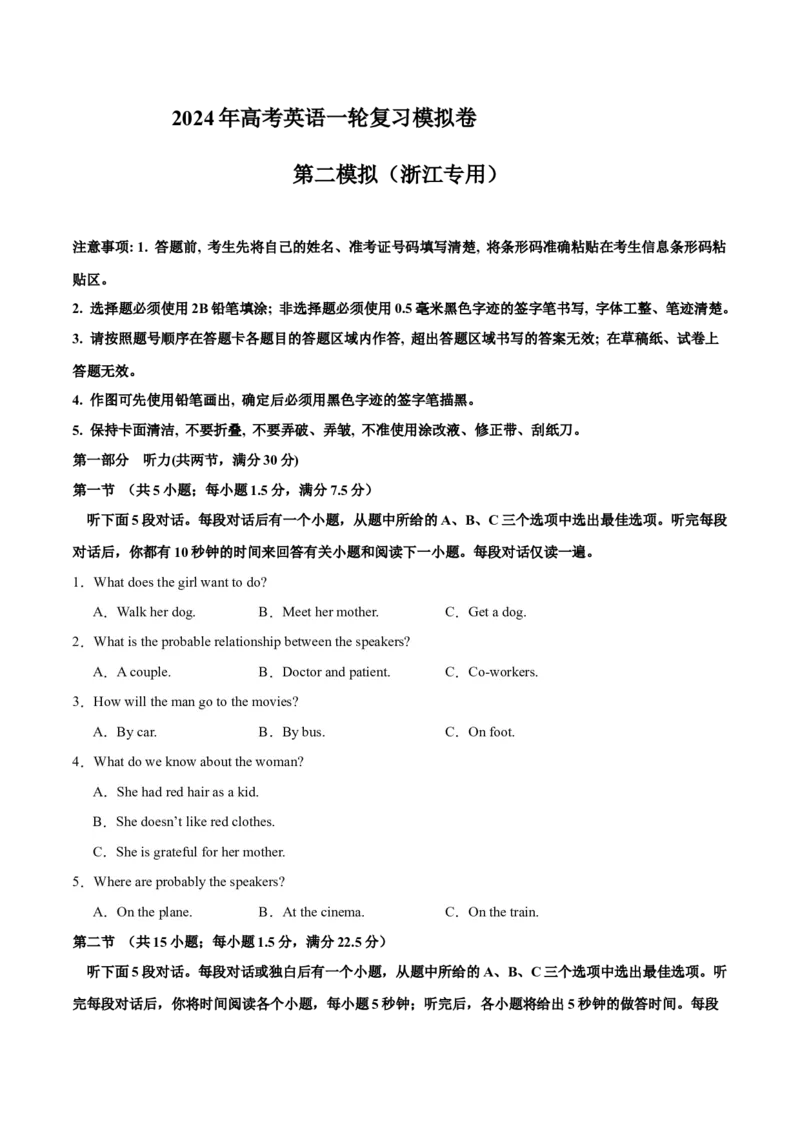
2024 年高考英语一轮复习模拟卷
第二模拟(浙江专用)
注意事项: 1. 答题前, 考生先将自己的姓名、准考证号码填写清楚, 将条形码准确粘贴在考生信息条形码粘
贴区。
2. 选择题必须使用2B铅笔填涂; 非选择题必须使用0.5毫米黑色字迹的签字笔书写, 字体工整、笔迹清楚。
3. 请按照题号顺序在答题卡各题目的答题区域内作答, 超出答题区域书写的答案无效; 在草稿纸、试卷上
答题无效。
4. 作图可先使用铅笔画出, 确定后必须用黑色字迹的签字笔描黑。
5. 保持卡面清洁, 不要折叠, 不要弄破、弄皱, 不准使用涂改液、修正带、刮纸刀。
第一部分 听力(共两节,满分30分)
第一节 (共5小题;每小题1.5分,满分7.5分)
听下面5段对话。每段对话后有一个小题,从题中所给的A、B、C三个选项中选出最佳选项。听完每段
对话后,你都有10秒钟的时间来回答有关小题和阅读下一小题。每段对话仅读一遍。
1.What does the girl want to do?
A.Walk her dog. B.Meet her mother. C.Get a dog.
2.What is the probable relationship between the speakers?
A.A couple. B.Doctor and patient. C.Co-workers.
3.How will the man go to the movies?
A.By car. B.By bus. C.On foot.
4.What do we know about the woman?
A.She had red hair as a kid.
B.She doesn’t like red clothes.
C.She is grateful for her mother.
5.Where are probably the speakers?
A.On the plane. B.At the cinema. C.On the train.
第二节 (共15小题;每小题1.5分,满分22.5分)
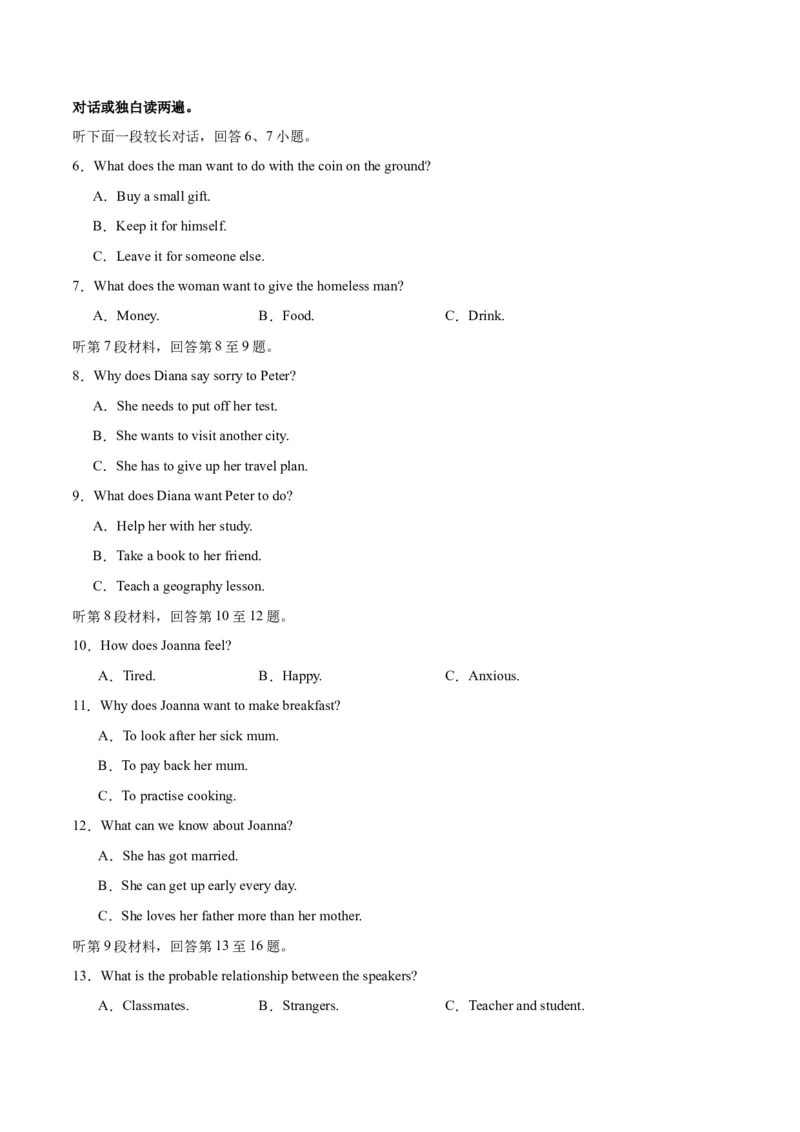
听下面5段对话。每段对话或独白后有一个小题,从题中所给的A、B、C三个选项中选出最佳选项。听
完每段对话后,你将时间阅读各个小题,每小题5秒钟;听完后,各小题将给出5秒钟的做答时间。每段对话或独白读两遍。
听下面一段较长对话,回答6、7小题。
6.What does the man want to do with the coin on the ground?
A.Buy a small gift.
B.Keep it for himself.
C.Leave it for someone else.
7.What does the woman want to give the homeless man?
A.Money. B.Food. C.Drink.
听第7段材料,回答第8至9题。
8.Why does Diana say sorry to Peter?
A.She needs to put off her test.
B.She wants to visit another city.
C.She has to give up her travel plan.
9.What does Diana want Peter to do?
A.Help her with her study.
B.Take a book to her friend.
C.Teach a geography lesson.
听第8段材料,回答第10至12题。
10.How does Joanna feel?
A.Tired. B.Happy. C.Anxious.
11.Why does Joanna want to make breakfast?
A.To look after her sick mum.
B.To pay back her mum.
C.To practise cooking.
12.What can we know about Joanna?
A.She has got married.
B.She can get up early every day.
C.She loves her father more than her mother.
听第9段材料,回答第13至16题。
13.What is the probable relationship between the speakers?
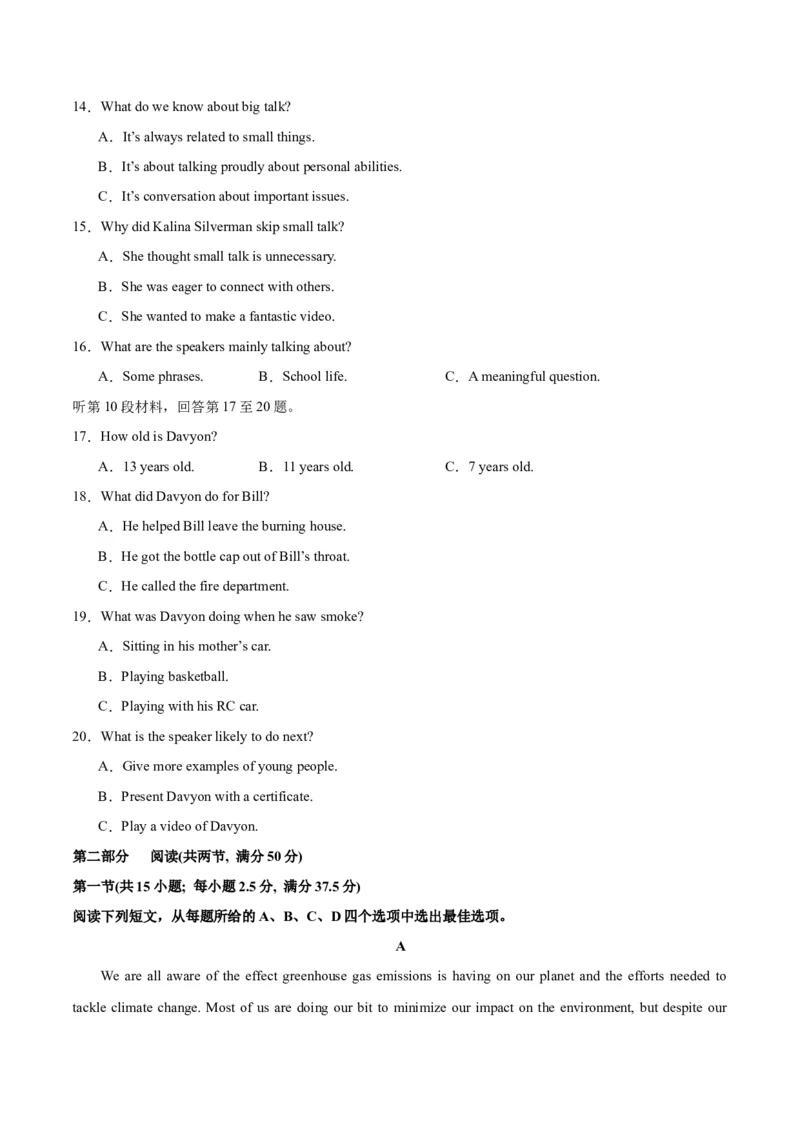
A.Classmates. B.Strangers. C.Teacher and student.14.What do we know about big talk?
A.It’s always related to small things.
B.It’s about talking proudly about personal abilities.
C.It’s conversation about important issues.
15.Why did Kalina Silverman skip small talk?
A.She thought small talk is unnecessary.
B.She was eager to connect with others.
C.She wanted to make a fantastic video.
16.What are the speakers mainly talking about?
A.Some phrases. B.School life. C.A meaningful question.
听第10段材料,回答第17至20题。
17.How old is Davyon?
A.13 years old. B.11 years old. C.7 years old.
18.What did Davyon do for Bill?
A.He helped Bill leave the burning house.
B.He got the bottle cap out of Bill’s throat.
C.He called the fire department.
19.What was Davyon doing when he saw smoke?
A.Sitting in his mother’s car.
B.Playing basketball.
C.Playing with his RC car.
20.What is the speaker likely to do next?
A.Give more examples of young people.
B.Present Davyon with a certificate.
C.Play a video of Davyon.
第二部分 阅读(共两节, 满分50分)
第一节(共15小题; 每小题2.5分, 满分37.5分)
阅读下列短文,从每题所给的A、B、C、D四个选项中选出最佳选项。
A
We are all aware of the effect greenhouse gas emissions is having on our planet and the efforts needed to
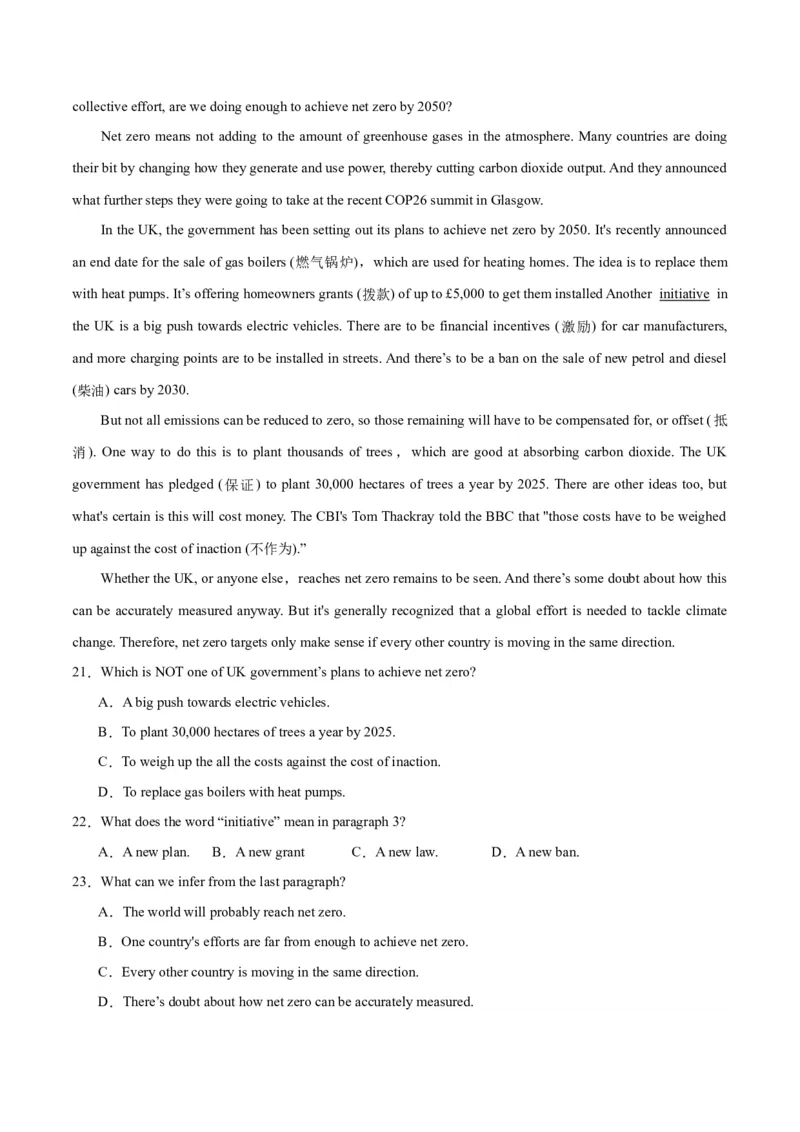
tackle climate change. Most of us are doing our bit to minimize our impact on the environment, but despite ourcollective effort, are we doing enough to achieve net zero by 2050?
Net zero means not adding to the amount of greenhouse gases in the atmosphere. Many countries are doing
their bit by changing how they generate and use power, thereby cutting carbon dioxide output. And they announced
what further steps they were going to take at the recent COP26 summit in Glasgow.
In the UK, the government has been setting out its plans to achieve net zero by 2050. It's recently announced
an end date for the sale of gas boilers (燃气锅炉),which are used for heating homes. The idea is to replace them
with heat pumps. It’s offering homeowners grants (拨款) of up to £5,000 to get them installed Another initiative in
the UK is a big push towards electric vehicles. There are to be financial incentives (激励) for car manufacturers,
and more charging points are to be installed in streets. And there’s to be a ban on the sale of new petrol and diesel
(柴油) cars by 2030.
But not all emissions can be reduced to zero, so those remaining will have to be compensated for, or offset (抵
消). One way to do this is to plant thousands of trees,which are good at absorbing carbon dioxide. The UK
government has pledged (保证) to plant 30,000 hectares of trees a year by 2025. There are other ideas too, but
what's certain is this will cost money. The CBI's Tom Thackray told the BBC that ''those costs have to be weighed
up against the cost of inaction (不作为).”
Whether the UK, or anyone else,reaches net zero remains to be seen. And there’s some doubt about how this
can be accurately measured anyway. But it's generally recognized that a global effort is needed to tackle climate
change. Therefore, net zero targets only make sense if every other country is moving in the same direction.
21.Which is NOT one of UK government’s plans to achieve net zero?
A.A big push towards electric vehicles.
B.To plant 30,000 hectares of trees a year by 2025.
C.To weigh up the all the costs against the cost of inaction.
D.To replace gas boilers with heat pumps.
22.What does the word “initiative” mean in paragraph 3?
A.A new plan. B.A new grant C.A new law. D.A new ban.
23.What can we infer from the last paragraph?
A.The world will probably reach net zero.
B.One country's efforts are far from enough to achieve net zero.
C.Every other country is moving in the same direction.
D.There’s doubt about how net zero can be accurately measured.B
Researchers say a new electrical device placed in three paralyzed patients has helped them walk again. The
lower bodies of the three patients were left paralyzed after they suffered spinal (脊柱的) cord injuries. But a device
implanted in the spinal cord was able to send electrical signals to the muscles to permit them to stand, walk and
exercise.
Scientists have discovered that neurons—which receive and send signals for muscle movements—often still
work in injured patients with serious spinal cord injuries. However, past research into spinal cord injuries has
centered on the stimulation of neurons. Now in the latest experiment led by Gregoire Courtine and Jocelyne Bloch
of the Swiss Federal Institute of Technology in Lausanne, three paralyzed men were implanted a new electrical
device designed to copy an action of the brain, in which it sends signals to the spinal cord that result in muscle
movement. When the spinal cord receives the brain signals, it stimulates a collection of nerve cells that can activate
different muscles.
The researchers reported that all three patients who got the spinal cord implants were able to take their first
steps within an hour after receiving them. Over the next six months, the patients regained the ability to take part in
more advanced walking activities, the study found. They were also able to ride bicycles and swim in community
settings.
Unlike other attempts to help paralyzed patients walk by stimulating nerves through the back of the spine,
Courtine said that his team redesigned the devices so signals would enter the spine from the sides. This method
permits more direct targeting and activation of spinal cord areas, he said.
The team then developed artificial intelligence (AI) systems linked to the device. The AI controls electrodes
on the device to send signals to stimulate individual nerves that control muscles needed for walking and other
activities. However, because the patients’ muscles were weak from not being used, they needed help with
supporting their weight, the researchers said. It also took some time for them to learn to work with the technology.
Still, Bloch said, “The more they train, the more they start lifting their muscles, the more fluid it becomes.”
24.What can be inferred from paragraph 2?
A.Courtine and Bloch have found that neurons in paralyzed patients still work.
B.The new electrical device can imitate the brain to send signals to the spinal cord.
C.Three paralyzed men recovered with the help of a new electrical device.
D.Stimulating the neurons is the focus of the latest research into spinal .cord injuries.
25.How does the new device stimulate the spinal cord areas more directly?A.By stimulating nerves through the back of the spine.
B.By using the AI system.
C.By making signals enter the spine from the sides.
D.By sending the signals to the brain.
26.Which can best describe Bloch’s idea in the last paragraph?
A.Every garden has its weeds.
B.Put the cart (运货马车) before the horse.
C.It's hard to please all.
D.Practice makes perfect.
27.What is the purpose of this text?
A.To report the consequence of spinal cord injuries.
B.To introduce the findings of a recent research.
C.To compare a recent research with other previous researches.
D.To recommend a treatment for paralyzed patients.
C
Rain is vital to life on Earth. However, rain isn’t just made of water anymore — it’s partly made of plastic.
Millions of tiny pieces of plastic, called microplastics, are wandering around Earth’s atmosphere and traveling
across entire continents, according to a study published in the journal Proceedings of the National Academy of
Sciences on April 12. Another study, published in the journal Science in June 2020, has revealed that every year
more than 1,000 tons of the particles — equivalent to over 120 million plastic bottles — fall in rain.
Microplastics are plastic particles less than 5 millimeters in diameter and come from a number of sources.
Plastic bags and bottles released into the environment break down into smaller and smaller bits. Some microplastics
are manufactured deliberately to provide abrasion in a host of products, such as toothpaste and cleansers, according
to the Daily Mail. Another major source is your washing machine. When you wash synthetic clothing, tiny
microfibers get flushed away with the wastewater. Even though the water is treated by a wastewater plant, the
microplastics remain, and they are released into the sea, according to American magazine Wired.
Plastic rain may remind people of acid rain, but the former is far more widespread and harder to deal with. The
tiny particles, too small to be seen with the naked eye, are collected by the wind from the ground. They are so light
that they stay in the air to be blown around the globe. As they climb into the atmosphere, they are thought to act as
nuclei around which water vapor condenses to form clouds. Some of the dust falls back to land in dry conditions,while the rest comes down as rain, according to the Daily Mail.
Microplastics have been found everywhere you can imagine. From fish and frogs to mice and mosquitoes,
their bodies have been found, on average, to contain 40 pieces of microplastic, reported Daily Mail. As the top of
the food chain, humans are exposed to microplastics, too. “ We live on a ball inside a bubble,” microplastic
researcher Steve Allen at University of Strathelyde, Scotland, told Wired. “There are no borders, there are no edges.
It (plastic rain) is raining on the land and then getting blown back up into the air again, to move somewhere else.
There’s no stopping it once it’s out.”
28.What does paragraph 3 mainly talk about?
A.How microplastics are used widely.
B.How microplastics come into being.
C.How microplastics pollute water.
D.How microplastics should be handled.
29.What do we know about microplastics?
A.They are light and can be easily dealt with.
B.They result in both acid rain and plastic rain.
C.They have nearly affected the whole food chain.
D.They have a diameter of at least 5 millimeters.
30.What do Steve Allen’s words mean in the last paragraph?
A.Countries should work together to fight pollution.
B.The atmosphere possesses the capacity to self-cleanse.
C.It is important to remove microplastics somewhere else.
D.No place is safe from microplastic pollution.
31.Which of the following can be the best title?
A.The sources and effects of microplastics.
B.The difference between acid rain and plastic rain.
C.The dangers of microplastics.
D.The microplastics in food chain.
D
Words can show what’s going on in our heads — and pronouns, in particular, may show where our attention is
aimed. “You can be focused on yourself for many reasons,” says James Pennebaker, a psychologist at the
University of Texas. “Once you appreciate that ‘I’ attracts attention, you see it’s a powerful marker of a speaker’spsychological state.” Here are a few ways in which the use of this tiny pronoun tells big truths.
Generally speaking, depressed people often use more “I” words. This seems to have to do with how long-
lasting sadness brings along an inward focus that translates into “I”, “me” and “my” usage. In fact, the poet who
overuses “I” in his poetry may be at a higher risk of suicide.
Lower-status people rely on “I” in that “we” words don’t just indicate “you and me” – they can hold many
other meanings. On the other hand, using “we” words lets the more powerful speaker decide what group the listener
falls into.
Interestingly, women open up and say “I”, and about fourteen percent of women’s words are these less formal
personal pronouns compared to only twelve percent for men. “This is a huge statistics difference,” Pennebaker
says. Women generally come across as more self-reflective and self-aware than men.
As for online writing, after September 11, “I” talk plummeted, and an analysis of thousands of blogs showed a
big drop in “I” words after the attacks. The result was that the use of “we” words jumped at an even higher rate. “A
temporary reaction to acute pain is to turn to others. It’s not a coincidence that disaster brings people together,”
Pennebaker points out.
Obviously, people who lie tend to avoid “I”. “When you’re lying, you almost distance yourself from the
words. In other words, you are not owning your statements.”
32.For what purpose is the use of pronouns being studied?
A.To evaluate the potential effect on people’s actions.
B.To advocate the use of pronouns in daily conversations.
C.To expose the relationship between behavior and speech.
D.To examine the relation between emotions and statements.
33.Compared with men, when women speak they_________.
A.seldom refer to themselves
B.tend to reflect on themselves
C.mainly talk about personal matters
D.choose more formal personal pronouns
34.The underlined word “plummeted” in Paragraph 5 most probably means _________.
A.increased quickly B.appeared suddenly
C.dropped sharply D.disappeared totally
35.What is the main message the text conveys?
A.Communication indicates status differences.B.Communication suggests more than one can see.
C.Communication means discussion between equals.
D.Communication connects different people together.
第二节(共5小题; 每小题2.5分, 满分12.5分)
阅读下面短文, 从短文后的选项中选出可以填入空白处的最佳选项。选项中有两项为多余选项。
Learn to Cite Sources
During your university education, you’ll be exposed to ideas and scientific theories of scholars and scientists.
Unavoidably, your own ideas will be shaped by the ideas you come across. 36 That means you should go
beyond what you learn in your textbooks or in the library. Your original work is the basis for your professor’s
evaluation of your performance. Thus, academic honesty is fundamental in your university education. It demands
that you cite the source materials you base your own work on. 37
Correctly citing your sources helps you distinguish your own ideas from those of other scholars. On the
readers’ side, it permits a reader to determine the depth of your research. 38 On the contrary, lack of citing
will only raise your reader’s doubt.
So you need to learn when to cite and how to provide an adequate or accurate reference list. If you fail to cite
your sources, whether deliberately or carelessly, you will be found responsible for plagiarism (抄袭) . 39 If
you are not sure, ask your professor for guidance before submitting the paper or report. Keep in mind this general
rule: when in doubt, cite!
40 For example, students from East Asia may think that copying directly from sources is the proper
way to do research. Students in France, preparing for the final examination, may be encouraged to memorize whole
passages and copy them into papers. Those cultural differences can lead to false assumptions about academic
expectations in the country you study in.
A.Some university students may cheat in different ways.
B.These include other scholars’ ideas, figures, graphs and so on.
C.The academic challenge you face is to make something original.
D.Often, students want to use others’ opinions to support their own essays.
E.It also allows a reader to appreciate your original contribution to the research.
F.For international students, it is important to know local academic expectations.
G.Not knowing academic regulations is an unacceptable excuse for such behavior.
第三部分语言运用(共两节, 满分30分)第一节(共15小题; 每小题1分, 满分15分)
阅读下面短文, 从每题所给的A、B、C、D四个选项中选出可以填入空白处的最佳选项。
Camping is a rite of passage (成人仪式) if you grow up in Canada. It’s a child’s first 41 of what
living in the wild really means. But growing up as an immigrant from India, I thought it was 42 .
Then I 43 26 and started trying new things. I had been 44 mental health issues for
quite some time and I discovered being out in nature helped me calm down. 45 , I decided to try camping.
Then I overheard a(n) 46 between my father and mother. “Why does she have to do this? Doesn’t
she know she can just stay at home?” my father asked. “This is what Canadian kids do, it’s okay, she’ll be fine!”
my mom 47 . My parents had no 48 in me surviving one night in the wild.
My friends and I 49 our campsite in the woods. As the day went on, we ate, played by the water
and met our camping neighbors. Time felt like it 50 ; life felt gentler and easier. As the day turned into
night, the stars came out and I was amazed by all the 51 lights above me. Morning came. I didn’t even
realize I was 52 to leave until we started packing everything up.
I wasn’t just leaving, having accomplished something I 53 thought I would do. I was leaving with
a real sense of community, a real sense of 54 for what the great outdoors had to offer, and a completely
different 55 to an activity that I had thought strange for so many years.
41.A.attempt B.taste C.proposal D.target
42.A.odd B.awkward C.amazing D.rough
43.A.grew B.observed C.turned D.recalled
44.A.involving B.surviving C.abandoning D.experiencing
45.A.Overall B.Moreover C.Somehow D.Therefore
46.A.argument B.debate C.conversation D.quarrel
47.A.explained B.insisted C.prayed D.interrupted
48.A.mercy B.empathy C.faith D.preference
49.A.set up B.beat down C.drew on D.rose to
50.A.shot up B.slowed down C.broke out D.put off
51.A.swinging B.bouncing C.rolling D.twinkling
52.A.curious B.enthusiastic C.upset D.desperate
53.A.barely B.constantly C.ultimately D.merely
54.A.foundation B.appreciation C.resolution D.recognition
55.A.contrast B.attitude C.priority D.exposure第二节(共10小题; 每小题1.5分, 满分15分)
阅读下面短文,在空白处填入1个适当的单词或括号内单词的正确形式。
For Mexican poet Manuel Cuautle 56 (bear) in 1971, Chinese poetry possesses two qualities that
make it stand out: naturalness and simplicity. “It is a literature of modernity and tradition, a 57 (combine) that
lends it a remarkable uniqueness, which is why it has so many great works,” Cuautle said.
Cuautle knows 58 he’s talking about. From a very young age he has maintained a close relationship
59 Chinese literature. First as a reader and later as a director of the Mexico City International Poetry Festival.
As part of this festival, Cuautle has invited Chinese poets 60 (present) their works and give readings in
front of a Mexican public. Among his favorites are Liu Chang. Yu Jian and Li Cheng’en.
The relationship grew even 61 (close) in 2013, when his collection of poems The Suicide of the Snail,
published in Argentina in 2005, 62 (translate) into Chinese by Zhang Jin, a teacher of classical Chinese
literature. And he had a chance to enjoy his translated version being read by a Chinese. 63 (listen) to his
work being recited in Chinese gives it 64 whole new dimension. “It’s beautiful to listen to oneself in
another language. Some of my books have been translated into English, French, German and Italian, but in Chinese,
it’s 65 (extreme) beautiful. It fascinates me,” Cuautle said.
第四部分 写作(共两节, 满分40分)
第一节 (满分15分)
假定你是李华。请你给一年前已回国的外教Jason写一封电子邮件,请他邀请他现在的学生参与你设计的
“外国学生眼中的中国文化”网络问卷调查。信的内容如下:
1. 写信目的;
2. 问卷目的;
3. 操作方式和提交日期。
注意:1.词数80左右; 2.可适当增加细节,以使行文连贯。
____________________________________________________________________________________________
____________________________________________________________________________________________
____________________________________________________________________________________________
____________________________________________________________________________________________
____________________________________________________________________________________________
____________________________________________________________________________________________
______________________________________________________________________________________________________________________________________________________________________________
第二节 书面表达 (满分25分)
阅读下面材料,根据其内容和所给段落开头语续写两段,使之构成一篇完整的短文。续写的词数应为 150
左右。
Sara Savick remembers one special Easter when she was nine years old. Her parents gave her a baby duckling
in a yellow basket.
“Mom said later that she bought the little duck because she felt sorry for it,” recalled Sara. The people at the
pet store colored the feathers pink for Easter. Sara named the duck Pinky.
Sara’s mother really didn’t think the baby duck would survive very long. But to her surprise, Pinky grew and
got stronger and stronger. Soon, the little duckling was a healthy, hungry duck with white feathers.
“We fed Pinky oatmeal, cooked and uncooked, and small pieces of vegetables,” said Sara. Pinky lived inside
the house with Sara and her family. She specially fancied taking baths with Sara. Everyone treated Pinky as a
family member.
But just when everything appeared to be perfect, the night of the “talk” came. Sara’s Mom and Dad sat her
down, explaining that the best thing for Pinky was to live a normal duck life, with other ducks. It was not natural
for ducks to live indoors with a family, her father told her. He added Pinky needed to swim in ponds and do all the
same things that ducks in the wild do.
Sara started to cry, knowing what was going to happen. Sara’s parents decided to take Pinky to a park, which
was two miles away. There was a pond with a lot of other ducks. Pinky would have the chance to live a natural life
and Sara could still visit her.
The big day came, Sara and her parents put Pinky in a box and drove to the park. Sara said that Pinky did not
look happy; maybe Pinky was convinced that she was a human, not a duck.
注意:
所续写短文的词数应为 l50 左右;
续写部分分为两段,每段的开头语已为你写好;
Paragraph 1
Everyone was sad when they left Pinky at the pond, even Sara’s father.
____________________________________________________________________________________________
____________________________________________________________________________________________
________________________________________________________________________________________________________________________________________________________________________________________
______________________________________
Paragraph 2
The next morning, when looking out of the kitchen window, Sara couldn’t believe her eyes!
____________________________________________________________________________________________
____________________________________________________________________________________________
____________________________________________________________________________________________
____________________________________________________________________________________________
______________________________________