【过高考】2023 年高考英语大一轮单元复习
人教 2019 新版选择性必修四 • Unit 3
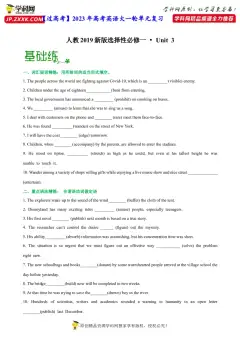
一、词汇短语精练:用所给词的适当形式或适当搭配填空。
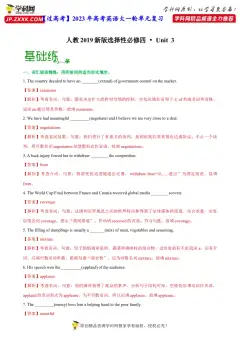
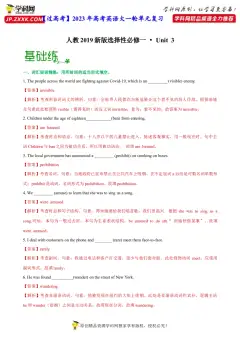
1. The country decided to have an ________(extend) of government control on the market.
2. We have had meaningful _________(negotiate) and I believe we are very close to a deal.
3. A back injury forced her to withdraw ________ the competition.
4. The World Cup Final between France and Croatia received global media ________ (cover).
5. The filling of dumplings is usually a _______(mix) of meat, vegetables and seasoning.
6. His speech won the__________(applaud) of the audience.
7. The _________(mercy) boss lent a helping hand to the poor family.
8. It is said that he is in________ (possess) of three shops.
9. He disguised himself as a young beautiful lady on purpose just to avoid__________(arrest) by the police.
10. I've displayed a few of the most important files and ________(directory) in the code.
二、题型精练:七选五
Like space exploration, deep sea exploration requires new instruments and technology. The ocean depths are
cold and dark and are under high pressure. 1
Finding the Bottom
In the 8th century, lead weights which were attached to ropes are dropped to measure water depth. Beginning in
the19th century, researchers used wire rather than rope to take sounding measurements. In the modern era,
acoustic (声学的) depth measurement devices are widely used. 2.
Human Exploration
Once people knew where the sea floor was, 3 Science has progressed way beyond the diving bell, a
huge bottle containing air that could be lowered into the water. The first submarine was built by Cornelius Drebbel
in 1623.The first underwater breathing device was invented in 1865. In 1964, Alvin was tested. Alvin was built by
General Mills and operated by the US Navy. Alvin allowed three people to remain underwater for as long as nine
hours and as deep as 14,800 feet. Modern submarines can travel as deep as 20,000 feet.
Robotic Exploration
While humans have visited the bottom of the Mariana Trench, 4. Further exploration relies on modern
robotic systems.
原创精品资源学科网独家享有版权,侵权必究!
学科网(北京)股份有限公司【过高考】2023 年高考英语大一轮单元复习
Remotely operated vehicles (ROVs) are controlled by researchers on a ship. ROVs typically carry cameras,
manipulator (操作) arms, sonar equipment, and sample containers.
Autonomous underwater vehicles (AUVs) operate without human control. 5. Some vehicles, such as
the Nereus, act as either a ROV or AUV.
A. But diving deep never ends
B. Humans are curious about the sea
C. they have made a lot of discoveries
D. they wanted to visit and examine it
E. the trips only allowed limited exploration
F. Basically, they produce a loud sound and listen for echoes to measure distance
G. They generate maps, measure temperature and chemicals, and take photographs
三、语法填空
Inspired by the work of William Beebe, Dr. Sylvia Earle (1935) began her work as an oceanographer at the
age of 3 when she 1 (knock) off her feet by a wave. She was fascinated by the ocean and its creatures.
Although she struggled 2 (balance) her studies and family, Earle earned her PhD from Duke University,
becoming well known in the marine science community. Early in her career, and while she was four 3 (month)
pregnant, Earle traveled 30.5m/100 ft below the surface in a submersible (潜水器). Her experience 4 (live)
in an underwater marine habitat earned her celebrity status in the scientific community.
With the experience, Earle developed an interest 5 deep sea exploration, and in 1979 she broke
6 record for deep diving at 381 m/1,250 ft below the surface in a special suit called the Jim Suit designed
to withstand (抵挡) the 7 (press). Earle decided to test the suit as part of her research on a book 8
(publish) by National Geographic, and the diving techniques only scratched the surface of the ocean. Following this
adventure, Earle started two companies 9 produce deep sea exploration vehicles. The continued advancement
in the technology of these vehicles has helped open up areas in the deep sea 10 (previous) unexplored.
四、阅读理解
A huge crowd has gathered to watch China’s new scientific research ship enter the water for the first time.
This ship, equipped with on-board labs and the latest scientific kit, will eventually explore the world’s oceans. But
原创精品资源学科网独家享有版权,侵权必究!
学科网(北京)股份有限公司【过高考】2023 年高考英语大一轮单元复习
it is also going to help China plunge beneath the waves: it will serve as a launch-pad for submarines that can dive
to the deepest parts of the ocean. “Humans know much less about the deep oceans than we know about the surface
of the Moon and Mars. That’s why I want to develop the facility for ocean scientists to reach the deep seas,” says
Prof. Cui Weicheng.
He is the dean of deep sea science at Shanghai Ocean University but he has also set up a private company
called Rainbow Fish, which built the new research ship and is busy developing submersibles. One of its unmanned
subs reached a depth of 4,000m (13,000ft) in its most recent trial. But Rainbow Fish’s ultimate goal is manned
exploration and it plans to take humans to the very bottom of the ocean the Mariana Trench, in the Pacific, at a depth
of nearly 11,000m (36,000ft). He shows me around a life-size model of the submarine and explains that there is
room inside for a crew of three, who will be protected by a thick metal sphere.” At the moment, we are in the design
stage, so we are testing several extremely high-strength materials for it.” It will have to bear immense pressures
from the crushing weight of water above. If there are any weaknesses, the submarine will implode. The deepest
ocean is a place few people have ever experienced first-hand. The first dive to the Mariana Trench was carried out
in 1960 by US Navy Lieutenant Don Walsh and Swiss engineer Jacques Picard. Their vessel, the Bathyscaphe
Trieste, creaked and groaned as it made the descent, taking nearly five hours.
The only other manned expedition was carried out by Hollywood director James Cameron, who took a solo
plunge in a bright green submarine in 2012. Rainbow Fish wants its sub to be next. The team insists its venture isn’t
about politics and that it is looking to collaborate with American, Russian and European scientists. It is, though, a
commercial operation. The company plans to charge people to use its research ship and submarines, and is targeting
three groups, says managing director Dr. Wu Xin. “The first is definitely the scientists who are interested in studying
deep-sea science and technology. The second group is offshore companies and oil companies. The last one is tourists
and adventurers [who] want to go down themselves to have a look at what’s going on there,” he says. This kind of
entrepreneurial approach may be a new model for science in China. Deep-sea research is a difficult, high-risk
activity — and much of the ocean remains unexplored. But Cui, who hopes to be the first Chinese person to reach
the Mariana Trench, believes that China could be the nation to truly open up this final frontier.
1. What function does the new scientific research ship serve?
A. As a deep-sea facility for tourist adventures B. As a supply ship for scientific explorations.
C. As a station for observing giant squid. D. As a launch-pad for submarines.
2. What is Prof. Cui Weicheng currently doing?
原创精品资源学科网独家享有版权,侵权必究!
学科网(北京)股份有限公司【过高考】2023 年高考英语大一轮单元复习
A. Testing high-strength materials for building submarines.
B. Designing a thick metal sphere for bearing space pressure.
C. Charting the Mariana Trench in the western Pacific Ocean.
D. Making plans for his dive to the bottom of the Mariana Trench.
3. What does “this kind of entrepreneurial approach” in the last paragraph mean?
A. Prof. Cui doesn’t rely on government funding. Instead he runs a for-profit business.
B. Prof. Cui is bold in his submarine design.
C. Prof. Cui, who started the company, is a professor-turned entrepreneur.
D. Prof. Cui is the first to offer his ship for tourists.
4. Which of the following might be the best title of this passage?
A. Deep-sea science and technology B. Ocean exploration
C. Race to the deep D. The rising of Rainbow Fish
五、七选五
Imagine taking a voyage to the deepest part of the ocean. What types of thing would you expect to see? Would
you see familiar animals and plants or find strange and new ones?
Scientists keep looking for new species and new facts. 1.
Diving deep in the ocean
The deep ocean, 1,000 meters below the surface, is freezing cold.
What’s worse, the water pressure can harm you if you don’t have protective devices on. Therefore, deep divers
wear special diving suits to protect themselves from the water pressure. 2, some of which have robot arms
that can collect samples of water, soil, and small animals underwater.
Using satellites for tracking
Satellites up in space can help to track sea animals travels in the ocean. Scientists attach some animals with
electronic sensors to study them. Then, a satellite can track the signal from the sensor attached on the animal’s fin
or back. 3. Besides, scientists can use this signal to predict the animal’s future movements.
4
What types of animals are in the ocean? How many are there? Oceanographers studied and counted animals
for ten years to discover the answers. They looked at all the world’s oceans from the North Pole to the South Pole.
They counted more than 30,000 species in more than 30 million records. More than 6,000 new species had never
been seen before!
原创精品资源学科网独家享有版权,侵权必究!
学科网(北京)股份有限公司【过高考】2023 年高考英语大一轮单元复习
However, not all the animals have been discovered.
5. There are many more surprises to come!
A. Counting sea animals
B. Living deep underwater
C. The more they explore, the more they find
D. It shows when, where, and how the animal travels
E. For really deep dives, they ride in small submarines
F. Life is more diverse than people previously thought
G. With sensors, some fish have traveled over 75,000 kilometers
六、完形填空
My journey to isolation (隔离) was somewhat accidental.
I saw an advertisement for a job as a leader for an expedition (探险) to Antarctica-and I have to 1 it
was the penguin in the ad that 2 my attention. The ad noted that they were looking for someone to lead a
3 of expeditioners in one of the most 4 and isolated places on the planet. I took part in an 5 and
then got a job that I knew I would regret if I didn’t 6 it. Leading 18 strangers for a full year-through
months of darkness and with no 7 from the freezing cold—I learned some 8 lessons.
After the journey, I wrote two best-selling books and became a motivational speaker. Being in isolation meant I
had to do lots of self 9.I kept a 10, and every day I would think 11 of how I had operated
as a leader. That discipline of 12 myself taught me how to tell right from wrong.
I often think back to 13 I saw the picture of the penguin that 14 me to look at the ad for the
job. It’s a moment that 15 my life completely.
1. A. admit B. believe C. indicate D. realize
2. A. demanded B. deserved C. caught D. needed
3. A. flood B. couple C. team D. handful
4. A. awful B. remote C. promising D. disturbing
5. A. experiment B. interview C. election D. investigation
6. A. make for B. prepare for C. register for D. go for
7. A. escape B. departure C. protection D. defence
8. A. hard B. powerful C. private D. terrible
9. A. service B. repair C. study D. reflection
原创精品资源学科网独家享有版权,侵权必究!
学科网(北京)股份有限公司【过高考】2023 年高考英语大一轮单元复习
10. A. pet B. secret C. journal D. promise
11. A. clearly B. carefully C. highly D. badly
12. A. evaluating B. forgiving C. behaving D. enjoying
13. A. where B. why C. when D. how
14. A. enabled B. permitted C. allowed D. inspired
15. A. improved B. formed C. ended D. changed
七、书面表达
假定你是李华,你校英语报举行主题为“Future Sea Exploration”英语征文活动,请你写一篇短文参加
该活动,内容包括:
1.想象未来海洋的用途;
2.倡导保护海洋。
注意:1.写作词数应为80左右;
2.请按如下格式在答题卡的相应位置作答。
Future Sea Exploration
_______________________________________________________________________________________
___________________________________________________________________________________________
___________________________________________________.
原创精品资源学科网独家享有版权,侵权必究!
学科网(北京)股份有限公司【过高考】2023 年高考英语大一轮单元复习
原创精品资源学科网独家享有版权,侵权必究!
学科网(北京)股份有限公司