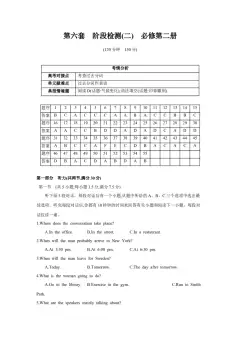
第六套 阶段检测(二) 必修第二册
(120分钟 150分)
考情分析
高考对接点 考查过去分词
单元疑难点 过去分词作表语
典型情境题 阅读D(话题:气候变化);语法填空(话题:印章雕刻)
第一部分 听力(共两节,满分30分)
第一节 (共5小题;每小题1.5分,满分7.5分)
听下面5段对话。每段对话后有一个小题,从题中所给的A、B、C三个选项中选出最
佳选项。听完每段对话后,你都有10秒钟的时间来回答有关小题和阅读下一小题。每段对
话仅读一遍。
1.Where does the conversation take place?
A.In the office. B.In the street. C.In a restaurant.
2.When will the man probably arrive in New York?
A.At 3:30 pm. B.At 6:00 pm. C.At 6:30 pm.
3.When will the man leave for Sweden?
A.Today. B.Tomorrow. C.The day after tomorrow.
4.What is the woman going to do?
A.Go to the library. B.Exercise in the gym. C.Run in Smith Park.
5.What are the speakers mainly talking about?
A.A book. B.A song. C.An album.
第二节 (共15小题;每小题1.5分,满分22.5分)
听下面5段对话或独白。每段对话或独白后有几个小题,从题中所给的A、B、C三个
选项中选出最佳选项。听每段对话或独白前,你将有时间阅读各个小题,每小题5秒钟;听完
后,各小题将给出5秒钟的作答时间。每段对话或独白读两遍。
听第6段材料,回答第6、7题。
6.What is the man's current goal?
A.To avoid dangerous activities.
B.To become a professional athlete.
C.To be able to walk again.7.What is the woman probably?
A.A caretaker. B.A surgeon. C.A coach.
听第7段材料, 回答第8、9题。
8.What did the man lack when he was young?
A.His own space.
B.The family's love.
C.Competition in the family.
9.What does the man think of having so many siblings now?
A.Hateful. B.Appreciative. C.Unusual.
听第8段材料,回答第10至12题。
10.What did the man buy for the woman?
A.Flowers. B.Flour. C.Milk.
11.How will the man go to the store?
A.By car. B.By taxi. C.On foot.
12.What is the probable relationship between the speakers?
A.Shopkeeper and customer.
B.Baker and assistant.
C.Husband and wife.
听第9段材料, 回答第13至16题。
13.How does the man feel now?
A.Relaxed. B.Tired. C.Sad.
14.How many exams will the man take?
A.Two. B.Three. C.Five.
15.What does the woman have to finish before Friday?
A.An exam. B.A book. C.A report.
16.Which subject does the man need help for?
A.Chemistry. B.Physics. C.Math.
听第10段材料, 回答第17至20题。
17.Why did the speaker come to China?
A.To work. B.To travel. C.To visit a friend.
18.What did the speaker have trouble with?
A.The passport. B.The travel permit. C.The medical report.19.What did the speaker think of the process?
A.Simple. B.Amazing. C.Complicated.
20.How did the speaker feel when she met Rudy?
A.Angry. B.Surprised. C.Exhausted.
第二部分 阅读(共两节,满分50分)
第一节 (共15小题;每小题2.5分,满分37.5分)
阅读下列短文,从每题所给的A、B、C、D四个选项中选出最佳选项。
A
Oyster is pleased to offer sea conservation volunteers the opportunity to take part in a 3-day
diving course in South Africa.
What qualification will I receive?
●Upon successful completion of the e-learning and the practical course, you will receive a
NAUI (National Association of Underwater Instructors) diving qualification.
What are the requirements?
●You will need to be staying for a minimum period of 2 weeks on the shark volunteering
project.(It's highly recommended that you join for 4 weeks, so that you can throw yourself into the
volunteer project and allow for bad weather.)
●Completion of a medical evaluation form before taking part in the course.
How does it work?
●Before arrival in South Africa, you will start an e-learning course.
●The e-learning course takes about 14 hours to complete.
●Once in South Africa, you will receive 17 hours of practical instruction, of which 10 hours
are spent in the water.
●You will not have a set date for your diving course before departure, as this is dependent on
weather.
How much does it cost?
Learning to dive in South Africa as part of the sea conservation volunteering project will cost
just $350. Payment must be made in advance to secure your place.
How do I book?
In person: The Volunteer Office is open on weekdays between 10 am and 8 pm.
By telephone: Dial (323) 641-7416 to reserve. The line is available from 1 pm to 6 pm.By post: Complete the application and return it to the Volunteer Office before Oct. 14th.
Through website: Visit our website www.oysterworldwide.com.
21.Which is necessary for a course-taker?
A.Organizing a shark volunteering project.
B.Being equipped with weather knowledge.
C.Taking an e-learning course in South Africa.
D.Presenting a clinical assessment of health status.
22.What is the total hours of the whole course?
A.About 14. B.About 17. C.About 27. D.About 31.
23.How can volunteers book the course?
A.By visiting the official site of Oyster.
B.By mailing the application in December.
C.By going to the Volunteer Office on Sunday.
D.By telephoning (323) 641-7416 in the morning.
B
Q: Last night I saw a comedian on TV making a joke about “old people smell”. I'd never
heard of it before, so I did research and was worried to see that people say old people have the
same bad smell. Now it worries me—do I smell? And if so, how can I get rid of it?
—Edith, 76
A: Thank you for your email. I can certainly smell something, and I'm afraid to say that it's
the unpleasant smell of ageism (年龄歧视). I doubt a comedian would dare say something like
this about any other group of people. The fact that they feel able to do so shows how ageism is one
of the last acceptable intolerances in our society. It's morally wrong to group people based on their
age. So, to answer your question: no, old people don't smell. The body smell is the result of
various factors. One thing I would note is that as we age, we tend to sweat less. As a result,
sometimes older people don't think they need to wash as frequently, especially when combined
with mobility problems—meaning they find it difficult getting in and out of the shower, not
realising that they can still have body smells without sweating. There is also the issue of
incontinence (失禁). While this can affect people of any age, it's more common in old age and is
also associated with a smell. There are plenty of treatments for incontinence, so this isn't
something that should arise. I'm sorry to say, but some doctors just blame incontinence for part ofgetting older. It's not. The idea that old people smell just feeds into this, but my view is if someone
does smell of urine (尿) due to incontinence, then this is the failure of doctors to provide adequate
help. It's to do with their incontinence, not their age.
—Dr Max Pemberton
24.According to the text, what is Edith's top concern?
A.A comedian's joke about old people.
B.Uncertainty of the research about getting old.
C.Methods of getting on well with elders.
D.Worry about old people having the same bad smell.
25.What would Dr Max Pemberton probably agree with?
A.Many factors contribute to elders' body smells.
B.Sweating often cannot be avoided as people age.
C.Age is to blame for elders' incontinence.
D.It's acceptable for comedians to group people by age.
26.Dr Max Pemberton tries to remove Edith's worry mainly by .
A.showing understanding
B.commenting on comedians
C.offering practical advice
D.analyzing possible reasons
27.Where is this text probably taken from?
A.An academic paper. B.An autobiography.
C.A health magazine. D.A medical treatment plan.
C
Before the arrival of photography, the Western imagination of China was based on paintings,
narrated films about travel and official reports. From the 1850s, however, a band of pioneering
Western photographers sought to capture the country's landscapes, cities and people, sparking a
homegrown photography movement in the process.
Among them were the Italian Felice Beato, who arrived in China in the 1850s to document
the Second Opium (鸦片) War, and Scottish photographer John Thompson, whose journey up the
Min River offered people in the West a rare look into the country's remote interior.These are just some of the figures whose work features in a collection of 15,000 photos
gathered together by New York antiquarian and collector Stephan Loewentheil. His 19th-century
images cover street scenes, tradespeople, rural life and architecture, showing everything from
blind beggars to camel caravans (商队) on the Silk Road.
A rare book dealer by trade, Loewentheil has spent the last three decades acquiring the
pictures from auctions and collectors. In 2018, he put 120 of the prints on display in Beijing for
the first time. The exhibition's scope ran from the 1850s, the very origin of paper photographs in
China, until the 1880s. It featured examples of the earliest forms of photography, such as albumen
print, which uses egg whites to make chemicals stick to paper, and the “wet plate” process, in
which negatives are processed on glass plates in a dark room.
These technological developments announced the birth of commercial photography in China,
as they allowed images to be copied exactly and spread for the very first time.
Loewentheil said, “ People who traveled there, everyone from diplomats and businessmen to
missionaries (传教士), all wanted to bring the great images home as a record of this beautiful
culture of China that was so unique. Later when some of them found a Chinese love for
photography and they immediately developed a strong market inside the country.”
28.What can be inferred from paragraph 1?
A.Foreigners play an important part in early Chinese photography.
B.The great change in China is out of the foreigners' imagination.
C.China offers foreigners more channels to travel and experience.
D.Foreigners promote photography to a promising home business.
29.What can we know about Stephan's 19th-century's collection?
A.It is one of the best in the world.
B.It displays impressive modern art.
C.It reflects the Western life.
D.It is wide-ranging.
30.What does the exhibition in Beijing feature?
A.The materials prints used.
B.The span of paper photographs.
C.The process of making negatives.
D.The early forms of photography.31.Why did foreigners bring great images of China back to their countries?
A.To keep them in good condition.
B.To spread different cultures.
C.To record their experiences.
D.To develop interest in photography.
D
Monarch butterflies have delayed their annual migration (迁徙) by 6 days per decade due to
warmer-than-normal temperatures.The birds white storks migrating to Northern Europe nest up to
a week earlier in warm weather. Main crops like rice, soybean and wheat along with fruits are all
experiencing disturbance in their growth and development. Ten years ago, a marine heat wave in
the Gulf of Maine caused fishermen to harvest the lobsters, a kind of sea creature, earlier than
expected.
Scientists have warned for years that climate change is upending (颠覆) the natural life
cycles of plants and animals—to potentially destructive effect. Now, a new report released by the
United Nations identifies these changes as one of the world's most pressing emerging
environmental crises, in need of immediate action. Animals often can adapt by hatching babies
earlier to catch up with their main food source. But with climate change occurring so rapidly,
animals may not be able to keep up with the rapid environmental changes we are experiencing.
The report also highlights emerging crises which include the growing destruction from
wildfires and the hidden cost of noise pollution, which leads to 12,000 premature (过早的) deaths
each year in the European Union alone. It warns that life-cycle changes driven by warming
temperatures and extreme weather patterns are affecting the natural rhythms of species around the
world. And while these changes may seem subtle season to season, the report argues they have
the potential to destroy commercial agriculture and fisheries, threatening vulnerable species from
butterflies to whales, which is easy to see.
“The report series aims to put the public eyes on key and emerging environmental issues—
those that potentially have huge effects on our society, economy, and ecosystems. We need to
realize these, so we can look at how we manage them, prevent harm, and carry out appropriate
preventative actions and solutions.” said Andrea Hinwood, chief scientist for the UN Environment
Programme.32.Why are several examples listed in paragraph 1?
A.To prove insects migrate earlier than birds.
B.To show warming temperatures affect wildlife.
C.To clarify crops grow well with fruits together.
D.To explain a good harvest is based on fine weather.
33.What can we know about the report?
A.It describes the diversity of wildlife.
B.It illustrates the ways humans manage ecosystems.
C.It refers to some forms of environmental crises.
D.It calls on people to care for their health seriously.
34.What does the underlined word “subtle” in paragraph 3 mean?
A.Unsteady. B.Abnormal. C.Unobvious. D.Intolerant.
35.What can be the best title for the text?
A.How warming temperatures are upending nature's life cycles
B.Monarch butterflies have delayed their annual migration
C.People need to be aware of the migration and its causes
D.How living things time their life-cycle stages
第二节 (共5小题;每小题2.5分,满分12.5分)
阅读下面短文,从短文后的选项中选出可以填入空白处的最佳选项。选项中有两项为多
余选项。
The best families are often the ones that have good communication. 3 6 But don't
worry. Here are four good ways you can improve good communication between family
members:
Dine together. Don't let your kids and wife have meals in their own rooms. Make your family
sit at the table and make that a routine. Enjoying meals together is a good way to open up the lines
of communications and get your group talking. 3 7
Schedule family time. You can't get family time if you don't make time for it. Schedule an
hour a day for a sit-together at the table or just idle talk. It doesn't have to be an hour. 3 8
Either way, plan out some activities during this time or get ideas for conversations ready such as
what's going on, or anything your kids or family members feel like sharing.Appreciate your family and be kind. It really helps to show some appreciation and kindness
to your family members. This could be something as simple as attending your son's high school
football game or making time for your daughter's concert. When your kids are struggling, show
some positivity by appreciating their talents and never discourage them. 3 9 However, make
sure it's positive and constructive.
4 0 Although it's a good idea to interact and communicate in-person, sometimes life
happens, and that's not possible. This is when interacting with your family over social media, your
own family website, email, or Skype is important. Pick one to two digital communication channels
and use them. Share songs, art, or any event going on there, comment, and socialize with your
family.
A.Do activities together.
B.Use technology to connect.
C.Just 20 minutes will work as well.
D.If you want to criticize them, go ahead.
E.Plus, it makes meal times a lot more fun too.
F.It's a simple concept that's often overlooked.
G.“Me” time is just one-to-one time with your family members.
第三部分 语言运用(共两节,满分30分)
第一节 (共15小题;每小题1分,满分15分)
阅读下面短文,从每题所给的A、B、C、D四个选项中选出可以填入空白处的最佳选项。
Dear Parents,
We're writing to discuss something with you. When school time rolls around, it is a busy time
for your children as they 4 1 to learn many new skills at school. One area of learning that
42 specific skills is social-emotional learning. But these important skills are often ignored. Here
children can learn how to understand and manage their 4 3 , how to solve social problems
properly and how to make friends and be a friend. Learning 4 4 throughout the day—in the
classroom, on the playground and at home. Children learn by watching and listening to how
teachers, family members and friends 4 5 with one another.We will be using a curriculum called the Kindness in the Classroom to help your children
think about, 4 6 and practice positive social skills. Research tells us that children who learn
and use these skills are more 4 7 to get along with others and do well in school.
To clarify, this is not a bully prevention program. 4 8 , it is a pro-social approach to
teaching students the skills needed to 4 9 communicate and cooperate, advocate for
themselves and actively call for positive 5 0 when they see bullying happening.
The Kindness in the Classroom program includes some good 5 1 such as responsibility,
respect, caring, inclusiveness (包容), honesty and courage. The program gives students the 5 2
to be inspired, act on what they've learned, reflect and 5 3 their experience with their peers.
Parents play a crucial role in the 5 4 of the curriculum. Students may ask for your help
in promoting what they are learning at home. We encourage you to take a look at the free 5 5
on this website, so you can follow along with what your children are learning in the classroom!
Sincerely yours,
Linda
41.A.continue B.decide C.promise D.manage
42.A.means B.supports C.requires D.guides
43.A.feelings B.decisions C.opinions D.thoughts
44.A.takes back B.takes over C.takes place D.take turns
45.A.interact B.compete C.agree D.quarrel
46.A.select B.save C.control D.develop
47.A.unwilling B.likely C.free D.ready
48.A.Rather B.Thus C.Otherwise D.Then
49.A.easier B.longer C.better D.less
50.A.attitude B.reflection C.energy D.behavior
51.A.qualities B.purposes C.services D.suggestions
52.A.challenge B.opportunity C.solution D.honor
53.A.divide B.connect C.argue D.share
54.A.success B.task C.safety D.problem
55.A.tickets B.lessons C.meals D.entries
第二节 (共10小题;每小题1.5分,满分15分)
阅读下面短文,在空白处填入1个适当的单词或括号内单词的正确形式。Chinese seal carving (印章雕刻) originated during the Shang Dynasty. In the beginning, the
characters carved on seals were the same as 5 6 (that) used in writing, such as Xiaozhuan of
the Qin Dynasty. However, with Chinese writing 5 7 (become) increasingly standardized and
simplified, it became a tradition to use Xiaozhuan for seals.
In ancient times, seals were regarded as 5 8 guarantee of authenticity (真实性). Today,
they 5 9 (be) more of a sign of authority of a legal person than an artwork.
After the Qin Dynasty, materials for seals were strictly classified. Jade was only used for
emperors, gold and silver for high-ranking officials 6 0 copper (铜) for the low ranks.
Various types of stones were used from the Song Dynasty, 6 1 led to a boom for seal
carving.
6 2 (early), seal carving was accomplished only by workers. During the Song Dynasty,
scholars and artists began to get 6 3 (involve) in it. They combined seal carving with
calligraphy and painting, making this traditional art more popular in China.
To protect this artistic treasure and stimulate the public's 6 4 (enthusiastic) for it,
Chinese seal carving 6 5 (include) on the UNESCO Representative List of the Intangible
Cultural Heritage of Humanity in 2009.
第四部分 写作(共两节,满分40分)
第一节 (满分15分)
假定你是李华,你的外籍教师Chris对中国功夫兴趣浓厚。请写封邮件,邀请他参加将在
你市举办的中国武术节,内容包括:
1.时间、地点;
2.活动内容。
注意:
1.写作词数应为 80左右;
2.请按如下格式在相应位置作答。
参考词汇: 武术martial arts
_______________________________________________________________________________
_______________________________________________________________________________
_______________________________________________________________________________
______________________________________________________________________________________________________________________________________________________________
_______________________________________________________________________________
第二节 (满分25分)
阅读下面材料, 根据其内容和所给段落开头语续写两段, 使之构成一篇完整的短文。
On Christmas Eve, my husband Matt and our three children were gathered in the living
room. The presents were wrapped under the tree, which was decorated in all its glory. For the third
year in a row, it was missing only one thing—the star topper.
Liliana and Landon were born first, and then along came Finn. He was a happy baby, until
Matt and I noticed changes in him at 14 months. Finn no longer slept well. He was bad- tempered
and restless, not using words. He didn't engage with me, Matt, his sister or brother anymore. It was
as if Finn had gone inside himself and couldn't come back out. His autism (自闭症) diagnosis at
18 months gave us some direction in terms of professional care.
Finn turned three, and I hoped he was ready to take part in adding the final touch to our tree.
It would be his first time, a chance to connect with us through this tradition. Matt took the older
kids' hands and stepped back to give us some room. I took the star from its box. “Here, Finn,” I
said, putting the star in his little hand. “It's your turn to put this on the top of the tree!” I went to
pick him up. Finn tightened. He threw the star on the floor and shook in my arms.
“Give him time,” Matt came up and said. It didn't feel right to let Liliana or Landon place the
star instead. It was Finn's turn, and I didn't want to leave him out. So the tree remained starless
that Christmas. The next Christmas too. And the one after that, waiting for Finn.
This year, I'd left the star in its box. I hadn't even tried to get six-year-old Finn interested.
“Come on, Mom!” said Landon. “Let's do this.” I had a quick look at Finn, who was still playing
on his own. With a sigh, I sat down on the couch. Finn would get to his gifts in his own time. Or
not. It was impossible to tell.
注意:
1.续写词数应为150左右;
2.请按如下格式在相应位置作答。
Liliana and Landon surrounded their father while he sorted the presents and Finn wandered
over.___________________________________________________________________________
______________________________________________________________________________________________________________________________________________________________
_______________________________________________________________________________
_______________________________________________________________________________
_______________________________________________________________________________
_______________________________________________________________________________
I handed him the star.________________________________________________________
_______________________________________________________________________________
_______________________________________________________________________________
_______________________________________________________________________________
_______________________________________________________________________________
_______________________________________________________________________________
_______________________________________________________________________________