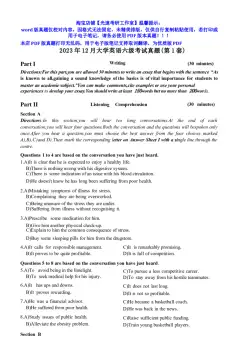
2023年 06月大学英语六级考试真题(第 1 套)
扫码获音频
Part I Writing (30 minutes)
Directions: For this part, you are allowed 30 minutes to write an essay that begins with the
sentence “Today there is a growing awareness that mental well-being needs to be given as
much attention as physical health.w You can make comments, cite examples or use your
personal experiences to develop your essay. You should write at least 150 words but no more
than 200 words.
Part II Listening Comprehension (30 minutes)
Section A
Directions: In this section, you will hear two long conversations. At the end of each
conversation, you will hear four questions. Both the conversation and the questions will be
spoken only once. After you hear a question, you must choose the best answer from the four
choices marked A), B), C) and D). Then mark the corresponding letter on Answer Sheet 1 with
a single line through the centre.
Questions 1 to 4 are based on the conversation you have just heard.
1. A) It was spacious and tranquil. C) It was shabby and solitary.
B) It was warm and comfortable. D) It was tiny and noisy.
2. A) She no longer hates people talking loudly in the dorm.
B) She misses her roommates she used to complain about.
C) She begins to enjoy the movies she once found irritating.
D) She finds the crowded dorm as cozy as her new apartment.
3. A) He found the apartment perfectly furnished.
B) He had a feeling of despair and frustration.
C) He had a similar feeling to the woman's.
D) He felt the new place was like paradise.
4. A) Go to see the woman's apartment. C) Buy some furniture for the woman.
B) Make a phone call to his parents. D) Decorate the woman's apartment.
Questions 5 to 8 are based on the conversation you have just heard.
5. A) He works as a literary critic. C) He has initiated a university reform.
B) He hosts an educational program. D) He has published a book recently.
6. A) It fails to keep up with the radical changes of society.
B) It fails to ensure universities get sufficient resources.
C) It has not prepared young people for the job market.
D) It has not fostered the growth of the arts disciplines.
7. A) More of the budget should go to science and technology.
B) The underfunded music discipline should be prioritized.
C) Subdisciplines like sculpture should get more funding.
D) Literature should get as much funding as engineering.
2023年6月英语六级真题第1套 第 1 页 共 10页 by:光速考研8. A) Build a prosperous nation. C) Create ingenious artists.
B) Make skilled professionals. D) Cultivate better citizens.
Section B
Directions: In this section, you will hear two passages. At the end of each passage, you will
hear three or four questions. Both the passage and the questions will be spoken only once. After
you hear a question, you must choose the best answer from the four choices marked A) , B), C)
and D). Then mark the corresponding letter on Answer Sheet 1 with a single line through the
centre.
Questions 9 to 11 are based on the passage you have just heard.
9. A) It is quite common. C) It seldom annoys people.
B) It is rarely noticed. D) It occurs when one is alone.
10. A) Seeing things in black and white.
B) Engaging in regular contemplation.
C) Having a special understanding of creativity.
D) Knowing how to make their mental batteries work.
11. A) Engaging in intense activity. C) Working on a particular project.
B) Fantasizing in one's down time. D) Reflecting during one's relaxation.
Questions 12 to 15 are based on the passage you have just heard.
12. A) Farmers helped Native Americans grow crops.
B) There were expansive university campuses.
C) There existed post offices.
D) Migrants found gold there.
13. A) It helped to boost the economy in the American West.
B) It provided job opportunities for many gold seekers.
C) It extended the influence of the federal government.
D) It kept people in the deserts and plains connected.
14. A) It employed Native Americans to work as postmen.
B) It commissioned private wagons to carry the mail.
C) It subsidized the locals who acted as postmasters.
D) It centralized postal services in its remote areas.
15. A) He analyzed interactive maps of mail routes.
B) He read a large collection of books on the topic.
C) He examined its historical trends with data science.
D) He collected data about its impact on local business.
Section C
Directions: In this section, you will hear three recordings of lectures or talks followed by three
or four questions. The recordings will be played only once. After you hear a question, you must
choose the best answer from the four choices marked A), B), C) and D). Then mark the
corresponding letter on Answer Sheet 1 with a single line through the centre.
Questions 16 to 18 are based on the recording you have just heard.
2023年6月英语六级真题第1套 第 2 页 共 10页 by:光速考研16. A) Higher levels of anxiety may improve people's memory.
B) Some experiences are easier to remember than others.
C) Most people tend to remember things selectively.
D) Simple things may leave a deep impression on one's memory.
17. A) They classified the participants9 mindset.
B) They showed some photos to the participants.
C) They measured the participants5 anxiety levels.
D) They tested the size of the participants' vocabulary.
18. A) Anxiety has become a serious problem for an increasing number of people.
B) Extreme levels of anxiety can adversely affect cognitive performance.
C) People diagnosed with anxiety disorder may forget things selectively.
D) There is no direct correlation between memory and levels of anxiety.
Questions 19 to 21 are based on the recording you have just heard.
19. A) They compare products from different companies before making a choice.
B) They get information from other consumers' postings and comments.
C) They lose patience when their phone call is not promptly answered.
D) They expect to get instantaneous responses to their inquiry.
20. A) Giving them rewards on the spot. C) Speaking directly to their emotions.
B) Broadening their scope of interest. D) Focusing on the details of the product.
21. A) Change the rules of the game in the market every year.
B) Keep up with the latest technological developments.
C) Learn from technological innovators to do business.
D) Make greater efforts to build up consumers5 confidence.
Questions 22 to 25 are based on the recording you have just heard.
22. A) People have only one social engagement per week.
B) Working together enhances friend ship.
C) Few people have devoted friends.
D) Friendships benefit work.
23. A) The impact of friends on people's selfesteem.
B) How supportive friends can be in the workplace.
C) How to boost one's sense of value and worthiness.
D) The role of family ties in people's mental well-being.
24. A) They show little interest in their friends' work.
B) They tend to be much more difficult to make.
C) They are more trustworthy and reliable.
D) They increase people's job satisfaction.
25. A) Allow employees to have a flexible work schedule.
B) Encourage employees to be friends with colleagues.
C) Help employees balance work and family responsibilities.
D) Organize activities to nourish friendships outside of work.
2023年6月英语六级真题第1套 第 3 页 共 10页 by:光速考研Part III Reading Comprehension (40 minutes)
Section A
Directions: In this section, there is a passage with ten blanks. You are required to select one
word for each blank from a list of choices given in a word bank following the passage. Read the
passage through carefully before making your choices. Each choice in the bank is identified by
a letter. Please mark the corresponding letter for each item on Answer Sheet 2 with a single
line through the centre. You may not use any of the words in the bank more than once.
Scientists recently examined studies on dog intelligence and compared them with
research into the minds of other intelligent animals. The researchers found that dogs are
among the more intelligent carnivores (食 肉动物),social hunters and domestic animals,
but that their intelligence does not 26 other intelligent animals in any of those
categories. Though a significant body of research has examined dog cognition 27 . the
authors of this new study found little to warrant the 28 of work that has been devoted
to the topic.
Stephen Lea, lead author of the new study, argues that many researchers seem to have
designed their studies to 29 how clever dogs are, rather than simply to study dogs'
brains. Lea and a colleague examined more than 300 studies of dog cognition, comparing
the studies5 results with those from research into other animals. The researchers made
specific comparisons between the different species in different categories of intelligence.
These comparisons 30 that dogs are intelligent, but their intelligence is not as
31 as some researchers might have believed.
In many areas, though, comparisons were not possible. For example, the researchers
noted that both dogs and cats are known to be able to recognize and 32 human voices.
But the investigators could not find any data to indicate which species can remember a
greater number of 33 human voices, so it was impossible to compare the two on that
front. However, not all researchers agree 34 with the findings of this study. Zachary
Silver, an American researcher, believes the authors of the new study 35 the idea that
an excessive amount of research has been devoted to dogs, as the field of dog cognition is
young, and there is much to be learned about how dogs think.
A) affirmed I) overstated
B) approximately J) pledge
C) completely K) previously
D) differentiate L) prospective
E) distinct M) prove
F) domain N) surpass
G) formidable O) volume
H) outperformed
2023年6月英语六级真题第1套 第 4 页 共 10页 by:光速考研Section B
Directions: In this section, you are going to read a passage with ten statements attached to it.
Each statement contains information given in one of the paragraphs. Identify the paragraph
from which the information is derived. You may choose a paragraph more than once. Each
paragraph is marked with a letter. Answer the questions by marking the corresponding letter on
Answer Sheet 2.
The lifesaving power of gratitude
A) Gratitude may be more beneficial than we commonly suppose. One recent study asked
participants to write a note of thanks to someone and then estimate how surprised and
happy the recipient would feel- an impact that they consistently underestimated. Another
study assessed the health benefits of writing thank-you notes. The researchers found that
writing as few as three weekly thank-you notes over the course of three weeks improved
life satisfaction, increased happy feelings and reduced symptoms of depression.
B) While this research into gratitude is relatively new, the principles involved are anything
but. Students of mine in a political philosophy course at Indiana University are reading
Daniel Defbe's 300-year-old Robinson Crusoe, often regarded as the first novel
published in English. Left alone on an unknown island with no apparent prospect of
rescue or escape, Crusoe has much to lament (悲叹).But instead of giving in to despair,
he makes a list of things for which he is grateful, including the fact that he is the sole
survivor from the shipwreck (海难)and has been able to salvage many useful items
from the wreckage.
C) Defbe's masterpiece, which is often ranked as one of the world's greatest novels,
provides a portrait of gratitude in action that is as timely and relevant today as it has
ever been. It is also one with which contemporary psychology and medicine are just
beginning to catch up. Simply put, for most of us, it is far more helpful to focus on the
things in life for which we can express gratitude than those that incline us toward
resentment and lamentation.
D) When we focus on the things we regret, such as failed relationships, family disputes,
and setbacks in career and finance, we tend to become more regretful. Conversely,
when we focus on the things we are grateful for, a greater sense of happiness tends to
spread through our lives. And while no one would argue for cultivating a false sense of
blessedness, there is mounting evidence that counting our blessings is one of the best
habits we can develop to promote mental and physical health.
E) Gratitude has long enjoyed a privileged position in many of the world's cultural
traditions. For example, some ancient Western philosophers counsel gratitude that is
both enduring and complete, and some Eastern thinkers portray it as not merely an
attitude but a virtue to be put into practice.
F) Recent scientific studies support these ancient teachings. Individuals who regularly
engage in gratitude exercises, such as counting their blessings or expressing gratitude to
others, exhibit increased satisfaction with relationships and fewer symptoms of physical
illness. And the benefits are not only psychological and physical. They may also be
moral- those who practice gratitude also view their lives less materialistically and
suffer from less envy.
G) There are multiple explanations for such benefits of gratefulness. One is the fact that
2023年6月英语六级真题第1套 第 5 页 共 10页 by:光速考研expressing gratitude encourages others to continue being generous, thus promoting a
virtuous cycle of goodness in relationships. Similarly, grateful people may be more
likely to reciprocate (回寸艮)with acts of kindness of their own. Broadly speaking, a
community in which people feel grateful to one another is likely to be a more pleasant
place to live than one characterized by mutual suspicion and resentment. The beneficial
effects of gratitude may extend even further. For example, when many people feel good
about what someone else has done for them, they experience a sense of being lifted up,
with a corresponding enhancement of their regard for humanity. Some are inspired to
attempt to become better people themselves, doing more to help bring out the best in
others and bringing more goodness into the world around them.
H) Gratitude also tends to strengthen a sense of connection with others. When people want
to do good things that inspire gratitude, the level of dedication in relationships tends to
grow and relationships seem to last longer. And when people feel more connected, they
are more likely to choose to spend their time with one another and demonstrate their
feelings of affection in daily acts.
I) Of course, acts of kindness can also foster discomfort. For example, if people feel they
are not worthy of kindness or suspect that some ulterior (另4 有 用 心 的)motive lies
behind it, the benefits of gratitude will not be realized. Likewise, receiving a kindness
can give rise to a sense of indebtedness, leaving beneficiaries feeling that they must
now pay back whatever good they have received. Gratitude can flourish only if people
are secure enough in themselves and sufficiently trusting to allow it to do so. Another
obstacle to gratitude is often called a sense of entitlement. Instead of experiencing a
benefaction (善行)as a good turn, people sometimes regard it as a mere payment of
what they are owed, for which no one deserves any moral credit.
J) There are a number of practical steps anyone can take to promote a sense of gratitude.
One is simply spending time on a regular basis thinking about someone who has made a
difference, or perhaps writing a thank-you note or expressing such gratitude in person.
Others are found in ancient religious disciplines, such as reflecting on benefactions
received from another person or actually praying for the health and happiness of a
benefactor. In addition to benefactions received, it is also possible to focus on
opportunities to do good oneself, whether those acted on in the past or hoped for in the
future. Some people are most grateful not for what others have done for them but for
chances they enjoyed to help others. In regularly reflecting on the things in his life he is
grateful for, Defoe's Crusoe believes that he becomes a far better person than he would
have been had he remained in the society from which he originally set out on his voyage.
K) Reflecting on generosity and gratitude, the great basketball coach John Wooden once
offered two counsels to his players and students. First, he said, “It is impossible to have
a perfect day unless you have done something for someone who will never be able to
repay you." In saying this, Wooden sought to promote purely generous acts, as opposed
to those performed with an expectation of reward. Second, he said, “Give thanks fbr
your blessings every day.”
L) Some faith traditions incorporate such practices into the rhythm of daily life. For
example, adherents of some religions offer prayers of thanksgiving every morning
before rising and every night before lying down to sleep. Others offer thanks throughout
the day, such as before meals. Other less frequent special events, such as births, deaths
2023年6 月英语六级真题第1套 第 6 页 共 10页 by:光速考研and marriages, may also be heralded by such prayers.
M) When Defoe depicted Robinson Crusoe making thanksgiving a daily part of his island
life, he was anticipating findings in social science and medicine that would not appear
for hundreds of years. Yet he was also reflecting the wisdom of religious and
philosophical traditions that extend back thousands of years. Gratitude is one of the
healthiest and most nourishing of all states of mind, and those who adopt it as a habit
are enriching not only their own lives but also the lives of those around them.
36. It does us far more good to focus on things we can be grateful for than what makes us
sad and resentful.
37. The beneficial impacts of gratitude can extend from individuals to their community and
to the wider society.
38. The participants in a recent study repeatedly underestimated the positive effect on those
who received thank-you notes.
39. Good deeds can sometimes make people feel uncomfortable.
40. People who regularly express gratitude can benefit in moral terms.
41. A basketball coach advocated performing generous acts without expecting anything in
return.
42. More and more evidence shows it makes us mentally and physically healthier to
routinely count our blessings.
43. Of all states of mind, feeling grateful is considered one of the most healthy and
beneficial.
44. The principles underlying the research into gratitude are nothing new at all.
45. Gratitude is likely to enhance one's sense of being connected with other people.
Section C
Directions: There are 2 passages in this section. Each passage is followed by some questions
or unfinished statements. For each of them there are four choices marked A), B), C) and D).
You should decide on the best choice and mark the corresponding letter on Answer Sheet 2
with a single line through the centre.
Passage One
Questions 46 to 50 are based on the following passage.
Technology is never a neutral tool for achieving human ends. Technological innovations
reshape people as they use these innovations to control their environment. Artificial
intelligence, fbr example, is altering humanity.
While the term AI conjures up anxieties about killer robots or catastrophic levels of
unemployment, there are other, deeper implications. As AI increasingly shapes the human
experience, how does this change what it means to be human? Central to the problem is a
person's capacity to make choices, particularly judgments that have moral implications.
Aristotle argued that the capacity for making practical judgments depends on regularly
making them- on habit and practice. We see the emergence of machines as substitute
judges in a variety of everyday contexts as a potential threat to people learning how to
effectively exercise judgment themselves.
In the workplace, managers routinely make decisions about whom to hire or fire and
2023年6月英语六级真题第1套 第 7 页 共 10页 by:光速考研which loan to approve, to name a few. These are areas where algorithmic (算 法的)
prescription is replacing human judgment, and so people who might have had the chance to
develop practical judgment in these areas no longer will.
Recommendation engines, which are increasingly prevalent intermediaries in people's
consumption of culture, may serve to constrain choice and minimize luck. By presenting
consumers with algorithmically selected choices of what to watch, read, stream and visit
next, companies are replacing human taste with machine taste. In one sense, this is helpful.
After all, machines can survey a wider range of choices than any individual is likely to have
the time or energy to do on their own.
At the same time, though, this selection is optimizing for what people are likely to
prefer based on what they've preferred in the past. We think there is some risk that people's
options will be constrained by their past in a new and unanticipated way.
As machine learning algorithms improve and as they train on more extensive data sets,
larger parts of everyday life are likely to become utterly predictable. The predictions are
going to get better and better, and they will ultimately make common experiences more
efficient and pleasant.
Algorithms could soon- if they don't already- have a better idea about which show
you'd like to watch next and which job candidate you should hire than you do. One day,
humans may even find a way for machines to make these decisions without some of the
biases that humans typically display.
But to the extent that unpredictability is part of how people understand themselves and
part of what people like about themselves, humanity is in the process of losing something
significant. As they become more and more predictable, the creatures inhabiting the
increasingly Ai-mediated world will become less and less like us.
46. What do we learn about the deeper implications of AI?
A) It is causing catastrophic levels of unemployment.
B) It is doing physical harm to human operators.
C) It is altering moral judgments.
D) It is reshaping humanity.
47. What is the consequence of algorithmic prescription replacing human judgment?
A) People lose the chance to cultivate the ability to make practical judgments.
B) People are prevented from participating in making major decisions in the workplace.
C) Managers no longer have the chance to decide which loan to approve.
D) Managers do not need to take the trouble to detennine who to hire or fire.
48. What may result from increasing application of recommendation engines in our
consumption of culture?
A) Consumers will have much limited choice.
B) Consumers will actually enjoy better luck.
C) It will be easier to decide on what to enjoy.
D) Humans will develop tastes similar to machines'.
49. What is Hkely to happen to larger parts of our daily life as machine learning algorithms
improve?
2023年6月英语六级真题第1套 第 8 页 共 10页 by:光速考研A) They will turn out to be more pleasant.
B) They will repeat our past experience.
C) They can be completely anticipated.
D) They may become better and better.
50. Why does the author say the creatures living in the more and more Ai-mediated world
will become increasingly unlike us?
A) They will have lost the most significant human element of being intelligent.
B) They will no longer possess the human characteristic of being unpredictable.
C) They will not be able to understand themselves as we can do today.
D) They will be deprived of what their predecessors were proud of about themselves.
Passage Two
Questions 51 to 55 are based on the following passage.
Phonics, which involves sounding out words syllable (音节)by syllable, is the best
way to teach children to read. But in many classrooms, this can be a dirty word. So much so
that some teachers have had to sneak phonics teaching materials into the classroom. Most
American children are taught to read in a way that study after study has found to be wrong.
The consequences of this are striking. Less than half of all American adults were
proficient readers in 2017. American fourth graders rank 15th on the Progress in
International Literacy Study, an international exam.
America is stuck in a debate about teaching children to read that has been going on fbr
decades. Some advocate teaching symbol-sound relationships (the sound k can be spelled as c,
k, ck, or ch ), known as phonics. Others support an immersive approach (using pictures of a
cat to learn the word cat), known as “whole language”. Most teachers today, almost three out
of four according to a survey by the EdWeek Research Centre in 2019, use a mix called
“ balanced literacy^^. This combination of methods is ineffective. "You can't sprinkle in a
little phonics,says Tenette Smith, executive director of elementary education and reading at
Mississippi's education department. 44It has to be systematic and explicitly taught.”
Mississippi, often behind in social policy, has set an example here. In a state once
notorious for its low reading scores, the Mississippi state legislature passed new literacy
standards in 2013. Since then Mississippi has seen remarkable gains. Its fourth graders have
moved from 49th (out of 50 states) to 29th on the National Assessment of Educational
Progress, a nationwide exam. In 2019 it was the only state to improve its scores. For the
first time since measurement began, Mississippi's pupils are now average readers, a
remarkable achievement in such a poor state.
Mississippi's success is attributed to implementing reading methods supported by a
body of research known as the science of reading. In 1997 Congress requested the National
Institute of Child Health and Human Development and the Department of Education to
convene a National Reading Panel to end the "reading wars“ and synthesize the evidence.
The panel found that phonics, along with explicit instruction in phonemic (音位的)
awareness, fluency and comprehension, worked best.
Yet over two decades on, ''balanced literacy^^ is still being taught in classrooms. But
advances in statistics and brain imaging have disproved the whole-language method. To the
2023年6月英语六级真题第1套 第 9 页 共 10页 by:光速考研teacher who is a proficient reader, literacy seems like a natural process that requires
educated guessing, rather than the deliberate process emphasized by phonics. Teachers can
imagine that they learned to read through osmosis (潜移默化)when they were children.
Without proper training, they bring this to classrooms.
51. What do we learn about phonics in many American classrooms?
A) It is ill reputed. C) It is arbitrarily excluded.
B) It is mostly misapplied. D) It is misrepresented.
52. What has America been witnessing fbr decades?
A) An obsession with innovating teaching methodologies of reading.
B) An enduring debate over the approach to teaching children to read.
C) An increasing concern with many children's inadequacy in literacy.
D) An ever-forceful advocacy of a combined method for teaching reading.
53. Why does Tenette Smith think a combination of teaching methods is ineffective?
A) Elementary school children will be frustrated when taught with several methods combined.
B) Phonics has to be systematically applied and clearly taught to achieve the desired effect.
C) Sprinkling in a little phonics deters the progress of even adequately motivated children.
D) Balanced literacy fails to sustain children's interest in developing a good reading habit.
54. What does the author say Mississippi's success is attributed to?
A) Convening a National Reading Panel to synthesize research evidence.
B) Placing sufficient emphasis upon both fluency and comprehension.
C) Adopting scientifically grounded approaches to teaching reading.
D) Obtaining support from Congress to upgrade teaching methods.
55. What have advances in statistics and brain imaging proved ineffective?
A) The teaching of symbol-sound relationships.
B) Explicit instruction in phonemic awareness.
C) Efforts to end the reading wars.
D) The immersive approach.
Part IV Translation (30 minutes)
Directions: For this part, you are allowed 30 minutes to translate a passage from Chinese into
English. You should write your answer on Answer Sheet 2.
近年来,越来越多的中国文化产品走向全球市场,日益受到海外消费者的 青睐。随着
中国对外文化贸易的快速发展,中国文化产品出口额已持续多年位居世界前列,形成了一批
具有国际影响力的文化企业、产品和品牌。数据显示,中国的出版物、影视作品、网络文学
与动漫作品等在海外的销售量连年攀升。中国政府出台了一系列政策鼓励和支持更多具有中
国元素的优秀文化产品走出国门,扩大海外市场份额,进一步提升中国文化的世界影响力。
2023年6月英语六级真题第1套 第 10页 共 10页 by:光速考研2023年 06月大学英语六级考试真题(第 2 套)
扫码获音频
Part I Writing (30 minutes)
Directions: For this part, you are allowed 30 minutes to write an essay that begins with the
sentence “When faced with differing opinions, we should try to reach agreement through
friendly discussion and reasonable argument.w You can make comments, cite examples or use
your personal experiences to develop your essay. You should write at least 150 words but no more
than 200 words.
Part II Listening Comprehension (30 minutes)
Section A
Directions: In this section, you will hear two long conversations. At the end of each
conversation, you will hear four questions. Both the conversation and the questions will be
spoken only once. After you hear a question, you must choose the best answer from the four
choices marked A), B), C) and D). Then mark the corresponding letter on Answer Sheet 1 with
a single line through the centre.
Questions 1 to 4 are based on the conversation you have just heard.
1. A) She is attracted to the beauty of modem buildings.
B) She is preoccupied with her dream to be an architect.
C) She is influenced by her father who teaches architecture.
D) She is drawn to its integration of design and engineering.
2. A) Through hard work. C) By studying the subject online.
B) With the professor's help. D) By taking prerequisite courses.
3. A) It is groundbreaking. C) It is immaterial.
B) It is long-lasting. D) It is immortal.
4. A) Economics. C) Computer science.
B) Philosophy. D)Westem art.
Questions 5 to 8 are based on the conversation you have just heard.
5. A) He has occasionally been harassed by his fans.
B) He has been guarded by a discreet assistant.
C) He is well known to the public.
D) He is a famous football coach.
6. A) Serve as a personal assistant. C) Run common daily chores for the woman.
B) Play a key role in Real Madrid. D) Help promote Mr. Sanchez ?s public profile.
7. A) He is honest and always tells the truth.
B) He once worked part-time in university.
C) He cares little about his working hours.
D) He has little previous work experience.
8. A) He has a strong ability to connect with people.
B) He has a high proficiency in several languages.
C) He has a sound knowledge of sports consultancy.
2023年6月英语六级真题第2套 第 1 页 共 10页 by:光速考研D) He has a natural capacity to cooperate with others.
Section B
Directions: In this section, you will hear two passages. At the end of each passage, you will
hear three or four questions. Both the passage and the questions will be spoken only once. After
you hear a question, you must choose the best answer from the four choices marked A) , B), C)
and D). Then mark the corresponding letter on Answer Sheet 1 with a single line through the
centre.
Questions 9 to 11 are based on the passage you have just heard.
9. A) They bring more benefits to young people.
B) They require less supervision and training.
C) They are more suitable to young people.
D) They have fewer rules and pressures.
10. A) They prevent kids from enjoying adventure sports.
B) They help kids guard against any possible injuries.
C) They rob kids of the chance to cultivate their courage.
D) They deprive kids of the opportunity to develop team spirit.
11. A) Help them take up these sports when they are more mature.
B) Let them participate in some less risky outdoor activities.
C) Ask them to try some forms of indoor sports.
D) Introduce them to these sports step by step.
Questions 12 to 15 are based on the passage you have just heard.
12. A) Consumers often have a craving for the latest model.
B) Such products tend to comprise parts that are irreplaceable.
C) Tech firms intentionally design products to have short lifespans.
D) Manufacturers use effective strategies to promote fancier products.
13. A) Indicate the competitiveness of their products.
B) List a repairability score of their products.
C) Specify the major parts of their products.
D) Detail the life cycle of their products.
14. A) Take the initiative to reduce electronic waste.
B) Take due caution in upgrading their products.
C) Invest in constructing more recycling facilities.
D) Substitute all toxic substances with non-toxic ones.
15. A) It can be solved. C) It will be fixed by tech companies.
B) It is certain to worsen. D) It is unavoidable in the long run.
Section C
Directions: In this section, you will hear three recordings of lectures or talks followed by three
or four questions. The recordings will be played only once. After you hear a question, you must
choose the best answer from the four choices marked A), B), C) and D). Then mark the
corresponding letter on Answer Sheet 1 with a single line through the centre.
Questions 16 to 18 are based on the recording you have just heard.
2023年6月英语六级真题第2套 第 2 页 共 10页 by:光速考研16. A) How internet monitoring can be implemented.
B) How to encourage productive internet surfing.
C) How cyberloafing affects overall productivity.
D) How to prevent employees from cyberloafing.
17. A) Cyberloafing is a sign of workers? laziness.
B) Cyberloafing may relieve employees of stress.
C) Employee engagement is closely related to job satisfaction.
D) Overuse of social media may lead to decline in productivity.
18. A) Taking mini-breaks means better job performance.
B) Cyberloafing generally does more harm than good.
C) Worker turnover is linked to the time allowed for cyberloafing.
D) Employees who indulge in internet surfing are most likely to quit.
Questions 19 to 21 are based on the recording you have just heard.
19. A) There were no wooden buildings. C) There were no trees.
B) There were environmental problems. D) There were few settlers.
20. A) He served as chairman of the Nebraska State Board of Agriculture.
B) He urged the state to start the Nebraska State Gardening Society.
C) He engaged himself in a large number of aesthetic projects.
D) He founded a newspaper and used it to promote his ideas.
21. A) A special prize was awarded to Julius Morton.
B) One million trees were planted throughout Nebraska.
C) The state government declared it the official Arbor Day.
D) Nebraska earned the nickname “the Tree Planters State”.
Questions 22 to 25 are based on the recording you have just heard.
22. A) They spread across Europe and Asia in a few decades.
B) They lived mostly in Africa for about 200,000 years.
C) They preferred to live in Europe rather than in Asia.
D) They moved out of Africa about 60,000 years ago.
23. A) The discovery of two modem human teeth in China.
B) The traces of human migration out of Africa to Asia.
C) The human fossils discovered most recently in Africa.
D) The Luna cave in Guangxi Zhuang Autonomous Region.
24. A) There must have been some reason fbr human migration.
B) There have been changes in animals5 living conditions.
C) Humans adapted themselves to the environment there.
D) Humans had access to abundant food sources there.
25. A) How humans settled down on the Arabian Peninsula.
B) When modem humans started to disperse out of Africa.
C) What path modem humans took to migrate out of Africa.
D) Why fresh water is so important fbr human survival.
2023年6月英语六级真题第2套 第 3 页 共 10页 by:光速考研Part III Reading Comprehension (40 minutes)
Section A
Directions; In this section, there is a passage with ten blanks. You are required to select one
word for each blank from a list of choices given in a word bank following the passage. Read the
passage through carefully before making your choices. Each choice in the bank is identified by
a letter. Please mark the corresponding letter for each item on Answer Sheet 2 with a single
line through the centre. You may not use any of the words in the bank more than once.
Imagine sitting down to a big dinner: a massive steak, a large portion of fried potatoes,
and cake for dessert. After eating so much, you should be too full to eat another bite. But
some people experience a powerful urge to keep eating, even after 26 in a huge meal,
a behavior that makes little sense, as most adults are well-versed in the dangers of obesity,
which researchers have shown correlates with 27 health issues and is even linked to
increased 28 risk. But some people still keep eating long after they should stop, a
phenomenon Dr. Susan Thompson calls ''insatiable ( 永 不 满 足 的 ) hunger." It is
characterized by two main 29 : not being satisfied by eating, and having a desire to
stay sedentary (久坐不动的).
This is at 30 with how humans are biologically programmed. When there was a
great deal of food available, ancient people would gorge on calories; this massive calorie
intake was accompanied by an urge to get active. Humans were also programmed for
something called “compensation,“ which is the brain's 31 mechanism for preventing
the accumulation of excess weight. With compensation, if you eat one large meal in the
morning, you are naturally 32 to eat less for the rest of the day.
But recent studies show that 70% of American adults have lost the ability to naturally
compensate fbr the calories they consume; worse 33 a significant number of them
report 34 hunger halfway through an eating session, but by the end of the meal, they
feel the same or higher levels of hunger than when they sat down. Dr. Thompson argues
that the main cause of this phenomenon is the modem diet, which is 35 of food high
in sugar, carbohydrates and calories.
A) attributes I) innumerable
B) comprised J) mortality
C)conceded K) odds
D) conservation L) plights
E) diminishing M) regulatory
F) far N) still
G) inclined O) unmatchable
H) indulging
2023年6月英语六级真题第2套 第 4 页 共 10页 by:光速考研Section B
Directions: In this section, you are going to read a passage with ten statements attached to it.
Each statement contains information given in one of the paragraphs. Identify the paragraph
from which the information is derived. You may choose a paragraph more than once. Each
paragraph is marked with a letter. Answer the questions by marking the corresponding letter on
Answer Sheet 2.
The problem with being perfect
A) When psychologist Jessica Pryor lived near an internationally renowned university, she
once saw a student walking into a library holding a sleeping bag and a coflee maker.
She has heard of graduate students spending 12 to 18 hours at a time in the lab. Their
schedules are meant to be literally punishing: If they are scientists-in-training, they
won't allow themselves to watch Netflix until their experiments start generating results.
''Relationships become estranged (疏 远 的 )一people stop inviting them to social
gatherings or dinner parties, which leads them to spend even more time in the lab,“
Pryor told me.
B) Along with other therapists, Pryor, who is now with the Family Institute at
Northwestern University, is trying to sound the alarm about a tendency among young
adults and college students to strive for perfection in their work- sometimes at any cost.
Though it is often portrayed as a positive trait, Pryor and others say extreme
perfectionism can lead to depression, anxiety, and even suicide.
C) Whafs more, perfectionism seems to be on the rise. In a study of thousands of
American, Canadian, and British college students published earlier this year, Thomas
Curran of the University of Bath and Andrew Hill of York St. John University found
that today 5s college students report higher levels of perfectionism than college students
did during the 1990s or early 2000s. They measured three types of perfectionism:
seli-oriented, or a desire to be perfect; socially prescribed, or a desire to live up to
others' expectations; and other-oriented, or holding others to unrealistic standards. From
1989 to 2016, they found, self-oriented perfectionism scores increased by 10 percent,
socially prescribed scores rose by 33 percent, and other-oriented perfectionism
increased by 16 percent.
D) A person living with an other-oriented perfectionist might feel criticized by the
perfectionist spouse for not doing household chores exactly the “right" way. "One of the
most common things couples argue about is the proper way of loading the dishwasher,
says Amy Bach, a psychologist in Providence, Rhode Island.
E) Curran describes socially prescribed perfectionism as “My self-esteem is contingent on
what other people think." His study didn't examine the causal reasons for its rise, but he
assumes that the rise of both standardized testing and social media might play a role.
These days, Linkedln alerts us when our rival gets a new job, and Instagram can let us
know how well “liked“ our lives are compared with a friend5s. In an opinion piece
earlier this year, Curran and Hill argue that society has also become more dog-eat-dog.
“Over the last 50 years, public interest and civic responsibility have been progressively
eroded,they write, ''replaced by a focus on self-interest and competition in a
supposedly free and open marketplace.We strive for perfection, it seems, because we
feel we must in order to get ahead. Michael Brustein, a clinical psychologist in
Manhattan, says when he first began practicing in 2007, he was surprised by how
prevalent perfectionism was among his clients, despite how little his graduate training
2023年6月英语六级真题第2套 第 5 页 共 10页 by:光速考研had focused on the phenomenon. He sees perfectionism in, among others, clients who
are entrepreneurs, artists, and tech employees. "You're in New York because you're
ambitious, you have this need to strive,he says. "But then your whole identity gets
wrapped into a goal.”
F) Perfectionism can, of course, be a positive force. Think of professional athletes, who
train aggressively for ever-higher levels of competition. In well-adjusted perfectionism,
someone who doesn't get the gold is able to forget the setback and move on. In
maladaptive (不 当的)perfectionism, meanwhile, people make an archive of all their
failures. They revisit these archives constantly, thinking, as Pryor puts it, “I need to
make myself feel terrible so I don't do this again.5, Then they double down, "raising the
expectation bar even higher, which increases the likelihood of defeat, which makes you
self^critical, so you raise the bar higher, work even harder,“ she says. Next comes
failure, shame, and pushing yourself even harder toward even higher and more
impossible goals. Meeting them becomes an “all or nothing“ premise. Pryor offered this
example: "Even if I'm an incredible attorney, if I don't make partner in the same pacing
as one of my colleagues, clearly that means I'm a failure.
G) Brustein says his perfectionist clients tend to devalue their accomplishments, so that
every time a goal is achieved, the high lasts only a short time, like “a gas tank with a
hole in it." If the boss says you did a great job, ifs because he doesn't know anything. If
the audience likes your work, thafs because it's too stupid to know what good art
actually is. But, therapists say, there are also different ways perfectionism manifests.
Some perfectionists are always pushing themselves forward. But others actually fall
behind on work, unable to complete assignments unless they are, well, perfect. Or they
might handicap their performance ahead of time. They5re the ones partying until 2 a. m.
the night before the final, so that when the grade C rolls in, there's a ready excuse.
H) While educators and parents have successfully convinced students of the need to be
high performing and diligent, the experts told me, they haven ?t adequately prepared
them for the inevitability of failure. Instead of praises like "You're so smart,“ parents
and educators should say things like “You really stuck with it,“ Pryor says, to
emphasize the value of perseverance over intrinsic talent. Pryor notes that many of her
clients are wary she511 "turn them into some degenerate couch potato and teach them to
be okay with it." Instead, she tries to help them think through the parts of their
perfectionism they'd like to keep, and to lose the parts that are ruining their lives.
I) Bach, who sees many students from Brown University, says some of them don't even
go out on weekends, let alone weekdays. She tells them, uAim high, but get comfortable
with good enough.When they don't get some award, she encourages them to
remember that “one outcome is not a basis fbr a broad conclusion about the person's
intelligence, qualifications, or potential fbr the future.95
J) The treatment for perfectionism might be as simple as having patients keep logs of
things they can be proud or having them behave imperfectly in small ways, just to
see how it feels. t4We might have them hang the towels crooked (不正的)or wear some
clothing inside out,“ says Martin Antony, a professor in the department of psychology at
Ryerson University in Toronto.
K) Brustein likes to get his perfectionist clients to create values that are important to them,
then try to shift their focus to living according to those values rather than achieving
specific goals. It's a play on the “You really stuck with it“ message for kids. In other
2023年6月英语六级真题第2套 第 6 页 共 10页 by:光速考研words, it isn't about doing a headstand in yoga class; ifs about going to yoga class in
the first place, because you like to be the kind of person who takes care of herself. But
he warns that some people go into therapy expecting too much- an instant
transformation of themselves from a pathological (病 态 的 )perfectionist to a (still
high-achieving) non-perfectionist. They try to be perfect, in other words, at no longer
being perfect.
36. Socially prescribed perfectionism is described as one's sell-esteem depending on other
people's opinion.
37. Jessica Pryor has learned that some graduate students work such long hours in the lab
that they have little time fbr entertainment or socializing.
38. The author believes perfectionism may sometimes be constructive.
39. It is found that perfectionism is getting more and more prevalent among college
students.
40. Some experts suggest parents and educators should prepare students for failures.
41. Some therapists warn that young adults tend to pursue perfection in their work.
42. Psychologist Amy Bach encourages her students to aim high but be content with
something less than perfect.
43. A clinical psychologist finds perfectionism is widespread among his clients.
44. In trying to overcome perfectionism, some people are still pursuing perfection.
45. In pursuing perfection, some perfectionists fail to complete their tasks on time.
Section C
Directions: There are 2 passages in this section. Each passage is followed by some questions
or unfinished statements. For each of them there are four choices marked A), B), C) and D).
You should decide on the best choice and mark the corresponding letter on Answer Sheet 2
with a single line through the centre.
Passage One
Questions 46 to 50 are based on the following passage.
How on earth did we come to this? We protect our children obsessively from every
harm; we scrutinize every carer, teacher or doctor with whom they come into contact. Yet
despite all this, one group, which in no way has their best interests at heart, has almost
unconstrained access.
We seem to take it fbr granted that advertisers and marketers are allowed to condition
even the youngest children. Before children have even developed a proper sense of their
own identity, or learned to handle money, they're encouraged to associate status and
seli-worth with stuff, and to look to external things such as fame and wealth for validation.
We're turning out little consumers rather than young citizens who will value themselves for
what they contribute to the society in which they live.
We've reached this point so gradually that many of us have never questioned it. It's
crept up on us in the 60 years since advertisers started to target the young and found that
they could recruit them to a commercial assault on their parents. We've come to know it as
“pester power“ or the ability of children to pressure parents to make certain purchases.
Many psychologists, child development experts and educators point to research
2023年6月英语六级真题第2套 第 7 页 共 10页 by:光速考研suggesting that this emerging cradle-to-grave consumerism is contributing to growing rates
of low selfesteem, depression and other forms of mental illness.
Not all psychologists agree. There9re plenty working hand in glove with a
£12bn-a-year industry that has turned the manipulation of adult emotions and desires into an
art form—often literally. Ifs also one thafs forever developing new ways to persuade our
children to desire material possessions, and because of advertisements? viral effect they
only need to infect a few to reach the many. Advertising and marketing can serve a useful
purpose for children. Marketing may help socialize children as consumers, inform them
about products, and help them carve out unique identities as they reach adulthood.
Then, should we ban all advertising aimed at young children? I say yes.
Of course there'll be plenty of objections to an outright ban on advertising to the
under-Ils. There41 be those who argue that would be a breach of freedom of speech and
infringe the rights of corporations to brainwash little children into demanding their products.
Most parents hate what advertising does to their children, but we do have the power to
end it and let our children grow up free from many of the pressures of consumerism until
they're old enough to make their own decisions. And though advertising is only part of an
all-pervasive (无处不在的)marketing culture we need to make a start somewhere. Lefs
ban all advertising targeting children of primary school age and younger now.
46. Which group of people does the author say has almost unrestricted access to children?
A) Advertisers. B) Carers. C) Teachers. D) Doctors.
47. What kind of people should we enable children to become according to the author?
A) Those who look to fame and wealth for external and ultimate validation.
B) Those who value themselves because of their contribution to society.
C) Those who associate sell-worth with the ability to handle money.
D) Those who have developed a proper sense of their own identity.
48. Many child development experts and educators call attention to research that suggests?
A) life-long consumerism is causing more and more cases of psychological problems.
B) increasing commercialization of education is eroding many children's self-esteem.
C) the growing desire for wealth is contributing to a rising rate of depression.
D) the craving for purchasing material things is nurtured throughout one's life.
49. What does the author imply about the impact of advertising?
A) It is actually infectious to many rather than a few.
B) It is rooted in our desire for material possessions.
C) It is comparable to that of virus.
D) It is literally limited to children.
50.What is the opponents5 argument against a complete ban on advertising to young children?
A) It would deprive them of the chance to learn about products.
B) It would render them unable to carve out unique identities.
C) It would breach their freedom as would-be consumers.
D) It would violate the rights endowed upon advertisers.
2023年6月英语六级真题第2套 第 8 页 共 10页 by:光速考研Passage Two
Questions 51 to 55 are based on the following passage.
Many oppose workplace surveillance, because of the inherent dehumanizing effect it
has and the relentless pressure it brings. But ifs on the rise around the world as firms look
to become more efficient by squeezing more productivity from their workers. More than
half of companies with over $750m in annual revenue used “non-traditional“ monitoring
techniques on staff last year.
Monitoring employee performance gives firms the ability to assess how their staff are
performing and interacting, which can be good for both the firm and employees themselves.
A growing number of analytics companies offer this service. They gather “data exhausf5
left by employees5 email and instant messaging apps, and use name badges equipped with
radio-frequency identification devices and microphones. These can check how much time
you spend talking, your volume and tone of voice, even if you do not dominate
conversations. While this may sound intrusive, exponents argue that it can also protect
employees against bullying and sexual harassment.
Some of this data analysis can produce unexpected results. For example, it was found
that people who sat at 12-person lunch tables tended to interact, share ideas more and
outperform those who regularly sat at four-person tables, a fact that would probably have
gone undetected without such data analysis.
Over the last few years a Stockholm co-working space called Epicenter has gone much
further and holds popular “chipping parties”, where people can have microchips implanted
in their hands. They can use the implants to access electronically-controlled doors, or
monitor how typing speed correlates with heart rate. Implanted chips may seem extreme,
but it is a relatively small step from ID cards and biometrics to such devices.
As long as such schemes are voluntary, there will probably be a growing number of
convenience-oriented uses so that a substantial number of workers would opt to have a chip
inserted. But if implanted chips are used to reduce slack time or rest breaks, that could
prove to be detrimental. And if surveillance tools take away autonomy, thafs when they
prove most unpopular. A lot depends on how such monitoring initiatives are communicated
and this could prevent possible revolts being staged.
If bosses don't communicate effectively, employees assume the worst. But if they're
open about the information they're collecting and what they're doing with it, research
suggests 46% of employees are generally okay with it. Although many such monitoring
schemes use anonymized data and participation is voluntary, many staffers remain sceptical
and fear an erosion of their civil liberties.
So workplace surveillance could be empowering for staff and useful for companies
looking to become more efficient and profitable. But implemented in the wrong way, it
could also become an unpopular tool of oppression that proves counterproductive.
2023年6月英语六级真题第2套 第 9 页 共 10页 by:光速考研5 l.Why are many people opposed to monitoring employee performance?
A) It puts workers under constant pressure.
B) It is universally deemed anti-human by nature.
C) It does both mental and physical harm to employees monitored.
D) It enables firms to squeeze maximal productivity from employees.
52 .What is the supporters; argument for workplace surveillance?
A) It enables employees to refrain from dominating conversations.
B) It enhances employees5 identification with firms they work in.
C) It can alert employees to intrusion into their privacy.
D) It can protect employees against aggressive behavior.
53 .What does the author want to show by the example of different numbers of people
interacting at lunch tables?
A) Data analysis is key to the successful implementation of workplace surveillance.
B) Analyzing data gathered from workers can yield something unexpected.
C) More workmates sitting at a lunch table tend to facilitate interaction and idea sharing.
D) It is hard to decide on how many people to sit at a lunch table without data analysis.
54 .What does much of the positive effect of monitoring initiatives depend on?
A) How frequently employees are to be monitored.
B) What specific personal information is being excluded.
C) What steps are taken to minimize their detrimental impact.
D) How well bosses make known their purpose of monitoring.
55 .What concern do monitoring initiatives cause among many staffers?
A) They may empower employers excessively.
B) They may erode the workplace environment.
C) They may infringe upon staffers5 entitled freedom.
D) They may become counterproductive in the long run.
Part IV Translation (30 minutes)
Directions: For this part, you are allowed 30 minutes to translate a passage from Chinese into
English. You should write your answer on Answer Sheet 2.
随着中国经济的快速发展和人们生活水平的稳步提高,城市居民对环境和生活品质的要
求越来越高。中国地方政府更加注重公共设施的建设和改进,以更好地满足人们的需求。通
过兴建新的广场、公园和公共绿地或对原有公共场地重新加以规划改造,许多城市为市民提
供了更多休闲和社交的场所。如今,政府出资购置的健身器械和铺设的健身步道在不少城市
随处可见,既明显改善了市民户外活动的条件,又使城市更加美丽。
2023年6月英语六级真题第2套 第 10页 共 10页 by:光速考研2023年 06月大学英语六级考试真题(第 3 套)
Part I Writing (30 minutes)
Directions: For this part, you are allowed 30 minutes to write an essay that begins with the
sentence “It is widely accepted that an important goal of education is to help students learn
how to learn.,, You can make comments, cite examples or use your personal experiences to
develop your essay. You should write at least 150 words but no more than 200 words.
Part II Listening Comprehension (30 minutes)
淘宝店铺【光速考研工作室】温馨提示:由于2023年 6 月六级考试全国共考了两套听力,本套真
题听力与前两套内容相同,只是选项顺序不同,因此在本套真题中不再重复出现。
Part III Reading Comprehension (40 minutes)
Section A
Directions; In this section, there is a passage with ten blanks. You are required to select one
word for each blank from a list of choices given in a word bank following the passage. Read the
passage through carefully before making your choices. Each choice in the bank is identified by
a letter. Please mark the corresponding letter for each item on Answer Sheet 2 with a single
line through the centre. You may not use any of the words in the bank more than once.
You might not know yourself as well as you think. According to a new study, people
are 26 accurate judges of only some of their behaviors. While most previous studies
on how well people know themselves have been done on long-term personality traits, this
new study 27 how well people understand how they are acting from one moment to
the next. Researchers asked participants to wear audio recorders that automatically 28
every 9.5 minutes between 7 a.m. and 2 a.m. to record 30 seconds of audio. These
participants were then emailed surveys four times a day asking them to 29 how
outgoing, agreeable, or conscientious they were during a particular hour of the day. The
study used data from 248 participants, all of whom answered questions about their behavior
for two 30 weeks and wore the audio device for one of those weeks.
Six laboratory assistants rated each participant's audio clips to see how their
observations compared with people's 31 of themselves. The six assistants were
generally in agreement with one another about how the people they were observing acted.
Further, participants? ratings of their own behaviors agreed with observers5 for how
outgoing and how conscientious they were being. But the agreement between participants
and outside observers was much smaller for agreeableness. Some of this 32 could be
because the observers used only audio clips, and thus could not read 33 like body
language, but there are 34 other explanations, as people should be able to hear when a
participant is being kind versus being rude. The weak agreement between how participants
thought they were acting and what observers heard could be because people would rather
35 rude behavior.
2023年6月英语六级真题第3套 第 1 页 共 8 页 by:光速考研A) activated I) probes
B) articulates J) random
C) assessment K) recall
D) consecutive L) relatively
E) cues M) saturated
F) deny N) symptoms
G) discrepancy O) terminate
H) probably
Section B
Directions: In this section, you are going to read a passage with ten statements attached to it.
Each statement contains information given in one of the paragraphs. Identify the paragraph
from which the information is derived. You may choose a paragraph more than once. Each
paragraph is marked with a letter. Answer the questions by marking the corresponding letter on
Answer Sheet 2.
Why we need tiny colleges
A) We're experiencing the rebirth of smallness. Farmers markets, tiny homes, and brew
pubs all exemplify our love of smallness. So do charter schools, coffee shops, and local
bookstores. Small is often (but not always) more affordable, healthier, and sustainable,
but its finest characteristic, the one that turns charm into love, is that going small allows
us to be more fully who we are.
B) In higher education the trend is mostly in the opposite direction: Universities with
20,000 or 30,000 students are considered “mid-sized”. The nation's largest university,
Arizona State University, has 80,000 students on campus and aims to enroll another
100,000 students online. At the other end of the spectrum is a handful of colleges that
have fewer than a hundred students on campus and no online courses: colleges such as
Sterling College, Thomas More College of Liberal Arts, and Deep Springs College.
These colleges are so small that they can only be called "tiny.”
C) Tiny colleges focus not just on a young person's intellect, but on the young person as a
whole. Equally important, tiny colleges ask, “How can education contribute to human
flourishing and the well-being of the world?” And they shape a college experience to
address that question. They replace concerns about institutional growth with attention to
the growth of students as fully developed participants in their communities.
D) Fve had the privilege of teaching at three different institutions of higher learning during
my career- a small liberal arts college and two mid-sized public universities. Fve also
been profoundly disappointed in each of these institutions, and in many of my colleagues,
especially when it comes to helping students and preparing them for the many
responsibilities of adulthood. Administrators focus on the business of running a university,
and most faculty focus on their scholarship and teaching their discipline. Little deliberate
2023年6月英语六级真题第3套 第 2 页 共 8 页 by:光速考研attention is given to how students mature as individuals and social beings.
E) Having just retired from teaching at a public university, I'm now returning to my
hometown of Flagstaff Arizona, to establish a tiny college- Flagstaff College. Fm
convinced that there's a need fbr another type of education, one devoted to helping
students come into their own and into this beautiful and troubled world. Young people
need an education that will provide them with meaning, hope, courage, and passion, as
well as information and skills. Large institutions, I believe, are particularly ill-suited to
this type of education.
F) There's no "best of9 list when it comes to tiny colleges, at least not yet. But around the
country people are creating new colleges that provide an alternative to small liberal arts
colleges, large public universities, and online education.
G) With only 26 students, Deep Springs is the smallest college in the country and, quite
likely, the most atypical ( NF 典 型 的 ).Located on a working cattle ranch on the
California-Nevada border, Deep Springs is a private, residential, two-year college for
men, committed to educating students fbr “a life of service to humanity.^^ Founded by
the electricity tycoon (大亨)L. L. Nunn in 1917, Deep Springs' "curriculum“ revolves
around academics, labor, and self-governance. In addition to their courses, students are
charged with running the 155-acre ranch and overseeing the functioning of the college.
Students chair both the admissions and the curriculum committees.
H) “Living in close community with one's teachers and fellow students, and being forced
to take on adult responsibilities, makes for one's growth as a person/5 says William
Hunt, who graduated last year. t4To exist for very long in a community like that, you
have to get over the question of whether you5 re sufficiently talented or principled and
get started worrying about how you can stretch yourself and your peers, how much you
can manage to learn with them.^^
I) Sterling College, in Craftsbury Common, Vermont, is also very small- fewer than 100
students. Unlike Deep Springs, Sterling focuses its curriculum on environmental and
social justice issues, but like Deep Springs it places a high value on personal
responsibility and manual labor. According to its catalog, a college education at Sterling
combines “rigorous academics, roll-up-your-sleeves challenges, and good old hard work.^^
J) The average tuition at a small liberal-arts college is $30,000 to $40,000 a year, not
including the cost of living on campus, as compared to $8,000 to $10,000 a year for
tuition alone at a public university. Of the tiny colleges, only Deep Springs doesn't
charge tuition or room and board; students pay only fbr books and the cost of traveling
to and from college. If tiny schools are to become a player on the higher education
scene, they will need to find a way to be truly affordable.
K) Doing so may not be that difficult so long as they do not pattern themselves too closely
on existing norms. We've come to believe that a good college should have many
academic programs and excellent facilities, posh (豪华的)dorms, an array of athletic
programs, and a world-class student activity center. Imagine a good college without a
2023年6月英语六级真题第3套 第 3 页 共 8 页 by:光速考研climbing wall! We also have accepted the idea that college presidents, and their many
vice-presidents, should be paid like their counterparts in the business world and that
higher education requires an elaborate, up-to-date technology infrastructure. All of this
drives up the cost of education.
L) The “trick“ to making tiny colleges affordable, if thafs the right word, is simplicity. At
its core, education is a human-to-human interaction. Reflecting on his own college
education, President Garfield once commented that an ideal college would consist of
nothing more than the legendary teacher Mark Hopkins on one end of a log and a
student on the other. The economics of a tiny college, in other words, might be similar
to that of a tiny house. Because it is small, a tiny house costs less to build and less to
furnish, insure, and maintain. But the economic benefits of a small house don't end
there. Tiny homes discourage homeowners from buying stuff that they really don't need,
because there ?s no place to put it.
M) I'm a late convert to the idea of tiny colleges, and I fully understand the need for many
diverse types of educational institutions. Academic research and job training are
important, but tiny colleges aren't suited for either. The educational needs of a complex
society are themselves complex, and no single model can meet all of these needs. But
I'm now convinced there's an educational need that's now going almost completely
unmet: namely, the need to help young people transition into adulthood. Tiny colleges
can do this better than any other type of educational institution.
N) The ultimate justification for a tiny college is the conviction that each of us comes into
our full humanity by close interaction with those who know and care for us, and that
one of the basic purposes of higher education is social. Although we give lip service to
the idea that a college education will make us better people, when all's said and done,
we think of higher education primarily in economic terms. We've come to think of
higher education as a means to make a living rather than make a life. We've also come
to see higher education as a private good rather than a public one. Tiny colleges are not
the answer to all of our educational requirements, but they're an answer to one of our
most basic educational necessities; the need to produce thoughtful, engaged, and
compassionate human beings.
36. One tiny American college situated on a cattle farm is devoted to educating students to
serve mankind throughout their lives.
37. Much to the author's disappointment, the three institutions of higher learning where she
taught largely ignore students5 growth as social beings.
38. Tiny colleges must be made affordable in order to play a role in higher education.
39. According to a recent graduate from a tiny college, living together with faculty and
fellow students is conducive to a studenfs growth as a person.
40. Rather than going small, most American universities are trying to go big.
41. In a certain tiny college, rigorous academic work and traditional manual labor are
2023年6月英语六级真题第3套 第 4 页 共 8 页 by:光速考研integrated.
42. Tiny colleges focus on educating students to become well-rounded citizens instead of
seeking their own expansion.
43. The essence of education lies in the interaction between people.
44. After her retirement, the author has decided to set up a tiny college in her hometown.
45. Tiny colleges are justified as it is believed that our growth into full humanity comes
through interaction with people near and dear to us.
Section C
Directions: There are 2 passages in this section. Each passage is followed by some questions
or unfinished statements. For each of them there are four choices marked A), B), C) and D).
You should decide on the best choice and mark the corresponding letter on Answer Sheet 2
with a single line through the centre.
Passage One
Questions 46 to 50 are based on the following passage.
If you're someone who has turned to snacking on junk food more in the pandemic (大
流 行 病),you're not alone. Investigative reporter Michael Moss says processed food is
engineered to hook you, not unlike alcohol, cigarettes, or other harmful substances. His
2013 book, Salt Sugar Fat, explored food companies5 aggressive marketing of those
products and their impact on our health. In his new book, Hooked, Moss updates the food
giants' efforts to keep us eating what they serve, and how they're responding to complaints
from consumers and health advocates.
Processed food is inexpensive, ifs legal, and ifs everywhere. Companies9 advertising
is cueing us to remember those products and we want those products constantly. So the
food environment is one of those key things that makes food even more problematic for so
many people. Memory, nostalgia (怀 旧)in particular, plays a big role in the foods we crave.
Soda companies discovered that if they put a soda in the hands of a child when they're at a
ball game with their parents, that soda will forever be associated with that joyous moment.
Later in life, when that child wants to experience a joyous moment, they're going to think
of soda. Many people seek comfort in the snacks they remember from childhood.
Moss examines the way companies capitalize on our memories, cravings and brain
chemistry to keep us snacking.
One of the reasons I came to think that some of these food products are even more
powerful, more trouble some than drugs can be is memory. What we eat is all about
memory. And we begin forming memories fbr food at a really early age. And we keep those
memories for a lifetime. Knowing this, the food industry spends lots of time trying to shape
the memories that we have for their products. One of the features of addiction that scientists
studying drug addiction discovered back in the 1990s was that the fester a substance hits
2023年6月英语六级真题第3套 第 5 页 共 8 页 by:光速考研the brain, the more apt we are as a result to act impulsively. There 5s nothing faster than food
in its ability to hit the brain. For Moss, this puts the notion of ”宿st fbod“ in an entirely new
light as this isn't limited to fast food chains- almost 90% of food products in grocery stores
are processed foods. Everything in the industry is about speed, from the manufacturing to
the packaging.
Overall, Moss outlines the industry's dependence on making their products inexpensive,
super delicious, and incredibly convenient for consumers. Now that more and more people
care about what they put in their bodies and are wanting to eat healthier, these companies are
finding it really difficult to meet that new demand because of their own addiction to making
these convenience foods.
46. In what way does Michael Moss think processed food is comparable to alcohol and cigarettes?
A) They are all addictive.
B) They are all necessary evils.
C) They are all engineered to be enjoyed.
D) They are all in increasingly great demand.
47 .What does the author say plays a key role in the foods we crave?
A) The food environment. C) Convenience.
B) Aggressive marketing. D) Memory.
48 .What do food companies do to capitalize on consumers5 association with their food products?
A) They strive to influence how consumers remember their products.
B) They attempt to use consumers? long-term memories to promote addiction.
C) They try to exploit consumers5 memories for their products as early as possible.
D) They endeavor to find what consumers remember about their products.
49 . How does the food industry operate from manufacturing to packaging, according to Moss?
A) Placing the idea of fast fbod in an entirely new light.
B) Setting no limit to the number of fast fbod chains.
C) Focusing on how quickly the work is done.
D) Prioritizing the quality of their products.
50 .Why are companies finding it difficult to satisfy consumers? demand for healthier food
products?
A) They think speed of production outweighs consumers! health.
B) They believe their industry would perish without fast foods.
C) They have to strike a balance between taste and nutrition.
D) They are hooked on manufacturing convenience foods.
2023年6月英语六级真题第3套 第 6 页 共 8 页 by:光速考研Passage Two
Questions 51 to 55 are based on the following passage.
Chimpanzees (,黑猩猩),human beings' closest animal relatives, share up to 98% of our
genes. Yet humans and chimpanzees lead very different lives. Fewer than 300,000 wild
chimpanzees live in a few forested comers of Africa today, while humans have colonized
every comer of the globe. At more than 7 billion, human population dwarfs that of nearly
all other mammals- despite our physical weaknesses.
What could account for our species5 incredible evolutionary successes?
One obvious answer is our big brains. It could be that our raw intelligence gave us an
unprecedented ability to think outside the box, innovating solutions to thorny problems as
people migrated across the globe.
But a growing number of cognitive scientists and anthropologists (人类学家)are
rejecting that explanation. They think that, rather than making our living as innovators, we
survive and thrive precisely because we don't think fbr ourselves. Instead, people cope with
challenging climates and ecological contexts by carefully copying others.
In a famous study, psychologists Victoria Homer and Andrew Whiten showed two
groups of test subjects—children and chimpanzees—a mechanical box with a treat inside.
In one condition, the box was opaque, while in the other it was transparent. The
experimenters demonstrated how to open the box to retrieve the treat, but they also included
the irrelevant step of tapping on the box with a stick.
Oddly, the children carefully copied all the steps to open the box, even when they
could see that the stick had no practical effect. That is, they copied irrationally: Instead of
doing only what was necessary to get their reward, children slavishly imitated every action
they5 d witnessed.
Of course, that study only included three- and four-year-olds. But additional research
has shown that older children and adults are even more likely to mindlessly copy others'
actions, and infants are less Hkely to over-imitate- that is, to precisely copy even
impractical actions.
By contrast, chimpanzees in the study only over-imitated in the opaque condition. In
the transparent condition- where they saw that the stick was mechanically useless-they
ignored that step entirely. Other research has since supported these findings.
When it comes to copying, chimpanzees are more rational than human children or
adults.
Where does the seemingly irrational human preference fbr over-imitation come from?
Anthropologist Joseph Henrich points out that people around the world rely on technologies
that are often so complex that no one can learn them rationally. Instead, people must learn
them step by step, trusting in the wisdom of more experienced elders and peers.
So the next time you hear someone arguing passionately that everyone should embrace
2023年6月英语六级真题第3套 第 7 页 共 8 页 by:光速考研nonconformity and avoid imitating others, you might laugh a little bit. We're not
chimpanzees, after all.
51 .What might explain humans' having the largest population of almost all mammals?
A) They are equipped with raw strength for solving the most challenging problems.
B) They cope with the outside world more effectively than their animal relatives.
C) They possess the most outstanding ability to think.
D) They know how to survive everywhere on earth.
52 .What accounts for humans' evolutionary successes according to a growing number of
cognitive scientists and anthropologists?
A) They are better at innovating solutions.
B) They thrive through creative strategies.
C) They are naturally adaptive to ecological contexts.
D) They meet challenges by imitating others carefully.
53 .What does the author think is odd about the findings of the study by Victoria Homer and
Andrew Whiten?
A) Children irrationally imitated every action of the experimenters.
B) Chimpanzees could tell the transparent box from the opaque one.
C) Chimpanzees could retrieve the treat more quickly than children did.
D) Children omitted the step of tapping on the box with a stick to open it.
54 .What is anthropologist Joseph Henrich's explanation for the human preference for copying?
A) It originates in the rationality of people around the world.
B) It stems from the way people learn complex technologies.
C) It results from people distrusting their own wisdom.
D) It derives from the desire to acquire knowledge step by step.
55 .What point does the author want to emphasize when he says "We're not chimpanzees”?
A) It is arguable whether everyone should avoid imitation.
B) It is characteristic of human beings to copy others.
C) It is desirable to trust in more knowledgeable peers.
D) It is naive to laugh at someone embracing nonconformity.
Part IV Translation (30 minutes)
Directions: For this part, you are allowed 30 minutes to translate a passage from Chinese into
English. You should write your answer on Answer Sheet 2.
近年来,中国城市加快发展,城市人居环境得到显著改善。许多城市努力探索中国特色
的城市高质量发展之路,城市功能不断完善,治理水平明显提高。中国持续开展城市生态修
复和功能修补,全面实施城镇老旧小区改造,大力推进城市园林绿化,消除污染;同时大力
推进城市基础设施体系化建设,开展房屋建筑和市政设施普查以及安全隐患排查整治,努
力为市民创造高品质的生活环境,让城市更美丽、更安全、更宜居。
2023年6月英语六级真题第3套 第 8 页 共 8 页 by:光速考研