Section A
News Report One
• 听力原文 •
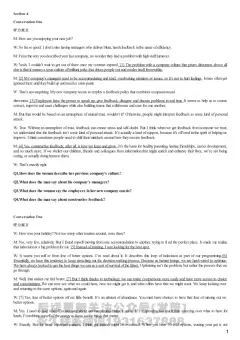
African leaders plan to turn the continent into a continent without borders. [1] They will introduce a single passport policy, allowing free
movement between countries. The idea from the African Union has been modeled on the EU Schengen free movement deal. Europe has abolished
many internal borders. This enables visa-free movement across the continent. Currently, 13 African countries have visa-free deals in place with
each other. These allow citizens to visit another country without a visa. Some countries offer visas on arrival. In contrast, Americans are able to
travel to 20 of the continent’s countries without a visa, or secure a visa on arrival. [1] The African Union, which represents 54 states, wants to
abolish the requirement of a visa for Africans visiting other African countries. [2] It also wants to establish a free trade deal across the continent in
the near future, as trade within the African continent costs more than any other region.
Q1::What is the news report mainly about?
Q2::What benefi t will a free trade deal bring to African economy?
News Report Two
• 听力原文 •
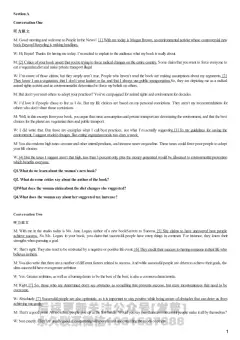
[3] Researchers in Iceland found a new way of tackling climate change by pumping carbon dioxide underground and turning it into stone. Other
carbon capture and storage methods store carbon dioxide as a gas. But problems include a high cost and concern about leaks. This new method
of burying carbon dioxide and turning it into stone is cheaper and more secure, the Guardian reports. To turn carbon dioxide into stone,
researchers with the CarbFix project pumped the gas into volcanic rock and sped up the natural process, in which the volcanic rock reacts with
gas and forms carbon minerals. The gas turned into solid in just two years, much faster than the hundreds or thousands of years researchers had
predicted. The research took place at Iceland’s Hellisheidi power plant. Already, the project in Iceland has been increased in scale to bury 10,000
tons of carbon dioxide each year. [4] One potential difficulty is that for each ton of carbon dioxide buried, the technique requires 25 tons of water.
However, the lead researcher said sea water could be used.
Q3::What new method has been developed to help fi ght climate change?
Q4::What is a potential diffi culty in applying the new technique?
News Report Three
• 听力原文 •
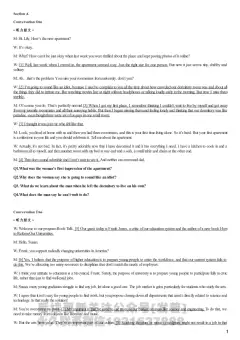
People in France are keeping away from the narrow French stick loaf in favour of healthier, cheaper options, a millers’ association has said. [5]
The National Association of French Millers says bread consumption is on the decline, with French people eating nine grams less than in the
previous year. The association is concerned about the eff ects this trend will have on their trade and suggests three reasons why it is happening. [6]
Firstly, the association cited changing diets, in particular, the switch to those low in calories, as a factor in the reduction of bread consumption. This
could explain why the difference in consumption between genders is so big. Nowadays, men eat an approximate average of 140 grams of bread
daily, whereas women eat 80 to 90 grams. The second reason they say is lifestyle changes in the country, [7] with people dedicating less time to
breakfast when bread would traditionally be eaten with butter and jam. Finally, the rising cost of bread is considered to be a factor, with the price
of a French stick loaf increasing by nearly 25% in the last 10 years.
Q5:: What does the news report say about French people’s bread consumption?
Q6::What do we learn about French women from the report?
Q7::What is said about lifestyle changes of the French people?
Section B
Conversation One
• 听力原文 •
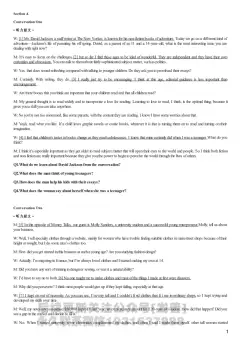
W: Next, please.
M: Yes, I’d like to book two train tickets to London tomorrow morning, please.
1W: Okay. What time would you like to go?
M: [8] Well, after the rush hour, I think. We’d like to avoid the crowds if possible. So, probably sometime around 10 o’clock.
W: No problem. Just give me a minute. There’s one here at 9:47, then one at 10:12, and then a third at 10:26.
M: The one at 10:12 sounds good.
W: All right. Would you like to sit in fi rst or second class?
M: Second class is fi ne. Thanks. [9] Is there any chance we could have a window seat for one of those?
W: No problem. And I’ve booked those seats next to each other for you. The total price is 36 pounds, 50 cents. Is there anything else?
M: Yes, actually, we’ll be taking our bicycles with us. What is the arrangement for that? And will it cost extra?
W: It’s no extra cost. The price will be the same. [10] All you need to do is wait at the far end of the platform. When the train arrives, tell the train
guard where you’re going, and he will help you secure the bicycles in the last carriage and give you a ticket. Then you can walk down through the
train to your carriage and take your seats. [11] When you arrive in London, hand the ticket to the guard and he will return the bicycles to you.
M: Thank you for the information. That’s very helpful.
Q8::When would the man like to leave for London?
Q9::What is the man’s other request?
Q10::Where should the man wait for the train?
Q11::What should the man do to collect the bicycles?
Conversation Two
• 听力原文 •
M: Good morning. Our guest today is Karen Brook. Karen is the managing director of Cube Movie Theater, located on Underhill Road. Thank
you for coming, Karen.
W: Thank you for having me.
M: So, tell us about your cinema—Cube Movie Theater.
W: Sure. Cube Movie Theater has been around now for 11 years. It’s located in what used to be a hat factory.
M: Oh, really?
W: Yeah. [12] There used to be many hat factories in Britain until around the 1950s, but fashion changed and most people stopped wearing hats.
So practically all of those factories had to close down. This one, in particular, was closed for 47 years before we transformed it into a movie
theater.
M: I see. I hear there’s something else that makes your theater special. What is it that sets you apart from other theaters?
W: [13] We are the only movie theater in the whole country that only shows foreign movies.
M: Is there enough demand for that? [14] I would have thought that in London, most people don’t speak foreign languages.
W: Sure, there’s enough demand. The fact that we have been open and in business for all these years proves it. London is a very large and
international city. There are lots of people interested in watching such movies. [15] Furthermore, I might add, all movies come with English text at
the bottom of the screen. So even if you don’t understand what the actors say, you can still read it.
M: Of course. What movie are you showing right now?
W: This week we’re showing a musical from Pakistan. It’s very popular.
Q12::What do we learn about hat factories in Britain?
Q13::What is special about Cube Movie Theater?
Q14::What does the man say about most people in London?
2Q15::What does the woman say about foreign movies shown in London?
Section C
Passage One
• 听听力力原原文文 •
Love them or hate them, smartphones have become an integral part of our daily lives. But should they be left outside the classroom?
Nick Gibb, Minister for School Standards in England, believes schools should ban their pupils from bringing in smartphones.
[16] Astrid Natley, a secondary school math teacher, incorporates phones into her classroom. “My school doesn’t have money for tablets,” she
says. “When students use their phones for research, they learn they have a powerful tool in their hands. If we stop children using phones, we’re
rejecting something they care about.”
Meanwhile, Helen Lockhart, a registered nurse working for community education, supports a complete ban. “[17]I’m banned from mobile use at
work, and my phone must be handed in. If I’m caught with it in my pocket, I will be subject to disciplinary procedure, which will impact on my
career. We need to teach children how to behave like the professionals they are striving to become.”
Richard Stone, an English teacher, thinks there should be a clear separation between school and home. “Students should do things differently in
the two environments. Children are getting more than enough screen time in their lives without the need to bring their phone into the classroom.
[18] The internet is too easy and too unreliable a research tool, so let’s leave phones and laptops at home, and show them a different world in their
lessons—one of books and pens,” he says.
Q16::What do we learn about Astrid Natley, a secondary school math teacher?
Q17::Why does Helen Lockhart, a registered nurse, support a complete ban on smartphone use in the classroom?
Q18::What should students do in the classroom according to Richard Stone, an English teacher?
Passage Two
• 听听力力原原文文 •
[19] Kate, a six-year-old girl, helped her brother wash windows to get a reward promised by her mother, a purple doll that she wanted. She
watched her mother order the doll online. The next day Kate asked if she could check the shipping status, so her mom clicked on the web page
and then walked out of the room. Kate saw that her doll would be arriving the next afternoon, but then she noticed something else, suggestions
about other dolls and toys she could order. [20] 15 minutes and a few clicks later, with more than $350 worth of dolls in her cart, Kate placed the
order and ran off to play.
The next day, while checking on another online order, her mother noticed a long list of dolls on the way. She was able to cancel two of them, but
it was too late to cancel the rest. She told her daughter that they were going to be returned. When the packages arrived, Kate wanted to open
them, but her parents said no. [21] Instead of sending back the dolls, her father suggested giving them to the local children’s hospital. So the next
week, Kate’s family loaded up their car and took all the dolls to the playroom at the children’s hospital. Kate was depressed at first, but then she
sat with some girl patients and they opened up all the boxes together, laughing and playing. She had a lot of fun and learned a really good lesson.
Q19::How did Kate earn the reward from her mother?
Q20::What did Kate do after her mother left the room?
Q21::What did Kate’s family do after the packages arrived?
Passage Three
• 听听力力原原文文 •
Can the date you were born aff ect how successful your life is? According to recent research done in Australia, the answer is yes. [22] The
researchers found that the time when a person starts school has an enduring impact on their lives. Those who are relatively old, compared to their
classmates, have certain advantages over them. Previous research has found older students achieve better results. They are also more likely to
attend university and become professional athletes, chief executives and even important politicians. [23] But the Australian researchers wanted to
discover what was driving these differences. They suspected older, more mature students obtained more self-confidence than their peers because
they achieved better grades.To test this out, they conducted two studies. One was with high school students and the other with more than a
thousand Australian adults, age between 24 and 60 years old. [24] In the first study more than 600 high school students were surveyed about their
3tendency to take risks and feel confident. In the second study, those born on both sides of the cutoff date for starting school were asked to
complete online math questions and rate their performance. They were also asked about the risks they took while riding bicycles and managing
their fi nances. The researchers found that older students displayed greater risk-taking tendencies. [25] While risk-taking can be considered a
negative attribute, it’s also a characteristic of successful people, including athletes, political leaders and entrepreneurs.
Q22::According to recent research conducted in Australia, what has a lasting impact on one’s life?
Q23::What was the purpose of the Australian research?
Q24::Who were the participants in the researchers’ fi rst study?
Q25::According to the researchers, what is one characteristic of successful people?
4
![《[1.1.9.9]--23年3月四级听力音频(仅一套)_文本_最新更新,视频都在这_2026、6月四级速转存易和谐_1、2025年6月四级_04.2026四级英语新东方_{9}--近五年听力音频+原文》第1页预览](https://static.diaifu.net/ssd/ssd5/wenku/2026-04-20/006f16999af296ad0dccbc2256d6ab9b/006f16999af296ad0dccbc2256d6ab9b_1.webp)
![《[1.1.9.9]--23年3月四级听力音频(仅一套)_文本_最新更新,视频都在这_2026、6月四级速转存易和谐_1、2025年6月四级_04.2026四级英语新东方_{9}--近五年听力音频+原文》第2页预览](https://static.diaifu.net/ssd/ssd5/wenku/2026-04-20/006f16999af296ad0dccbc2256d6ab9b/006f16999af296ad0dccbc2256d6ab9b_2.webp)