Section A
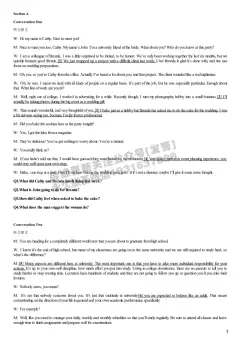
Conversation One
听听力力原原文文
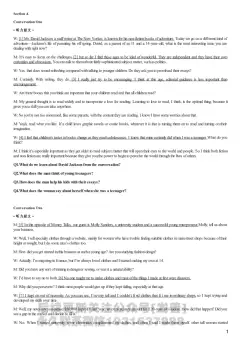
M:Today our guest is Rosie Melinda,[1]who works as a features editor for a fashion magazine.Hi,Rosie.You're a features editor at one of the most
widely-read women's magazines in the UK.What kind of responsibilities doesthat job entail.
W:We spend our days looking at ideas from journalists,writing copy for the magazine and website and editing.Wedo random things like asking
people in the street questionsand testing sports clothing.We also do less tangible thingslike understanding what our readers want.It's certainlyvaried
and sometimes bizarre.
M:During your working day what kind of work might youtypically do?
W:[2]My day mainly incorporates responding to emails,writing and editing stories and coming up with new featureideas.
M:How does the job of features editor differ from that offashion editor or other editorial positions?
W:The features team deals with articles such as careers,reports,confidence and confessions,everything exceptfashion and beauty.
M:[3]A lot of people believe that working at a magazine is aglamorous job.Is this an accurate representation of what you do?
W:I'd say it's glamorous to an extent,but not in the wayit's portrayed in films.We do have our moments such asinterviewing celebrities and attending
parties,which isa huge thrill.Ultimately though,we're the same as ourreaders,but working in a job we're all very lucky to have.
M:Did you have to overcome any difficulties to reach this point in your career?How did you manage to do this?
W:[4]I had to be really persistent and it was very hard work.After three years of working in a petrol station and doingunpaid work I still hadn't
managed to get an entry level job.I was lucky that my last desperate attempt led to a job.I told myself that all experiences make you a
betterjournalist in the long run and luckily,I was right.
Q1.What is the woman's profession?
Q2.What is one of the woman's main responsibilities?
Q3.What do many people think about the woman's job?
Q4.What helped the woman to get her current position?
Conversation Two
听听力力原原文文
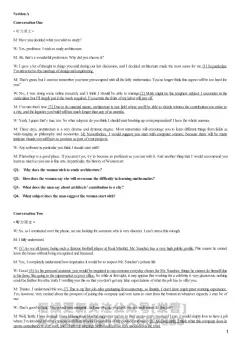
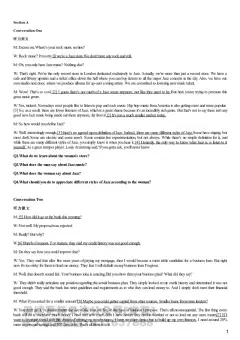
W:Are you watching any good shows these days?
M:Actually,yes.[5]I'm watching a great satire calledFrankie.I think you'd like it.
W:Really?What's it about?
M:It's about a real guy named Frankie.He is a famous comedian in New York and the show is a mixture ofcomedy and drama loosely depicting his
life.
W:I'm sorry.Do you mean to say,it's a real-life seriesabout a real person?It's non-fiction,is it?
M:No…Not really,no.It's fiction,as what happens inevery episode is made up.However,the lead roleis a comedian by the name of Frankie,and he
playshimself.So Frankie in both real life and in the TVshow lives in New York City,is a comic,is divorced,and has two little daughters.All those
things are true,but aside from him,all his friends and family areplayed by actors.And the plots and the events that takeplace are also invented.
W:Oh,I think I see now.That sounds like a very originalconcept.
M:Yes,it is.In fact,[6]the whole show is written,directed,edited and produced by him,and [5]is veryfunny and has won many awards.
W:That's cool.[7]I will try to download it.I'm watchinga comedy called The Big Bang Theory.It's a huge hitaround the world.
M:Oh,yes.I've heard of it,but never actually watched it.W:Well,then you should check it out.It's also very funny.It's about four male scientists and a
female waitress.Themen are very socially awkward but very bright.And this is contrasted by the lady's social skills and common sense.[8]The
show has been running for over ten years,and some of the actors are practically global superstars.Now that they are such famous celebrities.
1Q5.What does the man think of the satire Frankie he recently watched?
Q6.What does the man say is special about the satire Frankie?
Q7.What does the woman say she is going to do with the satire Frankie?
Q8.What does the woman say about the comedy The Big Bang Theory?
Section B
Passage One
听听力力原原文文
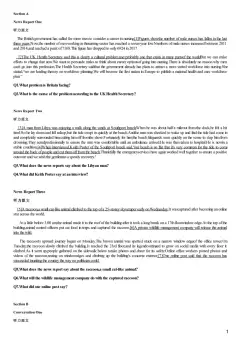
Related to the “use-it-or-lose-it"law is the“keep-moving"principle.We learned about stagnation fromnature.A river that stops moving gets
smelly.The samething happens to people who stop moving,either mentallyor physically.[9]Those who play contact sports knowthat the player who
usually gets hurt the most is the onewho is standing still.Of course,you'll need some time tocatch your breath every so often,but the essential
messageis keep-moving,-extending and -learning.Ships last alot longer when they go to sea than when they stay in theharbor.The same is true for
airplanes.You don't preservean airplane by keeping it on the ground.You preserve it bykeeping it in service.We also get to live a long healthy lifeby
staying in service.[10]Longevity statistics reveal that the average person doesn't last very long after retirement.The more we'll hear is "Don't
retire".If a fellow says “I'm94 years old and I worked all my life",we need to realizethat is how he got to be 94,by staying involved.GeorgeBernard
Shaw won a Nobel Prize when he was nearly 70.Benjamin Franklin produced some of his best writings atthe age of 84,and Pablo Picasso put
brush to canvas rightthrough his eighties.Isn't the issue how old we think weare?[11]A bonus with the"keep-moving"principle is thatwhile we keep
moving,we don't have a chance to worry.Hence we avoid the dreaded paralysis by analysis.
Q9.What does the speaker say about players of contact sports?
Q10.What do longevity statistics reveal about the average person?
Q11.What bonus does the“keep-moving"principle bring us according to the speaker?
Passage Two
听听力力原原文文
In 2014,one in sixteen Americans visited the hospital emergency room for home injuries. One of the main causes of these accidents? A
wandering mind! [12] By one estimate people daydream through nearly half of their waking hours. Psychologists have recently focused on the
tendency to think about something other than the task one is doing. For one experiment,[13] researchers developed an app to analyze the
relationship between daydreaming and happiness. They found that the average person's mind wandered most frequently about 65% of the time
during personal activities, such as brushing their teeth and combing their hair. Respondents minds tended to wander more when they felt upset
rather than happy. They were more likely to wander toward pleasant topics than unpleasant ones. How do daydreams affect daydreamers? A
wandering mind leaves us vulnerable when driving. In one study, researchers interviewed 955 people involved in traffic accidents, the majority of
them reported having daydream just before the accident.[14] Yet other research suggests that daydreaming has benefits. Researches have found
that it gives us a chance to think about our goals and it also seems to increase creativity. In one experiment, 145 undergraduates completed four
unusual uses tasks, each requiring them to list as many uses as possible for an everyday object. After the first pair of tasks was completed, one
group of participants was assigned an undemanding activity intended to cause their minds to wander. When all the participants proceeded to the
second pair of tasks,[15] the daydreamers performed 40% better than the others.
Q12.What does the passage say about people's mind?
Q13.For what purpose did the researchers develop the new app?
Q14.How does daydreaming benefit people according to some researchers?
Q15.What was the finding of the experiment with 145 undergraduates?
Section C
Recording One
听听力力原原文文
Dating from as far back as the 12th century,they areclaimed to be the rarest historic buildings in western Europe.These buildings offer vital
insights into Scandinavia's Vikingpast.But now,with only 30 wooden churches remaining[16]and their condition deteriorating,experts are working
topreserve the structures for future generations.
Some of these spectacular churches are no more thansmall buildings,barely four meters wide and six meters tall.Others are much larger
2structures.They soar up to 40 metersinto the cold air.Most consist of timber frames that rest onstone blocks.[17]This means that they have no
foundations.Although many of the churches appear from the outside to becomplex structures,they normally feature only a single storeybut
numerous different roof levels.
Staff from the Norwegian government have carried outconservation work on 10 of the churches over the past twoyears.Most of these churches
date from between the 12th and14th centuries.Other churches were conserved in previousyears.So far,specialists have worked to add
preservativematerials to the churches'exteriors.They also replaced rottingroots and halted the sinking of the churches into the ground.Intwo
cases,huge machines have been used to lift the buildingsup to 30 centimeters into the air.This was accomplished sothat the team could examine and
repair the churches'originalmedieval stone blocks.The team plans to return to around adozen of the buildings to assess progress and consider
furtheraction.
The earliest free-standing wooden church was probablybuilt in Norway in around 1080.However,the largest knownwooden churches were built
from the 1130s onwards.Thisperiod was one of inter-elite rivalry,in which nobles soughtto increase their influence by funding the construction of
churches and other buildings.The reason for constructing thebuildings from wood is probably that [18]ideally proportioned straight and slender
timber was available in large quantitiesin Scandinavia's vast pine forests.As wood was so plentiful,it was cheaper to use than the stone used in the
buildings ofother European cultures.The area's ship building tradition,partly established by the Vikings,also meant that sophisticatedcarpentry was a
major aspect of the local culture.The complexstyle of the medieval wooden church carvings and the skillsused to make them almost certainly derive
from the ancient Viking tradition.
Q16.What does the speaker say about the Viking wooden churches?
Q17.What is special about most of the Viking wooden churches?
Q18.Why were the Viking churches constructed from wood?\
Recording Two
听听力力原原文文
In last week's lecture,we discussed the characteristics ofthe newly-born offspring of several mammals.You probablyremember that human
infants are less developed physicallythan other mammals of the same age.[19]But in today'slecture,we'll look at three very interesting studies that
hint atthe surprising abilities of human babies.
In the first study,three-year-olds watched two videosshown side by side.Each featuring a different researcher,oneof whom they'd met once two
years earlier.The children spentlonger watching the video showing the researcher they hadn'tmet.This is consistent with young children's usual
tendencyto look longer at things that aren't familiar.And really this isamazing.It suggests the children remembered the researcherthey'd met just one
time when they were only one-year-olds.Of course,as most of us forget memories from our first fewyears as we grow older,these early long-turn
memories willlikely be lost in subsequent years.
Our second study is about music.For this studyresearchers played music to babies through speakers locatedon either side of a human
face.They waited until the babiesgot bored and inverted their gaze from the face.And then theychanged the mood in the music either from sad to
happy or theother way around.This mood switch made no difference to thethree-month-olds;but for the nine-month-olds,it was enoughto renew
their interest and they started looking again in thedirection of the face.[20]This suggests that babies of that agecan tell the difference between a
happy melody and a sad tune.
Our final study is from 1980,but it's still relevant today.In fact,[21]it's one of the most famous pieces of researchabout infant emotion ever
published.The study involvedordinary adults watching video clips of babies nine monthsor younger.In the video clips,the babies made various facial
expressions in response to real life events,including playfulinteractions and painful ones.The adult observers were able toreliably discern an
assortment of emotions on the babies faces.These emotions included interest,joy,surprise,sadness,anger,disgust,contempt and fear.
Next week,we'll be looking at this last study moreclosely.In fact,we will be viewing some of the video clips from that study.And together,see
how well we do in discerning the babies'emotions.
Q19.What are the three interesting studies about?
Q20.What does the second study find about nine-month-old babies?
Q21.What is the 1980 study about?
Recording Three
听听力力原原文文&译译文文
Today I'd like to talk about the dangers of being toocollaborative.Being a good team player is a central skill inour modern workplace.The
ability to work well with othersand collaborate on projects is a sought-after ability in nearlyevery position.[22]However,placing too much emphasis
3onbeing a good team player can negatively affect your careergrowth.Don't be overly focused on gaining consensus.Don't be too concerned with
the opinions of others.Thiscan hinder your ability to make decisions,speak up and gainrecognition for your individual skills and
strengths.Somepeople are too subordinate to others'opinions,too focused ondecision consensus,too silent about their own point of view,too
agreeable to take things on when they don't have timeor energy.This leads to building a brand of underconfident,submissive,low-impact non-
leaders and hampers their growthand career advancement.
[23]Collaboration certainly makes your individualcompetencies and contributions more difficult for outsidersto identify.Collaborative projects
mean you're sharing thespotlight with others.Outsiders may then find it difficult todetermine your contributions and strengths.This may end upcosting
you opportunities for promotions or pay raises.Youcertainly shouldn't ditch teamwork,but how can you avoid thehazards of being an over-
collaborator?
Working in a team can have huge benefits.Your teammay have repeated successes and often gain recognition.[24]You then have more
opportunities to expand your professionalnetwork than if you worked alone.However,finding a balancebetween team efforts and individual
projects that give youindependent recognition is important for making a name foryourself and providing opportunities for advancement.
Be selective in who you work with.This will maximizethe benefits and minimize the downsides of being a team player.Collaborate with people
who have complementaryexpertise.Select projects where there's potential for mutualbenefit.Perhaps you're bringing your unique knowledgeand
gaining access to someone else's professional network,or maybe you're able to learn a new skill by working withsomeone.Seek out your
teammates purposefully rather thanjumping on every new group project opportunity.When we'retoo collaborative,we want everyone to agree with
a decisionbefore we proceed.[25]This can create unnecessary delays asyou hold meetings trying to achieve consensus.It's fine to becollaborative
when seeking input.But put a deadline on the input stage and arrive at a decision,even if it's a decision thatdoesn't have consensus.
Q22. What does the speaker say about being over collaborative?
Q23.What does the speaker say about people engaged in collaborative projects?
Q24.How do people benefit from working in a team?
Q25.Why is it undesirable to spend too much time trying to reach consensus?
4
![《[1.1.9.21]--2019年12月六级听力(第二套)_文本_最新更新,视频都在这_2026,6月六级速转存易和谐_1、2025年6月六级_04.2026六级英语新东方_{9}--近五年听力音频+原文》第1页预览](https://static.diaifu.net/ssd/ssd5/wenku/2026-04-20/af06f5a9d71e7540681ded4e58f32a10/af06f5a9d71e7540681ded4e58f32a10_1.webp)
![《[1.1.9.21]--2019年12月六级听力(第二套)_文本_最新更新,视频都在这_2026,6月六级速转存易和谐_1、2025年6月六级_04.2026六级英语新东方_{9}--近五年听力音频+原文》第2页预览](https://static.diaifu.net/ssd/ssd5/wenku/2026-04-20/af06f5a9d71e7540681ded4e58f32a10/af06f5a9d71e7540681ded4e58f32a10_2.webp)
![《[1.1.9.21]--2019年12月六级听力(第二套)_文本_最新更新,视频都在这_2026,6月六级速转存易和谐_1、2025年6月六级_04.2026六级英语新东方_{9}--近五年听力音频+原文》第3页预览](https://static.diaifu.net/ssd/ssd5/wenku/2026-04-20/af06f5a9d71e7540681ded4e58f32a10/af06f5a9d71e7540681ded4e58f32a10_3.webp)
![《[1.1.9.21]--2019年12月六级听力(第二套)_文本_最新更新,视频都在这_2026,6月六级速转存易和谐_1、2025年6月六级_04.2026六级英语新东方_{9}--近五年听力音频+原文》第4页预览](https://static.diaifu.net/ssd/ssd5/wenku/2026-04-20/af06f5a9d71e7540681ded4e58f32a10/af06f5a9d71e7540681ded4e58f32a10_4.webp)
![《[1.1.9.21]--2019年12月六级听力(第二套)_文本_最新更新,视频都在这_2026,6月六级速转存易和谐_1、2025年6月六级_04.2026六级英语新东方_{9}--近五年听力音频+原文》第5页预览](https://static.diaifu.net/ssd/ssd5/wenku/2026-04-20/af06f5a9d71e7540681ded4e58f32a10/af06f5a9d71e7540681ded4e58f32a10_5.webp)
![《[1.1.9.21]--2019年12月六级听力(第二套)_文本_最新更新,视频都在这_2026,6月六级速转存易和谐_1、2025年6月六级_04.2026六级英语新东方_{9}--近五年听力音频+原文》第6页预览](https://static.diaifu.net/ssd/ssd5/wenku/2026-04-20/af06f5a9d71e7540681ded4e58f32a10/af06f5a9d71e7540681ded4e58f32a10_6.webp)
![《[1.1.9.21]--2019年12月六级听力(第二套)_文本_最新更新,视频都在这_2026,6月六级速转存易和谐_1、2025年6月六级_04.2026六级英语新东方_{9}--近五年听力音频+原文》第7页预览](https://static.diaifu.net/ssd/ssd5/wenku/2026-04-20/af06f5a9d71e7540681ded4e58f32a10/af06f5a9d71e7540681ded4e58f32a10_7.webp)
![《[1.1.9.21]--2019年12月六级听力(第二套)_文本_最新更新,视频都在这_2026,6月六级速转存易和谐_1、2025年6月六级_04.2026六级英语新东方_{9}--近五年听力音频+原文》第8页预览](https://static.diaifu.net/ssd/ssd5/wenku/2026-04-20/af06f5a9d71e7540681ded4e58f32a10/af06f5a9d71e7540681ded4e58f32a10_8.webp)
![《[1.1.9.21]--2019年12月六级听力(第二套)_文本_最新更新,视频都在这_2026,6月六级速转存易和谐_1、2025年6月六级_04.2026六级英语新东方_{9}--近五年听力音频+原文》第9页预览](https://static.diaifu.net/ssd/ssd5/wenku/2026-04-20/af06f5a9d71e7540681ded4e58f32a10/af06f5a9d71e7540681ded4e58f32a10_9.webp)
![《[1.1.9.21]--2019年12月六级听力(第二套)_文本_最新更新,视频都在这_2026,6月六级速转存易和谐_1、2025年6月六级_04.2026六级英语新东方_{9}--近五年听力音频+原文》第10页预览](https://static.diaifu.net/ssd/ssd5/wenku/2026-04-20/af06f5a9d71e7540681ded4e58f32a10/af06f5a9d71e7540681ded4e58f32a10_10.webp)