Section A
Conversation One
听听力力原原文文
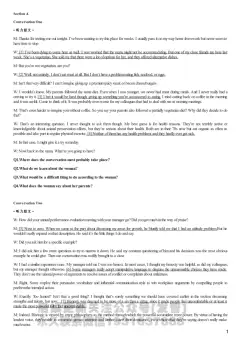
M: [1] It’s my last day at work tomorrow. I’ll start my new job in two weeks. My human resources manager wants to conduct an interview with
me before I leave.
W: Ah, an exit interview. Are you looking forward to it?
M: I’m not sure how I feel about it. I resigned because I’ve been unhappy at that company for a long time, but I’m not sure if I should tell them
how I really feel.
W: To my way of thinking, there are two main potential benefits that come from unleashing an agitated stream of truth during an exit interview. The
first is release. Unburdening yourself of frustration, and perhaps even anger to someone who isn’t a friend or close colleague can be wonderfully
free.
M: And let me guess. The second is that the criticism will, theoretically, help the organization I’m leaving to improve, making sure employees of the
future are less likely to encounter what I did?
W: That’s right. But the problem with the company improvement part is that very often it doesn’t happen. [2] An exit interview is supposed to be
private, but often isn’t. In my company, the information gained from these interviews is often not confidential, and the information is used as dirt
against another manager, or can be traded among senior managers.
M: Now you’ve got me rethinking what I’ll disclose in the interview. [3] There’s always the chance that it could affect my reputation and my ability
to network in the industry. It is a pretty small industry after all.
W: Anything you initially gained from the instant satisfaction of telling it like it is, you might lose down the track by injuring your future career
prospects.
M: Right. [4] Perhaps I would be better getting things off my chest by going to one of those rate-your-employer websites.
W: You could. And don’t do the interview at all. Exit interviews are not mandatory.
Q1.What do we learn about the man from the conversation?
Q2.What does the woman think about the information gained from an exit interview?
Q3.Why does the man want to rethink what he will say in the coming exit interview?
Q4.What does the man think he had better do?
Conversation Two
听听力力原原文文
M: Today, I’m talking to the renowned botanist, Jane Foster.
W: Thank you for inviting me to join you on the show, Henry.
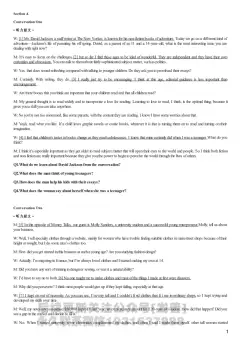
M: [5] Recently, Jane, you’ve become quite a celebrity, since the release of your latest documentary. Can you tell us a little about it?
W: Well, it follows my expedition to study the vegetation indigenous to the rainforest in equatorial areas of Southeast Asia.
M: You certainly get to travel to some very exotic locations.
W: It was far from glamorous, to be honest. [6] The area we visited was accessible only by canoe and the living conditions in the hut were
primitive, to say the least. There was no electricity, and our water supply was a nearby stream.
M: How were the weather conditions while you were there?
W: [6] The weather was not conducive to our work at all, since the humidity was almost unbearable. At midday, we stayed in the hut and did
nothing. It was too humid to either work or sleep.
M: How long did your team spend in the jungle?
W: Originally, we planned to be there for a month. But in the end, we stayed for only two weeks.
1M: Why did you cut the expedition short?
W: [7] Halfway through the trip, we received news that a hurricane was approaching, and we had to evacuate at very short notice.
M: That sounds like a fascinating anecdote.
W: It was frightening. The fastest evacuation route was through river rapids. We had to navigate them carrying all of our equipment.
M: [8] So overall, was the journey unsuccessful?
W: [8] Absolutely not. We gathered a massive amount of data about the local plant life.
M: Why do you put up with such adverse conditions?
W: Botany is an obsession for me. Many of the destinations I visit have a stunning scenery, and I get to meet a variety of people from all over the
world.
M: So where will your next destination be?
W: I haven’t decided yet.
M: Then we can leave it for another vacation. Thanks.
Q5.What does the man want Jane Foster to talk about?
Q6.Why does the woman describe her experience as far from glamorous?
Q7.Why did the woman and those who went with her end their trip halfway?
Q8.What does the woman think of the journey?
Section B
Passage One
听听力力原原文文
Scientists often use specialized jargon terms while communicating with laymen. Most of them don’t realize the harmful eff ects of this practice.
[9] In a new study, people exposed to jargon, when reading about subjects like autonomous vehicles and surgical robots, later said they were less
interested in science than others who read about the same topics, but without the use of specialized terms. They also felt less informed about
science and less qualified to discuss science topics. It’s noteworthy that it made no difference if the jargon terms were defined in the text. Even
when the terms were defined, readers still felt the same lack of engagement as readers who read jargon that wasn’t explained. The problem is that
the mere presence of jargon sends a discouraging message to readers.
Hillary Schulman, the author of the study, asserts that specialized words are a signal. Jargon tells people that the message isn’t for them. There’s
an even darker side to how people react to jargon. [10] In another study, researchers found that reading scientific articles containing jargon led
people to doubt the actual science. They found the opposite when a text is easier to read. Then people are more persuaded. Thus, it’s important to
communicate clearly when talking about complex science subjects. This is especially true with issues related to public health, like the safety of new
medications and the benefi ts of vaccines. Schulman concedes that the use of jargon is appropriate with scientific audiences. [11] But scientists
who want to communicate with the general public need to modify their language. They need to eliminate jargon.
Q9.What does the passage say about the use of jargon terms by experts?
Q10. What do researchers find about people reading scientifi c articles containing jargon terms?
Q11.What does Schulman suggest scientists do when communicating with the general public?
Passage Two
听听力力原原文文
At the beginning of the twentieth century, on the Gulf Coast in the US state of Texas, there was a hill where gas leakage was so noticeable that
schoolboys would sometimes set the hill on fire. [12] Patillo Higgins, a disreputable local businessman, became convinced that there was oil below
the gassy hill. Oil wells weren’t drilled back then. They were essentially dug. [13] The sand under the hill defeated several attempts by Higgins’
workers to make a proper hole. Higgins had forecast oil at 1,000 feet, a totally made-up fi gure. Higgins subsequently hired a mining engineer—
captain Anthony Lucas. [14] After encountering several setbacks, captain Lucas decided to use a drill, and his innovations created the modern oil
drilling industry. In January 1901, at 1,020 feet, almost precisely the depth predicted by Higgins’ wild guess, the well roared and suddenly ejected
2mud and six tons of drilling pipe out of the ground, terrifying those present. For the next nine days until the well was capped, the well poured out
more oil than all the wells in America combined.
In those days, Texas was almost entirely rural, with no large cities and practically no industry. [15] Cotton and beef were the foundation of the
economy. Higgins’ well changed that. The boom made some prospectors millionaires, but the sudden surplus of petroleum was not entirely a
blessing for Texas. In the 1930s, prices crashed to the point that in some parts of the country, oil was cheaper than water. That would become a
familiar pattern of the boom or bust Texas’ economy.
Q12.What did Texas businessman Patillo Higgins believe?
Q13.What prevented Higgins’ workers from digging a proper hole to get the oil?
Q14.What does the passage say about captain Lucas’ drilling method?
Q15.What do we learn about Texas’ oil industry boom?
Section C
Recording One
听听力力原原文文
Most people dislike their jobs. It’s an astonishing but statistical fact. [16] A primary cause of employee dissatisfaction, according to fresh
research, is that many believe they have terrible managers. Few describe their managers as malicious or manipulative, though. While those types
certainly exist, they are a minority. The majority of managers seemingly just don’t know any better. They’re often emulating bad managers they’ve
had in the past. It’s likely they’ve never read a management book or attended a management course. They might not have even reflected on what
good management looks like and how it would influence their own management style.
The researchers interviewed employees about their managers, beginning with a question about the worst manager they had ever had. From this,
the researchers came up with four main causes of why some managers are perceived as being simply awful at their jobs. [17] The first cause was
company culture, which was seen by employees as enabling poor management practices. It was specifically stressful work environments, minimal
training, and a lack of accountability that were found to be the most blameworthy. Often a manager’s superiors can eff ectively encourage a
manager’s distasteful behavior when they fail to discipline the person’s wrong doings. Such workplaces are sometimes described as toxic. The
second cause was attributed to the managers’ characteristics. Those deemed to be most destructive were odd people, those without drive, those
who allow personal problems into the workplace, and those with an unpleasant temperament or personality in general. The third cause of poor
management was associated with a deficiency of qualifi cations, not so much the formal variety one obtains from a university, but the informal
variety that comes from credible work experience and professional accomplishments. The fourth cause concerned managers who’d been
promoted for reasons other than potential. One reason in particular why these people had been promoted was that they had been around the
longest. It wasn’t their skill set, or other merits that got them the job. It was their tenure.
[18] A point worth making is that the study was based only on the perspective of the employees. The researchers didn’t ask senior leaders what
they thought of their frontline managers. It’s quite possible they are content with how the individuals they promoted are now performing, merrily
ignorant of the damage they’re actually causing, which might explain why, as the researchers conclude, those same middle managers are usually
unaware that they are a bad manager.
Q16.What is a primary cause of employee dissatisfaction according to recent research?
Q17. What is one of the causes for poor management practices?
Q18.What do we learn about the study on job dissatisfaction?
Recording Two
听听力力原原文文
[19] With the use of driverless vehicles seemingly inevitable, mining companies in the vast Australian desert state of Western Australia are
definitely taking the lead. Iron ore is a key ingredient in steel-making. The mining companies here produce almost 300 million tons of iron ore a
year. The 240 giant autonomous trucks in use, in the Western Australian mines, can weigh 400 tons, fully loaded, and travel at speeds of up to
sixty kilometers per hour. They are a technological leap, transporting iron ore along routes which run for hundreds of kilometers from mines to their
destinations. Here when the truck arrives at its destination, staff in the operation center direct it precisely where to unload. Vast quantities of iron
ore are then transported by autonomous trains to ocean ports. [19] Advocates argue these automated vehicles will change mining forever. It may
only be five years before the use of automation technology leads to a fully robotic mine.
A range of factors has pushed Western Australia’s desert region to the lead of this automation revolution. These include the huge size of the
mines, the scale of equipment and the repetitive nature of some of the work. Then there’s the area’s remoteness. At 502,000 square kilometers, it
3can sometimes make recruiting staff a challenge. Another consideration is the risks when humans interact with large machinery. There are also the fi
nancial imperatives. The ongoing push by the mining corporations to be more productive and more efficient is another powerful driver in embracing
automation technology.
The concept of a fully autonomous mine is a bit of a misleading term, however. This is because the more technology is put into the fi eld, the
more people are needed to deploy, maintain and improve it. [20] The automation and digitization of the industry is creating a need for different
jobs. These include data scientists and engineers in automation and artificial intelligence. The mining companies claim automation and robotics
present opportunities to make mining more sustainable and safer. Employees will be offered a career that is even more fulfi lling and more
rewarding. [21] Workers’ unions have accepted the inevitability of the introduction of new technology. But they still have reservations about the
rise of automation technology. Their main concern is the potential impact on remote communities. As automation spreads further, the question is
how these remote communities will survive when the old jobs are eliminated. And this may well prove to be the most signifi cant impact of robotic
technology at many places around the world.
Q19.What does the passage say about the mining industry in Western Australia?
Q20.What is the impact of the digitization of the mining industry?
Q21.What is the attitude of workers’ unions towards the introduction of new technology?
Recording Three
听听力力原原文文
[22] According to official statistics, Thailand’s annual road death rate is almost double the global average. Thai people know that their roads
are dangerous, but they don’t know this could easily be changed. Globally, road accidents kill more people every year than any infectious disease.
Researchers at the Institute for Health Metrics and Evaluation in America put the death toll in 2017 at 1.24 million.[ 23] According to the institute,
the overall number of deaths has been more or less static since the turn of the century. But that disguises a lot of changes in individual countries.
In many poor countries, road accidents are killing more people than ever before. Those countries have swelling, young populations, a fast-
growing fleet of cars and motorbikes, and a limited supply of surgeons. It is impossible to know for sure, because offi cial statistics are so
inadequate. But deaths are thought to have risen by 40% since 1990 in many low-income countries.
In many rich countries, by contrast, roads are becoming even safer. In Estonia and Ireland, for example, the number of deaths has fallen by
about two thirds since the late 1990s. [24] But the most important and intriguing changes are taking place in middle-income countries, which
contain most of the world’s people and have some of the most dangerous roads. According to researchers in China and South Africa, traffic
deaths have been falling since 2000 and in India since 2012, and the Philippines reached its peak four years ago.
The question is whether Thailand can soon follow suit. Rob McInerney, head of the International Road Assessment Program, says that all
countries tend to go through three phases. They begin with poor, slow roads. In the second phase, as they grow wealthier, they pave the roads,
allowing traffi c to move faster and pushing up the death rate. Lastly, in the third phase, countries act to make their roads safer.
The trick, then, is to reach the third stage sooner, by focusing earlier and more closely on fatal accidents. How to do that? [25] The solution lies
not just in better infrastructure, but in better social incentives. Safe driving habits are practices which people know they should follow but often
don’t. Dangerous driving is not a fixed cultural trait, as some imagine. People respond to incentives such as traffic laws that are actually enforced.
Q22.What does the speaker say about traffic accidents in Thailand?
Q23.What do we learn from an American institute’s statistics regarding road deaths?
Q24.What is said about middle-income countries?
Q25.What else could be done to reduce fatal road accidents in addition to safer roads?
4
![《[1.1.9.14]--2021年6月六级听力音频(第一套)_文本_最新更新,视频都在这_2026,6月六级速转存易和谐_1、2025年6月六级_04.2026六级英语新东方_{9}--近五年听力音频+原文》第1页预览](https://static.diaifu.net/ssd/ssd5/wenku/2026-04-20/e94af9a8c0213d2ff91147ee86663a19/e94af9a8c0213d2ff91147ee86663a19_1.webp)
![《[1.1.9.14]--2021年6月六级听力音频(第一套)_文本_最新更新,视频都在这_2026,6月六级速转存易和谐_1、2025年6月六级_04.2026六级英语新东方_{9}--近五年听力音频+原文》第2页预览](https://static.diaifu.net/ssd/ssd5/wenku/2026-04-20/e94af9a8c0213d2ff91147ee86663a19/e94af9a8c0213d2ff91147ee86663a19_2.webp)