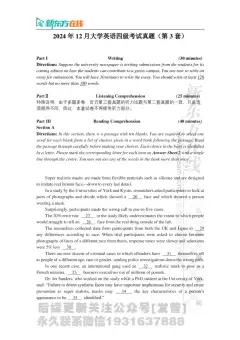
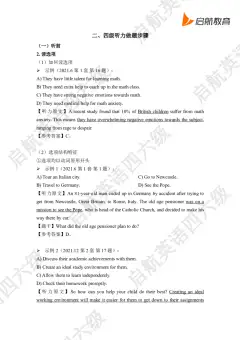
Section A
News Report One
• 听力原文 •
A new study finds that beverages containing added sugar might be harmful. In the study, researchers analyzed information from over 80,000
women and 37,000 men. Participants worked in the health profession. [1] They were followed for approximately three decades. They completed
surveys about their diet every four years. They also answered questions about sleep and exercise and health every two years. The more beverages
containing added sugar that people drink, the greater their risk of death was during the study period. These beverages included soda, energy
drinks, and sports drinks. Beverages like pure fruit juice, which are sweet but do not contain added sugar, were not part of the study. The fi ndings
held even after the researchers considered other factors that could aff ect people’s health. These factors included lack of exercise and not eating
enough vegetables. They also included consuming too much meat. The scientists say that their results support limiting beverages with added sugar.
[2] They argue we should replace them with other drinks, with water being the best choice. However, the researchers admit this is simply their
recommendation. The study found only an association. It did not prove that drinks with added sugar cause early death.
Q1::What do we learn about the new study from the news report?
Q2::What is the scientists’ recommendation?
News Report Two
• 听力原文 •
German police appealed Friday for information about the possible owners of two 17th-century oil paintings. [3]Police said a 64-year-old man
found the paintings in a garbage pile at a highway rest stop last month. He later handed them in to the Cologne police. [4] An initial assessment by
an art expert concluded the two framed paintings were originals, police said. One is a landscape painted by the Italian artist Pietro Bellotti, dating
to 1665. The other is a painting of a boy by the 17th-century Dutch artist Samuel van Hoogstraten, date unknown. Their combined worth is
estimated to be around one million euros. Authorities have not yet confi rmed what will happen if the rightful owner is not found. Nevertheless, it is
speculated that they could either be handed over to the National Art Museum of Cologne or sold to the public by the local government.
Q3::What did German police say about a 64-year-old man?
Q4::What is the art expert’s conclusion about the two framed paintings?
News Report Three
• 听力原文 •
[5] A four-year-old girl has walked eight kilometres through a snowy forest to seek help for her sick grandmother who later died of a heart
attack. The young girl braved the threat of bears, wolves and temperatures far below freezing. She made the journey through a remote region in
Siberia after waking up to fi nd her grandmother motionless. Named locally as Carla, she lives alone with her elderly grandmother and her blind
grandfather. [6] As a result, the girl’s mother is facing a criminal case. She stands accused of leaving a minor in danger, in the care of the elderly.
She also faces investigation from childcare services, who will also be asking why Carla was left alone with her vulnerable relatives. The journey
took place in February, when temperatures average -26°C. Russian reports on social media suggest the forest may have been as cold as -34°C.
The journey was only recently confirmed by authorities. [7] But though she was suff ering from the eff ects of extreme cold, the child reportedly
suff ered no life-threatening effects. Last year, a three-year-old boy survived alone for three days in a remote forest in the same region.
Q5::What did the four-year-old girl attempt to do?
Q6::What do we learn from the news report about the girl’s mother?
Q7::What happened to the little girl according to the news report?
Section B
Conversation One
• 听听力力原原文文 •
W: I’ve made a new friend recently. Her name is Susan and she’s from South Africa.
M: How did you meet her?
1W: We met over WeChat. She has very cool photos on her social media. The photos of her hometown look amazing.
M: [8] What’s her hometown called?
W: [8] It’s called Cape Town. It’s in the southwest of South Africa. She says it’s very green and windy. The city was built by European settlers
and there’s a big mountain that overlooks the city. [9] The mountain is called Table Mountain, because it’s fl at at the top.
M: That sounds interesting. What are the people there like?
W: Well, Susan says South Africa is very mixed. There are black people and white people and Indian people. Susan is white. [10] She says her
ancestors were from Britain. Many languages are spoken in South Africa, but she only speaks English.
M: Didn’t South Africa host the Football World Cup a few years ago? They must play football a lot then, right?
W: [11] I think they play football, but it’s not as popular as rugby.
M: Rugby? What’s rugby?
W: Rugby is a sport with two teams. And the players carry the ball in their arms and throw it at each other. The ball is not round, and the players
push each other. I don’t really understand the rules. I think it’s very complicated.
M: That sounds like a very strange sport, indeed. Is it only South Africa that plays it?
W: No, it’s also popular in Britain and in other former British colonies like Australia and New Zealand.
Q8::What does the woman say about her new friend Susan?
Q9::What does the woman say about Table Mountain?
Q10::What do we learn from the conversation about the woman’s friend Susan?
Q11::What does the woman say about rugby in South Africa?
Conversation Two
• 听力原文 •
M: Hi, Jennifer. I’m really struggling with this semester’s workload. Do you have any advice?
W: [12] Have you considered making a study guide? It is a tool you can make yourself to take the stress out of studying. I’ve been using one since
the start of last semester and it has really helped relieve a lot of study pressure.
M: Sounds like just what I need. [13] My main problem is that my study folder is full of notes and worksheets and is badly disorganized. I don’t
know where to start.
W: OK. Well, the main thing is to have everything in the right place. Whatever you’re reviewing, it’s important that it’s arranged for your particular
needs of that subject and in the most user-friendly way you can. What kind of learner are you?
M: Um… I’m not sure.
W: Well, visual learners prefer using images, pictures, colors and maps to organize information. Logical learners have a linear mind and would
rather use logic, reasoning and systems. [14] I’m an emotional learner, which means I need to connect to information emotionally to understand it.
M: Oh, I’m very much dependent on vision as a way of taking in information.
W: [15] Well, I suggest reorganizing your notes using color-coded sections in your study guides, or using idea mapping to lay out the information
and make it more quickly accessible.
M: [15] So you think I should arrange my notes using color and pictures in place of text.
W: [15] Yes. You’ll probably start to grasp information a lot quicker that way. As an emotional learner, I organize my notes into a story that I can
connect to and recite to myself.
M: That’s amazing. I didn’t know there were so many diff erent ways to learn.
Q12::What does the woman advise the man do?
Q13::What is the biggest problem the man has with his studies?
2Q14::What kind of learner does the woman say she is?
Q15::What does the woman think the man can do with his notes?
Section C
Passage One
• 听听力力原原文文 •
[16] The golden rule is a moral principle which states that you should treat others the way you want to be treated yourself. For example, if you
want people to treat you with respect, you should treat them with respect. Diff erent people tend to be exposed to diff erent forms of the golden
rule, based on factors such as the religion in their society. However, all forms of the golden rule revolve around the same concept. [16] Namely,
they help you treat others better, by using the way you yourself would want to be treated as a guide of how to behave.
[17] A notable criticism of the golden rule is that its application can lead to undesirable outcomes, when it conflicts with laws and ethical
principles. For example, if someone breaks the law, the golden rule would suggest that we should let them go, because we would not want to be
punished ourselves. However, this issue with the golden rule can be dealt with in a general manner, by viewing this principle as one of several
principles that we use to guide our behavior as individuals and as a society.
[18] Specifically, in the example described above, most individuals and societies choose to place laws and ethical principles above the golden
rule. This means that they strive to implement the golden rule whenever possible, as long as it doesn’t clash with a more important concept.
Q16::What do we learn from the passage about the golden rule?
Q17::What is a notable criticism of the golden rule?
Q18::What does the example of someone breaking the law serve to show?
Passage Two
• 听听力力原原文文 •
[19] Today many large corporations stress the importance of diversity on their websites, but current statistics show that the typical manager in
America still tends to be white and male. Obviously, the desire to bring about diversity has not translated into corporate reality. Why is this? [20] A
team of researchers from the University of Basel published their new study about people’s attitudes towards diversity at work. They found that
people have a wide range of opinions concerning diversity. On the one hand, many see value in diversity, which can contribute a variety of
perspectives, encourage new ideas, and generate innovative solutions. On the other hand, they assume that it might be difficult to work with
someone who has completely different views, speaks a different language or has a diff erent style of work. The actual value they attribute to
diversity depends on the decision-making perspective. Doubts about the practicability of diversity have a greater weight. [21] If a person is directly
affected, in other words, when a person’s own work group is involved, they tend to prefer team members who are similar to themselves. But when
people make decisions for others, they typically put together a more diverse team. These findings could help organizations become more diverse.
Companies need to pay attention to who makes hiring and team decisions. These decisions should not only be made by those directly aff ected.
People who are not directly involved in the group’s daily work should also take part.
Q19::What do we learn from the current statistics about diversity in large corporations?
Q20::What is the newly published study focused on?
Q21::What do the fi ndings of the new study show?
Passage Three
• 听听力力原原文文 •
Communication can essentially be divided into two categories: the written and the spoken. How the balance is struck between these two forms
of communication? The point at which one needs to be exchanged for another really depends on individual cultures. [22] Understanding when it’s
appropriate to exchange one form for another can be a major key to success in international business. Many cultures place a much greater value on
the spoken word than the American working culture does. [23] In parts of the Middle East, you’ll find spoken word agreements are seen as
seriously binding. A person’s word is linked to their honor, so verbal agreements are seen as important, whereas written contracts are taken as
memos of understanding. [24] Western working culture tends to place a high value on the written word, and this reaches its highest level of
intensity when it comes to contracts. In the U.S., France and Germany, written contracts tend to be seen as something that must be strictly carried
out. By contrast, other cultures may not see written contracts as quite so binding. It can prove a challenge to Western businesses if your business
3partner wants to renegotiate terms that you thought were already agreed on. [25] For example, a Japanese firm may have signed a contract, but
they may not feel bound by every detail of it, particularly if circumstances later change. Such diff erences in value that different working cultures
place on the written word tend to cause many problems when it comes to business relationships.
Q22::What is a major key to success in international business according to the passage?
Q23::What does the passage say about spoken word agreements in some Middle East countries?
Q24::What do we learn about the Western working culture?
Q25::How does a Japanese firm tend to view a written contract?
4
![《[1.1.9.11]--22年6月四级听力音频(仅一套)_文本_最新更新,视频都在这_2026、6月四级速转存易和谐_1、2025年6月四级_04.2026四级英语新东方_{9}--近五年听力音频+原文》第1页预览](https://static.diaifu.net/ssd/ssd5/wenku/2026-04-20/3c5aecd634c31861392af3b5ae999b17/3c5aecd634c31861392af3b5ae999b17_1.webp)
![《[1.1.9.11]--22年6月四级听力音频(仅一套)_文本_最新更新,视频都在这_2026、6月四级速转存易和谐_1、2025年6月四级_04.2026四级英语新东方_{9}--近五年听力音频+原文》第2页预览](https://static.diaifu.net/ssd/ssd5/wenku/2026-04-20/3c5aecd634c31861392af3b5ae999b17/3c5aecd634c31861392af3b5ae999b17_2.webp)