Section A
Conversation One
• 听听力力原原文文 •
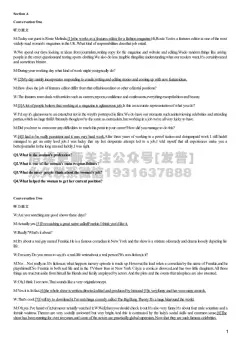
M: Welcome to Money Matters, [1] a weekly program that helps you manage your money. Tonight, I’ll be talking to Mary Johnson about
budgeting.
W: Hello, everyone.
M: There’s a magic about money. When it’s not planned for, tracked and kept a record of, it literally disappears. What are some of the steps we
can take to prevent this from happening?
W: Well, it’s all about keeping track of your money. If you don’t do that, you’ll never be able to set any goals for your budget or have the
discipline to stick to them.
M: That’s easier said than done. [2] I read recently that only 41% of Americans adhere to a budget.
W: Yes, [3] but knowing what you earn and what you spend can give you reassurance that you won’t get into debt in the first place. You can do
this by adding up all of your sources of income you have and writing them all down on a piece of paper. On the same page, write down all of your
monthly expenses.
M: I’m always amazed at how much my expenses add up, but designating each item as an income or an expense really helps me have a much
better sense of all my spending.
W: Right. Most people have no idea how much they spend each day, let alone each week, or month, no matter how careful they are. Next,
subtract your monthly expenses from income. If the result is positive, you are living within your means. If the result is a negative number, you’re
going to have to cut back on your spending.
M: I’m usually a negative number. I just can’t resist the allure of all those prestigious goods.
W: Well, it’s not a catastrophe, but you do have to make some changes. Try cutting back on those non-essential items, sell some stuff in your attic,
[4] or shop online to avoid unnecessary temptations, like chocolate. Failing that, you can always find yourself a part-time job.
Q1.What does the man say about the weekly program?
Q2.What did the man read recently?
Q3.What does the woman suggest the man do first to avoid getting into debt?
Q4.What does the woman say about online shopping?
Conversation Two
• 听听力力原原文文 •
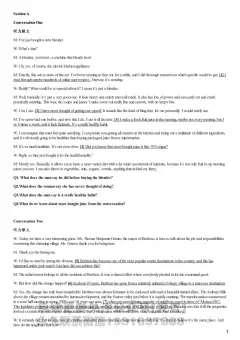
M: Hi, there! I’ve come to see the flat. My name is Mark Adams. We spoke on the phone on Wednesday?
W: Hi, Mark. Come on up. I’ll buzz you in. Green door on the second floor on the right side. … Nice to meet you. I spoke to all your references,
and they all checked out OK. So let me show you around. [5] The place actually belongs to my mother, but her health isn’t great, so we finally
managed to persuade her to move in with us and rent this old place out.
M: It’s a great size, plenty of space, very versatile. I think it’s a winner for us.
W: Yes. All the appliances are brand-new. There’s a washing machine and a tumble dryer in the utility room next to the kitchen.
M: Lots of closet space too, which is fabulous. My wife has a ridiculous number of shoes. [6] Now, the big question: What about noise and the
neighbours?
W: Well, all the neighbours are elderly. So no noisy kids and the back of the house overlooks a clear and peaceful pond, so it’s perfect if
tranquility is what you are looking for.
M: That’s good news. We’ve been living in a less than glamorous part of Aberdeen, constantly harassed day and night by noisy neighbours.
Getting to work was a nightmare too, as we only have one car and my wife has to use it as she works nights at the hospital.
W: Well, if you like the place, it’s yours, as soon as I get a contract drawn up with the solicitor. [7] The first month’s rent and a deposit are
1mandatory on signing the contract. Then we can work out when is the best day for you to pay rent each month.
M: We’ll be incredibly happy to be your new tenants. Thank you so much. [8] My wife will be thrilled to get out of the shabby place we are now
in, and start filling those wardrobes with all those shoes.
Q5.What does the woman say about the flat?
Q6.What is the man’s chief consideration in looking for a flat?
Q7. What does the man have to do on signing the contract?
Q8.Why does the man say his wife will feel very excited if they move into the flat?
Section B
Passage One
• 听听力力原原文文 •
[9] A new study has found a positive correlation between how much television children watch and their parents’ stress levels. Why? Because
the more television kids watch, the more they’re exposed to advertising; the more advertising they see, the more likely they are to insist on
purchasing items when they go with their parents to the store. This could generate conflict if the parents refuse. All that, researchers say, can
contribute to parents’ overall stress levels.
What’s the solution? Perhaps the most obvious is curtailing screen time. Commercial content is there for a reason to elicit purchasing behavior,
so parents might want to shut off the TV. Researchers concede that this is easier said than done, so they suggest another option. Parents can
change how they talk to their kids about purchases. [10] The researchers suggest that parents seek input from their children on family purchasing
decisions. They shouldn’t tryto control all purchases. Instead, parents might tell their children things like, “I will listen to your advice on certain
products or brands.” This type of communication, the researchers assert, can lead to children making fewer purchasing demands. That means less
parents’ stress.
However, the protective effect of this kind of communication diminishes with greater exposure to television. This is because advertising aimed at
children is especially persuasive. Advertisers use an assortment of tactics such as bright colors, happy music, and celebrity endorsements to appeal
to children. [11] Plus, children don’t have the cognitive ability to fully understand advertising’s intent. That makes them particularly vulnerable to
advertisements.
Q9.What has the new study found about children watching television?
Q10.What are parents advised to do to reduce the impact of TV commercials?
Q11.What makes children particularly vulnerable to TV commercials?
Passage Two
• 听听力力原原文文 •
Everyone is supposed to cheer for good guys, and we should only punish the bad guys. But that’s not what we always do. Most of the time, we
do indeed reward good people. We also often punish people who harm others, or who aren’t good team players. [12] But sometimes the good
guys also get punished or criticized. Specifically, because they are so good. This seems baffling, because it’s detrimental to group cooperation.
However, the phenomenon has been discovered in multiple fields, and it has been found in every society.
Why does this happen? Research suggests a simple reason. When one person looks really good, others look bad by comparison. Those others
then have an incentive in stopping that person from looking good, especially if they can’t or won’t compete. [13] After all, we’re all judged in
comparison with others. [14] When faced with someone better, what can a normal person do? One option is to actively compete.
A second option is to bring that person down. That is to suppress their cooperation or work ethic, infer selfish motives for their actions, or
imply real or imagine hypocrisy. Other tactics include attacking them on unrelated dimensions or punishing them outright. Why does this matter?
Critics often attack the motives of people who protect the environment, donate money, or work too hard. [15] Such good deeds are dismissed as
naive or hypocritical by those who do not perform those deeds. This criticism may ultimately discourage people from doing good deeds. So it’s
important to recognize these attacks for what they are.
Q12.What baffling phenomenon is discussed in the passage?
Q13.How are we all judged according to the passage?
Q14.What can a normal person do when faced with people who perform better?
2Q15.What may discourage people from performing good deeds?
Section C
Recording One
• 听听力力原原文文 •
In America, most researchers concede that boys and girls are brought up in different ways, taught different skills and rewarded for different
acts. Women, it is agreed, excel at certain tasks, men at others. There is little argument that some personality traits appear more dominant in one
sex than in the other.
All of this notwithstanding, gender differences are very much in the media these days. Since the rise of the women’s movement, gender role
behavior has come under closer scrutiny. How has this affected friendship? How do the sexes differ in their friendship relations? [16] Most preteen
children have a best friend who is usually someone of the same sex and similar age. Both sexes share an essentially positive recollection of these
childhood friendships. They do not differ in this respect.
However, the type of play engaged in during these early friendships is telling of the difference to come. Boys tend to form play groups that are
competitive in nature. Girls’ groups more frequently revolve around cooperative enterprises. Thus at an early age, boys become concerned with
trying hard and winning, while girls, by contrast, play house and school, engaging in roles that require complementary support. Speaking of their
childhood, men recall being highly responsive to and aware of the gender role opinions of other boys. Girls in preteen years appear to be less
susceptible to gender role pressure. It is not until the dating years that women report being concerned with feminine behavior. Males, for the most
part, are responsive to the suggestion that their behavior is unmanly at almost any age.
These early attitudes reinforced by social conditioning continue to play an active part in the friendships of both sexes during adolescence. This is
a period when the majority of males once again report a close alliance with same sex friends. [17] Now, however, with heightened intensity,
considerable energy is devoted to competing for position, and a definite undercurrent of competition permeates the relationship.
Although in dissimilar fashion, females share equally fragile relationships at this age. For them, the bond of loyalty extends only to the line of
romantic involvement. [18] This is most apt to be the case in late adolescence when dating and relationships with boys take sharp precedence over
sisterhood. Actually, dating dilutes the intensity of same sex friendships for men also. For the majority of us, the moment we begin to date seriously,
there’s a competition between romance and friendship.
Q16.What does the speaker say about most preteen children?
Q17.What do most males devote much of their energy to during adolescence?
Q18.What do children do when they reach late adolescence?
Recording Two
• 听听力力原原文文 •
Good afternoon. In today’s lecture, we’ll be talking about how and when to disclose a disability when applying for a job.
On average, about 20% of the population has some form of disability. Most countries these days have Equal Opportunity and Non-
Discrimination Laws. Yet disabled people often find it hard to decide when, how and if at all to raise their disability problem with a potential
employer. [19] There is uncertainty about how a recruiter will perceive their disability. As such, many candidates fear they wouldn’t be considered
for a position as a result of disclosing this personal information. And research has validated this as a genuine concern for many job applicants.
It’s a natural reaction, but it shouldn’t be a reason to stay quiet. People need to remember that they are applying for a position they have the
skills and experience to excel in. Discussing a disability with a potential employer may help them make reasonable workplace adjustments in their
favor. [20] It’s most appropriate to discuss a disability when they reply to confirm an interview. This information needn’t be put upfront in their
cover letter or ré sumé because it’s probably not relevant to the position itself.
Candidates with disabilities should feel they have the power to make their own decisions around sharing this information free from prejudice. If
they find an organization that doesn’t celebrate diversity and inclusion, it could say a lot about the company’s culture. Perhaps the organization isn’t
the right fit. It’s important for them to remember that they are seeking a manager and employer that’s going to be supportive and continue to give
them a great employment experience.
[21] Companies sometimes offer candidates the chance to disclose disabilities on their application form, but people shouldn’t feel restricted by
this method or timing. People should avoid sharing the name of their disability or condition. There is always the risk that the recruiter will research
information that is inaccurate or irrelevant. If people don’t think their disability will impact their ability to perform in the advertised position, then it’s
entirely their entitlement to choose when and whether to share this information.
3Q19.Why do disabled job applicants feel reluctant to disclose their disability information?
Q20.When does the speaker suggest applicants reveal their disability information?
Q21.What are people advised to do when filling out their job application form?
Recording Three
• 听听力力原原文文 •
Smartphones distract attention and reduce learning because of their potential to offer activities more inviting than studying. But what about
background sound alone? A group of American researchers compared students’ comprehension of verbal material, when reading in the presence
of background speech, instrumental music or general noise. General noise is neutral, such as that from the sound of an air conditioner or fan.
[22] Students’ scores were most depressed in the presence of background speech. Comprehension was slightly better with the presence of
music than with speech. However, when they were asked to identify melodies rather than understand text, background music interfered more.
When the background speech was in a language unfamiliar to participants, there was little if any hindrance of reading comprehension. British
researchers compared the effects of background speech, vocal music, instrumental music, general background noise, and silence on short-term
memory. Background speech had the biggest negative effect. Vocal music was slightly more disruptive than instrumental. In general, background
noise and silence were least disruptive. [23] It seems the degree of interference from background noise depends on the overlap between the
processing required on the task and the processing required to screen out the background noise. The study suggests that when people read and
when they try to remember any verbal material, background speech will inhibit their ability. Instrumental music will have, at worst, a slight effect.
[24] When students write essays, however, other research has found it is best to reduce all background noise as much as possible.
Not everyone reacts in the same way to distractions. Other studies suggest some aspects of personality may make a difference. The
researchers subjected shy, quiet people and confident, outgoing ones to high-arousal or low-arousal background music, general noise or silence
while asking them to remember words. [25] Everyone performed best in the silent condition, but less sociable people were more negatively
affected by each of the distractions. So when children are reading and trying to incorporate new material, parents could consider allowing some
background music, particularly if it is instrumental and their child is the outgoing type.
Q22.What did some American researchers find about students’ reading comprehension in the presence of background noise?
Q23.What do we learn from the British researchers about the degree of interference from background noise?
Q24.What is best for students to do when writing essays according to some research?
Q25.How do people of different personalities react to distractions according to other studies?
4
![《[1.1.9.10]--2022年9月六级听力音频(仅一套)_文本_最新更新,视频都在这_2026,6月六级速转存易和谐_1、2025年6月六级_04.2026六级英语新东方_{9}--近五年听力音频+原文》第1页预览](https://static.diaifu.net/ssd/ssd5/wenku/2026-04-20/01aaa3e0f6c725da5306773122ddc9cd/01aaa3e0f6c725da5306773122ddc9cd_1.webp)
![《[1.1.9.10]--2022年9月六级听力音频(仅一套)_文本_最新更新,视频都在这_2026,6月六级速转存易和谐_1、2025年6月六级_04.2026六级英语新东方_{9}--近五年听力音频+原文》第2页预览](https://static.diaifu.net/ssd/ssd5/wenku/2026-04-20/01aaa3e0f6c725da5306773122ddc9cd/01aaa3e0f6c725da5306773122ddc9cd_2.webp)