Section A
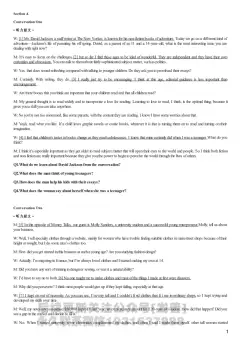
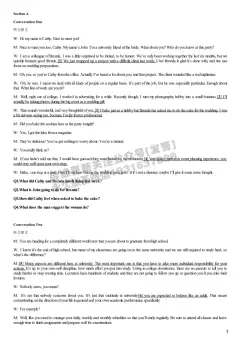
Conversation One
听听力力原原文文
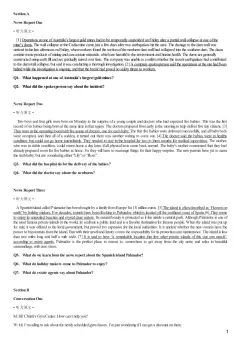
M: How are you enjoying your new job?
W: So far so good. I don’t miss having managers who deliver blunt, harsh feedback in the name of efficiency.
M: From the way you described your last company, no wonder they had a problem with high staff turnover.
W: Yeah. I couldn’t wait to get out of there once my contract expired. [1] The problem with a company culture that prizes directness above all
else is that it creates a toxic culture of brilliant jerks that drives people out and erodes itself from within.
M: [2] My company’s managers tend to be accommodating and kind, overlooking mistakes or issues, so it’s not to hurt feelings. Issues often get
ignored there until they build up and reach a crisis point.
W: That’s not surprising. My new company seems to employ a feedback policy that combines compassion and
directness. [3] Employees have the power to speak up, give feedback, disagree and discuss problems in real time. It seems to help us to course
correct, improve and meet challenges while also building teams that collaborate and care for one another.
M: But that would be based on an atmosphere of mutual trust, wouldn’t it? Otherwise, people might interpret feedback as some kind of personal
attack.
W: True. Without an atmosphere of trust, feedback can create stress and self-doubt. But I think when we get feedback from someone we trust,
we understand that the feedback isn’t some kind of personal attack. It’s actually a kind of support, because it’s off ered in the spirit of helping us
improve. I think sometimes people need to shift their mindsets around how they receive feedback.
M: [4] Yes, constructive feedback, after all, is how we learn and grow. It’s the basis for healthy parenting, lasting friendships, career development,
and so much more. If we shelter our children, friends and colleagues from information that might enrich and enhance their lives, we’re not being
caring, or actually doing harm to them.
W: That’s exactly right.
Q1.How does the woman describe her previous company’s culture?
Q2.What does the man say about his company’s managers?
Q3.What does the woman say the employees in her new company can do?
Q4.What does the man say about constructive feedback?
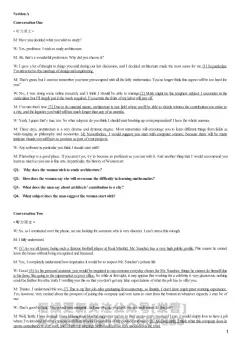
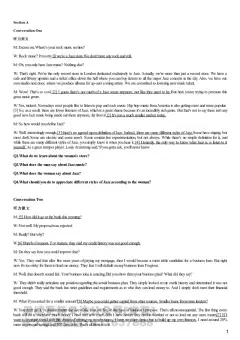
Conversation Two
听听力力原原文文
W: How was your holiday? Not too many other tourists around, were there?
M: No, very few, relatively. But I found myself moving from one accommodation to another, trying to fi nd the perfect place. It made me realize
that indecision is a big problem for me. [5] Instead of relaxing, I was looking for the best spot.
W: It seems you suff er from fear of better options. I’ve read about it. It describes this loop of indecision as part of our programming. [6]
Essentially, we have this tendency to keep stretching out the decision-making process. Because as human beings, we are hard-wired to optimize.
We have always looked to get the best things we can as a sort of survival of the fittest. Optimizing isn’t the problem, but rather the process that we
go through.
M: Well, that makes me feel better. [7] But I think thanks to technology, we can make comparisons more easily and have more access to choice
and customization. We can now see what we could have, how we might get it, and what offers have that we might want. We keep looking over
and returning to the same options, again and again.
W: [7] Yes, fear of better options off ers little benefit. It’s an ailment of abundance. You must have choices to have that fear of missing out on
better options.
M: Yes. I need to note when I’m worrying about inconsequential things, I guess. If I’m spending too much time worrying over what to have for
lunch, I’m robbing myself of the energy to focus on the things that matter.
W: Exactly. But for more important matters, I think gut instinct might be overrated. When you have 30 odd options, trusting your gut is not
1practical. [8] What you need to do is research, have a process, invest time exploring your options, and eliminate as many things as you can. The
most toxic part of decision making is going over the same options, time and time again.
Q5.What does the man say about his holiday?
Q6.What does the woman say people tend to do when making decisions?
Q7.What has made decision making increasingly difficult?
Q8.According to the woman, what should people do when making important decisions?
Section B
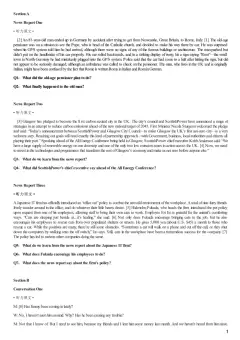
Passage One
听听力力原原文文
The role of homework in classrooms is not a new debate. Many parents and teachers are ardent supporters of homework. But do all students
benefit from homework? [9] A 2006 research paper suggested some correlation between the amount of homework done by a student and future
academic achievement for middle and high school students, but not so much for younger kids. A Stanford study in 2014 suggested that the same
was true for students in California’s affluent communities. The findings challenged the idea that homework was inherently good. The researchers
concluded that there was an upper limit to the correlation between homework and achievement, suggesting that high school students shouldn’t be
doing more than two hours of homework a night. And the most valuable kind of homework for elementary-level children was simply assigned free
reading.
The topic gets more complicated when we talk about the divide between rural and urban communities. [10] Studies found that in remote areas,
the poor quality or lack of Internet access can put students at a disadvantage, because 70% of teachers in these areas assign homework that
requires Internet access. But one in three households doesn’t have Internet. Experts assert homework requiring the Internet isn’t fair.
While the debate continues about the effect of homework on academic achievements, there are studies focusing on other benefits of homework.
[11] A study in Germany found that homework could have an effect on students’ personalities, suggesting that doing homework might help kids to
become more conscientious and independent learners.
Q9.What did the 2006 research find about homework?
Q10.What do experts think of homework requiring Internet access?
Q11.What conclusion could be drawn from the study in Germany?
Passage Two
听听力力原原文文
Robert Goddard, an American born in 1882, is widely regarded as the world’s fi rst rocket scientist. At age 27, Goddard published his fi rst
book, in which he hypothesized that a rocket launched from Earth could reach the Moon. Like many visionaries, the young scientist encountered
numerous skeptics. [12] In January 1920, the New York Times ridiculed Goddard’s theory that rockets could be utilized for space exploration.
Forty-nine years later, Apollo 11 reached the moon. And the famed newspaper published an apology to Goddard. [13] Goddard launched his first
rocket from his aunt’s farm in his native Massachusetts in March 1926. His maiden rocket voyage lasted a mere 3 seconds. It scaled an altitude of
only 12 meters. Nonetheless, it was a milestone in rocket science. [14] Goddard later consulted with a weather expert and determined that the
climate of New Mexico was ideal for year-round rocket launches. In 1930, Goddard and his family relocated there, to a remote valley in the
southwest of the country. There, he established a laboratory and test range. However, the ambitious scientist received negligible support from the
government.
For four years, wealthy businessman Daniel Guggenheim provided Goddard with an annual $25,000 grant to pursue his dreams. Other rocket
enthusiasts also raised funds for him. Over time, Goddard’s rockets grew more sophisticated and included the installation of instruments. In spite of
his many successes, Goddard was never able to interest the US military in rocket-propelled weapons. [15] He was granted over 200 patents and
continued to pioneer rocket technology until his death in 1945.
Q12.What do we learn about Goddard’s idea of using rockets for space exploration?
Q13.What does the passage say about Goddard’s first rocket launch?
Q14.Why did Goddard move to New Mexico?
Q15.What does the passage say about Goddard’s achievements?
2Section C
Recording One
听听力力原原文文
[16] Working for a new venture comes with a lot of risks. There’s instability, unclear responsibilities, and the need to be a master of all trades.
But the primary benefit is usually the passion and excitement associated with playing a role in a promising new company. The person to thank for
that passion and excitement is almost always the entrepreneur. There’s something about the founder’s energy and enthusiasm that infects the rest of
the team. The willingness to take risks may inspire others to be more courageous. The optimism and positivity may motivate people to focus less
on trivial and unimportant matters. The celebration of milestones may prompt staff to be more grateful about their own accomplishments and
privileges, or become set in the firm’s culture—it’s a contagious collection of affi rmative and positive emotions which are usually shared among the
team. [17] Science has already done a good job approving the results that follow. These include better processes, greater team cohesion, reduced
conflict and sharper alertness.
But what is yet to be demonstrated is whether the founders’ passion leads to increased team performance. This was recently tested in a research
which analyzed the teams of 73 new companies across a range of industries such as IT, medicine and energy. The CEOs were consulted once
again years after the initial analysis, and most shared their firm’s performance reports so that their success could be more objectively measured.
Entrepreneurial teams generally progress through three phases. The fi rst is inventing a product or service. The second is founding a venture to
sell that product or service. And the third is developing the fi rm so it continues to grow. The research has discovered that when the team is
passionate about the third phase, developing the firm, there’s a clear link to performance. But the fi rst phase, a passion for invention, is not a
reliable indicator that the fi rm will still be open for business a few years later. Likewise, the second, passion for founding the venture, doesn’t
necessarily translate into great success. The solution to great team performance stems from a willingness to recruit others who could direct their
passion towards the third phase of entrepreneurialism—developing the business.
Employing more staff can in itself be a risk for an entrepreneur, as is paying them big dollars to attract them. [18] On many occasions, the
entrepreneurs reported not paying themselves a wage at all initially in order to cover salaries and expenses.
Q16. What does the speaker say about working for a new venture?
Q17.What has science demonstrated regarding the positive culture of a new venture?
Q18.What does the speaker say about entrepreneurs at the initial stage of a new venture?
Recording Two
听听力力原原文文
Ageing is a curious thing in people’s desire to beat it, and death has become an industry worth hundreds of billions of dollars. Despite the huge
investment into research, ageing remains somewhat obscure, although there are certain things researchers do understand: they know that women
tend to have longer life spans, living on average six years longer than men. No one is really certain of the reason for this, [19] although the
speculation centers around the idea that women are more capable of surviving or handling disease than men. For virtually every disease, the effects
are greater on men than they are on women. Some suggest that women’s immune systems benefi t from their tendency to prioritize and nurture
social connections. But for me, this explanation is hardly convincing.
Researchers also know to an extent what causes ageing. For 60 years, it was believed that cells would continue to divide forever. It was only
uncovered in relatively recent times that older people’s cells divide a smaller number of times than younger people’s. Only cancer cells, in fact, are
capable of dividing forever. [20] Human cells have a limited reproductive ability. To an extent, we can postpone the eventual stop of cells’ dividing
through nutrition, exercise, good sleep and even relaxation techniques, but we cannot stop the ageing process. And researchers are yet to answer
the ultimate question of ageing: why does the body ultimately fall to pieces? In the opinion of some of the world’s best scientific minds on the
subject, part of the reason we don’t yet have an answer is because many researchers are looking in the wrong direction.
[21] Many public health policymakers believe that the resolution of age-associated disease will tell us something fundamental about the ageing
process, but, say some top scientists, that’s completely erroneous. They point to when the diseases of childhood were eliminated, but this did not
provide any insight into childhood development. In the same way, the idea that the resolution of age-associated disease like heart disease and
stroke will inform us about ageing is not based on sound science or logic. At best, if the major causes of death in developed countries were
eliminated, this would only add a decade to average life expectancy. But while there is money available to be spent on it, the search to understand
the secrets of ageing will be ongoing.
Q19.What do we learn about the possible reason why women tend to live longer?
Q20.What is the recent discovery about human cells?
Q21.What do many public health policymakers believe?
3Recording Three
听听力力原原文文
Good afternoon. In today’s talk, we’ll discuss how managers can get their staff to do what they are asked. [22] Much to their frustration,
managers often struggle to get their staff to comply with even simple instructions. Often they blame their employees: “They don’t read emails; they
don’t listen; they don’t care.”—that kind of thing. But according to a recent research conducted in Australia, it looks like it’s not the employees’
fault but the managers’.
[23] It’s easy to understand why people sometimes disobey procedures intentionally. Occasionally, it’s because they’re pressured to finish in a
short time. At other times, they may disagree with the spirit of the procedure—the effort demanded, the time consumed, the lack of potential eff
ectiveness. And every now and then, they just don’t want to, maybe deliberately or out of stubbornness.
So apart from that, what else gets in the way of procedural compliance? The research scholars surveyed 152 blue-collar workers from two
separate sites in the mining industry. They asked the workers a range of procedure-related questions, such as whether they found the procedures
useful, how confi dent they felt in their job, how comfortable they were to speak up in the workplace, and how closely they followed any new
procedures set by their managers. They were also asked to rate the extent to which they perceived their supervisors to be helpful. [24] That last
statement was the most instructive because, as the researchers found, there was a remarkably strong correlation between how helpful supervisors
were perceived to be and how likely their employees were to follow their directives. Supervisors’ helping behavior was found to be motivational in
nature. It increased employees’ perception of the likelihood of success in the attainment of job goals, and therefore fostered a willingness to
dedicate their effort and ability to their work.
In short, managers should be ongoing role models for the change, as the saying goes: “Do as I do, not as I say.” To affect behavioral change,
what’s most required is interaction and involvement—the human touch—and, naturally, processes that add value. Although procedures are
designed to guide and support employees’ work, employees, it seems, can’t always be expected to comply with procedures that are not seen as
useful. And of course, managers shouldn’t keep resending emails. [25] They’re an effective tool for the sharing of data or reports, but they’re a
hopeless tool if what a manager is desiring is a change in behavior.
Q22.Why are managers often frustrated with their employees?
Q23.Why do employees sometimes disobey procedures intentionally?
Q24.When are employees more likely to follow instructions according to the researchers?
Q25.What does the speaker say about emails?
4
![《[1.1.9.15]--2021年6月六级听力音频(第二套)_文本_最新更新,视频都在这_2026,6月六级速转存易和谐_1、2025年6月六级_04.2026六级英语新东方_{9}--近五年听力音频+原文》第1页预览](https://static.diaifu.net/ssd/ssd5/wenku/2026-04-20/13c20d9795a04109385b2dcbaeb17550/13c20d9795a04109385b2dcbaeb17550_1.webp)
![《[1.1.9.15]--2021年6月六级听力音频(第二套)_文本_最新更新,视频都在这_2026,6月六级速转存易和谐_1、2025年6月六级_04.2026六级英语新东方_{9}--近五年听力音频+原文》第2页预览](https://static.diaifu.net/ssd/ssd5/wenku/2026-04-20/13c20d9795a04109385b2dcbaeb17550/13c20d9795a04109385b2dcbaeb17550_2.webp)