Section A
News Report One
• 听力原文 •
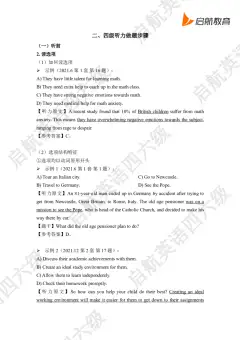
[2] An 81-year-old man ended up in Germany by accident after trying to get from Newcastle, Great Britain, to Rome, Italy. [1] The old-age
pensioner was on a mission to see the Pope, who is head of the Catholic church, and decided to make his way there by car. He was surprised
when his GPS system told him he had arrived, although there were no signs of any of the famous buildings or architecture. The man parked but
didn’t put on the handbrake of his car properly. His car rolled backwards, and in a striking display of irony, hit a sign saying “Rom”—the small
town in North Germany he had mistakenly plugged into the GPS system. Police said that the car had come to a halt after hitting the sign, but did
not appear to be seriously damaged, although an ambulance was called to check on the pensioner. The man, who lives in the UK and is originally
Italian, might have been confused by the fact that Rome is written Roma in Italian and Rom in German.
Q1::What did the old-age pensioner plan to do?
Q2::What finally happened to the old man?
News Report Two
• 听力原文 •
[3] Glasgow has pledged to become the fi rst carbon neutral city in the UK. The city’s council and ScottishPower have announced a range of
strategies in an attempt to reduce carbon emissions ahead of the new national target of 2045. First Minister Nicola Sturgeon welcomed the pledge
and said: “Today’s announcement between ScottishPower and Glasgow City Council—to make Glasgow the UK’s first net-zero city—is a very
welcome step. Reaching our goals will need exactly this kind of partnership approach—with Government, business, local authorities and citizens all
playing their part.” Speaking ahead of the All Energy Conference being held in Glasgow, ScottishPower chief executive Keith Anderson said: “We
have a large supply of renewable energy on our doorstep and one of the only two low emission zones in action across the UK. [4] Now, we need
to invest in the technologies and programmes that transform the rest of Glasgow’s economy and make us net zero before anyone else.”
Q3::What do we learn from the news report?
Q4::What did ScottishPower’s chief executive say ahead of the All Energy Conference?
News Report Three
• 听听力力原原文文 •
A Japanese IT firm has officially introduced an “office cat” policy to combat the stressful environment of the workplace. A total of nine furry friends
freely wander around in the office, and do whatever their little hearts desire. [5] Hidenobu Fukuda, who heads the firm, introduced the pet policy
upon request from one of his employees, allowing staff to bring their own cats to work. Employee Eri Ito is grateful for the animal’s comforting
ways. “Cats are sleeping just beside us...it’s healing,” she said. [6] Not only does Fukuda encourage bringing cats to the job, but he also
encourages his employees to rescue cats from over populated shelters or streets. He gives 5,000 yen (about U.S. $45) a month to those who
rescue a cat. While the positives are many, there’re still some obstacles. “Sometimes a cat will walk on a phone and cut off the call, or they shut
down the computers by walking onto the off switch,” Ito says. Still, cats in the workplace have been a tremendous success for the company. [7]
The policy has led to various other companies doing the same.
Q5::What do we learn from the news report about the Japanese IT firm?
Q6::What does Fukuda encourage his employees to do?
Q7::What does the news report say about the firm’s policy?
Section B
Conversation One
• 听力原文 •
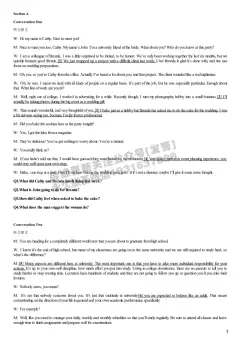
M: [8] Has Jimmy been coming in lately?
W: No, I haven’t seen him around. Why? Has he been causing any trouble?
M: Not that I know of. But I need to see him, because my friends and I lent him some money last month. And we haven’t heard from him since.
1[8] I heard he comes here a lot. So I thought I’d come in and check with you.
W: Well, that’s funny. Some other fellow came in asking for Jimmy just yesterday, a real nervous, pushy type of fellow,
[9] saying he needed Jimmy for some study project they were working on. But I can’t quite remember what it was all about. Is this a lot of money
we’re talking about here?
M: No, just 60 pounds between the three of us, but still, a bit too much to just let go. [10] He told us he’d got into an accident. Nothing serious,
mind you, but he damaged someone’s car and wanted to get some money together to make up for the damage he’d caused.
W: Hmm. Isn’t that sort of thing usually covered by insurance? And then if he still wanted to give money as some sort of apology or something, he
probably shouldn’t have to go around borrowing it from people.
M: You think Jimmy is just making it all up? See, I did think it was a bit weird for him to be asking for money for that sort of thing. And his story
was a bit vague to begin with. But I thought maybe [11] he doesn’t want his parents to know about what happened. So he’d rather come to us
and keep things quiet. Anyway, Jimmy’s a good guy, so we don’t make a fuss about it.
Q8::What does the man want to do?
Q9::What do we learn about the man who came to see the woman yesterday?
Q10::What did Jimmy say happened to him one day?
Q11::Why did Jimmy borrow money according to the man?
Conversation Two
• 听力原文 •
W: Hi, Max. How are you? Listen, [12] I want to ask you about ordering shopping online. I’ve never done it before and I know that you’ve been
doing it for ages.
M: Sure, I love getting my shopping delivered. It makes life so much simpler—no carrying heavy shopping bags in the rain, [13] or trying to park
the car on those huge supermarket car parks, then not being able to fi nd it again after you come out of the shops.
W: But there must be some problems. [14] I mean, how do you know that you won’t get bad fruit or that the eggs won’t be broken?
M: Oh, come on. The food is exactly the same as the stuff you buy in a conventional shop. They aren’t going to deliver you food that is out of date.
And if you get a broken egg, well, that could happen in a conventional shop, too. If anything is really wrong, you can just take photographs of the
damage, and they will give you the money back or replace the item.
W: How about delivery fees? Is it not more expensive to get everything delivered?
M: [15] I actually found that it was cheaper for me, as I live quite far away from my local supermarket. So with the deliveries, I am actually saving
on petrol.
W: I never thought of that. If you aren’t driving your own car, then you are saving on fuel. Right, you’ve convinced me. I’m going to go on the
computer now and give it a try. So, which supermarket do you think is the best to order from?
M: Oh, no, that’s defi nitely up to you. Otherwise, we’ll be here all day.
Q12::What did the woman want to ask Max about?
Q13::What does the man think is a problem with shopping in supermarkets?
Q14::What is the woman’s concern about shopping online?
Q15::What does the man fi nd about shopping online?
Section C
Passage One
• 听听力力原原文文 •
[16] A recent study found that ten percent of British children suff er from math anxiety. This means they have overwhelming negative emotions
towards the subject, ranging from rage to despair. Other emotions triggered by math include feelings of tension and frustration. Physical symptoms
2include a racing heart or struggling to catch breath. The phenomenon of math anxiety is characterized as a general sense of feeling that the subject is
hard compared with other subjects, leading to a subsequent lack or loss of confi dence.
Researchers said they investigated individuals’ attitudes towards mathematics because of what could be referred to as a “mathematics crisis” in
the UK. [17] There was a widespread misunderstanding that only low-performing children suffer from math anxiety. People automatically assume
children are anxious about math because they are poor achievers.
[18] In fact, more than three quarters of children with high levels of math anxiety are normal to higher achievers. Probably, their math anxiety will
go unnoticed because their performance is good. But, in the long term, their performance is negatively aff ected. So a real danger here is that
children who are completely able to do math at normal level may keep away from it because they feel anxious.[18] Math anxiety can severely
disrupt students’ performance in the subject in both primary and secondary school. But importantly—and surprisingly—this new study suggests
that the majority of students experiencing math anxiety have normal-to-high math ability.
Q16::What did a recent study find about some British children??
Q17::What is the widespread misunderstanding about math anxiety?
Q18::What does the passage say about British students with math anxiety?
Passage Two
• 听听力力原原文文 •
People spend a lot of time using phones and computers. Much of that time is devoted to text messages and social media. But many people
choose to spend their time playing computer games. For years, parents and teachers have worried that these games might be addictive. [19] And
now, the World Health Organization has recognized addiction to computer games as a disease. The organization explains that this decision refl ects
general agreement among experts around the world that some people have a problem with these games. They show a pattern of behavior
characterized by a lot of control. [20] Such people make computer games a priority over their responsibilities. They may play games instead of
attending school, or work, or socializing. According to the World Health Organization experts, people’s use of computer games is diff erent from
their use of the Internet, social media and online shopping. These experts claim there is not suffi cient data to indicate that people’s reliance on
those other activities isn’t addiction. But they argue that playing computer games to excess is diff erent. This behavior can become a disorder.
To meet the new defi nition for addiction, the behavior must damage a person’s relationships, or performance at school or work, and this must
last for at least a year. Still, not all behavior experts agree. [21] Some argue that there is not enough research on the subject. Thus, they claim it is
too early to call computer game addiction a disorder.
Q19::What conclusion has the World Health Organization come to recently?
Q20::What is said of people with addictive behavior?
Q21::What do some behavior experts think of addition to computer games?
Passage Three
• 听听力力原原文文 •
Maybe you carry the most powerful passport in the world, or perhaps the rarest passport. Whatever the case, your passport will likely be one of
four colors—red, blue, green or black, although there are slight variations. Switzerland’s passport is dark red, for example, [22] while most
European countries prefer a shade of red—that’s almost brown. There are no offi cial rules regarding possible colors. [23] But countries follow a
certain set of norms when designing them. The International Civil Aviation Organization, which works to defi ne the principles of air travel, suggests
that countries use suitable type, size and style for offi cial documents like passports. [23]There are also a few compulsory aspects of passports.
They must be made from material that bends. They should be able to be read by a machine at temperatures ranging from ten degree Celsius to fifty
degree Celsius, and conditions where the air can be extremely dry or moist.
Despite these existing recommendations, there is nothing regarding the cover color. Why? [24] Simply put, countries stick to darker and more
conservative colors because they appear more offi cial. And they can also hide dirt and wear. While there is little innovation when it comes to
passport cover color, the same cannot be said for the pages. [25]The passports of many countries contain images of their well-known
geographical features and wildlife, which also function as security features, as some are only visible under special light.
Q21::What do we learn about most European passports??
Q22::What does the passage say about the design of passports?
Q23::Why are dark colors chosen for passport covers?
3Q24::What is one special function of the images inside many passports?
4
![《[1.1.9.15]--21年6月四级听力音频(第二套)_文本_最新更新,视频都在这_2026、6月四级速转存易和谐_1、2025年6月四级_04.2026四级英语新东方_{9}--近五年听力音频+原文》第1页预览](https://static.diaifu.net/ssd/ssd5/wenku/2026-04-20/fa905f5c1bb6a51a5dbd3107322b7518/fa905f5c1bb6a51a5dbd3107322b7518_1.webp)
![《[1.1.9.15]--21年6月四级听力音频(第二套)_文本_最新更新,视频都在这_2026、6月四级速转存易和谐_1、2025年6月四级_04.2026四级英语新东方_{9}--近五年听力音频+原文》第2页预览](https://static.diaifu.net/ssd/ssd5/wenku/2026-04-20/fa905f5c1bb6a51a5dbd3107322b7518/fa905f5c1bb6a51a5dbd3107322b7518_2.webp)