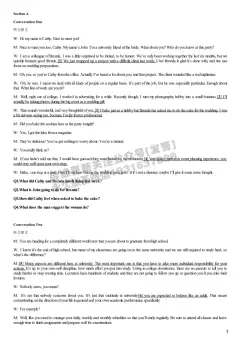
Section A
Conversation One
听听力力原原文文
W: [1] This is unbelievable, unlike any video game I’ve ever played before. It’s so boring yet so relaxing at the same time. How did you hear about
this driving simulator?
M: [2] My brother introduced it to me last year. I was surprised to fi nd how educational and realistic it was. It’s called euro truck simulator. But
they have other versions as well for Americans and so on. I was really drawn to the scenery. The routes go through parts of the country you don’t
normally see as a tourist.
W: Yeah, I can see that. It seems so simple, just transporting cargo from point A to point B, driving from one city to another. [3] But I really
appreciate all the details that go into the game. It’s even given me a new appreciation for the logistics industry and traffi c on the road.
M: I completely agree. My brother also introduced me to some videos of someone that streams their game online. It was fascinating to watch
really. This guy drove very carefully, obeyed all the road signs and traffi c rules, such a contrast to most violent games.
W: Honestly, playing has inspired me to look into the industry more. I’ve read articles about how self-driving trucks may soon be available and
could greatly impact cargo logistics. Considering all that goes into driving these larger vehicles, it’s amazing that we could soon have that kind of
technology.
M: Ha, I’ve gone one step further. I registered to take a safe driving course to improve my real-life driving skills. In a way, I feel like I have a head
start compared to other students in the class. Playing this video game has given me some maneuvering practice already.
W: [4] I’m not sure how accurate the video game is compared to real-life situations. But if it results in more drivers looking both ways before
entering an intersection, I’d say that’s a positive outcome.
Q1.What are the speakers mainly talking about?
Q2.What does the man say about the driving simulator?
Q3.What does the woman say she really appreciates?
Q4. What outcome does the woman expect from the driving simulator?
Conversation Two
听听力力原原文文
W: How do you like being self-employed?
M: [5] There are obvious benefi ts, though I don’t seem to have the freedom I anticipated, as I just don’t seem able to decline work offers .And
working alone, there have been times when I’ve found that money alone provides insufficient motivation. Have you experienced the same since you
began working for yourself?
W: Sometimes, it’s yes. Unlike the rest of the workforce who have managers to prompt motivation whenever they’re feeling lazy or bored, we
self-employed workers perform our jobs without a manager to lift our spirits. There’s no one around to off er praise or initiate collaboration, no
one to make greater use of our interests and talents.
M: That’s a fact. [6] Not every manager behaves with such awareness and care, of course. And certainly not all managers have a clue how to
motivate people. Still, having a manager nearby at least indicates there’s an opportunity. They’ll be decent enough to look out for you when your
energy and focus begin to deplete.
W: [7] The motivator I value most is autonomy. I’ve learned not to sacrifi ce my prized autonomy by working all hours of the day and by saying
yes to every client request.
M: [7] Yes. I need to remind myself that I selected this lifestyle for the independence. I don’t miss aspects of permanent full-time employment I
disliked, such as the offi ce politics, job insecurity, infl exible hours and so on. I wouldn’t mind a bit more in the form of praise though, praise which
is on the record.
W: That’ll come with time. [8] Relatedness is inevitably cultivated via human interaction engaging with clients, getting written testimony and
recommendations, staying in contact with clients afterwards. These are things you’ll find will come in due course and provide you with motivation.
M: [8] You’re right. That’s an area I do need to put some more effort into, building closer relationships with those who engage my services and
skills.
1Q5.What does the man say about his life of being self-employed?
Q6.What does the man say about managers?
Q7.What do both speakers value most about self-employment?
Q8. On what point does the man agree with the woman?
Section B
Passage One
听听力力原原文文
Weather is a constant force in our lives, but there’s little marketing research on how it affects businesses.
[9] Now a new study reveals how sunny and snowy conditions influence consumer behavior. [10] Those weather conditions trigger consumers
to mentally visualize using products associated with the respective weather. This leads to consumers placing a higher value on those products. That
is, they’re willing to pay more money for them. But the correlation is only found with products related to being outside. How does this work?
Researchers give the example of a beach towel. On a sunny day, consumers who see that product are not just looking at the towel itself. They are
likely imagining themselves lying on the towel in the sun. This mental picture of using the towel increases the value of the product in the consumers’
mind.
Researchers put forward the following hypothesis to explain their findings. They think the mental picture works in sunshine and snow, because
these weather conditions have a positive association with outside activities. The effect is not seen with rainy weather. Researchers assert this is
because there aren’t many activities that are enabled by rain. Most products associated with rain like umbrellas are only used for protection from
the weather, and not for any activities. Researchers believe that companies that sell a wide array of products online can benefit most from the
insights this study provides. [11] Online sellers often use complex mathematical formulas to determine what products to feature and how to price
those products. Incorporating more data about weather would allow them to make better decisions. This could bolster sales.
Q9.What do we learn about the findings of the new study?
Q10.What does the passage say may increase the value of products for consumers?
Q11.How can the findings of the new study benefit online sellers according to the researchers?
Passage Two
听听力力原原文文
Setting the office air-conditioning at about 22 degrees Celsius has become standard practice across the world. Numerous guidebooks across
the world on heating, ventilation and air-conditioning claim office performance peaks at 22 degrees. Many people indeed fi nd relief from soaring
summer temperatures in air-conditioned offices. [12] But recent studies have challenged the accepted wisdom that a cool office is more
productive. The reality is more complex.
[13] Researchers conducted a review of all studies relating to air-conditioning and productivity. They found that 22 degrees was probably a little
chilly, even at the height of summer. For a person dressed in typical summer clothing, an optimal range would be between 23 and 26 degrees. And
people can even tolerate temperatures beyond this comfort zone, as long as they can adjust their clothing and expectations. [14] In fact, even on
very hot days, it makes sense to turn the air-conditioning up. People often chase just one optimum temperature. And this is understandable when
people feel hot. But there is a range of at least 3 to 4 degrees, which does not have any adverse impact. Another issue related to this is that people
can become psychologically dependent on air-conditioning. [15] If they are used to the environment which is air-conditioned, they tend to prefer
lower temperatures. But the studies found that almost all humans became accustomed to the new temperature. It was only at the extreme ends of
the temperature range where people’s productivity suff ered. This range was above 26 degrees and below 19 degrees.
Q12.What is the accepted wisdom concerning the office environment?
Q13.What did researchers fi nd from the review of all studies relating to air-conditioning and productivity?
Q14.What do we learn about using a little less air-conditioning during hot weather?
Q15.What happens when people are used to an air-conditioned environment?
Section C
2Recording One
听听力力原原文文
Psychology research has tended to portray solitude as a negative experience. Studies conducted in the 1970s and 1990s suggested that people
felt less happy when alone as compared to being with others. However, a new paper shows an alternative view of solitude, one in which solitude
can be positive.
Let’s start by looking at the earlier research. It had a couple of shortcomings. First, it measured a motion on a scale from positive to negative,
overlooking the possibility that our positive and negative emotions can fluctuate independently. [16] Also, it categorized emotions as simply positive
or negative. It didn’t consider that emotions arouse us to different degrees, and that both positive and negative emotions can arouse us a lot or a
little. That is, whether positive or negative emotions can be either high arousal or low arousal? High arousal emotions include excitement on the
positive side or anger on the negative side; while low arousal ones include feeling calm on the positive side or lonely on the negative.
This new research attempted to overcome these shortcomings. Researchers began with a simple study. They asked participants to spend 15
minutes sitting alone without engaging in any activity, and measured how this solitude influence their emotional state. This experiment specifi cally
aimed to determine the eff ect of solitude on high arousal emotions. It looked at positive emotions such as being excited or interested, and negative
emotions including being scared or distressed. [17] The results were clear: after 15 minutes of solitude, the participants showed reductions in both
types of emotion.
A second study measured the effects of solitude on low arousal emotions. These included both positive and negative emotions, such as feeling
calm, relaxed, sad, or lonely. [18] That experiment found that all of these emotions were increased by time alone. Thus, it seems past depictions of
solitude were wrong. It doesn’t have a simple, emotional effect that can be characterised as good or bad. Rather, it changes the intensity of our
inner experience. It amplifies quieter emotions, but it diminishes the intensity of stronger feelings.
It’s worth clarifying that these fi ndings relate to relatively brief periods of solitude. This is distinct from prolonged loneliness. Research has
demonstrated that the latter is correlated with an assortment of negative physical and psychological effects. How can people benefi t from being
alone? The findings here suggest that people can use solitude to regulate their emotions. Solitude can help us become quiet after excitement, calm
after an angry episode, or simply feel at peace.
Q16.What is one of the criticisms directed at the early research on solitude?
Q17.What do we learn about the results of the new research?
Q18.What does the second experiment in the new research find about solitude?
Recording Two
听听力力原原文文
In 1984, the World Chess Championship was called off abruptly, due to the withered frame of a player who was competing for the title. He
wasn’t alone in experiencing the extreme physical eff ects of the game. Elite players can reportedly burn up to an absurd 6,000 calories in one day.
Does that mean that thinking harder is a simple route to losing weight? [19] Well, when the body is at rest, we know that the brain use up a
startling 20% to 25% of the body’s overall energy. This level of utilisation actually makes the brain the most energy-expensive organ in the body,
and yet it makes up only 2% of the body’s weight overall.
So the more we put this organ to work, the more calories we’ll burn? Technically, the answer is yes, for cognitively difficult tasks. What counts
as a difficult mental task varies between individuals. But generally, it could be described as something that the brain cannot solve easily using
previously learned routines or tasks that change the conditions continuously. However, deep thinking will not burn off the calories gained from
eating a sugary snack. Because in relation to the brain’s huge overall energy usage, which is devoted to a multitude of tasks, the energy required
just to think harder is actually comparatively tiny. [20] We’re unconscious of most of what uses up the brain’s energy. A lot of that activity is
unrelated to conscious activities, like learning how to sing or play the guitar.
The brain is able to allocate blood and thus energy to particular regions that are being active at that point. [21] But the overall energy
availability in the brain is thought to be constant. So while there might be signifi cant increases in energy use at localized regions of the brain when
we perform diffi cult cognitive tasks, when it comes to the whole brain’s energy budget overall, these activities don’t signifi cantly alter it.
So why did the chess champion grow too skinny to compete in his chess competition? The general consensus is that it mostly comes down to
stress and reduced food consumption, not mental exhaustion. Keeping your body pumped up for action for long periods of time is very energy
demanding. If you can’t eat as often or as much as you can or would normally, then you might lose weight.
Q19.What do we learn about the brain when the body is at rest?
Q20.What does the speaker say about the consumption of the brain’s energy?
Q21.What do we learn about the overall energy availability in the brain?
3Recording Three
听听力力原原文文
“Tell me about yourself ” may seem like an easy job interview question. [22] But the open-ended nature of this question often leaves job
seekers at a loss where to start. This common question is actually a critical test of a job candidate’s communication skills, so it’s important not to
give an unprepared response or mess it up. “Tell me about yourself ” is often the first question professional career coaches prepare people for
when they give interview guidance. It’s the opportunity for the candidate to take control of the narrative and tell their story in a way that really
matters to their audience. It takes hard work and extensive preparation to answer this question well. When a person goes to a job interview, their
interviewer has presumably read their résumé, [23] so they don’t need to repeat the information. But that’s what most people will do as it’s their
instinct to recite things that are already on their résumé.
It’s important for job seekers to do their homework on two crucial aspects. First, they are not just telling someone a fact about themselves.
They’re telling a story, and stories take work to create. Coming up with a good story means getting refl ective about what made their career
accomplishments something they’re proud of, and what strengths those accomplishments highlight. Candidates shouldn’t pick a broad, general
strength to elaborate on, such as “I’m smart”, “I work hard” and “I get things done”. [24] To come up with multiple career accomplishments or
examples for different interview questions, job seekers should talk with others, especially people who know them—partners, friends, or co-
workers, who will bring up different stories than the ones they remember.
[25] Secondly, candidates should know what’s at stake for the company with this job opening. What they really are asking you is “Tell me why
you are going to help me.” If the person is a prepared candidate, they should have already fi gured out those things. They’ve read the job
description and researched the company on the internet. What job applicants ought to be looking for is what the company is up to, what they are
trying to accomplish, and what is preventing them from accomplishing those things.
How long should it take to answer? Around a minute. That’s about right for most people’s attention spans. Under a minute could seem rushed,
while over 2 minutes will start to feel more like a speech. But the length of the answer is not an exact science, and candidates need to keep their
career story focused and tailored to their audience.
Q22.What does the speaker say about the job interview question “Tell me about yourself”?
Q23.What will most people do when they come to a job interview?
Q24.Why should job seekers talk with partners, friends and co-workers?
Q25.What other important preparations should job seekers make before an interview?
4
![《[1.1.9.17]--2020年12月六级听力音频(第二套)_文本_最新更新,视频都在这_2026,6月六级速转存易和谐_1、2025年6月六级_04.2026六级英语新东方_{9}--近五年听力音频+原文》第1页预览](https://static.diaifu.net/ssd/ssd5/wenku/2026-04-20/f0c0f20d61269d144cd5fd38433197d4/f0c0f20d61269d144cd5fd38433197d4_1.webp)
![《[1.1.9.17]--2020年12月六级听力音频(第二套)_文本_最新更新,视频都在这_2026,6月六级速转存易和谐_1、2025年6月六级_04.2026六级英语新东方_{9}--近五年听力音频+原文》第2页预览](https://static.diaifu.net/ssd/ssd5/wenku/2026-04-20/f0c0f20d61269d144cd5fd38433197d4/f0c0f20d61269d144cd5fd38433197d4_2.webp)
![《[1.1.9.17]--2020年12月六级听力音频(第二套)_文本_最新更新,视频都在这_2026,6月六级速转存易和谐_1、2025年6月六级_04.2026六级英语新东方_{9}--近五年听力音频+原文》第3页预览](https://static.diaifu.net/ssd/ssd5/wenku/2026-04-20/f0c0f20d61269d144cd5fd38433197d4/f0c0f20d61269d144cd5fd38433197d4_3.webp)
![《[1.1.9.17]--2020年12月六级听力音频(第二套)_文本_最新更新,视频都在这_2026,6月六级速转存易和谐_1、2025年6月六级_04.2026六级英语新东方_{9}--近五年听力音频+原文》第4页预览](https://static.diaifu.net/ssd/ssd5/wenku/2026-04-20/f0c0f20d61269d144cd5fd38433197d4/f0c0f20d61269d144cd5fd38433197d4_4.webp)
![《[1.1.9.17]--2020年12月六级听力音频(第二套)_文本_最新更新,视频都在这_2026,6月六级速转存易和谐_1、2025年6月六级_04.2026六级英语新东方_{9}--近五年听力音频+原文》第5页预览](https://static.diaifu.net/ssd/ssd5/wenku/2026-04-20/f0c0f20d61269d144cd5fd38433197d4/f0c0f20d61269d144cd5fd38433197d4_5.webp)
![《[1.1.9.17]--2020年12月六级听力音频(第二套)_文本_最新更新,视频都在这_2026,6月六级速转存易和谐_1、2025年6月六级_04.2026六级英语新东方_{9}--近五年听力音频+原文》第6页预览](https://static.diaifu.net/ssd/ssd5/wenku/2026-04-20/f0c0f20d61269d144cd5fd38433197d4/f0c0f20d61269d144cd5fd38433197d4_6.webp)
![《[1.1.9.17]--2020年12月六级听力音频(第二套)_文本_最新更新,视频都在这_2026,6月六级速转存易和谐_1、2025年6月六级_04.2026六级英语新东方_{9}--近五年听力音频+原文》第7页预览](https://static.diaifu.net/ssd/ssd5/wenku/2026-04-20/f0c0f20d61269d144cd5fd38433197d4/f0c0f20d61269d144cd5fd38433197d4_7.webp)
![《[1.1.9.17]--2020年12月六级听力音频(第二套)_文本_最新更新,视频都在这_2026,6月六级速转存易和谐_1、2025年6月六级_04.2026六级英语新东方_{9}--近五年听力音频+原文》第8页预览](https://static.diaifu.net/ssd/ssd5/wenku/2026-04-20/f0c0f20d61269d144cd5fd38433197d4/f0c0f20d61269d144cd5fd38433197d4_8.webp)
![《[1.1.9.17]--2020年12月六级听力音频(第二套)_文本_最新更新,视频都在这_2026,6月六级速转存易和谐_1、2025年6月六级_04.2026六级英语新东方_{9}--近五年听力音频+原文》第9页预览](https://static.diaifu.net/ssd/ssd5/wenku/2026-04-20/f0c0f20d61269d144cd5fd38433197d4/f0c0f20d61269d144cd5fd38433197d4_9.webp)