Section A
News Report One
• 听力原文 •
Good morning. In today’s headlines, Scotland’s transport minister has warned of potentially extreme weather conditions as heavy snow is
forecast across the country later this week. Orange warnings are enforced for many areas for Wednesday and Thursday. [1] The transport minister
advised people in parts of Scotland covered by the orange alert to avoid travel on Wednesday. This is what he said to us: “The orange warning
may be raised to red in some areas. That is a warning for snow that has never been seen since the modern system came into place in Scotland.”
The orange warning has been extended until 6 pm on Thursday. Trains, planes and ferries are also likely to be aff ected, with a wind chill that could
see parts of Britain feeling as cold as minus 15 degrees Celsius. [2] The head of Road Policing said, “I would urge drivers to take extra care on the
roads for their journeys. Drivers should make sure they’re prepared for their journey with warm clothing, food and drink, suffi cient fuel and a
charged mobile phone. There could be signifi cant traffi c delays, so please start to plan your journey now and consider if you really need to travel
when conditions are this poor.”
Q1::What were people in parts of Scotland advised to do?
Q2::What did the head of Road Policing urge drivers to do?
News Report Two
• 听力原文 •
[3] Romania’s wetlands are coming back to life thanks to help from local communities, the World Wildlife Fund, and funding from the European
Union. Roughly 2,224 acres of the picturesque Danube Delta—home to 300 species of birds—have filled with wildlife. The land has been
connected to the network of lakes and streams in the area.
“A lot of birds have migrated to the area, and one doesn’t need to travel long hours anymore or go to other lakes to watch the birds,” says Ion
Meuta, deputy mayor of Mahmudia.
The area around Mahmudia, which is a UNESCO World Heritage Site, is the third-most bio-diverse in the world, after Australia’s Great Barrier
Reef and the Galapagos Islands. Groups used earth-moving equipment to restore the waterways. [4] Government officials proposed to protect the
area’s endangered wild fi sh by issuing a fishing ban over the next decade.
Q3::What is the news report mainly about?
Q4::What did government offi cials propose to do to protect the endangered fish?
News Report Three
• 听力原文 •
Scott Dunn recently awoke from a medically-induced sleep he’d been in after a car accident. He was heartbroken after realizing he’d missed his
high school graduation. So his classmates decided to give him another chance. [5] It was just a month ago that East Juniata High School seniors
met in the school’s auditorium for graduation. And last week, they did it again. [5] Scott’s car accident was on May 22nd, just three days before
the ceremony.
[6] “I remember waking up in the hospital and asking mom what date it was. She told me it was the 28th,” he said. “I looked at her and said ‘I
missed my graduation. ’” The school’s principal Mr. Fausey called Scott’s mom Karen and said that everybody wanted to do something special
for him. Students wore their caps and gowns and sat in the front of the auditorium. Scott’s parents, Karen and Scott Senior, sat front and centre.
After brief speeches, Scott’s name was called, only Scott’s name. He walked across the stage as the audience cheered. A graduation for one. [7]
“I’m speechless,” Scott said. “I don’t know how to even explain it. I’m speechless to know that so many people are behind me.”
Q5::What happened to Scott a month ago?
Q6::What did Scott ask about when he regained consciousness?
Q7::Why was Scott speechless at the graduation ceremony?
Section B
Conversation One
1• 听听力力原原文文 •
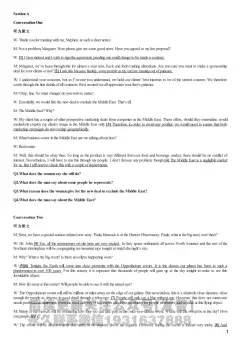
M: How do you like your new flexible work arrangement? Do you enjoy working from home?
W: Yes and no. [8] I find isolation challenging at times. Apart from my mother, not too many people I know have time for phone chats during
working hours. I tried the library, but found I wasn’t really keen on working there.
M: No, neither would I. [9] I find the library a bit too quiet. I’d lack inspiration or stimulation, which would be counterproductive to getting a lot of
work done.
W: I find the same thing. So, lately I’ve been going out to cafés occasionally. [10] I love the noise, the people, the busyness of a café, the sense of
being out in the world.
M: Coffee shops seem to have effectively become office spaces for so many people in this digital age, though I’m not sure how café owners feel
about it—having so many people who go to their places to work rather than drink and eat.
W: Yes, some people seem to spend a lot of time there and not order much. [11] The most annoying ones for café owners must surely be those
usually only two of them who occupy a table for six with their laptops and paperwork.
M: They should sit at a table for two, not at the table for six. Some obviously stay so long. They need to plug the laptops into a power outlet. I
nearly tripped over someone’s computer electrical lead the other day in my local café.
W: It’s a double-edged sword. No doubt about that for a café owner. While remote workers help to keep the café full in quiet times, they can
take up valuable table space in busy periods.
Q8::What does the woman say is the disadvantage of working from home?
Q9::What does the man say is counterproductive to getting work done in the library?
Q10::What does the woman like about doing one’s work in a café?
Q11::What is most annoying for café owners according to the woman?
Conversation Two
• 听听力力原原文文 •
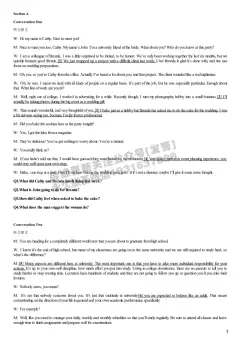
W: I’m going to start looking for another job. I can’t see myself getting an opportunity to progress at my company anytime in a near future. [12]
And I really think my skills and abilities deserve a higher salary.
M: You’re not going to quit, are you?
W: I’m thinking I might as well. Then I can devote more time and energy to finding a better position at another company.
M: But you’ve been at your present company less than two years, haven’t you? This will be the third time you’ve left a job in the last five years.
[13] If you do several jobs in a relatively short span of time, prospective employers might perceive that you lack loyalty. That could make them
wary and reluctant to employ you.
W: Unfortunately, loyalty doesn’t pay. Even if I get a promotion at my company, it’s likely to be less sizable than if I were to get a job elsewhere.
[14] And even if I get a promotion, I’m not guaranteed to get a raise. I had that experience at another company I worked at.
M: They wanted you to take on more work and responsibility but for the same amount of money?
W: More or less, yes. [15] The way I see it, through having different jobs, I’ve gathered a lot of experience in different jobs and in different
industries.
M: But potential employers might worry that that experience is not deep, or thorough enough.
W: Perhaps, but I feel pretty confident that I can sell myself. You know what they say, “Fortune favors the brave.”
Q12::What makes the woman think about changing her job?
Q13::What does the man say about people who keep changing their jobs?
Q14::What does the woman say would happen even if she got promoted in her current company?
Q15::What benefit has the woman gained from changing her jobs frequently?
2Section C
Passage One
• 听听力力原原文文 •
There is a saying that goes something along the lines of “You must love yourself fi rst before you can love someone else.” Similarly, I personally
believe that you must be comfortable and happy in your own company before you can truly be yourself in the company of others. There is a
massive difference between being lonely and being alone. Loneliness is a horrible feeling. However, you don’t have to actually be alone to feel that
way. Many times, I’ve felt lonely when surrounded by a big group of people. [16]In contrast, being alone can actually be a blessing, particularly,
when you’ve actively chosen it.
In my experience, being bored and alone is dangerous and can easily lead to the feeling of loneliness. [17]The trick is to be active. Get outside,
stretch your legs, do something cultural, buy yourself something tasty to eat or something pretty to wear. You don’t have to take anyone else into
consideration and can do whatever you please.
[18]Spending time alone also allows you to more effi ciently take care of problems. And then, when it’s time to be social and meet up with your
friends, you will be fully there, because you won’t have too much other stuff fl oating around in your mind. Having been alone for a bit, you will also
appreciate your friends’ company more and chances are your time spent together will be more worthwhile.
Q16::What does the speaker say about being alone?
Q17::What does the speaker say helps reduce one’s feeling of loneliness?
Q18::What is an advantage of spending one’s time alone?
Passage Two
• 听听力力原原文文 •
When I turned twelve, I worked summers at my father’s small brick cleaning business. I remember the harsh acid smell of the cleaning solution,
and the scraping sound of stiff iron brushes against rough brick. It was tempting to hurry a job, just fi nish. [19] But anybody who worked for
Thomas Kahoon had to meet his standards, and that included me. If I messed up, he made me stay late until I got it right. My father wasn’t being
mean. He demanded the same of himself. Every brick he cleaned on the house stood out like a red jewel in a white setting. It was his signature.
In 1970, when I was twenty, I got married. I moved out my parents’ modest place into a housing project. [20] Drugs and gang violence were
just beginning to plague the projects. Some of my friends went to jail. Some were killed. My wife Verllen was 18, and nobody gave our marriage a
chance. But we believed in each other. And our faith made us strong.
When we married, I worked as a stock clerk at Southwest Super Foods. [21] It was hard, tedious work. Each Friday night a truck came, with
cases of food that had to be unloaded, priced and placed on shelves. Most of stock clerks tried to get Friday night off . But I was always ready to
work. By Saturday morning, all the cans and jars in my aisle were placed with the labels facing smartly out, like a line of soldiers on review. That
was my signature. I took pride in a job nobody wanted.
Q19::What do we learn about the speaker’s father?
Q20::What does the speaker say about the housing project?
Q21::What do we learn about the speaker as a stock clerk?
Passage Three
• 听听力力原原文文 •
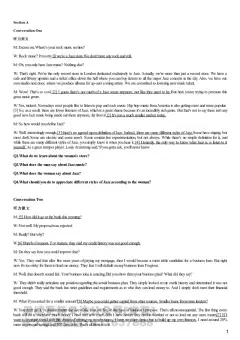
Watching more than 3 hours of television a day doubles memory loss in older people, a new study of more than 3,000 adults suggests.
[22]Scientists at University College London used memory and fluency tests on the same group of people 6 years apart. They found that those who
watched on average less than 3 hours’ television a day showed a decline of around 4 to 5 percent, while those who tended to watch more than 3
hours a day declined by an average of 8 to 10 percent. [23]The research team say they believe the “alert-but-passive” nature of television
watching may be creating stress on the mind, which contributes to memory decline.
Older people who watch more television are also less likely to undertake activities known to preserve mental functioning, such as reading, or
interactive screen-based pursuits, such as using the Internet or playing video games. [24]The researchers say that television viewing may be a risk
factor for Alzheimer’s disease, but more research is needed to establish a link.
[25]While watching television may have educational benefits and relaxation benefits, the researchers advise that adults over the age of 50 should
try and ensure that television viewing is balanced with other contrasting activities. If you’re concerned that the amount of television you’re watching
3could have a negative impact on your health, you should limit the amount of TV you watch each day and undertake some healthy hobbies.
Q22::By what means did scientists at University College London measure memory loss?
Q23::What contributed to memory decline in the participants?
Q24::What did the researchers say about their finding concerning the link between TV viewing and Alzheimer’s disease?
Q25::What do the researchers suggest older people do?
4
![《[1.1.9.19]--20年7月四级听力音频(仅一套)_文本_最新更新,视频都在这_2026、6月四级速转存易和谐_1、2025年6月四级_04.2026四级英语新东方_{9}--近五年听力音频+原文》第1页预览](https://static.diaifu.net/ssd/ssd5/wenku/2026-04-20/583c8537acc17165dece8bc2b05036da/583c8537acc17165dece8bc2b05036da_1.webp)
![《[1.1.9.19]--20年7月四级听力音频(仅一套)_文本_最新更新,视频都在这_2026、6月四级速转存易和谐_1、2025年6月四级_04.2026四级英语新东方_{9}--近五年听力音频+原文》第2页预览](https://static.diaifu.net/ssd/ssd5/wenku/2026-04-20/583c8537acc17165dece8bc2b05036da/583c8537acc17165dece8bc2b05036da_2.webp)
![《[1.1.9.19]--20年7月四级听力音频(仅一套)_文本_最新更新,视频都在这_2026、6月四级速转存易和谐_1、2025年6月四级_04.2026四级英语新东方_{9}--近五年听力音频+原文》第3页预览](https://static.diaifu.net/ssd/ssd5/wenku/2026-04-20/583c8537acc17165dece8bc2b05036da/583c8537acc17165dece8bc2b05036da_3.webp)
![《[1.1.9.19]--20年7月四级听力音频(仅一套)_文本_最新更新,视频都在这_2026、6月四级速转存易和谐_1、2025年6月四级_04.2026四级英语新东方_{9}--近五年听力音频+原文》第4页预览](https://static.diaifu.net/ssd/ssd5/wenku/2026-04-20/583c8537acc17165dece8bc2b05036da/583c8537acc17165dece8bc2b05036da_4.webp)
![《[1.1.9.19]--20年7月四级听力音频(仅一套)_文本_最新更新,视频都在这_2026、6月四级速转存易和谐_1、2025年6月四级_04.2026四级英语新东方_{9}--近五年听力音频+原文》第5页预览](https://static.diaifu.net/ssd/ssd5/wenku/2026-04-20/583c8537acc17165dece8bc2b05036da/583c8537acc17165dece8bc2b05036da_5.webp)
![《[1.1.9.19]--20年7月四级听力音频(仅一套)_文本_最新更新,视频都在这_2026、6月四级速转存易和谐_1、2025年6月四级_04.2026四级英语新东方_{9}--近五年听力音频+原文》第6页预览](https://static.diaifu.net/ssd/ssd5/wenku/2026-04-20/583c8537acc17165dece8bc2b05036da/583c8537acc17165dece8bc2b05036da_6.webp)
![《[1.1.9.19]--20年7月四级听力音频(仅一套)_文本_最新更新,视频都在这_2026、6月四级速转存易和谐_1、2025年6月四级_04.2026四级英语新东方_{9}--近五年听力音频+原文》第7页预览](https://static.diaifu.net/ssd/ssd5/wenku/2026-04-20/583c8537acc17165dece8bc2b05036da/583c8537acc17165dece8bc2b05036da_7.webp)
![《[1.1.9.19]--20年7月四级听力音频(仅一套)_文本_最新更新,视频都在这_2026、6月四级速转存易和谐_1、2025年6月四级_04.2026四级英语新东方_{9}--近五年听力音频+原文》第8页预览](https://static.diaifu.net/ssd/ssd5/wenku/2026-04-20/583c8537acc17165dece8bc2b05036da/583c8537acc17165dece8bc2b05036da_8.webp)
![《[1.1.9.19]--20年7月四级听力音频(仅一套)_文本_最新更新,视频都在这_2026、6月四级速转存易和谐_1、2025年6月四级_04.2026四级英语新东方_{9}--近五年听力音频+原文》第9页预览](https://static.diaifu.net/ssd/ssd5/wenku/2026-04-20/583c8537acc17165dece8bc2b05036da/583c8537acc17165dece8bc2b05036da_9.webp)
![《[1.1.9.19]--20年7月四级听力音频(仅一套)_文本_最新更新,视频都在这_2026、6月四级速转存易和谐_1、2025年6月四级_04.2026四级英语新东方_{9}--近五年听力音频+原文》第10页预览](https://static.diaifu.net/ssd/ssd5/wenku/2026-04-20/583c8537acc17165dece8bc2b05036da/583c8537acc17165dece8bc2b05036da_10.webp)