Section A
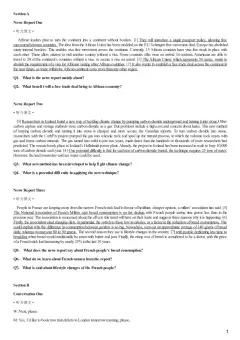
Conversation One
听力原文
W: Hi, my name is Cathy. Nice to meet you!
M: Nice to meet you too, Cathy. My name’s John. I’m a university friend of the bride. What about you? Who do you know at this party?
W: I am a colleague of Brenda. I was a little surprised to be invited, to be honest. We’ve only been working together the last six months, but we
quickly became good friends. [1] We just wrapped up a project with a difficult client last week. I bet Brenda is glad it’s done with, and she can
focus on wedding preparations.
M: Oh, yes, so you’re Cathy from the office. Actually I’ve heard a lot about you, and that project. The client sounded like a real nightmare.
W: Oh, he was. I mean we deal with all kinds of people on a regular basis. It’s part of the job, but he was especially particular. Enough about
that. What line of work are you in?
M: Well, right out of college, I worked in advertising for a while. Recently though, I turn my photography hobby into a small business. [2] I’ll
actually be taking photos during the big event as a wedding gift.
W: That sounds wonderful, and very thoughtful of you. [3] I bake just as a hobby but Brenda has asked me to do the cake for the wedding. I was
a bit nervous saying yes, because I’m far from a professional.
M: Did you bake the cookies here at the party tonight?
W: Yes, I got the idea from a magazine.
M: They’re delicious! You’ve got nothing to worry about. You’re a natural.
W: You really think so?
M: If you hadn’t told me that, I would have guessed they were baked by the restaurant. [4] You know, with your event planning experience, you
could very well open your own shop.
W: Haha...one step at a time. First I’ll see how baking the wedding cake goes. If it’s not a disaster, maybe I’ll give it some more thought.
Q1.What did Cathy and Brenda finish doing last week?
Q2.What is John going to do for Brenda?
Q3.How did Cathy feel when asked to bake the cake?
Q4.What does the man suggest the woman do?
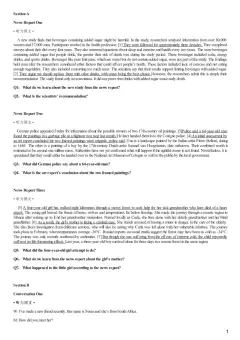
Conversation Two
听力原文
M: You are heading for a completely different world now that you are about to graduate from high school.
W: I know it’s the end of high school, but many of my classmates are going on to the same university and we are still required to study hard, so
what’s the difference?
M: [5] Many aspects are different here at university. The most important one is that you have to take more individual responsibility for your
actions. It’s up to your own self-discipline, how much effort you put into study. Living in college dormitories, there are no parents to tell you to
study harder or stop wasting time. Lecturers have hundreds of students and they are not going to follow you up or question you if you miss their
lectures.
W: Nobody cares, you mean?
M: It’s not that nobody concerns about you. It’s just that suddenly at university [6] you are expected to behave like an adult. That means
concentrating on the direction of your life in general and your own academic performance specifically.
W: For example?
M: Well, like you need to manage your daily, weekly and monthly schedules so that you’ll study regularly. Be sure to attend all classes and leave
enough time to finish assignments and prepare well for examinations.
1W: Okay, and what else is different?
M: Well, in college there are lots of distractions and you need to control yourself. [7] You will make interesting friends, but you need only keep
the friends who respect your student commitments. [8] Also, there are a lot of wonderful clubs, but you shouldn’t allocate too much time to club
activities, unless they are directly related to your study. It’s also your choice if you want to go out at night, but you will be foolish to let that affect
your class performance during the day.
W: Well, I’m determined to do well in university and I guess I’m going to have to grow up fast.
Q5.What does the man say about college students as compared with high schoolers?
Q6.What are college students expected to do according to the man?
Q7.What kind of friends does the man suggest the woman make as a college student?
Q8.What kind of club activities should college students engage in according to the man?
Section B
Passage One
听听力力原原文文
[9] Most successful people are unorthodox persons whose minds wonder outside traditional ways of thinking. Instead of trying to refine old
formulas, they invent new ones. When Jean-Claude Killy made the French national ski team in the early 1960s, he was prepared to work harder
than anyone else to be the best. At the crack of dawn, he would run up the slopes with his skis on, an unbelievably back-breaking activity. In the
evening, he would do weightlifting and running. But the other team members were working as hard and long as he was. He realized instinctively that
simply training harder would never be enough. Killy then began challenging the basic theories of racing technique.
Each week, he would try something different to see if he could find a better, faster way down the mountain. [10] His experiments resulted in a
new style that was almost exactly opposite the accepted technique of the time. It involved skiing with his legs apart for better balance and sitting
back on the skis when he came to a turn. He also used ski poles in an unorthodox way—to propel himself as he skied. The explosive new style
helped cut Killy’s racing time dramatically. [11] In 1966 and 1967, he captured virtually every major skiing trophy. The next year, he won three
gold medals in the Winter Olympics, a record in ski racing that has never been topped. Killy learned an important secret shared by many creative
people: innovations don’t require genius, just a willingness to question the way things have always been done.
Q9. What does the speaker say about most successful people?
Q10.What does the speaker say about Killy’s experiments?
Q11.What is said to be Killy’s biggest honor in his skiing career?
Passage Two
听听力力原原文文
Scientific experiments have demonstrated incredible ways to kill a guinea pig, a small furry animal. Emotional upsets generate powerful and
deadly toxic substances. [12] Blood samples taken from persons experiencing intense fear or anger when injected into guinea pigs have killed them
in less than two minutes. Imagine what these poisonous substances can do to your own body.
[13] Every thought that you have affect your body chemistry within a split second. Remember how you feel when you are speeding down the
highway and a big truck suddenly brakes twenty meters in front of you. A shock wave shoots through your whole system. Your mind produces
instant reactions in your body.
The toxic substances that fear, anger, frustration and stress produce not only kill guinea pigs but kill us off in a similar manner. [14] It is
impossible to be fearful, anxious, irritated and healthy at the same time. It is not just difficult. It is impossible. Simply put, your body’s health is a
reflection of your mental health. Sickness will often then be a result of unresolved inner conflicts which in time show up in the body.
It is also fascinating how our subconscious mind shapes our health. Do you recall falling sick on a day when you didn’t want to go to school?
Headaches brought on by fear? [15] The mind-body connection is such that if, for example, we want to avoid something, very often our
subconscious mind will arrange it. Once we recognize that these things happen to us, we are half way to doing something about them.
Q12.What happens to guinea pigs when blood samples of angry people are injected into them?
Q13.What does the speaker say about every thought you have?
2Q14.What does the speaker say is impossible?
Q15.What does the passage say about our mind and body?
Section C
Recording One
听听力力原原文文
Teachers and students alike have experienced the curious paradox that beginners, as a rule, tend to think too little about what they are doing
because they think too much about what they are doing. Take, for example, people who are learning to play basketball or the piano. [16] They
have to give so much thought and attention to the low-level mechanics of handling the ball, or fingering the keys or reading the music, that they are
unable to give any thought to the thing that matters—the game, or the music, respectively.
[16] With experts, it’s just the other way around. They’re open to the tactical possibilities and the musical challenges precisely because they’re
freed, through skill, from the need to pay attention to the low-level details of how to play. Indeed, when the expert pays attention to the mechanics,
it is liable to disrupt performance. This has led some to say that the expert operates in a zone “beyond thought”, in a state of flow. But this is
misleading. Expert performance is not beyond thought. [17] Smart basketball players or skilled musicians need to pay close attention to the
demands of high performance, to the challenges to be overcome. What they don’t need to do—what would be a distraction—is to have to think
about where their fingers are, or how to control the ball while running. It’s not mechanics, but the play itself, that absorbs the expert’s intelligence.
A nice video published online last month sheds light on expertise and the conscious mind. The video reports a new study using an eye-tracking
device. It turns out that the less skilled pianist spends more time looking at her fingers than does the expert who, in contrast, is more likely to be
looking at the sheet of music, or looking ahead at keys he’s not yet playing. In general, the expert’s gaze was calmer and more stable.
[18] This is not a surprising finding. It supports what we might almost think of as conventional wisdom. But it’s remarkable for all that,
nonetheless. The eye tracker gives expert and learning performers a glimpse into what they do without thinking about it. The topic of the nature of
skill—and the differences between beginners and experts—has been one of considerable discussion in cognitive science and philosophy.
Q16.What does the speaker say about beginners and expert pianists?
Q17.What do smart basketball players do according to the speaker?
Q18.What do we learn about the new study published in an online video?
Recording Two
听听力力原原文文
Every summer when I top up my selection of summer outfits from the department stores, my eyes would nearly pop out of my head. [19] I’m
overwhelmed with a wide range of different slimming products each year. And more shockingly, these products are often advocated by very slim
models. Having lived in Asia for almost 10 years now, I’ve seen various dieting tips come and go. I remember in Japan, people heading directly to
the fruit section in the supermarket, when the banana diet was at its peak. Then there was the black tea and oolong tea diet, followed by the
soybean diet and the tomato juice diet. The list goes on and on.
Apart from what people eat, I’ve also seen many interesting slimming products. [20] In Hong Kong, I’ve seen girls wrapping their whole body
or both legs up with a special type of slimming tape which is supposed to help make them thinner. But it just reminded me of the roasted ham my
mother usually puts on the dinner table at Christmas.
Then there were the face slimming rollers that were said to improve your blood circulation and make your face smaller. [21] Personally, I do
not believe in any of these slimming gadgets and I think I have a very different perspective when it comes to the definition of what is beautiful.
Asian women prefer to avoid the sun, because being pale or white is considered beautiful, whereas a tanned complexion is considered much
more beautiful and sexy in the West. [21] It is most certainly shaped by a person’s culture as well as how they were raised in their childhood.
As each summer season approaches, there’s no escape from it. But it’s not only women who are affected by this pressure to look good. Men
aspired to be able to show off their 6 packs or their v-shaped backs and there’s a growing market of slimming pills aimed at men, too.
I think no matter what diets we follow or what slimming products we obsess ourselves with, at the end of the day, there’s no magic trick to
shape up for the summer. Eat in a balanced way and incorporate the right level of physical activity. For me, this still seems to be the best plan.
Q19.What overwhelms the speaker when she buys her summer outfits each year?
Q20.What does the speaker think of girls wrapping their legs up with slimming tape?
3Q21.What does the speaker think affects people’s interpretation of beauty?
Recording Three
听听力力原原文文&译译文文
Skin may seem like a superficial human attribute, but it’s the first thing we notice about anyone we meet. [22] As a zoologist focusing on the
studies of apes and monkeys, I’ve been studying why humans evolved to become the naked ape and why skin comes in so many different shades
around the world. We can make a very good estimate from the fossil record that humans probably evolved naked skin around a million and a half
years ago and meanwhile they mostly lost their coat of fur. Today we have a few patches of hair remaining on various parts of our bodies. But
compared with apes and monkeys, we have very little.
[24] Basically we turned our skin darker to serve as a natural sun protector in the place of the hair we lost. [23] We think we lost this hair
because of the need to keep ourselves cool when we were moving around vigorously in a hot environment. We can’t really lose heat by breathing
quickly and loudly like dogs. We have to do it by sweating. So we evolve the ability to sweat plentifully and lost most of our fur. Most animals
protect themselves from the sun with fur. [24] What we did in our ancestry was to produce more permanent natural coloring in our skin cells. This
was really an important revolution in human history, because it allowed us to continue to evolve in equatorial environments. It really made it
possible for us to continue along the path toward modern humans in Africa. For most of human history, we all had dark skin. What we see today is
the product of evolutionary events resulting from the dispersal of a few human populations out of Africa around 60,000 to 70,000 years ago. Our
species originated around 200,000 years ago and underwent tremendous diversification culturally, technologically, linguistically, artistically for
130,000 years. After that, a few small populations left Africa to populate the rest of the world. These early ancestors of modern Eurasians
dispersed into parts of the world that had more seasonal sunshine and much lower levels of sun radiation. [25] It’s in these populations that we
begin to see real changes in the genetic makeup of natural coloring. Today skin color is evolving the new mixtures of people coming together and
having children with new mixtures of skin color genes. We can see this in almost every large city worldwide. Not only the coloring genes but lots of
other genes are getting mixed up, too.
Q22.What does the speaker mainly talk about?
Q23.What had probably caused humans to lose most of their hair one and a half million years ago?
Q24.What does the speaker say protected early humans from the sun?
Q25.What happened after humans migrated from Africa to other parts of the world?
4
![《[1.1.9.22]--2019年6月六级听力(第一套)_文本_最新更新,视频都在这_2026,6月六级速转存易和谐_1、2025年6月六级_04.2026六级英语新东方_{9}--近五年听力音频+原文》第1页预览](https://static.diaifu.net/ssd/ssd5/wenku/2026-04-20/141261037bd3d9942087448f620abf9f/141261037bd3d9942087448f620abf9f_1.webp)
![《[1.1.9.22]--2019年6月六级听力(第一套)_文本_最新更新,视频都在这_2026,6月六级速转存易和谐_1、2025年6月六级_04.2026六级英语新东方_{9}--近五年听力音频+原文》第2页预览](https://static.diaifu.net/ssd/ssd5/wenku/2026-04-20/141261037bd3d9942087448f620abf9f/141261037bd3d9942087448f620abf9f_2.webp)
![《[1.1.9.22]--2019年6月六级听力(第一套)_文本_最新更新,视频都在这_2026,6月六级速转存易和谐_1、2025年6月六级_04.2026六级英语新东方_{9}--近五年听力音频+原文》第3页预览](https://static.diaifu.net/ssd/ssd5/wenku/2026-04-20/141261037bd3d9942087448f620abf9f/141261037bd3d9942087448f620abf9f_3.webp)
![《[1.1.9.22]--2019年6月六级听力(第一套)_文本_最新更新,视频都在这_2026,6月六级速转存易和谐_1、2025年6月六级_04.2026六级英语新东方_{9}--近五年听力音频+原文》第4页预览](https://static.diaifu.net/ssd/ssd5/wenku/2026-04-20/141261037bd3d9942087448f620abf9f/141261037bd3d9942087448f620abf9f_4.webp)
![《[1.1.9.22]--2019年6月六级听力(第一套)_文本_最新更新,视频都在这_2026,6月六级速转存易和谐_1、2025年6月六级_04.2026六级英语新东方_{9}--近五年听力音频+原文》第5页预览](https://static.diaifu.net/ssd/ssd5/wenku/2026-04-20/141261037bd3d9942087448f620abf9f/141261037bd3d9942087448f620abf9f_5.webp)
![《[1.1.9.22]--2019年6月六级听力(第一套)_文本_最新更新,视频都在这_2026,6月六级速转存易和谐_1、2025年6月六级_04.2026六级英语新东方_{9}--近五年听力音频+原文》第6页预览](https://static.diaifu.net/ssd/ssd5/wenku/2026-04-20/141261037bd3d9942087448f620abf9f/141261037bd3d9942087448f620abf9f_6.webp)
![《[1.1.9.22]--2019年6月六级听力(第一套)_文本_最新更新,视频都在这_2026,6月六级速转存易和谐_1、2025年6月六级_04.2026六级英语新东方_{9}--近五年听力音频+原文》第7页预览](https://static.diaifu.net/ssd/ssd5/wenku/2026-04-20/141261037bd3d9942087448f620abf9f/141261037bd3d9942087448f620abf9f_7.webp)
![《[1.1.9.22]--2019年6月六级听力(第一套)_文本_最新更新,视频都在这_2026,6月六级速转存易和谐_1、2025年6月六级_04.2026六级英语新东方_{9}--近五年听力音频+原文》第8页预览](https://static.diaifu.net/ssd/ssd5/wenku/2026-04-20/141261037bd3d9942087448f620abf9f/141261037bd3d9942087448f620abf9f_8.webp)
![《[1.1.9.22]--2019年6月六级听力(第一套)_文本_最新更新,视频都在这_2026,6月六级速转存易和谐_1、2025年6月六级_04.2026六级英语新东方_{9}--近五年听力音频+原文》第9页预览](https://static.diaifu.net/ssd/ssd5/wenku/2026-04-20/141261037bd3d9942087448f620abf9f/141261037bd3d9942087448f620abf9f_9.webp)
![《[1.1.9.22]--2019年6月六级听力(第一套)_文本_最新更新,视频都在这_2026,6月六级速转存易和谐_1、2025年6月六级_04.2026六级英语新东方_{9}--近五年听力音频+原文》第10页预览](https://static.diaifu.net/ssd/ssd5/wenku/2026-04-20/141261037bd3d9942087448f620abf9f/141261037bd3d9942087448f620abf9f_10.webp)