回;
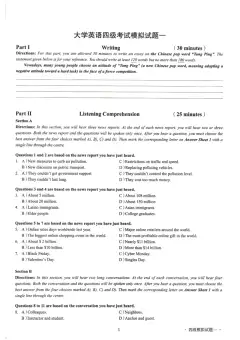
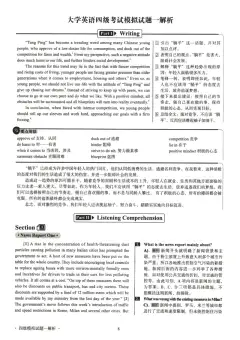
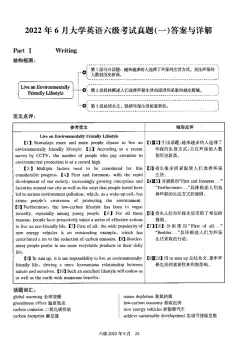
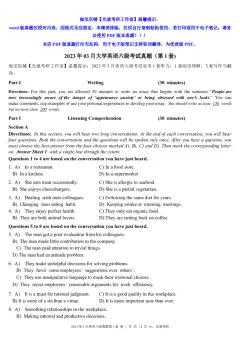
大学英语六级考试模拟试题一 面 制 国
Part I Writing (30 minutes)
Directions: For this part, you are allowed 30 minutes to write an essay that begins with the sentence '"Nowadays there is
a growing awareness that we should resist various temptations and eliminate different distractions.You can make
comments, cite examples or use your personal experiences to develop your essay. You should write at least 150 words but no
more than 200 words.
Part II Listening Comprehension (30 minutes)
Section A
Directions: In this section, you will hear two long conversations. At the end of each conversation, you will hear four
questions. Both the conversation and the questions will be spoken only once. After you hear a question, you must choose the
best answer from the four choices marked A), B) C) and D). Then mark the corresponding letter on Answer Sheet 1 with a
f
single line through the centre.
Questions 1 to 4 are based on the conversation you have just heard.
1. A) He was asked to move away from the dorm. C) He failed to pass the Academic Language test.
B) He had great difficulty in subletting his flat. D) He was at odds with the warden of the dorm.
2. A) For a whole year. C) For about 70 days.
B) For 5 weeks or so. D) For three months.
3. A) Mistaking the course fbr an online class. C) Having been absent since the beginning of new term.
B) Living in a wrong apartment by mistake. D) Ignoring instructions of the small print.
4. A) Share a private house with others. C) Contact the accommodation office.
B) Try a new dorm near the campus. D) Update his rental information in time.
Questions 5 to 8 are based on the Conversation you have just heard.
5. A) They made a living by fishing. C) They grew a large amount of com.
B) They built houses with stones. D) They relied heavily on birch trees.
6. A) Because it is easily cut. C) Because it is waterproof.
B) Because it smells fragrant. D) Because it has good shape.
7. A) Making the canoe. C) Making cooking containers.
B) Serving as firewood. D) Making weapons fbr hunting.
8. A) It is harder but faster for them to travel through a forest path.
B) It is more convenient for them to travel by boat than by road.
C) It is a daily routine fbr them to build canoes with birch bark.
D) It is not likely for them to travel from one tribe to another.
Section B
Directions: In this section, you will hear two passages. At the end of each passage, you will hear three or four questions. Both
the passage and the questions will be spoken only once. After you hear a question, you must choose the best answer from the four
choices marked A), B), C) and D). Then mark the corresponding letter on Answer Sheet 1 with a single line through the centre.
Questions 9 to 11 are based on the passage you have just heard.
9. A) Excessive screen exposure does little harm. C) More kids fall victim to screen exposure.
B) Screen exposure does more harm than good. D) Young children can benefit from screen exposure.
1 • 六级模拟试题一-10. A) Young infants are more likely to adapt to screen exposure.
B) Parents should focus more on the quality of screen content.
C) Exposure to television early on may be less harmful to kids.
D) Parents should spare no effort to limit their children's screen time.
11. A) Parental interference with children's screen exposure makes little sense.
B) Parents play a crucial role in restricting their child from screen exposure.
C) Parents should set a good example to their children in screen exposure.
D) Parental involvement and companionship are key to a kid's screen exposure.
Questions 12 to 15 are based on the passage you have just heard.
12. A) To communicate. C) To appreciate others.
B) To offer your help. D) To be a good listener.
13. A) Just tell them what we think of them. C) Show our appreciation by giving them presents.
B) Talk to them less and leave them alone. D) Communicate with their best friends at work.
14. A) Hold a team discussion to solve the problem.
B) Respond to disagreements as quickly as possible.
C) Try their best to ease the tension through authority.
D) Keep objective and professional when dealing with disagreements.
15. A) These sessions allow managers to communicate deeply with employees.
B) These sessions help managers establish strong personal relationships.
C) Managers can develop their ability to communicate with others.
D) Managers can develop their skills of organization and management.
Section C
Directions: In this section, you will hear three recordings of lectures or talks followed by three or four questions. The
recordings will be played only once. After you hear a question, you must choose the best answer from the four choices marked
A), B), C) and D). Then mark the corresponding letter on Answer Sheet 1 with a single line through the centre.
Questions 16 to 18 are based on the recording you have just heard.
16. A) A life in which we are content with what we have. C) A life in which we are totally focused on what we do.
B) A life in which we are surrounded by good people. D) A life in which we can do whatever we would like to.
17. A) When we do not take everything for granted. C) When we completely focus on what others do.
B) When we are wholly involved in the things we do. D) When we are making the most of our potential.
18. A) Talk about another scholar's life. C) Show the conditions of going with a state of flow.
B) Explain what a happy family would be like. D) Explore activities that help obtain a state of flow.
Questions 19 to 21 are based on the recording you have just heard.
19. A) Goldfish are hard to keep. C) Goldfish have extremely poor eyesight.
B) Goldfish are pretty smart. D) Goldfish have a 3-second memory span.
20. A) People's ignorance about fish intelligence. C) Misleading research results.
B) Goldfish owners9 observations. D) Lack of scientific research.
21. A) Goldfish feed on microorganisms. C) Goldfish can imitate their owners.
B) Goldfish are good at solving problems. D) Goldfish play tricks on their owners.
Questions 22 to 25 are based on the recording you have just heard.
22. A) Where they put on their glasses. C) How they9re wearing their glasses.
B) When they're not wearing glasses. D) Why they're wearing their glasses.
23. A) It changes frequently. C) It consists of several senses.
B) It works without senses. D) It disappears as we grow up.
24. A) By imitating our peers. C) Through practice and repetition.
B) By teaching ourselves. D) Through interacting with others.
• 六级模拟试题一- 225. A) It is just based on our body map. C) Objects are sensed by a somatosensory map.
B) It merely involves nerve system. D) Objects serve as part of a human-thing system.
Part III Reading Comprehension (40 minutes )
Section A
Directions: In this section, there is a passage with ten blanks. You are required to select one word for each blank from a
list of choices given in a word bank following the passage. Read the passage through carefully before making your choices.
Each choice in the bank is identified by a letter. Please mark the corresponding letter for each item on Answer Sheet 2 with a
single line through the centre. You may not use any of the words in the bank more than once.
What do you imagine when you hear about plastic pollution? A straw stuck in a sea turtle's nose? Bottles in local
streams? We often ( 2 6 ) plastic pollution to the use and disposal of single-use plastics. But what about the plastic
pollution that (27) during plastic production?
Every step of the plastic production process is ( 2 8 ) to the environment and climate. Methane, or natural gas,
is one of the ( 2 9 ) materials used to make plastics. Methane is up to 86 times more potent, or heat trapping, than
carbon dioxide over a 20-year period. Transforming petrochemicals, like methane, into plastics uses (30) energy,
creating greenhouse gases while spewing (喷射)toxic chemicals into the surrounding air.
The ( 3 1 ) of uses for plastics in our modem economies means producers have several markets in which to sell
their goods. Ifs not a ( 3 2 ) that petrochemical organizations, like the American Recyclable Plastic Bag Alliance,
continue to promote single-use plastics under the guise (伪装)that they use less energy to create and thus are a better option
environmentally. This fails to ( 3 3 ) fbr the toxic effects on the environment from their creation, use and disposal.
Plastic, and fossil fuels, continue to be cheap (34) because they externalize the true costs: to the environment,
climate, people and animals. It is estimated that the harm plastic production pushes onto the environment (35) at
least $40 billion a year. These harms include polluted air, water and land, warmer temperatures, drought, and health problems.
Changing our orientation to plastics with a climate-centered fbcus is a difficult but necessary challenge in order to save
our planet from climate change.
A) account I) incident
B) attribute J)largely
C) beneficial K) massive
D) coincidence L) multitude
E) contribute M) occurs
F) costs N) primary
G) harmful O) spectacle
H) immensely
Section B
Directions: In this section, you are going to read a passage with ten statements attached to it. Each statement contains
information given in one of the paragraphs. Identify the paragraph from which the information is derived. You may choose
a paragraph more than once. Each paragraph is marked with a letter. Answer the questions by marking the corresponding
letter on Answer Sheet 2.
Are We Having a Moral Panic Over Misinformation?
False and inaccurate information runs rampant online. But how much is it actually changing our behavior?
A) In 2020, as the Covid-19 pandemic rampaged (横冲直撞)across the globe, the World Health Organization declared that we
had plunged into a second, simultaneous catastrophe: an infbdemic. This global crisis was characterized by the rapid
spread of false information, or misinformation, mostly in digital spaces. The fear was that such inaccuracies would
leave the public unmoored, adrift in a sea of untruth. Eventually, this mass disorientation would cause people to harm
themselves and one another.
B) In an effort to combat the rising tide of misinformation, certain agencies, including the U.S. Department of Health and Human
Services and the U.K. Parliament9s Culture, Media and Sport Committee, have poured resources into quantifying its spread
3 • 六级模拟试题一-and impact online. Some of the resulting reports have spawned (弓 I 发)legislation aimed at limiting online fake news.
C) But some psychologists and sociologists aren't convinced that misinformation is as powerful as all that- or that it is a
substantially different issue now compared with in the past. In fact, they think that we may be prematurely whipping
ourselves into a misinformation moral panic. uIt seems to me that we start from the conclusion that there is a problem,
said Christos Bechlivanidis, a psychologist and causation researcher at University College London. 6<But I think we need
to think about this a little bit closer before panicking.^^
D) Studying misinformation can be extremely slippery. Part of the reason is semantic. Even the scientific community does
not have a good consensus on what constitutes misinformation. uIfs such a weak concept/9 said cognitive psychologist
Magda Osman at the University of Cambridge. Misinformation is most commonly defined as anything that is factually
inaccurate, but not intended to deceive: in other words, people being wrong. However, it is often talked about in the
same breath as disinformation- inaccurate information spread maliciously- and propaganda- information imbued
with biased rhetoric designed to sway people politically. Some lump misinformation under the same umbrella as
disinformation and other forms of intentionally misleading material. But this is where things start to get dangerous: Even
under its common definition, practically anything could qualify as misinformation.
E) Take, for example, a weather forecast that claims a particular day will have a high of 55 degrees Fahrenheit. If that
day comes and temperatures rise to 57 degrees, does the forecast qualify as misinformation? What about a newspaper
story that inaccurately reports the color of someone9 s shirt? Or a scientific hypothesis that was once widely accepted
but is later updated with newer, better data? The trouble is, research that seeks to quantify or test susceptibility to
misinformation will often include relatively harmless inaccuracies alongside things like dangerous conspiracy theories.
F) Ifs worth noting that misinformation- by any definition- has been around fbr a long time. Ever since the first humans
developed language, we've been navigating an information world pitted with lies, tall tales, myths, pseudoscience, half-truths,
and plain old inaccuracies. Medieval European fables about animals, for instance, described creatures like bears and weasels
alongside unicorns and manticores. Anti-vaccine groups have been around for over 200 years, well before the Internet. And in
the age of yellow journalism around the turn of the 20th century, many reporters made up stories out of whole cloth.
G) "I don't like this whole talk of 'we're living in a post-truth world/ as if we ever lived in a truth world,“ said Catarina, a
researcher who studies the history and philosophy of logic at a university in Amsterdam.
H) Standards fbr journalism and books have, on the whole, improved since the yellow journalism days. But casual
conversation isn't held to the same rigorous standards- you're probably not likely to pull out a reference book and
start fact-checking your grandma at the dinner table. Today, a lot of this type of interpersonal discussion has moved
online. Simply quantifying the amount of misinformation in a given online space, then, is virtually impossible, because
^everything that we're saying is inaccurate,M Osman said. And proving that wrong information has a direct impact on a
person's behavior can be even harder.
I) Most of the rationale (根本原因)for quantifying misinformation and determining who is susceptible to it stems from
the assumption that consuming it will alter people's beliefs and cause them to behave irrationally. The quintessential (典
型的)example is misinformation surrounding Covid-19, which was blamed for many people's subsequent hesitancy in getting
a vaccine to protect against the virus. There are a wealth of studies demonstrating a correlation between consuming
misinformation and vaccine hesitancy. But it is very tricky to prove a causal link; fbr example, evidence suggests a lot
of vaccine-hesitant folks were skeptical of the science well before the Covid-19 pandemic began. They may have sought
out misinformation to justify their pre-existing bias—but that doesn't mean consuming incorrect information caused the
distrust. Other studies suggest that factors like in-group solidarity and national identity are stronger predictors of whether
or not someone will get vaccinated against Covid-19.
J) In fact, a recent study showed that simply exposing people to Covid-19 misinformation had little to no impact on their decision
to get vaccinated and, in certain cases, may have even made them slightly more likely to get a Covid-19 vaccine.
K) Osman compares the panic to that over violent video games in the last few decades. Despite a number of headlines and
politicians proclaiming that certain games were making teenagers more aggressive, research hasn't really
demonstrated that one causes the other.
L) Osman argues that our collective concern over misinformation is, in some ways, a moral panic about the Internet- which
would place it in a long history of similar worries about every new way in which information gets shared. Virtually,
every form of communication technology has been met with its very own public outcry. In mid-15th century Europe,
people destroyed dozens of print shops in a wave of anti-Gutenberg sentiment. The rise of radio in the 1930s also led
• 六级模拟试题一- 4some American parents to fret (苦恼)about its negative influence on their children.
M) At a certain level, these fears are perfectly reasonable. Until we know how a new technology will change our lives, it
makes sense to proceed with caution. And lately, we've barely had time to do that. The last three decades have seen
extremely rapid shifts in information-sharing technologies- from cell phones to email to social media_that culminate
with the smart phone, which allows us access them all in one portable package. Ifs overwhelming and, in many cases, scary.
N) “I think what people are still coming to grips with is realizing that actually there was a lot of optimism in the beginning of the
Internet,Dutilh Novaes said. We expected that more freely available information would lead to more transparency and less
confusion. Instead, we've been disappointed to discover that even in an information golden age, people can still be wrong.
O) Of course, none of this means that the spread of misinformation online is always benign, or that we shouldn't attempt to
regulate it in any way. It's just that if we're going to respond with sweeping new legislation- or let tech giants impose
their own limitations- we need to be sure of what the problem actually is, Osman said.
P) The silver lining is that fake news, false beliefs, and moral panics are not new phenomena- society has thousands
of years of experience with them, for better or worse. "I would argue that we are pretty capable of dealing with lies,“
Bechlivanidis said.
36. No matter how it is defined, misinformation has been around since the first humans invented language.
37. In the beginning, people were very optimistic and expected that Internet would lead to more transparency and less confusion.
38. Some psychologists and sociologists do not believe that misinformation today is fundamentally different from that of the past.
39. Numerous studies have shown that misreading misinformation correlates with vaccine hesitancy, but that doesn't mean
consuming incorrect information caused the distrust.
40. Some agencies have sought to quantify the spread and impact of misinformation online in order to curb its rising trend.
41. In Osman's view, we need to figure out what the problem really is before taking measures to regulate online information.
42. Studying misinformation can be tricky in part because there is no consensus on the definition of misinformation.
43. Quantifying the amount of misinformation in a given cyber space is in fact not feasible because everything people say
can be inaccurate.
44. In 2020, alongside the Covid-19 pandemic, an infodemic is under way.
45. Osman believes that, to some extent, our collective fear of misinformation is a kind of moral panic about the Internet.
Section C
Directions: There are 2 passages in this section. Each passage is followed by some questions or unfinished statements.
For each of them there are four choices marked A), B), C) and D). You should decide on the best choice and mark the
corresponding letter on Answer Sheet 2 with a single line through the centre.
Passage One
When you're tucking into one of your favorite foods- perhaps a steaming bowl of ramen or spectacularly cheesy slice
of pizza- you're probably not thinking about the journey each morsel (一口 食物)is about to take through your digestive
system. Then, how long does it take to digest food, exactly?
The answer to this question is more complicated than you might think. Different types of foods are broken down and absorbed
by the body at different rates, meaning some parts of the meal may be entering the large intestine when other parts are still in the
stomach. Ifs also common for healthy people to digest food at slightly different rates, according to Colorado State University.
Scientists have conducted studies assessing “gut transit or how long it takes a substance to move through the
whole digestive tract, using ingestible capsules (胶囊)that can be tracked throughout their journey. These studies suggest
that it can take anywhere from 0.4 to 15.3 hours for food to leave the stomach, and from 3.3 to 7 hours for it to pass through
the entire small intestine. The leftover, indigestible parts of food then enter the large intestine, where they may remain fbr
approximately 15.9 to 28.9 hours, according to a review published in the Journal of Clinical Medicine in 2023.
Foods rich in dietary fiber, protein, complex carbohydrates and fats tend to take longer to digest than foods low in
these nutrients, said Dr. Nina Nandy, a gastroenterologist based in Texas. uFiber adds bulk to the diet, which slows down the
movement of food through the digestive tract," she said.
Lifestyle factors also affect gut transit time. Chewing thoroughly and staying hydrated can help speed up the digestive process
by increasing the fbod's surface area fbr digestive enzymes (7肖化酶)and helping to soften the food particles, respectively, Nandy
said. In addition, ''exercise helps increase gut motility and promotes peristalsis, which is the rhythmic contraction of digestive
5 • 六级模拟试题一-muscles,9, Nandy said. Conversely, peristalsis can slow down during periods of inactivity.
A person's age and stress levels can also affect digestion. With age, adults tend to produce less stomach acid and
digestive enzymes, while their guts become less motile, she said. "Stress and anxiety can also increase gut transit time by
altering gut motility and reducing gastrointestinal blood flow,“ she added.
And finally, certain medical conditions and medications can either speed or slow digestion. For example, diabetes is the most
common cause of "delayed stomach emptying",which makes food linger in the stomach fbr a long time. Certain medications, which
suppress nerve signals responsible for involimtary muscle movements, can slow gut transit and cause constipation, Nandy said.
46. According to Para. 2, why is it hard to say how long it takes to digest food?
A) Because people's intestines have different lengths.
B) Because people eat too many different types of foods.
C) Because a poor lifestyle can affect the speed of digestion.
D) Because different foods take different amounts of time to digest.
47. What have scientists discovered by using indigestible capsules?
A) 0.4 to 15.3 hours are needed for food to leave the small intestine.
B) 3.3 to 7 hours are needed for food to pass through the whole intestine.
C) Indigestible parts of food stay in the large intestine the longest.
D) All the food stays in the intestines fbr about 15.9 to 28.9 hours.
48. Why does it take longer to digest foods rich in dietary fiber?
A) Because the gut needs more time to absorb those nutrients from food.
B) Because fiber increases the volume of food and slows down digestion.
C) Because the gut needs to absorb various nutrients in food one by one.
D) Because the gut itself isn't very good at processing nutrient-rich foods.
49. What would help speed up the digestion of food?
A) To eat fried food. C) To reduce chewing time.
B) To reduce stress. D) To exercise while eating.
50. Which one of the following is likely to digest food the fastest?
A) A stressful young man. B) An old patient in bed. C) A healthy teenager. D) A man with diabetes.
Passage Two
The nostalgia (怀念)of childhood memories- that cherished first bicycle ride, the debut dip in the ocean, the distinctive
patterns of wallpaper from the family home. These early recollections are often steeped in sentimentality and woven into the
fabric of our identity. But can they be trusted?
Carole Peterson, a child psychologist, told Live Science that our memories are not infallible, and both children and adults
can have recollections that are not entirely accurate. ^Memories from every age can be malleable (可塑的),“ Peterson said.
“This is not unique to early memories. At all ages, we are susceptible to suggestion, although it is true that younger children
are more susceptible than older children or adults?9
Research has found that people often forget events relatively quickly after they happen, especially if they were not special or
interesting. In a 2020 study published in the journal Psychological Science, researchers found that people had fewer memories of
real world events the more time had passed since they happened. The memories were also less detailed as more time had passed.
Additionally, researchers have found a strong link between emotion and accurate recall. If an event is particularly
painful, fbr example, the quality of the memory is often higher.
But in some cases, people—and children in particular—can form false memories, or vivid recollections of events that
never happened. German psychiatrist Michael Linden states that high social expectations can lead to the development of
false memories in children who learn to respond as expected. These false memories can be remarkably realistic and detailed,
making them hard to distinguish from real memories.
So, given we tend to remember emotional events with a greater degree of clarity, how likely are these more uneventful
recollections to be precise?
Peterson published a study in 2017 in which children who were 4 to 9 ages initially recalled their very earliest memories
and were asked about them again eight years later. uWith some very general hints, they recalled most- but not all——of the
events, but the specific content they mentioned often differed,n Peterson said.
• 六级模拟试题一- 6For kids who were 6 and up ages at the time the initial memories were made, very little content was contradictory, but it
differed in terms of what they chose to talk about, Peterson said. "For example, when relating a particular camping trip, they
often described different components. Children who were 4 or 5 at the time of the initial interview, however, were much more
likely to contradict what they had said earlier.,,
Ultimately, Peterson said, it is very difficult to determine the “true” accuracy of a memory, especially when it comes
from early childhood, unless the event was recorded and video evidence exists.
51. What do we learn from what Peterson told Live Science?
A) Children's memories are more likely to be accurate.
B) People of all ages may not have completely accurate memories.
C) Older children's memories are most susceptible to suggestion.
D) Only early memories are likely to be completely accurate.
52. What kind of things are people more likely to remember?
A) Things that happened a long time ago. C) Ordinary things with less detail.
B) Things that happen around them. D) Things that are extremely painful.
53. What make children form vivid memories of things that never happened?
A) Poor memory. B) Rich imagination. C) High social expectations. D) False impression.
54. What did Peterson find in a 2017 study?
A) Initial memories of children who were 6 ages were rarely contradictory.
B) People start to have their first memories when they are 4 or 5 years old.
C) Children who were 4 to 9 ages remembered very few things accurately.
D) Uneventful recollections are unlikely to be precise.
55. What does Peterson imply in the last paragraph?
A) People will never know what happened in their early childhood.
B) People can use videos to help determine the accuracy of a memory.
C) People can only accurately recall their experiences as adults.
D) People are not meant to have accurate childhood memories.
Part IV Translation (30 minutes)
Directions: For this part, you are allowed 30 minutes to translate a passage from Chinese into English. You should write
your answer on Answer Sheet 2.
汉族是中国的主体民族,在政治、军事、哲学、文学、史学、艺术、自然科学等不同领域都创造了许多辉煌的
成就。几千年来,汉族人提倡以仁(benevolence)为中心,重视伦理教育,以勤劳、富于创造精神著称。历史上,
汉族的经济以农业为主,人们精通水利灌溉和农业生产。这是一种典型的男耕女织的自然经济。汉族是一个历史从
未中断过的古老民族。如今,它正以极强的包容性和融合性蓬勃发展、不断壮大。
7 • 六级模拟试题一 •大学英语六级考试模拟试题二
音频
Part I Writing (30 minutes)
Directions: For this part, you are allowed 30 minutes to write an essay that begins with the sentence “There is a growing
awareness that confidence is key to success, but what should we do to strike a balance between self-confidence and
conceit? ” You can make comments, cite examples or use your personal experiences to develop your essay. You should write
at least 150 words but no more than 200 words.
Part II Listening Comprehension (30 minutes)
Section A
Directions: In this section, you will hear two long conversations. At the end of each conversation, you will hear four
questions. Both the conversation and the questions will be spoken only once. After you hear a question, you must choose the
best answer from the four choices marked A), B), C) and D). Then mark the corresponding letter on Answer Sheet 1 with a
single line through the centre.
Questions 1 to 4 are based on the conversation you have just heard.
1. A) Taking away his diploma. C) Submitting a required form.
B) Acquiring his scholarship. D) Applying for a part-time job.
2. A) His credits are not enough. C) He missed the graduation ceremony.
B) His academic record is lost. D) He changed his academic record himself.
3. A) Identifying how many academic credits a student gets.
B) Sending letters one year before students graduate.
C) Making sure a graduate gets 48 credits in his or her major field.
D) Checking at least 24 credits are at or above the intermediate level.
4. A) Taking intro courses. C) Failing assigned work.
B) Doing laboratory research. D) Attending classroom lectures.
Questions 5 to 8 are based on the conversation you have just heard.
5. A) His absence. C) The retirement party.
B) His late essay. D) Anthropology classes.
6. A) Interesting. C) Abstract.
B) Practical. D) Inspiring.
7. A) She is easy-going. C) She is not interesting.
B) She is assertive. D) She keeps a low profile.
8. A) Assist her in a project. C) Spend time with Dean Adams.
B) Write articles on anthropology. D) Help arrange the retirement party.
Section B
Directions: In this section, you will hear two passages. At the end of each passage, you will hear three or four questions. Both
the passage and the questions will be spoken only once. After you hear a question, you must choose the best answer from the four
choices marked A) B), C) and D). Then mark the corresponding letter on Answer Sheet 1 with a single line through the centre.
f
Questions 9 to 11 are based on the passage you have just heard.
9. A) The scars of abuse will disappear one day. C) She will not forgive the abuser9 s misdoings.
B) Abuse has a lasting impact on victims. D) She hates the abusers because of their crimes.
• 六级模拟试题二- 2010. A) Their performance is far less satisfying. C) They have tried their best to curb abuse.
B) Their response is timely and effective. D) They are reluctant to respond to abuse.
11. A) Verbal abuse. C) Physical abuse.
B) Sexual abuse. D) Emotional abuse.
Questions 12 to 15 are based on the passage you have just heard.
12. A) Cattle ranches. C) The lumber business.
B) Oil drilling industry. D) Subsistence agriculture.
13. A) To lubricate their ships. C) To fill ship holes or cracks.
B) To power their ships. D) To light their ships at night.
14. A) Numerous wild fishes in the lake. C) Petroleum exploration facilities.
B) Oil bubbling up from the ground. D) The largest gold mine in the USA.
15. A) Dick Dowling为 oil drilling. C) The Spindietop oilfield.
B) The oil discovery at Corsicana. D) The Beaumont salt dome.
Section C
Directions: In this section, you will hear three recordings of lectures or talks followed by three or four questions. The
recordings will be played only once. After you hear a question, you must choose the best answer from the four choices marked
A), B), C) and D). Then mark the corresponding letter on Answer Sheet 1 with a single line through the centre.
Questions 16 to 18 are based on the recording you have just heard.
16. A) Being kind to each other. C) Being innocent and naive.
B) Living near. D) Being useful to each other.
17. A) Making new friends. C) Seeking inner peace.
B) Parents9 consolation. D) Being accepted by friends again.
18. A) Playing together. C) Conventional morality.
B) Mutual activities. D) Loyalty and intimacy.
Questions 19 to 21 are based on the recording you have just heard.
19. A) Indian food shortage. C) Immigrants from India.
B) Indian economic growth. D) Internal migrants in India.
20. A) Migrants suffer from discrimination. C) Indian government provides few benefits.
B) Migrants have little access to the benefits. D) Indian government cares little about migrants.
21. A) Organizing 1000 officials to help migrants. C) Seeking help from the international aid organization.
B) Creating a feedback system concerning all sides. D) Setting up a new special body to address the problem.
Questions 22 to 25 are based on the recording you have just heard.
22. A) Whether our brain is fully utilized. C) Whether our attention is linked to our brain.
B) Whether our brain is fully developed. D) Whether our attention guides our brain.
23. A) What kind of function attention has. C) Why attention fails to make us focused.
B) How attention controls our perception. D) When attention plays its role in our brain.
24. A) To show how we get deceived by our memory. C) To show what we can do to improve our attention.
B) To explain why we should value our attention. D) To explain how our attention is ultimately utilized.
25. A) Painful memories. C) Visual impairment.
B) Physical trauma. D) Emotional instability.
Part III Reading Comprehension (40 minutes )
Section A
Directions: In this section, there is a passage with ten blanks. You are required to select one word for each blank from a
list of choices given in a word bank fallowing the passage. Read the passage through carefully before making your choices.
Each choice in the bank is identified by a letter. Please mark the corresponding letter for each item on Answer Sheet 2 with a
21 • 六级模拟试题二•single line through the centre. You may not use any of the words in the bank more than once.
Music is good fbr the health. And drumming may be best of all. As well as being physically demanding, it requires
people to 26 their limbs and to react to outside stimuli (^]^) , such as what the rest of the band is up to.
It is particularly helpful fbr children who have emotional and 27 difficulties. Researchers at the Clem Burke
Drumming Project have shown that teaching such children to drum helps them to control their reactions more 28 , to
focus more effectively on tasks they are given, and to communicate better with other people.
The projecfs latest work published in the Proceedings of the National Academy of Sciences goes a step further. It looks
at the neurological changes which accompany these 29 . Ms. Cahart and her colleagues recruited 36 autistic (自 闭症)
teenagers and 30 them into two groups. One lot had drum lessons twice a week for eight weeks. The others did not. At
the beginning and end of the project, everyone was asked to stay 31 for 45 minutes in a functional magnetic resonance
imaging (fMRI) machine, to see how the activity of their brains had changed. Their behavior, as reported by their guardians,
was also recorded.
As expected, most of the drumming group displayed positive behavioral changes. And these were indeed 32 in their
brains. The fMRI scans showed that several clusters of connectivity between parts of those brains had strengthened during
the experiment. In particular, two regions related to attention control formed 33 links with areas associated with sel「
reflection and decoding facial expressions. These changes in the brain's "wet-ware" 34 with the changes in behavior
which learning to drum induces. Not a surprise, perhaps, but a gratifying 35 of drumming's power to heal.
A) align I) integrate
B) behavioral J) reflected
C) comprehensively K) robust
D) confirmation L) shifts
E) consecutively M) split
F) coordinate N) still
G) declaration 0) vibrations
H) deviated
Section B
Directions: In this section, you are going to read a passage with ten statements attached to it. Each statement contains
information given in one of the paragraphs. Identify the paragraph from which the information is derived. You may choose
a paragraph more than once. Each paragraph is marked with a letter Answer the questions by marking the corresponding
letter on Answer Sheet 2.
Science Has a Communication Problem and a Connection Problem
A) Scientists can be brilliant communicators. We are trained to work with collaborations large and small, present our work in
journal articles and conferences with clarity and purpose, and generally enjoy chatting with each other. Communication
is a fundamental part of scientific life. Yet when scientists try to engage the public, they face barriers to getting their
message across and can often find their messages manipulated.
B) As a scientist heavily engaged in science communication, I find my colleagues falling into the same traps, over and
over again. Science is failing at communicating its own process and values effectively to the public. And attempts to
disseminate ( 传 播 )vital information risk getting distorted by media interests, co-opted fbr political gain, or outright
ignored. As a result, I believe that the public is slowly losing trust in science because they don't view scientists as
trustworthy people.
C) According to the Pew Research Center, U.S. adults that have a ufair amount” or a "great deal” of trust in scientists fell
from 87 to 77 percent in just the past two years. And since the vast majority of science relies on public funding, if the
public isn't on board with science, then I fear that our future as an institution is at risk.
D) Research has shown that simply giving the public more information isn't the best way to correct this. Ifs crucial that
scientists find ways to communicate more effectively and directly with the public, so the public can have access to the
minds, and hearts, of scientists. In other words, they need to see scientists as people whom they can empathize with and
learn to trust. To enable this, scientific institutions must support those endeavors via media training and institutional
incentives which are currently lacking in the academic landscape.
• 六级模拟试题二- 22E) At most top-tier research institutions, the primary responsibility of a scientist is to win more grants. Anything that
supports that, for example, writing proposals and publishing well-received papers, is rewarded by the institution
through promotion and tenure. On the flip side, anything that does not support that- including engaging in public
communication- is often treated as a distraction.
F) I have seen this discouraging atmosphere play out in both my own career and those of my colleagues. And that personal
experience is backed up by evidence. A 2012 study looking at scientists9 attitude towards outreach (夕卜联活动)found
grim prospects, with 74 percent of survey respondents listing one or more impediments to engaging in public outreach,
including receiving little support or encouragements from their institutions. Meanwhile, less than half were able to come
up with potential solutions. Those findings are echoed in another study published earlier this year, which suggests that,
10 years later, many barriers will remain. Using focus group discussions, scientists “noted the pressure they felt to focus
on research and teaching, rather than public engagement for the sake of tenure and promotion requirements.^^ In many
cases, the study stated, mentors actively discouraged graduate students and junior faculty from engaging with the public.
G) Yes, science outreach is hard. But scientists are used to doing hard things. If they were rewarded for public
communication- by making science communication training a part of their professional development and making
engagement with the public a part of the portfolio that leads to tenure and promotion- I feel confident that they would
find and develop the tools necessary to do so effectively.
H) For scientists who do want to communicate their work to the public, the media landscape can be tricky to navigate.
While there are plenty of journalists who are careful to get the science right in their work, there are others in media
whose interests don't always align with scientists9 interests. Thus we see good science distorted into bad messages. For
example, the pseudoscientific documentary “What the Bleep Do We Know?” interviewed real scientists but edited their
interviews to make them appear to support outrageous claims. And there are countless headlines that exaggerate or even
directly contradict the science described in the article.
I) When working with the media, scientists should verify the publishing history of the journalist and outlet they are working
with, and, when possible, ask fbr a review of the quotes used in the piece. Ifs worth noting though that many outlets do
not allow for quotes to be reviewed verbatim (逐字地)in the interest of journalistic integrity. If thafs the case, scientists
should request a fact-checker or editor contact them and provide a summary of the quotes provided.
J) Perhaps it's not surprising when scientists fell for mismanagement of their own expertise, because “Working with the
Media" isn't a part of any science graduate program that Fve encountered. While some universities have begun to offer
certificates and workshops in media training, participation in such programs are often voluntary endeavors, rather than a
requirement of postgraduate training.
K) Scientists can be quick to blame the media fbr poor science communication, but ultimately those stories wouldn't exist
without the scientists participating in the process: generating the research, assisting in their university's press release
process, and making themselves available fbr interviews. And many of these scientists have absolutely no training or
guidance in media relations. Academia's disincentivizing of science communication doesn't just silence scientists; it
leaves scientists who do wish to be heard unprepared to deal with the media.
L) Sadly, sometimes scientists themselves participate in this distortion, leveraging their standing and level of public trust to
push personal agendas and their own search fbr fame. For example, Andrew Wakefield spent years spreading the false
idea that vaccines cause autism (自闭症)一an idea based on fraudulent (欺诈的)research. In my own field, recently
a group of astronomers claimed to find evidence fbr life in the cloud tops of Venus, a story that created a media frenzy.
Those claims were immediately disputed by other astronomers, to much less fanfare. The end result is that poor science
communication is a contributing factor in the public's declining trust in scientists.
M) Unfortunately, there will likely always be a small number of bad scientists. But that is why it is doubly important
that good scientists understand the power of effective communication. If we develop a culture and expectation where
scientists have a more intimate relationship with the public, and where non-scientists better understand the scientific
process, then I believe that people will have better tools to separate the good from the bad.
N) Social media offers an unfiltered method of communication, where scientists can be more directly engaged with the
public. While it requires scientists to devote time and energy to build a following, it should be leveraged more as an
important tool in reaching people on a one-to-one basis. While the majority of scientists use social media, many of them
use those platforms to connect with each other, rather than the public. Scientists should use that newfound voice to speak
directly to the public, removing any barriers and distortions placed by gatekeepers.
23 • 六级模拟试题二-O) Scientists need to reveal the inner workings of their process so that the public can appreciate and understand our
methodology and conclusions we reach. And institutions need to make science communication a fundamental job
requirement of being a scientist.
36. Some scientists may deliberately spread false information to the public for personal interests.
37. Scientists often find that the information they want to convey to the public has been distorted.
38. Researches indicate that many obstacles will still exist when scientists engage in outreach after 10 years.
39. The author believes that the public is gradually losing trust in science and scientists.
40. Scientists should review the quotations used by the media or request summaries of the quotes.
41. Many scientists have not received any training or guidance in media relations.
42. Writing proposals and publishing papers are beneficial for scientists in achieving promotions and tenure.
43. It is essential fbr scientists to find more effective and direct methods to communicate with the public.
44. Scientists should utilize social media to connect with the public and speak directly to them.
45. The author believes that if the public does not participate in science, research institutions will be in danger.
Section C
Directions: There are 2 passages in this section. Each passage is followed by some questions or unfinished statements.
For each of them there are four choices marked A), B), C) and D). You should decide on the best choice and mark the
corresponding letter on Answer Sheet 2 with a single line through the centre.
Passage One
Many students are using ChatGPT to write essays or to cheat on tests. Some teachers are worried that academia may be
crumbling under the pressure of 170 trillion text data parameters packed into a tempting AI chatbot. The education sector is
trying to get a handle on this technological chaos. Educational institutions have banned OpenAFs website. Governments are
building classroom frameworks fbr Al use. Pirate detectors GPTZero and Tumltln attempt to detect Ai-facilitated writing, but
they are still in need of improvements. Meanwhile, AI companies are drowning teachers and government regulators in new
and more accessible chatbots.
However, I believe the main problem with the response to such generative Al in education is that the focus is on
regulation, not reformation. We should instead be asking: why is it so easy to use these systems to cheat? And why aren't we
using them to learn?
Traditional learning is extremely linear: memorize content, receive assignments, take a test. Students are constantly
absorbing rote (死记硬背)methods of executing a task or calculation, as opposed to discovering answers by conceptualizing
the work. As a result, the right answer takes priority over the right thinking, and AI chatbots can get to that right answer very
conveniently.
Recognizing this, in 2021, I founded Fidutam, a civil society group mobilizing citizen, private and public sector
stakeholders fbr responsible technology. As a youth-led organization that now has more than 1,500 members, one of our
main focuses is technology in education. We built an application that uses GPT-4 to generate courses on any topic a student
or teacher chooses. The model acts like a more streamlined version of a standard Google search, ensuring that students are
presented with factual information and reducing the effect of Ais "hallucinating (产生幺7 觉 )“and producing incorrect
information.
To supplement the app, our team also designed an assessment system fbr teachers centered around class discussions
and students9 verbal explanations of content, using ChatGPT and our app as an educational aide. We now have just over
2,000 young people and teachers across the US, sub-Saharan Africa and South Asia plugged into our platform. Girls in
Ethiopia have used it to understand physical health, while teens from low-income New York households used it as an English
comprehension tutor. After four months, we had some students jumping one or two grade levels in core subjects. Perhaps
most impressively, they were doing this with limited access to textbooks or teachers with specialized degrees.
So the discussion about how to integrate AI and education isn't just for big tech and policymakers; it is one for us all.
Because if we build and use AI effectively, we can create an education system where students are assessed on the quality and
depth of their knowledge, not the content of an exam. This won't be the pathway to an easy A, but to an accessible and more
effective education.
• 六级模拟试题二• 2446. What do governments do to deal with AI in education?
A) Prohibit the use of AI in educational institutions.
B) Establish classroom frameworks for the use of AL
C) Require AI companies to improve the security of AL
D) Supervise the usage scenarios of Al-fiacilitated writing software.
47. What does the author say about traditional learning?
A) Traditional learning is linear and full of rote methods.
B) The right answer is as important as the right thinking.
C) Students often discover answers by conceptualizing the work.
D) Teachers only teach rote methods of performing tasks or calculations.
48. What can we learn about Fidutam?
A) Its fbcus is on technological ethics in education.
B) It was co-founded by the author and his students.
C) It is led by young people and it focuses on technology in education.
D) It calls up stakeholders being responsible for personal gain.
49. What impressive result did the assessment system bring?
A) South Asia girls used it to understand mental health.
B) American teenagers from middle class used it to perfect English.
C) Artificial intelligence education could replace textbooks and teachers.
D) Students jumped certain levels in core subjects with limited textbooks or specialized teachers.
50. What does the author say in the last paragraph?
A) AI should be used to assess the content of exams.
B) Integration of AI and education matters to all of us.
C) A strict education system should be created.
D) Big companies and educators should be decision-makers of AI policies.
Passage Two
A sharply divided federal appeals court on Monday exposed Wal-Mart Stores Inc. to billions of dollars in legal damages
when it ruled a massive lawsuit alleging gender discrimination over pay for female workers can go to trial.
The Court said the world's largest private employer will have to face charges that it pays women less than men for the same
jobs and that female employees receive fewer promotions and have to wait longer for those promotions than male counterparts.
Wal-Mart successfully convinced the court that women who allege discrimination should file individual lawsuits. Wal-
Mart employs 2.1 million workers in 8,000 stores worldwide and argued that the conventional rules of class action suits
should not apply because each outlet operates as an independent business. Since it doesn't have a company-wide policy of
discrimination, Wal-Mart argued that women alleging gender bias should file individual lawsuits against individual stores.
The ruling was a "big black eye fbr Wal-Mart, and ifs not going to heal anytime in the near future,9, said retail consultant
Burt P. Flickinger. Flickinger said the ruling could turn off women shoppers——the company's critical base——at a time it faces
increased pressure from a host of competitors, ranging from Kroger to J.C. Penney.
Wal-Mart9s fourth-quarter results, announced in February, showed that total sales at its US Wal-Mart stores fell fbr the
first time since the company went public in 1969. The company also reported its third consecutive quarter of declines in sales
at stores opened at least a year. Sales at stores opened at least a year are considered a key indicator of a retailer's health.
Wal-Mart9 s top lawyer Jeff Gearhart said the company disagreed with the ruling and was considering its next step, which
could include an appeal to the US Supreme Court.
“We do not believe the claims alleged by the six individuals who brought this suit are representative of the experiences
of our female associates,said Gearhart, an executive vice president. ”Wal-Mart is an excellent place fbr women to work and
fosters female leadership among our associates and in the larger business world.^^
Unions and other critics have long complained that Wal-Mart9 s workplace practices needed improvement, especially in
the areas of diversity and career advancement. The company employs 1.4 million workers in the United States and the unions
claim the company's labor practices are widely followed.
Wal-Mart responded to the pressure last year at its annual shareholders?meeting by announcing a plan to address the
issue of promoting women, creating a “global council“ comprised of 14 Wal-Mart female executives.
25 ・六级模拟试题二-“We are proud of the strides we have made to advance and support our female associates and have been recognized fbr
our efforts to advance women through a number of awards and accolades (荣 誉 )Gearhart said.
51. What had happened to Wal-Mart?
A) A court was sharply divided on the issue of Wal-Mart issue.
B) Wal-Mart suffered a great loss after its failure in a lawsuit.
C) Wal-Mart was the largest private employer hiring women.
D) It was accused of discrimination against female workers.
52. What does Wal-Mart suggest women alleging gender bias to do properly?
A) It is better fbr them to file lawsuit against the store for which they are working.
B) It is more proper fbr women workers to collect enough evidence before suing.
C) It is advisable fbr women workers to sign contracts about salary and promotion.
D) It is appropriate fbr women workers to start to operate an independent business.
53. What does the author mean by the phrase "a big black eye?, (Line 1, Para. 4) ?
A) A symbol for success. C) A shame on Wal-Mart.
B) Pressure from its fbes. D) A large and attractive eye.
54. What does Jeff Gearhart look at the lawsuit against Wal-Mart?
A) It helps women workers to get promotions. C) It enhances women workers, leadership.
B) It is not fair and does not make any sense. D) It benefits women workers in the world.
55. How do unions and other critics view Wal-Mart9s workplace practices?
A) There are many women receiving awards and praise.
B) There has been improving as fbr career advancement.
C) There is much to be desired in its workplace practices.
D) There will be a great economic loss in Wal-Mart stores.
Part IV Translation ( 30 minutes )
Directions: For this part, you are allowed 30 minutes to translate a passage from Chinese into English. You should write
your answer on Answer Sheet 2.
直播带货的兴起是电商行业发展的必然趋势。随着互联网的不断发展,消费者对购物方式的选择越来越多样
化。在传统电商平台中,商家只能被动地接受消费者的选择;而在直播平台中,商家能够主动向消费者展示和介绍
商品,以引导消费。传统的电商平台主要是由商家和消费者进行沟通和交流;而直播带货则是通过主播与观众进行
互动的方式来进行商品的推广和销售活动。主播与观众之间的积极互动极大地促成了商品的成交。
• 六级模拟试题二• 26大学英语六级考试模拟试题三
音频
Part I Writing (30 minutes)
Directions: For this part, you are allowed 30 minutes to write an essay commenting on the remark “There isn't anything
noble about being superior to another person. True nobility is in being superior to the person you once were." You can give
examples to illustrate your point and then explain what you will do to stay modest. You should write at least 150 words but
no more than 200 words.
Part II Listening Comprehension ( 30 minutes )
Section A
Directions: In this section, you will hear two long conversations. At the end of each conversation, you will hear four
questions. Both the conversation and the questions will be spoken only once. After you hear a question, you must choose the
best answer from the four choices marked A), B), C) and D). Then mark the corresponding letter on Answer Sheet 1 with a
single line through the centre.
Questions 1 to 4 are based on the conversation you have just heard.
1. A) It is well-paid. C) It is demanding.
B) It is stimulating. D) It is fairly secure.
2. A) A quick promotion. C) Moving expenses.
B) Free accommodation. D) A lighter workload.
3. A) He has difficulty communicating with local people. C) He has trouble adapting to the local weather.
B) He has to spend a lot more traveling back and forth. D) He has to sign a long-term contract.
4. A) The woman will help the man make a choice. C) The man is in the process of job hunting.
B) The man is going to attend a job interview. D) The woman sympathizes with the man.
Questions 5 to 8 are based on the conversation you have just heard.
5. A) To inquire about the interest rates at the woman's bank.
B) To inquire about the current financial market situation.
C) To see if he can find a job in the woman's company.
D) To see if he can get a loan from the woman's bank.
6. A) There is no difference between rate and yield.
B) The man has a good understanding of rate and yield.
C) The rate is the percentage of simple interest paid on the money.
D) The yield is only influenced by the amount of money.
7. A) Long-term investment. C) Any high-interest deposit.
B) A three-month deposit. D) Any high-yield investment.
8. A) She treated him to a meal. C) She offered him dining coupons.
B) She gave him loans at low rates. D) She raised interest rates for him.
Section B
Directions: In this section, you will hear two passages. At the end of each passage, you will hear three or four questions.
Both the passage and the questions will be spoken only once. After you hear a question, you must choose the best answer from
the four choices marked A), B), C) and D). Then mark the corresponding letter on Answer Sheet 1 with a single line through
the centre.
39 • 六级模拟试题三-Questions 9 to 12 are based on the passage you have just heard.
9. A) It is a Portuguese company selling coffee in New York.
B) Its most important task is to conduct coffee studies.
C) It represents several countries that export coffee.
D) Its role is to regulate international coffee prices.
10. A) The freezing weather in Brazil. C) The increased coffee consumption.
B) The impact of global warming. D) The fluctuation of coffee prices.
11. A) He is doing a bachelor's degree. C) He is a heavy coffee drinker.
B) He is young, handsome and single. D) He is tall, rich and intelligent.
12. A) A visit to several coffee-growing plantations. C) A vacation on some beautiful tropical beach.
B) Coffee prices and his advertising campaign. D) A quick promotion and a handsome income.
Questions 13 to 15 are based on the passage you have just heard.
13. A) They were held up in a traffic jam. C) They were late for the first morning bus.
B) They boarded a wrong coach in a hurry. D) They were delayed by the train for hours.
14. A) It was canceled because of an unexpected strike. C) It was spoiled by poor accommodations.
B) It was the most exciting trip they ever had. D) It was postponed due to terrible weather.
15. A) Go overseas. C) Take romantic cruises.
B) Stay at home. D) Take escorted trips.
Section C
Directions: In this section, you will hear three recordings of lectures or talks followed by three or four questions. The
recordings will be played only once. After you hear a question, you must choose the best answer from the four choices marked
A), B), C) and D). Then mark the corresponding letter on Answer Sheet 1 with a single line through the centre.
Questions 16 to 19 are based on the recording you have just heard.
16. A) Their extraordinary intelligence. C) The way they communicate.
B) The special bones in their fins. D) The way they get water.
17. A) They love to keep them as pets just like cats and dogs.
B) They love them but cannot live with them.
C) They can find many stores selling such souvenirs.
D) They believe such souvenirs can bring good luck.
18. A) They made them swim around their ships. C) They hunted them in great numbers.
B) They painted their images on some items. D) They trained them to perform tricks.
19. A) They are hunted in many places except Japan.
B) They have been protected thanks to literature and film.
C) They have adapted to the life in captivity.
D) They are losing their habitat and clean sea.
Questions 20 to 22 are based on the recording you have just heard.
20. A) It won't have any side-effect. C) It can be as effective as conventional treatments.
B) It can kill drug-resistant tumours. D) It can stop cancer cells from spreading in the body.
21. A) How to find a way to deliver viruses to tumours effectively.
B) How to inject viruses directly into tumours.
C) How to allow viruses to do what chemotherapy drugs do.
D) How to strengthen the body's immune system.
22. A) To use it to cure 75% of the patients with malignant cancers.
B) To make it accepted by the patients with incurable cancers.
C) To apply it to those with secondary cancers.
D) To apply it to treat all kinds of cancers.
• 六级模拟试题三- 40Questions 23 to 25 are based on the recording you have just heard.
23. A) It allows users of some Kindle devices to borrow books from local libraries.
B) It has benefited more than eleven thousand local libraries in the US.
C) It has led to a debate between publishers and libraries over e-book lending.
D) It aims at allowing everyone to read books anytime they like.
24. A) They can purchase any kind of media product. C) They can deal with digital products as they like.
B) They can lend books to readers repeatedly. D) They can limit the time the readers keep a certain book.
25. A) By allowing libraries to purchase e-books for lending in perpetuity.
B) By adopting the technology known as digital rights management.
、
C) By requiring libraries to purchase more of its e-book.
D) By persuading the critics to support the publishers.
Part III Reading Comprehension ( 40 minutes )
Section A
Directions: In this section, there is a passage with ten blanks. You are required to select one word for each blank from a
list of choices given in a word bank following the passage. Read the passage through carefully before making your choices.
Each choice in the bank is identified by a letter. Please mark the corresponding letter for each item on Answer Sheet 2 with a
single line through the centre. You may not use any of the words in the bank more than once.
Severe winter storms have worsened the nation's usual post-holiday blood shortage, 26 an urgent call today for
people to donate blood. Type O blood is the most urgently needed, because it is the 27 blood type, meaning it can be
safely 28 to most people in an emergency. 66The severe winter weather has forced the cancellation of blood drives and
limited our 29 to collect blood,“ American Red Cross President Elizabeth Dole said. The Red Cross reported having less
than one day's supply of Type O blood on hand in 18 of the organization^ 38 collection regions. The Red Cross 30 about half
of the nation's blood supply. America's Blood Centers, which supplies most of the rest, also has reported shortages.
Reacting to the shortage, a Pittsburgh blood bank asked 40 hospitals in western Pennsylvania, West Virginia
and Ohio to 31 elective surgeries through Wednesday. At least 1,000 donors are needed each day for the next several
days to stabilize the supply, said Mark Lynch, spokesman for the Central Blood Bank. "We're talking about (postponing)
hip replacement, for example, and orthopedic cases. These are sick people who need surgery, but ifs not life 32 he
said. When its blood supply is 33 , the blood bank needs about 700 donors each day to maintain normal inventory. The
Pittsburgh blood bank last asked hospitals to postpone elective surgeries because of a blood shortage in October 1995. Such
procedures were canceled for almost a week.
Nationwide, donations typically fall off during the holidays, when donors become too busy to give blood 34 . Bad
weather increases shortages both by 35 blood drives and by causing increased blood demand to treat accident victims.
A) threatening I) transfused
B) popular J) stable
C) postpone K) immediately
D) regularly L) prompting
E) receives M) blocking
F) ability N) density
G) universal O) provides
H) refuse
Section B
Directions: In this section, you are going to read a passage with ten statements attached to it. Each statement contains
information given in one of the paragraphs. Identify the paragraph from which the information is derived. You may choose
a paragraph more than once. Each paragraph is marked with a letter. Answer the questions by marking the corresponding
letter on Answer Sheet 2.
41 • 六级模拟试题三-How Marketers Target Kids
A) Kids represent an important demographic to marketers because they have their own purchasing power, they influence
their parents9 buying decisions and they are the adult consumers of the future. Industry spending on advertising to
children has exploded in the past decade, increasing from a mere $100 million in 1990 to more than $2 billion in 2000.
B) Parents today are willing to buy more for their kids because trends such as smaller family size, dual incomes and
postponing children until later in life mean that families have more disposable income. As well, guilt can play a role in
spending decisions as time-stressed parents substitute material goods for time spent with their kids. Here are some of the
strategies marketers employ to target kids:
Pester (纠缠)Power
C) Today?s kids have more autonomy and decision-making power within the family than in previous generations, so it
follows that kids are vocal about what they want their parents to buy. 'Tester power^refers to children's ability to nag
their parents into purchasing items they may not otherwise buy. Marketing to children is all about creating pester power,
because advertisers know what a powerful force it can be.
D) According to the 2001 marketing industry book Kidfluence, pestering or nagging can be divided into two categories一
“persistence” and “importance”. Persistence nagging (a plea, that is repeated over and over again) is not as effective as
the more sophisticated ^importance nagging”. This latter method appeals to parents5 desire to provide the best for their
children, and plays on any guilt they may have about not having enough time for their kids.
The Marriage of Psychology and Marketing
E) To effectively market to children, advertisers need to know what makes kids tick. With the help of well-paid researchers
and psychologists, advertisers now have access to in-depth knowledge about children's developmental, emotional and
social needs at different ages. Using research that analyzes children's behaviour, fantasy lives, art work, even their
dreams, companies are able to craft sophisticated marketing strategies to reach young people.
F) The issue of using child psychologists to help marketers target kids gained widespread public attention in 1999, when
a group of U.S. mental health professionals issued a public letter to the American Psychological Association (APA)
urging them to declare the practice unethical. The APA is currently studying the issue.
Building Brand Name Loyalty
G) Canadian author Naomi Klein tracks the birth of “brand“ marketing in her 2000 book No Logo. According to Klein, the
mid-1980s saw the birth of a new kind of corporation- Nike, Calvin Klein, Tommy Hilfiger, to name a few- which
changed their primary corporate focus from producing products to creating an image for their brand name. By moving
their manufacturing operations to countries with cheap labour, they freed up money to create their powerful marketing
messages. It has been a tremendously profitable formula, and has led to the creation of some of the most wealthy and
powerful multi-national corporations the world has seen.
H) Marketers plant the seeds of brand recognition in very young children, in the hopes that the seeds will grow into lifetime
relationships. According to the Center for a New American Dream, babies as young as six months of age can form
mental images of corporate logos and mascots. Brand loyalties can be established as early as age two, and by the time
children head off to school most can recognize hundreds of brand logos. While fast food, toy and clothing companies
have been cultivating brand recognition in children fbr years, adult-oriented businesses such as banks and automakers are
now getting in on the act.
Buzz or Street Marketing
I) The challenge fbr marketers is to cut through the intense advertising clutter (杂舌L) in young people's lives. Many
companies are using "buzz marketing,, ——a new twist on the tried-and-true “word of mouth^^ method. The idea is to find
the coolest kids in a community and have them use or wear your product in order to create a buzz around it. Buzz, or “street
marketing",as ifs also called, can help a company to successfully connect with the elusive (难找的)teen market by
using trendsetters to give them products “cool” status.
J) Buzz marketing is particularly well-suited to the Internet, where young "Net promoters,, use chat rooms and blogs to
spread the word about music, clothes and other products among unsuspecting users.
Commercialization in Education
K) School used to be a place where children were protected from the advertising and consumer messages that permeated
their world- but not anymore. Budget shortfalls (亏空,差额)are forcing school boards to allow corporations access
to students in exchange for badly needed cash, computers and educational materials.
• 六级模拟试题三- 42L) Corporations realize the power of the school environment for promoting their name and products. A school setting
delivers a captive youth audience and implies the endorsement of teachers and the educational system. Marketers are
eagerly exploiting this medium in a number of ways, including: 1) sponsored educational materials; 2) supplying schools
with technology in exchange for high company visibility; 3) advertising posted in classrooms, school buses, on computers
in exchange for funds; 4) contests and incentive programs: for example, the Pizza Hut reading incentives program in which
children receive certificates for free pizza if they achieve a monthly reading goal; 5) sponsoring school events.
The Internet
M) The Internet is an extremely desirable medium for marketers wanting to target children. Ifs part of youth culture. This
generation of young people is growing up with the Internet as a daily and routine part of their lives. Kids are often online
alone, without parental supervision. Unlike broadcasting media, which have codes regarding advertising to kids, the
Internet is unregulated. Sophisticated technologies make it easy to collect information from young people for marketing
research, and to target individual children with personalized advertising.
Marketing Adult Entertainment to Kids
N) Children are often aware of and want to see entertainment meant for older audiences because it is actively marketed to
them. In a report released in 2000, the U.S. Federal Trade Commission (FTC) revealed how the movie, music and video
games industries routinely market violent entertainment to young children.
O) The FTC studied 44 films rated “Restricted",and discovered that 80 per cent were targeted to children under 17.
Marketing plans including TV commercials run during hours when young viewers were most likely to be watching. The
FTC report also highlighted the fact that toys based on characters from mature entertainment are often marketed to young
children. Mature rated video games are advertised in youth magazines; and toys based on “Restricted“ movies and M-rated
video games are marketed to children as young *as four.
36. Guilt can affect parents9 spending decisions because they don't have enough time for their kids.
37. The Center for a New American Dream pointed out that brand loyalties could be formed as early as age two.
38. School boards allow corporations to access to students because they badly need money and educational materials.
39. The FTC report highlighted the fact that toys based on characters from mature entertainment are often marketed to young
children.
40. For this generation of young people, the Internet is a daily and routine part of their lives.
41. According to Kidfluence, "persistence nagging" is less effective than the more sophisticated ''importance nagging”.
42. According to a report released by the U.S. Federal Trade Commission, the movie, musiq and video games industries
usually market violent entertainment to young children.
43. Buzz marketing is well-suited to the Internet, because the interactive environment can spread messages effectively.
44. A group of U.S. mental health professionals think that it is unethical to use child psychologists to help marketers target
kids. .
45. According to the Pizza Hut reading incentives program, children will receive certificates fbr free pizza if they achieve a
monthly reading goal.
Section C
Directions: There are 2 passages in this section. Each passage is followed by some questions or unfinished statements.
For each of them there are four choices marked A), B), C) and D). You should decide on the best choice and mark the
corresponding letter on Answer Sheet 2 with a single line through the centre.
Passage One
Last summer, the missing white-letter hairstreak butterfly was spotted in Scotland fbr the first time in 133 years.
Conservationists wondered if the creature had established a breeding colony in the country—■and a new discovery suggests
there is good reason to be optimistic. As Russell Jackson reports fbr the Scotsman, volunteer naturalists recently found a
cluster of tiny white-letter hairstreak eggs on an elm tree in Lennel, a small village near the country of Berwickshire.
Volunteers with the UK's Butterfly Conservation have been carefully tracking white-letter hairstreak migrations fbr more
than ten years. The butterfly, which boasts a distinctive "W" pattern on the underside of its wings, is native to the U.K. and
was once widespread in England and Wales. But white-letter hairstreak numbers have declined drastically in recent decades,
43 • 六级模拟试题三-largely due to an outbreak of Dutch elm disease, an illness that took hold in the 1960s. The disease has killed millions of
British elm trees, which is the food source fbr white-letter hairstreak caterpillars (蝴蝶或蛾的幼 虫).
Recently, there have been signs that the butterfly's populations are recovering. The Butterfly Conservation team has
observed the white-letter hairstreak gradually spreading northwards, possibly due to warming climates. But the white-letter
hairstreak is still a very rare sight in Scotland, and the volunteers who found the cluster of eggs- Ken Haydock and Jill
Mills- were thrilled by the discovery.
“It was a lovely sunny morning and we were searching the elm trees by the River Tweed at Lennel when Jill called
me over,^^ Haydock says in a Butterfly Conservation Statement. could see by the look on her face that she had found
something. We were both smiling with disbelief and delight when we realized what Jill had found and within seconds I was
fumbling in my pack fbr the camera- my hands were shaking!”
That Haydock and Mills managed to spot the eggs is quite remarkable; according to Vittoria Traverso of Atlas Obscura,
white-letter hairstreak eggs are smaller than a grain of salt. The volunteers were also excited to discover an old, hatched
eggshell amid the cluster of new eggs. According to the Butterfly Conservation, this suggests that the white letter hairstreak
could have been breeding in the area since at least 2016.
Paul Kirkland, the director of the Butterfly Conservation's Scotland chapter, says in the statement that conservationists
will uneed to have a few more years of confirmed sightings“ before they can classify the white-letter hairstreak as a resident
species of Scotland. uIf this happens, it would take the total number of butterflies found in Scotland to 34 J he says, “which
really would be something to celebrate."
46. What did the two volunteer naturalists find?
A) A white-letter hairstreak butterfly. B) The eggs of an endangered butterfly.
C) Some new samples of a rare elm tree. D) The breeding colony of a rare animal.
47. What mainly accounted fbr the sharp decrease of the special butterfly species?
A) An outbreak of the butterfly disease. B) A great loss due to its mass migration.
C) The mass death of British elm trees. D) The consequence of global warming.
48. What was said about the white-letter hairstreak butterfly?
A) It has been native to the U.S. and spread to England.
B) Its population is decreasing due to global warming.
C) Signs have shown that its number is rising again now.
D) People can see them every now and then in Scotland.
49. What do we know about the two volunteer naturalists?
A) It was on a rainy day that they made the discovery.
B) Ken looked puzzled the moment Jill called him over.
C) Jill made the discovery first and took a photo of it.
D) They felt it unbelievable to make their discovery.
50. What does Paul Kirkland think would be something worth celebrating?
A) Volunteers can find more eggs of the special butterfly in the future.
B) The total number of butterfly species found in the U.K. adds up to 34.
C) Conservationists will have more years of confirmed sightings.
D) The number of butterfly species found in Scotland increases again.
Passage Two
Here9s a question about chickens and eggs you may not have heard before: How is it that an egg can be so hard to break
from the outside, yet so easy for a weak little chick to peck through from the inside?
It's a tough question to crack. Eggshells are thought to change as the chick grows inside. As the creature develops,
parts of the inner eggshell dissolve and the fuzzy little bird incorporates some of that calcium into its bones. But it remained
unclear how this process influenced eggshell microstructure. Now, As Nicola Davis at The Guardian reports, a new study in
Science Advances suggests that ifs all about the structure of the egg and how it develops with the growing creature inside.
To solve the mystery and study egg structures, researchers at McGill University used a new method that allowed them to
cut extremely thin sections of shell. They then analyzed these thin sections using a microscope to study shell structure.
• 六级模拟试题三- 44The team examined the shell off ertilized (受精的)eggs and compared that to unfertilized eggs. As Laurel Hamers at
ScienceNews reports, they discovered that the key to the eggs9 toughness appeared to be the formation of microstructures,
guided into place by proteins. They focused their analysis on one particular protein, which is found throughout the shell and
is believed to be vital in the organization of mineral structure.
As Davis explains, the special protein seems to act as a “scaffold (脚手架)" that guides the structure and density of
minerals in the shell, in particular calcium. In a developed egg, the minerals in the outer layer of the shell are densely packed
and rich with such special protein. But inner egg layers have a different structure, which has less of such special protein and
lower density of mineral packing.
In non-incubated eggs, the nanostructure didn't change. But in the fertilized eggs, the structure of the inner egg appeared
to shift over time. Calcium was transferred to the chicks and the inside of the shell grew weaker, making it easier for the
chick to crack through. The inner shell also became bumpier (更崎山区不平的),which the researchers believe provides more
surface area for chemical reactions that release calcium to the chicks.
Knowing the structure of the egg could lead to new types of materials, says Lara Estroff, a Cornell engineer who was
not involved in the study, Hamers reports. The researchers think it could even improve food safety fbr eggs. About 10 to 20
percent of chicken eggs crack in transport, which could lead to contamination. Understanding why some eggs are stronger
than others could help breed chickens with tougher eggs.
51. What is the question that the author thinks hard to answer?
A) The question about whether the chicken comes first or the egg comes out first.
B) Why eggshells are thought to change as the chick grows inside?
C) Why is it hard to break the eggshell from outside but easy fbr a chick to get out?
D) Which egg is harder to break if we boil one in fresh water and the other in salt water?
52. What did the researchers at McGill University do to study egg structures?
A) They used a microscope to analyze thin sections of eggshells.
B) They studied the structure of chicks' beak with a microscope.
C) They compared the shells of raw eggs to those of boiled eggs.
D) They analyzed the components of white eggs and yellow eggs.
53. What seems to play the most important role in making eggshells tough?
A) The minerals found in the eggshells. B) Elements that make up the eggshells.
C) Metal elements the eggshell contains. D) A special protein in the eggshells.
54. What do we know about the inside of eggshells and the outside of eggshells?
A) The inner shell of fertilized eggs is harder to break than that of unfertilized eggs.
B) The inner shell and the outer shell of an egg are made up of different proteins.
C) The outer layers of the shell are more densely packed with minerals than the inner egg layers.
D) It is easier for chemical reactions to occur if the inner shell becomes flatter.
55. What does the passage say could be a practical application of the new study?
A) Helping a chick crack through the eggshell more easily.
B) Creating new materials by knowing the structure of eggs.
C) Making it easier to tell fertilized eggs from unfertilized ones.
D) Increasing the food safety and improving the taste of egg food.
Part IV Translation (30 minutes )
Directions: For this part, you are allowed 30 minutes to translate a passage from Chinese into English. You should write
your answer on Answer Sheet 2.
自驾游(self-driving tour)属于自助旅游的一种类型,是近年来我国新兴的旅游方式,以自由、灵活、富有个性
化等突出特点被旅游者接受和喜爱。自驾游在选择目的地、参与旅程设计和体验自由等方面,给旅游者提供了极大
的灵活性,与传统的参团旅涝(group tour)相比具有自身的特点和魅力。随着自驾旅游者的增多,自驾游市场已
经成形,越来越多的旅行社、汽车俱乐部、汽车租赁公司(car rental companies)看好这一市场,并涉足这一市场
的开发。
45 • 六级模拟试题三•回 器 银 大学英语六级考试模拟试题四
音频
Part I Writing (30 minutes)
Directions: For this part, you are allowed 30 minutes to write an essay commenting on the remark “Life is 10% of what
happens to you and 90% of how you react to it:' You can give examples to illustrate your point and then explain how you will
react to your life. You should write at least 150 words but no more than 200 words.
Part II Listening Comprehension ( 25 minutes )
Section A
Directions: In this section, you will hear two long conversations. At the end of each conversation, you will hear four
questions. Both the conversation and the questions will be spoken only once. After you hear a question, you must choose the
best answer from the four choices marked A), B), C) and D). Then mark the corresponding letter on Answer Sheet 1 with a
single line through the centre.
Questions 1 to 4 are based on the conversation you have just heard.
1. A) Touch his heart. C) Remind him of his life.
B) Make him cry. D) Make him feel young.
2. A) He is good at singing operas. C) He can sing any song if he likes it.
B) He enjoys complicated music. D) He loves country music in particular.
3. A) He can't do such a complicated piece of music as the opera.
B) He can't sing a song that he doesn't like.
C) He can't concentrate on his singing sometimes.
D) He can't play musical instrument while singing.
4. A) Go to a bar and drink for hours. C) Go to see a performance in a concert hall.
B) Go to an isolated place to sing blues. D) Go to work and wrap himself up in music.
Questions 5 to 8 are based on the conversation you have just heard.
5. A) How he became an announcer. C) How he makes his living.
B) How he writes news stories. D) How he does his job.
6. A) They write the first version of news stories. C) They polish incoming news stories.
B) They gather news stories on the spot. D) They write comments on major news stories.
7. A) Reading through the news stories in a given period of time.
B) Having little time to read the news before going on the air.
C) Having to change the tone of his voice from time to time.
D) Getting all the words and phrases pronounced correctly.
8. A) It shows where advertisements come in. C) It alerts him to something important.
B) It gives a signal for him to slow down. D) It serves as a reminder of sad news.
Section B
Directions: In this section, you will hear two passages. At the end of each passage, you will hear three or four questions.
Both the passage and the questions will be spoken only once. After you hear a question, you must choose the best answer from
the four choices marked A), B), C) and D). Then mark the corresponding letter on Answer Sheet 1 with a single line through
the centre.
• 六级模拟试题四- 58Questions 9 to 11 are based on the passage you have just heard.
9. A) They offer students a wide variety of courses. C) They admit more students than they can handle.
B) They attract students from all over the world. D) They have trouble dealing with overseas students.
10. A) Everyone will benefit from education sooner or later.
B) A good education contributes to the prosperity of a nation.
C) A good education is necessary for one to climb the social ladder.
D) Everyone has a right to an education appropriate to his potential.
11. A) He likes students with high motivation. C) He tailors his teaching to students9 needs.
B) He enjoys teaching intelligent students. D) He treats all his students in a fair manner.
Questions 12 to 15 are based on the passage you have just heard.
12. A) It is mostly imported from the Middle East. C) It has a direct impact on the international oil market.
B) It is a sure indicator of its economic activity. D) It equals more than 30 million barrels of oil each day.
13. A) It eventually turns into heat. C) Its use is chiefly responsible for air pollution.
B) It is used in a variety of forms. D) Part of it is lost in the process of transmission.
14. A) When it is used in rural areas. C) When it operates at near capacity.
B) When it is environment-friendly. D) When it operates at regular times.
15. A) Traffic jams in cities. C) Fuel shortage.
B) Inefficient use of energy. D) Global warming.
Section C
Directions: In this section, you will hear three recordings of lectures or talks followed by three or four questions. The
recordings will be played only once. After you hear a question, you must choose the best answer from the four choices marked
A), B), C) and D). Then mark the corresponding letter on Answer Sheet 1 with a single line through the centre.
Questions 16 to 18 are based on the recording you have just heard.
16. A) Smelling scented candles. C) Talking with your parents often.
B) Setting an alarm fbr waking up. D) Listening to an upsetting song.
17. A) Handle the overwhelming unopened mail and tiny tasks within one minute.
B) Do anything that can be done in less than one minute without delay.
C) Do everything that can't be done in a minute within one minute.
D) Documents must be printed out and filed within one minute.
18. A) Strict habits. C) Hard rules.
B) Positive attitude. D) Decision-making methods.
Questions 19 to 22 are based on the recording you have just heard.
19. A) It takes great pains fbr a person to be very rich. C) A person will never be satisfied with his wealth.
B) Not Everyone wants to be too rich. D) A person will never have the feeling of being wealthy.
20. A) Introducing a topic. C) Making a complaint.
B) Telling a joke. D) Making a decision.
21. A) They were well paid by the German government.
B) They gathered mostly in London during the war.
C) They didn't provide any valuable information for Germany.
D) They worked fbr both their own country and their enemies.
22. A) Some common chicken food in America.
B) The living and working conditions of Americans.
C) The German and British spies in World War Two.
D) Some American expressions related to money.
Questions 23 to 25 are based on the recording you have just heard.
23. A) The husband is the head of the household. C) The wife lives within her husband's income.
B) The husband usually makes big decisions. D) The wife works and does two jobs.
59 • 六级模拟试题四-24. A) Their mother would help them to get ready for school and to make their breakfast.
B) They had to help their mother and father to take care of their younger sisters and brothers.
C) Their mother had to get up early in the morning to drive them to school.
D) They were spoiled by their parents and didn't want to go to school.
25. A) The roles of the father, mother, and children have changed.
B) An increasing number of women work outside the home.
C) Changes have taken place in the structure of an American family.
D) The increasingly rapid pace of life makes people under greater pressure.
Part III Reading Comprehension ( 40 minutes )
Section A
Directions: In this section, there is a passage with ten blanks. You are required to select one word for each blank from a
list of choices given in a word bank following the passage. Read the passage through carefully before making your choices.
Each choice in the bank is identified by a letter. Please mark the corresponding letter for each item on Answer Sheet 2 with a
single line through the centre. You may not use any of the words in the bank more than once.
Ifs normal to think of a conversation as taking place between people who are in the same room, surrounded by the
same set of physical objects and influences, and aware of each other's facial and bodily gestures. When this is not so, the
difference is 26 by using another term for what is going on ''telephone conversation^^ for instance. As a consequence of
their situation, conversationalists (交谈者)are able to place a great deal of 27 on the immediately surrounding bit of the
world--what may be called the “extra-linguistic contexf9 in their 28 to communicate with each other: a raised eyebrow,
a 29 movement, a glance towards some person or thing, may "say” a great deal without the need for any words at all.
Thus, to anyone listening at a keyhole, and so 30 of the contextual cues, the language being used may well sound 31 ,
incomplete, and probably difficult to hear at times, because of the great changes of speed and loudness that can so easily be
used by people sitting or standing 32 close to each other.
Conversationalists will also, as a rule, be relaxed and not unduly worried about the 33 they are creating unlike
the lecturer, or the person 34 an interview. Slips and errors of grammar will be frequent, and will bother no-one: they
certainly form an expected part of conversation, and perhaps even a welcome one, because to talk too smoothly and correctly
is to run the risk of sounding like a book and no one likes to talk to a book. Similarly, slight carelessness of pronunciation will
be common, and few people will bother to go in for the "tidying up“ of speech, or the adoption of an unusually “posh” accent
that is sometimes 35 in circumstances where it is thought necessary to "create impression^^.
A) straightforward I) illustrating
B) noticeable J) slight
C) deprived K) attempt
D) reference L) undergoing
E) relatively M) reliance
F) recognized N) consequently
G) accused 0) inexplicit
H) impression
Section B
Directions: In this section, you are going to read a passage with .ten statements attached to it. Each statement contains
information given in one of the paragraphs. Identify the paragraph from which the information is derived. You may choose
a paragraph more than once. Each paragraph is marked with a letter. Answer the questions by marking the corresponding
letter on Answer Sheet 2.
How the Shutdown Hammered the U. S. Economy
A) How much have the government shutdown and the default threat cost us? Before the latest congressional fierce debate
over government spending, the U.S. federal deficit was shrinking and seemed to shrivel even more in the near future.
As a percentage of the nation's gross domestic product, the cash shortfall had dropped by half in the past two years,
・六级模拟试题四- 60according to Standard&Poor's senior credit analyst Marie Cavanaugh, who heads the ratings team in charge of assessing
the U.S. credit rating.
B) In other words, the United States was on track to slash its deficit and enjoy the spoils of its growing financial recovery—
until the shutdown, which has socked (重击)the economy in the nose and soured investors9 confidence everywhere.
“Earlier this year, we raised our outlook for the U.S. from negative to stable based on the ability of Congress to negotiate
its way out of the fiscal cliff, the nation's strengthening economic recovery and the fact that the nation's deficit had fallen
by half of the 2011 level,“ Cavanaugh told Newsweek just before Congress cobbled together (胡乱拼凑)a last-minute
deal.
C) Now the same ratings agency estimates that the government shutdown knocked $24 billion out of the U.S. economy in
just two weeks. That is more than $1.5 billion a day. Essentially, the fighting over spending leaves America with less to
spend. "The bottom line is the government shutdown hurt the U.S. economy,stated S&P's chief economist Beth Ann
Bovino, on the heels of an eleventh-hour budget compromise that effectively delays key fiscal decisions until next year.
D) “In September, we expected 3 percent annualized growth in the fourth quarter, because we thought politicians would
have learned from 2011 and taken steps to avoid things like a government shutdown and the possibility of a sovereign
default.,, (In 2011, consumer confidence hit a 31 -year low; just this week a Gallup poll similarly showed investor
confidence dropping to its lowest level in almost two years. This is probably not a coincidence, as both polls took place
during congressional standoffs.)
E) S&P, which has been the only ratings agency to slash the nation's top-flight credit rating (also in 2011) , now expects
this year's fourth quarter GDP to be closer to 2 percent. That is, if the U.S. is lucky. "With full expectations that
consumer confidence will continue to decline suddenly amid the 'short turnaround for politicians to negotiate some
sort of lasting deal'," Bovino predicts, uif people are afraid that the government policy brinkmanship (边缘政策)will
resurface and, with it, the risk of another shutdown or worse, they'll remain afraid to open up their checkbooks.^^
F) Cavanaugh says the agency estimates that for every week the government was shut down, roughly 0.3 percent of the
nation's GDP was destroyed. Not really a good thing for a country that, until recently, 66was running one of the highest
deficits the world has seen since the World War II,“ according to Nikola Swann, Cavanaugh's predecessor and the credit
analyst who led the team that voted the U.S. credit rating down in 2011.
G) Swann, who tracked U.S. fiscal health for some time, traces much of the trouble back to 2001, when the September
11 attacks led to a downturn in the nation's economic growth and soaring spending in the lead-up to the war on terror.
“The U.S. did begin to recover by 2007”, he says, “but then it was hit by the financial crisis. By 2009, the nation's cash
deficit——the annual gap between spending and revenue as a percentage of its GDP——had swelled to 11 percent.”
H) "Compare that to a surplus of 3 percent of GDP in 2000, at present, the cash deficit has eased to under 5 percent,
Cavanaugh says, "but remains at the high end.” "Remember, the Clinton administration benefitted from very high rates
of economic growth, real rates that were around 3 percent to 5 percent of GDP,^^ Swann says. "We increased spending
but never got back to the high growth rates.^^
I) Bovino warns the U.S. still has much to lose if its fiscal game of chicken doesn't end. As the debt ceiling deadline
neared, S&P was minutes away from automatically demoting (使降级)America's credit rating and tipping it into
''selective defaulf9. (The only other country to have "SD" status is Grenada.) Fitch, a ratings-agency competitor of S&P,
already announced it was putting the U.S. on “credit rating watch negative",citing a lack of “timely“ action by Congress
to pass a budget.
J) Like a troubled teenager, America is repeatedly self^harming. uIt is simply not a characteristic of the most highly rated
sovereigns that you have to worry about them not paying their debts," said John Chambers, global head of S&P's
sovereign ratings committee and a member of the team that marked down America's debt rating in 2011, from AAA
to AA+. He notes that no nation has ever defaulted for such a ridiculous reason- political games of mutually assured
destruction. 46It is unheard of in a cohesive civil society, making it all the more puzzling and pathetic that we have these
tricks over spending that has already been approved by Congress.^^
K) When Standard&Poor^, which monitors and ranks the credit of 127 countries, slashed the sovereign debt rating of the
United States during the 2011 debt-ceiling war, cries of "unpatriotic" and "anti-American“ echoed up Wall Street. "We
knew what we were doing, that it was a historic decision,“ says Swann. "The volume of calls coming in was more than
we could sort through on our own. We were there until late Friday, doing interviews, investor calls, and teleconferences,
all through the weekend and the rest of the following week.”
61 • 六级模拟试题四-L) The hue and cry was no surprise. After all, nothing less than the world's global reserve currency was at stake. The
U.S. rating- alongside that of France, Austria and the Isle of Man一put it behind Sweden, Denmark, Finland, Norway,
Germany, the Netherlands, Hong Kong, Singapore, the United Kingdom, and Canada. By losing its gold-star rating, the
world's superpower became and remains second best.
M) “The political brinksmanship of recent months highlights what we see as America's governance and policymaking
becoming less stable, less effective and less predictable than what we previously believed,S&P stated to justify its lone
decision in 2011. “The statutory (法定的)debt ceiling and the threat of default have become political bargaining chips
in the debate over fiscal policy.^^
N) Now there are three months for Congress to complete its bargaining, pass a budget, and lift the debt ceiling again. If it
fails——and everything suggests a return to the deadlock we just escaped from——America will be back in default territory.
Politicians in Washington will put on the motley (4、丑装束),the default circus will resume and the damage to America's
economy will start over.
O) Whatever was said on either side in the latest showdown about reneging (违约)on the national debts, defaulting will
not be pretty. According to Bovino, if America defaulted it "would be devastating for markets and the economy and
worse than the collapse of Lehman Brothers in 2008” and “put the economy in a recession and wipe out much of the
economic progress made by the recovery from the Great Recession.,,
36. For countries with the highest credit rating, people should not have to worry that money lent to these countries won't be
paid back.
37. In Bovino's opinion, the default will do much more harm to America than the shutdown of Lehman Brothers.
38. The issues like debt ceiling and the default have been exploited by politicians for their own benefits to make fiscal
policies.
39. The shutdown of the government has hindered America's economic recovery and set back people's confidence in
investment.
40. Swann regards the September 11 attacks as a turning point for the development of American economy.
41. S&P is not quite confident about American's GDP getting near two percent in the last quarter of the year.
42. With the debt ceiling deadline approaching, S&P would soon attribute America to a worse rate alongside of Grenada.
43. In Nikola Swann's opinion, America has had more deficits than any other countries in the world since World War II.
44. According to the rating agency, the United States has had a huge loss after the shut down fbr half a month.
45. Three months later, if the Congress cannot pass a budget and lift the debt ceiling, America will be on the old track of
default.
Section C
Directions: There are 2 passages in this section. Each is followed by some questions or unfinished statements. For each of
them there are four choices marked A), B), C) and D), You should decide on the best choice and mark the corresponding letter
on Answer Sheet 2 with a single line through the centre.
Passage One
For most of us, work is the central, dominating fact of life. We spend more than half our conscious hours at work,
preparing for work, traveling to and from work. What we do there largely determines our standard of living and to a
considerable extent the status we are accorded by our fellow citizens as well. It is sometimes said that because leisure has
become more important, the indignities and injustices of work can be pushed into a comer, that because most work is pretty
intolerable, the people who do it should compensate fbr its boredom, frustrations and humiliations (羞耻)by concentrating
their hopes on the other parts of their lives.
I reject that as a counsel of despair. For the foreseeable future the material and psychological rewards which work can
provide, and the conditions in which work is done, will continue to play a vital part in determining the satisfaction that life
can offer. Yet only a small minority can control the pace at which they work or the conditions in which their work is done;
only for a small minority does work offer scope fbr creativity, imagination, or initiative.
Inequality (不平等)at work and in work is still one of the crudest and most glaring forms of inequality in our society.
We cannot hope to solve the more obvious problems of industrial life, many of which arise directly or indirectly from the
• 六级模拟试题四・ 62frustrations created by inequality at work, unless we tackle it head-on (迎面地).Still less can we hope to create a decent
and humane society.
The most glaring inequality is that between managers and the rest. For most managers, work is an opportunity and a
challenge. Their jobs engage their interest and allow them to develop their abilities. They are constantly learning; they are
able to exercise responsibility; they have a considerable degree of control over their own—and others'——working lives.
Most important of all, they have opportunity to initiate. By contrast, for most manual workers, and for a growing number of
white-collar workers, work is a boring, dull even painful experience. They spend all their working lives in conditions which
would be regarded as intolerable for themselves- by those who make the decisions which let such conditions continue. The
majority has little control over their work; it provides them with no opportunity for personal development. Often production
is so designed that workers are simply part of the technology. In offices, many jobs are so routine that workers justifiably feel
themselves to be mere cogs in the bureaucratic (官僚的)machine. As a direct consequence of their work experience, many
workers feel alienated from their work and their firm, whether it is in public or in private ownership.
46. What does the author say about work?
A) It can greatly influence our living standard.
B) It can significantly satisfy our spiritual needs.
C) It is a typical life style in an industrial society.
D) It is the only way for others to judge our social status.
47. How does the author think of the value of work in the future?
A) The psychological reward is less important than before.
B) The material reward is greater than that of psychological one.
C) It is no longer important to people's life.
D) Ifs still of great importance to people's life.
48. What does the author think would be a privilege for only a small number of staff?
A) Bridging the gender gap in senior management.
B) Obtaining a higher position and a satisfying pay.
C) Reaping both psychological and material rewards.
D) Enjoying creative and imaginative aspects of work.
49. What should we do to solve the problems in an industrial society?
A) Create more working opportunities for the poor.
B) Eliminate the inequality in the working place.
C) Cancel all managing positions in a company.
D) Turn to individual employment and work at home.
50. What do we learn from the passage about most workers?
A) They have no chance to criticize the management.
B) They have little control over their own work.
C) They do too much routine work without any reward.
D) They shoulder too much responsibility and duty.
Passage Two
On a clear, cold day in early March 2019, Justin Jordan, a fifth-generation grower in Lacona, Iowa, reads attentively old
maps spread across his dining-room table. One creased, yellowing chart shows a soil-conservation plan his grandfather created
with the USDA (United States Department of Agriculture) in the 1950s, including terraces for controlling erosion and areas
designated for tree planting. The agency was working to reverse critical topsoil loss from decades of mass-scale plowing.
His grandfather implemented part of the scheme. But new synthetic fertilizers, which could boost yields by 50 percent,
made the situation less terrible, so he continued cultivating their com and soybean fields each year. As did Jordan's dad, and
most other farmers. Over the past 150 years, cultivation has chewed up about half of Earth's topsoil.
Jordan, an polite, soft-spoken man in his late 30s, stopped plowing and began planting cover crops when he took over in
the early 2000s. "I was eager to do things in a different way,“ he says. "It just seemed like every year the topsoil was getting
thinner.Jordan tends 410 acres—larger than most farms selling vegetables at Saturday markets, but tiny compared with
10,000-acre corporate operations.
63 • 六级模拟试题四-Aerial photos show the contrast between his land and that of other farmers, most of whom continue deep cultivation. His
soil is dark and rich, but from the air, his fields appear lighter, covered in accumulated mulch (护才艮物).Strips of hay grass (for
his cattle) and native prairie species cover across the slopes——year-round plants that pump carbon into the soil. Neighboring
barren fields steadily release it.
Once Jordan brings in his com in October, he sows a cover of rye (黑麦)among the drying stalks that stays green through
the following spring, when he cuts it down and seeds next year's crop in the mulch. He sprinkles his soybean fields before the
September harvest with a cocktail of rye, radishes, and oats, creating a mini forest beneath the knee-high cash crop. With all
these changes, his yields have remained roughly the same as his neighbors9.
Soon, folks like Jordan might gain a financial edge. The Terraton Initiative, the nation's first carbon market dedicated
to agriculture, launched in June 2019 out of the farm-tech startup Indigo Ag. Companies that want to offset their emissions
purchase credits; Terraton then pays growers $15 per ton for the carbon their land captures. Within six months, farmers
tending a total of 10 million acres worldwide expressed interest in signing up.
More cash would be nice, but climate change is the motivating factor for Jordan- out of global concern, and to keep his.
harvest from washing away.
51. What do we know about the old chart?
A) It was about ecological agriculture.
B) It was designed by the author's father.
C) It was made in early March of 2019.
D) It was made together with government.
52. What does the author say about Jordan?
A) He continues deep cultivation.
B) He covers his soil with grass.
C) He tends to be easy and informal.
D) He farms his land as his father did.
53. What is the fundamental change about farming between Jordan and his elder generations?
A) Jordan grows totally different crops from what his elder generations had grown.
B) Jordan has never used synthetic fertilizers that his father and grandfather had used.
C) Jordan has given up plowing but started to grow cover crops in land instead.
D) Jordan has produced more crops and gained much more profits than his elder generations.
54. What is true about the Terraton Initiative?
A) It aims at profiting from collecting carbon from farmland.
B) It purchases credits to offset the emissions of carbon.
C) Terraton employs monetary incentives to encourage farmers.
D) Farmers have taken little interest in joining the new initiative.
55. What have driven Jordan to start his new farming practice?
A) His reluctance and resistance to follow his father^ steps.
B) Worries about climate change and fear of losing harvest.
C) The cash incentives that he received from the initiative.
D) The profits that he has won from collecting carbon.
Part IV Translation ( 30 minutes )
Directions: For this part, you are allowed 30 minutes to translate a passage from Chinese into English. You should write
your answer on Answer Sheet 2.
孟 子 (Mencius)是战 国 时 期 (the Warring States Period) 一位伟大的思想家、教育家。他的哲学思想与
?L^"(Confucius)是一脉相承的,孔子去世100年后,孟子传授并发展了孔子的学说,这使得他在儒家思想
(Confucianism)领域的地位仅次于孔子本人。孟子认为“人性本善”,是社会的影响引发了道德的堕落,因此十分
重视道德教育。孟子的母亲在他的生命中扮演了重要的角色,她曾三度迁居,只为了帮助她的孩子找到一个合适的
成长环境。
• 六级模拟试题四• 64大学英语六级考试模拟试题五
音频
Part I Writing (30 minutes)
Directions: For this part, you are allowed 30 minutes to write an essay on perseverance by referring to the saying "'What
you do every day matters more than what you do every once in a while:' You can cite examples to illustrate your point and
then explain what you will do to enhance your perseverance. You should write at least 150 words but no more than 200
words.
Part II Listening Comprehension ( 30 minutes )
Section A
Directions: In this section, you will hear two long conversations. At the end of each conversation, you will hear four
questions. Both the conversation and the questions will be spoken only once. After you hear a question, you must choose the
best answer from the four choices marked A), B), C) and D). Then mark the corresponding letter on Answer Sheet 1 with a
single line through the centre. ,
Questions 1 to 4 are based on the conversation you have just heard.
1. A) He cooks dinner for the family occasionally. C) He shares some of the household duties.
B) He dines out from time to time with friends. D) He often goes back home late for dinner.
2. A) To take him to dinner. C) To talk about a budget plan.
B) To discuss an urgent problem. D) To pass on an important message.
3. A) Foreign investors are losing confidence in India's economy.
B) Many multinational enterprises are withdrawing from India.
C) There is a sharp increase in India's balance of payment deficit.
D) There are wild fluctuations in the international money market.
4. A) JL Motors is a company with the business of bicycle sales.
B) The Indian rupee has been steady on the foreign exchange market.
C) JL Motors is an Indian company with a promising prospect.
D) The man doesn't agree to the woman's proposal.
Questions 5 to 8 are based on the conversation you have just heard.
5. A) They try to adapt to their changing roles.
B) They form a more realistic picture of life.
C) They may not be prepared for a lifelong relationship.
D) They have unrealistic expectations about the other half.
6. A) He is lucky to be able to do what he loves. C) He is able to forget all the troubles in his life.
B) He is able to meet many interesting people. D) He is lucky to have visited many exotic places.
7. A) It is stressful. C) It is full of fun.
B) It is all glamour. D) It is challenging.
8. A) Amazed. C) Puzzled.
B) Bothered. D) Excited.
Section B
Directions: In this section, you will hear two passages. At the end of each passage, you will hear three or four questions. Both
the passage and the questions will be spoken only once. After you hear a question, you must choose the best answer from the four
choices marked A), B), C) and D). Then mark the corresponding letter on Answer Sheet 1 with a single line through the centre.
77 • 六级模拟试题五-Questions 9 to 11 are based on the passage you have just heard.
9. A) Learn to be respectful in a hierarchical organization.
B) Follow closely the fast development of technology.
C) Learn new ways of relating and working together.
D) Maintain the traditional organizational culture.
10. A) How the team is built to keep improving its performance.
B) What type of personnel the team should be composed of.
C) How the team integrates with what it is supposed to serve.
D) What qualifications team members should be equipped with.
11. A) A team manager must set very clear and high objectives.
B) Teams must consist of members from different cultures.
C) Team members should be knowledgeable and creative.
D) A team manager should develop a certain set of skills.
Questions 12 to 15 are based on the passage you have just heard.
12. A) Word-of-mouth advertising. C) Prestige advertising.
B) Distributing free trial products. D) Institutional advertising.
13. A) To sell a particular product. C) To promote a specific service.
B) To attract high-end consumers. D) To build up their reputation.
14. A) By creating their own ads and commercials. C) By hiring their own professional advertising staff.
B) By buying media space in leading newspapers. D j By using the services of large advertising agencies.
15. A) Conduct a large-scale survey on customer needs.
B) Specify the objectives of the campaign in detail.
C) Pre-test alternative ads or commercials in certain regions.
D) Decide on what specific means of communication to employ.
Section C
Directions: In this section, you will hear three recordings of lectures or talks followed by three or four questions. The
recordings will be played only once. After you hear a question, you must choose the best answer from the four choices marked
A), B), C) and D). Then mark the corresponding letter on Answer Sheet 1 with a single line through the centre.
Questions 16 to 19 are based on the recording you have just heard.
16. A) The effective communication among family members.
B) The principle of “avoid adding trouble to others”.
C) The mutual love and caring between parents and children.
D) Everyone's commitment to support each other.
17. A) Thinking before speaking. C) Focusing on the present.
B) Adopting empathy during communication. D) Listening attentively.
18. A) Adopting nonverbal signals.
B) Being aggressive or overly stressed.
C) Maintaining eye contact to show attentiveness.
D) Keeping a suitable distance and respecting personal space.
19. A) To make sure you turn off your cell phones. C) To show you are an easy-going person.
B) To respect people involved in the conversation. D) To offer suggestions actively.
Questions 20 to 22 are based on the recording you have just heard.
20. A) The ability of speaking a certain kind of language. C) The ability of building a good relationship.
B) The ability of mending things. D) The ability of healing physical wounds.
21. A) Always feeling miserable when encountering difficulties.
B) Keeping calm though the child has made the house a mess.
C) Unwilling to offer a hand to those in troubles.
D) Feeling superior to everybody else.
• 六级模拟试题五・ 7822. A) Mental Health: Tool Case of the Mind C) Mental Health: The Key to Success
B) How to Gain Mental Health D) Be Careful of Mental Problems
Questions 23 to 25 are based on the recording you have just heard.
23. A) Studying hard fbr a relatively high degree. C) Understanding the new trend of career planning.
B) Having enough knowledge about different careers. D) Knowing more about yourself.
24. A) Ask fbr professional advice from experienced people. C) Divide it into smaller and achievable goals.
B) Bring it down to a practical level. D) Find an objective standard to reevaluate your ability.
25. A) To help you to deal with new problems you may meet with in your career better.
B) To ensure that you achieve something big sometime in the future.
C) To shorten the time you are tangled up with tricky situations.
D) To accelerate the process of climbing up the social ladder.
Part III Reading Comprehension ( 40 minutes )
Section A
Directions: In this section, there is a passage with ten blanks. You are required to select one word for each blank from a
list of choices given in a word bank following the passage. Read the passage through carefully before making your choices.
Each choice in the bank is identified by a letter. Please mark the corresponding letter for each item on Answer Sheet 2 with a
single line through the centre. You may not use any of the words in the bank more than once.
Ideas about “spoiling“ children have always involved consideration of just what is a spoiled child, how does spoiling
occur, and what are the consequences of spoiling; they have always included 26 of a child5s nature, the ideal child and
the ideal adult.
The many mothers of 1820 who belonged to the early ^maternal (母亲的)associations“ struggled to 27 the ideas
about child raising that had been 28. in the 18th century. They had always been told that the spoiled child stood in
danger of having trouble later in life (when exposed to all the 29 of the world) and, more importantly, stood in
danger of 30 ruin.
The approach these mothers knew was to “break the will“ of the child. This approach, coming 31 from the theology
(9中学)of Calvin, the French protestant reformer, was 32 from the stem outlook of the Puritans. As one mother wrote, ctNo
child has even been known, since the earliest period of the world, destitute (缺乏的)of an evil disposition however sweet
it appears.Infant depravity (堕落),by which meant the child's 33 , could be curbed only by breaking the will so that
the child 34 implicitly to parental guidance.
By freeing th© child from its evil nature, parents believed they could then guide the child into acquiring the right
character traits, such as honesty, industriousness, and society. These moral 35 , fixed in the child9s character, were to govern it
throughout life, in a society where free enterprise, individual effort, and competition were believed to be the ruling forces.
A) spiritual I) concepts
B) impulses J) segregated
C) eventually K) uphold
D) principles L) authentic
E) denounce M) submitted
F) prevalent N) descriptions
G) temptations 0) inherited
H) initially
Section B
Directions: In this section, you are going to read a passage with ten statements attached to it. Each statement contains
information given in one of the paragraphs. Identify the paragraph from which the information is derived. You may choose
a paragraph more than once. Each paragraph is marked with a letter. Answer the questions by marking the corresponding
letter on Answer Sheet 2.
79 • 六级模拟试题五-The Body-data Craze
A) Welcome to my biography, 2013-style. It includes more data points than it possibly could have 20 years ago. And ifs
part of a national obsession of a people who, literally, number our days. According to a recent nationwide survey for
Pew Research Center Internet & American Life Project, 7 out of 10 people self^track regularly- using everything from
human memory to a memory stick- some aspect of health fbr themselves or for someone else. Among the 3,000 adults
questioned, the most popular things to monitor were weight and diet. A third of the people surveyed also track more
complicated elements of their health, from blood pressure to sleep to blood sugar.
B) While many of them keep this information “in their heads”, a full 50 percent actually keep a written record of the
data either using technology or on paper. According to the Consumer Electronics Association, in 2012 the U.S. sports
and fitness category was a $70 billion business; and earlier this year, market firm ABI released a report that estimated
that 485 million wearable computing devices- like smart watches and smart glasses- will be shipped annually by
2018. Privately owned "human-centered wearable technology^^ company Jawbone is valued at a billion dollars, and
perhaps more.
C) What do people count in their everyday lives? True believers in the power of measurement go one step further-tracking every
bite or step, but also sharing what they've learned with others. A male friend sends his body mass index from his gym scale to
the cloud. A cousin of mine counts her steps on a pedometer (步程计)and posts them on Facebook. People like New York
Times reporter Brian Stelter, who wrote in his article Tall Tales, Truth and My Twitter Diet, that he could not diet alone, so
he “decided to use Twitter. I thought it would make me more accountable, because I could record everything I ate mstantly.^^
D) If our life stories used to be reducible to a shoebox full of old photographs, now we will remember ourselves by Fitbit
at the gym. Meanwhile, a shoe sensor called Amiigo, a wristband device called Basis, indoor-environment monitoring
systems, Jawbone's UP for sleep and fitness and Google Glass are all available on the sales site Groupon.
E) We collect this information on the pretext of health, self-knowledge, organization, or efficiency. We believe we need to
know it so that we can better ourselves. But what happens if the upsides have downsides to match? What happens if we
caift stop ourselves from counting on our endless digital abacuses (算盘)? And are we giving up some of the shreds of
privacy we have left by endlessly recording ourselves and sending it to the cloud?
F) Ifs true that some of this data may be useful. If you track your food consumption and digestion, seeing the numbers
may inspire you to eat better. If you track your blood sugar, you may maintain better control of it. A person who uses
Asthmapolis, a wireless sensor in an asthma (哮 喘)inhaler that records the GPS of a person experiencing an attack
or shortness of breath could be recording details of the attack that would help all of us learn what nearby plants or
chemicals in the air contributed to the attack.
G) ''Self-quantifiers absolutely fit into big data," says Kenneth Cukier, author of Big Data, an optimistic book about today's
gathering, storage, and analysis of information on a massive scale. "Big data is not just about size- it's about doing new
things with data. We are collecting material about ourselves——respiration or heart rate- that we never collected before
and crunching the numbers?9
H) The idea is that self^quantifying is a way of being an expert on yourself, at a time when studies can tell you about
percentages and probability fbr everything from drug effectiveness to your vote, but cannot tell you about you in
particular. For Jaron Lanier, a computer scientist and author of Who Owns the Future!, it can be societally productive
when normal people are forced "to act like scientists, challenging their biases J and clearing their perceptions. Also,
having been “blind to our own insides,Lanier says, he sees the value of “seeing in real time some things that go on in
my body. Now I am in my 50s, I am just starting to learn how to use my own body.^^
I) ''Quantifying is mostly a way to take care of ourselves/9 Cukier says. <6In the past, experts did vast studies in lab hospitals
to discover this, but now we can use one-hundred-dollar UP bands.^^ For Cukier, the dark side of QS is: hypochondria (M
病症).If people are constantly monitoring themselves, they may imagine they are encountering the onset of a disease
when their symptoms are really "statistical noise/9 as Cukier puts it.
J) QS-ers Honeywell and Greenhall both questioned why achieving a low body weight is the desired outcome of dozens of
new sensors now on the market. That9s not to say it doesn't work: thanks to QS, Greenhall says she lost 40 pounds over
two years. Honeywell, on the other hand, gets too thin when she gets stressed. 'Td like to tell all of these companies that
offer ways to measure yourself that consumers should have the option to turn off all the diet talk,“ said Honeywell. "I'd
love Fitbit to have an option to keep your weight above a certain amount as well as below.^^ "Calories are so emotionally
loaded fbr people with eating disorders,said Greenhall.
• 六级模拟试题五- 80K) Ifs possible that all this quantification might be able to help with some sorts of eating and other disorders, but the reverse
is also possible: after all, obsessive bodily measurement can be a fundamental symptom of anorexia (厌食) or bulimia (贪
食).Diana Freed, a therapist specializing in eating disorders, wrote last year about the way “the drastic increase of apps
that obsessively quantify eating and fitness... have radically transformed the way anorexia afflicts patients79
L) Might all of these numbers eventually be used against all self-quantifiers? Sure, the most serious QS-ers were
autonomous imaginative geeks, quantifying from the bottom up. But their employers might be quantifying them as
well. "The invasion of privacy is an issue J says Lanier. "A company in Britain has asked its workers to wear wearable
computing to monitor how healthfully they are living: this seems to be crazy. In the American context, when you use
sei色quantifying stuff to improve your health you are also sending this information to data aggregators and someone
might one day deny your insurance because of it.”
M) This is far from hypothetical: three years ago, the Nielsen company tried to go in and get health information from
mentally ill people posting on a site's private online forum. "Even if you are quantifying your own data, if it goes
through the cloud service, you may be exploited,says Lanier. 6tYou are making yourself vulnerable.^^ If you join all this
DIY Big Data with the other data out there- not only all of our emails and Google searches, but also the sensors in the
water system, in medical implants, in stoplight cameras and sound-activated street gunshot detectors- there9 s so much
of it that one security expert, Bruce Schneier, recently suggested that “the Internet is being monitored.^^
N) As Lanier puts it, "There are two dangers of self-quantifying: one is compromising privacy and the other is that
its participants can narrow themselves. Its extreme adherents hyperconcentrate on certain kinds of numbers about
themselves, and it can make them a little more robotic than other people.^^ It may be too soon to know exactly how and
what QS has transformed. Our memories were once defined a wooden childhood toy or a grainy picture of a lost lover, a
graduation dress or a passionate postcard.
O) In the future, that record could be dominated by our sleep patterns or the record of our respiration. ''Instead of saving
a high school football jersey, will we remember our pulse?” Cukier wonders. We were both entirely sure, though, that
quantifying is the mode of our time. "QS is not odd,“ says Cukier. 6tToday, we call it Quantified Self: tomorrow we are
going to call it health care. In the future, quantifying ourselves is not going to be done by some people but by all people.99
36. If the information of people's counting results is uploaded to the Internet, it is likely to be monitored or used without
their knowledge.
37. We count and track down numbers about our bodies under the excuse of knowing better of ourselves and keeping fit.
38. It's probable that all the people around the whole world will count about themselves in the future.
39. One thing now Americans crazily indulge themselves in is to count numbers about themselves every day.
40. Self^quantifying is personalized in that the data it offers are exclusively about a certain person.
41. People who are most enthusiastic about self^quantifying may be too crazy about certain numbers and become a bit rigid in mind.
42. People who enthusiastically believe in counting not only count minor things about their bodies but also share the
numbers with friends.
43. When crazy QS-ers seriously count for themselves, they might also be monitored by their employers.
44. Tracking down data about certain organs may be helpful in monitoring our health conditions.
45. Instead of being counted by an expert, we can count for ourselves with a low cost now.
Section C
Directions: There are 2 passages in this section. Each is followed by some questions or unfinished statements. For each of
them there are four choices marked A), B), C) and D). You should decide on the best choice and mark the corresponding letter
on Answer Sheet 2 with a single line through the centre.
Passage One
In general, our society is becoming one of giant enterprises directed by a bureaucratic management in which man
becomes a small, well-oiled cog (齿 轮 )in the machinery. The oiling is done with higher wages, well-ventilated factories
and piped music, and by psychologists and “human-relations“ experts; yet all this oiling does not alter the fact that man
has become powerless, that he does not wholeheartedly participate in his work and that he is bored with it. In fact, the blue
and the white collar workers have become economic puppets (木彳禺)who dance to the tune of automated machines and
bureaucratic management.
81 • 六级模拟试题五-The worker and employee are anxious, not only because they might find themselves out of a job; they are anxious also
because they are unable to acquire any real satisfaction or interest in life. They live and die without ever having confronted
the fundamental realities of human existence as emotionally and intellectually independent and productive human beings.
Those higher up on the social ladder are no less anxious. Their lives are no less empty than those of their subordinates.
They are even more insecure in some respects. They are in a highly competitive race. To be promoted or to fall behind is not
a matter of salary but even more a matter of self-respect. When they apply for their first job, they are tested fbr intelligence
as well as fbr the right mixture of submissiveness and independence. From that moment on they are tested again and again by
the psychologists, fbr whom testing is a big business, and by their superiors, who judge their behavior, sociability, capacity
to get along, etc. This constant need to prove that one is as good as or better than one's fellow-competitor creates constant
anxiety and stress, the very causes of unhappiness and illness.
Am I suggesting that we should return to the pre-industrial mode of production or to nineteenth-century "free enterprise^^
capitalism (资本主义)? Certainly not. Problems are not solved by returning to a stage which one has already outgrown. I
suggest that transforming our social system from a bureaucratically managed industrialism in which maximal production and
consumption are ends in themselves into a humanist industrialism (工业制度)in which man and full development of his
potentialities—those of love and of reason一are the aims of social arrangements. Production and consumption should serve
only as means to this end, and should be prevented from ruling man.
46. What does the author say about the employees with comfortable working conditions?
A) They have become powerless and unable to focus on their work.
B) They have to dance to the rhythm of a working machine every day.
C) They cannot put all the energy into work because of family chores.
D) They always feel tired of the management and bureaucracy of the factory.
47. Why are employees anxious about themselves? ,
A) Because they cannot earn as much as they have expected before.
B) Because they always have to compete with others fbr a better position.
C) Because they cannot obtain spiritual satisfaction as a human being.
D) Because they are always confronted with fundamental problems of life.
48. What may those who are superior in position to others suffer from?
A) The solitude derived from success. C) Becoming a member of the competitive race.
B) The fear fbr the loss of self-respect. D) The pain of being envied by their subordinates.
49. In order to stay competitive at work, what are employees supposed to do?
A) To do endless tests provided by company psychologists.
B) To give up their individual happiness and health.
C) To keep an eye constantly on other co-workers.
D) To take the risk of sacrificing both health and happiness.
50. What does the author think of a humanist industrialism?
A) It can prevent employees from becoming economic puppets.
B) It can offer workers a completely successful career.
C) It has the ability to eliminate bureaucracy in any forms.
D) It is a great leap for the freedom of all human beings.
Passage Two
That Louis Nevelson is believed by many critics to be the greatest twentieth-century sculptor (雕亥“家)is all the more
remarkable because the greatest resistance to women artists has been, until recently, in the field of sculpture. Since Neolithic (新
石器时代的)times, sculpture has been considered the privilege of men, partly, perhaps, fbr purely physical reasons: it was
faultily assumed that women were not suited fbr the hard manual labor required in sculpting stone, carving wood, or working
in metal. It has been only during the twentieth-century that women sculptors have been recognized as major artists, and it has
been in the United States, especially since the decades of the fifties and sixties, that women sculptors have shown the greatest
originality and creative power. Their rise to prominence (声望)parallels the development of sculpture itself in the United
Sates: while there had been a few talented sculptors in the United States before the 19409s, it was only after 1945—when
New York was rapidly becoming the capital of the world——that major sculpture was produced in the United States. Some of
the best was the work of women.
• 六级模拟试题五- 82By far the most outstanding of these women is Louis Nevelson, who in the eyes of many critics is the most original
female artist alive today. One famous and influential critic Hilton Kramer, said of her work, t4For myself I think Ms. Nevelson
succeeds where the painters often fail.
Her works have been compared to the Cubist (立体主 义的)constructions of Picasso, the surrealistic (超现 实主义
的)objects of Miro and the Merzhau of Schwitters. Nevelson would be the first to admit that she has been influenced by
all of these, as well as by African sculpture, and by Native American and pre-Columbian art, but she has absorbed all these
influences and still created a distinctive art that expresses the urban landscape and the aesthetic (审美的)sensibility of the
twentieth century. Nevelson says, “I have always wanted to show the world that art is everywhere, except that it has to pass
through a creative mind.”
Using mostly discarded wooden objects like packing crates (板条箱),broken pieces of furniture, and abandoned architectural
ornaments, all of which she has collected for years, she assembles architectural constructions of great beauty and power, creating
very freely with no sketches, she glues and nails objects together, paints them black, or more rarely white or gold, and places them in
boxes. These assemblages, walls, even entire environments create a mysterious, almost awe-inspiring atmosphere. Although she has
denied any symbolic or religious intent in her works, their three-dimensional grandeur and even their titles, such as Sky Cathedral
and Night Cathedral, suggest such connotations (涵义).In some ways, her most ambitious works are closer to architecture than
to traditional sculpture, but then neither Louis Nevelson nor her art fits into any neat category.
51. What happened to women sculptors in the middle of 20th century in America?
A) They won their first award in international competitions.
B) They exceeded their male counterparts in the field.
C) They were acknowledged as a powerful branch in the field.
D) They were admired for their female perspectives in arts.
52. According to the passage, what do we know about the rise of New York?
A) It had some positive effect on American sculpture.
B) It contributed mainly to female artists in America.
C) It made New York the center of the whole world in 1945.
D) It attracted talents in various fields to the U.S.
53. What can be inferred from Hilton Kramer's comment on Louis Nevelson?
A) People turned their interest to sculpture instead of painting due to her talents.
B) She was the only great female artist with unbelievable originality.
C) Her work is so expressive that no painters can compete with her.
D) Her creativity and originality endow her work incomparable expressiveness.
54. What can we infer about Louis Nevelson?
A) She was nurtured in African and Indian cultures in her early years.
B) She can express modernity creatively within primitive styles.
C) She has been mainly under the influences of modem artists.
D) She has the ability to combine African and western techniques well.
55. What do we know about Louis Nevelson when she works?
A) She can carve anything into a great piece of artistic work.
B) She reftises to make sculpture work for churches.
C) She doesn't confine her talents into any specific categories.
D) She always has her religious belief in mind.
Part IV Translation ( 30 minutes )
Directions: For this part, you are allowed 30 minutes to translate a passage from Chinese into English. You should write
your answer on Answer Sheet 2.
电子出版(electronic publishing)原本只在科学领域较为普遍,但如今它有了更为丰富的内逋(connotation).电子
出版包括电子书、数字报纸、数字期刊、数字图书馆等等。目前大部分的电子出版都是通过氤网实现的,但也有一
小部分电子出版物并不依赖互联网进行传播。速度是电子出版一项最突出的优势,同时,由于制作这些出版物无需印
刷,可以节约大量的资源。一项市场调查显示,到2015年底,世界上近一半的期刊和报纸的出版将实现数字化。
83 • 六级模拟试题五•