







文档内容
2013年1 2月四级考试真题(第二套)
Part I Writing
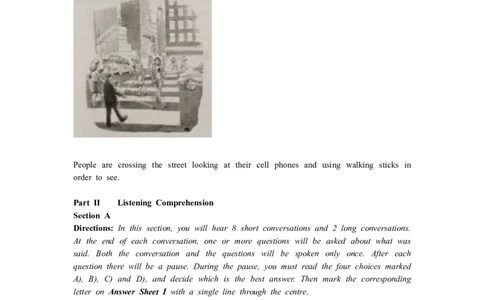
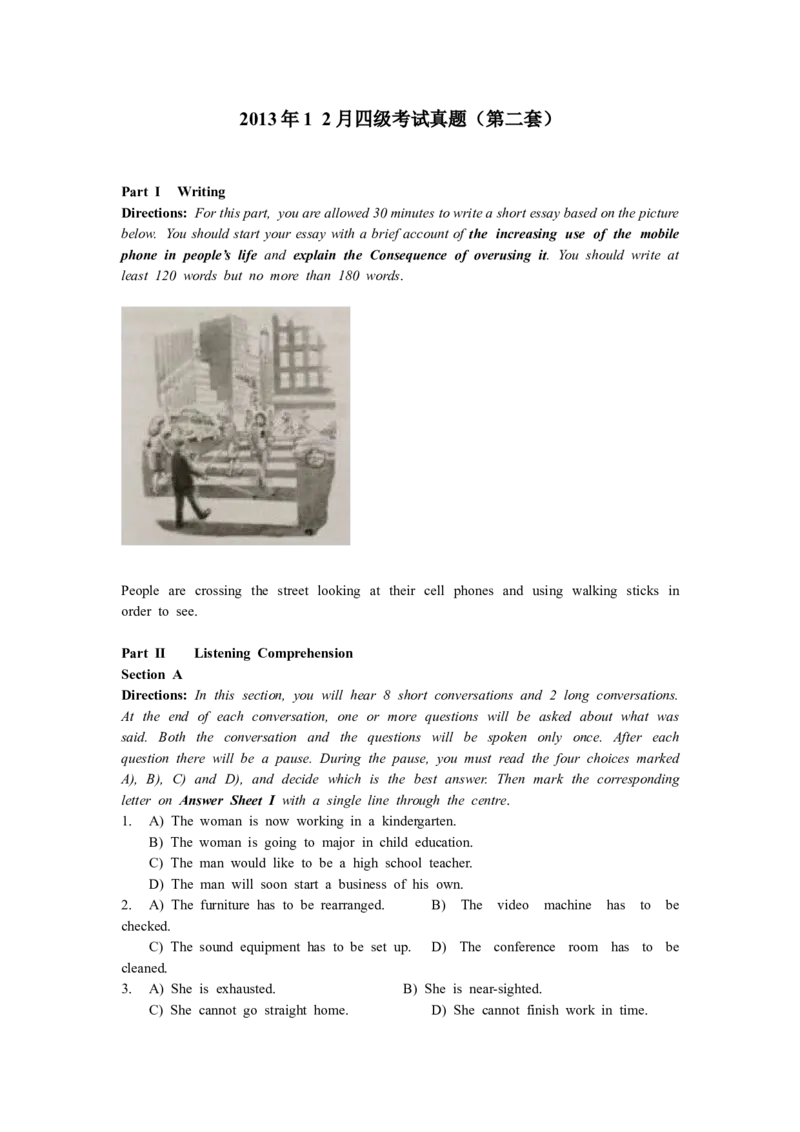
Directions: For this part, you are allowed 30 minutes to write a short essay based on the picture
below. You should start your essay with a brief account of the increasing use of the mobile
phone in people’s life and explain the Consequence of overusing it. You should write at
least 120 words but no more than 180 words.
People are crossing the street looking at their cell phones and using walking sticks in
order to see.
Part II Listening Comprehension
Section A
Directions: In this section, you will hear 8 short conversations and 2 long conversations.
At the end of each conversation, one or more questions will be asked about what was
said. Both the conversation and the questions will be spoken only once. After each
question there will be a pause. During the pause, you must read the four choices marked
A), B), C) and D), and decide which is the best answer. Then mark the corresponding
letter on Answer Sheet I with a single line through the centre.
1. A) The woman is now working in a kindergarten.
B) The woman is going to major in child education.
C) The man would like to be a high school teacher.
D) The man will soon start a business of his own.
2. A) The furniture has to be rearranged. B) The video machine has to be
checked.
C) The sound equipment has to be set up. D) The conference room has to be
cleaned.
3. A) She is exhausted. B) She is near-sighted.
C) She cannot go straight home. D) She cannot finish work in time.4. A) The woman is too particular about food. B) The woman should order her food
quickly.
C) He would rather have a meal an hour later. D) He usually prefers ice-cream to
sandwiches.
5. A) He doesn’t keep his promises. B) He is always ready to offer held to
others.
C) He is not a good mechanic. D) He spends his spare time doing
repairs.
6. A) Sam has a big family to support.
B) Sam is not interested in traveling.
C) The work hours in the travel agency are too long.
D) The pay offer by the travel agency is too low.
7. A) Financial consulting. B) Product development.
C) International trade. D) Domestic retailing.
8. A) Take a vacation. B) Go on a business trip.
C) Make a ticket reservation. D) Look for a job in Miami.
Questions 9 t0 11 are based on the conversation you have just heard.
9. A) It is located on Route 18. B) It is a beautiful little town.
C) It lies seven miles east of Newton. D) It has an interesting museum.
10. A) They are fifty-five miles apart. B) They are in opposite directions.
C) They are quite close to each other. D) They are a long drive from Norwalk.
11. A) They are crowded with tourists. B) They are connected by Route 7.
C) They have lots of old houses. D) They have many rare plants.
Questions 12 t0 15 are based on the conversation you have just heard.
12. A) Bring him up to date on the current situation in Milan.
B) Fetch the documents signed by Mr Gartner.
C) Inform him of the arrangements for his trip in Italy.
D) Accompany Mr Gartner to the Linate airport.
13. A) About 8:30. B) About 4:15.
C) About 5:30. D) About 6:30.
14. A) Gianni Riva at Megastar. B) Mr Gartner from Milan.
C) The company’s sales representative. D) Gavin from the Chamber of Commerce.
15. A) Secretary. B) Business manager.
C) Saleswoman. D) Travel agent.
Section B
Directions: In this section you will hear 3 short passages. At the end of each passage, you will
hear some questions. Both the passage and the questions will be spoken only once. After you hear
a question, you must choose the best answer from the four choices marked A), B), C) and D). Then
mark the corresponding letter on Answer Sheet 2 with a single line through the centre.
Passage OneQuestions 16 t0 19 are based on the passage you have just heard.
16. A) She needed some overseas experience. B) She wanted to find out more
about it.
C) She had a desire to help others. D) She was interested in farming.
17. A) Carry out a cultural exchange program. B) Work on an agriculture project,
C) Teach English. D) Learn Portuguese.
18. A) She could not get the country out of her mind.
B) She found it di伍cult to secure a job in her own country.
C) She wanted to renew her contact with the Peace Corps.
D) She was invited to work as an English teacher.
19. A) By teaching additional English classes.
B) By doing odd jobs for local institutions.
C) By working part time for the Peace Corps.
D) By writing stories for American newspapers.
Passage Two
Questions 20 t0 22 are based on the passage you have just heard.
20. A) Time spent with friends and family. B) Time spent working.
C) Time spent exercising. D) Time spent on leisure activities.
21. A) Reading. B) Watching TV.
C) Surfing the Web. D) Eating out.
22. A) Visiting friends. B) Going to the pub.
C) Gardening. D) Driving.
Passage Three
Questions 23 t0 25 are based on the passage you have just heard,
23. A) McLaughlin’s carelessness resulted in the collision.
B) The car driver was partly responsible for the accident.
C) McLaughlin was talking to his manager while driving.
D) The car driver was trying to avoid hitting a rabbit.
24. A) He did serious damage to a loaded truck.
B) He tore down the company’s main gate.
C) He knocked down several mailboxes.
D) He crashed into a car parked there.
25. A) He will receive retraining. B) He will have to pay damages.
C) He will be fined heavily. D) He will lose his job.
Section C
Directions: In this section, you will hear a passage three times. When the passage is
read for the first time, you should listen carefully for its general idea. When the passage
is read for the second time, you are required to fill in the blanks with the exact words
you have just heard. Finally, When the passage is read for the third time, you should
check what you have written.When Captain Cook asked the chiefs in Tahiti why they always ate 26. ______, they
replied, “Because it is right.” If we ask Americans why they eat with knives and forks,
or why their men wear pants 27. ______ skirts, or why they may be married to only one
person at a time, we are likely to get 28. ______ and very uninformative answers:
“Because it’s right.” “Because that’s the way it’s done.”“Because it’s the 29. ______.”
Or even “I don’t know.” The reason for these and countless other patterns of social
behavior is that they are 30. ______ by social norms – shared rules or guidelines which
prescribe the behavior that is appropriate in a given situation. Norms 31. ______ how
people “ought” to behave under particular circumstances in a particular society. We
conform(遵守) to norms so readily that we are hardly aware they 32. ______. In fact,
we are much more likely to notice 33. ______ from norms than conformity to them. You
would not be surpnsed if a stranger tried to shake hands when you were introduced, but
you might be a little 34. ______ if they bowed, started to stroke you, or kissed you on
both 35. ______. Yet each of these other forms of greeting is appropriate in other parts
of the world. When we visit another society whose norms are different, we quickly
become aware that things we do this way, they do that way.
Part III Reading Comprehension
Section A
Directions: In this section, there is a passage with ten blanks. You are required to select
one word for each blank from a list of choices given in a word bank following the
passage. Read the passage through carefully before making your choices. Each choice in
the bank is identified by a letter. Please mark the corresponding letter for each item on
Answer Sheet 2 with a single line through the centre. You may not use any of the
words in the bank more than once.
Questions 36 to 45 are based on the following passage.
What does it take to be a well-trained nurse? The answer used to be two-year
associate’s or four-year bachelor’s degree programs. But as the nursing shortage 36.
______, a growing number of schools and hospitals are establishing “fast-track programs”
that enable college graduates with no nursing 37. ______to become registered nurses with
only a year or so of 38. ______ training.
In 1991, there were only 40 fast-track curricula; now there are more than 200.
Typical is Columbia University’s Entry to Practice program. Students earn their bachelor
of science in nursing in a year. Those who stay on for an 39. ______ two years can earn
a master’s degree that 40. ______ them as nurse practitioners(执业护士)or clinical nurse
specialists.
Many students are recent 41. ______; others are career switchers. Rudy Guardron, 32,
a 2004 graduate of Columbia’s program, was a premedical student in college and then
worked for a pharmaceutical(药物的) research company. At Columbia, he was 42.
______ as a nurse practitioner, “I saw that nurses were in high 43. ______ and it
looked like a really good opportunity,” he says. “Also, I didn’t want to be in school for
that long.”
The fast-track trend fills a need, but it’s also creating some 44. ______ betweennewcomers and veterans. “Nurses that are still at the bedside 45. ______ these kids with
suspicion,” says Linda Pellico, who has taught nursing at Yale University for 18 years,
“They wonder, how can they do it quicker?” The answer is they don’t,
A) additional I) promote
B) applied J) qualifies
C)demand K) specialized
D) excessive L) tension
E) experience M) trained
F) explores N) view
G) graduates O) worsens
H) operations
Section B
Directions: In this section, you are going to read a passage with ten statements attached
to it. Each statement contains information given in one of the paragraphs. Identify the
Paragraph from which the information is derived. You may choose a paragraph more than
once. Each paragraph is marked with a letter. Answer the questions by marking the
corresponding letter on Answer Sheet 2.
The rise of the sharing economy
A) LAST night 40,000 people rented accommodation from a service that offers 250,000 rooms
in 30,000 cities in 192 countries. They chose their rooms and paid for everything online. But their
beds were provided by private individuals, rather than a hotel chain. Hosts and guests were
matched up by Airbnb, a firm based in San Francisco. Since its launch in 2008 more than 4m
people have used it—2.5million of them in 2012 alone. It is the most prominent example of a huge
new “sharing economy”, in which people rent beds, cars, boats and other assets directly from each
other, co-ordinated via the internet.
B) You might think this is no different from running a bed-and-breakfast(家庭旅店), owning a
timeshare(分时度假房) or participating in a car pool. But technology has reduced transaction
costs, making sharing assets cheaper and easier than ever—and therefore possible on a much
larger scale. The big change is the availability of more data about people and things, which allows
physical assets to be disaggregated and consumed as services. Before the internet, renting a
surfboard, a power tool or a parking space from someone else was feasible, but was usually more
trouble than it was worth. Now websites such as Airbnb, RelayRides and SnapGoods match up
owners and renters; smartphones with GPS let people see where the nearest rentable car is parked;
social networks provide a way to check up on people and build trust; and online payment systems
handle the billing.
What’s mine is yours, for a fee
C) Just as peer-to-peer businesses like eBay allow anyone to become a retailer, sharing sites let
individuals act as an ad hoc(临时的) taxi service, car-hire firm or boutique hote(l 精品酒店) asand when it suits them. Just go online or download an app. The model works for items that are
expensive to buy and are widely owned by people who do not make full use of them. Bedrooms
and cars are the most obvious examples, but you can also rent camping spaces in Sweden, fields in
Australia and washing machines in France. As proponents of the sharing economy like to put it,
access trumps(胜过) ownership.
D) Rachel Botsman, the author of a book on the subject, says the consumer peer-to-peer rental
market alone is worth $26 billion. Broader definitions of the sharing economy include peer-to-
peer lending (though cash is hardly a spare fixed asset) or putting a solar panel on your roof and
selling power back to the grid (电网). And it is not just individuals: the web makes it easier for
companies to rent out spare offices and idle machines, too. But the core of the sharing economy is
people renting things from each other.
E) Such “collaborative(合作的) consumption” is a good thing for several reasons. Owners
make money from underused assets. Airbnb says hosts in San Francisco who rent out their homes
do so for an average of 58 nights a year, making $9,300. Car owners who rent their vehicles to
others using RelayRides make an average of $250 a month; some make more than $1,000.
Renters, meanwhile, pay less than they would if they bought the item themselves, or turned to a
traditional provider such as a hotel or car-hire firm. (It is not surprising that many sharing firms
got going during the financial crisis.) And there are environmental benefits, too: renting a car
when you need it, rather than owning one, means fewer cars are required and fewer resources must
be devoted to making them.
F) For sociable souls, meeting new people by staying in their homes is part of the charm.
Curmudgeons(倔脾气的人) who imagine that every renter is Norman Bates can still stay at
conventional hotels. For others, the web fosters trust. As well as the background checks carried out
by platform owners, online reviews and ratings are usually posted by both parties to each
transaction, which makes it easy to spot lousy drivers, bathrobe-pilferers and surfboard-wreckers.
By using Facebook and other social networks, participants can check each other out and identify
friends (or friends of friends) in common. An Airbnb user had her apartment trashed in 2011. But
the remarkable thing is how well the system usually works. Peering into the future
Peering into the future
G) The sharing economy is a little like online shopping, which started in America 15 years ago.
At first, people were worried about security. But having made a successful purchase from, say,
Amazon, they felt safe buying elsewhere. Similarly, using Airbnb or a car-hire service for the first
time encourages people to try other offerings. Next, consider eBay. Having started out as a peer-
to-peer marketplace, it is now dominated by professional “power sellers” (many of whom started
out as ordinary eBay users). The same may happen with the sharing economy, which also provides
new opportunities for enterprise. Some people have bought cars solely to rent them out, for
example.
H) Existing rental businesses are getting involved too. Avis, a car-hire firm, has a sharein a sharing rival. So do GM and Daimler, two carmakers. In future, companies may develop
hybrid(混合的) models, listing excess capacity (whether vehicles, equipment or office space) on
peer-to-peer rental sites. In the past, new ways of doing things online have not displaced the old
ways entirely. But they have often changed them. Just as internet shopping forced Walmart and
Tesco to adapt, so online sharing will shake up transport, tourism, equipment-hire and more.
I) The main worry is regulatory uncertainty (see Technology Quarterly article). Will room-
renters be subject to hotel taxes, for example? In Amsterdam officials are using Airbnb listings to
track down unlicensed hotels. In some American cities, peer-to-peer taxi services have been
banned after lobbying by traditional taxi firms. The danger is that although some rules need to be
updated to protect consumers from harm, incumbents will try to destroy competition. People who
rent out rooms should pay tax, of course, but they should not be regulated like a Ritz-Carlton
hotel. The lighter rules that typically govern bed-and-breakfasts are more than adequate.
J) The sharing economy is the latest example of the internet„s value to consumers. This
emerging model is now big and disruptive(颠覆性的) enough for regulators and companies to
have woken up to it. That is a sign of its immense potential. It is time to start caring about sharing.
46. Sharing items such as cars does good to the environment.
47. Airbnb’s success clearly illustrates the emergence of a huge sharing economy.
48. The major concern about the sharing economy is how the government regulates it.
49. The most frequently shared items are those expensive to buy but not fully used.
50. The sharing economy has a promising future.
51. Online sharing will change the way business is done in transportation, travel, rentals,
etc.
52. Airbnb is a website that enables owners and renters to complete transactions online.
53. The sharing economy is likely to go the way of online shopping.
54. One advantage of sharing is that owners earn money from renting out items not made
full use of.
55. Sharing appeals to the sociable in that they can meet new people.
Section C
Directions: There are 2 passages in this section. Each passage is followed by some
questions or unfinished statements. For each of them there are four choices marked A),
B), C) and D). You should decide on the best choice and mark the corresponding letter
on Answer Sheet 2 with a single line through the centre.
Passage One
Questions 56 t0 60 are based on the following passage.
In recent years, a growing body of research has shown that our appetite and food intake are
influenced by a large number of factors besides our biological need for energy, including our
eating environment and our perception of the food in front of us.
Studies have shown, for instance, that eating in front of the TV (or a similar distraction) canincrease both hunger and the amount of food consumed. Even simple visual cues, like plate size
and lighting, have been shown to affect portion size and consumption.
A new study suggested that our short-term memory also may play a role in appetite. Several
hours after a meal, people’s hunger levels were predicted not by how much they’d eaten but rather
by how much food they’d seen in front of them—in other words, how much they remembered
eating.
This disparity (差异) suggests the memory of our previous meal may have a bigger
influence on our appetite than the actual size of the meal, says Jeffrey M. Brunstrom, a
professor of experimental psychology at the University of Bristol.
“Hunger isn’t controlled solely by the physical characteristics of a recent meal. We have
identified an independent role for memory for that meal,” Brunstrom says. “This shows that the
relationship between hunger and food intake is more complex than we thought.”
These findings echo earlier research that suggests our perception of food can
sometimes trick our body’s response to the food itself. In a 2011 study, for instance,
people who drank the same 380-calorie (卡路里) milkshake on two separate occasions
produced different levels of hunger-related hormones (荷尔蒙), depending on whether the
shake’s label said it contained 620 or 140 calories. Moreover, the participants reported
feeling more full when they thought they’d consumed a higher-calorie shake.
What does this mean for our eating habits? Although it hardly seems practical to trick
ourselves into eating less, the new findings do highlight the benefits of focusing on our food and
avoiding TV and multitasking while eating.
The so-called mindful-eating strategies can fight distractions and help us control our appetite,
Brunstrom says.
56. What is said to be a factor affecting our appetite and food intake?
A) How we perceive the food we eat. B) What ingredients the food contains.
C) When we eat our meals. D) How fast we eat our meals.
57. What would happen at meal time if you remembered eating a lot in the previous meal?
A) You would probably be more picky about food.
B) You would not feel like eating the same food.
C) You would have a good appetite.
D) You would not feel so hungry.
58. What do we learn from the 2011 study?
A) Food labels may mislead consumers in their purchases.
B) Food labels may influence our body’s response to food.
C) Hunger levels depend on one’s consumption of calories.
D) People tend to take in a lot more calories than necessary.
59. What does Brunstrom suggest we do to control our appetite?
A) Trick ourselves into eating less. B) Choose food with fewer calories.
C) Concentrate on food while eating. D) Pick dishes of the right size.
60. What is the main idea of the passage?
A) Eating distractions often affect our food digestion.
B) Psychological factors influence our hunger levels.
C) Our food intake is determined by our biological needs.D) Good eating habits will contribute to our health.
Passage Two
Questions 61 to 65 are based on the following passage.
As a society we might want to rethink the time and money spent on education, so that these
resources can benefit a greater percentage of the population. Ideally, both high schools and
colleges can prepare individuals for the ever-changing roles that are likely to be expected of them.
High school degrees offer far less in the way of preparation for work than they might, or than
many other nations currently offer, creating a growing skills gap in our economy. We encourage
students to go on to college whether they are prepared or not, or have a clear sense of purpose or
interest, and now have the highest college dropout rate in the world.
We might look to other countries for models of how high schools can offer better training,
as well as the development of a work ethic (勤奋工作的美德) and the intellectual skills
needed for continued learning and development. I recommend Harvard’s 2011 “Pathways
to Prosperity” report for more attention to the “forgotten half” (those who do not go on to
college) and ideas about how to address this issue.
Simultaneously, the liberal arts become more important than ever. In a knowledge economy
where professional roles change rapidly and many college students are preparing for positions that
may not even exist yet, the skill set needed is one that prepares them for change and continued
learning.
Learning to express ideas well in both writing and speech, knowing how to find information,
and knowing how to do research are all solid background skills for a wide variety of roles, and
such training is more important than any particular major in a liberal arts college. We need to
continue to value broad preparation in thinking skills that will serve for a lifetime.
Students also need to learn to work independently and to make responsible decisions.
The lengthening path to adulthood appears exacerbated (恶化) by parental involvement in
the college years. Given the rising investment in college education, parental concern is not
surprising, but learning where and when to intervene (干预) will help students take more
ownership of the outcomes of these increasingly costly educations.
61. What kind of education does the author think is ideal?
A) It benefits the great majority of the general population.
B) It prepares students to meet the future needs of society.
C) It encourages students to learn throughout their lives.
D) It ensures that students’ expectations are successfully fulfilled.
62. What does the author say is the problem with present high school education?
A) Ignoring the needs of those who don’t go to college.
B) Teaching skills to be used right after graduation only.
C) Giving little attention to those having difficulty learning.
D) Creating the highest dropout rate in the developed world.
63. What characterizes a knowledge economy according to the passage?
A) People have to receive higher education to qualify for a professional position.
B) Students majoring in liberal arts usually have difficulty securing a job.
C) New positions are constantly created that require people to keep learning.D) Colleges find it hard to teach students how to cope with the changing economy.
64. What does the author think a liberal arts college should focus on?
A) Solid background knowledge in a particular field.
B) Practical skills urgently needed in current society.
C) Basic skills needed for change and lifelong learning.
D) Useful thinking skills for advanced academic research.
65. What suggestion does the author offer to parents?
A) Rethinking the value of higher education.
B) Investing wisely in their children’s education.
C) Helping their children to bring their talent into full play.
D) Avoiding too much intervention in their children’s education.
Part IV Translation
Directions : For this part, you are allowed 30 minutes to translate a passage from
Chinese into English. You should write your answer on Answer Sheet 2.
中国结(the Chinese knot)最初是由手工艺人发明的,经过数百年不断的改进,已经成为一种
优雅多彩的艺 术和工艺。在古代,人们用它来记录事件,但现在主要是用于装饰的目的。
“结”在中文里意味这爱情、姻和团聚,中国结常常作为礼物交换或作用饰品祈求好运 和
辟邪。这种形式的手工艺(handicraft)代代相传,现在已经在中国和世界各地越来越受欢迎。