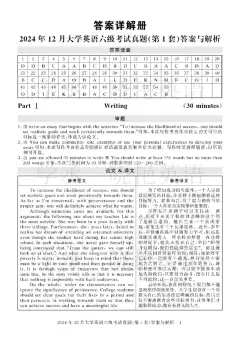
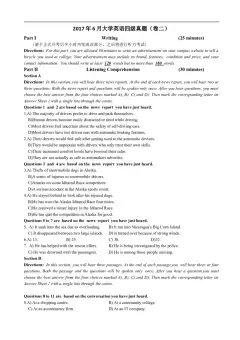
Part I Writing ( 30 minutes)
Directions : For this part , you are allowed 30 minutes to write an advertisement on your campus
website to sell some of the course books you used at college. Your advertisement may
include a brief description of their content, their condition and price, and your contact
information. You should write at least 120 words but no more than 180 words.
Part II Listening Comprehension ( 25 minutes)
Section A
Directions: In this section, you will hear three news reports. At the end of each news
report, you will hear two or three questions. Both the news report and the
questions will be spoken only once. After you hear a question, you must
choose the best answer from the four choices marked A) , B) , C) and D) .
Then mark the corresponding letter on Answer Sheet 1 with a single line
through the centre.
Questions 1 and 2 are based on the news report you have just heard.
1. A) The majority of drivers prefer to drive and park themselves.
B) Human drivers become easily distracted or tired while driving.
C) Most drivers feel uncertain about the safety of self-driving cars.
D) Most drivers have test driven cars with automatic braking features.
2. A) Their drivers would feel safe after getting used to the automatic devices.
B) They would be unpopular with drivers who only trust their own skills.
C) Their increased comfort levels have boosted their sales.
D) They are not actually as safe as automakers advertise.
Questions 3 and 4 are based on the news report you have just heard.
3. A) Thefts of snowmobile dogs in Alaska.
B) A series of injuries to snowmobile drivers.
C) Attacks on some Iditarod Race competitors.
D) A serious accident in the Alaska sports event.
4. A) He stayed behind to look after his irtjured dogs.
B) He has won the Alaska Iditarod Race four times.
C) He received a minor injury in the Iditarod Race.
D) He has quit the competition in Alaska for good.
Questions 5 to 7 are based on the news report you have just heard.
5. A) It sank into the sea due to overloading. C) It disappeared between two large islands.
B) It ran into Nicaragua's Big Com Island. D) It turned over because of strong winds.
2017.6/ 1 (ffi 2~)6. A) 13. B) 25. C) 30. D) 32.
7. A) He has helped with the rescue effort. C) He was drowned with the passengers.
B) He is being investigated by the police. D) He is among those people missing.
Section B
Directions: In this section, you will hear two long conversations. At the end of each conversation,
you will hear four questions. Both the conversation and the questions will be spoken only
once. After you hear a question, you must choose the best answer from the four choices
marked A), B), C) and D). Then mark the corresponding letter on Answer Sheet 1
with a single line through the centre.
Questions 8 to 11 are based on the conversation you have just heard.
8. A) At a shopping centre. C) At an accountancy firm.
B) At a community college. D) At an IT company.
9. A) Helping out with data input. C) Sorting application forms.
B) Arranging interviews. D) Making phone calls.
10. A) He enjoys using computers. C) He wants to work in the city centre.
B) He needs the money badly. D) He has relevant working experience.
11. A) Purchase some business suits. C) Improve his programming skills.
B) Learn some computer language. D) Review some accountancy terms.
Questions 12 to 15 are based on the conversation you have just heard.
12. A) They are keen on high technology.
B) They are poor at technology skills.
C) They often listen to National Public Radio.
D) They feel superior in science and technology.
13. A) Japanese. C) Poles.
B) Germans. D) Americans.
14. A) Emailing. C) Science.
B) Texting. D) Literacy.
15. A) It is undergoing a drastic reform. C) It has much room for improvement.
B) It lays emphasis on creative thinking. D) It prioritizes training of practical skills.
Section C
Directions: In this section, you will hear three passages. At the end of each passage, you will hear
three or four questions. Both the passage and the questions will be spoken only once.
After you hear a question, you must choose the best answer from the four choices marked
A), B), C) and D). Then mark the corresponding letter on Answer Sheet 1 with a
single line through the centre.
Questions 16 to 18 are based on the passage you have just heard.
16. A) They have small roots. C) They taste like apples.
B) They grow white flowers. D) They come from Central Africa.
17. A) They turned from white to purple in color.
B) They became popular on the world market.
C) They became an important food for humans.
D) They began to look like modem-day carrots.
2017.6/ 2 (ffi 2~)18. A) They were found quite nutritious. C) People discovered their medicinal value.
B) There were serious food shortages. D) Fann machines helped lower their prices.
Questions 19 to 21 are based on the passage you have just heard.
19. A) She could update her family any time she liked.
B) She could call up her family whenever she liked.
C) She could locate her friends wherever they were.
D) She could download as many pictures as she liked.
20. A) She liked to inform her friends about her success.
B) She enjoyed reading her friends' status updates.
C) She felt quite popular among them.
D) She felt she was a teenager again.
21. A) She could barely respond to all her 500 Facebook friends.
B) She spent more time updating her friends than her family.
C) She could barely balance Facebook updates and her work.
D) She didn't seem to be doing as well as her Facebook friends.
Questions 22 to 25 are based on the passage you have just heard.
22. A) They have strong muscles. C) They eat much less in winter.
B) They live a longer life than horses. D) They can work longer than donkeys.
23. A) It was a pet of a Spanish king. C) It was brought over from Spain.
B) It was bought by George Washington. D) It was donated by a U.S. ambassador.
24. A) They met and exchanged ideas on animal breeding.
B) They participated in a mule-driving competition.
C) They showed and traded animals in the market.
D) They fed mules with the best food they could find.
25. A) The wider use of horses. C) A shrinking animal trade.
B) The arrival of tractors. D) A growing donkey population.
Part ID Reading Comprehension ( 40 minutes)
Section A
Directions: In this section, there is a passage with ten blanks. You are required to select one word
for each blank from a list of choices given in a word bank following the passage. Read the
passage through carefully before making your choices. Each choice in the bank is
identified by a letter. Please mark the corresponding letter for each item on Answer
Sheet 2 with a single line through the centre. You may not use any of the words in the
bank more than once.
Questions 26 to 35 are based on the following passage.
As if you needed another reason to hate the gym, it now turns out that exercise can exhaust not
only your muscles , but also your eyes. Fear not, however, for coffee can stimulate them again. During
26 exercise , our muscles tire as they run out of fuel and build up waste products. Muscle
performance can also be affected by a 27 called " central fatigue , " in which an imbalance in the
body's chemical messengers prevents the central nervous system from directing muscle movements
28 . It was not known, however, whether central fatigue might also affect motor systems not
2017.6/ 3 (ffi 2~)directly 29 in the exercise itself, such as those that move the eyes. To find out, researchers gave
11 volunteer cyclists a carbohydrate ( 7wt 7.]( {t if~ Ef9 ) 30 either with a moderate dose of caffeine
( !!}JU ~FIE!) , which is lmown to stimulate the central nervous system, or as a placebo ( ~f!.tlfU) without,
during 3 hours of 31 . After exercising, the scientists tested the cyclists with eye-tracking cameras
to see how well their brains could still 32 their visual system. The team found that exercise
reduced the speed of rapid eye movements by about 8% , 33 their ability to capture new visual
information. The caffeine , the equivalent of two strong cups of coffee , was 34 to reverse this
effect, with some cyclists even displaying 35 eye movement speeds. So it might be a good idea to
get someone else to drive you home after that marathon.
A) cautiously I) phenomenon
B) commit J) preventing
C) control K) sensitive
D) cycling L) slowing
E) effectively M) solution
F) increased N) sufficient
G) involved 0) vigorous
H) limited
Section B
Directions : In this section , you are going to read a passage with ten statements attached to it. Each
statement contains information given in one of the paragraphs. Identify the paragraph
from which the information is derived. You may choose a paragraph more than once.
Each paragraph is marked with a letter. Answer the questions by marking the
corresponding letter on Answer Sheet 2.
Team Spirit
A) Teams have become the basic building blocks of organisations. Recruitment advertisements
routinely call for "team players". Business schools grade their students in part on their performance
in group projects. Office managers lmock down walls to encourage team building. Teams are as old
as civilisation, of course: even Jesus had 12 co-workers. But a new report by Deloitte, "Global
Human Capital Trends" , based on a survey of more than 7 , 000 executives in over 130 countries ,
suggests that the fashion for teamwork has reached a new high. Almost half of those surveyed said
their companies were either in the middle of restructuring or about to embark on ( 3fM t) it; and for
the most part, restructuring meant putting more emphasis on teams.
B) Companies are abandoning conventional functional departments and organising employees into
cross-disciplinary teams that focus on particular products, problems or customers. These teams are
gaining more power to run their own affairs. They are also spending more time working with each
other rather than reporting upwards. Deloitte argues that a new organisational form is on the rise : a
network of teams is replacing the conventional hierarchy ( ~~{;$:.ifftl).
C) The fashion for teams is driven by a sense that the old way of organising people is too rigid for both
the modem marketplace and the expectations of employees. Technological innovation places
greater value on agility ( ~lilftt). John Chambers, chairman of Cisco Systems Inc. , a worldwide
leader in electronics products , says that " we compete against market transitions ( 11 ~ ) , not
2017.6/ 4 (ffi 2~)competitors. Product transitions used to take five or seven years; now they take one or two. "
Digital technology also makes it easier for people to co-ordinate their activities without resorting to
hierarchy. The "millennials" ( -=f ff-1--1;'.;) who will soon make up half the workforce in rich
countries were raised from nursery school onwards to work in groups.
D) The fashion for teams is also spreading from the usual corporate suspects ( such as GE and IBM) to
some more unusual ones. The Cleveland Clinic, a hospital operator, has reorganised its medical
staff into teams to focus on particular treatment areas ; consultants , nurses and others collaborate
closely instead of being separated by speciality ( 4ft At) and rank. The US Army has gone the same
way. In his book, Team of Teams, General Stanley McChrystal describes how the army's
hierarchical structure hindered its operations during the early stages of the Iraq war. His solution
was to learn something from the rebels it was fighting: decentralising authority to self-organising
teams.
E) A good rule of thumb is that as soon as generals and hospital administrators jump on a management
bandwagon ( *JM[-;fipffJ..!.tlmE) , it is time to ask questions. Leigh Thompson of Kellogg School of
Management in Illinois warns that, "Teams are not always the answer-teams may provide insight,
creativity and knowledge in a way that a person working independently cannot; but teamwork may
also lead to confusion, delay and poor decision-making. " The late Richard Hackman of Harvard
University once argued, "I have no question that when you have a team, the possibility exists that
it will generate magic , producing something extraordinary... But don't count on it. "
F) Hackman ( who died in 2013) noted that teams are hindered by problems of co-ordination and
motivation that chip away at the benefits of collaboration. High-flyers ( f:Jt=f8'9A) who are forced
to work in teams may be undervalued and free-riders empowered. Group-think may be
unavoidable. In a study of 120 teams of senior executives , he discovered that less than 10% of their
supposed members agreed on who exactly was on the team. If it is hard enough to define a team's
membership , agreeing on its purpose is harder still.
G) Profound changes in the workforce are making teams trickier to manage. Teams work best if their
members have a strong common culture. This is hard to achieve when, as is now the case in many
big firms, a large proportion of staff are temporary contractors. Teamwork improves with time:
America's National Transportation Safety Board found that 73% of the incidents in its civil-aviation
database occurred on a crew's first day of flying together. However, as Amy Edmondson of Harvard
points out, organisations increasingly use "team" as a verb rather than a noun : they form teams for
specific purposes and then quickly disband them.
H) The least that can be concluded from this research is that companies need to think harder about
managing teams. They need to rid their minds of sentimentalism ( ]®'If ffi$) : the most successful
teams have leaders who are able to set an overall direction and take immediate action. They need to
keep teams small and focused : giving in to pressure to be more " inclusive " is a guarantee of
dysfunction. Jeff Bezos, Amazon's boss, says that "If I see more than two pizzas for lunch, the
team is too big." They need to immunise teams against group-think: Hackman argued that the best
ones contain " deviant" ( ~ t~ ~ ii $r) who are willing to do something that may be upsetting to
others.
I) A new study of 12,000 workers in 17 countries by Steelcase, a furniture-maker which also does
consulting, finds that the best way to ensure employees are "engaged" is to give them more control
over where and how they do their work-which may mean liberating them from having to do
2017.6/ 5 (ffi 2~)everything in collaboration with others.
J) However, organisations need to learn something bigger than how to manage teams better: they
need to be in the habit of asking themselves whether teams are the best tools for the job. Team
building skills are in short supply: Deloitte reports that only 12% of the executives they contacted
feel they understand the way people work together in networks and only 21% feel confident in their
ability to build cross-functional teams. Loosely managed teams can become hotbeds of distraction
employees routinely complain that they can't get their work done because they are forced to spend
too much time in meetings or compelled to work in noisy offices. Even in the age of open-plan
offices and social networks some work is best left to the individual.
36. Successful team leaders know exactly where the team should go and are able to take prompt
action.
37. Decentralisation of authority was also found to be more effective in military operations.
38. In many companies, the conventional form of organisation is giving way to a network of teams.
39. Members of poorly managed teams are easily distracted from their work.
40. Teamwork is most effective when team members share the same culture.
41. According to a report by Deloitte, teamwork is becoming increasingly popular among companies.
42. Some team members find it hard to agree on questions like membership and the team's purpose.
43. Some scholars think teamwork may not always be reliable, despite its potential to work wonders.
44. To ensure employees' commitment, it is advisable to give them more flexibility as to where and
how they work.
45. Product transitions take much less time now than in the past.
Section C
Directions : There are 2 passages in this section. Each passage is followed by some questions or
unfinished statements. For each of them there are four choices marked A), B), C) and
D) . You should decide on the best choice and mark the corresponding letter on Answer
Sheet 2 with a single line through the centre.
Passage One
Questions 46 to 50 are based on the following passage.
Shoppers in the UK are spending less money on toilet paper to save money, research has shown.
Penny-pinching UK consumers choose cheaper products from discounters such as Aldi and Lidl
rather than luxury alternatives.
This has wiped 6% off the value of the soft tissue paper market in the UK. It has shrunk from
£ 1. 19 billion in 2011 to£ 1. 12 billion in 2015, according to a new report from market research company
Mintel. Furthermore , the future of the market looks far from rosy, with sales expected to fall further to
£ 1. 11 billion in 2016.
In the last year alone , despite an increase in the UK population and a subsequent rise in the
number of households, sales of toilet paper fell by 2% , with the average household reducing their toilet
roll spending from £43 in 2014 to £41 in 2015.
Overall, almost three in five people say they try to limit their usage of paper-including facial
tissue and kitchen roll-to save money. "Strength, softness and thickness remain the leading indicators
of toilet paper quality, with just a small proportion of consumers preferring more luxurious
alternatives, such as those with flower patterns or perfume, " said Mintel analyst Jack Duckett. "These
2017.6/ 6 (ffi 2~)extra features are deemed unnecessary by the majority of shoppers , which probably reflects how these
types of products are typically more expensive than regular toilet paper, even when on special offer. "
While consumers are spending less on toilet paper, they remain fussy-in theory at least-when it
comes to paper quality. Top of Britons' toilet paper wish list is softness ( 57% ) followed by strength
( 45% ) and thickness ( 36% ) .
One in 10 buyers rank toilet rolls made from recycled paper among their top considerations ,
highlighting how overall the environment is much less of a consideration for shoppers than product
quality. In a challenge for manufacturers, 81 % of paper product users said they would consider buying
recycled toilet tissue if it were comparable in quality to standard paper.
46. The market sales of toilet paper have decreased because ____
A) Britons have cut their spending on it
B) its prices have gone up over the years
C) its quality has seen marked improvement
D) Britons have developed the habit of saving
47. What does the author think of the future of the tissue paper market in the UK?
A) It will expand in time. C) It will experience ups and downs.
B) It will remain gloomy. D) It will recover as population grows.
48. What does Jack Duckett say about toilet paper?
A) Special offers would promote its sales.
B) Consumers are loyal to certain brands.
C) Luxurious features add much to the price.
D) Consumers have a variety to choose from.
49. What do we learn about Britons concerning toilet paper?
A) They are particular about the quality of toilet paper.
B) They emphasize the strength of toilet paper the most.
C) They prefer cheap toilet paper to recycled toilet paper.
D) They reject using toilet paper with unnecessary features.
50. What can we infer from the last paragraph?
A) More and more Britons buy recycled toilet paper to protect the environment.
B) Toilet paper manufacturers are facing a great challenge in promoting its sales.
C) Toilet paper manufacturers compete with one another to improve product quality.
D) Environmental protection is not much of a concern when Britons buy toilet paper.
Passage Two
Questions 51 to 55 are based on the following passage.
" One of the reasons I find this topic very interesting is because my morn was a smoker when I was
younger," says Lindson-Hawley, who studies tobacco and health at the University of Oxford.
By studying about 700 adult smokers , she found out that her morn quit the right way-by stopping
abruptly and completely.
In her study, participants were randomly ( 1M[ tfL flt! ) assigned to two groups. One had to quit
abruptly on a given day, going from about a pack a day to zero. The other cut down gradually over the
course of two weeks. People in both groups used nicotine ( ~ r!t T ) patches before they quit, in
addition to a second form of nicotine replacement, like gum or spray. They also had talk therapy with
a nurse before and after quit day.
2017.6/ 7 (ffi 2~)Six months out, more people who had quit abruptly had stuck with it-more than one-fifth of
them, compared to about one-seventh in the other group. Although these numbers appear low, it is
much higher than if people try without support.
And the quit rates were particularly convincing given that before the study started, most of the
people had said they'd rather cut down gradually before quitting. "If you're training for a marathon,
you wouldn't expect to turn up and just be able to run it. And I think people see that for smoking as
well. They think, 'Well, if I gradually reduce, it's like practice,'" says Llndson-Hawley. But that
wasn't the case. Instead of giving people practice, the gradual reduction likely gave them cravings
( •) and withdrawal symptoms before they even reached quit day, which could be why fewer people in
that group actually made it to that point. " Regardless of your stated preference , if you're ready to quit,
quitting abruptly is more effective," says Dr. Gabriela Ferreira. "When you can quote a specific
number like a fifth of the patients were able to quit, that's compelling. It gives them the
encouragement, I think, to really go for it, " Ferreira says.
People rarely manage to quit the first time they try. But at least, she says, they can maximize the
odds of success.
51. What does Llndson-Hawley say about her mother?
A) She quit smoking with her daughter's help.
B) She succeeded in quitting smoking abruptly.
C) She was also a researcher of tobacco and health.
D) She studied the smoking patterns of adult smokers.
52. What kind of support did smokers receive to quit smoking in Llndson-Hawley's study?
A) They were given physical training. C) They were encouraged by psychologists.
B) They were looked after by physicians. D) They were offered nicotine replacements.
53. How does Dr. Gabriela Ferreira view the result of Llndson-Hawley's experiment?
A) It is idealized. C) It is encouraging.
B) It is unexpected. D) It is misleading.
54. The idea of "a marathon" ( Line 2, Para. 5) illustrates the popular belief that quitting smoking
A) is something few can accomplish C) requires a lot of patience
B) needs some practice first D) is a challenge at the beginning
55. What happens when people try to quit smoking gradually?
A) They find it even more difficult.
B) They are simply unable to make it.
C) They show fewer withdrawal symptoms.
D) They feel much less pain in the process.
Part IV Translation ( 30 minutes)
Directions : For this part, you are allowed 30 minutes to translate a passage from Chinese into
English. You should write your answer on Answer Sheet 2.
*
* tr¾SIE tHI ii*, -W: :W-1:~ ~ * l'f{Jfi'if flit a * trf lit f:} $#~IP] l¥J it 1& t1t , ¾~ $ lffi fit~# l¥J tJJli J~, ±m ,
~~Tq=i~Ji5tZ-a'9±:l:ma *trmE~( river basin) Jis1i~q:i ~ ~5tz-1¥JA r:::t a *llt!:9" ~J]j5E,X.
1t-tU£:Nff J:®~1ltkl¥Jfpffl *iT..=:J§ll+I ( delta) Fill $5E 20% l'f{J 9" 00 00 B.',i:tF,~,ti[o JL'f-1¥*' *iT.
O
][~ffl r1~1Jcjg~~T~!t.F *1IJ:~~fi~-W::W-!i::kl¥J1Jot:1.M
a a
2017.6/ 8 (ffi 2 ~)