2022 年 12 月大学英语四级考试真题(三)
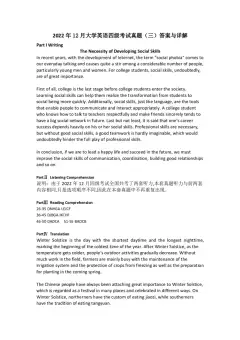
Part Ⅰ Writing (30minutes)
Directions:Inthistask,youaretowriteanessayonthenecessityofdevelopingsocial
skillsforcollegestudents.Youwillhave30minutesforthetask.Youshouldwriteat
least120wordsbutnomorethan180words.
Part Ⅱ Listening Comprehension (25minutes)
说明:由于2022年12 月四级考试全国共考了两套听力,本套真题听力与前两套
内容相同,只是选项顺序不同,因此在本套真题中不再重复出现。
Part Ⅲ Reading Comprehension (40 minutes)
SectionA
Directions:Inthissection,thereisapassagewithtenblanks.Youarerequiredto
selectonewordforeachblankfromalistofchoicesgiveninawordbankfollowing
thepassage.Readthepassagethroughcarefullybeforemakingyourchoices.Each
choiceinthebankisidentifiedbyaletter.Pleasemarkthecorrespondingletterfor
eachitemonAnswerSheet2withasinglelinethroughthecentre.Youmaynotuse
anyofthewordsinthebankmorethanonce.
Phonesinfluenceallaspectsofteenagelife.Ninety-fivepercentofAmericansages13
to17haveasmartphoneorhaveaccesstoone,andnearlyhalfreportusingthe
internet“almost 26 .“
Butasrecentsurveydataandinterviewshavesuggested,manyteensfindmuchof
thattimetobeunsatisfyinglyspent.Continuous 27 shouldn‘tbemistakenfor
endlessenjoyment.Anew 28 representativesurveyabout“screentimeand
devicedistractions“fromthePewResearchCenterindicatesthatit‘snotjustparents
whothinkteenagersareworryingly 29 fromtheirphonesmanyteens
themselvesdotoo.Fifty-fourpercentofthe13-to-17-year-oldssurveyedsaidthey
spendtoomuchtime 30 intheirphones.
VickyRideout,whorunsaresearchfirmthatstudieschildren‘sinteractionswith
mediaandtechnology,wasnotsurprisedbythisfinding.Shesaysit‘shardly 31
toteenagers.“Theyaredealingwiththesamechallengesthatadultsare,asfaras
theyarelivinginthe 32 ofatechenvironmentdesignedtosuckasmuchof
theirtimeontotheirdevicesaspossible,“Rideoutsays.
Thewayparentsinteractwithtechnologycan 33 thewaytheyinteractwiththeir
kids.Rideoutthusthinksit‘suptoparentstomodelgood 34 .Kidstendtotake
noteiftheirparentsputtheirphoneawayatdinnerorchargeitinanotherroomwhiletheysleep.Witnessinghabitslikethatcanhelpkids“realizethattheycan 35
somemorecontrolovertheirdevices,“shesays.
A)absorbed I)recruited
B)addicted J)shape
C)behavior K)solution
D)constantly L)specific
E)context M)summary
F)exercise N)usage
G)inseparable O)vaguely
H)nationally
SectionB
Directions:Inthissection,youaregoingtoreadapassagewithtenstatements
attachedtoit.Eachstatementcontainsinformationgiveninoneoftheparagraphs.
Identifytheparagraphfromwhichtheinformationisderived.Youmaychoosea
paragraphmorethanonce.Eachparagraphismarkedwithaletter.Answerthe
questionsbymarkingthecorrespondingletteronAnswerSheet2.
EvilGenius
A)AfewyearsagoIfoundmyselfteachingauniversityclassonevil.Itwasfor
third-yearcriminologystudentstohelpthemcontextualizetheoryandresearch
withincontroversialcurrenttopics.Itwasahugesuccess.Thedebateswereheated
andinteresting.Icouldseepeople‘sviewschangewithinthecourseofasingle
lecture.Overthepast13years,asastudent,lecturerandresearcher,I’veenjoyed
discussingthescienceofevilwithanyonewillingtolisten.WhatIlikemostis
destroyingtheclicheofgoodandevil,andreplacingthemwithscientificinsight.We
needamoreinformedwayofdiscussingbehaviorthatatfirstwecannot,orshould
not,begintounderstand.
B)Withoutunderstanding,weriskdehumanizingothers,writingoffhumanbeings
simplybecausewedon‘tcomprehendthem.Wemusttrytounderstandwhatwe
havelabeledevil.Wetendtothinkevilissomethingthatotherpeopleare.Wethink
ofourselvesas“goodpeople“,andevenwhenwedomorallywrongthings,we
understandthecontextofourdecisions.Withothers,however,itisfareasierto
writethemoff.Iftheiractionsdeviate(偏离)substantiallyfromwhatweconsider
acceptable,wemaylabelthemevil.Weneedtobecarefulwiththis.Calling
someoneevilisoftensimilartosayingtheycannotchange,andperhapsaren‘tevena
humanatall.However,whenyouactuallygomonster-hunting,andyoulookdeeply
atthepeoplebehindshockingbehavior,youmaybesurprised.
C)AsachildIusedtolovetheScooby-Doocartoons.Arrivingintheir“Mystery
Machine“,thegangwouldhavetofindamonsterwhowasterrorizinganeighborhood.Theywouldrunaroundlookingforcluesandattheendunmaskthe
badguy.Itwasalwaysanormalpersoninacostume.Therewerenomonsters.Like
theScoobycrew,wemayfindourselveshuntingforaneasyfix,onewordforpeople
whodobadthings.Butifwetakeagoodlook,theword‘evil‘isinsufficient-thereare
nosimpleexplanationsforwhyhumansdobadthings:insteadtherearemany,and
theyareallmarvelouslydifferent.
D) Evilistypicallyreferredtowhenthereisdeviancefromsocialnorms:formal
devianceistheviolationoflaws,liketheft,murder,andattacks,whileinformal
devianceinvolvesviolationsofsocialnorms,likelying.Evilbehavioristypically
thoughttoembraceoneorbothforms.However,deviancecanalsodescribea
behaviorthatsimplydiffersfromthenorm.
E) Perhaps this is where we can find the good side of our bad side. Deviating from
the norm can make us villains(恶棍) , but it can also make us heroes. A child
deviates from social pressures when they stand up for another child being bullied in
school. A soldier deviates when they choose not to follow orders to kill an innocent
civilian. An employee in a big tech company deviates when they expose its wrong
doings.
F) Creativityisalsoadeviation.Here,too,thingsarecomplex.Thinkingcreativelyhas
givenusmodernmedicine,technologyandmodernpoliticalstructures,butithas
alsogivenuspoisonandnuclearweapons.Greatbenefitandgreatharmcancome
fromthesamehumantendency.
G) Inaresearchpaper,EvilGenius,publishedin2014,thebehavioralscientists
FrancescaGinoandScottWiltermuthwantedtoexaminewhetherpeoplewho
behaveunethicallyinonetaskaremorecreativethanothersonasubsequenttask,
evenaftercontrollingfordifferencesinbaselinecreativeskills.Theunethical
behaviortheychosewasdishonesty.
H) Overfiveexperimentsresearchersgaveparticipantstasksinwhichtheycould
cheat.Inonestudy,theyweregivenmatrixes (矩阵)andhadtofindtwonumbers
thataddedupto10.Participantswereaskedtoself-reporthowwelltheydidatthe
endofthestudy:59%cheatedbysayingthattheysolvedmorematrixesthanthey
actuallyhad.
I) Aftereachtask,theresearchersmeasuredparticipants‘performanceonthe
RemoteAssociatesTest.Thisshowsparticipantsthreewordsatatimethatappear
tobeunrelated,andthepersonhastothinkofafourthwordthatisassociatedwith
allofthem.Forexample,youmightget“Fox,Man,Peep“,or“Dust,Cereal,Fish”.In
ordertofindthelinkingwords(“Hole”forthefirst,“Bowl“forthesecond)youneed
tobecreative.Themoreyougetright,themorecreativeyouarethoughttobe
becauseyouhavecomeupwithuncommonassociations.J) Foreveryoneofthefivestudies,theyfoundthesamethingparticipantswho
cheatedinthefirsttaskdidbetteronthecreativitytask.Why?Likeotherformsof
unethicalbehavior,lyingmeansbreakingrules.Itinvolvesbeingdeviant,going
againstthesocialprinciplethatpeopleshouldtellthetruth.Similarly,beingcreative
involves“thinkingoutsidethebox“,deviatingfromexpectations.Theyinvolvesimilar
thoughtpatterns,sostimulatingonestimulatestheother.Canwelearnfromthis?
Perhaps.Tobemorecreative,wecouldtrylyinginacontrolledenvironment.Find
onlinelogicgamesandcheatatthem,playScrabble(拼字游戏) withadictionary,
orwriteastoryaboutsomethingthatisuntrue?Suchtaskscangetourbrains
thinkingflexibly,beyondournormalcomfortzone.Thisisnotacalltobecomea
compulsive(强迫性的) liar,butacontrolledliar.
K) Inadditiontobenefitsforcreativity,deviancecanbeagoodthinginotherways.
EvenPhilipZimbardo,theauthoroftheStanfordprisonexperiment,whoshowed
howeasilywecanbeledtobehavebadly,believesthatthefutureofdeviance
researchmayliemoreinunderstandingextremepro-socialbehavior,suchas
heroism.Likeevil,weoftenviewheroismasonlyapossibilityforoutliersforpeople
whoareabnormal.ButZimbardoasks:“Whatifthecapabilitytoactheroicallyisalso
fundamentallyordinaryandavailabletoallofus?“Somesayweshouldnevermeet
ourheroes,lesttheydisappointuswhenwefindouthownormaltheyare.Butthis
shouldbeliberating,notdisappointing.Weareallcapableofbehavinglike outliers.
It‘stimeforustounderstanddeviance,andrealizeitspotentialforgoodaswellas
forharm.
36. Abehaviorthatdoesnotconformtosocialnormsmaybedescribedasbeing
deviant.
37. Variousexperimentsfoundthatparticipantswhocheatedintheinitialtask
performedbetterinthecreativitytest.
38. Peoplemaybesimplyconsideredeviliftheirbehaviorsaremorally
unacceptabletous.
39. The research published by two scientists was intended to examine the
relationshipbetweendishonestyandcreativity.
40. Theauthor‘slecturessparkedlivelydiscussionsinhisclass.
41. Theresearcherstestedtheparticipants‘creativitybyaskingthemtoplayaword
game.
42. Itistimewerealizedthatdeviancemaybecapableofdoingbothgoodandharm
toindividualsandsociety.
43. Thereasonforpeople‘sevilbehaviorscanbeexplainedinmorewaysthanone.
44. Themathtaskinoneexperimentwasdesignedtotestparticipants‘tendencyto
cheat.
45. Somecreativeideashaveturnedouttodoharmtohumansociety.SectionC
Directions:Thereare2passagesinthissection.Eachpassageisfollowedbysome
questionsorunfinishedstatements.Foreachofthemtherearefourchoicesmarked
A),B),C)andD).Youshoulddecideonthebestchoiceandmarkthecorresponding
letteronAnswerSheet2withasinglelinethroughthecentre.
PassageOne
Questions46to50arebasedonthefollowingpassage.
Eventhoughwearelivinginanagewheregrowingoldisthoughtofasaninevitable
misery,thisdoctorhasbeenchangingthegameforseniorsoverthelast25years.
Itallstartedin1991whentheHarvard-educatedphysicianwastransferredfrom
workinginastressfulemergencyroomtobeingthemedicaldirectorofanursing
homeinupstateNewYork.Thedepressingandregimented(严格管制的)
environmentgothimthinkingonwhatexactlycouldimprovetheresidents‘
conditions.
Eventhoughanimalsinnursinghomeswereillegalatthetime,Dr.BillThomastooka
chance.Basedonahunch(,hebroughtintwodogs,fourcats,hens,rabbits,100
birds,amultitudeofplants,aflowergarden,andavegetablepatch.
Thechangewasdramatic.Therewasa50%dropinmedicalprescriptionsalongwith
adramaticdecreaseindeathrates—butmostimportantly,theresidentswere
simplyhappier.
Dr.Thomas‘sapproach,namedtheEdenAlternative,hasdrivennursinghomesto
allowamoreautonomous (自主的)andcreativelivingspacefortheirelderly.It
erasesthebeliefthatgrowingoldmeansgrowinguseless.Heencouragesresidents
tothinkoftheirageasanenrichingnewphaseofliferatherthantheendofit.
Thomas,nowaspeakerandauthorofseveralbooks,alsocreatedsmall,
independently-runresidenceswiththeirownbedroomsandbathrooms,andhehas
beenpreachingasingularmessagethatgettingoldis
notabadthing.
“Withinsixweeks,theyhadtosendatruckaroundtopickupallthewheelchairs,
“ThomastoldtheWashingtonPost.“Youknowwhymostpeopleinnursinghomes
usewheelchairs?Becausethebuildingsaresobig.”
The56-year-olddoctor‘smethodshavebeenadoptedinAustralia,Japan,Canada,
andAmericawithenormoussuccess.LastyearhepublishedSecondWind:
NavigatingthePassagetoaSlower,Deeper,andMoreConnectedLife,aguideon
howtoshiftourperspectivesonagingandgrowth.HeiscurrentlytravelingthroughNorthAmericaperformingwithhisguitarandhis
enthusiasmonhisAgeofDisruptionTour.
46.WhathasBillThomasbeendoingforaquarterofacentury?
A)Transformingpeople‘slifestyle.
B)HonoringhisHarvardeducation.
C)Changingpeople‘sphilosophyoflife.
D)Shiftingpeople‘sperspectiveonaging.
47.WhydidBillThomastrysomethingdifferentinthenursinghome?
A)Hewantedtomakeitmorepleasantforseniors.
B)HewantedtoapplyhisHarvardtrainingtopractice.
C)Hefeltithisdutytorevolutionizeitsmanagement.
D)Hefeltdisappointedworkingintheenvironment.
48.WhatdoweearnaboutBillThomasbringinganimalsandplantsintothenursing
home?
A)Hemadeamessofthenursinghome.
B)Hedidsomethingallprofessionalswoulddo.
C)Hewoninstantsupportfromthestateauthorities.
D)Heactedinviolationofthestatelaw.
49.WhathasBillThomasbeenpersistentlyadvocating?
A)Goodhealthisnotjustaprivilegeoftheyoung.
B)Nursinghomesshouldbestrictlylimitedinsize.
C)Gettingoldisbynomeanssomethingmiserable.
D)Residencesforseniorsshouldberunindependently.
50.HowisBillThomas‘snewconceptreceived?
A)Itisgaininggroundinmanycountries.
B)Itisbeingheatedlydebatedworldwide.
C)Itisconsideredrevolutionaryeverywhere.
D)Itiswinningapprovalfromthegovernment.
PassageTwo
Questions51to55arebasedonthefollowingpassage.
Researchshowsthatindevelopedcountries,moreaffluentandeducatedpeople
tendtoconsumehigher-qualitydiets-includingmorefruitsandvegetables,fishand
wholegrains.Onthecontrary,economicallydisadvantagedpeoplereportdietsthat
arenutrient-poorandenergy-dense.Theyarelesslikelytohavefood-purchasing
habitsthatconformtopublichealthrecommendations.Thesedietarydifferencesareoftenaccompaniedbyhigherratesofobesityand
diabetesamonglower-incomepeople.Thisrelationshipbetweensocialclassanddiet
qualityandhealthisextensivelydocumented.However,theresearchdoesnot
explainwhythisisthecaseaquestionthathassignificantimplicationsfordesigning
effectivepoliciesandinitiativestoimprovedietsandpreventchronicdiseases.
Public-healthinitiativestopromotehealthydietsoftenfocusonprovidingnutrition
educationandrecipes(食谱).Theseapproaches,however,oftenpresumelessfood
literacy(i.e.foodknowledgeandskills)amonglow-incomepeople.Areunhealthy
dietsreallytheresultofpoorchoices,limitedfoodskillsandknowledge?
Researchsuggeststhatadultsinfood-insecurehouseholdsarejustaslikelyasthose
infood-securehouseholdstoadjustrecipestomakethemmorehealthy.Theyare
alsojustasproficientinfoodpreparationandcookingskills.Thereisnoindication
thatincreasingfoodskillsorbudgetingskillswillreducefoodinsecurity.
Instead,disadvantagedgroupsareconstrainedbytheireconomic,materialand
socialcircumstances.Forexample,lowincomeisthestrongestpredictoroffood
insecurityinCanada,whereoneineighthouseholdsexperiencesinsufficientaccess
tonutritiousfoods.
It‘swell-establishedthatfoodpricesareanimportantdeterminantoffoodchoice.
Low-incomehouseholdsreportthattheyfinditdifficulttoadoptdietaryguidelines
becausefoodpricesareabarriertoimprovingtheirdiets.
Whenresearchersestimatethecostofdietspeopleactuallyeat,higher-qualitydiets
aretypicallymorecostly.
Whilethismaybeso,itdoesnot,initself,provethathealthydietsarenecessarily
moreexpensiveorcost-prohibitive.Afterall,notallsocioeconomically
disadvantagedpeopleconsumepoordiets.
Wecaneasilythinkofanumberoffoodsandrecipesthatarebothinexpensiveand
nutritious.Theinternetisfullofrecipesfor“eatingwellonabudget.“
51.Whatcanwelearnfromresearchondietsindevelopedcountries?
A)Dietaryrecommendationsarenotfitforunderprivilegedpeople
B)Peoplefromdifferentsocialgroupsvaryintheirdietaryhabits.
C)People‘schoiceoffooddependsontheirindividualtaste.
D)Thereisnoconsensusonwhathigh-qualitydietsare.
52.Whatdoestheauthorsayisimportantinformulatingpoliciestoimprovediets
andhealth?
A)Abetterunderstandingoftherelationshipbetweensocialclassandhealth.B)Agreateremphasisonstudyingthecauseofobesityandchronicdiseases.
C)Prioritizingtheprovisionofbetternutritionforlowerclasses.
D)Designingeducationprogramsandinitiativesonpublichealth.
53.Whatdoesresearchrevealaboutadultsinfood-insecurehouseholds?
A)Theireatinghabitsneedtobechanged.
B)Theirfoodliteracyhasbeenimproving.
C)Theydonotpaymuchattentiontotheirfoodrecipes.
D)Theydonotlackfoodknowledgeorbudgetingskills.
54.Whatwouldhelpimprovefoodsecurityamongthedisadvantagedgroupsin
Canada?
A)Teachingthembudgetingskills.
B)Increasingtheirfoodchoices.
C)Enablingthemtohavemoreaccesstonutritiousfoods.
D)Takingmoreeffectivemeasurestoincreasefoodsupplies.
55.Whatdoestheauthorsuggestdisadvantagedpeopledotoimprovetheirhealth?
A)Adoptapositiveattitudetowardsdietaryguidelines.
B)Choosedietsthatarebothhealthyandaffordable.
C)Makesuretopurchasehealthyfoodsontheinternet.
D)Changetheireatinghabitsandconsumptionpatterns.
Part Ⅳ Translation (30minutes)
Directions: For this part,you are allowed 30 minutes to translate a passage from Chinese into
English.YoushouldwriteyouransweronAnswerSheet2
冬至(WinterSolstice)是全年白昼最短、黑夜最长的一天,标志着一年中
最寒冷时节的开始。冬至过后,气温越来越低,人们的户外活动逐渐减少。农民
地里活儿不多,主要忙于灌溉系统的维护和农作物的防冻,同时为来年春天播种
做准备。
中国人历来很重视冬至,许多地方都把冬至当作一个节日,庆祝方式各地不
尽相同。北方人有冬至吃
饺子(jiaozi)的习俗,南方人有冬至吃汤圆(tangyuan)的传统。