考向 18 填空类试题命题点句式
英语语法填空与完形填空常考句型
1. as 句型
(1) as引导方式状语从句句型:“按照……;正如……”
例:As(it is)in your country, we grow wheat in the north and rice in the south.
正如(像) 你们国家一样,我们北方种植小麦,南方种植水稻。
(2) as+形容词/副词原级+(a /an)+名词+as ; 否定式:not as/so --- as
例:He is as good a player as his sister.
他和他姐姐一样是位优秀的运动员。
(3) such + n. + as to do 如此……以致于……
例:She is such a fool as to believe what he said.
她是一个如此的一个笨蛋以致相信了他所说的话。
(4) so + adj./adv. + as to do sth 如此……以致于……
例:He was so strong as to carry the heavy box.
他是如此的强壮以致于能提起那重箱子。
(5) such...as... 象……之类的…… (接名词或定语从句)
例:He wished to be such a man as Lei Feng was.
他希望成为一个像雷锋这样的人。
(6) the same +名词+as 和……一样的…… (接名词或定语从句)
例:He is not the same man as he used to be.
他不是从前的那样子了。
(7) as 引导非限制性定语从句
例:As is known to us, knowledge is power.
众所周知,知识就是力量。
(8)引导时间状语从句,与while意义相近例:We get wiser as we get older.
随着我们长大,我们也变得越来越聪明。
(9) 引导原因状语从句,与 because的用法相近
例:As it was getting very late, we soon turned back.
因为越来越迟了,所以我们不久就回来了。
(10) 引导让步状语从句
例:Child as he is, he knows much about science.
尽管他是一个小孩,但他对科学了解得很多。
2. prefer 句型
(1) prefer to do sth
例:I prefer to stay at home.
我宁愿呆在家里。
(2) prefer doing sth
例:I prefer playing in defence.
我喜欢打防守。
(3) prefer sb to do sth
例:Would you prefer me to stay?
你愿意我留下来吗?
(4) prefer to do sth rather than do sth… 宁愿…...而不愿...
例句:I prefer to stay at home rather than go out.
我宁愿呆在家里而不愿出去.
(5) prefer doing sth to doing sth
例:I prefer watching football to playing it.
我喜欢看篮球,不喜欢打篮球。
(6) prefer sth to sth
例:I prefer tea to coffee.我要茶不要咖啡。
3. when 句型
(1) was/were doing sth...when...
例:He was still smiling when the door opened and his wife came in.
他正笑着的时候门突然开了,他妻子走了进来。
(2) was/were about to do sth ... when ...
例:We were about to start when it began to rain.
我们刚要出发,天就开始下雨了。
(3) had just done ... when ...
例:I had just gone to bed after a very hard day when the phone rang.
在劳累了一天之后我刚刚就寝,电话铃就响了。
4. seem 句型
(1) It +seems + that从句
例:It seemed that everyone was satisfied.
看来好像每个人都很满意。
(2) It seems to sb that ...
例:It seems to me that she is right.
我看她是对的,
(3) There seems to be ...
例:There seems to be a heavy rain.
看上去要有一场大雨。
(4) It seems as if ...
例:It seemed that she couldn't come to class.
看样子她不能来上课了。
5. 表示“相差……; 增加了……; 增加到……”的句型
(1) She is taller than I by three inches.她比我高三英寸
(2) There is one year between us.
我们之间相差一岁。
(3) She is three years old than I.
她比我大三岁。
(4) They have increased the price by 50%.
他们把价格上涨了50%
(5) His salary has rised to 10,000 yuan per month.
他的工资已经涨到了每月10,000元。
6. what 引导的名词性从句
(1) what 引导主语从句
例:What surprised me is that everybody seemed to be very indifferent to her.
让我吃惊的是每个人似乎对她都很冷淡。
[ indifferent adj.不关心的;冷漠的]
(2) what 引导宾语从句
例:We can learn what we do not know.
我们能学会我们不懂的东西。
(3) what 引导表语从句
例:That is what I want.
那正是我所要的。
(4) what 引导同位语从句
例:I have no idea what they are talking about.
我不知道他们正在谈论什么。
7. too句型
(1) too ... to do ...
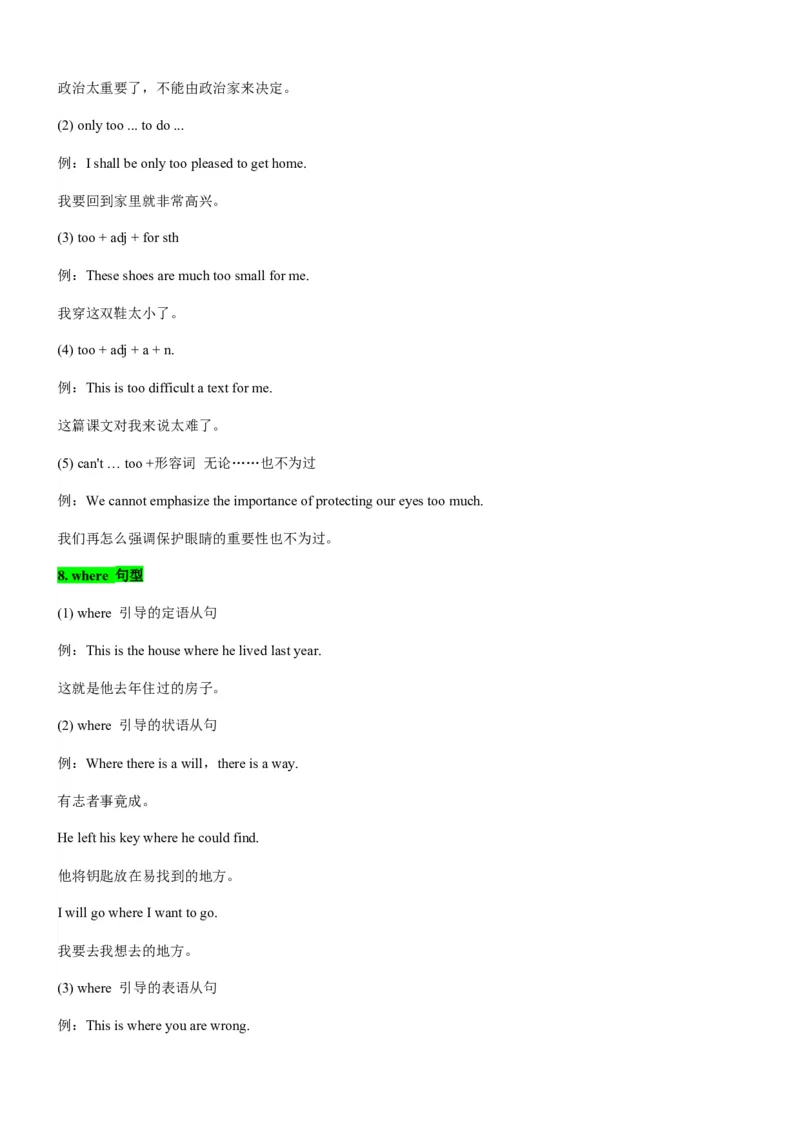
例:Politics is too important to be left to the politicians.(=Politics is so important that it can't be left to the politicians.)政治太重要了,不能由政治家来决定。
(2) only too ... to do ...
例:I shall be only too pleased to get home.
我要回到家里就非常高兴。
(3) too + adj + for sth
例:These shoes are much too small for me.
我穿这双鞋太小了。
(4) too + adj + a + n.
例:This is too difficult a text for me.
这篇课文对我来说太难了。
(5) can't … too +形容词 无论……也不为过
例:We cannot emphasize the importance of protecting our eyes too much.
我们再怎么强调保护眼睛的重要性也不为过。
8. where 句型
(1) where 引导的定语从句
例:This is the house where he lived last year.
这就是他去年住过的房子。
(2) where 引导的状语从句
例:Where there is a will,there is a way.
有志者事竟成。
He left his key where he could find.
他将钥匙放在易找到的地方。
I will go where I want to go.
我要去我想去的地方。
(3) where 引导的表语从句
例:This is where you are wrong.这正是你错的地方。
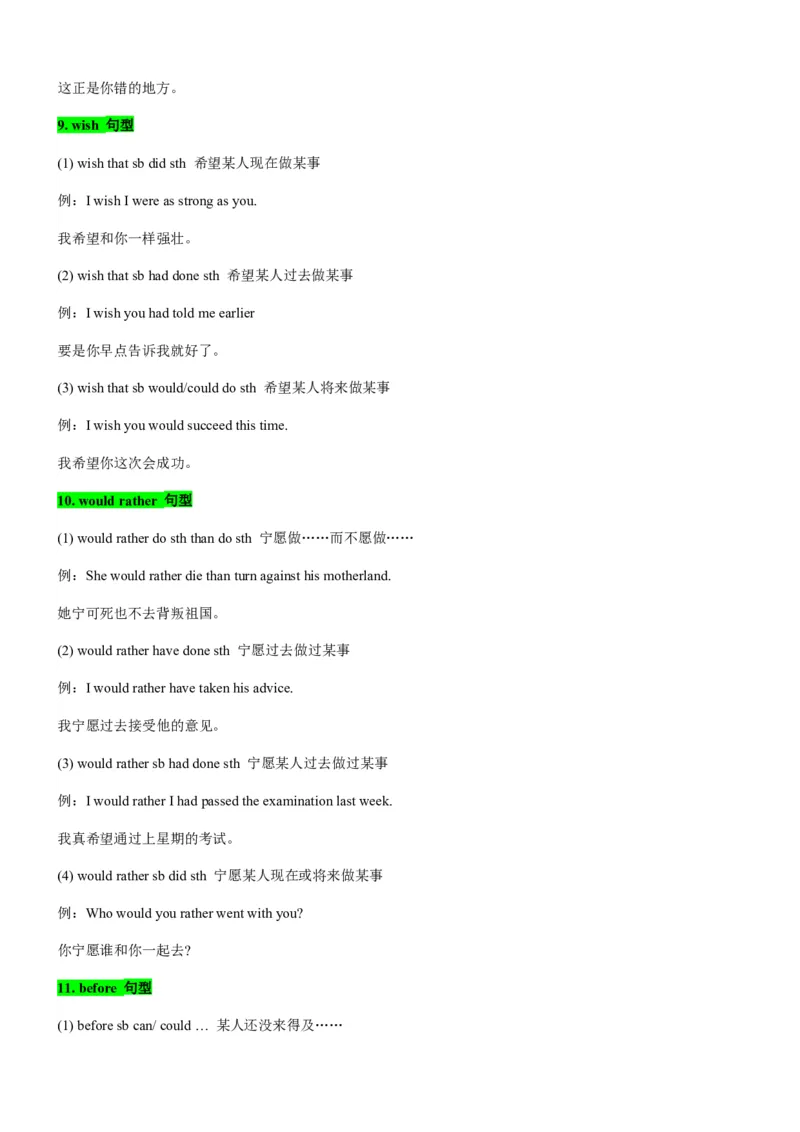
9. wish 句型
(1) wish that sb did sth 希望某人现在做某事
例:I wish I were as strong as you.
我希望和你一样强壮。
(2) wish that sb had done sth 希望某人过去做某事
例:I wish you had told me earlier
要是你早点告诉我就好了。
(3) wish that sb would/could do sth 希望某人将来做某事
例:I wish you would succeed this time.
我希望你这次会成功。
10. would rather 句型
(1) would rather do sth than do sth 宁愿做……而不愿做……
例:She would rather die than turn against his motherland.
她宁可死也不去背叛祖国。
(2) would rather have done sth 宁愿过去做过某事
例:I would rather have taken his advice.
我宁愿过去接受他的意见。
(3) would rather sb had done sth 宁愿某人过去做过某事
例:I would rather I had passed the examination last week.
我真希望通过上星期的考试。
(4) would rather sb did sth 宁愿某人现在或将来做某事
例:Who would you rather went with you?
你宁愿谁和你一起去?
11. before 句型
(1) before sb can/ could … 某人还没来得及……例:Before I could get in a word ,he had measured me.
我还没来得及插话,他就给我量好了尺寸。
(2) It will be +时间+ before + 还有多长时间……
例:It will be 4 years before he graduates.
他还有四年时间变毕业了。
(3) had done some time before (才……)
例:We had sailed four days and four nights before we saw land.
我们航行了四天四夜才见到陆地。
(4) had not done ... before ... 不到……就……
例:We hadn’t run a mile before he felt tired.
我们还没走到一英里路就觉得累了。
(5) It was not +一段时间+ before 不多久就……
例:It wasn’t two years before he left the country.
还没到两年他们离开了那国家。
12. 强调句型
(1) It is /was +被强调部分+that(who)...
例:It was I who wrote to my uncle yesterday.
是我昨天给我叔叔写信的。
(2) Is/was it + 被强调部分 + that (who) ...
例:Was it your brother that you met in the street?
在街上你遇见的是你兄弟吗?
(3) Where/who/what/how等特殊疑问词 + is/was it that ...
例:How is it that you will go to visit her tomorrow?
明天你究竟怎样去看望她?
(4) do/does/did +谓语动词 (强调谓语)
例:They do know the place well.他们的确很熟悉那个地方。
13. 用于表示过去未实现的希望和计划的句型
(1)would like to/ would love to have done sth.
例:I would like to have written to you.
我本想给你写信的。
(2) was / were going to do sth.(用过去将来时态表示原打算做什么)
例:Lucy was going to watch a basketball match.
Lucy 原打算看一场篮球比赛。
【检测训练】
一、完形填空
1
My nephew Tyden and I were attending another nephew’s birthday party at a local amusement center. Tyden won
quantities of 1 for scoring points on the games, so we went to 2 them in and select his prizes. I was feeling
nostalgic(怀旧的) because my loved one and I had our first 3 at this center and had 4 small decorations. I
noticed a lion and 5 my partner loved them. I asked the young man behind the counter if I could just 6 it
without tickets. He said 7 that was not an option.
I decided I needed to 8 350 tickets. I left Tyden at the counter to finish choosing his 9 with his grandma.
I bought game coins and entered the game room with all the 10 little faces engaged in fun and 11 . I had just
chosen a game I thought I could win when I heard Tyden’s excited voice, “Auntie, Auntie! 12 !”
He pulled the lion out from behind his back and 13 it to me. My eyes 14 up with tears and my heart
burst with love. He had 15 that whole conversation and chosen to give instead of 16 whatever he wanted.
Before I could thank him, he said, “I wanted you to have it so you didn’t have to spend 17 ‘cause you work so
hard.”
I 18 him up, hugged him close, and told him how much I loved his heart, his 19 , and him. I was
beyond grateful to have the 20 of his Auntie.
1. A. coins B. opportunities C. patents D. tickets
2. A. bring B. take C. cash D. join
3. A. outcome B. date C. procedure D. trade
4. A. ordered B. managed C. scanned D. exchanged
5. A. remembered B. ignored C. suspected D. realized6. A. abandon B. purchase C. replace D. withdraw
7. A. inconveniently B. unreasonably C. unfortunately D. ineffectively
8. A. obtain B. sell C. hire D. owe
9. A. game B. room C. prize D. gift
10. A. shocked B. puzzled C. inspired D. delighted
11. A. innocence B. laughter C. ambition D. rudeness
12. A. Stop B. Come C. Look D. Help
13. A. awarded B. limited C. returned D. presented
14. A. welled B. fed C. tied D. put
15. A. reflected on B. listened to C. talked about D. associated with
16. A. demanding B. questioning C. getting D. approving
17. A. time B. energy C. affection D. money
18. A. gathered B. did C. cheered D. caught
19. A. flexibility B. thoughtfulness C. sympathy D. determination
20. A. title B. help C. alternative D. belief
2
When you are stuck on a problem, sometimes it is best to stop thinking about it—consciously, anyway. Research
has shown that taking a break or a nap can help the brain create 21 to a solution. Now a new study 22 on the
effect of this so-called incubation(潜伏期)by using sound cues to focus the sleeping mind on a targeted problem.
When humans sleep, parts of the brain replay certain memories, strengthening and transforming them. About a
decade ago researchers developed a technique, called targeted memory reactivation (TMR), aimed at further
enhancing 23 memories: when a sound becomes associated with a memory and is later played during sleep, that
memory gets 24 . In a study published last November in Psychological Science, scientists tested whether 25
the memory of a puzzle during sleep might also improve problem-solving.
About 60 participants visited the laboratory before and after a night of 26 . First, they 27 spatial, verbal
and conceptual puzzles, with a distinct music clip repeating in the background for each, until they had worked on six
puzzles they could not solve. Overnight they wore electrodes(电极)to detect slow-wave sleep, which may be
important for memory enhancement—and a device played the sounds 28 to three of the six unsolved puzzles. The
next day, back at the lab, the participants attempted the six puzzles again.(Each repeated the experiment with a different
set of puzzles the following night.) All told, the subjects solved 32 percent of the sound-stimulated puzzles compared
with 21 percent of the 29 puzzles.
The researchers "very bravely went for quite complex tasks that involved a lot of complex processing, andremarkably they found these really strong effects in all of their 30 ." says Penny Lewis, a psychologist at Cardiff
University, who was not involved in the research. "These are supercool results. Now we need to go out and try to
understand them by firstly replicating(复制)them and secondly trying to 31 the component processes that are
actually being influenced."
Beyond providing new evidence that humans restructure memories while sleeping, the research may have 32
implications. "In a futuristic world, maybe TMR could help us use sleep to work on our problems," says lead author
Kristin Sanders, who was a graduate student at Northwestern University during the study. Sleep-monitoring technology
is increasingly accessible—and even without devices, prospective solvers can focus on important problems before 33
.
Still, sleep is not 34 ; people need to do their homework and load their heads with the puzzle pieces
involved. "I'm not going to solve cancer with this technique," Sanders says, "because I am totally 35 cancer
research."
21. A. applications B. commitment C. attention D. pathways
22. A. counts B. expands C. insists D. passes
23. A. treasured B. selected C. devoted D. shortened
24. A. dimmed B. stored C. reactivated D. researched
25. A. neglecting B. examining C. erasing D. revisiting
26. A. sleep B. experiment C. training D. relaxation
27. A. created B. solved C. attempted D. classified
28. A. assigned B. transformed C. explained D. introduced
29. A. unsettled B. untargeted C. unstated D. untested
30. A. puzzles B. brains C. processes D. tasks
31. A. work out B. turn to C. take on D. bring about
32. A. individual B. conceptual C. practical D. collective
33. A. dinner B. dawn C. bed D. schooling
34. A. significant B. magic C. fixed D. possible
35. A. dependent on B. curious about C. interested in D. ignorant of
二、语法填空
1
阅读下列材料,在空白处填入适当内容(1个单词)或填入括号内单词的正确形式。
I felt butterflies in my stomach when I started calligraphy class ten years ago. I wondered what I was doing there. Atthat moment, I couldn't have known that I'd just made one of the best 36 . (choose) of my life.
I sat down and listened to the teacher introducing the tools of the craft. Then 37 . was the first time for me that I
had tried my hand. I took up the brush, using the correct gesture, 38 . (dip) it in the ink, and carefully wrote "one" 39 .
Chinese.
Over 40 . past five years, I have learned to make versions of well-known poems. Calligraphy seemed like a
bridge, 41 . connected me to authors from centuries past. Stroke(笔画) by stroke, word by word, I could feel their
emotions, cherished my own peace and learned 42 . (appreciate) my daily life.
Now, calligraphy is not just a hobby, 43 . a way to remove myself from the worries of life. Rolling out the paper, I
can write for a whole day. Calligraphy 44 . (able) me to balance my busy schedule and live 45 . (peace).
2
阅读下面短文,在空白处填入1个适当的单词或括号内单词的正确形式。
Students at a primary school in Hangzhou had their first class 46 . March 1st on movable type. This is 47 . ancient
Chinese printing system.
The West Lake Primary School in Zhejiang Province has introduced the course in the new term. An expert in
Chinese characters culture has been invited to the campus, 48 . major responsibility is to teach students how 49 . (use)
the ancient printing technology. Students attend lectures on the history of mova type along with 50 . (interest) classes on
typesetting and printing. They then print their own document, 51 . (apply) the knowledge they’ve learned. One student
printed her 52 . (new) written essay “Whether the traditional red envelopes kids receive belong to them or their
parents?”
53 . (know) as one of the four great inventions of ancient China, movable type printing 54 . (invent) by Bi Sheng
in the 1040s during the Song Dynasty, and it is the world’s first system of movable type printing.
The school said the course is aimed at improving the students’ awareness of Chinese characters and their 55 .
(appreciate) of Chinese culture.
3
阅读下面材料,在题后空白处填入适当的内容(每空一词)或括号内单词的正确形式。
In many films, whenever Earth faces a disaster, the 56 . (solve) is always fleeing the planet 57 . spaceship. But
now the Chinese sci-fi movie, The Wandering Earth 58 . (offer) a different and 59 . (encourage) idea. In the
film, Earth is being destroyed by the dying sun. In response, humans around the world work together 60 . (build) a
giant engine system, 61 . will push Earth away from the sun. This"ambition" didn't come from nowhere. Up to now
“homeland” 62 . (have) a soft spot in the hearts and minds of Chinese people. This special cultural background 63 .
(probable) makes The Wandering Earth different from other films.
The film was released on Feb 5, the first day of Chinese New Year. It was 64 . time when many people had justmade the hard journey back to 65 . (they) hometowns. So there is only one possible way to tell the story: Earth goes
wherever humans go,because it's our home.
4
阅读下面材料,在空白处填入适当的内容(1个单词)或括号内单词的正确形式。
The British have been drinking tea for over 350 years. But in fact, the history of tea goes much 66 . (far) back.
The story of tea begins in China. According to the legend, the Chinese emperor Shen Nung was sitting 67 . a tree
while his servant boiled drinking water, when some leaves from the tree blew into the water. Shen Nung, 68 . expert in
herbal medicine, decided to try the water his servant created. As a result, it tasted so good that later the drink was 69 .
we now call tea.
It is 70 . (possible) to know whether there is any truth in this story. 71 . , tea drinking certainly was established in
China many centuries before it had even been heard of in the west. Containers of tea 72 . (find) in tombs dating from the
Han dynasty (206BC-220AD) before tea was firmly established as the national drink of China in the Tang dynasty (618-
906AD). It became 73 . a favorite thing that during the late eighth century, a writer 74 . (call) Lu Yu wrote the first
book entirely about tea, the Ch’a Ching, or Tea Classic. It was shortly after this that tea was first introduced to Japan, by
Japanese Buddhist monks who had travelled to China to study before. Tea drinking has become a vital part of Japanese
culture, 75 . may be rooted in the sprit described in the Ch’a Ching.
5
阅读下列短文,根据短文内容填空。在未给提示词的空白处仅填写一个适当的单词,在给出提示词的空白处用
括号内所给词的正确形式填空。
No one knows exactly 76 . the earth began. However, according to a widely accepted theory, the universe began
77 . a “Big Bang”. Then the dust 78 . (settle) into a solid globe. As the earth cooled down, water began to appear on its
surface. Many 79 . (science) believe that it was the presence of water that allowed the earth to dissolve 80 . (harm)
gases and acids into oceans and seas, which made it possible for life to develop.
Millions of years later, the first small plants appeared on the surface of the water. Their development 81 . (follow)
by early shellfish, all sorts of fish, green plants and land animals. Reptiles 82 . (produce) young generally by laying eggs
while mammals gave birth to young baby animals. Dinosaurs existed on the earth for over 140 million years before they
suddenly disappeared. The reason 83 . they disappeared still remains a mystery.
Finally, humans appeared and spread all over the earth. But they are putting too much carbon dioxide into the
atmosphere, which prevents heat from 84 . (escape) from the earth into space. As a result of this, people believe the earth
may become too hot to live on. So 85 . life will continue on the earth will depend on how this problem can be solved.