四 级 阅 读 讲 义目录 C o n t e n t s
四级阅读 1 选词填空 ���������������������������������������������������������������������������������������������������������001
四级阅读 2 段落匹配 ���������������������������������������������������������������������������������������������������������009
四级阅读 3 仔细阅读 ���������������������������������������������������������������������������������������������������������023
四级阅读 4 仔细阅读 ���������������������������������������������������������������������������������������������������������025
四级阅读 5 仔细阅读 ���������������������������������������������������������������������������������������������������������029
四级阅读 6 仔细阅读 ���������������������������������������������������������������������������������������������������������033
四级阅读 7 真题带练1 �����������������������������������������������������������������������������������������������������037
四级阅读 8 真题带练2 �����������������������������������������������������������������������������������������������������043
四级阅读 9 真题带练3 �����������������������������������������������������������������������������������������������������049
附录:答案速查 ����������������������������������������������������������������������������������������������������������������������056
001四级阅读 1
选词填空四级阅读讲义
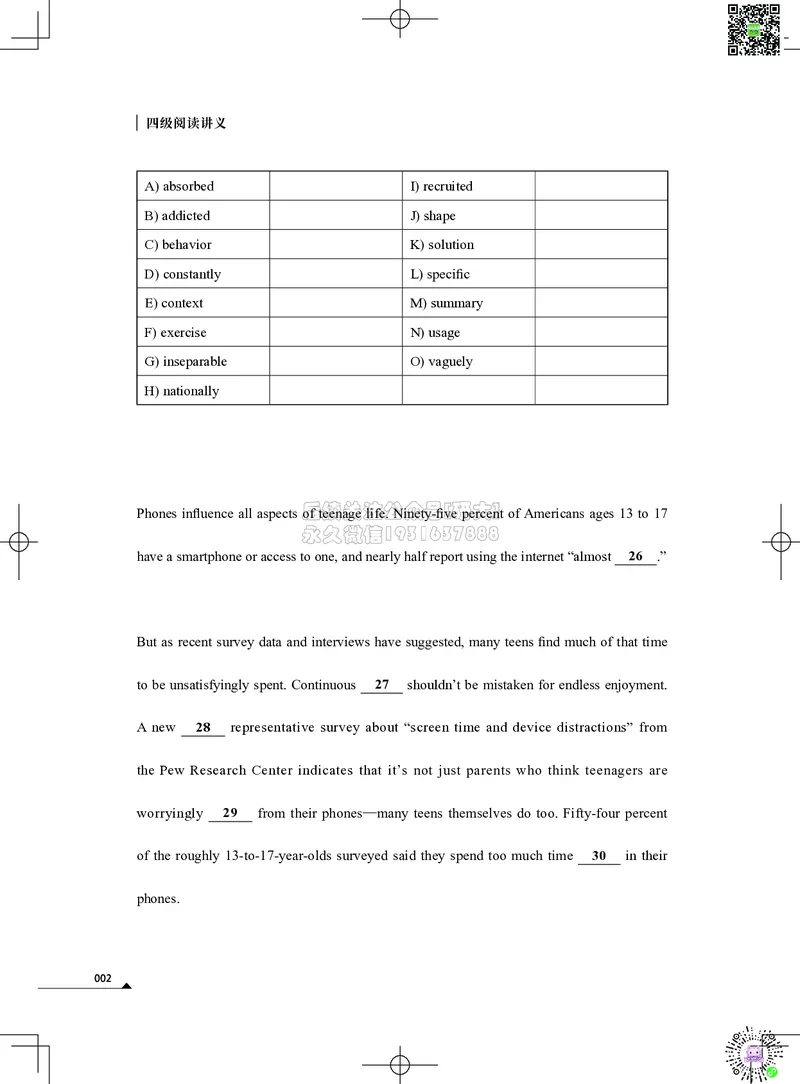
A) absorbed I) recruited
B) addicted J) shape
C) behavior K) solution
D) constantly L) specific
E) context M) summary
F) exercise N) usage
G) inseparable O) vaguely
H) nationally
Phones influence all aspects of teenage life. Ninety-five percent of Americans ages 13 to 17
have a smartphone or access to one, and nearly half report using the internet “almost 26 .”
But as recent survey data and interviews have suggested, many teens find much of that time
to be unsatisfyingly spent. Continuous 27 shouldn’t be mistaken for endless enjoyment.
A new 28 representative survey about “screen time and device distractions” from
the Pew Research Center indicates that it’s not just parents who think teenagers are
worryingly 29 from their phones—many teens themselves do too. Fifty-four percent
of the roughly 13-to-17-year-olds surveyed said they spend too much time 30 in their
phones.
002四级阅读 1 选词填空
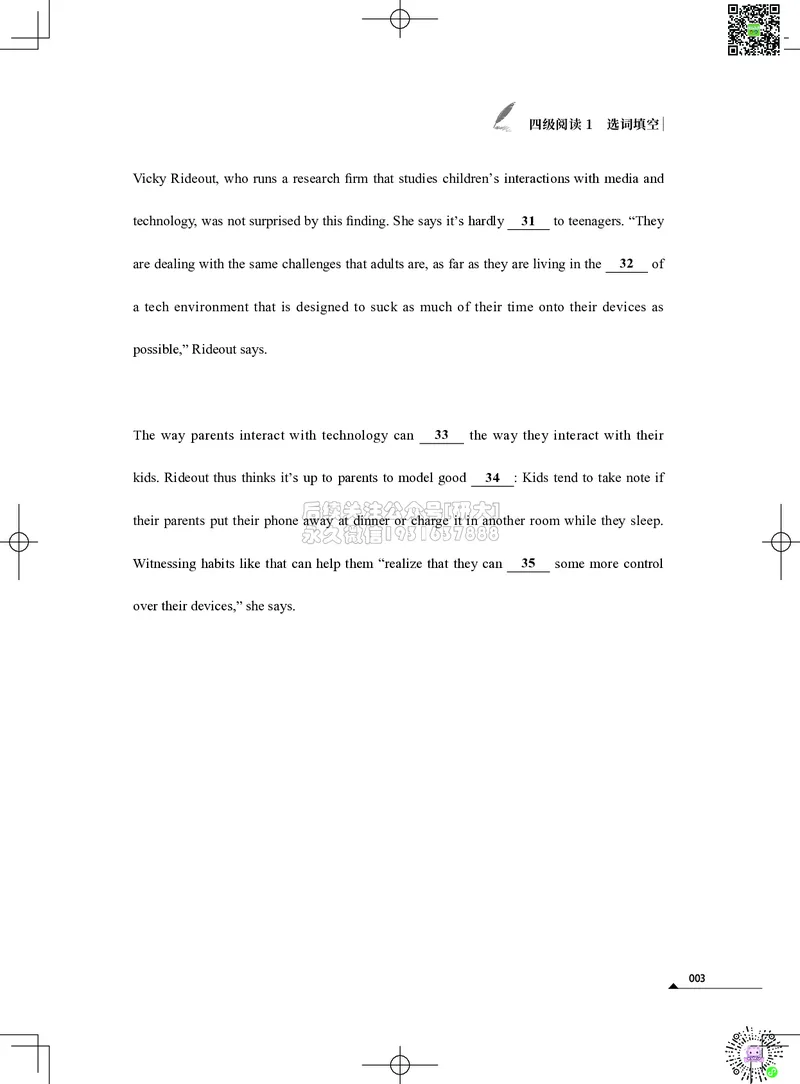
Vicky Rideout, who runs a research firm that studies children’s interactions with media and
technology, was not surprised by this finding. She says it’s hardly 31 to teenagers. “They
are dealing with the same challenges that adults are, as far as they are living in the 32 of
a tech environment that is designed to suck as much of their time onto their devices as
possible,” Rideout says.
The way parents interact with technology can 33 the way they interact with their
kids. Rideout thus thinks it’s up to parents to model good 34 : Kids tend to take note if
their parents put their phone away at dinner or charge it in another room while they sleep.
Witnessing habits like that can help them “realize that they can 35 some more control
over their devices,” she says.
003四级阅读讲义
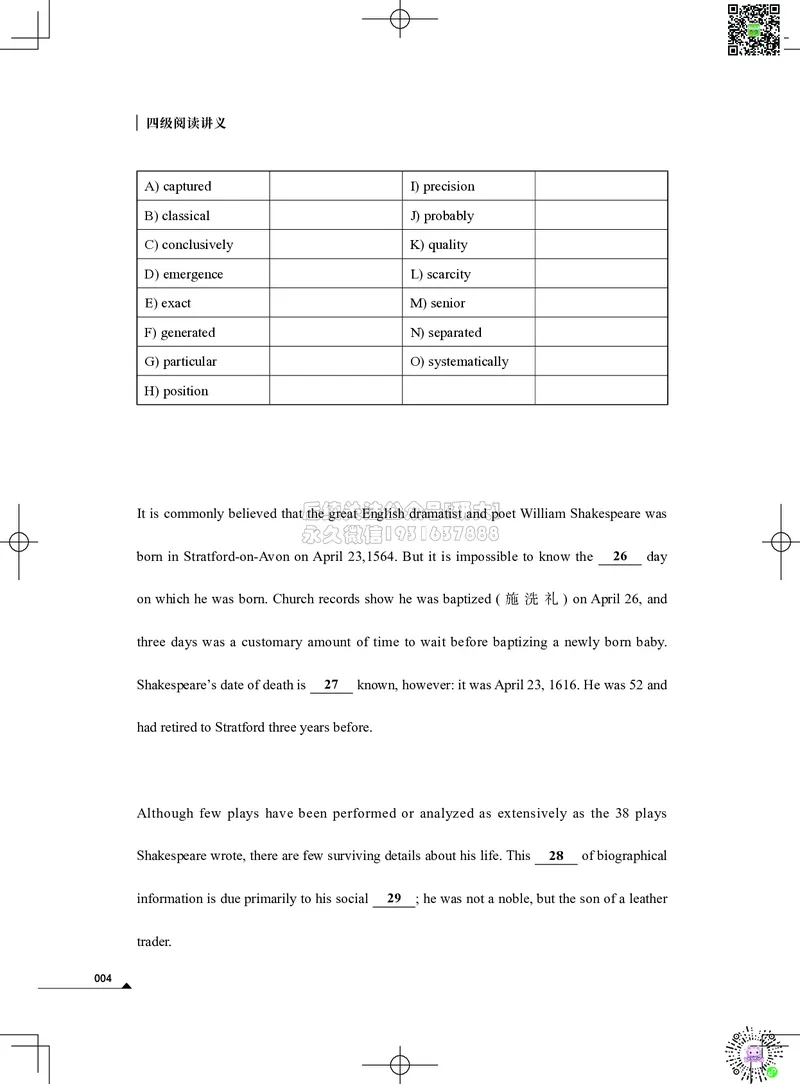
A) captured I) precision
B) classical J) probably
C) conclusively K) quality
D) emergence L) scarcity
E) exact M) senior
F) generated N) separated
G) particular O) systematically
H) position
It is commonly believed that the great English dramatist and poet William Shakespeare was
born in Stratford-on-Avon on April 23,1564. But it is impossible to know the 26 day
on which he was born. Church records show he was baptized ( 施 洗 礼 ) on April 26, and
three days was a customary amount of time to wait before baptizing a newly born baby.
Shakespeare’s date of death is 27 known, however: it was April 23, 1616. He was 52 and
had retired to Stratford three years before.
Although few plays have been performed or analyzed as extensively as the 38 plays
Shakespeare wrote, there are few surviving details about his life. This 28 of biographical
information is due primarily to his social 29 ; he was not a noble, but the son of a leather
trader.
004四级阅读 1 选词填空
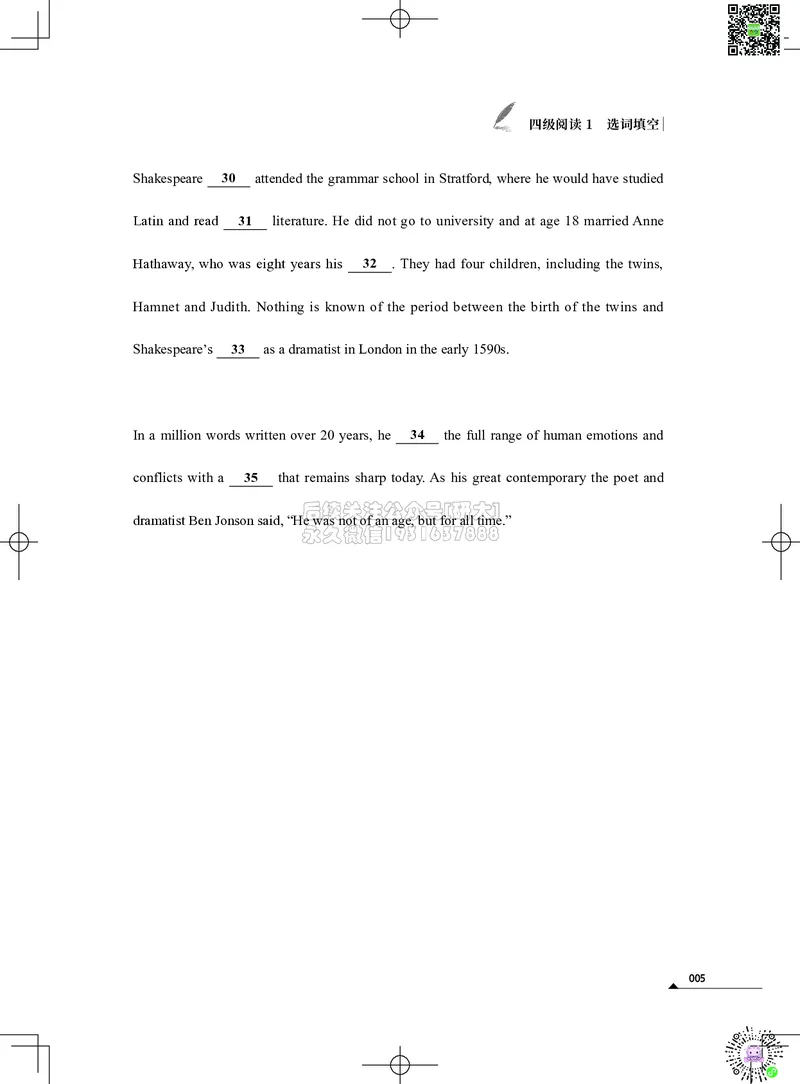
Shakespeare 30 attended the grammar school in Stratford, where he would have studied
Latin and read 31 literature. He did not go to university and at age 18 married Anne
Hathaway, who was eight years his 32 . They had four children, including the twins,
Hamnet and Judith. Nothing is known of the period between the birth of the twins and
Shakespeare’s 33 as a dramatist in London in the early 1590s.
In a million words written over 20 years, he 34 the full range of human emotions and
conflicts with a 35 that remains sharp today. As his great contemporary the poet and
dramatist Ben Jonson said, “He was not of an age, but for all time.”
005四级阅读讲义
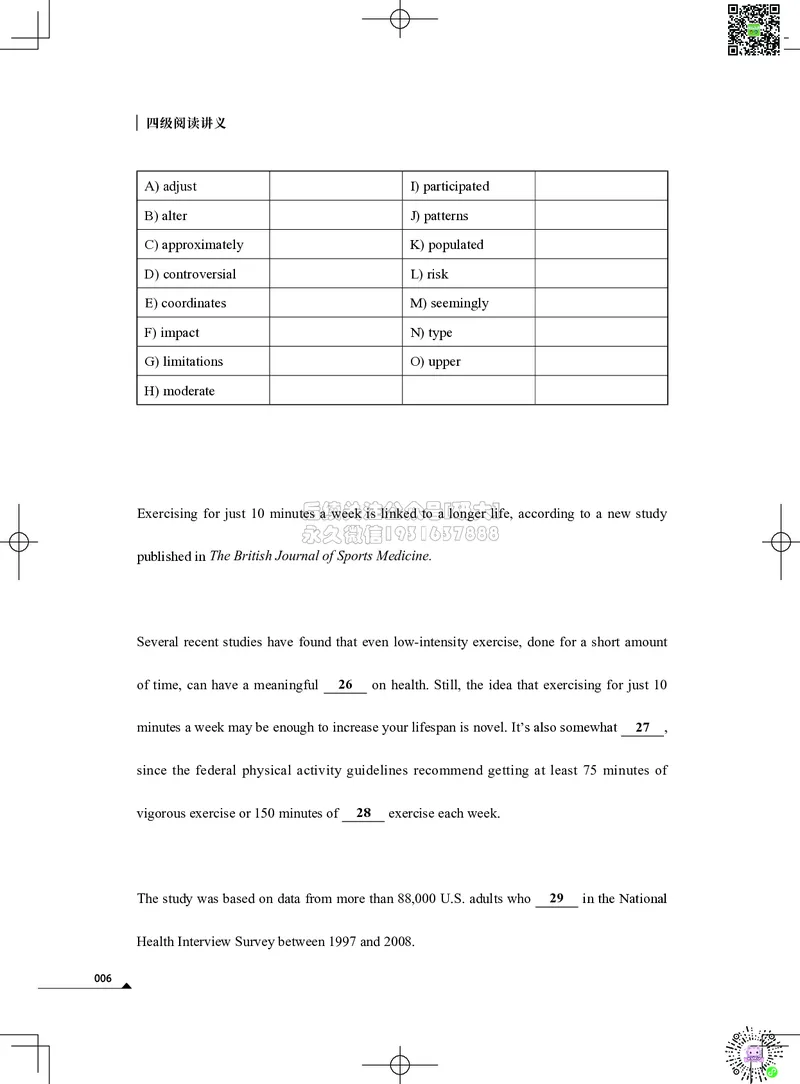
A) adjust I) participated
B) alter J) patterns
C) approximately K) populated
D) controversial L) risk
E) coordinates M) seemingly
F) impact N) type
G) limitations O) upper
H) moderate
Exercising for just 10 minutes a week is linked to a longer life, according to a new study
published in The British Journal of Sports Medicine.
Several recent studies have found that even low-intensity exercise, done for a short amount
of time, can have a meaningful 26 on health. Still, the idea that exercising for just 10
minutes a week may be enough to increase your lifespan is novel. It’s also somewhat 27 ,
since the federal physical activity guidelines recommend getting at least 75 minutes of
vigorous exercise or 150 minutes of 28 exercise each week.
The study was based on data from more than 88,000 U.S. adults who 29 in the National
Health Interview Survey between 1997 and 2008.
006四级阅读 1 选词填空
Contrary to some research that has found an 30 limit to the amount of exercise that is
healthy, the researchers found that there was 31 no limit to the longevity( 长寿 )
benefits of exercise. Even the small group of people who got 10 times the amount of exercise
recommended by the federal government had a 46% lower 32 of death than the least
active group.
Still, observational studies like this one cannot prove cause and effect; they can only
find 33 . The researchers also were not able to 34 for certain lifestyle factors that
could affect lifespan, including dietary habits and changes in physical activity over time.
Despite these 35 , the study’s results are yet another indication of the power of physical
activity, even in small amounts.
007四级阅读 2
段落匹配四级阅读讲义
Why it matters that teens are reading less
A) Most of us spend much more time with digital media than we did a decade ago. But
today’s teens have grown up with smartphones. Compared with teens a couple of decades ago,
the way they interact with traditional media like books and movies is fundamentally different.
B) Analysis of surveys of over one million teens in the United States collected since 1976
reveals a major shift in how teens are spending their leisure time. Paper books are being
ignored, in favor of screens. Digital devices are changing other behaviors, too. More and
more, young people choose spending time on their electronic devices over engaging in other
activities, regardless of the type. Indeed, by 2016, the average American high school senior
said they spent six hours a day writing text messages, on social media, and online during
their free time. And that covers just three activities, and if other digital media activities were
included, that estimate would no doubt rise.
C) Teens did not always spend that much time with digital media. Online time has doubled
since 2006, and social media use has moved from a periodic activity to a daily one in the same
period. By 2016, nearly nine out of ten young women in the 12th grade said they visited social
media sites every day. Meanwhile, time spent playing video games rose from under an hour
a day to an hour and a half on average. One out of ten American 8th grade students in 2016
spent 40 hours a week or more playing video games. Let me emphasize that this is equal to
the time most adults spend per week at work.
D) If teens are spending so much time using electronic devices, does that mean they have to
give up some other activities? Maybe not. Over the years, many scholars have insisted that
time online does not necessarily take away time spent engaging with traditional media or on
other activities. Some people, they argue, are just more interested in certain kinds of media
and entertainment. Thus, using more of one type of media does not necessarily mean less of
the other.
010四级阅读 2 段落匹配
E) That may be true, but that still does not tell us much about what happens across a whole
generation of people when time spent on digital media grows. Large surveys conducted over
the course of many years tell us that American youth are not going to the cinema nearly as
often as they did in the past. While 70 percent of 8th and 10th grade students used to go to
the movies once a month or more, now only about half do this. More and more, watching a
movie is something teens choose to do on their electronic devices. Why is this a problem?
One reason is that going to the cinema is generally a social activity. Now, watching movies is
something that most teens do alone. This fits a larger pattern. In another analysis, researchers
found that today’s teens go out with their friends much less often than previous generations did.
F) But the trends related to movies are less disturbing compared with the change in how teens
spend their time. Research has revealed an enormous decline in reading. In 1980, about 60
percent of senior high school students said they read a book, newspaper or magazine every
day that was not assigned for school. By 2016, only 16 percent did. This is a huge drop and it
is important to note that this was not merely a decline in reading paper books, newspapers or
magazines. The survey allowed for reading materials on a digital device.
G) Indeed, the number of senior high school students who said they had not read any books
for pleasure in the last year was one out of three by 2016. That is triple the number from two
decades ago. For today’s youth, books, newspapers and magazines have less and less of a
presence in their daily lives. Of course, teens are still reading. But they are generally reading
short texts. Most of them are not reading long articles or books that explore deep themes and
require critical thinking and reflection. Perhaps not accidentally, in 2016 reading scores were
the lowest they have ever been since 1972.
H) This might present problems for young people later on. When high school students go on
to college, their past and current reading habits will influence their academic performance.
Imagine going from reading texts as short as one or two sentences to trying to read entire
books written in complex language and containing sophisticated ideas. Reading and
comprehending longer books and chapters takes practice, and American teens are no longer
getting that practice.
011四级阅读讲义
I) So how can this problem be solved? Should parents and teachers take away teens’
smartphones and replace them with paper books? Probably not. Research has shown that
smartphones are currently American teens’ main form of social communication. This means
that, without a smartphone, teens are likely to feel isolated from their peers. However, that
does not mean teens need to use electronic devices as often as they do now. Data connecting
excessive digital media time to mental health issues suggests a limit of two hours a day of free
time spent with screens, a restriction that will also allow time for other activities—like going
to the movies with friends or reading longer, more complicated texts.
J) The latter is especially important. I would argue that of all the changes brought about by
the widespread use of digital devices, the huge decline in reading is likely to have the biggest
negative impact on today’s teens because reading books and longer articles is one of the best
ways to learn critical thinking. It helps people to understand complex issues and to separate
fact from fiction. Thus, deep reading is crucial for being a good citizen, a successful college
student and a productive employee. If serious reading dies, a lot will go with it.
012四级阅读 2 段落匹配
36. Many years’ surveys reveal that young people in America are going to the cinema much
less often than they used to.
37. Survey analysis shows American teens now spend their leisure time on digital devices
rather than reading printed books.
38. The number of senior high schoolers not reading books for pleasure in a year increased
three times over 20 years.
39. Many scholars claim that spending time on electronic devices doesn’t necessarily mean a
decrease of time for other activities.
40. Most people spend much more time interacting with digital media than they did ten years
ago.
41. The author claims that it will be a great loss if we no longer read books and longer articles.
42. Over a decade or so, American teens’ social media use shifted from an occasional activity
to a routine one.
43. A more disturbing trend in America today is that teens are spending far less time reading
than around four decades ago.
44. Some five years ago, high school seniors in America generally spent more than six hours a
day on electronic devices.
45. It was found that American youngsters today don’t socialize nearly as much as the earlier
generations.
013四级阅读讲义
Learning to say no
A) Not doing something will always be faster than doing it. This philosophy applies in many
areas of life. For example, there is no meeting that goes faster than not having a meeting at all.
This is not to say you should never attend another meeting, but the truth is that we say “yes”
to too many things we don’t actually want to do.
B) How often do people ask you to do something and you just reply, “Sure.” Three days
later, you’re overwhelmed by how much is on your to-do list. We become frustrated by our
obligations even though we were the ones who said “yes” to them in the first place. Even
worse, people will occasionally fight to do things that waste time. You don’t have to do
something just because it exists. It’s worth asking if things are necessary. Many of them are
not, and a simple “no” will be more productive than whatever work the most efficient person can
cope with. But if the benefits of saying “no” are so obvious, then why do we say “yes” so often?
C) We say “yes” to many requests not because we want to do them, but because we don’t
want to be seen as rude or unhelpful. Often, we have to consider saying “no” to someone
we will interact with again in the future—our co-worker, our spouse, our family and friends.
Saying “no” to our superiors at work can be particularly difficult. In these situations, I
like the approach recommended in Essentialism by Greg McKeown. He writes,“ Remind
your superiors what you would be neglecting if you said ‘yes’ and force them to deal with
the trade-off. For example, if your manager comes to you and asks you to do X, you can
respond with ‘Yes, I’m happy to make this the priority. Which of these other projects should I
deprioritize to pay attention to this new project?’”
D) Collaborating with others is an important element of life. The thought of straining the
relationship outweighs the commitment for our time and energy. For this reason, it can be
helpful to be gracious in your response. Do whatever favors you can, and be warm-hearted
and direct when you have to say no. But even after we have accounted for these social
014四级阅读 2 段落匹配
considerations, many of us still seem to do a poor job of managing the trade-off between
yes and no. We find ourselves over-committed to things that don’t meaningfully improve or
support those around us, and certainly don’t improve our own lives.
E) Perhaps one issue is how we think about the meaning of yes and no. The words “yes” and
“no” get so often used in comparison with each other that it feels like they carry equal weight
in conversation. In reality, they’re not just opposite in meaning, but of entirely different
magnitudes in commitment. When you say “no”, you’re only saying “no” to one option. When
you say “yes”, you’re saying “no” to every other option. I like how economist Tim Harford
put it,“ Every time we say ‘yes’ to a request, we’re also saying ‘no’ to anything else we might
accomplish with the time.” Once you’re committed to something, you’ve already decided
how that future block of time will be spent. In other words, saying “no” saves you time in the
future. Saying “yes” costs you time in the future. “No” is a form of time credit. You retain the
ability to spend your future time however you want. “Yes” is a form of time debt. You have to
pay back your commitment at some point.
F) “No” is a decision. “Yes” is a responsibility. Saying “no” is sometimes seen as a luxury
that only those in power can afford. And it’s true: turning down opportunities is easier when
you can fall back on the safety net provided by power, money, and authority. But it’s also true
that saying “no” is not merely a privilege reserved for the successful. It’s also a strategy that
can help you become successful. Saying “no” is an important skill to develop at any stage of
your career because it retains the most important asset in life: your time. As investor Pedro
Sorrentino put it, “If you don’t guard your time, people will steal it from you.” You need to
say “no” to whatever isn’t leading you toward your goals.
G) Nobody embodied this idea better than Steve Jobs, who said, “People think focus means
saying ‘yes’ to the thing you’ve got to focus on. But that’s not what it means at all. It means
saying ‘no’ to the hundred other good ideas that there are. You have to pick carefully.” Jobs
had another great quote about saying “no”:“ I’m actually as proud of the things we haven’t
done as the things I have done. Innovation is saying ‘no’ to 1,000 things.”
015四级阅读讲义
H) Over time, as you continue to improve and succeed, your strategy needs to change. The
opportunity cost of your time increases as you become more successful. At first, you just
eliminate the obvious distractions and explore the rest. As your skills improve and you learn
to separate what works from what doesn’t, you have to continually increase your threshold for
saying “yes”. You still need to say “no” to distractions, but you also need to learn to say “no”
to opportunities that were previously good uses of time, so you can make space for better uses
of time. It’s a good problem to have, but it can be a tough skill to master.
I) What is true about health is also true about productivity: an ounce of prevention is worth a
pound of cure. More effort is wasted doing things that don’t matter than is wasted doing things
inefficiently. And if that is the case, elimination is a more useful skill than optimization. I’m
reminded of the famous Peter Drucker quote, “There is nothing so useless as doing efficiently
that which should not be done at all.”
016四级阅读 2 段落匹配
36. People often grant a request just because they want to appear polite and helpful.
37. It’s no easy job learning to say “no” to opportunities that were once considered worth
grasping.
38. When you decline a request, you are saving your future time.
39. People sometimes struggle to do things that are simply a waste of time.
40. Doing efficiently what is not worth doing is the most useless effort.
41. It is especially difficult for people to decline to do what their superiors ask them to do.
42. People agree to do too many things they are in fact unwilling to do.
43. According to one famous entrepreneur, innovation means refusal to do an enormous
number of things.
44. It is an essential aspect of life to cooperate with other people.
45. Refusing a request is sometimes seen as a privilege not enjoyed by ordinary people.
017四级阅读讲义
Teenagers and social networking
A) As a parent of two boys at primary school, I worry about the issues associated with
teenagers and social media. Newspapers are constantly filled with frightening accounts of
drug addiction and aggressive behaviour supposedly caused by violent videogames. But
even when these accounts touch on real concerns, they do not really reflect the great mass of
everyday teenage social behaviour: the online chat, the texting, the surfing, and the emergence
of a new teenage sphere that is conducted digitally.
B) New technologies always provoke generational panic, which usually has more to do with
adult fears than with the lives of teenagers. In the 1930s, parents worried that radio was
gaining “an irresistible hold of their children”. In the 80s, the great danger was the Sony
Walkman (随身听). When you look at today’s digital activity, the facts are much more positive
than you might expect.
C) Indeed, social scientists who study young people have found that their digital use can
be inventive and even beneficial. This is true not just in terms of their social lives, but their
education too. So if you use a ton of social media, do you become unable, or unwilling, to
engage in face-to-face contact? The evidence suggests not. Research by Amanda Lenhart of
the Pew Research Centre, a U.S. think tank, found that the most passionate texters are also the
kids most likely to spend time with friends in person. One form of socialising doesn’t replace
the other. It expands it.
D) “Kids still spend time face to face,” Lenhart says. Indeed, as they get older and are given
more freedom, they often ease up on social networking. Early on, the web is their “third
space”, but by the late teens, it’s replaced in reaction to greater independence. They have to be
on Facebook, to know what’s going on among friends and family, but they are ambivalent (有
矛盾心理的) about it, says Rebecca Eynon, a research fellow at the Oxford Internet Institute,
who has interviewed about 200 British teenagers over three years. As they gain experience
with living online, they begin to adjust their behaviour, struggling with new communication
skills, as they do in the real world.
018四级阅读 2 段落匹配
E) Parents are wrong to worry that kids don’t care about privacy. In fact, they spend hours
changing Facebook settings or using quick-delete sharing tools, such as Snapchat, to minimise
their traces. Or they post a photograph on Instagram, have a pleasant conversation with
friends and then delete it so that no traces remain.
F) This is not to say that kids always use good judgment. Like everyone else, they make
mistakes—sometimes serious ones. But working out how to behave online is a new social
skill. While there’s plenty of drama and messiness online, it is not, for most teens, a cycle of
non-stop abuse: a Pew study found only 15% of teens said someone had bullied them online
in the last 12 months.
G) But surely all this short-form writing is affecting literacy? Certainly, teachers worry. They
say that kids use overly casual language and text-speak in writing, and don’t have as much
patience for long reading and complex arguments. Yet studies of first-year college papers
suggest these anxieties may be partly based on misguided nostalgia ( 怀 旧 ). When
Stanford University scholar Andrea Lunsford gathered data on the rates of errors in “freshman
composition” papers going back to 1917, she found that they were virtually identical to today.
H) But even as error rates stayed stable, student essays have blossomed in size and
complexity. They are now six times longer and, unlike older “what I did this summer” essays,
they offer arguments supported by evidence. Why? Computers have vastly increased the
ability of students to gather information, sample different points of view and write more
fluidly.
I) When linguist Naomi Baron studied students’ instant messaging even there she found
surprisingly rare usage of short forms such as “u” for “you”, and as students got older, they
began to write in more grammatical sentences. That is because they want to appear more
adult, and they know how adults are expected to write. Clearly, teaching teens formal writing
is still crucial, but texting probably isn’t destroying their ability to learn it.
019四级阅读讲义
J) It is probably true that fewer kids are heavy readers compared with two generations ago,
when cheap paperbacks boosted rates of reading. But even back then, a minority of people—
perhaps 20%—were lifelong heavy readers, and it was cable TV, not the internet, that struck
a blow at that culture in the1980s. Still, 15% or more of kids are found to be deeply bookish.
In fact, the online world offers kids remarkable opportunities to become literate and creative
because young people can now publish ideas not just to their friends, but to the world. And it
turns out that when they write for strangers, their sense of “authentic audience” makes them
work harder, push themselves further, and create powerful new communicative forms.
K) Few would deny that too much time online can be harmful. Some of the dangers are
emotional: hurting someone from a distance is not the same as hurting them face to face. If
we’re lucky, the legal environment will change to make teenagers’ online lives less likely to
haunt them later on. Just last week, California passed a law allowing minors to demand that
internet firms erase their digital past and the EU has considered similar legislation.
L) Distraction is also a serious issue. When kids switch from chat to music to homework, they
are indeed likely to have trouble doing each task well. And studies show that pupils don’t fact-
check information online—“smart searching is a skill schools need to teach urgently. It’s also
true that too much social networking and game playing can cut into schoolwork and sleep.
This is precisely why parents still need to set firm boundaries around it, as with any other
distraction.
M) So what’s the best way to cope? The same boring old advice that applies to everything in
parenting: moderation. Rebecca Eynon argues that it’s key to model good behaviour. Parents
who stare non-stop at their phones and don’t read books are likely to breed kids who will do
the same. As ever, we ought to be careful about our own behaviour.
020四级阅读 2 段落匹配
36. Research has found the use of digital technology benefits not only teenagers’ social lives
but also their studies.
37. It is urgent that schools teach kids how to verify online information.
38. Students now write longer and more complex essays than their counterparts in previous
decades while the error rates remain unchanged.
39. Newspaper reports of teenagers give a false picture of their behaviour.
40. Parents are advised to mind their own digital behaviour and set a good example for their
kids.
41. Contrary to parents’ belief, kids try hard to leave as few traces as possible on the web.
42. Students’ ability to learn formal writing is unlikely to be affected by texting.
43. Historically, new technologies have always caused great fears among parents.
44. The reading culture was seriously affected by cable television some four decades ago.
45. Teachers say that kids’ writing is too casual, using language characteristic of text messages.
021四级阅读 3
仔细阅读四级阅读讲义
【仔细阅读】三大考点
1.态度优先
2.区分观点
3.因果关系
024四级阅读 4
仔细阅读四级阅读讲义
You never see them, but they’re with you every time you fly. They record where you
are going, how fast you’re traveling and whether everything on your airplane is functioning
normally. Their ability to withstand almost any disaster makes them seem like something out
of a comic book. They’re known as the black box.
When planes fall from the sky, as a Yemeni airliner did on its way to Comoros Islands in
the India Ocean June 30, 2009, the black box is the best bet for identifying what went wrong.
So when a French submarine (潜水艇) detected the device’s homing signal five days later,
the discovery marked a huge step toward determining the cause of a tragedy in which 152
passengers were killed.
In 1947, Australian scientist David Warren developed a flight-memory recorder that
would track basic information like altitude and direction. That was the first model for a black
box, which became a requirement on all U.S. commercial flights by 1949. Early models often
failed to withstand crashes, however, so in 1965 the device was completely redesigned and
moved to the rear of the plane—the area least subject to impact—from its original position in
the landing wells (起落架舱). The same year, the Federal Aviation Authority required that
the boxes, which were never actually black, be painted orange or yellow to aid visibility.
Modern airplanes have two black boxes: a voice recorder, which tracks pilots’ conversations,
and a flight-data recorder, which monitors fuel levels, engine noises and other operating
functions that help investigators reconstruct the aircraft’s final moments. Placed in an
insulated (隔绝的) case and surrounded by a quarter-inch-thick panels of stainless steel,
the boxes can withstand massive force and temperatures up to 2,000 ℉. When submerged,
they’re also able to emit signals from depths of 20,000 ft. Experts believe the boxes from Air
France Flight 447, which crashed near Brazil on June 1,2009, are in water nearly that deep,
but statistics say they’re still likely to turn up. In the approximately 20 deep-sea crashes over
the past 30 years, only one plane’s black boxes were never recovered.
026四级阅读 4 仔细阅读
46. What does the author say about the black box?
A) It ensures the normal functioning of an airplane.
B) The idea for its design comes from a comic book.
C) Its ability to ward off disasters is incredible.
D) It is an indispensable device on an airplane.
47. What information could be found from the black box on the Yemeni airliner?
A) Data for analyzing the cause of the crash.
B) The total number of passengers on board.
C) The scene of the crash and extent of the damage.
D) Homing signals sent by the pilot before the crash.
48. Why was the black box redesigned in 1965?
A) New materials became available by that time.
B) Too much space was needed for its installation.
C) The early models often got damaged in the crash.
D) The early models didn’t provide the needed data.
49. Why did the Federal Aviation Authority require the black boxes be painted orange or
yellow?
A) To distinguish them from the colour of the plane.
B) To caution people to handle them with care.
C) To make them easily identifiable.
D) To conform to international standards.
50. What do we know about the black boxes from Air France Flight 447?
A) There is still a good chance of their being recovered .
B) There is an urgent need for them to be reconstructed.
C) They have stopped sending homing signals.
D) They were destroyed somewhere near Brazil.
027