文档文本内容
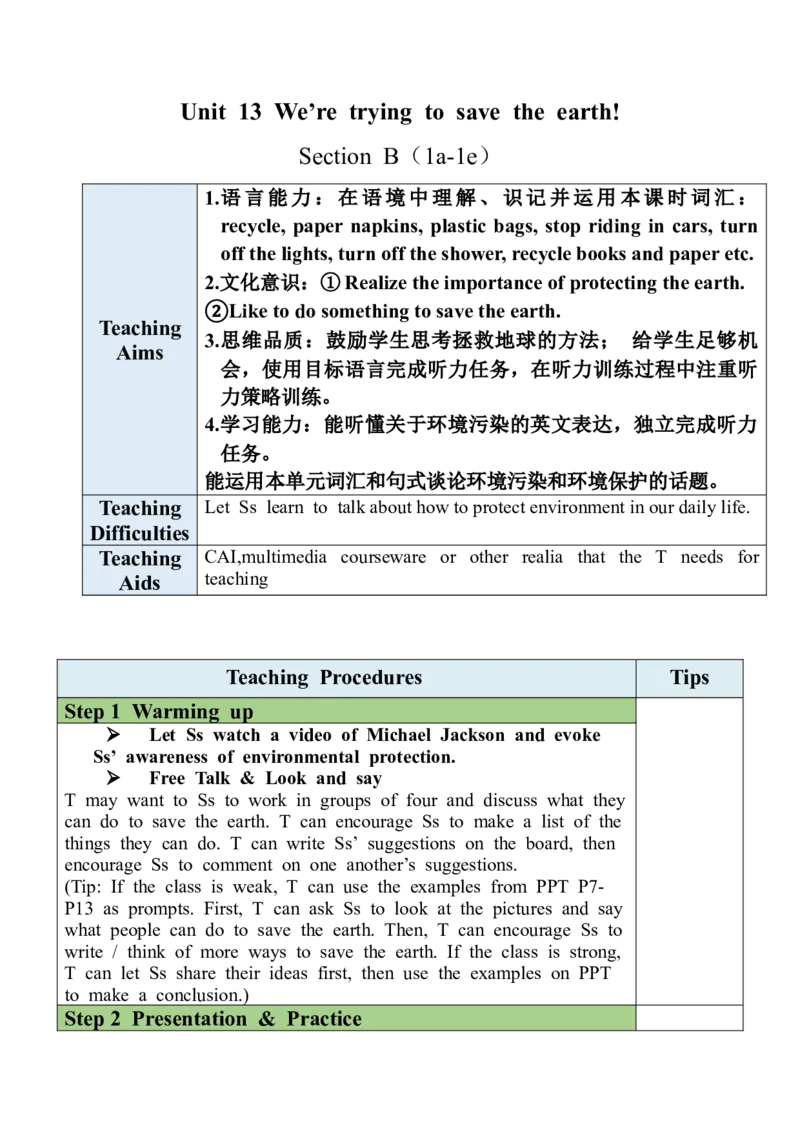
Unit 13 We’re trying to save the earth!
Section B(1a-1e)
1.语言能力:在语境中理解、识记并运用本课时词汇:
recycle, paper napkins, plastic bags, stop riding in cars, turn
off the lights, turn off the shower, recycle books and paper etc.
2.文化意识:①Realize the importance of protecting the earth.
Like to do something to save the earth.
Teaching
3.思维品质:鼓励学生思考拯救地球的方法; 给学生足够机
Aims
②
会,使用目标语言完成听力任务,在听力训练过程中注重听
力策略训练。
4.学习能力:能听懂关于环境污染的英文表达,独立完成听力
任务。
能运用本单元词汇和句式谈论环境污染和环境保护的话题。
Teaching Let Ss learn to talk about how to protect environment in our daily life.
Difficulties
Teaching CAI,multimedia courseware or other realia that the T needs for
Aids teaching
Teaching Procedures Tips
Step 1 Warming up
Let Ss watch a video of Michael Jackson and evoke
Ss’ awareness of environmental protection.
Free Talk & Look and say
T may want to Ss to work in groups of four and discuss what they
can do to save the earth. T can encourage Ss to make a list of the
things they can do. T can write Ss’ suggestions on the board, then
encourage Ss to comment on one another’s suggestions.
(Tip: If the class is weak, T can use the examples from PPT P7-
P13 as prompts. First, T can ask Ss to look at the pictures and say
what people can do to save the earth. Then, T can encourage Ss to
write / think of more ways to save the earth. If the class is strong,
T can let Ss share their ideas first, then use the examples on PPT
to make a conclusion.)
Step 2 Presentation & PracticeWhile-listening
1a
Ask Ss to rank the items from the easiest to the most
difficult using number 1-5.
As it is most likely that Ss won’t have identical rankings for the
list of items, after Ss have filled in their rankings, T may want to
call on a few Ss to ask them to share their rankings with the class
and explain their reasons for their rankings.
Answers will vary.
1b
Ask Ss to compare their answers in 1a with their
partners.
T may want to clarify the use the conjunction but used in the given
conversation.
Note:
As a conjunction, but is usually not used at the beginning of a
sentence in formal writing. However, it can be used at the
beginning of a sentence in speech or in informal writing.
1c
Ask Ss to listen and tick the things that Julia and
Jack talk about.
Answers: turning off the shower, taking your own bags when
shopping, not riding in cars, riding a bike
1d
Before playing the recording again for Ss to complete the
activity, T may want to have Ss try to recall what they heard
and have Ss attempt the activity first.
Answers: Checked: Doing now — turn off the lights
Will do in the future — taking your own bags when shopping
Would never do — turning off the shower, not riding in cars, riding
a bike
Play the recording for another time and answer the
questions.
1. Who read a book?
2. Would Julia turn off the shower when she is washing her hair?
3. Does Jack live close to school?
Show Ss the listening material, and ask them to role-
play the conversation in pairs.
Post-listening
Instead of using the information from the chart in 1c,
T may want to encourage Ss to suggest other things people
can do to help save the earth, then use these new suggestions
to make their conversations.Step 3 Language points learning
recycle v. 回收利用;再利用
recyclable adj. 可回收利用的;可再循环的
recycling n. 回收利用
Step 4 Exercise,Summary& Homework
Exercise
Do the exercises on PPT P24.
Homework
Preview the passage in Section B 2b.
Do the exercises in students’ book.
In this period, the students should have many chances to use the
words and structures to talk about the environmental protection. They
will learn new things by listening and speaking. In listening and speaking
Teaching
activities, they should use the grammar rules clearly. Then they must
Reflection
write down what they have talked about. In this way, their learning
will be remembered better. So we can give them some written work to do
after they do the listening practice and make conversations.