初中英语
2025年⼴东省⼴州市番禺区中考⼀
模英语试卷
新东⽅教育科技集团2025年⼴东省⼴州市番禺区中考⼀
模英语试卷
⼀、语法选择
 语法选择
Shadow puppetry combines painting, carving, storytelling and singing. It is one of China’s 1
traditional arts. In 2009, it 2 to UNESCO’s list of the intangible cultural heritage. (⾮物质⽂化遗产).
In Langzhong, Sichuan Province, generations (⼀代⼈) of shadow puppetry artists have kept this
traditional art alive. Langzhong shadow puppets are usually made from leather or paper. 3 often look
like Sichuan Opera characters. The plays tell stories from history and myths.
The most famous artist in Langzhong is Wang Biao. His family members 4 this art for over 350
years. Wang, born in 1965, is the seventh generation of his family 5 down the art. He learned from his
grandfather and became very skilled 6 a young age. In the 1980s, he traveled across the country with
his grandfather, performing at different events. However, by the 1990s, the art became less popular. Wang
had to find other jobs, 7 he never forgot his passion for shadow puppetry. Later, with help from
8 shadow puppet collector, he moved to Chengdu and started a puppet troupe (巡回演出团). The
troupe put on plays in parks and schools, making the art 9 again. Wang always remembers 10
his grandfather told him-not to let shadow puppetry 11 with his generation.
Wang knows shadow puppetry needs to change with the times, so he tries to add dance, music, and
cartoons to the shows. His troupe has performed in over 30 countries. He also teaches students 12
shadow puppetry in universities. In 2018, he built a museum which houses over 50,000 exhibits, including
13 ancient scripts. With modern technology, Wang and 14 artists are turning shadow puppetry
into a new cultural experience. Thanks to their efforts, this ancient art 15 still be alive and inspiring
today.
(1) A. old B. older C. oldest D. elder
(2) A. add B. added C. is added D. was added
(3) A. They B. Them C. Their D. Theirs
(4) A. practise B. practised C. have practised D. will practise
(5) A. to pass B. pass C. passes D. passed
(6) A. of B. at C. to D. for
(7) A. so B. but C. unless D. as
(8) A. a B. an C. the D. /
(9) A. popular B. most popular C. popularity D. popularly
(10) A. which B. why C. what D. how
(11) A. ends B. end C. ending D. to end
/(12) A. perform B. to perform C. performing D. performed
(13) A. hundred of B. two hundred of C. hundreds of D. two hundreds
(14) A. other B. the other C. others D. another
(15) A. must B. need C. should D. can
⼆、完形填空
 完形填空
Once, several children in a country were hurt at war, including an 8-year-old girl. People from the village
1 medical help from a nearby hospital. Soon, a doctor and some 2 arrived. They found out the
girl was the most seriously 3 . Without a quick blood transfusion(输⾎), she would die of blood loss. A
quick 4 showed that none of the adults had the correct type, but several of the uninjured orphans(孤
⼉) did. The doctor tried to explain to the frightened children that 5 the girl could be given some
blood, she would certainly die. Then he asked if 6 wanted to give blood to help. Everybody was silent.
After a while, a little boy slowly 7 his hand, dropped it back down, and then raised it again. He
was Heng. 8 Heng was laid on a bed. A needle(针) was put into his arm. After a moment, he began to
cry, quickly covering his 9 with his free hand. When the doctor asked him if the needle 10 him,
he shook his head. But soon he cried in silence. Something seemed 11 . The doctor spoke to the boy
softly and then, the 12 stopped crying and a look of happiness could be seen on his face. The doctor
said to the nurses, “He thought he was 13 . He misunderstood me. He thought I had asked him to give
all his blood so the little girl could live.”
“But 14 would he be willing to do that?” one of the nurses asked. The doctor repeated the question
to the boy, who answered 15 , “Because she’s my friend.”
(1) A. invited B. asked C. told D. gave
(2) A. workers B. nurses C. teachers D. children
(3) A. upset B. ill C. injured D. mad
(4) A. method B. way C. test D. study
(5) A. if B. until C. though D. unless
(6) A. anyone B. no one C. everyone D. each one
(7) A. put up B. put away C. put on D. put down
(8) A. Heavily B. Strangely C. Quickly D. Seriously
(9) A. head B. hand C. arm D. face
(10) A. worked B. stuck C. lost D. hurt
(11) A. wrong B. right C. meaningful D. possible
(12) A. girl B. child C. doctor D. parent
(13) A. lying B. sleeping C. leaving D. dying
/(14) A. why B. how C. what D. when
(15) A. angrily B. simply C. excitedly D. exactly
三、阅读理解
 阅读理解
UPCYCLE COMPETITION
From your old shirt to a bag, an old glass to a pencil holder—Let your creativity run wild!
Know Your Earth-saving Facts
Who can enter the competition? RECYCLING VS. UPCYCLING
◆Ages 9—15
You should create a team. (≤ 4 members in a
team)
How can you enter the competition?
◆Email your name, age, group information and
your creation to hi@earthhelper.co.
By 25 July, 2025
Why is it important that we recycle or upcycle?
(More requirements are on
When we recycle or upcycle, we put waste,
www.earthhelper.co/upcycle. Make sure you
unwanted materials into useful products. In doing
check them before sending your email.)
so, we avoid filling up our lands with more waste.
What prize can you get?
Also, recycling and upcycling save power and
◆1st Prize: $600
make less pollution from making new things. It
◆2nd Prize: $400
also helps to stop bad air that makes the Earth
◆3rd Prize: $200
too hot. In short, recycling and upcycling are
(Photos of winners’ creations will be put on
super important for keeping our planet safe for
www.earthhelper.co/upcycle.)
the future.
(1) Who can enter the Upcycle Competition?
A. A boy who is eight years old.
B. A group which has five teenagers.
C. A family of parents and two kids.
D. A team that has three 12-year-olds.
(2) Which of the following is true about the competition?
A. One can send his competition information after 25 July, 2025.
B. Photos of the best creations will be put on www.earthhelper.co/upcycle.
C. If your team wins the second place, you can get 600 dollars.
D. You can email hi@earthhelper.co for more requirements.
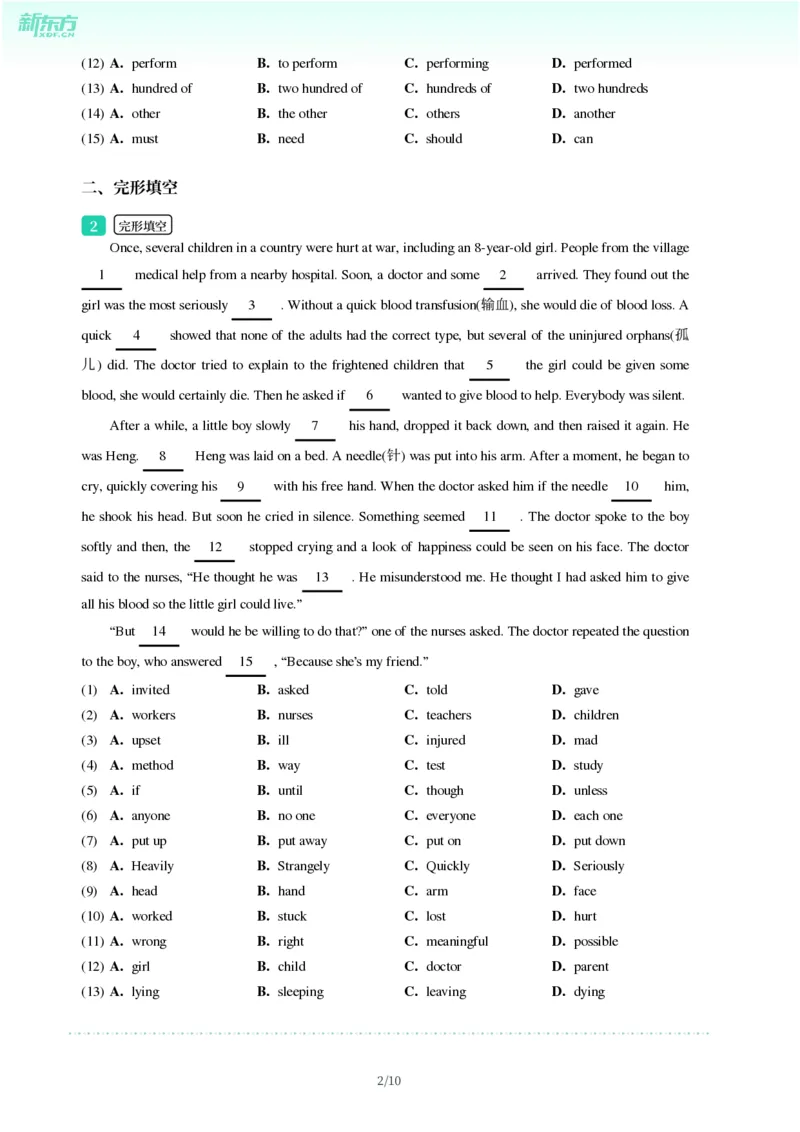
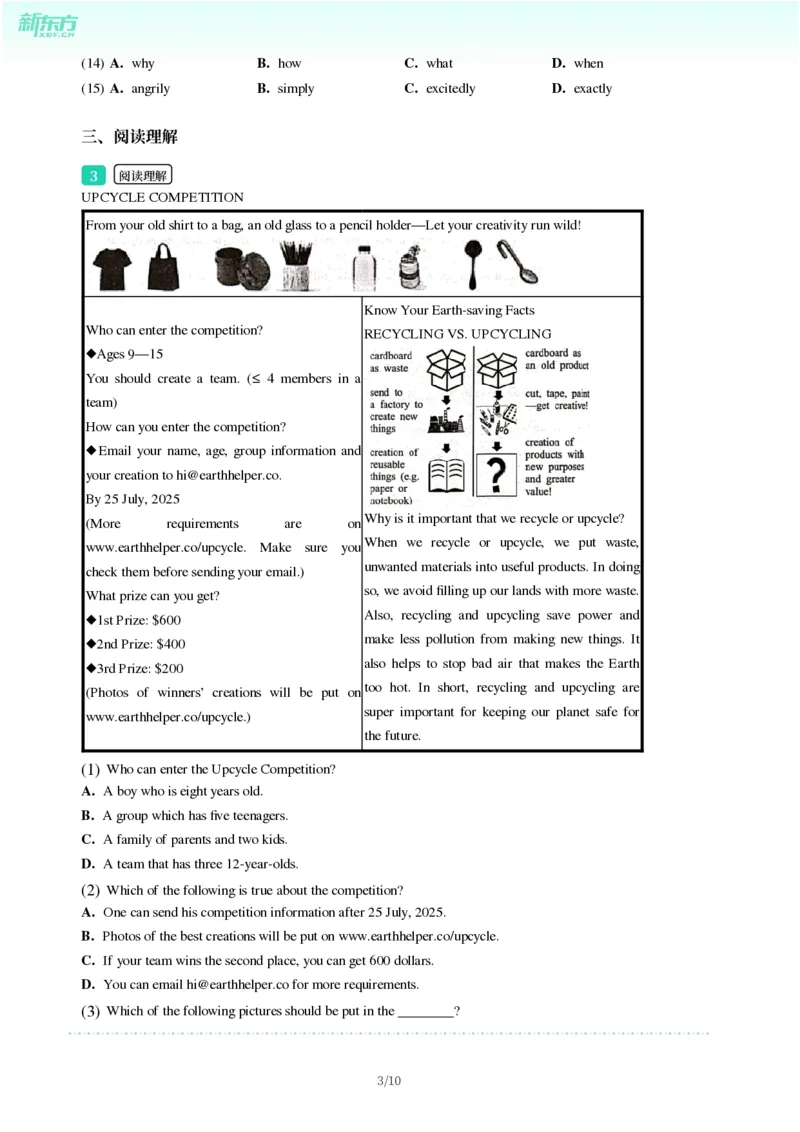
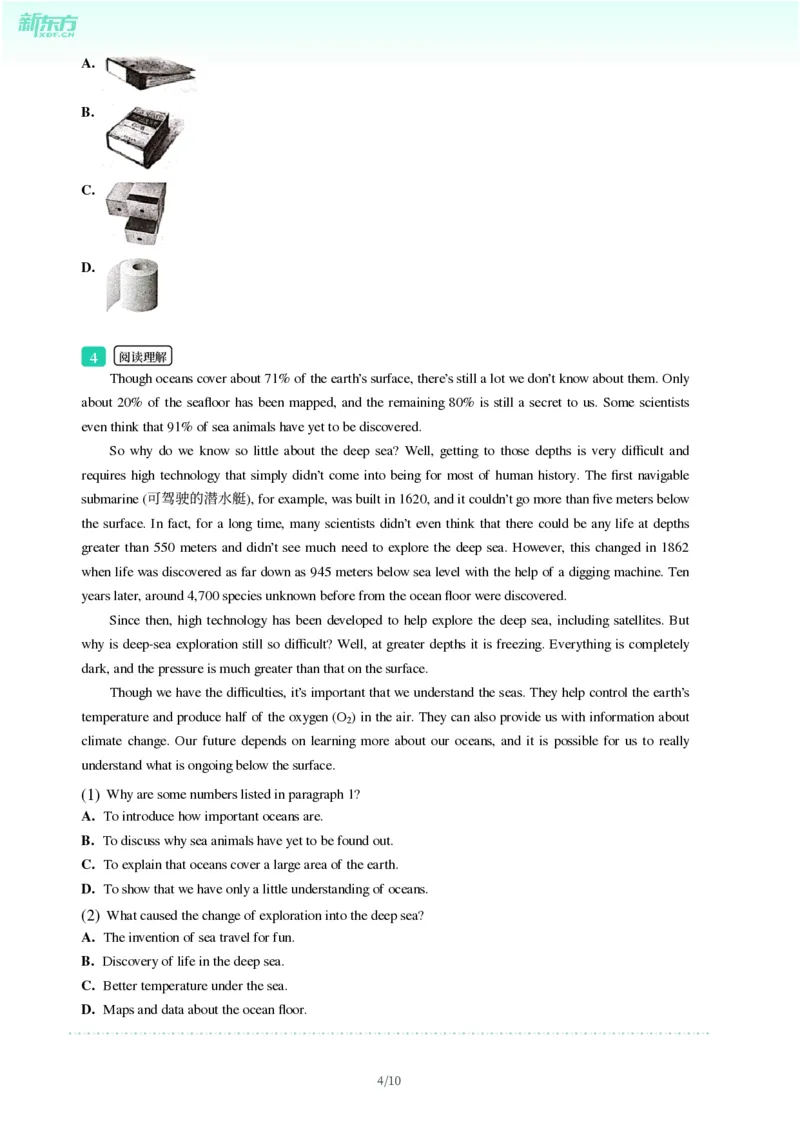
(3) Which of the following pictures should be put in the ________?
/A.
B.
C.
D.
 阅读理解
Though oceans cover about 71% of the earth’s surface, there’s still a lot we don’t know about them. Only
about 20% of the seafloor has been mapped, and the remaining 80% is still a secret to us. Some scientists
even think that 91% of sea animals have yet to be discovered.
So why do we know so little about the deep sea? Well, getting to those depths is very difficult and
requires high technology that simply didn’t come into being for most of human history. The first navigable
submarine (可驾驶的潜⽔艇), for example, was built in 1620, and it couldn’t go more than five meters below
the surface. In fact, for a long time, many scientists didn’t even think that there could be any life at depths
greater than 550 meters and didn’t see much need to explore the deep sea. However, this changed in 1862
when life was discovered as far down as 945 meters below sea level with the help of a digging machine. Ten
years later, around 4,700 species unknown before from the ocean floor were discovered.
Since then, high technology has been developed to help explore the deep sea, including satellites. But
why is deep-sea exploration still so difficult? Well, at greater depths it is freezing. Everything is completely
dark, and the pressure is much greater than that on the surface.
Though we have the difficulties, it’s important that we understand the seas. They help control the earth’s
temperature and produce half of the oxygen (O₂) in the air. They can also provide us with information about
climate change. Our future depends on learning more about our oceans, and it is possible for us to really
understand what is ongoing below the surface.
(1) Why are some numbers listed in paragraph 1?
A. To introduce how important oceans are.
B. To discuss why sea animals have yet to be found out.
C. To explain that oceans cover a large area of the earth.
D. To show that we have only a little understanding of oceans.
(2) What caused the change of exploration into the deep sea?
A. The invention of sea travel for fun.
B. Discovery of life in the deep sea.
C. Better temperature under the sea.
D. Maps and data about the ocean floor.
/(3) What can we learn from the passage?
A. It is difficult to build a navigable submarine.
B. The seas have a strong influence on our future.
C. The seas have no lives at a depth of 550 meters.
D. It is easier to go into the deep sea than we think.
(4) What’s the best title for the passage?
A. Hidden Treasures in Deep Sea
B. Unlocked Secrets of Deep Sea
C. Deep-Sea Exploration: Into the Freezing Depths
D. Deep-Sea Exploration: The Advantages and The Disadvantages
 阅读理解
My friend Julie and I are keen on creating a beautiful green town.
Gardening Course
Every September, our city has a special festival. Crowds of happy people go to the park. That’s because
the gardening competition takes place there.
For Julie and me, it was a pity that we couldn’t take part in the competition, for that was also the first day
of our high school. We buried ourselves in choosing courses. We wanted to learn all about plants, gardening
and farming. Finally, a course called Agriculture and Wildlife came into our sight. We thought it would help
us succeed as gardeners.
Project presentation
After a year’s study, I decided to give a presentation to my class about my project—the green farm.
“Good morning!” I said, “During my studies, I’ve learned a lot about city farming. Now, I want to do
something with what I’ve learned.”
I showed them a small plastic model. “This is the high street of our town. This is an old, nine-floor car
park. No one has used it for the last two years and it’s now for sale.”
“I’ve designed a city farm using the car park building. There will be eight floors to farm fruit and
vegetables. This design can help us collect rainwater to wet the soil. And we can also use energy from the sun
to power the special growing lights.”
“I will hire the space out to local people and they will sell everything good enough for the environment in
local shops. Also, the ninth floor will be for those who want to grow their own plants.”
My audience looked interested and my project got the highest marks in my class.
________
Later, Julie helped me search the town for the perfect place for gardening—somewhere that was not the
best neighbourhood, but a poor one. One where the road was full of holes and the pavement (⼈⾏道) was all
broken came into our eyes. At last, we made it.
In the neighbourhood, we posted letters through people’s doors with gardening instructions. More and
more people cared about that and began to plant vegetable gardens.
Then in the same neighbourhood, we put grass over those broken old pavements for the kids to play on.
Finally, we put up a sign that said, “Have fun here.”
/When we finished, we were both covered in soil and completely exhausted. But Julie put an arm around
my shoulders and smiled. “Not bad!” she said. “We can do more to make our town greener!”
(1) The writer mentioned the gardening competition to ________.
A. change her gardening projects
B. express her interest in gardening
C. discuss ways to get good prizes
D. tell stories of gardening courses
(2) Which is the most suitable for ________?
A. Grass Houses
B. Farming Instructions
C. Vegetable Gardens
D. Gardening Experiences
(3) Which of the following is the correct order of the story?
a.Julie helped find a perfect place for gardening.
b.The writer explained the green farm project.
c.Julie and the writer posted letters to neighbours.
d.Julie and the writer were busy choosing the courses.
e.Old pavements were covered with grass for kids to play on.
A. d-b-a-c-e
B. d-a-b-e-c
C. a-b-c-e-d
D. a-d-b-c-e
(4) According to the underlined sentence in the last paragraph, Julie and the writer may ________.
A. hire out their green farms for parking and camping
B. find more open spaces to plant grass and vegetables
C. sell their grass and vegetables to the neighbourhood
D. put up more signs to ask kids to have fun on the grass
 阅读理解
Two scientists called Stanley Schachter and Jerome Singer developed the two-factor theory of emotion
(情绪) in 1962. They said that emotions are formed in two parts. First, the body has a physical response to a
threat (威胁) and then the mind considers the physical response as an emotion, which is then felt by the
person. For example, imagine you are walking through a forest and you see a bear. Seeing it would probably
start a physical response, such as your heart beating very fast and sweat breaking out. Your mind then decides
that this is fear, which you feel as an emotion.
A new study has suggested that the key to reducing feelings of anger is not letting out but doing calming
activities such as yoga or meditation.
The study was published by Sophie Kjaervik and Brad Bushman from Ohio State University. They
wanted to explore the popular theory that venting anger is a good way of reducing it. Examples of venting
anger include shouting or hitting something like boxing sandbags, so that you let go of the emotion and
/therefore don’t feel it any more. The pair looked at 154 other studies on anger. These involved 10,189 people,
and included a variety of ages and backgrounds. In their study, Kjaervik and Bushman define anger as “an
emotional response to a real or imagined threat”. They used a theory of emotion that says emotions are partly
felt in your body and partly in your mind.
The scientists looked at the other studies to see how different activities influenced anger. They found that
activities such as running or boxing—which are often thought to be good for dealing with anger—weren’t
very good at reducing it. In fact, some of these activities actually made it worse because they increased
physical responses in the body that are linked to feeling angry. For example, they made people’s hearts beat
faster. However, activities that decreased physical responses in the body did help to reduce feelings of anger.
These included activities that slow the heart rate, such as deep breathing, meditation and yoga. Bushman says
activities that increase physical responses may be good for heart health but are “definitely not the best way to
reduce anger”.
The team found jogging was most likely to increase anger. However, some heart-rate increasing
activities—like ball games and team sports—could reduce anger. They think this shows that fun or playful
activities help to reduce negative feelings.
(1) According to Schachter and Singer’s theory, what happens first if you see a snake and feel afraid?
A. You get the feeling of fear.
B. You get the feeling of calm.
C. Your heart beats fast.
D. Your heart beats slowly.
(2) What does the underlined word “venting” probably mean in paragraph 3?
A. Expressing.
B. Hiding.
C. Avoiding.
D. Imagining.
(3) What is the main finding of the new study?
A. A new method of venting anger.
B. A new method of increasing anger.
C. Good activities to vent anger.
D. Good activities to reduce anger.
(4) What can we learn about calming activities?
A. They can reduce feelings of anger.
B. They can increase the heart rate.
C. They are good for venting anger.
D. They are good for heart health.
 阅读还原
阅读短⽂及⽂后A—E选项,选出可以填⼊各题空⽩处的最佳选项,并在答题卡上将该选项涂⿊。
Sugar painting, as the name means, is a painting made of sugar. (1)
Since the Warring States Period, the ancient people loved sweets and developed methods of producing
/sugar. In the Tang Dynasty, there was huge progress in the sugar-making technology. (2) With the
cultural and economic (经济的) development of Song and Yuan Dynasties, people became less interested in
only tasting sweetness. In the Ming Dynasty, some people added, pictures with good luck into the bowl of
sugar, and sugar painting appeared.
(3) Sugar painters use syrup (糖浆) as the material, a spoon as the “paintbrush”, and a smooth
table as the “paper”. To make syrup, they have to make sugar hot before painting. Since syrup may become
hard if it cools, the painters have to produce the work very quickly. They move the spoon full of syrup up and
down, left and right. Soon a sugar painting is done.
However, it’s a pity that this folk art is dying recently. (4) What’s worse, few people seem to
be willing to pass down the art except those aging sugar painters.
For most people, painting is a kind of art and difficult to understand. However, sugar painting has pulled
the art down into people’s daily lives. Through it, we may see the spiritual strength of the ancient people
across centuries. Now, sugar painting has been listed as an intangible cultural heritage in China. (5)
A. Sugar painting is different from normal painting.
B. It’s the sugar for us to taste, and the painting for us to admire.
C. Therefore, the art should be remembered, missed and passed down.
D. The sugar painting that used to be rich in shapes has become poorer and poorer because of fewer needs.
E. And sugar, the precious product once only served to the emperors and princes, also went into many people’s
homes.
四、短⽂填空
 ⾸字⺟填空
阅读短⽂,根据上下⽂和所给的⾸字⺟写出所缺单词。注意使⽤正确形式,每空限填⼀词。答卷
时,要求写出完整单词。
Dear Jenny,
I am sorry to hear that you have been under great stress. You feel sad, or even angry. I want you to know
that these feelings are c (1) . Many teenagers suffer from stress in their daily lives. First, remember to
take a b (2) when you need it. Sometimes, just resting for a few minutes can help you feel r (3)
. Exercise is also good for your health. Even a short walk can help clear your mind and reduce stress.
When you are not happy, try to do something you enjoy. W (4) it’s reading a book, listening to
music, or spending time with friends, a hobby can help you feel more positive. And always remember, it’s
okay to ask for help. There are many people around to love and s (5) you.
五、完成句⼦
 完成句⼦
今天,我们的地理⽼师使我们初次了解了全球变暖的影响。
Today, our geography teacher us the effects of global warming.
/ 完成句⼦
她还告诉我们⽇常⽣活中可以做些什么来帮助阻⽌全球变暖。
She also told us in our daily lives to help stop global warming.
 完成句⼦
例如,每年都应该种植更多的树木。
For example, more trees each year.
 完成句⼦
如果每个⼈都采取⾏动,世界将会变得更绿和更美丽。
If everybody , the world greener and more beautiful.
 完成句⼦
保护我们的地球是多么有必要啊!
it is to protect our Earth!
六、书⾯表达
 书⾯表达
随着科技⾼速发展,⼈们的⽣活变得越来越智能和便利。你校英语报以 “Life in 20 years” 为题
向学⽣征稿。请你从居家环境、⽇常饮⻝以及交通出⾏等⽅⾯展开想象,描述⼀下20年后的⽣活,
并谈谈与现在⽣活的不同之处。
注意:
1.⽂章应包括所有要点;
2.可在内容提⽰的基础上适当拓展信息;
3.词数80词左右(短⽂的开头已给出,不计⼊词数);
4.不得透露学校、姓名等任何个⼈信息,否则不予评分。
Life in 20 years
What will life be like in 20 years? I think it will be very
different._______________________________________________________________________________
______________________________________________________________________________________
/______________________________________________________________________________________
______________________________________________________________________________________
______________________________________________________________________________________
______________________________________________________________________________________
______________________________________________________________________________________
_______________________________________
/