2025-2026 学年高一英语上学期第一次月考卷 02(全国通用版)
(考试时间:120分钟 试卷满分:150分)
考生注意:
1.答题前,请务必将自己的姓名、准考证号用黑色字迹的签字笔或钢笔分别填写在试题卷和答题纸
规定的位置上。
2. 答题时,请按照答题纸上“注意事项”的要求,在答题纸相应的位置上规范作答,在本试题卷上
的作答一律无效。
3.难度系数:0.65。
4.考试结束后,将本试卷和答题卡一并交回。
第一部分 听力(共两节,满分30分)
注意,听力部分答题时请先将答案标在试卷上,听力部分结束前你将有两分钟的时间将答案转涂到
答题卡上。
第一节(共5小题;每小题1.5分,满分7.5分)
听下面5段对话。每段对话后有一个小题,从题中所给的A、B、C三个选项中选出最佳选项,并标在
试卷的相应位置。听完每段对话后,你都有10秒钟的时间来回答有关小题和阅读下一小题。每段对话仅
读一遍。
1.What did the woman borrow from Edward last week?
A.A pen. B.A bike. C.Some money.
2.Which dress does the woman like best?
A.The black one. B.The red one. C.The white one.
3.What does the woman expect the man to do on Saturday?
A.Celebrate their mum’s birthday.
B.Take Brian out for the day.
C.Help Brian move house.
4.Where are the speakers?
A.In a bank. B.In a restaurant. C.In a store.
5.Why did the man leave his last job?
A.To become famous. B.To study further. C.To find a new job.
第二节(共15小题;每小题1.5分,满分 22.5分)
1 / 11听下面5段对话或独白。每段对话或独白后有2至4个小题,从题中所给的A、B、C三个选项中选出最
佳选项,并标在试卷的相应位置。听每段对话或独白前,你将有 5秒钟的时间阅读各个小题;听完后,
各小题将给出 5 秒钟的作答时间。每段对话或独白读两遍。
听下面一段对话,回答第6和第7题。
6.How old is the woman now?
A.15. B.18. C.21.
7.What function is the woman’s watch unable to perform?
A.Playing music. B.Counting steps. C.Making phone calls.
听下面一段对话,回答第8 至第10题。
8.What did the man do just now?
A.He exercised indoors. B.He worked hard. C.He took a walk.
9.What will the man do first?
A.Order some food. B.Read the menu. C.Go out for dinner.
10.What is the relationship between the speakers?
A.Friends. B.Husband and wife. C.Waitress and customer.
听下面一段对话,回答第11 至第 13题。
11.When did the man begin his first horse riding lesson?
A.Yesterday. B.Last week. C.A month ago.
12.What did the man think of his first horse riding lesson?
A.Boring. B.Difficult. C.Interesting.
13.What did the woman say about her teacher?
A.She was a good teacher.B.She was an excellent rider. C.She was a humorous person.
听下面一段对话,回答第14 至第17题。
14.What is the man?
A.A host. B.A designer. C.A director.
15.What does the woman think of making clothes by using plastic bottles?
A.It’s costly.
B.It’s totally unacceptable.
C.It’s environmentally friendly.
16.How many plastic bottles are needed to make a ton of thread?
2 / 11A.42,000. B.62,000. C.67,000.
17.What does the woman say about the price of the clothes?
A.It is increasing rapidly.
B.It will be on a downward trend.
C.It ranges from 300 to 500 yuan.
听下面一段独白,回答第18至第20题。
18.How often is the Noetic Learning Math Contest held?
A.Once a year. B.Twice a year. C.Once every two years.
19.What are students required to do during the contest?
A.Solve 45 problems in an hour.
B.Solve 20 problems in 45 minutes.
C.Solve 10 problems in half an hour.
20.What will the highest scorer of each team receive?
A.A “Team Winner” medal.
B.A “Team Achievement Plaque”.
C.A “National Honor Roll” medal.
第二部分 阅读理解(共两节,满分50分)
第一节(共15小题;每小题2. 5分,满分37. 5分)
阅读下列短文,从每题所给的A、B、C、D四个选项中选出最佳选项,并在答题卡上将该选项涂黑。
A
The following are different ways to communicate with others in daily life. Are you familiar with them?
1 2
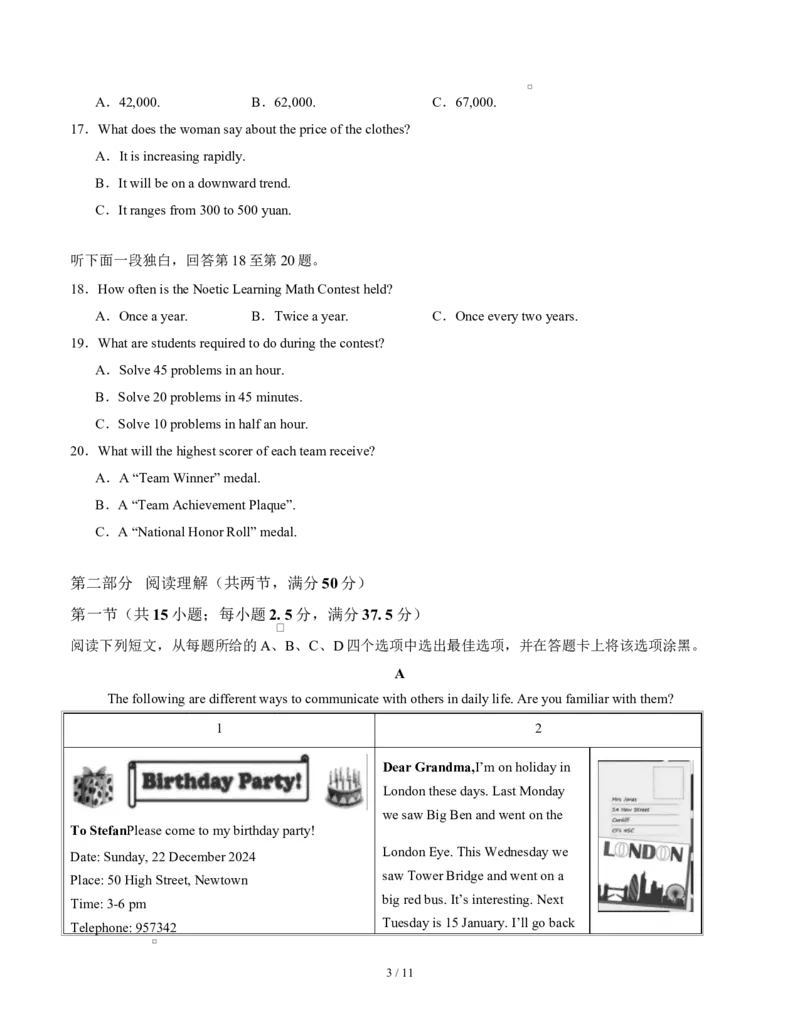
Dear Grandma,I’m on holiday in
London these days. Last Monday
we saw Big Ben and went on the
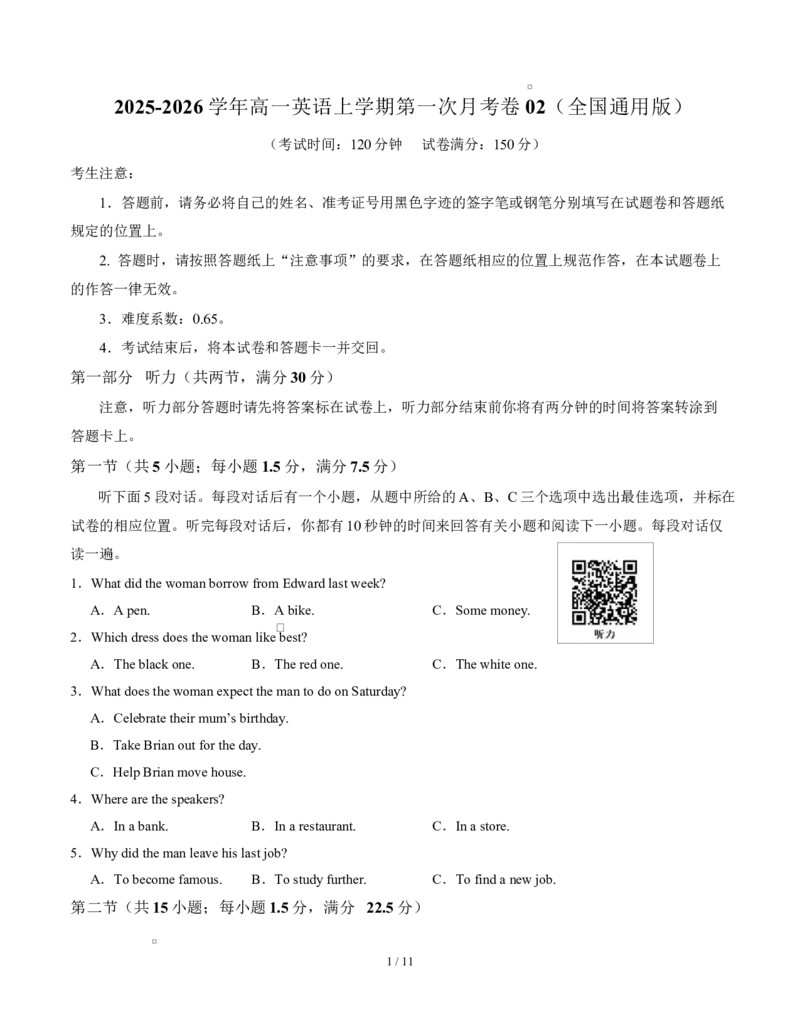
To StefanPlease come to my birthday party!
London Eye. This Wednesday we
Date: Sunday, 22 December 2024
saw Tower Bridge and went on a
Place: 50 High Street, Newtown
big red bus. It’s interesting. Next
Time: 3-6 pm
Tuesday is 15 January. I’ll go back
Telephone: 957342
3 / 11Email: isa@mail.web home. See you soon!
From Isabella Lucy
3 4
M. R. V. HIGH SCHOOL
Hi Alex,My best friend wants me to share my
NoticeOur school will organize an Inter-School
passwords with her. Shall I give them to her?
Dramatics Competition on 6 January 2025. Interested
From Star44
students can give their names to the cultural secretary
Hi Star44!
by 29 December 2024.
Passwords are private. If someone has your passwords,
Place: School Activity Hall
they can use your account. You can be best friends
Time:5-8 pm
without sharing passwords! Explain this to your friend.
Cultural Secretary
I’m sure she’ll understand. If you’re still worried, you
Roopa
should talk to your parents or another adult. Good luck.
Alex
21.When will Isabella’s birthday party be held?
A.On 6 January. B.On 15 January.
C.On 22 December. D.On 29 December.
22.What will Lucy do next Tuesday?
A.Visit Big Ben. B.Go back home.
C.See Tower Bridge. D.Go to the London Eye.
23.Who are the possible readers for the notice?
A.Students. B.Parents. C.Artists. D.Tourists.
B
Paris embraces the Olympic spirit with a burst of creativity, as nearly 30 colorful street art pieces have
transformed the city into an open- air gallery. These artworks, capturing scenes such as the dynamic French fencer
Ysaora Thibus and the calm boaters on the Seine River, have made a lasting impression on people.
Street artists come from different countries. Their pieces not only capture the essence of Parisian life, from the
busy coffee shops to the charming bookstores, but also extend to airports in Lille, Lyon, and Marseille. These cities are
co-hosting some of the Olympic events. Street art bridges the gap between high culture and everyday life, making art
accessible to everyone. It promotes shared appreciation, inspiring conversations in public spaces like subway stations
and airports and encouraging interaction among people of different backgrounds.
The Olympics follow strict guidelines and show national spirit, while street art is freer and shows many different
4 / 11cultures from the community. Despite their differences, both the Olympic spirit and the world of art share a common
platform of values that celebrate the pursuit of excellence, encouraging individuals to reach their highest potential.
Creativity and innovation are central to both, driving artists to create with every brushstroke and athletes to excel in
every performance as they both explore new heights of achievement.
Art competitions first appeared at the Olympics in 1912 in Stockholm, with medals awarded in five categories:
architecture, literature, music, painting and sculpture. However, the International Olympic Committee ended the
competitions in the 1948 Games. Now, the spirit of the Olympics is reflected in the street art that brightens every corner
of Paris. “Artists are like athletes. They also require a lot of effort and determination,” said JonOne, who is a pioneer of
street art. “I respect athletes in basketball and runners. Art is not really a sport, but it should be included in the
Olympics. Just surviving as an artist is an Olympic sport.”
24.What do we know about street art according to paragraph 2?
A.It centers around Olympic events. B.It helps strengthen social connections.
C.It encourages cooperation between artists. D.It is displayed in open-air galleries in Paris.
25.What do the Olympics and street art have in common?
A.They have strict standards to follow.
B.They reflect the creativity of communities.
C.They emphasize the importance of competition.
D.They inspire individuals to pursue their full potential.
26.Which of the following statements will JonOne probably agree with?
A.Art should be integrated with the Olympic Games.
B.Artists deserve respect from people from all walks of life.
C.Street artists should make use of the Olympics to gain popularity.
D.The Olympics motivates many artists to create pioneering works.
27.What is the best title for the text?
A.Street Art Honors Olympic Athletes
B.Street Art Adds Colors to the Olympics
C.The Olympics Draw Global Attention to Artists
D.The Olympics Make Art Walk into People’s Life
C
When I was 9, we packed up our home in Los Angeles and arrived at Heathrow, London on a gray January
morning. Everyone in the family settled quickly into the city except me. Without my beloved beaches and endless
blue-sky days, I felt at a loss and out of place. Until I made a discovery.
5 / 11Southbank, at an eastern bend in the Thames, is the center of British skateboarding, where the continuous
crashing of skateboards left your head ringing .I loved it. I soon made friends with the local skaters. We spoke our own
language. And my favorite: Safe. Safe meant cool. It meant hello. It meant don’t worry about it. Once, when trying a
certain trick on the beam(横杆), I fell onto the stones, damaging a nerve in my hand, and Toby came over, helping me
up: Safe, man. Safe. A few minutes later, when I landed the trick, my friends beat their boards loud, shouting: “ Safe!
Safe! Safe!” And that’s what mattered—landing tricks, being a good skater.
When I was 15, my family moved to Washington. I tried skateboarding there, but the locals were far less
welcoming. Within a couple of years, I’d given it up.
When I returned to London in 2004, I found myself wandering down to Southbank, spending hours there. I’ve
traveled back several times since, most recently this past spring. The day was cold but clear: tourists and Londoners
stopped to watch the skaters. Weaving(穿梭)among the kids who rushed by on their boards, I found my way to the
beam. Then a rail—thin teenager, in a baggy white T—shirt, skidded(滑)up to the beam. He sat next to me. He seemed
not to notice the man next to him. But soon I caught a few of his glances. “I was a local here 20 years ago,” I told him.
Then, slowly, he began to nod his head. “Safe, man. Safe.”
“Yeah,” I said. “Safe.”
28.What can we learn about the author soon after he moved to London?
A.He felt disappointed. B.He gave up his hobby.
C.He liked the weather there. D.He had disagreements with his family.
29.What do the underlined words “Safe! Safe! Safe!” probably mean?
A.Be careful! B.Well done! C.No way! D.Don’t worry!
30.Why did the author like to spend time in Southbank when he returned to London?
A.To join the skateboarding. B.To make new friends.
C.To learn more tricks. D.To relive his childhood days
31.What message does the author seem to convey in the text?
A.Children should learn a second language.
B.Sport is necessary for children’s health.
C.Children need a sense of belonging
D.Seeing the world is a must for children.
D
A new observation in Sumatra caught seasoned scientists by surprise. An orangutan (红毛猩猩) known as Rakus
treated a fresh wound with a medicinal plant, making this the first time an animal has been seen applying a biologically
active substance (物质) for its health benefits. This leaves scientists wondering: Did humans invent medicine, or does it
6 / 11pre-date our species?
These animals are known to be among the most intelligent non-human primates (灵 长 类 ). They’ve been
observed using tools, communicating vocally, and engaging in even more complex behaviors like calculated
reciprocity, which involves aiding another orangutan with the expectation of being paid back. They can even use Skype
with some help from humans.
Roughly 60,000-70,000 of these creatures remain in the wild, about 15,000 of which live on the Indonesian
island of Sumatra. That’s where the Suaq Project, part of the Max Planck Institute for Animal Behavior, observes
orangutans in their natural habitat.
The researchers noted in June that Rakus had a small wound on his face following a fight with another mature
male orangutan. Several days later, Rakus did something no one had ever seen a primate do before. He began carefully
picking the leaves from a climbing vine (藤蔓) known as akar-kuning. Local human populations have long used these
leaves for pain relief and to treat conditions like malaria. Orangutans don’t usually eat these plants; indeed, Rakus didn’
t eat them. He chewed (嚼碎) them and then applied the resulting paste to his facial wound.
This is the first time researchers have seen such behavior in 21 years at the Sumatran research station. Wild
orangutans are rarely injured, so this may be a rare but widespread behavior. Or perhaps Rakus is the only one that
knows this trick. The researchers assumed that early humans may have learned about certain treatment by observing
animals engaging in similar behaviors. And here we are, thousands of generations later, still watching and wondering
just how smart they are. Increasingly, it looks like orangutans are one cave painting away from civilization.
32.Why does the author mention Skype in paragraph 2?
A.To support an idea. B.To draw a conclusion.
C.To explain a problem. D.To present a suggestion.
33.What is paragraph 4 mainly about?
A.How Rakus got injured. B.How Rakus treated his wound.
C.What Rakus ate in the wild. D.What Rakus explored in the forest.
34.What can be inferred about the new observation?
A.It proves the medical value of a plant leaf.
B.It shows a widespread behavior among orangutans.
C.It answers one of scientists’ questions about medicine.
D.It adds evidence to show the intelligence of orangutans.
35.Which of the following is a suitable title for the text?
A.Non-human Primates Seen Using Tools in the Wild
B.Orangutans Proved to Be the Most Intelligent Primate
C.A Project Observes Orangutans in Their Natural Habitat
7 / 11D.An Orangutan Observed Applying Medicinal Plant to a Wound
第二节(共5小题, 每小题2. 5分, 共12. 5分)
阅读下面短文, 从短文后的选项中选出可以填入空白处的最佳选项。选项中有两项为多余选项。
Exam Anxiety
Has this ever happened to you? You’ve been studying hard for your midterm, but when you walk into your
exam, your mind goes blank, your heart races fast, you get sweaty palms and find it hard to breathe. 36
Everyone feels anxious during exams. Usually, it results from a fear of failure, lack of adequate preparation time
and bad experiences taking tests in the past. This is normal and often helps you work harder, think faster and generally
improve your performance. 37 You may also feel that other people are managing the exam better than you.
This can cause you to feel that your mind has “gone blank” on information you know you have revised.
38 Some choose to ignore the problem, while others don’t review because they think they will do
badly anyway and even miss exams due to the anxiety. It can also be really easy to think that if you don’t try and then
you fail, you won’t feel as bad as if you fail after trying really hard.
So what can you do to fight against the negative mindset and stay calm before and during your test? 39
Yes, this seems obvious, but it’s worth repeating. If you feel confident that you’ve prepared thoroughly, you’ll feel
more confident walking into the test. The second tip is simple: just start. The blank page can maximize your anxiety.
40 You can always go back and change things later if needed, but a few quick answers can get the ball rolling.
Besides, allocating (分配) your time is equally important. Look through the whole test before getting started. Mentally
allocate how much time you’ll spend on each section. If there’s time to recheck, even better.
A.After you get the paper, dive right in by getting some questions done to build up your confidence.
B.However, if you are overly anxious about the result, you may be unable to focus on your work.
C.Realizing time is almost up and that there’s still a lot of blank space will make you desperate.
D.Therefore, people need an appropriate amount of pressure to help deal with exams.
E.If these classic signs of exam anxiety sound familiar, you’re not alone!
F.People often deal with exam stress in many unhelpful ways.
G.The first thing you should do is to be prepared.
第三部分 语言运用(共两节, 满分30分)
第一节(共15小题;每小题1分, 共15分)
阅读下面短文,从每题所给的A、B、C、D四个选项中选出可以填入空白处的最佳选项。
Owura Kwadwo Hottish teaches computer science in a school. It is a normal school except for the fact that it
didn't have 41 .
Owura became famous after he posted photos of him on the Internet. In the picture, people could see he was
8 / 11teaching his students by 42 an entire computer on the blackboard. The photos showed the 43
level of education for children in Ghana (加纳). People were 44 that Owura made sure each button was
drawn correctly.
He would come to school half an hour ahead of 45 every day. He drew the computer on the
blackboard, but at the end of his class, it was 46 off to start the next class, so he had to 47 it
the next day!
Owura’s efforts 48 when Microsoft (微软公司) took 49 of his act. They first took him to
an international educators’ meeting in Singapore. He made a 50 about his teaching methods at the
meeting and 51 a standing ovation (致敬) after the speech.
52 , Owura got the thing he always wanted for his students—some companies 53
computers to the school. Not a single child in the school had seen a real computer in their lives. Thanks to their teacher’
s 54 , the world took notice and responded with 55 to them.
41.A.classrooms B.computers C.playgrounds D.tools
42.A.operating B.repairing C.describing D.drawing
43.A.poor B.clear C.ancient D.lucky
44.A.worried B.disappointed C.afraid D.surprised
45.A.line B.culture C.schedule D.school
46.A.rubbed B.called C.cut D.shown
47.A.stress B.improve C.ruin D.repeat
48.A.broke out B.paid off C.came back D.held back
49.A.care B.charge C.place D.notice
50.A.plan B.speech C.decision D.medal
51.A.made B.waited C.received D.carried
52.A.Suddenly B.Importantly C.Hopelessly D.Strangely
53.A.lent B.sold C.donated D.applied
54.A.efforts B.pains C.humor D.doubt
55.A.wisdom B.honesty C.kindness D.pride
第二节 (共10小题;每小题1. 5分, 满分15分)
阅读下面短文,在空白处填入1个适当的单词或括号内单词的正确形式。
In the past, it took days or even weeks to receive news from faraway friends. Now, thanks to advances in
technology, the way we make friends 56 communicate with them has changed greatly.
Nowadays, we can move around the world and still stay 57 touch with the people that we want to
remain friends with. Social media tools let us see 58 our friends are doing, which is a 59
9 / 11(particular) good way to maintain friendships.
The digital age enables us 60 (find) people who share our interests. Whatever our hobbies, the
Internet can connect us with others who also enjoy 61 (do) the same things, even if they live on the other side of
the world.
But we need to remember that what we see on social media 62 (be) often not the whole truth about a
person or a situation. Sometimes smiling photos can hide real problems. On 63 Internet, nobody knows who
you really are. A young person could be old; a woman could be a man; we could even be sharing 64 (we)
information with criminals.
This doesn’t mean that we should throw the baby out with the bath water. Although technology has changed the
way we acquire friends, the 65 (mean) of friendship and our longing for friends remain the same.
第四部分 写作(共两节,满分40分)
第一节(满分15分)
假定你是李华,你的英国朋友 Peter 对中国传统手工艺很感兴趣。你所在的学校将举办一场中国传统手工艺
展,请你给他写一封邮件,邀请他参加。内容包括:
1.展览的时间和地点;
2.展览的主要内容;
3.邀请他参加的原因。
注意:
1.词数80左右;
2.开头和结尾已给出,不计入总词数。
Dear Peter,
I’m excited to invite you to a Traditional Chinese Crafts Exhibition at our school.
________________________________________________________________________________________________
________________________________________________________________________________________________
________________________________________________________________________________________________
____________________________
Best regards,
Li Hua
第二节(满分25分)
阅读下面材料,根据其内容和所给段落开头语续写两段,使之构成一篇完整的短文。
It was a sunny morning, when Jessie sat at her desk in Mrs. Williamson’s class. They were learning about
science, which Jessie normally enjoyed. However, a bird stayed outside the classroom window, which caught much of
10 / 11Jessie’s attention.
“Jessie, are you listening?” Mrs. Williamson’s question cut in Jessie’s thoughts.
Jessie turned to her teacher. “What was that?” she asked.
The teacher frowned (皱眉), saying it was the second time that morning that she hadn’t been listening and that
she was supposed to do better.
After class the teacher stopped Jessie and told her, “A rule is a rule. And it’s important for everyone to follow the
rules.”
Jessie nodded to show she understood, but she didn’t really take it seriously, thinking Mrs. Williamson was too
strict. Then she rushed outside to play ball games with other kids. They first picked teams and made the rules for the
game. Then the game started. But the other team broke the rules and ended the game.
It made Jessie angry and complained it was one of the rules and a rule is a rule. But as soon as she said the
words, she remembered what happened in class.
注意:1. 续写词数应为100左右;
2. 请按如下格式在答题卡的相应位置作答。
Ashamed and embarrassed, Jessie went to Mrs. Williamson’s office.
________________________________________________________________________________________________
________________________________________________________________________________________________
________________________________________________________________________________________________
________________________________________________________________________________________________
____________________________________________________________________________
11 / 11