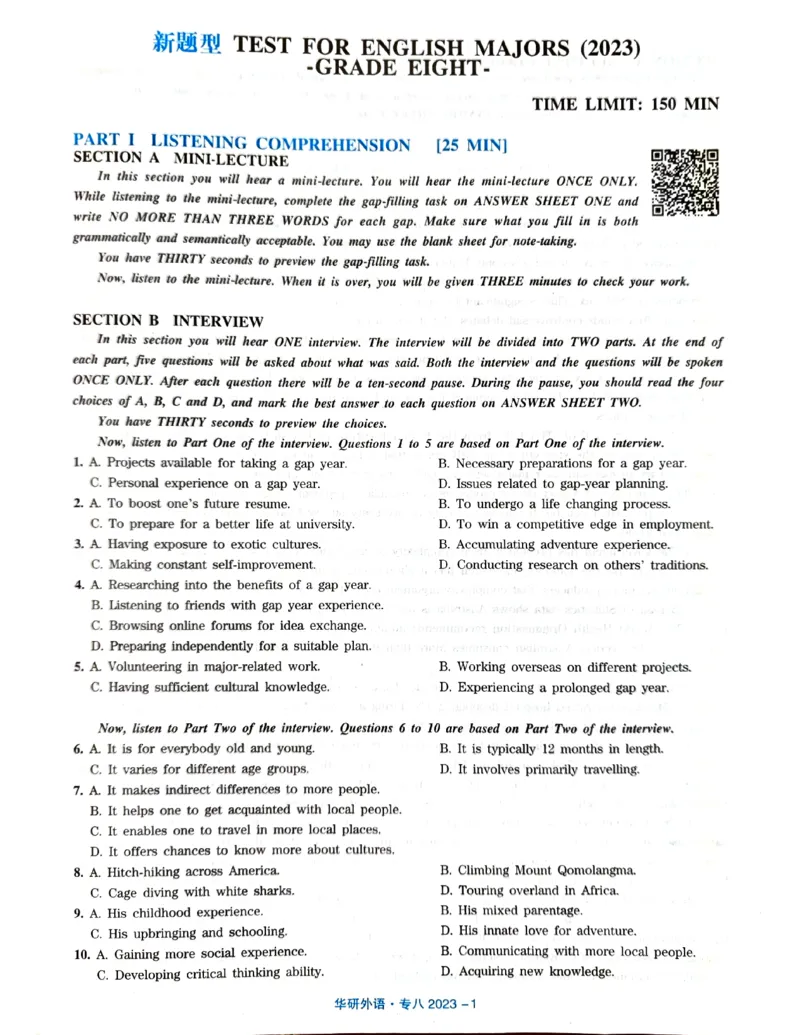
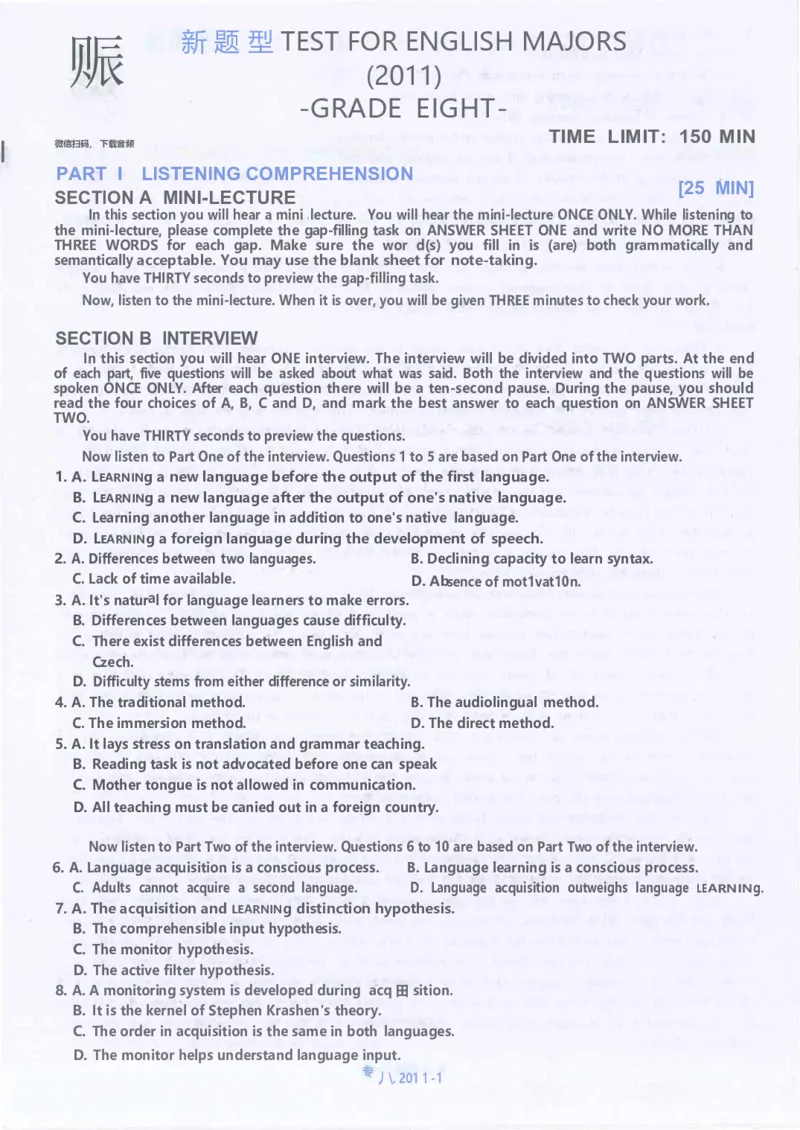
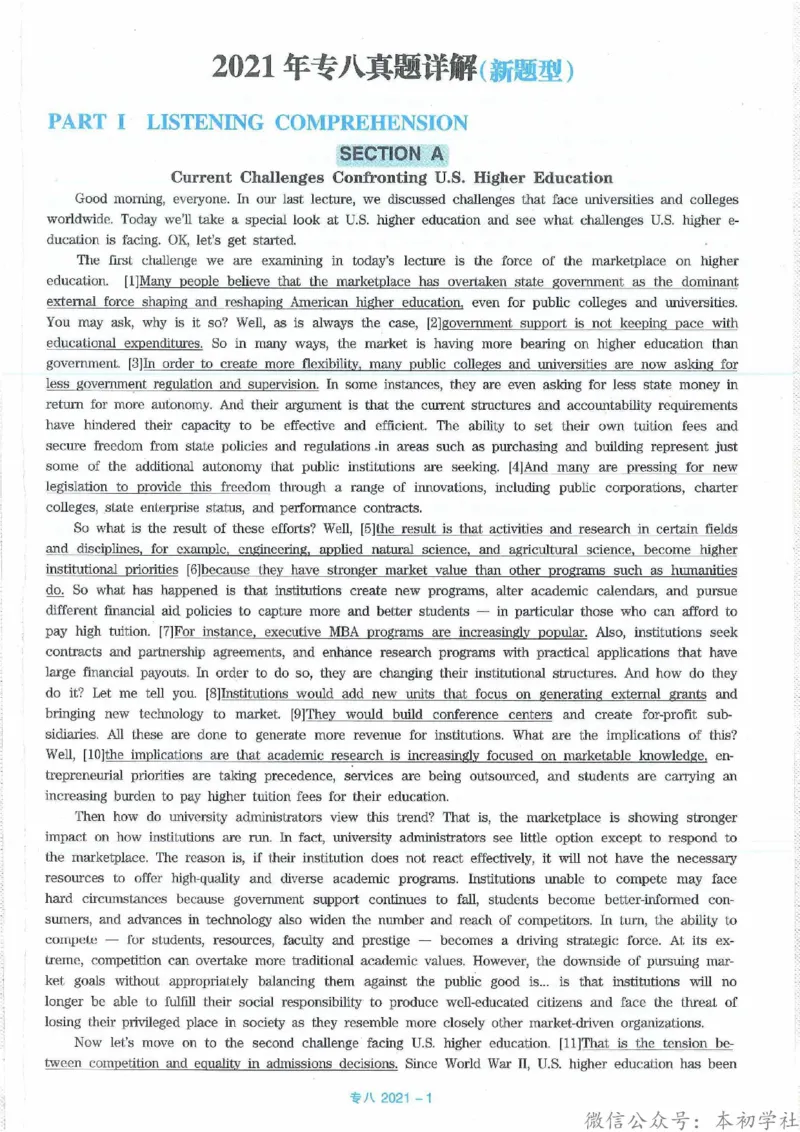
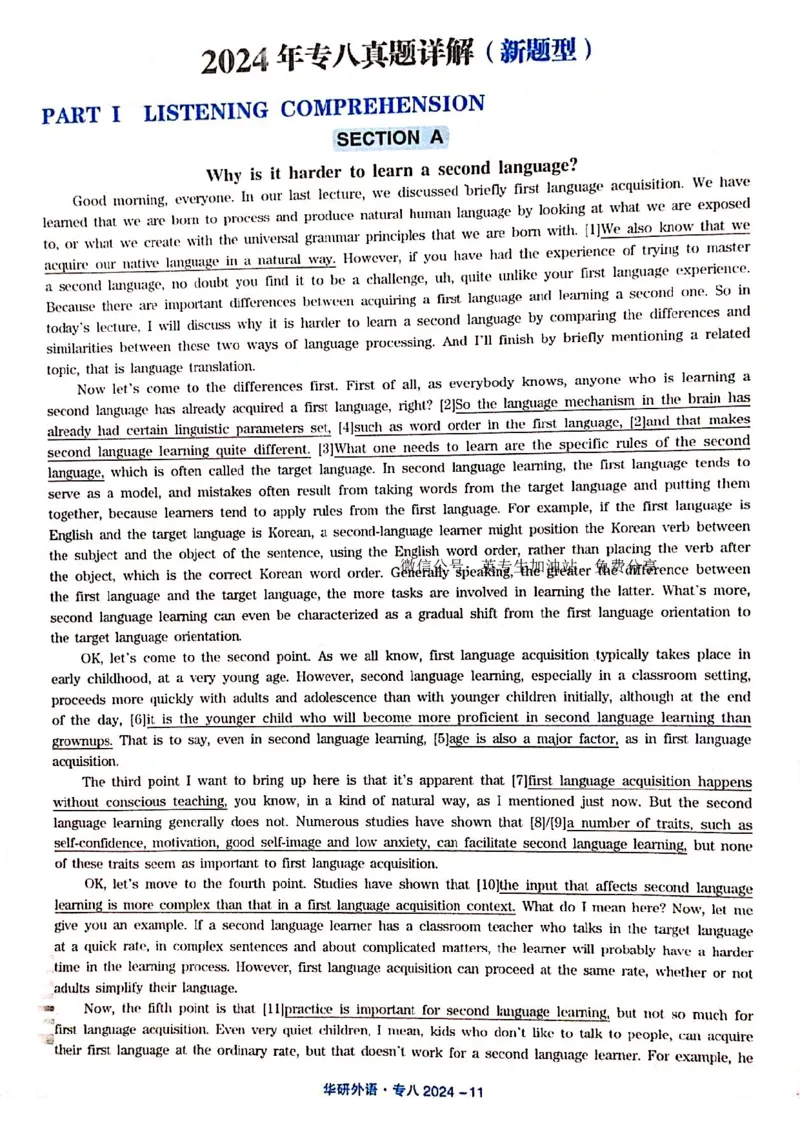
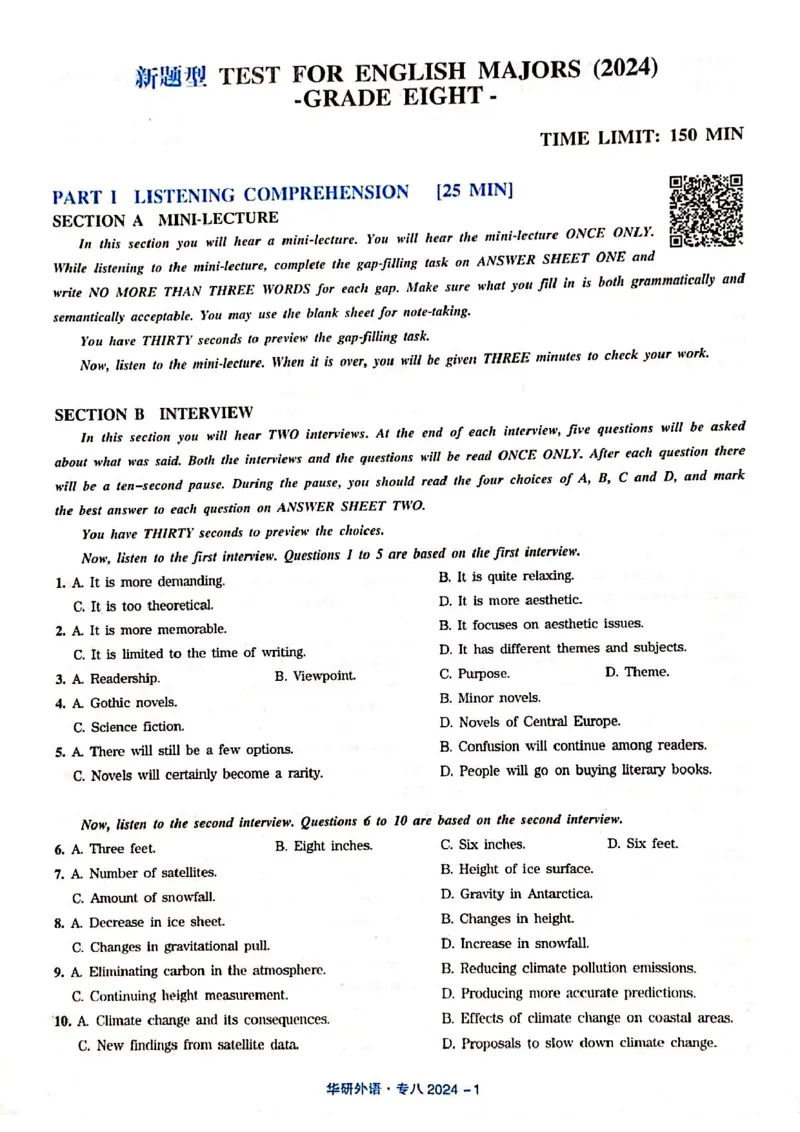
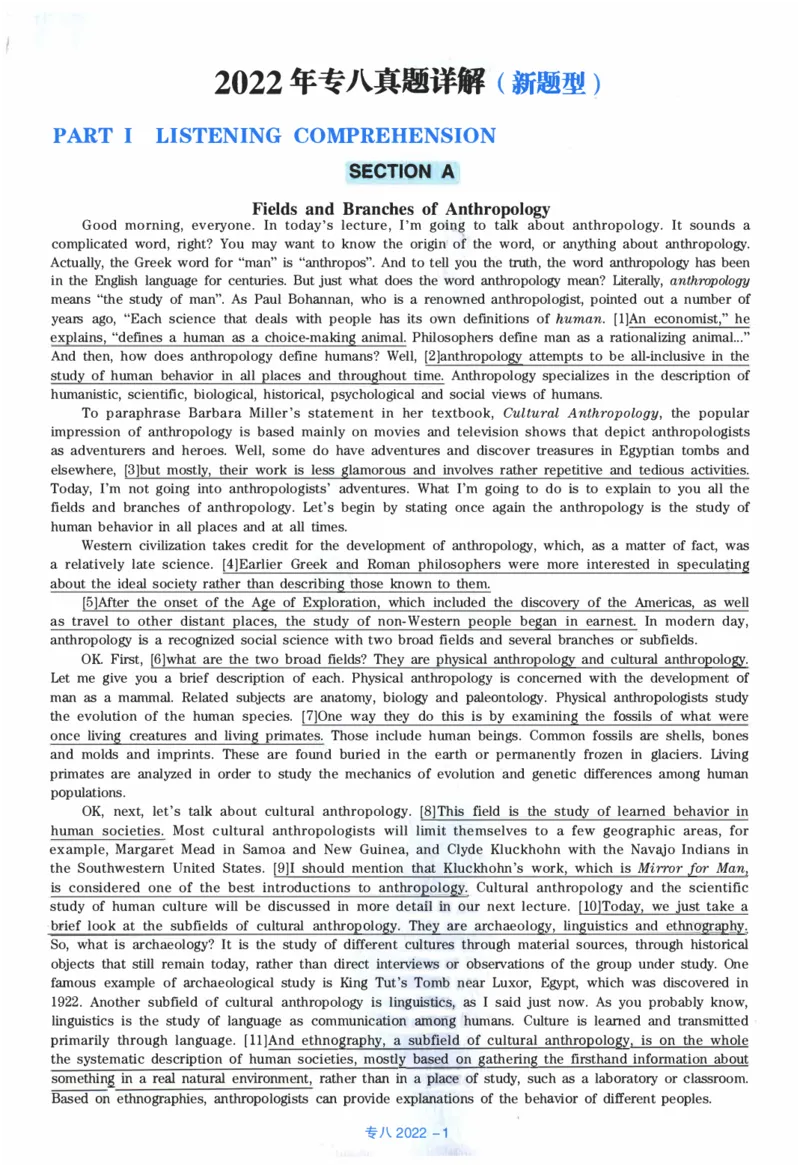
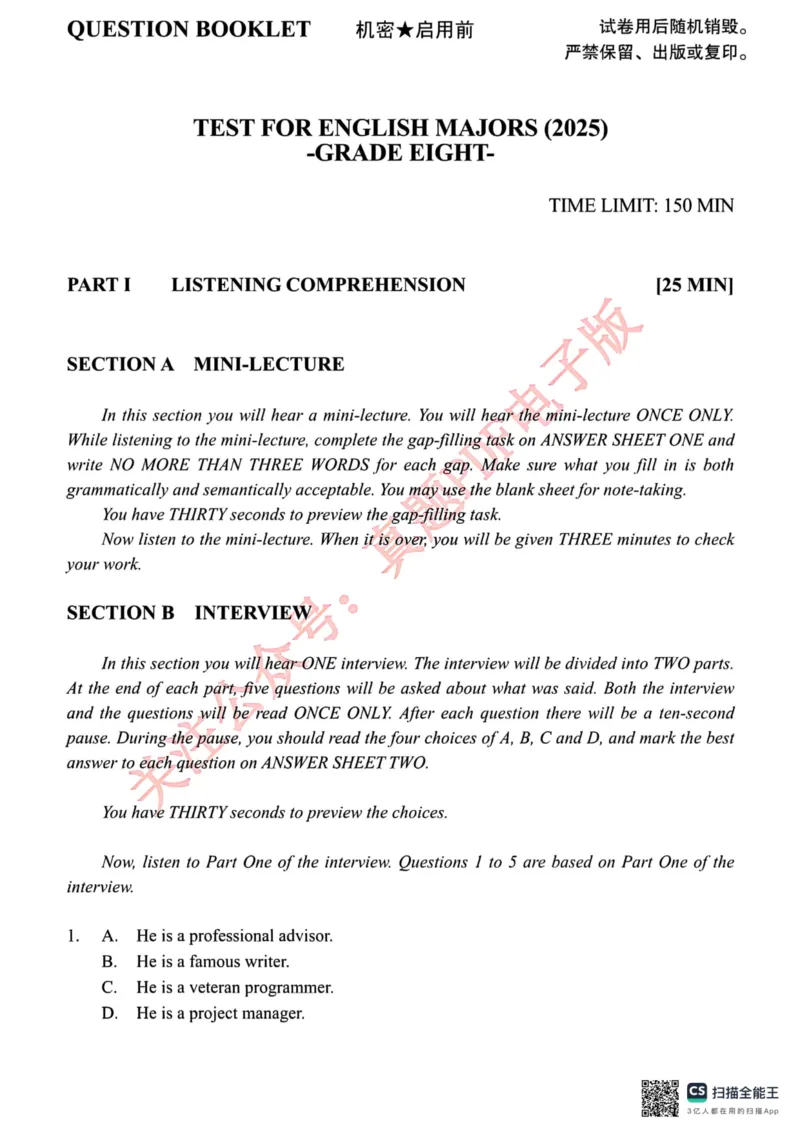
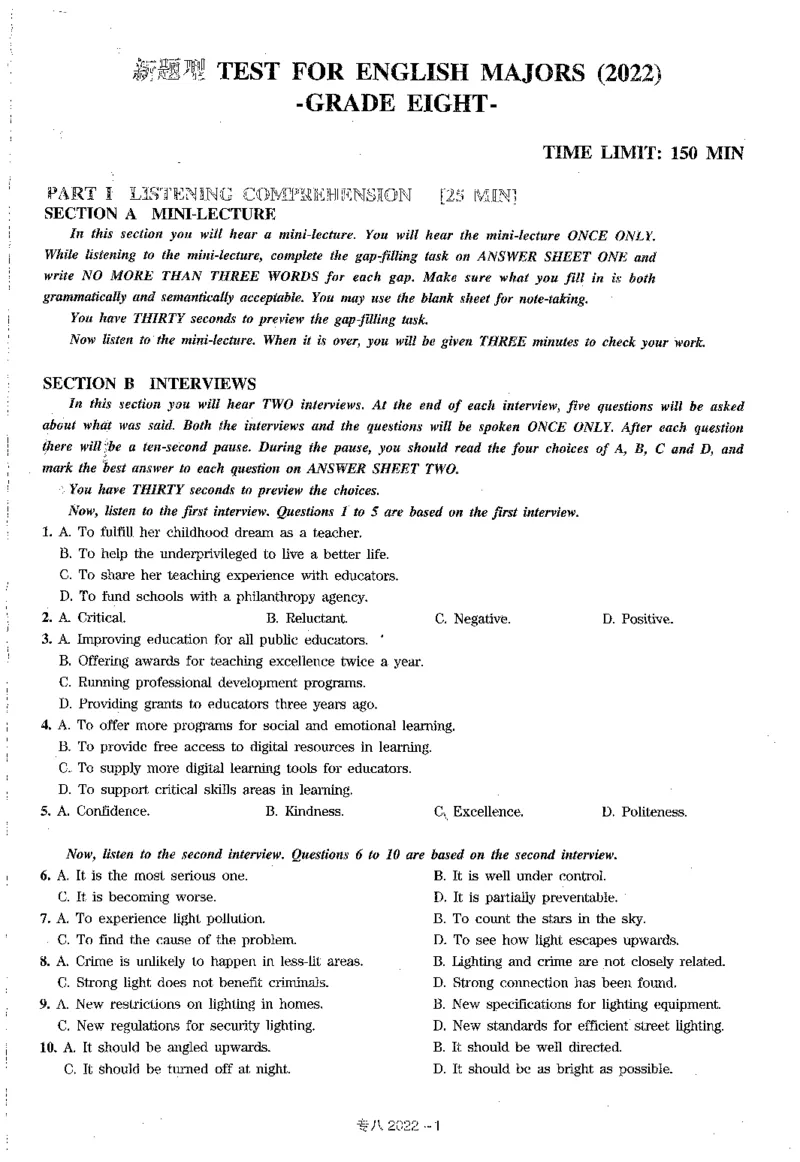
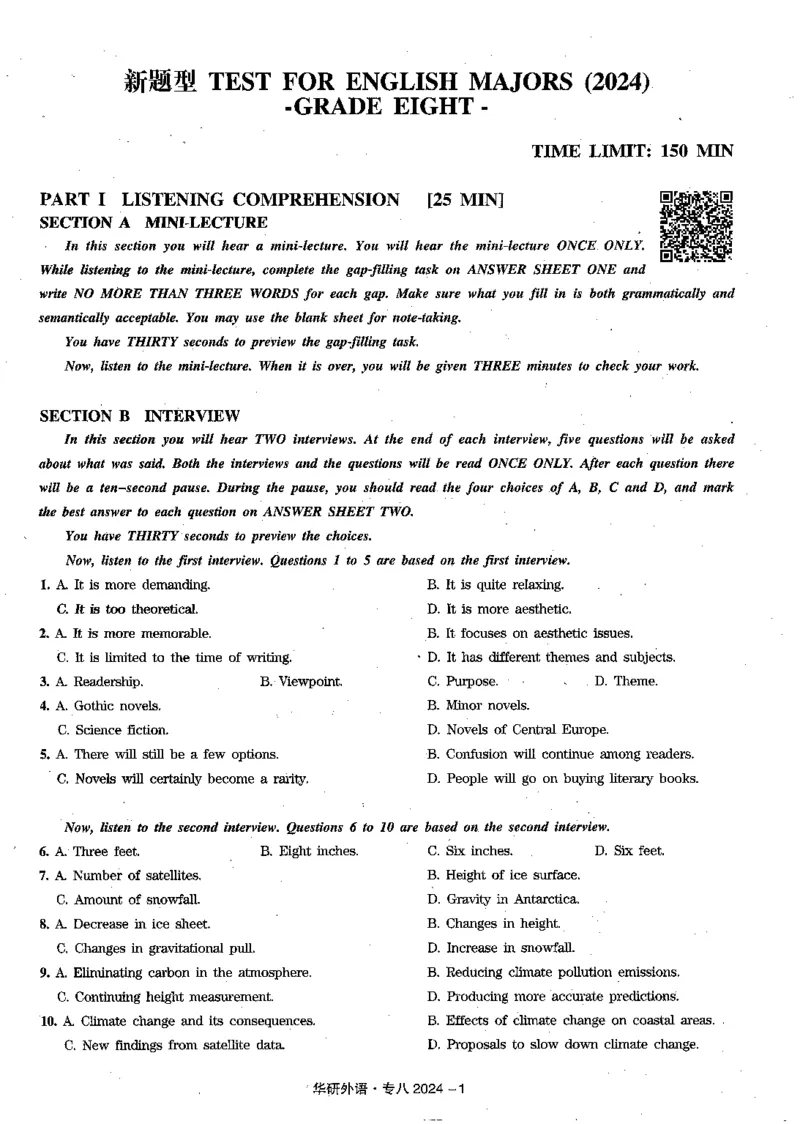
新题型 TEST FOR ENGLISH MAJORS (2021)
-GRADE EIGHT-
tim e LIMIT: 150 MIN
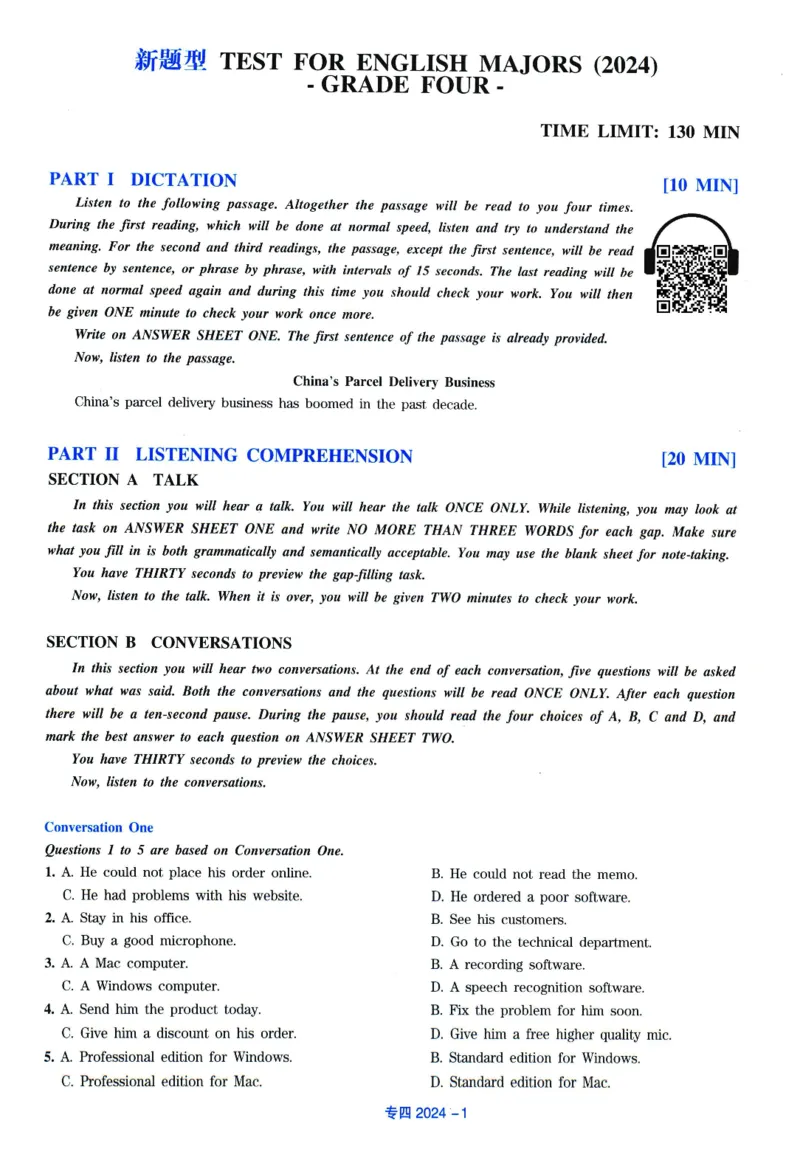
PART I LISTENING COMPREHENSION [25 MIN]
SECTION A MINI-LECTURE
In this section you will hear a mini-lecture. You will hear the mini-lecture ONCE ONLY.
While listening to the mini-lecture} complete the gap-filling task on ANSWER SHEET ONE and
write NO MORE THAN THREE WORDS for each gap. Make sure what you fill in is both
grammatically and semantically acceptable. You may use the blank sheet for note-taking.
You have THIRTY seconds to preview the gap-filling task.
Now listen to the mini-lecture. When it is over, you will be given THREE minutes to check your work.
SECTION B INTERVIEW
In this section you will hear ONE intetyiew. The interview will he divided into TWO parts. At the end of
each part, five questions will be asked about what was said. Both the interview and the questions will be spoken
ONCE ONLY. After each question there will be a ten-second pause. During the pausey you should read the four
choices of A,B, C and D, and mark the best answer to each question on ANSWER SHEET TWO.
You have THIRTY seconds to preview the choices.
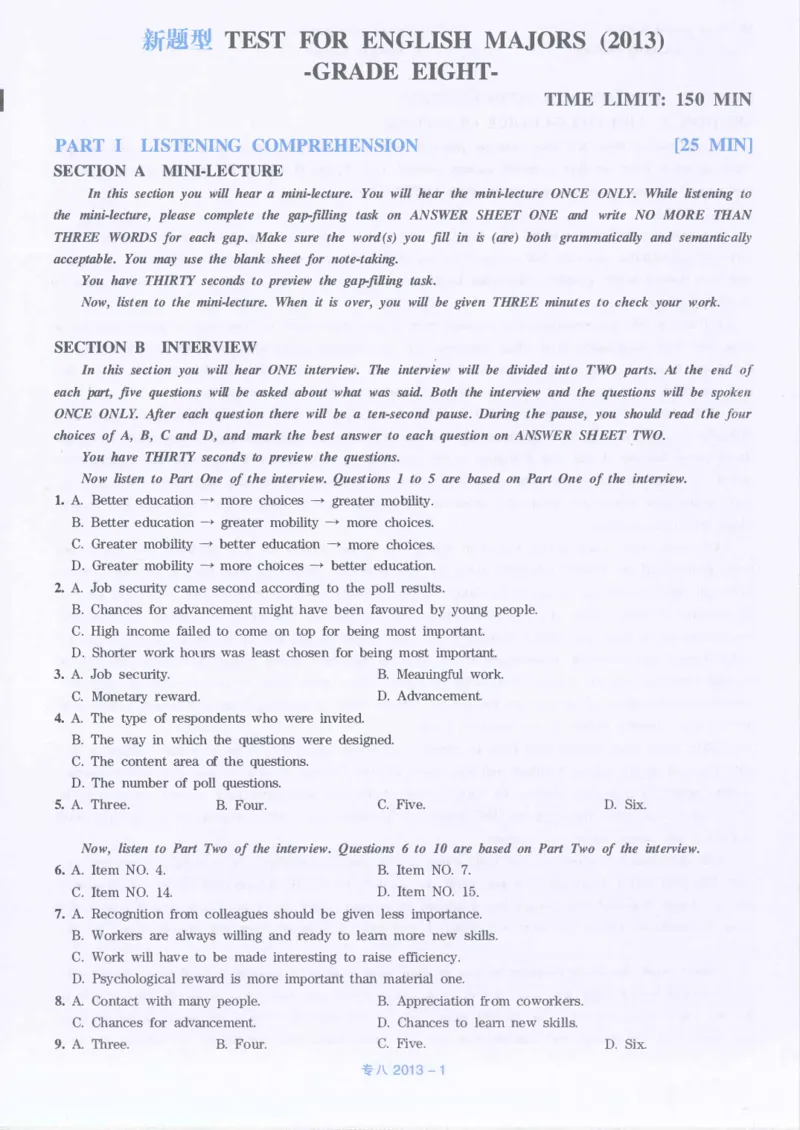
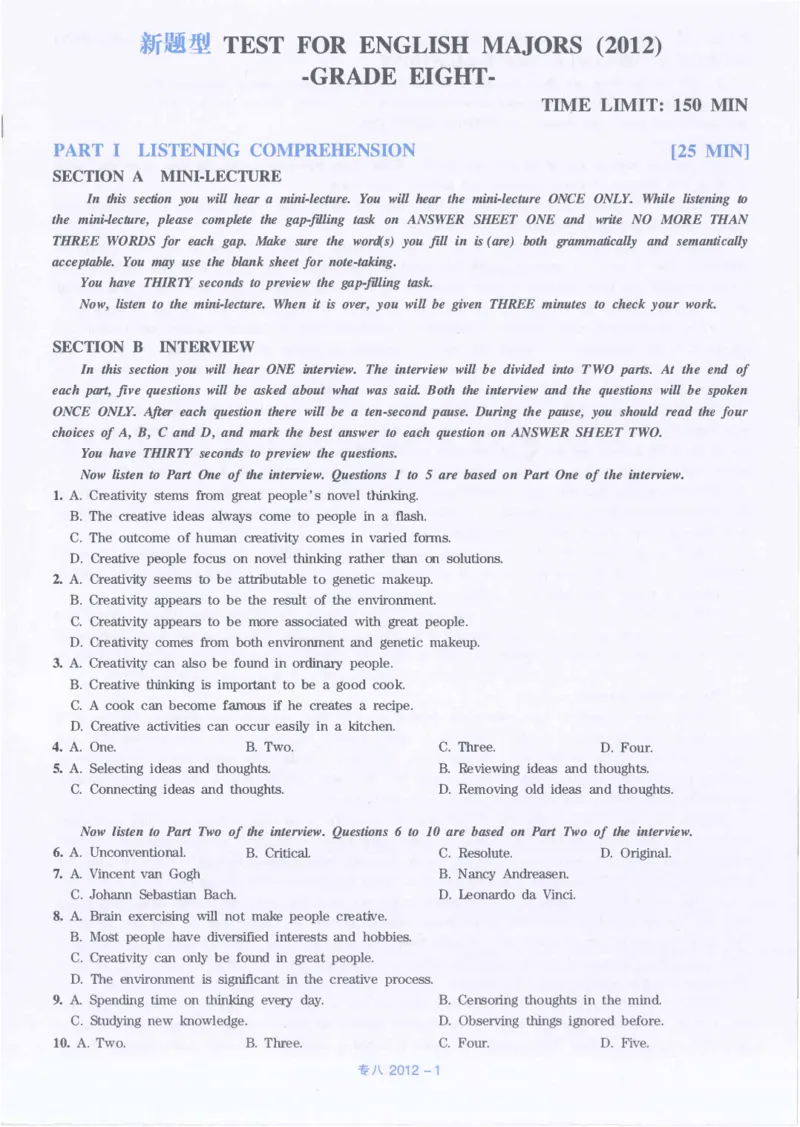
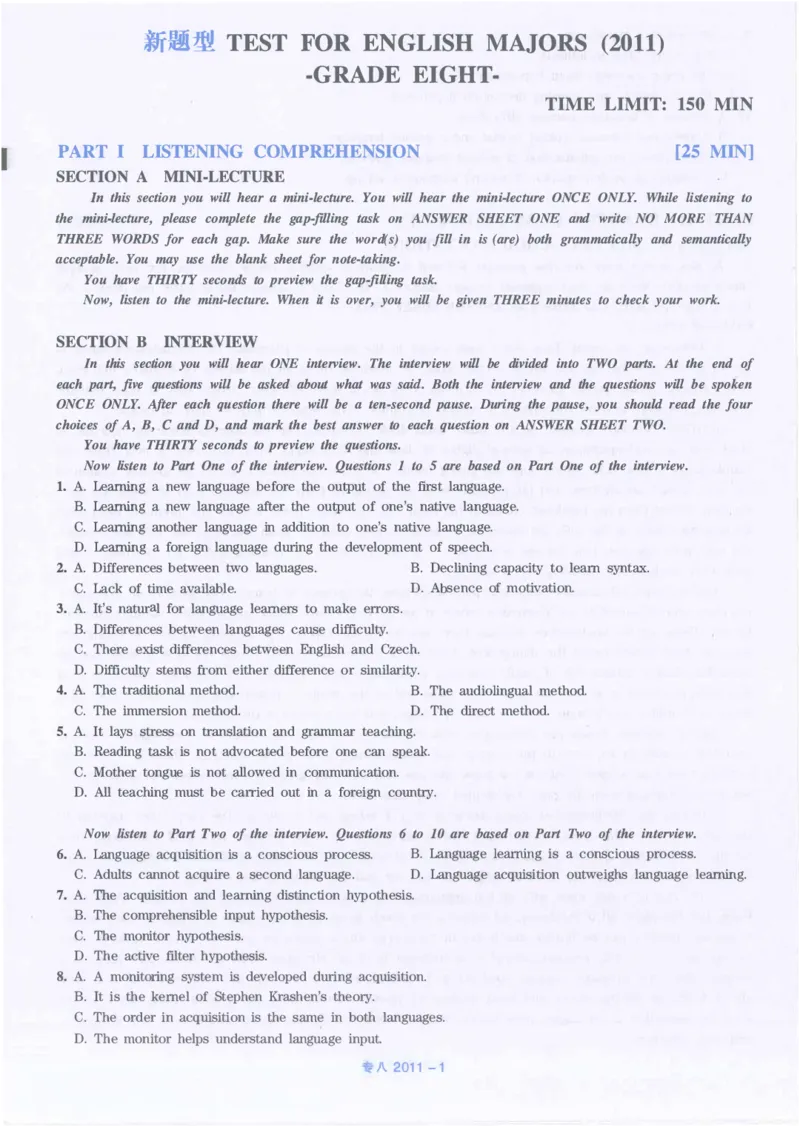
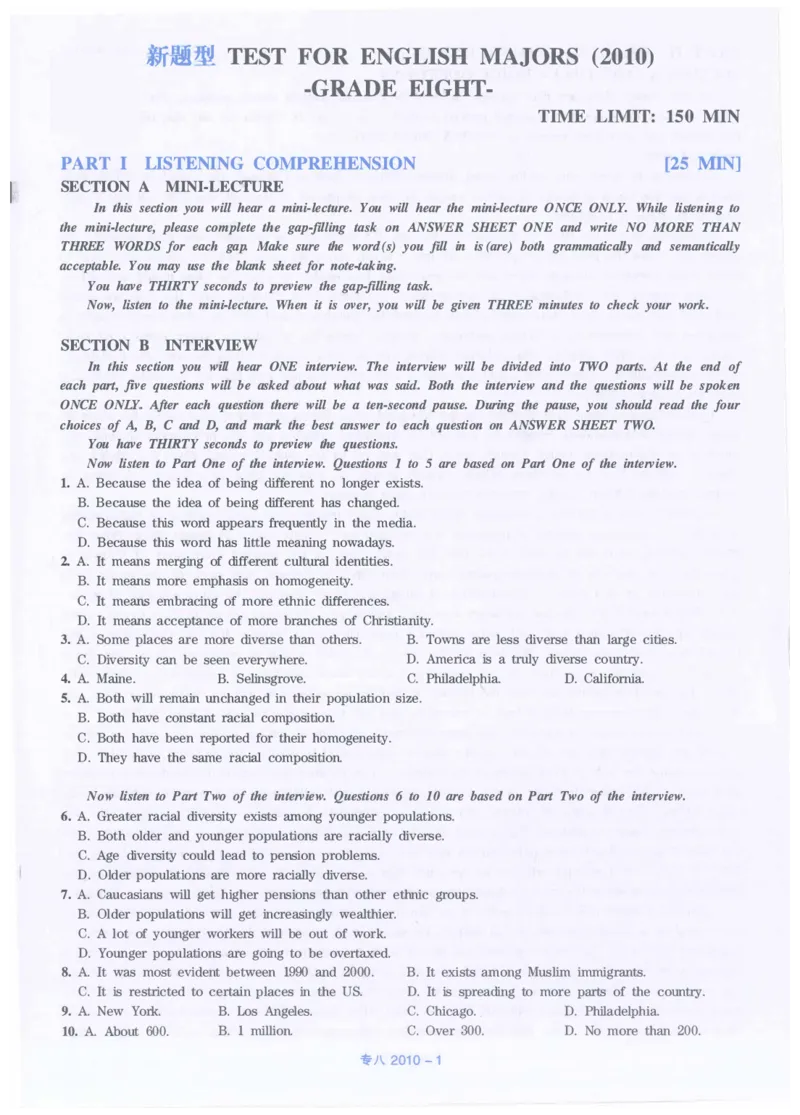
Now, listen to Part One of the interview. Questions 1 to 5 are based on Part One of the interview.
1. A. A publisher. B. A broadcaster. C. An anchorwoman. D. An academic.
2. A. During her childhood. B. During elementary school.
C. During high school. D. During nursery.
3. A. Historians. B. Writers and poets.
C. Professor of music. D. Professor of English.
4. A. The environment B. Academic work. C. Commercialization. D. Local history.
5〇A.Tohelpstudentstobetterrememberpoems. B. To facilitate the process of composing poems.
C. To activate one’s inner ear automatically. D. To better appreciate the poems.
Now, listen to Part Two of the interview. Questions 6 to 10 are based on Part Two of the interview.
6〇 A. Continuity between writing and social life was a gift.
B. Link between writing and social life was necessary.
C. She preferred to stay away from other poets.
D. She thought socializing experience helped a lot.
1. A. Its members could be anyone. B. Its members had to be poets.
C. It should be professional. D. It had a networking role.
8〇 A. To express stronger emotions. B. To allow for flexibility in expression.
C. To avoid readers' misunderstanding. D. To signal the end of a section.
9. A. It was innovative. B. It was emotional. C. It was different. D. It was ordinary.
10. A. Maureen^ teaching and writing experience. B. Maureen^ experience as a student and poet,
C. Maureen's views on socializing for poets. D. Maureen’s works of criticism and poems.
PART II READING COMPREHENSION [45 MIN]
SECTION A MULTIPLE CHOICE QUESTIONS
In this section there are three passages followed by fourteen multiple choice questions. For each multiple
choice question, there are four suggested answers marked A,B, C and D. Choose the one that you think is the
best answer and mark your answers on ANSWER SHEET TWO.
专八2021 -1PASSAGE ONE
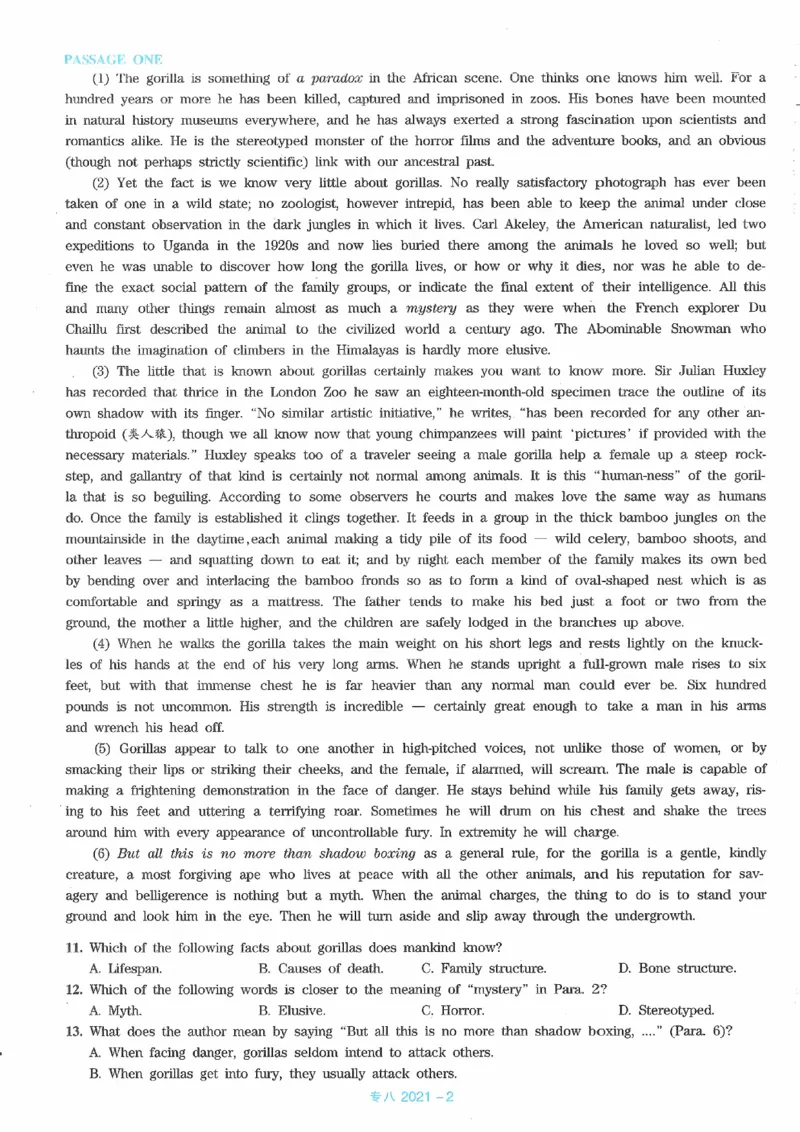
(1) The goillla is sometlilng of a paradox in the African scene. One thinks one knows him weli. For a
hundi'ed years or more he has been lolled, captured and imprisoned in zoos. His bones have been mounted
in natural history museums eveiywhere, and he has always exerted a strong fascination upon scientists and
romantics alike. He is t.he stereotyped monster of the horror films and the adventure books, and an obvious
(though not perhaps strictly scientific) link with our ancestral past.
(2) Yet the fact is we know very little about gorillas. No really satisfactory photograph has ever been
tal<en of one in a wild state; no zoologist, however intrepid, has been able to keep the animal under close
and constant observation in the dark jungles in which it lives. Carl Akeley, the American naturalist, led two
expeditions to Uganda in the 1920s and now lies buried there among the animals he loved so well; but
even he was unable to discover how long the gorilla lives, or how or why it dies, nor was he able to de
fine the exact social pattern of the family groups, or indicate the final extent of their intelligence. All this
and many other things remain almost as much a mystery as they were when the French explorer Du
Chaillu first described the animal to the civilized world a century ago. The Abominable Snowman who
haunts the imagination of climbers in the Himalayas is hardly more elusive.
(3) The little that is known about gorillas certainly makes you want to know more. Sir Julian Huxley
has recorded that tMce in the London Zoo he saw an eighteen-month-old specimen trace the outline of its
own shadow with its finger. l<No similar artistic initiative," he writes, uhas been recorded for any other an-
thropoid (类人猿),though we all know now that young chimpanzees will paint ‘pictures’ if provided with the
necessary materials." Huxley speaks too of a traveler seeing a male gorilla help a female up a steep rock-
step, and gallantly of that kind is certainly not normal among animals. It is this ^liuman-ness" of the goril-
la that is so beguiling. According to some observers he courts and makes love the same way as humans
do. Once the family is established it clings together. It feeds in a group in the thick bamboo jungles on the
mountainside in the daytime,each animal making a tidy pile of its food — wild celery, bamboo shoots, and
other leaves — and squatting down to eat it; and by night each member of the family makes its own bed
by bending over and interlacing the bamboo fronds so as to form a kind of oval-shaped nest which is as
comfortable and spiingy as a mattress. The father tends to make his bed just a foot or two from the
groimd, the mother a little higher, and the children are safely lodged in the branches up above.
(4) \¥hen he walks the gorilla takes the main weight on his short legs and rests lightly on the knuck
les of his hands at the end of his very long arms. When he stands upright a full-grown male rises to six
feet, but with that immense chest he is fax heavier than any normal man could ever be. Six hundred
pounds is not uncommon. His strength is incredible — certainly great enough to take a man in his arms
and wrench his head off.
(5) Gorillas appear to talk to one another in high-pitched voices, not unlike those of women, or by
smacking their lips or striking their cheeks, and the female, if alarmed, will scream. The male is capable of
making a frightening demonstration in the face of danger. He stays behind while Ms family gets away, ris-
ing to his feet and uttering a terrifying roar. Sometimes he will drum on his chest and shake the trees
around him with every appearance of uncontrollable fury. In extremity he will charge.
(6) But all this is no more than shadow boxing as & general nde’ for the gorilla is a gentle, kindly
creature, a most forgiving ape who lives at peace with all the other animals, and his reputation for sav
agely and belligerence is nothing but a myth. When the animal charges, the thing to do is to stand your
ground and look him in the eye. Then he will turn aside and slip away through the undergrowth.
11. Which of the following facts about gorillas does mankind know?
A. Lifespan. B. Causes of death. C. Family structure. D. Bone structure.
12. Which of the following words is closer to the meaning of ''mystery" in Para. 2?
A. Myth. B. Elusive. C. Horror. D. Stereotyped.
13. What does the author mean by saying “But all this is no more than shadow boxing, (Para. 6)?
A. Wlien facing danger, gorillas seldom intend to attack others.
B. When gorillas get into fury, they usually attack others.
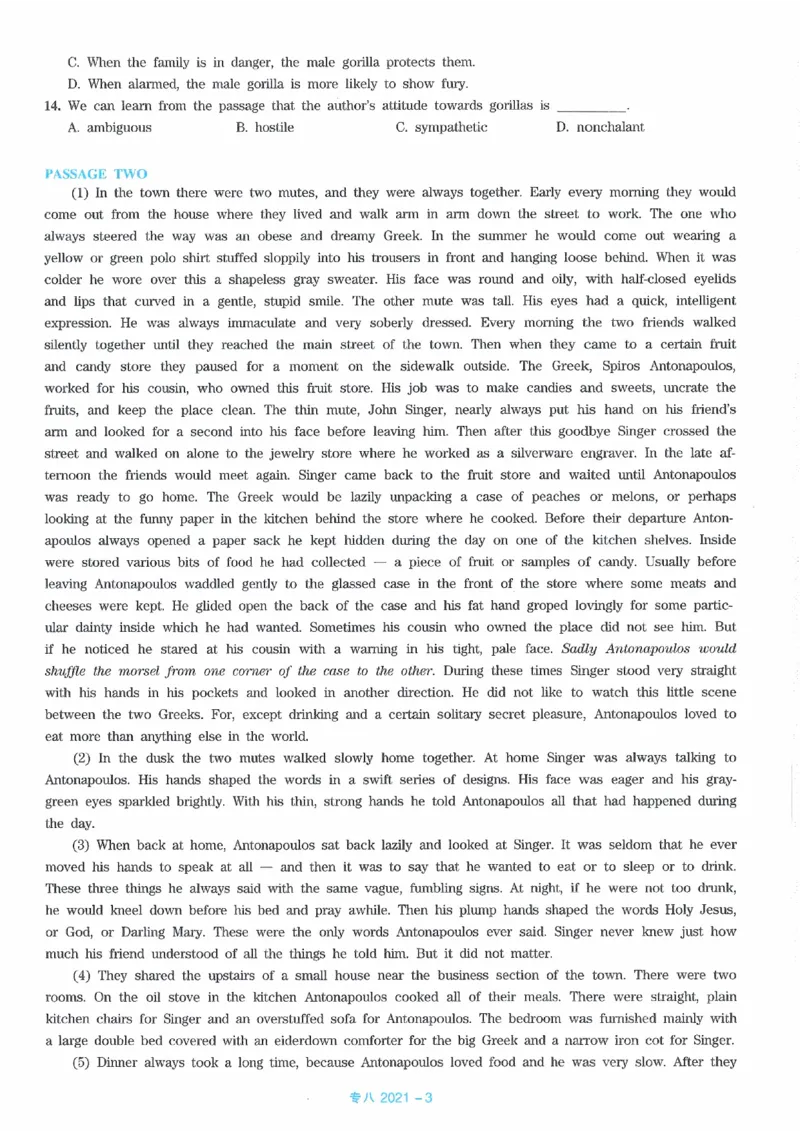
专八2021 -2C. When the family is in danger, the male gorilla protects them.
D. When alarmed, the male gorilla is more likely to show fury.
14. We can learn from the passage that the author’s attitude towards gorillas is ___________•
A. ambiguous B. hostile C. sympathetic D. nonchalant
PASSAGE TWO
(1) In the town there were W/o mutes, and they were always together. Early every morning they would
come out from the house where they lived and walk ann in arm down the street to work. The one who
always steered the way was an obese and dreamy Greek. In the summer he would come out wearing a
yellow or green polo shirt stuffed sloppily into his trousers in front and hanging loose behind. When it was
colder he wore over this a shapeless gray sweater. His face was round and oily, with half-closed eyelids
and lips that curved in a gentle, stupid smile. The other mute was tall. His eyes had a quick, intelligent
expression. He was always immaculate and very soberly dressed. Every morning the two friends walked
silently together until they reached the main street of the town. Then when they came to a certain fruit
and candy store they paused for a moment on the sidewalk outside. The Greek, Spiros Antonapoulos,
worked for his cousin, who owned this ftTiit store. His job was to make candies and sweets, uncrate the
fruits, and keep the place clean. The thin mute, John Singer, nearly always put his hand on his friend's
arm and looked for a second into his face before leaving him. Then after this goodbye Singer crossed the
street and walked on alone to the jewelry store where he worked as a silverware engraver. In the late af
ternoon the friends would meet again. Singer came back to the fruit store and waited until Antonapoulos
was ready to go home. The Greek would be lazily unpacking a case of peaches or melons, or perhaps
looking at the funny paper in the kitchen behind the store where he cooked. Before their departure Anton
apoulos always opened a paper sack he kept hidden during the day on one of the kitchen shelves. Inside
were stored various bits of food he had collected — a piece of fruit or samples of candy. Usually before
leaving Antonapoulos waddled gently to the glassed case in the front of the store where some meats and
cheeses were kept. He glided open the back of the case and his fat hand groped lovingly for some partic
ular dainty inside which he had wanted. Sometimes his cousin who owned the place did not see him. But
if he noticed he stared at his cousin with a warning in his tight, pale face. Sadly Antonapoulos would
shuffle the morsel from one comer of the case to the other. During these times Singer stood very straight
with his hands in his pockets and looked in another direction. He did not like to watch this little scene
between the two Greeks. For, except drinking and a certain solitary secret pleasure, Antonapoulos loved to
eat more than anything else in the world.
(2) In the dusk the two mutes walked slowly home together. At home Singer was always talking to
Antonapoulos. His hands shaped the words in a swift series of designs. His face was eager and his gray-
green eyes sparlded brightly. With his thin, strong hands he told Antonapoulos all that had happened during
the day.
(3) When back at home, Antonapoulos sat back lazily and looked at Singer. It was seldom that he ever
moved his hands to speak at all _ and then it was to say that he wanted to eat or to sleep or to drink.
These three things he always said with the same vague, fumbling signs. At night, if he were not too drunk,
he would kneel down before liis bed and pray awhile. Then his plump hands shaped the words Holy Jesus,
or God, or Darling Maiy. These were the only words Antonapoulos ever said. Singer never knew just how
much his friend understood of all the things he told him. But it did not matter.
(4) They shared the upstairs of a small house near the business section of the town. There were two
rooms. On the oil stove in the kitchen Antonapoulos cooked all of thek meals. There were straight, plain
kitchen chairs for Singer and an overstuffed sofa for Antonapoulos. The bedroom was furnished mainly v^ith
a large double bed covered with an eiderdown comforter for the big Greek and a narrow iron cot for Singer.
(5) Dinner always took a long time, because Antonapoulos loved food and he was very slow. After they
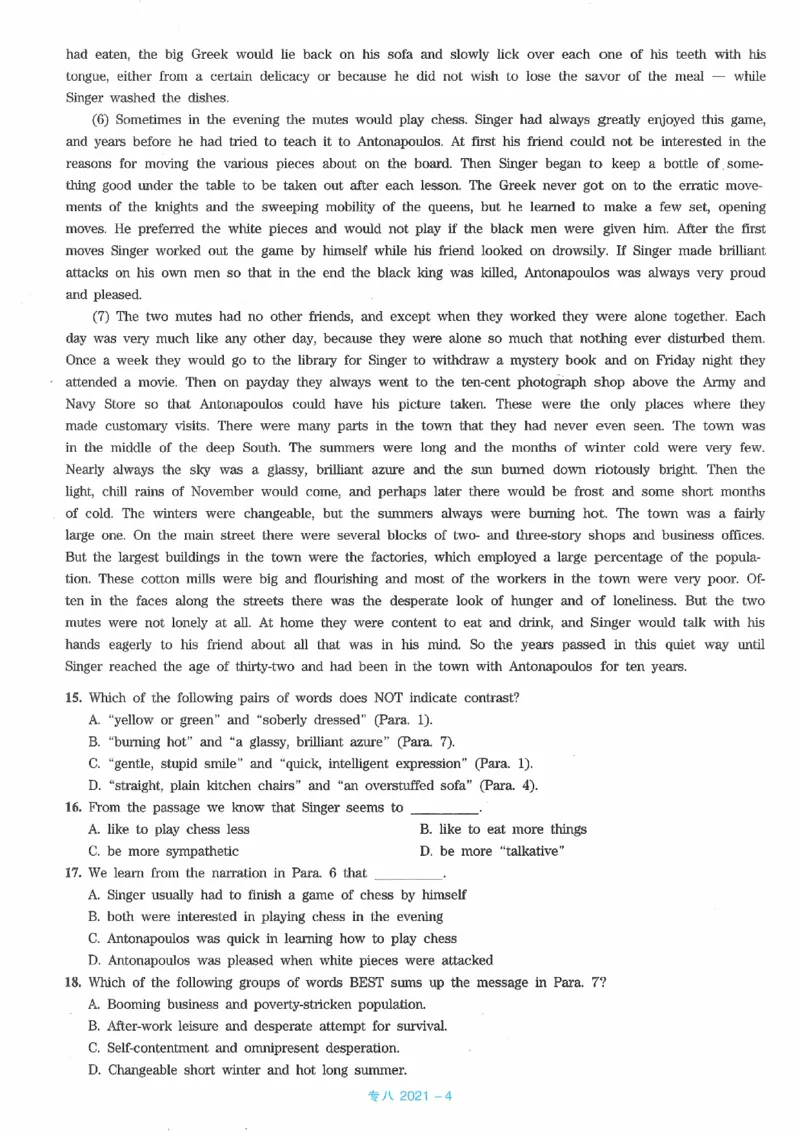
专八2021 -3had eaten, the big Greek would lie back on his sofa and slowly lick over each one of his teeth with his
tongue, either from a certain delicacy or because he did not wish to lose the savor of the meal 一 wtiile
Singer washed the dishes.
(6) Sometimes in the evening the mutes would play chess. Singer had always greatly eryoyed tliis game,
and yeans before he had tried to teach it to Antonapoulos. At first his friend could not be interested in the
reasons for moving the various pieces about on the board. Then Singer began to keep a bottle of . some
thing good under the table to be taken out after each lesson. The Greek never got on to the erratic move
ments of the knights and the sweeping mobility of the queens, but he learned to make a few set, opening
moves. He preferred the wWte pieces and would not play if the black men were given him. After the first
moves Singer worked out the game by himself while his friend looked on drowsily. If Singer made brilliant
attacks on his own men so that in the end the black king was killed, Antonapoulos was always very proud
and pleased.
(7) The two mutes had no other friends, and except when they worked they were alone together. Each
day was very much like any other day, because they were alone so much that nothing ever disturbed them.
Once a week they would go to the libraiy for Singer to withdraw a mystery book and on Friday night they
attended a movie. Then on payday they always went to the ten-cent photograph shop above the Army and
Navy Store so that Antonapoulos could have his picture taken. These were the only places where they
made customary visits. There were many parts in the town that they had never even seen. The town was
in the middle of the deep South. The summers were long and the months of winter cold were very few.
Nearly always the sky was a glassy, brilliant azure and the sun buiTied down riotously bright. Then the
light, chill rains of November would come, and perhaps later there would be frost and some short months
of cold. The winters were changeable, but the summers always were burning* hot. The town was a fairly
large one. On the main street there were several blocks of two- and three-story shops and business offices.
But the largest buildings in the town were the factories, which employed a large percentage of the popula
tion. These cotton mills were big and flourishing and most of the workers in the town were very poor. Of
ten in the faces along the streets there was the desperate look of hunger and of loneliness. But the two
mutes were not lonely at all. At home they were content to eat and drink, and Singer would talk with his
hands eagerly to his friend about all that was in his mind. So the years passed in this quiet way until
Singer reached the age of thirty-two and had been in the town with Antonapoulos for ten years.
15. Which of the following pairs of words does NOT indicate contrast?
A. “yellow or green” and “soberly dressed”(Para. 1).
B. “burning hot” and “a glassy,brilliant azure”(Para. 7).
C. “gentle,stupid smile” and “quick, intelligent expression”(Para. 1),
D. “straight, plain kitchen chairs” and “an overstuffed sofa”(Para. 4).
16- From the passage we know that Singer seems to ___________
A. like to play chess less B. like to eat more things
C. be more sympathetic D. be more “talkative”
17* We learn from the narration in Para. 6 that ___________ .
A. Singer usually had to finish a game of chess by himself
B. both were interested in playing chess in the evening
C. Antonapoulos was quick in learning how to play chess
D. Antonapoulos was pleased when white pieces were attacked
18. Wliich of the following groups of words BEST sums up the message in Para. 7?
A. Booming business and poverty-stricken population.
B. After-work leisure and desperate attempt for survival.
C. Self-contentment and omnipresent desperation.
D. Changeable short winter and hot long summer.
专八2021 - 4PASSAGE THREE
(1) Like many historical films, Amadeus is far from a faithful account of what is known about the pe
riod and the people that it portrays. Events are exaggerated, condensed and simplified, and the complexity
of real characters is reduced to suit the needs of a dramatic contrast between good and evil. Such histor
ical liberties are often bemoaned by experts, but few have seemed to mind the wayward story points of
Amadeus. This is no doubt partly attributable to the film's high entertainment value: it is an unusually live
ly and funny historical film. It revels in the boyish humor and high spirits of its main character, the com
poser Wolfgang Amadeus Mozart (1756-1791), played with jubilant gusto by Tom Hulce. But the film^ appeal is
also attributable to Mozart’s music. The composer’s vulgar hijinks (狂欢作乐)serve as a contrast to the tran-
scendent beauty of his music, beautifully perforaied on the soundtrack by the Academy of St Martin in the
Fields. Thus, even the most stringent historical purists couldn^ help but find something to er\joy in Amadeus.
(2) For all its liberties, the story is actually based on a real rumor that circulated in Vienna in the
1820s. While gravely ill, the rival composer Antonio Salieri (1750-1825) confessed he had murdered Mozart-
decades earlier by poisoning him. Salieri was suffering from dementia (病呆)at the time of this confession,
and he later withdrew it, but some — including Mozart's v\ddow Constanze — chose to believe the claim.
More than 150 years later, the English playwright Peter Shaffer based the stoiy of Amadeus not just on
Salieri^ confession but also the idea that Salieri had suffered from a deep and bitter jealousy of Mozart,
throughout the ten years that they both lived and worked as composers in Vienna. In the fun-loving Mozart,
the story goes, Salieri saw a tme genius — one who made his own talent and accomplishments appear
mediocre — and this drove him on a vendetta (宿怨)that ultimately culminated in murder.
(3) Shaffer's story makes for great clrama^ but it is, of coui'se, biased against Salieri. In fact, at the
time, Salieri was regarded as the more accomplished musician and composer. Fi'om the 1770s through the
1790s, he composed dozens of operas, many of them proving popular and considered innovative. A mark of
his prominence was his appointment to the influential post of Kapellmeister, or musical director, to the
court of Holy Roman Emperor Joseph II. Salieri was also a teacher whose pupils included Ludwig Van
Beethoven, Franz Liszt and Franz Schubert In his private life, he may not have had Mozart's exuberance
but nor was he the lonely and celibate man played with such convincing severity by F. Murray Abraham in
Amadeus. Salieri was married at the time he knew Mozart, and he fathered no fewer than eight children.
(4) If Salieri had little reason to fear or resent Mozarfs success, there was naturally a degree of rival
ry between two men working in the same profession and in the same city. Salieri (bom near Verona) and
Mozart, (bom in Salzburg) belonged to separate musical groups, and Italian and German opera fell into and
out of favor duiing this period. The composers were therefore vying for work, including the prestigious
post of musical tutor to the Princess of Wtirttemberg, which Salieri successfully attained. As composers,
they saw their operas’ debut side by side, yet there is little evidence of any animosity between them.
Mozart did complain in a letter to his father that Joseph II favored Salieri over all other composers, but
that observation was an accurate one. Both Mozart and his father suspected that, behind the scenes, Salieri
tried to undermine Mozart's success, but these were hardly unusual suspicions in a field so reliant on pa
tronage. In public, fellow composers reported that Mozart, and Salieri were friendly with another. Shortly af
ter the premiere of Mozarfs The Magic Flute^ Salieri attended a performance with Mozart, and applauded
warmly and vigorously. Thus, any ill feeling between Mozart and Salieri was borne by the former rather
than the latter — contrary to what is strongly depicted in Amadeus — and it stemmed from Salieri^ status
and success rather than his perceived mediocrity.
(5) Mozart's resentments were those of a younger man struggling for position in the world. Although he
had talent, he spent many years stmggling to find a suitable post or patronage. He and his father travelled
widely during his youth,seeking a distinguished appointment but finding mainly low pay and occasionally
humiliating circumstances. It was in the period after 1781,when Mozait defied liis father and decided to
live and work independently in Vienna that his career flourished. In the space of ten yeai's, he found great
success with the operas The Abduction from Seraglio (1782), The Marriage of Figaro (1786), Don Giovanni
专八2021 - 5(1787) and The Magic Flute (1791). These were composed alongside his piano concertos, symphonies and
chamber music, and together "with bis work as a performer and teacher, his success brought a high income.
Mozarfs money troubles were the result of excessive spending, and his volatile temperament, rather than
any malicious schemes against him. His death, at the age of 35, was not considered suspicious at the time
as he had been ill for weeks with a fever. While it is true that he had a cormnoner^s funeral, in 18th-cen
tury Vienna this was not unusual for a man of non-aristocratic standing. It certainly was not a mark of his
downfall or ignominy, as implied by the film. At his death, Mozart was second in stature only to Salieri as
Vienna’s most prominent musician and composer.
(6) The di'ama of Amadeus stems not from historical accuracies, but from our contemporary knowledge
that Mozart’s music and reputation have survived for centuries — and continued to find new, zesty audi
ences — while Salieri^ name and work quickly faded. Mozart’s secondary status during his own lifetime
thus appears uiyust and unwarranted, and he is invested with the role of the struggling artist and unappre
ciated genius. TMs may be shaky history, but the film has enough laughter, conflict, romance and tragedy
to please any opera lover, except perhaps for Salieri liimself, who undoubtedly would have told the tale in
an altogether different key.
19. According to the author, Amadeus's appeal comes from the following EXCEPT ___________ .
A. depiction of Mozarfs character B. a storyline true to history
C. actors’ excellent performance D. Mozart’s music in the film
20. According to the author, which of the following is INCORRECT about the real Salieri?
A. He remained single throughout his life. B. Some of his pupils later became famous.
C. He was a talented musician and composer. D. He was once assigned to an important post.
21〇 There was some rivaliy between Mozart and Salieri mainly because they ____________.
A. lived in the same city B. joined different musical groups
C. competed for musical work and post D. suspected each other on some occasions
22. What does the author thinlc of the cause of ill feeling betrween the two men (Para. 4)?
A. Mozarfs experience of breaking up with his father.
B. Salieri’s attempt to undermine Mozart’s success.
C. Mozarfs success and status as a musical talent.
D. Salieri’s success and status in the musical circle.
23〇 Which of the following statements BEST supports the complexity of real characters is reduced to
suit the needs of a dramatic contrast between good and evil”(Para. 1)?
A. It certainly was not a mark of his downfall or ignominy, .... (Para. 5).
B. For all its liberties, the story is actually based on a real rumor. (Para. 2).
C. Mozarfs secondary status during his own lifetime thus appears unjust... (Para. 6).
D. In his private life, he may not have had Mozait^ exuberance.... (Para. 3).
24〇 Thi'oughout the passage, the author attempts mainly to ___________• .
A. examine how the film appeals to modem audience
B. correct some distorted personal details in the film
C. highlight the entertainment value of the film Amadeus
D. provide an account of Mozart as a talented musician
SECTION B SHORT ANSWER QUESTIONS
In this section there are eight short answer questions based on the passages ht Section A. Answer each
question in NO MORE THAN TEN WORDS in the space provided on ANSWER SHEET TWO.
PASSAGE ONE
25. Why does the author call the gorilla “a paradox”(Para. 1)?
26. Mention T W O characteristics of goiillas which resemble those of humans.
专 八 2021 - 6PASSAGE TWO
27. Mention at least TWO differences between the mutes (Para. 1).
28. What does uSadly Antonapoulos would shuffle the morsel from one comer of the case to the other5' tell
us (Para. 1)?
29. How did the two mutes share cooking and washing?
PASSAGE THREE
30. What does Usuch historical libertiesn refer to according to the context (Para. 1)?
31. Why does the author say that “Shaffer’s story makes for great drama”(Para. 3)?
32. What does the author imply by saying <4who undoubtedly would have told the tale in an altogether dif
ferent keyM (Para. 6)?
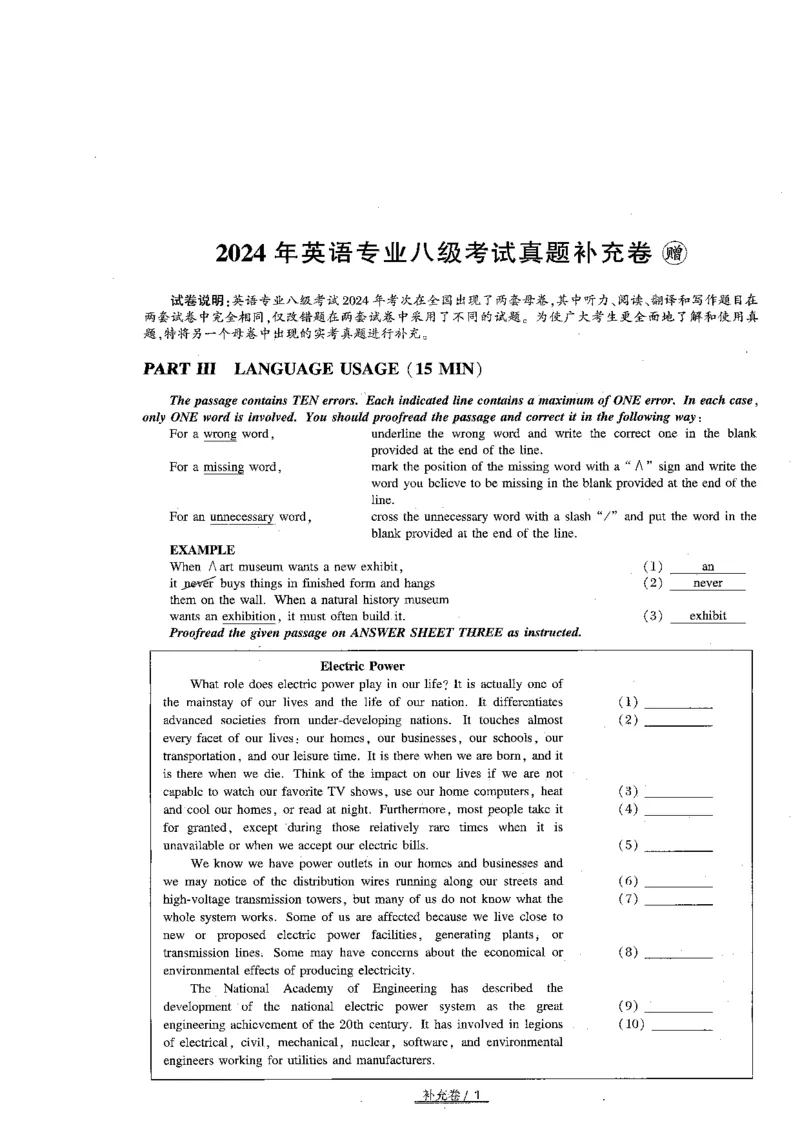
PART III LANGUAGE USAGE 『15 MIN]
The passage contains TEN errors. Each indicated line contains a maximum of ONE error. In each case,
only ONE word is involved. You should proofread the passage and correct it in the following way:
For a wrong word, underline the wrong word and write the correct one in the blank provided at
the end of the line.
For a missing word, mark the position of the missing word with a “八” sign and write the word
you believe to be missing in the blank provided at the end of the line,
For an unnecessary word, cross the unnecessary word with a slash and put the word in the blank
provided at the end of the line.
Example
When 八 art museum wants a new exhibit, (1)_ an
it rfevef buys things in finished form and hangs (2)___never
them on the wall. When a natural history museum
wants an exhibition, it must often build it. (S') exhibit
Proofread the given passage on ANSWER SHEET THREE as instructed.
PART IV TRANSLATION [20 MIN]
Translate the following text from Chinese into English. Write your translation on ANSWER SHEET THREE.
你的青春就是一场远行,一场离自己的童年,离自己的少年,越来越远的远行。你会发现这个世界跟你想象的一点
都不一样,你甚至会觉得很孤独,你会受到很多的排挤。度假和旅行,其实都解决不了这些问题,我解决问题的办法,就
是不停寻找S 己所热爱的一切。
PART V WRITING [45 MIN]
Read carefully the following two excerpts on private tutoring, and then write your response in NO LESS
THAN 300 WORDS, in which you should:
1. summarize the main messages in the two exceipts, and then
2. express your opinion on the issue, especially on whether private tutoring should be promoted or pro
hibited.
You can support yourself with information from the excerpts.
Marks will be awarded for content relevance, content sufficiency, organization and language quality. Failure
to follow the above instructions may result in a loss of marks.
Write your response on ANSWER SHEET FOUR
专八2021 -7Excerpt 1
Why Tutoring is Important
Not every child learns the same way. Some children learn faster than others. Lucidly, for any stu
dent who falls a little behind or has trouble in a particular subject there is tutoring available to help
them. Some parents believe their child does not need tutoring help, but many others may prefer instead
to have their child receive some extra help after class.
In our educational center, we believe that tutoring is very important in the world of academics.
Honestly, there is certainly no shame that your child may need a tutor. No matter what subject your
child needs help in, we can design a tailored program that suits your child's needs. Whether it is Math,
English, Reading, or Study Skills, there is always a tutor available to help you and your child. Among
the most popular requested tutors are math tutors. Although your child may not be a math wliiz, we
firmly believe every child has the greatest capacity to excel in any subject if given the right preparation
and tutoring.
Frequently there are times that a child starts to learn something new in school, only to get frustrat
ed that they are having difficulty in understanding the basic concepts. If they do not leam the funda
mental concepts well, it will only cause the child more difficulty when trying to complete homework as
signments and ultimately trouble scoring well on exams.
We understand your frustrations^ and many of our instructors, tutors,and staff are parents just like
you. your child receives tutoring here in our center, you can rest assured they are receiving the
highest quality of tutoring and instruction from a certified professional. Each student masters the material
since they ai^e taught key concepts in a systematic way.
Our teachers are guided instructors who provide students with specific tasks which lead to discoveries
and deeper understandings.
Excerpt 2
Private Home Teitiom Illegal
The Supreme Education Council (SEC) is to launch a crackdown against private tuition from the
second semester of the current academic year.
According to the local daily, the campaign will prohibit private lessons and the promotion of the
“phenomenon” with heavy penalties for people who would violate the rules.
The daily, quoting Mr. Muhammadi, head of the Communication Office at the SEC, said the penalties
for offenders could be imprisonment up to six months and heavy fines or both.
Officers of the SEC will have the judicial authority to deal with any offence in this regard.
Mr_ Muhammadi said measures are being taken in order to implement the new law, which was is
sued last September, for practicing of educational services in the country. He larged publishing houses
and advertisement platforms to participate in the campaign by refusing to release any material that pro
motes and encourages private tuition.
According to the new law, the SEC has the authority to approve educational centers and issue sanc
tions against those who practice without permission. ''Unauthorized private tutors will be targeted in the
first phase of the dhve/> Mr. Muhammadi said.
To curb the “unhealthy” practice,awareness campaigns through different media will be run to in
form the residents about the new law, he said. The council has already started adding lessons and ex
planations on the SEC website so that students can study without the help of private tutors.
In addition, special classes will be conducted at the schools for students who need help in some of
the subjects. The official urged pupils to focus on theii' teachers in classes instead of depending on pri
vate tutors, a phenomenon which, he said, could have a negative impact on children.
-THE END-
专八2021 -8ANSWER SHEET1 (TEM8)
■ m
注意事项
准 考 号
学 校 : 写自己的准考证号、姓名和学校;再用
2B铅笔把对应准考证号码的标号涂黑,
使用其它笔填涂无效。 t 〇 ) t〇)r 10 1 \ 〇 11511 0 |ro \(〇 ]101 1 0 1tor
2.考生不得填涂缺考、违纪项,违者赍任 ,, ' , 策1 J X 入 • U
自负。
(2 1 1 2 1 t 2 11,2 )12 1 1 21 (21 12 I i 2 1:j 2 )';:
3.选择题必须用2B铅笔填涂,使用其它笔
填涂无效,修改时要用橡皮擦干净;每
>3) r3) ;:l: ,3.;v;:U3 1.1: 3 >.ix3Ji 3«:131 [3 r(31 I3»J 3)
填 正确填涂方式 此处由监考老师填涂 4. 题 主 只 观 能填 题 涂 必 一 须 个答 用 案 黑 , 色 多 字 填不 迹 得 签 分 字 。 笔 ( 1 A 5 » )⑷ f I S 4 ) ) :l: 5,1: 1 » 4 5 1 1 ⑷ t5. , ' 1 A i 1 ⑷ 6 3 1 1 4 5 1 » M 15 : 1 r ( 1 4 5 1 1 t \ ' 5 'y l J 1 1 4 5 1 1 1 < 5 A ) )
涂 违 纪 IW1 (0.5mm)在答题区域内作答,超出红 161 丨W16) 16 1 (6> 161 16 1i a i (81 16.1 16) < 61
雨 色矩形框限定区域的答案无效。 171 I 7 l1.7j:l 7 »17) 17) i ;"l 17! iri m m l 7 Jm
错误填涂方式 缺 考 W1 5.保持答题卡的清洁和平整,不得折叠。 18) ■m t8l i i3 j"l〇l 1 B Ji&\ i 0 JU i(BI i8i 18 1:<:8X:
求 ic|) AHSWGR SHEET 1 | ■ > 9Jw 19 f> SI I9J人宇丨19 J191 [91 ■1 9'.1:191 ).9 i 191:l:9)
■■■■■Ml mmmmmmmmmmmmamm
PARTI LISTENING COMPREHENSION
SECTION A MINI-LECTURE
下列各题必须使用黑色字迹签字笔在答题区域内作答,超出红色矩形边框限定区域的答案无效,
Current Challenges Confronting U.S. Higher Education
The first challenge: force of the marketplace
® Current situation:
— presence of the marketplace as Cl) external force (i)
— government support: (2) (2)
— public institutions asking for less government (3) (3)
一 e.g. new legislation to provide (4) ⑷
鏺 Results:
— higher institutional priorities given to (5) (5)
because of their (6) ⑹ - .
— ways to generate more money for institutions
— creating new programs, e.g. (7) ⑺
— adding new units focusing on generating (8) ⑻
— building (9) _______ (9)
— implications
— increasing focus on (10) in academic research ⑽
— higher tuition fees for students
University administrators have to respond to the marketplace.
The second challenge: equality in (11) ______ (11)
# Post War massification of U.S. higher education:
-(12) (12)
# Reasons:
— low (13) of racial and ethnic minorities T13)
— inability of low-income individuals to Cl4) (14)
# Government role:
一 mediating the negative effects of competition in order to
(15) fl5)
高校外语专业教学测试办公室监制 FS-TEM8-1601-1-Beta
专八2021 - 9ANSWER SHEET3( TEM8)
国 s s a s 届 适 目 s i s 国 B B 鼠 固 E5S B S ㈢ □ 露 認 : SS S5 s
注意事项 -
准 考 证 =
1. 答题前,考生务必用黑色字迹签字笔滇
学 校 : 写自己的准考证号、姓名和学校;再用
2B铅笔把对应准考证号码的标号涂黑, z
使用其它笔填涂无效。 i〇)m lOi:r.〇)J CM iOi ICM i〇l to Ii〇 f
姓 名 : 2. 自 负〇 考生不得填涂缺考、违纪项,违1 者1 ]责 cn 任 : r 1»i " "» .'A::1:hi 穩 n u 1 1 1[1 t\ 11Hi =
3. 选择题必须用2B铅笔填涂,使用 12 其 ! 它笔 {2t ■n:y. 121 <2!tgl121 12 »d =
131 (3 !131 » < 3» '3< 13»:他13»
填涂无效,修改时要用橡皮擦干净;每
填 正确填涂方式 此处由监考老师填涂 题只能填涂一个答案,多填不得分。 【41 \ 4 j ⑷ r4iMi 14 Jin 14 1Ui U lMl =
4. 主观题必须用黑色字迹签» 字5J笔•/ 5 If 5 ?i 5 J:(5 ) « 5) ㈤ |(5丨;t 5 J:15) 151■1 S卜
涂 _
违 纪 1WI (0.5mm)在答题区域内作答,超出红 tBJ 16 i^61 i. sif6 JfS.J i Bi (61l6» m 1 6 i 161 =
要
求 错误填涂方式 缺考 5.
色
保
矩
持
形
答
框
题
限
卡
定
的
区
清
域
洁
的
和
答
平
案
整
无
,
效
不
。
得折叠。
J
{
7
8 )
l
t
t
f
v
i l
i
:
:l
1 8
7 »
J
t
< 8
7 )
i(
(
f
7
r
f1
1 8
7
*
)
j
r 7
a i
I j
f
1 7
8 \
1 m
.fit
.1
1 8
7
>
1
•i
f
m
7i
.
(
r
7
e
1
»
V V}
i/ii m< iij 191 1 9»7¥T m i 9 ) (91Tii:1911'9'i z
=
PART III 1' LANGUAGE USAGE
=
各题必须使用黑色字迹签字笔存:答题冈域内作答,超出红色矩形边框限定IK域的答案无效
=
=
Most, of us have an image of a standard English in pronunciation, and
=
very commonly in Great Britain this is “ Received Pronunciation ”,often
=
associated mth the public schools and the BBC. Indeed, a pronunciation =
-
within this range has great prestige throughout the world, and for
=
English taught as a foreign language it is usually ideal than any other (1) ____________ -
=
pronunciation. At the same time, it must be remembered that, so
=
far as the English - speaking countries are concerned, this “Received
=
Pronunciation" becomes the status of a standard" almost only in England. (2) =
=
Even in England it is difficult to speak about a standai'd in pronunciatioa (3)
For one thing, pronunciation is infinitely vaiiable, so that even giving the (4)
will to adopt a single pronunciation,it would be difficult to achieve. The
z
word dance will be pronounced in a dozen ways even by people who do (5)
=
not think of themselves as dialect speakers; there is no a sure way of any two (6) =
people saying the same word with precisely the same sound. In this respect, =
=
pronunciation much more closely resembles handwriting than spelling.
=
In spelling, there are absolute distinctions wliich can be leanit and imitated
=
with completely precision; one can know at once whether a word is spelt in (7)
=
a '* standardway or not. But two persons' handwriting and pronunciation
=
may both be perfectly intelligent, yet have obvious differences (8) =
without being able to say which is “better ” or more “standard ” ■ (9)
Moreover, with the easy and quick communications of modem z
=
times encouraging the spread of a "neutral", “normal” pronunciation,
=
the accompanied sociological changes have reduced the prestige of (10)
«
Received Pronunciation.
=
B
a ~
高校外语专业教学测试办公室监制 FS-TEM8-1601 -3-Beta
专八 2021 - 10