文档文本内容
2022全国乙卷完形填空
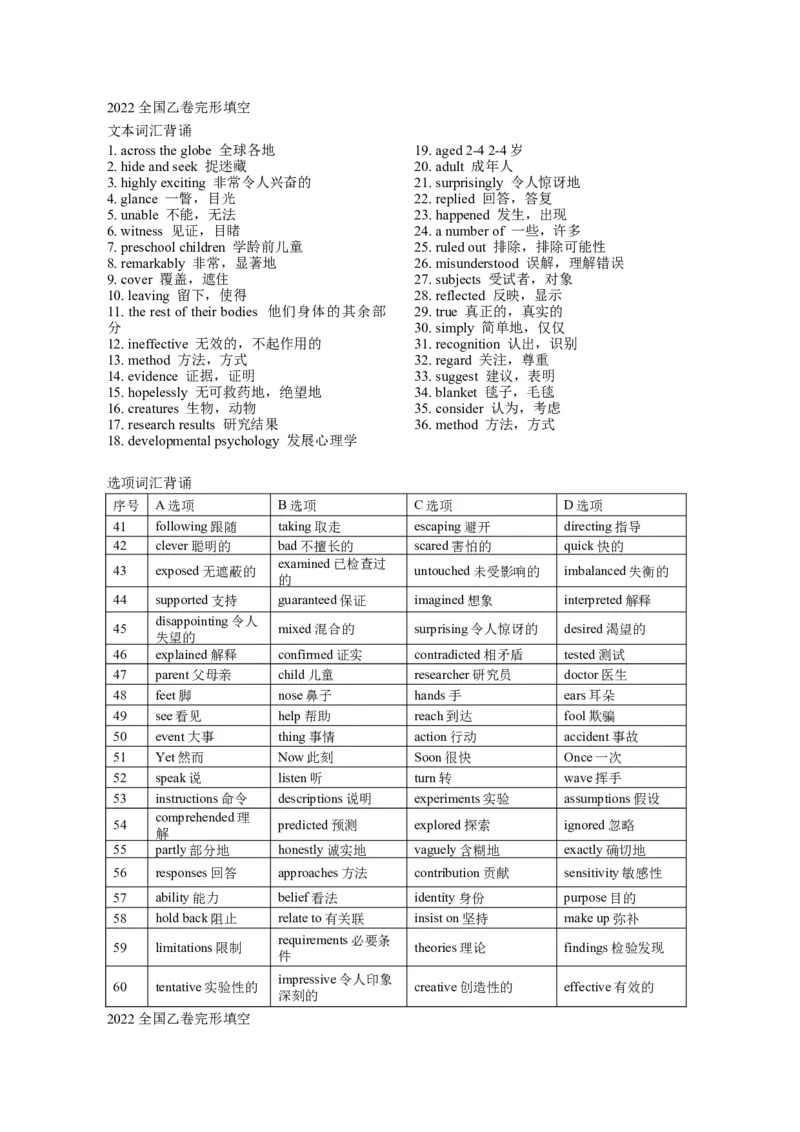
文本词汇背诵
1. across the globe 全球各地 19. aged 2-4 2-4岁
2. hide and seek 捉迷藏 20. adult 成年人
3. highly exciting 非常令人兴奋的 21. surprisingly 令人惊讶地
4. glance 一瞥,目光 22. replied 回答,答复
5. unable 不能,无法 23. happened 发生,出现
6. witness 见证,目睹 24. a number of 一些,许多
7. preschool children 学龄前儿童 25. ruled out 排除,排除可能性
8. remarkably 非常,显著地 26. misunderstood 误解,理解错误
9. cover 覆盖,遮住 27. subjects 受试者,对象
10. leaving 留下,使得 28. reflected 反映,显示
11. the rest of their bodies 他们身体的其余部 29. true 真正的,真实的
分 30. simply 简单地,仅仅
12. ineffective 无效的,不起作用的 31. recognition 认出,识别
13. method 方法,方式 32. regard 关注,尊重
14. evidence 证据,证明 33. suggest 建议,表明
15. hopelessly 无可救药地,绝望地 34. blanket 毯子,毛毯
16. creatures 生物,动物 35. consider 认为,考虑
17. research results 研究结果 36. method 方法,方式
18. developmental psychology 发展心理学
选项词汇背诵
序号 A选项 B选项 C选项 D选项
41 following跟随 taking取走 escaping避开 directing指导
42 clever聪明的 bad不擅长的 scared害怕的 quick快的
examined已检查过
43 exposed无遮蔽的 untouched未受影响的 imbalanced失衡的
的
44 supported支持 guaranteed保证 imagined想象 interpreted解释
disappointing令人
45 mixed混合的 surprising令人惊讶的 desired渴望的
失望的
46 explained解释 confirmed证实 contradicted相矛盾 tested测试
47 parent父母亲 child儿童 researcher研究员 doctor医生
48 feet脚 nose鼻子 hands手 ears耳朵
49 see看见 help帮助 reach到达 fool欺骗
50 event大事 thing事情 action行动 accident事故
51 Yet然而 Now此刻 Soon很快 Once一次
52 speak说 listen听 turn转 wave挥手
53 instructions命令 descriptions说明 experiments实验 assumptions假设
comprehended理
54 predicted预测 explored探索 ignored忽略
解
55 partly部分地 honestly诚实地 vaguely含糊地 exactly确切地
56 responses回答 approaches方法 contribution贡献 sensitivity敏感性
57 ability能力 belief看法 identity身份 purpose目的
58 hold back阻止 relate to有关联 insist on坚持 make up弥补
requirements必要条
59 limitations限制 theories理论 findings检验发现
件
impressive令人印象
60 tentative实验性的 creative创造性的 effective有效的
深刻的
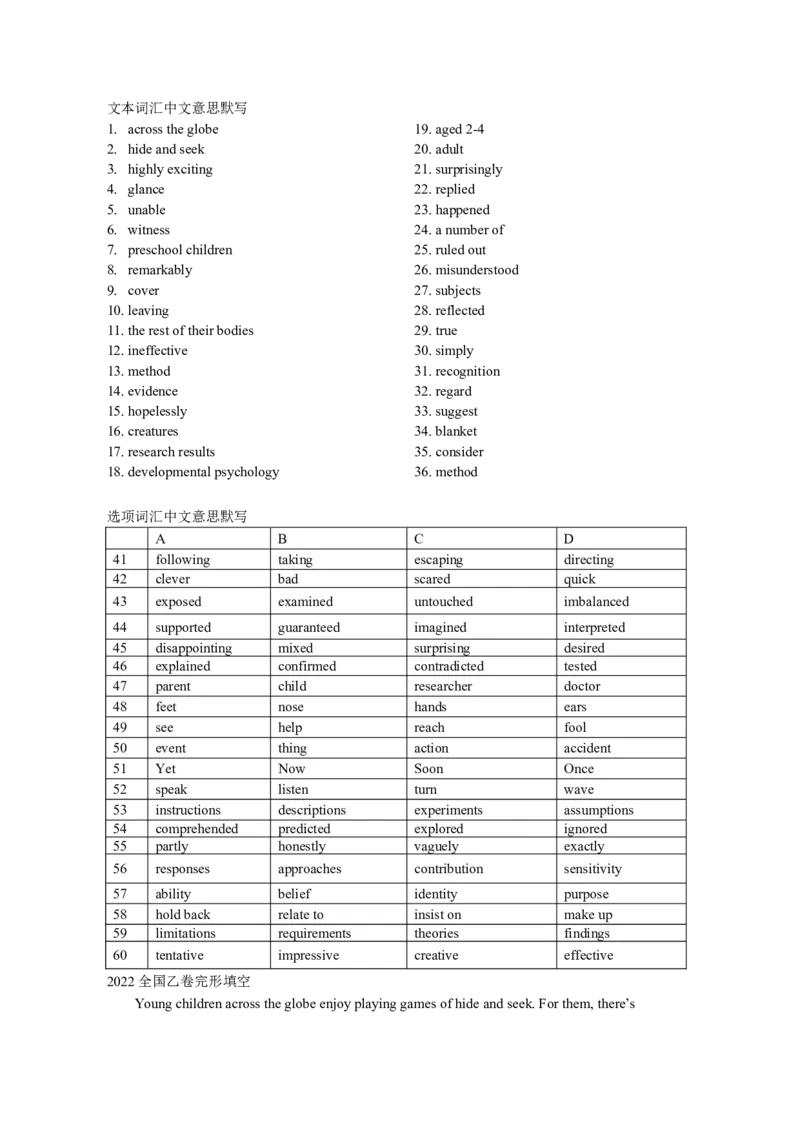
2022全国乙卷完形填空文本词汇中文意思默写
1. across the globe 19.aged 2-4
2. hide and seek 20.adult
3. highly exciting 21.surprisingly
4. glance 22.replied
5. unable 23.happened
6. witness 24.a number of
7. preschool children 25.ruled out
8. remarkably 26.misunderstood
9. cover 27.subjects
10.leaving 28.reflected
11.the rest of their bodies 29.true
12.ineffective 30.simply
13.method 31.recognition
14.evidence 32.regard
15.hopelessly 33.suggest
16.creatures 34.blanket
17.research results 35.consider
18.developmental psychology 36.method
选项词汇中文意思默写
A B C D
41 following taking escaping directing
42 clever bad scared quick
43 exposed examined untouched imbalanced
44 supported guaranteed imagined interpreted
45 disappointing mixed surprising desired
46 explained confirmed contradicted tested
47 parent child researcher doctor
48 feet nose hands ears
49 see help reach fool
50 event thing action accident
51 Yet Now Soon Once
52 speak listen turn wave
53 instructions descriptions experiments assumptions
54 comprehended predicted explored ignored
55 partly honestly vaguely exactly
56 responses approaches contribution sensitivity
57 ability belief identity purpose
58 hold back relate to insist on make up
59 limitations requirements theories findings
60 tentative impressive creative effective
2022全国乙卷完形填空
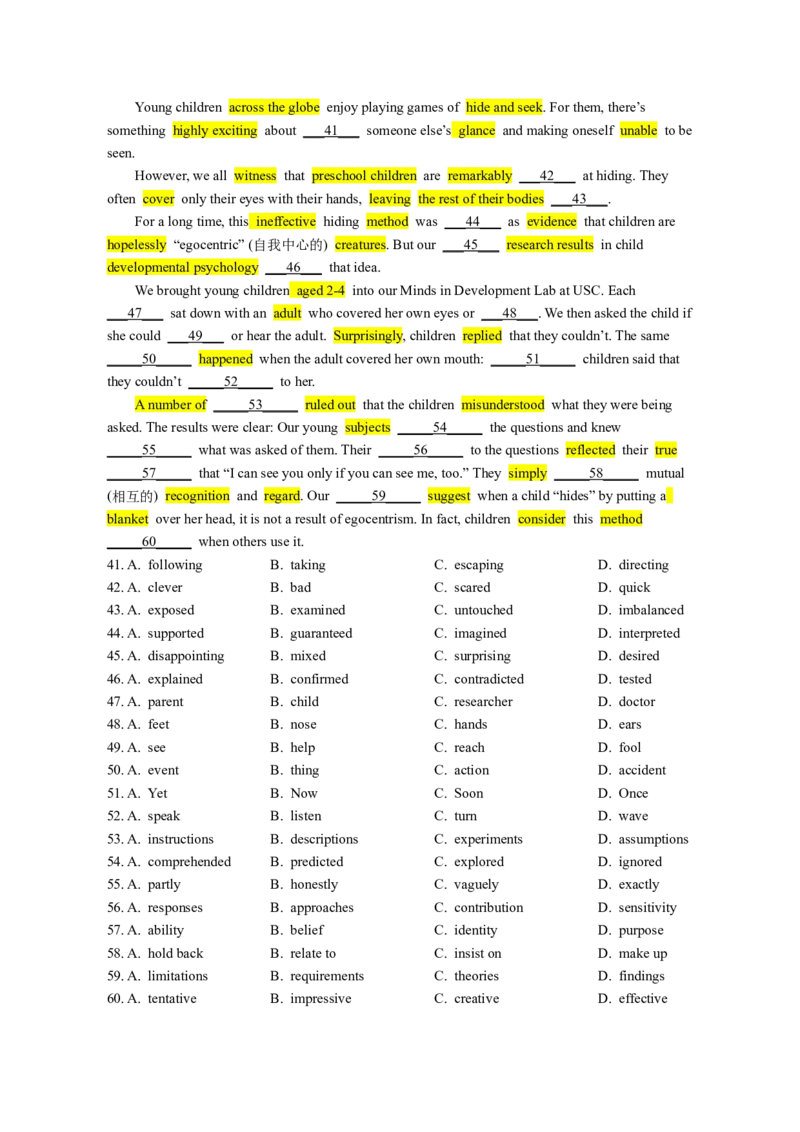
Young children across the globe enjoy playing games of hide and seek. For them, there’ssomething highly exciting about ___41___ someone else’s glance and making oneself unable to be
seen.
However, we all witness that preschool children are remarkably ___42___ at hiding. They often
cover only their eyes with their hands, leaving the rest of their bodies ___43___.
For a long time, this ineffective hiding method was ___44___ as evidence that children are
hopelessly “egocentric” (自我中心的) creatures. But our ___45___ research results in child
developmental psychology ___46___ that idea.
We brought young children aged 2-4 into our Minds in Development Lab at USC. Each ___47___
sat down with an adult who covered her own eyes or ___48___. We then asked the child if she could
___49___ or hear the adult. Surprisingly, children replied that they couldn’t. The same _____50_____
happened when the adult covered her own mouth: _____51_____ children said that they couldn’t
_____52_____ to her.
A number of _____53_____ ruled out that the children misunderstood what they were being
asked. The results were clear: Our young subjects _____54_____ the questions and knew
_____55_____ what was asked of them. Their _____56_____ to the questions reflected their true
_____57_____ that “I can see you only if you can see me, too.” They simply _____58_____ mutual
(相互的) recognition and regard. Our _____59_____ suggest when a child “hides” by putting a
blanket over her head, it is not a result of egocentrism. In fact, children consider this method
_____60_____ when others use it.
41. A. following B. taking C. escaping D. directing
42. A. clever B. bad C. scared D. quick
43. A. exposed B. examined C. untouched D. imbalanced
44. A. supported B. guaranteed C. imagined D. interpreted
45. A. disappointing B. mixed C. surprising D. desired
46. A. explained B. confirmed C. contradicted D. tested
47. A. parent B. child C. researcher D. doctor
48. A. feet B. nose C. hands D. ears
49. A. see B. help C. reach D. fool
50. A. event B. thing C. action D. accident
51. A. Yet B. Now C. Soon D. Once
52. A. speak B. listen C. turn D. wave
53. A. instructions B. descriptions C. experiments D. assumptions
54. A. comprehended B. predicted C. explored D. ignored
55. A. partly B. honestly C. vaguely D. exactly
56. A. responses B. approaches C. contribution D. sensitivity
57. A. ability B. belief C. identity D. purpose
58. A. hold back B. relate to C. insist on D. make up
59. A. limitations B. requirements C. theories D. findings
60. A. tentative B. impressive C. creative D. effective
2022全国乙卷完形填空Young children across the globe enjoy playing games of hide and seek. For them, there’s
something highly exciting about ___41___ someone else’s glance and making oneself unable to be
seen.
However, we all witness that preschool children are remarkably ___42___ at hiding. They
often cover only their eyes with their hands, leaving the rest of their bodies ___43___.
For a long time, this ineffective hiding method was ___44___ as evidence that children are
hopelessly “egocentric” (自我中心的) creatures. But our ___45___ research results in child
developmental psychology ___46___ that idea.
We brought young children aged 2-4 into our Minds in Development Lab at USC. Each
___47___ sat down with an adult who covered her own eyes or ___48___. We then asked the child if
she could ___49___ or hear the adult. Surprisingly, children replied that they couldn’t. The same
_____50_____ happened when the adult covered her own mouth: _____51_____ children said that
they couldn’t _____52_____ to her.
A number of _____53_____ ruled out that the children misunderstood what they were being
asked. The results were clear: Our young subjects _____54_____ the questions and knew
_____55_____ what was asked of them. Their _____56_____ to the questions reflected their true
_____57_____ that “I can see you only if you can see me, too.” They simply _____58_____ mutual
(相互的) recognition and regard. Our _____59_____ suggest when a child “hides” by putting a
blanket over her head, it is not a result of egocentrism. In fact, children consider this method
_____60_____ when others use it.
41. A. following B. taking C. escaping D. directing
42. A. clever B. bad C. scared D. quick
43. A. exposed B. examined C. untouched D. imbalanced
44. A. supported B. guaranteed C. imagined D. interpreted
45. A. disappointing B. mixed C. surprising D. desired
46. A. explained B. confirmed C. contradicted D. tested
47. A. parent B. child C. researcher D. doctor
48. A. feet B. nose C. hands D. ears
49. A. see B. help C. reach D. fool
50. A. event B. thing C. action D. accident
51. A. Yet B. Now C. Soon D. Once
52. A. speak B. listen C. turn D. wave
53. A. instructions B. descriptions C. experiments D. assumptions
54. A. comprehended B. predicted C. explored D. ignored
55. A. partly B. honestly C. vaguely D. exactly
56. A. responses B. approaches C. contribution D. sensitivity
57. A. ability B. belief C. identity D. purpose
58. A. hold back B. relate to C. insist on D. make up
59. A. limitations B. requirements C. theories D. findings
60. A. tentative B. impressive C. creative D. effective【答案】41. C 42. B 43. A 44. D 45. C 46. C 47. B 48. D 49. A 50. B 51. B 52. A
53. C 54. A 55. D 56. A 57. B 58. C 59. D 60. D
【解析】
【导语】这是一篇说明文。文章主要通过实验证明孩子们捉迷藏时,只遮住自己的眼睛并不是
自我中心主义的结果,而是孩子们坚持相互承认和尊重。
【41题详解】
考查动词词义辨析。句意:对他们来说,避开别人的目光,让自己无法被别人看到,这是一件
非常令人兴奋的事情。A. following跟随;B. taking取走;C. escaping避开;D. directing指导。
根据上文“Young children across the globe enjoy playing games of hide and seek.”(全球的孩子们
享受玩捉迷藏的游戏)可知,儿童喜欢玩捉迷藏,避开别人的目光。故选C项。
【42题详解】
考查形容词词义辨析。句意:然而,我们都看到学龄前儿童非常不善于隐藏。A. clever聪明的;
B. bad不擅长的;C. scared害怕的;D. quick快的。根据下文“They often cover only their eyes
with their hands, leaving the rest of their bodies”(他们通常只是用手盖住自己的眼睛,身体的其他
部分露在外面)可知,儿童不擅长隐藏,be bad at sth.表示“不擅长某事”。故选B项。
【43题详解】
考查形容词词义辨析。句意:他们通常只用手遮住眼睛,其余的身体暴露在外。A. exposed无
遮蔽的;B. examined已检查过的;C. untouched未受影响的;D. imbalanced失衡的。根据上文
“They often cover only their eyes with their hands, leaving the rest of their bodies” (他们通常只是
用手盖住自己的眼睛,身体的其他部分露在外面)可知,儿童只是用手遮住了眼睛,身体的其
余部分无遮蔽,是暴露在外的。故选A项。
【44题详解】
考查动词词义辨析。句意:长期以来,这种无效的隐藏方法被解释为儿童是无可救药的“自我
中心”生物的证据。A. supported支持;B. guaranteed保证;C. imagined想象;D. interpreted解
释。根据本句中的that从句内容“evidence that children are hopelessly “egocentric” creatures.”并结
合上文语境可知,此处表示这种无效的隐藏方法被解释为证据,证明儿童是以自我为中心的。
故选D项。
【45题详解】
考查形容词词义辨析。句意:但我们在儿童发展心理学方面令人惊讶的研究结果与这一观点相
矛盾。A. disappointing令人失望的;B. mixed混合的;C. surprising令人惊讶的;D. desired渴望
的。根据下文“Our 19 suggest when a child “hides” by putting a blanket over her head, it is not
a result of egocentrism.”(我们的19 建议当一个孩子用毯子盖住头来隐藏时,这并不是自我中
心的结果)可知,研究结果与之前孩子们自我中心的观点相矛盾,所以研究结果是令人惊讶的。
故选C项。
【46题详解】
考查动词词义辨析。句意:但我们在儿童发展心理学方面令人惊讶的研究结果与这一观点相矛
盾。A. explained解释;B. confirmed证实;C. contradicted相矛盾;D. tested测试。根据下文
“Our 19 suggest when a child “hides” by putting a blanket over her head, it is not a result of
egocentrism. In fact, children consider this method _ 20 _ when others use it.”(我们的19 建议当一
个孩子用毯子盖住头来隐藏时,这并不是自我中心的结果)可知,研究结果与之前的观点是相
矛盾的。故选C项。
【47题详解】
考查名词词义辨析。句意:每个儿童都和一个成年人坐在一起,成年人遮住自己的眼睛或耳朵。
A. parent父母亲;B. child儿童;C. researcher研究员;D. doctor医生。根据上文“We broughtyoung children aged 2-4 into our Minds in Development Lab at USC.”(我们把一些2到4岁的孩子
带到我们在USC的思维发展实验室)可知,儿童参加实验,此处表示每个儿童和一个成年人坐
在一起。故选B项。
【48题详解】
考查名词词义辨析。句意:每个儿童都和一个成年人坐在一起,成年人遮住自己的眼睛或耳朵。
A. feet脚;B. nose鼻子;C. hands手;D. ears耳朵。根据下文“We then asked the child if she
could __9__ or or hear the adult”(我们之后问孩子是否能或者听到大人的声音)可知,实验中,
儿童被询问是否能听到成年人的声音,所以此处表示成年人遮住了自己的耳朵。故选D项。
【49题详解】
考查动词词义辨析。句意:然后我们问儿童是否能看到或听到成年人的声音。A. see看见;B.
help帮助;C. reach到达;D. fool欺骗。根据上文“Each ___7___ sat down with an adult who
covered her own eyes or ___8___.”(每个孩子和遮住了眼睛和耳朵的大人坐在一起)可知,成年
人遮住了自己的眼睛,所以此处儿童被询问是否能看见成年人。故选A项。
【50题详解】
考查名词词义辨析。句意:当成年人捂住她自己的嘴时,同样的事情发生了:此刻孩子们说他
们不能和她说话。A. event大事;B. thing事情;C. action行动;D. accident事故。根据下文
“children said that they couldn’t _12_ to her.” (此刻孩子们说他们不能和她_12_)可知,发生了与
前面孩子们不能看见大人类似的事情,即孩子们表示不能和捂住嘴的成年人说话了。故选B项。
【51题详解】
考查副词词义辨析。句意:当成年人捂住她自己的嘴时,同样的事情发生了:此刻孩子们说他
们不能和她说话。A. Yet然而;B. Now此刻;C. Soon很快;D. Once一次。根据语境,此处表
示当成年人捂住自己的嘴时,此刻孩子们说不能和成年人说话了,强调当下。故选B项。
【52题详解】
考查动词词义辨析。句意:当成年人捂住她自己的嘴时,同样的事情发生了:此刻孩子们说他
们不能和她说话。A. speak说;B. listen听;C. turn转;D. wave挥手。根据上文“when the
adult covered her own mouth” (大人的嘴巴被盖住了)可知,由于盖住的是嘴巴,因此同样的事情
则是孩子们表示不能和捂住嘴的成年人说话了。故选A项。
【53题详解】
考查名词词义辨析。句意:许多实验排除了孩子们误解了他们被问到的问题。A. instructions命
令;B. descriptions说明;C. experiments实验;D. assumptions假设。根据语境,此处表示上文
中的许多实验排除了孩子们会误解问题这一情况。故选C项。
【54题详解】
考查动词词义辨析。句意:结果很清楚:我们的年轻受试者理解了这些问题,并且确切地知道
他们被问到了什么。A. comprehended理解;B. predicted预测;C. explored探索;D. ignored忽
略。根据下文“ and knew _15_ what was asked of them”(我们年轻的主人公们理解了问题并且
知道自己被问了什么)可知,只有先理解了才能能确切地知道自己被问了什么。故选A项。
【55题详解】
考查副词词义辨析。句意:结果很清楚:我们的年轻受试者理解了这些问题,并且确切地知道
他们被问到了什么。A. partly部分地;B. honestly诚实地;C. vaguely含糊地;D. exactly确切地。
根据下文“Their 16 to the questions reflected their true _17_ ”(他们的 16 反映了他们真
实的_17_)可知,只有确切地知道自己被问了什么,才能说他们的答案反映他们真实的看法。故
选D项。
【56题详解】
考查名词词义辨析。句意:他们对这些问题的回答反映了他们真正的看法:“只有你也能看到我,我才能看到你。”A. responses回答;B. approaches方法;C. contribution贡献;D.
sensitivity敏感性。根据上文可知,正是通过对孩子们进行提问来进行的,孩子们自然要对问题
做出回答和回应可知,此处指孩子们对于问题的回答。故选A项。
【57题详解】
考查名词词义辨析。句意:他们对这些问题的回答反映了他们真正的看法:“只有你也能看到
我,我才能看到你。”A. ability能力;B. belief看法;C. identity身份;D. purpose目的。根据
上下文可知这个在思维实验室进行的实验的目的正是为了研究孩子们的思维方式,通过回答与
大人的互动有关的问题,他们的回答反映的他们的真正的看法。故选B项。
【58题详解】
考查动词短语辨析。句意:他们只是坚持相互承认和尊重。A. hold back阻止;B. relate to有关
联;C. insist on坚持;D. make up弥补。根据上文“I can see you only if you can see me, too.”(只
有你也能看到我,我才能看到你)可知,孩子们的看法体现了他们坚持相互的承认和尊重。故
选C项。
【59题详解】
考查名词词义辨析。句意:我们的研究结果表明,当孩子在头上盖一条毯子“隐藏”时,这并
不是自我中心主义的结果。A. limitations限制;B. requirements必要条件;C. theories理论;D.
findings检验发现。根据上文“We brought young children aged 2-4 into our Minds in Development
Lab at USC.”(我们把一些2到4岁的孩子带到我们在USC的思维发展实验室)可知,结合前文
讲了实验的一些经过可知,此处表示实验的研究发现,故选D项。
【60题详解】
考查形容词词义辨析。句意:事实上,当其他人使用这种方法时,孩子们认为它是有效的。A.
tentative实验性的;B. impressive令人印象深刻的;C. creative创造性的;D. effective有效的。
根据上文“They simply 18 mutual recognition and regard.”(他们只是坚持相互承认和尊
重)可知,孩子们坚持相互承认和尊重,他们自己使用这种方法,所以当其他人也使用这种方
法时,孩子会认为它是有效的。故选D项。全文翻译:
全球各地的幼儿都喜欢玩捉迷藏游戏。对他们来说,逃避别人的目光并让自己看不见,
是一件非常令人兴奋的事情。
然而,我们都看到,学龄前儿童在藏匿方面表现得非常糟糕。他们常常只用手遮住自己
的眼睛,而让身体的其他部分暴露在外。
长期以来,这种无效的藏匿方法被解释为证据,表明儿童是无可救药的“自我中心”生物。
但我们在儿童发展心理学领域的最新研究结果反驳了这一观点。
我们将2-4岁的幼儿带入了南加州大学的发展心理实验室。每个孩子都和一个成年人坐在
一起,成年人遮住了自己的眼睛或手。然后我们问孩子她是否能看到或听到成年人。令人惊
讶的是,孩子们回答说他们不能。当成年人遮住自己的嘴巴时,同样的事情发生了:大多数
孩子说他们不能说话给她听。
许多实验排除了孩子们误解了他们被问的问题的可能性。结果很清楚:我们年轻的受试
者理解了这些问题,并确切地知道他们被问的是什么。他们对这些问题的回答反映了他们真
正的信念,即“我只有在你也能看见我的情况下才能看见你。”他们只是坚持相互认可和尊重。
我们的发现表明,当一个孩子通过把毯子盖在头上来“藏匿”时,这不是自我中心的结果。实际
上,孩子们认为当别人使用这种方法时是有效的。
Young children across the globe enjoy playing games of hide and seek. For them, there’s
something highly exciting about escaping someone else’s glance and making oneself unable to be
seen.
However, we all witness that preschool children are remarkably bad at hiding. They often
cover only their eyes with their hands, leaving the rest of their bodies exposed.
For a long time, this ineffective hiding method was interpreted as evidence that children
are hopelessly “egocentric” (自我中心的) creatures. But our surprising research results in child
developmental psychology contradict that idea.
We brought young children aged 2-4 into our Minds in Development Lab at USC. Each
child sat down with an adult who covered her own eyes or hands. We then asked the child if she
could see or hear the adult. Surprisingly, children replied that they couldn’t. The same event
happened when the adult covered her own mouth: most children said that they couldn’t speak to
her.
A number of experiments ruled out that the children misunderstood what they were being
asked. The results were clear: Our young subjects comprehended the questions and knew
exactly what was asked of them. Their responses to the questions reflected their true belief that
“I can see you only if you can see me, too.” They simply insist on mutual (相互的) recognition
and regard. Our findings suggest when a child “hides” by putting a blanket over her head, it is
not a result of egocentrism. In fact, children consider this method effective when others use it.