2024-2025 学年九年级英语上学期期中模拟卷(北京专用) B. To share his tour experience.
C. To introduce a one—day trip plan.
(考试时间:90分钟 试卷满分:100分)
二、听后回答(每题2分,共12分)
注意事项:
7. When did the boy start learning English?
1.本试卷分第Ⅰ卷(选择题)和第Ⅱ卷(非选择题)两部分。答卷前,考生务必将自己的姓名、准考证
___________________________________________________
号填写在答题卡上。
8. What did the girl use to be like?
2.回答第Ⅰ卷时,选出每小题答案后,用2B铅笔把答题卡上对应题目的答案标号涂黑。如需改动,用
___________________________________________________
橡皮擦干净后,再选涂其他答案标号。写在本试卷上无效。
9. Where does the boy want to go?
3.回答第Ⅱ卷时,将答案写在答题卡上。写在本试卷上无效。
___________________________________________________
4.测试范围:九年级全册Units 1~7(人教版)。
10. What did the girl learn to do?
5. 难度系数:0.65。
___________________________________________________
6.考试结束后,将本试卷和答题卡一并交回。
11. Who did the girl live with on the farm?
第一部分 听力理解(共30分)
___________________________________________________
一、听后选择(每题1.5分,共9分)
12. What did the girl do on the farm?
1.Who bought the shirt for the boy?
___________________________________________________
A. His mother. B. His father. C. His brother.
三、听后转写(共9分)听短文,写出短文的主要内容。短文的开头已经给出。请注意语法正确,语意连贯。
2. What is the shirt made of?
短文将连续播放三遍。
A. Cotton. B. Silk. C. wool.
3. Why does the girl look worried?
A.Because she is not interested in history.
B.Because she thinks her history teacher is strict.
C.Because there are too many history facts to take down.
4.How will the girl probably solve her problem?
A.By reading more history stories.
B. By talking to her history teacher.
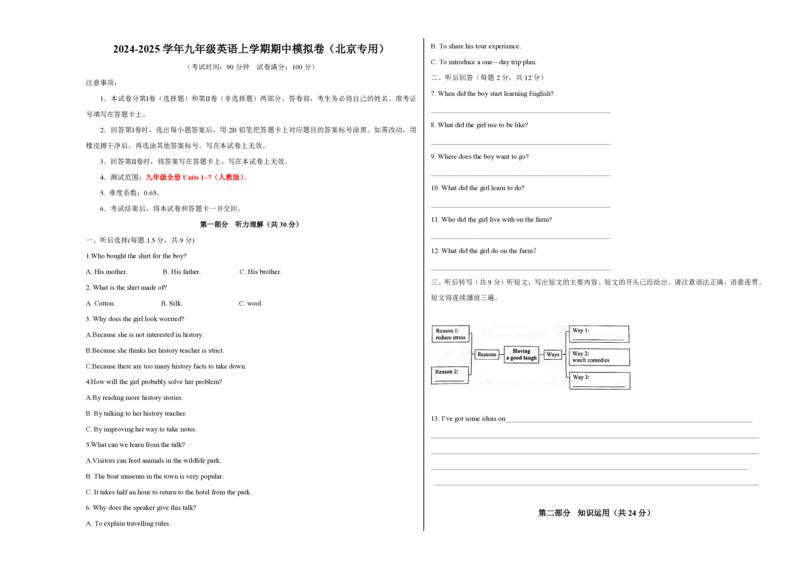
13.I’ve got some ideas on______________________________________________________________________
C. By improving her way to take notes.
_____________________________________________________________________________________________
5.What can we learn from the talk?
_____________________________________________________________________________________________
A.Visitors can feed animals in the wildlife park.
__________________________________________________________________________________________
B. The boat museum in the town is very popular.
____________________________________________________________________________________________
C. It takes half an hour to return to the hotel from the park.
6. Why does the speaker give this talk?
第二部分 知识运用(共 24分)
A. To explain travelling rules.四、单项选择 C. when will you travel D. when did you travel
14. I have a sister. ______ name is Lucy. 五、完形填空(12分)
A. Her B. His C. Its D. Your As the teacher called my name, I knew what lay ahead. She looked at me directly and made me to the
15. Teachers’ Day is ________ September 10th. whiteboard to perform a division (除法) problem. Division was my weakest subject. I repeatedly put the numbers in
A. on B. in C. at D. to the ___26___ places, or forgot to add in the zeros.
16. Deng Yaping isn’t so clever, _______ she has a very strong will and works hard. I worriedly ___27___ myself out of my seat. With every slow step I took, I grew more nervous. My stomach
A. and B. but C. so D. or ached, and my whole body shook with ___28___.
17. I think Confucius is one of _______ thinkers in China. The teacher read the problem aloud. Unsure of myself, I looked at the girl beside me, and tried to ___29___
A. great B. greater C. greatest D. the greatest what she was writing, but she went faster than I could understand, writing down what seemed to be foreign symbols.
18. — _______ did you borrow the book from the library? My eyes fixed on the chicken scratch I had tried. Impossible to understand. Why me? Why couldn’t I work out
— Yesterday morning. the problem that seemed easy to all other kids? These questions filled my head.
A. Where B. When C. How D. Why As the other girl finished and danced back to her seat, I wrote some random(胡乱的) numbers on the board, and
19. They will have a trip to the Great Wall if it _________ next Sunday. ___30___ back to mine. The teacher read over our work.
A. doesn’t snow B. won’t snow C. didn’t snow D. isn’t snowing “Now, class, Susie did this problem absolutely correctly.”
20. I _____________ my aunt at the airport tomorrow. “As for Tara,” the teacher said jokingly, “I don’t even know what she did.”
A. meet B. met The class burst into laughs, and I felt my face turn red as I tried to sink as low as possible into my seat, hoping
C. will meet D. have met to prevent them from ___31___ me at all.
21. We _______in the same school since three years ago. But this memory is one I remember, surprisingly, in a positive way. It made me ___32___, and gave me
A. are studying B. have studied C. will study D. study persistence. When I get a poor grade in school, or am put down by somebody, I think of that moment and every
22. — Mum, where is Dad? single one of those ___33___ that I asked myself. The terrible ache in my stomach comes back and gives me the
— He _______ a newspaper in the bedroom now. motivation to answer all of those whys and try hard until perfection, or as close as I can get.
A. read B. reads C. will read D. is reading 26. A. proper B. incorrect C. special D. unimportant
23. My classmates ________ as volunteers in the Science Museum last weekend. 27. A. lifted B. dropped C. repaired D. knocked
A. work B. worked C. will work D. are working 28. A. tiredness B. excitement C. shyness D. fear
24. — What were you doing when we were playing basketball yesterday afternoon? 29. A. accept B. explain C. copy D. describe
— I ______ the classroom. 30. A. rushed B. looked C. talked D. thought
A. was cleaning B. have cleaned 31. A. changing B. inviting C. seeing D. teaching
C. will clean D. clean 32. A. healthier B. stronger C. cleverer D. happier
25. —Can you tell me ________ to London? 33. A. ways B. words C. hows D. whys
—Sure. Next month.
A. when you will travel B. when you travelled 第三部分 阅读理解(共 26分)
公众号:初中英语助手六、阅读下列短文,根据短文内容,从短文后各题所给的 A、B、C、D 四个选项中,选择最佳选项。(共 “I had them on while I was watching the news this morning,” she said.
26分,每小题2分) “Where were you watching the news?” asked Kevin.
His mom thought for a minute, and then she answered that she was in the sitting room. She remembered sitting
A
in her favorite chair and taking off her glasses when the news ended. She thought she had placed her glasses on the
Jane, a reporter, is collecting information for the local newspaper. She is interested in the following creations
table, but they weren’t there. “Are you sure you didn’t put them on again after the morning news?” asked Kevin.
introduced in a magazine.
“Maybe I did,” his mom replied.
“Let’s walk through your day, Mom,” said Kevin. Kevin had his mom describe everything she remembered
____34____
doing during the day so far. She mentioned watching the news, making breakfast, folding laundry, working in her
A schoolboy aged 11 has invented a schoolbag. It tells you which books to pack. A small
home office and then gardening. It was after gardening that she started looking for her glasses. After hearing about
computer and a scanner (扫描装置) are fixed in the bag. As each book is put into the bag, it
his mom’s day, Kevin retraced her path through the house and yard. He looked under the cushion (垫子) of her
is checked by the scanner. If any book is missing, a message will be shown on the computer
favorite chair, in the kitchen, in the laundry basket, in her office and around the garden. He didn’t find her glasses.
screen to remind you.
Kevin didn’t want to give up, so he looked in each place again and he looked even harder. When he went
____35____
around the kitchen again, he opened the cabinets(橱柜)instead of just looking on the counters. Kevin solved the
A university makes that happen. It uses a 3D printer to create sweets based on the weather information of a certain
mystery, the puzzle and the problem. He found his mom’s glasses in the drawer with the silverware. “Thank you,
day. The shapes of the sweets are affected by wind speed. The colors of the sweets are decided by temperature. The
Kevin,” said his mom, “I wouldn’t be able to see anything without you.”
sweets act as a weather record of the day when they are made.
37. What was Kevin’s mom trying to find?
____36____
A. Her glasses. B. Her books. C. Her chairs. D. Her keys.
To help you get up, a company has created a “tool”—a sunrise bed. It wakes you up gently as a sunrise does. Lights
38. Where did Kevin find them for her mom?
built into the bed turn on and start to get brighter and brighter. When the lights are fully on, soft music will begin
A. On the table. B. In the yard. C. In the drawer. D. On the Internet.
to play. It will be louder and louder until you turn it off. The company explains, “The gentle light tells your body
39. How did Kevin help her mom find them?
that it is morning, so it stops producing a chemical that helps you sleep.”
A. By reading mystery books. B. By following her day’s path.
A. Can you eat weather?
C. By looking for it in his house with his friends. D. By walking around his house with his mom.
B. It’s hard for you to get up in the morning, isn’t it?
C
C. Weather sweets bring serious problems, don’t you agree?
Fluency in another language is a dream of a newcomer to another country. Besides, understanding the culture
D. Forget to pack the books you need into your schoolbag in the morning rush?
and learning to communicate comfortably with people of that culture are as important as learning the rules of the
B
language. Language learning and culture learning go together and may take a long time.
Kevin loves to read mystery books because he likes to try to solve the mystery himself before he gets to the
Sometimes people feel that they understand a culture after a few weeks or months. People do learn a lot when
end. Solving puzzles is like solving mysteries, so he likes working on puzzles too. He also likes solving problems.
they first begin living in another culture, but this is only the first step of learning. It usually involves things like
Kevin can usually solve any mystery, puzzle or problem.
learning everyday activities and some basic customs.
One day Kevin’s mom was trying to find her glasses. Without her glasses, she could not drive. This was a
To really understand another culture, people have to go beyond the first step. This is a challenge because it is
problem because she was going to drive Kevin to his friend’s house. It was also a mystery and a puzzle. Kevin really
often difficult to know what to learn. Much of what we call"culture" is hard to see.
wanted to solve this mystery, so he sat down with his mom.
Culture is like an iceberg. Imagine in your mind a huge iceberg in the ocean. The only part of the iceberg that
“Where do you last remember seeing your glasses?” he asked.
you see is the top. You don't see the rest of the iceberg because it is hidden from sight in the water. It is easy toforget that it is there. Most of the iceberg is deep in the ocean, just as much of a culture is deep in the ocean, just as the more time people spent on social media, the more unhappy they became.
much of a culture is deep within its people. There are a number of reasons for this. When browsing social media, people often see photographs and stories
When you meet someone from another culture, certain culture differences are obvious: You hear another showing beautiful holidays, fun parties and fashionable clothes. People seldom post negative stories or bad pictures,
language or you hear your own language spoken with an accent. You see different foods, clothes and sometimes so it can be misleading. For those looking at these pictures and comparing them to their own lives, they can end up
physical characteristics of people. You watch new customs or habits, such as the use of chopsticks, and, bowing or feeling sad and depressed. They might think their lives are worse in comparison. Even for those people who post
kissing on both cheeks as a greeting. These differences are interesting and important, but they are usually not too positive(积极的) stories and pictures, they too can feel stressed and worried.
difficult to understand. They can be seen easily and quickly. The number of “likes” and comments on their posts can make them worried about their popularity. Of course,
The part of culture that is like the underwater part of the iceberg consists of assumptions (设想), there is also the problem of “cyber bullying”(网络暴力 ) where people become victims of bullying online when
communication styles, values, and beliefs about what is right and wrong. The hidden part of culture influences much others make negative or cruel comments(评论) about them.
of a person’s way of thinking and communicating. It is the meaning behind his or her verbal and nonverbal language. The reality is that social media is a part of modern life and it is not going to go away. This research shows us
Learning to communicate well with people from another culture involves understanding the hidden part of culture. that it is important to deal with the relationship between our online and offline lives properly. We don’t have to
40. To really understand another culture, people should . disconnect from the Internet to live a happy life, but we should realise that the pictures we see and stories we read
A. learn the rules of language B. learn the hidden culture are only part of a bigger picture. If we can do that, we can protect ourselves and enjoy our lives.
C. visit some local people D. live with some local people 43. According to the passage, we know __________.
41. Which of the following does the writer agree? A. spending more time on social media makes people more enjoyable
A. Communication styles can be easily seen and learned B. researchers haven’t found anything negative about social media
B. Language learning is more important than culture learning C. it is common for young people to share their lives online
C. Learning about culture is not easy and may take a long time D. the world is not so connected like before
D. People usually learn a culture after a few weeks or months. 44. The words “have concerns about” in Paragraph 2 probably mean “__________”.
42. The passage is mainly about . A. feel worried about B. look forward to
A. learning about culture. B. learning about people C. speak highly of D. get used to
C. the hidden part of the iceberg D. fluency in another language 45. The writer says that social media can make people unhappy because __________.
D A. different people make different comments
Social Media… the Highs and Lows
B. there are many negative stories and bad pictures
Twenty years ago, the idea of sharing our lives so openly with the world was unheard
C. they compare positive pictures to their own lives
of. However, for young people today it is considered completely normal to share pictures of
D. the number of “likes” is larger than they expected
their lives and interact online every day. Fans of social media point out that the world has
46. What is the writer’s main purpose in writing this passage?
never been so connected as it has allowed people to make friends, learn about the world and
A. To ask us to protect ourselves from “cyber bullying”.
celebrate life.
B. To advise us to keep away from the Internet to live a happy life.
However, many people have concerns about the effects of this new way of living, particularly around the
C. To remind us of posting positive stories and good pictures online.
amount and type of information that is shared so openly.
D. To tell us to keep a balance between our online and offline lives.
Now researchers have found that too much time on social media may indeed have some negative( 消极的 )
第四部分 书面表达(共 20分)
effects. They measured people’s attitudes and feelings before and after browsing social media sites. They found that
公众号:初中英语助手七、阅读表达(34-36题每题2分, 37题4分,共10分) 你们班交换生Peter介绍你英语学习方面曾遇到的问题以及你的解决办法。
阅读短文,根据短文内容回答问题。 提示词语:words, remember, topic sentence, understand
On Top of the World 提示问题:what problem(s) did you meet in your English learning? How did you solve the problem(s)?
Jenny Tough is a runner, cyclist, and adventurer. She has spent much of her life climbing mountains in the Dear Peter,
world’s most places, often completely alone. In her recent book, she tells her expeditions and the lessons she’s How are you?___________________________________________________________________________
learned along the way. _____________________________________________________________________________________________
“I see adventure as a creative pursuit(追求), one where I’m inventing challenges(挑战) for myself. They don’t _____________________________________________________________________________________________
need to make sense to anyone else. In this case, I started with a goal to run across Kyrgyzstan. No one had ever done _____________________________________________________________________________________________
it before, and everyone told me it couldn’t be done. But I went, and I did it, And on that trip, I became the best of _________________________________________________________________________________________
myself but finishing a big project like that left a hole, and I felt pretty depressed(沮丧的) afterward. So I decided to What about you? Please tell me.
just keep going.” She said. Yours,
She also said that during the journey, so many things happened—some are scary, some are beautiful. We Li Hua
always have to set a record or we’ve always got to be the best. A thousand people could run across these mountains 题目②某英文网站正在开展以“书香润心灵,阅读伴成长”为主题的征文活动。假如你是李华,请用英文
and come back with a thousand different stories. 写一篇短文投稿,谈谈哪本书对你影响最大,介绍一下这本书的内容,以及给你成长带来的帮助。
“So many of us grow up in environments where we’re always looked after. Each solo(单独的) trip I took was a 提示词语:write, story, life, change, help
revelation(启示) of my abilities. I’ve gotten myself into some bad situations and I’ve had to think creatively to get 提示问题:
myself out. If I had never put myself through that, I might never have become a truly one who really backs herself ·Which book has had a big influence on your life?
when things get bad.” She also said. ·What is the book about?
47. Where does Jenny Tough tell her expeditions and the lessons she’s learned? ·How has the book helped you?
_________________________________________________________________________ There are a lot of books around us.____________________________________________________________
48. Why did Jenny Tough decide to keep going after running across Kyrgyzstan? _____________________________________________________________________________________________
_________________________________________________________________________ _____________________________________________________________________________________________
49. What has Jenny Tough had to do when she has gotten herself into some bad situations? __________________________________________________________________________________________
_________________________________________________________________________ ____________________________________________________________________________________________
50. Do you think Jenny Tough should spend much of her life climbing mountains in the world’s most places alone? ____________________________________________________________________________________________
Why or why not? Please give at least two reasons. ____________________________________________________________________________________________
_________________________________________________________________________
八、文段表达(10分)
从下面两个题目中任选一题,根据所给提示,完成一篇不少于50词的英语文段写作。文中已给出内容不计入总
词数。所给提示词语仅供选用。请不要写出你的校名和姓名。
题目①假如你是李华,你们学校正在举办“英语学习方法交流”的主题活动。请用英语写一封电子邮件向