





















































































































文档内容
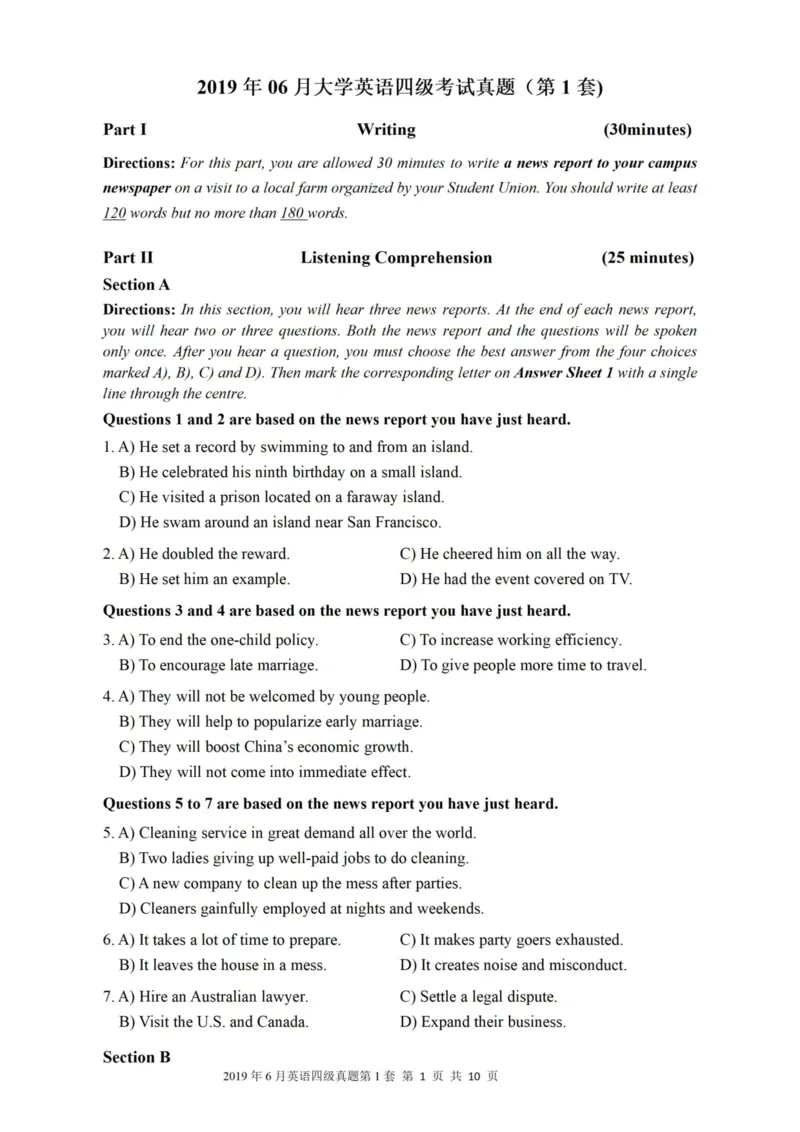
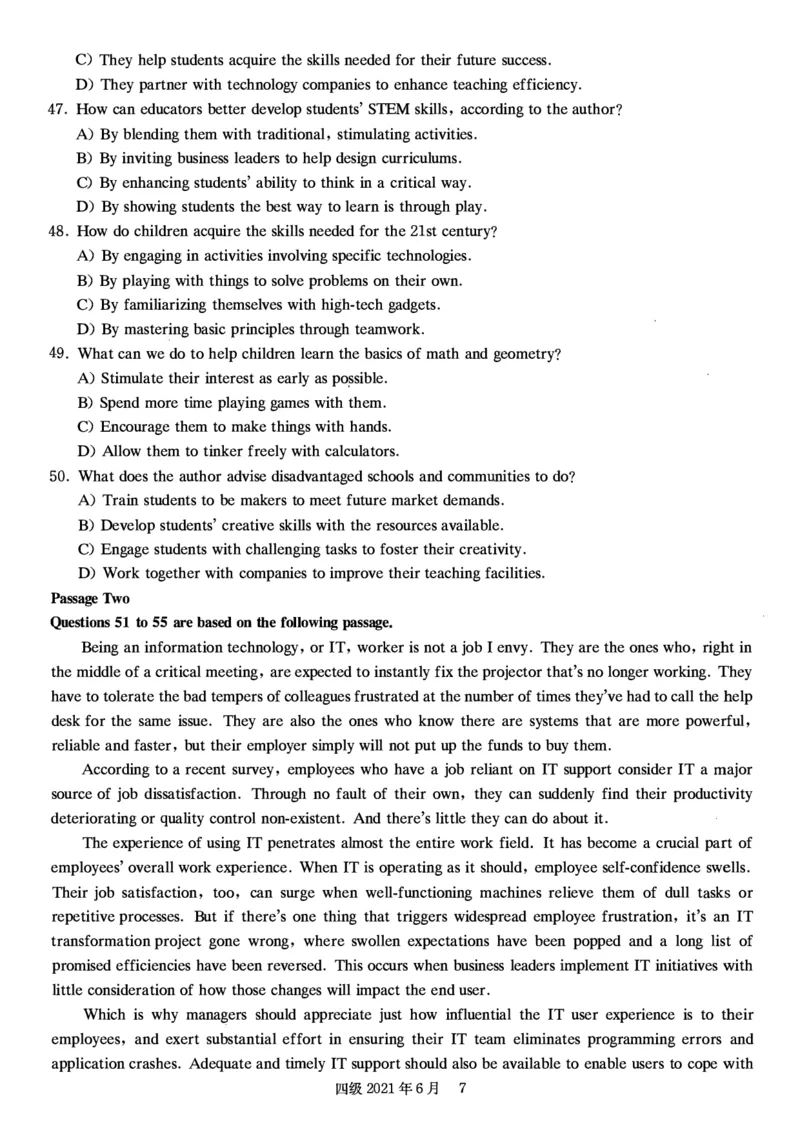
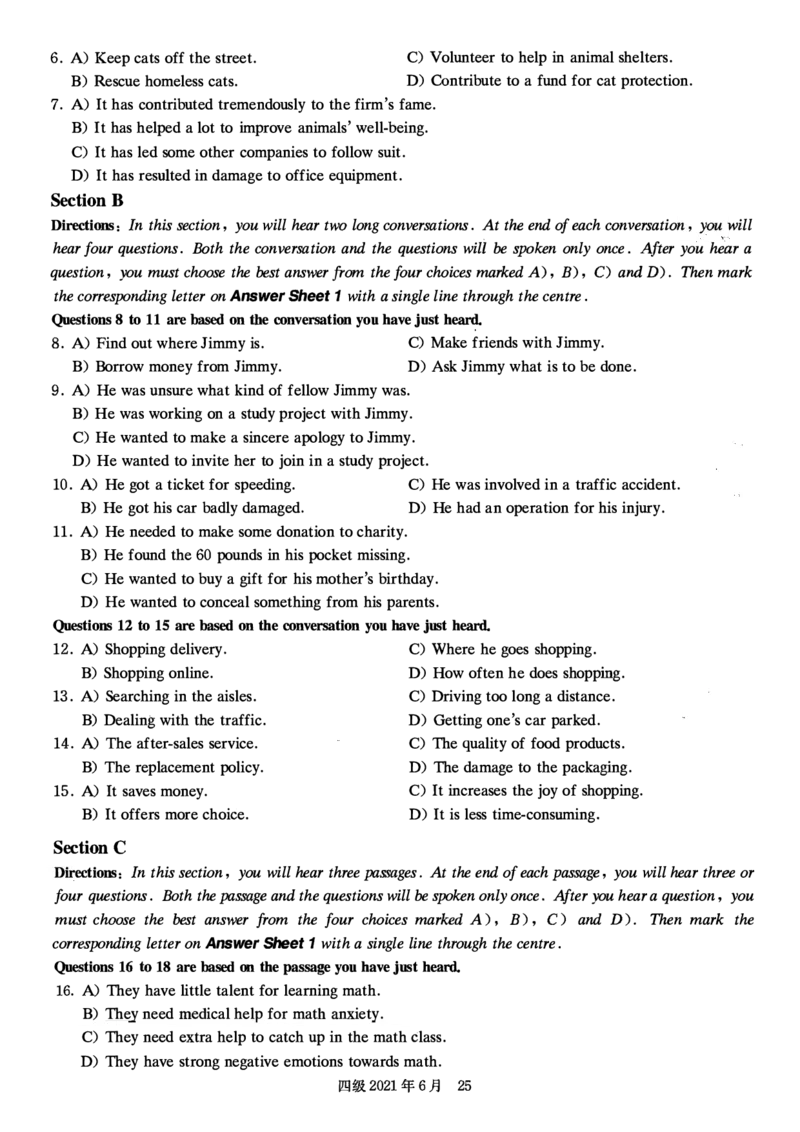
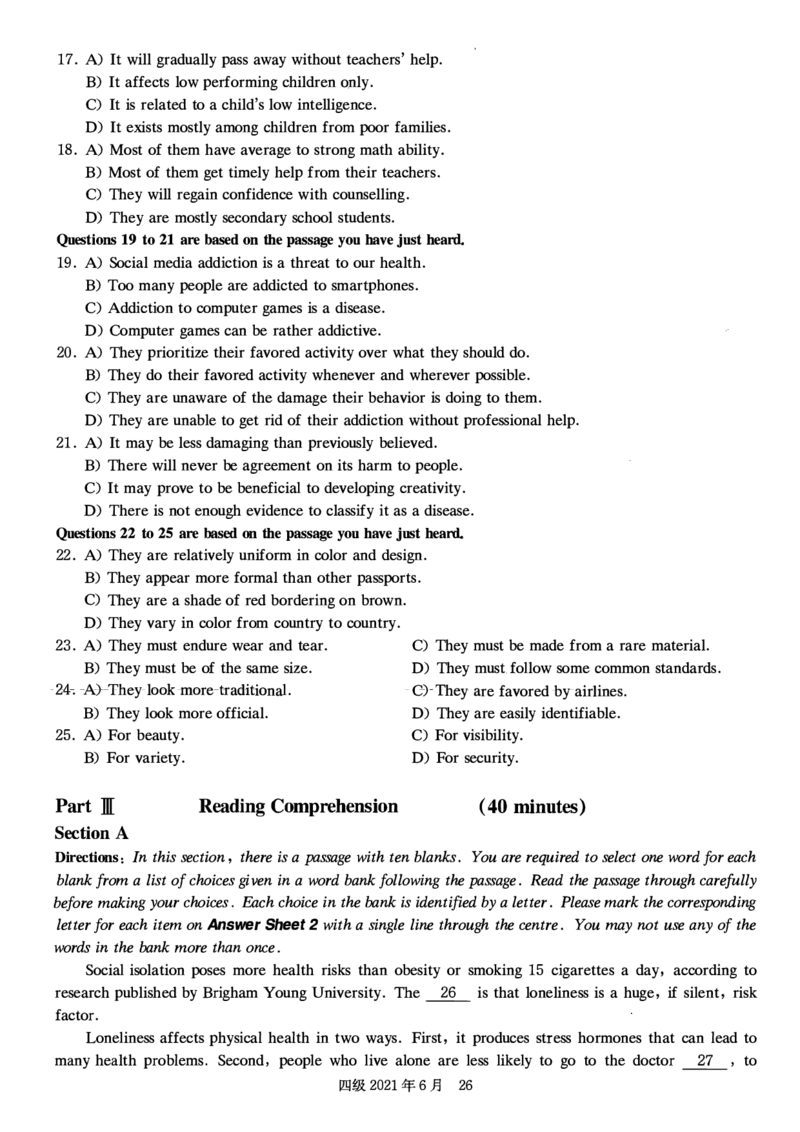
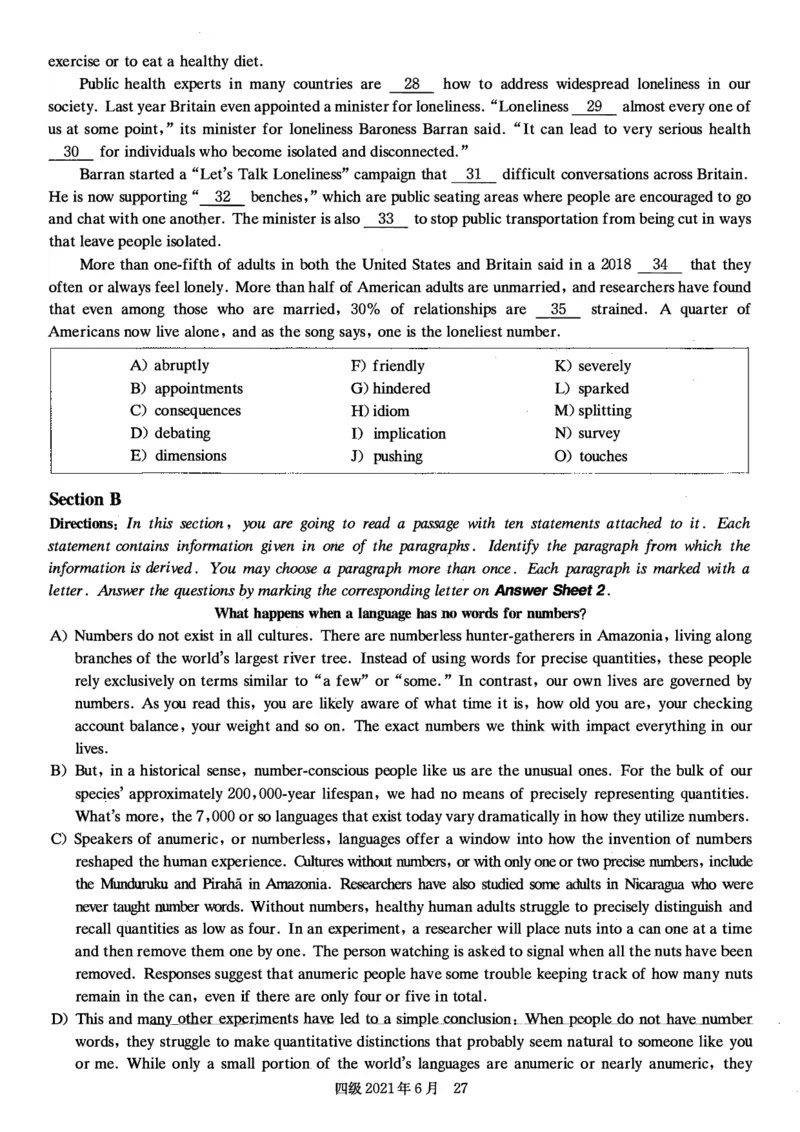
2019年 06月大学英语四级考试真题(第 1 套)
Part I Writing (30minutes)
Directions: For this part, you are allowed 30 minutes to write a news report to your campus
newspaper on a visit to a local farm organized by your Student Union. You should write at least
120 words but no more than 180 words.
Part II Listening Comprehension (25 minutes)
Section A
Directions: In this section, you will hear three news reports. At the end of each news report,
you hear two or three questions. Both the news report and the questions will be spoken
only once. After you hear a question, you must choose the best answer from the four choices
marked A), B), C) and D). Then mark the corresponding letter on Answer Sheet 1 with a single
line through the centre.
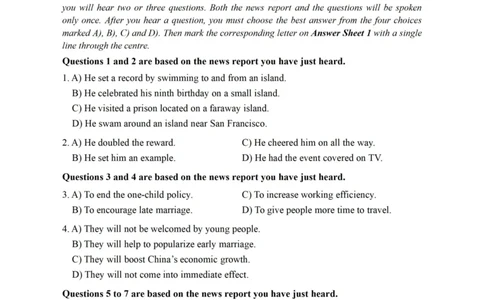
Questions 1 and 2 are based on the news report you have just heard.
1. A) He set a record by swimming to and from an island.
B) He celebrated his ninth birthday on a small island.
C) He visited a prison located on a faraway island.
D) He swam around an island near San Francisco.
2. A) He doubled the reward. C) He cheered him on all the way.
B) He set him an example. D) He had the event covered on TV.
Questions 3 and 4 are based on the news report you have just heard.
3. A) To end the one-child policy. C) To increase working efficiency.
B) To encourage late marriage. D) To give people more time to travel.
4. A) They will not be welcomed by young people.
B) They will help to popularize early marriage.
C) They will boost China9s economic growth.
D) They will not come into immediate effect.
Questions 5 to 7 are based on the news report you have just heard.
5. A) Cleaning service in great demand all over the world.
B) Two ladies giving up well-paid jobs to do cleaning.
C) A new company to clean up the mess after parties.
D) Cleaners gainfully employed at nights and weekends.
6. A) It takes a lot of time to prepare. C) It makes party goers exhausted.
B) It leaves the house in a mess. D) It creates noise and misconduct.
7. A) Hire an Australian lawyer. C) Settle a legal dispute.
B) Visit the U.S. and Canada. D) Expand their business.
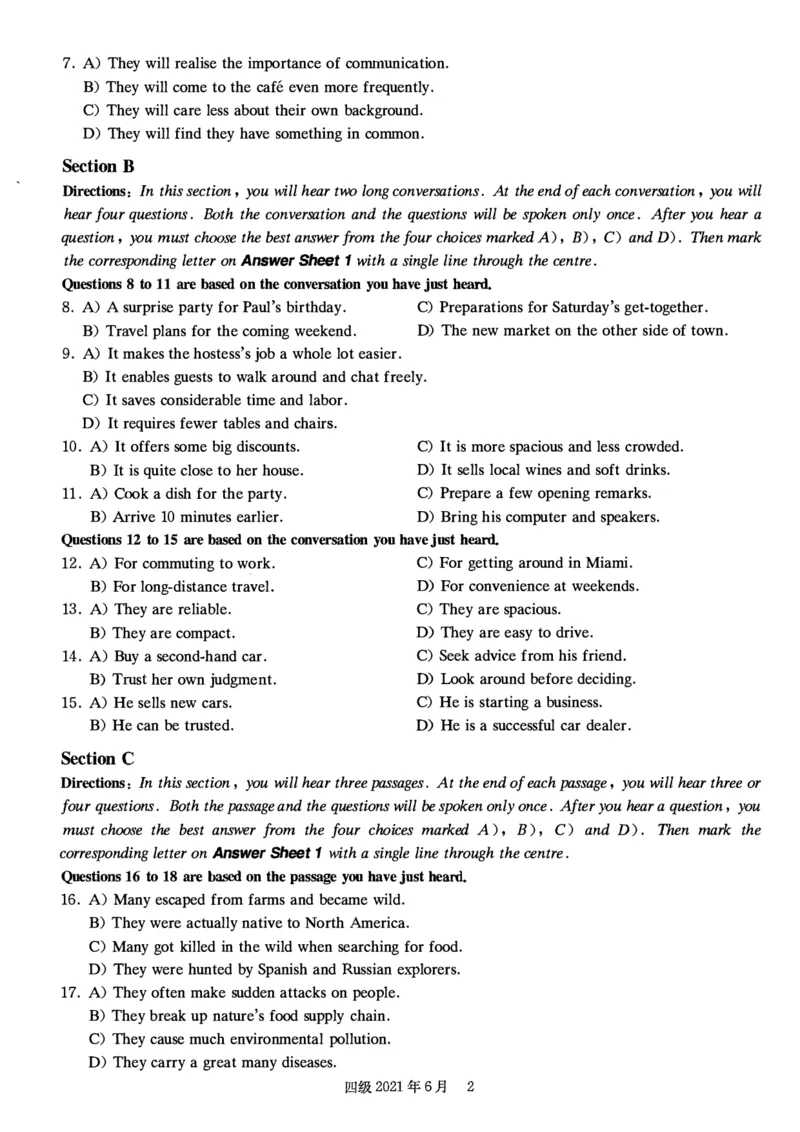
Section B
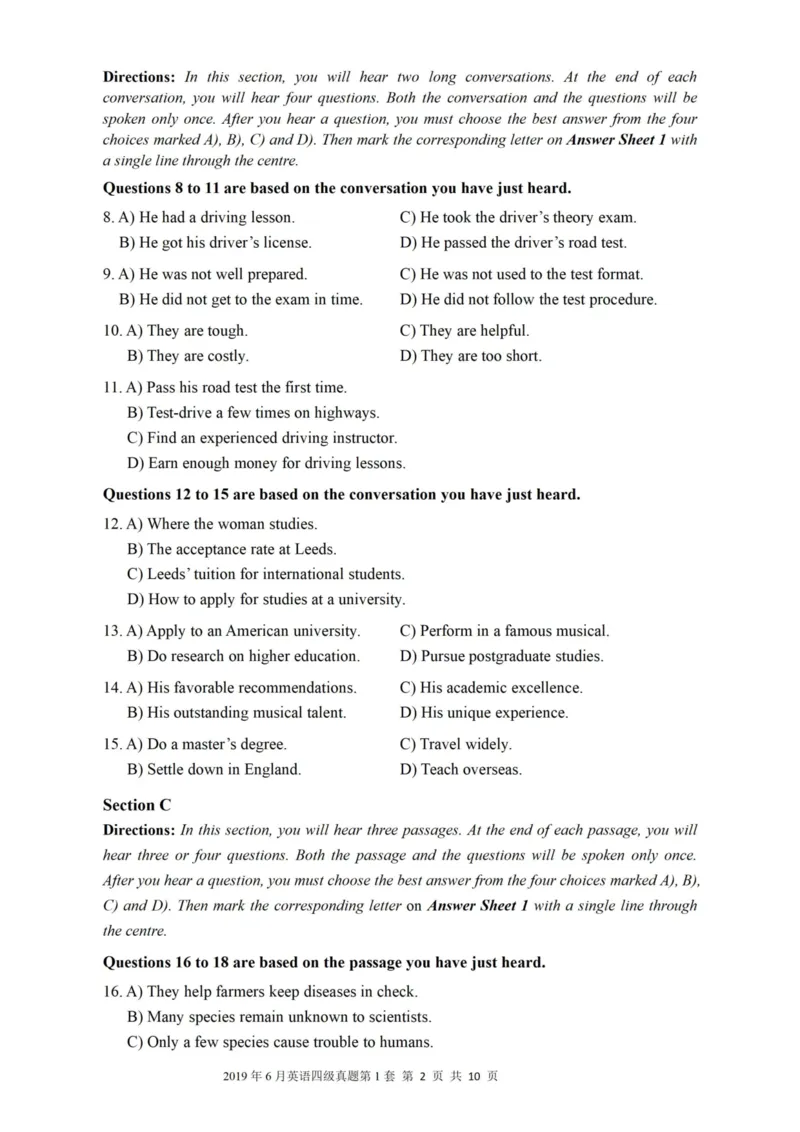
2019年6月英语四级真题第1套 第 1 页 共 10页Directions: In this section, you will hear two long conversations. At the end of each
conversation, you will hear four questions. Both the conversation and the questions will be
spoken only once. After you hear a question, you must choose the best answer from the four
choices marked A), B), C) and D). Then mark the corresponding letter on Answer Sheet 1 with
a single line through the centre.
Questions 8 to 11 are based on the conversation you have just heard.
8. A) He had a driving lesson. C) He took the driver's theory exam.
B) He got his driver's license. D) He passed the driver's road test.
9. A) He was not well prepared. C) He was not used to the test format.
B) He did not get to the exam in time. D) He did not follow the test procedure.
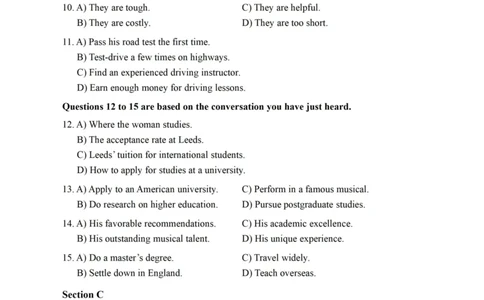
10. A) They are tough. C) They are helpful.
B) They are costly. D) They are too short.
11. A) Pass his road test the first time.
B) Test-drive a few times on highways.
C) Find an experienced driving instructor.
D) Earn enough money for driving lessons.
Questions 12 to 15 are based on the conversation you have just heard.
12. A) Where the woman studies.
B) The acceptance rate at Leeds.
C) Leeds' tuition for international students.
D) How to apply for studies at a university.
13. A) Apply to an American university. C) Perform in a famous musical.
B) Do research on higher education. D) Pursue postgraduate studies.
14. A) His favorable recommendations. C) His academic excellence.
B) His outstanding musical talent. D) His unique experience.
15. A) Do a master's degree. C) Travel widely.
B) Settle down in England. D) Teach overseas.
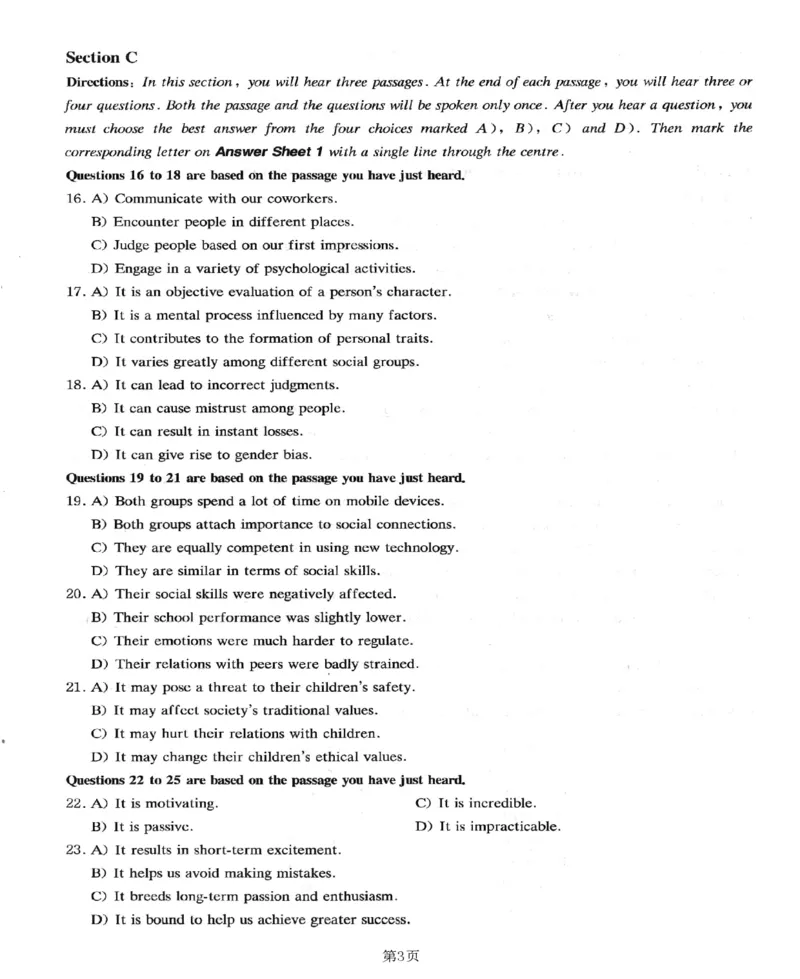
Section C
Directions: In this section, you will hear three passages. At the end of each passage, you will
hear three or four questions. Both the passage and the questions will be spoken only once.
After you hear a question, you must choose the best answer from the four choices marked A), B),
C) and D). Then mark the corresponding letter on Answer Sheet 1 with a single line through
the centre.
Questions 16 to 18 are based on the passage you have just heard.
16. A) They help farmers keep diseases in check.
B) Many species remain unknown to scientists.
C) Only a few species cause trouble to humans.
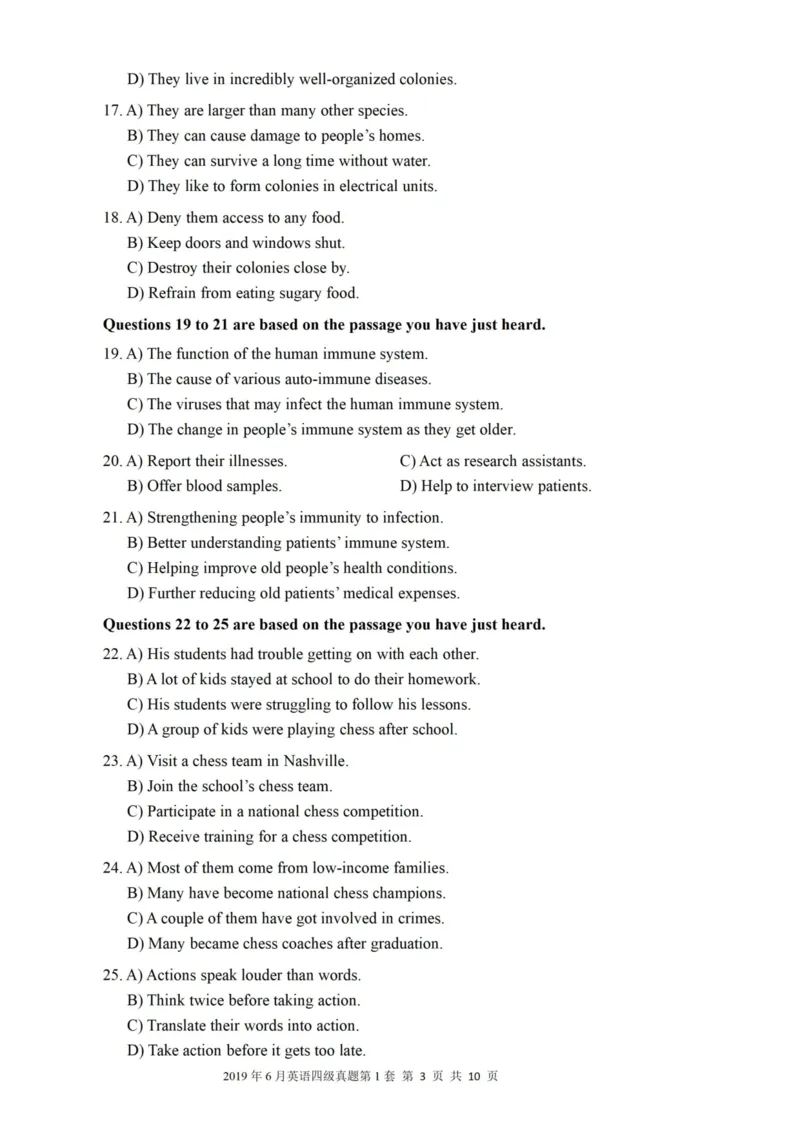
2019年6月英语四级真题第1套 第 2 页 共 10页D) They live in incredibly well-organized colonies.
17. A) They are larger than many other species.
B) They can cause damage to people's homes.
C) They can survive a long time without water.
D) They like to form colonies in electrical units.
18. A) Deny them access to any food.
B) Keep doors and windows shut.
C) Destroy their colonies close by.
D) Refrain from eating sugary food.
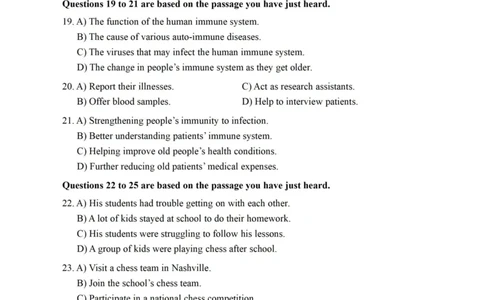
Questions 19 to 21 are based on the passage you have just heard.
19. A) The function of the human immune system.
B) The cause of various auto-immune diseases.
C) The viruses that may infect the human immune system.
D) The change in people's immune system as they get older.
20. A) Report their illnesses. C) Act as research assistants.
B) Offer blood samples. D) Help to interview patients.
21. A) Strengthening people's immunity to infection.
B) Better understanding patients9 immune system.
C) Helping improve old people's health conditions.
D) Further reducing old patients' medical expenses.
Questions 22 to 25 are based on the passage you have just heard.
22. A) His students had trouble getting on with each other.
B) A lot of kids stayed at school to do their homework.
C) His students were struggling to follow his lessons.
D) A group of kids were playing chess after school.
23. A) Visit a chess team in Nashville.
B) Join the schooPs chess team.
C) Participate in a national chess competition.
D) Receive training for a chess competition.
24. A) Most of them come from low-income families.
B) Many have become national chess champions.
C) A couple of them have got involved in crimes.
D) Many became chess coaches after graduation.
25. A) Actions speak louder than words.
B) Think twice before taking action.
C) Translate their words into action.
D) Take action before it gets too late.
2019年6月英语四级真题第1套 第 3 页 共 10页Part III Reading Comprehension (40 minutes)
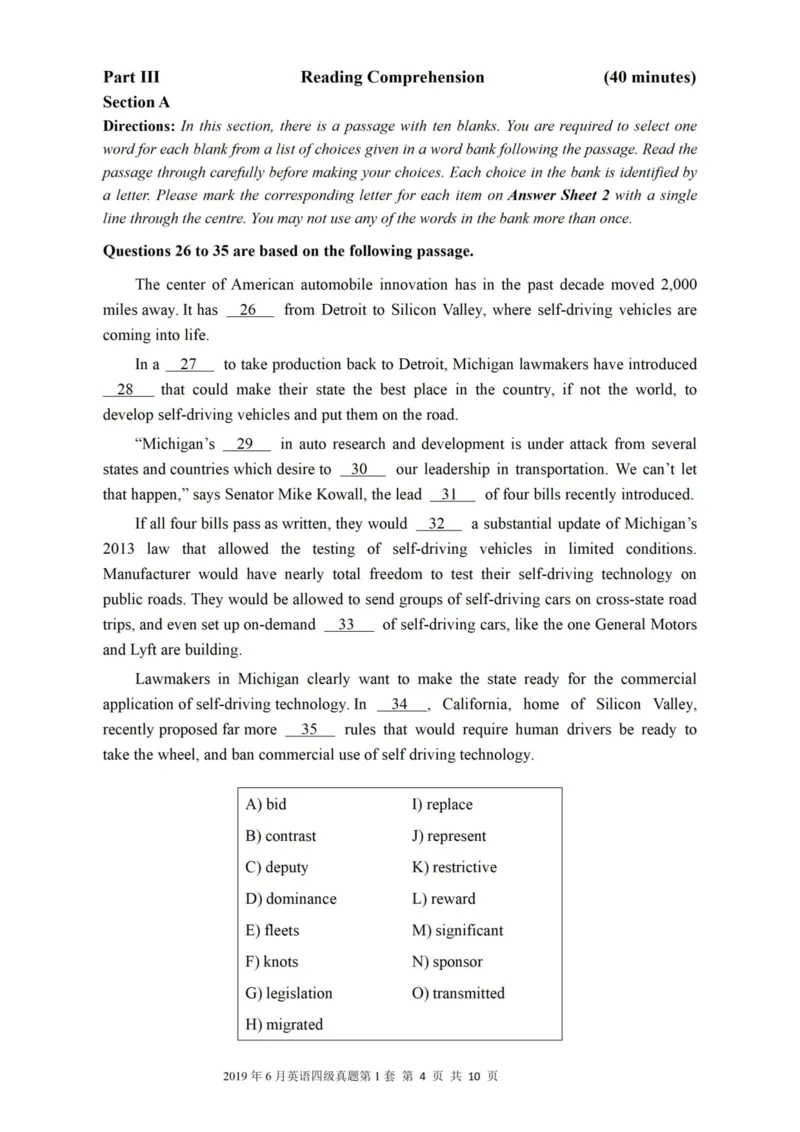
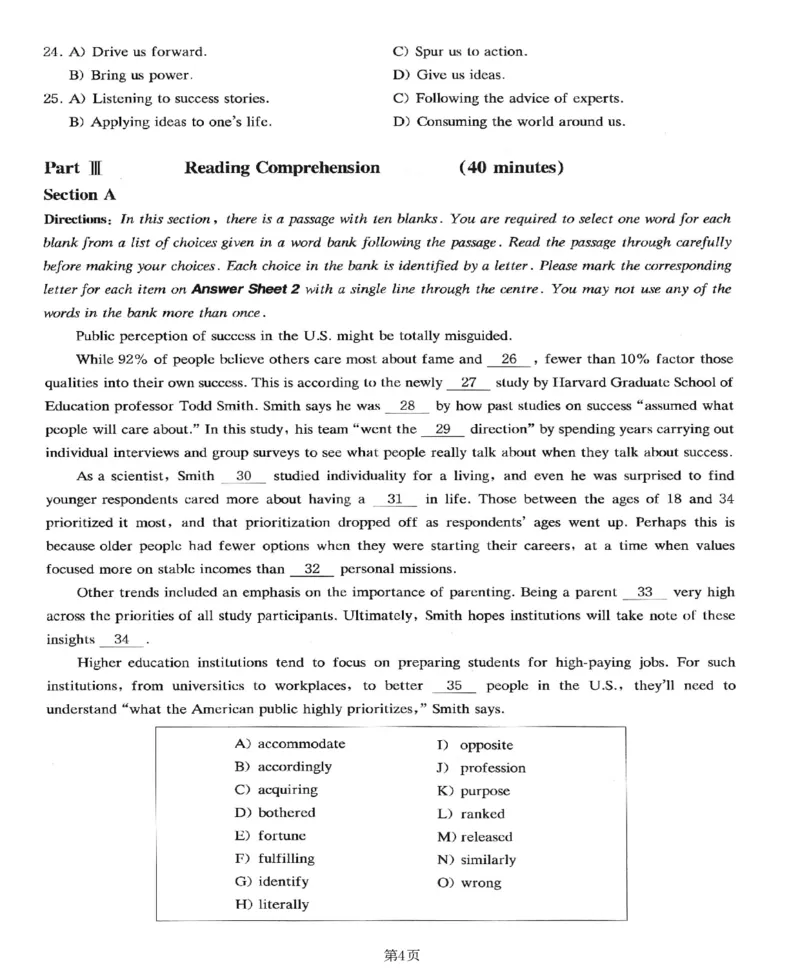
Section A
Directions: In this section, there is a passage with ten blanks. You are required to select one
word for each blank from a list of choices given in a word bank following the passage. Read the
passage through carefully before making your choices. Each choice in the bank is identified by
a letter. Please mark the corresponding letter for each item on Answer Sheet 2 with a single
line through the centre. You may not use any of the words in the bank more than once.
Questions 26 to 35 are based on the following passage.
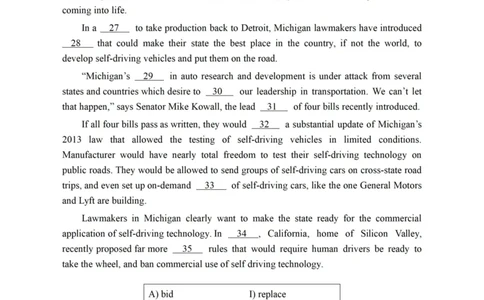
The center of American automobile innovation has in the past decade moved 2,000
miles away. It has 26 from Detroit to Silicon Valley, where self-driving vehicles are
coming into life.
In a 27 to take production back to Detroit, Michigan lawmakers have introduced
28 that could make their state the best place in the country, if not the world, to
develop self-driving vehicles and put them on the road.
“Michigan's 29 in auto research and development is under attack from several
states and countries which desire to 30 our leadership in transportation. We can't let
that happen," says Senator Mike Kowall, the lead 31 of four bills recently introduced.
If all four bills pass as written, they would 32 a substantial update of Michigan's
2013 law that allowed the testing of self-driving vehicles in limited conditions.
Manufacturer would have nearly total freedom to test their self-driving technology on
public roads. They would be allowed to send groups of self-driving cars on cross-state road
trips, and even set up on-demand 33 of self-driving cars, like the one General Motors
and Lyft are building.
Lawmakers in Michigan clearly want to make the state ready for the commercial
application of self^driving technology. In 34 California, home of Silicon Valley,
recently proposed far more 35 rules that would require human drivers be ready to
take the wheel, and ban commercial use of self driving technology.
A) bid I) replace
B) contrast J) represent
C) deputy K) restrictive
D) dominance L) reward
E) fleets M) significant
F) knots N)sponsor
G) legislation O) transmitted
H) migrated
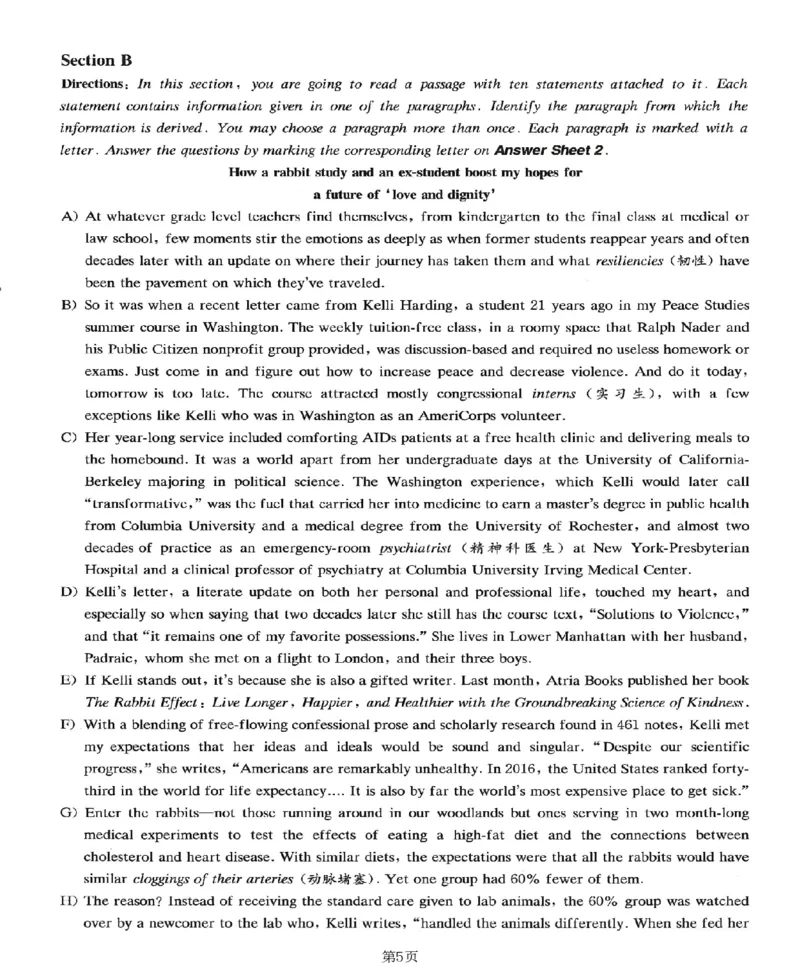
2019年6月英语四级真题第1套 第 4 页 共 10页Section B
Directions: In this section, you are going to read a passage with ten statements attached to it.
Each statement contains information given in one of the paragraphs. Identify the paragraph
from which the information is derived. You may choose a paragraph more than once. Each
paragraph is marked with a letter. Answer the questions by marking the corresponding letter on
Answer Sheet 2.
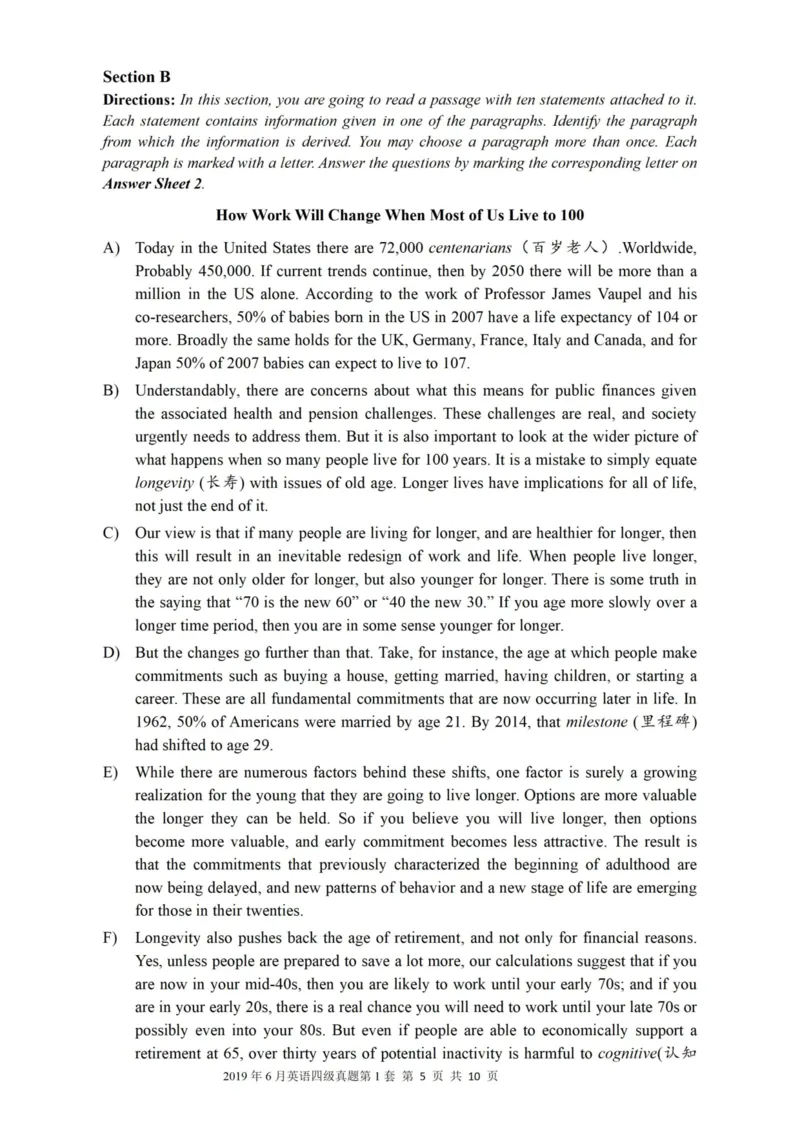
How Work Will Change When Most of Us Live to 100
A) Today in the United States there are 72,000 centenarians (百岁老人).Worldwide,
Probably 450,000. If current trends continue, then by 2050 there will be more than a
million in the US alone. According to the work of Professor James Vaupel and his
co-researchers, 50% of babies bom in the US in 2007 have a life expectancy of 104 or
more. Broadly the same holds for the UK, Germany, France, Italy and Canada, and for
Japan 50% of 2007 babies can expect to live to 107.
B) Understandably, there are concerns about what this means for public finances given
the associated health and pension challenges. These challenges are real, and society
urgently needs to address them. But it is also important to look at the wider picture of
what happens when so many people live for 100 years. It is a mistake to simply equate
longevity (长寿)with issues of old age. Longer lives have implications for all of life,
not just the end of it.
C) Our view is that if many people are living for longer, and are healthier fbr longer, then
this will result in an inevitable redesign of work and life. When people live longer,
they are not only older for longer, but also younger for longer. There is some truth in
the saying that "70 is the new 60" or "40 the new 30.“ If you age more slowly over a
longer time period, then you are in some sense younger fbr longer.
D) But the changes go further than that. Take, fbr instance, the age at which people make
commitments such as buying a house, getting married, having children, or starting a
career. These are all fundamental commitments that are now occurring later in life. In
1962, 50% of Americans were married by age 21. By 2014, that milestone (里程碑)
had shifted to age 29.
E) While there are numerous factors behind these shifts, one factor is surely a growing
realization for the young that they are going to live longer. Options are more valuable
the longer they can be held. So if you believe you will live longer, then options
become more valuable, and early commitment becomes less attractive. The result is
that the commitments that previously characterized the beginning of adulthood are
now being delayed, and new patterns of behavior and a new stage of life are emerging
for those in their twenties.
F) Longevity also pushes back the age of retirement, and not only fbr financial reasons.
Yes, unless people are prepared to save a lot more, our calculations suggest that if you
are now in your mid-40s, then you are likely to work until your early 70s; and if you
are in your early 20s, there is a real chance you will need to work until your late 70s or
possibly even into your 80s. But even if people are able to economically support a
retirement at 65, over thirty years of potential inactivity is harmful to cog几ifive(认知
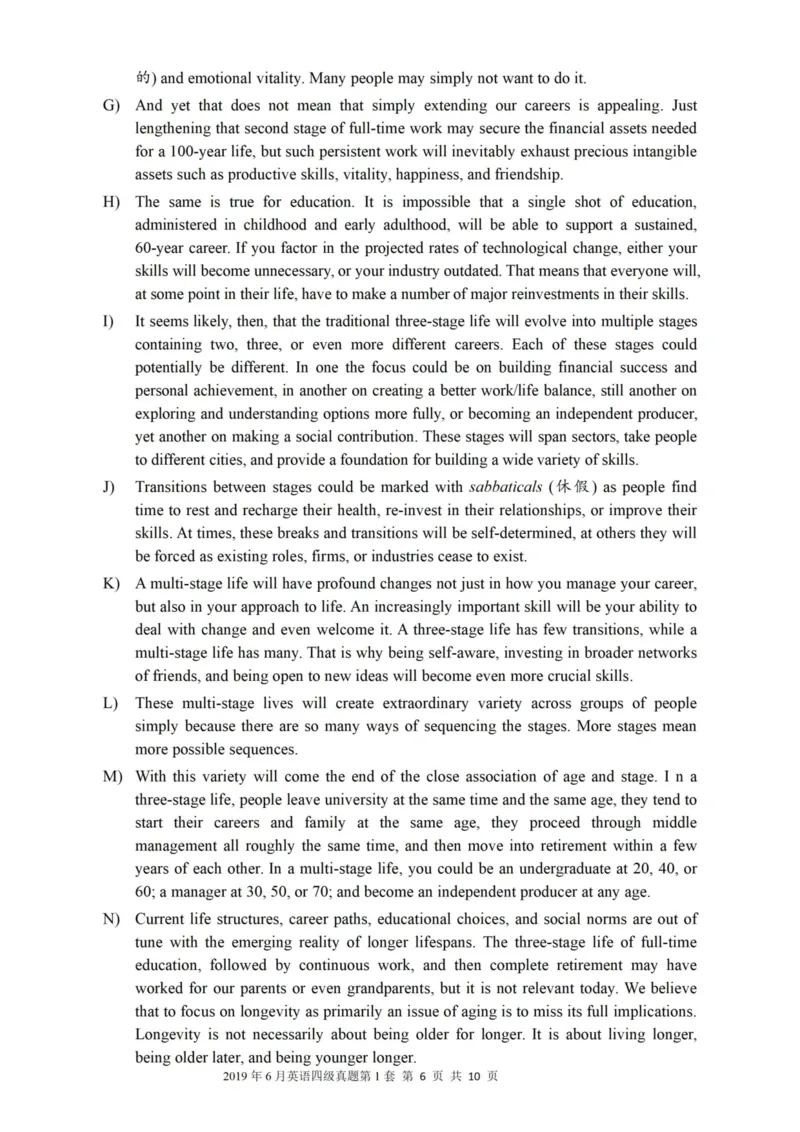
2019年6月英语四级真题第1套 第 5 页 共 10页的)and emotional vitality. Many people may simply not want to do it.
G) And yet that does not mean that simply extending our careers is appealing. Just
lengthening that second stage of full-time work may secure the financial assets needed
for a 100-year life, but such persistent work will inevitably exhaust precious intangible
assets such as productive skills, vitality, happiness, and friendship.
H) The same is true for education. It is impossible that a single shot of education,
administered in childhood and early adulthood, will be able to support a sustained,
60-year career. If you factor in the projected rates of technological change, either your
skills will become unnecessary, or your industry outdated. That means that everyone will,
at some point in their life, have to make a number of major reinvestments in their skills.
I) It seems likely, then, that the traditional three-stage life will evolve into multiple stages
containing two, three, or even more different careers. Each of these stages could
potentially be different. In one the focus could be on building financial success and
personal achievement, in another on creating a better work/life balance, still another on
exploring and understanding options more fully, or becoming an independent producer,
yet another on making a social contribution. These stages will span sectors, take people
to different cities, and provide a foundation for building a wide variety of skills.
J) Transitions between stages could be marked with sabbaticals (休彳段)as people find
time to rest and recharge their health, re-invest in their relationships, or improve their
skills. At times, these breaks and transitions will be self-determined, at others they will
be forced as existing roles, firms, or industries cease to exist.
K) A multi-stage life will have profound changes not just in how you manage your career,
but also in your approach to life. An increasingly important skill will be your ability to
deal with change and even welcome it. A three-stage life has few transitions, while a
multi-stage life has many. That is why being self-aware, investing in broader networks
of friends, and being open to new ideas will become even more crucial skills.
L) These multi-stage lives will create extraordinary variety across groups of people
simply because there are so many ways of sequencing the stages. More stages mean
more possible sequences.
M) With this variety will come the end of the close association of age and stage. In a
three-stage life, people leave university at the same time and the same age, they tend to
start their careers and family at the same age, they proceed through middle
management all roughly the same time, and then move into retirement within a few
years of each other. In a multi-stage life, you could be an undergraduate at 20, 40, or
60; a manager at 30, 50, or 70; and become an independent producer at any age.
N) Current life structures, career paths, educational choices, and social norms are out of
tune with the emerging reality of longer lifespans. The three-stage life of full-time
education, followed by continuous work, and then complete retirement may have
worked for our parents or even grandparents, but it is not relevant today. We believe
that to focus on longevity as primarily an issue of aging is to miss its full implications.
Longevity is not necessarily about being older for longer. It is about living longer,
being older later, and being younger longer.
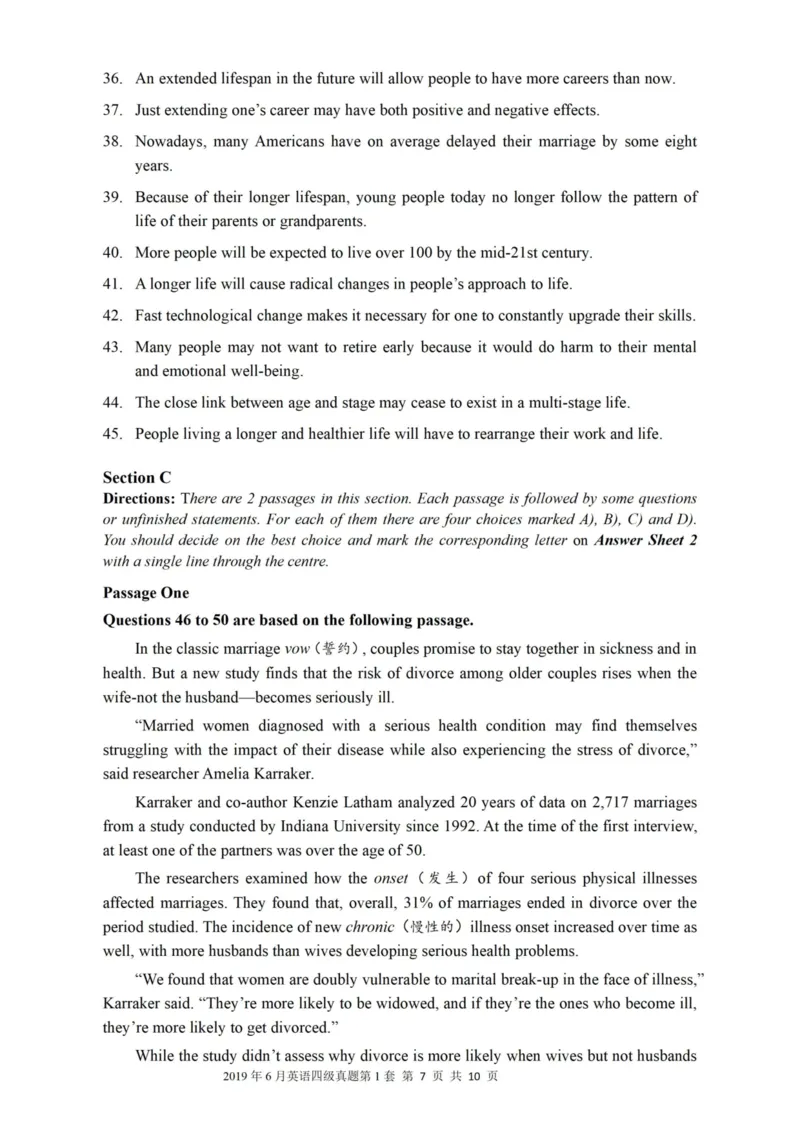
2019年6月英语四级真题第1套 第 6 页 共 10页36. An extended lifespan in the future will allow people to have more careers than now.
37. Just extending one's career may have both positive and negative effects.
38. Nowadays, many Americans have on average delayed their marriage by some eight
years.
39. Because of their longer lifespan, young people today no longer follow the pattern of
life of their parents or grandparents.
40. More people will be expected to live over 100 by the mid-21st century.
41. A longer life will cause radical changes in people's approach to life.
42. Fast technological change makes it necessary for one to constantly upgrade their skills.
43. Many people may not want to retire early because it would do harm to their mental
and emotional well-being.
44. The close link between age and stage may cease to exist in a multi-stage life.
45. People living a longer and healthier life will have to rearrange their work and life.
Section C
Directions: There are 2 passages in this section. Each passage is followed by some questions
or unfinished statements. For each of them there are four choices marked A), B), C) and D).
You should decide on the best choice and mark the corresponding letter on Answer Sheet 2
with a single line through the centre.
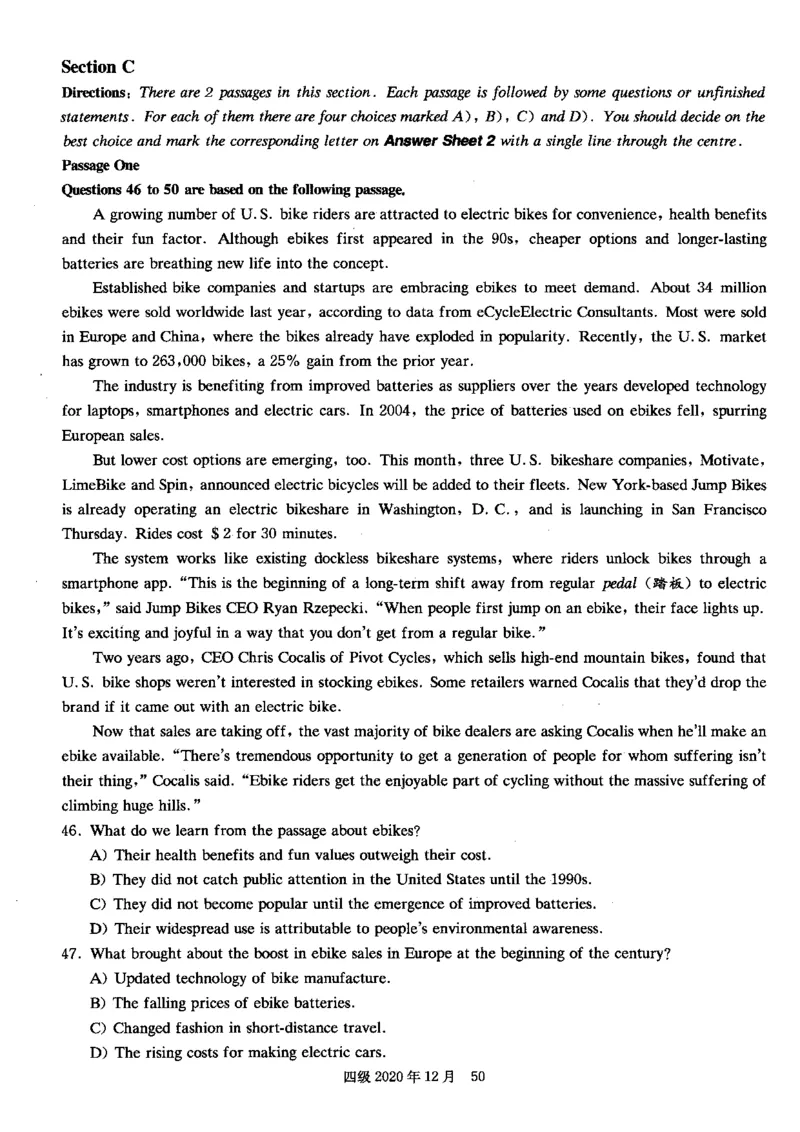
Passage One
Questions 46 to 50 are based on the following passage.
In the classic marriage vow (誓约),couples promise to stay together in sickness and in
health. But a new study finds that the risk of divorce among older couples rises when the
wife-not the husband- becomes seriously ill.
“Married women diagnosed with a serious health condition may find themselves
struggling with the impact of their disease while also experiencing the stress of divorce,
said researcher Amelia Karraker.
Karraker and co-author Kenzie Latham analyzed 20 years of data on 2,717 marriages
from a study conducted by Indiana University since 1992. At the time of the first interview,
at least one of the partners was over the age of 50.
The researchers examined how the onset (发生)of four serious physical illnesses
affected marriages. They found that, overall, 31% of marriages ended in divorce over the
period studied. The incidence of new chronic 。慢,性的)illness onset increased over time as
well, with more husbands than wives developing serious health problems.
“We found that women are doubly vulnerable to marital break-up in the face of illness,“
Karraker said. "They're more likely to be widowed, and if they're the ones who become ill,
they're more likely to get divorced.
While the study didn't assess why divorce is more likely when wives but not husbands
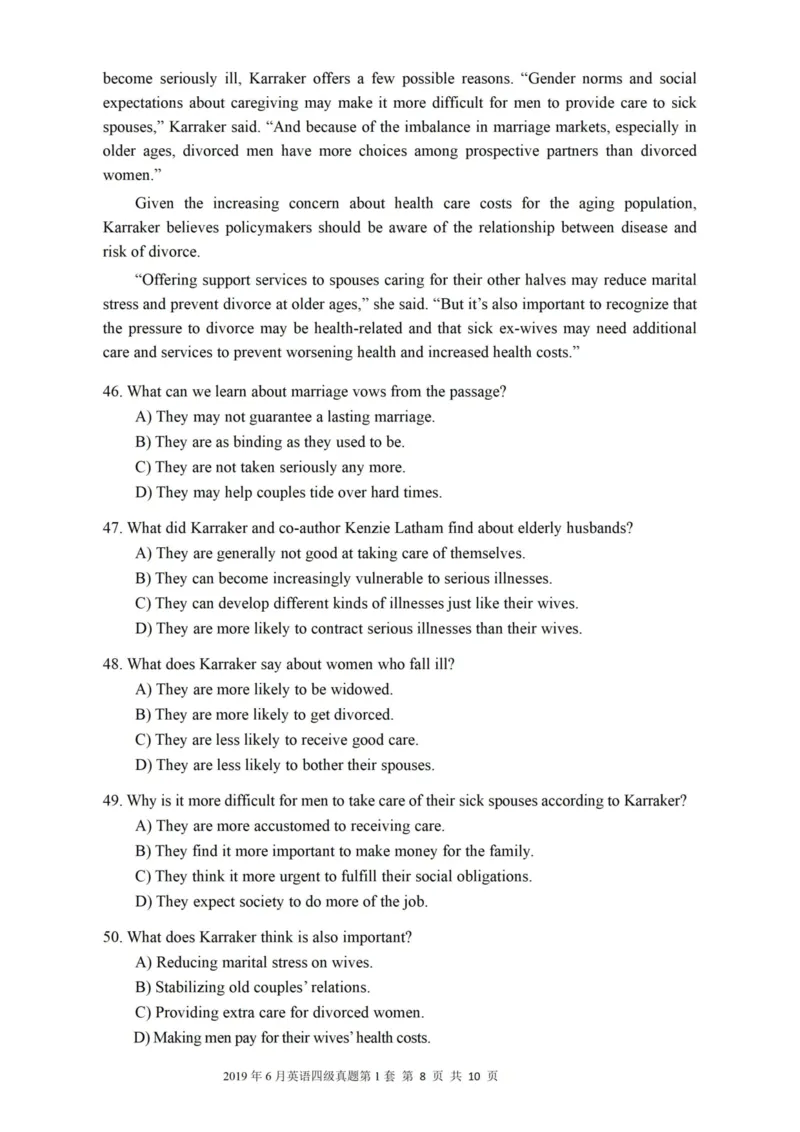
2019年6月英语四级真题第1套 第 7 页 共 10页become seriously ill, Karraker offers a few possible reasons. "Gender norms and social
expectations about caregiving may make it more difficult for men to provide care to sick
spouses,Karraker said. Section B
Section B
Directions;In this section,you will hear two long conversations. At the end of each conversatiom,
Directions: In this section, you will hear two wng conversations. At the end of each conversation,
you will hear four questions. Both the conversation and the questions will be spoken only
you will hear four questions. Both the conversation and the questions will be spoken oruy
omce. After yow hear a questiom,you must choose the best answer from the fowr choices
once. AffR/r you hear a question, you must choose the best answer from the four choices
marked A),B),C) amd D). Then mark the corresponding letter on Answer Sheet 1
marked A) , B) , C) and D). Then mark the corresponding letfR/r on Answer Sheet 1
with a single line through the centre.
with a single line through the centre.
Questions 8 to 1l are based on the conversation you have just heard.
Questions 8 to 11 are based on the conversation you have just heard.
8.8 .AA)I)t Iwt iwllil l bbee pprroodduucecde da tat HHarvarvaarrdd UUninviveerrssiittyyF.. ,CC) )ItI tw willill ccoovveer r ddiiffffeerreenntt arareeaass ooff sscciieennccee..
BB)I)t Itw iwlill l bbee hhoosstteedd bbyy ffamamoouus s pprrooffeessssoorrss.. DD)I)t Iwti wlli llf ofcoucsu so no nr erceecnetn st csiceinetnitifificc ddiissccoovveerriieess..
9.9 .AA)I)t Iwti willll b eb em omroe ref ufututuristiristicc.. CC)I)t Iwt iwilll l bbee mmoroer ee netnetretrtaininainingg..
BB)I)t Itw iwillll bbee mmoorere ssyysstteemmaatiticc.. DD) )ItI tw wiillll bbee eeaassiieerr ttoo uunnddeerrsstantandd..
1100.. AA))P eoPpeloep lien tinetreersetsetde di nin sscciieennccee.. CC)) ChCihlidlrderne ni nin t htheeirir eeaarrllyy tteeeennss..
BB)Y)ouYnogunstgsertse rse aegaegre rt oto e exxpplolorree.. DD) )StSutudednetnsts m amjajoroirinng gi inn sscciieennccee..
1111..A)AO)f fOffer eprr opfroesfessisoinoanlal aaddviviccee.. CC))H eHlpe lppr pomroomteo tiet ito no nt hthe eI Inntteerrnneett..
BB)P)roPrviodveid fei finannancicailal ssuuppppoorrtt.. DD)M)akMea kepei esopdiseosd feosr f oirt sits f ifirsrstt sseeasasoonn..
Questions 12 to 15 are based on the conversation you have just heard.
Questions 12 to 15 are based on the conversation you have just heard.
12.A)Unsure. C)Concerned.
12. A) Unsure. C) Concerned.
B)Helpless. D)Dissatisfied.
B) Helpless. D) Dissatisfied.
1133.. AA))H eH ies ist otoo oc ocnocnecrenrnede dw iwithth b ebienign gp perefrfeecctt.. CC))HeH ies ist otoo oa mambitbiiotiuosu si nin a acchiheievviinngg ggooaallss..
BB)H)e Hleo sloesse sh ehaerartt w whehne nf afcaecde dw wiithth sseettbbaacckkss.. D D ) ) He H t e a k ta es k e o s n o p n r o p j r e o c je ts c ts b e b y e o y n o d n h d i s h is a b a i b l i i li t ty y. .
14. A)Embarrassed. C)Miserable.
14. A) Embarrassed. C) Miserable.
D)Resentful.
BB))UnUcnocnocnecrernneedd.. D) Resentful.
1155..A)A )T rTryy to t ob eb eo potpitimmisisttiicc wwhhaatteevveerr hhaappppeennss.. CC)A)lwAalywsa ysle alerarnn f rfroomm o tohtheresrs'' aacchhiieevveemmeennttss..
BB) )CoCmopmarpear hei sh ipsr pesreesnetn wt iwthith h ihis sp pasast t oonnllyy.. DD) )TYTreaeta to tohtheerrss tthhee wwaayy hhee wwouoluldd b bee ttrreeaatteedd..
Section C
Section C
Directions:In this section, yow will hear three passages. At the end of each passage,you will hear
Directions: In this section, you will hear three passages. At the end of each passage, you will hear
three or fowr questions.Both the passage and the questions will be spoken only once.
three or four questions. Both th!3 passage and the questions will be spoken oruy once.
Afler you hear a questiom,you must choose the best amswer from the four choices manked
After you hear a question, you must choose the best answer from the four choices marked
A),B),C)and D).Then mark the corresponding letter on Answoer Sheet 1 with a
A), B) , C) and D). Then mark the corresponding letfR/r on Answer Sheet 1 with a
single line tharough the centre.
single line through the centre.
Questions 16 to 18 are based on the pas8age you have just heard.
Questions 16 to 18 are based on the passage you have just heard.
1166..A)ATh)e yTh heayv eh aav es tar osntrgoern gseern ssee nosfe osof csioacli alre rsepsponosnibsiibliilittyy..
B)They are more likely to succeed in the humanities.
B) They are more likely to succeed in the humanities.
CC))T hThey eayr ear em omreo reli lkiekleyly ttoo bbeeccoommee eennggiinneeeerrss..
DD) )T hTehye yha hvae vger gearetaerte rp optoetnetnitialal ttoo bbee lleeaaddeerrss..
1177.. AA)P)r aPraiise sgei girrlsl sw whoh ol ilkikee t too ssppeeaakk u upp f frreeqquueennttllyy..
BB)E)ncEonucroaurage ggei rgilsrl st oto s soollvvee pprroobblleemmss oonn tthheeiirr oownwn..
CC))InsInissits tt thhaatt bbooyyss aanndd ggiirrllss wwoorrkk totoggeetthheerr mmoorree..
DD))ReRspeospndo nmdo mreo rpeo spiotsiitivveellyy ttoo bbooyyss' 'ccoommmmeennttss..
1188.. AA)O)f fOffer epr epresrsonoanlaliziezde dt eteaacchhiningg mmataetreiriaallss.. CC)P)laPclea cger greaeta te mepmhpashiass iso no nt etsetst ssccoorreess..
BB)P)roPvriodvei dae vaa vrariieteyty o of f ooppttiioonnaall ccoouursrseess.. DD)P)ayP aeyx terxtraa at atttenetnitioon nt too ttoopp ssttuuddeennttss..
2019.12L2(第1套)
2019. 12 / 2 (ffi 1 �)Questions 19 to 21 are based on the pasage you have just heard.
Questions 19 to 21 are based on the passage you have just heard.
1 1 9 9 . . A A )I ) t I o t f o t ft en e n r rain ains s c c a a t ts s an and d d d o o g g s s . . CC)I)t Itd odeose sn onto tr arainin aass mmuuchc ha sas ppeeooplpele tthinhinkk..
BB)I)tIt s seellddoomm r araiinnss iinn ssummummeerr ttiimmee.. D D ) ) It I t i i s s o o n n e e o o f f t t h h e e m m os o t s t r a rain iny y c c it iti ie e s s i i n n th th e e U US S . .
2200.. AA)T) hThey edyr idvriev em omsot sot fo ft hthee ttimimee.. CC)T)hTeyh ehya vhea vgeo tg out susede dt ot ot hthee rraiainn..
BB)T)heT hrea irain ins isu suusaullalyl yv evreyry l iligghhtt.. DD) )ThThe er ariainn c coommese sm omstolsytl ya ta t nniigghhtt..
21. A)It has a lot of places for entertainment.
21. A) It has a lot of places for entertainment.
B)It has never seen thunder and lightning.
B) It has never seen thunder and lightning.
CC) )ItI t hhaass ffeewwere rc clloouuddyy d adyasy st hthanan a nany yo tohthere rc ocaosatsat.all cciittyy..
DD)I)t Iht ahsas m imlidl dw weaetathhere rb botohth i inn ssuummmmere ra nand di nin wwiinntteerr..
QQueusetsitionosn s2 22 2t too 2255 aarere bbaasseedd oonn tthhee ppaassssaaggee yyoouu hhaavvee jjuusstt hheeaarrdd..
22. A)It occurs when people are doing a repetitive activity.
22. A) It occurs when people are doing a repetitive activity.
BB)I)t Itr eresuslutlsts ffrroomm eexxeretrtinging oonnee''ss mmuusscclleess ccoonnttiinnuuoouussllyy..
C)It happens when people engage in an uncommon activity.
C) It happens when people engage in an uncommon activity.
DD)I)t Itc ocmoems efsr ofrmo mst rsatraininining go onen'es's mmususclceless iinn aann ununuussuuaall wwaayy..
2233.. AA)B)l oBoldo ofdl oflwo wan dan bdo dbyo dheya hte aint cirnecarseeas ien i nt hthe ea fafffeecctteedd aarreeaa..
BB)B)odByo dmyo vmemoevnetms einnts tihne thaef faffecteecdte da rareae ab ebceocmoem dei fdiffificcuulltt..
CC) )ThTehye yb ebgeigni nt too mmakake er erpeapiairsrs iimmmmedeidiaatteellyy..
DD) )TThheye yg rgaradduualalllyy bbeeccoommee ffragragmmeenntteedd..
2 2 4 4 . . A A )A ) b Ab ou o t u t o n on e e w w e e e e k k . . CC))AbAbouotu tt etenn ddaayyss..
B) About two days. D) About four weeks.
B) About two days. D) About four weeks.
25. A)Apply muscle creams. C)Have a hot shower.
25. A) Apply muscle creams. C) Have a hot shower.
B)Drink plenty of water. D) Take pain-killers.
B) Drink plenty of water. D) Take pain-killers.
Part Ⅲ m Reading Comprehension (40 minutes)
Part Reading Comprehension { 40 minutes)
Setion A
Section A
Directions:In this section, there is a passage with ten blanks. You are reqwired to select one wonrd jor
Directions: In this section, there is a passage with ten blanks. You are required to select one word for
each blamk from a list of choices given in a word bamk following the passage. Read the
each blank from a list of choices given in a word bank following the passage. Read the
passage through carefully before makeing your choices. Each choice in the bank is
passage through carefully before making your choices. Each choice in the bank is
identified by a letter. Please mark the corresponding letter for each item om Ansuer
identified by a letter. Please mark the corresponding letter for each item on Answer
Sheet 2 with a single line through the centre. You may mnot use ang of the words in the
Sheet 2 with a single line through the centre. You may not use any of the words in the
bank more than. 0nce.
bank more than once.
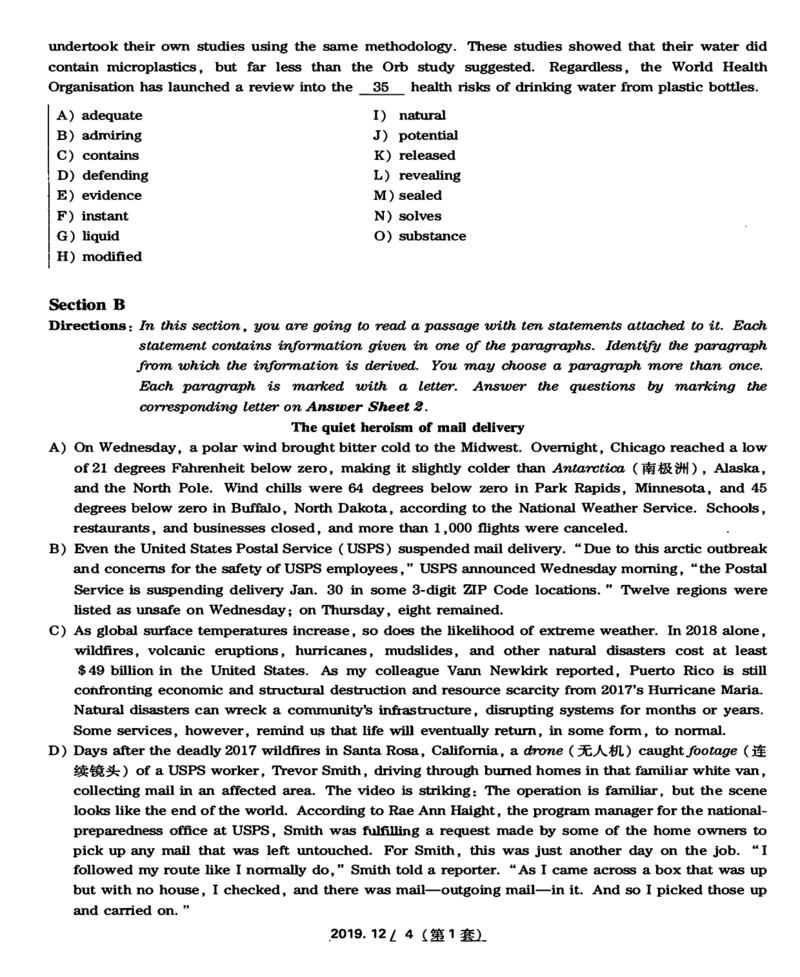
When travelling overseas, do you buy water in plastic bottles or take your chances with tap water?
When travelling overseas, do you buy water in plastic bottles or take your chances with tap water?
Imagine you are wandering about on a Thai island or 26 the ruins of Angkor. It's hot so you grab a
Imagine you are wandering about on a Thai island or� the ruins of Angkor. It's hot so you grab a
botte of water from a local vendor. It's the safe thing to do,right? The bottle is 27, and the label
bottle of water from a local vendor. It's the safe thing to do, ri�t? The bottle is _.%!___, and the label
says"pure water". But maybe what's inside is not so28. Would you still be drinkding it if you knew
says "pure water". But maybe what's inside is not so�- Would you still be drinking it if you knew
that more than 90 percent of all bottled water sold around the world 29 microplastics?
that more than 90 percent of all bottled water sold around the world � microplastics?
That's the conclusion of a recently 30 study, which analysed 259 bottles from 11 brands sold in
That's the conclusion of a recently� study, which analysed 259 bottles from 11 brands sold in
nine countries,31 an average of 325 plastic particles per litre of water. These microplastics
nine countries, ---2,L_ an average of 325 plastic particles per litre of water. These microplastics
included a 32 commonly known as PET and widely used in the manufacture of clothing and food
included a 32 commonly known as PET and widely used in the manufacture of clothing and food
and 33_ containers. The study was conducted at.the State University of New York on behalf of Orb
and 33 containers. The study was conducted at. .the State University of New York on behalf of Orb
Media, a journalism organisation.About a million bottles are bought every minute, not only by thirsty
Media, a journalism organisation. About a million bottles are bought every minute, not only by thirsty
tourists but also by many of the 2.1 billion worldwide who live with unsafe drinking water.
tourists but also by many of the 2.1 billion worldwide who live with unsafe drinking water.
Confronted with this 34,several bottled-water manufacturers including Nestle and Coca-Cola
Confronted with this �, several bottled-water manufacturers including Nestle and Coca-Cola
2019.12L3(第1套)。
2019. 12 / 3 ( ffi 1 $,:)undertook their own studies using the same methodology. These studies showed that their water did
undertook their own studies using the same methodology. These studies showed that their water did
contain microplastics, but far less than the Orb study suggested.Regardless, the World Health
contain microplastics, but far less than the Orb study suggested. Regardless , the World Health
Organisation has launched a review into the 35 health risks of drinkding water from plastic bottles.
Organisation has launched a review into the � health risks of drinking water from plastic bottles.
A) adequate I)natural
A) adequate I) natural
B)adimiring J)potential
B) admiring J) potential
C)Contains K) released
C) contains K) released
D) defending L) revealing
D) defending L) revealing
E)evidence M) sealed
E) evidence M) sealed
F) instant N) solves
F) instant N) solves
G) liquid O) substance
G) liquid 0) substance
H)modified
H) modified
Section B
Section B
Directions:In this section, you are going to read a passage with ten statements attached to it.Each
Directions: In this section, you are going to read a passage with ten stat,ements attached to it. Each
statement contains information given in one of the paragraphs,Identifu the paraaraph
statement contains information given in one of the paragraphs. Identify the paragraph
from which the information is derived. Yow may choose a paragroph more than once.
from which the information is derived. You may choose a paragraph more than once.
Each paragraph is marked with a letter. Answer the questions by marking the
Each paragraph is marked with a letter. Answer the questions by marking the
corresponding letter on Anster Sheet 2.
corresponding letter on Answer Sheet 2.
The quiet heroism of mail delivery
The quiet heroism of mail delivery
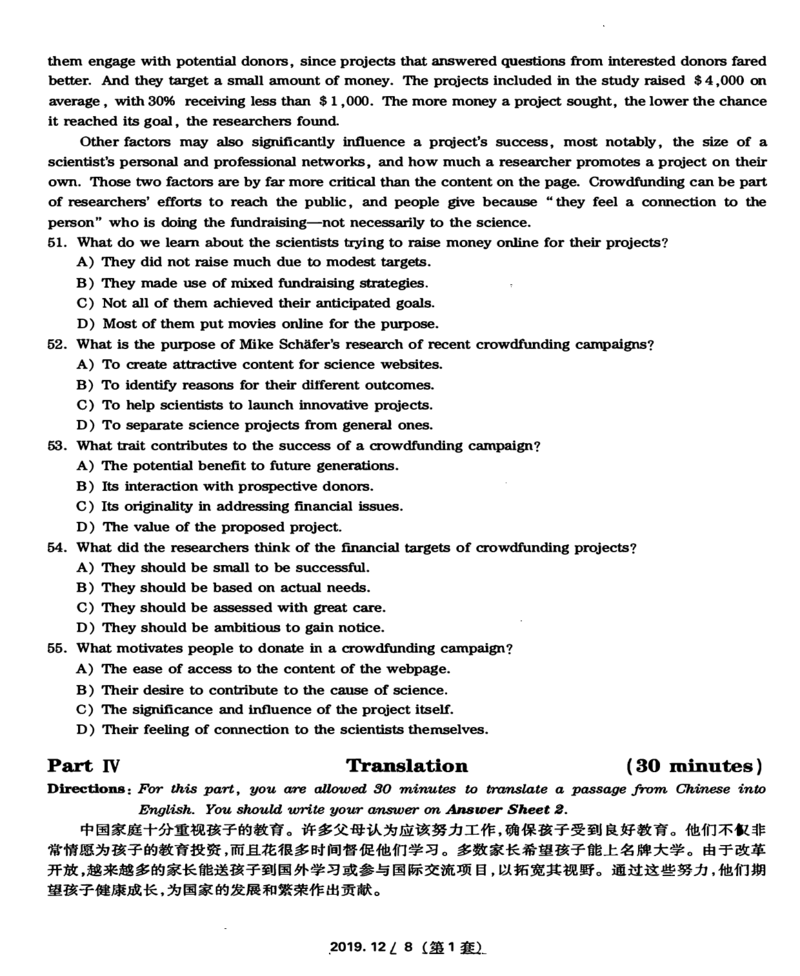
A)On Wednesday, a polar wind brought bitter cold to the Midwest. Overnight, Chicago reached a low
A) On Wednesday, a polar wind brought bitter cold to the Midwest. Overnight, Chicago reached a low
oof f 2211 ddeeggrreeeess FFahahrernehnehieti t bbeleolow wz ezreor,o,m amkiankig nigt ist lsilgighthltlyy ccoollddeerr tthhaann A A nt n o t r a c r e c t ti i c c a a ( ( 南m极tlH}洲)H), , AAllaasskkaa,,
and the North Pole. Wind chills were 64 degrees below zero in Park Rapids, Minnesota,and 45
and the North Pole. Wind chills were 64 degrees below zero in Park Rapids, Minnesota, and 45
degrees below zero in Buffalo, North Dakota, according to the National Weather Service. Schools,
degrees below zero in Buffalo, North Dakota, according to the National Weather Service. Schools,
restaurants, and businesses closed, and more than 1,000 flights were canceled.
restaurants, and businesses closed, and more than 1 , 000 flights were cancele d.
B)Even the United States Postal Service(USPS)suspended mail delivery."Due to this arctic outbreak
B) Even the United States Postal Service (USPS) suspended mail delivery. "Due to this arctic outbreak
and concerns for the safety of USPS employees,"USPS announced Wednesday morning,"the Postal
and concerns for the safety of USPS employees," USPS announced Wednesday morning, "the Postal
Service is suspending delivery Jan.30 in some 3-digit ZIP Code locations."Twelve regions were
Service is suspending delivery Jan. 30 in some 3-digit ZIP Code locations." Twelve regions were
listed as unsafe on Wednesday; on Thursday, eight remained.
listed as unsafe on Wednesday; on Thursday, eight remained.
C) As global surface temperatures increase,so does the likelihood of extreme weather. In 2018 alone,
C) As global surface temperatures increase, so does the likelihood of extreme weather. In 2018 alone,
wildfires, volcanic eruptions,hurricanes,mudslides,and other natural disasters cost at least
wildfires, volcanic eruptions, hurricanes, mudslides, and other natural disasters cost at least
$49 billion in the United States. As my colleague Vann Newkirk reported,Puerto Rico is still
$ 49 billion in the United States. As my colleague Vann Newkirk reported, Puerto Rico is still
confronting economic and structural destruction and resource scarcity from 2017's Hurricane Maria.
confronting economic and structural destruction and resource scarcity from 2017's Hurricane Maria.
Natural disasters can wreck a community's infrastructure, disrupting systems for months or years.
Natural disasters can wreck a community's infrastructure, disrupting systems for months or years.
Some services, however,remind us that life will eventually return, in some form,to normal.
Some services, however, remind U$ that life will eventually return, in some form, to normal.
DD))DaDyasy sa fafttere rt hthee d deaedaldyl y2 200171 7w wiildldfifirreess iinn SSananttaa RRoossaa,, CCaaliliffoornirniaa,, a ad rodrnoen e(( -JG无A.人ffl.机)) ccaauugghhtt ffooootagtagee (( �连
续�镜,m头�))o fo fa a UUSPSSP Sw owrkoerkr,er, TTrerevvoor r SSmmitihth,, ddririvviinngg tthhrroouugghh bburnumeedd h hoomemse si ni nt thhaatt ffamiliamiliarar w whhiittee v anva,n
collecting mail in an affected area. The video is striking: The operation is familiar, but the scene
collecting mail in an affected area. The video is striking: The operation is familiar, but the scene
lools like the end of the world. According to Rae Ann Haight, the program manager for the national-
looks like the end of the world. According to Rae Ann Haight, the program manager for the national
preparedness office at USPS, Smith was fulfiing a request made by some of the home owners to
preparedness office at USPS, Smith was fulfilling a request made by some of the home owners to
pick up any mail that was left untouched. For Smith, this was just another day on the job."I
pick up any mail that was left untouched. For Smith, this was just another day on the job. " I
followed my route like I normally do,"Smith told a reporter."As I came across a box that was up
followed my route like I normally do," Smith told a reporter. "As I came across a box that was up
but with no house,I checked, and there was mail—outgoing mail—in it. And so I picked those up
but with no house, I checked, and there was mail-outgoing mail-in it. And so I picked those up
and carried on."
and carried on. "
2019.12L4(c第m1 套)
201s. 12; 4 1 lUE)USPS has sophisticated emergency plans for natural disasters. Across the country,285 emergency-
E) USPS has sophisticated emergency plans for natural disasters. Across the country, 285 emergency
management teams are devoted to crisis control. These teams are trained annually using a
management teams are devoted to crisis control. These teams are trained annually using a
framework known as the three Ps: people, property, product. After mail service stops due to
framework known as the three Ps: people, property, product. After mail service stops due to
weather, the agency's top priority is ensuring that employees are safe. Then it evaluates the health
weather, the agency's top priority is ensuring that employees are safe. Then it evaluates the health
of infrastructure, such as the roads that mail carriers drive on. Finally, it decides when and how to
of infrastructure, such as the roads that mail carriers drive on. Finally, it decides when and how to
re-open operations. If the destruction is extreme, mail addressed to the area will get sent
re-open operations. If the destruction is extreme, mail addressed to the area will get sent
elsewhere.In response to Hurricane Katrina in 2005, USPS redirected incoming New Orleans mail to
elsewhere. In response to HUITicane Katrina in 2005, USPS redirected incoming New Orleans mail to
existing mail facilities in Houston. Mail that was already processed in New Orleans facilities was
existing mail facilities in Houston. Mail that was already processed in New Orleans facilities was
moved to an upper floor so it would be protected from water damage.
moved to an upper floor so it would be protected from water damage.
FF))AsA ss osoono ans asit i'ts's ssaaffee eennoouugghh t too bbee o ouutstsiiddee,, ccoouwrriiererss (( df邮�递:ii员.vi)) ssttartart didisstritrbiubutitnign ga caccucmumululaatteedd mmaailil oonn
the still-accessible routes. USPS urges those without standing addresses to file change-of-address
the still-accessible routes. USPS urges those without standing addresses to file change-of-address
forms with their new location. After Hurricane Katrina hit in 2005, mail facilities were set up in
forms with their new location. After HUITicane Katrina hit in 2005 , mail facilities were set up in
dozens of locations across the country in the two weeks that USPS was unable to provide street
dozens of locations across the country in the two weeks that USPS was unable to provide street
delivery.
delivery.
G)Every day,USPS processes, on average,493.4 million pieces of mail—anything from postcards to
G) Every day, USPS processes, on average, 493. 4 million pieces of mail-anything from postcards to
Social Security checks to medicine. Spokespeople from both USPS and UPS told me all mail is
Social Security checks to medicine. Spokespeople from both USPS and UPS told me all mail is
important. But some mail can be extremely sensitive and timely. According to data released in
important. But some mail can be extremely sensitive and timely. According to data released in
January 2017,56 percent of bills are paid online, which means that just under half of payments still
January 2017, 56 percent of bills are paid online, which means that just under half of payments still
rely on delivery services to be completed.
rely on delivery services to be completed.
H)It can be hard to identify which parcels are carrying crucial items such as Social Security checks,but
H) It can be hard to identify which parcels are carrying crucial items such as Social Security checks, but
USPS and UPS try their best to prioritize sensitive material. They will coordinate with the Social
USPS and UPS try their best to prioritize sensitive material. They will coordinate with the Social
Security Administration to make sure that Social Security checks reach the right people in a timely
Security Administration to make sure that Social Security checks reach the right people in a timely
fashion. After Hurricane Florence and Hurricane Michael last fall, USPS worked with state and local
fashion. After HUITicane Florence and HUITicane Michael last fall, USPS worked with state and local
election boards to make sure that absentee ballots were available and received on time.
election boards to make sure that absentee ballots were available and received on time.
I) Mail companies are logistics(物流)companies,which puts them in a special position to help when
I) Mail companies are logistics ( �vft) companies, which puts them in a special position to help when
disaster strikes. In a 201l USPS case study, the agency emphasized its massive infrastructure as a
disaster strikes. In a 2011 USPS case study, the agency emphasized its massive infrastructure as a
"unique federal asset"to be called upon in a disaster or terrorist attack."I think we're unique as a
"unique federal asset" to be called upon in a disaster or terrorist attack. "I think we're unique as a
federal agency,"USPS official Mike Swigart told me,"because we're in literally every community in
federal agency," USPS official Mike Swigart told me, "because we're in literally every community in
this country...We're obligated to deliver to that point on a daily basis."
this country ... We're obligated to deliver to that point on a daily basis. "
JJ)) PrPriivavatet ec ocuoruiriere rc ocmopmanpianesi,e sw,h iwchh ichhav hea mvoer me odorel ldaorsll arsto tsop esnpde,n uds,e utshee ithr eeirx peexprteirstie sien i nl ologigsisttiiccss ttoo hheellpp
revitalize damaged areas after a disaster. For more than a decade, FedEx has supported the
revitalize damaged areas after a disaster. For more than a decade, FedEx has supported the
American Red Cross in its effort to get emergency supplies to areas affected by disasters,both
American Red Cross in its effort to get emergency supplies to areas affected by disasters, both
domestically and internationally. In 2012, the company distributed more than 1,200 MedPacks to
domestically and internationally. In 2012 , the company distributed more than 1 , 200 MedPacks to
Medical Reserve Corps groups in California. They also donated space for 3.1 million pounds of
Medical ReseIVe Corps groups in California. They also donated space for 3. 1 million pounds of
charitable shipping globally. Last October, the company pledged $1 million in cash and
charitable shipping globally. Last October, the company pledged $ 1 million in cash and
transportation support for Hurricanes Florence and Michael. UPS's charitable arm,the UPS
transportation support for HUITicanes Florence and Michael. UPS's charitable ann, the UPS
Foundation, uses the company's logistics to help disaster-struck areas rebuild."We realize that as a
Foundation, uses the company's logistics to help disaster-struck areas rebuild. "We realize that as a
company with people, trucks, warehouses, we needed to play a larger role," said Eduardo
company with people, trucks, warehouses, we needed to play a larger role," said Eduardo
Martinez, the president of the UPS Foundation. The company employs its trucks and planes to
Martinez, the president of the UPS Foundation. The company employs its trucks and planes to
deliver food, medicine, and water. The day before I spoke to Martinez in November, he had been
deliver food, medicine, and water. The day bef<>re I spoke to Martinez in November, he had been
touring the damage from Huricane Michael in Florida with the American Red Cross."We have an
touring the damage from HUITicane Michael in Florida with the American Red Cross. "We have an
obligation to make sure our communities are thriving,"he said.
obligation to make sure our communities are thriving, " he said.
KK))ReRbueibludiildnign gc acnan t atakek ea al olonng gt itimme,e ,a nand de veevne nt hthene,ni,m pirmepssreisosniso nosf otfh eth dei sdaissastetre r mamya ys tsitillll rreemmaaiinn..
Returming to a normal life can be dificult, but some small routines—mail delivery being one of
Returning to a normal life can be difficult, but some small routines-mail delivery being one of
2019.12L5(第1套)。
2019. 12 / 5 (ffi 1 I;)them—may help residents remember that their communities are still their communities."When they
them-may help residents remember that their communities are still their communities. "When they
see that carrier back out on the street,"Swigart said,"that's the first sign to them that life is
see that carrier back out on the street, " Swigart said, "that's the first sign to them that life is
starting to return to normal."
starting to return to normal. "
36. The United States Postal Service has a system to ensure its employees'safety.
36. The United States Postal Service has a system to ensure its employees' safety.
37.One official says USPS is unique in that it has more direct reach to communities compared with
37. One official says USPS is unique in that it has more direct reach to communities compared with
other federal agencies.
other federal agencies.
38. Natural disasters can have a long-lasting impact on community life.
38. Natural disasters can have a long-lasting impact on community life.
39. Mail delivery service is still responsible for the completion of almost half of payments.
39. Mail delivery service is still responsible for the completion of almost half of payments.
40.The sight of a mailman on the street is a reassuring sign of life becoming normal again.
40. The sight of a mailman on the street is a reassuring sign of life becoming normal again.
41. After Hurricane Katrina interrupted routine delivery, temporary mail service points were set up.
41. After Hurricane Katrina interrupted routine delivery, temporary mail service points were set up.
42. Postal service in some regions in the U.S. was suspended due to extreme cold weather.
42. Postal service in some regions in the U.S. was suspended due to extreme cold weather.
43. Private postal companies also support disaster relief efforts by distributing urgent supplies.
43. Private postal companies also support disaster relief efforts by distributing urgent supplies.
44.A dedicated USPS employee was on the job carrying out duties in spite of extreme conditions.
44. A dedicated USPS �mployee was on the job carrying out duties in spite of extreme conditions.
45.Postal services work hard to identify items that require priority treatment.
45. Postal services work hard to identify items that require priority treatment.
Section C
Section C
Directions:There are 2 passages in this section.Each passage is followed by some questions or
Directions: There are 2 passages in this section. Each passage is followed by some questions or
wunnfgfiinnisishheded sstattaementementst.s .F oFro re aecahc ohf othemf th etherem th earree faorue r fcohwori ccesho micaerkeds ma rAk)e,d BA)),,B )C,)C )aanndd
DD).) .Y o
Y
u
o u
s h
s
o
h
u
o
l
u
d
ld
d edecicidede o n
o n
t h
t
e
h e
b e
b
s
es
t
t
c
c
h
h
o
o
i
i
c
c
e
e a
am
n
n
d
d
ma
mar
r
k
k
tthehe
c
c
o
o
rr
rrespesp
o
o
n
n
d
d
i
ingng
l
l
e
e
tt
t
er
te r
o n
o n
A ns
Ans
w
w
e
e
r
r
Sheet 2 with a single line tharough the centre.
Sheet 2 with a single line through the centre.
Pa88age One
Passage One
Questions 46 to 50 are based on the following pas8age.
Questions 46 to 50 are based on the following passage.
Professor Ashok Goel of Georgia Tech developed an artificially intelligent teaching assistant to help
Professor Ashok Goel of Georgia Tech developed an artificially intelligent teaching assistant to help
handle the enormous number of student questions in the online class, Knowledge-Based Artificial
handle the enormous number of student questions in the online class, Knowledge-Based .Artificial
Intelligence. This online course is a core requirement of Georgia Tech's online Master of Science in
Intelligence. This online course is a core requirement of Georgia Tech's online Master of Science in
Computer Science program. Professor Goel already had eight teaching assistants,but that wasn't
Computer Science program. Professor Goel already had eight teaching assistants, but that wasn't
enough to deal with the overwhelming number of daily questions from students.
enough to deal with the overwhelming number of daily questions from students.
Many students drop out of online courses because of the lack of teaching support. When students
Many students drop out of online courses because of the lack of teaching support. When students
feel isolated or confused and reach out with questions that go unanswered, their motivation to continue
feel isolated or confused and reach out with questions that go unanswered, their motivation to continue
begins to fade. Professor Goel decided to do something to remedy this situation and his solution was to
begins to fade. Professor Goel decided to do something to remedy this situation and his solution was to
create a viroual assistant named Jill Watson, which is based on the IBM Watson platform.
create a virtual assistant named Jill Watson, which is based on the IBM Watson platform.
Goel and his team developed several versions of Jill Watson before releasing her to the online
Goel and his team developed several versions of Jill Watson before releasing her to the online
forumns.At first,the virtual assistant wasn't too great.But Goel and his team sourced the online
forums. At first, the virtual assistant wasn't too great. But Goel and his team sourced the online
discussion forum to find all the 40,000 questions that had ever been asked since the class was launched.
discussion forum to find all the 40,000 questions that had ever been asked since the class was launched.
TThhene nt htheeyy bbegeagnan t oto f efeede dJ iJlilll wwiitthh tthhee qquueessttiioonnss anandd answansweerrss.. AAftefterr ssoommee aac\jdjuussttmmenetnsts aannd ds usfuffificciieenntt
time, Jill was able to answer the students'questions correctly 97of the time. The virtual assistant
time, Jill was able to answer the students' questions correctly 97% of the time. The virtual assistant
became so advanced and realistic that the students didn't know she was a computer. The students.who
became so advanced and realistic that the students didn't know she was a computer. The students, who
were studying artificial intelligence, were interacting with the virtual assistant and couldn't tell it apart
were studying artificial intelligence, were interacting with the virtual assistant and couldn't tell it apart
from a real human being. Goel didn't inform them about Jill's true identity until April 26. The students
from a real human being. Goel didn't inform them about Jill's true identity until April 26. The students
were actually very positive about the experience.
were actually very positive about the experience.
The goal of Professor Goel's virtual assistant next year is to take over answering 40of all the
The goal of Professor Goel's virtual assistant next year is to take over answering 40% of all the
questions posed by.students on the online forum. The name Jill Watson will, of course,change to
questions posed by . students on the online forum. The name Jill Watson will, of course, change to
something else next semester. Professor Goel has a much rosier outlook on the future of artificial
something else next semester. Professor Goel has a much rosier outlook on the future of artificial
2019.12/6(第1套)
2019. 12 / 6 ( ffi 1 it)intelligence than,say,Elon Musk,Stephen Hawking,Bill Gates or Steve Wozniak
intelligence than, say, Elon Musk, Stephen Hawking, Bill Gates or Steve Wozniak.
46. What do we learn about Knowledge-Based Artificial Intelligence?
46. What do we learn about Knowledge-Based Artificial Intelligence?
AA)I)t Iit si sa a rroobboot t tthhaatt ccaann ansanswweerr ssttuuddeennttss'' qquueessttiioonnss..
BB)I)t Iit si sa ac ocuorursse ed edseisgingnede df ofor rs tsutuddenetnsts t too lleeaarnrn oonnlliinnee..
C) It is a high-tech device that revolutionizes teaching.
C) It is a high-tech device that revolutionizes teaching.
D)It is a computer program that aids student learning.
D) It is a computer program that aids student learning.
47. What problem did Professor Goel meet with?
47. What problem did Professor Goel meet with?
AA)H)isH isst usdtuendtesn tswe wree reun suantsiastifsifiede dw iwithth t hthe ea assssiissttananttss..
BB)H)isHi cso ucrosurse wea sw astoo t odoi fdiffificuclutl tf foorr tthhee ssttuuddeennttss..
CC) )StSutudednetnsts''q uqeusestitioonnss wweerree ttoooo mmaannyy ttoo hhaannddllee..
DD)T)oTo omoa nmyan styu sdteundtesn tsdr doproppepd eodu ot uot fo fh ihsis ccoouurrssee..
48. What do we learn about Jill Watson?
48. What do we learn about Jill Watson?
AA))ShSe hteu turnred eodu to utto tob eb ea ag rgereaat t ssuucccceessss..
BB)S)heS hgeo tg oatl oalnogn pgr petrettyty w ewlell l wwitihth ssttuuddeennttss..
CC)) ShSeh ew awsas u nunwewlceolcmoe mteo tsot ustudednetns tsa ta tf firsistt..
DD) )ShSeh ew awsas r erleelaesasede do onlnilinnee aass aann eexxppeerriimmeenntt..
49. How did the students feel about Jill Watson?
49. How did the students feel about Jill Watson?
AA) )ThTehye tyh thouoghutgh sth es hwea sw aa sb ai tb tito oto aor tartifiificciiaall..
BB) )ThTehye yf ofounund dh ehre rn onto ta ass ccaappaabblele aass eexxppeecctteedd..
CC))ThTeyh ecyo cuoldu ldn onto tb ubtu t aaddmirmiree hheerr kknnoowwlleeddggee..
DD) )ThTehye yco cuoldu ldno nt otte tlelll hheerr ffrroomm a a rreeaall ppeerrssoonn..
50. What does Professor Goel plan to do next with Jill Watson?
50. What does Professor Goel plan to do next with Jill Watson?
AA)L)auLancunh dcihf difffereenret nvt evresrsioinosn so fo fh heer r oonnlliinnee..
B) Feed her with new questions and answers.
B) Feed her with new questions and answers.
CC)A)ssAsigsni ghne hr etr ot oa nanswsewre rm omroe reo fo fs tsutuddenetnsts''q quuesetstiioonnss..
DD)E)ncEonucroagurae sgteu sdteundtesn ttso tion tinetrearactc tw witihth h here r mmoroere f rfreeeellyy..
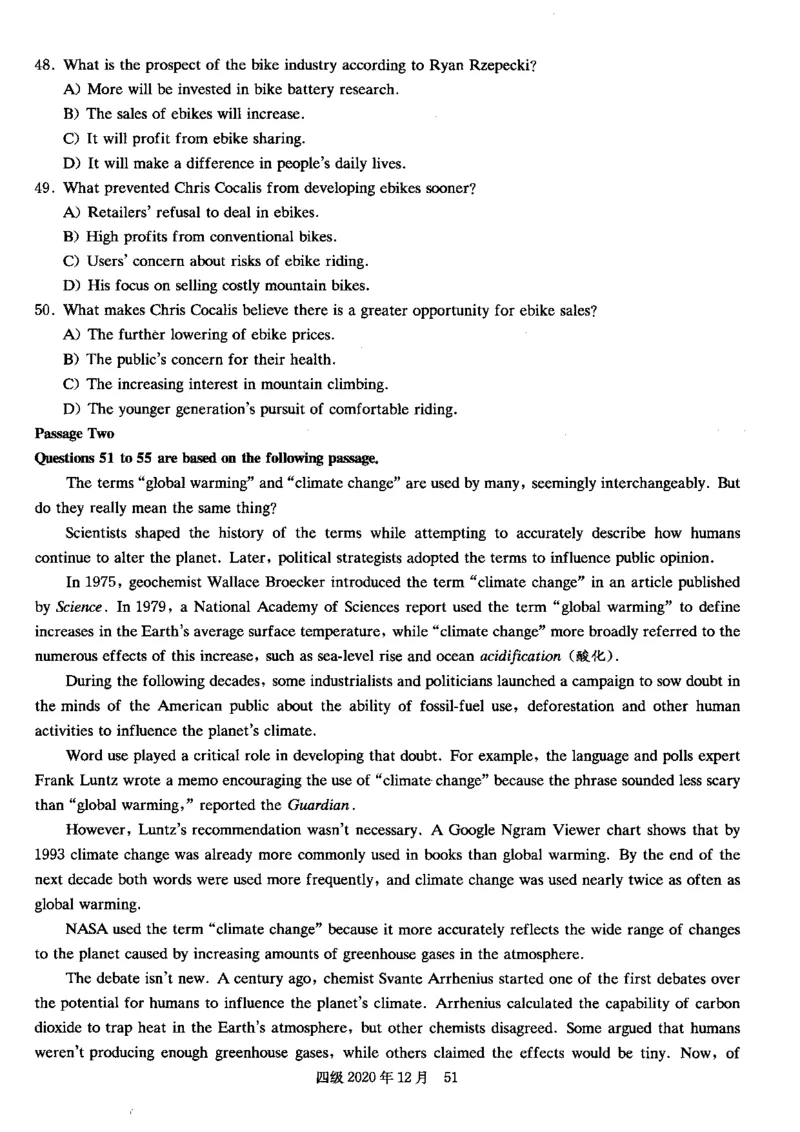
Passage Two
Passage Two
Questions 51 to 55 are based on the following pas8age.
Questions 51 to 55 are based on the following passage.
Thinking small, being engaging, and having a sense of humor don't hurt. Those are a few of the
Thinking small, being engaging, and having a sense of humor don't hurt. Those are a few of the
traits of successful science crowdfunding efforts that emerge from a recent study that examined nearly
traits of successful science crowdfunding efforts that emerge from a recent study that examined nearly
400 campaigns. But having a large network and some promotional skills may be more crucial.
400 campaigns. But having a large network and some promotional skills may be more crucial.
Crowdfunding, raising money for a project through online appeals, has taken off in recent years for
Crowdfunding, raising money for a project through online appeals , has taken off in recent years for
everything from making movies to producing water-saving gadgets. Scientists have tried to tap Intemet
everything from mald.ng movies to producing water-saving gadgets. Scientists have tried to tap Internet
donors, too, with mixed success. Some raised more than twice their goals, but others have fallen short
donors , too , with mixed success. Some raised more than twice their goals , but others have fallen short
of reaching even modest targets.
of reaching even modest targets.
To determine what separates science crowdfunding triumphs from failures, a team led by science
To determine what separates science crowdfunding triumphs from failures, a team led by science
communications scholar Mike Sch?fer of the University of Zurich examined the content of the webpages
communications scholar Mike Schafer of the University of Zurich examined the content of the webpages
for 371 recent campaigns.
for 371 recent campaigns.
Four traits stood out for those that achieved their goals,the researchers report in Pwblic
Four traits stood out for those that achieved their goals, the researchers report in Public
Understanding of Seience. For one, they use a crowdfunding platform that specializes in raising money
Understanding of Science. For one, they use a crowdfunding platform that specializes in raising money
for science, and not just any kaind of project. Although sites like Kickstarter take all comers, platforms
for science, and not just any kind of project. Although sites like Kickstarter take all comers, platforms
such as Experiment.com and Petridish.org only present scientific projects. For another, they present
such as Experiment. corn and Petridish. org only present scientific projects. For another, they present
the project with a funny video because good visuals and a sense of humor improved success. Most of
the project with a funny video because good visuals and a sense of humor improved success. Most of
2019.127(第1套).
2019. 12 / 7 ( ffl 1 ¥}them engage with potential donors, since projects that answered questions from interested donors fared
them engage with potential donors, since projects that answered questions from interested donors fared
better.And they target a small amount of money. The projects included in the study raised $4,000 on
better. And they target a small amount of money. The projects included in the study raised $4,000 on
average, with 30receiving less than $1,000. The more money a project sought, the lower the chance
average , with 30% receiving less than $1 , 000. The more money a project sought, the lower the chance
it reached its goal, the researchers found.
it reached its goal, the researchers found.
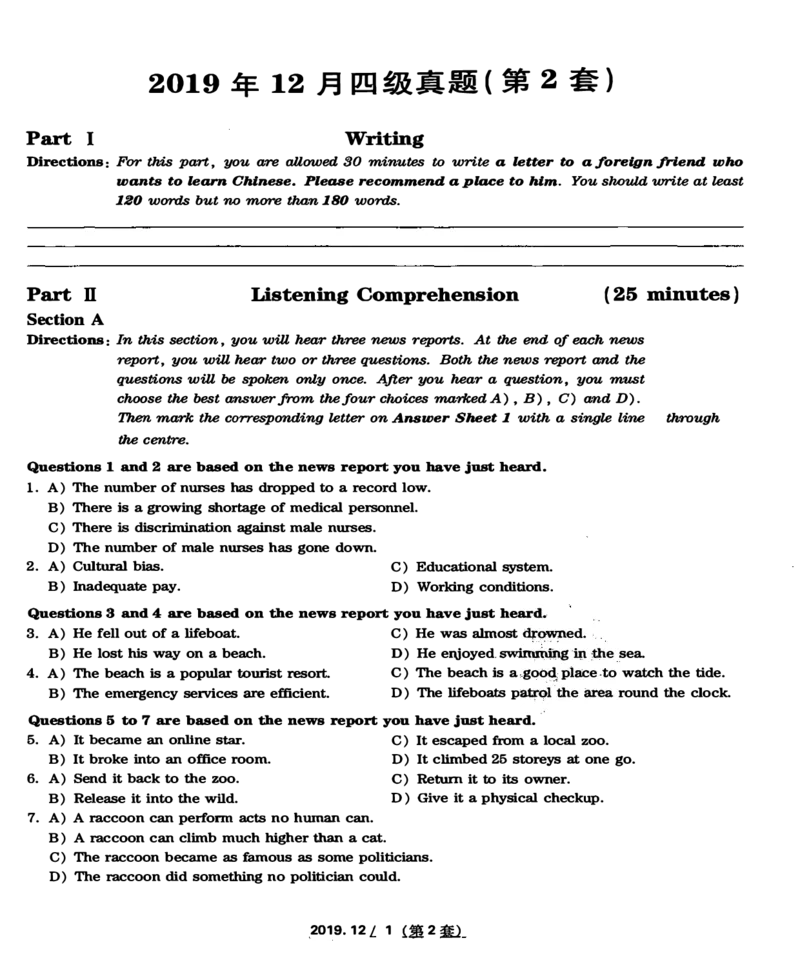
OOththere r ffaaccttoorrss mmaya ya lalssoo sisgignifinificcaanntltlyy inflinfuleunecnec ea a pprorojejcetc'st 'ssu scuccecsess,s ,m moosst tn nootatabblyl,y ,ththee sizsizee ooff aa
scientist's personal and professional networks, and how much a researcher promotes a project on their
scientist's personal and professional networks, and how much a researcher promotes a project on their
own. Those two factors are by far more critical than the content on the page. Crowdfunding can be part
own. Those two factors are by far more critical than the content on the page. Crowdfunding can be part
of researchers'efforts to reach the public, and people give because"they feel a connection to the
of researchers' efforts to reach the public, and people give because " they feel a connection to the
person"who is doing the fundraising—not necessarily to the science.
person" who is doing the fundraising-not necessarily to the science.
51. What do we learn about the scientists trying to raise money online for their projects?
51. What do we learn about the scientists trying to raise money online for their projects?
AA)T)heThy edyi dd idno nto rt araiissee mmucuhc hd udeu et oto m modoedsets tt atarrggeettss..
B) They made use of mixed fundraising strategies.
B) They made use of mixed fundraising strategies.
CC)N)otN oalt lal ol fo ft htheme mac ahicehvieevd etdh ethire ira nantitcicipipaatteedd ggooaallss..
DD)M)osMto ostf otfh tehme mpu tp umto mvioevsi eosn olinlnien ef oforr tthhee ppuurprpoossee..
52. What is the purpose of Mike Sch?fer's research of recent crowdfunding campaigns?
52. What is the purpose of Mike Schafer's research of recent crowdfunding campaigns?
AA)T)o Tcor ecarteea taet tarttracactitivve ec coontnetnetn tf foorr sscciieennccee wweebbsisitteess..
BB)T)o Tiod eindteinftyify r eraesasonosns f ofro rt thheeiirr ddiffiffeerreenntt o ouutctcoommeess..
C) To help scientists to launch innovative projects.
C) To help scientists to launch innovative projects.
DD) )ToT os espeapraraatet es csiceiennccee p prroojjeeccttss ffrroomm ggeenneerralal oonneess..
53. What trait contributes to the success of a crowdfunding campaign?
53. What trait contributes to the success of a crowdfunding campaign?
AA)T)heTh peo tpeontteinalti albe bneefnietfi tt oto f fuuttuurree ggeenneerratiatioonnss..
BB)I)tsIts i nitneterraaccttiioonn wwiitthh pprroossppeeccttiivvee ddoonnoorrss..
CC)I)tsI tsor oigriiginanlalitiyty i inn aaddddreresssisningg f fininaanncciiaall iissssuueess..
DD) )ThTeh ev avlalueu eo fo f tthhee pprrooppoosseedd p prorojjeecctt..
54. What did the researchers think of the financial targets of crowdfunding projects?
54. What did the researchers think of the financial targets of crowdfunding projects?
AA) )ThTheye ys hsohuoludl db eb es msmalal tl ot ob eb es usucccecsesssffuull..
B) They should be based on actual needs.
B) They should be based on actual needs.
CC) )ThTheye ys hsohuoludl db eb ea sassessessesde dw iwtihth g grereaatt ccaarere..
DD)) TThheye ys hsohuoludl db eb ea mambitbiitiouosus t oto g gaaiinn nnoottiiccee..
55. What motivates people to donate in a crowdfunding campaign?
55. What motivates people to donate in a crowdfunding campaign?
AA)T)heTh eea seeas oef oaf caccecsesss t oto t thhee ccoonntteenntt ooff ththee wweebbppaaggee..
BB)T)heThire idre sdierseir et ot oc ocnotnrtriibbutuete t too tthhee ccaauussee ooff sscciieennccee..
CC)T)heT hseig sniignifificacnance caen dan idn finfllueunceen coef otfh eth per pojreocjetc it tistseelflf..
DD) )ThTheier irf efeeleilinngg ooff ccoonnnnecetcitioonn t too tthhee sscciieennttisiststs ththeemsmseellvveess..
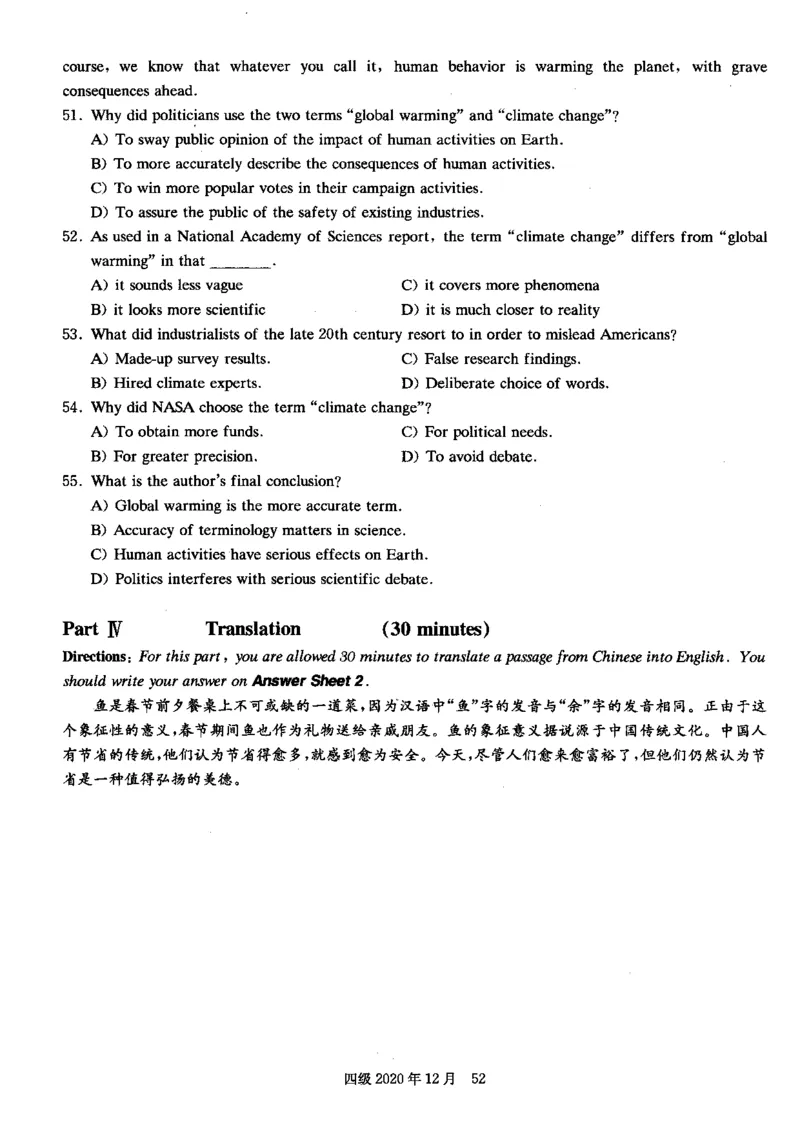
Part IV
Translation
Part IV Translation (( 3300 minminuutteess))
Directions:For this part,you are allowed 30 minutes to translate a passage from Chinese into
Directions: For this part, you are aJJ,owed 30 minutes to translate a passage from Chinese into
English. You should write yoaur answer on Answer Sheet 2.
English. You should write your answer on Answer Sheet 2.
中i:r国 家庭十分重视孩子的教育。许ilf多$父jt母-BJ:认iA为'1应M该�努�力JJ工 作r1:,, ?ifi确t保tH孩�r子�受JJ到J 1良�f好lt教ff育 。f他mf们11�不-0仅u非�
�aig+f.)-mma-=rtmaff o r J o
常情愿为孩子的教育投资,而且花很多时间督促他们学习。多数家长希望孩子能上名牌大学。由于改革
SfflS'1a-=f�a•aW,WH�-$��-�-m��o$�2*•ma-=rn���*�o���-
开3f放:!t,,�越*来•越$多�的2家*长fm能�送a孩-=f子JJ到Jm1国�外��学习�或�参�与�国�际�交3t流ffi:项JJi目 13,, 以V.H拓.f.ii:宽其;lt视t'R,野lf。 通ii过:M:这i!些@努�力JJ, ,f他t!!f们l1期M
*, o
望孩子健康成长,为,i国m1 家 �的 �发 1t展Ri和 ;ffi繁 �荣5i'H作1:出 m贡m:献�。
ma-=r••.mt o
2019.12/8a( c第m1 套)
2019. 12 / 1 JU2019年 12月四级真题(第 2套)
im�•a ( ffl 2
2019 � 12 � ft)
Writing
Part I
Part I Writing
Directions: For this part,you are allowed 30 minates to write a letter to a foreign friend who
Directions: For this part, you are allowed 30 minutes to write a letter to a foreign frl,end who
wants to learn Chinese. Please recommend a place to him. You should write at least
wants to learn Chinese. Please recommend a place to him. You should write at least
120 words but mno more than 180 words.
120 words but no more th.an 180 words.
Part Ⅱ Listening Comprehension (25 minutes)
Part Il Listening Comprehension ( 25 minutes)
Section A
Section A
Directions:In this section,you will hear three mews reports.At the end of each newus
Directions: In this section, you will hear three news reports. At the end of each news
report, you will hear two or three questons. Both the news report and the
report, you will hear two or three questions. Both the news report and the
questions will be spoken only once. After you hear a question, you must
questions will be spoken only once. After you hear a question, you must
cchhoooossee tthehe bbesest ta nsamwswerer fro frmo mt heth feo ufro ucrho cihcesoi cmesa rmkaedmk Ae)d ,A B),)B ,) ,CC)) aamnndd DD))..
Then mark the corresponding letter on Answer Sheet I with a single line through
Then mark the corresponding letter on Answer Sheet 1 with a single line through
the centre.
the centre.
Questions 1 and2 are based on the news report you have just heard.
Questions 1 and 2 are based on the news report you have just heard.
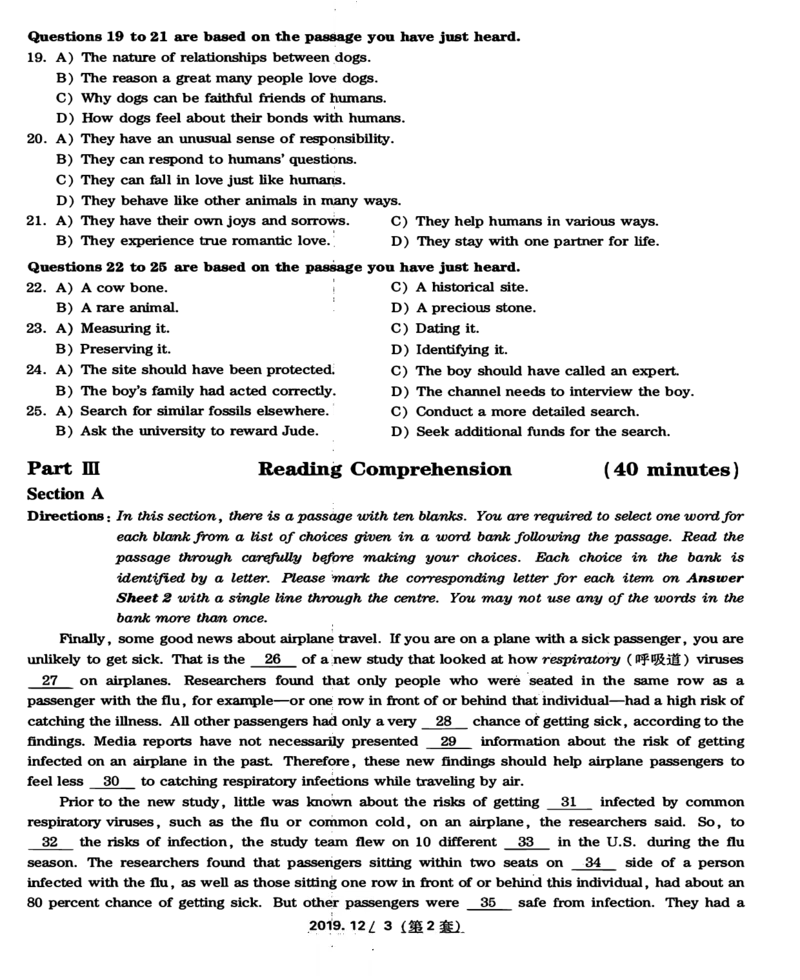
1. A)The number of nurses has dropped to a record low.
1. A) The number of nurses has dropped to a record low.
B)There is a growing shortage of medical personnel.
B) There is a growing shortage of medical personnel.
CC)T)heTrhee ries isd idsicsrciriminminataitioonn aaggaaininsstt mmaallee nnuursrseess..
DD) )TThhe en numumbebre ro fo fm malaele nnuursrseess hhaass ggoonnee ddoownwn..
2. A)Cultural bias. C)Educational system.
2. A) Cultural bias. C) Educational system.
B B )I ) n I a n d a e d q e u qu at a e te p p a a y y . . D D )W ) o W rk o i r n kin g c g o c n o d n i di ti ti o o n n s s . .
Questions 3 and 4 are based on the news report you have just heard.
Questions 3 and 4 are based on the news report you have just heard.
33..A)AHe) fHeel lf eollu to uotf oaf al iliffeebbooaatt.. C C ) ) He H e w a w s as a l alm mos o t s t d df ro � w � ne e d d . .
B
B
)H
)
e
H
l
e
o s
lo
t
s t
h i
h
s
is
w
w
a
a
y
y
o
o
n
n
a
a
b
b
e
e
a
a
c
c
h
h
.
.
D
D
)H
)
e
H
e
e
n j
e
o
nj
y
o
ed
y
.
e
s
d
w
. swi.mmu.l
imrming
g
i n·4t t
:th
he
e
s
s
e
e
a
a
.
.
4. A)The beach is a popular tourist resort. C)The beach is a.good place.to watch the tide.
4. A) The beach is a popular tourist resort. C) The beach is a:gooc! place.to watch the tide.
B B )T ) he Th e e m e e r m ge e n rg cy e n s c e y r v s i e c rv e i s c e a s r e ar e e f e f ffi ic c i i e e n n t t . . DD)T)heTh lief lifebeobaotsats p apt�rolo lt · thhee aarereaa rroouunndd tthhee cclloocckk..
Questions 5 to 7 are based on the news report you have just heard.
Questions 5 to 7 are based on the news report you have just heard. ·
5.5 .AA)I)t Itb ebceacmame aen an on olnliinen es tstarar.. CC)I)t Ite secsacpaepde df rfroomm a al oloccaall zz0o0o..
B)It broke into an office room. D)It climbed 25 storeys at one go.
B) It broke into an office room. D) It climbed 25 storeys at one go.
6 6 . . A A )S ) e S nd e n i d t it b a b c ac k k t o to t th he e z z o o o o . . C C ) ) Re R t e u turn mn i t i t t t o o i its ts o o wn wne e r r . .
B)Release it into the wild. D) Give it a physical checkaup.
B) Release it into the wild. D) Give it a physical checkup.
7.A)A raccoon can perform acts no human can.
7. A) A raccoon can perform acts no human can.
BB)A) rAa craccocoon ocna cn ancl cilmimb bm umchu chhi ghihghere rt hthanan a a ccaatt..
C)The raccoon became as famous as some politicians.
C) The raccoon became as famous as some politicians.
D)The raccoon did something no politician could.
D) The raccoon did something no politician could.
E)If breakfast alone isn't a guarantee of weight loss, why is there a link between obesity and breakfast-
E) If breakfast alone isn't a guarantee of weight loss, why is there a link between obesity and breakfast
skipping? Alexandra Johnstone,professor of appetite research at the University of Aberdeen,argues
skipping? Alexandra Johnstone, professor of appetite research at the University of Aberdeen, argues
that it may simply be because breakfast-skippers have been found to be less knowledgeable about
that it may simply be because breakfast-skippers have been found to be less knowledgeable about
nutrition and health."There are a lot of studies on the relationship between breakfast eating and
nutrition and health. "There are a lot of studies on the relationship between breakfast eating and
possible health outcomes, but this may be because those who eat breakfast choose to habitually
possible health outcomes, but this may be because those who eat breakfast choose to habitually
have health-enhancing behaviours such as regular exercise and not smoking,"she says.
have health-enhancing behaviours such as regular exercise and not smoking," she says.
FF)A) 2A0 1260 1r6e vrieevwie wof o1f0 1 0s tsutduideise sl loooolkiningg iinnttoo ththee rreelaltiatoinosnhsihpi pb ebtweteweene nb rberakfeakasfats ant adn wd ewiegihgth mt anamangaegmemeenntt
concluded there is"limited evidence"supporting or refjuting(反驳)the argument that breakfast
concluded there is "limited evidence" supporting or refuting ( J.j_ �) the argument that breakfast
influences weight or food intake, and more evidence is required before breakfast recommendations
influences weight or food intake, and more evidence is required before breakfast recommendations
can be used to help prevent obesity.
can be used to help prevent obesity.
G)GR)esReeasrecarhecsh efsr ofrm otmh eth Uen iUvneirvseirsityty o fo fS uSrU1Treeyy a annd dU Uninivevresrsiittyy ooff AbAbeerrddeeeenn aarree hhaalfwlfwaayy tthhrroouughgh rreesseeararcchh
lookding into the mechanisms behind how the time we eat influences body weight. Early findings
looking into the mechanisms behind how the time we eat influences body weight. Early findings
suggest that a bigger breakfast is beneficial to weight control. Breakfast has been found to affect
suggest that a bigger breakfast is beneficial to weight control. Breakfast has been found to affect
more than just weight. Slipping brealkfast has been associated with a 27increased risk of heart
more than just weight. Skipping breakfast has been associated with a 27% increased risk of heart
disease,a 21higher risk of type 2 diabetes in men,and a 20higher risk of type 2 diabetes in
disease, a 21 % higher risk of type 2 diabetes in men, and a 20% higher risk of type 2 diabetes in
wwomoemn.e nO.n eOn reea sreonas moany mbea yb breea kbfraesatkf'sas nt'ust nriuttriiotinoanl alv avlalueu—e-paprtartlly yb ebceacuasues ec ecreeraelal i sis
f
fo
ort
rt
if
if
ie
ie
d
l ((
�
增
1J
加
U fi
营
养�价ffl-值ffi))w iwthith v ivtiataminsmins. . InIn o noen es tsutudydy o no nt hthe eb rberaekakffasast th habaibtitss ooff 11,,660000 yyoouunngg ppeeooppllee iinn tthhee UUKK,,
researchers found that the fibre and micronutrient intake was better in those who had breakfast
researchers found that the fibre and rnicronutrient intake was better in those who had breakfast
regularly. There have been similar findings in Australia, Brazil, Canada and the US.
regularly. There have been similar findings -in Australia, Brazil, Canada and the US.
HH)B)reBarkefakfastas its isa laslso oa asssosocicaiatetedd w witithh iimmpprorovevde db rbariainn f fununccttiioonn,, i inncclluuddiinngg ccoonncceennttrraattiioonn anandd llanangguuaaggee ususee..
A review of 54 studies found that eating breakfast can improve memory,though the effects on other
A review of 54 studies found that eating breakfast can improve memory, though the effects on other
brain functions were inconclusive. However, one of the review's researchers, Mary Beth Spitznagel,
brain functions were inconclusive. However, one of the review's researchers, Mary Beth Spitznagel,
says there is"reasonable"evidence breakfast does improve concentration—there just needs to be
says there is "reasonable" evidence breakfast does improve concentration-there just needs to be
more research."Looking at studies that tested concentration, the number of studies showing a
more research. " Looking at studies that tested concentration, the number of studies showing a
benefit was exactly the same as the number that found no benefit,"she says."And no studies found
benefit was exactly the same as the number that found no benefit," she says. "And no studies found
that eating breakdast was bad for concentration."
that eating breakfast was bad for concentration. "
II))WhaWht'sa tm'so smto ismt pimorptoanrtant,sto,m es oamrgeu arge, uies, w ihsa wt hwaet ewaet efator fo brr ebarkefakfastas. t.H iHighgh-pr-portoeteini nb rberaelakfkfaassttss hhaavvee bbeeeenn
found particularly effective in reducing the longing for food and consumption later in the day,
found particularly effective in reducing the longing for food and consumption later in the day,
according to research by the Australian Commonwealth Scientific and Industrial Research
according to research by the Australian Commonwealth Scientific and Industrial Research
Organisation. While cereal remains a firm favourite among breakfast consumers in the UK and US, a
Organisation. While cereal remains a firm favourite among breakfas�. consumers in the UK and US, a
recent investigation into the sugar content of'adult'breakfast cereals found that some cereals
recent investigation into the sugar content of 'adult' breakfast , c:=ereals found that some cereals
contain more than three-quarters of the recommended daily amount of free sugars in each portion,
contain more than three-quarters of the recommended daily amount of _free sugaIS in each portion,
and sugar was the second or third highest ingredient in cereals.
and sugar was the second or third highest ingredient in cereals.
J) But some research suggests if we're going to eat sugary foods, it's best to do it early. One study
J) But some research suggests if we're going to eat sugary foods, it's best to do it early. One study
recruited 200 obese adults to take part in a 16-week-long diet, where half added dessert to their
recruited 200 obese adults to take part in a 16-week-long diet, where half added dessert to their
breakfast, and half didn't. Those who added dessert lost an average of 40 pounds more—however,
breakfast, and half didn't. Those who added dessert lost an average of 40 pounds more-however,
the study was unable to show the long-term effects. A review of 54 studies found that there is no
the study was unable to show the long-term effects. A review of 54 studies fonnd that there is no
ccoonnsseennssuuss yyeett oonn whwahta tt ytyppe eo fo fb rberaelakfkfaasstt iiss hheealalththieire,r, anandd ccoonncclluuddeedd tthhaatt tthhee ttyyppee ooff bbrreeaakfkfaasstt
doesn't matter as much as simply eating something.
doesn't matter as much as simply eating something.
KK)W)hiWlhe ilteh ethree'res' sn no oc conocnlculussiivvee eevviiddeennccee oonn eexxaaccttllyy wwhhaatt wwee sshhoouulldd bbee eeaatitinngg an andd w whheenn,, ththee ccoonsnseennssusus
is that we should listen to our own bodies and eat when we're hungry."Breakfast is most important
is that we should listen to our own bodies and eat when we're hnngry. "Breakfast is most important
for people who are hungry when they wake up,"Johnstone says."Each body starts the day
for people who are hungry when they wake up," Johnstone says. " Each body starts the day
differently—and those individual differences need to be researched more closely,"Spitznagel says.
differently-and those individual differences need to be researched more closely, " Spitznagel says.
2019.12L5(第2套)
201s. 12 I s Cffi 2 lU"A balanced breakdfast is really helpful,but getting regular meals throughout the day is more
"A balanced breakfast is really helpful, but getting �egular meals throughout the day is more
important to leave blood sugar. stable through the day,which helps control weight and hunger
important to leave blood sugar. stable through the day, which helps control weight and hunger
levels,"says Elder."Breakfast isn't the only meal we should be getting right."
levels," says Elder. "Breakfast isn't the only meal we should be getting right."
36. According to one professor, obesity is related to a lack of basic awareness of nutrition and health.
36. According to one professor, obesity is related to a lack of basic awareness of nutrition and health.
37.Some scientists claim that people should consume the right kind of food at breakfast.
37. Some scientists claim that people should consume the right kind of food at breakfast.
38. Opinions differ as to whether breakdfast is the most important meal of the day.
38. Opinions differ as to whether breakfast is the most important meal of the day.
39. It has been found that not eating breakfast is related to the incidence of certain diseases in some
39. It has been found that not eating breakfast is related to the incidence of certain diseases in some
countries.
countries.
40. Researchers found it was a change in eating habits rather than breakdast itself that induced weight
40. Researchers found it was a change in eating habits ratti.er than breakfast itself that induced weight
lo5s.
loss.
41. To keep oneself healthy, eating breakfast is more important than choosing what to eat.
41. To keep oneself healthy, eating breakfast is more important than choosing what to eat.
42. It is widely considered wrong not to eat breakdfast.
42. It is widely considered wrong not to eat breakfast.
43. More research is needed to prove that breakfast is related to weight loss or food intake.
43. More research is needed to prove that breakfast is related to weight loss or food intake.
44. People who prioritise breakfasts tend to have lower calorie but higher nutritional intake.
44. People who prioritise breakfasts tend to have lower calorie but higher nutritional intake.
45. Many studies reveal that eating breakfast helps people memorise and concentrate.
45. Many studies reveal that eating breakfast helps people i;nemorise and concentrate.
Section C
Section C
Directions:There are 2 passages in this section.Each passage is followed by some questions or
Directions: There are 2 passages in this section. Each passage is followed by some questions or
uunfnfininiisshheedd ssttaattemenememttss.. FFoorr eaeacchh o fo fthem the m � the raere a froeu fro cuhro icchesoi macesr kmeadr Ake)d , AB),) ,B C),)C )aanndd
DD).) . YoYuo us hsohuoludl dd edceicdide eo onn t thhee bbeesstt cchhooiiccee aanndd mmaarrkk tthhee ccoorresprrespoonnddiingng lleettertte ro no An nsAnwsweerr
Sheet 2 with a single line through the centre.
Sheet 2 with a single line through the centre.:
Passage One
Passage One
Questions 46 to 50 are based on the following passage.
Questions 46 to 50 are based on the following passage�
Textbooks represent an 11 billion dollar industry, up from $8 billion in 2014. Textbook publisher
Textbooks represent an 11 billion dollar industry,· up from $8 billion in 2014. Textbook publisher
Pearson is the largest publisher—of any kind—in the world.
Pearson is the largest publisher-of any kind-in the world.
It costs about $1 million to create a new textbook. A freshman textbook will have dozens of
It costs about $1 million to create a new textbook. · A freshman textbook will have dozens of
contributors, from subject-matter experts through graphic and layout artists to expert reviewers and
contributors, from subject-matter experts through graphic and layout artists to expert reviewers and
classroom testers. Textbook publishers connect professors, instructors and students in ways that
classroom testers. Textbook publishers connect professors, instructors and students in ways that
alteratives, such as open e-textbooks and open educational resources, simply do not. This connection
alternatives, such as open e-textbooks and open educational resources, simply do not. This connection
happens not only by means of collaborative development,review and testing, but also at conferences
happens not only by means of collaborative development, review and testing, but also at conferences
where faculty regularly decide on their textbooks and curricula for the coming year.
where faculty regularly decide on their textbooks and curricula for the coming year.
It is true that textbook publishers have recently reported losses,largely due to students renting or
It is true that textbook publishers have recently reported losses, largely due to students renting or
buying used print textbooks. But this can be chalked up to the excessively high cost of their books—
buying used print textbooks. But this can be chalked up to the excessively high cost of their books
which has increased over 1,000 percent since 1977. A restructuring of the textbook industry may well be
which has increased over 1, 000 percent since 1977. A re�cturing of the textbook industry may well be
in order. But this does not mean the end of the textbook itself.
in order. But this does not mean the end of the textbook itself.
While they may not be as dynamic as an iPad, textbooks are not passive or lifeless. For example,
While they may not be as dynamic as an iPad, textbooks are not passive or lifeless. For example,
over the centuries,they have simulated(模拟)dialogues in a number of ways.From 1800 to the
over the centuries, they have simulated ( ffl ffi ) dialogue$ in a number of ways. From 1800 to the
ppreresseennt t ddaayy,, tteextxtbbooookkss hhaavvee ddoonnee t thihiss bbyy ppoossiinngg qquueessttiioonnss ffoorr sstutuddeenntsts ttoo anansswweerr iinndduuccttiivveellya y(( Ja归�纳 tt性
地�)) .. ThThaatt mmeeaannss ssttuuddeennttss aarree aasskkeedd ttoo uussee tthheeiirr iinndidviivdi�dua le xpexepriereinecnec eto t oc ocmomee uupp wiwithth ansanswweerrss toto
general questions. Today's psychology texts, for example, ask:"How much of your personality do you
general questions. Today's psychology texts, for example, ask:"H ow much of your personality do you
think you inherited?"while ones in physics say:"How can you predict where the ball you tossed will
lathinndk? y"ou inherited?" while ones in physics say: "How
�
you predict where the ball you tossed will
land?"
Experts observe that"textbooks come in layers, something like an onion."For an active learner,
Experts obseive that "textbooks come in layers, something like an onion. " For an active learner,
2
2
0
0
1
1
9
9
.
.
1
12
2 LI 6
6
( < 第 ffl 2
2
套 iU)engaging with a textbook can be an interactive experience. Readers proceed at their own pace. They
engaging with a textbook can be an interactive experience. Readers proceed at their own pace. They
"customize" their books by engaging with diferent layers and linkages. Highlighting,Post-It notes,
"customize" their books by engaging with different layers and linkages. Highlighting, Post-It notes,
dog-ears and other techniques allow for further customization that students value in print books over
dog-ears and other techniques allow for further customization· that students value in print books over
digital forms of books.
digital forms of books.
46. What does the passage say about open educational resources?
46. What does the passage say about open educational resources?
A)They contribute to teaching as much as to learning.
A) They contribute to teaching as much as to learning.
BB)T)heTyh edyo nd'otn p'tr opfriotfi ta sas m mucuhc ha sas t rtradadititiioonnaall tteextxtbbooookkss ddoo..
CC))ThTeyh ecya nc'ant 'tc ocnonnencetc pt rporfoefsessosrosrs a anndd s sttuuddeennttss aass tteextxtbbooookkss ddoo..
DD)T)hTeyh ecyo mcpoemtep eftiee firecercleyl yf ofor r ccuussttoommeresrs w witithh tteexxttbbooookk pprroodduucceerrss..
47. What is the main cause of the publishers' losses?
47. What is the main cause of the publishers' losses?
A A )F ) ai F l ail ur ur e e t o to m m ee e t e t s s t t u u d d e e n n t t n ne e e e d d . . CC))EmEemrgeerngcenec eo fo fe e--bbooookkss..
BB))IndInudstusrytry r ersetsrtruuccttuurinringg.. DD)F)alFlalliingn gs saalleess..
48. What does the textbook industry need to do?
48. What does the textbook industry need to do?
AA))ReRfoerfom rmit sits s tsrtruuccttuurreess.. CC)F)inFind rde prelpalcaecmeemntesn tsfo for rp rpirinntteedd tteexxttbbooookkss..
BB)C)utC uitt sits r eretataiill pprriicceess.. DD)C)haCnhgean igtes itsbu sbiusneisnse ssst rsatratetegygy p epreiriodoidciaclalllyy..
49. What are students expected to do in the learning process?
49. What are students expected to do in the learning process?
AA) )ThTihnikn kc acrarefeufullllyy bbeeffoorree aannsswweeririnngg eeaacchh qquueessttiioonn..
BB)A)skA sqku eqsuteisotinosn sb absasede do no nt htheierir oowwnn u unndderesrstantanddiinngg..
C) Answer questions using their personal experience.
C) Answer questions using their personal experience.
DD)G)ivGei vaen sanswwerse rssh oswhionwing thge tihre irre srepspeceticvtiev ep epresrsonoanlalitityy..
50. What do experts say about students using textbooks?
50. What do experts say about students using textbooks?
AA) )ThTehye cya nc andi gdiitgailtaliziez et hthe ep rpirinntsts eeaassililyy.. CC)T)hTeyh ecya nc anpu prurchcahsase ec ucsutsotmoimizezde dv evresrsiioonnss..
B B ) ) T T he h y e y c a c n an l e l a e r arn n i n in a an n i i n n t t e e r ra ac c t ti i v v e e w wa a y y . . DD)T)heThy ecya nc anad aapdtap tth the em amtearteirialal tthheemmsseellvveess..
Pasage Tw0
Passage Two
Que8tions 51 to 55 are based on the following pa8age.
Questions 51 to 55 are based on the following passage.
When we think of animals and plants, we have a pretty good way of dividing them into two distinct
When we think of animals and plants, we have a pretty good way of dividing them into two distinct
groups:one converts sunlight into energy and the other has to eat food to make its energy.
groups: one converts sunlight into energy and the other has to eat food to make its energy.
Well, those dividing lines come crashing down with the discovery of a sea slug(海恬蟾)that's
Well, those dividing lines come crashing down with the discovery of a sea slug ( rli �ilru) that's
truly half animal and half plant. It's pretty incredible how it has managed to hijack the genes of the algae
truly half animal and half plant. It's pretty incredible how it has managed to hijack the genes of the aJ,gae
(藻类)on which it feeds.
( -�) on which it feeds.
TThhe es slluuggss ccaann mmananufuafcatcuturer ec hclholororophpyhlyll,l, tthhee ggrreeeenn ppiigmengmentt( (色 {g素 �) ) inin p plalannttss tthhaatt ccaappttuurreess eenneerrgygy
from sunlight,and hold these genes within their body. The term kleptoplasty is used to describe the
from sunlight, and hold these genes within their body. The term kleptoplasty is used to describe the
practice of using hijacked genes to create nutrients from sunlight. And so far, this green sea slug is the
practice of using hijacked genes to create nutrients from sunlight. And so far, this green sea slug is the
only known animal that can be truly considered solar-powered, although some animals do exhibit some
only known animal that can be truly considered solar-powered, although some animals do exhibit some
plant-like behaviors. Many scientists have studied the green sea slugs to confirm that they are actually
plant-like behaviors. Many scientists have studied the green sea slugs to confirm that they are actually
able to create energy from sunlight.
able to create energy from sunlight.
In fact, the slugs use the genetic material so well that they pass it on to their future generations.
In fact, the slugs use the genetic material so well that they pass it on to their future generations.
Their babies retain the ability to produce their own chlorophyll, though they can't generate energy from
Their babies retain the ability to produce their own chlorophyll, though they can't generate energy from
sunlight until they've eaten enough algae to steal the necessary genes, which they can't yet produce on
sunlight until they've eaten enough algae to steal the necessary genes, which they can't yet produce on
their own.
their own.
"There's no way on earth that genes from an alga should work inside an animal cell,"says Sidney
"There's no way on earth that genes from an alga should work inside an animal cell," says Sidney
Pierce from the University of South Florida."And yet here, they do. They allow the animal to rely on
Pierce from the University of South Florida. "And yet here, they do. They allow the animal to rely on
sunshine for its nutrition. So if something happens to their food source, they have a way of not starving
sunshine for its nutrition. So if something happens to their food source, they have a way of not starving
2019.12L7(第2套).
2019. 12 / 7 (ffi 2 4i:)to death until they find more algae to eat."
to death until they find more algae to eat. "
The sea slugs are so good at gathering energy from the sun that they can live up to nine months
11\e sea slugs are so good at gathering energy from the sun that they can live up to nine months
without having to eat any food. They get all their nutritional needs met by the genes that they've
without having to eat any food. They get all their nutritional needs met by the genes that they've
hhijijaacckkeedd ffrroomm tthhee aallggaaee..
51. What is the distinctive feature of a sea slug?
51. What is the distinctive feature of a sea slug?
AA)I)t Ilt olookosks l ilikkee bbootthh aa ppllaanntt anandd aann animalanimal..
BB)I)t Ict ocnovnervtesrts s osmoem see as eaan ianimalsrnals i ninttoo ppllaannttss..
CC) )ItI t lliivveess hhalalff oonn anianimmaallss aanndd hhaallff oonn ppllaannttss..
DD)I)t Igt egtests e neenregrygy f frroomm b obtohth f ofoood da nand ds usnunlliigghhtt..
52. What enables the sea slug to live like a plant?
52. What enables the sea slug to live like a plant?
A)The genes it captures from the sea plant algae.
A) The genes it captures from the sea plant algae.
BB)T)hThe mee cmheacnhianissm bmy bwyh iwchhi ciht itc ocnosnserevrveses eenneerrggyy..
CC) )ThThe enu nturitrienetnsts i tit hhiijjaaccksks frfroomm ootthheerr ssppeecciieess..
DD)T)heTh ger egreen epni gpmiegmnt eintt iitn hinehrietrists f frroomm i titss aanncceessttoorrss..
53. What does the author say about baby sea slugs?
53. What does the author say about baby sea slugs?
AA)T)heThy ecya nc anli vleiv ewi wthiothuot ust usnunlilighght tf oforr aa lloonngg ttiimmee..
BB)T)heThy ceayn caanbs oarbbs osrubn lsiunghlti ghritg rihtg hatf taefter rt htheierir b birirtthh..
C)They can survive without algae for quite some time.
C) They can survive without algae for quite some time.
DD) )ThTehye yc acnan p rpordoudcuec ec hclholroorophpyhlyll l oonn tthheeiirr oownwn..
54. What does Sidney Pierce say about genes from an alga?
54. What does Sidney Pierce say about genes from an alga?
A)They are stolen from animals like the sea slug.
A) They are stolen from animals like the sea slug.
BB)T)heThy ecya nc'ant 'ftu funcntcitiono nu nulnelsess se xepxposoesde dt oto s usnulniligghhtt..
CC)T)heThy edyo nd'ot nu'ts uusalulaly lyfu funnctciotino ni nisnisdide ea animalnimal c eclelllss..
DD)T)hTeyh ecya nc anre ardeialdiy lyb eb ec ocnovnevretrteed dt ot os seeaa s slluugg ggeenneess..
55. What do we learm about sea slugs from the passage?
55. What do we learn about sea slugs from the passage?
AA)T)heThy ebye hbaevhea vteh eth ew awy amyo msto sptl panlant ts pspeceiceiess ddoo..
BB)T)heTyh ecya nc ansu rsvurviivev ef ofor rm monotnhths sw iwtihthouotu te eaattiinngg..
C)They will tumn into plants when they mature.
C) They will tum into plants when they mature.
D)They will starve to death without sunlight.
D) They will starve to death without sunlight.
Part IV Translation
Part IV Translation ( ( 3 3 0 0 m min inu u t t e e s s ) )
Directions:For this part,you are allowed 30 minutes to translate a passage from Chinese into
Directions: For this part, you are allowed 30 minutes to translate a pa.ssage from Chinese into
English. You should write your amswer on Answer Sheet 2.
English. You should write your answer on Answer Sheet 2.
中国的家庭观念与其文化传统有关。和睦的大家庭曾非常令人羡慕。过去四代同堂并不少见。由于
lflffilff9��XVl��ltx1t��1i�o ffilffiff97C��'M1�F1it� A8t•o 111
n¼lm-ftliiJ:!t#�Y 9lo -r
这个传统,许多年轻人婚后继续与父母同住。今天,这个传统正在改变。随着住房条件的改善,越来越多
5X-1'�� 'iil):$.&A�Jls���jt-BJ:laJ-f±o �;Jc' ,X1'��.iE:r±��o mfi�-f±nj*flJ:agi!J(�' ffl!HIHl$
年轻夫妇选择与父母分开住。但他们之间的联系仍然很密切。许多老年人仍然帮着照看孙辈。年轻夫妇
••*�B#��-�ff�om•mz�ag�•filMffl�WoiilF$�•AfilMffl•Me�Uo•&*�
也
·m
抽
Adf
时 at间 fiil探
�
望
m
父
�
母
-BJ:
,
,
特�别iU是�在1±春•节;,和 ffi中
i:J:a
秋 tJc节W等
�
重
m:
要
w
节
;,
日
s
。
o
2019.12L8(第2套)
2019. 12 / 8 (ffi 2 lf)2019 年 12 月四级真题第3套)
ffi
2019 £1:- 12 iJ Im�-- ( 3 • )
Part I Writing
Part I Writing
((3
3
0
0
m
m
i
i
n
n
u
u
t
t
e
e
s
s
)
)
Directions:For this part,you are alowed 30 minutes to write a letter to aforeign friend who
Directions: For this part, you are aJlowed 30 minutes to write a letter to a foreign friend who
wants to study in China. Please recommend a university to him.Yo should write
wants to study in China. Please recommend a university to him. You slwuul write
aat t lleaseastt 112200 wwoorrddsls bbuutt n noo mmoorere tthhaann 118800 wwoorrddss..
P
P
a
art
rt Ⅱ
II
L
L
i
i
s
s
t
te
e
n
ni
in
n
g
g
C
C
o
o
m
mp
p
r
r
e
e
h
h
e
e
n
n
s
s
i
io
o
n
n (( 2
2
5
5
m
m
i
i
n
n
u
u
t
t
e
e
s
s
)
)
说m明M∶ = 由m T于 2 2 0 0 1 19 9 年$1 1 2 2 月 1.1四1m级&考�试iit全�国�共3t考�了72 套 2 ff听 PJr力n, ,本21t套•真a题11听11Jr力1J与-'=i前frr2 2 套 •内t*.1容!11完�全�一-样*¥,, .R只�是n顺m
序ff不�一-样*¥,, 因ffl此 Jlt在1£本21t套int真题li中 �不 �再:pj:重IU复U出l:l现 lJ\!。o
Part Ⅲm Reading Comprehension
(40 minutes)
Part Reading Comprehension ( 40 minutes)
Section A
Section A
Directions:In this section, there is a passage with ten blanks. You are required to select one word for
Directions: In this section, there is a passage with ten blanks. You are required to select one word for
each blank from a list of choices given in a word bamk following the passage.Read the
each blank from a list of clwices given in a word bank following the passage. Read the
passage through carefully before making your choices. Each choice in the bank is
passage through carefully before making your clwices. Each clwice in the bank is
identified by a letter. Pease mark the corresponding letter for each item on Answer
identified by a letter. Please mark the corresponding letter for each item on Answer
Sheet 2 with a single line through the centre. You may not use any of the words in the
Sheet 2 with a single line through the centre. You may not use any of the words in the
bank more than once.
bank more than once.
Millions of people travel by plane every single day. If you're planning on being one of them soon,
Millions of people travel by plane evecy single day. If you're planning on being one of them soon,
you might not be looling forward to the 26 feeling air travel often leaves you with.
you might not be looking forward to the � feeling air travel often leaves you with.
Besides the airport crowds and stress, traveling at a high altitude has real effects on the body.
Besides the airport crowds and stress, traveling at a high altitude has real effects on the body.
Although the pressure of the cabin is 27 to prevent altitude sickness, you could still 28
Although the pressure of the cabin is _JJ__ to prevent altitude sickness, you could still �
sleepiness or a headache. The lower oxygen pressure found in an aircraft cabin is 92 9to that at
sleepiness or a headache. The lower oxygen pressure found in an aircraft cabin is � to that at
6,000-8,000 feet of altitude. A drop in oxygen pressure can cause headaches in certain 30.To
6,000 -8,000 feet of altitude. A drop in oxygen pressure can cause headaches in certain �. To
help prevent headaches, drink plenty of water, and avoid alcohol and coffee.
help prevent headaches, drink plenty of water, and avoid alcohol and coffee.
Airplane food might not really be as tasteless as you 31 thought. The air you breathe in a plane
Airplane food might not really be as tasteless as you � thought. The air you breathe in a plane
dries out your mouth and nose, which can affect your sense of taste. Perception of sweet and salty
dries out your mouth and nose, which can affect your sense of taste. Perception of sweet and salty
foods dropped by almost 30 percent in a simulation of air travel. However,you can make your taste
foods dropped by almost 30 percent in a simulation of air travel. However, you can make your taste
buds active again by drinking water. A dry mouth may 32 taste sensitivity, but taste is restored by
buds active again by drinking water. A dcy mouth may � taste sensitivity, .but taste is restored by
drinkdng fluids.
drinking fluids.
Although in-flight infections 33 in dry environments like airplanes, your risk of getting sick
Although in-flight infections � in dcy environments like airplanes, your risk of getting sick
from an airplane is actually low because of the air 34 used. Unless you're sitting next to someone
from an airplane is actually low because of the air 34 used. Unless you're sitting next to someone
2019.12L1(第3·套).
2019. 12 / 1 (ffi 3,#)who is coughing or sneezing, you shouldn't worry too much about getting sick. However,bacteria have
who is coughing or sneezing, you shouldn't worry too much about getting sick. However, bacteria have
been shown to live on cabin surfaces,so wash your hands 35
been shown to live on cabin surfaces, so wash your hands 35 .
A)adjusted I) particular
A) adjusted I) particular
B)channels J) primarly
B) channels J) primarily
C) equivalent K) reduce
C) equivalent K) ·reduce
D) D ) e e x xp pe e r ri i e e n n c c e e LL))rernenoovvaatteedd
E)filters M) smooth
E) filters M) smooth
F)ffquently N) thrive
F) . frequently N) thrive
G) individuals O) upleasant
G) individuals 0) unpleasant
H) originlly
H) originally
Section B
Section B
Directions:In this section, you are going to read a passage with ten statements attached to it. Each
Directions: In this section, you are going to read a passage with ten st,a,tements attached to it. Each
statement contains information given in one of the paragraphs. Identify the paragraph
st,a,tement cont,a,ins information given in one of the paragraphs. Identify the paragraph
from which the information is derived. You may choose a paragraph more than once.
from which the information is derived. You may choose a paragraph more than once.
Each paragraph is marked with a letter. Answer the questions by marking the
Each paragraph is marked with a l,ett,er. Answer the questions by marking the
corresponding letter on Answer Sheet 2.
corresponding l,etter on Answer Sheet 2.
A South Korean city designed for the future takes on a life of its own
A South Korean city designed for the future takes on a life of its own
AA)G)etGtientting agr oarunodu nad cai tcyi tyis i so noen et hthiingn—g-anand dth thene nth tehreer'es' st hthee m matatttere ro of f ggeettttiningg frfroomm oonnee cciittyy ttoo ananootthheerr..
One vision of the perfect city of the future is a place that offers easy access to air travel. In 2011,a
One vision of the perfect city of the future is a place that offers easy access to air travel. In 2011, a
University of North Carolina business professor named John Kasarda published a book called
University of North Carolina business professor named John Kasarda published a book called
Aerotropolis:The Way WeWl Live Nert. Kasarda says future cities should be built intentionally
Aerotropolis : The Way We'll Live Next. Kasarda says future cities should be built intentionally
around or near airports. The idea, as he has put it, is to offer businesses"rapid,long-distance
around or near airports. The idea, as he has put it, is to offer businesses "rapid, long-distance
connectivity on a massive scale."
connectivity on a massive scale. "
B)B)"T"hTe h1e8 t1h8 thce cnteunrtyury re raelallyl yw wasas a aw a w t a er terb bor o m rn e( e 水 ( 运71<的�) B9c )en tcuernyt,ury t,h eth 1e9 t1h9 thce ncteunrtyury a raa riaill c ecnetnutruryy,, tthhee
20th century a highway, car, truck century—and the 21st century will increasingly be an aviation
20th century a highway, car, truck century-and the 21st century will increasingly be an aviation
century,as the globe becomes increasingly connected by air,"Kasarda says. Songdo, a city built
century, as the globe becomes increasingly connected by air, " Kasarda says. Songdo, a city built
from scratch in South Korea, is one of Kasarda's prime examples. It has existed for just a few years.
from scratch in South Korea, is one of Kasarda's prime examples. It has existed for just a few years.
"From the outset, it was designed on the basis of connectivity and competitiveness,"says Kasarda.
"From the outset, it was designed on the basis of connectivity and competitiveness, " says Kasarda.
""The government built the bridge directly from the airport to the 'Songdo International Business
"The government built the bridge directly from the airport to the ·songdo International Business
District. And the surface infrastructure was built at the same time as the new airport."
District. And the surface infrastructure was built at the same time as the new airport. "
C)C)SoSnogndog dios isa as tsotnoen'es's tthhrrooww f rfroomm S oSuotuht hK oKreoar'esa 'sI nlcnhcehoeno nA iAirprporot,rt,i tists mmaiain ni nintteerrnnaattiioonnaall
h
hu
u
b
b
( (枢 ;f!K纽ffl))..
But it takes a lot more than a nearby airport to be a city of the future. Just building a place as an
But it takes a lot more than a nearby airport to be a city of the future. Just building a place as an
"""iinntteernrnaatitioonnalal b businusin.eesss sd idsitristcrti"c td"odeose�s'nt' mt emanea ni ti wt iwlli lble cboemcoem eo noen.e .PPararkk YYeeoonn SSoooo ccoonncceeiivveedd( (构�想1)0
this city of the future back in 1986.He considers Songdo his baby. Park sees himself as a visionary.
this city of the future back in 1986. He considers Songdo his baby. Park sees himself as a visionary.
Thirty years after he imagined the city, Park's baby is close to 70 percent built,with 36.000 people
Thirty years after he imagined the city, Park's baby is close to 70 percent built, with 36, 000 people
living in the business district and 90,000 residents in greater Songdo. It's about an hour outside
living in the business district and 90, 000 residents in greater Songdo. It's about an hour outside
,202011s9. .1122 /L 22( 第
(ffi
3套
3
)
lU
。Seoul, built on former tidal flats along the Yellow Sea. There's a Coast Guard building and a tall
Seoul, built on former tidal flats along the Yellow Sea. There's a Coast Guard building and a tall
trade tower, as well as a park, golf course and university.
trade tower, as well as a park, golf course and university.
D)DC)haCnhceans caerse aryoeu y'oveu 'vaec taucatlulaly lys eseene nt hthiiss ppllaaccee.. SSoonnggddoo aappppeaerarss iinn tthhee mmoosstt ffamamoouuss mmusuiscic vviiddeeoo eevveerr ttoo
come out of South Korea."Gangnam Style" refers to the fashionable Gangnam district in Seoul. But
come out of South Korea. "Gangnam Style" refers to the fashionable Gangnam district in Seoul. But
some of the video was filmed in Songdo."I don't know if you remember,there was a scene in a
some of the video was filmed in Songdo. "I don't know if you remember, there was a scene in a
subway station. That was not Gangnam. That was actually Songdo,"says Jung Won Son,a
subway station. That was not Gangnam. That was actually Songdo," says Jung Won Son, a
professor of urban development at London's Bartlett School of Planning."Part of the reason to shoot
professor of urban development at London's Bartlett School of Planning. "Part of the reason to shoot
there is that it's new and nice."
there is that it's new and nice. "
EE)T)heT hcei tcyi tyw aws assu spuppospeods etdo tob eb ea ah uhbu bfo for rg lgolobbalal ccoommpapnaniiese,s ,w iwtihth e emmplpolyoeyeeses f rfroom ma lall l oovveerr tthhee wwoorrlldd._.
But that's not how it has turned out. Songdo's reputation is as a futuristic ghost town. But the reality
But that's not how it has turned out. Songdo's reputation is as a futuristic ghost town. But the reality
is more complicated. A bridge with big, light-blue loops leads into the business district. In the
is more complicated. A bridge with big, light-blue loops leads into the business district. In the
center of the main road, there's a long line of flags of the world. On the corner, there's a Starbucks
center of the main road, there's a long line of flags of the world. On the corner, there's a Starbucks
and a 7-Eleven—all of the international brands that you see all over the world nowadays.
and a 7-Eleven-all of the international brands that you see all over the world nowadays.
FF)T)heT hcei tcyi tyi si sn noott eemmptpyty.. TThheerree aarere mmootthheerrss ppuusshhiningg bbababyy ccarriarragiaegse,s ,oolldd wwoommeenn wwiitthh wwaallkkeerrss—-eevveenn iinn
.
the middle of the day, when it's 90 degprees out. Byun Young-Jin chairs the Songdo real estate
the middle of the day, when it's 90 degrees out. Byun Young-Jin chairs the Songdo real estate
.
association and started selling property here when the fist phase of the city opened in 2005. He says
association and started selling property here when the first phase of the city opened in 2005. He says
demand has boomed in the past couple of years. Most of his clients are Korean. In fact, the
demand has boomed in the past couple of years. Most of his clients are Korean. In fact, the
developer says, 99 percent of the homes here are sold to Koreans. Young families move here
developer says, 99 percent of the homes here are sold to Koreans. Young families move here
because the schools are great. And that's the problem:Songdo has become a popular Korean city—
because the schools are great. And that's the problem: Songdo has become a popular Korean city
more popular as a residential area than a business one. It's not yet the futuristic international
more popular as a residential area than a business one. It's not yet the futuristic international
business hub that planners imagined."It's a great place to live. And it's becoming a great place to
business hub that planners imagined. "It's a great place to live. And it's becoming a great place to
work,"says Scott Summers, vice-president of Gale International, the developer of the city. The
work," says Scott Summers, vice-president of Gale International, the developer of the city. The
floor-to-ceiling windows of his company's offices overlook Songdo Central Park, with a canal full of
floor-to-ceiling windows of his company's offices overlook Songdo Central Park, with a canal full of
smsamlall lb booatasts aanndd p peeopolpele f fiisshhiinngg.. ShShiimmmmerieringn(g 闪( IA]烁�的) a(]g)l agslass st otwoewrse rsl ilnine et hthee ccaannaal'l'ss eeddggee..
G)G")Wh"atW'sh ahta'sp pheanpepde inse dt hiast th oautr ofuro:•c ufos couns corne actrienagti tnhga tth qatua qliutalyi tyof olfi flief ef firsirstt hhasas eennaabblleedd tthhee rreessiiddeennttss ttoo
live here,"Summers says.But there needs to be strong economic incentives for companies to locate
live here, " Summers says. _But there needs to be strong economic incentives for companies to locate
hhereere. . TTheh ec ictiyty i sis ssttililll unfinisunfinihsheedd,, aanndd i tit ffeeeellss aa bbiitt lliikkee aa tthheemmee p aprark.k . ItI td odeosens'nt' tf efeele l aallll tthhaatt
futuristic. There's a high-tech underground trash disposal system. Buildings are environmentally
futuristic. There's a high-tech underground trash disposal system. Buildings are environmentally
friendly. Everybody's television set is connected to a system that streams personalized language or
friendly. Everybody's television set is connected to a system that streams personalized language or
exercise classes.
exercise classes.
HH)B)utB utth iths isi sis nnoott SSttarar TTrreekk.. AAnndd ttoo ssoommee ooff tthhee rreessidideenntst,s ,S oSonnggddoo fefeeelsl sh ohlololwlo. w.""II'mm,,l ilikkee,, iinn pprriissoonn
for weekdays. That's what we call it in the workplace,"says a woman in her 20s. She doesn't want
for weekdays. That's what we call it in the workplace," says a woman in her 20s. She doesn't want
to use her name for fear of being fired from her job. She goes back to Seoul every weekend."I say
to use her name for fear of being fired from her job. She goes back to Seoul every weekend. "I say
Im prison-breaking on Friday nights."But she has to make the prison break in her own car. There's
I'm prison-breaking on Friday nights. " But she has to make the prison break in her own car. There's
no high-speed train connecting Songdo to Seoul, just over 20 miles away.
no high-speed train connecting Songdo to Seoul, just over 20 miles away.
I)Park Yeon Soo, the man who fist imagined Songdo,feels frustrated, too.He says he built South
I) Park Yeon Soo, the man who first imagined Songdo, feels frustrated, too. He says he built South
Korea a luxury vehicle,"like Mercedes or BMW.It's a good car now.But we're waiting for a good
Korea a luxury vehicle, "like Mercedes or BMW. It's a good car now. But we're waiting for a good
driver to accelerate."But there are lots of other good cars out there, too. The world is dotted with
driver to accelerate. " But there are lots of other good cars out there, too. The world is dotted with
2
2
0
0
1
1
9
9
.
.
1
1
2
2
L
/
3 (
3
第
(1l
3
l
套3)
1f
。
)futuristic, high-tech cities trying to attract the biggest international companies.
futuristic, high-tech cities trying to attract the biggest international companies.
J))Songdo's backers contend that it's still early,and business space is filling up—about 70 percent of
J) Songdo's backers contend that it's still early, and business space is filling up-about 70 percent of
finished offices are now occupied. Brent Ryan,who teaches urban design at MIT,says Songdo
finished offices are now occupied. Brent Ryan, who teaches urban design at MIT, says Songdo
proves a universal principle."There have been a lot of utopian(乌托邦的)cities in history.And
proves a universal principle. "There have been a lot of utopian ( �ttt-lSB9) cities in history. And
the reason we don't know about a lot of them is that they have vanished entirely."In other words,
the reason we don't know about a lot of them is that they have vanished entirely. " In other words,
when it comes to cities—or anything else—it is hard to predict the future.
when it comes to cities-or anything else-it is hard to predict the future.
36. Songdo's popularity lies more in its quality of life than its business attraction.
36. Songdo's popularity lies more in it.s quality of life than it.s business attraction.
37. The man who conceived Songdo feels disappointed because it has fallen short of his expectations.
37. The man who conceived Songdo feels disappointed because it has fallen short of his expectations.
38. A scene in a popular South Korean music video was shot in Songdo.
38. A scene in a popular South Korean music video was shot in Songdo.
39. Songdo still lacks the financial stimulus for businesses to set up shop there.
39. Songdo still lacks the financial stimulus for businesses to set up shop there.
40.Airplanes will increasingly become the chief means of transportation, according to a professor.
40. Airplanes will increasingly become the chief means of transportation, according to a professor.
41. Songdo has ended up different from the city it was supposed to be.
41. Songdo has ended up different from the city it was supposed to be.
42. Some of the people who work in Songdo complain about boredom in the workplace.
42. Some of the people who work in Songdo complain about boredom in the workplace.
43. A business professor says that a future city should have easy access to international transportation.
43. A business professor says that a future city should have easy access to international transportation.
44.According to an urban design professor, it is difficult for city designers to foresee what will happen
44. According to an urban design professor, it is difficult for city designers to foresee what will happen
in the future.
in the future.
45. Park Yeon Soo, who envisioned Songdo, feels a parental connection with the city.
45. Park Yeon Soo, who envisioned Songdo, feels a parental connection with the city.
Section C
Section C
Directions:There are 2 passages in this section. Each passage is followed bgy some questions or
Directions: There are 2 passages in this section. Each passage is followed by some questions or
un u f nf in in is is h h e e d d s s t ta at temen ement ts s. . F F o o r r e e a a c c h h o o f f t hem the m t h t er he e r a e r e a r fo e u f r o c u h r o i c c h e o s i m ce a s r k m e a d r A ke ) d , A B ) ) , B, ) C ,C ) ) a a n n d d
DD).)Y.o uY osuh osuhlodu ldde cdeidcidee on onth eth eb ebsest tc chhooicicee aanndd mmaarkr kt hthee c coorrrreessppoonnddiinngg lketttterer oonm AAnsnsuwweerr
Sheet 2 with a single line through the centre.
Sheet 2 with a singl,e line through the centre.
Pas8age One
Passage One
Questions 46 to 50 are based on the following passage.
Questions 46 to 50 are based on the following passage.
TTheh ef ififtfthh llararggeesstt cciityty ini nt hteh eU USS ppassasseedd aa ssigignnifiifciancatn ts osdoad atax ta xp rporpopoossala lt htahta twill wi lletryleov y(( ffl:征&税)) 11.. 55 cceenntsts
per liquid ounce on distributors.
per liquid ounce on distributors.
Philadelphia's new measure was approved by a 13 to 4 city council vote. It sets a new bar for
Philadelphia's new measure was approved by a 13 to 4 city council vote. It sets a new bar for
similar initiatives across the country. It is proof that taxes on sugary drinks can win substantial support
similar initiatives across the country. It is proof that taxes on sugary drinks can win substantial support
outside super-liberal areas. Until now, the only city to successfully pass and implement a soda tax was
outside super-liberal areas. Until now, the only city to successfully pass and implement a soda tax was
Berkeley,California, in 2014.
Berkeley, California, in 2014.
The tax will apply to regular and diet sodas, as well as other drinks with added sugar, such as
The tax will apply to regular and diet sodas, as well as other drinks with added sugar, such as
Gatorade and iced teas.It's expected to raise $410 million over the next five years, most of which will
Gatorade and iced teas. It's expected to raise $ 410 million over the next five years , most of which will
go toward funding a universal pre-kindergarten program for the city.
go toward funding a universal pre-kindergarten program for the city.
While the city council vote was met with applause inside the council room,opponents to the
While the city council vote was met with applause inside the council room, opponents to the
measure,including soda lobbyists, made sharp criticisms and a promise to challenge the tax in court.
measure, including soda lobbyists, made sharp criticisms and a promise to challenge the tax in court.
"The tax passed today unfairly singles out beverages—including low-and no-calorie choices,"said
"The tax passed today unfairly singles out beverages-including low- and no-calorie choices, " said
2
2
0
0
1
1
9
9
.
.
1
1
2
21
L 4
4
( C第ffi3
3
套 lD)Lauren Kane,spokeswoman for the American Beverage Association."But most importantly,it is
Lauren Kane, spokeswoman for the American Beverage Association. " But most importantly, it is
against the law. So we will side with the majority of the people of Philadelphia who oppose this tax and
against the law. So we will side with the majority of the people of Philadelphia who oppose this tax and
take legal action to stop it."
take legal action to stop it. "
AAnn i ninddusutsrtryy--bbaacckkeedd aannttii--taxtax ccamamppaaiiggnn hhaass ssppeenntt aatt lleeasastt $$ 44 mmiilllliioonn oonn aaddvveertirtsiesmemeenntsts. . ThThee adsads
criticized the measure, characterizing it as a"grocery tax."
criticized the measure , characterizing it as a "grocery tax. "
Public health groups applauded the approved tax as a step toward fixing certain lasting health issues
Public health groups applauded the approved tax as a step toward fixing certain lasting health issues
that plague Americans."The move to recapture a small part of the profits from an industry that pushes
that plague Americans. "The move to recapture a small part of the profits from an industry that pushes
a product that contributes to diabetes, obesity and heart disease in poorer communities in order to
a product that contributes to diabetes, obesity and heart disease in poorer communities in order to
reinvest in those communities will sure be inspirational to many other places,"said Jim Krieger,
reinvest in those communities will sure be inspirational to many other places, " said Jim Krieger,
executive director of Healthy Food America."Indeed, we are already hearing from some of them. It's
executive director of Healthy Food America. "Indeed, we are already hearing from some of them. It's
not'just Berkeley' anymore."
not 'just Berkeley' anymore. "
Similar measures in California's Albany, Oakdland, San Francisco and Colorado's Boulder are
Similar measures in California's Albany, Oakland, San Francisco and Colorado's Boulder are
becoming hot-button issues. Health advocacy groups have hinted that even more might be coming.
becoming hot-button issues. Health advocacy groups have hinted that even more might be coming.
46. What does the passage say about the newly-approved soda tax in Philadelphia?
46. What does the passage say about the newly-approved soda tax in Philadelphia?
AA)I)t Iwt iwllil l cchhaanngeg et hthee lliiffeesstytylel eo fo fm mananyy ccoonnssuummeerrss..
B)It may encourage other US cities to follow suit.
B) It may encourage other US cities to follow suit.
CC)I)tI tw iwillll ccuutt ssooddaa ccoonnssumumppttiioonn amamoonngg llooww--iinnccoommee ccoommmmununiititieess..
D)It may influence the marketing strategies of the soda business.
D) It may influence the marketing strategies of the soda business.
47. What will the opponents probably do to respond to the soda tax proposal?
4 7. What will the opponents probably do to respond to the soda tax proposal?
A)Bargain with the city council. ;
A) Bargain with the city council.
BB)R)efRuesfue steo topa pya ya daddidtiitioonanlal ttaaxx..
C) Take legal action against it.
C) Take legal action against it.
DD) )TrTyry t oto w winin p pubulbilicc ssuuppppoorrtt..
48. What did the industry-backed anti-tax campaign do about the soda tax proposal?
48. What did the industry-backed anti-tax campaign do about the soda tax proposal?
A)It tried to arouse hostile feelings among consumers.
A) It tried to arouse hostile feelings among consumers.
BB)I)t Itt rtriieedd ttoo wwiinn ggrroocceerrss'' ssuuppppoortrt aaggaainsinstt ththee mmeeaassuurree..
C)CI)t Ikte kpte pste snednindign lge tlettetresrs oof f pprrootteesstt ttoo tthhee mmeeddiiaa..
D)DI)t Ictr cirititicciizzeedd tthhee mmeeasasurure et thrhroouuggh ha advdevretrtiissiinngg..
49. What did public health groups think the soda tax would do?
49. What did public health groups think the soda tax would do?
AA)A)leArlte rpt epoeploep leto to t hteh er irisskk ooff ssuuggaarr--iinndduucceedd ddiisseeaasseess..
B)Help people to fix certain long-time health isues.
B) Help people to fix certain long-time health issues.
C) Add to the fund for their research on diseases.
C) Add to the fund for their research on diseases.
D)Benefit low-income people across the country.
D) Benefit low-income people across the country.
50. What do we learn about similar measures concerning the soda tax in some other cities?
50. What do we learn about similar measures concerning the soda tax in some other cities?
A)They are becoming rather sensitive issues.
A) They are becoming rather sensitive issues.
B)They are spreading panic in the soda industry.
B) They are spreading panic in the soda industry.
C)They are reducing the incidence of sugar-induced diseases.
C) They are reducing the incidence of sugar-induced diseases.
D)D )ThTeyh eayr ear tea ltakiainng ga waawya ya al olto to fo fp prorofifitt ffrroomm tthhee ssooddaa iinndduussttryry..
2019.12L5(第3套).
2019. 12 / s O[P 1VPassage Two
Passage Two
Question8 51 to 55 are based on the following passage.
Questions 51 to 55 are based on the following passage.
Popping food into the microwave for a couple of minutes may seem utterly harmless, but Europe's
Popping food into the microwave for a couple of minutes may seem utterly harmless, but Europe's
stock of these quick-cooking ovens emit as much carbon as nearly 7 million cars,a new study has
stock of these quick-cooking ovens emit as much carbon as nearly 7 million cars , a new study has
found. And the problem is growing. With costs falling and kaitchen appliances becoming"status"items,
fom1d. And the problem is growing. With costs falling and kitchen appliances becoming "status" items,
owners are throwing away microwaves after an average of eight years. This is pushing sales of new
owners are throwing away microwaves after an average of eight years. This is pushing sales of new
microwaves which are expected to reach 135 million annually in the EU by the end of the decade.
microwaves which are expected to reach 135 million annually in the EU by the end of the decade.
A study by the University of Manchester calculated the emissions of CO2—the main greenhouse gas
A study by the University of Manchester calculated the emissions of Co -the main greenhouse gas
2
responsible for climate change—at every stage of microwaves, from manufacture to waste disposal."It
responsible for climate change-at every stage of microwaves, from manufacture to waste disposal. "It
is electricity consumption by microwaves that has the biggest impact on the environment," say the
is electricity consumption by microwaves that has the biggest impact on the environment, 0 say the
authors. The authors also calculate that the emissions from using 19 microwaves over a year are the
authors. The authors also calculate that the emissions from using 19 microwaves over a year are the
same as those from using a car. According to the same study, efforts to reduce consumption should
same as those from using a car. According to the same study, efforts to reduce consumption should
focus on improving consumer awareness and behaviour. For example, consumers could use appliances
focus on improving consumer awareness and behaviour. For example, consumers could use appliances
in a more efficient way by adjusting the time of cooking to the type of food.
in a more efficient way by adjusting the time of cooking to the type of food.
However, David Reay, professor of carbon management,argues that,although microwaves use a
However, David Reay, professor of carbon management, argues that, although microwaves use a
great deal of energy, their emissions are minor compared to those from cars. In the UK alone, there are
great deal of energy, their emissions are minor compared to those from cars. In the UK alone, there are
around 30 million cars. These cars emit more than all the microwaves in the EU. Backing this up,
around 30 million cars. These cars emit more than all the microwaves in the EU. Backing this up,
recent data show that passenger cars in the UK emitted 69 million tons of CO, in 2015. This is 10 times
recent data show that passenger cars in the UK emitted 69 million tons of CO in 2015. This is 10 times
2
the amount this new microwave oven study estimates for annual emissions for all the microwave ovens
the amount this new microwave oven study estimates for annual emissions for all the microwave ovens
in the EU. Further, the energy used by microwaves is lower than any other form of cooking. Among
in the EU. Further, the energy used by microwaves is lower than any other form of cooking. Among
common kaitchen appliances used for cooking, microwaves are the most energy efficient,followed by a
common kitchen appliances used for cooking, microwaves are the most energy efficient, followed by a
stove and finally a standard oven. Thus, rising microwave sales could be seen as a positive thing.
stove and finally a standard oven. Thus, rising microwave sales could be seen as a positive thing.
51. What is the finding of the new study?
51. What is the finding of the new study?
AA))QuQicukic-kc-ocookoikingn gm imcircorowawvaev eo voevnesns h haavvee bbeeccoomme em moroer ep oppouplualarr..
B)BT)heTh fer efrqeuqeunetn ut suse eo fo fm micicrroowwavaevse sm amya yd od oh ahrmmm to t oo uorur h heaelaltthh..
C)CC)O,C Oemiesmsiiosnssio nsco ncsotnisttiuttuet ea am amjoajro rt hthreraeta t ttoo tthhee eennvviirroonmnmeenntt..
2
DD) )ThThe eu sues eo fo fm micircorowwavaevse se meimtsits m moroer eC OC,O thtahnan p epoepolpel et thihinnkk..
2
52. Why are the sales of microwaves expected to rise?
52. Why are the sales of microwaves expected to rise?
AA)T)hThey eayr are eb ebceocmoimngin gm omroe rea fafffoorrddaabbllee..
BB)T)heThy ehyav hea av es aho srhteorrte lri flief ec yccylcele t thhaann ootthheerr aapppplliiaanncceess..
C)C )ThTehye ayr are eg egtettitinngg mmucuhc he aesasieire r ttoo ooppeerraattee..
DD) )ThTehye tya takke el elsess st tiimmee t too ccooookk t thhaann ootthheerr aapppplliianancceess..
53. What recommendation does the study by the University of Manchester make?
53. What recommendation does the study by the University of Manchester make?
AA)C)ooCkoiongki nfogo fod oodf odif fdfiffereernetn tv avrariieettiieess..
BJ;3))I mIpmropvroivnign gm imcircorwoawvaev eu suseresrs''h habaibtitss..
CC) )EaEtaitinng gl elessss ttoo ccuutt eenneerrgygy ccoonsnsumumppttiioonn..
D)Using microwave ovens less frequently.
D) Using microwave ovens less frequently.
.2019.12L 6(cffi第 3套�u)
201s.12I s 354. What does Professor David Reay try to argue?
54. What does Professor David Reay try to argue?
AA) )ThThereer ea rare ef faarr mmoorree eemmisisssiioonnss ffrroomm ccaarsrs thanthan frformom mimiccrroowwaavveess..
BB)P)eoPpeloep lseh osuhlodu lbde bpee rpseursadueadd eidn tion tuos usingin gp apsassesnegnegr ecr acrarss l elessss oofftteenn..
C)The UK produces less CO, than many other countries in the EU.
C) The UK produces less CO than many other countries in the EU.
2
DD) )MoMroe red adtaata a raree nneeeeddeedd t too sshhooww wwhehtehthere r mmiiccrroowwavaevse sa raree hhaarmfulrmful..
55. What does Professor David Reay think of the use of microwaves?
55. What does Professor David Reay think of the use of microwaves?
A)It will become less popular in the coming decades.
A) It will become less popular in the coming decades.
BB)I)t Itm amkaekse es veevreyrydadya yc ocookodkiningg mmuucchh mmoroer ec coonvnevneinieenntt..
C)It plays a positive role in environmental protection.
C) It plays a positive role in environmental protection.
D)It consumes more power than conventional cooking.
D) It consumes more power than conventional cooking.
Part V
Translation
Part IV Translation (( 3300 mmiinnuutteess))
D
D
ir
ir
e
e
c
c
t
ti
io
o
n
n
s
s
:
:
F oFro rt hthisis ppaarrtt,,y oyuo ua raer ea lallloowwede d3 03 0m imnuintuestes t ot ot rtraannssllaattee aa ppaassssaaggee frofromm CChhiinneessee iinnttoo
EEngnglilisshh.. YoYuo us hshououldld wwririttee yyoouurr aansnswweerr oonn AAnsnswweerr SShheeeett 22..
中国汉族人的全名由姓和名组成。中文姓名的特点是,姓总是在前,名跟在其后。千-=f百a年�来*,' 父姓一
i:p �&�)dl9½« mtt"1«ffl.•o i:rxtt« ff9�.��' !t't-��t£1fir' « Bit£1tlff O Jttt-
直世代相传。然而,如今,孩子Im跟-BJ:母*亲tt姓*并 �不�罕 见。一般来说,名有一个或两个汉字,通常承载父母对孩子
1ittt1tffl � o �mi, tn1-, a-=r Jh!, o -1&,IHJi, « 1=f -1'-Y.Jc;w.i 1'-&* ,ii# *�Jt-BJ: xt • r
的愿望。从孩子的名字可以推断出父母希望孩子成为什么样的人,或者期望他们过什么样的生活。父母
A9Smo�MrA9«*�W*�lliJt-BJ:#ma-=r•�tt�#A9A,••Mm•m�tt��A9�ffioJt-BJ:
非常重视给孩子取名,因为名字往往会伴随孩子一生。
��-ntmtitfiM-rllti, ��«•tttt�f*IDfH�-=f-�o
2019.12L7(第3套).
2019. 12 / 7 (ffi 3 If)!"!"!#"#$%&’()*+,-./
$%&’!!!!!(&)’)*+!!!!!,"-)*.’/0"
1)&/2’)3*0!!"#$%&’()#$"*"+)#,)--".,/012&3+$,’$".#&$,)3,’’)*"3$%,+’,"4$#)3’-)$&"3)((’56"+
7)3’$)#$*"+#,’’)*.&$%$%,’,3$,37,#8%,+’,"4$#)3’-)$&"3)((’&’9,7"2&3:&37#,)’&3:-*("(+-)#5$6"+
’%"+-/.#&$,)$-,)’$;<1."#/’9+$3"2"#,$%)3;=1."#/’5
$%&’"!!!!4)0’/*)*+53-6&/7/*0)3*!!!!!!8-)*.’/0"
9/2’)3*:
1)&/2’)3*0!>3$%&’’,7$&"3"*"+.&--%,)#$%#,,3,.’#,("#$’5?$$%,,3/"4,)7%3,.’#,("#$"*"+.&--%,)#
$.""#$%#,,@+,’$&"3’5A"$%$%,3,.’#,("#$)3/$%,@+,’$&"3’.&--9,’("B,3"3-*"37,5?4$,#*"+%,)#)
@+,’$&"3"*"+2+’$7%""’,$%,9,’$)3’.,#4#"2$%,4"+#7%"&7,’2)#B,/?%"A%"C%)3/D%58%,32)#B
$%,7"##,’("3/&3:-,$$,#"3!"#$%&’(%%)*.&$%)’&3:-,-&3,$%#"+:%$%,7,3$#,5
;./0’)3*0<%*=!%&/>%0/=3*’7/*/?0&/63&’@3.7%A/B.0’7/%&=C
$’%%()*+,*,-.-)*,-/01/-+)2*’ 3%%4156*/)4-718(-68-26)9’
:%;4)+<)*-*,-)/-).5*,*,-1/)8=-)7-/*’ >%?/-&)/--81<=,0116)866/58@’
!’%%?)9A1/-)**-8*518*1*,-/1)62’ 3%:/58=A1/-A1B57-&,18-2’
:%C*)9)*)2)0-/&7)+-’ >%D)@-)*/)58,1A-’
;./0’)3*0,%*=D%&/>%0/=3*’7/*/?0&/63&’@3.7%A/B.0’7/%&=C
E’%%D,-/-52187918--+1292*-A58;%D,-/-)/-!""2&-+5-210B5/6258F1A)85)G2.-*7)862’
H’%%:71+@*,-.)*-/.)92’ 3%I2-A185*1/58=-J<5&A-8*’
:%F-2*1/-*,-052,58=B)8’ >%?/1,5B5*052,58=58*,-8-K*$"9-)/2’
;./0’)3*08’3#%&/>%0/=3*’7/*/?0&/63&’@3.7%A/B.0’7/%&=C
L’%%M-,)6)+)/)++56-8*’ 3%M-,)6),-)/*)**)+@’
:%M-)**-86-6,52=/)6<)*518+-/-A189’ >%M-=)4-)&-/01/A)8+-58*,-)<65*1/5%(,-/-,-.)2’
#’%%M-.)2/-)779*1<+,-6B9,52+7)22A)*-2’ 3%M-+1<768G*/-A-AB-/.,)**12)9’
:%M-6568G*@81..,)*,)&&-8-6)*)77’ >%M52&)/-8*2.1/-+)&2)86=1.82’
9/2’)3*E
1)&/2’)3*0!>3$%&’’,7$&"3"*"+.&--%,)#$."-"3:7"3E,#’)$&"3’5?$$%,,3/"4,)7%7"3E,#’)$&"3"*"+.&--
%,)#4"+#@+,’$&"3’5A"$%$%,7"3E,#’)$&"3)3/$%,@+,’$&"3’.&--9,’("B,3"3-*"37,5?4$,#*"+%,)#)
@+,’$&"3"*"+2+’$7%""’,$%,9,’$)3’.,#4#"2$%,4"+#7%"&7,’2)#B,/?%"A%"C%)3/D%58%,32)#B
$%,7"##,’("3/&3:-,$$,#"3!"#$%&’(%%)*.&$%)’&3:-,-&3,$%#"+:%$%,7,3$#,5
"!"!#$%&’()"*+,-./0"1234.567!"!"8#9:;<=#>?%;@C" DEF
%G;HIJKLMG;NO"FP2QRSTU8VRWX:;YZ[\#
!"!"!"##$!!!!!$
书书书;./0’)3*0F’3<<%&/>%0/=3*’7/23*A/&0%’)3*@3.7%A/B.0’7/%&=C
O’%%M-/+,576/-8G2652/<&*518’ 3%%2-82-105217)*518’
:%P<5-*)*A12&,-/-’ >%Q18=-/.1/@58=,1%S*7)+@2*,-A)*-/5)7,-8--62’
$"’%%D,-2-82-10B-58=1<*58*,-.1/76’ 3%D,-+100--*)B7-’
:%D,-+100--5*&/1456-2’ >%D,-+1A01/*)B7-.1/@58=+1865*518’
$$’%%?-1&7-618G*1/6-/)89*,58=’
:%?-1&7-B/58=*,-5/7)&*1&2)86&)&-/.1/@’
3%?-1&7-1++<&94)7<)B7-*)B7-2&)+-58J<5-**5A-2’
>%?-1&7-10*.11++<&9)*)B7-01/25K’
;./0’)3*0%0/=3*’7/23*A/&0%’)3*@3.7%A/B.0’7/%&=C
$!’%%C,-5281*2)*5205-6.5*,*,-2)7)/9’
:%C,-5281*+)&)B7-10*,-V1B’
3%C,-10*-8.1/@214-/*5A-’
>%C,-G2/-+-54-6)V1B100-/0/1A)81*,-/+1A&)89’
$E’%%D,-9A)9B-+18256-/-6)27-22719)7’
:%D,-9.18G*=-**,-&/1A1*5181&&1/*<85*5-2’
3%D,-92,1<76*)@-A1/-/-2&1825B575*9)*.1/@’
>%D,-9.577B-=54-8,5/58=&/51/5*9’
$H’%%C,-A5=,*,)4-*161-K*/).1/@-4-/96)9’ 3%C,-A5=,*81*=-*-81<=,4)+)*518’
:%C,-A5=,*81*=-*)&)9/52-’ >%C,-A5=,*81*=)58A1/--K&-/5-8+-’
$L’%%;K&-/5-8+-’ 3%U1/*<8-’
:%318056-8+-’ >%W&&1/*<85*9’
9/2’)3*5
1)&/2’)3*0!>3$%&’’,7$&"3"*"+.&--%,)#$%#,,()’’):,’5?$$%,,3/"4,)7%()’’):,"*"+.&--%,)#$%#,,"#
4"+#@+,’$&"3’5A"$%$%,()’’):,)3/$%,@+,’$&"3’.&--9,’("B,3"3-*"37,5?4$,#*"+%,)#)@+,’$&"3"*"+
2+’$7%""’,$%,9,’$)3’.,#4#"2$%,4"+#7%"&7,’2)#B,/?%"A%"C%)3/D%58%,32)#B$%,
7"##,’("3/&3:-,$$,#"3!"#$%&’(%%)*.&$%)’&3:-,-&3,$%#"+:%$%,7,3$#,5
;./0’)3*05-*522*577*,-&17)/1&&125*-10*,-,-)7*,9&A12*79&7)8*T
B)2-665-**,)*V<2*)B1<*-4-/9-K&-/*2)92.-2,1<76B--)*58=’318256-/58=*,)**,-=14-/8A-8*G2
2*)86)/62)/-81*8-)/79)AB5*51<2-81<=,&*,-&5+*1-25*711@75@-21A-*,58=*,)*A5=,*1++%0/=3*’7/N3LL3?)*+6%00%+/C
D,-.)77-*52,-)658=01/-K*58+*518’%2)6)9T*1T6)9-22-8*5)7&5*.57765-100.5*,*,-=-8-/)*518.,1
/-)6&/58*8-.2&)&-/2’D,-@586102,1&&58=’.,-/-91<,)8614-/81*-2)86+1<8*1<*+,)8=-58
/-*14-/C*/--*&01/582*)8+-’91<618G*=1)862*)86)*)89
@58610+)2,/-=52*-/&.,-891<6-+56-*1&)9’D,-2*)00)/--J<5&&-6.5*,5?)62*1*)@-911-28G*).)77-*’*,)**5A-T,181)S*52+,)8=58=582*97-’
!"!"!"##$!!!!!NH#’M1.)/-B<258-22*/)82)+*5182618-58B5=A16-/82*1/-2*
%)S865456<)779’ 3)S8*,-)B2*/)+*’
:);7-+*/185+)779’ >)X5))+)2,/-=52*-/’
HO’(,)*A)@-2*,-)<*,1/0--7<8+1A01/*)B7-81.)6)92*
%)C)458=A18-952B-+1A58=)*,58=10*,-&)2*’
:)D,-&7-)258=U/56)9T85=,*0--758=520)658=’
3);)/858=A18-952=-**58=A1/-65005+<7*’
>)C&-8658=A18-952210)2*)86-)29’
HR’(,961-2*,-)<*,1/+,112-*1./5*-)B1<*.,)*G2,)&&-858=*1*,-.)77-**
%)S*/-&/-2-8*2)+,)8=-58*,-A16-/8.1/76’
:)S*,)221A-*,58=*161.5*,-4-/9B169G2750-’
3)S*A)/@2*,--8610)*5A-T,181)S*52*,-+18+-/810+18*-A&1/)/9-+181A52*2’
L"’(,)*+)8.-580-/0/1A*,-&)22)=-)B1<**,-)<*,1/*
%)M-52/-252*)8**121+5)7+,)8=-2’
:)M-52)=)582**-+,8171=5+)7&/1=/-22’
3)M-0--72/-7<+*)8**1&)/*.5*,*,-*/)65*518)7.)77-*’
>)M-0--72582-+%0/=3*’7/N3LL3?)*+6%00%+/C
S*G27)*-58*,--4-858=!*5A-*1+712-*,-B11@)86*/-)A58=)B1<*)7-)/8-6*)2@B-**-/25*2&-/01/A)8+-’
>)>/-)A58=)B1<**,58=2B-58=7-)/8-6652*)D,-B/)5818+-)=)58-K&-/5-8+-2*,-7-)/858=)+*545*5-210*,-6)9’
LE’(,)*61-2*,-B/)5861.,57-.-)/-27--&58=*
%)S*292*-A)*5Y-2)77*,-6)*)+177-+*-66)S*+7)22505-25801/A)*518)86&7)+-25*586500-/-8*057-2’
LH’(,)*61-2F1B-/*C*5+@=1762<==-2*)B1<*-8,)8+58=7-)/858=*
%)M)458=)75**7-27--&)0*-/2*<6958=58*,-6)9’
:)C*)958=<&7)*-B-01/-=158=*1B-6’
3)M)458=)6/-)A)B1<*)89*,58=’
>)D,58@58=)B1<**,-1662106/-)A58=)B1<**,-A)*-/5)7’
LL’(,)*+)8B-580-//-6)B1<*6/-)A58=0/1A*,-&)22)=-*
%)(-A)9-8,)8+-1/-)A58=5A&/14-291)D)@58=)8)&)0*-/7-)/858=+)8,-7&91<0586*,-.)9*,/1<=,*,-A)Y-’
$%&’$!!!!O&%*0L%’)3*!!!!!,"-)*.’/0"
1)&/2’)3*0!!"#$%&’()#$&*"+)#,)--".,/012&3+$,’$"$#)3’-)$,)()’’):,4#"2C%&3,’,&3$"G3:-&’%56"+
’%"+-/.#&$,*"+#)3’.,#"3!"#$%&’(%%)+’
yJz&B{|}!&"""~8’(cid:127)(cid:128)&(cid:129)(cid:130)(cid:131)(cid:132)(cid:133)(cid:129)(cid:134)(cid:135)’(cid:136)(cid:137)&(cid:138)(cid:139)y(cid:140)~(cid:136)(cid:137)(cid:141)(cid:132)&(cid:142)(cid:143)(cid:144)(cid:145)}(cid:136)
(cid:146)(cid:147)(cid:148)’(cid:149)(cid:150)#(cid:151)B{(cid:152)&(cid:153)(cid:154)(cid:155)(cid:156)(cid:157)(cid:158)(cid:159)y(cid:160)¡&(cid:160)¢J£⁄¥ƒ§§’B{#(cid:151)B{(cid:152)&(cid:154)¤'“L
M«‹’›fi⁄fl"(cid:176)–"†‡(cid:155)>?·(cid:181)&«‹¶•#(cid:154)¤'“<¡‚„(cid:136)”»&<¡…‰(cid:190)¿#
!"!"!"##$!!!!!OPart I Writing ( 30 minutes)
Directions, For this part, you are allowed 30 minutes to write an essay on online libraries. You can start
your essay with the sentence "Online libraries are becoming increasingly popular". You should write at least
120 words but no more than 180 words.
II
Part Listening Comprehension ( 25 minutes)
Section A
Directions, In this section, you will hear three news reports. At the end of each news report, you will hear
two or three questions. Both the news report and the questions will be spoken only once. After you hear a
question, you must choose the best answer from the four choices marked A), B), C) and D). Then mark
the corresponding letter on Answer Sheet 1 with a single line through the centre.
Questions 1 and 2 are based on the news report you have just heard.
1. A) Ship traffic in the Atlantic. C) Exhaust from cars in Europe.
B) Warm currents in the ocean. D) Particles emitted by power plants.
2. A) They need to be taken seriously. C) They might be causing trouble to air flights.
B) They have a huge effect on fishery. D) They may be affecting the world's climate.
Questions 3 and 4 are based on the news report you have just heard.
3. A) To appeal for higher wages. C) To call for a permanent security guard.
B) To demand better health care. D) To dismiss the bad-tempered supervisor.
4. A) ft had already taken strong action. C) It would take their appeal seriously.
B) It would put customers' needs first. D) It was seeking help from the police.
Questions 5 to 7 are based on the news report you have just heard.
5. A) The road was flooded. C) The road was frozen with snow.
B) The road was blocked. D) The road was covered with spilled gas.
6. A) A truck plunged into a pool of liquid chocolate.
B) The heavy snow made driving very difficult.
C) The truck driver dozed off while driving.
D) A truck hit a barrier and overturned.
7. A) It was a long time before the cleanup was finished.
B) It was a hard task to remove the spilled substance.
C) rt was fortunate that no passenger got injured.
D) It was difficult to contact the manufacturer.
第1/8页Section B
Directions, In this section, you will hear two long conversations. At the end of each conversation, you will
hear four questions. Both the conversation and the questions will be spoken only once. After you hear a
question, you must choose the best answer from the four choices marked A), B), C) and D). Then mark
the corresponding letter on Answer Sheet 1 with a single line through the centre.
Questions 8 to 11 are based on the conversation you have just heard.
8. A) She wanted to save for a new phone. C) She could enjoy discounts with cash.
B) She found it much safer to use cash. D) She had been cheated using phone apps.
9. A) They can save a lot more time and trouble.
B) They find it less difficult to make purchases.
C) They derive greater pleasure from buying things.
D) They are less aware of the value of their money.
10. A) More valuable items. C) Everyday necessities.
B) More non-essential things. D) Electronic devices.
ll. A) It can improve shopping efficiency. C) It may lead to excessive spending.
B) It is altering the way of shopping. D) It appeals more to younger people.
Questions 12 to 15 are based on the conversation you have just heard.
12. A) He wanted to order some wooden furniture.
B) He had to change the furniture delivery time.
C) He had a problem with the furniture delivered.
D) He wanted the furniture store to give him a refund.
13. A) Send the furniture back to the store. C) Collect the furniture he ordered.
B) Describe the furniture he received. D) Buy another brand of furniture.
14. A) Correct their mistake. C) Apologize to his wife.
B) Improve their service. D) Give the money back.
15. A) She recommended a new style.
B) She offered some gift to the man.
C) She apologized to the man once more.
D) She checked all the items with the man.
Section C
Directions: In this section, you will hear three passages. At the end of each passage, you will hear three or
four questions. Both the passage and the questions will be spoken only once. After you hear a question, you
must choose the best answer from the four choices marked A ) , B) , C) and D). Then mark the
corre:,ponding letter on Answer Sheet 1 with a single line through the centre.
Questions 16 to 18 are based on the passage you have just heard.
16. A) Reading books of wisdom. C) Sharing with others.
B) Tidying up one's home. D) Donating to charity.
17. A) Things that make one happy. C) Things that occupy little space.
B) Things that are becoming rare. D) Things that cost a lot of money.
18. A) It joined the city's clean-up campaign.
B) It sold as many as fifty boxes of books.
C) It received an incredibly large number of donated books.
D) It did little business because of the unusual cold weather.
第2/8页Questions 19 to 21 are based on the passage you have just heard.
19. A) Give free meals to the homeless. C) Help the vulnerable to cook lunches.
B) Provide shelter for the homeless. D) Call for change in the local government.
20. A) Strengthen co-operation. C) Win national support.
B) Promote understanding. D) Follow his example.
21. A) Spreading news of his deeds. C) Following the example he sets.
B) Writing him thank-you notes. D) Sending him hand-made bags.
Questions 22 to 25 are based on the passage you have just heard.
22. A) To solve word search puzzles.
B) To send smartphone messages.
C) To test their eyesight using a phone app.
D) To install some audio equipment in a lab.
23. A) They could not go on until the ringing stopped.
B) They could no longer concentrate on their task.
C) They grabbed the phone and called back right away.
D) They asked their experimenter to hang up the phone.
24. A) A rise in emotional problems. C) A reduction in the amount of sleep.
B) A decline in sports activities. D) A decline in academic performance.
25. A) Protect the eyesight of the younger generation.
B) Take effective measures to raise productivity.
C) Realize the disruptive effects of technology.
D) Ensure they have sufficient sleep every day.
Part ]I Reading Comprehension ( 40 minutes)
Section A
Directions, In this section, there is a passage with ten blanks. You are required to select one word for each
blank from a list of choices given in a word bank following the passage. Read the passage through carefully
before making your choices. Each choice in the bank is identified by a letter. Please mark the corresponding
letter for each item on Answer Sheet 2 with a single line through the centre. You may ,wt use any of the
words in the bank more than once.
There're three main types of financial stress people encounter. The first type is apparent in people
being stressed about the 26 ups and downs of investment markets-actually not so much the ups,
but 27 the downs. These people are usually unable or unprepared to endure the long haul.
The next common type of financial stress is that caused by debt. In a 28 percentage of cases of
debt-induced financial stress, credit cards and loans will be a central element. Often there'll be a car loan
and perhaps a mortgage, but credit cards often seem to be the gateway to debt-related financial difficulties
for many.
The third type of stress and __2 9_ _ _ the least known is inherited financial stress, which is the most
destructive. It is experienced by those who have grown up in households where their parents regularly
30 and fought about money. Money therefore becomes a stressful topic, and so the thought of
sitting down and planning is an unattractive 31
Those suffering inherited financial anxiety 32 to follow one of two patterns. Either they put
their head in the sand, they would 33 examining their financial statements, budgeting, and
第3/8页discussing financial matters with those closest to them. Alternatively, they would go to the other
34 , and micro-analyze everything, to the point of complete __3 _5_ _ . They're convinced that
whatever decision they make will be the wrong one.
A) appearance F) extreme K) proposition
B) argued G) inaction L) rebelled
C) avoid H) incredibly M) statement
D) considerable I) normal N) tend
E) definitely J) possibly 0) traditional
Section B
Directions: In this section, you are going to read a passage with ten statements attached to it. Each
statement contains information given in one of the paragraphs. Identify the paragraph from which the
information is derived. You may choose a paragraph more than once. Each paragraph is marked with a
letter. Answer the questions by marking the corresponding letter on Answer Sheet 2.
Doctor's orders: Let children just play
A) Imagine a drug that could enhance a child's creativity and critical thinking. Imagine that this drug were
simple to make, safe to take, and could be had for free. The nation's leading pediatricians ( JL,H !E. _i.)
say this miracle compound exists. In a new clinical report, they are urging doctors to prescribe it
liberally to the children in their care.
B) "This may seem old-fashioned, but there are skills to be learned when kids aren't told what to do,"
said Dr. Michael Yogman, a Harvard Medical School pediatrician who led the drafting of the call to
arms. Whether it's rough physical play, outdoor play or pretend play, kids derive important lessons
from the chance to make things up as they go, he said.
C) The advice, issued Monday by the American Academy of Pediatrics, may come as a shock to some
parents. After spending years fretting ( ;l:yf ·tit) over which toys to buy, which apps to download and
which skill-building programs to send their kids to after school, letting them simply play-or better
yet, playing with them-could seem like a step backward. The pediatricians insist that it's not. The
academy's guidance does not include specific recommendations for the dosing of play. Instead, it asks
doctors to advise parents before their babies turn two that play is essential to healthy development.
D) "Play is not silly behavior," the academy's report declares. It fosters children's creativity,
cooperation, and problem-solving skills-all of which are critical for a 2lst-century workforce. When
parents engage in play with their children, it builds a wall against the harmful effects of all kinds of
stress, including poverty, the academy says. In the pediatricians' view, essentially every life skill that's
valued in adults can be built up with play. "Collaboration, negotiation, decision-making, creativity,
leadership, and increased physical activity are just some of the skills and benefits children gain through
play," they wrote. The pediatricians' appeal comes as kids are being squeezed by increasing academic
demands at school and the constant invasion of digital media.
E) The trends have been a long time coming. Between 1981 and 1997, detailed time-use studies showed
that the time children spent at play declined by 25 percent. Since the adoption of sweeping education
reforms in 2001, public schools have steadily increased the amount of time devoted to preparing for
standardized tests. The focus on academic "skills and drills" has cut deeply into recess (-iJf_ fa] 1;/c..,@:) and
other time for free play.
第4/8页F) By 2009, a study of Los Angeles kindergarten classrooms found that five-year-olds were so burdened
with academic requirements that they were down to an average of just 19 minutes per day of "choice
time," when they were permitted to play freely with blocks, toys or other children. One in four Los
Angeles teachers reported there was no time at all for "free play." Increased academic pressures have
left 30 percent of U.S. kindergarten classes without any recess. Such findings prompted the American
Academy of Pediatrics to issue a policy statement in 2013 on the "crucial role of recess in school."
G) Pediatricians aren't the only ones who have noticed. Tn a report titled "Crisis in the Kindergarten," a
group of educators, health professionals and child advocates called the loss of play in early childhood
''a tragedy, both for the children themselves and for our nation and the world." Kids in play-based
kindergartens "end up equally good or better at reading and other intellectual skills, and they are more
likely to become well-adjusted healthy people," the Alliance for Childhood said in 2009. Indeed, new
research demonstrates why playing with blocks might have been time better spent, Yogman said. The
trial assessed the effectiveness of an early mathematics intervention ( -tffii) aimed at preschoolers. The
results showed almost no gains in math achievement.
H) Another playtime thief: the growing proportion of kids' time spent in front of screens and digital
devices, even among preschoolers. Last year, Common Sense Media reported that children up through
age eight spent an average of two hours and 19 minutes in front of screens each day, including an
average of 42 minutes a day for those under two. This increase of digital use comes with rising risks of
obesity, sleep deprivation and cognitive ( iJ.. 9'11 a-ii ) , language and social-emotional delays, the
American Academy of Pediatrics warned in 2016.
I) "I respect that parents have busy lives and it's easy to hand a child an iPhone," Yogman said. "But
there's a cost to that. For young children, it's much too passive. And kids really learn better when
they're actively engaged and have to really discover things."
J) The decline of play is a special hazard for the roughly 1 in 5 children in the United States who live in
poverty. These 14 million children most urgently need to develop the resilience ( -'pJ.1 "~"~"Ji" i¾-#. t ~-it I
~ ~ ~~.~-=f~~-il~~~~
•' ~ }!J~-=f ~,tr.:t~S;fi>-M-~.
m:I~ 2020 &:p 12 Jl 31Part I Writing ( 30 minutes)
Directions: For this part, you are allowed 30 minutes to write on the topic Ow.nges in the Way of
Communication. You should write at least 120 words but no more than 180 words.
I
Part Listening Comprehension ( 25 minutes)
&~: Ebr 2020 ~ 12 YI lm~~iat½ffl1~~7p;g~l!JrJJ '*~1{.Jlil!JrJJ~nup;ij~P-J~fflfRJ ,Jt~~~J@tff~
fRJ , 12;1 JlttE*~;t{.Df q:i ~Nm~ ili ~;{L
Part I[ Reading Comprehension ( 40 minutes) ·
Section A
Directions: In this section , there is a passage with ten blanks. You are required to select one word for each
blank from a list of choices given in a word ba.nk following the passage . Read the passage through carefully
'before making your choices. Each choice in the bank is identified by a letter. Please mark the co"esponding
letter for each item on Ans"fer Sheet 2 with a single line through the centre. You may not use any of the
words in the ba.nk more than once .
The things people make, and the way they make them, determine how cities grow and decline, and
influence how empires rise and fall. So, any disruption to the world's factories 26 . And that
disruption is surely coming. Factories are being digitised, filled with new sensors and new computers to
make them quicker, more 27 , and more efficient.
Robots are breaking free from the cages that surround them, learning new skills and new ways of
working. And 3D printers have long 28 a world where you can make anything, anywhere, from a
computerised design. That vision is 29 closer to reality. These forces will lead to cleaner factories,
producing better goods at lower prices, personalised to our individual needs and desires. Humans will be
30 many of the dirty, repetitive, and dangerous jobs that have long been a 31 of factory
life.
Greater efficiency 32 means fewer people can do the same work. Yet factory bosses in many
developed countries are worried about a lack of skilled human workers-and see 33 and robots as a
solution. But economist Helena Leurent says this period of rapid change in manufacturing is a 34
opportunity to make the world a better place. "Manufacturing is the one system where you have got the
biggest source of innovation, the biggest source of economic growth, and the biggest source of great jobs in
the past. You can see it changing. That's an opportunity to 35 that system differently, and if we
can, it will hdve tremendous significance."
A) automation F) feature K) matters
B) concerns G) flexible L) moving
C) enormously H) inevitably M) promised
D) fantastic I) interaction N) shape
E) fascinated J) leaning 0) spared
ml~ 2020 1F 12 Jj 47Section B
Directions: In this section, you are going to read a passage with ten statements attached to it. Each
statement contains information given in one of the paragraphs. Identify the paragraph from which the
information is derived. You may choose a paragraph more than once. Each paragraph is marked with a
letter. Answer the questions by marking the corresponding letter on Answer Sheet 2.
The History of the Lunch Box
A) It was made of shiny, bright pink plastic with a Little Mermaid sticker on the front, and I carried it
with me nearly every single day. My lunch box was one of my first prized possessions, a proud
statement to everyone in my kindergarten: "I love Mermaid-Ariel on my lunch box."
B) That bulky container served me well through my first and second grades, until the live-action version
of 101 Dalmatians hit theaters, and I needed the newest red plastic box with characters like Pongo and
Perdita on the front. I know I'm not alone here-I bet you loved your first lunch box, too.
C) Lunch boxes have been connecting kids to cartoons and TV shows and super-heroes for decades. But it
wasn't always that way. Once upon a time, they weren't even boxes. As schools have changed in the
past century, the midday meal container has evolved right along with them.
D) Let's start back at the beginning of the 20th century-the beginning of the lunch box story, really.
While there were neighborhood schools in cities and suburbs, one-room schoolhouses were common in
rural areas. As grandparents have been saying for generations, kids would travel miles to school in the
countryside (often on foot).
E) "You had kids in rural areas who couldn't go home from school for lunch, so bringing your lunch
wrapped in a cloth, in oiled paper, in a little wooden box or something like that was a very long
standing rural tradition," says Paula Johnson, head of food history section at the Smithsonian National
Museum of American History in Washington, D. C.
F) City kids, on the other hand, went home for lunch and came back. Since they rarely carried a meal,
the few metal lunch buckets on the market were mainly for tradesmen and factory workers.
G) After World War II, a bunch of changes reshaped schools-and lunches. More women joined the
workforce. Small schools consolidated into larger ones, meaning more students were farther away
from home. And the National School Lunch Act in 1946 made cafeterias much more common. Still,
there wasn't much of a market for lunch containers-yet. Students who carried their lunch often did so
in a re-purposed bucket or tin of some kind.
H) And then everything changed in the year of 1950. You might as well call it the Year of the Lunch Box,
thanks in large part to a genius move by a Nashville-based manufacturer, Aladdin Industries. The
company already made square metal meal containers, the kind workers carried, and some had started
to show up in the hands of school kids.
I) But these containers were really durable, lasting years on end. That was great for the consumer, not so
much for the manufacturer. So executives at Aladdin hit on an idea that would harness the newfound
popularity of television. They covered lunch boxes with striking red paint and added a picture of TV
and radio cowboy Hopalong Cassidy on the front.
J) The company sold 600,000 units the first year. It was a major "Ah-ha!" moment, and a wave of other
manufacturers jumped on board to capitalize on new TV shows and movies. "The Partridge Family,
ll11~ 2020 $12 J] 48the Addams Family, the Six Million Dollar Man, the Bionic Woman-everything that was on television
ended up on a lunch box," says Allen Woodall. He's the founder of the Lunch Box Museum in
Columbus, Georgia. "It was a great marketing tool because kids were taking that TV show to school
with them, and then when they got home they had them captured back on TV," he says.
K) And yes, you read that right: There is a lunch box museum, right near the Chattahoochee River.
Woodall has more than 2,000 items on display. His favorite? The Green Hornet lunch box, because he
used to listen to the radio show back in the 1940s.
L) The new trend was also a great example of planned obsolescence, that is, to design a product so that it
will soon become unfashionable or impossible to use and will need replacing. Kids would beg for a new
lunch box every year to keep up with the newest characters, even if their old lunch box was perfectly.
usable.
M) The metal lunch box craze lasted until the mid-1980s, when plastic took over. Two theories exist as to
why. The first-and most likely-is that· plastic had simply become cheaper. The second theory
possibly an urban myth-is that concerned parents in several states proposed bans on metal lunch
boxes, claiming kids were using them as "weapons" to hit one another. There's a lot on the internet
about a state-wide ban in Florida, but a few days worth of digging by a historian at the Florida State
Historical Society found no such legislation. Either way, the metal lunch box was out.
N) The last few decades have brought a new lunch box revolution, of sorts. Plastic boxes changed to lined
cloth sacks, and eventually, globalism brought tiffin containers from India and bento boxes from
Japan. Even the old metal lunch boxes have regained popularity. "I don't think the heyday (Jt'Tals,t.J!ij) ·
has passed," says D. J. J ayasekara, owner and founder of lunchbox. corn, a retailer in Pasadena,
California. "I think it has evolved. The days of the ready-made, 'you stick it in a lunch box and carry
it to school' are kind of done."
0) The introduction of backpacks changed the lunch box scene a bit, he adds. Once kids started carrying
book bags, that bulky traditional lunch box was hard to fit inside. "But you can't just throw a sandwich
in a backpack," Jayasekara says. "It still has to go into a container." That is, in part, why smaller and
softer containers have taken off-they fit into backpacks.
P) And don't worry-whether it's a plastic bento box or a cloth bag, lunch containers can still easily be
covered with popular culture. "We keep pace with the movie industries so we can predict which
characters are going to be popular for the coming months," Jayasekara says. "You know, kids are
kids."
36. Lunch containers were not necessary for school kids in cities.
37. Putting TV characters on lunch boxes proved an effective marketing strategy.
38. Smaller lunch boxes are preferred because they fit easily into backpacks.
39. Lunch boxes have evolved along with the transformation of schools.
40. Around the beginning of the nineteen fifties, some school kids started to use metal meal containers.
41. School kids are eager to get a new lunch box every year to stay in fashion.
42. Rural kids used to walk a long way to school in the old days.
43. The author was proud of using a lunch box in her childhood.
44. The most probable reason for the popularity of plastic lunch boxes is that they are less expensive.
45. The durability of metal meal containers benefited consumers.
IZ!I ~ 2020 ~ 12 Jj 49Section C
Directions: There are 2 passages in this section. Each passage is followed by some questions or unfinished
statements. For each of them there are four choices marked A), B), C) and D). You should decide on the
best choice and mark the corresponding letter on Answer Sheet 2 with a single line through the centre.
Passage One
Questions 46 to SO are based on the foilo wing passage.
A growing number of U.S. bike riders are attracted to electric bikes for convenience, health benefits
and their fun factor. Although ebikes first appeared in the 90s, cheaper options and longer-lasting
batteries are breathing new life into the concept.
Established bike companies and startups are embracing ebikes to meet demand. About 34 million
ebikes were sold worldwide last year, according to data from eCycleElectric Consultants. Most were sold
in Europe and China, where the bikes already have exploded in popularity. Recently, the U.S. market
has grown to 263 , 000 bikes, a 25 % gain from the prior year.
The industry is benefiting from improved batteries as suppliers over the years developed technology
for laptops, smartphones and electric cars. In 2004, the price of batteries used on ebikes fell, spurring
European sales.
But lower cost options are emerging, too. This month, three U.S. bikeshare companies, Motivate,
LimeBike and Spin, announced electric bicycles will be added to their fleets. New York-based Jump Bikes
is already operating an electric bikeshare in Washington, D. C., and is launching in San Francisco
Thursday. Rides cost $ 2 for 30 minutes.
The system works like existing dockless bikeshare systems, where riders unlock bikes through a
smartphone app. "This is the beginning of a long-term shift away from regular pedal (It~.) to electric
bikes," said Jump Bikes CEO Ryan Rzepecki. "When people first jump on an ebike, their face lights up.
It's exciting and joyful in a way that you don't get from a regular bike."
Two years ago, CEO Chris Cocalis of Pivot Cycles, which sells high-end mountain bikes, found that
U.S. bike shops weren't interested in stocking ebikes. Some retailers warned Cocalis that they'd drop the
brand if it came out with an electric bike.
Now that sales are taking off, the vast majority of bike dealers are asking Cocalis when he'll make an
ebike available. "There's tremendous opportunity to get a generation of people for whom suffering isn't
their thing," Cocalis said. "Ebike riders get the enjoyable part of cycling without the massive suffering of
climbing huge hills. "
46. What do we learn from the passage about ebikes?
A) Their health benefits and fun values outweigh their cost.
B) They did not catch public attention in the United States until the 1990s.
C) They did not become popular until the emergence of improved batteries.
D) Their widespread use is attributable to people's environmental awareness.
47. What brought about the boost in ebike sales in Europe at the beginning of the century?
A) Updated technology of bike manufacture.
B) The falling prices of ebike batteries.
C) Changed fashion in short-distance travel.
D) The rising costs for making electric cars.
gg~ 2020 1¥-12 J1 5048. What is the prospect of the bike industry according to Ryan Rzepecki?
A) More will be invested in bike battery research.
B) The sales of ebikes will increase.
C) It will profit from ebike sharing.
D) It will make a difference in people's daily lives.
49. What prevented Chris Cocalis from developing ebikes sooner?
A) Retailers' refusal to deal in ebikes.
B) High profits from conventional bikes.
C) Users' concern about risks of ebike riding.
D) His focus on selling costly mountain bikes.
50. What makes Chris Cocalis believe there is a greater opportunity for ebike sales?
A) The further lowering of ebike prices.
B) The public's concern for their health.
C) The increasing interest in mountain climbing.
D) The younger generation's pursuit of comfortable riding.
Passage Two
Questions 51 to 55 are based on the following passage.
The terms "global warming'' and "climate change" are used by many, seemingly interchangeably. But
do they really mean the same thing?
Scientists shaped the history of the terms while attempting to accurately describe how humans
continue to alter the planet. Later, political strategists adopted the terms to influence public opinion.
In 1975, geochemist Wallace Broecker introduced the term "climate change" in an article published
by Science. In 1979, a National Academy of Sciences report used the term "global warming" to define
increases in the Earth's average surface temperature, while "climate change" more broadly referred to the
numerous effects of this increase, such as sea-level rise and ocean acidification (M.1-t.).
During the following decades, some industrialists and politicians launched a campaign to sow doubt in
the minds of the American public about the ability of fossil-fuel use, deforestation and other human
activities to influence the planet's climate.
Word use played a critical role in developing that doubt. For example, the language and polls expert
Frank Luntz wrote a memo encouraging the use of "climate· change" because the phrase sounded less scary
than "global warming," reported the Guardian .
However, Luntz's recommendation wasn't necessary. A Google Ngram Viewer chart shows that by
1993 climate change was already more commonly used in books than global warming. By the end of the
next decade both words were used more frequently, and climate change was used nearly twice as oft en as
global warming.
NASA used the term "climate change" because it more accurately reflects the wide range of changes
to the planet caused by increasing amounts of greenhouse gases in the atmosphere.
The debate isn't new. A century ago, chemist Svante Arrhenius started one of the first debates over
the potential for humans to influence the planet's climate. Arrhenius calculated the capability of carbon
dioxide to trap heat in the Earth's atmosphere, but other chemists disagreed. Some argued that humans
weren't producing enough greenhouse gases, while others claimed the effects would be tiny. Now, of
Im~ 2020 ~ 12 Jj 51course, we know that whatever you call it, human behavior is warming the planet, with grave
consequences ahead.
51. Why did politic~ans use the two terms "global warming'' and "climate change"?
A) To sway public opinion of the impact of human activities on Earth.
B) To more accurately describe the consequences of human activities.
C) To win more popular votes in their campaign activities.
D) To assure the public of the safety of existing industries.
52. As used in a National Academy of Sciences report, the term "climate change" differs from "global
warming'' in that ____
A) it sounds less vague C) it covers more phenomena
B) it looks more scientific D) it is much closer to reality
53. What did industrialists of the late 20th century resort to in order to mislead Americans?
A) Made-up survey results. C) False research findings.
B) Hired climate experts. D) Deliberate choice of words.
54. Why did NASA choose the term "climate change"?
A) To obtain more funds. C) For political needs.
B) For greater precision. D) To avoid debate.
55. What is the author's final conclusion?
A) Global warming is the more accurate term.
B) Accuracy of terminology matters in science.
C) Human activities have serious effects on Earth.
D) Politics interferes with serious scientific debate.
Part N Translation ( 30 minutes)
Directions: For this pa,rt, you are allowed 30 minutes to translate a pa,ssage from Chinese into English. You
should write your answer on Answer Sheet 2 .
.. i.)l."flt ;1.i·~-i½t" .i." ~{r(J~t-~ "~" ~{r(J~-'t*l=l Mo
J }J.,lJ:~ iiJ"~~{l(J-il.~, ~ .iE. dl-ri!.
+~-~{r(J-~,."fMM.i.~~;/,J~·-··~-~o.i.{r(J~--~-«•-rt~#~~~o t~A
~ "Yi -ii {l(J # ~ , -ft!!.1n R ;1.i "Yi -ii 1ik .i , t-t ~ 11 1k ;1.i ~-¼ o 4- ~ , Jf-.. -t A 1n k At k 't ~ 1 , 1!1.-ft!!.1n 1Ji ~ iA ;1.i "Yi
-ii )l- #1 1 ff-!J.. .j~ {l(J ~ -tt
0
gg~ 2020 ~ 12 Jj 522021 � 6 --
JJ *��iftl!Qi}l:1fj�Jtl!( )
•
I
i\] · ..
Part Writing ( 30 minutes)
£.!k�ffiApp
!3��H"F
Directions: For this pa.rt, you are allowed 30 minutes to write an essay titled ''Are people becoming addicted
to technology?". The statement given below is for your reference. You should write at least 120 words but no
more than 180 words.
Numerous studies claim that addiction to technology is real and it has the same effect on the brain as drug
addiction.
Part Il Listening Comprehension (25 minutes)
Section A
Directions: In this section, you will hear three news reports. At the end of each news report, you will hear
two or three questions. Both the news report and the questions will be spoken only once. After you hear a
question, you must choose the best answer from the four choices marked A), B), C) and D). Then mark
the corresponding letter on Answer Sheet 1 with a single line through the centre.
Questions 1 and 2 are based on the news report yon have just heard.
1. A) Enrolhim in a Newcastle football club. C) Forbid him to draw in his workbook.
B) Send him to an after-school art class. D) Help him post his drawings online.
2. A) Contacted Joe to decorate its dining-room.
B) Hired Joe to paint all the walls of its buildings.
C) Renovated its kitchen and all the dining-rooms.
D) Asked Joe for permission to use his online drawings.
Questions 3 and 4 are based on the news report yon have just heard.
3. A) Get her pet dog back. C) Identify the suspect on the security video.
B) Beg for help from the police. D) Post pictures of her pet dog on social media.
4. A) It is suffering a great deal from the incident.
B) It is helping the police with the investigation.
C) It is bringing the case to the local district court.
D) It is offering a big reward to anyone who helps.
Questions 5 to 7 are based on the news report yon have just heard.
5. A) Provide free meals to the local poor. C) Help eliminate class difference in his area.
B) Help people connect with each other. D) Provide customers with first-class service.
6. A) It does not supervise its employees. C) It does not use volunteers.
B) It donates regularly to a local charity. D) It is open round the clock.
Im� 2021 1¥ 6 � 17. A) They will realise the importance of communication.
B) They will come to the cafe even more frequently.
C) They will care less about their own background.
D) They will find they have something in common.
Section B
Directions: In this section, you will hear two long conversations. At the end of each conversation, you will
hear four questions. Both the conversation and the questions will be spoken only once. After you hear a
question, you must choose the best answer from the four choices marked A), B), C) and D). Then mark
the corresponding letter on Answer Sheet 1 with a single line through the centre.
Questions 8 to 11 are based on the conversation you have just heard.
8. A) A surprise party for Paul's birthday. C) Preparations for Saturday's get-together.
B) Travel plans for the coming weekend. D) The new market on the other side of town.
It
9. A) makes the hostess's job a whole lot easier.
It
B) enables guests to walk around and chat freely.
It
C) saves considerable time and labor.
It
D) requires fewer tables and chairs.
It
10. A) It offers some big discounts. C) is more spacious and less crowded.
It
B) It is quite close to her house. D) sells local wines and soft drinks.
11. A) Cook a dish for the party. C) Prepare a few opening remarks.
B)Arrive 10 minutes earlier. D) Bring his computer and speakers.
Questions 12 to 15 are based on the conversation you have just heard.
12. A) For commuting to work. C) For getting around in Miami.
B) For long-distance travel. D) For convenience at weekends.
13. A) They are reliable. C) They are spacious.
B) They are compact. D) They are easy to drive.
14. A) Buy a second-hand car. C) Seek advice from his friend.
-�t Tllls_ ! her ownjudg�e_!lt. D) Look around before deciding.
----- - - - - -- - - -· - ---···
15. A) He sells new cars. C) He is starting a business.
B) He can be trusted. D) He is a successful car dealer.
Section C
Directions: In this section , you will hear three passages. At the end of each passage , you will hear three or
four questions. Both the passage and the questions will be spoken only once. After you hear a question , you
must choose the best answer from the four choices marked A ) , B) , C) and D) . Then mark the
corresponding letter on Answer Sheet 1 with a single line through the centre.
Questions 16 to 18 are based on the passage you have just heard.
16. A) Many escaped from farms and became wild.
B) They were actually native to North America.
C) Many got killed in the wild when searching for food.
D) They were hunted by Spanish and Russian explorers.
17. A) They often make sudden attacks on people.
B) They break up nature's food supply chain.
C) They cause much environmental pollution.
D) They carry a great many diseases.
fil}�2021�6J=j 218. A) They lived peacefully with wild pigs. C) They fell victim to eagles.
B) They ran out of food completely. D) They reproduced quickly.
Questions 19 to 21 are based on the passage you have just heard.
19. A) Taste coffee while in outer space. C)Develop a new strain of coffee bean.
B) Roast coffee beans in outer space. D) Use a pressurised tank to brew coffee.
20. A) They can easily get burned. C) They have to be heated to 36D°C.
B) They float around in the oven. D) They receive evenly distributed heat.
21. A) They charged a high price for their space-roasted coffee beans.
B) They set up a branch in Dubai to manufacture coffee roasters.
C) They collaborated on building the first spacC;! coffee machine.
D) They abandoned the attempt to roast coffee beans in space.
Questions 22 to 25 are based on the passage you have just heard.
22. A) It is the best time for sightseeing. C) They come to clean the Iditarod Trail.
B) A race passes through it annually. D) It is when the villagers choose a queen.
23. A) Its children's baking skills. C) Its tasty fruit pies.
B) Its unique winter scenery. D) Its great food variety.
24. A) The contestants. C) Jan Newton and her friends.
B) The entire village. D) People from the state of Idaho.
25. A) She owned a restaurant in Idaho. C) She went to Alaska to compete in a race.
'B) She married her husband in 1972. D) She helped the village to become famous.
Part ][ Reading Comprehension ( 40 minutes)
Section A
Directions: In this section , there is a passage with ten blanks. You are required to select one word for each
blank from a list of choices given in a word bank following the passage. Read the passage through carefully
before making your choices. Each choice in the bank is identified by a letter. Please mark the corresponding
letter for each item on Answer Sheet 2 with a single line through the centre. You may not use any of the
words in the bank more than once .
Most animals seek shade when temperatures in the Sahara Desert soar to 120 degrees Fahrenheit. But
for the Saharan silver ant, ___1L from their underground nests into the sun's brutal rays to _JJ__ for
food, this is the perfect time to seek lunch. In 2015 these ants were joined in the desert by scientists from
two Belgian universities, who spent a month in the � heat tracking the ants and digging out their
nests. The goal was simple, to discover how the� adapted to the kind of heat that can� melt
the bottom of shoes.
Back in Belgium, the scientists looked at the ants under an electronic microscope and found that their
_l!_, triangular hair reflects light like a prism (�4.t), giving them a metallic reflection and protecting
them from the sun's awful heat. When Ph.D. student Quentin Willot 32 the hair from an ant with a
� knife and put it under a heat lamp, its temperature jumped.
The ants' method of staying cool is _l!_ among animals. Could this reflective type of hair protect
people? Willot says companies are interested in _lL these ants' method of heat protection for human
use, including everything from helping to protect the lives of firefighters to keeping homes cool in
summer.
Im� 20211¥ 6 J] 3A) adapting F) hunt K) species
B) consciously G) literally L) specimens
C) crawling H) moderate M) thick
D) crowded I) remote N) tiny
E) extreme J) removed 0) unique
Section B
Directions: In this section, you are going to reaa a passage with ten statements attached to it. &eh
statement contains information given in one of the paragraphs. Identify the paragraph from which the
information is derived. You may choose a paragraph more than once. &eh paragraph is marked with a
letter. Answer the questions by marking the corresponding letter on Answer Sheet 2.
The start of high school doesn't have to be stressful
A) This month, more than 4 million students across the nation will begin high school. Many will do well.
But many will not. Consider that nearly two-thirds of students will experience the "ninth-grade
shock," which refers to a dramatic drop in a student's academic performance. Some students cope with
this shock by avoiding challenges. For instance, they may drop difficult coursework. Others may
experience a hopelessness that results in failing their core classes, such as English, science and math.
B) This should matter a great deal to parents, teachers and policymakers. IBtimately it should matter to
the students themselves and society at large, because students' experience of transitioning (lii./t) to
the ninth grade can have long-term consequences not only for the students themselves but for their
home communities. We make these observations as research psychologists who have studied how
schools and families can help young people thrive.
C) In the new global economy, students who fail to finish the ninth grade with passing grades. in college
preparatory coursework are very unlikely to graduate on time and go on to get jobs. One study has
calculated that the lifetime benefit to the local economy for a single additional student who completes
high school is half a million dollars or more. This is based on higher earnings and avoided costs in
health care, crime, welfare dependence and other things.
D) The consequences of doing poorly in the ninth grade can impact more than students' ability to find a
good job. It can also impact the extent to which they enjoy life. Students lose many of the friends they
turned to for support when they move from the eighth to the ninth grade. One study of ninth-grade
students found that 50 percent of friendships among ninth graders changed from one month to the
next, signaling striking instability in friendships.
E) In addition, studies find the first year of high school typically shows one of the greatest increases in
depression of any year over the lifespan. Researchers think that one explanation is that ties to friends
are broken while academic demands are rising. Furthermore, most adult cases of clinical depression
-t
first emerge in aaolescence ( $-J.Jl) . The World Health Organization reports that depression has the
greatest burden of disease worldwide, in terms of the total cost of treatment and the loss of
productivity.
F) Given all that's riding on having a successful ninth grade experience, it pays to explore what can be
done to meet the academic, social and emotional challenges of the transition to high school. So far,
our studies have yielded one main insight: Students' beliefs about change-their beliefs about whether
people are stuck one way forever, or whether people can change their personalities and abilities-are
ll!J� 2021 1j::. 6 JJ 4related to their ability to cope, succeed academically and maintain good mental health. Past research
has called these beliefs "mindsets ( ,'� if!:tl�)," with a "fixed mindset" referring to the belief that
people cannot change and a "growth mindset" referring to the belief that people can change.
G) In one recent study, we examined 360 adolescents' beliefs about the nature of "smartness"-that is,
their fixed mindsets about intelligence. We then assessed biological stress responses for students whose
grades were dropping by examining their stress hormones ( 1if t �) . Students who believed that
intelligence is fixed-that you are stuck being "not smart" if you struggle in school-showed higher
levels of stress hormones when their grades were declining at the beginning of the ninth grade. If
students believed that intelligence could improve-that is to say, when they held more of a growth
mindset of intelligence-they showed lower levels of stress hormones when their grades were
declining. This was an exciting result because it showed that the body's stress responses are not
determined solely by one's grades. Instead, declining grades only predicted worse stress hormones
among students who believed that worsening grades were a permanent and hopeless state of affairs.
H) We also investigated the social side of the high school transition. In this study, instead of teaching
students that their smartness can change, we taught them that their social standing-that is, whether
they are bullied or excluded or left out-can change over time. We then looked at high school students'
stress responses to daily social difficulties. That is, we taught them a growth mindset about their social
lives. In this study, students came into the laboratory and were asked to give a public speech in front of
upper-year students. The topic of the speech was what makes one popular in high school. Following
this, students had to complete a difficult mental math task in front of the same upper-year students.
I) Experiment results showed that students who were not taught that people can change showed poor
stress responses. When these students gave the speech, their blood vessels contracted and their hearts
pumped less blood through the body--both responses that the body shows when it is preparing for
damage or defeat after a physical threat. Then they gave worse speeches and made more mistakes in
math. But when students were taught that people can change, they had better responses to stress, in
part because they felt like they had the resources to deal with the demanding situation. Students who
got the growth mindset intervention ( f-f»i) showed less-contracted blood vessels and their hearts
pumped more blood-both of which contributed to more oxygen getting to the brain, and, ultimately,
better performance on the speech and mental math tasks.
J) These findings lead to several possibilities that we are investigating further. First, �e are working to
replicate (i.. 11itJ) these findings in more diverse school communities. We want to know in which types
of schools and for which kinds of students these growth mindset ideas help young people adapt to the
challenges of high school. We also hope to learn how teachers, parents or school counselors can help
students keep their ongoing academic or social difficulties in perspective. We wonder what would
happen if schools helped to make beliefs about the potential for change and improvement a larger
feature of the overall school culture, especially for students starting the ninth grade.
36. The number of people experiencing depression shows a sharp increase in the first year of high school.
37. According to one study, students' academic performance is not the only decisive factor of their stress
responses.
38. Researchers would like to explore further how parents and schools can help ninth graders by changing
their mindset.
39. According to one study, each high school graduate contributes at least 500, OOO dollars to the local
economy.
fill� 2021 � 6 JI 540. In one study, students were told their social position in school is not unchangeable.
41. It is reported that depression results in enormous economic losses worldwide.
42. One study showed that friendships among ninth graders were far from stable.
43. More than half of students will find their academic performance declining sharply when they enter the
ninth grade.
44. Researchers found through experiments that students could be taught to respond to stress in a more
positive way.
45. It is beneficial to explore ways to cope with the challenges facing students entering high school.
Section C
Directions: There are 2 passages in this section. &eh passage is followed by some questions or unfinished
statements. For each of them there are four choices marked A), B), C) and D). You should decide on the
best choice and mark the corresponding letter on Answer Sheet 2 with a single line through the centre.
Passage One
Questions 46 to 50 are based on the following passage.
Educators and business leaders have more in common than it may seem. Teachers want to prepare
students for a successful future. Technology companies have an interest in developing a workforce with the
STEM (science, technology, engineering and math) skills needed to grow the company and advance the
industry. How can they work together to achieve these goals? Play may be the answer.
Focusing on STEM skills is important, but the reality is that SIBM skills are enhanced and more
relevant when combined with traditional, hands-on creative activities. This combination is proving to be
the best way to prepare today's children to be the makers and builders of tomorrow. That is why
technology companies are partnering with educators to bring back good, old-fashioned play.
In fact many experts argue that the most important 21st-century skills aren't related to specific
technologies or subject matter, but to creativity; skills like imagination, problem-finding and problem
solving, teamwork, optimism, patience and the ability to experiment and take risks. These are skills
-- -- - - -acquired-when-kids-tinker (-it.fib
1
1 •-fu-;f;-};- -High4 ech industries-such-as-NASA's-Jet-Propulsion-Laboratory - ----
have found that their best overall problem solvers were master tinkerers in their youth.
There are cognitive ( -iA � {JI.;) benefits of doing things the way we did as children-building
something, tearing it down, then building it up again. Research shows that given 15 minutes of free play,
four- and five-year-olds will spend a third of this time engaged in spatial, mathematical, and architectural
activities. This type of play-especially with building blocks-helps children discover and develop key
principles in math and geometry.
If play and building are critical to 21st-century skill development, that's really good news for two
reasons: Children are born builders, makers, and creators, so fostering (;J:.g-$f.) 21st-century skills may be
as simple as giving kids room to play, tinker and try things out, even as they grow older. Secondly, it
doesn't take 21st-century technology to foster 21st-century skills. This is especially important for under
resourced schools and communities. Taking whatever materials are handy and tinkering with them is a
simple way to engage those important "maker" skills. And anyone, anywhere, can do it.
46. What does the author say about educators?
A) They seek advice from technology companies to achieve teaching goals.
B) They have been successful in preparing the workforce for companies.
[9f;& 20211:p 6 JJ 6C) They help students acquire the skills needed for their future success.
D) They partner with technology companies to enhance teaching efficiency.
47. How can educators better develop students' SIBM skills, according to the author?
A) By blending them with traditional, stimulating activities.
B) By inviting business leaders to help design curriculums.
C) By enhancing students' ability to think in a critical way.
D) By showing students the best way to learn is through play.
48. How do children acquire the skills needed for the 21st century?
A) By engaging in activities involving specific technologies.
B) By playing with things to solve problems on their own.
C) By familiarizing themselves with high-tech gadgets.
D) By mastering basic principles through teamwork.
49. What can we do to help children learn the basics of math and geometry?
A) Stimulate their interest as early as po.ssible.
B) Spend more time playing games with them.
C) Encourage them to make things with hands.
D) Allow them to tinker freely with calculators.
50. What does the author advise disadvantaged schools and communities to do?
A) Train students to be makers to meet future market demands.
B) Develop students' creative skills with the resources available.
C) Engage students with challenging tasks to foster their creativity.
D) Work together with companies to improve their teaching facilities.
Passage Two
Questions 51 to SS are based on the following passage.
Being an information technology, or IT, worker is not a job I envy. They are the ones who, right in
the middle of a critical meeting, are expected to instantly fix the projector that's no longer working. They
have to tolerate the bad tempers of colleagues frustrated at the number of times they've had to call the help
desk for the same issue. They are also the ones who know there are systems that are more powerful,
reliable and faster, but their employer simply will not put up the funds to buy them.
According to a recent survey, employees who have a job reliant on IT support consider IT a major
source of job dissatisfaction. Through no fault of their own, they can suddenly find their productivity
deteriorating or quality control non-existent. And there's little they can do about it.
The experience of using IT penetrates almost the entire work field. It has become a crucial part of
employees' overall work experience. When IT is operating as it should, employee self-confidence swells.
Their job satisfaction, too, can surge when well-functioning machines relieve them of dull tasks or
repetitive processes. But if there's one thing that triggers widespread employee frustration, it's an IT
transformation project gone wrong, where swollen expectations have been popped and a long list of
promised efficiencies have been reversed. This occurs when business leaders implement IT initiatives with
little consideration of how those changes will impact the end user.
Which is why managers should appreciate just how influential the IT user experience is to their
employees, and exert substantial effort in ensuring their IT team eliminates programming errors and
application crashes. Adequate and timely IT support should also be available to enable users to cope with
Im� 2021 ip 6 fJ 7technological issues at work. More importantly, IT practitioners need to understand what employees
experience mentally when they use IT.
Therefore, businesses need to set up their IT infrastructure so that it is designed to fit in with their
employees' work, rather than adjust their work to fit in with the company's IT limitations.
51. What does the author say about working in IT?
A) It is envied by many. C) It is financially rewarding.
B) It does not appeal to him. D) It does not match his abilities.
52. What is the finding of a recent survey on employees who have a job reliant on IT support?
A) IT helps boost productivity.
B) IT helps improve quality control.
C) Many employees are deeply frustrated by IT.
D) Most employees rely heavily on IT in their work.
53. What is said to happen when IT is functioning properly?
A) There is a big boost in employees' work efficiency.
B) Employees become more dependent on machines.
C) There are no longer any boring or repetitive tasks.
D) Employees become more confident in their work.
54. What should business leaders do before implementing new IT initiatives?
A) Consider the various expectations of their customers.
B) Draw up a list of the efficiencies to be promised.
C) Assess the swollen cost of training the employees.
D) Think about the possible effects on their employees.
55. How can a business help improve its employees' experience in using IT?
A) By designing systems that suit their needs.
B) By ensuring that their mental health is sound.
C) By adjusting their work to suit the IT system.
D) By offormg tliem regular· m-serv1ce trammg.
Part N Translation ( 30 minutes)
Directions: For this part, you are allowed 30 minutes to translate a passage from Chinese into English. You
should write your answer on Answer Sheet 2.
�)t.Jt-t(Tieguanyin) Jt_ 'f ml i{l,j:31x_l[f.�� z-, 1#-/L -fif&,�Jm 4c-�-!-iffl 3:f4Ji., -Jtµ4'-4c-��-!-{¥-Mi#ifli.,
��-!-�M�g±fE-�*�-tx����o *�-t-�����*�,������*������ifl
��-t
1:!o 4JoiJt-t�-JJri.:r..�J=.'t .i.-1#' f1 �;}t;i(.;fl7-f" 't � �� *'Jt-t*� ff, #ift± -t' 0 �Ji#
0 p��*- 0
-t -tk4 5t5!Jt-t � ]jJ -t-ffi � ,� M.� , 1*1tJu.a, � 51 ii ·ri :JJ
0
[g� 2021 &f 6 Jj 8II
I
Part Writing ( 30 minutes)
I!]• . ,•
�.1<.�iMpp
1:l��f§ffi""F
Directions: For this part, you are allowed 80 minutes to write an essay titled "Is technology making people
lazy?". The statement given below is for your reference. You should write at least words but no more than
words.
180
Many studies claim that computers distract people, make them lazy tmnkers and even lower their work
efficiency.
Part ]I Listening Comprehension ( 25 minutes)
Section A
Directions: In this section, you will hear three news reports. At the end of each news report, you will hear
two or three questions. Both the news report and the questions will be spoken only once. After you hear a
question, you must choose the best answer from the four choices marked A), B), C) and D). Then mark
the corresponding letter on Answer Sheet 1 with a single line through the centre.
Questions 1 and 2 are based on the news report you have just heard.
1. A) See the Pope. C) Travel to Germany.
B) Go to Newcastle. D) Tour an Italian city.
2. A) He was taken to hospital in an ambulance.
B) His car hit a sign and was badly damaged.
-8)-His-GPS-system-went out of-order;--
D) He ended up in the wrong place.
Questions 3 and 4 are based on the news report you have just heard.
3. A) Scotland will reach the national target in carbon emissions reduction ahead of schedule.
B) Glasgow City Council has made a deal with ScottishPower on carbon emissions.
C) Glasgow has pledged to take the lead in reducing carbon emissions in the UK.
D) First Minister Nicola Sturgeon urged ScottishPower to reduce carbon emissions.
4. A) Glasgow needs to invest in new technologies to reach its goal.
B) Glasgow is going to explore new sources of renewable energy.
C) Stricter regulation is needed in transforming Glasgow's economy.
D) It's necessary to create more low-emission zones as soon as possible.
Questions 5 to 7 are based on the news report you have just heard.
5. A) It donates money to overpopulated animal shelters.
B) It permits employees to bring cats into their office.
C) It gives 5,000 yen to employees who keep pet cats.
D) It allows workers to do whatever their hearts desire.
fill� 2021 &f 6 A 246. A) Keep cats off the street. C) Volunteer to help in animal shelters.
B) Rescue homeless cats. D) Contribute to a fund for cat protection.
7. A) It has contributed tremendously to the firm's fame.
B) It has helped a lot to improve animals' well-being.
C) It has led some other companies to follow suit.
D) It has resulted in damage to office equipment.
Section B
Directions: In this section, you will hear two long conversations. At the end of each conversation, you will
hear four questions. Both the conversation and the questions wili be spoken only once. After you hear a
question, you must choose the best answer from the four choices marked A), B), C) and D). Then mark
the corresponding letter on Answer Sheet 1 with a single line through the centre.
Questions 8 to 11 are based on the conversation you have just heard.
8. A) Find out where Jimmy is. C) Make friends with Jimmy.
B) Borrow money from Jimmy. D) Ask Jimmy what is to be done.
9. A) He was unsure what kind of fellow Jimmy was.
B) He was working on a study project with Jimmy.
C) He wanted to make a sincere apology to Jimmy.
D) He wanted to invite her to join in a study project.
10. A) He got a ticket for speeding. C) He was involved in a traffic accident.
B) He got his car badly damaged. D) He had an operation for his injury.
11. A) He needed to make some donation to charity.
B) He found the 60 pounds in his pocket missing.
C) He wanted to buy a gift for his mother's birthday.
D) He wanted to conceal something from his parents.
Questions 12 to 15 are based on the conversation you have just heard.
12. A) Shopping delivery. C) Where he goes shopping.
B) Shopping online. D) How often he does shopping.
13. A) Searching in the aisles. C) Driving too long a distance.
B) Dealing with the traffic. D) Getting one's car parked.
14. A) The after-sales service. C) The quality of food products.
B) The replacement policy. D) The damage to the packaging.
15. A) It saves money. C) It increases the joy of shopping.
B) It offers more choice. D) It is less time-consuming.
Section C
Directions: In this section, you will hear three passages. At the end of each passage, you will hear three or
four questions. Both the passage and the questions will be spoken only once After you hear a question you
. ,
must choose the best answer from the four choices marked A ) , B ) , C ) and D ) . Then mark the
corresponding letter on Answer Sheet 1 with a single line through the centre.
Questions 16 to 18 are based on the passage you have just heard.
16. A) They have little talent for learning math.
B) They need_�«!dical help f�� math anxiety. __
C) They need extra help to catch up in the math class.
D) They have strong negative emotions towards math.
fill� 2021 &p 6 JJ 2517. A) It will gradually pass away without teachers' help.
It
B) affects low performing children only.
It
C) is related to a child's low intelligence.
It
D) exists mostly among children from poor families.
18. A) Most of them have average to strong math ability.
B) Most of them get timely help from their teachers.
C) They will regain confidence with counselling.
D) They are mostly secondary school students.
Questions 19 to 21 are based on the passage you have just heard.
19. A) Social media addiction is a threat to our health.
B) Too many people are addicted to smartphones.
C) Addiction to computer games is a disease.
D) Computer games can be rather addictive.
20. A) They prioritize their favored activity over what they should do.
B) They do their favored activity whenever and wherever possible.
C) They are unaware of the damage their behavior is doing to them.
D) They are unable to get rid of their addiction without professional help.
It
21. A) may be less damaging than previously believed.
B) There will never be agreement on its harm to people.
It
C) may prove to be beneficial to developing creativity.
D) There is not enough evidence to classify it as a disease.
Questions 22 to 25 are based on the passage you have just heard.
22. A) They are relatively uniform in color and design.
B) They appear more formal than other passports.
C) They are a shade of red bordering on brown.
D) They vary in color from country to country.
23. A) They must endure wear and tear. C) They must be made from a rare material.
B) They must be of the same size. D) They must follow some common standards.
- - - -24� -A7 -'Fhey-look-more-traditional-;--- -- - --- - - - - --C-) They are favored -by-airlines-; - - - - - -- - - -
B) They look more official. D) They are easily identifiable.
25. A) For beauty. C) For visibility.
B) For variety. D) For security.
Part D[ Reading Comprehension ( 40 minutes)
Section A
Directions: In this section , there is a passage with ten blanks. You are required to select one word for each
blank from a list of choices given in a word bank following the passage. Read the passage through carefully
before making your choices. &eh choice in the bank is identified by a letter. Please mark the corresponding
letter for each item on Answer Sheet 2 with a single line through the centre. You may not use any of the
words in the bank more than once .
Social isolation poses more health risks than obesity or smoking 15 cigarettes a day, according to
research published by Brigham Young University. The� is that loneliness is a huge, if silent, risk
factor.
Loneliness affects physical health in two ways. First, it produces stress hormones that can lead to
many health problems. Second, people who live alone are less likely to go to the doctor _E_, to
[9� 20211¥-6 fa.I 26exercise or to eat a healthy diet.
Public health experts in many countries are � how to address widespread loneliness in our
society. Last year Britain even appointed a minister for loneliness. "Loneliness � almost every one of
us at some point," its minister for loneliness Baroness Barran said. "It can lead to very serious health
30 for individuals who become isolated and disconnected. "
Barran started a "Let's Talk Loneliness" campaign that ___l!_ difficult conversations across Britain.
He is now supporting "_;g_ benches," which are public seating areas where people are encouraged to go
and chat with one another. The minister is also _lL to stop public transportation from being cut in ways
that leave people isolated.
More than one-fifth of adults in both the United States and Britain said in a 2018 ____M_ that they
often or always feel lonely. More than half of American adults are unmarried, and researchers have found
that even among those who are married, 30% of relationships are � strained. A quarter of
Americans now live alone, and as the song says, one is the loneliest number.
A) abruptly F) friendly K) severely
B) appointments G) hindered L) sparked
C) consequences H)idiom M) splitting
D) debating I) implication N) survey
E) dimensions J) pushing 0) touches
Section B
Directions: In this section, you are going to read a passage with ten statements attached to it. Each
statement contains information given in one of the paragraphs. Identify the paragraph from which the
information is derived. You may choose a paragraph more than once. &eh paragraph is marked with a
letter. Answer the questions by marking the corresponding letter on Answer Sheet 2.
What happens when a language bas no words for numbers?
A) Numbers do not exist in all cultures. There are numberless hunter-gatherers in Amazonia, living along
branches of the world's largest river tree. Instead of using words for precise quantities, these people
rely exclusively on terms similar to "a few" or "some. " In contrast, our own lives are governed by
numbers. As you read this, you are likely aware of what time it is, how old you are, your checking
account balance, your weight and so on. The exact numbers we think with impact everything in our
lives.
B) But, in a historical sense, number-conscious people like us are the unusual ones. For the bulk of our
species' approximately 200, OOO-year lifespan, we had no means of precisely representing quantities.
What's more, the 7 ,OOO or so languages that exist today vary dramatically in how they utilize numbers.
C) Speakers of anumeric, or numberless, languages offer a window into how the invention of numbers
reshaped the human experience. Otltures without nwnbers, or with only one or two precise numbers, include
the Munduruku and Piraha in Amazonia. Researchers have also studied some adults in Nicaragua who were
never taught number words. Without numbers, healthy human adults struggle to precisely distinguish and
recall quantities as low as four. In an experiment, a researcher will place nuts into a can one at a time
and then remove them one by one. The person watching is asked to signal when all the nuts have been
removed. Responses suggest that anumeric people have some trouble keeping track of how many nuts
remain in the can, even if there are only four or five in total.
D) This and many otherexiteriments hav-e led to�a simple�conclusion�J\lhe�peopl�dQD.QtJ1av-e�umber
words, they struggle to make quantitative distinctions that probably seem natural to someone like you
or me. While only a small portion of the world's languages are anumeric or nearly anumeric, they
Im� 2021 � 6 JI 27demonstrate that number words are not a human universal.
E) It is worth stressing that these anumeric people are cognitively (,1£ R� -jj" i:1) normal, well-adapted to
the surroundings they have dominated for centuries. As a child, I spent some time living with anumeric
people, the Piraha who live along the banks of the black Maici River. Like other outsiders, I was
continually impressed by their superior understanding of the ecology we shared. Yet numberless people
struggle with tasks that require precise discrimination between quantities. Perhaps this should be
unsurprising. After all, without counting, how can someone tell whether there are, say, seven or eight
coconuts ( � -1-) in a tree? Such seemingly straightforward distinctions become blurry through numberless
eyes.
F) This conclusion is echoed by work with anumeric children in industrialized societies. Prior to being
spoon-fed number words, children can only approximately discriminate quantities beyond three. We
must be handed the cognitive tools of numbers before we can consistently and easily recognize higher
quantities. In fact, acquiring the exact meaning of number words is a painstaking process that takes
children years. Initially, kids learn numbers much like they learn letters. They recognize that numbers
are organized sequentially, but have little awareness of what each individual number means. With
time, they start to understand that a given number represents a quantity greater by one than the
number coming before it. This "successor principle" is part of the foundation of our numerical (��
e{j) cognition, but requires extensive practice to understand.
G) None of us, then, is really a "numbers person." We are not born to handle quantitative distinctions
skillfully. In the absence of the cultural traditions that fill our lives with numbers from infancy, we
would all struggle with even basic quantitative distinctions. Number words and their written forms
transform our quantitative reasoning as they are introduced into our cognitive experience by our
parents, peers and school teachers. The process seems so normal that we sometimes think of it as a
natural part of growing up, but it is· not. Human brains come equipped with certain quantitative
instincts that are refined with age, but these instincts are very limited.
H) Compared with other mammals, our numerical instincts are not as remarkable as many assume. We
even share some basic instinctual quantitative reasoning with distant non-mammalian relatives like
birds. Indeed, work with some other species suggests they too can refine their quantitative thought if
they are introduced to the cognitive power tools we call -n-u-m--b-er-s-.
I) So, how did we ever invent "unnatural" numbers in the first place? The answer is, literally, at your
fingertips. The bulk of the world's languages use base-10, base-20 or base-5 number systems. That is,
-r
these smaller numbers are the basis of larger numbers. English is a base-10 or decimal ( :ttr. -$1] e{j )
language, as evidenced by words like 14 ("four"+" 10") and 31 ("three" X "10"+ "one"). We speak a
decimal language because an ancestral tongue, proto-Indo-European, was decimally based. Proto-Indo
European was decimally oriented because, as in so many cultures, our ancestors' hands served as the
gateway to the realization that" five fingers on one hand is the same as five fingers on the other. " Such
momentary thoughts were represented in words and passed down across generations. This is why the
word"five" in many languages is derived from the word for" hand." Most number systems, then, are
the by-product of two key factors: the human capacity for language and our inclination for focusing on
our hands and fingers. This manual fixation-an indirect by-product of walking upright on two legs
has helped yield numbers in most cultures, but not all.
J) Cultures without numbers also off er insight into the cognitive influence of particular numeric
traditions. Consider what time it is. Your day is ruled by minutes and seconds, but these concepts are
not real in any physical sense and are nonexistent to numberless people. Minutes and seconds are the
verbal and written representations of an uncommon base-60 number system used in ancient
ll!I� 2021 &f 6 Jj 28Mesopotamia. They reside in our minds, numerical artifacts (A..I.!� �) that not all humans inherit
conceptually.
K) Research on the language of numbers shows, more and more, that one of our species' key
characteristics is tremendous linguistic ( ii i. €r?) and cognitive diversity. If we are to truly understand
how much our cognitive lives differ cross-culturally, we must continually explore the depths of our
species' linguistic diversity.
36. It is difficult for anumeric people to keep track of the change in numbers even when the total is very small.
37. Human numerical instincts are not so superior to those of other mammals as is generally believed.
38. The author emphasizes being anumeric does not affect one's cognitive ability.
39. In the long history of mankind, humans who use numbers are a very small minority.
40. An in-depth study of differences between human languages contributes to a true understanding of
cognitive differences between cultures.
41. A conclusion has been drawn from many experiments that anumeric people have a hard time
distinguishing quantities.
42. Making quantitative distinctions is not an inborn skill.
43. Every aspect of our lives is affected by numbers.
44. Larger numbers are said to be built upon smaller numbers.
45. It takes great efforts for children to grasp the concept of number words.
Section C
Directions: There are 2 passages in this section. Each passage is fallowed by some questions or unfinished
statements. For each of them there are four choices marked A), B), C) and D). You should decide on the
best choice and mark the corresponding letter on Answer Sheet 2 with a single line through the centre.
Passage One
Questions 46 to 50 are based on the following passage.
Sugar shocked. That describes the reaction of many Americans this week following revelations that,
50 years ago, the sugar industry paid Harvard scientists for research that shifted the focus away from
4'
sugar's role in heart disease-and put the spotlight 0.i 1;€r? 1\>') squarely on dietary fat.
What might surprise consumers is just how many present-day nutrition studies are still funded by the
food industry. Nutrition scholar Marion Nestle of New York University spent a year informally tracking
industry-funded studies on food. "Roughly 90% of nearly 170 studies favored the sponsor's interest,"
Nestle tells us. Other systematic reviews support her conclusions.
For instance, studies funded by Welch Foods-the brand behind Welch's 100% Grape Juice-found
that drinking Concord grape juice daily may boost brain function. Another, funded by Quaker Oats,
concluded, as a Daily Mail story put it, that "hot oatmeal ( � !: �) breakfast keeps you full for longer."
Last year, The New York Times revealed how Coca-Cola was funding well-known scientists and
organizations promoting a message that, in the battle against weight gain, people should pay more
attention to exercise and less to what they eat and drink. Coca-Cola also released data detailing its funding
of several medical institutions and associations between 2010 and 2015.
"It's certainly a problem that so much research in nutrition and health is funded by industry," says
Bonnie Liebman, director of nutrition at the Center for Science in the Public Interest. "When the food
industry pays for research, it often gets what it pays for." And what it pays for is often a pro-industry
finding.
_Giveathi�envs ironment,_consumeruhould-beskepticaL(�/$-�AfJ-}-whenr-eading-the-latest-findingin
nutrition science and ignore the latest study that pops up on your news feed. "Rely on health experts
who've reviewed all the evidence," Liebman says, pointing to the official government Dietary Guidelines,
fill� 2021 6 Jj 29which are based on reviews of hundreds of studies.
"And that expert advice remains pretty simple," says Nestle. "We know what healthy diets are--lots
of vegetables, not too much junk food, balanced calories. Everything else is really difficult to do
experimentally. "
46. What did Harvard scientists do 50 years ago?
A) They raised public awareness of the possible causes of heart disease.
B) They turned public attention away from the health risks of sugar to fat.
C) They placed the sugar industry in the spotlight with their new findings.
D) They conducted large-scale research on the role of sugar in people's health.
47. What does Marion Nestle say about present-day nutrition studies?
A) They took her a full year to track and analyze.
B) Most of them are based on systematic reviews.
C) They depend on funding from the food industries.
D) Nearly all of them serve the purpose of the funders.
48. What did Coca-Cola-funded studies claim?
A) Exercise is more important to good health than diet.
B) Choosing what to eat and drink is key to weight control.
C) Drinking Coca-Cola does not contribute to weight gain.
D) The food industry plays a major role in fighting obesity.
49. What does Liebman say about industry-funded research?
It
A) simply focuses on nutrition and health.
It
B) causes confusion among consumers.
It
C) rarely results in objective findings.
It
D) runs counter to the public interest.
50. What is the author's advice to consumers?
A) Follow their intuition in deciding what to eat.
B) Be doubtful of diet experts' recommendations.
C) Ignore irrelevant information on their news feed.
- ------
D) Think twice about new nutrition research findings.
Passage Two
Questions 51 to SS are based on the following passage.
Success was once defined as being able to stay at a company for a long time and move up the corporate
ladder. The goal was to reach the top, accumulate wealth and retire to a life of ease. My father is a
successful senior executive. In 35 years, he worked for only three companies.
When I started my career, things were already different. If you weren't changing companies every
three or four years, you simply weren't getting ahead in your career. But back then, if you were a
consultant or freelancer ( ro lb JfR 3k *) , people would wonder what was wrong with you. They would
assume you had problems getting a job.
It
Today, consulting or freelancing for five businesses at the same time is a badge of honor. ·shows
how valuable an individual is. Many companies now look to these "ultimate professionals" to solve
�
problems their full-time teams can't. Or they save money by hiring "top-tier c-m �) experts" only for
particular projects.
Working at home or in cafes, starting businesses of their own, and even launching business ventures
that eventually may fail, all indicate "initiative," "creativity," and "adaptability," which are desirable
qualities in today's workplace. Most important, there is a growing recognition that people who balance
lm#i 2021 !if:: 6 A 30work and play, and who work at what they are passionate about, are more focused and productive,
delivering greater value to their clients.
Who are these people? They are artists, writers, programmers, providers of office services and
career advice. What's needed now is a marketplace platform specifically designed to bring freelancers and
clients together. Such platforms then become a place to feature the most experienced, professional, and
creative talent. This is where they conduct business, where a sense of community reinforces the culture
and values of the gig economy (-* .:c. � *"), and where success is rewarded with good reviews that
encourage more business.
Slowly but surely, these platforms create a bridge between traditional enterprises and this emerging
economy. Perhaps more important, as the global economy continues to be disrupted by technology and
other massive change, the gig economy will itself become an engine of economic and social
transformation.
51. What does the author use the example of his father· to illustrate?
A) How long people took to reach the top of their career.
B) How people accumulated wealth in his father's time.
C) How people viewed success in his father's time.
D) How long people usually stayed in a company.
52. Why did people often change jobs when the author started his career?
A) It was considered a fashion at that time.
B) It was a way to advance in their career.
C) It was a response to the changing job market.
D) It was difficult to keep a job for long.
53. What does the author say about people now working for several businesses at the same time?
A) They are often regarded as most treasured talents.
B) They are able to bring their potential into fuller play.
C) They have control over their life and work schedules.
D) They feel proud of being outstanding problem solver.
54. What have businesses come to recognize now?
A) Who is capable of solving problems with ease.
B) How people can be more focused and productive.
C) What kind of people can contribute more to them.
D) Why some people are more passionate about work.
55. What does the author say about the gig economy?
A) It may force companies to reform their business practice.
B) It may soon replace the traditional economic model.
C) It will drive technological progress on a global scale.
D) It will bring about radical economic and social changes.
Part N Translation ( 30 minutes)
Directions: For this part , you are allowed 30 minutes to translate a passage from Chinese into English. You
should write your answer on Answer Sheet 2.
{tµf-(Pu'er)-l=-�*1= 1f@lA...g-�o il-M-�{t �lf--l=-;,: m � 1*J � � 5<5t..Jf.i..#J (Xishuangbanna), �.:f.� q_. {il
����{t�-l=-��±*��Jil*�*o f"�-l=-����'�il���*Jl=-- ����o �µj"
�,ffi-�
l=-- �t (brew)� at Ii]� *��11�il it$ �11�-l=-�A..JG�$>tk.��Mt��11 o � o {t�lf--l=--*� j :#�
O ��
JC$, 't1kf-�l=-- � Jl.h-f"1�;fr '� JJLi:fP k;f, :i£��Jle. .. m F.t.:lll���i!.m 1-t� -!IJ
�o
12!1� 2021 &:p 6 Jj 31Part I Writing ( 30 minutes)
Directions: For this part, you are allowed 30 minutes to write an essay titled "Do violent video games lead to
violence ? ". The statement given below is for your refe rene e . You should write at least 120 words but no more
than 180 words.
A growing body of research finds that violent video games can make kids act aggressively in their real world
relationships, causing an increase in violence.
Part :U: Listening Comprehension (25 minutes)
&�: Eil=f 2021 � 6 � IZQ���OO��TWI�l!Jrfl •*�;l'.lml!Jrfl!§fi!WI���fflfRJ,J=U!JZtl3i!flll¥�1EJ, 1!1
JtttE*�·-r:p�ff :m:�tll :$
Part I Reading Comprehension ( 40 minutes)
Section A
Directions: In this section , there is a passage with ten blanks. You are required to select one. word for each
blank from a list of choices given in a word bank following the passage. Read the passage through carefully
before making your choices. &eh choice in the bank is identified by a letter. Please mark the correspondirtg
letter for each item on Answer Sheet 2 with a single line through the centre. You may not use any of the
words in the bank more than once .
Nowadays you can't buy anything without then being asked to provide a rating of a company's
performance on a five-star scale.
I've been asked to rate my "store�" on the EFTPOS terminal before I can pay. Even the most
_J'J__ activities, such as calling Telstra or picking up a parcel from Australia Post, are followed by texts
or emails with surveys asking, "How did we do?"
Online purchases are � followed up by a customer satisfaction survey. Companies are so �
for a hit of stars that if you delete the survey the company sends you another one.
We're _lQ_ to rate our apps when we've barely had a chance to use them. One online course
provider I use asks you what you think of the course after you've only completed � 2 per cent of it.
Economist Jason Murphy says that companies use customer satisfaction ratings· because a �
display of star feedback has become the nuclear power sources of the modem economy.
However, you can't help but� if these companies are basing their business on fabrications (�:it
it? 1t-�). I� that with online surveys 1 just click the� that's closest to my mouse cursor (it#)
to get the damn thing off my screen. Often the star rating I give has far more to do with the kind of day
I'm having than the purchase 1 just made.
A)announce F) fascinated K) shining
B) commonplace G) option L)showering
C)confess H)prompted M)variety
-----maesperate l)roughly ----- N) voyage_ __
E) experience J) routinely 0) wonder
(JTJ�2021�6� 47Section B
Directions: In this section, you are going to read a passage with ten statements attached to it. &eh
statement contains information given in one of the paragraphs. Identify the paragraph from which the
information is derived. You may choose a paragraph more than once. &eh paragraph is marked with a
letter. Answer the questions by marking the corresponding letter on Answer Sheet 2.
Science of setbacks: How failure can improve career prospects
A) How do early career setbacks affect our long-term success? Failures can help us learn and overcome our
fears. But disasters can still wound us. They can screw us up and set us back. Wouldn't it be nice if
there was genuine, scientifically documented truth to the expression "what doesn't kill you makes you
stronger"?
B) One way social scientists have probed the effects of career setbacks is to look at scientists of very
similar qualifications. These scientists, for reasons that are mostly arbitrary, either just missed getting
a research grant or just barely made it. In social sciences, this is known as examining "near misses" and
"narrow wins" in areas where merit is subjective. That allows researchers to measure only the effects
of being chosen or not. Studies in this area have found conflicting results. In the competitive game of
biomedical science, research has been done on scientists who narrowly lost or won grant money. It
suggests that narrow winners become even bigger winners down the line. In other words, the rich get
richer.
C) A 2018 study published in the Proceedings of the National Academy of Sciences, for example, followed
researchers in the Netherlands. Researchers concluded that those who just barely qualified for a grant
were able to get twice as much money within the next eight years as those who just missed out. And the
narrow winners were 50 percent more likely to be given a professorship.
D) Others in the US have found similar effects with National Institutes of Health early-career fellowships
launching narrow winners far ahead of close losers. The phenomenon is often referred to as the
Matthew effect� fosp1red6- y ilie Bible's-wisdom diaf fo -those who have, more will be- given: There's-a -
good explanation for the phenomenon in the book The Formula: The Universal Laws of Success by
Albert Laszlo Barabasi. According to Barabasi, it's easier and less risky for those in positions of power
to choose to hand awards and funding to those who've already been so recognized.
E) This is bad news for the losers. Small early career setbacks seem to have a disproportionate effect
down the line. What didn't kill them made them weaker. But other studies using the same technique
have shown there's sometimes no penalty to a near miss. Students who just miss getting into top high
schools or universities do just as well later in life as those who just manage to get accepted. In this case,
what didn't kill them simply didn't matter. So is there any evidence that setbacks might actually
improve our career prospects? There is now.
F) In a study published in Nature Communications, Northwestern University sociologist Dashun Wang
tracked more than 1 , 100 scientists who were on the border between getting a grant and missing out
between 1990 and 2005. He followed various measures of performance over the next decade. These
included how many papers they authored and how influential those papers were, as measured by the
number of subsequent citations. As expected, there was a much higher rate of attrition (�g!) among
Im� 2021 &'f 6 }3 48scientists who didn't get grants. But among those who stayed on, the close losers performed even better
than the narrow winners. To make sure this wasn't by chance, Wang conducted additional tests using
different performance measures. He examined how many times people were first authors on influential
studies, and the like.
G) One straightforward reason close losers might outperform narrow winners is that the two groups have
comparable ability. In Wang's study, he selected the most determined, passionate scientists from the
culled
loser group and (J1J �) what he deemed the weakest members of the winner group. Yet the
persevering losers still came out on top. He thinks that being a close loser might give people a
psychological boost, or the proverbial kick in the pants.
H) Utrecht University sociologist Arnout van de Rijt was the lead author on the 2018 paper showing the
rich get richer. He said the new finding is apparently reasonable and worth some attention. His own
work showed that although the narrow winners did get much more money in the near future, the actual
performance of the close losers was just as good.
I) He said the people who should be paying regard to the Wang paper are the funding agents who
distribute government grant money. After all, by continuing to pile riches on the narrow winners, the
taxpayers are not getting the maximum bang for their buck if the close losers are performing just as
well or even better. There's a huge amount of time and effort that goes into the process of selecting
who gets grants, he said, and the latest research shows that the scientific establishment is not very
good at distributing money. "Maybe we should spend less money trying to figure out who is better than
who," he said, suggesting that some more equal dividing up of money might be more productive and
more efficient. Van de Rijt said he's not convinced that losing out gives people a psychological boost;
It may yet be a selection effect. Even though Wang tried to account for this by culling the weakest
winners, it's impossible to know which of the winners would have quit had they found themselves on
the losing side.
J) For his part, Wang said that in his own experience, losing did light a motivating fire. He recalled a
recent paper he submitted to a journal, which accepted it only to request extensive editing, and then
reversed course and rejected it. He submitted the unedited version to a more respected journal and got
accepted.
K) In sports and many areas of life, we think of failures as evidence of something we could have done
better. We regard these disappointments as a fate we could have avoided with more careful
preparation, different training, a better strategy, or more focus. And there it makes sense that
failures show us the road to success. These papers deal with a kind of failure people have little control
over-rejection. Others determine who wins and who loses. But at the very least, the research is
starting to show that early setbacks don't have to be fatal. They might even make us better at our jobs'.
Getting paid like a winner, though? That's a different matter.
36. Being a close loser could greatly motivate one to persevere in their research.
37. Grant awarders tend to favor researchers alretJ.dy reco�ized i:11 their re�pective fif?Jd_s. ___
38. Suffering early setbacks might help people improve their job performance.
39. Research by social scientists on the effects of career setbacks has produced contradictory findings.
fill€fl! 2021 6 J3 4940. It is not to the best interest of taxpayers to keep giving money to narrow winners.
41. Scientists who persisted in research without receiving a grant made greater achievements than those
who got one with luck, as suggested in one study.
42. A research paper rejected by one journal may get accepted by another.
43. According to one recent study, narrow winners of research grants had better chances to be promoted
to professors.
44. One researcher suggests it might be more fruitful to distribute grants on a relatively equal basis.
45. Minor setbacks in their early career may have a strong negative effect on the career of close losers.
Section C
Directions: There are 2 passa,ges in this section . F.ach passage is followed by some questions or unfinished
statements. For each of them there are four choices marked A), B), C) and D). You should decide on the
best choice and mark the corresponding letter on Answer Sheet 2 with a single line through the centre.
Passage One
Questions 46 to 50 are based on the following passage.
Boredom has become trendy. Studies point to how boredom is good for creativity and innovation, as
well as mental health. It is found that people are more creative following the completion of a tedious task.
When people are bored, they have an increase in "associative thought"-the process of making new
connections between ideas, which is linked to innovative thinking. These studies are impressive, but in
reality, the benefits of boredom may be related to having time to clear your mind, be quiet, or daydream.
In our stimulation-rich world, it seems unrealistic that boredom could occur at all. Yet, there are
valid reasons boredom may feel so painful. As it turns out, boredom might signal the fact that you have a
need that isn't being met.
Our always-on world of social media may result in more connections, but they are superficial and can
��t in �h� _\\"_ay_ _�f buildin� a real se�� !'!_ b_elonging. Feeling bored may signal the desire for a greater sense
_
of community and the feeling that you fit in with others around you. So take the step of joining an
organization to build face-to-face relationships. You'll find depth that you won't get from your screen no
matter how many likes you get on your post.
Similar to the need for belonging, bored people often report that they feel a limited sense of
meaning. It's a fundamental human need to have a larger purpose and to feel like we're part of something
bigger than ourselves. When people are bored, they're more likely to feel less meaning in their lives. If
you want to reduce boredom and increase your sense of meaning, seek work where you can make a unique
contribution, or find a cause you can support with your time and talent.
If your definition of boredom is being quiet, mindful, and reflective, keep it up. But if you're
struggling with real boredom and the emptiness it provokes, consider whether you might seek new
connections and more significant challenges. These are the things that will genuinely relieve boredom and
make you more effective in the process.
46. What have studies found about boredom?
A) It facilitates innovative thinking.
B) It is a result of doing boring tasks.
fill� 2021 � 6 Ji 50C) It helps people connect with others.
D) It does harm to one's mental health.
47. What does the author say boredom might indicate?
A) A need to be left alone.
B) A desire to be fulfilled.
C) A conflict to be resolved.
D) A feeling to be validated.
48. What do we learn about social media from the passage?
A) It may be an obstacle to expanding one's connections.
B) It may get in the way of enhancing one's social status.
C) It may prevent people from developing a genuine sense of community.
D) It may make people feel that they ought to fit in with the outside world.
49. What does the author suggest people do to get rid of boredom?
A) Count the likes they get on their posts.
B) Reflect on how they relate to others.
C) Engage in real-life interactions.
D) Participate in online discussions.
50. What should people do to enhance their sense of meaning?
A) Try to do something original.
B) Confront significant challenges.
C) Define boredom in their unique way.
D) Devote themselves to a worthy cause.
Passage Two
Questions 51 to 55 are based on the following passage.
Can you remember what you ate yesterday? If asked, most people will be able to give a vague
description of their main meals: breakfast, lunch, dinner. But can you be sure you've noted every snack
bar in your car, or every handful of nuts at your desk? Most people will have a feeling that they've missed
something out.
We originally had this suspicion back in 2016, puzzled by the fact that national statistics showed
calorie consumption falling dramatically over past decades. We found reliable evidence that people were
drastically under-reporting what they ate.
Now the Office for National Statistics has confirmed that we are consuming 50% more calories than
our national statistics claim.
Why is this happening? We can point to at least three potential causes. One is the rise in obesity levels
itself. Under-reporting rates are much higher for obese people, because they simply consume more food,
and thus have more to remember.
Another cause is that the proportion of people who are trying to lose weight has been increasing over
time. People who want to lose weight are more likely to under-report their eating-regardless of whether
they are overweight or not. This may be driven partly by self-deception or "wishful thinking''.
The final potential cause is an increase in snacking and eating out over recent decades-both in terms
of how often they happen and how much they contribute to our overall energy intake. Again, there is
ll!I� 2021 6 JI 51evidence that food conswned out of the home is one of the most poorly recorded categories in surveys.
So, what's the message conveyed? For statistics, we should invest in more accurate measurement
options. For policy, we need to focus on options that make it easy for people to eat fewer calories. If
people do not know how much they are eating, it can be really hard for them to stick to a diet. Also, we
should be looking for new ways to ensure what people eat wouldn't have much impact on their waistlines.
If this works, it won't matter if they can't remember what they ate yesterday.
51. What did the author suspect back in 2016?
A) Calorie conswnption had fallen drastically over the decades.
B) Most people surveyed were reluctant to reveal what they ate.
C) The national statistics did not reflect the actual calorie conswnption.
D) Most people did not include snacks when reporting their calorie intake.
52. What has the Office for National Statistics verified?
A) People's calorie intake was far from accurately reported.
B) The missing out of main meals leads to the habit of snacking.
C) The nation's obesity level has much to do with calorie intake.
D) Calorie conswnption is linked to the amount of snacks one eats.
53. What do we learn about obese people from the passage?
A) They usually keep their eating habits a secret.
B) They overlook the potential causes of obesity.
C) They cannot help eating more than they should.
D) They have difficulty recalling what they have eaten.
54. What often goes unnoticed in surveys on food conswnption?
A) The growing trend of eating out.
B) The potential causes of snacking.
C) People's home energy consumption.
�- D)_People's chan�g diet ove!Jh�-��rs.
________
55. What does the author suggest policymakers do about obesity?
A) Remind people to cut down on snacking.
B) Make sure people eat non-fattening food.
C) Ensure people don't miss their main meals.
D) See that people don't stick to the same diet.
Part N Translation ( 30 minutes)
Directions: For this part , you are allowed 30 minutes to translate a passage from Chinese into English . You
should write your answer on Answer Sheet 2.
}kAt-CLongjing)Jl-#!t�,.i..�? tJ 1f � ij;��ifu:€r9*0:� )£-Jl=-��i#€r9�F-*-� t:1 �?b-:it-&Ai r
O
�*�*--it
"1f � %,�"€r9:#� ,,f}:.1f � a9 >t.bfe.,,fJ;.ifg:5'r,ikJlJ a9 A..:if?..:M!*-:M! j 1£-J!=-�:ii 1*'"+ .:r.tJ 1t' -:it--Yt�
O �*
*-� ..
"iifi�ifll-:it-�-t ,� "iifi�tt.$.t1t.j: ,i!.�*:-f"�€r9 !l ;ft�atfaJ �1M1t.:r. to 1£-J!=-�1; �tft!l-!- C
�j#����a9�-!°o �1*'"�1£-Jl=-��M-f"���� .. ����o
fil1�2021 6 A 522021年12月大学英语四级考试真题(第1套)
Part I Writing (30minutes)
Directions: Suppose your school is organizing an orientation program to help the freshmen
adapt to the new environment and academic studies. You are now to write a proposal, which
may include its aim, duration, participants and activities. You will have 30 minutes to write the
proposal. You should write at least llQ words but no more than 1Jj_Q words
Part II Listening Comprehension (25 minutes)
Section A
Directions: In this section, you will hear three news reports. At the end of each news report,
you will hear two or three questions. Both the news report and the questions will be spoken only
once. After you hear a question, you must choose the best answer from the four choices marked
AJ, BJ, CJ and DJ. Then mark the corresponding letter on Answer Sheet 1 with a single line
through the centre.
Questions 1 and 2 are based on the news report you have just heard.
1.A) It found a pet dog on board a plane to a city in Texas.
B) It had one of its cargo planes land at a wrong ai ort.
rp
C) It sent two dogs to the wrong destinations.
D) It had two of its domestic flights mixed up.
2.A) Correct their mistake as soon as possible.
B) Give the two pets a physical checkup
C) Hire a charter jet to bring the pets back
D) Send another plane to continue the flight
Questions 3 and 4 are based on the news report you have just heard.
3.A) She weighs 130 kilograms C) She was brought from Africa.
B) She has had babies before. D) She has a big family of six
4.A) It took 22 hours. C) It was smooth.
B) It had some complications. D) It was monitored by Dr.Sue Tygielski
Questions 5 to 7 are based on the news report you have just heard.
5.A) It enjoyed great popularity C) It was frequented by newly-weds
B) It started business three years ago. D) It was built above the sea-water.
6.A) Expand his business on the beach.
B) Replace the restaurant's wooden deck.
C) Post a picture of his restaurant online.
D) Celebrate his silver wedding anniversary.
年 月英语四级真题第 套 第 页共 页 光速考研
2021 12 1 1 10 by:7. A) She sold it for two thousand dollars. C) She posted its picture on Facebook.
B) She took it to the restaurant manager. D) She returned it to its owner right away.
Section B
Directions: In this section, you will hear two long conversations. At the end of each
conversation, you will hear four questions. Both the conversation and the questions will be
spoken only once. After you hear a question, you must choose the best answer from the four
choices marked A), B), C) and D). Then mark the corresponding letter on Answer Sheet 1 with
a single line through the centre.
Questions 8 to 11 are based on the conversation you have just heard.
8. A) The number of ducks has declined sharply in recent years.
B) Climate change has little effect on the lives of wild ducks.
C) Duck meat is not eaten in Australia, Canada and the U.S.
D) Duck hunting remains legal in many parts of the world.
9. A) Droughts. B) Bushfires. C) Farming. D) Hunting.
10. A) They are not easy to domesticate. C) It is not environmentally friendly.
B) Their meat is not that popular. D) It is not considered cost-effective.
11. A) They hunted ducks as a traditional sport.
B) They killed wild ducks and geese for food.
C) They raised ducks and geese for their eggs.
D) They poisoned wild ducks in large numbers.
Questions 12 to 15 are based on the conversation you have just heard.
12. A) Have her house repainted. C) Move into a newly-painted house.
B) Replace some of her old furniture. D) Calculate the cost of the paintjob.
13. A) How long the work will take. C) How the paintjob is to be done.
B) How much the work will cost. D) How many workers are needed.
14. A) Cover up her furniture. C) Stay somewhere else.
B) Ask some friends for help. D) Oversee the work herself.
15. A) She could have asked a friend for help with the paintjob.
B) Painting a house involves more trouble than she thought.
C) She should have repainted her house much earlier.
D) Moving her furniture is harder than the paintjob.
Section C
Directions: In this section, you will hear three passages At the end of each passage, you will
hear three or four questions.Both the passage and the questions will be spoken only once.
After you hear a question,you must choose the best answer from the four choices marked A), B),
C) and D). Then mark the corresponding letter on Answer Sheet 1 with a single line through
2021年 12月英语四级真题第1套 第 2 页 共 10页 by:光速考研the centre.
Questions 16 to 18 are based on the passage you have just heard.
16. A) To cultivate good habits. C) To review what is learned in class.
B) To prepare for secondary school. D) To stimulate interest in learning.
17. A) Discuss their academic achievements with them.
B) Create an ideal study environment for them.
C) Allow them to learn independently.
D) Check their homework promptly.
18. A) Finish them before they get tired.
B) Tackle the most difficult task first.
C) Start with something they enjoy.
D) Focus on the most important ones.
Questions 19 to 21 are based on the passage you have just heard.
19. A) Workers who meet its body weight standards.
B) Workers who can lose 30 pounds in a year.
C) Workers who try the hardest to lose weight.
D) Workers who are in the top 10% of the slimmest.
20. A) Impractical. C) Unmanageable.
B) Inconsistent. D) Unfair.
21. A) Offer them much fatter bonuses. C) Encourage healthy behaviors.
B) Improve working environment. D) Provide free lunch and snacks.
Questions 22 to 25 are based on the passage you have just heard.
22. A) It has not done enough to help left-handed children.
B) It has treated left-handed children as being disabled.
C) It has not built facilities specially for the left-handed.
D) It has ignored campaigns on behalf of the left-handed.
23. A) They are as intelligent as other children.
B) They have a distinctive style of handwriting.
C) They sometimes have psychological problems.
D) They tend to have more difficulties in learning.
24. A) Punish teachers discriminating against left-handed students.
B) Lay more emphasis on improving children's mental health.
C) Encourage students to develop various professional skills.
D) Keep track of left-handed children's school performance.
25. A) How they can be reduced in number. C) What percentage they account for.
B) Why their numbers are so high. D) If their percentage keeps increasing.
2021年 12月英语四级真题第1套 第 3 页 共 10页 by:光速考研Part III Reading Comprehension (40 minutes)
Section A
Directions: In this section, there is a passage with ten blanks. You are required to select one
word for each blank from a list of choices given in a word bank following the passage. Read the
passage through carefully before making your choices, Each choice in the bank is identified
by a letter. Please mark the corresponding letter for each item on Answer Sheet 2 with a single
line through the centre. You may not use any of the words in the bank more than once.
Questions 26 to 35 are based on the following passage.
Many people believe that passion and commitment are the foundations of strong
romantic relationships. But a relationship is made of two 26 individuals. And the
personality traits (特,性)these individuals 27 or lack can often make a relationship
more- or less- likely to 28 . Recent research has found that one trait in particular 一
humility (#5b) - is an important indicator of successful relationships.
Humility can sometimes be 29 with a lack of confidence. But researchers have
come to realize that being humble generally indicates the 30 of deeply admirable
personal qualities. Being humble means you have the ability to accurately 31 your
deficiencies without denying your skills and strengths. For example, you might recognize
that you are intelligent, but realize that you are not a 32 . Thus, humility leads to
an honest view of one's own advantages and shortcomings. Humble people do not ignore,
avoid, or try to deny their limits or deficiencies. They can 33 mistakes, see value in
things that are far from perfect and identify areas for improvement.
Perhaps it is not 34 , then, that humility appears to be a huge asset to relationships.
One study found that people tend to rate this quality 35 in their spouse. The study
also found that someone who is humble is more likely to initiate a romantic relationship,
perhaps because they are less likely to see themselves as "too good“ for someone else. Thus,
a humble partner might be your ideal partner.
A) acknowledge I) possess
B) assess J) presence
C) confused K) puzzled
D) endure L) status
E) extremely M) surprising
F) genius N) thoroughly
G) highly 0) unique
H) permanent
2021年 12月英语四级真题第1套 第 4 页 共 10页 by:光速考研Section B
Directions: In this section, you are going to read a passage with ten statements attached to it.
Each statement contains information given in one of the paragraphs. Identify the paragraph
from which the information is derived. You may choose a paragraph more than once. Each
paragraph is marked with a letter. Answer the questions by marking the corresponding letter on
Answer Sheet 2.
There9 s a stress gap between men and women
A) “I used to work very hard. I love to create things, grow them and solve problems, ) 1..), with a few
exceptions like Kelli who was in Washington as an AmeriCorps volunteer.
C) Her year-long service included comforting AIDs patients at a free health clinic and delivering meals to
the homebound. It was a world apart from her undergraduate days at the University of California
Berkeley majoring in political science. The Washington experience, which Kelli would later call
"transformative," was the fuel that carried her into medicine to earn a master's degree in public health
from Columbia University and a medical degree from the University of Rochester, and almost two
decades of practice as an emergency-room psychiatrist (~if# ~ 1..) at New York-Presbyterian
Hospital and a clinical professor of psychiatry at Columbia University Irving Medical Center.
D) Kelli's letter, a literate update on both her personal and professional life, touched my heart, and
especially so when saying that two decades later she still has the course text, "Solutions to Violence,"
and that "it remains one of my favorite possessions." She lives in Lower Manhattan with her husband,
Padraic, whom she met on a flight to London, and their three boys.
E) If Kelli stands out, it's because she is also a gifted writer. Last month, Atria Books published her book
The Rabbit Effect: Live Longer, Happier, and Healthier with the Groundbreaking Science of Kindness.
F) .With a blending of free-flowing confessional prose and scholarly research found in 461 notes, Kelli met
my expectations that her ideas and ideals would be sound and singular. "Despite our scientific
progress," she writes, "Americans are remarkably unhealthy. In 2016, the United States ranked forty
third in the world for life expectancy .... It is also by far the world's most expensive place to get sick."
G) Enter the rabbits-not those running around in our woodlands but ones serving in two month-long
medical experiments to test the effects of eating a high-fat diet and the connections between
cholesterol and heart disease. With similar diets, the expectations were that all the rabbits would have
similar cloggings of their arteries ( #J M:-.it-it) . Yet one group had 60 % fewer of them.
H) The reason? Instead of receiving the standard care given to lab animals, the 60% group was watched
over by a newcomer to the lab who, Kelli writes, "handled the animals differently. When she fed her
第5页rabbits she talked to them and petted them. She didn't just pass out food, she gave them love .... The
studies indicate something is missing in the traditional biomedical model. It wasn't diet or genetics that
made a difference in which rabbits got sick and which stayed healthy. It was kindness."
I) Amid the political noise about Obamacare, Medicare, Medicaid, health insurance and thieving
pharmaceutical ( 1K ~ {r-J) companies, Kelli Harding stands apart from the crowd calling for quick
fixes, the simpler the better. She has walked too many miles in the halls of hospitals visiting too many
far-gone patients and seeing too many medical mistakes to go along with conventional thinking.
J) "The rabbit effect," she explains, means that "when it comes to our health, we've been missing some
crucial pieces: hidden factors behind what really makes us healthy. Factors like love, friendship, and
dignity. The designs of our neighborhoods, schools, ,n1d workplaces. There's a social dimension to
health that we've completely overlooked in our efforts to find the best and most cutting-edge medical
care .... Ultimately, what affects our health in the most meaningful ways has more to do with how we
treat one another, how we live, and how we think about what it means to be human than with
anything that happens in the doctor's office."
K) In more than a few passages, she relates the stories of men and women who came up against assembly
line medicine where patients were treated mostly as pieces of flesh. "Clinically," she writes, "it's
common to see two patients with the same condition, such as recovering from a heart attack, have two
very different courses based on seemingly irrelevant factors, such as their family relationships or their
educational levels. In my practice, the sickest people I see often share similar backgrounds: loneliness,
abuse, poverty, or discrimination. For them, the medical model isn't enough. It's like fixing up an
airplane engine and ignoring that the pilot is on his third drink at the bar and a massive storm is
overhead .... To properly care for patients, we also need to care about the lives of the people getting the
care."
L) Kelli wastes no time taking potshots at ( ~ i;-#1:. if) the medical establishment and its body-centered
biomedicine methods. Instead, she remains positive, holding up for praise one of her medical school
professors, George Engel, "who always noticed not just a patient's physical condition but little details
about her life, such as if she had family pictures up in her hospital room or flowers delivered. He was
the kind of trusted doctor you'd feel relieved to see and welcome into the room with a sick family
member. He'd sit down to talk with the patient not just about medical problems, but about her life and
priorities. He built a large consultation service to address the holistic ( ~#-a!J) needs of hospitalized
patients, including psychological and social factors."
M) It's a guess how many George Engels in their white jackets are at work these days and another
speculation on the number of Kelli Hardings the nation is blessed with. May the totals be large and
getting larger.
36. Kelli Harding also distinguishes herself by her literary talent.
37. Kelli Harding doesn't think America's medical model is sufficient for patients who need help most.
38. Kelli Harding differs from those seeking quick and simple solutions to America's medical problems.
39. Kelli Harding was a participant in a summer course the author taught.
40. According to Kelli Harding, scientific advances have not made Americans healthier, nor prolonged·
their life.
第6页41. The author was deeply moved by what Kelli Harding wrote about her current life.
42. George Engel, in treating his patients, not only looks into their symptoms but also into things like the
emotional support they receive.
43. According to Kelli Harding, rabbits' health had more to do with humans' kindness to them than their
diet or genetics.
44. What Kelli Harding went through in Washington changed her life.
45. A social aspect to health has not been taken into account in trying to provide the best medical care.
Section C
Directions: There are 2 passages in this section. Each passage is followed by some questions or unfinished
statements. For each of them there are four choices marked A), B), C) and D). You should decide on the
best choice and mark the corresponding letter on Answer Sheet 2 with a single line through the centre .
Passage One
Questions 46 to SO are based on the following passage.
Academic dishonesty is nothing new. As long as there have been homework assignments and tests,
there have been cheaters. The way that cheating looks has changed over time, though, particularly now
that technology has made it easier than ever. A study by the Josephson Institute of Ethics interviewed
23,000 high school students and asked them a variety of questions about academic ethics. Of the teens
surveyed, 51 percent said that they had knowingly cheated at some point on an exam but that they did not
feel uneasy about the behaviour. A Common Sense Media survey found that 35 percent of students had
cheated via smartphone, though the parents surveyed in that particular study did not believe their kids had
ever cheated. In many cases, students did not realize that strategies like looking up answers on a
smartphone were actually cheating at all.
In today's classrooms, students who cheat are rarely caught. There are no formulas written on the
insides of hands or students looking across the aisle, or whispering answers to their classmates. Today's
students use smartphones, tablets or even in-class computers to aid their cheating attempts and leave no
trace of their crimes. Since cheating through technology is not listed specifically as being against the rules
in many school policies, students do not view the actions unethical.
The technology is being adopted so quickly that school districts cannot adequately keep up with
cheating policies, or even awareness campaigns that alert students to the problem with using technology to
find answers in a certain way. From a young age, students learn that answers exist conveniently at their
fingertips through search engines and expert websites.
Schools must develop anti-cheating policies that include technology and these policies must be updated
consistently. Teachers must stay on guard when it comes to what their students are doing in classrooms and
how technology could be playing a negative role in the learning process. Parents must also talk to their kids
about the appropriate ways to find academic answers and alert them to unethical behaviours that may seem
innocent in their own eyes.
46. What do we learn from the study by the Josephson Institute of Ethics?
A) Over half of the students interviewed were unaware they were cheating.
B) Cheating was becoming a way of life for a majority of high school teens.
C) More than half of the interviewees felt no sense of guilt over cheating.
D) Cheating was getting more and more difficult for high school students.
第7页47. What did the Common Sense Media survey reveal?
A) Most parents tended to overprotect their children.
B) Many students committed cheating unknowingly.
C) Students were in urgent need of ethical education.
D) Parents and kids had conflicting ideas over cheating.
48. Why do students rarely get caught cheating nowadays?
A) They copy formulas on their palms.
B) They help each other to cover up their acts.
C) They keep changing their ways of cheating.
D) They make use of modern technology.
49. What does the author think schools should do to tackle cheating?
A) Bring policies against cheating up to date.
B) Reform their exam methods constantly.
C) Take advantage of the latest technologies.
D) Alert parents to their children's behaviour.
50. What does the author suggest teachers do in the classroom?
A) Prevent students from overusing electronic devices.
B) Develop more effective anti-cheating strategies.
C) Find more ways to curb students' unethical acts.
D) Guard against students' misuse of technology.
Passage Tuo
Questions 51 to 55 are based on the following passage.
Remote work is about more than just working from home-it means working differently.
Organizations should reconsider the appropriateness of their performance evaluation procedures in light of
the shift to remote work. This requires a fundamental rethinking of what organizations expect from
employees and what companies would look for in a model employee in a remote work context.
It is likely that the "first to arrive and last to leave" mentality is no longer relevant, but should be
replaced by a regard for the quality of an employee's contribution to the organization. This means that
work should be measured in terms of the quality of the work, not just the quality of the process. As remote
work is largely unobservable to supervisors, employers need to think about how they can objectively
measure the quality of work in a way that is consistent for employees of similar rank.
Focusing on output alone can have unintended consequences. Employers should think instead about the
values and soft skills they want to emphasize in a remote work environment. Qualities like flexibility and
the ability to work under minimal supervision might become critical.
Much has been written about the importance of timely feedback. In the context of a global pandemic
( :k $/,(At~) , firms may want to provide additional support to employees by providing more frequent
communication. This allows managers to both keep an eye on struggling employees and provide ongoing
feedback on how employees are adapting to their new work environment.
Compensation also needs to be revisited. The purpose of performance evaluation is ultimately to
determine how to reward employees for their work. This means that pay structures need to adapt to the
reality of working from home. However, organizations also need to be honest with employees about the
financial impact of COVID-19.
第8页For organizations that have struggled to keep the lights on due to the pandemic, this might mean
thinking of non-financial ways to reward employees, like unpaid time off or flexible work schedules.
Employers can also consider how to bundle different types of compensation to help employees cope with
their unique situations.
51. What does the author say companies should do in the context of remote work?
A) Reform performance evaluation.
B) Rethink the organizational fundamentals.
C) Reexamine its effects on employees' behaviors.
D) Reflect on its differences from working in the office.
52. What should be prioritized in assessing employees' remote work?
A ) The quantity of their output.
B) The length of their work time.
C) The quality of their contribution.
D) The flexibility of their work schedules.
53. What quality in the employees would be of great importance in a remote work context?
A) The ability to produce quality work.
B) The ability to maximize work efficiency.
C) The ability to finish tasks in a timely manner.
D) The ability to work with the least supervision.
54. Why is it important for firms to provide timely feedback during the pandemic?
A ) To evaluate their employees of similar rank in a consistent way.
B) To keep a watchful eye on those employees who perform poorly.
C) To help employees in need adapt to the new work environment.
D) To maintain connections with their employees away from office.
55. What is the author's suggestion to employers who experience the financial impact of the pandemic?
A) Urging their employees to adapt to the new situation.
B) Rewarding their employees in unconventional ways.
C) Identifying employees who make little contribution.
D) Allowing their employees to look for part-time jobs.
Part N Translation ( 30 minutes)
Directions: For this part, you are allowed 30 minutes to translate a passage from Chinese into English. You
should write your answer on Answer Sheet 2.
k.:W..,.J.CTaijiquan)~~ -t 'f 00 -s.fc., ll 'f 00 A~Cmartial art) {f.J-,t-y -:l-:$t" i..o Ms k.:W..,.J.:ifl.:t71 !l:h T
m .J !.,JJll.,(f.Jliltilt~•i.;flthft.~~3&.-;t*-j;" * #-. o :k. -i'hJf-1C~11A ,i!_#4fl1*-j;" i(~ .PJJ-t~# :fJ ~ ,3!,m•t1.~-t
*, *
~ :fJ , fr;~),· Bi :fJ ~ :W. ~- o k.:W..,.J.Ms >J ~ )!)t. $. lb 5l ·~-tic , i!ii ~ iiL +h (f.J #J 11 , ilt1 ~ ,i.;·~ -t M'>, 1-}fflj
i*~r
lijlj- 4-k, k.:W..~ e..~1t~1~i!t-Jr-.§-M!,, :k.. flt~*~$~"
0
第9页年 月大学英语四级考试真题(二)写作和翻译
2022 9
Part I Writing (30 minutes)
Directions: Suppose your class has just finished celebrating the Teachers’ Day. You are now to write a report to the
university newspaper on the celebration activities organized by your class. You will have 30 minutes to write the
report. You should write at least 120 words but no more than 180 words.
提示:2022年 9月四级考试仅考了 1套听力和 1套阅读。本套试卷,听力和阅读部分和第 1
套完全相同,所以不再单独列出。
Part IV Translation (30 minutes)
Directions: For this part, you are allowed 30 minutes to translate a passage from Chinese into English. You should
write your answer on Answer Sheet 2.
按照中国民间的传统习俗,春节期间长辈通常会给孩子发红包,俗称发压岁钱(lucky money),以表达 对
孩子的祝福,祝他们好运。如今,红包不仅是给孩子的礼物,而且经常也是给长辈或亲朋好友的礼物。 近
年来,随着微信用户数量的增加,微信红包变得愈加流行。欢度春节时,人们经常互发微信红包表达问 候。
这无疑是一种与远方亲友联系的便捷方式。
2022年9月四级第二套第1页,共1页年 月大学英语四级考试真题(三)写作和翻译
2022 9
Part I Writing (30 minutes)
Directions: Suppose your class plans to invite some former graduates to share their job experiences with the students. As
the organizer of the activity , you are now to write an invitation letter to the invited speakers on behalf of your class. You
will have 30 minutes to write the letter. You should write at least 120 words but no more than 180 words.
提示:2022 年 9 月四级考试仅考了 1 套听力和 1 套阅读。本套试卷,听力阅读部分和第 1
套完全相同,所以不再单独列出。
Part IV Translation (30 minutes)
Directions : For this part, you are allowed 30 minutes to translate a passage from Chinese into English. You should write
your answer on Answer Sheet 2.
戏曲是一种中国传统的艺术形式,可以追溯到唐朝。中国戏曲吸引观众的一大特色是其独具风格的脸谱(facial
Painting) 。脸谱代表不同角色的性格和命运。观众通过观察脸谱能够更好地理解这些角色的 故事。欣赏戏曲是中国人
特别是老年人的一大乐趣。为了吸引更多的年轻观众,传统戏曲正在不断地发 展和创新。如今,越来越多的外国观众
也喜欢中国戏曲。
2022年9月四级真题第三套 第1页,共1页2022 年 12 月英语四级真题第 1 套
Part I Writing (30 minutes)
Directions: In this task, you are to write an essay on the role of physical exercise in achieving success at
college. You will have 30 minutes for the task. You should write at least 120 words but no more than 180
words.
Part II Listening Comprehension (25 minutes)
Section A
Directions: In this section, you will hear three news reports. At the end of each news report, you will hear
two or three questions. Both the news report and the questions will be spoken only once. After you hear a
question, you must choose the best answer from the four choices marked A), B), C) and D). Then mark the
corresponding letter on Answer Sheet 1 with a single line through the centre.
Questions 1 and 2 are based on the news report you have just heard.
1. A) Part of its dam wall collapsed. C) It was destroyed by an earthquake.
B) It released a lot of harmful gases. D) Some miners were trapped underground.
2. A) It posed a safety threat to the miners. C) It brought the mine's operations to a halt.
B) It caused damage too heavy to assess. D) It was followed by two more earthquakes.
Questions 3 and 4 are based on the news report you have just heard.
3. A) It prepared beds for all the six new citizens.
B) It assigned a team of doctors for each expected baby.
C) It made ample preparations for various possibilities.
D) It brought in the most advanced instruments.
4. A) They had to undergo 2-3 physical checkups.
B) They were all of normal size except the sixth.
C) They could go home together with their mother a day later.
D) They needed to stay in the hospital for a couple of months.
Questions 5 to 7 are based on the news report you have just heard.
5. A) It is owned by the local government. C) It has been bought by an American.
B) It has been turned into a public park. D) It is a perfect tourist destination.
6. A) Its seafood. C) Its unspoiled beaches.
B) Its unusual coastline. D) Its architecture.
7. A) It has an unmatched location. C) It has beautiful weather all year round.
B) It is worth over 18 million euros. D) It is an ideal place to meet famous stars.
Section B
Directions: In this section, you will hear two long conversations. At the end of each conversation, you will
hear four questions. Both the conversation and the questions will be spoken only once. After you hear a
question, you must choose the best answer from the four choices marked A), B), C) and D). Then mark the
corresponding letter on Answer Sheet 1 with a single line through the centre.
Questions 8 to 11 are based on the conversation you have just heard.
2022年12月四级真题第1套 第 1 页,共 8 页8. A) She has been attending some group classes.
B) She has registered for two new gym classes.
C) She became a member of the gym two months ago.
D) She is entitled to a discount on all the gym exercises.
9. A) Considering the promotion of its regular classes.
B) Taking measures to expand its exercise programs.
C) Recruiting coaches for hot yoga and advanced spinning.
D) Offering existing members a discount off two new classes.
10. A) She missed the deadline for the 10-week course.
B) She missed out on the gym's general discount.
C) She didn't sign up for membership in time.
D) She wasn't so much interested in hot yoga.
11. A) She doesn't want to reveal her card details over the phone.
B) She doesn't think it wise to pay before attending any class.
C) She might have to cancel her registration any minute.
D) She prefers to have the fee added to her monthly bill.
Questions 12 to 15 are based on the conversation you have just heard.
12. A) To make investments. C) To research new markets.
B) To sign a business contract. D) To open a new office.
13. A) Dubai. B) Beijing. C) Amsterdam. D) Earl's Court.
14. A) Rent a bike for him to get around the town C)Help him prepare his presentation.
B) Reserve a meeting room in the head office. D) Send him a map of the hotel area.
15. A) Bring his projector. C) Submit his claims form.
B) Keep all his receipts. D) Pay with his credit card.
Section C
Directions: In this section, you will hear three passages. At the end of each passage, you will hear three or
four questions. Both the passage and the questions will be spoken only once. After you hear a question, you
must choose the best answer from the four choices marked A), B), C) and D). Then mark the corresponding
letter on Answer Sheet 1 with a single line through the centre.
Questions 16 to 18 are based on the passage you have just heard.
16. A) Whether a country's educational level is linked to women's rights.
B) Whether women's rights are making good progress around the world.
C) Whether a country's protection of women's rights is related to its public health.
D) Whether women's rights are more often overlooked in less-developed countries.
17. A) Their people still have better health if women's rights are respected.
B) They must make efforts to increase women's access to health care.
C) Their people tend to attach importance to women's rights.
D) They need to invest more in hospital staff and facilities.
18. A) Their link with a country's public health.
B) Their potential impact on social progress.
C) Their value to a country's international image.
D) Their positive effect on economic development.
2022年12月四级真题第1套 第 2 页,共 8 页Questions 19 to 21 are based on the passage you have just heard.
19. A) It creates a wonderful setting for dating. C) It turns parks into picnic sites.
B) It may cause strange physical reactions. D) It may result in a crowded beach.
20. A) Breathing difficulty. C) Excessive sweating.
B) Bad breath. D) High blood pressure.
21. A) It protects people against bacteria. C) It accelerates people's blood circulation.
B) It enables people to build up endurance. D) It provides people with extra energy.
Questions 22 to 25 are based on the passage you have just heard.
22. A) They are more likely to win in combat sports.
B) They are in the minority among the population.
C) They have a higher chance of joining sports teams.
D) They have more disadvantages in getting ahead.
23. A) Their brain is more powerful than that of right-handed people.
B) The left side of their brain is more powerful than its right side.
C) They tend to be a lot more aggressive than right-handed people.
D) Their brain has a stronger connection between its two sides.
24. A) They have a larger brain.
C) It is related to their genes.
B) It still remains unknown.
D) They are better at reasoning.
25. A) Teach them how to perform tasks with their right hand.
B) Help them fully develop their mathematical abilities.
C) Encourage them to play fast-paced interactive sports.
D) Advise them to choose jobs that require quick reactions.
Part III Reading Comprehension (40 minutes)
Section A
Directions:In this section, there is a passage with ten blanks. You are required to select one word for each
blank from a list of choices given in a word bank following the passage. Read the passage through carefully
before making your choices. Each choice in the bank is identified by a letter. Please mark the corresponding
letter for each item on Answer Sheet 2 with a single line through the centre. You may not use any of the
words in the bank more than once.
Researchers, writing in the journal Heart, pooled data from 23 studies and found that social isolation
or feelings of loneliness were tied to an increased risk of coronary heart disease (冠心病) and strokes.
The studies included data from 181,006 men and women ages 18 and over. There were 4,628 coronary
events and 3,002 strokes in follow-up periods ___26___ from three to 21 years. Three of the papers
___27___ loneliness, 18 looked at social isolation and two included both. Social isolation and loneliness
were determined with questionnaires; the researchers depended on medical records and death ___28___ for
determining coronary events and strokes.
The scientists found that loneliness and social isolation increased the ___29___ risk of having a heart
2022年12月四级真题第1套 第 3 页,共 8 页attack or a death from heart disease by 29 percent, and the risk of stroke by 32 percent. There were no
___30___ between men and women.
"People have tended to focus from a policy point of view on ___31___ lonely people to make them
more ___32___," said the lead author, Nicole K. Valtorta, a research fellow at the University of York in
England. "Our study ___33___ that if this is a risk factor, then we should be trying to prevent the risk factor
in the first place."
The authors ___34___ that this was a review of observational studies and did not 35 cause and effect.
A) acknowledge I) narrow
B) certificates J) permanent
C) connected K) produces
D) demonstrates L) ranging
E) differences M) relative
F) establish N) submitting
G) formats O) targeting
H) measured
Section B
Directions:In this section, you are going to read a passage with ten statements attached to it. Each
statement contains information given in one of the paragraphs. Identify the paragraph from which the
information is derived. You may choose a paragraph more than once. Each paragraph is marked with a
letter. Answer the questions by making the corresponding letter on Answer Sheet 2.
The hidden costs colleges don't want you to know about
A) This fall, thousands of college students from across the country will begin their undergraduate studies at
colleges around the nation. They will inevitably pack too much to fit in their tiny dorm rooms. They will
also carry with them a huge student loan debt, in addition to countless "hidden" out-of-pocket costs paid
for by their bank accounts and the bank accounts of their families.
B) At my well-respected, private, four-year university in Washington, D.C., which boasts a yearly tuition of
$ 44,046 not including room and board, I receive over $57,000 yearly in financial aid. As a student from
a family that is struggling to make ends meet, my financial aid package is a combination of federal grants
and federal work study, university merit scholarships and financial aid awards, and about $8,000 yearly
in: federally subsidized (有补贴的) and unsubsidized loans. On paper, my expenses and my financial aid
just about even out. Off paper, they don't.
C) Universities today are in the business of making money, and mine is no exception. They hit me right out
of gate with a $ 160 fee to attend my freshman orientation, a price which does not include the cost of
travel to and from the District. Almost every class has an associated fee not included in the cost of
tuition, most between $40 and $.100. Fees for lab science classes are the highest, and all students at my
university are required to take at least one lab before they graduate. Buying a laptop proved a necessity
and, thankfully, a relative bought me one as a gift. Renting a mini-fridge for my dorm room costs my
roommates and me about $ 140 a year.
D) Schools will charge you whatever they can. The costs of any damage to the dorm, including elevators,
2022年12月四级真题第1套 第 4 页,共 8 页bathrooms, and common areas, are billed to every person on a dorm floor, or even the entire building if
they do not know who caused the damage. After I fell out of my bed twice during my freshman year, the
university installed a railing—for $ 20, billed to my student account. My financial aid did not anticipate
any of these costs, and so it did not cover them.
E) An Internet search of "hidden costs" of college turns up a host of articles on parent-centered websites on
the college application process. These articles are almost always geared towards upper- and middle-class
families. For students already struggling to pay tuition, these costs may be the least of their worries.
F) So what hidden costs should low-income students really be paying attention to? My college experience
offers a few examples.
G) If you are a low-income student who will be attending school out-of-state, make sure you know if you can
use your state benefits, such as the Supplemental Nutrition Assistance Program, or SNAP. It wasn't until
after I had accepted admission to an out-of-state school that I learned that I could not use my Ohio
Medicaid on campus for anything other than emergency care. My benefits became invalid the second I
moved out of Ohio. After my freshman year, I had to opt for the school's insurance plan, which costs
around $2,000 a year. Even if your school offers a flat-rate fee for a doctor's appointment at the student
health center (mine is $ 20 a visit), these fees often do not include extra fees for lab tests or prescription
medications (药物).
H) If you plan on paying off bills in your student account with a credit card, be aware of any additional costs.
My school charges an additional fee for the use of a credit card to settle outstanding charges, which can
add upwards of 3% of the balance to your bill.
I) There is another depressing reality hidden within even the largest financial aid packages: Colleges often
offer the most generous packages during freshman year as a way to attract new students. My family was
careful to ask about the chances of financial aid being taken away after my freshman year. We were
assured that, except for low grades or a raise in family income, no money would be taken away. We did
not know to ask-and the school did not readily point out-that even if tuition rises, my financial aid
package will stay the same. So when my university voted to raise tuition costs 3% at the end of my
freshman year, my financial aid package remained the same and I was suddenly responsible for an
additional $1,200 for the next year. The university administration will likely vote to raise costs at least
once more before my graduation.
J) Yes, I chose to attend an expensive university far from my hometown. Yes, there were cheaper options.
But there are promising students from struggling families across the nation who should not rule out their
dream schools entirely. All things considered, I am paying significantly less than the ticket price of my
university, and having an educational experience in Washington, D.C., that I would not have had
anywhere else. As a low-income student from a down-and-out Rust Belt community, these educational
experiences have enormous potential to brighten my future—and my family's future.
K) The key is to make sure that students and their families understand that hidden costs exist, and that they
may prove problematic. Fill out a more comprehensive checklist, and be wary of listed prices that seem
too low. Understand just how complicated the financial aid process is.
L) Students and families must also understand their ability to self-advocate. They should not pay student bills
or excess fees blindly. If something does not look right, ask about it. If it still doesn't look right, negotiate
it. In cases where parents are working multiple jobs, are less knowledgeable about college bureaucracies,
have limited English language skills, or are not contributing financially to their child's education, the
2022年12月四级真题第1套 第 5 页,共 8 页burden of self-advocacy will fall on the student. I understand the difficulty, and the embarrassment. But it
is necessary.
M) In the grand scheme of things, however, colleges also must come to understand that the hidden fees they
ask for may prove unmanageable for the very kinds of low-income or first-generation students they are
trying desperately to attract.
36. Students' financial aid remains unchanged even when tuition rises.
37. Students may not be able to enjoy their state benefits when they go to college out of the state.
38. The financial aid the author receives is supposed to cover all her college expenses.
39. When the person who damages dorm facilities is not identified, students are required to share the cost.
40. Though it is difficult and embarrassing, students should make inquiries about what fees they have to pay
and why.
41. Today, many Americans have to go to college on student loans.
42. Receiving education in a private university in the nation's capital may change the author's future life and
that of her family's.
43. Students may no longer be qualified for financial aid if they perform poorly in school or if their family
income has increased.
44. In addition to tuition, college students have to pay extra fees for the courses they take.
45. Some schools charge students a fee to their student accounts for using credit cards to pay bills.
Section C
Directions: There are 2 passages in this section. Each passage is followed by some questions or unfinished
statements. For each of them there are four choices marked A),B),C)and D).You should decide on the best
choice and mark the corresponding letter on Answer Sheet 2 with a single line through the centre.
Passage One
Questions 46 to 50 are based on the following passage.
To write his 2010 book, The 5-Factor World Diet, nutritionist Harley Pasternak traveled to the
healthiest countries around the world to learn more about what made their meals extra nourishing.
He noted that Japanese people ate a wonderful variety of seaweeds, and that Chinese people tried to
include at least five different colors in every meal. Pasternak also came away with some valuable
observations about how different the North American way of life was, compared with many other countries.
For starters, Americans eat much bigger portions than people in other countries. "We don't prioritize
eating seasonally or locally, and we also add lots of salt, sugar and thickening agents to our foods," explained
Pasternak. Contrast that to the healthy Mediterranean, Nordic and Okinawan diets listed in Pasternak's book.
They all seem to stick to the ethos (特质) of regional, seasonal produce.
For example, a traditional Mediterranean diet includes fruits, vegetables, whole grains, nuts and olive
oil as the main components of nutritional intake. Fish, chicken and red wine make moderate appearances,
while red meat, salt and sugar are used much less often. The benefits of a traditional Mediterranean diet have
been studied since the 1970s, and researchers have found that living that olive oil life can help people lose
weight, lower their heart disease risk and reverse diabetes.
Most other healthy eating cultures also make meals an event—say, multiple courses around the family
table, or a glass or two of red wine at a long lunch—as opposed to hastily wolfing down handfuls of cereal
above the kitchen sink and calling it dinner.
Each of the healthy eating cultures has its own unique feature. But Pasternak did take note of one
2022年12月四级真题第1套 第 6 页,共 8 页unifying factor in all of the healthy societies he observed. "The only overlapping feature in most of these
healthy countries is that they all walk way more than the average American," said Pasternak. "So really,
regardless of what you're eating, if someone's walking four miles more than you each day, they're going to be
a lot thinner and live a lot longer than you."
46. What characterizes Japanese and Chinese foods?
A) Variety. C) Color.
B) Flavor. D) Naturalness.
47. What is typical of Americans in the way of eating?
A) They emphasize nutrition. C) They prioritize convenience.
B) They tend to eat quite a lot. D) They care about flavors.
48. What features in Mediterranean, Nordic and Okinawan diets?
A) Fruits and vegetables. C)Seasonal local produce.
B) Olive oil and red wine. D) Unprocessed ingredients.
49. What do people in most healthy eating cultures have in common?
A) They get the whole family to eat at a table.
B) They eat their meals regularly and punctually.
C) They consume plenty of cereal for breakfast.
D) They attach great importance to their meals.
50. Compared with the average American, people in healthy societies ______.
A) walk at least 4 miles a day C) pay more attention to body shape
B) do considerably more walking D) consume a lot more organic food
Passage Two
Questions 51 to 55 are based on the following passage.
Recognizing when a friend or colleague feels sad, angry or surprised is key to getting along with others.
But a new study suggests that being sensitive to people's feelings may sometimes come with an extra dose of
stress. This and other research challenge the prevailing view that emotional intelligence is uniformly
beneficial to its bearer.
In a study, psychologist Myriam Bechtoldt of the Frankfurt School of Finance and Management in
Germany asked 166 male university students a series of questions to measure their emotional intelligence.
For example, they showed the students photographs of people's faces and asked them to what extent feelings
such as happiness or disgust were being expressed. The students then had to give job talks in front of judges
who displayed serious facial expressions. The scientists measured concentrations of stress hormones in the
students' saliva (唾液) before and after the talk.
In students who were rated more emotionally intelligent, the stress measures increased more during the
experiment and took longer to go back to baseline. The findings suggest that some people may be too
emotionally clever for their own good, says Bechtoldt. "Sometimes you can be so good at something that it
causes trouble," she notes.
Indeed, the study adds to previous research hinting at a dark side of emotional intelligence. A study
published in 2002 in Personality and Individual Differences suggested that emotionally perceptive people
might be particularly influenced by feelings of depression and hopelessness. Furthermore, several studies
have implied that emotional intelligence can be used to manipulate others for personal gains.
More research is needed to see how exactly the relation between emotional intelligence and stress
2022年12月四级真题第1套 第 7 页,共 8 页would play out in women and in people of different ages and education levels. Nevertheless, emotional
intelligence is a useful skill to have, as long as you learn to also properly cope with emotions-both others'
and your own, says Bechtoldt. For example, some sensitive individuals may assume responsibility for other
people's sadness or anger, which ultimately stresses them out. Remember, as Bechtoldt says, "you are not
responsible for how other people feel."
51. What is the finding of the new study?
A) Emotional intelligence helps people get along with others.
B) Emotional intelligence is generally beneficial to its bearer.
C) People who are aware of others' feelings may experience more stress.
D) People who are emotionally stressed may have trouble making friends.
52. What was the purpose of psychologist Myriam Bechtoldt's experiment?
A) To define different types of human feelings.
B) To assess the impacts of being emotionally clever.
C) To demonstrate how to distinguish different feelings.
D) To identify gender differences in emotional intelligence.
53. What does the finding of Myriam Bechtoldt's study indicate?
A) Greater emotional cleverness means less trouble in one's life.
B) Emotional intelligence helps people succeed in job interviews.
C) People's psychological wellbeing is related to various factors.
D) People may suffer from having a high emotional intelligence.
54. What do we learn about emotional intelligence from a number of studies?
A) People suffering from depression are emotionally immature.
B) People who look at the dark side of life often feel depressed.
C) Some people may take advantage of it and benefit themselves.
D) Some people may lack it and are easily manipulated by others.
55. What does the author suggest sensitive individuals do?
A) Avoid burdening themselves with others' feelings.
B) Rid themselves of worries over worldly affairs.
C) Learn to cope with people's negative feelings.
D) Help people to deal with their troubles in life.
Part IV Translation (30 minutes)
Directions: For this part, you are allowed 30 minutes to translate a passage from Chinese into English. You
should write your answer on Answer Sheet 2.
在中国农历中,立秋(Start of Autumn)意味着夏天的结束和秋天的开始。立秋带来的首先是天气的变
化,气温逐渐下降。人们看到树叶开始变黄飘落时,知道秋天已经来临,这就是所谓的“一叶知秋”。但此
时酷热的天气并未完全结束,高温通常还会持续一段时间,被称为“秋老虎”。立秋对农民意义重大,这时
各种秋季作物迅速生长、开始成熟,收获的季节即将到来。
2022年12月四级真题第1套 第 8 页,共 8 页2022 年 12 月英语四级真题第 2 套
Part I Writing (30 minutes)
Directions: In this task, you are to write an essay on the importance of developing a healthy lifestyle among
college students. You will have 30 minutes for the task. You should write at least 120 words but no more than
180 words.
Part II Listening Comprehension (25 minutes)
Section A
Directions: In this section, you will hear three news reports. At the end of each news report, you will hear
two or three questions. Both the news report and the questions will be spoken only once. After you hear a
question, you must choose the best answer from the four choices marked A), B), C) and D). Then mark the
corresponding letter on Answer Sheet 1 with a single line through the centre.
Questions 1 and 2 are based on the news report you have just heard,
1. A) A free car show. C) A sports competition.
B) A yearly concert. D) A pipe band contest.
2. A) Improve the image of Glasgow city. C) Contribute a lot to the local economy.
B) Enrich the local culture of Glasgow. D) Entertain people in local communities.
Questions 3 and 4 are based on the news report you have just heard.
3. A) Surprising rise in global sea levels. C) Changing weather patterns in summer.
B) Dangerous ice melts in Greenland. D) Record growth of Greenland's ice sheets.
4. A) It began in late May. C) It started a month earlier than usual.
B) It lasted three months. D) It ended a month earlier than before.
Questions 5 to 7 are based on the news report you have just heard.
5. A) Bundles of £20 notes kept turning up.
B) A villager was searching for his lost cash.
C) Local policemen came across bundles of £20 notes.
D) A bundle containing thousands of pounds got stolen.
6. A) They give it to charity. C) They hand it over to the local government.
B) They return it to the finder. D) They place a notice in The Northern Echo.
7. A) They cooperated well with the police. C) They were puzzled by the mystery.
B) They enjoyed a fairly affluent life. D) They had a strong community spirit.
Section B
Directions: In this section, you will hear two long conversations. At the end of each conversation, you will
hear four questions. Both the conversation and the questions will be spoken only once. After you hear a
question, you must choose the best answer from the four choices marked A), B), C) and D). Then mark the
corresponding letter on Answer Sheet 1 with a single line through the centre.
Questions 8 to 11 are based on the conversation you have just heard.
8. A) Excited. C) Indifferent.
B) Delighted. D) Strange.
2022年12月四级真题第2套 第 1 页,共 8 页9. A) Search for the meaning of their life. C) Call on their relatives and friends.
B) Look back on their years at school. D) Talk about future plans with friends.
10. A) He prefers to have them shown on social media.
B) He loves them but does not want to make a fuss.
C) He enjoys celebrating others' birthdays rather than his own.
D) He looks forward to receiving presents from his close friends.
11. A) Hold it on a modest scale to remove birthday anxieties.
B) View it as a chance for people to socialize and have fun.
C) Extend invitation to those he trusts most.
D) Make it an occasion to collect donations.
Questions 12 to 15 are based on the conversation you have just heard.
12. A) It was absolutely exhausting. C) There was too long a delay.
B) There was a terrible smell. D) She got off at the wrong station.
13. A) She hasn't saved enough money. C) She hasn't passed the driving test yet.
B) She is worried about traffic jams. D) She is used to taking public transport.
14. A) They are popular. C) They are a bit expensive for her.
B) They are dangerous. D) They are environmentally friendly.
15. A) By bus. C) By renting a bike.
B) By jogging. D) By sharing a ride.
Section C
Directions: In this section, you will hear three passages. At the end of each passage, you will hear three or
four questions. Both the passage and the questions will be spoken only once. After you hear a question, you
must choose the best answer from the four choices marked A), B), C) and D). Then mark the corresponding
letter on Answer Sheet 1 with a single line through the centre.
Questions 16 to 18 are based on the passage you have just heard,
16. A) He is a sign language interpreter. C) He doesn't like speaking at meetings.
B) He is a deaf person working in IT. D) He doesn't use email or text messages.
17. A) Improved communication skills. C) Big advances in sign language.
B) Speech recognition technology. D) Transformation in the IT industry.
18. A) He can avoid being mistaken. C) He can understand with ease.
B) He can take notes on the spot. D) He can see the speakers' images.
Questions 19 to 21 are based on the passage you have just heard.
19. A) To find pure white walls shining. C) To get a hug from family members.
B) To enter a house well looked after. D) To see cheerful colours all around.
20. A) Choosing a colour because it is fashionable.
B) Painting the interior of their cupboards.
C) Doing the painting job all by themselves.
D) Designing all window frames the same way.
21. A) Fit most of the cupboards into walls.
B) Hang landscape paintings all around.
C) Match the room's ceiling with all the furniture in colour.
D) Paint the wooden frameworks and walls the same colour.
2022年12月四级真题第2套 第 2 页,共 8 页Questions 22 to 25 are based on the passage you have just heard.
22. A) Children must read at least 3 times a week.
B) Reading is a habit every child can develop.
C) Reading to their children is important.
D) Children should start reading at age 3.
23. A) The number of books they have read by age four.
B) The speed of their brain development in infancy.
C) The number and quality of books parents read to them in infancy.
D) The quality and quantity of time parents spend playing with them.
24. A) Books with specifically labeled images. C) Books describing the lives of animals.
B) Books with pictures of dolls and toys. D) Books telling very interesting stories.
25. A) Read as many books as possible to their children.
B) Choose carefully what to read to their children.
C) Share experience with other parents.
D) Create picture books for their children.
Part III Reading Comprehension (40 minutes)
Section A
Directions: In this section, there is a passage with ten blanks. You are required to select one word for each
blank from a list of choices given in a word bank following the passage. Read the passage through carefully
before making your choices. Each choice in the bank is identified by a letter. Please mark the corresponding
letter for each item on Answer Sheet 2 with a single line through the centre. You may not use any of the
words in the bank more than once.
Parenting brings fathers more joy than it does mothers, according to a new study. The research
examined three studies ___26___ more than 18,000 participants. Across all three, parenthood was ___27___
with more positive wellbeing outcomes for dads than for mums.
So why are fathers happier than mothers? "Fathers may fare better than mothers in part due to how they
spend time with their children," said lead author Katherine Nelson-Coffey. In one study, the authors
___28___ that dads were more likely to take "playing" as an ___29___ activity both when caring for their
kids and spending time with their kids. "Playing with their children likely offers parents opportunities to
experience positive feelings and ___30___ closeness with their children," they say.
Fathers also did better than men without kids, reporting greater happiness, life satisfaction, and fewer
___31___ symptoms. They also reported greater connectedness and autonomy (自主). For mums, ___32___,
compared to women without children, the results weren't quite as positive. Mums reported greater autonomy,
but also "greater trouble" and fewer positive ___33___.
Mums reported happier moods while interacting with their kids, compared to other experiences, but not
while engaging ___34___ in childcare. "This difference suggests that how mothers and fathers spend time
with their children might have important ___35___ for their wellbeing," the authors write. They suspect that
mums may be less happy than dads because they're more likely to have higher expectations about
parenthood. As such, they're more likely to be "let down" by the experience.
2022年12月四级真题第2套 第 3 页,共 8 页A) additional I) implications
B) associated J) interfered
C) composing K) involving
D) cultivate L) note
E) depressive M) precisely
F) directly N) superficial
G) emotions O) therefore
H) however
Section B
Directions: In this section, you are going to read a passage with ten statements attached to it. Each
statement contains information given in one of the paragraphs. Identify the paragraph from which the
information is derived. You may choose a paragraph more than once. Each paragraph is marked with a
letter. Answer the questions by making the corresponding letter on Answer Sheet 2.
Learning to say no
A) Not doing something will always be faster than doing it. This philosophy applies in many areas of life.
For example, there is no meeting that goes faster than not having a meeting at all. This is not to say you
should never attend another meeting, but the truth is that we say "yes" to too many things we don't
actually want to do.
B) How often do people ask you to do something and you just reply, "Sure." Three days later, you're
overwhelmed by how much is on your to-do list. We become frustrated by our obligations even though
we were the ones who said "yes" to them in the first place. Even worse, people will occasionally fight to
do things that waste time. You don't have to do something just because it exists. It's worth asking if
things are necessary. Many of them are not, and a simple "no" will be more productive than whatever
work the most efficient person can cope with. But if the benefits of saying "no" are so obvious, then why
do we say "yes" so often?
C) We say "yes" to many requests not because we want to do them, but because we don't want to be seen as
rude or unhelpful. Often, we have to consider saying "no" to someone we will interact with again in the
future-our co-worker, our spouse, our family and friends. Saying "no" to our superiors at work can be
particularly difficult. In these situations, I like the approach recommended in Essentialism by Greg
McKeown. He writes, "Remind your superiors what you would be neglecting if you said 'yes' and force
them to deal with the trade-off. For example, if your manager comes to you and asks you to do X, you
can respond with ‘Yes, I'm happy to make this the priority. Which of these other projects should I
deprioritize to pay attention to this new project?’"
D) Collaborating with others is an important element of life. The thought of straining the relationship
outweighs the commitment of our time and energy. For this reason, it can be helpful to be gracious in
your response. Do whatever favors you can, and be warm-hearted and direct when you have to say no.
But even after we have accounted for these social considerations, many of us still seem to do a poor job
of managing the trade-off between yes and no. We find ourselves over-committed to things that don't
meaningfully improve or support those around us, and certainly don't improve our own lives.
2022年12月四级真题第2套 第 4 页,共 8 页E) Perhaps one issue is how we think about the meaning of yes and no. The words "yes" and "no" get so
often used in comparison with each other that it feels like they carry equal weight in conversation. In
reality, they're not just opposite in meaning, but of entirely different magnitudes in commitment. When
you say "no", you're only saying "no" to one option. When you say "yes", you're saying "no" to every
other option. I like how economist Tim Harford put it, "Every time we say ‘yes’ to a request, we're also
saying 'no' to anything else we might accomplish with the time." Once you're committed to something,
you've already decided how that future block of time will be spent. In other words, saying "no" saves you
time in the future. Saying "yes" costs you time in the future. "No" is a form of time credit. You retain the
ability to spend your future time however you want. "Yes" is a form of time debt. You have to pay back
your commitment at some point.
F) "No" is a decision. "Yes" is a responsibility. Saying "no" is sometimes seen as a luxury that only those in
power can afford. And it's true: turning down opportunities is easier when you can fall back on the safety
net provided by power, money, and authority. But it's also true that saying "no" is not merely a privilege
reserved for the successful. It's also a strategy that can help you become successful. Saying "no" is an
important skill to develop at any stage of your career because it retains the most important asset in life:
your time. As investor Pedro Sorrentino put it, "If you don't guard your time, people will steal it from
you." You need to say "no" to whatever isn't leading you toward your goals.
G) Nobody embodied this idea better than Steve Jobs, who said, "People think focus means saying ‘yes’ to
the thing you've got to focus on. But that's not what it means at all. It means saying 'no' to the hundred
other good ideas that there are. You have to pick carefully." Jobs had another great quote about saying
"no": "I'm actually as proud of the things we haven't done as the things I have done. Innovation is saying
'no' to 1,000 things."
H) Over time, as you continue to improve and succeed, your strategy needs to change. The opportunity cost
of your time increases as you become more successful. At first, you just eliminate the obvious
distractions and explore the rest. As your skills improve and you learn to separate what works from what
doesn't, you have to continually increase your threshold for saying "yes". You still need to say "no” to
distractions, but you also need to learn to say "no" to opportunities that were previously good uses of
time, so you can make space for better uses of time. It's a good problem to have, but it can be a tough
skill to master.
I) What is true about health is also true about productivity: an ounce of prevention is worth a pound of cure.
More effort is wasted doing things that don't matter than is wasted doing things inefficiently. And if that
is the case, elimination is a more useful skill than optimization. I'm reminded of the famous Peter
Drucker quote, "There is nothing so useless as doing efficiently that which should not be done at all."
36. People often grant a request just because they want to appear polite and helpful.
37. It's no easy job learning to say "no" to opportunities that were once considered worth grasping.
38. When you decline a request, you are saving your future time.
39. People sometimes struggle to do things that are simply a waste of time.
40. Doing efficiently what is not worth doing is the most useless effort.
41. It is especially difficult for people to decline to do what their superiors ask them to do.
42. People agree to do too many things they are in fact unwilling to do.
2022年12月四级真题第2套 第 5 页,共 8 页43. According to one famous entrepreneur, innovation means refusal to do an enormous number of things.
44. It is an essential aspect of life to cooperate with other people.
45. Refusing a request is sometimes seen as a privilege not enjoyed by ordinary people.
Section C
Directions: There are 2 passages in this section. Each passage is followed by some questions or unfinished
statements. For each of them there are four choices marked A),B),C)and D).You should decide on the best
choice and mark the corresponding letter on Answer Sheet 2 with a single line through the centre.
Passage One
Questions 46 to 50 are based on the following passage.
We're eating more fish than ever these days. At around 20 kilograms per person global fish
consumption is now more than twice what it was in the 1960s. What's really remarkable, though, is
where that fish comes from.
For the first time in human history, most of our aquatic (水产的) food now comes from farming
rather than fishing.
People ate around 73 million tonnes of farmed fish-just more than half of the volume of fish that
humans consumed--in 2014. That's out of a total fish supply of 167 million tonnes; the remaining
20million or so tonnes go into things like animal feed and medical products.
To keep eating fish at the current rate, we're definitely going to need to keep aquaculture (水产养
殖) developing. That's because the volume of fish caught in the wild has leveled off since the 1990s.
Back in 1974, only 10% of marine fish stocks had been overfished. Now, more than three-tenths
are. Only a tenth of our oceans' fish stocks could sustain heavier fishing than current levels.
But while catchings at sea have suffered, fish-farming has been growing at a fast rate. A lot of that
is coming from China, which produces 60% of the world's farmed fish. In fact, some 35 countries,
including China, now produce more farmed than wild-caught fish.
This shift toward aquaculture isn't just good for ensuring salmon (三文鱼) on your plate; it's also
crucial to ensuring food security and sustainability. By 2050, the world will need to feed an estimated
9.7billion people. They'll have to get their protein somewhere. However, raising cattle, pigs, and other
land-based animals requires vast sums of grain and water. For example, pound for pound, beef requires
15 times more feed to raise than carp, a freshwater fish farmed all over Asia. That grain-and the water
needed to grow it-could be consumed by people instead.
However, aquaculture is no silver bullet. In some southeast Asian countries, shrimp farming does
disastrous damage to marine ecosystems. Despite these problems, however, shrimp continues to be
among the most popular seafoods worldwide.
46. What does the author say is remarkable about the fish we eat?
A) They reproduce quickly.
B) They are mostly farmed.
C) They have become as important as grain.
D) They have a longer history than humans.
47. What do we need to do if we keep consuming fish at the current rate?
2022年12月四级真题第2套 第 6 页,共 8 页A) Increase the fishing volume considerably.
B) Develop more advanced fishing technology.
C) Enlarge the marine fish stocks effectively.
D) Expand the scale of fish-farming continuously.
48. What does the author say about China in terms of aquatic food?
A) It places increasing emphasis on fishing now.
B) It boasts of the world's largest fishing stocks.
C) It raises more fish than caught from the wild.
D) It supplies 60% of the world's fish products.
49. Why does the author say aquaculture is so important these days?
A) It is a must for feeding the world's fast-growing population.
B) It proves a reliable source of protein for humans and animals.
C) It is essential to maintaining both mental and physical health.
D) It ensures a balanced healthy diet for people the world over.
50. What does the author imply by saying aquaculture is no silver bullet?
A) Shrimp-farming is a risky business.
B) Fish-farming will not be sustainable.
C) Fish-farming may cause serious problems too.
D) Shrimp-farming can become quite expensive.
Passage Two
Questions 51 to 55 are based on the following passage.
In 2020, the Nobel Peace Prize was awarded to the World Food Programme (WFP).
Why a Nobel Prize for the WFP, and why now? In 2019, the WFP assisted nearly 100 million people in
88 countries. It is the safety net for those who fall off the edge of existence. It is a response to solving the
problem of food instability. Its Nobel Prize reminds us all of the moral hazard in imagining that the poor and
vulnerable are somebody else's problem.
The WFP has been around since 1961 and has been the global coordinator of nationally based efforts to
avoid disasters with food aid. Despite decades of effort to eliminate hunger, the latest estimate is that about
11% of people on the planet (about 820 million people) are suffering daily undernourishment. Progress at
reducing undernourishment has stopped despite gains through the 1990s and 2000s.
Developed countries sometimes offer food and aid to developing ones, but at a price. One American
philosopher stated that addressing the needs of the poor and vulnerable is about more than money-it is mostly
about creating conditions under which prosperity and opportunity can thrive. When aid is offered with heavy
conditions, attached, like loan repayment or food for resources, it often widens the gap between rich and
poor and sustains the old world order. This is why the work of the WFP is so vital.
The scientific community, however, can provide a helping hand to the WFP. By sharing knowledge of
agriculture and climate with peers in countries most vulnerable to poverty and hunger, scientists can help
reduce these problems. By making its voice heard, science can lead by example. The ability to overcome
food shortages that must be built into some of the poorest countries will not come from loans from wealthy
countries, which may have food problems of their own, or world economic institutions. This ability will be
2022年12月四级真题第2套 第 7 页,共 8 页built upon self-confident people using open and shared scientific knowledge to pull themselves out of their
misery.
51. What does the WFP's winning of the Nobel Peace Prize make us realize?
A) More and more people in the world are suffering from starvation.
B) All of us can be affected by food instability one way or another.
C) It is hazardous to leave millions of people poor and vulnerable.
D) It is morally wrong to think helping the poor is not our business.
52. What do we learn about the WFP's effort to eliminate hunger?
A) It has ensured a sufficient food supply to millions.
B) It is still far from its goal despite the progress made.
C) It has done a good job in combating natural disasters.
D) It is preventing starvation occurring on a global scale.
53. What will happen when food aid is offered at a price?
A) The rich will become richer and the poor poorer.
B) More people will be willing to join in the effort.
C) More food will be made available to the needy.
D) The relief effort will be rendered less sustainable.
54. How can scientists help cope with poverty and hunger?
A) By collaborating closely with world economic institutions.
B) By sharing expertise with peers in poverty-stricken nations.
C) By setting up more food research programs in developing countries.
D) By building self-respect in people suffering from undernutrition.
55. What message does the author try to convey at the end of the passage?
A) Wealthy nations should solve their own food problems first.
B) Rich countries should be more generous in providing food aid.
C) Poor nations should enhance their own ability to solve their food shortages.
D) World economic institutions should play a bigger role in fighting hunger.
Part IV Translation (30 minutes)
Directions: For this part, you are allowed 30 minutes to translate a passage from Chinese into English. You
should write your answer on Answer Sheet 2.
立春(Start of Spring)在中国农历中表示春天的开始。立春之后,白天变得更长,天气也愈发温暖,万
物开始复苏,大地充满生机。人们常说“一年之计在于春”,农民在这个时节开始播种,为全年的丰收打下
基础。中国人早在三千年前就已开始在立春这一天举行庆祝活动。数百年来,迎春一直是民间的重要习俗。
在春暖花开的日子里,人们常常外出游玩,欣赏春天的美景。
2022年12月四级真题第2套 第 8 页,共 8 页2022 年 12 月英语四级真题第 3 套
Part I Writing (30 minutes)
Directions: In this task, you are to write an essay on the necessity of developing social skills for college
students. You will have 30 minutes for the task. You should write at least 120 words but no more than 180
words.
Part II Listening Comprehension (25 minutes)
温馨提示:2022年12月四级考试全国共考了2套听力,本套真题听力与前2套内容相同,只是
顺序不同,故听力部分不再重复列出
Part III Reading Comprehension (40 minutes)
Section A
Directions: In this section, there is a passage with ten blanks. You are required to select one word for each
blank from a list of choices given in a word bank following the passage. Read the passage through carefully
before making your choices. Each choice in the bank is identified by a letter. Please mark the corresponding
letter for each item on Answer Sheet 2 with a single line through the centre. You may not use any of the
words in the bank more than once.
Phones influence all aspects of teenage life. Ninety-five percent of Americans ages 13 to 17 have a
smartphone or have access to one, and nearly half report using the internet "almost ___26___ ."
But as recent survey data and interviews have suggested, many teens find much of that time to be
unsatisfyingly spent. Continuous ___27___ shouldn't be mistaken for endless enjoyment. A new
___28___ representative survey about "screen time and device distractions" from the Pew Research
Center indicates that it's not just parents who think teenagers are worryingly ___29___ from their
phones-many teens themselves do too. Fifty-four percent of the 13-to-17-year-olds surveyed said they
spend too much time ___30___ in their phones.
Vicky Rideout, who runs a research firm that studies children's interactions with media and
technology, was not surprised by this finding. She says it's hardly ___31___ to teenagers. "They are
dealing with the same challenges that adults are, as far as they are living in the ___32___ of a tech
environment designed to suck as much of their time onto their devices as possible," Rideout says.
The way parents interact with technology can ___33___ the way they interact with their kids.
Rideout thus thinks it's up to parents to model good ___34___: Kids tend to take note if their parents put
their phone away at dinner or charge it in another room while they sleep. Witnessing habits like that can
help kids "realize that they can ___35___ some more control over their devices," she says.
2022年12月四级真题第3套 第 1 页,共 6 页A) absorbed I) recruited
B) addicted J) shape
C) behavior K) solution
D) constantly L) specific
E) context M) summary
F) exercise N) usage
G) inseparable O) vaguely
H) nationally
Section B
Directions: In this section, you are going to read a passage with ten statements attached to it. Each
statement contains information given in one of the paragraphs. Identify the paragraph from which the
information is derived. You may choose a paragraph more than once. Each paragraph is marked with a
letter. Answer the questions by making the corresponding letter on Answer Sheet 2.
Evil Genius
A) A few years ago I found myself teaching a university class on evil. It was for third-year criminology
students to help them contextualize theory and research within controversial current topics. It was a huge
success. The debates were heated and interesting. I could see people's views change within the course of
a single lecture. Over the past 13 years, as a student, lecturer and researcher, I've enjoyed discussing the
science of evil with anyone willing to listen. What I like most is destroying the cliche (陈词滥调) of
good and evil, and replacing them with scientific insight. We need a more informed way of discussing
behavior that at first we cannot, or should not, begin to understand.
B) Without understanding, we risk dehumanizing others, writing off human beings simply because we don't
comprehend them. We must try to understand what we have labeled evil. We tend to think evil is
something that other people are. We think of ourselves as "good people", and even when we do morally
wrong things, we understand the context of our decisions. With others, however, it is far easier to write
them off. If their actions deviate (偏离) substantially from what we consider acceptable, we may label
them evil. We need to be careful with this. Calling someone evil is often similar to saying they cannot
change, and perhaps aren't even a human at all. However, when you actually go monster-hunting, and
you look deeply at the people behind shocking behavior, you may be surprised.
C) As a child I used to love the Scooby-Doo cartoons. Arriving in their "Mystery Machine", the gang would
have to find a monster who was terrorizing a neighborhood. They would run around looking for clues
and at the end unmask the bad guy. It was always a normal person in a costume. There were no monsters.
Like the Scooby crew, we may find ourselves hunting for an easy fix, one word for people who do bad
things. But if we take a good look, the word "evil' is insufficient-there are no simple explanations for why
humans do bad things: instead there are many, and they are all marvelously different.
D) Evil is typically referred to when there is deviance from social norms: formal deviance is the violation of
laws, like theft, murder, and attacks, while informal deviance involves violations of social norms, like
lying. Evil behavior is typically thought to embrace one or both forms. However, deviance can also
describe a behavior that simply differs from the norm.
E) Perhaps this is where we can find the good side of our bad side. Deviating from the norm can make us
villains (恶棍), but it can also make us heroes. A child deviates from social pressures when they stand
up for another child being bullied in school. A soldier deviates when they choose not to follow orders to
2022年12月四级真题第3套 第 2 页,共 6 页kill an innocent civilian. An employee in a big tech company deviates when they expose its wrongdoings.
F) Creativity is also a deviation. Here, too, things are complex. Thinking creatively has given us modern
medicine, technology and modern political structures, but it has also given us poison and nuclear
weapons. Great benefit and great harm can come from the same human tendency.
G) In a research paper, Evil Genius, published in 2014, the behavioral scientists Francesca Gino and Scott
Wiltermuth wanted to examine whether people who behave unethically in one task are more creative than
others on a subsequent task, even after controlling for differences in baseline creative skills. The
unethical behavior they chose was dishonesty.
H) Over five experiments researchers gave participants tasks in which they could cheat. In one study, they
were given matrixes (矩阵) and had to find two numbers that added up to 10. Participants were asked to
self-report how well they did at the end of the study: 59% cheated by saying that they solved more
matrixes than they actually had.
D) After each task, the researchers measured participants' performance on the Remote Associates Test. This
shows participants three words at a time that appear to be unrelated, and the person has to think of a
fourth word that is associated with all of them. For example, you might get "Fox, Man, Peep", or "Dust,
Cereal, Fish". In order to find the linking words ("Hole" for the first, "Bowl" for the second)you need to
be creative. The more you get right, the more creative you are thought to be because you have come up
with uncommon associations.
J) For every one of the five studies, they found the same thing-participants who cheated in the first task did
better on the creativity task. Why? Like other forms of unethical behavior, lying means breaking rules. It
involves being deviant, going against the social principle that people should tell the truth. Similarly,
being creative involves "thinking outside the box", deviating from expectations. They involve similar
thought patterns, so stimulating one stimulates the other. Can we learn from this? Perhaps. To be more
creative, we could try lying in a controlled environment. Find online logic games and cheat at them, play
Scrabble (拼字游戏) with a dictionary, or write a story about something that is untrue? Such tasks can
get our brains thinking flexibly, beyond our normal comfort zone. This is not a call to become a
compulsive (强迫性的) liar, but a controlled liar.
K) In addition to benefits for creativity, deviance can be a good thing in other ways. Even Philip Zimbardo,
the author of the Stanford prison experiment, who showed how easily we can be led to behave badly,
believes that the future of deviance research may lie more in understanding extreme pro-social behavior,
such as heroism. Like evil, we often view heroism as only a possibility for outliers for people who are
abnormal. But Zimbardo asks: "What if the capability to act heroically is also fundamentally ordinary
and available to all of us?" Some say we should never meet our heroes, lest they disappoint us when we
find out how normal they are. But this should be liberating, not disappointing. We are all capable of
behaving like outliers. It's time for us to understand deviance, and realize its potential for good as well as
for harm.
36. A behavior that does not conform to social norms may be described as being deviant.
37. Various experiments found that participants who cheated in the initial task performed better in the
creativity test.
38. People may be simply considered evil if their behaviors are morally unacceptable to us.
39. The research published by two scientists was intended to examine the relationship between dishonesty
and creativity.
40. The author's lectures sparked lively discussions in his class.
2022年12月四级真题第3套 第 3 页,共 6 页41. The researchers tested the participants' creativity by asking them to play a word game.
42. It is time we realized that deviance may be capable of doing both good and harm to individuals and
society.
43. The reasons for people's evil behaviors can be explained in more ways than one.
44. The math task in one experiment was designed to test participants' tendency to cheat.
45. Some creative ideas have turned out to do harm to human society.
Section C
Directions: There are 2 passages in this section. Each passage is followed by some questions or unfinished
statements. For each of them there are four choices marked A),B),C)and D).You should decide on the best
choice and mark the corresponding letter on Answer Sheet 2 with a single line through the centre.
Passage One
Questions 46 to 50 are based on the following passage.
Even though we are living in an age where growing old is thought of as an inevitable misery, this
doctor has been changing the game for seniors over the last 25 years.
It all started in 1991 when the Harvard-educated physician was transferred from working in a
stressful emergency room to being the medical director of a nursing home in upstate New York. The
depressing and regimented (严格管制的) environment got him thinking on what exactly could improve
the residents' conditions.
Even though animals in nursing homes were illegal at the time, Dr. Bill Thomas took a chance.
Based on a hunch (直觉), he brought in two dogs, four cats, hens, rabbits, 100 birds, a multitude of
plants, a flower garden, and a vegetable patch.
The change was dramatic. There was a 50% drop in medical prescriptions along with a dramatic
decrease in death rates—but most importantly, the residents were simply happier.
Dr. Thomas's approach, named the Eden Alternative, has driven nursing homes to allow a more
autonomous (自主的) and creative living space for their elderly. It erases the belief that growing old
means growing useless. He encourages residents to think of their age as an enriching new phase of life
rather than the end of it.
Thomas, now a speaker and author of several books, also created small, independently-run
residences with their own bedrooms and bathrooms, and he has been preaching a singular message that
getting old is not a bad thing.
"Within six weeks, they had to send a truck around to pick up all the wheelchairs," Thomas told the
Washington Post. "You know why most people in nursing homes use wheelchairs? Because the
buildings are so big."
The 56-year-old doctor's methods have been adopted in Australia, Japan, Canada, and America
with enormous success. Last year he published Second Wind: Navigating the Passage to a Slower,
Deeper, and More Connected Life, a guide on how to shift our perspectives on aging and growth.
He is currently traveling through North America performing with his guitar and his enthusiasm on
his Age of Disruption Tour.
46. What has Bill Thomas been doing for a quarter of a century?
A) Transforming people's lifestyle.
B) Honoring his Harvard education.
C) Changing people's philosophy of life.
2022年12月四级真题第3套 第 4 页,共 6 页D) Shifting people's perspective on aging.
47. Why did Bill Thomas try something different in the nursing home?
A) He wanted to make it more pleasant for seniors.
B) He wanted to apply his Harvard training to practice.
C) He felt it his duty to revolutionize its management.
D) He felt disappointed working in the environment.
48. What do we learn about Bill Thomas bringing animals and plants into the nursing home?
A) He made a mess of the nursing home.
B) He did something all professionals would do.
C) He won instant support from the state authorities.
D) He acted in violation of the state law.
49. What has Bill Thomas been persistently advocating?
A) Good health is not just a privilege of the young.
B) Nursing homes should be strictly limited in size.
C) Getting old is by no means something miserable.
D) Residences for seniors should be run independently.
50. How is Bill Thomas's new concept received?
A) It is gaining ground in many countries.
B) It is being heatedly debated worldwide.
C) It is considered revolutionary everywhere.
D) It is winning approval from the government.
Passage Two
Questions 51 to 55 are based on the following passage.
Research shows that in developed countries, more affluent and educated people tend to consume
higher-quality diets-including more fruits and vegetables, fish and whole grains. On the contrary,
economically disadvantaged people report diets that are nutrient-poor and energy-dense. They are less likely
to have food-purchasing habits that conform to public health recommendations.
These dietary differences are often accompanied by higher rates of obesity and diabetes among
lower-income people. This relationship between social class and diet quality and health is extensively
documented. However, the research does not explain why this is the case—a question that has significant
implications for designing effective policies and initiatives to improve diets and prevent chronic diseases.
Public-health initiatives to promote healthy diets often focus on providing nutrition education and
recipes (食谱). These approaches, however, often presume less food literacy (i.e. food knowledge and skills)
among low-income people. Are unhealthy diets really the result of poor choices, limited food skills and
knowledge?
Research suggests that adults in food-insecure households are just as likely as those in food-secure
households to adjust recipes to make them more healthy. They are also just as proficient in food preparation
and cooking skills. There is no indication that increasing food skills or budgeting skills will reduce food
insecurity.
Instead, disadvantaged groups are constrained by their economic, material and social circumstances. For
example, low income is the strongest predictor of food insecurity in Canada, where one in eight households
experiences insufficient access to nutritious foods.
It's well-established that food prices are an important determinant of food choice. Low-income
2022年12月四级真题第3套 第 5 页,共 6 页households report that they find it difficult to adopt dietary guidelines because food prices are a barrier to
improving their diets.
When researchers estimate the cost of diets people actually eat, higher-quality diets are typically more
costly.
While this may be so, it does not, in itself, prove that healthy diets are necessarily more expensive or
cost-prohibitive. After all, not all socioeconomically disadvantaged people consume poor diets.
We can easily think of a number of foods and recipes that are both inexpensive and nutritious. The
internet is full of recipes for "eating well on a budget.”
51. What can we learn from research on diets in developed countries?
A) Dietary recommendations are not fit for underprivileged people.
B) People from different social groups vary in their dietary habits.
C) People's choice of food depends on their individual taste.
D) There is no consensus on what high-quality diets are.
52. What does the author say is important in formulating policies to improve diets and health?
A) A better understanding of the relationship between social class and health.
B) A greater emphasis on studying the cause of obesity and chronic diseases.
C) Prioritizing the provision of better nutrition for lower classes.
D) Designing education programs and initiatives on public health.
53. What does research reveal about adults in food-insecure households?
A) Their eating habits need to be changed.
B) Their food literacy has been improving.
C) They do not pay much attention to their food recipes.
D) They do not lack food knowledge or budgeting skills.
54. What would help improve food security among the disadvantaged groups in Canada?
A) Teaching them budgeting skills.
B) Increasing their food choices.
C) Enabling them to have more access to nutritious foods.
D) Taking more effective measures to increase food supplies.
55. What does the author suggest disadvantaged people do to improve their health?
A) Adopt a positive attitude towards dietary guidelines.
B) Choose diets that are both healthy and affordable.
C) Make sure to purchase healthy foods on the internet.
D) Change their eating habits and consumption patterns.
Part IV Translation (30 minutes)
Directions: For this part, you are allowed 30 minutes to translate a passage from Chinese into English. You
should write your answer on Answer Sheet 2.
冬至(Winter Solstice)是全年白昼最短、黑夜最长的一天,标志着一年中最寒冷时节的开始。冬至过
后,气温越来越低,人们的户外活动逐渐减少。农民地里活儿不多,主要忙于灌溉系统的维护和农作物的防
冻,同时为来年春天播种做准备。
中国人历来很重视冬至,许多地方都把冬至当作一个节日,庆祝方式各地不尽相同。北方人有冬至吃饺
子(jiaozi)的习俗,南方人有冬至吃汤圆(tangyuan)的传统。
2022年12月四级真题第3套 第 6 页,共 6 页2023 年 3 月英语四级真题第 1 套
Part I Writing (30 minutes)
Directions: Suppose you have read a book recently and intend to recommend it to other members of your
book club via an online forum. Briefly introduce the book and explain why it is worth reading. You will have
30 minutes for this task and should write at least 120 words but no more than 180 words.
Part II Listening Comprehension (25 minutes)
Section A
Directions: In this section, you will hear three news reports. At the end of each news report, you will hear
two or three questions. Both the news report and the questions will be spoken only once. After you hear a
question, you must choose the best answer from the four choices marked A), B),C) and D). Then mark the
corresponding letter on Answer Sheet 1 with a single line through the center.
Questions 1 and 2 are based on the news report you have just heard.
1. A) A proposed policy allowing Africans to travel in Africa without a visa.
B) An agreement among 13 African countries to set up a free-trade zone.
C) A plan to invite all African countries to join the African Union.
D) An important initiative to permit tourists to visit Africa without a visa.
2. A) It will attract more investments from all over the world.
B) It will help many African countries reduce trade deficits.
C) It will reduce the cost of trade between African countries.
D) It will allow Africans to play a bigger role in world trade.
Questions 3 and 4 are based on the news report you have just heard,
3. A) Cooling down volcanic rock with sea water.
B) Storing carbon dioxide underground as a gas.
C) Capturing carbon dioxide and burying it under the sea.
D) Pumping carbon dioxide underground to form stone.
4. A) Lack of burying ground. C) High consumption of water.
B) Long time for processing. D) Enormous cost of energy.
Questions 5 to 7 are based on the news report you have just heard.
5. A) It varies with the seasons. C) It has caused nationwide concern.
B) It has been on the decline. D) It is ninety grams daily on average.
6. A) They emphasize food variety. C) They do more cooking than men.
B) They prefer French stick loaves. D) They favor diets lower in calories.
7. A) They bake more bread at home. C) They eat more fruit than they used to.
B) They spend less time eating breakfast. D) They put jam instead of butter on bread.
Section B
Directions: In this section, you will hear two long conversations. At the end of each conversation, you will
hear four questions. Both the conversations and the questions will be spoken only once. After you hear a
question, you must choose the best answer from the four choices marked A), B), C) and D). Then mark the
corresponding letter on Answer Sheet 1 with a single line through the center.
2023年3月四级真题第1套 第1页,共8页Questions 8 to 11 are based on the conversation you have just heard.
8. A) After the rush hour. C) As soon as possible.
B) Early in the morning. D) Around lunch time.
9. A) Two first class seats. C) One window seat.
B) Two seats together. D) One seat near the exit.
10. A) In the middle of the platform. B) At the far end of the platform.
C) Behind the yellow line. D) In the waiting room.
11. A) Wait in a queue for his turn. C) Pay an extra fee for the service.
B) Go to the baggage claim area. D) Give the ticket to the train guard.
Questions 12 to 15 are based on the conversation you have just heard.
12. A) Almost all of them were operating at a deficit.
B) They have all been turned into movie theatres.
C) Nearly all of them closed down decades ago.
D) They have adapted to meet fashion changes.
13. A) It shows foreign movies exclusively. C) It is the oldest theatre in London.
B) It shows movies from the 1950s. D) It is located next to a hat factory.
14. A) They wear hats on social occasions. C) They enjoy watching foreign movies.
B) They don't speak foreign languages. D) They don't go to movie theatres often.
15. A) They are meant mostly for immigrants.
B) They attract large crowds of young Londoners.
C) They are hard for English people to appreciate.
D) They have an English translation on the screen.
Section C
Directions: In this section, you will hear three passages. At the end of each passage, you will hear three or
four questions. Both the passages and the questions will be spoken only once. After you hear a question, you
must choose the best answer from the four choices marked A), B), C) and D). Then mark the corresponding
letter on Answer Sheet 1 with a single line through the center.
Questions 16 to 18 are based on the passage you have just heard.
16. A) She doesn't think smartphones can replace tablets.
B) She incorporates smartphones into her teaching.
C) She cannot stop children using smartphones.
D) She regards smartphones as a distraction.
17. A) To enforce school discipline. C) To help children grow up to be professionals.
B) To make students concentrate. D) To cultivate children's good study habits.
18. A) Use books and pens only. C) Make full use of electronic devices.
B) Cut down their screen time. D) Learn to use the internet for research.
Questions 19 to 21 are based on the passage you have just heard.
19. A) By cleaning the kitchen floor. C) By helping her mother do the dishes.
B) By looking after her baby brother. D) By helping her brother wash windows.
20. A) She ordered a large number of dolls.
B) She checked if a purple doll was ordered.
C) She mistakenly canceled her mom's order.
D) She ordered a more expensive doll instead.
2023年3月四级真题第1套 第2页,共8页21. A) They asked the children's hospital to pick them.
B) They took all of them to the children's hospital.
C) They opened all of them one by one.
D) They discussed where to keep them.
Questions 22 to 25 are based on the passage you have just heard
22. A) The time one starts school. C) The school that one attends.
B) The classroom atmosphere. D) The relationship with classmates.
23. A) To help parents decide when to send their children to school.
B) To find causes for differences in the participants' performance.
C) To identify students having potential to be professional athletes.
D) To offer constructive suggestions for making educational policies.
24. A) Political leaders. C) Professional athletes.
B) Financial analysts. D) High-school students.
25. A) Leadership ability. C) Risk-taking.
B) Commitment to work. D) Self-confidence.
Part III Reading Comprehension (40 minutes)
Section A
Directions:In this section, there is a passage with ten blanks. You are required to select one word for each
blank from a list of choices given in a word bank following the passage. Read the passage through carefully
before making your choices. Each choice in the bank is identified by a letter. Please mark the corresponding
letter for each item on Answer Sheet 2 with a single line through the centre. You may not use any of the
words in the bank more than once.
It's a fantasy that goes back centuries: a message in a bottle, carried ashore from far-off lands. Authors,
artists and children ___26___ have dreamed of such a gift from the sea.
This time, though, it's not a bottle that washes ashore. It's eggs—thousands of little toy eggs.
That's what happened on the German island of Langegoog this week.
Lying just off the North Sea coast, it found itself ___27___ by an invasion of colored plastic eggs-much
to the ___28___ of local children, because the eggs contained toys.
Police ___29___ the eggs came from a freighter that lost part of its cargo during an unusually ___30___
storm, the worst to hit Germany's northeastern coast since 2006.
At any rate, what was lost has now been found by many of the community's littlest residents.
"The surprise eggs have found their way to freedom," said Mayor Uwe Garrels. However, the joy of the
moment ___31___ off soon.
"At first I thought this was a wonder, because everything was so ___32___, but then we realized that
this is a huge ___33___ in the end," said the mayor. He also noted the plastic bags and other materials that
have washed ashore on the island can cause serious problems for ___34___.
Still, all these little eggs contained an extra treat with their toys. They ___35___ notes from afar.
There was just one problem for the German children who received them: They were written in Russian.
2023年3月四级真题第1套 第3页,共8页A) wore I) intense
B) wildlife J) human
C) suspect K) effective
D) struck L) delight
E) similar M) colorful
F) quantity N) bore
G) overthrown O) alike
H) mess
Section B
Directions:In this section, you are going to read a passage with ten statements attached to it. Each
statement contains information given in one of the paragraphs. Identify the paragraph from which the
information is derived. You may choose a paragraph more than once. Each paragraph is marked with a
letter. Answer the questions by making the corresponding letter on Answer Sheet 2.
Hyphenating your last name after marriage?
A) Congratulations on deciding to get married! While being married is great and wonderful, the act of
getting married can be quite stressful. There is the planning of the ceremony itself, the merging (合并) of
two households and all of the details involved in that. You also have to take the time to apply for your
marriage license and then decide whether or not you are going to keep your last name or change it.
B) This is where a lot of people have trouble. Once upon a time, it was just customary for a bride to take her
groom's last name as her own and abandon her maiden name completely. The act of keeping her own last
name was considered taboo (禁忌) and people's eyebrows would raise right off their faces when they
found out that the bride was even considering something so radical. Over time, though, more and more
women are deciding to keep their last names.
C) There are a lot of reasons to want to keep your own last name. Hopefully you have a supportive groom
who understands why this idea is the most appealing to you. A lot of times, though, the act of keeping
your name is still something that causes concern. Even if your groom is fine with it, his family (or your
own) might not be so understanding.
D) There are a couple of ways to compromise on the issue. You could choose an entirely new last name for
the two of you to share. This way neither of you gets "your" way and you both have to deal with the
legalities of going through a name change. Most of the time, though, the most popular compromise is to
hyphenate your last name and the last name of your groom. For example, if your groom's name is John
Smith and your name is Kate Jones, you would name yourself Kate Jones-Smith or Kate Smith-Jones.
This allows you to keep going by your own last name while legally adopting your husband's last name at
the same time.
E) The compromise is the biggest reason that so many women choose to hyphenate their last names. It is a
way of you keeping your own identity while also making your future husband happy. It allows you to
stay connected to accomplishments that you achieved before you got married. For example, many
2023年3月四级真题第1套 第4页,共8页women who choose to hyphenate do so partially because they have earned higher educational degrees
and certifications under their maiden names. They might have also had things published or publicized
and want to stay connected to that identity. Hyphenating your last name can help you bridge the gap
between your personal and professional lives. Many women who opt to simply keep their own names do
so because they don't want to give up all that they have accomplished professionally. Adopting their
husband's last name makes it hard for them to claim ownership of these accomplishments personally
because they happened under their "other" name.
F) While tradition is one thing, there isn't any logical reason to completely change your name. Keeping your
name and joining it to your husband's through hyphenation is as legal as simply adopting his name or as
simply keeping your own and leaving his out of the picture entirely.
G) Probably the most important reason to consider hyphenation is your identity. You've spent your whole
life building your identity under a certain name. Obviously you will still be you even if you've taken on
your husband's last name and omitted yours entirely. At the same time, your name is associated with the
identity you've built up and hyphenation allows you to respect that while also respecting tradition and
your husband's family's identity.
H) If you care about outside opinions on your name, you should know that a large portion of today's society
is annoyed by the hyphenated name. Some people find it "snobby" (势利的) and others simply find it
irritating because they have a hard time remembering which last name they are supposed to say first.
Some people even believe that not simply adopting your husband's last name is a huge sign of disrespect
and a lack of commitment.
I) It is possible that your future husband will find this choice offensive. Some men, regardless of how you
might feel about such things, are traditionalists and feel that it is simply "right" for the woman to take the
man's last name as her own. Whether your future husband insisting on your adopting his last name is a
red flag to you or not, it is still something that you should take into consideration.
J) There are all sorts of reasons to hyphenate your name or not to hyphenate your name. The basis for each of
these things, however, is whether or not you are willing to make a compromise when it comes to
changing your name. The hyphenation is the epitome (体现) of a compromise. One spouse wants a
complete name change. The other spouse wants no name change. Hyphenating the two names is a way
for each person to, at least a little bit, "win" the argument.
K) And don't forget the legal stuff! Making the decision is just part of the process. From there you are going
to have to legally change your name all over the place. You'll need to change your name at the bank, with
social security, with your credit cards, on your driver's license, at the gym...everywhere. It's easy to get
overwhelmed just thinking about it.
L) What matters, of course, is that the two of you are going to be happily married-hopefully for the rest of
your lives. At the end of the day, whether you each keep your names, whether you come up with an
entirely new name for the two of you to share or whether you hyphenate your current last names, what
matters is that you love each other and are going to be joining your lives together. Try to remember that
as you are staring at the application for your marriage license and filling out the portion that reads "name
after you get married" (or whatever the legalese for that might be).
2023年3月四级真题第1套 第5页,共8页36. Many people today still find name hyphenation upon marriage unacceptable.
37. As a compromise, a bride will in most cases adopt a name that combines the couple's last names.
38. The bride should consider adopting her groom's last name whether he feels strongly about it or not.
39. Making preparations for marriage causes a lot of stress.
40. Hyphenating the last names could be a win-win solution should arguments arise about what name to
adopt upon marriage.
41. It used to be considered socially unacceptable for a bride to retain her maiden name.
42. The bride who adopts a hyphenated last name after marriage can maintain connections with their past
achievements.
43. Hyphenating names allows the bride to preserve her own identity while respecting tradition.
44. No matter what name the bride adopts, it is most important that the newly weds truly love each other.
45. Legally speaking, the bride is free to choose whatever name she prefers.
Section C
Directions: There are 2 passages in this section. Each passage is followed by some questions or unfinished
statements. For each of them there are four choices marked A),B),C)and D).You should decide on the best
choice and mark the corresponding letter on Answer Sheet 2 with a single line through the centre.
Passage One
Questions 46 to 50 are based on the following passage.
It's good to be smart. After all, intelligent people earn more money, accumulate more wealth, and even
live longer. But there's another side to the story. The brightest people and strongest leaders sometimes make
errors others don't, especially in situations that require common sense.
Travis Bradberry, president at TalentSmart, explained in his post Why Smart People Act So Stupid that
"Rational thinking and intelligence don't tend to go hand in hand. Intelligent people are more prone to silly
mistakes because of blind spots in how they use logic. These blind spots exist because smart people tend to
be overconfident in their reasoning abilities." They are so used to being right and having quick answers that
they don't even realise when they're making a mess by answering without thinking things through.
A lifetime of praise leads smart people to develop too much faith in their intelligence and abilities. They
often fail to recognise when they need help, and when they do recognise it, they tend to believe that no one
else is capable of providing it.
"It's hard for anyone to graciously accept the fact that they're wrong. It's even harder for smart people
because they grow so used to being right all the time that it becomes a part of their identity," Bradberry
wrote. "For smart people, being wrong can feel like a personal attack, and being right, a necessity.
Smart people also have a hard time accepting feedback. They tend to undervalue the opinions of others,
which means they have trouble believing that anyone is qualified to give them useful feedback. Not only
does this tendency hinder their growth and performance, it can lead to harmful relationships, both personally
and professionally.
Smart people develop overachieving personalities because things come so easily to them. They simply
don't understand how hard some people have to work to accomplish the same things, and because of that,
2023年3月四级真题第1套 第6页,共8页they push people too hard. They set the bar too high, and when people take too long or don't get things quite
right, they assume it's due to a lack of effort. So they push even harder.
46. What do we learn from the passage about the brightest people?
A) They can make silly mistakes in straightforward situations.
B) They usually turn a blind eye to their own weaknesses.
C) They are admired by people around them.
D) They can differ in their personalities.
47. What accounts for the existence of intelligent people's logical blind spots?
A) Their irrational way of thinking. C) Their ignorance of behavioural science.
B) Too much faith in their ability to think. D) Too much concern about their work.
48. How do smart people react when they are found to be wrong?
A) They shift the blame to others. C) They may feel shocked.
B) They graciously accept the facts. D) They may get offended.
49. What may happen to smart people who find it difficult to accept suggestions?
A) They may suffer in their professional and private life.
B) They may lose faith in their administrative abilities.
C) They may commit more errors than ever before.
D) They may experience a lot of emotional stress.
50. What is said about those working with or under overachieving people?
A) They put a lot of effort into their work. C) They are under increasing pressure.
B) They set higher goals for themselves. D) They take less time to get things done.
Passage Two
Questions 51 to 55 are based on the following passage.
Of the endless troubles that come with being driven from one's home country, losing educational
certificates may seem small. But it isn't. Refugees who settle in other countries often find themselves unable
to continue on their previous career path due to a new set of employer standards or skills requirements. To
solve this problem, the U.S. State Department is posing a solution: online learning.
The State Department will announce a partnership with an online education platform called Coursera.
The platform will allow refugees worldwide to take thousands of online courses for free. "Coursera for
Refugees" will be available for any non-profit group that supports refugees in any country, as well as
individual refugees. They can apply for fully funded access to Coursera's course catalog, which means they
can take all of the platform's classes and obtain professional certificates for free. The platform currently
offers professor-led lectures on a broad range of topics, from data science to fashion design.
As the world migrant crisis intensifies, employment is becoming a global concern. The new program
aims to aid refugees by offering "important skills that will help them in the global economy," Evan Ryan,
U.S. assistant secretary of state for educational and cultural affairs, said on a press call last week. "What we
don't want to do is not act," added Coursera chief operations officer Lila Ibrahim.
The idea isn't without problems. For one, starting a new career path isn't as simple as watching a few
videos and obtaining an online certificate; even those looking to continue previous careers can't simply rely
on an online lecture to get them up-to-date on standards, policies, and practices. For another, most of the
2023年3月四级真题第1套 第7页,共8页classes on Coursera are in English, and though there are plans to add translations, language barriers can be a
big obstacle. Then there are the questions over the value of massive open online courses (MOOCs)
themselves—both for refugees and for average learners.
But it's still early days and there are signs of hope. In 2015, a joint study found 72% of people taking
the MOOCs saw career benefits afterwards.
51. Why is the U.S. State Department launching an online learning program for refugees?
A) To enable them to settle down in host countries.
B) To allow them to learn as many job skills as possible.
C) To offer them a platform to pursue advanced degrees.
D) To help them to meet new employment standards.
52. What do we know about "Coursera for Refugees"?
A) It provides refugees with a wide range of courses free of charge.
B) It offers free online data services for refugees around the world.
C) It allows refugees to obtain degrees in various academic fields.
D) It supplies refugees with a great variety of job opportunities.
53. What does the passage say is a consequence of the global migrant crisis?
A) Instability increases in host countries. C) A lot more refugees die during migration.
B) The global economic crisis intensifies. D) Refugees find it more difficult to get a job.
54. What does the author say causes refugees' difficulty in taking online courses?
A) Cultural environment. C) Lack of language skills.
B) Changed academic requirements. D) Difference in teaching platforms.
55. What did the joint study find about the MOOCs several years ago?
A) They helped solve learners' financial problems.
B) They benefited most of the learners.
C) They changed some learners' career path.
D) They provided the most needed vocational skills.
Part IV Translation (30 minutes)
Directions: For this part, you are allowed 30 minutes to translate a passage from Chinese into English. You
should write your answer on Answer Sheet 2.
近年来,越来越多的年轻人喜爱各种形式的自助旅游。许多自助旅游者选择徒步或骑自行车出游。他
们自己设计路线,自带帐篷、厨具以及其他必备的生活用品。在旅途中,自助旅游者经常能够发现一些新的
美丽景点,但有时也会遇见意想不到的困难或突发事件。游客在旅行中拥抱自然、欣赏美景,同时也增强了
自己克服困难的勇气和野外生存的能力。
2023年3月四级真题第1套 第8页,共8页2023 年 3 月英语四级真题第 2 套
温馨提示: 2023年3月四级考试一共考了1套听力、1套阅读、3篇写作、3篇翻译。第2和3套
真题中的听力和阅读与第1套相同,只是顺序不同,故不再重复列出。
Part I Writing (30 minutes)
Directions: Suppose you have attended a lecture delivered by a famous scholar. Write a report to the
campus newspaper, summarizing its most important points. You will have 30 minutes for this task and should
write at least 120 words but no more than 180 words.
Part IV Translation (30 minutes)
Directions: For this part, you are allowed 30 minutes to translate a passage from Chinese into English. You
should write your answer on Answer Sheet 2.
随着生活水平的提高,更多人开始加入到自驾游的行列之中。自驾游者既可驾驶自家车也可借车或租
车出游。司机可能是车主或结伴出游者。自驾游与传统的组团旅游不同,它能够更好地满足旅游者的个性
化需求,使他们更好地享受旅游的过程。自驾游尤其受到年轻出游者的欢迎。年轻人追求独立自由的生活,
而自驾游恰好满足了他们的这一需求。
12023 年 3 月英语四级真题第 3 套
温馨提示: 2023年3月四级考试一共考了1套听力、1套阅读、3篇写作、3篇翻译。第2和3套
真题中的听力和阅读与第1套相同,只是顺序不同,故不再重复列出。
Part I Writing (30 minutes)
Directions: Suppose you have taken part in a career planning seminar. Write an account of the seminar and
summarize what you have learned from it. You will have 30 minutes for this task and should write at least
120 words but no more than 180 words.
Part IV Translation (30 minutes)
Directions: For this part, you are allowed 30 minutes to translate a passage from Chinese into English. You
should write your answer on Answer Sheet 2.
近年来,越来越多的城市居民为农村的田园风光所吸引,利用节假日到乡村旅游。他们住在农民家中,
品尝具有当地风味的农家饭菜。有些游客还参与采摘瓜果等活动,亲身感受收获的喜悦。乡村旅游能够有
效地帮助游客舒缓压力,放松心情,增进身心健康。实际上,这种旅游形式不仅能使城市游客受益,同时也能
增加农民的收入,促进农村经济发展。
12023 年 6 月英语四级真题第 1 套
Part I Writing (30 minutes)
Directions: Suppose your university is conducting a survey to collect students' opinions of online classes.
You are to write a response to the survey about their advantages and disadvantages, and what improvements
can be made. You will have 30 minutes for the task. You should write at least 120 words but no more than
180 words.
Part II Listening Comprehension (25 minutes)
Section A
Directions: In this section, you will hear three news reports. At the end of each news report, you will hear
two or three questions. Both the news report and the questions will be spoken only once. After you hear a
question, you must choose the best answer from the four choices marked A), B),C) and D). Then mark the
corresponding letter on Answer Sheet 1 with a single line through the center.
Questions 1 and 2 are based on the news report you have just heard.
1. A) She was involved in a conflict with bird lovers.
B) She was charged with mistreating animals.
C) She was on bad terms with her neighbors.
D) She was accused of violating a city law.
2. A) It will take time to solve the rat problem.
B) All wild animals should be well protected.
C) The woman was not to blame for the situation.
D) No one should go unpunished for violating law.
Questions 3 and 4 are based on the news report you have just heard,
3. A) Communicate with astronauts in Mars Dune Alpha.
B) Work in an environment resembling Mars.
C) Build a Martian habitat in Houston.
D) Send in applications before Friday.
4. A) Ready-made food. C) Food they grow.
B) Food that is organic. D) Potatoes mostly.
Questions 5 to 7 are based on the news report you have just heard.
5. A) He apologized for scratching an athlete's gold medal.
B) He was asked to present a gold medal to Miu Goto.
C) He bit a softball player's Olympic gold medal.
D) He attracted public attention at a media event.
6. A) Have another picture taken with the Olympic medalist.
B) Apologize to the International Olympic Committee.
C) Get the damaged medal repaired.
D) Pay for the cost of a new medal.
7. A) Allow no one to touch them. C) Treat them as treasures.
B) See them as symbols of honor. D) Keep them in a safe place.
2023年6月四级真题第1套 第1页,共8页Section B
Directions: In this section, you will hear two long conversations. At the end of each conversation, you will
hear four questions. Both the conversations and the questions will be spoken only once. After you hear a
question, you must choose the best answer from the four choices marked A), B), C) and D). Then mark the
corresponding letter on Answer Sheet 1 with a single line through the center.
Questions 8 to 11 are based on the conversation you have just heard.
8. A) She covered its screen with a plastic sheet.
B) She connected it with her smartphone.
C) She decorated it with colorful stickers.
D) She bought some new software for it.
9. A) It may not be simply blue. C) It is more harmful to young people.
B) It includes unnatural light. D) It induces people to fall asleep.
10. A) He has had much trouble falling asleep.
B) He has had some sort of health problems.
C) He has stayed up playing computer games.
D) He has been burdened with excessive work.
11. A) Exposure to blue light is the chief cause of obesity.
B) Sleep may be more important than people assumed.
C) Sleep may also be negatively affected by natural light.
D) Overuse of electronic devices may cause heart disease.
Questions 12 to 15 are based on the conversation you have just heard.
12. A) What they wanted to be when grown up.
B) What their favorite cartoon character was.
C) What they learned from computer games.
D) What they liked to do most after school.
13. A) A stock broker. C) A mechanical engineer.
B) A pop singer. D) A basketball player.
14. A) Ambitious. C) Imaginative.
B) Sensible. D) Practical.
15. A) Relax their strict control of their kids.
B) Help their kids understand themselves.
C) Impose their own dreams on their kids.
D) Dismiss their high expectations of their kids.
Section C
Directions: In this section, you will hear three passages. At the end of each passage, you will hear three or
four questions. Both the passages and the questions will be spoken only once. After you hear a question, you
must choose the best answer from the four choices marked A), B), C) and D). Then mark the corresponding
letter on Answer Sheet 1 with a single line through the center.
Questions 16 to 18 are based on the passage you have just heard.
16. A) Set up company branches. C) Introduce iPhones into its markets.
B) Improve its infrastructure. D) Promote Internet-ready phones.
17. A) They cater to Africans' needs. C) They are more powerful and capable.
B) They are more expensive models. D) They boast the longest battery life.
18. A) A large touchscreen. C) A voice-response device.
B) An old-school keypad. D) A digitally-designed system.
Questions 19 to 21 are based on the passage you have just heard.
19. A) It ensured sustainable economic growth.
B) It was strongly opposed by manufacturers.
C) It was cheaper than using fossil fuel plastic.
2023年6月四级真题第1套 第2页,共8页D) It satisfied consumer demands on the whole.
20. A) The capacity to mass produce it.
B) The U.S. federal government's regulations.
C) A boom in market demand for clear plastic bottles.
D) A rapid increase in U.S. petroleum chemical production.
21. A) Require companies to use 30% of new plastic.
B) Increase the supply of new plastic in the market.
C) Reduce the amount of plastic pollution in local areas.
D) Take measures to promote the use of recycled plastic.
Questions 22 to 25 are based on the passage you have just heard.
22. A) It studies dreams. C) It is a hotel for business people.
B) It rents a place for nap-takers. D) It is a nap research institute.
23. A) To find out creative people's work performance.
B) To see how many people can go without napping.
C) To understand the obvious importance of napping.
D) To feel how difficult it is to get his idea across.
24. A) They decline due to pointless meetings.
B) They depend on his ability to concentrate.
C) They enable him to enjoy a creative career.
D) They are affected by the overuse of social media.
25. A) Some bosses associate napping with laziness.
B) Many office workers nap during work hours.
C) Some bosses can concentrate without napping.
D) Many of his friends daydream in the office.
Part III Reading Comprehension (40 minutes)
Section A
Directions: In this section, there is a passage with ten blanks. You are required to select one word for each
blank from a list of choices given in a word bank following the passage. Read the passage through carefully
before making your choices. Each choice in the bank is identified by a letter. Please mark the corresponding
letter for each item on Answer Sheet 2 with a single line through the centre. You may not use any of the
words in the bank more than once.
You probably haven't taken the time to think of all the work that went into creating the shirt on
your back. I mean, how hard it could be to create fabric and ___26___ it into a shirt shape. Don't
machines do all that? Well, creating fabric from cotton, which is the most ___27___ clothing material, is
actually a process that involves a lot of water, 2,700 liters per shirt to be ___28___.Take a look at the
video below from National Geographic for some more mind-blowing ___29___ about cotton clothing
production.
Clean water is ___30___ becoming one of the most sought-after resources in the world. Given how
large the ___31___ and cotton industries are, they take up a lot of our fresh water demands across the
world, according to The Huffington Post. The video from National Geographic was created to spread
___32___ of how environmentally harmful cotton is. But the situation can be made better. Through
better water management and farming practices, water usage in cotton production can be cut down by
___33___ 40 percent.
Called "Better Cotton", this environmentally conscious product will save millions of liters of water
a year simply from ___34___ the demands of cotton production. Cotton doesn't have to go, since it is,
2023年6月四级真题第1套 第3页,共8页after all, one of the most useful cash crops across the globe. However, as water supplies ___35___,
farmers and consumers need to be more conscious of the effect that these products have on the
environment as a whole.
A) abstracts I) nearly
B) abundant J) reckoning
C) awareness K) reducing
D) conscience L) sew
E) exact M) shrink
F) increasingly N) statistics
G) intense O) textile
H) mend
Section B
Directions: In this section, you are going to read a passage with ten statements attached to it. Each
statement contains information given in one of the paragraphs. Identify the paragraph from which the
information is derived. You may choose a paragraph more than once. Each paragraph is marked with a
letter. Answer the questions by making the corresponding letter on Answer Sheet 2.
The spoken web
A) We're growing more used to chatting to our computers, phones and smart speakers through voice
assistants like Amazon's Alexa, Apple's Siri and Microsoft's Cortana. Blind and partially sighted people
have been using text-to-speech converters for decades.
B) Out of these assistants, Siri is the most well-known. The assistant uses voice inquiries and a
natural-language user interface (界面) to answer questions. The software adapts to users' individual
language usages, searches, and preferences, with continuing use.
C) Some think voice could soon take over from typing and clicking as the main way to interact online. But
what are the challenges of moving to "the spoken web"?
D) What use is written online content if you can't read? That is the situation facing illiterate (不识字的)
African farmers. They are often denied crucial information the web offers many others. With a literacy
rate in some parts of Africa at only 22.6%, farmers are often "underpaid for their produce because they
might be unaware of the prevailing prices," says Francis Dittoh, a researcher behind Mr Meteo, a
speech-based weather information service.
E) "The most frequently heard complaint is about rainfall predictions," says Mr Dittoh, who lives in Tamale,
northern Ghana. "They tell us the methods their forefathers used to predict the weather don't seem to
work as well these days." This is down to climate change, he believes. Yet knowing when it's going to
rain is vital for farmers wanting to sow seeds, irrigate crops or take their animals out to the fields to feed
on grass.
F) Mr Dittoh says the idea of converting online weather reports into speech came from the farmers
themselves, after a workshop in the village of Guabuligah. "They came up with this," he says. Mr Meteo
takes the online weather forecast, converts it to a short recording in the appropriate language and makes
it available on a basic phone. Farmers ring up to receive the information. The local language Dagbani is
spoken by 1.2 million people but is not served by any online translation applications. The service was
designed to be cheap and easy to run, says Mr Dittoh. He plans to begin field tests this month, working
2023年6月四级真题第1套 第4页,共8页with Tamale's Savanna Agricultural Research Institute.
G) The spoken web could also help the one-in-five adults in Europe and the U.S. with poor reading skills.
But building the spoken web—web-to-voice and voice-to-web—isn't straightforward. For software to
understand pizza is served at Italian restaurants is easy. To cover multiple domains and to be able to have
a conversation with users on every single topic is still a long way off.
H) So although many computer assistants can answer simple questions about the weather and play music for
us, anything resembling a wide-ranging human conversation is decades away. Artificial intelligence just
isn't smart enough yet. Even turning your voice into text—automatic speech recognition—is one of the
hardest problems to solve, as there are as many ways to pronounce things as there are people on the
planet.
I) Siri has often been praised for its ability to interpret our casual language and deliver very specific and
accurate results, sometimes even providing additional information. But it is still somewhat restricted,
particularly when the language moves away from stiffer commands into more human interactions. In one
example, the phrase "Send a text to Jason, Clint, Sam, and Lee saying we're having dinner at Silver
Cloud restaurant" was interpreted as sending a message to Jason only, containing the text "Clint Sam and
Lee saying we're having dinner at Silver Cloud restaurant". It has also been noted that Siri lacks a proper
editing function, as saying "Edit message to say: we're at Silver Cloud restaurant and you should come
find us" generates "Clint Sam and Lee saying we're having dinner at Silver Cloud restaurant to say we're
at Silver Cloud restaurant and you should come find us".
J) Using voice interaction feels far more intimate than surfing the net the old-fashioned way. This is
intentional as the informal tone of the assistant helps create an emotional attachment. But if something
speaks, it must also listen. Our phones are always near us and they are collecting data about us all the
time. This has already raised privacy concerns. The American Civil Liberties Union has stated that digital
assistants create a threat to privacy from hackers. Some people have other concerns. They worry
assistants will one day be used to deliver advertising directly to us.
K) But digital voices need more personality to make them popular. Robots are not yet witty, Siri is boring.
The benefits of using voice instead of tapping fingers obviously depend on the context. Doctors
completing online forms about their patients by speech, for example, can dictate 150 words a minute,
three times faster than typing on a keyboard. This enables them to spend less time on administration and
more time with patients.
L) Last year, speech recognition company Nuance helped a doctors' surgery in Dukinfield, near Manchester,
set up a speech system for the practice's six doctors. Now they can dictate notes on a patient's health
condition and treatment and a smart assistant automatically enters the information into the right fields on
a web form. Previously, the doctors made voice recordings that were then transcribed by secretaries—a
process that was costly and likely to cause delays. The new system means letters to patients now have
more detail.
M) Using voice also makes sense when you're doing other things with your hands. Think about when you're
cooking, and you just want to know what the next step in the recipe is. Your hands are covered with oil;
you're not going to get on the iPad, so it's a lot more natural to talk. And speech obviously makes sense
when you're driving. In the U.S., 29% of drivers admit they surf behind the wheel, according to insurance
firm State Farm. This is up from 13% in 2009. No wonder using mobile phones while driving causes
more crashes a year than drink driving, says the U.S. National Safety Council.
2023年6月四级真题第1套 第5页,共8页36. According to Francis Dittoh, their speech-based weather information service was meant to be
inexpensive and easy to use.
37. Using voice instead of typing enables doctors to spend more time taking care of patients.
38. It is extremely difficult to convert voice into text because of different pronunciations.
39. African farmers unable to read often don't have access to important information conveyed online.
40. Some phone users worry advertisers will take advantage of voice assistants to send ads directly to them.
41. The spoken web is helpful when one's hands are occupied.
42. Some people believe online interaction would soon depend mainly on voice.
43. Setting up a spoken web is by no means an easy task.
44. Weather information is extremely important to farmers.
45. Some people are concerned about privacy because their phones are constantly collecting their personal
information.
Section C
Directions: There are 2 passages in this section. Each passage is followed by some questions or unfinished
statements. For each of them there are four choices marked A),B),C)and D).You should decide on the best
choice and mark the corresponding letter on Answer Sheet 2 with a single line through the centre.
Passage One
Questions 46 to 50 are based on the following passage.
The United States is facing a housing crisis: Affordable housing is inadequate, while luxury homes
abound (充裕), and homelessness remains a persistent problem. Despite this, popular culture and the
housing industry market happiness as living with both more space and more amenities (便利设施). Big
houses are advertized as a reward for hard work and diligence, turning housing from a basic necessity into a
luxury.
This is reflected in our homes. The average single-family home built in the United States before
1970was less than 1,500 square feet in size. By 2016, the average size of a new, single-family home was
2,422 square feet. What's more, homes built in the 2000s were more likely than earlier models to have more
of all types of spaces; bedrooms, bathrooms, living rooms, dining rooms, recreation rooms and garages.
There are consequences of living big. As middle-class houses have grown larger, two things have
happened. First, large houses take time to maintain, so cleaners and other low-wage service workers are
required to keep these houses in order. Second, once-public spaces, where people from diverse backgrounds
used to come together, have increasingly become privatized, leading to a reduction in the number of public
facilities available to all, and a reduced quality of life for many. Take swimming pools. While in 1950, only
2,500 U.S. families owned pools, by 1999 this number was 4 million. At the same time, public municipal
pools were often closed, leaving low-income people nowhere to swim.
The trend for bigger housing thus poses ethical questions. Should Americans accept a system in which
the middle and upper classes enjoy a luxurious lifestyle, using the low-wage labor of others? Are we willing
to accept a system in which an increase in amenities purchased by the affluent means a reduction in
amenities for the poor?
I believe neither is acceptable. We must change the way we think: living well does not need to mean
having more private spaces; instead, it could mean having more public spaces. A better goal than building
bigger houses for some is to create more publicly accessible spaces and amenities for all.
46. What are big houses promoted to be in the United States?
2023年6月四级真题第1套 第6页,共8页A) A luxury for the homeless. C) An abundant source of comforts.
B) A reward for industriousness. D) An absolute necessity for happiness.
47. What is one of the consequences of living big?
A) Many Americans' quality of life has become lower.
B) People from diverse backgrounds no longer socialize.
C) People no longer have access to public swimming pools.
D) Many Americans' private life has been negatively affected.
48. What questions arise from living big?
A) Questions related to moral principles.
B) Questions having to do with labor cost.
C) Questions about what lifestyle to promote.
D) Questions concerning housing development.
49. What kind of social system does the author think is unacceptable?
A) One in which the wealthy exploit the low-wage laborers building their houses.
B) One in which the rich purchase amenities at an increasingly unjustifiable price.
C) One in which the upper classes deprive the lower classes of affordable housing.
D) One in which the affluent enjoy a more comfortable life at the expense of the poor.
50. What does the author advocate for people to live well?
A) Finding ways to turn private spaces into public ones.
B) Building more houses affordable to those less affluent.
C) More public spaces created for everyone to enjoy.
D) All amenities made accessible to the rich and the poor alike.
Passage Two
Questions 51 to 55 are based on the following passage.
Most of us in the entrepreneurial community are blessed—or cursed—with higher-than-average
ambition. Ambitious people strongly desire accomplishments and are willing to take more risks and
spend more effort to get them.
Overall, this is a positive quality, especially for people trying to build their own businesses.
Apparently, if you're more naturally driven to set goals, you are more likely to succeed.
Actually, this isn't always the case. In fact, in some cases, extreme ambition may end up doing
more harm than good.
One major side effect of excessive ambition is the tendency to focus too determinedly on one
particular vision or end goal. This is problematic because it hinders your ability to adapt to new
circumstances, which is vital if you want to be a successful entrepreneur. If a new competitor emerges to
threaten your business, you may need to change direction, even if that means straying from your original
vision. If you have too much ambition, you'll find this hard, if not impossible.
Few people are successful when they try to build their first brand. Unfortunately, for the most
ambitious entrepreneurs, a failure is seen as disastrous, and impossible to recover from.
It's a clear departure from the intended plan toward the intended goal. For people with limited
ambition, however, failure is viewed as something closer to reality. Remember, failure is inevitable, and
every failure you survive is a learning experience.
Ambitious people tend to be more materialistically successful than their non-ambitious
2023年6月四级真题第1套 第7页,共8页counterparts. However, they're only slightly happier than their less-ambitious counterparts, and tend to
live significantly shorter lives. This implies that even though ambitious people are more likely to
achieve conventional "success," such success means nothing for their health and happiness-and if you
don't have health and happiness, what else could possibly matter?
Clearly, some amount of ambition is good for your motivation. Without any ambition, you
wouldn't start your own business, set or achieve goals and get far in life. But an excess of ambition can
also be dangerous, putting you at risk of burnout, stubbornness and even a shorter life.
51. What does the author think of most entrepreneurs?
A) They are more willing to risk their own lives.
B) They are more ambitious than ordinary people.
C) They achieve greater nonconventional success.
D) They have more positive qualities than most of us.
52. What does the author imply by saying "this isn't always the case" (Line 1, Para. 3)?
A) Ambitious people may not have a greater chance of success.
B) Ambitious people may not have more positive qualities.
C) Entrepreneurs' ambition does as much good as harm.
D) Entrepreneurs are more naturally driven to success.
53. What does the author say is of extreme importance for one to become a successful entrepreneur?
A) Holding on to one's original vision.
B) Being able to adapt to new situations.
C) Focusing determinedly on one particular goal.
D) Avoiding radical change in one's career direction.
54. How do the most ambitious entrepreneurs regard failure in their endeavor?
A) It will awaken them to reality.
B) It is a lesson they have to learn.
C) It means the end of their career.
D) It will result in a slow recovery.
55. What does the author advise us to do concerning ambition?
A) Distinguish between conventional success and our life goal.
B) Follow the example of the most ambitious entrepreneurs.
C) Avoid taking unnecessary risks when starting a business.
D) Prioritize health and happiness over material success.
Part IV Translation (30 minutes)
Directions: For this part, you are allowed 30 minutes to translate a passage from Chinese into English. You
should write your answer on Answer Sheet 2.
中国越来越重视终身教育,发展继续教育是构建终身教育体系的有效途径。高校作为人才培养的
基地,拥有先进的教学理念和优越的教学资源,理应成为继续教育的办学主体。因此,近年来许多高校
适应社会需求,加强与用人单位沟通,努力探索一条符合中国国情的继续教育发展新路,以使继续教育
在国家发展战略中发挥更大的作用。
2023年6月四级真题第1套 第8页,共8页2023 年 6 月英语四级真题第 2 套
Part I Writing (30 minutes)
Directions: Suppose the student union of your university is organizing an online discussion on
interpersonal relationships. You are to write an essay on ways to maintain a warm and friendly
relationship with your classmates and on the benefits of such a relationship. You will have 30 minutes
for the task. You should write at least 120 words but no more than 180 words.
Part II Listening Comprehension (25 minutes)
Section A
Directions: In this section, you will hear three news reports. At the end of each news report, you will hear
two or three questions. Both the news report and the questions will be spoken only once. After you hear a
question, you must choose the best answer from the four choices marked A), B),C) and D). Then mark the
corresponding letter on Answer Sheet 1 with a single line through the center.
Questions 1 and 2 are based on the news report you have just heard.
1. A) A man was bitten by a snake. C) A man kept a 4-foot snake as a pet.
B) A man was taken to a hospital. D) A man fell off his toilet seat.
2. A) Where the snake had been taken. C) How the snake was captured.
B) Whether the snake was infected. D) Who owned the snake.
Questions 3 and 4 are based on the news report you have just heard.
3. A) Taking her trash out in fancy dresses. C) Sharing her photos with famous movie stars.
B) Amusing herself by going to ball parties. D) Posting her daughter's photos on social media.
4. A) To make herself popular. C) To please her daughter.
B) To amuse people. D) To record her achievements.
Questions 5 to 7 are based on the news report you have just heard.
5. A) Eat as much as they want for $10. C) Have a meal even if they have no money.
B) Have a chance of winning a $ 100 prize. D) Get a free meal after answering some questions.
6. A) It was brought up by two staffers. C) It originated from a donation to her staff.
B) It helped to popularize her restaurant. D) It was suggested by some of her customers.
7. A) Fifty customers have offered donations. C) Many people have come to eat at the restaurant.
B) More people have been giving than taking. D) Most staffers have received messages of kindness.
Section B
Directions: In this section, you will hear two long conversations. At the end of each conversation, you will
hear four questions. Both the conversations and the questions will be spoken only once. After you hear a
question, you must choose the best answer from the four choices marked A), B), C) and D). Then mark the
corresponding letter on Answer Sheet 1 with a single line through the center.
Questions 8 to 11 are based on the conversation you have just heard.
8. A) He is a psychologist. C) He is a host for a TV program.
B) He is a famous writer. D) He is a primary school teacher.
9. A) Why social media accounts vanish without a trace.
B) Why parents raise their children in different ways.
C) Why people fail to respond to emails promptly.
2023年6月四级真题第2套 第1页,共8页D) Why friends break off contact all of a sudden.
10. A) They simply shut themselves down. C) They scream to get their parents back.
B) They avoid showing their emotions. D) They attempt to ignore the whole situation.
11. A) They may regard any difference as the end of a relationship.
B) They are on better terms with friends and romantic partners.
C) They try to express their feelings and thoughts effectively.
D) They attach more value to their relationships with others.
Questions 12 to 15 are based on the conversation you have just heard.
12. A) Their price. C) Their quality.
B) Their color. D) Their design.
13. A) Jeans are a typical American garment.
B). America makes the best-known brands of jeans.
C) America has the best weaving tools in the world.
D) Jeans are available in a greater variety in America.
14. A) They are artificial. C) They are unique.
B) They are natural. D) They are special.
15. A) They are for casual wearing. C) They are much too pricey.
B) They are popular with boys. D) They are worth the price.
Section C
Directions: In this section, you will hear three passages. At the end of each passage, you will hear three or
four questions. Both the passages and the questions will be spoken only once. After you hear a question, you
must choose the best answer from the four choices marked A), B), C) and D). Then mark the corresponding
letter on Answer Sheet 1 with a single line through the center.
Questions 16 to 18 are based on the passage you have just heard.
16. A) He desires more in life. C) He feels as inspired as other audience members.
B) He wants to see it again. D) He longs to become a superstar himself.
17. A) It is rather unrealistic. C) It is somewhat complicated.
B) It is extremely artistic. D) It is relatively predictable.
18. A) They are biased against women. C) They are full of shootings.
B) They are basically misleading. D) They are too simple.
Questions 19 to 21 are based on the passage you have just heard.
19. A) It can highlight leadership. C) It is a means to inspire creative thinking.
B) It can help connect people. D) It is an intuitive way to solidify friendship.
20. A) Allow them to recite data points. C) Enable them to remember the main idea.
B) Make them more open to learning. D) Stimulate them to engage in discussions.
21. A) Inspire listeners' imagination. C) Convey fundamental values.
B) Enrich their own experience. D) Explain insightful ideas.
Questions 22 to 25 are based on the passage you have just heard.
22. A) Immigrants outnumber U.S.-born Americans.
B) Immigrants have been contributing to the U.S.
C) Another wave of immigrants is hitting the U.S.
D) The number of immigrants to the U.S. is declining.
23. A) More of them expect their children to succeed in business.
B) They have fewer chances to be hired by U.S. companies.
2023年6月四级真题第2套 第2页,共8页C) They have founded most Fortune 500 companies.
D) More of them are successful business people.
24. A) They have higher installment loan debt than native-born Americans.
B) Nineteen percent of them borrow money from friends and family.
C) Their level of debt is lower than that of native-born Americans.
D) Thirty-four percent of them use credit for their daily purchases.
25. A) Keep their traditional values and old habits. C) Borrow money from financial institutions.
B) Find employment in competitive businesses. D) Collaborate with native-born Americans.
Part III Reading Comprehension (40 minutes)
Section A
Directions: In this section, there is a passage with ten blanks. You are required to select one word for each
blank from a list of choices given in a word bank following the passage. Read the passage through carefully
before making your choices. Each choice in the bank is identified by a letter. Please mark the corresponding
letter for each item on Answer Sheet 2 with a single line through the centre. You may not use any of the
words in the bank more than once.
Morocco is responding to increasing energy demands by setting up one of the largest solar plants in
the world.
The Noor solar power station is ___26___ in the city of Ouarzazate and, once completed, will
generate 580 million watts of electricity. The World Bank estimates it will serve 1.1 million people. It's
___27___ to be completed soon.
Morocco's current energy comes ___28___ from imports. The nation hopes to get 50 percent of its
energy from renewable sources by 2030. With demand for energy ___29___ at an annual rate of 7
percent, the new solar plant could be a ___30___ part of that goal.
"This makes Morocco a big ___31___ in the field of solar energy in the Arab region and the
African continent. It could also be a forerunner for many other countries in the world that ___32___ on
foreign imports of energy," said Ali Hajji, a solar energy specialist and engineering professor.
Experts believe that the Middle East and North Africa have huge ___33___ for solar energy
projects. This is partly because of adequate sunlight and partly because technology has become more
___34___ in the region.
"The last few years have seen a realization of ___35___ how competitive solar technologies can
be," said Michael Taylor, a senior analyst at the International Renewable Energy Agency.
A) affordable I) mostly
B) ancestor J) operating
C) crucial K) perhaps
D) depend L) pioneer
E) initial M) potential
F) insist N) rising
G) just O) scheduled
H) located
2023年6月四级真题第2套 第3页,共8页Section B
Directions: In this section, you are going to read a passage with ten statements attached to it. Each
statement contains information given in one of the paragraphs. Identify the paragraph from which the
information is derived. You may choose a paragraph more than once. Each paragraph is marked with a
letter. Answer the questions by making the corresponding letter on Answer Sheet 2.
New Formula One Chief Hopes to Grab Americans' Attention
A) For the past four decades, the leader of Formula One car racing, one of the biggest annual sporting series
in the world, was Bernie Ecclestone, a former motorcycle parts dealer who built it into an international
presence essentially on his own.
B) A skilled backroom operator who speaks without a filter, Ecclestone said often that in his opinion, the
sport was at its best when he was allowed to act as "a dictator.”
C) Yet now the dictator is gone. After an American company, Liberty Media, acquired the Formula One
competition recently, Chase Carey—a former executive with Fox Broadcasting Company and DirecTV
who by his own admission is not a fierce racing fan—was named to replace Ecclestone and to try to
renovate the organization's management, reach and ambition.
D) Among the goals, Carey said in an interview on Tuesday, is one that just about every global sport seems
interested in chasing: increasing interest in the United States. "People have said we're going to
"Americanize' it," Carey said. "And we're not going to do that totally. But realistically, there are some
elements of Americanization that the sport could use."
E) While Formula One commands enormous audiences throughout much of the world, many American
sports fans know it as that other motorsport, the one that is not Nascar (纳斯卡车赛). Formula One teams
race far more technologically advanced vehicles around tracks all over the world-in magnificent events in
places like Malaysia, Monaco, Singapore and the United Arab Emirates, and on tradition-rich tracks like
Silverstone in England and Monza in Italy too.
F) The series has an annual race in Austin, Texas. But within "a few years," Carey said, he plans to bring
another to a destination American city, like New York, Los Angeles, Miami or Las Vegas. Carey's
ambitious plan is two-fold: first, change the business model of Formula One, which he said was a
"one-man show" under Ecclestone that had a largely narrow vision when it came to negotiating
partnership deals; and second, alter the way fans experience the sport, both in person and remotely, so
that connections between the audience and people within the series are easier to make.
G) Increased digital access for fans, a more behind-the-scenes experience for broadcast viewers and
innovation in areas like virtual reality-what is it like to speed around a track inside a Ferrari?-are among
the possibilities. "The sport has clearly been underserved," Carey said. "It doesn't do anything digitally.
There's no marketing. It doesn't tell any stories. The goal in this is to make the fans connect to the live
experience as much as possible, and the tools you have to do that, we're not using at all."
H) The larger question, though, is a familiar one: Is there room for Formula One in the ever-crowded sports
landscape of the United States? Opinions vary, particularly because viewing habits among consumers
continue to evolve. John Bloom, a professor at Shippensburg University who has studied American
sports history, said the biggest challenge for any sport trying to increase its presence in the United States
was framing itself in a way that had lasting appeal. "Sports generally become popular in some way
because they establish a narrative," Bloom said. "When I think of motorsports in the U.S., what we all
2023年6月四级真题第2套 第4页,共8页think of is Nascar, and the narrative of Nascar is sort of rural, white, working-class Americans, mostly in
the South, connecting with the atmosphere of those races. That's the narrative. When I think of the
narrative of Formula One, it's a very different kind of audience."
I) That difference, Carey said, is significant. While some might immediately link Formula One to Nascar in
terms of American growth, Carey said Formula One's brand research had indicated there was very little
crossover; rather, Formula One fans generally cite other so-called elite events, like Wimbledon or the
Ryder Cup, as competitions they enjoy. "Other than they're both cars, the Nascar fan base is a very
different fan base," Carey said. "It's a very regional fan base. Formula One is a global, famous brand of
stars. These are machines that shock and awe you."
J) Carey's background is in deal making and innovation. At Fox Broadcasting Company, he was a top
advisor for years, known for his skill in helping to lead the launch of the company into sports, as well as
the start of Fox News Channel. After going to DirecTV, he positioned the satellite provider as a
mainstream option in millions of households.
K) Now, after Liberty Media paid $4.4 billion to acquire Formula One, he is charged with making the
investment pay off. "I think they can build Formula One in the U.S.," said Patrick Crakes, an executive at
In Vivo Media Group who spent 25 years at Fox Broadcasting Company before leaving in 2016 as a
senior manager at Fox Sports. "People don't work on their cars anymore. They don't want that connection
anymore. It's about technology and pushing the limits. It's about speed, danger and risk. And Formula
One has that more than any other racing series."
L) That is what hooked Carey, and he said he thought his experience was not unusual. He recalled attending
Formula One's Monaco race last year and being overwhelmed by the ceremony leading up to the event,
the way the race charmed the city for days ahead of the start. In his mind, it felt like a Super Bowl (超
级碗橄榄球赛).
M) Then, on race day, he watched as the cars rocketed out of a tunnel and went screaming toward a tight turn
with the city's harbor and the Mediterranean Sea in the background framing the scene. He was fascinated.
"You can't help but be awed," he said, "and I think that feeling can be translated to the viewer."
N) He added: "The broader sport is a little too inward-looking, and we need to be more open. In some ways,
I'm glad to be coming from the outside. The guys who are in the sport forever are sitting there saying:
'We can't do that. We can't do that because it's never been done that way.""
36. Chase Carey believes greater use should be made of digital technology to make Formula One more
accessible to its fans.
37. Chase Carey was deeply impressed by the ceremony preceding last year's Monaco race.
38. One of Chase Carey's goals is to make Formula One more appealing to Americans.
39. A former motorbike parts dealer led Formula One for the past forty years.
40. Chase Carey thought the audience of Formula One could be made to share his feeling about the race.
41. Chase Carey used to serve as a top advisor for a major broadcasting company.
42. Chase Carey intends to make connections easier between the audience and the Formula One racers.
43. The new leader of Formula One admitted he was not super interested in car racing.
44. People's opinions differ as to whether Formula One can be promoted in the U.S.
45. Compared with other racing series, Formula One focuses more on speed and involves more danger.
2023年6月四级真题第2套 第5页,共8页Section C
Directions: There are 2 passages in this section. Each passage is followed by some questions or unfinished
statements. For each of them there are four choices marked A),B),C)and D).You should decide on the best
choice and mark the corresponding letter on Answer Sheet 2 with a single line through the centre.
Passage One
Questions 46 to 50 are based on the following passage.
Supermarkets have long been suffering as one of the thinnest-margined businesses in existence and one
of the least-looked-forward-to places to work or visit. For more than a decade, they have been under attack
from e-commerce giants, blamed for making Americans fat, and accused of contributing to climate change.
Supermarkets can technically be defined as giants housing 15,000 to 60,000 different products. The
revolutionary idea of a self-service grocery, where people could hunt and gather food from aisles rather than
asking a clerk to fetch items from behind a counter, first came about in America. There is some debate about
which was the very first, but over the years a consensus has built around King Kullen Supermarket, founded
in New York in 1930.
For some 300 years, Americans had fed themselves from small stores and public markets. Shopping for
food involved mud, noisy chickens, clouds of flies, nasty smells, bargaining, and getting short-changed. The
supermarket imitated the Fordist factory, with its emphasis on efficiency and standardization, and reimagined
it as a place to buy food. Supermarkets may not feel cutting-edge now, but they were a revolution in
distribution at the time. They were such strange marvels that, on her first official state visit to the United
States in 1957, Queen Elizabeth II insisted on an impromptu (即兴的)tour of a suburban-Maryland Giant
Food.
The typical supermarket layout has barely changed over the past 90 years. Most stores open with
flowers, fruit and vegetables at the front as a breath of freshness to arouse our appetite. Meanwhile, they
keep the milk, eggs, and other daily basics all the way back so you'll travel through as much of the store as
possible, and be tempted along the way.
In the early days, as the supermarket multiplied, so did our suspicion of it. We have long feared that this
"revolution in distribution" uses corporate black magic on our appetite. The book The Hidden Persuaders,
published in 1957, warned that supermarkets were putting women in a "hypnoidal trance (催眠恍惚状态),"
causing them to wander aisles bumping into boxes and "picking things off shelves at random."
46. What problem have supermarkets been facing?
A) They are actually on the way to bankruptcy.
C) They are forced to use e-commerce strategies.
B) They have been losing customers and profits.
D) They have difficulty adapting to climate change.
47. What does the passage say about the idea of a self-service grocery?
A) It was put forward by King Kullen. C) It has been under constant debate.
B) It originated in the United States. D) It proves revolutionary even today.
48. What did supermarkets do by adopting the Fordist factory approach?
A) They modernized traditional groceries in many ways.
B) They introduced cutting-edge layout of their stores.
C) They improved the quality of the food they sold.
2023年6月四级真题第2套 第6页,共8页D) They revolutionized the distribution of goods.
49. What is the typical supermarket layout intended to do?
A) Arouse customers' appetite to buy flowers, fruit and vegetables.
B) Provide customers easy access to items they want to buy.
C) Induce customers to make more unplanned purchases.
D) Enable customers to have a more enjoyable shopping experience.
50. What have people long feared about supermarkets?
A) They use tricky strategies to promote their business.
B) They are going to replace the local groceries entirely.
C) They apply corporate black magic to the goods on display.
D) They take advantage of the weaknesses of women shoppers.
Passage Two
Questions 51 to 55 are based on the following passage.
The traditional school year, with three months of vacation every summer, was first implemented
when America was an agricultural society and the summer months were needed for farm work. Since
then, we've completely changed as a nation. Students no longer spend summers farming, but they aren't
in school, either. The average American student receives 13 weeks off from school each calendar
year-with about 11 of those during the summer. Few other countries have more than seven weeks off in
a school calendar.
With the U.S. lagging behind other countries in academics, it's time to consider year-round
schooling. One benefit of this change is that students will not fall victim to the "summer slide," or the
well-documented phenomenon where students forget some of the knowledge they have acquired when
too much time is taken off from school. Decades of research shows that it can take from 8 to 13 weeks
at the beginning of every school year for students to get back to where they were before the summer
holiday.
But year-round schooling isn't just about academics. Teachers and students experience a closer
relationship in year-round schools than they do in traditional schools and, in the absence of any
long-term break, students do not feel detached from the school environment. These closer bonds and
greater attachment pay off. Research shows that students in year-round schools are more self-confident
and feel more positive about their schooling experience.
But don't kids need time to relax? Some childhood development experts believe that time off from
school is vital to healthy development as kids are not designed to spend so much of their time inside
classrooms and the summer break provides a perfect opportunity to get outside. The problem with this
argument is that most children aren't playing outside or even spending time with other kids. While some
children visit summer camps, most stay at home, watching TV or playing games on electronic devices,
which hardly benefits them.
The U.S. has changed from a farming economy to a knowledge- and innovation-based economy, so
it makes sense for the school year to change as well.
51. Why did America's traditional school year have a three-month summer vacation?
A) Students needed to help with farm work.
B) Students needed time to learn necessary farming skills.
2023年6月四级真题第2套 第7页,共8页C) The agricultural society then attached less importance to academics.
D) America lagged behind other countries in making a scientific school calendar.
52. What benefit will year-round schooling bring students in addition to improving their learning?
A) It will help them get back to where their lessons started.
B) It will enable them to absorb what they have learned.
C) It will familiarize them with the school environment.
D) It will strengthen their relationship with teachers.
53. What do some childhood development experts believe about the long summer vacation?
A) It meets students' need to study on their own.
B) It enables students to learn about the outside world.
C) It satisfies students' desire to stay longer at home.
D) It contributes to students' healthy growth.
54. What is the argument against the experts' idea of a long summer vacation?
A) It does little good to most students.
B) It benefits few students playing outside.
C) It leads students to neglect their studies.
D) It makes students addicted to computer games.
55. What does the author think of the traditional school year in the U.S. today?
A) Well-grounded. C) Outdated.
B) Culture-bound. D) Welcomed.
Part IV Translation (30 minutes)
Directions: For this part, you are allowed 30 minutes to translate a passage from Chinese into English. You
should write your answer on Answer Sheet 2.
改革开放40多年以来,中国政府对高等教育越来越重视,高等教育已经进入稳步发展阶段。
高校学生总数已接近4,700万人,位居世界第一。随着我国经济的快速发展,人民生活水平不断提
高,越来越多的人渴望接受高等教育。我国高校的数量和学科专业持续增加,招生人数逐年上升,
教学质量也在不断改进,为更多年轻人创造了接受高等教育的机会。
2023年6月四级真题第2套 第8页,共8页2023 年 6 月英语四级真题第 3 套
Part I Writing (30 minutes)
Directions: Suppose the student union of your university is organizing an online discussion on college
students doing community service. You are to write an essay on its benefits and the service you can provide
to the community. You will have 30 minutes for the task. You should write at least 120 words but no more
than 180 words.
Part II Listening Comprehension (25 minutes)
温馨提示:2023年6月四级考试全国共考了2套听力,本套真题听力与前2套内容相同,只是
顺序不同,故听力部分不再重复列出
Part III Reading Comprehension (40 minutes)
Section A
Directions: In this section, there is a passage with ten blanks. You are required to select one word for each
blank from a list of choices given in a word bank following the passage. Read the passage through carefully
before making your choices. Each choice in the bank is identified by a letter. Please mark the corresponding
letter for each item on Answer Sheet 2 with a single line through the centre. You may not use any of the
words in the bank more than once.
Whether you're just having a down day or a down period, taking a walk can instantly lift your
mood, especially when you go outdoors. Not only can walking make you less depressed, but according
to a new study, depression sufferers who took a ___26___ walk showed just as much improvement in
their ___27___ as people taking medicine. In fact, 60-70 percent of the participants in the study could
no longer even be ___28___ as depressed.
Bone density may not be one of the most exciting health benefits of walking, but it's an important
one. People with stronger bones avoid osteoporosis (骨质疏松症) and all the problems that ___29___
with it, like breaks and other disabilities. And the best way to get strong, healthy bones is by doing
weight-bearing exercises like running, dancing and walking, according to a large study. But as regards
bones, it's ___30___ use it or lose it: To keep your bones strong you have to keep exercising. The
researchers found that adults who walked regularly had better bone density throughout their lives than
their ___31___ friends.
Taking a walk can be great for ___32___ your head or blowing off some steam. It also provides a
great opportunity to ___33___ with friends and family, far away from electronics and other ___34___ at
home. Even better, you set a powerful example because when they see you ___35___ the benefits of
walking, they'll be encouraged to walk more, too.
2023年6月四级真题第3套 第1页,共6页A) accompany I) distractions
B) approved J) exclusively
C) bond K) inactive
D) classified L) occurrences
E) clearing M) reaping
F) come N) symptoms
G) daily O) typical
H) definitely
Section B
Directions: In this section, you are going to read a passage with ten statements attached to it. Each
statement contains information given in one of the paragraphs. Identify the paragraph from which the
information is derived. You may choose a paragraph more than once. Each paragraph is marked with a
letter. Answer the questions by making the corresponding letter on Answer Sheet 2.
A Club Where Lions Dance and Traditions Take Root
A) The first thing you notice in the staircase to the fourth-floor studio on Canal Street in Manhattan, New
York, is the measured thumping (嘭嘭声) coming from behind a metal door. Just beyond the entrance,
large lion masks were twisting and turning to the drum-beat. On a recent Friday evening, the teenagers
made their way across the studio floor as they practiced Chinese lion dancing.
B) "You want to play in a circle," Victor Fong, aged 24, told his students at the New York Chinese
Freemasons Athletic Club. "Take it slow and do it again." The dance group, made up of 60 members,
performs throughout the year but was now preparing for its biggest events, Chinese Lunar New Year
celebrations, which will begin on Saturday and conclude on February 15. Teenagers comprise about half
of the group, many of whom began lion dancing at the age of 14. About 100 current and past members of
the dance group—which has been performing since 1956—will be among the 220 groups marching
through Chinatown in Manhattan for the 18th Lunar New Year Parade on February 5.
C) Mr. Fong has been involved in the organization since he was 15 and began teaching lion dancing three
years ago. But the club also acts as a recreation center and safe haven (庇护所) for teenagers, with video
games readily available. As many as 20 students show up after school. "The basic requirement for
hanging out here is you have to learn how to lion dance," Mr. Fong said. While that is not a formal
requirement for being a member, everyone finds a way to participate in the Lunar New Year Parade,
whether it's by dancing, carrying a flag or beating a drum.
D) Alvin Chau, aged 26, is an environmental consultant by day and a lion dancer on weekends. He has been
a club member for 10 years and joined because of an interest in lion dance. "We're a big family," he said,
shaking hands with other members as they walked through the door. "You know everyone."
E) It is believed that the lion dance began in the third century. Stories vary about how lion dancing came to
be, but most of them include a monster named Nian who would terrorize a village. The villagers finally
banded together and scared the beast away with firecrackers (爆竹) and drums. While lions are not native
to China, some versions of the story include the villagers creating a monster of their own in the shape of
a lion to fight off the beast.
F) Today, the dancers travel across Chinatown going from business to business to bring good luck for the
2023年6月四级真题第3套 第2页,共6页coming year. The new year-according to the Chinese lunar calendar-will begin on Saturday and marks
the Year of the Rooster (鸡年), which is thought to be a symbol of positivity. "It's almost like the dark
night is ending and the sun is coming up," said Ya Yung Teng, the digital collections coordinator for the
Museum of Chinese in America. "It's hopeful that we're going to have a new day." Roosters and chickens
are not particularly strong creatures, Ms. Teng said, but they are numerous. "In a way,” she said, the
rooster "stands for "We the People.””
G) The lion head and tail are operated by two people. As one person controls the head, a second follows
under a train of fabric representing the body. The dancers move in harmony as they imitate the animal's
natural movements in the wild, including the aggressiveness of an attack. A lion head figure weighs
under 10 pounds and sits squarely on the dancer's shoulders. Inside, the dancer manipulates strings that
open and close the lion's eyes, shake its ears and open its mouth to reveal a fire-orange tongue.
H) "A good lion dancer will imitate a living creature," said Karlin Chan, aged 59, who heads the athletic
club's community public relations. "I started lion dancing when I was a kid," he said. "Chinatown was
much smaller then and it was a celebration with fireworks and firecrackers, which added a lot of flavor
and meaning to it."
I) Mr. Chan buys a new lion head each year when he travels to China. A head costs about $ 1,500. "If you
want the good stuff, the quality, you have to see it for yourself," he said. "I'll inspect the product before
we put it in the container and ship it over." Mr. Chan, who has been involved with the club for nearly 50
years, said that passing the dance from one generation to the next was vital. "You need to pass on the
traditions and the culture, and this is a part of our culture," he said. "It's a great way to promote cultural
understanding and exchange; we welcome that.”
J) For Sara Pore, aged 17, another club member, lion dance is more than just tradition, it provides a creative
outlet. "Lion dancing started 2,000 years ago—that's incredible," she said. "But what makes you a
competent lion dancer is that there's a sense of imagination involved. Lion dancing teaches competence
in leadership because of this. You're constantly forced to push yourself past your limit."
K) Back at rehearsal (排练), Justin Le, aged 18, tied a red ribbon around his waist to practice jumping. The
dancers use the ribbons to pull themselves up over their partners' heads. The room's ceilings are too low
to wear the lion heads for jumping practice, so once up on his partner's head, Mr. Le held out his arms as
if in offering.
L) Mr. Le comes by the dance as a legacy (传承). "I was born into it, " Mr. Le said, noting that his uncle and
father were club members. "Growing up, I would always watch my family and see the lion dance, and I
slowly grew interested in it." By the age of 14, he was fully enrolled in the athletic club's lion dance
group. "I value my culture and tradition, being Chinese or Asian-American. I have a lot of pride in that,"
he said. "I want to contribute and give back to the community."
36. The lion dancers perform from door to door to bring New Year wishes to business people.
37. The New York dance club also serves as a place for entertainment where youngsters can enjoy
themselves safely.
38. Lion dancers need to have a little imagination to perform well.
39. There are a number of different versions about the origin of the lion dance.
40. Some 50% of the members of a New York lion dance club are teenagers.
41. One club member says he feels proud of his cultural tradition.
42. Two dancers coordinate their movements, one manipulating the lion's head and the other its body.
2023年6月四级真题第3套 第3页,共6页43. One lion dancer compares their New York dance club to a family.
44. Lion dance should be handed down to future generations as part of Chinese culture.
45. One lion dancer learned how to perform from his elders.
Section C
Directions: There are 2 passages in this section. Each passage is followed by some questions or unfinished
statements. For each of them there are four choices marked A),B),C)and D).You should decide on the best
choice and mark the corresponding letter on Answer Sheet 2 with a single line through the centre.
Passage One
Questions 46 to 50 are based on the following passage.
Team-building exercises have become popular for managers trying to increase organisational and
team harmony and productivity. Unfortunately many employees resent compulsory bonding and often
regard these exercises as a nuisance.
A paper published this week by University of Sydney researchers in Social Networks has reported
participants' feelings about team-building interventions (干预), revealing ethical implications in forcing
employees to take part.
"Many people see team-building activities as a waste of time, so we decided to look in more depth
at what's behind this," said the paper's lead researcher, Dr Peter Matous.
"Teams are formed, combined and restructured. Staff are relocated and office spaces redesigned.
All this is done with the aim of improving workplace efficiency, collaboration and cohesion. But does
any of this work?" said Dr Matous.
The study found that team-building exercises which focused on the sharing of and intervening into
personal attitudes and relationships between team members were considered too heavy-handed and
intrusive, although the researchers say some degree of openness and vulnerability is often necessary to
make deep, effective connections with colleagues.
"Some participants were against team-building exercises because they were implicitly compulsory.
They didn't welcome management's interest in their lives beyond their direct work performance," said
Matous. "Many people don't want to be forced into having fun or making friends, especially not on top
of their busy jobs. They feel management is being too nosy or trying to control their lives too much. "
In this study the researchers recommended a self-disclosure (表露) approach where participants
were guided through a series of questions that allowed them to increasingly disclose personal
information and values. The method is well-tested and has been shown to increase interpersonal
closeness. However, to be successful it must be voluntary.
The researchers said there are numerous schools of thought that propose differing psychological
methods for strengthening relationships. "With caution, many relational methods to improve teams and
organisations can be borrowed from other fields. The question is how to apply them effectively to
strengthen an entire collective, which is more than just the sum of individual relationships," said Dr
Matous.
46. Why are many employees opposed to team-building exercises?
A) They consider such exercises annoying.
B) They deem these exercises counter-productive.
C) They see such exercises as harmful to harmony.
2023年6月四级真题第3套 第4页,共6页D) They find these exercises too demanding.
47. What did Dr Matous and his team do to find out whether team-building activities would improve
productivity?
A) They relocated team leaders and their offices.
B) They rearranged the staff and office spaces.
C) They redesigned the staff's work schedules.
D) They reintroduced some cohesive activities.
48. What did the study by Matous' team find about some team-building exercises?
A) They were intended to share personal attitudes and relationships.
B) They implicitly added to the vulnerability of team members.
C) They invariably strengthened connections among colleagues.
D) They were regarded as an intrusion into employees' private lives.
49. How can the self-disclosure approach succeed in increasing interpersonal closeness?
A) By allowing participants freedom to express themselves.
B) By applying it to employees who volunteer to participate.
C) By arranging in proper order the questions participants face.
D) By guiding employees through a series of steps in team building.
50. What does Matous think of the various psychological methods borrowed from other fields for
strengthening relationships?
A) They must be used in combination for an entire collective.
B) They prioritise some psychological aspects over others.
C) They place too much stress on individual relationships.
D) They have to be applied cautiously to be effective.
Passage Two
Questions 51 to 55 are based on the following passage.
There are close to 58,000 homeless people in Los Angeles county. That's a shocking and tragic number
for a region that's home to some of the richest people in the world. At last, the problem became so acute-and
so visible-that Los Angeles took extraordinary action. The citizens of this county voted in November 2016
and again in March 2017 to raise their own taxes. The purpose of such action is to fund an enormous
multibillion-dollar, 10-year program of housing and social services for the homeless.
As a result, Los Angeles now has its best chance in decades to combat homelessness. This is an
opportunity that surely all can agree must not be wasted. It is neither desirable nor morally acceptable nor
practical for this county to tolerate the signs of deprivation more commonly associated with the slums (贫民
窟) of Rio de Janiero.
How did we get here? For as long as there are homeless people, there is a tendency to blame the victims
themselves for their condition—to see their failure to thrive as an issue of character, of moral weakness, of
laziness. But contrary to popular belief, the homeless in Los Angeles are not mostly mentally ill or drug
addicted or frightening, although a sizable minority meet some of those descriptions. Today, a greater and
greater proportion of people living on the streets are there because of bad luck or a series of mistakes, or
because the economy forgot them—they lost a job or were evicted (逐出) or fled an abusive marriage just as
the housing market was growing increasingly unforgiving.
2023年6月四级真题第3套 第5页,共6页The challenges are enormous, even if everyone is pulling in the same direction. That reality was driven
home this month by a new Los Angeles Homeless Services Authority report showing that the county's
homeless population is growing faster than the supply of new housing.
In the world's richest nation, homelessness on this scale should be shameful and shocking. But most Los
Angeles residents are no longer either shocked or shamed. Increasingly, we are uncomfortable, annoyed,
disgusted, scared or unaware. Compassion (同情心) is being replaced by resignation.
51. Why did the citizens of Los Angeles vote to raise their own taxes?
A) To combat the county's homelessness.
B) To reform the county's service system.
C) To fund the development of local infrastructure.
D) To narrow the gap between the rich and the poor.
52. What do people tend to believe about the homeless?
A) They seldom meet the descriptions of homelessness.
B) They are the victims of fast economic development.
C) They are responsible for their own condition.
D) They account for the majority of drug addicts.
53. What is one of the causes for more and more people in Los Angeles to become homeless?
A) They find it increasingly difficult to afford a place to live.
B) The divorce rate in the county has been on a steady rise.
C) They have been compelled to take low-paying jobs.
D) The society fails to forgive them for their mistakes.
54. What do we learn from the new Los Angeles Homeless Services Authority report?
A) Supplying enough job opportunities for the homeless remains a challenge.
B) Everyone is pulling in the same direction to solve the homelessness problem.
C) The increase in new housing falls short of the demand of the growing homeless population.
D) Los Angeles' homeless condition is deteriorating faster than many people predict.
55. How do most Los Angeles residents now feel about homelessness?
A) They are increasingly ashamed about its scale.
B) They find it no more scaring than it appears.
C) They are less and less indifferent to it.
D) They no longer find it shocking.
Part IV Translation (30 minutes)
Directions: For this part, you are allowed 30 minutes to translate a passage from Chinese into English. You
should write your answer on Answer Sheet 2.
中国政府一直大力推行义务教育(compulsory education),以使每个儿童都享有受教育的机会。
自1986年《义务教育法》生效以来,经过不懈努力,实现了在全国推行义务教育的目标。如今,在中国,
儿童年满六周岁开始上小学,从小学到初中一共接受九年义务教育。从2008年秋季学期开始,义务教
育阶段学生无须缴纳学费。随着一系列教育改革举措的实施,中国义务教育的质量也有显著提高。
2023年6月四级真题第3套 第6页,共6页2023 年 12 月英语四级真题第 1 套
Part I Writing (30 minutes)
Directions: Suppose the university newspaper is inviting submissions from the students for its coming edition on a
campus event that has impressed them most. You are now to write an essay for submission. You will have
30minutes to write the essay. You should write at least 120 words but no more than 180 words.
Part II Listening Comprehension (25 minutes)
Section A
Directions: In this section, you will hear three news reports. At the end of each news report, you will hear two or
three questions. Both the news report and the questions will be spoken only once. After you hear a question, you
must choose the best answer from the four choices marked A), B),C) and D). Then mark the corresponding letter on
Answer Sheet 1 with a single line through the center.
Questions 1 and 2 are based on the news report you have just heard.
1. A) Their brains work in harmony. C) Their interests are quite similar.
B) They are generally the same age. D) They have the same ethnic background.
2. A) It can be touching. C) It can work both ways.
B) It is hard to predict. D) It resembles family ties.
Questions 3 and 4 are based on the news report you have just heard.
3. A) Search for their half-brothers. C) Find out more about their ancestry.
B) Identify their biological fathers. D) See whether they are actually related.
4. A) They were both given up for adoption. C) They flew 737 airplanes as pilots.
B) They were born to the same mother. D) They were both 60 years of age.
Questions 5 to 7 are based on the news report you have just heard.
5. A) One of his friends was caught littering. C) The beautiful beach was spoiled with lots of trash.
B) Other tourists refused to join in the cleanup. D) The kilometer-long beach was practically deserted.
6. A) A passerby. C) The beach authorities.
B) A local woman. D) One of the five tourists.
7. A) The tourists' good deed was not noticed by the locals.
B) Some natives were selling poor-quality food to tourists.
C) The number of tourists to the beach is on a steady decline.
D) It was tourists not natives who were cleaning up the beach.
Section B
Directions: In this section, you will hear two long conversations. At the end of each conversation, you will hear
four questions. Both the conversations and the questions will be spoken only once. After you hear a question, you
must choose the best answer from the four choices marked A), B), C) and D). Then mark the corresponding letter
2023年12月四级真题第1套 第1页,共9页on Answer Sheet 1 with a single line through the center.
Questions 8 to 11 are based on the conversation you have just heard.
8. A) He has to play football with workmates. C) He is going to visit a friend.
B) He has got some books to read. D) He is physically unfit for it.
9. A) To teach kids about animal protection. C) To see some rare animals in cages.
B) To learn how popular zoos could be. D) To give her little nephew a treat.
10. A) He enjoys excellent health. C) He coaches tennis players every week.
B) He is keen on extreme sports. D) He spends most of his time in the gym.
11. A) Tending to his swollen ankle. C) Writing three book reports.
B) Concentrating on reading. D) Planning Christmas celebrations.
Questions 12 to 15 are based on the conversation you have just heard.
12. A) It is being debated by hundreds of retirees. C) It partly records his own experience.
B) It is attracting many people's attention. D) It argues for postponing retirement.
13. A) One should foresee a financial crisis. C) One should have one million dollars to retire.
B) One should trust financial planners' figures. D) One should start saving as early as possible.
14. A) It doesn't need to be permanent. C) It helps to reduce travel expenses.
B) It shouldn't be considered risky. D) It is the way to quit a job one hates.
15. A) By keeping close contact with one's employers. C) By investing half of one's monthly income.
B) By retiring when one reaches sixty years old. D) By following the counsel of financial planners.
Section C
Directions: In this section, you will hear three passages. At the end of each passage, you will hear three or four
questions. Both the passages and the questions will be spoken only once. After you hear a question, you must
choose the best answer from the four choices marked A), B), C) and D). Then mark the corresponding letter on
Answer Sheet 1 with a single line through the center.
Questions 16 to 18 are based on the passage you have just heard.
16. A) They tended to be easily anticipated by those belonging to their own race.
B) They tended to be arbitrarily judged by individuals of opposing groups.
C) They were readily shared among members of the same social or racial group.
D) They were influenced by the presence of someone from an outsider group.
17. A) When they tried to make a positive impression on the researchers.
B) When an unknown student from another university was present.
C) When an experimenter from the research team took notice.
D) When they were offered both candy and fruit as a snack.
18. A) By advertising its social benefits. C) By supporting struggling consumers.
B) By teaching consumers diet strategies. D) By maintaining its positive image.
Questions 19 to 21 are based on the passage you have just heard.
19. A) The academic and learning issues struggling students encounter.
B) The risk students face due to a history of mental health problems.
C) The effect of interacting with therapy dogs on students under pressure.
D) The work universities are doing to help students succeed academically.
2023年12月四级真题第1套 第2页,共9页20. A) Their communicative skills. C) Their academic networking.
B) Their executive functioning. D) Their leadership capacities.
21. A) Rid students of their anxiety. C) Contribute little to typical students' success.
B) Add to some students' stress. D) Help students with mental issues pull through.
Questions 22 to 25 are based on the passage you have just heard.
22. A) Work hard and plan carefully. C) Aim high and expect great results.
B) Attempt to succeed at any cost. D) Remain optimistic even in difficulty.
23. A) Regarding failure as something inevitable. C) Venturing into sectors never explored before.
B) Trying out innovative marketing strategies. D) Being willing to experiment with novel ideas.
24. A) Expect future success so as to move forward. C) Distinguish between good and bad risks.
B) Learn from our failure and forge ahead. D) Examine our strategies and find out weaknesses.
25. A) Fresher offers. C) More challenges.
B) Safer operation. D) Less competition.
Part III Reading Comprehension (40 minutes)
Section A
Directions: In this section, there is a passage with ten blanks. You are required to select one word for each blank
from a list of choices given in a word bank following the passage. Read the passage through carefully before
making your choices. Each choice in the bank is identified by a letter. Please mark the corresponding letter for
each item on Answer Sheet 2 with a single line through the centre. You may not use any of the words in the bank
more than once.
Exercising for just 10 minutes a week is linked to a longer life, according to a new study published in The
British Journal of Sports Medicine.
Several recent studies have found that even low-intensity exercise, done for a short amount of time, can
have a meaningful ___26___ on health. Still, the idea that exercising for just 10 minutes a week may be
enough to increase your lifespan is novel. It's also somewhat ___27___, since the federal physical activity
guidelines recommend getting at least 75 minutes of vigorous exercise or 150 minutes of ___28___ exercise
each week.
The study was based on data from more than 88,000 U.S. adults who ___29___ in the National Health
Interview Survey between 1997 and 2008.
Contrary to some research that has found an ___30___ limit to the amount of exercise that is healthy, the
researchers found that there was ___31___ no limit to the longevity (长寿) benefits of exercise. Even the
small group of people who got 10 times the amount of exercise recommended by the federal government had a
46% lower ___32___ of death than the least active group.
Still, observational studies like this one cannot prove cause and effect; they can only find ___33___. The
researchers also were not able to ___34___ for certain lifestyle factors that could affect lifespan, including
2023年12月四级真题第1套 第3页,共9页dietary habits and changes in physical activity over time. Despite these ___35___, the study's results are yet
another indication of the power of physical activity, even in small amounts.
A) adjust I) participated
B) alter J) patterns
C) approximately K) populated
D) controversial L) risk
E) coordinates M) seemingly
F) impact N) type
G) limitations O) upper
H) moderate
Section B
Directions: In this section, you are going to read a passage with ten statements attached to it. Each statement
contains information given in one of the paragraphs. Identify the paragraph from which the information is derived.
You may choose a paragraph more than once. Each paragraph is marked with a letter. Answer the questions by
making the corresponding letter on Answer Sheet 2.
How Climate Change Will Affect What You Eat
A) Earlier this year, scientists warned that one in six animal species could go extinct (灭绝的) due to climate
change. Could the same thing happen to our crops and other foodstuffs too?
B) It's clear that farmers in many parts of the world are going to find things harder in the coming decades. Last
week, BBC Future explored one scientist's efforts to help crops cope with the increased probability of droughts.
By using the genes from resurrection (复活) plants, Jill Farrant of the University of Cape Town is exploring
whether she can design crops to survive for much longer periods without water.
C) But if we can't find ways to protect other foods, will they survive climate change? Fortunately, there is some
good news on this front. Despite alarmist headlines about "foods that are going extinct," there is no evidence
that major food types like beans, chocolate, wine, corn or wheat will cease to exist.
D) But that doesn't mean it's all good news for future food. We will probably have to change where we grow
certain crops, as some regions get too hot. The disadvantage, obviously, is that local farmers will suffer under
this situation. And some people may struggle to get the same access to certain foods. "Even if overall food
production may be unaffected, food security can still be impacted," says Margaret Walsh, a scientist at the Us
Department of Agriculture's Climate Change Program Office. In other words, even if a certain food is still
grown on some corner of the Earth, it doesn't mean that everyone will continue to have the same degree of
access as today.
E) Overall, the yields of many foods, from staples to life-enhancing extras such as coffee and chocolate, will likely
be impacted by climate change too. How those decreases will be felt will depend on the degree of .warming and
the crop in question, but in general, "anything over about 30C is very bad for crops," says Wolfram Schlenker,
2023年12月四级真题第1套 第4页,共9页an associate professor of international and public affairs at Columbia University. For example, statistical studies
that he and a colleague built of corn and soybean ( 大豆) production in the Us show a steep decline after
crossing the 30℃ temperature threshold (临界点).
F) In the US-the world's largest producer of corn and soybeans-farms can move north to some degree, Schlenker
says. But eventually, yields will likely suffer because the soil north of Iowa declines in quality-a legacy of
glacial (冰川的) expansion. Other studies, including studies of wheat in India and corn in Africa, also found
that there is a threshold above which yields sharply decline: crops can adapt and move, but only to a point.
"What's common to all studies is the finding that extreme heat is damaging to crop growth, although exact
cutoffs vary by crop,” Schlenker says. "If predictions for the end of the century are true, though, I think a lot of
agricultural areas in the US will see significant hits."
G) Under current conditions, about 4% of the world's croplands experience drought in any given year, but by the
end of the century those conditions are forecasted to jump to about 18% per year. Some studies indicate that
horticulture crops—generally, everything besides staples—may be impacted most severely, largely because
they tend to be confined to a smaller geographic area. Researcher Andrew Jarvis and his colleagues found that
80% of coffee-growing zones in Central America and Brazil could become unsuitable by 2050, for example,
while climate change will likely have “great impacts” on cocoa (可可粉) production in West Africa. "High
quality chocolate will be less available in the future, and if you want it, you'll have to pay a lot more for it,"
Jarvis says.
H) This means that, for those who can afford it, some foods will simply cost them more in the future. But for
poorer people, those same price jumps will likely cause certain foods to go extinct from their diets. "The more
you reduce, the shorter the supply, and the higher the price will jump," Schlenker says.
I) Another potential climate change-induced problem is our dependence on commodity crops-wheat, soybeans,
corn and rice—which currently provide humanity with 75% of its calories, either directly or indirectly through
the animals we raise on those crops. Jarvis and his colleagues also found that, over the past five decades, the
world has seen an increasing standardisation of diets; the foods we eat globally today are 36% more similar
than they were in 1961. While this can be good news for the world's poorest people who now consume more
calories, protein and fat than in the past, homogeneity (同一性) and over-dependence on a handful of staples
leaves us vulnerable to threats such as drought, disease and pests—all of which are predicted to worsen in many
parts of the world as a result of climate change.
J) There are ways we could soften the coming blow to the global food supply, however. Like Farrant's work with
resurrection crops, a number of companies, organisations and researchers are aiming to create drought-and
temperature-resistant crops through genetic engineering and conventional breeding. For now, the jury is still out
as to how successful those endeavours will be. "The people at Monsanto who I've talked to are much more
optimistic that they'll be able to engineer heat-tolerant crops," Schlenker says. "On the other hand, scientists at
the USDA who I've spoken with are much more cautious.”
K) Until genetic engineering comes to fruition, other strategies might also help in some places, including applying
more fertiliser, implementing better irrigation, using machinery that gets crops out of the field faster or
installing storage facilities to delay spoilage. "Many places could benefit a great deal just by using technologies
2023年12月四级真题第1套 第5页,共9页that already exist," Walsh says. "General farm management can go a long way toward easing changes."
L) Finally, diversifying our diet away from heat-sensitive wheat, corn, rice and other crops could also help. "We've
seen profound changes in the last decades in what we eat largely as a result of international trade, and I think
that trend toward more diversification will continue," Jarvis says. "Depending on a greater number of plant
species creates a more vigorous and less risky food system—and one that provides a broader range of
nutritional requirements."
36. One consequence of climate change is that some people may not have adequate access to certain foods.
37. People around the world are eating foods more similar than what they used to eat.
38. A recent news report talked about scientific efforts to help crops survive droughts through genetic engineering.
39. It is predicted that climate change will affect the availability and price of quality chocolate.
40. People wonder if certain crops and foodstuffs could disappear like some animal species due to climate change.
41. Although farms in the US can move a bit northward, crop yields may decrease.
42. One possible solution to the food security problem is diversification of diet.
43. It remains unsettled whether the global food supply problem can be solved by creating heat-tolerant crops
through genetic engineering.
44. Poor people may have to give up eating certain foods because of their high prices.
45. A number of existing farming technologies could be used to reduce the negative effect of climate change on
food production.
Section C
Directions: There are 2 passages in this section. Each passage is followed by some questions or unfinished
statements. For each of them there are four choices marked A),B),C)and D).You should decide on the best choice
and mark the corresponding letter on Answer Sheet 2 with a single line through the centre.
Passage One
Questions 46 to 50 are based on the following passage.
One of my bad habits is saying "busy" when people ask me how I'm doing. Sometimes it's because I actually
am busy, but other times it's because that's what I think I'm supposed to say. That's what important people say.
That's what people who get promoted say. But working long hours doesn't drive better results. Never taking a
vacation won't lead to a promotion. So why are we so proud to talk about how busy we are all the time?
In 2016, researchers from Columbia, Harvard, and Georgetown conducted a study to figure it out. They found
busy people are perceived to be of high status, and interestingly, these status attributions are heavily influenced by
our own beliefs about social mobility. In other words, the more we believe that one has the opportunity for success
based on hard work, the more we tend to think that people who skip leisure and work all the time are of higher
standing.
That's why we feel like we have to appear busy, and there's a real perception that if someone is knee-deep in
meetings, emails, and stress, then they're probably a big deal. This culture of busyness is making it hard for
employees to find work-life balance. According to a recent study, one in five highly engaged employees is at risk
2023年12月四级真题第1套 第6页,共9页of burnout (精疲力竭).
Personally, I'm going to stop saying "busy" when people ask me how I am. It sounds self-righteous (自以为是
的) and sets the wrong tone. Phrases like "I have limited access to email" and "I'll respond as soon as I get back"
sound like you're being held against your will from working as opposed to making the most of your time off.
That's why we recently launched the Out of Office Email Generator, a free tool you can use before your next
long weekend or trip. You can share loud and proud that you won't be checking email until you're back. Managers
need to think twice about emailing their teams on the weekend and talking about how busy they are. Leaders should
take time off themselves and encourage employees to do the same.
46. What is a reason for the author to be in the habit of saying "busy" when asked how he is doing?
A) He just follows successful people's example. C) He thinks everyone should be devoted to work.
B) He is actually proud to be fully occupied. D) He believes busyness ensures accomplishments.
47. Why do we tend to think that busy people are of high status?
A) Our status can be attributed to our social mobility.
B) We hold the belief that hard work leads to success.
C) Our own opportunity for success never comes easily.
D) We find few people of high status have time for leisure.
48. What do we learn about the culture of busyness from a recent study?
A) It places employees in endless meetings, emails and stress.
B) It compels some 20% of employees to appear always busy.
C) It distorts many employees' belief of what a satisfying life is.
D) It does much harm to many busy employees' well-being.
49. What do such utterances as “I have limited access to email” sound like according to the author?
A) One is too busy to check all emails in time. C) One is forced by circumstances to stop working.
B) One is opposed to the prevailing work culture. D) One is simply enjoying their time off work.
50. Why did the author and his colleagues launch the Out of Office Email Generator?
A) To enable busy employees to spend less time checking emails.
B) To ensure employees as well as employers truly have time off.
C) To stop managers from talking about how busy their teams usually are.
D) To encourage both employers and employees to answer emails promptly.
Passage Two
Questions 51 to 55 are based on the following passage.
Female employees consistently pay lower airfares than men do for the same flights because they tend to book
earlier.
We compared the airfare paid by employees in the same position within a company for the same class of travel
and used a common statistical technique to account for other factors that might affect differences in airfares. We
found that women paid on average $18 less per ticket than their male colleagues. Further investigation allowed us
2023年12月四级真题第1套 第7页,共9页to conclude that this gap is largely explained by the fact that women tended to book earlier than men, 1.8 days on
average.
We wanted to determine what was causing these gender differences in booking business trips so we tested a
variety of possible explanations, such as women choosing to plan ahead or male frequent travelers being inclined to
book late. None of these explained away the gender gap, so we applied data collected from surveys that express
consumer preferences that play a central role in economic decisions, such as patience and risk avoidance.
We found that only the concept of "negative reciprocity"—in which an employee who feels unfairly treated
engages in negative behaviors, such as spending their company's money less carefully-explains these differences.
The surveys showed men tend to exhibit more of these negative behaviors than women. This isn't to say that all
men engage in these behaviors—or that booking relatively late is a sign of abnormal behavior. It only means that
the gender gap disappears when we plug in the negative reciprocity variable.
Prior research on negative reciprocity among workers found that it can result in lower employee motivation,
business performance and workplace morale (士气) and culture.
Our results show another way these negative behaviors can manifest themselves, like in airline bookings, and
add to evidence that women are less likely to engage in them.
Companies spend significant sums of money on business travel. While that $18 difference per ticket may seem
small, it adds up. Our analysis suggests early booking by women can translate into savings of $1 million a year for
a large multinational company with 20,000 regular travelers.
51. What did the author's team conclude about the gender difference in airfares from their further investigation?
A) It is largely attributed to women booking earlier than men.
B) It is largely explained by women's choosing cheaper flights.
C) It is mainly accounted for by male employees' readiness to pay more.
D) It is due to the fact that women care more about their company's money.
52. What did the researchers want to determine by testing a variety of possible explanations?
A) What made male frequent travelers book air tickets late.
B) What caused women to plan ahead in booking business trips.
C) What motivated women to book cheaper flights.
D) What accounted for the gender gap in airfares.
53. What happened when the negative reciprocity variable was taken into account?
A) Both men and women were found to engage in negative behaviors.
B) Neither men nor women viewed booking late as a bad behavior.
C) The gender difference in airfare expenses no longer existed.
D) The gender gap tended to narrow to a significant degree.
54. What did prior research on negative reciprocity among workers find?
A) It can do more harm to the workplace than to employees.
B) It contributes to the male-female divide in the workplace.
C) It proves to be counterproductive in a number of ways.
2023年12月四级真题第1套 第8页,共9页D) It can result in increasing labor-management conflicts.
55. What does the author emphasize about their analysis in the last paragraph?
A) It can help companies increase their savings significantly.
B) It can duly contribute to companies’ business performance.
C) It can translate women's booking practice into men's behavior.
D) It can enhance large multinational companies' competitiveness.
Part IV Translation (30 minutes)
Directions: For this part, you are allowed 30 minutes to translate a passage from Chinese into English. You
should write your answer on Answer Sheet 2.
中国政府十分重视人民的健康饮食(diet)。通过大力提倡健康饮食,人们对合理营养增进健康的重要性有了更
加深刻的认识。“吃得安全、吃得营养、吃得健康”是人民对美好生活的基本需要,是提升人民幸福感的必然要
求,也为食品产业的发展提供了新机遇。目前,各级政府都在采取多种举措确保人民饮食健康,推进健康中国的建
设。
2023年12月四级真题第1套 第9页,共9页2023 年 12 月英语四级真题第 2 套
Part I Writing (30 minutes)
Directions: Suppose the university newspaper is inviting submissions from the students for its coming edition on
the recent development in their hometown. You are now to write an essay for submission. You will have 30 minutes
to write the essay. You should write at least 120 words but no more than 180 words.
Part II Listening Comprehension (25 minutes)
Section A
Directions: In this section, you will hear three news reports. At the end of each news report, you will hear two or
three questions. Both the news report and the questions will be spoken only once. After you hear a question, you
must choose the best answer from the four choices marked A), B),C) and D). Then mark the corresponding letter on
Answer Sheet 1 with a single line through the center.
Questions 1 and 2 are based on the news report you have just heard.
1. A) He noticed the driver was too young to drive.
B) He found there was no one sitting at the wheel.
C) He thought something must be wrong with the driver.
D) He saw the driver changing lanes much too frequently.
2. A) Buy a sports car. C) Leave California.
B) Drive across town. D) Visit his sister.
Questions 3 and 4 are based on the news report you have just heard.
3. A) How they change the way we shop. C) How they cause increased headaches.
B) How they alter human skeletons. D) How they affect our communication.
4. A) It loosens. C) It hardens.
B) It brightens. D) It softens.
Questions 5 to 7 are based on the news report you have just heard.
5. A) Create Internet pages for him. C) Name an orange tree after him.
B) Ask a local pet shop to adopt him. D) Hold a birthday party for him.
6. A) He is a bold and aggressive pet. C) He once bit a doctor's receptionist.
B) He pays regular visits to village shops. D) He likes to sit on the hairdresser's chair.
7. A) He is fond of luxury cat food. C) He knows everybody in the village.
B) He likes to stay in villagers' houses. D) He often seeks food around her pub.
Section B
Directions: In this section, you will hear two long conversations. At the end of each conversation, you will hear
four questions. Both the conversations and the questions will be spoken only once. After you hear a question, you
must choose the best answer from the four choices marked A), B), C) and D). Then mark the corresponding letter
on Answer Sheet 1 with a single line through the center.
2023年12月四级真题第2套 第1页,共9页Questions 8 to 11 are based on the conversation you have just heard.
8. A) Who to order the food. C) When to go for their meal.
B) Whether to have sandwiches. D) Where to have their lunch.
9. A) In the shopping center nearby. C) At the Sandwich Place on Camden Street.
B) In the expensive Italian style diner. D) At the American restaurant they frequent.
10. A) There is to be a conference call. C) There will be crowds of people waiting for her.
B) She has to meet with her boss then. D) She will have a photo taken with Brigette Clark.
11. A) She doesn't deem homemade soup tasty. C) She feels Jeremy would rather dine out.
B) She doesn't think his wife cooks well. D) She has found the soup smells terrible.
Questions 12 to 15 are based on the conversation you have just heard.
12. A) A landlady. C)A receptionist.
B) A waitress. D) A saleswoman.
13. A) He was involved in a terrible car accident last April. C) He is expected to undergo a knee operation.
B) He has much difficulty getting up and down stairs. D) He prefers to stay next door to the children.
14.A) To please his parents-in-law. C) To satisfy his curiosity.
B) To find the best trip for his kids. D) To compare prices.
15. A) Visit a local art gallery. C) Take some photos of the islands.
B) Go on a boat trip. D) Try her hand-made clothing.
Section C
Directions: In this section, you will hear three passages. At the end of each passage, you will hear three or four
questions. Both the passages and the questions will be spoken only once. After you hear a question, you must
choose the best answer from the four choices marked A), B), C) and D). Then mark the corresponding letter on
Answer Sheet 1 with a single line through the center.
Questions 16 to 18 are based on the passage you have just heard.
16. A) They are more intelligent than many of us. C) They have begun to affect our social behavior.
B) They have already become our new friends. D) They play increasingly more important roles.
17. A) Whether it might have any effect on the way we negotiate.
B) Whether it might actually outperform human negotiators.
C) Whether it can facilitate business transactions.
D) Whether it can speed up legal procedures.
18. A) Choose to be tough. C) Use deceptive strategies.
B) Sympathize with their opponent. D) Appear to be pleasant.
Questions 19 to 21 are based on the passage you have just heard.
19. A) They were perceived differently by some academics.
B) They still existed six months after the course ended.
C) They varied greatly among the course participants.
D) They were only measurable within seven weeks.
2023年12月四级真题第2套 第2页,共9页20. A) They can be easily seen among participants in a healthy weight range.
B) They should be attributed to participants' change in diet behaviors.
C) They are linked to cooking confidence and cooking satisfaction.
D) They actually result from eating more fruits and vegetables.
21. A) Gender. C) Health.
B) Confidence. D) Practice.
Questions 22 to 25 are based on the passage you have just heard.
22. A) It keeps others away. C) It remains visible.
B) It causes discomfort. D) It varies in size.
23. A) It makes us feel uncomfortable. C) It brings the acquaintance closer to us.
B) It renders the acquaintance a stranger. D) It causes the bubble around us to vanish.
24. A) In personal space. C) Within a distance of 18 inches.
B) In social space. D) Over 2 feet away from one another.
25. A) When we begin to feel fear. C) When we are 3 or 4 years old.
B) When we develop a sense of space. D) When we enter our teens.
Part III Reading Comprehension (40 minutes)
Section A
Directions: In this section, there is a passage with ten blanks. You are required to select one word for each blank
from a list of choices given in a word bank following the passage. Read the passage through carefully before
making your choices. Each choice in the bank is identified by a letter. Please mark the corresponding letter for
each item on Answer Sheet 2 with a single line through the centre. You may not use any of the words in the bank
more than once.
A number of studies have looked at how family life can affect productivity and satisfaction in the
workplace. However, there has been ___26___ little research on the influence of leisure activities. So Ciara
Kelly and colleagues recruited 129 hobbyists to look at how the time spent on their hobbies ___27___ their
work life.
The researchers found that when participants spent longer than ___28___ on their leisure activity, their
belief in their ability to perform their job was strengthened. But this was only the ___29___ when they had a
serious hobby that was dissimilar to their job, or when their hobby was similar to their work but they only did
it ___30___. When their hobby was both serious and similar to their job, then spending more time on it
actually decreased their work ___31___.
Why might that be? To maintain a serious hobby, people need to invest significant psychological
resources, say the authors—so if the activity has the same kinds of demands as their work, they may be left
___32___ and unable to perform well at their job. But if their hobby is quite different from their career, it may
not ___33___ in the same way but instead help them develop other knowledge and skills that can ___34___
their confidence at work. "Consider a scientist who is a keen rock climber,” says Kelly. "Since climbing is so
2023年12月四级真题第2套 第3页,共9页far ___35___ from their day-to-day work activities, they can still recover from the demands of their job with
plenty of resources."
A) boost I) normal
B) case J) prevalent
C) casually K) relative
D) efficiency L) removed
E) estate M) scratch
F) exhausted N) shaped
G) faculty O) surprisingly
H) interfere
Section B
Directions: In this section, you are going to read a passage with ten statements attached to it. Each statement
contains information given in one of the paragraphs. Identify the paragraph from which the information is derived.
You may choose a paragraph more than once. Each paragraph is marked with a letter. Answer the questions by
making the corresponding letter on Answer Sheet 2.
More fathers are taking paternity leave, but mothers are still doing all the work
A) Attitudes towards paternity leave (陪产假) have drastically changed in America in the last five years as more
fathers feel comfortable taking extended time off, but gender bias persists when it comes to career prospects
and the home, according to a new study of working parents.
B) Research by the Boston College Center for Work & Family, which surveyed new parents at four large US
companies who were qualified for taking at least six weeks paid parental leave, found that 81% of the
1,240employees surveyed said the notion of fathers taking leave has become more acceptable.
C) Of those surveyed, 62% of fathers took the maximum amount of time off compared to 93% of mothers, and
around three-quarters of workers said their employer was equally supportive of mothers and fathers taking
parental leave and over half said leave policies had made workplace culture better.
D) The US is one of only three countries in the world not to offer statutory (法定的) paid leave, but increasingly
states and companies are starting to take up the issue. So far, eight states and the District of Columbia have their
own paid family leave laws.
E) Brad Harrington, executive director of the center and lead author of the study, estimates only 20% to 30%of
companies in the US offer paid parental leave. He feels the research findings reflect an obvious change in
corporate attitudes to new fathers taking time off.
F) "We did a study on paternity leave five years ago. Compared with those findings, these numbers were shocking
to me. I did not expect 80% of people to say the organisation finds dads taking this leave acceptable and
three-quarters to say it's equally supportive of women and men taking leave," Harrington said.
G) The previous study found that nearly three-quarters of fathers saw two to four weeks as an appropriate duration
for paternity leave and 76% said they would prefer not to take all their time off at once.
2023年12月四级真题第2套 第4页,共9页H) Since then, there have been a number of legal cases against companies involving paternity leave—including
cases against JPMorgan Chase and Estée Lauder—which have helped put pressure on companies to make their
parental leave policies gender neutral.
I) However, the study also shows how traditional gender roles endure both at work, where more women than men
reported changes in their perceived career potential, and at home—even among workers who claim to have a
strong desire for equality.
J) The vast majority of men, 97%, said one of the top reasons to take leave was to share caregiving with their
partner. But when they were asked about how caregiving and household tasks were divided, their answers
painted a different picture. While about 75% of employees said both genders should give the same amount of
care, the majority of men and nearly half of women admitted that in reality the female actually did most of it. A
tiny fraction, 2%, of men said they did more of the childcare.
K) Men and women's experiences of the return to work following parental leave were also considerably different.
Of the women surveyed, 32% reported a downturn in their job satisfaction, while 14% said it increased. In
comparison, 17% of men said their job satisfaction went down and 20% said it went up. Meanwhile, more
women reported an increase in their responsibilities and manager expectations after childbirth. Half of the
women said they used flexible work arrangements after becoming a parent, while just 27% of men did. Similar
percentages of men and women said they enjoyed their careers and that it gave them a sense of achievement,
while around half of women and 44% of men said it was a key part of their identity.
L) On the subject of career advancement, 59% of women and 49% of men said leave could be limiting and both
genders said they feared it would have an impact on their progress long-term. But on opportunity for
promotion, more than double the number of women, 30% compared with 15% of men, believed their chances to
be lower after becoming a parent. Despite progress, the struggle for women to reach the highest positions of
power is demonstrated in this year's Fortune 500 list, which featured a record 33 female CEOs, but this still
represents a tiny fraction of the total.
M) Harrington said culture change depends on companies putting more focus on men and their responsibilities. "By
that I mean companies need to give men paternity leave and encourage men to take time off to be with their
kids early on in the kids' life. They also need to recognise that men have to make significant adjustments when
they become parents. Companies cannot do all these things to enhance women's advancement and then turn
around and say, ‘Oh, but we don't expect the men to take over for the women at home."
N) In May, the American Civil Liberties Union (ACLU) and Outten & Golden LLP announced a historic
class-action $5m settlement with JPMorgan Chase on behalf of male employees who claim they were illegally
denied access to paid parental leave. Derek Rotondo, 35, filed the discrimination charge against his company
after he was allegedly told by his HR department that mothers were considered primary caregivers. Thus, they
were allowed to take 16 weeks of paid parental leave. Fathers, however, could take just two weeks.
O) The father of two from Columbus, Ohio, who still works at the company as an associate and investigator, said
he has witnessed a “domino effect (多米诺效应)” across companies since the settlement, but that there is
still substantial progress to be made towards changing attitudes towards paternity leave.
P) "I do think there's still some way to go...there's still going to be sort of the unstated expectation for new dads to
essentially come right back to work, but I think the research is showing that's starting to change." He said equal
2023年12月四级真题第2套 第5页,共9页parental leave is an essential component to creating gender equality in the workplace. "The old standard of
women staying home, having babies and cooking doesn't apply and hasn't applied for a long time."
36. In the absence of Federal legislation, some states in the US have passed laws concerning paid family leave.
37. Most fathers admitted that even during their paternity leave they actually did much less childcare than the
mother.
38. According to one father, equal parental leave is indispensable to achieving gender equality in the workplace.
39. One survey indicated there is now less objection to paternity leave.
40. Compared to five years ago, according to one researcher, many more people said their organisation gave the
same support to men and women taking parental leave.
41. One study finds that even workers who claim to desire gender equality stick to traditional gender roles both at
work and at home.
42. The majority of workers surveyed said parental leave policies had improved workplace culture.
43. In spite of progress, the number of women in top positions of big companies remains extremely small.
44. According to one estimate, less than one third of companies in the US provide paid parental leave.
45. A number of lawsuits have pressured companies to formulate gender neutral policies on parental leave.
Section C
Directions: There are 2 passages in this section. Each passage is followed by some questions or unfinished
statements. For each of them there are four choices marked A),B),C)and D).You should decide on the best choice
and mark the corresponding letter on Answer Sheet 2 with a single line through the centre.
Passage One
Questions 46 to 50 are based on the following passage.
Having a rival can keep you committed to achieving your goals and enhance your overall performance. But
before you go out and find an entrepreneur to outcompete, it's important to understand and avoid the traps that
often come with rivalry. After all, competitive rivalry can also hinder effective decision-making and increase your
willingness to take risks, behaviors that can ultimately hurt your venture's success.
Finding someone you're committed to outcompeting can be a great way to stay focused on your goals and
push your venture to the next level. But when you're intently focused on outperforming your rivals, you may begin
to develop a "win-at-all-costs" mentality that causes you to ignore how you achieve success. One group of
researchers, for example, examined the link between rivalry and unethical behavior. They found that when people
compete against their rivals, they are more willing to behave unethically to win. But such behavior may stain your
reputation and strain relationships important to your success. One way to avoid this trap is to stop and reflect on
what's important. While outperforming your rivals may provide short-term benefits, the loss of your integrity will
have long-term consequences.
One reason having a rival can enhance your venture's performance is that it creates a level of excitement that
drives you to work harder. But this eagerness to win may also hurt your venture's success, particularly when it
causes you to make impulsive, insensible decisions. But it's possible to avoid such costly mistakes by making a
2023年12月四级真题第2套 第6页,共9页habit of engaging in critical thinking, such as considering opposing viewpoints and conducting cost-benefit
analyses, especially for those decisions that are complex and can determine the future of your venture.
The sense of eagerness that comes with having a rival can not only cause you to make poorer decisions, but it
can also lead you to take greater risks that put your venture in peril. One way you can overcome the risk-inducing
effects of rivalry that stand to endanger your venture's success is to remain attentive to your emotional state and
actively monitor how such feelings are affecting your decision-making.
46. How can competitive rivalry benefit entrepreneurs according to the passage?
A) By enabling them to outcompete other entrepreneurs.
B) By enabling them to make their venture a success.
C) By helping them to reach long-term goals.
D) By helping them to stay goal-oriented.
47. What is one of the traps entrepreneurs may often fall into when competing with rivals?
A) They may adopt strategies that are bound to ruin their venture.
B) They may resort to unethical means to outperform their rivals.
C) They may be too eager to succeed while ignoring the huge labor cost.
D) They may be intently focused on winning at the current market level.
48. What are entrepreneurs advised to do to avoid traps that often accompany rivalry?
A) Deliberate on what really matters. C) Estimate the long-term consequences.
B) Prioritize reaping immediate benefits. D) Reflect on what successes are achievable.
49. How can entrepreneurs avoid making impulsive and insensible decisions?
A) By engaging themselves in critical reasoning.
B) By developing a habit of keeping their integrity.
C) By criticizing themselves for previous poor performances.
D) By refraining from being too excited about their successes.
50. How can entrepreneurs overcome the risk-inducing effects of rivalry?
A) By paying close attention to their current performance.
B) By taking steps that stand to endanger their rivals' success.
C) By monitoring how their decision-making impacts their mentality.
D) By keeping their emotions in check to avoid making poor decisions.
Passage Two
Questions 51 to 55 are based on the following passage.
A multitasker is one who can perform two or more tasks effectively at the same time, which—apart from the
obvious differences—is similar to what a computer does. The concept does indeed come from the realms of
technology, where it is used to refer to an operating system that can execute multiple tasks at the same time.
However, the question is: can a person really be a multitasker?
For most scientists, the answer is no. So much so that, according to experts in neuroscience (神经系统科学),
our brains do not handle multitasking situations well. As soon as two tasks require our attention, productivity
2023年12月四级真题第2套 第7页,共9页suffers. What we call multitasking, therefore, is in reality the ability to move more or less quickly from one task to
another. This requires two essential conditions: that one of the tasks needs to be automatic, like walking or eating,
and that they both need different mental processes. Answering the phone and writing at the same time, for example.
However, on the other side of the coin there are people who maintain that it is possible to be, or at least seem
to be, multitasking. A recent study concluded that regardless of whether people are actually handling several tasks
or not, the mere fact that they perceive this activity as multitasking has a positive effect on their performance.
The business perspective offers a different view: multitasking is understood as the ability to adapt to all types
of environment within a company and effectively undertake different activities within a set time frame. Indeed,
many companies look for people who are skilled in multitasking to improve their productivity. From this different
perspective, you can not only be multitasking but this ability can also be taught: something that is easier in fluid
organisations, which favour flexibility in their working practices.
The benefits of multitasking are clear. Being quicker and more efficient increases our performance and the
number of tasks completed. But having to pay attention to several things at once means that the powers of
concentration are reduced and that can lead to more mistakes.
51. What does a “multitasker” originally refer to?
A) An operating system capable of doing several tasks at once.
B) A skilled worker executing more than one task at the same time.
C) A sophisticated technology doing several tasks effectively at once.
D) An efficient person able to perform multiple tasks at the same time.
52. Why can't people really be multitaskers according to neuroscientists?
A) They are not sufficiently exposed to multitasking situations.
B) They are not comparable to mechanical operating systems.
C) Their brains do not allow them to multitask.
D) Their attention span cannot be expanded.
53. What do we learn from the conclusion of a recent study on multitasking?
A) People make greater achievements by maintaining whatever they are doing is multitasking.
B) People's performance benefits from the perception of what they are doing as multitasking.
C) People's active mental processes exert a positive effect on their multitasking.
D) People can improve their capabilities by handling multitasking situations.
54. How does the business world view multitasking?
A) It is a rare skill often found in fluid organisations.
B) It is an adaptable capability required of all workers.
C) It is an essential quality many employees lack.
D) It is a desirable ability that can be developed.
55. What does the author imply we should do if we have to focus on some task and do it well?
A) Work in a flexible way. C) Avoid multitasking.
B) Learn from mistakes. D) Increase efficiency.
2023年12月四级真题第2套 第8页,共9页Part IV Translation (30 minutes)
Directions: For this part, you are allowed 30 minutes to translate a passage from Chinese into English. You
should write your answer on Answer Sheet 2.
改革开放以来,中国人的饮食(diet)发生了显著变化。过去由于经济落后,食品种类有限、数量不足,人们仅
仅满足于吃得饱。如今中国经济快速发展,食品不仅更加丰富多样,质量也大幅提高。随着生活水平不断提升,
人们对饮食的要求越来越高,更加注重吃得营养健康。因此,目前市场上推出的低脂、低糖、有机食品受到人们
的普遍欢迎。
2023年12月四级真题第2套 第9页,共9页2023 年 12 月英语四级真题第 3 套
Part I Writing (30 minutes)
Directions: Suppose the university newspaper is inviting submissions from the students for its coming edition on
what in their university impresses them most. You are now to write an essay for submission. You will have 30
minutes to write the essay. You should write at least 120 words but no more than 180 words.
Part II Listening Comprehension (25 minutes)
温馨提示:本次四级考试全国共考了2套听力,本套真题听力与前2套内容相同,只是顺序不同,故
听力部分不再重复列出
Part III Reading Comprehension (40 minutes)
Section A
Directions: In this section, there is a passage with ten blanks. You are required to select one word for each blank
from a list of choices given in a word bank following the passage. Read the passage through carefully before
making your choices. Each choice in the bank is identified by a letter. Please mark the corresponding letter for
each item on Answer Sheet 2 with a single line through the centre. You may not use any of the words in the bank
more than once.
When people set out to improve their health, they usually take a familiar path: starting a healthy diet,
getting better sleep, and doing regular exercise. Each of these behaviors is important, of course, but they all
___26___ on physical health—and a growing body of research suggests that social health is just as, if not
more, important to ___27___ well-being.
One recent study published in the journal PLOS ONE, for example, found that the strength of a person's
social circle was a better ___28___ of self-reported stress, happiness and well-being levels than fitness tracker
data on physical activity, heart rate and sleep. That finding suggests that the " ___29___ self " represented by
endless amounts of health data doesn't tell the whole ___30___.
There's also a qualified self, which is who I am, what are my activities, my social network, and all of
these aspects are not ___31___ in any of these measurements.
This idea is supported by plenty of ___32___ research. Studies have shown that social support—whether
it comes from friends, family members or a spouse—is ___33___ associated with better mental and physical
health. A rich social life, these studies suggest, can lower stress levels, improve mood, encourage positive
health behaviors and discourage damaging ones, boost heart health and improve illness ___34___ rates.
Social isolation, meanwhile, is linked to higher rates of physical diseases and mental health conditions.
It's a significant problem, ___35___ since loneliness is emerging as a widespread public health problem in
many countries.
2023年12月四级真题第3套 第1页,共6页A) base I) prompt
B) eagerly J) puzzle
C) especially K) quantified
D) focus L) recovery
E) indicator M) reflected
F) overall N) story
G) preached O) strongly
H) prior
Section B
Directions: In this section, you are going to read a passage with ten statements attached to it. Each statement
contains information given in one of the paragraphs. Identify the paragraph from which the information is derived.
You may choose a paragraph more than once. Each paragraph is marked with a letter. Answer the questions by
making the corresponding letter on Answer Sheet 2.
Teenagers and social networking
A) As a parent of two boys at primary school, I worry about the issues associated with teenagers and social media.
Newspapers are constantly filled with frightening accounts of drug addiction and aggressive behaviour
supposedly caused by violent videogames. But even when these accounts touch on real concerns, they do not
really reflect the great mass of everyday teenage social behaviour: the online chat, the texting, the surfing, and
the emergence of a new teenage sphere that is conducted digitally.
B) New technologies always provoke generational panic, which usually has more to do with adult fears than with
the lives of teenagers. In the 1930s, parents worried that radio was gaining "an irresistible hold of their
children". In the 80s, the great danger was the Sony Walkman (随身听). When you look at today's digital
activity, the facts are much more positive than you might expect.
C) Indeed, social scientists who study young people have found that their digital use can be inventive and even
beneficial. This is true not just in terms of their social lives, but their education too. So if you use a ton of social
media, do you become unable, or unwilling, to engage in face-to-face contact? The evidence suggests not.
Research by Amanda Lenhart of the Pew Research Centre, a US think tank, found that the most passionate
texters are also the kids most likely to spend time with friends in person. One form of socialising doesn't
replace the other. It expands it.
D) "Kids still spend time face to face," Lenhart says. Indeed, as they get older and are given more freedom, they
often ease up on social networking. Early on, the web is their “third space”, but by the late teens, it's replaced in
reaction to greater independence. They have to be on Facebook, to know what's going on among friends and
family, but they are ambivalent (有矛盾心理的) about it, says Rebecca Eynon, a research fellow at the Oxford
Internet Institute, who has interviewed about 200 British teenagers over three years. As they gain experience
with living online, they begin to adjust their behaviour, struggling with new communication skills, as they do in
the real world.
E) Parents are wrong to worry that kids don't care about privacy. In fact, they spend hours changing Facebook
settings or using quick-delete sharing tools, such as Snapchat, to minimise their traces. Or they post a
2023年12月四级真题第3套 第2页,共6页photograph on Instagram, have a pleasant conversation with friends and then delete it so that no traces remain.
F) This is not to say that kids always use good judgment. Like everyone else, they make mistakes—sometimes
serious ones. But working out how to behave online is a new social skill. While there's plenty of drama and
messiness online, it is not, for most teens, a cycle of non-stop abuse: a Pew study found only 15% of teens said
someone had bullied them online in the last 12 months.
G) But surely all this short-form writing is affecting literacy? Certainly, teachers worry. They say that kids use
overly casual language and text-speak in writing, and don't have as much patience for long reading and
complex arguments. Yet studies of first-year college papers suggest these anxieties may be partly based on
misguided nostalgia (怀旧). When Stanford University scholar Andrea Lunsford gathered data on the rates of
errors in “freshman composition” papers going back to 1917, she found that they were virtually identical to
today.
H) But even as error rates stayed stable, student essays have blossomed in size and complexity. They are now six
times longer and, unlike older "what I did this summer” essays, they offer arguments supported by evidence.
Why? Computers have vastly increased the ability of students to gather information, sample different points of
view and write more fluidly.
I) When linguist Naomi Baron studied students' instant messaging even there she found surprisingly rare usage of
short forms such as "u” for "you", and as students got older, they began to write in more grammatical sentences.
That is because they want to appear more adult, and they know how adults are expected to write. Clearly,
teaching teens formal writing is still crucial, but texting probably isn't destroying their ability to learn it.
J) It is probably true that fewer kids are heavy readers compared with two generations ago, when cheap paperbacks
boosted rates of reading. But even back then, a minority of people—perhaps 20%—were lifelong heavy
readers, and it was cable TV, not the internet, that struck a blow at that culture in the 1980s. Still, 15%or more
of kids are found to be deeply bookish. In fact, the online world offers kids remarkable opportunities to become
literate and creative because young people can now publish ideas not just to their friends, but to the world. And
it turns out that when they write for strangers, their sense of "authentic audience" makes them work harder,
push themselves further, and create powerful new communicative forms.
K) Few would deny that too much time online can be harmful. Some of the dangers are emotional: hurting someone
from a distance is not the same as hurting them face to face. If we're lucky, the legal environment will change to
make teenagers' online lives less likely to haunt them later on. Just last week, California passed a law allowing
minors to demand that internet firms erase their digital past and the EU has considered similar legislation.
L) Distraction is also a serious issue. When kids switch from chat to music to homework, they are indeed likely to
have trouble doing each task well. And studies show that pupils don't fact-check information online-"smart
searching” is a skill schools need to teach urgently. It's also true that too much social networking and game
playing can cut into schoolwork and sleep. This is precisely why parents still need to set firm boundaries
around it, as with any other distraction.
M) So what's the best way to cope? The same boring old advice that applies to everything in parenting: moderation.
Rebecca Eynon argues that it's key to model good behaviour. Parents who stare non-stop at their phones and
don't read books are likely to breed kids who will do the same. As ever, we ought to be careful about our own
behaviour.
2023年12月四级真题第3套 第3页,共6页36. Research has found the use of digital technology benefits not only teenagers' social lives but also their studies.
37. It is urgent that schools teach kids how to verify online information.
38. Students now write longer and more complex essays than their counterparts in previous decades while the error
rates remain unchanged.
39. Newspaper reports of teenagers give a false picture of their behaviour.
40. Parents are advised to mind their own digital behaviour and set a good example for their kids.
41. Contrary to parents’ belief, kids try hard to leave as few traces as possible on the web.
42. Students' ability to learn formal writing is unlikely to be affected by texting.
43. Historically, new technologies have always caused great fears among parents.
44. The reading culture was seriously affected by cable television some four decades ago.
45. Teachers say that kids' writing is too casual, using language characteristic of text messages.
Section C
Directions: There are 2 passages in this section. Each passage is followed by some questions or unfinished
statements. For each of them there are four choices marked A),B),C)and D).You should decide on the best choice
and mark the corresponding letter on Answer Sheet 2 with a single line through the centre.
Passage One
Questions 46 to 50 are based on the following passage.
In the history of horse racing, few horses have captured the affection of the British public like Red Rum.
Today, three decades after his retirement, he is still one of the best-known and most beloved racehorses of all time.
Red Rum was passed around to several owners before being purchased for Noel Le Mar. The agent who made
the purchase was the now-legendary horse trainer Donald "Ginger" McCain.
It wasn't apparent at the time, but Red Rum had a serious bone disease in his foot. For many horses (and many
trainers) this would mean the end of a racing career before it even began. For Ginger and Red Rum, though, it was
just an obstacle to greatness that had to be overcome.
Red Rum's true talent came out in steeplechases (障碍赛马). His power, speed and jumping ability carried
him to his first Grand National title in 1973. The very next year, Red Rum returned to take his second title. He was
the first horse to take successive firsts since Reynoldstown in 1935-1936. Red Rum's spirit and grace had already
begun to charm the leagues of Grand National fans.
In the following two years, Red Rum lost out on the title, coming in second both times. When he returned in
1977 to try again, he was largely regarded as past his prime. He was 12 years old and not expected to place highly.
He surprised sporting fans around the world when he came in a remarkable 25 lengths ahead of the nearest horse,
taking his third Grand National win. To this day, Red Rum's third win is known as one of the greatest moments in
horse racing history.
Red Rum was headed for the Grand National once again in 1978 but suffered an injury in one of his heels
shortly before the race. He was retired soon after, but his public life and fame by no means decreased with the end
of his career. Red Rum traveled all over the country for various engagements. He often led pre-race parades at
Aintree Racecourse and was a popular guest at charity benefits and public events.
2023年12月四级真题第3套 第4页,共6页46. What do we learn from the passage about Red Rum the racehorse?
A) He captured public affection long before he won national titles.
B) He won enormous fame and love from British people.
C) He became a myth three decades after his retirement.
D) He owed his great success to several well-known horse trainers.
47. What did the serious bone disease in Red Rum's foot mean to himself and his trainer?
A) It was simply a hindrance they had to get over to excel.
B) It was surely a disadvantage though not considered fatal.
C) It was actually the end of a racing career that had just begun.
D) It was really a major obstacle hard to overcome on their own.
48. What does the author say Red Rum did with his power, speed and jumping ability?
A) He won his first Grand National title at 12. C) He surprised sporting fans worldwide in 1973.
B) He took two firsts successively in 1935-1936. D) He took three Grand National wins in the 1970s.
49. What did people generally think of Red Rum when he returned to the racecourse in 1977?
A) He had already passed the peak of his racing life.
B) He would have no rival in Grand National steeplechases.
C) He had lost his charm with the leagues of Grand National fans.
D) He could be expected to repeat his glory in the prime of his career.
50. What became of Red Rum after his career ended?
A) He suffered from severe pain in a heel. C) He lived on various charity benefits.
B) He spent almost all his time traveling. D) He remained famous and popular.
Passage Two
Questions 51 to 55 are based on the following passage.
People in business often make decisions based on their own personal feelings or instincts. It is quite horrifying
to see people being guided by some unknown force. But how wise is it, really, to let your instincts drive your
decisions?
In the decision-making process, relying on instincts only makes sense when you have a vast experience to
support you. Simply "feeling" that something is right or should be done is highly subjective and can drown you.
On the other hand, there is a more rational approach to making decisions. Data and analysis have long been
associated with informed decisions. These reduce the likelihood of errors and increase the chances of success. Big,
systematic data is mostly the foundation of most of our decisions, personal and business alike. But with its extreme
usability comes a complication: what do you do if you strongly feel something should not be done, even if the data
insists that it should?
This seemingly easy question is what drives the need to understand the relationship between instincts and data
in the decision-making process. Without making things complicated, the solution to this dilemma is using data and
instincts in conjunction to arrive at the best possible decisions.
Instinctive decisions are always backed by previous experiences or information, which acknowledges that
instinctive decisions have worked in the past. Decisions are not about making the choice and braving the
consequences because you want to blindly trust your instincts. They are about combining your inner wisdom with
2023年12月四级真题第3套 第5页,共6页the knowledge of systematic data to make the best decisions.
Sometimes, rational analysis and data are impractical to be employed in certain situations. Absence of
definitive criteria, and time and resource constraints, and novel situations are instances which limit the practicality
of data. The only feasible option is to rely on what your instincts tell you. In these situations, instincts can help you
make effective and quick decisions.
Combining instinctive and rational analysis produces well-rounded decisions. It reduces the chances of
making mistakes, and has increasingly become a favorite approach to decision-making among leaders of today.
51. What does the author say businesspeople often do?
A) Strive to make sense of some unknown forces. C) Draw on a vast wealth of past experience.
B) Avoid being driven by their own feelings. D) Rely on instincts in decision-making.
52. What should we take into account in order to make informed decisions?
A) The likelihood of errors. C) The complexity of circumstances.
B) Systematic data and analysis. D) Personal feelings and business strategies.
53. What should people do in a decision-making process if instincts disagree with data?
A) Resolve the dilemma with previous experience. C) Combine the two together.
B) Figure out which of the two is more reliable. D) Prioritize instincts over data.
54. What should we do when facing various factors that limit the practicality of data?
A) Make a rational and systematic analysis. C) Resort to our inner wisdom.
B) Explore the most feasible options. D) Apply definitive criteria.
55. What does it take for decisions to become the best according to the author?
A) Applying instincts and data in conjunction. C) Recalling what has actually worked in the past.
B) Assessing all factors when making a choice. D) Refraining from trusting instincts arbitrarily.
Part IV Translation (30 minutes)
Directions: For this part, you are allowed 30 minutes to translate a passage from Chinese into English. You
should write your answer on Answer Sheet 2.
改革开放以来,中国人民生活水平不断提高,这在人们的饮食(diet)变化上得到充分体现。如今,人们
不再满足于吃得饱,而是追求吃得更加安全、更加营养、更加健康,食物也愈来愈丰富多样,不再限于本
地的农产品。物流业(logistics industry)的发展使人们很容易品尝到全国各地的特产。毫无疑问,食品质量与
饮食结构的改善为增进人们健康提供了有力的保障。
2023年12月四级真题第3套 第6页,共6页