2010-1 Text 1
1-Of all thechanges that have taken place inEnglish-language newspapers during thepast quarter-century,
perhaps themost far-reaching has been theinexorable declinein thescope and seriousness oftheirarts
coverage.
2-It isdifficult tothepoint ofimpossibility fortheaverage reader under theage offorty to imagine a time
when high-quality arts criticism could be found in mostbig-city newspapers.
Yet aconsiderablenumber ofthemost significant collections ofcriticism published in the20th century
consisted inlarge part of newspaperreviews.
Toread such bookstoday is tomarvel at thefact that theirlearned contents were once deemed suitablefor
publication in general-circulation dailies.
3-Weare even farther removed from theunfocused newspaper reviews published inEngland between the
turn of the20th century and theeve ofWorldWarII, at a timewhen newsprint was dirt-cheap and stylish
arts criticism was considered an ornament to thepublications in which it appeared.
1In those far-offdays, itwas taken for granted that thecritics of majorpapers would write indetail and at
length about theevents they covered.
Theirs was aserious business, and even thosereviewers who wore theirlearning lightly, likeGeorge
Bernard Shaw and Ernest Newman, could betrusted to knowwhat they were about.
These menbelieved in journalismas acalling, and were proud to bepublished inthedaily press.
“Sofew authors havebrains enough orliterary gift enough tokeep theirown end upin journalism,”
Newman wrote, “that I am tempted to define‘journalism’as ‘aterm ofcontempt applied bywriters who
are not read to writers who are’.”
4-Unfortunately, thesecritics are virtually forgotten.
Neville Cardus, who wrote forthe Manchester Guardian from 1917untilshortly before his death in 1975,
is nowknownsolely as a writer ofessays onthe game of cricket.
During his lifetime, though, hewas also oneof England’s foremost classical-music critics, astylist so
widely admired that his Autobiography(1947)becamea best-seller.
2He was knighted in 1967,thefirst musiccritic tobe so honored.
Yet only oneofhis books is nowin print,and his vastbodyof writings onmusicis unknown save to
specialists.
5-Is thereany chance that Cardus’s criticism willenjoy a revival?
The prospect seems remote.
Journalistictastes had changedlong before his death, and postmodern readers havelittle usefor therichly
upholstered Vicwardian prose in which hespecialized.
Moreover, theamateur tradition inmusiccriticism has beenin headlong retreat.
21.It isindicated inParagraphs 1and2that .
[A]arts criticism has disappeared from big-city newspapers.
[B]English-language newspapers used tocarry more arts reviews.
[C]high-quality newspapers retain alarge bodyofreaders.
[D]young readers doubtthe suitability ofcriticism3 ondailies..
22.Newspaper reviews inEngland before World WarII were characterized by
[A]free themes.
[B]casual style.
[C]elaborate layout.
[D]radical viewpoints.
23.Which ofthefollowing wouldShawandNewman most probably agree on?
[A]It is writers' dutyto fulfill journalisticgoals.
[B]It iscontemptiblefor writers tobe journalists.
[C]Writers are likely tobetempted intojournalism.
[D]Not all writers are capable of journalisticwriting.
24.Whatcan belearned aboutCardus according to thelasttwo paragraphs?
[A]His musiccriticism may not appeal toreaders today.
[B]His reputation as amusic critichas longbeen in dispute.
[C]His stylecaters largely to modern specialists.
[D]His writings fail to followtheamateur tradition.
25.Whatwouldbethe besttitle forthetext?
[A]Newspapers oftheGood Old Days
[B]The Lost Horizon inNewspapers
[C]Mournful Decline ofJournalism
[D]Prominent Critics inMemory
42010-1 Text 2
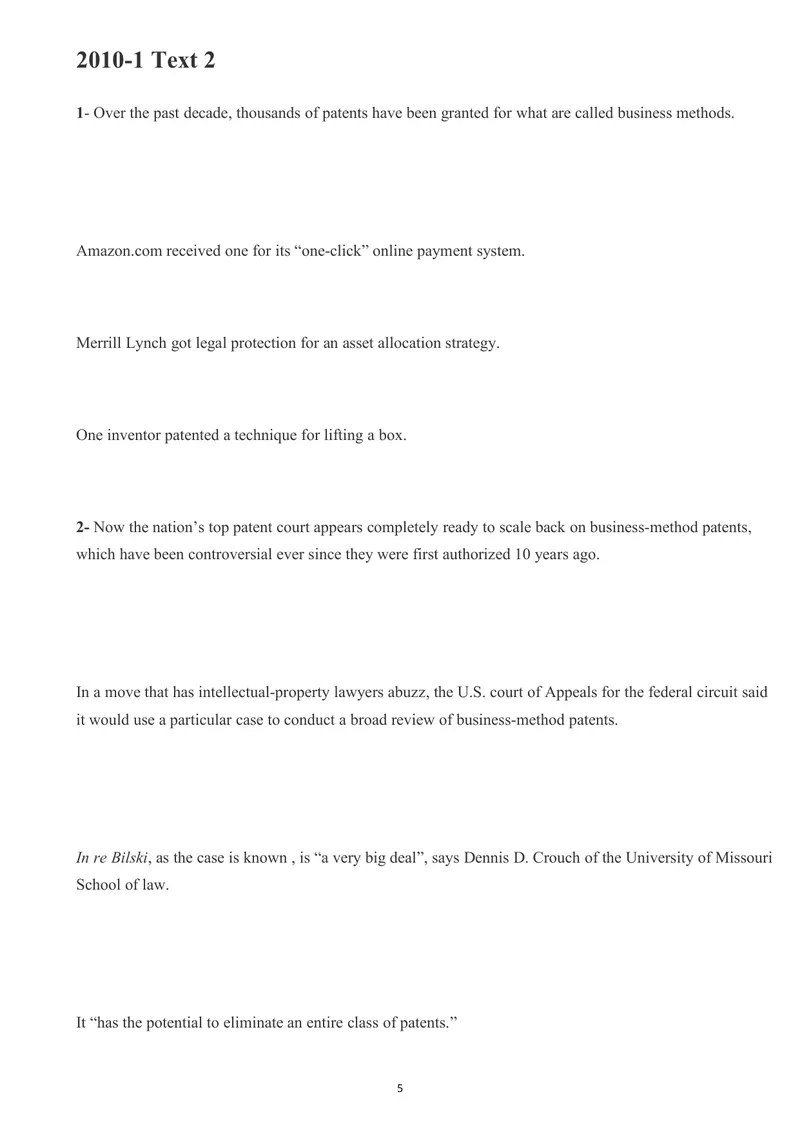
1-Over thepast decade, thousands of patents have been granted for what are called business methods.
Amazon.com received onefor its“one-click”onlinepayment system.
Merrill Lynch got legal protection foran asset allocation strategy.
One inventorpatented atechnique forlifting a box.
2-Now thenation’s top patent court appears completely ready to scaleback onbusiness-method patents,
which havebeen controversial ever since they were first authorized 10years ago.
In a movethat has intellectual-property lawyers abuzz,theU.S. court of Appeals for thefederal circuit said
it would useaparticular case toconduct a broad review ofbusiness-method patents.
In re Bilski,as thecase is known,is “a very big deal”,says Dennis D. Crouch oftheUniversity ofMissouri
School oflaw.
It “has thepotential to eliminatean entire class ofpatents.”
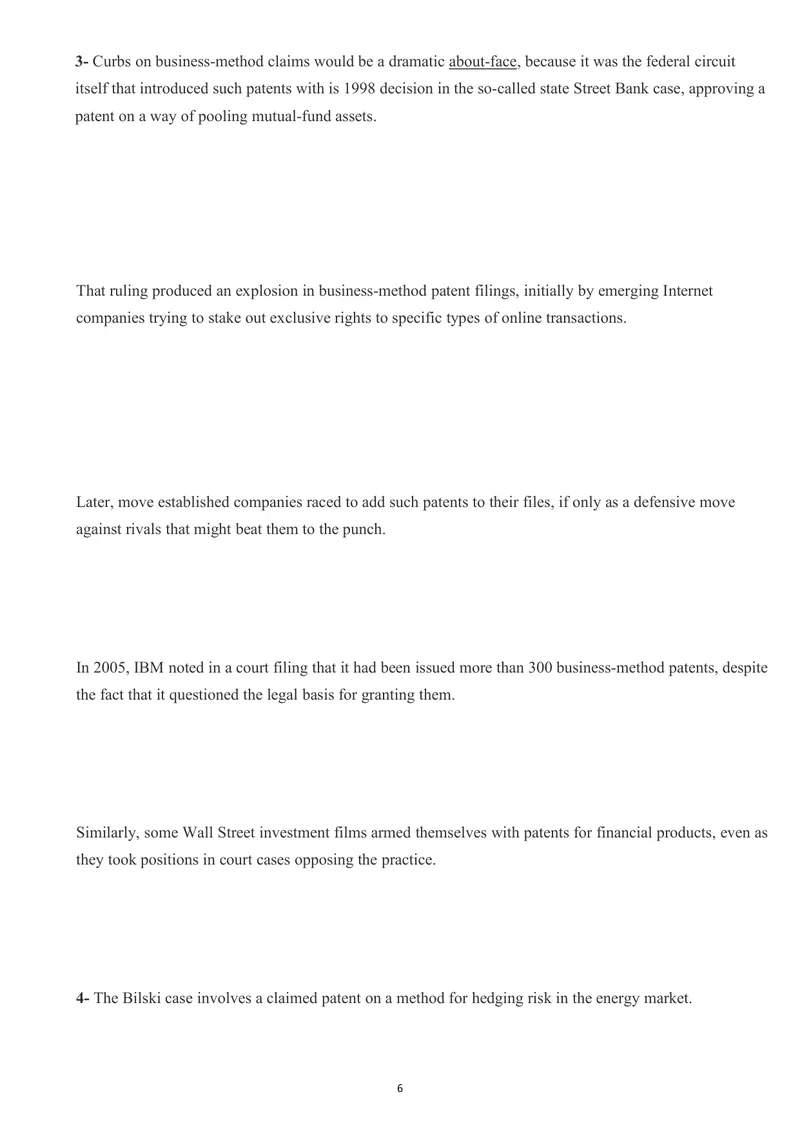
53-Curbs onbusiness-method claims would bea dramaticabout-face,because itwas thefederal circuit
itselfthat introduced suchpatents with is 1998decision in theso-called stateStreet Bank case, approving a
patent onaway of pooling mutual-fund assets.
That ruling produced an explosion inbusiness-method patent filings, initially byemerging Internet
companies trying to stakeout exclusiverights tospecific types ofonlinetransactions.
Later, moveestablished companies raced to add such patents to their files, ifonly as adefensivemove
against rivals thatmight beat them to thepunch.
In 2005,IBM noted in acourt filing that it had been issued morethan 300business-method patents,despite
the fact that it questioned thelegal basis forgranting them.
Similarly, someWall Street investment filmsarmed themselves with patents for financial products, even as
they tookpositionsin court cases opposing the practice.
4-The Bilski case involves aclaimed patent onamethod for hedging risk in theenergy market.
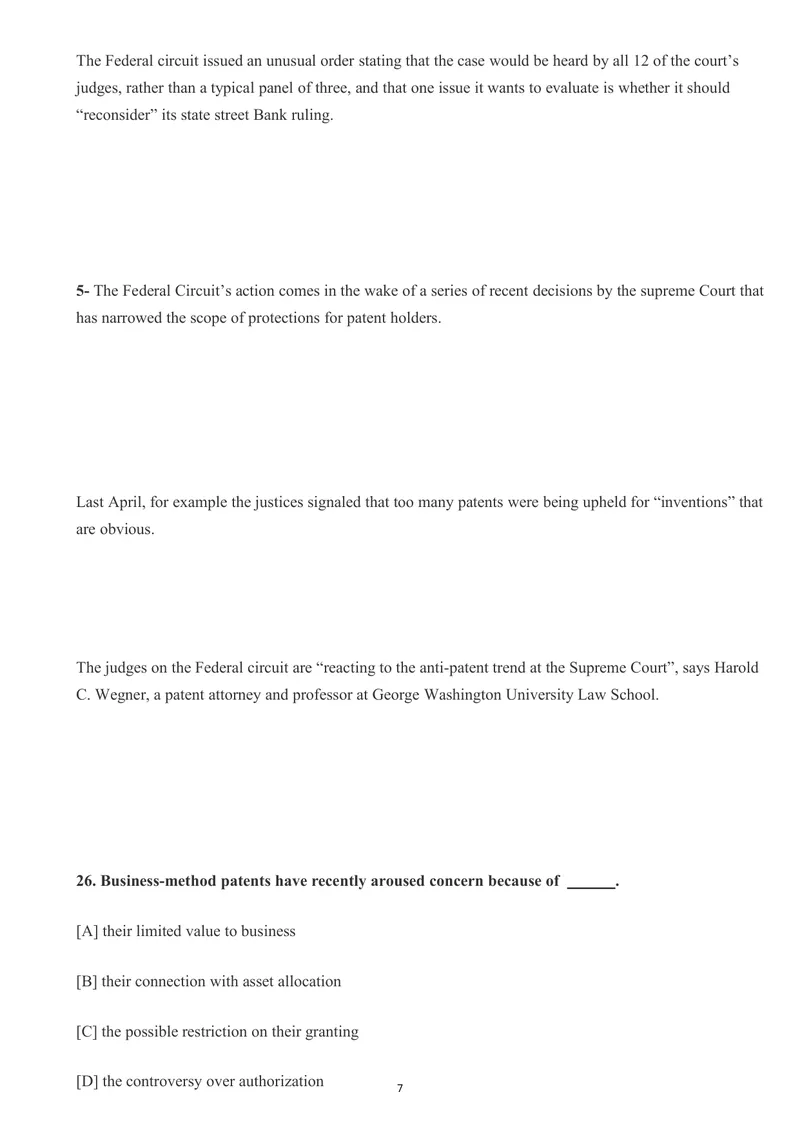
6The Federal circuit issued an unusual order statingthat thecase would be heard byall 12ofthecourt’s
judges, rather than atypical panel ofthree, and that one issueitwants to evaluate is whether it should
“reconsider”its statestreet Bank ruling.
5-The Federal Circuit’s action comes inthewake ofaseries ofrecent decisions bythesupremeCourt that
has narrowed thescope ofprotections forpatent holders.
Last April,for examplethejustices signaled that too many patents were beingupheld for “inventions”that
are obvious.
The judges ontheFederal circuit are “reacting tothe anti-patent trend at theSupremeCourt”,says Harold
C. Wegner, a patent attorney and professor at George Washington University Law School.
26.Business-method patents haverecently aroused concern becauseof .
[A]theirlimited value to business
[B]their connection with asset allocation
[C]the possiblerestriction ontheirgranting
[D]thecontroversy over authorization
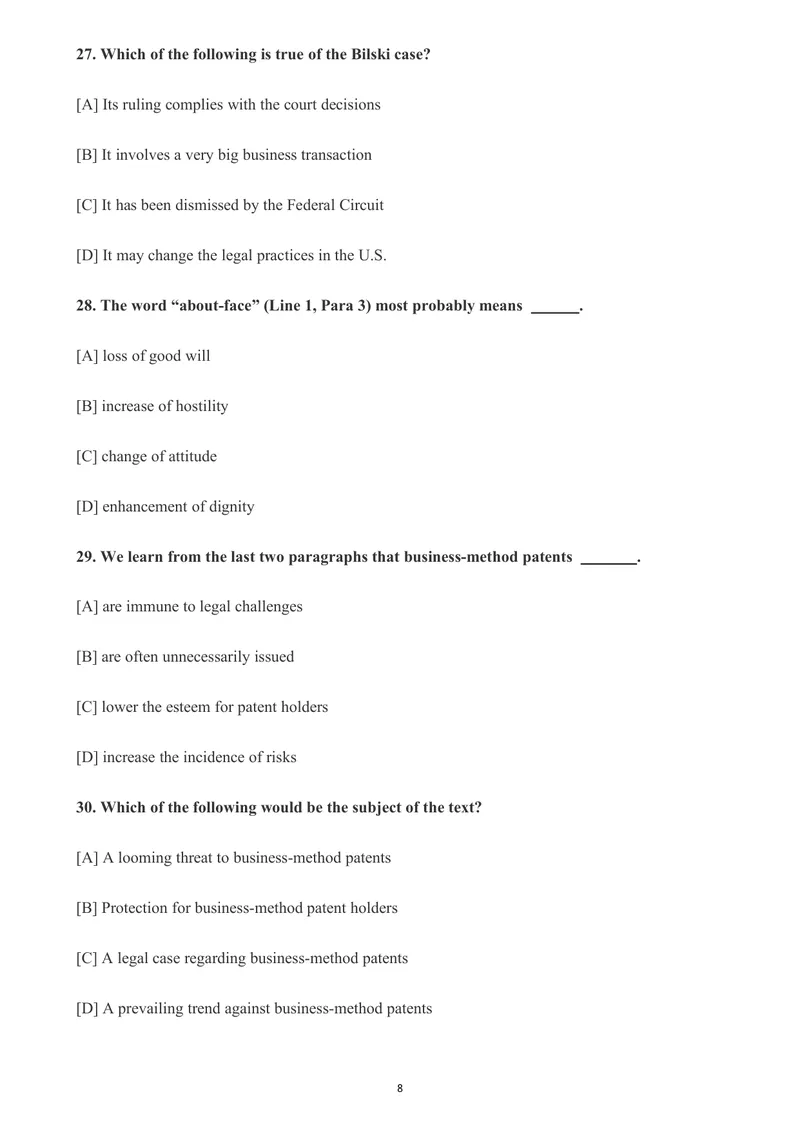
727.Which ofthefollowing istrue of theBilskicase?
[A]Its ruling complies with thecourt decisions
[B]It involvesa very big business transaction
[C]It has been dismissed bytheFederal Circuit
[D]It may change the legal practices in theU.S.
28.Theword“about-face”(Line1,Para3)most probablymeans .
[A]loss ofgood will
[B]increase ofhostility
[C]change ofattitude
[D]enhancement ofdignity
29.We learn fromthelasttwo paragraphsthatbusiness-method patents .
[A]are immuneto legal challenges
[B]are often unnecessarily issued
[C]lower theesteem for patent holders
[D]increase theincidence ofrisks
30.Which ofthefollowing wouldbethesubject ofthetext?
[A]Alooming threat to business-method patents
[B]Protection forbusiness-method patent holders
[C]A legal case regarding business-method patents
[D]Aprevailing trend against business-method patents
82010-1 Text 3
1-In hisbook TheTipping Point,Malcolm Gladwell argues that “social epidemics” are driven in large part
bythe acting ofa tinyminority ofspecial individuals, often called influentials, who are unusually informed,
persuasive, orwell-connected.
The ideais intuitively compelling, but itdoesn't explain howideas actually spread.
2-The supposedimportance ofinfluentials derives from aplausiblesounding butlargely untested theory
called the“two step flowofcommunication”: Information flows from themediatotheinfluentials and
from them to everyone else.
Marketers have embraced thetwo-step flowbecauseit suggests that ifthey can justfind and influence the
influentials, thoseselected people willdo most ofthework for them.
The theory also seems to explain thesudden and unexpected popularity ofcertain looks, brands, or
neighborhoods.
In many such cases, acursory search forcauses finds that somesmall group of peoplewas wearing,
promoting, ordeveloping whatever it isbefore anyone elsepaid attention.
9Anecdotal evidence ofthiskind fits nicely with theidea thatonly certain special people can drive trends.
3-In theirrecent work, however, someresearchers have comeupwith thefinding that influentials have far
less impact onsocialepidemics than is generally supposed.
In fact, they don’t seem to berequired ofall.
4-The researchers’argument stems from asimpleobserving about social influence, with theexceptionof a
few celebrities likeOprah Winfrey —whose outsizepresence isprimarily a function ofmedia, not
interpersonal, influence —even themost influential members ofa population simply don't interact with
that many others.
Yet itis precisely thesenon-celebrity influentials who, according tothe two-step-flow theory, are supposed
to drivesocial epidemics byinfluencing theirfriends and colleagues directly.
For asocial epidemictooccur, however, each person soaffected, must then influence hisor herown
acquaintances, who must inturn influence theirs, and so on; andjust howmany others payattention to each
ofthese peoplehas littleto dowith theinitialinfluential.
10If peopleinthenetwork justtwo degrees removed from theinitialinfluential proveresistant, forexample
from theinitial influential prove resistant, for examplethecascadeof change won’t propagatevery far or
affect many people.
5-Building onthebasictruth about interpersonal influence, theresearchers studied thedynamics of
populations manipulating anumber ofvariables relating of populations,manipulating anumber ofvariables
relating topeople’s ability toinfluence others andtheir tendency to be influenced.
They found that theprincipal requirement forwhat is call “global cascades”–thewidespread propagation
ofinfluence through networks –is thepresence not ofa fewinfluentials but, rather, ofa critical mass of
easily influenced people.
31.By citing thebookTheTippingPoint, theauthorintends to .
[A]analyze the consequences of social epidemics
[B]discuss influentials’function in spreading ideas
[C]exemplify people's intuitiveresponseto social epidemics
[D]describe theessential characteristicsof influentials.
1132.Theauthorsuggests thatthe“two-step-flowtheory” .
[A]serves as a solutionto marketing problems
[B]has helped explain certain prevalent trends
[C]has won support from influentials
[D]requires solidevidence for itsvalidity
33.Whatthe researchers haveobserved recently shows that .
[A]thepower of influencegoes with social interactions
[B]interpersonal links can beenhanced through themedia
[C]influentials have more channels toreach thepublic
[D]mostcelebrities enjoy widemediaattention
34.Theunderlined phrase“thesepeople”inparagraph 4refers to the oneswho .
[A]stay outsidethenetwork ofsocial influence
[B]have littlecontact with thesource ofinfluence
[C]are influenced and then influence others
[D]are influenced bytheinitial influential
35.Whatis theessential elementin thedynamics ofsocial influence?
[A]The eagerness tobeaccepted
[B]The impulsetoinfluence others
[C]The readiness to beinfluenced
[D]The inclinationto rely onothers
122010-1 Text 4
1-Bankers have been blaming themselves for theirtroubles inpublic.
Behind thescenes, they havebeen taking aim at someone else: theaccounting standard-setters.
Their rules, moan thebanks, have forced them toreport enormous losses, and it’s just notfair.
These rules say they mustvalue someassets at the pricea third party would pay, notthe pricemanagers
and regulators would likethemto fetch.
2-Unfortunately, banks’lobbying nowseems tobeworking.
The details may beunknowable, but theindependence ofstandard-setters, essential to theproper
functioning of capital markets, isbeing compromised.
And, unless banks carry toxicassets at prices that attract buyers, reviving thebanking system will be
difficult.
3-After abruising encounter with Congress, America's Financial Accounting Standards Board (FASB)
rushed through rulechanges.
13These gave banks more freedom to usemodels to valueilliquid assets and more flexibilityin recognizing
losses onlong-term assets in theirincomestatements.
Bob Herz, theFASB’s chairman, cried outagainst thosewho “question ourmotives.”
Yet bank shares roseand thechanges enhance what onelobby group politelycalls “theuseofjudgment by
management.”
4-European ministers instantly demanded that theInternational Accounting Standards Board (IASB)do
likewise.
The IASBsays itdoes not want to act without overall planning, but thepressure tofold when itcompletes
it reconstruction ofrules later this year isstrong.
Charlie McCreevy, aEuropean commissioner, warned theIASB that itdid “not livein apolitical vacuum”
but “inthe real word”and thatEurope could yet develop different rules.
5-It was banks that were onthewrong planet,with accounts thatvastly overvalued assets.
14Today they argue that market prices overstate losses, because they largely reflect thetemporary illiquidity
ofmarkets, not thelikely extentofbad debts.
The truth willnot beknown foryears.
But bank’sshares trade belowtheir bookvalue, suggesting that investors are skeptical.
And deadmarkets partly reflect theparalysis ofbanks which willnot sell assets for fear ofbookinglosses,
yet are reluctant to buyall thosesupposed bargains.
6-To get thesystem working again, lossesmust berecognized and dealt with.
America’s newplan to buy uptoxicassets willnot work unless banks mark assets tolevels which buyers
find attractive.
Successful markets require independent and even combativestandard-setters.
The FASB and IASB have been exactly that, cleaning uprules onstockoptions and pensions, forexample,
against hostility from special interests.
But bygiving in tocritics now they are inviting pressure to makemore concessions.
1536.Bankers complainedthat they wereforced to .
[A]followunfavorable asset evaluation rules
[B]collect payments from third parties
[C]cooperate with theprice managers
[D]reevaluate someoftheir assets.
37.According to theauthor,therulechanges oftheFASB may result in .
[A]thediminishing role ofmanagement
[B]the revival of thebankingsystem
[C]the banks' long-term asset losses
[D]theweakening of itsindependence
38.According to Paragraph 4,McCreevy objects tothe IASB’s attempt to .
[A]keep away from political influences.
[B]evade thepressure from their peers.
[C]act ontheirown in rule-setting.
[D]takegradual measures inreform.
39.Theauthorthinks thebanks were “on thewrongplanet” inthatthey .
[A]misinterpreted market price indicators
[B]exaggerated thereal value oftheir assets
[C]neglected thelikely existenceof baddebts.
[D]denied booking losses in theirsale ofassets.
40.Theauthor’s attitudetowards standard-setters is oneof .
[A]satisfaction.
[B]skepticism.
[C]objectiveness
16
[D]sympathy2011-1 Text 1
1-The decision ofthe New York philharmonicto hireAlan Gilbert as itsnextmusicdirector has been the
talk ofthe classical-music world ever since thesudden announcement ofhis appointment in 2009.
For themost part, theresponse has been favorable, tosay theleast.
“Hooray! At last!”wrote Anthony Tommasini, asober-sided classical-musiccritic.
2-One ofthereason why theappointment came as such a surprise, however, isthat Gilbert is
comparatively littleknown.
Even Tommasini,who had advocated Gilbert’s appointmentintheTimes,callshim “an unpretentious
musician with noair oftheformidable conductorabout him.”
As a description ofthenext musicdirector ofan orchestra that has hitherto been led bymusicians like
Gustav Mahler and PierreBoulez, that seems likely tohave struck at least someTimes readers as faint
praise.
3-For mypart, Ihave noideawhether Gilbert isa great conductor or even agood one.
17Tobe sure, be performs an impressivevariety ofinteresting composition, butit is notnecessary for meto
visit Avery Fisher Hall, oranywhere else, to hear interesting orchestral music.
All Ihave to dois to go tomy CDshelf, or bootupmy computer anddownload stillmorerecorded music
form iTunes.
4-Devoted concertgoers who reply that recording are nosubstitutefor liveperformance are missingthe
point.
For thetime, attention, and money of theart-loving public, classical instrumentalistsmust competenot only
with opera houses, dance troupes ,theater companies, and museums, but alsowith therecorded
performances of thegreat classical musicians of the20th century.
There recording are cheap, available everywhere, and very often much higherin artisticquality than
today’s choosing.
The widespread availabilityofsuch recording has thus brought about acrisis intheinstitution ofthe
traditional classical concert.
185-One possibleresponseis forclassical performers toprogram attractivenew musicthat isnot yet
available onrecord.
Gilbert’s own interest in new musichas been widely noted: Alex Ross ,aclassical-musiccritic, has
described him as a man whois capable ofturning the Philharmonic into “amarkedly different, morevibrant
organization.”
But what will bethenature ofthat difference?
Merely, expandingthe orchestra’srepertoirewillnot be enough.
If Gilbert and thrPhilharmonicare to succeed, they must firstchange therelationship between America’s
oldest orchestraand thenew audience it hopstoattract.
21.We learn fromPara 1thatGilbert’s appointmenthas .
[A]incurred criticism
[B]raised suspicion
[C]received acclaim
[D]around curiosity
1922.Tommasini regards Gilbert asan artist who is .
[A]influential
[B]modest
[C]respectable
[D]talented
23.Theauthor believes thatthe devoted concertgoers .
[A]ignore theexpenseofliveperformance
[B]reject most kinds ofrecorded performance
[C]exaggerate thevariety of liveperformances
[D]overestimatethevariety ofliveperformance
24.According to thetext, which ofthe followingistrue of recordings?
[A]They are often inferiorto liveconcerts inquality
[B]They are easily accessible to thegeneral public
[C]They helpimprove thequalityof music
[D]They haveonlycovered masterpieces
25.Regarding Gilbert’srole inrevitalizing thePhilharmonic, the authorfeels .
[A]doubtful
[B]enthusiastic
[C]confident
[D]puzzled
202011-1 Text 2
1-When Liam McGee departed as president ofBankof America inAugust, his explanation was
surprisingly straight up.
Rather than cloaking his exitin theusual vague excuses, hecame right out and said he was leaving to
pursue my goal ofrunning acompany.”
Broadcasting his ambition“was very much my decision,”McGee says.
Within two weeks, hewas talkingfor thefirst timewith theboard ofHartford Financial Services Group,
which named him CEOandchairman onSeptember 29.
2-McGee says leaving without aposition lined upgavehim timetoreflect onwhat kind ofcompany he
wanted to run.
It also senta clear message to theoutsideworld about his aspirations.
And McGee isn’t alone.
21In recent weeks theNO.2 executives Avon and American Express quitwith theexplanation that they were
looking for aCEOpost.
3-As boards scrutinizesuccession plans in responseto shareholder pressure, executives who don’t get the
nodalso may wish tomove on.
A turbulentbusiness environment also has senior managers cautious ofletting vaguepronouncements cloud
theirreputations.
As thefirst signs ofrecovery begin to take hold, deputy chiefs may bemorewilling to makethejump
without anet.
In the third quarter, CEO turnover was down 23% from ayear ago as nervous boards stuck with theleaders
they had, according to Liberum Research.
As theeconomy picks up,opportunities will abound foraspiring leaders.
4-The decision to quita seniorposition to lookfor abetter oneis unconventional.
22For years executives and headhunters haveadhered to therulethat the mostattractiveCEOcandidates are
the ones who must bepoached.
Says Korn/Ferry seniorpartner Dennis Carey, “Ican’t think ofa singlesearch I’ve donewhere a board has
not instructed metolook at sittingCEOs first.”
5-Those who jumped without ajob haven’t always landed in top positions quickly.
Ellen Marram quit as chief ofTropicana adecade age,saying shewanted tobe aCEO.
It was ayear before shebecamehead ofa tinyInternet-based commodities exchange.
Robert Willumstad left Citigroup in 2005with ambitionsto be aCEO.
He finally tookthatpost at amajorfinancial institution three years later.
6-Many recruiters say theold disgrace is fading for top performers.
The financial crisis has madeit more acceptableto be between jobsor to leavea bad on.
23“Thetraditional rule was it’s safer to stay where you are, buthat’s been fundamentally inverted,” says one
headhunter.
“Thepeople who’ve been hurt theworst are thosewho’vestayed too long.”
26.When McGee announced hisdeparture, hismanner can bestbedescribed as being .
[A]Arrogant
[B]frank
[C]self-centered
[D]impulsive
27.According to Paragraph 2,seniorexecutives quittingmay bespurred by .
[A]theirexpectation of betterfinancial status
[B]their need to reflect ontheirprivate life
[C]their strained relations withthe boards
[D]theirpursuit ofnew career goals
28.Theword“poached”(Line3, Paragraph 4)most probablymeans .
[A]approvedof
[B]attended to
[C]hunted for
[D]guardedagainst
2429.It can beinferred fromthe lastparagraphthat .
[A]top performers used to cling totheir posts
[B]loyalty of top performers is getting out-dated
[C]topperformers caremore about reputations
[D]it’s safer to stick tothe traditional rules.
30.Which ofthefollowing isthe besttitleforthe text?
[A]CEOs: where to GO?
[B]CEOs: All theWay Up?
[C]Top managers Jump withouta Net
[D]The Only wayout forTop Performers
252011-1 Text 3
1-The rough guide tomarketing success usedto bethat you got what you paid for.
No longer.
While traditional“paid” media-such as television commercials and print advertisements - stillplaya
majorrole, companies today can exploitmany alternative forms ofmedia.
Consumers passionate about aproduct maycreate “earned” mediabywillingly promoting it tofriends, and
a company may leverage “owned” mediabysending e-mail alerts about products and sales to customers
registered withits Website.
The way consumers nowapproach theprocess ofmaking purchasedecisions means that marketing’s
impact stemsfrom aboard range offactors beyond conventional paid media.
2-Paid and owned media are controlled bymarketers promoting theirown products.
For earned media, such marketers act as theinitiators for users’responses.
26But in somecases, onemarketer’s owned media becomeanother marketer’s paid media-for instance,
when ane-commerce retailer sells ad space onitsWebsite.
Wedefine such sold mediaas owned media whosetrafficis so strong the otherorganization placetheir
content ore-commerce engines withinthat environment.
This trend, which we believeis stillin itsinfancy,effectively began with retailers and travel providers such
as airlines and hotels and will nodoubt go further John & Johnson,for example, has created Baby-Center, a
stand-alone mediaproperty that promotes complementary and even competitiveproducts.
Besides generating income, thepresence ofothermarketers makes thesiteseem objective, gives companies
opportunities tolearn valuable information about theappeal ofothercompanies’marketing, andmay help
expand usertraffic forall companies concerned.
3-The same dramatictechnological changes that have provided marketers with more (and more diverse)
communications choices have also increased therisk that passionate consumers willvoice theiropinions in
quicker, morevisible, and much moredamaging ways.
27Such hijacked mediaare the oppositeof earned media: an asset orcampaign become hostageto
consumers,other stakeholders, or activistswho makenegative allegations about a brand or product.
Members ofsocial networks, for instance, are learning that they can hijack media to apply pressure onthe
business that originally created them.
4-If that happens, passionateconsumers would try topersuade others to boycott products, puttingthe
reputation ofthetarget company at risk.
In such acase, thecompany’s response maynot besufficiently quick orthoughtful, and the learning curve
has been steep.
ToyotaMotor, for example, alleviated someof thedamage from its recall crisis earlierthis year with a
relatively quick and well-orchestrated social-media response campaign, which included efforts toengage
with consumers directly sites such as Twitter and thesocial-news sit Digg.
31.Consumers may creat “earned”media when they are .
[A]obsessed with onlineshopping at certain Web sites
[B]inspired byproduct-promoting e-mails sent tothem
[C]eager to help theirfriends promotequality products
28
[D]enthusiasticabout recommending theirfavorite products32.According to Paragraph 2,soldmedia feature .
[A]asafe businessenvironment
[B]random competition
[C]Strong user traffic
[D]flexibilityinorganization
33.Theauthorindicates inParagraph 3thatearned media .
[A]inviteconstant conflicts with passionate consumers
[B]can be used to produce negativeeffects in marketing
[C]may beresponsiblefor fiercer competition
[D]deserve allthe negativecomments about them
34.Toyota Motor’s experience is cited as an exampleof .
[A]responding effectively to hijacked media
[B]persuading customers intoboycotting products
[C]cooperating with supportiveconsumers
[D]taking advantage of hijacked media
35.Which ofthefollowing isthe text mainlyabout?
[A]Alternatives toconventional paid media
[B]Conflict between hijacked and earned media
[C]Dominance ofhijacked media
[D]Popularity ofowned media
292011-1 Text 4
1-It’s nosurprisethat Jennifer Senior’s insightful, provocativemagazinecover story, “IloveMy Children,
IHate MyLife,”is arousing much chatter -nothinggets peopletalking likethesuggestion that child
rearing is anything less than a completely fulfilling, life-enriching experience.
Rather than concluding that children make parents either happy or miserable, Seniorsuggests we need to
redefine happiness: instead of thinkingofit as something that can bemeasured bymoment-to-moment joy,
we shouldconsider being happy as a past-tensecondition.
Even though the day-to-day experience ofraising kids can besoul-crushingly hard, Seniorwrites that “the
very things that inthemoment dampen ourmoods can later be sources ofintense gratification and delight.”
2-The magazinecover showing an attractive motherholdinga cutebaby ishardly theonly
Madonna-and-child image onnewsstands thisweek.
There are also stories about newly adoptive- andnewly single -momSandra Bullock, as well as the usual
“Jennifer Anistonis pregnant”news.
30Practically every week features at least onecelebrity mom, ormom-to-be, smilingonthe newsstands.
3-In asociety that sopersistently celebrates procreation, isit anywonder that admittingyou regret having
children is equivalent to admittingyou support kitten-killing?
It doesn’t seem quitefair, then, to compare theregrets of parent to theregrets of thechildless.
Unhappy parents rarely are provoked towonder ifthey shouldn’thave had kids, but unhappy childless
folks are bothered with themessage that children are the single mostimportant thingin theworld:
obviously theirmisery must beadirect result of thegapingbaby-sizeholes in theirlives.
4-Of course theimage ofparenthood that celebrity magazinelikeUs Weeklyand Peoplepresent is hugely
unrealistic, especially when theparents are single mothers likeBullock.
According to several studies concluding that parents are less happy than childless couples, single parents
are the least happy ofall.
31No shockthere, considering howmuch work it isto raise akid without apartner to lean on; yet to hear
Sandra and Britney tell it,raising akid on their“own (read: with round-the-clock help) isa piece ofcake.”
5-It’s hard toimagine thatmany peopleare dumb enough towant children just because Reese and
Angelina makeit look soglamorous: most adults understand that ababyis not ahaircut.
But it’s interesting to wonderiftheimages wesee every week of stress-free, happiness-enhancing
parenthood aren’t insomesmall, subconscious way contributing toourown dissatisfactions with theactual
experience, inthesame way that a smallpart ofus hoped getting “the Rachel” might make uslookjust a
littlebit likeJennifer Aniston.
36.Jennifer Seniorsuggests in herarticle thatraising achildcan bring ,
[A]temporary delight.
[B]enjoyment inprogress.
[C]happiness inretrospect.
[D]lasting reward.
37.We learn fromParagraph 2that .
[A]celebrity momsare a permanent source for gossip.
[B]single mothers with babies deserve greater attention.
[C]news about pregnant celebrities is entertaining.
32
[D]havingchildren ishighly valued bythepublic.38.It issuggested in Paragraph 3thatchildless folks .
[A]are constantly exposed to criticism.
[B]are largely ignored bythemedia.
[C]fail to fulfilltheirsocial responsibilities.
[D]are less likely to besatisfied with theirlife.
39.According to Paragraph 4,themessage conveyed bycelebrity magazines is .
[A]soothing.
[B]ambiguous.
[C]compensatory.
[D]misleading.
40.Which ofthefollowing can beinferred fromthe lastparagraph?
[A]Having children contributes little to theglamourofcelebrity moms.
[B]Celebrity momshave influenced ourattitudetowards child rearing.
[C]Having children intensifies ourdissatisfaction with life.
[D]Wesometimesneglect thehappiness from child rearing.
332012-1 Text 1
1-Come on–Everybody’sdoingit.
That whispered message, half invitationandhalf forcing, is what mostof usthink ofwhen wehear the
words peer pressure.
It usually leads tonogood - drinking, drugs and casual sex.
But in hernew bookJoin theClub,Tina Rosenberg contends that peer pressure can also bea positiveforce
through what shecalls the social cure, in which organizationsand officials usethepower ofgroup
dynamics tohelp individuals improvetheirlives and possibly theworld.
2-Rosenberg, therecipient of aPulitzerPrize, offers a host ofexampleofthesocial cure inaction: In South
Carolina, astate-sponsored antismokingprogram called RageAgainst theHazesets out to makecigarettes
uncool.
In South Africa, an HIV-prevention initiativeknown as LoveLife recruits young people to promotesafe sex
among theirpeers.
343-The ideaseems promising,and Rosenberg isa perceptiveobserver.
Her critiqueof thelameness ofmany pubic-health campaigns is spot-on: they fail to mobilizepeer pressure
for healthy habits, and they demonstratea seriously flawed understanding ofpsychology.
“Dare to bedifferent, please don’t smoke!” pleads one billboard campaign aimed at reducing smoking
among teenagers-teenagers, who desire nothing morethan fitting in.
Rosenberg argues convincingly that public-health advocates ought to take apage from advertisers, so
skilled at applying peer pressure.
4-But onthegeneral effectiveness of thesocial cure, Rosenberg is less persuasive.
Join theClub isfilled with too much irrelevant detail and notenough explorationof thesocial and
biological factors that make peer pressure so powerful.
The mostglaring flaw of thesocial cure as it’s presented here is that itdoesn’t work very well for very
long.
Rage Against theHazefailed once statefunding was cut.
35Evidence that theLoveLife program produces lasting changes is limited and mixed.
5-There’s no doubt that ourpeer groups exert enormous influence onour behavior.
An emerging bodyofresearch shows thatpositivehealth habits- as well as negative ones - spread through
networks offriends viasocial communication.
This is asubtleform ofpeer pressure: weunconsciously imitatethe behaviorwe seeevery day.
6-Far less certain, however, is howsuccessfully experts and bureaucrats can select our peer groups and
steer theiractivities invirtuous directions.
It’slikethe teacherwho breaks upthetroublemakers in theback row bypairing them with better-behaved
classmates.
The tacticnever really works.
And that’s theproblem with asocial cure engineered from the outside:in thereal world, as inschool, we
insistonchoosing ourown friends.
3621.According to thefirstparagraph, peerpressure often emerges as .
[A]asupplement tothe social cure
[B]a stimulusto group dynamics
[C]an obstacleto school progress
[D]acause of undesirable behaviors
22.Rosenberg holds thatpublicadvocates should .
[A]recruit professional advertisers
[B]learn from advertisers’experience
[C]stay away from commercial advertisers
[D]recognizethelimitations ofadvertisements
23.In theauthor’s view, Rosenberg’sbook failsto .
[A]adequately probe social and biological factors
[B]effectively evade theflaws ofthesocial cure
[C]illustratethefunctions ofstatefunding
[D]produce along-lasting social effect
24.Paragraph 5shows thatourimitation ofbehaviors .
[A]is harmful to ournetworks offriends
[B]will mislead behavioral studies
[C]occurs withoutourrealizing it
[D]can produce negative health habits
25.Theauthorsuggests inthe lastparagraphthatthe effect ofpeer pressureis .
[A]harmful
[B]desirable
[C]profound
37
[D]questionable2012-1 Text 2
1-A deal is adeal-except, apparently, when Entergy is involved.
The company, a majorenergy supplierin New England, provoked justified outragein Vermont lastweek
when it announced it was reneging onalongstanding commitment toabide bythestrict nuclear regulations.
2-Instead, the company has done precisely what it had long promised it would not: challenge the
constitutionality ofVermont’s rules in thefederal court, as part ofa desperate effort to keepitsVermont
Yankee nuclear power plant running.
It’sa stunning move.
3-The conflict has been surfacingsince 2002,when the corporation bought Vermont’s only nuclear power
plant, an aging reactorin Vernon.
As a conditionof receiving stateapproval forthe sale, thecompany agreed to seek permission from state
regulators to operatepast 2012.
In 2006,the statewent a step further, requiring that any extension oftheplant’s licensebe subject to
Vermont legislature’s approval.
38Then, too,the company went along.
4-Either Entergy never really intended tolivebythosecommitments, oritsimply didn’t foreseewhat
would happen next.
A stringofaccidents, including thepartial collapseof acooling tower in 207andthediscovery ofan
underground pipesystem leakage, raised serious questions about bothVermont Yankee’s safety and
Entergy’s management –especially after thecompany mademisleading statements about thepipe.
Enraged byEntergy’s behavior, theVermont Senatevoted 26to4last year against allowing an extension.
5-Now thecompany issuddenly claimingthat the 2002agreement is invalid because ofthe2006
legislation, andthat only thefederal government has regulatory power over nuclear issues.
The legal issues in thecase are obscure: whereas theSupremeCourt has ruled thatstates dohave some
regulatory authority over nuclear power, legal scholars say that Vermont case will offer aprecedent-setting
test of howfarthose powers extend.
39Certainly, thereare valid concerns about thepatchwork regulations that could result ifevery statesets its
own rules.
But had Entergy kept itsword, that debate would bebesidethe point.
6-The company seems to have concluded that itsreputation in Vermont is already so damaged that it has
noting left to losebygoing towar with thestate.
But there shouldbe consequences.
Permission to runanuclear plantis apublictrust.
Entergy runs 11other reactors in theUnited States, including Pilgrim Nuclear station inPlymouth.
Pledging to run Pilgrim safely, thecompany has applied for federal permission to keep itopen foranother
20years.
But as theNuclear Regulatory Commission (NRC)reviews thecompany’s application, itshould keepit
mind what promises from Entergy are worth.
4026.Thephrase“reneging on”(Line3.para.1) isclosest in meaningto .
[A]condemning.
[B]reaffirming.
[C]dishonoring.
[D]securing.
27.By entering into the 2002agreement, Entergy intendedto .
[A]obtain protection from Vermont regulators.
[B]seek favor from thefederal legislature.
[C]acquire an extensionof itsbusiness license .
[D]get permission to purchasea power plant.
28.According to Paragraph 4,Entergy seems to haveproblems withits .
[A]managerial practices.
[B]technical innovativeness.
[C]financial goals.
[D]business vision
29.In theauthor’s view, theVermontcase willtest .
[A]Entergy’s capacity to fulfillall its promises.
[B]the matureof states’patchwork regulations.
[C]the federal authority over nuclear issues .
[D]thelimits of states’power overnuclear issues.
30.It can beinferred fromthe lastparagraphthat .
[A]Entergy’s business elsewhere might beaffected.
[B]the authority oftheNRC willbe defied.
[C]Entergy will withdrawits Plymouth application.
41
[D]Vermont’s reputation might be damaged.2012-1 Text 3
1-In theidealized version of howscience is done, facts about theworld are waitingtobe observed and
collected byobjective researchers who usethescientificmethod to carry out theirwork.
But in theeveryday practice ofscience, discovery frequently follows an ambiguous and complicated route.
Weaim to beobjective, butwe cannot escape thecontext ofouruniquelifeexperience.
Priorknowledge and interest influence what we experience, what we thinkour experiences mean, andthe
subsequent actions we take.
Opportunities for misinterpretation, error, and self-deception abound.
2-Consequently, discovery claims should bethought ofas protoscience.
Similar to newly staked mining claims, they are full ofpotential.
But ittakes collective scrutiny andacceptance totransform adiscovery claim into amature discovery.
42This is thecredibility process, through which theindividual researcher’sme, here, now becomes the
community’s anyone, anywhere, anytime.
Objective knowledge is thegoal, not thestarting point.
3-Once adiscovery claim becomes public, thediscoverer receives intellectual credit.
But, unlikewith mining claims, thecommunity takes control of what happens next.
Within thecomplex social structure ofthescientific community, researchers makediscoveries; editors and
reviewers act as gatekeepers bycontrolling thepublication process; other scientistsuse thenewfinding to
suit theirown purposes; and finally, thepublic(including other scientists)receives thenew discovery and
possibly accompanying technology.
As a discovery claim works it through thecommunity, the interaction and confrontation between shared
and competing beliefs about the science andthetechnology involved transforms an individual’s discovery
claim intothecommunity’s crediblediscovery.
4-Two paradoxes existthroughout this credibilityprocess.
43First, scientificwork tends to focus onsomeaspect ofprevailing Knowledge that isviewed as incomplete
orincorrect.
Little reward accompanies duplication and confirmation ofwhat is already known and believed.
The goal is new-search, not re-search.
Not surprisingly, newly publisheddiscovery claims and credible discoveries thatappear to beimportant
and convincing will always be opento challenge andpotential modification orrefutation byfuture
researchers.
Second, novelty itselffrequentlyprovokes disbelief.
Nobel Laureateand physiologist Albert Azent-Gyorgyi once described discovery as “seeing what
everybody has seen and thinking what nobody has thought.”
But thinkingwhat nobody elsehas thought andtelling others what they havemissed may not change their
views.
Sometimes years are required for trulynovel discovery claims tobeaccepted and appreciated.
445-In theend, credibility “happens” to adiscovery claim –aprocess that corresponds to what philosopher
Annette Baierhas described as thecommons of themind.
“Wereason together, challenge, revise, and complete each other’sreasoning and each other’s conceptions
ofreason.”
31.According to thefirstparagraph, theprocess ofdiscovery is characterized byits .
[A]uncertainty and complexity.
[B]misconception anddeceptiveness.
[C]logicality and objectivity.
[D]systematicness and regularity.
32.It can beinferred fromParagraph 2that credibilityprocess requires .
[A]strict inspection.
[B]shared efforts.
[C]individual wisdom.
[D]persistent innovation.
33.Paragraph 3shows thatadiscovery claimbecomes credibleafter it .
[A]has attracted theattention ofthegeneral public.
[B]has been examined bythe scientificcommunity.
[C]has received recognition from editors and reviewers.
[D]has beenfrequently quoted bypeer scientists.4534.Albert Szent-Györgyi wouldmostlikely agree that .
[A]scientificclaims willsurvive challenges.
[B]discoveries today inspire future research.
[C]efforts tomake discoveries are justified.
[D]scientificwork calls for acritical mind.
35.Which ofthefollowing wouldbethebesttitle ofthe test?
[A]Novelty as an Engine ofScientific Development.
[B]Collective ScrutinyinScientificDiscovery.
[C]Evolution ofCredibility in Doing Science.
[D]Challenge toCredibilityat theGate toScience.
462012-1 Text 4
1-If thetrade unionist Jimmy Hoffa were alivetoday, hewould probably represent civil servant.
When Hoffa’s Teamsters were in theirprimein 1960,only onein tenAmerican government workers
belonged to aunion; now36%do.
In 2009the numberof unionists inAmerica’s publicsector passed that oftheir fellowmembers in the
private sector.
In Britain, more than halfof public-sector workers but only about 15%ofprivate-sector ones are unionized.
2-There are three reasons for thepublic-sector unions’thriving.
First, theycan shutthings down withoutsuffering much in theway of consequences.
Second, they are mostlybright and well-educated.
A quarterof America’s public-sector workers havea university degree.
47Third, they nowdominateleft-of-centre politics.
Someoftheir tiesgo back a longway.
Britain’s Labor Party, as its nameimplies, has long been associated with tradeunionism.
Its current leader, EdMiliband,owes his position to votes from public-sector unions.
3-At the statelevel their influencecan beeven more fearsome.
Mark Baldassare ofthePublicPolicy Instituteof Californiapoints outthat much ofthestate’sbudget is
patrolled byunions.
The teachers’ unionskeep aneye onschools, the CCPOAonprisons andavariety of laborgroups onhealth
care.
4-In many rich countries average wages in thestatesector are higherthan intheprivate one.
But thereal gains comein benefits and work practices.
48Politicians haverepeatedly “backloaded”public-sector pay deals, keeping thepay increases modest but
adding toholidays and especially pensions that are already generous.
5-Reform has been vigorously opposed, perhaps most egregiously in education, where charter schools,
academies andmerit payall faced drawn-out battles.
Even though there is plenty ofevidence thatthe qualityof theteachers is themost important variable,
teachers’unions have fought against getting rid ofbad ones and promoting good ones.
6-As thecost toeveryone else has become clearer, politicians have begun toclamp down.
In Wisconsin theunions haverallied thousands ofsupporters against Scott Walker, thehardline Republican
governor.
But many within thepublicsectorsuffer underthecurrent system, too.
7-John Donahueat Harvard’sKennedy School points outthat thenorms of culture inWestern civil
services suit thosewho want tostay put but isbad for high achievers.
49The onlyAmerican public-sector workers who earnwell above $250,000ayear are university sports
coaches andthepresident oftheUnited States.
Bankers’fat paypackets have attracted muchcriticism, but apublic-sector system that does not reward
high achievers may bea much biggerproblem forAmerica.
36.It can belearned fromthe first paragraphthat .
[A]Teamsters stillhave alarge bodyofmembers.
[B]Jimmy Hoffa used to work as acivil servant.
[C]unions have enlarged their public-sectormembership.
[D]thegovernment has improved its relationship with unionists.
37.Which ofthefollowing istrue of Paragraph2?
[A]Public-sector unionsare prudent in taking actions.
[B]Education is required forpublic-sector unionmembership.
[C]Labor Party has long been fighting against public-sector unions.
[D]Public-sector unionsseldom get introublefor theiractions.
38.It can belearned fromParagraph 4thattheincome inthestate sector is .
[A]illegally secured.
[B]indirectly augmented.
[C]excessively increased.
[D]fairly adjusted. 5039.Theexample oftheunions inWisconsinshowsthat unions .
[A]often run against thecurrent political system.
[B]can change people’s political attitudes.
[C]may bea barrier to public-sector reforms.
[D]are dominant in thegovernment.
40.JohnDonahue’s attitudetowards thepublic-sector system isoneof .
[A]disapproval.
[B]appreciation.
[C]tolerance.
[D]indifference.
512013-1 Text 1
1-In the2006film version ofTheDevil Wears Prada, Miranda Priestly, played byMeryl Streep, scolds her
unattractiveassistant for imagining that high fashion doesn’t affect her.
Priestly explainshowthedeep bluecolor oftheassistant’ssweater descended over theyears from fashion
shows to department stores and to thebargain bin inwhich the poorgirl doubtless foundhergarment.
2-This top-down conception of thefashion business couldn’tbe moreout ofdate orat odds with feverish
world described in Overdressed, Elizabeth Cline’sthree-year indictmentof “fast fashion”.
In the last decades orso, advances in technology haveallowed mass-market labels such as Zara, H&M, and
Uniqlo toreact to trends more quickly and anticipate demand more precisely.
Quicker turnarounds mean less wasted inventory, morefrequent releases, and more profit.
Theselabels encourage style-conscious consumers tosee clothes as disposable —meant to last onlya wash
ortwo, although they don’t advertise that —and to renew their wardrobe every few weeks.
52By offering on-trend items at dirt-cheap prices, Clineargues, these brands have hijacked fashion cycles,
shaking an industrylongaccustomed toaseasonal pace.
3-The victimsof thisrevolution, ofcourse, are notlimited to designers.
For H&M tooffer a $5.95knitminiskirtin all its2,300-plus stores around theworld, itmust rely on
low-wage overseas labor, order in volumes that strain natural resources, and usemassiveamounts of
harmful chemicals.
4-Overdressed is thefashion world’s answer to consumer-activist bestsellers likeMichael Pollan’s The
Omnivore’s Dilemma.
“Mass-produced clothing, likefast food, fillsahunger and need, yet isnon-durable, and wasteful,”Cline
argues.
Americans, she finds, buyroughly 20billiongarments a year —about 64items perperson —and no
matter howmuch they give away, this excess leads to waste.
535-Towards theend ofOverdressed,Clineintroduced her ideal, a Brooklyn woman named Sarah Kate
Beaumont, who since 2008has made all ofher own clothes —and beautifully.
But as Clineisthefirst to note, ittook Beaumont decades to perfect hercraft; her examplecan’tbe
knocked off.
6-Though several fast-fashion companies havemade efforts to curb their impact onlaborand the
environment —includingH&M, with its green ConsciousCollection Line —Clinebelieves lastingchange
can only beeffected bythecustomer.
Sheexhibits theidealism common tomany advocates ofsustainability, beitinfood orinenergy.
Vanity isaconstant; peoplewill only start shoppingmore sustainably when they can’t afford not to.
21.Priestly criticizes her assistantforher .
[A]poor bargaining skill.
[B]insensitivity tofashion.
[C]obsession withhigh fashion.
[D]lack of imagination.
5422.According to Cline, mass-marketlabelsurge consumers to .
[A]combat unnecessary waste.
[B]shut out thefeverish fashion world.
[C]resist theinfluence ofadvertisements.
[D]shop for theirgarments more frequently.
23.Theword“indictment”(Line3,Para.2) isclosest in meaningto .
[A]accusation.
[B]enthusiasm.
[C]indifference.
[D]tolerance.
24.Which ofthefollowing can beinferred fromthe lastparagraph?
[A]Vanity has moreoften been found inidealists.
[B]The fast-fashion industry ignores sustainability.
[C]People are moreinterested in unaffordablegarments.
[D]Pricing is vital toenvironment-friendly purchasing.
25.Whatis thesubject ofthetext?
[A]Satireonan extravagant lifestyle.
[B]Challenge to ahigh-fashion myth.
[C]Criticism ofthefast-fashion industry.
[D]Exposure ofa mass-market secret.
552013-1 Text 2
1-An oldsaying has itthat half ofall advertising budgets are wasted —thetroubleis, nooneknows which
half. In theinternet age, at least intheory, thisfraction can be much reduced.
By watching what people search for, click onand say online, companies can aim “behavioural”ads at those
most likely tobuy.
2-In thepast couple ofweeks aquarrel has illustrated the valueto advertisers ofsuch fine-grained
information: Shouldadvertisers assumethat people are happy to betracked and sent behavioural ads?Or
should they have explicit permission?
3- In December 2010 America’s Federal Trade Commission (FTC) proposed adding a “do not track” (DNT)
option to internet browsers, so that users could telladvertisers that they did notwant to befollowed.
Microsoft’s Internet Explorer and Apple’s Safari bothoffer DNT; Google’s Chrome isdue todo sothis
year.
In February theFTC and theDigital Advertising Alliance(DAA) agreed that theindustry would get
cracking onresponding to DNT requests.
564-On May 31st Microsoft set off therow.
It said that Internet Explorer 10,theversion dueto appear with windows 8,would have DNT as adefault.
5-Advertisers are horrified.
Human nature being what it is,most peoplestick with default settings.
Few switchDNT onnow,but iftracking is offit willstay off.
Bob Liodice, thechiefexecutive oftheAssociation ofNational Advertisers, says consumers willbe worse
off iftheindustry cannot collect information about theirpreferences.
People willnot get fewerads, hesays.
“They’ll get less meaningful, less targeted ads.”
6-It isnot yet clear how advertisers willrespond.
Getting a DNT signal does not oblige anyone to stoptracking, although somecompanies havepromised to
doso.
57Unable to tell whether someonereally objects tobehavioural ads orwhether they are stickingwith
Microsoft’s default, somemay ignore a DNT signal andpress onanyway.
7-Also unclear iswhy Microsoft has gone italone.
After all, it has an ad business too,which itsays willcomply with DNT requests, though it isstillworking
out how.
If it istrying toupset Google, which relies almost wholly onadvertising, it has chosen an indirect method:
there is noguarantee that DNT bydefault will become thenorm.
DNT does not seem an obviouslyhuge selling point forwindows 8—though thefirm has compared some
ofits otherproducts favourably with Google’sonthat count before.
Brendon Lynch, Microsoft’s chief privacy officer, blogged: “Webelieve consumers shouldhave more
control.”
Could itreally bethat simple?
58.
26.It issuggested in Paragraph 1that“behavioural”ads helpadvertisers to
[A]ease competition amongthemselves.
[B]lower their operational costs.
[C]avoid complaints from consumers.
[D]provide betteronlineservices.
27.“Theindustry” (Line6,Para.3) refers to .
[A]onlineadvertisers.
[B]e-commerce conductors.
[C]digital information analysis.
[D]internet browser developers.
28.Bob Liodiceholdsthatsetting DNT as adefault .
[A]maycut thenumber ofjunk ads.
[B]fails toaffect thead industry.
[C]will not benefit consumers.
[D]goes againsthuman nature.
29.Which ofthefollowing istrue accordingto Paragraph 6?
[A]DNT may not serveits intended purpose.
[B]Advertisers are willingto implement DNT.
[C]DNT is losingits popularity among consumers.
[D]Advertisers are obliged to offer behavioural ads.
30.Theauthor's attitudetowardswhatBrendon Lynchsaidin hisblog isoneof .
[A]indulgence.
[B]understanding.
[C]appreciation.
59
[D]skepticism.2013-1 Text 3
1-Up untilafew decades ago, our visionsofthefuture were largely —though bynomeans uniformly —
glowingly positive.
Science and technology would cure all theillsof humanity, leading to livesof fulfillmentand opportunity
for all.
2-Now utopiahas grown unfashionable, as we havegained adeeper appreciation oftherange of threats
facing us, from asteroid striketo epidemicflu toclimate change.
You might even betempted to assumethat humanity has little futureto look forward to.
3-But suchgloominess is misplaced.
The fossil record shows that many species have endured formillions ofyears —so why shouldn’twe?
Take a broader look at ourspecies’place in theuniverse, and it becomes clear that wehave an excellent
chance ofsurviving fortens, ifnothundreds, ofthousands of years.
60LookupHomo sapiens inthe “RedList”ofthreatened species oftheInternational Union for the
Conversation of Nature (IUCN), and you will read: “Listed as Least Concern as thespecies is very widely
distributed, adaptable, currently increasing, and thereare nomajor threats resulting in anoverall population
decline.”
4-So what does ourdeep future hold?
A growing numberof researchers and organisations are nowthinking seriouslyabout that question.
For example, theLongNowFoundation has as itsflagship project amechanical clock that is designed to
stillbe marking timethousands ofyears hence.
5-Perhaps willfully, itmay be easier to thinkabout such lengthy timescales than about themoreimmediate
future.
The potentialevolution of today’s technology, and itssocial consequences, is dazzlingly complicated, and
it’s perhaps best left toscience fiction writers and futurologists to explore themany possibilities wecan
envisage.
61That’s onereason why we have launched Arc,anew publication dedicated tothenear future.
6-But take alonger viewand there is asurprising amount that wecan say withconsiderable assurance.
As so often, thepast holds thekey to thefuture: wehave nowidentified enoughofthe long-term patterns
shaping thehistory of theplanet, and our species, tomake evidence-based forecasts about thesituationsin
which ourdescendants will find themselves.
7-This long perspective makes thepessimisticviewofour prospects seem more likely to beapassing fad.
Tobe sure, the futureis not all rosy.
But weare nowknowledgeable enough to reduce many oftherisks that threatened theexistence ofearlier
humans, and toimprove thelot ofthoseto come.
31.Ourvisionofthe futureused to beinspired by .
[A]our desirefor lives offulfillment.
[B]our faith in science and technology.
[C]our awareness ofpotential risks.
[D]our beliefin equal opportunity.
6232.TheIUCN’s “Red List”suggests thathuman beingsare .
[A]asustained species.
[B]a threat to theenvironment.
[C]the world’s dominant power.
[D]amisplaced race.
33.Which ofthefollowing istrue accordingto Paragraph 5?
[A]Arc helps limitthescope offuturological studies.
[B]Technology offers solutionsto social problem.
[C]The interest inscience fiction is ontherise.
[D]Our immediatefutureis hard to conceive.
34.To ensurethefuture ofmankind, itis crucial to .
[A]exploreourplanet’s abundant resources.
[B]adopt an optimisticview oftheworld.
[C]draw onour experience from thepast.
[D]curb ourambitionto reshape history.
35.Which ofthefollowing wouldbethebesttitle forthetext?
[A]Uncertainty about Our Future
[B]Evolution oftheHuman Species
[C]The Ever-bright Prospects of Mankind
[D]Science, Technology and Humanity
632013-1 Text 4
1-On afiveto three vote, the SupremeCourt knocked out much ofArizona’s immigration lawMonday —
a modestpolicy victory fortheObama Administration.
But onthemore importantmatter oftheConstitution, thedecision was an 8-0 defeat forthe
Administration’s effort to upset thebalance of power between thefederal government and thestates.
2-In Arizonav. United States,themajority overturned three ofthefour contested provisionsof Arizona’s
controversial plan tohave stateand local policeenforce federal immigration law.
The Constitutional principles that Washington alone has thepower to “establish auniform Rule of
Naturalization” andthat federal laws precede statelaws are noncontroversial.
Arizonahad attempted to fashion statepolicies that ran parallel to theexistingfederal ones.
3-Justice Anthony Kennedy, joined byChiefJusticeJohn Roberts and the Court’s liberals, ruled thatthe
stateflew too close tothefederal sun.
64On theoverturned provisions themajorityheld that Congress haddeliberately “occupied the field,”and
Arizonahad thusintruded onthefederal’sprivileged powers.
4-However, theJustices said that Arizonapolice would beallowed to verify thelegal status ofpeople who
come in contact with lawenforcement.
That’s becauseCongress has always envisioned jointfederal-state immigration enforcement and explicitly
encourages stateofficers toshare information and cooperate withfederal colleagues.
5-Two ofthethree objecting Justice—Samuel Alito andClarence Thomas —agreed with this
Constitutional logic but disagreed about which Arizonarules conflicted with thefederal statute.
The onlymajor objection came from JusticeAntonin Scalia, who offered an even morerobust defenseof
stateprivileges going back to theAlien andSeditionActs.
6-The 8-0 objection toPresident Obama turns onwhat Justice Samuel Alitodescribes in his objection as “a
shocking assertion offederal executive power”.
65The WhiteHouseargued that Arizona’s laws conflicted with itsenforcement priorities, even ifstatelaws
complied withfederal statutes tothe letter.
In effect, theWhite Houseclaimed that itcould invalidate anyotherwise legitimate statelawthat it
disagrees with.
7-Somepowers dobelong exclusively tothe federal government, and control of citizenship andtheborders
is among them.
But ifCongress wanted to prevent states from using theirown resources tocheck immigration status, it
could.
It never didso.
The administrationwas in essence asserting that because it didn’t want tocarry out Congress’s immigration
wishes, nostateshould beallowed todoso either.
Every Justicerightly rejected this remarkableclaim.
6636.Three provisionsofArizona’s planwereoverturned becausethey .
[A]deprived thefederal policeofConstitutional powers.
[B]disturbed thepower balance between different states.
[C]overstepped theauthority offederal immigration law.
[D]contradicted boththefederal and statepolicies.
37.On whichof thefollowingdidthe Justices agree, accordingto Paragraph 4?
[A]Federal officers’ dutyto withhold immigrants’ information.
[B]States’independencefrom federal immigration law.
[C]States’legitimaterole in immigration enforcement.
[D]Congress’sintervention in immigration enforcement.
38.It can beinferred fromParagraph 5that theAlien andSeditionActs .
[A]violated theConstitution.
[B]undermined thestates’ interests.
[C]supported thefederal statute.
[D]stoodinfavor ofthestates.
39.TheWhiteHouseclaims thatits power ofenforcement .
[A]outweighs that held bythe states.
[B]is dependent onthestates’ support.
[C]is established byfederal statutes.
[D]rarely goes against statelaws.
40.Whatcan belearned fromthelastparagraph?
[A]Immigration issues are usually decided byCongress.
[B]Justices intended to check thepower ofthe Administration.
[C]Justices wanted tostrengthen itscoordination withCongress.
67
[D]The Administration is dominant overimmigration issues.2014-1 Text 1
1-In order to“change lives for thebetter” and reduce “dependency,” George Osbome, Chancellorof the
Exchequer, introduced the “upfront work search” scheme.
Only ifthejobless arrive at thejob centre witha CVregister foronlinejobsearch, and start lookingfor
work willthey be eligible forbenefit-and then they shouldreport weekly rather than fortnightly.
What could bemore reasonable?
2-More apparent reasonableness followed.
There will nowbea seven-day wait forthejobseeker’s allowance.
“Thosefirst few days should bespent looking for work, not looking tosign on.”he claimed.
“We’redoing these things becausewe know they help peoplesay offbenefits and helpthose onbenefits get
into work faster.”
Help? Really?
68On firsthearing, this was thesocially concerned chancellor, trying tochange lives forthebetter, complete
with “reforms” toan obviously indulgent system that demands too littleeffort from thenewly unemployed
to find work, and subsides laziness.
What motivated him,we were tounderstand, was his zeal for “fundamental fairness”-protecting the
taxpayer, controllingspending and ensuring that onlythemost deserving claimants received theirbenefits.
3-Losing a jobis hurting: you don’t skip down to thejobcentre with asong in your heart, delighted at the
prospect ofdoubling your incomefrom thegenerous state.
It is financiallyterrifying, psychologically embarrassing andyou knowthat support is minimaland
extraordinarily hard to get.
You are nownot wanted; you support is minimaland extraordinarily hard toget.
You are nownot wanted; you are nowexcluded from thework environment that offers purposeand
structure in your life.
Worse, thecrucial income to feed yourselfand your family and pay thebillshas disappeared.
69Askanyone newly unemployed what they want and theanswer isalways: ajob.
4-But inOsborneland, your first instinctis to fall into dependency- permanent dependency ifyou can get
it -supported bya stateonly too ready to indulge your falsehood.
It is as though 20years ofever- tougherreforms ofthe jobsearch and benefit administrationsystem never
happened.
The principleof British welfareis nolonger thatyou can insureyourself against therisk ofunemployment
and receiveunconditional payments if thedisasterhappens.
Even thevery phrase “jobseeker’sallowance”-invented in1996- isabout redefining theunemployed as a
“jobseeker”who had nomandatory right to a benefit he orshehas earned through making national
insurance contributions.
Instead, theclaimant receives a time-limited “allowance,” conditional onactively seeking ajob; no
entitlement and noinsurance, at £71.70aweek, one oftheleast generous in theEU.
7021.George Osborne’s scheme wasintended to ___________.
[A]provide theunemployed with easier access tobenefits.
[B]encourage jobseekers’ activeengagement injob seeking.
[C]motivatetheunemployed to report voluntarily.
[D]guarantee jobseekers’legitimateright to benefits.
22.Thephrase“to signon”(Line3,Para.2) mostprobablymeans .
[A]to check ontheavailability ofjobs at thejobcentre.
[B]toaccept thegovernment’s restrictions ontheallowance.
[C]toregister for an allowance from thegovernment.
[D]to attend agovernmental job-training program.
23.Whatpromoted thechancellorto develop hisscheme?
[A]Adesire to secure a betterlifefor all.
[B]An eagerness toprotect theunemployed.
[C]An urgetobegenerous tothe claimants.
[D]Apassion to ensure fairness for taxpayers.
24.According to Paragraph 3,being unemployed makes onefeel .
[A]uneasy.
[B]enraged.
[C]insulted.
[D]guilty.
25.To which ofthefollowing wouldtheauthormost probably agree?
[A]The British welfare system indulges jobseekers’laziness.
[B]Osborne’s reforms will reduce therisk ofunemployment.
[C]The jobseekers’allowance has met theiractual needs.
71
[D]Unemployment benefits should notbe madeconditional.2014-1 Text 2
1-All around theworld, lawyers generate more hostility than themembers of anyotherprofession -with
the possibleexception ofjournalism.
But there are few places where clients havemore grounds for complaint than America.
2-During thedecade before theeconomic crisis, spending onlegal services in America grew twice as fast
as inflation.
The best lawyers madeskyscrapers-full ofmoney, tempting ever more studentsto pileinto lawschools.
But mostlaw graduates never get abig-firm job.
Many of them instead become thekindofnuisance-lawsuit filer that makes thetort system acostly
nightmare.
3-There are manyreasons for this.
One isthe excessivecosts ofa legal education.
72There is just onepathfor alawyer in mostAmerican states:a four-year undergraduate degree in some
unrelated subject,then athree-year law degree at one of200law schools authorizedbythe American Bar
Association and anexpensivepreparation for thebar exam.
This leaves today’s average law-school graduate with $100,000ofdebt ontop ofundergraduate debts.
Law-school debt means that they have to work fearsomely hard.
4-Reforming thesystem would help both lawyers and theircustomers.
Sensibleideas havebeen around fora longtime, but thestate-level bodies that govern theprofession have
been too conservativeto implement them.
One ideais to allowpeople tostudylawas an undergraduate degree.
Another is to let studentssit forthebar after only two years oflaw school.
If thebar examis truly astern enough test for awould-be lawyer, thosewho can sitit earlier shouldbe
allowed to doso.
73Students who do not need the extratraining could cut theirdebt mountain byathird.
5-The other reason why costs are so highis therestrictive guild-like ownership structure of thebusiness.
Except intheDistrict ofColumbia,non-lawyers may not own anyshare ofa law firm.
This keeps fees high and innovation slow.
There is pressure for change from withintheprofession, but opponentsof change among theregulators
insistthat keeping outsiders out ofa lawfirm isolates lawyers from thepressure to makemoney rather than
serve clients ethically.
6-In fact, allowing non-lawyers to ownshares in lawfirms wouldreducecosts and improveservices to
customers, byencouraging lawfirms to use technology and to employ professional managers to focus on
improving firms’efficiency.
After all, other countries, such as Australiaand Britain, have started liberalizingtheir legal professions.
America shouldfollow.
7426.A lotof students takeuplawas theirprofessiondueto .
[A]thegrowing demand from clients.
[B]the increasing pressure ofinflation.
[C]the prospect ofworking in big firms.
[D]theattraction offinancial rewards.
27.Which ofthefollowing adds to thecosts oflegal education inmost American states?
[A]Higher tuition fees forundergraduate studies.
[B]Admissions approval from thebar association.
[C]Pursuing abachelor’s degreein another major.
[D]Receiving trainingbyprofessional associations.
28.Hindrance to the reformofthe legal system originates from .
[A]lawyers’and clients’strong resistance.
[B]the rigid bodies governing theprofession.
[C]the stem examfor would-belawyers.
[D]non-professionals’sharp criticism.
29.Theguild-likeownershipstructure is considered “restrictive”partly because it .
[A]bans outsiders’ involvement in theprofession.
[B]keeps lawyers from holdinglaw-firm shares.
[C]aggravates theethical situationin thetrade.
[D]prevents lawyers from gaining due profits.
30.In thistext, the authormainlydiscusses .
[A]flawed ownership ofAmerica’s lawfirms and itscauses.
[B]the factors that help makea successful lawyer in America.
[C]a problem in America’slegal profession and solutionsto it.
75
[D]therole ofundergraduate studies in America’s legal education.2014-1 Text 3
1-The US $3-million Fundamental physics prizeis indeed an interesting experiment,as Alexander
Polyakov said when heaccepted thisyear’saward inMarch.
And itis far from theonly one ofitstype.
As a News Feature article inNature discusses, a string oflucrativeawards forresearchers have joined the
Nobel Prizes in recent years.
Many, likethe Fundamental Physics Prize, are funded from thetelephone-number-sized bank accounts of
Internet entrepreneurs.
These benefactors have succeeded intheirchosen fields, they say, and they want to usetheirwealth todraw
attention to thosewhohave succeeded in science.
2-What’s not to like?
Quite alot, according toa handful of scientistsquotedin theNews Feature.
76You cannot buy class, as theold saying goes, and these upstart entrepreneurs cannot buytheirprizes the
prestige oftheNobels.
The newawards are an exercise inself-promotion forthosebehindthem, say scientists.
They could distorttheachievement-based system ofpeer-review-led research.
They could cement thestatus quoofpeer-reviewed research.
They do notfund peer-reviewed research.
They perpetuatethemyth ofthelone genius.
3-The goals oftheprize-givers seem as scattered as the criticism.
Somewant toshock, others todrawpeople into science, orto betterreward thosewho havemade their
careers inresearch.
4-As Naturehas pointed outbefore, there are somelegitimate concerns about howscience prizes —both
new andold —are distributed.
77The Breakthrough Prizein LifeSciences, launched thisyear, takes an unrepresentativeview ofwhat the life
sciences include.
But theNobel Foundation’s limitofthree recipients per prize, each of whom muststillbe living, has long
been outgrown bythe collaborativenature of modern research —as will bedemonstrated bytheinevitable
row overwho is ignored when itcomes to acknowledging thediscovery oftheHiggs boson.
The Nobels were, of course, themselves set upbya very rich individual who had decided what he wanted
to dowith his own money.
Time, rather than intention,has given them legitimacy.
5-As much as somescientists may complain about the newawards, two things seem clear.
First, mostresearchers would accept sucha prizeif they were offered one.
Second, itis surely a good thingthat themoney and attention cometo science rather thango elsewhere.
78It is fair to criticizeandquestion themechanism —that istheculture ofresearch, after all —but it isthe
prize-givers’money todowith as they please.
It is wiseto take such gifts with gratitudeand grace.
31.TheFundamental Physical Prize isseen as .
[A]asymbol oftheentrepreneurs’wealth.
[B]a possiblereplacement of theNobel Prize.
[C]an exampleofbankers’investment.
[D]ahandsome reward forresearchers.
32.Thecritics thinkthatthenewawards willmost benefit .
[A]theprofit-oriented scientists.
[B]the founders of thenew award.
[C]the achievement-based system.
[D]peer-review-led research.
33.ThediscoveryoftheHiggsbosonisatypicalcasewhichinvolves .
[A]controversies over therecipients’status.
[B]the jointeffort of modern researchers.
[C]legitimateconcerns overthe newprizes.
[D]thedemonstration of research findings.
7934.According to Paragraph 4,which ofthefollowing is trueofthe Nobels?
[A]Theirendurance has donejusticeto them.
[B]Their legitimacy has long been in dispute.
[C]They are themost representativehonor.
[D]History has never cast doubt onthem.
35.Theauthorbelieved thatthenewawards are .
[A]acceptable despitethecriticism.
[B]harmful to theculture ofresearch.
[C]subject to undesirablechanges.
[D]unworthy ofpublicattention.
802014-1 Text 4
1-“TheHeart of theMatter,”thejust-released report bytheAmerican Academy ofArts and Sciences
(AAAS), deserves praise for affirming theimportance of thehumanities and social sciences tothe
prosperity and security ofliberal democracy in America.
Regrettably, however, thereport's failure to address thetruenature ofthecrisis facing liberal education
may cause moreharm than good.
2-In 2010,leading congressional Democrats and Republicans sent letters totheAAAS asking that it
identify actions that could betaken by“federal, stateand local governments, universities, foundations,
educators, individual benefactors and others” to“maintain national excellence in humanitiesand social
scientific scholarship and education.”
In response, theAmerican Academy formed theCommission on theHumanities and Social Sciences.
Among the commission’s 51members are top-tier-university presidents, scholars, lawyers, judges, and
business executives, as well as prominent figures from diplomacy, filmmaking, musicand journalism.
813-The goals identified inthereport are generally admirable.
Because representative government presupposes an informed citizenry, thereport supports full literacy;
stresses thestudy ofhistory and government, particularly American historyand American government; and
encourages theuseof newdigital technologies.
Toencourage innovation and competition, thereport calls for increased investment in research, thecrafting
ofcoherent curriculathat improvestudents’ abilitytosolveproblems and communicate effectively inthe
21st century, increased funding for teachers and theencouragement ofscholars tobring theirlearning to
bear onthe great challenges of theday.
The report alsoadvocates greater studyof foreign languages, international affairs andtheexpansion of
study abroad programs.
4-Unfortunately, despite2½years in themaking, “TheHeart of theMatter”never gets to theheart ofthe
matter: theilliberal natureof liberal education at ourleading colleges and universities.
82The commissionignores that for several decades America’s colleges and universities have produced
graduates who don’t knowthecontent and character of liberal educationand are thus deprived ofits
benefits.
Sadly, thespirit ofinquiry once at homeoncampus has been replaced bytheuse ofthehumanities and
social sciences as vehicles forpublicizing “progressive”,orleft-liberal propaganda.
5-Today, professors routinely treat theprogressive interpretation of history andprogressive publicpolicy
as the proper subject ofstudy whileportraying conservativeorclassical liberal ideas —such as free
markets orself-reliance —as fallingoutside theboundaries of routine, and sometimes legitimate,
intellectual investigation.
6-The AAAS displays great enthusiasm forliberal education.
Yet itsreport may well set back reform byobscuring the depth and breadth ofthe challenge thatCongress
asked ittoilluminate.
8336.According to Paragraph 1,whatis theauthor’sattitude towardtheAAAS’s report?
[A]Critical
[B]Appreciative
[C]Contemptuous
[D]Tolerant
37.Influentialfigures intheCongress required thattheAAAS report onhowto .
[A]retain people’sinterest in liberal education.
[B]define thegovernment’srole in education.
[C]keep a leading positioninliberal education.
[D]safeguard individuals rights to education.
38.According to Paragraph 3,thereport suggests .
[A]an exclusivestudy ofAmerican history.
[B]a greateremphasis ontheoretical subjects.
[C]the application ofemerging technologies.
[D]funding for thestudyof foreign languages.
39.Theauthorimpliesin Paragraph 5thatprofessors are .
[A]supportiveof free markets.
[B]cautious about intellectual investigation.
[C]conservative about publicpolicy.
[D]biased against classical liberal ideas.
40.Which ofthefollowing wouldbethebesttitle forthetext?
[A]Ways to Grasp “TheHeart ofthe Matter”
[B]Illiberal Education and “The Heart oftheMatter”
[C]The AAAS’sContribution to Liberal Education
84
[D]Progressive Policyvs. Liberal Education2015-1 Text 1
1-King Juan Carlos ofSpain once insisted” kings don’tabdicate, theydieintheirsleep.”
But embarrassing scandals andthepopularity of therepublican left in therecent Euro-elections have forced
him to eat his words and stand down.
Sodoes theSpanish crisis suggest that monarchy isseeing itslast days?
Does that mean the writingis onthewall for all European royals, with their magnificent uniforms and
majesticlifestyles?
2-The Spanish case provides arguments both forand against monarchy.
When publicopinion isparticularly polarized, as itwas following theendofthe Franco regime, monarchs
can riseabove” mere”politicsand “embody”a spiritof national unity.
3-It isthis apparent transcendence of politics that explainsmonarchs’continuing popularity as heads of
state.
85And so,theMiddle East excepted, Europe isthe mostmonarch-infested region in theworld, with 10
kingdoms (not counting Vatican Cityand Andorra).
But unliketheirabsolutistcounterparts in theGulf and Asia, most royal families have survived because
they allowvoters to avoid thedifficult search for a non-controversial but respected publicfigure.
4-Even so, kings and queens undoubtedly havea downside.
Symbolic ofnational unity as they claim to be, their very history -and sometimestheway they behave
today -embodies outdated and indefensibleprivileges and inequalities.
At a timewhen Thomas Piketty and othereconomists are warming ofrising inequality and theincreasing
power ofinherited wealth, it is bizarre that wealthy aristocratic families should still bethesymbolic heart of
modern democraticstates.
5-The mostsuccessful monarchies strive toabandon or hidetheiroldaristocratic ways.
Princes and princesses have day-jobs and ridebicycles, not horses (orhelicopters).
86Even so, theseare wealthy families who party with theinternational 1%, and mediaintrusiveness makes it
increasingly difficult to maintain theright image.
6-While Europe’s monarchies willnodoubt be smart enough to survivefor sometimeto come, it isthe
British royals who have most tofearfrom theSpanish example.
7-It isonly theQueen who has preserved the monarchy’s reputation with her rather ordinary (if
well-heeled) granny style.
The danger willcome with Charles.
Whohas bothan expensivetasteof lifestyle and a prettyhierarchical viewofthe world.
He has failed tounderstand that monarchies have largely survived because they providea service -as
non-controversial and non-political heads ofstate.
Charles ought toknowthat as English history shows, it is kings, not republicans, who are themonarchy’s
worst enemies.
8721.According to thefirsttwo paragraphs,King JuanCarlos ofSpain .
[A]used toenjoy high publicsupport
[B]was unpopular among European royals
[C]eased his relationship withhis rivals
[D]ended his reign in embarrassment
22.Monarchs are keptas heads ofstate inEuropemostly .
[A]owing to theirundoubted and respectablestatus
[B]toachieve abalance between traditionand reality
[C]togive voters morepublicfigures to look upto
[D]duetotheir everlasting political embodiment
23.Which ofthefollowing isshown to beodd,accordingto Paragraph 4?
[A]Aristocrats’excessivereliance oninherited wealth
[B]The role ofthenobilityin modern democracies
[C]The simplelifestyle ofthearistocratic families
[D]The nobility’s adherence totheirprivileges
24.TheBritishroyals ”havemost offear”because Charles .
[A]takes atough lineonpolitical issues
[B]fails tochange hislifestyle as advised
[C]takes republicans as his potential allies
[D]fails to adapt himselfto his future role
25.Which ofthefollowing isthe besttitleof thetext?
[A]Carlos, Glory and Disgrace Combined
[B]Charles, Anxious toSucceed to theThrone
[C]Carlos, aLesson for All European Monarchs
88
[D]Charles, Slowto React to theComing Threats.2015-1 Text 2
1-Justhowmuch does theConstitutionprotect your digital data?
The SupremeCourt will nowconsiderwhether policecan search thecontents of amobilephonewithout a
warrant if thephoneis onoraround aperson during an arrest.
2-California has asked thejustices to refrain from asweeping ruling, particularly onethat upsets theold
assumption that authorities may search through theeffects ofsuspects at thetimeoftheirarrest.
It is hard, thestateargues, for judges to assess theimplicationsof newand rapidly changing technologies.
3-The court would berecklessly modest ifitfollowed California’s advice.
Enoughof theimplications are discernable, even obvious,so that thejustices can and should provide
updated guidelines topolice, lawyers and defendants.
4-They shouldstart bydiscarding California’s lameargument that exploringthe contents ofasmartphone
—a vast storehouseof digital information —is similar to, say, rifling through asuspect’s purse.
89The court has ruled that policedon’tviolate theFourth Amendment when they siftthrough thewallet or
pocketbook ofan arresteewithout awarrant.
But exploring one’s smartphoneis morelikeentering his orherhome.
A smartphonemaycontain an arrestee’s reading history, financial history, medical history and
comprehensiverecords ofrecent correspondence.
The development of“cloud computing,”meanwhile, has made that exploration so much theeasier.
5-Americans shouldtake steps to protect their digital privacy.
But keeping sensitiveinformation onthese devices isincreasingly arequirement ofnormal life.
Citizens stillhave aright to expect privatedocuments to remain private and protected bytheConstitution’s
prohibition onunreasonablesearches.
6-As so often is thecase, stating that principledoesn’tease thechallenge ofline-drawing.
90In many cases, itwould not be overly onerous forauthorities to obtain a warrant tosearch through phone
contents.
They could stilltrump Fourth Amendment protections when facing severe, urgent circumstances, and they
could takereasonable measures toensure thatphone dataare not erased or altered whilefor awarrant.
The court, though, maywant to allowroom forpolice tocite situationswhere they areentitled to more
freedom.
7-But thejustices should not swallowCalifornia’sargument whole.
New, disruptivetechnology sometimes demands novel applications ofthe Constitution’s protections.
Orin Kerr, alawprofessor, compares theexplosion andaccessibilityof digital information in the21st
century with theestablishment ofautomobileuseas avirtual necessity oflifeinthe20th: Thejustices had
to specify novel rules for thenew personal domain ofthepassenger car then; theymust sort out howthe
Fourth Amendment applies todigital information now.
91.
26.TheSupreme court, willwork outwhether, duringan arrest, itis legitimate to
[A]search forsuspects’ mobilephones withouta warrant.
[B]check suspects’phone contents without being authorized.
[C]prevent suspects from deleting theirphone contents.
[D]prohibit suspects from using theirmobilephones.
27.Theauthor’s attitudetoward California’s argument isoneof .
[A]tolerance.
[B]indifference.
[C]disapproval.
[D]cautiousness.
28.Theauthorbelieves thatexploring one’s phonecontent is comparableto .
[A]getting into one’s residence.
[B]handing one’s historical records.
[C]scanning one’scorrespondences.
[D]going through one’s wallet.
29.In Paragraph 5and6,theauthorshows hisconcern that .
[A]principles are hard tobeclearly expressed.
[B]the court is giving police less room foraction.
[C]phones are used to storesensitiveinformation.
[D]citizens’privacy isnot effective protected.
30.Orin Kerr’s comparison is quotedto indicate that .
[A]theConstitution should beimplemented flexibly.
[B]New technology requires reinterpretation oftheConstitution.
[C]California’s argument violates principles of theConstitution.
92
[D]Principles ofthe Constitutionshouldnever bealtered.2015-1 Text 3
1-The journal Science is adding anextraround ofstatisticalchecks toits peer-review process,
editor-in-chief Marcia McNutt announced today.
The policy follows similarefforts from otherjournals, after widespread concern that basic mistakes in data
analysis are contributingtotheirreproducibility ofmany published research findings.
2-“Readers must haveconfidence in theconclusions published inour journal,” writes McNutt in an
editorial.
Working withthe American Statistical Association, the journal has appointed seven experts to astatistics
board ofreviewing editors (SBoRE).
Manuscripts willbe flagged up foradditional scrutiny bythejournal’s internal editors, or byitsexisting
Board ofReviewing Editors orbyoutsidepeer reviewers.
The SBoRE panel willthen find external statisticians to review thesemanuscripts.
933-Asked whether any particular papers had impelled thechange, McNutt said: “The creation ofthe
‘statistics board’was motivatedbyconcerns broadly with theapplication ofstatisticsand dataanalysis in
scientific research and is part of Science’s overall driveto increasereproducibility in theresearch we
publish.”
4-Giovanni Parmigiani, abiostatistician at theHarvard School of PublicHealth, amember oftheSBoRE
group, says heexpects theboard to “play primarily an advisory role.”
He agreed tojoin because he “found the foresight behind theestablishment ofthe SBoRE tobe novel,
unique and likely tohave alasting impact.
This impact will notonlybe through thepublications inScience itself, buthopefully through alarger group
ofpublishing places thatmay want to model theirapproach after Science.”
5-John Ioannidis, aphysician who studiesresearch methodology, says that the policy is“a mostwelcome
step forward”and “long overdue.”
“Mostjournals are weak in statistical review, and thisdamages thequality ofwhat theypublish.
94Ithink that, for themajority ofscientificpapers nowadays, statistical review is moreessential than expert
review,” hesays,but henoted that biomedical journals such asAnnals of Internal Medicine, the Journal of
the American Medical Associationand TheLancet paystrong attention to statistical review.
6-Professional scientists are expected to knowhowto analyze data, but statistical errors are alarmingly
common in published research, according to David Vaux, acell biologist at theWalterand ElizaHall
InstituteofMedical Research in Parlville, Australia.
Researchers should improvetheir standards, hewrote in 2012,but journals should also takea tougher line,
“engaging reviewers who are statistically literateand editors whocan verify the process”.
Vaux says that Science’s ideatopass somepapers to statisticians “has somemerit, but a weakness isthat it
relies ontheboard ofreviewing editors to identify ‘thepapers that need scrutiny’in thefirst place”.
31.It can belearned fromParagraph 1that .
[A]Science intends to simplify theirpeer-review process.
[B]journals are strengthening theirstatistical checks.
[C]few journals are blamed for mistakesindata analysis.
[D]lack of dataanalysis iscommon in research projects.
9532.Thephrase“flaggedup”(Para. 2)is theclosest inmeaning to .
[A]found.
[B]marked.
[C]revised.
[D]stored.
33.Giovanni Parmigiani believes thattheestablishment ofthe SBoREmay .
[A]pose athreat to all its peers.
[B]meet with strong opposition.
[C]increase Science’s circulation.
[D]set an examplefor otherjournals.
34.David Vaux holds thatwhatScience isdoingnow .
[A]adds toresearchers’workload.
[B]diminishes therole ofreviewers.
[C]has room for further improvement.
[D]is tofail in theforeseeable future
35.Which ofthefollowing isthe besttitleof thetext?
[A]Science JoinsPush to Screen Statistics in Papers.
[B]Professional Statisticians Deserve MoreRespect
[C]Data Analysis Finds Its WayontoEditors’Desks
[D]Statisticians AreComing Back with Science
962015-1 Text 4
1-Two years ago, Rupert Murdoch’s daughter, Elisabeth, spokeof the“unsettling dearth ofintegrity across
so manyof ourinstitutions”.
Integrity had collapsed, sheargued, becauseof acollective acceptance that theonly “sortingmechanism”in
society should be profit andthemarket.
But “it’s us,human beings, we thepeoplewho createthe societywe want, not profit”.
2-Driving herpoint home, shecontinued: “It’s increasingly apparent that theabsence ofpurpose, ofa
moral language withingovernment, mediaorbusiness couldbecome one ofthemost dangerous goals for
capitalism and freedom.”
This sameabsence ofmoral purposewas wounding companies such as News International, she thought,
making it morelikely that it would loseits way as ithad with widespread illegal telephone hacking.
3-As thehacking trial concludes —finding guilty oneex-editoroftheNews of theWorld, Andy Coulson,
for conspiring to hack phones, and finding his predecessor, Rebekah Brooks, innocent ofthesame charge
—the widerissueofdearth of integritystillstands.
97Journalists are known to have hacked thephones ofupto5,500people.
This is hacking onan industrialscale, as was acknowledged byGlenn Mulcaire, theman hired bytheNews
of theWorld in 2001tobethepoint person forphonehacking.
Others await trial.
This saga stillunfolds.
4-In many respects, thedearth ofmoral purposeframes not only thefact ofsuch widespread phone
hacking but theterms onwhich thetrial tookplace.
One oftheastonishing revelations was howlittle Rebekah Brooks knew ofwhat went onin hernewsroom,
how littleshethought to askand thefact that shenever inquired howthestories arrived.
The core ofher successful defencewas that sheknew nothing.
5-In today’s world, ithas become normal that well-paid executives shouldnot beaccountablefor what
happens intheorganisations that they run.
98Perhaps weshould not besosurprised.
For ageneration, the collectivedoctrine has beenthat thesorting mechanism of society should beprofit.
The words that have mattered are efficiency, flexibility, shareholdervalue, business-friendly, wealth
generation, sales, impact and, innewspapers, circulation.
Words degraded tothemargin havebeen justice, fairness, tolerance, proportionality and accountability.
6-The purposeof editing theNewsof theWorld was not to promotereader understanding, to befair in
what was written or to betray any common humanity.
It was to ruin lives in thequestfor circulation and impact.
Ms Brooks may or may not havehad suspicions about howherjournalists got theirstories, but sheasked no
questions, gave noinstructions—nor received traceable, recorded answers.
36.According to thefirsttwo paragraphs,Elisabeth wasupsetby .
[A]theconsequences ofthecurrent sorting mechanism.
[B]companies’ financial loss dueto immoral practices
[C]governmental ineffectiveness onmoral issues.
99
[D]thewidemisuseof integrityamong institutions.37.It can beinferred fromParagraph 3that .
[A]Glenn Mulcaire may denyphonehacking as a crime.
[B]more journalists may befound guilty ofphone hacking.
[C]Andy Coulsonshouldbeheld innocent ofthecharge.
[D]phonehacking willbe accepted oncertain occasions.
38.Theauthorbelieves thatRebekah Brooks’s defence .
[A]revealed acunning personality.
[B]centered ontrivial issues.
[C]was hardly convincing.
[D]was part ofa conspiracy.
39.Theauthorholds thatthecurrentcollectivedoctrine shows .
[A]generally distorted values.
[B]unfair wealth distribution.
[C]a marginalized lifestyle.
[D]arigid moral code.
40.Which ofthefollowing issuggested inthelastparagraph?
[A]The qualityofwritings is ofprimary importance.
[B]Common humanityis central to news reporting.
[C]Moral awareness matters inediting anewspaper.
[D]Journalists need stricter industrial regulations.
1002016-1 Text 1
1-France, which prides itselfas theglobal innovatoroffashion, has decided its fashion industry has lostan
absoluteright todefine physical beauty forwoman.
Its lawmakers gave preliminary approval last week toalaw that would makeit acrime to employ ultra-thin
models onrunways.
The parliament also agreed to ban websites that “inciteexcessivethinness”bypromoting extremedieting.
2-Such measures have a coupleof upliftingmotives.
They suggest beauty should not bedefined bylooks that end upwith impinging onhealth.
That’s astart.
And theban onultra-thin models seems to go beyond protecting models from starring themselves to death
–as some havedone.
It tells thefashion industrythat it movetake responsibilityfor thesignal itsends women, especiallyteenage
girls, about the socialtape –measure they mustuseto determine theirindividual worth.
1013-The bans, iffully enforced ,would suggest to woman (and manymen) that they shouldnot let others be
orbiters oftheirbeauty.
And perhaps faintly, they hintthat people shouldlook tointangible qualities likecharacter and intellect
rather than dieting their way tosinezero or wasp-waistphysiques .
4-The French measures, however, rely toomuch onsevere punishmentto change a culturethat stillregards
beauty as skin-deep-and bone-showing.
Under thelaw, usinga fashion model that does not meet agovernment-defined index ofbodymess could
result ina $85,000fineand sixmonthsin prison.
5-The fashion industry knows it has an inherent problem in focusing onmaterial adornment and idealized
bodytypes.
In Denmark, the United States, and a few othercountries, itis trying to set voluntary standard formodels
and fashion images there rely moreonpear pressure for enforcement.
1026-In contrast toFrance’sactions, Denmark’s fashion industryagreed lastmonth onrules and sanctions
regarding age, health, andothercharacteristics of models.
The newly revised Danish Fashion Ethical charter clearly states: “We are awareof and take responsibility
for theimpact thefashion industryhas onbodyideals, especially onyoung people.”
The charter’smain toll ofenforcement istodeny access for designers and modeling agencies to
Copenhagen Fashion Week (CFW), which isrun bytheDanish Fashion Institute.
But in general itrelies onaname-and-shamemethod of compliance.
7-Relying on ethical persuasion rather than lawto address themisuseofbodyideals may be thebest step.
Even betterwould be tohelp elevate notionsofbeauty beyond thematerial standards ofa particular
industry.
21.According to thefirstparagraph, whatwouldhappen inFrance?
[A]Physical beauty would beredefined
[B]New runways would beconstructed
[C]Websites about dieting would thrive
103
[D]The fashion industry would decline22.Thephrase“impingingon”(Line2 Para2) isclosest inmeaning to .
[A]heightening thevalue of
[B]indicating thestate of
[C]losing faith in
[D]doing harm to
23.Which ofthefollowing istrue of thefashionindustry?
[A]The French measures have already failed
[B]New standards are being set in Denmark
[C]Models are nolonger under peer pressure
[D]Its inherent problems are getting worse
24.A designeris most likelyto berejected byCFW for .
[A]setting perfect physical conditions
[B]caring toomuch about models’ character
[C]showing littleconcern for health factors
[D]pursuing ahigh age threshold for models
25.Which ofthefollowing maybe thebesttitle ofthe text?
[A]Achallenge to theFashionIndustry’s Body Ideals
[B]A Dilemmafor thestarving models inFrance
[C]Just Another Roundof struggle forbeauty
[D]The Great Threats to theFashion Industry
1042016-1 Text 2
1-For thefirst timeinthehistory more peopleliveintowns than in thecountry.
In Britain this has had a curious result.
While pollsshowBritons rate “thecountryside”alongsidethe royal family, Shakespeare and theNational
Health Service (NHS)as what make them proudest oftheircountry, thishas limited political support.
2-A century ago Octavia Hill launched theNational Trust not torescue stylish houses but to save “the
beauty ofnatural places foreveryoneforever”.
It was specifically toprovide city dwellers with spaces for leisure where they could experience “a
refreshing air”.
Hill’s pressure later ledto thecreation ofnational parks and green belts.
They don’t makecountryside any more, and everyyear concrete consumes more ofit.
It needs constant guardianship.
1052016-1 Text 3
1-“There is oneand onlyone social responsibilityof business”wrote MiltonFriedman, aNobel
Prize-winning economist.
“That is, to useitsresources and engage in activities designed toincrease itsprofits.”
But even if you accept Friedman’s premise andregard corporatesocial responsibility(CSR)policiesas a
waste ofshareholders’s money, things may notbe absolutely clear-act.
New research suggests that CSRmay create monetary value for companies - at least when they are
prosecuted for corruption.
2-The largest firms in America and Britain togetherspend morethan $15billiona year onCSRaccording
to an estimatebyEPG, aconsultingfirm.
This could add valueto theirbusinesses in three ways.
First, consumers may take CSRspending as a “signal”that a company’sproducts are ofhigh quality.
106Second, customers may be willingto buyacompany’s products as an indirect may to donate to thegood
causes it helps.
And third,through amorediffuse “halo effect”whereby itsgood deeds earn it greater consideration from
consumers and others.
3-Previous studies onCSRhave had trouble differentiating theseeffects because consumers can be
affected byall three.
A recent studyattempts to separate them bylookingat bribery prosecutions underAmerican’s Foreign
Corrupt Practices Act(FCPA).
It argues that since prosecutors donot consumeacompany’s products as part of theirinvestigations,they
could beinfluenced only bythehaloeffect.
4-The studyfound that,amongprosecuted firms,thosewith themost comprehensiveCSRprogrammes
tended to get morelenient penalties.
107Their analysis ruled outthepossibility that it was firm’s political influence, rather than theirCSRstand,
that accounted for theleniency: Companies that contributed more topolitical campaigns did notreceive
lower fines.
5-In all, thestudyconcludes that whereas prosecutors shouldonlyevaluate acase based onitsmerits, they
doseem tobe influenced byacompany’s record inCSR.
“Weestimate that eithereliminating asubstantial labour-rights concern, such as child labour, orincreasing
corporate giving byabout 20% result in fines that generally are 40%lower than the typical punishmentfor
bribing foreign officials.” says one researcher.
6-Researchers admitthat their studydoes notanswer the question at howmuch businesses ought to spend
onCSR.
Nor does it reveal howmuch companies are banking onthehalo effect, rather than the otherpossible
benefits, when they decide theirdo-gooding policies.
But at least they have demonstrated that whencompanies get into troublewith thelaw, evidence ofgood
character can win them a less costlypunishment.
10831.TheauthorviewsMilton Friedman’s statementaboutCSRwith .
[A]uncertainty
[B]skepticism
[C]approval
[D]tolerance
32.According to Paragraph 2,CSRhelpsacompany by .
[A]guarding itagainst malpractices
[B]protecting it from consumers
[C]winning trust from consumers.
[D]raising thequality of itsproducts
33.Theexpression “more lenient”(line2,Para.4)is closest inmeaning to .
[A]less controversial
[B]more lasting
[C]more effective
[D]less severe
34.When prosecutors evaluateacase, acompany’s CSRrecord .
[A]comes across as reliable evidence
[B]has animpact ontheir decision
[C]increases thechance ofbeing penalized
[D]constitutes part ofthe investigation
35.Which ofthefollowing istrue of CSRaccording to thelastparagraph?
[A]The necessary amount ofcompanies spending onit is unknown
[B]Companies’ financial capacity forit has been overestimated
[C]Its negative effects onbusinesses are often overlooked
109
[D]It has brought much benefit to thebankingindustry3-At the nextelection none ofthebig parties seem likely to endorsethis sentiment.
The Conservatives’planning reform explicitlygives rural development priority overconservation,even
authorizing “off–plan”building where local people might object.
The concept ofsustainabledevelopment has been defined as profitable.
Labour likewisewants to discontinuelocal planning where councils oppose development.
The Liberal Democrats are silent.
OnlyUkip, sensing its chance, has sidedwith thosepleading fora moreconsidered approach to using
green land.
Its campaign to protect Rural England struck terror into many local conservative parties.
4-The sensibleplace to buildnew houses,factories and offices is where people are in citiesand towns
where infrastructure is in place.
110The London agents StirlingAckroyed recently identified enoughsites forhalf ofmillion houses in the
Landon area alone with nointrusionongreen belt.
What istrue ofLondon is even truer oftheprovinces.
5-The ideathat “housing crisis”equals “concreted meadows” ispure lobby talk.
The issueis notthe needfor morehouses but, as always, where toput them under lobby pressure, George
Osborne favours rural new-build against urban renovation andrenewal.
He favours out-of-town shoppingsites against high streets.
This is not afree market but abiased one.
Rural townsand villages havegrown and will always grow.
They do so best where buildingsticks to theiredges and respects their character.
Wedonot ruin urban conservation areas.
Whyruin rural ones?
1116-Development should beplanned, not let trip.
After theNetherlands, Britain is Europe’s mostcrowed country.
Half acentury oftown and country planning has enable itto retain an enviable rural coherence, whilestill
permitting low-density urban living.
There is nodoubt ofthealternative- thecorrupted landscapes ofsouthern Portugal, Spainor Ireland.
Avoiding this rather than promoting itshould unitetheleft and right of thepoliticalspectrum.
26.Britain’s publicsentimentaboutthecountryside .
[A]is notwell reflected in politics
[B]is fully backed bythe royal family
[C]didn’t start filltheShakespearean age
[D]has brought much benefit totheNHS
27.According to paragraph2,theachievements of theNational Trustarenowbeing .
[A]largely overshadowed
[B]properly protected
[C]effectively reinforced
[D]gradually destroyed 11228.Which ofthefollowing can beoffered fromparagraph 3?
[A]Labour is underattack for opposingdevelopment
[B]The Conservatives may abandon “off-plan” building
[C]Ukip may gain from its support forrural conservation
[D]The Liberal Democrats are losing politicalinfluence
29.Theauthorholds thatGeorge Osbornes’s preference .
[A]shows his disregard for thecharacter ofrural area
[B]stresses thenecessity ofeasing thehousingcrisis
[C]highlights hisfirm standagainst lobby pressure
[D]reveals a strong prejudice against urban areas
30.In thelastparagraph theauthorshowhis appreciation of .
[A]thesizeofpopulation inBritain
[B]the enviable urban lifestyle in Britain
[C]the town-and-country planning in Britain
[D]thepolitical lifein today’s Britain
1132016-1 Text 4
1-There willeventually comea day when TheNewYork Times ceases to publishstories onnewsprint.
Exactly when that day willbe isa matterofdebate.
“Sometimein thefuture,”thepaper’s publishersaid back in 2010.
2-Nostalgia forinkonpaper and therustleofpages aside, there’splenty of incentiveto ditch print.
The infrastructurerequired tomake aphysical newspaper –printing presses, delivery trucks –isn’tjust
expensive; it’s excessiveat atimewhen online-onlycompetitors don’t have thesameset of financial
constraints.
Readers are migrating away from print anyway.
And though print ad sales stilldwarf theironlineand mobilecounterparts, revenue from printis still
declining.
1143-Overhead may be high andcirculation lower, but rushing to eliminateitsprint edition would bea
mistake, says BuzzFeed CEOJonah Peretti.
4-Peretti says theTimes shouldn’t wastetimegetting out oftheprint business, but onlyif they go about
doing it theright way.
“Figuring out away toacceleratethat transition would make sensefor them,”hesaid, “but ifyou
discontinueit, you’re going have your mostloyal customers really upset with you.”
5-Sometimes that’s worth making a change anyway.
Peretti gives theexampleof Netflix discontinuingits DVD-mailing service tofocus onstreaming.
“It was seen as blunder,”hesaid.
The moveturned out to beforesighted.
And ifPeretti were in charge at the Times?
“Iwouldn’t pickayear toend print,”he said.
115“Iwould raise prices and makeit into moreofa legacy product.”
6-The mostloyal customers would stillget theproduct theyfavor, theideagoes, and they’dfeel likethey
were helping sustainthe qualityofsomething they believe in.
“Soifyou’reoverpaying for print, you could feel likeyou were helping,”Peretti said.
“Then increase itat a higher rate each year and essentially try togenerateadditional revenue.”
In other words, if you’regoing tomake aprint product, make itfor thepeople who are already obsessed
with it.
Which may bewhat theTimes is doingalready.
Getting the printedition seven days aweek costs nearly $500a year –morethan twice as muchas a
digital-only subscription.
7- “It’s a really hard thing to do and it’s a tremendous luxury that BuzzFeed doesn’t have alegacy business,”
Peretti remarked.
116“But we’re going tohave questions likethat where we havethings we’redoing that don’t make sense when
the market changes and theworld changes.
In those situations,it’s bettertobemore aggressive that less aggressive.”
36.TheNew York Times is consideringendingit’s printedition partly dueto .
[A]theincreasing onlineand sales
[B]the pressure from its investors
[C]the complaints from itsreaders
[D]thehigh cost ofoperation
37.Peretti suggests thatin face ofthepresent situation, TheTimes should .
[A]makestrategic adjustments
[B]end theprint seditionfor good
[C]seek new sources ofleadership
[D]aim forefficient management
38.It can beinferred fromparagraphs 5and6thata”legacy product” .
[A]helps restore theglory of former times
[B]is meant forthemost loyal customers
[C]will have thecost of printingreduced
[D]expands thepopularity ofthepaper
117.
39.Peretti believes thatin achanging world
[A]traditional luxuries can stay unaffected
[B]cautiousness facilitates problem-solving
[C]aggressiveness bettermeets challenges
[D]legacy businesses are becoming outdated
40.which ofthe followingwouldbethebest titleofthe text?
[A]shift to onlinenewspapers all at once
[B]Cherish theNewspapers stillin Your Hand
[C]keep Your Newspapers Forever inFashion
[D]Make Yourprint Newspapers aluxury Good
1182017-1 Text 1
1-First two hours, nowthree hours —this is howfar inadvance authorities are recommending people
showupto catch a domesticflight, at least at somemajorU.S. airports withincreasingly massivesecurity
lines.
2-Americans are willingto tolerate time-consuming security protocols inreturn forincreased safety.
The crash ofEgypt AirFlight 804,which terrorists may have downed over theMediterranean Sea, provides
another tragic reminder ofwhy.
But demanding too much ofair travelers orproviding too littlesecurity in return undermines publicsupport
for theprocess.
And itshould: Wasted timeis adrag onAmericans’economic and private lives, not tomention infuriating.
3-Last year, theTransportation Security Administration (TSA)foundin asecret check that undercover
investigators were able to sneak weapons — bothfake and real —past airport security nearly every time
they tried.
119Enhanced security measures sincethen, combined with arise in airlinetravel dueto theimproving
economy andlowoil prices, have resulted in longwaits at majorairports such as Chicago’sO’Hare
International.
It is not yet clear how much moreeffective airlinesecurity has become —but thelines are obvious.
4-Part oftheissueis that thegovernment didnot anticipate thesteep increase in airlinetravel, sotheTSA
is nowrushing to get new screeners ontheline.
Part of theissueisthat airports have onlyso much room forscreening lanes.
Another factormay be that morepeople are trying to overpack theircarry-on bags to avoid
checked-baggage fees, though theairlines strongly disputethis.
5-There isone step theTSAcould take that would notrequire remodeling airports or rushing to hire:
Enroll more peoplein thePreCheck program.
PreCheck is supposed tobea win-win fortravelers and theTSA.
120Passengers whopass a background check are eligible to useexpedited screening lanes.
This allows theTSAto focus ontravelers whoare higherrisk, saving timeforeveryoneinvolved. TSA
wants toenroll 25millionpeople in PreCheck.
6-It has not gotten anywhereclose to that, and onebig reason is stickershock.
Passengers mustpay $85every fiveyears to process their background checks.
Since thebeginning, thisprice taghas been PreCheck’s fatal flaw.
Upcoming reforms might bring theprice to amore reasonable level.
But Congress should lookinto doing so directly, byhelping to finance PreCheck enrollment orto cut costs
in otherways.
7-The TSAcannot continuediverting resources intounderused PreCheck lanes whilemost ofthetraveling
publicsuffers in unnecessary lines.
It is longpast timeto maketheprogram work.
12121.Thecrash ofEgyptAirFlight804is mentioned to____.
[A]explainAmerican’s toleranceof current security checks.
[B]stress theurgency to strengthen security worldwide.
[C]highlight thenecessity of upgrading majorU.S. airports.
[D]emphasizetheimportance ofprivacy protection.
22.Which ofthefollowing contributes tolong waits atmajor airports?
[A]New restrictions oncarry-on bags.
[B]The declining efficiency oftheTSA.
[C]An increaseinthenumber oftravellers.
[D]Frequent unexpected secret checks.
23.Theword“expedited”(Liner 4,Para.5)is closet inmeaning to____.
[A]quieter.
[B]cheaper.
[C]wider.
[D]faster.
24.Oneproblemwith thePreCheck program is____.
[A]adramatic reduction ofits scale.
[B]its wrongly-directed implementation.
[C]the government’sreluctance to back it.
[D]an unreasonable price for enrollment.
25.Which ofthefollowing wouldbethebestforthe text?
[A]Less Screening for MoreSafety
[B]PreCheck – a Belated Solution
[C]Getting Stuck in Security Lines
122
[D]Underused PreCheck Lanes2017-1 Text 2
1-“Theancient Hawaiians were astronomers,” wroteQueen Liliuokalani, Hawaii’s last reigning monarch,
in 1897.
Starwatchers were among themost esteemed members of Hawaiian society.
Sadly, all is not well with astronomy in Hawaii today.
Protests have erupted over construction oftheThirty Meter Telescope (TMT), agiant observatory that
promises to revolutionizehumanity’s viewofthe cosmos.
2-At issueis the TMT’s planned location onMauna Kea, a dormant volcano worshiped bysome
Hawaiians as the piko,that connects the Hawaiian Islands to theheavens.
But Mauna Keais also hometosomeofthe world’s most powerful telescopes.
Rested inthe PacificOcean, Mauna Kea’speak rises above thebulk ofour planet’s dense atmosphere,
where conditionsallowtelescopes to obtain images ofunsurpassed clarity.
3-Opposition totelescopes onMauna Keais nothing new.
123A smallbut vocal group ofHawaiians and environmentalists havelong viewed theirpresence as disrespect
far sacred land and a painful reminder oftheoccupation ofwhat was once asovereign nation.
4-Someblame forthe current controversy belongs toastronomers.
In their eagerness to build biggertelescopes, they forgot that science is notthe onlyway ofunderstanding
the world.
They did not always prioritize the protection of Mauna Ke’s fragile ecosystems or its holiness tothe islands’
inhabitants. Hawaiian culture is nota relicof thepast;itis a livingcultureundergoing arenaissance today.
5-Yet science has a cultural history, too,with roots goingback to thedawn ofcivilization.
The samecuriosity to find what lies beyond thehorizonthat first brought early Polynesians to Hawaii’s
shores inspires astronomers today toexplorethe heavens.
Calls to disassembleall telescopes onMaunaKea or to ban futuredevelopment there ignore thereality that
astronomy and Hawaiian culture bothseek toanswer big questions about whoweare, where wecome from
and where weare going.
124Perhaps that iswhy weexplorethestarry skies, as ifanswering aprimal calling to knowourselves and our
true ancestral homes.
6-The astronomy community ismaking compromises tochange itsuseof MaunaKea.
The TMT sitewas chosen to minimizethe telescope’s visibilityaround theisland and toavoid
archaeological and environmental impact.
Tolimitthe numberoftelescopes onMauna Kea, oldones will beremoved at theend of theirlifetimes and
theirsites returned toa natural state.
There is noreason why everyone cannot be welcomed onMaunaKea to embrace theircultural heritage and
to study thestars.
26.Queen Liliuokalani’s remark inParagraph 1indicates____.
[A]her conservativeviewonthe historical roleof astronomy.
[B]the importanceof astronomy in ancient Hawaiian society.
[C]theregrettabledecline ofastronomy inancient times.
[D]her appreciation ofstar watchers’feats in her time.
12527.Mauna Kea is deemed asan ideal astronomical site dueto____.
[A]itsgeographical features.
[B]its protective surroundings.
[C]its religious implications.
[D]itsexisting infrastructure.
28.Theconstruction ofthe TMT isopposedby some locals partly because____.
[A]it may risk ruining theirintellectual life.
[B]it reminds them of ahumiliating history.
[C]their culture willloseachance ofrevival.
[D]theyfear losingcontrol of MaunaKea.
29.It can beinferred fromParagraph 5that progress in today’s astronomy____.
[A]is fulfillingthedreams ofancient Hawaiians.
[B]helps spread Hawaiian cultureacross theworld.
[C]may uncover theorigin ofHawaiian culture.
[D]will eventually soften Hawaiians’hostility.
30.Theauthor’s attitudetoward choosingMauna Kea as theTMT siteis oneof____.
[A]severe criticism.
[B]passive acceptance.
[C]slight hesitancy.
[D]full approval.
1262017-1 Text 3
1-Robert F.Kennedy once said that a country’s GDP measures “everything except that which makes life
worthwhile.”
With Britain votingtoleave theEuropean Union, and GDP already predicted toslowas a result, itis nowa
timely momenttoassess what he was referring to.
2-The question ofGDP and its usefulness has annoyed policymakers forover halfa century.
Many argue that it is aflawed concept.
It measures things that donotmatter and miss things that do.
By mostrecent measures, theUK’s GDP has been theenvy ofthe Western World,with record low
unemployment and high growth figures.
If everything was going so sowell, then why did over 17million peoplevotefor Brexit, despitethe
warnings about what it coulddoto theircountry’s economicprospects?
1273-A recent annual studyof countries and theirabilityto convert growth into well-being sheds somelight
onthat question.
Across the163countries measured, theUKis one ofthepoorest performers in ensuring that economic
growth is translated into meaningful improvement for itscitizens.
Rather than justfocusing onGDR over 40different sets ofcriteria from health, education and civil society
engagement have been measured to get amore rounded assessment ofhowcountries are performing.
4-While all ofthese countries face theirown challenges, there are anumber ofconsistent themes.
Yes, therehas been abudding economicrecovery since the2008global crash, but in key indicators in areas
such as health and education, major economies have continued todecline.
Yet thisisn’t thecase with all countries.
Somerelatively poor European countries have seen huge improvements across measures including civil
society; incomeequality and theenvironment.
1285-This is a lesson that rich countries can learn: When GDP isnolonger regarded as thesolemeasure of a
country’s success, theworld looks very different.
6-So, what Kennedy was referring to was that whileGDP has been themostcommon method for
measuring theeconomic activity ofnations, as a measure, it is nolongerenough.
It does not includeimportantfactors suchas environmental equality oreducation outcomes - all things that
contribute toa person’s senseof well-being.
7-The sharp hit to growth predicted around theworld and in theUKcould lead to adecline in theeveryday
services we depend onforour well-being and forgrowth.
But policymaker who refocus efforts onimproving well-being rather than simplyworrying about GDP
figures could avoid the forecasted doom and may even see progress.
31.Robert F.Kennedy iscited becausehe_____.
[A]praised theUK foritsGDP.
[B]identified GDP with happiness.
[C]misinterpreted therole ofGDP.
[D]had a lowopinionof GDP.
12932.It can beinferred fromParagraph 2that____.
[A]theUK is reluctant to remold its economicpattern.
[B]the UKwill contributeless to theworld economy.
[C]GDP as themeasure ofsuccess is widely defied in theUK.
[D]policymakers inthe UKare payingless attention to GDP.
33.Which ofthefollowing istrue abouttherecentannual study?
[A]It excludes GDP as an indicator.
[B]It issponsored by163countries.
[C]Its criteria are questionable.
[D]Its results are enlightening.
34.In thelasttwo paragraphs,theauthorsuggests that____.
[A]theUK is preparing for an economicboom.
[B]high GDP foreshadows aneconomic decline.
[C]it is essential to consider factors beyond GDP.
[D]it requires caution to handleeconomic issues.
35.Which ofthefollowing isthe besttitleforthe text?
[A]High GDP But InadequateWell-being, aUK lesson
[B]GDP figures, a WindowonGlobal Economic Health
[C]Robert F.Kennedy, a Terminator ofGDP
[D]Brexit, theUK’s Gateway toWell-being
1302017-1 Text 4
1-In arare unanimousruling, the USSupreme Court has overturned thecorruption conviction ofa former
Virginiagovernor, Robert McDonnell.
But itdid so whileholding itsnose at theethics ofhis conduct,which included accepting gifts such as a
Rolex watch and a Ferrari Automobilefrom acompany seeking access togovernment.
2- The highcourt’s decision saidthejudge inMr. McDonnell’strail failed to tell ajury that itmust look
only at his “official acts,” ortheformer governor’sdecisions on“specific” and “unsettled” issuesrelated to
his duties.
3-Merely helping a gift-givergainaccess to otherofficials, unless donewith clear intent to pressure those
officials, is not corruption, thejustices found.
4-The court didsuggest that accepting favors in return foropening doors is “distasteful”and “nasty.”
But under anti-bribery laws, proofmust bemade ofconcrete benefits, such as approval ofa contract or
regulation.
131Simply arranging ameeting, making aphone call, orhosting anevent is notan “official act.”
5-The court’s rulingis legally sound indefining a kind offavoritism that is notcriminal.
Elected leaders must beallowed tohelp supporters deal with bureaucratic problems withoutfear of
prosecution ofbribery.
“Thebasiccompact underlying representativegovernment,”wrote ChiefJustice JohnRoberts forthecourt,
“assumes that publicofficials will hear from theirconstituentsand act ontheirconcerns.”
6-But theruling reinforces theneed forcitizens andtheir elected representatives, not thecourts, toensure
equality ofaccess to government.
Officials must not beallowed toplay favorites inproviding information orin arranging meetings simply
because anindividual orgroup provides acampaign donationor apersonal gift.
This type ofintegrity requires will-enforced laws in government transparency, suchas records of official
meetings, rules onlobbying, and information about each elected leader’s source ofwealth.
7-Favoritism in official access can fan publicperceptions of corruption.
132But itis not always corruption.
Rather officials mustavoiddoublestandards, ordifferent types ofaccess for average peopleand the
wealthy.
If connections can be bought, a basicpremise ofdemocraticsociety –that all are equal in treatment by
government -is undermined.
Good government rests on an understanding of theinherent worth ofeach individual.
8-The court’s rulingis a step forward in thestruggle against both corruption and official favoritism.
36.Theunderlined sentence (Para.1) mostprobablyshows thatthe court____.
[A]avoided defining theextentof McDonnell’sduties.
[B]made nocompromise inconvicting McDonnell.
[C]was contemptuous ofMcDonnell’s conduct.
[D]refused tocomment onMcDonnell’s ethics.
37.According to Paragraph 4,an officialact isdeemed corruptiveonlyifitinvolves____.
[A]concrete returns for gift-givers.
[B]sizablegains in theform ofgifts.
[C]leaking secrets intentionally.
133
[D]breaking contracts officially..
38.Thecourt’s ruling is don theassumption thatpublic officialsare
[A]allowed to focus ontheconcerns oftheirsupporters.
[B]qualified to deal independently with bureaucratic issues.
[C]justified in addressing theneeds oftheirconstituents.
[D]exemptfrom conviction onthechargeof favoritism.
39.Well-enforced laws ingovernmenttransparency are needed to .
[A]awaken theconscience ofofficials.
[B]guarantee fair play inofficial access.
[C]allow forcertain kinds oflobbying.
[D]inspirehopes inaverage people.
40.Theauthor’s attitudetoward thecourt’s rulingis ____.
[A]sarcastic.
[B]tolerant.
[C]skeptical.
[D]supportive.
134