2022-2023学年九年级英语上册单元易错句型专项突破
Unit 4 I used to be afraid of the dark.
一、单选题
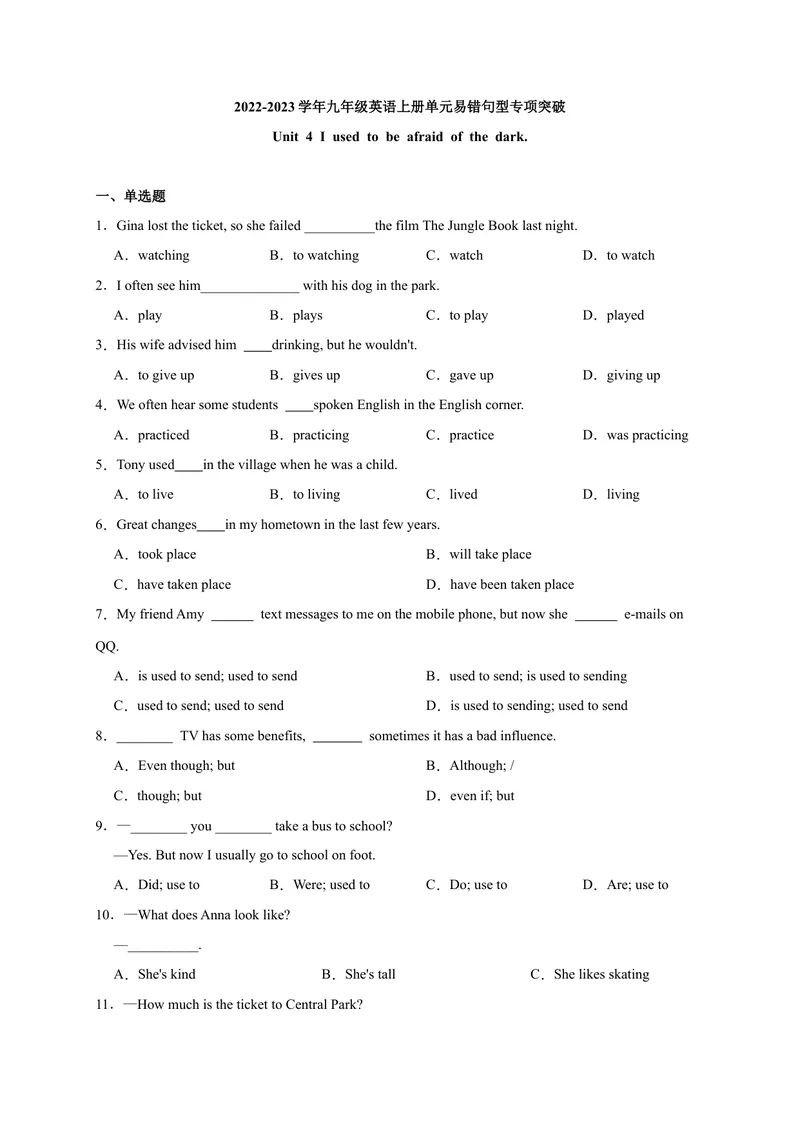
1.Gina lost the ticket, so she failed __________the film The Jungle Book last night.
A.watching B.to watching C.watch D.to watch
2.I often see him______________ with his dog in the park.
A.play B.plays C.to play D.played
3.His wife advised him drinking, but he wouldn't.
A.to give up B.gives up C.gave up D.giving up
4.We often hear some students spoken English in the English corner.
A.practiced B.practicing C.practice D.was practicing
5.Tony used in the village when he was a child.
A.to live B.to living C.lived D.living
6.Great changes in my hometown in the last few years.
A.took place B.will take place
C.have taken place D.have been taken place
7.My friend Amy text messages to me on the mobile phone, but now she e-mails on
QQ.
A.is used to send; used to send B.used to send; is used to sending
C.used to send; used to send D.is used to sending; used to send
8. TV has some benefits, sometimes it has a bad influence.
A.Even though; but B.Although; /
C.though; but D.even if; but
9.—________ you ________ take a bus to school?
—Yes. But now I usually go to school on foot.
A.Did; use to B.Were; used to C.Do; use to D.Are; use to
10.—What does Anna look like?
—__________.
A.She's kind B.She's tall C.She likes skating
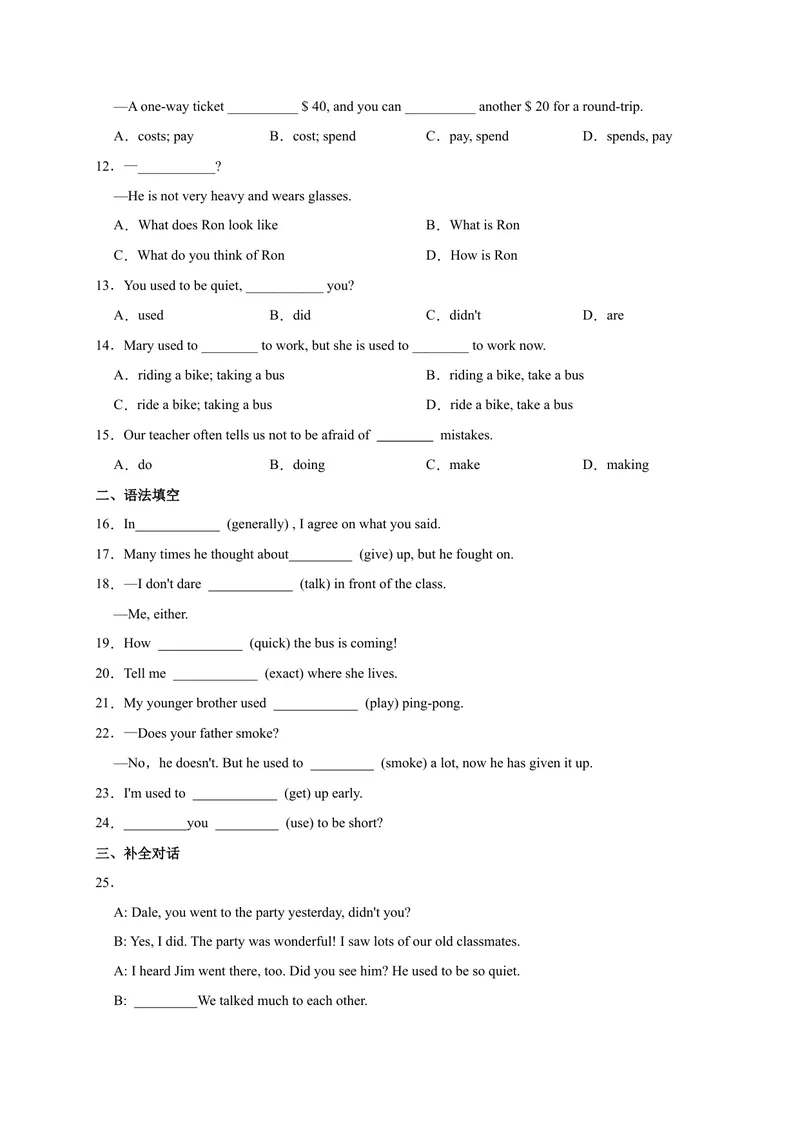
11.—How much is the ticket to Central Park?—A one-way ticket __________ $ 40, and you can __________ another $ 20 for a round-trip.
A.costs; pay B.cost; spend C.pay, spend D.spends, pay
12.—___________?
—He is not very heavy and wears glasses.
A.What does Ron look like B.What is Ron
C.What do you think of Ron D.How is Ron
13.You used to be quiet, ___________ you?
A.used B.did C.didn't D.are
14.Mary used to ________ to work, but she is used to ________ to work now.
A.riding a bike; taking a bus B.riding a bike, take a bus
C.ride a bike; taking a bus D.ride a bike, take a bus
15.Our teacher often tells us not to be afraid of mistakes.
A.do B.doing C.make D.making
二、语法填空
16.In (generally) , I agree on what you said.
17.Many times he thought about (give) up, but he fought on.
18.—I don't dare (talk) in front of the class.
—Me, either.
19.How (quick) the bus is coming!
20.Tell me (exact) where she lives.
21.My younger brother used (play) ping-pong.
22.—Does your father smoke?
—No,he doesn't. But he used to (smoke) a lot, now he has given it up.
23.I'm used to (get) up early.
24. you (use) to be short?
三、补全对话
25.
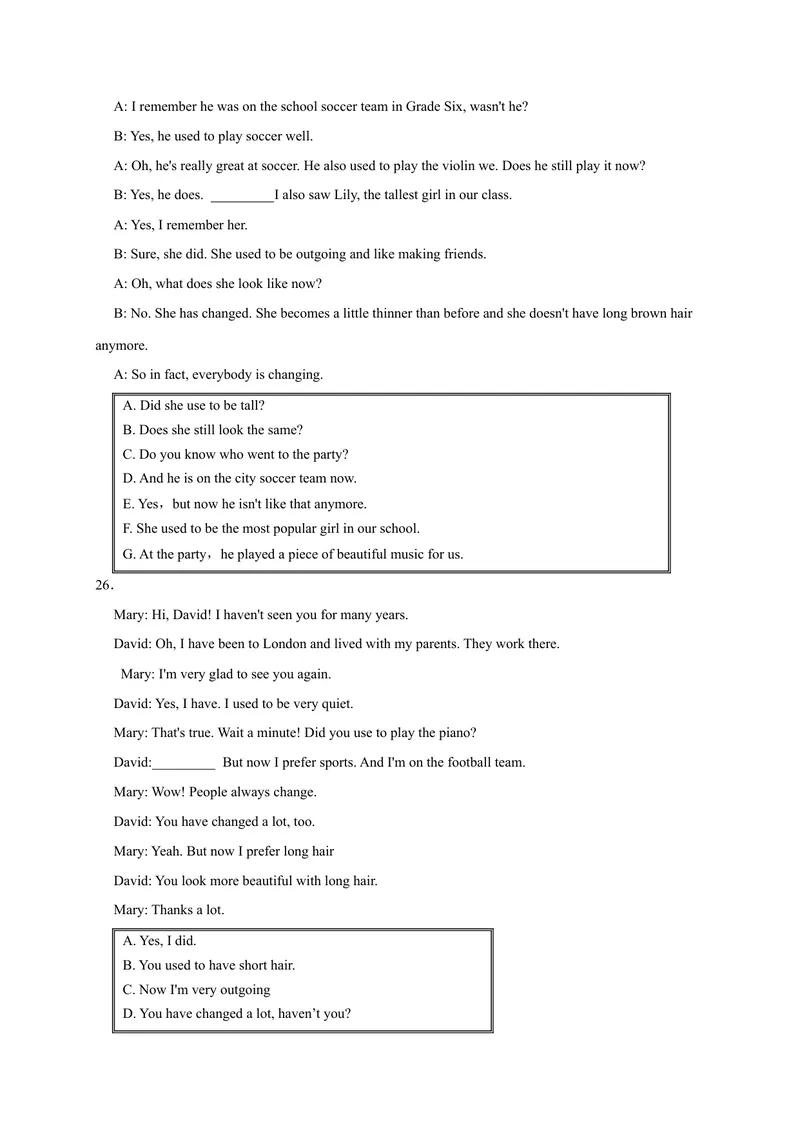
A: Dale, you went to the party yesterday, didn't you?
B: Yes, I did. The party was wonderful! I saw lots of our old classmates.
A: I heard Jim went there, too. Did you see him? He used to be so quiet.
B: We talked much to each other.A: I remember he was on the school soccer team in Grade Six, wasn't he?
B: Yes, he used to play soccer well.
A: Oh, he's really great at soccer. He also used to play the violin we. Does he still play it now?
B: Yes, he does. I also saw Lily, the tallest girl in our class.
A: Yes, I remember her.
B: Sure, she did. She used to be outgoing and like making friends.
A: Oh, what does she look like now?
B: No. She has changed. She becomes a little thinner than before and she doesn't have long brown hair
anymore.
A: So in fact, everybody is changing.
A. Did she use to be tall?
B. Does she still look the same?
C. Do you know who went to the party?
D. And he is on the city soccer team now.
E. Yes,but now he isn't like that anymore.
F. She used to be the most popular girl in our school.
G. At the party,he played a piece of beautiful music for us.
26.
Mary: Hi, David! I haven't seen you for many years.
David: Oh, I have been to London and lived with my parents. They work there.
Mary: I'm very glad to see you again.
David: Yes, I have. I used to be very quiet.
Mary: That's true. Wait a minute! Did you use to play the piano?
David: But now I prefer sports. And I'm on the football team.
Mary: Wow! People always change.
David: You have changed a lot, too.
Mary: Yeah. But now I prefer long hair
David: You look more beautiful with long hair.
Mary: Thanks a lot.
A. Yes, I did.
B. You used to have short hair.
C. Now I'm very outgoing
D. You have changed a lot, haven’t you?E. What have you been doing?
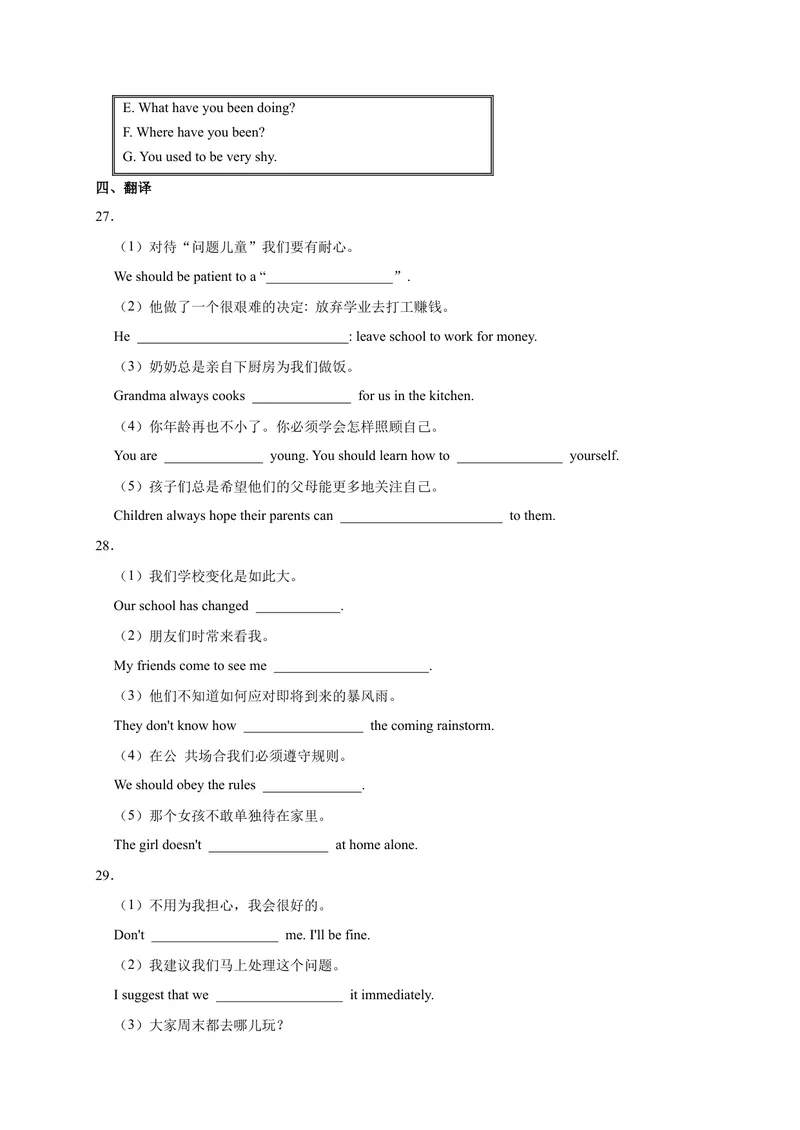
F. Where have you been?
G. You used to be very shy.
四、翻译
27.
(1)对待“问题儿童”我们要有耐心。
We should be patient to a “ ”.
(2)他做了一个很艰难的决定: 放弃学业去打工赚钱。
He : leave school to work for money.
(3)奶奶总是亲自下厨房为我们做饭。
Grandma always cooks for us in the kitchen.
(4)你年龄再也不小了。你必须学会怎样照顾自己。
You are young. You should learn how to yourself.
(5)孩子们总是希望他们的父母能更多地关注自己。
Children always hope their parents can to them.
28.
(1)我们学校变化是如此大。
Our school has changed .
(2)朋友们时常来看我。
My friends come to see me .
(3)他们不知道如何应对即将到来的暴风雨。
They don't know how the coming rainstorm.
(4)在公 共场合我们必须遵守规则。
We should obey the rules .
(5)那个女孩不敢单独待在家里。
The girl doesn't at home alone.
29.
(1)不用为我担心,我会很好的。
Don't me. I'll be fine.
(2)我建议我们马上处理这个问题。
I suggest that we it immediately.
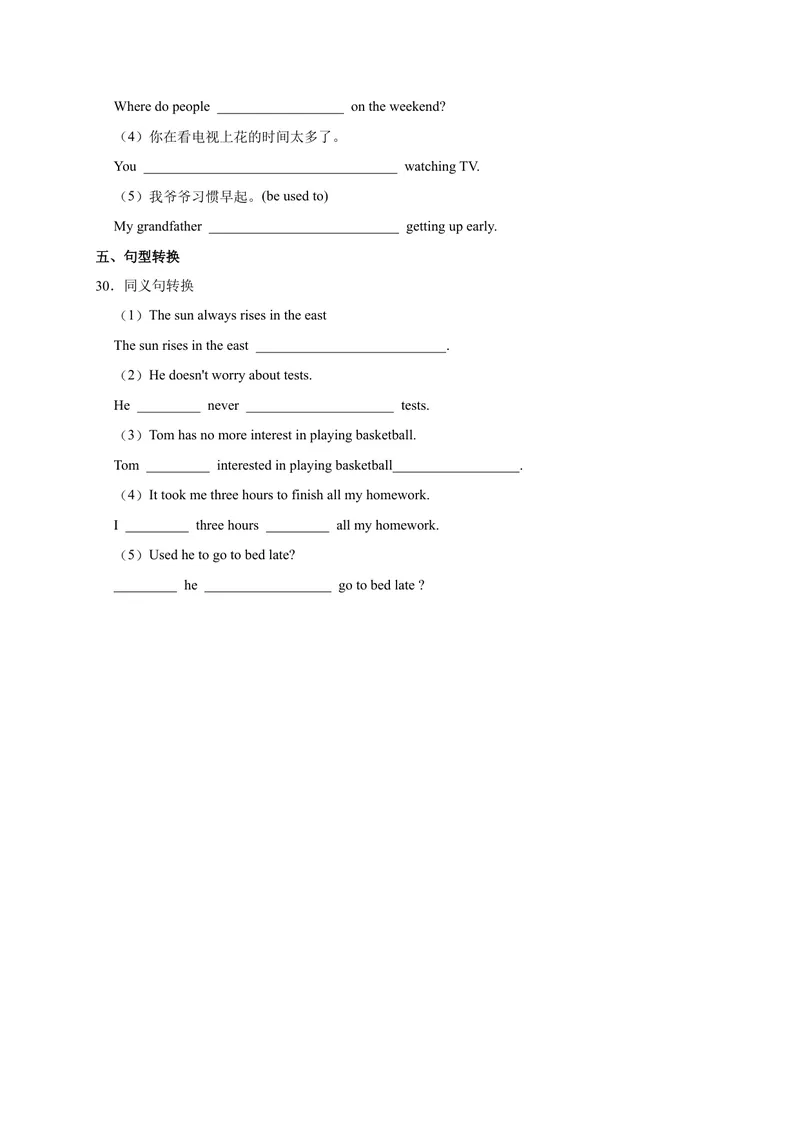
(3)大家周末都去哪儿玩?Where do people on the weekend?
(4)你在看电视上花的时间太多了。
You watching TV.
(5)我爷爷习惯早起。(be used to)
My grandfather getting up early.
五、句型转换
30.同义句转换
(1)The sun always rises in the east
The sun rises in the east .
(2)He doesn't worry about tests.
He never tests.
(3)Tom has no more interest in playing basketball.
Tom interested in playing basketball .
(4)It took me three hours to finish all my homework.
I three hours all my homework.
(5)Used he to go to bed late?
he go to bed late ?答案解析部分
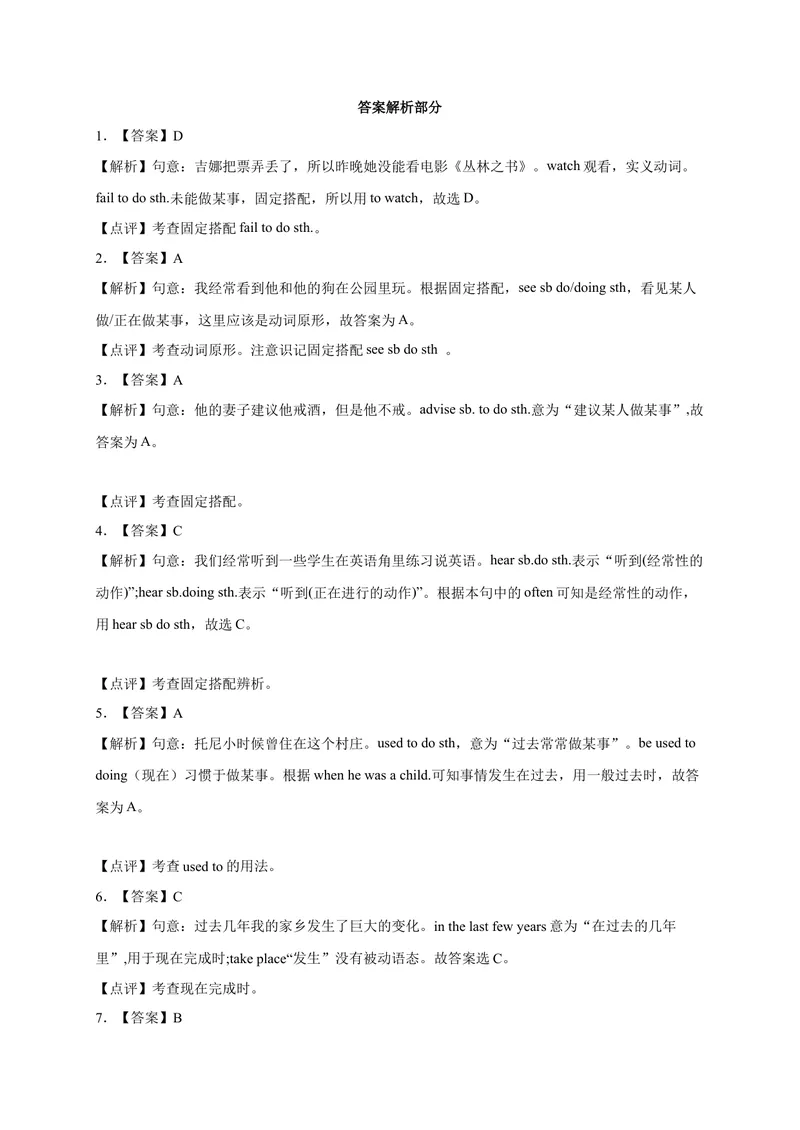
1.【答案】D
【解析】句意:吉娜把票弄丢了,所以昨晚她没能看电影《丛林之书》。watch观看,实义动词。
fail to do sth.未能做某事,固定搭配,所以用to watch,故选D。
【点评】考查固定搭配fail to do sth.。
2.【答案】A
【解析】句意:我经常看到他和他的狗在公园里玩。根据固定搭配,see sb do/doing sth,看见某人
做/正在做某事,这里应该是动词原形,故答案为A。
【点评】考查动词原形。注意识记固定搭配see sb do sth 。
3.【答案】A
【解析】句意:他的妻子建议他戒酒,但是他不戒。advise sb. to do sth.意为“建议某人做某事”,故
答案为A。
【点评】考查固定搭配。
4.【答案】C
【解析】句意:我们经常听到一些学生在英语角里练习说英语。hear sb.do sth.表示“听到(经常性的
动作)”;hear sb.doing sth.表示“听到(正在进行的动作)”。根据本句中的often可知是经常性的动作,
用hear sb do sth,故选C。
【点评】考查固定搭配辨析。
5.【答案】A
【解析】句意:托尼小时候曾住在这个村庄。used to do sth,意为“过去常常做某事”。be used to
doing(现在)习惯于做某事。根据when he was a child.可知事情发生在过去,用一般过去时,故答
案为A。
【点评】考查used to的用法。
6.【答案】C
【解析】句意:过去几年我的家乡发生了巨大的变化。in the last few years意为“在过去的几年
里”,用于现在完成时;take place“发生”没有被动语态。故答案选C。
【点评】考查现在完成时。
7.【答案】B【解析】used to do sth.过去常常做某事;be used to do sth.被用于做某事;be used to doing sth.习惯做
某事。句意:我的朋友艾米______通过手机发短信给我,但是现在她_________通过QQ给我发电
子 邮件。根据but now可知第一空应为used to send过去常常发送。第二空被动语态排除,故填be
used to sending习惯发送。故选B。
【点评】此题考查固定短语搭配,平时要多归纳总结并记忆。
8.【答案】B
【解析】句意:_______电视有一些好处,_______有时候它也有坏的影响。根据句意应填:虽
然......但是......。英语中."虽然......但是......"不能同时使用,故选B。
【点评】考查连词辨析。
9.【答案】A
【解析】根据now可知问句表示过去常常used to,一般过去时的一般疑问句句首加did,后用动词
原形;句意:—你以前常常做公共汽车上学吗?—是的。但是我现在通常步行了。故选A。
10.【答案】B
【解析】问句是询问外貌的句子,故以长相作答。A. She's kind她很好,指品格。B. She's tall她很
高, C. She likes skating她喜欢滑冰,指爱好。句意:—安娜长什么样?—她很高。故选B。
11.【答案】A
【解析】表示“花费”的几个词:pay主语是人,pay for付款;spend主语是人,花费时间或金钱,
spend on/(in)doing sth.花费时间做某事;cost物作主语,sth. cost sb. some money某物花费某人多少
钱。根据句意:-中央公园的票价是多少?-单程的40美元,而且你可以再付20美元买往返票。故
选A。
12.【答案】A
【解析】根据答语可知询问外貌,用What does...look like? 句意:—罗恩长什么样?—他不胖,戴
着眼镜。故选A。
13.【答案】C
【解析】陈述部分是一般过去时的肯定句,反问部分用didn't+主语。句意:你过去很文静,不是吗?
故选C。
14.【答案】C
【解析】考查 used to do sth.和be used to doing sth.的区别:前者表示过去常常做某事;后者表示习
惯于做某事;句意:玛丽以前常骑车去上班,但她现在习惯于乘公共汽车上班了。故选C。
15.【答案】D【解析】句意:我们的老师经常告诉我们不要害怕犯错误。犯错误:make mistakes, be afraid of
doing sth.害怕做某事,排除A, C,B 故选D。
【点评】考查非谓语动词。牢记两个固定短语的用法。
16.【答案】general
【解析】句意:总的来说,我同意你说的。generally总体上,副词。in general总的来说,固定搭配。
故填general。
【点评】考查词性转化,注意平时识记固定搭配in general。
17.【答案】giving
【解析】句意:很多次他想放弃,但他坚持了下来。give给,动词;介词about后跟名词,代词或
者动词的ing形式,故答案为giving。
【点评】考查动名词。注意识记介词后用动名词的用法。
18.【答案】to talk
【解析】句意:——我不敢在教室前面说话。——我也是。talk,谈话,说话,动词。根据dare to
do sth敢于做某事,可知后要接不定式,故答案为to talk。
【点评】考查短语dare to do sth的用法。
19.【答案】quickly
【解析】句意:公共汽车来得多快啊! quick 快的,快速的,形容词。根据句子结构,可知要用
副词修饰动词come, quick的副词是quickly,故答案为quickly 。
【点评】考查词性转化。注意识记副词修饰动词的用法。
20.【答案】exactly
【解析】句意:确切地告诉我她住在哪里。 exact 精确的,准确的,形容词。根据句子结构,可知
要用副词修饰动词tell, exact 的副词是 exactly,故答案为 exactly。
【点评】考查词性转化。注意识记 exact 的词性变化。
21.【答案】to play
【解析】句意:我弟弟过去常打乒乓球。play 玩耍,动词。根据固定短语 used to do sth过去常常
做某事,可知要用动词不定式,故答案为to play。
【点评】考查固定搭配。注意识记短语used to do sth的用法。
22.【答案】smoke
【解析】句意:——你爸爸吸烟吗?——不,他不吸烟,但是他过去常常吸很多烟,现在他戒烟了。
smoke 吸烟,动词。根据 used to do sth过去常常做某事,可知不定式to后接动词原形,故答案为smoke。
【点评】考查固定搭配。注意识记used to do sth的用法。
23.【答案】getting
【解析】句意:我习惯于起早床。get up 起床。根据 used to doing sth习惯于做某事,可知要用动
名词形式,get 的动名词为 getting,故答案为getting。
【点评】考查固定搭配。注意识记used to doing sth的用法。
24.【答案】Did;use
【解析】句意:你过去常常很矮吗?固定搭配 used to do sth 过去常常做某事,used为过去式,变
为一般疑问句,借助于助动词did,助动词后加动词原形,used的原形为use,故答案为Did,use。
【点评】考查一般过去式的一般疑问句。注意识记含有实意动词的一般疑问句的构成。
25.【答案】E;D;G;F;B
【解析】大意:Dale和作者关于班级聚会同学之间的变化的一个对话,主要谈到了Jim和Lily。
A. Did she use to be tall? 她过去高吗?
B. Does she still look the same? 她看起来还是老样子吗?
C. Do you know who went to the party?你知道谁去参加聚会吗?
D. And he is on the city soccer team now.他现在是城市足球队的队员。
E. Yes,but now he isn't like that anymore. 是的,但现在他不再是那样了。
F. She used to be the most popular girl in our school.她曾经是我们学校最受欢迎的女孩。
G. At the party,he played a piece of beautiful music for us. 在聚会上,他为我们演奏了一首优美的乐
曲。
(1)根据下文 We talked much to each other,可知我和Jim不仅见了面,而且还聊了很多,可知
Jim不再像以前那么的安静了,故选E。
(2)根据下文 Oh, he's really great at soccer,可知他现在是足球队队员,故选D。
(3)根据上文 He also used to play the violin…,可知Jim以前也拉小提琴,现在也在拉,所以在
聚会的时候给我们演奏了一曲,故选G。
(4)根据上文 I also saw Lily, the tallest girl in our class. 可知这里提到了班里最高的女孩Lily,结
合关键词she以及下文的回答 she did,故选F。
(5)根据上文 look like 下文的回答 No. She has changed. 可知在问她的外貌,故选B。
【点评】】考查补全对话。做题时理解选项意思,根据提出的语境回答问题,注意前后呼应,抓住
关键词。
26.【答案】F;D;C;A;B【解析】
(1)根据回答I have been to London。应该问你去哪里了?故选F。
(2)Yes是回答一般疑问句或反义疑问句,D是反意疑问句,故选D。
(3)根据上句I used to be very quiet.可知继续描述自己的情况。上句说我过去安静,C句说我现在
外向。故选C。
(4)对一般疑问句的回答用Yes/No。故选A。
(5)根据回答But now I prefer long hair.可知以前是短发。故选B。
27.【答案】(1)problem child
(2)made a difficult decision
(3)in person
(4)no longer;look after
(5)pay more attention
【解析】(1)问题儿童problem child。根据a可知用可数名词单数。故填:problem child。
(2)做艰难的决定make a difficult decision。根据“了”可知为过去发生的事,动词要用过去式。
故填:made a difficult decision。
(3)亲自in person。故填:in person。
(4)再也不no longer,照顾look after。故填 :no longer ;look after。
(5)更多的关注pay more attention to。横线后有单词to。故填:pay more attention。
【点评】此题考查汉译英。先中英文对比找出所要填的单词或短语,再填入相应的形式。要注意英
语的表达习惯和常见搭配问题,还要考虑不同词性的相应变化。如:名词注意可数不可数,单复数
的问题。动词要注意时态语态问题等。
28.【答案】(1)so much
(2)from time to time
(3)to deal with
(4)in public
(5)dare to stay
【解析】(1)如此大 (修饰动词change变化)so much。故填:so much。
(2)时常from time to time。故填:from time to time。
(3)应对deal with。此题考查特殊疑问词+动词不定式做宾语的结构。故填:to deal with。
(4)在公共场合in public。故填:in public。
(5)敢:dare to,doesn't 后跟动词原形。呆(在家)stay (at home)。故填:dare to stay。【点评】此题考查汉译英。先中英文对比找出所要填的单词或短语,再填入相应的形式。要注意英
语的表达习惯和常见搭配问题,还要考虑不同词性的相应变化。如:名词注意可数不可数,单复数
的问题。动词要注意时态语态问题等。
29.【答案】(1)worry;about
(2)deal;with
(3)hang;out
(4)spend;too;much;time
(5)is;used;to
【解析】
(1)为....担心worry about;助动词don’t后跟动词原形。故填worry about。
(2)处理deal with;suggest从句用虚拟语气,即谓语动词用should+动词原形或直接用动词原形。
故填deal with。
(3)“去哪玩”实际上是“闲逛”hang out;助动词do 后跟动词原形, 故填hang out。
(4)因主语you指人,而且后面有doing,所以花费用spend;时间是不可数名词,所以太多用too
much。故填spend too much time。
(5)因主语my grandfather是单数第三人称,故用is。故填is used to。
30.【答案】(1)all;the;time
(2)is;worried;about
(3)isn't;at;all
(4)spent;doing
(5)Did;use;to
【解析】
(1)always总是,同义短语是all the time。故填all the time。
(2)worry about担心,同义短语是be worried about。故填be worried about。
(3)no more不再,同义短语是not...at all;not和is进行缩写。故填isn't, at all。
(4)take表示花费时间,主语是it, 主语是指人时,花费用spend; spend doing sth.而且是一般过去
时。故填spent doing。
(5)句意:他以前常常晚睡吗?同义表达为used to do 的一般疑问句。故填Did, use to。