人教版新目标九年级英语自学手册
+ + + +
知识点解析 重点句型 语法 短语归纳 自我检测
Unit 1 How can we become good learners?
Section A
【重点知识点解析】
1. .by asking the teacher for help请老师帮忙
by+doing通过......(Page 1 1a)
by可以用来表示方位、时间、手段等,其用法在中考中经常出现。
(1)by “ ……, ……, ……”, n/pron/doing, , how
意为 通过 靠 凭 其后接 作方式状语 可以用来回答
引导的疑问句。
He had to do all the work by hand.
所有的工作他都要靠手工完成。
You can practice soccer by joining a sports club.
你可以通过加入体育俱乐部来练习足球。
(2)by , , “ …… ” We live by the sea.
+地点名词表方位意为 在 旁边 。 我们住在海边。
(3)by , “ …… ( , ); …… ”
+时间名词意为 到 时为止 已发生某事此时谓语可用完成时 在 之前 。
I must be in bed by ten o’clock. 10
我必须在 点之前睡觉。
(4)by ( , ), “ ……, ……,
+交通工具、交通方式名词 名词前不加冠词 不变复数 意为 通过 由
……”
乘 。
: by train / taxi / bus / bike/ boat / sea / water / air/
如
underground /subway/ ship
等。
(5)by
的常见短语:
by means of …… by the way
通过 的方式 顺便说一下
one by one step by step
一个接一 一步接一步
side by side by oneself
肩并肩 独自
[知识拓展] by, with与in表示方式时的区别:
易混词 含义 用法 例句
使用某种方式、方法或使用 后 接 n/pron/ I live by the river.我住在河边。
by 交通工具,还可表示“在…… doing
旁”。
使用某种工具或身体的某个 后接n/pron Jim can play the piano very well with
部位;表示伴随“具有,拥有, his feet.
with
戴”
Who is the man with sunglasses?使用语言、语调、笔墨或颜 后接n/pron We don’t write letters in red.
in
色。
(1)他们是通过网络聊天认识彼此的,到目前为止,他们已经相爱了将近4年了。
T:_____________________________________________________________________________
(2)当我到公交车车站时,公交车已经离开了大约半小时了。
T:_____________________________________________________________________________
(3)有的学生步行上学,其他的一些学生乘出租车上学。
T:_____________________________________________________________________________
(4)这些天她太累了以至于靠着窗户就睡着了。
T:_____________________________________________________________________________
(5)这个九旬的老太太住在农村的一所老房子里,周围群山环绕。
T:_____________________________________________________________________________
ask the teacher for help 向老师寻求帮助
ask相关短语
ask sb. for sth.向某人要某物
ask sb. about sth.向某人询问某事
ask sb. (not) to do sth.要求某人(不)做某事
be asked (not) to do sth.被要求(不)做某事
eg: He asked his parents for money.他向他的父母要钱。
Can I ask about the result of the match?我可以问一下比赛的结果吗?
My mother asked me not to play in the street.我妈妈让我不要在街上玩。
2. What about reading aloud to practice pronunciation?大声朗读来练习发音怎么样?
(1)aloud /ə'laʊd/ adv.大声地;出声地
eg: He reads aloud so that everyone can hear him.他大声地读为的是每一个人都能听到。
辨析aloud, loud与loudlyaloud adv. “出声地,大声地” The teacher asks us to read aloud to him.老师要求我
们大声读给他听。
①几乎总是用于loud enou Don’t play the CD so loud.播放唱片声音别那么
gh, as loud as 等短语中或 大。
与too, very, so连用。
loud
②可作形容词,用于固定 Xie Na always speaks in a loud voice. 谢娜总是说话
搭配:in a loud voice 大声 声音很大。
地
loudly 源自于loud 的常用副词, He does not talk loudly or laugh loudly in public.在公
往往含有令人讨厌或打扰 共场合他既不大声说话,也不大声笑。
别人的意思。
这个3岁的小女孩找不到她的妈妈时就大声喊叫。
T:_____________________________________________________________________________
(10)你一定要这么 讲 吗? 呢。
大声 话 你奶奶正在睡觉
T:_____________________________________________________________________________
(11) 。
当你在课堂上回答老师的问题时就要大声些
T:_____________________________________________________________________________
(2)practice /'præktɪs/ v.练习
practice后可接名词、代词或动名词(短语)等。
eg: The boy practices (playing) the game called King of Glory every day.那个男孩天天练习
(打)叫做王者荣耀的那个游戏。
practice也可用作不可数名词,意为“练习”。
eg: Students get lots of practice in the English club.学生们在英语俱乐部得到了大量的练
习。
3. What is the secret to language learning? 语言学习的秘诀是什么?(Page 3 3a)
(1)作n时,意为“秘密,秘诀,奥秘”。
the secret of/to success
成功的诀窍;
the secret of nature
自然界的奥秘;
keep a secret/keep sth a secret/keep it a secret
保守秘密;
in secret=secretly , ,
秘密地 暗中 私下里
(2)作adj时,意为“秘密的,保密的”;secretary.n.秘书,部长
Secretary of State国务卿;
Secretary of the Treasury财政部长; Secretary of Defense国防部长
(6)保守秘密意味着你永远不能把我今天告诉你的让别人知道。
T:_____________________________________________________________________________
(7)希拉里·克林顿(Hillary Clinton)曾经是美国的国务卿,奥巴马(Obama)经常向她征求意
见。
T:_____________________________________________________________________________
(8)Part of the secret of success in life is to eat what you like and let the food fight it out
inside. ---Mark Twain.
T:_____________________________________________________________________________
4.But I was afraid to ask questions because my pronunciation was very bad.
但我害怕问问题,因为我的发音很差。
afraid adj.害怕的,怕的
(1) be afraid of sth. /doing sth.害怕某物/做某事Don’t be afraid of snakes.别怕蛇。
(2) be afraid to do sth.害怕做某事It seems that she is afraid to tell them about it.似乎
她怕将此事告诉他们。
(3) be afraid that +从句 害怕……She was afraid that she might lose her job.她担心会
丢掉工作。
[注意]“be afraid+句子”还可用于提出异议,告诉不好的消息等场合,使语气婉转,意为
“恐怕,遗憾”。
I’m afraid I can’t help you.恐怕我不能帮你。
(12)珍妮过去在课堂上害怕说话,所以她总是什么也不说。
T:_____________________________________________________________________________
(13)如果你遇到困难,不要害怕向其他同学求助。
T:_____________________________________________________________________________
(14)说英语时不要害怕犯错,因为我们当中没有一个人是完美的。
T:_____________________________________________________________________________
5. The more you read, the faster you’ll be.
读得越多就会变得越快。
(15)我们的老师说我们练习说英语越多,我们的英语口语会越好。
T:_____________________________________________________________________________
(16)相反,你越不粗心,你出的错就会越少。
T:_____________________________________________________________________________6. I discovered that listening to something interesting is the secret to
language learning.
我发现听一些有趣的东西是语言学习的秘密。
listening to something interesting在宾语从句中作主语,使用动名词形式,谓语动词
使用单数形式。
(17)读当年明月写的历史小说真的可以让你爱上历史。
T:_____________________________________________________________________________
(18)____________(protect) the environment that we depend on makes our world
more beautiful.
(19)____________(go) to bed early and____________(get) up early is a good habit
that you should develop.
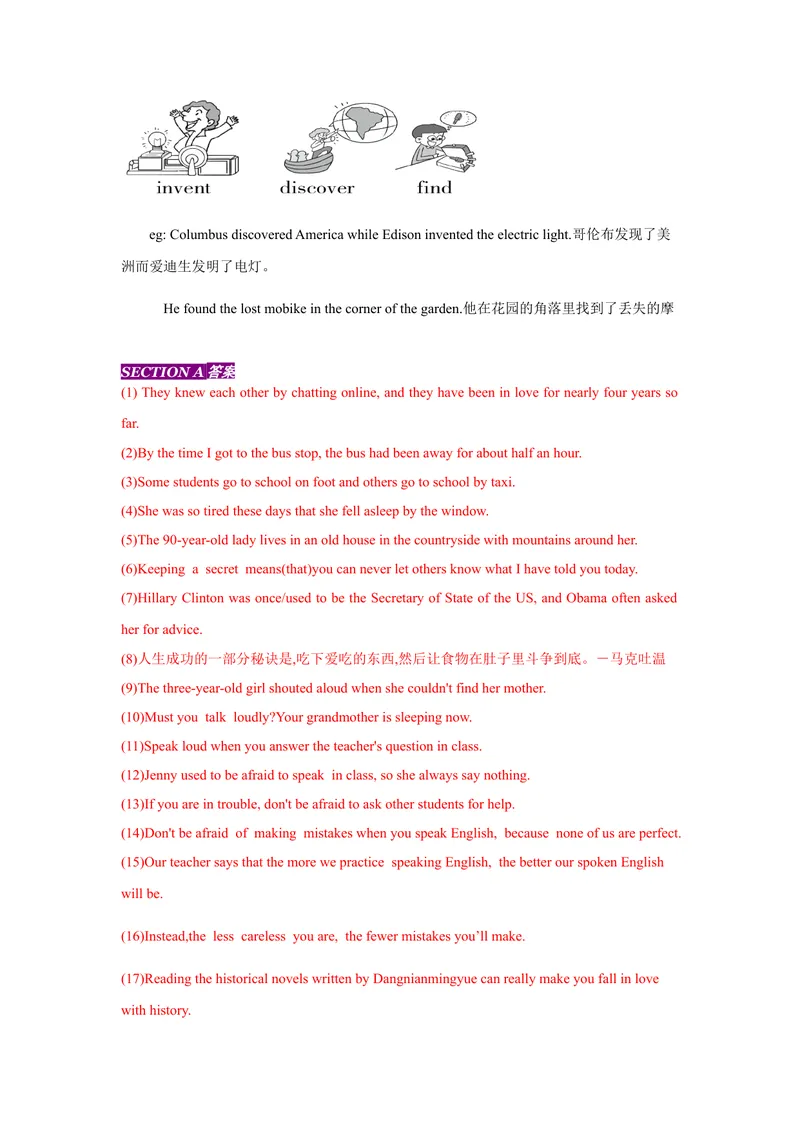
discover / dɪ'skʌvə(r)/ v.发现;发觉
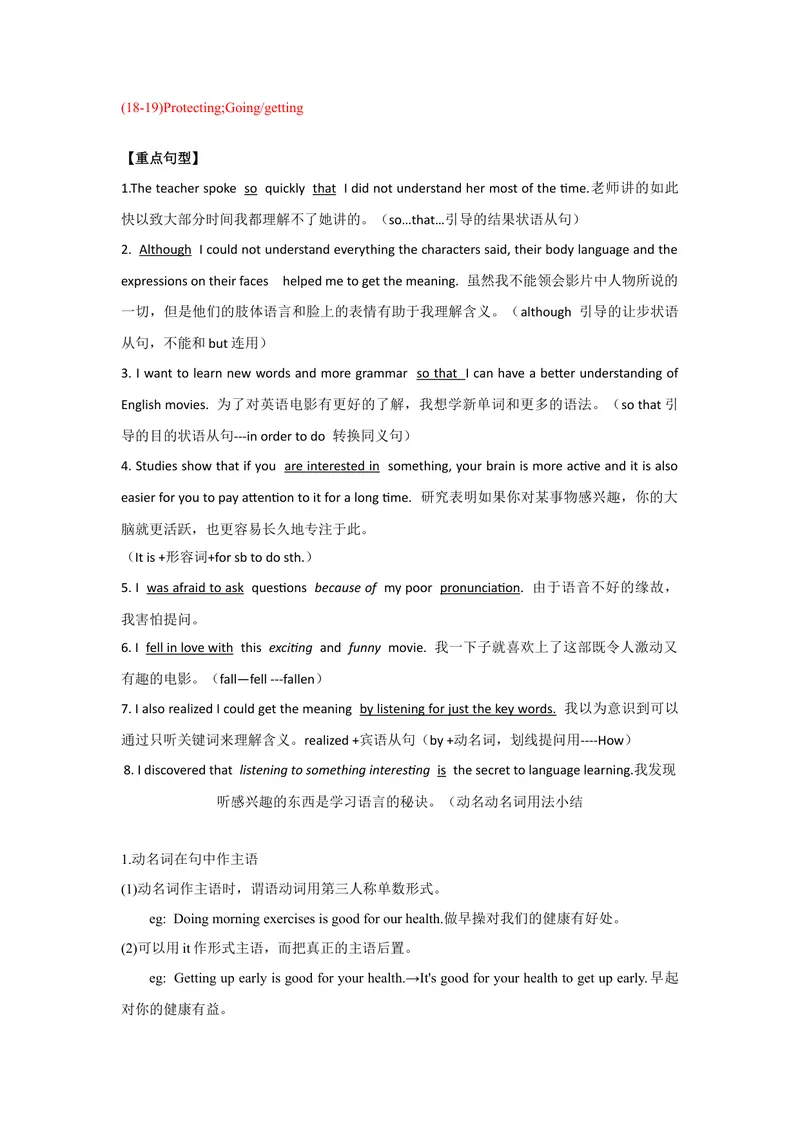
辨析invent, discover与find
invent 发明(从无到有的东西) Edison invented the electric light bulb.爱迪生
发明了电灯泡
discover “发现”(本来就已经存在,但不 I discovered his secret.我发现了他的秘密。
为人知的事物)
find find指找到或发现 I find my pencil.我找到了我的铅笔。
【拓展】eg: Columbus discovered America while Edison invented the electric light.哥伦布发现了美
洲而爱迪生发明了电灯。
He found the lost mobike in the corner of the garden.他在花园的角落里找到了丢失的摩
SECTION A答案
(1) They knew each other by chatting online, and they have been in love for nearly four years so
far.
(2)By the time I got to the bus stop, the bus had been away for about half an hour.
(3)Some students go to school on foot and others go to school by taxi.
(4)She was so tired these days that she fell asleep by the window.
(5)The 90-year-old lady lives in an old house in the countryside with mountains around her.
(6)Keeping a secret means(that)you can never let others know what I have told you today.
(7)Hillary Clinton was once/used to be the Secretary of State of the US, and Obama often asked
her for advice.
(8)人生成功的一部分秘诀是,吃下爱吃的东西,然后让食物在肚子里斗争到底。-马克吐温
(9)The three-year-old girl shouted aloud when she couldn't find her mother.
(10)Must you talk loudly?Your grandmother is sleeping now.
(11)Speak loud when you answer the teacher's question in class.
(12)Jenny used to be afraid to speak in class, so she always say nothing.
(13)If you are in trouble, don't be afraid to ask other students for help.
(14)Don't be afraid of making mistakes when you speak English, because none of us are perfect.
(15)Our teacher says that the more we practice speaking English, the better our spoken English
will be.
(16)Instead,the less careless you are, the fewer mistakes you’ll make.
(17)Reading the historical novels written by Dangnianmingyue can really make you fall in love
with history.(18-19)Protecting;Going/getting
【重点句型】
1.The teacher spoke so quickly that I did not understand her most of the time.老师讲的如此
快以致大部分时间我都理解不了她讲的。(so…that…引导的结果状语从句)
2. Although I could not understand everything the characters said, their body language and the
expressions on their faces helped me to get the meaning. 虽然我不能领会影片中人物所说的
一切,但是他们的肢体语言和脸上的表情有助于我理解含义。(although 引导的让步状语
从句,不能和but连用)
3. I want to learn new words and more grammar so that I can have a better understanding of
English movies. 为了对英语电影有更好的了解,我想学新单词和更多的语法。(so that引
导的目的状语从句---in order to do 转换同义句)
4. Studies show that if you are interested in something, your brain is more active and it is also
easier for you to pay attention to it for a long time. 研究表明如果你对某事物感兴趣,你的大
脑就更活跃,也更容易长久地专注于此。
(It is +形容词+for sb to do sth.)
5. I was afraid to ask questions because of my poor pronunciation. 由于语音不好的缘故,
我害怕提问。
6. I fell in love with this exciting and funny movie. 我一下子就喜欢上了这部既令人激动又
有趣的电影。(fall—fell ---fallen)
7. I also realized I could get the meaning by listening for just the key words. 我以为意识到可以
通过只听关键词来理解含义。realized +宾语从句(by +动名词,划线提问用----How)
8. I discovered that listening to something interesting is the secret to language learning.我发现
听感兴趣的东西是学习语言的秘诀。(动名动名词用法小结
1.动名词在句中作主语
(1)动名词作主语时,谓语动词用第三人称单数形式。
eg: Doing morning exercises is good for our health.做早操对我们的健康有好处。
(2)可以用it作形式主语,而把真正的主语后置。
eg: Getting up early is good for your health.→It's good for your health to get up early.早起
对你的健康有益。2.动名词在句中作宾语
动名词在句中作宾语时,一般放在某一及物动词或介词之后充当这一动词或介词的宾
语。
(1)后接动名词作宾语的及物动词有:finish, enjoy, keep, stand(忍受), suggest, advise,
practice, allow, mind, imagine等。
eg: The tourists enjoy staying in Kunming all the year round游客们喜欢一整年都待在昆
明。
Do you mind opening the window?你介意开一下窗户吗?
(2)动名词作介词的宾语,包括以介词结尾的动词短语,如:give up, take part in, be good at
等。
eg: I know you are good at drawing pictures.我知道你擅长画画。
提建议的句子:
①What/ how about +doing sth.? 做…怎么样?(about后面要用动词的ing形式,这一点考
试考的比较多)
如:What/ How about going shopping?
②Why don't you + do sth.? 你为什么不做…?
如:Why don't you go shopping?
③Why not + do sth. ? 为什么不做…?
如:Why not go shopping?
④Let's + do sth. 让我们做…...吧。
如:Let's go shopping
⑤Shall we/I + do sth.? 我们/我...…好吗?
如:Shall we/I go shopping?
【重点短语】
1.by doing sth 通过做某事
2.by working with a group通过同小组一起学习
3.make word cards制作单词卡片
4.listen to tapes听录音磁带
5.ask sb for help向某人求助6.watch videos/ English programs看录像/英文节目
7.listen to a tape and repeat out loud听录音和大声重复朗读
8.have conversations with friends和朋友一起会话
9.take notes, do exercises and read a lot记笔记、做大量的练习和阅读
10. write e-mails to my pen pals给笔友写电子邮件
11. speak English with my classmates和同学讲英语
12. memorize sentence patterns记句型
13. do grammar exercises做语法练习
14. read English books/magazines.阅读英文书籍和杂志
15. write an English diary写英文日记
16. use an English dictionary用英语字典
17. have conversations with sb同某人谈话
18. read the textbook 读课本
19. read aloud to practice pronunciation 大声朗读来练习发音
20. learn a lot that way 用那种方法学到很多
21. improve my speaking skills 提高我的说话技巧
22. understand spoken English 理解英语口语
23. get the main ideas 获得主要的意思
24. read word groups 读词组
25. try to guess a word’s meaning 努力猜测一个单词的意思
26. be patient 耐心点
27. take time 花时间
28. too...to..太...而不能...---so…that…/ enough to do sth 的转换
29. give a report作报告
30. at first起初
31. word by word逐词逐句地
32. the secret to language learning 学习语言的秘诀
33. be afraid to do sth害怕做某事=be afraid that+宾语从句
be afraid of sth / doing sth 害怕…
34. an English movie called Toy Story一部名叫《玩具故事》的英文电影
35. fall in love with爱上...36. body language肢体语言
37. as well也=too ;as well as 如同、和,连接主语时如同with(主谓一致要看前一主语,
不能相加)
38. because of my poor pronunciation
因为我的糟糕的发音
39. hide behind my textbook 躲在书后面
40. the expressions on their faces 他们脸上的表情
41. listen for the key words 听关键词
42. useful sentences 有用的句子
43. a piece of cake小菜一碟;很容易的事
44. It serves you right.活该,自作自受
45. look it/them up查阅;查找(主考点)
46. so that以便;为了
47. repeat out loud大声跟读
48. memorize sentence patterns记句型
49. take notes 记笔记
50. read a lot 大量阅读
51. keep a diary in English 记英语日记
Section A【自测题】
Ⅰ. 词汇
根据语境及所给首字母提示,补全所缺单词。
1. I don’t know the rules of g , so I have difficulty in English writing.
2. If you write a s , you must begin with a capital letter (大写字母).
3. “I don’t understand,” he said, with an e of surprise on his face.
4. Dinner will be ready in half an hour — just be p !
5. Susan and her mother haven’t seen for a long time. They had a long c on the
phone last night.
6. —You cook so delicious food. What’s your s ?
—Just practice more.
7. With the teacher’s help, David d math was not hard to learn.8. Tim’s sister is always crying a . It’s noisy.
根据句意,从方框中选择恰当的单词填空,有的需要变换形式。每词限用一次。
aloud, pronounce, discover, secret, sentence, textbook, grammar
9. If you don't know the _______ of this word, please ask the teacher for help.
10. In the end, Gina _______ that young man was blind and could see nothing.
11. Several _______ are on the teacher's desk. Who do they belong to?
12. They are the _______ between you and me. Don't tell them to others.
13. Could you speak _______ so that I can hear you clearly, sir?
14. Spelling and _______ are both important in English learning.
15. The teacher asked us to make some _______ with these phrases (短语).
Ⅱ. 根据汉语意思,完成英语句子,每空一词。
1. Mary经常和同学们用英语交谈。
Mary often _______ _______ _______ her classmates in English.
2. 对她有耐心点,她还小。
_______ _______ _______ her — she's very young.
3. 她脸上的表情表明了她愿意帮助我们。
The _______ _______ _______ _______ shows that she'd like to help us.
4. 如果你不认识这些单词,在词典中查阅一下它们怎么样?
If you don't know the words, what about _______ _______ _______ in the dictionary?
5. 在老师的帮助下,我提高了口语技能。
I have improved my speaking skills _______ _______ _______ _______ the teacher.
6. 这篇文章你需要逐字地去阅读。
You need to _______ the article _______ _______ _______.
7. 别着急,这得慢慢来。
Don't worry. _______ _______ _______.
8. 我听了磁带也制作了词卡。
I listened to tapes and made word cards _______ _______.
9. 你可以在十分钟内获取文章大意吗?
Can you _______ _______ _______ _______ of the article in ten minutes?
10. 首先你应该听关键词。
First you should _______ _______ _______ _______ _______.
11. Mr. Wang要做一个关于如何提高口语技能的报告。Mr. Wang will give a report about how to _______ _______ _______.
12. 由于她的发音不好,她几乎不回答老师的问题。
She hardly ever answers the teacher’s questions because of her _______ _______.
13. 如果你不知道如何使用这个单词,你可以查词典。
If you don’t know how to use the word, you can _______ _______ _______ _______ _______
_______.
14. 听关键词是获取大意的好方法。
It’s a good way to get the main idea by _______ _______ _______ _______ _______.
15. 你需要为你的项目做很多事情。慢慢来吧。
You need to do lots of things for your project. _______ _______ _______.
答 案
Ⅰ. 1. grammar 2. sentence 3. expression 4. patient
5. conversation 6. secret 7. discovered 8. aloud
9. pronunciation 10. discovered 11. textbooks 12. secrets
13. aloud 14. grammar 15. sentences
Ⅱ. 1. has conversations with 2. Be patient with
3. expression on her face 4. looking them up
5.with the help of 6. read; word by word
7. It takes time 8. as well
9. get the main idea 10. listen for the key words
11. improve speaking skills 12. poor pronunciation
13. look it up in the dictionary 14. word by word
14. listening for the key words 15. It takes time