人教版新目标九年级英语自学手册
+ + +
知识点解析 语法讲练 短语归纳 自我检测
Unit 2 I think that mooncakes are delicious!
Section A
【重点知识点解析】
1. put on 增加(体重);发胖 (教材Page 10 2c)
文中put on意为"增加(体重);发胖",常与weight或具体的数值搭配使用。
►She can eat what she wants but she never puts on weight. 她能想吃什么就吃什么,但是从来
不长胖。
【拓展】put on的其他含义:
(1)穿上;戴上
►My mother put on her coat and went out. 我妈妈穿上大衣出去了。
(2)上演;举办
►One summer our children put on a play. 有一年夏天我们的孩子上演了一出戏。
(3)播放(唱片、磁带等)
►Do you mind if I put some music on? 我播放音乐你介意吗?
【典例】These shoes are yours. Please _____.
A. put on them B. put on it
C. put them on D. put it on
【答案】C
【解析】put on修饰代词时,代词应放中间,且shoes是复数,用them指代,故选C。
2. be similar to 与……相似 (教材Page 10 2d )
be similar to 意为"与……相像、类似的"。其中similar为形容词,意为"相像的;类似
的",无比较等级。
►A cat is similar to a tiger in many ways. 猫与虎在很多方面相似。
【拓展】be similar with 某人很熟悉……
【典例】My skirt looks similar _____ yours.
A. with B. to C. about D. in
【答案】B【解析】be similar to与……相似,为固定短语。故选B。
3. throw …at…把……抛/洒向…… (教材Page 10 2d)
动词throw(threw, thrown)意为"扔",后接所投掷的物体,用介词at引入泼洒或抛的对
象。
►Please don’t throw a stone at the window. 请不要对着窗子投掷石块。
【拓展】与throw相关的短语还有:
throw away扔掉 throw sth. to sb. 把某物扔给某人
【典例】I threw a pen _____ his direction.
【答案】at
4. luck不可数名词,意为"幸运;运气"。 (教材Page 10 2d)
have good luck "有好运气"。
►She wished me good luck in the exam.她祝我考试好运。
【拓展】luck n. 幸运;运气 lucky adj. 幸运的
unlucky adj. 不幸的 luckily adv. 幸运地;好运地
unluckily adv. 不幸地
【典例】_____, the rain stopped when we went out for a walk.
A. Lucky B. Luck
C. Luckily D. Luckless
【答案】C
【解析】句意:幸运地是,当我们出去散步时雨停了。lucky幸运的,形容词;luck运气,
名词;luckily幸运地,副词;luckless不幸的,形容词。此处位于句首,修饰整个句子,故
用副词luckily。故选C。
5. Whoever drank this could live forever, and Hou Yi planned to drink it with Chang’e. 无论
谁喝了此药都会长生不老,后羿打算和嫦娥一起服用。 (教材Page 11 3a )
whoever 代词,意为"无论谁;不管什么人",在此处引导主语从句,相当于 anyone
who。
►Whoever comes will be welcome. 谁来都欢迎。
►Whoever gains the most points wins the competition. 谁得分最多,谁就赢得比赛。
【拓展】whoever还可引导让步状语从句,相当于no matter who。
►I’m not opening the door, whoever you are. 不管你是谁,我都不会开门的。
【典例】说那话的人是个骗子。_____ says that is a liar.
【答案】Whoever
6. refuse 拒绝 (教材Page 11 3a )
动词,意为"拒绝",其后常接动词不定式,即refuse to do sth.意为"拒绝做某事"。
►I refused his invitation. 我拒绝了他的邀请。
►I asked him to leave but he refused. 我让他离开但他不肯。
►He refused to tell us why. 他不肯告诉我们为什么。
【典例】 The soldiers were put in prison because they _____ to obey orders.
A. rejected B. declined
C. objected D. refused
【答案】D
【解析】句意:这些士兵被关到监狱里因为他们拒绝遵守规则。
7. How he wished that Chang’e could come back! 他是多么希望嫦娥能回来呀!(教材Page
11 3a)
【辨析】wish和hope
wish 表示某种强烈的"愿望";后跟从句时, wish to do sth. 希望做某事
一般表示难以实现的"愿望",从句常用
wish sb. to do sth.希望某人做某事
虚拟语气
wish+that从句"希望……"
表示美好的"祝愿" wish+宾语+宾语补足语(形容词或名词)
hope 表示可以实现或能达成的"希望" hope to do sth.希望做某事
hope+that从句 "希望……"
►I wish to go right now. 我希望现在就走。
►I wish him to make progress. 我希望他取得进步。
►I wish I could fly like a bird. 但愿我能像鸟儿一样飞。
►I wish you happy. 祝你幸福。
►I wish you a pleasant journey. 祝你旅途愉快。
►We hope to see you again. 我们希望能再次见到你。
►We hope that we can see you again. 我们希望能再次见到你。
【典例】 青岛中考 Larry hopes _____ his English, so he keeps practicing it every day.
( )
A. to solve B. solving C. to improve D. improving
【答案】C【解析】句意:劳瑞希望提高他的英语,因此他每天坚持练习它。根据hope to do希望做
某事,排除B、D; solve解决;improve提高,根据so he keeps practicing it every day.可知
是希望提高;故选C。
8. Do you know that there are two special days for parents in America? 你知道在美国有两
个为父母而设的特殊日子吗? (教材Page 12 4b)
There is/are表示"有……",此处的"有"表示存在关系。there be句型中be动词的形式
要和句中作主语的名词形式保持一致。
►There is a book on the desk. 书桌上有一本书。
【拓展】(1)there be句型的一个重要用法是"就近一致"原则,即be动词和最靠近它的
作主语的名词在形式上保持一致。
►There is a book and two rules on the desk. 书桌上有一本书和两把尺子。
(2)there be 与 have/has的区别:前者表示某地存在某物;后者表示"拥有"。二者有时
可以互换。
►There are twenty classes in our school. = Our school has twenty classes. 我们学校有20个班。
(3)there be的一般将来时形式为there will be 或 there is/are going to be。
►There is going to be a meeting this afternoon. 今天下午将会有一个会议。
【典例】There _____ some beef in the fridge. Let’s make some beef noodles.
A. am B. is C. are D. be
【答案】B
【解析】分析空格所在句可知,此句为there be句型,主语beef(牛肉)是不可数名词,所
有be动词用is。
9. Actually, we don’t have to spend a lot of money.事实上,我们不必花费很多钱。(教材
Page 12 4b)
(1)actually副词,意为"事实上;实际上"。常用于强调情况的真实性,往往是在出人
意料或跟刚刚所说的话形成对照的情况下使用。
►She looks young, but she’s actually 60. 她看上去年轻,可实际上她已经60岁了。
【助记】
actual(adj.实际的;现实的)+-ly(副词后缀)—actually(adv. 事实上,实际上)
(2)have to意为"必须;不得不",强调由于外界客观因素主语不得不做某事,有人称、
数和时态的变化,其后接动词原形。
Because he had no money, he had to drop out of school. 因为没有钱,他不得不辍学。【辨析】have to和must
have to 必须;不得不 表示客观的需要,有人称、数和时态的变化 don’t have to表示"不必",相
当于needn’t
must 必须;一定 表示说话人主观上的看法,只有一种形式 mustn’t表示"禁止"
►You don’t have to tell him about it. = You needn’t tell him about it. 你没必要把这件事告诉他。
►You mustn’t tell him about it. 你一定不要把这件事告诉他。
【典例】(滨州中考)—_____ I swim here?
—I’m sorry. Children _____ swim alone here. It’s very dangerous.
A. Must; can’t B. May; must C. Can; mustn’t D.
Can’t; can
【答案】C
【解析】句意:—我能在这里游泳吗?—对不起。孩子们禁止一个人在这里游泳。这是非
常危险的。Can/May I…?意思是"我可以做……吗?",是提建议的一种表达方式,根据
"It’s very dangerous."判断,此处禁止一个小孩游泳,mustn’t禁止,千万别,故选C。
10. It is also a good idea to help parents to do something instead. 相反,帮父母做点事也是
个好主意。 (教材Page 12 4b)
It is + 名词 + to do sth. 是固定句式,意为"做某事是……",其中it是形式主语,真正的
主语是后面的动词不定式短语。
►It’s a good habit to go to bed early and get up early. 早睡早起是个好习惯。
【典例】_____ is no good _____ without doing anything.
A. This; talking B. It; to speak
C. That; to say D. It; talking
【答案】B
【解析】此处It作形式主语,后面的不定式为真正的主语。
11.I’m going to Chiang Mai in two weeks.我两周后去清迈。
in +时间段:在……时间后
eg: He will visit Shanghai in three days. 三天后他将参观上海。
辨析“in+ 时间段”,“after+ 时间段”与“for+ 时间段”
以现在为起点的一段时间之后,常与
in+ 时间段 用how soon 提问
将来时连用。
after+ 时间段 以过去为起点的一段时间之后,常与 用when 提问一般过去时连用。
for+ 时间段 表示动作或状态持续一段时间 用how long 提问
12.However, a bad man, Pang Meng, tried to steal the medicine when Hou Yi was not home.
然而,当后羿不在家时,一个叫庞蒙的坏人试图偷药。
(1)however/haʊ'evə(r)/ adv. 然而
eg: He was ill. However, he still went to work. 他病了,然而他仍然去上班。
He tries to learn to swim, however cold it is in winter.不管冬天多冷,他都尽力学习游泳。
辨析however与but
adv. 可是;然而。可位于句首、句中 eg: I told him to come here. However,
however (前后用逗号)、句末(其前用逗 he didn’t come. 我告诉他来这儿,
号)。 然而他没有来。
eg: Tom was ill, but he still went to w
but conj. 但是。位于句中。
ork. 汤姆病了,但他仍然去上班。
(2)steal /stiːl/ v. 偷;窃取(stole; stolen)
eg: I don’t know who stole my money. 我不知道谁偷了我的钱。
He stole some flowers from the garden. 他从花园里偷走了一些花。
13.He quickly laid out her favorite fruits and desserts in the garden.他很快把她最喜欢的水
果和甜点摆在花园里。
lay /leɪ/ v. 放置;安放;产(卵);下(蛋)
eg: The hen laid an egg yesterday.昨天这只鸡下了一个蛋。
Lay out the map on the table. Let’s have a look.把地图在桌子上展开,让我们看一看。
辨析lay与lie
含义 过去式 过去分词
放置;安放;下(蛋);产
lay laid laid
(卵)
躺下 lay lain
lie
说谎 lied lied
图解助记
14.One is Mother’s Day on the second Sunday of May, and the other is Father’s Day on thethird Sunday of June.一个是五月第二个星期天的母亲节,另一个是六月第三个星期天的父
亲节。
one... the other... 一……另一……
eg: She has two bikes. One is new, and the other is old.她有两辆自行车。一辆是新的,另
一辆是旧的。
辨析 another, other, the other, others与the others
another 表示“另一,又一”,指三者或三者以上中的另一个,后接单数名词。
other 表示“别的;其他的”,后接不可数名词或可数名词复数。
the other 表示“另一”,指两者中的另一个。常用于one... the other... 结构。
表示“其他的人或物”。指不确定的另一部分(并非是其余的全部)。
others
some... others... 一些……另一些……
the others 表示“其余的全部”。some...the others... 一些……其余的……
eg: I don’t like the sweater; please show me another one.我不喜欢这件毛衣,请再给我看
一件。
Do you have other questions to ask? 你有其他问题要问吗?
Some are working, and others are playing. 一些在工作,另一些在玩。
Here are some pens. Some are red, and the others are black.这儿有一些钢笔。一些是红
色的。
【语法讲练】
that和if/whether引导的宾语从句
在复合句中,如果由一个句子充当宾语,这个句子叫作宾语从句。引导宾语从句的常见
关联词有 that, if/whether, what, who, where, why 和 how 等,本单元主要学习 that
和if/whether引导的宾语从句。
一、that引导的宾语从句
1. 关联词
当宾语从句是陈述句时,用that引导,that在口语或非正式文体中常省略。
►I think(that)he’ll return in an hour.我想他将在一个小时以后回来。
►The teacher said(that) I was right. 老师说我是正确的。
【拓展】关联词that在下列情况下不可省略:
(1)当宾语从句的主语是that时。
►He says that that is a map of the city. 他说那是一副城市地图。(2)当宾语从句前有插入语时。
►He says, in his letter, that he misses us very much. 在他的信中,他说他非常想念我们。
(3)当宾语从句是双宾语中的直接宾语时。
►I can’t tell him that his father died. 我不能告诉他他父亲去世了。
【典例】My mother told me______ she would go to the shop.
A. that B. which C. what D. who
【答案】A
【解析】本题考查宾语从句。句意:妈妈告诉我她要去商店。后面是陈述句,宾语从句不
缺成分,应用that连接。
2. 时态
(1)如果主句为一般现在时,从句可选择任意适当的时态。
►I’m sorry to hear that you were ill last week. 听说你上周病了,我很难过。
(2)如果主句是一般过去时,从句一般要用过去的某种时态。
►She didn’t know that Tom had left for Shanghai. 她不知道汤姆已经动身去了上海。
(3)当宾语从句是表达客观事实或自然规律的句子时,即使主句用过去时态,宾语从句仍
用一般现在时态。
►The teacher told us that light travels faster than sound. 老师告诉我们光的传播速度比声音快。
二、if/whether引导的宾语从句
当从句部分是一般疑问句或选择疑问句时,常用if或whether引导宾语从句,if/whether
意为"是否"。
►I wonder if/whether he is a driver. 我想知道他是不是个司机。
►Alice wants to know if/whether she has passed the exam. 爱丽丝想知道她是否考试及格了。
【拓展】一般情况下,if和whether可互换,在口语中多用if,而在以下几种情况下,只能
用whether。
(1)当or not直接跟在关联词后时,只能用whether。
►I don’t know whether or not they will come. 我不知道他们是否会来。
(2)在动词不定式之前只能用whether。
►He dosen’t know whether to go or not. 他不知道是否会去。
(3)在介词后通常用whether。
►It depends on whether I have enough time. 那取决于我是否有足够的时间。
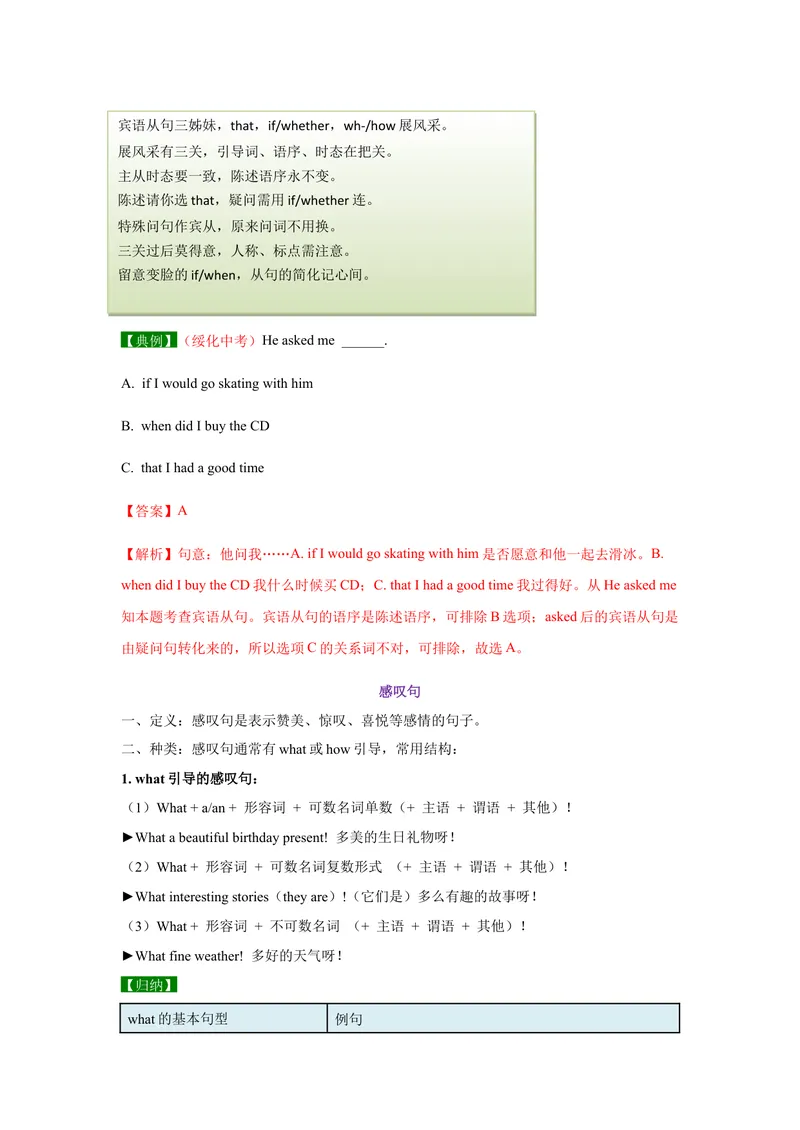
【助记】宾语从句的用法宾语从句三姊妹,that,if/whether,wh-/how展风采。
展风采有三关,引导词、语序、时态在把关。
主从时态要一致,陈述语序永不变。
陈述请你选that,疑问需用if/whether连。
特殊问句作宾从,原来问词不用换。
三关过后莫得意,人称、标点需注意。
留意变脸的if/when,从句的简化记心间。
【典例】(绥化中考)He asked me ______.
A. if I would go skating with him
B. when did I buy the CD
C. that I had a good time
【答案】A
【解析】句意:他问我……A. if I would go skating with him是否愿意和他一起去滑冰。B.
when did I buy the CD我什么时候买CD;C. that I had a good time我过得好。从He asked me
知本题考查宾语从句。宾语从句的语序是陈述语序,可排除B选项;asked后的宾语从句是
由疑问句转化来的,所以选项C的关系词不对,可排除,故选A。
感叹句
一、定义:感叹句是表示赞美、惊叹、喜悦等感情的句子。
二、种类:感叹句通常有what或how引导,常用结构:
1. what引导的感叹句:
(1)What + a/an + 形容词 + 可数名词单数(+ 主语 + 谓语 + 其他)!
►What a beautiful birthday present! 多美的生日礼物呀!
(2)What + 形容词 + 可数名词复数形式 (+ 主语 + 谓语 + 其他)!
►What interesting stories(they are)!(它们是)多么有趣的故事呀!
(3)What + 形容词 + 不可数名词 (+ 主语 + 谓语 + 其他)!
►What fine weather! 多好的天气呀!
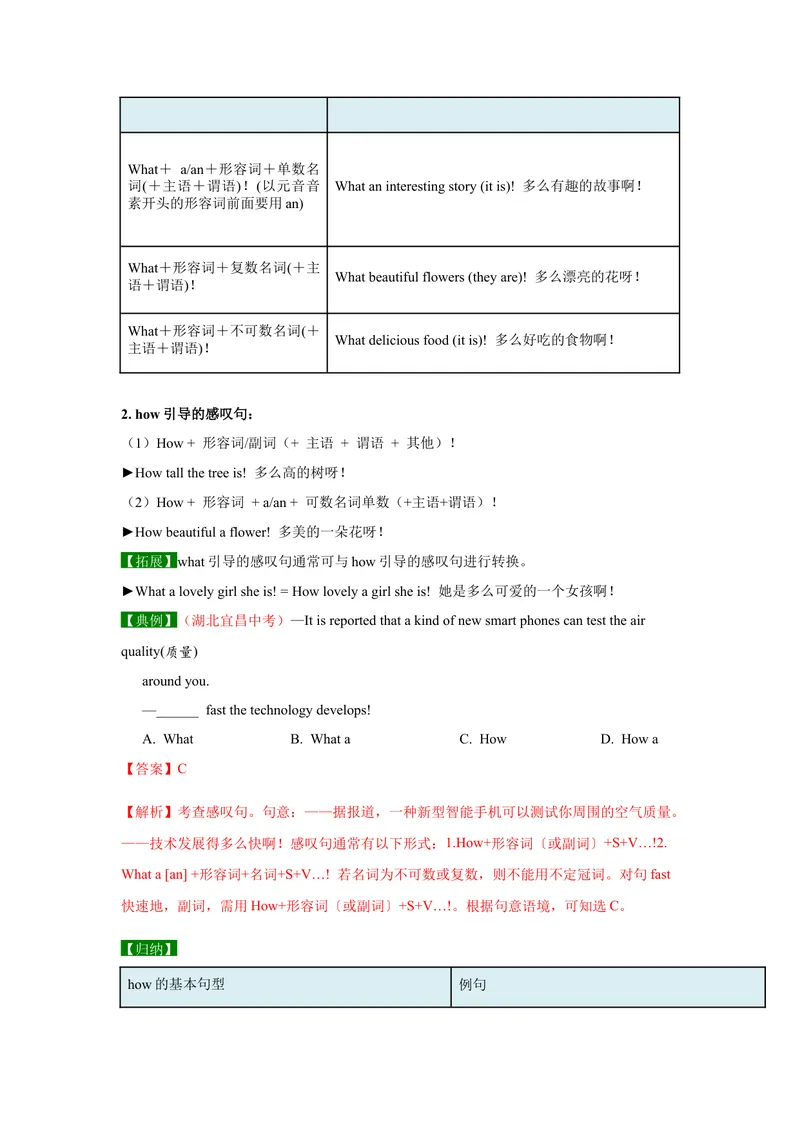
【归纳】
what的基本句型 例句What+ a/an+形容词+单数名
词(+主语+谓语)!(以元音音 What an interesting story (it is)! 多么有趣的故事啊!
素开头的形容词前面要用an)
What+形容词+复数名词(+主
What beautiful flowers (they are)! 多么漂亮的花呀!
语+谓语)!
What+形容词+不可数名词(+
What delicious food (it is)! 多么好吃的食物啊!
主语+谓语)!
2. how引导的感叹句:
(1)How + 形容词/副词(+ 主语 + 谓语 + 其他)!
►How tall the tree is! 多么高的树呀!
(2)How + 形容词 + a/an + 可数名词单数(+主语+谓语)!
►How beautiful a flower! 多美的一朵花呀!
【拓展】what引导的感叹句通常可与how引导的感叹句进行转换。
►What a lovely girl she is! = How lovely a girl she is! 她是多么可爱的一个女孩啊!
【典例】(湖北宜昌中考)—It is reported that a kind of new smart phones can test the air
quality(质量)
around you.
—______ fast the technology develops!
A. What B. What a C. How D. How a
【答案】C
【解析】考查感叹句。句意:——据报道,一种新型智能手机可以测试你周围的空气质量。
——技术发展得多么快啊!感叹句通常有以下形式:1.How+形容词〔或副词〕+S+V…!2.
What a [an] +形容词+名词+S+V…! 若名词为不可数或复数,则不能用不定冠词。对句fast
快速地,副词,需用How+形容词〔或副词〕+S+V…!。根据句意语境,可知选C。
【归纳】
how的基本句型 例句How+形容词(+主语+谓语)! How kind (the girl is)! (这个女孩)多么善良啊!
How+副词(+主语+谓语)! How well (she dances)! (她舞跳得)多好啊!
How+主语+谓语! (此句型中how修饰动词,但动
How time flies! 时间过得真快呀!
词不提前。)
【魔法记忆】感叹句的引导词what和how:
1. 根据所接词汇有无名词来判断。若所接词汇为名词或名词短语,该引导词用 what;若所
接词汇只有形容词或副词,无名词,则该引导词用how。
2. 句中有名词,根据主语和主语前的词汇判断。若主语前的词汇为名词或名词短语,该引
导词应用what;若主语前的词汇为形容词,则该引导词应用how。
【典例】用what或how填空:
①______ clever girls they are!
②______ clever the girls are!
【答案】①What ②How
【解析】第①句中的主语为they,they前的girls为名词,且clever与girls中间无其他词(如
定冠词 the 或物主代词等),clever girls 意为"聪明的女孩",为名词短语,则应用
What。第②句中虽有名词girls,但girls前存在定冠词the,the girls为名词短语,作主语,
clever不能与the girls一起构成名词短语, 即主语the girls前只有形容词clever,则应用
How。
语法过关练
1. —I don’t know______tomorrow.
—You can ask our teacher right now.
A. if we take the bus there B. when will we leave
C. what will we do D. how we will go there
2. May I ask you ______?
A. if or not there is a toilet near here
B. whether is there a school around here
C. that there is a hospital in the neighborhood
D. whether we should hand in the homework at once3. —The match is so exciting. The opposite team is really strong.
—You’re right. But I am sure ______ our team will win!
A. if B. that C. whether D. why
4. —______ fast China is developing!
—Yes, we are so lucky to live in such a great country.
A. What B. What a C. How D. How a
5. —______ fine weather it is! Shall we go hiking in the hills?
—Why not?
A. What B. What a C. How D. How a
6. —Could you please tell me ______?
—Yes. There is one on Center Street.
A. where can I buy some stamps B. when you will take your vacation
C. when was the telephone invented D. if there are any good restaurants around
here
7. —How long does it take to get to the airport?
—Forty minutes. But it’s foggy today. I’m not sure ______ the highway will be closed soon.
Let’s set off earlier.
A. whether B. when C. how D. why
8. —What about going to the South Lake for a picnic next weekend?
—OK. But I’m not sure ______ it will rain.
A. why B. where C. when D. whether
9. —______ interesting the storybook is!
—Yes. I have read it twice.
A. What B. What an C. How D. How an
10.—Could you please tell me ______?
—Yes, sure.
A. if there is a bookshop near here B. where can I buy a stamp
C. when will the next bus arrive D. you like to eat what
11.—Excuse me, can I interview Mr. Miller this afternoon?—A moment, please. Let me check ______.
A. if Mr. Miller will be free B. when will Mr. Miller have time
C. if Mr. Miller had an appointment D. when does Mr. Miller come back
12. —What did your granddaughter say just now?
—She wondered ______.
A. what time was it B. whether the book was written by Mark
Twain
C. how could she use the MP4 D. when she will have a final test
13. I wonder if he ______ this weekend. If he ______, I’ll let you know.
A. will com/will come B. will come/ comes
C. comes/ comes D. comes/ will come
14.—Whatever he does, he will tell his mother.
—______ honest boy he is!
A. How an B. How a C. What an D. What a
15. ______ exciting the good news is!
A. What B. What an C. How D. How a
1. D【解析】句意:—我不知道明天我们怎么去那儿。—你马上问问我们的老师。根据疑
问词引导的宾语从句用衬衫句语序,排除B/C;根据tomorrow.可知用将来时态;故选D。
2.D【解析】句意:我能问问你我们是否应该立刻交上作业?此题是考查宾语从句,宾语从
句的语序是陈述语序,排除B;if不和or not连用,排除A;根据句意此题是问句所以引导
词不能用that,排除C,因此此题选D。
3.B【解析】句意:—这场比赛是如此的激动人心。对手真的很强。—你说得对。但我相信
我们的球队会赢得!if是否,引导由一般疑问句变来的宾语从句;that引导由陈述句变来的
宾语从句;whether是否,引导由一般疑问句变来的宾语从句;why引导由特殊疑问句变来
的宾语从句。结合语境可知该选B。
4. C【解析】句意:中国发展得多快啊!—是的,生活在这么伟大的国家我们非常的幸运。
本题考查感叹句。Fast是副词,符合句型:How+形容词/副词+主语+谓语!故答案选C。
5. A【解析】考查感叹句。句意:—多好的天气啊!我们去山里徒步旅行好吗?——为什
么不呢?英语中感叹句有两种形式:1. What引导的感叹句,其构成:what+a/an+形容词
+可数名词单数+主语+谓语!/what+形容词+可数名词复数+主语+谓语!/what+形容词+不可
数名词+主语+谓语!2. How引导的感叹句,其构成:how+形容词/副词+主语+谓语!本句fine weather,weather是不可数名词,需用what+形容词+不可数名词结构;根据句意和语
境可知选A。
6.D【解析】考查宾语从句。在主从复合句中,宾语从句必须是陈述句语序,故排除 A、C
两项。B项"你何时去度假";D项"这附近是否有好的饭店"。根据答语句意"是的,
在中心大街上有一家"判断答案选D。
7.A【解析】考查宾语从句的连接词的用法。由答句中"但是今天有雾"可知"我不能肯定
高速公路是否不久后会被关闭"。whether是否;when何时;how如何;why为什么。根
据句意应选A。
8.D【解析】考查宾语从句的引导词。根据语境可知,此处表示"但是我不确定是否会下雨
",故用whether引导。故本题选D。
9.C【解析】考查感叹句的用法。句意:——这本故事书是多么有趣啊!——是的,我已经
读过两遍了。感叹句的构成有两种形式:What(+a/an)+adj.+n.+其他!How+adj.(+a
/an+n.)+其他!根据形容词interesting可知此处用how来引导感叹句。故选C。
10.A【解析】考查宾语从句。宾语从句用陈述句语序,先排除 B、C两项:D项中的what
应放在句首,排除D项。故选A。
11.A【解析】考查宾语从句用法。根据宾语从句要用陈述句语序,先排除 B、D两项;再
根据上句中的时间状语this afternoon可以确定宾语从句要用将来时态,故选A。
12.B【解析】句意:——刚才你的孙女说什么了?——她想知道这本书是不是马克吐温写
的。这里考查的是宾语从句,这个从句在句中放在wonder 的后面做宾语。我们知道,宾
语从句中应该用陈述语序,故可先排除A和C;句中wondered 使用的是一般过去时,故
宾语从句中也应该用过去时态,故D不对,选B。
13.B【解析】句意:我不知道这周末他是否会来,如果他来,我会让你知道的。本题的第
一句if引导的是宾语从句,遇到将来时要用将来结构will+动词原形;本题的第二句if引导
的是条件状语从句,遇到将来不用将来时,可用一般现在时来代替将来时,主语为单数第
三人称,come应该用comes,所以本题选B。
14.C【解析】句意:——无论做什么事,他都会告诉他的妈妈。——他是多么诚实的孩子
啊!感叹句结构:what (a/an)+形容词+名词+主语+谓语;how +形容词+主语+谓语,因
为honest的第一个因素是元音音素,故用an修饰,故选C。
15.C【解析】句意:这好消息是多么激动人心啊!感叹句的构成:How+形容词+主语+谓语,
What+a/an+形容词+可数名词单数+主语+谓语,What+形容词+不可数名词或可数名词复数+主语+谓语,所以选C。
【重点短语】
Section A
1. the Water Festival 泼水节
2. the Dragon Boat Festival 端午节
3. the Spring Festival 春节
4. the Lantern Festival 元宵节
5. Mother’s Day 母亲节
6. Father’s Day 父亲节
7.a little too crowded 有点太拥挤
8. eat out 出去吃饭
9.put on five pounds 体重增加了5磅
10. Guess what? 你猜怎么着?
11. in two weeks 两周以后
12.the hottest month of the year 一年中最热的月份
13.be similar to 和……相似
14.the Dai people 傣族
15. throw water at each other 互相泼水
16. wash away bad things 洗去晦气
17.have good luck in the new year 在新的一年交好运
18. celebrate the Mid-Autumn Festival 庆祝中秋节
19. in the shape of a full moon 一轮满月的形状
20. on the Mid-Autumn night 在中秋节的晚上
21. traditional folk stories 传统民间故事
22. shoot down 射下
23. magic medicine 仙药
24. live forever 长生不老
25. plan to do sth. 计划做某事
26. refuse to do sth. 拒绝做某事27. lay out 摆开;布置
28. start the tradition of ... 开始……的传统
29. admire the moon 赏月
【自测题】
Ⅰ. 词汇
根据语境及所给首字母提示,补全所缺单词。
1. We have so much work to do so I don't s going away now.
2. If you want to mail this letter, you should buy a 29-cent s .
3. Don't r ; take your time.
4. We are deskmates (同桌). She sits b me.
5. P me for breaking your glasses. I'll buy you one new pair.
6. Excuse me, are there any public r around here? I want to wash my hands.
7. When you called me last night, I was taking a shower in the b .
8. Remember to send me a p with the Great Wall on it when you travel to Beijing.
从方框中选择合适的单词填空,使每个句子在结构、句意和逻辑上正确。
relative, mooncake, admire, garden, steal, pound
1. Lucy has lost five _______ since she stopped having dinner.
2. I really _______ people who can work in such difficult conditions.
3. Grandma used to make some _______ for the Mid-Autumn Festival every year.
4. Jim has some _______ in Chengdu and he visits them twice a year.
5. The Whites live in a big house with two _______ and a swimming pool.
6. It’s reported that someone _______ a famous painting from the museum.
Ⅱ. 根据汉语意思完成英语句子,每空一词。
1. Tom尝试了乘骑项目之后感到不舒服。
After Tom _______ _______ _______, he didn't feel well.
2. 我经过Linda的房间时听见她在哭。
I heard Linda crying when I _______ _______ her room.
3. Kate睡觉时总是抓住妈妈的手。
Kate always _______ _______ _______ _______ when she sleeps.
4. 在上学的路上,我经常遇见Henry。_______ _______ _______ _______ school, I often meet Henry.
5. 事故发生时,我们恰好路过。
When the accident happened, we just _______ _______.
6. 我很高兴这家饭店能给我们提供美味的食物。
I'm glad that this restaurant could _______ _______ _______ to us.
7. 那个节日通常以大型的烟火展开始。
The festival usually _______ _______ a huge fireworks display.
8. 沿着这条街走,银行就在你的左边。
Walk along this street and the bank is _______ _______ _______.
9. It’s impossible for everyone to _______ _______(长生不老).
10. _______ _______(你猜怎么着)? I have passed the driving test.
11. During the Water Festival, we like to _______ _______(泼水) at each other.
12. Jack, you’d better not _______ _______(射下) the birds.
13. Jason _______ _______(摆开) his new books on the bed just now.
14. The flood (洪水) _______ _______(冲走) hundreds of houses.
15. My sister cut the paper _______ _______ _______ _______(呈……形状) a heart.
16. Mary was thin from sickness, and the doctor said she must _______ _______(增加) at least
ten kilos.
Ⅲ. 根据对话内容,从方框中选择恰当的选项补全对话,其中有两项多余。
A: Hey, Mary! (1)_______
B: Yeah! You can buy them at a bookstore.
A: Oh? (2)_______
B: Sure. There's one on Green Street.
A: (3)_______
B: Of course. Go along this street and turn left at the first crossing, and then you can find it.
A: I see. Could you tell me when the bookstore closes in the afternoon?
B: (4)_______
A: OK. What's the time now?
B: Half past four. (5)_______
A: OK. Thank you very much.
A. What's wrong?
B. It closes at 5:00 p.m.C. You need to be quick.
D. How can I help you?
E. Can you tell me how to get there?
F. Could you tell me where I can buy cards?
G. Do you know if there's a bookstore around here?
单项选择
1.Helping others, ______ we have lots of money or just a little, can make us happy.
A.if B.that C.which D.whether
2.A new English play ______ there next week.
A.will put on B.will be put on
C.is going to put on D.will be putted on
3.I wonder______.
A.what will they choose to wear B.that are their favourite colours
C.if they will come on time D.that students have finished reading the book
4.-It's cold outside, Jimmy! You should ______your sweater.
-Thanks, mom.
A.take off B.take in C.put on D.put up
5.-______ will the invitations be sent to our guests?
-In three days.
A.How often B.How soon C.How long D.How far
6.The shop ______with old people on weekends,but children ______in the interesting places.
A.crowds;crowded B.crowded;crowds C.crowded;crowd D.is crowded;crowd
7.A lot of trees ______ around here every year, and we can enjoy fresher air now.
A.were planted B.are planted C.will plant D.are planting
8.______great day! Let’s go out to have a picnic.
A.What a B.What C.How D.How a
9.—Are you sure you can do well in today’s test, Lucy?
—______. I’ve got everything ready.
A.It’s hard to say B.I’m afraid not
C.I think so D.I hope not10.______ comes in must keep quiet.
A.Whatever B.Whenever C.However D.Whoever
参考答 案
Ⅰ. 词汇
根据语境及所给首字母提示,补全所缺单词。
Ⅰ. 1. suggest 2. stamp 3. rush 4. beside
5. Pardon 6. restrooms 7. bathroom 8.postcard
从方框中选择合适的单词填空,使每个句子在结构、句意和逻辑上正确。1. pounds 2. admire 3. mooncakes 4. relatives 5. gardens 6. stole
Ⅱ. 根据汉语意思完成英语句子,每空一词。
1. tried the rides 2. went past / passed by 3. holds her mother's hand
4. On my way to 5. passed by 6. serve delicious food
7. starts / begins with 8. on your left 9. live forever
10. Guess what 11. throw water 12. shoot down
13. laid out 14 . washed away 15. in the shape of
16. put on
Ⅲ. 根据对话内容,从方框中选择恰当的选项补全对话,其中有两项多余。
1-5 FGEBC
单项选择
D BCCB DBACD