人教版新目标九年级英语自学手册
知识点解析+ 短语归纳+语法讲练+ 自我检测
Unit 8 It must belong to Carla.
Section A
【知识点精讲】
1 It must be Carla’s. 它一定是卡拉的。 (Page 57 1b)
此处must表肯定推测,表示可能性很大,意为"一定;肯定",通常与 be连用,这种用法只
用于肯定句中。
►There must be something wrong with the computer. 这台电脑一定是出了什么毛病。
►The schoolbag must be Mary’s. 那个书包一定是玛丽的。
【拓展】must表示"必须",可用于肯定句、否定句或疑问句中;用于否定句中时,mustn’t的意
思是"一定不要;禁止"。
►We must find a good way to learn English well. 我们必须找一个学好英语的好方法。
►You mustn’t play soccer in the square. 你们一定不能在广场上踢足球。
►—Must I clean the classroom? 我必须打扫教室吗?
—Yes, you must. (No, you needn’t./No, you don’t have to.) 是的,你必须(不,你不必)。
【典例】(四川南充中考)—Mum, may I play computer games this evening?
—No way, you __________finish your homework.
A. can B. must C. may D. will
【答案】B
【解析】句意:——妈妈,今天晚上我可以玩电脑游戏吗?——不行,你必须完成你的作业。A.
can能,会;B. must必须;C. may可以;D. will会。根据上文Mum, may I play computer games this
evening?及回答No way可知下文用must必须。根据题意,故选B。
2 belong to 属于 (Page 58 2b)
belong此处用作不及物动词,to为介词,后接名词或人称代词的宾格形式,不能接名词性物主
代词或名词所有格,其主语通常是物。
►That book belongs to him. 那本书属于他。
►These clothes must belong to Tom. 这些衣服一定是汤姆的。
【拓展】(1)belong to不能用于进行时态,也不能用于被动语态。(2)belong to可与名词性物主代词或名词所有格进行句型转换。
►This watch belongs to me. = This watch is mine. 这块手表是我的。
►It must belong to Carla.= It must be Carla’s. 它一定是卡拉的。
3 What’s wrong? 怎么了? (Page 58 2d)
►What’s wrong (with...)?意为"(……)怎么了?"常用来询问某人遇到了什么麻烦事、患了什么
疾病或某物出了什么问题等。
►—What’s wrong with you? 你怎么了?
—I lost some money. 我丢了一些钱。
【拓展】表示"(……)怎么了/出什么事了?"的常见句型还有:What’s the matter (with...)? =
What’s the trouble (with...)? = What’s...trouble?
►What’s the matter with you? = What’s the trouble with you? = What’s your trouble? 你怎么了?
【典例】—I didn’t fall asleep last night. So I am sleepy now.
—__________
—I worried about the coming test.
A. How are you? B. Are you OK?
C. What was wrong? D. When did you go to bed?
【答案】C
【解析】根据对话的前两句"我昨晚睡不着,所以我现在很困。"和最后一句"我担心马上到来的
考试。"可知,对方应是询问"怎么了?",以表示关心。
4 attend 参加,出席 (Page 58 2d)
►He’ll attend an important meeting tomorrow. 明天他要参加一个重要会议。
【辨析】attend, join与take part in
此三者皆有"参加"的意思,但用法不同。
attend 常用于参加会议、婚礼、葬礼、典礼,去 I attended his wedding. 我参加了他的
上课、上学、听报告、出席音乐会、看演 婚礼。
出、听演讲等
join 指加入某个党派、团体、组织等,并成为 She joined the Young Pioneers. 她加入
其中的一员,如"参军、入团、入党"等 了少先队。
take part in 指参加群众性活动等,并在其中发挥积极 We’ll take part in social practice during
作用 the summer vacation. 暑假期间我们将
参加社会实践。
►I attended his lecture. 我听了他的演讲。
►Will you take part in the English evening? 你要参加英语晚会吗?
►I will never forget the day when I joined the Party. 我永远也忘不了我入党的那一天。►Will you join us for dinner? 你愿意和我们一起吃晚餐吗?
【典例】There was a concert in the music hall and I _______(参加) it yesterday.
【答案】attended
5 pick up 捡起,拾起 (Page 58 2d)
此短语为"动词+副词"型短语,若宾语为人称代词,须将人称代词置于pick与up之间。
►Please pick up the books on the floor. 请把地板上的书捡起来。
►The books are on the floor. Please pick them up. 书在地板上,请把它们捡起来。
【拓展】pick up还可意为"接电话;接(某人);收听"。
►The phone is ringing. Could you please pick it up for me? 电话铃响了。请你帮我接一下好吗?
【典例】(安徽中考)—Shall we go to the airport to _______ your sister?
—I don’t think it’s necessary. She will come here by taxi.
A. see off B. pick up C. look after D. come across
【答案】B
【解析】句意:——我们去机场接你的姐姐,好吗?——我想这没有必要,她会乘出租车来这里。
see off为某人送行;pick up接某人;look after照顾;come across偶然遇见。根据句意She will come
here by taxi可知,这里表示"去机场接……",故应选B。
6 noise 嘈杂声,喧闹声 (Page 59 3a)
noise既可作可数名词,表示某一具体的嘈杂声、喧闹声;又可作不可数名词,意为"噪音;
喧闹声",其形容词形式为noisy,意为"喧闹的"。make a noise意为"吵闹"。
►Don’t make a noise. 不要吵闹。
►Don’t make so much noise. Your father is sleeping. 别那么吵,你们的父亲在睡觉。
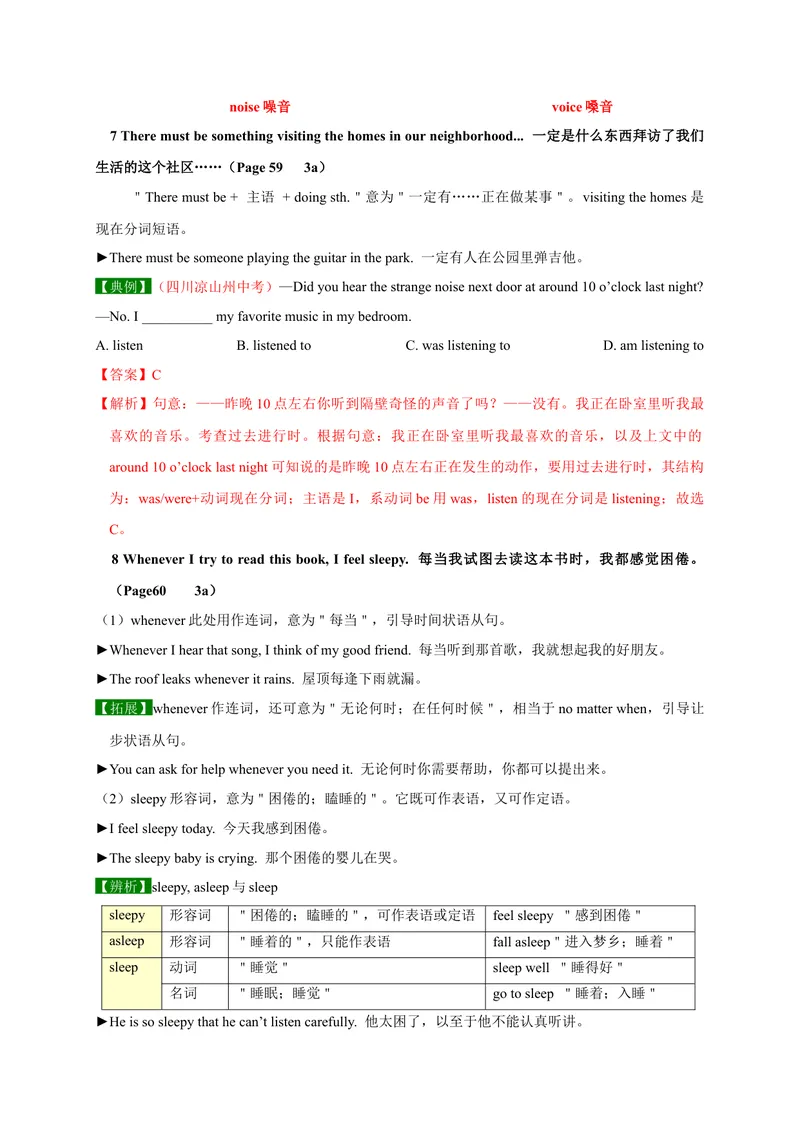
【辨析】noise, sound与voice
noise 意为"噪音,喧闹声",常指不悦耳、不和谐的 Please don’t make much noise in
嘈杂声 class. 请不要在课堂上太吵闹。
sound 意为"声音";泛指各种声音 Light travels much faster than sound.
光的传播速度比声音快得多。
voice 意为"嗓音",一般指人的声音,如说话声、歌 The boy has a beautiful voice. 那个
声、谈笑声等。voice有时可指鸟叫声 男孩嗓音很美。
sound声音
其他声音noise噪音 voice嗓音
7 There must be something visiting the homes in our neighborhood... 一定是什么东西拜访了我们
生活的这个社区……(Page 59 3a)
"There must be + 主语 + doing sth."意为"一定有……正在做某事"。visiting the homes是
现在分词短语。
►There must be someone playing the guitar in the park. 一定有人在公园里弹吉他。
【典例】(四川凉山州中考)—Did you hear the strange noise next door at around 10 o’clock last night?
—No. I __________ my favorite music in my bedroom.
A. listen B. listened to C. was listening to D. am listening to
【答案】C
【解析】句意:——昨晚10点左右你听到隔壁奇怪的声音了吗?——没有。我正在卧室里听我最
喜欢的音乐。考查过去进行时。根据句意:我正在卧室里听我最喜欢的音乐,以及上文中的
around 10 o’clock last night可知说的是昨晚10点左右正在发生的动作,要用过去进行时,其结构
为:was/were+动词现在分词;主语是I,系动词be用was,listen的现在分词是listening;故选
C。
8 Whenever I try to read this book, I feel sleepy. 每当我试图去读这本书时,我都感觉困倦。
(Page60 3a)
(1)whenever此处用作连词,意为"每当",引导时间状语从句。
►Whenever I hear that song, I think of my good friend. 每当听到那首歌,我就想起我的好朋友。
►The roof leaks whenever it rains. 屋顶每逢下雨就漏。
【拓展】whenever作连词,还可意为"无论何时;在任何时候",相当于no matter when,引导让
步状语从句。
►You can ask for help whenever you need it. 无论何时你需要帮助,你都可以提出来。
(2)sleepy形容词,意为"困倦的;瞌睡的"。它既可作表语,又可作定语。
►I feel sleepy today. 今天我感到困倦。
►The sleepy baby is crying. 那个困倦的婴儿在哭。
【辨析】sleepy, asleep与sleep
sleepy 形容词 "困倦的;瞌睡的",可作表语或定语 feel sleepy "感到困倦"
asleep 形容词 "睡着的",只能作表语 fall asleep"进入梦乡;睡着"
sleep 动词 "睡觉" sleep well "睡得好"
名词 "睡眠;睡觉" go to sleep "睡着;入睡"
►He is so sleepy that he can’t listen carefully. 他太困了,以至于他不能认真听讲。►The old man fell asleep while watching TV. 那位老人在看电视时睡着了。
►Please be quiet! The baby is sleeping. 请安静!那个婴儿在睡觉。
►We need at least 8 hours’ sleep at night. 我们晚上至少需要8小时的睡眠。
【典例】—Why are you looking __________ in class all day?
—Because I can’t finish my homework until eleven every night.
A. awake B. asleep C. sleeping D. sleepy
【答案】D
【解析】awake醒着的;asleep睡着的;sleeping睡觉;睡着的;sleepy困乏的。由答语句意"因为
我每天晚上都直到11点才完成作业"可知,问句意为"你为什么整天上课时都显得很困乏?"。
故选D。
9 whose /huːz/ adj.& pron.谁的
►She’s the girl whose bicycle was stolen. 她就是那个被偷了自行车的女孩。
whose既可置于名词前作定语,也可单独使用,在句中作主语、表语。
►Whose are these books? (=Whose books are these?) 这些书是谁的?
whose用于疑问句中,询问某物属于何人,是who的所有格形式。
►—Whose pens are these? 这些是谁的钢笔?
—They are Tom’s. 它们是汤姆的。
【典例】(甘肃白银中考)__________ pencil is this, Tom’s or Henry’s?
A. What B. When C. Who D. Whose
【答案】D
【解析】句意:这是谁的铅笔,汤姆的还是亨利的?本题考查特殊疑问词。A. What什么;B. When
什么时候;C. Who谁;D. Whose谁的。根据后面的Tom’s or Henry’s?"汤姆的还是亨利的?"可
知前面是问
10 picnic /’pɪknɪk/ n. 野餐
►It is fine this week. What about having a picnic this weekend? 这个星期天气不错。这个周末去野餐
怎么样啊?
have a picnic=go on a picnic=go for a picnic去野餐
►If it doesn’t rain tomorrow, we will have/go for a picnic. 如果明天不下雨的话,我们将去野餐。
【拓展】picnic还可用作动词,意为"野餐"。
►We can picnic on the riverbank. 我们可以在河岸上野餐。
11 possibly /’pɒsəbli/ adv. 可能;也许►It is possibly their worst performance so far.这也许是他们迄今为止最糟糕的表演。
【辨析】maybe, perhaps, possibly与probably
四者都有"或许;大概"之意。但它们之间仍有差别:
(1)maybe多用于美式英语。指某事也许如此,含不确定之意。
►Maybe he will be back this afternoon. 他或许今天下午回来。
(2)perhaps与maybe同义,多用于英式英语。
►Perhaps you should give him another chance. 或许你应该再给他一次机会。
(3)possibly指可能性较小。
►Tom can possibly lend you money. 汤姆可能会借给你钱。
(4)probably指可能性大,语气比possibly强。
►Never give up. Try again and you’ll probably succeed. 永远不要放弃,再试一次,可能你就会成功
的。
12 anything valuable 一些贵重的物品
当something, anything, nothing, everything等不定代词有形容词修饰时,形容词要放在不定代词后
面。
►I have something important to tell you. 我有一些重要的事情告诉你。
【魔法记忆】不定代词的用法:不定代词不张扬,修饰成分后面藏;谓语动词用单数,何时何地都
一样。
【典例】My host family tried to cook ________ for me when I studied in New Zealand.
A. different something B. different anything
C. something different D. anything different
【答案】C
【解析】肯定句中用something,排除B、D选项。不定代词有形容词修饰时,形容词放在不定代词
后面。
valuable在句中可用作定语,也可用作表语。用作表语时,可与介词to连用。
►The handbook is valuable to me. 这本手册对我很有价值。
【典例】Helping others is the most ________(有价值的) thing in the world.
【答案】valuable
13 anybody /’enibɒdi/ pron. 任何人
anybody(anyone) 表示"任何人",常用于否定句和疑问句中。在肯定句或if条件状语从句中
表达"任何人"的含义时也用anyone/anybody。►Has anybody come? 有人来了吗?
►It’s easy — anybody can do it. 这很容易——任何人都会做。
►Please tell me at once if anyone calls me. 假如有任何人给我打电话,请立刻告诉我。
【典例】(青海西宁中考)—Lisa, don’t let ________ in. I am too busy to meet anyone this moming.
—OK. I _________.
A. nobody; will B. anybody; won’t C. somebody; don’t D. anybody;
don’t
【答案】B
【解析】句意:——Lisa,不要让任何人进来。今天早上我太忙了不能见任何人。——好的,我不
会的。nobody没有人;anybody任何人,常用于否定句中;somebody某人,用于肯定句中;
don’t不;will会的;won’t不会的。第一句话是否定句,故应填anybody。根据句意don’t…可知,
这是祈使句的否定形式,答语中应用否定形式,表示"不会的",将来时形式。故选B。
14 There must be something visiting the homes in our neighborhood, but what is it?
"There be sb./sth. doing sth. +地点"表示"某处有某人或某物正在做某事"。
►There is a man fishing by the lake. 有一个人正在湖边钓鱼。
"There be 句型后,还可以接过去分词,也可以跟不定式。
►There was a car stolen last night. 昨晚有辆车被偷了。
►There is a lot of work to do (to be done). 有许多工作要做。
15 fear /fɪə(r)/ n. 恐惧;惧怕
fear此处用作不可数名词,意为"恐惧,惧怕"。
►There is no reason for her mother’s fear. 她妈妈的担心是没有道理的。
【拓展】fear作及物动词时,常见以下用法:
(1)意为"担心,恐怕",相当于worry about。
►I fear that he will come late to school. 我担心他会上学迟到。
(2)意为"害怕,惧怕",相当于be afraid of。
►The girl feared to speak in public. 这个女孩怕在别人面前讲话。
16.Use “might” or “could” to show that you think something is possibly true.使用“might”或“could”
来表示你认为某事可能是真的。
possibly /'pɒsəbli/ adv.可能;也许
eg: It is possibly their worst performance so far.这也许是他们迄今为止最糟糕的表演。
It can’t possibly work. 那绝对不成。
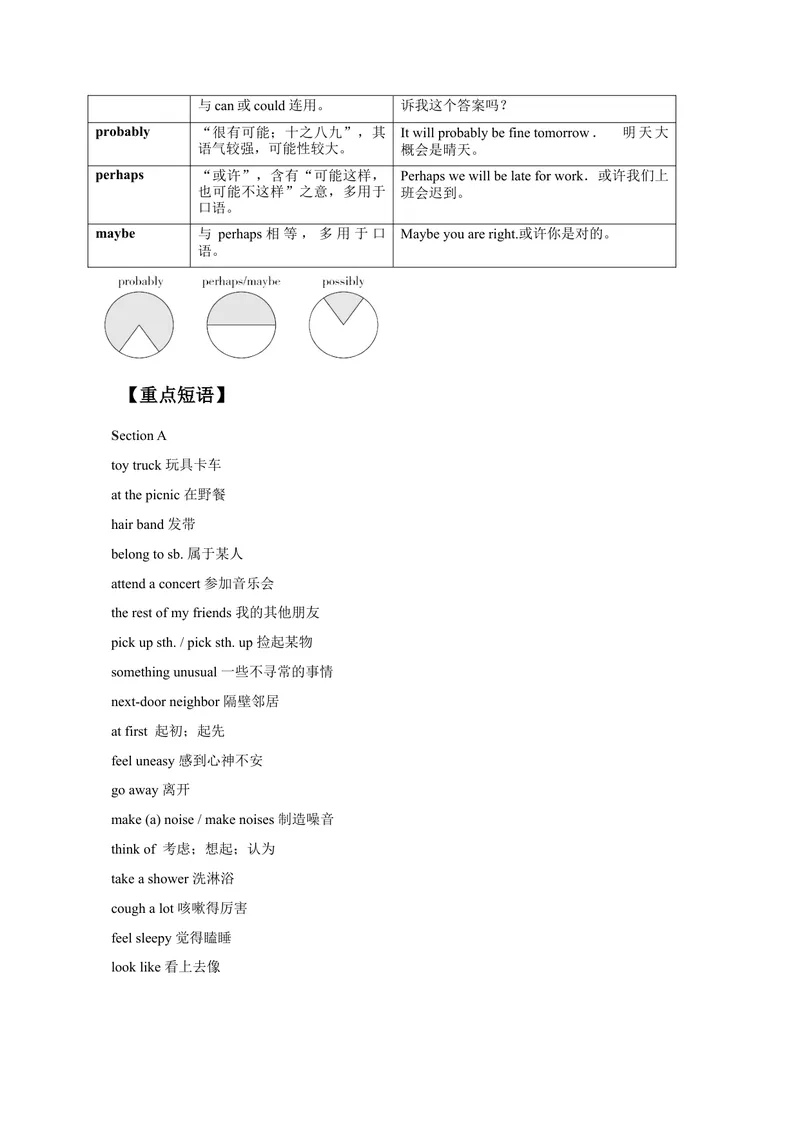
辨析possibly, probably, perhaps与maybe
possibly 可能性较小,为加强语气,可 Could you possibly tell me the answer? 你能告与can或could 连用。 诉我这个答案吗?
probably “很有可能;十之八九”,其 It will probably be fine tomorrow. 明天大
语气较强,可能性较大。 概会是晴天。
perhaps “或许”,含有“可能这样, Perhaps we will be late for work.或许我们上
也可能不这样”之意,多用于 班会迟到。
口语。
maybe 与 perhaps 相等,多用于口 Maybe you are right.或许你是对的。
语。
【重点短语】
Section A
toy truck 玩具卡车
at the picnic 在野餐
hair band 发带
belong to sb. 属于某人
attend a concert 参加音乐会
the rest of my friends 我的其他朋友
pick up sth. / pick sth. up 捡起某物
something unusual 一些不寻常的事情
next-door neighbor 隔壁邻居
at first 起初;起先
feel uneasy 感到心神不安
go away 离开
make (a) noise / make noises 制造噪音
think of 考虑;想起;认为
take a shower 洗淋浴
cough a lot 咳嗽得厉害
feel sleepy 觉得瞌睡
look like 看上去像【语法讲练】
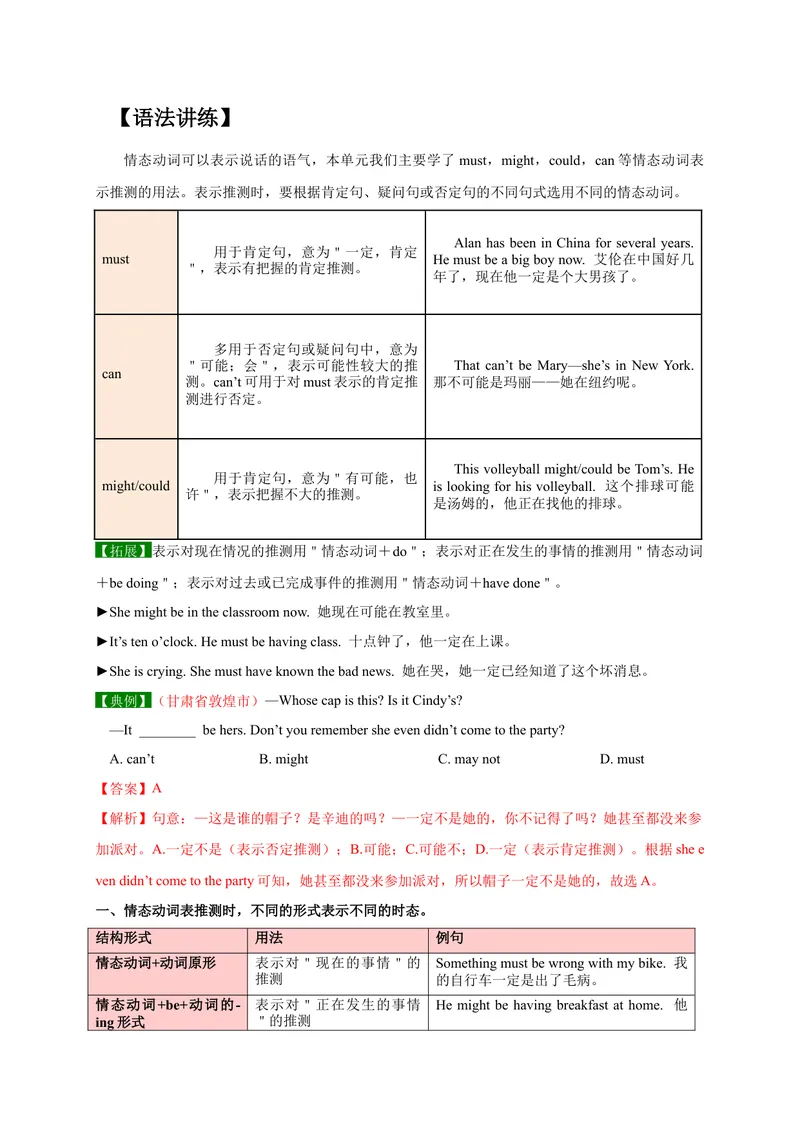
情态动词可以表示说话的语气,本单元我们主要学了must,might,could,can等情态动词表
示推测的用法。表示推测时,要根据肯定句、疑问句或否定句的不同句式选用不同的情态动词。
Alan has been in China for several years.
用于肯定句,意为"一定,肯定
must He must be a big boy now. 艾伦在中国好几
",表示有把握的肯定推测。
年了,现在他一定是个大男孩了。
多用于否定句或疑问句中,意为
"可能;会",表示可能性较大的推 That can’t be Mary—she’s in New York.
can
测。can’t可用于对must表示的肯定推 那不可能是玛丽——她在纽约呢。
测进行否定。
This volleyball might/could be Tom’s. He
用于肯定句,意为"有可能,也
might/could is looking for his volleyball. 这个排球可能
许",表示把握不大的推测。
是汤姆的,他正在找他的排球。
【拓展】表示对现在情况的推测用"情态动词+do";表示对正在发生的事情的推测用"情态动词
+be doing";表示对过去或已完成事件的推测用"情态动词+have done"。
►She might be in the classroom now. 她现在可能在教室里。
►It’s ten o’clock. He must be having class. 十点钟了,他一定在上课。
►She is crying. She must have known the bad news. 她在哭,她一定已经知道了这个坏消息。
【典例】(甘肃省敦煌市)—Whose cap is this? Is it Cindy’s?
—It ________ be hers. Don’t you remember she even didn’t come to the party?
A. can’t B. might C. may not D. must
【答案】A
【解析】句意:—这是谁的帽子?是辛迪的吗?—一定不是她的,你不记得了吗?她甚至都没来参
加派对。A.一定不是(表示否定推测);B.可能;C.可能不;D.一定(表示肯定推测)。根据she e
ven didn’t come to the party可知,她甚至都没来参加派对,所以帽子一定不是她的,故选A。
一、情态动词表推测时,不同的形式表示不同的时态。
结构形式 用法 例句
情态动词+动词原形 表示对"现在的事情"的 Something must be wrong with my bike. 我
推测 的自行车一定是出了毛病。
情态动词+be+动词的- 表示对"正在发生的事情 He might be having breakfast at home. 他
ing形式 "的推测可能正在家里吃早饭。
情态动词+have+动词的 表示对"过去或已经完成 I must have put my keys somewhere in the
过去分词 的事情"的推测 bedroom.我一定是把钥匙放在卧室的某个
地方了。
二、情态动词表推测的意义和用法
句式 情态动词 用法 意义 例句
肯定句 must 表示有把握的肯定推测 一 定 ; He must be very tired after a long
肯定 journey. 长途旅行后,他一定很
累。
could/ 其肯定程度逐渐减弱,表 可能 It might rain this afternoon.今天
may/might 示把握性不大的推测 下午可能会下雨。
否定句 can’t 表示有把握的否定推测 不可能 She can’t be at school. It’s Sunday
today.她不可能在学校里。今天
是星期天。
疑问句 can/could 表示推测 可能 Could Mike be an Indian boy? 迈
克可能是一个印度男孩吗?
【警示】1. could用于否定句时,语气较can’t缓和,意为"不可能"。
►He said the news couldn’t be true.他说那个消息不可能是真的。
2. may/might用于否定句时,表示不太有把握的否定推测,意为"可能不"。
【典例】【天津】You ________ walk on the wet hill path because you ________ fall and hurt yourself.
A. must; might not B. mustn’t; might
C. needn’t; need D. must; must
【答案】B
【解析】考查情态动词。句意:禁止在湿湿的山路上走,因为你可能会摔跤且伤到你自己。第一空
需要填入一个情态动词,表示"禁止",用musn’t;第二空需要填入一个情态动词,表示"可能",用
might。故选:B。
基础过关
一、选用方框中的情态动词填空。
can, may, must, can’t, may not, mustn’t, could, might, couldn’t, might not
1. That red notebook ______ be Wang Hong’s. Look! It has her name on the first page.
2. The jeans ______ be Michael’s. They are too short for him.
3. The basketball ______ be Mike’s. His superstar is Yao Ming.
4. The guitar ______ belong to Mary. She likes to play the guitar very much.
5. Oh, the red bike ______ be his. His is yellow.1. must 2. can’t 3. might/may
4. might/may 5. can’t/couldn’t
二、根据汉语意思完成句子,每空一词。
1. 她不可能正在等你。
She______ ______ ______ for you.
2. 她的表准是停了。我去叫她。
Her watch ______ ______ ______. I will go and call her.
3. 他喜欢读书。现在他一定是正在图书馆读书呢。
He likes reading. Now he ______ ______ ______ in the library.
4. 你走了那么长的路,一定饿了吧。
You ______ ______ ______ after your long walk.
5. 你最好去问那位警察,他一定知道去邮局的路。
You’d better ask the policeman. He ______ ______ the way to the post office.
1. can’t be waiting 2. must have stopped 3. must be reading
4. must be hungry 5. must know
【自测题】
一、根据句意,从方框中选择恰当的单词填空,有的需要变换形式。每词限用一次。
rabbit, pink, anybody, who, valuable, wolf, policeman, belong, laboratory, attend
1. Linda, here is a handbag. I wonder _______ it is.
2. _______ will make mistakes. That is to say, nobody is perfect.
3. In the movie, we could hear _______ howling (长嚎) in the forests.
4. The ring is beautiful, but not very _______.
5. My brother plans to keep two _______ as his pets.
6. Tom and Paul are both _______ and they work in the same police office.
7. Our new research _______ will be set up by the end of this year.
8. Today she is wearing a bright _______ dress. She looks very beautiful.
9. Peter went to Beijing and an important meeting three days ago.
10. Does this book to you?
二、单项选择。
( )1. —Listen! Nancy is singing in the next room.
—It ____ be Nancy. She is in the teachers’ office.
A. can’t B. mustn’t C. could D. might( )2. Who ___ this building belong to?
A. is B. does C. was D. has
( )3. Our teacher said she had to tell us.
A. valuable something B. something valuable
C. valuable anything D. anything valuable
( )4. —Are those stamps ?
—No, they are not mine. They belong to .
A. you; him B. yours; him C. yours; his D. your; his
( )5. Last week they a concert.
A. joined B. took part in C. attended D. on
( )6. —I wonder if this smart phone is Mary’s.
—It belong to her. is totally different from this one.
A. mustn’t; Her B. can’t; Her C. can’t; Hers D. may; Hers
( )7. —Where are you going this month?
—We ____ go to Xiamen, but we’re not sure.
A. needn’t B. must C. might D. mustn’t
( )8. —Oh, it’s raining hard.
—Be careful! The road be wet.
A. could B. must C. might D. can
( )9. —Whose pencil box is this?
—Oh, it’s . I was looking for it everywhere.
A. my B. yours C. me D. mine
( )10. The problem is simple. can solve it.
A. Nobody B. Anybody C. Somebody D. Someone
( ) 11.The book must ______ Han Mei. It has her name on it.
A. be B. belong to C. is D. belongs
( )1 2. The noise-maker is having too much fun ______fear in the neighborhood.
A. be create B. to be creating C. creating D. to create
( ) 13. I’m sure this book ______ Li Lei’s, because there is his name on it.
A. can’t B. may be C. might be D. must be
( ) 14. Don’t _______ about things so much. It will make you stressed out.
A. afraid B. terrify C. terrified D. worry( )15. Lucy thinks that ______ English movies isn’t a good way.
A. watch B. watched C. watching D. watches
( )16. —I don’t know why he is late.
—Nor do I. He_____ have had an accident.
A. can B. should C. might D. must
( )17. —Who’s that boy reading in the garden? Is it David?
—It______ be David. I saw him in the classroom just now.
A. must B. can’t C. may D. shouldn’t
( ) 18. —Must I finish my homework now?
—No, you _________. You may have a rest first.
A. mustn’t B. can’t C. may not D. needn’t
( )19. —Where is Tom?
— He hasn't come to school today. I think he________ be ill.
A. has to B. should C. may D. need
( )20. —Tom, where is your father?
— I’m not sure. He_______ in his office.
A. is B. may be C. maybe D. may
三、根据汉语意思完成英语句子。
1. 一些学生在踢足球,其余的在做作业。
Some students are playing soccer and _______ _______ _______ them are doing their
homework.
2. 昨天在考试之前,她感到心神不安。
She _______ _______ before the exam yesterday.
3. 你上次把玩具卡车放在哪里了?
Where did you _______ put your _______ _______?
4. 野餐时不同寻常的事情发生了。
Something unusual happened _______ _______ _______.
5. 不要走开,我有事要告诉你们所有人。
Don't _______ _______. I have something to tell all of you.
6. 我认为这条发带属于Lisa的妹妹。
I think this hair band _______ _______ Lisa's sister.7. 她明天可能和她的朋友参加音乐会。
She might _______ _______ _______ with her friends tomorrow.
8. 图书馆里不允许任何人制造噪音。
Anybody is not allowed to _______ _______ _______ in the library.
四、根据对话内容,从方框中选择恰当的选项补全对话,其中有两项多余。
A: Frank, look at the black pen under your desk. Is it yours?
B: No, it isn’t, Amy. Look! Mine is in my pencil box.
A: (1)_______
B: It might be Mike’s. He always loses his things.
A: It can’t be his. (2)_______
B: Oh, look, Kevin’s name is on the pen. (3)_______
A. Oh, whose is it?
A: I think you’re right. Please go to ask him. B. Is this pen yours?
(Frank goes over to Kevin with the black pen.) C. It must be Kevin’s.
D. Where did you find it?
B: Hi, Kevin. (4)_______
E. How do you know that?
C: Yes, it is. I looked for it for long, but I couldn’t find it.
F. Its owner can’t be a boy.
(5)_______
G. He doesn’t like black at all.
B: Under my desk. Here you are.
C: Thank you.
B: You’re welcome.
五、阅读短文,从文后的方框里选出个句子完成短文,使其内容完整通顺。有一项剩余。
Do you think there is a ghost(鬼) in the world? More than 20 years ago, a student jumped from the top
of the clock tower in the University of Birmingham. 1
After his death, a superstition(迷信) began: 2 Years later, students there still remembered
the story of the tower. Although Birmingham is the second largest city in Britain, the university is green
and quiet. 3 But they refuse to pass underneath(在……下面)the tower.
4 so students could walk to their classrooms without passing under the most terrible area.
But, one day just before an important exam, a top student in the university walked under the clock tower
because he was lost in thought. However, he got high marks in the exam the next day. Quickly students all
knew about it. 5
Whenever I go under the clock tower, I will tell myself, “Working hard is the key to success.”
答案:1. 2. 3. 4. 5.A. Then they realized that the most important thing was working hard.
B. He did this only because he failed his final exam.
C. The grass around the tower has been worn away by the feet of students.
D. It’s good for students to say what they think.
E. Anyone who walks under the clock tower will have bad luck in his exam.
F. The university had to build extra paths.参考答案
一、根据句意,从方框中选择恰当的单词填空,有的需要变换形式。每词限用一次。
1. whose 2. Anybody 3. wolves 4. valuable 5. rabbits
6. policemen 7. laboratory 8. pink 9. attended 10 belong
二、单项选择。
1-5 ABBBC 6-10 CCBDB 11-15 BCDDC 16-20 CBDCB
三、根据汉语意思完成英语句子。
1. felt uneasy 2. the rest of 3. last; toy truck(s) 4.at the picnic
5. go away 6. belongs to 7. make a noise 8. make a noise
四、根据对话内容,从方框中选择恰当的选项补全对话,其中有两项多余。
1-5 AGCBD
五、阅读短文,从文后的方框里选出个句子完成短文,使其内容完整通顺。有一项剩余。
1-5 BECFA