文档文本内容
人教版新目标九年级英语自学手册
+ + +
知识点解析 短语归纳 语法讲练 自我检测
Unit 6 When was it invented?
Section A
知识点解析
1. invent v. 发明;创造 (Page 41 1a)
指创造出以前不存在的东西,尤指科技上的发明创造。
►—Do you know who invented the electric light bulb? 你知道是谁发明了电灯泡吗?
—Edison. 爱迪生。
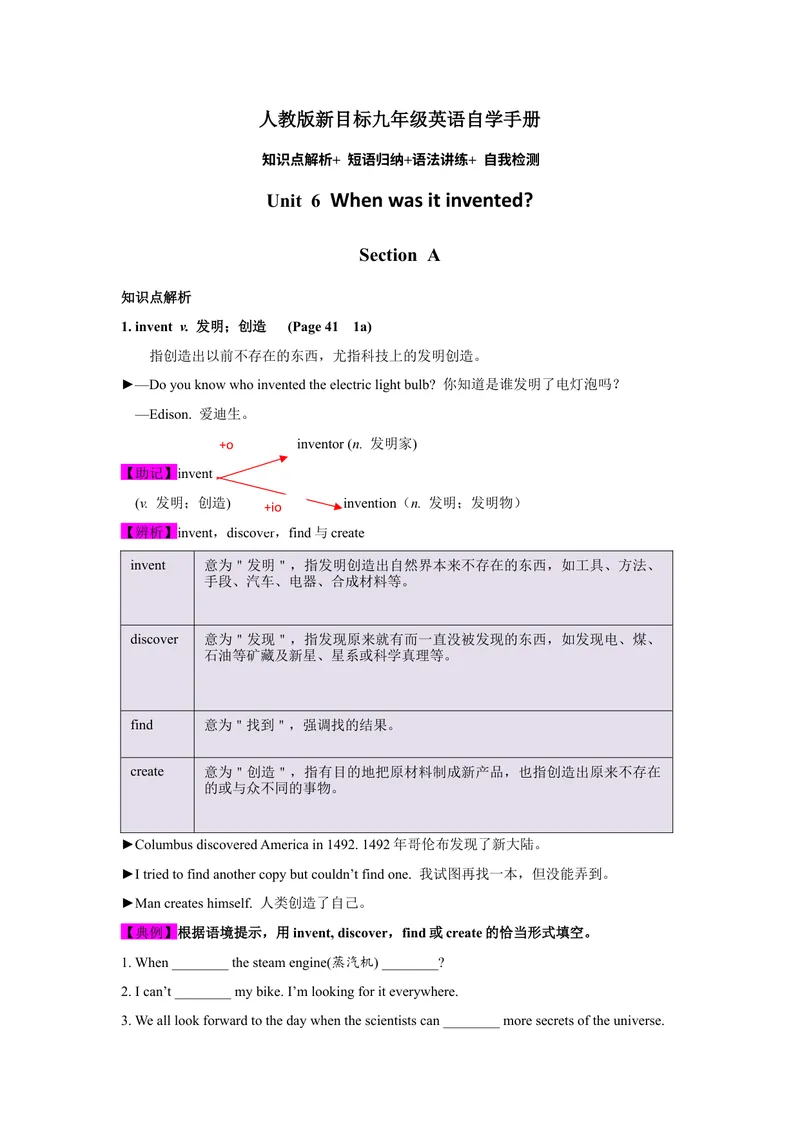
+ o inventor (n. 发明家)
【助记】invent
(v. 发明;创造) invention(n. 发明;发明物)
+io
【辨析】invent,discover,find与create
invent 意为"发明",指发明创造出自然界本来不存在的东西,如工具、方法、
手段、汽车、电器、合成材料等。
discover 意为"发现",指发现原来就有而一直没被发现的东西,如发现电、煤、
石油等矿藏及新星、星系或科学真理等。
find 意为"找到",强调找的结果。
create 意为"创造",指有目的地把原材料制成新产品,也指创造出原来不存在
的或与众不同的事物。
►Columbus discovered America in 1492. 1492年哥伦布发现了新大陆。
►I tried to find another copy but couldn’t find one. 我试图再找一本,但没能弄到。
►Man creates himself. 人类创造了自己。
【典例】根据语境提示,用invent, discover,find或create的恰当形式填空。
1. When ________ the steam engine(蒸汽机) ________?
2. I can’t ________ my bike. I’m looking for it everywhere.
3. We all look forward to the day when the scientists can ________ more secrets of the universe.4. Do you know who________ the plane?
5. He ________ quite a number of wonderful characters in his play.
【答案】
1. was; invented 2. find 3. discover 4. invented
5. created
【拓展】inventor n. 发明家 invention n. 发明
►Could you please tell us about the four great inventions of China? 请问你能告诉我们中国的
四大发明吗?
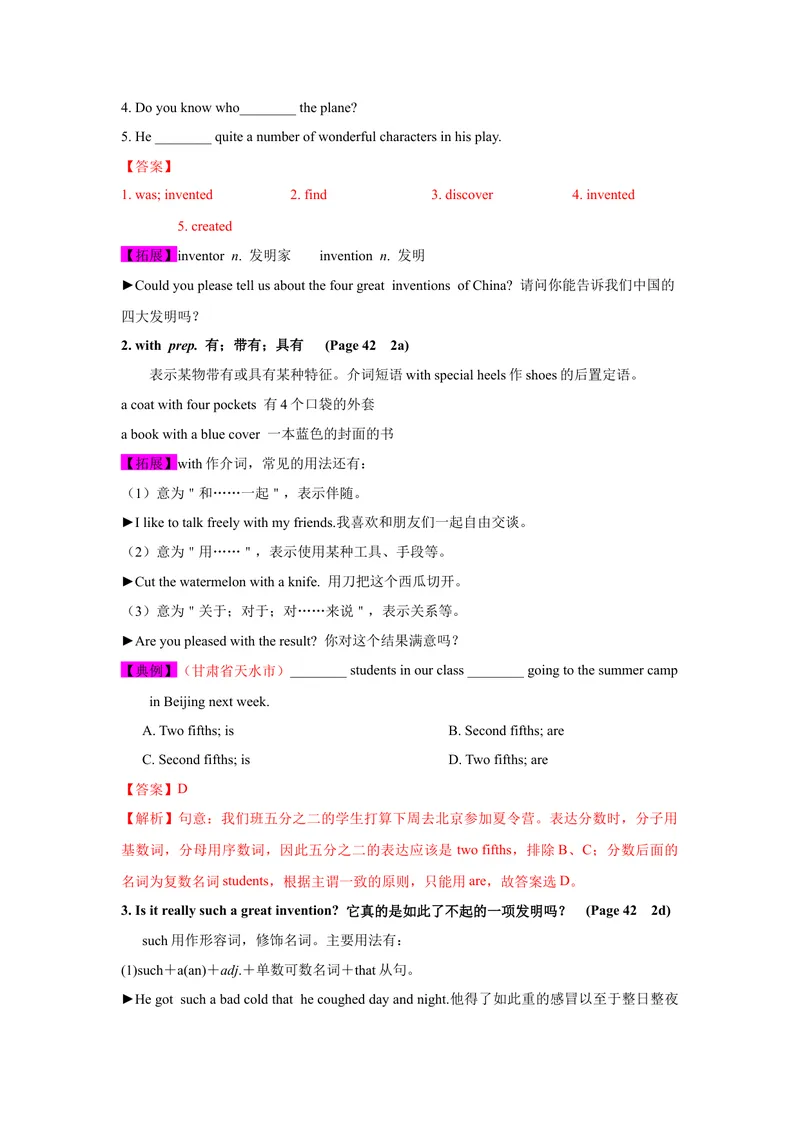
2. with prep. 有;带有;具有 (Page 42 2a)
表示某物带有或具有某种特征。介词短语with special heels作shoes的后置定语。
a coat with four pockets 有4个口袋的外套
a book with a blue cover 一本蓝色的封面的书
【拓展】with作介词,常见的用法还有:
(1)意为"和……一起",表示伴随。
►I like to talk freely with my friends.我喜欢和朋友们一起自由交谈。
(2)意为"用……",表示使用某种工具、手段等。
►Cut the watermelon with a knife. 用刀把这个西瓜切开。
(3)意为"关于;对于;对……来说",表示关系等。
►Are you pleased with the result? 你对这个结果满意吗?
【典例】(甘肃省天水市)________ students in our class ________ going to the summer camp
in Beijing next week.
A. Two fifths; is B. Second fifths; are
C. Second fifths; is D. Two fifths; are
【答案】D
【解析】句意:我们班五分之二的学生打算下周去北京参加夏令营。表达分数时,分子用
基数词,分母用序数词,因此五分之二的表达应该是 two fifths,排除B、C;分数后面的
名词为复数名词students,根据主谓一致的原则,只能用are,故答案选D。
3. Is it really such a great invention? 它真的是如此了不起的一项发明吗? (Page 42 2d)
such用作形容词,修饰名词。主要用法有:
(1)such+a(an)+adj.+单数可数名词+that从句。
►He got such a bad cold that he coughed day and night.他得了如此重的感冒以至于整日整夜咳嗽。
(2)such+adj.+不可数名词+that从句。
►She has made such great progress that many people like her. 她取得如此大的进步,许多人
都喜欢她。
(3)such+adj.+名词复数+that从句。
►They are such interesting books that we all like them. 它们是如此有趣的书,我们都喜欢它
们。
such (a/an) + adj. + n. 意为"如此……的(一个)……"。
►Why do you buy such expensive clothes?
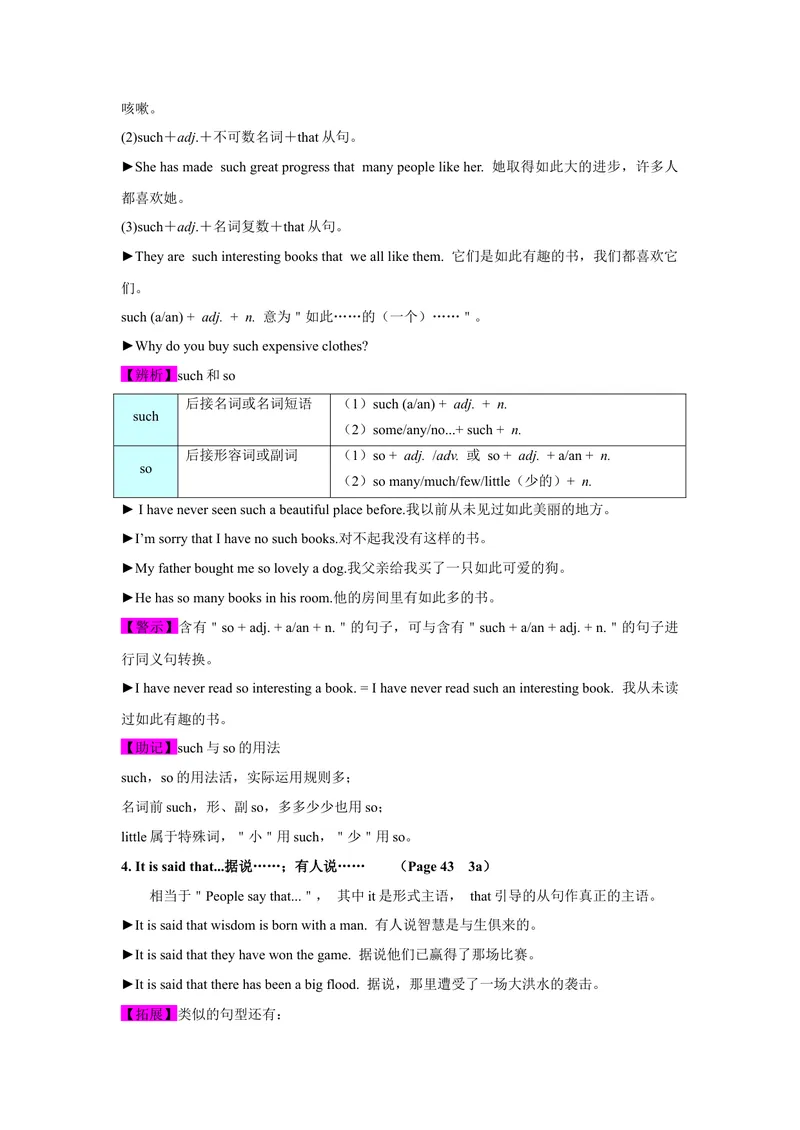
【辨析】such和so
后接名词或名词短语 (1)such (a/an) + adj. + n.
such
(2)some/any/no...+ such + n.
后接形容词或副词 (1)so + adj. /adv. 或 so + adj. + a/an + n.
so
(2)so many/much/few/little(少的)+ n.
► I have never seen such a beautiful place before.我以前从未见过如此美丽的地方。
►I’m sorry that I have no such books.对不起我没有这样的书。
►My father bought me so lovely a dog.我父亲给我买了一只如此可爱的狗。
►He has so many books in his room.他的房间里有如此多的书。
【警示】含有"so + adj. + a/an + n."的句子,可与含有"such + a/an + adj. + n."的句子进
行同义句转换。
►I have never read so interesting a book. = I have never read such an interesting book. 我从未读
过如此有趣的书。
【助记】such与so的用法
such,so的用法活,实际运用规则多;
名词前such,形、副so,多多少少也用so;
little属于特殊词,"小"用such,"少"用so。
4. It is said that...据说……;有人说…… (Page 43 3a)
相当于"People say that...", 其中it是形式主语, that引导的从句作真正的主语。
►It is said that wisdom is born with a man. 有人说智慧是与生俱来的。
►It is said that they have won the game. 据说他们已赢得了那场比赛。
►It is said that there has been a big flood. 据说,那里遭受了一场大洪水的袭击。
【拓展】类似的句型还有:It is believed that..."人们认为……";
It is reported that... "据报道……";
It is known that... "总所周知……";
It is supposed that..."据猜测……"。
【典例】我不知道这所学校,但据说是非常好的一所学校。
I don’t know the school, but ________ it is quite a good one.
【答案】it is said that
5. some time一段时间 (Page 43 3a)
►I will stay here for some time. 我要在这儿待一段时间。
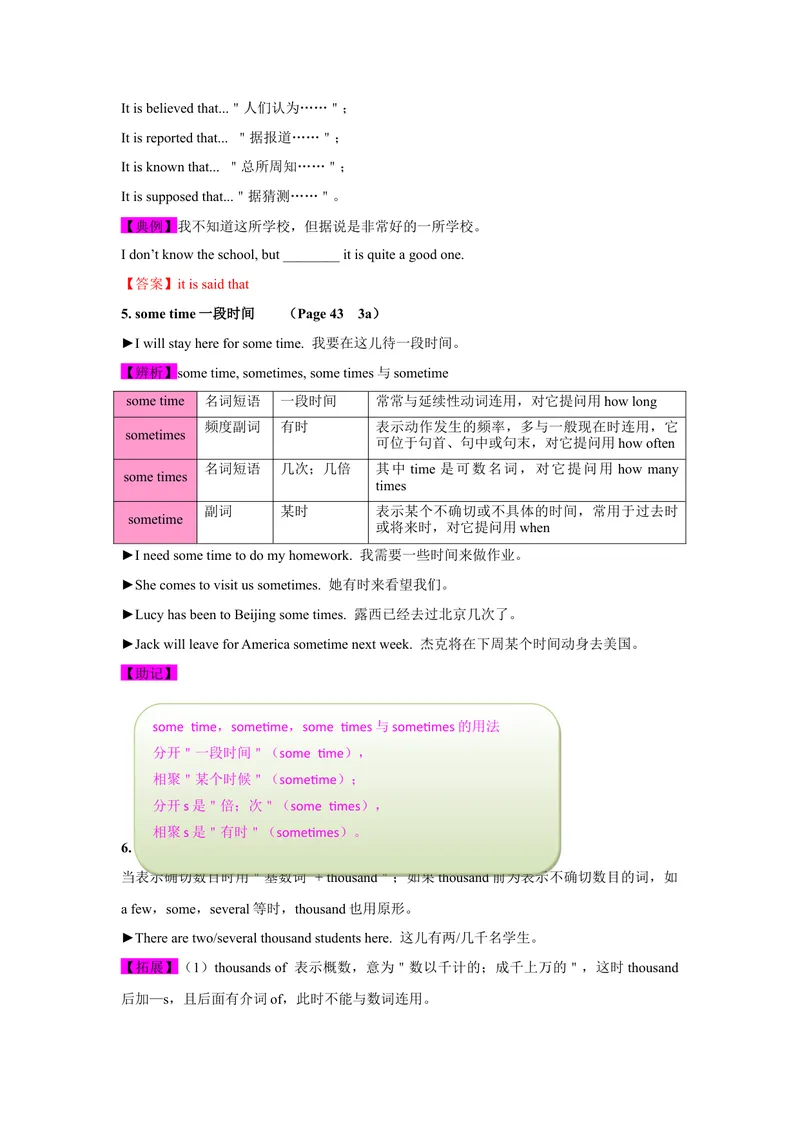
【辨析】some time, sometimes, some times与sometime
some time 名词短语 一段时间 常常与延续性动词连用,对它提问用how long
频度副词 有时 表示动作发生的频率,多与一般现在时连用,它
sometimes
可位于句首、句中或句末,对它提问用how often
名词短语 几次;几倍 其中 time 是可数名词,对它提问用 how many
some times
times
副词 某时 表示某个不确切或不具体的时间,常用于过去时
sometime
或将来时,对它提问用when
►I need some time to do my homework. 我需要一些时间来做作业。
►She comes to visit us sometimes. 她有时来看望我们。
►Lucy has been to Beijing some times. 露西已经去过北京几次了。
►Jack will leave for America sometime next week. 杰克将在下周某个时间动身去美国。
【助记】
some time,sometime,some times与sometimes的用法
分开"一段时间"(some time),
相聚"某个时候"(sometime);
分开s是"倍;次"(some times),
相聚s是"有时"(sometimes)。
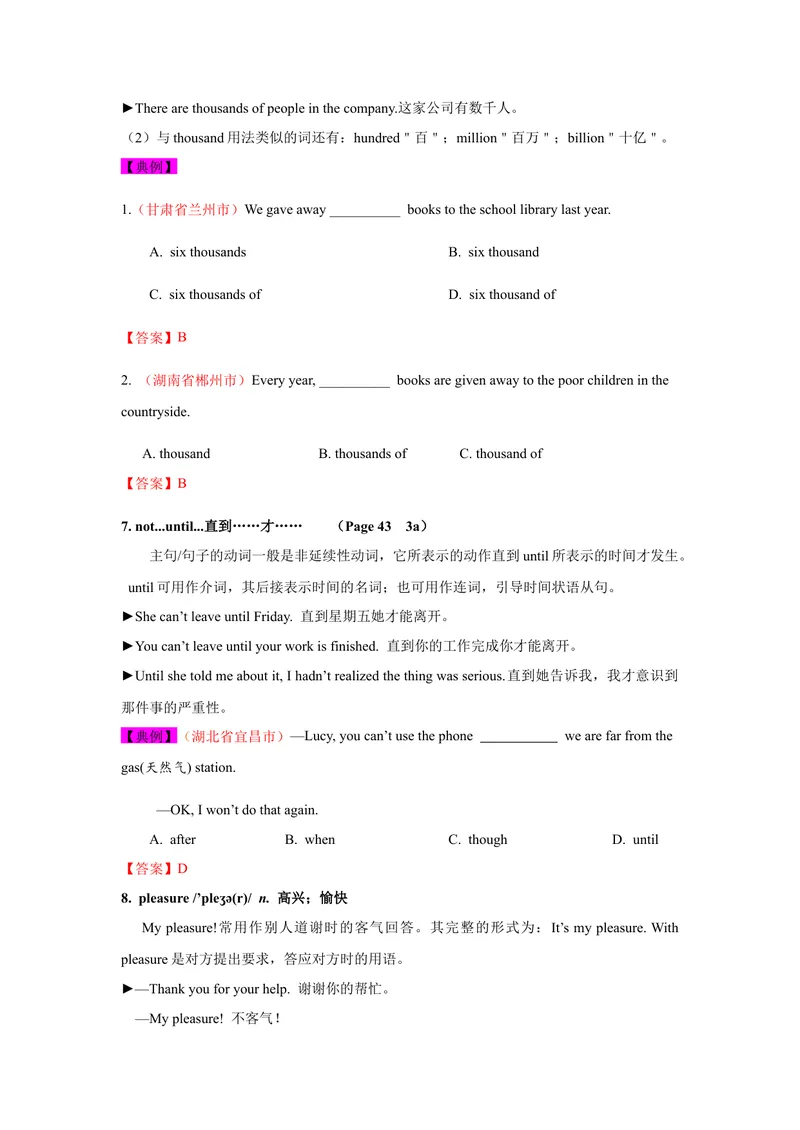
6. thousand 数词 千 (Page 43 3a)
当表示确切数目时用"基数词 + thousand";如果thousand前为表示不确切数目的词,如
a few,some,several等时,thousand也用原形。
►There are two/several thousand students here. 这儿有两/几千名学生。
【拓展】(1)thousands of 表示概数,意为"数以千计的;成千上万的",这时thousand
后加—s,且后面有介词of,此时不能与数词连用。►There are thousands of people in the company.这家公司有数千人。
(2)与thousand用法类似的词还有:hundred"百";million"百万";billion"十亿"。
【典例】
1.(甘肃省兰州市)We gave away __________ books to the school library last year.
A. six thousands B. six thousand
C. six thousands of D. six thousand of
【答案】B
2. (湖南省郴州市)Every year, __________ books are given away to the poor children in the
countryside.
A. thousand B. thousands of C. thousand of
【答案】B
7. not...until...直到……才…… (Page 43 3a)
主句/句子的动词一般是非延续性动词,它所表示的动作直到until所表示的时间才发生。
until可用作介词,其后接表示时间的名词;也可用作连词,引导时间状语从句。
►She can’t leave until Friday. 直到星期五她才能离开。
►You can’t leave until your work is finished. 直到你的工作完成你才能离开。
►Until she told me about it, I hadn’t realized the thing was serious.直到她告诉我,我才意识到
那件事的严重性。
【典例】(湖北省宜昌市)—Lucy, you can’t use the phone we are far from the
gas(天然气) station.
—OK, I won’t do that again.
A. after B. when C. though D. until
【答案】D
8. pleasure /’pleʒə(r)/ n. 高兴;愉快
My pleasure!常用作别人道谢时的客气回答。其完整的形式为:It’s my pleasure. With
pleasure是对方提出要求,答应对方时的用语。
►—Thank you for your help. 谢谢你的帮忙。
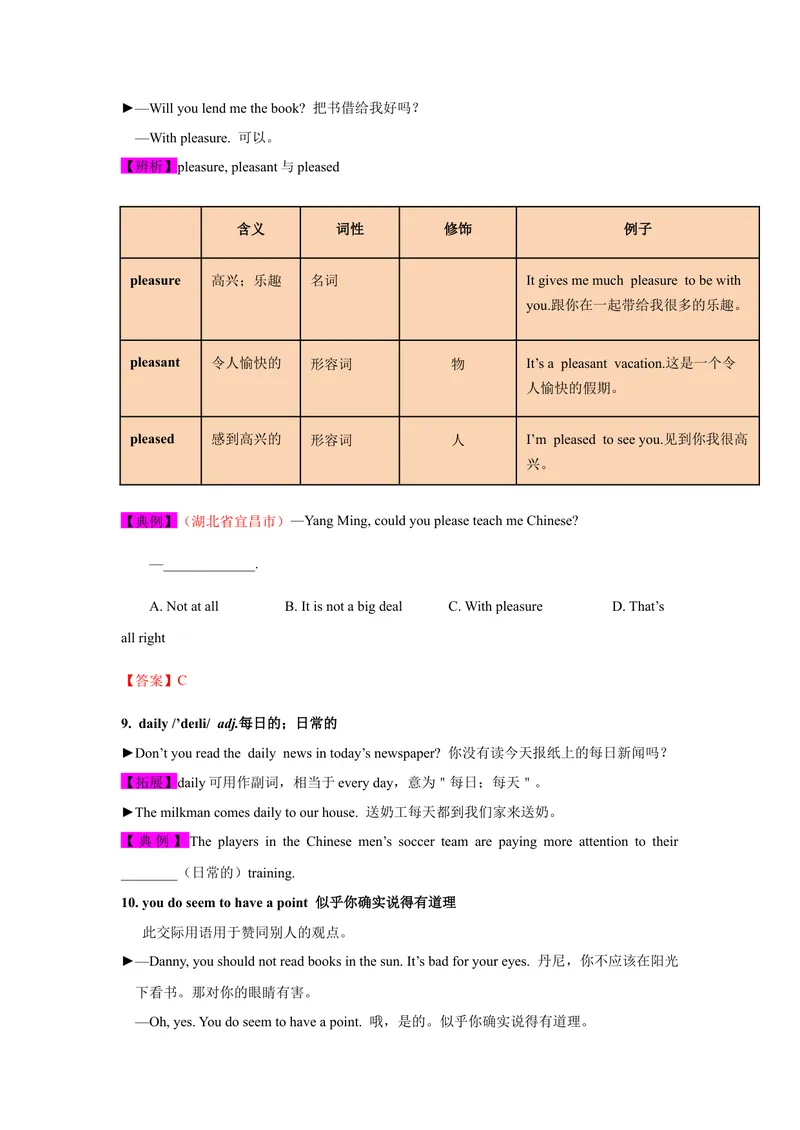
—My pleasure! 不客气!►—Will you lend me the book? 把书借给我好吗?
—With pleasure. 可以。
【辨析】pleasure, pleasant与pleased
含义 词性 修饰 例子
pleasure 高兴;乐趣 名词 It gives me much pleasure to be with
you.跟你在一起带给我很多的乐趣。
pleasant 令人愉快的 形容词 物 It’s a pleasant vacation.这是一个令
人愉快的假期。
pleased 感到高兴的 形容词 人 I’m pleased to see you.见到你我很高
兴。
【典例】(湖北省宜昌市)—Yang Ming, could you please teach me Chinese?
—_____________.
A. Not at all B. It is not a big deal C. With pleasure D. That’s
all right
【答案】C
9. daily /’deɪli/ adj.每日的;日常的
►Don’t you read the daily news in today’s newspaper? 你没有读今天报纸上的每日新闻吗?
【拓展】daily可用作副词,相当于every day,意为"每日;每天"。
►The milkman comes daily to our house. 送奶工每天都到我们家来送奶。
【典例】The players in the Chinese men’s soccer team are paying more attention to their
________(日常的)training.
10. you do seem to have a point 似乎你确实说得有道理
此交际用语用于赞同别人的观点。
►—Danny, you should not read books in the sun. It’s bad for your eyes. 丹尼,你不应该在阳光
下看书。那对你的眼睛有害。
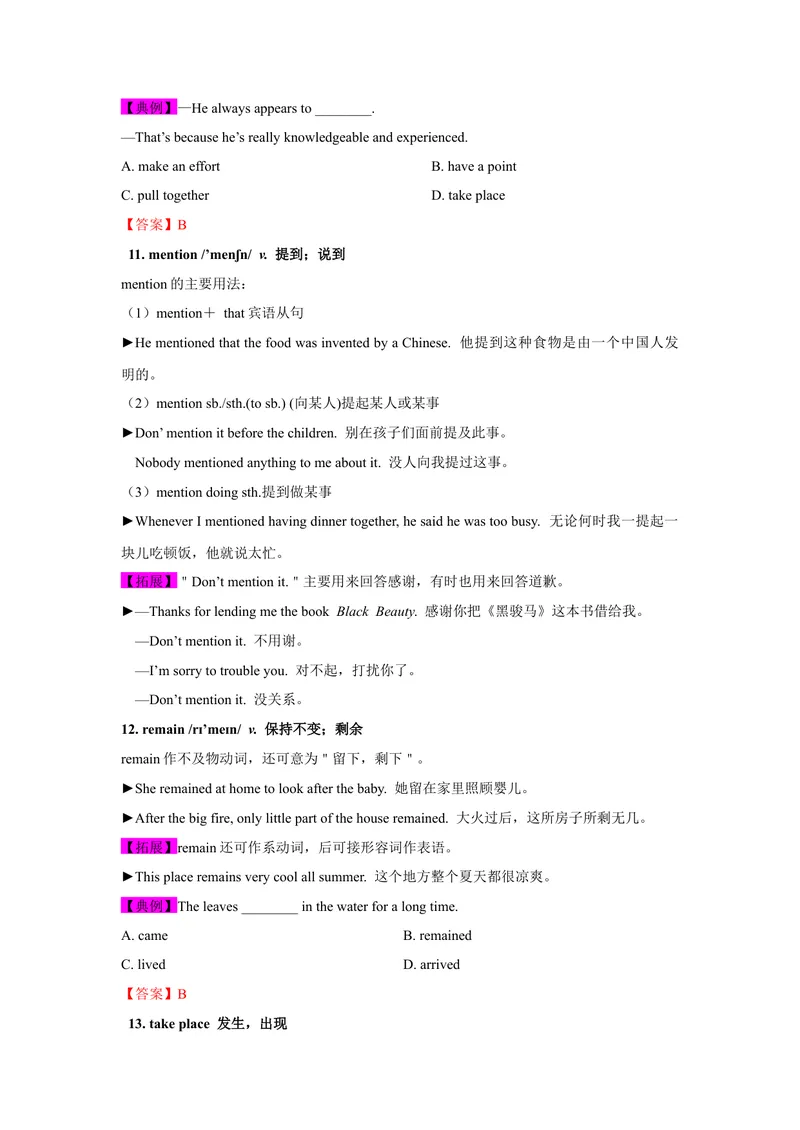
—Oh, yes. You do seem to have a point. 哦,是的。似乎你确实说得有道理。【典例】—He always appears to ________.
—That’s because he’s really knowledgeable and experienced.
A. make an effort B. have a point
C. pull together D. take place
【答案】B
11. mention /’menʃn/ v. 提到;说到
mention的主要用法:
(1)mention+ that宾语从句
►He mentioned that the food was invented by a Chinese. 他提到这种食物是由一个中国人发
明的。
(2)mention sb./sth.(to sb.) (向某人)提起某人或某事
►Don’ mention it before the children. 别在孩子们面前提及此事。
Nobody mentioned anything to me about it. 没人向我提过这事。
(3)mention doing sth.提到做某事
►Whenever I mentioned having dinner together, he said he was too busy. 无论何时我一提起一
块儿吃顿饭,他就说太忙。
【拓展】"Don’t mention it."主要用来回答感谢,有时也用来回答道歉。
►—Thanks for lending me the book Black Beauty. 感谢你把《黑骏马》这本书借给我。
—Don’t mention it. 不用谢。
—I’m sorry to trouble you. 对不起,打扰你了。
—Don’t mention it. 没关系。
12. remain /rɪ’meɪn/ v. 保持不变;剩余
remain作不及物动词,还可意为"留下,剩下"。
►She remained at home to look after the baby. 她留在家里照顾婴儿。
►After the big fire, only little part of the house remained. 大火过后,这所房子所剩无几。
【拓展】remain还可作系动词,后可接形容词作表语。
►This place remains very cool all summer. 这个地方整个夏天都很凉爽。
【典例】The leaves ________ in the water for a long time.
A. came B. remained
C. lived D. arrived
【答案】B
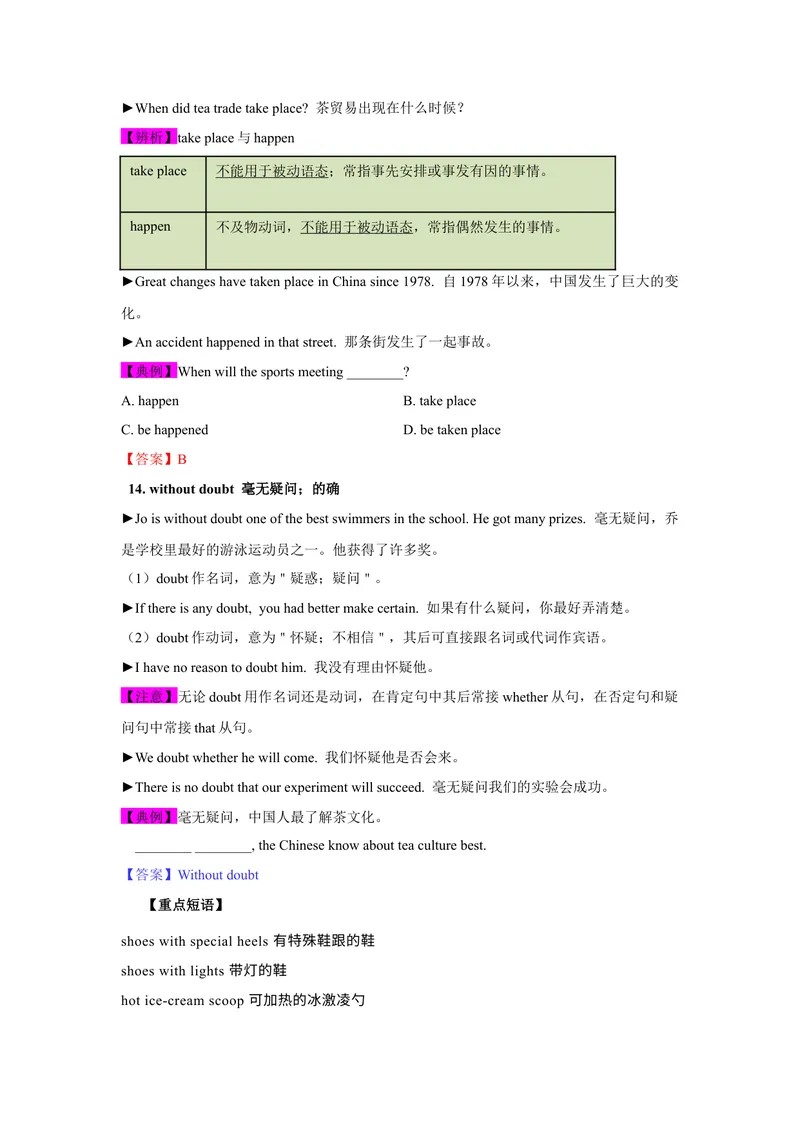
13. take place 发生,出现►When did tea trade take place? 茶贸易出现在什么时候?
【辨析】take place与happen
take place 不能用于被动语态;常指事先安排或事发有因的事情。
happen 不及物动词,不能用于被动语态,常指偶然发生的事情。
►Great changes have taken place in China since 1978. 自1978年以来,中国发生了巨大的变
化。
►An accident happened in that street. 那条街发生了一起事故。
【典例】When will the sports meeting ________?
A. happen B. take place
C. be happened D. be taken place
【答案】B
14. without doubt 毫无疑问;的确
►Jo is without doubt one of the best swimmers in the school. He got many prizes. 毫无疑问,乔
是学校里最好的游泳运动员之一。他获得了许多奖。
(1)doubt作名词,意为"疑惑;疑问"。
►If there is any doubt, you had better make certain. 如果有什么疑问,你最好弄清楚。
(2)doubt作动词,意为"怀疑;不相信",其后可直接跟名词或代词作宾语。
►I have no reason to doubt him. 我没有理由怀疑他。
【注意】无论doubt用作名词还是动词,在肯定句中其后常接whether从句,在否定句和疑
问句中常接that从句。
►We doubt whether he will come. 我们怀疑他是否会来。
►There is no doubt that our experiment will succeed. 毫无疑问我们的实验会成功。
【典例】毫无疑问,中国人最了解茶文化。
________ ________, the Chinese know about tea culture best.
【答案】Without doubt
【重点短语】
shoes with special heels
有特殊鞋跟的鞋
shoes with lights
带灯的鞋
hot ice-cream scoop
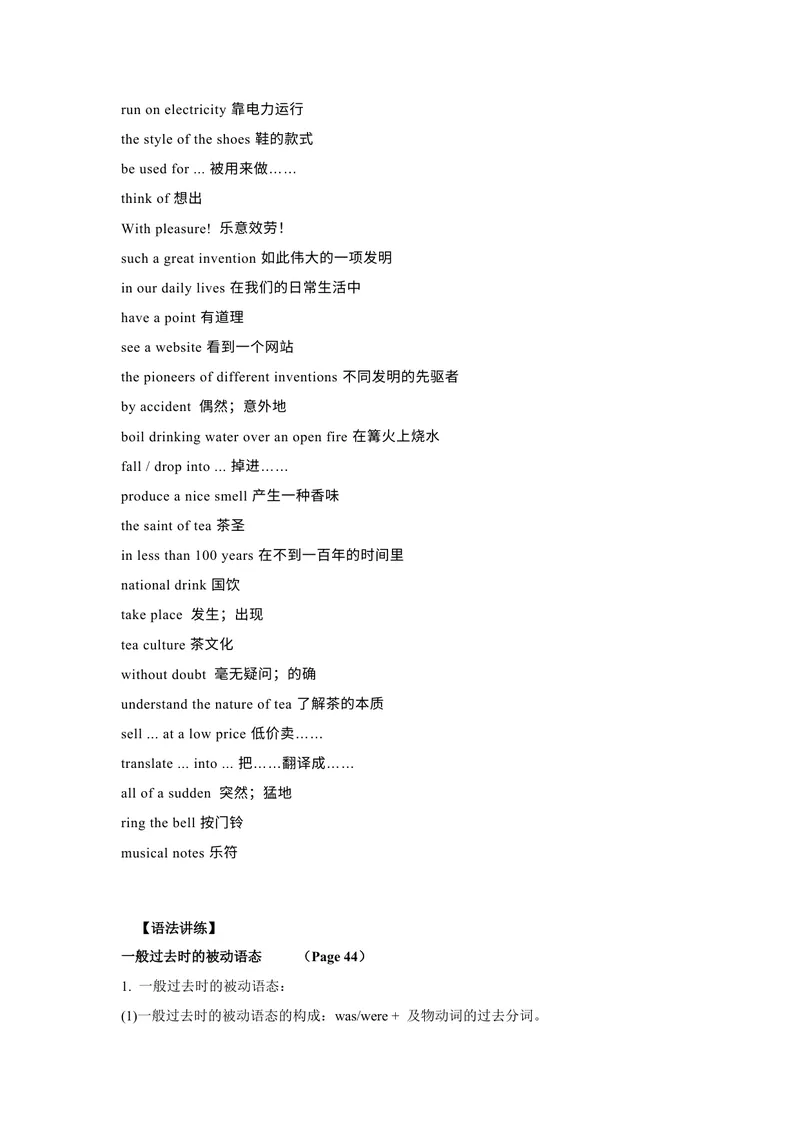
可加热的冰激凌勺run on electricity
靠电力运行
the style of the shoes
鞋的款式
be used for ... ……
被用来做
think of
想出
With pleasure!
乐意效劳!
such a great invention
如此伟大的一项发明
in our daily lives
在我们的日常生活中
have a point
有道理
see a website
看到一个网站
the pioneers of different inventions
不同发明的先驱者
by accident
偶然;意外地
boil drinking water over an open fire
在篝火上烧水
fall / drop into ... ……
掉进
produce a nice smell
产生一种香味
the saint of tea
茶圣
in less than 100 years
在不到一百年的时间里
national drink
国饮
take place
发生;出现
tea culture
茶文化
without doubt
毫无疑问;的确
understand the nature of tea
了解茶的本质
sell ... at a low price ……
低价卖
translate ... into ... …… ……
把 翻译成
all of a sudden
突然;猛地
ring the bell
按门铃
musical notes
乐符
【语法讲练】
一般过去时的被动语态 (Page 44)
1. 一般过去时的被动语态:
(1)一般过去时的被动语态的构成:was/were + 及物动词的过去分词。►The desk was made by my father. 这张桌子是由父亲做的。
(2) 句式变化:肯定句:主语 + was/were + 及物动词的过去分词 + 其他.
否定句:主语 + wasn’t/weren’t + 及物动词的过去分词 + 其他.
一般疑问句:Was/Were + 主语 + 及物动词的过去分词 + 其他?
回答:Yes, 主语 + was/were.
No, 主语 + wasn’t/weren’t.
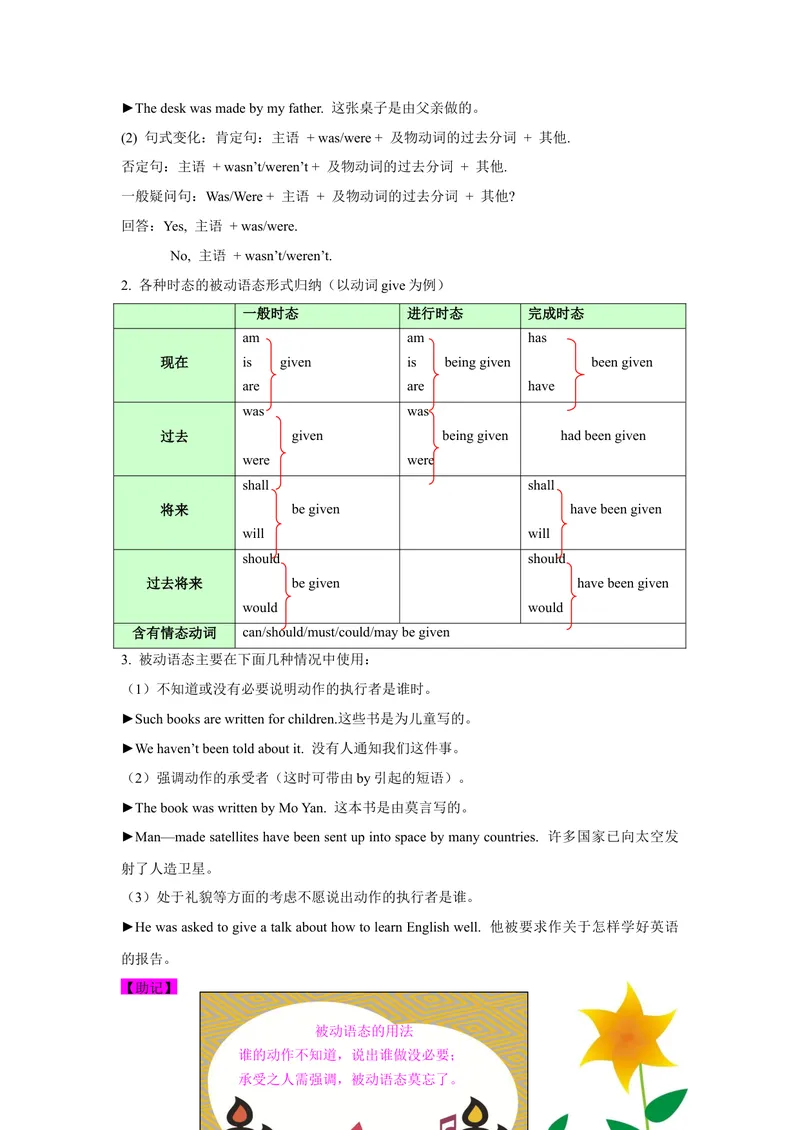
2. 各种时态的被动语态形式归纳(以动词give为例)
一般时态 进行时态 完成时态
am am has
现在 is given is being given been given
are are have
was was
过去 given being given had been given
were were
shall shall
将来 be given have been given
will will
should should
过去将来 be given have been given
would would
含有情态动词 can/should/must/could/may be given
3. 被动语态主要在下面几种情况中使用:
(1)不知道或没有必要说明动作的执行者是谁时。
►Such books are written for children.这些书是为儿童写的。
►We haven’t been told about it. 没有人通知我们这件事。
(2)强调动作的承受者(这时可带由by引起的短语)。
►The book was written by Mo Yan. 这本书是由莫言写的。
►Man—made satellites have been sent up into space by many countries. 许多国家已向太空发
射了人造卫星。
(3)处于礼貌等方面的考虑不愿说出动作的执行者是谁。
►He was asked to give a talk about how to learn English well. 他被要求作关于怎样学好英语
的报告。
【助记】
被动语态的用法
谁的动作不知道,说出谁做没必要;
承受之人需强调,被动语态莫忘了。被动语态的用法
谁的动作不知道,说出谁做没必要;
承受之人需强调,被动语态莫忘了。
【顺口溜】
一般过去时,被动用be+done;
be形式有两种,主单was主复were;
疑问提前be,否定be后not挤。
4. 被动语态的注意事项:
(1)"主语+连系动词 + 表语"的句子没有被动语态。
(2)there be结构没有被动语态。
(3)主动句中宾语是反身代词的没有被动语态。
(4)句子是主谓结构时,没有被动语态。也就是说,不及物动词没有被动语态。
(5)有些不及物动词加介词构成及物动词短语,如果变被动语态,不能把动词后的介词丢掉。
►He looks after his younger sister. His younger sister is looked after by him. 他照看他妹
妹。
(6) 在主动语态中,在make, hear,see,watch,notice等词后跟省略to的动词不定式,
但在被动语态中,to不可省略。
►We saw a stranger enter the hall. A stranger was seen to enter the hall by us. 我们看到
一个陌生人进入了大厅。
(7)被动语态结构中的be用was还是用were。
主语的单复数决定be用was还是用were。
【典例】So many trees and beautiful flowers ________ in this area in 2014.
A. were planted B. was planted C. are planted
【答案】A
【解析】本题用主谓一致法解题。根据句子的时间状语in 2014可知本句应用一般过去时,
主语trees and flowers是复数,be应用were。
(8)在主动语态中make,see等动词后接省略to的不定式作宾语补足语,变成被动语态时,
不定式符号to要还原。
【典例】Though he often made his little sister ________, today he was made ________by hislittle sister.
A. cry;to cry B. crying;crying
C. cry;cry D. to cry;cry
【答案】A
【解析】本题用语法判定法解题。make 用作及物动词,意为"使,让",在主动语态中
其后要跟省略to的不定式作宾语补足语,而在被动语态中,to不能省去。
(9)在主动语态中,动词短语中的介词在变为被动语态时,仍要跟在原动词之后。
【典例】Old people weren’t ________ good ________ in the past.
A. take;care of B. taken;care C. took;care D.
taken;care of
【答案】D
【解析】考查固定短语。take care of照顾,照料,在被动语态中不能漏掉介词。
(10)主动语态若有双宾语,变为被动语态时,间接宾语(人)和直接宾语(物)都可变为主语,
动词后一般要用相应的介词与其搭配。
►He gave me a book. (改为被动语态)
A book was given to me by him.
I was given a book by him.
【魔法记忆】变被动语态的口诀:宾提前变主,主变介by宾;谓语be 加done,时态看主
动。如遇双宾语,最好变间宾;若要变直宾,间宾前加 to/for。主动中省to的不定式,被
动中to加上。
【典例】1. She ________ to give a talk about how to save water yesterday.
A. invite B. invited C. is invited D. was invited
【答案】D
【解析】联系选项可知句意为"昨天她受邀做了一个关于如何节约用水的报告"。句子主
语和谓语动词间存在逻辑上的动宾关系,所以本句是被动语态,谓语构成为"be + 及物动
词的过去分词",可排除A、B两项。由关键词yesterday(昨天)可知,本句为一般过去
时态,再排除C项。故选D。
2. —Why didn’t you go to the New Year’s party last Friday?
—Because I ________.
A. was invited B. wasn’t invited C. didn’t invite
【答案】B【解析】句意:——上周五你为什么没有参加新年晚会?——因为我没有被邀请。上句提
到了last Friday,所以应用一般过去时的被动语态。wasn’t invited一般过去时的被动语态的
否定形式。
巩固练习
根据句意及所给提示填空。
1. Many houses ____________ (damage) by the earthquake and thousands of people
were left homeless.
2. UNICEF(联合国儿童基金会) _________ (set up) in 1946. It works to help
children live a better life.
3. —Did Jack come to our party yesterday?
—No, he _____________ (not invite).
4. —Who’s the baby in the photo?
—It’s me. The photo __________ (take) ten tears ago.
5. Last weekend, Jack ___________ (invite) to a birthday party and he had a lot of
fun.
6. Last month a new law ___________ (pass) in China to stop people from smoking
in public places.
将下列句子改为被动句。
1. The waiter took away the plates after we finished eating.
____________________________________ after we finished eating.
2. A middle school student invented a new robot last term.
_____________________________________________ last term.
3. He didn't finish the report two days ago.
_______________________________ two days ago.
4. Did your father ride the bicycle to the farm last week?
__________________________________________ last week?
单项选择
1. Earth Day ________ in 1970 for the first time, and the Day now includes events in
more than 190 countries and regions (地区).
2. A. celebrated B. was celebrated
C. is celebrated D. has been celebrated2. As the most exciting and traditional way to shop, street markets _____ here and
there in China these days.
A. find B. found C. are found D. were found
3. —The last Beidou GEO-3 _____ into space successfully on June 23, 2020.
—As Chinese, we feel proud of it.
A. sends B. sent C. is sent D. was sent
4. As soon as books _______, the volunteers posted them to the students in Hope
Primary School.
A. are raised B. were raised C. raised D. have raised
5. —Our school sports meet _______ next week. Which sport will you take part in?
—The long jump and the high jump. I’m good at jumping.
A. holds B. held C. was held D. will be held
6. — What language _______ in Canada?
— Both English and French.
A. is spoken B. speaks C. is speaking
7. — Will you go to Lisa’s housewarming party next Sunday?
— Well, if I ________, I will go on time.
A. invite B. will invite C. am invited D. will be
invited
【自测题】
一、多句选词填空
用所给词的适当形式填空。每词限用一次。
take place,mention,list,lock,remain
1.Great changes ______ in China during the last few years.
2.Some tree leaves fell into the river and ______ there for some time.
3.Look!My mother ______ the things that she will buy in the supermarket.
4.The famous writer often ______ his mother in his speech.
5.I ______ the door when I finish it.
二、完成句子根据汉语意思完成句子
6.但是我认为你是有道理的。
But I thought you ______ ______ ______.
7.毫无疑问,中国人最了解茶文化。
______ ______,the Chinese know about tea culture best.
8.我们想知道谁把这个故事翻译成了中文。
We wonder who ______ this story ______Chinese.
9.昨晚我直到爸妈回家才睡觉。
Last night I ______ ______ to bed ______ my parents got home.
10.这座桥建于1927年。
The bridge ______ ______ in 1927.
三、单项选择
11.Each stone was ______ so well, ______ the ancient workers didn’t have any modern tools.
A.fixing; although B.fix; because C.fixed; so D.fixed; though
12.The light bulb ______ by Thomas Edison.
A.invented B.is invented C.was invented D.inventing
13.These books ______ in 1996 and they sold very well at that time.
A.is printed B.are printed C.was printed D.were printed
14.Bi Sheng invented “printing”. It means that “printing” ______ by Bi Sheng.
A.is invented B.was invented C.were invented D.are invent
15.—I only heard of him a little. But what are the other important things ______ done by him?
—He also set up a school with his wife.
A.that B.which C.who D.which were
16.When ______ the People’s Republic of China ______ ?
A.was;found B.was;founded
C.did;found D.does;found
17.The glass ______. It ______ by little Tom this morning.
A.broke;is broken B.is broken;was broken
C.was broken;broke D.has been broken;broken
18.— Do you know Newton?
— Yes. He was a great English scientist who was a ________ in the field of physics.
A.guide B.pioneer C.philosopher D.tourist参考答案
Unit 5 What are the shirts made of?
Section B
1.have taken place
2.remained
3.is listing
4.mentions
5.will lock
二.
6.had a point
7.Without doubt
8.translated into
9.didn't go until
10.was built
三. 根据汉语意思及括号内所给提示语,将下列句子翻译成英语。
单项选择
11.Each stone was ______ so well, ______ the ancient workers didn’t have any modern tools.
A.fixing; although B.fix; because C.fixed; so D.fixed; though
【答案】D
【详解】句意:每一块石头都固定得很好,尽管古代的工人没有任何现代工具。考查被动
语态和从属连词辨析。fix固定;though/ although尽管; so因此。根据Each stone和fix可
知,石头是被固定的,需用被动语态,用fixed;结合句意,每一块石头都固定得很好和古
代的工人没有任何现代工具之间构成转折,用though/ although,故选D。
12.The light bulb ______ by Thomas Edison.A.invented B.is invented C.was invented D.inventing
【答案】C
【详解】句意:灯泡是由托马斯爱迪生发明的。考查时态和语态。The light bulb是被发明
的,所以用被动语态,且动作发生在过去,所以用一般过去时的被动语态,结构为was/wer
e done。故选C。
13.These books ______ in 1996 and they sold very well at that time.
A.is printed B.are printed C.was printed D.were printed
【答案】D
【详解】句意:这些书是1996年印刷的,当时卖得很好。考查一般过去时的被动语态。根
据时间状语“in 1996”以及主语和动词之间的动宾关系可知,空处应用一般过去时的被动语
态,构成形式为:was/were done,故排除A、B项;主语“These books”是复数形式,助动
词应用were,故排除C项。故选D。
14.Bi Sheng invented “printing”. It means that “printing” ______ by Bi Sheng.
A.is invented B.was invented C.were invented D.are invent
【答案】B
【详解】句意:毕昇发明了“印刷术”。意思是“印刷术”是毕昇发明的。考查一般过去
时的被动语态。主语“printing”和动词“invent”是被动关系,可知使用被动语态,根据“Bi
Sheng invented “printing””是一般过去时,此句时态应为一般过去时,由此可知此句是一般
过去时的被动语态,其构成是“主语+was/were+done+by+动作的执行者”,主语
“printing”是单数,be动词应用was;故选B。
15.—I only heard of him a little. But what are the other important things ______ done by him?
—He also set up a school with his wife.
A.that B.which C.who D.which were
【答案】D
【详解】句意:—我只听说过他一点。但是他做过的其他重要的事情是什么?—他还和他
的妻子建立了一所学校。考查定语从句和被动语态。that,关系代词,指人,也可物,在从
句中作主语、宾语或表语;which,关系代词,指物,在从句中作主语、宾语;who,关系
代词,指人,在从句中作主语;分析句子可知,这是一个定语从句,先行词是 things,指
物,可使用that或which引导定语从句, things与do之间是被动关系,空格处需用被动语
态,空格后已有“done”,还需使用be动词,分析选项可知,只有D选项有be动词。故选
D。16.When ______ the People’s Republic of China ______ ?
A.was;found B.was;founded
C.did;found D.does;found
【答案】B
【详解】句意:中华人民共和国是什么时候成立的?考查动词辨析、被动语态。find“发
现”的过去式/ 过去分词为found;found“创建”,动词,其过去式/过去分词为founded;
根据语境可知此处指“中华人民共和国何时成立”,用一般过去时被动语态,其谓语动词
构成为“was/were+过去分词”,所以排除A、C和D;故选B。
17.The glass ______. It ______ by little Tom this morning.
A.broke;is broken B.is broken;was broken
C.was broken;broke D.has been broken;broken
【答案】B
【详解】句意:玻璃杯碎了。今天早上小汤姆把它弄坏了。考查被动语态及时态。根据语
境可知,第一空表示当下玻璃杯碎掉的状态,故应用“is +形容词”的系表结构。第二空根
据“by little Tom”提示,此处应用被动语态,且时间状语为“this morning”,表示发生过的
事应用一般过去时,故第二空应用一般过去时的被动语态,故选B。
18.— Do you know Newton?
— Yes. He was a great English scientist who was a ________ in the field of physics.
A.guide B.pioneer C.philosopher D.tourist
【答案】B
【详解】句意:—你知道牛顿吗?—是的。他是一个伟大的英国科学家,也是物理领域的
先驱者。考查名词词义辨析。guide导游;pioneer先驱者;philosopher哲学家;tourist游客。
根据“Do you know Newton”以及“He was a great English scientist who was a…in the field of
physics”并结合常识可知,牛顿在物理领域是先驱。故选B。