人教版新目标九年级英语自学手册
+ + +
知识点解析 语法讲练 短语归纳 自我检测
Unit 4 I used to be afraid of the dark
Section A
1. Mario, you used to be short, didn’t you? 马里奥,你过去很矮,是吗?(Page 25 1a)
(1)used to意为"过去常常",后接动词原形,表示过去经常发生的动作或存在的状态(暗
含现在已经不复存在)。
►He used to play basketball at school. 他过去常常在学校里打篮球。
►He used to walk to school. 他过去常常步行去上学。
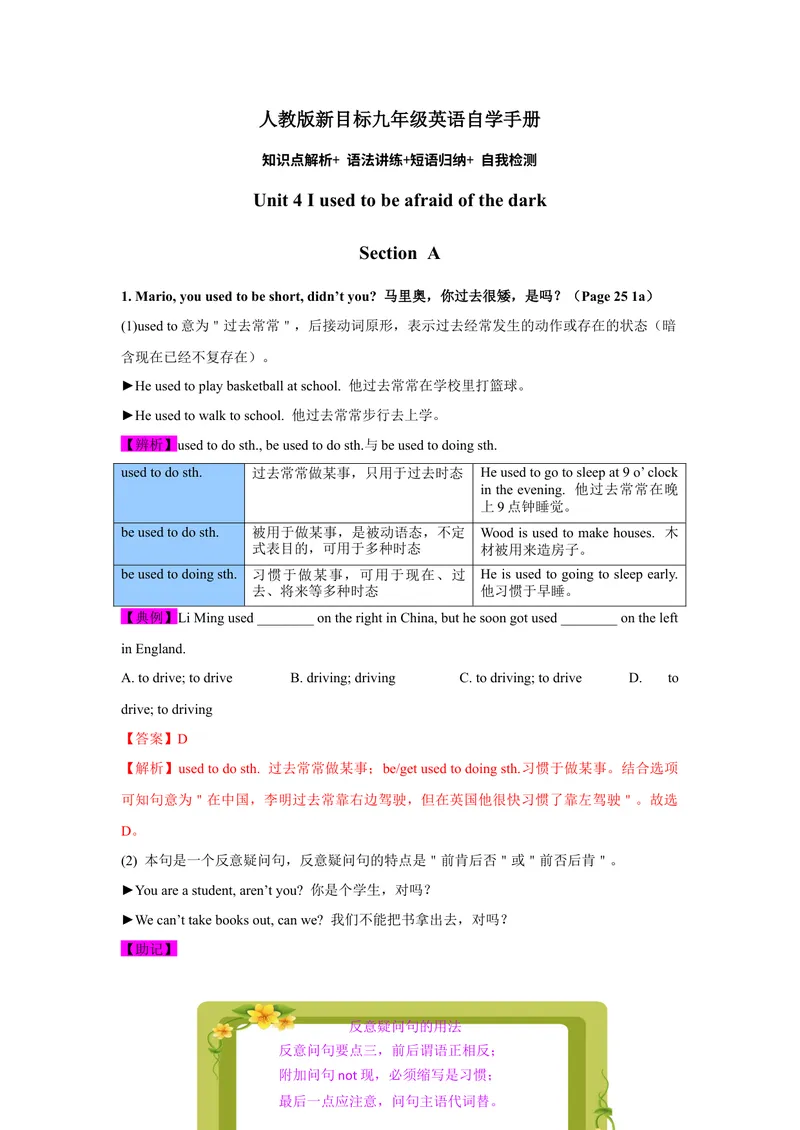
【辨析】used to do sth., be used to do sth.与be used to doing sth.
used to do sth. 过去常常做某事,只用于过去时态 He used to go to sleep at 9 o’ clock
in the evening. 他过去常常在晚
上9点钟睡觉。
be used to do sth. 被用于做某事,是被动语态,不定 Wood is used to make houses. 木
式表目的,可用于多种时态 材被用来造房子。
be used to doing sth. 习惯于做某事,可用于现在、过 He is used to going to sleep early.
去、将来等多种时态 他习惯于早睡。
【典例】Li Ming used ________ on the right in China, but he soon got used ________ on the left
in England.
A. to drive; to drive B. driving; driving C. to driving; to drive D. to
drive; to driving
【答案】D
【解析】used to do sth. 过去常常做某事;be/get used to doing sth.习惯于做某事。结合选项
可知句意为"在中国,李明过去常靠右边驾驶,但在英国他很快习惯了靠左驾驶"。故选
D。
(2) 本句是一个反意疑问句,反意疑问句的特点是"前肯后否"或"前否后肯"。
►You are a student, aren’t you? 你是个学生,对吗?
►We can’t take books out, can we? 我们不能把书拿出去,对吗?
【助记】
反意疑问句的用法
反意问句要点三,前后谓语正相反;
附加问句not现,必须缩写是习惯;
最后一点应注意,问句主语代词替。反意疑问句的用法
反意问句要点三,前后谓语正相反;
附加问句not现,必须缩写是习惯;
最后一点应注意,问句主语代词替。
【拓展】反意疑问句的用法
①回答反意疑问句和回答一般疑问句一样,如果答语是肯定的,用"Yes + 肯定结构";
如果答语是否定的,则用"No + 否定结构"。
►—He enjoys singing, doesn’ t he? 他喜欢唱歌,是吗?
—Yes, he does./No, he doesn’ t. 对,是的。/不,不是。
②回答陈述部分为否定句的反意疑问句时,yes或no的汉语意思与其本身的词义相反。
—You didn’ t go to school, did you? 你没有去上学,是吗?
—Yes, I did./No, I didn’ t. 不,我去了。/是的,我没有去。
【助记】反意疑问句的回答方法
回答反意疑问句,答案含义是依据,肯定事实用yes,否定事实用no替。
【典例】He can hardly stay awake because he is so tired, ________?
A. does he B. isn’t he C. can’t he D. can he
【答案】D
【解析】句中关键词hardly(几乎不)表否定含义,故附加疑问部分用肯定形式,可排除
B、C两项;由主句中的情态动词can可知选D。
2. What’ s sb. like? 某人长什么样? (Page 25 1c)
►—What’ s your brother like? 你哥哥长什么样子?
—He is tall and a little thin. 他长得高并且有点瘦。
What’ s sb. like?=What does sb. look like?但be like不能与look like同时出现,此时like
是介词,无词形变化。
►—What is Tom like? (=What does Tom look like?) 汤姆长什么模样?
—He is very much like his father, tall and dark. 他非常像他的父亲,又高又黑。
【拓展】What is sb. like? 还可用来询问某人的品质。
►—What is Lily like? 莉莉是怎样的一个人?
—She’ s a very nice girl. 她是个非常好的女孩。【典例】What ________ Mr Wei ________ ?
A. is;like B. does;be like C. is;look like D. is;likes
【答案】A
【解析】考查固定句型。询问某人长相的句型是What’ s sb. like?或What does sb. look like?
3. helpful /’ helpfl/ adj. 有用的;有帮助的 (Page 26 2a)
►Leo and Nick are helpful. Each of us likes them. 莱奥和尼克乐于助人,我们大家都喜欢他
们。
helpful的相关短语:
be helpful to sb. 对某人有帮助
►This book is helpful to us. 这本书对我们有帮助。
【拓展】helpful是在help后加形容词后缀-ful构成的形容词。类似的词还有:
thank(v. 感谢)—thankful (adj. 感谢的)
care(n. 小心)—careful (adj. 小心的)
【典例】It’ s very ________ (有帮助的) to discuss your problems with your parents.
【答案】helpful
4. silent /’ saɪlənt/ adj. 不说话的;沉默的 (Page 26 2b)
►My brother used to be silent. 我哥哥过去不爱说话。
silent的相关短语:
keep silent 保持沉默
►Do you know when you should keep silent? 你知道你该什么时候保持沉默吗?
【拓展】silent的名词形式是silence,常用短语in silence沉默地。
►All of us are reading the test papers in silence. 我们大家正在默默地阅读试卷。
【典例】We felt strange about his ________ (silent) at the party as he used to be very outgoing.
【答案】silence
【解析】本题考查词形转化。silent是形容词,其前有物主代词(his)修饰时,需用其名词形
式silence。
5. such /sʌtʃ/ adj.如此的;这样的 (Page 26 2d)
such 作限定词,常用于名词前作定语,在句中起强调作用。
主要用法有:
(1)such+a(an)+adj.+单数可数名词+that从句。
►He got such a bad cold that he coughed day and night. 他得了如此重的感冒以至于整日整夜
咳嗽。(2)such+adj.+不可数名词+that从句。
►She has made such great progress that many people like her. 她取得如此大的进步,许多人
都喜欢她。
(3)such+adj.+名词复数+that从句。
►They are such interesting books that we all like them. 它们是如此有趣的书,我们都喜欢它
们。
(4)so many /much /few / little是固定搭配,such不可替换。
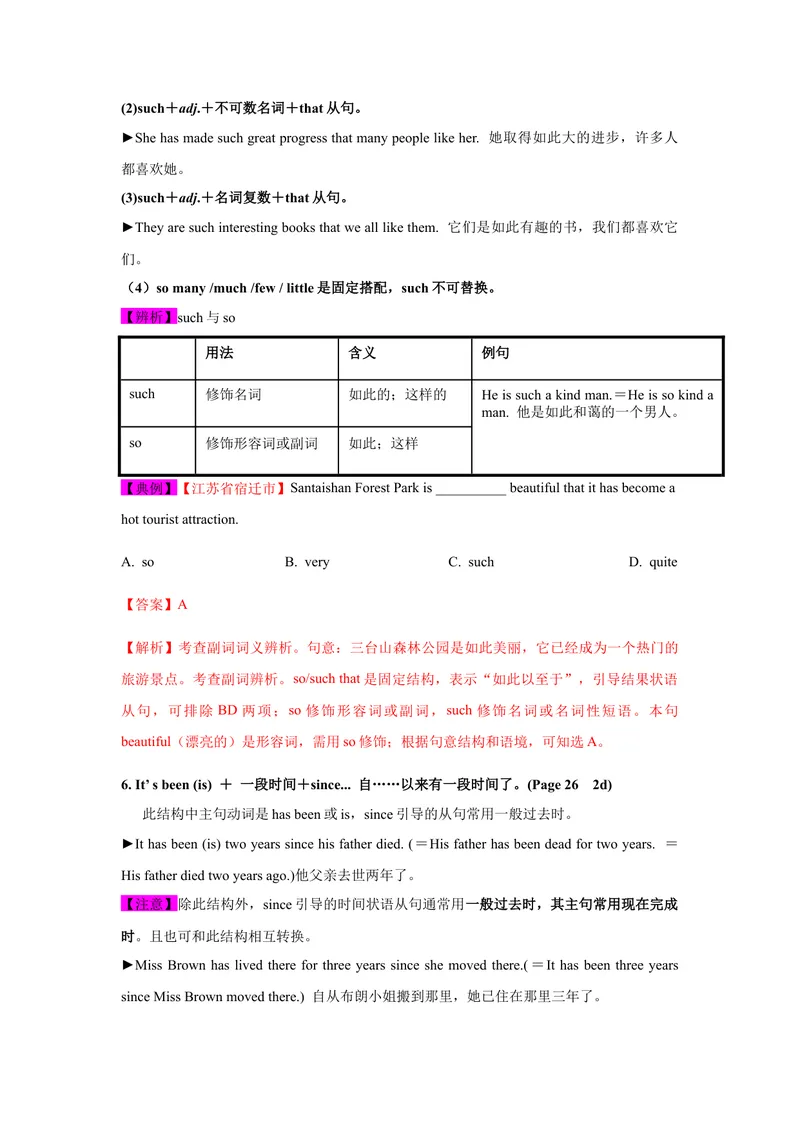
【辨析】such与so
用法 含义 例句
such 修饰名词 如此的;这样的 He is such a kind man.=He is so kind a
man. 他是如此和蔼的一个男人。
so 修饰形容词或副词 如此;这样
【典例】【江苏省宿迁市】Santaishan Forest Park is __________ beautiful that it has become a
hot tourist attraction.
A. so B. very C. such D. quite
【答案】A
【解析】考查副词词义辨析。句意:三台山森林公园是如此美丽,它已经成为一个热门的
旅游景点。考查副词辨析。so/such that是固定结构,表示“如此以至于”,引导结果状语
从句,可排除 BD 两项;so 修饰形容词或副词,such 修饰名词或名词性短语。本句
beautiful(漂亮的)是形容词,需用so修饰;根据句意结构和语境,可知选A。
6. It’ s been (is) + 一段时间+since... 自……以来有一段时间了。(Page 26 2d)
此结构中主句动词是has been或is,since引导的从句常用一般过去时。
►It has been (is) two years since his father died. (=His father has been dead for two years. =
His father died two years ago.)他父亲去世两年了。
【注意】除此结构外,since引导的时间状语从句通常用一般过去时,其主句常用现在完成
时。且也可和此结构相互转换。
►Miss Brown has lived there for three years since she moved there.(=It has been three years
since Miss Brown moved there.) 自从布朗小姐搬到那里,她已住在那里三年了。【典例】It’s been twenty-two years since I ________(work) here.
【答案】worked
7. see sb. doing sth. 看见某人正在做某事 (Page 26 2d)
此结构中doing sth.作宾语补足语,强调动作正在进行。而see sb. do sth. 看见某人做了
某事,强调看见动作发生的全过程或看到动作经常发生。
►I saw him playing football on the playground. 我看见他正在操场上踢足球。
►I saw her run into the room. 我看见她跑进房间去了。
【典例】When I walked past the park, I saw some old people ________ Chinese Taiji.
A. do B. did C. doing D. are doing
【答案】C
【解析】see是感官动词,常见用法有:see sb. do sth. 看见某人经常做或做了某事;see sb.
doing sth. 看见某人正在做某事。句意:当我路过公园时,我看见一些老人正在打中国太极。
由句意可知选C。
8. deal with 应对;处理 (Page 27 3a)
【辨析】deal with与do with
(1) deal with与do with两者都可以用来表示"处理",前者侧重于方式、方法,后者侧重
于对象。在句中,deal with与how连用,do with则与what连用。
►I don’t know how they deal with the problem. = I don’t know what they do with the problem.
我不知道他们如何处理这个问题。
(2)deal with 还意为"应付;涉及;论及"。
►He’s good at dealing with pressure. 他善于应付压力。
【典例】【湖北省黄冈市】—I don’t know how to _________ the old books.
—Why not give them away to poor children?
A. hand out B. give up
C. deal with D. take up
【答案】C
【解析】句意:——我不知道如何处理旧书。——为什么不把它们送给穷孩子呢?A. hand
out分发;B. give up放弃;C. deal with处理;D. take up开始从事。根据Why not give them
away to poor children? 为什么不把它们送给穷孩子呢?可知,这是处理旧书的一种方式,因此选择deal with处理;符合语境。故选C。
9. in front of 在……前面 (Page 27 3a)
【辨析】in front of 和in the front of
in front of 在……的前面 强调在某一物体外部的前面
in the front of 在……的前部 强调在某一物体内部的前面
in front of the car in the front of the car
【典例】(南宁)Jim sits behind me, so I sit ________ him.
A. at the top of B. at the end of C. in the middle of D.
in front of
【答案】D
【解析】at the top of 在……的顶端;at the end of"在……的末尾"; in the middle of"
在……的中间";in front of "在……的前面"。由句意可知选D。
10. too much太多 (Page 27 3a)
此处too much意为"太多的",后接不可数名词。
He has too much homework to do. 他有太多的家庭作业要做。
【辨析】too many, too much与much too
too many 修饰可数名词复数形式,意为"太多的"。
too much 相当于一个形容词,修饰不可数名词,意为"太多的";相当于一个副词,在
句中作状语,意为"太多"。
much too 修饰形容词或副词,意为"太,非常"。
►There are too many passengers on the bus.►There is too much noise in the classroom.
►She talked too much. 她话说得太多。
【助记】too much, much too 与too many的用法区别
too much, much too, 用法区别看后头。
much后跟不可数,too后只跟形或副。
too many要记住,后面名词必复数。
【典例】(贵州黔东南)—He’ s ________ the plan.
—So am I. It costs ________ and we have no enough time.
A. for; too much B. against; too much C.with; much too D. of;
much too
【答案】B
【解析】be for"赞成";be against"反对";too much"太多",修饰不可数名词或动词;
much too"太,非常",修饰形容词或副词。由句意可知选B。
11. a very small number of 极少数…… (Page 27 3a)
后接复数名词,在句中作主语时,谓语动词用复数形式。a number of意为"许多;大
量"。
【辨析】a number of 与 the number of
许多,后跟名词复数,作主语时,谓语动词用复数。e.g:A number of peo
a number of
ple have left early. 许多人已经早早离开了。
……的数量,后跟名词复数,作主语时,谓语动词用单数。e.g.:The num
the number of ber of the books in the library reaches 3, 000.图书馆里的书的数量达到了三
千。
►A number of apples are red. 许多苹果是红色的。
►The number of students is 2, 000. 学生的数量是2000。
【典例】(四川眉山)In our school library there ________ a number of books and the number
of them ________ growing larger and larger.
A. is; are B. has; is C. are; is D. have; are
【答案】C
【解析】由题干可知,本句为there be句型,它不能与have/has 连用,排除B、D项;a
number of + 复数名词意为"许多……",作主语时,谓语动词用复数形式;the number of
+ 复数名词/代词意为"……的数量",作主语时,谓语动词用单数形式。故选C。
12. interview /'ɪntə(r)vjuː/ v. 采访;面试 n. 面试;访谈 (Page 27 3a)
interview作动词时,后接某人作宾语,表示"采访某人,面试某人",短语 interviewsb. about sth.表示
"采访某人关于某事";作名词时,构成短语have an interview with sb.表示"采访某人"。
►Peter interviewed Mr White yesterday. 彼得昨天采访了怀特先生。
►We will interview the great man about his life tomorrow. 明天我们将采访这个杰出的人,了
解他的生活。
►The reporter had an interview with the winner of the competition. 那位记者对这次竞赛的获
胜者进行了采访。
interviewer n. 面试者;采访者
interviewee n. 被访问者;被采访者
13. 19-year-old 十九岁的 (Page 27 3a)
►He is a 19-year-old young man. 他是一个十九岁的年轻男人。
19-year-old为复合形容词,由"数词+名词(单数)+形容词"构成,而且三者之间要用
"-"来连接。用作定语。
【典例】(江苏省宿迁市)Wu Dajing, a _________Chinese skater, set a new world record at
the Short Track World Cup last year.
A. 25-years-old B. 25 year old C. 25-year-old D. 25
years old
【答案】C
【解析】句意:25岁的中国滑冰运动员吴大靖在去年的短道世界杯上创造了新的世界纪录。
考查限定词辨析。由数字、名词和形容词加连字符构成的词为复合形容词,也称限定词,
其结构为“数字-名词-形容词”,中间的名词必须用单数形式。根据句意结构,可知选C。
14. take up 开始从事 (Page 27 3a)
take up此处意为"开始从事",后接名词或动名词作宾语。
►They have taken up golf. 他们开始学起打高尔夫球了。
►Jack took up running for exercise to lose weight this month. 杰克这个月开始通过跑步锻炼来
减肥。
【拓展】take up还可意为"占,占地方"。
►Learning English takes up a lot of my time. 学英语占据了我许多时间。►That big table takes up too much room. 那张大桌子占的地方太大了。
【典例】Bob is taking the desks away because they ________ too much room.
A. stand up B. pick up
C. take up D. listen up
【答案】C
【解析】考查动词短语辨析。句意:鲍勃正在把桌子搬走,因为它们________太多的空间。
stand up站起来,起立;pick up捡起;take up占据(时间或空间);listen up注意听。根据题
意中"太多的空间"可知,用"占据"最为贴切。
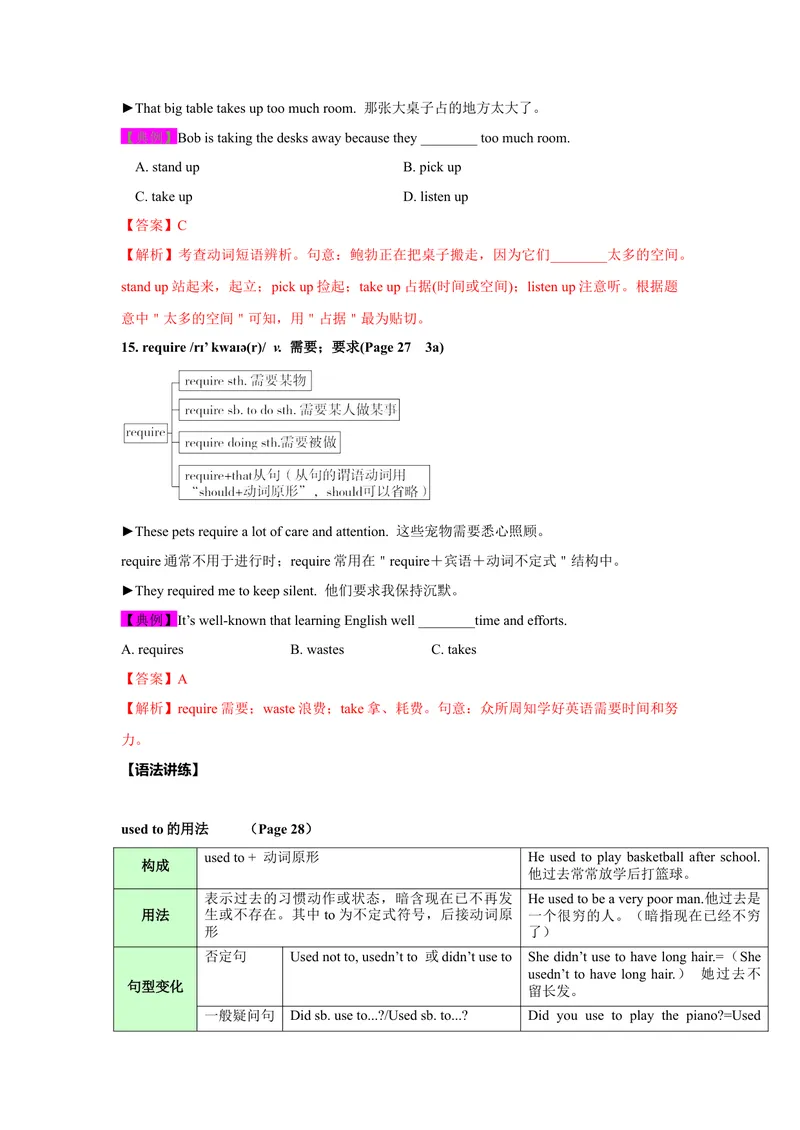
15. require /rɪ’ kwaɪə(r)/ v. 需要;要求(Page 27 3a)
►These pets require a lot of care and attention. 这些宠物需要悉心照顾。
require通常不用于进行时;require常用在"require+宾语+动词不定式"结构中。
►They required me to keep silent. 他们要求我保持沉默。
【典例】It’s well-known that learning English well ________time and efforts.
A. requires B. wastes C. takes
【答案】A
【解析】require需要;waste浪费;take拿、耗费。句意:众所周知学好英语需要时间和努
力。
【语法讲练】
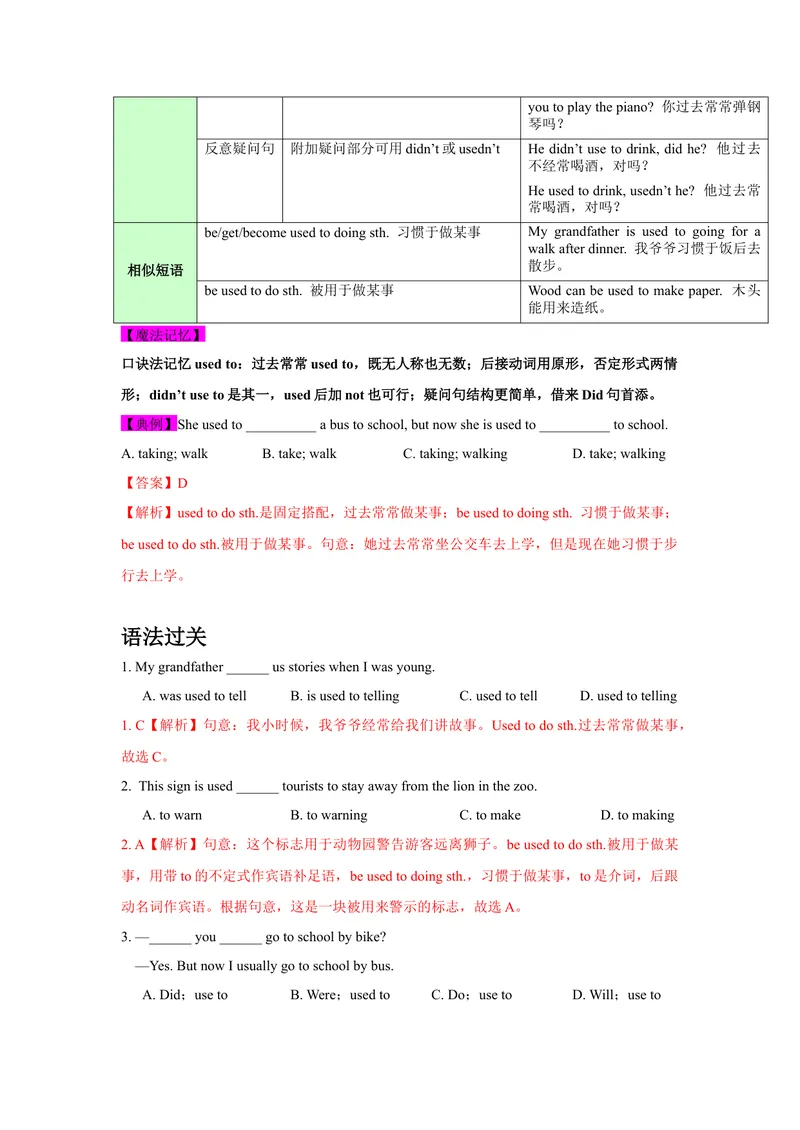
used to的用法 (Page 28)
used to + 动词原形 He used to play basketball after school.
构成
他过去常常放学后打篮球。
表示过去的习惯动作或状态,暗含现在已不再发 He used to be a very poor man.他过去是
用法 生或不存在。其中to为不定式符号,后接动词原 一个很穷的人。(暗指现在已经不穷
形 了)
否定句 Used not to, usedn’t to 或didn’t use to She didn’t use to have long hair.=(She
usedn’t to have long hair.) 她过去不
句型变化
留长发。
一般疑问句 Did sb. use to...?/Used sb. to...? Did you use to play the piano?=Usedyou to play the piano? 你过去常常弹钢
琴吗?
反意疑问句 附加疑问部分可用didn’t或usedn’t He didn’t use to drink, did he? 他过去
不经常喝酒,对吗?
He used to drink, usedn’t he? 他过去常
常喝酒,对吗?
be/get/become used to doing sth. 习惯于做某事 My grandfather is used to going for a
walk after dinner. 我爷爷习惯于饭后去
散步。
相似短语
be used to do sth. 被用于做某事 Wood can be used to make paper. 木头
能用来造纸。
【魔法记忆】
口诀法记忆used to:过去常常used to,既无人称也无数;后接动词用原形,否定形式两情
形;didn’t use to是其一,used后加not也可行;疑问句结构更简单,借来Did句首添。
【典例】She used to __________ a bus to school, but now she is used to __________ to school.
A. taking; walk B. take; walk C. taking; walking D. take; walking
【答案】D
【解析】used to do sth.是固定搭配,过去常常做某事;be used to doing sth. 习惯于做某事;
be used to do sth.被用于做某事。句意:她过去常常坐公交车去上学,但是现在她习惯于步
行去上学。
语法过关
1. My grandfather ______ us stories when I was young.
A. was used to tell B. is used to telling C. used to tell D. used to telling
1. C【解析】句意:我小时候,我爷爷经常给我们讲故事。Used to do sth.过去常常做某事,
故选C。
2. This sign is used ______ tourists to stay away from the lion in the zoo.
A. to warn B. to warning C. to make D. to making
2. A【解析】句意:这个标志用于动物园警告游客远离狮子。be used to do sth.被用于做某
事,用带to的不定式作宾语补足语,be used to doing sth.,习惯于做某事,to是介词,后跟
动名词作宾语。根据句意,这是一块被用来警示的标志,故选A。
3. —______ you ______ go to school by bike?
—Yes. But now I usually go to school by bus.
A. Did;use to B. Were;used to C. Do;use to D. Will;use to3. A【解析】used to do sth.结构的一般疑问句应在句首加did,然后将used变为use,因此
答案为A。
4. I used to ______ in the morning, but now I’m used to ______ before going to bed.
A. read;read B. reading;read
C. read;reading D. reading;reading
4. C【解析】句意:我过去常常早晨读书,但现在我习惯于睡觉前读书。"过去常常做某
事"应该表示为"used to do sth.";"习惯于做某事"应该表示为"be used to doing sth.
",因此答案为C。
5. She ______ live with her grandparents, but she doesn’t now.
A. used to B. is used to C. was used to
5. A【解析】used to表示"过去常常";be used to do表示"被用来做某事"。根据句意"
她过去常常与祖父母住,但是她现在不了"可知选A。
6.My parents______ hate the weather in Xining a lot. But now they ______ it.
A.are used to; are used to B.be used to; are used to
C.are use to; used to D.used to; are used to
【答案】D
【解析】句意:我的父母过去常常很讨厌西宁的天气。但是现在他们习惯了它。used to do
sth过去常常做某事,be used to sth习惯某事,be used to do sth被用于做某事。根据But
now可知此处与现在相反,应是过去,故用used to。第二空接it作宾语,主语they是复数,
故谓语用复数are,故用are used to,故选D。
7.—What’s your brother?
—He ______ a teacher, but now he is a doctor and he ______ his work.
A.used to be; is used to B.was used to; is used
C.was used to be; used to D.is used to be; used to
【答案】A
【详解】句意:—你哥哥是做什么的?—他过去是一名教师,但现在是一名医生,他习惯
了他的工作。考查use的用法。used to be过去是;be used to do sth被用来做某事;be used
to sth习惯于……。根据“He…a teacher, but now he is a doctor and he…his work.”可知,前半
句是过去的情况,后半句是现在的情况。故选A。
8.Don’t take this knife away. It ______ cut watermelons, and we ______ using it.
A.is used to; used to B.used to; are used to C.is used to; are used to【答案】C
【详解】句意:别把刀拿走。它是切西瓜用的,我们用习惯了。考查used to的用法。be
used to do sth.被用来做某事,本句中的主语it指代knife,与使用之间的关系是被动关系,
所以要使用被动语态;it作主语,be动词要用is,故第一个空用is used to;be used to doing
sth.习惯于做某事,固定短语,we作主语,be动词要用are,故第二个空用are used to,故
选C。
【点睛】
易混点:used to do sth.过去常常做某事;be used to do sth.被用来做某事,用于被动语态;
be used to doing sth.习惯于做某事。
9.The room______ as a study.
A.used to being used B.used to be used
C.was used to be used D.was used to being used
【答案】B
【解析】句意“这个房子以前被用作书房”。used to do过去常常做某事,且主语the room
与use之间为被动,故选B。
10.Maria ______ watch TV, but now she ______ listening to music.
A.used to;is used to B.is used to;used to
C.used to;used to D.is used to;is used to
【答案】A
【详解】句意:玛丽亚以前看电视,现在却习惯听音乐。考查动词短语。短语used to do
sth.:过去常常做某事,从前做某事;be used to doing sth.:习惯于做某事。结合句意可知
填used to;is used to;选A。
11.He ______ be a driver, but now he ______ walking to work.
A.used to; used to B.used to; is used to
C.is used to; is used to D.is used to; used to
【答案】B
【详解】句意:他过去是一名司机,但是现在他习惯于走路去上班。used to do …过去常常
做某事;is used to doing…习惯于做某事。根据句意可知,第一个空表示“过去常常”,第
二个空后是动名词,故应选B。
12.My grandfather ______go for a walk in the morning, but now he ____going for a walk in the
evening.A.used to; used to B.is used to; used to
C.used to; is used to D.is used to; is used to
【答案】C
【详解】句意:我的祖父过去早上常常去散步,但现在他已经习惯了晚上去散步。短语
used to do意为“过去常常做…”,be used to doing意为“习惯于做…”,第一空指的是过
去常常,第二空指的是现在习惯的动作,故选C。
【点睛】
1)used to do sth.过去总做某事(现在不做了);只用于过去时态:He used to get up early.
过去他总早起。(现在不这样了)
2)be used to (doing) sth.习惯于做某事;可用于现在、过去、将来的多种时态:(be可用
get, become等来代替);He will be (has been) used to getting up early.他将会(已经)习惯于
早起。
3) be used to do sth.被用于做某事;不定式表示目的,可用于多种时态:Wood is used to
make paper.木材被用来造纸。(=People make paper from wood.)
13.Mr. Brown ______ go to bed early, but now he ______going to bed early.
A.used to, used to B.used to, is used to
C.is used to, sued to D.is used to, is used to
【答案】B
【解析】used to do sth,表示过去常常做某事,而be used to doing sth,为习惯于做某事,
故选B,符合题意。
14.The room______ as a study.
A.used to being used B.used to be used
C.was used to be used D.was used to being used
【答案】B
【解析】句意“这个房子以前被用作书房”。used to do过去常常做某事,且主语the room
与use之间为被动,故选B。
15.He ______ go out with his parents, but now he ______ staying at home alone.
A.used to; is used to B.is used to; used to
C.use to;is used to D.used to; used to
【答案】A
【解析】试题分析:be used to sth习惯于某事;used to do sth过去常常做某事. sth be used to
do sth某物被用来做某事。句意:他过去常常和他的父母一起出去,但是现在他习惯了独自呆在家里面。结合语境可知选A。
考点:used的用法
点评:used to的用法比较固定,需要注意的是used to do表示过去常常做某事,be used to
表示习惯于某事。前者to是不定式符号,后接动词原形。后者to是介词,后接名词或者名
词性短语。Used to do结构中use相当于行为动词,有词形变化。Be used to中used相当于
形容词,无词形变化。
16.Miss Zhang ______ spicy (辣的) food, and now she ______ sweet food.
A.used to eat; is used to eat B.used to eat; is used to eating
C.is used to eat; used to eating D.is used to eating; used to eat
【答案】B
【详解】句意:张小姐以前吃辣的,现在吃甜的。考查used短语。used to do过去常常做某
事,表示现在不做了;be used to do被用于做某事;be used to doing sth习惯于做某事;结
合语境及“and now”可知,前句说的是过去的情况,应用used to eat,表示过去吃辣的;后
句表达现在的情况,应用be used to eating,表示现在习惯于吃甜的,故选B。
17.—How does your father usually go to work?
—He ______ drive a car, but now he ______ there to lose weight.
A.used to; is used to walk B.was used to; is used to walking
C.was used to; is used to walk D.used to; is used to walking
【答案】D
【详解】句意:—你爸爸经常如何去上班?—他过去常常开车,但是现在他为了减肥,习
惯步行去那里。
考查use的用法。use to do sth过去常常做某事,be used to do sth被用于做某事,be used to
doing sth习惯做某事。连词but前后表示转折关系,but后有now,故but前表示过去,故
第一空用used to。根据now可知第二空用一般现在时,表示习惯步行去那里,故用is used
to walking。故选D。
18.Justin______eat outside, but now he______making meals at home.
A. is used to; used to B. is used to; is used to
C. used to; is used to D. used to; used to
【答案】C
【解析】试题分析:句意:Justin过去常常在外面吃饭。但是现在他习惯在家里做饭了。be
used to doing sth 习惯于做某事,used to do sth,过去常常做某事。结合句意,故选C。考点:考查动词短语辨析。
19.--How does Jack usually go to work?
--He______drive a car , but now he______there to lose weight.
A.used to, is used to walk B.was used to,is used to walking
C.was used to, is used to walk D.used to, is used to walking
【答案】D
【详解】句意:—杰克通常怎样去上班?—他过去常常开车,但现在为了减肥他习惯步行
去上班了。考查动词短语。used to do 表示"过去常常干某事",后跟动词原形;be used to do
ing 表示"习惯干某事",后跟动名词形式;根据He drive a car , but now he there
to lose weight.可知句意为“他过去常常开车,但现在为了减肥他习惯步行去上班了。”故
两空分别为used to do 和be uesd to doing,故答案选D。
20.—The Earth provides us with air, water and food.______
—So it is important for us to save our Earth.
A.offers us B.offers to us C.gives to us
【答案】A
【详解】句意:-地球为我们提供空气、水和食物。-所以拯救我们地球是很重要的。offer
动词,提供,根据固定搭配offer sb. sth.=offer sth. to sb.; give sb. sth.=give sth. to sb.,故选
A。
21.My grandfather ______ live in the countryside, but now he ______ living in the city.
A.used to; used to B.was used to; gets used to
C.used to; is used to D.was used to; used to
【答案】C
【详解】句意:我祖父过去住在农村,但现在他习惯于住在城市。考查used短语辨析。短
语used to do sth.表示“过去常常做某事”;be /get used to doing sth.表示“习惯做某事”;
第一空是过去住在乡下,用used to do的形式;排除BD;第二空表示习惯做某事,用be
used to doing,排除A。根据题意,故选C。
22.My grandmother ______ watch TV after dinner. but now she______ taking a walk
A.is used to; is used to
B.is used to; used to
C.used to;is used to
D.used to; used to【答案】C
【详解】used to do 过去常常干某事;be used to doing习惯于干某事.此题根据语境:我祖
母过去晚饭后看电视,但现在她习惯于散步.
故选C.
【点睛】
区别:used to do sth表示过去常常做某事,是表示过去的动作,所以对于含有used to do 的
句型进行提问时,要借助于助动词did, 例如Did you use to go to school on foot? be used to
doing 意思是习惯于做某事,而be used to do则是被动语态结构,表示被用来做某事。
23. Nancy ______ eat a lot of snacks between meals, but now she ______green food.
A.used to, is used to B.used to , used to
C.is used to, used to D.is used to, is used to
【答案】A
【解析】试题分析:句意:Nancy过去的时候在两顿饭之间吃很多零食,但是现在她习惯了
吃绿色食品。used to+do 过去常常做;be used to+sth./doing sth. 习惯于某事/做某事。根据
题意可知选A。
考点:考查动词。
24. Ethan in Spain(西班牙), but he is Chinese food since he moved to China.
A. is used to live, used to eating
B. used to live, used to eat
C. used to live, used to eating
D. is used to live, used to eat
【答案】C
【解析】试题分析:句意: Ethan曾经住在西班牙,但自从他搬到中国他习惯了吃中国的
食物。根据句意及题干分析第一空“过去常常”是used to,后跟动词原形;第二空“习惯
于”是be used to,后跟动词ing,故选C。
考点:考查固定搭配的用法
25.My sister ______ text messages to me on the mobile phone,but now she ______ e-mails on
QQ.
A.is used to send ; used to send B.is used to sending ; used to send
C.used to send ; is used to sending D.used to send ; used to send
【答案】C【详解】句意:我的妹妹过去常常用手机给我发短信,但现在她习惯了发QQ邮件。考查
固定句型。used to do sth过去常常做某事;be used to doing sth习惯于做某事,所以选C。
26.I ______ have afternoon tea, but I ______ taking a walk now.
A. used to; used to B. was used to; get used to
C. used to; am used to D. was used to; used to
【答案】C
【解析】试题分析:句意:我过去曾喝下午茶,但我现在习惯了散步。used to do sth曾经
做某事;be used to doing sth习惯于做某事。所以选C。
考点:考查固定句型。
27.She______live alone. But she______living alone because she feels lonely.
A.used to, doesn’t used to B.is used to, was used to
C.used to, is not used to D.was used to, doesn’t used to
【答案】C
【详解】句意“她过去常常单独居住,但是她不习惯单独居住因为她感到很孤单”。第一
空后为动词原形live,根据used to do“过去常常做某事”可知,排除B和D;第二空后为
living,根据be used to doing“习惯于做某事”可知,故选C。
28.I ______ be quite afraid to live in a new city, but after I moved to this city, I ______ the
life here very soon.
A.used to; used to B.was used to; used to
C.used to; was used to D.was used to; was used to
【答案】C
【详解】句意:我以前很害怕住在一个新的城市,但我搬到这个城市后,很快就习惯了这
里的生活。考查动词短语。短语used to do sth.:曾经做过某事,过去常常做某事;be used
to doing sth.:习惯于做某事;结合句意可知填used to; was used to;选C。
【点睛】
短语used to do sth.、be/get used to doing sth. 和 be used to do sth.用法:(一)used to:以前
是,从前做,过去常常,后面接动词原形。used to do sth.表示过去常常发生的动作或存在
的状态,常用来表示今昔对比。例如,I don’t smoke these days, but I used to.(我现在不抽
烟,但我以前抽。)(二)be/get used to doing sth.:习惯于…;例如,He used to get up
late, so he isn’t used to getting up early.( 他过去常常起得晚,所以他不习惯起得早。)(三)be
used to do sth.:被用来做某事,短语use sth. to do sth.(用某物做某事)被动语态形式;例如,Wood is used to make paper.( 木头用来造纸。) We use wood to make paper. ( 我们用木头
造纸。)
29.My father ______ in the morning, but now he ______ after supper.
A.is used to run; is used to walking
B.used to run; is used to run
C.used to run; is used to walking
D.is used to running; used to walk
【答案】C
【解析】本题根据use 的用法,be used to do sth (被用来做某事) be used to doing sth(习
惯于做某事) used to do sth(过去常常做某事),故选C
30.The man ______ get up late, but now he ______ getting up early.
A.used to; is used to B.used to; used to C.was used to; is used to D.used to; was
used to
【答案】A
【详解】句意:这个人过去起床很晚,但现在他已经习惯早起了。考查use的用法。be
used to do被用来;used to do sth过去常常做某事,be used to doing sth习惯于做某事。 根
据“…but now…”可知,前半句陈述过去的情况,后半句描述现在的情况。故选A。
31.The building______ be a factory, but now it______ a shopping centre.
A.used to; is used as B.is used to; used to be
C.used to; used to be D.is used to; is used as
【答案】A
【解析】试题分析:句意:这建筑曾经是一个工厂,但现在被用作购物中心。used to do sth
过去做某事(暗含现在不这样了);be used as被用作,表示用途。所以选A。
考点:考查固定句型。
【重点短语】
Section A
have straight hair / curly hair 留着直发 / 卷发
be silent in class 在课堂上保持沉默be interested in ... 对……感兴趣
on a basketball team 在篮球队
from time to time 时常;有时
turn red 变红
get good scores on the exams 在考试中取得好成绩
wear glasses 戴着眼镜
take up singing 开始唱歌
deal with her shyness 克服她的羞怯
dare to do sth. 敢做某事
not ... anymore 不再……
in front of crowds 在众人面前
all the time 频繁;反复
get tons of attention 被众人所关注;吸引无数目光
worry about ... / be worried about ... 担心……;担忧……
be careful about ... 对……小心
private time 私人时间
hang out with friends 和朋友们闲逛give up your normal life 放弃你正常的生活
the road to success 成功之路
fight on 奋力坚持下去;继续战斗
require a lot of talent and hard work 需要很大的天赋和勤奋
make it to the top 成功;出人头地
give a speech 发表演讲
in public 公开地;在别人面前
【自测题】
一. 单项选择。
1. She ____________ tennis in the school team. Now she is a professional tennis player.
A. is used to play B. is used to playing
C. used to play D. used to playing
2. Mr. Li, wait a moment, please. I don’t want to ___________ much of your time. But I really
have something important to tell you.
A. pick up B. give up C. take up D. look up
3. — You’d better ____________ smoking. It’s bad for your health.
— OK. I’ll try my best.
A. put up B. give up C. make up D. stay up
4. — A number of students ____________ in the dining hall.
— Let me count. The number of the students _______ about 400
A. are; is B. is; are C. are; are D. is; is
5. His cousin is a _____________ boy.
A. 11-year-old B. 11-years-old
C. 12-year-old D. 12- years-old
二. 从方框中选择合适的单词填空,使每个句子在结构、句意和逻辑上正确。score, guard, help, humor, silent, private, interview, require
1. It’s _______ to read the map before you travel to a new place.
2. Tim is very quiet. In other words, he is a(n) _______ man.
3. I love my room because it is my _______ space!
4. The _______ at the gate didn’t stop the old man. They let him in.
5. It’s difficult to do the job well. It _______ hard work, long hours and patience.
6. Marcus spent much time preparing for the tests and he got good _______.
7. As a reporter, Miss Steen has _______ a lot of famous people.
8. He is a(n) _______ man. He often makes me laugh a lot.
三. 根据句意及所给首字母提示,补全所缺单词。
1. Thank you for your advice. It's very h .
2. The teacher is serious, so I don't d to ask him questions in class.
3. Mr. Green is h . He often tells us jokes and makes us laugh.
4. She looked unhappy and kept s during the whole meal.
5. Lisa, it's impolite to look through others' p letters.
6. Let me give you a little b about myself — I'm from a poor family.
7. They beat our team by a s of 7 to 3.
8. Those two g didn't allow us to get into the building.
四. 用括号内单词的适当形式填空。
1. Susan used ______________ (be) very shy. Now she is very outgoing.
2. Sally is a good girl and she is ________ (friend) to others.
3. Is the boy afraid of ________________ (go) out alone at night?
4. My parents are always prepared ________ (help) me with everything.
5. As she got better, she dared ______ (sing) in front of her class.
6. Like that, the little girl will be able ______ (speak) English and French.
7. When I walked past the classroom, I saw her _______ (play) the piano.
8._______________(hang) out with friends is impossible for me because I have to do my
homework on school days.
9. The show was so ________ (humor) that all the people laughed.
10. What’s wrong? Why are you so ________ (silence)?
11. It’s ________ (help) to read the map before you travel to a new place.
12. John gets good ______ (score) in his tests every time.五. 根据句意及所给汉语提示,写出所缺内容,每空一词(含缩略形式)。
1. Two years ago Dale _______ _______ _______(开始学物理) and then he fell in love with it.
2. They are afraid of Harry and _______ _______ _______ _______(不敢问) him questions.
3. You talk about this _______ _______ _______ _______(时常). It’s nothing new.
4. That young man talks rubbish _______ _______ _______(频繁). No one likes him.
5. Although she is old, she never _______ _______ _______(放弃学习).
6. Both schools have _______ _______ _______ _______(被广泛关注) recently.
7. If you want to win the basketball game, you must be ready to _______ _______(奋力坚持下
去).
8. Maria decided to see a psychiatrist (精神科医生) to help _______ _______ _______
_______(应对她的恐惧).
六. 根据对话内容,从方框中选择恰当的选项补全对话,其中有两项多余。
A: Hi, Bruce. Is that you?
B: Yes, it is. Err ... You’re Sara, right?
A: Yes, I am. I’m really surprised to see you here.
B: Yeah. (1)_______ You look really different now.
A: That’s right. (2)_______ But now I have curly hair, because it is more popular.
B: (3)_______
A: Hah, yeah. I used to be short. But the most important thing is that I’m much more outgoing.
B: But why? (4)_______
A: Well, because I’m working as a reporter for a magazine now.
B: Wow! (5)_______
A. People sure change.
B. You didn’t use to be short.
C. I used to have straight hair.
D. And you are much taller than before.
E. I remember you used to be kind of shy.
F. We haven’t seen each other for three years.
G. I wasn’t brave enough to answer questions in class.参考答案
Unit 4 I used to be afraid of the dark
Section A
一. 单项选择。
1-5 CCBAC
二. 从方框中选择合适的单词填空,使每个句子在结构、句意和逻辑上正确。
1. helpful 2. silent 3. private 4. guards
5. requires 6. scores 7. interviewed 8. humorous
三. 根据句意及所给首字母提示,补全所缺单词。
. 1. helpful 2. dare 3. humorous 4. silent
5. private 6. background 7. score 8. guards
四. 用括号内单词的适当形式填空。
1. to be 2. singing/ to sing 3. going 4. to help 5. to sing
6. to speak 7. playing 8. Hanging
五. 根据句意及所给汉语提示,写出所缺内容,每空一词(含缩略形式)。
1. took up physics 2. don’t dare to ask 3. from time to time
4. all the time 5. gives up learning / studying 6. got tons of attention
7. fight on 8. deal with her fear
六. 根据对话内容,从方框中选择恰当的选项补全对话,其中有两项多余。
1-5 FCDEA