人教版新目标九年级英语自学手册
+ + +
知识点解析 语法讲练 短语归纳 自我检测
Unit 5 What are the shirts made of?
Section A
知识点解析
1.What is the painting made from?这幅画是用什么做的?
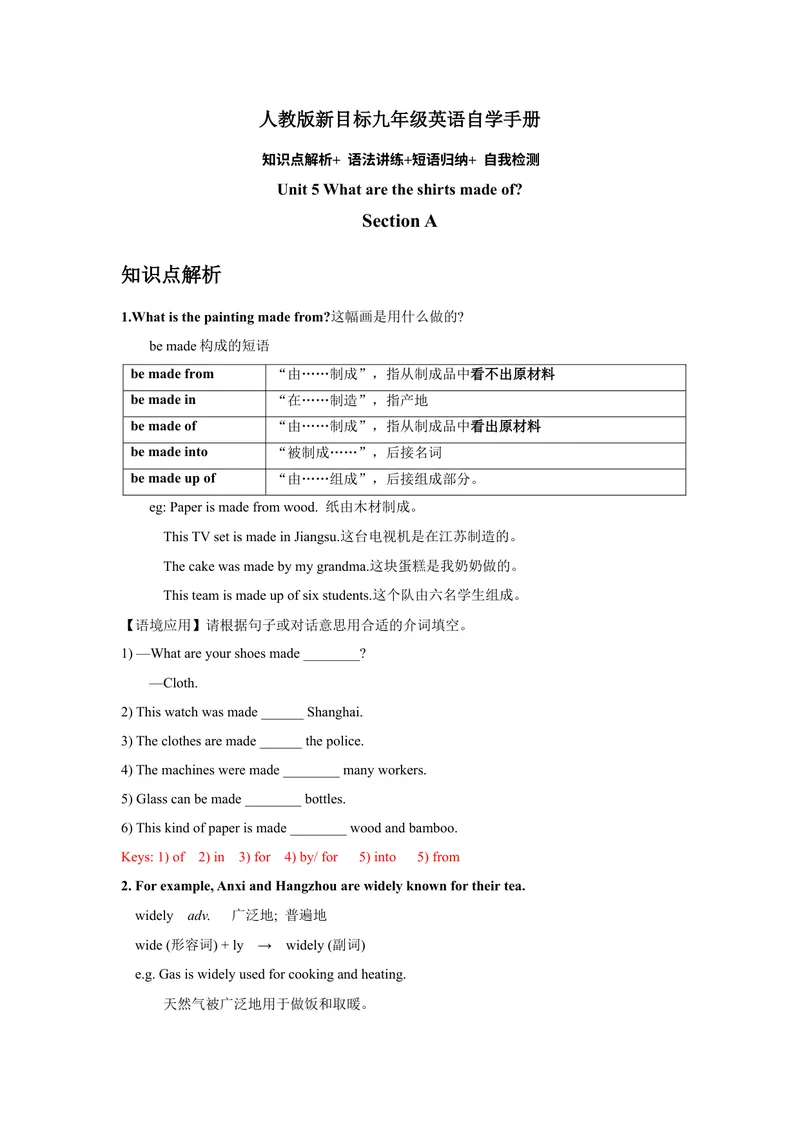
be made构成的短语
be made from “由……制成”,指从制成品中看不出原材料
be made in “在……制造”,指产地
be made of “由……制成”,指从制成品中看出原材料
be made into “被制成……”,后接名词
be made up of “由……组成”,后接组成部分。
eg: Paper is made from wood. 纸由木材制成。
This TV set is made in Jiangsu.这台电视机是在江苏制造的。
The cake was made by my grandma.这块蛋糕是我奶奶做的。
This team is made up of six students.这个队由六名学生组成。
【语境应用】请根据句子或对话意思用合适的介词填空。
1) —What are your shoes made ________?
—Cloth.
2) This watch was made ______ Shanghai.
3) The clothes are made ______ the police.
4) The machines were made ________ many workers.
5) Glass can be made ________ bottles.
6) This kind of paper is made ________ wood and bamboo.
Keys: 1) of 2) in 3) for 4) by/ for 5) into 5) from
2. For example, Anxi and Hangzhou are widely known for their tea.
widely adv. 广泛地; 普遍地
wide (形容词) + ly → widely (副词)
e.g. Gas is widely used for cooking and heating.
天然气被广泛地用于做饭和取暖。【语境应用】完成句子
1) A long time ago it was _________ (广泛地) believed that there was life on Mars. (江苏中考)
2) 单项选择
So far, Confucius Institute (孔子学院) has been set up in many other countries. And Chinese is
_______ spoken in those countries.
A. widely B. badly C. hardly
Keys: 1) widely 2) A
3.China is famous for tea, right?中国以茶叶闻名,对吗?
be famous for因……而著名,相当于be known for。
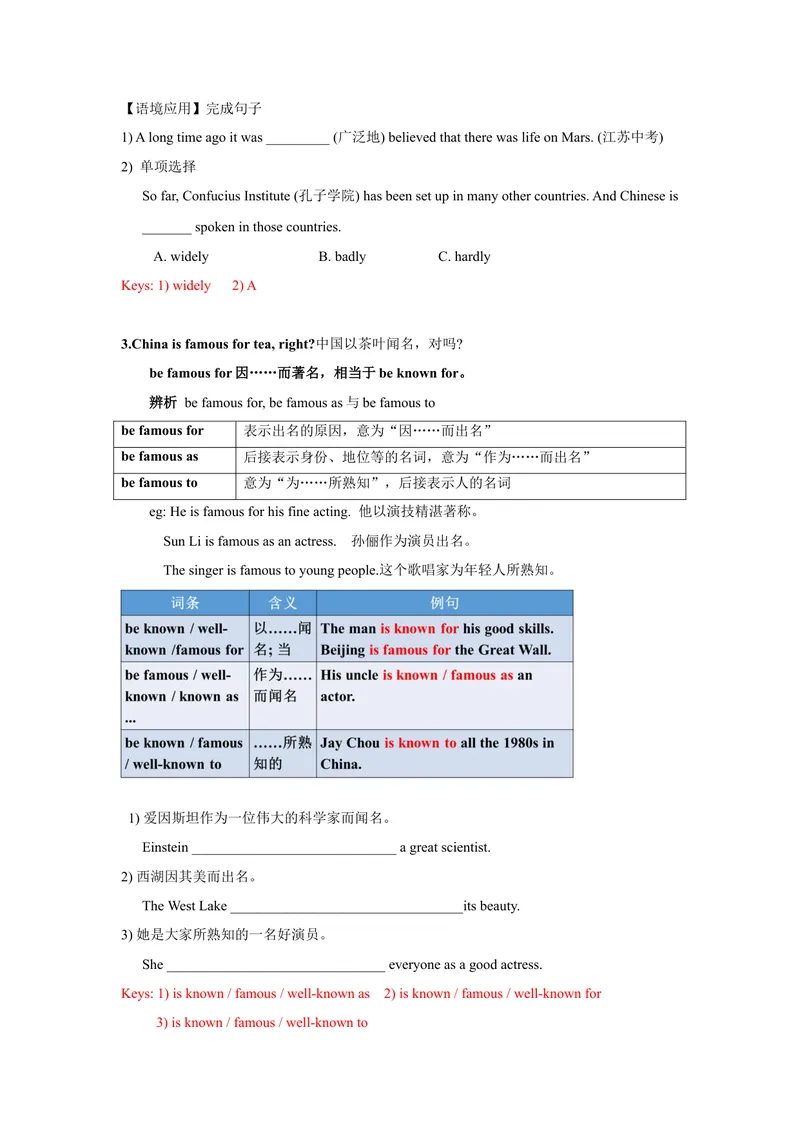
辨析 be famous for, be famous as与be famous to
be famous for 表示出名的原因,意为“因……而出名”
be famous as 后接表示身份、地位等的名词,意为“作为……而出名”
be famous to 意为“为……所熟知”,后接表示人的名词
eg: He is famous for his fine acting. 他以演技精湛著称。
Sun Li is famous as an actress. 孙俪作为演员出名。
The singer is famous to young people.这个歌唱家为年轻人所熟知。
1) 爱因斯坦作为一位伟大的科学家而闻名。
Einstein _____________________________ a great scientist.
2) 西湖因其美而出名。
The West Lake _________________________________its beauty.
3) 她是大家所熟知的一名好演员。
She _______________________________ everyone as a good actress.
Keys: 1) is known / famous / well-known as 2) is known / famous / well-known for
3) is known / famous / well-known to4. Where is tea produced in China?
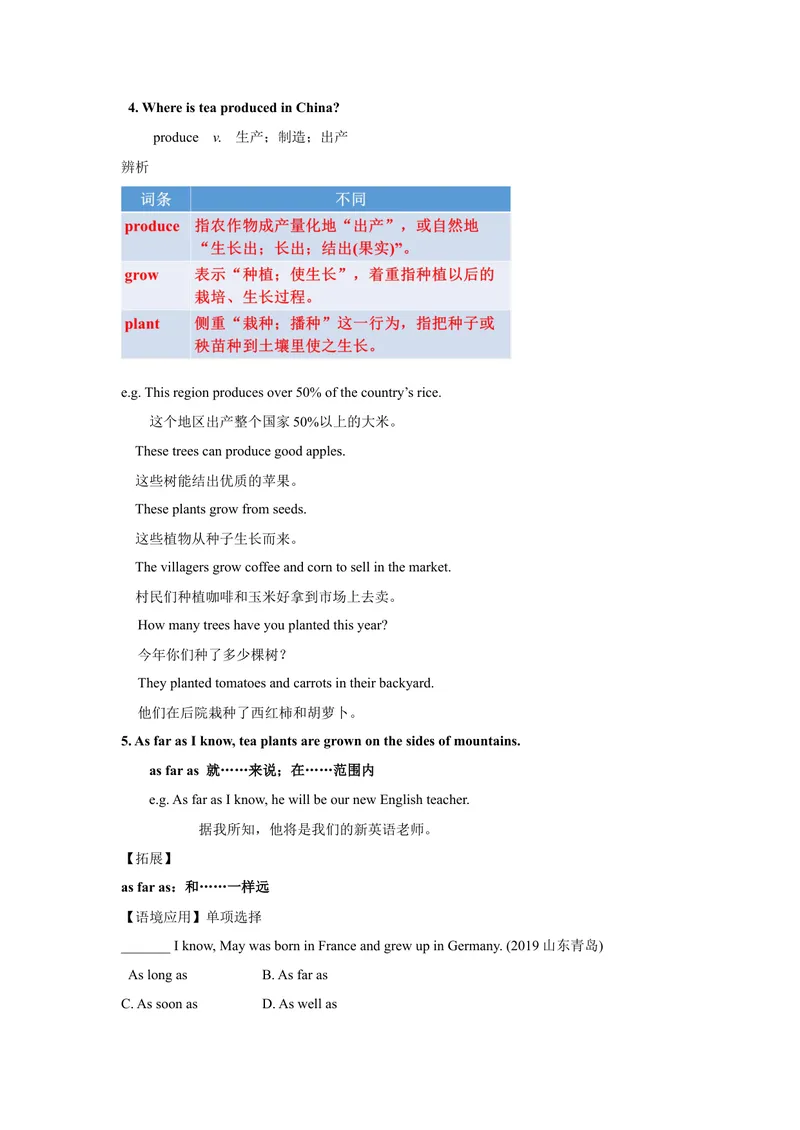
produce v. 生产;制造;出产
辨析
e.g. This region produces over 50% of the country’s rice.
这个地区出产整个国家50%以上的大米。
These trees can produce good apples.
这些树能结出优质的苹果。
These plants grow from seeds.
这些植物从种子生长而来。
The villagers grow coffee and corn to sell in the market.
村民们种植咖啡和玉米好拿到市场上去卖。
How many trees have you planted this year?
今年你们种了多少棵树?
They planted tomatoes and carrots in their backyard.
他们在后院栽种了西红柿和胡萝卜。
5. As far as I know, tea plants are grown on the sides of mountains.
as far as 就……来说;在……范围内
e.g. As far as I know, he will be our new English teacher.
据我所知,他将是我们的新英语老师。
【拓展】
as far as:和……一样远
【语境应用】单项选择
_______ I know, May was born in France and grew up in Germany. (2019山东青岛)
As long as B. As far as
C. As soon as D. As well asKey: B
6. …, they are picked by hand and then are sent for processing.
process v. 加工; 处理
be sent for processing 被送去加工
e.g. America sent cotton to England for processing.
美国把棉花运到英格兰进行加工。
拓展
process n. 工序;过程
in process 在进行中
e.g. Building a car is a long process.
制造一辆汽车有很长的工序。
The bridge is in the process of being built.
大桥正在建设中。
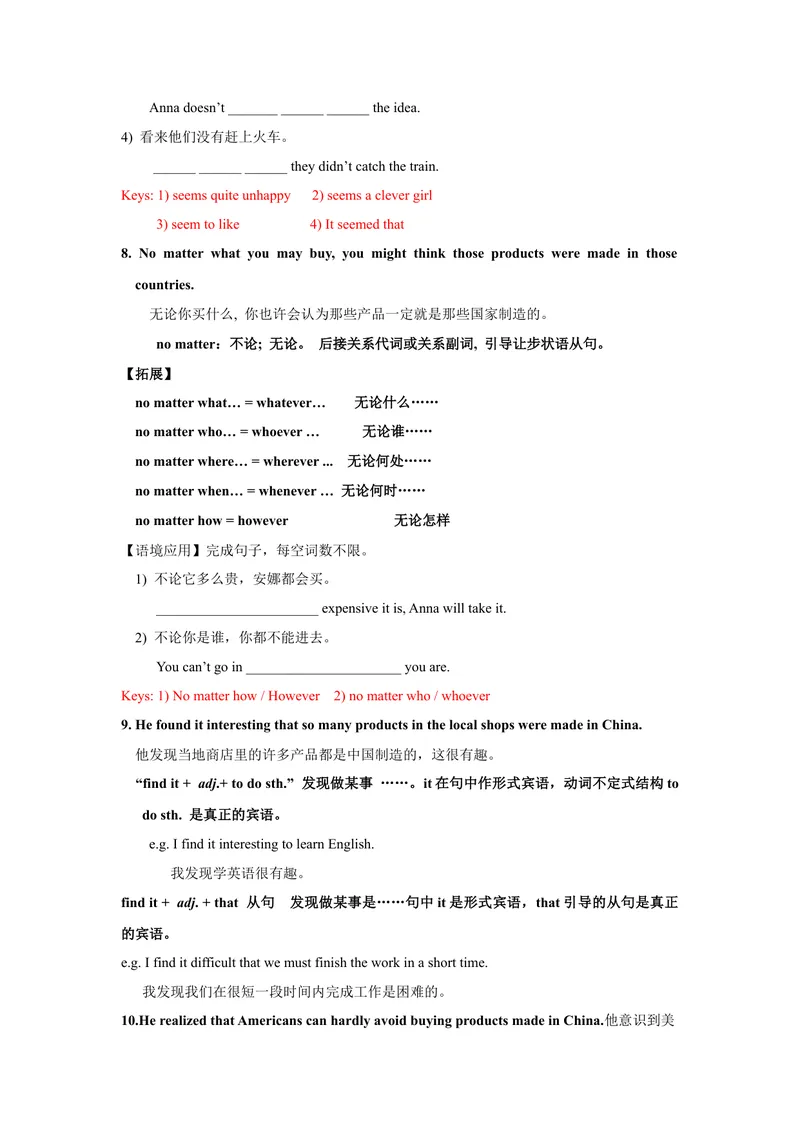
7.It seems that many people all over the world drink Chinese tea.似乎世界各地的许多人都
喝中国茶。
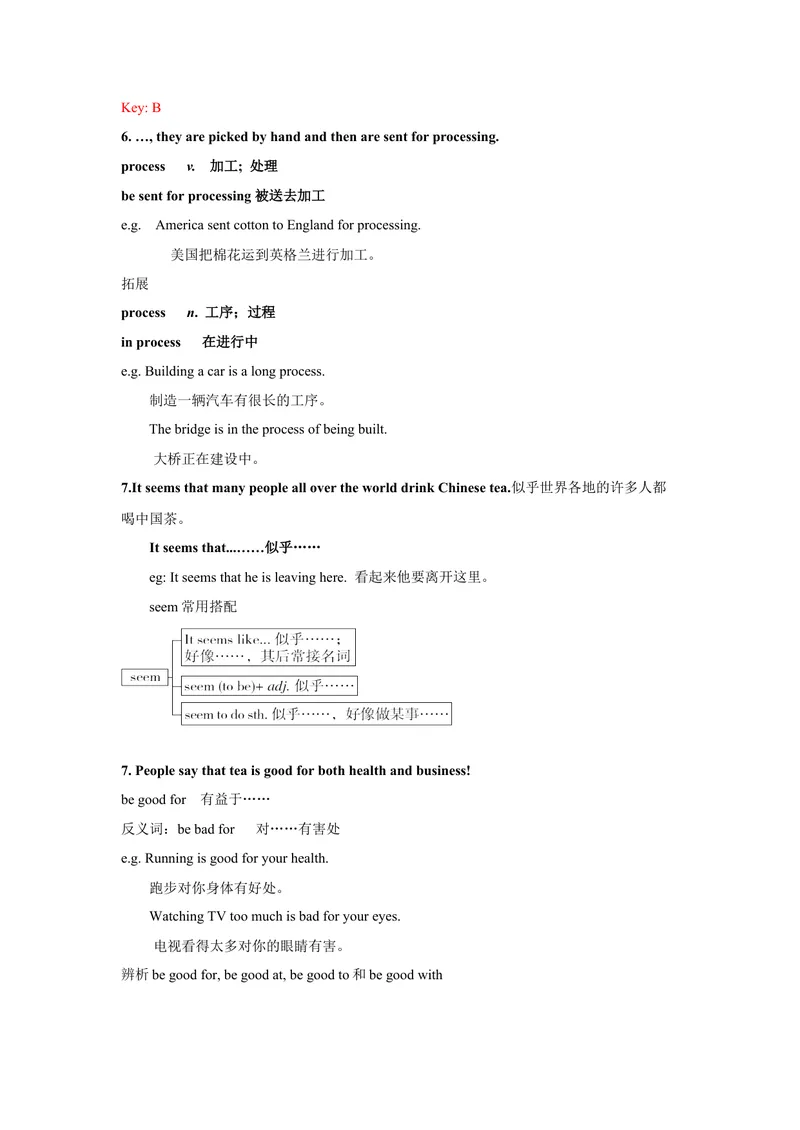
It seems that...……似乎……
eg: It seems that he is leaving here. 看起来他要离开这里。
seem常用搭配
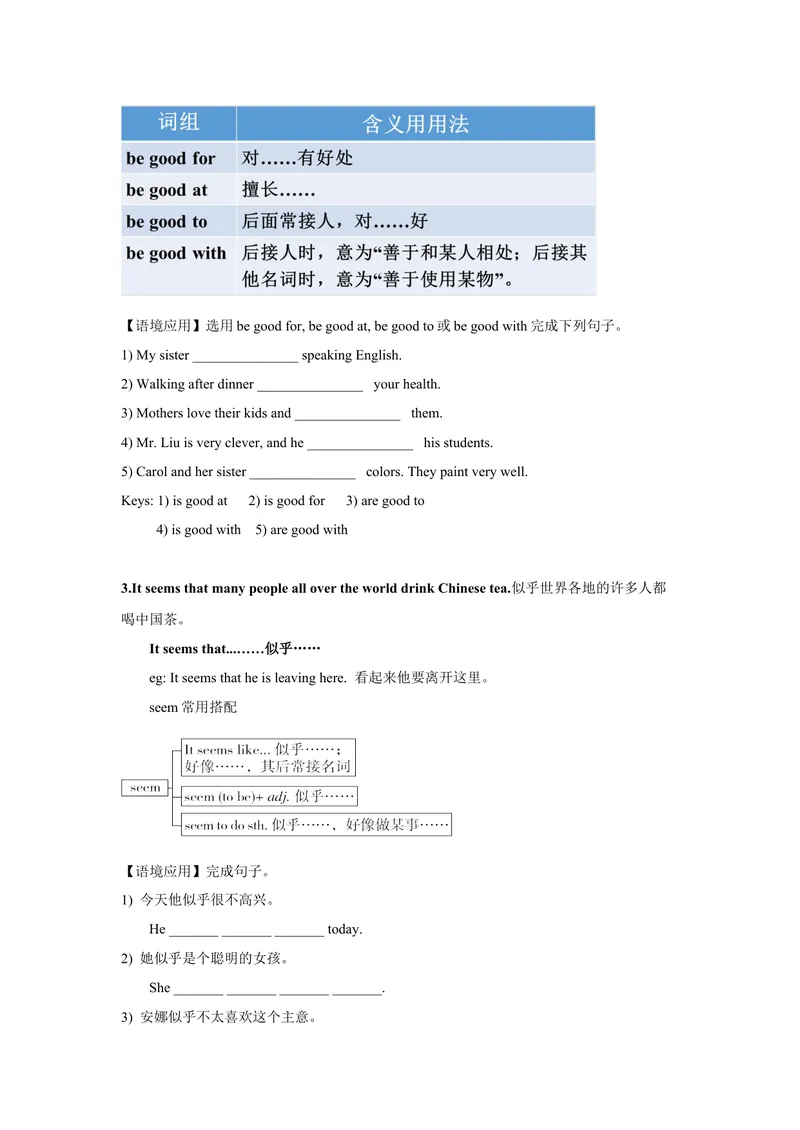
7. People say that tea is good for both health and business!
be good for 有益于……
反义词:be bad for 对……有害处
e.g. Running is good for your health.
跑步对你身体有好处。
Watching TV too much is bad for your eyes.
电视看得太多对你的眼睛有害。
辨析be good for, be good at, be good to和be good with【语境应用】选用be good for, be good at, be good to或be good with完成下列句子。
1) My sister _______________ speaking English.
2) Walking after dinner _______________ your health.
3) Mothers love their kids and _______________ them.
4) Mr. Liu is very clever, and he _______________ his students.
5) Carol and her sister _______________ colors. They paint very well.
Keys: 1) is good at 2) is good for 3) are good to
4) is good with 5) are good with
3.It seems that many people all over the world drink Chinese tea.似乎世界各地的许多人都
喝中国茶。
It seems that...……似乎……
eg: It seems that he is leaving here. 看起来他要离开这里。
seem常用搭配
【语境应用】完成句子。
1) 今天他似乎很不高兴。
He _______ _______ _______ today.
2) 她似乎是个聪明的女孩。
She _______ _______ _______ _______.
3) 安娜似乎不太喜欢这个主意。Anna doesn’t _______ ______ ______ the idea.
4) 看来他们没有赶上火车。
______ ______ ______ they didn’t catch the train.
Keys: 1) seems quite unhappy 2) seems a clever girl
3) seem to like 4) It seemed that
8. No matter what you may buy, you might think those products were made in those
countries.
无论你买什么, 你也许会认为那些产品一定就是那些国家制造的。
no matter:不论; 无论。 后接关系代词或关系副词, 引导让步状语从句。
【拓展】
no matter what… = whatever… 无论什么……
no matter who… = whoever … 无论谁……
no matter where… = wherever ... 无论何处……
no matter when… = whenever … 无论何时……
no matter how = however 无论怎样
【语境应用】完成句子,每空词数不限。
1) 不论它多么贵,安娜都会买。
_______________________ expensive it is, Anna will take it.
2) 不论你是谁,你都不能进去。
You can’t go in ______________________ you are.
Keys: 1) No matter how / However 2) no matter who / whoever
9. He found it interesting that so many products in the local shops were made in China.
他发现当地商店里的许多产品都是中国制造的,这很有趣。
“find it + adj.+ to do sth.” 发现做某事 ……。it在句中作形式宾语,动词不定式结构to
do sth. 是真正的宾语。
e.g. I find it interesting to learn English.
我发现学英语很有趣。
find it + adj. + that 从句 发现做某事是……句中it是形式宾语,that引导的从句是真正
的宾语。
e.g. I find it difficult that we must finish the work in a short time.
我发现我们在很短一段时间内完成工作是困难的。
10.He realized that Americans can hardly avoid buying products made in China.他意识到美国人很难避免购买中国制造的产品。
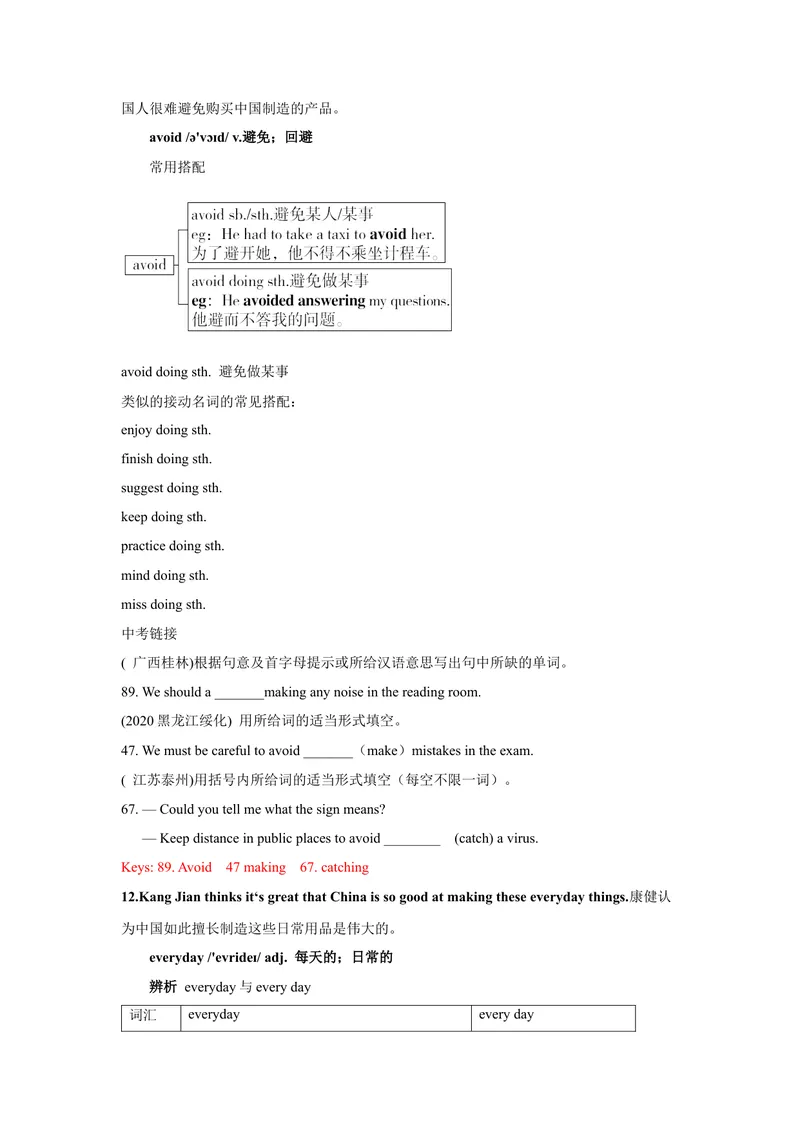
avoid /ə'vɔɪd/ v.避免;回避
常用搭配
avoid doing sth. 避免做某事
类似的接动名词的常见搭配:
enjoy doing sth.
finish doing sth.
suggest doing sth.
keep doing sth.
practice doing sth.
mind doing sth.
miss doing sth.
中考链接
( 广西桂林)根据句意及首字母提示或所给汉语意思写出句中所缺的单词。
89. We should a _______making any noise in the reading room.
(2020黑龙江绥化) 用所给词的适当形式填空。
47. We must be careful to avoid _______(make)mistakes in the exam.
( 江苏泰州)用括号内所给词的适当形式填空(每空不限一词)。
67. — Could you tell me what the sign means?
— Keep distance in public places to avoid ________ (catch) a virus.
Keys: 89. Avoid 47 making 67. catching
12.Kang Jian thinks it‘s great that China is so good at making these everyday things.康健认
为中国如此擅长制造这些日常用品是伟大的。
everyday /'evrideɪ/ adj. 每天的;日常的
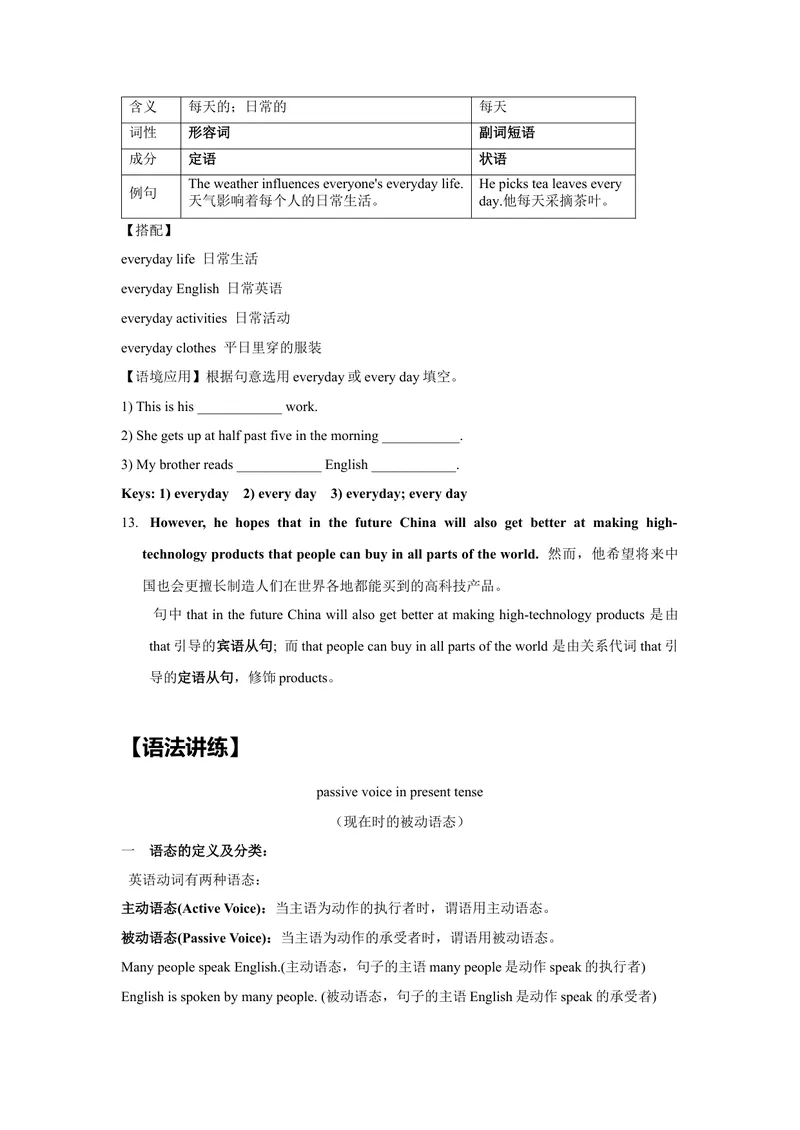
辨析 everyday与every day
词汇 everyday every day含义 每天的;日常的 每天
词性 形容词 副词短语
成分 定语 状语
The weather influences everyone's everyday life. He picks tea leaves every
例句
天气影响着每个人的日常生活。 day.他每天采摘茶叶。
【搭配】
everyday life 日常生活
everyday English 日常英语
everyday activities 日常活动
everyday clothes 平日里穿的服装
【语境应用】根据句意选用everyday或every day填空。
1) This is his ____________ work.
2) She gets up at half past five in the morning ___________.
3) My brother reads ____________ English ____________.
Keys: 1) everyday 2) every day 3) everyday; every day
13. However, he hopes that in the future China will also get better at making high-
technology products that people can buy in all parts of the world. 然而,他希望将来中
国也会更擅长制造人们在世界各地都能买到的高科技产品。
句中 that in the future China will also get better at making high-technology products 是由
that引导的宾语从句; 而that people can buy in all parts of the world是由关系代词that引
导的定语从句,修饰products。
【语法讲练】
passive voice in present tense
(现在时的被动语态)
一 语态的定义及分类:
英语动词有两种语态:
主动语态(Active Voice):当主语为动作的执行者时,谓语用主动语态。
被动语态(Passive Voice):当主语为动作的承受者时,谓语用被动语态。
Many people speak English.(主动语态,句子的主语many people是动作speak的执行者)
English is spoken by many people. (被动语态,句子的主语English是动作speak的承受者)二 被动语态的构成:
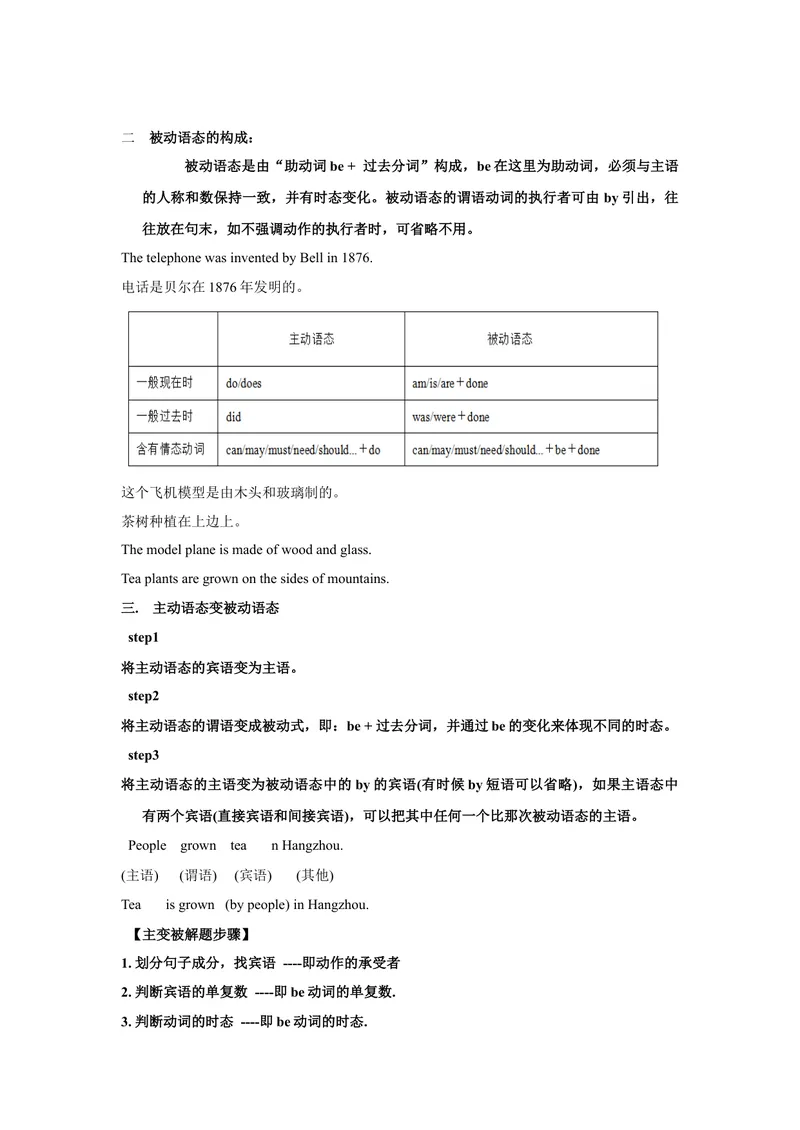
被动语态是由“助动词be + 过去分词”构成,be在这里为助动词,必须与主语
的人称和数保持一致,并有时态变化。被动语态的谓语动词的执行者可由 by引出,往
往放在句末,如不强调动作的执行者时,可省略不用。
The telephone was invented by Bell in 1876.
电话是贝尔在1876年发明的。
这个飞机模型是由木头和玻璃制的。
茶树种植在上边上。
The model plane is made of wood and glass.
Tea plants are grown on the sides of mountains.
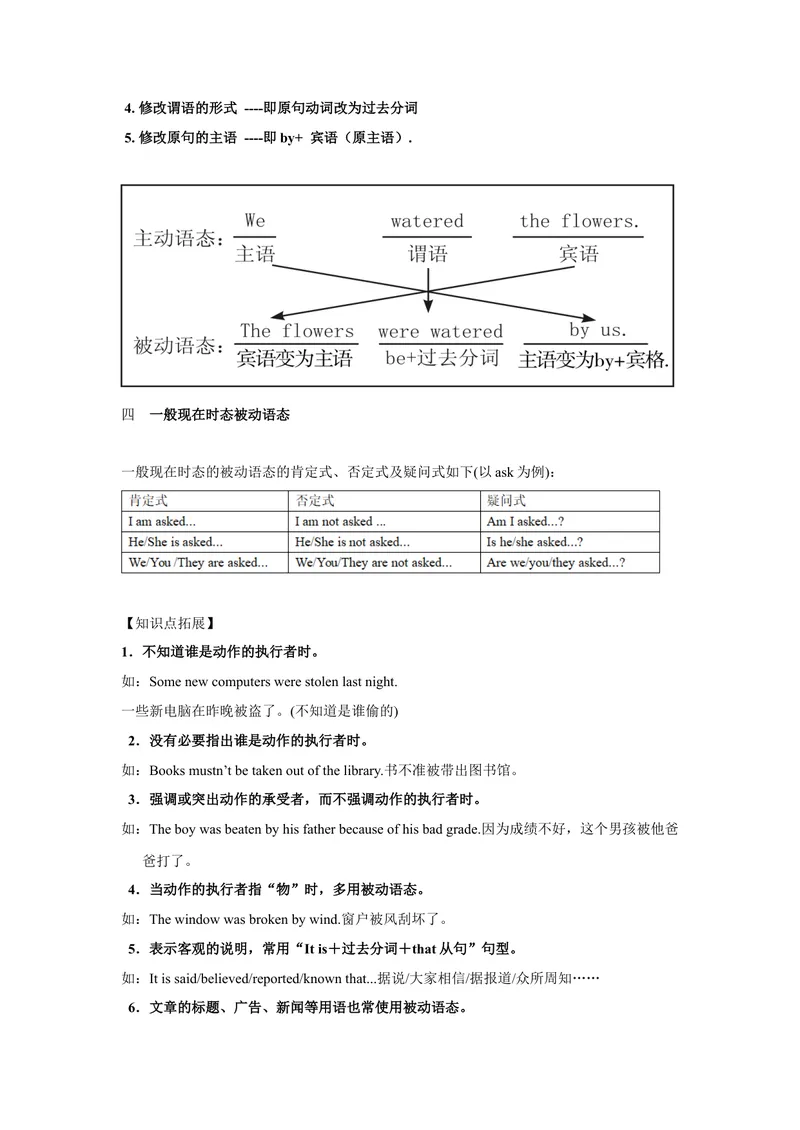
三. 主动语态变被动语态
step1
将主动语态的宾语变为主语。
step2
将主动语态的谓语变成被动式,即:be + 过去分词,并通过be的变化来体现不同的时态。
step3
将主动语态的主语变为被动语态中的by的宾语(有时候by短语可以省略),如果主语态中
有两个宾语(直接宾语和间接宾语),可以把其中任何一个比那次被动语态的主语。
People grown tea n Hangzhou.
(主语) (谓语) (宾语) (其他)
Tea is grown (by people) in Hangzhou.
【主变被解题步骤】
1. 划分句子成分,找宾语 ----即动作的承受者
2. 判断宾语的单复数 ----即be动词的单复数.
3. 判断动词的时态 ----即be动词的时态.4. 修改谓语的形式 ----即原句动词改为过去分词
5. 修改原句的主语 ----即by+ 宾语(原主语).
四 一般现在时态被动语态
一般现在时态的被动语态的肯定式、否定式及疑问式如下(以ask为例):
【知识点拓展】
1.不知道谁是动作的执行者时。
如:Some new computers were stolen last night.
一些新电脑在昨晚被盗了。(不知道是谁偷的)
2.没有必要指出谁是动作的执行者时。
如:Books mustn’t be taken out of the library.书不准被带出图书馆。
3.强调或突出动作的承受者,而不强调动作的执行者时。
如:The boy was beaten by his father because of his bad grade.因为成绩不好,这个男孩被他爸
爸打了。
4.当动作的执行者指“物”时,多用被动语态。
如:The window was broken by wind.窗户被风刮坏了。
5.表示客观的说明,常用“It is+过去分词+that从句”句型。
如:It is said/believed/reported/known that...据说/大家相信/据报道/众所周知……
6.文章的标题、广告、新闻等用语也常使用被动语态。Teacher wanted.(招聘老师,省去了are) Road Blocked.(道路堵塞,省去了is)
五. 被动语态结构中应注意的几个问题
1.主动句中在感官动词see、hear、watch、feel、notice等以及使役动词let、make、have
等后跟省略to的不定式, 变为被动句时, 应加上不定式符号to。
2.“不及物动词+介词 / 副词”构成的短语动词,变成被动句时,要把它们作为整体看待,
介词或副词不可与动词拆开或漏掉。
3.含有双宾语的主动句变被动句时,可将主动句中的直接宾语或间接宾语变为被动句中的
主语。
如果把主动句中的直接宾语(指物)变为被动句中的主语,则需在间接宾语(指人)前加适当
的介词to或for。
常接to的动词有give, tell, lend, show, pass, hand等;
常接for的动词有buy, get等。
六.主动形式表示被动意义的情况
1. 动词open, read, sell, write, lock, clean, watch, cut, burn, drive等作不及物动词, 且它们的
主语为物时。
2. 某些系动词(如smell, look, taste, feel, sound等)描述某物特性时。
3. be worth doing中,doing表示被动意义。
4. “need/require+doing”相当于“need/require+to be done”, to be done 是不定式的被动结
构。
中考链接
1. Earth Day _________ in 1970 for the first time, and the Day now includes events in more than
190 countries and regions(地区).
A. celebrated B. was celebrated
C. is celebrated D. has been celebrated
2. As the most exciting and traditional way to shop, street markets _____ here and there in China
these days.
A. find B. found C. are found D. were found
3. —The last Beidou GEO-3 _____ into space successfully on June 23, 2020.
—As Chinese, we feel proud of it.
A. sends B. sent C. is sent D. was sent4. As soon as books ______, the volunteers posted them to the students in Hope Primary School.
A. are raised B. were raised C. raised D. have raised
5. —Our school sports meet ________ next week. Which sport will you take part in?
—The long jump and the high jump. I'm good at jumping.
A. holds B. held C. was held D. will be held
6. — What language _______ in Canada?
— Both English and French.
A. is spoken B. speaks C. is speaking
7. It is reported that the Tokyo 2020 Olympics ________ no later than summer 2021.
A. is held B. will be held C. will hold D. hold
8. — Will you go to Lisa's housewarming party next Sunday?
— Well, if I _________, I will go on time.
A. invite B. will invite
C. am invited D. will be invited
Keys: 1. B 2. C 3. D 4.B 5. D 6. A 7. B 8. C
语法过关练
根据句意及括号内所给词语的提示填空。
1. _______ this text _______(write) in English?
2. Mr. Black ___________(not work) for a bank. He's a doctor.
3. Jane ___________(not drive) to school by her uncle every day.
4. Sir, these rooms ____________(tidy up) every morning.
5. These flowers ___________(not water) once a week.
6.English ________ (learn) as a foreign language in most of Chinese schools.
7.Usually, my homework _______ (not do) in the afternoon.
8.Computers ________ (not sell) well in that shop.
9.Is our school ________ (visit) by many people every day?
10.Usually, shirts and ties ________ (give) to fathers as gifts on Father's Day.
11. The car _________(wash) every week.
12. The patients _________(look) after by ten nurses in this small hospital every day.
13. _________ this kind of sugar _________(produce) in Anhui now?
14. _________ the beautiful art works _________(show) in the museum every day?
15. The color TVs _________(not sell) in that shop these days.三. . 将下列主 / 被动句改为被 / 主动句。
1. Mom cleans the kitchen every day.
__________________________________
2. I don't read newspapers.
__________________________________
3. They paint their house once a year.
__________________________________
4. The cat isn't fed by my grandma.
__________________________________
5. Those animals are helped by our organization.
__________________________________
6. He does a lot of work every day.
________________________________________
7. We don't use the oven often.
________________________________________
8. Shoes are made by the workers in the factory.
________________________________________
9. Is he liked by everybody?
________________________________________
10. We plant trees every spring.
________________________________________
11.They don't make this kind of watch in Beijing.(改为被动语态)
This kind of watch __________ __________ by them in Beijing.
12.The bike is mended by Uncle Li.(对画线部分提问)
_________ _________ the bike mended by?
13.The trees are watered by them once a week.(改为主动语态)
________ _________ the trees once a week.
14.Does she often look after the old woman?(改为被动语态)
_________ the old woman often __________ after by her?
15.Tea is grown in the south of China.(改为一般疑问句)
_________ tea __________ in the south of China?
四.根据短文内容及括号内所给动词的提示填空。“Free books! Take me home and read me!” says the note on the cover of Jurassic Park. The
book (1)_______(lie) on a café table. Is this a joke? No, it's an invitation. The book is registered
(登记) at www.bookcrossing.com and you (2)_________ (invite) to take it home and read it.
Ron Hornbaker, an American, came up with the idea of BookCrossing in 2001 and he set up
the website (网站). It (3)_________(visit) by thousands of members around the world. “Our goal
is to make the whole world a library,” says Hornbaker.
How does BookCrossing work? Books (4)_________(leave) in public places — on buses, on
park chairs and in cafés. And they (5)_________(find) by other people. Each book is labeled (用
标签标明) with an ID number, and people (6)_________(ask) to report back to the website when
they find a book.
So why not try it? The next time you (7)_________(finish) a good book, register it on the
website and label it with its ID number. Then (8)_________(leave) it in a public place for
someone else to pick up and enjoy. Who knows? Your book may appear on the other side of the
world!
根据句意及括号内所给词语的提示填空。
1. Is; written 2. doesn't work 3. isn't driven 4. are tidied up 5. aren't watered
6. is learned 7. isn't done 8. don't sell 9. visited 10. are given
11. is washed 12. are looked 13. Is; produced 14. Are; shown 15. aren't sold
将下列主 / 被动句改为被 / 主动句。
1. The kitchen is cleaned by Mom every day.
2. Newspapers aren't read by me.
3. Their house is painted by them once a year.
4. My grandma doesn't feed the cat.
5. Our organization helps those animals.
6. A lot of work is done by him every day.
7. The oven isn't used by us often.
8. The workers make shoes in the factory.
9. Does everybody like him?
10. Trees are planted by us every spring.
11. isn't made 12. Who is 13. They water 14. Is; looked 15. Is; grown
根据短文内容及括号内所给动词的提示填空。1. is lying 2. are invited 3. is visited 4. are left
5. are found 6. are asked 7. finish 8. leave
【重点短语】
Section A
be made of / from ... 由……制成
be made in ... 在……(地方 / 时间)制造
the art and science fair 艺术与科学博览会
environmental protection 环境保护
be known / famous / well-known for ... 以……闻名;为人知晓
by hand 用手工;靠手做
be sent for processing 被送去加工
be good for ... 对……有好处
no matter 不论;无论
in the local shops 在当地商店里
even though 即使;虽然
American brands 美国品牌
avoid doing sth. 避免做某事
in fact 确切地说;事实上;实际上
everyday things 日常用品
in the future 将来
high-technology products 高科技产品
the earth’s surface 地球表面
traffic accidents 交通事故
【自测题】
一. 单项选择。
( )1. Yao Ming is known __________ playing basketball.
A. to B. as C. for D. between
( )2. I won’t leave my office until my work _______.
A. finishes B. will finish C. is finished D. finishing
( )3. —What do you think of my shirt? It cotton.
— It looks nice on you.
A. is made in B. is made for C. is made of D. is made by( ) 4. Today, computers are really helpful. They _____ everywhere.
A. use B. are used C. used D. were used
( )5. —How do they pick the pears?
—They pick the pears .
A. in hand B. by hand C. in hands D. by hands
( )6. I couldn’t do it ____ your great help. Thanks a lot!
A. with B. without C. for D. to
( )7. The movie covers all of Chinese history. It is ___ worth seeing again.
A. mainly B. really C. possibly D. hardly
( )8. —What do you think of my shirt? It _____ cotton.
—It looks nice on you.
A. is made in B. is made for C. is made of D. is made by
( )9.—Excuse me, sir, smoking ___ in the gas station.
—Oh,I’m really sorry.
A. doesn’t allow B. isn’t allowed C. aren’t allowed D. don’t allow
( )10. _________ you go, I’ll go with you.
A. Where B. Whatever C. No matter where D. No matter who
二. 根据句意及所给汉语提示,写出所缺单词。
1. Look! Some sheep are eating grass and _______(叶子) over there.
2. We Chinese people eat with _______(筷子) but Western people eat with knives and forks.
3. My father took some _______(硬币) out of his wallet and gave them to me.
4. Every day many kinds of foods are sent for _______(加工).
5. The factory in Shanghai _______(生产) 100 cars a day.
6. I bought nothing but two _______(小手提包) last weekend.
7. They came here in search of new markets for their _______(产品).
8. Be careful! The top of the table is made of _______(玻璃)..
9. The Internet is _______(广泛). used in our work and life.
10. The _______(衬衫)in our store are all made of the best leather (皮革).
三. 根据汉语意思,完成英语句子,每空一词。
1. 奶奶手工做了所有的缝纫工作。
Grandma did all the sewing _______ _______.
2. 你和谁去了艺术与科学博览会?Who did you go to _______ _______ _______ _______ _______ with?
3. 为了保持健康,你应该尽量避免喝酒。
To keep healthy, you should try to _______ _______.
4. Rick还没有完成他的小说。实际上,他还没开始动手写。
Rick hasn't finished his novel. _______ _______, he hasn't started on it.
5. 我喜欢在这家超市买日常用品。
I like to buy _______ _______ in this supermarket.
6. 这家公司生产各种各样的高科技产品。
All kinds of _______ _______ are produced in this company.
四. 根据括号内的要求完成下列各题,每空一词。
1. This piece of paper is made from bamboo. (对划线部分提问)
_______ _______ this piece of paper _______ from?
2. The bicycle is made in Shanghai. (对划线部分提问)
_______ _______ the bicycle _______?
3. Even if it rains tomorrow, we won't change our plan. (改为同义句)
_______ _______ it rains tomorrow, we won't change our plan.
4. Our silk is famous for its good quality. (改为同义句)
Our silk _______ _______ _______ its good quality.
5. Whatever happens, I'll always be there for you! (改为同义句)
_______ _______ _______ happens, I'll always be there for you!
五. 根据对话内容,从方框中选择恰当的选项补全对话,其中有两项多余。
A: Morning, sir. (1)_______
B: Morning! I'd like to buy a shirt, please.
A: Sure, no problem. We have lots of different styles (款式). (2)_______ Please have a look.
(A few minutes later …)
A: (3)_______
B: Er … The green one looks nice.
A: Yes. It sells well because it is made of cotton.
B: Really? I like wearing cotton clothes. (4)_______ They also absorb sweat (吸汗).
A: That's true. Cotton clothes are great to wear in the summer. (5)_______
B: OK. Get me a size 40. Thank you!
A. Can I try it on?B. This way, please.
C. How can I help you?
D. That's a little expensive.
E. Which one do you like, sir?
F. They are light and let the air in.
G. You can try it on if you'd like to.
六、短文填空。
Couplets (对联) have been around for about 600 years. It was started in Ming Dynasty. At f
1. , people used red paper i 2. _of peach wood charms (桃符) to make the
Spring Festival couplets. After Qing Dynasty, the couplets were once w 3. popular.
Lots of famous couplets appeared. With the d 4. of the international cultural
exchange, the couplets were also i 5. to Vietnam, Korea, Japan, Singapore and
other c 6. . The customs of sticking these couplets still remain now.
Couplets are usually in different s 7. __ and colors. Nice words and s 8.
are written on the couplets. Different couplets are put on doors, walls or windows as s 9.
of wishes for good l 1 0. and a happy new year.
参考答案
Unit 5 What are the shirts made of?
Section A
一. 单项选择。
1-5 CCCBB 6-10 BBCBC
二. 根据句意及所给汉语提示,写出所缺单词。
1. leaves 2. chopsticks 3. coins 4. processing 5. produces
6. handbags 7. products 8. glass 9. widely 10. blouses
三. 根据汉语意思,完成英语句子,每空一词。
1. by hand 2. the art and science fair 3. avoid drinking 4. In fact
5. everyday things 6. high-technology products
四. 根据括号内的要求完成下列各题,每空一词。
1. What is; made 2. Where is; made 3. Even though
4. is known / well-known for 5. No matter what
五. 根据对话内容,从方框中选择恰当的选项补全对话,其中有两项多余。1-5 CBEFG
六、短文填空。
1. first 2. instead 3. widely 4. development
5. introduced 6. countries 7. shapes 8. sentences
9. symbols 10. luck