人教版新目标九年级英语自学手册
知识点解析+ 短语归纳+语法讲练+ 自我检测
Unit 8 It must belong to Carla.
Section B
【知识点讲解】
1 express 表达;表示 (Page 62 2a)
express为及物动词,其后可接名词、wh-从句作宾语。express sth. to sb. 对某人表达……
►He freely express his ideas. 他直率地表达自己的想法。
【拓展】(1)express可接反身代词作宾语,表达自己的意思、思想、感情等。
►Have I expressed myself clearly? 我的意思讲清楚了吗?
(2)expression名词,意为"表达;表情;表达方式"。
►He ended the letter with expressions of grateful thanks. 他在那封信的结尾表达了自己的感
激之情。
express的常用搭配:express oneself表达自己
►You can express yourself freely. 你可以畅所欲言。
【拓展】expression名词,意为"表达"。
►I bought them flowers as an expression of thanks. 我给他们买了鲜花以示感谢。
【典例】I am greatly interested in this painting. It ________ the painter’s love for nature.
A. expresses B. discusses C. expects D.
imagines
【答案】A
【解析】本题用词义辨析法解题。express表达;discuss讨论;expect期待;imagine想象。
句意:我对这幅画很感兴趣,它表达了画家对大自然的爱。
2 receive 接待;收到 (Page 62 2b)
receive及物动词,其后可接名词或代词作宾语。
►I received a card from my best friend yesterday. 昨天我收到了我最好的朋友的卡片。
【拓展】receive a letter from sb. = get a letter from sb.= hear from sb. 意为"收到某人的来信
"。
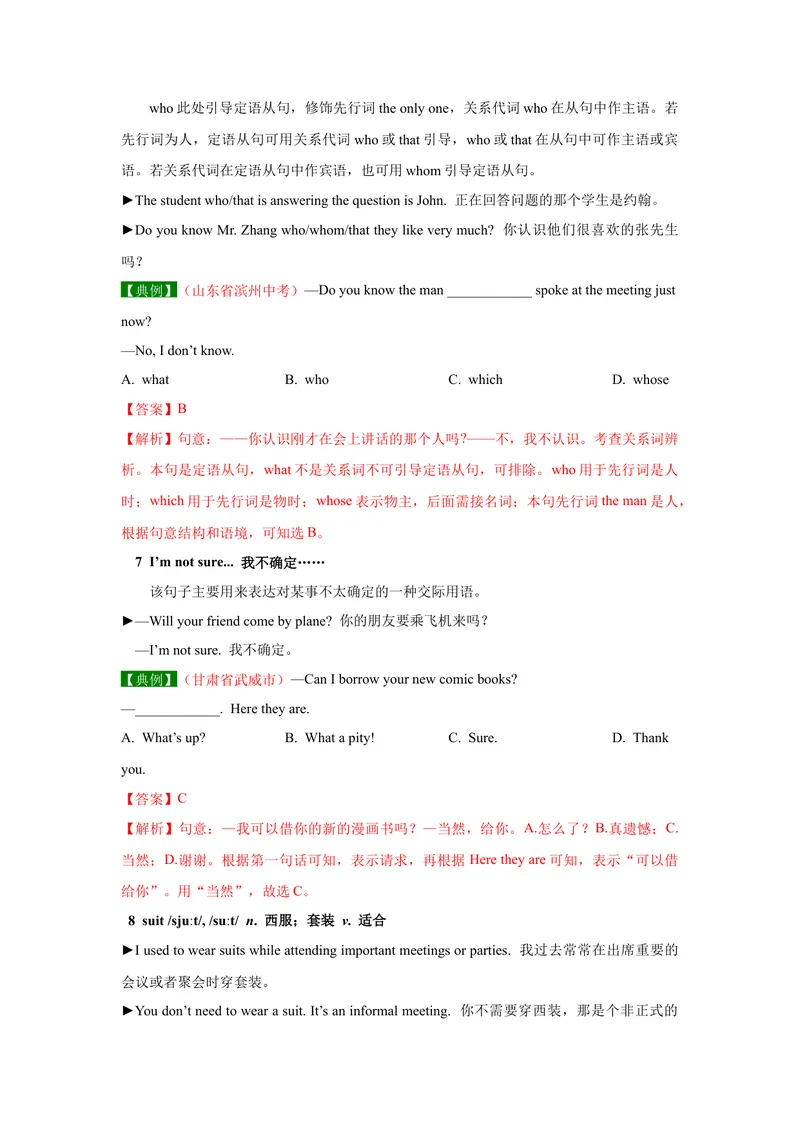
►She received a letter from her father. = She got a letter from her father. = She heard from herfather. 她收到了父亲的一封来信。
【辨析】receive与accept
receive 接待;收到 它表示的行为与主语的主观意愿无关,侧重于行为本身,不涉及收到者是否同
意,是"客观上"的收到。
accept 接受 它表示的行为由主语的主观意愿决定,强调经过主语的考虑而接受,是"主观上
"的接受。
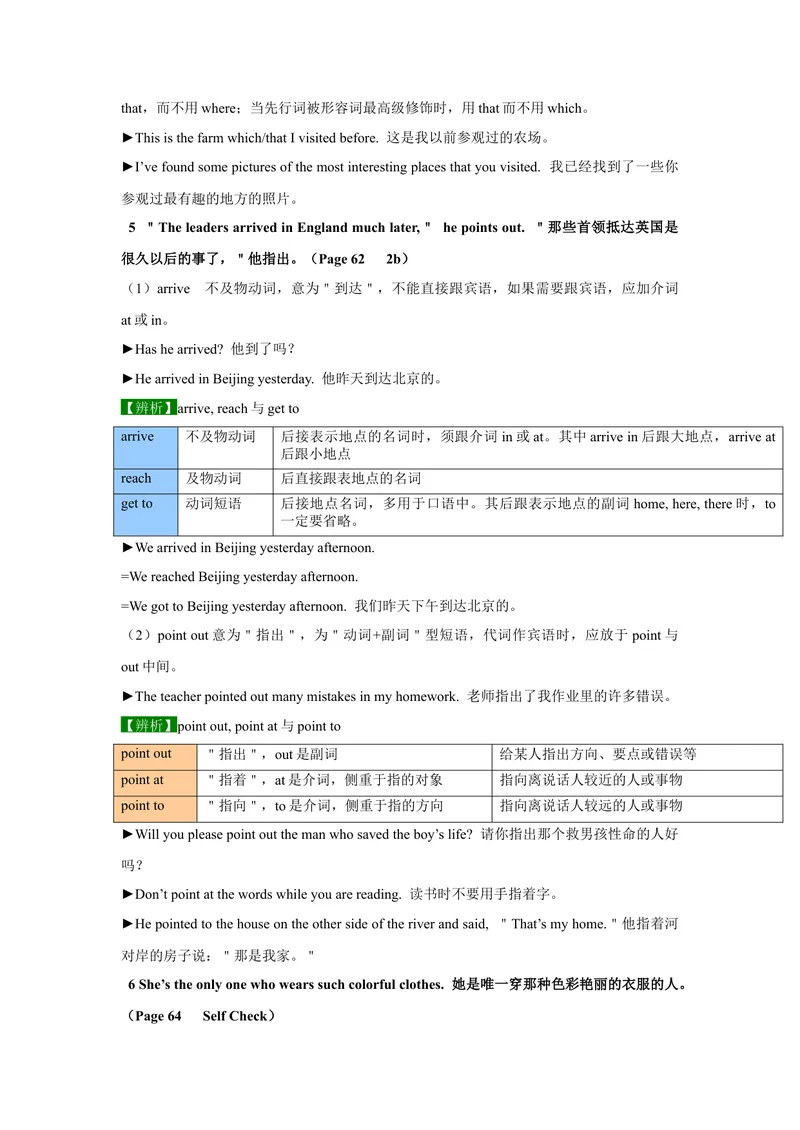
►She accepted my gift. 她接受了我的礼物。
accept(主观上)接受 receive(客观上)收到
3 People like to go to this place especially in June as they want to see the sun rising on the
longest day of the year. 人们尤其喜欢在六月份去这个地方,因为他们想在这里观看一年中
白昼最长的一天的日出。(Page 62 2b)
as此处用作连词,意为"由于;因为",引导原因状语从句。
►As it was late, I went at once. 由于天晚了,我立即走了。
【辨析】as, because与since
as "由于;因为" 主句与从句并重,从句说明原因,主句说明结果
because "因为",语气最强,可回答由why 从句可放在主句前,也可放在主句后
提出的问题
since "既然" 侧重主句,从句表示显然的或已知的理由
►As you don’t feel well, you had better stay at home. 由于你不舒服,你最好待在家里。
►—Why were you late for school? 你为什么上学迟到了?
—Because I missed the first bus. 因为我错过了第一班公共汽车。
►Since everybody is here, let’s begin the meeting. 既然大家都到了,我们开始开会吧。
Point 4 For many years, historians believed Stonehenge was a temple where ancient leaders
tried to communicate with the gods. 多年以来,历史学家们认为巨石阵是古代首领试图与
神灵沟通的一座庙宇。(Page 62 2b)
(1)where ancient leaders tried to communicate with gods是一个定语从句,修饰a temple。
若先行词是表示地点的名词,关系词在从句中作状语,则用关系副词where引导定语从句。
►I have come back to the farm where I worked before. 我已经回到了我以前工作过的农场。
【警示】先行词表示地点时,如果关系词在从句中充当主语或宾语,则关系词用which或that,而不用where;当先行词被形容词最高级修饰时,用that而不用which。
►This is the farm which/that I visited before. 这是我以前参观过的农场。
►I’ve found some pictures of the most interesting places that you visited. 我已经找到了一些你
参观过最有趣的地方的照片。
5 "The leaders arrived in England much later," he points out. "那些首领抵达英国是
很久以后的事了,"他指出。(Page 62 2b)
(1)arrive 不及物动词,意为"到达",不能直接跟宾语,如果需要跟宾语,应加介词
at或in。
►Has he arrived? 他到了吗?
►He arrived in Beijing yesterday. 他昨天到达北京的。
【辨析】arrive, reach与get to
arrive 不及物动词 后接表示地点的名词时,须跟介词in或at。其中arrive in后跟大地点,arrive at
后跟小地点
reach 及物动词 后直接跟表地点的名词
get to 动词短语 后接地点名词,多用于口语中。其后跟表示地点的副词home, here, there时,to
一定要省略。
►We arrived in Beijing yesterday afternoon.
=We reached Beijing yesterday afternoon.
=We got to Beijing yesterday afternoon. 我们昨天下午到达北京的。
(2)point out意为"指出",为"动词+副词"型短语,代词作宾语时,应放于point与
out中间。
►The teacher pointed out many mistakes in my homework. 老师指出了我作业里的许多错误。
【辨析】point out, point at与point to
point out "指出",out是副词 给某人指出方向、要点或错误等
point at "指着",at是介词,侧重于指的对象 指向离说话人较近的人或事物
point to "指向",to是介词,侧重于指的方向 指向离说话人较远的人或事物
►Will you please point out the man who saved the boy’s life? 请你指出那个救男孩性命的人好
吗?
►Don’t point at the words while you are reading. 读书时不要用手指着字。
►He pointed to the house on the other side of the river and said, "That’s my home."他指着河
对岸的房子说:"那是我家。"
6 She’s the only one who wears such colorful clothes. 她是唯一穿那种色彩艳丽的衣服的人。
(Page 64 Self Check)who此处引导定语从句,修饰先行词the only one,关系代词who在从句中作主语。若
先行词为人,定语从句可用关系代词who或that引导,who或that在从句中可作主语或宾
语。若关系代词在定语从句中作宾语,也可用whom引导定语从句。
►The student who/that is answering the question is John. 正在回答问题的那个学生是约翰。
►Do you know Mr. Zhang who/whom/that they like very much? 你认识他们很喜欢的张先生
吗?
【典例】(山东省滨州中考)—Do you know the man ____________ spoke at the meeting just
now?
—No, I don’t know.
A. what B. who C. which D. whose
【答案】B
【解析】句意:——你认识刚才在会上讲话的那个人吗?——不,我不认识。考查关系词辨
析。本句是定语从句,what不是关系词不可引导定语从句,可排除。who用于先行词是人
时;which用于先行词是物时;whose表示物主,后面需接名词;本句先行词the man是人,
根据句意结构和语境,可知选B。
7 I’m not sure... 我不确定……
该句子主要用来表达对某事不太确定的一种交际用语。
►—Will your friend come by plane? 你的朋友要乘飞机来吗?
—I’m not sure. 我不确定。
【典例】(甘肃省武威市)—Can I borrow your new comic books?
—____________. Here they are.
A. What’s up? B. What a pity! C. Sure. D. Thank
you.
【答案】C
【解析】句意:—我可以借你的新的漫画书吗?—当然,给你。A.怎么了?B.真遗憾;C.
当然;D.谢谢。根据第一句话可知,表示请求,再根据 Here they are可知,表示“可以借
给你”。用“当然”,故选C。
8 suit /sjuːt/, /suːt/ n. 西服;套装 v. 适合
►I used to wear suits while attending important meetings or parties. 我过去常常在出席重要的
会议或者聚会时穿套装。
►You don’t need to wear a suit. It’s an informal meeting. 你不需要穿西装,那是个非正式的会议。
suit还可用作及物动词,意为"适合"。
►The coat doesn’t suit you. 这件外衣不太适合你。
【拓展】suitable 形容词,意为"适宜的;合适的",be suitable for 适合……的,be
suitable to do... 适合于做……。
►Nobody was suitable for the job. 无人适合做那份工作。
►The shoes are suitable to travel. 这种鞋适用于旅行。
辨析fit与suit
fit 多指衣服尺码、大小、形状合适(强调客观)
suit 多指样式、花色合适或指合乎某种条件(强调 两者的主语通常是物
主观)
eg: The suit fits you well, but its color doesn’t suit you.这套西服很适合你,但它的颜色不
适合你。
9 circle /’sɜː(r)kl/ n. 圆圈 v. 圈出
►The children stood in a circle around the fire. 孩子们围着火站成一圈。
circle用作名词,也可表示具有共同爱好、兴趣的"集团;圈子"。
►Jackie Chan is well-known in theatrical circles. 成龙在演艺圈赫赫有名。
circle可用作动词,意为"圈出"。
►Please circle the correct answers. 请圈出正确的答案。
10.A UFO is landing.一个不明飞行物正在着陆。
land /lænd/ v.着陆;降落。可作动词或名词
eg: The plane is landing now.飞机现在正在着陆。
The river passes through our land.这条河流经我们的国土。
【重点短语】
run after 追逐;追赶
a woman with a camera 一个拿着照相机的女人
run for exercise 跑步锻炼wear a suit 穿着西装
catch a bus 赶公交车
at the same time 同时;一起
one of Britain’s most famous historical places 英国最著名的历史古迹之一
receive more than 750,000 visitors 接待75万多名游客
see the sun rising 看日出
the longest day of the year 一年中白昼最长的一天
ancient leaders 古代首领
communicate with 交流
point out 指出
a kind of calendar 一种日历
in a certain way 以某种方式
on midsummer’s morning 在仲夏的早晨
shine directly into the center of the stones 直射巨石阵的中央
prevent illness 预防疾病
for a special purpose 为了一个特殊的目的
a burial place 一个墓地
a place to honor ancestors 一个纪念祖先的地方
celebrate a victory over an enemy 庆祝打败敌人的胜利
over a long period of time 在很长一段时间内
a group of ... 一群……
stop sb. (from) doing sth. 阻止某人做某事
【重点句型】
1. If you have any idea where might be please call me. 如果你知道它可能在哪,请打电
话给我。
2. It’s crucial that I study for it because it counts 30% to the final exam. 关键是我必须学,
因为它占期末考试的30%。
3. What do you think “anxious“ means? 你认为“anxious”是什么意思?
4. He could be running for exercise. 他可能是正在跑步锻炼身体。
5. He might be running to catch a bus. 他可能是正在跑着赶公共汽车。
6. Why do you think the man is running? 你觉得那个男的为什么跑?【考点详解】
1. 情态动词must, may , might, could, may , can't表示推测含义,后面都接动词原形,都
可以表示对现在情况的揣测和推断,但他们含义有所不同。
must 一定,肯定 (100%的可能性)
may, might, could 有可能,也许 (20%-80%的可能性)
can't 不可能,不会 (可能性几乎为零)
2. whose:谁的,是个疑问词,作定语,后面接名词
如:---Whose book is this? ---This is Lily's.
4. 当play 指弹奏西洋乐器时,常在乐器前用定冠词the
play the guitar;play the piano;play the violin
当play 指进行球类运动时,则不用定冠词
play football;play basketball;play baseball
5. if引导的条件状语从句,主句用一般将来时,从句用一般现在时代替将来时。
If you don't hurry up, you'll be late. 如果你不快点,你将会迟到。
6. if you have any idea= if you know 如果你知道
7. on 关于(学术,科目)
9. because of:由于
because:因为,它们的用法是:
because of + 名词/代词/名词性短语(这是一个重要的短语)
because + 从句
I do it because I like it. 我做这件事是因为我喜欢。
I had to move because of my job. 因为工作的原因我得搬家。
10. own v. - owner n.
listen v. - listener n.
learn v. - learner n.
11. catch a bus 赶公车
12. neighbor 邻居,指人
neighborhood 邻居,指地区也可指附近地区的人
13. local 当地的 如:local teacher 当地的教师
16. anything strange 一些奇怪的东西
当形容词修饰something, anything, nothing, everything等不定代词时,放在这些词的后面(重要,切记)
17. there be sb./sth. doing 有…...正在......
There is a cat eating fish.
18. escape from… 从哪里逃跑出来(常考短语)
He escaped from the burning building. 他从燃烧的建筑中逃出来。
19. an ocean of + 名词 极多的,用不尽的 如:an ocean of energy.
20. unhappy 不高兴的 反义词:happy 高兴的
22. dishonest 不诚实的 反义词:honest 诚实的
23. get on 上车 get off 下车(掌握住这两个短语的意思)
24. use up 用光,用完
They have used up all the money. 他们已经用完了所有的钱。
25. attempt to do 试图做某事(重要考点,大家记着attempt后面用的是不定式to do)
The boys attempted to leave for Beijing. 男孩子们试图想去北京。
26. wake 是个动词,意思是唤醒,常用的词组:wake up 意为醒来
Please wake me up at 8 o'clock. 请在8点钟叫醒我。
27. look for 寻找,强调找的动作(重要)
find 找到,强调找的结果
I am looking for a pen. 我正在找一支笔。(指找的动作)
I found my pen just now. 我刚刚找到了我的笔。(指找的结果)
28. hear 听,强调听的结果
listen 听,强调听的动作
Did you hear? 你听到了吗?(指听的结果)
I often listen to the music. 我经常听音乐。(指听的动作)
29. try one's best to do sth. 尽某人的最大努力去做某事(注意best后面跟的不定式to do
是考试的重点)
He tried his best to run. 他尽他的最大努力去跑。
【写作指导】
本单元话题为“神秘事物”,围绕这一话题对我们生活中出现的不确定的事情进行推
理判断。要求我们恰当使用情态动词客观的对提供的材料进行分析,以推测某件物品可能
是某人的或某人正在做什么。写作此类话题作文的常用表达有:
(1) sth. must /can’t/might/could be...(2) sb. must/can’t/might/could be doing…
写作任务 (Section B 3a & 3b)
上周你市某小区发生了一件神秘离奇的事情,引起了人们的猜测,但最终这个谜团被
解开了。假如你是你校英文报的一名记者,请以“No More Mystery in the Neighborhood”为
题写一则新闻报道。
【审清题目】
内容:介绍神秘离奇的事件,并说明谜团是如何被解开的
文体:应用文(新闻稿)
人称:以第三人称为主
时态:以一般过去时为主
【头脑风暴】
【提供素材】
语块
something strange / unusual, strange noises, make noises, feel uneasy / nervous / worried, be
afraid of, call the policemen, with the help of ... / with one’ s help, do / try one’ s best to ..., find
out the truth, feel relaxed
习语:make one’ s hair stand on end (使某人毛骨悚然), have one’ s heart in one’ s mouth (吓得
某人心都提到嗓子眼儿了), scare the pants off sb. (把某人吓坏了), scare sb. to death (吓死某人
了), have cold feet (临阵胆怯;畏缩), sb.’ s blood runs cold (吓得某人不寒而栗)句型
1. ... think / guess that ... 2. ... must be ...
3. ... might / could / may be ... 4. ... can’ t be ...
5. It’ s not clear that ... 6. It’ s impossible for ... to ...
7. ... find that ... 8. ... hope that ...
【谋篇布局】
【点评范文】
1. 内容:作者按照事件发生的先后顺序(事件的发生、发展和结局)来安排文章结构,逻辑
性很强。
2. 语言:文章体现了词义搭配这一衔接手段,本文围绕mystery一词展开,与之相关联的
词有strange, uneasy, solved, relaxed等,这些词都与描述神秘事件有关联;使用however和
so进行衔接,使得文章语意连贯、自然。
【典型例题】
你在上学的路上捡到了一件T-shirt,它是你校某位同学的。请根据以下提示做出一个
合理的推断,并把推断的经过和结果写出来。可适当发挥,词数80词左右。提示:
1. Mary和Sally的T恤衫都丢了
2. T恤衫上有长头发
3. T恤衫口袋里有一张信用卡和一张刘德华的照片
【优秀范文】
Oh,look! There is a T-shirt here. It’s a school T-shirt. The owner must be a
student.
Mary and sally lost their T-shirt. Could it be Mary’s or Sally’s? There is long
hair on the T-shirt. But both of them have long hair. There is a photo of Liu Dehua in
the pocket. Sally likes Liu Dehua very much, but Mary’s favorite star is Sun Yanzi. So,
it belongs to sally. There is credit card too. Then, it must be sally’s school T-shirt
because she is the only person who has a credit card in our school.
【自测题】
一. 从方框中选择合适的单词填空,使每个句子在结构、句意和逻辑上正确。
medicine, circle, position, land, lead, energy, enemy, period, victory, express
1. Simon drew some _______ in the sand with a stick (棍).
2. He was saving his _______ for next week’s race in Beijing.
3. The Huamei Shopping Mall is in a central _______ in the city.
4. The plane _______ safely in New York on the morning of June 6th.
5. You don’t want to be friends anymore but there’s no need to be _______.
6. Jessica won a(n) _______ over her competitors on the balance beam (平衡木).
7. Mandy entered a(n) _______ school two years ago and her dream is to be a nurse.
8. My time in the middle school was one of the most exciting _______ of my life.
9. A lot of people like music. They think that thoughts can be _______ by means of (借助) music.
10. A good _______ is always open-minded to different opinions even if he or she is against them.
二. 根据句意及所给汉语提示,写出所缺单词。
1. Our plane _______(着陆) safely just now.
2. Well, I've found our _______(位置) on the map if you want to see where we are.3. The guests _______(表达) their thanks before leaving.
4. The expert spent lots of time on the _______(医学的) research.
5. The book was written by a writer from _______(大不列颠).
6. Two men in _______(套装) came out of the hotel in a hurry just now.
7. The work is boring. It's a waste of time and _______(精力).
8. The planets move in _______(圆圈) around the sun.
三. 句型转换。
1. This person must be a Chinese teacher. (改为否定句)
This person be a Chinese teacher.
2. The dictionary might belong to Carla. (改为同义句)
The dictionary might be .
3. That woman could cry for help. (改为进行时态)
That woman could for help.
4. Maybe there is something strange in the sky. (改为同义句)
There something strange in the sky.
5. The man could be running for exercise. (对划线部分提问)
the man be running for?
四.根据汉语意思完成英语句子,每空一词。
1. Stonehenge is (不仅) one of Britain’s most famous historical places
(而且) one of its greatest mysteries.
2. Every year it (接待超过) 750,000 visitors.
3. Many historians believed Stonehenge was a temple where ancient leaders tried to
(与……交流) the gods.
4. (在仲夏的清晨), the sun shines directly into the
center of the stones.
5. Others think it was built to __________ __________ ___________ ____________________
__________.
6. Visitors want to __ (观看日出) on the longest day
of the year.
8. The large stones ____ ___ __ (被放在一起) in a certain way.
9. (同时), she passed the English test.10. Our teacher (指出) some mistakes in my composition.
五. 根据汉语意思,完成英语句子,每空一词。
1. 这个新公园将于下周六接待游客。
The new park will _______ _______ next Saturday.
2. 这个派对是为了一个特殊的目的而举办的。
The party was held _______ _______ _______ _______.
3. 刚才他觉得有什么东西在他身旁移动。
Just now he _______ _______ _______ beside him.
4. 我们应该多做运动以预防疾病。
We should do more exercise to _______ _______.
5. 这些书应该以某种方式被摆放在一起。
These books should be put together _______ _______ _______ _______.
6. 一股强风吹走了我的帽子,我不得不追赶它。
A strong wind blew away my hat and I had to _______ _______ _______.
7. 我必须穿西装赴宴吗,还是只穿夹克衫就可以?
Do I have to _______ _______ _______ to the dinner, or will a jacket be good enough?
8. 古代首领为什么要修建那座塔?
Why did _______ _______ build the tower?
9. 我想知道他们是用什么方式庆祝了打败敌人的胜利。
I wonder in what way they _______ _______ _______ _______ _______ _______.
10. 这家工厂将关闭长达两年。
The factory will be closed down _______ _______ _______ _______ two years.
六. 根据短文内容,从方框中选择恰当的词语填空。每个限用一次。
because, when, not only ... but also ..., while, or, however, so
Hi, I'm Sally. One day, (1)_______ I was waiting for my father, I saw a little boy running
freely on the grass. He fell to the grass, got up, without looking back at his mother.
At that moment, I thought to myself, “Why can't most adults just stand up like kids?”
(2)_______ most adults make a big deal out of it. (3)_______ they fall down, they feel shy. They
would do another thing quickly to show they don't mind it.
(4)_______ they would find a good excuse for themselves that they're not fit for it. All in all,
they don't make a second try.(5)_______, when kids fall down, they don't think of their falling down as a failure (失败).
Instead, they (6)_______ think that it's quite okay to fall down _______ treat it as a learning
experience. They try again and again until they succeed. In other words, they allow themselves to
make mistakes, (7)_______ they can become better and stronger.
参考答案
Unit 8 It must belong to Carla
Section B
一. 从方框中选择合适的单词填空,使每个句子在结构、句意和逻辑上正确。
1. circles 2. energy 3. position 4. landed 5. enemies
6. victory 7. medical 8. periods 9. expressed 10. leader
二. 根据句意及所给汉语提示,写出所缺单词。
1. landed 2. position 3. expressed 4. medical 5. Britain 6. suits 7. energy
8. circles
三. 句型转换。
1. can’t 2. Carla’s 3. be crying 4. may be 5. What could
四.根据汉语意思完成英语句子,每空一词。
1. not only; but also 2. receives more than
3. communicate with 4. On midsummer’s morning
5. celebrate a victory over an enemy 6. see the sun rising
7. were put together 8. were put together
9. At the same time 10. pointed out
五. 根据汉语意思,完成英语句子,每空一词。
1. receive visitors / tourists 2. for a special purpose
3. felt something move 4. prevent illness
5. in a certain way 6. run after it
7. wear a suit 8. ancient leaders
9. celebrated a victory over an enemy 10. over a period of六. 根据短文内容,从方框中选择恰当的词语填空。每个限用一次。
1. while 2. Because 3. When 4. Or 5. However 6. not only; but also 7. so