法国大餐 - 名称
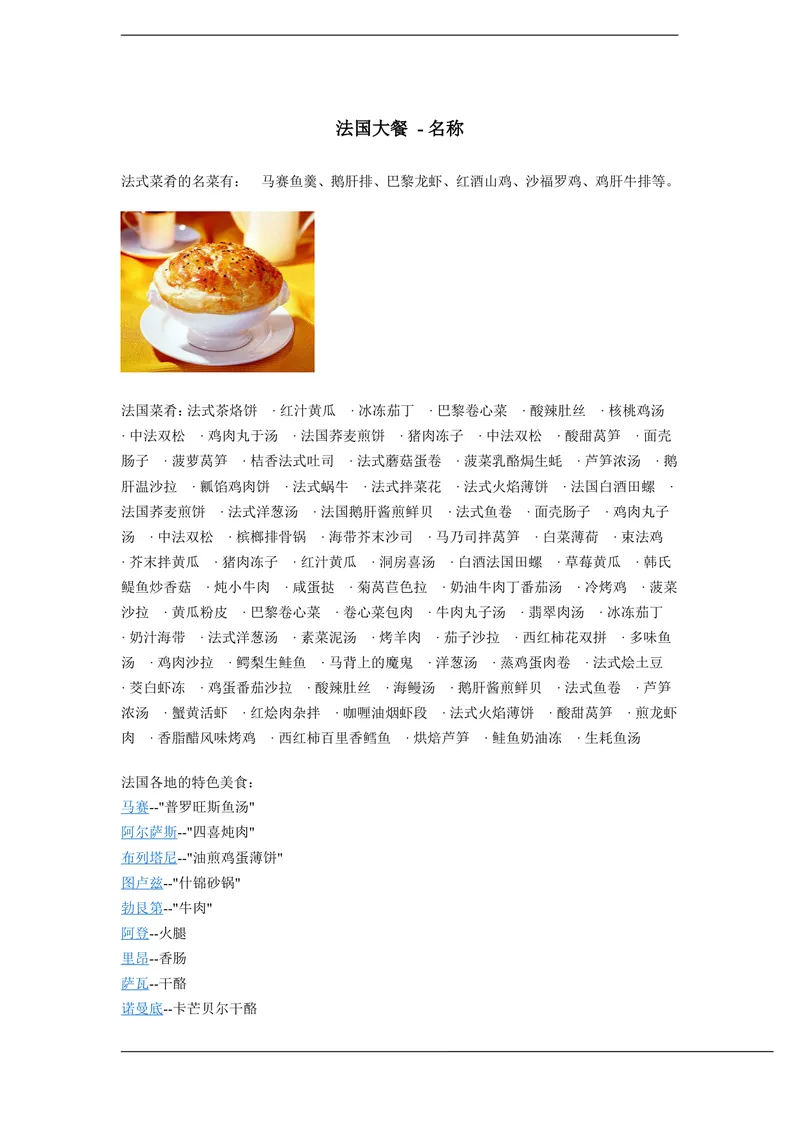
法式菜肴的名菜有: 马赛鱼羹、鹅肝排、巴黎龙虾、红酒山鸡、沙福罗鸡、鸡肝牛排等。
法国菜肴:法式茶烙饼 · 红汁黄瓜 · 冰冻茄丁 · 巴黎卷心菜 · 酸辣肚丝 · 核桃鸡汤
· 中法双松 · 鸡肉丸于汤 · 法国荞麦煎饼 · 猪肉冻子 · 中法双松 · 酸甜莴笋 · 面壳
肠子 · 菠萝莴笋 · 桔香法式吐司 · 法式蘑菇蛋卷 · 菠菜乳酪焗生蚝 · 芦笋浓汤 · 鹅
肝温沙拉 · 瓤馅鸡肉饼 · 法式蜗牛 · 法式拌菜花 · 法式火焰薄饼 · 法国白酒田螺 ·
法国荞麦煎饼 · 法式洋葱汤 · 法国鹅肝酱煎鲜贝 · 法式鱼卷 · 面壳肠子 · 鸡肉丸子
汤 · 中法双松 · 槟榔排骨锅 · 海带芥末沙司 · 马乃司拌莴笋 · 白菜薄荷 · 束法鸡
· 芥末拌黄瓜 · 猪肉冻子 · 红汁黄瓜 · 洞房喜汤 · 白酒法国田螺 · 草莓黄瓜 · 韩氏
鳀鱼炒香菇 · 炖小牛肉 · 咸蛋挞 · 菊莴苣色拉 · 奶油牛肉丁番茄汤 · 冷烤鸡 · 菠菜
沙拉 · 黄瓜粉皮 · 巴黎卷心菜 · 卷心菜包肉 · 牛肉丸子汤 · 翡翠肉汤 · 冰冻茄丁
· 奶汁海带 · 法式洋葱汤 · 素菜泥汤 · 烤羊肉 · 茄子沙拉 · 西红柿花双拼 · 多味鱼
汤 · 鸡肉沙拉 · 鳄梨生鲑鱼 · 马背上的魔鬼 · 洋葱汤 · 蒸鸡蛋肉卷 · 法式烩土豆
· 茭白虾冻 · 鸡蛋番茄沙拉 · 酸辣肚丝 · 海鳗汤 · 鹅肝酱煎鲜贝 · 法式鱼卷 · 芦笋
浓汤 · 蟹黄活虾 · 红烩肉杂拌 · 咖喱油烟虾段 · 法式火焰薄饼 · 酸甜莴笋 · 煎龙虾
肉 · 香脂醋风味烤鸡 · 西红柿百里香鳕鱼 · 烘焙芦笋 · 鲑鱼奶油冻 · 生耗鱼汤
法国各地的特色美食:
马赛--"普罗旺斯鱼汤"
阿尔萨斯--"四喜炖肉"
布列塔尼--"油煎鸡蛋薄饼"
图卢兹--"什锦砂锅"
勃艮第--"牛肉"
阿登--火腿
里昂--香肠
萨瓦--干酪
诺曼底--卡芒贝尔干酪法国大餐 - 特点
法国大餐是西餐中最有地位的菜,是西方文化的一颗明珠。相传16世纪意大利女子
Catherine嫁给法兰西国王亨利二世以后,把意大利文艺复兴时期盛行的牛肝脏,黑菌,嫩牛
排,奶酪等烹饪方法带到法国,路易十四还曾发起烹饪比赛,即现今流行的Corden Bleu奖。
曾任英皇乔治四世和帝俄沙皇亚历山大一世首席厨师的安东尼.凯莱梅写了一本饮食字
典,Dictionary of Cuisine,成为古典法国菜式的基础。
法国美食的特色在于使用新鲜的季节性材料,加上厨师个人的独特的调理,完成独一无二的
艺术佳肴极品,无论视觉上、嗅觉上、味觉上、触感、交感神经上,都是无与伦比的境界,而在
食物的品质服务水准用餐气氛上,更要求精致化的整体表现
法国菜的特色是汁多味腴,而吃法国菜必须有精巧的餐具和如画的菜肴满足视觉;扑鼻的酒
香满足嗅觉;入口的美味满足味觉;酒杯和刀叉在宁静安详的空间下交错,则是触觉和味觉
的最高享受。这种五官并用的态度,发展出了深情且专注的品味。
法国大餐 - 品尝法国菜
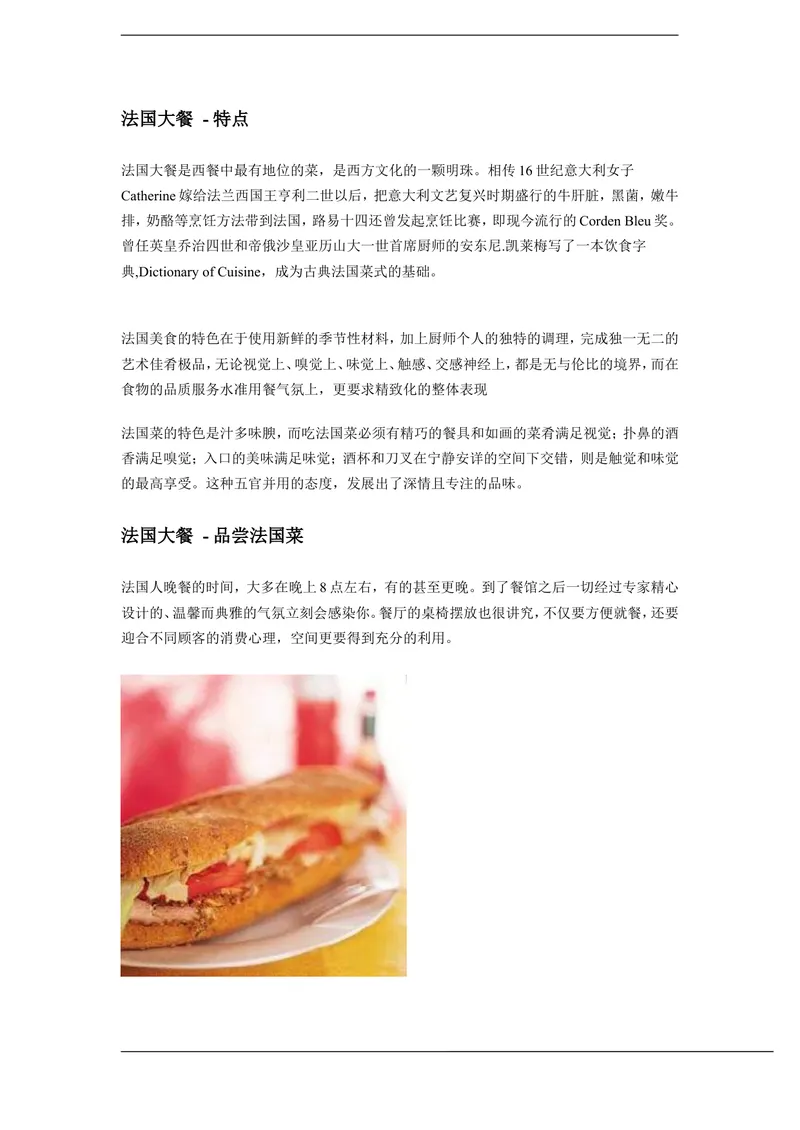
法国人晚餐的时间,大多在晚上8点左右,有的甚至更晚。到了餐馆之后一切经过专家精心
设计的、温馨而典雅的气氛立刻会感染你。餐厅的桌椅摆放也很讲究,不仅要方便就餐,还要
迎合不同顾客的消费心理,空间更要得到充分的利用。法国餐厅的服务非常到位,不仅要为第一次光顾的客人提供满意的服务,而且还要记住老客
户的姓名及其喜好的餐桌位置。每当这些人来此就餐,他们都主动迎上前去招呼着客人的姓
名,使人备感亲切。
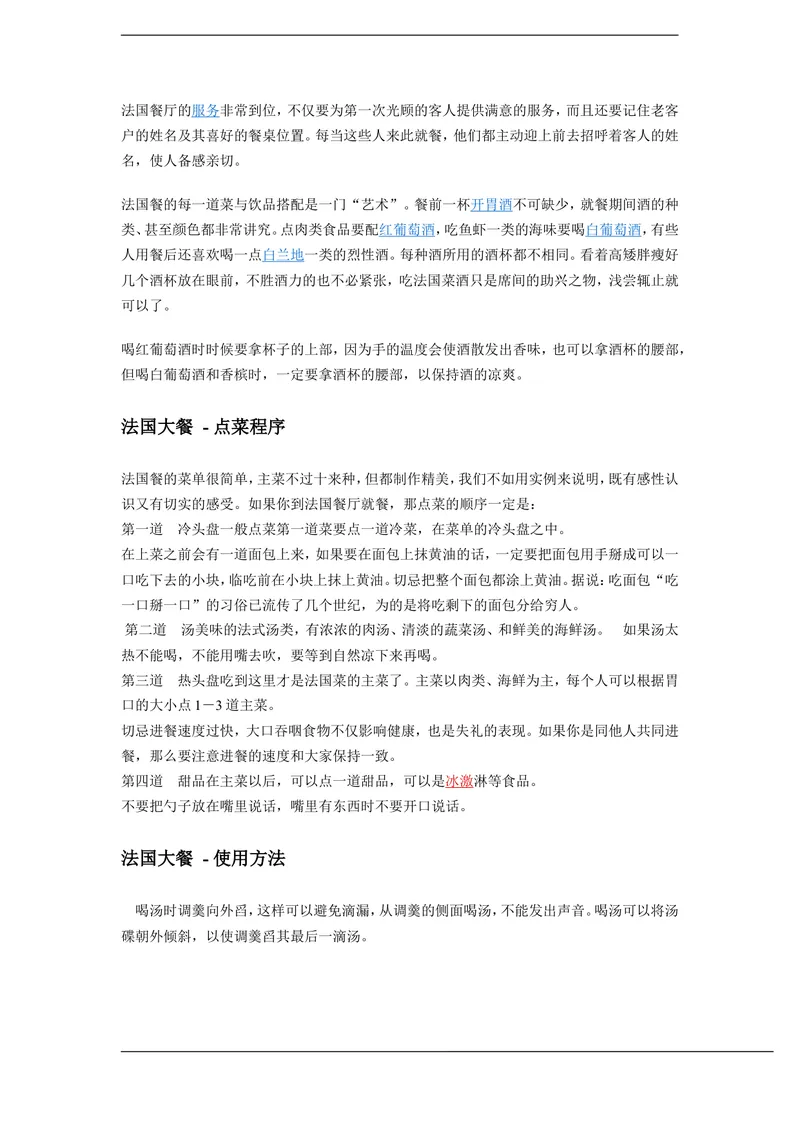
法国餐的每一道菜与饮品搭配是一门“艺术”。餐前一杯开胃酒不可缺少,就餐期间酒的种
类、甚至颜色都非常讲究。点肉类食品要配红葡萄酒,吃鱼虾一类的海味要喝白葡萄酒,有些
人用餐后还喜欢喝一点白兰地一类的烈性酒。每种酒所用的酒杯都不相同。看着高矮胖瘦好
几个酒杯放在眼前,不胜酒力的也不必紧张,吃法国菜酒只是席间的助兴之物,浅尝辄止就
可以了。
喝红葡萄酒时时候要拿杯子的上部,因为手的温度会使酒散发出香味,也可以拿酒杯的腰部,
但喝白葡萄酒和香槟时,一定要拿酒杯的腰部,以保持酒的凉爽 。
法国大餐 - 点菜程序
法国餐的菜单很简单,主菜不过十来种,但都制作精美,我们不如用实例来说明,既有感性认
识又有切实的感受。如果你到法国餐厅就餐,那点菜的顺序一定是 :
第一道 冷头盘一般点菜第一道菜要点一道冷菜,在菜单的冷头盘之中。
在上菜之前会有一道面包上来,如果要在面包上抹黄油的话,一定要把面包用手掰成可以一
口吃下去的小块,临吃前在小块上抹上黄油。切忌把整个面包都涂上黄油。据说:吃面包“吃
一口掰一口”的习俗已流传了几个世纪,为的是将吃剩下的面包分给穷人。
第二道 汤美味的法式汤类,有浓浓的肉汤、清淡的蔬菜汤、和鲜美的海鲜汤。 如果汤太
热不能喝,不能用嘴去吹,要等到自然凉下来再喝 。
第三道 热头盘吃到这里才是法国菜的主菜了。主菜以肉类、海鲜为主,每个人可以根据胃
口的大小点1-3道主菜。
切忌进餐速度过快,大口吞咽食物不仅影响健康,也是失礼的表现。如果你是同他人共同进
餐,那么要注意进餐的速度和大家保持一致。
第四道 甜品在主菜以后,可以点一道甜品,可以是冰激淋等食品。
不要把勺子放在嘴里说话,嘴里有东西时不要开口说话。
法国大餐 - 使用方法
喝汤时调羹向外舀,这样可以避免滴漏,从调羹的侧面喝汤,不能发出声音。喝汤可以将汤
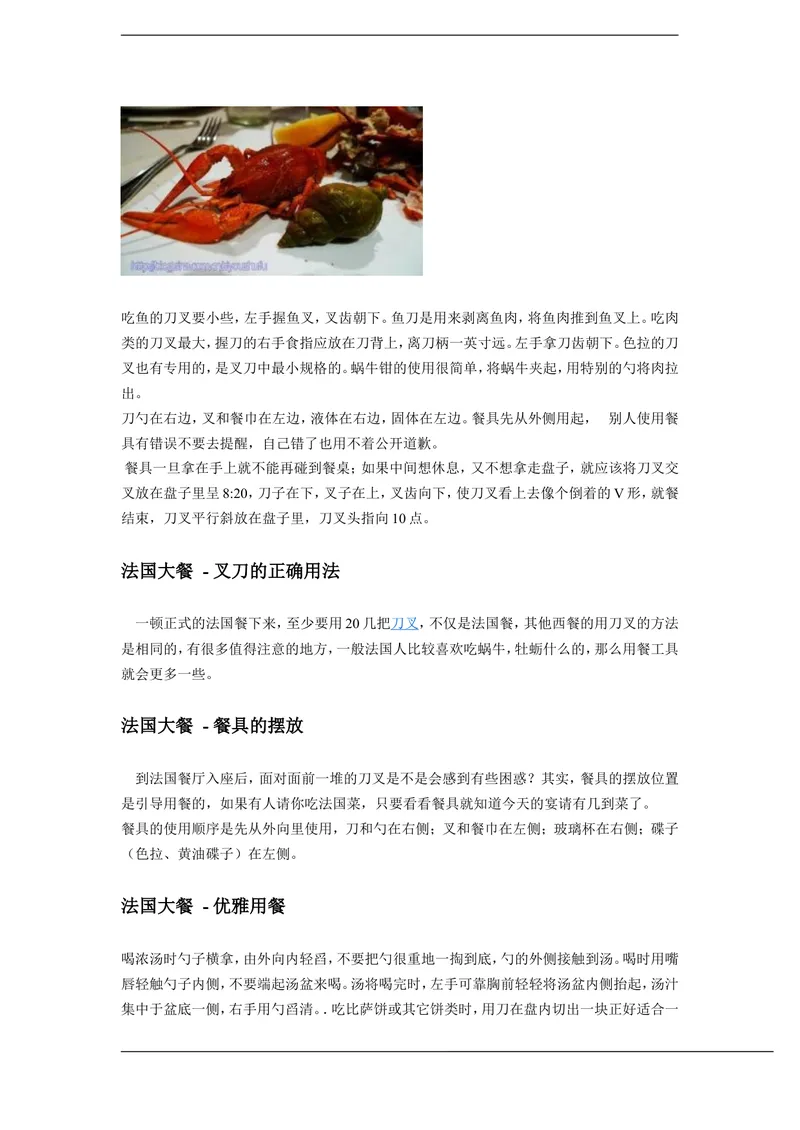
碟朝外倾斜,以使调羹舀其最后一滴汤。吃鱼的刀叉要小些,左手握鱼叉,叉齿朝下。鱼刀是用来剥离鱼肉,将鱼肉推到鱼叉上。吃肉
类的刀叉最大,握刀的右手食指应放在刀背上,离刀柄一英寸远。左手拿刀齿朝下。色拉的刀
叉也有专用的,是叉刀中最小规格的。蜗牛钳的使用很简单,将蜗牛夹起,用特别的勺将肉拉
出。
刀勺在右边,叉和餐巾在左边,液体在右边,固体在左边。餐具先从外侧用起, 别人使用餐
具有错误不要去提醒,自己错了也用不着公开道歉。
餐具一旦拿在手上就不能再碰到餐桌;如果中间想休息,又不想拿走盘子,就应该将刀叉交
叉放在盘子里呈8:20,刀子在下,叉子在上,叉齿向下,使刀叉看上去像个倒着的V形,就餐
结束,刀叉平行斜放在盘子里,刀叉头指向10点。
法国大餐 - 叉刀的正确用法
一顿正式的法国餐下来,至少要用20几把刀叉,不仅是法国餐,其他西餐的用刀叉的方法
是相同的,有很多值得注意的地方,一般法国人比较喜欢吃蜗牛,牡蛎什么的,那么用餐工具
就会更多一些。
法国大餐 - 餐具的摆放
到法国餐厅入座后,面对面前一堆的刀叉是不是会感到有些困惑?其实,餐具的摆放位置
是引导用餐的,如果有人请你吃法国菜,只要看看餐具就知道今天的宴请有几到菜了 。
餐具的使用顺序是先从外向里使用,刀和勺在右侧;叉和餐巾在左侧;玻璃杯在右侧;碟子
(色拉、黄油碟子)在左侧。
法国大餐 - 优雅用餐
喝浓汤时勺子横拿,由外向内轻舀,不要把勺很重地一掏到底,勺的外侧接触到汤。喝时用嘴
唇轻触勺子内侧,不要端起汤盆来喝。汤将喝完时,左手可靠胸前轻轻将汤盆内侧抬起,汤汁
集中于盆底一侧,右手用勺舀清。.吃比萨饼或其它饼类时,用刀在盘内切出一块正好适合一口吃掉的大小,叉子叉住送入口中。
吃面包时一手拿面包,一手撕下一小块放入口里,不要拿着整个面包咬。吃西餐时要衣着整
洁,坐姿端正,背挺直,脖子伸长。最重要的是手一定要保持干净,指甲修剪整 齐。
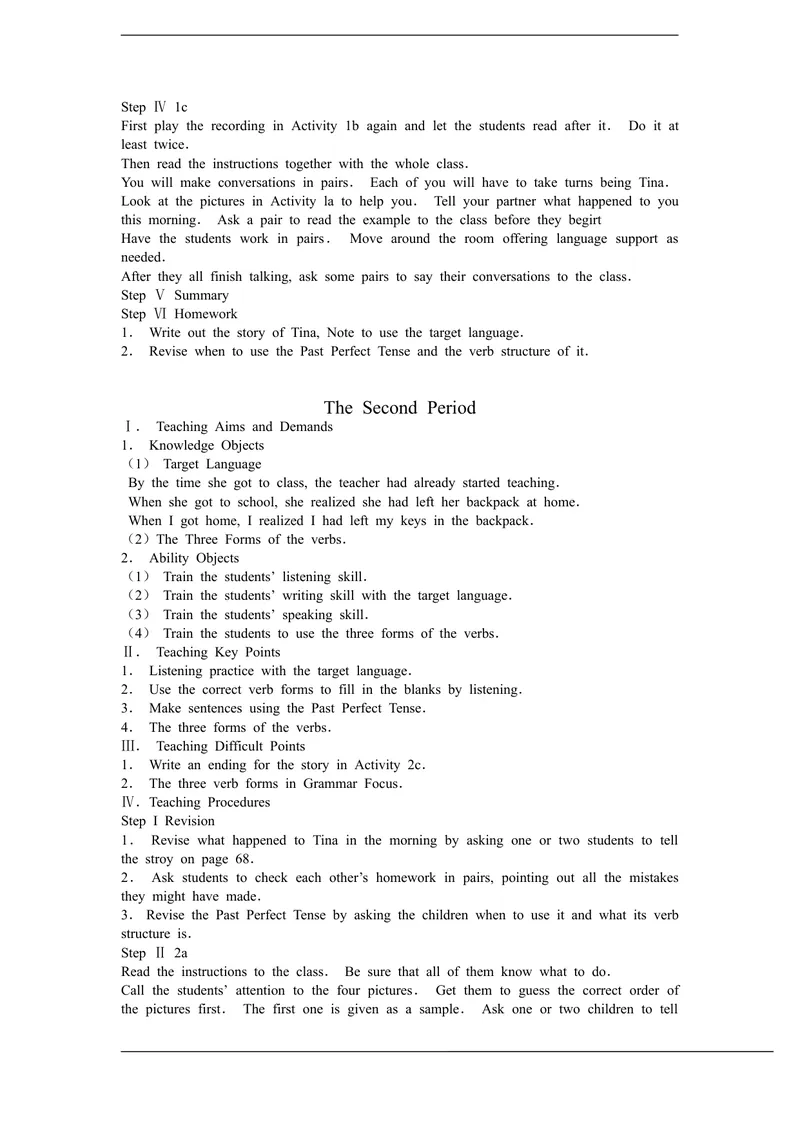
法国大餐 - 法国大餐入选非物质文化遗产名录
新华网巴黎11月16日电,正在肯尼亚首都内罗毕举行的联合国教科文组织保护非物质文
化遗产政府间委员会第五次会议16日经过审议,将法国大餐列入人类非物质文化遗产代表
作名录。
法国媒体说,这是教科文组织首次将一国的餐饮列入非物质文化遗产名录。委员会成员认为,
法式大餐已经融入人们的日常生活,成为个人或团体庆祝重要时刻的习俗。
法国总理菲永得知这一消息后发表公报,对法国大餐入选名录表示祝贺。他说,法国餐饮业
不仅代表一种悠久的传统,还蕴含着优秀的手工艺技能和深厚的文化,并体现了法国独特的
生活艺术。
本次会议15日开幕,为期5天,来自近130个国家和地区的450余名代表出席会议,共有来
自29个国家和地区的47项遗产申报项目被列入人类非物质文化遗产代表作名录。该名录目
前已收录了77个国家和地区的166项非物质文化遗产项目。
Unit 10 By the time I got outside, the bus had already left.
The First Period
Ⅰ. Teaching Aims and Demands
1. Knowledge Objects
(1) Key Vocabulary oversleep
(2) Target Language What happened?
I overslept. And by the time I got up, my brother had already gotten in the shower.
2. Ability Objects
(1) Teach the students to use the new words.
(2) Train the students to narrate past events with the Past Perfect Tense.
(3) Train the students’ listening and speaking skills with the target language.
3. Moral Object
It’s a good habit to go to bed early in the evening and get up early in the morning. So
you’ll never be in a hurry in the morning.
21·cn·jy·com
Ⅱ. Teaching Key Points1. Key Vocabulary oversleep
2. Target Language Narrate past events with the Past Perfect Tense
www.21-cn-jy.com
Ⅲ. Teaching Difficult Points
1. Train the students to narrate past events with the Past Perfect Tense.
2. Train the students to understand the target language in spoken conversation.
Ⅳ. Teaching Methods
1. Thinking of examples from the students’ real lives.
【版权所有:21教育】
2. Making sentences by looking at the pictures.
Ⅴ. Teaching Procedures
Step I Revision
1. Ask some questions like this: What volunteer work would you like to do?
Help the students to answer, I’d like to…/I love to…/I hope to…
2. Practice the dialogue in Activity 3c on page 62 again.
3. Check the students’ homework by asking some students to read their sentences with
the phrasal verbs. Then ask the students to hand in their homework.
Step Ⅱ 1a
First write by the time on the blackboard. and tell the class the meaning of it.
Say this sentence to the class: By the time the teacher came in, the students had begun
reading English.
Tell them to note the structure "had begun" in this sentence. Begun is the past participle
of begin. Explain what is the past participle form of a verb for the students. Tell them
it is as the same as the past form for a regular verb. And they have to remember the
irregular verbs’ participles one by one.
Write By the time I came back…on the blackboard.
Say to the class, By the time I came in. What had happened?
Help one student to answer like this, By the time the teacher came in, Don had written
his name on the blackboard.
Then get more students to answer differently,
Read the instructions to the students and read these questions to the class as well.
What do you usually do in, the morning before school? Do you like morning?
Why or why not?
Choose one good student to answer them by saying something he or she usually does in
the morning.
Then have the whole class practice in pairs. Ask each other the questions.
After they finish talking, ask one or two pairs to say their conversations to the class.
Correct the mistakes they may make with the other students.
Call the students’ attention to the pictures in Activity la.
Then tell students to talk about the pictures in groups of four. Move around the
classroom, listening to students and offering help. Make sure that they talk in English.
After they all finish talking, ask different groups to tell the class about the pictures.
Step Ⅲ 1b
Ask the students to read the instructions together. Have them look at the two columns, A
and B ,in the chart. Point out the sample answer. Read the two parts of the sentence.
Then go over the other unconnected parts of sentences, too.
Play the recording for the first time.
Students only listen. Then play it a second time. Let students match two parts of each
sentence. Check the answers by asking some students to tell their answers.
Make sure that all of them have got the correct answers by listening. Say congratulations
to the students who get the answers correctly by guessing.Step Ⅳ 1c
First play the recording in Activity 1b again and let the students read after it. Do it at
least twice.
Then read the instructions together with the whole class.
You will make conversations in pairs. Each of you will have to take turns being Tina.
Look at the pictures in Activity la to help you. Tell your partner what happened to you
this morning. Ask a pair to read the example to the class before they begirt
Have the students work in pairs. Move around the room offering language support as
needed.
After they all finish talking, ask some pairs to say their conversations to the class.
Step Ⅴ Summary
Step Ⅵ Homework
1. Write out the story of Tina, Note to use the target language.
21教育名师原创作品
2. Revise when to use the Past Perfect Tense and the verb structure of it.
The Second Period
Ⅰ. Teaching Aims and Demands
1. Knowledge Objects
(1) Target Language
By the time she got to class, the teacher had already started teaching.
When she got to school, she realized she had left her backpack at home.
When I got home, I realized I had left my keys in the backpack.
(2)The Three Forms of the verbs.
2. Ability Objects
(1) Train the students’ listening skill.
(2) Train the students’ writing skill with the target language.
(3) Train the students’ speaking skill.
(4) Train the students to use the three forms of the verbs.
Ⅱ. Teaching Key Points
1. Listening practice with the target language.
2. Use the correct verb forms to fill in the blanks by listening.
3. Make sentences using the Past Perfect Tense.
4. The three forms of the verbs.
Ⅲ. Teaching Difficult Points
1. Write an ending for the story in Activity 2c.
2. The three verb forms in Grammar Focus.
Ⅳ.Teaching Procedures
Step I Revision
1. Revise what happened to Tina in the morning by asking one or two students to tell
the stroy on page 68.
2. Ask students to check each other’s homework in pairs, pointing out all the mistakes
they might have made.
3. Revise the Past Perfect Tense by asking the children when to use it and what its verb
structure is.
Step Ⅱ 2a
Read the instructions to the class. Be sure that all of them know what to do.
Call the students’ attention to the four pictures. Get them to guess the correct order of
the pictures first. The first one is given as a sample. Ask one or two children to telltheir stories by describing the pictures according to their own order.
【出处:21教育名师】
Play the recording the first time, students only listen. Play the recording again and ask
the children to number each picture.
Check the answers with the class and see who have ever got the correct answers without
listening.
Step Ⅲ 2b
Ask the students to read the instructions together. Point out the blanks in the sentences
and the verbs in the brackets.
Let the students fill in the blanks with the correct forms individually.
Move around the classroom collecting the common mistakes they may make.
After they all finish writing, tell them to get ready to listen to the conversation and check
their answers.
Play the recording. Students listen and check their answers. Correct the answers by
asking seven different students to say theirs to the class.
Step Ⅳ 2c
Ask the whole class to read the instructions together.
We have a new task now. We know Tina was late for class. What do you think
happened after Tina was late for class?Work with a partner. Make up an ending for the
story by continuing it. The beginning has been given.
Get students to discuss in pairs. Complete the ending. Make sure they are talking in
English. Move around the classroom, offering language support if needed. After ten
minutes, ask students to stop discussing. Get some pairs of students to tell the class how
they think the story ended And let the whole class decide whose ending is the best. Tell
each pair to write down their ending, or do it after class if time is not enough.
Step Ⅴ Grammar Focus
Call students’ attention to the sentences on the left. Ask four different students to read
the four sentences and point out where had plus a past participle is used. Write the
sentences on the blackboard.
Ask the students to make sentences correctly using each form of the verbs in the box.
Check the answers.
Step Ⅵ Homework
1. Write down the ending of Tina’s story.
2. Make sentences using each form of the verbs below:
leave, walk, start, oversleep, ring, be
3. Review the Grammar Focus.
The Third Period
Ⅰ. Teaching Aims and Demands
1. Knowledge Objects
(1) Key Vocabulary
bell, ring, go off, rush, run off, on time, give sb. a ride, lock, break down
(2) Target Language
By the time I got there, the bus had already left.
21·世纪*教育网
By the time I woke up, my father had already gone into the bathroom.
2-1-c-n-j-y
2. Ability Objects
Train the students’ reading skill with target language.
21cnjy.com
Train the students’ speaking skill with target language.
21*cnjy*com
Ⅱ. Teaching Key Points
1. Guide the students to read the article in activity 3a.2. Help the students do the oral practice with the target language.
Ⅲ. Teaching Difficult Points
1. Help improve the students’ reading skill by Activity 3a.
2. Help the students describe what has happened to them with the target language.
Ⅳ. Teaching Procedures
Step Ⅰ Revision
1. Revise what happened to Tina by asking several students to tell the story.
2. Revise the three forms of the verbs in Grammar Focus by asking four students to
write them out on the blackboard.
3. Check homework by asking one or two to read their own endings of the stroy.
4. Check homework by asking some students to read the sentences which they made.
Step Ⅱ 3a
Ask the whole class to read the instructions together. There is an article in Activity 3a.
Your task is to read the story and write the events in the correct order.
Have a look at the sample answer on the right of the article before you start. Then let
the children complete the work on their own. After a while, ask some students to report
their answers to the class. Write the events on the blackboard as they report, putting the
events in the correct order.
After checking the answers, tell students to read the article again more carefully.
Tell them to find out the words or sentences which they can’t understand this time.
A few minutes later, let the students ask questions on the words and sentences which
they can’t understand. Do some explanation and make sure that the students make
everything clear about the article.
2·1·c·n·j·y
Then ask the students to read the article aloud. Move around the classroom while they
are reading, offering help as needed.
Next ask students to pick out the sentences with the Past Perfect Tense. Tell them to
underline them and come up with the reason to use the tence.
21教育网
Ask two students to read their answers and explain the sentences.
Step Ⅲ 3b
Call the students’ attention to the photo of the woman sleeping. The girl is sleeping.
She may oversleep. How about you?
Have you ever overslept?
Get a students to answer the question simply, such as Yes, I have. /No, I haven’t.
Then ask one student to read the instructions to the class.
Explain that describe the circumstances means to tell when, where and how the things
happened.
Ask one student who has ever overslept to answer the first question and describe the
circumstance. Help him or her use the Past Perfect Tense to describe the circumstance.
Then ask students to read the questions and write their answers in their exercise books.
Tell them that they have to describe the circumstances if their answers are Yes, and there
should be at least one sentence with the Past Perfect Tense in each description. Move
around the classroom providing sentences to the ones who need. Ask several students to
share their stories with the class. Correct any mistakes they may make. Let them check
the answers in pairs.
Step Ⅳ 3c
Ask the whole class to read the instructions together. Then call the students’ attention to
the sample conversation on the right. Ask a pair of the students to read the conversation
to the class. Please ask your partner the questions in Activity 3b. Ask more questions if
he or she says "Yes".Ask the students to work in pairs. Encourage them to ask as many questions as they
can. As they work, move around the room offering help and answering questions as
needed. Ask some pairs to say their conversations to the class.
Step Ⅵ homework
1. Write the answers to the questions in Activity 3b.
2. Write a conversation in Activity 3c.
The Fourth Period
I. Teaching Aims and Demands
1. Knowledge Objects
(1) Key Vocabulary
costume, show up, exhausted, embarrassed, empty, fool, April Fool’s Day, go off, stay up
(2)Target Language
When I got there, I found that he had fooled me.
After an hour, the other kids showld up, and I realized that my brother had fooled me.
By the time I got to match class, I was exhausted because I had stayed up all night
studying.
I found out that my friend had fooled me.
2. Ability Objects
(1) Train the students’ writing, listening and speaking skills with the target language.
(2)Train the students to use the new vocabulary.
Ⅱ. Teaching Key Points
1. Train the students’ listening and speaking skills with target language.
2. Teach the students the new vocabulary.
Ⅲ. Teaching Difficult Points
1. Guide listening and oral practice using the target language.
2. Help learn to use the new vocabulary correctly.
Ⅳ. Teaching Procedures
Step I Revision
1. Revise the article in Activity 3a on page 70 by asking several students to read it.
2. Dictate some words and phrases:
3. Check the homework.
Step Ⅱ 1a
Read the instructions to the students. Remember to read the sentence in the brackets.
Point to the chart with the three headings Nouns, Verbs and Adjectives. Read the words
in the brackets to the students and help the students to understand the meanings of nouns,
verbs and adjectives.
Get a student to read the sample answers to the class before they start say, Fool call also
be a verb. Ask the students to complete the chart on their own.
Correct the answers by asking three students to read their answers to the class.
Step Ⅲ 1b
Ask a student to read the instructions to the class.
www-2-1-cnjy-com
Ask another student to read the example on the right.
Work in pairs now. Tell your partner about something that has happened to you recently.
Note to use two or more phrases from the list in Activity la. Get tile students to talk in
pairs. Move around the classroom checking their work and offering language support as
needed.
After they all finish talking, ask some pairs to say their conversations to the class.
Step Ⅳ 2aSay something about April Fool’s Day to the students
Call the students’ attention to the four pictures. Ask the students what is happening in
each picture.
Ask four different students to describe the pictures.
Read the instructions to the class.
Play the tape the first time. The students only listen. Then play the tape again. Ask the
students to write each boy’s name in the correct box. Check the answers by asking
different students to tell their own answers.
Step Ⅴ 2b
Read the instructions to the class. There are six phrases in the box. Your task is to find
out who says each of the phrases, Dave, Nick or Joe after listening to the same
recording. And write "D" for Dave, "N" for Nick and "J" for Joes on the short lines
before the phrases. Look at the first one. The answer has been given as a sample.
【来源:
21cnj*y.co*m】
Play the recording the first time. The students only listen. Then play the recording
again. Ask the students to write the letters in the blanks. Ask six different students to
report their answers to the class. Check the answers with the class.
Step Ⅵ 2c
This activity provides oral practice using the target language.
First play the recording again. Pause after each sentence and get the students to repeat.
Do it at least twice.
Ask a student to read the instructions to the class. Then have them look at the sample
conversation on the right. Ask a pair of the students to read and try to continue it
Then ask the students to work in pairs.
Each pair makes two conversations using information from the earlier activities.
Move around the room as they work, offering help as needed. Ask one or two pairs to
say their conversations to the class.
Step Ⅶ Homework
1. Write something that has happened to you recently. Use two or more phrases from
the list in Activity 1a.
2. Write a conversation in Activity 2c.
The Fifth Period
Ⅰ. Teaching Aims and Demands
1.Knowledge Objects
(1) Key Vocabulary
announce, describe, convince, panic, set off, authority, reveal, hoax, flee/fled/fled, spaghetti,
girl-friend, Show, marry, thrill, get married, reply, ending
21世纪教育网版权所有
(2) The reading passages about April Fool’s Day.
(3) Write stories happened on April Fool’s Day.
2. Ability Objects
(1) Train the students’ reading skill.
(2) Train the students’ writing and speaking skills.
【来源:21·世纪·教育·网】
Ⅱ. Teaching Key Points
1. Teach the students the new vocabulary.
2. Help the students understand the three articles.
3. Guide the students to write stories happened on April Fool’s Day.
Ⅲ. Teaching Difficult Points
1. Help the students understand the three articles.2. Help the students write the stories happened on April Fool’s Day.
Ⅳ. Teaching Procedures
Step I Revision
1. Revise the three boy’s stories happened on April Fool’s Day. Ask three different
students to tell their stories to the class.
2. Check the homework.
Step Ⅱ 3a
Read the instructions to the students.
You’ll have to read three articles. The three articles are about three different stories
happened on April Fool’s Day.
Not all of them are true. Tell which of these stories is the most believable and which is
the least believable. And you have to tell the reasons as well. At last, think over if you
would be fooled by any of the stories.
Read the first article to the class. The students look at their books, listen to the teacher
and find out the answers to the questions in the instructions.
After reading, ask the students if it is believable and why. Ask several students to tell
their opinions on the believability the first article. They may say like this:
I think it is believable because the exact time and person’s name are given in the first
sentence, or, I don’t think it’s believable because I think no one dared to fool the people
like that.
Do the same with the two articles left.
Ask two good students to read the articles instead of the teacher. Elicit students’ reasons
for their answers. At last tell the students the correct answer.
Step Ⅲ 3b
Read the instructions to the class. Play the recording again to help the students.
Ask three different students to read the notes to the class.
Help the students make sentences with the notes first.
After making sentences, ask the students to write a magazine story about Nick in
Activities 2a and 2b, using the notes below. As they write, move around the room
offering help and answering questions as needed.
After around ten minutes, ask a student to read the completed article to the class.
The rest of the class help correct the mistakes the student may have made. Get them to
check each’ other’s writing carefully in pairs.
Step Ⅳ 3c
Read the instructions to the class. Be sure that the students know what they are asked to
do. At first, have the students think what they might write about.
Then tell them to make a list of ideas before starting writing. The list should include the
three parts, what happened first, what happened next, and what you finally realized.
Write a sample list on the blackboard:
Next ask the students to write their jokes.
Ask some students to read their articles to the class. Correct as many of the articles as
possible in class.
Step Ⅴ 4
Read the instructions to the class. Review the meanings of funniest, most embarrassing
and most creative.
Have the class have a look at the sample conversation in the box before reading.
Ask a pair of the students to read it to the class.
Then ask the students to read their stories to the class. After all of the students have
read, ask the class to vote for the funniest, most embarrassing and most creative stories.Step ⅥHomework
1. Read the three articles aloud after class.
2. Correct the magazine story and the joke you have written.
3. Try to remember the new vocabulary.
The Sixth Period
Ⅰ. Teaching Aims and Demands
1. Knowledge Objects
(1) Verbs
rush, realize, invite, show up, stay up.
(2) Write an article according to the pictures given.
(3) Vocabulary
homework, look, costume, empty
2. Ability Objects
(1)Train the students to use these verbs correctly:
rush, realize, invite, show up, stay up.
(2)Train the students’ writing skill.
Ⅱ. Teaching Key Points
1. Help the students have a self check on the key words and target language of this
unit.
2. Practise using these verbs: rush, realize, invite, show up, stay up.
3. Review the new vocabulary introduced in this unit: homework, lock, costume, empty.
4. Direct the students to write an article according to the pictures given.
Ⅲ. Teaching Difficult Points
1. Help the students make sentences with the verbs.
21*cnjy*com
2. Direct the students to write an article with the pictures given.
Ⅳ. Teaching Procedures
Step I Revision
1. Revise the contents in the three articles in Activity 3a on page 72 by asking some
questions
2. Ask three different students to read the articles.
Step Ⅱ Part 1
This activity focuses on vocabulary introduced in the unit. Focus attention on the box.
Invite a student to read the vocabulary words at the top.
Ask students to fill in the blanks on their own. Check the answers.
Ask students to make their own sentences with the words, preferably sentences that are
meaningful. Move around the room.Collect a few students’ answers with mistakes on the
blackboard. Along with the students’ help correct the mistakes.
Step Ⅲ Part 2
Have the students look at the seven pictures. Tell the children that the pictures are
connected to each other in an order.
Ask: What is happening to Ming?
Get the whole class to read the instructions. Then ask the students to describe each
picture in order. Write some useful sentences on the blackboard. For example, for the
first picture, help the students to say Ming wakes up at 10:00 and thinks she is late for
school.
After a while, ask a few students to tell the class about Ming’s day. Let the rest of the
class help correct the mistakes that they may have made.
Tell them to exchange their articles with their partners and help each other correct themistakes. Ask the students to rewrite their articles to make the articles perfect after
class.
Step Ⅳ Part 3
Call the students’ attention to the box. Have them look at the four groups of words.
Get the students to read the instructions together. Ask them to circle the words that don’t
belong in each group.
The first one has been given as a model.
Ask some students to tell their answers to the class. Check the answers with the whole
class.
Step Ⅴ Just for Fun!
Call the students’ attention to the cartoon pictures. Tell them to see what happens.
Ask the students to read the sentences under the pictures together.
Then ask the children what is, funny about this cartoon. Help the students to answer like
this:
The boy saw the clouds and he felt the rain long before he got home. He should have
realized much sooner that he had forgotten his umbrella.
Step Ⅵ Homework
1. Revise all the language points in this unit.
2. Finish off the exercises on pages 36~38 of the workbook.
3. Make another more sentence with each verb below, rush, realize, invite, show up,
stay up.
4. Rewrite the article.