新人教版新目标英语九年级上全册试讲教案
Good morning, everyone. Today I`m very pleased to have an opportunity to talk about some of
my teaching ideas. The content of my lesson is xxx.
I`ll be ready to begin this lesson from four parts. They are 1Analyzing teaching Material
2.the teaching methods 3.the studying methods 4.the teaching procedures, and while
presenting these parts I will do the blackboard design properly. Ok now I am going to start
from the first part
Part 1 Analyzing teaching Material:
This lesson is about.By studying of this lesson, we`ll enable the students to know the
serious attitude towardsand develop the interest in
At the same time, let the students learn how to give instructions. This lesson plays an
important part in the English teaching in this unit. As it is the main passage in this unit
which outlines the theme of this unit .If the Ss can learn it well, it will be helpful to
make Ss learn the rest of this unit. And as we all know , reading belongs to the input
during the process of language learning. The input has great effect on output, such as
speaking and writing. Then according to the new standard curriculum and syllabus(新课程标准
和教学大纲), I think the teaching aims of this lesson are the following:
1.Knowledge aim:Understand the main idea of the text.
2. Ability aim: Retell the text in their own words.
3.Emotional aim: Make the Ss love
Then the Teaching important point is how to understand the text better
And the teaching difficult points are:
1. Use own words to retell the text
2. Discuss the
Part 2 Teaching methods:
Dealing with this lesson. I`ll do my best to carry out the following theories: Make the Ss
the real masters in class while me, myself acts as director; Combine the language
structures with the language functions; Let the Ss receive some moral education while they
are learning the English language. To achieve my goal I`ll use the following teaching
methods:
1.Commucative Approach(交际教学法)
12.Task based watch and listen activity
3. Question and answer activity
4.Pair work or individual role play or scene play activity
And in order to practice my teaching methods well, I need the following teaching aids
1. a projector
2. a tape recorder
3. multimedia
4. the blackboard
Part 3 Studying Methods:
As Ss are poor in cooperative learning skill, manySs are not active in class, and even some
of them don`t like English. Therefore, I `ll have Ss study in a relaxed atmosphere. The
learning process of students is from seeing, thinking,saying . So after feeling and
understanding the language points, I will let the students get the knowledge actively by
cooperative study. In a word I will
1. Let the Ss pass observation -imitation-practice to study language.
2. Teach the Ss how to master dialogues and how to communicate with others.
Part 4 Teaching Procedure:
I have designed the following steps to train their ability of listening, speaking, reading
and writing. Especially reading ability.
Step1.Lead-in
Have a free talk about ---and then discuss the question in pre-reading on page
Purpose: arouse the Ss` interest of study
Step2. Listening comprehensions
1. Present the students the questions before listening to the text
AB
2.Get the students to listen to the tape and then answer the questions.
Purpose: Train the Ss` listening ability to grasp the general idea of a passage and prepare
for the later exercises.
Step3.Fast reading
2Read the passage as quickly as they can. I will use the question and answer activity to
help them get the main idea of each paragraph, then ask them to use their own words to
conclude the main ideas of each paragraph.
Purpose: Improve the Ss` fast reading skills like skimming reading and scanning reading.
Understand the general idea of each paragraph.
Step4 Intensive reading
Read the passage carefully again and answer some detailed questions.
AB C
it is also called depth reading or study reading. It means reading for detailed
information.
Purpose: Further understand the text to find out some different sentences and details of
the text.
Step5.Retell the passage
1.I will list out the general idea of each paragraph which the Ss have concluded in fast
reading
2. Encouraging Ss to use their own words to retell the passage according to the general
ideas .
Purpose: I want to check if my students really understand the whole text and if they master
what I mean to tell them in this class. What`s more, I want to make the students practice
their oral English through retelling.
Step6.Language points
I will show the important words phrases and sentences which the Ss need to learn in this
passage on the screen one by one. Then give them the right usages of these new language
points. What`s more I will ask Ss to make sentences by using these newly learnt words and
phrases.
Step 7.Pair work or individual role play or scene play activity
Purpose: I mean to give them emotional education. I give them muti-media pictures to arouse
their interest of study and their love for
Step 8 Summary
I will go through the important points and difficult points of this lesson with the
students once again.
3Step 9 Homework
Write an article of I want to improve the ability of their writing. At the same time, train
the ability of do it yourself and looking up the information by themselves.
Above is my teaching plan of this lesson. Thank you for listening.
注:关于blackboard(板书设计),在试讲前在黑板上表出课题,然后只需在试讲过程中根据内容需要(比如
课程导入或者课堂活动时)稍许写一下,切忌满篇板书而减少了试讲时间,也最好不要把板书设计单独成为
一个部分。
4学科 English 课型 fresh 年级 9
课题 Unit 1 How do you study for a test? 1/5
教学媒
A tape recorder , CAI
体
1.Key words: vocabulary, flashcard
知识
2.Target Language;
技能
How do you study for a test?
教
I study by…….
学
过程 According to designing some tasks, train students’
目
方法 listening skill.
标
Maybe you find English frustrating sometimes. But
情感
remember not to give it up.
态度
As we know, where there is a will, there is a way
1. Key words : vocabulary, flashcard
2. Target Language
教学重 How do you study for a test?
I study by…….
点
3. structure
verb + by with gerund.
教学难
verb + by with gerund
点
教学内容及教师活动 学生活动 设计意图
Step 1 : Warm-up
1. Greetings. Answer the 通过师生对于假
2. Ask some students about their summer questions and 期的对话,在轻松
holiday talk about their 的氛围中为本课
(Teacher shows a flashcard with the word holidays. 的学习掀开了序
Shanghai and asks one student.) 幕。
Teacher shows the others and teaches the Review the new
word “flashcard” to the students. word.
Step 2: Revision
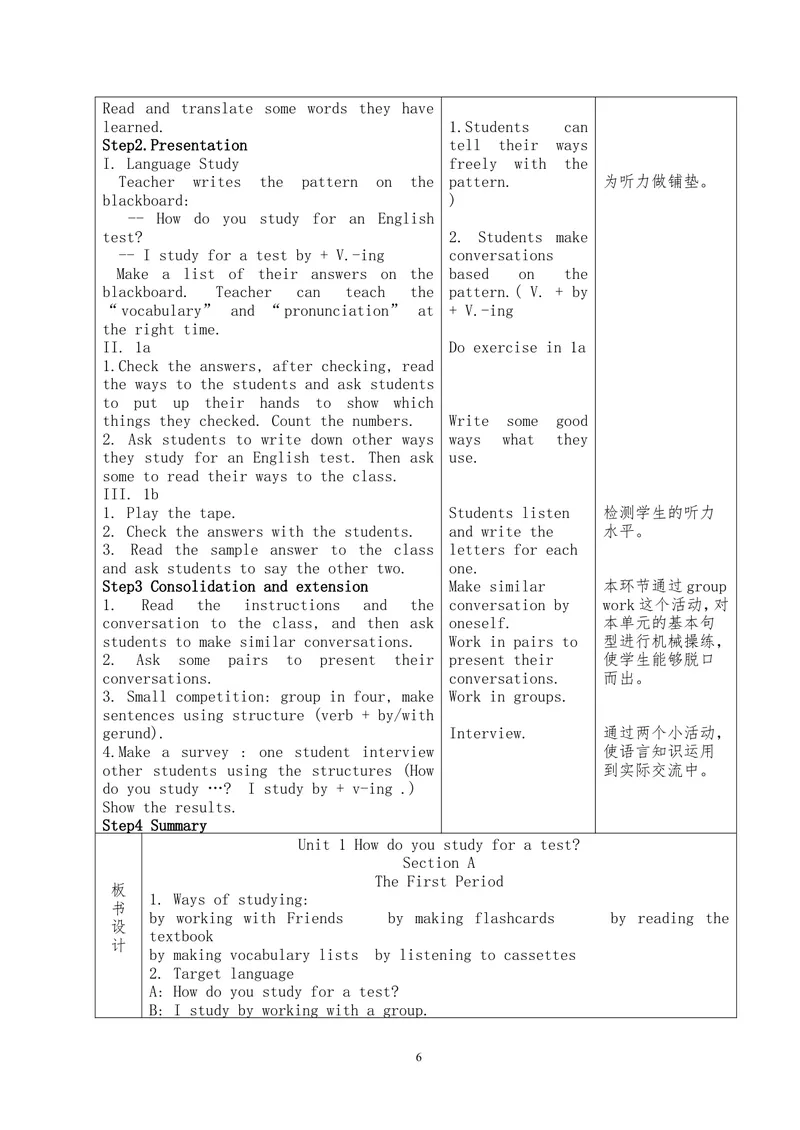
5Read and translate some words they have
learned. 1.Students can
Step2.Presentation tell their ways
I. Language Study freely with the
Teacher writes the pattern on the pattern. 为听力做铺垫。
blackboard: )
-- How do you study for an English
test? 2. Students make
-- I study for a test by + V.-ing conversations
Make a list of their answers on the based on the
blackboard. Teacher can teach the pattern.( V. + by
“vocabulary” and “pronunciation” at + V.-ing
the right time.
II. 1a Do exercise in 1a
1.Check the answers, after checking, read
the ways to the students and ask students
to put up their hands to show which
things they checked. Count the numbers. Write some good
2. Ask students to write down other ways ways what they
they study for an English test. Then ask use.
some to read their ways to the class.
III. 1b
1. Play the tape. Students listen 检测学生的听力
2. Check the answers with the students. and write the 水平。
3. Read the sample answer to the class letters for each
and ask students to say the other two. one.
Step3 Consolidation and extension Make similar 本环节通过group
1. Read the instructions and the conversation by work这个活动,对
conversation to the class, and then ask oneself. 本单元的基本句
students to make similar conversations. Work in pairs to 型进行机械操练,
2. Ask some pairs to present their present their 使学生能够脱口
conversations. conversations. 而出。
3. Small competition: group in four, make Work in groups.
sentences using structure (verb + by/with
gerund). Interview. 通过两个小活动,
4.Make a survey : one student interview 使语言知识运用
other students using the structures (How 到实际交流中。
do you study …? I study by + v-ing .)
Show the results.
Step4 Summary
Unit 1 How do you study for a test?
Section A
The First Period
板
1. Ways of studying:
书
by working with Friends by making flashcards by reading the
设
textbook
计
by making vocabulary lists by listening to cassettes
2. Target language
A: How do you study for a test?
B: I study by working with a group.
6教
学
反
思
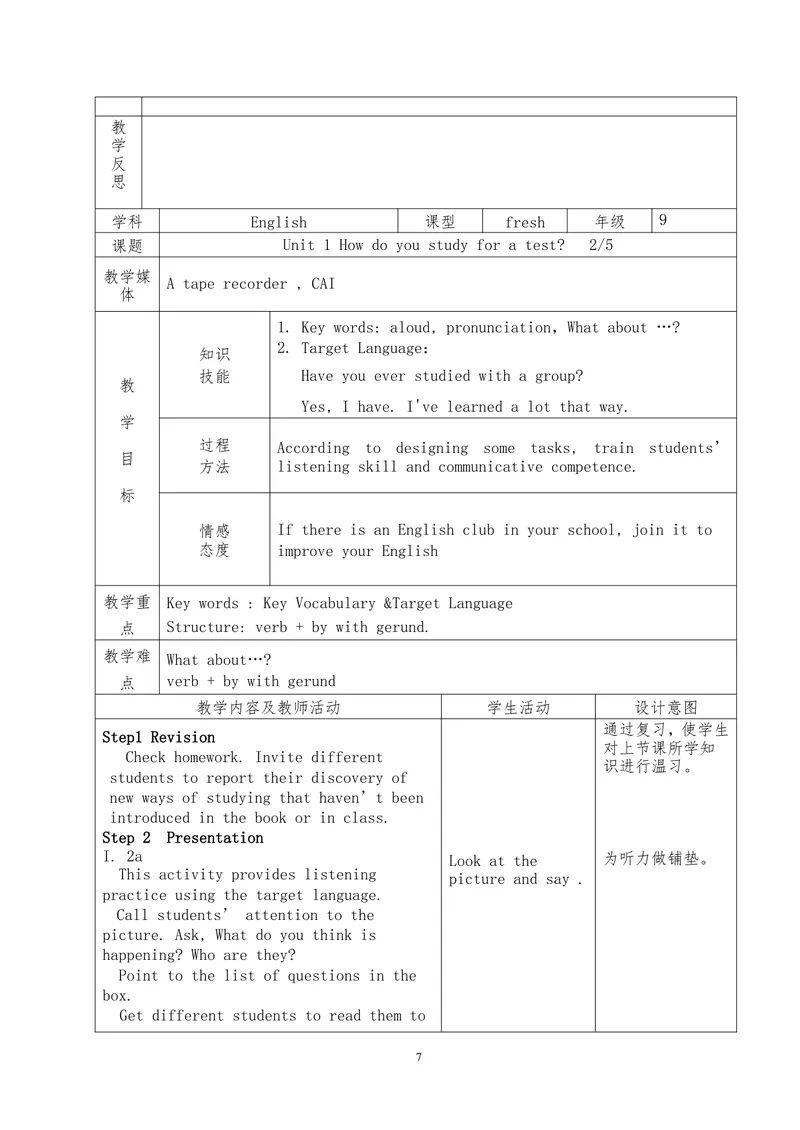
学科 English 课型 fresh 年级 9
课题 Unit 1 How do you study for a test? 2/5
教学媒
A tape recorder , CAI
体
1. Key words: aloud, pronunciation,What about …?
2. Target Language:
知识
技能 Have you ever studied with a group?
教
Yes, I have. I've learned a lot that way.
学
过程 According to designing some tasks, train students’
目
方法 listening skill and communicative competence.
标
情感 If there is an English club in your school, join it to
态度 improve your English
教学重 Key words : Key Vocabulary &Target Language
点 Structure: verb + by with gerund.
教学难 What about…?
点 verb + by with gerund
教学内容及教师活动 学生活动 设计意图
通过复习,使学生
Step1 Revision
对上节课所学知
Check homework. Invite different
识进行温习。
students to report their discovery of
new ways of studying that haven’t been
introduced in the book or in class.
Step 2 Presentation
I. 2a Look at the 为听力做铺垫。
This activity provides listening
picture and say .
practice using the target language.
Call students’ attention to the
picture. Ask, What do you think is
happening? Who are they?
Point to the list of questions in the
box.
Get different students to read them to
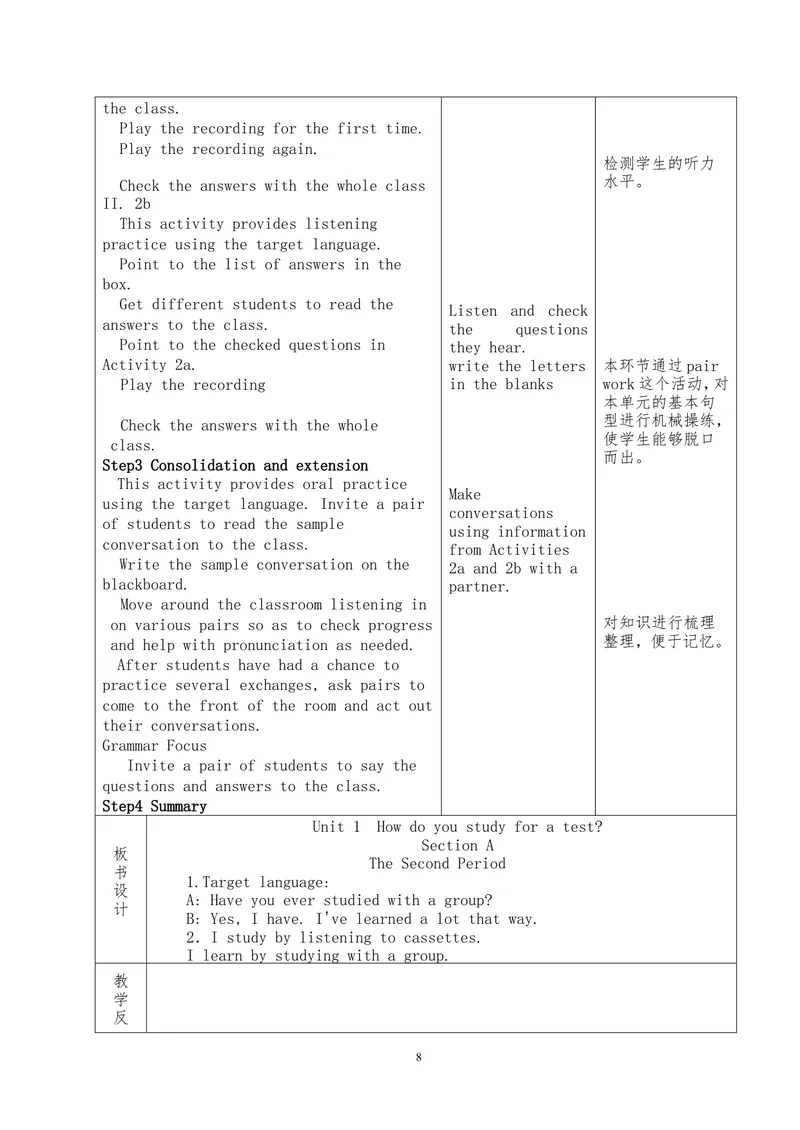
7the class.
Play the recording for the first time.
Play the recording again.
检测学生的听力
Check the answers with the whole class 水平。
II. 2b
This activity provides listening
practice using the target language.
Point to the list of answers in the
box.
Get different students to read the
Listen and check
answers to the class.
the questions
Point to the checked questions in they hear.
Activity 2a. write the letters 本环节通过pair
Play the recording in the blanks work这个活动,对
本单元的基本句
型进行机械操练,
Check the answers with the whole
使学生能够脱口
class.
而出。
Step3 Consolidation and extension
This activity provides oral practice
Make
using the target language. Invite a pair
conversations
of students to read the sample
using information
conversation to the class.
from Activities
Write the sample conversation on the 2a and 2b with a
blackboard. partner.
Move around the classroom listening in
on various pairs so as to check progress 对知识进行梳理
and help with pronunciation as needed. 整理,便于记忆。
After students have had a chance to
practice several exchanges, ask pairs to
come to the front of the room and act out
their conversations.
Grammar Focus
Invite a pair of students to say the
questions and answers to the class.
Step4 Summary
Unit 1 How do you study for a test?
Section A
板
The Second Period
书
1.Target language:
设
A: Have you ever studied with a group?
计
B: Yes, I have. I've learned a lot that way.
2.I study by listening to cassettes.
I learn by studying with a group.
教
学
反
8思
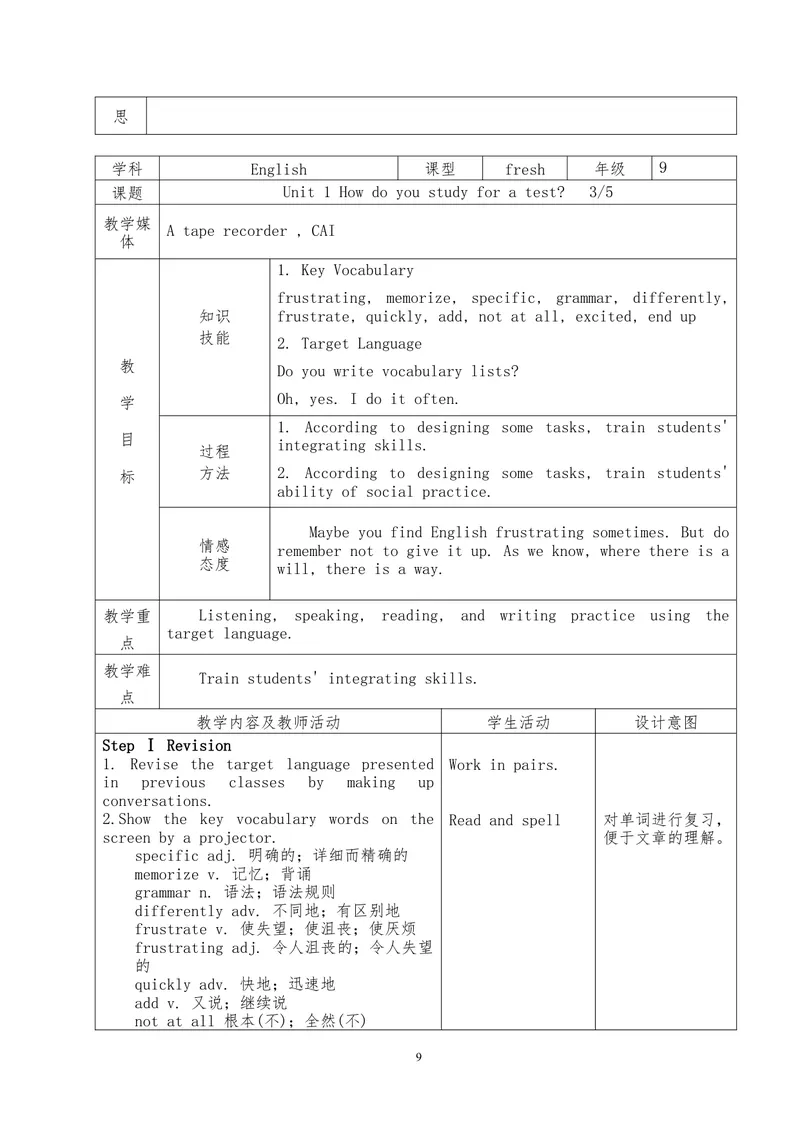
学科 English 课型 fresh 年级 9
课题 Unit 1 How do you study for a test? 3/5
教学媒
A tape recorder , CAI
体
1. Key Vocabulary
frustrating, memorize, specific, grammar, differently,
知识 frustrate, quickly, add, not at all, excited, end up
技能
2. Target Language
教
Do you write vocabulary lists?
Oh, yes. I do it often.
学
1. According to designing some tasks, train students'
目
integrating skills.
过程
标 方法 2. According to designing some tasks, train students'
ability of social practice.
Maybe you find English frustrating sometimes. But do
情感
remember not to give it up. As we know, where there is a
态度
will, there is a way.
教学重 Listening, speaking, reading, and writing practice using the
target language.
点
教学难
Train students' integrating skills.
点
教学内容及教师活动 学生活动 设计意图
Step Ⅰ Revision
1. Revise the target language presented Work in pairs.
in previous classes by making up
conversations.
2.Show the key vocabulary words on the Read and spell 对单词进行复习,
screen by a projector. 便于文章的理解。
specific adj. 明确的;详细而精确的
memorize v. 记忆;背诵
grammar n. 语法;语法规则
differently adv. 不同地;有区别地
frustrate v. 使失望;使沮丧;使厌烦
frustrating adj. 令人沮丧的;令人失望
的
quickly adv. 快地;迅速地
add v. 又说;继续说
not at all 根本(不);全然(不)
9excited adj. 激动的;兴奋的
end up 结束;告终
Say the words and have the students
repeat again and again until they can
pronounce the words fluently and
accurately.
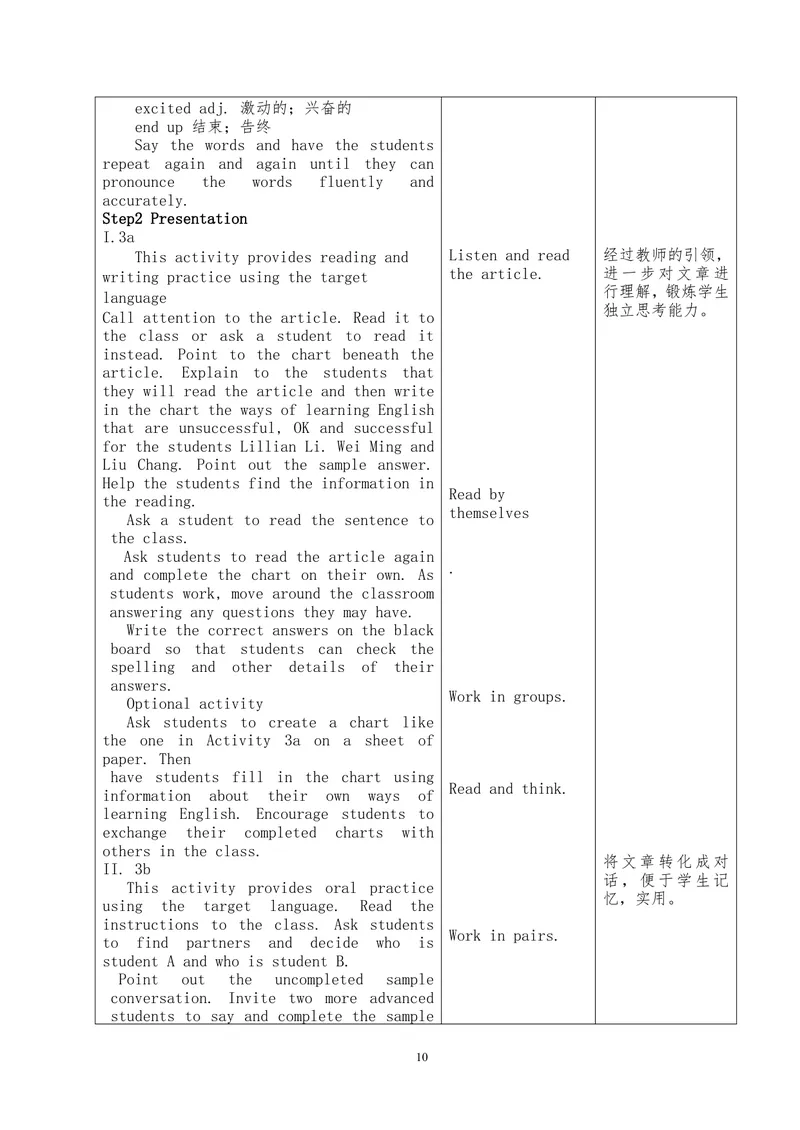
Step2 Presentation
I.3a
This activity provides reading and Listen and read 经过教师的引领,
writing practice using the target the article. 进一步对文章进
行理解,锻炼学生
language
独立思考能力。
Call attention to the article. Read it to
the class or ask a student to read it
instead. Point to the chart beneath the
article. Explain to the students that
they will read the article and then write
in the chart the ways of learning English
that are unsuccessful, OK and successful
for the students Lillian Li. Wei Ming and
Liu Chang. Point out the sample answer.
Help the students find the information in
Read by
the reading.
themselves
Ask a student to read the sentence to
the class.
Ask students to read the article again
.
and complete the chart on their own. As
students work, move around the classroom
answering any questions they may have.
Write the correct answers on the black
board so that students can check the
spelling and other details of their
answers.
Work in groups.
Optional activity
Ask students to create a chart like
the one in Activity 3a on a sheet of
paper. Then
have students fill in the chart using
Read and think.
information about their own ways of
learning English. Encourage students to
exchange their completed charts with
others in the class.
将文章转化成对
II. 3b
话,便于学生记
This activity provides oral practice
忆,实用。
using the target language. Read the
instructions to the class. Ask students
Work in pairs.
to find partners and decide who is
student A and who is student B.
Point out the uncompleted sample
conversation. Invite two more advanced
students to say and complete the sample
10conversation.
Step 3 Consolidation 通过此活动,让学
Part 4 Interview DO the exercise 生对本课内容进
This activity provides reading, in part 4 一步理解
writing, listening and speaking practice 。
using the target language.
Read the instructions to the class.
Focus attention on the chart. Get
students to check what they do to learn
English. You may wish to give an example 将所学到的知识
from your own experience. Remind the 结合到实际生活
students of the differences among often, 当中,激发学生兴
sometimes and never. Invite a pair of 趣,能够更好记
students to say the sample conversation 忆。
to the class.
Write the conversation on the
blackboard.
Ask the students to work in pairs.
Interview your partner and fill in the
chart. As the students do this, walk
around the room to make sure that they
ask and answer questions in English and
fill in the chart correctly.
If time permits, ask a few students to
tell the class about the partners they
have interviewed.
Step4 Summary
Unit 1 How do you study for a test?
Section A The Third Period
板
1. Target language:
书
A: Do you write vocabulary lists?
设
B: Oh, yes. I do it often.
计
A: How do you study for a test?
B: I study by working with a group.
教
学
反
思
学科 English 课型 fresh 年级 9
课题 Unit 1 How do you study for a test? 4/5
教学媒
A tape recorder , CAI
体
教 知识 1. Key vocabulary:
技能 spoken, make mistakes, comma, challenge, solution,
11later on, realize, be afraid to, laugh at, complete,
secret, learner, take notes
2. Key structures:
I can’t understand spoken English.
I don’t have a partner to practice English with.
学
It wasn’t easy for me to understand the teacher
when she talked to the class.
目
过程 According to designing some tasks to train students’
标
方法 listening、reading and writing ability.
情感
态度
1. Key Vocabulary
教学重
2. Reading an article.
点 3. Writing something using the target language.
教学难
Writing a letter using the target language.
点
教学内容及教师活动 学生活动 设计意图
Step 1. Greetings and Lead-in
1. Check the homework. 复习单词,为学习
2. Read the new words and correct the Read the words. 文章扫除障碍。
pronunciation.
Step2 Presentation
I
1a/1b
1. Read the instructions to the class. Work in groups.
2. Ask students to find ways to solve 。
them.
II. 2a Listen and do 2a 锻炼听力
1.Play the tape.
2. Check the results with the students. Listen and do 2b
III. 2b
1.Play the tape. Work in pairs.
2. Check the work with the students.
Step3 Consolidation and extension
I.2c Pair work
1. Read the instructions and the
conversation to the class, then ask
students to make similar conversations. Look
2. Ask some pairs to present their 培养学生阅读能
conversations. Read after the 力。
II.3a tape.
1.Show the question:” how she learned to Do exercise about
learn English.” 3a
122. Focus students’ attention on the ask their
article and repeat after the tape. difficult points
3. Ask the students to write if the on this article.
statements are true or false.
4. Check the work with the students. Read and write.
III. 3b
1. Read the instructions to the class. 训练学生写作能
Point to the blanks in the letter. 力。
Explain that they can look back 2b and
then fill in the blanks in the letter.
2. Do the first two fill-ins with the
students and ask them to complete the
letter. Move around seeing if they need
any help.
3. Ask two or three students to read
their completed letters to the class.
Step4 Summary
Unit 1 How do you study for a test?
A sample letter to Activity 3b:
板 Dear Wei Ming,
书 I know it isn’t easy to Learn English, but I have …,not every word.
设 You also said that you often forgot a lot of new words. Well, try
计 writing the new words in your notebook and studying at home. That helps
a lot. If you keep on doing this, you will get good grades in English.
Your friend,
Liu Chan
教
学
反
思
学科 English 课型 fresh 年级 9
课题 Unit 1 How do you study for a test? 5/5
教学媒
A tape recorder , CAI
体
1. Key vocabulary:
教 look up, make up, deal with, be angry with, go by,
try one’s best, break off,
学
知识 2. Key structures:
技能 Rich or poor, young or old, we all have problems.
目
Time goes by.
标 It is sour duty to try our best to deal with each
challenge in our education with the help of our
teachers.
13过程 According to designing some tasks to train students’
方法 reading and writing ability.
Maybe you find English frustrating sometimes. But do
remember not to give it up. As we know, where there is a
情感
will, there is a way.
态度
Read the text to identify main idea.
教学重
Read the text to understand words in context.
点
Read the text for special information.
教学难
Train students' reading skill.
点
教学内容及教师活动 学生活动 设计意图
Step 1. Greetings and Lead-in
1. Check the homework.
2. Read the new words and correct the Read 复习单词,为理解
pronunciation. 文章做准备。
Step 2. Presentation
I.Self Check
1. Read the instructions to the class. Do part 1
2. Ask students to fill in the blanks on
their own. They may need to use another
form of the word. Check the answers 培养学生独立思
3. Check the answers with the students. and tell the 考能力,从而提高
Ask them to tell the reason they choose reasons. 独立阅读能力。
the word.
II. Reading Listen and have
1. Section 1 1a. discussion with
Read the instructions to the class and teacher.
ask some students about their problems
and how they dealt with them. Think and guess.
2. Reading Section 2/3
1. Find the words that are in 1b in Read again and do
Section 2 and guess their meanings. 3c according to
Section 2.
2.Give some questions about Section 2 Read the third
(1) What will happen if you worry about time and answer
your problems? the questions
(2) What will happen if you are always given by the
angry with your friends? teacher:
(3) What do students complain about
school and what should they do?
(4) How can you find your problems are
14not terrible? Make notes if
3. Underline some important expressions: they need and ask
deal with, worry about, be angry with, what they don’t
time goes by, decide to do sth, complain understand.
about, It’s our duty to do sth, with the 敢于提出问题,挖
help of, compare one to another, regard… Do the exercise 掘文章内涵
as…
4. Answer students’ questions about
understanding the article. .
Step3 Summary
Unit 1 How do you study for a test?
板
Period 5
书
1 What will happen if you worry about your problems?
设
2What will happen if you are always angry with your friends?
计
3 What do students complain about school and what should they do?
4 How can you find your problems are not terrible?
教
学
反
思
学科 English 课型 fresh 年级 9
Unit 2 I used to be afraid of the dark. 1/5
课题
教学媒
A tape recorder , CAI
体
1. Key Vocabulary
used to, dark
知识
2. Target Language
技能
教 Mario used to be short.
Yes, he did. Now he's tall.
学
目 过程 According to designing some tasks, train students'
listening skill and communicative competence.
方法
标
情感
Don't judge a person by his appearance.
态度
151.Target language
教学重
2.The structure: used to
点
教学难
The structure: used to
点
教学内容及教师活动 学生活动 设计意图
Step 1 Revision
1.Check the homework exercises.
2.Ask some individual students their ways Answer the 复习。
of learning English. questions and say
Step 2 Presentation out their ways.
I.1a
This activity introduces the key
vocabulary. Call students' attention to
the chart with the headlines Appearance
and Personality. 复习词汇,为听力
Get students to fill in the chart 做准备。
individually.
Check the answers by asking different
students to read their lists to the
class. Make sure that all the students
understand what each word means.
II.1b
The activity gives students practice
in understanding the target language in
spoken conversation.
Write two dates side by side on the
blackboard. The first is today's date,
including the year, and the second is the
same day, but ten years ago.
Ask a student to stand up. Use words Work follow the 从说到听,逐步递
or phrases to describe that student now. teacher. 进。
Ask students to suggest words or phrases
that describe him/her ten years ago.
Ask some more questions and add more
examples to both columns.
Ensure that the blackboard ends up
like this:
Sep. 10,2004 Sep. 10,1994
tall short
long hair short hair
… …
Say, we use “used to” to talk about
things that have changed.
Write the following on the Look and say
blackboard:
Liu Chang used to be short, but she .
is tall now.
She used to have short hair, but she
16Listen to the 训练听力。
tape only.
Students listen
and fill in the
blanks.
Read .
Look at the 反复练习,把知识
has long hair now. picture in 口语化,达到熟练
Play the recording for the first Activity 1b. Have 运用。
time. a conversation
Play the recording again. This time, with a partner
Check the answers. about people in
Step3 Consolidation and extension the picture. Talk
1c about how the
This activity provides oral practice people look now
using the target language. and how they used
Read the instructions to the class. to look.
Call students' attention to the Show their work.
conversation in the box. Invite a pair of
students to read it to the class.
As students work. Listen in on
various pairs checking progress and
helping with pronunciation as needed.
After students have had a chance to
practice several exchanges, ask pairs to
come to the front of the room and act out
their conversations.
Step4 Summary
Unit 2 I used to be afraid of the dark.
Section A
板
The First Period
书
1.The structure: used to
设
Sep.10,2004 Sep.10,1994
计
tall short
long hair short hair
… …
17Liu Chang used to be short, but she is tall now.
She used to have short hair, but she has long hair now.
2.Target language:
A: Mario used to be short.
B: Yes, he did. Now he's tall.
教
学
反
思
学科 English 课型 fresh 年级 9
Unit 2 I used to be afraid of the dark. 2/5
课题
教学媒
A tape recorder , CAI
体
1. Key Vocabulary
be interested insure
2. Target Language
知识
技能 I used to be really quiet.
教
Did you use to have straight hair?
学
Yes. I did. /No, I didn't.
目
过程 According to designing some tasks, train students’
listening skill and integrating skills.
标 方法
情感
You should have the courage of your opinions.
态度
1.I used to be really quiet.
教学重
2.Did you use to have straight hair?
点
Yes, I did./No, I didn't.
1.Yes/No questions with used to
教学难
2.Statements with used to
点
教学内容及教师活动 学生活动 设计意图
Step 1 Revision
Check homework. Ask a student to hold He/she reads out 通过复习,使学生
18up the picture given to him yesterday or his/her article 对上节课所学知
a picture he/she collected about the person 识进行温习
himself/herself to the class. in the picture. 。
Step 2 presentation
I.2a
This activity provides listening Look at the
practice using the target language. Point picture and say .
to the picture and ask students what is
happening. Elicit answers from students.
Point to the six words in the box and
ask students to repeat each one. Make Read the words.
sure students know the meaning of each
word. only listen
Play the recording for the first Listen and check
time. the questions
Play the recording a second time. they hear.
This time ask students to put a check in
front of the words they hear.
Check the answers. Students fill in
II. 2b the blanks with 检测学生的听力
This activity gives students practice the words they 水平。
understanding the target language in hear.
spoken conversation. Students check
Play the recording. their answers.
Correct the answers. 将所学知识转化
Step3 Consolidation and extension Read the 为生活语言,便于
2c conversation 使用。
This activity provides oral practice aloud
using the target language. Focus students
on the conversation in Activity 2b. Ask a Work in pairs.
pair of students to read it to the class.
Have students work in pairs. Move
around the room listening in on various Start by reading
pairs and offering help if necessary. the conversations
in Activities 2b
and 2c. Then make
Check the answers by calling on conversations
different pairs to say their about themselves.
conversations to the class.
Step4 Summary
板 Unit 2 I used to be afraid of the dark.
书 Section A
设 The Second Period
计 Target language:
191.I wasn't very outgoing.
2.You used to have long hair.
3.Did you use to have straight hair?
Yes, I did.
4.Did you use to play the piano?
No, I didn't.
教
学
反
思
学科 English 课型 fresh 年级 9
Unit 2 I used to be afraid of the dark. 3/5
课题
教学媒
A tape recorder , CAI
体
1. Key Vocabulary
知识
terrify, be terrified of,
技能
2 .Talk about what you used to be afraid of and what you
教
are still afraid of.
学
过程 According to designing some tasks, train students'
目 integrating skills
方法
标
Are you afraid of speaking in front of a group?
情感
Don't be so shy. Be confident of yourself. Practice
态度
more, and you will sure change.
Target Language
Did you use to be afraid of the dark?
教学重
Yes, I did.
点
Are you still afraid of the dark?
No, I'm not. How about you?
教学难 Talk about what you used to be afraid of and what you are still
afraid of using the target language.
点
教学内容及教师活动 学生活动 设计意图
Step1 Revision
Check homework. Ask different Show their
students to read their reports about his homework.
favorite film star or a scientist. Then
collect their writings and write comments
20on each paper before returning them.
Display some better ones in the
classroom.
Show a student's work on the screen
by a projector. Help him/her correct any
errors.
Step 2 Presentation 培养学生独立阅
I.3a 读能力。
This activity provides reading and
writing practice using the target Think and say.
language.
Point to the pictures and ask
students to tell what is happening. Listen only.
Draw students' attention to the
chart. Read each of the four headlines
and the list of items in the first column
to the class. Do 1a.
Demonstrate how to fill in the chart
with a good student orally.
Tell students where to put a check in
the chart.
Ask students to complete the “ I”
column of the chart on their own by
checking the items that they used to be
afraid of and that they are still afraid
of.
II. 3b
This activity provides oral practice
using the target language. Focus
attention on the conversation. Ask a pair Read the 培养学生的合作
of students to read it to the class. conversation in 能力。
Point out the list of items in the pairs. 通过此活动,让学
first column of Activity 3a. 生对本课内容进
Ask students to work with partners. 一步掌握。。
Walk around the room correcting any Ask their partner
errors in pronunciation. about these items
Ask several pairs to share their and complete the
conversations with the class. “My partner”
Check to see how many students used columns of the
to be afraid or are still afraid of the chart in pairs.
same things. Invite a student to ask
questions.
Step3 Consolidation and extension Ask and answer.
Part 4 Give the example.
This activity gives students an
opportunity to use the target language to
talk about themselves.
Read the instructions to the class.
Ask a good student to give an example
from his or her own experience.
21Ask students to complete the work in Work in groups.
groups of four. Walk around the classroom
listening in on different groups and
offering help with pronunciation and
writing.
Ask a few students to tell the class
about the other students they have talked
to.
Unit 2 I used to be afraid of the dark.
Section A
板
The Third Period
书
Key Vocabulary Target Language
设
terrify, be terrified of, Did you use to be afraid of the dark?
计
Yes, I did.
Are you still afraid of the dark?
No, I'm not. How about you?
教
学
反
思
学科 English 课型 fresh 年级 9
Unit 2 I used to be afraid of the dark. 4/5
课题
教学媒
A tape recorder , CAI
体
教 1. Key Vocabulary
知识
技能 spider, insect , chew, gum,right, comic
学
2.Target Language
221)I used to eat candy all the time. Did you?
Yes, I did. And I used to chew gum a lot.
2)Practice reading and writing using the target
langue.
1. According to designing some tasks to train
students' ability to talk about what they used to be/do.
目
过程 2. Train students' ability to get information in
标 reading or in conversation.
方法
3. Train students' ability to express their ideas
using the target language.
1. People surely change. Students should take good
care of the process of their growth.
情感
态度 2. Talk to your parents as often as possible so that
you can understand each other better.
1. Key Vocabulary
spider, insect, chew, gum
2.Target Language
教学重
I used to eat candy all the time. Did you?
点
Yes, I did. And I used to chew gum a lot.
3. Practice reading and writing using the target language.
1. Talk about what you used to be/do.
教学难
2. Write a passage about how someone's life has changed.
点
教学内容及教师活动 学生活动 设计意图
Step 1 Revision
Look and say.
Review the target language presented
复习本单元的重
in this unit. Invite a student to come to
点句型。为以下听
the front of the classroom and
力做好准备。
demonstrate an activity. The rest of the
class guess what he/she is doing first.
Then make sentences using the words “
used to” and the guessed activity,
Demonstrate how to play the game.
Step 2 Presentation
I.1 a
This activity introduces new
vocabulary words and provides practice
with the target language.
Using pictures, teach students to Look at the
practice the words spider and insect. pictures and say
Teach the word gum by holding up a gum. what is happening
23And teach the verb chew by chewing the in each picture.
gum. Call students' attention to the 复习单词为听力
pictures. 做好准备。
Check the things
Ask students to complete the work they liked to do
individually. when they were
children.
Check the answers by inviting
different students to report his/her work
.
II.1b
This activity provides practice with
the target language. write some other
things that they
Point out the box under the pictures.
used to like to
Read the instructions to the class. As
do when they were
students work, move around the room
children on the
offering language support and helping
lines in the box.
them with any words they want to use.
Get a student to write his/her
sentences on the blackboard. Help correct
any errors.
III.2a
This activity provides listening
practice using the target language. Look through the
sentences in the
Set a time limit of one minute. Ask
box. 通过听力检测学
students to look through the sentences in
生对重点句型的
the box. Listen and check
理解程度。
the sentences
Point out the sample answer. Play the
they hear.
recording for the first time. Play the
recording again. This time students check
the sentences they hear.
IV.2b
This activity gives students practice
in understanding and writing the target
language.
Call students' attention to the chart
with the headlines In the past and Now.
Set a time limit of one minute for
students to look through the uncompleted
sentences.
Listen and fill
Play the recording.
in the blanks
Ask a student to read these with the words
sentences, filling in the blanks, the they hear.
rest of the class check their answers.
24Step3 Consolidation and extension
I.2c
This activity provides oral practice
using the target language.
Ask a pair of students to read the
sample conversation to the class. Read in pairs.
II. 3a
This activity provides reading Read the words.
practice using the target language. Read the article.
Teach the words right and comic.
训练学生的独立
Call students' attention to the 思考能力。
article. Invite a student to read it to 为学生的写作做
the class. Correct any pronunciation 好准备。
errors to make sure the student provides
a good model for the rest of the class.
Point out the chart. Elicit the first
answer from the class: Rose Tang then:
had so much time. Guide students to find
out the information in the reading. It
says when I was young, I used to have so
much time, … Read the article
and complete the
Get students to do the work on their
chart.
own. As they work, move around the
classroom and offer help if necessary.
III.3b
This activity provides reading and
writing practice using the target
language.
Read the instructions to the class.
Read the letter to the class. Do the 训练学生的写作
first one or two fill-ins with the class. 能力,并检测对本
Complete the
单元基本句型的
Ask students to work individually. letter on their
掌握情况。
Walk around the room checking progress own. They may use
answering questions as needed. the information
from the chart in
Ask different students to read their
Activity 2b.
completed letters to the class.
IV.3c
This activity provides writing
Write an article
practice using the target language.
about the things
Read the instructions to the class. that they used to
25Demonstrate how to do the activity. do and that they
Ask students to take turns suggesting still do to
things that they used to do and that they describe how
still do. Make two columns with the their life has
headlines Used to and Now on the changed since
blackboard. primary school.
Use these
Show a sample version on the screen
suggestions on
by a projector as a guide.
the blackboard
Ask students to do the activity with their ideas
individually. As they begin to write, to write their
move around the room providing help as article. They may
needed. It doesn't matter whether they also use the
only write a sentence or a longer articles in
article. Activities 3a and
3b as a model.
Ask students to read their articles
to a partner.
If there isn't enough time for all
the students to finish the article, allow
them to finish it after class.
V.4a
Students read the
This activity provides reading,
headlines at the
writing, listening and speaking practice
top and at the
using the target language.
sides.
Read the instructions to the class.
Focus attention on the chart. Set a
time limit of one minute.
Demonstrate how to fill in the chart
with a good student to provide a good
model for the rest of the class. Do 4a
Ask students to complete the work on
their own. They may remember or guess
what their parents used to do. Assign
part of their task to homework so that
students may talk to their parents.
VI.4b
Work in groups.
This activity provides oral practice
using the target language.
Read the instructions to the class.
Ask students to complete the work in
groups.
Ask a few students to tell the class
about the other students they have talked
to.
26Step4 Summary
培养学生的团结
合作能力。
Unit 2 I used to be afraid of the dark.
Section B
The Fourth Period
1.Target language:
板
A: I used to eat candy all the time. Did you?
书
B: Yes, I did. And I used to chew gum a lot.
设
2.Used to Now
计
play chess study very late
draw pictures wear glasses
not wear glasses like maths
… …
教
学
反
思
学科 English 课型 fresh 年级 9
Unit 2 I used to be afraid of the dark. 5/5
课题
教学媒
A tape recorder , CAI
体
1. Key Vocabulary
知识
chatline, be made up of, symbol, secret code, comprehend
技能
教
2. Write an article using the target language.
学
According to designing some tasks to train students'
writing skill.
目
过程
According to learning text to train students'
方法
标 ability of identifying main idea, understanding words in
context and reading for special information.
情感
Everyone surely changes. You should care for your
态度
27own growth.
1.Write an article using the target language.
教学重
2. Read the text to identify main idea.
点
1. Train students' reading skill.
教学难
2. Train students' writing skill.
点
教学内容及教师活动 学生活动 设计意图
Step 1 Revision
1. Ask some questions about 3a Answer the 检查学生课下复
questions. 习情况。
Step 2 Presentation
I.Self Check Read after the 对本单元的词汇
1. Read the words in the top. teacher. 用法进行检测。
Do exercise 1 by
2. Fill in the blank with the words oneself.
given.
3. check the answers. Work in groups.
4. Read the sentences. 1. Look at the
5. Make sentences with the words given. pictures and
tell the 通过前几课时的
II.Writing differences 训练,检测学生独
1. Move around the classroom and give between the 自写作的能力。
some help . pair of the
pictures.
2.Show a good one to the class. 2. Write about
the pictures.
3. Give the
answers in
class.
。
Read after the
teacher.
III. Words study
1. Learn the new words in this passage 为更好学习文章
death afford cause himself patient 做好准备
in the end decision make a decision
head teacher necessary to one’ s
surprise exactly even though take Read and Write
pride in no longer attention pay notes of their
attention to five up waste not … any own.
more 由问题解答检测
IV Section 1 Read the passage 学生理解文章程
1. Ask Ss to read Part 1 in the book . in three minutes. 度。
28Answer the
V Section 2 questions.
1. Ask Ss to read the text and answer the
questions.
A. How old is Martin Murrary ?
B. What did he use to be ?
C. How was he a problem child? not
interested in studying / got into
trouble with the police
D. What is Martin afraid of after his The Ss listen and
father died? read aloud.
E. What did his mother do after his Listen and make
father died? work – look after – notes.
F. What decision did she make?
G. What cause Martin change his life ?
H. What is the main idea of this
passage? Read the 通过习题,对文章
2. Play the tape. sentences in the 进一步理解。
box.
3. Language points : a fifteen –year-old Do 3a,3b
boy can’t afford to pay for get
into trouble make a decision a
boys’ boarding school it’s.. to
do… to one’ s surprise even
though not any longer take pride
in pay attention to a top student
VI Section 3
1. Put the sentences into the correct
place in the reading.
2. check the answers.
Step 3 Summary
Unit 2 I used to be afraid of the dark.
The fifth Period
A. How old is Martin Murrary?
板
B. What did he use to be?
书
C. How was he a problem child? not interested in studying / got into
设
trouble with the police
计
D. What is Martin afraid of after his father died?
E. What did his mother do after his father died? work – look after
–
F. What decision did she make?
G. What cause Martin change his life?
教
学
反
思
29学科 English 课型 fresh 年级 9
Unit 3 Teenagers should be allowed to choose their own clothes.
课题
1/6
教学媒
A tape recorder , CAI
体
1. Key Vocabulary
allow, drive, pierce, driver, license, silly
2. Target Language
知识
I think teenagers should be allowed to go out with their
技能
friends.
教
I agree. They …
学 3. Structure
should be allowed to
目
标 过程 According to designing some tasks, train students'
listening skill and students' communicative competence.
方法
Students should do what they are allowed to do and
情感
avoid doing what they aren't allowed to do.
态度
1.Target language
教学重
2.The structure: should be allowed to
点
教学难
The structure: should be allowed to
点
30教学内容及教师活动 学生活动 设计意图
Step 1 Revision
Show the following on the screen by a Read after 复习词汇.
projector. teacher.
Make sentences
go out at night
with the phrases
collect stamps above using the
structure used
be alone at home
to. Both
ask the teacher questions statements and
questions are
drink milk
acceptable.
read English magazines
eat eggs
write letters
Step 2 Presentation
I.1a
This activity focuses on vocabulary
words and the structure “ should be
allowed to. ” Show the new words on page
18 on the screen by a projector.
allow v. 允许,准许 学习新的词汇,为
Read after
练习口语和做准
drive v. 驾驶;驾车 teacher.
备。
pierce v. 刺穿;刺破
license(=licence) n. 执照;许可证
silly adj. 愚蠢的;傻的
Say the words and have students
repeat over and over again until they are
pronounced fluently and accurately.
Write the words “ can do” and 用生活中的实际
Answer the
“ can't do” side by side on the 例子激起学生对
questions with
blackboard. Then ask students questions 知识的兴趣。
“can do ”
about things that their parents say they
“can’t do ” .
can and can't do.
Now write on the blackboard the
headlines “ is allowed to” and “ isn't
allowed to” instead of “can do” and
“can't do”.
The blackboard looks like this:
is allowed to isn't allowed to
surf the Internet play soccer ball
31… …
Give an sample sentence using the
Repeat the
structure above.
sentence.
(Write the sentence on the blackboard)
Read the instructions to the class.
Read the
Set a time limit of one or two minutes
sentences in 1a.
for students to read the sentences or
invite a more advanced student to read
them aloud to the class instead.
Ask students to tell you what their Have a discussion 培养学生的合作
attitude to each sentence is. and circle A for 和独立思考能力。
agree or D for
When all the students are finished,
disagree for each
ask students to raise their hands to show
sentence on their
which things are or aren't allowed to do.
own.
Discuss the results with the class.
II. 1b
This activity gives students practice
in understanding the target language in
spoken conversation.
Read the instructions to the class.
Get students to read the three sentences Read the
in the box silently. sentences in 1b
Play the recording for the first
time. Listen to the
tape only.
Play the recording a second time.
Students listen
Check the answers. and circle T or F
Step3 Consolidation and extension
1c
This activity provides oral practice
using the target language.
Read the instructions to the class.
Work as teacher
Call students' attention to the
says.
phrases in the left box. Invite a student
把知识点口语化
to read them to the class.
便于学生记忆。
Invite another student to read the
statements in Activity 1a.
Focus attention on the conversation
in the right box. Ask a pair to read it
to the class.
32Work with a
Demonstrate a new conversation with
partner. Make
another student using the phrases in the
conversations
left box.
using the phrases
As students work in pairs, move
in the box and 此处体现学生的
around the room listening in on various
the statements in 合作和创新能力。
pairs and giving pronunciation and
Activity 1a.
language help as needed.
After students have had a chance to
practice several exchanges, ask pairs to
come to the front of the classroom and
say their conversations.
Unit 3 Teenagers should be allowed to choose their own clothes.
Section A
The First Period
1.The structure: be allowed to
板 is allowed to isn't allowed to
书 surf the Internet play soccer ball
设 … …
计 She is allowed to surf the Internet. He isn't allowed to play soccer
ball.
2.Target language
A: I think teenagers should be allowed to go out with their friends.
B: I agree. They need to relax.
教
学
反
思
学科 English 课型 fresh 年级 9
Unit 3 Teenagers should be allowed to choose their own clothes.
课题
2/6
教学媒
A tape recorder , CAI
体
1. Key Vocabulary
earring, instead of
教
2. Target Language
学
I think students should be allowed to do homework
知识
with friends.
目 技能
I disagree. They talk instead of doing homework.
标
Sixteen-year olds should not be allowed to drive.
I agree. They aren't serious enough at that age.
Do you think sixteen-year-olds should be allowed to
33work at night?
No, I don't.
过程 According to designing some tasks, train students'
listening skill and students' communicative competence.
方法
情感
You should have the courage of your opinions.
态度
教学重
Target language
点
教学难
Agreement and disagreement
点
教学内容及教师活动 学生活动 设计意图
Step 1 Revision
Play a game to review the structure 通过游戏复习,让
be used to do. 学生在轻松的氛
Work as teacher 围中对上节课所
Write sentence starters on separate
says. 学知识进行温习。
pieces of paper as follows:
I'm allowed to …; My brother isn't
allowed to … ; Students should not
allowed to …; Put the papers in a paper
bag. Put students into teams. Each team
chooses a slip from the bag. Set a time
limit of five minutes. Each team writes
as many sentences and reasons as they
can. When time is up, collect their
answers. Each team gets one point for
each correct sentence and one point for
each correct reason. The team which gets
the most points wins the game.
Step 2 Presentation
I.2a
This activity provides practice
understanding the target language in
spoken conversation.
Point to the picture and ask students
Look at the
what is happening. Elicit answers from
picture and think
students.
about what is
happening.
look the
34Point to the statements in the chart. statements in the
chart through. 培养学生从图片
Have students look them through.
中理解内容的能
Answer any questions students raise to
力,为看图作文打
make sure they comprehend each sentence.
基础。
Play the recording for the first
time.
训练听力。
Play the recording again. Only listen.
Check the answers.
This time
students listen
and check what
Kathy thinks and
circle if Molly
Agrees, Disagrees
or Doesn't know.
II. 2b
This activity provides practice in Read the list of
understanding the target language in reasons in the
spoken conversation. box
Point to the list of reasons in the
Listen and number
box. Invite a student to read them to the
the reasons.
class.
Play the recording again.
Check the answers.
Step3 Consolidation and extension
Review and work
I.2c in pairs to make
conversation.
This activity provides oral practice
using the target language.
Read the instructions to the class,
Ask students for suggestions that
teenagers should and should not be
allowed to do. Remind them to look back
at Activities 1a and 2a.
对上节课所学知
Point to the sample conversation. 识进行进一步复
Invite a pair of students to say it to 习。
the class, completing the sentences.
Have students work in pairs. Move
around the room listening in on various Work in pairs to
pairs and offering any help they may read the
need. statements and
questions in
Check the answers by asking different
Grammar Focus .
pairs to say their conversations to the
35class. Step II. Grammar Focus Have a
discussion.
Ask different pairs of students to
say the statements and questions. Write
对知识点进一步
them on the blackboard. Check how well
总结,便于学生记
students understand each sentence by
忆,实用。
asking a student to repeat it in his/her
own words. Point out I disagree, I agree
and Do you think …? If necessary, give
students more practice.
Grammar note
Don't explain the structure “ be
allowed to” to students. It's too
complex for students to understand at
this point. So it can be studied almost
as if it were a vocabulary item at this
level.
Step4 Summary
Unit 3 Teenagers should be allowed to choose their own clothes.
Section A
The Second Period
Target language:
板
1.I think students should be allowed to do homework with friends.
书
设 I disagree. They talk instead of doing homework.
计
2.Sixteen-year-olds should not be allowed to drive.
I agree. They aren't serious enough at that age.
3.Do you think sixteen-year-olds should be allowed to work at
night?
No, I don't.
教
学
反
思
学科 English 课型 fresh 年级 9
Unit 3 Teenagers should be allowed to choose their own clothes.
课题
3/6
教学媒 A tape recorder , CAI
36体
1、 Key Vocabulary
stay up
2、 Target Language
知识
What rules do you have at home?
技能
教 Well, I'm not allowed to go out on school nights.
How about you?
学
I'm not allowed to go out on school nights either.
But I can study at a friend's house.
目
标 过程 According to designing some tasks, train students'
方法 integrating skills.
Students may think parents should allow them more
情感
freedom. In fact, they are weak in telling the right
态度
from wrong. So accept parents' advice.
1.Talk about what oneself is or isn't allowed to do using the
target language.
教学重
2.Ask for what someone is or isn't allowed to do using the target
点
language.
教学难
Train students' integrating skills by task-based activities.
点
教学内容及教师活动 学生活动 设计意图
Step 1 Revision
Play a game to review the structure
Play the game . Review the
be or be not allowed to.
structure be or
Divide the class into groups. Each be not allowed
group is asked to make a list of school to.
rules.
The group which writes down the most
rules within five minutes wins the game.
Step 2 Presentation
I.3a
This activity provides reading and
Look at the
writing practice using the target
picture in 3a and
language.
describe it.
此处训练学生独
Point to the picture and ask students Read the
立思考能力。
to describe it. conversation
Invite a pair of students to read the
37conversation to the class. Read it again and
write Sun Fei's
Ask a student to read the sample
and Wu Yu's rules
answers to the class.
in the chart
Get students to complete the chart
individually. Remind them to use
“Don't” and “You can”.
As they are working this, move around
the room answering any questions students
raise about the conversation and offering
language support as needed.
II. 3b
This activity provides listening and
speaking practice using the target
language.
Focus attention on the conversation.
Ask a pair of students to read it to the Work in pairs to
class, completing the last sentence. read the
conversation in
3b and complete 将所学知识用到
the last 实际生活中去。
sentence.
Ask students to cover the
Work in pairs.
conversation in Activity 3a. Using the
information in the chart, make new
conversations in pairs. Get students to
complete the work in pairs. Move around
the room checking progress and offering
any help students need.
Ask several pairs to share their
conversations with the class.
Step3 Consolidation and extension
Part 4
This activity provides reading,
writing, listening and speaking practice
using the target language.
Read the instructions to the class.
Call students' attention to the
chart. Set a time limit of one minute. Students read the
headlines at the
Demonstrate how to fill in the chart
top and at the
with a student.
sides.
Have students to ask different
Do an interview.
students in the class and find three
people who have to follow each of the
rules in the chart.
38Ask students to complete the chart.
Allow them to stand up and move around
the room. Walk around the room checking
progress and offering help with
pronunciation and writing.
通过此活动,让学
Ask several students to tell the
生对本课内容进
class what they learned.
一步掌握并能熟
Optional activity 练运用。
Ask students to create a chart
similar to the one in Activity 4. Then
make a different list of rules from the
ones in the book. Get them to complete
the activity by going around the class
and filling in the chart.
Step4 Summary
Unit 3 Teenagers should be allowed to choose their own clothes.
Section A
The Third Period
板
书
Target language:
设
A: What rules do you have at home?
计
B: Well, I'm not allowed to go out on school nights. How about you?
A: I'm not allowed to go out on school nights either. But I can
study at a friend's house.
教
学
反
思
39学科 English 课型 fresh 年级 9
Unit 3 Teenagers should be allowed to choose their own clothes. 4/6
课题
教学媒
A tape recorder , CAI
体
1、 Key Vocabulary
be strict with, take a test, pass a test, fail a
test
知识 2、 Target Language
技能
I think Peter should be allowed to take the test
教
later.
学 I don't agree.
I think the school has to have rules.
目
According to designing some tasks to train
标 过程
students' listening skill and students' ability to talk
方法 about agreement and disagreement.
情感
It's good manners to be on time.
态度
1.Review some key vocabulary words and target language.
教学重
2.Talk about agreement and disagreement.
点
教学难
Talk about agreement and disagreement.
点
教学内容及教师活动 学生活动 设计意图
Step 1 Revision
激发学生兴趣,对
Competition: Write “are allowed to” Work as the
所学知识进行复
and “ aren't allowed to” on the teacher says.
习,使记忆更加深
blackboard. Divide the class into groups.
刻。
Each group is asked to write down as
many things as they can think of about
what teenagers are or aren't allowed to
do. See which group can think of the most
items for each category.
40Step 2 Presentation
I.1a
This activity reviews the use of
always, sometimes, usually and never.
Point to the picture. Ask students to Look at the
describe what is happening in the pictures and say 对看图作文能力
picture. what is happening 进行培养。
in each picture.
Help students to say, The boy is late
for class. Invite a student to read the
four questions in the box to the class.
Read the instructions and remind
students of the exact meanings of the
adverbs of frequency.
Students finish
the task on their
Ask students to write A after things own in
they always do, U after things they
1a
usually do, S after things they sometimes
do and N for things they never do.
II. 1b
This activity provides oral practice
using the target language.
Pair work.
Point out the sample conversation. Talk with his/her
Ask a pair of students to say it to the partner about
class. his/her answers
in Activity 1a.
As the pairs work together, walk
around the room offering help if
necessary.
Ask several pairs to share their
conversations with the class.
III.2a
This activity provides practice in
understanding the target language in Students only
spoken conversation. listen.
Students listen
Play the recording for the first
and circle the 把知识点转化为
time.
things that they 听力,在实际情境
41Play the recording a second time. hear. 中检测学生对知
识的理解程度。
Check the answers.
IV.2b
This activity provides listening
practice using the target language.
Point to both the numbered and
lettered lists of item in the box.
Match the
Point out the sample answer. Read the sentence parts as
sentence “Peter is going to fail a math they hear on the
test to the class. ” tape
Play the recording again.
.
Check the answers.
Step3 Consolidation and extension
2c
This activity provides oral practice
using the target language.
Listen and look.
Call students' attention to the
statements in the box. Say them to the
class.
Ask three students to read the sample Discuss the
conversation to the class, completing the statements with
培养学生合作讨
sentences. their group.
论、分析能力。
Divide the class into groups of four.
As the groups work together, walk
around the room offering help as needed.
Ask some groups to say a few lines of
their conversations to the class.
Step4 Summary
Unit 3 Teenagers should be allowed tochoose their own clothes.
Section B
The Fourth Period
板
书 Target language:
设
A: I think Peter should be allowed to take the test later.
计
B: I don't agree.
C: I think the school has to have rules.
42教
学
反
思
学科 English 课型 fresh 年级 9
Unit 3 Teenagers should be allowed to choose their own clothes.
课题
5/6
教学媒
A tape recorder , CAI
体
1 Key Vocabulary
the other day, learn from, at present, local finish,
知识
clear up,
技能
教 2 Make sentences using vocabulary words.
3 Write a letter using the target language.
学
目 过程 According to designing some tasks to improve
students' ability of reading comprehension and writing.
方法
标
Every thing has its advantages and disadvantages. So
情感
treat things critically.
态度
431. Practice reading and writing.
教学重
2. Fill in blanks and make sentences using vocabulary words.
点
3. Write a letter using the target language.
1.Improve students' ability of reading comprehension.
教学难
2.Improve students' ability of writing.
点
教学内容及教师活动 学生活动 设计意图
Step 1 Revision
Have a dictation about this class. Write follow the 检查学生课下复
teacher. 习情况,为本节课
Step 2 Presentation
做好准备。
I.3a
This activity provides reading
practice using the target language.
Call students' attention to the
article.
Read it to the class.
Answer the first 培养学生独立思
Point to the five questions beneath
question 考能力。
the article. Elicit the first answer from
together.
the class .
Ask students to read the article Read and answer
again and answer the questions the questions
individually. individually.
As students work, move around the 培养学生合作精
room answering any questions they may 神,练习口语。
have. When students are finished, ask the
questions orally and ask students to
answer.
Check the answers.
II. 3b
This activity provides oral practice Read.
using the target language.
work with a
Point to the sample conversation. Ask
partner. Start by
a pair of students to read it to the
reading the
class.
sample
Get students to complete the activity conversation Then
in pairs. As the pairs work together, make new
walk around the room offering language conversations
and pronunciation support as needed. using the
information in
Ask some pairs to show their
Activity 3a.
conversation.
44Make a list of
Step3 Consolidation and extension
rules about what
I.Part 4
should and should
This activity gives students an not be allowed
opportunity to practice listening, along with 鼓励学生大胆想
speaking, reading and writing using the students. 象,勇于提出自己
target language. 观点。
Write the rules on the blackboard.
1. Members are allowed to use
English-English dictionaries.
2 . Members aren't allowed to speak
Chinese but English.
3.Members aren't allowed to be late.
4.…
Point to the sample conversation.
Invite a pair of students to say it to
the class.
Ask students to make conversations
Make
using the information on the list of
conversations
rules. Walk around the room offering help
using the
as needed. Get different pairs to share
information on
their conversations with the class.
the list of
II.self check Part 1 rules. 对本单元的词汇
知识进行复习。
This activity provides a
comprehensive review of vocabulary
presented in the unit.
Focus attention on the box. Invite a
student to read the vocabulary words at
the top.
Ask students to fill in the blanks on
their own.
Fill in the
Check the answers. Five students each blanks with the
read a sentence , the rest of the words.
students check their answers.
III.Part 2
This activity provides reading and
writing practice using the target
language.
Read the instructions to the class.
Call attention to the article. Read
it to the class. Explain the new
45vocabulary perform and primary. 由阅读向写作过
Read and write. 渡,逐步训练学生
Point to the letter beneath the
写作能力。
article. Ask students to complete the
work on their own on a separate piece of
paper. Show the sample version on the
screen by a projector. Students may use
it as a model.
Dear Editor,
I would like to reply to the article
“ Helping and Learning” in your last
newsletter. I agree with some ideas and
disagree with others. The article said
that students should be allowed to
volunteer more often. I think it's a good
idea. Because volunteering is good for
future jobs. However, I don't agree to
the suggestion that students should visit
primary schools and help teach young
students. I think we are just students.
We have no experience in teaching. We
should do something we can.
Yours,
Wei Ming
Hand in their work.
Step4 Summary
Unit 3 Teenagers should be allowed to choose their own clothes.
板 The Fifth Period
书 A list of rules:
设 1 Members are allowed to use English-English dictionaries.
计 2 Members aren't allowed to speak Chinese but English.
3 Members aren't allowed to be late.
4 …
教
学
反
思
学科 English 课型 fresh 年级 9
Unit 3 Teenagers should be allowed to choose their own clothes.
课题
6/6
教学媒
A tape recorder , CAI
体
46知识 Key Vocabulary
技能
achieve realistic succeed
教
学
过程 According to designing some tasks to improve
目 students' ability of reading.
方法
标
情感
态度
教学重
Practice reading
点
教学难
Improve students' ability of reading comprehension.
点
教学内容及教师活动 学生活动 设计意图
Step 1 Revision Write follow the 检查学生课下复
Have a dictation about this class. teacher. 习情况,为本节课
Step 2 Presentation 做好准备。
I.1a
This activity allows students to give
their opinions about the responsibilities
they have as teenagers.
Ask some students to say how old they Work in groups to
are and what grade they are in. write up have a 培养学生独立阅
the grade and age of the students. Ask discussion. 读能力。
about the age of students in other grades
and list them on the board. Ask them to
talk in groups and decide on the age of a
teenager (13-19).
Ask the groups to list some rules
that they agree should be obeyed, both at
school and at home. share their ideas
with the class.
II.1b
This activity expects each student to
make a decision and tell the group what
it is.
Ask the groups to look at the title
questions. Each student must decide on an Read the title
answer. Each group will report how many questions and
YESes and NOs they have. Find out the make a decision.
result for the entire class.
47III. While You Read
Ask students to read the passage once Read the passage.
without stopping for general
understanding. When most students have
finished reading, ask for a show of hands
to indicate they have enderstood the
general idea. Work in groups to
Ask some student to give examples of have a
language they don’t know and want to be discussion.
able to use. Discuss the meanings of 通过小组活动,锻
these words or phrases. Ⅳ 3a 炼学生合作精神。
This activity allows the students to Read the passage
actively use some new language from the again.
reading. Write an example
Ask students to find and underline of their own.
the three phrases.
V 3b
This activity develops the idea of
the difference of opinion between Liu Yu
and his parents.
Ask students to give some examples of Read the passage
how they know their parents care about again and do
them. exercise in 3b.
Tell students to find examples in the
reading that show Liu Yu’s parents love
him.
Ask students to list examples to show
that Liu Yu is unhappy with his parents’
attitude.
Check the answers.
VI 3c
This activity expects students to Work in pairs to
decide if they agree with Liu Yu or his discuss the
parents. question.
Go around listening in on the
conversations. Help with vocabulary and
the expression of ideas and thoughts.
Encourage students to refer to the
information in the reading. Do part 4
VII Go For It
Ask students to write a schedule that
plans their time for schoolwork and
hobbies. As they do this, move around the
room and offer help as needed.
Ask students what the benefits are of
a schedule like this.
Suggest students share this plan with
their parents when they go home.
Step3 Summary
48板
书 Unit 3 Teenagers should be allowed to choose their own clothes.
设 Key Vocabulary
计 achieve realistic succeed
教
学
反
思
学科 English 课型 fresh 年级 9
Unit 4 What would you do? 1/6
课题
教学媒
A tape recorder , CAI
体
教 1.Key Vocabulary
知识
技能 lottery, million, medical, research
学
2. Target Language
49Look. This girl won a million dollars in the
lottery.
Wow! What would you do if you won a million dollars?
I'd give it to medical research.
3. Structure
目 I would/I'd do
标
过程 According to designing some tasks, train students'
listening skill and communicative competence.
方法
If you won a million dollars, you'd buy a big house,
情感
buy a car and so forth. However, do remember it's really
态度
being cool to realize your dream through great efforts.
1.Target language
教学重
2.The structure: I would/I'd do
点
教学难
The structure: I would/I'd do
点
教学内容及教师活动 学生活动 设计意图
Step 1 Revision
Review the structure “ should be
Make sentences. 复习。
allowed to” by asking students to make
sentences about school rules.
Step 2 Presentation
I.1a
This activity focuses on vocabulary
and structures introduced in the unit.
Read the instructions to the class.
Call students' attention to the words
Read the
in the box. Ask a student to read them to
sentences.
the class.
Ask students what they would do if Add more ideas to
复习词汇,为听力
they have a lot of money? the list. Then
做准备。
share your
Get students to complete the task.
answers with
First individually, then in groups.
other students.
As they work, walk around the room
checking progress and offering any help
they may need.
Collect answers from students on the
blackboard.
50Answers will vary but should include
a mixture of ideas for helping themselves
and others.
II.1b
This activity gives students practice
understanding the target language in
spoken conversation.
Read the instructions to the class.
。
Read the question in the speech
bubble.
Explain the word lottery to students.
Point to the pictures. Ask students Look and say in
to describe them one by one. groups.
Students only
Play the recording for the first
listen. 从说到听,逐步递
time.
进, 训练听力。
Play the recording again. Students listen
and number the
Check the answers.
pictures in the
order they hear
them.
Step3 Consolidation and extension
1c
This activity provides oral practice
using the target language.
Read the instructions to the class.
Read in pairs.
Call students' attention to the
conversation in the box. Explain the
vocabulary words million and medical
research. Invite a pair of students to Pretend they are
read it to the class. the people in the
将知识结构由实
picture. Talk
Get students to work in pairs. As 际生活中的常见
with their
they work in pairs together, walk around 实例展现出来,引
partner about
the room offering language support as 起学生兴趣,便于
what they would
needed. 更好应用。
do if they won a
After students have had a chance to million dollars.
practice several exchanges, ask pairs to
come to the front of the classroom and
act out their conversations.
Step4 Summary
板
Unit 4 What would you do?
书
Section A
设
51The First Period
Target language:
A: Look. This girl won a million dollars in the lottery.
计
B: Wow! What would you do if you won a million dollars?
A: I'd give it to medical research.
教
学
反
思
学科 English 课型 fresh 年级 9
Unit 4 What would you do? 2/6
课题
教学媒
A tape recorder , CAI
体
1. Key Vocabulary
tie
2. Target Language
知识
What would you do if you won a million dollars?
技能
教 I'd give it to charities.
If I were you, I'd wear a shirt and tie.
学
If I were you. I'd take an umbrella.
目
过程 According to designing some tasks, train students'
标
listening skill and communicative competence.
方法
Two heads are better than one. Give some direction
情感
to those who are in trouble.
态度
1.Listening Practice
教学重
2.Target language
点
教学难
Train students' ability to use the target language.
点
教学内容及教师活动 学生活动 设计意图
Step 1 Revision
Invite a student to come to the front
Students talk 通过复习,使学生
of the class and ask if you had 100, 000
52yuan, what would you buy? Students take about how to 对上节课所学知
turns answering his/her question. spend a large 识进行温习。
amount of money.
Step 2 Presentation
I. 2a
This activity provides practice
understanding the target language in
spoken conversation.
Focus attention on the picture. Ask
students to describe it. Look at the
picture and say .
Point to the list of reasons. Invite
Read the
a student to read them to the class.
为听力做铺垫。
sentences.
Read the words.
Play the recording the first time.
Students only
Play the recording a second time. listen.
students listen
and circle the
Check the answers. reasons.
II. 2b 检测学生的听力
水平。
This activity provides listening
practice using the target language.
Read the
Read the instructions to the class.
sentences.
Point to the list of sentences. Students listen
Invite a student to read them to the and check the
class. things.
Play the recording again.
同2a
Check the answers.
Step3 Consolidation and extension
I.2c
This activity provides oral practice
using the target language.
Point to the list of Larry's worries
Read the
in the box. Invite a student to read them
sentences.
to the class.
Look back at the
Ask students to look back at the list list of checked
of checked sentences. sentences.
Make sentences in
pairs.
Read the instructions to the class.
Ask students to make conversations using
information from Activities 2b and 2c.
53进行口语训练,把
Ask a pair of students to demonstrate
知识转化为自己
a conversation to the class.
生活中的用语。并
对2a和2b的知识
After all the students have a chance
进行复习。
to play both parts, stop the activity.
Ask different students to perform their
conversations.
Optional activity
Ask students to write down a problem
they have on a piece of paper. Have
students exchange papers with one another
and read the one they receive. Then ask
让学生用本课知
students to write two pieces of advice
识解决实际生活
they would give the other student. Ask a
的实际问题。
student to read his/her advice to the
Read the
class. The rest guess the problem.
sentences.
II. Grammar Focus
Ask different students to read the
question and answer and the statements to
the class.
Answer the
Write them on the blackboard.
questions about
the picture. 对知识进行整理,
Show a picture of someone in a lion's
设计一幅图片,检
cage on the screen by a projector. Ask
测学生对语言结
students questions using the target
构的实际运用。
language .
Make notes if
Get several more examples from other
needed.
students.
Explain the using of word “would”
and “were”.
Step4 Summary
Unit 4 What would you do?
板
Section A
书
The Second Period
设
计
Target language:
A: What would you do if you won a million dollars?
54B: I'd give it to charities.
A: If I were you, I'd wear a shirt and tie.
B: If I were you, I'd take an umbrella.
A: What would you do if you were in a lion's cage?
B: I'd call for help.
C. I'd get out fast.
教
学
反
思
学科 English 课型 fresh 年级 9
Unit 4 What would you do? 3/6
课题
教学媒
A tape recorder , CAI
体
1. Key Vocabulary
教 pimple, trouble
知识
2. Target Language
学 技能
I'm too tired to do well. What should I do?
目
If I were you, I'd take a long walk before going to
bed.
标
过程
According to designing some tasks , train students'
方法
55reading skills and integrating skills.
情感
Everyone may have some trouble. Don't worry.
态度
教学重
Target language
点
教学难
Give advice using the target language.
点
教学内容及教师活动 学生活动 设计意图
Step 1 Revision
Get students to talk about what they
would do if a teacher criticized them.
Have a 对上节课所学知
Step 2 Presentation
discussion. 识进行复习。
I.3a
This activity provides reading
practice using the target language. Point
Read the
to the problems on the left. Ask
sentences.
different students to read them to the
class.
Point out the pieces of advice on the
right. Get different students to read
Read .
them to the class.
Point out the sample answer. Invite a
pair of students to read the problem and
the piece of advice to the class.
Ask students to match each problem on
Work in pairs.
the left with the correct advice on the
培养学生独立分
right. Get students to complete the
Work individually 析能力。
activity on their own. As they work
to complete the
individually, move around the room
activity on their
answering any questions students raise
own.
and offering help as needed.
Check the answers.
II. 3b
This activity provides oral practice
using the target language.
Read the instructions to the class.
Invite a pair of students to read the
sample conversation.
Ask students to think of different
advice for the problems in Activity 3a.
Collect suggestions from students.
For example, for the third problem, a
Read the
student might say, If I were you, I'd
conversation in
watch TV to relax my mind.
pairs.
Ask students to make conversations
56with partners using new suggestions to
each problem. As they work in pairs, walk Think by oneself.
around the room offering language support
as needed. Work in pairs to
After each student has a chance to make new 培养学生的解决
play both parts, stop the activity. Get conversation. 问题能力。
several pairs of students to say their
conversations.
Step3 Consolidation and extension
Part 4 Read the
This activity provides writing, conversation.
listening and speaking practice using the
target language.
Read the instructions to the class. Make a list in
Get a pair of students to say the sample the chart. Then
conversation to the class. ask their
Point out the sample answers in the classmates for
chart. Say, What problems do you have at advice and write
home? At school? Get students to complete their advice in
the activity in groups of four. As the the chart too.
groups work together, move around the
room to make sure students discuss the
topic in English and know how to fill in
the chart.
Check the answers by asking different
pairs of students to say their 创设一个实际情
conversations to the class. 境,激起学生兴
Optional activity Work in pairs. 趣,对本课知识进
Ask, What would you do if there were 一步掌握。
no classes tomorrow? Ask students to
write as many answers as they can. Then
get students to work in pairs. One ask
the other the question and see how many
new answers the other is able to think
of.
Step4 Summary
板 Unit 4 What would you do?
书 Section A
设 The Third Period
计 Some good advice:
......
教
学
反
思
57学科 English 课型 fresh 年级 9
Unit 4 What would you do? 4/6
课题
教学媒
A tape recorder , CAI
体
1. Key Vocabulary
energetic, confident, public, in public, permission
知识
2. Target Language
技能
What would you do if someone asked you to be in a
教
movie?
学 I'd say yes.
目 According to designing some tasks to train students'
过程
ability to identify words in context and listening
标 方法 skill.
Enable students to realize that confidence is a good
情感
personality.
态度
1.Key Vocabulary
教学重
2.Target Language
点
1.Listening practice using the target language.
教学难
2.Use the target language.
点
教学内容及教师活动 学生活动 设计意图
Step 1 Revision
Say, If I had a day off today, what
Have a discussion 对上节课重点语
would I do? Encourage students to give
and make 言结构进行复习。
advice using sentences beginning with if
sentences.
I were you, I'd … or you should … See
how many pieces of advice students are
able to think of.
58Step 2 Presentation
I.1a
为学生完成 1a 练
This activity reviews earlier
习做准备。
vocabulary and introduces some new words.
Introduce the key vocabulary words on
page 29 by showing them on the screen by
a projector.
energetic adj. 有活力的;精力充沛的
confident adj. 自信的;有把握的
public n. & adj. 公众(的);公共(的)
Repeat the words.
in public 当众;公开的
Read the words one by one and have
students repeat several times.
Read the instructions to the class.
Point to the five words above the
box. Invite a student to read them to the
class. Ask students to tell what each
word means. For example, for the word
outgoing, a student might say, outgoing
means friendly.
Focus attention on the five numbered
sentences in the box. Point out the
sample answer. Ask students to think
about which word would work best in each
blank.
Walk around the room offering help as
needed.
Correct the answers.
II.1b
.
This activity provides oral practice
using the target language.
Practice in pairs
Read the instructions to the class.
Make
Call students' attention to the conversations to
sample conversation. Invite a pair of tell each other
students to read it to the class. what words in 1a
to describe
Have students practice in pairs. As 训练由认知词汇
himself/herself.
they work, walk around the classroom 到使用的能力。
checking progress and offering language
support as needed.
Have a few pairs of students to share
their conversations with the class.
59III.2a
This activity provides listening
practice using the target language.
Call students' attention to the
Read .
chart. Point to the list of questions
underneath the headline “What would you
do… ” Ask different students to read
them to the class. Correct any
pronunciation and intonation errors.
Play the recording the first time.
Only listen.
Play the recording a second time.
Listen and check
the answers Celia
asks.
Check the answers.
IV.2b
This activity provides listening
practice using the target language.
Point to the list of answers
underneath the headline “I would …”
Ask different students to read them to
the class.
Listen and circle
Play the recording again. Bill's responses.
Check the answers.
Step3 Consolidation and extension
2c
This activity provides oral practice
using the target language.
Point to the sample conversation in Read in pairs.
the box. Invite a pair of students to
read it to the class.
Point out the personality survey in
Work in pairs.
Activity 2a. Get students to work in
Ask and answer
pairs. As the pairs work together, move 把自己的具体 情
the questions in
around the classroom offering language 况用本节重点句
the survey.
and pronunciation support as needed. 型练习,激发兴
趣、加深记忆。
Check the answers by asking different
pairs to share their conversations with
the class.
Step4 Summary
Unit 4 What would you do?
板
书
Section B
60The Fourth Period
1.Key vocabulary:
energetic confident
设
public in public
计
2.Target language:
A: What would you do if someone asked you to be in a movie?
B: I'd say yes.
教
学
反
思
学科 English 课型 fresh 年级 9
Unit 4 What would you do? 5/6
课题
教学媒
A tape recorder , CAI
体
1. Key Vocabulary
pretty, social, in the slightest, fairly, get along
知识
with,
技能
let … down, come up with
教
2. Read the e-mail from Fran, and write a reply.
学
过程 According to designing some tasks to train students'
目
ability of reading comprehension and writing.
方法
标
Sometimes you might annoy people because you are so
confident. In fact, being a good listener is an art.
情感
The reason why you are shy may be that you are
态度
afraid of being laughed at. Encourage students to be
confident.
1.Reading
教学重
2.Writing
点
1.Reading
教学难
2.Writing
点
61教学内容及教师活动 学生活动 设计意图
Step 1 Revision
Answer the 对本单元的重点
Hold a quick survey around the class.
questions. 句型继续复习。
Ask what would you do if …
1 the teacher asked you to give a
speech in front of the whole school?
2 your brother borrowed your clothes
without permission?
3 someone asked you to be in a movie?
4 you wanted to be friends with a new
student?
Encourage students to give different
answers to each question.
Step 2 Presentation
I. 3a
This activity introduces key
vocabulary words and provides reading
practice using the target language.
Read the words which in this lesson
Repeat the words
one by one and have students repeat them
after teacher.
several times.
为本节课扫清词
Call students' attention to the 汇障碍。
personality survey results in the box. Read the
Set a time limit of two or three minutes. paragraphs
Have students read the three paragraphs
silently.
Read the Activity 3a instructions to
the class. Ask students to reread the
Reread the
personality survey results and decide
personality 此活动对提高学
which letter goes in each paragraph.
survey results 生的学习兴趣会
Point out the sample answer.
again and decide 有很大鼓动。
Get students to complete the activity which letter goes
on their own. in each
paragraph.
Check the answers.
II.3b
This activity provides reading and
writing practice using the target
language.
Read the instructions to the class.
Ask students to write their own
personality survey.
Work in groups.
62Give another example on the
blackboard.
对学生的情感进
If a friend misunderstood you, would
行正确培养。
you a, tell him/her it is a
misunderstanding at once?
b. want to explain to him/her, but
have no courage?
c. invite him/her to dinner and
explain?
Get students to work individually.
Work
As they work, move around the room
individually.
checking their works and offering
language support.
Step3 Consolidation and extension
I. Part 1
This activity provides a
comprehensive review of vocabulary
presented in the unit.
Focus attention on the box. Invite a
student to read the vocabulary words at
the top.
Ask students to fill in the blanks on
Fill in the blanks
their own. on their own.
Check the answers.
II.Part 2
This activity provides reading and
writing practice using the target
language. Read and write.
Read the instructions to the class.
Teach students to practice the words
represent, let … down and come up with. 学生独立写作,教
Read the e-mail from Fran to the class. 师给予协作,既培
Set a time limit of five minutes. 养学生独立写作
Students read the e-mail again carefully 能力,教师又能及
and discuss what they are going to write 时发现问题。
in the reply. Move around the room
answering any questions students have in
the reading.
Get students to write a reply on
their own.As students do this, walk
around the room offering any help they
may need.
63Ask a few students to read their
replies to the class and share their
solutions.
Step4 Summary
Unit 4 What would you do?
The Fifth Period
An example to Activity 3b:
板
书
If a friend misunderstood you, would you…
设
计
a. tell him/her it's a misunderstanding at once?
b. want to explain to him/her, but have no courage?
c. invite him/ her to dinner and explain?
教
学
反
思
学科 English 课型 fresh 年级 9
Unit 4 What would you do? 6/6
课题
教学媒
A tape recorder , CAI
体
教 知识 Key Vocabulary
技能
downstairs correct burn offer
学
64过程 According to designing some tasks to train students'
ability of reading comprehension.
方法
目
标
情感
态度
教学重
Reading
点
教学难
Reading `
点
教学内容及教师活动 学生活动 设计意图
Step 1 Revision
Write follow the 检查学生课下复
Have a dictation about this class.
teacher. 习情况,为本节课
做好准备。
Step 2 Presentation
I. section 1
Work in groups to
This activity encourages students to have a discussion 在开课之前让学
consider the differences between an about the 生进行讨论,可以
accident and a problem, and how accidents question the 激发学生对本课
happen and what problems teenagers face. teacher says. 的兴趣,以便更好
的开展教学。
Draw a picture of a sad face on the
board. Ask students what things in their
lives make them sad. Write“accidents on
the left and examples of”problem” on
the right.
Divide the class into groups. Ask
them to discuss the two questions and
note down a) a list of accidents, and b)
what the group decides is the biggest
problem for teenagers.
Share each group’s ideas and compare
the results. Make sure students
understand the difference between an
accident and a problem.
II.While You Read
Ask students to look at the artwork
and the cartoon and then draw on their
knowledge to say what this reading is.
Ask students to notice the format.
Ask students to repeat the reading
65aloud in pairs, changing over for each
page. Read the
conversation and
III.After You Read
do some work as
1.3a the teacher says。
This activity shows the knowledge and
common sense students already have.
Ask students to pool the knowledge
they have to answer the two questions.
.
Discuss the questions with the
students.
2.3b
Work in pairs to
This activity develops students’
discuss the
ability to consider and rank according to
questions in 3a
knowledge
再次通读文章,然
Ask students to go through the 后进行讨论,加深
accidents mentioned in the reading and 对文章的理解程
discuss how serious each one is. 度。
Discuss answer with the class.
3.3c
This activity asks students to
personalize the information and talk
Read the
about their own experience.
conversation
Ask each student to answer the again and discuss
question and check or not check the box. in groups.
Have a class discussion to see how
many students share the same experience
Work as the
and followed the advice given in the
teacher says.
book.
IV.Go For It
Ask students to write one more
“ accident” Question and Doctor’ s
answer, and one more “ Problem and
Advice” using the same language style as
in the reading.
Take the examples of each student and
write them up on a computer if available.
Step3 Summary
板
书
设
计
66教
学
反
思
学科 English 课型 fresh 年级 9
课题 Unit 5 It must belong to Carla 1/6
教学媒
A tape recorder , CAI
体
1. Key Vocabulary
belong, belong to, plate. author, toy, picnic
知识
2. Target Language
技能
Whose book is this?
教
It must be Mary's. Wanda Wilbur is her favorite
学 author.
目 According to designing some tasks, train students'
过程
listening skill and communicative competence using the
标 方法 target language.
When you are on a picnic, remember to bring litter
情感
back to keep our environment clean and tidy.
态度
1.Key vocabulary
教学重
2.Target language
点
1.Listen for the target language
教学难
2.Oral practice using the target language
点
教学内容及教师活动 学生活动 设计意图
Step 1 warm up
Show some new words in this unit.
Repeat after 为学习新句型做
Step 2 Presentation teacher. 好准备。
I.1a
This activity introduces the key
vocabulary.
Focus attention on the picture. Have
students point to each item and say its
name.
67Get students to complete the task on
对词汇的进一步
their own, As they work, move around the
Look at the 复习。
room checking their progress and
picture and write
answering any questions they may have.
the things you
Show the correct answers on the see in the
screen by a projector. correct columns
in the chart.
II.1b
This activity gives students practice
in understanding the target language in
spoken conversation.
Read the persons,
Call students' attention to the
the things and
chart. Set a time limit of two minutes.
the reasons
Play the recording the first time.
Play the recording again.
Only listen.
Listen and match
each person with
Step3 Consolidation and extension a thing and a
reason.
1c
This activity provides oral practice
using the target language.
Point to the picture in Activity 1b.
Invite a pair of students to say the Work with a
conversation in the speech bubbles. partner. Start by
reading the
Point out the conversation in the
conversations in
box. Invite another pair of students to
the picture and
say it to the class.
in the box. Then
Point out the chart in Activity 1 b. make
Get students to practice in pairs. As conversations
they work, move around the classroom using the
listening in on various pairs and information in
将知识点融入实
offering help with language and the chart in
际生活,便于实
pronunciation as needed. Activity 1b. Talk
用。
about whom each
After all the students have had an
thing might
opportunity to ask and answer questions,
belong to and
stop the activity. Get different pairs of
give a reason.
students to say their conversations to
the class.
Step4 Summary
68Unit 5 It must belong to Carla
1. Key Vocabulary
板
belong, belong to, plate. author, toy, picnic
书
设
2. Target Language
计
Whose book is this?
It must be Mary's. Wanda Wilbur is her favorite author.
教
学
反
思
学科 English 课型 fresh 年级 9
课题 Unit 5 It must belong to Carla 2/6
教学媒
A tape recorder , CAI
体
1. Key Vocabulary
教
band, hair band
学
2. Target Language
知识
目 技能 Whose notebook is this?
It must be Ning's. It has her name on it.
标
Whose French book is this?
69It could be Ali's. She studies French.
Whose guitar is this?
It might belong to Alice. She plays the guitar.
Whose T-shirt is this?
It can't be John's. It's much too small for him.
过程 According to designing some tasks, train students'
listening skill and writing skill.
方法
情感
Use your mind, then make inferences correctly.
态度
1.Listening and writing practice using the target language.
教学重
2.Make inferences using the target language.
点
教学难
Make inferences using the target language.
点
教学内容及教师活动 学生活动 设计意图
Step 1 Revision
Revise the conversations in 1b. Get Look at the
different pairs of students to talk about picture and say . 通过复习,使学生
对上节课所学知
who each thing might belong to and give a
识进行温习。
reason.
Step 2 Presentation
I.2a
This activity provides listening
practice using the target language. Using
a hair band, teach students to practice
the words hair band. Point to the
numbered list with blank lines after each
.
number.
Play the recording the first time. Only listen
Students write
Play the recording a second time.
the correct words 检测学生的听力
Check the answers. in each blank. 水平。
II. 2b
This activity provides listening and
writing practice using the target
language.
70Call students' attention to the
chart. Point to the numbered list of
sentences which contain a blank. Read the
sentences to the class saying blank when
coming to a write-on line.
Students listen
Play the recording.
and fill in the
blanks.
Check the answers.
Point to the box that contains the
explanations of how to use the words
must, might, could and can't. Read the
explanations to the class.
And then have different students
explain in his/her own words what each
Make new
word means. Encourage students to make
sentences.
their own sentences using these words.
For example, for the word must, a student
might say, The English magazine must be
Li Lei's. He likes reading English
magazines very much.
III.2c
This activity provides writing
practice using vocabulary introduced in
the unit. Read the instructions to the
class. Point to the list of sentences
that contain a blank. Elicit the first
answer from the class (The notebook
must/might be Ming's. It was on her desk)
.
Get students to complete the task on
Fill in the
their own. As students work, move around
blanks with the
the classroom answering any questions
words from this
they may have and offering help as
unit.
needed.
Check the answers.
IV.Grammar Focus
Ask students to say the questions and
Work in pairs,
answers in pairs.
ask and answer.
Invite a student to underline the
words must, could, might and can't and
then write them in a list on the
blackboard.
Ask students, what does it mean when
you, say something must be true? How sure
Answer the
are you that it is true? 100 percent? 50
questions.
71percent? 10 percent?
让学生参与,对本
When a student answers 100 percent,
节内容的实际运
write it next to the word must on the
用进一步理解。
blackboard.
Repeat the process with the words
might, could and can't.
Step3 Summary
Unit 5 It must belong to Carla
1. Key Vocabulary
band, hair band
2. Target Language
Whose notebook is this?
板
书 It must be Ning's. It has her name on it.
设
Whose French book is this?
计
It could be Ali's. She studies French.
Whose guitar is this?
It might belong to Alice. She plays the guitar.
Whose T-shirt is this?
It can't be John's. It's much too small for him.
教
学
反
思
学科 English 课型 fresh 年级 9
72Unit 5 It must belong to Carla. 3/6
课题
教学媒
A tape recorder , CAI
体
1. Key Vocabulary
symphony, optometrist, appointment, algebra,
crucial, because of, Chinese-English Oxford University
知识 2. Target Language
技能
What do you think “anxious” means?
教
Well, it can't mean “happy”.
学 It might mean “worried”.
Oh, yes, she is worried because of her test.
目
According to designing some tasks, train students'
标 过程
reading skill and communicative competence using the
方法 target language.
When you are in trouble, send an e-mail message to
情感
your friends to ask for help.
态度
1.Reading practice
教学重
2.Ora1 practice using the target language
点
1.Key vocabulary
教学难
2.Target language
点
教学内容及教师活动 学生活动 设计意图
Step 1 Revision
复习。
Revise the usage of the words must,
might, could and can't by checking
homework.
Step 2 Presentation
I. 3a
This activity provides reading
practice using the target language.
Look and say.
Call students' attention to the
picture. 注重学生的观察
Read the parts 和表达能力。
Ask students to tell what's happening
carefully and
in the picture.
Number them in
Point to the parts of the e-mail order.
message. Circle the new
words.
73Check the answers.
II.3b
Read the
This activity provides oral practice conversation in
using the target language. pairs.
Read the instructions to the class.
Make new
Point to the sample conversation. Invite
conversations.
a pair of students to say it to the
class. 掌握句型结构,用
所学知识解决实
Get students to talk about the
际问题。
circled words in Activity 3a. Use the
words can't, must, could or might as in .
the sample. circled words might include
anxious, symphony hall, algebra,
optometrist appointment, crucial, count,
drop
Get students to work with a partner.
As they work in pairs, move around the
classroom helping students with
pronunciation and answering any questions
they may have. Some time later, stop the
activity. Ask different students to share
Read the words.
their conversations with the class. Make
a list of the words students are talking
about on the blackboard.
drop v. 通过此环节,既培
养了学生口语,也
symphony n.
让学生慢慢掌握
opotometrist n. 如何解决阅读过
程中的生词问题。
appointment n.
algebra n.
crucial adj.
count v.
because of
Practice the pronunciation of these
words and explain the meaning of each
word.
Step3 Consolidation and extension
Part 4
74This activity provides oral practice
using the target language. Look and read the
conversation.
Call students' attention to the
picture. Get students to name each item
in it. Write the new words Chinese-
English dictionary and Oxford University
on the blackboard. Point to the sample
conversation. Invite a pair of students
to read it to the class.
Focus attention on the chart with the
headlines Can't, Could/might and Must at
the top. Point out the sample answer. 通过此活动,让学
生对本课内容进
Read the instructions to the class.
一步掌握。
Get students to complete the task in Work in pairs and
pairs. As the pairs work together, move fill the chart.
around the classroom helping students
with pronunciation, sentence formation or
anything else they ask for help with.
Ask some pairs to say their
conversations to the class.
Step4 Summary
Unit 5 It must belong to Carla.
Section A
The Third Period
1.Vocabulary words:
drop v.
symphony n.
optometrist n.
板
appointment n.
书
algebra n.
设
计
crucial adj.
count v.
because of
Chinese-English dictionary
Oxford University
2.Target language:
A: What do you think “anxious” mean?
B: Well, it can't mean “happy”.
75教
学
反
思
学科 English 课型 fresh 年级 9
Unit 5 It must belong to Carla. 4/6
课题
教学媒
A tape recorder , CAI
体
1. Key Vocabulary
chase, creature
2. Target Language
知识
技能 Why do you think the man is running?
教
He could be running for exercise.
学 No, he's wearing a suit. He might be running to
catch a bus.
目
过程 According to designing some tasks to train students'
标
listening skill and writing skill.
方法
The UFO and alien are both unreal. As students, we
情感
must work hard to explore the universe in the future.
态度
1.Listening practice
教学重
2.Writing practice
点
1.Write two or three sentences to finish the story.
教学难
2.Listen and complete the sentences.
点
教学内容及教师活动 学生活动 设计意图
Step 1 Revision
对上节课所学知
1.Invite a student to read the thank- Read the message
识进行复习。
you message Linda wrote to Anna to the and the
class. conversations.
2.Get different pairs of students to
read the conversations in Activities 3b
and 4.
76Step 2 Presentation
I. Part 1
This activity provides writing
practice using the target language.
Read the instructions to the class. Repeat the words
Read the words in the box and have in the box
students repeat several times. Invite
different students to explain the meaning
of each word in their own words.
Get students to look at the three
Look at the
pictures carefully. Ask a student to say
pictures and
the sample answer to the class. Get
write a sentence
students to complete the activity
about each 训练学生的写作
individually. As students work, walk
picture. 能力。
around the classroom offering language
support as needed.
Check the answers on the blackboard.
II.2a
This activity gives students practice
understanding and writing the target
language in spoken conversation.
Read the instructions to the class.
Point to the three pictures in Activity
1.
Play the recording the first time.
Only listen.
Play the recording again.
Listen and number
Check the answers. the pictures.
听写结合,对听力
Encourage students to write two or Write two or
的要求更高一层。
three sentences to finish the story. three sentences
to finish the
Answers will vary. Write a sample
story.
version on the blackboard. Ask students
to use it as a model.
III.2b
This activity gives students practice
listening and writing the target
language.. Explain the meaning of the
word creature to the students.
Play the recording once or twice,
using the Pause button as necessary.
Show the answers on the screen by a Listen and
projector so that students can check the complete the
spelling and other details of their sentences.
77answers.
The man says …
1.He could be running for exercise.
2.It could be a helicopter.
3.It must be an Alien.
4.She could be from the TV news.
The woman says …
He might be late for work.
It must be a UFO.
I must be dreaming.
They must be making a movie.
Step3 Consolidation and extension
2c
This activity provides oral practice
using the target language.
Start by reading
Point out the sample conversation in
the conversation
the box. Invite a pair of students to
in the box with
read it to the class.
their partner.
Get students to work in pairs. As the Then role play 把所学知识口语
pairs work together, walk around the conversations 化,时学生的记忆
classroom listening in on various pairs using information 更加深刻,使用更
and offering help as needed. in Activity 2b. 加便捷。
Ask several pairs to say their
conversations to the class.
Step4 Summary
Unit 5 It must belong to Carla.
Section B
板
The Fourth Period
书
设
1.Answers to Activity 1:
计
a. The UFO is landing.
b. The alien is chasing the man.
78c. The man is running.
2.Target language:
A: Why do you think the man is running?
B: He could be running for exercise.
A: No, he's wearing a suit. He might be running to catch a bus.
教
学
反
思
学科 English 课型 fresh 年级 9
Unit 5 It must belong to Carla. 5/6
课题
教学媒
A tape recorder , CAI
体
1.Key Vocabulary
extremely, garbage, mystery, director, escape,
知识
2. Target Language
技能
教 In my dream, I was swimming in an ocean of paper.
Maybe it means you're afraid of too much homework!
学
According to designing some tasks to train
目 过程
students' reading skill、writing skill and integrating
方法 skills.
标
情感
态度
1.Reading practice
教学重
792.Writing practice
点
1.Reading practice
教学难
2.Writing practice
点
教学内容及教师活动 学生活动 设计意图
Step 1 Revision
对上节课所学知
Look and answer
Collect pictures from students on the
识进行复习。
the questions.
teacher's desk. Hold up one at a time and
ask students to describe it using the
target language introduced in the
preceding classes. For example:
T: (Holding up a picture with a boy
swimming in an ocean of books) What do
you think is happening to the person in
the picture?
S : He must be a student.
1
S : He could be having a dream.
2
S : He might like reading books.
3
S : …
4
Step 2 Presentation
I.3a
This activity provides reading
practice using the target language.
Show the key vocabulary words on page
38 on the screen by a projector.
extremely adv. 极其;非常
worried adj. 烦恼的;焦虑的
neighbor n. 邻居;邻人
garbage n. 垃圾;废料
mystery n. 神秘的事物;不可思议的事
物;谜
director n. 决策者;董事;导演
Read the words
escape v. 逃跑;逃走 after the
teacher.
解决生词,为学生
ocean n. 大海;海洋
更好理解文章做
Read the words one by one and have
好准备。
students repeat several times until they Answer the
can pronounce them fluently and questions.
accurately. Read the title of the
newspaper article to the class. And then
point to the picture and ask students.
80How is the person feeling? Help students
to answer. Call students' attention to
the article.
Read the article
Read it to the class.
individually and
Get students to complete the task underline what
individually. As they work, walk around people think
the classroom answering any questions could be causing
they may have and offering help as the strange
needed. things that are
happening in Bell
Check the answers
Tower.
II.3b
This activity provides reading and
writing practice using the target
language.
Get students to discuss any words or Read the article
sentences they don't know in Activity 3a again and discuss
with one another. Call students' any words or 培养学生集体合
attention to the three sets of notes. Ask sentences they 作精神,积极思
different students to read them to the don't know in 考,敢于发问。
class. Activity 3a with
one another.
Ask students to write another
paragraph about Bell Town using these
Write paragraph
notes. As they work, move around the
仿写是训练写作
classroom offering language support as
的很好途径。
needed. Get a few students to read their
works to the class.
Write the sample version on the
blackboard.
III.3c
This activity provides writing
practice using the target language.
Read the title No more mystery in
Bell Tower neighborhood to the class and
explain the meaning of the word mystery.
Invite a student to read the opening Have a
sentences to the class. Divide the class discussion.
into groups of four to discuss what
should be included in the article.
Two or three minutes later, stop the
Do 3c
activity. Ask students to finish the
article about the strange events in Bell
Tower. Use the ideas they discussed along
with original ideas of their own to
complete the article.
81As they are writing, move around the
classroom offering help as needed. Ask
some students to read their articles to
the class.
Step3 Consolidation and extension
Part 4
This activity provides reading,
writing, listening and speaking practice
Look 、think and
using the target language.
read. 此活动可大大激
Read the instructions to the class. 发学生兴趣,对教
Point to the picture. Ask students to 学的实施和知识
tell what is happening in it. Invite a 的记忆有很大帮
pair of students to read the sample 助。
conversation in the box to the class.
Work with a
Ask students to think of a dream they
partner. Start
had recently and tell their classmates
practice by
about it. Let classmates guess what the
reading the
dream might mean. Ask different pairs to
sample
tell the class about their dream and what
conversation. As
they may mean.
the pairs work
together, walk
around the room
offering help
with
pronunciation and
language.
Step4 Summary
Unit 5 It must belong to Carla.
Section B
The Fifth Period
板
书 A sample version to Activity 3b:
设
计 These days, something unusual is happening in my neighborhood. Mr.
Chu often hears footsteps in the hallway at late night. His wife thinks
it might be the neighbors. Lao Zheng, a retired worker, saw someone
trying to get in the window one evening. Later, he found it might be the
wind. Xiao Ning, a Junior 2 student, often finds garbage in front of her
house. Her mother thinks it might be cats. But she doesn't think so. My
neighborhood used to be quiet. But now everyone is worried. I don't know
82what to do.
教
学
反
思
学科 English 课型 fresh 年级 9
Unit 5 It must belong to Carla. 6/6
课题
教学媒
A tape recorder , CAI
体
1.Key Vocabulary
ant, dishonest, bark, wake, pretend, use up,
知识 attempt
技能
2. Fill in blanks and make sentences using
教
vocabulary words.
学 3. Learn some proverbs.
目
过程 According to designing some tasks to train students'
writing skill and reading comprehension.
方法
标
情感
We'll benefit a lot by learning proverbs.
态度
1.Make sentences using vocabulary words.
教学重
832.Say the meanings of different proverbs in your own words.
点
1.Make sentences using vocabulary words.
教学难
2.Say the meanings of different proverbs in your own words.
点
教学内容及教师活动 学生活动 设计意图
Step 1 Revision
Ask several students to read the
对上节课所学知
newspaper article in Activity 3a to the
识进行复习。
class.
Step 2 Presentation
I. Part 1
This activity provides a
comprehensive review of vocabulary
Read the words.
presented in the unit. Focus attention on
the box Invite a student to read the
vocabulary words at the top.
anxious strange worried careful
favorites
Fill in the
Ask students to fill in the blanks on
blanks with the
their own.
words.
Check the answers. Five students each
read a sentence, filling in the blanks.
The rest of the students check their
answers.
II.Part 2
This activity provides reading,
writing, listening and speaking practice
using the target language.
Show the vocabulary words on the
screen by a projector.
finger n. 手指
stone n. 石头;石块
ant n. 蚂蚁
poor adj. 贫穷的;贫困的
dishonest adj. 不诚实的
bark v. (狗等)吠声;叫声
wake v. 唤醒;弄醒
pretend v. 假装;佯若
use up 用完;用光;耗尽
attempt v. 试图;企图
Read the words and have students
repeat them until they can pronounce them
fluently and accurately.
Read the instructions to the class.
Explain to the students that a proverb is
a short well-known saying that states a
Read after the
general truth or gives advice.
teacher.
Read the first proverb to the class.
One finger cannot lift a small stone.
84Elicit the interpretation from the
students.
Ask students to read the proverbs. 培养学生探究精
Discuss with your classmates what they Read the 神。
might mean. proverbs. Discuss
Get students to work in groups of with your
four. As the groups work together, walk classmates what
around the room to make sure that they might mean.
students are discussing the topic in
English. Invite different students to say
what they think each proverb means. 检测学生对词汇
III. Part 3 Do part3 词性、意思的掌握
This activity focuses on the new 程度。
vocabulary introduced in this unit.
Ask students to read the five lines
of words in the box.
Point out the first line. In this
line, escape, chase and run are all
verbs. However, the word owner is a noun.
So we circle it. Get students to complete
the task on their own. As they are doing
this, move around the classroom checking
their progress and offering help as
needed.
Check the answers by asking a student
to read.
Step3 Summary
板
书
设
计
教
学
反
思
学科 English 课型 fresh 年级 9
课题 Review of units 1~5 1/2
教学媒
A tape recorder , CAI
体
教
知识 1. Listening practice using the target language.
技能 2. Oral practice using the target language.
学
851. According to listening to train students’ listening
目 过程 skill.
方法 2 . According to oral practice to train students’
标 speaking skill.
情感
态度
教学重 1. Listening practice using the target language.
2. Oral practice using the target language.
点
教学难
Train students’ listening skill and speaking skill.
点
教学内容及问题情境 学生活动 设计意图
Step1 Revision
1. Dictate some vocabulary words in Write some
units 1~5. vocabulary on 复习1-5单元重
2. Choose four or five words. Encourage their exercise 点短语,进行知识
students to make sentences with them. book ,and make 巩固。
sentences with
some of them.
Step 2 Presentation.
Ⅰ.1a
1.Check that they understand what they Read the clues
游戏方式复习已
need to do by having one or two and complete the
学短语。
students complete other answers. crossword.
2.Ask the students to do the crossword
individually or in pairs.
3.Check the answers.
Ⅱ1b Choose words from
1.Explain to students that they need to units 1-5 and
write clues like the clues for the write a clue for 运用已学语言创
crossword in activity 1a. each word . Read 作有特色的语言。
2.Ask the students to work in pairs. the clues to your
partner. He or
she guesses the
words.
Ⅲ. 2a 运用已学知识,进
1.Ask the students to pay attention to Listen and match 行听力练习。
the four pictures. the conversations
2.Play the recording ,students listen and with the correct
match the conversations with the correct pictures by
pictures by writing the numbers in the writing the
boxes. numbers in the
3.Check the answers. boxes.
Ⅳ.2b Listen again .
1.Set a time limit of two minutes. Complete the four
Students go through the lists of different
questions. questions next to
862.Ask the students to listen to the same the pictures in
recording again, complete the four Activity 2a.
different questions next to the pictures
in Activity 2a.
3.Let students check their answers in 运用所学知识进
pairs, and then with the whole class. 行口语练习,提高
Ⅴ. 2c Role play , 口语表达能力。
1.Read the instructions to the class. Practice the
Point out the sample conversation in the conversations in
box. Invite a pair of students to read it activity 2b with
to the class. their partner.
2.Ask the students to work with a partner
and use the information in activity 2b.
3.Ask several pairs of students to say
their conversations to the class.
Step 3 Summary
Review of units 1~5
板
The First Period
书
Target Language:
设
A: What would you do if you saw a big bicycle accident?
计
B: If I saw a bicycle accident I would...
教
学
反
思
学科 English 课型 fresh 年级 9
课题 Review of units 1~5 2/2
教学媒
A tape recorder , CAI
体
1.Oral practice talking about things they used to do.
教 知识
2.Oral particle talking about things they should be
技能
allowed to do.
学
目 过程 1. Train students’ speaking skill.
方法 2. Train students’ writing skill.
标
情感
态度
教学重 1. Talk about things they used to do.
2. Talk about things hey should be allowed to do.
点
87教学难
Train students’ speaking and writing skills.
点
教学内容及问题情境 学生活动 设计意图
Step 1 Revision 复习上节课所学
Check homework. Ask different students to Say their 知识。
say their conversations to the class. conversations to
Step 2 Presentation the class
Ⅰ.Part 3
1.Point out the sample conversation in Work in pairs and
复习已学知识,提
the box. Ask the students to work in fill in the
供口语练习的机
pairs like that and fill in the blanks blanks.
会。
2.Invite a pair of students to say it to
the class. The B student should think of
something to finish the conversation.
3.Ask several pairs to say their
conversations to the class. Answers will
vary.
Ⅱ. Part 4
1.Get students to complete these Complete these
sentences using their own experience. sentences using 完成主观任务,练
2.Point out the sample conversation in their own 习口语交际。
the box. Invite a pair of students to experience and
read it to the class. then work in
3. Ask the students to work in pairs. pairs.
4.Ask several pairs of students to say
their conversations to the class.
Answers will vary.
Ⅲ. Part 5
1.Read the instructions to the class. Write a list
Get students to write a list thing thing teenagers
teenagers should be allowed to do using should be allowed 回忆已学知识,练
their own experience. to do using their 习口语。
2. invite a student to read them to the own experience
class. and work in
3.Ask students to role play the pairs.
conversation in the box. Move around the
class offering help as needed.
Ⅳ.Part 6
1.Read the instructions to the class. Read the sample
Point out the sample conversation in the conversation in
box. Invite a pair of students to read it the box.
to the class.
培养学生集体合
2.Ask the students to write their own
作精神。
responses.
3. Ask students to work in group of Students take
three. turns
interviewing each
other and writing
88the answers.
Complete the
Ⅴ .Part 7 sentences and
1.Focus students’ attention on the then talk about
instructions and the example .Have two them with their
students model the sample conversation. partner.
2.Ask the students to look at the
pictures and discuss with their partners 练习口语。
what they look like.
3.Ask the students to share their answers
as conversations with the class.
Part 8
1.Ask the students to answer the
questions on the blank lines. Get
students to complete the task
individually.
2.Point out the sample conversation in
the box. Invite a pair of students to say
it to the class.
3.Ask the students to work with a
partner.
4.Ask several pairs of students to say
their conversations to the class. Answers
will vary.
Step 3 Summary
Review of Units 1~5
The Second Period
Target language:
板 1. A: How do you study for a test?
书 B: By reading the textbook. How about you?
设 A: I usually study by looking at old tests.
计 2. A: I used to think I wouldn’t get taller.
B: You’re very tall now.
A: Yes, it makes me happy!
3. A: It might be a man riding a horse.
B: I agree. But it could also be a...
教
学
反
思
89学科 English 课型 fresh 年级 9
课题 Unit 6 I like music that I can dance to 1/6
教学媒
A tape recorder , CAI
体
1.Key Vocabulary :prefer, lyric, gentle
知识 2.Target Language;
教
技能 I like music that I can sing along with. What about you
?
学
I prefer music that has great lyrics.
目 According to designing some tasks, encourage the
过程
students use the sentences with the relative clauses to
方法
标 express preferences .
情感
Let’s enjoy music. It always brings us happiness.
态度
1.Key Vocabulary :prefer, lyric, gentle
2.Target Language:
教学重
I like music that I can sing along with.
点
I like singers who write their own music.
I prefer music that has great lyrics.
教学难 1.Relative clauses with that and who
2.The listening practice
点
教学内容及问题情境 学生活动 设计意图
Step1 Warm-up Answer the 以旧带新,引入新
Ⅰ.Talk about the school questions and 课,通过对学生的
Present the relative clauses: learn relative 逐一操练,让学生
Ⅱ.定语从句:修饰某一名词或代词的从句。 clauses with 在轻松的环境中
I like the school that is clean . that. 接受新知识——
Step2 Presentation 定语从句。
90Ⅰ.1a
1. Listen some pop music that students
like, and learn some new words. Lyrics, 通过在不同的环
gentle. And ask the students talk about Learn some new 节根据学生自己
the music. words, and talk 对生活经验和自
I like music that I can sing along about the music. 己的兴趣爱好入
with. Do a survey then 手,设计不同
that has great lyrics. do a report . 的任务,循序渐
that I can dance to. 进,将语法教学
that isn’t too loud. 巧妙结合在任务
2.Ask the students to look at the picture 型教学中。
in 1a and circle the sentences they agree
with, then write their own sentence.
3.Do a survey: Ask the students to do a
survey about their friends’ favourite
music, then do a report: For example:Mary
likes music that she can sing along with. 通过听力练习提
Listen and check 高学生的听力能
Ⅱ 1b Listening practice: the music Tony 力。
Listen 1b and check the answers. and Betty like
Step3 Consolidation and extension Work in groups
Ⅲ.1.Group work 1C
2. Extension, prefer=like … better
I prefer music that has great lyrics.
It means I like music that has great 通过句子,让学生
lyrics better. Look at the 归纳,比较that
3.Show some family or movie pictures and pictures and 和who 引导的定
teach “Relative clauses with who” learn “Relative 语从句,培养自己
For example: clauses with 的观察能力。 也
The man who is standing by my side is my who” 为下一步的听力
husband. The girl who has big smile is my 理解打好基础
daughter.
3.Listen 2a and 2b and check the answer. Listening to the
tape.Make
conversations
using the 。
information from
2a and 2b.
通过拓展,区别
4. Work in pairs.2c that 和which
Extension: I like the ruler which/that I Work in pairs. 在定语从句中的
bought yesterday. 用法
The room that/which is behind me is my
bedroom.
Step3 Summary
板 Unit6 I like music that I can dance to.
书 The First Period
设 prefer, lyric, gentle
计 I like music that I can sing along with. What about you ?
I prefer music that has great lyrics.
91The man who is standing by my side is my husband.
The girl who has big smile is my daughter.
教
学
反
思
学科 English 课型 fresh 年级 9
课题 Unit 6 I like music that I can dance to 2/6
教学媒
A tape recorder , CAI
体
知识 1. Key vocabulary: remind of, dislike, heart, string
教
技能 2. The sentences with the Relative Clauses.
学
过程 According to use the sentences with the relative
目 方法 clauses to express what they like or dislike.
标
情感 Try to exchange the opinions on CDs with your friends.
态度 It will help you to know more about your friends.
教学重 Teach the students how to use the key word.
Practice using sentences with relative clauses in real life.
点
教学难
Using sentences with relative clauses in discussing CDs.
点
教学内容及问题情境 学生活动 设计意图
Step1 Revision 复习由that 和
Ⅰ.Revise the relative clauses with that Answer the who 引导的定语
by asking questions : questions and 从句,及时发现学
Ⅱ.Revise the relative clause with who by review relative 生的问题,及时纠
asking questions: clauses with that 正。
Step2 Presentation and who.
Ⅰ.Lead-in:
1.Show my favorite CDs to the class and
teach the phrase—— remind of
2.Give more examples on "remind sb. of Understanding the
设置不同任务,使
sth./sb. " phrase“ remind
学生不断加深定
such as, He reminds me of his brother. of”
语从句的理解,提
This reminds us of what we often did when and discuss in
高学生的口语能
we were children. Tell the students that pairs.
力。
remind…of…means cause sb. to think of
sth.
3.Write the four questions on the
92blackboard.
(1)What’s the name of your favourite CD?
(2)Why do you like this CD?
(3)What do you dislike about this CD?
(4)What does it remind you of?
Get them to discuss in pairs. Ask a pair
of the students to share their
conversations with the class.
Step3 Consolidation and extension
I. Do activity 3a. Read the review
Ask the students to read the review and and match the
match the sentences part by themselves, sentence parts 让学生独立完成
then check the answers. 学习任务,达到自
II.3b Pair work 主学习的目的。
Ask a pair of students to read the model Read the model
conversation in the box first, Then make conversation in
the students make up a similar dialogue . the box first.,
Then make up a
III Part 4 similar dialogue
1. Show some pictures of the popular
singers or groups among the students. Let Complete this
the students complete the sentences with survey. Then find
their own words. classmates who
3. Move around the classroom and ask agree with you.
questions who feels the same way you do 通过贴近学生实
about each thing. And write down the 际生活的调查,提
student’s name in the blank . 高学生口语能力,
Ask some pairs to say their conversations 培养学生学习兴
to the class. 趣。
Step 4 Summary
Unit 6 I like music that I can dance to
板 The Second Period
书 remind of, dislike,
设 1.What’s the name of your favourite CD?
计 2.Why do you like this CD?
3.What do you dislike about this CD?
4.What does it remind you of?
教
93学
反
思
学科 English 课型 fresh 年级 9
课题 Unit 6 I like music that I can dance to 3/6
教学媒
A tape recorder , CAI
体
1.Key Vocabulary: sink
知识
2.The target language.
技能
I like movies that are sad.
教 He likes clothes that are unusual.
学 1.According to listening to train the students'
listening ability.
过程
目 2.According to working in groups to train the students'
方法
ability to understand the target language in spoken
标 conversation.
情感 I have my own favorite things in my life,
态度 that's why I enjoy the life.
教学重 Help the students express preferences on different things in daily
life, using the target language.
点
教学难 Talk about why they like the band, the book and the movie, using the
sentences with relative clauses.
点
教学内容及问题情境 学生活动 设计意图
Step1 Warm-up The students 通过复习本单元
1 . Ask some questions on CDs, groups, answer the 的语言目标,在轻
singers and musicians. Help the students questions with 松愉快的气氛中
to answer with the target language. the target 为本课的学习掀
2.Ask the students to make a survey of language. Then 开了序幕。
the students around them and do some make a survey of
notes. 3.Ask several students to report the students
their results of the survey . around them .
Step2 Presentation
Ⅰ.part1 Fill in the chart.
1. Ask some questions about band/ book/ Fill in the
movie. Let some of the students to chart. Write the
answer it. names of the
2. Ask the students to complete the students’ 为听力做铺垫
chart on their own and share the favorite band, 。
favorite book with the classmates book and movie
94Listen and write
after class.
down the three
Ⅱ.2a listening
things in the
1. Tell the students to have a look at 通过问题让学生
picture that
the picture and let them guess what they 分析信息,听选相
Michael and Ali
are talking about. 关信息。
talk about.
2.Listen to the tape carefully , there
are two boys, Michael and Ali, they are
talking about some of the things they see
in the room. The task of us is to write
Listen again .
out the three things that they are
Write what
talking about.
Michael likes and
3. Check the answers.
why he likes each
Ⅲ. 2b listening
thing.
1. Ask the students to have a look at the
chart in Activity 2b. Tell them to
note the sample answers.
Discuss their
2. Check the answers
favorite things
Step3 Consolidation and extension
from activity
Ⅰ.2c Group work
1.Say why they
1.Ask two students to read the sample
like each thing.
conversation.
本环节通过group
2.Ask the students to discuss their
work这个活动,拓
favorite bands, books and movies in
展了活动1的内
groups of four. Try to use the sentences
容,使语言知识运
with the relative clause we have met in
用到实际交流中。
this unit to help to make conversations.
3.Ask one or two groups to say their
conversations to the class.
Step4 Summary
板
Unit6 I like music that I can dance to.
书
The Third Period
设
I like movies that are sad.
计
He likes clothes that are unusual.
教
学
反
思
学科 English 课型 fresh 年级 9
95课题 Unit 6 I like music that I can dance to 4/6
教学媒
A tape recorder , CAI
体
1.Key Vocabulary
Yellow River, fisherman, entertainment, feature, wife,
教 知识 wives, photography, gallery, photographer, display, on
技能 display, photograph, interest, show ,class, suggest,
学 energy latest,whatever , miss, okay
2. Practice reading articles.
目 3. Practice writing an article.
过程 1. According to reading, train the students' reading
标 方法 skill.
情感 If you know where there is a good movie/band, tell your
态度 friend and go to enjoy it.
1.Key Vocabulary.
教学重
2. The main ideas of the three short articles.
点 3. Write a review.
教学难
Write a review.
点
教学内容及问题情境 学生活动 设计意图
Step Ⅰ Revision
温习已学知识,熟
Revise the contents of last class by Answer the
练掌握 who和
asking some questions about the questions with
what引导的定语
students’ favorite clothes, movies relative clauses
从句。
writers and so on.
Step2 Presentation
Ⅰ. 3a
1.Ask the students to read the review and Read the review
answer the questions, then check the and answer the 独立完成阅读理
answer. questions 解,回答相应的问
(1) Is Yellow River Fishermen Hung Tao’s 题,培养学生自主
latest movie? 探究的精神
(2) What has Hung Tao done over the
years?
(3) What does the reviewer suggest you
doing if you are looking for
entertainment?
(4) What good feature does the movie
have? Read the reviews
(5)What are the photos about? and try to
(6)What’s the name of the band? complete 3b.
(7)Are the songs loud or gentle? Read after the
(8)Are the lyrics of the songs very nice? tape, find out
2.Let students read the reviews of 3a by some useful
themselves, and try to complete 3b and phrases and
then check the answers. sentences, use
963.Read after the tape, then discuss the them to make 通过让学生反复
words and sentences they don’ t their own 阅读,理解文章,
understand of 3a in groups. Let students sentences. 掌握重点短语和
find out some useful phrases and 句型,并用重点短
sentences, and make their own sentences. Write a review of 语造句,学以致
a book you have 用。
read, a CD you
Ⅱ. 3c have listened to
1.Ask the students to decide what review or a movie you
they will write first, a review of a have seen. 根据3a,结合自己
book, a CD or a movie? 的实际写出一篇
2.Write a list of questions they plan to 文章,体现学生的
answer in their review. 喜好,接近学生的
(1) Who wrote the book/made the 生活,使学生对学
movie/sang the songs? 习英语建立自信。
(2)What kind of people the
writer/director/singer is?
(3)What do I think of the writer/
director/ singer?
(4)What do I think of the book/Movie/ Fill in the
songs calendar with
(5)What do I like and dislike? special events.
(6)What suggestions will I give the
readers?
Step3 Consolidation and extension
Group work 4
Ask students to fill in the calendar with
special events.
Sept 4 summary
板
Unit6 I like music that I can dance to.
书
The Fourth Period
设
Look for, be boring, be on display
计
教
学
反
思
学科 English 课型 fresh 年级 9
课题 Unit 6 I like music that I can dance to 5/6
教学媒
A tape recorder , CAI
体
教 1.Key Vocabulary
知识 honest, suit, Italian, Indian, expect
学 技能 2.Use the following words properly remind, can’ t
stand, look for, prefer, love
目 3. How to answer an email to a pen pal.
97过程 According to understanding this e-mail, write a reply to
方法 train the students’ writing skill.
标
情感 Do you have any pen pal on the Internet? If not, try to
态度 make one.
1.Help the students have a self check to see if they can use the
教学重
target language of this unit well.
点 2.The verbs: remind, can’t stand, look for, prefer, love
教学难
Reply the email.
点
教学内容及问题情境 学生活动 设计意图
Step1. Warm-up
Asking some questions about their Answer some 通过问题方式激
holiday. questions about 发学生兴趣,导入
Step2. Presentation their holiday. 新课。
Ⅰ.Part 2 Understanding the
1.Ask the students to read this e-mail, article and 独立完成阅读理
ask some questions about Ling ling to see answer the 解,回答相应的问
if they understood the e-mail questions. 题,培养学生自主
(1)what is the subject of this email? 探究的精神
(2)Whom is it from?
(3)Who wrote the email?
(4)What language would you like to learn?
(5) What kinds of music do you like?
(6) What kinds of food do you prefer?
(7)Have you ever seen an Indian film?
(8)What kinds of films do you prefer?
2. Ask the students to read it again and
find out what Lingling wants to know
about her pen pal. Read it again ,
结合自己的实际
Pick out the questions that Lingling asks Pick out the
给玲玲写回信,提
in her e-mail. Write the questions that questions that
高学生的写作水
Lingling asks in the email on the Lingling asks in
平,在实际应用中
blackboard: her e-mail. Then
掌握语言技巧。
(1)What language would you like to learn?
write a reply to
(2) What kinds of music do you like?
Lingling.
(3)What kinds of food do you prefer?
(4)Have you ever seen an Indian film?
(5) What kinds of films do you prefer?
3. According these questions on the
blackboard, tell the students to write
the reply to Lingling. Answers will vary.
Step3 Consolidation and extension Choose the
Practice Self check 1 correct form,
通过造句使学生
make their own
1. Ask the students to fill in the blanks 学会运用重点字
sentences.
by their own. Then check the answers. 词,鼓励学生在日
2. Make their sentences. 常生活中尽量运
98用英语交流。
Step 4 Summary
Unit6 I like music that I can dance to.
The Fourth Period
板 Look for, be boring, be on display
书 (1)What language would you like to learn?
设 (2) What kinds of music do you like?
计 (3)What kinds of food do you prefer?
(4)Have you ever seen an Indian film?
(5) What kinds of films do you prefer?
教
学
反
思
学科 English 课型 fresh 年级 9
课题 Unit 6 I like music that I can dance to 6/6
教学媒
A tape recorder , CAI
体
Key Vocabulary
教 知识 healthier,to be honest, be bad for, stay away from,
技能 sweet, taste, cancer, laboratory, increase, risk,
学 biscuit, main
According to finishing some tasks of reading ,to train
目 过程
students’ ability of identify main idea. And to train
方法
students’ ability of reading for special information.
标
情感 Stop eating junk food, get more sleep, and exercise
态度 three times a week. Start today! Then you can be happy.
Key vocabulary.
教学重
Read the text to identify main idea.
点 Read the text to understand words in context.
教学难
Train students’ reading skill.
点
99教学内容及问题情境 学生活动 设计意图
Step1. Warm-up
Ⅰ .Asking some questions about their Answer some 通过问题方式激
diet, then discuss what do they think of questions about 发学生兴趣,导入
these food? their diet, then 新课。
1. What do you eat for breakfast? discuss what do
2. Do you think it is healthier? you think of
Step2. Presentation these food?
Ⅰ.Section 1.Before you read.
look at the diets
Ask the students to look at the diets of
of two people.
two people. Discuss which diet is
Discuss which
healthier and why.
diet is healthier
and why.
Ⅱ.3a Fill in the
Ask the students to go through the chart.
conversation and find all the language 独立阅读,完成相
that is only used when speaking. Add them 应的阅读任务,培
to the chart below. 养学生自主探究
Ⅲ.3b Match the 的精神
Ask the students to read the article, use statements with
the information from the conversation to each person.
match the statements with each person.
Ⅳ. 3c
Discuss which
1.Ask the students to read the article
food is good or
again, write down each type of food or
bad for us?
drink from the reading in the correct
column.
Things that are good for us.
Things that are dad for us.
3. Ask the students to discuss with their
partner.
Step3 Consolidation and extension
keep healthy = stay healthy
stay away from = keep away from
eg. I think children should stay away
from sugar ,It’s bad for their teeth.
Section 4.Go For It
调查身边的学生,
Do a class survey to find out
Do a class survey
提高学生的口语
classmates’ diets. Check each person’s
then discuss the
能力,以及现实生
answer under the YES or NO column.
results of the
活中的语言交际
Discuss the results of the survey.
survey.
能力。
1. Are you a vegetarian?
2. Do you care how much fried food you
eat?
3. Do you prefer to drink water when you
are thirsty?
4. Do you only eat food that you like?
Step 3 Summary
100板 Unit6 I like music that I can dance to.
书 The Sixth Period
设 diet, healthier
计 Things that are good for us :milk, vegetables , fruit…
Things that are bad for us :cola ,sweet…
教
学
反
思
学科 English 课型 fresh 年级 9
课题 Unit 7 Where would you like to visit? 1/5
教学媒
A tape recorder , CAI
体
1.Key Vocabulary
tiring, educational, peaceful, fascinating, thrilling,
take it easy, trek, jungle, fall, Florida, Amazon,
知识 Niagara
教
技能 2.Target Language
Where would you like to go on vacation?
学
-- I'd like to go somewhere relaxing.
I like places where the people are really friendly.
目
According to fishing some listening tasks ,to improve
过程 students’ listening skill. Using the target language to
标
方法 make their own dialogue to train their communication
skill.
情感 It′s more interesting to go on vacation somewhere
态度 instead of staying at home.
Key Vocabulary
tiring, educational, fascinating, thrilling, peaceful, exotic, trek,
教学重
jungle, take it easy,
点 Target Language
Talk about different places with the target language.
教学难 Describe vacations with different adjectives.
Talk about different places with the target language.
点
101教学内容及问题情境 学生活动 设计意图
Step 1 Revision
Ⅰ. Revise the language points in Unit 6. Answer some 复习已学知识,复
Provides some questions: What kind of questions and then 习定语从句。
music do you like/love/prefer? What kind practice in
of clothes/ writers /movies … do you pairs.
like/love/prefer?
Ⅱ .Then ask two pairs to make model
conversations to the class to make sure
they answer, I like/love/prefer music
that…I prefer writers who…
Ⅲ. Ask students to practice in pairs.
Step 2. Presentation.
Ⅰ.1a
1. Read the adjectives and understand
them.
2.Look at the pictures carefully, and
write adjectives to describe the Read the
vacations adjectives ,look
3.Talk about the plans of vacation. at the pictures 描述假期生活,熟
carefully, and 悉一些语言,为听
write adjectives 力作铺垫。
Ⅱ.1b.Listen to describe the
1.Ask the students to listen to two vacations,talk
students talking about where they would about the plans
like to go on vacation and why. See the of vacation.
sample answers in the chart first. Write Listen and fill
进行听力练习,提
their answers like that while they hear. in the chart.
高学生听力能力。
2.Check the answers.
Ⅲ.Pair work
1.Present this dialogue:
Showing some pictures of the places with
great interest all over the world and say
like this: Practice
I’d like to travel to France. I’d love conversation with
to visit Paris, because I like relaxing partner.
vacations.
在老师的示范下,
Ask one student to answer the question.
学生进行语言交
After that, let him or her ask another
流练习,由易到
student. Set off a chain drill like this:
难,逐步掌握语言
2.After a team finished, get the children
技巧。
to make their own conversations in pairs.
3.Ask two students to read the example in
Activity la. Tell them to talk about the
posters with their partners this time.
4.As students work together, move around
the classroom, offering language support
as needed. Ask some pairs to say their
conversations to the class.
Ⅱ.2a.Listen
1021.Play the recording for the first time.
Students only listen, pay attention to
some key words. Listen and number these
statements in the order that they hear Listen and number
them. these statements
___I love places where the people are in the order that
really friendly. you hear them. 完成不同的听力
___I hope to see Niagara Falls some day. 任务,提高听力能
___I like places where the weather is 力。
always warm.
___I hope to visit Hawaii one day.
2.Check the answers.
Ⅲ.2b
1,Ask the students to look at the chart,
get them to read the places and reasons
several times. Listen and match
2.Listen to the same recording again. each place with a
Listen and match each place with a reason reason for not
for not going there. going there.
3.Check the answers
Ⅳ.2c Pairwork
1.Read the instructions to the students.
Tell them to use the information in
Activities 2a and 2b to role play Make a new
conversations. conversations and 根据学生的实际
2.Show some pictures of Hawaii, Mexico, act 生活创造出符合
Niagara Falls, ask some questions and get 学生实际的对话
a student to answer. 并进行表演,增强
3.Ask two students to make up similar 语言的实际交流
conversations. use the information in 效果,使学生在交
Activities 2a and 2b. 流中更好的运用
4.Ask the students to role play the 语言,增强学习英
conversations in pairs, using the 语的自信心。
information in Activities 2a and 2b.
5. Ask one or two move pairs to say their
conversations to the class.
Step 3.summary.
103Unit 7 Where would you like to visit? .
板
The First Period
书
Where would you like to go?
设
I’d like to go somewhere relaxing.
计
I hope to go to France some day.
I’d love to visit Mexico.
教
学
反
思
学科 English 课型 fresh 年级 9
课题 Unit 7 Where would you like to visit? 2/5
教学媒
A tape recorder , CAI
体
1.Key Vocabulary
touristy, spotlight, Singapore, tower, church, consider,
downtown, lively, general, sight, including, convenient,
知识
教 underground, in general ,be supposed to
技能
2.Target Language
学 Where would you like to go, Kathy?
I'd like to visit Kunming.
目
According to designing some tasks to train students’
过程
reading skill and train students’ skill of
标 方法
communication.
Share your experience on traveling in a city with your
情感
classmates and tell them what they should bring if they
态度
decide to visit it.
教学重 1.Guide students to read the passage in Activity 3a.
2.The new vocabulary
点
教学难
Help students to talk to their partners about the cities they know.
点
教学内容及问题情境 学生活动 设计意图
Step 1 Revision
Ⅰ. Revise the target language by asking
questions, Where would you like to go on Answer the 复习上节课所学
vacation? Get several students to give questions to 知识,温故而知
different answers. revise the target 新。
Ⅱ.Then talk about some places where the language
students went.
104Step 2 Presentation.
Ⅰ.Ask the students to read the passage Read the passage
反复阅读文章,回
quickly and try to answer the questions quickly and try
答相应的问题,理
on the blackboard. to answer the
解文章中一些重
1.1.What’s the capital of France? questions
要短语的用法,掌
2.2.What are the fantastic sights in Paris?
握阅读技巧。
3.3.If you go to Paris ,how do you travel
around it ? Why ?
4.4.What’s cheap in France?
5.5.Have most Frenchmen learned English ?
6.6.If you can’ t speak French, who can
translate for you?
2.Understanding the article, using some Reading the
phrases to make own sentences. article again,
(1)consider doing sth find out some
eg: I’m considering going abroad important phrases
(2)be supposed to do sth = should do sth and use them to
eg: We are supposed to help each other. make some
3.Play the video of Paris for students or sentences
show them some pictures, know more about
Paris.
Ⅱ3b pair work
Ask the students to read the sample Practice the 根据简单提示,创
conversation on the left in Activity conversation 造出符合学生实
3b,then make new conversations with the below. Then make 际的对话,使学生
information in the box. new conversations 在交流中更好的
with the 运用语言,增强学
information in 习英语的自信心。
the box. 同学之间互相交
Step Ⅲ Part 4 pairwork 流,增进彼此感
1. Ask the students to tell the names of Make a list of 情。
the cities they’ ve thought of,and things they like
fill in the box with the things they and things they
like or dislike about the city. don’t like about
2. Work in pairs and talk to their the city. Then
partner about it. talk to their
Step3:Summary partner about it.
105Unit 7 Where would you like to visit? .
板
The Second Period
书
touristy, spotlight, Singapore, tower, church, consider, downtown,
设
lively, general, sight, including, convenient, underground, in general
计
,be supposed to
教
学
反
思
学科 English 课型 fresh 年级 9
课题 Unit 7 Where would you like to visit? 3/5
教学媒
A tape recorder , CAI
体
1.Key Vocabulary: save money, pool, culture, dream
知识 vacation, travel agency
技能 2.The target language.
教 I like movies that are sad.
He likes clothes that are unusual.
学
1. According to listening to train students’ listening
过程 ability and
目
方法 2. According to working in pairs to train students to
use the target language in oral English properly.
标
情感 To role play the conversations you’ve heard is a very
态度 good way to improve your oral English.
教学重 Train students’ listening skill by listening to the conversations
with the target language.
点
教学难
Help students to role play the conversations.
点
教学内容及问题情境 学生活动 设计意图
Step1 Warm-up
part 1
1.Ask the students to brainstorm a list Brainstorm a list
of things that are important to them when of things that 通过头脑风暴复
they go on vacation. Write them down in are important to 习本单元知识点,
their exercise books. They should not you when you go 在回忆中巩固本
worry if an idea is silly or if a word is on vacation. 单元知识.
spelled wrong. They can even write a word Write them down
106in your exercise
books.
in their first language for the moment.
Ask them to have a look at the two model
phrases the book provides before they
Discuss the lists
begin.
in groups of
2.Discuss the lists in groups of four.
four.
Each one reads his or her own list to the
other three. Then they discuss the words
or phrases together. If there is
something that they are not sure, tell
them to show the teacher by putting up
Listen to the
their hands.
conversations and
Step2 Presentation
number the
Ⅰ. 2a listening
完成不同的听力
pictures.
If you plan to have a trip or vacation,
任务,提高听力技
you can go to a travel agency. A travel
能。
agency is an office that can help you
make travel plans. Also they help you get
plane tickets and hotel reservations.
1.Look at the three pictures in Activity
2a now. We know Jeff has a summer job at
a travel agency. We will hear him talking
Listen to the
on the phone with three different people.
conversations
Listen to the conversations and number
again and
the pictures.
complete the
2..Check the answers.
chart.
Ⅱ .2b listening
1.Ask the students to read the headings
Customer, Wants, Doesn’t want and point
out the blanks under each one. And let
。
them see the sample answer under Wants in
Look at the chart
the chart.
in 2b. Role play
2.Ask the students to listen again and
Jeff’ s
complete chart.
conversations.
3.Correct the answers.
Step3 Consolidation and extension
角色扮演,根据学
Ⅲ.2c
生实际编写对话,
1. Ask a pair of students to read the
提高口语表达能
sample conversation to the class.
力。
2. Ask them to continue it. Offer some
help if necessary.
3.Role play Jeff’s conversation with the
information in the chart in Activity 2b.
Step3 Summary
板 Unit 7 Where would you like to visit? .
书 The Third Period
设 not too hot, near the ocean
计 I’d like to go somewhere warm.
107教
学
反
思
学科 English 课型 fresh 年级 9
课题 Unit 7 Where would you like to visit? 4/5
教学媒
A tape recorder , CAI
体
1.Key Vocabulary
知识
教 provide, firm, offer, spot, Confucius,
技能
2.Practice reading articles.
学 3.Practice writing an article.
目 1. According to reading, train the students' reading
过程
skill.
方法
标 2. According to writing to practice writing an article.
Are you planning to take a trip this summer?
情感
Write an e-mail to a travel agency in English to get
态度
some information on vacations.
1.The new vocabulary.
教学重
2.Read an e-mail.
点
3.Write an e-mail.
教学难
Write an e-mail.
点
教学内容及问题情境 学生活动 设计意图
Step 1 Revision
Revise the conversation in Activity 2c on 教师提示,学生编
Review and make a
page 55 by making a conversation with one 对话,复习本单元
conversation and
student , then ask them to practice in 的语言知识点。
act it out.
pairs.
Step2 Presentation
Ⅰ3a
Glance over the
1.Glance over the statements about the e-
设置不同的阅读
statements about
mail message with the whole class. And
任务,学生独立完
the e-mail
tell them to put the six statements in
成阅读理解,回答
message, write
their minds while they scan the e-mail
相应的问题,并能
T,F or DK before
below. Try to get the main idea of the
提出问题,培养学
each statement.
letter and find out the answers to the
生自主探究的精
statements. Ask them to scan the letter
神
individually, and write T,
F or DK before each statement.
2.Check the answers with the whole class.
Elicit why the false sentences are false
at the same time.
Read the passage
3. Tell the children to read the passage
108more carefully and prepare to answer the more carefully
questions on the blackboard. and answer the
(1)Where do S.T. Zhang and the family questions on the
want to take a trip? blackboard.
(2)What kind of place do they want to go
to?
(3)What exercise do they especially love
doing? .
(4)What does S. T. Zhang say about the
hotel they want to live in?
(5)What does S. T. Zhang want the travel
agency to do?
(6)How long would they like to be away?
4.Encourage them to ask questions on what Ask questions on
they don’t understand about the e-mail. what they don’t
5.Ask one student to read the letter to understand about
the class. Help him or her with the the e-mail.
pronunciation. Then let all the students Read the letter
read the passage several times. and pay attention
6.Extension the
provide sb. with sth. = provide sb.for pronunciation.
sb.
eg: I hope you can provide me with some
warm clothes. Reply the e-mail
offer sb. sth. and work in pairs
eg: He offered me a glass of wine. to correct the
Ⅱ.3b mistakes in the
1.Ask the students to reply the e-mail passage they’ve 根据3a,结合自己
and tell where they should go on written. 的实际写出回信,
vacation. 提高学生理解和
2.After they’ve all finished writing, 写作能力。
ask the students who have written Complete the
excellent passages to read theirs to the survey using
class. words from the
3.Let them work in pairs to correct the box and any other 锻炼学生口语交
mistakes in the passage they’ve written. words .Then 际能力。
Ⅲ . Part 4 survey three
1.Showing some pictures of these places students.
to the students,
(1)Qufu is a small city in Shandong
Province.
It is famous for Confucius. It was
Confucius’ hometown. He was born there.
(2)The Great Wall is the pride of the
Chinese people. It is very long and it is
hard to believe that it was built over
two thousand years ago.
(3)The Store Forest in Yunnan is a great
place for people who are interested the
natural landscape.
109What do you think of the three places?
Now please fill in the blanks, use the Say out the
words above the chart or any other word. English names of
2.Then work in groups of four to survey the four famous
the three students. places in the
3.Report the results to the class. Then picture and write 了解世界各地的
ask the class where they would prefer to an article about 著名景观,提出自
go together. where they would 己独特的见解。
Ⅳ Self Check .Part 2 like to visit
1.Say out the English names of the four most and why.
famous places in the pictures.the Golden
Gate Bridge in San Francisco, the Sydney
Opera House, Big Ben in London, the
Eiffel Tower in Paris. .
2. Ask the students to write an article Fill in the
about where they would like to visit most blanks by
and why. themselves, and
3.After they’ve finished writing, ask a make their own
few students to read their articles to sentences with
the class. Encourage the rest of the the words.
class to tell the mistakes they may have 用关键词造句,增
made in their passages. 强学生对词语的
Ⅴ.Part 1 理解运用。
1.Ask students to fill in the blanks by
themselves.
2.Check the answers.
3.Ask students to make their own
sentences with the words.
Step 3. Summary
Unit 7 Where would you like to visit?
The Fourth Period
板
provide sb. with sth. = provide sb.for sb.
书
eg: I hope you can provide me with some warm clothes.
设
offer sb. sth.
计
eg: He offered me a glass of wine.
教
学
反
思
学科 English 课型 fresh 年级 9
课题 Unit 7 Where would you like to visit? 5/5
教学媒
A tape recorder , CAI
体
教 Key Vocabulary
知识
sail, Pacific, thousands of , as soon as possible,
技能
学 continue, programming, report, quite a few, dream of,
110hold on to, attitude, be willing to, translator,
conclusion
According to finishing some tasks of reading ,to train
目 过程
students’ ability of identify main idea, and to train
方法
students’ ability of reading for special information.
标
情感
Take action to achieve our dream.
态度
Key vocabulary.
教学重
Read the text to identify main idea.
点 Read the text to understand words in context.
教学难
Train students’ reading skill.
点
教学内容及问题情境 学生活动 设计意图
Step1. Warm-up
Before you read,
Discuss the 通过问题方式激发
Ⅰ.1a Think of an example of a hope and
difference 学生兴趣,导入新
a dream ,discuss the difference between
between a hope 课。
a hope and a dream .
and a dream, then
Ⅱ.1b Ask some questions: answer some
questions.
1.What’s your dream?
2.How do you achieve your dream?
Step2. Presentation
While you read
Ⅰ.3a
1.Ask the students to go through the Understanding the
独立完成阅读理
reading slowly, underline points they article and
解,完成相应的阅
want to know . underline points
读任务,培养学生
they want to know
2.Extension 自主探究的精神
.
continue doing sth.= go on doing
eg: The rain continued falling all
afternoon.
hold on to doing sth.
Ⅱ .3b Read it again and answer some
Read it again and
questions:
answer some
1.Why do some students want to work as
questions.
soon as possible?:
2,What’ s important to students about
the work they do?
3.What’ s the most popular choice of
job?
4.What example is given of an impossible
111Look at the
dream?
reading and check
Ⅲ. 3c Check the answers.
answers.
调查身边的学生,
提高学生的口语表
Ⅳ.3d. Discuss each of
达能力,以及现实
the three
1. Divide the class into discussion groups 生活中的语言交际
questions and
of a maximum of six students each. 能力。
tell the
2. Give them 2minutes to discuss each of classmate if
the three questions . their dream have
鼓励学生努力实现
come true.
3. Ask for a show of hands for “yes” and 自己的美好愿望。
“no” to Questions3.
Ⅴ.Section 4 Go For It!
Write down a
1. Ask the students to read out the
dream and talk
example dream.
about how to
2. Ask for ideas that will help this achieve the
person achieve this dream. dream.
3. Write down a dream they have and talk
about how they will achieve their dream.
Step 3 Summary
板 Unit 7 Where would you like to visit?
书 The Fifth Period
设 I’d love to sail across the Pacific.
计 hope ,dream
教
学
反
思
学科 English 课型 fresh 年级 9
课题 Unit 8 I’ll help clean up the city parks. 1/5
教学媒
A tape recorder , CAI
体
教 1.Key Vocabulary
clean up, hunger, homeless, cheer up, give up , give
知识
学 out, sign, put off, set up, establish, come up with
技能
2.Target Language
目 How to express offering to help with target language.
过程 1.According to listening to train the students’
标 方法 listening skill.
1122.Train the students to express offering to help with
the target language.
Offer help to the others as much as possible. Plan a
情感
City Parks Clean-up Day with your good friends and come
态度
up with some ideas to tell people about it.
Key Vocabulary: clean up, hunger, homeless, cheer up, give up , give
教学重 out, sign, put off, set up, establish, come up with
Target Language
点
How to express offering to help with target language.
教学难 Teach the students how to use the new phrasal verbs.
Teach the students to express offering to help with target language.
点
教学内容及问题情境 学生活动 设计意图
Step 1 Revision
Answer some 复习前一单元所
1. Revise the language points in Unit 7.
questions in 学知识
Ask some questions like this: Where
Unit7.
would you like to go on vacation? Why?
Step 2 Presentation.
Ⅰ1a
Look at the
1.In this unit we talk about: offer 教学目标语言,为
bulletin board
help. 听力练习做铺垫。
and read about
We’ll use some phrasal verbs. such as
ways you could
clean up, cheer up, give out.
help people. Then
Here is an example on how to use clean
list other ways
up. Look at the title of Unit 8. I’ll
you could help
help clean up the city parks.
people.
2.Ask the children to read the title
twice.
Then go on saying, "clean up means make
a place clean and tidy, put things there
in order". Let’s see another example,
We should always clean up after a
picnic.
3.Ask one student to explain the
sentence. Then make sentences with clean
up.Ask several students to share their
sentences to the class.
Do the same with the other phrasal
verbs.
Some sample sentences
(1). clean up— make a place clean and
tidy, put things in order
eg. We should always clean up the dirty
parts of the sea.
(2). cheer up—make someone feel happy
eg. The good news cheers everyone up.
(3). give out—hand out, distribute
eg. Lin Tao helped the teacher give out
the new textbooks to the class.
113Read the instructions to the students.
4. (1).Please look at the picture now.
What is the bulletin board about?
Help students to answer: Volunteer
Today!
(2).Then continue saying, "Who can tell
me the meaning of volunteer?"
Ask one student to try to explain it.
Then tell them the meaning of it.
Volunteer means a person who offers to
do something unpleasant or dangerous. It
means a person who offers to help the
others sometimes. Volunteer is used as a
verb in this lesson. Pay attention to
the three posters on the board. What are
the volunteers doing in each poster?
Please work in pairs and talk about the
posters.
(3). Read the sentences in the posters
to the class. Ask the pairs of students
to explain what the sentence means in
their own words. Or tell what the
volunteers are doing in the posters.
4.After the students have finished all
the items, ask the students to add some
other ways they can help people. Get
them to write the ways down in the box
below the picture.
5. Ask some students to share their
ideas with the class.
Ⅱ. 1b
1.Ask the students to pay attention to
the sentences, and understand them.
2.Listen to the conversations and 完成不同的听力
complete the sentences. 练习,提高学生的
Ⅲ 1c 听力能力。
1.Ask the students to pay attention to
the example in the speech bubbles in Listen and
Activity la. Ask a pair of students to complete the
read this conversation to a class. Then sentences. 提高学生的口语
let them practice in pairs. 能力。
2.After they’ve finished practicing the
sample conversation, ask them to make up
similar conversations based on the other Practice the
two posters. Get two pairs to conversation in
demonstrate two conversations first. the picture
3.Then let the whole class practice in above. Then have
pairs. similar
Ⅳ. 2a conversations
1.Ask five different students to using the
114information in
1b.
完成不同的听力
练习,提高学生的
听力能力。
describe the pictures.
Picture 1: We can see a TV screen .
Picture 2: There is a girl putting a
sign on the board.
Picture 3: A boy is making a call.
Picture 4: We can see a copy of Listen and check
newspaper with the advertisement. the things the
Picture 5: A boy is giving out students are
advertisements to people. going to do
2.We’ ll hear some students at a club
meeting. They are talking about how
their club can help clean up the city
parks. .
Now listen to the club members talking
about what they can do to clean up the
city parks and check the things they
hear.
3.Check the answers.
Step Ⅲ 2b
1. Ask the students to listen 运用本单元目标
carefully , and fill in the blanks 语言创造自己的
2.Check the answers. 对话,在交际中熟
Step Ⅳ 2c 悉语言,提高口语
1.Ask students to look at the sample Listen to the 表达能力。
conversation first. Ask a pair to read same recording
it to the class. again and fill in
2.Work in pairs to role play the the blanks
conversation in Activity 2b. Each pair Role play the
will make a conversation like the sample conversation in
one. You can use the sentences in 2b.
Activity 2b as a guide.
Step 3 Summary
板 Unit 8 I’ll help clean up the city parks.
书 The First Period
设 cheer up , set up, think up, come up with
115计
教
学
反
思
学科 English 课型 fresh 年级 9
课题 Unit 8 I’ll help clean up the city parks. 2/5
教学媒
A tape recorder , CAI
体
1.Key Vocabulary
major, commitment, elementary , coach
知识
教 2.Target Language
技能
I’d like to join the school volunteer project.
学 I love playing soccer.
According to designing some tasks to train students’
过程
目
reading skill and train students’ speaking skill with
方法
target language.
标
If there is a student volunteer project in your school,
情感
try to join it; if not, try to set up one; being a
态度
volunteer is great!
1.Guide students to read the article in Activity 3a.
教学重 2.Help students to use the target language to express what kinds of
volunteer work they could do and what they like to do.
点
1.Read the article for comprehension.
教学难
2.Use the target language to express what kinds of volunteer work
点 they could do and what they like to do.
教学内容及问题情境 学生活动 设计意图
Step Ⅰ Revision
Ⅰ .Revise the target language they
learned last class. Ask several pairs to Talk about the 复习上节课所学
talk about the ways they could help ways the students 知识,温故而知
people, using the conversation in could help 新。
activity la as a sample. people.
Step 2 Presentation.
Ⅰ. 3a
1.Ask the students to look at the picture
of the three children. Ask them who they
116think the children are. Look at the 反复阅读文章,完
2.Ask the students pay attention to the picture of the 成阅读任务,理解
title of the article and ask the children three children 文章中一些重要
to read it out. Ask them the question and answer some 短语的用法,掌握
again:who they think the children are. questions. 阅读技巧。
3.This is an article about volunteers.
You have two tasks to do: first underline
the kinds of work the volunteers do;
second circle the reasons why they like Read the article
their work. There are three questions on about volunteers
the blackboard to help the students to .
get the answers . Underline the
Questions kinds of work the
1. What does Li Huiping do to help volunteers do .
people as a volunteer? Circle the
2. What does Lan Pei do to help people reasons why they
as a volunteer? like their work.
3. What does Zhu Ming do to help people
as a volunteer?
4.Check the answers by asking three
students to answer the questions.
5.Read the article to the class and do
some explanation on any new words. Tell
the students to raise their hands when I
come to any word or sentence they don’t
understand. Pause and do some
explanation.
Ⅱ.3b
1.Read the instructions to the students.
And tell them
Hui loves playing football. What could
Hui do if he wants to join the school discuss in pairs
根据表格,进行口
volunteer project? and fill the
语交际,运用目标
Help the students answer. He could coach results of their
语言的同时提高
a football team for little kids. discussions in
学生口语能力 。
Tell them coach means teach or train. the blanks.
Then ask the students to look at the
table in Activity 3b.
We can see three columns in this form.
There are four names in the first column.
And we can know what each of them loves
doing from the second column, the column
of loves. Now our task is to fill in the
blanks in the third column, the column of
Could. Get the students to discuss in
pairs and fill the results of their
discussions in the blanks.
2.Ask several pairs to report their
answers to the class. Answers will vary
but should show a sense of volunteering.
117Ⅲ.3c Role play . Take
1.Ask a pair of the students to model the turns being one
sample conversation first. of the people in
根据3b的内容,
2.Then let the whole class practice in 3b.Ask for and
发表自己独特的
pairs. Remind them to use the sample give advice.
见解,提高学生的
conversation, but replace the words loves
口语能力。
and skills.
3.Ask two or three pairs to share their
conversations to the class. Write down three
Ⅳ. Part 4 things they like
1.At first, Ask the students to write to do. Ask their
down three things they like to do on the partner for
根据实际情况填
lines in the column of things they like advice about the
表格,互相给予建
to do. They can write in either complete kinds of
议,在交流中更好
sentences or phrases. For example, they volunteer work
运用目标语言.
can fill in the blank with :I love they could do.
drawing pictures, or Drawing pictures.
2.Then ask the students to work in pairs
and give each other suggestions about
what volunteer work they could do with
those interests. Ask a pair to model the
sample conversation before they begin to
practice and fill in the blanks.
Step3:Summary
板 Unit 8 I’ll help clean up the city parks. .
书 The Second Period
设 Major, commitment, elementary, coach
计 I’d like to join the school volunteer project.
I love playing soccer.
教
学
反
思
118学科 English 课型 fresh 年级 9
课题 Unit 8 I’ll help clean up the city parks. 3/5
教学媒
A tape recorder , CAI
体
1.Key Vocabulary: fix, repair, similar, strategy
知识
2.The target language.
技能
What do you do?
教
I fix up bikes and give them away.
学
过程 According to listening to train students’ listening
目
方法 ability.
标
情感 Come up with a good idea to help others. It will bring
态度 you much enjoyment.
1.Train students’ listening skill by listening to the conversations
教学重
with the target language.
点 2.Teach the students to use the new phrasal verbs properly.
教学难
Teach the new phrasal verbs.
点
教学内容及问题情境 学生活动 设计意图
Step 1 Revision
Revise the contents of the article in Answer some 复习上节课所学
activity 3a by asking some questions questions. 内容,理解3a这
1. What does Li Huiping love to do? 篇文章。
And what does she do as a volunteer?
2. What does Lan Pei love and what does
he plan to be when he leaves school?
Where does he spend every Saturday
working?
3. What about Zhu Ming? Say something
about Zhu Ming.
4. What do they say about their volunteer
work?
5. What do they plan to do? Match the
Step2 Presentation sentences with
I 1a similar meanings
119then use the 增强学生用英语
1.Try to explain the four sentences in
phrases to make 理解英语的意识。
English for the children, especially the
some new
new phrasal verbs in the sentences.
sentences.
2. Ask the students to match the
sentences with similar meanings.
3.Using the phrases to make some new Make sentences
sentences. with the words in
Ⅱ1b the box then
1.Ask the students to pay attention to check each
理解短语,灵活运
the phrasal verbs in the box. Ask four other’s
用短语。
different students explain each phrase in sentences very
their own words. carefully.
2. Make sentences with the words in the
box.
3.After all of them have finished
writing, choose some children who have
made some wonderful sentences to share
theirs with the class.
4.Ask the whole class to work in pairs Listen and number
and help each other. Let them check each the pictures in
other’s sentences very carefully. the correct order
完成不同的听力
Ⅲ.2a then check the
任务,提高听力能
1. Ask the students to pay attention to answer.
力。
the four pictures. Then number the
pictures in the correct order while they
are listening to the conversation on the
tape.
2.Ask some students to tell their own
stories on the pictures according to
their own orders. Listen to the
3.The stories will vary. Ask them to work conversations
in pairs. Each one has to tell a story to again and circle
the partner. the correct
4. Listen again and check the answers. answer to each
Ⅳ.2b question—T for
1.Ask the students to pay attention to true or F for
the box. Ask four students to read the false.
four sentences to the class.
2. Ask the students to circle the correct
answer to each question—T for true or F Practice the
for false. conversation 利用所学语言,创
3.Check the answer. between Jimmy and 造新的对话,培养
the reporter, 学生创新思维能
Ⅴ. 2c using the 力。
1.Play the recording of 2a again, The information in
students repeat after it. Tell them to the Activities 2a
try their best to copy the pronunciation and 2b.
of the recording.
2.Tell them they will practice the
conversation between Jimmy and the
120reporter, using the information in the
Activities 2a and 2b.
3.Ask a pair of the students to read the
model conversation. Then let them
practice their own conversations in
pairs.
4.Ask several pairs to share their
conversations with the class.
Step 3 Summary
板
Unit 8 I’ll help clean up the city parks.
书
The Third Period
设
fix, repair, similar, strategy
计
take after, fix up, put up, ask for, hand out
教
学
反
思
学科 English 课型 fresh 年级 9
课题 Unit 8 I’ll help clean up the city parks. 4/5
教学媒
A tape recorder , CAI
体
教 1.Key Vocabulary
知识
call up, hand out, call-in(=phone in), strategy, work
技能
学 out
2.The reading passage.
1213.Writing an article using the notes given
4.Train students’ writing skill.
目
过程 According to reading, train the students’ reading skill
方法 and train the students how to use the phrasal verbs.
标
情感 If you get in trouble in your volunteer work, go to the
态度 people around you to ask for help.
1.To help the children understand the article.
教学重
2.To teach the new phrasal verbs.
点 3.To direct the students how to make notes based on an article.
教学难 1.Teaching the new phrasal verbs.
2.Directing the children to make notes based on an article.
点
教学内容及问题情境 学生活动 设计意图
Step Ⅰ Revision
Revise the phrasal verbs that taught last Make sentences 复习上节课的语
class by asking students to make with the phrasal 言知识点,运用造
sentences with them again. verbs that 句方式学会灵活
Step 2 Presentation learned again. 运用语言。
Ⅰ.3a
1. Jimmy is a Bike Boy. He fixes up old Please read the 理解文章,理解重
bikes and gives them away. But he ran out article once 点短语。
of his money to buy old bikes last week. quickly and
Has he come up with any way to solve his answer the
problem? or Will he have to stop? Let’s questions.
find out the answer in the article in
Activity 3a.
2. Ask the students to read the article Underline all the
and underline all the phrasal verbs . phrasal verbs and
3. Understanding the meaning of these take notes ,then
phrasal verbs and take notes then make make some
some sentences. sentences.
Ⅱ.3b. 整体理解文章,互
1.What things did he do to solve his Make a note of 相找错,提高自我
problem? Please make a note of the things the things that 纠错能力。
that Jimmy did to solve his problem. Jimmy did to
2.After they all finish writing, ask a solve his problem
few students to give their answers. Point then check each
out the mistakes they may have made in other’s answers
writing. carefully
3.Ask them to work in pairs. Tell them to
check each other’s answers carefully and
point out the mistakes their partners may
have made. Tell them to help each other
like this as often as possible. Brainstorm a plan
Ⅲ Part 4 Groupwork. for helping our
1.Let’s do it in groups of four. Each in your community
group will have to brainstorm a plan for Make notes on
helping out in your community. Talk about where you will
it and make notes on where you will help help and what you
122and what you will do. Each group has to will do. Then
write out your own list of possible tell the class
places and volunteer activities first. about your plan.
Show some pictures or signs on volunteer
activities to help the children come up
with some ideas. Fill in the
2.Each group will have to report your blanks and make
plan to the class. some sentences
Ⅳ Self Check Part 1 with the phrasal 理解短语,并会灵
1.Fill in the blanks. Look at the words verbs given. 活运用短语。
given in the box, choose a correct verb
for each blank and note to use the
correct forms of the verbs.
2. Ask five different students to read
their answers to the class. Correct any
mistakes they may have made, especially
the verb forms. Encourage the other
students to point out their mistakes and
help correct them.
3.Ask the children to make their own
sentences with the phrasal verbs given.
Ask some students to share their
sentences to the class by reading their
sentences to the class. Correct any 运用所给材料写
mistakes they may have made. 文章,提高学生写
Ⅴ. Part 2 Write an article 作水平。
1.Write an article using the notes in the using the notes
box. The article will tell what happens in the box, tell
to Sally. what happens to
2.Tell students to exchange their Sally.
articles with their partners and help
each other.
Step 3. Summary
板
Unit 8 I’ll help clean up the city parks.
书
The Fourth Period
设
call up, hand out, work Out, call-in(=phone in)
计
教
学
反
思
学科 English 课型 fresh 年级 9
课题 Unit 8 I’ll help clean up the city parks. 5/5
教学媒
A tape recorder , CAI
体
教 知识 Key Vocabulary: disable, donate, organization, pleasure
123,blind ,deaf, shut, specially, fetch, at once ,support,
技能
appreciate ,donation, part of speech,,
学
According to finishing some tasks of reading , train
过程
目 students’ ability of identify main idea and train
方法
students’ ability of understanding words in context.
标
情感 Help your family and friends to solve the life’s big or
态度 small problems with the ways you have learnt.
1.Key vocabulary.
教学重 2.Read the text to identify main idea.
3.Read the text to understand words in context.
点
4.Read the text for special information.
教学难
Train students’ reading skill and writing skill.
点
教学内容及问题情境 学生活动 设计意图
Step1. Revision
Answer the 通过问题方式复
Ask some questions about how the students
questions. 习已学知识。
help their family and friends to solve
the life’s problems.
Step2. Presentation.
ⅠBefore You Read
1.1a
Come up with some 完成相应的任务,
This activity makes students think about
different types 导入新课。
different types of letters that can be
of letters.
written : For example , notes ,informal
letters to a friend ,business letters,
invitations, etc.
List three
2.1b Show students an article in an differences
English newspaper or magazine, or ask between a letter
students to look back at the article from and an article.
Unit2, on Page16 then list three
differences between a letter and an
article.
Understanding the
ⅡWhile You Read 独立完成阅读理
article and
解,回答相应的问
Read the letter carefully and answer some answer some
题,培养学生自主
questions: questions.
探究的精神
(1) What is “Animal Helpers” ?
(2) What’s the Chinese meaning of the
word “normal” in the passage ?____
A. 正规的 B. 日常的 C. 平时的
(3)Why the writer wants to write this
article?
(4)How did her friend help him out?
124(5)What’s the name of her dog?
(6)How does lucky help her?
(7)What will the writer send to Miss Li?
go through the
Ⅲ.After You Read
letter and find 阅读文章后,完成
1.3a
one example of 相应的任务,加深
Ask students to go through the letter and each part of 对文章的整体印
find one example of each part of speech, speech. 象。
then check the answers.
Ⅱ3b Find three
examples of
Ask students to go through the letter
phrasal verbs
again , find three examples of phrasal
from the reading
verbs from the reading .Use them to make
.Use them to make
sentences of your own. Then check the
sentences.
answers.
Use information
in the letter to
make true
Ⅲ3c sentences by
Ask students to scan the letter to create matching the
correct sentences. different parts.
写一封回信,使学
Ⅳ.Go For It. Write a short
生熟悉书信格式,
1.Ask students to use the information on reply to Liz
提高应用文写作
their book to write an individual letter Smith use the
能力。
to Liz. information on
2.Ask students to exchange notebooks with their book.
a partner and ask for help to make
changes that they see as necessary.
Step 3 Summary
板
Unit 8 I’ll help clean up the city parks
书
The Fifth Period
设
thank for, disable
计
教
学
反
思
学科 English 课型 fresh 年级 9
课题 Unit 9 When was it invented? 1/5
教学媒
A tape recorder , CAI
体
1251.Key Vocabulary
invent, calculator, be used for, adjustable, heel,
battery, operate, slipper, scoop, electric
2.Target Language
When was the telephone invented?
知识 I think it was invented in 1876.
技能 Who were they invented by?
教
They were invented by Julie Thompson.
学
What are they used for?
目 They are used for seeing in the dark.
标
1. According to listening to train the students to talk
about the history of inventions.
过程
方法 2. Train the students' listening and speaking skills
with the target language.
Many important inventions have changed the world a lot.
Do you know the inventors of them? And when were they
情感
invented?
态度
1.Key Vocabulary
教学重
2.Target Language
点
1.Train the students to talk about the history of inventions.
教学难
2.Train the students to understand the target language in spoken
点 conversation.
教学内容及问题情境 学生活动 设计意图
Step 1. Warm-up
Show some pictures and ask students to be Look at the 出示精彩图片,提
familiar with the words below. picture and 高学生学习兴趣。
Telephone ,calculator , car ,personal remember the
computer, TV set words.
Step 2. Presentation
Ⅰ.1a Groupwork
1. Point to the pictures and ask students Look at the
练习学生口语的
to say what they are. pictures and
同时,熟悉本课新
2. Discuss in groups and number them 1-5. number them 1-5.
词。
3. Check the answers.
Ⅱ.1b
1. Look at the pictures and the dates. Listen to a
听力练习,提高学
Listen to a conversation between a girl conversation
生口语能力。
and a woman, then match the inventions between a girl
and the dates. and a woman, then
2. Check the answers. match the
inventions and
126the dates.
Ⅲ.1c Pair work Work in pairs.
1. Work in pairs. Look at 1b. Student A Then make similar
练习口语的同时,
cover the dates. Student B, ask student A dialogues using
熟悉不同物品的
when the things in the picture were the things around
发明年代。
invented. Then change roles and practice them.
again.
2. Ask students to make similar dialogues
using the things around them. Listen and number
Ⅳ.2a the inventions in
完成不同的听力
1. Show a slide with some inventions on the order that
任务,提高学生的
it. Teach the vocabulary words. Read them you hear them.
口语能力,进一步
again and again and try to grasp them.
理解不同物品的
2.2a Show another slide. Look at the
历史。
picture. Here are the three inventions.
You will hear a conversation between a
girl and a boy. Listen and number the
inventions in the order that you hear
them.
3. Listen carefully again and check up
their answers.
4. Ask a student to say out his / her Listen again.
answer. Match the
5. The teacher shows the correct answers. inventions with
Ⅴ. 2b their inventors
1. Show another slide. Look at the chart. and uses.
It shows the people who invented these
things and what they are used for. Listen
to the recording again and match the
items in column A, B and C.
2.. Play the tape again, then check the
answers.
运用本课学习的
Ⅵ.2c Pair work Role play the
句子创作对话,提
1. Ask the students to pay attention to conversations
高学生口语交际
the sample conversation and ask two using the
能力。
students to read it aloud. information in
2. Role play the conversations using the the chart in 2b.
information in the chart in 2b.
Step 3 Summary
Unit 9 When was it invented?
The First Period
1.The names of the five inventions:
板
书
computer, car, calculator, telephone, TV set
设
2.Target language:
计
When was the telephone invented?
I think it was invented in 1876.
127Who were they invented by?
They were invented by Julie Thompson.
What are they used for?
They are used for seeing in the dark.
教
学
反
思
学科 English 课型 fresh 年级 9
课题 Unit 9 When was it invented? 2/5
教学媒
A tape recorder , CAI
体
1.Key Vocabulary
bulb, light bulb, microwave, oven, microwave oven,
2.Target Language
教 知识 What do you think is the most helpful invention?
技能 I think the most helpful invention is the light bulb.
学 Why is that?
Well, it gives people more time to work and play every
目 day.
过程 Train the students' writing and speaking skills with the
标
target language.
方法
If you are alone on a tiny island, what inventions would
情感
you like to have on the island with you?
态度
1.Talk about the helpful inventions and annoying inventions.
教学重
2.Guide the students to discuss their opinions on the inventions.
点
1.Discuss the opinions on the inventions.
教学难
1282.Use the target language to describe the inventions.
点
教学内容及问题情境 学生活动 设计意图
Step 1 Revision
Wat Show some pictures about inventions such Talk about the 复习上节课所学
as computer, telephone, car, TV, inventions in the 知识,温故而知
calculator… Ask the students to practice picture. 新。
speaking.
Step 2. Presentation
Ⅰ.3a Pairwork
11.Look at the pictures. There are some Make a list of
谈论不同物品是
inventions (alarm clock, light club, five helpful
否对人类有帮助,
microwave oven) . Ask students to read inventions and
练习学生口语。
them loudly. five annoying
2. Ask students the following questions. inventions .
Is the light club useful or annoying?
3. Ask the students to make a list of
five helpful inventions and five
annoying inventions on their own, move
around the room to offer help as needed.
4. Let the students who would like to
share their answers to read to the
class. Discuss their
Ⅱ.3b opinions in 3a
谈论不同物品是
1.Ask the students to pay attention to with their
否有用,提高口语
the conversation. Ask two students to partner.
表达能力。
read the conversation.
2. Ask the students to discuss their
opinions in 3a with their partner. Choose five
Ⅳ. Groupwork inventions you
用所学语言,表达
1.Show a picture. Imagine that you are would like to
自己的看法。
alone on a tiny island. Choose five have on the
inventions you would like to have on the island with you.
island with you. Tell the group
what you choose
and why, then
2.Tell the group what you choose and why, discuss in a
use these sentences. group.
I think the most helpful invention is…
I’d like to have a… because I could…
It’s used for…
I also want a… because it…
3.Ask the students to discuss in a group.
Step3:Summary
板
书
Unit 9 When was it invented?
设
The Second Period
计
Target language:
A: What do you think is the most helpful invention?
129教
学
反
思
学科 English 课型 fresh 年级 9
课题 Unit 9 When was it invented? 3/5
教学媒
A tape recorder , CAI
体
1.Key Vocabulary: sweet, salty, crispy, sour, potato,
chip, mistake, by mistake. thin, in the end, chef ,
sprinkle
知识
2.The target language:
技能
教 Did you know potato chips were invented by mistake?
No, I didn't know that. Who invented them?
学
目
过程 According to listening to train the students' speaking
and listening skills with the target language.
标 方法
Do you enjoy eating the potato chips? Have you ever
情感 thought of the history of the chips?
态度
1.Train the students' speaking and listening skills with the target
教学重 language.
点 2.Teach the students to use the new vocabulary correctly.
教学难
Do the listening practice.
点
130教学内容及问题情境 学生活动 设计意图
Step 1 Revision
Have a free talk. Ask the students to Practice talking 复习上节课所学
practice talking to each other。 to each other。 内容,巩固所学知
Step 2 Presentation 识。
Ⅰ.1a
1. Read the four words and ask students Write the words
to repeat them. Give them a minute to under the correct
认知一些形容词,
read and write the words. Then tell the pictures
为听力做准备。
students they are adjectives and they are
used for describing things. For example:
The apple is sweet and sour.
2. Get the students to describe the
things with the given adjectives. Some
food have more than one word.
3. Check the answers.
Ⅱ 1b Ask the students to describe how
food taste and finish 1b.
Ⅲ.2a Listen and circle
1. Let students describe how potato chips T or F.
taste and describe how helpful the potato
完成不同的听力
chips.
任务,提高听力能
2..Ask the students to listen to a story
力,了解炸土豆条
about the invention of the potato chips
的历史。
and circle T or F. Listen again and
3. Check the answers. complete the
Ⅳ. 2b sentences.
1.Listen again and complete the
sentences. Work in pairs.
2. Check the answers. Role play the
Ⅴ.2c Pairwork conversation
利用所学语言,创
This activity provides guided oral about the
造新的对话,培养
practice using the target language. invention of the
学生创新思维。
Ask the students work in pairs. Role play potato chip. Use
the conversation about the invention of the information
the potato chip. Use the information from from 2a and 2b.
2a and 2b.
Step 3. Summary
板
Unit 9 When was it invented?
书
The Third Period
设
A: Did you know potato chips were invented by mistake?
计
B: Wow, I didn't know that. Who invented them?
A: They were invented by a chef called George Crum.
教
131学
反
思
学科 English 课型 fresh 年级 9
课题 Unit 9 When was it invented? 4/5
教学媒
A tape recorder , CAI
体
1.Key Vocabulary
by accident, beverage, thousand, according, according
知识 to, ancient, legend, emperor, fall into, remain, notice,
教 技能 produce, pleasant, in this way, pie, flying, bakery,
Bridgeport, Connecticut , throw
学
2.The reading passage about tea.
目 过程 According to reading, train the students' reading skill
on how to answer the questions.
方法
标
China is among the leading countries in tea production
in the world. Let's learn some history about the
情感
invention of tea.
态度
1.The reading passage about tea.
教学重
2.Lots of new words.
点
1.To help the students understand the reading passage.
教学难
2.To direct the students to write the article.
点
教学内容及问题情境 学生活动 设计意图
Step 1. Warm-up
Show some pictures of some inventions and 通过图片和句型,
Have a free talk
ask the students to have a free talk 既激发了学生口
about some
about some inventions. 语练习的积极性,
inventions.
What do you think is the most helpful 又让学生在轻松
invention? 好奇的氛围中认
When was it invented? 识人类的科技进
Who was it invented by? 步。
What is it used for?
How was it invented?
Step 2.Presentation
Ⅰ.Lead-in
Answer some
1. Do you like drinking tea?
questions . 问题方式引出课
2. Do you know who invented tea? When
文进行教学。
was tea invented? And how was tea
invented?
132Look at the
Ⅱ Reading 3a
picture in 3a and 设置递进问题方
1. Ask the students to look at the
answer some 式完成阅读教学,
picture in 3a answer some questions:
questions. 了解茶的发明过
Who was the man?
Read this article 程,。
What was he doing?
and answer some
2. Ask the students to read this article
questions.
and answer some questions.
(1) What’s the article about ?
(2) When was it invented ?
(3) Who was it invented by?
(4) How was it invented?
3. Check the answers. Discuss in groups
4. Read the article again and discuss the
difficulties in groups.
5. Read the article again and again and
try to retell it. Answer the
Ⅲ.3b questions and
1. Look at the chart. It shows the write an article.
history of flying disks. Ask the students
用目标语言提供
to answer the following questions:
阅读和写作练习。
(1)Who invented flying disks?
(2)When were they invented?
(3)What did the college students use for
flying disks?
(4)Where were the metal pie plates from?
(5)How were the flying disks invented?
2. Ask students to write an article about
flying disks according to the
information. The teacher moves around the
room to offer some help if necessary.
3. After several minutes, let students Think of
who would like to share their articles to something that
read to the class. you don’t like
Ⅳ.4a doing. Then think
1. We all have things that we don’t like of an invention
发挥学生想象力,
doing. Why not think of an invention that that could help
练习目标语言。
could help you? you .Write the
2. Discuss in groups what they don’ t details in the
like doing. Then think of an invention chart.
that could help them. Pretend a
3. After five minutes, ask several groups businessperson,
to tell the class their inventions. try to sell their
4.Write the details in the chart. partner’s
Ⅴ.4b invention to the
通过角色扮演,
Ask the students pretend a class.
提高学生学习英
businessperson, to work in pairs to ask
语的兴趣。
their partner questions about his / her Fill in the
invention. Then try to sell their blanks with the
partner’s invention to the class. words, then make
their own
133sentences with 增强词语的理解。
Ⅵ. Self check 1 each word.
1.Ask the students to read the four
adjectives and pay attention to their
meanings and usage.
2. Let the students fill in the blanks Answer some
with the words. questions then
3. Check the answers. write paragraphs
4. Make their own sentences with each about them. 进一步了解一般
word. 过去时被动语态
Ⅶ. Self-check 2 并掌握被动语态
1. Ask the students to find out when 其他事态的表达。
these things were invented and who
invented them?
2.Ask students some questions:
What is it?
What is it used for?
Who was it invented by?
What would you like best?
3.After that, ask students to write
paragraphs about them.
Step 3. Summary.
板
Unit 9 When was it invented?
书
The Fourth Period
设
fall in to , in this way
计
教
学
反
思
学科 English 课型 fresh 年级 9
Unit 9 When was it invented? 5/5
课题
教学媒
A tape recorder , CAI
体
教 Key Vocabulary: taste, century, active , indoors ,
知识 create , wooden , knock into , divide , aim metal basket
学 技能 , below , towards develop , rise, risen
目
According to finishing some tasks of reading , train
过程
students’ ability of identify main idea and train
标 方法
students’ ability of understanding words in context.
134Some students like playing basketball , let's learn some
情感
history about the invention of tea.
态度
1.Key vocabulary.
教学重
2.Read the text to identify main idea.
点 3.Read the text to understand words in context.
教学难
Train students’ reading skill .
点
教学内容及问题情境 学生活动 设计意图
Step1. Revision
Answer the 通过问题方式复
Ask some students some questions about
questions. 习已学知识。
target language.
Step 2 Presentation
Before you read
Ⅰ1a
Answer some
1. People like sports because it can keep 完成相应的任务,
questions and
them fit and make them relaxing. Do you 导入新课
list eight sports
like doing sports?
played in China.
2. How many kinds of sports do you know? 。
3.Look at some pictures. There are so
many kinds of sports. Discuss in pairs.
List eight sports played in China. And
fill in the chart.
Ⅱ1b
1. Do you think which sport is the most
3. Rank the sports
popular?
they listed in
2. 2.which one do you think is less popular?
the order of
3.Ask students to rank the sports they
popularity.
listed in the order of popularity.
While you read
Ⅰ Show a picture of Yao Ming, and ask
Understanding the
some questions.
article and 完成阅读任务,提
Do you know him?
answer some 高阅读能力。
Ⅱ Read this article and answer some
questions.
questions.
How was the basketball invented?
After you read
Ⅰ .3a. Complete the mind-map with
information from the reading. First
训练学生利用思
discuss in groups. Then check the Complete the
路图理解文章,记
answers. mind-map with
住信息,回答相应
Ⅱ.3b Without reading the article again, information from
的问题。
use what you remember from the mind-map the reading.
to answer the following questions. Answer the
1.Who invented basketball? following
2. Why were the Berlin Olympics questions.
important for basketball?
3. What is the aim of basketball?
1354. Name a professional basketball
organization in America.
Ⅲ. 4. Go For It! 阅读文章后,询问
Ⅰ.Ask some questions first. 学生他们认为成
Answer the
(1)Do you like playing basketball? 为一名篮球运动
questions first
(2)Do you want to be a professional 员是难还是易,发
,then discuss in
basketball player like Yao Ming? 表个人见解。
groups to make a
(3)would you like to play on China’ s
list of good
national basketball team one day?
things and
(4)Is it good to be a basketball player?
difficult things
2.Ask the students to discuss in groups
about being a
to make a list of good things and
basketball
difficult things about being a basketball
players.
players. Fill in the chart.
3.Ask the students to tell their idea.
Step 3 Summary
板
Unit 9 When was it invented?
书
The Fifth Period
设
divide into ,the number of
计
教
学
反
思
学科 English 课型 fresh 年级 9
课题 Unit 10 By the time I got outside, the bus had already left. 1/5
教学媒
A tape recorder , CAI
体
1.Key Vocabulary
oversleep, by the time, get outside, get to school,
start doing, be late for
2.Target Language
知识 What happened?
教
技能 I overslept. By the time I got up, my brother had
already gotten in the shower.
学
By the time I got outside , the bus had already left.
When I got to school, I realized I had left my backpack
目
at home.
1.According to listening to Encourage the students to
标
过程 use the new words.
方法 2.According to speaking to train the students to narrate
past events with the past perfect tense.
情感 It’s a good habit to go to bed early in the evening and
态度 get up early in the morning. So you’ll never be in a
136hurry in the morning.
1.Key Vocabulary
oversleep, by the time, get outside, get to school, start doing, be
教学重
late for
点 2.Target Language
3.Narrate past events with the Past Perfect Tense
1.Train the students to narrate past events with the Past Perfect
Tense.
教学难
2.Train the students to understand the target language in spoken
点
conversation.
教学内容及问题情境 学生活动 设计意图
Step 1 Revision
Dictate the following words: Write some 复习前一单元所
phrases on the 学短语,进行知识
by mistake, by accident, according to ,
notebook. 巩固。
fall into , in this way
Step 2 Presentation
Ⅰb
1.Ask the students to discuss these
questions in a group. Discuss these
questions in a 由以前的知识导
(1)What do you usually do in the morning
group. 入新知识进行学
before school?
习。
(2)Do you like mornings ? Why or why
not?
(3)Do you want to know what happened to
Tina this morning?
2.Ask the students to pay attention to
the pictures in activity 1a. Ask students
Describe the
to tell what they see.
pictures in 依次描述不同的
Picture1: She overslept. activity 1a. 图片,为整体描述
做铺垫。
Picture2:She wants to go into the
bathroom. She can't because someone is
taking a shower.
Picture3:When she got to the bus stop,
the bus had already left.
Picture4: She had to run to school.
Picture5: After she got to school, she
realized she had left her backpack at
home.
3. Tell students to talk about the
137pictures in groups of four.
Tina overslept in the morning. She wanted
Talk about the 谈论几幅图并能
to go to the bathroom, but her brother
pictures in 讲述,学生自然而
had already gotten in the shower. When
groups of four. 然理解过去完成
she got to the bus stop, the bus had
时的用法。
already left. She had to run to school.
After she got to school, she realized she
had left her backpack at home. The
sentences can vary, but should be
correct.
4.Teach key vocabulary, ask students to
make their own sentences.
by the time ---- not later than,before
eg.By the time the teacher came in, the
students had begun reading English.
理解by the time
(1)Play a game to help the students Understanding key
的意思,并会准确
vocabulary and
understand the sentences with the words 应用,从而更深刻
make their own
理解过去完成时
by the time … Do it like this: sentences.
的应用。
Pretend that the teacher will leave the
classroom and the students will do some
things. When the teacher returns, the
class will make statements starting with
By the time …
(2)Write “ By the time I came back …”
on the blackboard. Ask the students :
By the time I came in, what had happened?
(3)Write these sentences on the
blackboard, and teach the students to
read several times.
5.Teach narrate past events
过去完成时:表示在过去某一时间或动作之前已
经发生或完成了的动作。它表示动作发生的时间
是“过去的过去”。
结构:had + V过去分词
时间词:by/before, already
Ⅱ.1b
1.Ask the students to read these 具体学习现在完
sentences, and guess what they will hear. 成时,理解怎样应
2.listen to the tape ,and complete the 用,把握其结构。
Understanding
sentences.
narrate past
3.Check the answers by asking some
138events
students to tell their answers. Commend
the students who get the answers
correctly by guessing.
听录音之前猜测
答案,让学生掌握
Ⅲ. 1c
一些好的听力技
1.Ask the students to make conversations
巧。
Listen to Tina
in pairs, Each of them take turns being
talking about her
Tina. Look at the pictures in Activity 1a
morning. Complete
to help them. Tell your partner what
the sentences.
happened to you this morning.
Step 3. Summary
Unit 10 By the time I got outside, the bus had already left.
The First Period
1.By the time …
板
By the time the teacher came in, the students had begun reading.
书
By the time the teacher came in, Dong had written his name on the
设
blackboard.
计
By the time the teacher came in, we had discussed an English problem.
2.Some words to describe the pictures
overslept, taking a shower, had left, left her backpack at home.
教
学
反
思
学科 English 课型 fresh 年级 9
课题 Unit 10 By the time I got outside, the bus had already left. 2/5
教学媒
A tape recorder , CAI
体
教 1. Target language:
知识 By the time she got to class, the teacher had already
学
技能 started teaching.
目 When she got to school, she realized she had left her
139backpack at home.
When I got home, I realized I had left my keys in the
backpack.
2. The three forms of the verbs.
标
过程 According to listening to train the students' listening
方法 skill.
Try to be a careful person and do everything carefully.
情感
Remember not to be as careless as Tina.
态度
1.Listening practice with the target language.
2.Use the correct verb forms to fill in the blanks by listening.
教学重
3.Make sentences using the Past Perfect Tense.
点
4.The three forms of the verbs.
1.Write an ending for the story in Activity 2c.
教学难
2.The three verb forms in Grammar Focus.
点
教学内容及问题情境 学生活动 设计意图
Step 1 Revision
1.Revise what happened to Tina in the
morning by asking one or two students to Tell the story. 复习上节课所学
tell the story on page 76. 知识。
Tina had a bad morning. First of all she
overslept. By the time she got up, her
brother had already gotten in the shower.
And by the time she went outside, the bus
had already left. She had to run all the
way to school. When she got to school,
she realized she had left her backpack at
home. All these made her look stressed
out. Remind them to use the correct verb
forms.
Step 2 Presentation
Ⅰ. 2a
1. Look at activity 2a on page 77, and
see what happened to Tina later in the
morning. Pay attention to the four
pictures. Get them to guess the
correct order of the pictures first. Guess the correct
order of the
2. Ask the students to listen to the tape
pictures first, 完成不同听力任
,and number the pictures in the
then listen to 务,提高学生听力
correct order.
the tape ,and 能力,注意动词的
3.Ask one or two children to tell their number the 变化。
stories by describing the pictures pictures, next
140tell their
according to their own order.
stories by
4.Check the answers and see who have ever describing the
got the correct answers without pictures
listening. according to
their own order.
Ⅱ 2b
1.Let the students fill in the blanks
with the correct forms individually.
2.After they all finish writing, tell
them to listen to the conversation and
Fill in the
check their answers.
blanks with the
correct forms.
and then listen
Ⅲ.2c
again an check
1. Get students to discuss in pairs, the answers.
Complete the ending. offering language
support if needed.
2. After five minutes, ask students to
Make up an ending
stop discussing. Get some pairs of for the story
students to tell the class how they think and share it
the story ended. And let the whole class with their
decide whose ending is the best. partner.
3. Tell each pair to write down their
ending, or do it after class if time is
not enough.
Sample ending of the story
The teacher looked at Tina and said,
锻炼学生思维,巩
“ Why are you late and where is your
固运用现在完成
homework, Tina?”“I had a bad morning
时的能力。
today. ”Tina said sadly.“I'm sorry to
hear that, but may I know what
happened?” said the teacher.Then Tina
told the teacher and the whole class her
story. All her classmates laughed loudly
after it. Some of them said,“ Poor
Tina!” Bob, one of Tina's classmates,
stood up and said, “ Well, Tina, I'd
love to help you. Why not let me keep the
keys for you? I would put your keys in my
backpack. ”
Ⅳ. Grammar Focus
1.Call students' attention to the
sentences on the left. Ask four different
students to read the four sentences and
141point out where had plus a past
participle is used. Write the sentences
on the blackboard.
2.Draw a simple time line for each
sentence to help students to understand
the grammar focus. For example:
Sum up the three
forms of the
verbs used in
this unit.
3. Get the students to look at the box.
Teach students to read the three forms of
each verbs first. Then ask several
students to read the verbs to the class
to see if they can read. Write the verbs
on the blackboard.
4.Ask the students to make sentences
correctly using each form of the verbs in
the box. For example:
复习所学知识,掌
I usually get up at 6:30.
握动词特殊形式
I got up at 5:30 yesterday. 的用法。
By the time I got up, my sister had
already gotten in the shower.
5.Ask the students to make their own
lists of other verbs used in this unit.
The lists have to include these verbs:
leave, walk, start, oversleep, ring, be.
The three forms of the verbs used in this
unit:
leave left left
walk walked walked
start started started
oversleep overslept
overslept
ring rang rung
be was/were been
Step 3 Summary
板 Unit 10 By the time I got outside, the bus had already left.
书 The First Period
设 1.By the time …
142By the time the teacher came in, the students had begun reading.
By the time the teacher came in, Dong had written his name on the
blackboard.
计
By the time the teacher came in, we had discussed an English problem.
2.Some words to describe the pictures
overslept, taking a shower, had left, left her backpack at home.
教
学
反
思
9
学科 English 课型 fresh 年级
课题 Unit 10 By the time I got outside, the bus had already left. 3/5
教学媒
A tape recorder , CAI
体
1431. Key Vocabulary
go off, rush, run off, on time, give sb a ride, lock,
知识 break down
技能 2. Target Language
教 By the time I got there, the bus had already left.
By the time I woke up, my father had already gone into
学
the bathroom.
目
过程 According to listening to train the students' reading
skill with target language.
方法
标
Have you ever done anything carelessly? Share your story
情感
with your friends.
态度
1.Guide the students to read the article in activity 3a.
教学重
2.Help the students do the oral practice with the target language.
点
1.Help improve the students' reading skill by Activity 3a.
教学难
2.Help the students describe what has happened to them with the
点 target language.
教学内容及问题情境 学生活动 设计意图
Step 1. Revision
1.Revise what happened to Tina by asking Tell the story of 复习上节课所学
several students to tell the story. Tina, and write 内容,巩固所学知
识。
the three forms
2.Revise the three forms of the verbs in
of the verbs on
Grammar Focus by asking four students to
the exercise
write them out on the blackboard.
book.
Step 2.Presentation
Ⅰ.3a
1.Show the vocabulary
go off 闹钟(闹响)
Read the
rush off 跑掉;迅速离开
vocabulary and
give sb a ride让某人搭便车 理解一些短语,为
report the
理解文章做准备。
break down 损坏;坏掉 answers.
on time 准时
2. Ask the students to read the words .
read the story
3. Ask the students to read the story and and write the
write the events in the correct order. events in the 完成阅读任务,更
correct order. 好的理解文章。
4.Ask some students to report their
answers to the class.
144Answers
.alarm clock didn't go off
.father went to bathroom
.woke up late
.took shower
.had some breakfast
.bus left
.ran to bus stop
.started walking
.got a ride with a friend
.bell ringing
.got to school
Read this article
(12).got to class and remember it.
5.Ask the students to read this article
and remember it ,especially the sentences
反复阅读文章,理
with the past perfect tense in the
Answer the 解过去完成时。
article.
questions ,then
Ⅱ3b
describe the
situations in
1.Ask the students to pay attention to
which these 通过结合学生实
the photo of the woman sleeping, and ask
things happened. 际创作对话,深刻
some questions:
理解过去完成时
(1)Have you ever overslept?
的应用。
(2)Have you ever been late for school?
(3)Have you ever forgotten to bring your
homework to school?
(4)Have you ever locked your keys in your
horse?
(5)Have you ever forgotten a relative’s
birthday?
(6)Have you ever forgotten a doctor’s or
dentist’s appointment?
2.Work in pairs and describe the
situations in which these things
Ask your partner
happened.
the questions in
3b,If he or she
Ⅲ.3c
says “Yes”, ask
1.Ask the students to pay attention to
more questions.
the
通过做对话,提高
sample conversation on the right.
1452. Ask a pair of the students to read the 学生的口语能力。
conversation to the class.
3.Ask the students to find a partner
,then
ask the questions in Activity 3b. Ask
more questions if he or she says “Yes”.
Encourage them to ask as many questions
as they can.
4.Ask some pairs to say their
conversations to the class.
Step 3 Summary
Unit 10 By the time I got outside , the bus had already left.
板 The Third Period
书 go off
设 rush off
计 give sb a ride
break down
on time
教
学
反
思
学科 English 课型 fresh 年级 9
Unit 10 By the time I got outside, the bus had already left. 4/5
课题
教学媒
A tape recorder , CAI
体
1. Key Vocabulary
costume, show up, exhausted, embarrassed, empty, fool,
April Fool's Day, stay up
2. Target Language
教
When I got there, I found that he had fooled me.
学 知识
After an hour, the other kids showed up, and I realized
技能
that my brother had fooled me.
目
By the time I got to match class, I was exhausted
标 because I had stayed up all night studying.
I found out that my friend had fooled me.
过程 According to listen to train the students' listening and
146train the students to use the new vocabulary.
方法
Have you ever been fooled on April Fool's Day? Share
情感
your story with your friends.
态度
1 . Train the students' listening and speaking skills with target
教学重
language.
点
2.Teach the students the new vocabulary.
教学难 1.Guide listening and oral practice using the target language.
点 2.Help learn to use the new vocabulary correctly.
教学内容及问题情境 学生活动 设计意图
Step 1 Revision
1.Revise the article in activity 3a on
Read the article 复习上节课所学
page 78 by asking several students to
in activity 3a, 知识,巩固重要短
read it.
and write some 语,句型。
2 . Dictate the following words and phrases on
phrases: exercise book. 。
bell, ring, go off, rush, run off, on
time, give sb. a ride ,lock, break down.
Step 2 Presentation
Ⅰ1a Put the words in
the correct
1.Read the instructions to the students.
columns in the
辨别词性,理解词
Point to the chart with the three
chart .
语意思。
headings— Nouns, Verbs and Adjectives,
and help the students to understand the
meanings of nouns, verbs and adjectives.
2.Teach the students to read the new
vocabulary below:
costume, fool, go off, get dressed, show
up, change, exhausted, embarrassed,
empty, fool, stay up.
3. Find out the words which the students
don't understand and give some
explanation.
4.Ask the students to put the words in
the correct columns. (Some words can be
put in more than one column.)
5.Correct the answers by asking three
students to read their answers to the
class.
Answers
Nouns: fool, costume, change, clock
147Verbs: fool, invite, empty, go off, get
up, get dressed, show up, realize,
change, stay up
Adjectives : embarrassed, empty,
exhausted
Ⅱ 1b
1.Ask the students to work in pairs. Tell
their partner about something that has
happened to them recently. Note to use
通过语言交际,提
two or more phrases from the list in
高学生口语能力。
Activity 1a.
Make new
2.After they all finish talking, ask some
conversations,
pairs to say their conversations to the
use two or more
class.
phrases from the
Ⅲ. 2a list in Activity
1a.
1.Say something about April Fool's Day to
the students like this:
Every year on April first, Americans do
完成不同听力任
silly things to surprise each other. For
务,提高听力能
example, someone might tell you to go to
力。
the teacher's office to get your new Listen and write
book. But there is no book at all ! each person’s
name under the
2.Ask the student to pay attention to the
correct picture.
four pictures. Ask four different
students to describe the pictures.
3.Please listen to the tape, three boys,
Dave, Nick and Joe are talking about
April Fool's Day. Now write the name of
each boy under his picture. Tell the
students there will be one picture
without a name under it.
Ⅳ.2b
1. Ask the students to find out who says
each of the phrases, Dave, Nick or Joe
after listening to the same recording.
And write “D” for Dave, “N” for Nick
and “J” for Joes on the short lines
before the phrases.
2.Ask six different students to report
their answers to the class. Check the
answers with the class.
Ⅴ. 2c
1.Ask the students to look at the sample Listen again and
148write “ D” for
Dave, “ N” for
Nick and “ J”
for Joes on the
short lines
before the 根据2a和2b创作
phrases. 自己的对话,复习
目标语言。
conversation on the right. Ask a pair of
Tell the April
the students to read and try to continue
Fool’s Day
.
stories . Use the
2. Ask the students to work in pairs. information from
Each pair makes two conversations using 2a and 2b.
information from 2a and 2b.
3.Ask one or two pairs to say their
conversations to the class.
Step3. Summary
板 Unit 10 By the time I got outside, the bus had already left.
书 The Fourth Period
设 fool, invite, empty, go off, get up, get dressed, show up, realize,
计 change, stay up
教
学
反
思
149学科 English 课型 fresh 年级 9
Unit 10 By the time I got outside, the bus had already left. 5/5
课题
教学媒
A tape recorder , CAI
体
1. Key Vocabulary
announce, describe, convincing, panic, set off,
教 知识 authority, reveal, hoax, flee/fled/fled, spaghetti,
技能 girlfriend, marry, thrill, get married, ending ,
学 embarrassing,a piece of
2. The reading passages about April Fool’s Day.
目
过程 According to finishing some tasks of reading to train
标 方法 the students’ reading skill.
Try to collect the jokes happened on April
情感
态度 Fool‘s Day and share them with your friends.
1. Teach the students the new vocabulary.
2. Help the students understand the three articles.
教学重
3. Guide the students to write stories happened on April Fool’s Day.
点
4. Direct the students to write an article according to the pictures
given.
1. Help the students understand the three articles.
教学难
2. Help the students write the stories happened on April Fool’s Day.
点
2. Direct the students to write an article with the pictures given.
教学内容及问题情境 学生活动 设计意图
Step1. Revision
Revise the three boy’s stories happened Tell their 讲述愚人节的故
on April Fool’s Day. Ask three different stories to the 事,复习所学语言
students to tell their stories to the class. 知识。
class.
Step2. Presentation
Ⅰ. 3a
1.Show the new words and expressions on 反复阅读文章,完
the screen . 成阅读任务,提高
Understanding
阅读能力。
announce v. 宣告;通告 some new words .
describe v. 描述;描绘
convince v.使确信;使信服
panic n. 恐慌;惊恐
set off 激起;引起
150authority n. 权威机构;行政管理机构
reveal v.揭示;揭露
hoax n. 骗局;恶作剧;玩笑
flee n. 逃跑;逃走
spaghetti n. 意大利式细面条
girlfriend n. 女朋友
show n,演出;展示;炫耀
marry v.嫁;娶;与……结婚
thrill v. 回答:答复
ending n. 结局;结尾
get married 结婚
reply v. 回答;回复
2. Ask the students to read the words
several times.Make sure that the students
can read each word correctly.
3.Ask the students to read the three
Read the words.
articles. Not all of them are true, which
of these stories is the most believable
and which is the least believable. And
they have to tell the reasons as well.
Read the three
4. Please think over if you would be
articles, and
fooled by any of the stories.
answer some
Answers
questions, tell
The first story really happened . The their opinions
radio program was called "The War of the
World."
5.Read the article again and ask some
questions.
(1) What did a radio program announce in
1938?
(2) What had happened by the time the
authorities revealed the story was a
hoax?
(3) What did a reporter announce on
April Fool’s Day?
(4) What had happened by the time people
realized that the story was a hoax?
(5) What did a famous TV star once do on
April Fool’s Day?
(6) What was the ending of the last
story?
Ⅱ.3b
学会灵活运用短
1. Let the students make sentences with 语。
the phrases given, based on the story
happened to Nick.
For example
151A: when the alarm went off, Nick got up,
took a shower, got dressed, and went to
school.
B: But when he got to school, the school Make sentences
was empty, an hour later, the other kids with the phrases
showed up. given.
C: He realized that his brother had 通过提纲方式,写
fooled him. 出 Nick 的故事,
2. Ask the students to write a magazine 教会学生按照提
story about Nick in Activities 2a and 2b, 纲写文章。
using the notes below.
3.After several minutes, ask a student to
read the completed article to the class.
The rest of the class help correct the
mistakes the student may have made.
4. Get them to check each other’ s
writing carefully in pairs.
A sample answer: Write a magazine
story about Nick
On April Fool’s Day Nick’s alarm went
in Activities 2a
off. He got up and took a shower. Then
and 2b.
he got dressed and went to school. When
he got to school, the building was empty.
An hour later the other kids showed up.
Then he realized that his brother had
fooled him. His brother had set his alarm
an hour earlier. 写自己亲身经历
Ⅲ. 3c 的事,继续练习提
纲写作的技巧。
1. Tell the students to make a list of
ideas before starting writing. The list
should include the three parts, what
happened first, what happened next, and
what you finally realized. They can use
the notes in Activity 3b as samples.
Write a sample list on the blackboard:
What happened first: school gate/met
Dong/Li Lei/waiting for/on the
playground/ran to the playground.
What happened next: got to the
playground/no one was there.
What I realized: Dong/fooled me
Write about a
2. Ask the students to write their jokes.
joke they played
Tell them they can use the article they
on someone or a
wrote for Activity 3b as a model.
joke someone
3.Ask some students to read their
played on them.
articles to the class. Correct as many of
152the articles as possible in class.
A sample writing
On April Fool’s Day I met Don at the
school gate. He told me that Li Lei was
waiting for me on the playground. Then I
ran to the playground. When I got there,
I found no one was on the playground.
Then I realized that Don had fooled me.
通过竞赛方式,提
Ⅳ.Part 4
高学生写作兴趣。
1. Review the meanings of funniest, most
embarrassing and most creative.
2. Ask the students to tell their funny
story to the class.
3.The other students vote on the funniest
joke, the most embarrassing joke and the
most creative joke.
Ⅴ. Self Check Part 1
理解本单元的重
1.Ask the students to fill in the blanks
点短语或词语,在
with the words given, change the form of
练习中进行巩固。
the word if necessary.
2. Check the answers.
3.Ask students to make their own
sentences with the words.
rush: As soon as the bell rang, the
students rushed to the playground.
realize: By the time he got to the office
he realized that he had locked all his
keys at home.
invite: Mr Green invited his good friends Tell their funny
to have a big dinner at home last Sunday. story to the
show up: We have to finish the task class.
before the boss shows up.
stay up: Jack stayed up very late last
night. He couldn’t wake up on time this
morning.
Ⅵ.Part 2
通过看图写故事
1.Ask the students to look at the seven 方式,巩固过去完
pictures . Then ask the students to 成时的用法。
describe each picture .
Fill in the
2.After describing each picture, ask the blanks and make
students to write a story about Ming’s their own
day on their own. sentences with
3.Ask a few students to tell the class the words.
about Ming’s day. Let the rest of the
class help correct the mistakes that they
153may have made.
4.Tell them to exchange their articles
with their partners and help each other
correct the mistakes. Ask the students to
rewrite their articles to make the
articles perfect after class.
A sample answer
Ming woke up at 10:O0 o’ clock in the
morning. She thought that she must be
late for school. So she got up and rode a
bike to school.The school was empty. She
Look at the
was the only one there. Then she realized
pictures and
that it was Sunday.
write about Luo
Her good friend, Han Mei, came to see her
Ming’s day.
after she had got home. Ming told Han Mei
the whole story happened in the morning
earlier. It made Han Mei laugh a lot.
Ming went to her grandparents’ house
with her parents . They had dinner 复习单词。
together and talked happily.
Ming watched TV in the evening and she
went to bed at 10:00.
Ⅶ. Part 3
1.Ask the students to pay attention to
the box, and circle the words that don’t
belong in each group.
2.Ask some students to tell their answers
to the class. Check the answers with the
whole class.
Answers
1. homework 2. lock 3. costume 4. empty
Step 3 Summary
154Pay attention to
the box, and
circle the words
that don’t
belong in each
group.
Unit 10 By the time I got outside, the bus had already left.
The Fifth Period
板 1. Sample notes to Activity 3c:
书 What happened first: school gate/met
设 Don/Li Lei/waiting for/on the play-ground/ran to the playground.
计 What happened next: got to the play-ground/no one was there.
What I realized: Don/fooled me.
教
学
反
思
学科 English 课型 fresh 年级 9
课题 Review of units 6~10 1/2
教学媒
A tape recorder , CAI
体
教
知识 1. Listening practice using the target language.
学 技能 2. Oral practice using the target language.
1551.According to listening to train students’ listening
过程 skill.
目
方法 2 . According to oral practice to train students’
speaking skill.
标
情感
态度
教学重 1. Listening practice using the target language.
2. Oral practice using the target language.
点
教学难
Train students’ listening skill and speaking skill.
点
教学内容及问题情境 学生活动 设计意图
Step1 Revision
1. Dictate some vocabulary words in Write some 复习6-10单元重
units 6~10. vocabulary on 点短语,进行知识
2. Choose four or five words. Encourage their exercise 巩固。
students to make sentences with them. book ,and make
sentences with
some of them.
Step 2 Presentation.
Ⅰ.1a
4.Check that they understand what they Read the clues
游戏方式复习已
need to do by having one or two and complete the
学短语。
students complete other answers. crossword.
5.Ask the students to do the crossword
individually or in pairs.
6.Check the answers.
Ⅱ1b
1.Explain to students that they need to Choose words from
write clues like the clues for the units 6-10 and 运用已学语言创
crossword in activity 1a. write a clue for 作有特色的语言。
2.Ask the students to work in pairs. each word . Read
the clues to your
partner. He or
she guesses the
Ⅲ. 2a words.
1.Ask the students to pay attention to
the four pictures. Listen and match 运用已学知识,进
2.Play the recording ,students listen and the conversations 行听力练习。
match the conversations with the correct with the correct
pictures by writing the numbers in the pictures by
boxes. writing the
3.Check the answers. numbers in the
Ⅳ.2b boxes.
1.Set a time limit of two minutes. 运用所学知识进
Students go through the lists of Listen again 行口语练习,提高
questions. Complete the four 口语表达能力。
2.Ask the students to listen to the same different
156recording again, complete the four questions next to
different questions next to the pictures the pictures in
in Activity 2a. Activity 2a.
3.Let students check their answers in
pairs, and then with the whole class.
Ⅴ. 2c
1.Read the instructions to the class. Role play ,
Point out the sample conversation in the practice the
box. Invite a pair of students to read it conversations in
to the class. activity 2b with
2.Ask the students to work with a partner their partner.
and use the information in activity 2b.
3.Ask several pairs of students to say
their conversations to the class.
Step 3 Summary
Review of units 6~10
板 The First Period
书 Target Language:
设 A: I’d like to be a volunteer. Can you help me?
计 B: Sure. What kind of volunteer work would you like to do?
A: Well, I like working with kids.
教
学
反
思
学科 English 课型 fresh 年级 9
课题 Review of units 6~10 2/2
教学媒
A tape recorder , CAI
体
1.Oral practice talking about places you would like to
visit.
知识
教
2.Oral particle narrating past events.
技能
3 . Oral practice talking about the history of
学
inventions.
目 过程 1. Train students’ speaking skill.
方法 2. Train students’ writing skill.
标
Thank all the inventors. It is they who make our life
情感
convenient.
态度
1. Talk about places you would like to visit.
教学重
2. Narrate past events.
点 3. Talk about the history of inventions.
157教学难
Train students’ speaking and writing skills.
点
教学内容及问题情境 学生活动 设计意图
Step 1。 Revision
Check homework. Ask different students to Say their 复习上节课所学
say their conversations to the class. conversations to 知识。
Step 2 Presentation the class
Ⅰ.Part 3
1.Point out the sample conversation in Work in pairs and
复习已学知识,提
the box. Ask the students to work in fill in the
供口语练习的机
pairs like that and fill in the blanks blanks.
会。
2.Invite a pair of students to say it to
the class. The B student should think of
something to finish the conversation.
3.Ask several pairs to say their
conversations to the class. Answers will
vary.
Ⅱ. Part 4
1.Get students to complete these Complete these
sentences using their own experience. sentences using 完成主观任务,练
2.Point out the sample conversation in their own 习口语交际。
the box. Invite a pair of students to experience and
read it to the class. then work in
3. Ask the students to work in pairs. pairs.
4.Ask several pairs of students to say
their conversations to the class.
Answers will vary.
Ⅲ. Part 5 Take turns to
1.Read the instructions to the class. choose a square 用游戏方式鼓励
Point to the phrasal verbs in the box. and make a 学生应用已学动
Invite a student to read them to the sentence using 词短语。
class. the phrasal verb
2.Invite different students to say the in the square .
meaning of each phrasal verb in their own If the sentence
words. Demonstrate how to play the game is correct ,
with the whole class. Student A puts an
3.Ask students to play the game in pairs. “X”in the
Remind students to be careful to make square and
sure the sentences are correct. Move Student B puts an
around the class offering help as needed. “O”. The first
Ask winning students for their sentences. student to make a
row wins.
Ⅳ.Part 6 Think of an
1.Read the instructions to the class. invention, write
回忆已学知识,练
Point out the sample conversation in the information about
习口语。
box. Invite a pair of students to read it it in the chart .
to the class. Then talk to
2.Ask the students to think of an their partner and
invention. Then talk to their partner and try to guess his
158or her invention.
Complete the
try to guess his or her invention.
sentences and
3.Ask selected students to model their
then talk about
conversations to the class. 复习过去进行时。
them with their
Ⅴ .Part 7
partner.
1.Focus students’ attention on the
instructions and the example .Have two
students model the sample conversation.
2.Ask the students what sorts of things
they had done by different ages ,then
complete the sentences.
3.Ask the students to work in pairs.
Ⅵ.Part 8 练习口语。
1.Ask the students to write some things
they would like to do on the blank lines.
Get students to complete the task
individually.
2.Point out the sample conversation in
the box. Invite a pair of students to say
it to the class.
3.Ask the students to work with a
partner. Make conversations to talk about
what you would like to do.
4.Ask several pairs of students to say
their conversations to the class. Answers
will vary.
Step 3 Summary
Review of Units 6~10
The Second Period
Target language:
1. Where would you like to visit?
I’d like to go Holland.
Why do you want to go there?
板
I want to see the windmills and smell the flowers.
书
2. By the time I was five, I had started learning English.
设
Really? Where did you learn?
计
I went to classes at an English language school.
3. When was it invented by?
It was invented about a thousand years ago.
Who was it invented?
It was invented by a Chinese man.
What is it used for?
It is used for many things including writing and printing.
159How has it developed?
It has developed by being created by machine rather than by hand.
Is it paper?Yes, it is.
教
学
反
思
160