Unit 1 Where’s your pen pal from?............................................................................................4
Unit 1 Where’s your pen pal from? Section A 1a—Grammar Focus 说课稿...........................................................................4
Unit 1 Where’s your pen pal from? Activity2a, 2b说课稿.......................................................................................................6
Unit 1 Where’s your pen pal from? 3a,3b,3c说课稿..............................................................................................................10
Unit 1 Where’s your pen pal from? 教案.................................................................................................................................13
Unit 2 Where’s the post office?.................................................................................................20
Unit 2 Where’s the post office? 说课稿...................................................................................................................................20
Unit 2 Where’s the post office? 说课稿二...............................................................................................................................22
Unit 2 Where’s the post office? 说课稿(英文版)....................................................................................................................27
Unit 2 Where’s the post office? 教案.......................................................................................................................................30
Unit 2 Where’s the post office? 教案二...................................................................................................................................34
Unit 3 Why do you like koalas?................................................................................................39
Unit 3 Why do you like koalas? 说课稿..................................................................................................................................39
Unit 3 Why do you like koalas? Section A说课稿.................................................................................................................43
Unit 3 Why do you like koalas? SectionB 说课稿..................................................................................................................44
Unit 3 Why do you like koalas? 复习课说课稿......................................................................................................................45
Unit 3 Why do you like koalas? 教案......................................................................................................................................47
Unit 3 Why do you like koalas? Section A 1a 教学素材........................................................................................................59
Unit 4 I want to be an actor.......................................................................................................61
Unit 4 I want to be an actor. 1a、1b、1c说课稿....................................................................................................................61
Unit 4 I want to be an actor. section A说课稿(英文版)....................................................................................................63
Unit 4 I want to be an actor. 第一课时说课稿........................................................................................................................66
Unit 4 I want to be an actor. 说课稿........................................................................................................................................68
Unit 4 I want to be an actor. 说课稿........................................................................................................................................70
Unit 4 I want to be an actor. 教案............................................................................................................................................71
Unit 4 I want to be an actor. 教案(英文版)........................................................................................................................75
Unit 5 I’m watching TV.............................................................................................................85
Unit 5 I’m watching TV. 说课稿一..........................................................................................................................................85
Unit 5 I’m watching TV. 说课稿二..........................................................................................................................................89
Unit 5 I’m watching TV. 说课稿三..........................................................................................................................................91
Unit 5 I’m watching TV. 说课稿(英文版)...............................................................................................................................97
Unit 5 I’m watching TV. 第一课时说课稿.............................................................................................................................99
Unit 5 I’m watching TV. 教案................................................................................................................................................101
Unit 6 It’s raining!...................................................................................................................108
Unit 6 It’s raining! 第一课时说课稿.....................................................................................................................................108
Unit 6 It’s raining! 第一课时说课二.....................................................................................................................................111
Unit 6 It’s raining!第一课时说课稿(英文版).......................................................................................................................112
Unit 6 It’s raining! 说课稿.....................................................................................................................................................116
Unit6 It’s raining!说课及单元练习题...................................................................................................................................118Unit 6 It’s raining! 教案.........................................................................................................................................................129
《It’s raining!》教案二.........................................................................................................................................................134
Unit 7 What does he look like?...............................................................................................136
Unit 7 What does he look like? 第一课时说课稿.................................................................................................................136
Unit 7 What does he look like? 第一课时说课稿二.............................................................................................................141
Unit 7 What does he look like? 第一课时说课稿(英文版).............................................................................................144
Unit 7 What does he look like? 第二课时说课稿.................................................................................................................149
Unit7 What does he look like? 说课稿..................................................................................................................................154
Unit 7 What does he look like? 教案.....................................................................................................................................157
Unit 7 What does he look like? 教案二.................................................................................................................................170
Unit 7 What does he look like? 教案(英文版).................................................................................................................173
Unit 8 I ’d like some noodles...................................................................................................180
Unit 8 I ’d like some noodles. 第一课时说课稿...................................................................................................................180
Unit 8 I ’d like some noodles. 第一课时说课稿二...............................................................................................................184
Unit 8 I ’d like some noodles. 说课稿...................................................................................................................................187
Unit 8 I ’d like some noodles. 说课稿二...............................................................................................................................188
Unit 8 I ’d like some noodles. 教案.......................................................................................................................................190
Unit 8 I’d like some noodles........................................................................................................................................190
Unit 9 How was your weekend?.............................................................................................197
Unit 9 How was your weekend? 说课稿...............................................................................................................................197
Unit 9 How was your weekend? 说课稿二...........................................................................................................................199
Unit 9 How was your weekend? 说课稿(英文版)...........................................................................................................201
Unit 9 How was your weekend?第一课时 说课稿..............................................................................................................204
Unit 9 How was your weekend?第三课时 说课稿..............................................................................................................205
Unit 9 How was your weekend? 教案...................................................................................................................................207
Unit 9 How was your weekend?教案二................................................................................................................................210
Unit 10 Where did you go on vacation?.................................................................................217
Unit 10 Where did you go on vacation? 第一课时说课稿...................................................................................................217
Unit 10 Where did you go on vacation? Section A 1a—1c 说课稿......................................................................................218
Unit 10 Where did you go on vacation? 第三课时说课稿...................................................................................................226
Step1 Warming-up(4 minutes)..........................................................................................227
Unit 10 Where did you go on vacation? 说课稿...................................................................................................................230
Unit 10 Where did you go on vacation?第一课时 说课稿(英文版)..............................................................................233
Unit 10 Where did you go on vacation?教案.........................................................................................................................238
Unit 11 What do you think of game shows?..........................................................................249
Unit 11 What do you think of game shows? Section A说课稿............................................................................................249
Unit 11 What do you think of game shows? Section A 1a-1c 说课稿.................................................................................251
Unit 11 What do you think of game shows? 说课稿.............................................................................................................254
Unit 11 What do you think of game shows? 说课稿二.........................................................................................................256
Unit 11 What do you think of game shows? 说课稿三.........................................................................................................259
Unit 11 What do you think of game shows? 教案.................................................................................................................264
Unit 12 Don’t eat in class........................................................................................................278
2Unit 12 Don’t eat in class. Section A (1a, 1b, 2a~2c, 4) 说课稿...........................................................................................278
Unit 12 Don’t eat in class. Section A 1a to 4 说课稿............................................................................................................280
Unit 12 Don’t eat in class. 第一课时 说课稿.....................................................................................................................281
Unit 12 Don’t eat in class.第二课时 说课稿........................................................................................................................285
Unit 12 Don’t eat in class. 说课稿二.....................................................................................................................................288
Unit 12 Don’t eat in class. 教案.............................................................................................................................................295
Unit 12 Don’t eat in class教案及练习题.............................................................................................................................304
Unit 1 Where’s your pen pal from?
Unit 1 Where’s your pen pal from? Section A 说课稿
各种评委老师大家好,我是来自()学校初中部的(),今天我所讲的话题是七年级下 Unit 1 Where’s your pen pal
from? Section A 1a—Grammar Focus
【教材分析】
一、
下面我对这一课时的内容进行分析,这一单元的中心话题是介绍主要国家的一些情况,如国家,国籍和语言;问答人们
来自于哪,住在哪。本单元是上册关于个人基本信息(如姓名、年龄、生日、家庭成员、个人喜好、能力、日常生活及校园活
动)方面学习的扩展,学习内容于学生生活密切相关,语言材料富有实用性,让学生在回顾的同时,介入新的知识点,借
此来丰富学生的谈论话题。根据学生已有基础,激活学生已有的文化背景知识,培养学生对中西方文化差异的敏感性,
使学生这部会在实际情景中恰当而灵活地运用语言,体现语言的工具性、交际性和文化性。
二、 三维目标
1、 知识与能力:学习四会单词,包括表示国家和城市的名词;两个短语和以where引导的两个特殊疑问句。
2、 过程与方法:开展各种形式的任务型活动,自主学习,搜索,筛选信息,使学生具备熟练的语言表达笔友来自哪,住在
哪的能力。
3、 情感态度与价值观:展示笔友信件,询问回答等任务活动,体验、实践、参与、合作、交流,增加学生之间的了解与友谊,
提高他们的判断力和观察力,使他们乐于模仿,敢于开口,积极参与并体会学习英语的乐趣。
三、 重点:
1、国家名和城市名,如, canada,frence,New York等。
2、在情景中运用where引导的特殊疑问句。
难点:be from与come from的区别。
【教学对象】
初中这一阶段的学生具备了一定的基本知识与技能,大多数学生对英语有持续性的兴趣,能用简单的英语问候,或
交换有关个人、家庭、朋友的基本信息。而且他们大多数表现欲和自尊心强,希望得到老师和同学的认可和赞扬,索岩老
3师要鼓励他们敢于开口表达,并给予正确引导。本课符合他们的心理特点,他们会根据互相询问笔友的情况进行活动,
并初步具备小组合作学习能力。
【教法与学法】
教法中采用“任务型”教学为主,情景法和交际法为辅。理论依据:Go for it美方主编David Nunan倡导的任务型教
学法主张learning for doing强化了语言运用和二语习得过程,充分体现了语言的交际本领,符合社会实际。
学法:要求学生课前做好准备,通过自主学习,搜集与笔友情况相关的资料;再通过合作学习,互相交流,探索,模仿
得出重点句型,达到熟练掌握与灵活运用。
【教学过程】
一、 复检:Role Play. “Where is your backpack?”复习以Where引导的特殊疑问句。
二、 导入:有笔友的同学介绍笔友情况。没有笔友的想结实外国的孩子吗?你又对那些国家感兴趣呢?
三、 新授:
1、展示目标:学生齐读。
2、出示中英文地图,通过导入过程中学生对笔友的介绍过渡到国家的介绍,可以让学生列举他们熟知的国家并在地图上
找出那些国家或者你对哪些国家感兴趣,你是否想和那个国家的孩子交朋友。出示国家名,领读然后学生齐读并进行单
词接龙,使所有学生得到锻炼。给出句型:
Where’s your pen pal from? He/She is from….
总结短语be from=come from,并进行区分,一个为be动词,一个为实义动词,用法不同。
将城市与国家联系起来,学习重要的城市名。还是领读。学生齐读并接龙。
Where does he/she live in? He/She lives in….
3、小组活动:以小组为单位互相询问笔友情况,包括国家、国籍和来自的城市,并做记录。老师在班级里巡视。
4、小组汇报:一人作为小组代表进行汇报,其他同学记录。
5、完成课内活动任务:1a,1b,2a,2b.
四、 练习:对一节课知识进行巩固,照顾大多数同学。
五、 小结:让学生进行总结。
六、 作业:给出提示语,让学生根据提示词造本节课所学的重点对话。
七、 梳理:给学生两分钟,使之对本节课内容进行消化吸收。
【板书设计】
正中间标题与课时,四个本节课重点句型:
Where’s your pen pal from?
He/She is from….
Where does he/she live in?
He/She lives in….
4Unit 1 Where’s your pen pal from? Activity2a, 2b说课稿
一、 教学背景分析
(一)教学内容分析
本单元的中心话题是pen pals。主要语言功能项目是talk about countries, cities and languages。语法
结构为 Where…from; Where…live and what language…speak。先以Activity1复习语言与国家的配对练习入
手,
Activity2a, 2b一个综合的听力训练来展示学生的听力能力,并以听力内容为基础,通过Activity2c中假设
的两人对话操练来培养学生的交流能力,同时也引导学生多沟通与多交流。Activity3a是一篇email形式的阅读
文章,并有相关问题由学生在阅读后进行回答Activity3b 是根据提供的信息进行填空的写作练习,Activity3c
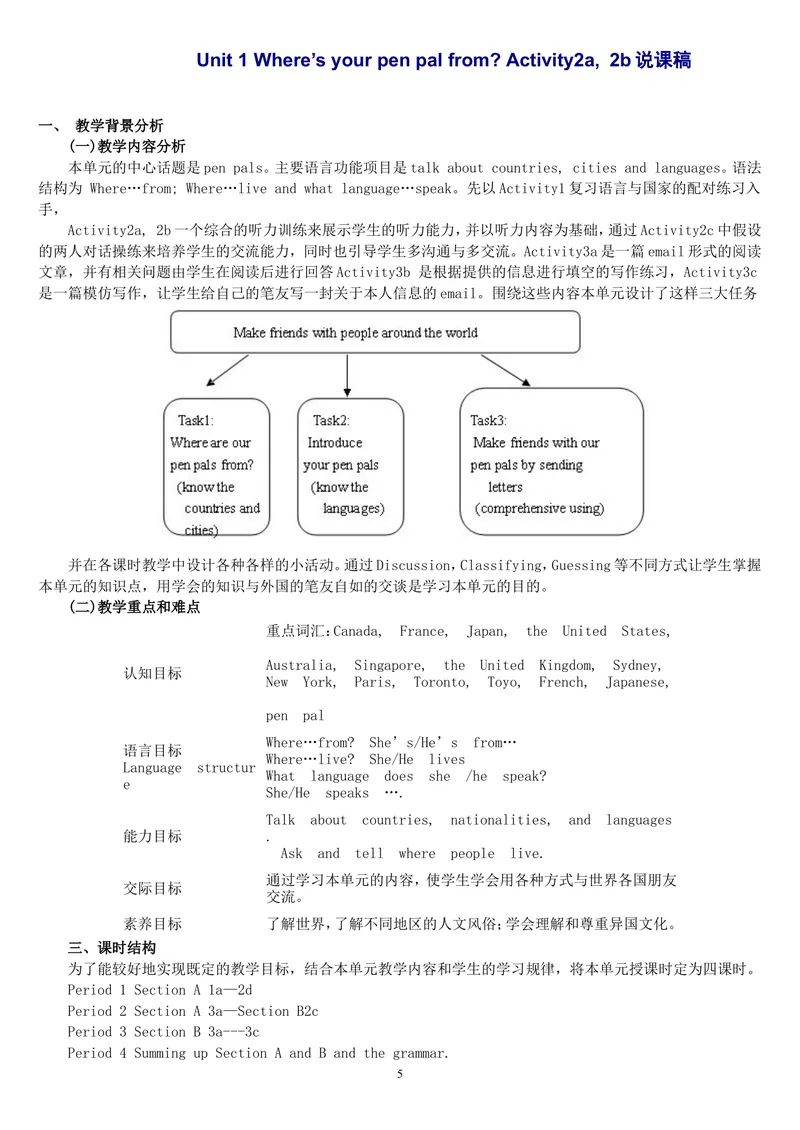
是一篇模仿写作,让学生给自己的笔友写一封关于本人信息的email。围绕这些内容本单元设计了这样三大任务
并在各课时教学中设计各种各样的小活动。通过Discussion,Classifying,Guessing等不同方式让学生掌握
本单元的知识点,用学会的知识与外国的笔友自如的交谈是学习本单元的目的。
(二)教学重点和难点
重点词汇:Canada, France, Japan, the United States,
Australia, Singapore, the United Kingdom, Sydney,
认知目标
New York, Paris, Toronto, Toyo, French, Japanese,
pen pal
Where…from? She’s/He’s from…
语言目标
Where…live? She/He lives
Language structur
What language does she /he speak?
e
She/He speaks ….
Talk about countries, nationalities, and languages
能力目标 .
Ask and tell where people live.
通过学习本单元的内容,使学生学会用各种方式与世界各国朋友
交际目标
交流。
素养目标 了解世界,了解不同地区的人文风俗;学会理解和尊重异国文化。
三、课时结构
为了能较好地实现既定的教学目标,结合本单元教学内容和学生的学习规律,将本单元授课时定为四课时。
Period 1 Section A 1a—2d
Period 2 Section A 3a—Section B2c
Period 3 Section B 3a---3c
Period 4 Summing up Section A and B and the grammar.
5四、教学过程设计
Period One
(第一课时)
一、 Teaching aims (教学目的)
1.学会世界上主要国家和城市的表达方式。
2.了解世界上主要国家一些情况,如国旗,地图形状及地理位置。
3.学会使用where 句型。
二、 Key points (本课重点)
1. Words: pen pal, Australia, Japan, Canada, France, the United states, Singapore, the United
Kingdom, country, Sydney, New York, Paris, Toronto, Tokyo world
2.Sentences:Where is your pen pal from? He’s from Australia. 1/4 1 2 3 4 下一
页 尾页
Where does he live? He lives in Paris
Where is John’s pen pal from ?
三、 Teaching tools (教学工具)
Some cards with cities and countries. CAD
四、 Teaching procedures (教学过程)
Step 1.Lead—in (1a&2a)
First greet the students. Then teacher begins the topic with the Spring Festival. Do you have
a nice Spring Festival? Do you go to many places? I do. Then use the fresh pictures through
computer to teach the students names of countries, cities. Divide the students into groups, then
show the flags and pictures, let them guess the names of countries and cites. At last finish 2a
on page2. 通过这个环节,教师完成本单元的新单词的导入,通过提供给学生每个国家的地图,让学生猜出国家名
称及相应的城市,学生能有意识的记忆国家及城市的名称,并为整节课任务的完成奠定最基本的词汇基础。在看图
片时学生能够做到精神集中,并能激发学生的学习兴趣。
Step2.Practice(1c&2d)
①Teacher says: I goes to many places during the Spring Festival, so I have many pen pals
from different countries. One of my pen pals is Sandy. She is from the UK. She lives in London.
Ask the students: Do you have a pen pal? Some say yes, some say no. Then go on with “Where is
she/he from?” and “Where does she/he live? Ask some students to stand up and practice with
teacher.
②With these sentence structures, ask students to practice them in pairs.
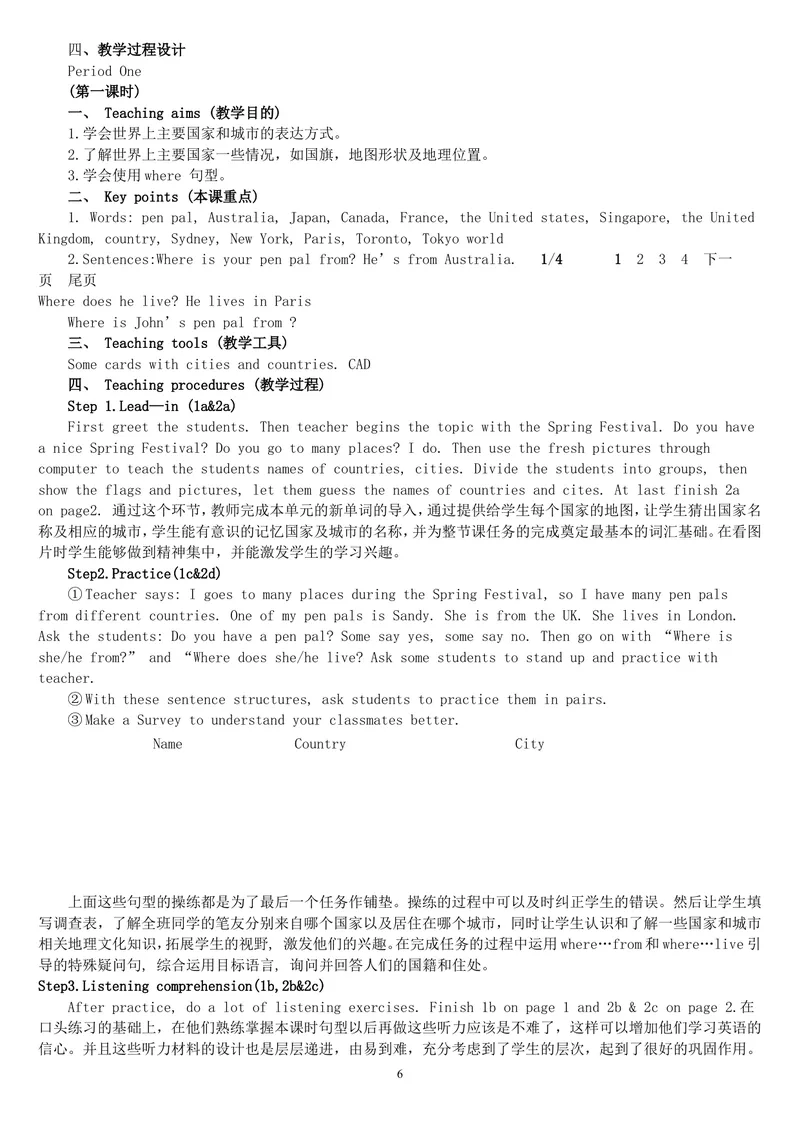
③Make a Survey to understand your classmates better.
Name Country City
上面这些句型的操练都是为了最后一个任务作铺垫。操练的过程中可以及时纠正学生的错误。然后让学生填
写调查表,了解全班同学的笔友分别来自哪个国家以及居住在哪个城市,同时让学生认识和了解一些国家和城市
相关地理文化知识,拓展学生的视野, 激发他们的兴趣。在完成任务的过程中运用where…from和where…live引
导的特殊疑问句, 综合运用目标语言, 询问并回答人们的国籍和住处。
Step3.Listening comprehension(1b,2b&2c)
After practice, do a lot of listening exercises. Finish 1b on page 1 and 2b & 2c on page 2.在
口头练习的基础上,在他们熟练掌握本课时句型以后再做这些听力应该是不难了,这样可以增加他们学习英语的
信心。并且这些听力材料的设计也是层层递进,由易到难,充分考虑到了学生的层次,起到了很好的巩固作用。
6Step4.Homework
Revise Section A1a—2d
Make a similar dialogue about pen pals
Period Two
(第二课时)
一Teaching aims(教学目的)
1.继续巩固国家名称,及where引导的疑问句。新教民族单词.
2.新句型What language does she/He speak ?
二Key points(本课重点)
1.Words: language Japanese French in English
2.Sentences:What language do they speak?
What language does she /he speak ?
She/He speaks ……
三Teaching tools(教学工具)
Some cards with cities and countries CAD
四Teaching procedures (教学过程)
Step1.Revision (Brain Storm)
Use fresh maps of some countries, let the students say the names of these countries as
quickly as possible.用这样一个小小的游戏,既复习了上一课时的单词又活跃了课堂的气氛,也为这一节课新
知识的教授作好了衔接。使新课的导入自然又轻松。
Step2.Lead—in(3a&SectionB1)
The teacher says we have known the names of these countries, but do you know what languages
do people speak in these countries? Let’s look at the map and guess. Then do a matching exercise
to consolidate the knowledge. At last do 3a and sectionA1.通过一系列的活动,让学生知道那个国家讲什
么语言,学会说这些语言的单词,为下面的任务作准备。
Step3.Listening comprehension(SectionB2a&2b)
Do some listening exercise to review what we learned before.通过这个听力练习,巩固前面所学的知
识,也为下一步的学习举了一个范例,相当于一小步导入。
Step4.Practice(3b&SectionB2c)
Choose your favorite pen pal and say something about him or her.
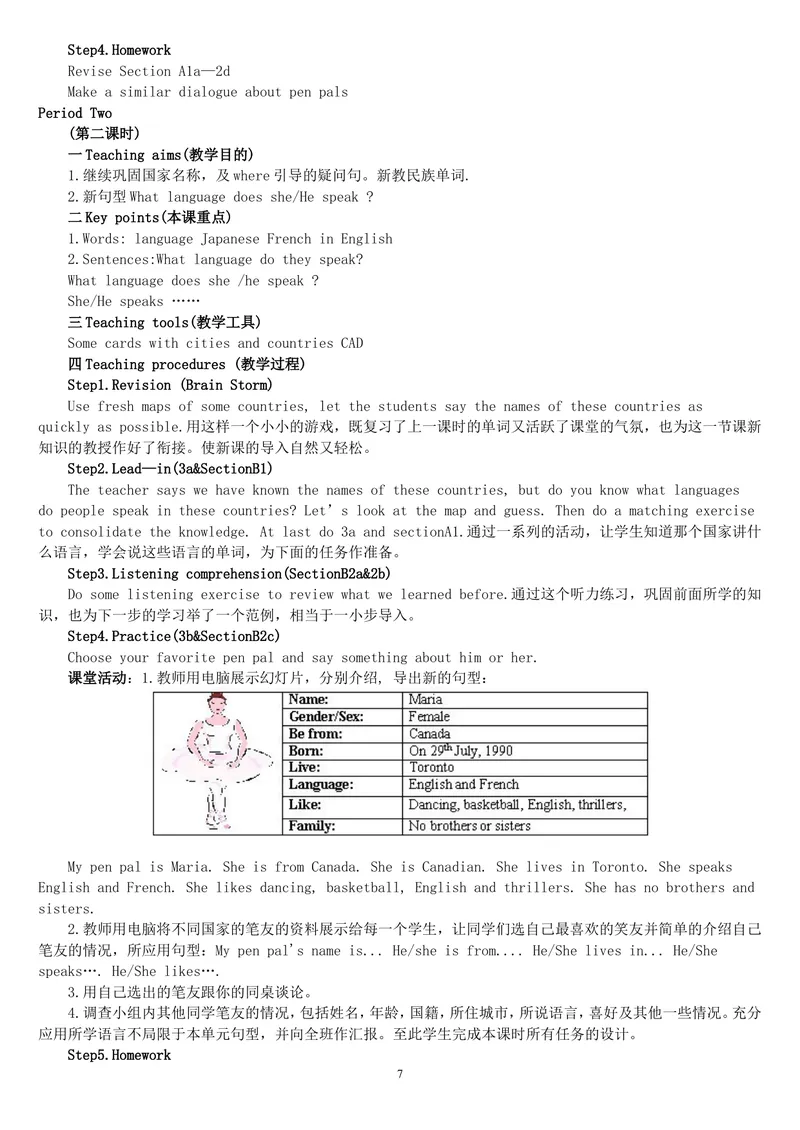
课堂活动:1.教师用电脑展示幻灯片,分别介绍, 导出新的句型:
My pen pal is Maria. She is from Canada. She is Canadian. She lives in Toronto. She speaks
English and French. She likes dancing, basketball, English and thrillers. She has no brothers and
sisters.
2.教师用电脑将不同国家的笔友的资料展示给每一个学生,让同学们选自己最喜欢的笑友并简单的介绍自己
笔友的情况,所应用句型:My pen pal's name is... He/she is from.... He/She lives in... He/She
speaks…. He/She likes….
3.用自己选出的笔友跟你的同桌谈论。
4.调查小组内其他同学笔友的情况,包括姓名,年龄,国籍,所住城市,所说语言,喜好及其他一些情况。充分
应用所学语言不局限于本单元句型,并向全班作汇报。至此学生完成本课时所有任务的设计。
Step5.Homework
7Revise Section A3a—SectionB2c
Write a short passage about your friend’s pen pal according to the survey.
Period Three
(第三课时)
一、Teaching aims(教学目的)
1. Listen 2a , 2b
2. learn a letter and write answers to the question
3. make an information card .
4. write an email to your pen pal.
二、Key points(本课重点)
1.Words: any dislike
2.Sentences: Does she have any brothers and sisters ?
Where is she from ?
Is that from your new pen pal ?
I like going to the movies and playing sports .
Can you write to me soon ?
三、Teaching aids(教学工具)
Some cards with cities and countries CAD
四、Teaching procedures(教学过程)
Step1.Revision
Revise the names of the countries, cities and languages by fill in a form.通过这个复习目的在
于让学生牢牢掌握,因为这些词汇很难,要不停反复地记。
Step2. Reading(3a)
1.The students open the books, turn to Page 5 and read the first letter. After that, the
students answer six simple questions.
2.The students read after the tape and go on asking and answering some more questions in
pairs. 通过这一步的练习,作好热身运动,为下面更多内容的阅读作好准备。
Step3. Pairwork( 3b)
1. The students read the letters that the teacher gives them and then choose one pen pal they
like.
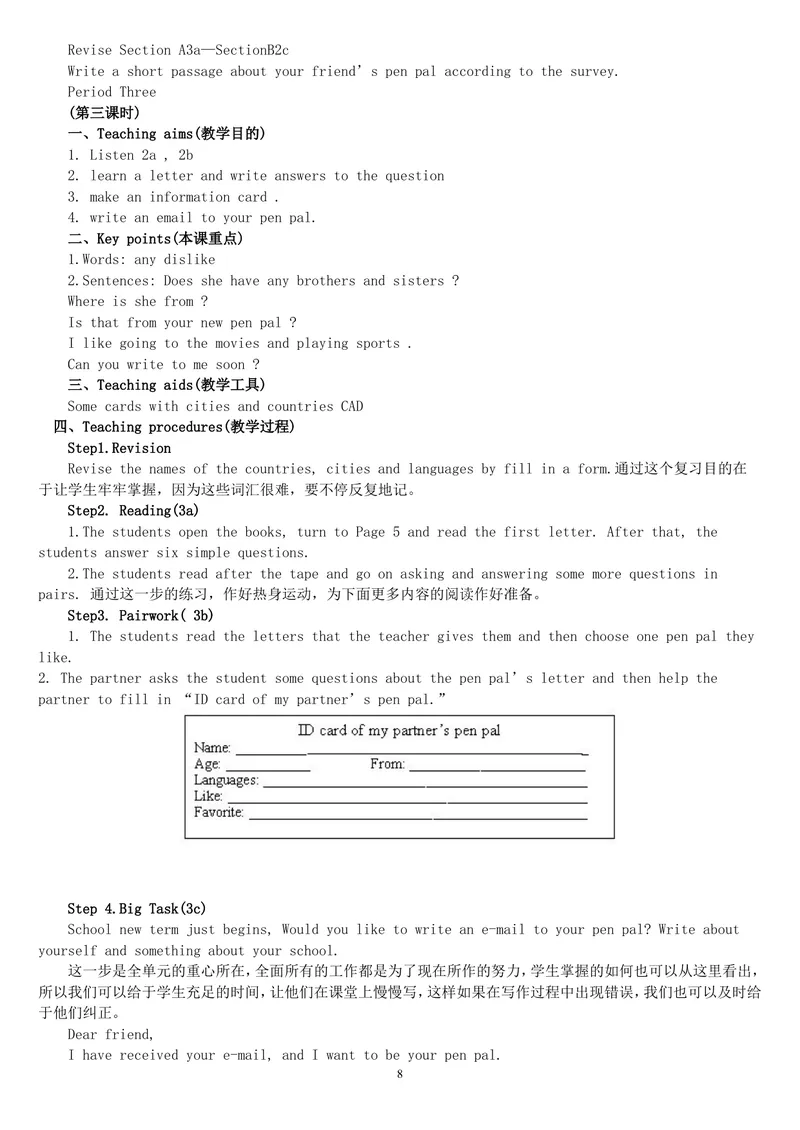
2. The partner asks the student some questions about the pen pal’s letter and then help the
partner to fill in “ID card of my partner’s pen pal.”
Step 4.Big Task(3c)
School new term just begins, Would you like to write an e-mail to your pen pal? Write about
yourself and something about your school.
这一步是全单元的重心所在,全面所有的工作都是为了现在所作的努力,学生掌握的如何也可以从这里看出,
所以我们可以给于学生充足的时间,让他们在课堂上慢慢写,这样如果在写作过程中出现错误,我们也可以及时给
于他们纠正。
Dear friend,
I have received your e-mail, and I want to be your pen pal.
8I _______________________________________ ______
__________________________________________________________________ __
_________________________________________________________________I think I can be your good
friend. I hope to get your letter soon.
Yours,
Step5Homework
1. Write to your pen pal to talk about yourself.
2. Try your best to send it.
Period Four(self check)
(第四课时)
一、Teaching aims(教学目的)
1. 复习本单元所学单词,补充新词。
2. 描述学生,姓名,年龄,国籍,语言等。
二、Key points(本课重点)
1.Key word check
Imagine and describe the new students
2.Just for Fun ! 轻松一刻
三、Teaching tools(教学工具)
图片
四、Teaching procedures(教学过程)
Step1. Revision
1. Free talk(用所学过的知识组织对话)
2. Check homework
Step2. Presentation
1. 从Where are you from ? where is your pen pal from ? 开始复习本单元所学的主要句型。
2.通过图片,卡片复习所学的主要句型,国家名称,语言。
Step3. Practice
在全班范围内进行连锁式练习本单元所学的主要句型,让学生表演本单元所自编的对话。随时纠正学生所出
现的错误。
Step4. Consolidation
在全班范围内练习本单元所补充的学习知识,对这部分知识进行巩固,加深理解。利用所补充的知识进行翻译
题训练等等。
Just for Fun 中Mars –火星 Martian---火星人,语言类
Step5. Summary
总结本堂课所复习的内容(语法总结)
Step6.Homework:
1. 掌握本单元所有的所学的主要句型,对话。
2. 在日常用语中能熟练运用所学知识。
3. 预习下一单元。
Unit 1 Where’s your pen pal from? 3a,3b,3c 说课稿
一教材内容及其分析
我今天所说课的内容是七年级下unit1 where is your pen pal from?的第三课时,3a,3b,3c,本节课是
unit1的阅读和写作部分。本单元的教学核心项目是“地点”(Place),涉及到国家、城市及所使用的语言
等项目。在本课时中教材的编排安排了阅读和写作等活动任务,让学生在这些环节的设计中最终达到一个
9写作的目的
Activity3a是一篇email形式的阅读文章,并有相关问题由学生在阅读后进 行回答,Activity3b 是根据
提供的信息进行填空的写作练习,Activity3c是一篇模仿写作,让学生给自己的笔友写 一封关于本人信息
的email。
学情分析
本单元可以在此基础上介绍世界上主要国家的一些情况,如国旗,地理位置,重要标志物及一些重要人物。
本单元是上册关于个人基本信息(如姓名、年龄、生日、家庭成员、个人喜好、能力、日常生活及校园活动)方
面学习的扩展,学习内容与学生的生活密切相关,语言材料富有实用性,让学生在回顾的同时,介入新的语
言点,借此来丰富学生的谈论话题。它融交际功能、语言结构于一体,包含了文化知识、任务型语言学习成
分以及语篇材料等内容,通过循序渐进的生活化的学习程序,提高学生运用英语进行听、说、读、写的能力,
激活学生已有的文化背景知识,培养学生对中西方文化差异的敏感性,使学生逐步学会在实际情景中恰当
而灵活地运用语言,体现语言的工具性、交际性和文化性。 http://www.yingyu6.com
教学目标
1语言目标
根据“新课程标准”关于教学目标的要求,结合本单元的具体内容,在sectionB的阅读部分目标细分如下:
1. 语法:① 掌握where引导的特殊疑问句。 ② 掌握表示国家和城市的名词及语言。
2. 词汇:复习国家和城市的名词,主要掌握如下 :
where pal from live a little
3. 交际用语:
① Where is your pen pal from? He/She is from ...
② Where is John’s pen pal from?
③ Where does he live? He lives in ...
④ What language does he speak? He speaks English.
⑤ I can speak a little French.
⑥ Can you write to me soon?
2语言技能目标
1 能谈论自己所处的位置,即哪个国家哪个城市,
能正确运用where引导的特殊疑问句。
2. 能够用自己在本单元中所学的语言内容与笔友
进行对话与通信。
3情感态度目标
1. 有明确的学习目的,能认识到学习英语的目的
在于交流,敢于用英语进行表达。
2. 学生乐于接触并了解异国的地理位置及其拥有
的文化。
4文化意识目标
1了解现代最流行的网络工具及网络用语,比如OICQ、
ICQ、MSN,email等等。
www.xiao688.com
三 学习策略
首先,是自主学习,主要体现在课前预习,. 要求学生采用自主学习的方式,能根据需要进行有目
的预习,使其对教师的教学内容起补充作用。
其次,是合作学习法,主要体现在自编对话或表演对话中,在学习过程中要求学生形成合作学习和探究学习的学
习方式,引导学生积极思考,善于抓住英语学习交流的机会。
10再次,是体验法。读和写是本堂课自始至终的主线,最终达到交际的目的。要求学生能利用网络上的学习资源,
用所学内容进行真实的交际,积极参与课外英语学习并能够在学习之后进行有效的复习,善于整理和归纳,找寻
记忆的规律。
四教学重难点
重点: 学会利用OICQ、MSN软件、发email等
方式与人进行交流。
难点: 如何利用所学过的句型进行综合运用,尤其在写作中,要注意写作内容的丰富性和多样性 。
五教学过程设计
period3
1 target language:
words: live/a little/write to /tell….about…..ect.
key sentences: where is bob from ?
what does he want?
What language does he speak?
Where does he live?
Can you write to me soon?
Please write and tell me about yourself.
Ability goals: how to write an e-mail about yourself.
Learning ability: enable students to write an e-mail to his/her pen pals.
Important and difficult points: how to improve their level using the different ways to express.
教学过程设计
一 greeting and revision http://www.yingyu6.com
(1)通过旧图片复习单词,[或使用地图]
(2)practice :
I ask first student, then they answer the questions one by one.
Questions below:A:Where is he/she from?
B: He/she is from…..
A:Where does he/she live?
B:He/she lives in….
A: What language does he/she speak?
B: He/she speaks……..
二pairwork
Do you want to make pen pals from other country?
What countries do you want? Why?
I like to make pen pals from …..do you know why ?
从而引出一写新的词汇来描述国家。如great,interesting,….large.ect. 为后面 的写作打下了一定的基础。
通过pairwork来操练口语,巩固知识。
三reading
(1)listening <听3a,以提高他们的听力。
(2)fast-reading <快速阅读,从而补充听力当中未能听清的内容。
并设计简单的问题[1]Is the letter from B?
[2]Does he want a pen pal?
[3]精读。<给学生充分的时间进行第二次阅读,掌握文中重点信息,并根据其内容回答以下的问题 。
1:where is bob from ?
2:what does he want?
3:What language does he speak?
11欢迎访问http://www.9word.com
4:Where does he live?
(4)跟读。让学生跟读一遍3a,对其文中信息形成系统
(5)整体通读全文,对其阅读内容,进行整体把握。
(6)check
name:_____
from:_____
age:______ language:________
family:________ likes:___________
favorite subject:_____________
通过再次填表格使学生熟记文中句型,并使学生能通过表格信息,能叙述全文3a,目的是为了通过以上活动,来提高
学生的听,说,读,写的能力,来突破文章的重难点,为其后的3b奠定了一定的基础。
四3b Fill in the blanks
先由学生浏览表格信息来完成笔友的信,让学生根据所掌握的信息来填,最后齐读,让学生来理解其中与3a的写作
不同之处,为其后写作进行积累。
五3cWriting
通过以上听说读写等活动最终达到一个写的目的。3c要求给笔友写一封信,这也是本课的一个亮点。让学生来介绍
自己,我提出了以下要求:1不局限于自己的真实的情况,可假设自己是其他一个自己喜欢的国家中的一员来介绍,
找两人上黑板来写。这样做的目的,使学生能灵活运用所学知识,能发散学生的思维,不手局限,达到其写作的效果。
六得与失
课后教学反思
通过本课时的学习,学生能够通过听说读等方面的训练,最终达到一个写的目的。而且对于大多数 的学生来说不存
在问题,但是通过自己的教学与研究发现,这些学生当中,多数都局限于模仿中,在写作方面还是有待于提高。因此
我认为在今后的该课题教学中应从多方位,多角度,开阔学生的思维,使其内容和形式多样化。
Blackboard Design
Unit 1 where is your pen pal from?
where is bob from ?
what does he want? 9word.com提供各种免费文书文档
What language does he speak?
Where does he live?
name:_____
from:_____
age:______ language:________
family:________ likes:___________
favorite subject:_____________
Unit 1 Where’s your pen pal from? 教案
学习目标:
认知目标 重点词汇:Canada, France, Japan, the United States, Australia,
Singapore, the United Kingdom, Sydney, New York, Paris, Toronto,
12Toyo, French, Japanese, pen pal
语言目标 Where…from? She’s from…
Language structure Where…live?
What language does she speak?
She speaks ….
能力目标 Talk about countries, nationalities, and language.
Ask and tell where people live.
交际目标 通过学习本单元的内容,使学生学会用各种方式与世界各国朋友交流。
素养目标 了解世界,了解不同地区的人文风俗;学会理解盒尊重异国文化。
教学准备:
1. 制作课堂教学所需要的课件。
2. 制作课堂任务表格,在课前准备或上课时发放给学生。
3. 设计、准备每一项调查所需要的语言项目。
学生课前预习:
了解世界各国的名称,首都及著名城市(完成下列表格)。
Name’s of country capital Famouse city
教学时间:4课时
13教学过程:
Period One
Section A
Step I Presentation
The teacher show many pictures about some countries’ map, building, flag.
Let the student say the Names of the countries, cities to learn the words. 1a
Canada, France, Japan, the United States, Australia, Singapore, the United Kingdom.
Pen pal
Step II Practice
pair work. 1c
Step III
2a
Step IV Listen
1b, 2b ,2c
Step V Pair work 2d
Step VI Homework
1&3
Fill in chart .
Q:What kind of pen pals do you want to have?
language country city
14Period Two
Section A
StepI. Revision
Ask the ss the following questions to revision the countries and cities.
1. Where is you pen pal from?
2. Where does she/he live?
Step II Prentation
1.I can speak Chinese and English. What language do you speak?
---- Help the student to answer: I can speak ….
2.Show pictures of different countries and ask the students “What language do they speak?” Help the
students to complete the chart.
Canana
The United States
Australia
French
The United Kingdom
Japan
Singapore
3.3a
Step III Group work
3b
Use the chart to make a survey..
Use the following language structures:
15--Where is your pen pal from?
--Where does she/he live?
--What language does she/he speak?
Chart 2.
Name country city language
3.Report: I want to have a pen pal from France. He lives in Paris. He can speak French….
Step IV Homework
Exercise book(2)P1,2
Make an information card.
Name:_____________________
First Name:________________
Last Name:___________________
Age:_________ From :_____________
Language:___________
Favorite Sport:___________
Favorite Subject:____________
Family:_______________
Period Three
Section B
16StepI. Revision
1.Group contest:
Group1: “Where is _______(city)?”
Other group: It’s in________ (country).
2.1Match the country with the language.
Step II Reading
3a
let the students read the letter fast and answer the questions.
Let the students ask more questions about the letter as possible as the can.
Step III Writing
3b.
Step IV. Pairwork
2c
Step V Listening
2a, 2b
Step V. Homework
Exercises book(1) P3
Exercises book (2) P3
Period Four
Step I . Dictate the words and sentences in Unit1.
Step II. Self-check
Step III. Check the answers for Exercises book in the unit.
17Step IV. Home work
Revise unit 1 and preparation for unit 2.
教学反思:通过本单元的学习,学生基本可以谈论人们的国籍,居住城市及其所说的语言,通过书信方式去介绍自己
并寻找笔友。但在涉及到国外的一些城市时,学生对这方面的知识相对欠缺,能介绍的城市并不多,也反应出学生课
前预习不充分,这跟学生学习条件也有关,大多数学生无法通过网络获取所需信息。因此,在以后的教学中要多指导
学生通过计算机网络获取信息,拓宽知识面。
Unit 2 Where’s the post office?
Unit 2 Where’s the post office? 说课稿
各位评委大家好,今天我说课的内容是《Unit 7 Where’s the post office?》下面我将从课标要求、知识与能力目标、教学
重点、难点、教学方法三个方面阐述我的教学设计及教学理念。
一、教材分析
本单元的教学主要内容是:学习“问路指路”的常用表达方式 ,该话题与学生的日常生活紧密联系在一起,容易唤起学生的学
习兴趣,这对于提高学生的综合能力很有帮助,特别是说的能力。
本单元仍在继续学习一般现在时,这是一个生活中离不开的时态,也是最基本的一个时态。新课程标准要求学生重点掌握一般
现在时,这在英语中使用频率很高,学好这一时态的用法对以后其他时态的学习和交际有很大的帮助。
1.知识与能力目标
知识目标
1)重点词汇
post office, hotel, bank, park, supermarket, street, pay phone, avenue
left, right, next to, across from, near, between …and
2). 语言目标
1. 重点句型: Is there a bank near here?
Yes, there is a bank on Center Street.
Where’s the supermarket?
It’s next to the library.
Is there a pay phone in the neighborhood?
Yes, it’s on Bridge Street on the right.
2、 语言技能
1)、能看着图片说出建筑物的名称 ;
2)、能运用一般现在时询问街道上某一场所的位置;
3)、能够运用所学语言为他人指明 某一场所的路线;
184)、能够描述某一场所各建筑物之间的位置关系;
5)、能够利用地图向他人介绍自己所居住的社区;
能力目标
通过本单元的学习,掌握问路与指路的基本语句,并能运用于现实生活中。
2、过程与方法目标
1)、利用老师所提供的图片做出简单的判断,学习相关方位介词的用法。
2)、通过与同学交流,学会问路指路,掌握对地点特征做出简单描述的句型。
3、情感态度目标
1)通过各小组的对话练习培养学生的合作精神;
2)通过学习本单元,教会学生礼貌待人,建立和睦的邻里关系;
3 ) 通过运用问路和引路的交际用语,帮助各个层次的同学树立自信心,敢于用英语进交际,并培养学生乐于助人
的精神。
二、教学重、难点
词汇
句型:There be句型和 Where’s ...?特殊疑问句
问路与指路的基本用语
三、教学方法
1.提倡循序渐进的教学过程,使学生在认识新知识时有一个心理适应的过程。
2. 因人因材施教,倡导“任务型”教学过程,让学生“做中学”,“学”是前提,“做”是目的。
3.多方位使用电脑多媒体的动态效果帮助学生学习。
4.学生在课堂教学过程中口头训练应成为本单元教学的重要内容。
四.学法指导
1.自学与小组合作相结合,充分发挥小组的作用,调动每个学生的积极性
2.书本知识与现实生活相结合,提高学生运用知识的能力。
五、教学流程 (分九大块)
(一).组织上课
(二).问题再现
巩固本节课所用的单词, 利用多媒体呈现不同类型的建筑,让学生说出这些建筑的名字。
(三).创设情景,导入新课
利用多媒体展示球的位置,导入方位介词的用法。
(四).自学解疑
1.利用图片,让学生用所给方位介词造句,进一步提高运用方位介词的能力。
2.小测:利用图片导出Where’s the pay phone? Is there a pay phone ?句型。
3.听力练习,巩固方位介词,提高学生的听力水平。
(五).小组交流合作
1在我们的日常生活中,我们经常会看见一些交通标志,我们就看一下下面表示什么。(由交通标志引出如何指路)
2根据交通警察的指示,学习常用的指路词汇。
3利用多媒体动画,共同讨论如何指路问路。
4Task: 谁是热心的小民警(小组讨论,小组代表起来展示)
(六).点拨提升
教师点出在指路问路中的其他表示方法。
(七)目标达成度检测
利用多媒体地图,对本节课的内容进行测试。
(八)、归纳总结
19形成性评价与终结性评价相结合。
(九)家庭作业
巩固性作业:
利用Is there…? Where’s the …? 和同桌做一个自由对话。
拓展性作业:
画一条从学校到自己家的路线,然后写一写从学校到你家是怎样走的。
Unit 2 Where’s the post office? 说课稿二
教材分析
问路与指路是常用的生活用语之一,几乎所有的基础英语教程中都会涉及这项内容,JEFC将这项内容编排在初
二(上)第六单元,由此可知,本单元的重要 性。
教学内容
词汇
.Names of places:post office、library、hotel、restaurant、bank、supermarket、 street、pay phone、
park、house、garden、market.
.Description adjectives:clean、dirty、new、old、quiet、busy.
.其它:enjoy、visit、beginning、tour、through、walk、hungry.
短语
.介词短语:next to、in front of、between、behind、across from.
.其它:take a walk、have fun.
句型
.掌握there be句型。
.初步认识if句型.
.掌握指路时所常用的祈使句,包括go straight、turn left/right、take the ...turning.
日常交际用语
.掌握问路常用语:Excuse me.Is there...?/Where is...?
.了解问路的其它用语:Excuse me.Which is the way to...?/Can you tell me the way to...?
教学重点
.词汇
.句型:there be句型
.问路与指路的基本用语
教学难点
.设计一些学生能够主动参与的活动,让学生能够对所学的知识进行操练与扩展。
课时划分
考虑到所教学生的实际情况以及本单元在本册书中的“前沿”位置,我将本单元细划分为5个课时(不包括self-
check)。
第一课时: Section A 1a-1c
第二课时: Section A 2a-2c
第三课时: Section A 3a-4
20第四课时: Section B 1a-2c
第五课时: section B 3a-3b
主要策略
1. 教学策略
.提倡循序渐进的教学过程,使学生在认识新知识时有一个心理适应的过程。
.倡导“任务型”教学过程,让学生“做中学”,“学”是前提,“做”是目的 。
.因人因材施教。
2. 学习策略
.倡导合作学习的理念,课堂中使学生有尽可能多的合作机会。
.强调家庭作业的重要性,提倡学生的自主学习,家庭作业的形式尽可能的多样化,比如让学生准备下节课的一些课
堂道具。
教学目标
1. 知识目标:
.谈论问路与指路
.学会方位介词next to、in front of、between…and、across、behind
.学会形容词new、old、busy、quiet、clean 、dirty、big、small
2. 语言技能
.能围绕“问路与指路”的交际用语进行交际。
*能用一些形容词准确地描述和表达自己的观点。
.能用简单的图表、地图、句子等描述和传递信息
3.情感目标
.通过运用简单的问路和引路的交际用语,学会相互合作,培养乐于助人的精神 。
.通过运用问路和引路的交际用语,帮助各个层次的同学树立自信心,敢于用英语进交际 。
4.文化意识
.了解中西方问路与引路方式的不同.
教学过程
The first period(Section A 1a-1c)
Warm-Up
Ask students “Where does he/she live?” “Where do I live?”,give students the answer
“I live in this neighborhood”(show Ss the picture on the screen).
Word-Teach
?Direct Ss’attention to the picture on the screen
and ask Ss “What’s this?”,present the names of the places on the board.
?Give plenty of opportunity for both choral and individual repetition of the new word
s.
?Refer to 1a and 1b in Section A on p7.
Target language-Teach
?Have Ss look at the picture on the screen again and ask“Is/Are there ...?”,present
Ss the answers “Yes,there is/are.” “No,there isn’t /aren’t.”.
?On the board,write the models.
21?Have Ss look at the picture and the example question and answer together,have them
take turns
practicing asking and answering questions.
?Invite volunteers to role-play their dialogs.
Make a survey
?Organize Ss into groups,have them make a survey by asking others in the group questions
Yes/nowhere
post office
library
hotel
restaurant
bank
supermarket
pay phone
park
Homework
?Draw one of the places with color pens.
?Complete the conversations according to the illustration in 1a.
板书设计
-Is there a...? post office
-Yes,there is. It’s on...street. / library
No,there aren’t. hotel
-Are there any...? restaurant
-Yes there are.They are on...street./ bank
No,there aren’t. supermaket
park
pay phone
The second period(Section A 2a-2c)
Warm-Up
?Review the target language taught last lesson by asking Ss“Is/Are there...?”such as “Is there a post office?”.
Word-Teach
.Show a stick-figure picture on the screen.
park
school
market
my house
Center street
hotel
.Point to the park,say“where is the park?”get the response”It’s on Center Street”from Ss,tell Ss we can use othe
r prepositions to describe the location of the park,present the new
prepositions.
.Put the prepositions on the board,have Ss repeat.
.To reinforce the understanding,refer to 2a,2b on Page 8 in the book.
.Check the answers by asking Ss “where is...?”
.Activity 1: Competition
?Focus Ss’attention to the picture on the screen.Choose 4 Ss from different group,give each of them 2 minutes
22to describe the location of a place to see the can say the most different descriptions of one place in
the limited time.
Target language-Teach
Model a dialog on the board,have Ss repeat.
.Orgnize Ss into groups of 4,have them take out their cards of places on the desk and imagine each
card as a real place,have them take turns practicing the diagog by changing the locations of their cards.
.Have less advanced Ss come to the board to perform as places with cards in their hands,have advanced
Ss perform the dialog according to the locations of the “places”in front.
Homework
?Draw the places between your house and your school.
?Make up new dialogues with the target language according to the picture in 1a,at least 5 different
dialogues.
板书设计
-Where is...? next to
-It’s.... in front of
-Where are...? across from
-They are.... behind
between
The third period(Section A 3a-4)
Warm-Up
.Show a stick-figure picture on the screen.Ask Ss the locations of the places in the picture.
Library
Food Market
Paul’s house
Green Street
No.1 Middle School
Bank
Restaurant
Bridge Street
Hotel
Park
Post Office
.Point to the boy,say“This is Paul,he wants to go to a hotel.Which is the way to the hotel?”present go straight,in
the same way present turn
left/right、take the...turning.
?Refer to 3a,3b on Page 9.
Practice
23.Have Ss take out their picture of their route from their house to the school.
.Organize Ss into groups of four.Have them take turns telling their group members the way to their
house or from their house to the school.Monitor them with vocabulary and grammar.
.Show a stick-figure map of Sisu on the screen,say“Excuse me.Can you tell me the way to your house?”,have v
olunteers give their directions.
Yang’ao
Zhang’ao
school
Meixi
Qianyang
Mei’ao
Chentan
Boyan
Yangchuan
.Tell Ss they can use different ways of asking for directions.Elicit the questions from Ss.(take notes while Ss are
saying)
Activity: A short play set in a street
?Have Ss put their pictures or models of the places on the desk and ---the desk as a real place.
?Desigh the classroom into a neighborhood.
.Organize Ss into groups,have them take on roles of a passer-by and a police officer. Homework
?Draw a picture of your ideal neighborhood.
.Write down the route from your home to your school.
.Make up a dialog between a police officer and a passer-by.
.Finish off the exercises on Page 5 in Pink Book.
.Copy the words on Page 9 in the book,twice each.
板书设计
-Excuse me.Is there...? go straight
Where is ...? turn left
Which is the way to ...? turn right
Can you tell me the way to ...? take the...turning
The fourth period(Section B 1a-2c)
Warm-up
Draw a stick-figure picture on the screen,have Ss say the routes between places.Point to two parks ,one big,on
e
small,have Ss tell the difference,elicit the two adjectives big、small from Ss.
Word-Teach
.Show three pairs of items,elicit the three pairs of antonyms.
.Reinforce with examples Ss familiar with,for example our class is clean,but the W.C is dirty,etc.
.Refer to 1a,2a, in Section B.
Target language-Teach
.Refer to 2a in section B.
.Check the answers in 2b by asking one student to draw the map of Michaels’ neighborhood on the
board.
.Use there-be clause to describe the existence of one of the places,have Ss give the rest answers using there-
24be clause.
.Write the structure of there-be clause on the board.Expain that there-be clause can describe the existence of it
ems,present the negative and interrogative forms of there-be clause.To reinforce the understanding,have Ss m
ake up sentences about the items in the classroom.
Activity: Guess Game
.Organize Ss into groups of 4,have them prepare a short description of a place using there-be clause without m
ention its name.
.Put an example on the board. “The place is scary at night,it’s old and big, there are many trees next to it,there i
sn’t a house near it,there are always dead people in it.”,have Ss guess which place is being referred to.
When each group is reday,have them take turns reading out their descriptions for the rest of the class
to guess.
Homework
.Use there-be clause and adjectives to describe your neighborhood.
板书设计
There is ... clean dirty
There isn’t... new old
Is there ...? quiet busy
There are ...
There aren’t...
Are there...?
The fifth period(Section B 3a-4b)
Warm-up
Ask Ss “Do you have a school trip?” “Do you want to have a school trip?”“Why?”etc.Elicit the new words and ph
rases.
Reading
Before-Reading
.Tell Ss that it’s importannt for us to get information from a tour guide if we want to have a tour.Ask Ss “What
information can you from a tour guide?”elicit answers from Ss.(take notes as Ss answering)
While-Reading
.Have Ss look at the lists of the items on the board and find the information about in 3a section B.
.Have one student put the answers on the board.
.Tell Ss to read the passage aloud,go around and monitor them and help with pronunciation.
After-Reading
.Say“I don’t live in Sidu.Can you tell me some interesting places in Sidu?”.Elicit information from Ss,such as
Wang Shipeng Museum、Wang Shipeng Tomb、Danxi Reservioer,etc.
.Tell Ss to chooose one of the places and write down the four items of the place,and try to link the
information into a tour guidar.
.Select some tour guides from Ss at random,check them on the screen,have Ss judge the best one.
Homework
.Finish off Self-Check and all the exercises of unit2 in the exercise books.
.Write a tour guide for your neighborhood.
板书设计
the place to visit: take a walk tour
the way to the place: have fun if
how to go to the place: enjoy
how is the place: place
25visit
through
beginning
Unit 2 Where’s the post office? 说课稿(英文版)
Teaching Aims:
Functions: Ask for and give directions on the street
Structures: There be structure
Where questions
Affirmative statements
Prepositions of place
Difficulties and focus:
Target language: Is there a bank near here?
Yes, there is. It’s on Center Street.
Where’s the supermarket?
It’s next to the library.
Is there a pay phone in the neighborhood?
Yes, it’s on Bridge Street on the right.
Vocabulary: post office, restaurant, bank, supermarket, avenue, pay phone, park, dirty, clean, left, right, next to,
across from, near, between, in front of, behind
Recycling: hotel, street, new, big, small, busy, Do you want to…?
Learning Strategies: Using what you know
Deducing
Personalizing
Section A
Create plots and scenes to guide the new lesson
The main content is to learn to ask for and give directions in conversations by introducing some buildings in
Section A, so we can adopt the Audiovisual Guiding Method: At first ,review the prepositions that the students have
learned, then the teacher can teach some nouns about buildings by showing some pictures or projecting flashcards
about some buildings.
1. Show a picture of a bank.
T: Look at this picture. What place is it ?
S: It is a bank.
T: Spell it.
S: B-A-N-K .
Teach other new words : post office, park, supermarket, payphone, street, .
Show a map and let students practice in pairs.
Is there …… ?
Yes, there is. /No, there isn’t.
2. Consolidation:
Tell us the way to your school.
T: Where is the …?
S: It’s ….
Teach the prepositions
26Next to, across from, near, between, in front of, behind.
Step1: .Learn some nouns about buildings first, and then the teacher communicates with the students.
Show some pictures about buildings or project some flashcards about buildings.
T: It’s a bank.
Can you spell it?
S: Yes I do. / No, I don’t.
T: Is there a / an…?
S: Yes, there is. / No, there isn’t .
T: Where is the…?
S: It’s near/ next to /across from /… the…
Step2: Get the students to practice conversations and communicate with each other.
Is there a / an … near here ? Yes, there is .
Where’s the … ? It’s … .
Step 3: 1. Play the tape of Part 1b, get the students to listen and circle the places they hear in 1a, finish the
teaching task of 1b.
The answers in 1a are: f, a, e, I, c, b, h, g, d.
The answers in 1b are: restaurant, post office, supermarket, Fifth Avenue, Bridge Street, Center Street.
2. 1c: This activity provides guided oral practice using the target language:
Point to the different locations shown in the picture. Ask different students to name each one.
Point to the question and answer the example conversation and ask a pair of students to read the
conversation to the class.
Ask students to work in pairs. Say, First one person a question and then the other person takes a turn.
Demonstrate the activity. Point to the picture and ask, Is there a post office near here? Then choose a
student to answer. Guide the student to say, yes, there’s a post office on Bridge Street.
As students work, move around the room and check on their progress.
Ask students to present their questions and answers to the class.
3. 2a: the answers are: 4, 6, 2, 3, 5, 1.
4. Play the tape of Part 2b, and get the students to fill in the blanks with the words in the box, finish
the teaching task of Part 2b.
The answers are: 1.between, 2.across from, 3. on, 4. next to, 5. in front of,
6. behind.
5. 2c: this activity provides guided oral practice using the target language.
Point to the list of buildings in 1a. Ask a student to read the list aloud.
Point to the question and answer in the speech bubbles in 2c and ask a pair of students to read the
conversation to the class.
Ask Ss to work in pairs like in 1c.
Demonstrate the activity. Point to the map and ask Where’s the park? Then choose a student to
answer. Guide the student to say, It’s across from the bank.
5. 3a: This activity provides target-oriented reading practice using the language items taught in
this unit.
Draw attention to the conversation in the box.
Ask a student to point out the place that Paul wants to get to.
Point to the two arrows. Ask students to repeat left and right.
Ask Ss to read the conversation again.
The answer is: Paul and Nancy are the two figures outside the gate to the park.
6. 3b: This activity provides guided writing practice using the target language.
Call attention to the three pictures.
Point to the questions below each picture and ask a student to read them aloud.
Point to the three write-on lines in the speech bubbles.
27Ask students to complete the writing individually.
Answers are: 1). Yes, there is. Go straight down New Street and turn right. There’s a pay phone
on the right.
2). Go straight down New Street and turn right. Turn left at Bridge Street . The bank
is across from the street.
3). Yes, there is. Turn right, then go straight down Bridge Street. The post office is
on the left. It’s across from the restaurant, next to the supermarket.
7. Part 4 provides guided oral practice using the target language.
Section B and Self check
Create Plots and scenes to guide the new lesson
Review and consolidate the sentence patters like Is there a / an … ? Where’s the …? Where do you
live ? by reviewing and learning some nouns about public buildings in Section B. The Transforming
information methods can still be adopted: The teacher shows some objects or pictures or projects some
flashcards and gets the students to do pairwork to review the words taught in the first part; Again the
teacher shows some objects or pictures or projects some flashcards about public buildings, for example, a
park, a hotel, a street, a supermarket. At last, the teacher can get the students to observe the pictures in
Part 1a and match the pictures with the words, then finish the teaching task of Part 1a.
The main content in Section B is to ask for and give directions on the street with the target language
learnt.
Step 1: Demonstration
The teacher communicates with the students to review the target language:
Is there a / an…? Yes, there is. / No, there isn’t.
Is there a / an … near where you live? Yes , there is.
Where is the ….? It’s… .
Step 2: Activities
Get the Ss to practice conversations to review the target language:
Is there a /an…near where you live?
Yes, there is.
Step 3: Intercourse
Get the Ss to write a guide for their town and let them communicate with each other, then draw a picture
of where their partner lives:
Where do you live?
My house is… .
Step 4: Experiences
Play the tape of part 2a and get the Ss to circle the places they hear in Activity 1a. then finish the
teaching task of Part 2a.
Again play the tape of part 2a and get the Ss to draw a map of Michael’s neighborhood in the box
according to the content they hear, then finish the teaching task of part 2b.
The answers in 1a: e, d, a, g, f, h, c, b.
The answers in 2a are: a quite street, a new hotel, a small supermarket.
Step 5: activities
Get Ss to do groupwork and review the words in 1a, lead student A to say one true thing and one false
thing about his or her map in 2b, and another student to say Yes or No, and finish the teaching task of
part 2c.
Step 6: Read by themselves
Get the Ss to read the passage in part 3a and demand them to circle the description words: busy, small,
old, interesting,. Then finish teaching task of part 3a.
Step7:
Get the Ss to look at Activity 3a, and look at the picture in 3b and fill in the blanks, then finish the
28teaching task of part 3b. Demand the students to use some description words in 3a.
Step 8:
Get the students to write a guide for their town, and finish the teaching task of part 3c.
Step 9: Get the Ss to do pairwork , demand the Ss to describe where they live, let them to draw a
picture according to their partners’ description, and finish the teaching task of part 4.
Summary:
The content of this unit is to learn some nouns of public buildings and prepositions of location, the
sentence patterns like Is there a /an…? Where is the …? And to learn how to talk about the places and
their locations.
Unit 2 Where’s the post office? 教案
I. Teaching analysis
In this unit, students will learn how to express the location, how to ask and show the ways. In the course of
conversations, we'll also review the usage of prepositions and there be. Improve the abilities of solving problems by
doing the tasks. The content of this unit is close to life, and it is very practical, students will be interested in it.
But it is also a little hard to some lower students, so teacher should pay attention to the difficulty degrees when
designing the tasks, to fit different students.
II. Teaching targets
1. Knowledge and abilities
Learn how to ask and show the ways, and can describe the place.
2. Process and methods
Learn the prepositions by introducing ones’ own family district. Practicing asking and showing the ways by
imitated asking ways activities.
3. Moral education
Learn asking for help politely. And always get ready to help others.
III. Important and difficult points
Important points:
1. How to ask for and give directions on the street.
292. Describe what there is in some place.
Difficult points:
1. Using the way to ask for and give directions on the street.
2. Describe some place.
IV. Teaching method
Communication, and solving task methods.
V. Periods
First period: learn to describe the location relationship between one place and other buildings. (Learn the
prepositions)
Second period: Learn how to ask the location of one place. (Review the prepositions, learn adjectives and
asking ways)
Third period: Learn how to show the ways to some places. (Review the prepositions, adjectives and showing
ways)
Fourth period: Can describe places.
VI. Task design
30VII. Teaching steps
The First Period
Step 1: Greeting
Step 2: Show the new words in 1a.
T: If you want to borrow some books, you can go to the library. Do you know what library means? Can you
make a sentence with “library”?
Step 3: Practice
Activity 1a.
Make a dialogue in pairs.
Sentences: Is there a ... in the picture?
Where is it?
Learn to use “in fount of, behind, next to, cross from”.
Step 4: Listening
Activity 2a & 2b.
Step 5: Game
31Where is my best friend?
Let the students describe their best friends and the rest of the students guess who he/she is. (See who has the
most friends?)
Step 6: Homework
The Second Period
Step 1: Free talk
Discuss you school
Step 2:
Discuss the school. When describing the locations, give them the adjectives.
Use: Is there a ...? Is it clean?
Step 3:
Task: I am the headmaster—design the ideal school
Group discussion; introduce the new school that you have designed. Each group chooses the best one to report.
And choose the best design in class.
The Third Period
Step 1:
Task one: Look at the pictures and learn the sentences of asking the ways. (Section A 3a)
Step 2:
Task two: Find a student to turn right or left or go straight according to the teacher’s order, to find the next
student that play the game.
Step 3:
Task three: Listening part of Section B 2a 2b
Step 4:
Task four: Invite the students to go to your home. And describe the route and draw a map. Mark some of the
important buildings in the map.
32The Fourth Period
Step 1:
Task one: Draw your home district, and introduce your district.
Step 2:
Task two: Describe the route, Self check 3
Step 3:
Task three: Make a nice showing route booklet. (Creative tasks)
read 3a & 3b→choose one place(park or mall street)→write articles.
Unit 2 Where’s the post office? 教案二
Topic: Countries, nationalities, and languages
Functions: Talk about countries, nationalities and languages
Ask and tell about where people live
Structure: Where's/Where're ...from?
Where does/do ...from?
What questions----What language does/do ...speak?
Target language: Where is she from? She is from....
Where does she live? She lives in....
What language does she speak? She speaks....
Vocabulary: words about countries, languages
Teaching design: The whole unit needs 5 periods, 4 for new lessons and 1 for test
Period 1 ( 1a----Grammar Focus )
Key points: Where is your/John's pen pal from? He/She is from...
Where does he/she live? He/She lives in....
(Homework for preview)Pre-task: Let the Ss give themselves pen pals and they should write down their pen pals' information,
33such as their names, countries and cities they live even the language they speak
T can give the Ss an example meanwhile T gives the different countries which can be used by the Ss. T gives the Ss Chinese
words for the countries, they are following: 加拿大,法国,日本,美国,澳大利亚,新加坡,英国,中国( The Ss can look them
up in the dictionary if they are new for them)
The example is following:
Name: Curry Muray
Age: 75
From(Nationality): the United States
City: New York
Language: English
Teaching Steps:
Step 1 Leading-inThe information of the teacher's own pen pal's information.
"I have a pen pal. His name is Curry Muray. He is from the United States. Do you have a pen pal? Where is your pen pal from?
What's your pen pal's name?"
Different students say the information about their own pen pals. T should choose the different countries. T writes the different
countries on the Bb(both Chinese and English)
Step 2 Learning
Section A 1a Learn the new words on the Bb. The new words are:
pen pal; Canada; France; Japan; the United States(the US/the USA/America); Australia; Singapore; the United Kingdom(the
U.K./Great Britain/England)
Pay attention to the pronuciation of the new words.
Step 3 Listening
1b Listen and circle the countries in 1a they learned
Step 4 Competition
Two groups of students to write the new words to see which group does better. First write down the Chinese words with looking
at the English meanings, then write down the English words with looking at the Chinese meanings.
(This step is a memory game. It can help the Ss consolidate the new words they learned)
Step 5 Pairwork
1c Practise the following conversation:
---Do you have a pen pal? ---Yes, I do.
---Where's your pen pal's from? ----He/She is from ....(Write it down on the Bb)
First T has a conversation with one student as an example then let the Ss practise in pairs. At last let several pairs do it again in
class.
Step 6 Leading-in
Revise the countries names with looking at the Bb. Then T writes down the city names on the Bb. Let the Ss try to find out
which countries the cities are in. The city names are following:
Toronto; Paris; Tokyo; New York; Sydney; Singapore; London;
Step 7 Learning
2a Learn the city names together with the whole class just like Step 2
2b Listen and circle the cities and countries
2c Listen and complete the chart
Have a similar competition to consolidate the new words in this part.
Step 8 Pairwork
T has a conversation with one student like the following:
---Do you have a pen pal? ---Yes, I do.
---What's your pen pal's name? ---His/Her name is....
---Where is your pen pal from? ---He/She is from...
---Where does he/she live? ---He/She lives in....(Write it down on the Bb)
34Let the Ss practise after the T's example in pairs then several pairs do it in class.
Step 9 Exercise
My pen pal is from Australia.(划线提问)
John's pen pal is from Japan. (划线提问)
He lives in Paris. (划线提问)
Homework: Read and copy the new words .
Copy the sentences in Grammar Focus
Make up the questions about Jodie in 2c The questions are:
Does Jodie have a pen pal? Where is Jodie's pen pal from? Where does he/she live? What's his/her name?(This one can be
chosen by themselves)
Period 2 (3a----Section B 2c)
Preview(Pre-task): Key points: What laAdd another information about their pen pals----their language on
the card
nguage does she/he speak? She/He speaks....
Does she/he have any brothers and sisters? Does she/he speak English?
Preview(Pre-task): Add another information about their pen pals----their language on the card
Key points: What language does she/he speak? She/He speaks....
Does she/he have any brothers and sisters? Does she/he speak English?
Step 1 Revision
1.Revisionand dictation of the new words
2.Revise the drills they learned yesterday.(by pairwork and grammar exercise)
Step 2 Leading-in
T has a conversation with one student. The conversation is following:
---Do you have a pen pal? ---Yes, I do.
---What's your pen pal's name? ---His/Her name is....
---Where is your pen pal from? ---He/She is from...
---Where does he/she live? ---He/She lives in....
---What language does he/she speak? He/She speaks...
35Write the new words on the Bb. They are following: English Chinese Japanese French
Step 3 Learn
Learn the new words with the whole class.
Finish 3a with the students
3b Pairwork T still does an example with one student Then the Ss practise in pairs. The example is
following:
--Curry Muray is my pen pal. He is from the United States.
---What language does he speak?
---He speaks English.
Step 4 Practice
1.Section B 1a Match the countries with their languages.
2.Memory game Let the Ss repeat the following sentences:
People in China speak Chinese. People in Japanese speak Japanese. People in the USA, UK, Australia and
Canada speak English. People in Singapore speak English and Chinese. People in France speak French.
3. 2a Listen and number the questions they hear
2b Listen again and write short answers to the questions in 2a
(Good students can finish the two tasks for one time)
Step 5 Pairwork
Practice the conversation of 2a in pairs
Pay attention to the language points:
Does she have any brothers and sisters? (any and)
Does she speak English? (Write them on the Bb)
2c The Ss makes up their own dialogue about more information of their pen pals by using the drills in 2a
Step 6 Groupwork
Four students as a group make a survey about pen pals by asking and answering each other.
Their questions are about their pen pals' names, nationalities, cities, languages and their favorite subjects
or more information
At last if time possible several students do the report in class about their surveys.
Homework:
36Copy the new words they learned today and the sentences in 2a
Good students can write a report about their surveys about pen pals of their own groups.
Period 3(3a----3c) A reading lesson
Step 1 Revision
1. Revision and dictation of the new words and expressions
2. Revise conversations they learned yesterday.
3. Revise the key points by grammar exercise
He speaks English.(变一般疑问句和特殊疑问句)
Step 2 Reading
3a Read the letter and write answers to the questions in the box.
Read it again and let the Ss discuss in groups(4 as a group) to design an information card for Bob.
Let the Ss read aloud. First after the T or the tape then by themselves.
T must make sure the Ss can read it correctly and fluently.
T write the key words on the Bb to help the Ss retell the letter. The key words are following:
Bob, Toronto, want, a very interesting country, 14, in Nov., can speak, brother, Paul, sister, Sarah, pen pals
in the UK and Australia, like going ...and playing..., favorite subject, fun, math, difficult, write to
Learn the language points in the letter:
1) I want a pen pal .
want sth./sb.( musician wanted)
want to do sth. I want to play soccer with my friends.
want sb. to do sth. My parents want me to do homework now.
2) I like going to the movies ...
3) My favorite subject in school is...
4) write to sb. Soon
Step 3 Practice
3b Complete the pen pal letter with the information on the card.
Step 4 Writing
1. Make an information card just like the card in 3b .
372. Write a letter or an e-mail to your pen pal.
Period 4 (Self-check)
Step 1 Revision
1. Reading practice(Read aloud the passage)
2. Dictation for the useful expressions
Step 2 Words Revision
Complete the words builder(Some good students can express their vocabulary about countries and languages)
Step 3 Writing
P6 Part 3 First discuss and then complete the writing
Step 4 Grammar
Do the extra grammar exercises:
1.I have a pen pal.
2.He has a pen pal.
3.My pen pal is from Australia.
4.Jim's pen pal is from Canada.
5.His pen pal lives in Singapore.
6.Her pen pal speaks French.
7.People in Japan speak Japanese.
Unit 3 Why do you like koalas?
Unit 3 Why do you like koalas? 说课稿
一、学生分析
七年级学生爱动,求知欲强,接受能力较强。经过中学上学期半年的任务型课堂的熏陶,他们对课堂上的英语活动
已经习惯,要求参与课堂英语活动的热情很高,课堂表现活跃。他们基本上能够接受大密度的语言输入和语言输出的课
堂授课模式。课堂上,他们也能够进行多人合作学习。但是,每个班都还有少数几个学生在小学阶段没有学过英语,他们
的课堂学习效果显得不是很理想。要面向每一个学习个体,让每一个后进生跟上我们的教学是我课堂教学追求的一个重
要方向。因此,在教完这个单元后,我针对所教两个班级学生的学习现状设计了这节复习课。
二、教材分析
本课是本单元的一个复习课。课前学生已经学完本单元的所有教学内容,但考虑到少数后进生还没有很好达成本单
元的教学目标,同时为了给学生创设一个更轻松的学习氛围,我设计了这节复习课。
三、教学目标
(一)语言知识目标
1.掌握下列单词
(1)关动有物的名词:tiger ,elephant, koala, dolphin, panda, lion, penguin, giraffe
(2)有关品质的形容词:cute, smart, shy, ugly, clever, beautiful, friendly, quiet, lazy
(3)有关国家的名词:Africa, Japan, Australia
(4)其他词类:grass, leaf, meat, sleep, relax, kind of
382.掌握下列句型
Why do you want to see the pandas?
Because they’re cute.
Why does he like the koala bears?
Because they are kind of interesting.
What animals do you like?
I like penguins. They are cute.
What other animals do you like?
I like dogs, too.
Where are lions from?
They are from Africa.
使学生熟练谈论自己喜爱的动物并给出理由。使学生学谈论自己喜爱的其他东西并给出理由。 使学生了解动物的
生存情况。
(二)语言能力目标
1.使学生熟练谈论自己喜爱的动物并给出理由。
2.使学生学谈论自己喜爱的其他东西并给出理由。
3.使学生了解动物的生存情况。
(三)情感目标
1.通过学习要培养学生自觉保护动物的意识。
2.通过学习可以使学生更加热爱生活。热爱父母、热爱朋友,热爱自然。
3.能在小组活动中积极与他人合作,相互帮助。
(四)教学重点难点
1.重点:
(1)掌握动物单词的表达法,及谈论自己最喜欢的动
物的表达法。
(2)掌握动物特点的形容词,并能谈论喜欢某一种动
物的原因。
(3)掌握介绍来历的表达法。
2.难点:
(1)表达动物的的意义和读音。
(2)Kind of 用法。
(3)如何用所学句型进行综合运用。
(五)任务特点
1.学生学会如何谈论自己所喜欢的动物及原因,具有实际交际能力,符合中学 生交往的原则,
2.由喜欢动物到喜欢各种各样的东西,学生能激发内心的爱心,更加热爱生活,保护自然。
3.了解父母朋友同学的各种爱好,更能激发学生的友谊、亲情,更多地去关心身边的每一个人。
(六)教学向导
语言目标 学习策略与思维技巧 重点词汇
使用like的一般现在时句型 通过讨论,做出推理与判tiger, elephant, koala
使用like的一般现在时的疑问句 断,培养综合分析能力 bear, dolphin, panda,
(并做出肯定和否定的回答) lion, penguin,
giraffe,
使用what 和like的特殊疑问句
39使用why, where的特殊问句和 smart, cute, ugly,
Because...句型 intelligent, friendly,
名词的单复数的使用 beautiful, shy, kind
of, very, Africa,
描述性的形容词的使用
China
语言结构 语言功能 跨学科学习
Present tense to like 讨论喜好 文学:鼓励学生结合自己
Yes/No questions and short 陈述理由 对所知道的动物的外观、
answers 习性等的了解,写英语演
讲辞。
And/but
Adjectives of quality
Why do you like koala bears?
四、教学策略
1.本课主要运用“任务型教学法”,并辅助以情景交际教学法和猜谜活动。
(1)任务型语言教学法
任务型语言教学是交际语言教学近年来发展起来的一种教学方法,主张采用任务型语言教学的人认为:人们使用语
言的过程就是一个完成各种各样任务的过程。在本课的任务型语言教学中,我将依据课程的总体目标并结合教学内容,
创造性地设计贴近学生实际的任务活动,吸引和组织他们积极参与,使学生通过观察、思考、讨论、交流和合作等方式,
在一种自然、真实或模拟真实的情境中体会语言、掌握语言的应用。
(2)情景交际法
课堂教学以情景交际教学法为主,尽量给学生以足够的听、说、读的机会,联系课文实际,创设情景,引入讨论主题,
在交际中学英语。情景的设计注意衔接的自然性,主题的设计强调知识的渐进性和讨论的可行性,并注意情感体验和概
括、推理思维的培养。
2.学法指导
(1)合作学习:合作学习是指学生通过分工合作共同达成学习目标的一种学习方式。本节课将在课堂活动中把学生分
成四人一小组的学习小组,让他们围绕着课堂任务分工合作,在活动中相互探讨、相互交流、相互合作、相互补充,从而
获得知识、技能和情感体验,发展他们的能力。
(2)创设情景和有意义的任务活动,激发学生的学习热情,培养他们的概括和推理能力,发挥他们自己的主观能动性,
把被动的学习变为主动学习。
3. 课前准备
(1)教师准备:
图片、课件、网上英语歌曲
(2)学生准备:
预习生词和课文
五、教学过程
教学步骤 教学目的 教师活动 学生活动 媒体运
用
Step 1 课前播放英语歌 Play the song Sing after the 互联网
Warm up 曲,活跃课堂气氛, “Big,big girl” song.
制造英语学习氛围
Step 2 复习本单元所学动 Show the Tell the names 播放课
Task one: 物的名词 pictures of of the animals 件
animals
What is it?
Step 3 让学生在快速反应 Show the words Choose nine 表格
Task two: 中复习本单元所学 of the animals words among the
的重点单词 and some list, and then
Bingo
40countries play the game.
Step 4 让学生谈论动物, Show some Talk about the 播放课
Task three 并陈述自己对所谈 pictures of animals. 件
论动物的看法,复 animals, ask
Do you like
习描述人物的词 the students to
it?
语,同时进行德育 talk about them.
渗透。
Step 5 练习句型: Show pictures of Act as animals 播放课
Task four: Where are you animals. and talk in 件
Where are from? Do you pairs.
you from? like (pandas)?
Why do you like
(pandas)? 复习本
单元的重要句型。
Step 6 让学生通过演讲这 Ask students to Make a speech
Task five: 种形式训练学生的 talk about their
英语书面表达能力 favorite or
Talk show
和演讲能力。 dislike animal.
Step 7 让学生修改他们语 Write down the Correct the
Summary 言表达中的错误, wrong sentences mistakes on the
从而进一步明确如 from the blackboard.
何使自己的语言表 students’
达更准确。 speech on
blackboard.
Step 8 学生参照上一环节在黑板上展示的语言错误修改自己演讲稿中的错误,然
Homework 后写到作业本上。
六、课后反思
本课能够通过一系列前后关联的活动,环环相扣地推进教学目标,逐步突破本课的教学重难点。本课最成功之处有:
(1)Bingo 游戏充分有效地调动了每一个学生参与到课堂教学重来了,就是那些基础最差的一、两个后进生也饶有兴趣
地参与到激烈的游戏中来了。(2)英语演讲 在这个环节里,那些语言能力和基础较好的学生能抓住这个机会在课堂上
充分表现自己的英语能力和知识面(关于动物的知识),有的学生的演讲稿写得有板有眼,语言较规范,格式较正确,描
述性的词语用的较灵活。(3)任务后活动 学生在修改他们和别人演讲辞中的语言表达错误的同时也能认识到自己书面
表达中的类似语言错误,本人认为这样的活动对弥补现在我们课堂教学中的尴尬问题很有价值。我们现在的英语课堂,
往往是课上师生活动轰轰烈烈,一旦让他们动手书面表达的时候却错误百出。这个问题曾经苦恼过我很久,这段时间
(包括这堂课上)的进行的这方面的探索让我觉得这个任务后活动对解决这个问题很有价值!以上活动的设计都是依据
“任务型教学”理念设计的。这种教学理念就是要求我们新课程实施者在课堂设计和教学中,结合课标要求,通过设计
一些贴近学生生活的活动,让学生用英语去做事,让他们在做事中感受语言,习得语言,提高能力,发展情致,开拓他们
的想象力和创造力。本课要调整和改进的方面是,课件里面的动物图片的动画效果还不是很理想。
七、课例评析
本课以说写为主线,最后的中心任务也落实在写。首先以听和看引入,接着从看图说话引入读写,在读的过程中适
当穿插说,既练习口头表达,又巩固了读的成效。最后,本课的中心任务选自于学生目前很感兴趣的动物,即是任务,又
象游戏,最后的展示是以演讲辞的形式,课后活动让学生修改自己的演讲辞并上交到教师处再次评改,便于师生共同落
实本课的写的任务。
41Unit 3 Why do you like koalas? Section A 说课稿
Hello, everyone! I’m very glad to have an opportunity to talk about some of my teaching ideas
here. I’m going to talk about—why do you like koalas?
First, the teaching material I use is from “Go for it” (Book 1B) Unit 3 Section A, published by
PEP, which
Second, students of their age are very active. They have strong thirst for knowledge and like to
be challenged. Most students are interested in talking about animals, especially their pets and some
small animals. They have already known some simple vocabulary such as: cat, dog, monkey, etc. in their
study before. But they are lack of vocabulary of animals that they do not see often.
Then, we come to the objectives of my class. For instructional objectives, after class, students will
be able to express some animals’ English names, tiger(s), elephant, koala, dolphin, panda, lion,
penguin, and giraffe and use the sentence structure “Why do you like… Because it is/they are…”
For educational objects, I will help students to form the sense of loving animals, protecting animals.
After that, focal points and difficult points, focal points are: first, students will mater
several important vocabularies (tiger, elephant, koalas, dolphin, panda, lion, penguin, and giraffe)
and they can use the sentence structure to express their preferences and present reasons for it.
Difficult points are how to help students to pronounce the vocabulary right, and help them to form the
sense of loving animals, protecting animals.
At last, we come to the teaching procedures.
After greeting, I revise what we have learned last period. Then, I ask sth about small animals
they like and their pets. And say why do they like them? After that, I imagine a situation that we
will go to the zoo to see animals. Here I use the Situational Language Teaching method, with a
familiar situation they can learn better than not. Then with the help of the computer, I present the
sound of animals to introduce the animals. Here I use the Computer Assisted English Teaching method.
Having finished introducing the vocabulary, I will present some activities to help them to master
the vocabulary, for example, memory test, link and so on. These activities are set to help students to
learn by participating, by doing. In the listening step, listening and writing skills specially
trained, but other two skills are also mentioned. Listening, speaking, reading, writing, these four
skills are integrated in my teaching.
At last of my class, I offer some activities to review the vocabulary of animals and descriptive
adj. to the homework, I give them the homework of making a photo album of animals, with their English
names, phonetic symbols, their favorite food, and where do they come from. In case they don’t know
how to do it, I put an example on the screen. In my whole teaching procedure, Task-based Language
Teaching method is used.
42Unit 3 Why do you like koalas?SectionB 说课稿
一、 说教材
我的说课内容是七年级英语下册第三单元Why do you like koalas?的SectionB前面部分,包括1、2a、2b和3这
几个部分内容。
本部分围绕单元主题Why do you like koalas?展开进一步的教学活动。它在整个单元中起着承上启下,深化扩展
的作用。首先,它是对A部分内容的延续,延续用形容性词语对动物进行描述,进一步谈论对动物的喜好并陈述原因;其
次,本部分内容既是本单元的基本语言内容,又是为后面全面描述动物性格特征、生活习性及主要产地等语言学习打下
坚实基础。因此,上好这一部分,对完成本单元和今后的英语教学具有重要意义 。
二、 说目标
本节的教学活动要达到以下目标:
在知识目标中,主要要达到的目标是:能运用描述性词汇简单描述自己喜欢的动物;能运用由why,what引导的特殊疑问
句来谈论自己喜欢的动物。
在能力目标中,主要要达到的目标是:
听:能听懂文中的听力材料,听懂他人对有关动物进行描述的语句。
说:能运用所学知识来描述动物和谈论自己喜爱的动物;能询问他人对动物的喜好以及与他人进行简单的有关动物
话题的交流。
读:能说之前,是要求学生会读文中的词汇和语句,进而会读文中的对话 。
写:能按听力材料要求记录所听到的描述动物的词语。
在情感态度目标中,要达到的目标是:通过一系列的任务活动,鼓舞学生积极参与活动和积极学习英语。同时进一
步培养和激发大家热爱动物、保护动物、维护生态平衡的朴素情怀。
从上述对教材的分析中,我确定了本部分的教学重点和难点。重点是:对描述性词汇的掌握和表达对动物的喜好并陈述
原因。难点是:在交际中准确运用描述性词汇描述某物。
三、 说教法
根据初一学生的认知心理特点,他们有较强的求知欲和表现欲,希望自己的表现得到同学和老师的认可,特别是对谈论
自己熟悉的话题的兴趣更浓,我将在教学中设计利用竞赛法、情景模拟、多媒体辅助教学和任务型教学及结合听说法的
方式来进行教学。
首先,利用多媒体资源来呈现一些动物的图片,采用竞赛法,考查学生的眼力和脑力,对已学知识进行识记,激活课堂气
氛。
其次,将课文内容生活化,将其营造成一个日常生活场景,到这样一个大家都熟悉的场景中来进行学习,能使学生愿意
加入其中,愿意合作与交流。当然,在这个场景中要指导学生利用本单元学习的基本句型来问答,达到任务型教学的目
的。
四、 说学法
教学中,让学生在生活化场景中合作交流,积极主动开口说英语;听材料时,让学生把握初听要害词,再听听意思,最后
做记录等。
五、 说教学过程
(一)用竞赛法识记有关动物的单词和描述性词语。
利用多媒体来呈现一些动物身体某一部分的图片,让各组学生合作猜动物的名称,然后展现动物全身图,让学生用
尽可能多的形容词来描述动物的特征。课前这一环节不仅能激活学生对已有知识的记忆,又能使学生用上预习时掌握的
新词汇来形容动物,从而引入对新词语的学习,为下面听、说有关描述动物特征的环节做准备。
(二)把听力材料和结对活动从课文中生活化,让学生来到动物玩具店看并挑选玩具。 首先是听两个人的对话,听他们
用什么形容词来描述他们喜欢的动物。按要求听第一遍圈出形容词,听第二遍写出各自用来描述不同动物的形容词。这
样能让学生逐步捕捉听力信息,轻松完成任务。
接下来轮到学生们自己来进行结对活动,谈论玩具店里自己喜欢的动物和询问别人喜欢的动物并陈述原因。可以仿
照听力材料的对话,也可以仿照第3部分的对话来模拟情景编对话。先是老师和学生们共同来谈论一种动物,然后是老
师和一两个学生模拟对话,最后是学生之间情景对话,这样的活动既培养了合作意识,又在情境中进行交际,巩固了本
43节课的重点,又突破了难点。
(三)归纳总结和布置课后作业
通过一系列的任务活动,最后让学生自己总结运用的描述动物对动物的喜好和询问原因的基本句型,并通过练习册的练
习巩固。课后作业一是记忆、抄写新单词;二是把结对活动环节中编的一组对话写出来。
六、 说板书
,为使本课重点一目了然,有利于学生记忆,我的板书如下 :
Description words:ugly clever friendly beautiful cute shy small scary
Let's see the koalas first.
Why do you like koalas? Because they're very cute.
What animals do you like? I like elephants.
What other animals do you like? I like dogs,too.
以上教学活动注重学生的兴趣,使学生学在活动中学,在学中用。
Unit 3 Why do you like koalas? 复习课说课稿
教学内容:
Unit3 Why do you like koalas? 复习课
学生分析:
通过Go for it七上的学习,大部分学生对why/what/where引导的特殊疑问句已具备较强的听说能力,而本单元围
绕“animals”的教学活动贴近学生生活,学生有强烈的兴趣和好奇心,使他们产生了解的欲望,有利于引导他们自主学
习。本单元的教学内容我是用了三节课完成,又用了第四节来复习。七班的学生大部分性格偏内向,不喜欢表达和展现
自己,但大部分同学有一定的英语基础,通过教师的恰当引导,能完成教学任务。
教材分析:本单元的topic是animals, 要求学生掌握一些新的动物名词,学会用表示性质和品质的形容词来描述动
物,并能用“Why do you like…? Because….” 来陈述喜欢的原因。通过讨论动物,让学生了解大自然,增长地域知识,
增进对自然环境的情感;通过讨论自身的喜好及原因,提高学生的认知和思维能力。教材在第一、第二单元的基础上对
已有的语言项目进行拓展,符合学生的认知规律,循序渐进。
教学重难点:根据本节课的教学内容和学生对知识的理解程度,结合本课的教学目标与学习目标,确定本节课的重
点是在交际活动的过程中运用句型Why do you like…? Where are they from? What do they like? 难点为重点句型的
实际运用及why/what/where引导的问句的表达方式。
教学准备:教师制作ppt ; 课前布置学生想一想自己喜欢的动物,并简单陈述理由。
教学过程:
Step 1. Warming up
Play a song named Doremi.
T: Did you hear a kind of animal in the song?
S: Deer.
T: Yes, you are great. Do you like animals? Do you like to play with animals? Do you like to look after
animals? Our zoo needs a zoo keeper! Can you be a good zoo keeper? You should first pass four stages.
设计说明:用学生熟悉的歌曲Doremi 引出动物。整节课设计成闯关游戏,成为我们动物园最棒的动物管理员, 最大
限度的激起学生的兴趣。
44Step2. Guessing
T:A good zoo keeper must be familiar with all kinds of animals. First, we want to know if you can name these
animals. I/ll show you many pictures of animals, but it’s not a whole picture, only a part of the animal. Try to guess
what animal it is.
T: Show the pictures of the animals to the Ss, let them guess. The eight kinds of animals are all listed.
设计说明:Stage 1 Can you name these animals? 第一关设计的是根据动物的某个部位猜测是哪一种动物,复习
单元中的八种动物并要求学生spell it out. 学生们的积极性空前高涨,对于猜图游戏,有时他们比较熟悉的动物,即使班
级中基础不是很好的学生也饶有兴趣,既可以训练学生的观察力和记忆力,同时又不知不觉操练了新单词,鼓励他们开
口说英语。
Step2 Looking and matching
T: You did a very good job in Stage 1, maybe Stage 2 is a bit difficult. Are you ready? Let’s go! In Stage 2, you
should tell me where these animals come from.
设计说明:Stage 2 Do you know these animals come from? 第二关设计的是 你知道这些动物来自于那里吗?让
学生操练两个句型,Where are they from? Where do they come from? 唤起学生对以前学的国家、大洲的名词的记忆。
当学生完成一关的任务后,教师会让播放一段掌声,良好的评价更能激励学生们向前进!
Step 3 Asking and answering
T: In this stage, we want to know if you can feed the animals well. I think a good zoo keeper must give the right
food to the animals, so look carefully and make your decision.
Ask the Ss work in pairs to make a dialogue about their favorite animals.
A: What’s your favorite animal?
B: ... are my favorite animals
A: Why do you like them?
B: Because they are very/kind of ….
A: What other animals do you like?
B: I like …..
A: Why?
B: Because I think they’re ….
设计说明:Stage 3 Do you know what they like? 要成为一名好的动物管理员,必须知道给动物们投喂正确的食物。
配对游戏培养学生的观察思维能力,学生眼、耳、脑并用,激发学习潜能。What do they like eating? 设计成chain
practice, 把话语权还给学生, 学生是活动的主体。学生操练 “what do they like ? What is your favorite animal? Why
do you like them? What other aniamls do you like?” 在这一活动中,待学生能熟练使用动物名词和形容词后,加入句型
的练习,使枯燥的对话操练变得有血有肉,丰富多彩。
Step 4 An activity “ Help the visitors!”
T: It’s time to show youselves! If you were a really zoo keeper in the zoo, you should help the visitors. Make a
conversation with one student as a model.
设计说明:这个环节联系上单元的asking and showing the way, 根据一张动物园的地图, 创设情境,让学生把知
识融会贯通,用所学知识解决实际问题,培养他们在现实生活中使用英语的能力。
Step 5 Homework
45Let the students discuss a good route to visit the zoo according to the picture the teacher showed in class.
教学反思:
本节课用闯关游戏来贯穿,To be a good zoo keeper! 四关游戏都紧扣本单元和前几个单元的知识内容,精心设计
的活动,积极创设能让学生主动交流的语言环境,把课本材料还原成活生生的交际语言,既紧扣了教材,又抛开了教材,
然后再回到教材。 学生们在本节课上的表现也可圈可点,因为活动量比较大,课堂操练的面也较广,但因为涉及
的内容都是学生比较熟悉和感兴趣的,在老师的鼓励下,即是基础较差的学生都愿意开口说,有话说。每个学生进入活
动角色,积极用英语思维,通过各种活动形式,把书本知识内化为实实在在的语言交际能力。本节课任务与任务之间相
互关联,并体现层层递进。随着课堂进程的发展,任务在其语言知识的难度上、内容的拓展上、能力的训练上、意义的启
发上都体现了渐进性、发展性,使整节课教学任务一气呵成
Unit 3 Why do you like koalas? 教案
单元整体说明
(一)单元教材分析
本单元的核心话题是描述动物和表达个人喜好,以及句式why do you like…? Because…。这也是本单元的教学重
点。通过本单元的学习,学生应能较流利地运用所学词汇和句型描述动物,表达个人喜好。
(二)单元知识结构
1.词汇
动物名称 tiger, elephant, koala, dolphin, etc.
词汇描述性形容词: smart, cute, ugly, clever, shy, etc.
国家名: Australia, South Africa
2.句型
Why do you like koala hears? Because they are cute.
Where are pandas from? They're from China.
What animals do you like? I like dolphins.
46(三)单元整体目标
1.Master the vocabulary
2.Master and use: Why do you like koalas? Because they am cute.
Where are pandas from? They're from China.
What animals do you like? I like dolphins.
(四)单元教学重难点一览
重点 难点
1.the vocabulary
The use of the sentence structures
2.The sentence structures
(五)单元学情分析
学生此前已经学过由why, where, what 引导的特殊疑问句句型,具有了学习本单元知识的认知前提。形形色色的
动物能激发学生的好奇心,产生了解它们的欲望,这有利于本单元知识的教学和学生学习兴趣的培养。
(六)单元教学建议
充分利用简笔画,教学图片,多媒体等教学手段和工具,创设谈论动物的情景,使学生能有尽量多的机会动口说,动
笔写,以熟练掌握所学知识,提高听、说、读、写的综合素质。
(七)单元课时分配
本单元共7课时:
Section A(一)2课时
Section A(二)l课时
Section B(一)1课时
Section B(二)2课时
Section A(一)
47教学内容
Smtionr1中的la, lb, lc, 2a, 26, 2c和Grammar focus U及Selfcheck中的1, 2
教学目标
知识与能力
1.Master the vocabulary: koala,tiger,elephant,dolphin,panda,lion, penguin,giraffe, zoo, map, first, cute, fun,
smart, animal, kind
2.Master and use: Let's see the lions.
Why do you want to see the lions?
Because they are cute.
过程与方法
学生学习有关动物的知识,已具备了相当的情感基础,且学生已有了一定的英语知识,有能力学习本课内容。通过
What's your favourite animal? 引入教学充分利用教学图片和多媒体,创设情景让学生由参与学习的欲望,引导他们主
动学习。
情感态度价值观
熟知动物相关词汇,热爱动物。
教学重、难点及教学突破
重点
1.The vocabulary.
2.Express preferences and give reasons.
难点
Use the language to express preferences and give reasons.
教学突破
l.充分利用单词卡片和教学图片,分词性进行单词教学。
2.借助多媒体手段和大量的练习进行语言项目的教学。
48教学准备
教师准备:录音机,磁带,教学图片
学生准备:单词卡片
教学步骤
教学步骤、时间教师活动 学生活动 媒体应用
Step 1 Free talk 舒缓节奏
Greetings Greetings.
3' 歌曲
Give the students some word cards to Read word
Step 2 Test 1 Read the words and spell them one by one
and spell cards
Step 3 Free talk get some pairs to cut out the dialogues they
Practice the dialogue in pairs
4' have prepared
1.Words
show pictures with come animals in
Step 4 Revision Try to name the animals then write the words
them. slides
6' down to the exercises written orally
2.Fill in the blanks to revise the
expressions
1.Point to and say the names of the Repeat the content name the animals one by
Step 5 New three countries on the maps. one map,
teaching 5' 2.Point to the three animas correct the Draw a line between each animal and the slides
answers. country it comes from
本课小结
本节课共学习了18个单词,其中包括动物名称,描述性单词、国家名称等。并掌握了提出要求及给出原因的句式。
教学探讨与反思
本节课通过反复训练,学生熟练地掌握了所学单词,这和灵活的教学方式密不可分。对所学知识兴致很高。
板书设计
Unit 3 Why do you like koalas?
1.Why do you like pandas?
Because they're very cute.
2.Why does he like koalas?
Because they're kind of interesting.
49Section A (二)
教学内容
Section A中的3a, 3b, 4
教学目标
知识与能力
1.Revise the knowledge of the last class.
2.Learn the following words:Africa South Africa bingo.
3.Do some exercises to practice the target language.
过程与方法
在上一节课的学习中学生们已有了相当的基础,因此能轻松完成本课的学习任务,通过测试引入教学,利用多种练
习方式从听、说、读、写四个方面入手进行教学活动。
情感态度价值观
明确动物种类及产地,有探索欲望。
教学重、难点及教学突破
重点
1.the vocabulary.
2.the revision
难点
use the language freely
教学突破
借助于多媒体及单词卡片来进行练习。
50教学准备
教师准备:Recorder, slides, exercises
学生准备:课前预习本课内容。
教学步骤
教学步骤、时间教师活动 学生活动 媒体应用
1.Ask students to point to and
name any animals they can.
2.Point to the animals one by one
and say the name of each, point out the
sample answer.
name the animals.
Play the recorder for 3 times.
repeat the words match each words
with one of the pictures.
Correct the answers.
Word reaching
Step 1 New
Practice Presentation Point to and name the animals in la
teaching 5' Consolidation presentation
un and write the answers down read it to the
class (pairwork).
1.Call attention to the example
conversation in the picture.Give some
Answer the questions make same
questions.
conversations in pain then cut them out
2.Let the Ss make conversations
about animals according to the example.
Have the Ss take turns saying both
parts.
Call attention to the two blank lines
on the left.Play the recorder for 3 times. Listen carefully.
Listening
Let the Ss write the words that they Listen and write say the answers
Writing heard. out.
Step 2
consolidation 6'
Oral Ask a student to read the words in Read the words
the box.
Practice Offer the student make up a
Demonstrate a conversation with a dialogue in pairs
student
本课小结
本节课学习了与动物相关的几个国家,通过游戏巩固了所学,学生兴趣很高。
结合本节课所学的内容,学生课下搜集其它与动物有关的国家。
51教学探讨与反思
1.游戏激趣可以推广
2.要经常反复检查学生的知识掌握情况,以便巩固、提高。
板书设计
Unit 3 Why do you like koalas?
animals countries
Section B (一)
教学内容
Section B中的1 2a 2b, 2c和Selfcheck 中的3, 4。
教学目标
知识与能力
1.Master vocabulary: ugly, clever, friendly shy, dog
2.Master ail use: What (other)animals do you like?
I like elephants.Because they are friendly.
过程与方法
通过身体语言和图片等学习描述性形容词,既直观形象,又能提高学生的学习兴趣。再加以深化联系,学生自然会
掌握这些词汇,对话练习可以先用图片引导学生整体操练,再进行分组练习。
情盛态度价值观
拓展关系动物的词汇和相关句型。
教学重、难点及教学突破
52重点
The new description words.
难点
Use the language to describe the animals freely.
教学突破
l.充分利用单词卡片和教学图片,以猜游戏的方式进行单词教学。
2.以从整体练习到分组练习的方式进行语言项目的教学。
教学准备
教师准备:录音机,磁带,教学图片.
学生准备:单词卡片
教学步骤
教学步骤、时间 教师活动 学生活动 媒体应用
Greeting the students.Talk about the animals learnt Greetings.Talk about the animals
Step 1 Free talk 2'
before. learnt before.
Revise the words by ask: What's this?
Step 2 Revision 5' Where is it far? Do you like …? Why do you like answer the teacher's questions. Pictures
…? ect.
1.Teach the new words by pictures.Write the
new words on the black board
Do SB P10, Part 1 in pairs,
Read and Write the new
Check the answers. words.
Step 3 Pictures
Presentation 16' 2.Guessing game,Guess the words with the Guessing. Recorder
whole class.
listen and circle.
3.Listen to the tape and circle the description
words in part 1.
Listen again check the answers
Step 4 Listening Listen to the tape twice and fill in the chart.Listen Listen to the tape twice and fill in
Recorder
5' again, check the answers. the chart.
SB, P10, Part3
Step 5 Pair work
First, get the students to read the dialogue, then in Practise the dialogue.
7'
pairs.
53Finally, talk about some other animals the student,
know.
Step 6 Summary Summarize the important words and language points
Pictures
2' with the class.
Step 7 Test 3' See exercise design.
1.Learn the new words by heart.
Step 8 Homework 2.Make up a dialogue with the word learnt is this
lesson.
本课小结:
本节学习了4个形容词和两个句型,学生通过本节课的学习基本能用所学知识描述和表达个人喜欢的动物。
练习设计
选择适当的词填空:why, other, friendly, animals, clever, shy
What do you like?
I like pandas.
do you like them?
Because they are and cute.
What animals do you like?
I like dolphins, too.Because they are and to people.
教学探讨与反思
通过教学图片和多媒体课件的使用,增大了课堂练习的密度,便学生很好地掌握了所学生词和句式。由整体到分组
进行练习,降低了练习的难度,使学生敢于参与,敢于开口,有利于学生信心的提高。
板书设计
Unit 3 Why do you like koalas?
ugly dog What (other)animals do you like?
clever I like dolphins.
friendly Why do you like them?
54shy Because they're cute.
Section B(二)
教学内容
Section B中的3a, 3b, 3c, 4。
教学目标
知识与能力
1.Master the vocabulary: grass, sleep, during, at night, leaf, him, give, guess, meat, relax, lazy
2.Master and use: Where are from? They are from .
教学重、难点及教学突破
重点:The new description words.
难点:Describe the animals freely.
教学突破
充分利用教学图片,以整体练习到分组练习的方式进行快速问答练习。然后再进行书面练习。
教学准备
教师准备:课件,教学图片.
学生准备:预习生词和课文
教学步骤
教学步骤、时间教师活动 学生活动 媒体应用
step 1 1.Organize greeting each other.
Organization 3' 2.Check HW.
Step 2 Revision Answer the
Revise the names of the animals and the phrases learnt before. pictures
4' teacher's questions.
551.Ask several students:where are you from?
What do you like to do?
Step 3 Ask and answer in 多媒体放映世界
Get the Ss to answer.Then get the Ss to ask ad answer in
Presentation 5' pairs 地图,动物图片。
pairs.Ask where are pandas from? What do pandas like to do?
2.look at Part2a P11 Read and match the descriptions and
animals in pairs quickly.
1.See P11, 3b, Get the Ss to fill in the blanks in pairs.
Then check the answers.
Step 4 Practice5' 2.SB P11,3c, Write a description of another animal like
cat, dog, etc.Get several students to read their descriptions for
the class.
Step 5 Group Guess the animals
Get the Ss to exchange their descriptions.
work 3' they write about
1.Words and phrases
Step 6 Summary
2.Where are…from? 多媒体放映
4'
They are from….
teat 5' See the exercise design. 多媒体放映
Step 8
Practise describing animals.
Homework
本课小结:
本课学习了11个生词和 Where are ... from? They are from ….句式。通过学习,学生能运用所学词汇较好的描
述各种动物。
练习设计
随堂练习设计
1. are pandas from? They are from .
2. koala bears from Africa? , they are from .
个性练习设计
用所给词完成句子。
leaves, interesting, during
Koala bears are from Australia, They are very and cute.They sleep the day,
but at night they come out and eat .Do you like them?
56教学探讨与反思
本课较好地练习了学生的口语,激发了学生的学习兴趣,但笔头练习应加强,提高学生的书面表达能力。
板书设计
Unit 3 Why do you like koalas?
Where are from?
They're from .
本课总结
本单元主要学习了描述动物和表达个人喜好的一些描述性形容词的运用,以及句式Why do you like…?
Because…。通过本单元的学习,学生应能较流利的运用所学词汇和句型描述动物,表达个人喜好。但总体来看,口头练习
较多,书面练习较少,应在以后的学习中加强这方面的练习。
Period Seven
Testing of Unit
1.Nan'an English test paper
2.Exercise Entering Famous School.
Unit 3 Why do you like koalas? Section A 1a 教学素材
1a 课前预习。
A. 听录音,反复模仿下列单词。在书后词汇表中查出这些单词的中文意思写在单词后面的横线上。
57B. 看下面的图片,找出下列字母代表的动物,将单词写在四线格里。
1b. 听录音,在1a,B中找出你所听到的单词,在括号内打钩。
1c. 口头表达。
A. 图中的动物你一定很喜欢吧。请选出四种动物将其单词写在下列表格的第一栏中,然后在1a A中选择一个代表你喜
欢它的形容词写在第二栏中。
58B. 请你用上面表格中的信息,模仿图片中的人物和你身边的同学边看动物边对话吧。
You:Let's see the lions.
Your friend: Why do you want to see the lions?/Why?
You: Because they're cute.
Unit 4 I want to be an actor.
Unit 4 I want to be an actor. 1a、1b、1c说课稿
本节课讲授的是七年级下册第四单元1a、1b、1c部分的内容,本节课共分两大部分。一、教材分析;二、教学过程。
一、教材分析
本部分包括本节课的主题、功能、词汇、目标语言、教学目的教学重难点及教学策略。
主题:职业
功能:谈论工作
词汇:shop assistant doctor reporter policeman waiter
bank clerk hospital
目标语言:
What does she do ?
She is a doctor?
Where does she work?
She works in a hospital .
What do you want to be ?
I want to be an actor ?
教学目的:
1、掌握一些表示职业的词汇。
2、能够谈论自己或别人的工作。
3、能够谈论自己或别人理想中的职业并能说出为什么。
教学重点:
591、让学生尽可能多地记住职业名称。
2、让学生能谈论自己或他人的工作。
3、充分调动学生的学习积极性,培养学生的主观能动性及参与合作意识。
教学策略:
1、充分合理利用多媒体教学,帮助学生记住职业名词。
2、通过师生练习、小组练习、两人对话练习,让所有学生都参与到教学活动中来。通过对目标语言的大量反复操练,
让学生能熟练地谈论自己、他人的工作。
二、教学过程
教学过程分为六部分,教学引入,新课介绍,听力练习,口语练习,练习题,新课结束。
(一) 教学引入
师生互相问候后,使用多媒体向学生展示一幅家谱图片,复习家庭成员称呼,问学生是否能说出家庭成员的职业,
如不能说出,则告诉学生我们今天将学习一些职业名词,这样就自然过渡到职业名称的学习。
(二)新课介绍1a
这部分主要通过使用图片向学生展示职业名称及目标语言,是一个要求学生从不断熟悉内容到进一步掌握所学内
容的过程。
1、使用多媒体,向学生先后展示九幅表示职业的图片。一边展示图片,一边提问:What does he/she do? 一边回答:
He/She is a …….出现一个单词,再出现单词的英文解释。这种方式可以培养学生用英语思维的方式。
2、图片文字一一呈现完毕后,将图片返回,教学生练习说目标语言:What does he/she do? He/She is a
student/teacher/shop assistant/doctor/reporter/policeman/bank clerk/actor.提醒学生有意识地记新的词汇。
3、用英语说出工作单位,让学生猜职业,对职业名词加深印象。
4、再次展示图片,让学生用目标语言看图对话。
5、向学生展示1a中的图片,逐一指着a b c d e f g 这7幅图片,向学生提问:What does he/she do? 让学生回答:
He/She is a …….并要求学生将图片字母分别填在图片边相应的职业横线上。
6、订正答案:1f、 2b、 3h、 4c、 5a、 6d、 7e、 8g
7、教师根据图片说出目标语言,学生跟读,让学生进一步熟悉目标语言。
8、让学生看图,两人一组对语,操练目标语言。这样既培养学生积极参与及合作意识,同时也能提高口语表达能力。
9、让几组学生表演图片内容,教师应及时表扬表现突出的学生,这样可以提高学生学习积极性。自己的成绩得到
了肯定,下次他们会更踊跃地加入到这种活动中来,同时也会激起更多学生参与活动的欲望。
(三)新课介绍1b (listening practice )
这部分主要训练学生在对话中听懂目标语言,能迅速判断出所听到的职业名词代表的含义,能判断对话中提到的
不同的人所从事的不同的职业。对于成绩较好的学生,要求他们听对话后能根据对话内容提出相应的问题,并找到答案。
听力训练操作方式如下:
1、第一遍放录音,让学生静听,要求他们能听出其中提到的职业名称。
2、第二遍放录音,让学生一边听,一边给所听到内容相关的三幅图片编号。这一步要求学生能听懂什么人从事什
么职业。
3、订正答案:
conversation 1 c reporter
conversation 2 b doctor
conversation 3 f shop assistant
4、第三遍放录音,要求学生跟读录音内容,进一步加深学生对职业名词及目标语言的印象。同时也能培养学生说
的能力。
5、让学生两人一组读听力材料,并对所读对话提出相应的问题,让同伴回答。所提问题如:what does your father
do? He is a reporter . Is it interesting? Yes ,it is .等。
让学生根据所学内容提问,能培养学生主动思考问题,主动探索问题的能力,也能逐步培养学生的理解能力。
6、让学生齐读所有听力材料,取到进一步巩固的作用。
(四) 巩固目标语言。(speaking practice)
通过以上训练,学生对职业名称及目标语言已有所掌握,通过让学生谈论家庭成员的职业来进一步加强对职业名
称及目标语言的练习。让所有学生都积极参与到此活动中来。通过大量的口语练习,学生说的能力得到了锻炼,同时也
培养了学生积极参与、合作、讨论及探索意识。
60操作方法如下:
1、向学生展示一幅家谱图。
2、让学生根据图中家庭成员,两人一组用目标语言谈论自己家庭成员的职业,同时询问对方理想中的职业,。
目标语言如下:
what does your mother do?
She is a shop assistant.
Where does she work?
She works at a supermarket.
What do you want to be ?
I want to be an actor?
Why?
Because it,s interesting .
3、让几组学生表演他们的对话,师生共评,教师应适时表扬学生取得的成绩。
(五) 笔头练习
通过以下笔头练习,学生能牢固掌握职业名称的含义及拼写形式,同时也能掌握对职业的提问方式。其中涉及到
动词的第三人称单数变化形式,教师应注意提醒学生句中谓语动词的形式。
操作方式如下:
1、大屏幕展示练习题,让学生在纸上迅速写出答案。
2、向学生询问答案,最后订正答案。
(六) 课程结束
大屏幕显示:“Thank you !”
Unit 4 I want to be an actor. section A说课稿(英文版)
Good afternoon,everyone, I’m very glad to interpret my lesson here .today.The teaching plan I'm going to
talk about is unit 4 I want to be an actor, section a Grade 7 ,I divide my teaching plan into 6 parts
. they are teaching material ,students’ analysis ,teaching methods and leaning strategies ,teaching aids
,teaching procedure and blackboard design .ok now,please follow me into the first part , teaching
material ,
The first aspect :Teaching material analysis. I will analyse it from three aspects ,They are: Status and
Function, Teaching Objectives and Key points and Difficulties. .
In this unit, the teaching materials are designed to make Students learn some new words about jobs and
professions, and ask the others’ job. For sure that it is very important for the students to improve their
listening and speaking ability. It’s not only an important expression in our daily lives but also the difficulties
and importance of situated learning. It is helpful to communicate with each other in the real life situation freely.
the second is Teaching objectives. I divide the objectives into knowledge objectives, ability objectives
and moral objectives.
First, knowledge objectives. in this unit, students should try to make every effort to master some new
61words, and one sentence structure.
Second, ability objectives.as we all know, in the language learning process, the four skills listening
speaking reading and writing are mutual interactive,in this unit the centrol point will b be laid on
training their listening and speaking skills .
Next, moral objectives.As we all know ,there are many kinds of jobs in our society ,throug learning
this uinit,ss will be more respective to people from all walks of life,especially to their parents than
before.At the same time ,ss can have a positive attitude to their future jobs.
Let’s move on to the next part: Teaching key points and difficulties. The key points of this unit are new
words: actor,doctor,dancer ,policeman, the structure is,What do/does sb do? As for the difficulties, the
ss should know how to use it to ask jobs and answer this question correctly in daily life .
Students analysis.because students are the center of teaching activity. Most of the junior middle
school students are aged from 13 to 15 .They have strong ability of performance and they are very
curious about new things. So,I’ll provide real contexts,various tasks and challenging activities.The
purpose is to change their attitude toward English learning from “have to study” to “want to
study”.
As far as Teaching methods and learning strategies concerned, I will mainly use task-based
teaching method. In my class,Various tasks will be used for the students to help them master the
new words and the sentence structure. Besides, I will use situational teaching method and audio-visual
teaching method. For ss, Experiences—Practice—Feedback” is the best way for students to learn. I’ll show
the target languages step by step.
Next let’s talk about Teaching aids. In this unit, In order to make the class lively, and the students can learn
easily, I will use the mulit-media . It can arouse their interets of learning English 。 Besides, some real objects like red
stars, pictures, recordings and charts will also be useful. This will be helpful to the interaction between
teacher and ss.and make my class more attractive.
We’ve finally come to the most important part of my teaching plan----Teaching procedure. It is
made up of 5 parts. They are preparation, presentation, practice, production and homework.
Now,let's talk about the first step:
step1.preparation
At the beginning of the class, first I will play a piece of music named “listen to themothers”《听妈
妈的话》of Jay Chou and show two pictures of him to guide my students to tell me Jay Chou is a
62singer and is also an actor, in this way , I want let students know the topic of this lessen is job.
Then I will oganize an activity named brainstorm to encourage ss to have a challenge competition
and speak out as may as jobs and the ss who speak out the most jobs will get a red paper star. by
doing so,it can practice the imaginative and speaking ability of my ss. Meanwhile,it can also arouse
their learning interest and attract much attention from them.
2.Presentation
With an exciting prieview, in this part, first ,I will show four pictures of four kinds of jobs,at the
same time, I will use the strcture above to describe every picture.for example:what does he do?He
is a worker. in this way ,on the one hand ss can learn how to use the structure to ask jobs and give
correct answer accordingly.
Then ,I will guid ss to take a little quiz to check whether my ss have already recognize all the
new words and the structure. I just let my ss match three jobs with the pictures .through this exercise
ss can riview the new words again.after the two steps,students can have a better standing of the new
words and the sentence structure in this lesson.
Step 3 Practice the first is listening practice.After learning the new words and the structure,s ss can
have a listening practice, it can be divided into three steps, the first step, i will play a piece of
listening material to let ss find out the conversation they hear ,the second step, let them listen again
and number the three pictures.the third step,let them listen the third time to fill in the chart , In this
way, it can help ss shape a good listening habit and practice their listening ability well.
next is speaking practice .first I will guide ss to play a guessing game .and i will show three
simple drawings to let ss use the struture what dodoes sb do to ask me and I give them anwsers,
by doing so it can enhance their speaking ability.second ,I will guide ss to play another game :that is
role play to act the conversations out.cooperation sprit in learning strategies can be presented
perfectly.
Step4 Production
In this step I will give the Ss a free space to show themselves.
I’ll give the Ss some tasks to make similar dialogues without repetition and find out which group will make
more dialogues. The winner will get five red stars.In this way,
it can develop the Ss’ ability of communication and also their ability of co-operation will be well trained. .I
think proper competition can arouse the Ss’ interest in English learning. If the Ss can finish this task well, they
63will benefit a lot in their spoken English.
Then will make a summary to finish my class.
step 5:Homework
I will give my students two tasks :
1. Make a survey: what do your parents do?What do they want to be?
2 . Fill in one chart
The last part of my teaching plan is Blackboard Design
through what I ‘m wtiring on bb, ss can have a good review of what they have learnt.
In fact, teachers are also actors to some extent, and I want to be the most excellent one on the
teaching stage.
Thank you
Unit 4 I want to be an actor. 第一课时说课稿
课文分析过程
教学目标-------教学重,难点-------教学方法------学习策略------教学手段------教学评价-------教学程序。
教学目标
1. 知识目标
重要词汇:
64shop assistant, doctor, reporter, policeman, policewoman, waiter, bank clerk, actor, teacher and student.
65目标语言
What do you do? I’m an actor.
What does he do? He’s a doctor.
What do you want to be? I want to be an actor.
What does he want to be? He wants to be a bank clerk..
2. 能力目标
训练学生听说能力
3. 情感目标
1) 很多人都羡慕演员,但事实上他们很多时候还是很辛苦,他们的生活也遭受了很多的挫折,所以每个学生要达到自
己的目标必须要通过艰辛的付出以后才能实现。
2) 让学生正确树立自己的人生观,树立崇高的理想,确立自己未来理想的职业,并为其努力学习。
教材分析
在这个单元教材的设计主要是让学生能够学会更多关于职业的英文昵称,和对别人职业和未来职业的询问。对于每一个
英语学习者来说,学习英语最主要的目的是能够用英语进行交流,就要求学者应努力的提高自己的听说的能力,由此听
说能力就显得尤为重要,就不难得出教学的重,难点:
1 教学重点
谈论工作(How to talk about jobs.)
2 教学难点
各种工作的称谓(Learn the names of jobs.)
训练学生听的技巧(Train students’ listening skill.)
提高学生用所学知识进行关于职业的对话(Train students’ ability to talk about jobs using the target language. )
教学方法
1)任务型教学法
每个人都会存在信息交流代沟,所以学生应该互相学习,相互帮助相互影响。因此为了让学生能更好的掌握本课时的目
标语言,我计划将给每一个小组一个任务,并鼓励他们完成这个任务,老师并为他们创造一个真实的生活环境,让他们
在真实的生活环境中用目标语言进行对话。2)交际法
学习需要交流和互动,让学生在学习了语言以后进行交际,老师并对他们的表现予以恰当的评价。所以,交际法将会是
一种有效的教学方法。
学习策略
1)“体验—操练—反馈” 是学生学好英语的最好的方法之一,因此我将给学生逐步展示目标语言,“预热—任务前—任
务中—任务后”。
2) 小组合作, 我们学习的目标就是学会和别人用英语进行交流,因此在英语课堂上,对学生交流能力的训练就显得优为
重要,要提高这些能力就必须以小组合作的形式进行对话交流。学生的对话内容要尽量和自己的实际相符合。
教学手段
多媒体辅助教学
1.头脑风暴的方式进行热身运动 目的:吸引学生注意力,活跃气氛
2.多媒体猜词游戏 目的:提高兴趣,增强记忆
3.歌曲结尾《超越梦想》 目的:加强自身理想观念培养
4.积分榜 目的:激发学生兴趣,实现激励评价
其他教学辅助
5.闪示卡教单词 目的:让学生更加容易的记住单词
6.运用调查表 目的:巩固新知教学评价
兴趣是最好的老师,因此,无论哪一堂课上,老师都应该采用不同的手段来吸引学生的注意力,而教学评价对于学生
来说很重要,教学评价是否到为将直接关系到学生对该科的学习兴趣,我们应该尽量让学生有成就感,教学评价的基本
原则就应该进行积极的评价。所以采用学生评价软件,以加分的形式进行鼓励,其次是用激励性的语言进行评价,例如:
very good, pretty good, you can say that again, excellent, fantastic, 等等。
教学步骤 教学内容 教师活动 学生活动 设计目的
预热 头脑风暴 1. 在黑板上写 ‘job’这个单词,让他们说出所有他们所知道的有关 ‘job’的单词2. 将学生说出的单词写在黑板上. 1.小组讨论并进行总结.
692.小组派代表发言. 1. 吸引学生注意力,活跃课堂气氛。
2. 使课文引入自然.
70任务前 1. 学习新词汇
2. 学习新句型 1. 展示本课时的单词图片,并做一个猜词游戏进行巩固。
2.问一个学生 ’Are you a teacher?’ ‘What are you? ’ ‘What do you want to be?’ 1.积极的猜测已经学过的词语.
2.用新学的单词: student, teacher, reporter等说出他们各自父母的职业
3.学生说 I am …. I want to be…
4.展示不同的图片让学生就图片内容进行对话. 1.让学生学会本课的目标语言
2.学习如何就职业提问,以及对自己的理想职业进行提问。
任务中 1. 你是做什么的?
712. 你将来想做什么?
3. 他是做什么的?
4. 他将来想做什么?
5. 听说能力训练 1. 给每个小组一个任务
2. 引导学生进行小组合作.
3. 让学生根据自己的实际情况进行对话. 1. 通过同学对职业的表演,其他同学进行猜测他所表演的职业.
722. 就学习的句型进行问答.
3. 把他们的对话表演出来。
4. 对听说进行训练. 1. 提高听说能力.
2. 提高用英语交流能力.
任务后 将学过的目标语言运用到实际生活中. 发给每位学生一张调查表,引导他们就班上同学情况展开调查. 1.做一个
调查并完成表格.
2.部分同学根据表格做一报告. 1.练学生运用英
73语的能力
2.巩固本堂所学内容
教学步骤
74家庭作业
听:第四单元SECTION A 5遍
读:第四单元SECTION A 5遍
背:第四单元SECTION A 单词,句子
写:第四单元SECTION A 5遍,用所学的句型造句,每组5遍
75What do you do? I am ____. What do you want to be? I want to be____.
What does he do? He is ____. What does he want to be/ He wants to be____.说:每个小组编一个对话。至少10句。
Unit 4 I want to be an actor. 说课稿
一. 教材分析
在这个单元教材的设计主要是让学生能够学会更多关于职业的英文昵称,和对别人职业和未来职业的询问。对于每
一个英语学习者来说,学习英语最主要的目的是能够用英语进行交流,就要求学者应努力的提高自己的听说的能力,由
此听说能力就显得尤为重要.
二. 教学目标
1. 知识目标
重要词汇:
shop assistant, doctor, reporter, policeman, policewoman, waiter, bank clerk, actor, teacher and student.
目标语言
What do you do? I’m an actor.
What does he do? He’s a doctor.
What do you want to be? I want to be an actor.
What does he want to be? He wants to be a bank clerk..
2. 能力目标
训练学生听说读写能力
3. 情感目标
1) 很多人都羡慕演员,但事实上他们很多时候还是很辛苦,他们的生活也遭受了很多的挫折,
所以每个学生要达到自己的目标必须要通过艰辛的付出以后才能实现。
2) 让学生正确树立自己的人生观,树立崇高的理想,确立自己未来理想的职业,并为其努力学
习。
三. 教学重难点
1. 谈论工作(How to talk about jobs.)
2 教学难点
各种工作的称谓(Learn the names of jobs.)
训练学生听的技巧(Train students’ listening skill.)
提高学生用所学知识进行关于职业的对话(Train students’ ability to talk about jobs using the target language. )
四. 教学方法
交际法
学习需要交流和互动,让学生在学习了语言以后进行交际,老师并对他们的表现予以恰当的评价。
五.学习策略
小组合作, 我们学习的目标就是学会和别人用英语进行交流,因此在英语课堂上,对学生交流能力的训练就显得优
为重要,要提高这些能力就必须以小组合作的形式进行对话交流。学生的对话内容要尽量和自己的实际相符合。
77五. 教学过程
1. 预习展示 (Review)
在幻灯片上写出预习目标,然后让他们展示他们自己所预习的有关职业名称的词汇. 小组派代表发言.(设计目的:
吸引学生注意力,活跃课堂气氛。
使课文引入自然)
2. 检测成果(Checking)
(1) 展示本课时的单词图片,让学生快速完成。
(2) 让同学领读,齐读,男女同学读,在齐读。(设计目的:巩固单词的读音,以及纠正错误的读音,
加深记忆力.)
3. 学习新句型(Presentation)
用幻灯片出示重点句型,让学生观察、齐读、what do you do ?I’m a student.
What do you want to be ? I’m want to be an actor.这些重点句型。(设计目的:培养学生认真观察动脑思考学
习如何就职业提问,以及对自己的理想职业进行提问。)
4. 练习句型(Pattern drills)
你是做什么的?What do you do ? 你将来想做什么? What do you want to be ? 他是做什么的?What does
he do ?他将来想做什么? What does he want to be ? 引导学生进行小组合作让学生根据自己的实际情况进行对
话.(设计目的:提高听说能力.及英语交流能力.)
5. 听力 (Listening)(设计目的:提高学生听力的能力.)
6. 练习题(Do exercises)(设计目的:检测一下本节课学生对重点知识的掌握以及应用的能力)
7. 学习总结(Summary) (设计目的: 检测句型、单词的理解运用程度.)
8. 板书.( Blackboard design)
Unit 4 I want to be an actor. 说课稿
1.知识目标
重要词汇:
shop assistant, doctor, reporter, policeman, policewoman, waiter, bank clerk, actor, teacher and
student.
目标语言
What do you do? I’m an actor.
What does he do? He’s a doctor.
What do you want to be? I want to be an actor.
What does he want to be? He wants to be a bank clerk..
2. 能力目标
训练学生听说能力
3. 情感目标
1)很多人都羡慕演员,但事实上他们很多时候还是很辛苦,他们的生活也遭受了很多的挫折,所以每个学生要达到
78自己的目标必须要通过艰辛的付出以后才能实现。
2)让学生正确树立自己的人生观,树立崇高的理想,确立自己未来理想的职业,并为其努力学习。
教材分析
在这个单元教材的设计主要是让学生能够学会更多关于职业的英文昵称,和对别人职业和未来职业的询问。对于每
一个英语学习者来说,学习英语最主要的目的是能够用英语进行交流,就要求学者应努力的提高自己的听说的能力,由
此听说能力就显得尤为重要,就不难得出教学的重,难点:
1 教学重点
谈论工作(How to talk about jobs.)
2 教学难点
各种工作的称谓(Learn the names of jobs.)
训练学生听的技巧(Train students’ listening skill.)
提高学生用所学知识进行关于职业的对话(Train students’ ability to talk about jobs using the target
language. )
教学方法
1)任务型教学法
每个人都会存在信息交流代沟,所以学生应该互相学习,相互帮助相互影响。因此为了让学生能更好的掌握本课时
的目标语言,我计划将给每一个小组一个任务,并鼓励他们完成这个任务,老师并为他们创造一个真实的生活环境,让
他们在真实的生活环境中用目标语言进行对话。http://www.dakao8.com/ 大考吧
2)交际法
学习需要交流和互动,让学生在学习了语言以后进行交际,老师并对他们的表现予以恰当的评价。所以,交际法将
会是一种有效的教学方法。
学习策略
1)“体验-操练-反馈” 是学生学好英语的最好的方法之一,因此我将给学生逐步展示目标语言,“预热-任务前-任
务中-任务后”。
2) 小组合作, 我们学习的目标就是学会和别人用英语进行交流,因此在英语课堂上,对学生交流能力的训练就显
得优为重要,要提高这些能力就必须以小组合作的形式进行对话交流。学生的对话内容要尽量和自己的实际相符合。
教学手段
多媒体辅助教学
1.头脑风暴的方式进行热身运动 目的:吸引学生注意力,活跃气氛
2.多媒体猜词游戏 目的:提高兴趣,增强记忆
3.歌曲结尾《超越梦想》 目的:加强自身理想观念培养
4.积分榜 目的:激发学生兴趣,实现激励评价
其他教学辅助
5.闪示卡教单词 目的:让学生更加容易的记住单词
6.运用调查表 目的:巩固新知
教学评价
兴趣是最好的老师,因此,无论哪一堂课上,老师都应该采用不同的手段来吸引学生的注意力,而教学评价对于学
生来说很重要,教学评价是否到为将直接关系到学生对该科的学习兴趣,我们应该尽量让学生有成就感,教学评价的基
本原则就应该进行积极的评价。所以采用学生评价软件,以加分的形式进行鼓励,其次是用激励性的语言进行评价,例
如: very good, pretty good, you can say that again, excellent, fantastic, 等等。
家庭作业
听:第四单元SECTION A 5遍
读:第四单元SECTION A 5遍
背:第四单元SECTION A 单词,句子
写:第四单元SECTION A 5遍,用所学的句型造句,每组5遍
What do you do? I am ____. What do you want to be? I want to be____.
What does he do? He is ____. What does he want to be/ He wants to be____.
说:每个小组编一个对话。至少10句。
79Unit 4 I want to be an actor. 教案
一、教学目标
谈论工作种类及地点
介绍他人及自己目前的工作
表达自己将来想从事的职业并陈述原因
二、教学向导
目标语言 学习策略与思维技巧 重点词汇
·What does he do? ·个性化的学习 ·doctor, actor,
·推测词义
·He's a waiter. reporter, police office,
waiter, bank clerk, shop
·What do you want to be? assistant, student
·I want to be an actor. ·dangerous
·Where does she work?
·She works at a bank.
语言结构 语言功能 多元智能
·What,Where 问句 ·讨论工作 ·人际交往
·want,work的一般现在时
·逻辑表达
·内省智能
三、教学建议
第一课时:
1. Lead in (Vocabulary)
80A) Before class, teacher should collect some pictures of working places. For example: Bank, TV Station, Restaurant,
Police Station, Hospital ...
B) In class, show students the pictures (PowerPoint, OHP). Ask students to tell the name of the working places and the
name of the jobs.
Shop assistant, doctor, actor, reporter, police office, waiter, bank clerk, student
C) Do exercise 1a and 3a.
2. Bingo Game
Ask groups of students to make up pairs of cards with a job on one and the related workplace on the other. For example,
waiter / restaurant, teacher / school, doctor / hospital. Encourage students to use both the job / workplace combinations in the
book and the ones that students came up during class discussions. Be sure they have twice as many sets of cards as there are
students in the group. They can make two sets of cards for a single job / workplace, if necessary. Then have each group mix up
its set of cards and hand their cards out in random order. Each time a student gets a pair of cards that match, he or she can lay
these cards down. The goal is to have no cards in your hand at the end.
3. Task One
A) Ask students to work in pairs and ask the partner what does he / she want to be in the future.
e. g. :
What do you / does he / does she want to be?
I want to be a .
Why?
Because it's (adj).
B) Vocabulary: Section B, 1a
4. Homework 1. 2.
B) Ask students to go back home and interview their parents', friends' or relatives' jobs; the jobs they want to have; and
their working places. Take notes.
第二课时:
811. Task Two "Occupation Quiz"
一部分学生用动作表演一些职业,另一部分学生用是/非问句猜,表演的学生只能回答yes/no.
2. Task Three
Students work in pairs and ask each other about their parents', relatives' or friends' jobs; the jobs they want to have; and
their working places.
Present jobs Future jobs Working places
Father
Mother
Friend
What does your mother / your father do?
She's a .
What does he / she want to be?
She wants to be a .
Where does he / she work?
He / She works at .
3. Listening: Listen to the tape Section A 2a and 2b.
4. Homework:
A) Workbook 3. 4. 5.
B) Make up 2 long dialogues.
第三课时:
821. Task Four "Class Top 10 Occupation List"
Group work. 7 or 8 students in one big group, tell each other his / her favorite job in the future: The job he wants to have.
The group leader should take notes. After class, all the group leaders work together to make a "Class Top 1. Occupation List".
2. Task Five "Special Occupations"(特种职业)
Ask students to do some investigation about the most modern and special occupations.
3. Challenging activity(挑战性活动)
“Occupation Prediction”:哪些职业会成为下个世纪最热门的职业,这些职业的特点是什么?你为什么认为某些职业
会走俏?你本人又想从事哪一行?能否据此做一次较大范围的职业调查和预测?
4. Listening
Listen to the tape Section B 2a and 2b.
5. Homework
A) Workbook Ex 6. 7.
B) Collect some job wanted ads from the local newspapers.
第四课时:
1. Reading and Writing
Read and write Section B 3a and 3b
2. Ex 3c Write your own newspaper help wanted ad.
3. Task Six
83Take out the job wanted ads in the newspapers, underline the jobs and keywords, and rewrite the ads. And make your own
ads.
第五课时:
收尾工作:self-check;workbook and test.
Unit 4 I want to be an actor. 教案(英文版)
Teaching Goal
1.General aims: Talk about jobs.
2.Particular aims:
A.Language Focus.
Talk about jobs and the place where people work.
B.Language goals
(1)What do you do? I’m a reporter.
(2)What does she want to be? She wants to be a sales assistant.
C.Language structures:
(1)What do you do? I am a teacher.
(2)What does he want to do? He wants to be an officer.
(3)Does your father work? Yes, he does.
(4)What does your mother do?
D.Useful words and phrases:
Words: assistant, sales assistant, doctor, reporter, police officer, waiter, bank clerk, star, thief,
nurse, money, station, magazine, dinner, dangerous, afraid, late
84Phrases: get … from, work for, work hard, call at, school play, evening newspaper, be afraid
of
E.Grammar language:
Special questions
F.Learning strategies:
Learn other’s job
G.Interdiscipinary:
Social and communication.
H.Emotion and manner:
Teaching time: 6 periods
Teaching procedures
Period One (pp19-20)
知识与能力
1.Match the vocabulary: sales assistant.Doctor.Actor.Reporter.Police.Officer.Waiter.Bank clerk.
student
2.Master and use: What do you do? What does he do? Does he work in hospital?
教学重、难点及教学突破
重点
1.The vocabulary
2.language: What does she do? She is a doctor.
难点
85Use the language to ask for the jobs
教学步骤、时间 教师活动 学生活动 媒体运用
Step 1
Organize students to
Organization
prepare for the class
1'
Step2 Talk about the weather and The student talk about
Ree talk 2' weeks. omething.
1.Ask students to look at
the picture and remember what
they can see
2.Find four groups to say
the words that they remember.
(教师板书,学生说出)
3.Talk about the picture
then make a dialogue.
Such as: What is this? It’s a
store.What can you see? I can
see a sweater.What color is t?
It’s green.How much is it? It’s
50 dollars
Ask ss to close their books
and write down the words about
4.Ask students: What is
the things. 多媒体放
your father? He is a worker.
映
(Tell them another way of
Ask ss to act out in pairs or
Step 3 saying:
groups. 图一
Presentation
15' What does your father do?
Call more students to 图二
板书)出示一张人物以及职业
practice more.
的图片,问学生:
录音机
Ask ss about jobs in pairs
Is he a worker? No, he
or groups.
isn’t.What is he? He is a
doctor.或问:What does he do?
然后以同桌之间一问一答
的形式来练习:
Such as: A: What does he
do?
B: He is a reporter.
5.Listen to the tape: 1b.
2a.ab.
Listen and number the
people (1-3)in the picture
86above.Listen carefully three
times.Point out the picture in
activity 2a.Ask who each
person is, say, Now work with
your partner.Ask and answer
questions about the pictures.
Now, practice the things
we have learned.
给学生们一定的时间,让
They can talk about the 他们充分练习。
jobs.Such as: What do you do?
Step 4 多媒体放
学生小组讨论和练习。
Practice 6' 映
I am a student.
让大部分的同学都能有机
What does your father do? 会来表演。
He is a farmer.
Words and phrases of this
class.
以提问的形式来进行复习
Step 5 Language: What does he
总结,在让学生有一个巩固的
Summary 2' do? What does he want to be?
机会。
He is a worker.He wants to be a
sales assistant.
Step 6 多媒体放
1.Self check 让学生作后再讲解答案。
text 4' 映
In this class, we have
learned the sentence:
What do you do? What
Step 7 does he do?
大屏幕显
Consolidation
示
4' What does he want to be?
Talk about the jobs.Pay
attention to the usage of”want”
or”wants”
Practice The dialogue
Step 8 让学生写出五个询问对方
according to the picture on Page
Homework 1' 职业的句子。
1.
Period Two (p21)
教学步骤、时间 教师活动 学生活动 媒体运用
Step 1 Organize students to prepare
Organization for the class
Talk about the family and
Step 2 the jobs, Such as; My father is a
The student talk freely
Free talk 2' worker, And He works in a
hospital
Step 3 1.Ask students to make 1.叫学生口头造句,用一 多媒体放
Presentation some sentences with these words; 些有关职业的句子。争取大部映
87waiter.Bank clerk.Reporter.
Nurse.Police officer.
2.Look at the picture and
match the jobs with the people in
the pictures.Such as; I see a lot
of money every day.But it’s not
mine.I count it for other people
match the bank clerk.
3.Let the students practice
more and more.
4.They make a
conversation to proc-tise the
drills.
For example: What do you
do?
分的同学都有回答的机会,多
I help doctors and
patients.次重复加大练习。
Some people call us”angels in
white”, Can you guess what I do? 2.教师边让学生读句子
图一
边解释这些句子的意思。
5.Pairwork: Practise the
图二
conversation on the right.Use 3.教师边让学生读句子,
3'
做到熟练掌握。
the jobs and places in activity
出示单词
3a.
卡片
4.采用游戏的形式,让尽
可能多同学参与。
Where does your sister
录音机
work? She works at a hospital.
5.继续练习这个句式。能
让学生自己造句。
What does your sister work?
She works at a hospital.
What does she do? She’s a
doctor.
6.Game: Guess the game!
Draw a picture of someone
at work.
Can your classmates guess
the job?
Just like: Is he a police
officer?
No, he isn’t? Is he a waiter?
Yes, he is
Step 4 Now, practice the things we 给学生一定的时间,让他多媒体放映
88have learned.
They can talk about the
jobs.Such as: What do you do?
Where does he work?
们充分练习。学生小组讨论和
Practice 6' 练习。让大部分的同学都能有
He is a doctor.He works in
机会来表演。
a hospital.
Is he a police officer? Yes,
he is.
No, he isn’t
Words and phrases of this
class
Language: What does he
do? What does he want to be? He
is a worker.
以提问的形式来进行总
Step 5
He wants to be a sales 结,在让学生有一个巩固的机
Summary 2'
assistant. 会
Where does he work?
He words in a hospital.
Is she a nurse? Yes, she is.
Step 6
1.Self check(见后面) 让学生作后在讲解答案 多媒体放映
Test 4'
In this class, we have
learned the sentence:
Where does he work? He
works in a factory.
Step 7
大屏幕显
Consolidation A bank clerk: I see a lot of
示
4' money every day.But it’s not
mine.I count it for other people.
Talk about the jobs.Pay
attention to the usage of”want”
or”wants”
Pratice the dialogue
Step 8 让学生写出五个句子,分
according to the picture on Page
Homework 别询问职业和工作地点
25.
Period Three (pp22-23)
教学步骤、时间 教师活动 学生活动 媒体运用
Step 1 Organize students to
89Organization
prepare for the class
1'
Oral practice: Games,
Step 2 The students talk about
words that describe jobs, such as
Free talk 2' freely
exciting, dangerous, boring
1.Let students look at the
picture and guess the jobs.The
teacher describes the jobs and
let students guess what.Ask job
does the person have? Where
does the person work?
2.Then use explanations
and short sample sentences to
help students understand what
1.叫学生口头造句用一些
each word means.For example,
有关职业的句子。争取大部分
Exciting means very interesting
的同学都有回答的机会,多次
and very fast-moving.
重复加大练习。
多媒体放
A police officer has an
2.教师边让学生读句子边映
exciting job.
解释这些句子的意思。
图一
3.Let students practice.
Step 3 3.叫学生口头练习一些有
Such as: He is a police officer.
Presentation 关这方面的句子。 图二
It’s an exciting job.
8'
4.听录音,让学生填写表 出示单词
4.Listen to the
格,然后再纠正答案。 卡片
conversation.What jobs do
Betty, Jenny, and Sam want?
5.分组练习,让学生大面 录音机
Then write the jobs below.
积的练习。
5.Listen again.Why are
6.让学生朗读Gammar
Betty, Jenny, and Sam interested
Focus
in these jobs? Complete the
chart above.
6.Listen to the tape: Listen
and number the picture(1-3)
below.
Then practise the dialogue.
7.Grammar focus:
7.Read the newspaper
want ads.And fill in the blanks
with the correct jobs.
给学生一定的时间,让他
One: Wanted: Do you like
Step 4 们充分练习。学生小组讨论和
to work late? Do you like to 多媒体放映
Practice 6' 练习。让大部分的同学都有机
work hard? Do you like to meet
会来表演。
people? If your answer is”Yes”,
then we have a job for you as a
……
90本节课主要是听录音来完
成各种对话,充分让学生学会
Step 5 Words and phrases of this 职业的文法以及地点的表达
大屏幕显示
Summary 2' class Language: 法。以提问的形式来进行复习
总结,在让学生有一个巩固的
机会。
Step 6
1.Self check(见后面) 让学生作后在讲解答案 多媒体放映
Test 4'
在这节课例我们主要听录
Step 7
音然后回答问题,让学生充分 大屏幕显
Consolidation
练习听力,达到会听、会说然后 示
4'
在自己编对话来练习。
Step 8 Read the newspaper more 让学生朗读3A部分的内
Homework and more. 容。
Period Four (P24)
教学步骤、时间 教师活动 学生活动 媒体应用
Step 1
Organize students to prepare for
Organization
the class
1'
Organization 1’ Step 2
Free talk 2’
Oral composition: My
学生口头作文,让他们把学到的
parents.
Step 2 知识系统地用到自己的作文中
Free talk 2' 来。练习关于职业以及工作地点
Such as: I have a very happy
的表达。
family.
My father is a worker.He
works in a factory.My mother is
a nurse.She works in a hospital.
1.Let the students hurry to
read the words they can't
remember.
1.学生自测,看看他们急
多媒体
2.Then the teacher guid the 得如何。
放映
students to go over the words.
See how the students have 2.在让学生写五个生词填
图一
grasped. 在单词表上。
Step 3
Presentation 图二
3.Ask students to write five 3.找工作:以小组为单位
8'
new words in their Vocab- 讨论。个人介绍推销自己。
出示单
builder.
词卡片
4.总复习时,领着学生复
4.Practise: I magine you 习全部单词,争取让每一个学生
录音机
want one of the jobs at BFS. 都能来掌握。
Write and explain why your are
good person for the job.
91They don't have to use real
information about themselves-
they can imagine that they have
the skills needed to do one of the
jobs.Remind them that they have
to show why they are good for
the job.
5.Go over the whole unit,
first the words and useful
expressions.
Then go over the frills:
What do you do? What does he
do?
Where does he work? He
works in a factory.
Now, practice the things we
have learned.
They can talk about the
jobs.Such as: What do you do?
Where does he work? 给学生一定的时间,让他们充分
Step 4
练习。学生小组讨论和练习。让多媒体放映
Practice 6'
He is a doctor.He works in 大部分的同学都有机会来表演。
a hospital.
Is he a police officer? Yes,
he is.
No, he isn't
Game: How to find a good
Step 5 以提问的形式来进行复习总结,
job? Discuss and make a
Summary 2' 在让学生有一个巩固的机会。
dialogue.
In this class, we have learned
Step 6 test 4 1.Self check(见后面) 多媒体放映
self-
Check, then go over the
Step 7
whole unit.I think most of the
Consolidation 让学生写一篇作文。 大屏幕显示
students have grasped them very
4'
well.
Especially the jobs and the
Step 8 places.
Homework 1' Compostion: How to find a
good job?
Period Five
Testing (Weekly paper and Nan'an paper)
92Exercise: Entering famous school
Note:
Unit 5 I’m watching TV.
Unit 5 I’m watching TV. 说课稿一
一、教材分析:
1、教学内容:
本单元是Go for it ( 下 ) Unit 5。主要围绕"What are you doing?"这一主题展开各种教学活
动,并以这一主题引出现在进行时的一般疑问句,否定句以及特殊疑问句等语言功能。本单元旨在创造一
个轻松、愉快的学习、交流环境,通过听、说、读、写来培养学生综合运用这些知识的能力。并让学生能
在"做中学"(learning by doing),通过有限的课堂实践活动,注意观察别人的行动,能准确地用英语来
表达。
2、教材的地位和作用:
"Go for it"教材有一个比较明显的编排特点,那就是每单元由Section A , Section B 和 Self Check
三大版快组成,同时每个版快又由a, b , c 三小部分构成,内容循序渐进,符合学生的认知规律,教材
又图文并茂,既能吸引学生的注意力,又能激发学生的学习兴趣,每一小部分中的C部分又是pairwork,
培养了学生的合作意识,每一小部分又有听力训练,培养了学生的听说能力。Section B 中的3a, 3b
又能培养学生的读写能力,本单元的综合语言知识能力的运用,又能在此体现出来。Section B中的3c是
任务性教学,体现了语言的交际性和实用性。
3、教材的处理:
根据《英语课程标准》(实验稿)关于总目标的具体描述,结合本单元这部分的教学内容及基于对教材的
分析,我对本单元的内容进行如下处理,目的是突出重点,使课堂节奏紧凑,衔贯。本单元分为四课时,第
一课时是Section A中的1a,1b,1c,,2c),第二课时是Section A中的2a,2b,3a,3b, 第三课时是
Section A 4 ----Section B / 1a---2c), 第四课时是 Section B/ 3a---4 ,最后一部分是 Shelf
Check ,以学生的自测为主,然后予以校对。
二、教学 目标:
93根据以上我对本单元教材内容的分析,我确定以下几个为本单元的教学目标:语言知识、语言技能、学习
策略、情感态度和文化意识五个方面。
1.语言知识:
本单元要求学生掌握以下词汇(phone, mall, movies, sound, show, boring, library, soccer.
watch TV, do homework, eating dinner, talking on the phone)
语言功能:
学会读、写一篇有关人们正在运动的短文。
语言结构(日常交际用语):
What are you / they doing ?
I'm / We're/ They're watching TV.
Is he/ she watching TV?
Yes, he/ she is. / No, he/ she isn't.
2.语言技能:
(1)能用现在进行时的各种形式进行准确的描述和表达正在发生的动作。
(2)能掌握现在进行时态及一些表示具体动作的词组搭配,如:watch TV, read books, play soccer,
talk with/ to , be boring, go to the movies, want to do sth.等。
(3)能在日常生活中恰当理解和运用本单元的话题范围内的单词和习惯用语。
3、学习 策略:
通过本单元的教学,我要求学生能通过上下文内在的逻辑联系,或在观察别人的行为和活动时能用现在
进行时来准确地表达所发生或进行的动作。
4、情感态度:
通过对本单元的任务性活动,我的目的是能培养同学间的友好相处,规范自己的行为,同时能提高他们的
观察能力和判断能力,激发他们对学习英语的兴趣和热情,在接近生活常态的交际中能乐于模仿,敢于开
口,积极参与,主动请教。
5、文化意识:
了解西方人是如何表达或描述正在进行的动作。
三、教学的重、难点:
基于上述对教材的分析,我确定本单元的教学重点为词汇、词组搭配和现在进行时的用法。
教学难点为现在进行时中现在分词的结构及读音,能在交际中准确地运用现在进行时来描述或表达正在
进行的动作。
四、教学方法
1、教法分析:
94(1)现在进行时是学生刚刚接触的一种新的语法项目,而本单元的话题源自生活,立足这一点,我充分利
用学生已有的知识和生活经验,创设生活化的真实情境(或半真实情境)引导学生在 运用语言中学习语
言,然后在学习新的语言知识后创造性地运用语言(为用而学, 在用中学,学了就用)。
(2)开展多种类型的任务型活动,提供给学生合作交流的空间和时间,促使学生为完成任务和同学进行合
作,为完成任务进行探究性学习。
2、学情分析:
我们教学的对象是初一学生(以中等生为主),他们学习英语既感到好奇又担忧,希望能得到他人的肯定
因此我在教学活动中尽量让他们参与到活动中来,有更多的机会来说英语,减少他们的恐惧感,通过学生
间的合作学习,降低他们的学习难度,使他们体验到成功的喜悦。同时在阅读和书面表达中加以落实,提
高他们综合运用语言的能力,使各层次的学生都有所收获。
五、教学过程设计
The First Period
(Section A 1a. 1b ,1c,2c)
Step 1 Warming up
("良好的开端是成功的一半", 因此,我认为能以一种新颖的问候方式或复习方式进入一节课,就能
唤起学生的兴趣,使学生保持一种积极的学习状态,或循序渐进地导入所学的内容,那么可为这节课的成
功打下基础,同时也能给自己适当的减压。)
T:We are having an English class now. What are we doing now?
(Help the students to answer: We're having an English class now.)接下来教师要求几个学生做
一些动作,让其他学生用英语来猜测。(目的是为本节课的现在进行时作好铺垫)
Step 2 Presentation
教师出示几张图片,引出现在进行时的结构和用法。
(1)叫一位学生按照老师图片上的提示做动作,教师接着说:
T: He/ She is singing now.
They are playing football now.
T: What is he/ she doing ?
He/ She's playing football now
(2)然后叫一个学生做动作,另一个学生问,进行问答练习。
S1: What are you doing now?
S2: I'm watching TV. (ect.)
sing----singing / watch----watching / play---playing /ect.
这样设计的目的是让学生在交际情景中感受出现在进行时的结构和用法。
Step 3 Practice
1. Show some pictures and let the students ask and answer in pairs.
95e.g What are you doing ? I am eating.
What is he doing ? He is eating.
What are they doing? They're eating..
2. Practice Section A (1a)
3. 然后叫学生归纳出现在进行时的结构句型。
主语 + am/ is / are+ 动词的现在分词
(培养学生归纳能力,找出记忆的规律。)
Step 4 Listening
接下来的任务型听力要求学生对动作作出反应,教师可承接刚开始的话题,引导学生根据所学语言完成
以下任务:
1.What are the people doing?
2.Write numbers from 1a below.
3.Check the answers in pairs like this:
A: What is Jenny doing? B: He is watching TV.
A: What are Dave and Mary doing? B: They are eating dinner.
A: What is John doing?
B: He is doing homework.
(通过听力训练,现在进行时的结构得以很好的落实)
Step 5 Pairwork
接着教师叫一些学生背向着全班同学来做一些动作,让其他学生来猜他或她正在干什么。
(小组比赛,猜对的同学以一颗红星加以鼓励,比一比哪组同学的红星最多。)
如:Is LiLei writing? No, he isn't. ect.
直到猜对为止。(在课堂活动中实行鼓励性评价,能促进学生的竞争意识和学习英语的积极性。)
然后叫学生看第26页 2C 部分的内容,让学生进行结队练习。本部分要求学生掌握一些固定的词组搭配
如: write a letter, eat dinner, do homework, talk with 等。
Step 6 Group work
接下来我设计的任务是要求三个学生为一小组, 进行问答练习。
如:What are you doing ? I am talking.
What is he/ she doing ?He/ She's talking.
Is he/ she talking?
Yes, he/ she is. / No, he/ she isn't.
(这样的活动既可以培养学生的合作意识,又能在情景中用现在进行时交际,巩固了本节课的重点,从而
突破了难点,促使学生在学习过程中学会细心观察。)Homework:1.熟记本课的单词、词组和句型。
2.完成Shelf Check 3.
963.观察今晚自己一家人做的事。
Unit 5 I’m watching TV. 说课稿二
各位领导,各位老师:
今天我说课的内容是义务教育课程标准实验教科书七年级英语下册 ,下面我将从教学
Unit 5 I’m watching TV
目标,教学重难点,教学工具,教学过程和教学反思五方面进行简要说明。
一、教学目标
.知识目标:
1
)词汇
1
Clean, on, read, apartment
watching TV, eating dinner, cleaning, shopping, reading, doing homework, talking on the phone
)语法 现在进行时
2 (Present progressive tense)
)句子
3
What are you doing? I’m watching TV.
What’s he doing? He’s doing his homework.
What are they doing? They’re cleaning the room.
能力目标:学会用英语谈论人们正在做什么
2.
(To freely talk about or learn about what they are doing)
文化目标:培养用英语获取信息,与人合作的能力。激发他们学习英语的兴趣和热情,在接近生活常态的交际中乐于
3.
模仿,敢于开口,积极参与。
二、教学重难点
教学重点
基于对教材和教情的分析,我确定本节的教学重点为现在进行时的用法。
To grasp the structure of present continuous tense : What are you doing ? I’m watching TV. What’s
she/he doing ? She/he’s ……
教学难点
①现在进行时中现在分词的结构。( )
The structure of the verb adding “ing”
97②能在交际中准确地运用现在进行时来描述或表达正在进行的动作。(
Using this tense to describe and
)
communicate
三、教学工具 多媒体的运用
---
本节课我采用多媒体课件( )进行教学,创设英语学习情境,调动学生学习兴趣。首先,我利用多媒体播放一段英文歌
PPT
曲,创造英语教学环境,并引出本节课的学习内容。然后,我通过多媒体出示图片,引领学生进行学习、操练现在进行时。
接着,进行一段听力训练,对所学知识进行检查和练习。然后,让学生进行模仿表演和猜测,活跃课堂气氛,调节学生的
兴趣,操练所学句型。
四、教学过程
(听音乐创设情境)
Step 1 leading-in
为了沟通师生关系,进行相互问候
1. Greetings.( )
回顾上节课内容,抽学生在黑板上写出现在进行时结构
2.
本节课学习目标展示。
3.
结合教材,展示图片学生完成 ,各组依次说出答案。
Step 2 1a
Step 3 Practice
各组轮流进行
1. Show some pictures and let the students ask and answer ( ).
e.g What are you doing ? I am reading.etc.
2. Get some pairs to practise in class.
Step 4 Presentation
出示图片,教师问:“ 并帮助学生回答“
(1) What is he/she doing?” He/She is…….
然后出示图片 进行问答练习。老师领读。
(2) ,
A: What is he/she doing?
B: He/She is……. (ect.)
Step 5 Game
猜动作
1. Show a picture and get the students to guess what he is doing.
接着教师叫一些学生面向全班同学来做一些动作,让其他学生来猜他或她正在干什么。直到猜对为止。
2.
(目标听和精听结合)
Step6 Listening
981.say:There are many people living in the apartment. Do you know “what they are doing?”. Please listen
to the tape and find out “What is Jenny doing? What are Dave and Mary doing? What is John doing?”
2.Check the answers in class like this:
A: What is Jenny doing? B: He is watching TV.
A: What are Dave and Mary doing? B: They are eating dinner.
A: What is John doing? B: He is doing homework.
通过听力训练,现在进行时的结构得以很好的落实
( )
Step 7
“how to add –ing to verbs”in class. And do some exercises.
学习目标回顾
Step8
Step9 Homework:
五、教学反思
学生在本节课中的表现总体不错,教学计划进行的比较顺利,但也存在一些小的瑕疵。
简单有以下几点:
我在课堂上习惯一句话或一个知识点多次重复,有无意的也有特意的,本想通过重复来强化学生的记忆,可事实
l
上,会让学生感到枯燥无味,所以这一点,在以后的教学过程中应该注意。
课堂上学生名字有时点中文名有时英文名,如果能全部用上英文名,英语情景的气氛更浓一些。所以要尽快记住
l
学生的英文名,在英语课堂上尽量提问学生的英文名字。
在学生表演 猜动作的环节中,学生有的使用的汉语,如果课堂上教师点拨一下,告诉他如何用英语表达,这样更
l -
好些。
当然还有很多不足之处,我会在今后的教学过程中,慢慢摸索,弥补不足,更好的提高英语课堂的效率,提高自己的英语
教学水平。
Unit 5 I’m watching TV. 说课稿三
一、 教材分析
1、教材内容
99本单元是Go for it (下) Unit 5,主要围绕“What are you doing?”这一主题开展各种教学活动,并以这一主题引出
现在进行时的一般疑问句、否定句、以及特殊疑问等语言功能。本单元目标是在创造一个轻松、愉快的学习、交流环境,
通过有限的课堂实践活动,注意观察别人的行动,能准确地用英语来表达。
2、教材的地位和作用
“Go for it”教材有个比较明显的编排特点,那就是每个单元由Section A、Section B和Self Check三大部分组成,内
容循序渐进、形式多样,既能吸引学生的注意力,又能激发学生的学习兴趣。
二、教学目标
1、语言知识
(1)单词
phone mall soccer movie sound show boring library
(2) 短语
watch TV do homework talking on the phone eating dinner
(3) 句子
What are you / they doing?
I'm / We're / They're watching TV.
100What is he / she doing?
He / She is reading.
Is he / she watching TV?
Yes, he / she is. No, he / she isn't.
2、语言技能
(1)能用现在进行时的各种形式进行准确描述和表达正在发生的动作。
(2)能掌握本单元范围内的单词、短语,以及现在进行时的一般疑问句、否定句、和特殊疑问的简单运 用。
(3)能适当理解现在进行时的定义、构成以及变化规律。
3、情感态度
培养学生的观察能力和判断能力,激发他们对学习英语的兴趣和热情。
三、教学的重点和难点
1、教学的重点:主要掌握单词、词组搭配以及现在进行时的用法。
2、教学难点:现在进行时中现在分词的结构及读音的正确掌握,以及用现在进行时的各种形式对正在发生的动作的准
确描述和表达。
101四、教学方法
本单元主要运用任务型教学方法,以学生为主体,强调学生的主观体验,实现动中学,具体方法有:
(1)呈现法:利用肢体动作表达语言。
(2)图片法:利用图片加强学生的感官认识。
(3)情景法:创设教学情景,模仿对话,角色扮演,活学活用。
五、教学过程设计(第一课时<1a、1b、1c 、2a、 2b>的教学过程)
1、Step 1: Warming up
看单词(如:run walk jump smile),请学生上讲台做动作,利用正在进行的肢体动作表达现在进行时,导入教学内容,
这样做能活跃课堂气氛,唤起学生的学习兴趣,从而提高学生的课堂注意力和学生学习的积极性。
2、Step 2: Presentation (1a部分)
(1)教师出示教学挂图,引导学生找出图画中的活动与课文的词组搭配。
(2)然后老师利用图画中的活动和学生进行问答练习。
如:Teacher: What are you doing?
102Student 1: I'm watching TV.
Teacher: What is he doing?
Student 2: He is reading. ……
这样设计的目的是让学生在交际情景中感受现在进行时的结构和用法。
3、Step 3: Practice (1c部分)
角色扮演,学生三人一组进行对话问答。
如:Student 1: What are you doing?
Student 2: I am writing.
Student 3: He / She is writing. ……
4、Step 4: Listening(1b 2a 2b部分)
在熟悉和理解课文内容的基础上进行听力,更有利于学生理解和听懂听力的内容
5、Step 5: Reading (2b部分)
为了使得学生听、说、读、写综合能力的全面提高,读英语也是一个不可忽视的教学内容。
1036、Step 6: Teaching summary
课堂结束前,向学生总结和归纳本课时所要掌握的主要内容。
7、Step 7: Assigning homework
最后,布置家庭作业。
六、板书设计
1、What are you doing?
I am watching TV. I am = I'm
2、 What is he doing?
He is reading. What is = What's He is = He's
3、What is she doing?
She is reading. She is = She's
4、What are they doing?
They are eating dinner. They are = They're
七、教学反思
1041、本单元的教学活动是遵循以学生为主体,以学生体验为中心的教学,并通过听、说、读、写等方面的运用来全面提高学
生的英语综合能力。
2、另外,由于我们遵循的是任务型的教学理念,在现在进行时态的语法学习过程中,我们又不可避免地走学习语法的老
路,适当地向学生讲解和归纳总结语法知识点。
Unit 5 I’m watching TV. 说课稿(英文版)
I. Introduction
This is one of the lessons of Book II . In this class, they will learn a grammar item
called the present progressive (结构式: Be + V-ing ).
They can learn the grammar item by looking, listening, talking and practicing to know
how to use it in reality. And many activities have been designed for students to study
and practice. Trying to connect knowledge to interesting and stimulating their enthusiasm
to study in class is a very important thing for teachers to consider.
II. Teaching goal and key points.
1. The language Goal is to learn about what people are doing and the present
progressive (结构式: Be + V-ing ), and besides master the structures of the present
progressive, how to make good use of the present progressive in real life is also
important. Through many different teaching steps and methods, make students realize that
the present progressive is close to their studies and lives, they can use the language
they learn to meet the need and wishes by using the new knowledge easily.
2. Teaching key points are training the abilities of using the present progressive to
express their feelings in real language surroundings.
III. Ways of teaching and learning
Divide the whole class into six groups to train them how to cooperate with group
members. One of the students answering questions correctly will win one or two points for
their own group, using this way to make them know helping others are equal to help
themselves, honors of collectivity are their honors. Dialogues, games and performances
are designed for students to practice, in addition to these exercises, flash and songs,
balls and photos are used in class activities to build a kind of strong study atmosphere
IV. Teaching Procedures:
Step1 Warming – up
105A. Sing a song < My love>
Step 2 Lead in
1. Show some pictures to students and introduce the present progressive (结构式: Be +
V-ing) to them
2. Look and say
Talking about pictures
3. Fill in the forms after listening, to make the Ss clear what
they are learning.
Invite a few students to do some actions in class, and then ask some questions to the
other students,
Q1
T: What is he doing?
Ss: He is jumping.
Step 3 Presentation
Pair work, flash and conversations
To let the students guess what the people are doing in the picture.
Step 4 Practice
1. Lead in the general question of the present progressive
2. Invite two students to play football in the classroom,
then ask some questions to Ss,
3. Guessing the pictures to practice the general question.
Step 5 Description
1.Show a photo of Mr. Black, let them learn how to talk
about the photo.
2.Show a photo of two girls with the words to the others as an example.
3. With the help of projector, let them look at their baby photos.
Step 6 Group work
106Show some sentence patterns for students to reference.
Everybody talks about one picture one by one.
(The students have performances in front of the classroom)
Step 7 Summary
Be + V-ing
Step 8 Homework
A composition about the photos
V. Feedback
Teaching design is very important for a good lesson, yet the most important thing is
how to organize teaching and make the students show great interesting in class. Giving
students more opportunities and encouragement to make them believe they are the best.
Unit 5 I’m watching TV. 第一课时说课稿
尊敬的各位领导、各位评委老师:
大家好,我说课的内容是新目标英语七年级下 Unit 5 I’m watching TV.的第一课时。下面我从说教材、说学生、
说教法学法、说教学程序、说板书设计五大块来说。
第一大块:说教材
一、 教材分析:
“Go for it”教材有一个比较明显的编排特点,那就是每单元由Section A , Section B 和 Self Check 三大
版快组成,同时每个版快又由a, b , c 三小部分构成,内容循序渐进,符合学生的认知规律,教材又图文并茂,既能吸
引学生的注意力,又能激发学生的学习兴趣,每一小部分中的C部分又是pairwork,培养了学生的合作意识,每一小部
分又有听力训练,培养了学生的听说能力。Section B 中的3a, 3b 又能培养学生的读写能力,本单元的综合语言知
识能力的运用,又能在此体现出来。
本单元是新目标英语七年级下 Unit 5。主要围绕“What are you doing?”这一主题展开各种教学活动,并以这一
主题引出现在进行时的一般疑问句,否定句以及特殊疑问句等语言功能。本单元旨在创造一个轻松、愉快的学习、交流
环境,通过听、说、读、写来培养学生综合运用这些知识的能力。并让学生能在“做中学”(learning by doing),通过有
限的课堂实践活动,注意观察别人的行动,能准确地用英语来表达。
二、本课在本单元中的地位和作用:
本课是本单元中的第一课时,从本课开始,学生开始接触并学习现在进行时这项新的语法项目。所以,本课在本单
元中起着重要的承上启下作用,不能轻视。
三、教学目标:
1.知识目标:
(1)掌握本课的单词和短语。
107(2)掌握现在进行时的用法。
2.能力目标:
能用现在进行时准确的描述和表达正在发生的动作。
3、情感态度价值观:
通过对本单元的任务型小组活动,培养学生互相帮助、团结合作的学习习惯,激发他们对学习英语的兴趣和热情,
在接近生活常态的交际中能乐于模仿,敢于开口,积极参与,主动请教。
四、教学的重、难点:
基于上述对教材的分析,我确定本单元的教学重点为现在进行时的用法。
教学难点为现在进行时中现在分词的结构及读音,能在交际中准确地运用现在进行时来描述或表达正在进行
的动作。
第二大块:说学生
我教学的对象是初一的农村学生,他们没有城市孩子那样优越的条件和深厚的基础,他们对学习英语既感到好奇
又担忧,希望能得到他人的肯定。因此我在教学活动中尽量让他们参与到活动中来,有更多的机会来说英语,减少他们
的恐惧感,通过学生间的合作学习,降低他们的学习难度,使他们体验到成功的喜悦。
第三大块:说教法学法
1、说教法:
(1)现在进行时是学生刚刚接触的一种新的语法项目,而本单元的话题源自生活,立足这一点,我充分利用学生已
有的知识和生活经验,创设生活化的真实情境(或半真实情境)引导学生在 运用语言中学习语言,然后在学习新的语言
知识后创造性地运用语言(为用而学, 在用中学,学了就用)。
(2)开展多种类型的任务型活动,提供给学生合作交流的空间和时间,促使学生为完成任务和同学进行合作,为完
成任务进行探究性学习。
2、说学法:
(1)提前预习法。学生提前学习并记忆本课单词和短语,并了解本课句型,这样就解决了学生在课堂上识记单词困
难的问题。
(2)小组合作的学习方法。通过小组合作的方法,让学生互相帮助、分工协作,共同完成任务。培养了学生互相尊重、
互帮互助的合作精神。在小组合作的过程中,也伴随着组与组之间的竞争,提高了学生的学习兴趣和竞争意识。
(3)游戏学习法。通过一个学生表演、其他学生猜测他正在干什么这样的小游戏,来引出什么是现在进行时并学习
现在进行时的用法。
第四大块:说教学程序
Step 1 导入
T:We are having an English class now. What are we doing now?
(Help the students to answer: We're having an English class now.)接下来教师要求几个学生做一些动
作,让其他学生用英语来猜测,引出本课所学新句型及语法现在进行时,并板书重要短语和句型。
Step 2 任务前(pre-task)
在这一环节,需要解决三个问题:学习单词、了解现在进行时的用法和完成1a.
学习在导入时已经写在黑板上的动词短语,老师领读之后再让学生齐读几遍。
根据板书,介绍现在进行时的结构和用法,介绍是现在进行时的含义和结构:肯定句 主语+be(am is are)+现
在分词+其他.
一般疑问句 Be(am is are)+主语+现在分词+其他?
回答 Yes,主语+be. No,主语+be+not.
108否定句 主语+be(am is are)+not+现在分词+其他.
给出例句,并总结现在分词的构成和读音。
完成1a.熟悉本课出现的动词短语及现在分词的构成。
Step 3 任务中(while-task)
1、Listen.完成1b.练习学生的听的能力。
2、Pairwork.让学生根据1a中的图片进行问与答。练习学生的说的能力。
3、Listen.听并且完成2a和2b.练习学生的听和写的能力。在这一环节,内容比较简单,要求学生当堂记忆。
4、Pairwork.学生看图片,根据图片做对话,练习学生的说的能力。
Step 4 任务后(post-task)
这一环节,主要是展示本课任务型教学的成果。我把这一环节设计成让学生总结本课所学的现在进行时的用法,
并举出例句。
第五大板块: 说板书设计
Unit 5 I’m watching TV Section A
现在进行时
肯定句 主语+be(am is are)+现在分词+其他.
一般疑问句 Be(am is are)+主语+现在分词+其他?
回答 Yes,主语+be. No,主语+be+not.
否定句 主语+be(am is are)+not+现在分词+其他
现在分词的构成:
What are we doing ?
We are having an English class.
Doing homework What is he doing ?
Watching Tv He is doing his homework.
Cleaning What is she doing ?
Eating dinner She is cleaning.
Reading
Unit 5 I’m watching TV. 教案
单元分析
单元目标: Talk about what people are doing
单元主要句型:
1.What are you doing ?I’m doing my homework .
2.Do you want to go swimming ?Yes , I do .
3.When do you want to go ?At three o’clock .
4.What is he doing ?He is watching TV.
109单元词汇:
watching , doing , eating , cleaning , playing , reading , swimming , shopping , pool ,school , mall , library ,
wait , talk to , talk about , activity , camero , bird
重点、难点:
1.be动词am , is , are的用法;
be动词前面我们已经学过,这一单元主要是与分词一起构成现在进行时态,即be (am , is , are)+V-ing,表示正在
干什么。它主要是随主语人称的变化而选择不同的。
2..现在进行时态
上面我们讲be (am , is , are) 时已提及进行时态,其句子的构成情况我们通过下面的两个表格中的问句、答句来具
体体现:
am I
he
is she
What it
doing?
we
are you
they
(I am ) I’m
(He is ) He’s
(She is ) She’s
(It is ) It’s eating.
(We are) We’re
(You are )You’re
(They are )They’re
再用两、三个例句来说明:
(1)A:What are they doing ? B:They’re reading .
(2)A:What’s Mr. Jones doing ? B:He’s reading the newspaper .
(3)A:What are you doing ? B:I’m listening to the music .
3.现在分词的构成
现在进行时态中be + V - ing 的构成中V-ing被称为现在分词,它的基本构成是动词原形+ing,但也有些特殊情
况,下面分几类说明:
(1)一般情况+ing
110如:read→reading,go→going,do→doing,
look→looking,listen→listening,watch→watching.
(2)以不发音的e结尾的词,去掉e,再加ing.
如:write→writing,skate→skating,type→typing,wake→waking,make→making
(3)重读闭音节结尾的先双写最后一个字母,再加ing,这些词比较少,可单独记忆。
如:sit→sitting,begin→beginning,swim→swimming,hit→hitting,put→putting,shut→shutting.
(4)注意有个别词容易弄错,如see→seeing,是直接加ing,因为结尾的“e”发了音,所以不去掉。这样发音的“e”就不
能去的情况要注意。
教学过程
第一课时
一、Warming up
T:We are having an English class now. What are we doing now?
(Help the students to answer: We're having an English class now.)接下来教师要求几个学生做一些动作,让其他
学生用英语来猜测。(目的是为本节课的现在进行时作好铺垫)
(Section A 1a. 1b ,1c,2c)
二、Presentation
教师出示几张图片,引出现在进行时的结构和用法。
(1)叫一位学生按照老师图片上的提示做动作,教师接着说:
T: He/ She is singing now.
They are playing football now.
T: What is he/ she doing ?
He/ She's playing football now
(2)然后叫一个学生做动作,另一个学生问,进行问答练 习
S1: What are you doing now?
S2: I'm watching TV. (ect.)
sing----singing / watch----watching / play---playing /ect.
(这样设计的目的是让学生在交际情景中感受出现在进行时的结构和用法。)
三、 Practice
1. Show some pictures and let the students ask and answer in pairs.
e.g What are you doing ? I am eating.
What is he doing ? He is eating.
What are they doing? They're eating..
1112.让学生练习第25页SectionA-1a 的内容
3. 然后叫学生归纳出现在进行时的结构句型。
主语 + be动词[am/ is / are]+ 动词的现在分词
(培养学生归纳能力,找出记忆的规律。)
4.讲授动词的现在进行时态。
四、Listening
接下来的任务型听力要求学生对动作作出反应,教师可承接刚开始的话题,引导学生根据所学语言完成以下任务:
1.What are the people doing?
2.Write numbers from 1a below.
3.Check the answers in pairs like this:
A: What is Jenny doing? B: He is watching TV.
A: What are Dave and Mary doing? B: They are eating dinner.
A: What is John doing?
B: He is doing homework.
(通过听力训练,现在进行时的结构得以很好的落实)
五、Pairwork
接着教师叫一些学生对着全班同学来做一些动作,让其他学生来猜他或她正在干什么。
(小组比赛,猜对的同学以一颗红星加以鼓励,比一比哪组同学的红星最多。)
eg:: Is LiLei writing? No, he isn't. He is eating .
直到猜对为止。
(在课堂活动中实行鼓励性评价,能促进学生的竞争意识和学习英语的积极性。)
然后叫学生看第26页 2C 部分的内容,让学生进行结对练习。本部分要求学生掌握一些固定的词组搭配,如:
write a letter, eat dinner, do homework, talk with 等。
六、Group work
要求三个学生为一小组, 进行问答练习。
eg:What are you doing ? I am talking.
What is he/ she doing ? He/ She's talking.
Is he/ she talking? Yes, he/ she is. / No, he/ she isn't.
(这样的活动既可以培养学生的合作意识,又能在情景中用现在进行时交际,巩固了本节课的重点,从而突破了难
点,促使学生在学习过程中学会细心观察。)
七、Homework:
1.熟记本课的单词、词组和句型。
2.完成 Shelf Check 3.
3.观察今晚自己一家人做的事。
112第二课时
( Section A / 2a , 2b , 3a, 3b)
一、Warming up
1. 教师做几个动作,要求学生进行问答练习:
What is the teacher doing?
She is cleaning the classroom ect.
2、然后三人活动,一人做动作,另两人进行问答练习。
What is he / she doing?
He/ She is playing soccer.
Is he/ She playing football?
Yes, he/ she is. / No, he/ she isn't.
(通过复习,使学生巩固上一节课的主要内容,为本节课进一步学习现在进行时打下基础。)
二、Presentation
教师要求一位学生做打电话样子,
然后问:
What is he/ she doing?
I am talking on the phone.T: Do you want to go to the movies?S: Sure./ That's sounds good.
三、Practice
1.Ask some students to make a conversation.
What are you doing?
Do you want to go to the movies?
2. Turn to page 26, Section 2b. Put these questions and answers in order to make a conversation. Then listen
to the tape carefully. Check the answers.
(目的是让学生进一步巩固现在进行时的用法。)
3. Listening (2a)
要求学生听对话,然后回答一些问题。
检查学生的听力情况。
四、Practice
1. Show some pictures and ask the students to make a conversation about them( Role play)
What are you doing? I am reading.
Do you want to go to the movies? Sure.
When do you want to go? Let's go at 7:00.
1132. Turn to books at page 27(3a) . Ask the students to write the number of the picture next to the correct
conversation.
(利用模拟情景,可以培养学生初步综合运用语言的能力,同时巩固本节课的重点句型,达到学以致用的目的。)
五、Homework:
1. 熟记本课的单词和重点句型。
2.根据今天所学过的重点句型,编一则对话。
第三课时
( Section A 4 --Section B/ 1a--2c)
一、Warming up
教师出示几幅图片,要求学生进行问答练习。
如:What's he/ she doing?
He/ She is playing basketball.
What are they doing ?
They are playing football.
Is he/ she swimming ?
Yes, he/she is. / No, he/ she isn't.
二、Presentation
接着教师以前面复习的这几幅画,引入本课的现在进行时的各种特殊疑问句,如: Where are they playing
football? Who is he/ she talking to? ect.
三、Practice
教师在引入新课的前提下,接下来提供以下任务,要求学生去完成。
(1)教师出示Section B/ 1a 中的六幅图片,要求学生用现在进行时的各种疑问句进行问答。
(2)要求学生在问答的基础上,完成Section B/ 1a中的表格。
(本环节通过各种活动,目的是强化训练,加深印象,为运用将打下最坚实的基础。)
四、Listening
在上面环节的基础上,教师要求学生做以下的听力练习,根据听到的内容,完成下面的表格。(Section B/ 2b)
(通过本次的听力练习,强化学生现在进行时的运用)
五、Pairwork
承接上部分听力内容,要求学生在模拟情景中进行交际:
如:
A: Hello, Is Tina there ?
B: No, she isn’t.
A: Where is she ?
114B: She is at home.
A: What’s she doing now?
B:She is watching TV.
A:Does she want to go to the movies?
B:Sure. Let's go there at 7:00.
(通过学生在模拟情景中交际,目的是培养学生综合运用语言的能力,能在做中学,在学中用.)
六、Homework:
1.熟记本节课的重点句型
2.画一张或带一张家庭活动的照片
第四课时
(Section B / 3a------4)
一、Warming up
1.教师出示几张图片,要求学生就图片中的内容进行问答.
What is he/ she doing ?
Where is he / she playing football?
Who is he/ she playing with?
2.然后要求学生就图片中的内容,用完整的句子进行介绍.(目的是培养学生观察能力及用英语表达的能力.)
二、Reading
1.教师把刚才出示的图片顺序打乱,要求学生根据老师提供的具体内容,一个学生陈述,另一个学生重新排列图片的
顺序.
2.要求学生读Mike 写给他笔友的信,然后重新排列图片的顺序.(Section B / 3a)
(在第一步的基础上,学生会比较容易读懂这封信,对第二步的任务也比较容易完成)
三、Group work
要求学生出示带来的照片,进行问答练习(Tell the group about your photos.)
(这样的小组活动,有利于培养学生的合作,又能让学生在实践中学习,在交流中运用语言.)
四、 Speaking and writing
1. 在上述小组活动的基础上,再要求学生介绍自己照片的内容,目的是为下面的写作作好准备.
2.要求学生完成一篇书信(Section B/ 3b)
(这是一篇同步完成的书信材料,在以上的学习过程中,学生以具备了阅读和处理相关信息的能力,因此这部分任务交
给学生自己完成,以此提供学生运用语言,解决问题的空间.)
3.同步写作:写一篇自己家照片的内容的书信体.
(写作是学生综合运用语言能力的体现,通过写作能强化语言的运用,同时加深对所学知识的理解,将学与用融合在一
起.)
115五、Homework:
1.熟记本单元的单词,词组和重点句型.
2.注意观察同学在课间的活动,用现在进行时写一篇报道.
Unit 6 It’s raining!
Unit 6 It’s raining! 第一课时说课稿
说教学背景
这一单元的中心话题是Describe the weather。语法现象是Present progressive tense。继Unit5 I’m watching TV
第二次出现了现在进行时态,是上一单元的延续。
比较上一单元,本单元增设了一个日常生活中重要的情景Talking about the weather 。学生不但要具备并熟练得
掌握现在进行时态的意识和技巧,并且要会运用这一时态描述在各种没的天气背景下人的活动。可以说任务重,难度大。
在教学前我们是否适当地布置学生课前任务,从而更好得活用教材?
说教材内容
本单元语言训练的重点是(1)谈论天气;(2)描述正在发生的动作。重点语言结构是(1)How引导的特殊疑问句;
(2)Yes/No问句及答语;(3)现在进行时的用法。Section A主要是听读说和基础语言运用,为目标句型提供分步示例和
指导性练习;Section B知识扩展、新旧知识的运用,循序渐进的写作练习;运用所学的语言完成各种任务使学生能够对
已经学过的目标句型运用自如:Self -Check自我评价,词汇知识的评价,语言应用能力的评价。
第一课时说课
一、教学目标
1、知识目标
1)单词:rain windy cloudy sunny snow Moscow Boston how’s bad terrible pretty weather cool cold humid
warm hot
2)句型:How’s it going?
How’s the weather?
2、能力目标:通过此课学习,使学生能够学会打招呼和描述天气。
3、情感和文化目标:了解异地天气和异国招呼用语。
116二、教学重点:掌握招呼用语和描述天气用语。
三、教学难点:掌握并运用How’s the weather?----It’s…
四、教学设计
Step 1 Greeting
1)通过问:How are you? What day is it today? What is the date today? How’s it going?引出本课时的问候语。
2)看图片 教会Not bad, Great! Terrible! Pretty good! 等问候回答语。
3)完成P27,3a
Step 2 Presentation(把SectionA la, SectionB la融合在一起教学天气用语)
可以这样导入:让学生问老师:How’s it going, Miss Chen?引出weather和How’s the weather today?然后在利
用各种图片导出新单词。当然,新单词的引入尽量让学生自己讲出来,因为已经提前布置任务,进行课前预习和查阅。
Step 3 Practice
教完了新单词,我设计了以下三个步骤来加以巩固
1)看图片进行问与答
How’s the weather?
It’s…
2)天气图片和天气单词进行连线
Match the words with the pictures
(some words and some pictures)
3)A guessing game
T: Tomorrow I want to go shopping, which kind of weather is the best?
Ss: I think it’s…(在猜猜的游戏中,不仅及时巩固和运用了各种天气的表达,同时复习了前一单元的知识点,也为
下一个步骤做了铺垫)
Step 4 Presentation
1)T: You are very clever, tomorrow is fine, I want to take you to the beautiful cities. Where shall we go?
Ss:
T: Look, where is it?
Ss: It’s…
T: How is the weather in…?
Ss: I think it’s…in…
T: You are right, it’s…(Show the weather if it is right)
1172)Practice(去掉天气,让学生凭记忆问与答)
S1: How’s the weather in…?
S2: It’s…(some pairs)
3)完成P31,1b
Step5 Task: Asking the weather
让学生通过这个活动,把今天所学的知识进行巩固和拓展。
步骤如下:
1、其他学生组成三人一小组计划去旅游,分工如下:
2、教师分给他们不同的地图。
3、分工做事,讨论并派一人进行汇报天气和决定去旅游的地方。
4、最后,教师对学生的表现进行评价或由学生互评。
Step6 Listening text(了解异国天气,增加文化意识的渗透)
Listening text
A: Hi, Lucy!
B: Hi, Bob! How’s it going?
A: Not bad!
B: How’s the weather today!
A: Terrible. It’s foggy.
B: Oh, no, I think it will be sunny later on.
T: Where are they from? How do you know?
Ss: ……
T: Yes, it’s in London. It’s foggy before, but not now. That was an old story. But it is still very humid.
Step7 Homework
巩固新教的单词及句型
Unit 6 It’s raining! 第一课时说课二
人教版新目标教材,话题广泛生动,任务真实,易于激发学生学习兴趣。课堂任务的设计从学生的兴趣和生活经验
出发,话题贴近学生实际生活。提供符合真实生活的输入信息,激发学生参与真实语言活动的动机。从而,培养学生主动
学习英语的兴趣。《英语课程标准》的总目标要求学生语言技能,语言知识,情感态度,学习策略和文化意识等多方面综
118合发展。所以本教学设计以新的教学思想,观念,方式和方法为指导,力求利用教材,开发教材,利用多种教学手段及教
学资源服务于教学。学生自主学习,合作学习。注重过程,追求实效。
一,教材分析
1,教材内容分析:本单元的中心话题是“谈论天气”整个单元的内容围绕天气展开听,说,读,写的活动。通过本单
元的学习,使学生掌握描述天气的基本词汇及对天气的提问,学会准确地表达自己对某种天气的喜好并说明原因,学会
做天气预报,学会叙述在不同的天气背景下做什么。通过以上活动,使学生能够在实践中体会到学习英语的乐趣,更积
极地运用目标语言,培养学生在实际生活中综合运用所学语言的能力。本节课是单元第一节课,本课的核心是让学生们
掌握表示天气的形容词。问答天气的句式:How is the weather? It’s rainy. 与此同时复习并灵活运用现在进行时态。
2, 教学重点:
1)学习并掌握词汇:raining, rainy, sunny, cloudy, foggy, snowing, snowy, windy, hot, cold, warm, cool, humid,
dry, etc.
2) 熟练掌握现在进行时的用法。
3, 教学难点:学会描述人们在不同天气里所做的运动及运用自己的方式做天气预报。
4,教学目标:
1)知识目标:学习、掌握描绘天气状态的形容词及现在分词,如raining, sunny, cloudy, foggy, snowing, windy,
hot, cold, warm, cool, humid, dry 学习、掌握问答天气的句型,如 How is the weather? It’s raining.
2)能力目标:学会通过询问天气展开话题。学会叙述在不同天气里所做的事情。
3)情感目标:通过实践让学生体验在生活中运用英语的乐趣,并通过小组活动,培养学生互相合作,互相学习的团
队精神。培养教育学生善于观察天气,善于描绘周围事物的能力。
4)学习策略目标:改变传统的死记更背,积极主动的投入到语言实践中去,在实践中提高语言的综合使用能力,加
深对基础知识的掌握和记忆。
5)文化意识目标:在西方国家人们在很多情况下都会谈到天气,正如在我国人们以“吃了吗?”引起话题一样,通
过本课的学习,让同学们更多的了解西方文化。更深入的理解不同的国家会有不同的风俗及文化。
二,说学情
七年级学生善于表现,愿意参与,各项活动设计如果能力够,水平足,他们都会热情的投入。具有一定的创造性思维。
关于天气的话题,同学们会很感兴趣。但对东西方文化的差异需要进一步的了解和学习。
三,说教法
1,任务型语言教学法。人们使用语言的过程就是一个完成各种各样任务的过程。在本课的任务型语言教学中,我将
依据课程的总体目标并结合教学内容,创造性的设计贴近学生实际的任务活动,吸引和组织他们积极参与,使学生通过
观察,思考,讨论,交流和合作等方式,在一种自然,真实或模拟真实的情境中体会语言,掌握语言的应用。
2,情景交际法。课堂教学以情景交际教学法为主,昼给学生以足够的听说读的机会,联系实际,创设情景,引入讨
论主题,在交际中学英语。情景的设计注意衔接的自然性,主题的设计强调知识的渐进性,并注意情感体验和推理思维
的培养。
四,说学法
1,合作学习。合作学习是指学生通过分工合作共同达成学习目标的一种学习方式。本节课将在课堂活动中把学习分
成两人一小级的学习小组,让他们围绕着课堂任务中合作,在活动中相互探讨,相互交流,相互合作,从而获得知识、技
能和情感体验,发展他们的能力。
2,创设情景和有意义的任务活动,激发学生的学习热情,培养他们的主观能动性,变被动学习为主动学习。
1193,课上重在口头,大胆开口。积极操练,课下和其他同学经常运用英语进行交流,在用中学,在学中用。将书本知识
变为真正的属于自己的东西。
五.教学程序
1. 歌曲导入:Rain, rain, go away.
2. 学习并操练描绘天气的词汇。
1). 看图片,说单词。并了解一些词形的变化,如:rain- rainy。
2). 通过描述四季中某一天的天气的特点。练习巩固新词。
3). 过找朋友游戏,进一步巩固一些常见的描述天气的词语。
3. 学习并练习句型:How is the weather? It’s rainy.
1) 方式是熟读,然后看图片编对话。并加入现在进行时的复习。
2) 打电话,复习现在进行时,巩固问答天气。
3)通过预报天气活动,联系生活实际,贴近生活,增强课上的趣味性。进一步练习巩固所学内容。本活动有文字提
示,仿照电视上常见的天气预报。但也有所不同,重点巩固本节课,而不增加气温等天气因素
4,做书中P31 1a 1b 练习并巩固本节所学的词汇及句型。
5,Homework:
1) 把课上所做的天气预报形成文字。
2) 根据书中31页图片,编写两组对话。必须包含问答天气状况,在不同的天气情况下正在做什么。
Unit 6 It’s raining!第一课时说课稿(英文版)
Introduce myself.
一. Teaching material analysis
1.Theaching items: This lesson is the first lesson in Unit-6. It’s also a main point in this lesson, which provides
an example for the target sentence construction. It’s increases the students synthetic ability of hearing,
speaking, reading, writing by reviewing the present continuous tense.
2. Aims to the teaching:
A. Aim to the knowledge:
To learn the target words raining, windy, cloudy, sunny, snowing in this lesson. The target sentence
construction in this lesson is: How is the weather?
B. Aim to the abilities :
To improve the students communication ability.
C. Aims to the emotion:
120To train the students to love our nation, and develop their good charactor.
3. Difficult and important points:
To get the local weather information by using their knowledge which they have learnt.
二. Teaching method--- the investigative method
As we all know: the main instructional aims of learning English in middle school is to cultivate students’
basic abilities of listening 、speaking、reading and writing and their good sense of the English language. So in
this lesson I’ll mainly use “Task-based” teaching method. That is to say, I will let the Ss learn in real situations,
finish a task by making a survey to help the Ss to get a better understanding of the key structure of the
conversation. And in this lesson communication method、scene method and CAI will be needed.
三.Study method---the investigative method
I request the students to study English independenly cooperatively and investigatively. Each unit in Go for it
contains pair work, group work and games. The students who sit at the same table and groups can make a
discussion and learn each other. It makes each student be relaxed. They needn’t worry about making mistakes.
It can arouse students to think and to say what they want to say. Study becomes more relaxed and pleased in
this kind of environment.
四.The time table of teaching steps
1. Review. It will take me 7 minutes.
2. Presentation. This is the most important part in this lesson. It will take me 32 minutes.
3. The study of diffuse thought. It will take me 4 minutes.
4. Briefly summary and homework. It will take me 2 minutes
五.Teaching steps
I’ll finish this lesson in 5 steps.
Step1---Review
Purpose: To form a better surrounding for the students by speaking and doing some total physical response
and at the same time it provides situations to review learnt knowledge for the next step.
1. Let a student greet and make a duty report.
2. Free talk between T and Ss about last unit.
3. Review the present continuous tense by software.
I will make a conversion with the students . I ask ,students answer.The question is:“ What is he doing?”
Students answer:“ He is singing.” The second picture,“ What are they doing?” “They are playing chess.”And
then I will let the students ask and answer in pairs using the target sentences “What is he doing?” “What is she
121doing?”“What are they doing?”. Make sure the students ask and answer correctly. They can use the
words:dance、go to school、swim、play computer games、paint、 watch TV and run.
Step2---Presrntion
The purpose is to present the key words one by one is much easier for the students to learn and grasp the
meaming. CAI providea a real situation for students to understand the conversation better.
I’ll mainly talk about this step.
1.I’ll use a picture to ask a question: “Is’t raining?” Ss answer:”Yes,it is.” Then I’ll tell them if you want to
know the weather, you can ask:“How is the weather?” The answer is:“It’s raining.” “raining ”is a target word
and “How is the weather?” is a target sentence. Help the Ss understand the meaning by body language. Then
lead the Ss to read the sentences. Make sure they can say them out correctly.I will use the other pictures to
teach the target words “windy 、cloudy、sunny and snowing”.
2.I will use the other pictures to teach the other target words“ windy, sunny cloudy and snowiny.”
These are the sentences they must master. “How is the weather?” “It’s cloudy”. “It’s windy.” “It’s sunndy.”
“It’s snowing.” and“It’s raining.”
3. After they finish learning the target words. I will ask them to open the books and turn to P53. I will teach 1a
This activity introduces the key words.
After they finish I will give them the right answers.
4.We will do listening exercise 1b
This activity gives student practice in understanding the target language in spoken English.
The students can listen twice and finish them.
5.1c pairwork.
This activity provides guided oral practice using the target language.
Ask the students to make a conversation in pairs according to the model.
6.After they finish, we will go on listening exercises. Look at Page 54-2a.
At first I will point to the four pictures. Ask students to tell what each person is doing in each picture. For
example “The boy is talking on the phone”. “The men is playing basket.”and so on. Then I will play the tape
twice and the Ss number the pictures. I will give them the right answers.
7.Go on learning 2b. It’s listening exercises,too.
122I will ask a student to read the list of names and another student read the list of activities for the class.Then play
the tape twice. The students tisten and match the names and the adivties. After they finish , I will give them the
correct answers.
8. 2c-Pairwork.
I will ask SS to make conversations in pairs, I’ll ask some pairs to present their conversations to the elass.
9.After learning the text. I will let Ss do some more oral exercises.
This is a weather report. I’ll let the students make a conversation in pairs with the weather information using the target words
and sentences. 天气报告
北京 上海 广州 西安 昆明
晴 雨 多云 雪 有风
eg,How is the weather in Beijing/Shanghai……?
It is sunny/rainy…….
Step 3. The study of diffuse thought.
Purpose:In order to raise students English level, I will teach them word-building --how to change
nouns into adjectives. It can help them improve the abilities of remembering words easily. The words
are sun–sunny, snow–snowy, wind-windy, rain-rainy, cloud-cloudy.
Step 4. Summary and homework.
Purpose:It’s important for students to speak English as much as possible in class or after
class.It’s nesesseny for them to do some extensive exercise after class to consolidate the knowledge
they learned.
In this lesson, We have learnt some words and sentences about the weather .Ss can use these to
ask and answer about local weather imfamation. Homework for this lesson is:
1) Finish off the workbook.
2) Listen to the local weather report and get ready for the coversation for tomaorrow.
3) Remember the target words and sentences by heart.
Design of blackboard
Unit 9 It’s raining!
------IItt’’ss rraaiinniinngg//rraaiinnyy..
HHooww’’ss tthhee wweeaatthheerr?? ------IItt’’ss ssuunnnnyy..
123------IItt’’ss cclloouuddyy..
------IItt’’ss wwiinnddyy..
------ IItt’’ss ssnnoowwiinngg//ssnnoowwyy..
WWhhaatt’’ss hhee//sshhee ddooiinngg??------HHee’’ss//sshhee’’ss…………
WWhhaatt’’rree tthheeyy ddooiinngg??------TThheeyy’’rree …………
Unit 6 It’s raining! 说课稿
我说课的内容是新目标英语七年级下册Unit6 It’s raining.主要从教材分析、教学目标、学生情况、教学方法及教学
程序方面做具体的阐述。
l 说教材
本单元的话题是Weather, 天气与我们生活息息相关,本课知识大多数同学都比较感兴趣和喜欢学习,相信同学们
在学习中充满期待。
l 说教学目标
根据《英语课程标准》的教学理念将本课时的目标确定如下:
认知目标:能够听、说、读、写、用本课时的主要单词:
raining、snowing、windy、cloudy、sunny…
主要句型:
A:How’s it going?
B: great/ pretty good/not bad/terrible
A: what are you doing?
B: I am reading a book/ watching TV.
A: How is the weather in…
B: It’s sunny/raining/snowing/cloudy…
A: What do you usually do when it is sunny/….
B: I usually read a book.
能力目标:能够听懂录音中的对话,并能分角色进行扮演,能够很好的完成group work
情感目标:通过活动、游戏使学生对英语学习产生兴趣;让学生敢于、乐于开口,积极参与交流。并让学生在学习的过程
中,培养学生的合作意识和竞争意识。
l 说学情
刚刚步入初中的学生,英语基础知识和听说能力普遍较差,大部分学生虽然在小学接触过英语,但应用能力十分薄
弱,而且不正规的书写习惯已经养成,很难纠正。因此,面对学生掌握英语的程度不一,将采用分层教学与整体教学相结
合的方式完成教学任务,努力提高他们的英语水平。
另外,学生在情感态度,学习策略和文化意识方面还存在诸多需要进一步解决的问题。例如:个别学生不明确学习英
语的目的;有些同学对学好英语缺乏自信,不敢用英语表达;缺乏小组合作意识;一些学生没养成良好的学习习惯,不能
做好课前预习课后复习,学习没有计划性和策略性;不善于发现和总结语言规律,不注意知识的巩固和积累。
针对这种情况,在入门教学阶段,努力做好中小学的衔接,培养良好的学习习惯,并为提高学生学习兴趣想一些办
法。如通过学生们喜爱的游戏、竞赛等方式反复练习一些基本单词、基本句型。
124l 说教法
1、重示范。在教单词时,要求教师自己示范到位,发音清晰,讲解发音要点。同时培养学生认真听,专心看,积极模
仿的好习惯。听清后再跟说。确定学生大都听清,模仿正确后,再出示单词卡片,以免分散学生的注意力。对直观的单词
配以图片、体态语帮助学生理解。顺利完成音——形——义的逐步过度。
2、重情景。单词是构成语言的三大要素之一。人类思维活动是借助词汇进行的。人类思想的交流也是通过由词构成
的句子来实现的,因此单词具有语言的意义,应在特定的语境中引出,这样既便于学生理解,印象也深刻。
3、重迁移。在教学中注重 “以旧带新”或叫“相互迁移”。
4、重趣味。英国著名语言家埃克斯利说:“教英语的最好的方法就是能引起学生学习英语兴趣的那种方法。”我们
在单词教学中不能让学生死记硬背,而应尝试运用多种形式巧记。如编顺口溜,英汉意义对照等。
5、重运用。学习单词的目的是为了运用词汇,并能正确运用到笔头表达之中。在英语教学中创设一定的语言情景,
使学生宛如置于一种真实的语言环境中,就能使学生自然而然使用所学习词汇来表达他们的思想感情,从而达到学以至
用的目的。
l 说教学程序
遵循人类认识过程的普遍规律和学生认识的主要特点,我把教学过程分为以下几个环节:
第一、导入
向学生问好,复习前单元学习的现在进行时。What are they doing? What’s he/she doing?
自由谈话:
Today, why I change my clothes? Because it’s warm and sunny 聊一下日常生活,为后文做铺垫。
第二、呈现
1、利用课堂卡片,呈现不同的天气符号,引出weather这一话题。
2、让同学们把课文中的图片与天气搭配起来,检查和核对。
3、引出五大城市: Beijing, Shanghai, Moscow, Boston and Toronto。
4、从而根据图片提问:What’s the weather like in these cities?
5、创设天气播报员和同事对话的情景,让学生编对话。
第三、操练
说一说:利用教学卡, 反复练习句型:What’s the weather like in…/How is the weather in...
演一演:让学生扮演两个不同角色操练这一句型
第四、拓展延伸
让同学扮演电话通话角色,操练以下句型
A :How is it going?
B: …
A: What are you doing?
B: …
A: How is the weather there?
B: …
第四、课后作业
了解三个地区的天气,按照课堂句型,写一段对话。
Unit6 It’s raining!说课及单元练习题
教学背景点击
这一单元的中心话题是Describe the weather。语法现象是Present progressive tense。继Unit5 I’m watching TV第二
次出现了现在进行时态,是上一单元的延续。
125比较上一单元,本单元增设了一个日常生活中重要的情景Talking about the weather 。学生不但要具备并熟练得掌握现
在进行时态的意识和技巧,并且要会运用这一时态描述在各种没的天气背景下人的活动。可以说任务重,难度大。在教
学前我们是否适当地布置学生课前任务,从而更好得活用教材?
教材内容点击
本单元语言训练的重点是(1)谈论天气;(2)描述正在发生的动作。重点语言结构是(1)How引导的特殊疑问句;(2)
Yes/No问句及答语;(3)现在进行时的用法。Section A主要是听读说和基础语言运用,为目标句型提供分步示例和指导
性练习;Section B知识扩展、新旧知识的运用,循序渐进的写作练习;运用所学的语言完成各种任务使学生能够对已经
学过的目标句型运用自如:Self -Check自我评价,词汇知识的评价,语言应用能力的评价。
单元说课点击
一、 学习内容
本单元主要学习怎样打招呼和描述、谈论天气;学会描述在不同的天气背景下人的活动,时态主要也是现在进行时,是
上一单元的继续。
二、学习目标
1、语言知识
1)语音 了解语音在语言学习中的意义
2)词汇 略
3)语法 (1)现在进行时 (2)有关天气的特殊问句及答语
4)日常交际用语
How’s the weather?It’s raining.
What’s the weather like in Shanghai? It’s sunny.
What are you/they doing? We/They are watching TV.
What is he/she doing? He/she is cooking.
How’s it going? Great!
2、语言技能
1)能用英语打招呼和描述并谈论不同的天气。
2)能用现在进行时互相交流。
3)能用现在进行时叙述在不同地方的和不同的天气背景下人们能做的事。
3、情感态度
1)通过课文教学引导学生关注天气情况,爱护环境,保护大气等自然资源的良好意识。
2)通过学习打招呼、谈论天气和所做的事时所用的交际用语,学会与人友好相处。
3)通过学习和对比不同天气背景下人的活动,激发学生的内在情感,进行爱的教育。
4)能在小组活动中积极与他人合作,相到帮助,共同完成学习任务。
4、文化意识
了解不同地方和不同的天气背景下人们能做的事,互相交流不同国家的文化,对学生进行不同文化意识的渗透。同时让
了解其他国家风景,风俗,增加学生的背景知识,增强学科间的交流。
5、学习策略
通过任务型的教学,让学生学会自主学习,归纳总结,培养主动学习的能力。尤其对所学内容能主动复习并加以整理和
归纳的能力。
三、任务设计
1、结合课本内容学习有关天气的词汇和句型,收集课文中未出现的其他气候用语和招呼用语。
2、争当最佳“天气接线员”,询问和回答东南和西北方向天气。
3、为东南亚海啸灾区描绘一幅美好的家园。
4、假设你是中央电视台《Around The World show》一位主持人,请介绍一个你的城市或你感兴趣的城市的概况:气候,
风俗,人情。
四、课时安排
第一课时:P31 P33,3a P34,1a,1b
第二课时:P32 PP33,3b P34,2a,2b,2c
第三课时:P35
126第四课时:作文点评+Selfcheck+当堂检测
分课时说课点击
第一课时
一、教学目标
1、知识目标
1)单词:rain windy cloudy sunny snow Moscow Boston how’s bad terrible pretty weather cool cold humid warm
hot
2)句型:How’s it going?
How’s the weather?
2、能力目标:通过此课学习,使学生能够学会打招呼和描述天气
3、情感和文化目标:了解异地天气和异国招呼用语
二、教学重点:掌握招呼用语和描述天气用语
三、教学难点:掌握并运用How’s the weather?----It’s…
四、教学设计
Step 1 Greeting
1)通过问:How are you? What day is it today? What is the date today? How’s it going?引出本课时的问候语。
2)看图片 教会Not bad, Great! Terrible! Pretty good! 等问候回答语。
3)完成P33,3a
Step 2 Presentation(把SectionA la, SectionB la融合在一起教学天气用语)
可以这样导入:让学生问老师:How’s it going, Miss Zheng?引出weather和How’s the weather today?然后在利用
各种图片导出新单词。当然,新单词的引入尽量让学生自己讲出来,因为已经提前布置任务,进行课前预习和查阅。
Step 3 Practice
教完了新单词,我设计了以下三个步骤来加以巩固
1)看图片进行问与答
How’s the weather?
It’s…
2)天气图片和天气单词进行连线
Match the words with the pictures
(some words and some pictures)
3)A guessing game
T: Tomorrow I want to go shopping, which kind of weather is the best?
Ss: I think it’s…(在猜猜的游戏中,不仅及时巩固和运用了各种天气的表达,同时复习了前一单元的知识点,也为下
一个步骤做了铺垫)
Step 4 Presentation
1)T: You are very clever, tomorrow is fine, I want to take you to the beautiful cities. Where shall we go?
Ss:
T: Look, where is it?
Ss: It’s…
T: How is the weather in…?
Ss: I think it’s…in…
T: You are right, it’s…(Show the weather if it is right)
2)Practice(去掉天气,让学生凭记忆问与答)
S1: How’s the weather in…?
S2: It’s…(some pairs)
3)完成P31,1b
Step5 Task: Asking the weather
让学生通过这个活动,把今天所学的知识进行巩固和拓展。
步骤如下:
1、四个学生上来当电话接线员
1272、其他学生组成四人一小组计划去旅游,分工如下:obvaso, recorder, reporter, helper
3、教师分给他们不同的地图
4、分工做事,讨论并派一人进行汇报天气和决定去旅游的地方。
5、最后,教师对学生的表现进行评价或由学生互评。
Step6 Listening text(了解异国天气,增加文化意识的渗透)
Listening text
A: Hi, Lucy!
B: Hi, Bob! How’s it going?
A: Not bad!
B: How’s the weather today!
A: Terrible. It’s foggy.
B: Oh, no, I think it will be sunny later on.
T: Where are they from? How do you know?
Ss: London foggy.
T: Yes, it’s in London. It’s foggy before, but not now. That was an old story. But it is still very humid.
Step7 Homework
巩固新教的单词及句型
第二课时
一、教学目标
1、知识目标
1)单词:cook study
2)句型:What are you/they doing? We/They are…
What is he/she doing? He/she is...
2、能力目标:运用现在进行时问与答以及简单描述人的生活。
3、情感和文化目标:通过了解和比较不同地区人们的生活情景,激发学生内在情感,进行爱的教育。
二、教学重点:运用现在进行时
三、教学难点:综合运用现在进行时来描述天气和情景。
四、教学设计
Step1 Revision
1)复习前一课的一些内容
a)T: How is it going?
How’s everything going?
How’s the weather?
b) Practise in pairs P33, 3b
2)复习现在进行时,可以这样导入
T: It’s a fine day, isn’t? What are you doing now?
Ss:…
T: Now, look what is he doing? Guess!(Show some pictures)这样,让学生带着一种探究的心理,去猜图片中的内容,
这样,可以使学生的语言和思维得到同步发展。
Step2 完成课文P32,2a,2b,2c
1)Listen and number the pictures as you hear
2)Listen and match the names with the activities
3)Pairwork(以打电话对话的形式)
4)Describe the pictures
Step3 Who has a best memory
设这一步骤的目的是使学生在具体、真实的环境中综合运用How’s the weather?
What are they doing? How’s it going? 这几个句型。
Watch the cartoon of 《the Snowwhite and the drawfs》
1281)T: Now boys and girls, are you tired? Would you like to watch a cartoon? Let’s have a rest, OK?
Then get the Ss to watch the cartoon.
2)T: OK, do you like it? How do you like it? Would you like to watch it again?
Please answer these questions.
How’s the weather?
What are they doing?
How’s it going?
T: Let’s say: who has a best memory?
Ss:
3)Fill in the blanks
A: Hello, Kitty!
B: Hi, Emma!
A: ?
B: Pretty good!
A: How’s the weather today?
B: ?
A: What are you doing now?
B: ?
A: What can you see in the cartoon?
B ?
A: What are they doing in it?
B ?
设计这个活动的目的在于:通过以上几个环节,学生的听、说、读都得到一定发展的同时,再让学生做一个笔头练习,能
进一步落实学生写的能力。
Step4 Make a survey and Draw a nice picture
让学生观看海啸灾区的情景,对比不同环境下人的活动,激起学生内在的情感,对他们进行爱的教育,鼓励他们为灾区
献爱心,可以为灾区人们描绘一幅美好的家园。
Step5 Homework
关于海啸话题编写一对话。
第三课时
一、教学目标
1、知识目标
1)单词和词组:vacation lying group beach surprised heat
relaxed winter scarf everyone man
2)句型:复习前几课句型
2、能力目标:学会用英语描述不同地方的天气和人的活动
3、情感目标:学习不同地方的天气和人的活动,来对学生进行不同文化意识的渗透。
二、教学重点:复习和运和本单元的单词及句型。
二、教学难点:用英语综合描述不同的季节及气候背景下人的活动。
四、教学设计
Step1 Revision
在这个复习环节中,我考虑在回顾单词、句型的同时,适当的融入一些新的、学生未知的内容,不至于复习好像是一项简
单的“抄冷饭”式的工作。我设置几种情况,期待学生能在这个环节中自如地运用天气用语,一般现在时和现在进行时
都得到复习巩固。
Situation1
T: How’s it going?
How’s the weather now?
Ss:
129T: What are you wearing?
Ss: I’m wearing scarf sweater, gloves…
T: When is it now?
Ss: It’s winter.
T: What can you do in winter?
Ss: I can…
T: What’s he doing in winter?
Situation2
T: How’s the weather in the picture?
Ss: Warn.
T: When is it?
Ss: Spring.
T: What can you do in spring?
Ss:
T: Look, what is he doing in spring?
Ss:…
Situation3
T: How is the weather is it?
Ss: Hot/cool.
T: When is it?
Ss: Summer/autumn.
T: What can you do it summer/autumn?
Ss:
T: Look, what are they doing?
Ss:
Ss: He is lying on the beach./ They are playing beach volleyball.
T: I’m surprised the can play in this heat. What do you think of them?
Ss:…relaxed.
T: Where and when can they be so relaxed?
Ss: When he is free, he is on holiday, he is on vacation…
T: But how do you know the different weather?
Ss: From The radio/ the weather forecast/ the 114/ CCTV.
Step2 完成P35, 3b
T: Right, a program called Around The World show in CCTV often show us some beautiful cities. It tells us something about
the weather and what the people are doing. Look How’s the weather in France and what are they doing?
Ss: Fill in the blanks.
让学生了解法国的天气情况以及那里人们所做的事情。
Step3 完成P35, 3a
考虑到前面是让学生通过边看边读来完成填空,为了避免教学步骤的单调性和调节学生的积极性,这部分的阅读我是这
样做的:
T: You know it is winter in France. What about in Australia?
1)Listen and answer: How’s the weather in Australia? How do you know?
2)Read the passage quickly and underline the things that people are doing. Circle the words that describe the
weather.
T: When it is winter in France, it is summer in Australia. So we know in different countries have different weather.
目的是对学生进行不同文化意识的渗透。
Step4 Describe the pictures
为了来拓展阅读教学,我让学生展示为灾区人们描绘的画,让其他学生欣赏的同时,要求学生四人一组合作讨论并派代
表对画进行描述,时间限定为一分钟。
130T: Boys and girls, do you remember the tsnami in Southeast Asia? Did you draw a picture for the poor people after class?
Please take out and show us, ok? Is it nice? Look, what are they doing? How’s the weather? How’s it going? Please talk about
the picture in groups of four for one minute. Then I will ask one of you to talk about it?
Ss:…
T: Who is the best?
Ss:
T: I think you are all very kind.. I believe you can help others when they need help.
Step5 Homework
1)T: Your hometown is beautiful too. Can you write a passage about it? First you can make an interview. What
the people are doing in different weather?
Names How’s the weather?What is he/she doing?
2)Write a passage about your hometown
3)Collect the words about weather and clothes
4)Collect the expressions about the greetings
第四课时
自我检查,自我评定
Step1 Give a report(及时检查学生带回去的作业任务)
Step2 Whose composition is the best?(通过当堂写作文,使学生在单位时间内完成任务)
1)Write the composition in groups of four
2)Read and enjoy the compositions
3)Check the students’ compositions
(通过这个朗读、欣赏、点评文章这个环节,使学生在单位时间内得到一定的提高)
Step3 Selfcheck1(自我检测本单元单词的掌握情况)
Step4 Who has the most words and expressions
1)Write down what you don’t know on your piece of the paper
(通过自我归纳、自我总结来巩固和增加单词、句型的储备量)
2)Finish selfcheck3
Step5 Have a test(当堂检查学生对本单元知识的掌握)
1)Do the exercises
2)Selfcheck with A B C(用等级评定来代替分数的评定)
Step6 Arrange the homework in different level(根据学生对知识掌握程度的差异,布置不同的作业)
1)Recite and copy the words and expressions
2)Revise the text again
3)Look for some more beautiful passages to read
附表(一)语言实践•自我评价
〔实践活动1〕
以小组形式进行活动,注意收看电视的天气预报,并作好记录,向小组成员简单介绍自己记录的当天全国及世界各地的
天气状况。
提示:How’s the weather today in Beijing?
It’s sunny/raining/windy/snowing …
Good morning, ladies and gentlemen!
Here is the weather forecast!
Today is Thursday.
131Beijing is…Guangzhou is …
〔实践活动2〕
以小组形式进行活动,调查小组成员最喜欢的季节,要求介绍该季节的天气特征和习惯做的事情。
提示:1.spring,summer,autumn,winter
2.cold,hot,warm,cool,humid,foggy,windy…
3.What kind of weather do you like?
What season do you like best?
What are you doing in
spring/in summer/in autumn/in winter?
Names Favorits season Reason Activity
附表(二)
姓名 学号 评估项目及内容 评估情况
单词和词组学习和运用情况 A B C D
语法掌握情况——现在进行时用法及构成 A B C D
学会介绍天气情况,描述天气 A B C D
学会谈论天气情况的好坏 A B C D
How引导的特殊疑问句的用法 A B C D
综合评估 A B C D
A. 很好 B.较好 C.一般 D.需努力
姓名 学号 评估项目及内容 评估情况
单词和词组学习和运用情况 A B C D
语法掌握情况——现在进行时用法及构成 A B C D
学会介绍天气情况,描述天气 A B C D
学会谈论天气情况的好坏 A B C D
How引导的特殊疑问句的用法 A B C D
综合评估 A B C D
A. 很好 B.较好 C.一般 D.需努力
附表(三)
学生自我检查评价表Unit6 日期:
姓名 班级 学号
自 我 检 查 评 价
1、我会读、能听懂下列的单词和词组: 1、我还不会读、不能听懂下列的单词和词组:
2、我已掌握了下列的单词、词组(习惯用语)2、我暂时未掌握下列的单词、词组(习
惯用语)和句型
3、能在实际情景中运用上述的单词、词组(习惯用语)和句型3、未能在实际情景中运用上述的单词、
词组(习惯用语)和句型
132我准备
来改善提高我的学习效率。
初中七年级(下)新目标(英语)单元检测题
一、听力(Listening Test)满分为20分
第一节,听短文,根据录音给图片排序。
1、 2、 3、 4、 5、
第二节,听句子,选出你所听到的单词。(5分)
6、A、wet B、weather C、winter D、where
7、A、train B、rain C、green D、wind
8、A、cool B、old C、cold D、coat
9、A、now B、know C、snow D、how
10、A、playing B、walking C、cooking D、studying
第三节,听短文,回答问题。
( )11、It’s in Egypt
A、winter B、summer C、spring D、autumn
( )12、--How’s the weather in Egypt? –It’s .
A、warm B、hot C、cool D、cloudy
( )13、Where is the writer?
A、In the street B、In the pyramid C、In the city D、In England
( )14、What are some people doing?—They’re .
A、climbing the pyramids B、riding horses
C、looking at the Egyptians D、riding camels
( )15、--Why are they wearing a kind of scarf?—Because it’s
A、so cool B、so hot C、so cold D、so warm
二、词汇(Vocabulary)满分为10分(单词识记与拼写)
16、How’s the w in Beijing? It’s raining.(首字母提示)
17、How’s it going? It’s t !I can’t pass the driving exam. (首字母提示)
18、It’ll be in Harbin tomorrow.(sun 词形转换)
19、Look! people are TV at home.(watch 词形转换)
20、Listen! they songs. (唱,中文提示)
13321、I don’t like , it’s too cole.(冬天,中文提示)
22、Yunnan is a warm place. It’s . (pretty good/too bad选择)
23、What do you do when you’re free? I help Mum .
24、I’m they can play volleyball in this heat. /s∂ praIzd/
25、The dolphins are on the beach. / laInIη/
三、单项选择(Choose the best answer for the following sentences)10
( ) 26、Who is standing under the tree?-- .
A、Tom are B、Tom is C、Tom does D、Tom do
( )27、Hi.How’s it going?-- .
A、I don’t like it B、I will go to school C、Not bad D、No
( )28、It is Sunday today.Look!Alice and Bob in the park.
A、is playing B、playing C、plays D、No
( )29、What do you do when it ?
A、snowing B、snow C、is snowy D、is snow
( )30、Her mother is .She her students now.
A、a teacher,teach B、teacher, teaches
C、a teacher,teaching D、a teacher, is teaching
( )31、I’m not a book like this.
A、watching B、reading C、looking at D、seeing
( )32、It’s today.I thing it’s going to .
A、cloud;rain B、cloudy;raining
C、cloudy;rain D、cloudy;rainy
( )33、--How is the weather today?
--Oh,lots of people are wearing warm clothes ,so guess it is .
A、cold B、humid C、hot D、warm
( )34、I like koala they’re cute.
A、but B、because C、so D、why
( )35、--The sun is shining here now.—It great.
A、sounds B、sound C、is sounding D、will sound
四、句型转换(Rewrite the senternes in another way)或连词成句(Make sentences with the following words)10分
36、The twins are eating some strawberries.(改为一般疑问句)
the twins eating strawberries?
37、The students are playing computer games now. (对划线部分提问)
are the students now?
38、It is snowy today. (对划线部分提问)
39、home Joe Uncle is look at cooking (连词成句)
40. France windy the in weather in cool and is winter (连词成句)
A. Where can we put the cakes?
B. What are you doing?
C. I’m coming!
D. I’m making some cakes.
E. I want some help.
F. Where are you reading?
134G.. Can you make cakes? A: Jim! (41) ?
B: I’m reading an English book.
A: Can you come here, please? (42) .
B: Certainly Mum! (43) .
Oh, what are you making?
A: (44) .
B: Let me help you ,Mum. (45) .
A: Let put the cakes on that table.
B: Ok, Mum!
五、补全对话(Complete the dialogue)5分
六、完型填空(Cloze test)10分
It is46in Qingdao. It’s very hot here. Now, there are many people47vacation.They go to the beach and have 48good time there.
Today is 49,it is not very hot. On the beach, a lot of people50to their friends51looking at the beautiful sea. Some of them
are52.Other are taking53.Can you find54?I’m the boy in blue shorts .I’m going to dive.It’s55.
( )46、A. August B. December C. March D. January
( )47、A. in B. on C. at D. with
( )48、A./ B. an C. a D. the
( )49、A. winds B. wind C. winding D. windy
( )50、A. is talking B. are talking C. is selling D. are telling
( )51、A. to B. but C. and D. because
( )52、A. swim B. swims C. swimming D. swimming
( )53、A. photos B. photoes C. phones D. potatoes
( )54、A. I B. me C. my D. mine
( )55、A. hot B. warm C. cold D. cool
七、阅读理解(Reading)满分为25分( A篇5分,其余2篇20分)
A
Judy: Hello, Chen Xuan! This is Judy.
Chen Xuan: Hi, Judy. Where are you? I miss you very much.
Judy: I’m in Germany. I’m studying here now.
Chen Xuan: That’s great! How’s it going?
Judy: Not bad. How about you?
Chen Xuan: Pretty good. How’s the weather there?
Judy: It’s cold and dry. It’s snowing outside.
Chen Xuan: Snowing? Hainan is sunny and hot. The weather is quite different in different places.
Judy: You’re right! What are you doing now?
Chen Xuan: I’m talking to my good friend, Judy!
Judy: Oh, yes!
根据对话完成表格
Name Where are you? How’ sit going? What are you doing? How’s the weather?
56 57 58 59 60
61 62 63 64 65
B
Li Ming is staying with the Wang’s family for the weekend.
Today it is warm and fine. The family are having dinner in the garden. They often have dinner in the garden on a warm and fine
spring day. Now Mr. and Mrs. Wang are sitting at the table with Li Ming under a tree.
“It’s great to have dinner out here on such a lovely day,” Mrs. Wang says.“hat’s the weather like in your hometown, Li Ming?”
Mr. Wang asks.“It’s not very warm in spring. But I like the spring there best.”“Help yourself to some cakes, Li Ming,” Mrs.
135Wang says.“Thanks,”
says Li Ming .“The cakes are very nice. I enjoy the dinner very much.”
66、Li Ming is staying with the Wang ’s family .
A. for a week B. for a day C. for the weekend D. for a month
67、It’s not cold spring day, is it?
A. Yes, it is B. No. It’s a warm spring day.
C. No. It’s a warm winter day D. Yes. It is a warm spring day.
68、The family are having their dinner .
A. in the house B. in the garden C. in the park D. in the hotel
69、What’s the weather like in Li Ming’s hometown?
A. It isn’t very cold in spring B. It’s very nice .
C. It’s not very warm in spring D. It’s very cold.
70、How does Li Ming like the dinner?
A. He enjoys the dinner very much.
B. He only enjoys the cake.
C. He eats a lot .
D. He doesn’t enjoy the cake.
C
When who English people meet, their first words will be “How do you do?” or “How are you?” After the reply “How do you
do?” or ”Fine, thank you, and you?” they often talk about the weather. The reason for this is not simply that their weather is
interesting and changeable but that the English people don’t like talking about personal matters(私事)with people
who are not friends. Talking about the weather can be a useful way of starting a conversation with a stranger in
public.
71、What are the first words when English people meet?
A. Say “hello” to each other . B. Say“goodbye” to each other.
C. Talk about the weather D. Talk about their personal matters.
72.What’s the answer to “How do you do” ?
A. Fine, thank you ,and you? B. How are you?
C. How do you do? D. I’m fine, too.
73、Why do the English people often talk about the weather?
A. Because the weather is interesting.
B. Because they don’t like talking about personal matters with stranger
C. Because the weather is changeable.
D. A, Band Care all right.
74、From the article, you know that the English people talk about the weather to .
A. finish a conversation with a friend .
B. start a conversation with a stranger.
C. Say “goodbye” to a stranger.
D. Study the weather.
75、Which sentence is not right?
A. English people like talking about the weather.
B. English people usually talk about personal matters with friends but not strangers.
C. English people like talking about personal matters with strangers in public.
D. The weather is England is interesting and changeable.
八、写作(Writing)8分+书写(Handwriting)2分
写一篇介绍温州不同地区气状况以及人们在不同天气状况下干些什么,有什么感受的短文。要求十句以上,字数控制在
70-100字。
136听材料及参考答案(Unit6)
第一节:听录音,选择正确的图画,句子念一遍。
1、I don’t like cluody weather.
2、What a cold day!
3、Tom likes rainy days.
4、It’s sunny today.
5、They swim in hot weather.
第二节:听录音,选择你听到的单词,句子念一遍。
1、How is the weather in Yueqing today?
2、There is heavy rain here this afternoon.
3、Do you like cold weather,JuLia?
4、I must go home now ,because I want to be relaxed ,really!
5、What are the boys doing?They’re studying.
第三节,听短文,选择正确的答案,短文念两遍。
It’s summer in Egypt. It’s a beautiful,sunny day!The weather is quite hot.We’re walking in the street .There’re many people
here on vacation. Some are looking at the pyramids.Some are taking photos.Others are riding camels .The Egyptians are
wearing a kind of scarf on their heads because it’s too hot .They look cool!
1—5 EACBD
6—10 BBCAD
11—15BBADB
16—25 weather terrible sunny watching are singing winter
pretty good cook surprised lying
26—35 BCKCD BCDBA
36 Are any
37 What doing?
38 How’s the weather today?
39 Look!Uncle Joe is cooking at home.
40 The weather in France is cool and windy.
Unit 6 It’s raining! 教案
设计理念:
通过学习本单元的内容,掌握表示天气情况的词语,使学生学会描述不同的天气状况 表达自己的情感。并且了解英语文
,
化背景下天气话题的内涵。本单元主要谈论天气,可以结合地理方位,国家名称来扩大学生的知识范围。充分利用多媒
体和真实场景的设计,使学生切实理解现在进行时的用法。
学习目标:
认知目标 重点词汇:Windy cloudy rain snow sunny cold cool warm humid winter weather cool pretty Egypt
Egyptian winter vacation take photos ride camel scarf tower
137目标语言
1.How is the weather?
It’s raining (rainy)/windy/ cloudy/sunny/ snowing (snowy)/ cold/hot/wet/dry.
2.How is it going? It’s great.
3. Is Aunt Sarah here? Yes, she is.
4. What’s she doing? She is cooking.
所需语言结构:现在进行时
What are you doing? I’m watching TV.
What is he/she doing?
He/She is playing basketball.
What are they doing?
They’re studying.
语言功能
Talk about the weather.
Talk about what you are doing.
交际目标 通过学习本单元的内容,使学生学会描述不同的天气状况。并且了解英语文化背景下天气话题的内涵。学会表
述并且坚持自己正在做的事情。
素养目标 使学生学会描述不同的天气状况,同时可以恰当地表达自己的情感。
知道自己正在做什么,而且体会自我行为和事态发展的密切关系。
学习重点:实现认知目标和语言目标
学习难点:实现交际目标和素养目标
教学准备:
准备有关天气和表现“现在进行时”的图片和视频资料。
1.
制作课堂教学所需要的课件。
2.
设计、准备每一项调查所需要的语言项目。
3.
.制作课堂任务表格或者设计任务型教学方案,在课前准备或上课时供师生使用
4
任务设计
:
任务设计一:我看天气预报( )
forecast
范例:
Forecast: fromJuly31, 200408:00toJuly32, 200408:00
Beijing fine-->fine
138Dalian overcast-->cloudy
Qingdao light rain-->moderate rain
Yantai shower-->shower
Zibo shower-->moderate rain
Puyang cloudy-->cloudy
任务要求:
(7cities at least)
Weather forecast for major Chinese cities City Weather
Beijing
Changchun
Changsha
Chengdu
Chongqing
Dalian
Zibo
任务设计二:天气进行时:
Write a report about different weather and about how you like it.
When it is raining, the world is very clear and the air is nice. I like rain very much. When it is raining, I
love to stay at home and sleep.
任务设计三:
What am I doing?
要求记录自己一周中每一天的三个具体时刻自己正在做什么,到周末的时候做一下汇总,谈谈自己这一周的收获和体会
写出英文报告。
任务设计四:好友链接——和亲友交流沟通
利用业余时间和自己的亲朋好友进行电话联系或者对面交流,谈谈现在正在做什么?最近一段时间正在做什么?记录
其中有趣的或者对你有启发的对话。比较我们和朋友之间的异同,借鉴和学习他们健康的生活方式,高效的工作方法。
语言成果要求:
.编写对话
1
2.编写对照表格
联系人 联系方式 交流内容 交流启发
139A telephone Learning at school She is learning hard and well. She listens well
in class and does homework every day.
教学过程
:
Period II
学习目标:
1. New words: terrible pretty
2. New drill: How’s it going? Great./ Pretty good……
3. Use “ How’s the weather?/ What’s the weather like?” skillfully.
4. Know the phone language
学习重点难点:
How’s it going? Great./ Terrible./ Pretty good. Phone language
教学准备:
1. Four cards with faces,
2. a piece of exercise paper
教学时间:
1 period
教学过程:
四人小组活动:
Step 1:
各自来自不同的国家 住在不同的城市,彼此询问天气情况。在组织此活动之前老师可以用幻灯片出示不同国家城市以
,
及天气的图片带领学生做一个简短的复习,也为学生的对话做好提示。
所需用到的句型结构:
Where are you from? / Where do you come from?
Where do you live?
How’s the weather there? / What’s the weather like there?
Step2: Learning 3a on Page15.
Firstly: The teacher takes out the four cards with four different kinds of faces to make the students know
what do they stand for, then ask students to finish the match exercise in 3a.
140教是可以把自己手中的四张图片发给四
Secondly: learning the new drill: How’s it going? Great./ Terrible……
名学生由学生帮助完成新对话的教授。
Lastly: Pair work: Ask students draw a face they like, then work in pairs, ask and answer using the new
drill.
Step3: Finish Exercise1 in the paper like this:
1. Write down the words under the faces and write out the dialogue that connected: face word
Dialogue:
A:________________________________________? B:________________________________________.
Step4:Group work: 3b on page15.
借助于第一步中的对话情景,已是好朋友,彼此想念,打电话给对方。。。。。。。
所需句型:
Hello! This is…/ Is that….?
How’s it going?
How’s the weather?/ What’s the weather like?
Step5 Listening 2a and 2b on page 14.
Step 6 2c on page14.
Students in pairs ask and answer quickly.
Step7:Game: Find the difference
Finish the form: Picture on page91 Picture on page93 Aunt Betty Uncle Ed Nancy Rick
Step 8 Summary Sum up what have learned this class.
Step 9: home work:
Write down the phone dialogue you did with your partners.
Make cards with different faces and practice the dialogue with you .
《It’s raining!》教案二
教学目标:
1. 熟练运用现在进行时的用法
1412. 能够描述自己看到的情景,人的动作行为。
3. 能够对天气、对事情表达自己的情感
教学向导:
目标语言 语言结构 语言功能
What are you doing? 现在进行时一般疑问句 谈论人的动作
I am playing basketball. Are you watching TV? 谈论天气
Yes, I am. No, I am not.
Is she/he playing computer games?
Yes, she/he is. No, she/he isn’t.
重点词汇 学习策略与技巧 跨学科知识
Hot, cool, humid, cold, warm; 小组活动 互相交流不同国家的文化
Riding, walking, taking; Playing basketball, 调查图表
Eating/ drinking, Visiting my grandmother,
Watching TV, Playing the guitar
教学过程设计:
Steps Teacher’s activity Students’ activity Preparation
Brainstorm Ask students to describe photos of Describe the photos, use ‘my father Photos
them is watching TV.’
Task I: pair work: what is he doing?
Aim Familiar with the new words; review the sentences
1 Look at the words and the pictures Finish the work
and match them P601a
2 Check the answers Check
3 Make conversations with the pictures: Use: The weather is… he is
what and how reading;
4 Move around the room and give the Talk about the conversations
suggestions
5 Ask some pairs and point out the Show their works
mistakes
Task II: reading comprehension
1 Say something about the background Give their information of Egypt Ppt.
knowledge of Egypt and then look at
the picture
2 Ask students to explain the report for Act as a reporter.
the class
3 Choose the words of weather and the Give the answer
activities
4 Check the answer and point out the Finish the work
focus
5 Look at the pictures and describe ParisRead and fill in the blank
6 Check the answer and point our the Check the answer
verb phrases
Task III: group work: your ideal place
Aim Use different sentences
1 Each group choose one place to Choose one place, and describe
describe and what you are doing in it what they are doing
2 Move around the room and give Talk about it and write it down
suggestions
1423 Ask one to show their works and act itChoose one of each group to make
a report
4 Evaluate the best group and the best Choose the best one
reporter
Homework Ask your friends their ideal place and write about it
教学反思:
新课程标准中强调学生在课堂中的主体地位,在综合课中他们的主体地位就更加突出。在各个活动中给不
同程度的学生不同层次的任务,让各层面的学生都有表现发挥的机会,从而产生对英语的兴趣。使用照片图片多媒
体来辅助教学,效果更好。同时让了解其他国家风景,风俗的同学介绍ideal place,增加学生的背景知知识,实现
跨学科交流的目的。
教案点 : 采用任 型教学模式,在各个活 中 不同程度的学生不同 次的任 , 各 面的学生都
有表 的机会评,从而 生务英 的 趣。使用照片动片多给媒体来 助教学,效果层更好。 务了解让其他层国家 景,
俗的现同发学挥介 ideal pl产ace对,增语加学兴生的背景知 ,图 跨学科交辅流的目的。 让 风 风
绍 识 实现
Unit 7 What does he look like?
Unit 7 What does he look like? 第一课时说课稿
各位领导,各位老师,大家好!很高兴能在这给大家说课.我今天要说的是新目标英语七年级下册第七单元第一课时.课题
是:What does he look like 以下简单地从教材分析,教学方法和课前准备活动,教学过程及设计意图等几方面来阐述我的说
课.
一,教材分析
我将教材分析分解为教学内容,教学目标以及教学重点难点等.
1,教学内容
section A 第41页和第42页,围绕一幅卡通画,介绍人的长相.
2,教学目标
a.知识目标:掌握描述人物外表的形容词.
b.技能目标:谈论自己和周围人的外表长相.
c.学习策略: 积极与他人合作,共同完成学习任务.以及积极运用所学英语进行表达和交流.
1433,教学重点
a.掌握"询问一个人的长相是什么样的"表达方式:
(1)What do you look like
(2)What do they look like
(3)What does he look like
(4)What does she look like
b.学会"描述一个人的长相是什么样的"表达方式:
(1)I am short. I am thin.
(2)They are medium height.
(3)He is medium height.
(4)She is tall. She is thin.
4,教学难点
a. 对比look like 和like 的区别
如果在教学过程不将语法难点加于区别,日后会给学生的理解带来阻碍.如look like "看起来像"之意;用法为look like
+名词;而like "喜欢"之意;like+名词/动名词
b.回答 What do you like / What does he look like 时,可以有两种回答方式,一种为 I'm…./He's…需要注意的是be 动
词后跟着形容词/表示身高;另一种为I have …/He has…需要注意的是后跟着形容词+名词.
二,教学方法和课前准备活动
虽说"教无定法",但作为一节听说课,我首先采用的教学方法是听说法,加强学生听说方面的训练,另外,我运用了任务
教学法,以教学任务作为本堂课的主线,贯穿整个课堂.
144在教具准备方面,我采用幻灯片,挂图,录音机等教学手段,丰富课堂教学,使课堂更形象生动,增加学生学习英语的兴
趣,使学生更乐于学,更容易学.
三,教学程序及设计目的
教学步骤
教师活动
学生活动
设计目的
任务准备
教师给学生布置任务,说:Well, class. I'm sure you are eager to know some ways of describing people, such as tall or
short.. Let's learn them now. Next, do you want to know some more about his or her hair or build , such as long or short, fat or
thin
1,认真听
2,听清任务
3,准备任务
在刚开始上课时,就把任务布置给学生,目的是让学生清楚本节课的主要内容,有利于在完成任务的过程中形成主动的学
习状态,产生学习的欲望.
任务过程
(1a)利用挂图介绍图中人物,引出单词. 板书并带读.
(1b) 利用录音机播放对话.
(1c) 组织小组活动,维持课堂纪律,为有困难的学生提供帮助.
(2a) 播放录音
145(2b)再次播放录音.
(3)组织小组活动,巡视课堂.
Grammar Focus:复习语法.
1, Match the words with the people.
2, Listen and fill in the blanks.
3, Pair-work..
4, Listen and circle "is" or "has".
5, Listen again. Fill in the chart.
6, Pair-work.
7,Review.
1a) This activity introduce the key vocabulary.
1b) This activity provided guided listening and writing.
1c) Oral practice
2a) Provide guided listening practice using the words
2b)Provide listening and writing practice.
3)Provide writing practice.
Review the grammar box.
任务结束
布置作业:看谁画得像 教师边描述,
146学生边听边画
然后落实到笔头,写下自己的报告
通过此项任务,学生学习了描述人的外貌的一些词语.
1.教师采用简笔画的形式,让学生区分关于头发(long hair, short hair, blonde hair, curly hair, straight hair)和不同的体形
(medium height, thin, heavy, medium build)说法
2.教师用这些词语任意组合想象中的人物,让学生根据自己的描述,画出相应的人物的图像.
3.学生对所画的人物形象进行描述.
4.完成任务所需要的语言结构:(1)She has long curly hair.
(2) She isn't tall. She is short.
教后反思:
在本节课中,用教学任务贯穿始终,使学生在完成任务时更好地学习语言,使学生乐于学,乐于说,能说会说.但听说课,
任务型教学的局限在这堂课中体现的很明显,在时间的控制上,教师很难把握好.而且,由于本人的教学基本功不够扎实,所
以在挑战这么高难度的听说课,显得有些难于把握.在此,也恳请大家多多指导,多给宝贵意见.
以上就是我今天的说课,再次谢谢大家!
Unit 7 What does he look like? 第一课时说课稿二
SectionA( the first period)
在悠扬的轻音乐中,我开始了上课。这是一堂人物外貌的描述课,所以我用一个游戏“Pally says…”game开始引课。
StepI.Guidance: Play “Pally says…”game目的在于活跃气氛,调动学生的积极性,减少学生的紧张情绪。加之五官属于人
的长相的范畴,所以与此课人物外貌相关连,这样引入就能自然过渡到本节课的内容。人物前活动用于扫除学生的语言
障碍,因此在教学上以激发学生的学习兴趣为主,通过活动让学生感知、操练语言,为下一步活动做好铺垫。
Rulers: If Pally says touch your eyes/ears/ nose/mouth/shoulder/legs/arm. You should do it . If it doesn’t say that, you can’t
147do it. If you are wrong, you have to sit down. The person who does it correctly is the winner.
After that we begin to study our lesson.
T: Do you like Miss Hu?
Ss: Yes.
T: Why?
Ss: Because you are beautiful.
T: Thank you. Do you like her?(图片展示)
Ss: Yes.
T: OK, I know you think she is a beautiful girl, too. And you like any beautiful person. Today we learn Unit 7 What does he
look like?( 图片展示同时板书。)
Step II. Teach the new words and new sentences pattern.
The teacher uses the pictures to lead and teach the new words and the new sentence pattern. And then ask the Ss to describe
the classmates.
先利用图片展示进行新单词句型的引入,让学生熟悉。接着要求其他同学描述三位外貌典型的同学,再小组练习。这
样更形象,更贴近生活,学生更容易接受,加强了学生间的合作与交流。再按发形,身高,体重的类别练习以免混淆,同时
加深记忆。在教学的过程中,我要求学生描述教室里听课的老师,学生们十分激动,想着能用英语描述自己的老师了,他
们特别高兴。此时的气氛很活跃。
StepIII. Pair work
At first the teacher gives the Ss an example. Then ask Ss practice like this.
A:What does he look like?
B: He has short hair. He is tall. He is medium height.
这样完整地描述人的外表是为后面能安排、完成任务做铺垫,同时能检测学生的掌握情况,以便老师随时调控。
StepIV. Play a guessing game.
At first the teacher gives the Ss an example.Then ask Ss to describe anyone in the classroom. Let the others guess.
这个游戏的安排目的是让学生通过他人的描述,去发现别人的外部特征。培养学生听、说以及辨别能力,同时可活
跃课堂气氛。
StepV. Free talk: talk about any person who you like.
这是一个任务教学,让学生描述自己的家人、朋友及喜爱的明星,增添他人对自己的了解。学生拿出事先准备好的
自己最喜爱的电影、足球明星,在小组里轮流进行描述。然后在组与组之间进行资源共享,让学生在讲台上用投影仪进
行展示。(通过这一活动,使学生在掌握一定的英语基础知识和基本技能,能与小组成员合作共同完成学习任务,发展语
言的综合运用能力,并创造性地使用英语表达自己的思想)。
StepVI. Describle and draw
148Ask Ss to describle “What do you look like when you are 20 years old and draw a picture of it.
设计这个任务目的在于让学生能学有所用,想象设计一下自己20岁风华正茂时的样子,并画出来,让此堂课别开生
面,乐趣横生。同时这培养学生的多种能力,让其能动手动口。
StepVII.1a—1b
在学生掌握好的前面的知识的基础上再处理学习书上的知识,就化难为简,学生才能得心应手,同时让学生整体回
顾本节课的重点内容。
StepVII. Motto
此格言的安排是为了培养学生尊重他人的品德,不以貌取人。
StepIX. Homework.
1. Copy the sentences in Grammar focus.
2. Describe your friend,your parent, your teacher or any other person,and then write it down in your
exercise book
通过以上几步的语言输入练习,让学生在进一步创造性活用所学语言,提高学生的写作能力。
二、课后分析及感想:
反思中教学,教学中成长
精心准备了好久的“节目”上演完毕,心中紧绷的弦终于放了下来,不管结果怎样,我都坦然。因为它毕竟是
我努力的心血。从初赛到复赛到决赛,我努力过、奋斗过,有了这个过程,结果怎样就显得不是那么重要了。毕竟我
们年轻人就是应该在一次次的磨练中,吸取经验教训,在反思中教学,在教学中成长,才有利今后的进一步提高。当
然这次课后我也受益不浅。课后也私下征求了一些老师的意见,询问了学生的学习反馈意见。我一直在思索这个问
题:我们的英语课该怎样去上,才能让学生觉得不枯燥,并能学好知识?是天天拿着教材教呢?还是变着花样把生
活以及其他学科融入到英语学科,让学生们去感受,去体会,然后学中用,用中学。
本课是初一新教材第7单元的第一部分,教材内容围绕着描述人的外貌特点展开,让学生学会谈论人的身高、体重、
发型、面部特征及着装特点。本课的教学内容与学生的实际生活密切相关,易于引发学生运用简单的英语进行交际
和交流。在学习活动中,学生能通过交换对不同人物的描述及看法,促进学生之间和师生之间的情感交流,增进情
谊。所以在这堂课的设计上我是从以下几个方面去考虑的,以下是本节课的亮点:
第一:丰富的图片信息使用:我们的学生由于他们的年龄特征所定,对形象的事物特别感兴趣,尤其对新新人
类更是喜欢。那么就这个特点,我采用了大量的人物图片。而这些图片却是经过精挑细选的:就本课的教学内容它
主要是要求描述人物的发型与身材,所以选图时,就得相当有代表性。比如:高个——姚明;矮个——潘长江;胖的
——韩红;瘦的——张柏芝等等。让学生一看就能明白这些单词的含义。那么他们说起来也就琅琅上口了。
第二:对现实教学资源的合理利用:图片给的信息直观,现实的资源就更为形象。本课要求学生能描述他人的外貌。
149那么我们的身边有这么多的同学、老师,我们来描述他们的长相,岂不更贴近生活实际,给我们的学习岂不带来更
多的乐趣。这样更能给学生们长久的记忆。
第三:贴近学生的生活,让学生的口、手齐动。人们常说我们要过“双文明”生活。那我们的学生也应要求思维与动
手能力齐备。大量的可行的任务教学设计,有利于学生们对知识的灵活运用。
首先要走进学生的生活,了解他们才能找到让他们动口动手的关键。那么怎样走近学生的生活呢?那就应该知道他
们的喜好。我们的学生有强烈的喜恶情绪,有自己所喜欢、所崇拜的明星。那么以此为切口,我设计了一个活动:谈
论自己喜欢的明星。这样以来学生就能运用自己所学的知识去描述自己喜欢的明星。并且缩短了与学生的距离,也
让他们感受到老师的关心。
我让学生自备明星照片讲述,以及用“猜朋友”的办法来描述他人进行思维与口头的训练,同时我让学生们自己设
计绘画自己将来的形象,培养了他们的动手能力,并且描述出来,这就让学生手口齐动。三个环节紧密相扣,层层相
关。
第四、发挥多学科知识的联系作用。这一节课要求学生能描述他人的外貌。这就要求学生应具备听、说能力。怎样把
这样的能力融入一体,并且学生能很好的接受,同时还能锻炼写的能力呢?怎么办呢?我想学生们的想象能力十分
丰富,何不让他们想象一下当他们20岁的时候自己长什么样子呢?可是这个活动又怎么实施呢?我犯难了。我想
不如让他们一边描述,一边画出自己的肖像。这样利用美术知识来巩固本节内容,学习的形式也多样了,岂不更好
第五、对学生情感上的引导。人的外貌对人的影响是很大的,所以常常有人犯以貌取人的错误。那么我们老师就应
该对他们进行正确的引导,培养学生正确的人生观和世界观。于是在此课中通过描述同学、教师或自己的偶像的外
貌,表达自己的看法,使学生在人际交往中学会尊重和理解别人,学会交换不同的看法,了解他人的爱好,增进情谊。
在选图时,我就侧重强调人物虽然有美丑,但是他们却都有自己的特长,都能在各自的领域成就一翻事业,让学生
明白人不可貌相。同时在课末我增添谚语,再次强调人的外貌在人生中不是最重要的因素,能力才是最重要的。
在课堂上我鼓励学生大胆的使用英语,对他们学习过程中的失误和错误采取宽容的态度。以学生为主体,教师旨在导学,
不断创设情境让学生参与,积极肯定地评价学生的表现。任务设计较成功,创造条件让学生能够研究他们自己感兴趣的
话题。同时注意给学生创设自主学习和交流的机会。学生通过体验、实践、讨论、合作等方式发展了听说读写的综合语言
技能。同时我也将在今后的教学中继续探索在任务、与合作型教学中如何调动全体学生的积极性的方法。争取做到让学
生独立“自主”学习,参加小组活动进行“合作”学习,做到“探究”学习
本课的设计使学生确实从学习中学会了如何谈论外貌,同时还学会了识别不同人物外貌特征,设计简单形象.丰富
了学生生活,同时也是一种真实的体验.增加学生的语言实践,促进他们在整个教学活动中主动参与。
在板书设计上,为了避免学生把is和has混用,我采取了分开总结排版的格式,让学生能一目了然,描述什么该用什
么词语。这样能使他们更容易接受,并且能分清它们的区别。 而课后作业是描述朋友、父母的外貌特征。这样设计的目
的是为了巩固知识培养和提高学生的写作能力 。通过以上几步的语言输入练习,让学生再进一步创造性活用所学语言,
提高学生的写作能力。
150从这些方面我设计了本节课,按理说是很不错了,可是上完之后却不如我想象中的那么好。因为此课的设计不管是
从内容上还是活动上都是很有激情的,然而学生的激情却没有充分的调动起来,让我很失望。课后我也一直在思考这个
问题。我问学生为什么不积极回答我的问题呢?他们给的答案是:“胡老师,我们在那样的大教室里,有那么多老师听
课,回答问题很紧张,害怕答错。”原因似乎很简单,但是这个问题却一直萦绕着我。我发现自己还有很多不足:
首先培养学生大胆发言习惯不够。在平常的教学中,学生的胆量是比较大的,可是这学期与上学期他们举手发言的
激情却没有那么活跃了。因此我想在今后的教学中我应该注意培养学生大胆开放的性格,让学生在任何场合都能勇于发
言,积极思考。
其次,课堂调控能力仍需加强。可能由于自己教学经验不足,导致调控能力不够好,所以没有把学生的激情完全调
动起来,导致课堂上没有那么活跃。我应该把握好学生学习的反馈情况,及时调整教学进度。
既然意识到自己的不足,那么今后我应该多学习专业知识,多向其他老师学习,多方位的了解学生,把握好教学进
度,分析好学情,弥补自己的不足,争取以后能学到更多的知识,能更好的上好课,教好书。争取尽快成长成为一名优秀
的教育工作者。
Unit 7 What does he look like? 第一课时说课稿(英文版)
Good afternoon everyone ! I’m very glad to interpret my lesson here today.The lesson plan I'm going to talk about is from
Book I Unit 7 What does he look like ?—the first period. The language goal is: Describe people’s looks . and there are some
new description words in it .My understanding of teaching materials include three parts :(1)the first one from 1a to 1c . In this
part ,help students learn the new words and language .try to describe people with them . (2)the second part from 2a to 3 ,in this
part mainly practice their listening and writing .(3) the last part is Grammar Focus , in this part I’ll ask students to sum what
they have learned in class and Explain some important things to them
l In this unit students learn to describe people . and the main content of this lesson are the sentences : What does he\she
look like ?What do you\they look like? the answers and some description words.
l The ability aim is to describe people’s looks .
l As a new lesson I’ll use different kinds of methods to encourage the students to practice . Make them describe various
people and be interested in my class .
There are eight steps in the lesson . Here are the steps .
151Step I Revision
Show some pictures of people or other things to revise description words they have learned
Like :old \young \beautiful \ugly \cute \long and so on . Here are the pictures :
Step II presentation
First , I‘ll use some pictures to teach new words : Show some famous star’s photos to teach new words . such as Yao Ming
. He is tall . He has short hair . Here I’ll introduce the new language : What does he look like ? He is _______ . He has
________ . and then let students ask and answer with the pictures, Then do 1a match the words with the pictures . finish1b,
listen and fill in the blanks . Students read the conversation together .
Step III pair work
1c: In this part point out the sample conversation . and ask students to make a new conversation imitate it . look at the
picture on page 41, they describe one of them,and other students find him or her . After this do Exercise 1 on paper .
Step IV listening
In this part we’ll finish 2a and 2b . This activity provides guided listening and writing practice using the target
language .first listen and circle the correct word, either is or has, When they hear it in the conversation. and then point at the
chart in 2b, listen and complete it . then finish Exercise 2
Step V Game
Describe someone in the class . Ask your classmates to guess who he is describing then do Exercise II.Work in groups .
and at last find which group has the most right answers and they are the champion . have a flag .
Step VI Pair work and writing
Describe Lily’s new friend . complete the dialogue with words to describe Nancy’s looks . then write a new conversation
imitate it Finish Exercise 3.
Step VII Sum and Test
152Review the grammar box . Ask students to read the questions and answers . Point out some important things : I’m , they’re
, he’s and she’s with description of height and build .
Step VIII Homework .
Write a short passage about your good friends ,mother , or father .
I think using the target teaching method and the change of pictures and the competition may arise students interest . Each
student can attend the teaching steps . and try to describe various people .improve their abilities .
At last is my blackboard designment :
What does he look like ? Words :
He’s tall. Short hair
He has short hair . curly hair \medium build \thin\medium height
That's all for my presentation. Thank you for your attention.
Exercises :
1. 完成对话:
A: Do you know my good friend Linda ?
B: Linda ? What _____ she look ______ ?
A: She’s ______ ______ (中等身材), she’s very ______ (瘦)。
B: What about her hair ?
A: Oh, she has long and _______ (卷曲的)hair . She has a round face with ______ _____ (大眼) and a small mouth.
B: What about her clothes ?
A: Well, she often ______ (穿) a red dress .
1532.看图写句,你能描述下列图画中的人物吗?
1. She is ____________________.
She has ___________________.
2. He is ____________________.
He has ____________________.
He likes __________________.
3. She is __________________.
She has ___________________.
She wears ___________________.
3.补全对话:
A: So you ___ my sister ?
B: What _____ she look like ?
A: She ______ medium height. And she ____ short hair .
B: Is ____ thin ?
A: No, she isn’t , And she always ______ glasses .
B: Does she ____ curly blonde hair ?
A: Yes, she does.
B: Oh. I know ____ !
Test
154单项选择:
1. ____ doesn your father look like ?
A. How B. What C. Who D. Where
2. He always _____ black shoes .
A. wear B. put on C. puts on D. wears
3. --- What does old Henry _____ ?
---- He’s sad.
A. look like B. looks like C. look for D. look at
4. He _____ tall and he _____ a medium build.
A. is, is B. has, is C. is , has D. has, has
5. This person is medium height. She ________ short hair .
A. is B. have C. has D. there is
句型转换:
1. She has long blonde hair .
______ ______ long blonde hair .
2. The boat looks like a duck .
______ ______ the boat ________ _______ ?
Unit 7 What does he look like? 第二课时说课稿
各位老 ,大家好!
师
155今天我 的内容是人教版七年 英 下册第七 元第 2 。本 是口 ,它是在第一
说课 级 语 单 课时 课 语训练课 课时
的基 上 知 的 一步 展和延伸。下面我将从几个方面来 述一下我的 内容。
础 对 识 进 扩 阐 说课
一. 教材
说
1、 教材分析
本 我以“Physical apperance” ,以 “Describe people’looks” 功能
课 为话题 为
目,展开 ,并以此 依托,在目 言“What does she/he look like ? She/he
项 话题 为 标语
has long hair” 中学会描述人物的外貌特征。我借助于“任 型教学”,将听、 、 、写、
务 说 读 练
等融 一体,激 学生学 英 的 趣和愿望。通 合作学 ,使学生体 集体荣誉感和成就感,从
为 发 习 语 兴 过 习 验
而 立自信心, 展自主学 的能力, 一步培养学生用英 行交 的能力。
树 发 习 进 语进 际
2.学情分析
知 基 :大部分学生具 了初步用英 交 的能力,但少数学生 任 的完成仍有一定的 度。
识 础 备 语 际 对 务 难
思 能力:七年 学生有 的 力和模仿能力,有待培养学生的知 展和运用的能力。
维 级 较强 记忆 识扩
据上述分析, 合新 程 准和大 提出的基 教育 段英 程的 体目 和具体要求,我将本
结 课 标 纲 础 阶 语课 总 标
的学 目 :
课 习 标设计为
1. 知 目 :①复 上 的 ,掌握一个新 always.
识 标 习 节课 单词 词
②目 言:Grammar focus .
标语
③掌握“be +adj ,have +n. ”的用法。
2. 能力目 :培养学生用英 行交 的能力,从而提高听、 、 、写及知 自学
标 语进 际 说 读 识
的 合能力。
综
3. 情感目 :激 学生学 英 的 趣,使学生 得成就感,增 自信心。通 合作
标 发 习 语 兴 获 强 过
学 ,培养学生的合作意 和探究精神。
习 识
依据教学大 的要求及本 在教材中所 的地位及作用,我将本 的教学重点 :① 。②
纲 课 处 课 设计为 词汇
目 言。
标语
教学 点 : “be+adj ,have+n.”的用法。
难 设计为
我主要通 感知新教材--- ---灵活运用等方式来突破教材的重 点的。在教学开始 ,我
过 归纳 难 时 让
学生复 、句型,以旧 新,引入新知,通 教材的了解感知新任 ,并在教 用 片、
习单词 带 过对 务 师 电脑图
156音等多种媒介的感官刺激下 知 的体 和 践,最后在真 的生活情境中运用, 能力
录 实现对 识 验 实 实 实现
的 展。
发
二、 教法和学法
说
(一)教法
1、“任 型教学法”
务
学 言的 程就是 学生完成各种各 任 的 程。在本 的任 型教学中,我将依据 程 体
习语 过 让 样 务 过 课 务 课 总
目 并 合教学内容, 造性地 学生感 趣的任 型活 ,用名星的 片吸引和 他 参与,
标 结 创 设计 兴 务 动 图 组织 们
使学生通 察、思考、 、合作、探究等方式,在一种自然、真 的情境中体会 言,掌握 言
过观 讨论 实 语 语 应
用。
2、 情境教学法
我将教学建立在 足学生心理需要的基 上。使整个教学活 有 厚的情感色彩。在句型的
满 础 动带 浓 训练
中,我使用了名人的 片,在加生活化的 音, 学生 置了真 而有效的 景,激 了学生想 的
图 录 为 设 实 场 发 说
愿望,也有利于学生表达能力的提高。
(二)学法
1、 善于抓住用英 交 的机会,充分感知, 极体 ,大胆 践。如复 每个
语 际 积 验 实 习环节
学生可以利用很多机会, 、造句,人人都可以参与。
读单词
2、 合作学 。本 我 了几个任 型活 ,描述人物外貌,学生感 趣, 于参
习 课 设计 务 动 兴 乐
与,从而合作完成任 ,培养了学生的 精神。
务 团队
(三)教具
依据英 教学直 性、趣味性、 践性的原 , 合任 型教学的新理念,本 我采用了 代化的教
语 观 实 则 结 务 课 现
学手段-----多媒体教学及 音机 助教学,增 了 堂的直 性和趣味性。
录 辅 强 课 观
三、 堂程序
说课
1、 体 及 意
总 设计 设计 图
整个教学我采用了听、 、 、写、 等一系列教学活 。具体 :复 入---- 授新
说 读 练 动 设计为 习导 讲
知----知 用----小 及布置作 。
识应 结 业
依据:学生 知活 和特点及教 主 ,学生 主体的新 理念。
认 动 师为 导 为 课标
2、 分步 及 意
设计 设计 图
157(一)、复 入(6’)
习导
① 上 开始,我 学生看 屏幕,出示一个 , 学生 ,并 :“What’s
课 让 电脑 单词 让 读 问
meaning? ”。 学生答出 的 意思。然后用同一方法复 上 的所有 。我
让 该词 汉语 习 节课 单词
用一个短 造句,“I have long hair”,做 例子,然后 学生仿照老 用上述所有
语 为 让 师
一一造句。
词汇
通 上述 ,每个学生都有 的机会,培养了学生的口 表达能力,克服了学生害怕 英
过 训练 说 语 说
的胆怯心理。且“人人都参与”,学生 跟老 的思路走,始 于 的心理状 ,使
语 紧 师 终处 紧张 态
堂气氛异常的活 。
课 跃
② 我一一出示下列名人 片。(学生看大屏幕) 不同的 片,我用英 不同的 :
图 针对 图 语问 问题
“Who’s this ?”; “What does he/she look like ?” 学生用英 描述
让 语
不同人物的外貌。 通 生 答,双 活 ,不但培养了学生的口 表达能力,而且通
这样 过师 问 边 动 语
重点句型的复 本 授新知做好了 。“Then , what do
过 习为 课 铺垫
David/Sally/Pete look like ? Today, we go on learning unit 7
‘What does he look like?’”.教 板 并口述学 目 。
师 书课题 习 标
(二)、 授新知(12’)
讲
教材活 2A 、2B 是听力部分。我放 音, 学生 听 音 完成 。然后教 答
动 录 让 边 录 边 练习题 师检查
案。如果学生一遍不能听出答案,我 具体情况可多遍放 音,直到学生听懂 止。 屏幕上
视 录 为 电脑
的是活 2B 的表格。
动
屏幕出示下一 。我 学生以小 的形式 :“be 和 have 的用法有哪些区 ?
电脑 页 让 组 讨论 别
几分 后,各小 果,直到得出正确答案。(板 )
钟 组汇报讨论结 书
最后做几个巩固 。
练习题
通 上述听力 ,有利的提高了学生听的技能。学生小 ,通 自主、合作、探究式
过 训练 组讨论 过
的学 ,掌握新知,突破 点。既培养了学生的口 表达能力,增 了合作的意 ,而且出体
习 难 语 强 识 现
了教 主 ,学生 主体的新 理念。巩固 目的是当 学生 知 的掌握程度,
师为 导 为 课标 练习题 场检验 对 识
同 也利于突破教材的 点。
时 难
(三)、知 用(22’)
识应
158于教材活 3,我 理:首先 学生复 一下表示身体部位名称的 。(出示大屏
对 动 这样处 让 习 词汇
幕)然后 学生再 出一些描述人物外貌的其他 。 是 了 展学生的知 面,活 思
让 说 词汇 这样 为 扩 识 跃
,学以致用。
维
出示 屏幕下一 , 学生看 片。我 :“What does lily look like ?” ,找
电脑 页 让 图 问
几名同学 地描述一下 lily。然后仍然以小 合作的形式 学生填空。几分 后,我找几
简单 组 让 钟 组
同学会 , 答案。
话 检查
我指出会 中本 的一个新的 ,教 ,直到教会 止。(板 )
话 课 单词 读单词 为 书
部分我 学生两人一 仿做会 ,描述自己的一位同学或朋友。几分 后,我找几 同
训练 让 组 话 钟 组
学表演会 。
话
接下来我 了一个游 活 。(出示 屏幕) 学生以小 的形式描述一下班 里的一
设计 戏 动 电脑 让 组 级
位同学,然后其它 猜一下他/她是 ?通 游 活 ,学生 于参与,感 趣。运用本 知 ,
组 谁 过 戏 动 乐 兴 课 识
不但达到了学以致用的目的,而且有效活 了 堂气氛。
跃 课
最后是 笔, 学生描述一位科任老 ,并写在 本上。(出示大屏幕)我 两名写作比
练 让 师 练习 让
好的同学到黑板上来写,点 后可做例文。在学生写作 程中,教 循回指 ,指出部分学生
较 评 过 师 导
法等方面的 。最后, 学生同座互批,改正 。 能收到良好的效果。
语 错误 让 错误 这样
(四)、小 及布置作 (5’)
结 业
于本 的复 要点,我以 堂小 的形式展示 学生。(出示大屏幕) 学生通 小
对 课 习 课 结 给 这样 过 结
本 内容能 再次重申,体 出了本 的重点,使知 更加系 化、 范化。
对 课 够 现 课 识 统 规
了巩固本 内容,我 学生布置如下家庭作 。(出示大屏幕) 后描述一下你的父母,
为 课 给 业 课
并写在作 本上
业
四、板
书设计
(出示 屏幕)板 除了 之外,我将本 的重点 always 于板 ,并附例句,
电脑 书 课题 课 词汇 书 书
利于学生掌握 的用法。并将本 的 点内容 be+adj ,have+n.的用法 于板 ,并附
该词 课 难 书 书
例句,利于学生突破 点。 板 、清晰、明了,突出了本 的重 点。
难 该 书简洁 课 难
159本 我以素 教育 目的, 合教材的重 点及英 学科的特点,采用任 型教学,从听、
课 质 为 结 难 语 务
、 、写、 等方面使学生得到了 ,在 松、愉快的氛 中温故而知新,达到了培养学生用
说 读 练 锻炼 轻 围
英 交 的目的。
语 际
Unit7 What does he look like? 说课稿
一、 教材分析
1. 教学内容
新目标英语七年级下Unit 7 What does he look like?(1a-1c).本单元的核心话题是谈论人的外表形象(look), 教材
内容围绕着描述人的外貌特点展开,让学生学会谈论人的身高、体重、发型、面部特征及着装特点,因此 ‘talking about
sb’s look’ 是教学重点。通过对本单元的学习,学生能掌握本单元出现的表示人外观的词组及句型 。
2、教材的地位及作用
以人的外貌特征为主线,兼顾交际功能的学习,以一种循序渐进的生活化的学习程序,引导学生学会用英语介绍自己
或他人的外表特征。本单元的教学内容与学生的实际生活密切相关,易于引发学生运用简单的英语进行交际和交流。在
学习活动中,学生能通过交换对不同人物的描述及看法,促进学生之间和师生之间的情感交流,增进情谊。
二、 学生情况及设计思想
1.学生情况分析
学生在七年级上册已经学过关于“What does he like?”这一特殊疑问句式,具有了学习本单元知识的认知前提,能自然
地与本单元话题进行衔接。谈论人的外表形象是人们日常生活中遇到的话题。故学生喜于用英语表达此类知识 。
2.设计思想
旨在改变学生消极、被动地学习为积极主动地学习,变苦学为乐学,让学生真正成为学习的主人,从而提高教学效
率。培养学生的主体性、创造性、参与性和合作性,提高学生整体素质为目标,通过诱导学生主动参与,引导学生自主探
索,启发学生发现规律,达到开发学生潜能的目的。
三.教学目标
通过教学引导学生学会用英文表达如何描述人物的外貌,能向他人介绍自己认识人的长相和特征。
1.认知目标
重点词汇:
short hair, curly hair, long hair, straight hair, tall, short, medium height, thin, heavy, medium build.
重点句型:
(1)What does he look like?
He’s really tall. And he has curly hair.
(2)What do they look like?
They’re of medium height.
2.能力目标
160(1)培养运用英语交际的能力,让学生把所学到的语言知识和生活实际联系起来,使学习过程生活化。
(2)培养学生探究,合作的参与意识。
四.教学重难点
通过学习语言材料,让学生获得运用所学的有关词汇,短语及句型,描述人的外貌特征,并能结合实际生活进行灵
活运用的能力。新词汇的运用,特别是has与is的正确使用,是本单元的一个难点。
New words:hair, curly, straight, tall, medium height, thin, heavy ,build, like
New language:
(1)What does he look like?
He’s really tall. And he has curly hair.
(2)What do they look like?
They’re of medium height.
Guide them to learn how to describe sb’s looks.
五、教学方法和学习策略
1. 教学方法:
(1)情景交际法:本单元话题源自生活,立足这一点,充分利用学生已有的知识和经验,创设生活化的真实情境,引
导学生在运用中学习语言,然后在学习新的语言知识后创造性地运用语言(为用而学,在用中学,学了能用 )。
(2)任务型语言教学法:设计多种任务活动,提供给学生合作交流的空间和时间,促使学生为完成任务和同学进行
合作,为完成任务进行探究学习。
(3)开放性教学策略:教师要开放性地处理教材,结合教材插入学生感兴趣的图片、电影片段等,丰富学生知识,拓
宽他们视野,实现知识的整合。
2.学习策略
(1)自主学习:要求学生采用自主学习的方式,能根据需要进行有目的预习,使其对教师的教学内容起补充作 用。
(2)合作学习:在与同学合作完成任务的活动中形成合作学习和探究学习的学习方式,引导学生积极思考,善于抓
住英语交流的机会。在活动中相互探讨、相互交流、相互合作,从而获得知识、技能和情感体验,发展他们的能 力。
(3)通过汇报、猜明星、车站接人、做目击证人、绘画等一系列比赛,创设情景和有意义的任务活动,激发学生的学
习热情,培养他们的概括和推理能力,发挥他们自己的主观能动性,把被动的学习变为主动学习,让学生巩固所学语言
知识。
(4)能利用网络上的学习资源查找信息,用所学内容进行真实的交际,积极参与课外英语学习 。
六、教学准备
录音机、投影仪、人物照片。
七、教学过程
Step One: Lead in
Look at the pictures and pay attention to their hair, height, build.
Do you know these stars? Do you like them?
161好的导入有三种作用:(1)调动情感,使学生急于学、乐于学;(2)引导思路,启发学生,积极主动地学;(3)铺垫知识,
让学生轻松自然地学。只有针对学生的智力特点与心理特点,“投其所好”,才能充分发挥学生们的主体能动性,达到
预期效果。这节课可以这样导入:先让学生看下面几个明星的照片。(巧设悬念,激发学生的求知欲望)
Step Two:课文教学
1.教师课前准备的人物照片,让学生看这些人的头发、身高和体形。这样既复习了前面学过的单词,又引导学生学
习新的单词,如:
hair, curly, straight, tall, short, medium ,height, build, heavy, thin.(引导学生以喜欢的人为题材、以小组为单位自
学新单词。)
2. Listening : Let’s listen to the tape and finish 1b.
3.Pair work: Make a dialogue according to 1c.(创设情景,分组表演对话)
A: What do you look like?
B: I am tall. I have long straight hair.
C: What does he/she look like?
D: He/She is tall. He/She has long straight hair.
4.过渡:在教学中教师要注意知识点的衔接,在新旧知识的连接点上设问,既可以复习旧知识,又能引出新知识。
(1)What does she /he look like?
(2)创设情景,小组合作表演对话以此练习这个句型
What does she/he look like?
She/He is…
What do you/they look like?
I/they …
Step Three:课堂练习
课堂练习要有针对性,教师应认真钻研教材,把握教学目标及教学重点难点。例如本课的重点难点是描述人物的外
貌,可以设计两个练习:
1.看图完成对话。
A: Hello! Is this your sister?
B: No, _____ ______.
A: What _____she_____ like?
B: She is ______.She has_______ _________.
A: Is she thin?
B: Yes, she______.
1622.让学生表演对话。这样既突出了教材的重点难点,又训练了听、说、读、写能力。
Step Four:课后作业
课后作业设计新颖有趣,能激发学生学习英语的兴趣,促使他们充满信心,努力学习,例如本课可以设计为:
Describe someone in the class. Ask the classmates to guess who is he /she.
Step Five:教学反思
本节课在教师合理有趣的引导下,以学生为主体,充分激发学生的学习兴趣,将自主学习、合作学习、探究学习有
机结合,培养学生自主学习的能力。同时通过实物照片及各样的情景,让学生在听、说、读、写中得到全面锻 炼。
八. 板书设计
Unit7 What does he look like?
What do you look like?
I am tall. I have long straight hair.
What does he/she look like?
He/She is tall. He/She has long straight hair.
Unit 7 What does he look like? 教案
一、教材分析:
本单元的教学核心项目是“描述人的外貌”( ),涉及到讨论人的身高、体重、发型、面部特征及其
Describe People
着装等语言项目。教材内容围绕着描述人的外貌特点展开,让学生学会谈论人的身高、体重、发型、面部特征及着装特
点,以人的外貌特征为主线,兼顾交际功能的学习,以一种循序渐进的生活化的学习程序,引导学生学会用英语介绍
自己或他人的外表特征。这些内容与学生的实际生活密切相关,易于引发学生运用简单的英语进行交际和交流,所以
在学习活动中,学生能通过交换对不同人物的描述及看法,促进学生之间和师生之间的情感交流,增进情谊。
从根据人的外貌特征找人,来呈现与此相关的形容词、短语 到听力练习
Section A (Activity1a) (Activity1b, 2a,
,让学生学会描述人的外貌 ,引出本单元的语法项目 动词 、 动词和 动词的用法,到句
2b) (Activity3a) have be wear
型操练 ,语言目标层层递进,主要展示了重点句型:
(Activity1c,3,3b)
What does he/she look like?
He/She is tall. He/She has curly hair.
What do you/they look like?
I’m thin. /They’re medium height.
最后还有一个猜人游戏: 以游戏的方式来检测学生对本部分单词和句型的掌握情况。
Mystery Student(Activity4)
中的教学是在 的基础上展开的,不少知识点都是以旧带新,把所学的目标句型进行实际的综合
Section B Section A
运用。
163先以 入手继续学习描述人的外貌特征的词和短语,再以 进行实际操练 是一
Activity1a Activity1b , Activity2a, 2b
个综合的听力训练,用来展示学生的听力能力,并以听力内容为基础,通过 中描述自己的偶像的外貌的练
Activity2c
习实现英语交际的功能。 通过比较 的前后照片培养学生的任务性阅读能力。 是
Activity3a Johnny Dean Activity3b
根据提供的图片进行填空的写作练习。 是一篇模仿写作,让学生写一篇描述他们家庭成员外貌的短文。
Activity3c
是课后自我表现检测,包括四个部分:
Self-check
.检测本单元所学词汇。
1
.添加生词。
2
.描述图片中人物的外貌。
3
.最后在 小幽默中轻松愉快地结束本单元。
4 Just for Fun
二、教学目标:
(一)语言知识目标:
语法:① 的问句及回答。
1. look like
② 的一般现在时用法。
wear
③用于宽泛描述的形容词。
.词汇:
2
名 词:
hair, height, build, captain, team, bit, joke, beard, glasses, look, singer, etc.
形容词:
short, tall, medium, thin, heavy, blonde, brown, curly, straight, wise, popular, huge, teeny,
etc.
动 词:
wear, stop, remember, say, etc.
交际用语:
3. What does he/she look like?
He/She is tall. He/She has curly hair.
What do you/they look like?
I’m thin. /They’re medium height.
Do you know David? No./Yes.
(二)语言技能目标:
.能熟练的用英语进行对人外表特点的描述,并根据描述画出人像。
1
164.能概括人物的外貌特征并根据人物特征推理出某一人物。
2
.能替自己和别人进行新形象设计,能和合作伙伴互相交流,充分交换信息。
3
.能掌握本单元出现的表示人外观的词组及句型,并能结合实际生活进行灵活运用,用这些词组及句型描述别人的
4
外表,提高写作水平。
(三)情感态度目标:
.通过描述自己、同学、亲人、偶像的外貌,简单地表达自己的观点或好恶,学会交换不同的看法,使学生在人际交往
1
中学会尊重和理解别人。
.教育学生要多发现别人的优点,学会赞美别人,友好地描述别人的形象 。
2
.学会赏识,懂得心灵美比外表美更重要。
3
.能在小组活动中积极与他人合作,相互帮助,共同完成学习任务 尽情享受学习的乐趣。
4 ,
(四)文化意识目标:
了解不同人的外貌和同一人的不同外貌,了解在中西方文化中表达自己的观点时存在的差异,我们比较委婉,而西方
人则比较直接些,对学生进行不同文化意识的渗透。同时让学生在给自己或别人画像时提高绘画水平和审美意识;让
学生了解不同外貌作用的背景知识,实现跨学科交流的目的。
三、教学重难点:
通过学习语言材料,让学生获得运用所学的有关词汇、短语及句型,描述人的外貌特征,并能结合实际生活进行灵活
运用的能力。
(一)重点:
词汇( ).
1. The vocabulary
句型:-
2. What does he/she look like?
- .
He/She is tall
-
What do you look like?
-
I’m thin. I have short hair.
-
What do they look like?
-
They’re medium height. They have long curly hair.
(二)难点:
. 与 的正确使用。
1 has is
. 的正确使用。
2 Wear
.描述人的外貌。
3
四、学情分析
:
165学生在七年级上册已经学过关于“ 这一特殊疑问句式,具有了学习本单元知识的认知前提,能
What does he like?”
自然地与本单元话题进行衔接。谈论人的外表形象是人们日常生活中遇到的话题。故学生喜于用英语表达此类知识。
五、教学方法和学习策略:
(一) 教学方法:
.情景交际法:本单元话题源自生活,立足这一点,充分利用学生已有的知识和经验,创设生活化的真实情境,引导学
1
生在运用中学习语言,然后在学习新的语言知识后创造性地运用语言(为用而学,在用中学,学了能用)。
.任务型语言教学法:设计多种任务活动,提供给学生合作交流的空间和时间,促使学生为完成任务和同学进行合作,
2
为完成任务进行探究学习。
(二)学习策略
.自主学习:要求学生采用自主学习的方式,能根据需要进行有目的预习,使其对教师的教学内容起补充作用。
1
合作学习:在与同学合作完成任务的活动中形成合作学习和探究学习的学习方式,引导学生积极思考,善于抓住
2.
英语交流的机会。在活动中相互探讨、相互交流、相互合作,从而获得知识、技能和情感体验,发展他们的能力。
通过猜同学、猜明星、调查汇报,创设情景和有意义的任务活动,激发学生的学习热情,培养他们的概括和推理能
3.
力,发挥他们自己的主观能动性,把被动的学习变为主动学习,让学生巩固所学语言知识。
能利用网络上的学习资源查找信息,用所学内容进行真实的交际,积极参与课外英语学习。
4.
六、主题语表
:
hair: short, long,
curly, straight, bald, others: wear glasses, height: tall, short,
blonde, brown etc wear white shoes… medium height
↖ ↑ ↗
physical appearance
↙ ↘
face: beard, mustache, figure: thin, heavy,
eye (big blue..) etc a medium build
七、课时分配设计:
本单元分为四课时:
Period 1: SectionA-1a, 1b, 1c.
Period 2: SectionA-2a, 2b, 3,3a, 3b, 4.
Period 3: SectionB-1a, 1b, 2a, 2b, 2c, 3a, 3b.
166Period 4: Section B - 3c, 4, Self-check.
八、教学过程设计:
Period One
(一)教学目标:
.知识目标:
I
.单词:
1 hair, curly, straight, height, tall, medium, thin, heavy, build.
.句型:
2 -- What does he/she look like?
--He/She is tall and has long hair.
--What do you look like?
.
--I’m thin
.能力目标 :
II
.学完本课,学会描述人物外貌 。
1
.能积极思维,运用所学单词,短语及句型,结合实际生活进行灵活运用。
2
.情感目标:
III
让学生学会友好地描述别人的形象。
(二)教学重点
:
掌握本课新单词、句型和怎样描述一个人的外貌。
(三)教学难点:
掌握运用动词 和 描述人物外貌的方法。
have be
(四)教学设计:
Step I. Warming-up:
:
Play a game “Polly says…”.Tell the Ss the rules If Polly says touch your eyes/ears/
nose/mouth/shoulder/legs/arms. You should do it. If it doesn’t say that, you can’t do it. If you are
wrong, you have to sit down. The person who does it correctly is the winner.
Step II. Presentation:
!”
1.Say“Great to the winner and let him/her be in front of the class. Then talk about the winner with the
:
whole class Do you think he/she is very great? Do you like him/her? What is he/she like? What does
167he/she look like? Is he/she tall/short? What does he/she wear?
2.Show the photos of some famous people to introduce hairstyle, height and build. Teach the new words
and the new sentence pattern.
3.Go over the spelling and the pronunciation of the new words with the Ss.
Step III. Pair work:
At first the teacher gives the Ss an example with a picture of Jackie Chen.
A: What does he look like?
B: He has short hair. He is medium build. He is a little short.
Then ask Ss practice like this.
Step IV. Play a guessing game:
At first the teacher gives the Ss an example. Then ask Ss to guess their classmates’ names with the
descriptions as quickly as possible.
Step V. Activity1a—1b:
1. Let the Ss look at the picture at page 41 and match the people in the picture with the words. And
check the answers together
2. Let the Ss listen Activity 1b carefully, fill in the blanks in the picture at page 41 and find Amy’s friend.
. . , .
We can listen twice The first time, just listen The second time listen and fill in the blanks And say
. .
something about Amy’s friend’s look ( He's really tall And he has curly hair.)
Step VI. Draw and describe:
Ask Ss to draw a picture of “What do you look like when you are 20 years old? ” and descry
Step. VII. Homework:
1. Remember all of the new words.
2. Do the Ex. in the Ex. Book.
3.Write a short passage about what your favorite teachers look like.
168教学反思
:
Period Two
(一)教学目标:
.知识目标:
I
.单词: ,
1 always, captain, popular, team, good-looking, a little bit, joke, never, stop brown, blonde, beard,
glasses.
.句型: 同第一课时。
2 Do you know David? No./Yes.
.能力目标:
II
.提高听读能力。
1
.能抓住人物的主要特征来描述人物的外貌。
2
.能概括人物的外貌特征并根据人物特征推理出人物。
3
.情感目标:
III
教育学生要多发现别人的优点,学会赞美别人。
(二)教学重点:
掌握本课新单词和句型和熟练掌握描述人物外貌的方法。
(三)教学难点:
熟练掌握描述人物外貌的方法并成功地根据人物特征推理出某一人物。
(四)教学设计:
Step I. Revision:
1. Revise the description words of the people’s look.
2. Talk about the hairstyles of themselves, and tell the Ss to choose a new look for themselves to revise
how to describe hairstyles.
3. Talk about the hairstyles of the people in the picture by asking:“What does he/she look like?”
4.Say something more about other people.
Step II. Activity2a,2b,3:
1.Let the Ss listen Activity 2a carefully, circle“is”or“has”.
169.
2.Listen the conversations again and fill in the blanks. Then say something about the students’ look (eg.
.
David is tall and heavy And he has curly hair.)
3.Let the Ss find the difference between “is”or“has” and pay attention to how to use “is”or“has”.
4.Tell the Ss: Lily has a new friend in Class Five. Do you want to know her? Let’s help Lily describe her
new friend.
5.Check the answers.
.
6. Practice the conversation
Step III. Presentation:
1.Talk about Lily’s new friend’s look with the picture, and present the new words: good-looking.
2. Talk about some more photos of some famous stars to teach the new words: popular, blonde, tell
jokes, brown, captain, a little bit, beard, glasses.
Step IV. Activity3a:
1.Let the Ss describe the four people in the picture.
2.Let the Ss read the descriptions of the four people, and match them with the pictures on Page43.
3.Check the answers.
4.Show the language points in Activity3a.
5. Let the Ss read after the tape.
Step V. Activity3b:
1.Let the Ss do pairwork. Student A writes the names in the box next to the people in the picture on Page
43. Student B asks questions to find the people. They can ask and answer like this:
B: What does Paul look like?
A: He’s tall and he has brown hair.
2.Let the student B report like this:
Paul is tall and he has brown hair.
170…is …l and he has … hair.
Step VI. Survey
:
Make a survey What does your best friend look like? What does he/she like doing?
:
Fill in the blanks
name friend’s name is has wears likes
Jim Peter tall short hair a black coat reading
…
2. Report like this: Jim’s best friend is Tom. He is tall. He has short hair. He often wears a black coat. He
likes reading.…
Step VII.. Game:
Show two photos of two famous stars, and let the Ss guess who it is by describing about the
height/build/hair/eyes/wearing/job. Step. VIII. Homework:
1. Finish Section B 1a-1b.
2. Do the Ex. in the Ex. Book.
3.Tell the Ss: Do you want to have a new look? What do you look like? Write a short passage about your
new look.
教学反思
:
Period Three
(一)教学目标:
.知识目标:
I
.单词:
1 look, remember, nobody, singer, teeny, huge, dreamer, wise, pop singer, now, say.
.句型:复习前面句型。
2
171.能力目标:
II
.提高听读能力。
1
.能概括人物的外貌特征并区别人物和推理出某一人物。
2
.能替自己和别人进行新形象设计,能和合作伙伴互相交流,充分交换信息。
3
.情感态度目标:
III
.通过描述同学、自己、偶像的外貌,简单地表达自己的观点或好恶,学会交换不同的看法,使学生在人际交往中学会尊
1
重和理解别人。
.培养正确的审美观。
2
(二)教学重点:
掌握本课新单词和句型和熟练掌握描述人物外貌的方法并能灵活运用于生活中。
(三)教学难点:
掌握描述人物外貌的方法,能尽可能完整地描述人的外貌。
Step I. Check the homework:
1.Section B 1a,1b.
2. Let the Ss show their new looks and describe themselves.
3. Let other students talk about the changes of their classmates.
Step II. Revision:
1.Tell the Ss: I think your new looks are very great. And why do you think people want to have a new
look? (Be different, beautiful, popular…)But not all the new looks look beautiful. Do you think so? The
person in the picture also has some new looks. Would you please help him?
2.Show the Ss some pictures of George Bush. Let them describe the pictures, and choose the best one.
3.Tell the Ss: The one fits you best is the best.
Step III. Presentation:
1.Ask: Who do you think often has a new look? (Actors, actresses, singers,…)They’re all famous persons.
They want to be different, cool, beautiful and popular.
2. Show the two pictures of Ge You to present the following language items:
172He has black short straight hair. His eyes are a little bit small. He has a mustache. He wears a T-shirt.
Now, he has a new look. He doesn’t have hair. He is bald. He doesn’t have mustache. He wears a suit. He
isn’t good-looking. But he is very funny. He plays well. He is a pop actor.
Step IV. Practice:
Show the Ss an old photo of Ren Xianqi. Let the Ss guess who he is. Then show them another photo. Let
the Ss say something about the two photos.
Step V. Activity2a, Activity2b:
1.Say: Now, Maria and Danny are also talking about two famous people. Look at Page44 and find out
their names. Make sure the Ss can read the names correctly.
2.Let the Ss describe the two people in the picture.
3.Listen to the conversation, write down the job each person does.
4. Listen again and write down what each person looks like.
5.Check the answers.
Johnny Dean Tina Brown
Job rocker singer
movie actor
Looks like tall, thin, long curly hair, glasses
medium height, long blonde hair
Step VI.Activity3a:
1.Help the students describe the two pictures of Johnny Dean. And find the difference between the two
.
pictures of Johnny Dean
2.Ask a student to read the article about Johnny Dean.
3.Read the article with the whole class, and fill in the blanks in the chart.
4.Go through the article and give necessary explanation.
173Step VII. 3b:
1.Look at the pictures of Gloria Green. Then fill in the blanks in the article.
2.Ask one student to read for the class to follow.
Step. VIII. Homework:
1.Remember all the new words in Selfcheck1 by heart.
2.Do the Ex. in the Ex. Book.
3.Decribe some of your members in your mind.
教学反思
:
Period Four
(一)教学目标:
.知识目标:
I
.单词 句型:复习整个单元。
1
.能力目标:
II
.能熟练的用英语进行对人外表特点的描述,并根据描述画出人像。
1
.能掌握本单元出现的表示人外观的词组及句型,并能结合实际生活进行灵活运用这些词组及句型描述别人的外表 提
2 ,
高写作水平。
(二)教学重点:
描述人物外貌特征和写作。
(三)教学难点:
听文画图,看图写文。
Step I. Dictation:
Dictate the words in Selfcheck 1.
Step II. Revision:
1.Show the old photos of Heinan and Wang Fei. Let the Ss guess who they are and ask the Ss to choose
one to describe to their partner.
2.Show another two photos of the two stars and ask the Ss to talk about the differences between each
174two photos.
3.Let some Ss say something about the two famous stars.
Step III. Game:
Show some parts of the photos of Xu Ruoxuan and Jet Chow slowly. Let the Ss play a guessing game.
They should only ask about their looks like this: Is he/she tall? Does he/she have big eyes?
Step IV. Activity3c:
1.Let the Ss make a survey with their partners about their family members:
family member
height build hair eyes glasses(√/×)
father
tall
medium height
short straight
small
×
…
…
2.Let the Ss report like this: Jim’s father is tall and heavy. He has short straight hair. He has small eyes.
He doesn’t wear glasses.
Step V. Activity4:
1.Have the Ss get into groups of four. Tell the students in each group to give themselves numbers from 1
to 4.
2.Give one of the students a photo of a person and describe it. Ask the other three students in each
group to listen to the description and draw the person. Have them listen to the description several times.
1753.Let the Ss show their pictures to the class. Find out the best drawing and the winner.
Step VI.Selfcheck3:
Introduce Old Henry and his neighbors to the Ss and tell them that they are performing in a play. Let the
Ss write down the description on Page 46.
Step VII. Homework:
1.Revise this unit.
2.Do the Ex. in the Ex. Book.
3.Write something about Old Henry and his neighbors.
教学反思
:
Unit 7 What does he look like? 教案二
Task 1: 班级同学性格分类
Step one: 以小组为单位,作自我介绍,小组内做好纪律。
Step two: 小组间成员互换,综合全班情况。
Name Serious Funny Smart Friendly Shy Unfriendly
Step three: 每组选一名同学,进行统计,统计每一项人数,得出全班同学性格中最大的共同特点,并找出个性差异明
显的,对性格进行分类。
Introvert(内向)
Extrovert(外向)
176讨论:哪种性格好,哪种性格不好,为什么?
所需用到的句子:
What is he like?
He is ...
What is she like?
She is ...
5 students are introvert.
20 students are extrovert.
I like to be friendly, because I can make friends.
I do not like to be shy, because it is not good.
Task 2: 猜猜他是谁?
Step one: 学生们以小组的形式围坐在一起。每一小组选出一个人作为被描述的对象,本组所有人(包括他本人)用
英文说一句话来描述他的特征。
Step two: 其他组同学猜他是谁,看看哪组同学猜出的最多。
所需用到的句子:
What is he or she like?
He is ...
She is ...
Task 3: 职位申请
Step one: 课前准备,制作一张帖有本人照片的申请表,带到课堂上。
Step two: 把同学们分成小组,把申请表打乱顺序发给每个小组,假设每一组成员都是某种职业的招聘者。他们从申
请表中选出想要的人,并说明为什么。
177所需要用到的句子:
Who is that?
That is Jack. I like him.
Why do you like him?
I like him because he is interesting.
Task 4: 设计理想中的人类
Step one: 设计理想中的人类的外貌。把全班同学分成若干小组,学生可以边说边在纸上画出他们的模样。
Step two: 设计理想中人类的性格。学生们可以把那些能描述性格的单词写在图画的旁边。
Step three: 每组选出一名同学,其他同组同学提问,他作简单回答,并说明原因。
所需用到的句子:
What does he or she look like?
He or she ...
What is he or she like?
He or she is ...
Why?
Because ...
178Task 5: 挑战性活动
调查性格是天生的还是后天形成的,让每个同学回家去调查一下自己成长过程中性格是否有变化,具体是怎样的,
为什么会这样?
Name Age (years old)
1-5 5-7 7-10 10-12 12-14
Personality
Reason
Unit 7 What does he look like? 教案(英文版)
Teaching Aims:
1. Enable students to have a general understanding of how to talk about people's physical
appearance.
2. Enable students to tackle some essential vocabularies and patterns about describing people.
Provide them with necessary skills and methods.
3. Create various chances for students to describe the persons they're familiar with, such as
classmates, family members, teachers, idols, etc.
4. Encourage students' self-expression, participation collaboration through various devices.
Teaching Aids:
Pictures, Videos, Computer, Powerpoint files
Teaching Methods Student-centered, Task-basked
Teaching Procedure
179Lead-in Greetings and introduce teaching aims.
Presentation:
1. General introduction about people's appearance.
2. Teach Ss how to describe a person in details, age, height, build, hair, eye, looks.
Practice: Practice talking about people's appearance in pairs or in groups.
Activities:
Design some tasks so as to give students further chances to practice what they've learnt.
Homework:
A composition: Describe a person you like or you're familiar with
Sum-up Vocabulary:
Age: young, middle-aged, old
Height: short, pretty short, medium height, pretty tall, tall
Build: thin/slim, medium build, fat/heavy
Hair: long/short, black/blond/white/grey/;straight/curly,
Looks: handsome, good-looking, beautiful, pretty
Patterns:
What does sb. look like? What's one's appearance?
What's one's age? How old is sb?
How tall is sb? What's one's height?
Class Type(lead-in):
180导入课就是围绕一中心话题,通过大信息良输入,多媒体辅助,不同任务的设置来完成对该话题的整
体理解和感知。首先教师通过 free-talk;English songs, stories or jokes 等一些 Warm-up Activities 为
学生创设一个轻松、愉悦的学习氛围 ,然后引出中心话题,鼓励学生谈论他们对这一话题的理解和背景
知识。教师以话题为中心,在多媒体的辅助下,介绍常用词汇、基础语法、重要句型,同时给学生提供大量
的视、听、说素材,为他们设计不同的任务型活动,让学生在练中学习语言、感知语言。
Appearance
Step 1: Greetings and introduce teaching aims (2-3 mins) T-C;
Good morning, everyone. I'm your new English teacher today. My name is Sally. Nice to meet
you! This is the first time for us to learn English together. I'm quite sure we can have a wonderful
happy time together, because I know you like learning English, am I right?
I'm your new English teacher. Who's your old English teacher? Do we look the same? Of course
not. Look, I'm tall, but he's short. My hair is long while his is short. I'm pretty. What about him?
Do you think he's ugly? Both of us like our students and enjoy English teaching.
So today we're going to learn how to talk about people's appearance. We'll talk about what sb.
looks like by learning some vocabularies and patterns. Hopefully it will help you a lot in your daily
life.
Step 2: General introduction about people's appearance. T-I, Chain exercise
When we talk about people's appearance, we use lots of adjectives. Please tell me your name and
give an adj to describe yourself. For example.
My name is Sally. I'm tall.
(ask students in random to give me answers)
Well done, everyone. Now let's learn how to talk about what sb. looks like.
What do we usually say when we describe a person. We say it's age, height, build, hair, eyes
and looks by using some adjs. (Students may give help when necessary, T shows the powerpoint files;
teach the word; appearance, height and build)
Step 3: Describe a person in details.
A. Age: (T- individual)
181How old are you? You're very young.
What about your mum, how old is your mum?
Is she young? No, she's middle-aged.
And your grandfather? What's his age? He's really old.
Do you want to be young all the time? What about your grandmother?
(show powerpoint about age)
Talk about the pictures and the patterns.
Ask 1 or 2 students to say something about their teachers.
B. Height:( Ask five students to come to front, Ask Mr. Qi to give me the names)
* Show the picture and read after the new words.
* Now I'll invite five students to come to the front.
(Who can say something about their height, practice loudly, ask 2-3 students to talk about their
height)
Sb. is short, pretty short, medium height, pretty tall, tall.
T asks Ss questions and asks them to go back.
Introduce yourself and then talk about your age and height.
T added questions when necessary.
Do you want to grow taller? Do you worry about your height?
Don't worry. Usually great men are usually very short.
(Napoleon, Deng Yaping)
Are you happy to be a tall boy?
You are so tall? What do you like doing? What can you do?
C. Build (Jay Chou,Chenglong, Liuhuan)
Jay Chou: Do you know him? What's his job? What does he look like?
182Is he heavy? No, he's very thin.
Cheng Long: What's his name? What is he good at?
Is he an actor or actress? What does he look like?
He has a medium build.
Liu Huan: This is Liu Huan. What does he do? Is he a famous singer?
What does he look like? Look, his hair is flying in the air.
He looks really cool. He's very heavy.
Talk about your classmates' build. Give me three names and
Say what they look like. (age, height, build)
D. Hair: ( long/short;black/blond/brown/red, curly/ straight/wavy hair)
Talk about the six given pictures first:
Can you give me some adj to describe hair
Well done. When we talk about hair. We usually talk about if it’s long
or short, and hair's colour and it's type.
Look, is her hair long or short? What colour is her hair?
Her hair is long, black and straight. We say she has long black straight
hair. Repeat after me.
Say something about other person's hair.
Mustache: hair grows above your upper lip.
Beard: hair grows on your chin.
Could you say something about your own hair or your neighbour's hair.
I have... and my neighbour has...
Step 4: Watch some short videos and talk about people's appearance.
183Pic. 1 What does Suzy look like? young, medium height, long blackstraight hair, wear a red T-
shirt, pretty. (T asks, S answer in random.)
Pic. 2. What's his name? Do you know his occupation? What does he look like? (Who can ask
questions? Who can answer)
Bill, professor, old, white, straight hair, Maybe he's tall. He's quite heavy. Wear a pair of glasses.
Pic 3: What do you know about the young man. (Describe him by using one or two sentences.
)A news reporter, young and handsome, tall, short brown hair (Do you want to be a news reporter)
Pic. 4: a newscaster, short curly hair, big eyes, beautiful, a white suit. young, slim. (T- S)
Pic 5: Kate, at home, long, blond curly hair, young , medium height and a little thin, wearing
jeans and green T- shirt.
(Anybody who can ask questions about the picture. Find someone answer.)
Pic 6: Nile Morry. Newsreporter, old, bald, mustache, heavy.
Pic 7: What does the woman like? middle-aged, short white straight hair, really heavy, short and
strong, She needs to do more exercise.
Pic 8: David Beckham: tall and handsome, middle-aged, long blond hair. His hair looks very
cool. He is a football player and he plays for Real Madrid. (practice in pairs , ask two students to
come to the front to talk about him.)
Step 5: Go over the vocabularies and patterns we've just learned.
Just now we've learnt some vocabularies about people's appearance. Do you still remember what
they are? Now look. Height: give me some adjs about height. Can you spell medium, Age, Looks,
Hair, Build: (arouse students' interest) Here are some patterns for you to remember.
“Go through patterns very quickly”
If I want to know a person's appearance, what question can I ask? Age; Height; Hair; Clothes.
Step 6: Practice Stage: Learn to describe people in several sentences.
1.Show several pictures of Mr. Qi. Who's this handsome guy? What's his English name? I know
you love your English teacher. So please talk about him by using the vocabularies and patterns we
learned today. You can practice in pairs. Or you can say something by yourself.
Ask 2 students to come to the front in turn. Let Ss to describe him. Each student can only say
one sentence. Give as many sentences as possible. (random order)
184Step 7: Develop Stage:
Ask students to write down 3-4 sentences about their classmate. “Developing writing and
speaking)
1. I'm really happy that you can use some English to describe people successfully. Now please
take out a piece of paper, then write down 3-5 sentences about one of your classmates. After writing,
I'll ask someone to read the description so that others can guess who he is.
2. The one who guesses the right answer can have a chance to read his description.
Step 8: Guessing Game
Ask two students to come to the front, facing the class. Then the teacher will show others a
picture of their classmates, famous people or their teachers. The students try to describe the person.
(only one chance); Let the two guess who is in the photo. He’ll receive a present if he is successful
in guessing. “
Step 9: Interview: Activate their use of language.
Now it's interview time. Again it's a good time to practice your oral English. You can find
someone and interview him/her by asking them questions. (your classmate, the teachers in the room,
or any one else in the room.)You have only two-minutes. After that, please say something about the
person's appearance in 5-6 sentences.
Homework
Write a short composition. Describe someone you like.
Find a photo of someone you like. Put it on a piece of paper. Write a short paragraph about the
person's appearance.
Blackboard Design
Appearance: What does he look like?
New Words:
height n. What's your...? A little + adj be tall/ heavy/young
build n. have a... build pretty have a medium build
185middle-aged very
medium quite
bald really
mustache
beard
Unit 8 I ’d like some noodles.
Unit 8 I ’d like some noodles. 第一课时说课稿
尊敬的各位评委老师你们好!
非常欢迎大家和我一起进入美食乐园共同研读《I’d like some noodles》 这节课的教学思路,
一.教材分析
这节课是人教版下册第八单元第一课时,本节课的中心内容是新单词和would like新句型。注重培养学生听、说、读、
写能力的进一步提高。尤其对于生活中的交际用语起到了积极锻炼的作用,上学期学生接触过类似的情景如购物。但需
要进一步从学会点餐,也就是本课的学习来拓展交际能力,通过本节课的学习,学生与同伴交流并合作的技巧,以及人
际智能和言语技能将得到很大的提高,为以后的学习奠定坚实的基础。
二.学情分析
七年级的学生经过小学和初中上学期的学习之后,已经具备了一定的英语语言功底,在思维能力方面有较强的
记忆力和模仿力,但知识的扩展和运用能力有待于进一步提高,在认知心理方面,学生有较强的求知欲和表现欲。并初
步具备了合作探究能力
三.教学目标
在新课程理念的指导下,结合学生和教材的情况,我设计了这样的三维教学目标(课件展示)
1. 知识与能力
(1)Key words: noodles bowl would beef pork mutton chicken cabbage tomato potato broccoli carrot
(2)New sentences: what kind of noodles would you like ? I’d like_noodles.
186what size bowl of noodles would you like ? I’d like a_bowl of noodles.
(3)能力目标:让学生了解去饭店购面的一般程序,能清楚表达自己对食品的需求,能使用礼貌用语,如“Can I help
you?” “Anything else?” Wait a moment ,please! 这些都是本节课没有的内容,但语言的学习就是要让学生
大量的接收外来信息,使其转化为自己的语言来解决生活中遇到的问题。
2. 过程与方法:在解决问题的过程中,培养学生与他人合作,以及提高学生的语言表达能力
3. 情感态度与价值观
1、体会英语学习的乐趣,做到“在用中学,在学中用”。
2、学会使用礼貌用语,积极与他人交流并合作。
四. 教学重难点(课件展示)英语学习主要靠词的积累和熟练运用句型,因此这节课的重难点分别为单词和would
like句型的学习。
1 The main points:
A: Key words : noodles bowl would beef pork mutton chicken cabbage tomato potato broccoli carrot
B:What questions and modal verb would
2 The difficult points:what questions and modal verb would.
五.教学方法 在教学过程中,通过设计形式多样的教学方法,给孩子们更多的用英语交流的空间,展开以教师为主
导,学生为主体的师生双边活动,这不仅能够营造良好的学习氛围,更重要的是在频繁的双向和多面的交流中,能更好
的提高学生的语言表达能力。因此这节课我准备采用下面五种教学手法。
1.问题引入法:
2.直观教学法
3. 情景教学法
4. 小组讨论法
5. 表演法 这五种方法的具体使用我将在后面的教学过程中一一展现它的魅力
六 教学过程(课件展示)
依据本节课的教学目标,我把这节课的教学分为 五个步骤来完成(课件展示)
1871.情景导入(课件展示)
课前我收集了一些食物图片象饺子、蛋糕、面条、羊肉串等,我将带领学生一起进入美食乐园,学生一开始就会被这些
令人垂涎欲滴的食品所吸引,这个时侯教师可以充分利用学生的好奇心用问题引入法和学生共同讨论有关食物的话题,
如你喜欢吃什么东西,为什么喜欢?你喜欢吃面条吗?你所知道的面条种类有哪些等,这时候学生就会积极踊跃的发表
自己的想法,烘托了课堂气氛,然后由我引导学生进入一家知名面馆,(课件展示)首先介绍这家面馆,在国内非常有名,
经常有知名人士光顾,今天特推出几款特色面,让我们进去看一看吧(课件展示)
2. 发现新知(课件展示)
发现新知也就是新知识学习的过程。那么这节课主要是单词和两个句型的学习,这六道特色菜的原材料就是今天我们
要学的新单词。通过点击每一道特色菜来了解新单词,单词的学习有很多方法,但最重要的是要把单词融入到句子当中
而不是割裂开来单独去记去背。比如第一道特色菜介绍chicken这个单词,教师可以通过问问题,如 What kind of
meat is it ? Do you like chicken ?引导学生用句子来回答。再比如第三道特色菜,在学习beef和carrot 这两个单
词的时候,老师可以问 Where is beef from ? Do you like beef or chicken ? 因为chicken 这个单词在第一道菜
里刚刚学过,所以这个句型既练习了单词又把前后知识联系起来,我们还可以设置这样一个问题如 What would you
like to eat for lunch ? 引导学生用I’d like beef or chicken.来回答,这不仅让学生了解了新单词,还让学生
提前感知了would like这一新句型为后面的句型学习做好了铺垫。每一道特色菜都用问和答的方式进行,最后可以通
过教师领读,学生自读来加强记忆。紧接着我们要进入到句型的学习,(课件展示)这个时侯学生已经对新句型并不陌生,
我采用让学生开小火车的方式练习这一句型。在熟练之后很自然的进入第二个句型的学习,三个大小不同的碗呈现在学
生面前,学生很容易就能理解What size bowl of noodles would you like ?这句话的意思。这时教师可以使用肢体
语言帮助学生加强记忆 a large bowl , a medium ,a small bowl。让学生站起来模仿老师用动作表演三个类型的碗,
增加趣味性。最后采用开小火车的方式让学生练习。然后插入一个小小的游戏让学生巩固这一句型(课件展示),我选择
了三个形象上有着鲜明对比的图片,老师可以问 “What size bowl of noodles would he/she like ?学生在熟练掌
握了句型之后一定会争先恐后的回答问题。在掌握知识的同时又培养了学生的自信心。发现新知这一部分的学习,我将
坚持直观性和趣味性相结合的原则,运用色彩鲜艳的实物图片,吸引学生的注意力,培养学生的直接兴趣。
3.应用新知(课件展示)
这个环节是最重要的一部分,它是本节课中心内容的应用,我准备采取三种形式让学生进行练习:
(1)对话 学生通过对上述词汇和句型的学习之后,需要对所学知识进行梳理和整合
我采用情景教学法引导学生和老师编一组饭店服务员和顾客之间的对话,如:我首先介绍自己,I’m a
waitress in the noodle house , You are my guests. 以 Can I help you ?We have some noodles ,What kind
of noodles would you like?引导学生用 I’d like noodles 来回答,教师做完示范之后,可以放手让学生两人一
组自己去练习,程度好的学生可以自由发挥,薄弱的学生可以参照教师给出的句型,真正做到培优扶弱,因材施教,,随
后让学生表演出来,充分运用表演法发挥学生的积极性,这一阶段的学生表现欲极强,教师可以抓住这一特点,将课堂
气氛推向高潮
(2)做游戏(课件展示)
在对话练习之后学生的注意力会逐渐减弱,这时教师的主要任务是要再次调动起学生的兴趣。所以我采用的
第二个练习方法是做游戏,老师告诉学生下周有几位明星要来这个餐馆,已经预定好了各自要吃的面,让学生来猜,首
先让学生选择数字,然后猜测数字后面的人物喜欢的食物,同一个人物让多个学生来猜,课程进行到这一阶段,就完全
把教师教学生学转变为学生自己要学、要说、要表达。这样不仅再一次活跃了课堂气氛,又通过这个游戏让学生巩固了
所学知识,加深了记忆。
(3) 做调查(课件展示)
188给学生展示这个表格,分成小组讨论表格内容,最后用下面的句型做出汇报。在这个巩固语言的过程中,学生的团结协
作能力得到了很好的锻炼和提高
names What kind of noodles would What size bowl of noodles
he/she like? would he/she like?
Report like this:_ would like_noodles. He/she would like a_bowl of noodles.
四 巩固新知
1 听力听说能力在语言学习过程中显得尤为重要,因此训练学生听的能力是必不可少得一部分
播放课本上面的听力,做听力练习
2. 课后总结(课件展示)
最后,通过一节课的学习,由学生自己总结出本节课的重点词汇和句型,让学生初步养成归纳、总结知识的习
惯
3. 作业:询问家人爱吃的食物,记录下来,下节课和其他学生组成对话
五 板书设计
noodles bowl would beef pork mutton chicken cabbage tomato potato broccoli carrot
A: What kind of noodles would you like?
B: I’d like…noodles.
A: What size bowl of noodles would you like?
B: I’d like a large bowl of noodles.
本节课的教学设计体现了新课程标准的理念,教师是学生学习的组织者、引导者,与合作者,学生是学习的主
人。所设计的内容是丰富而富有挑战性的。教师为学生提供了互动交流的舞台,学生既需要独立思考,更需要交流合作,
在此过程中逐渐培养了学生自主学习语言的能力。
189Unit 8 I ’d like some noodles. 第一课时说课稿二
各位评委、老师,大家好!我今天说课的内容是新目标七年级英语下册Unit 8 I’d like some noodles第一课
时,下面我将按教材分析、学情分析、教学策略、教学过程及资源应用等方面来谈谈这节课的教学设计。
一、教材分析
1、教学内容
本课是Go for it七年级下册第八单元的第一课时,本单元的核心话题是询问他人的个人信息及订餐或叫外卖,教材围
绕就餐展开,与学生的实际生活密切相关,易于引发学生用英语进行交流。本单元共需个5课时,本课时的教学内容有:
中心话题: Order food
相关语言: “What would you like?”, “I’d like …”, “What kind of … would you like?”, “What size
bowl of … would you like?”.
四会单词: would like beef mutton size cabbage special bowl small medium large etc.
2、教学目标
英语新课程标准指出,基础教育阶段英语课程的总目标是培养学生的综合语言运用能力。而综合语言运用能力又以学生
语言技能、语言知识、情感态度、学习策略和文化意识五个方面的综合素养为基础。根据总目标,结合本课教学内容及学
生实际,我确定这节课的教学目标为:
知识目标
掌握新单词: noodles, beef, mutton, chicken, cabbage, potatoes, tomatoes, large. 学会would like构成的
疑问句及回答,并能够使用该语言进行交际对话。
能力目标
提高学生听说的能力,培养学生自学的能力,在学习表达点菜﹑订餐和购物等活动中培养合作的能力。
情感目标
“在用中学,在学中用”,在活动中让学生体会学习英语的乐趣,激发和培养学生学习英语的兴趣,树立学习英语的信
心;模拟生活场景,在交流中增长学生生活经验,促进人际交往。
3、教学重点和难点
重点:学习日常生活中有关的食物名称的单词;学会 would like句型的特殊疑问句及其回答。
难点: 感悟两个疑问句的相同点和不同点;灵活应用新句型模拟生活场景进行点菜、订餐、购物等对话。
二、学情分析
知识基础:初一学生(特别是农村孩子)缺少丰富的语言基础,对某些任务的完成有一定的难度。
思维能力:有较强的记忆力和模仿能力,有待培养知识的扩展运用能力。
认知心理:初中学生充满好奇,有较强的求知欲和表现欲,但农村孩子缺乏说英语的环境和机会,部分学生存在不自信,
羞于表现等思想顾虑。
三、教学策略
兴趣活动策略:这节课我设计了成果展示、竞猜、表演、评比等多种活动方式来调动学生的学习兴趣;.
开放性教学策略:利用农村远程教育资源制作课件,给学生创设真实生动的生活环境,结合学生生活实际拓展学用渠道,
充分开发课程资源;
采用“任务型”教学方法;
注重评价方式和鼓励措施。
四、教学过程
(一)展示课前学习成果
课前任务:要求学生收集日常生活中熟悉的蔬菜、肉类、面食类的实物或图片,通过查阅课本、词典及网络等工具写出并
拼读这些英语单词.
课内展示:请同学们交流各自的收集成果,鼓励学生踊跃展示图片或到黑板上板书单词并拼读。
【设计意图】:通过完成课前任务培养学生自主学习的能力,养成课前预习的良好学习习惯;通过成果展示既可以温故而
知新,又可调动课堂气氛,为新课的学习打下基础。
190(二)学习新单词
1、读 (Read the new words in SectionA,1a)
成果展示后重点识读课本中的七个单词,特别注意单词的正确读音和拼写,纠正展示中学生读错写错的地方,借助多媒
体放映实物图片加深印象。
2、说 (Work in pairs to practice the conversation)
A: What would you like? B: I’d like some…,
根据放映的实物图片引导学生操练对话。
(先师问生答,再同桌间互相问答)。
【设计意图】:单词融入句型中学习,培养学生在语境中理解识记单词的能力,也为下面新句型的学习打下基础。
3、听 (SectionA,2a )
Listen to the tape and check the names of the foods you hear.
【设计意图】:变换学习方式,保持学生学习热情,落实单词记忆。
(三)学习新句型
1、创设情境:以具体的场景--面馆进入新句型的学习,先让学生结合自己的生活经验熟悉对面条的描述方式,为学习新
句型奠定感性基础。
2、句型1: What kind of noodles would you like?
I’d like beef noodles.
结合学生生活经验,学会从面条中添加不同的内容角度描述面条的品种,扩展学习新句型。
3、句型2: What size bowl of noodles would you like?
I’d like a large bowl of noodles.
结合学生生活经验,学会从面条外部碗的型号角度描述面条的品种,扩展学习新句型。(重在体会句型1与句型2的相同
和不同)
4、趣味操练: Guessing game
采取师生互动,生生互动的方式去猜对方所需。此活动目的是帮助学生巩固所学句型,同时调动学生的学习积极性。
(四)知识小结
New words and some phrases
Drills:
1、-What would you like?
-I would like a bowl of noodles.
2、-What kind of noodles would you like?
-I would like cabbage and beef noodles.
3、-What size bowl of noodles would you like?
-I’d like a small /medium /large bowl , please.
【设计意图】:及时小结,培养学生良好的学习习惯,巩固本节课的重点,为下面活动做好充分准备。
(五)课堂活动
Activity 1:Make a survey
name kind of noodles size bowl of noodles
【设计意图】:活动始终围绕主要话题展开,该活动既巩固了新知,又拓展了新单词(鼓励学生查阅词典),增进相互间的
了解,加深同学之间的友谊,为下面任务做好准备。
Activity 2: Role- play
Order food in a noodle house
事先将学生分组,每小组同学共同创设情境,编排对话,然后推选几位分别扮演顾客和服务员,表演节目。为了鼓励学生
参与活动,对基础较差的同学允许他们用汉语替代一些不太熟悉的名词。
【设计意图】:学是为了用,活动中培养学生在生活中大胆说英语,激发学生学英语的热情;展现学生的表演才华,锻炼学
191生与人合作的能力和表演能力。
Activity 3: Come on! Show yourself!
表演结束后,由观众席上的同学进行评比,评出最佳表演奖、最佳口语奖、最佳编剧奖等。
【设计意图】:由于时间关系,有些学生没机会参加表演,只能当观众,此活动可以调动学生全员参与,培养学生的听说能
力,提高欣赏并正确评价别人的能力。
(六)课后作业
要求学生课后到实际的生活场景中(如菜市场、早点部、超市等)去灵活运用所学语言。分层次作业,鼓励有能力的学生
学会利用词典来增加词汇量,可以邀请几个同学一道去模拟,最好寻找机会给外国游客当当翻译。
【设计意图】:将课堂中所学的知识应用到日常生活中,让学生在生活中巩固课堂知识,拓展学生视野,培养学习兴趣;三
亚是一个国际旅游城市,国外游客特别多,这应该是我们英语教学中具有巨大开发潜力的课程资源!
五、资源应用
在这节课的教学设计中,我充分运用了农村现代远程教育资源制作课件,创设真实的生活情景,并运用“任务教学法”
设计了一组趣味性活动,调动学生学习英语的热情,突出了重点,突破了难点,提高了学生学习英语的兴趣。农村现代远
程教育资源内容丰富,系统性强,但由于自己的水平有限,不能物尽其用,留下许多遗憾,希望借今天这个交流平台得到
更多的收获,不断进步。
以上就是我说课的全部内容,谢谢大家!
Unit 8 I ’d like some noodles. 说课稿
一 说教材
1 人民教育出版社《新目标英语》
七年级下册第8单元
《I’d like some noodles》
2 教材的地位和作用
会用英语来做事情是学生英语的目的。本单元的主要任务是让学生学会用英语来做以下事情:会订餐,会与他人交
流个人信息,会为自己的面馆写宣传广告。
二 说学生
1 学生的特点:爱说爱动,自我约束,自我控制能力不强
2 学情分析:会使用简单的关于购物的日常英语。
三 课标要求
1 学生对英语学习表现出积极性和自信心,能听懂有关熟悉话题的语段和简短的故事。
2 学生能和教师或同学就熟悉的话题(如学校,家庭生活)交换信息, 能参照范例写出简单的句子,能尝试使用适当
的学习方法,克服学习中遇到的困难 。
四 教学设计
(一)教学目标
1.知识目标:学会订餐或叫外卖;会询问他人的个人信息;会向他人提供自己的个人资料。
2.能力目标:能为面条和饺子写宣传广告,制作海报。
3.情感目标:训练人际交往能力和表演能力
(二)教学重点:
1学会订餐或叫外卖;
2会询问他人的个人信息;会向他人提供自己的个人资料。
(三)教学难点
1 分清可数名词和不可数名词,并且能正确使用。
2 会订餐
(四)课时安排:4课时
192(五) 说教法
在课堂教学中采用实践性强、具有明确任务的“任务型” 教学方式和“听说法”,使学生带着明确的任务目标,积
极主动地进行学习。
依据:英语课程标准的要求和学生的接受能力
1 教法设计
情景导入 趣味操练 情感升华
2 教学手段:
采用激发学生兴趣的教学手段,如男女生比赛看谁知道的关于食物的词汇多,小组传话比赛,齐声说唱,小组提问
接龙,轮流扮演顾客和面馆的工作人员 做订餐的对话,广告的交流和关于健康的美文欣赏等 ,使学生在轻松愉快的气
氛下完成任务,使学生的学习积极性得到很好地保护。
3 理由:因为学生只有在做事情的过程中才能发展语言能力、思维能力以及交流与合作的能力。语言学习要从语法
讲解中和单词的死记硬背中解脱出来。学生在教师创设的良好的语言环境下利用大量的语言实践的机会,通过自己的体
验、感知、实践、参与和交流,才能形成语感。
4 教具:纸条等
(六) 说学法
1 在教师的引导下,学生通过观察、发现,思考,讨论和归纳等方式学习和使用英语,掌握语言的规律,形成有效的学
习策略,通过交流与合作,发展交流与合作的能力,把综合语言运用能力的培养落实在教学过程中
2 学法指导:
讲授式
交流式
谈话式
3 教给学生以下学习方法:
预习的方法,听讲的方法,复习的方法,提高听说读写能力的方法和归纳总结的方法。
4 学法指导的重点:提高听说读写能力的方法和归纳总结的方法
5 培养学生以下能力:
通过观看视频来培养听的能力;通过两人讨论和角色表演来发展语言能力;通过小组传话来培养协作精神;通过朗
读小诗和说唱词来培养读的能力;通过些宣传广告来培养观察能力、思维能力,创新能力和表达能力;通过请学生总结
可数名词和不可数名词,和把事物分类来培养学生的归纳总结能力。
6 教学理论依据:
《英语课程标准》三级目标
课时安排:4课时
Unit8
第一课时:利用图片引入关于食物的话题讨论,自然导入喜欢吃的食物,利用男女生比赛,训练学生的短时记忆,看
谁说的关于食物的词汇多,然后写出来;让学生相互交流,谈论自己和同伴想要吃的蔬菜,肉类,水果和主食。大声齐读
说唱词使学生巩固关于询问想要吃的食物的用语;引入中华传统美食之一————面条,接着完成1a,1b,之后,相
互交流想要的面条和碗型;做小组传话比赛,看哪个组传话又快又准确;完成2a, 2b, 做猜测游戏猜图片上的人物想要吃
的面条来巩固所学的内容;进行小组活动来统计组员想要吃的面条并汇报,最后写出自己和好朋友想要吃的面条及碗型。
第二课时:复习关于想要的面条和碗型的用语,引入饮料的词汇和量词, 完成 Section B 1a ,
1b, 谈论彼此喜欢的食物和不喜欢的食物。让学生注意and和or的用法,接着让学生听对话,填写订餐单,然后
观看关于订餐的动画,完成Section A 3a后,做角色表演。给学生提供更多的关于购物的日常用语。
A: Can I help you? B: Yes, I’d like some noodles.
A: What kind of …would you like? B: I’d like some ….
A:What size bowl of …would you like? B:I’d like a …of ….
A:Is that all? (就这些吗?) B:No, I’d like some salad, too.
A:OK. B:How much are they?
A: They’re ...yuan/dollars. B: OK. Here is the money.
Thank you! A: You’re welcome!
Can I help you?/What can I do for you?
193May I have a menu, please? Do you have a menu in Chinese?
Would you like something to drink before dinner?
May I order, please? What would you like?
Do you have today's special? Could you tell me how to eat this?
I'd like …, please. May I have …, please?
This is not what I ordered. Check, please.麻烦请结帐。
What’s your address? What’s your telephone number
Anything else ?
第三课时: 复习关于购物的日常用语,完成Section B 3a ,3b , 让学生读一篇广告,然后总结写广告的方法。在课上
为自己的面馆写一篇广告。最后,相互交流彼此的广告。
第四课时:谈论学生想在家吃饭还是想在外面吃,哪些食物可以多吃,哪些食物是垃圾食品。读一篇关于食物与健
康的短文,并且回答问题。最后让学生根据自己对食物喜好,写一篇关于保持健康的短文。
第五课时:梳理第八单元的知识点,尤其是名词和量词,以及购物用语。
Unit 8 I ’d like some noodles. 说课稿二
尊敬的各位评委老师你们好,我是来自()的()号选手()。今天晚上很高兴能和大家一起走进美食乐园共同研读《I'd
like some noodles》这节课的教学思路,下面我将从教材、教法与学法、教学过程、板书设计这四个方面来阐述这节说课
内容。
一、说教材
(1)教材分析
《I'd like some noodles》是人教板新目标七年级下册第八单元内容。本节课的中心内容是新单词和would like 句型表达
法。注重培养学生听、说、读、写能力的进一步提高,尤其对于生活中的交际用语起到了积极的作用。通过本课的学习,学
生可以拓展交际能力,提高与同伴交流并合作的技巧,以及言语技能,为以后的学习奠定坚实的基础。
(2)教学目标
七年级的学生经过小学和初中上学期的学习后,已经具备了一定的英语语言功底,在思维能力方面有较强的记忆力和模
仿力,但知识的扩展和运用能力有待于进一步提高,加之在《课程目标》指导下,结合学生和教材的情况,我设计了这样
的三维教学目标(课件展示)
a 知识目标 重点词汇:noodles, beef ,mutton, chicken, cabbage, tomatoes, potatoes.
重点句型:What kind of noodles would you like? I'd like beef and tomato noodles.
What size of noodles would you like? I'd like a large\medium\small bowl of noodles.
b 能力目标:培养运用英语交际的能力,让学生把所学到的语言知识和生活实际联系起来,使学习过程生活化。培养学
生探究、合作的参与意识。
c情感态度与价值观:1,体会英语学习的乐趣,“做到在用中学,在学中用”。2,学会使用礼貌用语,积极与他人交流并
合作。
(3)教学难点
英语学习主要靠词的积累和熟练运用句型,因此这节课的重难点分别为单词和would like 句型型的学习。
a New words:noodles,beef,mutton,chicken,cabbage,potato,tomato
b New language 1,What kind of noodles would you like? I'd like beef and tomato noodles.
2,What size bowl of noodles would you like? I'd like a large\medium\small bowl of noodles.
(4) 教学难点:Guide them to learn how to order food.引导(ben文由wuyanrenjia收集整理)学生怎样用英语表达定餐。
二、说教法和学法
1、在教学过程中,通过布置任务,设计形式多样的教学方法,给同学们更多的用英语交流的空间,展开以老师为主导,学
生为主体的师生双边活动,这不仅能够营造良好的学习环境,更重要的是在频繁的交流中,能更好地提高学生的语言能
力,因此这节课我将采用以下三种教学方法a 任务型教学法 b 情景教学法 c小组讨论表演法
2、学法:(1)让学生学会预习,发挥学生的主观能动性,变被动学习为主动学习。带着问题有目的听课,更好地把握课堂
194的重难点,提高课堂效率。(2)合作学习:让学生积极参与2-4人小组对话或活动,相互交流,互相帮助,合作完成任务,
培养团队合作精神,更好地掌握本课所学知识。(3)“为用而学,用中学,学了就用”善于抓住英语交际的机会,充分感
知,联系实际积极体会。
三、教学过程
依据老师主导,学生主体,遵循学生认知规律,我将本课的教学流程设计如下:
Step 1:课前准备 老师准备好一些食物图片,让学生课前预习
Step 2:新课导入,将课前收集的一些食物图片,如面条,羊肉串等,带领学生一起进入美食乐园,并完成1a中的“找朋
友”习题
Step 3:让学生运用所学的新单词,运用句型组成句子进行1c的对话练习,分成几组来进行1c中的情景对话练习,看哪
组表现得好。
Step 4:学生自主体验,选三到四个人设定特定情境,让他们进行定餐练习对话。
Step 5:巩固新知,训练学生听的能力,播放课本上的听力2a、2b,做听力练习,进一步巩固所学知识。
Step 6:归纳总结,由学生自己总结出本节课学习的重点词汇和句型,让学生初步养成总结归纳知识的习惯。
Step 7:布置作业。 询问同桌喜爱吃的食物,记录下来,下节课与同学组成对 话。
教具:运用到多媒体和录音机
四、板书设计
词汇: noodles,bowl,would,beef,pork,mutton,chicken,cabbage,tomato,potato,broccoli,carrot.
句型:A, what kind of noodles would you like? B,I'd like ...noodles.
A, What size bowl of noodles would like? B, I'd like a large bowl of noodles.
本节课的教学设计体现了新课程标准和理念,教师是学生学习和组织者、引导者与合作者,学生是学习的主人。所
设计的内容是丰富而富有挑战性的。教师为学生提供了互动交流的舞台,学生既需要独立思考,更需要交流合作,在此
过程中逐渐培养了学生自主学习语言的能力。
Unit 8 I ’d like some noodles. 教案
课题 Unit 8 I’ d like some 课型 新 授
noodles.
教 Words:l noodle, beef, green tea, cabbage, onions, juice, potato, special, size,
学 知 识 dumpling, porridge, rice,
目 能 力 Drills: -- What kind of noodles would you like?
标 --I’d like beef noodles, please.
Subject:学生学会订购食物。
关爱父母和他人,帮助他们做一些力所能及的家务事。
思 想
教 育
教 学 What kind of noodles would you like?
重 点 I’d like beef noodles, please.
What kind of noodles would you like?
I’d like mutton and potato noodles, please.
教 学 What kind of noodles would you like?
难 点
I’d like mutton and potato noodles, please.
教 学方
1. Thinking of examples from the students’ real lives.
195法
2. Making sentences by looking at the pictures.
教 学时
数 1课时
教具 a tape recorder, a computer, some objects
教 学 过 程
Step 1. Greeting and revision
1. Greet students and have a chant together.
2. Have a revision about animal names.
Step 2. Presentation
1. Show them some pictures of food. Teach some new words, hamburgers, noodles, rice. And ask
them, what kind of food would you like? Help them to answer I would like…. Then give them 2
minutes to practice with their partners.
2. Show students some pictures of vegetables. And teach them these new words, potatoes, tomatoes,
cabbage, Carrots. Ask them what kind of vegetables would you like? Help them to answer I would
like….. Then give them 2 minutes to practice with their partners.
3. Give students some pictures of meat. Teach them new words beef, mutton, chicken, fish. And ask
them what kind of meat would you like? Help them answer I would like….And give them 2minutes to
practice the dialogue with their partners.
Step 3 Practice
Look at the pictures and learn words .say each words and ask students to repeat. Then ask students
to match each word with one of the ingredients in noodles.
Step 4 Listening
1.Look at the three bowls of noodles. Ask: What ingredients are in these noodles?
2.Play the recording the first time .Students only listen.
3.Play the recording a second time.
4.Correct the answers.
Step5 Practice
1.Read the conversation in the picture in 1a.
2.Ask students to work in pairs. One person is the waiter, the other one is the
customer.
3.Perform the conversation in front of the classroom.
Step 6: Practice
1 Look at the picture .What is they doing in 3a?
2 Read all the questions yourselves.
3 Read all the answers yourselves.
4 Now please match each question with an answer. The first one is done as a sample.
5 Check the answers.
6 Read the conversation again in 3a.
7 Now make your own conversation. Student A asks the questions from activity 3a. Student B gives
true answers.
8 Perform their dialogue for the class.
Homework:
熟记本课的单词和重点句型。
Unit 8 I’d like some noodles.
板
Section A
书
The First Period
设
计 What kind of noodles would you like?
196I’d like beef noodles, please.
What kind of noodles would you like?
I’d like mutton and potato noodles, please.
课
后
反
思
作
业
反
馈
课题 Unit 8 I’d like some noodles. 课型 新 授
Words:large, medium, noodle, beef, green tea, cabbage, onions,
教 知 识
juice, potato, special, size, dumpling, porridge, rice, soup, fish,
学 能 力
Drills: -- What kind of noodles would you like?
目
--I’d like beef noodles, please.
标
Subject:学生学会订购食物。
思 想
关爱父母和他人,帮助他们做一些力所能及的家务事。
教 育
教 学 What kind of noodles would you like?
重 点 I’d like beef noodles, please.
What size bowl of noodles would you like?
I’d like a large / medium / small bowl of noodles.
教 学 What size bowl of noodles would you like?
难 点 I’d like a large / medium / small bowl of noodles.
教 学方
法
1. Thinking of examples from the students’ real lives.
2. Making sentences by looking at the pictures.
教 学时
数 1课时
教具 a tape recorder, a computer, some objects
教 学 过 程
Step One: Revision
1 Revise the food words.
2 Revise: What kind of noodles would you like?
I’d like …
What size bowl of noodles would you like?
I’d like…
Step2 Listening
1971. Look at the food in the picture in 2a and name each one.
2. Read the numbered list of words.
3. Say, you will hear a conversation. The people will talk about some of the foods, but they will not
talk about others. Please check the names of the food you hear below.
4. Play the recording a second time.
5. Correct the answers.
Step3 Listening
1. Read the conversation in 2b. Point to the blank lines .Say, listen again and fill in the blanks now.
2. Check the answers.
Step4 Practice
1. Read the conversation in 2c yourselves.
2. Work in pairs. Each student can be both the waiter and the customer. Say what you really like with
your noodles.
Step 5. Game.
Describe noodles (kind, size). I have four sentences about noodles. I need four students to stand in
front of the classroom one by one, and let him or her to guess what kind of noodles and size bowl of
noodles it is. Continue our competition.
Step 6. Role play
Student A works in a noodle house. Take an order for noodles. Student B is the customer. Decide the
size of bowl and the ingredients for the noodles.
Unit 8 I’d like some noodles.
板
Section B
书
The Third Period
设
计 What kind of noodles would you like?
I’d like beef noodles, please.
What size bowl of noodles would you like?
I’d like a large / medium / small bowl of noodles.
课
后
反
思
作
业
反
馈
Unit 8 I’d like some noodles. 课型 新 授
课题
教 Words: juice, potato, special, size, dumpling, porridge, rice, soup,
学 知 识
fish, Drills: -- What kind of noodles would you like?
目 能 力
--I’d like beef noodles, please.
标
Subject:学生学会订购食物。
思 想 关爱父母和他人,帮助他们做一些力所能及的家务事。
教 育
教 学 What kind of noodles would you like?
重 点 I’d like beef noodles, please.
What size bowl of noodles would you like?
I’d like a large / medium / small bowl of noodles.
198教 学 What size bowl of noodles would you like?
难 点 I’d like a large / medium / small bowl of noodles.
教 学方
法
1. Thinking of examples from the students’ real lives.
2. Making sentences by looking at the pictures.
教 学时
数 1课时
教具 a tape recorder, a computer, some objects
教 学 过 程
Step One: Revision
1 Revise the food words.
2 Revise: What kind of noodles would you like?
I’d like …
What size bowl of noodles would you like?
I’d like…
Step 2: Presentation
Show them some pictures of food. Ask them to say the new words then repeat .After that ask students
to look at 1a and match the words with the pictures.
Step 3: Practice
Students do 1b .teacher says : Please circle the things you like and put an x in front of the things you
don’t like .When students finished this part , ask students to practice the dialogue in pairs .
Step4 Listening
1. Point to 2a, say, for this activity, mark your answers in activity 1a .You will hear a conversation.
Play the recording for the first time. Students only listen. Then play the scone time, ask students to
circle each of the foods in activity 1a that is mentioned in the dialogue on the tape. Then check the
answers.
2. Listen again; fill in the order form on page 81.
Step 5 Role play
Student A works at a dumping house. Look at page 82. Ask questions and fill in the order form.
Student B orders food form from Student A. Order dumplings and drinks from activity 1a ask some
pairs of students to present their conversations to the class.
Step 6 Homework
Unit 8 I’d like some noodles.
板
Section B
书
The Third Period
设
计 What kind of noodles would you like?
I’d like beef noodles, please.
What size bowl of noodles would you like?
199I’d like a large / medium / small bowl of noodles.
课
后
反
思
作
业
反
馈
课题 Unit 8 I’d like some noodles. 课型 新 授
教 Words: juice, potato, special, size, dumpling, porridge, rice, soup,
学 知 识
Drills: -- What kind of noodles would you like?
目 能 力
--I’d like beef noodles, please.
标
Subject:学生学会订购食物。
思 想 关爱父母和他人,帮助他们做一些力所能及的家务事。
教 育
教 学 What kind of noodles would you like?
重 点 I’d like beef noodles, please.
What size bowl of noodles would you like?
I’d like a large / medium / small bowl of noodles.
教 学 What size bowl of noodles would you like?
难 点 I’d like a large / medium / small bowl of noodles.
教 学方
法
1. Thinking of examples from the students’ real lives.
2. Making sentences by looking at the pictures.
教 学时
数 1课时
教具 a tape recorder, a computer, some objects
教 学 过 程
Step 1: warming-up
Sing a song---------“food and drink”
Step 2: Revision
1 Dictation
2 Revise: What kind of noodles would you like?
I’d like …
What size bowl of noodles would you like?
I’d like…
200Step 3: Presentation
1 show pictures of food, ask students say the words.
2 Students read the newspaper ad in 3a. Fill in blanks with words in the box. Then read the ad
together, the teacher explains some difficult language points.
3 Check the answers
Step 4 Practice
Ask students to finish 3b in the same way according to 3a. Students read the short passage and fill in
the blanks .At last, check the answers.
Step 5 production
Ask students to write their own ad for dumplings, noodles, drinks, and other foods they know. Then
ask students to read their partner’s ad. Then order food and drink from their partner.
Step 6 Home work
Group work – make an ad about “food and drink”
Unit 8 I’d like some noodles.
板
Section B
书
The Fourth Period
设
计 What kind of noodles would you like?
I’d like beef noodles, please.
What size bowl of noodles would you like?
I’d like a large / medium / small bowl of noodles.
课
后
反
思
作
业
反
馈
Unit 9 How was your weekend?
Unit 9 How was your weekend? 说课稿
一、说教材:
本单元的语言训练重点是互相询问如何度过周末,并对已过上一周的周末进行评论。本节课主要是听说训练和基础
语言运用,进一步体验英语文化与实际生活的密切联系,提高学生的英语表达能力。由于本节课的背景知识特别贴近实
际,但是其中一些知识点较为隐蔽,所以在探究的过程中需要把这些知识点引出来并且正确运用。结合本节课所讲述的
内容,为学生正确运用英语知识描述他们的日常生活起到了启蒙作用。在提高学生应用语言能力的同时,也有利于培养
他们对英语的学习兴趣,对后续教学起到了奠基作用。
201教学目标:
1.认知目标:
(1 能熟悉课文主要内容,掌握相应的语言知识
(2 能结合所给任务,综合运用新、旧知识完成任务。
2.技能目标
(1 能培养学生良好的听、说的能力,能正确使用动词过去式进行准确的描述。
(2 能在日常生活中理解并且应用这单元话题范围内的单词和习惯用语,在真实的语言环境中体会语言,运用语言,
感受语言的真实价值,品味语言的实际意义,从而获得运用语言的实际能力。
3.情感目标
合理安排自己周末的学习、运动、休息、娱乐等活动形式,过有意义的周末。保持愉快的心情,以积极的姿态,精
神饱满地面对生活与学习。
过程与方法
1. 学生情况分析
七年级学生在学习了一般现在时与现在进行时之后,对一般过去时的求知欲极其强烈,但是往往不知道一般过
去时的句中动词的变化形式和一般过去时的句型结构从而不能正确的描述他们在过去某个时间里所做的事情, 学
生在用英语描述他们的周末生活时,可能存在以下的困难:
(1. 不清楚不规则动词的过去时;
(2. 找不准句子的动词。
针对此问题我将本节课的重点、难点确定如下:
2教学重点、难点的确定
(1 掌握一般过去时的基本用法。
(2 动词的过去时的变化。
eg: 单词 visit, stay, test, spend, practice 以及不规则变化行为动词 is,do,go,have, see,write 的过去式形式
was,did,went,had, saw,wrote
语法:掌握一般过去时表示过去发生的动作或存在的状态。通常由动词过去式表示,与表示过去的时间状语连用。
日常交际用语:
⑴ What did you /your friend/he/she/they do last weekend?
(2) How was your weekend?
(3) It was great!/It was OK./It wasn’t very good.
通过对话练习来提高学生的英语表达能力是难点。
二、说教法
(1 巧引妙导,挖掘教学内容和教学方法的新颖性和艺术性,激发学生学习英语的兴趣。
(2 采用互动的课堂模式,提倡开放式教学。
(3 面向全体,因人因材施教。
三、说学法
(1 树立正确的“以人为本”的学习观,倡导自主学习、合作学习与探究式学习,发展学生主体性,培养独立学习意
识,养成良好的学习习惯。
(2 让学生明确“熟能生巧”的原理,积极参与课堂活动。在学习活动中讨论weekend activies,创设语境,猜测周末
活动,乐于探究,勤于动脑动口,来提高学生的英语表达能力。
课时安排:一课时
四、教学流程
复习 导入 学生 重点 学生 课文 作业
旧知 新课 探究 讲解 讨论 小结 设计
202课前准备:
教师-----深入了解并准确掌握关于一般过去时的时态句型结构及动词的变化形式,做好相关的多媒体课件。
学生-----熟练一般现在时及现在进行时的运用,并且自己探究一般过去时的句子结构,掌握本节课新单词。
(一)复习旧知
通过对第八单元:I would like some noodles重要内容的复习,引出学生们喜欢和想要做的事情,也为新课的展
开做好了良好的铺垫。
(二)创设情境导入新课。
播放《昨日重现》这首歌曲,让大家能够回忆起过去他们所做过的事情,然后让学生就歌词中出现的不知道的单词
进行猜想和探究一般过去时句子的构成,鼓励同学们拓展思路,多方面进行考虑,培养学生们独立思考解决问题的能力。
学生可能探究出以下几方面:
1.动词为原形或变为复数形式的为一般现在时;
2.动词加—ing的为现在进行时;
3.推出动词加—ed形式的为一般过去时。
(三)重点讲解:
(分析、探究问题实质并解决实际问题)
(四)巩固练习:
(学生分小组讨论他们的周末生活,并且用所学的一般过去时的时态来表达出来,一则可以检查学生对所学内
容的掌握情况,及时巩固提高,另外这样可以培养学生的合作精神,同时也可以突出学生在学习中的主体地位。)
(五)课堂小结:
(让学生自己总结出本节课他们所学习到的新内容,培养学生对知识进行系统整理的能力。)
(六)作业设计:
1.总结出他们学过的动词的过去时;
2.写一篇关于他们上周周末生活的小短文。
(目的在于使学生在课后得到巩固提高的同时,教师也能了解学生巩固知识的程度的存在的问题。)
五、教学效果预测
本节课的教学,我从学生已有的认知基础出发,以学生自主探究,合作交流为主线。预计百分之九十五的同学能在课堂
上活跃起来,百分之八十的同学能在课堂上掌握重点,理解难点,把知识点在课堂上消化,还有百分之二十的同学需要
在课后进一步复习与巩固,才能达到掌握重难点的效果。
Unit 9 How was your weekend? 说课稿二
今天我说课的题目是《How was your weekend?》选自人民教育出版社出版:义务教育课程标准实验教科书(新目
标),第9单元,第56课,供七年级第二学期使用。下面我就教学理念、教材分析、教学方法的确定、学生的学习方法,教
学流程的设计等方面,向各位领导及同行们进行说课。
一、说教学理念
通过两年的学习和体验,及我个人对新课程标准的理解,本说课将紧紧围绕新课改理念进行设计。以学生“能做某事”
的描述方式设定各级目标要求,避免单纯传授语法和词汇,强调从学生学习心理实际出发,注重学生综合素质培养和提
高。采用“任务型”教学途径吸引和组织学生积极参与,通过思考、讨论、交流和合作等方式,最终实现学生英语交际能
力的提升。
203二、说教材
1、本节课的地位和作用
这一单元的中心话题是谈论周末经历,首次出现一般过去时,
动词过去式的规则与不规则形式都已涉及。JEFC是将一般过去时编排在初二(上),分三个单元落实动词的过去式形式。
比较老教材,我们的教学任务提前了一个学期,单位时间内要完成的教学内容也扩充了三倍。学生不仅要会谈论过去经
历而且要学会运用一般过去时的意识和技巧。可以说,知识容量大,学习任务重,学生在心理上可能一下子适应不过来。
这将给我们的教学带来了一定的难度。
2、本课的重点和难点
本节课的学习任务是:通过听Sally 和Jim谈论上周的对话,进行听力练习,从而复习和巩固刚刚学过的一般过去时态,
并培养和提高学生的听力水平。所以我确定本节课的教学重点为训练学生对于一般过去时听力方面的感知能力。难点为
对于较难的听力任务,如何指导学生适当的听力技巧。
3、学生分析
七年级下的学生,掌握了一定英语语言知识,也有一定的交际能力,布置给他们一些解决问题型号任务,使他们体验用
英语解决问题的成就感,能增强进一步学好英语的动力。但是所上课班级的综合能力较差,完成活动任务会有一定的困
难,这就要求教师要关注学生的情感,营造宽松、民主、和谐的教学氛围。切实作好指导者,协作者
4、说教学目标
英语课程标准指出语言知识和语言技能是综合语言运用能力的基础,文化意识是得体运用语言的保证,情感态度是影响
学生学习和发展的重要因素,因此结合本课内容和学生实际,我制定如下学习目标:
(1)运用一般过去时态描述过去发生的事情。
(2)独立获取英语知识,处理和使用信息,并用所学知识解决问题。
(3)大胆积极参与到课堂活动和任务中来,敢于表达,展示自我。
三、说教法
只有当教师既在思想上把学生当成真正的学习主体,又在课堂教学过程中始终把学生当做学习的主人,教学目标才能实
现,教学效率和效益才可能提高。因此课堂上加强对学生学习策略的指导是非常重要的,要使课堂教学过程成为师生共
同参与,相互作用与反馈,创造性地实现教学目标的过程。另外,结合本节课内容特点,我还确立了“任务型”教学模式,
并配合情景教学来实现教学目标。
四、说学法
课程标准倡导:教学要着眼于学生的全面成长,促进学生认知、情感、态度与技能等方面的和谐发展,着眼于学生潜能的
唤醒,开掘与提升,促进学生的自主发展;关注学生的生活世界和学生的独特需要的有机结合,促进学生有个性,有特色
的发展,关注学生的终身学习的愿望和能力的形成,促进学生特性发展。因此我确定本节课学习策略是:
1、积极调动学生参与的积极性,指导学生感知,体验参与和合作。
2、通过引导重点短语,完成听力任务,来获取信息,并能回答相关问题。
2043、善于发现总结或把知识归类,按一定语言规律加以运用。
4、大胆表达自己的想法和观点,展示个人魅力。
五、说教学流程
1、自由对话练习
这部分练习,既是复习和巩固的过程,也是锻炼口语表达能力的过程,从而也能提高学生们与他人用英语交流的能力。
3、情境导入
通过教师设计的语言情境,学生发挥想象,自主设计并描述自己的旅行见闻,提高了学习兴趣,也给学生们展示自我的
空间,从而了积极地进入新课。
4、新课任务学习活动。
任务(1)通过问“What did you do yesterday?及学生们的回答,引出Sally和Tom昨天做的事情的动词短语。
通过自主学习,了解2a大概意思,充分体现了英语学习学生主体性这一鲜明理念,学生自主阅读,自主探究解决问题,
自我实现重点知识掌握。
任务(2)在完成任务(1)基础上进而过渡到2b的听力任务中,通过听力训练达到培养学生的听力水平及互相交流的目
的,获取英语知识。
任务(3)处理听力材料让学生自主探究,找出听力材料中存在的疑问,并提出来,大家一起解决,这种处理疑难的办法能
充分发挥学生的自主性。培养了学生自主学习的能力。
任务(4)我父母的周末。学生们回顾自己父母周末都做了什么,首先完成填表任务,接着向同桌中述自己父母周末所做
的事情,然后落实在书面上,进行写作训练。
任务(5)作业:进一步完成和修改课堂上的作文。
5、归纳总结
通过一节课的学习,谈自己的收获,让学生们感受学习的快乐,给自己一个合适的自我主人,有信心去面对新的。由于课
堂时间有限,在课堂已经做过大量的口语训练,那么必须用写的环节来检验学生们是否真正掌握了正确运用时态。这样
听、说、读、写才能真正得以全面得到锻炼。但写作时间剩余太少,没有完成。今后我要在此方面努力提高,更好地掌控好
课课堂时间的分配。
Unit 9 How was your weekend? 说课稿(英文版)
Good morning/afternoon,teachers.Today I’m very pleased to have an opportunaty to talk about
some of my teaching ideas. My topic is “Unit9 How was your weekend?”taken from Book Seven. It
belongs to listening and speaking lesson. It is made up of six parts.
205Part 1: Analysis of the teaching material:
In this unit students maily learn to talk about recent past events. It plays a very important part
in Book Seven ,while SectionA is very important in this unit,because I can train the students’ ability of
listening ,speaking, reading and writing in Junior English teaching. In this unit, I will help the ss to
get some knowledge about the words,phrases.At the same time,I will get the ss to understand some
difficult sentence patterns and Grammar, especially “The simple Past Tense”,Also I will have the ss do
some listening ,speaking and writing exercises.And the ss should receive some moral education.This
unit is closely related to the following ones.
Part2: Analysis of the students
The students have learned English for over four years, therefore they have some abilities of
listening, speaking, reading and writing. They have also learned how to study in pairs or groups.
They are used to teamwork. They have learned “The present simple tense” and “The present
progressive tense” before. In this unit, they begin to learn a new tense, “The simple Past Tense” they
will have some trouble in the grammar,especially the use of the irregular verbs. They will still have
some trouble communicating with each other using the target language. Some students are weak in
English, some even lose interest in English. So it’s important to train their good study habits and
develop their interst of English study.
Part3: Teaching aims
According to the ss’ English level and the demands of the New Standard English , I made the
following teaching aims:
Ⅰ. Knowledge aims
1. Enable the Ss to remember the following new words & phrases:
was,went,did,stay,practice,regular,irregular,what about , did one’s homework, played soccer, cleaned
my room, went to the beach, played tennis, went to the movies, on Saturday morning, over the
weekend
2. Get the Ss to be familiar with these sentence patterns:
What did you do over the weekend?
I played soccer. We went to the beach.
How was your weekend? I was great.
3. Grammar: The Simple Past Tense
II. Ability aims
1. Help the students to improve the abilities of listening, speaking, reading and writing, especially
listening and speaking skills
2. Make the students talk about recent past events freely
3. Moral aims
Learn to communicate with other students using the target language and try to get on well with the
other students.
Part4: Teaching methods and srategies
206Double activities teaching method Communicative method
Question-and-answer activity teaching method
Watch-and-listen activity
Free discussion method
Pair work or individual work method
Purpose:
Teaching aids
1.a projector 2. a tape recorder 3. multimedia 4. the blackboard
Purpose:They are for showing Ss some pictures, some audio files, some visual files,
some topics or reading tasks.
Part5: Teaching Procedures
I have designed the following steps to train their ability of listening, speaking, reading and writing,
especially reading ability.
Step 1 Free talk: Ask some questions like:
Who’s on duty today?
What’s the weather like?
Purpose: It’s helpful to improve the students’ ability of listening and speaking.
Step2 Presentation
1. Lead in: Ask these questions:
Do you like weekend? (Let some students answer)
It takes them three minutes to talk about the question.
Why do you like weekend? (let the students answer) Most of the students like the weekend
Then the teacher ask them in Chinese:
“在周末期间你干了什么?这句话用英语怎么回答?
Let the students guess.
At last the teacher give them right answer
What did you do over the weekend?(write it on the blackboard)to lead in a new lesson
“How was your weekend?”
2..New Words—learning
show on the slide: was did went stay what about practice regular irregular
3. Take up la and 1b.
What did you do over the weekend? (Let sb. answer the question) I-played basketball.
Show some pictures to the students with some activities
Match the words with the picture
Let the students listen and write carefully. First listen, then listen and write the words like “morning
afternoon” or “night”等
4.Take up 1c Pairwork
Role play: students A ask and student B answer
Then let them do it in pairs
5.Take up 2a and 2b.
listen to 2a and 2b
Listen and underline the words you hear, then listen again and write. Play the recording
the first time, students only listen, play the recording a second time ,students write down the
207answers, then check the answers.
Step 4. Practice
1.Take up 2c
Practice the conversation in 2b in pairs. Then make conversations about
yourselves.
2.Grammar Focus
Let students read the statements , questions and answers. And then ask
them to write them on their exercise-books.
Step 5. Summary
In this class, weve mainly learned to talk about recent past events using
the target language. What did you do over the weekend? I played tennis. We also learned regular
verbs and irregular verbs.
Step 6.Exercises
1 Choose the best answer. 2 Write what their family did last night
Purpose: Enable the students to consolidate the important points and the target language in this
lesson.
Step7: Homework
1. Grasp the grammar Focus.
2.Write a composition. What did you do last weekend ?
3. Preview 3a of sectionA
Purpose: Enable the students to consolidate the important points and the target language in this
lesson. Train the students’ ability of studying independently.
Part6: Blackboard design
Stay at home, practice sth /doing sth, what about sth/doing sth?
What did you do last weekend? I stayed at home.
What did she/he do? She/he went to the movies.
A good blackboard design plays an important part in the English teaching .Such design is clear
and ,it is easier for the ss to understand the lesson and remember the key points.
That’s all.thank you.It would be grateful if you give some suggestions about my teaching.
Unit 9 How was your weekend?第一课时 说课稿
一、说教材
1. 本单元教材的地位和作用。
动词的一般过去时是英语五种基本时态中最常用的时态之一,而本单元是Go for it!教材中第一次正式接触一般过
去时,通过学习,让学生在基本掌握动词现在进行时和一般现在时的基础上,跨入一个新的认知领域,即对过去活动的
表达。因此,本单元教材在整个七年级下期乃至整个初中阶段,都有着极为重要的地位。
2. 教学目标的确立及其依据。
本单元的整体语言目标,即Language Goal, 是“谈论最近的过去所发生的事情(Talk about recent past events)”。教材
的安排也是通过听说读写各种活动,使学生学会如何谈论过去(教材中体现为“上个周末)发生的事情。本课时作为本单
208元的第一课时,学生对过去时的概念几乎一无所知,他们即使在表达现在的概念时,对已经学过的一般现在时和现在进
行时也常常搞混。因此,本节课需要对常用动词的一般现在时作一定的复习,在此基础上引出一般过去时,通过听、说和
写的训练逐步领会其用法。本课时教学目标确定为:
(1)知识与技能
A.初步领会一般过去时的概念及构成;
B.基本掌握play, clean, watch等规则动词和do, go, be等不规则动词的过去时的用法;
C.学会运用How was your weekend? What did you do last weekend? 两个特殊疑问句及其回答。
(2)过程与方法
要求学生通过归纳和对比一般现在时态用法的基础上,通过课堂所设置的听、说、写的训练,逐渐领会一般过去时
的用法。
(3)情感目标
通过谈论学生所喜爱的周末活动,以及对自己和同伴的周末活动进行评价,引导学生在业余时间积极参加有益于身
心健康和学习的活动。
3. 重点、难点和关键点的确立及其依据。
一般过去时态是课程标准要求学生掌握的重要时态之一,本课是该项语法教学的第一课,要对学生进行正确的语言
输入,为以后的教学打下坚实的基础。由于英汉两种语言在动词表达上的差异,学生往往对一般过去时的结构不太敏感,
对动词各种形式产生混淆,因此,“一般过去时的基本结构和用法”既是本课教学的重点,又是本课教学的难点。因此,
正确理解一般过去时的概念是掌握其用法的关键,对本课教学的成败起着决定性作用。
二、说教法
教法的选择是课堂教学成败的关键。本堂课重在通过听、说和写的训练使学生逐步领会一般过去时的用法,培养学
生的口语表达能力,因此选择使用交际教学法。在具体教学中以情景教学为主,活动教学为辅,充分利用直观教具和电化
教学手段创设情景,利用投影仪、录音机等辅助设备,培养学生直接用英语理解、表达和思维的能力。在具体教学过程中
贯彻交际教学原则,采用3P教学模式,组织各种课堂活动,培养和强化学生的语言实践能力和自主学习能力。
三、说学法及学法指导
在本课教学过程中, 指导学生学习使用比较归纳(一般现在时和一般过去时的用法)、分析概括规律(一般过去时构
成)、分类记忆(规则与不规则动词的过去式的构成)等方法。本课教学中要培养学生观察力、记忆力、自主学习和合作探
究的能力(与同伴合作完成任务)等。合理调动各个层次学生的学习积极性和主动性,把学习方法传授给学生,从而提高
学生的整体学习水平。
四、说教学程序
本节课采用3P教学模式。
第一步:呈现(Presentation)
通过复习导入新课,为新课学习做好心理准备和知识准备。例如,通过提问What do you often do on weekends? 复习
play, do, clean, go, visit等动词的一般现在时;通过复习句型How’s it going?组织学生进行问答练习,来复习Great! Pretty
good. Not bad!等表示评价的形容词;通过替换练习呈现句型What did you do last weekend? How was your weekend? 该句
型熟练后提出如下两个问题:What did Lucy do last weekend? How was her weekend?组织学生听对话录音?呈现对话内容。
第二步:练习(Practice)
3P教学模式重视语言实践能力的训练。为了帮助学生熟练运用本课的功能用语,设计如下练习。
练习一: 听力训练。把呈现对话与听力训练结合起来,听后通过简单问答理解对话大意。
练习二:朗读与理解。通过朗读,训练学生的语音、语调,进一步感知对话内容。通过问答练习,加深学生对对话内容的
理解,强化学生口语表达能力。
练习三:语法、句型的单项训练。讲解、操练句型,为复用、活用语言扫除障碍。
练习四: 熟练对话,角色表演,复用本课功能用语,为活用语言打基础。
第三步:表达(Production)
组织学生小组活动,交流上个周末的活动并记载,进行交际性练习,巩固所学知识。让学生自己上台说出自己和同伴
的上个周末的活动,并进行简单的评价,提高学生综合运用所学语言自由表达思想的能力。
五、说板书设计
What do you often do on weekends?
I often clean my room.
What did you do last weekend?
209I cleaned my room.
How was your weekend?
It was pretty good.
通过板书这三组疑问句及其答句,展现一般现在时和一般过去时在结构上的差异,加深学生的印象。
Unit 9 How was your weekend?第三课时 说课稿
今天我说课的题目是Go for it!七年级下册的第九单元How was your weekend?的第三课时。说课的内容包括四
个部分:(一)说教材与教情;(二)说教学设计与设计理念;(三)说教法与学法;(四)说教学步骤。
(一)说教材与教情
从本单元的题目How was your weekend?就可以知道本单元的语言目标是讨论曾经的活动或过去发生的事件,要
求学生掌握的语法知识就是一般过去时。一般过去时这一时态在Go for it!这套书里这是第一次出现,因此要让学生把
一贯以来他们所熟悉的一般现在时暂时搁浅,而用新学的一般过去时来表述发生的事件,无非是本单元的重点也是本单
元的难点所在。要攻克这一重难点的关键,我认为在于能使学生对动词的过去时具备一定的熟巧度,并且这种熟巧度不
仅应该表现在听说能力上,也应该体现在阅读和写作能力当中;不仅要在听和读的语言输入过程当中能够对这一时态有
较强的敏感度,也要在说和写的语言输出过程中能够比较自然和自如地运用这一时态。对一般过去时在语言中运用的这
种熟巧度实际上也就是本单元预期达到的语言技能目标。
在本单元整体的知识和技能的大目标下,本课时作为本单元的第三课时,也就是本单元最后一个课时,它所覆盖的
课本内容是Section B中的听力、阅读和写作。根据我对Go for it!这套教材的理解,Section B的内容往往是对所在单元
的基本知识和基本技能的拓展和提高。那么,既然本堂课所要覆盖的内容是整个Section B,那本课时的课型就可预设为
综合课,即整堂课将围绕知识和技能的综合训练和提高来展开活动,当然,也可将它看作是一堂复习课,因为本单元的
基本知识将在本课时中得到比较全面的复习和综合。
本课时的知识目标将仍然是包含一般过去时的句型,而能力目标则定位于发展学生运用这一时态的综合能力。在
知识目标和能力目标的实现过程当中,将贯穿交际目标和情感目标,即让学生互相了解、交流和讨论自己的业余生活。
(二)说教学设计与设计理念
确定了本堂课在本单元的地位作用后,确定了本堂课的课型和各项教学目标后,我将本课时大致划分成四个环节:
即复习与热身、听说训练、阅读与表达和写作训练等四个环节。遵循第二语言习得理论中先语言输入后语言输出的二语
习得规律,这四个环节基于此规律设置的,并按照从听说到读写、从单句到篇章、从模仿到创作的能力发展顺序,层进式
地设计语言活动。
整堂课设计的指导思想,是把学生做为学习和运用语言的主体,而老师承担引导和调控的角色,旨在使学生领悟语
言习得的规律,探寻提高语言综合技能的有效途径,既培养学生自主学习的兴趣和能力,也实现素质教育以达到终生学
习的目的。
(三)说教法与学法
本堂课将充分利用听说法、情景模拟、角色表演、阅读训练法等语言教授和训练方法,来达到使学生掌握如何学习
和运用一种新的时态,训练学生将所听到、所读到的语言信息转化成自己能说的、能写的语言素材,提高学生将新学时
态运用在恰当语言环境的能力和熟巧程度。
(四)说教学步骤
210下面说一说本堂课四个环节对教材的处理、教法的应用和教学活动的设计。
环节一:复习与热身。这一环节针对一段对话设置了齐读和角色表演两项活动。在教授新课之前,让学生齐读前一
课时Section A中的一段对话,作为对前面课时的复习。这样设计,是考虑到该段对话包含了本单元最基本的句型和时态,
旨在让学生在齐读中唤起对旧知识的记忆。接下来的活动仍然围绕这段对话,但改用让学生上台表演的形式,以此创设
目标语言的运用环境,也为接下来Section B的听力练习做一个热身。这一环节中的表演是学生主动运用语言的舞台,学
生以此复习巩固旧知识的同时也为接下来的新课做准备,而老师则在学生的表演当中考察学生对本单元基本句型和时
态的掌握情况。
环节二:听说训练。这一环节覆盖的课本内容是Section B 2a、2b的听力练习。本环节将第一环节中的对话表演作为
听前活动,在听后活动中设计了对话竞赛来发展说的技能。基于学生在前一环节中对于基本句型和一般过去时的记忆已
经被唤起,也基于前一环节中学生所表演的对话和本环节中将听到的对话在形式和内容上有很多的相似,因此预计本环
节的听力练习难度系数将大大降低,所以在本环节中,把教学重点放在听后活动。听后活动中,先让学生利用听力练习
的答案信息来回答 “What did she do last weekend?”和“What did he do last weekend?”这两个问题,同桌之间先说
得琅琅上口,之后设置 “比一比谁说得又快又对”的小竞赛,该竞赛在小组之间进行,要求学生交替问答并且变换答案,
费时最少的一组获胜。这个竞赛利用听的信息来练习说的技能,将听说结合,安排为新课的首环节,学生在这一环节中
将一般过去时从第一、二人称的运用向第三人称的运用转移,这将使学生对时态的运用和操练又向前迈进一步。
环节三:阅读与表达。这一环节覆盖的课本内容是Section B 3a的阅读文,设置了快速阅读回答问题作为读前活动,
在阅读后设计了口头模仿作文的练习。本课时的3a阅读文是一篇调查报告,具有句型单一,文中无长句无复杂句,内容
无起伏变化等特点,这样稍显乏味的文章既没有值得讲解的语言点语法点,预计也较难引起学生阅读的欲望和兴致,因
此在听前活动中呈现五个与文章内容有关的问题,让学生通过快速阅读和回答问题的手段来解决对文章大意的理解,以
此代替老师逐字逐句的讲解。对阅读文进行这样的处理,将改变传统的老师主讲式的课堂,使学生反被动接受为主动研
究,给学生创造自主学习的机会。但考虑到本阅读文的体裁为说明文,其文体对学生来说,较之常见的叙事文体显得相
对陌生,因此在读后活动中要求学生模仿该文章,在小组当中运用目标语言做类似的调查,然后形成与该文相仿的口头
调查报告。在这里,口头报告的形成和造句成篇的环节,将使学生体会到思考、咀嚼和内化的过程。阅读和表达这一环节,
将读说结合,使第一环节所复习的基本句型在小组调查中被学生多次运用以达到巩固目的,而第二环节中学生对一般过
去时在第三人称上的运用又可以在本环节中派上用场,既运用在快速阅读当中,也运用在口头作文当中,同时,这一环
节对能力的要求又提高了一级,由前一环节的单句上升为这一环节的篇章。
环节四:写作训练。这一环节覆盖课本内容的是Section B 3b的内容,由短文填空展开来,设置了看图造句、完成短
文和话题写作等三项活动。课本中3b的短文填空很好地将本单元的一般过去时这一语言知识和谈论过去的活动这一语
言目标结合起来,因此利用该篇短文来综合复习语言知识以达到本单元的知识目标,又将其作为作文仿写的良好范本以
充分发展学生写的技能。在写前活动中,从六幅图片入手,让学生用一般过去时看图造句,作为写作前的热身,然后连句
成文,完成课本3b设置的填空练习。在写后活动中,设计了一个与3b短文题材和体裁都互相类似的话题写作,要求学生
以“The Weekend of My Family”为题,用过去完成时来叙述上周末一家人的活动。写作训练这一环节充分利用课本中
的短文填空,涟漪式地设置写作活动,以提高学生写的技能。在本环节中,第一环节所复习的句型又被充分运用,而第二、
第三环节的听、说、读为本环节的写提供足够而丰富的语言素材,保证了话题写作的顺利进行。本堂课到了这一环节已
211近尾声,预计学生通过这一系列活动,在四大语言技能上已有较大的提高,对本单元要求掌握的词汇、句型、语法等语言
知识也有了较夯实的巩固和掌握。
整堂课四个环节,环环相扣,循环上升,前一环的知识和技能训练为后一环作铺垫,后一环的教学又运用到前一环
的语言知识和技能,综合复习了本单元的语言知识,也综合发展了学生的语言技能。在环环教学步骤中,围绕一般过去
时的不同人称运用和基本句型的操练来展开,为避免复习课中语言知识重复而引起的乏味,设置了形式多样的语言活动
特别在开堂时用表演和竞赛来激发学生运用语言的热情,预计在这些活动中使学生的知识和能力以循序渐进的方式层
层递增,层层加深,达到本课时复习巩固和拓展综合能力的初衷。
Unit 9 How was your weekend? 教案
一、教学目标
叙述过去所做和发生的事。
二、教学导向
1. 语言目标:
what did you do over the weekend?
saturday evening i went to the movies.
saturday morning i cleaned my room.
how was your weekend?
it was great.
2. 重点词汇:
played, went, did, was, cleaned, watched, visited, studied, beach, weekend, geograghy, was, did, went
3. 语言结构:
一般过去式的规则与不规则动词变化
212what提问的特殊疑问句
4. 语言功能:
谈论刚刚发生过的事
5. 学习策略与思维技巧
6. 跨学科学习
三、教学难点
动词过去式的变化及助动词did的用法。
四、教学步骤
period ⅰ
task 1 groupwork
调查汇报上个周末假期做了什么?
name what did you do last weekend?
i went to the beach
jim did his homework
kate played the piano
以上练习所用句型:
what did you do over weekend?
i usually went to the beach.
213what did he do on holidays?
he did his homework.
在此过程中强调动词的变化
完成section a 中1a,1b,1c,2a,2b,2c
period ⅱ
classroom activity:
把学生分成2组,红组绿组,每组每次各选出一人,红组的同学表演动作,绿组同学背过去猜,红组其他同学问:
what did she do over weekend? 然后换组。
task 2 groupwork
四人一组,写出周末做过的事,并汇集全班同学的情况谈出你的看法:
以上练习所用句型:
how was your (tom's ... ) weekend?
it was great! he did homework.
it was boring! he watched tv.
完成section a 中3a,3b,4;section b 中1a,1b,2a,2b,2c。
214period ⅲ
task 3:
1. 让学生写周记
2. 让学生简单叙述对自己曾有影响的事
3. 学会写简单表扬信
4. 写简历介绍自己
Unit 9 How was your weekend?教案二
Teaching Goal:
1. General aims:
Talk about recent past events
2. Particular aims:
A. Language Focus.
Talk about recent past events and think of the past events.
B. Language goals
How was….?
It was …
What did …do over the weekend?
C. Language structures:
(1). How was your weekend? I was great. Pay attention to no form.
(2). What did you do over the weekend? I played soccer. We went to the beach.
D. Useful words and phrases:
215Words: was, did, went, beach, over, project, test, wasn’t, false, number, geography, spend, week, most, mixture, their, had,
little, cook, read, saw, change, everyone, sit, sat, no, anything
Phrases: did one’s homework, played soccer, cleaned my room, went to the beach, played tennis, went to the movies, on
Saturday morning, over the weekend, cook … for, what about, do some reading, have a party, talk show, go shopping
E. Grammar language:
Present simple past tense
Regular and irregular verbs
F. Learning strategies:
Tour and holidays
G. Interdiscipinary:
H. Emotion and manner:
Teaching time: 5 periods
Teaching procedures:
Period One
教学步骤、时间 教师活动 学生活动 媒体应用
Step 1
Free talk 3’ Ask some questions like:
Who’s on duty today?
What’s the weather like? Answer and talk about something.
让同学们回答下列问题
1. Do you like weekend? (Let some students answer)
It takes them three minutes to talk about the question.
2. Why do you like weekend? (let the students answer) Most of the students like the weekend
216此时教师用汉语问:
“在周末期间问你干了什么?
这句话用英语这么回答?
Let the students guess.
At last the teacher give them right answer
3. What did you do over the weekend?(板书、学习)
4. What did you do over the weekend? (Let sb. answer the question) I-played basketball.
5. 出示三张照片(有各种活动)
6. Match the words with the picture
7. Let the students listen and write carefully. First listen, then listen and write the words like “morning afternoon” or
“night”等 Find some students to answer.
The students talk about it in pairs.
Students think of the sentences.
Students study and read the sentences
First the students read after the teacher, the practice in pairs.
学生看图,互相问答:What did you do?
The students look at the picture on page 29 and do it.
Listen and write carefully.
媒体展示问题
多媒体放映图一、图二、图三(关于周末的活动)
Step 3
Practice(5’) Pairwork
Role play students A ask and student B answer
217Then let them do it in pairs A: What did you do over the weekend, Lucy?
B: I played tennis.
Students do it in pairs.
Step listen to
2a and 2b (5’) Listen and underline the words you hear, then listen again and write. Listen and underline
Listen and write A \ B \ S carefully
Step 5
Summary (2’) 1. Words and phrases of the class.
2. What did you do over the weekend?
I played —. Look and listen carefully
Step 6
Test (5’) Selfcheck 1 and 2c Students do it 放映多媒体
Step 7
Consolidation Make a dialogue use “What did —?”at least five questions.
Divide the students into 7 groups.
Step 8
拓展练习(3’) 1. What did you do over the Weekend?
2. What did you do over the weekday? Students answer did things in different times. 多媒体展示、总结
Step 9
Homework (1’). 1. Practise the dialogue.
2. Grasp the grammar Focus. 多媒体放映
Period Two
218教学步骤、时间 教师活动 学生活动 媒体应用
Step 1
Free talk (2’) Ask a student “Do you like weekend”?
Do you like weekday? The students answer and talk.
Step2
Presention (10’) (用班里学生为例作下列练习)
1. What did you do over the weekend?
2. First let the students draw a picture of weekend然后让他们利用实物投影向我们说明
3. 用 “What did you do over the weekend?” 询问几个学生后,这着一个学生问“你的周末怎么样?”
4. Let the students change it into English.
板书 “How was your weekend?”
Then let the students practice in pairs.
5. Write number (1-3) in the blanks. 1. Draw a picture of weekend
2. Tell the class about your weekend like” I played basketball in the morning.
3. The student answers. (have a try)
Guess:
How was your weekend?
Read and study
Then do it in pairs.
Ex: How was your weekend?
It’s great.
I played basketball.
219Look at the picture in 3a. and write unmbers. 实物投影
媒体展示
媒体展示答案
Step 3
Game 6’ Let Ss write 3 things they did over the weekend.
One is false, the others are true. 然后把学生的描述利用实物投影机投到大屏幕上。 Write 3 sentences ion their paper.
Look at the screen.
Let the other Ss guess which one is true/false. 实物投影
Step 4
Summary 3’ 1. words
2. Grammar:
How was your weekend?
I was great. / I did … Read and remember 媒体显示
Step 5
Consolidation 10’ Divide the Ss into several groups. Every group must make up a dialogue.
Use “What did you do on the weekend?”/How was your weekend? And so on. Make up a dialogue in groups and act it.
Step 6
拓展练习 5’ 1. 让学生回忆一般过去时态。
2. 对照一般现在时和一般过去时,找出差异。
3. 总结 “be”动词的变化。 1. 回忆
2. 讨论
3. 总结 媒体显示
220Step 7
Homework Practise the dialogue And answer some questions about the lesson.
Period Three
教学步骤、时间 教师活动 学生活动 媒体应用
Step 1
Free talk (2’) 1. Ask the Ss some question.
2. check some questions. Put up hands and answer.
Step 2
Presention (10’) (问班里的学生)
1. what did you do over the weekend?
2. 昨天你做了什么?↓引出
What did you do yesterday? ---A played….(板书/学习)
Unit 10 Where did you go on vacation?
Unit 10 Where did you go on vacation? 第一课时说课稿
一、设计思路
今天我所讲授的内容是Go for it七年级(下)Unit10的第一课时。通过本课的学习,学生将继续学习一般过去时。一
般过去时是一个非常重要的语法项目,经过一个单元的学习,学生在使用时,还存在一定的困难。这个单元将对这种时态
进行巩固。因此,它在整册书中有着非常重要的作用。
本课时的知识目标是:
1.学习新单词。New York City, camp, summer camp, museum, guide, central等
2学习句型。Where did you go on vacation? We went to New York.
Did you go to Central Park? Yes, I did.
3.掌握相关的过去式短语,并能利用这些短语谈论节假日活动及过去发生的事。
4. 灵活运用含过去式的特殊疑问句和一般疑问句及其回答.
能力目标是:
2211. 学习谈论过去发生的事件
2.学会谈论节假日的活动
3.能把所学内容应用于生活中。
4.能根据课文内容编写新对话。
情感目标是:
1. 培养学生的交际能力,提高其综合语言运用能力。
2. 培养学生的合作意识和合作能力。
教学重点是使学生掌握stayed, visited, went, did, were, was,mountains, summer camp, museum等以及 Where 引导的
特殊疑问句。
教学难点是过去式在句中的应用
教法和学法:
在教学过程中我采用了媒体辅助法和情景教学法引导学生自主学习,质疑问难,积极探究,突出教师的主导作用和
学生的主体地位。
教学环节:
合理的教学过程是教学成功的关键,为了能让学生轻松的进入课堂,在愉悦的气氛中学习知识,在真实的情景中使
用知识,在饶富趣味的话题探讨中,积极沟通和交流,最终达成共识,我这样设计每一个教学环节:
(一)、课前热身,对话练习。
这一环节主要针对我所不熟悉的学生,师生之间进行简单的对话练习,既减少了师生之间的距离感,又对于上个单
元的过去式内容进行了复习巩固。
(二)、 利用图片学习并复习单词,渗透新知识,完成1a内容。
我利用多媒体出示单词的图片,把本节课的主要句型也结合在单词教学当中,让学生朗读并记忆。运用图片的呈现
使单词直观地展现在学生的面前,多媒体图片教新单词和句型,使学生在课堂上能更直接更立体地记忆,加深了对单词
的理解,也降低了难度,以免学生抽象地记单词和句型,能清晰,直观地操练和巩固句型,突出了重点。在进行了大量练
习的基础上在完成1a也就降低了难度。
(三)、 通过听读,掌握新知识
在听读Section A 1b的过程中培养学生良好的听力习惯,良好的听力习惯对于英语的学习非常重要,而且,对于我
们的学生缺乏英语环境,因此,在课堂上应最大限度的为学生创造听、说英语的机会。操练让学生在情景中练习达到掌
握Where did you go on vacation? I went to summer camp. Where did Tina go on vacation? She went to the mountains.
(四)、对话练习。
谈论1b中的人物,巩固句型。
(五)、利用图片练习2a、2b中出现的句型。
利用多媒体,直观的出示所练习的句型,在说的过程中予以图片加以配合,帮助理解;由模仿到练习,反复刺激学生
的感官,增强学生对新知的理解和运用。
(六)听读训练,完成2a和2b的内容。
利用多媒体播放录音,节省了导带的时间,扩大了课堂的容量。答案出现在大屏幕上,易于学生理解与掌握。
(七)对话表演,巩固所学内容。
学生表演对话,达到灵活运用语言的目的。表演为学生提供一个可操作的模式,以任务型的活动方式,通过合作学
习,给学生提供平等的说英语的机会,这样既创造了轻松愉快、自然和谐的课堂气氛,增强学生的自信心,又促进了交
际活动的展开。
(八)、练习。
通过练习,检查学生对于本节课重点词组和一般过去时的掌握情况。突出重点。
(九)、布置作业,加强巩固
222Unit 10 Where did you go on vacation? Section A 1a—1c 说课稿
一. 说教材
1. 教材的地位与作用:
本单元的中心话题是谈论人们在假期所去的地方,从事的活动和游戏时所见所闻,整个单元内容是围绕一般过去
时展开的话题学习的。本课是承接Unit 9 How was your weekend ? 之后,继续学习和巩固如何运用一般过去时询问由
Where引导的特殊疑问句,谈论人们过去在哪里度假,及假期里从事的活动。通过本课各活动的学习与实践,学生不但
学会把自己过去精彩的经历与别人分享,同时培养学生在运用英语语言交际的过程中善于挖掘自我的思维能力,勇于展
现自我,提升自我的学习精神。
1. 教学目标
⑴知识目标:A:学会并掌握本课的基本及重点词汇;New York City, camp, summer camp, museum,
stayed at home ,went toNew York City, visited my uncle, went to summer camp,
went to the mountains, went to the beach, visited museums
B:Where引导的特殊疑问句来谈论人们过去在假期所去的地方。Where did you go on vacation ? I
went to the mountains. Where didTinago on vacation ? She went to the mountains.
⑵语言技能:通过展开听,说,读,写等多种教学活动,能够实现用英语把自己的经历与别人分享。
⑶学习策略:抓住用英语交际的机会,在教师的引导下,学生发现知识的个人意义,通过合作学习,激发学生的思维,
培养学生合作互助的精神。
⑷情感目标:发动学生积极参与有善于身心健康的集体活动,通过实践让学生体验到学习英语的乐趣。
⑸文化意识:人际交往,了解西方国家的休闲生活方式。
1. 教学重点及难点:
⑴重点:A:学会并掌握本课的基本及重点词汇:New York City, camp, summer camp, museum,
stayed at home ,went toNew York City, visited my uncle, went to summer camp,
went to the mountains, went to the beach, visited museums
B:目标语言结构:
Where did you go on vacation?
I went to the mountains.
223Where did Tina go on vacation?
She went to the mountains.
⑵难点:准确地运用一般过去时谈论人们过去发生的事情。
二. 学情分析:
本课的教学对象为七年级的学生,这阶段的学生属于渴望收获又充满好奇、处于乐于表现自我的年龄段,再说经过
半年多的强化英语学习训练,学生有了初步自主、合作、探究、实践的能力。在教学过程中,注意设置情境,倡导其参与活
动,尊重每个学生,积极鼓励他们大胆尝试,体验荣誉感和成就感,激发学生学习兴趣,提高课堂效率。
三. 教法分析:
1. 任务型语言教学模式:倡导体验参与,注重学生的创新意识,和用语言做事情的能力的培养,即培养学生自主学
习能力,让学生带着任务,有目的的学习英语,并在课堂学习中不断获得完成此任务所必须的知识、能力、技能
等,达到真正运用英语语言的目的。
2. 情景交际法:创设情景,引导话题,让学生在真实交际中学习和运用英语,达到听、说、读、写的综合 训练。
3. 听说法:注重学生的听力、发音、语法、拼写和词汇等方面的知识和技能都会得到锻炼和提高。同时也能培养学
生分析,判断并迅速思考,快速反应能力,教授对话.听说领先,跟读模仿,掌握句型,巩固口头,读写跟 上。
4. 教学手段:多媒体课件,包括图文,音像等 。
四.学法指导:
在教学中应以“学生为中心”,重视学生的主动性,调动学生自由积极性,让学生在教师的指导下,
自己去发现,去总结,去归纳,让学生在理解语言知识和规则的基础上操练外语,在有意义的情景中操练,运用外语,从
而达到真正掌握外语的目的。
五.教学流程:
为了落实本课的教学目标,我设计了以“学生为主体,以Where did you go on vacation?为主题线索”的五个步
骤环节,包括复习热身导入,初访新语言结构,听力天地训练场,活动评价总结,作业布置。
教学
45
教师活动 学生活动 设计意图
分
步骤
3m 复习 1. Announce to start class 1.Greet with the teacher.
热身 2 Ask the students to look at the video 2 Watch the video and answer
and ask: the questions according to
导入 观看录像,激发学生学
what they are seeing.
习兴趣。
Where is she ?
What is she doing in the sea ?
224How’s her vacation ? 3 Answer the questions in 提出问题,复习与本课
their real life. 有关的句型。为以下教
How was your weekend? 学内容做好铺垫。
But what did you do on vacation ?
初访新 1 T: I like traveling and I want to tell you
语言结 where I went on vacation.
构
2 Show the pictures ofNew York City,
1 Look at the pictures and talk
camp, summer camp , museum and teach
about what they see on the
those new words and the target language 学会单词,纠正语音。
screen and read the new words
in this lesson. 并掌握该单词的意义。
asNew York City, camp,
Where did I go on vacation? summer camp, museum .
I went toNew York Cityon 2 Answer the questions and
5m repeat the dialogues.
Vacation. 通过图文并茂的形式学
习新语言知识,更被学
I went to summer camp on vacation. 生乐意接受并容易消化
吸收。
I visited museums on vacation.
3 T: I believe that everyone had wonderful
vacations in the past. Today we’ll talk
about where people went on vacations.
( Show Unit 10 Where did you go on
vacation ? )
4 Ask the students to read the phrases in 3 Read the phrases. Look at
Section A, activity1a. And match them the pictures and finish Section
with the pictures. A, activity1a as quickly as they
can.
5 T:Let’s look at this picture.
4 They’re Tina and Ken.
Who are they ?
5 The mountains.
通过图文搭配完成教材
What can you see behind Tina?
1a内容,进一步巩固所
学的动词短语
Ken wants to know where Tina went on
vacation? Can you help Tina to answer the
question ?
通过图中的标志图示,
3m “ Where did you go on vacation?” 6 “I went to the mountains.” 学生更容易领会新语言
结构的运用与人称的转
“ I went to the mountains.” 换。
6.Show another picture of a boy. 7 She went to the mountains.
“Where didTinago on vacation? ”
Please answer it with the correct person
and verb form .( Show the correct answer)
7. Ask Student A : “Where did you go on
vacation? ”
8 Student A answer the
8. Ask the whole class: “Where did
question
Student A go on vacation?”
9 The whole class answer the
second question according to
student A’s answer.
9 Look at the pictures and use “ Where did 10 The students are divided
_____ go on vacation” to make new into four groups and work in
conversations. their own group.
There are four pictures and divide the
class into four groups and each group say
帮助与引导学生在真实
one picture. And then have a group
语言情境中正确运用所
4m competition. 学语言结构。
10 As the students work, the teacher give
225help. 11 Competition.
11 Pay more attention on students’ Where did you go on
vacation?
pronunciation of the verbs. And use the
correct person .) I went to the beach.
Where did she go on vacation?
分组活动,以小组竞赛
的形式激发学生的学习
She went toNew York City.
热情。分配作业,给学
Where did they go on
生更充足的时间思考问
题。
vacation?
They went to summer camp.
Where did he go on vacation?
He visited museums.
12 Ask the students to read the dialogue. 12 Read the dialogue
together.
通过基本句型,灵活运
用。
6m
掌握不同人称替换的链
接。为学生牢固掌握所
学语言结构并熟练运用
奠定基础。
3m 听力天 1 T: There are some students talking 1 Listen to tape for the first 学会听取特定信息,捕
地训练 about where they went on vacation. Let’s time. And circle the activities 抓关键词组。为接下来
场 的听力活动进一步的理
226listen. For the first time, please circle the that they hear in the chart. 解对话内容。
activities you hear from (a—g)
2 Check the answers.
3 Play the tape for a second time. This
2 Check the answers. 通过层层分解听力练
time , the students draw a line between
习。完成人物与活动正
the name and the activity which the
3 Listen to the tape for a 确搭配。
person have circled on the right.
second time and finish the
提高学生的英语学习自
step2 inthe chart.
4 The teacher will play the tape the third 信心。
time, Ask the students to turn to page 85
if they like.
4 Turn to page 85 and repeat
5 Check the answers. 学会模仿正确的英语语
3m the sentences after the tape.
音,语速和语调。
5 Check the answers.
4m
活动评 1.T: That’s enough for that. I think you
价总结 are eager to have a show of your English,
1m 1.The students are very
don’t you?
excited now.
通过运用学生自己的像
T: Have you taken your photos with you?
And get ready for task. 片来创设真实的语言信
息沟。提出问题,并就
Class. Would you like to know what your
所学知识在现实生活中
classmates did on vacation? Or where they
运用。是倡导体验参
went on vacation?
与,注重学生的创新意
识,和用语言做事情的
T: OK. Let’s enjoy our talk show time.
2 And listen to the teacher’s 能力的培养。
explanation for the steps of
Please look at the screen. Let me tell you
how to make your work. ( Explain how
interviewing task.
they work.)
The questions that students
may use in the work:
Where did you go on
vacations?
6m
What did you do on vacation?
How was the weather there?
学生的积极参与,把本
How was your vacation? 课推向高潮。并在活动
2.As the students work, the teacher 中实践运用英语。“在
moves around the classroom and gives the 3 The students work with their 玩中学,学以至用”符
help as it’s necessary. classmates 合七年级学生的心理发
展规律。
3. Help the students with their
interviewing show in front of the class.
4 Have a Talk Show in front of
And praises students’ good work. the class .
4 Give a warm applause for the students’ 5 Give a warm applause for
wonderful shows. fellow students’ wonderful
正确评价是纠正,鼓励
shows.
学生的综合运用语言能
5 ( Sum up ) T: What have we learned in
力的培养。
this lesson? 6 ( Sum up ) Read the
dialogue.
Where did you go on vacation?
及时总结今日所学知
I went to the mountains.
识,温故而知新。
Where did Tina go on vacation?
She went to the mountains.
2275m
1m
1m 作业布 1.Homework for today: 1. Record down today’s 作业的布置是对本课教
置 homework. 学内容的延伸。也是检
make more your own sentences after 查学生的学教师教学的
the patterns. 成果反馈。
Where did you go on vacation?
I went to the mountains.
Where didTinago on vacation ?
She went to the mountains.
2. Say thank you to the
Write a dialogue for your survey.
teacher and Leave the
classroom
2 Dismiss the class.
板书设计: Unit 10 Where did you go on vacation?
( 句型通过 New words and expressions
多媒体展现) New York City
camp summer camp
museum
Unit 10 Where did you go on vacation? 第三课时说课稿
一、 背景分析
教材分析:
我的说课题目是Where did you go on vacation? Section B (the first period),它是《Go for it!》七年级(下)第十单元的内容。本单元主要通过谈
论节假日的活动学习一般过去时。学生在Unit9 How was your weekend?对一般过去时已经有了初步的了解,本单元将继续学习一般过去时
的用法。它不仅巩固了九单元的知识,而且进一步把一般过去时应用于实际生活中。同时为初二 Unit8 How was your school trip? , Uint9
When was he born? 一般过去时的继续学习奠定了坚实的基础。本知识的学习还为其他各种过去时的学习进行知识的储备。编者试图通过螺
旋渐进的方式让学生积累感知,逐步体验,最后达到熟练运用一般过去时的目的。它在本册书中乃至整个初中阶段占有极其重要的位置,起
着一个承上启下和知识迁引的作用。
本节课是本单元的第三课时,是Section B 的第一课时,它包括1a, 1b, 2a, 2b, 2c。 这一课时主要是对节假日活动进行描述评论,它涉
及到delicious, expensive, crowded, cheap等单词和句型 How was…? 它们属于新课标四会词汇和句型,在日常生活中它们的应用也非常频繁
因此本课的重点是:单词delicious, expensive, crowded, cheap与句型How was…?。
学情分析:
1、认知基础:经过一个半学期的学习,学生已经掌握了一些基本的日常用语。我校学生的基础较好,能用简单的英语相互问候,交流信息,表
228达感觉和情感。通过对第九单元的学习,学生已经初步感知了一般过去时,对本课的学习提供了认知基础。另外,学生通过初一地理知识的
学习,对地域常识有了一定的了解,并且我的学生有机会和条件外出旅游,这为本课学习提供了有利的知识保证,也有利于激发学生的参与
热情。
2.个性特征:初一学生好奇心强,有初生牛犊不怕虎的热情和积极性。但是他们的近景性动机较强,注意力不能持久,所以我使用多媒体进
行直观教学,以维持学生的注意力,激发学生的学习兴趣。
3.学习方式:在英语学习中我班学生乐于模仿语言,能够积极参于和合作,有共同完成各种任务的意识。因此,我尽量给他们创设一个愉悦
而宽松的学习情境,促进学生交流合作。
4.学习能力:
英语写作是听、说和读综合运用能力的体现,它要求学生对单词、句型、基本语法能熟练运用,还要求学生要有较强的逻辑表达能力。我校在
英语教学实践中很注重听、说、读、写训练,学生会写简单的短文,但是学生刚接触到一般过去时,难免词不达意,表达不流畅。所以本节课的
难点是:写一篇描述节假日活动和感受的日记
鉴于学生的这些特点,结合新课标和本单元教材对学生的要求,我制定以下教学目标。
二、教学目标
认知目标:
A:知识目标
1. Key words: delicious, expensive, crowded, cheap (four skills)
2. Sentence pattern:
How was…?
B: 技能目标
通过听、说、读、写,学会以上单词和句型。
能力目标:
1. 通过学生谈论度假的经历和感受,发展学生的英语交际能力和评价能力。
2. 在具体的任务活动中培养学生的写作能力。
情感目标:
1. 谈论在母亲节做了什么,对学生进行情感和文化教育。教他们要学会尊敬父母。告诉他们努力学习也是尊敬父母的一种方式,激励学生奋
发向上的精神。
2.在旅游情景体验中感受语言美,发展学生的审美情趣,激发学生学习英语的热情。
3.通过小组内组员之间,小组与小组之间的学习交流活动,增长见识,学会分享,学会合作,促进学生互助学习。
三、设计思想
目标意识:新课标要求课堂任务、活动都应紧紧围绕教学目标而设计。本课时,体现在用图片记单词、听对话、作调查报告和写
作文等任务中。
参与评价意识:新课标认为“在教学过程中以形成性评价为主,注重培养和激发学生学习的积极性和自信心。评价要有利于学
生综合语言运用能力和健康人格的发展”。本课以活动的趣味性激发学生的参与性,坚持即时性和发展性评价的原则。本堂课在学生表演,
展示作文后,采取老师评价,学生自评和互评的方式对其进行评价 。
反馈矫正意识:本节课通过各种汇报、表演等活动检测学生所学知识,并进行及时矫正 。
创新意识:合理利用和积极开发课程资源(如母亲节),拓展学用渠 道。
根据以上理念,我采取了以下教学方法:任务型教学法、问题引入法、直观教学法、情景教学法、小组讨论法、表演法。
四、学过程与设计思路
Play a song “Lu Bing Flower”
Step1 Warming-up(4 minutes)
Task: Talk about what you did on Mother’s Day
Purpose: Review talking about past events
Know about some traditional world culture and learn to respect parents
Develop students’ another skill – thinking
Create a relaxing learning atmosphere and arouse students’ interest
229Present the new words
Prepare themselves for learning and using the new sentence pattern 1. Teacher:
Do you like the song? Who is the song for?
Do you know last Sunday is a special day for our mothers?
What did you do on Mother’s Day?
Did you have a big dinner? Was the food delicious?
Did you buy any gift for your mother? How much? cheap 、expensive
There must be many people in the shop. crowded
这一步是以旧引新。以就近话题“母亲节”入手,让学生在体验和情感交流中学习。谈论What did you do on Mother’s Day? 不仅复习一般过
去时,而且了引出新单词delicious, expensive, crowded, cheap。在引入新单词的同时,我会根据学生需要,抓住契机对学生进行恰当的,要求
外的词汇扩展。
引出词汇后,我教读两遍。然后学生以开火车的形式轮流读,并及时纠正学生的发音。
Step2 Practice (5 minutes)
1. Show the students some beautiful pictures. And ask, “How was… in the picture?”
引出单词后,多媒体展示漂亮的图片。使用直观教学法,不仅可以激发他们的学习兴趣,还可以培养学生的直觉思维,加深学生对所学单词
的认识与理解。同时引出重点句型How was…
2.A game: Say what they think of the things in the pictures quickly.
闪现图片,快速说单词的游戏引导学生亲自参与课堂,体验语言。通过种学习方式一方面强化了学生说和读单词的能力,另一方面训练了学
生的快速反应力,同时可以及时检验学生对所学单词的掌握情况。
3.1a Match the words with the pictures.
让学生先读一遍单词,然后连接单词和图中的物品,检测学生是否把语言形式与语言意义有机的结合。让学生念出答案,及时得到学生语音
和口头表达技能的反馈信息。
4. 1b Write words on the left. Write words on the right.
检测学生对所学描述式形容词的理解情况。
Step3 Meaningful drills (3 minutes)
Ask and answer in pairs
A: How was …?
B: It was…
看1a 的图片,学生两人一组操练How was…?句型。这是本节课的一个小任务,这个活动让学生将所学的知识立刻运用于实际交流中,也是
本课学生用语言做事情的初步训练。通过操练把语言形式转换成一种技能。
Step4 Listening (6 minutes)
Task: Listen and answer questions in 2a & 2b
Purpose: Develop their skill of listening
Get some information from the recording
Test if students master the new words and sentence patterns
1. 2a Listen to Vera talking about her vacation. Answer these questions
2. 2b Listen again and fill in chart
3. Check the answer
训练学生听力,培养学生获取信息的能力,检测学生掌握词汇和句型的情况。
Step 5 Pairwork (5 minutes)
Task: 2c Role play.
Purpose: Students drill the new sentence pattern by using more descriptive words
2301. Role play. One is Vera’s friend. The other is Vera. Talk about Vera’s vacation. Use the information in the chart above.
2. Act out
学生两人一组进行角色表演,在交际和应用中及时反馈学生掌握句型的情况。我会关注学生每个动情时刻,及时对学生的表演进行鼓
励性和发展性评价。如果学生有一些小错误,我不会随时打断他们,做到注重语言的意义而非形式。
Step6 Make a survey (5 minutes)
Task: Make a survey
Purpose: Students have the real-life relevant communication by using the previous knowledge they’ve learned. And consolidate what they have
learned
Get some information from others
Our May Day
Name
Place
Activities
Food
Weather
Feeling
…
这个任务的设置从学生的学习兴趣、生活经验出发,把所学知识运用于实际生活中,让他们用英语做事情——进行小组
采访。这也是技能转化成——基于真实生活运用英语的能力的过程。这项活动还涉及到了地理学科,体现了新课程理念:
灵活应用跨学科资源,为语言学习而服务。鼓励学生应该学好各科知识,促进他们全面发展。
Step7 Give a report (5 minutes)
Task: Act out , take notes and give a report
Purpose: Develop students’ skills ---- listening, speaking and writing
Learn to hearken and share
1.Act out and take notes
采访完毕,让小组进行现场采访表演,在这个过程中我们应该重视学生的个性发展,发展他们的创造思维。其他同学记好笔记,为作报告而
准备。
2. Give a report about the interview
这是本课的一个标志性的语言输出。在培养学生对语言的综合运用能力的同时,也为后面的写作打下基础。
Step8 Writing (7 minutes)
Task: Write a travel diary
Purpose: Develop students’ writing skill
1. Write a travel diary
学生在听、说和读的过程中可以获取信息、选择信息。写是本课的最终任务,把所学知识落到笔头上,进行信息组织,加工和创造,达到提高
学生的语言素质的目的。
2. Ask several students to show their diaries to the class
3. Talk about the dairy
学生展示日记后,老师引导其他学生对他们的日记进行评价,鼓励学生养成用英语写日记的好习惯。
Step9 Homework
Write a travel diary.
My most unforgetful trip
进一步巩固所学知识,把所学知识运用到实际生活中。
五、板书设计
Unit 10 Where did you go on vacation?
delicious Where did…?
231expensive What did…?
cheap Did you…?
crowded How was…?
Unit 10 Where did you go on vacation? 说课稿
尊敬的各位领导、老师
你们好!今天我说课的题目是《where did you go on vacation》选自人民教育出版社出
版:义务教育课程标准实验教科书(新目标),第10单元,第63课,供七年级第二学期使用。下面我就教学理念、教材分
析、教学方法的确定、学生的学习方法,教学流程的设计等方面,向各位领导及同行们进行说课。
一、
说教学理念
通过两年的学习和体验,及我个人对新课程标准的理解,本说课将紧紧围绕新课改理念进行设计。以学生“能做某事”
的描述方式设定各级目标要求,避免单纯传授语法和词汇,强调从学生学习心理实际出发,注重学生综合素质培养和提
高。采用“任务型”教学途径吸引和组织学生积极参与,通过思考、讨论、交流和合作等方式,最终实现学生英语交际能
力的提升。
二、说教材
1、本节课的地位和作用
本单元是继续学习和使用一般过去时时态,并运用过去时来谈论过去的事件,将上一单元内容进一步扩展和延伸,扩充
词汇。本课是本单元的第五课时,通过三则小日记的学习,进一步巩固和正确运用过去时,复习和巩固what did …? Did
you…? Where did …? How was…? How were …? 句型,通过问答或对话的形式,谈论或描述自己假期经历,从而达到熟
练掌握这些句型。因此本节课不但是巩固丰富学生的语言知识,还能较好地发展学生语言技能。同时,学生们在谈论自
己所见的过程中,增强了对祖国大好河山的热爱之情。
2、本课的重点和难点
本节课的学习任务是:通过学习Bob’s travel diary的学习,掌握日记的形式和内容。因此我确定本节课重点是正确的使
用时态,并掌握几具习惯用法:have fun doing sth. find sb. doing sth. help sb . do sth .decide to do sth. 根据本班学生对英语
232语言基本知识程度和接受能力的情况,我确定本课的难点是运用所学句型,流利并准确描述自己的旅行见闻或情境设计
的内容。
3、学生分析
初二的学生,掌握了一定英语语言知识,也有一定的交际能力,布置给他们一些解决问题型号任务,使他们体验用英语
解决问题的成就感,能增强进一步学好英语的动力。但是所上课班级的综合能力较差,完成活动任务会有一定的困难,
这就要求教师要关注学生的情感,营造宽松、民主、和谐的教学氛围。切实作好指导者,协作者
4、说教学目标
英语课程标准指出语言知识和语言技能是综合语言运用能力的基础,文化意识是得体运用语言的保证,情感态度是影响
学生学习和发展的重要因素,因此结合本课内容和学生实际,我制定如下学习目标:
(1)运用正确的时态描述假期经历。
(2)独立获取英语知识,处理和使用信息,并用所学知识解决问题。
(3)大胆积极参与到课堂活动和任务中来,敢于表达,展示自我。
三、说教法
只有当教师既在思想上把学生当成真正的学习主体,又在课堂教学过程中始终把学生当做学习的主人,教学目标才能实
现,教学效率和效益才可能提高。因此课堂上加强对学生学习策略的指导是非常重要的,要使课堂教学过程成为师生共
同参与,相互作用与反馈,创造性地实现教学目标的过程。另外,结合本节课内容特点,我还确立了“任务型”教学模式,
并配合情景教学来实现教学目标。
四、说学法
课程标准倡导:教学要着眼于学生的全面成长,促进学生认知、情感、态度与技能等方面的和谐发展,着眼于学生潜能的
唤醒,开掘与提升,促进学生的自主发展;关注学生的生活世界和学生的独特需要的有机结合,促进学生有个性,有特色
的发展,关注学生的终身学习的愿望和能力的形成,促进学生特性发展。因此我确定本节课学习策略是:
1、积极调动学生参与的积极性,指导学生感知,体验参与和合作。
2、通过阅读,获取信息,并能回答相关问题。
3、善于发现总结或把知识归类,按一定语言规律加以运用。
2334、大胆表达自己的想法和观点,展示个人魅力。
五、说教学流程
1、值日报告练习
通过日常训练,培养习惯,提高学生大胆运用英语的随机对话能力。
2、自由对话练习
这部分练习,既是复习和巩固的过程,也是锻炼口语表达能力的过程,从而也能提高学生们与他人用英语交流的能力。
3、情境导入
通过
教师设计的语言情境,学生发挥想象,自主设计并描述自己的旅行见闻,提高了学习兴趣,也给学生们展示自我的空间,
从而了积极地进入新课。
4、新课任务学习活动。
任务(1)自主阅读并回答问题
通过自主学习,了解日记大概意思,充分体现了英语学习学生主体性这一鲜明理念,学生自主阅读,自主探究解决问题,
自我实现重点知识掌握。
任务(2)翻译课文
在完成任务(1)基础上进而翻译整篇日记,通过读、译、讲、练达到互相交流的目的,获取英语知识。
任务(3)请你当导游
让学生充分发挥想象力,拓展语言思维,发展学生语言的交际能力。这一教学任务也是拓展学生的文化视野,发展他们
跨文化交际的意识和能力。
任务(4)我眼中的中国
学生们将以不同的身份,不同的文化背景和不同的角度去描述各自眼中的中国,在与全班同学交流的过程中,也加深了
对祖国的热爱。
2345、归纳总结
通过一节课的学习,谈自己的收获,让学生们感受学习的快乐,给自己一个合适的自我主人,有信心去面对新的。
6、作业:写自己的旅行日记。]
由于课堂时间有限,在课堂已经做过大量的口语训练,那么必须用写的环节来检验学生们是否真正掌握了日记和正确运
用时态。这样听、说、读、写才能真正得以全面得到锻炼。
Unit 10 Where did you go on vacation?第一课时 说课稿(英文版)
Good morning, everyone. I am ** from the ***. I have taught English for over ten years and I like my students. Today, I will
talk about Unit 10 where did you go on vacation? Go for it Junior English Book .There are 6 periods to finish this unit. I will
talk about the first period with the following parts..
I. Analysis of the Teaching Materials.
The topic of this unit is the continuation of unit 9 as well as about the past events.
By using the Simple PasT Tense,which is essential in junior English,students will
talk about their past.This topic is about their experiences and places they have
visited on their vacations.So it helps bring back their memories and learning
motivations.
II. Students’ characteristic
Although the Junior 1 has been learning English for almost a year and are having
some basic knowledge. Because of living in China and surrounding environment, students are learning English
impassively and irregularly. But The junior 1 has showned themselves very creative,capable and of plasticity as they’re doing
so well in what they’re interested in such as games and CAI.
235III.Teaching Aims and Demands
1.Knowledge objectives
a. To enable the students to read, to spell , to understand the vocabulary correctly.
b. To help the students ask and answer the new sentence pattern: Where did you go on vacation?
2.Ability objectives.
a. To improve the students’ skills of listening ,speaking,reading and writing..
b. To encourage the students to communicate with others uning the new sentence pattern .
3.Emotion objectives
a. To train the Ss to cooperate well in groups and in pairs.
b. To be interested in communicating in English.
IV. Teaching Key Points
1. Key vocabulary
New York City camp summer camp museum
2. Key structures
Where did you go on vacation?
I went to…
V. Teaching Difficulty
Learn the key structures
VI. Teaching Methods
2361. Task-based method
That’s to say I’ll let the students finish 1 listening task and make short dialogues along with the actions to help the students
get a better understanding of the key
structures.
2. Communication method
I’ll set up a dream and ask students to pretent themselves as reporters. This way, the students can say freely and needn’t to
worry about making mistakes.
VII. Learning Methods
1. Listening—speaking method
2. Communicative strategy
We all know that the best ways to learn English well are to imitate,to practice,to listen,to speak and to communicate more
constantly.
VIII. Teaching Aids
In this lesson, the CAI, cassette, a tape recorder will be used.
X. Teaching Procedure
I’ll mainly talk about this part. It consists of 5 steps.
Step 1 Warm – up and review
1. Make a free talk between T-S. What did you do yesterday? And what did your best friend do yesterday?
2. Write down the past tenses of the verbs that I show in CAI.
Purpose: this step is in order to review what the students have learnt in Unit 9.That way, I can lead them into the new
lesson smoothly. I think It’s usual but pratical.
237Step 2 Presentation
1. Learn the new words and expressions
a. lead—in: ask students some questions: Did you dream last night? What did you dream? Where did I go on vacation in
my dream?
b. CAI shows many pictures of my dream,which are also the activities in 1a .
c. Ask students to read and spell the new phrases.
d. Do 1a. Match the activities with the pictures (a—g).
e. Play a guessing game: I will show some jigsaws of each picture and have the students to guess. I will praise the student
who answers more quickly.
Purpose: I put the vocabulary learning into a dream in order to prompt them to find it very interesting to learn English.. By
CAI, students can match the vocabulary with the real things directly and master them easily.
Step 3 Listening practice
a. Tell the students to listen to the tape and number the people (1—5) in the picture.
b. Play the recorder for the first time, and then check the answers.
c. Play the recorder again, students imitate the conversations and fill in the blanks. Pay attention to their pronunciation and
intonation.
Purpose: this is a basic and necessary step, which develops the students’ skills of listening, reading and writing.
Step 4 Pairwork
a. T—S: where did Tina go on vacation?
She went to the mountains.
238b. Ask the students to practice in pairs as we 1c. Then they will come to the platform and click on the number to choose a
picture and act it out randomly
Purpose: “Task-based”teaching method is used here to develop the students’ability of
communication and their ability of co-operation will be well trained. This step provides guided oral practice using the
target language to consolidate the key structure and It can develop students’ skill of speaking and sense of language.
Step5 Production
Have students pretent to be reporters to interview anyone they want to ask about their vacation.
Purpose: After learning 1a—1c, it’s time to extend what they learnt just now and give the students a free space to show
their abilities. With the real situations, students will feel easy and successful during this part. By way of communication, the
students will understand how to use the key structure better and consolidate the knowledge firmly.
Part XI Homework
Do a survey and write a report about the classmates’ vocation.
Purpose: I think homework is so important that the students can speak english as much as they can in class or after class.I
set this step in order to practice students’ skills of listening, speaking and writing.
Blackboard Design
239Unit 10 Where did you go on vacation?教案
单元分析
内容提示
本单元是围绕“与朋友共同回忆假期”为话题,开展教学活动,学习动词的一般过去时表达法,是继上一单元学习
一般过去时的特殊疑问句和一般疑问句的用法。并且本单元在已学习how was your weekend?谈论周末的基础上,
进一步对假期的去向和评价进行问答,而本课是该单元的第一课时,应先做好语言的输入,再进行语言的输出。所以该
课时主要以语言材料的输入为主。本课课堂活动设计以谈论假期的安排为主线,将Where did you go …?句型结合日
常生活中所涉及的语言、词汇等融入一系列小任务中,完成任务最终达到交际目的。
教学目标
1)掌握一些关于活动的词组如 go to the beach, go to Summer camp, visit museum, go to New York
City, go to mountains, stay at home等;
2)掌握一些规则和不规则的动词过去式:stay(ed), visit(ed), go(went), do(did), is/am(was)。能听懂关于
过去活动的特殊疑问句和一般疑问句以及简单描述语言的对话。
3)询问去过何地以及感受 Where did you go? I went to the beaches. How was it? It was awful /not
bad, pretty good./ fantastic。并能熟练运用所学知识就过去活动进行描述。
4)谈论与朋友的度假方式,培养同学间团结、友善的精神,以及增进学生对国内外风景名胜的认识,热爱大自然,形
成积极向上的生活观。
教学重、难点分析
教学重点是理解一般过去时态与现在时态在含义上的区别,落实be动词和一些基本的规则和不规则的实义动词在
一般过去时里的用法。熟练会话Where did you go? I went to summer camp..等。学会用beautiful, pretty
good , fantastic, 等描述过去的事物。
本课难点是动词过去式要加“ed”,而学生在描述过去时时容易遗忘动词的“ed”,在运用不规则动词过去式时容
易直接加“ed”。be动词和实义动词的过去式的运用
学情分析
学生在第五单元已接触过一般过去时,具有了学习本单元知识的认知前提,能自然地与本单元话题进行衔接。假期
活动Such as; go abroad, go hiking, go hiking, summer camps, and so on接近学生的生活,They are all
interested in talking about it.
本单元教学对象是初一年级的学生(即13-14岁年龄段的)。已要求具备一定的基本知识和技能,对英语学习有一
定的兴趣和爱好。能学会讨论过去发生的事情,并对其简单评价。在课堂活动中乐于模仿、敢于开口、积极参与,主动请
教。对即将学习的内容能适当地提前做好预习工作。
单元教学建议
首先进行集中识字,为本单元的学习作好铺垫。其次,充分利用听力材料和阅读材料,训练和提高学生的听力和阅
读水平。在听读的基础上创设语言情景,加强读写训练。培养学生的听、说、读、写综合能力。
教材分析
本单元是九年制义务课程标准实验教科书《新目标英语》七年级下册第10单元。
本单元的核心话题是用一般过去时谈论度假等发生在过去的事情。因此“Where did you go on vacation?" "
Did you go to the beach? Yes,I did.No,I didn’t.”等是教学的重点。通过对本单元的学习,学生能掌握本单元
出现的地点名词,用于询问和回答过去发生的事情的短语和句型。
单元知识结构
词汇:
New York City; Central Park,exam,were,rainy, delicious,expensive,inexpensive.crowded.flew,
kite,later,felt,little, corner, discuss,etc
句型: Where did you go on vacation? I went to summer camp.Did she go to Central Park?Yes,
she did.No, she didn’t
语法:一般过去时特殊疑问句、一般疑问句及肯、否定回答。
课时安排
4课时
第一课时:SectionA:la,1b,lc,2a,2b,2c
第二课时:SectionA:3a,3b,4
第三课时:SectionB:1,2a,2b,2c
第四课时:SectionB:3a,3b,3c,4 and Self Check
第一课时
教学目标
掌握描写假期生活的形容词。
假期里自己所做事情的简单表达。
谈论假期做的事情及当时情况。
240谈论假期时旅游的天气,旅游者以及食物等。
教学过程
一、导入
播放一首英文歌曲:Let’s travel
说明:通过让学生听节奏欢快迪斯尼英语歌曲Let’s travel.引入本节课谈论的话题vacation and travel. 让歌曲
使学生的思维活跃,增强课堂气氛,激发学生提高学习英语的兴趣。
T:How is the trip ?
Ss : It’s pretty good/ happy/exciting /relaxing/busy/dangerous/ fantastic
说明:这个问题是为了操练形容词。建议让多个Ss作答。鼓励他们用不同的形容词。上述个别形容词本应在第二课
时中出现,但可以在warming-up中第一次非正式出现。这些形容词也可在老师的评价语中适时出现,以加深学生对词
汇的印象。
二、教学新知识
1. 利用课件,教学新句型。
中的
2.教学课件中的单词,给学生足够的时间,让其在课上充分消化吸收。
中的
三、句型操练
Can you guess ?
1. 通过让学生猜猜老师在五一假期里活动,为了让学生复习回顾上一个单元动词词组过去式的表达方式,然后引
出Where did I go ?的句型。
Ss: You stayed at home.
Ss:You visited some places.
T: Yes, I visited some interesting places . Where did I go? Can you guess? I’ll draw a picture to
tell you.
2. 老师在黑板先画个圆,让学生们猜去了什么地方,使学生们尽可能的发挥想象力,也可鼓励学生运用新单词。对
于学生讲出的新单词板书在黑板上,让学生教学生朗读,老师在旁予以总结。注意go–went .
Ss: You went to the mountain/beach/summer camp /moon /park .
3. 老师把画一步步地画出来,直到出现一个东方明珠塔的图,学生才一口同声说出。
You went to Shanghai.
4. 老师出示几张上海世纪花园,上海博物馆,上海外滩,上海人民广场等照片进行词汇教学。T:I went to the
New Century Park / Shanghai Museum …
上海世纪花园 上海博物馆 上海外滩 上海人民广场
四、教学SectionA-1a,1b
2411.让学生选择书中的一副照片或图画由其他S问:Where did you go? 持图S再回答:I went to…。这种活动可
使Ss操练:Where…?句型,并检验1a完成情况。利用课件,核对答案。活动前先由T和Ss做示范对话,再由S和S对
话。对正确地使用了过去式回答的同学进行表扬。重点板书动词原形及过去式。
中的
2.利用书中的照片,由其他S问:Where did she/he go? S回答:She/He went to…。这种活动可使Ss操练:
Where…?句型。
3. 教师说: Now let’s listen to the tape, find out the names of the people, and number the people 1
-5 in the picture.播放课件录音,完成1b的听力任务,教师核对答案。
中的
五、教学SectionA-1c
利用1a中的信息,两人结组编对话,教师叫几组学生将对话表演出来。教师对每组的表演要给出适当的评价。
六、教学SectionA-2a,2b
1. Point to the three people’s names(Nancy, Kevin and Judie) and read the names to the class.
Point to the three vacation activities and ask a student to read the activities to the class.Play the
recording for two times.Ask students to write the letters of where people went on vacation next to
their names. Then get the students to finish the chart of Activity 2b.
说明:通过这次听力练习学生能更好地掌握句型。
七、教学SectionA-2c
1.根据上面听力材料中的信息,学生编对话,教师叫几组学生进行表演。
T: Where did Nancy go to vacation ?
Ss : She went to New York City .
T: How about Kevin and Julie ? Now let’s listen to the tape.
Ss: Kevin went to the beach./Julie went home.
T:Now let’s listen again . How were their trips ? 板书 are-were
Ss : Nancy’s trip was really nice./ Kevin’s trip was nice. Am/is –was
说明:根据Ss的实际水平,可以让Ss自由发挥编对话,也可以板书对话框架,以降低难度。根据课堂时间安排,检
查对话若干。要求S在听时,记录对话中出现的动词过去式及原形。对话结束后,让同学朗读记录下来的动词过去式,以
此强化学生对动词过去形式的意识。
2. Make up your own dialogue using the sentences we have learnt by now.
说明:通过这一活动能够极大的调动学生的学习积极性,包括一些成绩相对差一些的学生也能够很好的参与到活动
中来。
八、教学拓展
Make a survey :调查朋友的一次难忘的假期,并收集他们的相关照片建立“Vacation Album”.
Ask::Where did you go on vacation?
What did you do there?
How was your vacation?
242Report like this: My friend Tom went to Hainan Island on his vacation .He went to the beaches.
The weather there was sunny and warm. He felt very interesting and exciting.
说明:该任务的设计将该课的语言点进行综合的运用,引出该课的主题是:读万卷书不如行万里路(Traveling
thousands of miles is better than reading thousands of books.)。让学生明白知识并不来自书本,更多的是来
自于实践生活。
九、作业(Homework)
1.复习巩固本课的重点词汇和句型。
2.问问你的父母曾经何时去过什么地方, 感觉如何,并作好记录。
第二课时
教学目标
能力目标
1.was和were的用法。
2.如何以一般过去时来评价已经历的活动和事物。
Language points(语言点)
1.要求掌握以下句式:How was/ were…? It was/ they were….
2.要求掌握以下词汇:fantastic,pretty good,unfriendly,relaxing(relax, relaxed),awful.
Difficulties: (难点): was/were的运用。由于学生对主语单复数不敏感,容易错误使用was/were.
教学过程
一、课堂热身和复习(Warming-up and revision)
1. Daily greetings to the students(日常问候)
T: Good morning/afternoon. What is the weather like today? How was the weather yesterday?
How was the weather last weekend?
Is A here today? Was A here yesterday?
*How is A today? *How was A yesterday?
Are A and B here today? Were A and B here yesterday?
*How are A and B today? *How were A and B yesterday?
Are you here today? Were you here yesterday?
*How are you today? *How were you yesterday?
说明:这几个问句可以让学生们顺便复习一下形容天气的词汇。这些问候是为了S能分辨was和were的用法。板
书写出打星号的句子,把划线部分留空,让S回答后再填写。用彩笔写and和you,让S注意were用于复数的主语。在
问how…时,提醒S尽量使用fantastic, pretty good, not bad, awful…。第一节课出现过的这些新词。
2.Revision(复习)
T: Now, we are going to do a little quiz, please fill in the blanks with the right form of the words.
─ Where _________ you _________ (go) on vacation last summer?
─ _______ _______ (go) to the mountains.
─ Where ________ Ben and Mary __________ (go) on vacation last winter?
─ ________ _______ (visit) the museums.
─ _________ Nancy ________ (go) to Central Park last vacation?
─ Yes, _______ _______ (do).
─ _______ Kevin _______ (go) there too?
─ No, _______ _______ (do; not)
─ _______ Mike and his brother _______ (have) a party last Saturday night?
─ No, _______ _______ (do; not).
─ ________ you and your friend _________ (practice) English?
─ Yes, _________ __________ (do).
说明:此练习教师可以事先写在小黑板上,或以幻灯展示,或打印分发给学生。这个练习是为了检测他们对上一课
语法的掌握,要求学生迅速完成,也可以口头完成以节省时间。
2433.在教师校对学生答案时,对于学生的正确回答尽量给与fantastic, pretty good, excellent job等等的评价
语,这些词汇的反复重复能让学生印象更深,不由自主地就能学会使用了。
参考答案:
e. did, go, I, went;
b. did, go, They, visited;
c. Did, go, she, did, Did, go, he, didn’t;
d. Did, have,
二、呈现新知识(Presentation)
T: How is the exercise to you? (Is it easy or hard?)
S: It is easy.
T: How is the English class today? (Is it easy or hard?)
S: It is …
T: How was the English class yesterday? (Was it easy or hard)
S: It was …
T: How are you in the English class today? (Are you hardworking today?)
S: I’m / We’re …
T: How were you in the English class yesterday? (Were you hardworking yesterday?)
S: I was/We were … yesterday.
T: How are the classrooms today?
S: They are clean today.
T: How were the classrooms yesterday?
S: They were clean yesterday.
说明:如果学生不能回答第一个问题,括号中的问句可以帮助学生回答。教师用夸张的语调重读黑体字部分。教师
也可根据实际情况设置其他情景,能够鲜明地比较is/was/ are/were.
三、教学Grammar Focus
动词be的一般过去时
动词be的一般过去时表示过去发生的动作或存在的状态,它常和表示过去的时间状语连用。如:yesterday/ last
night/week/month/year, last Saturday, in 1998, five years ago等。动词be的过去式有was和were两种
形式。
1) 肯定句
若主语是第一人称单数或第三人称单数时,谓语动词用was;主语是第二人称或其它人称的复数时,谓语动词用
were.如:
He was in a bank a moment ago. 刚才他在银行。
They were at home last night. 昨晚他们在家。
I was at school last Friday. 上周五我在学校。
2) 否定句
在was(were)之后加not即可变为否定句。即:主语 + was(were)+ not + 表语 + 其它。如:
Han Mei and Wei Hua were not in the classroom just now. 韩梅和魏华刚才不在教室里。
He was not at home the day before yesterday. 他前天不在家。
注意: was not=wasn't were not=weren't
3) 一般疑问句
把was, were提到句首,句末用问号即可变为一般疑问句。即:Was, Were+ 主语 + 表语 + 其它?如:
Were you busy last week﹖ 你们上周忙吗?
Was she early this morning﹖ 她今天上午来得早吗?
若对一般疑问句做出回答,肯定形式用“Yes, 主语+was(were)”, 否定形式用 “No,主语+
wasn’t(weren’t)”。如:
—Were you on the farm yesterday﹖ 昨天你在农场吗?
—Yes, I was.(No, I wasn’t.) 是的,我在农场。(不,我不在。)
四、教学SectionB-3b
1.教师说: Now let’s do 3a on P61, and see if you can do the exercise correctly.
2. 给学生一分钟完成此任务。如果学生独立完成有困难,可以让同桌一起讨论完成此任务。在学生完成后,教师可
以让同桌读出对话的形式,来检测学生完成此任务的情况。
3.教师接着说:Now please read the sentences with your deskmate.让学生练习对话。
五、教学SectionB-3b
教师可以用第一幅图片,与学生做示范对话。然后教师把图片分配给不同的四人小组,让他们合作完成此任务。要
求他们仔细观察图片,问尽可能多的how问句。T也可以让小组竞赛。问出最多how句式的小组获胜。
例:T: And I hope everyone I meet on my vacation is friendly too. Now, look at a picture of a girl
on vacation. How was the girl?
S: She was happy / great / relaxed / …
T: How was the bus?
S: It was big / clean / nice /…
244T: How was the weather that day?
S: It was fantastic / fine / great / pretty good / …
T: How was the book?
S: It was interesting / funny / …
T: How was the drink on the table?
S: It was cool / not bad / …
T: How was the bus trip?
S: It was relaxing.
六、教学4
1. 可以让学生拿出度假照片互相提问来获取尽可能多的信息,学生准备一定时间后,老师可以请一两组同学做示
范。如果学生能力较强,在问彼此问题时可以增加其他各种特殊问句如What…? When…? Why…? Who…?
2. 在提问完后,Ss先小组讨论哪个是度假最佳的地点,然后选出一个代表做总结发言。Ss可以在T给的语言框架
帮助下完成此任务。如果课堂时间不够,可留作口头作业。
例:
I think … is the best place for a vacation because the food is … there. The weather is always…
and the people are … there. Visitors can …and… there. It is really…!
说明:板书呈现这部分语言。
七、作业
1.将下面的新词写三遍,达到记忆的程度: unfriendly / fantastic/ relaxing/awful.
2.从59页a to g 的图片中选出一副,写出至少三个. “How was/were …?”问句和答句。
第三课时
教学目标
能力目标
1.较熟练运用一般过去时。
2.灵活使用一般过去时的特殊疑问句和一般疑问句。
Language points(语言点)
1.要求运用以下句式:
(1)― Where did sb. go (on vacation)? ― Sb. went to … ( on vacation).
(2)― What did sb. do (on vacation)? ― Sb. verb.+ed … ( on vacation).
(3)― Did sb. go to … / do sth.? ― Yes, sb. did. / No, sb. didn’t.
(4)― How was / were …?
2.要求掌握以下词汇:
delicious;crowded;expensive;cheap
Difficulties(难点):学生能综合灵活地运用Where did…? What did…? How ..? Did…?句式。
教学过程
一、课堂热身和复习(Warming- up and revision)
T: Good morning / afternoon!
How are you today? How were you yesterday?
How is the weather today? How was the weather yesterday?
Where did you go yesterday after school? Did you go home / go to the movies / play …?
What did you do at home? Did you watch TV / do your homework / …?
How was the TV show / your homework / …?
Did you do anything relaxing? What did you do?
Did you finish your oral homework yesterday? Are you ready to show your oral work now?
说明:这些问题的目的是为了综合复习前几天学的句式。教师检查昨天的口语作业。检查三组左右。在检查口语作
业前,建议教师把昨天的句子框架再次板书I think … is the best place for a vacation because the food is …
there. The weather is always… and the people are … there. Visitors can…and…there. It is really…! 学
生完成任务后,教师给予鼓励性评价。
二、呈现新知识(Presentation)
T: When we are traveling on vacation, we would like to try the food there. Why are there always
a lot of people at 全聚德 in Beijing?
S: Because people want to eat the duck there.
T: Yes. Beijing Duck is really delicious. What food do you think is delicious?
S: … is / are delicious.
T: So it’s very hard to find a seat and table at 全聚德. It’s full of people there. It’s always
crowded. During May Day Holiday, which places are crowded?
S: The trains / buses / streets / stores / parks / … are crowded4.
T: A lot of people go out to travel during May Day Holiday. A plane ticket from Hangzhou to
Beijing is almost 1,000 yuan. But a train ticket from Hangzhou to Beijing is about 300 yuan. Which
one would you like to buy?
245S: A train ticket.
T: It’s cheap. It is inexpensive. But a plane ticket is expensive. What do you think it’s
expensive / cheap/inexpensive to buy?5
S: It’s expensive / cheap/inexpensive to buy ….
说明:教师板书斜体词(下同),并一边做出生动的面部表情,帮助学生理解,一边要求学生跟读3~4遍。引导学生
使用crowded,有意操练单词cheap, expensive, inexpensive.
三、教学SectionB-1a,1b
1. 教师先给学生一点时间,独立完成此项任务,然后以同桌问答的形式来检验他们的答案。教师核对答案,然后以
T—S形式做示范对话。
例:T: How was the ring?
S: It was very expensive.
中的
2.脸部表情游戏:学生根据教师所给的1a中单词的感情色彩做出相应的面部表情—高兴或不高兴,然后重复教师
所说的词。
具体操作:教师说完1a的单词后,由学生来说带有感情色彩的词。想到的学生马上站起来说出该词,其他学生做出
相应的面部表情—高兴或不高兴,然后重复该位学生所说的词。此游戏是为了更有意义地完成1b任务。
中的
四、教学SectionB-2a,2b
1.播放2a录音,但只放前四句,让学生完成2a中的两个问题。利用课件,展示答案。
中的
2. 教师说: Do you want to know more about Vera’s vacation in Tokyo? Listen to the rest of the
dialogue and try to find out the words for the good things, and words for the bad things in the
dialogue. Group A, find out the words for . Group B, find out the words for .
T: For your wonderful job, I will show you a face like this .
(老师作一个微笑的表情,表示对学生鼓励。)
T: But what was interesting / expensive / crowded? Now let’s listen to the tape again and finish
2b.(完整地播放2a录音。)
T: Now let’s check the answers.
(学生用完整的句子表述答案。例如:Her vacation was great. The Japanese people were friendly. …)
教师利用课件,给出参考答案。
246中的
五、教学SectionB-2c
教师要求同桌编对话,谈论他们的假期。一个是Vera,另一个是Vera的朋友。教师可创设一个情境:Vera is your
friend. She just came back from Tokyo. And you also came back from your vacation. You went to
Beijing or … Now please make up a dialogue with your deskmate. You two talk about your vacations.
Try to use the following patterns:
(1) Where did …? (2) What did …? (3) Did you …?
(4) How was …? (5) How were …?
叫几组学生将对话表演出来。教师给予各组学生都给予鼓励性评价。
六、作业
1. Go on making up your dialogues with your partner and polish it.
2. Preview p.63― 3a, read after the tape and try to understand the diary.
第四课时
教学目标
能力目标
1.通过阅读找出重要文中信息。
2.初步了解英文日记的写法,进行仿写。
Language points(语言点)
1.要求掌握下列词汇:
feel , corner, walk , the Great wall, Tian’an Men Square, the Palace Museum, Hutong
2.要求掌握下列短语:
have great fun doing sth.;make sb feel (happy)
Difficulties(难点):学生能完整叙述过去发生的事情。
教学过程
一、课堂热身和复习(Warming-up and revision)
A game: quick responses
做一个游戏,让学生口头拼出每个句子的最后一个单词,把学生分成几个小组,在黑板上给拼对的小组红星来鼓励
学生。
T: Let’s play a game. Please give me the last word of each sentence and spell it. The first one
who finishes the sentence will get a star. (Divide the students into several groups and draw stars on
the blackboard to encourage the students.)
① John is a good chef. People think his food is ____________.
② Peter goes home by bus. He thinks the bus is awful, because it is _____________
③ Yesterday, Tom went shopping. He saw a nice bike, but he didn’t buy it because the bike was
____________
④ Kevin didn’t enjoy the trip to the museum. It was ___________
⑤ Many people like to go to Haikou for their vacations because there are many beautiful
___________
⑥Julie enjoyed her bus trip so much. The trip was ______________
⑦ The holiday is coming but the students are still working hard. They are studying for _______
⑧ Lin was on vacation last week. He went to the beaches. The beaches were __________
说明:通过这个游戏使Ss进入上课状态,与此同时复习前几课学过的单词。
参考答案:
delicious,crowed,expensive,boring,beaches,relaxing,exams,fantastic
注意第8题除fantastic答案外,其他合理答案都接受。另外,教师对游戏结果简要评价。
二、新知识呈现(Presentation)
T: Did the game make you feel happy?
S: Yes, the game made us / me feel happy.
说明:要求学生用完整句回答,然后板书The game made sb. feel happy.
T: Your good job made me feel happy too.
247T: We have great fun playing the game.
说明:把这句话写在黑板上,再在边上写have great fun doing sth.
T: Do you still remember your last vacation? Do you still remember your last vacation? Did you
have great fun doing something? Tell us in this way:
In my last vacation, I had great fun (playing volleyball). That made me happy.
说明:把这句话写在黑板上,再在边上写have great fun doing sth.
T: Well, people usually want to remember something important / nice / happy / unhappy. How to
keep those nice memories for a long time?
S: We can write diaries.
说明:如果学生不能用英语说此词,T就在黑板上板书write diaries / a diary,并要求学生跟读几遍,建议教师拿
出一本日记本,以便学生理解。
T: Yes, we can write them down. We can write diaries5. What do you write at the first line of your
diary?
S: The day, the date, the weather.
T: Yes, the day and the date. Don’t forget the weather. Well, if we keep diaries in English, we
write the day, the date but we don’t have to write weather in the first line. Let’s read Bob’s travel
diary. Circle the good things about his vacation and underline the bad things.
三、教学SectionB-3a
学生在阅读的过程中,老师可以在黑板上画一张表格,或事先画好。以填写整理日记里面的重要信息。在学生读完
后,通过问下列几个问题,把关键词填入表格内,以便学生复述和仿写。另外把阅读材料中的词组in the corner板书在
黑板上,并指一下教室的角落,帮助学生明白其意。
第一步:老师提问。
1. How long was Bob’s vacation? What were the dates?
2. What was the weather like on the first / second / third day?
On the first day what made Kim feel happy? Did he enjoy the afternoon? Why?
3. On the second day, who did Bob find? Where did Bob find him?
4. One the second day, what made Bob feel happy? What made him feel tired?
5. On the third day, what did he do all morning? What did he have for dinner?
第二步:复述(根据表格里的关键词,要求学生能简单复述出Bob的假期生活)。
T: Can you tell me something about Bob’s vacation according to the form on the blackboard?
给学生几分钟时间准备复述。根据学生的水平,可以让几个学生合作复述一天。也可让能力强的学生一人叙述一天
的内容。根据学生的回答情况可以给以不同话语的鼓励,如:not bad, good job, fantastic, etc。
四、教学SectionB-3b
Brainstorm one
T: Well, if you have an American friend, he is in Beijing for vacation. Where can he visit in
Beijing?
S: He can visit …
T: He can visit the Great Wall, the Palace Museum, Tian’an Men Square, a Beijing Hutong.
说明:教师把四个地名写在黑板上,并让学生进行必要的跟读。有条件可以展示一下挂图,或补充另外一些北京著
名的景点。
Brainstorm two:
T: He visited those four places and then he wants to keep a travel diary. What can he write in
the diaries?鼓励学生参考3a内容,尽可能多说。帮助学生整理日记框架。如有可能把有关问题打在幻灯片上,或写在
黑板上。可以由教师提供几个例子,然后由学生提出更多的问句。
Where did he go?
How was the weather?
What did he do there?
How was the place?
248Where did he have lunch?
How was the food?
What made him happy or unhappy?
在此基础上,教师把学生分四大组,每大组负责写一个地方。具体以四人小组学生进行活动。
说明:这个活动要根据时间是否充裕来定。在完成后,T可以选几个小组朗读。并要求Ss课后每人独立继续完成。
五、教学4
可以充分利用上述活动的内容,编一个比较完整的对话。情景是在机场里,外国游客准备回家,大家碰到一起谈在
中国旅游的事情。可以从相互认识开始编起,要求符合逻辑,有创意,能灵活运用所学句型,并有一个合理的结尾,教师
可使用适当的中文讲解要求。在小组活动后,教师检查几组对话。学生在编对话时,教师可以提供必要的词汇和语音上
的帮助。
(利用上述活动的内容,并加以扩展、发挥)
Group work: Talk about what you did on your vacation.
T: If you are a foreigner in China . Your vacation is over. You must go back to your own country.
You meet some other foreigners at the airport. Talk about what you did on your vacation. You can
begin like this:
T: Hi , I am … I am from. Nice to meet you.
S: Glad to see you. I am … I am from….
T: Are you on vacation?
S: … …
六、教学SelfCheck
1.SelfCheck 1
让学生在认识的单词前打钩,再用这些词语分别造句。然后叫一名学生读出自己不认识的单词,让另外一名学生说
出对应的汉语意思。
2. SelfCheck 2
在词汇本上写上五个单词,扩充词汇。
3. SelfCheck 3
旅游公司对游客做一个调查,在64页上已经有了部分,请同学们做两件事情:
第一,设计每一个项目所涉及的问题。
第二,在这基础上自己设计一张调查表,可以提供更多你认为值得的项目和它们相关的问题。
比如:place这一项,相关问题是Where did you go for your vacation?
四个同学共同讨论。我们来比哪一张调查表更能反映出游客的旅游过程和感受。
(Possible questions:有可能提到的一些问题)
Where did you go for your vacation?
What did you do there?
What did you eat there?
How was the weather?
What souvenirs did you buy?
What made you feel happy about the trip?
What made you feel unhappy about the trip?
…
T: Please tell us your questions about for the questionnaire.
(在每组汇报各自的调查表后,给予简单的评价)
七、教学拓展
利用媒体资源中动画,进行口语练习。
八、作业
Oral homework:
(1) Recite the diaries. 背诵P63的日记
(2) Polish the dialogue. 再改进课堂上编的对话。
249Written homework:
(3) Write down the travel diary of 3b. 写一篇旅行日记
Unit 11 What do you think of game shows?
Unit 11 What do you think of game shows? Section A说课稿
一、教学内容分析
本单元的中心话题是“发表意见”,具体涉及电视节目,时尚流行,以及学生围绕电视节目和时尚饰品谈论不同程
度的喜好,并发表见解。语言技能和语言知识几乎都围绕“发表见解”这一中心话题设计的。Section A 所呈现的是各类
电视节目以及与此相关的基本语言知识及其初步运用。这部分内容从呈现电视节目开始,通过视、听等方式输入信息,
并引出本单元主要句型:What do you think of …? I love / like / don’t / mind / can’t stand them /it/ her/him.
接着从对节目的看法过渡到对节目中人物的看法。借此突出本单元主要语法知识:What do you think of …? 及其回
答;之后的一个对电视节目的调查起到了引导学生初步综合运用所学语言的作用,以调查的形式使学生在活动中主动运
用语言。
综上所述,本单元以发表见解为主线,围绕着谈论电视节目、人物和时尚物品等语言功能项目展开了一系列任务活
动。教材内容从基本语言知识到语言综合运用层层递进,听说读写依次展开,以一种循序渐进的学习程序,引导学生在
做事中有目的的学习语言.
二、教学重点和难点
教学重点:
1.掌握词汇
2.功能:1)让学生能够谈论表达不同程度的喜好,并学习如何发表自己的见解,倾听并转诉他人对人、事的态度和看法,
并能运用已有的语言知识简单阐明理由. 2) What do you think of….?句式在不同人称中的使用及其几种不同的答语方式.
3)掌握运用love, like, don’t like, can’t stand, don’t mind 恰当表达对有关事物的观点和态度。
教学难点:掌握运用love, like, don’t like, can’t stand, don’t mind 恰当表达对有关事物的观点和态度。
三、教学目标
《新课程标准》之基础教育阶段英语课程的总体目标是培养学生综合语言运用能力,而这种语言运用能力的形式是
建立在语言知识、语言技能、情感态度、学习策略和文化意识的整体发展基础上的,根据本单元教学内容和学生知识结
构及认知特点,本单元的教学目标确定为:
1、语言知识目标
词汇:能理解、运用以下生词soap, sitcom, mind, fashion, idea, stand
短语: think of, soap opera, talk show, sports show ,don’t mind, can’t stand, game show
功能:
1)让学生能够谈论表达不同程度的喜好,并学习如何发表自己的见解,倾听并转诉他人对人、事的态度和看法,并能运用
已有的语言知识简单阐明理由。
2) What do you think of….?句式在不同人称中的使用及其几种不同的答语方式.
3)掌握运用love, like, don’t like, can’t stand, don’t mind 恰当表达对有关事物的观点和态度.
2、语言技能目标
听:能捕捉特定信息,抓住关键词(如can’t stand , don’t mind 等)
说:能熟练掌握与话题相关的常用词汇与表达.如:如何用英语来表达自己对事物的不同意见,如何表达自己对 事物不
250同程度的喜好,以提高在真实语境中的英语交际能力.
3、学习策略目标:学生能在一定程度上形成自主学习、有效交际、用英语思维和发表意见的能力,以及搜索、筛选信息的
能力。如:对中央电视台各类电视节目的收视率展开调查等活动,使学生在做中学英语。
4、 情感态度目标
1)让学生了解各类电视节目,对各类电视节目有筛选性的进行收看。
2)引导学生用得体的语言表达不同程度的喜好,培养发表不同见解的能力。
3 )通过小组合作、调查等活动来培养学生合作与共享的学习习惯。
三、教学方法和学习策略
1、教法:
(1)本单元话题源自生活,立足这一点,充分利用学生已有的知识和经验,创设生活化的真实情境,引导学生在运用中学
习语言,然后在学习新的语言知识后创造性地运用语言(为用而学,在用中学,学了能用)。
(2)设计多种任务活动,提供给学生合作交流的 空间和时间,促使学生为完成任务和同.学进行合作,为完成任务进行探
究学习。
2、学习策略:在与同学合作完成任务的活动中主动探究和学习语言。
(1)一、创设情景,以旧引新
T:In your free time what do you like doing?
S:I like …/watching.
T:I like watching IV,too.Do you like Watching TV?
S: Yes. I do.
T:But what kind of TV shows do you know?Today let’s talk about TV shows together.OK?
S: (T helps) talk shows, sports shows, game shows, sitcoms, soap operas, news, ….
边教新词,边使用相应的电视节目的flashcards,让学生更直观、形象的理解各类电视节目.
四、巩固语言,结对操练
1.教师讲关于自己对各类电视节目不同程度的喜好,突出love, like, don’t like, don't mind, can’t stand 这几个词所表达的
不同程度,让学生再次直观的体验他们的不同程度。
T: I love YaoMing,so I like sports shows(show two smiling faces and a smiling face .etc.)What do you
think of them? Ask and answer in pairs.
A: What do you think of game shows/…?
B: I love/like/don’t like/don’t mind/can’t stand them?
A: Why do you think so?
B: Because they are exciting/…
2.拿出一些明星的图片(周杰伦、S.H.E等),再次操练句型“What do you think of him/her/them?I like/…”
五、Homework:Make a survey.
Unit 11 What do you think of game shows? Section A 1a-1c 说课稿
I. Analysis of the teaching material
This is the first class in Section A of Unit 11 in Grade 7, Go for it. The language goal is to practice telling
one’s preferences or opinions about events. This is a topic that students will be very interested in. In this Unit,
students will learn some names of different kinds of TV shows and movies, the related popular culture and the way
of showing opinions. What do you think of…? is a question used to ask for others’ opinions in Section, love, like, don’t
mind, don’t like, can’t stand can be used to give opinions. Words like also, too, either, enjoy, like, love and sentences
like How about…? Tell it like it is. This is what I think. Can you please…? are useful sentences which need to
be mastered.
II. Analysis of the students
Our school is a village school, the students’ language basis of English is poor, especially the abilities of listening
251and speaking. They’re often ashamed to speak English, so the listening practice, oral practice, guessing game, group
activities are designed to train the students’ abilities of using language, and to obtain the abilities of listening,
speaking, reading and writing. I think What do you think of…? is a good question for students to open their
mouths and practice giving opinions in English. In the teaching process, I focus on training the students’ cooperative
study and develop their ability of creative thinking.
III. Teaching aims and demands
1. Knowledge and skills
In this class of unit 11, students are required to give opinions about different kinds of TV shows. The main
purpose is to train students’ skills of listening, speaking, reading and writing by using What do you think of…? I
like/love/don’t mind/don’t like/can’t stand…
2. Processes and methods
Using the learning strategies of Role playing and Personalizing.
Organize the students to express their feelings about different TV programs and so on.
3. Emotion, attitudes and value
The content is close to students’ lives. Different TV shows are for different audience. As to students, TV games
which are valuable to their health and happy growth should be chosen to watch. Teachers should try to help students
to establish a correct outlook on life .When learning this unit, students should be active to give their opinions about
TV shows using the target language.
IV. Difficulties and focuses
1. To master the names of some TV shows.
2. Using What do you think of…? to ask for others’ opinions about TV shows.
3. Get students to show their feelings using can’t stand, don’t like, don’t mind, like and love.
V. Analysis of the Teaching Procedures
Create plots and scenes to guide the new lesson.
( 创设情境 导入新课)
Step 1. Warm-up
First of all, I will greet my students as usual, and encourage my students to use the useful expression they have
learned to communicate with me. I will quickly lead them to sing the English song《How is the weather?》.The
sentence patterns What’s the weather like? and How’s the weather? are used .The students are easy to give opinions
about weather. Then the students look at the big screen and sing the song together. This aim is to warm up before
new lesson and let the students get ready for giving opinions about TV shows.
Step 2. Lead- in
The teacher talks with the students about the introduction of new lesson. The topic is close to the students’ lives,
and the students are interested in.
师生互动 探索新知
Step 3. Presentation
Task 1: Learn the new words of TV shows.
I made full use of courseware to help the students learn new words.
a. game show
在这一新词的学习过程中,将引出本单元的目标语言What do you think of game shows?以及对电视节目喜爱的两个词
like /love.
b. talk show
在利用基本句型What do you think of …?I…them.学习这一生词时,师顺势说:“I don’t like them, either. But I don’t
dislike them, So I don’t mind them.” 从而学习mind一词。
c. sports show
Let the students guess what TV show it is after watching. Then ask them to show their opinions about sports
shows.
d. sitcom
Let students watch the video of a sitcom , and then learn the new word. Ask the students to read and spell the
252two ways of expression about the word. After that, get students to show their feelings using like/love…
f. soap opera
After watching this TV show ,let students ask me with the question What do you think of soap operas to lead to
the word—can’t stand . And ask students to make sentences with the word.
Task 2: Open the books and finish 1a.
This activity is to enable students to master the new words.
Task 3: Learn the new dialogs.
a. The students learn this part by listening and reading with CAI. Students look at the pictures and guess what
TV shows they are, then listen to the recording carefully.
b. Let students read the dialogs.
Task 4: Do a guessing game.
Look at the faces and fill in the blanks.本任务的目的是巩固所学新内容。
生词的学习过程中,我总是能尽量做到词不离句,让学生在相应的语言环境中学习新知;师生互动的氛围中不断培养
学生探索新知的欲望。
学以致用 提升能力
Step 4. Practice
1.Oral practice.
a. Make dialogs in groups with the pictures on the screen.
b. Students performance dialogs.
2.Listening practice.
This activity provides listening practice using the target language.
本部分的课堂活动也是本节课的亮点之一,它注重了采用创设贴近生活的语言环境来进行知识的传输和操练的教学
策略,引导学生学习“谈论喜好、表达观点” 的交际表达技能。
归纳小结 升华知识
Step 5. Consolidation and improvement .
A survey can be done by students in order to consolidate the target language. At first, let the students make a survey,
then ask them to give a report by using the target language.
Make a survey.
What do you think of …?
soap talk sports game
Name sitcoms
operas shows shows shows
Kelly
GGiivvee aa rreeppoorrtt lliikkee tthhiiss Report: Kelly likes soap
operas. She loves sitcoms. But she doesn’t mind talk
shows. She doesn’t like sports shows. She can’t stand
game shows.
Step 6. Homework
253A survey ----“ What do you think of the……?
调查你的好友或你的家人:
Topics(主题)
Movies Kinds of movies, actor, actress…Why
Food Kinds of food, fruit, vegetable…Why
Sports Kinds of sports, players …Why
Clothes Kinds of clothes, color, size… Why
Music Kinds of music, singer…Why
Choose two of them to write it down.(任选两个主题)
Step 7. Blackwriting Design Blackwriting Design
Unit 11 game shows?
What do you think of
like
﹋﹋﹋﹋﹋﹋﹋﹋﹋﹋
love
How do you
I don’t like them.
like
don’t mind
can’t stand
Step 8. Pondering
【Pondering】教学反思
This sentence pattern What do you think of…? is a good question for students to open their mouths and practice
giving opinions in English. Getting students to express their likes and dislikes about different TV shows using love,
like, don’t like, can’t stand, don’t mind is one of the language goals in this lesson. And the content is close to the
students’ lives, as teacher, we should tell students when and what TV shows to watch. Those which are good for
study and growth should be chosen to watch. In the course of learning and teaching, students’ outlook on life and
study is developed and improved step by step.
Unit 11 What do you think of game shows? 说课稿
说教材
本课时的语言训练目标是学会对物品或电视节目的评论。
254说教学目标
1、知识目标:学习本单元的词汇和句型结构
句型结构:
What do you think of …?
I love/like…, I don’t like/mind…, I can’t stand
2、能力目标:
1) 学会陈述自己的看法和意见。
2) 学会谈论自己的喜好。
3) 谈论流行文化,了解各类电影和电视节目的名称。
4) 了解一些日常生活用品,描述对其喜好程度。
3.情感目标:
学会客观地评价事物;正确表达自己的意见;正确认识流行文化。
说教学重、难点
1、重点:
学习及掌握陈述自己的看法、意见及喜好的词汇和基本句型。
2、难点:
正确运用What do you think of …? 及I like/love/don’t like/can’t stand…等句型结构来表达对客观事物的
评价。
说教学过程
步骤1 就同学身边有的物品询问同学的看法。如:
What do you think of this pencil-case?
What do you think of this school bag?
What do you think of his hairstyle?
What do you think of her T-shirt? … …
步骤2 活动:实物展示,让学生自由评价这些物品。展示的实物至少应该包括1a中所出现的物品。通过展示物品,让学
生先完成1a,1b,然后自由交谈对所学物品的意见,并形成对话。
步骤3 教师描述,通过询问他们对该主持人及其节目的态度引导学生用英语列举自己所知道的电视节目,并对它表达
自己的态度。
I like English Today.
I can’t stand Chinese Cooking.
I love Animal World.
I don’t like Healthy Living.
I don’t mind Sports News.
增加一些常见的电视栏目。如:Culture China, Off the Shelves, Half the Sky,等。
步骤4 活动:要求学生谈论自己对这些电视节目的不同观点。
步骤5 学生听录音,根据对话中的信息,完成练习(3b)。(本课时中没有听力,根据新目标对听说读写的要求,我特别设
计了这一环节。旨在突出要点,增加练习花样,最大限度调动学生。
步骤6 角色扮演:两人一组,分别扮演节目主持人和Alan ,进行采访活动,并选择部分小组到全班表演。
步骤7 教师讲解部分语言点
a thirteen-year-old boy
Cooking is for mum!
Thanks for joining us.
步骤8 课堂小结:What have you learned in this class? Or What do you think of your learning in this
class?
1 Learn more TV shows.
2552 Give opinions to TV shows
3 Important sentences or phrases
a thirteen-year-old boy
Cooking is for mum!
Thanks for joining us.
步骤9 Homework.
Homework1 Write a short passage about What Yang Lin or Alan thinks of these CCTV shows. Homework2
Interview your classmates, friends or your families. Write down what they think of the TV shows。
说效果
在本课教学中我不仅注重语言的输入,更积极创设英语情景,从活动的目的和方式促进语言输出与运用。充分利
用教材中的信息,来对话交流,从体验中学习,在实践中收获。给学生充分展现自己的平台,畅所欲言。
实物教学,形象直观,增加兴趣。
导课是授课的关键,描述大家熟知喜爱的主持人,再次调动学生的热情。
在教学中,紧扣教材,以旧代新,注重个环节的衔接,力争做到过渡自然,环环相扣,深入浅出,是内容不断升华,同时升
华学生的情感和拓展学生的视野。采用鼓励竞争方式,激活课堂。美中不足是课堂容量较大,学生活动不能充分展开。
Unit 11 What do you think of game shows? 说课稿二
一、说教材
本单元的中心话题是“发表意见”,具体涉及用英语谈论电视节目,时尚流行,以及学生围绕电视节目和时尚饰品谈论
不同程度的喜好,并发表见解。语言技能和语言知识几乎都围绕“发表见解”这一中心话题设计的 。
1.语言知识目标
词汇:能理解、内化、运用以下生词(soap, situation, sitcom, nothing, mind, host, agree, belt, wallet,
fashion, idea, colorful.
短语:(think of, soap opera, talk show, sports show, don’t mind, can’t stand, game show, agree with.)
2.语言技能目标
听:能捕捉特定信息,抓住关键词(如can’t stand , don’t mind 等)。
说:能熟练掌握与话题相关的常用词汇与表达。如:如何用英语来表达自己对事物的不同意见,如何表达自己对事物不
同程度的喜好,使学生能就话题较好的完成一些开放性话题,以提高在真实语境中的英语交际能力。
读:获取关于电视节目和时尚饰品的相关信息,且进行一些阅读技能的训练,如训练学生通过阅读搜索信息和获取main
idea的能力,同时也培养学生能够学会欣赏文章中的优美句子,并为我所用。
写:教材要求学生根据西方老太太对生活的态度,对时尚的追求写一篇自己看法的作文。考虑到部分学生写这类作文有
一定的难度,所以在写这一环节上,我尊重学生的个体差异,遵循分层教学的原则,让能力不够的学生,通过欣赏美文,
模仿写一篇What do you think of your school uniform?的文章。
3.学习策略目标:
学生能在一定程度上形成自主学习、有效交际、用英语思维和发表意见的能力,以及搜索、筛选信息的能力。
4.情感态度目标
1)让学生了解各类电视节目,对各类电视节目有筛选性的进行收看。
2)引导学生用得体的语言表达不同程度的喜好,培养发表不同见解的能力。
3)通过小组合作、调查等活动来培养学生合作与共享的学习习惯。
二、说学情 学生对于看过的各类电视节目,对各类电视节目有筛选性的进行收看。然后根据要求发表信息,达到语言表
达流利,说法得当之目的。
三 说教学重点和难点
教学重点和难点
256教学重点:
1) 词汇: soap, soap opera, situation, sitcom, nothing, ha, stand, mind, king, How about…?, in fact,
culture, host, agree, sunglasses, key ring, belt, wallet, fashion, said, article, put, idea, colorful
2) 句型结构: What do you think of soap operas? I can’t stand them. I don’t mind .I don’t, either. I
do ,too.
教学难点:
掌握运用love, like, don’t like, can’t stand, don’t mind 恰当表达对有关事物的观点和态度。
四 说教学方法和学习策略
1.教法:
(1)情景交际教学法:本单元话题源自生活,立足这一点,充分利用学生已有的知识和经验,创设生活化的真实情境,引
导学生在运用中学习语言,然后在学习新的语言知识后创造性地运用语言。
(2)任务型教学法:设计多种任务活动,提供给学生合作交流的空间和时间,促使学生为完成任务和同学进行合作,进行
探究学习。
2.学习策略:
(1)通过表演、猜词、记忆等一系列比赛,让学生巩固所学语言知识。
(2)在与同学合作完成任务的活动中主动探究和学习语言。
五、教学安排
1、课时及内容建议
本单元建议用4个课时完成
第一课时 section A 1a/1b/1c/2a/2b/2c/ Grammar focus
第二课时 section A 3a/3b/4
第三课时Section B 1a/1b/2a/2b/3a
第四课时Section B 3b/2c/Selfcheck
2、各课时中部分环节设计思路
PERIOD 1:SECTION A
☆创设情景,以旧引新:Play a popular TV show and let them enjoy it.
T: Do you like watching TV?
S: Yes. I like them very much..
T: What kinds of TV shows do you know?
S: (T helps) talk shows, sports shows, game shows, sitcoms, soap operas, news, ads.
在这一过程中,边教新词,边放相应的电视节目,让学生更直观、形象的理解各类电视节目。
1a Match the TV shows with the pictures.
MATCH的活动往往让学生觉得过于平淡,缺乏兴趣。所以在完成这一任务时,我利用多媒体,选取了学生生活中最感兴趣
的电视节目呈献给他们。
然后以GUESSING GAME的形式,用描述,猜出节目类型的方式进行巩固,(课前分好A与B)比只是看图搭配更有乐趣,同
时锻炼了学生根据直观形象进行准确恰当描述的能力,以及学生对于抽象描述的判断能力。
Guessing game(可用各种不同的计时方式)陈述TV shows的情景,如:1.A man is playing basketball.(sports
show)
2.A funny show. The people on TV do or say things that make TV watchers laugh.(sitcom)
1c PAIRWORK
☆创设真实的语言情景,拉近与学生的距离
教师讲关于自己对各类电视节目不同程度的喜好,老师先做example通过体态、夸张的语言来突出love, like, don’t
like, don't mind, can’t stand 这几个词所表达的不同喜好程度,让学生再次直观的体验其情感态度,再引导学生
相互问答组成小对话。这一环节是对本堂课所学词汇和句型的巩固。在课本的教学要求中,只要表达喜好就可以了,但
是,考虑到实际的交际需求以及对之前学习的巩固,在对话练习中,我要求学生必须要给出自己的理由。而且,如果只机
械地pair work, 学生会感到单调乏味,没有激情,所以可采取比赛机制,让学生在pair work 中一定要用语言体现出
257喜好的程度,根据学生不同的表演能力给予不同的加分。这样可以激发学生的学习热情,学生运用、巩固知识的活动也
在表演中达到了高潮。
2a & 2b LISTEN
在听录音跟读时,请学生在书本上标出重读与升降调,以便更好地模仿朗读。
2c Practice in pairs内容主要是对2b的练习,这一环节目的是培养学生用英语对电视节目中的人物进行评价,为了
调动学生的积极性,下一环节就要让学生脱离课本,enjoy a short play:灰姑娘。进而让学生对灰姑娘、继母及继母的
两个女儿进行评价,进行真实的情感交流。
HOMEWORK:在作业的设计上,我考虑到下节课要学习部分中央台电视节目的名称,因此,要求学生在课后就利用电脑,报
纸等媒介工具完成课前参与。除此之外,象SOAP OPERA 等名称的来历都有着其特殊的社会历史背景和一定的文化内涵
因此还鼓励学生带着好奇心,主动和积极地去寻求和学习这些重要又有趣的文化知识,这既是新知识的学习,更是兴趣
的激发。
PERIOD 2:
3a PAIRWORK
在做3a之前,检查课前参与内容,将这些节目:Tell it like it is,Legal Report,CCTV News, News in 30
Minutes,Man and Nature,Chinese Cooking,Around China,Sports news,Lucky52,Animal World,Culture China,
Healthy Living与中文相匹配。对于表现好的同学给与鼓励,以激励他们今后会更加自主学习。
3a引入AGREE WITH的讲解,在学生发现两人观点始终一致的情况下,通过老师简单的点拨,体会这一词组的准确含义,
自然而轻松地学习这一语言点。在这一课时内容较少,我们可适当加入一篇与本单元有关的阅读。即是巩固又起到延伸
的作用。
教学4 Survey time
“我做小记者”。在班级内调查中央电视台节目的收视率. 学生可以在四人小组内,也可以离开座位询问其他同学。
1) What do you think of …? Why?
2) Do you like …? Why?
3) How about …?
最后经过调查让学生选出最受欢迎的CCTV programs,使学生体会到合作学习的乐趣。
PERIOD 3
SECTION B 1a
通过图片呈现给学生这些fashionable things,迅速调动学生们的学习热情,同时,请学生作为小老师,教授新单词,新
颖而高效。接着让学生介绍:I have a watch, a scarf, and… 时刻给学生表现先自我的舞台。
任务性活动中:Talk Show电视台要举办 一次有关时尚话题的“脱口秀”,邀请你们作为嘉宾参与讨论。六人一组展开
讨论后,进行汇报表演,即是对新知识的巩固,又为学生的合作探究提供了平台。
3a 语法较少,可以交给学生自己来处理。
HOMEWORK:在作业设计上,充分考虑学生个体英语基础的差异,允许写作有困难的学生写写自己熟悉的SCHOOL
UNIFORM,而程度好的同学,就鼓励其充分发挥自己,模仿3a写一写WHAT IS COOL?
PERIOD 4
Self Check 1这一环节上转换“老师”与“学生”的模式关系,四人一小组教学self check中1部分的单词,相
互纠正发音,检查单词的拼写。利用第一部分中的单词,在班上快速轮流做句子,要求不能重复运用同一个句式。
Self Cheek 3可打破常规,先听后读,再评议。既训练了学生的听力,也培养了学生的口头表达能力。
Homework:在作业设计中,采用了备战辩论赛的形式,给出了有一定争议性的话题Playing computer games is
good for us! 请学生自己选择正方或是反方,并且收集和整理支持自己观点的素材。在这一过程中,学生巨大的学习潜
能被激发了,因为人人都想要张扬自我,并期待认可。所以,有部分学生会在课堂外获取新的知识,达到了课外有效学习
的体验。而这一次作业的成果展示更是一次学生心理的洞悉和德育教育的渗透,可以帮助学生树立正确的人生观和价值
观,比起单纯的说教更具说服力。
现代的英语课堂应是一个能向学生提供这样一个学习环境,即:它能使学生获得更多的直接使用语言的场合和机会,努
力为学会创设活动情境,诱发学生的好奇心,鼓励学生大胆参与,使学生"沉浸"于使用语言的环境之中,进行有意义的
交际。
258在教学过程中,学生是主体,我们是呈现者;组织指挥者。通过合作探究学习来激发学生求真、探索的潜能,使学生
用心去体验集体的力量,去感悟合作的无穷魅力,在任务活动中体验合作成功的快乐,体验实现自我价值的幸福。
以上是自己的说课材料,不妥之处难免,望同仁提出建议和意见,共同提高、共同发展。
Unit 11 What do you think of game shows? 说课稿三
我说课的题目是 What do you think of game shows? 下面我将按照教材分析、教学目标、重点难点、教学方法和
教学过程的步骤进行。
· 一、教材分析
本单元选自山东教育出版社义务教育课程标准实验教科书初中英语七年级上册第九单元。本单元围绕谈论个人喜
好这一活动展开。主要让学生学会陈述自己的看法和意见,了解一些日常生活用品,描述对其喜好的程度。在实际教学
过程中,通过模拟情境对话,分角色表演等活动,让学生把所学知识灵活运用到实践当中,让学生感受学习的愉悦,体会
成长的快乐,真正做到学以致用。
· 二、教学目标
1.知识目标
1)熟练掌握本单元单词
2)掌握询问意见、表达喜好的句型
3)能够运用句型表达自己的喜好
2.能力目标
· 1) 通过任务明确的听说读写等大量的实践活动,让学生能够用英语陈述自己的看法、意见和喜好。
•2) 培养学生在听力中抓住关键词的技巧
3.情感目标
通过互相谈论彼此的喜好,让学生在交际中增加了解,增进友谊。让学生之间进行多向交流,互相合作,取长补短,
使每个学生都能得到充分发展,培养他们的合作探究精神和竞争意识。
· 三、教学重难点
1.love, don't mind, can't stand, don't like 的用法
2.句型What do you think of...?
What's your favourite...?
What kind of... do you like?
What /how about...?
3.Too, either 的用法
· 四、教学方法
本课主要运用"任务型教学法",并辅助于情景交际教学法等手段。
1.任务型教学法
任务型的教学活动,是让学习者通过运用语言来完成各种各样的交际活动。学习者通过表达、沟通、交涉、解释、询
问等各种语言活动形式来学习和掌握语言。
在本课的任务型语言教学中,我将依据课程的总体目标并结合教学内容,创造性地设计贴近学生生活实际的任务活
动,吸引和组织他们积极参与,使学生通过观察、思考、讨论、交流和合作等方式,在一种自然、真实或模拟真实的情境中
体会语言、掌握语言的应用。
2.情景交际法
课堂教学以情景交际教学法为主,尽量给学生以足够的听、说、读的机会,联系课文实际,创设情景,引入讨论主题,
在交际中学英语。
3.使用多媒体课件进行辅助教学。
用Powerpoint 将本单元所需要的动画、录音、图片、文字、图表和音乐制成CAI软件,使抽象的语言变得直观,为学
生运用英语进行交际创设情景,实现师生互动,生生互动和人机互动的多向交流。
4.使用非测试性评价等教学手段。
259本课我将各种活动设计成小组活动并开展小组竞赛和填写课堂自我评价表等非测试性评价手段,帮助学生学会自
主学习,学会与人合作,培养创新意识以及具备科学的价值观。
· 五、教学过程
第一课时
步骤一 情景导入
教师在屏幕上显示出几种食物图片,让学生说出英文名称 pizza, broccoli, icecream, mushrooms. 并且在旁边
也显示出句型 what do you think of...?教师问一学生 what do you think of pizza? 帮助学生回答I like pizza
or I don't like pizza.依次运用各食物图片练习句型what do you think of...?及回答用语。
本环节是通过复习学过的有关食物的单词,引出该课新句型,进而为下步新单词的练习做铺垫。
步骤二 看图学单词
我把本单元有关的单词制成图片显示在屏幕上。目的在于通过直观的画面效果和有意义的情景,便于学生更快地把
单词的声、形和意联系起来。使学生轻松地掌握这些单词的音、形、义,且充分调动了学生的学习热情,让学生在思考中
理解所学的生词。如 sitcom( situation comedy)
1.猜。点击屏幕上一副有关情景喜剧的图片。说This is s kind of funny show. We call it sitcom. The
people in sitcoms do or say things that make Tv watchers laugh.让学生根据图片和教师的提示猜出单词的意
思。这时再告诉学生们sitcom=situation comedy.一定会有很多同学争先恐后地抢答,我们可以挑三个不同层次的学
生起来回答,这样做既发挥了优等生的带头作用,同时为待优生树立起学好英语的信心,又增强了其他同学的竞争意识
(他会我也会),也融入了教师的情感价值观之中。
2.读。让学生跟随录音机听读单词。反复练习读音。这样有利于学生形成正确的语音语调。
3.写。读熟单词后,让学生根据拼读规则,结合单词读音把单词拼写出来。如situation si-tu-a -tion.
步骤三 巩固提高
在初次掌握了单词的基础上,采用多种形式加以巩固提高。
· 1. 听录音找单词。我把课本中一些单词事先录制好,然后根据录音在所给的单词中查找。这样既练习了听力,
又再次纠正了读音,同时还强化了单词的记忆效果。
· 2. 赛一赛
为了激发学生的学习自觉性,我通常采用赛一赛活动。以小组为单位,以出示图片或直译的形式让学生拼写单词。
宣布每小组得A的同学免当天的作业,得B的同学把当天记的不熟的单词回家背下来等等。这种竞赛形式充分调动了学
生的积极性,从而提高了课堂效率。
· 3. 利用本节课的新句型结合本单元单词加以练习。如 what do you think of soap operas? I like it or I
don't like it.这样使本单元句型和单词同时得到了练习。
步骤四 信息反馈
对本节课的句型和单词进行小测,了解学生掌握情况。
步骤五 课后作业
•1. 继续巩固本单元单词
•2. 采访3位同学对talk show, soap opera,sitcom的看法,并以下列形式写出来 what do you think of talk
show?
I like it.\ I don't like it.
本节课的主要内容是集中识词,并初步引入询问看法的句型,为后几节课的顺利进行奠定基础。
第二课时
步骤一 检查作业
让学生把调查情况以小组为单位汇报,并完成1a的搭配。
步骤二 知识延伸
通过上节课的学习,学生对本单元单词及what do you think of...? 以有所掌握。这时转换角色让学生问教师
what do you think of...? 教师趁此机会引入表达其他意见和看法的方式,并做解释If you "don't mind
something", you don't either like it or dislike it. "can't stand something" means you dislike it very
strongly. Your least favourite food is something you can't stand.If you love something, you like it
very much. Your favourite food is something you love.
步骤三 强化训练
· 1. 看1a的图片,依次说出每一部TV SHOW的名称。
260· 2. 教师问一名学生what do you think of soap operas? 让他根据实际选择用语做出回答。I love them./ I
like them. /I don't mind them. /I don't like them. /I can't stand them.
· 3. 让学生同桌俩根据实际情况进行对话练习。
此步骤把1b听力部分出现的有关难点渗透在了对话中,减轻了1b的难度。
步骤四 处理听力
1)先处理1b。先让学生弄清题目要求,而后播放两遍。第一遍指导学生只听不做题,等到第二遍时再做。并且这时几
乎所有的学生都已能熟练运用本课的重点句型,所以这部分较为容易,采取一句一停顿的辐射法,让学生跟读,同时在
这一环节中要教给学生在听力中抓住关键词的听力技巧。
用录音机的暂停键,每放一句,让那些先听懂的学生起来重复,这样会有更多地同学听懂此句,他们会接着重复,直
到全部学生听懂为止,然后录音机再放一遍,让全体学生集体重复。这种做法不仅消除了学生对听力的畏惧心理,还激
发了学生起来表现自己的欲望,同时他们还因听有所获,增加了成就感,对听力越来越有兴趣,越来越有信心。
2)处理2a,2b 。完成2a之前先可以让学生把1-5读一遍,指导学生学会根据所给内容揣摩听力内容。2a之后接着
再播放一遍完成2b。由于学生对2b中出现的重点句型在步骤三中已练习过,所以完成2b 会很容易。
· 3) 在听力做完后,让学生根据手中的听力原文,跟读录音,进行朗读训练,然后再三人或四人小组通过合作讨
论,模仿听力材料自编对话,然后到台前表演,这样,既锻炼学生的口语表达能力,又展示学生的个人风采,从而树立起
自信心。
步骤五 2 c Pairwork
首先同桌问答,然后让一对同桌上前进行角色表演。表演完后,教师问第三名学生what does he think of
Hilltop High?引导学生用第三人称回答He doesn't like it or....师生一起训练What does he/do they think
of..?及答语几遍后,以小组为单位进行下步操练。语言结构如下 :
A:What do you think of...?
B: I don't mind it.
C: What does B think of ...?
D: He doesn't mind it.
学生先在小组内进行充分准备,再上前进行角色表演,就会避免个别学生因不会而引起的尴尬或打击自尊心的情况
这样做既能给每个学生提供一个锻炼的机会,又能创造小组间的竞争氛围,还为优等生提供了展示自我的舞台。
步骤六 总结收获
让学生归纳本节学到的内容,教师再加以强调补充。
步骤七 课后作业
•1) 巩固课本Grammar Focus部分,并自编两组对话。
•2) 让学生调查一些电视节目,并写出其英文名称。
第三课时
步骤一 检查作业
· 1. 作业1以小组形式交流检查,并选出优秀作业全班展示。
· 2. 教师将学生搜集的电视节目名称列在黑板上,然后从黑板上的节目表中选出四五个,让学生在小组中进行调
查,把组员对这些节目的喜好程度填入下表:
Zhang Ming
CCTV NEWS Don't mind
Weather Report Like
Cartoons Love
Tell it like it is Can't stand
教师搜集部分信息以上述表格形式写在黑板上。
步骤二 知识拓展
· 1. 使用上一步搜集到的信息,教师引导学生学习除 what do you think of...?之外的征询看法的句型,并把
这些巨型展示在屏幕上:
· 1) A: What kind of TV program do you like?
261B: I like soap operas.
· 2) A: What's your favourite TV program?
B: My favourite TV program is Tell it like it is.
· 3) A: What do you think of Tell it like it is?
B: I don' t mind it.
· 4) I can't stand them./I don't like it./I like them very much.
· 5) A: What about Cartoons?
B: I don't mind.
· 6) A: How about Weather Report?
B: I like it.
· 2. 用上表以师生、生生问答形式反复练习上述句型,然后学生自编对话,以达到活学活用的目的。
· 3. 充分准备后,鼓励学生上前表演,培养学生的竞争意识。
此步骤的目的是拓展学生的知识面,让他们知道在实际中灵活运用。
步骤三 Pairwork
有了对话基础后,让学生结合3a与P69进行二人现场采访,并记录结果,并完成3b。
步骤四 点播重点
•1. 完成3b的信息填空后,让学生熟读对话,并找出自己不理解的地方进行小组讨论。不懂得问题先在组内解决,
把解决不了的汇总在一起,用以提问其他学生。
•2. 教师把对话中的知识点展示在屏幕上,供学生总结记忆。
•1) welcome to...
•2) talk to sb.
•3) A thirteen-year-old boy
•4) I like it ,too.(too 也,又 用于肯定句末)
I don't like it,either.(either 也,又用于否定句末)
5) Thanks joining us.
Thanks for doing sth join sb.
这样可以让学生在轻松愉悦的氛围下精读细读文章,最后由教师出示重点,使学生能够完全消化吸收对话内容。
步骤五 归纳总结
让学生归纳总结本节课学到的内容,教师做以补充,并在屏幕上出示,供学生巩固记忆。
步骤六 家庭作业
•1. 复习本节课知识点。
•2. 在同学间做一调查,完成课本4。并用一段话陈述下来。教师可先在屏幕上出示范文。
One of us likes CCTV News very much. All of us love Cartoons. Nobody likes Soap Operas. Lin Peng
doesn't mind Weather Report. Lily and Lucy don't stand Sports show.Tom's favourite TV show is Man and
Nature.
本节课的知识容量较大,在复习巩固之后,适时加以笔头练习,使学到的知识能够融会贯通,把动手与动脑相结合,
会大大提高学习效率。
第四课时
步骤一 检查作业
小组内先互相交流,选出最好的向全班展示。这样易形成小组间的竞争氛围,还为优等生提供了一个展示自我的舞
台。
步骤二 复习单词,完成1a,1b.
•1. 教师说 Look at Picture a. This is a belt. Is anyone in the class wearing a belt?依次处理b-f。以
此形式复习前面学过的单词,完成1a。
•2. 放录音再次跟读这些单词,进一步纠正读音,而后加以巩固。
•3. 教师说 I have a watch,a scarf and sunglasses. How many of these things do you have?让一学生回
答。
•4. 前后桌之间仿照上述方法进行问答训练,完成1b。
通过这一步骤用二种形式复习了单词,为下一步打好了基础。
262步骤三 听力部分
•1. 教师事先把听力内容设计成填空形式,以屏幕展示或将准备好的材料分发给学生。听力材料中将本单元出现的
知识点设计成空,难易适中,不能让学生听不懂失去信心。
听力材料:
Maria: Well, look at these things. ____ do you ____ ____ them?
Carol: Ok, I ____ ____ the watch.
Evan: Oh, I ____ ____ the watch. My sister has one of these.
· 3. 完成填空材料后,让学生跟读录音,进行朗读训练,而后完成2a,2b.
步骤四 Groupwork
小组活动,调查彼此父母的喜好。运用下列语言结构:
What does your father think of the watch?
He doesn't mind it.
此步骤不仅练习了单词,还再次复习了本单元的重点句型。
步骤五 阅读训练
· 1. 3a 文章的设置旨在锻炼学生的朗读能力,让学生进行快速阅读完成下表:
things loves likes Doesn't mind Doesn't like Can't stand
Watch
Key ring
Sunglasses
2. 因有了上面的练习,所以填表对学生来说比较简单,所以学生在完成表格时,即使是学困生也能很轻松的完成,这
样避免了学生看见这么长的文章,产生畏惧心理,让他们轻轻松松的阅读。在更正完答案后,进行第二遍的阅读,将课文
中不明白、不理解的地方划出。然后小组活动,解决疑难,让他们以小组为单位,将文章中自己不懂的先在小组内部讨论
解决,接着可以将自己组解决不了的问题,拿到班上请教其他组的同学。这样既可以避免老师口干舌噪的讲解,学生无
精打采的听讲,更让他们在轻松愉悦的氛围下,精读细读直至最后完全消化吸收,也为下面的写作奠定了基础,让学生
有了可以借鉴的资料。课文中的重点如下:
· 1) show sb. Sth.=show sth to sb
· 2) each student
· 3) like-dislike
· 4) also,too,either的用法
· 5) the coolest thing:; her best friend
在解决完疑难之后,让学生大声跟读录音,熟读课文。这时可以再让学生根据表格复述课文。这样将问题的难度加
大,让学生在循序渐进的过程中,分享到每次成功的喜悦。
3.自我检测,完成3b.
步骤六 课后作业
仿照3b完成一封书信。
第五课时
本节课旨在有重点、有计划、有选择地复习本单元所学内容的同时,为学生理清思路,查漏补缺,在测试中增强记忆,
在记忆中加深理解。
步骤一 检查作业
作业以小组形式交流检查,并选出优秀作业全班展示。
步骤二 复习单词
让学生对本单元单词进行集中复习,并完成自测1。
步骤三 复习句型
教师把重点句型出示在屏幕上,让学生加以巩固。然后根据这些句型自己独立完成一篇对话。再以小组为单位交流,
选出最棒的一篇进行分角色排练。排练完毕,上前面做本单元的汇报演出,评出优胜小组,加以奖励。
现代的英语课堂应是一个能向学生提供这样一个学习环境,即:它能使学生获得更多的直接使用语言的场合和机会
努力为学会创设活动情境,诱发学生的好奇心,鼓励学生大胆参与,使学生"沉浸"于使用语言的环境之中,进行有意义
的交际,它能激励学生学习英语的兴趣,从而参与解决问题和完成任务的交际活动当中。
263步骤四 阅读自测第三部分
· 1. 独立阅读第三部分,找出存在的问题。
· 2. 小组为单位讨论不懂的问题。
· 3. 师生一起解决疑难。
· 4. 教师给出提示词,让学生根据提示词复述短文。
· 5. 把短文改写成对话形式,同桌俩进行 Talk show表演。
步骤五 巩固本单元知识点
让学生做一些练习题,进一步巩固本单元知识。
步骤六 课后作业
根据自测第三部分内容,写出自己的观点。
Unit 11 What do you think of game shows? 教案
单元分析
内容提示
以学生为主体,以任务为主线,重视学生的体验和参与,通过各种活动使学生在轻松、和谐的气氛中学会如何用英
语表达自己对某个电视节目、人以及事物的态度和看法,倾听并转述他人对人、事的态度和看法,且能运用已有的语言
知识简单阐明理由;培养学生的主动思维能力,让学生真正实现语言学习的最终目标——学了就用。
教学目标
1、语言目标
◆ 掌握部分有关电视节目以及表示装饰的词汇,如:soap opera, sitcom, sports show, host, super, agree, hair
clip, key ring, belt, wallet etc.
◆ What do you think of…?句式在不同人称中的使用及其几种不同的答语方式,并能简单陈述理由。
◆ 掌握运用love, like, don’t like, don’t mind, can’t stand恰当表达对有关事物的观点和态度。
2、能力目标
◆ 学会陈述自己的看法和意见。
◆ 学会谈论自己的喜好。
◆ 谈谈流行文化,了解各类电影和电视节目的名称。
◆ 了解一些日常生活用品,描述对其喜好程度。
3、策略目标
利用不同媒体获取相关的学习资源,通过合作、探究的方式学习;学会正确评价自己的学习行为和学习效果。
2644、情感目标
◆ 学会客观地评价事物。
◆ 正确表达自己的意见。
◆ 正确认识流行文化。
◆ 了解中西文化在表达自己的观点时存在很大差异——我们比较委婉,而西方人则更直接一些。
教学重点、难点
1、重点
学习及掌握陈述自己的看法,意见及喜好的词汇和基本句型。
2、难点
正确运用What do you/does he/she think of…?及I love/like/don’t like/don’t mind/can’t stand ... He/She
loves/likes/doesn’t like/doesn’t mind/can’t stand ...等句型结构来表达对客观事物的评价。
教材分析
本单元以What do you think of game shows为话题,共设计了三个部分的内容:
一、Section A
该部分有4个模块:
1.第一模块围绕talk about likes and dislikes这一话题展开思维(1a)、听力(1b)、口语(1c)训练;
2.第二模块围绕expressions进行听力(2a-2b)、口语(2c)训练;
3.第三模块就What do Yang Lin an Stuart think of theses CCTV shows这一话题展开训练,训练形式为表格
填空(3a)和完成对话(3b);
4.第四模块仍就TV shows以Survey的形式进行讨论,展开听力训练(4)。
二、Section B
该部分有4个模块:
1.第一模块就words and the pictures展开思维训练;
2.第二模块就the things that Maria,Carol,and Evan talk about进行听力(2a-2b)、口语(2c)训练;
3.第三模块围绕Maria’s article这一话题展开阅读(3a-3b)训练;
4.第四模块仍就a list of six more things这一话题以口语训练形式为主展开小组活动(4)。
三、Self Check
265该部分有3个模块:
第一模块对所学词汇进行辨认训练(1);
第二模块为词汇扩展训练(2);
第三模块就Smith的话谈谈自己的看法,并写下来(3)。
课时安排
第一课时:Section A:1a,1b,1c,2a,2b, 2c
第一课时
教学目标
1. 学会陈述自己的看法和意见。
2. 学会谈论自己的喜好。
教学过程
一、导入
1. 教师展示课件,提问学生:What kind of movies do you like?学生踊跃参与讨论,练习口语。
中的
2.利用课件,教学新单词。教师可以先带读两遍,给学生几分钟时间在课上消化记忆,然后利用课件检查学生掌握
的情况。
中的
3.利用课件,引出本课时涉及到的句型,并由此详细讲讲此句型的用法。
266中的
和
二、教学sectionA-1a
1.引导学生谈论周末活动,what do you usually do on weekends?当有学生谈到watch TV时,开始介绍电视节目
的种类,播放电视节目的片断或图片。表达对各种电视节目的看法,可供选择的电视节目有:
Talk shows, game shows, sports shows, soap opera, sitcom.
2. 学生认真看图片,然后完成1a。
3. 教师利用课件,展示答案。
中的
三、教学sectionA-1b,1c
1.教师播放录音,学生重在理解文章大意。
2.再次播放录音,完成1b, 利用课件展示答案。
267中的
3. 就电视节目谈论彼此的观点,做pair work前,老师要先给学生一两个model,然后学生有准备过程,再进行pair
work show。
说明:练习的面广,给一般的同学创造安全的课堂。
四、教学sectionA-2a,2b
利用学习指导中中学英语人教课标版7年级课后提高中Unit11多媒体课件中的SectionA-2a,2b进行下列教学
活动。
和
1. 播放录音前,让学生明确听力任务。
2. 播放录音,注意各种表情的顺序,完成2a。
3. 再次播放录音,完成填空。教师核对两部分的答案。
五、教学sectionA-2c
学生三人一组,分别扮演角色 host/hostress和guests,电视访谈节目的演示,谈论对不同TV shows的看法,但老
师先要给予Talk show的model。
A: Welcome to 9 o’clock weekend Talk show.
We’re talking to….Welcome to the show…
B: Thank you.
A: Do you like to watch TV?
B:
A: What do you think of sports shows?
B:
268A: How about…?
B:
A: OK! Thanks for joining us. Next, we’re talking to…
说明:学生亲历访谈节目,会很有兴趣,同时也是综合运用所学语言知识的平台。
六、教学拓展
1. Guessing game(可用各种不同的计时方式)
老师陈述TV shows的情景,如:
1.A man is playing basketball.(sports show)
2.A funny show. The people on TV do or say things that make TV watchers laugh.(sitcom)
说明:调节气氛,缓和学生的视觉及听觉疲劳,培养学生的判断力和信息的捕捉能力。
2.TV shows survey
学生可以在四人小组内,也可以离开座位询问其他同学,完成表格,再进行report。
Report:
My friend…likes…. He/She also likes…. But he can’t stand…
说明:提供的任务:学了英语就是为了运用英语
七、作业(Homework)
1.Copy the new words and new sentences.
2. Survey what your family think of different TV shows, and make a new dialogue about that with your partner.
说明:课堂任务活动向课外延伸,同时课外作业贴近学生生活,激活了学生的兴趣和创新精神。
第二课时
教学目标
谈谈流行文化,了解各类电影和电视节目的名称。
教学过程
269一、热身(Warming up)
Chant
What do you think of talk shows?
I don’t mind them.
What about game shows?
I love them.
Do you like sitcoms?
Yes, I do.
说明:Chant的目的既能引起兴趣,朗朗上口,又能培养学生的语感。
二、复习(Revision)
Dialogue show time
注:1. Dialogue show后要鼓励学生给予comments。可以引导学生在以下几方面评价:
What do you think of their dialogue?
Body language
pronunciation
intonation
2.如有许多Pairs想上来show,可以用一个chant确定:
1,2,3,4 Mary is at the kitchen door.
5,6,7,8 Mary is at the garden.
说明:给学生一个展示的平台、学生的评价,旨在引导学生认真倾听及学会评价。学生会饶有兴趣的。
三、教学SectionA-3a
Information exchange
Student A looks at one paper, student B looks at the other paper.(Don’t look at his/her partner’s paper)
运用句型结构:What does Stuart/Yang Lin think of these TV shows? 交流信息。
表格如下:
Student A
270Student B
四、教学SectionA-3b
1.叫一组学生将未填空的对话朗读出来,其他学生了解文章的大意。
2.给学生几分钟时间,将对话完成。
3.教师核对答案。再给学生几分钟时间准备表演,叫几组学生将对话表演出来。
五、教学4
Survey time
列举常见TV Shows的名称,调查并统计班内同学对各种节目的观点。四人小组以统计图表的形式(学生可以
creative一些,设计各种统计图表)呈现结果,再给TV station写一封调查报告,并提些建议。
统计时,增加句型:I do, too.
I don’t, either.
附表如下:
说明:英语及数学学科知识的合作,完成任务,引导学生关心社会,并关注社会的问题,提出观点。
六、教学拓展
271讨论美国电视节目的收视情况。
目标:了解各种电视节目类型,谈论自己对电视节目的看法。
活动过程:
1.首先让学生通过报纸、网络等媒体了解美国的电视剧的分类,了解各个电视节目在美国的收视情况。
soap opera (肥皂剧),sitcom (情境喜剧),和 drama (电视剧) talk show (脱口秀)、game show (益智问
答) 和 cartoon (卡通)
2.搜索自己喜爱的相关节目的资料,包括图片,主持人,电视海报及相关视频片断。
3.分组讨论各自喜爱的电视节目,及相关的影片、演员或主持人。如:Talk show
喜爱看The Oprah Winfrey Show和Larry King Live的学生可以展示自己喜爱的talk show主持人的图片和
片断。
What do you think of talk show?
I doesn’t mind it.
I like it.
I love it.
I can’t stand it.
4.最终全班评出排名榜。
七、作业(Homework)
1. Finish your diagram and stick on the board.
2. Finish writing the letter to the TV station.
说明:任务型活动要有成果,而且成果的展示形式需要多样化。
第三课时
教学目标
了解一些日常生活用品,描述对其喜好程度。
教学过程
一、热身(Warming up)
Enjoy an English talk show.
272中的
说明:这一步旨在给学生营造一个轻松愉快的学习英语的氛围,同时也为下一步呈现句型做好铺垫。
二、复习(Revision)
1.Teacher shows some pictures of question-masters(主持人)and asks: “What do you think of him/her/his
songs/her talk shows?” Get the students to answer : “I love/like/don’t like/don’t mind/can’t stand ...”
中的
和
2.Get the students to work in pairs, ask and answer like this: “What does your father/mother/sister/…think of
…?” “He/She loves/likes/doesn’t like/doesn’t mind/can’t stand …”
说明:联系生活实际,既使学生感受到了英语课的乐趣,又复习操练了有关陈述自己及转述他人对客观事物进行评
价的句型。
三、教学sectionB-1a,1b
1.课件展示:sunglasses, belt, wallet, key ring, watch, scarf…
T: What’s this in English? / What are these?
What do you think of …?
Ss: I love/like/don’t like/don’t mind/can’t stand ...”
2. Let the Ss finish 1a. 课件展示,Check the answers.
273中的
说明:让学生自由评价这些物品,以此呈现新单词,同时再次操练了有关谈论喜好的句型。
3. Class work: How many of these things do you have? Get some Ss to tell the class.
说明:可以选用教师和本班学生的生活用品,及时巩固所学的生词;同时评价自己的东西,联系自己的生活实际这
是学生最感兴趣的话题,让学生真正体会到学以致用的目的。
四、教学SectionB-2a,2b
要求学生快速阅读2a,2b的要求,引导学生进行分析信息,听选相关信息。
进行听力练习,学生根据录音内容完成2a和2b。如有错误,教师利用课件纠正答案。
重放一遍录音内容,学生跟读。
说明:学生通过听力练习,进一步熟悉本课的目标语言。
中的
五、教学SectionB-2c
1. Pair work: What do you think of the belt/sunglasses/…? What does your father/mother/… think
of your scarf/belt…?
2. Group work
(1). Teacher shows some different kinds of school uniforms (制服)and asks : “ What do you think of your
school uniforms? If you have a chance to choose your school uniforms, what kind would you like to choose?”
(2). Discuss in groups.
(3).Get some Ss to report in class.
说明:这一步旨在让学生运用已有的语言知识谈论对事物的看法和意见,并简单阐明理由,培养学生的主动思维能
力和运用英语的能力。
六、教学拓展
274调查电视节目的收视率
任务:调查你周围的人对现在各种电视节目的反响。
活动过程:
1.教师布置任务,让学生调查周围的人(包括他的亲戚朋友和邻居)喜欢收看哪方面的电视节目。
2.学生进行调查活动,运用本单元所学的句型What do you think of….? (Why?)
What's your favorite game shows?
What do you think of talk show?
I doesn’t mind it.
I like it.
I love it.
I can’t stand it.
3.记录下排在前10位的TV Program,填写调查表,比较其收视率。
4.最后分组讨论,每组排出前10位的TV Program,最终全班排出前10位的TV Program收视率。
说明:不仅让学生运用了本堂课所学的语言知识,同时也对学生进行了德育教育,加强学生间的相互了解,增进同
学间的友谊。
七、作业(Homework)
询问你的朋友对不同东西的评价并写下来。
说明:开放型的作业代替机械、枯燥的抄写,培养学生的主动思维能力,又让学生真正实现语言学习的最终目标:学
了就用。
第四课时
教学目标
1.正确认识流行文化。
2.了解中西文化在表达自己的观点时存在很大差异——我们比较委婉,而西方人则更直接一些。
一、热身(Warming up)
观看动画: Just for Fun!
说明:这一步旨在营造一种轻松愉快的学习氛围,同时为下一步做好了铺垫。
二、复习(Revision)
1. T: What do you think of the cartoon ? (T~ S)
2. 课件展示:不同的事物。
Pair work: What do you think of the scarf/belt/…?
275I love/like/don’t like/don’t mind/can’t stand ...”
说明:由开头的动画片引出句型 What do you think of … ?通过师生互动、生生互动复习有关表述自己及他
人喜好的句型。
三、教学SectionB-3a
1.先让学生听录音,回答问题:
① Who wrote this article?
② What was the Coolest thing?
2.学生细读文章,回答问题:
① What did Maria ask the students about?
② How many things did she show to the students?
③ What does Jack Smith think of the key ring?
④ Who likes the sunglasses?
⑤ Did all the students agree with each other?
⑥ Why did Maria think the coolest thing was the best?
由问题引出新单词: fashion 、article等
3 . Listen to the tape and repeat.
说明:培养学生的听力及阅读理解能力。
四、教学SectionB-3b
1、运用自己的观点Complete a letter to Maria. (完成3b) Fill in the blanks.
2、Ask some Ss to report in class.
说明:让学生运用所学的语言知识,系统地表达对某些事物的态度和看法。
五、教学4
Making a survey.“我做小记者”活动
1. T: Make a list of five more things. Ask your classmates what they think of each thing.
提示: “ What do you think of the …?”
Topics You may ask: ( key words)
Movies Kinds of movies, actors, actresses, …, why?
Music Kinds of music, singers, groups, CDs, …, why?
Food Kinds of food, fruit, vegetables, drinks, …, why?
276Sports Kinds of sports, volleyball players, basketball players, …, why?
Clothes Kinds of clothes, color, size, …, why?
TV show Kinds of TV programs,…, why?
… …
2. Ask some Ss to report in class.
说明:使学生既运用了本单元所学的语言知识,又训练了学生的写作能力和口头表达能力。
六、教学SelfCheck
1.SelfCheck 1
四人一小组教学selfcheck中1部分的单词,相互纠正发音,检查单词的拼写。利用第一部分中的单词,在班上快
速轮流做句子,要求不能重复运用同一个句式。
2.SelfCheek 2
在词汇本上写上五个单词。
3.SelfCheek 3
(1)、Get the Ss to listen to the tape. (Self check—3)
(2)、Questions:Do you agree with Rose Smith? Why ?
(3)、Write your opinion.
说明:既训练了学生的口头表达能力,也培养了学生的写作能力。
七、作业Homework
写一则调查报告:
在同学中展开流行文化的调查,如调查同学对某部放映的电影,某位明星,某项活动或某种流行服饰的看法,并将
调查结果写成报道在教室里张贴或在学校报刊上发表。
说明:开放型的作业代替机械、枯燥的抄写,培养学生的主动思维能力,又体现了学以致用的原则。
第二课时:Section A:Grammar focus, 3a,3b,4
第三课时:Section B:1a,1b, 2a,2b,3, 3a
第四课时:Section B:3b,3c,4 and Self Check
277Unit 12 Don’t eat in class.
Unit 12 Don’t eat in class. Section A (1a, 1b, 2a~2c, 4) 说课稿
Good morning, everyone. I'm honored to be here to give you my presentation. The topic of this
unit that I'll say is "Don't eat in class". In this unit students learn to talk about rules. If you want to
be good students, don't break the school rules. The rules are good for you study. I'll prepare to say
the lesson from six parts. That are: Part 1,my analysis of the teaching material; Part 2, teaching
important points; Part 3, teaching difficult points; Part 4, activity in class; Part 5, blackboard design;
Part 6,homework.
Part 1 Analyzing the teaching material
First, I will talk about my understanding of this lesson. It's the first one of unit 12, so if the
students can learn it well, it will be helpful to make the student learn the rest of the unit.
Second, I want to talk about the students, The students can further develop their autonomous
learning ability, cooperative learning ability and investigative learning ability.
Third, knowledge aims. make students to master the following new words and sentences in class.
Rule, hall way, classroom, fight, Ms, outside, dining...
Don't arrive late for class.
Don't run in the hallway.
Don't eat in the classroom. ...
Can we eat in the classroom? Yes, we can / No, we can't.
Part 2 Teaching important points
(1) New words and phrases.
Read the new words and phrases to the students and ask them to repeat. Make sure every
student knows the meaning and can read them.
(2) To improve the students abilities of listening, speaking, reading and writing.
I will follow the task-based method and student-centred method with the help of the tape recorder
278and multimedia.
(3) To develop the students interest in English.
(4) To train the students ability of working in pairs.
Part 3 Teaching difficult points
(1) How to write the right whole sentences.
(2) Develop their communicate ability. Act out their our dialogue.
Part 4 Activity in class
Teacher shows the students some pictures, then let the students talk about them with "Can
you/we...?".
Eg: —Can we arrive late for class?
—No, we can't. We can't arrive late for class.
Ask the students to make up a similar dialogue. It can make the students reach a better
understanding of the lesson by making the class lively and interesting. At the same time, it arouses
the students interest in learning English.
Part 5 Blackboard design
Part 6 Homework
(1) Copy the new words and the sentences they learnt today.
(2) To sum up our school rules, use "can, can't and don't".
(3) To find out some signs around us and try to draw them out.
(4) Ask students to prepare the next lesson.
That's all! Thank you!
Unit 12 Don’t eat in class. Section A 1a to 4 说课稿
Section A 1a to 4
教学内容和步骤
教学意图和说明
Step1 Warming up
279After greeting, teacher says:" I'm happy. Do you know why "
Let the students guess.
Tell them:" Because I heard a nice song. Do you want to listen to it "
"What do you think of the song "
"Do you like listening to music "
"Can you listen to music in the classroom "
讲授新课之前与学生自由交谈,可以消除学生的紧张感和对英语学习的畏惧感.让学生猜测还能激发学生兴趣,很快把
学生的思维引导到学习中.音乐是大部分学生所感兴趣的,谈论音乐贴近生活,并且让学生有话可说,顺理成章的引入话
题.
Step2 Presentation
Take out an apple.
T: Can I eat an apple in class now "
Ss: No, you can't
T: Can you eat apples in class now
Ss: No, we can't.
Repeat it with a cigarette.
Can和can't 的句式在七年级上册书已经有所讲授,但是用法有所差别,不再是用can和can't表示能力,而是表示许可.
所以可以轻句型而重用法.运用实物讲授知识,既直观形象,又方便有效.
Step3 Practice
Show the students some pictures ,then let the students talk about them with" Can you/we… "
S1.Can we arrive late for class.
S2.No, we can't. We can't arrive late for class.
巩固刚学过的新知识,除了一些机械操练外,更重要的是设计有意义的句型操练加以巩固和记忆,这一部分联系可以发
散学生思维,想出各种课堂上能或不能做到事情,为同桌练习可以扩大练习面,让每一个学生都有开口的机会.
Step4 Game
Every student makes a list of six rules. Use "can" in the rules. Put the rules in a bag. And take a
different set of rules out. Now find the students who wrote these rules.
把刚才的听说转化为书写,但是以游戏方式给出,可以降低学生的畏惧感,提高学生兴趣.调动学生各方面的情绪,激活
他们已有点知识水平.既复习句子,有活跃了课堂气氛,让学生在轻松中完成知识的积累.
Step5 Listening
Finish Section A 2a 2b
听力练习检测所学到知识的掌握和情况.提醒学生做听力练习注意听对话的语气语调,学会抓关键词,听重点.
Step6 Presentation
Show the students some picture of the students who are breaking school rules and ask:" Can we …
"Present "Don't…"
再一次巩固所学知识的掌握情况.同时引出本单元重点知识:祈使句.用can't替代don't的用法,降低难度,便与理解.
Step7 March
Finish Section A 1a
书上的图片形象直观,让学生明白祈使句的用法与作用.同时也可以对学生进行思想教育,要求学生遵守校纪校规.
Step8 Listen
Finish Section A,1b
First, let the students guess what rule Peter/Selina/Nick is breaking.
听力练习最应该注意的是听力策略,这部分内容可以让学生猜一下,在降低难度的同时,让学生有更高的热情参与到本
环节中.
Step9 Competition
Have a competition between boys and girls; let them say as many school rules as they can
T: There are many school rules in our school. Can you name any of them
S1: Don't eat in class.
S2: WE can't fight…
280这部分是对本课所讲授知识的总结,以达到查漏补缺的效果.由于七年级学生好胜心比较强,通过比赛形式可以来检查
课堂教学成果,可以引起学生的兴趣和共鸣,发散学生思维,充分发挥学生的想象力和能动性,激发学生的表现欲.
Step10 Homework
To sum up our school rules.
To find out some signs around us and try to draw them out.
布置作业可以巩固在本节课中的学习内容,也要学生学会为下节课做一定的课前准备.
Unit 12 Don’t eat in class. 第一课时 说课稿
各位 委大家好:
评
我是( )号。今天我 的内容是七年 下册的第十二 元section A的第一 。我的 主要内容包括4个
说课 级 单 课时 说课
部分:
一、 教材分析
(一)教材的地位和作用
本 是十二 元section A , 的中心 是rules in school, 主要 言功能是 并制定某些校 、
节课 单 谈论 话题 语 谈论 规
班 ,句式 构 祈使句否定句的使用,情 can、can’t表示 可和不可以的用法和情 have to句式
规 结 为 态动词 许 态动词
的 化。 校园教室行 活 的 可和禁止 一中心 , 合学生生活 ,从基本 言知 到 言 合运用,
变 围绕 为 动 许 这 话题 结 实际 语 识 语 综 层
, 、听、 依次展开,引 学生思考、学 和运用 言, 学生起到 范教育作用。我 划将section A分成两
层递进 读 说 导 习 语 对 规 计
行 授,本 在本 元中主要是 学生初步感知了解祈使句,能 的 校 ,主要目的是 学生的 、
节课进 讲 课时 单 让 简单 谈论 规 训练 读
听、 能力。
说
(二)教学目
标
1、知 与能力目
识 标
(1) 言知 目 :通 学 使学生掌握并能熟 运用 、句型。
语 识 标 过 习 练 词语
学 并掌握 :rule, arrive, classroom, hallway, outside, fight, uniform, sports
习 词汇
shoes, dining hall, have to
掌握交 用 :
际 语
Don’t eat in class!
Can you wear hats in school?
Do you have to wear a uniform at school?
What do you have to do ……
What are the rules ?
No talking!
281(2) 言技能目 :能运用所学 、句型表达校园班 所禁止的行 ,并能 行行 提 和作相 的回答,能
语 标 词汇 级 为举动 够进 为 问 应
正确使用情 can,have to和祈使句。
态动词
2、 程与方法目 :培养学生自主学 的能力、 言 合运用能力、听 力、英 表达能力、与他人合作会 的能
过 标 习 语 综 语 话
力。
3、情感 度与价 目 :
态 值观 标
(1)在教学中 极鼓励班 中开口 少的同学 行表达,能 行 定的列 。
积 级 较 进 够进 规 举
(2)提醒学生自我 范在班 行 。
规 级 为
(三)教学重点与 点
难
1、 教学重点:
A新 及 短 (如rule fight outside loudly…)
词汇 动词 语
B目 言:--`Don’t do ……..
标语
Can you wear hats in school?
We can’t listen to music in the classroom.
We\you have to clean the room.
2、教学 点:A掌握情 can,have to和祈使句的正确用法。
难 态动词
B运用句型 行口 表达交流。
进 语
3、解决措施:通 老 示范引 、 替 、 示 志 和口 表达能力拓展 等措施使学生逐一突破
过 师 导 词组 换训练 图 标 识别 语 训练
教学重 点。
难
4、教学方法: 比法、听 法、 法、情景 法。
归纳对 说 识图 对话
二、教法分析
本 中主要要突出学生主体作用,教 要 行有效引 。 合本 元教学内容和学生的学 情况,本 程主要采用
节课 师 进 导 结 单 习 课
任 型教学、开放性教学策略,以听 主,可按照需要适当 整教学内容的先后 序。
务 说为 调 顺
三、学情分析
班 中学生多是 村学生,英 学 极性差, 然基本掌握 表达的能力,但缺乏英 整体思考及表达能力。
级 农 语 习积 虽 简单 语
因此,本人充分利用学生 班 、学校 定的熟悉,先 景,引起学生 制度 定的 想,然后引 学生 行的列
对 级 规 设计场 对 规 联 导 进 举
已知的校 和班 ,再引入英文的 的学 , 而推出祈使句否定句, 行校 禁止行 止的表达,随后 行
规 规 单词 习 进 进 规 为举 进
can’t can / have to的引入和教学,努力 造出一种自然、生 、活 、有序的学 气氛,以吸引学生的注意力,
营 动 泼 习
激 学生的学 趣,在 授 ,将 些同学 行 的提 和 。
发 习兴 实际 课训练时 对这 进 专门 问 训练
五、教学 程
过
时间 教学步骤 活动内容 设计思路
1 min 1. Leading-in Greeting and warm up
T: Hello, boys and girls .
S: Hello, Mr Tang.
T: What’s the weather like
today?
S: It’s sunny.
282T: What did you do last
weekend?
S1:I。。。。。.
S2:I went to the 。。。。。.
T: Did you have a good time?
S: Yes,。。。。
S: No, …….
2. Presentation
Play the game--”Hot Seat”.
The teacher says some orders.
Get the students to give out
the opposite orders.
T: Sit down.----Can’t sit
down
S: yes
T: Drink water .
S: Can’t drink water.
T: Run
T: Can’t run.
T:Good. You can’t drink water
in class. This is one of the
school rules. Today We’ll
learn Unit12.Don’t eat in
class. We’ll learn how to
talk about rules.
Let’s have a look at other
new words
Teach the new words:
Fight
3. New drills hallways
loudly
Run in hallways
Talk loudly in classroom (on
Bb)
(Show some pictures in which
some students do some things
in school.)
T: What are they doing in
class?
S: They are listening to music
.
T: Can we Listen to music in
class?
S: No, we can’t. We can’t
4. Presentation
listen to music in class.
T: So, don’t listen to music
in class.
(Introduce other rules in
class.)
5 .listening
1.Don’t arrive late for
class.
2.Don’t run in the hallways.
3.Don’t eat in the classroom.
4.Don’t listen to music in
class.
5.Don’t fight.
6. Pairwork
1.Get ss look at 1a,Write the
number of the rule next to ss
in picture .
2.2a,give ss 2-3mins to get
the meaning of sentences of
2832a.
7. Groupwork Play tape 1b,2a,2b
Ask and answer :
T: What are the rules of
school?
A: We can’t arrive late for
8. Drill
school.
(Writing) B: we can’t fight.
C: We can’t run in the
hallways.
D: we can’t listen to music
in classroom
give ss time to ask and answer
Practice …then get some pair
to make dialogue
Writing
1.Do 3a Fill in the blanks
with words
2.make a card for class .
(using“ Don’t… You can …
You can’t…”.Encourage the
students to write good rules
9. Homework for class.)
Unit 12 Don’t eat in class.第二课时 说课稿
本单元是新目标英语 七年级下的第十二单元 中心话题是 主要语言功能项目是谈论并制定某些规
Go for it , rules,
章制度 语言结构为祈使句 情态动词 表示许可的用法和情态动词 及其各种句式的变化 结合本单元教学内
, , can have to .
容和学生的学习情况 我将本单元授课课时定为四课时 具体安排如下
, , :
Period 1 :Section A 1a,1b,1c,
Period2 :SectionA 2a 2b 2c 3a 3b 4
Period3 :SectionB 1 2a 2b 2c 3a 3c
Period4 : SectionB 3b 4 Self check
本节课所上的是第二课时 主要教学目标是
, :
语言知识
1,
运用前节课学过的祈使句
(1),
学习情态动词 表示许可的用法和情态动词 的用法
(2), can have to .
284为扩大学生的知识面 特意在原来新词 的基础上添加一些新词的学习 如
(3), , (outside dining room else gym) , obey
等等
finish polite spit copy smoke each other .
语言技能
2,
能围绕 规章制度 进行谈论
" " .
能合理正确使用情态动词 和祈使句
can,have to .
情感态度
3,
学习规章制度 规范自己行为
, .
学会与他人讨论规章制度 发表自己的认识 提出改进措施 以便自己和他人能更好地遵守
, , , .
本节课的主要教学策略是
:
任务型教学策略 新课程倡导 任务型 的教学途径 培养学生综合语言运用能力 并以 能做某事 作为评价标准 要求教
1, : " " , , " " .
师在设计 任务型 活动时 应该结合学生实际 力求设计出真实 切实可行的活动
" " , , , .
开放性教学策略 教师要开放性地处理教材 结合教材插入学生感兴趣的图片 电影片段等 丰富学生知识 拓宽他们视
2, : , , , ,
野 实现知识的整合
, .
本节课主要教学过程是
:
复习上节课学过的祈使句
1, :
等
Don't arrive late for class. Don't listen to music in class. Don't sleep in class. Don't smoke. Don't fight.
通过练习 运用学过的祈使句
2, :Read and tick Which of the rules does our school have .
通过观看电影《逃学威龙》片段 找出他们所犯的规则
3, , .
让学生认真反省 找出自己或同学们平常所违反的规则
4, , .Do you often break school rules Who often break
school rules What rules do you and your classmates often break
进行情感教育
5, :Give them a word: Obey all the school rules Please!
展示一张图书馆的图片来谈论图书馆的规章制度 引进情态动词 的表示许可的用法
6, , can .
Can we listen to music in the library
No, we can't.
285Can we listen to it outside
Yes, we can.
Can we spit in the library
No, we can't.
Can we eat in the library
No, we can't.
But where can we eat Show a picture to teach the word: dinning room Students say: We can eat in the
dinning room.
马上运用 的这一张图片来设置 听力部分的情景 说
7, dinning room 2a . :There are two children in the dinning
room. Who are they Oh! They are Cindy and Alex. They are talking something. What are they talking OK,
let's listen to the tape.
播放录音 学生完成
8, , 2a (listen Check the activities Alex and Cindy talk about) Then check the answers.
Listen again. Finish 2b (listen again. Can Alex and Cindy do these actvities Circle "can" or "can't" above.)
Check the answers.
学生两人一组练习 的句型
9,Pairwork can .
Can we listen to music,Alex
No, we can't. we can't listen to music in the hallways, but we can listen to it outside.
展示图片 一位穿裙子的女孩 问学生
10, ( ) :Can we have a gym class like the girl
Ss answer: No, we can't.
But what do we have to wear
Do we have to wear sports shoes in gym class
Help Ss answer: Yes, we do. We have to wear sports shoes in gym class.
展示具体的学校规则 让学生两人一组练习 这一句型
11, , have to .
A: Do you have to keep the classroom tidy and clean
286B: Yes, we do.
让学生独立完成课本 部分
12, 3 a , Check the answers
做一份调查
13,
1,Tick the things you have to do at school first, then make a report.
2,Ss make a report like this:
At school we have to …
竞赛
14, competition Have a competition between boys and girls. Please say as many school rules as you
男生与女生说有关学校规则的句子比赛 看谁说得多 选手可以接替 但对方讲过的
can, use don't ,can ,and have to( , , ,
句子不能再讲
)
欣赏歌曲 有关本节课句型的歌曲
15, ( )
布置作业
16,
(1),What are the rules does your house have Please Write down.
(2),Wb2 (2)
Unit 12 Don’t eat in class. 说课稿二
一.教学理念和设计思路
以新课标为指导,以活动为载体,教师为主导,学生为主体。强调语言的应用,注重能力的培养,寓教于学。因此在本单元
的设计上力求以话题为线索,采用任务型教学途径,开放性的处理教材。结合实际,学以致用。语言应用,能力培养,不忘
德育教育。将规范教育贯穿始终,以培养学生的规范意识。
二.教材分析
GO FOR IT教材七年级下第十二单元的中心话题是rules,主要语言功能项目是谈论并制定某些规章制度(校规、班规、
家规等)。语言结构为祈使句,情态动词can表示许可的用法和情态动词have to以及各种句式的变化。围绕这一中心话
题,结合学生生活实际,教材插入了许多学生感兴趣的图片,从基本语言知识到语言综合运用层层递进,听、说、读、写依
次展开,引导学生思考、学习和运用语言,并寓教于学,对学生起到规范教育作用。
287三.学生分析
初一学生刚由小学生转型过来,胆子大,模仿能力且具有较强的表现欲与参与意识,容易激发他们对英语的浓厚兴趣,
活动是他们自由表现的天地。因此,在教学设计中,要在注重学生原有知识和经验,注重他们的生活实际。课堂尽量使用
直观教学法,使学生感到熟悉,容易接受和操作,使他们在真实的语境中进行交际,在此基础上拓展他们的语言知识。以
活动为途径,让学生充分参与和体验。同时尊重学生独特的感受和理解,使学生过程充分体现和发挥学生的主体性作用。
四.教学目标
1.知识目标:
学习并掌握词汇:rule, arrive, CLAssroom, hallway, outside, fight, uniform, sports shoes, gym, dining hall, have to
掌握交际用语:
Don’t eat in CLAss!
Can you wear hats in school?
Do you have to wear a uniform at school;?
What do you have to do ……
What are the rules ?
No talking!
2.能力目标
A.学会用英文表达这一些标志含义
B.能熟练食用目标语言,围绕规章制度展开话题,发表自己的看法与观点。
C.能正确食用情态动词can,have to和祈使句。
3.感情态度目标:
A.通过对规章制度的学习与讨论,教育学生规范自己的行为。
B.学会与他人讨论规章制度,发表自己的认识,提出改进措施,以便自己和他人更好地遵守。
五.教学重难点
本文重点是学会对学会讨论规章制度,掌握情态动词can, have to 和祈使句的正确用法。
六.教学策略
教学活动是教师教与学生学组成的双边活动。在这一过程中不但要重视的主导作用更要重视学生的主体作用。为了实现
两者的有机统一,结合本单元教学内容和学生的学习情况,本课程主要采用任务型教学策略,结合学生实际,设计了真
288实而又切实可行的任务活动。将单词教学融合于具体的语境中.与此同时采用开放性教学策略,在整个过程中,教师要
开放性地处理教材,可按照需要适当调整教学内容的先后顺序。结合教材插入学生感兴趣地图片,电影片断,以丰富学
生的知识,拓宽他们的视野,实现知识的结合。
七.教学课时
结合本单元教学内容和学生的学习情况,我
们将将教学课时定为四个课时,并将顺序进
了适当的调整.
Period1: SectionA1a—2b
Period2: SectionA2c—4
Period3 SectionB1a—3a,Self check 3
Period4 SectionB3b—Self Check
八.教学设计
下面我按照教学过程简单阐述一下自己的教学设计.我把本单元的主思路设计为
Enjoy our life.
Period I
TASK1. Enjoy our life.(导入新课)
目的:为新课的教学作好铺垫,营造轻松的教学环境。
教具:CAI
操作:首先在优美轻松的乐曲中欣赏一组学生学习生活的录象,来拉开本堂课的序幕,吸引学生的注意力。以自由谈话
的方式,询问学生:Do you like our school? Do you enjoy ourselves in our school?
TASK2.School rules
目的:用图片,以直观教学发引入School rules的教学。
操作:首先通过设问,Can we listen to the music in CLAss? Can we eat in CLAss? 指出我们必须在合适的时间和地点做合
适的事,在校我们必须遵守学校的规章制度。但是仍然有人破坏,在违规。呈现一组学生违规的图片,并问:What rules
are they breaking?
289arrive late for CLAss, run in the hallways, eat in the CLAssroom, listen to the music in th CLAssroom, fight 以此教学school
rulers 并完成课文1a Match 部分教学。与此同时,在这一过程中较直观地完成 语言项目祈使句以及can表示许可的用法
的介绍
TASK3.Do you have clever ears?
目的 :听力教学.在这里我将1b,2a,2b集中在一起教学,这样有利于训练学生的听力。
操作:在开始听之前先提示 Peter, Selina ,and Nick are in the picture. And ask :What rules are they breaking ? Then number
after the names. 然后要求学生听录音,逐句复述.对于2a,2b部分的教学可先进行简单的问答.然后再听,以降低难度.
Task4.Competition
目的: 操练情态动词can 表示许可的用法, 一般疑问句及其回答和否定句.开展竞赛的目的在于激发学生的好胜心,活跃
课堂气氛,促进语言应用。
教具:调查表
操作:先由教师示例,给学生提供调查所需要的调查表的样本及所使用的目标语言。
:Make a survey
Name
Activity can Can’t
Get up late
Pick the flowers
Wear school clothes
Talk loudly in the library
Can we wear school clothes at school?...
先由学生讨论,进行总结本校的一些规章制度。男女学生之间开展竞赛,总结出条目多的为优胜方。
1 Don’t arrive late for CLAss.
2 Don’t run in the hallways.
3 Don’t eat in the CLAssroom.
4 Don’t listen to music in the CLAssroom or the hallways.
Period II
TASK1.TV SHOW
目的:在此起到承上启下,并以此激发学生热情
290教具:CAI
操作:播放电影“逃学威龙“片断,并询问他们破坏了那些规则。(这部电影有些同学看过,比较熟悉,容易激发他们的兴
趣。)
TASK 2. Presentation
目的:在于介绍和运用语言项目have to 。
教具:CAI
操作:首先呈现一个女孩着裙装准备去上体育课的画面,以引出语言项目have to 的运用.
T; Can you have a gym CLAss like the girl?
S:
T: Do you have to wear sports shoes in gym CLAss?
S: Yes we do. We have to wear sports shoes in gym CLAss.
并通过图片来操练,落实其用法。
TASK3. Make a survey .
目的:让学生在真实的语境中运用所学的句型,把所学知识与实际生活相结合.
操作:要求学生做一个调查报告。通过调查报告,练习Do you have to……?句型. 并将have to 转化has to 的运用。
Name: Yes/No
Finish homework on time
Make the bed
Stay at home on school nights
Keep the bed room clean and tidy
clean your house.
Eat and read at the same time
Read English every day
Make a report:At home, my friend… has to …..
这样不仅能培养学生的语言能力,也能促进学生的互相合作,增进互相了解 .
TASK4.Game.
目的: Make your own rules.
通过游戏,结束本堂课的教学,并且使学生巩固的can和have to 的用法
Period III.
291TASK1. Family Rules
目的:语言拓展
教具:CAI
操作:由自由谈话引入到Family Rules的谈论。然后完成SectionB1,2a,2b以及Self check 第三部分的教学,并把2c部分
由talking改为writing .
Don’t sing songs at night.
Make the bed
Make the bed
Don’t watch TV on school night.
Don’t get up late.
Don’t watch TV on school night.
List the rules of the Fraster family.
• FAMILY RULES
• 1.Don’t talk loudly at home.
• 2.______________________
• 3______________________
• 4.______________________
• 5._______________________
•
• 6._______________________
TASK2.Zhao Pei’s letter.
目的:学习制定规则
292教具:CAI
操作:同样采用直观教学法。首先呈现 Zhao Pei 的照片,播放录音,通过听力设问Where does Zhao Pei have to learn
the piano?教学 Children’s Palace.师生问答,并落实于笔头,完成教学要求。
TASK3.The rules for the school library.
目的:练习制定规则
教具:CAI
操作:由直观教学,引入部分的教学。先由学生口头完成,再写
到书上。
Period IV
TASK1.I can, I win
目的:为进一步巩固祈使句的用法,激发学生兴趣,让学生在真实的语境中运用所学知识,并把所学知识与实际生活相
结合。加强学生思想教育。
教具:CAI
操作:先把下列图片覆盖起来,以激发学生的好奇心。用适当的语言描述下列图片。
TASK2.Love your parents, love your teachers.(爱心活动)
目的:学以致用,教育中学生尊敬长辈,热爱父母。
教具:CAI
操作:要求学生给自己的父母或老师写一封建议信。给自己的父母或老师提出一些合理的建议,For example: Don’t be
too busy ,mum.并阐述理由,让他们接受你的建议。
Unit 12 Don’t eat in class. 教案
教材分析:
中心话题:rules。
语言目标:谈论并制定某些规章制度
语言结构:祈使句、情态动词can表示许可的用法和情态动词have to 及其各种句式的变化。
Section A提供了本单元教学的基本词汇和语言结构。
Section B是让学生在掌握了Section A的基础知识后进行拓展和延伸。
293•Section A 介绍学校生活
Words: rule, arrive, classroom, dining hall, hallway, outside, fight, uniform, sports shoes, gym, have
to
Sentences: Don’t eat in class. Can we listen to music in class? No, we can’t. But we can listen to
it outside. Do you have to wear a uniform in school? Yes, we do.
We have to wear sports shoes for gym classes.
•Section B 由学校生活过渡到家庭生活,制定家规、了解标识,并引导学生展开思维与想象,进行与现实生活相联系的
再创作。
•Self check 自我检测和评估,巩固本单元的学习任务
重点与难点分析:
•祈使句
•情态动词can表示许可的用法;
•情态动词have to
•各种可以用在表述规章制度的动词和句型
教学目标
1.能力目标 v 通过本单元的学习,学生能熟练使用目标语言用口头或书面描述规则,能用英文表达一些标志的含义,
能谈论对某些规章制度的看法。
2 认知目标
Ø.词汇 : rules, arrive late for class, go out , practice,
in class, classroom, halllways, outside, uniform, fight, etc.
Ø 熟练运用祈使句的否定与肯定形式 。
Ø熟练运用can表许可的一般疑问句及回答。
Ø熟练运用have to 表达必须遵守的规则。
3 情感目标
v学习规章制度,规范自己行为。
v学会与他人讨论规章制度,发表自己的认识,提出改进措施,以便自己和他人能更好地遵守。
v通过小组对话,讨论,调查和设计等一系列的课堂活动,培养学生寻求帮助,乐于与他人合作的精神。
4 学习策略
v交际策略:树立正确的纪律观念,养成良好的遵守纪律的习惯,学会在人际交往等方面树立良好的行为礼貌意识。
v资源策略:学会利用一切可利用的学习资源,如词典,音像资料,
v 认知策略:积极思考,及时反馈。
v 调控策略:在反思,顿悟和自醒中,不断调整自己的学习策略。
5 跨学科学习
•人际交往
•逻辑推论
•哲理思考
教学策略
Ø任务型教学策略:新课程倡导“任务型”的教学途径,培养学生综合语言运用能力,并以“能做某事”作为评价标准。
在设计“任务型”活动时,应该结合学生实际,力求设计出真实、切实可行的活动。
Ø开放性教学策略:开放性地处理教材,结合教材插入学生感兴趣的图片、电影片段等,丰富学生知识,拓宽他们视野,实
现知识的整合
四课时,具体安排如下:
Period 1 :Section A 1a,1b,1c,2a,2b, 2c
Period 2: Section A 3a,3b,4,Section B:3b
Period 3: Section B 1,2a,2b,2c,3a, 3c, 4
Period 4: Self check
Period One
Sub Topic:Talk about the school rules
Language focus: Imperatives ,Can for permission
294Vocabulary:rule, arrive, classroom, dining hall, hallway, outside, fight
Language Structure:Don’t eat in class. Can we listen to music in the classrooms or in the
hallways? Yes, we can. No, we can’t.
Tasks:Listing, discussion & Making a survey
Teaching steps:
Step1. Pre-task
Tell the students that we will learn rules today by showing the picture of rules.(Teacher can decide
how to present the topic according to the actual situation, for example, you can tell the students
that you are unhappy because some of the students are not ready for class. Then present the
topic :rules, tell the students everyone must keep the rules, etc.)
Show pictures and ask the students about some rules, then present the sentence structure: Don’t
------ . You can do it as the following:
A: Can we arrive late for class?
B: No, we can’t.
A: so, don’t arrive late for class.
A: Can you fight?
B: No, We can’t. We can’t fight.
A: So, don’t fight.
Show other pictures and go on talking about the rules like the following:
We can’t eat in the classrooms. Don’t eat in the classrooms.
We can eat outside We can eat in the dining hall.
(meanwhile, teach the new words :outside and dining hall.)
We can’t talk in class. Don’t talk in class. We can talk after class.
Show a picture of the hallway, teach in the hallways and say:
Don’t run in the hallways.
Go on showing other pictures which may not from the unit but very useful.
We can’t draw on the wall.
Don’t draw on the wall.
We can’t spit(吐痰) here.
Don’t spit here.
Step 2 while- task
Task 1 Listing competition
T: There are many school rules in our school. Let’s list what we can’t do and take some
notes as quickly as you can. Then report them.
School rules
What we can’t do What are our school rules?
We can’t ------.
Then ask the students change the sentences into imperative as the models.
Present and check the rules by showing the board
School rules
1. Don’t arrive/be late for class.
2. Don’t run in the hallways.
3. Don’t eat in the classroom.
4. Don’t listen to music in the classrooms or the hallways.
5. Don’t fight.
Task 2Match the pictures with the rules
Show pictures and let the students match in order to consolidate the new words and sentence structure.
295( ) Don’t arrive late for school.
( ) Don’t eat in class.
( ) Don’t talk in class.
( ) Don’t run in the hallway.
( ) Don’t fight.
( ) Don’t draw on the wall.
( ) Don’t spit here.
Show a picture from Section A. Ask the students the following questions and let them try to answer:
Are they good students?
What rules are they breaking ?
Task 3Listen. What rules are these students breaking? Write the number after the names.
Finish Section A 1b.
Task 4 Listen
Finish Section A 2a and 2b.
Task 5 Report
Find out what Alex and Christina can do and what they cannot do.
By Task 5, we can make the students listen and note the content very carefully .
School rules
What they can’t do What they can do
listen to music in the classrooms or listen to it in the music room
hallways.
eat in the classrooms eat in the dining hall
wear hats in class
fight with anyone
Step 3
Task 6Add more school rules.
According to the above steps, let the add more school rules so that they can express the rules as they
like.
Don’t listen to music in the classroom or hallways .
Listen to music in the music room.
Don’t eat in the classrooms.
Eat in the dining hall.
Don’t wear hats in class.
Don’t fight with anyone.
Then tell the students the following phrases.
school rules
keep the rules 遵守规则
break the rules 违反规则
Homework
•Ask students to find out some signs around them and try to draw them out.
Period Two
Sub Topic: Talk about the school rules
Language focus: Do we have to ---? No talking, no wet umbrellas
Structure: We have to clean the classroom every day.
Do we have to wear a uniform?
You don’t have to ---.
Tasks:•Listing•Making a survey
Teaching steps:
Step 1. warming up
296Watch a segment of “逃学威龙” and see what rules they are breaking ?(他们违反了哪些规章制度)let the
students answer :
Don’t play balls in class. Don’t smoke. (吸烟)。Don’t drink. Don’t wear hats. Don’t run.
Don’t sleep. Don’t fight…
Step 2 Discuss
1. What do you think of the students in the movie?
2.Can you keep(遵守) the rules?
3. How can you be a good student?
Step 3 Present
Ask the students what they can or can’t do as a good student.
Show a model girl to the students and ask:
Can we have a gym class like the girl?
Do we have to wear sports shoes in gym classes? Yes, we do.
We have to wear sports shoes for gym class.
(Teach sports shoes)
Step 3 Practice
Make the students practice the following sentence structure by showing the school rules.
Do we / you have to …? Yes, I do./No, I don’t.
School rules
1. Clean the classroom every day.
2. Get to school before 7:20.
3. Wear sports shoes for gym class.
4. Keep quiet in class.
Step 4. While –task
Task 1. group work
1.ask and tick the things they have to do at school first, then make a report.
Finish homework on time Help each other
( ) ( )
Clean the classroom ( ) Wear a uniform every day( )
Keep all school rules ( ) Study
hard
( )
Be ……
polite
( )
2. Make a report : At school, my friends have to …
Task 2. Show Ss a picture of the school library. Let them talk about it.
S 1: Can we …? S 2: Yes, we can. / No, we can’t.
Task 3 Group work
Ask students to show the signs they found before class and explain their meanings.
Say: there are some signs in English in our daily life. What other places do you think need
English signs and rules on campus? Let’s work out together.
Ask them to work in groups of four and make rules for the library. Choose the best group. Ask
them to write out.
Model: Rules in the library
Is there a library in the school? Do you know the rules in the library? There is a library in our
school. Let me tell you its rules.
You can study and do your homework there, but remember to be quiet. There are many kinds of
books and magazines in the library. You can read them there, or you can borrow them home. But please
297keep them clean and don’t make them dirty. You can use the computers in the library to look for
information, but you can’t play games there.
What about the rules in your library? Can you write them down?
Task 4. Read the signs and explain their meanings.
Do you know the rules for the school library?
Show the pictures of the rules for the school library.
Task 5 Make the library rules , then exchange their ideas.
Library Rules:
Don’t write on books, magazines, desks, or walls.
Don’t eat or drink in the library.
Don’t run or fight inside.
Don’t listen to music inside.
Don’t use the call phone inside.
•No food!
•No wet umbrellas!
•No listening to music!
•No talking!
•No school bags!
Task 6. Group work Discuss about the rules for the public places and make the rules.
Show each picture for the lab, the computer room , the dining room and the swimming pool ,make the
rules for the public places .(each group can choose one public place )
Task 7 do you know these signs.
Show more signs and make the students discuss and express .
Homework:
•To sum up some rules of the public places
•To find out some signs around us and try to draw them out.
Period Three
Sub Topic: Talk about the house rules
Language focus: I have to ---He /she has to ---
Vocabulary: Practice, go out on school nights,
Language Structure: I have to practice my guitar every day. I have to be in bed by ten o’clock.
Tasks:• Listing •Comparing•Sharing
Teaching steps:
Step1. pairwork
Make the students ask and answer the following questions:
Do you have to get up at 6:00?
Can you watch TV on weekdays?
Do you have to wash your clothes?
Can you go out on school nights?
Do you have to clean your bedroom?
Do you have to be home at 5:00?
Can you play computer games?
Step 2. Pre-task and while-task
Tell the students what they can do to be a good child at home.
Talk with Ss about the house rules on weekdays and weekends.
Modle:
•Amy: Hello, Ian.
•Ian: Hi, Amy. What are your rules?
298•Amy: Well, I can’t watch TV in the evening. And I can’t go out on school nights. Then I have
to do my homework every night. What about you?
•Ian: I can’t play football at noon. I have to have a good rest at noon. And I can’t watch TV in
the evening and I have to do my homework every night. Then I have to practise guitar every
day.
Task 1Make the students ask and answer about their house rules.
Task 2 Interview: Go around the classroom and interview four of your friends the following questions.
House rules
What you can’t do? What you have to do?
Item
Name
Task 3 The signs for rules Show the pictures from Section B 1.
What do these signs mean?
what can’t he do ? And what does he have to do ?He has to ---.
Finish Section B 1
Rules Emily
Dave
___ ____ Don’t watch TV after school ___ ____
__a_ ___ Don’t go out on school nights ___ ____
___ ____ Do your homework after school. ___ ____
___ ____ Practice your guitar every day. ___ ____
Task 4 .Talk about their family rules (listen and note)
The rules for Dave and Emily
Name What they can doWhat they can’t do What they have to do
Emily Go out on school nights Do homework
Hang out with my friends Clean her room every
after school weekend
Watch TV after school
Dave Go out Watch TV after school be home by 10 o’clock
Do homework
Practice the guitar
Clean his room every
weekend
Emily can’t ---. She has to do her home on school nights.
Finish Section B 2a and 2b.
Task 5 Making some rules
Listen and Find the rules for Zhao Pei’s house.
Zhao Pei’s Rules
get up at 6 o’clock
can’t meet her friends after school
has to take her dog for a walk after school
can’t watch TV on school nights
has to be in bed by ten o’clock
has to clean her room and wash her clothes on weekends
has to help her mom make dinner
299has to learn the piano
Finish Section B 3a
Task 6. Write a letter to your parents to give them some advice.
Model 1:
Dear parents,
It isn’t fair. We have too many rules at home. We want freedom. Freedom! Freedom! Now, here
are the rules for you:
1.No smoking in the living room.
2.
3.
Kids
Model 2
Dear parents,
We know you love us, though we sometimes have different opinions. You just want us to be good. But now
we grow up and hope to do things in our way. We should respect each other. Would you like to have a
look at the suggestions?
1. Please don’t smoke in the house.
2.
3.
Love,
kids
Step 3. sing a song
Can we wear hats in school? Can you watch TV after school?
No, we can’t. No, we can’t. Yes, I can. Yes, I can.
Can we listen to music? Can you go out on school nights?
Yes, we can! No, I can’t.
What else do we have to do? What else do you have to do?
We have to eat in the dining hall. I have to practice guitar every day.
Do we have to wear a uniform? Do you have to clean your room?
Yes, We do. Yes, I do.
Homework:
Ø Introduce your family rules.
Ø Ask the students to write the suggestions to their parents or teachers. for example, “No smoking ,
dad.”
Help zhao Pei give some suggestions to her parents.
Period Four
Sub Topic: Talk about the rules
Language focus: have to, don’t, can/can’t
Vocabulary: All the words and expressions in the unit
Language Structure: Don’t ---.We can’t ---.We have to ---
Tasks: Listing •Imagination•Sharing
Teaching steps:
Step 1.warming up
Sing and fill in the blanks
____ we wear hats in school? Can you watch TV after school?
No, we ____. No, we_____. Yes, I can. Yes, I can.
Can we listen to music? Can you ___ ____on school nights?
Yes, we can! No, I can’t.
300What else do we ___ ____ do? What else do you have to do?
We___ ____eat in the ___ _____. I have to ____ guitar ___day.
Do we have to wear a ____? Do you have to clean your room?
Yes, We do. Yes, I do.
Step 2 Revision
Task 1.Recall the school rules.
1. Don,t arrive late for class.
2. Don't run in the hallways.
3. Don't eat in the classrooms.
4. Don't listen to music in the classrooms or
the hallways.
5. Don't fight.
6. Don't talk in class.
7. Don't go out in school nights.
8. Please wear a uniform at school every day.
9. No spitting!(不要吐痰!)
10. No smoking!(不要吸烟!)
Task 2 Make our school rules
Dear students:
In order that we can have a good environment (环境). We should have some rules in our school.
Here is some suggestion, we hope that all of us can have a look at them.
1. Don’t sleep in class.
2. Clean the classroom everyday.
----
Yours
Task 3 .Show Ss some school rules, then let them practise “Do we / you have to …?”.
School rules
1. Keep tidy and clean.
2. Get to school before 7:20.
3. Be polite.
4. Respect each other.
Task 4 Fill in the blanks
School rules
1. ____arrive late for class/school.
2. Don’t eat _________.
3. ______ fight.
4. ______ the school uniform.(校服)
5. _______ wear a hat in______.
6. ______ run in the ___________.
7. ______ __________ music in the classrooms/hallways.
Task 5. Competition
Have a competition between boys and girls, let them ask and answer questions about different rules.
Boy 1: Do we have to wear uniforms at school?
Girl 1: Yes, we do. Can we run in the classroom?
Boy 2: No, we can’t. …
After competition, get them to choose one of the rules and make a report about it in groups of four.
Task 6 Discussion
Discuss the following questions:
1. Who made so many rules for you?
3012. Why did they make them?
3. What do you think of them?
4. Can you make better rules that everybody likes?
Task 7.Ask some students to read their report and ask the other students to give some more advice.
Task 8. List the rules of the Fraser family. And imagine you are a child in the Fraser family. Write a
letter to Dr Know about the rules in your house.
FAMILY RULES
Don’t talk loudly on the phone.
Don’t watch TV in the evening;.
Don’t eat in bed.
Don’t go out on weekends.
Don’t sleep late on Sunday morning.
Practice the guitar every night.
Task 9 solve the actual situation
In Jiaxing Grand Theatre, what do we have to do?
Step 3 Cosolidation
一、根据汉语意思完成句子。
1. 不要大声说话。
______ ______ loudly.
2. 我每天不得不在6:30起床。
I _____ _____get___ ____6:30 every day.
3. 上班不要迟到。
____ _____ arrive ______ ______work。
4. 他必须在11点钟以前睡觉。
He ______ _____ to go to bed________11:00。
5. 在我们学校能戴帽子吗?--不能。
_____ we _____ hats _____school? --No,we ________.
6.你们必须每天读英语吗?—是的。
_____you _____ _____read English every day? —Yes, we _____.
二、翻译下列词组或句子。
1. 上课时 2. 不得不
3. 禁止谈话 4. 禁止吸烟
5. 请不要在走廊上奔跑。
6. 6. 请不要在教室里吃东西。
Unit 12 Don’t eat in class教案及练习题
一. 教学目标
1.知识目标
1).让学生识记下列的单词和短语
302rule, sneaker, in class, in the hallways, in the classrooms, have/has to do, for gym class, on
school nights, Dr Know, take my dog for a walk, be in bed, by ten o’clock , wash my clothes, help my
mom make dinner, no talking, turn off the lights, waste water, talk loudly.
2). 让学生掌握下面的句型
Can we eat in school?
We can eat in the cafeteria , but we can’t eat in the classroom.
Can students wear hats in school? Yes, they can. / No, they can’t.
2. 能力目标
1).复习,巩固“祈使句”的用法。(肯定,否定形式)
2).学习“can” 表许可的用法。
3).掌握“have/ has to”的表达方式及提问和问答。
3. 情感目标
能用英语表达和制定某些规则。
二. 教学重难点
1.“can”表请求,许可的用法是本单元的重点。
2.情感动词“have to”有第三人称单数的变化形式“has to”,还有时态的变化, 如:“Do you have to …?/
Does he have to…?”。
3.肯定祈使句是省略掉主语的原形动词开头; 否定祈使句则是在肯定祈使句前加上“don’t”。
4.注意“No + doing”的表达结构
三.课文重难点注释
Section A
(1a)in class 表示“在课堂上”; in the classroom 表示“在教室里”;
(2a)eat outside 表示“在外面吃 ”,其中“outside”是“在外面”;
(3a)have to 有三单形式 “has to”,表示“必须”; 还有时态的变化。
Section B
(3a) I never have any friends. 其中“never”表达否定语气,但表达形式为肯定。例如:He never goes
fishing.
四. 教学建议
3031. 课时及内容建议
建议划分为四到五个课时:
第一课时Section A (1a-1c)
第二课时 Section A (2a- 4)
第三课时Section B (1a- 4)
第四课时Section B (3a)
第五课时Section B (selfcheck- 3b)
教学方法建议:
1). 教师可根据教学目的和学生情况对教材调整,组合甚至删除;
2).在教本单元内容前可复习一册第十单元情态动词“can”表请求,许可的用法,然后以旧带新,完成本单元“can”
表可能的用法;
3).完成了本单元的教学任务后,教师可根据学生的交际能力,适当对表达“许可及禁止”的句型进行分类,归纳和总
结。学生注意其中的不同之处,能相互转换。
教学设计建议
(T:teacher, S: student)
1) 第一课时 (1a~1c)
步骤1 : warming up and revision
教师进教室后,使用祈使句请学生们完成一系列动作:
Please stand up/ sit down.
Close the door , please.
Look at me and listen to me.
Don’t open your books .
Don’t talk.
Let’s begin our class.
学生听教师的指令完成各种动作,教师也可将指令写到黑板上,让学生从视觉上考察祈使句的特点。
步骤2 : presentation
T: Where are you ? Are you in the video arcade? S: No, we’re in the classroom.
304教师出示书上1a 的图片,向学生提问。
a. 指着图上奔跑的男孩提问
T:What’s the boy doing? S: He’s running.
T: Where is he running? S: He’s running in the hallways.(板书,教读)
T:Can you run in the hallways? S: No, I can’t.
T: So please don’t run in the hallways.(板书,教读)
= You can’t run in the hallways.
学生跟读数遍,明白祈使句和“can”的表达含意。
T:Why is he running in the hallways? S: He’s late.
T: Oh, he’s late for class.(板书,教读)
You can’t arrive late for class.(板书,教书)= Don’t arrive late for class.
b. 指着图中的女孩问
T: Is she eating in the classroom? S: Yes, she is.
T: Can you eat in the classroom? S: No, we can’t.
T: You can’t eat in the classroom or in class ? (板书,教读)
= Don’t eat in the classroom or in class.
注意“in the classroom”和 “in class”在表达含义和形式上的不同。
c. 指着带耳机的男孩
T: Look, the boy with headphones likes rap very much. But he isn’t listening to the teacher. So the
teacher is very angry.
Remember: Don’t listen to the music in class or in the hallways. =You can’t listen to music in
class or in the hallways. (板书,教读)
d. 指着相互打斗的男孩
T: The two boys aren’t friendly. They’re fighting. (板书,教读)
Don’t fight. =You can’t fight. (板书,教读)
教师把这些句子板书在黑板上,并请学生大声整齐地读祈使句和“can’t”句型,并让学生注意两种句型表达形式的不
同和转换,“Don’t …=You can’t…”;并对学生说:These are our school rules. (板书,教读) You can’t
break the school rules. Don’t break the school rules.(板书,教读)
305步骤3 : Practice
a. T: Now, each of the students is breaking one of these rules.
Please finish 1a.
学生看图,完成1a的内容,检查答案并大声朗读校规。
b. 听录音,完成1b,选出四位学生都违反了哪条校规;听之前,学生要读会英文名。
c. 请两位学生朗读1c部分的句型;要求学生两人一组对话表演,SA扮演外校转来新生,SB告知本校校规。(学生可经过
讨论,多说出他们想到的校规,不必只限于书上;教师应给予帮助)
2) 第二课时(2a~4)
步骤1 : warming up of revision
T: What are the rules at your school?
学生使用“can”或祈使句表达各条校规;其中老师可引出“eat in the cafeteria outside”的表达。
步骤2 : Practice
a. T: Christina is an exchange student. She doesn’t know the rules. Let’s listen, what activities
they’re talking about?
学生听第一遍时,完成2a;第二遍时,完成2b;
b. 请学生领读2c部分,看着2a完成的表格,理解2c活动的要求;分成小组针对2a进行问答;
步骤3 : Presentation
a. 要求学生看着3a的图片
①T: What class are the students having? S: P. E
Yes, they’re having gym class. (板书,教读)
You have to wear sneakers for gym class. (板书,教读)
学生仔细跟读,理解并记住“必须做什么”用“have to”的表达.
T: Do you have to wear sneakers for gym class?
S: Yes, I do. (板书,教读)
学生了解“have to”的疑问句型变化形式。
②T: At school, you have to wear uniforms every day. (板书,教读)
Do you have to wear uniforms at school?
306S: Yes, I do.
Do you have to wear uniforms on weekends?
S: No, I don’t.
You don’t have to wear uniforms on weekends. (板书,教读)
学生了解“have to”否定句型的变化形式。
b. 学生看图,完成3a部分。
c. 教师提问,检查答案。
Do they have to wear the uniforms every day?
Do they have to clean the classroom every day?
Does he have to wear sneakers for gym class?
教师告诉学生“have to”和“can”的区别;学生注意“have to”和“can”的概念和用法;掌握“have to”的三种
形式“has to”及句型转换。
步骤4 : Practice
学生分小组用“can”和“have to”写出几条班规,并相互交流。
3) 第三课时 Section B (1~2c以及4)
步骤1 : Presentation
a. 学生看着1部分的图片
T: What day is it today? Ss: It’s Tuesday.
T: The boy is going out on school nights. (板书,教读)
学生理解“school nights”的含义。
Can you go out on school nights?
Ss: No, We can’t.
T: Yes, in China, the students can’t go out on school nights.
So please don’t go out on school nights.
b. 请学生朗读1部分的“rules”,并完成1的内容。
c. 学生听磁带完成2a,2b部分。
307步骤2 : Practice
a. 教师请学生看到完成的表格,学生两人一组,进行问答训练。
S1: Can Emily watch TV after school?
S2: No, she can’t.
S1: Does Dave have to do his homework after school?
S2: Yes, he does.
b. 教师将2c和4组合,鼓励学生说出自己的家规并相互交流。
S1: I have to take a walk after supper.
Jenny, do you have to take a walk after supper?
S2: Yes, I do.
T: What do you think of the rule?
S: I think it’s good for our health. We love it.
4) 第四课时 (3a~Selfcheck)
步骤1: Presentation
a. T: Boys and girls, I have a friend ―Zhao Pei. She’s not happy, why? She has too many rules in
her house. So she never has any fun.
老师讲解“never”的含义和用法。
b. 学生自己阅读,找出“the rules in Zhao Pie’s house”
c. 学生掌握下列短语和单词的用法:
meet friend, take dog for a walk, be in bed, by ten o’clock, wash clothes, later
步骤2 : Practice
a. 让学生看着自我测试第三部分的插图,想象自己是Fraser家的小孩,小组讨论这家的家规。
b. 教师给予学生必要的帮助:talk loudly, turn off the lights, waste water
c. 要求学生根据“the family rules in Frasers’”写一封信给Dr Know.
步骤3 : learning and writing
a. 让学生看着3b的插图,为图书馆制定各种制度;必要时,给予帮助:wet umbrellas
308b. 将学生制定的各种制度板书到黑板上,再换成以“No”开头的表达;
You can’t talk. =Don’t talk. =No talking.
c. 让学生观察,总结三种表达的特点。
4. 任务型活动设计建议
根据本单元的教学目标——认识用英文表达的一些标志含义以及制定一些规则和谈论看法,可制定这样的任务活动:
“做校园文化建设的小主人”
此活动为小组活动,通过此活动,树立学生的合作意识和团队精神,激发了学生的主动性和展示个性。
操作建议:1. 学生四人或六人一组展开活动,讨论身边的各种英文标识和规则,收集整理;
2. 讨论学校需要标识和规则的地方,如图书馆等。
3. 制作英文规则,在全班乃至全校展览,征求大家意见,在校园正式使用。
五. 同步练习
I. 选择题
1.The class begins at ten. Don’t ____.
A. late B. arrive late C. arrives late
2. ____ you eat in class? No, I ____.
A. Can , can’t B. Don’t, do C. No, don’t
3.I have to be ____ bed ____ ten.
A. at, at B. in, to C. in , by
4.We can’t go out ____school nights.
A. in B. on C. at
5. ____ listen to music in class.
A. Don’t B. can’t C. No
II. 句型转换
1.I can play computer games on weekends.(一般疑问句)
_________________________________? Yes, ____________.
2. He has to wear uniform.(变否定句)
309He _____ _____ _____ wear uniform.
3. I have to wear sneakers for gym class.(一般疑问句)
_____ you ____ ____ wear sneakers for gym class? Yes, I ____.
4. They have to wash clothes.(提问) ____ do they have ____ ____?
5. You can’t go out on school nights.(换一种表达)
_______ go out on school nights.
6. Don’t talk in class.(同上)
No _________.
III. 汉译英
对不起,我上课迟到了。
I’m ________, I ____ ____ ____ class.
别在走廊里跑,看看墙上的校规。
____ run in the ____. ____ ____the school ____on the wall.
我家规则太多,我从不快乐。
I have ____ ____ rules at home. I ____ have ____ fun.
你必须去少年宫学钢琴吗?
____ you ____ ____ go to the children’s Palace ____learn the piano?
附: 参考答案:
1. B A C B A
1.Can you play computer games on weekends? Yes, I can.
2. He doesn’t have to wear uniform.
3. Do you have to wear sneakers for gym class? Yes, I do.
4. What do they have to do?
5. Don’t go out on school nights.
6. No talking.
1. I’m sorry. I arrive late for class.
3102. Don’t run in the hallways. Look at the school rules on the wall.
3. I have too many rules at home. I never have any fun.
4. Do you have to go to the Children’s Palace to learn the piano?
311