初 中 英 语 优 秀 说 课 稿
初中英语优秀说课稿之一
A Brief Instruction to the topic of “What should I do?”
Shangyuan Middle School Li Yi Cai
Good afternoon, ladies and gentlemen. My name is LiYiCai. I
come from Shangyuan Middle School in Nanjing.Today I’m
going to talk about the topic” What should I do?”I will
divide the instruction into seven parts: they are Teaching
material Analysis, Teaching aims, Teaching emphasis,
Teaching difficulties, Teaching methods, Teaching aids and
Teaching procedures.
Part 1 Teaching material analysis
This period is from Unit 3 of 9A Oxford English. First of
all,I’d like to talk about my understanding about this
lesson.We have learned Star sings in Unit 1 and Colours and
moods in Unit 2.We have also learned how to write a formal
recommendation letter and how to write a report on themoods of people in last two units.Today we are going to
learn two letters to a famous youth worker about Millie’s
and Simon’s problems.So this unit links with a special
meaning of Unit 1 and Unit 2.This period is the first
lesson of Reading.The main idea of the topic is how to
express their problems and ask for advice.We are going to
learn the ways to deal with problems and stress in
following lessons.So this period is very important in this
unit.
Part 2 Teaching aims
1.Aims of the knowledge:
(1)To know the spelling of some words and usage of some
phrases.
(2)To learn something about Millie’s and Simon’s
problems.
(3)To grasp the main idea of Reading and use the
information to talk to others about one’s problems and how
to deal with them.
2.Aims of the ablilities:(1)To improve the ability of getting information by
reading.
(2)To improve the ability of retelling the story.
3.Aims of the emotion:
(1)To understand how to write about problems and to express
feelings.
(2)To ask for advice to solve the problems.
Part 3 Teaching emphasis
1.To master the ‘to’-infinitives and ‘wh-’words+‘to’-
infinitives.
2.To get the ability of general reading and getting
information.
Part 4 Teaching difficulties
1.To recognize and understand vocabulary about problems.
2.To ask for advice
Part 5 Teaching methodsIn this topic,I will use five-step Teaching Method and
Task-based language Teaching.I design some tasks to help
the students learn.I think if I want to improve the
students’ oral English,I should give them enough chances
to practice and I will use pair work,group work to let the
students take an active part in all kinds of
activities.That is “Learning by doing,learning by
using”.Let the students be the masters of the class
teaching,thus,student-centered teaching method is well
shown.
Part 6 Teaching aids
Projector,slide show,tape recorder and blackboard
Part 7 Teaching procedure
Step Ⅰ.Lead-in
The purpose is to arouse the students’interest of
study.
Let’s have a free talk.
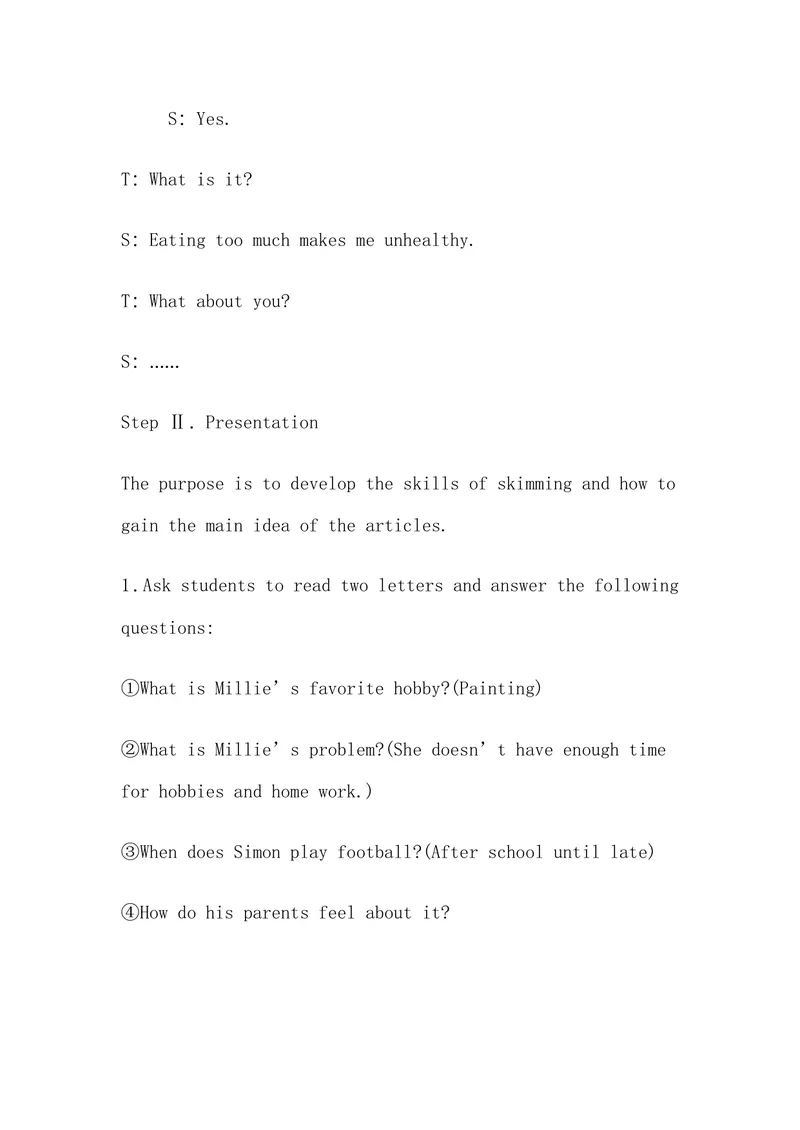
T:Have you got problems?S:Yes.
T:What is it?
S:Eating too much makes me unhealthy.
T:What about you?
S:……
Step Ⅱ.Presentation
The purpose is to develop the skills of skimming and how to
gain the main idea of the articles.
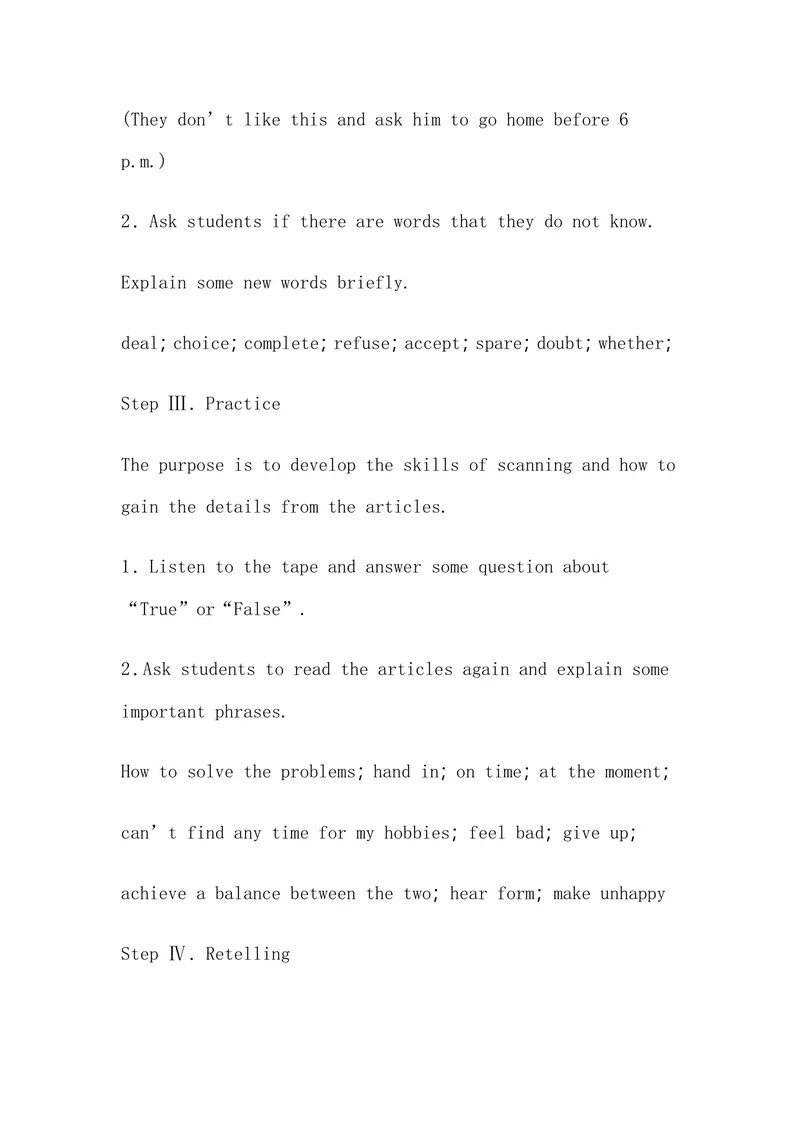
1.Ask students to read two letters and answer the following
questions:
①What is Millie’s favorite hobby?(Painting)
②What is Millie’s problem?(She doesn’t have enough time
for hobbies and home work.)
③When does Simon play football?(After school until late)
④How do his parents feel about it?(They don’t like this and ask him to go home before 6
p.m.)
2.Ask students if there are words that they do not know.
Explain some new words briefly.
deal;choice;complete;refuse;accept;spare;doubt;whether;
Step Ⅲ.Practice
The purpose is to develop the skills of scanning and how to
gain the details from the articles.
1.Listen to the tape and answer some question about
“True”or“False”.
2.Ask students to read the articles again and explain some
important phrases.
How to solve the problems;hand in;on time;at the moment;
can’t find any time for my hobbies;feel bad;give up;
achieve a balance between the two;hear form;make unhappy
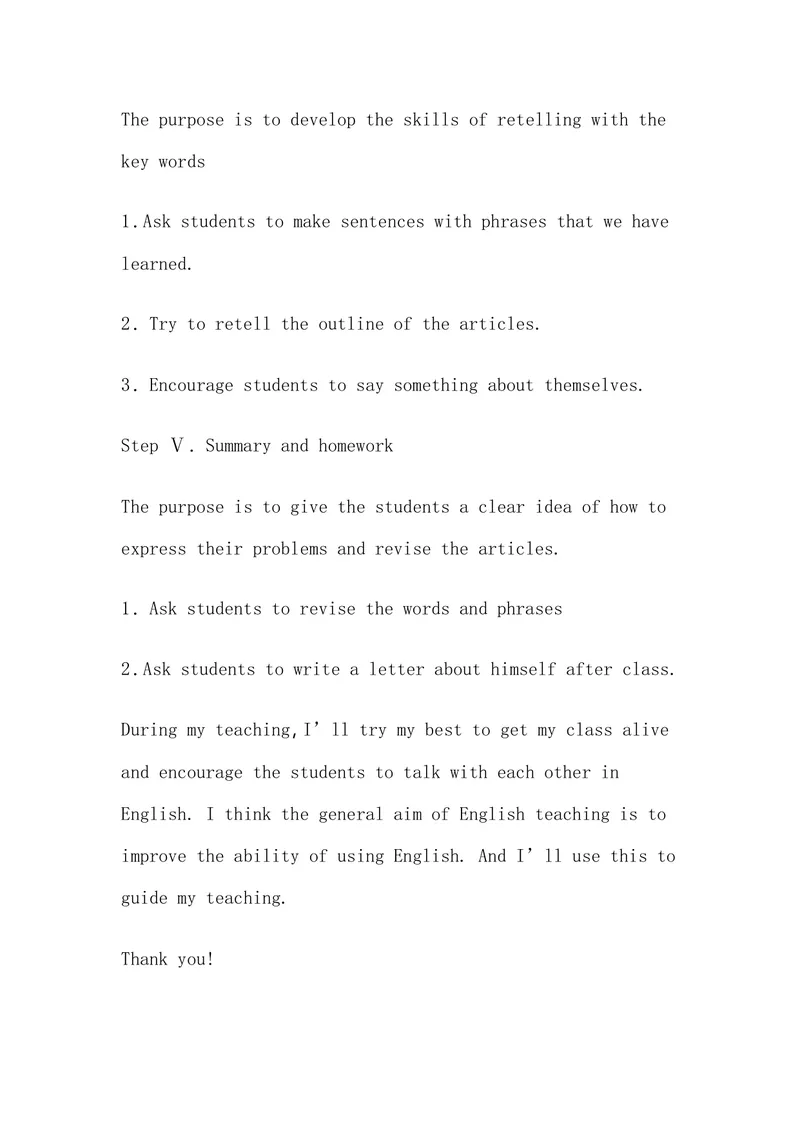
Step Ⅳ.RetellingThe purpose is to develop the skills of retelling with the
key words
1.Ask students to make sentences with phrases that we have
learned.
2.Try to retell the outline of the articles.
3.Encourage students to say something about themselves.
Step Ⅴ.Summary and homework
The purpose is to give the students a clear idea of how to
express their problems and revise the articles.
1.Ask students to revise the words and phrases
2.Ask students to write a letter about himself after class.
During my teaching,I’ll try my best to get my class alive
and encourage the students to talk with each other in
English. I think the general aim of English teaching is to
improve the ability of using English. And I’ll use this to
guide my teaching.
Thank you!初中英语优秀说课稿之二
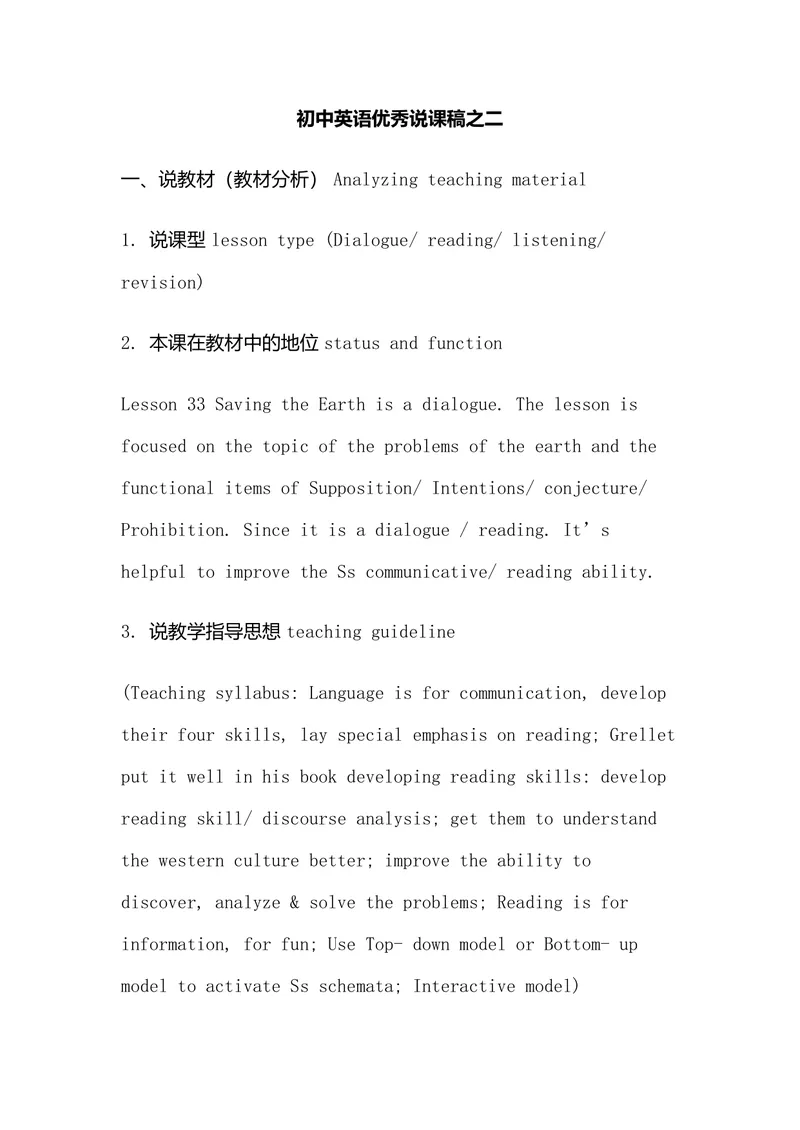
一、说教材(教材分析) Analyzing teaching material
1. 说课型 lesson type (Dialogue/ reading/ listening/
revision)
2. 本课在教材中的地位 status and function
Lesson 33 Saving the Earth is a dialogue. The lesson is
focused on the topic of the problems of the earth and the
functional items of Supposition/ Intentions/ conjecture/
Prohibition. Since it is a dialogue / reading. It’s
helpful to improve the Ss communicative/ reading ability.
3. 说教学指导思想 teaching guideline
(Teaching syllabus: Language is for communication, develop
their four skills, lay special emphasis on reading; Grellet
put it well in his book developing reading skills: develop
reading skill/ discourse analysis; get them to understand
the western culture better; improve the ability to
discover, analyze & solve the problems; Reading is for
information, for fun; Use Top- down model or Bottom- up
model to activate Ss schemata; Interactive model)4. 说教学目标和要求 Teaching aims and demands (…be
intended for Ss in key schools)
1)认知目标 knowledge objects
a. Enable the Ss to remember the following new words &
phrases:
Damage, lecture, pollute, pollution, room, standing room,
be fit for, hear about, turn into
b. Get the Ss to be familiar with this sentence pattern:
If the population keeps growing so quickly, there will only
be standing room left…
Give the Ss a reinforced practice on the functional item
Supposition.
c. Activate Ss schemata regarding the topic of pollution
and help Ss to know more about the problem of pollution.
2)智能目标 ability objects
a. Ask the Ss to make up a similar dialogue.b. Help them to understand the dialogue better and improve
the four skills.
c. Develop their ability of thinking independently.
d. Cultivate their ability to discover, analyze and solve
problems.
e. Train them to collect information from the Internet.
f. Train them with some effective learning methods to
optimize Ss’ learning results.
3)德育目标 moral objects
a. Arouse their interest in learning English;
b. Help them to understand the background of pollution.
c. Enable the students to love our earth and the nature.
d. Be aware of the importance of stopping pollution &
protecting out environment.
e. Encourage the Ss to do something to save the earth.
5. 说教学重点 teaching important points (生词、句型;培养阅读
技能)a. New words and phrases
b. Sentence pattern: If- clause
c. improve their reading skills.
d. Talking about problems of the Earth.
6. 说教学难点 teaching difficult points (语法;发展交际能力)
a. functional item: Supposition.
b. Develop their communicative ability. Act out their own
dialogue.
7. 说教具 teaching aids (multi-media computer, software,
OHP)
The teaching syllabus says that it’s necessary for
teachers to use modern teaching facilities. It’s of great
help to increase the class density and improve our teaching
result. It can also make the Ss reach a better
understanding of the text by making the classes lively and
interesting. At the same time, it arouses the Ss’ interest
in learning English.
二、说教法 Teaching methodsFive step method; audio-video; communicative approach;
Task-based learning: New Syllabus Design encourages
teachers to use this teaching method. TBLT can stimulate
Ss’ initiative in learning and develop their ability in
language application. Make the Ss the real masters in class
while the teacher himself acts as the director and bring
their ability into full play.
三、说学法 Study methods
1. Teach Ss how to be successful language learners.
2. Teach Ss how to develop the reading skill — skim &
scan; how to communicate with others; how to learn new
words; how to learn independently;
3. Get the Ss to form good learning habits.
四、说教学过程Teaching procedures
I. 复习 (Revision) 5min (Daily report; 词汇diagram;
brainstorming; activate schemata)
Activity 1: Imagination1). Suppose a bottle of ink is turned over and dirties your
white shirt, what is to be done? (Wash it? Or throw it
away?)
2). Suppose you catch a bad cold, what’s to be done?
3). Suppose your bike is broken, what’s to be done?
4). And suppose the earth, on which we all live, is
damaged, what’s to be done?
* What can you think of when you see “pollution” this
word?(waste, environment, air, water, factory, desert,
climate... Try to activate the Ss schemata regarding the
topic of pollution.)
II. 呈现 (Presentation) 5min
Activity 2: Presentation
Play the song “Earth Song” sung by Michael Jackson.
(Create an atmosphere)
A lot of pictures and video clips about the causes and
results of the three problems mentioned in this lesson will
be shown on the screen with the help of the computer.Ss’ presentation on pollution. Attract their attention,
arouse their interest, and create a good atmosphere for
communication.
* Activate their schemata and cultivate their ability in
collecting information from the Internet and develop their
ability in thinking independently.
III. 对话 / 阅读 (Dialogue)18m
1. Pre- reading
Activity 3: Prediction
1st listening/ fast reading, one guided Q to help Ss to get
the main idea:
What do you think is discussed at the conference?
2. While- reading
Activity 4: Read and answer
2nd listening/ careful reading, more Qs to get the detailed
information. Develop their reading skills: skim & scan. Pay
attention to the pronunciation, stress & intonation.* 阅读: Pre-reading; while-reading; post-reading (fast
reading/ careful reading; skim/ scan; 识别关键词key words;
确定主题句;创设信息差information gap;T or F; 填表
格chart/diagram; Predicting; Make a timeline; Make a story
map。达到对课文的整体理解和掌握。So that they can have a good
understanding of the whole text.)
3. Post- reading
Activity 5: Language focus
While Ss are answering the Qs, the teacher deals with some
key language points.
a. is being caused b. and so on c. go on doing
d. be fit for e. standing room f. if- clause
IV. 操练 (Practice) 10m
Activity 6: Retell
Use your own words to retell the dialogue in the 3rd
person.
Activity 7: Acting outActivity 8: Drill – Supposition
Purpose: Practise the functional item of Supposition. (P.
33 Part 2; P.113, wb Ex. 3)
(Retell; act out; role play)
V. 巩固 (Consolidation) 6m
(Discussion; interview; press conference; debate; quiz)
Activity 9: role play
Suppose you were head of a village, scientist, journalist
and villager, make up a conversation and ask several groups
to demonstrate in front of the class.
* The Ss are encouraged to use the words and
expression_r_rs like pollution, damage, be fit for, turn
into, the if- clause, etc.
Activity 10: Discussion
Think of the question: Are we causing damage to the world?
What should we do to save the earth and protect our
environment especially in our daily life?Collect their answers and form a report.
VI. 作业 (Homework) 1m (Writing; continue the story;
recite; retell)
Write a letter to the mayor, telling him sth. about the
pollution around your school.
初中英语优秀说课稿之三
Good afternoon, everyone. I’m Zhou Yan. I’m an English
teacher from Experimental School of Suqian. Now I’ll say
Sample A of Lesson Six in Book One. I’ll prepare to say
the lesson from four parts.
Part One Analysis of the Teaching Material
(一) STATUS AND FUNCTION
1.This is an important lesson in Book One. From this
lesson, it starts asking the Ss to grasp contents of each
Sample. To attain “four skills” request of listening,
speaking, reading and writing. To start listing “Word
Bank” and tell the Ss to remember the new words. To start
asking the Ss to write the English sentences well.
Therefore this lesson is in the important position of the
teaching material.2.This lesson is the first one of Unit 2.So if the Ss can
learn it well, it will be helpful to make the Ss learn the
rest of this unit.
3.Such a topic is related to daily life, so it is helpful
to raise learning interests of students and it will be also
helpful to improve their spoken English.
()ANALYSIS OF THE STUDENTS
The Ss has learned English for about one month so far. They
can understand some words and some simple sentences. The Ss
have taken a great interest in English now.
()TEACHING AIMS AND DEMANDS
The teaching aim\'s basis is established according to
Junior School English syllabus\' provision.
1.Knowledge objects
(1) To make the Ss know how to use the affirmative sentence
“This is. . . .” and the negative sentence “This is
not….”Everyday expressions for “Apologies”“I\'m
sorry”“That\'s all right”.
(2) To study the new words “six, hey, sorry, it’s,
that’s”, etc. by learning the dialogue of this lesson.
(3) To finish some exercises.
2.Ability objects(1) To develop the Ss’ abilities of listening, speaking,
reading and writing.
(2) To train the Ss’ ability of working in pairs.
(3) To develop the Ss’ abilities of communication by
learning the useful structures.
3.Moral objects
(1) To enable the Ss to be polite and love life.
(2) To enable the Ss to look after their things well.
()TEACHING KEY AND DIFFICULT POINTS
The teaching key and difficult points’ basis is
established according to Sample A of Lesson Six in the
teaching material\'s position and function.
1.Key points:
(1).To help the Ss to communicate with each other.
(2).To enable the Ss to study in groups and co-operate
skillfully.
(3).To develop the Ss’ interest in English.
2.Difficult points:
(1) How to make dialogues and act them out.
(2) How to write the right whole sentences.
(五) TEACHING AIDS
Multi-media computer, Tape recorder, Software: Powerpointor Authorware, school things and so on. They will be needed
in this lesson. 四三二
Part Two The Teaching Methods
1. Communicative teaching method
2. Audio-visual teaching method
3. Task-based” teaching method
As we all know: the main instructional aims of learning
English in the Middle School is to cultivate students’
abilities of listening, speaking, reading, writing and
their good sense of the English language. So in this lesson
I’ll mainly use “Communicative” teaching method,
“Audio-visual” teaching method and “Task-based”
teaching method. That is to say, I’ll let the Ss to get a
better understanding of the key structure of the dialogue.
I’ll give the Ss some tasks and arrange five kinds of
activities: talking, guessing games, watching CAI, acting
out Sample A and having a competition.
Teaching special features
To use these methods are helpful to develop the Ss’
thought.
Part Three STUDYING WAYS
1.Teach the Ss how to be successful language learners.2.Let the Ss pass \"Observation—Imitation—Practice \" to
study language.
3.Teach the Ss how to master dialogues and how to
communicate with others.
Teaching special features:
Let the Ss communicate with each other and adopt
competition methods to develop the Ss’ keen interest in
English.
Part Four Teaching Procedure
I’ll finish this lesson in four steps. First I’ll divide
the Ss into four groups and bring a competition into the
class. At last let’s see which group is the winner.
Step1 Warm-up
1. Free talk between T and Ss .
Such as: Hi, I’m . . . . What’s your name?
This is …. How do you do?
Who is he/she? How are you?
Who can count from 1to 5?
What’s this in English? etc.
2.A game: Ask the Ss to give T some school things. For
example:
T: Give me your book.(ruler, box, pen, table, knife, etc.)T: This is your book. This is not my book. It’s your book.
etc.
In this course I’ll ask them to make a dialogue group by
group without repetition. Find out which group will make
the most dialogues.
Purpose of my designing: I think it is important to form a
better English learning surrounding for the Ss by imitating
and at the same time it is necessary to provide situations
to review learned knowledge.
Step2. Presentation
This course is very important. I’ll mainly talk about this
step.
I’ll use CAI to present the whole dialogue. Arrange some
situations to help Ss understand Sample A.
First scene: There is a bag on the floor. B is picking it
up and get ready to leave. Now A is talking with B.
A: Hi, B. How are you today?
B: I’m fine, thank you. And you?
A: I’m fine, too. Oh, this is my bag.
B: No, this is not your bag. It’s my bag.
A: (Look closely) Oh, I’m sorry.
B: That’s all right.(At the same time, C is running up and hitting A.)
C: Oh, I’m sorry.
A: That’s OK.
I’ll write the key points on the Bb while they are
watching. After watching, I’ll teach them to read the
words and sentences on the Bb. Make sure they can read them
well.
Purpose of my designing: To present Sample A by CAI is much
easier for the Ss to learn and grasp the meanings. CAI can
provide a real situation with its sound and picture and it
makes the relationships between the Ss better.
Step3.Practice
First play the tape recorder. Let the Ss listen and imitate
the dialogue. Pay attention to their pronunciation and
intonation. In this step the Ss are required to practise
the Sample in pairs by reading the dialogue aloud. This
step is employed to make the Ss grasp the Sample .At last
I’ll ask the Ss to think hard and act it out with a
partner according to Sample A. Then find out which group
will act it out well. I’ll give them red stars.
Purpose of my designing: This step is employed to make the
Ss get the general idea of the dialogue as a whole one. Atthe same time let the Ss have a chance to practise their
listening and spoken ability.
Step4.Production
In this step I’ll give the Ss a free space to show their
abilities.
Second scene: The Ss are having a picnic. It’s hot and
they take off their coats and put them together. They are
singing and dancing, laughing and chatting. After the
picnic, they begin to look for their coats. D and E are
talking. F and G are talking. etc.
After watching, I’ll give the Ss some tasks to make
similar dialogues without repetition and find out which
group will make more dialogues.
Purpose of my designing: “Task-based” teaching method is
used here to develop the Ss’ ability of communication and
also their ability of co-operation will be well trained.
Tell the Ss we should be polite and take good care of our
things. We should love our life. I think proper competition
can arouse the Ss’ interest in English learning. If the Ss
can finish this task well, they will benefit a lot in their
spoken English.
2.Skill 1 Model 1.I’ll ask four Ss of the groups to write these sentences on
the Bb in the four lines.
Then check their handwriting, correct their mistakes. Find
out who will write well and whose handing is the best.
3.Finish the Ss’ workbook.
Purpose of my designing: To check the knowledge Ss have
learned in this lesson.
Step5.Homework:
(1)Recite the words as many as possible after class.
(2)Make a dialogue according to Sample A and write it in
the exercise book.
Purpose of my designing: I think homework is so important
that the Ss should speak English as much as they can in
class or after class. It is necessary for the Ss to do some
extensive exercises after class to consolidate the
knowledge they learned.
Blackboard Design
Lesson Six Sample ASix This is my….hey This is not your. .
. .sorry It’s my. . . . Picture it’s=it is Oh, I’m
sorry.that’s=that is That’s all right/OK.
Teaching plan
For Unit 4 A Garden of PoemsReading English Poetry
By shiyanping
Teaching Goals:
1. Learn about poets and poems of different countries.
2. The similarities and differences between the Chinese and English
poets and poems.
3. Improve the student’s reading ability.
Teaching procedures:
Step 1 Lead-in
T:It is well known that China has long history and splendid culture. Of
course, in the field of poetry, we have many of the world’s greatest poets.
Can you name some famous poets?
Li Bai, Du Fu, Bai Juyi, Wang Wei……
T: Good ! Thanks. Chinese poets, such as Li Bai & Du Fu use their
genius to make the dream world of poetry more colorful. Here is a poem
written by Li Bai, I think you are familiar with it.
T: Okay, let’s read it together.
Li Bai use his endless imagination to describe the wonderful scenery of
the Lu Shan Mountain Waterfall, we can feel the power & magic of the
waterfall through the words that he used. Can you recite any other poems
that written by Chinese poets?T: Well done! We have taken a look on the art of poetry and Chinese
poetry. Next, we’ll take a journey to English poetry. English poetry is as
interesting and attractive as Chinese. I’ll be the guide to show you
around.
Step 3 Fast-reading
T: Open your books , turn to P27, look at the Reading part, First, go
through the text quickly and find the answers to the following 2
questions:
Q: 1. What are the differences between poetry and other forms of
literature?
2. Whose poetry reminds Chinese readers of Du Fu or Li Bai? Whose of
Su Dongpo?
T: Well, let’s deal with the 2 questions.
A: 1. ① Poetry plays with sounds, words and grammar. ② Poetry is
difficult to write, but interesting to read.③ Poetry calls up all the colors,
feelings,experiences and curious images of a dream world.
2. ① William Wordsworth, George Gordon Byron & John Keats ②
John Donne
Step 4 Careful-reading
Task 1. The main idea of each paragraph
T: Good job! How many paragraphs in the text? (7) Ok, read the text
carefully. Then summarize each paragraph’s main idea.Para. 1 The characters of poetry.
Para. 2 A look on Chinese poetry.
Para. 3 The first period of Modern English poetry.
th
Para. 4 Modern English poetry in the 19 century.
Para. 5 Why modern poets have special attraction?
Para. 6 The introduction of English poetry to China.
Para. 7 ①The translation of English poetry.②The role that poems act as.
Task 2 A timeline
T: Excellent! Here is a task for you. Please focus on paragraph 3-5 and
finish the timeline which will help you to get a more clear impression of
some great poets in English history. Now do it!
Step 4 Post-reading
Task 1
T: Let’s turn to next step. Look at P28, Ex.1, make sure to get the right
choices.
Keys: 1. A 2. C 3. B 4. D 5. C
Task 2
T: In several paragraphs, there are some words in bold; can you tell what
do they refer to?Para. 1 That makes poetry difficult to write, but very interesting to read.
------Poetry plays with sounds,words and grammar.
Para.
Para 3 Despite its short history,there is a lot of good poetry around.
------English poetry’s
Para. 4 The style and atmosphere in their poems has often…
------William Wordsworth,Byron,John Keats
Para. 5 Finally, modern poets have their special …in the language and
images they use.
------modern poets
Para.
Para.7 They can help us to understand each other better,…
------poems and literature
Retell the story by filling the blanks:
Step 5
T: The poet Mu Dan wrote a short poem, “Quietly, we embrace In a
world lit up by words.”.
Q: Can you use your own words to explain it?
A: When people from one country read the poems from another, they will
be struck by what is inside the poem, so they will understand each other
and become good friends.Step 6 Enjoyment
T: You have understood the magic that poetry brings, that’s great! There,
we can use a image to describe the special role that poems and literature
act as, “Poems and literature can be bridges.” Can you give other images
to express the same idea? Who’d like to have a try?
A: 1.Poems and literature can be ties that bring the East and the West
together.
2. Poems and literature can be fine wine enjoyed by the East and the
West.
T: We say, Poems can be fine wine enjoyed by the East and the West.
That means not matter you are a English or Chinese, you can find
amusement in poem. But how to enjoy a English poem? We need to know
several simple principle, do you want to know what principles they are?
T: When enjoy an English poem, you should: 1. Use your heart and
emotion.2. Imagine you are exactly in the dream world of that poem.
Step 7 Discussion
T: It’s really amusing! At the end of this lesson, let’s have a discussion.
Are poems good for our life? What can we get from poems?
1. Poems bring passion to our life.
2. Poems help us to understand life, virtues, beauty and romance…3. Poems make us know, we are here,we can make our life and the
world more colorful!
Step 8 Homework
1. Read the text again to get a better understanding.
2. Read and translate several good English poems.
3. Get some information about famous poets on internet if possible
牛津英语8B说课稿
Good morning, everyone. I’m Wang Li. I’m an English
teacher from Xing Long School. I am very glad to be here
to talk about my opinion. This is my first time to face so
many people, I feel a bit nervous. Today I’m going to talk
about 8B Chapter 1 Reading. This part is the most
important in Chapter 1.I’ll teach it in details.
First I’ll talk about the teaching Objectives
1. Objectives on the knowledge
(1) To enable the students to know some attractions of France.(2) To help Ss to finish some exercises about the text.
(3) To master some new vocabulary and phrases.
2. Objectives on the abilities
(1) To develop the Ss’ abilities of reading.
(2) To train the Ss’ ability of working in groups
(3) To develop the Ss’ abilities of summary
3. Objectives on the emotion
(1) To foster Ss’ consciousness of good co-operation.
(2) Let the students know and love France, let the world know and
love China
Next I’ll talk about key points of this part.
(1) To master the key words and some facts about France.
(2) To enable Ss to study in groups and co-operate skillfully.(3) To develop Ss’ interest in English.
After that I’ll say something about difficult points of this
part.
(1) It is difficult to read the names of some places in France.
(2) It has more new words than some students can understand.
Then, I’ll talk about Teaching methods.
Everyone knows the main instructional aim of learning English in
middle school is to cultivate students’ basic abilities of listening,
speaking, reading, writing and their good sense of the English
language. So in this lesson, I’ll mainly use “Task-based” teaching
method.
Teaching methods
Task-Based Teaching Methods
With the help of the teacher, let the students finish the task.My main teaching property is multimedia.
Here is the analysis about the students.
They’ve just had their own good holiday, so they’ll be glad to know
how and where to travel to France. Before reading, they’ve known
something about France, so exercise A. What do you know
about... won’t be too difficult, they’ll like the text very much. After
reading with the teacher’s and With each other’s help, the
students can finish the exercises A-D happily.
Finally, I’ll talk about teaching procedures. I’ll finish this part in six
steps.
Step 1 Warm upFirst, I’ll have a free talk with the students about their summer
holidays. Because this is our first lesson this term, we will be very
happy to see each other. We will talk about where we have been.
Step 2 Lead in
Then I’ll show them a picture of Eiffel Tower. Ask them “What’s
this? Do you know where it is?” Then lead in Paris and France. I’ll
more pictures about French landmarks, food and culture and
fashion. I’ll tell them Paris is the capital of fashion.
After that, I’ll ask them what they know about France. We will talk
about French flag, French popular sports, French drinks and what
happened in France in 1789. I’m sure the students will be very
interested in these.
Next part, I’ll let them scan the heading, the headlines and photos,
then answer the questions in Exercise B Look and think.Step 3 Presentation
I’ll show them some pictures to teach them new words.
Step 4 Read and comprehension
Read Paragraph 1, with the help of the useful phrases. I’ll explain
them for the students. They must discuss the main idea of each
paragraph in class. The student who can summarize correctly, we
will cheer for him or her and I’ll give a gift to him or her. Each
paragraph will do the same thing as above.
Step 5 Have a discussion
What good of learning French when we are traveling to France.
Step 6 Exercise
Do Exercise C1, C2, because both of the exercises are easy, I’ll ask
some students who aren’t good at English to answer these
questions.At last, make a summery of the article in note form.
Homework for today.
1. Match each word with its meaning
(Workbook Page 102)
2. Try to write an article
“China is calling”
Blackboard designs
Useful phrases
1 now that=since
2 think about
3 go abroad
4 this year
5 why not6 spread your wings
Good afternoon, everyone. I’m Zhou Yan. I’m an English teacher from
Experimental School of Suqian. Now I’ll say Sample A of Lesson Six in
Book One. I’ll prepare to say the lesson from four parts.
Part One Analysis of the Teaching Material
(一) STATUS AND FUNCTION
1.This is an important lesson in Book One. From this lesson, it starts
asking the Ss to grasp contents of each Sample. To attain “four skills”
request of listening, speaking, reading and writing. To start listing “Word
Bank” and tell the Ss to remember the new words. To start asking the Ss
to write the English sentences well. Therefore this lesson is in the
important position of the teaching material.
2.This lesson is the first one of Unit 2.So if the Ss can learn it well, it will
be helpful to make the Ss learn the rest of this unit.
3.Such a topic is related to daily life, so it is helpful to raise learning
interests of students and it will be also helpful to improve their spoken
English.
(二)ANALYSIS OF THE STUDENTS
The Ss has learned English for about one month so far. They can
understand some words and some simple sentences. The Ss have taken a
great interest in English now.(三)TEACHING AIMS AND DEMANDS
The teaching aim\'s basis is established according to Junior School
English syllabus\' provision.
1.Knowledge objects
(1) To make the Ss know how to use the affirmative sentence “This
is. . . .” and the negative sentence “This is not….”Everyday expressions
for “Apologies”“I\'m sorry”“That\'s all right”.
(2) To study the new words “six, hey, sorry, it’s, that’s”, etc. by learning
the dialogue of this lesson.
(3) To finish some exercises.
2.Ability objects
(1) To develop the Ss’ abilities of listening, speaking, reading and
writing.
(2) To train the Ss’ ability of working in pairs.
(3) To develop the Ss’ abilities of communication by learning the useful
structures.
3.Moral objects
(1) To enable the Ss to be polite and love life.
(2) To enable the Ss to look after their things well.
(四)TEACHING KEY AND DIFFICULT POINTS
The teaching key and difficult points’ basis is established according to
Sample A of Lesson Six in the teaching material\'s position and function.1.Key points:
(1).To help the Ss to communicate with each other.
(2).To enable the Ss to study in groups and co-operate skillfully.
(3).To develop the Ss’ interest in English.
2.Difficult points:
(1) How to make dialogues and act them out.
(2) How to write the right whole sentences.
(五) TEACHING AIDS
Multi-media computer, Tape recorder, Software: Powerpoint or
Authorware, school things and so on. They will be needed in this lesson.
Part Two The Teaching Methods
1. Communicative teaching method
2. Audio-visual teaching method
3. Task-based” teaching method
As we all know: the main instructional aims of learning English in the
Middle School is to cultivate students’ abilities of listening, speaking,
reading, writing and their good sense of the English language. So in this
lesson I’ll mainly use “Communicative” teaching method, “Audio-visual”
teaching method and “Task-based” teaching method. That is to say, I’ll
let the Ss to get a better understanding of the key structure of the
dialogue. I’ll give the Ss some tasks and arrange five kinds of activities:talking, guessing games, watching CAI, acting out Sample A and having
a competition.
Teaching special features
To use these methods are helpful to develop the Ss’ thought.
Part Three STUDYING WAYS
1.Teach the Ss how to be successful language learners.
2.Let the Ss pass \"Observation—Imitation—Practice \" to study
language.
3.Teach the Ss how to master dialogues and how to communicate with
others.
Teaching special features:
Let the Ss communicate with each other and adopt competition methods
to develop the Ss’ keen interest in English.
Part Four Teaching Procedure
I’ll finish this lesson in four steps. First I’ll divide the Ss into four groups
and bring a competition into the class. At last let’s see which group is the
winner.
Step1 Warm-up
1. Free talk between T and Ss .
Such as: Hi, I’m . . . . What’s your name?This is …. How do you do?
Who is he/she? How are you?
Who can count from 1to 5?
What’s this in English? etc.
2.A game: Ask the Ss to give T some school things. For example:
T: Give me your book.(ruler, box, pen, table, knife, etc.)
T: This is your book. This is not my book. It’s your book. etc.
In this course I’ll ask them to make a dialogue group by group without
repetition. Find out which group will make the most dialogues.
Purpose of my designing: I think it is important to form a better English
learning surrounding for the Ss by imitating and at the same time it is
necessary to provide situations to review learned knowledge.
Step2. Presentation
This course is very important. I’ll mainly talk about this step.
I’ll use CAI to present the whole dialogue. Arrange some situations to
help Ss understand Sample A.
First scene: There is a bag on the floor. B is picking it up and get ready to
leave. Now A is talking with B.
A: Hi, B. How are you today?
B: I’m fine, thank you. And you?
A: I’m fine, too. Oh, this is my bag.
B: No, this is not your bag. It’s my bag.A: (Look closely) Oh, I’m sorry.
B: That’s all right.
(At the same time, C is running up and hitting A.)
C: Oh, I’m sorry.
A: That’s OK.
I’ll write the key points on the Bb while they are watching. After
watching, I’ll teach them to read the words and sentences on the Bb.
Make sure they can read them well.
Purpose of my designing: To present Sample A by CAI is much easier for
the Ss to learn and grasp the meanings. CAI can provide a real situation
with its sound and picture and it makes the relationships between the Ss
better.
Step3.Practice
First play the tape recorder. Let the Ss listen and imitate the dialogue. Pay
attention to their pronunciation and intonation. In this step the Ss are
required to practise the Sample in pairs by reading the dialogue aloud.
This step is employed to make the Ss grasp the Sample .At last I’ll ask the
Ss to think hard and act it out with a partner according to Sample A. Then
find out which group will act it out well. I’ll give them red stars.
Purpose of my designing: This step is employed to make the Ss get the
general idea of the dialogue as a whole one. At the same time let the Ss
have a chance to practise their listening and spoken ability.Step4.Production
In this step I’ll give the Ss a free space to show their abilities.
Second scene: The Ss are having a picnic. It’s hot and they take off their
coats and put them together. They are singing and dancing, laughing and
chatting. After the picnic, they begin to look for their coats. D and E are
talking. F and G are talking. etc.
After watching, I’ll give the Ss some tasks to make similar dialogues
without repetition and find out which group will make more dialogues.
Purpose of my designing: “Task-based” teaching method is used here to
develop the Ss’ ability of communication and also their ability of co-
operation will be well trained. Tell the Ss we should be polite and take
good care of our things. We should love our life. I think proper
competition can arouse the Ss’ interest in English learning. If the Ss can
finish this task well, they will benefit a lot in their spoken English.
2.Skill 1 Model 1.
I’ll ask four Ss of the groups to write these sentences on the Bb in the
four lines.
Then check their handwriting, correct their mistakes. Find out who will
write well and whose handing is the best.
3.Finish the Ss’ workbook.
Purpose of my designing: To check the knowledge Ss have learned in this
lesson.Step5.Homework:
(1)Recite the words as many as possible after class.
(2)Make a dialogue according to Sample A and write it in the exercise
book.
Purpose of my designing: I think homework is so important that the Ss
should speak English as much as they can in class or after class. It is
necessary for the Ss to do some extensive exercises after class to
consolidate the knowledge they learned.
Blackboard Design
Lesson Six Sample ASix This is my….hey This is not your. . . .sorry It’s
my. . . . Picture it’s=it is Oh, I’m sorry.that’s=that is That’s all right/OK.
初中英语说课稿(英文版)
一、说教材(教材分析) Analyzing teaching material
1. 说课型 lesson type (Dialogue/ reading/ listening/
revision)
2. 本课在教材中的地位 status and function
Lesson 33 Saving the Earth is a dialogue. The lesson is
focused on the topic of the problems of the earth and the
functional items of Supposition/ Intentions/ conjecture/
Prohibition. Since it is a dialogue / reading. It’s
helpful to improve the Ss communicative/ reading ability.
3. 说教学指导思想 teaching guideline(Teaching syllabus: Language is for communication, develop
their four skills, lay special emphasis on reading; Grellet
put it well in his book developing reading skills: develop
reading skill/ discourse analysis; get them to understand
the western culture better; improve the ability to
discover, analyze & solve the problems; Reading is for
information, for fun; Use Top- down model or Bottom- up
model to activate Ss schemata; Interactive model)
4. 说教学目标和要求 Teaching aims and demands (…be
intended for Ss in key schools)
1)认知目标 knowledge objects
a. Enable the Ss to remember the following new words &
phrases:
Damage, lecture, pollute, pollution, room, standing room,
be fit for, hear about, turn into
b. Get the Ss to be familiar with this sentence pattern:
If the population keeps growing so quickly, there will only
be standing room left…
Give the Ss a reinforced practice on the functional item
Supposition.
c. Activate Ss schemata regarding the topic of pollution
and help Ss to know more about the problem of pollution.
2)智能目标 ability objects
a. Ask the Ss to make up a similar dialogue.
b. Help them to understand the dialogue better and improve
the four skills.
c. Develop their ability of thinking independently.d. Cultivate their ability to discover, analyze and solve
problems.
e. Train them to collect information from the Internet.
f. Train them with some effective learning methods to
optimize Ss’ learning results.
3)德育目标 moral objects
a. Arouse their interest in learning English;
b. Help them to understand the background of pollution.
c. Enable the students to love our earth and the nature.
d. Be aware of the importance of stopping pollution &
protecting out environment.
e. Encourage the Ss to do something to save the earth.
5. 说教学重点 teaching important points (生词、句型;培养阅读
技能)
a. New words and phrases
b. Sentence pattern: If- clause
c. improve their reading skills.
d. Talking about problems of the Earth.
6. 说教学难点 teaching difficult points (语法;发展交际能力)
a. functional item: Supposition.
b. Develop their communicative ability. Act out their own
dialogue.
7. 说教具 teaching aids (multi-media computer, software,
OHP)The teaching syllabus says that it’s necessary for
teachers to use modern teaching facilities. It’s of great
help to increase the class density and improve our teaching
result. It can also make the Ss reach a better
understanding of the text by making the classes lively and
interesting. At the same time, it arouses the Ss’ interest
in learning English.
二、说教法 Teaching methods
Five step method; audio-video; communicative approach;
Task-based learning: New Syllabus Design encourages
teachers to use this teaching method. TBLT can stimulate
Ss’ initiative in learning and develop their ability in
language application. Make the Ss the real masters in class
while the teacher himself acts as the director and bring
their ability into full play.
三、说学法 Study methods
1. Teach Ss how to be successful language learners.
2. Teach Ss how to develop the reading skill — skim &
scan; how to communicate with others; how to learn new
words; how to learn independently;
3. Get the Ss to form good learning habits.
四、说教学过程Teaching procedures
I. 复习 (Revision) 5min (Daily report; 词汇diagram;
brainstorming; activate schemata)
Activity 1: Imagination
1). Suppose a bottle of ink is turned over and dirties your
white shirt, what is to be done? (Wash it? Or throw it
away?)
2). Suppose you catch a bad cold, what’s to be done?3). Suppose your bike is broken, what’s to be done?
4). And suppose the earth, on which we all live, is
damaged, what’s to be done?
* What can you think of when you see “pollution” this
word?(waste, environment, air, water, factory, desert,
climate... Try to activate the Ss schemata regarding the
topic of pollution.)
II. 呈现 (Presentation) 5min
Activity 2: Presentation
Play the song “Earth Song” sung by Michael Jackson.
(Create an atmosphere)
A lot of pictures and video clips about the causes and
results of the three problems mentioned in this lesson will
be shown on the screen with the help of the computer.
Ss’ presentation on pollution. Attract their attention,
arouse their interest, and create a good atmosphere for
communication.
* Activate their schemata and cultivate their ability in
collecting information from the Internet and develop their
ability in thinking independently.
III. 对话 / 阅读 (Dialogue)18m
1. Pre- reading
Activity 3: Prediction
1st listening/ fast reading, one guided Q to help Ss to get
the main idea:
What do you think is discussed at the conference?
2. While- readingActivity 4: Read and answer
2nd listening/ careful reading, more Qs to get the detailed
information. Develop their reading skills: skim & scan. Pay
attention to the pronunciation, stress & intonation.
* 阅读: Pre-reading; while-reading; post-reading (fast
reading/ careful reading; skim/ scan; 识别关键词key words;
确定主题句;创设信息差information gap;T or F; 填表
格chart/diagram; Predicting; Make a timeline; Make a story
map。达到对课文的整体理解和掌握。So that they can have a good
understanding of the whole text.)
3. Post- reading
Activity 5: Language focus
While Ss are answering the Qs, the teacher deals with some
key language points.
a. is being caused b. and so on c. go
on doing
d. be fit for e. standing room f. if-
clause
IV. 操练 (Practice) 10m
Activity 6: Retell
Use your own words to retell the dialogue in the 3rd
person.
Activity 7: Acting out
Activity 8: Drill – Supposition
Purpose: Practise the functional item of Supposition. (P.
33 Part 2; P.113, wb Ex. 3)
(Retell; act out; role play)V. 巩固 (Consolidation) 6m
(Discussion; interview; press conference; debate; quiz)
Activity 9: role play
Suppose you were head of a village, scientist, journalist
and villager, make up a conversation and ask several groups
to demonstrate in front of the class.
* The Ss are encouraged to use the words and expression_rs
like pollution, damage, be fit for, turn into, the if-
clause, etc.
Activity 10: Discussion
Think of the question: Are we causing damage to the
world?
What should we do to save the earth and protect our
environment especially in our daily life?
Collect their answers and form a report.
VI. 作业 (Homework) 1m (Writing; continue the story;
recite; retell)
Write a letter to the mayor, telling him sth. about
the pollution around your school.
五、说板书Blackboard design
英文版英语说课稿
Background of English teaching in primary school: It is not
a long history that English is as a subject in primary
school in our country and the main instructional aims of
teaching English in primary school is to cultivate pupils’
basic abilities of their listening and speaking and their
good sense of the English language. Our boys and girls areexposed to English for the first time, so it is very
important to develop their keen interest in English.
I. Contents:
Today I’m going to talk about Part B of Unit 2, PEP
Primary English, Book 3. This lesson includes two parts:
Let’s talk and let’s practice. In section 1, it mainly
deals with the dialogue about “What’s in the schoolbag?”
and the answers. And in section 2, it provides a real
situation for the Ss to prastise the pattern: How many +n.
(pl.)+ do you have? And the answer: I have 23 +n.(pl.)
II. Teaching aims
1. Aims on the knowledge
(1) To enable the Ss to understand and speak: “My
schoolbag is heavy. What’s in it? Thank you sooooooo
much.” Make sure that Ss can use these sentences in real
situations.
(2) To help Ss to finish the survey.
(3) Let Ss finish the assessment of “Let’s check” in
this unit.
2. Aims on the abilities
(1) To develop Ss’ abilities of listening and speaking.
(2) To train the Ss’ ability of working in groups.
(3) To foster Ss’ abilities of communication and their
innovation.
3. Aims on the emotion(1)To foster Ss’ consciousness of good co-operation and
proper competition.
(2) To lead Ss to show their loveliness to the poor.
III. Key-points of this lesson
(1) To help Ss ask and answer the question: What’s in
it?
(2) To enable Ss to study in groups and co-operate
skillfully.
(3) To develop Ss’ interest in English.
IV. Difficult points
(1) To help the Ss ask and answer the question “What’s
in it?” and make sure they can use the plural nouns
correctly.
(2) To finish the survey by themselves.
V. Teaching methods
As we all know: the main instructional aims of learning
English in primary school is to cultivate pupils’ basic
abilities of listening and speaking and their good sense of
the English language. So in this lesson I’ll mainly use
“Task-based” teaching method. That is to say, I will let
the Ss learn in real situations, finish a task by making a
survey to help the Ss to get a better understanding of the
key structure of the dialogue. I will arrange four kinds of
activities: singing, guessing game, finishing a survey and
having a competition. And in this lesson a recorder, CAI,school things and a printed form will be needed. Students
should prepare some school things.
VI. Teaching procedures and purposes of my designing.
I’ll finish this lesson in five steps.
Step 1. Warm-up and preview
1. Free talk between T and Ss about things in the
classroom.
2. Sing the song together: Books and pencils.
3. Do some TPR, for example: Show me your English book.
Show me your crayon.
4. Review the numbers by asking: “How many crayons do
you have?”
Purpose: It is important to form a better English
learning surrounding for the Ss by singing and doing some
total physical response and at the same time it provides
situations to review learned knowledge for the next step.
Step 2. Presentation
Now I’ll mainly talk about this step.
1. Present the pattern: “My schoolbag is heavy.”
“What’s in it?.”
(1) Show a bag and say: “Look! I have a bag.” Carry it
and say: “Oh, it is heavy. My schoolbag is heavy.” Help
the Ss understand the meaning with the help of my body
language. Then lead the Ss to read the sentence. Make sure
they can say it correctly.
(2) T: My schoolbag is heavy.Open the bag and say: “What’s in it? What’s in my
schoolbag?”
Take out a Chinese book. Then do the action again. Let
the Ss read the sentence.
2. Play a guessing game. Divide the whole class into four
groups to have a competition.
Let them guess: What’s in the bag? How many? Purpose:
To present the key structures one by one is much easier for
the Ss to learn and grasp the meanings. Proper competition
can arouse the Ss’ interest in English learning.
3. With the help of the CAI to present the dialogue. Set a
situation to help Ss understand: Two Ss are coming. One
girl is carrying a heavy bag on her back. They are talking.
Girl: My schoolbag is heavy.
Boy: What’s in it?
Girl: 20 story-books, 32 pencil, 9 rulers, 12 crayons
and 30 picture-books. Etc.
Boy: What will you do?
Girl: They are for the poor.
Boy: Great! I’ll bring some school things too.
The boy comes back home and puts a lot of things into
the bag. Then he goes to school again and gives them to a
teacher. While he is taking them out, he is counting the
numbers of all things. The teacher says: Thank you
soooooooo much.
4. Mention that we should take care of the poor.
5. Play the cassette. Let the Ss listen and imitate the
dialogue.Pay attention to their pronunciation and intonation.
Purpose: CAI can provide a real situation for the Ss to
understand the dialogue and the relationships between
people better. Tell the Ss we should show our loveliness to
the Ss.
Step 3. Practice
Divide Ss into groups of six children. Each one would
finish the printed form by asking and answering: How many
storybooks do you have? Find out which group finishes
faster. Story books picture-books sharpeners crayons
pencils erasers pencil-cases rulers Chen Jie 8 24 3 32 26 4
1 3 Purpose: Task-based teaching method is used here to
develop Ss’ ability of communication and also their
ability of co-operation will be well trained.
Step 4. Assessment
Help Ss finish “Let’s check” of this unit and
workbook.
Purpose: To check the knowledge Ss have learned in this
period.
Step 5. Add-activity
1. Let Ss tell each other how many school things they
have after class. Tell their parents how many school things
they have at home.
2. Take care of everything they have.
Purpose: Revision is so important that Ss should speak
English as much as they as in class or after class. It is
necessary for the Ss to do some extensive exercises after
class to consolidate the knowledge they learned.英语说课稿范例
说课稿
各位老师:大家好!
让学生愉快地、充满自信地走进我的英语课堂,是我最大的愿
望,让学生在我的英语课堂上享受快乐和成功是我孜孜以求的。多年
来,我为实现自己的梦想和追求不懈地努力着。今天,借此平台,希望
各位老师指导我的说课,使我更快的成长。
我说课的内容是PEP Book 4 Unit 5 B Let’s talk.。主要从教材分
析、教学策略、教学程序 、板书设计、教学评价等方面作具体的阐述。
下面我先来说第一个板块——教材分析中的第一环节——说
教材
本单元的话题是shopping. 购物与我们的生活息息相关,本课的知
识点是大部分学生乐于学习和接受的,相信他们对本课的学习充满期
待。
第二环节——说教学目标
根据《英语课程标准》的教学理念,教材特点以及四年级学生的
实际情况,将本课时的教学目标确定如下:
[认知目标] 能够听、说、认读本课时的主要句型:A pair of …for…
What size? How much are they? We’ll take them.
[能力目标] 能够跟录音朗读对话,并能分角色进行表演。能够较好地
完成Group work中的调查表格.
[情感目标] 通过活动、游戏使学生产生学习英语的兴趣;让学生敢于、
乐于开口,积极参与交流。并让学生在学习的过程中,培养他们的合
作意识和竞争意识。
在仔细研究教材和分析学生的心理和生理特点的基础上,我认为
本课重点是掌握有关购物的句型:如How about this pair? Are they
nice? How much are they? They are yuan.等价格的复数表达法。难点
是A pair of …for… 中for的含义;What size? size的发音;We’ll take
them. them 的发音以及理解这句话的含义。
第二个板块——说教学策略
本课主要采用情景教学和交际功能法以及多媒体计算机辅助课
堂教学,充分发挥教师的主导作用和学生的主体作用,利用现代教育
技术优化教学过程,通过课件为学生创设更多生动活泼的语言环境,
把学生吸引到活动中去,并激发他们主动参与学习的欲望内。努力培
养学生的自学能力,把学习的钥匙交给学生,在传授知识的同时授以
科学的思维方法。不仅要使学生学会,更要使学生学会学,因此,在课堂教学中巧妙运用教学艺术,适当安排自学、小组讨论、全班讨论、游
戏、竞赛等活动,鼓励学生开口就说,提高运用语言的能力,变“讲
堂”为“学堂”,变“要我学”为“我要学”,从而从根本上打破传
统的课堂教学方法,建构一种新型的现代教育模式,使学生在更轻松
更愉快的环境下实现更多的信息交流,真正做到快快乐乐学英语,扎
扎实实打基础,向四十分钟要质量,向课堂教学要效益的最终目的。
第三个板块——说教学程序
遵循人类认识过程的普遍规律和学生认识活动的主要特点,我把
教学过程分为以下几个环节:
导入设计、新课呈现、巩固操练、拓展延伸以及课后作业五个环节。教
育家托尔斯泰说过:“成功的教学所必须的不是强制,而是激发学生
的兴趣,兴趣是推动学生学习的强大动力,是学生参与教学活动的基
础,激发学生的兴趣是新课导入的关键。”“Well begun, half
done”良好的开端是成功的一半。
第一环节 导入设计分三块:
①唱一唱本单元的歌曲“The coat in the window”(How much is that
coat in the window? )一首优美的英文歌,全班同学在教师的带领下,
边拍手边唱,营造良好的英语氛围,使学生能自然地进入到一个良好
的学习状态中。
②Let’s do Put on your sneakers. Run in the park. Put on your sandals.
Wiggle your toes. 通过TPR活动,让全班学生能够做起来,动起来。在
复习旧知的基础上为新课的学习起到一个呈上起下的作用。
③Free talking:What’s the weather like today? 聊一聊天气,为后面创
设明天开运动会,John需要一双新的运动鞋的情境埋下伏笔。同时也
营造一种民主、和谐、宽松的英语氛围,为学生架设一座由中文思维
向英文思维过渡的桥梁。
第二环节 新课呈现分两部分:
① 利用课件,出示不同的鞋子,引出shoes shop。操练chant: sneakers ,
sneakers, a pair of sneakers , a pair of sneakers for my friend.
② 创设妈妈和John去鞋店买鞋的情境,教师扮演assistant,引出句型
What size? How about this pair? Are they nice ? Are they all right?等等。
第三环节 巩固操练分五部分:
①玩一玩,鲁迅说过:“游戏是儿童的天使。”本节课我设计“我猜,
我猜,我猜猜”的游戏来操练句型 How much are they? They are .
②说一说,利用教学卡
片,在黑板上制作一个简易的鞋子商店,操练句型Can I help you?
How about this pair? We’ll take them等③听一听,听课文录音,完成教师提问A: What size? B: How much are
the sneakers? 让学生带着问题去听,养成良好的倾听习惯。
④读一读,我们都知道,磁带是最好的老师,让学生跟着磁带朗读课
文,正确的语音语调的形成是学生学习英语的基础,因此教师要有意
识地培养学生的模仿能力。
⑤演一演,利用头饰,分角色三人小组合作演一演本课对话,教师要
鼓励学生进行大胆的表演。
第四环节拓展延伸分两部分:
①完成调查表格,了解班里同学鞋子的尺寸大小和价格。教师渗透文
化知识:不同国家,不同鞋子大小的表达方式不同,如:美国常用6、
8、9这样的数字,而我们和欧洲基本相同,用36、38、40这样的数字进
行表达。
②活动:“自由市场”
5月14日母亲节快到了,给学生一定数目的钱,请他们为妈妈买一
样最需要的礼物,让学生学会理性购买。通过在“自由市场”内学生
之间的买卖活动,充分发挥学生的创造性思维,让学生学以致用;通
过讨价还价,发展学生当家理财的经济头脑和对生活的适应能力。
第五环节 课后作业也是两部分:
①了解家里人的鞋子尺码并了解市场上不同规格,不同种类鞋的价格。
②根据询问同学的衣物和鞋子,了解班里同学的消费水平,小组之间
合作完成此项任务。
第四个板块——说教学板书
PEP Book 4 Unit 5 How much is it?
B Let’s talk
How about this pair?
Are they nice?
How much are they?
They are yuan.
第五个板块——说教学评价
综观整节课,为了达到新课标所要求的小学英语课程的要求, 我
主要通过创设教学情景进行师生互动,充分激发学生学习英语的兴趣,
培养英语学习的积极态度,把情感、态度与价值观目标的实现融合在
知识与能力、过程与方法目标实现的过程之中,努力为学生进一步学
习英语打下坚实基础。
苏霍姆林斯基说过:没有也不可能有抽象的学生。因此,我们要鼓励
孩子们,让他们知道“English, I can”.
That’s all. Thank you!