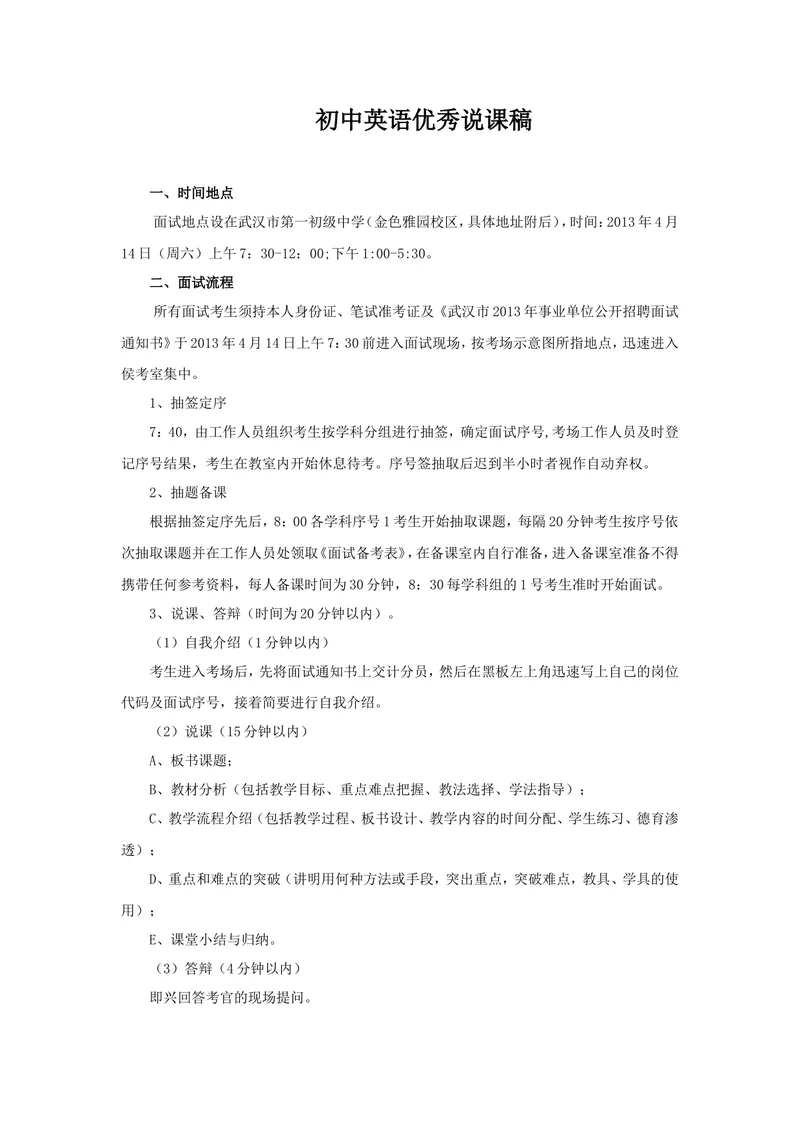
初中英语优秀说课稿
一、时间地点
面试地点设在武汉市第一初级中学(金色雅园校区,具体地址附后),时间:2013年4月
14日(周六)上午7:30-12:00;下午1:00-5:30。
二、面试流程
所有面试考生须持本人身份证、笔试准考证及《武汉市2013年事业单位公开招聘面试
通知书》于2013年4月14日上午7:30前进入面试现场,按考场示意图所指地点,迅速进入
侯考室集中。
1、抽签定序
7:40,由工作人员组织考生按学科分组进行抽签,确定面试序号,考场工作人员及时登
记序号结果,考生在教室内开始休息待考。序号签抽取后迟到半小时者视作自动弃权。
2、抽题备课
根据抽签定序先后,8:00各学科序号1考生开始抽取课题,每隔20分钟考生按序号依
次抽取课题并在工作人员处领取《面试备考表》,在备课室内自行准备,进入备课室准备不得
携带任何参考资料,每人备课时间为30分钟,8:30每学科组的1号考生准时开始面试。
3、说课、答辩(时间为20分钟以内)。
(1)自我介绍(1分钟以内)
考生进入考场后,先将面试通知书上交计分员,然后在黑板左上角迅速写上自己的岗位
代码及面试序号,接着简要进行自我介绍。
(2)说课(15分钟以内)
A、板书课题;
B、教材分析(包括教学目标、重点难点把握、教法选择、学法指导);
C、教学流程介绍(包括教学过程、板书设计、教学内容的时间分配、学生练习、德育渗
透);
D、重点和难点的突破(讲明用何种方法或手段,突出重点,突破难点,教具、学具的使
用);
E、课堂小结与归纳。
(3)答辩(4分钟以内)
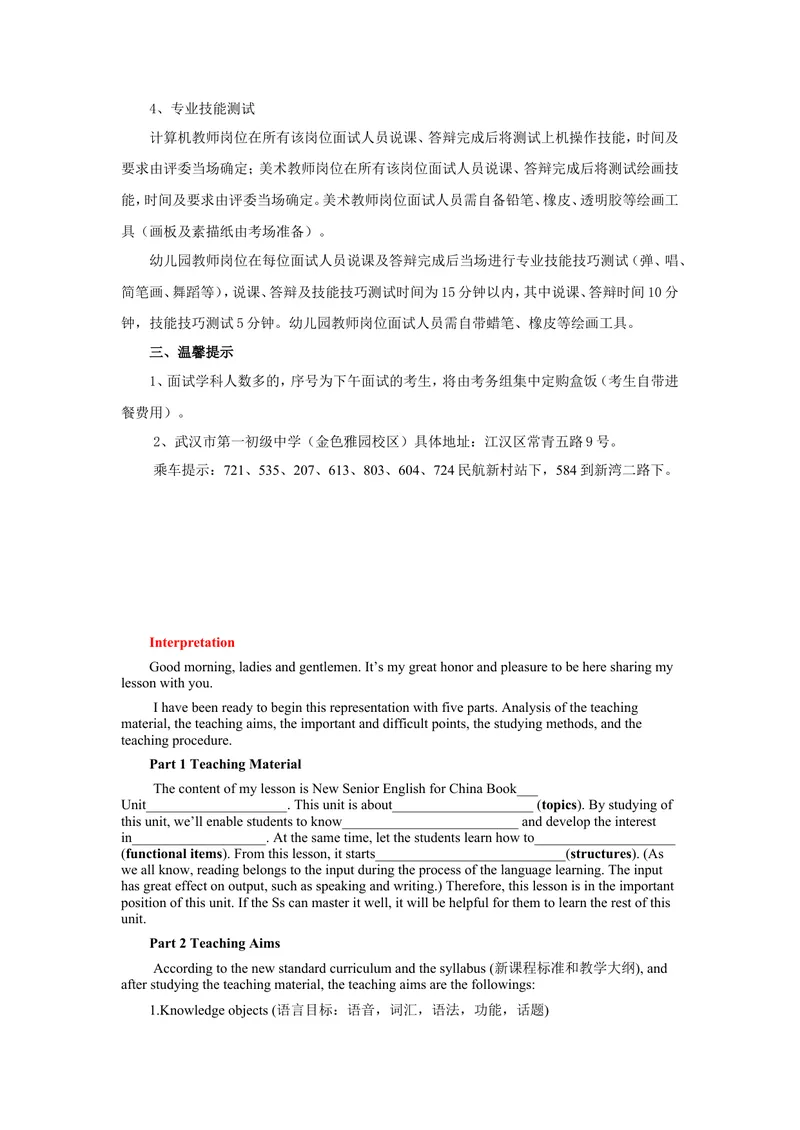
即兴回答考官的现场提问。4、专业技能测试
计算机教师岗位在所有该岗位面试人员说课、答辩完成后将测试上机操作技能,时间及
要求由评委当场确定;美术教师岗位在所有该岗位面试人员说课、答辩完成后将测试绘画技
能,时间及要求由评委当场确定。美术教师岗位面试人员需自备铅笔、橡皮、透明胶等绘画工
具(画板及素描纸由考场准备)。
幼儿园教师岗位在每位面试人员说课及答辩完成后当场进行专业技能技巧测试(弹、唱、
简笔画、舞蹈等),说课、答辩及技能技巧测试时间为15分钟以内,其中说课、答辩时间10分
钟,技能技巧测试5分钟。幼儿园教师岗位面试人员需自带蜡笔、橡皮等绘画工具。
三、温馨提示
1、面试学科人数多的,序号为下午面试的考生,将由考务组集中定购盒饭(考生自带进
餐费用)。
2、武汉市第一初级中学(金色雅园校区)具体地址:江汉区常青五路9号。
乘车提示:721、535、207、613、803、604、724民航新村站下,584到新湾二路下。
Interpretation
Good morning, ladies and gentlemen. It’s my great honor and pleasure to be here sharing my
lesson with you.
I have been ready to begin this representation with five parts. Analysis of the teaching
material, the teaching aims, the important and difficult points, the studying methods, and the
teaching procedure.
Part 1 Teaching Material
The content of my lesson is New Senior English for China Book___
Unit____________________. This unit is about____________________ (topics). By studying of
this unit, we’ll enable students to know_________________________ and develop the interest
in___________________. At the same time, let the students learn how to____________________
(functional items). From this lesson, it starts___________________________(structures). (As
we all know, reading belongs to the input during the process of the language learning. The input
has great effect on output, such as speaking and writing.) Therefore, this lesson is in the important
position of this unit. If the Ss can master it well, it will be helpful for them to learn the rest of this
unit.
Part 2 Teaching Aims
According to the new standard curriculum and the syllabus (新课程标准和教学大纲), and
after studying the teaching material, the teaching aims are the followings:
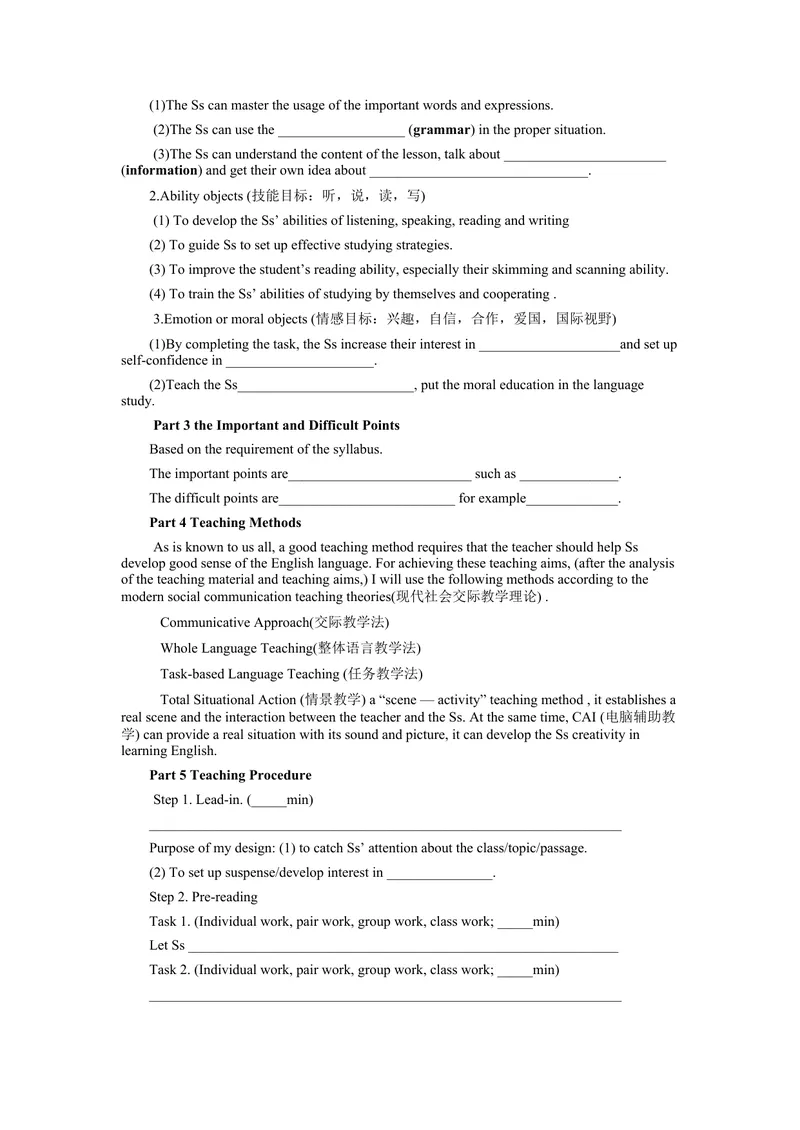
1.Knowledge objects (语言目标:语音,词汇,语法,功能,话题)(1)The Ss can master the usage of the important words and expressions.
(2)The Ss can use the __________________ (grammar) in the proper situation.
(3)The Ss can understand the content of the lesson, talk about _______________________
(information) and get their own idea about _______________________________.
2.Ability objects (技能目标:听,说,读,写)
(1) To develop the Ss’ abilities of listening, speaking, reading and writing
(2) To guide Ss to set up effective studying strategies.
(3) To improve the student’s reading ability, especially their skimming and scanning ability.
(4) To train the Ss’ abilities of studying by themselves and cooperating .
3.Emotion or moral objects (情感目标:兴趣,自信,合作,爱国,国际视野)
(1)By completing the task, the Ss increase their interest in ____________________and set up
self-confidence in _____________________.
(2)Teach the Ss_________________________, put the moral education in the language
study.
Part 3 the Important and Difficult Points
Based on the requirement of the syllabus.
The important points are__________________________ such as ______________.
The difficult points are_________________________ for example_____________.
Part 4 Teaching Methods
As is known to us all, a good teaching method requires that the teacher should help Ss
develop good sense of the English language. For achieving these teaching aims, (after the analysis
of the teaching material and teaching aims,) I will use the following methods according to the
modern social communication teaching theories(现代社会交际教学理论) .
Communicative Approach(交际教学法)
Whole Language Teaching(整体语言教学法)
Task-based Language Teaching (任务教学法)
Total Situational Action (情景教学) a “scene — activity” teaching method , it establishes a
real scene and the interaction between the teacher and the Ss. At the same time, CAI (电脑辅助教
学) can provide a real situation with its sound and picture, it can develop the Ss creativity in
learning English.
Part 5 Teaching Procedure
Step 1. Lead-in. (_____min)
___________________________________________________________________
Purpose of my design: (1) to catch Ss’ attention about the class/topic/passage.
(2) To set up suspense/develop interest in _______________.
Step 2. Pre-reading
Task 1. (Individual work, pair work, group work, class work; _____min)
Let Ss _____________________________________________________________
Task 2. (Individual work, pair work, group work, class work; _____min)
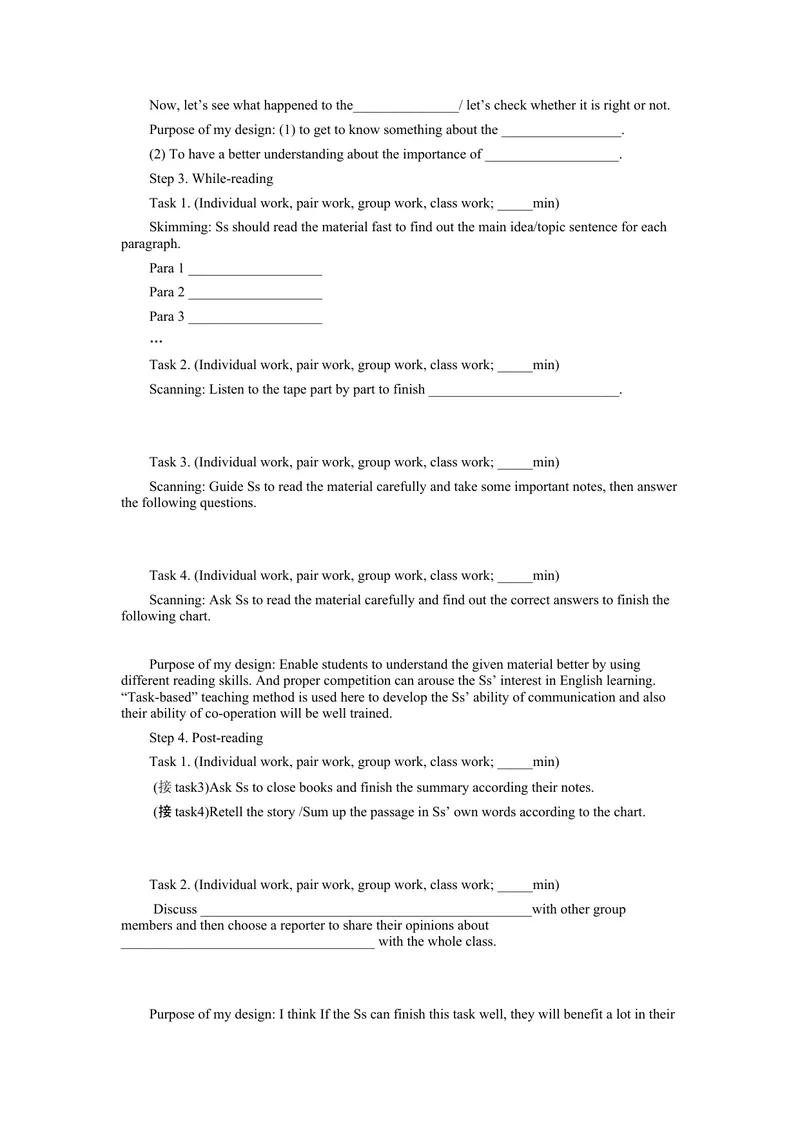
___________________________________________________________________Now, let’s see what happened to the_______________/ let’s check whether it is right or not.
Purpose of my design: (1) to get to know something about the _________________.
(2) To have a better understanding about the importance of ___________________.
Step 3. While-reading
Task 1. (Individual work, pair work, group work, class work; _____min)
Skimming: Ss should read the material fast to find out the main idea/topic sentence for each
paragraph.
Para 1 ___________________
Para 2 ___________________
Para 3 ___________________
…
Task 2. (Individual work, pair work, group work, class work; _____min)
Scanning: Listen to the tape part by part to finish ___________________________.
Task 3. (Individual work, pair work, group work, class work; _____min)
Scanning: Guide Ss to read the material carefully and take some important notes, then answer
the following questions.
Task 4. (Individual work, pair work, group work, class work; _____min)
Scanning: Ask Ss to read the material carefully and find out the correct answers to finish the
following chart.
Purpose of my design: Enable students to understand the given material better by using
different reading skills. And proper competition can arouse the Ss’ interest in English learning.
“Task-based” teaching method is used here to develop the Ss’ ability of communication and also
their ability of co-operation will be well trained.
Step 4. Post-reading
Task 1. (Individual work, pair work, group work, class work; _____min)
(接task3)Ask Ss to close books and finish the summary according their notes.
(接task4)Retell the story /Sum up the passage in Ss’ own words according to the chart.
Task 2. (Individual work, pair work, group work, class work; _____min)
Discuss _______________________________________________with other group
members and then choose a reporter to share their opinions about
____________________________________ with the whole class.
Purpose of my design: I think If the Ss can finish this task well, they will benefit a lot in theirspoken English. Most Ss can take their parts in the activities, especially for the Ss who have
trouble in English study.
Step 5. Homework
__________________________________________________
__________________________________________________
Purpose of my design: Homework is so important and necessary for to master the knowledge
they learned after class. It will check whether the Ss achieve the teaching aims.
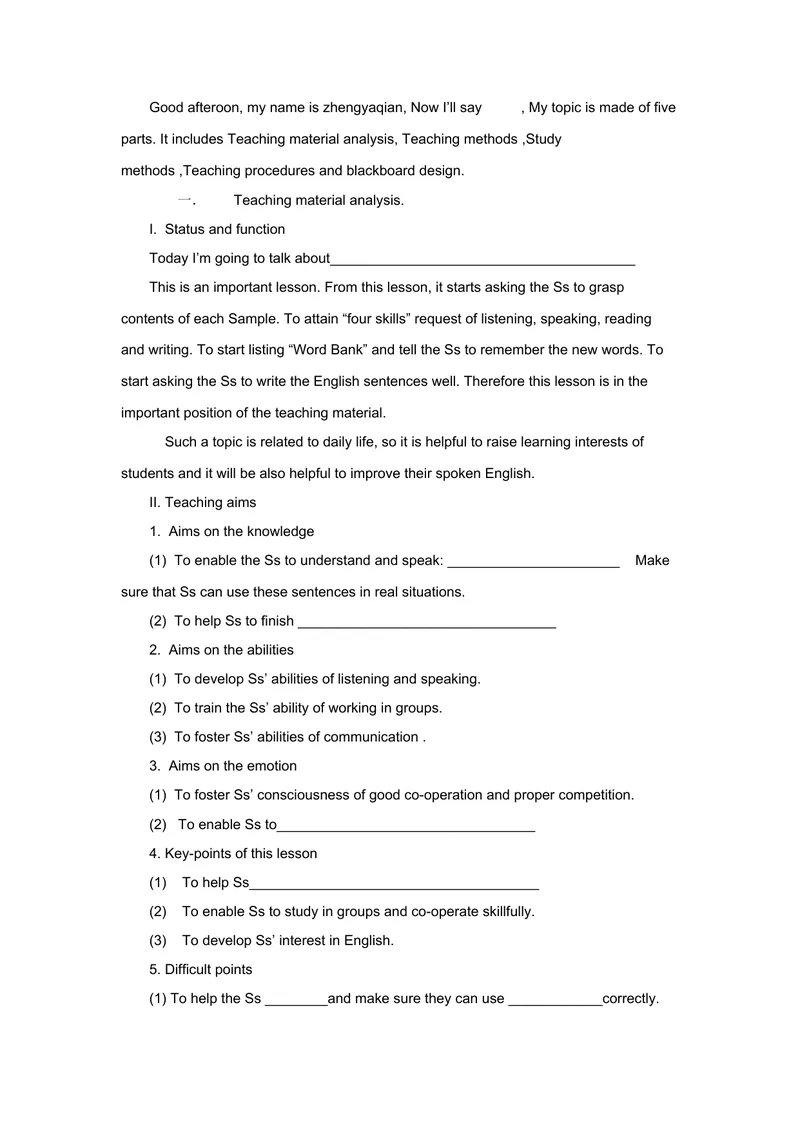
Geetings and introduction:Good afteroon, my name is zhengyaqian, Now I’ll say , My topic is made of five
parts. It includes Teaching material analysis, Teaching methods ,Study
methods ,Teaching procedures and blackboard design.
一. Teaching material analysis.
I. Status and function
Today I’m going to talk about_______________________________________
This is an important lesson. From this lesson, it starts asking the Ss to grasp
contents of each Sample. To attain “four skills” request of listening, speaking, reading
and writing. To start listing “Word Bank” and tell the Ss to remember the new words. To
start asking the Ss to write the English sentences well. Therefore this lesson is in the
important position of the teaching material.
Such a topic is related to daily life, so it is helpful to raise learning interests of
students and it will be also helpful to improve their spoken English.
II. Teaching aims
1. Aims on the knowledge
(1) To enable the Ss to understand and speak: ______________________ Make
sure that Ss can use these sentences in real situations.
(2) To help Ss to finish _________________________________
2. Aims on the abilities
(1) To develop Ss’ abilities of listening and speaking.
(2) To train the Ss’ ability of working in groups.
(3) To foster Ss’ abilities of communication .
3. Aims on the emotion
(1) To foster Ss’ consciousness of good co-operation and proper competition.
(2) To enable Ss to_________________________________
4. Key-points of this lesson
(1) To help Ss_____________________________________
(2) To enable Ss to study in groups and co-operate skillfully.
(3) To develop Ss’ interest in English.
5. Difficult points
(1) To help the Ss ________and make sure they can use ____________correctly.(2 )How to_________________________________________
6. Teaching aids
In this lesson, the multi-media will be used to make the class lively and
improve my teaching result.
二 .Teaching methods
As we all know: the main instructional aims of learning English is to cultivate
pupils’ basic abilities of listening and speaking and their good sense of the English
language. So in this lesson I’ll mainly use “Task-based” teaching method. That is to say, I
will let the Ss learn in real situations, finish a task by making a survey to help the Ss to
get a better understanding of the key structure of the dialogue. I will arrange four kinds of
activities: singing, guessing game, finishing a survey and having a competition. And in
this lesson a recorder, CAI, school things and a printed form will be needed. Students
should prepare some school things.
三.Study methods
① Teach the Ss how to be successful language learners.
②Get the Ss to form good learning habits.
③Teach the Ss how to communicate with others and take competition methods to
develop the Ss interest in English.
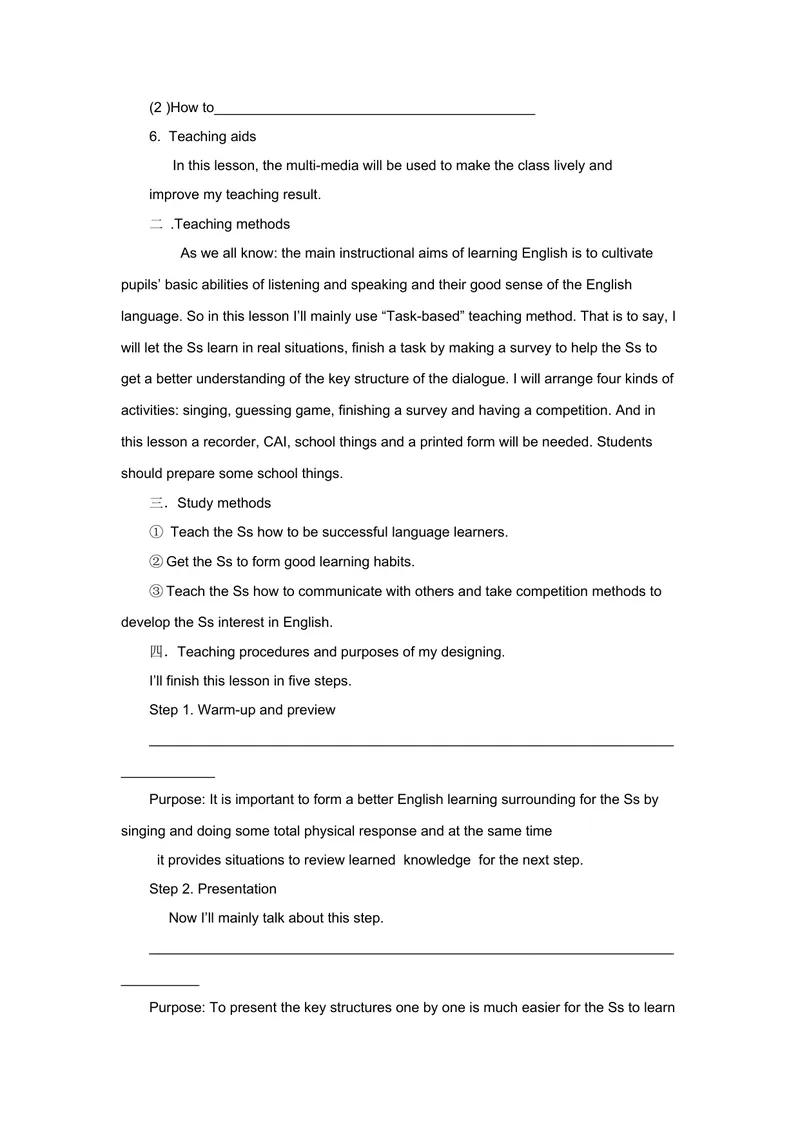
四.Teaching procedures and purposes of my designing.
I’ll finish this lesson in five steps.
Step 1. Warm-up and preview
___________________________________________________________________
____________
Purpose: It is important to form a better English learning surrounding for the Ss by
singing and doing some total physical response and at the same time
it provides situations to review learned knowledge for the next step.
Step 2. Presentation
Now I’ll mainly talk about this step.
___________________________________________________________________
__________
Purpose: To present the key structures one by one is much easier for the Ss to learnand grasp the meanings. Proper competition can arouse the Ss’ interest in English
learning.
___________________________________________________________________
________
Purpose: CAI can provide a real situation for the Ss to understand the dialogue
and the relationships between people better. Tell the Ss we should show
our loveliness to the Ss.
Step 3. Practice
___________________________________________________________________
____________
Purpose: Task-based teaching method is used here to develop Ss’ ability of
communication and also their ability of co-operation will be well trained.
Step 4. Production
___________________________________________________________________
____________
Purpose: To check the knowledge Ss have learned in this period.
Step 5. Homework
___________________________________________________________________
_______
Purpose: Revision is so important that Ss should speak English as much as they
as in class or after class. It is necessary for the Ss to do some extensive exercises
after class to consolidate the knowledge they learned.
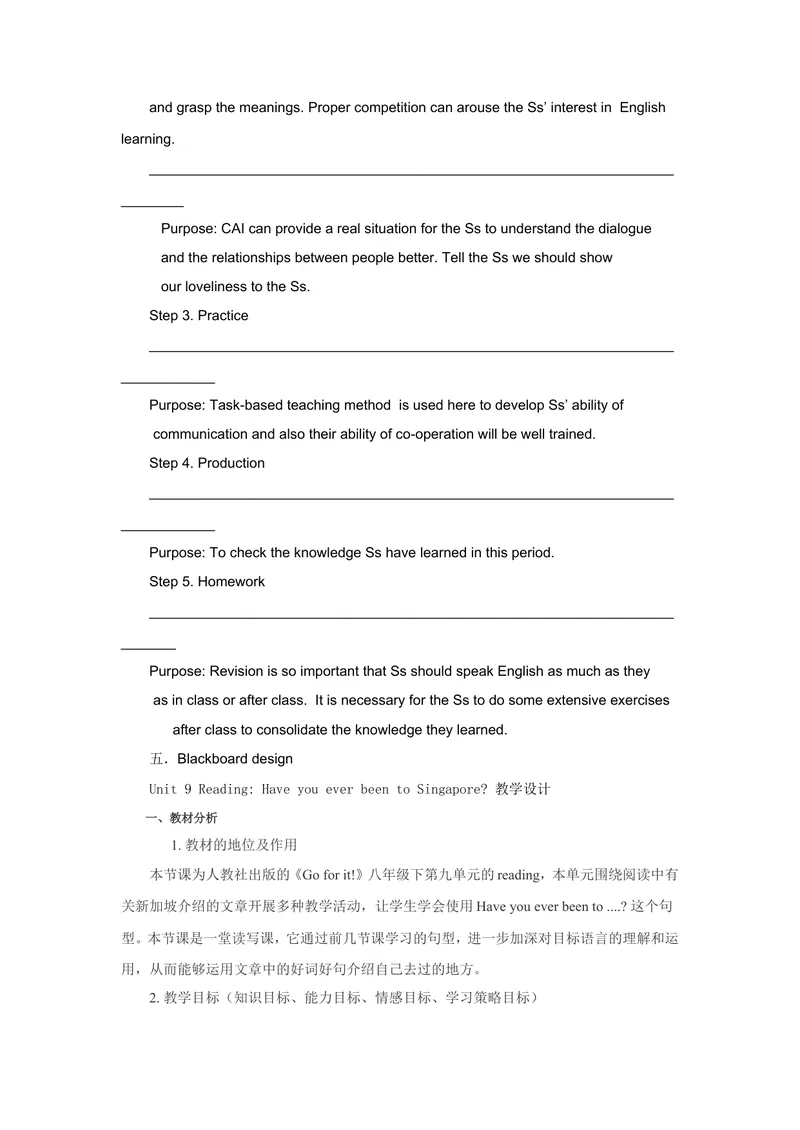
五.Blackboard design
Unit 9 Reading: Have you ever been to Singapore? 教学设计
一、教材分析
1. 教材的地位及作用
本节课为人教社出版的《Go for it!》八年级下第九单元的reading,本单元围绕阅读中有
关新加坡介绍的文章开展多种教学活动,让学生学会使用Have you ever been to ....? 这个句
型。本节课是一堂读写课,它通过前几节课学习的句型,进一步加深对目标语言的理解和运
用,从而能够运用文章中的好词好句介绍自己去过的地方。
2. 教学目标(知识目标、能力目标、情感目标、学习策略目标)知识目标:掌握重点句型Have you ever been to ...? It is a wonderful place to ...
能力目标:提高学生阅读文章,提炼文章主旨大意的能力,提高写作短文的能力。
情感目标:①通过形象、生动的网络英语教材使学生掌握如何去介绍具体的地点,增强
学生对美好事物的追求和向往。②培养学生学习英语的强烈兴趣,乐于参加各种活动的积极
情感。
确立教学目标的依据:
根据英语课程标准规定,通过听、说、读、写的训练,使学生获得英语基础知识和为交际
初步运用英语的能力,激发学生的学习兴趣,为进一步学习打好初步的基础。此外,根据我国
国情和外语教学大纲的要求,现阶段外语教学的素质教育主要包括思想素质教育、目的语素
质教育、潜在外语能力的培养、非智力因素的培养等四方面。
3. 重点与难点
在教师的引导下, 理解文章结构, 寻找好词好句, 从而使学生在自己的写作过程中能够注
重结构, 运用好词好句来丰富自己的文章。
二、教学过程
1. 总体设计及依据
课前学生图片导入,新加坡图片展示(3分钟)——整体阅读(5分钟)———细节阅读(5
分钟)——写作(15分钟)——展示修改(10分钟)——作业布置(2分钟)
依据:
(1)遵循人类认识过程的普遍规律和学生认识活动的特点。
(2)教师为主导,学生为主体。
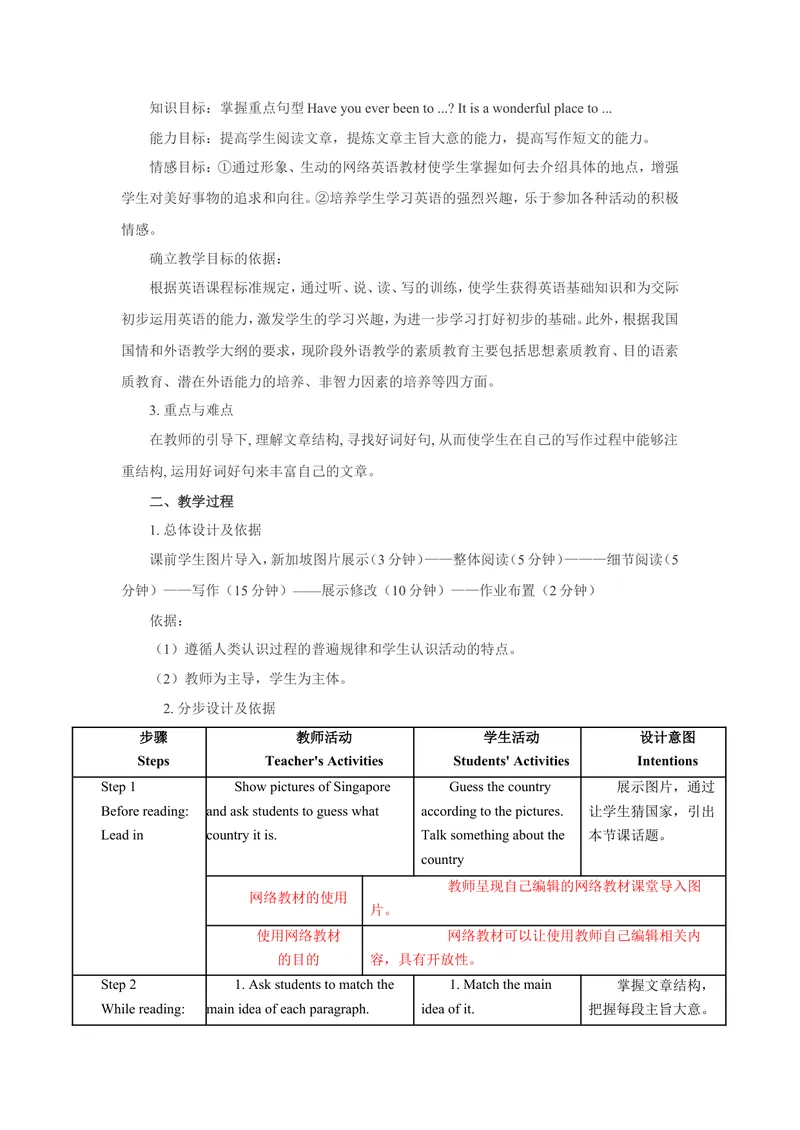
2. 分步设计及依据
步骤 教师活动 学生活动 设计意图
Steps Teacher's Activities Students' Activities Intentions
Step 1 Show pictures of Singapore Guess the country 展示图片,通过
Before reading: and ask students to guess what according to the pictures. 让学生猜国家,引出
Lead in country it is. Talk something about the 本节课话题。
country
教师呈现自己编辑的网络教材课堂导入图
网络教材的使用
片。
使用网络教材 网络教材可以让使用教师自己编辑相关内
的目的 容,具有开放性。
Step 2 1. Ask students to match the 1. Match the main 掌握文章结构,
While reading: main idea of each paragraph. idea of it. 把握每段主旨大意。Find the main idea 2. Ask students to read the text 2. Read the text
of each paragraph quickly and underline the topic quickly and underline the
sentence in each paragraph. topic sentence in each
paragraph.
1. 在学生使用网络教材完成文章主旨大意的阅读
理解活动后,教师带领学生通过网络教室共享其他同学的
活动成果。
网络教材的使用
2. 教师带领学生在电子白板上示范“标识主题
句”,然后学生在网络教材上完成“标识主题句”的个人
活动。
在本环节中,网络教材为学生的个人活动和
使用网络教材 集体活动的有效结合开辟了一种新的途径。
的目的
Step 3 1. Ask students to read the text 1. Read the text again 通过不同任务的
While reading: again and fill in the blanks in 3a,. for details and fill in the 练习让学生把握文章
Read for details 2. Ask students to do the blanks in 3a. 细节。
exercise in 3c. 2.Do the exercise in
3c.
3. Check the answer.
学生使用网络教材完成文章细节的两个读写
网络教材的使用
活动,教师使用网络教室检查、共享学生的活动成果。
使用网络教材 在本环节中,网络教材为教师管理学生学习
的目的 进行了新的尝试。
Step 4 Draw the conclusion about the Talk about the 总结地点介绍文
After reading: writing structures of a place important things in a 章的主要结构。
Draw the introduction. composition about place
conclusion introduction
教师使用黑板复现学生关于“介绍一个地
网络教材的使用
点”的观点,完成从阅读环节到写作环节的过渡。
使用网络教材 这个环节体现了在利用网络教材的教学过程
的目的 中,网络资源和其他资源的有效结合。
Step 5 Ask students to find out useful Find out useful 通过找好词好
Before writing: phrases and sentences. phrases and sentences in 句,给出学生写作细
the passage. 节部分的语言支持Find useful 1. 学生在利用网络教材进行有声阅读后,完成“标
phrases and sentences 网络教材的使用 识好词好句”的个人活动。
2. 教师在电子白板上呈现学生的活动成果。
在此环节中,网络教材帮助学生提高自主学
使用网络教材
习的主动性和有效性。
的目的
Step 6 Show the table about writing. Fill in the table and 通过表格,掌握
Before writing get to know how to write a 地点介绍写作的脉络
place introduction. 及写作要求。
教师利用电子白板呈现“介绍一个地点”文
网络教材的使用
段写作的结构框架,学生使用网络教材完成相应活动。
使用网络教材 本环节教师带领学生强化“介绍一个地点”
的目的 写作的框架,为学生的后续写作活动作准备。
Step 7 Ask students to write the place Write the place 写作练习
While writing introduction. introduction
1. 学生使用网络教材完成各自的写作任务。
网络教材的使用 2. 教师利用网络教室实时监控学生的任务完成情
况。
使用网络教材 在这一环节中,网络教室实现了教师监控学
的目的 生具体学习过程的可能性。
Step 8 1. Ask students to share several 1. Share the 根据评价要求
After writing compositions in the whole class. compositions in groups. (表格),全班一起分
2. Ask students to find the 2. Share several 析,打分,从中学习。
useful sentences in the compositions with all the
compositions. students
3. Ask students to give the 3. Find the important
suitable marks to the composition. things and the useful
sentences in the
composition.
1. 教师利用电子白板和学生分享部分学生的写作
网络教材的使用 成果,并和学生一起在电子白板上找出好词好句。
2. 学生利用网络教材对其他学生的习作进行评价。
在本环节中,网络教材使课堂中他评、互评等多种评
使用网络教材
价能够有效地结合。
的目的Step 9 Homework Ask students to polish their Polish the 修改作文,为下
compositions. compositions after class 一节课讲评作文做好
铺垫工作。
板书设计
Unit 9 Have you ever been to Singapore?
Name of the place
Place of interest
Food shopping ...
Weather
课后小结:本课以素质教育为目的,结合教材写作重点、难点及英语学科特点,利用网络
英语教材及多媒体教学,从读、写等方面使学生得到锻炼,让学生学会写作并审视修改自己
的文章。在愉快、轻松的氛围中温故而知新,达到初步运用英语交际的能力。
《初中英语优秀说课稿》简介:
Part One: Analysis of the Teaching Material (一) ST
《初中英语优秀说课稿》正文开始>> Part One: Analysis of the Teaching Material
(一) STATUS AND FUNCTION
1. This is an important lesson. To attain “four skills” request of listening , speaking, reading
and writing. Start with listing part and tell the Ss to remember the new words. Ask the Ss to write
the English sentences well. Therefore this lesson is in the important position of the teaching
material.
2. This is the first period of Unit7.It’s the part of the Lead-in.So if the Ss can learn it well, it
will be helpful to make the Ss learn the rest of this unit.
3. Such a topic is helpful to raise learning interests of students and it will be also helpful to
improve their spoken English.
(二)ANALYSIS OF THE STUDENTS
The Ss have learned English for more than one year and a half so far. They can speak simple
English very well. The Ss have taken a great interest in English now.(三)TEACHING AIMS AND DEMANDS
1.Knowledge objects
(1) To make the Ss know how to use Object Clauses.
(2) To study the new words and phrases: try one’s best, successful, imagine, soup, biscuit,
pancake, cheese, pie.
(3) To learn some phrases to about preparing for the food festival.
make biscuits, learn to cook food, cook soup, set a table, write a song
2. Ability objects
(1) To develop the Ss’ abilities of listening, speaking, reading and writing.
(2) To train the Ss’ ability of working in pairs and groups.
(3) To develop the Ss’ abilities of communication by learning the useful structures.
3. Moral objects
(1)To make Ss know something about the western food culture and the traditional food of
western countries.
(2)Let Ss know they should help people in need.
(四)TEACHING KEY AND DIFFICULT POINTS
1.Key points:
(1).To help Ss grasp the new words and phrases.
(2).To help Ss master the Objective Clauses.
(3) To enable Ss to study in groups and co-operate skillfully.
2. Difficult points: How to use the Objective Clauses to express thoughts.
(五) TEACHING AIDS
Tape recorder, Pictures, Software: Power point
Part Two: The Teaching Methods
1. Communicative teaching method
2. Audio-visual teaching method
3. Task-based” teaching method
4. inquiry learning teaching method
As we all know: the main instructional aims of learning English in the Middle School is to
cultivate students’ abilities of listening, speaking, reading, writing and their good sense of the
English language. So in this lesson I’ll mainly use “Communicative” teaching method, “Audio-
visual” teaching method and “Task-based” teaching method. That is to say, I’ll let the Ss to get abetter understanding of the key structure of Section A. I’ll give the Ss some tasks and arrange four
kinds of activities: talking, watching CAI, listening to the tape, reading.
Teaching special features:
I’ll use the Explorable teaching method to let Ss grasp the rules of the Object Clauses. It’s
helpful to develop Ss’ thought and learning ability.
Part Three: Studying Ways
1.Let the Ss pass “Observation---Imitation---Practice” to study language.
2.Teach Ss how to master the key structures and how to communicate with others.
Teaching special features:
Develop Ss’ abilities of Independent learning and cooperative learning.
Part Four:Teaching Procedure
Step 1: Lead-in
1. Show a picture of food festival, tell Ss in the picture are having a food festival now. And in
this unit we are going to learn something about food festival, different kinds of delicious food and
its culture.
2.let Ss look at the different kinds of food in it. Then learn the new words: soup, biscuit,
pancake, cheese, pie.
Purpose of my designing: I think it is easy for Ss to remember words with pictures. It’s a kind
of Intuitive learning.
According to knowledge of psychology, this method is useful to Ss’memory.
Step2. Presentation
1.Make Ss thing about what the food festival will be like. Learn the new word: imagine. Let
Ss discuss it after the example in groups.Write these examples on the blackboard:I imagine (that) a
lot of people will come to the food festival. I think/guess/suppose (that)…
Purpose of my designing: Let Ss know how to use Object Clauses to express their own
ideas.In this period, Explorable teaching method is used to train Ss’discovering learning
abilities.And they talk in groups so it can develop their cooperative learning abilities.
2. Show another picture to tell Ss Kang Kang and his friends are going to have a food
festival. Let Ss listen to the tape of 1a and answer the question : why are they going to have a food
festival?
3.Use CAI to introduce Daniel Igali to Ss. Learn the new words :Nigeria, wrestling,successful.Then listen again and answer these questions: what does Jane/Maria say? What does
Kangkang know? What does Michael think?
Purpose of my designing: Task-based teaching method is used here to train Ss’listening
abilities. And it can make Ss go on to practice using Objective Clauses.
Step3.Practice
1.First play the tape recorder. Let Ss listen and imitate the dialogue. Pay attention to their
pronunciation and intonation. In this step Ss are required to practice the Sample in pairs by
reading the dialogue aloud. This step is employed to make the Ss grasp the Sample.
Purpose: This step is employed to make Ss get the general idea of the dialogue as a whole
one. At the same time let Ss have a chance to practice their listening and spoken ability.
2.Do Part 2 pair work
Purpose: Consolidate the new words and structures learnt. Also it practices their listening
and spoken abilities.
Step4.Summarize
Review new words and structures Ss learnt .
step5.Homework:
(1) Recite the words.
(2) Write a short passage of a helpful person you know and his/her good deeds.
Purpose of my designing: I think homework is so important that the Ss should speak English
as much as they can in class or after class. It is necessary for the Ss to do some extensive exercises
after class to consolidate the knowledge they learned.
Blackboard Design
Unit 7 Food Festival
Topic 1 SectionA
Food: soup, biscuit, pancake, cheese, pie
I imagine (that)…
I guess/think/suppose(that)… Jane says(that)…
for raising money---help---Daniel Igail---help---the poor village
Nigeria wrestling Being a helpful person
初中英语说课稿(英文版)一、说教材(教材分析) Analyzing teaching material
1. 说课型 lesson type (Dialogue/ reading/ listening/ revision)
2. 本课在教材中的地位 status and function
Lesson 33 Saving the Earth is a dialogue. The lesson is focused on the topic of the
problems of the earth and the functional items of Supposition/ Intentions/ conjecture/ Prohibition.
Since it is a dialogue / reading. It’s helpful to improve the Ss communicative/ reading ability.
3. 说教学指导思想 teaching guideline
(Teaching syllabus: Language is for communication, develop their four skills, lay
special emphasis on reading; Grellet put it well in his book developing reading skills: develop
reading skill/ discourse analysis; get them to understand the western culture better; improve the
ability to discover, analyze & solve the problems; Reading is for information, for fun; Use Top-
down model or Bottom- up model to activate Ss schemata; Interactive model)
4. 说教学目标和要求 Teaching aims and demands (…be intended for Ss in key
schools)
1)认知目标 knowledge objects
a. Enable the Ss to remember the following new words & phrases:
Damage, lecture, pollute, pollution, room, standing room, be fit for, hear about, turn into
b. Get the Ss to be familiar with this sentence pattern:
If the population keeps growing so quickly, there will only be standing room left…
Give the Ss a reinforced practice on the functional item Supposition.
c. Activate Ss schemata regarding the topic of pollution and help Ss to know more about
the problem of pollution.
2)智能目标 ability objects
a. Ask the Ss to make up a similar dialogue.
b. Help them to understand the dialogue better and improve the four skills.
c. Develop their ability of thinking independently.
d. Cultivate their ability to discover, analyze and solve problems.
e. Train them to collect information from the Internet.
f. Train them with some effective learning methods to optimize Ss’ learning results.
3)德育目标 moral objects
a. Arouse their interest in learning English;b. Help them to understand the background of pollution.
c. Enable the students to love our earth and the nature.
d. Be aware of the importance of stopping pollution & protecting out environment.
e. Encourage the Ss to do something to save the earth.
5. 说教学重点 teaching important points (生词、句型;培养阅读技能)
a. New words and phrases
b. Sentence pattern: If- clause
c. improve their reading skills.
d. Talking about problems of the Earth.
6. 说教学难点 teaching difficult points (语法;发展交际能力)
a. functional item: Supposition.
b. Develop their communicative ability. Act out their own dialogue.
7. 说教具 teaching aids (multi-media computer, software, OHP)
The teaching syllabus says that it’s necessary for teachers to use modern teaching
facilities. It’s of great help to increase the class density and improve our teaching result. It can also
make the Ss reach a better understanding of the text by making the classes lively and interesting.
At the same time, it arouses the Ss’ interest in learning English.
二、说教法 Teaching methods
Five step method; audio-video; communicative approach;
Task-based learning: New Syllabus Design encourages teachers to use this teaching
method. TBLT can stimulate Ss’ initiative in learning and develop their ability in language
application. Make the Ss the real masters in class while the teacher himself acts as the director and
bring their ability into full play.
三、说学法 Study methods
1. Teach Ss how to be successful language learners.
2. Teach Ss how to develop the reading skill — skim & scan; how to communicate with
others; how to learn new words; how to learn independently;
3. Get the Ss to form good learning habits.
四、说教学过程Teaching procedures
I. 复习 (Revision) 5min (Daily report; 词汇diagram; brainstorming; activate schemata)
Activity 1: Imagination1). Suppose a bottle of ink is turned over and dirties your white shirt, what is to be done?
(Wash it? Or throw it away?)
2). Suppose you catch a bad cold, what’s to be done?
3). Suppose your bike is broken, what’s to be done?
4). And suppose the earth, on which we all live, is damaged, what’s to be done?
* What can you think of when you see “pollution” this word?(waste, environment, air,
water, factory, desert, climate... Try to activate the Ss schemata regarding the topic of pollution.)
II. 呈现 (Presentation) 5min
Activity 2: Presentation
Play the song “Earth Song” sung by Michael Jackson. (Create an atmosphere)
A lot of pictures and video clips about the causes and results of the three problems
mentioned in this lesson will be shown on the screen with the help of the computer.
Ss’ presentation on pollution. Attract their attention, arouse their interest, and create a
good atmosphere for communication.
* Activate their schemata and cultivate their ability in collecting information from the
Internet and develop their ability in thinking independently.
III. 对话 / 阅读 (Dialogue)18m
1. Pre- reading
Activity 3: Prediction
1st listening/ fast reading, one guided Q to help Ss to get the main idea:
What do you think is discussed at the conference?
2. While- reading
Activity 4: Read and answer
2nd listening/ careful reading, more Qs to get the detailed information. Develop their
reading skills: skim & scan. Pay attention to the pronunciation, stress & intonation.
* 阅读: Pre-reading; while-reading; post-reading (fast reading/ careful reading; skim/
scan; 识别关键词 key words;确定主题句;创设信息差 information gap;T or F; 填表
格chart/diagram; Predicting; Make a timeline; Make a story map。达到对课文的整体理解和掌
握。So that they can have a good understanding of the whole text.)
3. Post- reading
Activity 5: Language focusWhile Ss are answering the Qs, the teacher deals with some key language points.
a. is being caused b. and so on c. go on doing
d. be fit for e. standing room f. if- clause
IV. 操练 (Practice) 10m
Activity 6: Retell
Use your own words to retell the dialogue in the 3rd person.
Activity 7: Acting out
Activity 8: Drill – Supposition
Purpose: Practise the functional item of Supposition. (P. 33 Part 2; P.113, wb Ex. 3)
(Retell; act out; role play)
V. 巩固 (Consolidation) 6m
(Discussion; interview; press conference; debate; quiz)
Activity 9: role play
Suppose you were head of a village, scientist, journalist and villager, make up a
conversation and ask several groups to demonstrate in front of the class.
* The Ss are encouraged to use the words and expression_r_rs like pollution, damage, be
fit for, turn into, the if- clause, etc.
Activity 10: Discussion
Think of the question: Are we causing damage to the world?
What should we do to save the earth and protect our environment especially in our daily
life?
Collect their answers and form a report.
VI. 作业 (Homework) 1m (Writing; continue the story; recite; retell)
Write a letter to the mayor, telling him sth. about the pollution around your school.A Brief Instruction to the topic of “What should I do?”
Shangyuan Middle School Li Yi Cai
Good afternoon, ladies and gentlemen. My name is LiYiCai. I come from Shangyuan
Middle School in Nanjing.Today I’m going to talk about the topic” What should I do?”I will
divide the instruction into seven parts: they are Teaching material Analysis, Teaching aims,
Teaching emphasis, Teaching difficulties, Teaching methods, Teaching aids and Teaching
procedures.
Part 1 Teaching material analysis
This period is from Unit 3 of 9A Oxford English. First of all,I’d like to talk about my
understanding about this lesson.We have learned Star sings in Unit 1 and Colours and moods in
Unit 2.We have also learned how to write a formal recommendation letter and how to write a
report on the moods of people in last two units.Today we are going to learn two letters to a famous
youth worker about Millie’s and Simon’s problems.So this unit links with a special meaning of
Unit 1 and Unit 2.This period is the first lesson of Reading.The main idea of the topic is how to
express their problems and ask for advice.We are going to learn the ways to deal with problems
and stress in following lessons.So this period is very important in this unit.
Part 2 Teaching aims
1.Aims of the knowledge:
(1)To know the spelling of some words and usage of some phrases.
(2)To learn something about Millie’s and Simon’s problems.
(3)To grasp the main idea of Reading and use the information to talk to others about
one’s problems and how to deal with them.2.Aims of the ablilities:
(1)To improve the ability of getting information by reading.
(2)To improve the ability of retelling the story.
3.Aims of the emotion:
(1)To understand how to write about problems and to express feelings.
(2)To ask for advice to solve the problems.
Part 3 Teaching emphasis
1.To master the ‘to’-infinitives and ‘wh-’words+‘to’-infinitives.
2.To get the ability of general reading and getting information.
Part 4 Teaching difficulties
1.To recognize and understand vocabulary about problems.
2.To ask for advice
Part 5 Teaching methods
In this topic,I will use five-step Teaching Method and Task-based language Teaching.I
design some tasks to help the students learn.I think if I want to improve the students’ oral
English,I should give them enough chances to practice and I will use pair work,group work to let
the students take an active part in all kinds of activities.That is “Learning by doing,learning by
using”.Let the students be the masters of the class teaching,thus,student-centered teaching method
is well shown.
Part 6 Teaching aids
Projector,slide show,tape recorder and blackboard
Part 7 Teaching procedure
Step Ⅰ.Lead-in
?? The purpose is to arouse the students’interest of study.
?? Let’s have a free talk.
?? T:Have you got problems?
?? S:Yes.
T:What is it?
S:Eating too much makes me unhealthy.
T:What about you?
S:……Step Ⅱ.Presentation
The purpose is to develop the skills of skimming and how to gain the main idea of the
articles.
1.Ask students to read two letters and answer the following questions:
①What is Millie’s favorite hobby?(Painting)
② What is Millie’s problem?(She doesn’t have enough time for hobbies and home
work.)
③When does Simon play football?(After school until late)
④How do his parents feel about it?
(They don’t like this and ask him to go home before 6 p.m.)
2.Ask students if there are words that they do not know.
Explain some new words briefly.
deal;choice;complete;refuse;accept;spare;doubt;whether;
Step Ⅲ.Practice
The purpose is to develop the skills of scanning and how to gain the details from the
articles.
1.Listen to the tape and answer some question about “True”or“False”.
2.Ask students to read the articles again and explain some important phrases.
How to solve the problems;hand in;on time;at the moment;
can’t find any time for my hobbies;feel bad;give up;
achieve a balance between the two;hear form;make unhappy
Step Ⅳ.Retelling
The purpose is to develop the skills of retelling with the key words
1.Ask students to make sentences with phrases that we have learned.
2.Try to retell the outline of the articles.
3.Encourage students to say something about themselves.
Step Ⅴ.Summary and homework
The purpose is to give the students a clear idea of how to express their problems and
revise the articles.
1.Ask students to revise the words and phrases
2.Ask students to write a letter about himself after class.During my teaching,I’ll try my best to get my class alive and encourage the students to
talk with each other in English. I think the general aim of English teaching is to improve the
ability of using English. And I’ll use this to guide my teaching.
Thank you!