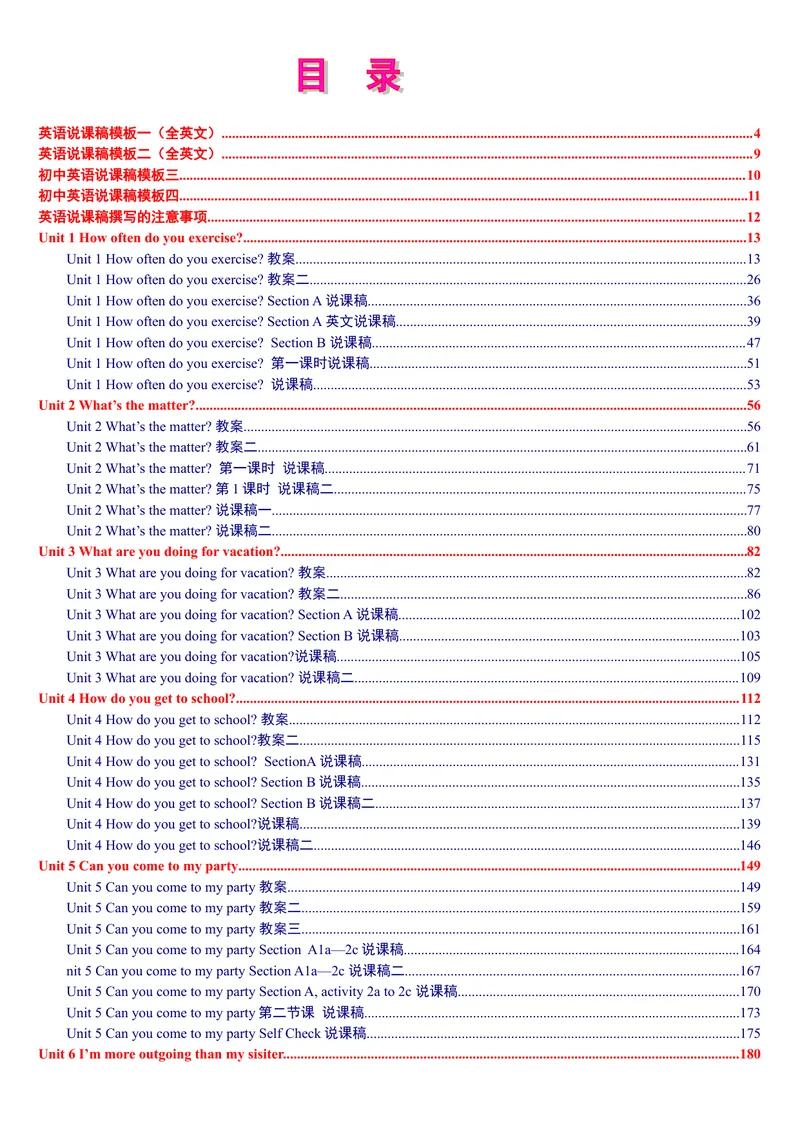
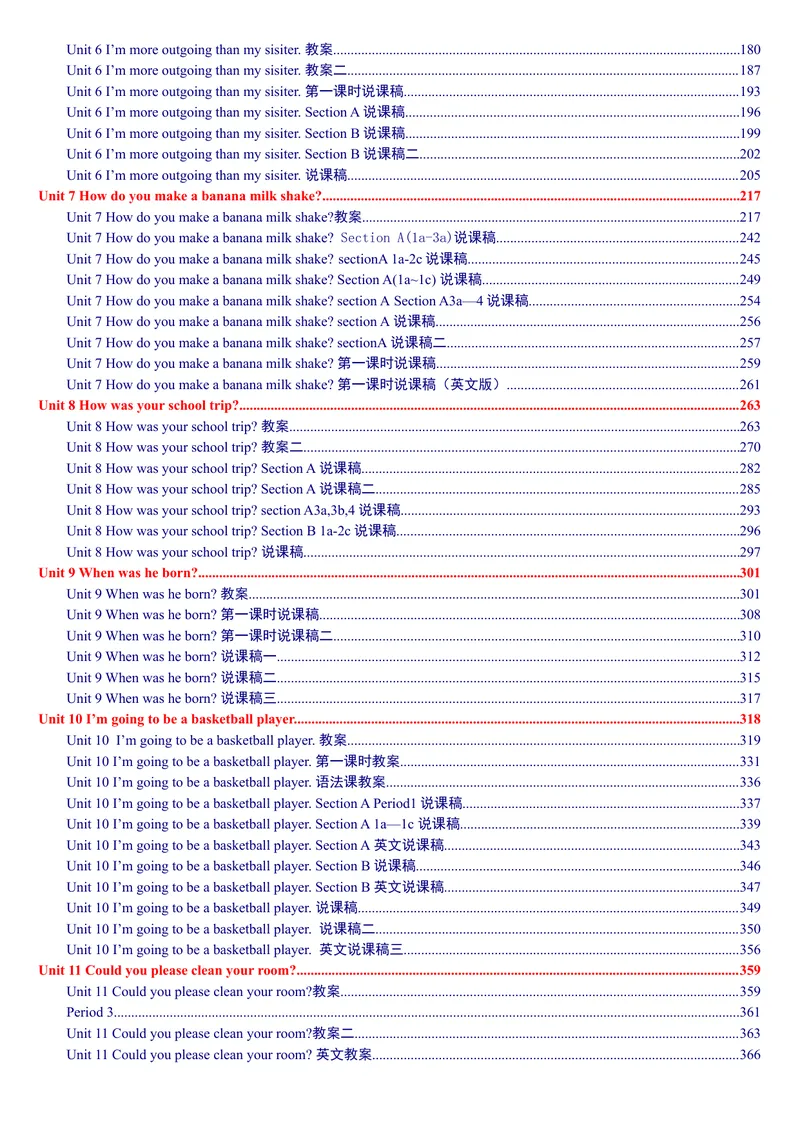
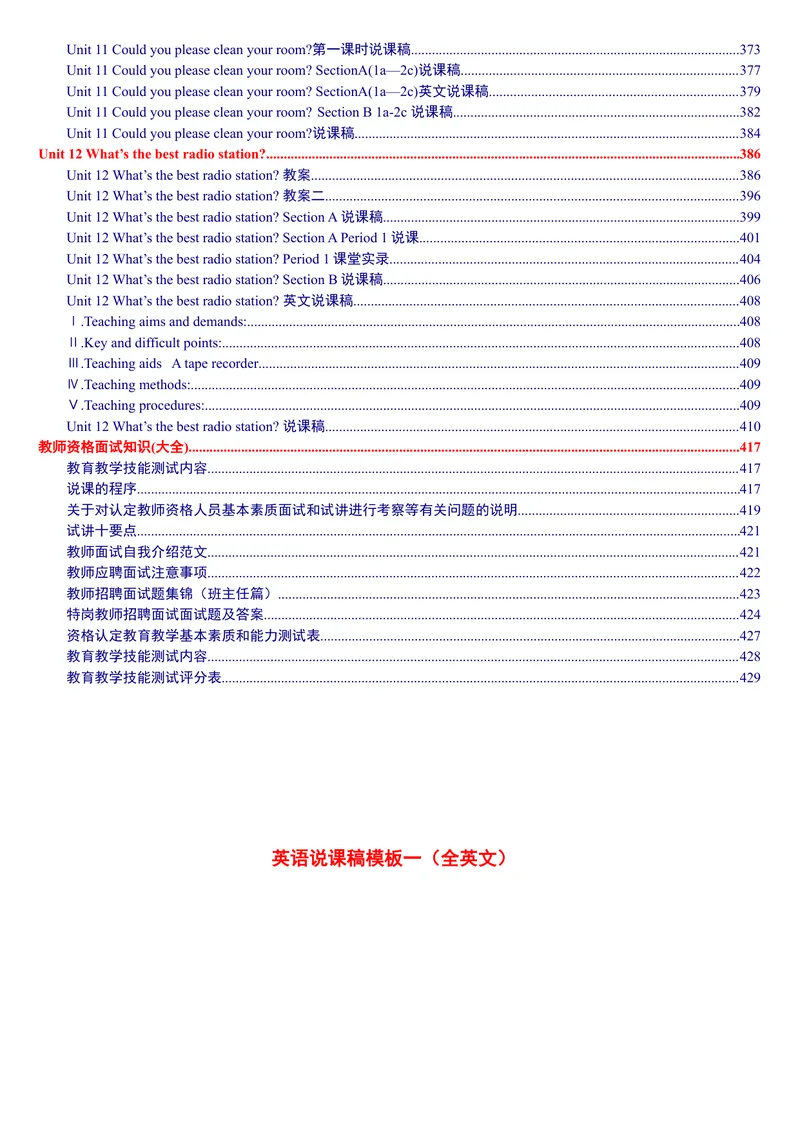
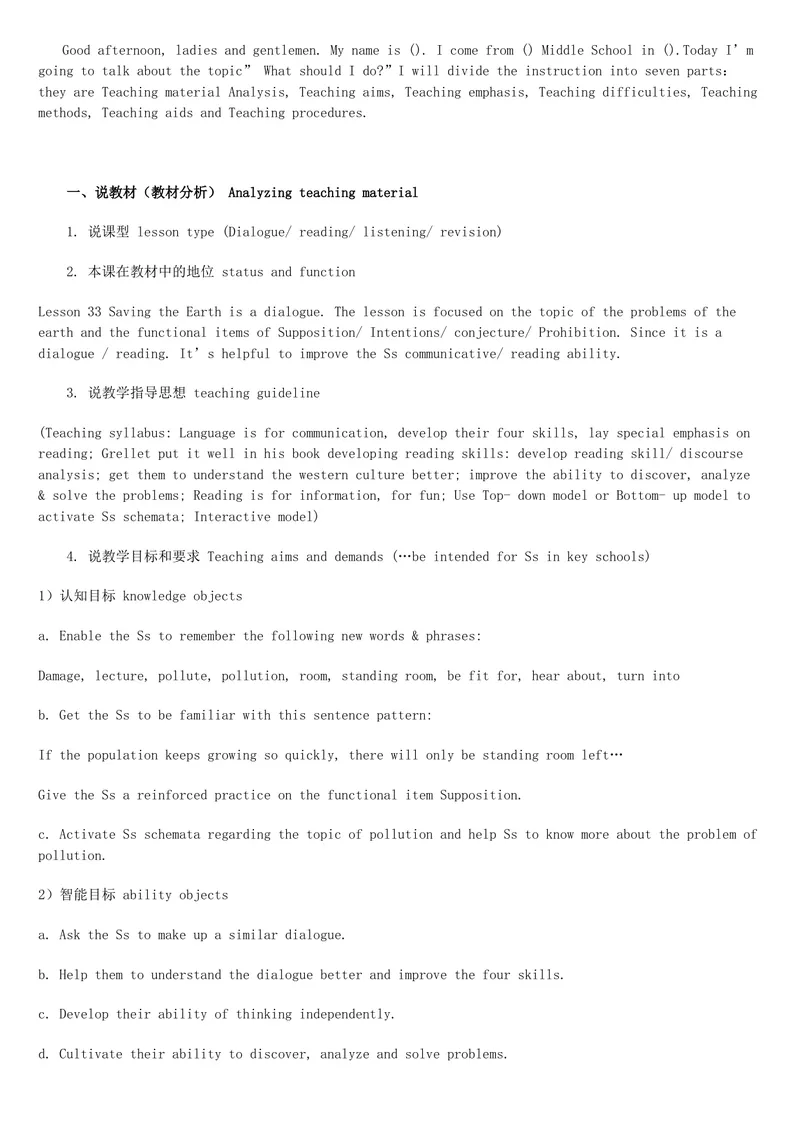
英语说课稿模板一(全英文)........................................................................................................................................................4
英语说课稿模板二(全英文)........................................................................................................................................................9
初中英语说课稿模板三..................................................................................................................................................................10
初中英语说课稿模板四..................................................................................................................................................................11
英语说课稿撰写的注意事项..........................................................................................................................................................12
Unit 1 How often do you exercise?................................................................................................................................................13
Unit 1 How often do you exercise? 教案.................................................................................................................................13
Unit 1 How often do you exercise? 教案二.............................................................................................................................26
Unit 1 How often do you exercise? Section A说课稿............................................................................................................36
Unit 1 How often do you exercise? Section A英文说课稿....................................................................................................39
Unit 1 How often do you exercise? Section B 说课稿...........................................................................................................47
Unit 1 How often do you exercise? 第一课时说课稿............................................................................................................51
Unit 1 How often do you exercise? 说课稿............................................................................................................................53
Unit 2 What’s the matter?.............................................................................................................................................................56
Unit 2 What’s the matter? 教案................................................................................................................................................56
Unit 2 What’s the matter? 教案二............................................................................................................................................61
Unit 2 What’s the matter? 第一课时 说课稿........................................................................................................................71
Unit 2 What’s the matter? 第1课时 说课稿二......................................................................................................................75
Unit 2 What’s the matter? 说课稿一........................................................................................................................................77
Unit 2 What’s the matter? 说课稿二........................................................................................................................................80
Unit 3 What are you doing for vacation?.....................................................................................................................................82
Unit 3 What are you doing for vacation? 教案........................................................................................................................82
Unit 3 What are you doing for vacation? 教案二....................................................................................................................86
Unit 3 What are you doing for vacation? Section A说课稿.................................................................................................102
Unit 3 What are you doing for vacation? Section B 说课稿.................................................................................................103
Unit 3 What are you doing for vacation?说课稿...................................................................................................................105
Unit 3 What are you doing for vacation? 说课稿二..............................................................................................................109
Unit 4 How do you get to school?................................................................................................................................................112
Unit 4 How do you get to school? 教案.................................................................................................................................112
Unit 4 How do you get to school?教案二..............................................................................................................................115
Unit 4 How do you get to school? SectionA 说课稿............................................................................................................131
Unit 4 How do you get to school? Section B说课稿............................................................................................................135
Unit 4 How do you get to school? Section B说课稿二........................................................................................................137
Unit 4 How do you get to school?说课稿..............................................................................................................................139
Unit 4 How do you get to school?说课稿二..........................................................................................................................146
Unit 5 Can you come to my party...............................................................................................................................................149
Unit 5 Can you come to my party 教案.................................................................................................................................149
Unit 5 Can you come to my party 教案二.............................................................................................................................159
Unit 5 Can you come to my party 教案三.............................................................................................................................161
Unit 5 Can you come to my party Section A1a—2c说课稿................................................................................................164
nit 5 Can you come to my party Section A1a—2c 说课稿二...............................................................................................167
Unit 5 Can you come to my party Section A, activity 2a to 2c 说课稿................................................................................170
Unit 5 Can you come to my party第二节课 说课稿...........................................................................................................173
Unit 5 Can you come to my party Self Check说课稿..........................................................................................................175
Unit 6 I’m more outgoing than my sisiter..................................................................................................................................180Unit 6 I’m more outgoing than my sisiter. 教案....................................................................................................................180
Unit 6 I’m more outgoing than my sisiter. 教案二................................................................................................................187
Unit 6 I’m more outgoing than my sisiter. 第一课时说课稿................................................................................................193
Unit 6 I’m more outgoing than my sisiter. Section A 说课稿...............................................................................................196
Unit 6 I’m more outgoing than my sisiter. Section B说课稿...............................................................................................199
Unit 6 I’m more outgoing than my sisiter. Section B说课稿二...........................................................................................202
Unit 6 I’m more outgoing than my sisiter. 说课稿................................................................................................................205
Unit 7 How do you make a banana milk shake?.......................................................................................................................217
Unit 7 How do you make a banana milk shake?教案............................................................................................................217
Unit 7 How do you make a banana milk shake? Section A(1a-3a)说课稿.....................................................................242
Unit 7 How do you make a banana milk shake? sectionA 1a-2c说课稿.............................................................................245
Unit 7 How do you make a banana milk shake? Section A(1a~1c) 说课稿.........................................................................249
Unit 7 How do you make a banana milk shake? section A Section A3a—4说课稿............................................................254
Unit 7 How do you make a banana milk shake? section A说课稿.......................................................................................256
Unit 7 How do you make a banana milk shake? sectionA 说课稿二...................................................................................257
Unit 7 How do you make a banana milk shake? 第一课时说课稿......................................................................................259
Unit 7 How do you make a banana milk shake? 第一课时说课稿(英文版)..................................................................261
Unit 8 How was your school trip?...............................................................................................................................................263
Unit 8 How was your school trip? 教案.................................................................................................................................263
Unit 8 How was your school trip? 教案二............................................................................................................................270
Unit 8 How was your school trip? Section A 说课稿............................................................................................................282
Unit 8 How was your school trip? Section A 说课稿二........................................................................................................285
Unit 8 How was your school trip? section A3a,3b,4说课稿.................................................................................................293
Unit 8 How was your school trip? Section B 1a-2c说课稿..................................................................................................296
Unit 8 How was your school trip? 说课稿............................................................................................................................297
Unit 9 When was he born?...........................................................................................................................................................301
Unit 9 When was he born? 教案............................................................................................................................................301
Unit 9 When was he born? 第一课时说课稿........................................................................................................................308
Unit 9 When was he born? 第一课时说课稿二....................................................................................................................310
Unit 9 When was he born? 说课稿一....................................................................................................................................312
Unit 9 When was he born? 说课稿二....................................................................................................................................315
Unit 9 When was he born? 说课稿三....................................................................................................................................317
Unit 10 I’m going to be a basketball player...............................................................................................................................318
Unit 10 I’m going to be a basketball player. 教案................................................................................................................319
Unit 10 I’m going to be a basketball player. 第一课时教案.................................................................................................331
Unit 10 I’m going to be a basketball player. 语法课教案.....................................................................................................336
Unit 10 I’m going to be a basketball player. Section A Period1说课稿...............................................................................337
Unit 10 I’m going to be a basketball player. Section A 1a—1c 说课稿................................................................................339
Unit 10 I’m going to be a basketball player. Section A英文说课稿....................................................................................343
Unit 10 I’m going to be a basketball player. Section B说课稿............................................................................................346
Unit 10 I’m going to be a basketball player. Section B英文说课稿....................................................................................347
Unit 10 I’m going to be a basketball player. 说课稿.............................................................................................................349
Unit 10 I’m going to be a basketball player. 说课稿二........................................................................................................350
Unit 10 I’m going to be a basketball player. 英文说课稿三................................................................................................356
Unit 11 Could you please clean your room?..............................................................................................................................359
Unit 11 Could you please clean your room?教案..................................................................................................................359
Period 3...................................................................................................................................................................................361
Unit 11 Could you please clean your room?教案二..............................................................................................................363
Unit 11 Could you please clean your room? 英文教案.........................................................................................................366Unit 11 Could you please clean your room?第一课时说课稿..............................................................................................373
Unit 11 Could you please clean your room? SectionA(1a—2c)说课稿...............................................................................377
Unit 11 Could you please clean your room? SectionA(1a—2c)英文说课稿.......................................................................379
Unit 11 Could you please clean your room? Section B 1a-2c 说课稿..................................................................................382
Unit 11 Could you please clean your room?说课稿..............................................................................................................384
Unit 12 What’s the best radio station?.......................................................................................................................................386
Unit 12 What’s the best radio station? 教案..........................................................................................................................386
Unit 12 What’s the best radio station? 教案二......................................................................................................................396
Unit 12 What’s the best radio station? Section A 说课稿......................................................................................................399
Unit 12 What’s the best radio station? Section A Period 1说课...........................................................................................401
Unit 12 What’s the best radio station? Period 1课堂实录....................................................................................................404
Unit 12 What’s the best radio station? Section B说课稿......................................................................................................406
Unit 12 What’s the best radio station? 英文说课稿..............................................................................................................408
Ⅰ.Teaching aims and demands:.............................................................................................................................................408
Ⅱ.Key and difficult points:....................................................................................................................................................408
Ⅲ.Teaching aids A tape recorder.........................................................................................................................................409
Ⅳ.Teaching methods:.............................................................................................................................................................409
Ⅴ.Teaching procedures:.........................................................................................................................................................409
Unit 12 What’s the best radio station? 说课稿......................................................................................................................410
教师资格面试知识(大全).............................................................................................................................................................417
教育教学技能测试内容........................................................................................................................................................417
说课的程序............................................................................................................................................................................417
关于对认定教师资格人员基本素质面试和试讲进行考察等有关问题的说明...............................................................419
试讲十要点............................................................................................................................................................................421
教师面试自我介绍范文........................................................................................................................................................421
教师应聘面试注意事项........................................................................................................................................................422
教师招聘面试题集锦(班主任篇)....................................................................................................................................423
特岗教师招聘面试面试题及答案........................................................................................................................................424
资格认定教育教学基本素质和能力测试表........................................................................................................................427
教育教学技能测试内容........................................................................................................................................................428
教育教学技能测试评分表....................................................................................................................................................429
英语说课稿模板一(全英文)Good afternoon, ladies and gentlemen. My name is (). I come from () Middle School in ().Today I’m
going to talk about the topic” What should I do?”I will divide the instruction into seven parts:
they are Teaching material Analysis, Teaching aims, Teaching emphasis, Teaching difficulties, Teaching
methods, Teaching aids and Teaching procedures.
一、说教材(教材分析) Analyzing teaching material
1. 说课型 lesson type (Dialogue/ reading/ listening/ revision)
2. 本课在教材中的地位 status and function
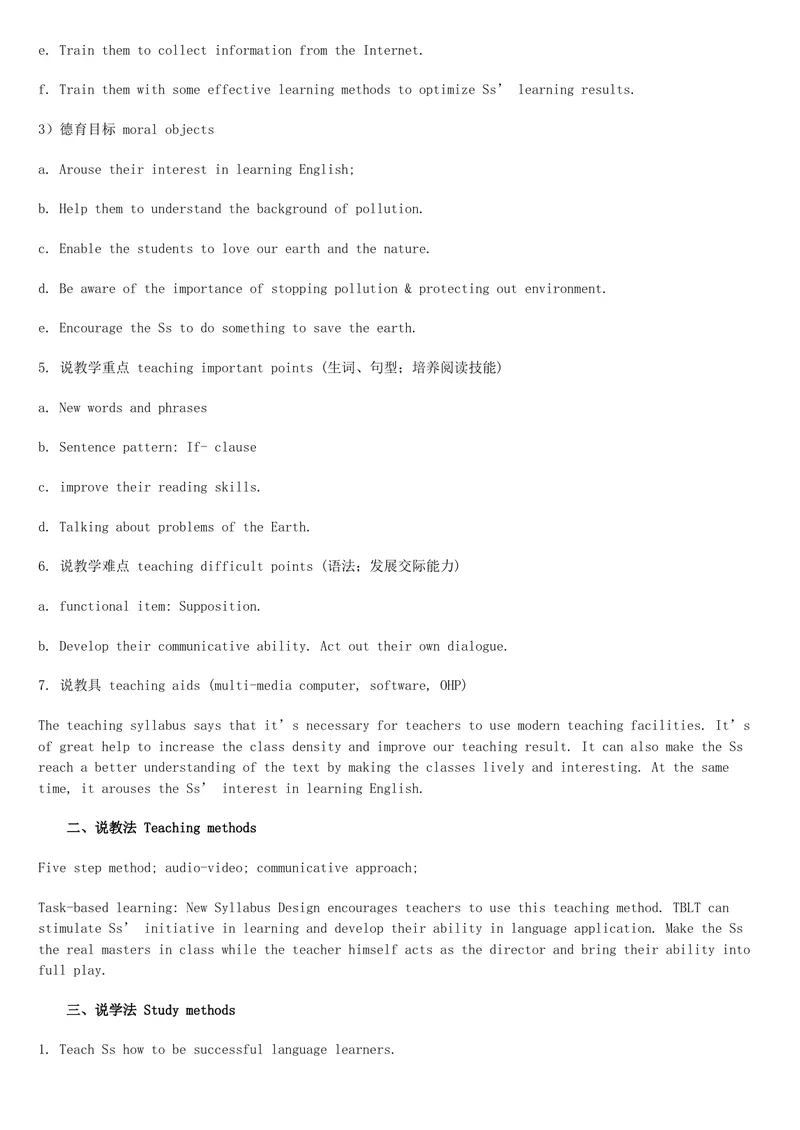
Lesson 33 Saving the Earth is a dialogue. The lesson is focused on the topic of the problems of the
earth and the functional items of Supposition/ Intentions/ conjecture/ Prohibition. Since it is a
dialogue / reading. It’s helpful to improve the Ss communicative/ reading ability.
3. 说教学指导思想 teaching guideline
(Teaching syllabus: Language is for communication, develop their four skills, lay special emphasis on
reading; Grellet put it well in his book developing reading skills: develop reading skill/ discourse
analysis; get them to understand the western culture better; improve the ability to discover, analyze
& solve the problems; Reading is for information, for fun; Use Top- down model or Bottom- up model to
activate Ss schemata; Interactive model)
4. 说教学目标和要求 Teaching aims and demands (…be intended for Ss in key schools)
1)认知目标 knowledge objects
a. Enable the Ss to remember the following new words & phrases:
Damage, lecture, pollute, pollution, room, standing room, be fit for, hear about, turn into
b. Get the Ss to be familiar with this sentence pattern:
If the population keeps growing so quickly, there will only be standing room left…
Give the Ss a reinforced practice on the functional item Supposition.
c. Activate Ss schemata regarding the topic of pollution and help Ss to know more about the problem of
pollution.
2)智能目标 ability objects
a. Ask the Ss to make up a similar dialogue.
b. Help them to understand the dialogue better and improve the four skills.
c. Develop their ability of thinking independently.
d. Cultivate their ability to discover, analyze and solve problems.e. Train them to collect information from the Internet.
f. Train them with some effective learning methods to optimize Ss’ learning results.
3)德育目标 moral objects
a. Arouse their interest in learning English;
b. Help them to understand the background of pollution.
c. Enable the students to love our earth and the nature.
d. Be aware of the importance of stopping pollution & protecting out environment.
e. Encourage the Ss to do something to save the earth.
5. 说教学重点 teaching important points (生词、句型;培养阅读技能)
a. New words and phrases
b. Sentence pattern: If- clause
c. improve their reading skills.
d. Talking about problems of the Earth.
6. 说教学难点 teaching difficult points (语法;发展交际能力)
a. functional item: Supposition.
b. Develop their communicative ability. Act out their own dialogue.
7. 说教具 teaching aids (multi-media computer, software, OHP)
The teaching syllabus says that it’s necessary for teachers to use modern teaching facilities. It’s
of great help to increase the class density and improve our teaching result. It can also make the Ss
reach a better understanding of the text by making the classes lively and interesting. At the same
time, it arouses the Ss’ interest in learning English.
二、说教法 Teaching methods
Five step method; audio-video; communicative approach;
Task-based learning: New Syllabus Design encourages teachers to use this teaching method. TBLT can
stimulate Ss’ initiative in learning and develop their ability in language application. Make the Ss
the real masters in class while the teacher himself acts as the director and bring their ability into
full play.
三、说学法 Study methods
1. Teach Ss how to be successful language learners.2. Teach Ss how to develop the reading skill — skim & scan; how to communicate with others; how to
learn new words; how to learn independently;
3. Get the Ss to form good learning habits.
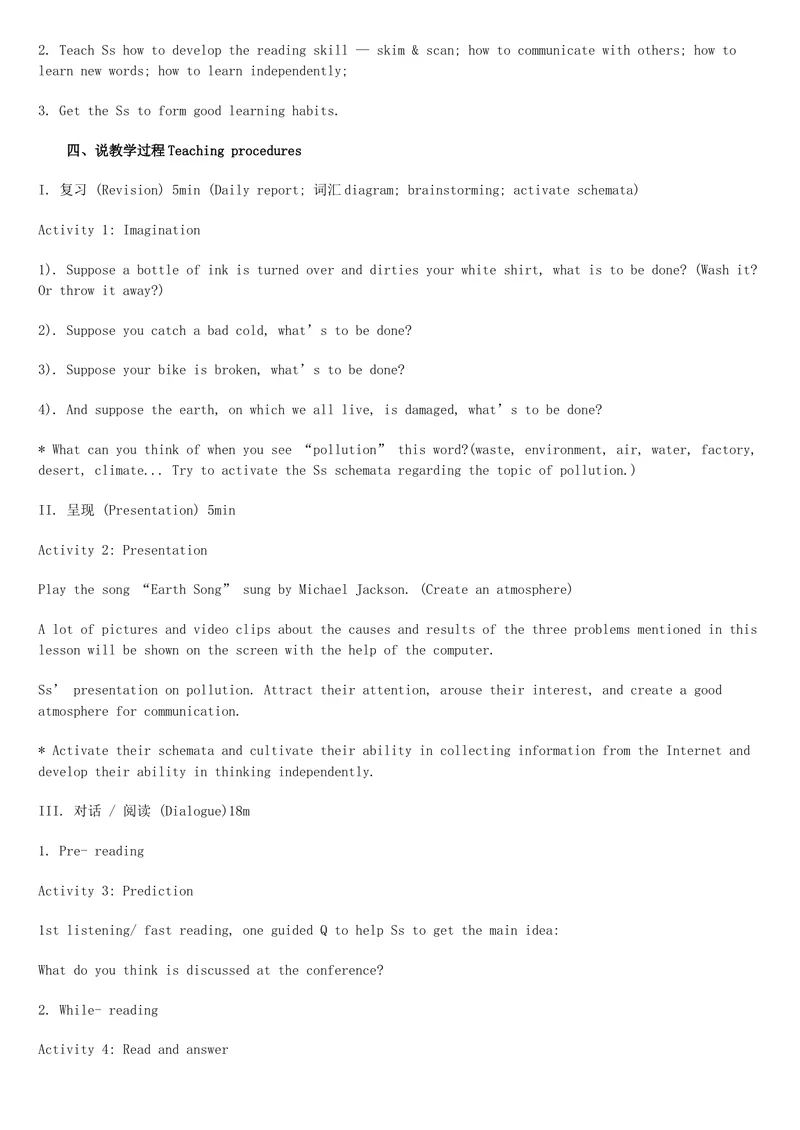
四、说教学过程Teaching procedures
I. 复习 (Revision) 5min (Daily report; 词汇diagram; brainstorming; activate schemata)
Activity 1: Imagination
1). Suppose a bottle of ink is turned over and dirties your white shirt, what is to be done? (Wash it?
Or throw it away?)
2). Suppose you catch a bad cold, what’s to be done?
3). Suppose your bike is broken, what’s to be done?
4). And suppose the earth, on which we all live, is damaged, what’s to be done?
* What can you think of when you see “pollution” this word?(waste, environment, air, water, factory,
desert, climate... Try to activate the Ss schemata regarding the topic of pollution.)
II. 呈现 (Presentation) 5min
Activity 2: Presentation
Play the song “Earth Song” sung by Michael Jackson. (Create an atmosphere)
A lot of pictures and video clips about the causes and results of the three problems mentioned in this
lesson will be shown on the screen with the help of the computer.
Ss’ presentation on pollution. Attract their attention, arouse their interest, and create a good
atmosphere for communication.
* Activate their schemata and cultivate their ability in collecting information from the Internet and
develop their ability in thinking independently.
III. 对话 / 阅读 (Dialogue)18m
1. Pre- reading
Activity 3: Prediction
1st listening/ fast reading, one guided Q to help Ss to get the main idea:
What do you think is discussed at the conference?
2. While- reading
Activity 4: Read and answer2nd listening/ careful reading, more Qs to get the detailed information. Develop their reading skills:
skim & scan. Pay attention to the pronunciation, stress & intonation.
* 阅读: Pre-reading; while-reading; post-reading (fast reading/ careful reading; skim/ scan; 识别关键
词key words;确定主题句;创设信息差information gap;T or F; 填表格chart/diagram; Predicting; Make a
timeline; Make a story map。达到对课文的整体理解和掌握。So that they can have a good understanding of
the whole text.)
3. Post- reading
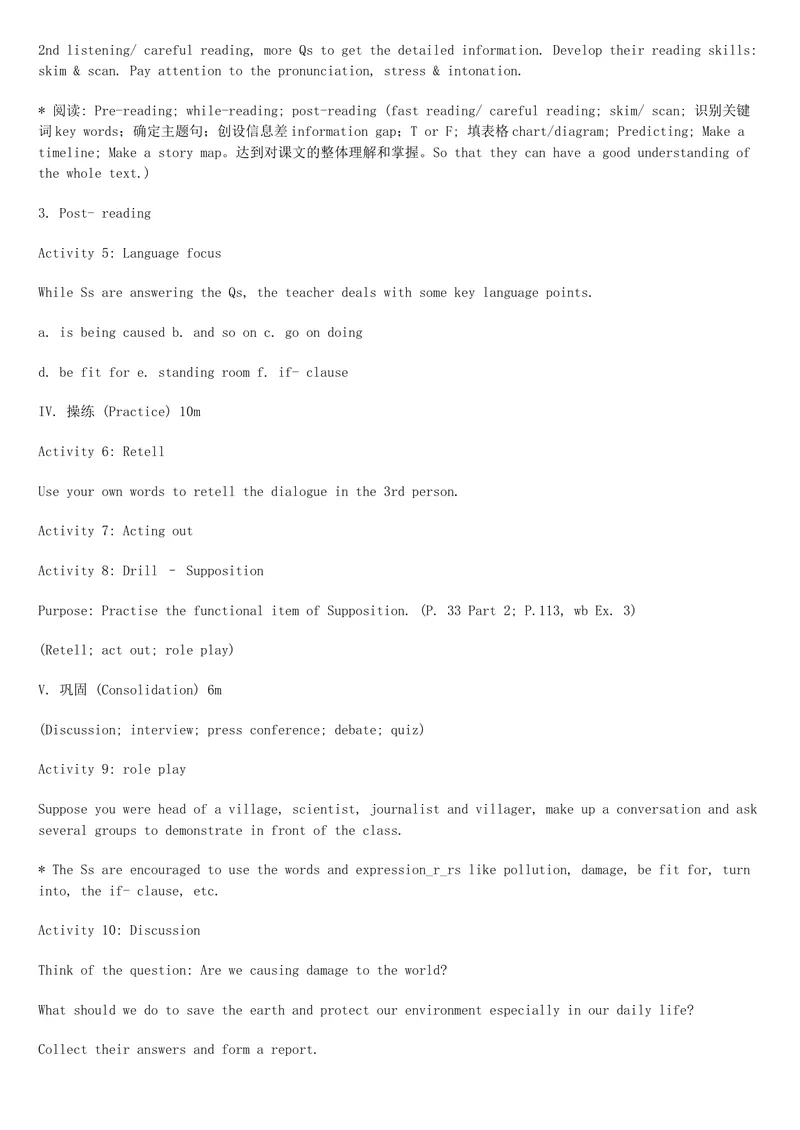
Activity 5: Language focus
While Ss are answering the Qs, the teacher deals with some key language points.
a. is being caused b. and so on c. go on doing
d. be fit for e. standing room f. if- clause
IV. 操练 (Practice) 10m
Activity 6: Retell
Use your own words to retell the dialogue in the 3rd person.
Activity 7: Acting out
Activity 8: Drill – Supposition
Purpose: Practise the functional item of Supposition. (P. 33 Part 2; P.113, wb Ex. 3)
(Retell; act out; role play)
V. 巩固 (Consolidation) 6m
(Discussion; interview; press conference; debate; quiz)
Activity 9: role play
Suppose you were head of a village, scientist, journalist and villager, make up a conversation and ask
several groups to demonstrate in front of the class.
* The Ss are encouraged to use the words and expression_r_rs like pollution, damage, be fit for, turn
into, the if- clause, etc.
Activity 10: Discussion
Think of the question: Are we causing damage to the world?
What should we do to save the earth and protect our environment especially in our daily life?
Collect their answers and form a report.VI. 作业 (Homework) 1m (Writing; continue the story; recite; retell)
Write a letter to the mayor, telling him sth. about the pollution around your school.
英语说课稿模板二(全英文)
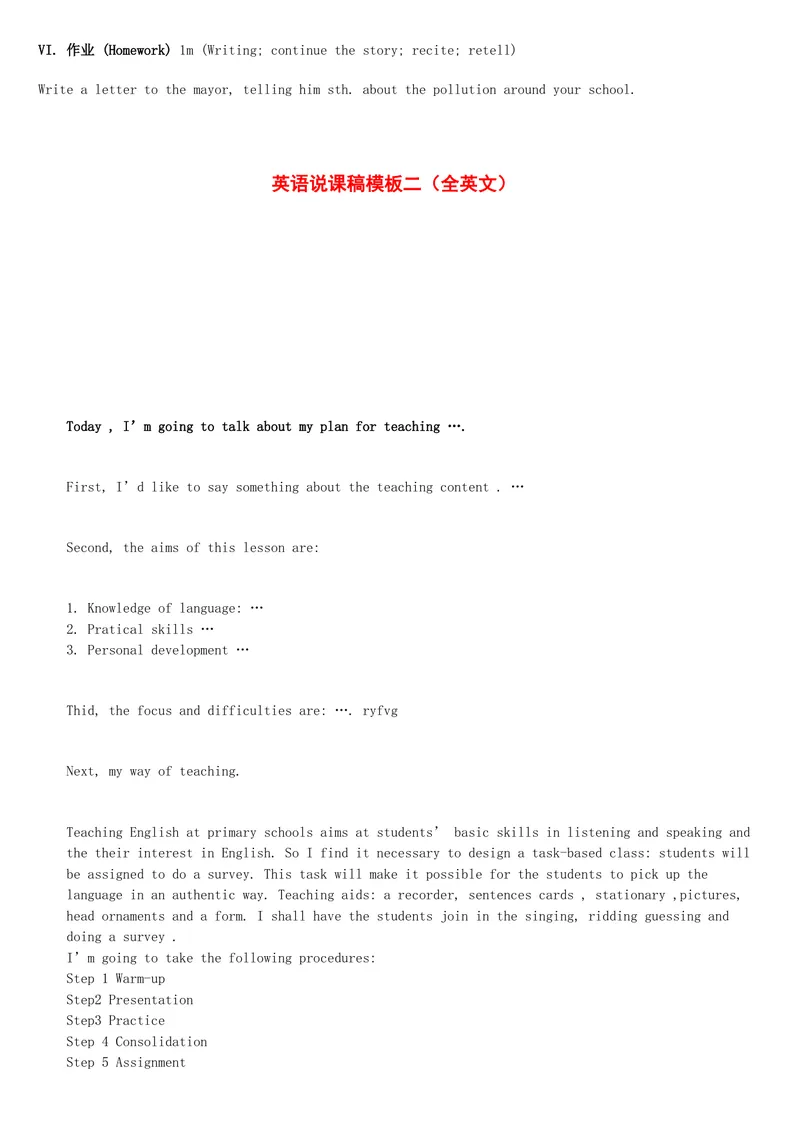
Today , I’m going to talk about my plan for teaching ….
First, I’d like to say something about the teaching content . …
Second, the aims of this lesson are:
1. Knowledge of language: …
2. Pratical skills …
3. Personal development …
Thid, the focus and difficulties are: …. ryfvg
Next, my way of teaching.
Teaching English at primary schools aims at students’ basic skills in listening and speaking and
the their interest in English. So I find it necessary to design a task-based class: students will
be assigned to do a survey. This task will make it possible for the students to pick up the
language in an authentic way. Teaching aids: a recorder, sentences cards , stationary ,pictures,
head ornaments and a form. I shall have the students join in the singing, ridding guessing and
doing a survey .
I’m going to take the following procedures:
Step 1 Warm-up
Step2 Presentation
Step3 Practice
Step 4 Consolidation
Step 5 AssignmentⅡ
It's my pleasure to be here. Now, I'd like to say something about my teaching plans about …
For its objective, it covers …objectives
1. Knowledge objective …
2. Ability objective …
3. Moral objective …
During the procedure of my teaching, multi-media, over head project, tape recorder, pictures will
surely be adopted that will also be accompanied by demonstration, role-playing, task-oriented
approach. Through these methods and by using these aids, I want to teach the students how to be
successful language learners.
After analyzing the dialogue, I set off my teaching plan around 4 tasks and many activities: pre-
task, while-task, post-task and creative task.
…
That’s my idea about the teaching plan of this lesson. Thanks for listening.
初中英语说课稿模板三
一、说教学理念:
英语新课程标准要求教师要从教学实践者转为教学的研究者,……
二、说教材
㈠教材概述:本单元……
㈡三维目标设立:
1、知识与技能
⑴学会单词、短语:……;句型:……
⑵提高学生交际,探究能力,培养创新精神。
2、过程与方法:
以学生自主学习为基础,以一幅……图引入,……
3、情感态度与价值观
⑴引导学生充分认识到必须……
⑵培养学生的学习英语兴趣,……
⑶培养团结协作精神。
㈢重点、难点
基于以上分析,确定本课重点:……
难点:⑴……
⑵……
三、说教法
1、学生分析:……
2、教学方法:
⑴游戏教学法;⑵任务型教学法;⑶多媒体辅助教学。
四、说学法1、善于抓住用英语交际的机会,充分感知,积极体验,大胆实践。
2、积极参与,善于合作,培养团队精神。
3、为赢取“英语课堂最佳表现奖”而主动学习。
依据:新课程倡导的感知——体验——实践——参与——合作,以及形成性评价。
五、说流程
1、总体设计及依据
在任务型活动中热身(8分钟)……
2、教具准备:
3、分步设计及依据(多媒体课件制作)
Step1:在任务活动中热身
活动一:chant
活动二:Guessing games
活动三:利用挂图……
活动四:学生俩俩合作,……
Step2 在任务活动中认知
……
Step3 在任务活动中巩固
6个活动
Step4 Summary
……
4、板书设计
六、教学效果预测
……
七、教学反思(教后说)
1、教学内容要形式多样,……
2、尽量合理组织教材,……
3、课件制作要充满色彩,……
4、拓展学生文化视野,……
5、充分发挥学生主动作用,……
初中英语说课稿模板四
各位老师好:
今天我说课的课题是《XXX》。下面我对
本课题进行分析:
一、说教材(地位与作用)
《XXX》是人教版必修教材第XX单元第XX个课题。在此之前,学生们已经学习了XX,这为过度到本课题的学习
起到了铺垫的作用。因此,本课题的理论、知识是学好以后课题的基础,它在整个教材中起着承上启下的作用。
二、说教学目标根据本教材的结构和内容分析,结合着XX年级学生他们的认知结构及其心理特征,我制定了以下的教学目标:
1. 知识与技能目标
2. 过程与方法目标
3. 情感与价值观目标
三、说教学的重难点
本着XXX新课程标准,在吃透教材基础上,我确定了以下教学重点和难点。
教学重点:重点的依据是只有掌握了 ,才能理解和掌握 。
教学难点:难点的依据是 较抽象,学生没有这方面的基础知识。
为了讲清教材的重难点,使学生能够达到本课题设定的教学目标,我再从教法我学法上谈谈。
四、说教法。
我们都知道XX是一门培养人的XXX能力的更要学科。因此,在教学过程中,不仅要使学生“知其然”,还要使
学生“知其所以然”。我们在以师生既为主体又为客体的原则下,展现获取理论知识、解决实际问题的思维过程。
考虑到XX年级学生的现状,我主要采取设置情景教学法,让学生积极主动地参与到教学活动中来,使他们在活动
中得到认识和体验,产生践行的愿望。培养学生将课堂教学和自己的经验结合起来,引导学生主动去发现周边的客观事
物,发展思辩能力,注重滨心理状况。当然老师自身也是非常重要的教学资源。教师本人应该通过课堂教学感染和激励
学生,调动起学生参与活动的积极性,激发学生对解决实际问题的渴望,并且要培养学生以理论联系实际的能力,从而
达到最佳的教学效果。基于本课题的特点,我主要采用了以下的教学方法:
1. 直观演示法:利用图片等手段进行直观演示,激发学生的学习兴趣,活跃课堂气氛,促进学生对知识的掌握。
2. 活动探究法:引导学生通过创设情景等活动形式获取知识,以学生为主体,使学生的独立探索性得到了充分的发挥,
培养学生的自觉能力、思维能力、活动组织能力。
3. 集体讨论法:针对学生提出的问题,组织学生进行集体和分组语境讨论,促使学生在学习中解决问题,培养学生团结
协作的精神。
由于本课题内容与社会现实生活的关系比较密切,学生已经具有了直观的感受,可以让学生自己阅读
课本并思考,例举社会上存在的一些有关的经济现象,在老师的指导下进行讨论,然后进行归纳总结,得出正确的结论。
这样有利于调动学生的积极性,发挥学生的主体作用,让学生对本框题知识的认知更清晰、更深刻。
五、说学法
我们常说:“现代的文盲不是不懂字的人,而是没有掌握学习方法的人”,因而,我在教学过程中特别重视学法
的指导。让学生从机械的“学答”向“学问”转变,从“学会”向“会学”转变,成为学习的真正的主人。这节课在指
导学生的学习方法和培养学生的学习能力方面主要采取以下方法:思考评价法、分析归纳法、自主探究法、总结反思法。
最后我具体来谈谈这一堂课的教学过程。
六、说教学过程
在这节课的教学过程中,我注重突出重点,条理清晰,紧凑合理,各项活动的安排也注重互动、交流,最大限度的
调动学生参与课堂的积极性、主动性。
1. 导入新课:(2~3分钟)
由上节课演过的知识和教材开头的情景设置导入新课。导语设计的依据:一是概括了旧知识,引出新知
识,温故而知新,使学生的未知欲望。这是教学非常重要的一个环节。
2. 讲授新课:(35分钟)
在讲授新课的过程中,我突出教材的重点,明了地分析教材的难点。还根据教材的特点,学生的实际、教
师的特长,以及教学设备的情况,我选择了多媒体的教学手段。这些教学手段的运用可以使抽象的知识具体化,枯燥的
知识生动化,乏味的知识兴趣华。还重视教材中的疑问,适当对题目进行引申,使它的作用更加突出,有利于学生对知识
的串联、积累、加工,从而达到举一反三的效果。
3. 课堂小结:(2~3分钟)
课堂小结的目的是强化认识,可以把课堂传授的知识尽快地转化为学生的素质;简单扼要的课堂小结,
可使学生更深刻地理解XXX理论在实际生活中的应用,并且逐渐地培养学生形成良好的个性。4. 板书设计:
我比较注重直观地、系统的板书设计,并及时地体现教材中的知识点,以便于学生能够理解掌握。我的板
书设计是:
5. 布置作业。
针对XX年级学生素质的差异,我进行了分层训练,这样做既可以使学生掌握基础知识,又可以
使学有余力的学生有所提高,从而达到拔尖和“减负”的目的。我布置的课堂作业是:XXX
英语说课稿撰写的注意事项
说课是教师职业的基本素养,说课要求教师对教学大纲、教学目的、课堂设计很了解,说课要包括:教材、目标、重点、
难点、教法、学法、过程、板书、小结。
说课有别于讲课。讲课的对象是学生,侧重讲授知识、培养能力、教书育人,是系统的教育教学活动;而说课的对象
是教师、教研员、评委,侧重表述如何讲授知识、培养能力、教书育人,是系统的教育教学研究活动。说课是教学与教研的
结晶,是教学理论和教学实践结合的产物。说课讲稿的撰写要注意以下几点。
(一)突出理论性
说课讲稿有别于教案或教案提要,它比教案更具有理论性。写说课讲稿也不同于写教案,教案多是具体教学过程,
而说课稿则侧重于有针对性的理论指导的阐述;教案只说"怎么教",而说课讲稿则要重点说清“为什么这么教"。因此,
写说课讲稿要注重理论依据的阐述,尤其是说教材、说教法、说学法及学法指导时,一定要说明其理论依据。
(二)简明扼要
说课稿有别于教学论文,它比教学论文更具实践性,因此。说课稿的撰写要用词精当,切忌长篇大论、面面俱到或泛
泛而谈。说课各个要素及其理论依据必须要有直接的内在联系,在语言表达方面要言简意赅。另外,表述具体的教学目
标时,要尽量避免使用抽象、笼统、缺乏可操作性和可监测性的一般性用语,如知识目标一Student will learn about the
present perfect tense;能力目标一Improve the students' abilities of listening,speaking, reading and writing。这样的教学目标
只是泛泛而谈,没有说明要求学生做到的是什么,教师在教学过程中也无法有效操作,听课者更难确定教学目标是否达
成。
(三)不拘一格
由于教学内容不同,教学对象(学生)不同,课型不同,教师的教学经验以及对教材的理解和处理不同,说课稿的撰
写也不应拘泥于单一的、固定的模式。只要教师能够准确把握说课的要素和要点,透彻分析教学设计的理论依据,采用
综合论述(说课的各个要素不逐项列出)或分块论述(说课钠各个要素逐条列出),都能达到说课教研的最终目的。
(四)突出英语学科特点,但要量力而行
原则上讲,英语说课讲稿最好用英语写。但是用英语写说课讲稿对教师的英语写作能力提出了更高的要求,因此,
在有些教师还没有掌握说课方法或没有能力准确翻译某些教学理论时,最好慎重用英语写说课讲稿。笔者认为,现阶段
英语说课讲稿用英语撰写或用汉语撰写均可。因为,说课是陈述教学方案设计及其理论依据,而不是具体实施课堂教学
方案。英语说课的目的主要是进行英语教学研究,提高教师的教研水平,而不侧重于提高教师的英语口语表达能力。Unit 1 How often do you exercise?
Unit 1 How often do you exercise? 教案课时安排4课时
第一课时:
Section A (1a—2c)
第二课时:
Section A (3—4)
第三课时:
S
ection B (1a—2c)
第四课时:
Section B (3a—4)单元目标与要求
1.能够谈论自己、朋友或他人平时的活动,如:I
often go to movies. He sometimes watches TV.等。
2.能够谈论自己、朋友或他人平时活动的频率,如:
I shop once a month. He watches TV twice a week..
等。
3.能听、说、读、写课后但此表中的黑体重点词汇
和Grammar Focus 的重点句型。
4.能够听、说、读A、B部分Pairwork中的对话;能
够听懂简单的听力内容,并完成回答。
5.能够理解Read中的大致内容,并能解决相应的
问题。
6.能够理解比并且完成Groupwork 和 Survey 。
7.在Self-check 中完成综合运用,检验对本单元的
掌握程度。
8.通过本单元的学习,能引导学生关注自己以及
身边的人对于日常生活的安排,养成合理安排生活
起居及饮食好习惯。倡导健康生活,健康起居。
Period 1
l¡教学内容与分析
教学内容:(SectionA 1a—2c)
教学目标:
a. 能够听、说、读、写平时的活动:exercise, go skateboarding。
b. 能够听、说、认读句子:What do you usually do on weekends?I often go to the movies. What does she do on weekends? She
sometimes watches TV.并能运用这些句型来描述自己和他人的平时活动。
c. 能够听、说、认读句子:How often do you shop? I shop once a month并能用这些句型谈论自己、朋友或他人平时活动的
频率。
l¡教学重点、难点分析:
教学重点:能够听、说、读、写自己、朋友或他人平时的活动以及活动的频率并在实际情景中运用自如。
教学难点:能够准确运用词汇来区分不同的频率,而掌握代表不同频率的词汇本身也是本课时的教学难点。
l¡ 课前准备
教师准备主情景图的教学挂图。
教师为制作多媒体课件,在网上搜索相关资料。
教师准备磁带和录音机。
l¡ 教师设计
教学步骤 建议和说明
Step 1 Greetings
Greet with Ss
T:Welcome back to school,boys and girls.How are you? 在回忆暑假生活中抛出话
How time flies!Our summer vacation was over. 题,激发学生情感,营造氛围,How was your vacation? 并有意识地复习以前学过的动
Did you enjoy your summer vacation? 词词汇表达。真实的语境,容易
Was it interesting,exciting or relaxing? 调动学生开口的积极性。
Would you like to tell us?
Encourage Ss to share their vacation with the whole class.
Step 2 Presentation and Practice
从这个暑假聊到以往的各
Ask Ss:Well,do you still remember your last vacaton? 个暑假,从而展开讨论,一般来
说,暑假里都做些什么,进而呈
现表达不同频率的副词。加上〉
How did you spend it?
来区分他们的不同程度,使学生
Was it the same as this summer vacation?
一目了然。
So what do you often do in your summer vacation?
Then show some phrases for Ss to practice. Then present as following:
always>usually>often>sometimes>hardly ever(几乎没有) >never
and let them understand their differences at the first time.
After that ask Ss try to answer the question above,according to their own
situation,using always,usually,often,sometimes,hardly ever(几乎没有) or never.
通过猜谜的游戏来呈现新
的词汇,同时结合刚学的副词来
Step 3 Guessing Presentation and Practice 谈论自己的实际情况,加强对不
同副词的运用及掌握。
由调查的形式来进一步操
练学生对副词的掌握。真实的环
always,usually,often,sometimes,hardly ever(几乎没有) or never. 境,往往更能激起了孩子们说的
欲望及想要了解别人的好奇心,
And during this part,present surf the net exercise and go skateboarding. 使孩子们有获得信息的感受,并
增进了解。
Step 4 Make a survey
Ask Ss:What do you usually do on weekends?
First show some examples as following,let Ss drill them 积累从刚才的调查所得的
Do you often exercise on weekends? 信息,就变成了一篇不错的口头
No. I sometimes exercise. 小短文,进而检验了学生对于段
Do you usually surf the internet? 落的掌握。
Yes. I usually surf the internet.
Do you sometimes go skateboarding?
No.I hardly ever go skateboarding. 通过进一步的深入调查,引
No.I never go skateboarding. 出once a day/
Do you often exercise on weekends ?
Yes. I often exercise ./No. I … exercise.
Let Ss ask and answer in pairs,using always,usually,often,sometimes,hardly 给学生提供一张表格,让
ever(几乎没有) or never. 学生进行直观的操练。有时候,
Step5 Make a report 简单的操练可能会起到事半功
After the survey,ask Ss to make a report about themselves. 倍的效果。
On weekends, I always ….I usually ….I often … . I sometimes.I hardly
ever….And I never ….
Step 6. Make a more survey about your partner
Ask: How often do you exercise, Cathy?
I exercise once a day/twice a week 通过完成教科书上的内容,
Present once a day/twice a week /three times a month/every day etc. by asking 来检验对本课时的具体掌握程
and answering. 度。从而为下课时做好准备,查
Then practice with does 漏补缺,有的放矢。
给学生留一份采访家人的
eg. How often does Jack read books, ? 调查作业,增进与家人的了解沟
He reads books every day . 通,倡导合理的生活习惯。After that ,make a report about your partner,showing the form as following.
ACA c Activities
How often
surf the Internet
tivities
read English books
go to the movies
watch TV
exercise
Step 7 Students’ Book
Let Ss look at 1a,look at the picture and write down the activities in the blanks.
Listen to the tape for twice,fill in 1b.
Finish the Exs. in 2a &2b
Step 8 Homework
Interview one of your family members how often he/she does something, and then
make a report.
Period 2
Teaching aims:
1. Learn the words: shop once twice time surf Internet program
high school most no result active for as for about
2. Learn common English talkings:
What do you usually do on weekend? I usually…
What do they do on weekends? They often…
What does he/she do…? He/She sometimes …
How often do you shop? I shop once a month.
How often does Cheng watch TV? He watches TV..
Teaching key points:
1. Master the words and write them correctly
2. Grasp the talkings and talk them out naturally and fluently
3. Know the times well .Teaching demands:
1. Students can learn to talk about Activities and HOW OFTEN to each other
1. Students can listen, talk ,read and write these words correctly
Teaching time:
One period (45 minutes)
Preparation
1. A tape-recorder and tapes.
2. Word cards.
3. Exercise paper.
Activities How often
Watch TV everyday
Surf the Internet
Read English
books
Go to the movies
exercise
Teaching steps:
1. Warming-up
让学生欣赏并学唱英文歌曲,
Enjoy a nice English song which Ss like (choose one)
有助于放松缓解压力,消除前
<< take me to your heart >> 一节课的影响,使学生尽快融
<< yesterday once more >> 入到英语课堂教学中,同时创
<< right here waiting >> 造良好的课堂气氛。
… …
… …
向学生问好,促进师生情感的
2. Greeting 交融,并引导他们快乐地学习
T: Hi ! Boys and girls! 英语,保持快乐的心境。
S: Hi ! 看似无意却有意的引导到日
常生活中的各类活动。
T: Are you happy ?
S: Yes.
自然过渡
T: I am happy, too . I am happy to see you
… 真实情景交际
(talk everything which you would like to talk with your children,
一边展示图片,让学生感觉到
then lead to Activities )
比较生动的画面;一边让学生
回忆起以前学的活动。 也学
3 Talking :(pictures) 一些新的单词, 词组。
⑴ what do you usually do on weekends? on vacation?
What does he/she do …?…?
多使用表扬语言,以此激励学
Use the photos of a baby , a lovely mouse, a QQ, a short man …
生大胆发言
⑵ Activities
go to the movies wash faces
watch TV clean the bedroom
为下一步的学习作好准备.可
shop brush the teeth
适当展开小组比
exercise take a shower 以
sing do some running 赛 ,这样可将学生的主动性
和积极性更好地发挥出来,让
⑶ Talk in pairs/ in groups 他们更热情地投入活动中.既
What do you usually do on weekend? I… 可以加深对次数的了解,也能
What do they do on weekends? They .. 锻炼其表达能力。
What does he/she do…? He/She …
真正的英语是源于生活,让学
…
生从生活中寻找英语的乐趣,4.Presentation: 在课堂上感受到英语的快乐
⑴ How often do you watch TV? 是老师的快乐。让学生在合作
的气氛下学习英语是很重要
every day
的。
once a day
twice a day
three times a day 提高学生的听力水平
… … 这里一定要注意方法的合理
运用, 根据学生的实际水平
⑵ talk in pairs
操作。 千万不要只停留于皮
go to the movies wash faces
表, 走过场!
watch TV clean the bedroom 一切以学生听懂了,理解了为
shop brush the teeth 目的!!!
exercise take a shower 合理利用书本上的资料,深化
挖掘资料。
sing do some running
How often do you watch TV?
I …… every day
once a day 引入学生自身实际让学生有
twice a day 话可说,要说,想说!能言之
有物!
three times a day
5. Listening: 2a 2b
⑴ Cheng is talking about how often he does different activities. Number the activities 适当深化内容,以便复习以前
you hears from 1 to 5 学过的内容,新旧结合,温故
知新!
the answer is 3,1,5,4,2
⑵ Match his activities with the number of times
watch TV twice a week
read every day at school
培养孩子们的综合运用
go to the movies once a week
能力,学会自我组织材
exercise three times a week 料!能长对话,也能流利
小短文!
shop twice a month
6. Presentation:
全面训练学生的听,说,读。
⑴ what about you ? how often do you ……….?
发挥学生主观能动性,培养其
⑵ how often do you do these activities? 成就感。
Fill in the chart and then make conversations!
Activities How often
Watch TV everyday
布置作业,完整课堂,适当延
Surf the Internet
伸!
Read English books
Go to the movies
exercise
A: How often do you watch TV?
B: I watch TV every day.
A: what’s your favorite program?
B: It’s Animal World.
A: How often do you …….?
B: ……..
⑶Talk in pairs then report
Begin with: I watch TV……….
My partner …… watches TV…….
7. Consolidation:
read the magazines article, use the information in the boxes below to help you. (Green
High School )
(1) Listen and read after the tape.
(2) Retell it in your own words.
(3) Questions Ss like to ask8. Homework:
⑴ Finish 4 fill in the blank
⑵ Copy the words
⑶ A small composition <<My partner and I>>
(4) Recite the listening
实实在在上课,一步一个脚印进步! Happy every day !
Period 3
l¡ Teaching Contents and Analysis
Teaching materials: Section B. (1a-2c)
Teaching aims:
a. To master the new words: junk food ,milk ,coffee ,chip ,cola ,chocolate ,drink , health ,how many ,interviewer.
b. Talk about how often you do things
c.To master the following key sentences:
How often do you drink milk, Liu Feng?
How many hours do you sleep every night?
She says it’s good for my health.
d. Make sure that Ss can listen, speak, read and write the key sentences and finish the survey in the listening materias
correctly.
Analysis of key items and difficulties of teaching:
Key items: Reading and writing of key sentences.
Difficulties : To use health and healthy correctly.
l¡ Preparation
A tape-recorder and tape.
A projector
l¡ Teaching PlanTeaching procedures
Suggestions &explanation
Step1.Warm-up
1.Enjoy an English song.
通过欣赏歌曲活跃课堂气氛。又通过几
2.Free talk Talk with Ss about the following questions:
个小对话可复习第一册及前几课所学内容,
Do you like fruit/vegetables?
又可自然地导入本课重点。以旧带新,符合
Yes,I do .I love it/ them.It’s/They’re delicious.And it’s/they’re
认知规律。
healthy food.It’s/They’re good for our health. Or No ,I don’t.It’s
awful.I can’t stand it.
在授课同时与学生进行情感交流,并对
Ask Ss:How often do you eat fruit /vegetables?
学生的不良饮食习惯进行引导、纠正。
Step 2 Presentation
1.Teach milk. Do you like milk? Do you drink milk every day?
Why /Why not?
2.Then teach chip /cola/chocolate/coffee in the same way.Don’t
foget to ask them Are they/Is it healthy food /drink? They’re /It’s
在教授了新知识后让学生自己操练,可
healthy/unhealthy/ junk food.Don’t eat /drink them /it too often.
及时巩固刚学过的新知识。
Step 3.Pair work
Ss make a similar conversation by themselves.
A:How often do you{ eat…?
drink…?
B :I eat/drink… every day/….
A:Do you like it ?
从谈论饮食扩展到学生生活的其它方
B:Yes ,I do. It’s good for my health. /No,I don’t. But my mother wants
面,再引出另一个新句型。
me to eat/drink it.
Step 4. Presentation
The teacher asks Ss other questions:
How often do you exercise/watch TV/read English/play computer 让学生编一个较长的对话,可将本节课
games? 所学的新语言点都用起来,加强语言的积
How many hours do you exercise/watch TV/read English/sleep/play 累,同时可培养他们综合运用语言的能力。
computer games?
Step 5. Pairwork
Get Ss to make a long conversation by themselves,use the sentences they 每节课都抽出一定时间培养学生听的
learned so far. 能力,并持之以恒,这对英语学习很有好
Step 6. Listen (work on 2a)
处。
Get the Ss to listen and circle the answers to each question .Latercheck the answers.
Step 7 Group work
Role play . Student A is the interviewer .Student B
is the Katrina. Student C is Bill. Practice the conversation again.
Task
Ask your classmates as many questions as you can.
The questions in 2b can help you . Then give a report in front of the
class.e.g
My classmate Gina likes to exercise. She exercises every day….
Homework :1)Finish the homework in this period.
2)Try to write your report in your exercise book.
Step 7. work on 2b
Listen again and fill in the blanks in the survey. Then check
the answers.
Step8 Group work
Role play. Student A is the interview. Student B is Katrina.
Student C is Bill. Try to act the conversation out .They can
use their own words.
通过编对话可巩固并加深学生对所听内容的理解,通
Step 9.Task 过说来输出听到的东西,让听与说互相促进,共同提高。
Get the Ss to ask their classmates as many questions as they
can about their lives. The questions above (2b) can help
them. After that they can give a report in front of the class.
Homework :1.Finish the exercise in this period.
2.Write the report in the exercise book. 让学生从课本里跳出来,将所学的知识运用到生活
实际中去,这是语言学习的最终目标,也是本节课的最
终目标。Period 4
Teaching aims:
1. Learn following expressions: eating habits,
look after, healthy lifestyle, unhealthy lifestyle,
good grades.
2. Learn to write one’s own habits.
3. Finish the exercises on Self-check.
Difficult point:
How to write a composition of one’s habits.
Preparation: A recorder and tape
Teaching plan:Teaching Procedures Suggestions& Explanation
↘Step 1.Warm-up/Revision
带
1. Free talk:
着学生复习前面几课学过的知 识,
2.Ask and answer
并 加 入 第 三 人 称 单 数 , 有 利
﹙1﹚ How often do you exercise?
于下面知识的展开。
How often do you eat vegetables/fruit/junk food?
How often do you drink milk/coffee/tea?
How many hours do you sleep every day?
…
﹙2﹚ Use he/she/they ask and answer these questions.
﹙3﹚ Group works
↘Step 2.Presentation/Practice
1. Oh, S1 eats vegetables and fruit every day
and he also drinks milk very often. I think
his eating habits are very good. What about yours,S2?
﹤T can write eating habits and yours=your eating habits on 通过学生的回答带动新知识的
Bb, then read them for several times.﹥ 引入,既真实又自然,便于学生掌
2. T: Oh, we can also know S1 sleeps nine hours 握,降低难度。
every nights, he does exercise every day, he
doesn’t drink coffee, and he never eat junk
food. What a healthy lifestyle.
3. After that, T can show a picture with healthy
lifestyle and unhealthy one:
eat fruit never eat vegetables/fruit
vegetables drink coffee/wine too much 两种生活方式的对比,让学生
drink milk never drink milk 一目了然,易于掌握。
sleep 9 hours sleep 5 hours
do exercise never do exercise
healthy lifestyle unhealthy lifestyle
4. T: And you know: Healthy lifestyle can help us get good grades. Good food
and exercise help us to study better. My student Katrina has a good lifestyle.
Let’s see it.
Step 3. Read
1. Listen and repeat.﹙Close their books﹚
2. Open books and read after the tape, then read together.
1. Work in pairs 通过上面的引入,学生应该得
Ask and answer questions on 3a. 心应手,较容易完成问题。
2. Underline some important points
↘Step 4.Read and fill
1. T: Yesterday, we just ask Bill some questions about his habits.
Look at the information in section B 2b,fill in the blanks on
3b.
培养学生创新能力,自己出问
2. Check the answer.
题可增强主动性,给他们更多空间
3. Ask Ss read the passage one by one. Each reads one sentence.
发挥。
Then read together.
4. Have Ss ask and answer some questions according the passage.
Step5.Discussion
1. Work in groups, discuss which kind of life is healthy.
2. Do a report according the discussion.
We think we should eat fruit and vegetables…
此步有助于学生对生活方式进
Step6 Self check
行必要思考,以寻找健康的生活,
让他们健康成长。
Fill in each blank with the correct word given.
Then make your own sentence with each word.
1. wants 2.exercises 3.help 4.try 5.have
Step7 HW1. Read 3a 3b for several times.
2. Write about your own habits.
Unit 1 How often do you exercise? 教案二
教 案 正 文 随堂记录Unit 1 How often do you exercise ?
Teaching goals:
1. Words &phrases: how often , hardly , twice , once , difference , look after ,
although ,etc .
2. Learn to talk about how often do you do things .
3. 一些表示频率的副词: always , usually , often , never , hardly ever , sometimes .
4. 句子结构: What do you usually do on weekends ?
How often ··· ?及回答.
Important and difficult points :
What does she /he do on weekends ?
She often goes to the movies .
How often do you shop ?
Once a week / Twice a week ··· .
Teaching aids : cards , pictures and a tape recorder .
Period 1
Teaching procedures :
Step 1 Leading-in
1.Greetings:Talk about something the students did on
教 案 正 文summer vacation .
Step 2 Pre-task
SB Page 1 , 1a .
1. Look at the picture (学生识图).
2. Name each activity .
T: What are they doing ?
They are shopping /reading /exercising /watching TV /skateboarding .(Help the students to
answer )
3. Write the activities on the line .
4. Check the answers on the Bb .Correct their own activities .
5. Practise reading .
SB Page 1 , 1c .
1. Focus on the conversation in the box .
2. Practise reading .
3. Pairwork : What do you do on weedends ? I ··· .
4. Groupwork :Divide the class into groups of four or five .Make conversations .First S1 to
S2:
S1:What do you do on weekends ?
教 案 正 文S2:I ··· .
S1:What does she /he do on weekends ?
S2:She /He ··· .
5. Act out their own dialogues .
Step 3 While-task
SB Page 1 , 1b .
1. Look at each picture in 1c.Tell what the person does on weekends .Check the Ss orally.
2. Make sure what they will hear and do .
3. Read these adverbs and explain.
4. Play the tape twice .Write the letters on the line.
SB Page 2 , 2a & 2b .
1. read the activities and the answers of “how often” first .
2. Practise reading .
3. In 2a we should know the activities you hear .In 2b we should know the answers of how
often he does the activities.
4. Play the tape for a first time .Ss only listen .
5. Play the tape a second time .Ss do 2a .
教 案 正 文
6. Play the tape a third time .Check the answers .
7. Play the tape .Ss do 2b .
8. Check the answers .
In this part ,we should pay attention to how often引起的特殊疑问句及回答.
Step 4 Post-task
SB Page 2 , 2c .
1. Focus on the conversation .
2. Practice reading .
3. Read the activities in the left box .
4. Fill in the chart .5. Pairwork: Make conversations .
Homework:
1. Copy the new words.
2. Review Section A 1a-2c
3. prepare 3.
教 案 正 文Period 2
Teaching procedures :
Step 1 Leading-in
1. Greetings
2. Drills:
T: What do you usually do on weekends ?
S1: I usually play soccer .
T: How often do you play soccer ?
S1: I play soccer twice a week .
T: How often does he play soccer ?
The other Ss: He plays soccer twice a week .
Repeat for three times .
Step 2 Pre-task
SB Page 2 ,Grammar Focus .
1. Review the grammar box .Ss say the questions and answers .
2. Practise reading .
Step 3 While-task
SB Page 3 , Part 3 .
教 案 正 文1. Call attention to the survey .Make sure the Ss understand the chart .
T: What activity do ninety-five percent of Green High students do every day ?
Ss answer .If necessary , give them help .
2. Review the information in the green box with Ss .
3. Read the article first by the Ss .
4. Read it to the class .
5. Look at the survey and fill in the blanks in the article .
6. Finish the activity individually .
7. Check the answers .
8. Practise reading .
Step 4 Post-task
SB Page 3,Part 4 .
1. T: What can you do to improve your English ?(e.g. read English books, practice reading
and speaking ) How often do you ··· ?
2. Think of more things you can do to improve your English and write them here .
教 案 正 文3. Ask several Ss each question .
4. See: Who is the best English students in the class
Homework:
1.Revise and copy the new words .
2.Prepare for Section B.
教学后记
教 案 正 文Period 3
Teaching procedures :
Step 1 Leading in
1. Greetings & free talk .
2. Practise reading the article in Page 3.
3. Check the homework.
Step 2 Pre-task
SB Page4 , 1a .
1. Point out the five phrases .
2. Ss read after the teacher .
3. Make sure the Ss understand what do they mean .
4. Call attention to the pictures .Say something about the pictures .
5. Match the words with the pictures .
6. Check the answers .
7. Practice reading .
Step 3 While-task
SB Page 4 , 1b .
1.pay attention to the conversation in the box on the right .
教 案 正 文2. Read it to the class .
3. Explain : “be good for” means :有益于…,对…有好处.
4. Pairwork. Choose a new partner .Use the words in Activity 1a to make conversations .
5. Share the students’ conversations.
SB Page 4 ,2a&2b .
1. T : Now you will hear a reporter interview two people ,Katrina & Bill .Read the two names
for the Ss. In 2a ,we’ll know who is healthy , Bill or Katrina ?
2. Read the questions in 2a .
3. Listen to the tape carefully twice .Circle “yes” , “no” or “I don’t know” in the chart .
4. Before we check the answers in 2a,we’ll read through the questions in 2b .Pay attention to
Katrina’s and Bill’s answers .
5. Play the tape again .This time ,if we have heard one questions and we have a pause .Make
sure Katrina’s and Bill’s answer.
教 案 正 文
6. From the answers in 2b ,we can tell who is healthy Bill or Katrina ?
Step 4 Post-task
Role-play .
Groupwork .Divide the Ss into groups of three .S1 is interview,S2 is Katrina ,S3 is Bill .
S1: How often do you exercise ?
S2: I exercise every day .
S3: … .
With the help of 2b .
Homework1. Revise and copy the new words.
2. Make a suvery with the qudstions from 2b,write down the answers and compare.
教
学
后
记
Unit 1 How often do you exercise? Section A说课稿
1a ---1c
教材分析:本单元以“How often do you exercise ?”为话题展开教学活动。首先学会恰当地使用频率副词及短语,再
学会描述课余时间的活动安排和基本饮食结构。通过复习七年级学习过的动词短语,及本单元的听力练习,各种方式的
口语交际活动和写作练习,使学生积极参与,合作,从而培养学生的综合语言运用能力。教材在本单元的开篇,即本课时,
安排了关于谈论课余时间的各项活动,以及初步认识和使用频率副词,为进一步地使用频率副词及动词短语做语言知识
上的准备。
教学目标:
A:语言目标:恰当使用always usually often sometimes hardly ever never 等频率副词和日常活动短语:
watch TV go shopping read books exercise等。
掌握句型: What do you usually do on weekends? I often go to the movies.
What does she do on weekends ? She often goes to the movies.
B:能力目标:学习描述课余时间的活动安排,初步培养学生的语言综合运用能力。
C:德育目标:培养学生的逻辑表述能力,激发学生的积极思维,并使学生互相了解,增进友谊,加强人际交往,以形成良
好的人际关系。教学重点:核心句型: What do you usually do on weekends?
I often go to the movies.
教学难点:第三人称单数谓语动词在此核心句型中的运用。
教学用具:词汇卡片 多媒体课件一套
教学过程:
Step1 Warm-up activities
(1) Do it (学生按教师的指令做动作)
T:Read books. / Do homework!/ Draw pictures/ Look at the blackboard
T: run / stop / stand up / sit down.
(2) Do as I do.(学生跟老师边说边做动作)
I read books on weekends.
I run on weekends.
I do my homework on weekends.
Step 2 Revision and presentation
(1)教师问:“What do you usually do on weekends ? ” (并且板书)让学生根据自己的实际回答 I usually ……
on weekends.
(2)教师出示动词卡片 watch TV、read books 、exercise 、clean、skateboard、 play basketball、wash clothes、go
shopping、 go to movies让学生认读。
(3)做游戏:“ What’s missing?” (学生先把动词卡片全部读一遍,教师从卡片中任意抽掉一张,再让学生看卡片读
动词短语,然后让学生说出抽掉的是哪一张词汇卡片。)
Step 3 Pattern drill and dialogue
(1)出示词汇卡片给学生,并提问:“What do you usually do on weekends?” 引导学生回答: I usually …… on
weekends.
(2)Task one “Find my group members.”
在规定 时间内填完活动表格,再向周围同学开始询问,找出与自己课外活动大致相同的同学请他或她在每项活动后面
签名。
Activity Name
(3)Look at the picture on the book ,name each activity .Then ask students to point to each picture ,
ask and answer in pairs . “What ’s the boy/girl doing ? ” “He/She is reading .” Check the
answers on the blackboard and ask students to correct their own activities.(1a )
Step 4 Presentation and drill
(1)教师指着屏幕说:“ Now let’s see my activities on weekends. 屏幕上出现各项活动的图片并介绍。 I
always read books at 6:00 in the morning. Then I usually run at 6:30. I often clean my house in the
afternoon. Sometimes I watch TV, but I never watch TV too much. I hardl y eve r go to the movies.
(2)点击鼠标屏幕上出现频率副词及相关的百分比。
always(100%) usually(80%) often (30-50%)
sometimes(20%) hardly ever(5%) never(0%)
领读频率副词,让学生快速认读。
(3)分别点击活动图片,每个图片正面出现一个频率副词。
教师依次提问: What do you do on weekends?
引导学生用图片中的活动及副词回答,如:I usually run.
(4)Task Two: Making cards
每个学生把自己的课外活动做成卡片,再把频率副词做成卡片,然后一个学生问What do you do on weekends? 另一
个学生分别拿一张活动卡片和频率卡片并用其进行回答。
Step 5 Practice and drill
(1)Play the recording the first time .Students only listen . Play the recording a second time . Point
to the pictures . This time say , Listen to the conversation and write the letter of one activity (athrough e )after the word in the list .(1b)
(2) 屏幕上出现一张一个女孩读书的图片,教师提问:
What does she do on weekends?
再点击图片出现副词often 引导学生回答 She often reads books.
(3) 点击屏幕出现 A:What do you do on weekends?
B: I often read books.
C: What does she do ?
D: She often reads books/
(4) 点击图片出现活动图片,四人小组练习对话。
(5) Task three: Do a survey “What does she /he do on weekends ?”
Name Activity How often
Step 6 Homework
(1)Make a conversation “What do you usually do after school ?” in groups.
(2)Collect some information about your favorite teacher with your partners ,such as his or her
personality , hobby , eating habit and so on . Then introduce this teacher to us .
教学板书设计:
Unit 1. How often do you exercise ? 1a-----1c
A:What do you usually do on weekends?
B:I often go to the movies.
教学策略:
根据本课时的特点,我安排了六个环节,第一个环节让学生按老师的指令做动作来调整学生的精神状态,同时又复
习了一些动词,为新课做知识上的准备;在第二个环节中,通过复习旧句型“What do you usually do on weekends ?
”,引出了七年级曾学过的频率副词usually和一些动词短语,减轻学生学习新课的难度;第三环节,通过完成课本
Activity 1a和Task 1来加强说和写的能力的培养;第四环节出现了本课时的重点,因为句型已掌握熟练,这些重点内
容——新频率副词的使用,也迎刃而解,再通过Task Two: Making cards这一有趣的活动来加深理解;第五环节,是我
在教学中的扩展和延伸,在完成课本Activity 1b和Task3的过程中,把学生们学习一般现在时态的难点,用对比的方
式清楚地呈现给学生,使学生充分感知和理解,使学生在交际中对语言的认识得到升华。在第六环节中,我安排了编对
话活动来加强听说能力的培养,第二题是一个开放性的作业,在锻炼学生的综合语言运用能力的同时,又让他们学会合
作与交流。在本课的整个教学过程中,教学重点内容(1c)贯穿始终,这是在教学实际中对教材的调整,由于本课教材没
有涉及到一般现在时态的单三形式,而它又是中学生学习英语易疏忽的问题,所以我在本课做了补充。Unit 1 How often do you exercise? Section A 英文说课
稿Unit 1 How often do you exercise? Section B 说课稿
◆ 教材分析:
下面我要说的内容是人教版八年级上Unit 1 Section B(3a--4) Page 5,本单元以“How often do you
exercise ?”为话题展开教学活动。首先让学生学会恰当地使用频率副词及短语(always, usually, often,
sometimes, hardly ever, never) 再学会描述自己或他人的生活方式。通过复习已学习过的动词及短语(shop,
exercise, read, go to the movies, watch TV, ,eat vegetables/fruit/junk food, ect),使学生积极参与,主动
合作,让学生在完成任务的过程中,使用英语获取信息,用英语进行交流,从而培养学生运用英语的能力。本单元的
Section A部分,已初步认识和使用了频率副词,为进一步使用频率副词及动词短语做语言知识上的准备。本课时主要
在此基础上培养学生对语言知识点的综合运用能力,让学生学会阅读、学会写作,学会调查,让学生在体验中内化语言
知识,从而培养学生对频率副词以及 how often句型的使用能力。
◆ 教学目标:
1、知识目标
(1)掌握以下词汇:
habit, try, lifestyle, grade, better, same, as, different, maybe, although, for,
of course, look after, good—better—best, healthy—healthier—healthiest
(2)掌握并会运用下列重要短语和句型:
look after = take care of the same as try to do sth. get good grades
-How often do you exercise? -I exercise every day.
-How often does she drink milk? -She drinks milk every day.
2、能力目标
读:通过学习本课时的短文,能读懂介绍个人生活方式的文章。
说:利用所学知识或提示的信息,能在短时间内复述课文。
写:能用本节所学知识,描述有关自己或熟人生活习惯的短文。
3、情感目标
通过本单元的学习,养成健康的饮食习惯,保证充足的睡眠时间,进行合理的运动锻炼,以保持健康的体魄。
◆ 教学重点:
1.能正确运用频率副词和How often…?句型。
2.培养学生良好的阅读习惯和运用所学知识进行书面表达的能力。
◆ 教学难点:
能运用频率副词描述自己或别人的生活方式。
◆ 教学方法:
任务型教学法和分层教学法.从学生“学”的角度设计教学活动,使学生的学习活动具有明确的目标,把注重语言
本身转变为注重语言习惯,随着“任务”的不断深化,整个语言学习的过程也越来越自动化和自主化;分层教学能激发
各个层次的学生获取语言信息知识的欲望,提高他们的自信心,从而培养学生学习英语的浓厚兴趣。
◆教学手段:
运用多媒体辅助教学,能使抽象的语言变得直观形象,为学生运用英语进行交际创设情景,实现师生互动,生生互
动多向交流。
◆ 教学过程
一、复习热身
1、检查本课时生词的预习情况。
(1)让个别学生朗读生词,教师及时正音。然后领读,齐读。
(2)听写生词。让学生以合作小组为单位互批互改,小组长汇报检查情况。对表现好的提出表扬,如果学生掌握情况
不好,教师可以结合读音规则等方法帮助学生识记生词。
2、复习导入
(1)利用多媒体出示图片导出已学过的单词和短语。
Healthy food: milk, fruit, vegetablesUnhealthy food: junk food, coffee, cola, chocolate
eat junk food/fruit/vegetables, drink milk/coffee, play sports, how often,
every day, hardly, ever, never, two or three times a week
(2)利用上面的单词和短语通过对话形式复习下列句型。
How often do …..? How often does …..? It’s good / bad for one’s health.
①Make a conversation with the Ss:
T: Excuse me? Do you like…….?
S:
T: How often do you…..?
S:
T: It’s good/bad for your health.
②Then ask them to work in pairs.
(通过“复习导入”的方式复习上节课所学知识,自然过渡到本节课的内容,既为下面的3a﹠4的学习做好了铺垫,
也提高了学生的自信心。首先通过师生之间的交流做出示范,适当引导,然后实现生生之间互动交流。)
(3)做调查
(通过上一环节的准备与铺垫,将“4部分的调查”提前至此,既增强了学生的自信心,调动了学生学习的积极性,
主动性,提高了学生学习英语的兴趣,也为下一步的写作打下基础。)
(1)Fill in the charts(绘制三个表格,分别调查your parents and your best friend)
How often
Three or four
Every day Hardly ever never
times a week
activity
exercise
Play sports
Eat fruit and
vegetables
Drink milk
(2)Compare and decide: Who is the healthiest person?
二.阅读训练
1.速读:让学生阅读下面的问题,然后快速阅读短文并选择正确答案。(训练学生快速阅读、捕捉主干信息的能力。)
What does Katrina talk about in her letter?
A. Her exercise. B. Her eating habits.
C. Her sleep. D . He r lifestyle .
2、细读:让学生再认真阅读短文,完成下面的表格,小组讨论后在课内通过多媒体交流展示,下表自exercise分
层次逐步展开。(深入课文内容、扫除障碍、加深记忆)
Katrina’s lifestyle
exerciseHealthy food
Eating
habits
Unhealthy food
Sleep
Do you think she has a healthy lifestyle? Why or why not? Is her
lifestyle the same as yours or different? What are the
Conclusion
differences?
3、朗读:教师首先播放录音,让学生跟读,享受地道的英语,感悟语言。然后学生自由朗读。教师抽查学生朗读情况,
及时纠正读音、语调、停顿等。这样可以训练和培养学生欣赏文章的意识和能力。
4、精读:学生再进一步阅读,找出短文中的重点句子、短语,发现疑难点,小组内讨论,学生发言解答,教师适当点
拨。学生完成笔记。通过这个环节,扫除短语及语法的应用障碍,为写作做好铺垫。
If necessary, the teacher can explain the followings:
(1) try to do sth eg: She tries to study English better. .
(2) help sb (to) do sth eg: Can you help me (to) study English ?
(3) the same as … … eg: Lucy is the same as Lily . They’re twins.
(4) look after= take care of eg. If you’re busy, I can look after/take care of your baby.
三、强化巩固
1、根据上面表格内提示的信息复述短文,1至2名学生展示。(教师可适当示范或引导)
2、学生独立处理3b,我将3b设计出三种难易不同的形式供层次不同的学生选做。
(1)选用给出的单词或短语完成下面的短文。
hardly, ever, milk, vegetables, fruit, junk food, coffee, don’t like, nine hours,
three or four times, sleep
(2)根据给出的首字母提示写出适当的完整的单词形式,完成下面的短文。
(3)教材中的原型。
3、做针对性练习(同步学习第5页第3、4题):
四、语言运用(写作训练)
Encourage the Ss to write about their own habits according to the following
questions (连词and, but, although, so等的使用会使你的文章更流畅!)
①Are you healthy or unhealthy?
②How often do you exercise?
③How often do you eat vegetables , fruit , or junk food?
④How often do you drink milk or coffee?
⑤How many hours do you sleep every night?
(我设计这几个小问题作为写作铺垫,让他们感觉有话可说,这样可以鼓励学生积极参与进来。)
________________________________________________________________
________________________________________________________________
________________________________________________________________
_______________________________________________________________
五、总结反馈
What have we learnt today? Let’s make a summary.
Words: ________________________________________________________
Expressions: ___________________________________________________
How to get a healthy lifestyle? __________________________________________________________________________________________________
_______________________________________________________________
六、作业布置
1、背诵3a .
2、完成同步练习中的Section B.
3、预习第六页的内容。
教学反思:这是一节读写课,阅读和写作是两项,相对独立,但又是相互依赖、相辅相成的技能。叶圣陶先生曾经说
过:“阅读是吸收,写作是倾吐,倾吐能否合乎于法度,显然与吸收有密切的联系。” 根据认知心理学观点,一方面,语
言应用能力(写作)的提高是建立在大量的语言输入,尤其是大量的阅读基础上;另一方面,语言知识的输出能有效促进
语言知识的内化。所以首先要抓好3a 的阅读训练,通过设计任务,采用多种读法,排除学生写作的心理压力和障碍。
对于采访调查环节,我把它放在学生写作训练之前,就是先让学生感知、内化所学语言内容,培养口头交际的能力,
也为写作搭好铺垫。学生阅读的过程,也就是学生模拟写作的过程。学生能通过对阅读材料的理解,揣摩作者的意图,身
体力行地扮演作者角色,悟其理,师其法。通过对阅读材料的模仿来提高写作技能。通过阅读,有助于学生加深对已学单
词的理解和记忆,使这些词汇在反复的接触和运用中得以巩固,为写作储备丰富的语言知识,获得大量的阅读和运用知
识的机会,在此基础上进行写作,写作过程便呈现简单化,而且也富有创造性。
Unit 1 How often do you exercise? 第一课时说课稿
The First period
I Teaching Aim and Demands (教学目标与要求)
1、Knowledge Objects (知识目标)
Names of activities.
Adverbs of frequency.
What do you usually do on weekends?
I often go to the movies.
2、Ability Objects. (能力目标)
Writing skill. Listening skill. Communicative competence.
3、Moral object (情感目标)
Keep a diary every day in English.
Teaching Key Points. (教学重点)
Watching TV, reading , shopping , skateboarding , exercising ,Teaching Difficulties. (教学难点)
Always, usually, often, sometimes, hardly, ever, never.
What does she do on weekends?
She often goes to the movies.
I Teaching Methods. (教学方法)
Discover method. Listening and writing methods. Pairwork.
II Teaching Aids. (教学手段)
A tape recorder.
III Teaching Procedures (教学过程)
Step1: Greet the class.
Step2: Section A 1a
First look at the picture, ask a few students to say what they see in the thought bubbles. Each
thought bubble shows something a person does on weekends.
Then name each activity. Ask students to repeat each one. Point out the sample answer. Then ask
student to list all the activities . Then ask the student who finishes first to write the answers on
the board .
Check the answers:
Watching TV reading skateboarding exercising shopping
Step3: 1b
Teach new words. Read the new words to students. Ask them to repeat.
Now, listen to the conversation . The people are talking about what they do on weekends.
Please listen and write the letter after the word in the list.
Answer:
Always a usually c often e sometimes d
Hardly ever d never a
Step 4: IC Pairwork
First ask two students to read the sample in speech bubbles.Now work with a partner. Make your own conversations about the people in the picture. The ask
some pairs to present their conversations to the class.
Step 5: Summary
This class we ,ve learnt some names of .activities: watching TV , reading , skate-boarding ,
exercising , shopping . And we also learnt some adverbs of frequency: always usually, after,
sometimes, hardly ever, never.
Step 6: Homework
1.Copy new words.
2.Make conversations
Unit 1 How often do you exercise? 说课稿
Teaching goals:1. Words &phrases: how often , hardly , twice , once ,
difference , look after , although ,etc .2. Learn to talk about how often
do you do things .3. 一些表示频率的副词: always , usually , often , never , hardly
ever , sometimes .4. 句子结构: What do you usually do on weekends ? How often
··· ?及回答.Important and difficult points :What does she /he do on weekends
?She often goes to the movies .How often do you shop ?Once a week / Twice
a week ··· .Teaching aids : cards , pictures and a tape recorder .Period
1Teaching procedures :Step 1 Leading-in1.Greetings:Talk about something
the students did on
summer vacation .Step 2 Pre-taskSB Page 1 , 1a .1. Look at the picture
(学生识图).2. Name each activity .T: What are they doing ?They are shopping
/reading /exercising /watching TV /skateboarding .(Help the students to
answer )3. Write the activities on the line .4. Check the answers on the
Bb .Correct their own activities .5. Practise reading .SB Page 1 , 1c .1.
Focus on the conversation in the box .2. Practise reading .3. Pairwork :What do you do on weedends ? I ··· .4. Groupwork :Divide the class into
groups of four or five .Make conversations .First S1 to S2:S1:What do you
do on weekends ?
S2:I ··· .S1:What does she /he do on weekends ?S2:She /He ··· .5. Act out
their own dialogues .Step 3 While-task SB Page 1 , 1b .1. Look at each
picture in 1c.Tell what the person does on weekends .Check the Ss
orally.2. Make sure what they will hear and do .3. Read these adverbs and
explain.4. Play the tape twice .Write the letters on the line.SB Page 2 ,
2a & 2b .1. read the activities and the answers of “how often” first .2.
Practise reading .3. In 2a we should know the activities you hear .In 2b
we should know the answers of how often he does the activities.4. Play the
tape for a first time .Ss only listen .5. Play the tape a second time .Ss
do 2a .
6. Play the tape a third time .Check the answers .7. Play the tape .Ss do
2b .8. Check the answers .In this part ,we should pay attention to how
often引起的特殊疑问句及回答.Step 4 Post-taskSB Page 2 , 2c .1. Focus on the
conversation .2. Practice reading .3. Read the activities in the left box
.4. Fill in the chart .5. Pairwork: Make conversations .
教学后记
Period 2Teaching procedures :Step 1 Leading-in1. Greetings2. Drills:T:
What do you usually do on weekends ?S1: I usually play soccer .T: How
often do you play soccer ?S1: I play soccer twice a week .T: How often
does he play soccer ?The other Ss: He plays soccer twice a week .Repeat
for three times .Step 2 Pre-taskSB Page 2 ,Grammar Focus .1. Review thegrammar box .Ss say the questions and answers .2. Practise reading .Step 3
While-taskSB Page 3 , Part 3 .
1. Call attention to the survey .Make sure the Ss understand the chart .T:
What activity do ninety-five percent of Green High students do every day
?Ss answer .If necessary , give them help .2. Review the information in
the green box with Ss .3. Read the article first by the Ss .4. Read it to
the class .5. Look at the survey and fill in the blanks in the article .6.
Finish the activity individually .7. Check the answers .8. Practise
reading .Step 4 Post-taskSB Page 3,Part 4 .1. T: What can you do to
improve your English ?(e.g. read English books, practice reading and
speaking ) How often do you ··· ?2. Think of more things you can do to
improve your English and write them here .
3. Ask several Ss each question .4. See: Who is the best English students
in the class Homework:Revise the new words .
教学后记
Period 3Teaching procedures :Step 1 Leading in1. Greetings & free talk .2.
Practise reading the article in Page 3.3. Check the homework.Step 2
Pre-taskSB Page4 , 1a .1. Point out the five phrases .2. Ss read after the
teacher .3. Make sure the Ss understand what do they mean .4. Call
attention to the pictures .Say something about the pictures .5. Match the
words with the pictures .6. Check the answers .7. Practice reading .Step 3
While-taskSB Page 4 , 1b .1.pay attention to the conversation in the box
on the right .
2. Read it to the class .3. Explain : “be good for” means :有益于…,对…有好处.4.Pairwork. Choose a new partner .Use the words in Activity 1a to make
conversations .5. Share the students’ conversations.SB Page 4 ,2a&2b .1. T
: Now you will hear a reporter interview two people ,Katrina & Bill .Read
the two names for the Ss. In 2a ,we’ll know who is healthy , Bill or Katrina ?2. Read the questions in 2a .3.
Listen to the tape carefully
twice .Circle “yes” , “no” or “I don’t know” in the chart .4. Before we
check the answers in 2a,we’ll read through the questions in 2b .Pay
attention to Katrina’s and Bill’s answers .5. Play the tape again .This
time ,if we have heard one questions and we have a pause .Make sure
Katrina’s and Bill’s answer.
6. From the answers in 2b ,we can tell who is healthy Bill or Katrina
?Step 4 Post-taskRole-play .Groupwork .Divide the Ss into groups of three
.S1 is interview,S2 is Katrina ,S3 is Bill .S1: How often do you exercise
?S2: I exercise every day .S3: … .With the help of 2b .Homework
请同学们用2b里面的问题调查你熟悉的两位同学,写出答案并做比较.
教学后记
Unit 2 What’s the matter? 教
nit 2 What’s the matter?
案Teaching goals:
1. 词汇.让学生熟记这些单词,能够很熟练地指出表示身体部位的某些单词.
2. 能够用所学的单词谈论身体并且能给出中肯的建议.
3. 通过听力练习,争取能够提高学生的听力能力.
4. 文化欣赏,中国文化.
Important and difficult points:
1. words .
2. How to talk about the health and give the advice .
Period 1
Teaching procedures:
Step 1 Leading in
1.T :How many parts of the body can you name ?
What’s this ?(head , mouth etc.)
Today we’ll learn some parts of the body .
2.This is my head .Oh ,I have a headache .
Step 2 Pre-task
1. Read the new words by the Ss first .
2. Then check the Ss if they can read the new words by themselves correctly .if
there is a mistakes ,correct .
3. Practice reading the new words .Give them 6 minutes .
4. Have a competition between boys and girls .Write the words you remembered just
now on the blackboard .
5. Page7,1a.Do this part by the Ss first. Write the correct letter after the nam
e of each body part on the list . 6. Check the answers .
7. Play a game .All the Ss close your books ,we’ll have a instructor to say :
Touch your nose /head /right ear … .Let’s see which student do it correctly and quick
ly .First all the Ss do this game .Then have competitions between boys and girls .5 bo
ys and 5girls to the front to do what the instructor said .if you are wrong ,please g
o back to your seats ,the last one who stands at the front is the winner .
Step 3 While-task
SB Page 7, 1b .Listen and check the answers .
SB Page 7,1c .Work in pairs and act out .SB Page 8, 2a .
1. Point out the eight items in this activity .Read the item to the class .Ss
repeat .
2. There are different conversations .Listen carefully . people are talking about
health problems they have and getting advice .
3. Match the problems with the advice .
4. Play the tape twice .
5. Check the answers .
Step 4 Post-task
同桌之间设计一个医生与病人之间的对话.
Step 5 Homework
1. Remember the name of your body part .
2. Write conversations between the doctor and the patient .
Period 2
Teaching procedures :
Step 1 Leading in
1. Free talk .
2. Revise playing the game .
3. Practice reading the dialogues .
Step 2 Pre-task
SB Page 8, 2b .
1. Pay attention to the four pictures .Each of these pictures
illustrates one of the conversations .
2. Play the tape ,write the missing words on the blank lines .
3. Play the tape again and check the answers .
4. Pairwork .Practice reading the dialogues in the pictures .Take turns having the
problem and giving the advice .
5. Practice reading the dialogue in 2c ,and make their onw conversations .
6. Act out the dialogue .Step 3 While-task
SB Page 9, 3a .
1. Point out the picture and ask Ss to describe it .(There is a boy sitting on
a bench .He’s sick .A teacher is talking to him )
2. Pay attention to the dialogue and the blanks in the dialogue .
3. Fill in the blanks in the conversation .
4. Go over the answers.
5. Practice reading the dialogue with a student, then work in pairs .
Step 4 Post-task
SB Page 9 , 3b .
1. Look at the picture with activity .
A: What’s the matter ?
B: I’m not feeling well . I have a toothache /fever/sore throat /sore back .
2. Pairwork.
Make your own dialogues setting 3a as an example .
3. Act out the dialogue .Ask some pairs to come to the front to act out their
onw dialogues .
SB Page 9, Part 4.
1. Read the instructions and demonstrate what a “mime” is .
2. Read the dialogue by the Ss .
3. Ask a student to come to the front and mime an illness ,the other Ss guess
what the illness is .
4. Ask one student to give advice .
5. Give several students an opportunity to come to the front and mime an illness
.
Step 5 Homework
1. When you had some problems.please remember what the doctor said .
2. Remember the new words .
教学后记
Period 3Teaching procedures :
Step 1 Leading in
1. Free talk .
2. Play the game :One student mimes an illness , the other students guess the i
llness and give advice .
What’s the matter? Do you have a sore throat ?
Step 2 Pre-task
SB Page 10 ,1a .
1. Look at the picture .Point out the four new words and expressions .Say each
word and ask Ss to repeat .
2. The first picture .Explain something about it using one of the four words and
expressions .
3. Match the words with the pictures by the Ss .
4. Check the answers .
5. Practice reading and make sure the Ss understand the meaning of the words .
Step 3 While-task
SB Page 10,1b .
1. Read the four sentences ,Ss practice reading .
2. Look at the picture and match each picture with advice.
3. Check the answers .
SB Page 10 ,2a & 2b .
1. First ,make sure the Ss understand what they will hear .
2. Then read the four names
3. Listen and write the problems on the bland lines .If possible ,
write what each person “should” and “shouldn’t” do for their problem.
4. Check the answers .
Step 4 Post-task
SB Page 10,2c .
1. Ask two students to read the conversation to the class .
2. Pairwork .Make conversations with your partner .
3. Act out the conversations for the class .
4. Write two dialogues in the exercise book .
SB Page 11, 3a &3b .
1.3a .Read the article and underline the things you should do . Check the answers .
2.3b .Let the Ss read the paragraph and fill in the blanks .Check the answers .
SB Page 11 ,Part 4.
Play the gameStep 5 Selfcheck
SB Page 12 ,Part 1 .
1. Fill in the blanks on their own .
2. Make your own sentences with the words .
SB Page 12,Part 2.
Read the letter .Make sure Ss can understand it .
Step 6 Homework
1. Remember the words in this unit .
2. Do the exercises on Pages 6-8of the workbook .
Unit 2 What’s the matter? 教案二
Period One (Section A:1a-1c)
Teaching aims:
1.Knowledge aims:
1)Ss can use the following words: head , ear, eye, mouth, nose, throat , neck, back, hand, arm, leg, tooth-teeth, foot-feet , matter,
have a cold, stomachache, , backache, headache, toothache
2)Ss can use the following sentence patterns:
What’s the matter? I have a stomach./I have a sore back./I have a cold.
He/She has a sore throat.
2.Ability aims: Learn how to talk about health problems
3.Emotion aims: Let the Ss know keeping healthy is important
Important & difficult points:
Learn how to talk about health, use have to talk about health problems
Teaching aids: recorder, computer
Teaching design:
Teaching steps Suggestions
Step 1 Warming-up
Sing an English song: If you’re happy and you know it, clap your hands.
Step 2 Word study
1. T: Are you happy? S: Yes, we are. T: When we’re happy, we can clap our hands and stamp our feet. Hands and feet are parts
of our body, do you know other parts of our body in English?
2. Teach the parts of the body one by one by touching it. While teaching one, let them touch or show it.
3.Present a picture of a baby and Yao Ming. let the Ss say the parts of the body.
4.Work on Section A 1a
5. Play a game: Touch the parts of your body
1) Let the whole class touch the parts of their body when teacher say: Touch your…
2)Ask eight Ss to come to the front and do as the teacher tells them: Touch your…if one does wrong, let him or her go back, the
last one who in the front is the winner.
Step 3 Presentation and practise
1. T: Are you happy? Ss: Yes, we are.
T: When there’s something wrong with your body, are you still happy?Ss: No.
T: Look at the picture, is he happy?
Ss: No, he isn’t.
T: Why?(Help the Ss to answer: He has a stomachache.)
2.Present other pictures, talk about health problems of the persons in the pictures.
What’s the matter? He/She has a headache/ toothache /a sore back/ a sore throat/a cold and a cough.
3. Let the Ss practice in pairs
4. T: Suppose there is something wrong with your body, please use gestures to show it .You may say: I have a headache. I have
a sore throat.
Make a model dialogue with two Ss.
T: What’s the matter?
S: I have a headache.
T: Oh, that’s too bad. I’m sorry to hear that.
Let the Ss practice in pairs.
Step 4 Chant
Head, head, I have a headache. I have a headache,
Stomach, stomach, I have a stomachache. I have a stomachache,
Ear, ear, I have an earache. I have an earache, Tooth, tooth, I have a toothache. I have a toothache.
Back, back, I have a sore back. I have a sore back, Throat, throat, I have a sore throat. I have a sore throat.
Oh, dear! Do more exercise, please and keep healthy!
Step 5 listen and say
1. Work on Section A 1b, listen and number the names 1-5.
2. Talk about the health problems of the persons in the picture. Eg: Nancy has a toothache, Sarah has a cold,…
Homework:
1. Listen to the tape of 1b and repeat.
2. Copy the new words in Period1.
3. Finish the exercises in this period.
通过唱歌来活跃气氛,让学生很快融入到英语学习的氛围中,,同时为下面引出身体各部位名称的教学作铺垫
用自身来教学新的单词,直观、形象生动
利用明星的图片可以激发学生的兴趣,有利于单词的巩固记忆。
利用游戏来巩固使用刚学过的单词,让学生的感官充分地动起来,通过听输入信息,又通过动作来输出信息。
以happy这个单词自然地引出the man who’s not happy because he has a stomachache.为下面引出其他人的种种不适做铺
垫。
用形象生动的图片来引出本课要掌握的句型,有利于学生对新知识的掌握。
以同桌两两对话的形式来操练句型,巩固新句型的使用。
从第三人称过渡到第一人称,对学生来说是轻车熟路了。再加上两句话来表达自己对他人生病的情感,也就很容易掌握
了。结合本单元内容设计的chant,有利于学生巩固句型。在练习时,教师可让学生操练的速度由慢到快,使学生熟练掌握句
型。同时chant节奏明快,朗朗上口,有助于形成良好的学习氛围。
培养学生的听说能力。
Period 2 (SectionA 2a-2c)
Teaching Aims:
Knowledge aims: 1. Review the names of each part of the body and the names of
the illness.
2. Continue to learn the names of the illness: toothache, fever and headache.
Ability aims: 1. Learn some advice to keep healthy.
2. Learn to give others some advice according to their matters.
Emotion aims: 1. Learn to live in a healthy way.
2. Learn to take care of others and themselves.
Teaching Key Points & Difficult Points:
1. How to teach the Ss to learn the names of the illness: toothache, fever and headache.
2. How to give others some advice according to their matters.
3. Learn how to take care of themselves and others.
Teaching design: Suggestions
Teaching Steps:
Step1. Warming up
Enjoy and sing an English song: Head and shoulders knees and toes
Head and shoulder knees and toes
Knees and toes, knees and toes,
Head and shoulder knees and toes
Eyes, ears, mouth, nose
(Repeat 4 times)
Step2. Greeting and revision
1.Greet the whole class as usual.
T: What’s the date today?/ What day is it today?/ How’s the weather?/ How was your weekend?/What do you usually do on
weekends?/ Do you like exercising?/ How often do you exercise?/ That’s great! To do exercise can keep us healthy, but if we
don’t pay attention to our health, there will be something wrong with our body. Now , look at these people.
2. Revision
T: (Show pictures) How is he/she? ( He / She is not fine.)
What’s the matter?
He /She has a cold (flu) / stomachache/ sore back.
Step3. Presentation
Guessing game
T shows some part of the pictures to the Ss and let them guess .
T: What’s the matter with him/her?
S: Does he/she have a …?
T: Yes, he/she has a sore throat (Teach the new word) Can you give him/ her some advice? What should he /she do? (Teach the
new word)
S: He /She should drink hot tea with honey/ shouldn’t speak more/ go to see a doctor… (Ss can give different advice as they
like)
T: What’s the matter with him/her?
S: Does he/she have a …?T: Yes, he / she has a / an toothache /fever / headache / earache…(Teach the new words) What should he /she do?
S: He /She should go to see a dentist / shouldn’t eat ice cream/shouldn’t drink cold water /lie down and rest / shouldn’t play
basketball/ should drink a lot of water./should see a doctor…
Step4. Practice
1. Do 2a. Listen. Match the problems with the advice.
Play the tape for the Ss and let them do it by themselves. Then check the answer.
2. Do 2b. Listen again . Fill in the blanks.
Play the tape for the Ss. At the first time, let them do it by themselves. Then play it again and check the answer.
3. Do 2c. Pairwork.. Role play the conversations in 2b. Let the Ss read the conversations in 2c first. Then work in pairs, make a
new conversation according to 2b.
A: What’s the matter?
B: I have a …
A: Maybe you should …
B: That’s a good idea.
4. Show more pictures and let the Ss make more conversations.
Problems Should Shouldn’t
A: What’s the matter?
B: I have a …
A: Maybe you should …but you shouldn’t…
B: That’s a good idea.
Step5. Task
Work in groups and discuss how to keep ourselves healthy.
Should Shouldn’t
Report:
To keep healthy, we should… we shouldn’t…
Step6 Homework
1. Copy the new words.
2. Write the report on the exercise books.
3. Search on the internet about more advice of keeping healthy.
课前通过听唱英文歌曲既复习了上节课所学的身体各部位的名称,又使学生能够迅速地融入到英语课堂中来。通过对前
一单元的复习自然引入到本单元的话题中来。
通过猜谜游戏使学生在充满趣味性的形式中接受新知识。
借助课本上的练习进行操练。达到巩固新知识的目的。
学生在此过程中可不必严格按照课本的模式,个人可有自由的发挥。
此环节在熟练操练的基础上,为学生展示更多的情境,使学生在掌握课本知识后拓展,学到更多保持健康的方法。且形
式也在原有的基础上加以拓展, 使学生能够更灵活地运用句型。此环节是综合运用知识的部分, 通过对本节课内容的学习, 让学生用知识解决实际中碰到的问题。使其感受到学有所
用。(本环节可让学生在课余时间继续完成。)
Period 3 (SectionA 3a-4)
Teaching Aims:
Knowledge aims: 1. Review the names of the matters: cold, headache, toothache, stomachache, sore throat and so on.
2. Learn the words “ ago, illness, advice, so”.
3. Continue to learn how to give advice to others.
4. Continue to learn the knowledge of keeping healthy.
Ability aims: 1. Learn to use the sentences: “-When did it start?
-About …ago.”
“ Yes , I think so.” “ I hope you feel better soon.”
“ -Do you have a /an…?
-Yes, I do./ No, I don’t.”
2. Continue to learn how to give others advice.
Emotion aims: 1. Continue to learn how to live in a healthy way.
2. Learn to be kind to others and give others more cares.
Teaching Key Points & Difficult Points:
1. How to learn the new words and master the words that have learnt.
2. How to master these sentences to communicate with others fluently.
3. How to make the Ss live in a healthy way and help each other when they are in trouble.
Teaching design: Suggestions
Teaching Steps:
Step1. Warming up
Chant: I have a headache
Head, head, I have a headache.
I have a headache,
And my eyes hurt!
Stomach, stomach, I have a stomachache.
I have a stomachache,
And I have the flu!
Ear, ear, I have an earache.
I have an earache,
And I have a fever! Tooth, tooth, I have a toothache.
I have a toothache,
And a sore throat!
Back, back, I have a backache.
I have a backache,
And my knee hurts!
I have a headache, I have an earache,
A toothache, a backache,
And a sore throat.
My eyes hurt, my knee hurts, I have a stomach ache.
I have a fever,
And I have the flu!Oh, dear. Next, please!
Step2. Greeting and revision
1. Greet the whole class as usual.
2. Revision
T: Oh! They all have matters. What about you ? What’s the matter with you ?
S1: I have a …
T: Maybe you should …but you shouldn’t…
S1: That’s a good idea. (Turn to S2) What’s the matter with you?
S2: I have a/an…
S1: Maybe you should /shouldn’t…
S2: That’s a good idea. ( Turn to S3) …
Step3. Presentation
T: Oh! I’m not feeling well, too. I have a sore back. It starts two days ago . What should I do ?
Ss: You should …/You shouldn’t…
T: Yes, I think so. And I hope we feel better soon. ( Teach the new words and the sentences)
Step4. Practice
1. Do 3a.
T: OK! Now, look at the picture on Page 9. Can you describe the picture? What are they doing? (Ask the Ss to describe the two
people in the picture)
Fill in the blanks in the conversation.
2. Read the conversation.
3. Practice the conversation of 3a.
4. Do 3b.
T: Now look at the picture of 3b. There are a lot of patients in the doctor’s room. Are they feeling well? What’s the matter with
them? What advice should the doctor give them? Use the picture below to make new conversations. You can make the
conversations according to the conversaton in 3a.
Give the Ss some minutes to prepare and then ask some pairs to act it out.
Step5. Game
Ask some of the Ss to come to the blackboard to act like patients and the others are doctors.
The patients mimes an illness one by one. And the doctors guess: what s the matter with him/her? And then give them some
advice. Have a competition between the groups.
Ask like this:
A: What’s the matter ? Do you have a …?
B: No, I don’t.
C: Do you have a…?
B: Yes, I do.
C: You should …/You shouldn’t…
Name Illness Advice
Liu Peng headache Lie down and rest
Step6. Homework
1. Copy the new words.
2. Make a new conversation according to 3a on their exercise books.
通过chant的形式来复习上几节课所学的各类疾病的名称。
目的:通过此活动,提高学生学习英语的兴趣,复习巩固所学的知识,使其状态能够尽快进入到英语课堂。通过链条形式的问答,使学生复习上节课所学的句型。形式简单,操练面比较广。
最后由学生问回老师,老师由此引出本节课的新单词与新句型。
借助课本上的练习进行操练。首先让学生只看图片进行描述,让其对对话的内容进行预测,同时也达到对对话内容熟悉
的目的。
学生在此过程中可不必严格按照课本的模式,个人可有自由的发挥。
此环节在原先课本的基础上采用比赛的形式来调动学生的积极性,同时也使本节课达到高潮。
Period 4 (SectionB 1a—2c,4)
教学内容与分析
Teaching content: The 4th period section B: 1a, 1b, 2a, 2b, 2c ,4
Teaching aims:
Knowledge aims:
①To master the new words:
thirsty, stress, (be) stressed out, early, problem, medicine, weak, late
②To master the new sentences:
What’s the matter with Gina?
She is tired.
She should go to bed early. She shouldn’t go to the party.
Ability aims:
Students can tell their problems and find some ways to solve their problems.
Emotional aims:
A good health is much more important than anything. So everyone should
take good care of themselves and their families.
Key points:
How to give advice about the problems of their body.
Difficult points:
How to give advice when one’s unhealthy.
Teaching tools: Tape and pictures
教学设计 建议与说明
Teaching Steps:
Step1. Enjoy a song named “ Head, shoulders, knees and toes.”
The content: Head, shoulders, knees and toes, knees and toes.
Head, shoulders, knees and toes, knees and toes.
Eyes and ears and mouth and nose.
Head, shoulders, knees and toes.knees and toes.
Step2. Revision
T: What do you usually do on weekends?
Do you like watching TV?How often do you usually watch TV?
What day is it today?
What’s the date today?
How is the weather today?
How are you today?
Are you happy today?
(If the student says no, we can ask her: What’s the matter with you? And then reply with: I am sorry to hear that.)
What about your father? How is your father? Is he fine?
Is he happy?
T: Look! This is my friend Helen. Is she happy?
What’s the matter with her?
S: She has a headache/stomachache/to/toothache/cold/sore throat.
(T shows them some pictures and get Ss to say them one by one.)
Step3. Play a guessing game
T: Look at this boy. Does he have a cold?
Can you give him some advice?
S: He should…
He shouldn’t…
Then T give them some pictures which they can only see in a limited time. Play a guessing game.
e.g. Does he/she have….
He/She should….
He/She shouldn’t…
Step4. Presentation
T: Does she have a cold/fever?
What’s the matter with her?
S: She is hungry/stressed out/thirsty/tired.
T: So what should she do?
S: She should eat…
She shouldn’t …
T get the Ss to give the advice, then show them some advice.
Step5. Exercise P10 1a, 1b
Finish the exercises and then check them
Step6. Listening comprehension
⑴Now there are four students. They are Gina, Tony, Julie and Alan. All of them have some problems. Please listen to the tape
and fill in the blanks.
Problem Should Shouldn’t
Gina tired Go to bed early Go to the party tonight
Tony
Julie
Alan
⑵Listen and repeat.
⑶Choose one of the students to make up dialogues according to the form.
A:What’s the matter with Gina?
B: She is tired.
A: Well, she should……
She shouldn’t…
B: That’s a good idea.⑷Report one or two of the students
e.g. I have a friend. Her name is Gina.
She is tired now.
I think she should go to bed early.
She shouldn’t go to the party tonight.
Step7. Task
T: You know, there are lots of problems in our life. If you are a doctor, please tell us how to solve the problem. I will divide you
into 9 groups. Please work in groups. And then choose one of you to report your ideas.
The following are the problems:
I have a toothache.
I am hungry. I have a sore throat.
I am stressed out. I have a sore back.
I am tired. I can’t sleep.
I have a cold. I have a headache.
Report:
If you have a headache, you should go to bed early.
You should see the doctor. You should eat some medicine.
You shouldn’t wash your face with cold water.
You shouldn’t sleep late.
You shouldn’t swim.
…..
T encourages the students to give advice as much as possible.
Homework:
1. Chose one of the problems, and write down your advice
2. Copy the new words
这一步是用于热身的,同时也可以让他们复习一部分的表示人体部位的单词,扩充知识.
学习语言的过程也是一个不断积累的过程,复习旧知识,增添新知识.
通过小游戏,强化学生对Does she/he have…这个句子的运用能力.
通过复习,自然的引到下面新知识的学习。
充分利用表格,由句子到对话,再到文章,让学生循序渐进.
提高学生的综合语言运用能力,运用以前学过的知识来解决身边的问题.
Period 5 (SectionB 3a—3c, selfcheck)
教学内容与分析:
Teaching content: The 5th period section B: 3a, 3b, 3c, selfcheck
Teaching aims:Knowledge aims:
⑴To master the words: traditional, yin, yang, weak, Dangshen, Hangqi, herb, angry, tofu, medicine, western, everybody, get,
few, a few, stay, important, balanced, diet, moment, late, until, dear, host family, yesterday, hear.
⑵To understand the healthy lifestyle.
Ability aims:
Learn how to give advice.
Emotional aims:
A healthy lifestyle can make one healthy, so try to lead a healthy life.
Key points:
To master the new words.and to give the advice.
Difficult points:
To master the new words.and to give the advice.
Teaching tools: tape, some pictures
教学设计 建议与说明
Teaching Steps:
Step 1.sing some songs
Step2.Revision
T prepares some pieces of paper, and write down the problems on the paper. Then T gets some students to come to the
blackboard and act out. The others try to guess them out and give the advice.
A: What’s the matter with…
B: Does she have…/ Is she…
B: She should…
She shouldn’t…
While playing this game, we can let the students have a competition.
Step3.Presentation
T: So there are lost of problems in our life. But why do we have such problems?
Now let’s look here. Who is this man?
S: He is Li Shizhen.
T: What does he do?
S: He is a doctor.
T: He is a traditional Chinese doctor.
This is his famous book. It is called本草纲目. There are lots of herbs in the book. For example, Dangshen and Huangqi. It is
good for the health.
All the people want to be healthy. It is very important to be healthy.
But what should we do?
Chinese doctors believe we need a healthy diet.
A healthy diet must have ying foods and yang foods.
We need a balance of ying and yang to keep healthy.
But how will we feel when we have too much ying or yang?
Now please read this paragragh and fill in the form.
1)
Too much problems Should
ying Weak and tired Eat yang foods like Dangshen and Huangqi herbs
yang Too stressed and angry Eat ying foods like tofu
2)Check the answers, and then read after the tape, try to imitate from the tape.
3)Make up dialogues according to the form
e.g. A: Hello,…
B:.A: How are you today?
B: Not very well.
A: What’s the matter?
B: I am ….
A: Oh, you have too much…..
You should…..
B: Oh, thank you very much.
A:…
Step4. Fill in the blanks
1)T: We have lots of things to do. So we get tired sometimes. When you are tied, you should eat yang foods.
What else should you do when you are tired?
And what else shouldn’t you do when you are tired?
Think it over and tell me.
2)Now please turn to Page 11 and look at 3b. fill in the blanks.
The answers: go out at night, go to bed early, exercise, fruit, study.
3) T: Well, you know, in summer, it is very hot. People like to stay at home. They can enjoy the cold air at home, because they
have airconditioner. But unluckily, it’s very easy for us to get a cold. It’s so terrible. Now, try to write an article called “Do you
have a cold?”
e.g. Do you have a cold?
Everybody gets a cold sometimes. When you get a cold, you shouldn’t….
You should…..
(T get Ss to write it, then choose one to check as a model.)
Step5 Comprehension
1)T: well, let’s enjoy a picture of my pen pal. Her name is Sally. These days, she is very unhappy. She really needs some helps.
Now, let’s read her letter together and find out what her problem is.
2) Discuss what advice can we give her
problems should Shouldn’t
tired Go to bed early Study late
headache Have a good rest, to see a doctor
Stressed out Relax herself, listen to the music
Have a cold Drink hot water
Eat some pills or medicines
Her Putonghua isn’t improving Practise with her host family to improve her Putonghua
Write a letter back:
Dear Sally,
I’m sorry to hear that you’re not feeling well.
I think you should…
Step6. Self check
Finish the exercise
The answers: !.believe 2. give 3. get 4. need 5. stay
Homework
1.Copy the new words
2.Write back a letter to Sally运用表演的形式,更加形象,同时复习了学过的知识。
本篇阅读生词很多,对该文章,最主要是让学生理清文章的思路,对生词的处理不多。
学生根据表格自篇对话,对表格里的知识进行综合运用.不仅可以复习以前的知识,而且还可以让学生对该文章有更清楚
的了解。
用表格的形式列出来,可以为学生写回信奠定基础,降低难度,使学生们不会感到不知所措。
Unit 2 What’s the matter? 第一课时 说课稿
一、 说教材
1、 教材内容及地位
本节课的主要内容是新目标英语八年级上册第2单元第一课时,教材是以What’s the matter ?为中心话题,描述
身体不适和提出建议展开,学习和运用“What’s the matter ?”和“What should…do?”让学生学会描述身体的不
适和提出建议,本课教材内容与学生的实际生活密切相关,易于引出学生运用简单的英语进行交际和交流,在学习活动
中,学生通过交换对身体不适的描述及建议,促进学生之间和师生之间的情感交流,增进情谊。
第一课时主要学习的内容是学习有关身体部位的单词,学习“What’s the matter ?”和“What should …do?”
句型。
2、 说教学目标
1) 知识目标:学习掌握有关身体的词汇以及有关疾病的词汇,并学会描述身体的不适和提出建议。
2) 能力目标:听懂本课学习活动中的问题及回答,能在本课的任务型活动中进行简单的交流,能正确朗读本的对和
句型,能写出本课的单词和句型。
3) 情感目标:通过描述自己的身体的不适提出建议,表达自己的看法,使学生在人际交往中学会关心别人,增进情
谊。
4) 文化意识目标:用恰当的方式表达自己的看法,增进人际交往中学会关心别人的能力,了解英美国家询问和表达
身体不适的习惯,培养世界意识。
3、 说教学重难点
重点:本节课主要学习身体部位的单词和一些疾病的词汇,以及身体不适的表达及建议。
难点:身体不适的表达及建议
二、 说学情初二年级的学生对英语已经有了一定的基础,但本地区部分学生对学习英语的兴趣不是很浓,在学习中,他们更喜
欢从游戏中或活动中学习,这样更能提高他们的学习兴趣,让他们更轻松地掌握英语知识。
三、 说教法
作为教学的引导着,我遵循新课程“学生是学习的主人,一切的教学活动设计在以学生为本”的教学理念,坚持
“为学生的发展,必须培养学生的自主性、能动性、独立性和创造性”的教学原则。课堂教学中利用图片,单词卡片等直
观的教学手段,通过任务型教学法,游戏教学法,情景教学法等教学法引导学生学习,使枯燥的单词教学变得生动有趣,
激活课堂,最终达到预期的教学目标。
四、 说教学流程
Step 1 Greeting
T: How are you?
Ss: I’m fine. Thank you. How are you?
T: I’m OK. But I have a cold. (我感冒了)What should I do?(我该怎么做)
学生提建议:看医生(see a doctor)休息(have a rest) ,吃药(take some medicines)等 ,教学以上词汇,为以下
对话做铺垫。
Step 2 Lead-in 直接导入新课,引出课题。
Today we’re going to talk about the matters. Let’s learn Unit 2 What’s the matter? (板书并教学
课题)
Step 3 New words
1、 Now let’s look at the picture. This is a body. We’re going to learn the part of the body. (利
用图片、单词卡片进行教学)
2、 Game.(叫几个学生上讲台,其余的学生在下面通过卡片抽读,上面的学生迅速指出身体部位)通过游戏让学生更
好地掌握单词,这样可以加强对单词的巩固。
3、 通过老师的表情,动作让学生用“What’s the matter?”询问,引出疾病的单词,如:sore throat, sore
back=backache, toothache, stomachache等,并利用卡片进行教学。同时让学生用You should…提出建议。
Step 4 Practice (利用图片问答)
1、Game (学生抽图片,表演,进行问答)
A: What’s the matter ?
B: I have a cold./ a stomachache/ backache…
A: You should see a doctor./ have a rest/ take some medicine…
2、A: What’s the matter?
B: She/He has a cold. /a stomachache/ backache…A: what should she do?
B: She/He should see a doctor./ have a rest/ take some medicine…
Step 5 pair work (让学生和同伴练习对话,抽查几对学生对话)
A: What’s the matter?
B: I have a cold. /a stomachache/ backache…
A: You should see a doctor./ have a rest/ take some medicine…
Step6 listening
通过上面一系列的对话练习,学生对1b的对话已经很熟悉了,所以更好的把握。
Step 7 小结(这节课主要学习掌握有关身体的词汇以及有关疾病的词汇,并学会描述身体的不适和提出建议。)
Step 8 Homework 记单词和用所学单词句型跟同学进行对话练习
五、 说板书设计
Unit 2 What’s the matter?
①A: What’s the matter ?
B: I have a cold./ a stomachache/ backache…
A: You should see a doctor./ have a rest/ take some medicine…
② A: What’s the matter?
B: She/He has a cold/ sore throat /stomachache…
A: She/He should see a doctor./ have a rest/ take some medicine…
单词已经利用卡片学习了,本课我只板书这两个对话,这样让学生更一目了然,知道这课主要学习的句型,对话。
Unit 2 What’s the matter? section B 1a-2c
执教:苏石川 班级:八年(3)班
一、 说教材
1.教材分析:本单元的标题为What’s the matter? 主要学习如何表述身体的种种不适以及给出恰当的建议。本
节课的上课内容是section B 1a-2c主要是对前面学习过的内容进行复习和扩展,主要复习的句型是What’s the
matter? What should he / she / it do? 同时,教材通过练习让学生学习新单词,并能用所学的新单词去说,从而达
到学以致用的效果。
2.教学目标
语言知识目标:学习并掌握句型:What’s the matter?
学习情态动词should/ shouldn’t的用法
能够对健康问题提出相应的建议,如: You should ……
语言技能目标:能听懂谈论健康问题的对话材料:What’s the matter?
能对别人的健康问题提出建议:
a) You should drink some water.
b) You shouldn’t eat anything.情感态度目标:通过谈论健康问题,培养学生关心他人身体健康的爱心
二、 教法与学法
根据本节课教材特点以及八年级学生年龄的特点,采取任务型教学法,而学生也相应地采取自主、合作、探究
的学习方式。在课堂中利用多媒体课件来展开课堂Pair work的口语交际活动,让学生参与其中。在教学中,
尽量让学生能主动的参与到问题的讨论中,充分调动学生学习的积极性和主动性,使学生在参与过程中学到
知识。
三、 学情分析
学生已经积累了一定的词汇,并熟练掌握了一些句型。他们现在最感兴趣的是能用所学的英语来表述一些和现实
生活息息相关的话题,并给出合理的解决办法。本单元通过表述身体的各种不适和谈论个人健康问题,使学生学会关
心他人身体健康,并能提出一些建议。
四、 教学重难点
1.教学重点
掌握身体各部位的表达法和健康问题的表达法;掌握情态动词should/shouldn’t的用法
重点词汇:tired, hungry, thirsty, be stressed out
重点句型:What’s the matter?
You should/ shouldn’t….
2.教学难点
情态动词should/ shouldn’t的用法
短语:go to bed early, be stressed out, listen to music
五、 课堂教学设计
1.导入:
通过刘翔引入句型:What’s the matter with him? 通过最近发生的事情引起学生的兴趣。
2. 新课教学
a) 通过提问和回答引出新单词并学习新单词
b) 通过对句型的学习,让学生能够make a conversation
c) 在理解新单词的基础上,让学生完成one a 和one b 的练习
d) 听力练习。在前面的单词和短语学习之后,学生有了一个信息输出的能力,通过听力练习,培养学生
听的能力,同时也培养他们说的能力。
e) Pairwork.同桌间的对话练习,这也是对所学内容的输出。
f) 调查。让学生用两个问题去对同学进行调查,主要目的是对第一单元所学的句型以及这个单元
的学习重点进行复习和回顾。
g) 单词练习巩固。这个环节是对本节课所学单词进行巩固,因为时间不够,因此让学生在课后完成。
六、 板书设计
What’s the matter with it/ him/ her? tired
It/ he /she is …… hungry
What should it / he / she do? thirsty
It/ he/she should…… be stressed out
Unit 2 What’s the matter? 第1课时 说课稿二
各位评委老师:
大家好!我说课的内容是新目标英语八年级上册第二单元“What’s the matter?”的第1课时,即Section A 部
分。下面我将从以下几个方面来探讨一下,如何对本堂课进行有效的教学。
一、说教材
㈠ 教材分析:本单元的标题为What’s the matter? 主要学习如何表述身体的种种不适以及给出恰当的建议。本
节课的上课内容是section A 学习有关身体部位和疾病的单词,学习句型What’s the matter? You should
/should’t… 同时,教材通过练习让学生学习新单词,并能用所学的新单词去说,从而达到学以致用的效果。
㈡ 教学目标语言知识目标:学习有关身体部位和疾病的词汇;
学习并掌握句型:What’s the matter? I have a headache.
学习情态动词should/ shouldn’t的用法
能够对健康问题提出相应的建议,如:You should see a dentist
语言技能目标:能听懂谈论健康问题的对话材料:What’s the matter?
能对别人的健康问题提出建议:
a) You should see a dentist.
b) You should’t eat anything..
情感态度目标:通过谈论健康问题,培养学生关心他人身体健康的爱心
㈢ 教学重点及难点
1.教学重点
⑴ 掌握本课时表示有关身体部位的词汇:
arm back ear aye foot hand head leg mouth neck nose stomach tooth
⑵ 掌握本课时表示疾病的新词汇:
have a fever have a cold have a toothache
have a headache have a sore throat
⑶ 重点句型:What’s the matter? I have a headache.
You should/ shouldn’t….
2.教学难点
⑴ 能在具体的语境中运用所学知识进行“What’s the matter”的句型的操练。
⑵ 情态动词should/ shouldn’t的用法
二、教法与学法
英语课程标准指出,英语教学不光要培养学生的综合语言运用能力,还要培养学生的创新精神和实践能力,这才是
英语教学的最高目标。因此,在本节课的设计中,我坚持以话题为核心,以功能、结构为主线,以任务型活动安排本课教
学。在新授阶段,我主要借助多媒体辅助法来呈现材料,激发学生的学习兴趣和求知欲;在操练阶段,我运用全身动作反
应法和交际法,开展任务型活动,来巩固知识,发展学生的语言实践能力,培养学生的创新精 神。
三、学情分析
学生已经积累了一定的词汇,并熟练掌握了一些句型,他们有了一定的英语基础知识和听说能力。他们现在最感
兴趣的是能用所学的英语来表述一些和现实生活息息相关的话题,并给出合理的解决办法。本单元通过表述身体的各
种不适和谈论个人健康问题,使学生学会关心他人身体健康,并能提出一些建议。
四、说教学程序
1、导入:歌曲热身
因为本课时的主要话题是疾病,疾病与医生是紧密联系的。为了创设英语学习的氛围,激发学生学习英语的兴趣,
所以在导入部分我引用一首已学的歌曲:“My father is a doctor”,让学生拍手跟唱。悦耳的音乐既活跃了课堂气氛,
又为学生See the doctor 的表演创设情境。
2. 新课教学
a)、 通过提问和回答引出新单词并用肢体语言引导学习新单词、新短语,在教完本课时表示身体疾病的重要新词
后,为了巩固所学知识,激发学生的学习兴趣,我设置了一个chant游戏,并且作相应表演,把课堂教学推向高潮。
b) 、教学句型:What's the matter?
直观的画面和具体的语境更能让学生在第一思维理解语言。所以在教学句型:What' the matter?时,我避免了直接
板书讲解而是通过播放课前裁剪的远程教育光盘Amy看病的录像,然后直接提问:What's the matter with Amy?并用
动作引导学生回答。接着我装作牙痛样问学生:What's the matter with me?
在学生明白了该句型的用法、含义后我才板出该句型进行具体教学。
通过对句型的学习,让学生进行对话。
c)、 Pairwork.同桌间就“What’s the matter”进行对话练习,这也是对所学内容的输出。d) 、在理解新单词的基础上,让学生完成one a 和one b 的练习
e) 、听力练习。在前面的单词和短语学习之后,学生有了一个信息输出的能力,通过听力练习,培养学生听的能力,
同时也培养他们说的能力。
3、实际运用 :游戏
为了培养学生在实际情境中综合运用语言的能力并增强团体合作精神。我模仿了远程教育光盘刘燕老师的教学,设
置了See the doctor的游戏。学生通过在看病这个情境中扮演医生和病人这两个不同的角色进行交流,既增强了团体
合作精神,又提高了语言的综合运用能力。
4、扩展延伸 在学生尽情地参与活动后再让学生反思本节课的教学重点——词汇、句型,并进行适当的操练,
对学生在任务活动中的语言失误进行纠正,使学生保持学习信心。 Homework(1”) 1. Circle Story: Let Ss make
up a story in their groups, each student adds a sentence, then write down their stories in the
exercise.2. Searching information Give Ss some websites.
由于教材中Section A的环节较多,在一节课中要全部完成不大可能,因此我将最后一个环节“故事接龙”作为作
业,将课堂小组活动延伸到课外。为学生提供网址,使学生充分利用学习资源 。
5、评价:生动形象
评价是课堂教学的重要组成部分。恰当的评价可以使学生在学习过程中不断体验进步和成功,认识自我,建立自信。
在该课堂中,我主要采用了语言赞赏(You’re very clever; you’re right; Good; very good! Well
done .....)和在活动中给表现优秀的小组与个人在代表该组的记分栏里计分,课堂小结时评出:Who is the winner
?这种竞选胜出的评价方式进行评价。
五.说板书设计
这节课的板书我主要是把所有的重点单词和句型进行呈现。学生对所学知识一目了然,其间与学生一起完成板书。
师生同乐,把整堂课的主要内容进行了再次呈现,既简洁又明了,较好地体现了课堂的整体性。
六、效果预测
整堂课我是以设置任务为引线,通过提出问题引导学生解决问题来学习新知识。并以学生为本,通过活动巩固拓展。
活动丰富多样,课堂气氛活跃,学生学习兴趣浓烈。
在游戏巩固操练环节,我设置的see the doctor ,make a story,和说 chant这几个游戏能让学生通过想象、自由
编排。
Unit 2 What’s the matter? 说课稿一
一、教材分析
(一) 教材的地位及作用
1、目标英语教材概述 : 《新目标英语》教材的语言教育理念是:知识用于行动强调“语言应用”,培养“创新、实践能
力”,发展“学习策略”。 它采用任务型语言教学(Task-based Language Teaching)模式。教材中每单元都设计一个或几
个与该单元话题有关的任务,让学生在完成任务的过程中,使用英语获取信息,用英语进行交流,培养运用英语解决实
际问题的能力。
2、单元分析及教材处理: 本课是新目标英语八年级上册第2单元,教材以 What’s the matter? 为中心话题,围绕着描
述“身体的不适和提出建议”展开,学习和运用What’s the matter?和 What should…do? ,让学生学会描述身体的不适和
提出建议。 本课教学内容与学生的实际生活密切相关,易于引发学生运用简单的英语进行交际和交流。在学习活动中,
学生通过交换对身体不适的描述及建议,促进学生之间和师生之间的情感交流,增进情谊。Section A的主要学习内容是:
学习有关身体部位的单词,学习What’s the matter和What should he do句型?教材安排了许多听,说,读,写的任务活动,通过运用这些活动,将其中的一些活动进行变化或整合,如:1c,2c的Pairwork活动内容相似,我把1c和2c整合成一个
任务活动。
(二)教学目标
根据《英语课程标准》关于总目标的具体描述,结合第2单元的教材内容,我按语言知识、语言技能、学习策略、情感态
度、文化意识五个方面将本单元的教学目标细化:
1、知识目标:单词:学习掌握有关身体的词汇以及关于疾病的词汇。。 功能:描述身体的不适和提出建议等。语言结
构:用have来描述身体的不适,用should 和shouldn’t来提出建议。
2、语言技能:听:能识别不同句式的语调,并能根据语调变化,判断句子意义的变化 能听懂本课学习活动中的问题,
做出较得体的回答。 说:能在本课的任务型活动如:游戏、调查、中进行简单有交流。 读:能正确朗读本单元对话和句型;
能查阅工具书为完成任务做准备。 写:能写出本节课学习的单词和句型,能运用简单的句子写出过去的活动和感受 。
3、学习策略: 抓住用英语交际的机会,在交际中把注意力集中在意思的表达上,必要时借助手势和表情。 主动参与
学习活动,善于和他人合作。
4、情感目标: 通过描述自己身体的不适和提出建议,表达自己的看法,使学生在人际交往中学会关心别人,增进情谊。
5、文化意识: 用恰当的方式表达自己的看法;增进人际交往的能力,了解英、美国家询问和表达身体不适的习惯,培
养世界意识。
(三)教学重点及难点
重点及 难点 1. 复习有关身体部位的词汇arm back ear aye foot hand head leg mouth neck nose stomach tooth 等句
型:.2.学习词汇headache toothache stomachache sore throat sore back dentist lie rest honey water illness advice should
shouldn’t3. 学习句型what’s the matter? I have a headache. What should I do? You should see a doctor.引入第三人称单数形
式进行句型操练。
二、学情分析
1.初中学生的抽象思维能力较低,形象思维能力强,但注意力容易分散。本课采用唱歌和做动作、调查、漫画或动画等
形式展示,并配以丰富的色彩,从而增强学生的兴趣和注意力 。
2.初中生的学习心理特点是:对英语普遍感兴趣,但有很大的不稳定性,好奇心强,求知欲旺盛,已不满足教师对课文
的简单重复。对刺激记忆手段多的知识记忆深刻,遵从记忆规律。偏重于形象思维,对片面,零碎的材料尚缺乏一定的概
括分析能力。主要通过他人评价初步形成对自己的评价,所以很在乎他人的评价;自我认识较模糊、片面,但自我意识
却不断增强。因此,在本课教学过程中,在注重启发引导,培养学生分析、概括能力的同时,更要注重教学方法的灵活性,
通过任务型教学法,情景交际法,全身反应教学法等,激发学生学习的兴趣,让学生乐于接受,易于接 受。
3.经过一年多的学习,有了一定的英语基础知识和听说能力,正逐渐向读、写过渡,同时,学生们对英语学习还保持着较
浓厚的兴趣。经过一年的新课程理念的熏陶及实践,有了初步的自主、合作、探究、实验的能 力。
4、本单元学情剖析:本单元的主题是健康和给出建议,可以采用活动教学法和Role playing的学习策略,学习新词汇,
掌握重点句型,同时能比较好地运用到实践中,解决类似问题。做到既能巩固所学知识,又能提高解决问题的能力以及
综合运用语言能力。
三、教法渗透
1、教学设计思路与教材处理:
《新目标英语》中的具体语言目标是通过各种各样的Tasks来实现的;学生需要运用具体而特定的行动来完成一定
的交际任务。整个教学过程中,各种语言结构与语言功能与不同的学习任务有机的结合。任务活动所谋求的效果不是
一种机械的语言训练,而是侧重在执行任务中学生自我完成任务的能力和策略的培养;重视形式在完成任务过程中的
参与和在交流活动中所获得的经验。因此本节课我将始终引导学生通过完成具体的任务活动来学习语言,让学生为了
特定的学习目的去实施特定的语言行动,通过完成特定的交际任务来获得和积累相应的学习经验,让学生在用中学,
在学中用(Learning by using, learning for using)。
2、教学原则
l 活动性原则 提倡学生主动参与,体验,交流,合作,探究等多种学习。 l 合作性原则 以学生为主体,师生合作,
生生合作,体现教与学的互动,交往。 l 任务型原则 任务驱动-激发动机;任务完成-激励学习积极性;执行任务-培养
责任 心和合作精神。 l 情感性原则 激发学生学习英语的兴趣和始终保持良好的学习情绪。3、教法运用: 本课主要运用“任务型教学法”,并辅助于TPR 全身反应教学法、情景交际教学法和调查活动。
l 任务型语言教学法 任务型的教学活动,是让学习者通过运用语言来完成各种各样的交际活动。学习者通过表达、沟
通、交涉、解释、询问等各种语言活动形式来学习和掌握语言。
它应具备以下特点:(1)以任务为中心,而不是以操练语言形式为目的。
(2)任务的设计焦点应该是解决某一具体的贴近学生生活的交际问题。在任务型语言教学中,教师要从学生
“学”的角度来设计教学活动,使学生的学习活动具有明确的目标,并构成一个有梯度的连续活动。在教师精心设计
的各种“任务”中,学生能够不断地获得知识或得出结论,从注重语言本身转变为注重语言习得。从而获得语言运用
的能力而不是仅仅掌握现成的语言知识点。随着“任务”的不断深化,整个语言学习的过程会越来越自动化和自主化。
在本课的任务型语言教学中,我将依据课程的总体目标并结合教学内容,创造性地设计贴近学生生活实际的任务
活动,吸引和组织他们积极参与,使学生通过观察、思考、讨论、交流和合作等方式,在一种自然、真实或模拟真实的情
境中体会语言、掌握语言的应用。 。
4、教学手段 l 多媒体辅助:用flash 软件将本课所需要的动画、录音、图片、文字、图表和音乐制成CAI软件,使抽
象的语言变得直观,为学生运用英语进行交际创设情景,实现师生互动,生生互动和人机互动的多向交流。
四、学法指导
新制定的《英语课程标准》把“培养学生学习英语的兴趣,树立自信心,培养良好学习习惯和形成有效策略,发展
自主学习和合作精神”放在了首位。依据课改的精神,我从以下几个方面对学生进行学法指导 。
1、学习方法的指导 培养学生观察力,想象力,记忆力以及思维能力。用生动的课件调动学生的感官进行听说读
写的训练。
2、学习积极性的调动 我在教学过程中创造一种开放的,和谐的,积极互动的语言氛围,把课堂变成有声有色的
舞台,让学生在乐中学。
3、学习能力的培养 通过连贯的听说读写,游戏,竞赛等,培养学生的交际能力,发展他们的思维能 力。
4、学习策略的指导 本节课将在课堂活动中把学生分成四人小组的学习小组,让他们围绕着课堂任务分工合作,
在活动中相互探讨、相互交流、相互合作,从而获得知识、技能和情感体验,发展他们的能力。创建开放式,探究式的课
堂,有意识渗透学习策略的训练。我让学生观察课件画面,回答问题,让学生学会使用认知策略;让学生表演对话,实现
交际策略;引导学生交际,主动练习和实践,是调控策略的体现。充分利用多媒体,录音,卡片等是资源策 略。
教学步骤 活动内容 设计思路
Warming up(7”)
1. Listening to a song (2”)Listen to an English song This Old Man, let the students do the action while they are
listening. 歌曲欣赏,以学生喜闻乐见的形式导入新课,为学生创造轻松愉快的学习气氛, 激发学生的好奇心,为学习新
课打下伏笔。
2 Games:(5”)l Play three short passages by using the multimedia,showing the key words on the screen. Each group
chooses a student to act according to what they heard. See who do best. 采用TPR全身反应教学法,通过大幅度的动作尝试
运动的好心情方式,完成动词的复习巩固。全方位的运动,全感官的参与使记忆更加顺畅。这样的活动能使学生在轻松
活泼的气氛中学习和掌握知识。
Pre-task任务前活动(12” ) 1. Brainstorm(2”)Show what I did in my vacation by using the multimedia, ask the
students: Where did I go on my vacation? What did I do?How was my vacation? Etc.Then get Ss to talk something they did
over the weekends or on their last school trip so that they can revise uses of the Past Tense learnt before. 多媒体展示了同学
们熟悉的活动,激发了学生表达过去活动的欲望。生活就是知识,对于他们熟悉的话题,学生总能大侃特侃,信心倍增。
采用Brainstorm的教学方法并进行小竞赛,能使学生更积极地参与到课堂活动中。
2. Presentation(5”)Let Ss list 3 things at least they did in their last vacation or school trip. Ask them questions: Did you
go to the beach/museum/zoo? Were there any dolphins/pandas/ lions? Etc.Meanwhile lead in the new words concerned with
this period by using the multimedia. 由上一环节自然过渡到新课的学习,学生在不知不觉中感知新知识;多媒体采用形
象生动的卡通图片,保持学习新知识的兴趣。
3. Listening(2”)Play the tape of 1b twice for Ss to listen and follow. Then get them to circle What Tina did in last
school trip. 本环节是教材安排的任务型听力活动,目的是让学生在听音时抓住关键词,培养学生边听边做笔记的学习
策略。4. Pair work(3”)Ask Ss to make dialogues in pairs about the picture on the top of Page 57 according to the sentence
patterns in 1c. Get several pairs to act out their dialogues. 任务前活动用于扫除学生的语言障碍,因此在教学上以激发学
生的学习兴趣为主,通过不同的活动让学生感知、操练语言,为下一步活动做好铺垫 。
While-task任务环活动(21”) l Task 1:Memory challenge(2”)Show what Tom, Jim, Tina, Susan and Bill did in their
last school trip on the screen for 30 seconds. Then hold a competition, see which group can remind what they have seen most
and correctly.l Task 2:Listening(5”) Let the Ss look at the picture in 2b and guest what they are talking about. Play the tape
of 2a twice,ask Ss to tick the answers. Then play the tape a third time for them to check whether their answers are correct or
not. Finally play the tape for Ss to listen and repeat. l Task 3:Jigsaw(5”)Disorder the reading passage in 3a by cutting it into
single sentences. Put each sentence on the small piece of papers and give them out to Ss of the divided groups. See which
group can put them in the right order in the shortest time. Then get the whole class to finish the exercises in this part.。l Task
4:School trip survey(10)1. Get Ss to make a survey about what they did in their school trip and fill in the form below:Name
How Where Activities
When surveying, they can use the following sentence patterns: How was your school trip? Where did you go?Did you
see any…?Were there any…?What else did you do?2. Get each group to send a representative to make a report after they
finish the survey.
在任务环活动中,我通过设计不同的四个任务,让学生在小组中交流、合作、竞争,每个任务都存在着一定的“信
息差”,易于激发学生的表达欲望和急于知道最终结果的心情,在活动中他们一定会努力表现自己,做到最好。四个任
务所侧重的训练学生的语言能力的要求也各有不同,他们分别侧重训练学生的听、说、读、写的能力。把任务活动放在
小组中进行,还可以解决“大班”难于操练的难题,学生在小组中有更多的时间来运用英语表达自己的思想。 Post-
task任务后活动(4”)
1. Grammar Focus(2”)Go through the Grammar Focus with the whole class,ask Ss to point out the main points in this
period. Then show the use of The Past Tense on the screen, especially the regular and irregular changes of verbs. 2. Language
practice(2”)Practise the sentence patterns and the use of the Past Tense, especially the errors which Ss made while carrying
out their tasks. Such as Subject-verb agreement or Tense-agreement, etc. For example: were you see any sharks? He go to the
beach.
在学生尽情地参与活动后再让学生反思本节课的语法焦点,并进行适当的操练,对学生在任务活动中的语言失误
进行纠正,使学生保持学习信心。语法讲解采用动画形式又保持了学生的学习兴趣 。
Homework(1”)
1. Circle Story: Let Ss make up a story in their groups, each student adds a sentence, then write down their stories in the
exercise.
2. Searching information Give Ss some websites, such as
http://www.xianglanschool.nease.net/moive/grammar_mc.htmhttp://www.cmr.com.cn/BasicStudy/LearnColumn/
EnglishOnline/ Let them find more information about the Past Tense.
由于教材中Section A的环节较多,在一节课中要全部完成不大可能,因此我将最后一个环节“故事接龙”作为作
业,将课堂小组活动延伸的课外。为学生提供网址,使学生充分利用学习资源。
Unit 2 What’s the matter? 说课稿二
尊敬的各位评委
大家好!
我是(),来自于()中学,今天我说课的题目是:Unit 2 What’s the matter?本课是新目标英语八年级上册第2单
元,教材以What’s the matter 为中心话题,围绕着对人的身体的种种不适进行慰问,学习和运用“What’s the
matter”句型,让学生学会谈论和问候别人的不适,并给出建议,本课教学内容与学生的实际生活密切相关,易于引发
学生运用简单的英语进行交际和交流,促进学生之间和师生之间的情感交流,增进情谊。接下来,我从以下方面来说说:
一:教学目标:
根据《英语课程标准》关于总目标的具体描述,结合本单元的教材内容,我确定以下目标:1、知识目标:(1)学习掌握表身体部位的词汇:arm, back, ear, eye, foot, hand, head, leg, mouth, neck,
nose, stomach, tooth等。
(2)Sentence pattern:
A: What’s the matter?
B: I have a sore throat.
2、能力目标:学习巩固就医常用语,能对人身体的不适进行慰问。
3、情感目标:学会关爱他人,通过询问他人健康,并提出建议,增进人与人之间的感情,体验到人世间的美好。
二、教学重难点
1、重点:Grammar Focus and New words
2、难点:学生能了解和运用课文中的句型,把它们用于现实生活中进行交际 ,
3.学情分析:我所带的是平行班,学生基础不太好,注意力特别容易分散,本课以活动,游戏的形式展开,从而增强
学生的兴趣和注意力。让他们尽量投入到学知识中来。
三、教学方法:
根据教材和学生因素的特点,我采用1、任务型教学法:在课堂上,我将以学生为主体,我们知道,老师作为引导者,引路
人,直接指导学生获知信息,所以在我的这堂课上,我主要采用任务型教学法,目的是:为学习者的实践提供机会,并且
通过学习,鼓励学习者在听力,实践评议功能方面有所突破。
2、采用语言交际法
四:学习策略:
1、抓住用英语交际的机会,在交际中把注意力集中在意思的表达上,必要时借助手势和表情。
2、主动参与学习活动,善于和他人合作
五、教学过程
StepⅠ1.Greeting with the students.
2.Sing an English Song: BINGO.
3.Revise something we learnt last Period.
StepⅡ: New words
1: Use Pictures to teach the new words one by one.
2: Play a game “Touch your nose” to practice the new words.
3: Go into the vocabulary game (词汇乐园) Ask some students to put the word card in correct part .
(on a student’s body ). It can check the students master the new words or not.
4: Ask students to finish la at page 7 and check the answers
StepⅢ Dialogue.
1: 用对话的形式引出句型并且操练(in different ways)
2: 点拨解疑:
(1)What’s the matter?
=What’s wrong?
=What’s the trouble?
(2)foot—feet tooth—teeth (复数形式)
StepⅣ Listening
1. Look at the pictures Listen and number the names.
2. Listen for three times and check the answers.
StepⅤ Exercise(反馈练习)
1:牛刀小试
2:“火眼金眼”
StepⅥ 板书设计
Unit 2: What’s the matter?
New words Dialogue
arm nose A: What’s the matter ?
neck leg =What’s wrong ?
back stomach =What’s the trouble ?head eye B: I have a sore throat.
mouth a cold
Tooth-teeth a stomachache
Foot-feet
各位评委:本节课我根据八年级学生的心理特征及其认知规律,采用任务型教学法及语言交际法,以老师为主导,
学生为主体,教师的“导”立足于学生的“学”,以学法为重心,放手让学生自主探索学习,主动地参与到知识的学习
过程中来,力求使学生在积极,愉快的课堂氛围中提高自己的知识水平,从而达到预期的教学效果。
我的说课完毕,谢谢!
Unit 3 What are
Unit 3
What are you doing for vacation?
you doing for vacation? 教案
Teaching goals :
1. Words & phrases: babysit ,get back , fishing , rent , think about , decide(o
n) , tourist etc.
2. How to talk about future plans .
3. 现在进行时表示将来计划或行动.
4. 特殊疑问句(where , when , how long引导)
Important and difficult points :
Drills :What are you doing for vacation ?
I’m watching TV .
When are you going ?
I’m going … .
How long are you staying ?
We’re staying for five days .
Teaching aids : cards and a tape ,a large wall calendar .
Period 1
Teaching procedures :
Step 1 Leading in
1. Free talk .
2. Put up the wall calendar .T: I’m staying home on Saturday (pointing to next Saturday ). Ss repeat .
Ss: I’m staying home on Saturday .
T: OK. Today we’ll learn how to talk about future plans.
Step 2 Pre-task
SB Page 13 , 1a .
1. Look at the picture carefully and tell what you see in the picture .
2. Write the activities from the pictures in the box and add some more .
3. Practice reading .
Step 3 While-task
1. Using the activities we write in 1a to make conversations .For example :What
are you doing for vacation ? I’m visiting my uncle .
2. Pairwork .Practice in pairs .
3. 用第三人称练习对话.
4. Groupwork . Divide the Ss into groups of four or five .Make conversations .
5. Listening Page 13,1b. Check the answers .
SB Page 14 ,2a & 2b .
1. First ,read the names of the people .
2. Play the recording and let Ss fill in the chart .
3. Check the answers .
Step 4 Post-task
SB Page 14,2c .
Read the conversations first .
Groupwork and fill in the chart .
Step 5 Homework
1. 如果没填完上面的表格回去接着做完.
2. 记单词.
Period 2
Teaching procedures :
Step 1 Leading in
1. Free talk .
2. Revise : Make conversations with the setences what are youdoing for vacation ?
When are you going ?Who are you going with?
Step 2 Pre-task
SB Page 14,Grammar focus .
1. Call attention to the sentences together .Read them by the Ss .Ask a student
to say the question using the word he and then again using a boy’s name .
2. Do in the same way with “she” and a girl’s name.
Step 3 While-task
SB Page 15, 3a .
1. Read the conversation by the Ss and practice reading .
2. Listen and fill in the chart .
3. Check the answers .
SB Page 15, 3b .
1. Look at the conversation in the box .
2. Practice reading .
3. Pairwork . Make conversations using the information in 3b .
4. Act out your conversations .
Step 4 Post-task
Vacation Dreams .
Imagine your dream vacation .
Write something on a piece of paper using what we learnt .
Share the dreams .
Step 5 Homework
Write 2 conversations about 3b in the exercise books .If you don’t finish your dream w
riting, do it at home .
Period 3
Teaching procedures :
Step 1 Leading in
1. Free talk .
2. Check the homework :Ask one or two Ss to say something about their dream vacation .并给出全适的评价.
Step 2 Pre-task
SB Page 16, 1a .
1. Say each phrase and ask Ss to repeat .
2. Call attention to the pictures .Say something about the pictures .Match each p
hrase with a picture .
3. Check the answers .
Step 3 While task
1. Make conversation. Work with your partner .Talk about what you would like to
do on vacation .
2. Share their conversations.
SB Page 16 , 2a&2b .
1. Read the reporter’s questions together .
2. Play the recording and check the answers .
Step 4 Post-task
1. Find a new partner .
Student A is the reporter .Student B is He Yu . A interview B .
2. Read the conversation in 2c and with the help of the listening .
Step 5 Homework
1. Remember the new words .
2. Write the conversations about your interview .
Period 4
Teaching procedures :
Step 1 Leading in
1. Greetings .
2. Make an interview with a student .
Step 2 Pre-task
SB Page 17 ,Part 4 .
T: What are you doing this weekend ?
1. Ask each other ,write down2. One student to present his /her exercise .
Step 3 While-task
SB Page 17 , 3a .
1. Read the article about Ben Lambert’s vacation plans by the Ss .Tick out the
new words .
2. Read the article to the class .
3. Explain the new words .
4. Play the tape .Ss listen and repeat .
5. Point out the five numbered pictures .Ss identify the items .
6. Check the answers .
7. Play the tape again .Practice reading .
SB Page 17, 3b .
T: This is an article about Julia’s vacation plans .Call attention to the blanks in th
e paragraph .Read the paragraph to the class ,saying blank each time when we come to a
bland line .
Read the paragraph and fill in the blanks .
Step 4 Post-task
SB Page 17 , 3c .
T: We read about Julia’s vacation and Ben’s vacation .If you are a famous singer or
football player ,What are your vacation plans ?Write about your vacation plans .Give them
help if they need .
Step 5 Homework
Complete the Selfcheck .
Unit 3 What are you doing for vacation? 教案二
Unit 3 What are you doing for vacation?
Part 1: Teaching design (第一部分:教学设计)
Structures Present progressive as future
Where, when, how long questionsTarget language What are you doing for vacation?
I’m spending time with my friends.
When are you going?
How long are you staying?
We’re staying for two weeks.
Vocabulary babysitting, sightseeing, fishing, renting videos, How long, plan,
decide, at home, get back
Learning Role playing, Listening for key words
strategies
SECTION A
Goals
● To learn about present progressive as future and where, when, how long questions
● To talk about future plans
Procedures
Warming up by learning about Present Progressive Tense
The present progressive tense takes the form be + V- ing.
The form of “be” is determined by the subject of the sentence.
He is singing.
She is listening.
They are sleeping.
I am going home.
In English, the present progressive is used to indicate actions happening at the time of speaking, or right now.
Jake is speaking to his mother right now.
Please keep quiet. The baby is sleeping.
The present progressive can also be used to indicate actions occurring over a period of time which includes the present.
I’m taking five classes at the university.
Grace is working at a chemical factory.
What are you doing these days?
The present progressive is sometimes used to indicate ongoing, developing, imminent or future actions.
Ongoing
Don’t bother Mr. Grumpy while he is watching the football game.
Developing
I’m beginning to like this place!
Imminent
A: Honey, where are you?
B: I’m coming. Just let me put on my shoes.
Future (Note the presence of future time words.)
A: Are you going to the concert this weekend?
B: I wish I could, but I’m meeting an important client from Oklahoma.
Warming up by learning grammar
To be able to understand and use English, knowledge of grammar is necessary. Now go to page 14. Look at
the grammar focus for Present progressive as future: Where, when, how long questions.
Questions Answers
What are you doing for vacation? I’m visiting my grandmother.
What’ s she doing for vacation?
What are they doing for vacation? She’s going camping.
They’re relaxing at home.When are you going? I’m going on Monday.
When is he going? He’s going on the 12th.
When are they going? They’re going next week.
Warming up by talking about future
Hello, everyone!
Do you like sports? Do you like doing sports? What do you usually do in your spare time? National Day is
coming. We all have a long vacation about 7 days. What are you doing for the vacation? Now let’s talk about
future plans. Answer my question. You may have lots of answers, and you may use useful expressions to express
your ideas.
What are you doing for vacation?
1. I’m going camping.
2. I’m visiting my aunt.
3. I’m watching TV at home.
4. I’m babysitting her sister.
5. I’m playing basketball.
6. I’m relaxing at home.
7. I’m going hiking in the mountains.
8. I’m going bike riding.
9. I’m going sightseeing.
10. I’m going fishing.
11. I’m taking walks and renting videos.
12. I’m playing the violin .
13. I’m playing the guitar .
14. I’m st aying at home .
15. I’m going to the movies .
1A: Making a list and adding some more
In our book, there are lots of pictures about the activities. Please turn to page 1 and look at the picture and tell what
you see in it.
Answers:
1. camping
2. babysitting
3. playing basketball
4. watching TV
Great. Now write down the activities and add some more. Then read after me. I will make a list of all the added activities
on the blackboard.
5. visiting your grandmother
6. spending time with friends
1b Listening and numbering
Do you like your vacation? Look at the picture on page 13. Name each activity. Then listen to these three conversations.
Some students are talking about what they are doing on vacation. Each picture has a letter. Three pictures have boxes in front of
them. Listen to the recording and write a conversation number from 1 to 3 in each box.
The first time, you only listen.
The second time, you fill in the answers. Write numbers in front of the three pictures.
TapescriptConversation1
Girl 1: What are you doing for vacation, Jane?
Jane: I'm spending time with my friends.
Girl l: That sounds like fun!
Conversation 2
Boy 1:What are you doing for vacation, Sharon?
Sharon: I'm visiting my grandmother.
Conversation 3
Girl 3: What are you doing for vacation, Michael?
Michael: I'm relaxing at home.
Check the answers.
3,2,1 ( from left to
right )
Now read the tapescript to underline all the expressions.
1c Doing pair work
What are the people in the picture doing for vacation? Look at the dialogue. Zhao Fei and Li Jun, read it to the class.
Then you must point to the picture that shows babysitting.
A: What’s she doing for vacation?
B: She’s babysitting her sister.
Now work with a partner. Ask and answer questions about the people in the picture.
A: What’s she doing for vacation?
B: She’s visiting my grandmother.
A: What’s she doing for vacation?
B: She’s playing basketball.
A: What’s she doing for vacation?
B: She’s relaxing at home.
A: What’s she doing for vacation?
B: She’s spending time with friends.
A: What’s she doing for vacation?
B: She’s camping.
2a Listening and filling
Look at the chart on page 14.
Who What When
Hector
Susan
Molly
There are three columns in the chart. Let’s read the headingS: Who? What? and When? We’ll hear a conversation. On the
recording, Molly, Susan, and Hector are talking about what they are doing for the vacation. Listen carefully and fill in the
answers under "What?"
For example, Hector is visiting his cousins on Friday. The answer under What? is visiting cousins.
The first time, you only listen.
The second time, fill in the answers.
Tapescript
Molly: Hey Hector! What are you doing for vacation?
Hector. I'm visiting my cousins in Canada. I'm leaving on Friday. How about you, Susan?
Susan: I'm going to sports camp.
Molly: Oh, cool. When are you going?
Susan:On the 11 th.
Molly: Sounds great.
Hector. How about you, Molly? What are you doing for
vacation?
Molly:I'm going to the beach with my family.
We're leaving this weekend.
Let’s check the answers.
Who What When
Hector Visiting cousins
Susan going to sports camp
Molly going to the beach2b Listening and filling
Listen again, please. This time fill in the answers under “when”.
AnswerS:
Who When
What
Hector Visiting cousins On Friday
Susan Going to sports camp On the 11th
Molly Going to the beach This weekend
Read the tapescript, underlining all the useful expressions and blacken examples of Present progressive as future.
2c Doing groupwork
What are you and your classmates doing for your next vacation? Now talk about your vacation plans. Use the given
conversation as an example.
A: What are you doing for vacation, Li
Chen?
B: I’m going camping.
A: That sounds nice. Who are you going with?
B: I’m going with my parents.
Then write down the vacation plans for all the people in your group.
Name Vacation plans
Li Chen He’s going camping with his parents.
Zhu Fang She’s camping.
Zhang Li She’s spending time with friends.
Hou Fei He’s relaxing at home.
Ma Yang She’s playing basketball.
Hua Li She’s visiting my grandmother.
3a Reading and fillingNow turn to page 15, please. Read the conversations in the box, underlining all the useful expressions and
shadowing examples of Present progressive as future Where, when, how long questions. Then I’ll ask two students to
read the conversation for the class. You two, please.
Tony: What you doing for vacation, Lin Hui? Tony: I’m visiting my friend in Hong Kong.
Lin Hui: I'm going to Tibet for a week. Lin Hui: Oh yeah? How long are you
staying?
Tony: That sounds interesting! What are you
doing there? Tony: Just for four days. I don't like going
away for too long.
Lin Hui: I'm going hiking in the mountains.
How about you, Tony? What are Lin Hui: Well, have a good time! Send me a
you doing for vacation? postcard from Hong Kong!
Tony: Sure. Show me your photos when you
we get back to school.
Now read the conversation again and fill in the chart.
Answers;
Tony Lin Hui
Where are they going? Hong Kong Tibet
How long are they staying? four days a week
3b Doing pairwork
First let’s practice the conversation in 3a on page 15.
Then read the conversation in 3b on the right. This conversation comes from the first line of the chart.
A: What is Dave doing for vacation?
B: He's going to his cousin's house.
A: How long is he staying?
B: He's staying for a week.
Now have conversations using information from the chart.
Dave cousin’s house a week
Zhu Yan San Francisco Friday-Tuesday
Mary beach five days
Mike sports camp 11th-22ndIn pairs, one student asks all the questions. Then the other student asks the questions.
4 Vacation Dreams
Look. This is a note about a dream vacation. Let’s read it and then write about your dream vacation. You can imagine
your dream vacation. On a piece of paper, write what you are doing for vacation, when you are going, and how long you
are staying.
I’m going to Hawaii for vacation. I’m going in December, and I’m staying for three weeks.
Now put your paper in the paper bag. Then take out a piece of paper without looking at it. Please go around the class.
Ask each other questions to find out if you are holding the paper they wrote.
What questions can you ask? For example: What are you doing for vacation? and How long are you staying?
Closing down by asking and answering
A: What you doing for vacation?
B: I'm going to Tibet for a week.
A: What are you doing there?
B: I'm going hiking in the mountains.
B: What are you doing for vacation?
A: I’m visiting my friend in Hong kong.
B: How long are you staying?
A: Just for four days.
…
SECTION B
Goals
● To learn to use Wh- questions
● To talk about vacation
Procedures
Warming up by asking and answeringGood morning, class. Let’s talk about the activity you plan to do. Please work in pairs.
A: What you doing for vacation?
B: I'm going to Tibet for a week.
A: What are you doing there?
B: I'm going hiking in the mountains.
B: What are you doing for vacation?
A: I’m visiting my friend in Hong Kong.
B: How long are you staying?
A: Just for four days.
1A: Matching the words
Do you like your vacation? Do you like to talk about the vacation? Look at the pictures and talk about them.
1. Look at this girl. She’s happy. She’s sightseeing.
2. Look at this girl. She’s happy. She’s walking.
3. Look at this boy. He’s happy. He’s riding.
4. Look at this man. He’s happy. He’s renting videos.
Now read the phrases and match each phrase with a picture by writing the letter of the picture in the blank in front of the correct
phrase.
Answers:
1. d go bike riding 2. b go sightseeing 3. c take walks
4. a go fishing 5. e rent videos
1b Doing pairwork
Good. Now work with your partner. Talk about what you would like to do on vacation. Talk about the activities in 1a at
beginning of this unit. Talk about other activities you know.
What are you doing for vacation?
1. I’m going bike riding
2. I’m going sightseeing
3. I’m taking walks
4. I’m going fishing
5. I’m renting videos
6. I’m babysitting her sister.
7. I’m playing basketball.
2a Listening and checking
Look! This is a talk show program. The reporter is interviewing an actress named He Yu. I will play a recoding of
their conversation. Listen to the conversation. Put a checkmark next to the question you hear the reporter ask.
Tapescript
Male Reporter: Hi, He Yu! I’m Jeff Blake from Lives of the very Famous magazine. Thank you
for talking to me today.
He Yu: Oh, you’re welcome. It’s nice to meet you, Jeff.Male Reporter: He Yu, our readers wants to know what
famous people do for vacation. Where are you going for your
next vacation?
He Yu: It’s beautiful…And it’s always sunny and warm!
Male Reporter: Really? What are you doing there?
He Yu: Oh, going to the beach…maybe playing volleyball…
Male Reporter: Anything else?
He Yu: Oh yes, going sightseeing, going shopping, you know,
the usual…
Male Reporter: And how long are you staying?
He Yu: Oh, only for three weeks…
Male Reporter: Well, that sounds wonderful.
Answers:
Reporter’s Questions He Yu’s Answers
1. √ Where are you going for vacation?
2._ What’s it like there?
3._How's the weather there?
4.√What are you doing there?
5. _Who are you going with?
6.√ How long are you staying?
Read the tapescript to underline all the useful expressions and shaow the examples of Present progressive as future
Where, when, how long questions.
2b Listening and matching
Now listen to the tape again. Write He Yu’s answers to the questions on these lines.
Answers
Reporter’s Questions He Yu’s Answers
1. √ Where are you going for vacation? Italy
2._ What’s it like there?
3._How's the weather there?
4. √What are you doing there? going to the beach, going shopping, playing
volleyball, going sightseeing
5. _Who are you going with?
6. √ How long are you staying? three weeks
2c Doing pairwork
Imagine you are an interviewer. How do you make an interview? Read the conversation in the box. Now work in
pairs. Student A, you are the reporter. Student B, you are He Yu. Ask and answer questions about He Yu’s vacation.
Then switch roles.
Then I’ll ask pairs of students to present their conversations to the class.
A: Hello, He Yu. Can I ask you some questions about your vacation plans?
B: Yes.
A: What are you doing… ?
3a Reading and writing
Read the article and pay attention to the five numbered picture.Ben Lambert's Vacation Plans!
Ben Lambert, the famous French singer, is taking a long vacation this summer! He thought
about going to Greece or Spain, but decided on Canada. "I always take vacations in
Europe," he said. "This time I want to do something different. I heard that Canada is
beautiful, and I know there are many people there who speak French."
Ben is going to Canada's Great Lakes. He is leaving the first week in June and staying until
September. He plans to have a very relaxing vacation. "I'm taking walks(___),going fishing
(____),and going bike riding(___)I'm planning to spend time in the beautiful countryside.
I love nature. I hope I can forget all my problems! At night, I'm renting videos(____)and
sleeping a lot(____)… A great vacation! I can't wait!”
Look at the article again. One of the things Ben Lambert’s is going to do is taking walks. Which of the items in the
pictures does he need for a walk?
S: Hiking boots.
T: Right. Then write 5, the number next to that picture, on the line after “taking walks” .
Let’s check the answers.
Ben Lambert's Vacation Plans!
Ben Lambert, the famous French singer, is taking a long vacation this summer! He thought
about going to Greece or Spain, but decided on Canada. "I always take vacations in
Europe," he said. "This time I want to do something different. I heard that Canada is
beautiful, and I know there are many people there who speak French."
Ben is going to Canada's Great Lakes. He is leaving the first week in June and staying until
September. He plans to have a very relaxing vacation. "I'm taking walks(5),going fishing
(3),and going bike riding(4)I'm planning to spend time in the beautiful countryside. I love
nature. I hope I can forget all my problems! At night, I'm renting videos(1)and sleeping a
lot(2)… A great vacation! I can't wait!”
Read the article again to underline the expressions and show the connectives.
While reading try to notice examples of Present progressive as future.
3b Completing the article
Read this paragraph, please. Saying blank each time when you come to a blank line.
Julia Morgan, the famous movie star, is taking a vacation. She is going to____ “I just
finished making my last movie,” she says. "I'm____ and I really need to____ .
I asked her about her plans. "Well, I'm going___ and__. I'm also____ and____. I want an
exciting vacation!”
Now read the paragraph and fill in the blanks. Please finish the activity individually.Julia Morgan, the famous movie star, is taking a vacation. She is going to Beijing. “I just
finished making my last movie,” she says. "I'm tired and I really need to relax .
I asked her about her plans. "Well, I'm going taking walks and going bike riding. I'm also
going fishing and planning to spend time in the beautiful countryside. I want an exciting
vacation!”
(The answers will vary.)
3c Writing an article
We have read about Julia and Ben’s vacation. Pretend you are a famous singer or football player. What
kind of vacation would you like? Please write an article. You can use the words in this unit. You don’t have to write your
true plan.
I’m a pop singer. I am always busy. I'm tired and I really need to relax. I'm going taking walks
and going bike riding. I'm also going fishing and planning to have a very relaxing vacation
with my friends.
4 Making a survey
T: Do you want to relax?
SS: Yes.
T: Ok. Let’s make a survey. Please pay attention to the chart on page 81.
Find someone who is… Name
…going to the beach.
…visiting family.
…staying home.
…playing sports.
…going shopping.
…taking a walk.
…reading a book.
…renting a video.
You will ask your classmates what they are doing this weekend. Write your classmates’ name next to the correct activity.A: What are you doing this weekend?
B: Well, I'm going shopping on Saturday.
Closing down by asking and answering
A: What are you doing for vacation?
B: I'm going shopping.
A: What are you doing for vacation?
B: I'm going hiking.
A: What are you doing for vacation?
B: I'm going fishing.
A: What are you doing for vacation?
B: I'm going visiting my grandma.
A: What are you doing for vacation?
B: I'm going visiting the Palace Museum.
SELF CHECK
Goals
● To revise the vocabulary
● To revise the target language in this unit
Procedures
Warming up by giving a dictation
Today we are going to do the SELF CHECK to revise the target language. But first, let’s have a dictation.
babysitting, sightseeing, fishing, renting videos, how long, plan, decide, at home, get back
1 Filling in the blanks
There are five sentences in the box. First use the words given to you to fill in the blanks. Then check the
answers.leave hear plan ask hope
1. I___ that Thailand is a good place to go sightseeing.
2. She's____ for Hong Kong on Tuesday.
3. I'm ____ the weather is nice in the mountains.
4. I want to____ you about places to visit in China.
5. I'm____ my vacation to Italy this weekend.
AnswerS:
1. hear 2. leaving 3. hoping 4.ask 5. planning
Now make sentences with your own words.
1. We left the party at 8 o'clock
2. We often hear her sing this song.
3. Is there anything planned for tonight?
4. The teacher asked a lot of questions.
5. We hope to see you tomorrow.
2 Writing the schedule
Imagine you are a tourist guide. You plan schedules for tourists who visit your city. Write the schedule for this weekend. You
can answer the questions below in your schedule.
1. Where are you going?
2. What are you doing there?
3. What should tourists take with them?
4. Where are you leaving from?
5. When are you leaving?
6. What are you eating?
For example:
Saturday Sunday
morning morning
We are going to the Great Wall in the We are going to the Summer Palace in the
morning morning
afternoon afternoon
We are going to have a picnic in the We are going fishing in the afternoon.
afternoon.
evening evening
We are going to try some Chinese food in the We are going to visit some Chinese homes in
evening. the evening.
Just for fun!
Let’s sing a song in English.
Wee Willie Winkie
Wee Willie Winkie runs through the town,
Upstairs and downstairs in his night-gown,Tapping at the window, crying through the lock,
"Are the babes in their beds,
For it's now ten o'clock?"
Part 2: Teaching resources (第二部分:教学资源)
I. Introduction to Tibet
Tibet Geography Located in the southwest frontier of the People's Republic of China, Tibet Autonomous Region has an area of
over 1.2 million square kilometers., which makes up one-eighth of the total national area, only second to Xinjiang Uygur
Autonomous Region.
II.
Word studies
1.
camp
n. 1. 营地 a place where a person lives in a tent or hut or outdoorS: A marching army usually
makes camp every night.
行进中的军队通常每夜都要扎营。2. 阵营;阵线number of people with the same ideaS: You and I belong to different
political camp. 你我属于不同的政治阵营。
v. 宿营;野营to live in a tent: We walked all day and camped by a river at night. 我们走了一天,晚上在一条河边宿营。
2.
hike
vi. (为出游、运动而往郊区) 远足,作徒步旅行: go hiking (in the country (往乡间) 去远足
vt. <美>猛提高 <房租、物价等>: hike prices 猛提高物价
n. [C] (往乡间的) 远足,徒步旅行: go on a hike 作徒步旅行
3.
send
vt. 1. 打发;派遣make (someone) go somewhere: Peter s boss has sent him to New York. 彼得的老板派他去纽约。2.送;
寄出make (something) go somewhere: Have you sent a letter to John? 你给约翰寄信了吗?3.使觉得…;使处于make
(someone) feel (something): The noise is sending me mad! 如果你需要我,请通知我
4.
ride
vt. 骑;乘to sit on something which moves: Do you mean to say you don't know how to ride a bicycle. 难道说你自行车都
不会骑吗?
vi. 1. 骑(乘)be carried along (on a horse or in a vehicle): We rode in the back of the car. 我们坐在汽车后面。2. 前进;
浮 move or float (on the water or in the air): The ship rides on the waves. 轮船破浪前进。
n. 骑马、骑车或乘车旅行journey on a horse, bicycle, etc. or in a bus, car, etc.: We had a long ride in the car. 我们乘汽车
走了一段长旅程。
5.
rent
v.. 租用;租入to pay a sum of money for the use of property or goods: We don't own our house, we rent it. 我们自己没有房
子,这是租来的。
n. 租金;租费a sum of money paid for the use of property or goods: The rent for the apartment is $80 a month. 那套公寓的
租金为每月八十美元。
6.
something
pron. 某物,某事:Something must have gone wrong. 一定有什么事不对劲。Is there something to eat? 有什么可吃的东
西吗? If something happens to you, I'll come to help you at once. 假如你发生什么事,我会立刻来帮助你。
7.
leavev. 1. 离开go away from somewhere:The train leaves in five minutes. 火车五分钟以后离站。2.脱离;离开to go away
from something, to depart:When did you leave London?
你什么时候离开伦敦的?
8.
forget
v. 1. 忘记,忘却not remember, no longer have something in mind:I'm sorry, I have forgotten your
name. 对不起,我忘记你的姓名了。2. 没有携带 to leave, not to bring with you
I forgot my umbrella, and got very wet when it rained. 我忘了带伞,下雨的时候给淋湿了。
III. Grammar studies
一般将来时:
1. 现在进行时“be+动词~ing”可以用来表示一个在最近按计划或安排要进行的动作。
-What are you doing for vacation? -I’m visiting Tibet.
-Where are you going on May Day? -I’m going to the beach.
-How many students are coming to out party tomorrow? -Fifty.
2. “be going to +动词原形”表示主观打算去做某事,表示“人”打算,计划,决定要去做的事 。
They are going to travel in China.
Look at the clouds! It is going to rain.
-Are you going to be a teacher when you grow up? -Yes, I am.
3. 用“shall+动词原形”或“will+动词原形”表示一般将来时。
(shall只用于第一人称)
We shall go to the beach this Sunday.
My brother will finish middle school in a year.
These birds won’t fly to the south in winter.
When will they begin the work?
Unit 3 What are you doing for vacation? Section A 说
课稿
教学内容分析:本课是八年级(新目标)第三单元section A 部分,学习 使用现在进行时表示将来时,以假期活动安排
为线索展开,与学生的生活联系密切 。
语言目标:What are you doing for vacation ?
I'm spending time with my friends .
When are you going ? I' m going next week
How long are you staying here?We're staying for two weeks
情感目标: 通过学习,同学们应学会如何询问朋友假期的出行计划。只有学会关心别人,才能得到别人的关心和帮助。
学习策略与思维技巧:通过合作学习,启发学生思维,培养合作意识。
跨学科学习: 了解和熟悉当地地理,培养学生对本土文化的热爱。
教学过程:
一、 播放课件,激趣引入
以 学生野餐画面引入,问学生是否也喜欢此活动,假期(National Day is coming )即将到来,自然引入 Unit 3
What are you doing for vacation?
二、七嘴八舌
屏幕上出现野餐、踢足球等场面,利用 I'm +Ving 结构教授I'm campimg--- What is he \she doing for
vacation ?Discuss in groups .
He is campimg \visiting my aunt \playing football \ going sightseeing -----
在学生反复问答中,即复习了基础知识,又加深对新知识的掌握。
学生完成课本1a 进一步加深对这些活动的说法和写法。
教师在学生七嘴八舌积极表现时,要多倾听多鼓励。
三、寻求帮助,建立感情
T:I’m going to BeiJing on National Day .
Where am I going ? \ When am I going ?
Who am I going with ?\ How long am I staying ?
S:You ’re going on ---
DS1:you ’re going to “the Plalace Museum" .It's interesting ----
S3:----
Ss听到老师向他们求救,学生们很高兴的各抒己见。他们带着明确的活动目的,通过思维、讨论、合作等方式,很出色
的完成了设定的任务目标,与此同时也扩展了师生间的感情交流的渠道。
四.推己及人,步入正题
I like your ideas very much .You are vey friendly .Now,let's listen to the tape and fill in the chart
.What are Hector,Susan and Molly doing for vacation ?(2a and 2b)
播放对话录音,让学生带着问题听内容,并注意及时填写。然后以抢答的方式,并在课件上一一展现出来。通过展现重点、
难点使学生在头脑中对假期安排初步感知,为机械操练到语言实际运用的过渡奠定了基础。
五、我是小记者
引导学生 I'm a journalist from CCTV .The National Day is coming .
What are you doing for Vacation? When are you going ?
Please make a survey.
各小组成员拿着问卷调查去调查、访问其他的同学。
小组选派代表在班上汇报采访结果
Group 1:We interviewed four people .
Li Hong is going camping with her parents.
Wang Chen is visiting his grandmother .
Tom i s spending time with his friends
Group 2: We interviewed three people.
------
教师给学生提供制作问卷调查表的时间和空间,学生积极参与调查访问实践活动,学生制作问卷调查的能力以及
合作学习的能力得以培养。
六、探讨未来假期旅游,深化主题,培养想象力
T: The world i s developing all the time .What will future vacation be like ? Discuss in
groups and later we'll share your idea together .
学生在想象中发展思维,发展运用英语的技能,也许他们中有人在不久的将来把今天的梦想变为现实。
七、Homework :Make an interview
采访一位你熟悉的大学生或名人,了解假期将怎样渡过。
教后记:
学生在学习时肯定会碰到困难,学生之间也表现出差异性,我们首先要正视这种差异。因为有了这种差异,我们的
课堂才丰富多彩;尽管学生之间有差异,但在学习时,都有一种“愿被老师肯定”的愿望。因此在英语课上我全力肯定
学生的一切努力,保护激励学生的一切创造欲和尝试。我以不同的标准评价不同层次的学生,对学生的课堂活动都给予
发自内心的赞赏,肯定他们的点滴进步,“You are so clever.”“That's a good boy.”“How lovely you
are.”“That's great.”“Well done”等真诚地称赞他们。学生从我的举手投足中感受到了我对他们的爱意和鼓励
性评价,体会到了自己的价值,树立了参与课堂活动的信心。因为我们的课堂需要全体学生的积极参与。Unit 3 What are you doing for vacation? Section B 说
课稿
各位同行,大家下午好!
今天我说课的内容是新目标八年级上Unit 3 Section B.
一、教材内容分析
Unit 3. Section B的中心话题是:Vacation Plans. 围绕这一话题,主要涉及句型:
—Where are you going for vacation? —How’s the weather there?
—What are you doing there? —Who are you going with? —How long are you staying?
本单元的语法项目是用be doing 表达的一般将来时态。
二、教学重点和难点
1、教学重点
A、能够正确描述假期计划及相关内容。 B、掌握be doing, be going to do句型的意义、功能和用法。 C、进一步
熟练一般将来时。
2、教学难点
Be doing所表达的现在进行时态与一般将来时态的微妙区别。
三、教学目标
1、语言知识目标:立足语言实践活动,在完成任务的过程中掌握动词短语,核心词汇,be doing所表达一般将来时态。
2、文化意识目标:通过本单元的学习,让学生知道如何用英语正确表述自己或他人的假期、周末等将来某时段行为计划
3、语言技能目标
1)掌握有关假期生活的动词且能熟练运用;掌握wh-特殊疑问句的运用。
2)能围绕未来计划这一话题作较具体的描述。
3)学会书写即将发生的假期安排或计划和科学安排自己的假期活动.
4、学习策略目标:学生能在一定程度上形成自主学习、有效交际、用英语思维和收集信息的能力,使学生在做中学英语。
5、情感态度目标 1).运用所学语言,积极投身到实践活动中去,实践自己的价值。2).能在描述自己的计划和打算时,
激起学生更加热爱祖国的美好河山和地球,从而为人类的美好明天贡献自己的一份力量。
四、任务型活动
Task1:今天下午 / 明天 / 本周末你的活动安排是什么?说完后可让同学转述。
Task2:十一黄金周你的旅游计划是什么?画出简易路线图并描述行程安排。
Task3:自由分组成立旅行社,每个旅行社为大家提供一条旅游线路并安排好行程中的所有细节(包括优惠条件等),向
班级其他同学推销这条线路。由学生投票选择出最受欢迎的旅游安排。如时间允许可做出宣传海报。
五、教学过程设计
Step1 Make an interview
Role play. Student A is the reporter. Student B is He Yu. Student A , interview Student B.
Ask some groups to act it out in front of class.
这是上节课的作业,但在上课时,也应该留点时间给学生模仿右边方框中所给的表达作为开头,进行对话练习,然后在
全班表演。学生应尽可能用所学的的各种疑问词提问。
Step2 Listening (Section A3a)
①Fill in the chart after listening.
Tony Lin Hui
Where are they going? Hong Kong
How long are they staying?
②Say a few sentences about Tony and Lin Hui. Eg. Tony is going to…
Step3 Read(Section A3a)
①Answer any difficulty raised by students. Meanwhile deal with the new words, phrases and sentences.
②在黑板上写一些句子,让学生对划线部分提问。如:I’m going to Tibet fo r a wee k.
He’s staying there nex t Sunda y. etc.
③Read in pairs.
④Act it out before class.
Step4 Pairwork (Section A3b)
①请一名学生对左边的表格作一简要的说明。让学生说出自己的理解,如:这三列内容分别代表人物、将去的地点和将
停留的时间。Friday-Tuesday 应读做from Friday to Tuesday等。
②学生读右边方框中的对话,然后用左边内容替换相应部分进行两人对话。也可将全班分成 boys and girls or
halves等,进行齐声问答。
③Say one sentence for everyone. ---Dave is going to his cousin’s house for a week. …
Step5Vacation Dreams
①Individual work. Write down your vacations dream with a few sentences.
②Group work. Read it aloud in your groups, and let listeners fill the following form.
Name Place Activities When How long
③Classwork. Report
Ask students to make a report in front of class.
Step6学生旅行社
学生分小组成立旅行社,根据学生人数最好成立四到五个。教师可以根据学生对各个省份和城市的了解及喜爱情况
选择旅行社的项目所在地,然后学生查找相关的资料,制定旅行计划,撰写各个景点的简介,计算旅行的花费。教师可以
利用综合活动的机会让旅行社展示自己的企划,用学生自己评选最佳创意、最佳路线、最佳导游等,鼓励学生创造。
六、教学评价和预测
1)自主评价表
Have you finish each of the goods?
A. very good. B. Good. C. Just so—so. D. Bad.
Using new words and phrases A B C D
Report someone said
Telling a plan
Total(总计)
2)教学预测:
通过本单元的学习,学生将能很好地掌握运用be doing句型的能力,但在熟练掌握与运用一般将来时表述假期计划,还
存在一定难度,需在以后的学习中注意知识的循环再现。
Unit 3 What are you doing for vacation?说课稿
各位同学,大家好!我今天说课的内容是新课标英语 Go for it,八年级上 Unit 3 How do you go to school。下
面我将从教材分析、教法、学法、教学程序等几个方面谈谈这一单元的设计。
一、 说教材
这一单元是围绕“假期计划”这一主题展开听、说、读、写的多种教学活动。
现代社会里,随着生活水平的提高,人们的假期生活越来越丰富,生活质量也越来越高, 购物、旅游观光、运动或是
在家休息,假日生活丰富多彩,这是一个贴近生活,具有时代性的教学主题。本单元计划需要四个课时完成,分别为第一
课时:section A ( 1a—2c), 第二课时 Section A (3a—4), 第三课时 Section B (1a—2c), 第四课时, Section B (3a—4).
在这一单元的教学过程中, 我将紧密联系学生生活实际,采用多种教学方式,听说读写结合,解决本单元的中心对话—“what are you doing for vacation?” –“ I am…”重点词汇以及语法知识点—用现在进行时表示一般讲来时。
(一) 教学目标:
理论依据: 初中英语新课程标准
针对本单元的教学内容,我确定的教学目标为语言知识目标,语言技能目标、学习策略目标,文化意识与情感态度目
标。
(1) 语言知识目标:
1.学习并掌握下列重点词汇:relaxing, babysit, plan, sightseeing, fishing, decide, forget, lake, countryside, tourist.
2. 掌握短语:at home, how long, get back, think about, decide on
3. 正确运用“what are you doing for vacation?” 和 “where” “when” “how “等特殊疑问句。
4. 掌握并应用 用现在进行时表示一般将来时的语法知识点。
(2) 语言技能目标
本课的语言技能目标是培养学生听说读写的各项技能。
首先是培养听的技能,通听过听磁带完成相关练习等方法来获取相关信息,然后通过使用所学语言进行小组讨论来
实现说的目标,并同时进一步训练听的能力,通过讨论、发表个人的意见,提高真实语境中语言思维、语言使用和语言交
际的能力。最后通过作文实现对所学知识的巩固和掌握。具体如下:
1.能听懂与vacation 有关的 activities 词汇以及由 when , what, how, who, how long 引导的与 vacation 有关的
话提及表述。
2.能以 “ what are you /is she/ is he doing for vacation”等特殊疑问句为话题展开pairwork的有关 vacation
plans 和 group work 对话。
3.能写一篇有关自己的假期计划的小短文。
(3) 学习策略目标
学习策略指学生为了有效地学习和发展而采取的各种行动和步骤。结合本单元内容,我将通过听力训练,英语朗读
英语对话,在完成任务的过程中让学生进行有效的自我调控,通过各种途径获取信息,辨别并运用有效资源。另外通过
相应的课外练习让学生对所学知识进行巩固。
(4) 文化意识与情感态度目标
情感态度是新课标五大综合语言运用能力之一。情感态度指兴趣、动机、自信、意志和合作精神等影响学生学
习过程和学习效果的相关因素以及在学习过程中逐渐形成的祖国意识和国际视野。保持积极的学习态度是英语学习成
功的关键。本单元,我将具体实现如下情感目标:
(1) 通过what are you doing for vacation 这个话题的谈论,从而让学生从现在就学会为将来的事情做准备,
对将来的事做好计划,为之向往,从小就有一个积极的人生观和世界观,以及对未知世界的求知欲。
(2) 通过学生们相互的调查和讨论,完成一份同龄人的”future plans” 的表格,从而更好地了解他人的思
想和愿望,加强理想和沟通,学会尊重他人,了解他人,服从集体。
(二) 教学重点与难点
教学重点:
词汇及短语:babysit, plan, go camping, get back, go hiking, go away, have a good time, sightseeing, fishing, rent,
take walks, decide, lake, countryside, forget, leave for 等词。句型:1. --- what are you doing for vacation? ----I am …
2. ---how long are you staying there? ----I am staying there for…
3. Where are you going for vacation? 及回答.
4. Who are you going with? 及回答。
5. I heard that…
语法: 学会用现在进行时态表示计划,安排将要发生的事。
形容词修饰复合不定代词:something, anything, nothing, somebody, anybody, nobody 等的位置用法。
宾语从句:I hear that…
教学难点:
1.运用上面所学词汇和句子,使用不同人称围绕对话主题进行操练,并能熟练使用。
2.用现在进行时态表示计划,安排将来要发生的事。
二、 说教法:
国家《英语课程标准》明确指出:提倡任务型教学模式,把综合语言运用能力的培养落实在教学过程中,倡导体验、
实践、参与、交流与合作的学习方式,实现任务的目标,感受成功,强调学生能用英语做事情。为此, 本单元主要通过任务
型教学法的途径来进行教学。近年来广泛受到语言学家和教师推崇的任务型教学法,它要求教师依据课程的总体目标结
合教学内容,创造性地设计贴近学生实际的一系列教学活动,吸引和组织他们积极参与到学习当中。学生在思考、调查、
讨论、交流与合作过程中,充分发挥学习的主动性,通过解决实际问题,学生英语的实际运用能力得到了提高。
本堂课的主要任务是让学生以小组为单位,分析各种交通工具的优缺点。学生可以通过计算从学校到上海乘坐不同
交通工具所使用的时间及需要的费用,比较各种交通工具的优缺点从而进行选择。设计这样的情景能让学生切身考虑生
活实际,能激发学生学习的兴趣。此外,在小组讨论中学生需要用英语进行表达,这样可以帮助学生巩固本堂课所学的
词汇和句型,最大限度地突破难点。
另外,我也将结合PPT和功能交际法、情景表演法等多种途径来让学生全身心的参与到课堂中来,充分调动学生学
习的积极性并培养他们语言使用和交际能力。
在教学媒体上我主要运用课件,视情况使用板书。课件主要由25张左右的幻灯片组成,从Pre-Task到While-Task再
到Post-task,使学生能准确地获取教学信息。
三、 说学法:
新课标的落实要求转变学生的学习方式, 倡导以“主动参与, 乐于探究, 交流合作”为主要特征的学习方式。本
堂课是一堂任务型教学课,正好能充分发挥把所学语言用于真实的交际当中这一巨大优势,从而在学生轻松愉悦地完成
学习任务的同时,切实掌握语言知识。学生需要积极参与讨论,各自发表意见,每一个小组都要通过亲密无间的合作才
能对选择何种交通工具达成共识,这也是新课标提出的“合作学习”教学理念的要求;学生还需要充分发挥判断能力和
决策能力,在解决任务的过程中则锻炼学生解决问题的能力,另外还有经济理财能力。
一个有意义的话题,一个相应的情景和一个宽松的学习氛围,能够让学生更加投入其中,学得愉快,教师也能更
加忘我,教得轻松。
四、 说教学程序:本堂课教学时间为45分钟。根据初二学生学习英语的特点和规律,按照任务型教学模式,本堂课由Pre-task, While-
task, Post-task三个教学环节构成. 下面我具体讲一下我的教学步骤和设计:
Leading-in:
在这一环节,我的设计是首先让学生听声音辨交通工具,通过这种发式,呈现了各种现代交通工具,时呈现关于交
通工具的新单词。本环节用时5分钟。
Pre-task:
这个环节主要是语言教学阶段,为下一阶段学生要完成的交际性任务作好充分的知识储备。通过前面话题的引入,来
激活学生的知识图式,然后开始向学生输入本课的重点词组和句型,但学生对词汇和句法的学习不是单纯地接受语言知
识,而是仅作铺垫作用,为接下来任务的进行扫清语言障碍。
这一环节我采用电影《哈利波特》中哈利去霍格华兹的图片引入“how does Harry go to school?” 进而引入”
how do you go to school?” 呈现“the ways to go to school” 让学生明确take 的使用及与交通工具的搭配。接着让
学生根据实际情况回答自己采用的交通方式,期间可以引入“how does he /she go to school?” 基本了解了怎么说后
进入课文,完成1a 部分练习 和1 b 的听力练习。
完成后让学生玩一个数字游戏,帮学生回忆数字。通过问学生从家里出发时间和到达时间,引出“it takes ??
minutes .” 的句型。借助ppt 图片进行句型操练。然后完成听力练习2a—2c。本环节用时20分钟。
While-task:
本堂课的主要任务是让学生运用已学的语言知识,完成一个任务,即计算从学校到上海各种交通工具所需要的时
间和费用,讨论应选用和种交通工具和各种优缺点。这一环节将用时10分钟。
情景设置:春天到了,班级里将去上海游玩,但是还没决定采用什么交通方式。请你根据学校到上海各种交通工具
所需要的时间和费用及其他优缺点比较,选择最适合的一项。
这个任务主要通过Group Work来进行,前后桌四人为一个小组,先分工合作,个人负责一个小任务,完成后向组员
汇报,然后进行小组讨论决定。
这一环节,教师因在教室里巡回,并和不善发言的学生进行对话,对需要的组提供帮助,语气应尽量友善柔和,起到
穿针引线的作用。
Post- task:
汇总完毕,做出决定,各小组代表报告所在组的决定及理由。
布置家庭作业:回家询问父母去上班使用的交通工具做好信息记录,次日向同学做报告。
本环节共用时10分钟。
这一环节,教师应积极评价学生们的表现,因此语气应略带赞赏。
五、 课堂效果预测:
本堂课由于是一堂任务型教学课,所以课堂气氛会比较活跃。学生通过任务的完成,能够比较自觉运用所学句型,
扎实掌握新的词汇和语法,学生的语言知识得到提高。通过计算分析决策,培养学生合作学习、分工劳作的意识与能力。
另外,发表看法,小组讨论和做报告等环节,使学生的听说能力得到训练。Unit 3 What are you doing for vacation? 说课稿二
一、 教材内容分析
本单元是Go for it八年级上册中第三单元“What are you doing for vacation?”。本单元的核心话题是谈论未来计
划,课文始终围绕这一主题展开,我们要学习如何谈论假期的计划(Vacation plans),及对将来的安排(Future plans)。
让学生学会用what询问将要干什么并回答;用when, who, where, how long, how等词围绕未来计划进行提问和回答。
语言知识和语言技能部分主要是围绕核心话题时设计安排了许多听,说,读,写的任务活动,来不断丰富巩固这一话题
的词汇及习惯短语。
二、 教学目标分析
根据《英语课程标准》关于总目标的具体描述,结合第三单元的教材内容,我按语言知识、语言技能、学习策略、
情感态度、文化意识五个方面将本单元的教学目标细化:
1、语言知识
1.语音:在日常生活中做到语音、语调基本正确、自然、流畅。
2.词汇: babysit, camp, plan, hike, rent, fishing等等。
3.语法:①现在进行时表示将来用法及去做某事的go doing
②用what, when, where, who 等对句中的事件、时间、地点、人物等提问。
4.功能: 谈论未来的计划安排
5.话题: 熟悉有关度假的内容。
2、语言技能
1.能听懂学习活动中的问题,做出较得体的回答。
2.掌握有关假期生活的动词且能熟练运用;掌握wh-特殊疑问句的运用。
3.能运用所学词汇询问和表达未来打算,学会使用现在进行时态表示未来计划;
4.能围绕未来计划这一话题作较具体的描述。
5.学会书写即将发生的假期安排或计划和科学安排自己的假期活动.
3、情感态度
1.运用所学语言,积极投身到实践活动中去,实践自己的价值。
2.能在描述自己的计划和打算时,激起学生更加热爱祖国的美好河山和地球,从而为人类的美好明天贡献自己的一
份力量。
4、学习策略
1.能根据需要进行有目的预习,使其对教师的教学内容起补充作用。
2.抓住用英语交际的机会,在交际中把注意力集中在意思的表达上,必要时借助手势和表情。
3.主动参与学习活动,善于和他人合作。
5、文化意识
了解和熟悉当地地理,培养学生对本土文化的热爱,实现跨学科交流的目的。三、 教学重难点
重点是‘talk about future plans’及本单元出现的词汇、句型和语法。主要句型如下:
What are you doing for vacation? I am spending time with my friends
When are you going? I’m going next week.
How long are you staying? We are staying for two weeks.
难点①如何培养学生根据阅读材料提高写作能力。
②本单元出现的be+doing均表示“打算做某事”,这与以前所学的现在进行时表“正在做某事”要学生注意通
过上下文从意思上区分。
四、学情分析及教学策略
本课以听说为主线,以三个环环相扣,循序渐进的任务展开知识学习。
首先就以一段动画幽默引入,将学生自然带入语言环境,并初步感受到本课的主要话题是谈论假期活动。由此引出
本课第一个任务,学生自己谈论各自的假期活动安排,并为第二个任务做了铺垫。学会陈述自己的情况之后,还要交流
和了解他人的假期活动,因此,第二个任务接踵而来,学生开始自由调查班级里其他同学的假期活动安排是怎样的。这
个任务承上启下,它引出本课的中心任务:为Susan安排周末秦皇岛之旅的日程。整个课堂设计由浅入深,循序渐进,难
度过渡自然。在课堂设计上体现了任务型教学的主导思想,以任务贯穿教师教学和学生活动的各个环节。任务设计由浅
入深,学生活动的目的明确,每个步骤都给出了活动所需的语言知识内容,学生亦能准确的使用目标语言,在活动中学
习掌握知识。
五、 主题语表
六、教学过程设计
Step 1: Lead-in
Enjoy a video.
Question: What are they talking about?
What vacation is coming?
Step 2: Pre-task
①Practice some phrases: go hiking, go fishing, rent a video, etc.
②If teacher speaks English, Ss speak Chinese. If teacher speaks Chinese, Ss speak English.
③“ Who is the fastest?”
④T: What is he/she doing for vacation?
S: He/She is…(doing)
在学生反复问答中,即复习了基础知识,又加深对新知识的掌握。
Step 3: While-task
T:I’m going to Beijing on weekend.
Where am I going? \ When am I going?
Who am I going with? \ How long am I staying?
S:You’re going to ---S2:You’re going to “the Palace Museum" .It's interesting ----
S3: ----
Ss听到老师向他们求救,学生们很高兴的各抒己见。他们带着明确的活动目的,通过思维、讨论、合作等方式,很出
色的完成了设定的任务目标,与此同时也扩展了师生间的感情交流的渠道。
“I like your ideas very much .You are very friendly .Now, let’s listen to the tape and fill in the chart .What are
Hector, Susan and Molly doing for vacation? (2a and 2b)”
①Listen to the tape of Section A 2a, Before listening, and ask:
What are they doing for vacation?
②Section A 2b, Before listening, one question is given.
When are they going for vacation?
Who What When
Hector
Susan
Molly
③After checking the answers, and ask students to describe the 3 students’ vacation plans.
Task one: show one’s own vacation plan.
Pair work and presentation.
Brain storm: (复习Section B 1b) let students speak out the vacation activities they’d like to do.
Step 4: Post-task
Task one
Ask classmates about their vacation plan and fill in a chart.
Name Place Weather Activities When How long
Sample:
Name Place Weather Activities When How long
Mary Hongkong Sunny, warm Going to the beaches, Next summer Two weeks
and humid going to the Sea Park…
Jim …
Task two: Susan’s tour in Qinhuangdao for the weekend.
Imagine you are a tourist guide from … agency. You plan the schedules with your groupmates for Susan in
Beijing.
The schedule must contains:
Where are you going? What are you doing there? What should tourists take with them? Where are you
leaving from? When are you leaving? What are you eating? …Place of interests in Qinhuangdao: ……
Report:
Hi, Susan. I’m glad to tell you...
Step9: Homework
七、板书设计
Unit 3 What are you doing for vacation?
What are you doing for vacation? I am….
Where are you going? I’m going to…..
When are you going? I’m going on Monday/next week…
How long are you staying? I’m staying for a week.
Who are you going with? I’m going with my parents.
Unit 4 How do you get
Uni
t 4 How do you get to school?
to school? 教案
Teaching goals :
1. Words & phrases: get to , how far , bicycle , subway , minute , mile , bu
s stop .
2. Talk about how to get to places (谈论出行方式)
take the bus /subway /train /taxi , ride a bike /walk .
3. how引导的特殊疑问句,表示乘坐何种交通工具的方式.how far ,how long 引导的特殊疑问句.
4. 复习基数词及时间的表示方法.
5. 了解中外文化的差异.
Important and difficult points :
1. how /how far /how long 引导的特殊疑问句.
2. 乘坐交通工具的表示方法.
3. It takes /will take/took sb some time to do sth .
Teaching aids: cards and a tape-recorder .
Period 1Teaching procedures :
Step 1 Leading in
1. Greetings and free talk .
1. T: How do we get to school ? Some students walk ,some students take the bus
,some students
ride a bike .Does anyone take the subway ? No , we have no subway .OK ,today we wi
ll learn Unit 4 .
Explain : get to
Step 2 While-task
SB Page19 ,1a&1c .
1. Write down how you get to school .
2. Look at the picture .Write down how the students get to school.
3. Make dialogues with the phrases .
4. Groupwork: Divide the students into groups of three or four .Practice reading
the dialogues.
5. Act out their dialogues .
SB Page 19 , 1b .Listening
1. Make sure the Ss know what ot do .Give them an example orally if possible .
2. Read the names .
3. Play the tape and check the answers .
SB Page 20 , 2a&2b .
1. Revise the numbers .
2. Teach the new word :minute .
3. Play the tape for the students to finish 2a&2b .Then play again and check th
e answers .
Step 3 Post-task
If there is time ,make conversations .
Step 4 Homework
用对话的形式告诉老师你是怎么到达学校并需要多长时间,then please tell me how you get to school
and how long it takes .Period 2
Teaching procedures :
Step 1 Leading in
1. Greetings .
2. Check the homework .
3. Go over the dialogue in Page20 ,2c .
Step 2 Pre-task
SB Page 20 ,Grammar focus .
1. Review the grammar box .Ask students to say the statements and responses .
2. Practice reading .
3. Explain the usage of “take” in “take the train” and “take sb some time to
do sth” .
Step 3 While-task
SB Page 21,3a .
1. Pay attention to the speech bubbles .Read the questions .
2. Read the passage by the Ss. Find the answers to the questions and write the a
nswers on the lines . 3. Check the answers .
SB Page 21, 3b .
1. Show Ss the example in the box .Two students read it to the class .
2. Pairwork: Make your own conversations using
the information in the left box.
3. Ask some pairs to present the conversations to the class
Step 4 Post-task
SB Page 21 ,Part 4 .
Groupwork.Divide the Ss into groups of three .In each group ,one is A,who look at Page
21.One is
B,who look at Page 85,the other is C,who look at Page 86 .
Fill in the blanks .
The group who fill in the blanks first wins .
Step 5 HomeworkWrite two conversations in 3b in the exercise books .
Period 3
Teaching procedures :
Step 1 Leading in
1. Greetings and free talk .
2. Check the homework.
3. Go over the passage in 3a Page 21 .
Step 2 Pre-task
SB Page 22 ,1a .
1. Say the four new phrases and Ss repeat .
2. Match the words with the pictures .
3. Check the answers .
Step 3 While-task
SB Page 22,2a&2b .
1. Play the tape for the students to finish them .
2. Point out the two sets of pictures with a blank line in front of each .
3. Check the answers .
SB Page 22, 2c .Talk about how Nina gets to school .
Step 4 Post-task
SB Page 23, 3a .
1. Read the instructions to the class and read through the statements abut the a
rticle .
2. Read the article again by the Ss .Write if the statements are true or false
in your exercise
books.
3. Do the activity individually and check the answers .
SB Page 23 ,3b .
Read the article and fill in the blanks .Check the answers.
Selfcheck Part 2 .
1. Look at the picture .Make sure what the people in the picture doing .2. Finish the conversation .
课时安排4课时
3. Practice reading .
第一课时:
Step 5 Homework
Section A (1a, 1b, 1c)
1. Write a newspaper article .
第二课时:
Section A (2a,2b,2c,
2. Go over this unit
2d, Grammar Focus,3b)
第三课时:
Section A (3a,4,),
Unit 4 How do Section B (1a,1b,2a,2b,,2c) you
第四课时:
Section B (3a,3b, 3c, 4)
Self check
get to school?教案二
单元教案
单元目标与要求
掌握有关交通的词汇,如take the subway/train, ride the
bicycle,
by bus/boat, transportation, bus stop, train station,
kilometer,
mile,
river以及其他一些词汇。
掌握由How引导的特殊疑问句及其答句:
How do you get to school? I ride my
bike.
How long does it take? It takes about
… minutes.
How far is it from your home to school? It’s …
miles.
学会谈论交通工具和距离;学会合理安排行程,并合理选
用交通工具。
学会设计实践调查报告中的问题,并提出解决问题的简单
方案.
了解东西方国家出行方式的不同,以及不同的交通规则,
加深对交通
知识的了解。
不同的出行目的可以选择不同的交通工具.不同交通工具
带来不同的心灵感受,让学生懂得从环保这一角度出发,
了解交通工具给环境带来的影响.
通过本单元的学习能引导学生关注自己身边的人、事物及
自然界中与Period 1
l¡教学内容与分析
教学内容:Make a list ; Listen and write ; Pairkwork
教学目标:
a. 能够谈论:How do you get to school?
c. 掌握各种交通工具的英语表达法。
d. 能够听、说、认读句子:A:How does Bob get to school?
B:He takes the train.
并能用熟练地运用这些句型对不同交通工具的使用进行谈论和比较。
l¡教学重点、难点分析:
教学重点:能够听、说、读、写各类交通工具并在实际情景中会运用How do you get to school?句型进行交际活动。
教学难点:take \ ride the \ a … to + 地点 = go to + 地点 + by …
walk to +地点 = go to + on foot
l¡ 课前准备
教师准备 多媒体课件或教学挂图。
教师准备磁带和录音机。
l¡ 教学设计
教学步骤 建议和说明
Step Ⅰ Warming-up and Revision
通过英文歌曲,营造氛围,
1. Enjoy the English song "Over the mountains (driving)"
培养学生学习英语的乐趣,培养
学生的语言节奏感和培养创造
2. Greetings and free talk.
能力。
Step Ⅱ Lead in
1. Listen and guess what it is.
此处采纳了源自于生活场
Listen and guess what it is. Revise the old words and teach the new 景的各类交通工具的音效。充分
words. 利用现成的教学资源,方便、实
用。真实的情景使学生容易产生
2. Guessing game
学习英语的欲望,直观的教具容
The teacher say a sentence ask the students to guess what kind of transportation it 易吸引学生的注意力,提高的学
is. 习效率,同时有助单词的记忆。
a. ---It is like a bike but goes much faster. ---A motorbike.
b. ---It is like a train but goes under the ground. ---A subway.
随后的GUESSING GAME
c. ---It goes in the water. ---A ship or a boat.
对学生来说容易接受,使大部
d. ---It takes you about three hours to go to Beijing from Shenzhen by it. 分孩子有体验成功的机会。
---A plane.
e. ---It can take people to the moon. ---A spaceship.
f. ---It is very useful, you may ride it to school. ---A bike/ bicycle.
3. There are so many transportations around the world. What kind of transportation do
you like to choose ?
Ask how do you get to school/Shanghai/ Hangzhou/ Luqiao /Paris….?
Help the students answer: I take the subway./take the bus 真实的环境有助于孩子们
语言的输出。
take a minibus /take a taxi
take the train / take the planetake the ship/take the car
ride my/a bike
ride a motorbike/walk
Step Ⅲ To work in pairs, ask and answer
Ask the students to work in pairs.
A: How do you get to school?
B: I walk to school.
I ride a bike to school.
I take a bus to school.
简单易操作的活动可以起
I take a car to school. 到事半功倍的效果。孩子们不仅
可以掌握语言的表达方式,而且
I take the subway to school.
可以增进彼此的了解。
I take the train to school.
Step Ⅳ Presentation
1. Enjoy a good flash named "How does Emilio get to school?"
2. First ask two students to ask and answer in pair. 欣赏完flash之后教师Ask
some questions about it.然后再
Then ask the other students “how does he/she get to school?”
由学生们小组操作。
He/She takes the subway. /……
rides his/her bike……
通过生动有趣的画面进一
walks. 步巩固所学知识,拓展学用渠
道,使学习与生活紧密结合。操
Step Ⅴ Group work
作过程中须注意单数第三人称
Ask the students to do group work.
动词的用法。
A: How do you get to school?
B: I take the bus. /…
ride my bike/ bicycle. 团队活动可以打破语言使
用范围的局限性,尽可能的使用
walk.
所学的知识点,达到学以致用,
C: How does he /she get to school? 而且孩子们可以了解更多的同
学的情况,增进彼此的了解。
He/She takes the bus/…
rides his/her bike/bicycle.
walks.
Step Ⅵ Work on 1a and 1b.
锻炼学生的听写能力,加深
1. To do Section A 1a look at the picture and write
对新单词的记忆。
down the way of transportation.
2.To listen to the tape and finish 1b . .
Step Ⅶ Presentation
Ask “how does Bob get to school?’
意在告诉学生:同样的一种
东西可以有不同的表达方式
Help them answer he takes the train.
培养学生运用语言的灵活
性,学生可以选择自己擅长或喜
Then ask “how does Paul get to school?” 欢的方式来表达自己。
"He walks."
Say Paul usually walks to school.
反复的操练让学生可以当He goes to school on foot. 堂掌握本课时知识点。即使接受
能力较弱的学生也有能力来参
加,增强他们学习英语的信心。
Show some pictures to students. Ask them to say
like this.
My father rides a bike to work every day.
总结归纳去某地的不同表达
方式
=My father goes to work by bike every day.
Step Ⅷ To work in pairs, ask and answer
Show some pictures to the students then ask then
to work in pairs.
拓展学生的语言思维能力
A: How do you get to......? 和表达能力,活学活用。
B: I take/ride/walk......
I get to school...by.../on...
Step Ⅸ Summary
Take/ride the/a ...to+地点=go to +地点+by....
Walk to+ 地点=go to +on foot
e.g. He often takes the subway to work.
=He often goes to work by subway.
注意:当home, here, there 作地点时 to 不要。
Step Ⅹ Discuss
What should I take if I go to Xianmen for vacation?
Why?
Which is the fastest way and which is the cheapest
way?
Step Ⅺ Homework
1. Copy the new words.
2. Make a survey: How do your relations go to
school/work?
3. Make a report according your survey.
Period 2
l¡ 教学内容与分析:
教学内容: Listen and repeat ; Write ; Listen and check ; Match ; Pairwork教学目标:
a. 学习和掌握运用数字的表达方法,如forty , fifty , sixty, seventy, eighty, ninety, hundred, 以及正确运用以下词汇:
minute, take, how far, kilometer, mile.
b. 熟练掌握和正确运用下列句型:
How long does it take?
It takes …
How far is it from…to …?
It’s …
c. 了解东西方文化方面的不同,教师介绍一些相关的文化背景知识。
l¡ 数学重难点:
本课需要重点掌握句型:How long does it take?
How far is it from…to …?
要求学生能替换关键词造新句并在实际情景中自如运用。
本课时的难点是:How long does it take?
It takes …
How far is it from…to …?
It’s …
It takes …中takes 易漏掉“S”。而且在人称转换时动词的正确形式学生仍旧较难准确把握。
l¡ 课前准备:
本课时的教学课件(或一幅教学挂图)。
相关的录音磁带及录音机。
l¡教学设计: 教学步骤 建议和说明Step Ⅰ Revision
通过问答,自然地创设
1. Greeting
英语语言氛围,使学生快速
What day is it today? 地溶入到英语语言学习的
情景中来。
What’s the weather like today?
How do you get to school?
How does he/she get to school?
通过生动的图片,对上
How do your parents get to work? 课时的教学内容进行巩固。
2. Show some pictures ask some students ask and answer in pairs
A: How do you get to school?
加强动词的单数第三
B: I take the bus…
人称在所学句型中的练习
A: How does he/she get to work? 与使用。
B: He/She takes the bus….
3. Show a picture then say how does he/she get to work? 运用相关音乐不仅能
使学生安静下来,而且可以
让学生在潜移默化中感受
Step Ⅱ Lead-in 语言,习得歌曲。同时也能
为下面的教学作铺垫。相信
1.Sing a number song 这个环节之后课堂气氛会
相当活跃。
2. Revise the numbers from 1 to 20.
3. Learn and tell the differences and the same.
通过听与写对所学的数字
4. Say these numbers.
进行巩固。
5. Have a competition.
Step Ⅲ Play the tape for the students to finish 2a&2b.
Then play again and check the answers.
Step Ⅳ Presentation
直观的教具容易吸引学生
1. Show the students a picture of a clock.
的注意力,提高
Say an hour=60 minutes
2:10____2:50/40 minutes
It takes her about 40 minutes to go to school by bike.
2:10____2:25/15 minutes
It takes her about 15 minutes to go to school by car. 学习效率。
2. Show some pictures.
T: How does he get to school?
S: He walks. / He gets to school on foot.
T: How long does it take? 展示图片引入本节课
所要学的重点,遵循有易到
S: It takes twenty-five minutes.
难的原则,同时又有知识的
T: How long does it take you to get from home to school? 拓展与延伸。S: It takes me 20 minutes to go to school by bike.
T: How long does it take you to get to from home to school?
S: It takes me 10 minutes to go to school by bus.
Step Ⅴ Section A 2c
锻炼学生的听力能力。
Listen and check( √ )the kinds of transportation that you hear.
Listen again. Match the times with the kinds of transportation.
通过 Pairwork 增加英
Step Ⅵ Pair work ( 2c and Grammar Focus)
语语言练习的量。
Make a conversation about how you get to school and then act out in front .
Step Ⅶ Do some exercise
A: How do you ____ _____school?
B: I ______ ride my bike, but sometimes
I ____ the train.
A: ____ _____ does it take?
B: It _____ about forty-five minutes to ride the bike and fifteen minutes by train.
在前面听懂会说的基
句型转换
础上进行写的训练, 不仅为
1. They ride their bikes to school. (就画线部分提问) 学生提供了感性的书写材
料,而且减轻了难度
_____ _____ _____ get to school?
2. It takes 50 minutes to get here. (就画线部分提问)
_____ ______ _____ it take to get here?
3. It takes only 10 minutes to take the bus. (改为同义句
It takes only _____ minutes _____ ____.
4. It takes about 40 minutes on foot. (改为同义句)
It takes about ______ minutes ______ _____.
Step Ⅷ Presentation
T: How far is it from your home to school? 教师以己为例,根据自己
的自身的实际情况,介绍引
S: It’s about 10 kilometers.
入How far…?句型
T: How far is it from your home to school?
S: It’s about …kilometers/meters/miles. ( If need, offer them help)
1kilometer=1000meters 1mile=1609meters
Step Ⅸ Pair work
结合以上所学两个重
Look at the picture. Ask and answer questions.
点句型进行小组活动,相互
A: How do you get to school? 合作学习,既锻炼了学生的
口头表达能力又锻炼了他
B: I take the subway.
们的交际能力。
A: How far is it from your home to school?
B: It’s three miles.
A: How long does it take you to get from home to school?
B: It takes 25 minutes.
Step Ⅹ Puzzles
1. How far is it from Luqiao to Xialiang?
课外知识拓展,不仅可
About 20 kilometers.
以延伸学生的知识面,而且
2. How long does it take from Luqiao to Beijing by plane? 还可引发学习英语的趣味
性。
2 hours and 10 minutes.
3.How long is the Changjiang River?
More than 6,300 kilometers4. How high is Mount Qomolangma?
More than 8,844 meters
5.How deep is the Baikal Lake(贝加尔湖)?
1,620 meters.
6. How long is the Great wall ?
More than 6,000 kilometers.
7. How far is it from the earth to the moon?
380,000 kilometers.
8. What’s the population (人口)in the world?
More than 6,000,000,000
9. How much is the Rolls Royce?
$ 253,590
Step Ⅺ Homework
1. Remember the numbers from 30-100.
2. Recite 3b.
要求学生去调查身边
3. Ask your classmates. Fill in the blanks.
人的相关出行情况,增进同
学之间的相互了解,培养学
生的英语口头表达能力,并
达到巩固所学知识的目的。
Who How How far How long
Mary walk 1 mile 10 minutes
Period
3
l¡ 教学内容 与分析:
教 学 内 容 : Read and
answer ; Info gap race ; Match ; Pairwork ; Listen; Groupwork.
教学目标:
a.培养学生的阅读能力
b.让学生了解和运用一些交通标志
c.词汇掌握:bus stop, bus station, train station, subway station
d.巩固句型: How do you get to school? How does it take? How far is it from…to …?
Well, I ride my bike to the subway station. Next, I take the subway. Then .... Finally,..
l¡ 数学重难点:本课需要重点掌握句型:A :How do you get to school? How does it take? How far is it from…to …?要求学生能替换
关键词造新句并在实际情景中自如运用。
B:交通标志的认识。
本课时的难点是:在真实的环境中,把各种交通工具用next, then, finally等连贯起来运用
l¡ 课前准备:
本课时的教学课件(或一副教学挂图)
相关的录音磁带及录音机。
调查表
l¡教学设计:
Teaching procedures Suggestions& Explanation
StepⅠ Warming-up and revision 通过具有节奏性的歌曲和歌
1.Greet the class and enjoy the English song "Row your boat" 谣来调动学生英语学习的积极情
绪;通过Check the homework为
2.Check the homework.
新授内容做准备。
Step II Reading: Work on 3a
1. Read after the tape and pay attention to these questions above it.
2. Read this text again by yourself and try to answer the questions 通过阅读来巩固学生所
学句型。
3. Explain the text and check the answers.
( Answers: by bike and by bus, 35 minutes.)
Step III Pairwork
1. Pay attention to the conversation on the top.
2. Suppose one student was Lin Fei and his/her partner ask him some questions. Make
the other conversations in pairs.(Give them five minutes) 通过小组对话来加深对着篇
文章的理解。
3.. Ask some pairs to act the conversations.
Step Ⅳ Info gap race
First help students form groups of three. Because three students work together in this
activity.
这部分内容为学生提供了口头
StepⅤ Make a survey 和笔头的练习。
1. Interview (采访)your other classmates or our teachers here. By using the following
questions:
How do you get to school?
How far is it from your home to school? 这是一项贴近学生实际生活
的活动,集交际,任务等目标等于
How long does it take ?
一体,旨在通过实践,参与和合作
等途径,培养学生积极的学习态
度,发展学生语言活动活动中的
思维能力2. Report:
Peter's home is about … kilometers far from school. He walks to school. It takes him about
ten minutes….
Step VI Presentation (Section B 1a)
Show some pictures on the screen. Teach students some key words.
通过呈现真实交
通站点的画面,介绍了
Say something about the pictures one by one.
更多的key vocabulary,
For example: 培养学生的辨别能力
和观察能力。
This is a train station. Trains stop here.
This is a bus stop. Buses stop here.
This is a subway station.
This is a bus station.
(Ask students to repeat these words.)
Now let students open their books at page 26. Point out the blank line in front of each
numbered phrase. Ask students to match each phrase with a picture by writing the letter of the
picture in the blank in front of the correct word. One has done for students.
Then check the answers.
(Answers: 1.b 2.a 3.c 4.d)
(This activity introduces more key vocabulary.)
Step Ⅶ Role play ( Work on 1b)
1. First ask two students to read the dialogue to the class.Sa: How do you get to school?
Sb: Well, I ride my bike to the subway station. Then I take the subway.
在真实的环境中
2. Now work with a partner. 把各种交通工具形成
一个连贯完整的描述,
Suppose you use two kinds of transportation to get to school \Hangzhou\Beijing... (bus, train,
锻炼了口语表达能力。
subway, walking, bike, etc.) Tell how you get there. You may use the phrases in 1a.
3. Then ask different pairs of students to present their conversations to the class.
Step Ⅷ Listening
1. Work on 2a
(1) First ask students to read the list of information that Thomas wants to know.
…where Nina lives.
…how far from school she lives.
…how long it takes to get to school.
…how she gets to school.
…what she thinks of the transportation.
(2) Tell students what transportation and bus stop mean.
bus stop 汽车站 transportation n. 运送;运输 通过听力练习让
学生感受所学句型在
Then tell students we'll hear a recording. Please put a checkmark in front of each thing that
实际情景中的运用,在
Thomas wants to know.
口语对话中深刻理解
(3) Now play the recording for students. 本单元的目标语言。
( Have students pay attention to the sample answer.)
(4) Then correct the answers.
2. Work on 2b
Show two sets of pictures on the screen.
( Answers: Picture 2 should be checked. )
Step Ⅸ Groupwork ( Work on 2c)
In this activity let students tell how Nina gets to school. Ask
students to use the pictures in 2b. And write these sentences on the
board.
First she …. Next she …. Then she ….
Help students form groups. First one student asks about Nina.
Then the other students answer. Please use the words first, next and
通过小组活动灵活运用
then.
所学句型在单数第三人
Ask some students to say their descriptions to the class. Step 称情况下的使用,(This
Step Ⅹ Optional Activity activity provides guided
oral practice using the
Expand the practice of the sentence starters First she …, Next, target language.)
she …, Then, she … by writing the sentences on the board and
asking students to describe another set of actions they are familiar
with from earlier lessons. For example: First I get up. Next I take a
shower. Then I have breakfast. Ask several different students todescribe different activities
Step Ⅺ Summary and Homework
This class we've learnt some key vocabulary and had oral
practice. After class ask your parents how they get to offices. Next
class I'll ask some of you to report to the class.
Period 4
l¡ 教学内容与分析:
教学内容:Listen; Read and write; Survey ; Role play
教学目标:
a.培养学生的阅读能力和写作能力。
b.词汇掌握:North America, school bus, depend, by boat, must, car
c.巩固和掌握句型:
How do you get to school? How does it take? How far is it from…to …?
Most students ride their bikes to school. Many students walk.
Some students drive. Other students take the bus.
A small number of students take the subway.
How far do you live from school?
I live 10 miles from school..
l¡ 教学重难点:
本课需要重点掌握句型:A :How do you get to school? How does it take? How far is it from…to …?要求学生能替换
关键词造新句并在实际情景中自如运用。
B:阅读与写作。
本课时的难点是:在真实的环境中使用本单元目标语言;写作。
l¡ 课前准备:
本课时的教学课件(或一副教学挂图)
相关的录音磁带及录音机。
教学设计:
Teaching procedures Suggestions&
Explanation
Step Ⅰ Warming-up and revision
1. Greet the class as usual and enjoy an English song.
创设英语学习环境,活跃气
2. Check the homework.
氛。复习巩固所学内容。
Ask some students to report how their parents get to their offices. If they use these words
“first, next, then” , give them presents and praise them.
Step Ⅱ Presentation.
Show some new words on the screen. Then teach the new words and ask
students to repeat.north n. 北部;北方 east n. 东方;东部 学习并掌握新词汇
south n. 南方;南部 west n. 西方;西部
North America 北 美
洲
school bus 校车
although pron. 虽然,即使,尽管
depend v. 依赖;依靠 depend on
by boat 乘坐小船 must aux. v. 必
须;一定要
培养学生阅读理解能力,
river n. 河 流
和语音语调的正确使用能力,
同时进一步巩固本单元所学知
lake n. 湖泊 识点。
than 与,比
Step Ⅲ Reading ( Work on 3a )
1. First play the recording of the article to students.
2. Now let students read the article again. Then have them look at the five
sentences on the screen.
(1)In North America, not all students take the bus to school.
通过判断题和回答问题,加深
(2)Other parts of world are different from the United States. 学生对所读内容的理解,培养
学生的能力。
(3)In Japan, the three most popular ways of getting to school are bus, train and
bike.
(4)In China, bikes and buses are the most popular means of transportation.
(5)Students in Hongshan Lake and Kaishan Island have to take a boat to get to
school.
3. Read again the passage carefully and answer these questions:
(1)How do most students go to school in North America?
(2). How do most students go to school in Japan? 这是一项综合性能力的练
习,利用所所提供的材料,从
(3). How do students usually go to school in big cities in China?
中获取有用的信息来完成任
Step Ⅳ 3b 务,以此锻炼和提高学生获取
信息的能力。
1. First let students look at the chart.
This chart shows how students get to Garden High School. There are 175
students riding their bikes to school. The number 175 means most. ( That is the
sample answer. ) At Garden High School most students ride their bikes to
school.
这是一项综合性的活动,
( Make sure students know what to do. )
让学生通过本单元所学知识来
完成老师设计的任务。
2. Ask them to finish the activity individual-ly according to the chart.
3. Then check the answers.
Step Ⅴ Task1. Task one : Make a survey ( Work on 3c )
2. Task two: Survey Find someone who … 拓展与延伸词汇量,对于
3. Task three: Tomorrow is National Day . 学有余力的同学来说,拓展词
汇有利于他们的阅读理解。
Tomorrow is National Day . Where are you going? How are you going?
Step Ⅵ Game " What other transportations do you know? "
Well, let's make a competition.
Show some pictures of other transportations.
检查本单元学习所掌握的
Let's who know more than others. 词汇。
( Maybe students can exert their imagination. )
Step Ⅶ Self Check 1
1.First tell students to use these words: “ride, take, live, think of and get
检查所学语言的掌握程
to” to fill in the blanks. Ask them to do this exercise individually.
度,以及口语表达能力和书写
2. Then check the answers 能力
3.Then ask students to make their own sentences with the words.
Step Ⅷ Pairwork : Self-check 2 使用本单元目标语言
First let students look at the picture. Imagine you meet an American who needs help. His 来提升阅读表达能力。
friend is ill in hospital. He has got a map. But it's a Chinese map. He doesn't know Chinese.
Can you tell him how to get to the hospital?
Step Ⅸ Just for Fun!
cater pillar 毛毛虫 butterfly 蝴蝶
Ask students to read the cartoon to themselves. 通过Self-check让学生检
查本单元知识的掌握程度,相
How do they get to school?
对的可以查漏补缺。
The cater pillar walks.
The butterfly flies.
Step Ⅹ Summary
Today we've learnt some key vocabulary and done some reading and
writing practice. And then pay more attention to the usage of " take "
Step Ⅺ Homework
1. Write 3c down in your exercise book
2. Finish off the exercises.Unit 4 How do you get to school? SectionA 说课稿
一.说教材
1.内容:新目标英语八年级上册 Unit4 How do you get to school? SectionA 1a-1c 第一课时。
2.教材的地位及作用
本单元以How do you get to school?为中心话题,围绕“traffic way”展开。主要是运用How long /How far 询问
“去某地的交通方式、时间、距离”。 本单元谈论的交通工具与上一单元谈论的度假有必然的联系。本课话题是如何到
达某地,主题与学生生活实际息息相关,从而激励学生积极投身英语学习。
3.教材的处理
我把1c的内容进行了整合,增加了一个调查表。学生在对话交流信息后将调查的结果记录下来,这一环节体现合作学习,
形成听,说,与反馈的三重收益。
二.说学生
1.学生现有的能力与已掌握的知识。
2.初中学生的抽象思维能力较低,形象思维能力强,以丰富多彩的图片展示学生早晨到校的情景,即形象,又直观,还能
激发学生的兴趣吸引他们的注意力。
3.学生很注重课堂上教师对他们的评价,评价应及时多样。
三.说教学目标
1).知识目标:
学习掌握词汇 subway, bicycle, train, bus, bus station, train station, subway station, ride ,walk.
2).语言目标
语言结构:
①掌握How引导的特殊疑问句句型。
②要求学生掌握好助动词do在不同人称特别是第三人称单数后的变化。
语言功能:学会谈论并描述用某种交通方式到达某地。
3)语言技能目标:听说读写四方面
培养听说读写的能力,尤其是说的能力, 能与他人沟通信息,合作完成任务,并能运用How引导的特殊疑问句表达,达
到知识到能力的正向迁移。
4)情感目标:倡导自觉遵守交通法规及礼貌乘车;让学生懂得从环保的角度出发,了解交通工具给环境带来的影响。
5)学习策略目标:学生要善于抓住用英语交际的机会,主动参与学习活动,充分感知,积极体验,学会合理选用交通工具
形成自主学习,有效交际的能力。
6)文化意识目标:了解东西方国家出行方式的不同,以及不同的交通法规,加深对交通意识的了解。
四.说教学重难点:
重点:
1.学习掌握词汇 subway, bicycle, train, bus, bus station, train station, subway station, ride ,walk等。
2.掌握How引导的特殊疑问句句型
通过幻灯展示和猜词游戏反复操练突出本课的重点。
难点:
1.学会谈论并描述使用某种交通工具到达某地。
2.要求学生掌握好助动词do在不同人称特别是第三人称单数后的变化。
通过合作学习将听说读写有机地结合起来,切实做到任务密集度适中,节奏合理,环节与环节之间过渡自然,让学生一
步步登上高峰突破难点。
五.说教学策略:
1.教学手段分析:针对低起点的学生,在学习过程中通过“兵交兵,小组训练,鼓励性评价”等扶路措施,提高低起点学
生的语言技能。针对高起点的学生要拔高学习目标,同时又能较好地运用到实践中去。
2.教学方法分析:本课主要以“任务型教学法”并辅助与情境交际法完成任务的。在教学活动中采用任务型教学法让学
生的学习活动具有明确的目标,并构成有梯度的连续活动。学生从注重语言本身转变为注重语言习得,从而获得语言运
用的能力。我还采用情境交际法给学生足够的听,说的机会,联系实际,创设情景,在交际中学英语。
3.学法指导
用生动的课件调动学生的感官进行听说读写的训练。培养学生的兴趣,树立自信心,培养良好的学习习惯和形成有效的
策略,发展自主学习和合作精神。
六.教学过程:
1.导入:Listen to English song “ wheels on the bus”
设计意图:激发学生的好奇心和学习的动机。
2.介绍本课的主题
设计意图:明确本课的主题。3.执行任务——任务链
Task1. 1)播放各种交通工具的鸣笛声,学生猜词。
设计意图:从听觉和视觉角度输入知识,为输出知识做准备。
2)小组比赛(说你知道的交通工具名称)
设计意图:巩固新学知识,调动学生积极性,强调团队合作。
Task2. Free-talk
设计意图:让学生将语言知识和实践有机地结合起来,提醒学生注意第三人称单数的用法。
Task3. Interview (4人一组)
以表演的形式完成采访活动,交流信息,然后记录调查结果。
设计意图:学生交换信息,并实行自我监控。体现合作学习,形成听说写与反馈的三重收益。
Task4.Listening
设计意图:从听觉角度增强学生对知识的理解。
Task5. Group work
以小组为单位,每一小组合作编对话。
设计意图:形成写读听的反馈,体现合作精神。
1. 任务后 Homework
1) 抄写本课学过的单词。
>>《Unit4 How do you get to school_ 八年级英语说课稿》这篇教育教学文章来自[淘教案网]www.taojiaoan.com
收集与整理,感谢原作者。
2) 调查父母亲外出使用的交通工具。
设计意图:巩固本节课所学知识。
2. 板书:Unit4 How do you get to school?
take the subway take the train
take a taxi ride a bike
do you
How get to school?does he/she
七.教学效果预测:
1. 可以识别不同的交通工具。
2.能够运用语言简单的描述如何到达某地。
3.让学生在课堂上树立自信心并得到全面发展。
Unit 4 How do you get to school? Section B说课稿
一、教材分析
1、教材的地位及作用
Go For It!八年级上册Unit 4 How do you get to school?是本册很重要的一课,Section B是承接
SectionA所学交通和距离类话题的延伸,进一步提高学生的听说读写综合能力。交通transportation话题贴近学生的
日常生活,因此较容易激发学生的学习兴趣。
2、教学目标
(1)知识目标:掌握新词汇及日常用语;学习设计交通实践调查报告。
(2)能力目标:提高学生听说读写综合能力和学以致用的能力;培养学生与他人合作学习的能力。
(3)情感目标:学会在合作学习中欣赏别人,享受与人交流的乐趣。
3、教学重、难点
(1)教学重点:学习掌握新词汇及日常用语;涉及交通实践调查报告。
(2)教学难点:学习设计交通实践调查报告;对文章中较难句子的理解及运用。
二、教法
1、教学思路:新目标英语中的具体语言目标是通过各种各样的任务(tasks)来实现的,因此本节课我始终引导学生
通过完成具体的任务活动来学习语言,让学生为了特定的学习目的去实施特定的语言行动,通过完成特定的交际任务来
获得和积累相应的学习经验,让学生在用中学、学中用。
2、辅助教学:利用直观的多媒体和简笔画辅助教学,尽可能地为学生学习创设真实的语言环境。
3、学法指导
根据教学内通我采取自主学习和小组合作学习相结合的教学方法,培养学生良好的学习习惯,发展自主学习和合作
学习的能力。采用多媒体和简笔画等辅助教学手段,激发学生学习英语的兴趣,树立自信心。
4、教学过程
(1)复习:通过复习为学习新知作好铺垫。
四人一组上台展示,谈论上节课有关交通和距离的重点句型。展示前,务必让学生明确目标,即在欣赏他人风采时
要作好笔记,每组表演完后邀请学生进行复述。这样既锻炼了听力,又提高了口头表达能力。
(2)导入:猜谜游戏
展示四张车站的简笔画,让学生猜测画中的车站名称。通过猜谜游戏导入了新课,又激发了学生的学习积极性,使
学生乐学、愿学。
(3)新授
Pair work
通过简笔画的直观导入,四种车站深深印在学生的脑中,几分钟后1a便完成了。学生充分准备后上台展示,展示时
可利用准备好的简笔画。Pair work 的目的是为下一步的听力作好铺垫。
听力
听前务必明确听力目的,养成在听录音时抓住关键词和边听边作笔记的良好习惯。听完后,多媒体呈现答案节约时
间,答案明确。之后再听一遍听力材料,学生及时纠正错误。
Group work八人一组操练Nina 的上学路线。一人扮演Nina ,一人提问“How does Nina get to school?”其他五人
各选一张简笔画并分别扮演home\bus\subway\school等。五人不但是扮演者,还是操练者,即Nina每到一个地方他们
分别操练句型“First,she walks to school.Next ,she gets to school by bus. Then, she gets t
o school by subway.”
通过小组合作学习让学生享受与他人合作的愉快,而其他学生不仅欣赏到精彩的英语短剧,更重要的是在欣赏的同
时掌握了知识,体验了语言的运用。
④Reading
限时阅读,要求学生独立阅读3a提供的交通方式实践调查报告,完成五个阅读题。阅读前,务必让学生明确阅读目
的,带着问题去阅读,从而锻炼他们的阅读能力。阅读完后,由多媒体呈现阅读题答案一目了然,又节约时间。小组根据
正确答案解决存在的问题。解决完问题后,借助工具书和课前收集的本课资料,在小组内一起学习文中重、难点短语与
句型。此时,教师应到学生中去旁听或进行个别辅导。本教学环节既注重提高学生的自主学习能力,又让学生体验到集
体的力量。
⑤Interview
采访调查班内学生的上学方式。要求各小组选一名代表去采访其他同学并记录,然后回小组汇报。集体写出调查报
告,并设计出调查报告表。表格形式由多媒体呈现,同时提醒学生表格多了一项百分比。目的是与数学学科相结合,从而
达到与其他学科进行整合的新课标理念要求。
(4)检测巩固
根据本课的重、难点设计几个连词成句题,以复习巩固本课重点。
(5)Summary
把时间和讲台交给学生,人人都可以到讲台上说一说自己本课的收获与不足,并作好课堂笔记。
(6)Homework
为了扩展学生的视野,让学生课下去采访其他同学、朋友和老师,完成调查报告并设计调查报告表。这样可以更好
的锻炼他们的口语交际能力。
5、板书设计
根据本课教学目标和重、难点板书设计如下:
How do you get to school? Section B Phrases:
1、depend on
2、Not all
3、Be different from
4、The ways of doing sth
5、A (small/large)number of
Sentences:
1、It depends on where you are.
2、That must be more fun than taking a bus.
3、Not all students take the bus to school.
4、A small number of students take the subway.
Unit 4 How do you get to school? Section B说课稿二
各位评委、老师:
大家好!
我是来自虹桥镇天岳中学的李彩霞。今天我说课的内容是初中英语八年级上册第四单元的B部分第22页。
一、教材分析
第四单元以How do you get to school?为中心话题,围绕“traffic way”展开。这节课主要是运用How do/
does sb get to splace?询问 “去某地的交通方式”,至少要用两种交通工具简单描述路线。
二、学生分析
1、学生现有的能力与已掌握的知识。2、针对低起点的学生,需要课前补充学过的“某种交通工具去某地”的表达法:主要是by bike/bus/car/train/
ship/plane及其简单问答,为学习本课奠定好基础。
三、教学目标
(一)语言知识目标
1、掌握一些重要的词汇:stop , bus station , transportation,on foot等。
2、学会谈论、描述如何到达目的地的交通方式。
掌握下面两种语言结构:
1)How引导的特殊疑问句、肯定句句型:
How do you get to school? I take the bus.
How does she/he get to splace? She/He rides her/his bike.
2)助动词do在不同人称特别是第三人称单数后的变化。
(二)语言技能目标
1、能根据录音判断交通的方式;
2、能询问他人到达某地的交通方式,并能转述;
3、能运用简单的语言对自己上学的路线、方式进行描述。
(三)情感态度目标
通过完成特定的交际任务,积累相应的学习经验,达到有条理地描述个人体验,表达个人见解和想象,选择合理的
交通方式。
四、教学策略
1、引导学生发现和利用生活中的学习资源,补充词汇、句型及交通知识;
2、利用小组合作、分组竞争的机制,激起学生的竞争意识,激发学生的表现欲和信心;
3、通过录音带、多媒体课件,利用情境教学,启发学生思维;
4、口头激励评价贯穿课堂始终,让不同层次的学生渴望成功的心理得到满足。
五、教学方法
任务型,合作型,启发式
六、教学重点、难点
重点:词汇,听力练习,表达怎样到达目的地。
难点:谈论如何到达某地。
七、教学步骤及任务设计
教学步骤
导入任务
呈现新知
语言实践
反
评
馈
修 综合运用
正
教学总结
巩固提高 练习
步骤(一)导入任务
通过师生问答复习交通方式 ,导入对本课的学习。
教师问:How do you get to school?
学生则用这样的句式回答:I get to school by bus/bike/on foot··· I walk/ride/take ···
任务设计
通过问答复习交通方式
完成1a,1b,学习新词汇
听力训练,学习有关的语法知识
根据交通路线分组讨论:Nina是
如何到达学校的 价
总结本课时所学的词汇、句型步骤(二)呈现新知
完成教材上的1a和1b两部分内容,同时学习新词汇:stop, transportation等。
步骤(三)语言实践
听录音,选择答案,完成教材上的2a和2b两部分。学习有关的语法知识:
第一个语法知识是主语为三人称单数的一般现在时:
How does Nina get to school?
第二个语法知识是由疑问词引导的宾语从句用陈述语序。
Thomas wants to know where Nina lives.
步骤(四)综合运用
1、让学生五人一小组谈论: How does Nina get to school?教师适当指导。充分谈论后,从不同知识层次的学生中
分别请一人描述Nina上学的交通方式。
2、讨论、交流:The National Day is coming, if you are going to Hainan Island for vacation.Can you
tell me how to get to the destination? (国庆节即将来到,假如你要去海南岛旅游,请问你可以用哪些交通方式到
达目的地?)
步骤(五)教学总结
1、词汇:stop n.车站
transportation n.运输,公共交通
take the train 乘坐火车
take the bus 乘坐公共汽车
get to school 到校
bus station 汽车站
on foot 步行
2、句型:1.How does he/she get to school?
2.Thomas wants to know how he gets to school.
步骤(六)巩固提高
设计了以下两个练习,用课件展示:
一)单项选择:
( )1.-___ are you going to London?
-By air.
A.How B.When C.Where D.Why
( )2.Do you know where ___?
A.does he live B.do they live
C.he lives D.they lives
( )3.My sister ___ her homework every night.
A.do B.did C.does D.doing
二)请与你的同学谈一谈并记录:你的父母是通过怎样的交通方式去上班的?
八、板书设计
我努力做到板书的清晰有序,安排合理。在主板书处列出语言点,副板书列出词汇,这样可以使学生清晰地记在心
里。
以上是我对这节课的教学构思和设计,不足之处,敬请各位评委老师批评指正。
Unit 4 How do you get to school?说课稿
我说课的内容是新目标英语八年级上第四单元How do you get to school ?本世纪英语越来越受世界人民的关注,英语
作为一种语言,要经过反复的循环和大量的实践才能获得。学外语的中国学生普遍不具备耳濡目染的语言环境,只有通
过大量的听、说、读、写的多次反复的实践训练,并通过多次强化和反馈来获得和巩固知识。因而,增强英语教学的实效
性势在必行;要提高英语教学效果,首先必须了解学生的特点。那么,如何激发学生的兴趣和求知欲呢?如何引导学生关注学习过程呢?如何达到交际目的呢?又如何能突出课程标准的评价对学习策略的修正呢?下面我们带着这些问题
一起探索一下本单元的教学设计。
一、教材分析
(一)教材的地位及作用
《新目标英语》教材有图文并茂、实用性强、注重交际等特色。
1、单元分析及教材处理:本单元是新目标英语八年级上册第4单元,教材以How do you get to school?为中心话题,
围绕“traffic way”展开。主要是在学习和运用某种交通工具去某地表达法的基础上,运用How long /How far询问如何
到达某地,描述“去某地的交通方式、时间、距离”。其教学内容与学生的实际生活密切相关,易于引发学生运用简单的
英语进行交际和交流,这对于提高学生的综合能力,特别是说的能力很有帮助。
2、补充拓展:为了让学生正确表达到达某地、距离、时速,熟练掌握一般现在时的用法,在每一课时中补充相关的一些词
汇、课前搜集与交通相关的文章、各种车的图片及交通工具的模型等资源来扩展教学任务活动:扩大学生的思维、文化
视野;
补充的词汇:
交通工具类型:jeep,truck,helicopter,tractor,carriage,sedan,minibus ,A spaceship,ambulance,UFO,sailboat,
hot balloon,磁悬浮列车MAGLEV (Magnetically Levitated Trains)
交通方式的转换:take the bus ,by bus,on a bus;take a taxi ,by taxi,in a taxi.;rides her bike ,by bike,on her bike;
walks ,go… on foot,; 含 take 的短语 take exercise 运动;锻炼 take off 脱掉等;
补充的阅读:
1)、英国交通规则的文章,引导学生了解各国相关的交通现状;
2)、青藏铁路干线的开通;增强民族自豪感。
3)、各种交通工具有什么特点和优点;如磁浮列车的特点和优点:不污染环境。
补充的图片:为了扩大生活知识的视野,展示各种类型的交通工具图、国内各大型火车站、航空站等图片。
二、学习需要分析:
1、学习内容分析:本单元复习一般现在时,学习两种特殊疑问句: How long /How far …?教材安排了许多听,说,读,写
的任务活动,我将灵活运用这些活动,将其中的一些活动进行变化或整合,如:Section A中的2d和3b的Pairwork
活动内容相似,我将把2d和3b整合成一个Interview的任务活动(采访同学上学的交通方式及花费的时间、距离)。将
Section A中的4,Into gap race!与Section B中的1b整和成一个Survey(调查)的任务。在每一课时中适当补充与交通
相关的文章,扩大学生的阅读范围。
2、学习者特征分析:
1)、认知水平:初三的学生经过二年多的学习,有了一定的英语基础知识和听说能力,正逐渐向读、写过渡;初一时已有
用英语询问活动的时候所采用的 “交通工具” 的语言基础。
2)、学生结构及能力水平:随着英语学习的逐层深入,学生的语言基础已开始参次不齐,多半学生好奇心强,对英语很是
感兴趣,但成绩有很大的不稳定性,少数低起点学生,对英语尚缺乏一定的听、阅读理解能力。为让不同层次的学生都能
找到成就感,我采用循序渐进的分层次教学方法,即:分层制定学习目标;采用综合素质发展的评价并实施“兵教兵”
训练策略。
三、教学目标
根据《英语课程标准》关于总目标的具体描述,结合第四单元的教材内容,我按语言知识、语言技能、学习策略、情感
态度、文化意识五个方面将本单元的教学目标细化:
1、知识目标:
单词:学习掌握词汇Bicycle, subway ,car, bus, train ,bus stop ,train station ,bus station ,subway
station ,ride ,walk ,minutes ,kilometers ,miles north North America , part .thing, other. depend on .by boat
more ,means等。
语言功能:学会谈论、描述交通方式、距离及时速的表达。
语言结构:
1)、How引导的特殊疑问句、肯定句与否定句句型:
How do you get to school? I take the bus.
How long does it take? It takes 20 minutes. (It takes sb. some time to do sth. )
How far is it? It’s 10 miles.
2)、要求学生掌握好助动词do在不同人称特别是第三人称单数后的变化。语言技能:听说读写四方面
1)、能根据录音判断交通的方式、花费的时间及距离;
2)、能询问他人到达某地的交通方式的表达,并转述;
3)、能运用简单的语言对自己上学的路线、方式进行描述;
4)、阅读3a和练习册上的文章,能理解大意,回答相应问题,并复述大意。能运用语言简单描述他人出行的路线。
5)、 通过完成特定的交际任务来获得和积累相应的学习经验,达到能有条理地描述个人体验和表达个人的见解和想象、
能传递信息并就熟悉的话题表达看法。
3、学习策略:
学生要善于抓住用英语交际的机会,主动参与学习活动,充分感知,积极体验,大胆实践;学会合理安排行程,并合理选
用交通工具。形成自主学习、有效交际、信息处理、英语思维能力。
4、情感目标:倡导自觉遵守交通法规及礼貌乘车;不同的出行目的可以选择不同的交通工具;不同交通工具带来不同的
心灵感受,让学生懂得从环保这一角度出发,了解交通工具给环境带来的影响.
5、文化意识:了解东西方国家出行方式的不同,以及不同的交通规则, 加深对交通知识的了解。
教学策略:针对低起点的学生,需要课前补充学过的“某种交通工具去某地”的表达法:主要是by bike/bus/car/
train/ship/plane及其简单问答,为学习本单元打下伏笔。在学习过程中通过“兵教兵”小组训练、鼓励性评价等扶路
措施,提高学生综合语言技能。针对高起点学生,每节课设基础及拔高学习目标:能运用目标语言谈论出行方式;同时比
较好地运用到实践中,解决类似问题;其目的就是为了能够给学生留有更多的发挥和学习的余地
评价设计:
实现教学目标的基本思路:有效的评价是促进学生发展的有效方式,因而,我在教学过程中将口头和书面评价并用,形
成性评价与终结性评价相结合,评价贯彻课堂始终,让学生清楚学习成果,为教师提供教学反馈。
1.评价目的的确立:
教学理念:本单元的教学是依据“时时关注学习过程,处处关注学习动态”的理念进行设计的。
a.评价理念:学生的发展是多方面的,为关注学生个体发展的差异性和独特性,在教学中倡导"多一把尺子,多一批好学
生"的评价观,在即时与延时的评价中做到教学目标步步落实,及时反馈修正。
b.教学评价的目的:引导学生关注学习过程,注重知识和能力的形成过程,学会修正学习策略,为以后的学习提供行动的
坐标。
2、评价内容:
a.基础知识方面的评价:教学前原有认知结构(交通词汇)、目标达成度(距离、时速、花费时间的表达法)、每节课及本单
元目标知识点的达成度;
b.综合素质发展的评价:包括知识以外的学生学习情感与态度、学习方法、实现目标程度以及学习进步程度和创造力、创
新(设计未来交通工具)、探究、合作、实践等方面的评价。
3、评价工具:本着科学性、有效性、可操作性原则,采用激励性口头评语,及小礼物:交通工具模型贴画、口语进步奖章
(教师自制)、小贴花;书面的及时检测评价如:听写的纸条、调查表、同伴任务活动评价表、小组积分、成长档案袋、课外
阅读自我评价表。
制作方法:学生的自备纸条;教师课前复印绘制的调查表、课外阅读自我评价表;学生自行设计成长档案袋
使用方法:
①、 课前的听写并互评后各学习小组组长收齐交给教师,教师考查基础知识掌握情况。
②、 学生按要求填写各类调查表(课堂调查报告、作文赏析)、同伴任务活动评价表;活动结束后用2-3分钟时间,各组
按评价标准的得分汇报,选出优胜组,课下组长收齐并整理加入成长档案袋;
③、 每节课设立小组积分,及时公布到班级的小组量化评价表上。积累一周后选出优胜组。
④、 成长档案袋:收集和分析能反映学生发展过程和结果的有关资料、信息,即全面融合学生最得意的平时作业、作文
作品、口语进步奖章、贴花等。
⑤、 课外阅读后填写自我评价表,每周五下午汇报会上的通过口头复述大意分别评出‘优秀读书者’、‘最佳小读
者’、‘读书博士’。
注意事项:
1、评价要落到实处,有针对性;要尊重学生的个性差异和独特感觉。
2、要自始至终为每一个学生提供均等展示才艺的机会。
3、注重评价过程中的反思与交流,了解个人发展需求。
4、课外阅读的真实度可通过每周定期的汇报会上的口头复述大意来检测。4、评价方法:
本单元形成性评价、终结性评价主要注重以下几方面:
1、 学生的课堂回答情况;
2、操练能力、情感态度、学习积极性等方面的多元化评价;
3、随堂检测学生的口语表达能力;
4、口头激励评价贯穿课堂始终,适时进行笔头测试。
课上让学生渴望成功的心理得到满足,这也是激励学生积极投身英语学习的一个最简单而有效的方法。口头评价此处不
一一罗列,下面着重谈一下每一课时中形成性评价与终结性评价相结合的书面评价的具体运用。(书面落实情况)
第一课时:Section A (1a, 1b, 1c)本课知识点为:对不同类型交通工具的认识及表达(单词、句型的学习)设计任务活动
如下流程图:
Transportation
知识支撑 ↙ ↘任务设计
导入任务 课前调查交通方式的发展
↓ ↓
介绍有关交通的词语 用how询问交通方式
↓ ↓
听录音、训练 谈论如何到达某地
↓ ↓
综合运用、提高 采访:同学上学的交通方式
↓ ↓
巩固考查 随堂小测验
首先,通过学生对所搜集的交通工具的认识检验基础知识的预习;在接下来的教学环节猜谜活动中:让学生看课件中的
图画及解释,其他同学猜测所描述的是哪种交通工具, GUESSING GAME对学生来说容易接受,使大部分孩子有体验
成功的机会。对于优胜者给予交通工具模型贴画的奖励方式;此项活动简单易操作,即使接受能力较弱的学生也有能力
来参加,课堂伊始先增强他们学习英语的信心,为下面的学习活动注入动力。
随后在小组活动中,Interview采访“他是怎样到校的?”我设计不同的四个任务角色,每个任务角色都存在着一定的
“信息差”, 他们分别侧重训练学生的听、说、写的能力。通过不同角色选择适合不同层次的学生的任务活动,使得每
个人都获得成就感,通过对话展示、同伴互评,引入竞争机制,促进学习。教师此时可以利用“小组互评机制”来让其他
学生仔细倾听、认真记录及评价。
最后在随堂检测中,通过反馈卡,及时考查、巩固目标词汇(交通工具)、句型的达成度;课后学生将收集的资料汇总,以
学生档案的形式展出在班级宣传栏内。
第二课时:Section A (2a,2b,2c, 2d, Grammar Focus,3b)本课知识点为谈论到达某地的方式、距离、时间的表达(句型的
练习)
Period II教学流程图
Transportation
知识支撑 ↙ ↘任务设计
导入任务 课前调查
↓ ↓
呈 现 询问距离及花费时间
↓ ↓
听录音、训练 谈论如何到达某地、距离及花费时间
↓ ↓
综合运用、提高 调查survey :who lives nearest ?:
↓ ↓
巩固考查 随堂小测验
在第一教学环节中利用课前的听写及互评来强化复习、巩固;检查作业完成情况,调查统计班级各种交通方式及人数的
报告为本课做好课前准备。
听力中书面上答题的反馈评价。另外,问卷的调查统计和汇报:学生根据自己的实际情况回答问题,然后选择汇报的方式:将自己的回答编为对话(降低
难度)、组成短文的形式(口头、笔头作文)三个目标任务具有弹性化,让学生在小组中各尽所能的交流、合作、竞争。在设
有"作文批改情况登记表"的家校联系卡,作文中的评价集此汇报,通过这张表,学校家长能更有效地随时监测、掌握学生
的学习情况,让家长们了解孩子的才能和进步,并对其表现做文字评价。。
随堂检测及时考查目标语言How long /How far的运用能力
第三课时:Section A (3a,4,),Section B (1a,1b,2a,2b,,2c) 本课知识点为简单描述路线;
Period III教学流程图
Transportation
知识支撑 ↙ ↘任务设计
导入任务 父母上班的交通方式
↓ ↓
呈 现 输入语言信息
↓ ↓
实践语言 描述如何到达某地、距离及花费时间
↓ ↓
综合运用、提高 讨论:从嫩江到上海最便捷的交通方式
↓ ↓
巩固 随堂检测
第一教学环节,以对话的方式汇报父母上班的交通方式,复习距离和花费时间的表达,利用目标语言进行对话,检测上
节课教学目标的巩固情况;
通过3a的阅读比赛,评出优胜组,给予积分奖励,增强学生的竞争、合作意识,使学生在学习中体验成功。
随堂检测:用First …next…then …按顺序描述路线,一方面检测目标语言运用及口语表达能力。并由师生共同评出口语
进步小奖章获得者,每节课选出1-2名目标语言运用表现突出者,连续三次保持最佳口语活动者同时获得一枚大奖章;
同时写成的小短文和报告,又进行了笔头检测;
第四课时:Section B (3a,3b, 3c, 4), Self check本课知识点为世界上其他学生上学的方式。
Period IV教学流程图
Transportation
知识支撑 ↙ ↘任务设计
导入任务 复习:描述同学上学路线
↓ ↓
听录音,训练 输入目标语言
↓ ↓
阅读能力训练 速读,查读
↓ ↓
综合运用、提高 谈一谈:你对我场交通的看法
↓ ↓
巩固 writing
课前,外语学习的遗忘率很高,必须根据遗忘的发展规律,有目的、有计划地组织知识的再现,减少遗忘,增强学生学外
语的信心。
第四教学环节:随堂检测,完成自我检测,提高综合语言运用能力;布置分层作业
方式:师评、组评、自评为主要方式。
a.)对英语的学习给予积极暗示;
b.随堂检测学生的口语表达能力,任务活动完成情况; 这样实现了生与生之间的交际,使我们的课堂变成了交际的课堂。
2、平时注重收集和分析能反映学生发展过程和结果的有关资料、信息。
充分起到了时时关注学习过程,处处关注学习动态的作用;
此外,任务活动的同伴反馈评价。课前发下评价表,在一组展示结束后,教师给三分钟时间完成同伴评价表,经过讨论,
各小组在3-4分钟后上交评价表。教师宣布下一组展示继续进行;这堂课结束后,教师把评价表交到各小组手中,让他们
统计结果。④调查反馈学生学习的情感态度。
课外阅读:课外时间阅读并完成表格。
作业用批语反馈等形式给孩子进行随机评价,加之温情的提醒式的符号,这样的评价既是师生情感交流的互动,更体现
了老师对学生的激励和关怀。
评价结果:
效果:多元化评价注重综合素质的发展,引导学生关注求知、探究、努力的过程。将评价变成了促使学生主动参与、自我
反思、自我教育、发展的过程,针对自己的不足,学会修正学习策略。
结果呈现方式:质性评价;才艺展示;卷面评分及状况分析
方法:定性与定量的评价结合评价各时期进步,每课评价细化积累,每周统计、累计,每单元积累对照,其中(形成性评价
30%,终结性评价70%)评价本周进步程度,呈现在班级宣传栏上。
6、突破教学重点、难点的策略
本单元教学重点1. 学习词汇Bicycle, subway ,car, bus, train ,bus stop ,train station ,bus station ,subway station ,ride
,walk ,minutes ,kilometers ,miles north North America , part .thing, other. depend on .by boat more ,means.
2.学习句型:
How do you get to school? I take the bus.
How long does it take? It takes 20 minutes.
How far is it? It’s 10 miles.
3、运用语言简单描述路线:1 、How 的用法2、交通工具的表达3、到达某地的表达4、花多长时间的表达
难点:How do you get to school? I take the …/ride …/ walk…
How long does it take?
学生能够清晰地描述路线、花多长时间、交通工具不同的表达方式by bus= take the bus及第三人称单数动词的变化和
应用将是本单元的难点。因为它是本课三个维度目标的集中体现。
突出重点:
突出重点的措施:第一,根据学生间的差异,帮助学生制定分层学习目标;第二,课上所有分支任务环节都围绕‘到达某
地和所花时间的表达’这一中心目标展开;第三,把每课时的任务环节专门设计与交通相关的目标语言综合运用,并提
供充足的时间,以此达到迁移能力、强化和升华主题的核心目的;第四,布置相关内容的笔头作业以使学生以书面文字
形式把握并落实重点。
突破难点:
突破难点的方法:第一,联合“旧部”,建立“根据地”;以原有知识(交通词汇,一般现在时等)和(听说读写)技能为建
构新的知识和技能的基础。第二,分割难点,逐一击破;将总目标‘学会谈论交通工具和距离’分解为针对掌握词
汇‘交通工具类型’和句型‘交通方式的句型转换’两个子目标,先逐一攻下子目标,然后兵合一处攻取总目标。第三,
稳扎稳打,逐渐扩大战果;切实作到任务密集度适中、节奏合理、环节与环节之间过渡自然。第四,借助多“据点”(设置
的真实交流场景)、多“器械”(媒体)攻下目标。第五,教师努力营造民主、愉悦、幽默的学习气氛,使学生进入学习的最
佳心理状态。
七、教学效果的预测:
1.能运用语言简单描述路线;
2.恰当的评价使每个学生都能在各自的知识、能力起点上获得自信心和发展。
附表1、每课时的随堂检测:
第一课时:
Name Check that you’ve known
Words: get to, how, bicycle, subway, car, train, by bus, by train
How do you get to school?
I take the bus.
Talk with others using target language:
Any questions or gain
第二课时:
Match the items below:
1. How do you like Chinese food ? A. Good idea!2. What about going by train? B. By subway.
3.How long does it take? C. It’s ten
4.What’s the time ? D. very delicious
5.How does he go to work ? E. Fifteen minutes
第三课时:
Make sentence using :fist…next…then…to tell us how you get to school. Then write a passage.
第四课时:
workbook :shelf check 1,2.
附表2、口语进步评价表:
项 目
姓 名 语音准确 语调自然流畅 有效语言:
本节目标语言 情境语运用灵活
附表3、同伴、任务活动评价表
同伴评价表
小组活动名称 日期
被评价小组成员
一、整体结构
1、它的开场白吸引你吗? 是 一般 不
2、各项活动介绍清楚吗 是 一般 不
3、各部分之间衔接是否自然? 是 一般 不
4、占用课堂的时间是否合理? 是 一般 不
5、其它:
此项得分(共25分)
二、语言
1、语言是否准确? 是 一般 不
2、语言是否具有感染力? 是 一般 不
3、是否出现了太多生词? 是 一般 不
4、其它:
此项得分(共20分)
三、小组合作:
1、小组成员间的过度是否自然? 是 一般 不
2、展示时的分工是否合理? 是 一般 不
3、其它:
此项得分(共15分)
总得分(共60分)
评价小组成员
附表4、:(每周一次)英语教学调查问卷
————年级———班级 学习内容—————— 日期 ————————
问题 自评 同伴互评 师生互评
1、课前积极预习
2、我每天用至少半小时朗读英语
3、是否掌握新词汇并能运用
4、口头表达能力,语音、语调及流畅程 度
5、课堂上集中精力参与学习活动
6、英语课堂上的自学7、目标语言运用情况
8、听力理解情况
9、调查任务完成情况
10本单元收获,是否达到学习目标
优点:
需要改进的方面
本组组长: 组员: 评价人员:
附表5:
课外阅读评价反馈:本班设计如下简便易操作的阅读成长记录和自我评价表,利于促进学生自我督促、提高阅读能力,
便于教师加强课外阅读的有效指导:(每周一次)
Name
_____ The title of the passage
_________________ New words of the passage
English Chinese
Date _____ The main content of the passage
Sentence you like best What do you think of the passage
___________
Your view
附表6:单元测试(略)及学生自我评定表
进行单元测试的终结性评价以及填写考试体会及感受(以纸条形式),了解学生对单元知识的掌握情况:(通过考试后对
方法问题、态度问题、逻辑思维的反思,淡化终结性评价,)
考试前后的体会或感想:
1、你觉得自己这一次的复习成功吗?成功(或失败)点在哪里?
2、对于这次考试你有什么感受?
3、对于自己的复习工作,你最满意的一点是什么?最不满意的一点是什么?
4、针对自己在考试中暴露出来的问题,你准备怎么做?考试前后的体会或感想:
Unit 4 How do you get to school?说课稿二
一、说教材
一)、教材的地位和作用
(
本单元以 为中心话题,围绕交通方式而展开,主要运用 询问
How do you get to school? How long/How far
“去某地的交通方式、时间、距离。”简单描述路线。这一话题贴近学生们的日常生活,它继第三单元谈论“假日计划”后安排这样一个话题,符合学生的认知结构和年龄特征,它将为后几个单元的学习打下坚定的语言基础。而
SeetionA
第一课时重点则采访同学们上学的交通方式,及花费的时间、距离等等。
二 、教学目标(语言知识 能力目标 情感目标)
( )
语言知识:
、语言目标,掌握语汇 、 、 、 、 等。
1 subway train bus car bus stop
语言功能:学会谈论并描述交通方式
语言结构:学习掌握 引导的特殊疑问句:
How
?
How do you get to school
How long does he get to school?
要求学生掌握好助动语 在不同人称,特别是第三人称单数后的变化。
How long does it take? do
、语言技能
2
、能根据录音判断交通的方式,花费的时间及距离。
1
、能询问他人到达某地的交通方式并转述。
2
能力目标:
、培养学生听、说、读、写的能力。
1
、训练学生小组合作的能力。
2
、让学生通过有用的目标语言学会与他人交流的能力。
3
情感目标:
鼓励学生学会关心别人,帮助别人。
三 、教学重点和难点
( )
重点:帮助学生学会使用
How do you get to school?
I take the train to school.
?
How does he get to school
进行交际
He takes the bus to school.
难点 区别 的用法。
: take
二、说教学方法
一)、学情分析
(
、初二学生经过小学和初中的学习,已经有了一定的英语基础知识和听说能力,正逐渐向读写过渡,同时,学生们对英
1语学习还保持着较浓厚的兴趣。在加上受新课程理念的熏陶及实践,能巩固所学知识,又能提高解决问题的能力以及综
合运用语言的能力。
、从年龄特征看,学生们也很在乎他人的评价。在学习过程中通过“兵教兵”小组训练,鼓励性评价等措施,提高学生
2
综合语言技能。
(二)、学习策略
教学生要善于抓住英语交际的机会,主动参与学生活动,形成自主学习的能力。
(三)、教学手段
用幻灯片将本课所需要的录音、图片、文字、制成多媒体课件,使抽象的语言变得直观,为学生运用英语进行交际创设情
景,实现师生互动,生生互动和人机互动的多向交流。
(四)、教学原则:
、任务型原则,在整个教学过程中,各种语言结构、语言功能与不同的学习任务有机的结合。因此本节课我将始终引导
1
学生通过完成具体的任务活动来学习语言,让学生为了特定的学习目的去实施特定的语言行动,通过完成特定的交际任
务来获得和积累相应的学习经验,让学生在用中学,在学中用
、合作性原则,以学生为主体,师生合作,生生合作,体现教与学的互动交往。
2
、情感性原则,激发学生学习英语的兴趣和始终保持良好的学习情绪。
3
五 、学法指导
( )
、学习方法的指导,用生动的课件调动学生进行听、说、读、写、训练。
1
、学习积极性的调动。
2
我在教学过程中创造一种开放的、和谐的积极互动的语言氛围,把课堂变为有声有色的舞台,让学生在乐中学。
、学习能力的培养。
3
通过连贯的听、说、读、写,培养学生的交际能力,发挥他们的思维能力。
三、说教学过程
在整个教学活动中,我通过设计不同的四个任务,让学生在小组中交流、合作、竞争,每个任务都存在着一定的“信息
差”,易于激发学生的表达欲望和急于知道最终结果的心情,在活动中他们一定会努力表现自己,做到最好。四个任务
所侧重的训练学生的语言能力的要求也各有不同,他们分别侧重训练学生的听、说、读、写的能力。把任务活动放在小组
中进行,还可以解决“大班”难于操练的难题,学生在小组中有更多的时间来运用英语表达自己的思想。
一 、在复习环节中,通过问学生
( ) What are you doing this Sunday? What is he doing tomorrow? What are you
来了解学生对上一单元知识的掌握情况。
doing for vocation?
二 、在导入新课中:先通过让同学们看图片,回答下面的问题, ?
( ) What is the boy doing Does he often ride a bike
引入目标语言,并帮助他们回答:
to school? How do you get to school? I take the subway to school. I take the
等。
train to school
在列举许多交通方式后,让同学们完成 。然后检测学生们的答案。
1a三 、在听力练习上。教学设计共插入了三个听力训练。
( )
、让学生结合图片,分辩交通工具。并与图中的人物结合起来。
1
、能听辩数字。
2
、通过让学生们听,然后说出五种交通工具并把这种交通工具和它花费的时间相匹配。
3
四 、在小组练习中,我让学生四人一组进行这样对话练习
( )
:
A How do you get to school?
B: I take the subway to school.
C:: How does B get to school?
D: He takes the subway to school?
?
A: How long does it take
B: It takes about 25 minutes
重点巩固第三人称单数这种情况。鼓励学生们用不同的词替换来反复操练这个句型 突破教学重点。
.
五 、小结:最后总结 的用法,消化教学难点。
( ) take
六 、家庭作业:仿写四个句型,并使用不同的交通工具。
( )
七 、板书设计:
( )
Unit 4 How do you get to school? forty
take the train How do you get to school fifty
take the subway I ride my bike. sixty
walk How does he get to school? seventy
ride the bike he walks to school eighty
?
Take the bas How long does it take ninety
It takes a bout farty minutes.
Uni
t 5 Can you come to my partyUnit 5 Can you come to my party 教案
I. Analysis of the Teaching Material
1. Status and Function
The topic of this unit is about invitation. It teaches the students how to give or receive an invitation. It’s close to the everyday
life. So we’d better raise the students learning interest first.
2. Teaching aids and demands
(1) Knowledge Objects
Students must learn to make invitation. They must learn to say yes and say no to an invitation and give their reasons.
(2) Ability Objects
To improve the students’ ability of listening, speaking, reading, writing.
(3) Moral Objects
We teach this lesson in order to learn how to accept or refuse an invitation of foreign countries politely. It will teach
the students good manners. If he or she holds a party at home, He or she will feel happy when they can do something
for others.
(4) Teaching Key Points
The key vocabulary and the key phrases of this unit
(5) Teaching Difficulties
Using the target language to improve the abilities of the students
II. Target language
Can you come to birthday party?
Yes, I’d love to.
Sorry, I can’t. I have to look after my mother.
When is the party?
It’s at six on Monday.
III. Vocabulary
Tomorrow, weekday, invitation, match, whole, whom, another, concert, pity, free, American,
Chemistry, training…
IV. Learning Strategies
Inducting
CooperatingV. Teaching procedures.
It includes five periods. (5个课时)
The First Period
I. Teaching Aims and Demands
Key vocabulary and phrases
Target language
To improve the students ability of Listening and speaking
II. Teaching Key Points
(1) Key Phrases
Study for a test, have a piano lesson, go to the doctor, visit my aunt
(2) Target language
_ Can you come to my party on Sunday?
_ Sure, I’d love to.
_ Can you come to my party on Sunday?
_ Sorry, I have too much homework this weekend.
I have to help my mum.
I have to go to the doctor.
III. Teaching Difficulties
Using the target language to practice the oral English in pairs
IV. Teaching Methods
Communicative methods
Pairwork
V. Teaching Aids
多媒体
VI. Teaching Procedures
Step 1
Before the class, let the students listen to the music, this can guide to the new lesson. After this, ask the
students to watch the movie, this can guide to the target language.
Step 2 (1a)
Learn the phrases and do the exercise in 1a.
The answer is: b, d, a, c, e
Step 3 (1b and 1c )
First let the students read the dialogue in the picture. Then listen to it. (This activity provides guided oral practice using the
target language). After the listening practice, ask the student to practice some invitations and refusals.
Step 4 ( culture notes )When you are in foreign countries, you should know whether an invitation is a real invitation. If you are invited, but not given
a specific time, this is not a real invitation. For example, “Why not have dinner some day?” You mustn’t ask when you can
come. It’s not polite. This is a real invitation: “ Can you come to my birthday party on Saturday night? When you are asked
this way, you should only say: “Yes, I’d love to”. Or “sorry, I can’t. I have to …” and give him or her your reason.
Step 5 (summary and homework)
Today we have learnt some key vocabulary and the target language. That is how to invite somebody and how
to refuse an invitation politely. After class write the phrases in 1a in the exercise book.
Step 6 (Blackboard design)
Unit 5
How about…? polite
What about…? impolite
The second period
I Teaching aims and demands
1. Knowledge Objects
Key vocabulary
Target language
Grammar focus
2. Ability Objects_ Listening
II. Teaching key points
1. key vocabulary
hey, baseball game, too much homework
2. Target language
A: Hey, Dave! Can you come to the movies on Saturday?
B: I’m sorry, I can’t
I have too much homework.
I have to help my mum.
I have to go to my guitar lesson.
I have to visit my aunt.
III Teaching difficulties
Grammar focusIV Teaching methods
Listening and speaking methods.
Communicative approach
Pairwork.
VI Teaching procedure
Step I
Greet the class and check the homework
Step II (2a)
First, make the preparation for listening. Read the sentences twice to the class. The first time you can read “can”, the second
time you can read “can”. Then let the students listen .
The answers for activity 2a are : 1. can’t , 2.can 3. can’t 4. can’t 5.can
Step III (2b)
Ask a student to read the sentences in the box.. Tell the students these are the reason why people can’t go to the party. Listen to
the recording again and number the reasons 1~3 why they can’t go to the party .
The answers are : a . 2 d . 3 e . 1
Step IV (2c)
This is an oral practice about the target the language . You can ask the student if they can give other reasons besides the ones
in 2a . If they can, make a dialogue in pair . ( First , ask two who can do it well to make a model dialogue , then let them do it in
pairs .
Step V . ( Grammar focus)
First , let the students read the sentences in the grammar box . Then write “ have to , has to ” on the blackboard , and tell them
they are used to say no to an invitation . And then write “ be going to do something ” on the blackboard , tell the students we
can say no to an invitation by talking about the future plan . After that , let them do exercises in order to master to the grammar .
Step V. Blackboard design
Unit 5
1. have to /has to + verb
They have to go to the acting lesson on Sunday.
Lucy has to help her mom with the housework.
Do they have to go to the acting lesson on Sunday.
Yes, they do. / No, they don’t.
Does Lucy have to help her mom with the housework?
Yes, she does. / No, she doesn’t.
2. Can you come to…? Sure, I’d love to. / Sorry, I can’t. I have to…Can she come to…? No, she can’t. She has to…
Step VI . Homework
Please write as many reasons as you can to refuse an invitation
The Third Period
I Teaching aims and demands
1. Vocabulary and phrases Oral practice
2. Ability objects
Reading, writing, communicative competence
II. Teaching key Points
Review vocabulary items and grammar focus
III. Teaching difficulty
Oral practice using the target language
I. Teaching methods
Reading, writing methods and communicative approach
V. Teaching procedures
A computer
VI. Teaching procedures
Step I
Greet the class and let a student to make a duty report. And then check the homework
Step II (3a writing)
Show the invitation in 3a to the students. Ask the students to fill in the blanks according to the information of the invitation.
The answers are: can, party, when, on Friday, June 30 4:30
Step III (oral practice)
Practice the dialogue in 3a in pairs and then let some of the act the dialogue.
Step IV (writing)
Let the students fill in the card with details of an event. Then call your friends and invite them to the event
.Step V Invite a friend (oral practice)
Tell the students how to do the activity: Student A, you are Eliza. Look at page 82. Eliza , invite Lu Qing to go to the
mall . Look at the calendar for this week and find a time when you can both go there.
Use the dialogue in the box to start the activity , and then ask more questions to learn when both people aren’t busy . Help
students to start the work, give them a hand if needed.
The answers: Lu Qing and Eliza are both free on Wednesday afternoon , Friday afternoon , Saturday and Sunday
Step VI. SummaryToday we have learnt how to write an invitation and done a lot of practice.
Step VII Homework
Give your best friend an invitation to an event.
The student who receives it must give a reply.
Step III . Blackboard design
Unit 5
1. Lu Qing and Eliza are both Free on : 2. have fun /have a great time
Wednesday afternoon 3. join/take part in
Friday afternoon 4. have a piano lesson
Saturday have a swim
Sunday have a look
The Fourth Period
I. Teaching aims and demands.
Target language
Oral practice
II. Ability objects.
Listening skill
Speaking skill
Communicative competence
III. Teaching key points
1. Key vocabulary.
Sunday, Monday, Tuesday, Wednesday, Thursday, Friday, Saturday
Yesterday, today, tomorrow, the day after tomorrow
2. Target language.
What’s today?
It’s Monday the 14th.
Can you play tennis with me?
When?
Today.
Sorry, I can’t.
IV. Teaching difficulties.
The target languageV. Teaching methods.
Listening and speaking methods.
VI. Teaching aids.
A calendar
A computer
VII. Teaching procedure.
Step 1
Greet the class and check the homework.
Step 2 (Section B 1a)
Show the students a calendar, and ask a student to point out today’s date. Point to the number which shows the dates,
and ask the students to copy them into the calendar in their book.
Read the dates and let the students read after you.
Step III (1b)
1. Show the words on the screen:
Yesterday, today, tomorrow, the day after tomorrow, weekday
2. Let the students write the words below the correct days on the calendar in 1a.
Step IV (1c)
First ask two students to read the dialogue in the box. Then let them practice it in pairs by using the calendar in 1a.
Step V. (listening 2a)
First read the phrases in the box. Ask the students “Can Vince play tennis with Andy?” Circle Yes or No.
The answers are: No
Step VI. ( listening 2b )
Listen again, match Vince’s activities with the days. By listening, the students can understand the language better.
Step VII. (summary)
Today, we have learnt how to ask the date and how to invite somebody and how to refuse and give a reason.
Step VIII. (homework)
Make a calendar of this month after class.
Step IX Blackboard design
Unit 5
Sunday, Monday, Tuesday, Wednesday, Thursday, Friday, Saturday
The____ the_____ the_____ the______ the_____ the____ the_____
Yesterday, today, tomorrow, the day after tomorrow
The Fifth period
I. Teaching aims and demands.
1. Knowledge objectsE-mail message
Writing practice
Reading practice
2 Ability objects
Reading and writing skill
Communicative competence
II. Teaching key points
Reading passage
主语+verb+-ing I have to…
III. Teaching difficulties
Reading and wring practice.
IV. Teaching methods
Reading and writing methods and communicative approach.
V. Teaching aids
A calendar
VI. Teaching procedures
Step 1
Greet the class, do the duty report.
Step 2 (3a )
First, read the e-mail message to the students. Ask the students if they have any questions. If they do, answer them. Then let
the students fill in the calendar on the book. After this, explain the key language points to them.
Language points:
1. Thank you for… (为……表示感谢)
Thank you for helping me.
Thank you for your invitation.
2 On ( 在某天, 在某天的上午、下午或晚上)
I’m going to the dentist on Sunday.
On Friday afternoon, I often play soccer.
The answers to the calendar are:
Sunday
Monday Cousin’s birthday party
Tuesday Go to the dentist
Wednesday
Thursday Tennis training
Friday Study for the chemistry testSaturday Go to the movies
Step 3 (3b)
First, tell the students when we talk about our future plans, we often use: I’m+verb+ing When we talk about what we must
do, we use have to.
Ask the students to fill in the blanks in 3b.
The answers are: shopping, go to see, a test, I’m going, my family.
Step 4 (3c)
Let the students write an e-mail message to a friend. Say why you can’t visit next.
Before the exercise, ask the students to give some possible answers and write them on the blackboard. So the students will
feel easy to finish the writing exercise. After they finish it, Let them to correct it in groups first. Each group chooses theirs
best one to read in front of the whole class.
Step 5 ( planning a party )
First read the conversation in the box together. Then ask the students to turn to page 88.
Write down everything you have to do next week. Write in all the things you have to do .
Ask the students to look at the list. Ask them “What day are you free?” This is when you can have your party.
Step 6 (Self check 1 )
Let the students to fill in the blanks with the words given. Change the forms of the words if possible. Then make their own
sentences.
The answers are: visit, playing, have to, study, come
Step 7 (Self check 2)
Imagine you are Marie. Read the information and look at your schedule. Write replies to the invitation.
VII. Summary and homework
Today we have learnt how to write a e-mail to a friend. You can write another one to your frien after class.
Step 8 Blackboard design
Unit 5
1. Thanks for… 2. on Sunday at 4:00
Thanks for helping me. I’m going to the dentist on Sunday.
Thanks for your invitation. I often get up at 4:00.Unit 5 Can you come to my party 教案二
教学目标
本课主要是让学生学习如何礼貌地发出,接受,拒绝邀请。
教学过程
一、课前热身(Warm-up)
教师提问学生周末干的事情。
T: What weekend activities do you know? Make a list.
Ss: Study for a test/ go to a movie /have a piano lesson /surf the internet/ help my mother /visit my
grandfather /play basketball and so on.
接着,教师让学生把所知活动写在黑板上,这样既为下一步要用到活动名提供了选择和参考,又让学生学习
以前知识且能体验到成就感,兴趣大增。在列举的基础上,教师补充如Go to the doctor /go to the baseball game/ have a
guitar lesson等且写在黑板上。
二、导入(lead-in)
利用媒体资源中课件,播放一个关于如何在party中礼貌地发出,接受,拒绝邀请的短片。
2. 教师接着提问学生:
T; What activities do you want to do this weekend?
S: I want to …
T: What activities do you not want to do?
S: I don’t want to study for a test.
T; Yes, you don’t like these activities but you have to do them.
教师把句型You have to do something.写在黑板上,这样导入了表示拒绝的重点句型 I have to…然后问学
生是否能参加我的生日晚会(晚会时间各不相同,有上课时,周末等)回答中必然有肯定和否定两种,帮助学生回答完整,且
把下列对话写在黑板上。
A: Can you come to my party?
B: Sure, I’d love to. Thanks for asking./
Sorry I can’t. I have a piano lesson/have too much homework…
I’m sorry, I can’t. I have to help my mother./go to the doctor.
I’m sorry, I can’t. I’m playing soccer./going to the movies.
这样表示拒绝的三种理由表达法都呈现出来了,下一步学生就会使用以上三种句型来拒绝邀请。
三、教学SectionA-1a,1b
1. 教师让学生认真看1a上面的图片,然后叫一名学生读出图片中的对话,让学生熟悉本单元的目标语言。
2. 教师再叫一名学生读出 1a中的短语,让学生将短语和图片匹配。
3. 教师订正答案。
4. 利用媒体资源课件,进行1b部分的教学,并用课件展示答案。四、教学SectionA-1c
1. 此任务是学以致用,利用以上所学来向对方提出或拒绝或接受邀请,这样一来学生在使用目标语中慢慢掌
握了本节课重点内容.教师将学生分成四人一组,四人分饰A,B,C和D,进行小组讨论,然后编对话。
2. 提问最后两组学生互相邀请,随后问全班同学Can he /she come to his or her party? Help them to
answer .No he /she can’t. He /She has a football lesson /has to help her mother/is surfing the Internet. 然后让学生
以第三人称的 口气练习对话。例:
A: Can you go to the movies?
B: Sorry, I can’t. I have to go to the doctor.
C: Can he go to the movies?
A: No he can’t .He has to go the doctor.
说明:通过练习会话,操练和掌握了第三人称的相关内容。
3. 假设马上有一个音乐会,六人为一组,一人邀请其余五人同去,然后汇报邀请结果,这样学中用,用中学既练
习如何发出,接受和拒绝邀请,同时练习了用第三人称汇报邀请结果.
五、教学SectionA-2a,2b
1. 教师提问学生都有情况导致我们要拒绝别人的邀请。
2. 在学生回答的基础上,教师展示几副相关的图片。
3. 教师让学生阅读2a,2b的题目要求,明确听力任务。
4. 利用课件,播放2a,2b的语音,完成 2a,2b.
5. 教师订正答案,对出现错误较多的题目进行讲解。
说明:在前面部分训练熟练的基础上再做听力 ,既能起到再次训练和巩固的作用,有能让学生体验到成功的
喜悦,提高学习兴趣和听力。
六、教学 SectionA-2c
比赛游戏。
将学生分成四人一组,拒绝别人邀请的原因还有很多,看看哪组能找出的最多。如:too much homework,
being sick.
七、作业
邀请6位同学参加某项活动,把结果写在练习本上
Unit 5 Can you come to my party 教案三
1. Students learn to make, accept and decline invitations.
Language goals
2. Talk about the reasons.
Ability goal Learn how to make and use invitation cards and calendars.1. Learn to respect old men and know about some traditional Chinese culture from “Old Men Festival”.
Moral education
targets
2. Learn to arrange time reasonably.
A. Key words: calendar, another, concert, whom (four skills)
B. Sentence patterns:
A: Can you come to the movie on Saturday?
The
B: Sure, I’d love to.
focal points
A: Great!
C: I’m sorry. I can’t. I have to do some cleaning this weekend./ I’m sorry. I can’t. I am visiting my aunt.
A: That’s too bad. Maybe another time / next time.
C: Sure. Thanks for asking.
1.Learn to make and use invitation cards and calendar.
The difficult point 2.Learn to invite friends.
Steps 教师活动
学生活动
1.播放《九月九的酒》, 为文化1.听《九月九的酒》。
教育创设情景。
Step1 Warm up 2.问学生《九月九的酒》主要
1. Play a song "九月九的酒". 是关于哪个节日,引出"重阳
节"。
2. Greet students and talk about the special song. 2.讨论重阳节我们应
3.问学生今天是几月几日,同该做什么。
3. The special song —— Old Men Festival
时展示一个日历。
4. Talk about: What should we do on Old Man Festival?
4.引导学生谈论重阳节我们
该做什么。对学生进行情感教
育:尊敬长辈,努力学习。
1.让学生猜今晚我会做什么
(展示我祖父母的图片,继续
情感教育)
1.猜测。
Step2 Talk about my calendar
2.展示我的时间安排表,让学
2.谈论老师的时刻表。
What am I doing this evening? 生谈论我的一周都要做些什
么。 3.谈论时间安排表的
What am I doing…?
好处。
3.让学生学会制作时间安排
才表,教会学生合理安排时
间。
Step3 Presentation
A: Can you come to the movie with me?
1.由时间安排表引入本课语
B: Sure, I’d love to. 言点:如何邀请,接受或拒绝
别人,并且说出理由。
1.听、说、读
C: I’m sorry. I can’t. I have to do some cleaning this weekend. /I’m
2.教读。 3.板书。
sorry. I can’t. I am visiting my aunt.
A: That’s too bad. Maybe another time / next time.
C: Sure. Thanks for asking.走下讲台,走近学生,对学生
Step4 Practice and act out 练习、表演
进行指导
Step5 Watch a video (go shopping)
Why did I buy so much delicious food? 播放我购物的录像片段。 观看录像。
I’m having a birthday party.
Step6 Talk my invitation cards
Ask: What kind of invitation is it? 1.展示生日邀请函及其内容。 1.通过回答问题,学习
Who is having the birthday party? 2.引导学生对其进行了解。 邀请卡的格式。
When and where is the birthday party?
Step7 watch a video 1.播放我邀请朋友参加生日
1.观看录像,听对话。
I have a problem, what’s it? 聚会的录像。
Listen and answer: Who can come to my birthday party? Who 2.回答问题。
2.提出问题。
can’t? Why?
对老师的邀请进行回
Step8 Invite some friends to my birthday party 热情邀请学生到我的生日会。
答。
1.教学生如何制作邀请卡。
Step9 Make some invitation cards (Task1) 2.教育学生相互帮助。 1.制作邀请卡。
Help your friends make some invitation cards. 2.介绍邀请卡。
3.展示个别学生制作的邀请
Talk about some invitation cards. 卡。 3.评价邀请卡。
4.对邀请卡进行评价。
Step10 Invite friends (Task2) 1.对学生的对话进行指导。
1.帮别人邀请朋友。
Help your friends invite friends as many as you can.
2.对学生的表演进行鼓励性
2.表演。
Act out. 评价。
Step11 Sing a birthday song
和学生一起唱《生日快乐》
唱《生日快乐》歌。
歌。
Step12 Homework
Make a calendar.
Surf the Internet to find out: What do we usually do on Old Men Festival?
Blackboard design:
Unit5 Can you come to my birthday party?
A:
Can
you
come
calendar
whom
another
concert
教学后记:1. 本课重点学习邀请,接受或拒绝别人,并谈论拒绝的理由。同时教学学生如何制作邀请函和时刻表。这些都与学生
的生活息息相关,学生非常感兴趣。
2. 展示老师一周的时间安排表,教会了学生合理安排时间。
3. 教学以老师过生日为主线,溶教学于生活,学生更容易接受,学习更加轻松。最后又以学生过生日为辅线,让学生
把所学知识立即运用于生活中。
4. 在学习过程中让学生帮忙做邀请卡,用邀请卡去邀请朋友,教会学生相互帮助和相互合作。对制作的邀请卡进行及
时正确的评价,树立学生正确的审美观。
5. 教学过程中学生观看了我邀请各科老师参加生日派对的录象,充分激发了学生学习英语的兴趣。
6. 学习本课时正好是“重阳节”,我抓住时机对学生进行情感教育和文化教育。教他们要学会尊敬老人。同时告诉他
们努力学习也是尊敬父母的一种方式,激励学生奋发向上的精神。
Unit 5 Can you come to my party Section A1a—2c 说
课稿
尊敬的各位领导老师:大家好!今天我说课的内容是八年级上册第五单元Can you come to my party? Section A
1a---2c.我准备从以下几个方面来谈一谈我对这一课的安排:一、教材分析(教学内容、教学目标、教学重点、教学难点);
二、教学过程(教学方法、教学手段、活动设计、设计意图);三、教学反思。
一、教材分析:
1、教材内容:
本单元通过“邀请”(Invitation)这一话题,介绍了提出邀请、接受邀请以及如何有礼貌的接受拒绝的交际用语。中间
穿插了情态动词can, have to 的用法。而本课是一节听说课,重点在于培养学生的听说能力。特别要求学生学会在请
求别人做某事时使用礼貌用语。
一. 教学目标:(知识目标、能力目标、德育目标)
(1)知识目标:通过本单元的学习让学生掌握有关邀请和请求许可的用语,拒绝邀请及合理的解释,在互动的交流中学会
谈论自己的计划安排。并学会制作邀请函。
(2)能力目标:通过在真实情境中的对话操练,听力练习,游戏以及制作邀请函,培养学生动脑,动口和动手的能力。和语
言在真实情境中运用的能力。
(3)德育目标:在交际,操练和动手操作的合作学习过程中,培养同学们的合作意识,增进同学间的友谊,并培养学生礼
貌的接受和合理的拒绝别人请求的意识。
二.教学重点及难点:
重点:本课的重点词汇短语:study for a test, go to the doctor, have a piano lesson,help my parents, visit
my aunt.以及时间短语on Saturday afternoon等。以Can开头的一般疑问句,can和can’t的区分,和sure,
I’d love to. Sorry, I can’t, thank you for asking, maybe another time, I have to…等答句。
难点:目标词汇和句型在实际情况中的运用。
三.教学方法:
任务型教学法为主体,以小组活动,两人协作,为依托。以游戏,听力,动手练习和笔头练习为载体开展教学。四.学具准备:
教学课件,电脑,学生自制的邀请函所需要用的卡片。
五.教学程序:
1.热身(Warm-up)
(1) 在课间就开始播放英文故事视频短片,和中学生英文演讲比赛的片断,吸引学生的注意力,培养学生的预
感,增强学习英语的兴趣。
(2) 课前duty:把全班按座位分成三组,每组确定任务,给出中心话题,Group 1 take a vacation,Group 2
keep healthy,Group 3get to school.让学生以两人一问一答的对话形式,复习前几单元的知识,只要
与所给话题相关的问答都可以。
(3) 课前展标:展示本课的学习目标。
2.新课导入 (lead-in)
猜词游戏:以一个小的猜词游戏导入新课,用变化字体错综排列的三个字母,c a n让学生从猜字母入手,然
后启发他们猜猜可以组成什么单词,学生可以猜到是can,这也是本课的要训练的重要词汇情态动词。然后复习can引
导的一般疑问句,如“can you sing a song? Can you swim? Can you play basketball?”等,继而引出“Can you
come to my party?”这一本课的题目。这个导入环节是从猜词游戏入手激发学生的兴趣,吸引学生的目光和注意力,并
自然的引出本课主题,还可以对相关的知识进行复习。
3.新授课过程
(1)新授短语:本课新授短语有study for a test, go to the doctor, have a piano lesson, help my
parents, visit my aunt.
T: This Sunday is my birthday, I will have a party, Can you come to my party?问全体同学
S: Sure/Yes/Ok.
T:Thank you, and I also invited my friends to my party, but they have a lot of things to do.
用师生间的对话引出本课短语,这时候展示图片,练习短语,并用Unit3学过的话题“What’s he/she doing
for weekend?”来提问,这样即可以复习旧的句型,也可以练习新的短语。看图识图以后,让学生one by one的形式看
图说短语,或说句子,以达到熟练掌握,人人都会的程度。
(2) 填图练习:完成书上的Section A 1a用这个填图练习来巩固刚学过的短语.
(3)小组合作:就刚才练习短语的图片询问 Can you come to my party?启发学生答出sure, I’d love to.和
I’m sorry, I can’t. I have to go to the doctor.以及sorry, I can’t. I’m helping my parents.等。
在大屏幕中出示这些句子,让学生有一个视觉上的印象,另外对have to 句型进行强调和反复练习。进一步提问三
人称“Can he come to my party?”以及三人称的答句。师生之间的简短的示范练习之后,让学生根据大屏幕上的
语言提示以小组为单位进行对话练习。运用所学短语,也鼓励学生发挥自己的想像力,根据自己的实际情况练习一
人称和三人称的邀请和拒绝邀请。
(4)听力练习:为了巩固所学句型进行听力练习。完成1b.一遍听内容填图,核实答案,一遍看原文复听,最后让学
生两人协作复述或阅读听力原文。
(5)游戏时间:大段的听力练习过后学生有了些疲劳的情绪,这个时候要积极调动学生的学习兴趣,刺激学习的兴
奋点,所以在这里准备了一个游戏,名字叫“can you guess?”准备一些遮住一部分的图片,然后逐步露出图片,让
学生猜:T: I invited some of my friends to my party, but they have some weekend plans, so they can’t
come to my party, can you guess why?
Keys: Can he come to my party? No, he can’t. He has to go to the doctor.etc.
这一部分即是一个猜图片的游戏,也是对can引导的一般疑问句和have to的三人称的练习,达到了一箭双雕的
目的。
(6)导入听力:三段听力练习连续而至,势必会使学生有一些懈怠,此处运用一个小的看图练习导入,并对can和
can’t进行区分练习。准备两个小图片,笑脸和哭脸,笑脸代表can而哭脸代表can’t,给出句子,让学生根据是笑
脸或是哭脸说出can或can’t的句子。 如,Jeff come to the party. Mary swim in the pool.
(7)完成2a 2b让学生从听觉上区分情态东西can和否定形式can’t, 并进一步强化拒绝邀请的方式和合理的
理由。依然采取让学生复述或阅读原文的形式来核对答案。
4.动手练习:
(1)准备工作:在大屏幕上展示已做好的邀请函,解释邀请函上要出现的信息,提出问题“What is it about?
Whose invitation is it? When is the party? Where is the party?”启发学生了解邀请函上要具备那些信息。
完成3a,并请同学两人协作填出正确答案。
(2)做一做:拿出准备好的硬纸板,制作自己的邀请函,此时在大屏幕上给出邀请函的模板,让学生能够明确邀请
函要包含的信息内容。
(3)展示并演练:用实物投影仪展示制作优秀的邀请函,用这样的方法鼓励和表彰制作的优秀的同学,让大家了解
他的作品,并以两人协作的方式就此邀请函内容模仿3a进行对话练习。这部分也是本课的一个拓展和延伸的环节
也是本课知识的一个生成,跳出了party 这一话题的局限,启发学生就其他方面的邀请制作和讨论邀请函,如
It’s a sports meeting, It’s a movie, It’s an English club,etc. 给出keys: Can you come to my
party on Sunday? When is it? Where is it? How can I get there? Etc.让学生利用本课所学的知识畅所欲言,
作为本课知识学习的成果展示。
5.小结:
小结部分,本着“把小结换给学生的理念”,在幻灯片中给出总结提示,让学生们参照总结提示,总结本课所学的知
识点,和语法项目要点。给出语言提示“Can…………? Sure,……. sorry,I can’t I have to…….”启发学生说出
本课所学到的短语,句子,或有用的表达方式。
三、教学反思。
本单元重点学习的语法是,can 引导的一般疑问句以及它们的回答方式,与此同时学习与运动有关的一些词汇。为此,在
本单元我运用不同形式鼓励学生使用目标语言,在任务中体现学生的主体地位。在过程中学生可能出现一些错误,本人
就以积极的态度对待他们,愉快的氛围对学生的学习有很大的积极影响力。首先要调动学生的学习兴趣和积极性,我努
力在这方面去做,不足的请各位多提宝贵意见。nit 5 Can you come to my party ection A1a—2c 说课
S
稿二
尊敬的各位评委、各位老师:
大家好!今天我说课的内容是Go for it! 八年级(上)Unit5 Section A中的1a—2c部分。下面我将从教材分析、学
情分析、教法、学法、教学过程五个方面来谈谈我对这节课的教学设想。
一、教材分析
1、教材的地位及作用:
本节课位于初二英语上册第五单元的第一课时,是该单元的重点内容之一。本单元的话题是邀请。学生就“是否来
我的聚会”这一具体情景,应用can或者 have to 发出、接受或拒绝邀请,同时了解西方礼貌用语的语言特色:如果拒
绝邀请,应礼貌的说不并给出理由。这一话题与学生的日常生活紧密相连,很容易将内容延伸到现实中来,所以,让生活
和学习融为一体,是本单元的重要特点。该课授课时间为45分钟。
2、教学目标
根据《英语课程标准》关于总目标的具体描述,结合第五单元的教材内容,我按知识目标、语言技能、情感态度、文
化意识四个方面将本单元的教学目标细化:
①知识目标:
单词:学习掌握lesson,another,concert ,invitation等词汇。
句型:Can you come to my party? Sure, I’d love to. I’m sorry, I have to do…. Can she / he …..? Sorry, she / he
has to …….
语法:复习情态动词have to的用法,以及“be + ving”的结构。也就是用现在进行时表示将来已计划好的事情。
②语言技能:能够发出、接受或拒绝各种邀请;知道如何礼貌地回绝邀请。
③情感目标:培养学生礼貌用语的习惯.
④文化意识:了解中西方文化的差异,培养世界意识。
3、教学重点、难点
根据教学大纲的要求,及本课在教材中所处的地位和作用,确定如下教学的重、难点:
重点:如何发出、接受或拒绝邀请。
难点:目标语言在实际生活中的应用。
二、学情分析
本课的教学对象是初二年级学生。具有以下特点:
(1)知识经验与兴趣:初一刚入学时,学习热情高涨,成绩也较高,可随着年龄的增长到了初二这一阶段,部分学生
渐渐地失去了学习兴趣,不愿积极主动地参与学习,学习成绩也随之下降。
(2)思维方式:偏重于形象思维,对片面,零碎的材料尚缺乏一定的概括分析能力。
(3)评价:主要通过他人评价初步形成对自己的评价,所以很在乎他人的评价;自我认识较模糊、片面,但自我意识
却不断增强。三、 说教法
针对以上学情,本节课,我的总体思路是采用任务型教学法、合作学习及分层教学法。
(1)任务型教学法:面对不同层次组成的班级,要想大面积提高教学质量,必须贯彻因材施教的原则。这要求教师
在设计任务时应具有阶梯性,形成由初级任务到高级任务和由高级任务涵盖初级任务的循环。使每一学生都能为之,各
有提高,让每个学生都能获得求知的满足与成功的体验,激发其学习兴趣,从而达到教学的最终目的。
(2)合作学习:两人对话、分组练习或一起讨论的学习方法能让学生之间取长补短,提高学习效率。
(3)分层教学法:根据学生的成绩、潜力、学习态度三方面因素把学生分为 A、B、C三个层次。A层次是学习成绩、
学习自觉性、主动性各方面较优秀的学生。B层次是有一定基础,学习自觉性、主动性不强,但潜力较大的学生。C层次为
学习成绩较不理想,其他各方面都较差的学生。当然,这种层次的划分也不是一成不变的,利用竞争机制,根据测验成绩,
允许学生层次位置有所变化。
四、说学法
新制定的《英语课程标准》把“培养学生学习英语的兴趣,树立自信心,培养良好学习习惯和形成有效策略,发展自
主学习和合作精神”放在了首位。依据课改的精神,我从以下几个方面对学生进行学法指导:
1、学习方法的指导 :培养学生观察力,想象力,记忆力以及思维能力。用生动的课件调动学生的感官进行听说
读写的训练。
2、学习积极性的调动
我在教学过程中创造一种开放的,和谐的,积极互动的语言氛围,把课堂变成有声有色的舞台,让学生在乐中 学。
3、学习能力的培养
通过连贯的听说读写,游戏,竞赛等,培养学生的交际能力,发展他们的思维能 力。
4、学习策略的指导
创建开放式,探究式的课堂,有意识渗透学习策略的训练。让学生观察课件画面,回答问题,让学生学会使用认知策
略;让学生表演对话,实现交际策略;引导学生交际,主动练习和实践,是调控策略的体现。充分利用多媒体,录音等是资
源策略。
五、说教学过程:任务前活动----任务链-----任务后活动-----作业
任务前活动:
Step 1 Warming up导入(2)
欣赏歌曲《Happy birthday to you》
【设计意图】为学生创造轻松愉快的学习气氛, 激发学生的好奇心,为学习新课打下伏笔。
Step 2 presentation新授(8)
告诉大家一个消息,老师这周末将要举办一个生日聚会,希望大家都来参加。从而学习发出邀请的主要句型“Can
you come to my party?”教师呈现接受和拒绝邀请并给出理由的语言知识。“Sure,I’d love to.” “Sorry,I can’t.I have
to…”
【设计意图】问 Can you come to the party? 学生会马上积极思考这个与自己有着紧密联系的问题。这样,一个真
真假假的消息,快速地将他们导入到了今天的话题。用身边的真实例子导入,成功的吸引了他们的注意力,这就是一个
很好的开端。
接着利用图片、文字、声音的多重效果,让学生操练基本句型,加深印象,并在情境中理解、掌握。
Step 3 practicing and Listening (1a,1b)(5)【设计意图】本环节是教材安排的任务型听力活动,目的是让学生在听音时抓住关键词,培养学生边听边做笔记的
学习策略。
任务环活动:
Task 1 Play a game.
由于中学生非常崇拜歌星、球星,大屏幕同时出现李宇春和姚明的动态照片。谁喜欢李宇春请举手,我点击她的图
片,其背后隐藏的是接受邀请的基本句型。再问谁喜欢姚明请举手,我再点击他的图片,其背后隐藏的是拒绝邀请的基
本句型。下面进行小组操练,其中有一人邀请,其他人应答。谁选了李,谁就必须接受邀请,谁选了姚,谁就必须拒绝邀请。
【设计意图】经过前面的学习 ,学生有点疲劳了,我采用游戏的形式,使学生又兴奋起来,激活了参与小组
合作学习的欲望,使每位学生都能学会本节课的重点知识。
Task 2 完成听力材料 2a--2b (10)
告诉学生另一个消息,Anna想邀请几个朋友去她的聚会,她该如何呢?一个相似的话题,将课程自然地过渡到了
听力部分。要求学生带着不同的任务听磁带,完成相关题目。根据听力材料,具体的任务设计如下:
A层: 1) 听懂并理解对话内容。(一遍)2) 快速准确地完成提出的问题。3) 就对话内容互相提问和回答。4) 复述对话。
B层: 1) 基本听懂对话、把握对话大意。(一遍)2) 能独立完成提出的问题。3) 大致能重复或模仿对话中的关键句。
C层: 1) 参照对话完成听力,了解对话大意。(两遍)2) 在老师的提示下完成提出的问题。
【 设计意图】这样,简单的听力题就成了很好的练习素材,从听到说,从输入到输出。层层递进,自然流畅。通过分类完
成听力训练,为所有学生提供了语言实践的机会。让他们了解了自己的听力、理解水平,从而激发了他们下次提高听力
的愿望。
Task 3 Competition(竞赛)(2)
通过图片的闪现,应用竞争机制让同学们抢答。
【设计意图】游戏直观、趣味、竞赛,既轻松了课堂,也提高的学生的学习兴趣。
Task 4 Make a survey.(8)
提供三种晚会,让各小组任选一种,并邀请你的同伴参加。找出谁能来,谁不能来。然后再把姓名,是否能来以及理由
写在表格里。
准备一些表格发给每一位学生,如图:
Name Can/Can’t Reasons
Dave can’t too much homework
C层同学负责邀请,B层同学负责记录,A层同学负责最后的报告。在此过程中让同学们将自己的调查结果表演出
来(生生互动),做报告练习了第三人称的用法(师生互动)。
【设计意图】紧紧围绕目标语言,对知识点进一步练习、加深、巩固,由易到难,举一反三,从课本到生活。调查可操
作性强,学生能学以致用,让学习成果直观化,增加成就感,从而调动积极性和主动性。如果他们做的很棒,给予鼓励。
任务后活动:
1、Grammar focus.语法归纳(1)
【设计意图】在学生尽情地参与活动后再让学生反思本节课的语法焦点,并进行适当的操练,对学生在任务活动中
的语言失误进行纠正,使学生保持学习信心。语法讲解采用动画形式又保持了学生的学习兴趣。2、结束语(2)
教师问:“ Whose birthday is it today ?/Whose birthday is coming? And when is it ?”至少会有一两个同学举起手,
好,那么过生日的同学和即将过生日的同学一起到教室前面,开Birthday party。伴随画面,并唱“Happy birthday to
you !”在Party即将结束时,全班一起唱“If you are happy”。
作业为了体现面向全体学生,我将作业布置为三种:(1)
A层 :为你的party 设计一张富有个性的邀请卡.
B层 :背诵2c的对话。
C层 :抄写语法表里的句子。
板书设计:切合教学实际,简明扼要,整洁美观。
Unit 5 Can you come to my party?
A: Can you come to my party?
B: Sorry, I can’t. I have to________.
A: That’s too bad. Maybe another time.
B: Sure. Thanks for asking.
A: Can she / he…..
B: Sorry. She / he has to…….
本课设计是在新课程理念指导下,结合教材重点、难点及英语学科特点,利用多媒体辅助教学,从视、听、说等方面
使学生得到锻炼,在愉快、轻松的氛围中温故而知新,达到初步运用英语交际的能力。在教学过程中,师生互相尊重,互
相赞赏,互相交流,互相启发,互相促进,互相学习,共同提高,在学习过程中,注意引导学生敢于动口,勤于思考,主动探
究,通过多种形式的学习活动,在巩固已学知识的学习新知识的同时,创新精神和实践能力得到培养。
Unit 5 Can you come to my party Section A, activity 2a
to 2c 说课稿
说课开始,先不急于进入正题,应简单问候、说明本次说课的主要内容(Book 2, Unit 5 Can you come to my
party? Section A, activity 2a to2c.)、概括主要框架(5 parts: Analysis of teaching material and key and
difficult points, teaching aims, teaching and learning methods, teaching steps and blackboard
design.)。让评委对本次的说课有整体的了解,为以下的内容做好铺垫。
1、教材及重难点分析
分析教材时,应说明授课内容在语言体系中的地位和作用,以及对于发展学生思维、培养能力方面有什么重要作用
等;根据内容需要,分析要关注的文化背景;说明重难点以及确定重难点的依据。这一单元的话题是邀请。学生就“是否来我的聚会”这一具体情景,应用can或者 have to 发出、接受或拒绝邀请,
同时了解西方礼貌用语的语言特色:如果拒绝邀请,应礼貌的说不并给出理由。学会与他人的交流和相处。这一话题与
学生的日常生活紧密相连,很容易将内容延伸到现实中来,所以,让生活和学习融为一体,是本单元的重要特点。如何发
出、接受或拒绝邀请不仅是重点,也是难点。因为单词、句型很容易记,但是要将所学灵活的应用于生活,成为自己语言
的一部分,还是要加以时日的。
2、教学目标
教学目标要切合实际,具体明确,具有可操作性。必须联系学生的语言水平、认知水平和心理实际,阐述其确定的合
理性和科学性。
2.1 知识目标:Can you come to my party? Sure, I’d love to. I’m sorry, I have to do…. Can she /
he …..? Sorry, she / he has to …….
2.2 能力目标: 能够发出、接受或拒绝各种邀请;知道如何礼貌地回绝邀请。
2.3 情感目标:通过互相邀请,充分调动每个学生的积极性和主动性,勇于开口参与活动;培养学生友好、热心的生
活态度,广交朋友,互相学习。
3、教法与学法
说课时不仅要阐述采用的教、学法,也要说明选择的理由及希望达到的目的;介绍如何激发学生的学习热情及兴趣;
说明如何指导学生学习,提高学习策略。
为完成上述教学目标,本课主要采用了引导、合作、任务型教学等方法,从易到难,由浅入深,循序渐进。初中二年级
的学生还不能独立的完成完整的对话,这就需要老师的正确引导,给出一个例子或示范对话等,最好能将主要句型和新
单词板书在黑板上。两人对话、分组练习或一起讨论的学习方法能让学生之间取长补短,提高了学习效率。当然,从完成
各种不同任务的过程中学习语言,也是一种趣味性强的、应用性强、易操作的有效的学习方法,提高了学习兴趣。
4、教学过程
教学过程是比较重要的一部分,要介绍教学思路与教学环节安排;说明教与学的双边活动安排;阐述突出重点、突
破难点的方法和策略;说明采用了哪些教学手段辅助教学,何时何处使用,为什么。思路要清晰,时间安排得当。
4.1 Step One: 师生之间互相问候(1min)。这一步骤看起来可有可无,然而却是不可或缺的。因为这是和学生互
相交流的好机会。给学生们一个大大的微笑,告诉他们不要担心犯错误,缓解他们的紧张情绪,轻松学习。
4.2 Step Tow: 复习和导入(3min)。告诉学生一个消息,他们熟知的一位老师将要举办一个生日聚会,希望大家
都来参加。问 Can you come to the party? 学生会马上积极思考这个与自己有着紧密联系的问题。这样,一个真真假
假的消息,快速地将他们导入到了今天的话题。用身边的真实例子导入,成功的吸引了他们的注意力,这就是一个很好
的开端。
4.3 Step Three: 完成听力材料 2a--2b (16 min)。
告诉学生另一个消息,Anna想邀请几个朋友去她的聚会,她该如何呢?一个相似的话题,将课程自然地过渡到了听
力部分。要求学生带着不同的任务听磁带,完成相关题目。之后,要求学生用自己的语言复述听力内容。有一定的难度,
可以板书重点单词,辅助完成任务。
这样,简单的听力题就成了很好的练习素材,从听到说,从输入到输出。层层递进,自然流畅。
4.4 Step Four: 三个活动,完成三种任务。
知识点呈现完毕,接下来是通过不同的活动,紧紧围绕目标语言,一步一步地练习、加深、巩固,由易到难,举一反三,
从课本到生活。4.4.1任务一最简单,是一个小游戏 (8min):准备一些小卡片,上面分别写着不同的邀请,都来自于生活。比如:Can
you go to the movies?Can you go swimming with me? 放在讲台上。再准备一些上面有着笑脸或哭脸的小卡片,代
表Yes or No, 发给每一个学生。请两位同学来讲台分别选择一个邀请卡片,向每一位同学发问Can you…..? 找出持
有笑脸卡片的同学,看谁找的多。
游戏直观、趣味、竞赛,既轻松了课堂,也提高的学生的学习兴趣。
4.4.2任务二比游戏要稍微难一些,一个调查(12min)。准备一些表格发给每一位学生,如图:
Action Name Lucy
Can you come to my party? No
Can you go to the concerts?
Can you go shopping with me? Yes
Can you play soccer with us?
Can you come to my home to have dinner?
Can you have art class with me this Sunday?
..........先示范对话,再将主要对话板书在黑板上(见板书),帮助学生完成任务。然后将课堂交给学生,自由对话,完成表格
内容。之后,将自己的调查结果表演出来(学生对学生),同时练习第三人称的用法(老师对学生)。
调查可操作性强,学生能学以致用,让学习成果直观化,增加成就感,从而调动积极性和主动性。如果他们做的很棒,
别忘了给予鼓励。
4.4.3任务三是自由谈话(5min)。学生发挥自己丰富的想象力与创造力,海阔天空,不拘泥于课本中“邀请”这个
话题,将其扩大化,同学之间探讨今天所学在生活中的广泛应用,例如:Can I borrow your pen, please? Sorry,
I’m using it now.。
自由谈话体现了学习与生活的紧密联系,让学生在生活中学习,并将所学用于生活。这也是学习语言的正在意义之
所在。
4.5 Step Five: 家庭作业。将新对话写在练习本上。既可以检查学生的掌握情况,及时反馈课堂效果,也可以为
制定下次的教学计划做准备。所以是不可忽视的。
5、板书设计
板书设计切合教学实际,简明扼要,整洁美观。
Unit 5 Can you come to my party?
A: Can you come to my party? concert
B: Sorry, I can’t. I have to________. another
A: That’s too bad. Maybe another time. have to
B: Sure. Thanks for asking. has to
A: Can she / he…..
B: Sorry. She / he has to…….
结束,用简单的感谢语结束整个说课,注意把握时间。
Unit 5 Can you come to my party 第二节课 说课稿
一、 教材分析
1. 教材的地位及作用
新目标英语第八册第五单元第二节课。本单元围绕发出邀请,
接受、拒绝邀请,展开各种教学活动,这一单元与第三单元联系紧密,第三单元的I’m doing sth 句型是本单元在拒
绝邀请时所应用的句型,也就是说第三单元里的句型在本单元也得到了巩固和运用,为学生谈论邀请这一话题时提高了更多的可选语言结构。本节课是本单元的重点,通过谈论发出、接受和拒绝邀请,进一步加深学生对Can you come to
my party? 这一语言结构在日常生活中的应用。学生在参与和合作中,提高听、说、读、写的能力,并在学习中感受沟通
与合作的乐趣,形成健康向上的人格。同时,在讲课时向学生渗透国外文化,让学生了解中西文化差异,培养学生爱国主
义精神,增强世界意识,为学生的可持续发展打下良好的基础。
2.教学目标
语言目标:
a:描述各种活动的词汇
b:如何发出、接受或拒绝邀请
能力目标:
a:能听懂谈论邀请的对话,并能根据需要完成对话材料。
b:能根据需要向别人发出、接受和谢绝邀请
c:能读懂关于邀请及涉及学生日常活动的文章
d:能写出重点单词和重点句型,并能制作出自己的生日聚会邀请函。
情感目标:
通过学习,培养学生关心别人,乐于交往,关于沟通的健康人格。
World is full of love.
确定教学目标的依据
根据新目标英语教学大纲和新课程改革的要求,结合本班学生的特点,通过听、说、读、写的训练,使学生获得英语
基础知识和为交际初步运用英语的能力,激发学生的学习兴趣,为进一步学习打好初步的基础。
3.重点与难点
重点:
Can you come to my party?
Can you go to the movies with me?
Sure ,I’d love to…
Sorry, I have to …
I’m Ving…
难点:
go to +名词的特定用法
go to my guitar lesson
go to the movies
go to the dentist
go to the basketball game
确立重点与难点的依据
a. 根据教学大纲及课改实施纲要的要求
b. 本课在教材中所处的地位和作用c. 本班学生特点
二、教学设计与构思
根据以上对教材的分析,同时针对学生学习外语存在一定困难的实际情况及学生的年龄特点,首先给学生营造一
个温馨愉悦的氛围,创设一个接近学生生活的语言环境,激发学生的学习兴趣,让学生乐于参于以后的活动中,而且每
一个环节都配有相应的动画或亲切的画面,让学生在看、听和感知中接受知识,陶冶情操。最后用清晰明了的方式总结
知识要点,便于学生巩固复习。在评价学习上,采用多元化评价,尊重差异,富于感性。布置作业时,分两部分,由浅入深,
照顾全体学生。
三、教学文法
通过五步教学法,精讲巧红,由浅入深,以学生为主体,开展师生双边活动。
四、教学手段
使用现代化教学手段,多媒体辅助教学贯穿整个教学过程,增加直观性和趣味性,提高教学效果。
Unit 5 Can you come to my party Self Check说课稿
一.教材分析
教材是教学的载体和根本,透彻地分析钻研教材是教学的首要前提,教材分析包括以下两方面 :
1.本单元的特点:本单元以Can you come to my party?”为中心话题,围绕“发出,接受,拒绝邀请”展开,学习礼
貌用语的表达和人际交往的基本常识,分为Section A, Section B, Self Check三个部分。本单元内容与实际生活息息相
关,是学生感兴趣的话题,是对情态动词can引导的一般疑问句的进一步学习(七年级上册Unit10已学过),又是对本册
Unit3所学的用现在进行时表将来的巩固,谈论已有的计划或安排。
2.本课时的特点:我要说的Self Check是巩固复习课,是本单元知识的小结和运用课,同时也包括了新知识的学习。
本课时作为整个单元的压轴和收尾部分,对学生提出了更高要求,体现了“在用中学,在学中用,学了就用”的新课标
理念,在教材中占有重要地位和作用。可以说,本课时是本单元的一个标点符号:一个句 号。
二.学情分析
学生是学习的主体,对学生情况的分析是教学工作的关键环节,学情分析也包括了两个方面 :
1. 八年级学生的特点:八年级学生经过一年多系统的英语学习,具备了一定的基础和听说能力,正逐步向读,写过
渡,通过一年多新课程理念的熏陶和实践,有了初步自主合作, 分析归纳的能力。并处于知识积累,前后知识衔接,培养
良好的学习习惯的关键时期。大部分学生对英语有一定兴趣,但由于知识的安排由浅入深,有少数学生对这门学科产生
了厌恶心理,消除学生厌学情绪,激发学习兴趣显得至关重要 。2.我的学生的特点: 我的教学对象是边远农村学生,英语基础薄弱,学习习惯还有待提高,学习目标不明确,与其
它学校学生相比存在很大差距,但是课堂上发言积极,具有勇于表现自我,不怕失败的精神。因此,对我的学生采用什么
样的教学方法是我面临的最大挑战。
三.教学目标
依据新课标要求和本单元、本课时的特点,制定以下教学目标 :
1. 知识目标
a.通过复习归纳已学知识,更加熟练掌握本单元基础目标:1) 重点短语:study for a test,help my parents,visit
my aunt,go to the doctor,go to the guitar lesson,play soccer,go to the mall,go to the movies,go to my cousin’s
birthday party,babysit my sister,have tennis training等。2)重点句型:Can you come to my party?Sure,I’d love
to./I’m sorry, I can’t. I ... .
b.学习掌握本课时新单词和短语:1)American,match,whole,come over,free(四会);2)project,till(三会)。
2. 能力目标
a.根据日程表安排写回信,提高学生写作水平。
b.培养语言表达能力,合作沟通能力,归纳概括能力,分析解决问题能力 。
3. 情感目标
培养学生使用礼貌用语的能力,营造积极乐观的人际氛围,增进人与人之间的友谊。并激励学生语言上,行为上都
要争当“文明之星”。
4. 教学重点难点
教学重点:
a.复习短语:study for a test,help my parents,visit my aunt,go to the doctor,go to the guitar lesson,play
soccer,go to the mall,go to the movies,go to my cousin’s birthday party,babysit my sister,have tennis training等。
b.复习句型:Can you come to my party?Sure,I’d love to./I’m sorry, I can’t. I ... .
c.Key words:American,match,whole,come over,free(四会)。
教学难点:学习根据日程表安排写回信。
四.实现教学目标的策略与方法
要在有限的40分钟,实现教学效果最优化,必须要有严密的教学组织形式和科学的教学方法和学习方法 。
1.教法:新课标倡导教师地位转变,是课程的引导者和参与者。我灵活运用情境创设法,任务型教学法,问答法,比
较法,合作学习法,诵读法,以旧代新法,评价法,鼓励鞭策法等多种方法逐步引导,层层深入,尽可能多挖掘学生潜力,使师生,生生极好配合。(这些方法在教学过程中都有体现,用知识的以旧代新法举例:在学习了Part2新单词之后,马上
仿照Part1设计练习,检查掌握情况。)
2.学法:学生以自主合作交流,讨论总结,归纳判断为主,形成共 识。
五.教学过程设计
教学过程设计是课堂教学的重中之重,本课时分为八个教学步骤:
步骤 教师活动 学生活动 设计目的 备注
第一步: Daily greeting and duty report
问候;听,评值日报告;问候;使学生进入英语语言氛围,并训练说的能力。点评以表扬为 主。
第二步:复习任务一 (Speaking)
提出以下问题:
1.What’s the date today/tomorrow/the day after tomorrow?
2.What was the date yesterday?
3.What day is it today/tomorrow/ the day after tomorrow?
4.What day was it yesterday?
5.What’s today?
6.Can you name the seven days of a week?
齐声回答和个别回答相结合
问答式回顾句型,采用比较法和联系法。
目的:1.复习句型,以及月份,星期,日期的表达;2.复习星期为Self check part2的学习做铺垫。
第三步:复习任务二(Task-based speaking)
1.创设情境,呈现语言练习模板:
T: My birthday is in November. I’m having a birthday party. Can you come to my party?
Ss: Sure, I’d love to. /
Ss: I’m sorry , I can’t. I have to help my parents./ I am visiting my cousin.
2.师生共同活动练习对话
3.要求学生分组练习。设定任务:对邀请说“不”,尽可能多地举出拒绝理由 。
4.抽学生对话,要求全班重复同学举出的每一个拒绝理由。
目的:1.灵活运用句型。2.培养归纳总结能力。3.巩固学过的短语。
如果学生遗漏了一些,由老师补充
第四步:复习任务三(Exercise)1.学习准备考试 帮助我父母 拜访我姑姑 去看医生 去上吉他课 踢足球 去商场 去看电影 参加表兄的生日聚会
临时照顾妹妹 有网球训练
2.叫学生抢答纠正黑板上的错误。
3.要求全班齐声朗读这些短语。
1.完成翻译
2.抢答纠错
3.齐声朗读
把上一环节落实到笔头,为写作热身。 目的:1,学生上黑板可培养实际动手能力;2,抢答为同学纠错更能集中
学生注意力,激发竞争意识,培养分析解决问题的能力 。
(纠错过程中不完善的地方由老师补充.)
第五步:
1.要求学生展开竞赛完成填空,看谁填得又对又快,抽五位学生上黑板写答案。教师板书新词和短 语
2.抽学生纠正黑板上答案。
3.要求齐读句子。
1.完成填空
2.纠错
3.齐读句子
鼓励鞭策法
目的:1,检测知识掌握熟练情况;2,增强学生自信。
对获胜者给予表扬,注重差生
第六步:
1. T: Marie gets three invitations. Who are they from? Listen to the tape.引入,放录音,叫学生边听边勾出新词。
2. T: Can Marie accept these invitations? Imagine you are Marie and check your schedule.
叫学生默读日程安排,勾出新词。 教师板书 。
3.抽学生根据单词表中音标拼读单词—抽学生教读—男女生互相教读—小组比赛朗读单词短语。
4.仿照Part1出练习题:选词填空
5.叫学生查看日程安排,四人小组讨论以下问题:a .Can Marie play tennis with Rose? b. Can Marie go to Julie’s
party? C .Can Marie come over to Dave’s house?抽几位代表说讨论结果。
6.将全班分为三大组写回信,每组写一封,并派一位代表上黑板写 。
7.引导同组同学为黑板上的回信纠错,教师打分,然后要求两位同学交换修改,打出分数 。8.多媒体出示范文,全班齐读。
1.听录音
2.默读
3.根据音标拼读单词,学习新词。
4.完成练习并纠错。
目的:
1.通过听,训练听力
2..根据音标拼单词,学习音标
3.仿照part1出当堂练习,采用知识以旧代新法,检测学生对新单词的掌握情况 。
4.小组讨论,梳理思想,为写作做准备,培养合作意识,训练口头表 达。
5.写回信训练写作和思维。
6.为同学作文纠错,批改,可激发学生兴趣,锻炼分析解决问题的能力和培养互相帮助的习惯 。
第七步:Summary
抽学生总结本课时内容,(引导学生从复习内容和新学知识两方面归纳总结)。总结本课 。训练归纳总结知识的能
力
第八步:
Homework
六.板书设计
Unit 6 I’m more outgoing than my sisiter.Unit 6 I’m more outgoing than my sisiter. 教案
Period 1
Teaching contents : Section A 1a , 1b, 1c ,2a ,2b ,2c .
Teaching goals :
1. vocabulary : outgoing , more , than , calm , wild , athletic , twin ,tall , short , thin .
2. Pattern: He has shorter hair than Sam .
Is Tom smarter than Tim ?
3. 能力目标:能对人物的外表进行描绘,个性进行比较.
Teaching procedures:
Step 1 Leading in
Ask a student to introduce herself/himself .
Step 2 Pre-task
SB Page 31 , 1a .
Show some pictures to Ss .
Say ,They are stars .Ask Ss to tell what they see .
Ask Ss to use the words :tall ,wild , thin , long hair , short hair , heavy , calm , short and so on
Then ask Ss to repeat these sentences :Yao Ming is taller than Ronaldo .
Step 3 While-task
SB Page 31 , 1c , 1b .
Call attention to the picture .
Point out the sample conversation in activity 1c .
Say ,Now work with a partner .Make your own conversation about the twins .
Ask several pairs to say one or more of their conversations .
Then listen to the recording .Ask Ss to number the twins .
Check the answers .
SB Page 32 ,2a .
Point out the two columns and read the headings :-er , -ier and more .Then point out the words in the box .Read .
Say ,now listen and write the –er and –ier words in the first column and the words that use more in the second column .
Play the recording and check the answers .SB Page 32 , 2b .
Point out the picture and the two boxes with the headings Tina is and Tara is .
Say ,listen to the recording .Write word in the boxes .The words are from the list in activity 2a .
Play the recording and check the answers .
Step 4 Post-task
SB Page 32 , 2c .
Point out the chart in activity 2c and on Page 89 . Say , Make your own conversations according to the information. Ask pairs
to continue on their own .
Correct the answers .
Step 5 Homework
How are you and your sister /brother different ?Write down
Period 2
Teaching contents: Grammar focus , 3a , 3b ,4 .
Teaching procedures:
Step 1 Leading in
Ask ,How are you and your mother/father different ?
Ask some Ss to answer .
Step 2 Pre-task
Grammar focus . Review the grammar box .Ask Ss to read the sentences to the class .
Call attention to the word “funny”,circle “y” and say when a word ends in y ,change “y” to an “i” and add –er .
Write the phrases “more athletic than” .Say,when you complete things using words with three or more syllables ,you use the
word more .
Practice : happy , outgoing , short , thin , good .
Step 3 While-task
SB Page 33 , 3a .Call attention to the letter .Ask a student to read it to the class .Say, now read the article ,then answer the
questions .
Write if the statements are true ,or false ,or “don’t know” if you don’t know the answer .
Check the answers .
SB Page 33 , 3b .
Say ,tell your partner about things that are the same and different between you and a member of your family or a friend .You
can make a conversation like the example .Ask two Ss to read the sample conversation in the box .
Have Ss work and ask some pairs to say their dialogues .
Step 4 Post-task
Read the instruction to the class .Ask pairs of Ss how many same and different examples they found .
Work in pairs and ask some pairs to read their lists .
Step 5 Homework
Write down the same and different between you and a friend .
Period 3
Teaching contents : Section B 1a , 1b , 2a , 2b , 2c .
Teaching procedures :
Step 1 Leading in
Show a maxim to Ss : A friend indeed is a friend in need .
Ask ,What kind of things are important in a friend ?
Step 2 Pre-task
SB Page 34 , 1a .
Read each description to the class and ask the Ss to repeat.
What kind of things are important in a friend .Rank the things below 1-6 (1 is most important )
Ask different Ss to copy the six phrases on the Bb .Then read the phrases together .
Step 3 While-task
SB Page 34 , 1b .
Say , Now make your own statements about friends using
the phrases in activity 1a .
Ask some Ss to tell the class what they look for in a friend .And say ,who is your best friend ?
SB Page 34 , 2a .
Play the recording and check the answers .
SB Page 34 , 2b .
Play the recording and check the answers .
Step 4 Post-task
SB Page 34 , 2c .
Say , Now work with your partner .Make a conversation using information in the chart .
Ask several pairs to say their conversations to the class .Step 5 Homework
连词成句:
1. Tom , Sam , intellectual , more , than , is .
2. her sister , as … as . not, sports , at , good, is ,Liu Ying.
3. me , same , as , the , friend , my , is .
4. makes , laugh , a , me , good , I , think , friend .
5. outgoing , are , both , we .
Period 4
Teaching procedures :
Step 1 Leading in
Greeting .
Step 2 Pre-task
SB Page 35 , 3b .
Read the instruction to the class .Ask Ss to look at the chart on Page 34 .
Ask a student to read the example to the class .
Say ,now write your own sentences .
Ask students who finish first to write sentences on the Bb.
Ask some Ss to read the sentences ,each student read one sentence one by one .
Step 3 While-task
SB Page 35 , 3a .
Read the instruction .Point out the sample answer .
Say , Now read the article .Explain the words and sentences in your own words .
Listen to the recording .
[教学过程]
Step 1 Lead-in
T:I have a sister. Can you guess what she looks like and what she is like? (Show them you are waiting.)
S:She is tall. /She is thin. / She has long hair./She is easygoing./…(Students use their imagination and express themselves
freely.)
T:Let’s look at our photos. (Show them on the screen.) Please talk about us.
S:She is shorter than you. /She has shorter hair than you. /She is thinner than you. /… (Students get information from the
photos.)T:I’m more outgoing than my sister.(Lead in the class subject.)
[ 1、平时师生间接触多,但学生与老师的家人接触甚少,利用学生的心理和想象空间,调动学生的学习兴趣,增进师生间
的相互了解。2、了解学生对已学过的形容词比较级和最高级的掌握程度,为下一步巩固学习做好铺垫。]
Step 2 Revision
1、 Revise the adjectives describing people’s appearance and personalities:
Divide the class into four groups and have a competition. See which group of the students can get as much as possible. Write
down on a piece of paper prepared before class. (Students must collect them before class.)
2、Show some photos about famous persons and talk about their personal traits, using description words, such as short
hair/long hair, curly hair/straight hair, tall/short, heavy/thin, funny/serious, outgoing/quiet, smart/foolish, beautiful/ugly,
intelligent/lazy, friendly/unfriendly …etc, on the screen.
[1、复习已学内容,自然延伸到新课学习,起到承上启下的作用。2、开展竞赛活动,既可调动课堂气氛,又可提高求知欲望,
一举两得。]
Step 3 Presentation
1、 Learn some new words about personal traits: calm/wild, athletic/weak, using the pictures of 3 pairs of twins in Section A.
T: Who is calmer, Tom or Sam?
S: Tom is calmer than Sam. Sam is wilder than Tam.
Tom is more athletic than Sam. Sam is weaker than Tom.
2、 Do Section A-1a.Match each word with the opposite. Check the answers.
3、 Get students to introduce the rules of the comparative and superlative degrees of adjectives.(Show them on the screen.)
[1、充分利用课本资源和网络资源,进行词汇教学,词不离句,形散而神不散。2、让学生归纳总结语法知识点,因势利导,
有利于开启思维,体现以学生为中心的教学特点。]
Step 4 Listening
1、 Listen to the tape and number the pictures in 1b.
2、 Listen to the tape and complete the chat in 2a. Listen again and fill in chat in 2b.
3、 Check the answers.
[听力训练既是对知识的巩固,也为下一步的任务输出提供了输入材料。]
Step 5 Practice
Task 1: Interview famous persons(Pair work)
1、Demonstrate the activity with one student. (Imagine he/she is a famous person. The teacher acts as a reporter.)
eg.T: Hello, Susan. May I ask you some questions about your family?
S: Yes.T: Do you have a brother or a sister?
S: Yes, I have two brothers and one sister.
T: Who is taller, your sister or you?
S: I’m taller than my sister.
T: Who is the most athletic of you?
S: My oldest brother.
(Show an example on the screen.)
2、 Ss work in pairs. Then ask some pairs to act them out in class.
Task 2: Public vote (Group work)
1、 Divide the class into 4 groups and then work in groups. Fill in the chat.
In class
Name
Who is the tallest?
Who is the shortest?
Who is the heaviest?
Who is the thinnest?
Who is the most outgoing?
Who is the most athletic?
…
2、 Each group choose one student to do a report. Show the results in class.
Task 3: Super star (Individual performance)
T: Suppose you are a super star in the future. What will you look like and what will you be like?
S: I’m better than now, of course.
1、 Show an example on the screen:
I want to be a super star. Now I’m tall. Later I’m taller. Now I’m a middle school student. Later I’m a college student.…
2、Get Ss to design their future and have a free talk.
3、Ask some Ss to share with others.
[1、设计的活动既突出互动合作,又体现个性化发展,有利于调动各个层面同学的学习积极性,最大限度地提高每位同学
的参与意识。2、活动的主题难易顾及到学生的实际情况,操作具有可行性。3、教师导演,学生主演,充分发挥学生的主体作
用和积极能动性。4、“名人专访”、“公众投票”、“明日之星”这些活生生的生活场面,活现在课堂中,完全改变了以
往“直截了当向学生传授语言”的传统教育模式,真正体现了“以人为本”的任务型语言教学模式。]Step 6 Reading and Writing
1、 Teach “look the same”、“look different”、“ be as good as”、“be not as good as”、“a little”,using some pictures and
comparing some Ss in class.
2、 Ss read the article. Then read the statements (1-5) about the article. Write “T”、“F” or“DK”.
3、 Check the answers. (Ask Ss to give reasons.)
4、 Ask Ss to write another letter.
T: You are Isabel now. Write a letter to reply Liu Li. Talk about the same and different between you and one of your friends.
5、Choose two or three to share the replies with the whole class.
[1、这一环节是基于听说训练之上,培养学生的读写能力,在课堂内强化目标语言。2、对教材进行重新整合,既有效地控
制了难易梯度,又不失时机地为学生创造了互相学习的机会,充分调动了学生的创造性思维和发散性思维能力。]
Step 7 Consolidation and Sum-up
1、 Give Ss a chance to sum up what have learned in this class.(Ss can talk about it freely.) Then T makes a brief sum-up.
2、 Get the Ss to do some consolidation exercises. T goes around and gives some help to Ss.
[1、让学生来做课堂小结,抓住了学生“敢于开口说英语”的心理,突出主动学习的重要性;教师作综合陈述,犹如给学
生一颗定心丸,给学生增添了信心。2、强化练习,重点训练听写能力,进一步巩固本课所学内容。]
Step 8 Homework
1、 Do Workbook Exx.1-3.
2、 Preview Section B.
[案例反思]
时代在变,世界在变,事物都在发展,教育理念的更新也是势在必行。由David Nunan倡导的任务型语言教学主张
learning by doing,掀起了英语教学改革的浪潮。这给工作在第一战线的英语教师带来了希望,也使得英语课堂教学更具挑
战性。如今,互联网无处不在,网上分布着无比丰富的英语教学资源,多媒体和网络技术的应用已经成为英语教学不可缺
少的教学辅助手段,确实为英语课堂教学带来了生机与活力。英语教师也因此用一种新的眼光来看待英语教学。“它(互
联网)拥有如此令人惊讶的无限资源,它可以使我们每一位教师变得更富有创造性,更紧跟时代,更令人满意。”
Unit 6 I’m more outgoing than my sisiter. 教案二
I 教学内容、目标与要求
题目 I’m more outgoing than my sister.
题材内容 本单元以描述朋友外表和个性特征, 比较个人与朋友之间的异同为题材, 增进朋友之间
的相互了解。教 学 目 标
语言 功 能 表述个性特征, 对人物进行比较。
知识 语 法 形容词的比较级, both的用法。
目标 词 汇 more, than, taller, shorter, thinner, longer, heavier, calmer, wilder, quieter, funnier,
smarter, more athletic, more popular, twin, both, be good at
听 能听懂描述某人外表及个性特征, 人物之间外表及个性异同的句子和对话。
说 能口头描述某人的外表及个性特征, 能比较不同人物之间特征的异同。
语言 读 能读懂对不同人物外表和个性描述的对话和简单文章。
技能
能用S + be + adj.比较级+than+被比较对象 结构描述不同人物的区别, 能用as + adj.原
目标
写 级+as 描述不同人物的相同处, 学会用both描述不同人物的相同处。
演示与表达 能在同学之间进行真实的介绍自己的朋友和家庭成员的特征。
学习 自学策略 培养分类表述, 听取特定信息的习惯。
策略 合作学习 掌握描述个人特征的表达方式, 结识朋友, 介绍朋友, 了解朋友, 形成一个学习集体, 互
策略 相帮助。
情 感 介绍朋友时要尊重朋友, 实事求是地评价朋友和自己, 珍惜培养朋友之间真实而美好的
态度 友谊。
任务 能够运用所学结构和句式向别人介绍自己和朋友的异同。II 教学内容分析
本单元以描述某人的个性特征为中心而展开, 从外表和性格两方面比较人物之间的相同与不同点, 由此引出taller,
shorter, thinner, longer, heavier, calmer, wilder, quieter, funnier, more athletic, more popular, more serious, more
outgoing 等词汇, 以及“S + be + adj.比较级+than+被比较对象”这个重要的句子结构。Section A部分重在要求听说
读三个方面比较不同双胞胎之间外表和性格的区别, 附带着在3a也提出了as….as 结构the same as结构表达两人的相
同之处。与Section A部分比较, Section B部分则深入到比较自己和朋友的相同与不同之处, 并提出了“选择朋友”这
个话题, 引导学生正确评价朋友, 引导学生结识真正的好朋友。
III 教学过程建议
围绕本单元“描述个性特征”这一话题,教师可以在课堂上展开系列的两人一组活动引出本单元的主要单词和句子
结构“S + be + adj.比较级+than+被比较对象”。如任务一:你眼里的我?学生两人一组展开活动,分别在各自的卡片
上写下一些形容词,描述对方的身体和性格特点。任务二:咱们相同吗?学生两人一组展开活动,通过比较各自的卡片,
找出自己和对方相同的地方,简单地表述这些相同之处,然后进一步比较这些相同之处,说说它们在程度上的区别。也
可以准备一些教师自己或学生不同时期的照片,先用所学过的形容词描述照片,然后把两类照片进行比较,从而引出本
单元所要讲的形容词的比较级。
本单元的听力练习教师可以根据学生的实际情况适当的扩展增加或降低难度。
在“说”方面,教师应尽量选择学生感兴趣的话题,激发学生开口交流。如活动“猜猜他/她是谁”,可以Pairwork,
也可以Groupwork,一个学生描述班里一位同学或老师并和自己比较,其他同学猜所描述的人是谁。又如小组活动“交
通工具的比较”,学生4-6人一组讨论到达某一景点可乘坐的各种交通工具,并选择最佳出行方式。
课本上阅读的练习教师也可以根据学生的实际情况适当的扩展。
课后书面作业,教师应尽量要求学生根据课堂上展开的活动进行复述,一方面检查学生课堂上是否按老师要求活动,
一方面加强学生对本单元主要句型和词汇的笔头操练。
第一课时
课型: speaking writing & listening
方法: 多媒体教学
目标: 了解并初步运用形容词的比较级,能简单地描述人物外表和个性的差异。
核心内容:
Key vocabulary--- taller, shorter, thinner, longer, calmer, wilder, heavier, funnier, smarter, quieter, more outgoing,
more athletic, more serious, than
Key structure----- S + be + adj.比较级+than+被比较对象
教具: 录音机 多媒体
教学建议
Step 1 Lead-in (导入)
目的: 本阶段的活动是为下面的听力做准备, 起导入话题和复习词汇的作用。
建议:
1教师可以从网上下载一些典型的双胞胎或名人的照片, 先用所学的形容词描述外貌和性格特征, 然后进行比较, 引
出本单元的主要句子结构“S + be + adj.比较级+than+被比较对象”。注意先引出单音节形容词比较级, 再引出双
音节和多音节形容词比较级。如: Look at the pictures of the twins Tom and Tim. They look the same. But
there are some differences between them too. Can you find them? Yes, Tom is taller than Tim. Or Tim is
shorter than Tom.
其它: X X is thinner /fatter/ heavier than X X..
X X has longer/ shorter hair than X X .
X X is calmer/ wilder than X X.
X X is funnier than X X.
X X is smarter than X X.
X X is more serious than X X..
X X is more athletic than X X.X X is more popular than X X.
2 根据黑板上的例句, 教师引导学生归纳形容词的比较级的构成形式。
3 Exercise.
1) 做Section A --- 1a
2) 写出下列形容词的比较级。
funny thin small fast serious popular fat heavy outgoing athletic
Step 2 Listening ( Activity 1b & 2b)
目的: 本部分听力目的在于训练学生从听力材料中获取有关描述比较人物不同的信息, 任务完成以学生能够掌握对
话的主要信息为标准。
建议: 课本上的练习比较简单, 教师可以根据实际情况适当变动一下题目形式加大难度。
1 Listening exercise for 1b. Listen and fill in the blanks.
(1) Sam has _________ than Tom. Tom has ________ than Sam.
(2) Tara is _________ than Tina. Tina is _________ than Tara.
(3) Pedro is __________ than Paul. Paul is __________ than Pedro.
Key: (1) longer, shorter (2) shorter, wilder (3) heavier, shorter
2 Listening for 2a/2b. (按课本上的要求做练习。)
Key: Tina is funnier, more outgoing, more athletic. Tara is more serious, quieter, smarter.
3 如果时间允许的话, 教师可以让学生听录音写录音稿, 这对提高学生的听力有好处。
Step 3 Pairwork ( 两人小组活动)
目的: 本部分是听力活动的继续, 目的是使学生掌握听力活动中所展示的词语句法, 更重要的是促使学生开口, 能初
步掌握形容词比较级的用法。
建议: 1 看P31 的图, 两人一问一答。
Model: A: Is that Tara?
B: No, it isn’t. It’s Tina. Tina is shorter than Tara.
2 Student A 看P32-2C的表格, Student B 看P89的表格, 两人一问一答。
Model: A: Is Tom smarter than Sam?
B: No, Sam is smarter than Tom.
第二课时
课型: Speaking, listening & writing
方法: Formal and interactive practice
目标: 能将上一节课所学的描述和比较人物实际运用到真实的生活情景中去。
核心内容:
Key vocabulary----as you can see, in some ways, look the same, look different, both, however, hers, as…
as…, have some things in common, a little, the same as
Key structures---- S + be + adj.比较级+than+被比较对象 as….as
教具: 多媒体, 学生自带一些小时侯和现在的照片
教学建议
Step 1 Revision (复习)
目的: 本活动可以起到衔接上一节课的作用, 通过Pair work 和Group work复习上一节课所学内容, 同时也为下面的
阅读起个铺垫作用。
建议: Task 1 Pair work 我的过去与现在 (Self-check2)
课前任务: 学生准备自己小时侯与现在的照片。
(1)教师可以向全班同学展示自己以前和现在的照片(最好是把照片扫描到电脑, 用幻灯片的方式放映。), 请同
学们描述几张照片的区别。如: You are older than before. / You are taller than before. / You have longer
hair than before. / You are more beautiful than before. / You are more serious than before. 学生说出这些句
子的时候, 教师适当地引入 a little, much ,等修饰形容词比较级的副词和 as…as, the same as, 等原级结构的
181短语。
(2)两人一组, 互相向对方展示自己带来的照片, 用所学的句子结构描述几张照片的相同和不同之处。
(3)请一些同学在全班展示自己和Partner所带来的照片, 并叙述它们之间的相同和不同之处。
Task 2 Group work 猜猜她/他是谁?
(1) 首先教师作个示范, 描述某个科任 老师 与自己的相同和不同之处, 请同学们猜是哪个老师。Now I’d like to
describe a teacher. You all know him. He and I are both your teachers. We are both tall, but he’s a little
taller than me. I have longer hair than him. We both like sports, although he is more athletic than me. I’m
better at Ping-Pong, but he’s better at basketball. I’m more outgoing and he’s more serious. Who is he? Do
you know?
(2) 4-6人一组。一个同学描述某个大家都认识的同学, 其他同学仔细听, 并猜出她/他是谁。
注: 以上两个活动的笔头复述可以作为家庭作业布置下去。
Step 2 Reading ( Activity 3a)
目的: 本活动目的是训练学生阅读有关描述双胞胎之间差异的短文获取具体信息地能力, 以学生能够了解阅读内容并
能简要复述为达标标准。
建议: 1 Exercise 1. Read the article. Then read the statement about the article. Write “T” ( for true ), “F” (
for false ) or “DK” (for don’t know).
Key: 1 DK 2 T 3 F 4 T 5 DK
Exercise 2. Fill in the form.
The same Different
2 读完后, 教师可以适当地讲解一些重要的短语。如: as you can see, in some ways, look the same, look
different, hers, however, both, enjoy doing sth., as…as, the same as, have some things in
common, more than等。
Step 3 Practice ( Activity 3b)
目的: 本活动主要是将前面的复习中的导入和阅读中的重要短语做进一步的巩固。
建议: 1 Pair work 两人小组互相询问对方和朋友的相同点和不同点, 并完成表格。
My partner and his/her friend
The same Different
2 复述 (speaking) My friend and I , My partner and his/her friend
3 复述 (writing ) My friend and I , My partner and his/her friend (此项可作为家庭作业。)
第三课时
课型: Listening and speaking
方法: Interactive approach
目标: 能进一步利用所学句型描述朋友之间的相似点和不同点, 引导学生结交合适的朋友。
核心内容:
Key words----popular, be good at, schoolwork, make sb. laugh
Key structures---S + be + adj.比较级+than+被比较对象, as….as
教具: 录音机, 多媒体
说明: 本课以学生感兴趣的电影“Harry Porter”导入并展开讨论, 教学效果很好。
教学步骤:
Step 1 Lead-in (导入)
建议:
1 教师可以用提问的方式引入本课的话题( Section B---1a): Do you have a good friend? Who is your friend? Why
182do you choose him/her as your friend? 学生的回答会五花八门, 教师应该适时进行归纳出:
has cool clothes
is popular in school.
A good
likes to do the same things as me. ( has the same interests)
friend
is good at sports ( athletic)
is good at schoolwork.
makes me laugh. ( funny)
2 展示Harry Porter 剧照, Who is this? (Harry Porter) Who are his friends? ( Ron and Hermoine).
Step 2 Compare “Harry Porter” with Ron and Hermoine.
1 教师提问: Why are they friends? 学生回答, 教师适时归纳: They are the same age. They are all kind-
hearted. They are all brave. They have the same interests. They have the same dream.
2 Differences between Harry Porter , Ron and Hermoine.
(1) 观看有关Ron的片段1 学生得出结论: Ron is funnier than his friends.
(2) 观看有关Ron的片段2 学生得出结论: Ron is better at chess than his friends.
(3) T: How is Ron different form his friends? 学生总结: Ron is funnier and better at chess than his friends.
(4) 观看有关Hermoine的片段 学生得出结论: Hermoine is smarter and better at school work than her friends.
(5) T: How is Hermoine different from her friends? 学生总结: Hermoine is smarter and better at school work
than her friends.
(6) 观看有关Harry Porter的片段1 学生得出结论: Harry Porter is braver than his friends.
(7) 观看有关Harry Porter的片段2 学生得 出结论: Harry Porter is more popular than his friends.
(8) 观看有关Harry Porter的片段3 学生得出结论: Harry Porter is more athletic than his friends.
(9) T: How is Harry Porter different from his friends? 学生总结: Harry Porter is braver, more popular, more
athletic than his friends.
(10) 引导学生完成下面的表格:
The same as best friends Different from best friends
Harry
Porter
Step 3 Listening ( Activity 2a/2b)
建议: 本部分听力练习中, 语速较快, 语音有点含糊, 教师根据实际多放几遍录音, 并在重要的地方做提示以降低难
度。任务完成以学生能简要复述课本中表格的内容为达标要求。
Key:
Likes about best friend The same as friend Different as best friend
Holly likes to do the same pretty outgoing Pete’s funnier, & wilder
things Holly is quieter
popular, good at sports
Maria good listener look alike, both tall, Vera is quieter & smarter
keeps secrets have long curly hair Maria is more outgoing
Step 4 Discussion (Group work)
目的: 本部分的讨论活动是对前面片段的总结, 主要目的是激发学生用所学的句子结构发表自己的意见, 正确的评价
Ron, Hermoine和Harry Porter这三个人物。
1 Who would you like to make friends with? (Ron, Hermoine, or Harry Porter) Why?
2 Introduce your new friend to us. (Ron, Hermoine, or Harry Porter)
(1) Why is he/she your good friend?
(2) What do you like about him/her?
(3) Do you have anything same as him/her?
(4) How are you different from each other?
第四课时
183课型: Reading, speaking &writing
方法: formal and interactive practice
目标: 通过阅读范文,能简要复述范文,能模仿范文口头和笔头两方面表达自己的观点。
核心内容:
Key words--- opposite, view, interest, most of, though
Key structures--- S + be + adj.比较级+than+被比较对象, as….as
教具:录音机
建议: Step 1 Revision (复习)
目的:本活动通过Pair work 复习Section B-2b听力内容。要求能比较流利地复述Holly和 Maria与他们朋友
之间的异同。
操作: 两人一组互相谈论Holly和Maria, 然后请一些同学在班上复述, 尽量不看课本。
Step 2 Reading
目的:通过阅读能模仿范文口头和笔头上描述自己对选择朋友的观点,能描述自己和朋友相似和不同之处。
建议: 1 阅读并完成表格:
Name Opinion The same as his/her Different from his /her friend
friend
James
Green
Huang
Lei
Mary
Smith
2 利用表格简要复述三人的观点。
3 Pair work 两人一组互相表达自己的观点以及自己与朋友之间的异同。
4 Write about the things that are the same and different between you and a friend.(时间不够的话,可以作为
家庭作业。)
Step 3 Practice ( Activity 4—Pair work)
目的:通过阅读招聘广告,获取主要信息,然后利用本单元所学句子结构到实际交流中。
建议:1 学生阅读招聘广告,教师适时做理解方面的指导。
2 4人一组讨论,找出本班最合适人选,并陈述理由。
3 小组推荐候选人并陈述原因,教师将各组候选人的名字写在黑板上。
4 全班讨论,选出最佳人选。
IV 其他任务活动
1 交通工具的比较
此活动为小组活动。学生通过讨论找出到达某一城市可乘坐的各种交通工具,并选择最佳出行方式。
Teacher: We’re going to Shanghai. How many ways can we use to get there? Yes, there are four ways: by
bus, by plane, by train, by ship. Please discuss how you are going to get there.
操作建议:
(1)学生以小组为单位展开活动,谈论本组所选择的交通工具。
(2)各组选代表向全班汇报,阐述本组所选择的交通工具的利和弊。
完成任务所需要的语言结构:
We can go there by ship. It’s more comfortable and cheaper than any other transportation.
We can go there by bus. It’s cheaper but it takes longer time.
2 哪个城市更合适?
此活动具有挑战性。假设中国要举行2014年世界杯足球赛,分别从历史,人文,天气等方面对各城市(北京,大连,
上海,昆明)进行比较,选择最佳举办城市。
T: Imagine China is holding the 2014 FIFA World Cup. Which city do you think is the best for the World
Cup, Beijing, Dalian, Shanghai or Kunming? Let’s work in groups. If you choose Beijing, please join the
184Team Red. If you chose Dalian, please join the Team White. If you choose Shanghai, please join the Team
Blue. If you choose Kunming, please join the Team Green. Please show us its advantages. Then let’s see
which team will win.
操作建议:
(1)学生选择不同的城市,参加不同的代表队。
(2)各代表队陈述各自城市的优势并作记录。
(3)每队选代表向全班陈述本队的观点。
(4)辩论开始。
(5)根据列举优势的多少评出优胜队。
完成任务所需要的语言结构:
Beijing has a long history. You can go there by train, by air and so on. Beijing is very beautiful and
comfortable in autumn. And it has a lot of big gyms.
Unit 6 I’m more outgoing than my sisiter. 第一课时说课
稿
一、教材分析
这是第六单元的第一课时的内容,其中心话题围绕Talk about personal traits and compare people这个题材开展
多种教学活动,本节课是本单元的重点,通过听、说、读、写来培养学生综合运用知识的能力,通过有限的课堂实践活动,
能准确地用英语在交际中运用本单元的话题对自己与他人进行描述,作出比较并进行判断。并让学生能在“做中学。”
通过听、说、读、写来学习比较等级,加深对比较等级的语法现象的理解和运用,培养学生综合运用知识的能力能初步运
用这一语言结构进交谈,为后面 Section B 的学习打下基础,在本单元中起着承上启下的用。。 通过本 课时的学习,
能培养同学间的友好相处,规范自己的行为,同时能提高他们的观察能力和判断能力,激发他们对学习英语的兴趣和热
情,在接近生活常态的交际中能乐于模仿,敢于开口,积极参与,主动请教。在此之前,学生已掌握部分形容词的用法。所
以,这些对学生来说并不难,学生很容易掌握
基于上述对教材的分析,我确定本单元的教学重点为词汇、形容词比较级的构成、形容词比较级的用法。教学难点为the
comparatives with –er/ier and more
的结构及读音,能在交际中准确地运用本单元的话题对自己与他人进行描述,作出比较并进行判断
重点与难点Important points :1形容词比较级的用法
Is that Sam? No, that’s Tom. He has shorter hair than Sam.
He’s calmer than Sam.
主语(sb / sth)+ be +形容词比较级 + than +…
Difficult points; 形容词比较级的构成: the comparatives with –er/ier and more
二教学目标分析:
1. 知识目标:(1)语言知识:掌握本课时的目标词汇:outgoing , more , than , calm , wild , athletic , twin ,tall , short ,
thin .
目标语言
Is that Sam? No, that’s Tom. He has shorter hair than Sam. Is Tom smarter than Tim ? He’s calmer than Sam.
(2))语言技能:能对人物的外表进行描绘,个性进行比较,能在日常生活中恰当理解和运用本单元的话题对自己与他
人进行描述,作出比较并进行判断
(3)情感目标:体会英语学习的乐趣,做到在 “用中学,在学中用”
185(4) 能力目标:培养学生自学能力,阅读能力,提高听的能力,锻炼学生交际能力与他人合作的能力提高学生听、说、读、
写及知识自学的综合能力。
(5)德育目标:教育学生关注自己和身边的人。
确立教学目标的依据:根据英语教学大纲规定,通过听、说、读、写的训练,使学生获得英语基础知识和为交际初步运
用英语的能力,激发学生的学习兴趣,为进一步学习打好初步的基础。此外,根据我国国情和外语教学大纲的要求,现阶
段外语教学的素质教育主要包括思想素质教育、目的语素质教育、潜在外语能力的培养、非智力因素的培养等四方面。
三.学生学情分析
我们教学的对象是初二学生(以中等生为主),他们学习英语有较强的记忆力和模仿能力,有待培养知识的扩展运
用能力。,有较强的求知欲和表现欲,但部 分学生存在不自信,羞于表现等思想顾虑,但又希望能得到他人的肯定。因此
我在教学活动中尽量让他们参与到活动中来,有更多的机会来说英语,减少他们的恐惧感,缺少丰富的语言基础,对某
些任务的完成有一定的难度,通过学生间的合作学习,降低他们的学习难度,使他们体验到成功的喜悦。同时在阅读和
书面表达中加以落实,提高他们综合运用语言的能力,使各层次的学生都有所收获。
新教材重视以人为本,学生的发展是英语课程的出发点和归宿。根据学生实际情况,对知识的增、减、删做细心研究,
尊重学生现有的知识水平和认识差异,着眼学生的个性发展,把握整体目标走向,因此,本课中我挑选了section
A:1a,1b,1c,2a,2b,3b, 4等内容。
五、教学策略
1、兴趣活动策略:采用游戏、唱歌、竞赛、合作等多种 活动方式采用对话、表演、游戏、竞赛的学习策略,利用教学图片、
制作课件等来展开课堂教学
2、开放性教学策略:开发课程资源,拓展学用渠 道
3、 采用“任务型”教学方法;情景教学法situational language teaching )交际教学法(the communicative
approach)
4、 注重评价方式和鼓励措施。
(教法分析:启发式教学、任务型教学,情景教学
四.教法设计:
(1)比较级是学生刚刚接触的一种新的语法项目,而本单元的话题源自生活,立足这一点,我充分利用学生已有的知识
和生活经验,创设生活化的真实情境(或半真实情境)引导学生在 运用语言中学习语言,然后在学习新的语言知识后创
造性地运用语言(为用而学, 在用中学,学了就用)。
(2)开展多种类型的任务型活动,提供给学生合作交流的空间和时间,促使学生为完成任务和同学进行合作,为完成任
务进行探究性学习。由浅入深,由易到难,由已知到未知,循序渐进地深化教学内容。展开以教师为主导,以学生为主体
的师生双边活动。
语音教学——让学生进行模仿操练;词汇教学——采用情景介绍或展示图片的方式进行教学,让学生在情境中操练,理
解含义并学会运用;口语教学——采用pair work、group work问答的口语交际活动或游戏等小组活动互相操练;听力教
学——采取图文配对和对话选择的方式;写作教学——以填表、造句、作文为主;语法教学——总结规律,抓住特征,模
仿操练
学法分析 :课前预习法、观察发现法、知识迁移法 )
五.设计理念:本单元我的教学设计理念:
1、本单元的教学活动始终遵循任务型教学的教学理念,以学生为学习的主体,以任务为中心,在运用语言完成任务的过
程中来学习,体会和掌握语言。
2、自始自终贯穿了以交际为目的的原则(在做中学,在学中用)。
3、在教学过程中,关注学生的生活实际和生活体验,让其贴近实际、贴近生活、贴近时代,树立以学生为本的思想,提倡
学生参与、体验、亲身实践、独立思考、合作探究,从而实现教学方式和学习方式的转变。
4.体现《新目标》英语的阶梯型原则,单元设计又简到繁,由易到难,层层深入,遵循先听读后说写的设计顺序,因此教学
中也本着阶梯式的模式层层递进,体现言语、情景真实性原则 体现做中学原则。自始至终引导学生通过完成具体活动
来学习语言,完成特定的交际任务来获取和积累相应的学习经验
1865在英语课堂里,要根据教材内容设计出的不同课堂活动任务(task), 根据设计出的不同任务给出相应的语境和词语提
示,引导学生进行 pair work 和 group work 的训练活动,而且还要给学生留出思维想象的空间,启发学生动脑思考
(brain—storming), 这样不仅有利于发展学生的求同思维(convergent thinking),更有利于发展学生的求异思维
(divergent thinking),换言之, 就是发展学生的创新能力。
六、教学手段:recorder powerpoint CAI
主要以现代化电教手段--多媒体辅助教学,贯穿整个教学过程。增加了直观性和趣味性,加大了课堂密度,提高了教
学效果。
七、教学程序:
1、新课导入Step1:Greeting and lead-in
用简单易学的英语歌曲,调动起全班学生的学习热情。这部分的设计采用的是兴趣型的教学策略。旨在上课初吸引同学
们的注意力,提起他们的学习兴趣。 “良好的开端是成功的一半”, 因此,我认为能以一种新颖的问候方式或复习方
式进入一节课,就能唤起学生的兴趣,使学生保持一种积极的学习状态,或循序渐进地导入所学的内容,那么可为这节
课的成功打下基础,同时也能给自己适当的减压。
2. Step2 presentation and practice
(利用多媒体逐步出现6组图,分别是引导学生说出新单词)本课利用多媒体教学手段展示了一幅幅色彩逼真、形象生
动的画面,比较等级在一系列既关联又相对独立的语境中详细讲解,反复演练,使学生全面掌握,充分地调动了学生的
积极性,吸引了全体学生的注意力,达到了教育教学目的,培养学生思想素质、情感素质和英语语言素质。
设计目的:学生是任务的主体,让学生通过课前任务自主学习新单词,让学生做一个发现者,研究者,探索者。同时单词
融入句型来学习,培养学生在语境中理解、识记单词)
3 practice
task1.Section A是基本的语言部分,打好本单元目标语言的基础。运用听力(1a,2a,2b)pairwork (1c,2c)role---
playing(3a)等口语练习活动,充分培养学生学习目标英语的语感。
1.Tom’s ______than Sam.
2.Tina is ______than Tara. She’s also______.
3. Pedro’s ______than Paul. And Paul’s
_____than Pedro.
设计思路:1b部分为我们提供了一段录音材料,对学生的要求相对较低,我提高了要求,旨在培养学生听力和笔头方面
的练习。
设计思路:这部分我们采用了任务型的教学策略,在学生进行了反复的操练后,让他们思考形容词比较级的构成、形容
词比较级的用法,并做出了归纳(比较级规则变化口诀)
比较级,要变化,一般词尾加er。(long-longer)
词尾若有哑音e, 直接加r就可以。(nice-nicer)
重读闭音节, 单辅音字母要双写。(hot-hotter)
辅音字母若加y, 记得把y变为i。(happy-happier)
锻炼了学生的思考能力,在接受任务,完成任务的过程中,获得成就感,对句型的掌握更为深入,透彻,从而突破了这个
重难点
Task2 Make sentences as more as you can according the pictures
设计思路:
反复操练是记忆的一个重要方法,通过练习句型来强化巩固单词,从而能更好地掌握和使用句型。采取比赛的形式,提
高学生的学习兴趣和参与意识,适当引入竞争教学,使学生在激烈、快乐的竞争氛围中,巩固了重难点。
Task3 Say something about your past and now.
(始终围绕主话题开展活动, 既“巩固新知”,使学生通过活动的方式进一步熟悉新的单词又增进了相互间的了解。任
务具有趣味性,拓展性和挑战性,自己的创造力,审美观,艺术和感觉整个学习过程充满了灵感和智慧。把课堂知识与实
际生活联系起来,使所学的语言知识更有用武之地.
187反复操练和巩固应用为了调动学生的积极性,利用Work in threes,in pairs,in row,in group,及Boys ask,Girls answer等
多种不同方式操练巩固。使学生处于积极思维的状态之中,全方位、多角度培养学生运用英语的能力。
.Play a guessing game 1.We are both boys/girls.We both like….
.猜出小组成员 Who is he /she?2.He/She is…than I. But I’m…than he/she is.
本课的又一次高潮是将游戏与练习有机结合,融为一体。使学生在玩中进一步体会比较等级的运用。学生边做游戏边做
练习,寓教于乐,极大地激发学生学习兴趣,同时巩固了学生所学的知识。
5、归纳总结
本课除了板书所呈现的重点内容外,又把比较级构成浓缩成口诀形式,巧妙地总结本课重点、难点,学生又通过动听的
节奏,进一步巩固,加强对本课内容的理解和运用 。
7 sing the song :The more we get together , together, together
(不一样的巩固形式,将引起学生极大的学习兴趣)
Homework
1.When KFC meets Mcdonald’s
2Write a short passage about things that are the same and different between you and your friend .
反思:
本课以素质教育为目的,结合教材重点、难点及英语学科特点,利用多媒体辅助教学,从视、听、说等方面使学生得
到锻炼,在愉快、轻松的氛围中温故而知新,达到初步运用英语交际的能力。本课时利用多媒体设备辅助教学,提高了课
堂教学的效率;充分调动了学生自主学习的积极性;培养了学生运用所学知识解决问题的能力;对学生的思维发展起到
了积极的推动作用;同时,也提高了学生的英语综合运用能力。
Unit 6 I’m more outgoing than my sisiter. Section A 说
课稿
[设计理念]
以任务为中心的任务型语言教学是目前交际教学思想中的一种新的发展形态。它倡导“在做中学,在做中用”的
教育理念,将语言应用的基本理念转化为具有实践意义的课堂教学方式。运用学习任务组织教学,强化了语言实践的过
程,充分体现了语言的交际本质。新目标英语是一套好教材,然而,“橘生淮南则为橘,生于淮北则为枳”。在镇区中学
的英语课堂上,实施任务和开展活动具有很大的挑战性,需要在实际操作中对教材进行重新整合,并要根据学生的环境
和接受能力来开展行之有效的任务和活动。同时利用多媒体和网络技术,帮助解决教学难题。这样,既能为学生创设真
实可视的英语学习环境,也能激发学生积极参与的欲望,引起学生的共鸣和兴趣。
[教材分析]
教学内容为“Go for it ”新目标英语八年级上册第六单元Section A。
188[学生分析]
学生以前已经学过形容词的比较级和最高级,但掌握的强度不够,对单音节和多音节形容词的比较级和最高级的
表达上总是出现错误。通过对本课的学习可以巩固所学知识,掌握用正确的语言结构表达人物特点和人物比较。
[教学目标]
1、 谈论学生感兴趣的话题,指导学生学习有关人物特点的单词、人物比较的表达及语法知识点“形容词的比较
级和最高级”。
2、 学生根据班级的真实情况,采用“名人专访”、“公众投票”、“明日之星”的游戏,培养学生的想象力、自
信心和合作精神。
3、 通过学习本课,增强师生、生生间的相互了解和沟通。
4、 培养学生的口头表达能力、阅读理解能力和写作能力。
[教学过程]
Step 1 Lead-in
T:I have a sister. Can you guess what she looks like and what she is like? (Show them you are waiting.)
S:She is tall. /She is thin. / She has long hair./She is easygoing./…(Students use their imagination and
express themselves freely.)
T:Let’s look at our photos. (Show them on the screen.) Please talk about us.
S:She is shorter than you. /She has shorter hair than you. /She is thinner than you. /… (Students get
information from the photos.)
T:I’m more outgoing than my sister.(Lead in the class subject.)
[ 1、平时师生间接触多,但学生与老师的家人接触甚少,利用学生的心理和想象空间,调动学生的学习兴趣,增进
师生间的相互了解。2、了解学生对已学过的形容词比较级和最高级的掌握程度,为下一步巩固学习做好铺垫。]
Step 2 Revision
1、 Revise the adjectives describing people’s appearance and personalities:
Divide the class into four groups and have a competition. See which group of the students can get as much as
possible. Write down on a piece of paper prepared before class. (Students must collect them before class.)
2、Show some photos about famous persons and talk about their personal traits, using description words.[1、
复习已学内容,自然延伸到新课学习,起到承上启下的作用。2、开展竞赛活动,既可调动课堂气氛,又可提高求知欲望,
一举两得。]
Step 3 Presentation
1、 Learn some new words about personal traits: calm/wild, athletic/weak, using the pictures of 3 pairs of
twins in Section A.
T: Who is calmer, Tom or Sam?
S: Tom is calmer than Sam. Sam is wilder than Tam.
Tom is more athletic than Sam. Sam is weaker than Tom.
2、 Do Section A-1a.Match each word with the opposite. Check the answers.
1893、 Get students to introduce the rules of the comparative and superlative degrees of adjectives.(Show them
on the screen.)
[1、充分利用课本资源和网络资源,进行词汇教学,词不离句,形散而神不散。2、让学生归纳总结语法知识点,因势
利导,有利于开启思维,体现以学生为中心的教学特点。]
Step 4 Listening
1、 Listen to the tape and number the pictures in 1b.
2、 Listen to the tape and complete the chat in 2a. Listen again and fill in chat in 2b.
3、 Check the answers.
[听力训练既是对知识的巩固,也为下一步的任务输出提供了输入材料。]
Step 5 Practice
Task 1: Interview famous persons(Pair work)
1、Demonstrate the activity with one student. (Imagine he/she is a famous person. The teacher acts as a
reporter.)
eg.T: Hello, Susan. May I ask you some questions about your family?
S: Yes.
T: Do you have a brother or a sister?
S: Yes, I have two brothers and one sister.
T: Who is taller, your sister or you?
S: I’m taller than my sister.
T: Who is the most athletic of you?
S: My oldest brother.
(Show an example on the screen.)
2、 Ss work in pairs. Then ask some pairs to act them out in class.
Task 2: Public vote (Group work)
1、 Divide the class into 4 groups and then work in groups. 2、 Each group choose one student to do a
report. Show the results in class.
Task 3: Super star (Individual performance)
T: Suppose you are a super star in the future. What will you look like and what will you be like?
S: I’m better than now, of course.
1、 Show an example on the screen:
I want to be a super star. Now I’m tall. Later I’m taller. Now I’m a middle school student. Later I’m a college
student.…
2、Get Ss to design their future and have a free talk.
3、Ask some Ss to share with others.
190[1、设计的活动既突出互动合作,又体现个性化发展,有利于调动各个层面同学的学习积极性,最大限度地提高每
位同学的参与意识。2、活动的主题难易顾及到学生的实际情况,操作具有可行性。3、教师导演,学生主演,充分发挥学生
的主体作用和积极能动性。4、“名人专访”、“公众投票”、“明日之星”这些活生生的生活场面,活现在课堂中,完全
改变了以往“直截了当向学生传授语言”的传统教育模式,真正体现了“以人为本”的任务型语言教学模式。]
Step 6 Reading and Writing
1、 Teach “look the same”、“look different”、“ be as good as”、“be not as good as”、“a little”,using some
pictures and comparing some Ss in class.
2、 Ss read the article. Then read the statements (1-5) about the article. Write “T”、“F” or“DK”.
3、 Check the answers. (Ask Ss to give reasons.)
4、 Ask Ss to write another letter.
T: You are Isabel now. Write a letter to reply Liu Li. Talk about the same and different between you and one of
your friends.
5、Choose two or three to share the replies with the whole class.
[1、这一环节是基于听说训练之上,培养学生的读写能力,在课堂内强化目标语言。2、对教材进行重新整合,既有
效地控制了难易梯度,又不失时机地为学生创造了互相学习的机会,充分调动了学生的创造性思维和发散性思维能力。
]
Step 7 Consolidation and Sum-up
1、 Give Ss a chance to sum up what have learned in this class.(Ss can talk about it freely.) Then T makes a
brief sum-up.
2、 Get the Ss to do some consolidation exercises. T goes around and gives some help to Ss.
[1、让学生来做课堂小结,抓住了学生“敢于开口说英语”的心理,突出主动学习的重要性;教师作综合陈述,犹
如给学生一颗定心丸,给学生增添了信心。2、强化练习,重点训练听写能力,进一步巩固本课所学内容。]
Step 8 Homework
1、 Do Workbook Exx.1-3.
2、 Preview Section B.
[案例反思]
时代在变,世界在变,事物都在发展,教育理念的更新也是势在必行。由David Nunan倡导的任务型语言
教学主张learning by doing,掀起了英语教学改革的浪潮。这给工作在第一战线的英语教师带来了希望,也使得英语课堂
教学更具挑战性。如今,互联网无处不在,网上分布着无比丰富的英语教学资源,多媒体和网络技术的应用已经成为英
语教学不可缺少的教学辅助手段,确实为英语课堂教学带来了生机与活力。英语教师也因此用一种新的眼光来看待英语
教学。“它(互联网)拥有如此令人惊讶的无限资源,它可以使我们每一位教师变得更富有创造性,更紧跟时代,更令人
满意
191Unit 6 I’m more outgoing than my sisiter. Section B 说
课稿
各位评委老师:
大家好,我是()中学的英语老师()。今天我要说课的内容是八年级英语上册第6单元的Section B。 第六单元的标
题是 “I'm more outing than my sister”。 Section B的主要内容是 “Talk about personal traits and how to
compare people”这一话题。
一、教材分析:
1、教材的地位及作用:
本单元围绕表述个人特征,对人物进行比较这个题材开展多种教学活动,学会用形容词的比较级来对两个人的外貌
及个性进行比较。本节课是堂阅读课,它通过前几节课学习的比较级,进一步加深对比较级的语法现象的理解和运用。
同时通过对与朋友间的相同及不同之处的描述,进一步提高学生听、说、读、写的综合素质能力。具有非常重要的地位。
2、教学目标:(知识目标、能力目标、情感目标、学习策略目标)
根据英语课程标准规定,通过听、说、读、写的训练,使学生获得英语基础知识和为交际初步运用英语的能力,激发
学生的学习兴趣,为进一步学习英语打好初步的基础。此外,根据我国国情和外语教学大纲的要求,现阶段外语教学的
素质教育主要包括思想素质教育、目的语素质教育、潜在外语能力的培养、非智力因素的培养等四个方面。基于以上的
分析,本节的教学要达到以下几个目标:
① 知识目标:
(1)学习单词:opposite, view, interest, most of, though, opinion, really etc.
(2)掌握句子:
Should friends be different or same?
I like to have friends who are like me.
I like to have friends who are different from me.
② 能力目标:
(1)让学生学会用英语与他人谈论人的个性特征和形容词的比较。
(2)进一步提高听力能力和英语语言表达能力。
③ 情感目标:
(1)通过形象、生动的教学使学生掌握如何去比较两个人,并从中学会欣赏别人,享受与不同的人交往的乐趣。
(2)培养学生学习英语的强烈兴趣、乐于参加各种活动的积极情感。
④ 学习策略目标:
(1)善于抓住用英语交际的机会。
(2)积极参于,善于合作。
3、重点与难点:
根据课程标准的要求,及本课在教材中所处的地位和作用。
重点:学会用形容词的比较级来对两个人的外貌及个性进行比较。
难点:文章中较长较难句子的理解及应用。
二、说教法:为了更好地突出重点,突破难点,我主要采用了:
1、任务型教学法:新课标倡导的“玩中学,学中玩”的理念也很受学生欢迎。例如,阅读文章时我设计了一张表格,
让学生阅读后完成表格并复述。培养学生逻辑分类与表述能力。
1922、竞赛教学法:根据初中生争强好胜的性格特征,我每堂课都进行俩俩对话,激发学生兴趣,给学生创造良好的外
语语言氛围,培养学生集体荣誉感。实践证明这是个复习、巩固旧知识的好办法 。
三、说学法:
1.善于抓住用英语交际的机会,充分感知,积极体验,大胆实践。例如,在复习环节,学生可以利用很多机会:One
minute dialogue(每组都有一次机会),Revise words and phrases(每人至少一次),Act out the conversation(每
组一次)。
2.积极参于,善于合作。例如,本课设计了几个任务,操作简单,学生一定很感兴趣并且积极地参与其中,从而合作
完成任务,培养了团队精神。
接下来是说课流程,我主要采用任务型的教学模式,
四、说课流程:依据:⑴遵循人类认识过程的普遍规律和学生认识活动的特点。
⑵教师为主导,学生为主体。
1.总体设计: 课前准备和复习(10分钟),阅读(20分钟),任务应用(8分钟),写作交流(6分钟),作业布置(1分钟)。
2.分步设计
StepⅠ课前准备和复习(10分钟)
1.一分钟俩俩对话。自由选择已学过或未学句型进行一分钟限时比赛。创设英语氛围,引进竞争机制,活跃课堂气
氛,调动学习积极性。同时促进预习的开展,为新课导入做准备。
2.用卡片复习本单元重点词汇与短语。直观教学,加深印象,促进单词记忆,为新课的活动做准备。
3.学生拿出课前准备好的自己小时候与现在的相片,然后进行比较,从而复习巩固本单元的重点:形容词的比较级。
StepⅡ阅读(20分钟)
1.让学生自行阅读课文2分钟,找出难理解的词汇或句子。然后教师给与解答,为理解课文及3c的写作扫清语言障
碍。
2.划出文章中描写人物性格特征的词。复习巩固形容词的比较级的变化规律。
3.完成表格,加深对文章的理解。
What kind of friend he/she likes
Names The same as best friend Different from best friend
Jim Green
Huang Lei
Mary Smith
StepⅢ任务应用(8分钟)
根据所完成的表格,Say something about Jim, Huang Lei, Mary and their friends.让学生学会交际,训练说
的能力。
StepⅣ写作交流(6分钟)
对本堂课所学知识进行了综合运用,培养了学生听、说、读、写能力。教师要引导学生从中学会欣赏别人,享受与人
交往的乐趣。。
StepⅤ作业布置(1分钟)
《英语课程标准》建议教师把“任务型”教学活动延伸到课堂之外的学习和生活之中。因此,我在家庭作业布置中,
分常规性作业和合作探究性作业:1.常规性作业主要完成WORKBOOK的练习。2.合作探究性作业是各小组总结本课形容
词比较级的形式,如加er、change “y ”into“i+er”和加more 的形式以及他们的读音规律,进而培养学生的自主探
究能力和合作精神。
五、板书设计(根据本课的重难点)
Unit 6 I‘m more outgoing than my sister
1、Should friends be different or the same?
2、I like to have friends who are like me/different from me.
1933、I’m quieter than he is.
4、Carol is really funny and more outgoing than I am.
本课以素质教育为目的,结合教材重点、难点及英语学科特点,利用任务型教学,从听、说、读、写等方面使学生得
到锻炼,在愉快、轻松的氛围中温故而知新,达到初步运用英语交际的能力。
苏霍姆林斯基说过:没有也不可能有抽象的学生。因此,我们要鼓励孩子们,让他们知道“English, I can”.
That’s all. Thank you!
Unit 6 I’m more outgoing than my sisiter. Section B 说
课稿二
一 说教材
1.教材的地位及作用:
第二册第六单元第五节课,本单元围绕表述个人特征,对人物进行比较这个题材开展多种教学活动,学会用形容词
的比较级来对两个人的外貌及个性进行比较。本节课是堂阅读课,它通过前几节课学习的比较等级,进一步加深对比较
等级的语法现象的理解和运用。同时通过对与朋友间的相同及不同之处的描述,进一步提高学生听、说、读、写的综合素
质能力。
2、教学目标:(知识目标、能力目标、情感目标、学习策略目标)
知识目标:
(1)学习单词:opposite, view, interest, most of, though, opinion, really
(2)掌握句子:Should friends be different or the same?
I like to have friends who are like me.
I like to have friends who are different from me.
能力目标:提高学生听、说、读、写及知识自学的综合能力。
情感目标:
①通过形象、生动的教学使学生掌握如何去比较两个人,并从中学会欣赏别人中,享受与不同的人交往的乐趣。
②培养学生学习英语的强烈兴趣,乐于参加各种活动的积极情感。
学习策略目标:
①善于抓住用英语交际的机会。
②积极参于,善于合作。
194确立教学目标的依据:
根据英语课程标准规定,通过听、说、读、写的训练,使学生获得英语基础知识和为交际初步运用英语的能力,激发
学生的学习兴趣,为进一步学习打好初步的基础。此外,根据我国国情和外语教学大纲的要求,现阶段外语教学的素质
教育主要包括思想素质教育、目的语素质教育、潜在外语能力的培养、非智力因素的培养等四方面。
3、重点与难点:
重点:学会用形容词的比较级来对两个人的外貌及个性进行比较。
难点:文章中较难句子的理解及应用。
确立重点与难点的依据:
根据课程标准的要求,及本课在教材中所处的地位和作用。
二、说教法:
为了更好地突出重点,突破难点,我主要采用了:
1.任务型教学法:新课标倡导的“玩中学,学中玩”的理念也很受学生欢迎。例如,阅读文章时我设计了一张表格,让学
生阅读后完成表格并复述。培养学生逻辑分类与表述能力。
2. 竞赛教学法:根据初中生争强好胜的性格特征,我每堂课都进行俩俩对话,激发学生兴趣,给学生创造外语语言氛,
培养学生集体荣誉感。实践证明这是个复习巩固旧知识的好办法。
三、说学法:
1.善于抓住用英语交际的机会,充分感知,积极体验,大胆实践。例如,在复习环节,学生可以利用很多机会:One
minute dialogue(每组都有一次机会),Revise words and phrases(每人至少一次),Act out the conversation(每
组一次)。
2.积极参于,善于合作。例如,本课设计了几个任务,操作简单,学生一定很感兴趣并且积极地参与其中,从而合作完成
任务,培养了团队精神。
四、说流程:
1.总体设计及依据
课前准备和复习(10分钟)-阅读(20分钟)-任务应用(8分钟)-写作交流(6分钟)-作业布置(1分钟)
依据:
⑴遵循人类认识过程的普遍规律和学生认识活动的特点。
⑵教师为主导,学生为主体。
2.分步设计及依据
StepⅠ课前准备和复习(10分钟)
1. 一分钟俩俩对话。自由选择已学过或未学句型进行一分钟限时比赛。创设英语氛围,引进竞争机
制,活跃课堂气氛,调动学习积极性。同时促进预习的开展,为新课导入做准备。
2. 用卡片复习本单元重点词汇与短语。直观教学,加深印象,促进单词记忆,为新课的活动做准备。
3. 学生拿出课前准备好的自己小时候与现在的相片,然后进行比较,从而复习巩固本单元的重点:
形容词的比较级。
StepⅡ阅读(20分钟)
1951. 让学生自行阅读课文2分钟,找出难理解的词汇或句子。然后教师给与解答。为理解课文及3c的写作扫清语言
障碍。
2. 划出文章中描写人物性格特征的词。复习巩固形容词的比较级的变化规律,
3. 完成表格,加深对文章的理解。
What kind of friend he/she likes
The same as best friend
Different from best friend
James Green
Huang Lei
Mary Smith
StepⅢ任务应用(8分钟)
根据所完成的表格,Say sth about James, Huang Lei, Mary and their friends.让学生学会交际使用,训练说的能
力。
StepⅣ写作交流(6分钟)
对本堂课所学知识进行了综合运用,培养了学生听说读写能力。教师要引导学生从中学会欣赏别人,享受与人交往的乐
趣。。
StepⅤ作业布置(1分钟)
为了巩固课堂上所学知识,给学生布置课外作业:继续完成写作并完成自测部分练习。
3.板书设计(根据本课的重难点)
Unit 6 Section B 3a-3c
①Should friends be different or the same?
②I like to have friends who are like me/different from me.
③I’m quieter than he is.
Carol is really funny and more outgoing than I am.
本课以素质教育为目的,结合教材重点、难点及英语学科特点,利用任务型教学,从听、说、读、写等方面使学生得到
锻炼,在愉快、轻松的氛围中温故而知新,达到初步运用英语交际的能力。
196Unit 6 I’m more outgoing than my sisiter. 说课稿
一. 说教材
1. 教材简析
本单元教材内容是围绕学会使用形容词的比较级来对日常生活中身边的事物进行比较,进而选择最佳方案,以及比较谈
论各人的不同特点而展开的.教材的编排贴近学生的生活实际,具有时代气息;教材内容图文并茂,设计新颖,形式多样,
既培养了学生的朋友观,又教会他们关注自己身边的人,同时增强了交际能力和比较判断能力.
2.教学目标
语言目标: a.学习使用形容词的比较级
b.谈论个性特征
能力目标: 学习比较身边的事物并选择最佳方案
情感目标: 通过本单元的学习,学会与朋友友好相处,培养乐观,积极向上的性格.
3.教学重难点
重点词汇/词组
taller, shorter, thinner, longer, calmer, wiler, quieter, funnier, heavier, more athletic, popular,
serious, outgoing
be good at, as, both, though
难点:运用所学知识去描述,谈论,比较身边的事物及人物特征,并作出最佳选择.
二.说教法,学法
指导学生以“主动参与,乐于探究,交流与合作”为主要特征的学习方式,即自主学习,探究学习,合作学习.在理解的
基础上习得语言.在用中学,学中用.
三.教学手段
任务型教学模式
四.课时分配
五课时(四节新授课,一节复习课)
五.教学过程
第一课时(Section A 1a-2c)教学目标:在同一话题下培养学生的听说能力.
197Step 1 Leading in
Show the photos of Yao Ming and Pan Changjiang.以学生喜欢的明星来感觉,形成对比,引出比较级.这样的导入会
达到润物细无声的效果,使学生形成积极的情感,主动思维,并形成良好的语感。
Step2 Match 1a
Match each word with the opposite
Step 3 Listen 1b
此处也可设计一个猜测游戏.(一名学生描述班里一位同学并和自己作比较,其他同学猜所描述的人是谁.) 此活动是1b
的升华.
Step4Pairwork
Show some photos of stars and practice the drill.
Eg:Liu Huan is heavy. Fei Mao is heavier. Fei Mao is heavier than Liu Huan.
Li Xiaopeng is athletic. Stallone is more athletic.
Stallone is more athletic than Li Xiaopeng.
Drill:Is that…?
No,it isn’t.It’s….
He/She is…than….
Step5 Listen(2b)
Listen and choose
How are Tina and Tara different?
Tina Tara
funnier
quieter
smarter
more serious
More outgoing
More athletic
Step6 Listen(2a)
Listen and complete the chart
funny serious outgoing quiet smart athletic wild big fat thin tall heay
dirty
198Step7Pairwork(2c)
Ask and answer
Is Sam…than Tom?/Is Tom…than Sam?
Sam Tom
smart **** **
tall *** *
athletic * ***
quiet ** ****
thin *** *
funny *** *
Step8Make a Survey
让学生随意调查班里同学现在和以前的外貌,性格,并填写表格,做好比较进行汇报.
Names Before Now
smaller easier hotter more interesting
Step7 Pairwork
Ask and answer
Is Sam…than Tom?/Is Tom… than Sam?
Sam Tom
smart *** **
tall * ***
athletic *** *
quiet *** *
thin *** *
funny *** *
Step8 Make a survey
调查你的同学以前和现在的外貌和性格,填写表格,作出比较并进行汇报。
199Names Before Now
Report:
Step9 Summary学生总结。让学生来做课堂小结,抓住了学生“敢于开口说英语”的心理,突出主动学习的重要性;教师
作综合陈述,犹如给学生一颗定心丸,给学生增添了信心。
Step10 Quiz
Step8 Summary学生总结。
Step9 Quiz
用所给单词的正确形式填空:
1、Tom is than Sam. ( calm )
2、My hair is than hers. ( short )
3、Pedro is than Paul. ( funny )
4、Li Ping is a little than me. ( outgoing )
5、Vera is than Maria. ( smart )
6、Tina is much than Tara. ( athletic )
7、Liu Li is a little than her sister. ( quiet )
8、Ruth is than Rose. ( serious )
9、Jala has hair than Juva. ( curly )
10、Paul is than Pedro. ( thin )
Step11 Homework
Write a short passage about things that are the same and different between you and your friend.
Step10 Homework
Write a short passage about things that are the same and different between you and your friend.
1、教学反思:教学反思:教师在探究活动中的主导作用非常重要。体现在对教材的钻研、教学过程的设计、情感的激励、
探究学习氛围的营造等各方面。如在本课中,学生在探究活动中出现了拍手、拥抱、欢笑等场面;在讨论热烈时,课堂似
乎有吵闹之嫌。以传统眼光来看,会觉得学生纪律不尽人意。但如在当时对这些行为进行批评,会打击学生探究的积极
200性。因此,只要学生的确是在积极参与活动中出现上述情况的,教师可宽容待之,营造出宽松的探究气氛。教师还要有较
强的应变能力,在学生思维受阻时巧妙引导,思维活跃时适时激励,有了思维成果后适当奖励 …… 要真正成为学生学
习的促进者、组织者和指导者,关键是转变传统的教学观念和教学行为。
第二课时(SectionA 3a-4)教学目标:学会描述,比较人物的外貌及性格特征。
Step1 Leading in
Show the photos of Liu Li and Liu Ying and have a contest
Eg:I think Liu Li is more outgoing than Liu Ying.
Ithink Liu Li is smarter than Liu Ying.
这一设计不仅复习了上节课的知识,而且也为本节所要学的内容作好了铺垫。
Step2 Read 3a and write“T”or“F”
Step3 Groupwork
重点词汇
a. as you can see b.in some ways c.both的用法 d.however与but
e.in common f.as…as…/not as…as…
Step4 Pairwork/make a survey
Ask,answer and say
1) Do you have any friends? Who are they?
2) Are your friends the same as you or different?
3) Can you tell us something about your friends the differences between you two.
Eg:Tom is my friend. We both… but we are different… I…than Tom…
Step5 Summary and test
第二课时(SectionA3a-4)教学目标:学会描述,比较人物的外貌,性格特征。
Step1 Leading in
Show the photos of Liu Li and Liu Ying then have a contest.
Eg:I think Liu Li is more outgoing than Liu Ling.
201这一设计既复习巩固了上节知识,又为学习本节内容作好了铺垫。
Step2 Read 3a then write “T”or “F”
Step3 Groupwork
重点词汇:a.in some ways b.look the same c.look different d.both的用法 e.用hers造句f.hower与but g.用
more than造句 h.as…as…/not as…as…
Step4 Pairwork
Ask,answer and say
1)Do you have any friends? Who are they ?
2)Are your friends the same as you or different?
3)Can you tell us something about your friends the differences between you two?
Eg:Tom is my friend. We both… but we are different… I… than Tom…
Step5 Chant
A friend in need is a friend indeed.
Friendship is very important in our life.
We may have many friends.
Some are the same as me.
Some are different.
一首小诗不仅能让学生感受到学习的乐趣,而且还能培养他们
的朋友观。
Step6 Summary
Step7 Quiz
A.译短语
1、擅长 be good at 2、与……一样 the same as ……
3、在某些方面 in some ways 4、与……不同 be different from
5、看起来不一样 look different 6、看起来像 look the same
7、一张我和我双胞胎妹妹的照片 a photos of me and my twin sister
2028、喜欢去参加晚会 enjoy going to parties 9、更外向 more outgoing
10、更强健 more athletic
B.
B.组词成句。
1. sister, outgoing, I’m, than, more, my
2. is, as, me, friend. My, same, the
3. photos, me, my, here, of, are, sister, twin, and
4. both, enjoy, football, we, games, watching
5. friend, likes, the, to, as, best, Holly’s, do, same, things, does, she
Step6 Homework
Step8 Homework
你能向Gina进一步介绍你的好朋友吗?请比较一下你和Tara的相同点和不同点。
Dear Gina,
You want to know more about Tara. Well, You know, in some ways we look the same, and tin some ways we
look different. _____________________________
_____________________________________________________________________
_____________________________________________________________________
_____________________________________________________________________
_____________________________________________________________________
_____________________________________________________________________
教学反思:
203教学反思:我将本课与平时教法相比,觉得运用探究方式更能充分发挥学生的主体性,学生思维的广度、深度、密度更大,
更易形成良好的学习方法、策略。本课 80% 左右的时间是学生活动, “ 以学生为主体 ” 的教学理念得到了发挥。小
组学习的形式,又增强了学生的合作意识。这在编儿歌等过程中表现得特别明显。其中,最大的不同是学生的情感体验。
从发现规则时的喜悦,到巩固规则时的兴奋,运用规则时的大功告成,学生体验到了探究学习的快乐。而这种体验,又促
进了学生外语学习的积极性。他们下课了还不想休息,仍想着编谜语等活动充分说明了这一点。真正达到了外语教学
“激励情意”的目标。
第三课时(SectionB1a-2c)教学目标:通过对人物性格的描述,比较,树立学生正确的择友观,不断地完
善自我。
Step1 Leading in
Listen to an English song“Friendship Forever” then ask“Do you have any friends?”, “What do you
think a good friend should be like?”
这样的导入能自然地引起学生的兴趣和想要表达的欲望。
Step2测测你的朋友观
第三课时(SectionB 1a-2c)教学目标:通过比较,评价,树立正确的朋友观。
Step1 Leading in
“Yes” “No” game测测你的朋友观
Is he a good friend?
1. When you fight with others, he helps you to fight.
2.When you are tired, he does homework for you.
3.When you are thirsty, he gives you a cup of tea.
2044.When you meet a thief, he runs away quickly.
5.When you don’t know the answers in the exam, he gives you the answers to copy.
Step3
What kind of things are important in a friend?Answer“Yes”or“No”
Step2 Answer the questions”Yes”or”No”
A good friend…
____ a. has cool clothes.
____ b. is popular in school.
____ c. likes to do the same things as me.
____ d. is good at sports.
205____ e. is good at school work
.
____ f. makes me laugh.
Step4 Listen and fill in the chart(2a)
Step5 Pairwork
Talk about Holly and Maria and their best friends
A: Holly’s best friend is funnier than she is.
B: Well, Maria and her best friend are both tall.
Step6 A chant
A friend in need is a friend indeed.
Friendship is very important in our life.
We may have many friends.
Some are the same as me.
Some are different
一首小诗让学生在紧张中尝到了轻松与快乐。
Step7 Summary and test
Step3Listen(2a)
Listen and fill in the chart
Step4 Pairwork
Talk about Holly and Maria and their best friends.
A: Holly’s best friend is funnier than she is.
B: Well, Maria and her best friend are both tall.
Step5 Make a survey
调查你的同学他们的朋友观,并作出调查报告。
206Eg:Kay thinks a good friend makes her laugh,but Lisa thinks a good friend is more outgoing than
she……
Step6 Summary and test
用方框内的词填空。
both laugh popular is good at more athletic interest writing
though should different
1. Tim is than I am. He does sports every day.
2. Lily and Lucy are outgoing. They have lots of friends.
3. I like listening to songs. Coco is my favorite singer.
4. Edison showed great in science when he was a little boy.
5. Nina went to school she didn’t feel very well today.
6. I’m from Rick. He is calmer than I.
6. It’s not polite(礼貌的) to at others when they make mistakes(错误).
8. Who do you think get the job, Ruth or Olive?
9. I enjoy . I want to be a writer when I grow up.
10. Peter English. He often helps me with my English.
Step8 Homework
Step7 Homwork
My views on friendship 我的朋友观
第一步,请在下列列出的选项中选择你认为符合你的品位的。标记---J
第二步,请根据你挑选的选项,结合你的好朋友,完成一篇小作文。开头已经给出。
I think a good friend…
_____ a. is good at sports
_____ b. is good at schoolwork
_____ c. is popular at school
_____ d. likes to do the some things as me.
207_____ e. has cool clothes and hair style ( 发型 )
_____ f. makes me laugh
_____ g. is more athletic than me.
_____ h. likes telling jokes.
_____ i. has good grades.
I like to have friends who are different from me. I like to have friends who
_______________________________________________________________
_______________________________________________________________
_______________________________________________________________
_______________________________________________________________
_______________________________________________________________
教学反思:教学反思:从课后反应看,多数学生体验到了成功的快乐,形成了主动积极的学习态度,基本达到了探究性学
习的目的。这让我觉得特别快乐。在本次尝试中,我也发现了一些问题。比如,如何管理课堂,做到 “ 放 ” 而有
“ 度 ” , “ 活 ” 而不 “ 乱 ” ?如何在探究活动中照顾到学生的个别差异?如何利用小组群体力量,使那些
对学习不感兴趣、成绩差、注意力不集中的同学也至始至终较积极地参加探究活动?其中如何将研究活动设计成既符合
外语学习理论,又符合学生身心发展特点、知识能力水平,是我感到最困难的。
Unit 7 How do
you make a banana milk shake?
Unit 7 How do you make a banana milk shake?教案
I. Teaching objectives 单元教学目标
Skill Focus 听 Listen to the process and the ingredients of making something
说 Describe the process of making something
Talk about the culture of eating home and abroad
读 Read a passage about recipe
写 Write about the process and ingredients of making something
Write instructions about how to eat Beijing Duck
208功 Describe a process and follow instructions
How do you make a banana milk shake?
能 First, peel the bananas and cut them up.
Then pour the milk into the blender ...
句 Next ...
Finally ...
式
1. 重点词汇
词 cut, up, peel, pour, into, instruction, top, check, ice cream, salt, sandwich, bread, butter, duck
2. 认读词汇
汇 shake, milk shake, yogurt, watermelon, popcorn, popper, relish, lettuce, turkey, slice, green onion,
sauce, pancake, blender, ingredient, amount, teaspoon, super, recipe, mix, boil, add, roll
3. 短语
Language turn on, cut up, put/pour ... into ..., mix up, add ... to ...
Focus
语 1. Imperatives (祈使句)
Peel the bananas and cut them up.
法 Pour the milk into the blender.
2. Countable/Uncountable nouns
How many bananas do we need? There.
How much yogurt do we need? Two cups.
Strategy Guessing
Focus Sequencing
Task based learning
II. Teaching materials analyzing and rearranging 教材分析和教材重组
1. 教材分析
本单元的中心话题是Cooking at home,主要围绕How do you make a banana milk shake?这一主题展开各种教学
活动。并以这一主题引出可数名词和不可数名词,how many/how much 问句及祈使句等语言功能。本单元旨在让学生
学会描述制作某个东西的过程和步骤,进而分析中西方在饮食文化方面的不同,通过听、说、读、写来培养学生综合运用
这些知识的能力。最终让学生能在“做中学”(learning by doing),通过有限的课堂实践活动,能准确地用英语来表达。
Section A 1a介绍本单元的重点词汇:一些用以描述香蕉饮料的制作过程的动词,并让学生根据图片选择正确的动
词完成图中句子,由此引入本单元的主题;1b让学生听一段对话录音,根据听到的顺序给句子排序,帮助学生从听力材
料中了解、获取目标语言;1c是一个口头会话练习(结对子活动),指导学生如何用目标语言进行对话(描述香蕉饮料的
209制作过程);2a和2b是两个听力活动,通过听力训练帮助学生进一步了解目标语言的用法,落实听与写的技能目标;2c
是结对子口语会话活动,从描述如何制作香蕉饮料扩展到如何制作水果色拉,以巩固目标语言,是对学生的一种语言输
出练习;3a要求学生阅读对话,并用所给的词完成对话,掌握几个表顺序的副词的用法;3b要求学生根据3a中的对话示
范,看图向同伴描述爆米花的制作过程,帮助学生进一步用目标语言进行口头表达;4 是一个写食谱、拼食谱的游戏活
动,给学生提供了一个学以致用的机会,是学生运用目标语言进行听、说、读、写的综合训练。
Section B 1a让学生写出自己喜欢的三明治配料并与其他学生比较,学习一些表食品的词汇,为后面的课堂活动作
铺垫;1b是在1a基础上的口头训练,仿照对话与同伴谈论喜欢的三明治配料;2a和2b是两个听力练习,其中2b也有写
的训练;2c又是一个结对子口头会话练习,要求学生描述自己最喜欢的三明治的制作过程,是对目标语言的巩固与扩展;
3a、3b和3c为读、写训练,通过一系列活动了解中西方饮食文化的差异,其中3a是一篇关于Recipe的阅读材料,要求
学生根据材料内容写出“Super Chicken Sandwich”的配料并进行分类完成表格,是一项巩固词汇的读写训练;3b是在
3a的基础上的读与写的训练,完成 A recipe for Sandwich的阅读语言材料;3c用目标语言进行写作的训练,落实与巩
固写的技能;4是一项口语训练活动,体现了英语语言“在做中学,在学中用”的特点,本单元的综合语言知识能力的运
用在此体现出来。
Self check 1 检验学生对几个重要动词和动词短语的掌握情况,形式为填空和造句;2 要求学生根据所给图片和提
示语写一段吃北京烤鸭的步骤和过程,是对学生语言应用能力的综合检验。
2. 教材重组和课时分配
Period 1(Section A: 2a, 2b, Section B: 1a,1b)
Function, Listening and Speaking
Period 2(Section A: 1a, 1b, 1c, 2c, 3a, 3b, 4)
Function and Integrating skills
Period 3(Section B: 2a, 2b, 2c, 3a, 3b, 3c)
Integrating skills and Culture
Period 4(Self check and some exercises)
Grammar and Practice
III. Teaching plans for each period
分课时教案
Period 1 Function, Listening and Speaking
210Target language 目标语言
1. Words and phrases生词和短语
shake, watermelon, yogurt, teaspoon, blender, salt, popcorn, popper, sandwich, butter, relish, sauce, turkey, slice, green onion,
duck, pancake, ingredient, instruction, amount
2. Key sentences重点句子
How many bananas do we need?
How much milk do we need?
Ability goals 能力目标
Get students to know the names of food and drink, the plural forms of countable nouns, and uncountable nouns.
Learning ability goals 学能目标
Help students learn how to eat healthy.
Teaching important and difficult points 教学重难点
The use of countable nouns and uncountable nouns.
Teaching aids 教具准备
CAI or lantern slides, pictures, tape recording.
Teaching procedures and ways 教学过程与方式
Step I Warming up
T: Good morning, boys and girls! Do you like English songs? Let’s relax ourselves and enjoy an English song:
“One hamburger, two hamburgers ...” (CAI呈现)
T: What’s the song about?
Ss: Food and drink.
T: Yeah, great! In this unit we’ll talk about how to make delicious food and drink. (Write “How to make things”
on the blackboard.) Today we will learn the names of food and drink first.
Step II Guessing game and Presentation
T: Now please tell me what kind of food/drink/fruit you like.
S1: I like noodle.
S2: I like bananas.
S3: ...
In this way, help students to review the words about food they have learned. Then teach the following new words
by using pictures or slides.
211shake, watermelon, yogurt, teaspoon, blender, salt, popcorn, popper,
sandwich, butter, relish, sauce, turkey, slice, green onion, duck, pancake
Sample pictures:
Step III Make chants
T: I have a good way to remember the words well. Now look at the slide and chant after me.
Show the following on the slide.
What do you like? What do you like?
I like onions. I like .
What does she like? What does she like?
She likes yogurt. She likes .
T: OK. Now make your own chants by changing the words underlined with the new words that we have learned.
Students make chants with each other, then ask individual students to present their chants to the class and see who does it best.
Then choose the best chant maker and the best chanter.
Step IV Countable nouns and uncountable nouns
Show the following words on the screen.
shake, watermelon, yogurt, teaspoon, blender, salt, popcorn, popper, sandwich,
butter, relish, sauce, turkey, slice, green onion, duck, pancake, apple, ice cream,
noodle, broccoli
1. Put the words into the correct places
Countable nouns Uncountable nouns
T: Now please look at the words carefully. Then tell us which words can be counted and which words can not be counted. Put
them in the right places in groups of four.
After that have the students make a conclusion on the rules of plural forms of countable nouns and uncountable nouns. Finally
sum up about the rules that:
Countable items are things you can count like one apple, two apples, three bananas; Uncountable items are things
212you can’t count like milk or yogurt. So you should say some milk/yogurt or two cups of milk/yogurt.
2. Pairwork
Ask a student to act as partner, and present the following dialogue as a model. Then let students make more similar dialogues
with the words above.
Model:
T: How many bananas do we need?
S: Three bananas.
T: How much relish do we need?
S: Two teaspoons.
Step V Listening (Section A: 2a, 2b)
In this step students will do some listening, speaking and writing practice using the target language.
T: Maria and Katie are making a fruit salad. Listen carefully to what they’re talking about.
Play the recording for the first time. Students only listen.
T: They mentioned some names of foods, right? We call them ingredients. Look at the chart in 2a on page 42. (Call attention to
the headings “How much” and “How many”) Write the ingredients you can count under the heading “how many” and write
those you can’t count under the heading “how much”.
Play the recording again, students listen and write the names of the ingredients in the correct column.
Check the answers.
Then point at the chart in 2b and ask a student to read the amounts in the first column. Point out the measuring cup and
teaspoon in the picture above.
T: Listen to the recording again. This time listen to the amount of each ingredient the girls talk about. Write the name of each
ingredient after the amount in the chart.
Play the recording again. Students write words in the correct places in the Ingredient column.
Then check the answers.
T: Now look at the sample conversation in the picture. Which pair would like to read the conversation for us?
Ask two students to read it to the class. Enable them to read in proper tone and intonation.
Then let students make similar dialogues with the ingredients and the amounts in the chart in pairs.
Finally, have some pairs present their dialogues.
Step VI My favorite (Section B: 1a, 1b)
Show the followings on slide.
Discussion:
What kind of salad/sandwich/popcorn/smoothie/ ... would you like to have?
Write down the ingredients of your salad/sandwich/popcorn/smoothie/ ...
213Model:
A: Do you like lettuce in sandwiches?
B: Yes, I do.
A: Do you like tomatoes?
C: No, I don’t.
A: Do you like relish?
D: Yes, I do.
Report:
In my sandwich, I like lettuce, relish ...
In his/her smoothie, he/she likes apples, oranges ...
T: Now discuss in groups of four. Take turns to ask your partners what he or she likes in sandwiches/popcorn/smoothie/ ... Each
group can choose one food and talk about it, then report to the class.
Finally make a comment and choose:
※the best reporter
※the best salad
※the best smoothie
※the best sandwich
Step VII Summary and Homework
T: Today we have learned some names of food, what ingredients we need to make things and how many/how much
of them we need. Most of you talked about your favorite food as well. But I don’t think you can eat everything
that you like. We should have healthy eating habit.
Homework:
Your class is having a party. You want to make some fruit salad and sandwiches. So your classmates and you are shopping. Yon
are talking about what you need and the amount.
Please make a shopping list.
Shopping list
Ingredient(配料) Amount(数量)
Period 2 Function and Integrating skills
Target language 目标语言
1. Words and phrases生词和短语
214peel, cut, pour, cut up, turn on, pour ... into, boil, add, add ... up, mix ... up, finally
2. Key sentences重点句子
(1) How do you make a banana milk shake?
First, peel the bananas and cut them up.
Then put the milk into the blender ...
First ... next ... then ... finally ...
(2) How do you make fruit salad?
(3) How do you make popcorn?
Ability goals 能力目标
Learn the adverbs of procedure: first, next, after that, then, finally etc.
Talk about making food.
Learning ability goals 学能目标
Help the students learn how to describe a process with the target language.
Teaching important and difficult points 教学重难点
Describe the process of making something.
Teaching aids 教具准备
CAI or lantern slides, stick figures, tape recording.
Teaching procedures and ways 教学过程与方式
Step I Verbs and instructions (Section A: 1a, 1b)
Talk about the picture on page 41.
T: Look at the picture carefully. What can you see? What are the boys doing?
First have some individuals answer the question.
Clue: The picture shows some actions.
Then help students to learn the meanings of the following verbs and verb phrases:
peel, cut, pour, cut up, turn on, pour ... into, boil, add, add ... up, mix ... up
Then let students do activity 1a.
Check the answers and let them remember the actions:
A. Drink the milk shake
B. Pour the milk into the blender
C. Peel the bananas
D. Cut up the bananas
E. Turn on the blender
F. Put the bananas and ice cream in the blender
T: From the picture, can you guess what they are doing?
215Ss: They’re making a banana milk shake.
T: Yeah, you are clever. They are making smoothie.
Then deal with the listening activity 1b. This activity gives students practice in understanding the target language in
spoken conversation, especially students’ ability of solving and analyzing information.
T: Now let’s do some listening. It’s about some instructions of making a banana milk shake. First read the list of
actions in activity 1b before listening.
Ss: (Read)
T: Do you know how to make banana milk shake? Can you put these instructions in correct order? ... Now listen to the
conversation, number the instructions in the correct order.
Play the recording. Students listen and number the instructions.
Play the tape again. Students listen and check the answers.
Step II Pairwork (Section A: 1c)
T: Do you know how to make a banana milk shake now?
Ss: Yes.
Present the conversation with an individual as a model.
T: How do you make a banana milk shake, Xiao Li?
L: Peel the bananas, cut up the bananas, put the bananas and ice cream into the blender ...
Then let students practice the conversation in pairs without looking at the instructions.
Step III Writing (Section A: 3a)
This activity provides reading and writing practice using the target language.
T: Now let’s move on to 3a on page 43. First look at the picture carefully and answer my question: What are the
girl and the woman doing?
Ss: They are making fruit salad.
T: What ingredients can you see in the picture?
Ss: Apples, bananas, watermelon, honey and yogurt.
T: In the box, there are four words. Now read together. (...) We can use these words to describe a process. They tell the order of
instructions. Which word always comes first?
Ss: First.
Ask students to put number 1 next to the word “first”. Then ask them to number the other three words to show the order they
appear in a process.
Clue: first → next → then → finally
T: Now please write these words in the blanks.
216Check the answers.
Ask a pair to read the conversation to the class.
Step IV Consolidation (Section A: 3b)
This activity provides guided oral practice using the target language.
T: Next we will make another kind of food. Kids in America like that very much. I think you like it, too.
Show a picture of popcorn.
T: Look at my picture please. Do you like it? (...) I like it, too. It tastes delicious. Now let’s go over some new
words about the delicious food first.
Show the following on the screen and let students repeat.
bowl n. 碗;钵
mix n. 混合物
mix up混合在一起
popcorn n. 玉米花
popper n. 爆米花机
sauce n. 调味汁;酱油
salt n. 盐
T: Now look at the pictures in activity 3b on page 43. Can you tell me what is happening in Picture 1?
S: One of the boys puts the popcorn into the popper.
T: How about Picture 2? What do they do?
S: They turn on the popper.
Deal with Pictures 3, 4, 5 in the same way.
T: Now you can work with a partner. Tell your partner how to make popcorn.
Then ask one or two students to tell the class how to make popcorn.
Sample process of making popcorn:
First, put the popcorn into the popper.
Next, turn on the popper.
Then, pour the popcorn into the bowl.
After that, put some salt on the popcorn.
Finally, enjoy it!
Step V Game (Section A: 4)
This activity provides listening, speaking, reading, and writing practice using the target language.
T: Now let’s play a game. Get into group of four or six.
Help students form teams and read the instructions to the class.
217T: Now listen to me carefully and clearly. First decide on a dish or food your group members all like. Then work out a recipe
for it and write it down. Use the words first, next, then, and finally in your recipe.
As the groups work on their recipes, move around the room checking their work. Help with names and amounts of ingredients
as well as names of kitchen items. Also help students keep the vocabulary as simple as possible, using words that the class
already know.
Remind them to write each instruction on a separate line.
T: Now cut your recipe up. And exchange it with another group. Then put the recipe you get in order. Are you clear?
A few minutes later, ask the groups to check each other’s work. In the end, ask some groups to read their recipes
to the class. Vote for the most creative food.
Step VI Summary and Homework
T: This class we have learned how to make a banana milk shake, how to make fruit salad and how to make popcorn. We also
learned how to describe a process by using “first, next, then and finally”. I hope you can make these foods at home by
yourselves. It will be fun.
Homework:
Search for information about the eating habits and culture in western countries.
Period 3 Integrating skills and Culture
Target language 目标语言
1. Words and phrases生词和短语
butter, turkey, slice, relish, lettuce, onion, sandwich, add, add ... up, mix ... up, finally
2. Key sentences重点句子
How do you make a sandwich?
First, put some relish on a slice of bread.
Then cut up some tomatoes ...
Finally, ...
Ability goals 能力目标
Learn to write the process of making something.
Learning ability goals 学能目标
Help students learn how to describe the steps of making something in English correctly.
Teaching important and difficult points 教学重难点
How to write a recipe.
Teaching aids 教具准备
218CAI, tape recording.
Teaching procedures and ways 教学过程与方式
Step I Revision and Presentation
T: Last class we learned how to make smoothie, fruit salad and popcorn. Do you remember the instructions of making them?
Ask students to bring materials for making milk shake, salad or sandwich. Then have the students talk about their favorite food.
Finally, three individuals describe the steps of making smoothie, fruit salad and popcorn.
Show the steps of making popcorn on the slide and have students read together.
How to make popcorn:
First, put the popcorn into the popper.
Next, turn on the popper.
Then, pour the popcorn into the bowl.
After that, put salt on the popcorn.
Finally, eat the popcorn!
T: Well done! This class we will make another different food. It is more delicious and tasty, but more difficult to
do. Now let’s learn some new words we will use to make a more delicious sandwich. Please look at the screen and
read after me.
Show on the screen:
Words and meanings:
butter, turkey, slice, relish, lettuce, onion, sandwich,add, add ... up, recipe, mustard
add: put something on (doing action to show)
recipe: ways to cook food, with this we could cook food as easily as a real chef
mustard: something we put into salad or food to make more flavor
Step II Listening (Section B: 2a, 2b)
Show a picture of a sandwich.
T: Do you like it? What ingredients do we need to make it?
Ss: ...
T: Now let’s look at activity 1a on page 44.
Point to the food in activity 1a and read the words to the class.
T: You will hear some of these words on the tape. Now listen and circle the words that you hear.
Play the tape twice. Then check the answers.
Call attention to the chart in activity 2b.
T: Listen again carefully and write down the ingredients in the order you hear them.
219Play the tape twice and then check the answers.
Step III Pairwork (Section B: 2c)
T: Have you got some ideas about how to make a turkey sandwich after listening?
Ss: ...
T: Well, I will tell you more about it. First please take out a piece of paper. Then write down the things you use
to make your favorite sandwiches. And don’t forget the amount. Clear?
Then students write down the ingredients and amount they need for their favorite sandwich.
T: OK. Now work in pairs. Use your list of ingredients and amounts to tell your partner how to make your favorite sandwich.
Remember to use the words “First, Next, Then, and Finally.”
Point out the sample conversation on page 44 and have the students read it together.
Then students make their own conversations.
Ask some pairs to present their conversations to the class in front.
Step IV Reading (Section B: 3a)
T: Now let’s read a recipe of making a super chicken sandwich.
Point to the recipe and the chart below it.
T: We know onion is a kind of vegetable. What about tomato?
S: It’s a kind of vegetable, too.
T: Is chicken slice vegetable or meat?
S: Meat.
Point to the words “Vegetables”, “Meat”, and “Others” in the chart. Ask students to give some examples for each type of food.
T: You are very clever. Now read the recipe and write the ingredients under “Vegetables”, “Meat”, and “others” in the chart
below.
Then check the answers.
Then call attention to the ingredients list. Let students underline the names of ingredients and circle the amounts. This will help
them to review uncountable nouns and countable nouns.
bread → two slices
butter → 1 teaspoon
onion → 1
tomato → 1
chicken → 3 slices
relish → 2 teaspoons
220Step V Writing (Section B: 3b, 3c)
1. Read the recipe and fill in the blanks with the words from the box.
T: There is another sandwich recipe. It’s for a great turkey sandwich. Read the recipe and fill in the blanks with the
words from the box on the left.
Point out the words in the box and ask a student to read the words to the class.
Check the answers.
2. Pairwork
Read the instructions to the class. Then ask:
T: What should we do before we make some food?
Ss: Write out the ingredients.
T: Very good! Now write down the ingredients you need to make your favorite food, and then write your recipes. You can use
the recipe in activity 3b as an example.
After students have finished, ask them to read their recipes to their partners and check each other.
Finally, ask some students to read their recipes to the class.
Step VI Eating culture
In this step, students will learn something about the eating culture in the west.
Show the followings on slide.
Differences between the western and Chinese eating culture
1. Cooking ways
In China:
Pay attention to color, smell, taste; Cook with cooking pot, has much smoke;
Different ways of cooking: stew, braise, fry, instant boil, smoke; deep fry, simmer;
In western countries:
Pay attention to nutrition; Cook with oven, doesn’t have too much smoke;
Simple cooking ways: roast, bake, toast, boil;
2. Eating habits
In China:
1) Eat with chopsticks.
2) Take vegetables from the same plate with own chopsticks.
In western countries:
1) Eat with forks and knives.
2) Take food from own plate.
3. Eating manners
221In China:
1) People can talk loudly when they are eating.
2) People throw up the draffy after eating.
3) A guest in a Chinese house never finish the food, he leaves a little to show that he has had enough.
In western countries:
1) People speak softly when they are eating.
2) People never throw up the draffy.
3) In England, a guest always finishes a drink to show that he has enjoyed it.
4. Order of servings
In China:
1) cold dishes and drinks
2) main courses—fish; crabs; shrimps; pork; chicken; vegetables
3) fruits
In western:
1) starters—soup/cocktail
2) main courses—chicken; steak; lamb; fish; pork; hamburgers;
3) drinks—mineral water; coffee; juice;
Show some pictures of western food on the slide, let students know some dishes abroad.
Step VII Homework
Suppose one of your foreign friends is visiting China. He asks you for some recipes of typical Chinese food such as dumpling,
Yangzhou fried rice, noodles, Zongzi and so on. Please choose one and write a recipe for him.
Period 4 Grammar and Exercises
222Target language 目标语言
1. Words and phrases生词和短语
Review all the words and phrases in this unit.
2. Key sentences重点句子
How much yogurt do we need?
How many tomatoes do we need?
How do you make a sandwich?
First, put some relish on a slice of bread.
Next, cut up some tomatoes ...
Then ...
Finally ...
Ability goals 能力目标
Review the vocabulary and target language and put them into use.
Learning ability goals 学能目标
Help students to review what they have learned in this unit through self check.
Teaching important and difficult points 教学重难点
How to make sentences with some key words in this unit.
Describe the process of making something fluently.
Teaching aids 教具准备
CAI, lantern slides.
Teaching procedures and ways 教学过程与方式
Step I Memory challenge
1. Use the pictures in Period 1 to review all the words of nouns in this unit. (CAI呈现)
2. Show the exercise on the slide:
Put the words into the right circles:
tomato, watermelon, beef, teaspoon, strawberry, yogurt, cinnamon, fish,
honey, tea, milk, chicken, ingredient, salad, potato, cabbage, onion, mutton
A Countable Nouns C Uncountable Nouns
B
Step II Self check
2231. Activity 1 (This activity focuses on some verbs and verb phrases introduced in this unit.)
T: Look at activity 1 on page 46. Here are five blanks. Fill in the blank with the words given.
Students work alone to fill in the blanks. When they’ve finished, ask some students to read their completed
sentences. Correct any mistakes they may have. Then let students make their own sentences with the words given.
2. Activity 2 (This activity provides writing practice using the target language of the unit.)
Read the instructions to the class. Ask students to write instructions based on the pictures.
Sample instructions:
First, check you have all the ingredients. You need sauce, green onion and slices of duck. Next, put slices of duck, sauce, green
onion into the pancake.
Then, roll the pancake.
Finally, eat it!
Step III Exercises
1. Fill in the blanks with the words in the box.
minute, first, finally, join, after, then, next, sauce, beef, add
Thank you for ______Anna’s Cookery show. Today let’s make a pizza.________, mix 2 cups of flour, 2 spoons of
butter and 1 cup of milk up to make a curst. ________, put tomato _______ on the curst._________, put green
pepper, sausage and _______ on top of it. _____ that, some cheese on them. _________, bake the pizza in a hot oven
for 20 ________ .
2. Complete the conversation according to the passage above.
A: Can you tell me how to make a pizza?
B: Sure.
A: _______ can I make a crust?
B: You need some _________ , _________ and some milk.
A: _______ milk shall I pour into it?
B: _______ is enough.
A: Can I ________ them up all like this?
B: Yes. You do a good job. Now pour some _________on the crust. And then put the small pieces of _________,
________,_________, and _________ on top of it.
A: ________, ________do I bake them in the oven?
B: 20 minutes. But don’t forget to add cheese on it
__________ you bake it.
3. Exploring world
This is a broken recipe for duck stew. Could you number them from 1 to 8?
224( )salt in it when it boils the second time.
( )add four large bowls of water to cook it.
( )milk. Then put some tomato sauce and a little ( )First cut three potatoes into thin slices and put them
( )into the saucepan with a little duck.
( )Finally cook for 40 minutes.
( )After it boils, pour a cup of
( )Next
Key: 7-4-6-1-2-8-5-3
Step IV Homework
Collect the recipes you have learned in this unit and make a recipe booklet. Show it to your mother and help her cooking your
favorite food.
Teaching resources 教学资源库
I. 背景知识
饮食文化是人类饮食方面的思想,意识和观念。世界上有许多民族,每个民族往往都形成自己独特的饮食文化。我
们中国人一向热情好客,大家围在一起吃大锅饭,似乎更能增进彼此的感情,好客的主人会一再地给客人夹菜,热情之
意溢于言表。而西方人和我们有所不同,把自己喜欢吃的食物放在一个小盘里,而不喜欢给别人夹菜,周到的服务是他
们显示好客的方式。中国人的主食为米饭类,因此习惯用筷子、碗和汤勺;而外国人爱吃牛肉、鸡、鸭肉等,通常用盘子、
叉子和刀。在结合教学内容时,就可以适当为学生增加这些背景知识。从营养方面来看,中国的饮食比较健康合理,高纤
维,低脂肪糖,而西方高脂肪,高热量,而他们尽量注意保持食物的原汁和突然营养。
II. 知识点归纳
1. First, ... then, ... next, ... finally, ...
首先,……然后,……接着,……最后,……
这是英语中表达做某事的步骤的一种说法。如果步骤较多,还可以说:first-next-after that-later on-finally/at last通常你会
听到说英语国家的人在说 first, next, then, finally 和后面的内容时,他们会做一些停顿。这样就能提前告诉听者接下来
讲的是一系列的步骤。这一点在朗读和听力中应特别注意。
2. how many, how much均为疑问词,同是“多少”,但用法不同。请看:
how many修饰可数名词复数,how much修饰不可数名词。但在用法上,同学们常犯如下错误:
1) [误] How many are there bananas on the table?
225[正] How many bananas are there on the table?
[析] how many, how much 中的many,much是形容词,常修饰名词作定语,故后面跟名词。
2) [误]How much tea are there on the table?
[正]How much tea is there on the table?
[析] how much修饰不可数名词时,谓语动词用单数。
how many与how much的区别可简记为:
前how many:问“多少”,复数名词后面跑;how much问“多少”,不可数名词单数好。前者答语用基数词,后者答语
用数量关系。
How many apples do you want?
Only one.
How much milk does he drink?
Half a bottle.
另外,how much还可以问“价格”。
此时可用于可数名词或不可数名词。
How much is the meat? 这肉多少钱?
How much are the apples?
这些苹果多少钱?
How much a kilo are the pears?
这些梨多少钱一千克?
其实,此时的how much=how much money
3) 祈使句的特点:
祈使句表示请求、命令、叮嘱、邀请、劝告、号召等,以动词原形开头,一般读降调,句末“!”或“.”
祈使句的否定句以don’t或never开头。
如:Don’t peel the banana! 不要剥开香蕉!
Never do that again. 再也不要那样做了。
一首有关祈使句的儿歌:
祈使句,祈使句,请求命令或建议;
主语是you常省去,动词原形开头住;
否定形式要注意,句首要把Don’t加;
要讲客气用please,句首句末没关系。
注:一些表示禁止的标语口号中,常用祈使句的省略形式。如:No Smoking!
III. 单元练习
一、按要求转变词形。
1. blend(名词) _______________
2262. make(过去式)__________________
3. a slice of bread(复数)______________________
4. at last(同义词)__________________
5. cut(现在分词)___________________
6. one(序数词)____________________
二、单项选择。
1. His parents let him __________ to school by himself.
A. goes B. go
C. going D. to go
2. Would you like ___________ cup of tea?
A. other B. the other
C. another D. the one
3. How ____________ people _________ there in your family?
A. many, are B. many, is
C. much, is D. much, are
4. Did you put a lot of ______________ and _____________ into your wonderful apple pie?
A. cinnamon, tomato
B. cinnamons, tomatoes
C. cinnamons, tomatoes
D. cinnamon, tomatoes
5. Do you like onion _____________ sandwiches?
A. in B. on C. with D. for
6. On the evening party, the actors and actress _____ giving us wonderful performance (精彩的表演).
A. taked turns B. maked turns
C. took turns D. made turns
7.____________ three ____________four, you will get seven.
A. Plus, to B. Add, to
C. Adding, and D. Plusing, and
8. Before eating the fruit salad, you’d better______________ first.
A. put it in B. mix it up
C. put it up D. mix up it
9. “Jim, ___________________late again,” the teacher said angrily.
A. don’t B. not be
C. isn’t D. don’t be
22710. Let’s play basketball together, ______?
A. aren’t we B. shall we
C. will we D. won’t we
11. “______________do you live?”“At the No.2 Beijing Road.”
A. When B. Where
C. How D. Why
12. “__________is your telephone number?”“It’s 2016531.”
A. How much B. How many
C. Which D. What
13. “__________ is your age?”“Twenty.”
A. What B. How old
C. How many D. When
14. “ ____________ is it today?” “It’s Tuesday.”
A. When B. What day
C. What date D. What time
15. “ ______________ is it by your watch now?” “It’s 3:05.”
A. What day B. When
C. How D. What time
16. “_____________ was your father like when he was young?” “He was tall and strong.”
A. What B. How
C. What about D. How about
17. “_____________ is it from here to your house?” “About two miles.”
A. how long B. How far
C. How soon D. Where
18. “__________is the bridge of the river?” “100 meters.”
A. How far B. How tall
C. How old D. How long
19. “__________ do you go to see your grandparents?” “Twice a month.”
A. How long B. How soon
C. How often D. How much
20. “ _________ football is this?” “It’s theirs.”
A. Who B. Whom
C. Which D. Whose
21. “_________ did you take to the zoo?” “Bus No.10.”
228A. Which bus B. How
C. What D. Where
22. “_________ book do you want?” “The second one.”
A. What B. Which
C. Whose D. Who
三、汉译英。
1. 我不喜欢在调料里面放芥末。
I don’t like ________________________ the relish.
2. 去火车站,你需要搭乘23路巴士。
You need _____________________ the No.23 bus to the railway station.
3. 把这些原料放进不同的瓶子里,不然你会把它们弄混的。
Put the _________________ into different bottles, or you’ll .
4. 打开电视机,今天晚上有一场精彩的中日足球赛。
______________ the TV please, tonight there _______________ an exiting football match between China and _____________
.
四、选用所给的词语补全句子。
turn cut peel drink eat
pour have add take put
1. How long does it ______________ to get to school?
2. I can’t come. I ____________ a really busy day.
3. Mr Green likes to _____________ sandwiches with lettuce.
4. Let’s _______________ some banana smoothie.
5. ________________ some more salt to the popcorn, please.
6. You have to __________ the banana before eating it.
7. Can you help me _____________ these tomatoes?
8. Don’t _____________ waste water into the river.
9. Next you need to ____________ all these things into the blender.
10. Finally, ____________ on the blender and you’ll get some fruit salad.
五、阅读理解
(A)
Phillip is fourteen this year. He studies in a middle school. He doesn’t do any housework at home. He usually
watches football matches on TV or goes out to play football with his friends after school. His mother and
sister do all housework.
His father went to New York on business last Friday. And the next day his sister Tina was ill. His mother took her to see a
229doctor. The doctor told her to be in hospital. His mother had to look after her there. At first the boy could find some food
in the fridge and cupboard. But on the third day there was only some uncooked(未烹饪的)vegetable and meat left.
He had to buy a cook book and did all what it said. But sometimes he put the pepper in the milk or sugar in the
soup. Of course, they were terrible and he was often hungry.
A week later Tina came out of hospital. When his mother came back, it was a fearful mess(凌乱不堪)in the
rooms. Phillip told her all about it. His mother and sister had a good laugh over that. Now the boy stands in the
kitchen and watches what his mother does. He thinks it’s necessary(必要的)for him to learn to do the housework.
Read and answer the following questions.
1) What’s Phillip ?
2) What’s Phillip’s favorite sport ?
3) When was Tina in hospital ?
4) Why did Phillip buy a cook book ?
5) Why did Phillip begin to learn to cook ?
(B)
Many years ago, children who had good manners kept quiet if their parents were talking with other persons.
Sometimes good manners in one place are bad manners in other place.
Suppose you are a visitor in the land of Mongolia. Some friends ask you to eat with them. What kind of manners do they
want you to have? They want you to give a loud “burp” after you finish eating. Burping will show that you like your food. In
some countries, if you give a loud burp you are told to say, “Excuse me, please.”
In many places people like to eat together. But in some parts of Polynesia, it is bad manners to be seen eating at all. People
show their good manners by turning their back on others while they eat.
What are good manners like in an East African town? The people try not to see you. They are being polite. You
may see a friend. He may not see you at all. If you’re polite, you will sit down beside him. You will wait until he
finishes what he is doing. Then he will talk to you.
Suppose you visit a friend in Arabia. You should walk behind the tents until you come to his tent. If you pass in front of the
other tents, you will be asked into them. The people will ask you to eat with them. And it is bad manners if you say no.
1. In Mongolia, burping is a way of showing that___.
A. you are not full
B. you enjoyed your meal
C. your meal is not good
D. you want to eat more
2. In Polynesia, to be polite while eating you should ___.
A. turn your back on others
B. sit still
230C. talk much with others
D. eat quickly
3. In Arabia it is bad manners___.
A. to walk behind the tents
B. to say no if you’re asked to eat
C. to refuse to sit down
D. to visit a friend
4. In East Africa, people ___ a visitor ___ he finishes what he is doing.
A. like to walk with ... while
B. to say no if you’re asked to eat
C. won’t talk to ... until
D. talk to ... before
5. Which of the following is true according to the text?
A. Well-mannered children should always keep quiet.
B. Eating with others is bad manners.
C. People always want others to bother (打扰) them.
D. Good manners are different from one place to another.
Key:
一、 1. blender 2. made 3. two (...) slices of bread
4. finally 5. cutting 6. first
二、 1-5 BCADA 6-10 CDBDB 11-15 BDABD
16-20 AADCD 21-22 AB
三、 1. mustard in 2. to take
3. ingredients; mix them up
4. Turn on; will be; Japan
四、 1. take 2. have 3. eat 4. drink 5. Add
6. peel 7. cut 8. pour 9. put 10. turn
五、 (A) 1) He is a middle school student.
2) His favorite sport is football.
3) Last Saturday.
4) Because he doesn’t know how to cook.
5) Because he thinks it’s necessary for him to learn to do the housework.
(B) BABCD
231Unit 7 How do you make a banana milk shake?
Section A(1a-3a)说课稿
一、说教材
(一)教学内容分析:
本课是《义务教育课程标准实验教科书•英语》(人民教育出版社)八年级上册第七单元How do you make a banana
milk shake?第一课时。本单元中心话题是学习询问和描述一种食物的制作过程,本课时学习“询问和描述香蕉奶昔和
水果沙拉制作过程。主要语言结构为:祈使句的运用; How many /How much引导的特殊疑问句。通过本课的学习进一步
培养学生的跨文化意识和综合语言运用能力。
本单元分为Section A 、Section B.和Self check 三部分. Section A 提供了本单元教学的基本词汇和语言结构,并
通过简单的语言活动进行操练和巩固,Section B 是学生在掌握了Section A的基础知识后的拓展和延伸。
(二)教学目标:
1.知识与能力:
1).语言知识目标:通过学习使学生掌握并能熟练运用四会三会词语和句型。
Words: milk shake, yogurt, watermelon, ingredient, blender, teaspoon, peel ,pour, finally.
Sentences: How many …/ How much… do we need ?
2).语言技能目标:能运用所学词汇句型描述奶昔、水果沙拉等食物制作过程,能在真实情景中熟练运用。
2.过程与方法:通过听说读写等任务型活动,熟练应用所学单词和动词词组,掌握描述过程, 听从指令。
3.情感态度与价值观:
通过创设人文情景,学生身临其境感受和体验,使语言学以致用,激发学生的学习积极性。体会在活动中学习英语的乐
趣。培养学生乐于与他人合作的精神及爱生活和爱做家务的好习惯。
4.文化意识目标:了解西方人的饮食文化。
5.学习策略目标:通过学习,使学生在一定程度上形成自主学习、探究学习、合作学习的习惯,有效交际、用英语思维的
能力。
(三)、依据新课程标准及本单元总目标确定本课的教学重点为:
重点:学习制作奶昔所需的相关词汇和句型。
难点:学会制作奶昔、沙拉并描述其过程。
二、学情分析:
本课教学对象为八年级的学生。这一阶段的学生思维能力发展较快,自我意识增强,在情感方面能进行自我教育。好奇
心强,喜欢探索新鲜的事物,喜欢动手参与,也喜欢竞赛。经过一年的新课程理念的熏陶及实践,有了初步的自主、合作、
探究、实践的能力。
因此我将此课设计为活动课,并引入竞争机制,满足学生学习需要,同时利用预习指导既培养了学生的学习策略,也
降低了学习难度,为新课的顺利开展打下伏笔。
三、教法
1.《英语课程标准》强调课程从学生的学习兴趣,生活经验和认知水平出发,倡导体验、实践、参与、合作与交流的学习方
式和任务型的教学途径,发展学生的综合语言运用能力,使语言学习的过程成为学生形成积极的情感态度,主动思维和
大胆实践、提高跨文化意识和形成自主学习能力的过程。加德纳的多元智能理论强调教育的目的是真正理解并学以致用
基于上述理论和英语课程标准对4级学生的要求及学生的心理特点和认知发展规律,结合任务型语言教学模式,采用多
元智能理论的教学设计策略,通过对fruit 的头脑风暴,句型的练习,听力的训练及制作奶昔的示范,让学生为完成任
务获得必需的知识、能力、信息和文化理解,最后小组合作完成水果沙拉的制作并描述其过程,实现了任务目标、感受到
成功。
2.教学手段: 运用多媒体辅助教学,我将本课所需要的动画、录音、图片、文字、图表和音乐制成CAI课件,使抽象的语
言变得直观,为学生运用英语进行交际创设情景,实现师生互动,生生互动和人机互动的多向交流。如形象的动画向学
生展示制作奶昔的全过程,信息传输数量多、速度快、质量高,取得良好的教学效果。
2323.游戏辅助教学。如在教学过程的第七环节,我教学生make faces来操练First …next ..then …finally.极大程度
的调动了学生的学习积极性,从而熟练掌握了本课的知识点。
四、学法指导
《英语课程标准》把“培养学生学习英语的兴趣,树立自信心,培养良好学习习惯和形成有效策略,发展自主学习和合作
精神”放在了首位。依据课改的精神,我从以下几个方面对学生进行学法指导。
1、学习方法的指导
培养学生观察力,想象力,记忆力以及思维能力。用生动的课件调动学生的感官进行听说读写的训练。
2、学习积极性的调动
设置真实情境制作水果沙拉,为完成任务(描述食物制作过程)服务。把课堂变成有声有色的舞台,让学生乐学、会学到
创学。
3、学习能力的培养
通过连贯的听说读写,游戏,竞赛等,培养学生的交际能力,发展他们的思维能力。
4、学习策略的指导
在课堂活动中把学生分成六人小组的学习小组,让他们围绕着课堂任务分工合作,在活动中相互探讨、相互交流、相互
合作,从而获得知识、技能和情感体验,发展他们的能力。
五、教学程序:
Step 1 Warm up and lead in. Get the students to enjoy a piece of flash show. Greedy monkey .
Step 2 Revision
Show pictures and review the names of some fruit.
T: Do you like fruit? What kind of fruit do you like?
What is your favorite drink? Today we are going to learn a new kind of drink--a banana milk shake . Do
you want to know how to make it?
设计意图:采用兴趣型教学策略,多媒体呈现水果,激发学生探索的动机和愿望。通过头脑风暴唤醒学生的言语智能,既
检查学生的预习效果,培养学生自我学习的能力也培养了学生的发散思维能力。以旧引新为新课内容铺垫。
Step3 .Presentation(while-task)
T:Let’s see how to make a banana milk shake. What ingredients do we need?
Teach ingredient /yogurt…
What tools do we need? Teach blender / turn on/cut up…
1.Peel three bananas
2.Cut up the bananas.
3.Put the bananas and ice cream in the blender.
4.Pour the milk in the blender.
5.Turn on the blender
6.Drink the milk shake.
设计意图:形象生动的动画展示制作过程,初步感知新知。
Step4 Practice
1a. Write down the words. 1b. Listen and number.
设计意图:本环节是教材安排的任务型听力活动,目的是让学生在听音时抓住关键词,培养学生边听边做笔记的学习策
略。
Step5. Presentation
Pairwork:T: Tell your partners how to make a banana milk shake or strawberry milk shake . You can use
these words: “ first, next, then and finally”.
设计意图:由香蕉奶昔的制作拓展到其它奶昔制作同时介绍表示顺序的副词,培养学生创新精神,进行探究学习。
Step 6 Play a game. How to make your friends laugh? Practice First…next …then… finally…
设计意图:采用TPR全身反应教学法,全方位的运动,全感官的参与使记忆更加顺畅。这样的活动能使学生在轻松活泼的
气氛中学习和掌握知识。
Step 7.Presentation
1.Show the picture and say: We are going to talk about fruit salad. Do you like it ? To make fruit
salad, what do we need ?
2.Listening practice
233Discuss with the Ss “ What ingredients do we need ?” and “how many or how much”, then have a
listening practice of 2a. and then 2b.
. 设计意图:由水果沙拉的制作复习how many 和how much 的用法。强化重点,攻破难点。
3. Groupwork .Have a competition of making fruit salad. Work in groups and make their own fruit salad
and report .
学生通过亲手制作并汇报过程,培养学生的综合语言运用能力,体现了任务型的教学模式,使学生在用中学,学中用。
Step 8. Sum up在学生尽情地参与活动后再让学生反思本节课的语法焦点,反思环节是培养学生的反思能力和问题意
识,也是培养学生反省智能和元认知的重要途径。
Step9. Homework :
1) Write a recipe for your favorite fruit salad .
2)Write a process. How do you make instant noodles?
3) Cook your favorite food or dish for your family. And tell the feeling tomorrow.
Chose one or two pieces of homework.
目的是让学生能真正灵活运用所学内容,这是对所学知识更深层次的拓展和升华,在整体感知的基础上对重点内容进行
深入探究操练进而升华,达到自由运用所学语言的目的,突破本课重点。
六、评价与反思:
.评价手段:本课我将各种活动设计成小组活动并开展小组竞赛和填写课堂自我评价表等非测试性评价手段,帮助学生
学会自主学习,学会与人合作,培养创新意识以及具备科学的价值观。
学生自我评价课堂活动表
班级:________________姓名:___________________
活动内容 态度 能力 行动
喜欢 不喜欢 容易 一般 困难 积极 一般 未参与
课前预习任务
课中活动任务
课后作业任务
小组合作
在本课中我学到了_________________________________________________
我 最 喜 欢 的 活 动 是 __________________________________, 我 参 与 了 _____ 次 活 动 , 这 些 活 动 使 我
____________________________________________.
1. 敢于和乐于开口讲英语.
2. 2.英语口语和表达能力有所提高.
3. 学会了与他人合作.
4.了解了他人的意见
5.增长了我的见识.
6.其他
自己对本课堂表现的评分是______________________,对于教学的建议是____________________________,对于作业的
建议是________________________________,
234Unit 7 How do you make a banana milk shake?
sectionA 1a-2c说课稿
今天我说课的内容是新目标八年级上册第七单元sectionA 1a-2c部分。整个说课内容包括四个程序:教材分析、学
情分析、教法和学法指导及教学程序。
一、 教材分析(一) 单元内容分析
本单元是新目标八年级上册第七单元,课题是how do you make a banana milk shake?话题是cooking at home。
通过本单元的学习,让学生学会运用first next then finally来描述做事情的过程和学会根据用法说明去做事情。
sectionA 1a ---2c 是本单元的第一课时,主要是语言知识的呈现,目标是指导学生学会描述做事情的顺序,它是通
过制作香蕉奶昔和水果沙拉是过程来帮助学生学会运用祈使句来准确表达这一过程的。同时让学生体会到制作过程的
乐趣,培养自己动手进行家庭饮食的能力。
(二) 教学目标:根据新课标的要求和教材的内容,我制订以下的教学目标。
1 知识目标
(1)重点词汇和短语:
Turn on cut up peel pour put 、mix up /two teaspoons of honey
A slice of bread another slice of bread one cup of yogurt need
(2) 重点句式: How do you make a banana milk shake ?
Peel the bananas.
Pour the milk into the blender.
How many bananas do you need?
How much yogurt do you need?
2 能力目标:
(1)让学生能在亲自动手做事情的同时能口头准确地进行过程的描述。
(2)能正确区分并使用可数名词及不可数名词。
(3)能熟练运用first next then finally描述做事情的过程。
3 德育目标:通过教学,培养学生勤动手,爱劳动,并在动手中体验劳动的乐趣,与成功的喜悦。
(三)教学重难点:根据教材内容和学生实际,我制订以下的重点和难点。
重点:1 能运用正确的动词描述制作香蕉奶昔的过程。
2352 可数名词和不可数名词的用法区别。
难点:能流畅地描述做事情的过程。
(三) 教学辅导工具: 水果实物(香蕉、苹果、橘子)图片 表格 录音机
二.学情分析:初二年级的学生经过一年的英语学习,积累了一定的英语知识,对英语的学习也有自己可行的有效
的学习方法。对于这样一节制作课,初二年级的学生能表现出较高的兴趣,乐于动手。同时本单元的生词已采用词汇集
中教学的方式学校了。
三、说教法和学法
1、说教学方法:结合教材和学生实际,遵循教学原则和学生的认识规律,我将采用情景演示法、听说法导入话题;
采用任务型教学途径,让学生在完成任务过程中采用目标语言,在用中学,在学中用,以熟悉并能描述制作的过程。
情景演示法:教师运用实物边演示制作过程边描述过程的先后,学生才中观察,模仿,并学习运用。
听说法:在演示的过程,通过师生、生生互动,仔细观察演示的过程,认真听老师的过程表达,调动学生的兴趣,让
他们主动构建自己的语言知识,从而有效地掌握知识。
任务型教学模式:以学生为中心,合理组织教学,把教学目标融入到教学任务中,学生完成任务的过程就是用英语
用目标语做事的过程。
2、学法指导:教师教的过程就是学生学的过程,也是学生形成自主有效的学习方法的过程。在教学过程中逐步培养
学生通过观察模仿运用来体验到学习英语就是为了交流对话的目的,并在这一过程中逐渐感知并归纳出英语语言的特
点,能做到让学生明明白白地学习英语知识,知道英语究竟是怎么一回事。
四、说教学过程
Step 1 导入
首先复习前面单元学过的how的疑问句,How do you get to school?
How often do you exercise? 然后出示第七单元的标题How do you make a banana milk shake?学生理解熟读后
进行标题句型的替换练习:
How do you make a pear/an apple milk shake?这样先让每个学生由标题句来了解本单元的学习内容。
Step 2 1a,2a的教学
1、 向学生展示一个banana,教师做剥皮的动作,引导学生说出句子
T:What am I doing now? S1: You are peeling a banana .
What am I doing ? S2 : You are peeling an apple.
板书:Peel a banana /an apple.
(接着用小刀切香蕉的动作) What am I doing ?
236S: You are cutting up the banana.
板书:cut up the banana.
Then put the banana into the cup.然后用语言引导学生把香蕉放进搅拌机里如何表示;put the banana into the
blender. (板书)
What should we do then?
Hoe do we make a banana milk shake?
What else should we put into the blender?
S: milk
T: yes . Pour the milk into the blender.(板书)
Can we drink the milk shake now?
S: No.
T: We should turn on the blender. After that ,can we drink the milk shake ?
S: of course .
然后根据板书,让学生熟读制作milk shake 的过程,填写1a。接着听录音完成1b的内容。
2、 给学生一个任务how do you make an apple milk shake?让学生两人一组练习描述苹果
奶昔的过程。
Step 3 2a 2b 的教学
1、 After we drink the banana milk shake and apple milk shake ,would you like some fruit salad? How do we
make fruit salad? What ingredients do need? 然后引导学生说出制作水果沙拉所需要原料,并填写下列表格
ingredients
How much +不可数名词 How many +可数名词复数
Yogurt/honey/chicken Bananas/ apples/oranges/watermelons
同时运用How many bananas /apples/oranges /watermelons do we need? We need three bananas /one
apple /two oranges.
How much yogurt /honey/butter/bread do we need?
We need one cup of yogurt/two teaspoons of butter/a slice of bread./three slices of chicken.
通过以上的教学,让学生在句子运用中理解掌握可数名词和不可数名词的用法特点。
2、听录音,完成2a,2b的任务,填写表格,并要求学生跟录音朗读对话2遍,然后讲解what else?=what other
things?
2373、Pair work:要求学生同桌间就how to make fruit salad这一内容编对话,根据2c 的提示。
Step 4 homework
1、 描述然后制作orange milk shake的过程。
2、 用how many +可数名词复数 do we need?和
How much +不可数名词 do you need?各造两个句子。
板书设计:
Unit7 ow do you make a banana milk shake?
Peel the banana . How many bananas do we need?
Cut up the banana. apples
Put the banana into the blender. tomatoes
Pour the milk into the blender. We need one/two
Turn on the blender. How much yogurt do we need?
Drink the milk shake. We need a cup of yogurt/two teaspoons of honey
Unit 7 How do you make a banana milk shake? Section
A(1a~1c) 说课稿
学情分析
所在班级情况,学生特点分析:学生有了一定的词汇积累,再加本课内容学生比较感兴趣,学习起来应该比较容易。
教学目标
知识目标:能询问和描述食物制作过程,在真实的情景中运用以下
词汇:shake , milkshake , blender, turn on, cut up , peel ,put…in,
pour … into , first, next , then, finally.
句型: How do you make a banana milk shake?
Peel three bananas.
238Cut up the bananas.
Put the bananas ice cream into the blender.
Pour the milk into the blender.
Turn on the blender.
Drink the milk shake.
能力目标:能听说和运用祈使句.
情感目标:使学生对英语充满兴趣和自信心,热爱制作美食.
教学重点:学习制作奶昔所需的相关词汇和句型。
难点:学会制作奶昔并描述其过程。
教学方法:任务型教学,归纳教学法,课型:听说课.
教具: tape blackboard pictures CAI.
教学过程:
I. Warming-up and leading-in
1. Daily greeting to the students
T: Good morning , boys and girls.
Ss: Good morning ,teacher.
T: Sit down, Let’s dance Hokey Pokey ,Please all of you stand up, listen and do it after me. Are
you ready?
Ss: Yes. (Ss dance while listening)
T: Great! How are you feeling now? I am feeling hungry and thirsty. I want to have some drink.
T: Well, Let me make a new kind of drink. Now watch me carefully!
II. Presentation
1. Learn the words.
T: Right, To make milk shake, What do we need?. Please look at me carefully (实物呈现单词)
Ss: Bananas , milk, ice cream, a blender, a knife, a plate, a cup
T: (Teacher do some actions and ask) What am I doing now?(肢体运动呈现单词)
239(let Ss say verbs and verb-phrases while the teacher does the actions)
Ss: Peel, cut up, pour, turn on.
T: Great! Please read these words again.(show the words on the screen).
Ss: Read the words.
2. Learn the processes of making milk shake.
T: Now, Let me show you how to make a banana milk shake. I need three bananas, a blender, some
milk, ice cream, a knife,
a plate, a spoon.
T: First, peel three bananas
T: Next cut up the bananas and put the bananas and ice cream in the blender.
T: Next, pour the milk into the blender.
T: Then, turn on the blender.
T: Finally, pour the milk shake in a glass and drink it.
T: Look! It is finished!
Ss: Well, can we have a taste?
T: Yes!(可以让学生品尝, 在制作时应使用手套)
III. Practice
1. Work on 1a
T: Now, look at the pictures in 1a, please write the words in the blanks in the pictures.
Ss: Students do it alone.
(After 2 minutes)
T: Let’s check the answers .Who can give us the answers?
S1: Picture1, Drink the milk shake.
S2: Picture2, Cut up the bananas.
S3: Picture3, Pour the milk into the blender.
S4: picture4, Peel the bananas.
240S5: picture5, Turn on the blender.
S6: picture6, Put the bananas and ice cream in the blender.
T: Very good! How clever you are!
1. Work on 1b
T: Next, Let’s move on to 1b.You are going to listen to a conversation, listen carefully and
number the instructions in correct order.
Ss: Students listen and finish 1b.
T: Play the recorder again if necessary.
T: It’s time to check the answers.S1, please tell us your answers.
S1: Read the answers.
T: Thank you very much. All of you read the instructions together.
Ss: Students read together.
IV. Group work
T: Just now, you have drunk milk shake and known how to make it, So ,I would like you to work
together and make milk shake .I want to see which group can finish first . ( four students a group)
Ss: OK!
T: You should read the instructions out while you are making.
Ss: work together.
T: (After some time), Have you finished making?
Ss: Yes.
T: So I am sure all of you know how to make a banana milk shake clearly. How do you feel?
Ss: It is great/ wonderful/ interesting.
T: Well, please close your books; tell your partner how to make a banana milk shake .After that,
I will ask some students to give us a report of making milk shake.
Ss: Students talk to each other.
(After finishing the report)
V. Summary
241T: Very good! You did very well. Let’s go over what we have learnt today. (show the steps on the
screen) then ask:Who can tell us?
(Let Ss make the summary.)
Words
S1: shake , milkshake , blender, turn on, cut up , peel ,put…in,
pour … into , first, next , then, finally.
Sentences
S2: How do you make a banana milk shake?
Peel three bananas.
Cut up the bananas.
Put the bananas ice cream into the blender.
Pour the milk into the blender.
Turn on the blender.
Drink the milk shake.
T: Show what has been summarized on the screen.
T: Today, I have a good time. Do you have a good time?
Ss: Yes, we do.
VI .Homework
T: So, today’s homework (on the screen)
1, Read the instructions in 1b.
2. Preview page 42~43.
3. Write some instructions on how to make your favorite fruit milk shake.
4.Write the processes of making instant noodles.(方便面)
Choose one or two pieces of homework
T: Class is over, Good-bye boys and girls.
Ss: Good-bye, teacher.
242板书设计
Unit7How do you make a banana milk shake?
Words: shake, milk shake , blender, turn on, cut up , peel ,put…in, pour … into ,
first, next , then, finally.
Sentences:
How do you make a banana milk shake?
Peel three bananas.
Cut up the bananas.
Put the bananas ice cream into the blender.
Pour the milk into the blender.
Turn on the blender.
Drink the milk shake.
Unit 7 How do you make a banana milk shake? section
A Section A3a—4说课稿
【教材分析】
本节课是新目标英语七年级(下 )的三单元How do you make a banana milk shake? Section A的第二课时。本单元主
要介绍了几种食物或饮料的制作过程。本节课主要介绍 fruit salad的制作过程。该教学内容比较贴近生活,很多孩子接
触过,因此在教学中利用实物和图片更容易增强直观性,让学生自己动手制作,使学生在“做中学”掌握并叙述fruit
salad and popcorn的制作过程。
【教学目标】
Ⅰ. Knowledge
ⅰ. Key vocabulary
mix up popcorn popper boil salt add to sandwich
ⅱ. Sentences:
How do you make fruit salad?
Put in two teaspoons of honey and a cup of yogurt.
Finally mix it all up. Add the ingredients to the noodles. Boil the noodles.
ⅲ. Grammar:
Countable nouns and uncountable nouns
Ⅱ. Skills:
243Train Ss the ability of listening and speaking
Ⅲ. Emotion:
Train students to love life and experience life.
【教学重点】
Lead the Ss to know how to make fruit salad.
【教学难点】
Follow instructions and describe the process of how to make fruit salad and popcorn.
【教学手段】
Tape-recorder photos, objects
【教学方法】
Talking, listening and speaking.
【教学过程】
Step1 : Warming- up
Play guessing games.
1. Act and guess the verbs: peel, cut up , pour into , put into , drink
2. Draw and guess what it is. watermelon ,yogurt, teaspoon ,honey
Step2. Revision
1 Listening for 1b, get the Ss to say how to make a banana milk shake.
2 Listening for2a and 2b, make dialogues about how to make fruit salad.
Step3. .Listen and do.
1. Get the Ss to show and say the ingredients they prepared for the fruit salad.
2. Listen to the teacher and make the fruit salad.
3. Fill in the blanks in 3a.
Step4 Pair work
Show pictures and teach: popcorn, popper, salt. Then get them look at the pictures in 3b to talk about how to
make popcorn.
Step5.Super cook
Get the Ss to show the photos (prepared before class) and then work in pairs to talk about how to make it.
Step6. Interview.
Get some Ss to show their photos in front of class and the others ask questions about it.
Step7. Recipe game
A recipe game (Put the sentences in the correct order)
Work in groups of four. Each team will write a different recipe. For example, recipes for sandwiches or salad, use
the words “first, next, then and finally”. Write each instruction on a separate line. Then cut up the recipe into
separate lines, Another team puts the instructions in the correct order.
Step8 Summary
What did we learn?
Leads the Ss to summarize the key words and expressions, the students can describe how to make popcorn, how to
make fruit salad and the process of making noodles.
Step9 Exercises
1. Please buy some ____________(三明治) for your grandma.
2. Let me help you put some ____________(黄油) on your bread..
3. I want some ____________(糖) in my coffee.
4 Before you take the medicine, you must read the _____(说明)carefully.
5. I have already ___(加)some salt to the soup . Is it salty enough ?
2446. I have ____________ bananas in the fridge.
A. a lot B. many of C. much D. lots of
7. Would you like ____________ relish on the bread?
A. many B. any C. some D. /
8. Here is onion, please put it in your bowl.
A. some B. any C. a D. an
9. I have for supper sometimes.
A. chickens B. lettuce C. breads D. meats
10. The milk shake tastes__ bad______ I don’t want it any more.
A. too, to B.such , that C. too. Enough D. so, that
Step10. Homework
Design a special for your family and describe the process.
【板书设计】
Unit 3 How do you make a banana milk shake?
First… Next… Then… Finally…
1 How to make a banana milk shake?
2 How to make fruit salad?
3 How to make popcorn?
4 How to make noodles?
Unit 7 How do you make a banana milk shake? section
A说课稿
(一)教材分析
本课是新目标英语,八年级上册第七单元section A部分,教材以how do youmake a banana milk shake?为中心话题。
围绕着描述“一种食品的制作过程”展开。学习和运用重点词汇及其句型turn on /cut up/pour ...into 及其how
do you make a banana milk shake/fruit salad ?让学生谈论一种家庭食物的制作过程同时用first./next/then
/finally 来描述制作过程步骤的先后顺序。本课教学内容与学生的实际生活密切联系,易于引发学生用简单的英语进
行交际和交流。
(二)教学目标
结合第七单元教材内容骂我按照语言知识、语言技能、学习策略、情感态度、文化意识等五个方面,将本课的教学目标细
化
1、知识目标:单词.词汇及其短语
功能:描述一种事物的制作过程
245句型:how do you make a banana milk shake
2、语言技能:听:听懂只做一种食品的对话材料
说:描述制作一种家庭食品的过程
读:读懂介绍食物制作过程的文字
写:能运用重点单词及其句型描述自己喜欢的事物的制作过程
3、情感目标:
培养学生热爱劳动,帮助父母做家务的好习惯
(三)教学重点及其难点
重点:
词汇及其句子: how do we make ...
first ...next ...then ..finally..
难点:能够选择恰当的动词描述一种事物的制作过程。
(四)教学方法:在课堂中把学生返程小组,让他们围绕香蕉奶昔的制作过程的描述。进而展开对制作水果沙拉过程进行
描述。让学生在活动中相互探讨、相互合作。从而发展他们的能力
(五)教学过程
1)在课的开始检查学生对单词短语的掌握
2)1b,听力为了让学生了解香蕉奶的制作过程,让学生复述,是为了然他们用所学的重点 词汇进行练习、为后面制作水
果沙拉奠定基础。
3)2a2b的听力是为了复习how much 与how many的区别 ,因为七年级上册unit8涉及到的知识,所以2a2b训练的的
真正目的是为了让学生更清楚的了解不可数名词的表达方式 :数词 +量词 +of +不可数名词
4)在学生完全弄懂事物的制作过程极其不可数名词的数量表达后,我安排他们进行制作水果沙拉的对话。这个对话是机
动的,如果时间充足,我让他们按照自己的医院去选择材料进行对话的编排。
这个话题既可以用到本科的重点句型,又可用到重点词汇。在这步抓住重点突出难点
5)在consolidate 环节,我安排2个汉译英,4个有关how much /how many 的选择,让学生讲做题原因,让他们彻
底弄懂不可数名词的数量表达。
6)最后,为了加深学生对食物制作过程描述的巩固,让学生把所学知识从口落实到笔头
246Unit 7 How do you make a banana milk shake?
sectionA 说课稿二
各位评委、老师:
好!
我说课的题目是《How do you make a banana milk shake》。选自人教版英语新目标八年级上册第七单元
sectionA部分。下同本人就按说教材、说教法、说学法、说教学程序四部分向各位说课。
㈠教材分析
第1:教材的地位及课文特点
本单元内容围绕询问和 描述一种饮料的制作过程而展开。让学生学会用英语询问、描述制作步骤。本课的教学内
容与学生的实际生活密切相关,易于引发学生运用简单的英语进行交际和交流。在学习活动中,通过对制作步骤的描述,
体现出学生之间的团队合作精神。
第2:教学目标
⑴知识目标:描述饮料的制作步骤,运用下列句型进行交流
- How do you make a banana milk shake?
-First… Next…. Then. … Finally…..
⑵能力目标:能熟练掌握制作饮料的步骤,能自己动手做饮料。
⑶情感目标:通过亲自劳动,懂得应尽量为父母做点家务。
第3:教学重点及难点
掌握并运用下列重点动词及动词短语:peel . cut up. pour. Turn on. Drink etc.
㈡说教法
本课主要运用“任务型教学法”、情景交际教学法和活动
第1:任务型教学法是交际语言教学近年来发展起来的一种全新的教学方法。在本课的任务型语言教学中,我将
依据课程的总体目标,并结合教学内容,使学生通过观察、思考、讨论、交流和合作等方式,在一种自然、真实的情境中体
会语言,应用语言。
第2:课堂教学以情景交际教学法为主,尽量给学生以足够的听、说、读的机会,联系课文实际,创设情景,引入讨
论主题,在交际中学英语。
㈢学法指导
第1:合作学习。合作学习是指学生通过分工合作共同达成学习目标的一种学习方式。本节课我将在课堂活动中
把学生分为5人一小组的学习小组,让他们围绕课堂任务分工合作,在活动中相互探讨,相互学习,从而获得知识、情感
体验,发展他们的能力。
第2:创设情景和有意义的任务活动,激发学生的学习热情,提高学生学习英语的积极性、主动性。本节课我将设
计“步骤还原赛”和“今天我主厨”两个活动来检查学生对新知识的掌握程度。
㈣教学程序
第一步:Greeting 问候(注意表情和动作)
第二步:Warm up 热身活动
用玩具讲述与本课时有关的幽默小故事“步骤”,首先使学生身心得到放松,拉近师生间距离,从而使学
生积极配合课堂活动。
第三步:Presentation 陈述
1:复习旧知识,为新课作铺垫。展示图片,问答
247-What’s this? -It’s…(示图)
2:新课导入
举一杯香蕉奶昔问:-What’s this? -It’s a cup of banana milk shake.
教授新单词“milk shake”.
3:任务呈现
先说:It’s very delicious. Would you like to drink it? 今天我们的任务就是:How do you
make a banana milk shake? 展示课题。接下来介绍原材料:banana, milk, ice cream, blender. 实物 教授新单
词搅拌机 blender。然后介绍制作步骤:First peel the bananas. Cut up the bananas. Next put the bananas
and ice cream into the blender. Pour the milk into the blender. Then turn on the blender. Finally
drink the milk shake.(示图)。 把步骤图贴在黑板上。最后,通过操练句型,叫学生上黑板看图填步骤来巩固新知识。
第四步:Pair-work活动
通用活动巩固知识进行实践操作及要求学生具备驾驭语言的能力。
1.做一个小调查(Can you cook yourselves?)
2.实物举例。例如苹果奶昔,和学生一起复习制作步骤。
3.活动。
活动一;“步骤还原赛”。把好的制作香蕉奶昔的步骤纸条顺序打乱,哪个小组最先重新正确排列出制作
步骤,哪个小组就取胜。并给予奖励。
活动二:“今天我主厨”首先自己做一遍展示制作过程,然后叫学生上来自己动手做,做完后叫其他学生
品尝。-Would you like to drink a cup of banana milk shake?
第五步:Listening 听力
1.给学生一分钟时间浏览句子。 2。放录音(2遍)。 3检查答案
第六步:情感教育(应尽量为父母做点家务,孝敬父母)
第七步:课堂小结
第八步:布置作业
That’s all . Thanks.
Unit 7 How do you make a banana milk shake? 第一课
时说课稿
各位领导、老师,大家好!
今天我说课的内容是八年级上第七单元:How do you make a banana milk shake?首先,我对本节课进行分析。
一、教材的地位和作用
本课是《义务教育课程标准实验教科书,英语》八年级上册第七单元How do you make a banana milk shake?第一
课时,本单元的中心话题是学习询问和描述一种食物的制作过程,本课时学习询问和描述香蕉奶昔的制作过程。主要是
祈使句的运用。通过本课的学习进一步培养学生的跨文化知识和综合语言运用能力。
二、教学目标
2481、知识目标:使学生掌握并熟悉运用以下词语和句型:milk shake,blender turn on, cut up, peel, pour,
into.
How do you make a banana milk shake?
2、语言技能目标:能运用所学词汇描述奶昔的制作过程,能在真实情景中熟练运用。
3、情感目标:通过创设情境,学生身临其境感受和体验,使语言学以致用,激发学生的学习积极性。体会在活动中学
习英语的乐趣。了解西方人的饮食文化。
三、教学重、难点
重点是学习制作奶昔所需的相关词汇和句型,cut up, turn on, blender, put…in, pour…into, milk shake
难点是学会制作奶昔,描述其过程。
四、教法选择
我所采用的是直观演示法,通过教师在讲台上做香蕉奶昔,学生观看,进而学习一些新单词和短语,使学生能够通
过自己亲眼观看而记住奶昔的制作过程,还采用了活动探究法,把同学们分成小组,让他们讨论探究出其他奶昔的制作
方法,描述其过程。
五、学法指导
培养学生观察力,记忆力及思维能力,用教师的直观演示来调动学生的感官进行听说读写的训练。设置真实的情境
让学生自己制作苹果奶昔,把课堂变成学生活动的舞台,使学生会学、乐学。在课堂活动中把学生分成六人小组,让他们
围绕着课堂任务分工合作,在活动中相互探讨、相互交流、相互合作、从而获得知识,技能,发展他们的听说能力。
六、教学过程
Step1: lead in .Show some pictures and review the names of some fruit and vegetables .
T: Do you like fruit? What‘s your favorite drink? Today ,We are going to learn a new kind of drink
—a banana milk shake, do you want to know how to make it?
Step2:
The teacher take out the bananas milk and the blender ..teach the word:“blender”.then the
teacher makes the banana milk shake .let the students look at carefully then teach the words:peel cut
up, pour…into
Pour…into. Put…in turn on and drink ,let the students taste the shake , and read tha new words
.later show some pictwes about the steps .let the students fill in the blanks with some expressions
and put the pictures in the right order.
1、peel three banana
2、cut up the bananas
3、put the bananas and ice cream in the blender.
4、Pour the milk into the blender
2495、Turn on the blender
6、Drink the milk shake
Step3:
Let a student come in front of the blackboard, and make an apple milk shake and say the steps.
Step4:
Six students in a group each gorup make a kind of milk shake then let one student report
Step5:
Open the books and number the sentences
The teacher teaches some grammars
1、peel sth for sb∣banana peel
2、pour sth to sb pour into.
3、Turn on .∣turn off ∣turn up turn down
Step6: Homework
Write an artiue about how to make a milk shake
板书设计:
Lint7 how do you make a banana milk shake?
1、 peel…
2、 cut up…
3、 pour…into…
4、 turn on
5、 drink…
总结:这节课我想运用直观教学法,使学生真正体会到西方文化的乐趣。激发学习兴趣,通过师生互动,形象的展示
制作奶昔的过程来取得良好的教学效果。在学生尽情地参与活动后,让学生反思本节课的语法焦点,培养学生的观察能
力、动手能力及听说读写能力。
Unit 7 How do you make a banana milk shake? 第一课
时说课稿(英文版)
Besaids,I’m a yonng teacher,I hope every teacher-you, can give me some snggestions, so I can make
progress.
250Lesson plan Interprtetation For
Unit 7: How do you make a banana milk shake?
The First Period
Hello,everyone, nice to meet you!At frist, let me do a self-introduction.My name is chen Li,I’m an English
teacher from Gao Louhe middle school of Tong Chuan.Today, I’m very glad to stand here and show my sample
from bookⅡUnit 7: How do you make a banana milk shake? The First Period. I’m planning to say this lesson from
four parts.
PartⅠ: Understanding of the teaching material
PartⅡ: Teaching methods:
PartⅢ: Learning strategies:
PartⅣ: Teaching procedures:
PartⅠ: Understanding of the teaching material分析教材
Ⅰ. Status and function of this period in the teaching material:
Ⅱ. Teaching goals:
Ⅲ. Teaching important points and difficult points:
Ⅰ. Status and function of this period in the teaching material:
This period is the frist one of Unit 7, with its focus on learning how to ask and describe the procedure of
making a kind of food. We can see from the picture in the book that two boys are making a banana milk shake.
Through Learning, Students should master some action verbs and try to use them in practice and communication.
Besides, It’s very useful to improve students’ listening and speaking ability, which helps students communicate
better in the dialy life.
Ⅱ. Teaching goals:
a.knowledge Goals: enable the students to master new words, phrases and familiar with Imperatives.
Moreover,let sudents know how to ask and describe a process.
b.Ability Goals: enable the students to do free and fluent conversational practice using the knowledge they
have learned, and continne to develop their basic skills of listening, speaking, reading and writing, and improve ther
English communication ability.
Ⅲ. Teaching important points and difficult points:
a. Important points: enable the students to describe the procedure of making akind of food in English.
b. Diffitult points: how to improve students’ listeaing and speaking ability let students know what called
“imperatives”:这是一种句子类型,直接以动词原形开头,省略主语,表达一种命与令与请求的语气。
PartⅡ: Teaching method:
The content of this period is not so much. Besides, I have asked the students to preview the new words and
the content of this period to obtain a first imperession. Thus, the teaching procedures can be more easily carried
out.
251During the course of teaching, I adopt the heuristic method of teaching and the recycled teaching method. For
example, when teaching some action verbs. I use my own body gestures to explain this word vividly and make good
use of some ppts to emphasize the word in order to ask students to remember them firmly, Then ask some students
to make sentences using them, which can deepen students’ impresson of them and use them flexibly. And at this
course,the teacher should show her praise and enconrgeratmt at once, and then the students will feel happy, which
will make them like to learn and be able to learn well. In this may, they can be more deeply impressed.
Meamhile, I also adopt the communication method. In class, try to let students speak as much as possible and
do pair-work and group-work. So as to reach the ability goals of this lessm.
PartⅢ: Learning strategies:
Guided by the idea to “strengthen the psychological ability, and lighten the psychological burden of the
students”, begin with the desire to develop a good relation between the teacher and students, inspire their interest
to learn, and lead them to actively explore, discover and solve the problems by themselves. Students are centered
as the principal part in the teaching procedure with the leading of the teacher. In the procedure of the teaching
practice, learning guides of the following aspects should be paid attention to: guiding the students to do preparation
and revision, to attend the lecture and take notes, and to summarize and do exercises. All these will help students
to know how to learn.
PartⅣ: Teaching procedures:
Ⅰ.Preparation:
1.Music lead-in:Give students a light atmosphere and help them learn this class better。
2.self-Introduction: Do a self-introduction to know each other well and develop a good relationship between
teacher and students.
Ⅱ. Revision: Through this part, ask students to recall the function of “how “and make a foundation for the new
lesson.
Ⅲ. Lead-in to the new period: begin the new class with a question, get students’ akswers,then lead in the new
lesson.
Unit 7: How do you make a banana milk shake?——The frist period.
Ⅳ.The new lesson’s plan.
1.Show the teaching Goals:let students know the Gools of learning.
2.Learn the new words and phrases:Use all kinds of methods to help students master these words and
phrases,especially the recycled teaching method.
3.Do la part: through the steps of making a banana milk shake, Ask students to confirm the words just learned
and know the steps of making a banana milk shake.
4.Do1b part: Build students’ undertsundig and improve their listening abilily.
5. Do 1c part: In this part, the purpose is to improve students’ speaking and communicational ability, which
reflects the uses of language.
6.Exerise in class: Confirm what we learn and deepen the impresson of making a thing.
7.Do a class conclusion: Doing like this, students can form a complete knowledge system.
8.Homework: Thie part is divided into two parts, one is oral work, which improves the oral English level. The
other is written work, which confirms what learned in this class.
252总结:以上我从四点对已讲的这节课进行了分析,望各位老师批评指正,我会在以后的教学中加以注意。
That’s all!
Thank you!
Unit 8 How
was your school trip?
Unit 8 How was your school trip? 教案
Part 1 Understanding of the teaching material
I. Status and Function
“Go for it!” is based on “Task-Based Language Teaching”. It adheres to “The authenticity
principle”, “The form-function principle”, “The task dependency principle” and “The principle of
learning by doing”. These principles all accord with the demands of curriculum focus.
In Unit 5 and Unit 10 of Grade Seven (II), “Go for it!”, students have learned “The Simple Past Tense”.
And it appears again in Unit 8 of Grade Eight (I). Unit 8 teaches students more about how to talk about events
in the past. In addition, it gives affirmative and negative statements in the past tense, such as the sentence
patterns “Did you see …?” “Were there …?” “Did you go …?”
As the first part of Unit 8, Section A opens with a picture presenting the last school trip in the aquarium
and continues with several step-by-step practice activities, which are all good for students to master “The
Simple Past Tense”. Doing well in Section A will help students integrate the new target language with that in
Section B. Thus, they can describe the events in the past freely and foster their own ability of reflecting and
practicing.
II. Teaching Objectives
Teaching objective is the beginning and aim of teaching activities. According to the overall goal of the
English elementary course--- improve students' synthetic ability of language application, which should be
based on the development of students’ “Language knowledge”, “Language skills”, “Character building”,
“Learning strategies” and “Cross-cultural awareness”. The teaching objectives are described as follows
(I). Knowledge objectives
i. Master the simple past tense of regular and irregular verbs
ii. Recite the new words and expressions about the last school trip in the aquarium, including their
pronunciation and intonation
iii. Master the key sentences and learn how to talk about the past events
(II). Ability objectives
253i. Understand the two dialogues and gain the information to foster the listening skills
ii. Use the discourse markers to organize sentences together to form a short story and interview others to foster
the speaking skills
iii. Understand the reading material and find the answers on the wall to foster the reading skills
iv. Write down the correct sentences to foster the writing skills
(III). Moral objectives
i. Encourage students to think and talk in English through communicative tasks and provide the
students with the chances of cooperation
ii. Get students to realize the importance of protecting animals and help them build up the sense of
environmental protection
iii. By visiting the aquarium, encourage students to know more about our culture and love our country
III. Teaching important points and difficult points
According to the demands of the curriculum focus---“The Simple Past Tense” is one of the most important tense that
students should master, the status and function of this unit, the teaching important points and difficult points are described
as follows
Teaching important points:
(i)The key vocabulary about the animals in the aquarium
(ii)Affirmative and negative statements in the past tense, “Did you, Were there” questions.
(iii) The ways of talking about the events in the past.
Teaching difficult points:
(i)Create the situation for students to use “The Simple Past Tense” and the sentence patterns “Did you see
…?” “Were there …?” “Did you go …?” freely.
(ii)Find out the answers on the flashcards outside the classroom by understanding the questions
on the screen.
(iii)Guide students to make up their own dialogues by interviewing the famous persons.
IV. Arrangement for the teaching material
David Nunan pointed out that “Don’t use just the textbook. Anything in real life that connect
and appropriate to the lesson can be used as teaching resources.” Teachers should use the textbook to
teach rather than teach the textbook. McGrath (2002) also pointed out that the adjustment of the
teaching material should be based not only on the structure of the material itself, but also on students’
learning process. So the arrangement should be student-centered. In addition, “Go for it!” emphasizes
on “language application” and “cultivating students’ ability of innovation and practice”. Curriculum
focus lays stress on “Character building”, “Learning strategies” and “Cross-cultural awareness”. And
innovation can help cultivate students’ autonomous learning and cooperative learning. So, the
arrangement for the teaching material is described as follows:
On recycling “The Simple Past Tense”, present some pictures about the recent past events in the world and
have students describe them instead of asking the question in 1a. On teaching the key vocabulary, the
videotapes and flash are used to attract students’ attention. The tasks of “Test your memory” and “Guessing
games” are selected on teaching the key sentence patterns “Did you see …?” “Were there …?”and “Did you go
…?” in 3b. The task of interview is to talk something about the last trip between “reporters” and “famous
persons”. The task of “Can you find them out on the wall?” focuses on students’ skills of listening, speaking,
reading and writing. Students won’t find the answers outside on the wall until they understand the reading
material in 3a. And the last task “ Use your imagination” asks students to summarize what they have learned,
then use “The Simple Past Tense” to make up a story by adding sentences themselves.
Part 2 Teaching Methodologies and Learning Strategies
254I. Student Analysis
The students in Grade Eight have learned how to describe the past events before, though they don’t know
much about it, they have shown their confidence in learning English. They can describe the pictures, and
exchange their information according to the familiar topic. They are good at imitation, they are eager to show
their abilities. So, in this way, students are encouraged to fulfill some small tasks to enhance the ability of
solving problems through interaction in a target language.
The more advanced students wish to challenge each other with new vocabulary and create original
dialogues using key grammar and vocabulary items. The less advanced students may benefit from pairwork and
groupwork, because the more fluent students may help them, so they may have the chance to practise.
II. Teaching Methodologies
i. The Task-based Language Teaching
The theoretical background of the Task-based Language Teaching comes from psycholinguistics.
Psycholinguistic perspective is that a task is a device that guides learners to engage in certain types of
information-processing that are believed to be important for effective language use and for language
acquisition. Nunan(1989)also pointed out, “Setting specific tasks for students so that they act as if they were
using the language in real life — this is part of the essence of task-based teaching.” In this lesson, I mainly
adopt this method to help my teaching. For example, six tasks are arranged for students to fulfill through
interaction in a target language. So students can get more chances to speak out.
ii. The Communicative Language Teaching
The curriculum focus emphasizes on “learner-centered”. So does “The Communicative Language Teaching”
proposed by M.Canale and M.Swain which provides students lots of information and encourage them to take an
active part in it. In the task of interview, by giving students some key sentences, let them interview the famous
persons in groups of two or three according to their last trip and their photos. They may use their imagination to
make up their new dialogue. It not only enlarges their intellectual circles, but also improves their spoken
English.
iii. The Direct Method
Berlitz’s Direct Method forbid the first language in classrooms, it enables the students to think in the target
language, so that they can use it to express themselves directly without referring to their mother tongue. In this
way, concrete vocabulary was taught by using videotapes, demonstration, objects and pictures. In the first six
minutes, the words “shark, octopus and seal” were taught by using this method. Thus, the use of the target
language as a means of instruction and communication in the classroom contributes greatly to forming the habit
of thinking in the target language, which is necessary in efficient real communication.
III. Learning Strategies
i. To cultivate learners’ autonomous learning.
“Curriculum focus” recommends “The Task-based Language Teaching”, which has a specific objective and
has meaning as their primary focus. In the tasks of “Test your memory” and “Guessing games”, to provide
students some pictures and photos will help them practise the target language and cultivate their autonomous
learning. And the tasks will encourage them to take part in the classroom activities and pay constant attention to
expanding their language.
ii. To cultivate learners’ cooperative learning.
In the area of “Language skills”, “Curriculum focus” demands that the students in Grade Eight should make
up several dialogues according to the topic and give a performance with the teacher’s help. In the tasks of
“Interview” and “Can you find them out on the wall?”, by arranging various interaction activities, such as
teacher-students, students-students, especially the activities among students, let students communicate with
each other by practicing to stimulate learners’ interests, then cultivate their cooperative learning and reinforce
their learning motivation. Thus, they can help each other and form the good learning style.
iii. To cultivate learners’ ability of reflecting and practicing.
When the learners are describing the past events, they will use “The Simple Past Tense” to help
255them. Thus, it will cultivate their own ability of reflecting and practicing
IV. Teaching Aids
Besides the textbook and the speech cassette, Internet also provides different kinds of pictures and
videotapes which will attract students’ attention. Furthermore, students’ own photos, teacher’s gestures, some
real objects and the projector will also help the teaching. On the other hand, they will help students fulfill their
tasks successfully.
Part 3 Teaching procedures
I
. Pre-
I. Teaching procedures
i. Warming up
t
i
ask
i. Do you know the
animals
Task One---
Test your memory
T
in the aquarium?
ask Two---
T Guessing gam I es
T
ask Three--- I.While
ask Four---
-
Listening t
Interview
T T
I
iask i
ask Five--- Can you ask Six---
II. Post
. Summary i. Assignment
find them out on the
-
U
wall?
se your imagination
t
ask
Teaching procedures Teaching aims
256i. Warming up (3 minutes) (Pictures) This activity helps students
Recycle the “Simple Past Tense” by giving some words describe the past events in
and pictures about recent past events in the world . the world. And the
Encourage Ss to describe them by having a competition competition is aimed to
among them. make them become active.
Pre
-task
ii. Do you know the animals in the aquarium? This activity provides the
(3 minutes) (Videotapes, flash) key vocabulary in Section A,
Get Ss to watch a short play to teach the animals in Unit 8. And the short play is
the aquarium. ( The key words: aquarium, shark, interesting enough to attract
seal, crab, octopus, shell, starfish, fish) students’ attention.
Task One--- Test your memory (3 minutes) Students like new challenge,
(Pictures) so testing their memory will
i. Give Ss 30 seconds to remember the 9 pictures on the arouse their interest. And this
screen. task provides speaking
ii.Test their memories by using “Were there …?”or practice using the target
“Did you see …?”to ask and answer. language “Were there … ?”
“Did you see …?”
Task Two--- Guessing games (3 minutes) Students are curious to know
(Photos & the projector) the places their classmates
Call out some students with their photos to come to traveled, so this task gives
the front. Get the others to guess where he went for them the chances to use the
his last trip by asking “Did you go …?” target language “Did you go
…?”
Task Three--- Listening (5 minutes) This task gives students
(Audio cassette, the recorder) practice in understanding the
Have Ss listen to the tape and do the listening target language in spoken
exercises on Page 47 & 48. Encourage Ss to give the conversation. 1b and 2a
answers by having a competition among them. focus on fluency. They will
make students become
Group 1 Group 2 Group 3 Group 4 confident. 2b will
challenge the more
advanced students.
257Task Four--- Interview (10 minutes) This task provides oral
(Photos, the projector) practice using the target
i Have Ss bring their own photos. The photos should language.
be about their last trips. Ask the students in Group Students have traveled some
While 1 to exchange the photos with the students in places and taken some
-task
Group 2. So does Group 3 & Group 4. photos. They have their own
ii Suppose the students in Group 2 and Group 4 opinions about their last trip.
are famous persons. Give the students in Group So this task is for them to
1 and Group 3 three minutes to interview the show their abilities of
famous persons according to the photos. sharing opinions in English.
iii Call out some to act it out. See who are the best And they are eager to be
actor and actress. famous persons, so the
(Here are some suggestions for the reporters to task is aimed to motivate
interview the famous persons.) them.
I am a reporter from CCTV-9.
Now I am going to interview …,
How was your last trip?
Did you go …? /Where did you go?
Were there …?
What did you do there?
Did you see … there?
Did you buy a souvenir?
Did people there ask for your autograph?
…
Task Five--- Can you find them out on the wall? This task is new and the
(9 minutes) (Flashcards, answer sheets, CAI, the projector) competition will help students
i Books closed. Show the six questions on the screen. But the get involved. In addition, it
answers are on the flashcards outside the classroom. provides the
Students sit in different rows should answer different questions. students with the chances of
(Row1-Q1, …,Row 6-Q6) cooperation. Finding the correct
ii Hand out the answer sheets. Each group just gets one. answers will foster their reading
Ss sit on the left—Go out of the classroom to find the skills. Explaining the answers to
answers on the wall. their partners will foster their
Ss sit on the right—Don’t go out! Just write down the speaking skills. Writing down the
answers by understanding their partners’ explanation. answers correctly will foster their
iii Every time, just ask one student from each group to find the listening and writing skills.
answers on the wall outside the classroom. In a word, it will develop
iv. Check the answers from each group. students’ skills of listening,
See which group has the most correct answers. And which speaking, reading and writing.
group is the first one to finish the task.
Group 1 Group 2 Group 3 Group 4
v. Have Ss correct the statements on Page 49
Task Six---Use your imagination (3 minutes) Students have different kinds of
i Have Ss make up their own story. One student starts the story ideas about the trips. This task
by saying where he went, the others add sentences to continue helps them use their imagination
the story. to share their ideas with others,
ii. Have a competition among them. One sentence, one point. and it also provides oral practice
They should use “The Simple Past Tense”. And students who using the target language.
can use the discourse marker can get more points. See which
group has the most correct sentences.
Summary (1 minute) This activity helps Ss know what
Have Ss summarize “the Simple Past Tense” they learned they have learned in this unit.
Post today.
258-task Assignment The assignment aims to help
i Recite the new words and phrases in Section A, Unit 8 students recycle what they
ii Write a composition about your last trip have learned today and foster
iii Preview Section B, Unit 8 the ability of reflecting.
II. Blackboard design
Unit 8 How was your school trip?
I. New words & phrases II. Sentence patterns
aquarium What did you do …?
shark Did you …?
seal Yes, I did. / No, I didn’t
octopus Were there …?
souvenir Yes, there were. /No, there weren’t.
autograph
III. Competition
Group 1 Group 2 Group3 Group 4
III. Pre-assessment
In this lesson, formative and summative assessment are adopted. By letting students fulfill different kinds
of tasks to build self-assessment and group assessment. And it will do help to students’ autonomous learning
and cooperative learning.
But the task of “Interview” may be difficult for some students. So the teacher may provide some language
structures or interview a student first to make sure that this activity is going on smoothly. And the task of “Can
you find them out on the wall?” may be new for the students, so the teacher may give an example first to help
students understand the meaning of the game. The task may make students become crazy. When some are
going out to find the answers, the others should be in order. And the teacher should make sure that students
inside mustn’t be too noisy.
Appendix
Actor/actress____________
Self-assessment Group-assessment Observation assessment
i. Pronunciation and intonation
ii. Asking and answering clearly
iii. Cooperation
iv. Content
v. Creativity
vi. Taking an active part in the activity
vii. Reaction of audiences
viii. Stage properties
A—Excellent!
B—Good!
C—Not bad!
D—Come on!
259Unit 8 How was your school trip? 教案二
单元课时安排:5课时
●○单元目标与要求
1.学习询问和谈论过去发生的事情。如:what did you do on your school trip ? did you go to the zoo? No, I
didn’t. I went to the aquarium.等。
2.能听、说、读、写Section A、B部分中的四会单词和四会句型。
3.能够听、说、读Section A、B部分中的对话。能够听懂简单的听力回答,完成selfcheck 部分的练习。
4.能够掌握动词过去式的构成法。规则动词和不规则动词的一般过去式。一般过去式的肯定句和否定句。Did you were
there 引导的一般疑问句。
第一课时
教学内容与分析
1.教学内容: Section A 1a, 1b,1c
2.教学目标:
a. 能够听、说、读、写地点名词aquarium, science center, gift shop, museum, 和动物名词dolphin,
seal ,shark, octopus。
b. 能够听、说、认读句子:what did you do last school trip? Did you go to the zoo? Were there any
sharks?并能运用这些句型来描述自己和他人的身高。
1. 能简单进行询问和谈论过去发生的事情。
教学重点、难点分析:
1.教学重点:能够听、说、读、写地点名词aquarium, science center, gift shop, museum, 和动物名词
dolphin, seal ,shark, octopus。实际情景中会运用询问和谈论过去发生的事情。
(i)The key vocabulary about the animals in the aquarium
ii)Affirmative and negative statements in the past tense, “Did you, Were there” questions.
(iii) The ways of talking about the events in the past.
2.教学难点:对过去的事情进行询问并会简单的描述。Aquarium, souvenir的发音也是本课时的教学难点。
(i)Create the situation for students to use “The Simple Past Tense” and the sentence patterns
“Did you see …?” “Were there …?” “Did you go …?” freely.
(ii)Find out the answers on the flashcards outside the classroom by understanding the questions
on the screen.
(iii)Guide students to make up their own dialogues by interviewing the famous persons.
课前准备
1.教师准备主情景图的教学课件。
2.教师准备磁带和录音机。
260教师设计(过程)
复习(Warm-up/Revision)
1.enjoy the movie (let’s travel)
a. 教师播放录音,师生一起吟唱并观看。
b. 请学生watch the screen进行问答。如:
what did I do yesterday? What did I do on vocation? What did Sam do three days ago?
2. pairs work:“what did he/ she/ they do on last school trip?”
操练(Presentation/Practice)
1. 教学句型“Did you go to the zoo?”
a. guessing game:” What did Sam do on his last school trip?
T: what did Sam do on his last school trip? Do you know?
S: did he ……..?
2.教学地点名词aquarium, science center, gift shop, museum, 和动物名词dolphin, seal ,shark,
octopus。实际情景中会运用询问和谈论过去发生的事情。
a Do you know the animals in the aquarium?
(3 minutes) (Videotapes, flash)
Get Ss to watch a short movie to teach the animals in the aquarium. ( The key words: aquarium,
shark, seal, crab, octopus, shell, starfish, fish)
b Task One--- Test your memory (3 minutes) (Pictures)
i. Give Ss 30 seconds to remember the 9 pictures on the screen.
ii.Test their memories by using “Were there …?”or “Did you see …?”to ask and answer.
3. pairs work (were there any books in the classroom yesterday? 1c
4..Listening (5 minutes)
(Audio cassette, the recorder)
Have Ss listen to the tape and do the listening exercises on Page 47 1b. Encourage Ss to give the
answers by having a competition among them
巩固(Extension/Consolidation)
2611. . Interview (10 minutes)
(Photos, the projector)
i Have Ss bring their own photos. The photos should be about their last trips. Ask the
students in Group 1 to exchange the photos with the students in Group 2. So does Group 3 & Group 4.
ii Suppose the students in Group 2 and Group 4 are famous persons. Give the students in Group
1 and Group 3 three minutes to interview the famous persons according to the photos.
iii Call out some to act it out. See who are the best actor and actress.
(Here are some suggestions for the reporters to interview the famous persons.)
I am a reporter from CCTV-9.
Now I am going to interview …,
How was your last trip?
Did you go …? /Where did you go?
Were there …?
What did you do there?
Did you see … there?
Did you buy a souvenir?
Did people there ask for your autograph?
2.完成课后相应的练习。
3.Homework
1. 抄写本课时出现的地点名词aquarium, science center, gift shop, museum, 和动物名词dolphin,
seal ,shark, octopus。
2. 采访并做好记.
II.Blackboard design
Unit 8 How was your school trip?
I. New words & phrases II. Sentence patterns
aquarium What did you do …?
shark Did you …?
262seal Yes, I did. / No, I didn’t
octopus Were there …?
souvenir Yes, there were. /No, there weren’t.
autograph
III. Competition
Group 1 Group 2 Group3 Group 4
第 二 课 时
教学内容与分析:
1.教学内容: Section A. 2a 2b 2c 3b
2.教学目标:
a.能听懂,会说:how was your day off? What else did he do? What did you do on…? 并能在情景中熟练运
用。
b.掌握一般过去式及词汇autograph ,win jate took, hang out
c.情感教育,尊重他人
数学重难点:
1.本课需要重点掌握句型:.要求学生能替换关键词汇autograph ,win jate took, hang out
掌握一般过去式及词造新句并在实际情景中自如运用。
2.本课时的难点是:一般过去使的运用,规则动词和不规则动词的一般过去式。一般过去式的肯定句和否定句。Di
you were there 引导的一般疑问句。
课前准备:
1.本课时的教学课件。
2.相关的录音磁带及录音机。
教学设计:(过程)
复习(Warm-up/Revision)
1. chant
clap, clap, clap, clap our hands,
263I say go ,you say went.
Go, go, go, went,went,went.
Buy, buy, buy .bought, bought. bought
Take, take, take,took took took
Eat, eat eat. ate……..
2. revise “ what did he see ?”
A:What day is it today?
B: It’s Monday.
A: what did he see in the aquarium?
3.look at the chart, say out the questions
操练(Presentation/Practice)
1.guessing game。”What did I do yesterday evening?”
2.放2a部分的录音,感知新内容并完成练习。
巩固(Extension/Consolidation)
1.完成配套练习。
2.听2a , 2b 的录音。
3.同学一起练chant.
第三课时
教学内容与分析:
1.教学内容: Section A. 3a 3b 3c
2.教学目标:
a.能听懂,会说:how was your day off ? What did you do on…? 并能在情景中熟练运用。
b.掌握一般过去式及词汇visitor, gift, drive, end, octopus, Chicago
outdoor, off
c.情感教育,尊重他人
264教学重难点:
1.本课需要重点掌握句型:.要求学生能替换关键词汇 Class 9 had a great time on the school trip. have
a great time/have a good time/enjoy oneself
At the end of the day…掌握一般过去式及词造新句并在实际情景中自如运用。
2.本课时的难点是:一般过去使的运用,规则动词和不规则动词的一般过去式。一般过去式的肯定句和否定句。Di
you were there 引导的一般疑问句。
课前准备:
1.本课时的教学课件。
2.相关的录音磁带及录音机。
教学设计:(过程 )
复习(Warm-up/Revision)
1.enjoy the movie (let’s travel)
a. 教师播放录音,师生一起吟唱并观看。
b. 请学生watch the screen进行问答。如:
what did I do yesterday? What did I do on vocation? How was your day off?
2. pairs work:“what did you do on last school trip?how was it ?”
操练(Presentation/Practice)
3. 教学句型“Did they go on a trip?”
a. guessing game:” What did I do on the last school trip?
T: what did class 9 do on their last school trip? Do you know?
S: did they ……..?
2.教学地点名词outdoor pool, Center Park, at the end of… 实际情景中会运用询问和谈论过去发生的事情。
3. reading
task1 Read the directions.
Task 2 Ask students to read the article on their own, and circle the words and phrases they don’t
understand.
265Task 3 Ask students to read the words and phrases they don’t understand, ask other students to
explain.
4.reading and correcting
Ask students to correct the statements below the article.
5..Listening (5 minutes)
(Audio cassette, the recorder)
Have Ss listen to the tape and repeat. Encourage Ss to read together with the tape.
6. Free talk:
Task 1 Writing the following on the blackboard: Places I visited and Things I did .
Task 2 Have students write down places they visited and things they did in these places.
Task 3 Ask students to read the sample conversations. Have them work in pairs to ask and answer,
then change the roles.
Were there…?
Did you see…?
Did you go…?
Task 4 Ask some students to say their dialogues to the class .
7. Group work Circle Story
Task 1 Read the instructions and point to the picture.
Task 2 Ask students to read the sentences to read the sentences in the speech bubbles ,ask other
students to
add sentences to continue the story.
Task 3 Divide the class into groups of four or five students. Ask them to make their own
conversations.
Task 4 Ask each group to present its
conversation to the class .
巩固(Extension/Consolidation)
1. . Consolidation (10 minutes)
266(Photos, the projector)
i Have Ss look at the screen to retell the trip about class 9 So does Group
ii fill in the blanks of the article.
iii Call out some to act it out. See who are the best actor and actress.
2.完成《作业本》中相应的练习。
3.Homework
1.Revise the target language.
2. Revise the simple past tense.
3.Finish off the exercises on exercise book.
第 四 课 时
教学内容与分析:
1.教学内容: Section B1a 1b 2a 2b
2.教学目标:
a.能听懂,会说:how was your day off? What else did he do? What did you do on…? 并能在情景中熟练运
用。
b.掌握一般过去式及词汇any, bad, awful, bus, buy, class, cleaned, sleep late, drive, helped, yard
sale, hung out, not, rain, read, saw,
school trip, science teacher, seal, stayed, day off
c.情感教育,尊重他人
教学重难点:
1.本课需要重点掌握句型:any bad, awful, bus, buy, class, cleaned, sleep late, drive, helped, yard
sale, hung out, not, rain, read, saw, school trip, science teacher, seal, stayed, day off 掌握一般过去
式及词造新句并在实际情景中自如运用。
2.本课时的难点是:一般过去使的运用,规则动词和不规则动词的一般过去式。一般过去式的肯定句和否定句。Di
you were there 引导的一般疑问句。
课前准备:
1.本课时的教学课件。
2.相关的录音磁带及录音机。
267教学设计:(过程)
复习(Warm-up/Revision)
1. chant
clap, clap, clap, clap our hands,
I say go ,you say went.
Go, go, go, went went went.
Buy, buy, buy .bought, bought. bought
Take, take, take, took took took
Eat, eat eat. ate……..
2.revise “ what did he see ?”
task 1 Review the simple past of regular and irregular verbs
take/took, have/had, eat/ate, hang/hung, come/came, do/did, is/was, are/were,
buy/bought, go/went, and see/saw
Task 2 Practice the conversations using the target language students have already studied.
A
3.look at the chart, say out the questions
操练(Presentation/Practice)
1. Pair work
Task 1 Read the instructions and read the sentences to the class.
Task 2 Ask students to work in pairs to discuss their answers in activity 1a.
2.放2a部分的录音,感知新内容并完成练习Listening
Task 1 Read the instructions.
Task 2 What did Tina and Tony do on their last day off? Ask students to check Tina or Tony.
Task 3 Play the recording the first time. Students only listen.
Task 4 Play again. Ask students to check .
Task 5 Check the answers.
2683.放录音2b.对答案,然后跟读Listening
Task 1 Read the instructions and point to the lists of statements.
Task 2 Ask different students to read the statements to the class.
Task 3 Play again. Ask students to write who said each statement.
Task 4 Check the answers.
4.drill (听力4材料)then act it o
groups work.(let’s talk)
Task 1 Read the instructions for the activity.
Task 2 Ask students to say what they did on their last day off.
Task 3 Ask students to work in pairs.
Task 4 Ask some students to present their dialogues to the class .
巩固(Extension/Consolidation)
1.完成配套练习。2.听2a , 2b 的录音,读。3.writing
第 五 课 时
教学内容与分析:
1.教学内容: Selfcheck
2.教学目标:
a.一般过去使的运用,规则动词和不规则动词的一般过去式。一般过去式的肯定句和否定句。Did you were there
引导的一般疑问句。Revise the content taught and complete the writing practice;
b..能听懂,会说:how was your day off? What else did he do? What did you do on…? 并能在情景中熟练
运用。
c.情感教育,尊重他人
教学重难点:
1.本课需要重点掌握句型:.要求学生能替换关键词汇autograph ,win jate took, hang out
掌握一般过去式及词造新句并在实际情景中自如运用。
2.本课时的难点是:一般过去使的运用,规则动词和不规则动词的一般过去式。一般过去式的肯定句和否定句没。
Di you were there 引导的一般疑问句。
269课前准备:
1.本课时的教学课件。
2.相关的录音磁带及录音机。
教学设计:(过程)
复习(Warm-up/Revision)
1. chant
2.Revision
Task 1 Review the simple past of regular and irregular verbs.
Task 2 Revise the simple present tense
Did you, were there questions
3.look at the chart, say out the questions
操练(Presentation/Practice)
1.guessing game。”What did I do yesterday evening?”
2.Reading
Task 1 Read the letter to the class.
Task 2 Read the instructions to the class.
Task 3 Ask students to finish the activity on their own.
Task 4 Ask students what they wrote. Talk about what the student in the class like and don’t like
doing. Ask the student to write down their opinion放录音2b.对答案,然后跟读。
3. Reading nd Writing
Task 1 Read the letter to the class.
Task 2 Have students fill in the blanks.
Task 3 Ask students to read their letters to the class.
4. Writing
Task 1 Ask students to make a list of ideas.
Task 2 Ask students to write the letter using the language learned in this unit.
270Task 3 Ask some students to read letters to the class.
巩固(Extension/Consolidation)
1.完成配套练习。2.听2a , 2b 的录音,读。3. Self check
Task 1 Fill in the blanks.
Task 2 Write to a friend about your trip.
Task 3 Just for fun: read and act out.
Unit 8 How was your school trip? Section A 说课稿
一、教材分析(一)教材的地位及作用
本课是新目标英语八年级上册第8单元,教材以 How was your school trip ? 为中心话题,围绕着描述“过去发
生的事情”展开,学习和运用一般过去时态的一般疑问句Did you go/see /buy…? Were there any…?询问过去的事
件,让学生学会谈论和分享过去发生的事件。本课教学内容与学生的实际生活密切相关,易于引发学生运用简单的英语
进行交际和交流。在学习活动中,学生通过交换对过去发生的事情的描述及看法,促进学生之间和师生之间的情感交流,
增进情谊。Section A的主要学习内容是:复习一般过去时态和动词的规则与不规则变化,学习一般过去时态的两种一
般疑问句: Did you…? Were there any …?教材安排了许多听,说,读,写的任务活动,我将灵活运用这些活动,将其
中的一些活动进行变化或整合,如:1c,2c和3c的Pairwork活动内容相似,我将把2c和3c整合成一个Interview(采
访)的任务活动。
(二)教学目标
根据《英语课程标准》关于总目标的具体描述,结合第八单元的教材内容,我按语言知识、语言技能、学习策略、
情感态度、文化意识五个方面将本单元的教学目标细化:
1、知识目标:单词:学习掌握词汇 Aquarium, science center, gift shop, seal, shark, octopus, autograph,
won,ate,Chicago.else等。
功能:描述过去发生的事情
语言结构:规则动词和不规则动词的一般过去式
一般过去时的一般疑问句
句型:Did you go to the zoo? Yes, I did. No, I didn’t. I went to the aquarium.
Were there any seals? Yes, there were. No, there weren’t any sharks.
I saw some sharps/ I went to the aquarium.
2、语言技能:听:能识别不同句式的语调,并能根据语调变化,判断句子意义的变化;能听懂本课学习活动中的问题,做
出较得体的回答。
说:能在本课的任务型活动如:游戏、调查、故事接龙等中进行简单有交流。
读:能正确朗读本单元对话和句型;能查阅工具书为完成任务做准备。
写:能写出本节课学习的单词和句型,能运用简单的句子写出过去的活动和感受。
3、学习策略: 抓住用英语交际的机会,在交际中把注意力集中在意思的表达上,必要时借
助手势和表情。
主动参与学习活动,善于和他人合作。
4、情感目标: 通过描述过去所做的事,表达自己的看法,使学生在人际交往中学会尊重和理解别人,学会交换不同的看
法,了解他人的喜好,增进情谊。
2715、文化意识: 用恰当的方式表达赞扬或自己的观点;了解英、美国家中
(三)教学重点及难点
重点 难点
1. 复习词汇 museum, beach, zoo, dolphin, pizza, ice cream,
friend, movie, went, saw, were, played, read, visited,
1、一般过去时的
cleaned 等
规则动词和不规
句型:How was your weekend? It was great.
则动词。
Where did you go on your vacation? I went to the
2、一般过去
beach.
时的肯定句
2.学习词汇aquarium, science center, gift shop, seal, shark,
和否定句。
octopus, autograph, win
3 、 Did you,
3. 学习句型Did you go to the zoo? Yes, I did. No, I didn’t
were there 引
Were there any seals? Yes, there were. No, there weren’t
导的一般疑问
I saw some sharps/ I went to the aquarium.
句。
What else did you do?
(四)本单元学情剖析:
本单元的主题是谈论过去的事情,可以采用活动教学法和Role playing的学习策略,学习新词汇,掌握重点句型,
同时能比较好地运用到实践中,解决类似问题。做到既能巩固所学知识,又能提高解决问题的能力以及综合运用语言能
力
三、教法渗透
本节课我将始终引导学生通过完成具体的任务活动来学习语言,让学生为了特定的学习目的去实施特定的语言行
动,通过完成特定的交际任务来获得和积累相应的学习经验,让学生在用中学,在学中用(Learning by using,
learning for using)。
4、教学手段
l 多媒体辅助:用flash 软件将本课所需要的动画、录音、图片、文字、图表和音乐制成CAI软件,使抽象的语言变得
直观,为学生运用英语进行交际创设情景,实现师生互动,生生互动和人机互动的多向交流。
l 非测试性评价
l 本课我将各种活动设计成小组活动并开展小组竞赛和填写课堂自我评价表等非测试性评价手段,帮助学生学会自
主学习,学会与人合作,培养创新意识以及具备科学的价值观。
五、教学程序:(一课时45分钟)
教学步骤 活动内容 设计思路
1. Listening to a song (2”) 歌曲欣赏,以学生喜闻乐见的
Warming up Listen to an English song This Old Man, let the students do 形式导入新课,为学生创造轻
the action while they are listening. 松愉快的学习气氛, 激发学生
(7”)
的好奇心,为学习新课打下伏
笔。
2Games:(5”) 采用TPR全身反应教学法,通过
l Play three short passages by using the multimedia, 大幅度的动作尝试运动的好心
showing the key words on the screen. Each group chooses 情方式,完成动词的复习巩固。
a student to act according to what they heard. See who 全方位的运动,全感官的参与
do best. 使记忆更加顺畅。这样的活动
能使学生在轻松活泼的气氛中
学习和掌握知识。
2721. Brainstorm(2”) 多媒体展示了同学们熟悉的活
Pre-task Show what I did in my vacation by using the 动,激发了学生表达过去活动
任 务 前 活 动 multimedia, ask the students: 的欲望。生活就是知识,对于他
(12” ) Where did I go on my vacation? 们熟悉的话题,学生总能大侃
What did I do? 特 侃 , 信 心 倍 增 。 采 用
How was my vacation? Etc. Brainstorm的教学方法并进行
Then get Ss to talk something they did over the 小竞赛,能使学生更积极地参
weekends or on their last school trip so that they can 与到课堂活动中。
revise uses of the Past Tense learnt before.
2. Presentation(5”) 由上一环节自然过渡到新课的
Let Ss list 3 things at least they did in their last 学习,学生在不知不觉中感知
vacation or school trip. Ask them questions: 新知识;多媒体采用形象生动
Did you go to the beach/museum/zoo? 的卡通图片,保持学习新知识
Were there any dolphins/pandas/ lions? Etc. 的兴趣。
Meanwhile lead in the new words concerned with this period
by using the multimedia.
3. Listening(2”) 本环节是教材安排的任务型听
Play the tape of 1b twice for Ss to listen and follow. 力活动,目的是让学生在听音
Then get them to circle What Tina did in last school 时抓住关键词,培养学生边听
trip. 边做笔记的学习策略。
4. Pair work(3”) 任务前活动用于扫除学生的语
Ask Ss to make dialogues in pairs about the picture on 言障碍,因此在教学上以激发
the top of Page 57 according to the sentence patterns in 学生的学习兴趣为主,通过不
1c. Get several pairs to act out their dialogues. 同的活动让学生感知、操练语
言,为下一步活动做好铺垫。
While-task任 l Task 1:Memory challenge(2”) 在任务环活动中,我通过设计
务 环 活 动 Show what Tom, Jim, Tina, Susan and Bill did in their last 不同的四个任务,让学生在小
(21”) school trip on the screen for 30 seconds. Then hold a 组中交流、合作、竞争,每个任
competition, see which group can remind what they have seen 务都存在着一定的“信息
most and correctly. 差”,易于激发学生的表达欲
l Task 2:Listening(5”) 望和急于知道最终结果的心
Let the Ss look at the picture in 2b and guest what they 情,在活动中他们一定会努力
are talking about. Play the tape of 2a twice,ask Ss to 表现自己,做到最好。四个任务
tick the answers. Then play the tape a third time for them 所侧重的训练学生的语言能力
to check whether their answers are correct or not. Finally 的要求也各有不同,他们分别
play the tape for Ss to listen and repeat. 侧重训练学生的听、说、读、写
l Task 3:Jigsaw(5”) 的能力。把任务活动放在小组
Disorder the reading passage in 3a by cutting it into 中进行,还可以解决“大班”
single sentences. Put each sentence on the small piece of 难于操练的难题,学生在小组
papers and give them out to Ss of the divided groups. See 中有更多的时间来运用英语表
which group can put them in the right order in the shortest 达自己的思想。
time. Then get the whole class to finish the exercises in
this part.。
l Task 4:School trip survey(10)
1. Get Ss to make a survey about what they did in
their school trip and fill in the form below:
273Name How Where Activities
When surveying, they can use the following sentence
patterns:
How was your school trip?
Where did you go?
Did you see any…?
Were there any…?
What else did you do?
2. Get each group to send a representative to make a
report after they finish the survey.
Post-task 任 1. Grammar Focus(2”) 在学生尽情地参与活动后再让
务 后 活 动 Go through the Grammar Focus with the whole class,ask Ss 学生反思本节课的语法焦点,
(4”) to point out the main points in this period. Then show the 并进行适当的操练,对学生在
use of The Past Tense on the screen, especially the regular 任务活动中的语言失误进行纠
and irregular changes of verbs. 正,使学生保持学习信心。语法
2. Language practice(2”) 讲解采用动画形式又保持了学
Practise the sentence patterns and the use of the Past 生的学习兴趣。
Tense, especially the errors which Ss made while carrying
out their tasks. Such as Subject-verb agreement or Tense-
agreement, etc. For example: were you see any sharks? He go
to the beach.
Homework 1. Circle Story: 由于教材中Section A的环节
(1”) Let Ss make up a story in their groups, each student adds 较多,在一节课中要全部完成
a sentence, then write down their stories in the exercise. 不大可能,因此我将最后一个
2. Searching information 环节“故事接龙”作为作业,
Give Ss some websites, such as 将课堂小组活动延伸的课外。
http://www.xianglanschool.nease.net/moive/grammar_mc.htm 为学生提供网址,使学生充分
http://www.cmr.com.cn/BasicStudy/LearnColumn/EnglishOnline/ 利用学习资源。
Let them find more information about the Past Tense.
Unit 8 How was your school trip? Section A 说课稿二
一、教材分析
(一)教材的地位及作用
1、新目标英语教材概述
274《新目标英语》教材的语言教育理念是:知识用于行动强调“语言应用”,培养“创新、实践能力”,发展
“学习策略”。它采用任务型语言教学(Task-based Language Teaching)模式。教材中每单元都设计一个或几个与该单
元话题有关的任务,让学生在完成任务的过程中,使用英语获取信息,用英语进行交流,培养运用英语解决实际问题的
能力。《新目标英语》有以下几个特色:
(一)图文并茂。翻开课本,你都能够在每一页上看到一幅副充满情趣,幽默生动的画面,令你眼睛一亮。
(二)实用性强。每个单元的选材都来源于学生的学习和生活,与学生的年龄特征、认知结构、生活经验密切
联系。
(三)注重交际。针对中国学生学英语普遍存在的“聋哑病”,教材设计了大量的听说读写材料。
(四)词汇量大。第一册有词汇700个左右,第二册约450个,第三册约450个,第四册约400个, 第五册
约500个,合计2500个。这一点正好达到《英语课程标准》5级的要求。
2、单元分析及教材处理
本课是新目标英语八年级上册第8单元,教材以 How was your school trip ? 为中心话题,围绕着描述
“过去发生的事情”展开,学习和运用一般过去时态的一般疑问句Did you go/see /buy…? Were there any…?询问
过去的事件,让学生学会谈论和分享过去发生的事件。本课教学内容与学生的实际生活密切相关,易于引发学生运用简
单的英语进行交际和交流。在学习活动中,学生通过交换对过去发生的事情的描述及看法,促进学生之间和师生之间的
情感交流,增进情谊。Section A的主要学习内容是:复习一般过去时态和动词的规则与不规则变化,学习一般过去时态
的两种一般疑问句: Did you…? Were there any …?教材安排了许多听,说,读,写的任务活动,我将灵活运用这些活
动,将其中的一些活动进行变化或整合,如:1c,2c和3c的Pairwork活动内容相似,我将把2c和3c整合成一个
Interview(采访)的任务活动。
(二)教学目标
根据《英语课程标准》关于总目标的具体描述,结合第八单元的教材内容,我按语言知识、语言技能、学习策
略、情感态度、文化意识五个方面将本单元的教学目标细化:
1、知识目标:单词:学习掌握词汇Aquarium, science center, gift shop, seal, shark, octopus,
autograph, won,ate, else等。
功能:描述过去发生的事情
275语言结构:规则动词和不规则动词的一般过去式
一般过去时的一般疑问句
句型:Did you go to the zoo? Yes, I did. No, I didn‘t. I went to the aquarium.
Were there any seals? Yes, there were. No, there weren‘t any sharks.
I saw some sharps/ I went to the aquarium.
2、语言技能:听:能识别不同句式的语调,并能根据语调变化,判断句子意义的变化;能听懂本课学习活动中的
问题,做出较得体的回答。
说:能在本课的任务型活动如:游戏、调查、故事接龙等中进行简单有交流。
读:能正确朗读本单元对话和句型;能查阅工具书为完成任务做准备。
写:能写出本节课学习的单词和句型,能运用简单的句子写出过去的活动和感受。
3、学习策略: 抓住用英语交际的机会,在交际中把注意力集中在意思的表达上,必要时借
助手势和表情。
主动参与学习活动,善于和他人合作。
4、情感目标: 通过描述过去所做的事,表达自己的看法,使学生在人际交往中学会尊重和理解别人,学会交换
不同的看法,了解他人的喜好,增进情谊。
5、文化意识: 用恰当的方式表达赞扬或自己的观点;了解英、美国家中小学生的业余生活,培养世界意 识。
三)教学重点及难点
重点 难点
1. 复习词汇museum, beach, zoo, dolphin, pizza, ice cream, friend, movie, went, saw, were,
played, read, visited, cleaned 等句型:How was your weekend? It was great. Where did you go on your
vacation? I went to the beach.2.学习词汇aquarium, science center, gift shop, seal, shark, octopus,
autograph, win3. 学习句型Did you go to the zoo? Yes, I did. No, I didn‘tWere there any seals? Yes, there
were. No, there weren’tI saw some sharps/ I went to the aquarium.What else did you do? 1、一般过去时的规则
动词和不规则动词。2、一般过去时的肯定句和否定句。3、Did you, were there 引导的一般疑问句。
二、学情分析
2761.初中学生的抽象思维能力较低,形象思维能力强,但注意力容易分散。本课拟以故事、小品、漫画或动画等形式
展示,并配以丰富的色彩,从而增强学生的兴趣和注意力。根据教育心理学,如果学生对于一件事物有极大的兴趣,他们
就会排除主观和客观的种种消极因素,尽量全身心地投入到知识的学习中去。
2.初中生的学习心理特点: (1)兴趣:对英语普遍感兴趣,但有很大的不稳定性,好奇心强,求知欲旺盛,已不满
足教师对课文的简单重复。(2)记忆:对刺激记忆手段多的知识记忆深刻,遵从记忆规律。(3)思维:偏重于形象思维,对
片面,零碎的材料尚缺乏一定的概括分析能力。(4)评价:主要通过他人评价初步形成对自己的评价,所以很在乎他人的
评价;自我认识较模糊、片面,但自我意识却不断增强。因此,在本课教学过程中,在注重启发引导,培养学生分析、概括
能力的同时,更要注重教学方法的灵活性,通过任务型教学法,情景交际法,全身反应教学法等,激发学生学习的兴趣,
让学生乐于接受,易于接受。
3.初二上期的学生经过一年多的学习,有了一定的英语基础知识和听说能力,正逐渐向读、写过渡,同时,学生们
对英语学习还保持着较浓厚的兴趣。经过一年的新课程理念的熏陶及实践,有了初步的自主、合作、探究、实验的能力。
4.本单元学情剖析:本单元的主题是谈论过去的事情,可以采用活动教学法和Role playing的学习策略,学习新
词汇,掌握重点句型,同时能比较好地运用到实践中,解决类似问题。做到既能巩固所学知识,又能提高解决问题的能力
以及综合运用语言能力。
三、教法渗透
1、教学设计思路与教材处理:
《新目标英语》中的具体语言目标是通过各种各样的Tasks来实现的;学生需要运用具体而特定的行动来
完成一定的交际任务。整个教学过程中,各种语言结构与语言功能与不同的学习任务有机的结合。任务活动所谋求的效
果不是一种机械的语言训练,而是侧重在执行任务中学生自我完成任务的能力和策略的培养;重视形式在完成任务过程
中的参与和在交流活动中所获得的经验。因此本节课我将始终引导学生通过完成具体的任务活动来学习语言,让学生为
了特定的学习目的去实施特定的语言行动,通过完成特定的交际任务来获得和积累相应的学习经验,让学生在用中学,
在学中用(Learning by using, learning for using)。
2、教学原则
l 活动性原则 提倡学生主动参与,体验,交流,合作,探究等多种学习。
l 合作性原则 以学生为主体,师生合作,生生合作,体现教与学的互动,交往。
277l 任务型原则 任务驱动—激发动机;任务完成—激励学习积极性;执行任务—培养责任 心和合作精神。
l 情感性原则 激发学生学习英语的兴趣和始终保持良好的学习情绪。
3、教法运用:
本课主要运用“任务型教学法”,并辅助于TPR 全身反应教学法、情景交际教学法和猜谜活动。
l 任务型语言教学法
任务型的教学活动,是让学习者通过运用语言来完成各种各样的交际活动。学习者通过表达、沟通、交涉、
解释、询问等各种语言活动形式来学习和掌握语言。它应具备以下特点:(1)以任务为中心,而不是以操练语言形式为目
的。(2)任务的设计焦点应该是解决某一具体的贴近学生生活的交际问题。在任务型语言教学中,教师要从学生“学”
的角度来设计教学活动,使学生的学习活动具有明确的目标,并构成一个有梯度的连续活动。在教师精心设计的各种
“任务”中,学生能够不断地获得知识或得出结论,从注重语言本身转变为注重语言习得。从而获得语言运用的能力而
不是仅仅掌握现成的语言知识点。随着“任务”的不断深化,整个语言学习的过程会越来越自动化和自主化。
在本课的任务型语言教学中,我将依据课程的总体目标并结合教学内容,创造性地设计贴近学生生活实际
的任务活动,吸引和组织他们积极参与,使学生通过观察、思考、讨论、交流和合作等方式,在一种自然、真实或模拟真实
的情境中体会语言、掌握语言的应用。
l 全身反应教学法
全身反应教学法(Total Physical Response,缩写为TPR)是加州心理学家James J. Asher(詹姆士J.艾谢,
1988)提出来的,注重语言学习中的互动模式,认为学生在一个较放松的环境中学习效果最佳。紧张、焦虑的情绪对学习
英语不利。在课堂教学的具体实践中,让学生根据教师发出的指令做动作,或模仿声音。孩子不必用语言做出反应,以听
力训练为主,待听力和理解能力得到提高后,方进入说话训练,是自然而然的学会语言的方法。
l 情景交际法
课堂教学以情景交际教学法为主,尽量给学生以足够的听、说、读的机会,联系课文实际,创设情景,引入讨
论主题,在交际中学英语。情景的设计注意衔接的自然性,主题的设计强调知识的渐进性和讨论的可行性,并注意情感
体验和概括、推理思维的培养。
4、教学手段
278l 多媒体辅助:用flash 软件将本课所需要的动画、录音、图片、文字、图表和音乐制成CAI软件,使抽象的语言变
得直观,为学生运用英语进行交际创设情景,实现师生互动,生生互动和人机互动的多向交流。
l 非测试性评价:传统的评价观念的出发点是学科本位,只重学科,不重学生发展。要体现新课程标准的实施效
果,评价体系应该“正确反映外语学习的本质和过程,满足学生发展的需要”。为了达到这一目标,唯有重视形成性评
价,充分发挥其积极作用,促进新的评价体系的形成。因此,本课我将各种活动设计成小组活动并开展小组竞赛和填写
课堂自我评价表等非测试性评价手段,帮助学生学会自主学习,学会与人合作,培养创新意识以及具备科学的价值观。
四、学法指导
新制定的《英语课程标准》把“培养学生学习英语的兴趣,树立自信心,培养良好学习习惯和形成有效策略,
发展自主学习和合作精神”放在了首位。依据课改的精神,我从以下几个方面对学生进行学法指导。
1、学习方法的指导
培养学生观察力,想象力,记忆力以及思维能力。用生动的课件调动学生的感官进行听说读写的训练。
2、学习积极性的调动
我在教学过程中创造一种开放的,和谐的,积极互动的语言氛围,把课堂变成有声有色的舞台,让学生在乐
中学。
3、学习能力的培养
通过连贯的听说读写,游戏,竞赛等,培养学生的交际能力,发展他们的思维能力。
4、学习策略的指导
本节课将在课堂活动中把学生分成四人小组的学习小组,让他们围绕着课堂任务分工合作,在活动中相互
探讨、相互交流、相互合作,从而获得知识、技能和情感体验,发展他们的能力。创建开放式,探究式的课堂,有意识渗透
学习策略的训练。我让学生观察课件画面,回答问题,让学生学会使用认知策略;让学生表演对话,实现交际策略;引导
学生交际,主动练习和实践,是调控策略的体现。充分利用多媒体,录音,卡片等是资源策略。
教学步骤 活动内容 设计思路
Warming up(7“) 1. Listening to a song (2”)Listen to an English song This Old Man, let the students do
the action while they are listening. 歌曲欣赏,以学生喜闻乐见的形式导入新课,为学生创造轻松愉快的学习气氛, 激
发学生的好奇心,为学习新课打下伏笔。
2792Games:(5“)l Play three short passages by using the multimedia,showing the key words on the screen.
Each group chooses a student to act according to what they heard. See who do best. 采用TPR全身反应教学法,通
过大幅度的动作尝试运动的好心情方式,完成动词的复习巩固。全方位的运动,全感官的参与使记忆更加顺畅。这样的
活动能使学生在轻松活泼的气氛中学习和掌握知识。
Pre-task任务前活动(12“ ) 1. Brainstorm(2”)Show what I did in my vacation by using the multimedia, ask
the students: Where did I go on my vacation? What did I do?How was my vacation? Etc.Then get Ss to talk
something they did over the weekends or on their last school trip so that they can revise uses of the Past Tense
learnt before. 多媒体展示了同学们熟悉的活动,激发了学生表达过去活动的欲望。生活就是知识,对于他们熟悉的话题,
学生总能大侃特侃,信心倍增。采用Brainstorm的教学方法并进行小竞赛,能使学生更积极地参与到课堂活动中。
2. Presentation(5“)Let Ss list 3 things at least they did in their last vacation or school trip. Ask them
questions: Did you go to the beach/museum/zoo? Were there any dolphins/pandas/ lions? Etc.Meanwhile lead
in the new words concerned with this period by using the multimedia. 由上一环节自然过渡到新课的学习,学生在不
知不觉中感知新知识;多媒体采用形象生动的卡通图片,保持学习新知识的兴趣。
3. Listening(2“)Play the tape of 1b twice for Ss to listen and follow. Then get them to circle What Tina did
in last school trip. 本环节是教材安排的任务型听力活动,目的是让学生在听音时抓住关键词,培养学生边听边做笔记的
学习策略。
4. Pair work(3“)Ask Ss to make dialogues in pairs about the picture on the top of Page 57 according to the
sentence patterns in 1c. Get several pairs to act out their dialogues. 任务前活动用于扫除学生的语言障碍,因此在教
学上以激发学生的学习兴趣为主,通过不同的活动让学生感知、操练语言,为下一步活动做好铺垫。
While-task任务环活动(21“) l Task 1:Memory challenge(2”)Show what Tom, Jim, Tina, Susan and Bill
did in their last school trip on the screen for 30 seconds. Then hold a competition, see which group can remind
what they have seen most and correctly.l Task 2:Listening(5“) Let the Ss look at the picture in 2b and guest what
they are talking about. Play the tape of 2a twice,ask Ss to tick the answers. Then play the tape a third time for
them to check whether their answers are correct or not. Finally play the tape for Ss to listen and repeat. l Task 3:
Jigsaw(5”)Disorder the reading passage in 3a by cutting it into single sentences. Put each sentence on the small
280piece of papers and give them out to Ss of the divided groups. See which group can put them in the right order in
the shortest time. Then get the whole class to finish the exercises in this part.。l Task 4:School trip survey(10)1.
Get Ss to make a survey about what they did in their school trip and fill in the form below:Name How Where
Activities
When surveying, they can use the following sentence patterns: How was your school trip? Where did
you go?Did you see any…?Were there any…?What else did you do?2. Get each group to send a representative
to make a report after they finish the survey. 在任务环活动中,我通过设计不同的四个任务,让学生在小组中交流、合
作、竞争,每个任务都存在着一定的“信息差”,易于激发学生的表达欲望和急于知道最终结果的心情,在活动中他们
一定会努力表现自己,做到最好。四个任务所侧重的训练学生的语言能力的要求也各有不同,他们分别侧重训练学生的
听、说、读、写的能力。把任务活动放在小组中进行,还可以解决“大班”难于操练的难题,学生在小组中有更多的时间
来运用英语表达自己的思想。
Post-task任务后活动(4“) 1. Grammar Focus(2”)Go through the Grammar Focus with the whole class,ask
Ss to point out the main points in this period. Then show the use of The Past Tense on the screen, especially the
regular and irregular changes of verbs. 2. Language practice(2“)Practise the sentence patterns and the use of the
Past Tense, especially the errors which Ss made while carrying out their tasks. Such as Subject-verb agreement or
Tense-agreement, etc. For example: were you see any sharks? He go to the beach. 在学生尽情地参与活动后再
让学生反思本节课的语法焦点,并进行适当的操练,对学生在任务活动中的语言失误进行纠正,使学生保持学习信心。
语法讲解采用动画形式又保持了学生的学习兴趣。
Homework(1“) 1. Circle Story: Let Ss make up a story in their groups, each student adds a sentence,
then write down their stories in the exercise.2. Searching information Give Ss some websites, such
ashttp://www.xianglanschool.nease.net/moive/grammar_mc.htmhttp://www.cmr.com.cn/BasicStudy/
LearnColumn/EnglishOnline/ Let them find more information about the Past Tense. 由于教材中Section A的环节较
多,在一节课中要全部完成不大可能,因此我将最后一个环节”故事接龙“作为作业,将课堂小组活动延伸的课外。为
学生提供网址,使学生充分利用学习资源。
281Unit 8 How was your school trip? section A3a,3b,4 说
课稿
一,教材分析:
(一)教材的地位及作用
本课是新目标英语八年级上册第8单元,教材以 How was your school trip 为中心话题,围绕描述"过去发生的事
情"展开,学习和运用一般过去时态的一般疑问句Did you … Were there any… 句型询问过去的事件,让学生学会谈
论和分享过去发生的事件.从语法上来说,本单元是对七年级下册第9,10单元一般过去时用法的一个复习和延伸.从内
容上来说,它呼应了本册第3单元What are you doing for vacation中有关假期话题的谈论.一般过去时在英语中使
用频率很高,学好这一时态的用法对以后其他时态的学习和交际有很大的帮助.
我所说课的内容是本单元的第三课时,section A 的3a,3b,4这三部分,它是在学生掌握了前两节课一般过去时态的一
般疑问句后,对这一语法点的巩固和运用;是一堂阅读,写作的综合能力训练课.
(二)教学目标:(知识目标,能力目标,情感目标,学习策略目标)
《课程标准》中提到英语教学的目的是培养学生运用语言进行交际的能力,为用而学,在用中学,学了就能用.因此,我将
本课教学目标细化成以下几点
1.知识目标:
A.单词:用来表述事物发展顺序的连接词:first, then, after…, finally, at the end of … 用来描述过去事件的
动词短语:watched a movie about sharks, watched a dolphin show, saw a big octopus, bought gifts, etc.
用来表达事件发生场景的单词:Blue Water Aquarium, the Visitors' Center, the Outdoor Pool, the Gift Shop,
etc.
B.句子:Were there… Did you see… Did you go…
2. 能力目标:
读懂描述假期活动的材料;
能询问和谈论过去发生的事情;
小组活动,创作连环故事;
3. 情感目标:
感受户外活动所带给我们的乐趣,享受自然;
在学习谈论过去活动的过程中,学会和同学分享自己的经历,并从中体会到分享所带来快乐.
4.学习策略目标:
让学生完成采访任务,实现语言的交际和交流;让学生能主动参与课堂,提高课堂效率.
5.文化意识:用恰当的方式表达赞扬或自己的观点;
(三)教学重点及难点
出于对学生学习状况的了解和对教材,课程标准的研读.
重点:读懂描述假期活动的材料,并能用表达顺序的连接词进行写作.
难点:学生对于一般过去时这个时态各个方面掌握和综合运用能力.
二,教法:
《新目标英语》中的具体语言目标是通过各种各样的Tasks来实现的;学生需要运用具体而特定的行动来完成一定的交
际任务.整个教学过程中,各种语言结构与语言功能与不同的学习任务有机的结合.因此我选用了以下教学方法;
1.采用多媒体上课,用一段钓鱼之行的动画导入.吸引学生的课堂注意力.
2.用听说法,和观察法引导学生将话题引入3a的阅读.
3.在教授3b时,设置采访任务,采用情景交际法.
4.在整堂课的设计上,都体现了任务型教学.
5.采用竞赛型课堂.
三,学法:
2821.培养学生的预习能力.课前做好有关这一部分重点的预习指导.
2.培养学生观察力,想象力,记忆力以及逻辑表达能力.
3.在教学过程中创造积极互动的语言氛围,让学生在乐中学.调动学生学习积极性.
四,学生分析:
经过一年的学习,初二学生有了一定的英语基础知识和听说能力,正逐渐向读,写过渡.同时,学生们对英语学习还保持
着较浓厚的兴趣.经过一年的新课程理念的熏陶及实践,有了初步的自主,合作,探究,实验的能力,在课堂上能和老师进
行积极有效的配合.
五,教学步骤:
Lead in (引入)
10分钟
1. Watch a flash movie about a fishing trip. List the main activities
以一段动画开始课程,可以让学生迅速关注课堂.且钓鱼这一话题起到了单元之间的承接作用.
2. List the activities with a time axis to lead in the words and phrases show logical orders.
时间轴可以立体地展现动词在时态中的变化.在表示逻辑顺序的连接词的引入上起到了从旧知引入新知的作用.
Task One:
Reading (阅读任务)
15 分钟
Let's see the school trip of Class 9
1. listening and fill in chart. (refers to the board-designing)
将3a的内容按照地点,活动,并以连接词为顺序设置表格.又一次展现了本课重点,并疏通了阅读短文的脉络.
2. Reading and correct the statements in 3a.
3. Retell it according to the chart above.
学生在这一环节将根据表格展现的短文重点词,用连接词来进行口语表达,操练重点.
Task Two:
Having an interview
(超级采访)
10分钟
1. Present the students' own traveling photos.
以小组竞赛的活动进行现场采访.学生在复习运用上两次课的重点"Were… " "Did…" 引导的一般过去时的一般疑问
句的同时,学会和同学一起分享自己的美好记忆.并且为下一个任务连环故事准备素材,创造条件.
2. Have an interview with the sentence patterns "Were… " "Did…"
The others take notes of the interviews.
Task Three:
Circle an story
(连环故事)
10分钟
1. Sort out the information they get in the interview.
再一次对本课重点用连接词表达过去事件的具体运用.学生在这一任务环节中,学会和他人合作,并且体会到团队集体
的力量.让绝大部分的学生能积极的参与课堂.
2. Make stories one by one with a sentence each.
3. Title one group " the best story"
评出"最佳故事奖",以形成对这节课学生表现的一个非测试性评价.
六,作业:
1.如果你是Harry Potter,请做出合理想象,描述过去发生的一天.以Harry Potter's … Day为题,有层次地写一篇作
文.
背诵3a:
板书设计:
根据教学需要,我将在黑板左边板书fishing trip故事的时间轴;右边板书3 a的任务型阅读表格,如下;
Unit 8 How was your school trip
283Happy fishing trip Fantastic school trip
Time order
Past activities
Places
First
Watched a movie about sharks
The Visitors' Center
Then
Watched a dolphin show
The Visitors' Center
After that
Saw a big octopus
The Outdoor Pool
After lunch
Bought gifts
The Gift Shop
Finally
Took the bus back to school
At the end of the day
Cleaned the bus
School
now
First got up early get up early
Then bought some baits buy some baits
After that took the boat take the boat
Finally got many fish get many fish
At the end of the day felt happy feel happy
Unit 8 How was your school trip? Section B 1a-2c 说
课稿
分析教材
本课是初二英语教材第八单元的第三部分。本课是一节听说课,重点在于培养学生的听说能力。特别要求学生在请求别
人做某事时使用礼貌用语。
二、说教学目标
词汇
invite my friends to …,buy some drinks and ,snacks, borrow some money r, teenager disagree
掌握句型 .
---Could you please buy some drink and snacks?
---Sure. / Yes, I can.
--- Could I borrow your money?
---Yes, you can.. Sorry, you can’t.
3.难点,综合的运用单元的目标语针对实际情景解决问题.
284三、教学准备
复习动词短语,并且预习生词, 游戏用的卡片 小奖品
四、说教学方法与手段1.口语教学,在真实的语境下进行对话交际,复习旧知识,认识新事物,学习新内容。2.单词教学
游戏化,寓教于乐,让学生学得开心,记得舒心。3. 利用信息沟活动,给学生设置了信息差,激发了学生的询问欲望,真
正使语言起到了交流思想的作用。4.听说读写全面训练,从在听说的基础上,发展读写的技能。本节课着重写的能力,让
学生从听写单词到看图写句子,由简到难,循序渐进。5.小组合作,师生对话,生生对话。
五、说教材处理与学法指导1.将教材内容分为三部分。第一部分为口语操练为主,完成Section B,3,在复习旧句型的
前提下学习Could you please clean your room?并能熟练进行对话。2.第二部分是听力练习,训练学生对新学单词的
听辨能力和从对话中获取信息并作好记录的能力。4.第三部分是一个写的练习,是对上一节课的语法聚焦的巩固和提高,
也是第二部分口头表达的延伸,是学生书面表达的起步。
五、教学过程
1.Lead in: Warming up Enjoy a chant 用朗朗上口的吟唱,营造英语学习氛围,同时也在吟唱活动中充分给
予学生时间让学生复习学过的有关做家务的新词组,起到温故而知新的效果。 2. Discussion(在屏幕上展示出刚才的
动词短语) .,
1a What can teenagers ask their parents to do? What do parents ask their teenagers to do? 学习用I
agree/ disagree 表示自己的观点.
T: Come to the front , talk about your ideas.(这个任务地目标运用词汇进行表达, 同时渗透了对学生爱的教
育,爱父母,爱家庭,爱劳动.)
A:I think teenagers …
B:I agree./ I don’t agree(disagree). I think …
2). Sally’s weekend.
Ask: What chores does Sally do on weekends? What do you think of Sally? Then Show some photos of
Sally.
Step 2. Pairwork
Make your own conversations about the items in activity 1a.
T: Teenagers say, Could you clean your room ?
S: No, I disagree. Parents say, Could you clean your room?
Do a second example if the students wish.
Then the students work in pairs.
Ask several pairs to say their conversations to the class.
3. A game
Practice with “Could you please…?”“Could I …?”将课前准备的双色卡片(如:红/蓝)分发给学生,卡片以
字母编号,同一编号的有两张,上面有简笔画,规定获得红色卡片的学生先发问,根据卡片上的简笔画回答。
Example:
A: Could you please sweep the floor?
A2: Sure! But I have to do my homework first.
4. Listening.
1) 2a Listen and check the things you hear..
2b Listen again., and fill in the chart.
What is Sandy’s mother going to do ?
What is Sandy going to do?
What are Sandy and Dave going to do?
3) Listen to Happy birthday song..
通过此活动,发展学生的听、写技能,使学生能对已学过的知识运用自如。并让学生学会听录音时初听抓关键词,再听细
节,然后校对的方法。
5. Group work. Make a telephone invitation and ask for help. (小组继续比赛)
If you are sandy,, you want to invite you good friends to come to you party, and you need their
help, too.. Make a list of things you want to buy and to do first, then discuss in group, act it
285out..
让学生进行评价.评出有特色的“最佳表演”“最佳创意”“最…”小组,给予奖励。
6.总结本课的target language.
7.Homework.
Invite your friends to have a picnic with you, and ask for their help to prepare for the
picnic.. make a conversation.
8.教学反思
如何激发学生的兴趣, 使他们主动积极地参与活动,开展合作学习, 使课堂充满活力,使设计的每个任务产生实效, 这
是任务型教学中的首要问题. 本节课开展小组竞赛, 任务链为:游戏热身( 巩固词汇), 讨论(学习运用句型), 表演
(综合运用)等活动, 逐步递进, 从简到难, 从谈论Sally 的周末, 到谈自己一周里所干的家务,电话邀请和请求帮助 ,
都是来自现实生活的话题, 极具真实性. 为学生综合表达提供了丰富的素材.让学深入、让学生参与过程的评价体现了
以学生为主体的教学理念.
Unit 8 How was your school trip? 说课稿
一、教材分析
教材的地位及作用:
本单元以 How was your school trip ? 为中心话题,让学生学会谈论和分享过去发生的事件。本课以听说的方式围绕
着描述“过去发生的事情”这个本单元的重点而展开多种任务型的教学活动,学习和运用规则动词和不规则动词的一
般过去式,一般过去时的肯定句和否定句和一般过去时态的一般疑问句Did you go…? Were there any…? 这样既能使
学生在人际交往中学会尊 重和理解别人。要让学生们热爱祖国,培养他们在爱国主义情操,并且使学生能够抒发热爱祖
国、热爱大自然的情感。本单元与第九单元衔接紧密:由本单元“Did you go…? Were there any…?”的一般疑问句学习
过渡到第九单元“When was he born?”的特殊疑问句学习,最终促进学生综合运用语言能力的提高和形成学生在实践
中学会学习的能力,从而为终身学习打下坚实的基础。
二、教学目标:(知识目标、能力目标、德育目标)
教学目标是教学活动的出发点和归宿点,根据布鲁诺关于认识领域的教学目标理论以及新目标教材大纲要求,结合
以上分析,我确定本课的教学目标如下:
知识目标
词汇:gift shark aquarium seal prize
hang out souvenir win autograph
句型:
—— Did you go to the zoo?
—— Yes, I did.
/No, I didn’t. I went to the aquarium.
—— Were there any sharks?
—— Yes, there were.
/No, there weren’t any sharks.
能力目标:培养学生用英语思维的判辨能力、综合运用语言的能力和自主学习的能力。培养学生的语言交际能力和
创新能力。
德育目标:使学生在人际交往中学会尊 重和理解别人。要让学生们热爱祖国,培养他们在爱国主义情操,并且使学
生能够抒发热爱祖国、热爱大自然的情感。
三、学习策略:
286在教学过程中以开放式教学策略主。激发兴趣,循序渐进和尊重差异的安排各种任务型活动。通过work in pairs
and work in groups ,听对话看图,师生之间和生生之间的教学活动,达到学生学习英语的目的等。
确立各目标的依据:根据英语新课标规定,通过听、说、读、写的训练,使学生获得英语基础知识和为交际初步运用
英语的能力,激发学生的学习兴趣,为进一步学习打好初步的基础。
四、教学重难点
词汇:
aquarium hang out souvenir
autograph prize
词组:
went to the aquarium hung out with …
went to the zoo saw some seals
had a hamburger bought a souvenir
ate some ice cream saw some sharks
句型: 过去时态的两种一般疑问句及简单回答。
---Did you go to the zoo?
---Yes, I did.
/No, I didn’t. I went to the aquarium.
---Were there any sharks?
---Yes, there were.
/No, there weren’t any sharks
确立重难点的依据:
根据课程标准的要求,根据学生的年龄特点及认知水平。
五、学情分析根据所教学生的特点:
1、心理特点
兴趣:好奇心强
记忆:需要多方面刺激
思维:偏重于形象思维
评价:很在乎他人的评价
2、知识基础
爱因斯坦曾说过:“兴趣是最好的老师。”兴趣是学习自觉性的起点,是智慧灵感的源泉。本课是对旅游探讨,大部
分对这一课时有着极大的兴趣和好奇心。教师应该抓住这个有利因素,注重对学生学习英语兴趣的培养,保持他们强烈
的好奇心和旺盛的求知欲。因此,教师在教学过程中要精心设计各种教学活动,积极采用新颖、丰富多彩的教学手段来
激发学生的学习兴趣,用兴趣来激活他们的思维能力,唤起他们的学习注意力,进而充分调动学生的学习积极性和主动
性,让他们积极参与到教学中去,真正成为一堂课的主人。 学生的心理和生理特点:心理上,他们好动、好奇、好表现。
抓住这一心理特点,积极采用形象生动、形式多样的教学方法和学生广泛的、积极主动参与的学习方式,就一定能激发
学生的学习兴趣;生理上,他们好动、注意力易分散、爱表现自己,希望得到老师的表扬。抓住这一生理特点,一方面要运
用直观生动的形象,引发学生的兴趣,使他们的注意力始终集中在课堂上。另一方面要创造条件和机会,让学生有机会
表现自己,享受成功的喜悦,从而增强他们对英语学习的自信心,在学习过程中发展综合语言应用能力。
六、教法设计
要想上好一节生动有趣的英语课,精心设计每一个教学步骤、教学环节以及采取切实可行的教学方法是关键所在。新
课程标准也要求:英语课要培养学生的学习兴趣,树立学生学习的自信心,养成良好的学习习惯,形成学生综合运用语
言进行交际的能力。因此,在整个教学过程中我采用情景教学法、多媒体辅助教学法、合作学习法、小组竞赛法、交际法
和任务驱动式教学法等教学方法进行教学,以兴趣吸引人,以情感培育人,以评价激励人、以活动促进人。通过多媒体、
实物、体态以及图片等创设富有生活气息的语言情境,让每一个学生参与听、说、读、练、表演等各种丰富多彩的学习活
动,激发学生的学习兴趣。将学习与游戏有机结合,使学生陶醉在轻松、活泼、有趣的课堂活动中,让学生“在玩中学,在
287学中玩”,循序渐进地、积极主动地去感知、体验和参与合作,形成综合运用语言进行交际的能力。通过听说读写的基本
训练,使同学们在轻松愉快的学习氛围中掌握和巩固知识,真正做到寓教于乐 。
七、教学程序
Step 1温故知新
首先展现动词
stayed visited watched
decided noticed noted
carry—carried study—studied worry—worried
stop— stopped shop— shopped plan— planned
go—went have—had see—saw
buy–bought hang—hung take–took
展现动词后,让学生把这些动词变为过去式,来实现学生掌握动词过去式的变化形式的四种变化规律。且为新课学习
作铺垫。
Step 2学习新课
创设情景,导入新课
(1)在屏幕上水族馆图片,通过图片导出新词aquarium,并以这个词为主干引发对话。 学生边看边说,在轻松的气
氛中学习和掌握Target language 。
Did you go to the aquarium?
---Yes, I did.
/No, I didn’t . I went to the zoo.
在学生学习和掌握Target language 后,再创设情景师生互动,学习探究。最后采取生生互动,即小组活动的方式,
通过看图说话的形式来巩固和加深对重点句型的理解。自由的表达,灵活运用语言的能力。同时对学生渗透德育教育:
培养他们在爱国主义情操,并且使学生能够抒发热爱祖国、热爱大自然的情感。
2.展示出几组图片,引出本课另一重点句型:
Target language Two:
—— Were there any sharks?
—— Yes, there were./ No, there weren’t any sharks.
也是采用新句型展示—师生互动—生生互动的方式逐步过渡,使学生容易地获取新知识。
Step 3综合训练
展示不完整的对话,在 小组中布置一个任务,采访你的同学来完成对话。这篇对话含有两个语言点,实现了让学生
从简单的对话转向多元对话,培养学生的综合语言能力。
Step 4听力训练
1.创设任务听对话,使学生学会运用听关键词和推测词意的能力;同时在学生掌握语言结构的基础之上,进行听力训
练,以提高学生的听力能力。
2.Music Time
288以视频的形式展示人与动物和谐相处的画面,让学生在轻松活泼的音乐中放松自己,引发对往日的回忆,自然进入下
一个环节。
Step 5联系生活
任务二:Making a survey 做调查
展示一个表格,通过做调查完成表格。活动目的:通过创设贴近生活的语言情景,学生自由选择所学的语言知识进行
交流,培养学生综合运用语言的能力。使学生达到运用所学知识联系生活实际,享受语言的快乐
Step 6教学总结
由学生归纳总结出重点句型
—— Did you … ?
—— Yes, I did.
/No, I didn’t. I ...
—— Were there any sharks?
—— Yes, there were.
/No, there weren’t any ... .
设计目的:重复巩固重点难点,加深印象。
Step 7布置作业
设计假如你上周去了…,请你以
“My Unforgettable …”为题,写一篇短文。
这个作业的设计既促进了学生的创新能力的提高,又培养了他们的动手能力,使课堂的知识得到了延伸,也使每位学
生都得到了体验成功的喜悦心情。
板书设计:我的板书设计是这样的:
重点句型
—— Did you … ?
—— Yes, I did.
/No, I didn’t. I ...
—— Were there any sharks?
—— Yes, there were.
/No, there weren’t any ... .
这样进行板书设计,力求简洁明了,一目了然,能充分揭示本节课的重点和难点,便于学生理解、记忆和操练。
确立教学程序各环节设计的理论依据:
通过复习旧知识,引入新知识,再利用所学的知识,由师生操练转向生生操练,由单向操练转向自由操练,由模仿提
高到运用,遵循了学生的认知规律,加强了师生和生生之间的互动。新课程标准特别强调要突出学生的主体地位,尊重
个体差异。在整个教学过程中老师充当了学生学习的引路人、组织者,充分体现了学生的主体性,尊重了学生的个体差
异,让他们真正成为学习的主人。新课程标准提倡“任务型”的教学模式和小组合作学习的方式。整节课的设计以任务
型的学习模式为主,通过小组合作学习的方式来完成各项任务,开放了学生的思维空间,充分激活了学生的英语思维,
拓宽了学生的视野,丰富了学生语言的积累,为今后实现真正的交际打下良好的基础。
八、课后反思
1、本课的设计是以新课标理念为指导思想,以学生为主体,面向全体学生。让每个学生都参与其中。
2、从学生兴趣出发,任务活动贯穿始终。培养了学生与人交流、与人合作的能力。
3、本课兼顾到了听、说、读、写的每个环节,培养了学生综合运用语言的能力。
289Unit 9
When was he born?
Unit 9 When was he born? 教案
290单元目标与要求
1. 能掌握单元的词汇,习惯用语和基本句型。
2. 能用who, when, how long等对句中的事件、时
间、人物等提问并作相应的回答。
3. 能听懂本单元学习活动中的问题,做出较得体的
回答。
4. 能掌握有关名人生活的动词且能熟练运用;掌握
wh-特殊疑问句的运用。
5. 能运用所学词汇询问名人成名的情况,学会使用
一般过去时态表示过去所发生的事情。
6. 能对自己小时候会做什么事情这一话题作较具体
的描述。
7. 能读懂名人简介的文章。
8. 能会书写名人的生活简介。
9. 能在描述名人的成就时,激起自己发奋图强,努力
拼搏,从而为人类的美好明天贡献自己的一份力量。
10. 能根据需要进行有目的预习,使其对教师的教学
内容起补充作用。
11. 能利用网络上的学习资源查找信息,用所学内容
进行真实的交际,积极参与课外英语学习。
课时安排4课时
第一课时:
Section A: 1a 1b 1c SectionB: 1a 1b 3c
第二课时:
Section A: 2a 2b 2c SectionB: 2a 2b
2c
SectionB: 3b
第三课时:
SectionA: 3a 3b Section B: 3a 4
第四课时:
SectionA: 4a 4b Self check 1 and 2
Just for fun
第一课时
l¡教学内容与分析
教学内容: Section A: 1a 1b 1c SectionB: 1a 1b 3c
教学目标:
a. 能够掌握基本单词和词汇。
e. 能够运用基本句型进行提问。
c. 能够运用所学形容词来描述他们所崇拜敬佩的人。。
l¡教学重点、难点分析:
教学重点:基本单词,词汇和句型。。
教学难点:能够运用wh-句型用一般过去式提问。。
l¡ 课前准备
本课时的教学课件
291教师准备磁带和录音机。
l¡ 教学设计
教学步骤 建议和说明
↘热身/复习(Warm-up/Revision) 在学唱中调动学生情感,营造氛
An English song: Twelve months 围,并有意识地复习前面学过的十
Greetings 二个月份。
↘呈现/操练(Presentation/Practice)
教学句型 When were you born? I was born in/on …
When was he/she born? He/She was born in/on…
T: Student A, How old are you?
A: I’m thirteen.
T: When is you birthday?
已学知识的巩固,真实的情景使
A: My birthday is August 16th. 学生容易学会如何表达并容易接受
T: You were born in 1993.
所要学的新知识。
You were born on August 16th,1993.
T: Student B, How old are you?
B: I’m …
T: When is your birthday?
B: My birthday is …
T: You were born in …/on….
T: Student C, when were you born?
T and C: I was born…..
T: Student D, what about you?
D: I was born ….
教学in 和on 接时间的区别
in接年或月份或年月
通过接龙这简单易操作的活动
on接具体的年月日 强化训练新知识。简易操作的两人
学生接龙操练一组 合作比赛,大大提高了学生的参与
A: When were you born? 欲望,强化了学生的听力。自然而
B: I was born in /on… When were you born? 然的提高了学生的学习效率。
C: I was born in/on … When were you born?
D: I was born in/on…
…..
学生pairwork和performance 并引入
When was he /she born ? 学生熟悉并崇拜的明星出现能
He/She was born in/on…. 够引起他们的好奇心,并激发他们
学习的 欲望。
教师呈现一张刘翔的照片。并就他问一些问题。
Who is that? What does he do?
What does he look like? How old is he?
When is his birthday? When was he born?
教师再引入二个体育明星:姚明和罗纳尔多
.Work on 1a 写出自己所知道的体育明星.
用熟悉的人物引出新句型,学
↘听力训练
生容易理解并接受.
work on 1b 听出四位明星的出生日期.
↘拓展/巩固(Extension/Consolidation)
pairwork as 1c
巩固课堂所学内容.
performance
Take Jordan for example and present these sentences and
some adjectives, like famous, outstanding and so on:
T: When did he start to play basketball?
为下堂课的值日报告作准备。
How long did he play basketball?
292When did he stop playing basketball?
What is he like?
Talk about other famous persons just as above:
work on Section B 1a and 1b
Exercise
Homework (work on 3c on Page 57.)
Write a short passage about your favourite person.
第 二 课 时
l¡ 教学内容与分析:
教学内容: Section A: 2a 2b 2c Section B: 2a 2b 2c 3b
教学目标:
能听懂两篇听力材料并能在情景中熟练运用。
l¡ 教学重难点:
本课重点是掌握并进一步巩固第一课时的句型:要求学生能应用他们在实际情景中自如运用。
本课时的难点是:第二篇听力材料以及对听力材料的采访和写作。
l¡ 课前准备:
本课时的教学课件。
相关的录音磁带及录音机。
l¡教学设计:
教 学 步 骤 建 议 与 说 明
一、热身/复习(Warm-up/Revision)
Duty report. My favorite person 检查昨天的家庭作业。并训练学生
then ask some questions about it. 的听力。
Guessing game。
老师说出自己有一个最崇拜的人,但不说出他的名字,然后学生通过问问题 活跃气氛,既是复习,又为下面的教
来猜出他是谁。 学作铺垫。
↘呈现/操练(Presentation/Practice)
呈现Section A:2a中的两个人并教hiccup, sneeze, world record这四个单
先教新词汇,降低听力难度。
词。
放录音,感知新内容并完成练习2a。
放第二遍录音,完成练习2b
pairwork
short composition:
深入理解并灵活应用所学知识。
↘呈现/操练(Presentation/Practice)
Section B 2a Listen to the tape and circle the words they hear in 1a
Listen again Write “M” or “L” on the lines.
Read after the tape.
pairwork.
听力较难,进一步理解消化它,为后面
拓展/巩固(Extension/Consolidation) 的pairwork和 interview做铺垫。
293Make an interview.
Role play. Suppose student A is a reporter, student B is Modori. A
这样的活动可扩大练习面,既巩固
interviews B. Encourage them to ask more questions as possible as they
复习了以前所学知识,锻炼了听力,同时
can.
又有知识的拓展与延伸.也锻炼了口头
Ask some groups to act it out in front of class. 表达能力。让他们表演同时给学生一个
表现的机会。
写作(writing)
Write an short about Laura.
Homework
Recite the tape script learned in class.
熟读并进一步巩固上课所学内容.
第三课时
l¡ 教学内容与分析:
教学内容:Section A: 3a 3b Section B: 3a and 4
教学目标:
能读懂名人简介的文章。
l¡ 教学重难点:
本课重点是掌握并运用前两课时的句型,要求学生能应用他们读懂名人简介的文章,并填写相应的表格。
本课时的难点是:两篇简介的一些单词,词汇和语法。
l¡ 课前准备:
本课时的教学课件。
相关的录音磁带及录音机。
l¡教学设计:
教 学 步 骤 建 议 与 说 明
一、热身/复习(Warm-up/Revision)
观看名人的纪录短篇并提一些相应的问题。 学生观看影片很感兴趣,激活课堂
并训练学生的听力。
Competition
学生分组比赛说出他们所知道的名人,并说明成名的理由。 活跃课堂气氛,既是复习,又为下
面的教学作铺垫。
↘呈现/操练(Presentation/Practice)
呈现Section A:3a中的出现的名人,并作简要介绍。
学生pairwork,完成第55页的3a,3b和第86页的3a,3b
↘呈现/操练(Presentation/Practice)
先熟悉人物,降低阅读难度。
阅读Section B 3a 并完成表格。
解释一些重要的语法和句型
跟读磁带.
short composition
拓展/巩固(Extension/Consolidation)
熟读并深入理解课文。
Game: Groupwork
Role play. Four students a group, one say a person he admire most, the
three others have to guess the name of th e 学生用游戏的形式来猜名人,既能提
高课堂的积极性,扩大他们的参与范围,
person .They can only ask ten questions.
又能灵活应用并巩固前面所学知识点
Ask the group they didn’t guess out to act it out in front of class.
Homework
294Find two short passages about famous persons to read .Then say 培养他们自主学习能力.并加强同学间
something about him/her to your friends. 的合作精神.
第四课时
l¡ 教学内容与分析:
教学内容:SectionA:4a 4b Self check 1 and 2 Just for fun
教学目标:
a: 能谈论自己及他人小时候会做的事情。
b.能会书写名人的生活简介
l¡ 教学重难点:
本课重点是掌握并运用前三课时的句型,谈论自己及他人小时候会做的事情。同时要求学生能应用他们书写名人的生
活简介。
本课时的难点是:一般过去式的运用。
l¡ 课前准备:
本课时的教学课件。
相关的录音磁带及录音机。
l¡教学设计:
教学步骤
一、热身/复习(Warm-up/Revision)
Greeting the whole class as usual。
free talking 缓和紧张气氛,为后面的采访
How old are you? When were you born? 作铺垫.
How old were you when you rode a bicycle?
Could you speak English when you were 7 years old?
二.操练(Practice)
Interview: work on 4a and 4b
interview classmates and fill in the chart.
让学生互相了解他们小时候会
干什么事情.
Name Achievement Age More
information
learned to ride a
bike
started learning
English
started playing sports
first went to a
movie
first had a party
……..
训练学生的口语作文,让他们学
……..
会归纳总结自己所了解的知识.培养
他们的口语篇幅综合能力.
Give a report
Tom started playing sports when he was only 7 years old.
When he first went to a movie, he was 3 years old ………… 先口头谈论作文的主人公,可以
消化信息的生词,好学生做示范作用,
三.Writing 降低笔头作文的难度.
work on 2 on Page 58
Firstly say something about Deng Yaping they have known.
Secondly, some super students give short composition. Thirdly, they write
an article about Deng Yaping.
四.Homework.
Finish some homework about the whole unit.
295Unit 9 When was he born? 第一课时说课稿
本节课是八年级上册第九单元When was he born? 的第一课时。本单元主要以我们敬慕,熟知的名人为话题,以人
物简历为线索,进一步学习一般过去时态的使用,尤其是一般过去时态的特殊疑问句。继续巩固学习一般过去时态,同
时学会谈论自己崇拜的人,谈论自己和别人的过去和成就。同时进一步提高学生的听,说,读,写综合素质的能力。
二、说教学目标:(知识目标 能力目标 德育目标 )
1. 知识目标:
掌握when引导的一般过去时态的特殊疑问句。
掌握重点词汇: be born
掌握单词介词in 和on 的用法。
2.能力目标:
听:能听懂谈论杰出人物的对话材料。
说:能够就所给材料编对话。
读:通过跟读听力材料掌握句子结构。
写:能够写对话掌握本课内容。
3.德育目标:
通过了解名人的个人经历,学习他们积极上进努力奋斗的精神,同时我们学到了何时开始做事都不为晚的道理。
三、说重点与难点
重点:1)When引导的特殊疑问句
2) be born 结构。
3)介词in 和on 的用法。
难点: 能灵活运用以下句型:
When was he born ?
确立重点与难点的依据:根据课标的要求,及本课在教材中所处的地位和作用。
四、说学情
同学们在七年级已学过了一些词汇在一般过去时中的使用,unit8则更系统地学习动词过去式的变化
及其在疑问句和否定句重的应用。学生对一般过去时态已很熟悉,这为新知识的学习奠定了认知基础。他们热爱和崇拜
乔丹,邓亚萍,贝克汉姆等名人,对他们的人生历程充满好奇,在教学中,教师可充分利用学生这一心理,引导学生进行
探究,让学生自主地解决问题,
五、说教学方法
296这次活动采用情景法,交际法及“任务型”教学途径并配以多媒体辅助教学。
这种教学方法比较贴近学生的生活实际,学生易于掌握 。
六、说学法
在我的学法设计中,生活中的名人贯穿整个教学。让学生通过听、说、读、写学习本节课的内容。
七、教学程序:
Step 1 Leading-in
First, I’d like to ask you some questions. JingTingting, please answer my questions. “How old are you? ”
S: “I am thirteen years old.”
T: “Where were you born?”
S: “I was born in NingXia.”
T: “When were you born?”
S: “I was born in 1996.”
T: “OK. Sit down, please.”
Ask the class: “ When was she born?”Ss: “She was born in 1996.”
T: “OK. That’s what we are going to learn today. When was he born?”
(课题出现:Unit 9 When was he born? 通过教师创设的外部环境,学生立刻领悟到本课的主题,很快进入兴奋状态。)
Step 2 Free talking
1a,make a list of international sports stars.(老师呈现以下图片提问:)
Do you know who’s that? Where is he from? When was he born?
Teacher: “Who’s that?”
Students: “That’s Yao Ming.”
Teacher: “Where is he from ?”
Students: “He is from Chinese.”
Teacher: “What does he do ?”
Students; “He is a basketball player.”
Teacher: “When was he born?”
Student: “He was born in 1963.”
(老师继续刘翔,等一组照片来练习用句型Who’s that? 和 When was he\she born?与学生对话。注意介词in 和on 的用
法。)
Step 3 Listening(听力练习)
1b, Listen to the tape and write the year the sports star was born.
Check the answers.
Read the listening material.
Step 4 Practice(口语练习)
学生两人一组练习,掌握When引导的特殊疑问句、 be born 结构和介词in 和on 的用法。
Practice in pairs like this:
A: Who is that ? B:…
297A: When was he born ? B:…
Ask some students to practice their conversation.
Step 5 Exercise(笔头巩固练习)
Do some exercise IV on page 50.
Help the students if necessary.
Step 6 Assignment
Ex. V on page 51.
Step 7 Homework
1. Read and write the words.
2. Make some conversations about 1b.
3. Preview the next period.
Step8 语法项目小结
提问某人何时出生用:
1. When were you born? 你是什么时候出生的?
I was born in 1992.
I was born on Oct.11th,1992.
2.When was he/she born? 他/她是什么时候出生的?
She was born in 1992.
She was born on Oct.11th,1992.
板书:
Unit 9 When was he born ?
问职业:What does he do ?
问何时出生:When was he born ?
对话: A: When was he born ? B: He was born in 1980.
Unit 9 When was he born? 第一课时说课稿二
一、教材分析
(一)教材的地位及作用
八年级上册Unit 9第一节课,本单元围绕“exceptional people(杰出人物)”这个题材开展多种教学活动,可以说是
七年级下册学习生日日期教学内容的延续。本节课是本单元的重点——When was he born? 通过谈论自己崇拜的名人,
学习一些有关职业的英文表达方式,进一步加深对出生年月及职业表达的理解和运用,从而更能准确流利地表达人的职
业与出生日期。
(二)教学目标(知识目标、能力目标、德育目标)
根据新课标大纲的要求,将本课教学目标拟定如下:
1. 知识目标
(1)掌握重点词汇。
ping-pong player, basketball player, tennis player, football player, skater, champion, great, born.
(2)掌握重点句型及语法知识。
例如:Who’s that? That’s.... When was he/she born?
2982. 能力目标
(1)通过对重点词汇及语言结构的掌握,提高学生听、说、读、写及知识自学的综合能力。
(2)通过结对及小组练习,提高学生相互合作、共同完成任务的技能。
3. 德育目标
(1)教导学生无论做任何事,都要有持之以恒的精神。
Rome was not built in one day.
(2)学东西无论多早都不过分。
You’re never too young to start doing things.
(三)教学重点及难点。
1. 教学重点
(1)新单词及目标语言的掌握。
(2)听、说、读、写的综合训练。
(3)对对合作及小组合作练习口语的训练。
2. 教学难点
(1)when所引导的特殊疑问句。
(2)询问生日与出生年月日的区别。
When is your birthday? (一般现在时)
When were you born?(一般过去时)
(3)表达年月日时所用的不同介词:in+年/月;on+日期
二、教学方法。
由浅入深,由易到难,由已知到未知,从学生熟悉的运动明星、电影明星甚至是歌手入手,调动他们的学习积极性,让他
们在心情愉快、兴趣浓厚的氛围中展开一系列听说读写的训练,主动地投入到学习中去,自然地掌握本单元的重点、难
点;循序渐进地深化教学内容,同时以训练学生听说为主,展开以老师为主导,以学生为主体的师生双边互动活动。
三、教学手段。
利用名人图片来辅助新的语言知识的巩固和训练;采用多媒体教学,并把听力内容录到电脑中,锻炼了学生的视听能力,
提高了教学效果。
四、教学过程。
教学环节 教学程序 设计意图
1、让一位同学用已学的知识(主要是出 达到复习效果,由易到难,由已知到未
生日期及运动爱好)来介绍自己,再让其 知,由学生的值日报告导入今天的新
他同学针对他的值日报告回答三个问 课。
题:When was I born? What kind of sports
do I like? Which sports star do I like best?
2、由我口头提问,询问同学们的出生年 导入新课,熟悉新句型:When was
新课的导入
月日When were you born?再以第三人称 he/she born?
的角度提问。
1、提问:你还知道哪些运动项目和运动 进一步掌握重点词汇,为后面的新课
明星?学生踊跃发言,然后我进行了归 做下了铺垫。
纳,如:basketball player, soccer player.
2、看屏幕上的国际运动明星图片,让同 培养口头表达能力。
学们以回答问题的方式说出他们各自的
新课的讲解
职业。
3、听录音,在书上写出四位运动明星的 体现并培养了学生的听说能力。
出生年份,并在核对正确答案后,跟读。
反馈练习 1、利用屏幕上的运动明星的图片表演对 调动积极性,巩固所学知识,训练口头
话,两人为一组,互问互答,操练重点句 表达能力。
型:Who’s that? That’s…
When was he/she born?
He’s/she’s was born…
并在他们自由操练的过程中,纠正他们
的语言错误。
2、进行填空练习,给两分钟自己独立写 训练in/on+时间的用法,在训练口语的
299出答案,再让同学以提问的方式说出所 同时,也不忘记语法点的学习和巩固。
填答案。
小结 关上课本,把今天所学到的 温故而知新,让学生养成归
重点词汇及句型回顾一遍。 纳知识点的良好习惯。
五、归纳总结
本课以素质教育为目的,采用任务型语言教学模式,结合教材重点、难点,从视、听、说等方面使学生得到锻炼,在
愉快、轻松的氛围中温故而知新,达到初步运用英语交际的能力。
由于经验不足,不到之处,欢迎各位老师批评指正。
Unit 9 When was he born? 说课稿一
When was he born? 本单元主要以我们敬慕,熟知的人物为话题,以人物简历为线索,进一步学习一般过去时态的
使用,尤其是一般过去时态的特殊疑问句。继续巩固学习一般过去时态,同时学会谈论自己崇拜的人,谈论自己和别人
的过去和成就。同时进一步提高学生的听,说,读,写综合素质的能力。
教学目标:(知识目标 能力目标 德育目标 )
知识目标:
掌握一般过去时态的特殊疑问句和 when引导的时间状语从句
学会运用When ,How long引导的特殊疑问句及学习一些有关职业的英文表达方式。
掌握好部分重点词汇: record sneeze hiccup be born start doing sth.
stop doing sth 等
能力目标:
听:能听懂谈论杰出人物的对话材料。
说:能够谈论自己过去的生活经历。
读:能读懂描述杰出文物的文章。
写:能够写介绍自己和周围同学的生活经历的短文。
德育目标:
通过了解名人的个人经历,学习他们积极上进努力奋斗的精神,同时我们学到了何时开始做事都不为晚的
道理。
重点与难点
重点: When/How long引导的特殊疑问句
be born start doing sth stop doing sth
难点: 能灵活运用以下句型:
When was he born ?
300When did he start / stop …..?
How long did he……..?
确立重点与难点的依据:根据课程标准的要求,及本课在教材中所处的地位和作用。
学情分析:同学们在七年级已学过了一些词汇在一般过去时中的使用,Unit8则更系统地学习动词过去式的变化及其在
疑问句和否定句中的应用。学生对一般过去时态已很熟悉,这为新知识的学习奠定了认知基础。他们热爱和崇拜乔丹,
邓亚萍,贝克汉姆等名人,对他们的人生历程充满好奇,在教学中,我充分利用学生这一心理,引导学生进行探究,让学
生自主地解决问题。
教学方法设计:这次活动采用情景法,交际法及“任务型”教学途径并配以多媒体辅助教学。由于全班同学的英语水平
参差不齐,有的基础一般的同学进行口语对话还存在一定的困难。因此,必须采取分层递进的教学方法。课堂上还用生
动的语言、温柔的目光、信任的眼神加强师生间的情感交流;在轻松愉悦、民主和谐的环境气氛中,让学生积极主动参与,
使学生产生了强烈的求知愿望。从而亲其师,学其道。同时对学生评价机会很多,对每一位(组)学生的发言,都给予积极
的评价,评价中注意理解,尊重学生,让学生从评价中体验成长发展的快乐,受人赞赏的自豪和奋发向上的冲动。教学应
从学生感兴趣的问题入手。比如说让学生在课堂上谈谈自己的偶像,让他们收集自己喜欢的明星照片。这样不仅引起了
他们的学习兴趣,而且也增加了学习英语的真实性。
教学程序:
一、复习:复习月份、日期以及一般过去时。
学生在第3单元已学过了when 和how long引导的特殊疑问句,学生就能初步接触when和 how long 在一般过去时态
的应用。(让学生回忆when对时间点进行提问,而how long是对时间段进行提问)从而为学生掌握when和 how long
从句做好铺垫。
二、新课导入:
北京奥运会在倒计时之计,奥运话题逐渐增温,课前让学生搜集世界体育明星的照片和资料。上课时老师从简单提问导
入新课题,由易到难,自然过渡。
First, I’d like to ask you some questions. please answer my questions. “How old are you? ”
Student: “I am thirteen years old.”
Teacher: “Where were you born?”
Student: “I was born in Hangzhou.”
Teacher: “When were you born?”
Student: “I was born in 1990.”
Teacher: “OK. Sit down, please.”
Ask the class: “ When was he born?”
Students: “He was born in 1990.”
301Teacher: “OK. That’s what we are going to learn today. When was he born?”
课题出现:Unit 9 When was he born? 通过教师创设的外部环境,学生立刻领悟到本课的主题,很快进入兴奋状态。
三、新课讲解:
1.活动 Pairwork: 学生用How old… When…来操练并进一步引出其他人称的运用。
2.老师呈现以下图片提问:How old is he ? And do you know who’s that? What’s he/she? Where is he from?
学生对这些明星的很多情况都很熟悉,可是不太熟悉他们的出生时间。提出以上一系列问题后,就可引起学
生的好奇心,这时,让他们听录音,写下明星们出生的年份。核对答案。然后学生分角色朗读part 1c.然后对话。
看课件上明星的图片,问题或提示语在适当的时候显示出来。学生在老师引导下对话:)eg: Teacher: “Who’s that?”
Students: “That’s Michael Jordan.”
Teacher: “He is a ?”
…
Students: “He is a basketball player.”
Teacher: “Where is he from?
Students: “America.”
Teacher: “He is an American basketball player.”
“When was he born?”
Student: “He was born in 1963.”
(老师继续邓亚萍,贝克汉姆,辛吉斯等一组照片来练习用句型Who’s that? 和 When was he\she born?与学生对话。
活动2 学生按小组用他们自己准备的有关明星的材料自主对话。最后请几组同学演示。
3.呈现图片学习新单词:hiccup sneeze hold the record 等
然后学生做笔头练习P55和听力练习Page 56. Part 2a 2b.学生听录音、填表格。核对答案。学生利用2b的内容完成Part 2c.
填空。
4.巩固练习:(选择与本节的重要知识点相关的习题)
5.语法项目小结
讲解语言点和学习grammar focus。尽量用学过的语言来解释新的知识,通过做就划线部分提问,创设情景提问和造句等
形式操练,使课文的重点短语和语法知识融会在一定的语境中,启发引导他们归纳when和 how long在一般过去时态的
用法 。这样本课的难点就迎刃而解啦。
五、 作业:写出自己家人的出生年、月、日。
总之,本单元教学设计的思路能遵循学习认知规律。同时通过设疑,提问,启发,诱导等方法,唤醒全体学生的主
体意识,从而能调动学生的积极性,让学生处于积极思维状态之中,全方位,多角度培养学生运用语言的能力。进行听,
说,读,写操练,使整个教学从知识的内化到外显呈现一种动态的,和谐的发展过程。
板书设计说明:
302通过呈现key words和重点句型这种板书设计既简单明了,同时能使学生思路清晰,加深对句型的理解,也使教师不会遗
忘教学要点,并突出教学重点,有效提高教学效果。
Unit 9 When was he born? 说课稿二
一、教材分析:
1. 教材所处的地位和作用:
本节内容在全书和章节中的作用是:《 When was he born? 》是新目标英语教材八年级上册第九单元内容。本单元内容在
八年级英语上册的一般过去时态的教学中,占据继续巩固学习这一时态的地位。以及为其他学科和今后的学习打下基础。
2. 教育教学目标:
根据上述教材分析,考虑到学生已有的认知结构心理特征,制定如下教学目标:
(1)知识目标:1)掌握一般过去时态的特殊疑问句和 when引导的状语从句
2)学会运用When ,How long引导的特殊疑问句 。
3)掌握好部分重点词汇: record sneeze hiccup be born
start /stop doing sth. doing too…to violinist pianist university accordion 等
(2)能力目标:1) 能听懂谈论杰出人物的对话材料。
2) 能谈论自己过去的生活经历。
3) 能读懂描述杰出文物的文章。
4) 能写介绍自己和周围同学的生活经历的短文。
(3)情感目标:通过了解名人的个人经历,学习他们积极上进、努力奋斗的精神的教学引导学生从现实的生活经历与体
验出发,激发学生学习兴趣。同时学习何时开始做事都不为晚的道理。
重点:When/How long引导的特殊疑问句;be born;start doing sth;stop doing sth
难点:能灵活运用以下句型:
When was he born ? When did he start / stop …? How long did he…?
重点:通过对名人的出生年月和经历提问;并用交流合作的学习方式突出重点
难点:通过使用一般过去时态讨论学生们所仰慕的名人的经历、成就突破难点
二、教学策略
1. 教学手段:采用情景法,交流合作法及“任务型”教学途径
2. 教学方法及其理论依据:本单元主要以我们敬慕,熟知的人物为话题,以人物简历为线索,进一步学习一般过去时态
的使用,尤其是一般过去时态的特殊疑问句。继续巩固学习一般过去时态,同时学会谈论自己崇拜的人,谈论自己和别
人的过去和成就。唤醒全体学生的主体意识,从而能调动学生的积极性,让学生处于积极思维状态之中,全方位,多角度
培养学生运用语言的能力。同时进一步提高学生的听,说,读,写综合素质的能力。使整个教学从知识的内化到外显呈现动
态的和谐发展。
3. 学情分析:
(1) 学生特点分析:同学们在七年级已学过了一些词汇在一般过去时中的使用,unit8则更系统地学习动词过去式的变
化及其在疑问句和否定句中的应用。学生对一般过去时态已很熟悉,这为新知识的学习奠定了认知基础。他们热爱和崇
拜乔丹,邓亚萍,贝克汉姆等名人,对他们的人生历程充满好奇,在教学中,教师可充分利用学生这一心理,引导学生进
行探究,让学生自主地解决问题,从而巩固一般过去时态的学习。
(2) 知识障碍上:自如运用一般过去时态描述名人经历和成就;自如运用一般过去时态的各种句式;不规则动词过去式
的识忆和恰当使用;SectionA 2a&2b听力稿中的年份的英文读法。
303(3) 动机和兴趣上:本单元的语言功能项目是谈论自己崇拜的名人以及名人的职业生涯和人物简历为线索,学习巩固
一般过去时态,让学生在实际运用中感受积极参与的乐趣,产生强烈的求知欲望 。
4. 教学程序及设想:
(1)引入:复习月份、日期以及一般过去时态,让学生翻译两个句子并就划线部分提问。
1). We went to the beach yesterday. -------- When did you go to the beach?
2). She stayed in Hong Kong for 4 days. ------ How long did she stay in Hong Kong?
这样学生就能初步接触when和 how long 在一般过去时态的应用。
(2)本课新的知识点 :
1) When was he born ? He was born in 月份?/He was born on 日期?
2) When did he start / stop doing sth …?
3) How long …?在一般过去时态中的运用;When引导的时间状语从句。
(3)新课讲解:
1)Pairwork活动: 学生用How old…? When…?来操练并进一步引出其他人称的运用。
2) 老师呈现名人照片提问:How old is he ? And do you know who’s that? What’s he/she? Where is he from? 学生
对这些明星的很多情况都很熟悉,可是不太熟悉他们的出生时间。提出以上一系列问题后,就可引起学生的好奇心,这
时,让他们听1b录音,写下明星们出生的年份。核对答案。然后学生分角色朗读part 1c.再看课本上明星的图片对话。
3)学习新单词:hiccup sneeze hold the record 等
然后完成SectionA 2a 2b.听力练习,学生听录音、填表格。核对答案。学生利用2b的内容完成SectionA 2c. 填空。
4) 语法项目小结
讲解语言点和学习grammar focus。尽量用学过的语言来解释新的知识,通过做就划线部分提问,创设情景提问和造句等
形式操练,使课文的重点短语和语法知识融会在一定的语境中,启发引导他们归纳when和 how long在一般过去时态
的用法 。
(4)能力训练:在黑板上呈现 My first time 表格,用所学的语言材料work in pairs填表格,训练目标语言。(学生两人
一组结队活动,互相提问,学生分别讲述自己同伴的相关情况。让学生通过描述自己的种种第一次,对人生第一次的回
顾,学生熟悉并使用叙述以往经历的语言。操练When did you start .....? How long did you…..?句型)
Achievement Your age Your partner’s age
started learing English
learn to ride a bike
learn to write
learn to swim
eg, A: When did you start learning English? B:When I was six .
(5)小结:本单元教学设计的思路遵循认知规律,利用学生们感兴趣的人物调动学习积极性,主动掌握目标语言并锻炼
听、说、读、写能力
(6)思维拓展:你还知道哪些名人的事迹呢?Write a passage to describe one’s experience
(7)板书设计:通过呈现key words和重点句型这种板书设计,使学生思路清晰;利用图表填空的呈现,让学生方便口语
训练,加深对句型的理解,也使教师不会遗忘教学要点,并突出教学重点,有效提高教学效果。
eg: Period 3的板书设计
Unit 9 When was he born?
1.on July 1, 1982 was born
2. when he was a small boy could hum songs
3. at the age of 4 began to learn the accordion
4. when he was 7 started to learn the piano
5. in October 2000 took part in 14th Piano Competition
(8)布置作业。
Period 1 : Learn by heart the new words and phrases in Section A ;
Period 2 : Make conversations according to P55 4a;Recite P55 3a;Finish off the Exx about Section A
Period 3 : Learn by heart the new words and phrases in Section B ;
304Period 4 : Recite P57 3a;Write a passage about Deng Yaping; Write a passage to describe one’s experience; Finish
off the Exx about SectionB
注明:针对不同班级可选择性做以上作业。
Unit 9 When was he born? 说课稿三
一、教材分析
(一)教材的地位及作用
八年级上册Unit 9第一节课,本单元围绕“exceptional people(杰出人物)”这个题材开展多种教学活动,可以说
是七年级下册学习生日日期教学内容的延续。本节课是本单元的重点——When was he born? 通过谈论自己崇拜的名
人,学习一些有关职业的英文表达方式,进一步加深对出生年月及职业表达的理解和运用,从而更能准确流利地表达人
的职业与出生日期。
(二)教学目标(知识目标、能力目标、德育目标)
根据新课标大纲的要求,将本课教学目标拟定如下:
1. 知识目标
(1)掌握重点词汇。
ping-pong player, basketball player, tennis player, football player, skater, champion, great, born.
(2)掌握重点句型及语法知识。
例如:Who’s that?
That’s....
When was he/she born?
2. 能力目标
(1)通过对重点词汇及语言结构的掌握,提高学生听、说、读、写及知识自学的综合能力。
(2)通过结对及小组练习,提高学生相互合作、共同完成任务的技能。
3. 德育目标
(1)教导学生无论做任何事,都要有持之以恒的精神。
Rome was not built in one day.
(2)学东西无论多早都不过分。
You’re never too young to start doing things.
(三)教学重点及难点。
1. 教学重点
(1)新单词及目标语言的掌握。
(2)听、说、读、写的综合训练。
(3)对对合作及小组合作练习口语的训练。
2. 教学难点
(1)when所引导的特殊疑问句。
(2)询问生日与出生年月日的区别。
When i s your birthday? (一般现在时)
When were you born?(一般过去时)
(3)表达年月日时所用的不同介词:in+年/月;on+日期
二、教学方法。
由浅入深,由易到难,由已知到未知,从学生熟悉的运动明星、电影明星甚至是歌手入手,调动他们的学习积极性,让他
们在心情愉快、兴趣浓厚的氛围中展开一系列听说读写的训练,主动地投入到学习中去,自然地掌握本单元的重点、难
305点;循序渐进地深化教学内容,同时以训练学生听说为主,展开以老师为主导,以学生为主体的师生双边互动活动。
三、教学手段。
利用名人图片来辅助新的语言知识的巩固和训练;采用多媒体教学,并把听力内容录到电脑中,锻炼了学生的视听能力,
提高了教学效果。
四、教学过程。
教学环节 教学程序 设计意图
1、让一位同学用已学的知识(主要是出 达到复习效果,由易到难,由已知到未
生日期及运动爱好)来介绍自己,再让其 知,由学生的值日报告导入今天的新
他同学针对他的值日报告回答三个问 课。
题:When was I born? What kind of
sports do I like? Which sports star do
新课的导入 I like best?
2、由我口头提问,询问同学们的出生年 导入新课,熟悉新句型:When was
月日When were you born?再以第三人 he/she born?
称的角度提问。
1、提问:你还知道哪些运动项目和运动 进一步掌握重点词汇,为后面的新课
明星?学生踊跃发言,然后我进行了归 做下了铺垫。
纳,如:basketball player, soccer player.
2、看屏幕上的国际运动明星图片,让同 培养口头表达能力。
新课的讲解
学们以回答问题的方式说出他们各自的
职业。
3、听录音,在书上写出四位运动明星的 体现并培养了学生的听说能力。
出生年份,并在核对正确答案后,跟读。
反馈练习 1、利用屏幕上的运动明星的图片表演对 调动积极性,巩固所学知识,训练口头
话,两人为一组,互问互答,操练重点句 表达能力。
型:Who’s that? That’s…
When was he/she born?
He’s/she’s was born…
并在他们自由操练的过程中,纠正他们
的语言错误。
2、进行填空练习,给两分钟自己独立写 训练in/on+时间的用法,在训练口语的
出答案,再让同学以提问的方式说出所 同时,也不忘记语法点的学习和巩固。
填答案。
小结 关上课本,把今天所学到的 温故而知新,让学生养成归
重点词汇及句型回顾一遍。 纳知识点的良好习惯。
五、归纳总结
本课以素质教育为目的,采用任务型语言教学模式,结合教材重点、难点,从视、听、说等方面使学生得到锻炼,在
愉快、轻松的氛围中温故而知新,达到初步运用英语交际的能力。
由于经验不足,不到之处,欢迎各位老师批评指正。
Unit 10 I’m going to be a
basketball player.
Unit 10 I’m going to be a basketball player. 教案
单元分析
306内容提示
这单元的主要内容是通过复习一些旧的职业名词和学习一些新的职业的词汇,使用be going to谈论长大以后
打算做什么工作以及打算怎样实现目标。用be doing to谈论将来的打算。
教学目标
1.知识目标:(1)学习What are you going to be when you grow up?/How are you going to do that?句式。
(2)学会用英语描述有关职业的表达法。
2.能力目标:(1)能够谈论为实现理想所做出的打算和安排。
(2)能够谈论未来自己与他人理想的职业及原因。
(3)能用英语描述课余时间的活动安排,最终具备表达综合信息的能力。
3.情感目标:新学期到来之际,让他们在学习、体育、饮食、特长、读书等方面制定计划,教育学生合理安排自己
的课外生活,思考自己的理想职业及适合自己的职业。
教学重点、难点
本单元的重点为“be going to”表将来,want to be, what,where, when,how引导的特殊疑问句。难点是语言目
标的实现。
教材分析
本单元以I am going to be a basketball player为话题,共设计了三部分的内容:
一、Section A
该部分有4个模块。
第一模块围绕Do you think these jobs are interesting?这一话题展开思维(1a)、听力(1b)、口语(1c)训练;
第二模块围绕上一模块中的话题进行听力(2a-2b)、口语训练(2c);
第三模块继续围绕前两个模块中的“be going to”展开训练。训练形式为阅读(3a)和两人问答(3b);
第四模块仍就上一话题展开讨论。
二、Section B
该部分有4个模块。
第一模块要求将图画和对应的句子相匹配。
第二模块在听力(2a-2b)和分角色口语训练(2c)的基础上,继续进行“be going to”训练;
第三模块围绕“New Year’s Resolution Survey Results”这一话题展开阅读(3a)和写作(3b-3c)训练;
第四模块以Clean and Green为话题展开小组活动。
三、Self Check
该部分有3个模块。
第一模块以填空形式对所学词汇进行训练;
第二模块以小组活动形式,学生自己造句并进行交流。
课时安排
3074课时
第一课时:Section A :1a,1b,1c,2a,2b,2c
第二课时:Section A :Grammar focus, 3a,3b,4
第三课时:Section B :1a,1b, 2a,2b,2c,3a
第四课时:Section B :3b,3c,4,Self Check
第一课时
教学目标
(1)知识目标: 重点词语computer programmer, computer science, engineer, airplane pilot, professional
basketball player 重点句型 What are you going to be when you grow up? I’m going to be … How are you going to
do that? I’m going to …
语法:用be going to表示一般将来时。
(2)能力目标:培养学生应用英语谈论将来计划,提高学生听、说、读、写等能力。
(3)情感目标:通过谈论将来打算做什么以及准备怎样实现目标,让学生考虑自己的将来,及早为将来做好准备。
培养学生学习英语的强烈兴趣,乐于参加各种活动的积极情感,善于合作,培养学生团结协作精神。
教学重、难点
重点是掌握本课computer programmer, computer science, engineer, airplane pilot, professional basketball
player等重点词语以及What are you going to be when you grow up? I’m going to be …How are you going to do
that? I’m going to …等重点句型和语法:用 be going to 表示一般将来时。
难点是一般将来时be going to中be的具体形式和后面接动词原形的用法, 而学生根据自己喜欢的职业,运用
所学知识谈论自己打算怎样做实现目标则既是难点,又是能力训练点。
教学过程
一、导入(lead-in)
教师利用媒体资源中课件中的图片内容让学生熟悉一些表示职业的名词。
例:Teacher: Do you know them?
Students: Yes, we do. They are farmers, soliders, scientists, posters, singers, drivers.
在此基础上引出更多关于职业的词汇,让学生掌握这些词汇。
例:Teacher: would you like to learn more such words?
Students: Yes, we would like to.
(computer programmer, computer science, engineer, pilot, professional basketball player等)
308说明:温习所学单词,引出新词。通过图片的形式,激起学生学习此课的积极性,同时让学生练习口语。
二、教学引出本课重点be going to表示一般将来时。
1.利用课本中1a之前的图片谈论自己长大以后想要从事的职业,引出重点句型:
教师板书本课句型:
What are you going to be when you grow up?
I’m going to be …
How are you going to do that?
I’m going to …
2.让学生分组练习,两人一组,运用上面句型编成小对话, 通过反复练习,达到掌握程 度。
说明:在这副图片里本单元的主要语言目标已经基本呈现。它的作用应当是相当于我们平时做的warming-up,
在复习旧知识的同时将新知识沟通连接起来。同时由于谈论的内容非常贴近学生的现实生活,也易于被学习接受。
三、教学Section A-1a
教师利用媒体资源中课件中的图片内容继续巩固上个环节所学词汇。
答案:多种多样,依据学生自己的兴趣,属于开放性问题。
例:1 is most interesting, 6 is least interesting.
说明:这一活动通过学生自主判断练习,复习学习过的单词,并引起学生学习的兴趣。
四、教学SectionA-1b
利用学习指导中中学英语人教课标版8年级课后提高中Unit10多媒体课件中的语音1b进行下列教学活动。
1.播放对话语音,让学生听第一遍,按要求完成1b,再播放—遍,教师检查学生答案,教师利用媒体资源中课
件中的内容展示答案。
2.再播放—遍录音,学生跟读。
309说明:这段对话的目的是通过听的方式呈现句型what are you going to be when you grow up?…I’m going to
….how are you gong to do that? I’m going to….:训练学生的听选信息的能力,再让学生跟读,培养语流和语调
五、教学Section A-1c
让学生将1b的对话按照1c右侧的句式进行模仿练习。
A: What are you going to be when you grow up?
B: I’m going to be a basketball player.
C: How are you going to do that?
D: I’m going to practice basketball everyday.
说明:口头练习target language的表达。
六、教学Section A-2a
利用学习指导中中学英语人教课标版8年级课后提高中Unit10多媒体课件中的Section A-2a, 进行下列教学
活动。
学生阅读题目要求,明确自己的听力任务。
播放对话语音,让学生听第一遍,第一次只听,重在理解听力内容。
再播放一遍录音,让学生指出Cheng Han以后将要从事工作的图片。
教师更正答案。
七、教学Section A-2b
利用学习指导中中学英语人教课标版8年级课后提高中Unit10多媒体课件中的Section A–2a
1.播放对话语音,听第一遍,完成2b,再听第二遍,全班同学检查答案,教师更正。利用多媒体课件展示答案。
2. 再播放—遍录音,学生跟读。
说明:训练学生的听选信息的能力,再让学生跟读,培养语流和语调。
八、教学Section A–2c
310利用学习指导中中学英语人教课标版8年级课后提高中Unit10多媒体课件,展示对话模式。
根据图片中词汇,练习此对话。
利用学习指导中中学英语人教课标版8年级课后提高中Unit10多媒体课件,展示对话模式。
学生模仿编造对话,并让几组学生展示出来。教师检验学生掌握情况,对错误部分进行纠正。
说明:活动2a-2c通过一副图片和一段听力练习进一步练习本单元的目标语言。这一部分更多的呈现了what,
where, how, when等问句练习,与grammar focus的内容紧密相连,使学生能更清楚的理“be going to”, 同时, pairwork
也提供了学生练习目标语言的机会。
八:作业(Homework)
记忆单词和目标语言,巩固本课内容。
第二课时
教学目标
词汇(vocabulary)目标: sound like, fashion show, part-time, save, at the same time, hold, rich,retire.
语法目标:熟练掌握be going to的构成及与will区别。
能力目标: 谈论未来自己与他人的理想职业及原因.
教学过程
一、导入(lead-in)
1.复习上节所学重点词汇和目标语言。
2.让学生进行对话展示。
说明:通过这两个环节检查学生的掌握情况。
二、教学Grammar focus
1." be going to " 结构
311be going to +不定式,表示将来。表示"打算"、"准备、要"的意思,常指按计划或安排将要发生的动作。
a.主语的意图,即将做某事。
What are you going to do tomorrow?
b.计划,安排要发生的事。
The play is going to be produced next month。
c.有迹象要发生的事
Look at the dark clouds, there is going to be a storm.
2.陈述句基本构成:
主语 + be (am, is, are) + going to+ 动词原形
3.此外表示将来的一般将来时和"be going to "表将来的区别是什么呢。
一般将来时基本结构是主语+will(或shall)+动词原形+…
我们还没有学过这种用will/shall 表示的将来时态,但书上已经几次出现。在此只掌握它与be going to的区别
即可。
(1)当说话人在做一个预测时,(他或她认为将来会发生或出现某种情况),will 和 be going to......都是可以用
的。
(2)表达一种事先计划或打算时(说话人打算在将来做某事,因为他已制定了一个计划或决定去做这件事),
只能用be going to.
如:He is going to change his job.
他将换一份工作。(表示已经计划好了的。)
(3)而will , shall 则表示未经事先考虑的意图。
如:There is somebody at the door. I'll go and open it.
有人敲门,我去开。
(4)表示意愿时,只能用will。
三、教学Section A-3a,3b
1.播放一首歌曲,I have a dream,激起学生对理想的思索。
2.猜测游戏:教师向学生展示一张儿时的照片,让学生猜测照片中的人是谁?由此引出本课内容。
例:Teacher: When I was a little child, I had a lot of dreams. Do you know what they were?
Yes, I wanted to be a teacher. Now my dream came true.
How did I make my dream come true?
What’s your dream?
What are you going to be when you grow up?
3.让学生自己阅读日记,并在不认识的单词和短语下面划线。找一名学生读出这些不懂的单词和短语,其他同
学解释。
4.让学生在Tian Tian要干的事情下面画线,教师订正答案。
3125.根据3a的内容填写表格。并以3b的对话为模式,运用3b的句型,练习对话。
例:A: What are you going to be when you grow up?
B: I am going to be a reporter.
A: How are you going to do that?
B: I’m going to write articles and send them to magazines and newspapers.
A: Where are you going to work?
B: I’m not sure yet. Maybe Beijing or Shanghai.
当学生讨论编对话时,教师应该巡视各组的进展,如果有困难,教师参与其中,引导学生能运用句型进行对话。
四、教学4
此活动为小组活动,通过此活动,学生可学会制定计划并进行交流。
告诉学生: China is hosting the Olympic Games in 2008 .Are you going to help make the Olympics a
success? Please talk about what you are going to do for the Olympics and make a list.
1.学生根据自己特长,在班里组成多个志愿小组。
2.各组指定组长,然后一起制定各组志愿服务计划。
3.各组把志愿服务计划贴在墙上,全班同学阅读并交流。
说明:通过志愿者活动,激发了学生的学习积极性,让学生在轻松好奇的氛围巩固了目标语言目标。
五.作业(homework)
使用4部分的内容,用4—5句话写成一段文章,要求用上be going to.
第三课时
教学目标
语言目标: resolution,instrument,fax.
能力目标: 谈论为实现理想所做出的打算和安排,能用英语描述课余时间的活动安排,最终具备表达综合信息
的能力。
教学过程:
一、导入(lead-in)
提问:When is New Year’s Day?
回答:It is January 1st.
讨论:给出两个问题,学生四人一组进行讨论。
What are you going to do next year?
Why are you going to do so? …
二、教学sectionB-1a,1b
1.看图说话
看1a中的图片,由浅入深,通过提问题的方式,引入本课话题。
313How many children are there in the picture?
Where are they?
What are they doing?
What are their New year’s Resolutions?
说明:这一环节问题的设置一定要一步一步由易到难,逐渐接近所需的目标语言。
2.学习一些相关短语
Play an instrument
Get a part-time job
Make the soccer team
Get good grades
Eat healthier food
Get lots of exercise
说明:这个活动能够充分发挥学生的想象力、创造力,比单纯记忆课本对话或设置某一固定的任务要灵活得多。
它不仅提高了学生的听说能力,还激发学生以正确的心态对待明年的打算,做一个身心健康的中学生。
3.巩固练习:
Teacher: Do you want to change something in your life? Do you have any plan for the new term? First
write down your resolutions. Then read your resolutions to your partners and talk about them.
a.新学期到来之际,让学生在学习、体育、饮食、特长、读书等方面制定计划,并在小组内讨论。
b.每组选派一名同学到其他组采访,了解他们的新学期的打算,并记录在以下的表格中。
c.各组选派的同学向组员汇报采访结果。
d.汇总各组采访结果并总结全班同学的新学期打算。
e.让学生谈谈上学期的计划及计划完成情况。
教师提示可能用到的语言:I’m going to……
4.pairwork,完成1b的训练。
a.仿照句型和同桌进行口语对话练习。
b.对话表演。任选一对同桌,一问一答。其中一人随意指着前后左右相邻的同学,用真实情况提问,然后让同桌
做出肯否定回答。这样做,学生把书本知识转变为自己的生活语言,并在实践当中灵活运用。
c.向优胜者颁发小奖品。
314三、教学SectionB-2a,2b
利用学习指导中中学英语人教课标版8年级课后提高中的多媒体课件中的Section B-2a 课件中的语音,将
2a、2b两部分听力放在一起处理,进行下列教学活动。
1.要求学生快速阅读2a,2b,帮助学生明确听力语言目标的要求。
2.听两遍,完成2a,2b,中的问题。
3.第三遍分发听力材料,教师订正答案,并强调一些读音规则,帮助学生更容易听懂听力材料。
说明:在进行听力之前,首先站在学生的角度,想想以他们目前的水平能听懂那些内容,回答些什么问题。
四、教学SectionB-2c
为了更好地完成2c中的任务,提高学生的说写能力。我们可利用2c中的例句,让学生按图表提供的信息完成
句子。引导学生仿照上述句子,将话题展开。2c是对本课的一个总结归纳,本环节如果处理得当,将大大提高学生的说话
能力,为第四课时的读写练习打下良好的基础。在做对话时,要求学生除使用本课目标语言want to be/going to be,还
要做出几个Wh问句及其回答,然后小组交流,互相补充。例如 :
A:What are you going to do in the future?
B:I want to be a teacher.I’m going to get good grades.
A:Sounds interesting.
A:How are you going to do?
B:I will study hard. What are you going to do?
A:I want to get a lot of exercise.
B:……
第四课时
教学目标
1.掌握本课生词。
2.正确使用be going to来表达未来的计划。
3.能读懂有关别人新年计划的文章。
4.学会写自己的新年计划。
教学重点
1.熟记本课生词。
3152.正确使用be going to来表达未来计划。
3.能读懂有关别人新年计划的文章。
教学难点
学写自己的新年计划。
教学过程
一、导入(lead-in)
老师呈现备受欢迎的各种明星图片,让学生运用be going to句型进行描述。
例:
2.学生将描述的句子写在一张纸上,交到教师手中。
3.教师订正答案。
说明:通过丰富多彩的图片,让学生温习所学知识和句型,既激发了学生的口语练习的积极性,又让学生在不
断的练习中锻炼自己的思维。
二、教学Section B-3a
1.教师播放短文录音,让学生听语音,理解文章大意。
2.让学生仔细阅读文章,划出文章中提到的新年计划。
例work harder in school, play sports, eat more vegetables.
3.提问几名学生回答,教师给出参考答案。
4.再次阅读短文,进行翻译练习,加深对短文的理解。
5.教学语言点.
1)learn sth.
e.g. Did he learn the poem at school?
learn to do sth.
e.g. Some people never learn to like sliced raw fish.
某些人总是学不来喜欢生鱼片。
learn + adv.
e.g. The child is learning quickly.
2)exercise more 加强锻炼
3163)keep fit 保持健康
fit = healthy
e.g. He feels fit to work today.
Keeping fit is important.
4)communicate with sb. 和某人交流
e.g. The Minister for Foreign Affairs communicated on this event with the American President just now. 外
交部长刚才跟美国总统就此事件交换过意见了。
5)as a foreign language teacher 作为一名外语教师
as作为…… (某种身份);当作;视为
e.g. He is respected both as a judge and as a man. 他作为一名好法官和一个好人受到尊敬。
She works as a doctor.
I like her as a writer.
6.学生阅读知识点,加深记忆。
三、教学SectionB-3b
1.利用上节课所学2a,2b中内容,根据提示模仿3a写一篇关于Lucy, Manuel, Kim的新年计划。
2.由学生自由发挥,写作时,教师指导写作方法。
3.提问一名学生阅读自己写的短文,让另外一名学生指出并改正短文中出现的错误。
4.教师给出改正的参考答案。
说明:通过改错活动,学生更加牢记短文写作中易出现的错误,避免了写作练习的枯燥。
四、教学Section B-3c
1.谈论自己的新年计划,列在纸上。
2.与同桌交换,互改错误。
3.提问几名学生读出自己的新年计划。教师把共同的计划展示在多媒体上。
说明:通过写作训练学生养成良好的写作习惯,能够正确运用短语和语言结构,而不是简单的将汉语直接翻译
成英语。
五、教学Section B4
象你为自己的城市工作。你的职责是使这个城市更加清洁。你打算怎样做?列出六条计划 。
六、教学Self Check
1.Self Check 1
让学生用所给单词进行填空,检查答案,再用这些词语分别造句。
2.Selfcheck 2
小组合作学习
四人一组,讨论为美国交换生准备的活动。
317说明:通过学生自己完成self-check 来检验自己本单元的学习情况。
七、教学巩固
口语训练Just for fun!
让学生利用有趣的图片,结合本单元的语言知识点,自由谈论图片的情节。
八、作业 (Homework)
1.背诵3a短文。
2.在练习本上写下自己的新年计划。
3.复习知识点
Unit 10 I’m going to be a basketball player. 第一课时教
案
一、教材分析:
1、教材的地位及作用:
八年级第一册第十单元第一节课,本单元围绕表述个人理想与愿望,对人物进行这个题材开展多种教学活动,学会用将
来时来对个人的理想与愿望进行描述。本节课是堂语法实践课,它通过be going to的结构,进一步加深对将来时的语法
现象的理解和运用。同时进一步提高学生听、说、读、写的综合素质能力。
2、教学目标:(知识目标、能力目标、情感目标、学习策略目 标)
知识目标:(knowledge ability)
(1)学习单词:to grasp the new words and phrases: guide, engineer professional, computer programmer, pilot, grow up
(2)掌握语法句子结构:
to master the grammar—the sentence structure—the future tense: be going to + v
能力目标:(Ability goals)提高学生听、说、读、写及知识自学的综合能力 。
情感目标:
①通过形象、生动的教学使学生掌握如何去描绘一个人的理想与愿望,并从中学会在欣赏别人中,享受与不同的人交往
的乐趣。
②培养学生[此文转于斐斐课件园 FFKJ.Net]学习英语的强烈兴趣,乐于参加各种活动的积极情感。
学习策略目标:(Learning strategy ability goals)
①善于抓住用英语交际的机会。
②积极参于,善于合作。
确立教学目标的依据:
根据英语课程标准规定,通过听、说、读、写的训练,使学生获得英语基础知识和为交际初步运用英语的能力,激
发学生的学习兴趣,为进一步学习打好初步的基础。此外,根据我国国情和外语教学大纲的要求,现阶段外语教学的素
质教育主要包括思想素质教育、目的语素质教育、潜在外语能力的培养、非智力因素的培养等四方面。
教学重点:How to grasp the new words and phrases: guide, engineer professional, computer programmer, pilot, grow up
教学难点:How to master the grammar—the sentence structure—the future tense: be going to
教学要求:通过本单元的教学活动,要体现面向全体学生,一切以学生为主体,培养学生[此文转于斐斐课件园 FFKJ.N
318et]树立终身学习观,使学生掌握本单元的语言目标。
教学设计理念:通过本单元的教学活动,使学生关注北京,关注2008年奥运会,争做志愿者,积极培养学生[此文转于斐
斐课件园 FFKJ.Net]的情感态度和价值观。根据学生将来的愿望和理想的工作以及准备的实践活动,来设计任务型创
新教学课堂模式,进而完成本单元教学任务。
单元主题:How are you going to be a guide ?
单元概述:
Visiting relatives— at the travel agency
本单元的焦点是学生关注北京2008年奥运会,积极争做志愿者导游,为中外游客提供热情周到的服务,展现中华学子的
风采和北京的城市精神。
框架问题 :
How to travel and pay attention to the questions about visiting ?
基本问题:
假设你是一位北京2008年奥运会志愿者,以怎样的精神风貌迎接中外游客,来展现北京的城市精神呢?
单元问题 :
1. 如何在旅行社询问有关北京的旅游信息?
2. 假设你有一位外国亲戚想来中国旅游,你能为他设计怎样的旅游计划?
3. 如果你是一位北京2008年奥运会志愿者,如何向中外游客介绍新北京,新奥运,如何为北京2008年奥运会做贡献?
内容问题 :
1. 如果你计划去某地旅游,如何获取相关的旅游信息?
2. 北京有哪些旅游景点?
3. 你对北京了解多少?
4. 你想游览北京哪些旅游景点?(每个景点的地理位置和游览项目)•
5. 李家准备去北京旅游,他们在旅行社如何询问相关信息的?
6. 假设你有一位外国亲戚想来中国旅游,你还想向他介绍哪些旅游城市?你能为他设计一个旅游计划吗?
7.三个小组设计的旅游路线,你愿意选择哪一个,为什么?
8.你想成为北京2008年奥运会志愿者吗?你愿意为2008年北京奥运会做什么?
教学步骤及方法:
1. 创设情景 导出课题:
put forward the new subject (3分)
记者提问采访的方法
What do you plan to do tomorrow ?
What do you want to do next Sunday?
What do you want to be when you finish your study?
What do you plan to do when you finish your college?
What will you be when you grow up?
What are you going to be when you finish middle school?
What will you be when you grow up?
I am going to be a …
2. 讲解语法:
to give a lecture about the future tense (4分)
① 将来时的定义概念:表示将来某一时刻将要发生的动作或存在的状态。
② 将来时的结构:be + going to + v.
(be 有人称的变化am is are )
③ 将来时的分类:will + v. (will 适合各种人称)
shall + v. (shall 只适用于第一人称)
3.小组练习:practise in pairs (6 分)
① to describe your future life. (your dream)
② to make up conversation by using the sentence structure of the future tense. ( be going to + v.)
3194. 学习新的词汇:
(to learn the new words and phrases)(4分)
① 语音、词型、词性、词义联想记忆 。
② 学会解释,记忆和运用单词。
③ 学会词汇用法,记忆和运用单词。
④ 学会造句,形成能力。
5.小组练习:(practise in groups.)(6分)
① 造句比赛:(by using the words and phrases)
② 编对话:(by using the future tense)
6. 提出新材料:(put forward the new materials)(4分)
Beijing, the capital of China, is the political, economic and cultural center of the nation. It is in North China. It is both ancient a
nd modern. Beijing has a population of more than 12 million. It is one of the most popular tourist cities in the world. Every year,
hundreds of thousands of tourists from home and abroad come to Beijing. There are plenty of places of historical interest in this
city. They enjoy visiting its grand palaces, beautiful gardens and climbing the Great Wall. Tourists are also interested in “old Be
ijing” by exploring Beijing’s hutong and enjoying the Peking Opera.
Tiananmen Square, the city center, is the symbol of both Beijing and China. The Great Wall is one of the eight wonders of the w
orld.
The Forbidden City is the largest imperial palace in the world and the emperors of the Ming and Qing Dynasties lived and work
ed there.
The Temple of Heaven is another famous place to visit. The emperors would worship Heaven to thank Heaven and hope everyt
hing would be good in the future. In the Summer Palace you can see the beautiful Kunming Lake and a long corridor links old b
uildings and gardens together.
The Ming Tombs are the tombs of 13 emperors of the Ming Dynasty and they are famous for the underground palaces.
In 2008 when Beijing hosts the Olympic Games, she will show the world something so special.
7. 小组练习:(practise in groups.)(6分)
Travel agent: Hello. What can I do for you?
Tourist: I would like to travel to …
Could you please give me some suggestions for that?
Agent: My pleasure.
Tourist: How are we going to get there?
Agent: We are going to get there by…
Tourist: Where are we going to visit?
Agent: We are going to visit …
Tourist: What will we see/do in/on/at …?
Agent: We will …
Tourist: Where is it?
Agent: It’s … kilometres … of …
Tourist: How much does it cost?
Agent: It costs … yuan per person.
Tourist: Thank you for your information.
Agent: You’re welcome.
8.拓展练习:(4分)
①What would you like to do for Beijing 2008 Olympic?
②Would you like to be Beijing 2008 Olympic Game volunteer?
③What should you do if you would like to be Beijing 2008 Olympic Game volunteer?
9.拓展知识:
(get more information about travelling)(4分)
• The emperors lived and worked in the Forbidden City in the past.
320• Many tourists from home and abroad like traveling to Beijing every year.
• Most of tourists always enjoy the culture and history of Beijing rather than shopping and eating there.
• Beijing is the political and cultural center of China.
• There are only less than 10 million people in Beijing.
• Beautiful Kunming Lake is in the Temple of Heaven.
• Tian’An men Square is in the north-west of Beijing.
10. 课堂小结:(学生总结)(2分)
①The new words and the phrases:
②the grammar: the future tense: be going to
11. Homework: to write a passage: (2分)
①What should you do if you would like to be an Beijing Olympic Game volunteer?
② How can you get information about it if you would like to travel to a tourist city?
12.板书设计:
Unit 10:
I am going to be a basketball player.
new words and phrases: the grammar—the sentence
guide, engineer professional, structure—the future tense:
computer programmer, pilot, be going to
grow up
付表:
13.学生学习评价:
学生学习评价量化表
项目 亮点 作用
学习目标
学习策略
学习态度
参与合作
创新思维
14.学生学习评价:
教师评价量化表
项目 内容 作用
教学目的
教学方法
321教学手段
教学设计
教学实施
教师素质
教学管理
多媒体水平
15.单元测试题:
I. 语法练习:
1.I my home work this time yesterday evening.
A. were doing B. was to do C. am doing D. was doing
2.My mother some washing when I home this evening.
A. does, got B. was doing, got C. did, got D. were doing, was
doing
3.They under the tree after a long walk.
A. lay B. lie
C. lying D. lied
4.I the film. I can tell you something about it.
A. see B. saw C. to see D. have seen
5.Where you ?I can’t find you .
A. have, been, anywhere B. did, be, somewhere
C. do, do, everywhere D. are, going, somebody
6. Have you to England?
A. gone B. been C. went D. go
7.The man downstairs was just falling asleep there was a loud knock the window.
A. when, at B. while, to C. as, for D. so, of
8.I am sorry I often you.
A. am troubling B. trouble C. will trouble D. was troubling
9.Don’t worry. Your children with snow now.
A. play B. will play C. was playing D. are playing
II. 扩展训练。
1. Please answer my question in a voice.
A. loud B. loudly C. aloud D. weak
2. He came on a rainy evening and left morning.
A. tomorrow B. next C. the next D. second
3. They made them the house.
A. to leave B. left C. to live D. leave
4. There is water in the glass, is there?
322A. a few B. a little C. few D. little
5. you an English –Chinese dictionary?
A. Did, had B. Have, bought C. Have, got D. Can bought
6. They’ve got many pears, Several on the table.
A. is B. were C. are D. was
7. End the letter with “Very yours”, and sign my name.
A. true B. truly C. truth D. truthfully
8. Please about your son more .
A. careful, care B. care, careful C. care, carefully D. carefully, care
9. I am sorry. I the book at home.
A. have lost B. forget C. left D. read
10. Who the old man to the hospital?
A. has taken B. took C. takes D. was taking
Unit 10 I’m going to be a basketball player. 语法课教案
教材分析
本课时的重点内容是be going to 句型的学习。其中包括肯定句,一般疑问句,否定句,特殊疑问句。同时,本课会谈
及一些不同的职业名称。
三. 学情分析
be going to 句型是一个新的知识点,但配合图片,通过不同形式让学生操练,学生比较容易掌握。
四. 教学目标
通过本课时的学习,让学生熟练掌握be going to 句型。能用其表达“打算做某事”。在掌握了肯定句的基础上,
教会一般疑问句,否定句及特殊疑问句。同时,学会用此句型表达打算从事某职业。
五. 教学过程
1.教唱英文歌
用两至三分钟的时间教唱英文歌,达到调动学生积极性,活跃课堂气氛的目的。
2.展示几副图片问学生图片人物的职业。
由生动形象的图片问答,引出职业,学生容易产生兴趣。
3.以男女学生分组比赛形式,竞答其他不同的职业名称。
这个步骤是以竞赛的形式展开的,学生更感兴趣,同时将课堂气氛推向更高点。提问不同的职业名称是为了下一步讨
论学生们自己想从事的职业打下伏笔。
4. 提问学生自己想从事的职业
这一环节,主要是为了由“What do you want to be when you grow up?”这个句型引入到 “What are you
going to be when you grow up?” 由已学的导入到未知的,起到温故而知新的效果。
5.操练本课的重点句型
A: What are you going to be when you grow up?
B: I’m going to be a professional basketball player.
A; How are you going to do that ?
B: I’m going to practice basketball every day.
由学生将来打算从事的职业导入到如何去做。该步骤是为了练习书上的重点句型。
6.语法归纳
通过学生操练以上的句型,引导学生自己对be going to 句型意思及结构的归纳。达到语法课教学的目的。
7.展示一张生日聚会的图片,讨论生日聚会上你将会做什么。
此环节是为了给学生一个平时感兴趣且熟悉的场景,引导其讨论运用be going to句型。
8.做游戏
323给出几副图,遮挡住其一部分,让学生猜图中的人在干什么,这是对一般疑问句的运用操练,达到在快乐中学习的目
的。
9.给出几副图片,练习be going to 的不同句子形式
操练其一般疑问句,否定句,特殊疑问句的形式。给出图片,让学生根据图片自己编对话。
10.总结be going to 的不同句式的结构及用法。
通过操练对话,引导学生对该句子的不同形式结构进行归纳
11.做练习
给出几道句型转换的练习,达到检测及总结的目的。
12.对比一般将来时be going to 和现在进行时
由其形式的相象对比两个句型,让学生更清楚的使用该句型。
13.给出图片造句。
给出几副图片及时间状语,让学生造句。该步骤可检测学生对两种时态的区别掌握。
14.听力练习
这是一个复习的步骤,通过听来巩固本堂课的重点。
15.做游戏
用游戏的形式,对本课语法点作一个总结,学生在活动中巩固知识。
16.拓展性话题
给出学生话题“假如你是本班的英语老师,你在英语课堂中会怎么去做?”站在学生的角度,去给一个英语老师提
出要求。这也体现了以学生为中心的思想。老师的备课和教课都要以学生为中心。老师和学生常常要换位思考。
17.作业布置
写一篇小作文“我理想的工作”。
板书设计
Unit 10 I’m going to be a basketball player.
(Section A 1a-2c)
What are you going to be when you grow up?
How are you going to do that?
主语+be going to +动词原形
六.教学反思
语法教学不能再象过去一样枯燥乏味,要以学生为中心,充分调动学生的兴趣,提高其积极性。本课语法讲解用的是归
纳法。从各各例句中,引导学生自己发现总结。
附录:
本堂课点评:
本课时教师的教态自然;自身的素质较好;本课时的目标定位准确、重点、难点较突出;课堂教学各环节紧凑;突出
了教师为主导,学生为主体、活动为主线。师生双边活动开展较好,注重了学生的听、说、读、写能力的训练及能力的培养;
课中对学生的活动给予了适当的评价;既有多媒体的运用,又有板书。
但学生的活动训练及教师的板书还需进一步加强。
324Unit 10 I’m going to be a basketball player. Section A
Period1说课稿
一.说教材
1.教材的地位与作用:Unit10 I’m going to be a basketball player. 这单元通过复习和学习一些关于职业的词汇
用be going to谈论长大以后打算做什么以及打算怎样实现目标,与七年级(下)Unit 4 I want to be an actor. 学
习关于职业的词汇以及用want to be\do谈论将来,和八年级(上)Unit 3 What are you doing for vacation? 用be
doing谈论将来的打算有着密切的联系。本课是这单元的第一课和重点课,学好本课将为进一步学习一般将来时打下良
好的基础。
2.教学目标:
(1).知识目标:掌握本课重点词汇computer programmer, computer science, engineer, pilot, professional ….
本课主要句型:What are you going to be when you grow up? I’m going to be an engineer. How are you
going to do that? I’m going to study math hard.
语法:用be going to表示一般将来时。
(2).能力目标:培养学生应用英语谈论将来计划,提高学生听、说、读、写等能力。
(3).情感目标:通过谈论将来打算做什么以及准备怎样实现目标,让学生考虑自己的将来,及早为将来做好准备。同时
让学生意识到光有伟大的理想是不够的,还要为了这一理想而脚踏实地地努力学习。培养学生学习英语的强烈兴趣,乐
于参加各种活动的积极情感,善于合作,培养学生团结协作精神。
(4).教学重、难点:重点是掌握本课 computer programmer, computer science, engineer, pilot, professional等
重点词汇,What are you going to be when you grow up? I’m going to be an engineer. How are you going to
do that? I’m going to study math hard.等重点句型和语法:用be going to表示一般将来时。
难点是一般将来时be going to 中be 的具体形式和后面接动词原形的用法, 而学生根据自己喜欢的职业,运用所学
知识谈论自己打算怎样做来实现目标则既是难点,又是能力训练点。
二. 说教法
1.“Teach English in English”: 即新课标倡导的“用英语教英语”,尽量用英语教学,创造英语课堂良好的听的环
境,让学生充分感知,积极体验,大胆实践,把握用英语交际的机会,鼓励学生大胆开口说英语。
2.突出重点,突破难点:通过听力训练、做调查、小组竞赛等多种形式反复操练重点句型,巩固所学知识,提高灵活运用
能力,通过操练中人称的变化和幻灯片展示帮助学生更好地领会语法。
3.任务型教学法:倡导体验参与,培养自主学习能力。课前布置任务,要求学生复习七年级(下)Unit 4中关于职业的词
汇,预先读本课新词,让学生带着任务有目的地上课,并在课堂学习中不断获得完成此任务所必须的知识、能力、技能
等,为最终完成任务作全面的准备。
4. 游戏教学法:新课标倡导的“玩中学,学中玩”的理念很受学生欢迎。设计环节请同学表演How are you going to
do that?既达到以旧带新的目的,又有效地激发了学生的学习兴趣,活跃了课堂气氛。
5.竞赛教学法:根据初中生争强好胜的性格特征,在课堂内引进小组竞争机制,提高团体活动效率,加强团体凝聚力,激
发学生的求知欲和参与意识。
6.借助多媒体辅助教学,形象、生动,使课堂容量相对增加,给学生提供更多的语言实践机会,有利于综合语言运用能力
的提高。
7.教具:电脑多媒体、职业道具、录音机等。
三.说学法
1. 学会预习:发挥学生的主观能动性,变被动学习为主动学习,带着问题有目的地听课,可以更好地把握课堂的重点和
难点,提高课堂效率。
2.在游戏中学习:在“玩中学,学中玩”,好玩是学生的天性,让学生轻松学习,体会学英语原来可以这么有趣,提高学
习兴趣与热情。
3.合作学习:积极参与2人或4人小组对话或活动,相互交流,互帮互助,合作完成任务,培养团队精神,更好地掌握本
课所学知识。
3254.“为用而学,用中学,学了就用”:善于抓住用英语交际的机会,充分感知,联系实际,积极体验,大胆实践。
四.说学生:
1.大班教学,学生语言实践机会少,程度不一,整体教学中较难兼顾到具体对象,容易两极分化,通过各种合作学习
的活动,可以照顾学习英语有困难的学生,尽可能多地为他们创造语言实践的机会,促使学生互相学习,互相帮助,
体验集体荣誉感和成就感,发展合作精神。
2.初中学生脸皮薄,怕犯错,不敢开口,“哑巴英语”的现象比较严重,在教学中关注学生的情感,努力营造宽松、
民主、和谐的教学氛围,尊重每个学生,积极鼓励他们大胆尝试,保护他们的自尊心和积极性。
3.中学生活泼、好动、好胜心强、可塑性大,在教学过程中,注意设置情境,倡导其活动参与,并引进小组竞争机制,
更好地激发学生的学习兴趣,提高课堂效率。
五.说教学过程:根据英语五步教学法“组织课堂——复习——导入新课——讲授新知识——操练巩固”来开展教学,
通过引入姚明的资料,对学生进行提问和启发,复习学过的关于职业的词汇,多媒体展示图片学习关于职业的新单词,
通过请同学问答来导入新用法What are you going to be when you grow up? 进一步谈论How are you going to
do that? 引导学生用be going to 谈论将来的计划,并通过听力训练、做调查、小组竞赛等形式进行操练,使学生更快
更好地识记,巩固所学知识,提高灵活运用能力。
6.教学过程:
Step1 Organization and duty report
Step2 Revision
1. Revise the words about jobs by playing a guessing game.
2. Ask students to say jobs we’ve learned.
通过猜谜的形式复习旧单词, 调动学生的学习积极性。
Step3 Presentation
1. Teach new words and expressions by showing the pictures.
利用多媒体展示图片引入新词汇,直观、形象,印象深刻。
2. Present What are you going to be when you grow up? How are you going to do that?
3. Ask What’s he\she going to be when he\she grows up? How’s he\she going to do that?
结合实际谈论自己的个人成长计划,引导学生谈论自己的将来计划。
Step4 Listening
Listen and match the items in 1b,then listen and repeat.
通过听、说、读,进一步巩固所学知识。
Step5 Practice
Ask the students to make an investigation about their future plans in groups of four.
通过小组调查活动操练本课重点句型。
Step6 Sum up
In this class we learn to use “be going to” to describe future plans.
通过小结,回顾本课主要内容
Step7 Homework
Read the four conversations in 1b, recite one of them.
Make their own conversation in pairs, write it on the exercise books.
布置两人合作做对话,促使学生加强合作,互相帮助。
326Unit 10 I’m going to be a basketball player. Section A
1a—1c 说课稿
一、课型:会话课
二、教学时长:40分钟
三、教材分析:
1.教学内容:本课时的教学内容选自人教版义务教育课程标准实验教科书《新目标英语》学生用书 八年级上册,第
十单元 I’m going to be a basketball player 中Section A 1a-1c。
2.地位和作用:这是第十单元的第一课时的内容,其中心话题是谈论人生理想。通过本课时的学习,学生对 be
going to 这一结构表示“将来”会有一定基本的了解,并能初步运用这一语言结构进行交流,为下一节课的学习打下
基础,在教学中的地位是举足轻重的。
3.重点:目标词汇和be going to + do结构。
难点:动词一般将来时的用法和基本结构。
四、教学目标分析
1.认知目标
(1)掌握本课时的目标词汇和目标语言。
(2)学习运用 be going to +do 这种结构来谈论对未来的打算。
(3)学会用 what, how与be going to +do结合来提出问题并做出正确回答。
2.能力目标
听 能听懂谈论有关人生理想的词汇及表达。
说 能运用目标语言进行有关人生理想的谈论。
读 能从课文提供的语言材料中获取有关人生理想的信息。
写 能运用正确的语言结构写一篇题为 “My Future”的短文。
3.情感目标
通过对人生理想的讨论,让学生从小就树立自己的人生理想,并且下决心为实现自己的理想而努力奋斗,使他们
成为有理想、有抱负、有动力、健康成长的新一代青少年学生。
五、学情分析
学生已经在Unit 3 What are you doing for vacation中学会了使用现在进行时表示计划即将着手去做的事(一定
要发生的事),对本单元的教学有所铺垫。本单元主要讲授使用be going to +do结构来表述将来的计划或打算(可
能会发生、也可能不会发生的事)。
六、教法、学法
教法:任务型教学法
学法:合作式学习法、观察发现法 讨论学习法、探索学习法
七、教学手段
多媒体、录音机、黑板等
八、设计理念
本节课抓住初中学生的心理特点,一开始就用他们乐于参与的游戏开局,增强课堂的趣味性、调动学生的积极性和
主动性,同时也起到复习的作用。在新职业名称呈现之后,再次引入竞争机制,开展小组竞赛,更进一步活跃课堂,增强
生生互动,同时起到新旧知识整合的作用。在目标语言的呈现方面,采用了“以旧引新”的办法,用 want to be结构引
出本节课的目标语言be going to + do结构。在听、说能力训练的同时,本节课对读、写能力训练也设计了一定内容
(Group work、homework).总之,本节课注重初中学生的心理特征,设计了活泼、有趣、参与性强、参与面广的课堂活动;
注重师生互动、生生互动;强调新旧知识的整合;在强化听、说能力的同时,也进行了必要的读、写训练,使各项能力平衡
发展。
327九、教学过程
Teaching Teacher’s Activities Students’ Activities Explanation
Procedures
Revision Ask one student to come to the Guess what kind of work he (she) Revise the names
(3 minutes) blackboard and act out what the does. of jobs learned
teacher tells him (her) to do. before.
Presentation Show some pictures to present the Learn the new words: engineer,
(4 minute) new words. pilot, professional , programmer.
Task 1 (1a) Ask Ss to write down the jobs they Ss write down the jobs they know on Arouse interest about
(5minutes) know in groups the blackboard. ideal jobs
Presentation and Present the new target language: 1. Ss answer the question: What do Use the first
drill What are you going to be when you want to be when you grow up? question to present
(8minutes) you grow up? How are you going 2. Then learn to answer the question: the phrase “grow
to do that? What are you going to be when you up ” and “ be
grow up? 3. Drill going to + do”
Pair work Ask Ss to make conversations in Ss use the target language to talk about Use the names of
(5minutes) pairs their ideal jobs. the jobs learned
before
Listening(1b) Play the tape record. And check the Ss listen to the tape and match the items
(4minutes) answers. in 1b.
Practice Ask the Ss to make interviews about Ss make interviews and report. Writing and reading
(8minutes) their ideal jobs. practice
Summary Summarize the usage of the structure Consolidate the usage of “be going to +
(2minutes) “be going to +do”. do”.
Homework Ask the Ss to write short passages Write an article named My Future.
(1minute) about their future.
Board Writing
engineer What are you going to be when you grow up? The space is for checking
pilot I’m going to be a computer programmer. students’ answers.
professional How are you going to do that?
programmer I’m going to study computer science.
grow I am
grow up He/ She/ It is going to do
We/ You/ They are
教学过程(文字说明)
Step 1 Revision (play a guessing game)
请一位学生到讲台上,老师轻声耳语告诉他(她)某个职业,要求该学生用动作表现出来,教师使用 What does he
(she) do?向其他学生提问,让学生猜测台上学生所表演的职业,用以复习以前所学职业名称:singer, actor,
dentist, basketball player, doctor等。(3分钟)完成任务所需要语言结构:
Is he / she a (an)……
What does he /she do?
He /She is a (an)……
[目的] :复习与本单元的教学内容有关的职业名称和句型。
Step 2. Presentation
利用新图片继续进行问答,用以呈现新单词professional, programmer,engineer,pilot。完成任务所需要语言结构:
Is he / she a (an)……
What does he /she do?
He /She is a (an)……
[目的]:通过这个环节,学生进一步学习与谈论职业和人生理想相关的新单词,为新课的展开做好铺垫。
Step 3. Task(1a)
根据班内自然组分组,要求各组集体讨论并在黑板上写出他们所知道的职业,各小组所写内容不能重复,比一比,
看哪个小组写得最多、最快。
[目的]:通过比赛,进一步引起学生对未来职业的兴趣,为下一步谈论理想做好铺垫。
328Step 4. Presentation and drill
1. Presentation
设置问题,与学生谈论他们的理想,用以呈现新句型be going to +do。完成任务所需要语言结构:
What do you want to do when you grow up?
I want to be an actor.
用上述句型来引出下列目标语言:
What are you going to be when you grow up?
I am going to be a …… ?
How are you going to do that?
I’m going to ……
2. Drill
采用师生问答、生生问答的方式,鼓励学生使用上述新学目标语言进行半开放式操练。
[目的]:联系学生的实际想法,鼓励学生积极参与讨论,激发学生的学习兴趣,让学生掌握 be going to + do 的用法。
Step 5. Pair work (1c)
要求学生用新学句型结合已有有关职业知识进行开放式操练。完成任务所需要语言结构:
What are you going to be when you grow up?
I am going to be a ……?
Why do you want to be ……
Because……
How are you going to do that? I’m going to ……
………
[目的]:采用开放式的操练,进一步强化目标语言的运用、加强新旧知识的进一步整合。
Step 6. Listening
通过前一阶段的学习和操练,要求学生完成59页的练习1b 的听力训练。
[目的]:对本节课所学的词汇和目标语言从听力上进行巩固与强化,达到听力训练目的。
Step 7. Practice
设计如下表格,要求学生4人一组谈论他们的理想职业和实现自己的理想必须要做的工作,做好记录,在班内作报告。
Name What is he / she going to do when he/ she How is he / she going to do
grows up? that?
Step 8. Summary
对本节所学的句型结构“be going to do”进行一个的小结:
I am
He / She / It is going to + do
We / You / They are
[目的]:使学生通过小结对本课所学习的目标语言进行巩固与强化,达到熟练使用“be going to do”来谈论将来的打
算,为下一步的学习打下基础。
Step 9. Homework
要求以“My Future”为题写一篇短文谈论自己的人生理想,以及为实现这个理想要付出哪些努力。
[目的]:检查学生的学习情况,培养学生运用所学知识解决问题的能力;也检验教学的效果,对有问题的地方,采取及时
的补救措施;对学生进行评价。
329Procedure Chart
B
eginnin Multimedia
R
g
Plaeyv iew a
guessing
game
Multimedia
P
Wrritees ednowtant the
jobs they know
ion
C
hec
multimedia
P
k
resentaDtrill
ion
C
Listeningh ec
practice
Tape
k
recorder
C
Make an hientcerview and
report
k
Multimedia
S
ummar
H
y
omewor
E
k
nd
330Unit 10 I’m going to be a basketball player. Section A
英文说课稿
I. Teaching Aims and Demands
The students should learn and grasp structures “be going to”
To develop the students’ abilities of listening, speaking, reading and writing.
To train the ability of cooperation.
Language goal
In this unit, students learn to talk about future intentions.
New language
.What are you going to be when you grow up? I'm going to be a computer programmer.
How are you going to do that? I'm going to study computer science.
Structures are Future with going to, Want to be, What, Where, How questions.
.Key words and phrases (9): grow up , programmer, computer science, engineer, pilot, professional ,acting lesson, art ,
move,
II. Teaching Key and Difficult Points
.Enable the students to learn to talk about future intentions with “ be going to”.
.How to make dialogues and act them out.
.How to co-operate with the partner.
III. Teaching Methods
Listening, speaking, writing, pair work.
IV. Teaching Aids:
Computer and CD-ROM; tape recorder ; school things and so on.
V. Teaching Procedures
I design 7 steps for this lesson.
Step I
Announce learning goal to the class. Today we’re going to learn Unit 10 “I’m going to be a basketball player.”
Ask students some questions.
“ How many jobs do you know?”
Encourage students to talk about jobs as many as they can.
“What do you want to be when you grow up?”
“What are you going to be when you grow up?”
Ask students to think about ways they already know to talk about future events. Ask the students to give some questions
and answers about future events.
Give the students sample questions. For example:
331Q: Where are you going next week?
A: I'm going to my grandmother's house next week.
Q: What are you doing on Saturday?
A: I'm playing tennis all day.
Step II
Leading in.
Ask students to look at the screen. And ask them :
“What job is this?” “pilot, basketball player, actor, computer programmer”
Read the words and dialogue after me.
Step III
Deal with 1a . This activity reviews earlier vocabulary and introduces some new words.
Read each of the words to the class. Ask the students to point to the jobs that appear in the picture. As they point,
describe each person.
Read the instructions and say, Put a 1 after the most interesting job. Put a 2 after the second
most interesting job, put a 6 after the least interesting job and so on.
Check to see which things are most interesting to students in the class. Ask students to write the six jobs on the their
exercise-books. Then ask the class “What’s your answer?”
Step IV
Deal with 1b . This activity provides listening practice with the target language.
Read the instructions. Say, You will hear four conversations. After each conversation, draw a line between the job in the
first column and the activity in the second column.
Ask the students to look at the screen and give them the correct answers. Ask them to check the answers by themselves.
Point out the sample answer and read it to the class.
Play the recording the first time. Students only listen. Play the recording again. Ask students to draw lines
Step V
Deal with 1c This activity provides guided oral practice using the target language. Read the instructions. Tell students
they will be working with a partner. Point out the example in the box. Ask two students to read it to the class. Say, Now work
with a partner. Start by reading the conversation in the box with your partner. Then look at the other jobs in activity la and have
conversations about these jobs. As students talk, move around the classroom checking their work and offer language support as
needed.
Step VI
Deal with 2a. First read the instructions to the class. Let the students look at the screen. Point to the white box on each
picture. Say, Listen to the recording and check the things Cheng Han is going to do. And then play the recorder and listen to the
tape.
Play the recording again. After that, check the answers.
Step VII
332Deal with 2b . This activity provides listening and writing practice using the target language. First read the instructions
and point out the sample answer. Ask a student to read the sample question and sample answer to the class. Play the recording
again. Ask students to write their answers in the chart. Look at screen and check the answers.
VI. Summary
In this lesson , we’ve learned how to talk about future intentions with “ be going to”.
VII. Homework
For homework:
1. Copy the new words on P59 1a five times each and 1c once.
2. Listen to the tape on P59~60 1b, 2a, 2b at home.
Unit 10 I’m going to be a basketball player. Section B
说课稿
一、 教材分析
1. 教材的地位及作用:
本单元围绕谈论如何礼貌地与陌生人开始闲聊这一话题,学习使用反意疑问句。通过创设不同的场景,让学生对比
在中文和英文中人们是如何开始闲聊的,反复运用句型It’s a nice day , isn’t it ?等成功|礼貌的话题,从而了
解中西方文化的一些差异, 激发他们使用本单元所学单词句型的兴趣。教材中提供的所有活动都以反意疑问句为中心,
通过一系列的听、说、读、写的训练,来加深对反意疑问句的理解,明白中西方人在文化及思想领域方面一些异同点。从
而提高他们运用所学语言的综合能力。
2. 教材的结构
围绕本单元的功能话题及语言目标,Unit10 Section B P79呈现了三部分:1a-1b:讨论哪些是成功的话题,哪些是
不成功的话题,并运用这些成功的话题创设情景对话;2a-2b:三篇听力材料;2c:分角色表演对话。用以加强对目标语言
的理解,锻炼学生对本单元所学目标语言的综合运用能力。
3. 教学目标(知识目标、能力目标、情感目标)
1) 知识目标:
学习单词:Section B----cost ,fan ,yeah
掌握句型:Section B----How much did that shirt cost ?
You’re Jenny’s friend, aren’t you ?
Have you always gone to this school?
So, tell me about yourself.
Are you a ball game fan?
2) 能力目标:训练学生运用所学知识进行听、说、读、写的综合能力。
3) 情感目标:引导学生了解中西方文化的差异,培养学生学习英语的兴趣,意识到合作学
习的重要性。
4. 重点和难点
重点:1)掌握本单元的语言目标:反意疑问句
2)记忆本单元的主要单词|句型。
难点:1)如何礼貌地与陌生人考试闲聊。
2)听力课文中关键单词、短语及句子的理解。
二、 说教法
333在课堂教学中建立平等、民主、和谐的师生关系;切实转变教师的教学方式、学生的学习方式以及教学内容的呈现
方式;重视师生互动、倡导合作学习;加强信息技术与学科课程的整合,运用多媒体教学手段辅助教学,注重实现教学方
法的优化组合。
1. 任务型教学法:这是新课标所倡导的新的教学理念,引导学生在完成任务的过程中“用中学,学中用”。例如,
了解了中西方文化的一些差异后,鼓励学生自由创设情境与陌生人开始闲聊,培养学生运用目标语言解决实际问题的能
力。再如:将Self Check中Part2/Part3整合到这一课的练习及对话中。
2. 情景教学法:在课堂教学中,借助多媒体手段呈现一些图片、动画及资料,创设生动直观的教学情
景,激发学生的学习兴趣。
3. 合作探究法:例如在自由创设对话中组织学生分小组共同探讨,鼓励好学生带动基础差生共同探
讨话题,创设有意义的生活场景对话。
三、 说学法
学生是学习的主体,教学中要加强学法指导,让学生学会学习,关键是转变学生的学习方式,让学生成为学习的主
人。
1. 预习法:课前安排学生阅读教材内容,预习生词,找出重难点,提出问题,加深对目标语言的理解。
2. 合作法:通过分组练习,使得人人开口说英语,用英语,培养他们积极参与,善于合作的团队精神。
3. 角色表演法:例如在2c中,鼓励学生自由创设生活场景,让学生在具体的语境中体味目标语言的真实性。
四、 说流程
1. 总体设计:
Section B包括三部分。通过设计不同场景及活动,让学生了解中西方文化的一些差异,利用角色表演和小组合作
学习探讨的模式,从而加深学生对反意疑问句在具体真实语境中的理解。。
2. 教学过程设计:
1)导入课前问候及自由对话给学生一个心情愉快轻松的氛围,内容涉及反意疑问句及生活中各种闲聊话题,引导学
生进行相应回答。这样的热身活动可激发学生的学习兴趣,对即将要学的目标语言有个初步预知。然后导入本单元课题,
切入本堂课的四项任务:Remember Key words; Present and make up small talk conversations; Listening
pratice and Pairwork.
2)Remember Key words 将本单元中的单词和重点短语、句子编制成抢答竞赛,让学生集中注意力观看并快速抢答
出所见单词或短语、句子,同时把本课新词和重点句子也呈现出来,领读、齐读,给学生形成强烈的感官刺激,强记本节
课的关键单词和短语,为后面的两项活动做好铺垫。
3)Present and make up small talk conversations 展示闲聊的情境并会创设运用。通过一些场景的展示,使学
生明白哪些话题是礼貌的,哪些话题是不礼貌的。然后结合P79 1a的任务让学生判断并能运用其中的话题与同伴创设
生活场景对话(1b)。为后面的Listening and Pairwork扫清语言结够上的障碍。
4)Listening Practice 播放听力前要让学生了解练习的意图和要完成的任务。然后再播放两遍听力,一遍听,二
遍做,完成2a/2b就不难了。如果时间允许,再让学生跟读听力材料加深理解。这同时也为接下来的Pairwork所需语言
结构提供了模式。
5)Pairwork 在自由编写、表演对话前,先出示两个练习题:完成对话。这就给学生提供了很好的对话范例和进一
步熟悉重难点内容的机会,为接下来的Pariwork奠定了语言基础;在pairwork时可以让学生使用书本中提供的场景,
也可以使用Self Check中Part3的两幅图片或自由创设情境,编写并表演对话。此时教师可深入学生当中,解决他们交
流中的一些实际问题。然后请几组学生到前面进行Role Play。该活动的目的是从口语和听力上再次强化了学生对本单
元目标语言的理解。
6)小结与作业 总结本堂课内容,强调重难点,使学生对本堂课的知识线有个总体的掌握。布置复习与预习的作业,要求
他们自编如何礼貌地与陌生人开始闲聊的对话作为口笔头作业,为下节课的活动做好准备.
Unit 10 I’m going to be a basketball player. Section B
英文说课稿
section B
334一. Analysis of the teaching material
1. Status and Function:
a. In this unit, students learn to talk about future intentions with be going to.
b. In section B, students learn to make new year’s resolutions.
2. Teaching Aims and Demands
a. knowledge objects
b. ability objects: listening, speaking, writing and cooperating skills
c. moral objects:
d. A good plan is a good start to success.
* Do before talk makes a man
3. Teaching key Points and Difficulties
⑴ words and phrases
⑵ sentence patterns
4. Teaching Methods
二. Analysis of Students
三.Teaching procedures
Step ⒈ Warming up
Two questions to lead in the topic, then introduce new words resolution
Ask and answer :
a. What are you going to do this year?
b. How are you going to do that?
Step ⒉ Listening Practice
Today we will know three new friends: Lucy ,Manual and Jim ,they are talking about their new
year’s resolutions. Listen the first time circle the resolutions you hear
Next year, I’m going to:
1. learn to play an instrument
2. get a part-time job
3. make the soccer team
4. get good grades
5. eat healthier food
6. get lots of exercise
Listen again. How are they going to do it? Fill in the chart
How are they going to do it?
Lucy going to take piano listens
Manuel
Kim
Step 3. Pair work
Every one wants to become better in the next year , make a conversation with your partner about your
new year’s resolutions. You can use the target language we’ve learnt.
Step 4. Group work
335Four students in a group .A is the interviewer, B is the headmaster of our school; C is the mayor of
our city; D is a famous singer you like. Student A tries to ask what they are going to do next year.
Step 5. Competition between boys and girls
China is hosting 2008 Olympic Games. I think all of us want to make it successful. Speak out what you
are going to do for the Olympics.Let’s see who can say more sentences.
Step 6. Summary
Let one student summarize what we’ve learnt today
⑴ words and phrases: resolution, instrument etc.
⑵ sentence patterns:
What are you going to do this year?
I’m going to…
How are going to do that?
I’m going to…
* A good plan is a good start to success.
Do before talk makes a man.
Step 7. Exercise
㈠ Complete the sentences with the suitable words.
1. I can play the v____ very well.
2. B_____ is a popular sport in America.
3. R______is promise you make to yourself.
4. He is an engineer, but his p_____job is a writer.
㈡ . Translate the following phrases.
5. 1. 组建足球队 2. 上吉他课
6. 3. 取得好成绩 4. 多做运动
Step 8. Homework
Write down your own new year’s resolutions and let your parents sign their names, then put them on
your bedroom and read it everyday.
四. Postscript:
After this lesson students can make their own new year’s resolutions.
If you want to be successful ,the most important thing is that you must hold on to your dream, no
matter what kind of troubles your met never give up, then you can do it.
Unit 10 I’m going to be a basketball player. 说课稿
设计理念:
英语课程标准中提出,语言知识和语言技能是综合语言运用能力的基础,培养学生的综合语言运用能力为英语学习
的总目标,本节课通过合作学习、小组竞赛、相互交流,培养团队精神,在用中学, 学了再用的任务型教学模式,激发学
生的学习兴趣,提高学生的语言运用能力,进而使学生形成创新意识,培养创新能力,为终生学习奠定基础。
教学目标:
1.知识目标:学生掌握本课重点词汇(grow, programmer, engineer, pilot, professional, act, move)、短语
(grow up, computer programmer, computer science, take acting lessons, really hard ) 以及句
型(What are you going to be when you grow up? How are you going to do that? Where are you
going to work/move?)
2.能力目标:学生能够应用英语知识谈论将来的梦想职业及计划, 提高听、说、读、写的综合能力。
3363.情感目标:学生通过谈论将来打算形成提早为将来做好准备 的意识,同时培养学生学习英语的强烈兴趣,参加各
种活动的积极情感,培养学生团结协作精神,树立远大理想,为实现理想而努力学习。
教学重点: 1.Be going to 表示一般将来时;
2.What, Where, How, When引导的一般将来时的特殊疑问句。
教学难点: 运用本节课所学的语言知识谈论自己的梦想职业以及未来的打算。
教学关键: 让学生熟练掌握本节课的词汇及句型,突破重点及难点,并能够运用于实际。鼓励大胆尝试,使不同的学生
都有收获。
教材分析: 本节课是在七年级下Unit 4 I want to be an actor.谈论职业 以及本册中Unit 3 What are you doing
for vacation ?谈论未来的计划打算的基础上,进一步引出一般将来时的be going to 结构,以What are
you going to be 的句式为切入点,从而引出一般将来时How, Where, When 等引导的语言结构,同时也为
进一步学习八年级下Unit 5 If you go to the party, you ’ll have a great time!的一般将来时的复
合句做好铺垫,因此学好本节课是学习一般将来时的关键。
授课过程:
Step 1:激情引趣,导入新课。
1. 展示姚明的图片,激发学生兴趣,问学生是否想成为像姚明一样的篮球选手, 出示课题Unit 10 I’m
going to be a basketball player. 及语言目标 talk about future intentions
2. 展示大量职业图片,复习各种职业名词,学习新的职业名词。 (活动1:小组竞赛)提问What other jobs
do you know?分三组同学到黑板上写出职业名词, 看哪一组写的最多,发放糖果鼓励。通过此活动让学
生为本课搜集词汇,为下面的话题谈论打好基础。
3. 在众多职业中,长大后你梦想当一名什么, 提出话题What are you going to be when you grow up?,导
入新课。
Step 2:传授新知。
1. (活动2:口头调查)通过学生one by one 回答What are you going to be when you grow up?调查每名同学的梦
想职业,评出最受欢迎的职业。
2. 展示篮球明星易建联图片及短文介绍,阅读后让学生回答How does Yi Jianlian do every day? 学生体会成功是
需要付出努力的。然后播放听力1b,听力中的学生们是打算怎样做的?完成连线。给学生提供了语言材料。
向学生提问How are you going to do that? 引起思考。
3. 对话练习1c部分,巩固语言结构:What are you going to be when you grow up?以及How are you going to do
that?
4. 提出问题Do you make plans for your dream job? 引起思考,为听力2a,2b部分做好准备,播放听力
让学生完成关于陈寒的表格任务,从而让学生熟练掌握What/How/Where/When等引导的一般将来时的特
殊疑问句,并为下面的调查任务和写作任务奠定基础。
Step 3: 画龙点睛。
总结本课重点,形成知识体系,便于学生记忆。
What are you going to be when you grow up ?
be going to + v.(原) How are you going to do that?
(一般将来时) Where are you going to work/move?
When are you going to start?
337Step 4: 学以至用。
(活动3:小组调查)让学生调查本小组的成员对自己未来职业做了那些安排,完成表格。然后让学生汇报结果。通过调
查,填表,汇报巩固本节课重点,为下面的写作打好基础。
Step 5: 轻松练笔。
请以My Dream Job 为题目写一篇短文。 通过写作训练,让学生进一步掌握重点知识,提高写作能力,也为下一课时的
阅读做好铺垫。
Unit 10 I’m going to be a basketball player. 说课稿二
环节1 Warming up
利用文字提示,猜四个名人,进行热身,导入新课。文字提示每次只出现一排。学生猜出,最后老师出示图片核对。
1. He is a great athlete.
He’s from Shanghai.
He runs fastest in the 110-meter hurdle race.
2. She is a Chinese gymnast.
She won a gold medal at the age of 17.
3. He is a host.
He has small eyes
He works for CCTV.
He’s not very handsome,but very humorous.
3384.She is an actress.
She is an American
She was a movie star when she was 3 years old.
【设计意图】通过这个猜名人的环节,一可以热身,让学生自然地投入到学习的环节,二可以引出这节课谈论理想所
要用到的职业这个话题。
环节2 Brainstorming.
小组活动:想想我们学过的职业的名词并下来,看看哪个小组写的多。学生展示完,教师可适当补充,总结。如:
artist doctor singer cleaner officer farmer teacher reporter policeman shop assistant nurse worker student
scientist blank clerk business man actor/actress waiter /waitress
【设计意图】通过这个头脑风暴,让学生可以集中复习所学的职业的名称,为下面用一般将来时态讨论理想扫除障
碍。
环节3 Presentation
1. 通过几幅图片,引出今天的几个生词,pilot, engineer, computer programmer
然后让学生把课本上的几个职业按照从最有趣到不是很有趣的标出1,2,3,4,5,6.
【设计意图】通过这个环节,可以巩固所学新词汇,还可以放飞学生的思想,让他们按照自己的想法标出顺序,当然
就没有标准答案。
2. 看下面的图,他们在干什么?是的,四个同学正在讨论他们的理想,让我们来听听吧。听之前,可以让学生讨论
一下这幅图片,降低听力的难度。
339听完以后,把下面相关的信息连起来。
【设计意图】
通过听力,我们进行一个信息输入,可以引出我们这节课的重点句型,也就是一般将来时态“be going to ”的
用法。为下面展开我们的任务做好铺垫。
3.pairwork:
两人一组合作,模仿听力中的学生对话,进行机械操练,划线的内容可以换成其它信息。
对话如下:
A: What are you going to be when you grow up?
B: I’m going to be a basketball player.
A: How are you going to do that?
B: I’m going to practice basketball every day.
【设计意图】
模仿听力进行对话是最简单,也是最有效的一种学习交流的方式。为了更好的完成我们后面的任务,我们必须要
把所用的句型操练好。
4.listening.
1)听,程寒将来要干什么呢?有三幅图片供你选择,请在正确的图旁边打上对号。
3402)听第二遍,把程寒的计划写出来。
3)做对话,询问程寒的未来梦想。所需语言结构:
What is Cheng Han going to be?
Where is Cheng Han going to work?
How is he going to do that?
When is he going to start t?
【设计意图】
通过完成程寒梦想图表的这个环节,可以让我们又接触到be going to 的另外几个句型:Where is …going to ..?
When is …going to start?为完成我们的任务提供了更富的语言。
环节 4 Survey
小组活动,要求如下:
1. 四人一组,进行调查。一人询问,一人记录,一人汇报,一人协调。
2. 运用此表格,填空。
name what how where when
stdent A
Student B
Student C
Student D
3.可以用以下句型,也可以添加自己的内容。
What are you going to be?
341Where are you going to work?
How are you going to do that?
When are you going to start t?
4.调查完,找几个小组汇报总结,展示成果。
【设计意图】教学中以具体的任务为载体,以完成任务为动力,重视学生主动积极的参与过程,把知识和技能融为一
体。作为课堂学习主体的学生,用所学的英语去做事,在做事的过程中发展运用英语的能力。充分发挥学生学习的主动
性,培养了学生独立识词的能力;创造条件让学生能够探究他们自己感兴趣的问题并自主解决问题。
环节 5 Writing Practice
根据刚才调查和学生的汇报,我们很自然地可以把调查的内容汇编成一篇口头文章。为了更好的指导学生运用
be going to 来进行写作,我们可以把课本上的范文给大家朗读一遍,分析如何来写My dream job.
然后,可以当堂让学生模仿来进行一篇作文创造,My dream job.
【设计意图】最后的写作环节是本课的提升,学生说的都不错,但落实到笔头,总是会出现这样那样的错误。如何让
学生运用be going to 来进行作文创作是我们本课的重点和难点。因此很有必要当堂落实。
环节6 Summary
学生在老师的指导下进行课堂小结。
1.重点句型:
2.be going to 的用法。
【设计意图】教师引导学生课堂小结,既是对文本内容的复习,又是为下节课打好铺垫,同时充分体现了学生是学习
的主体地位,增强了学生自主学习的能力,可谓一举多得。
环节8 Evaluation
内容 学生A 学生B 学生C 学生D
积极发言
乐于合作
完成情况
342【设计意图】学生是学习的主体,也应该成为评价的主体。通过小组互评,使学生在英语课程的学习过程中不断体验
进步与成功,认识自我,建立自信,真正地成为学习的主人。同时,可以促进学生在其他小组表演时养成认真倾听的好习
惯。
教有所思
1. 本节课,采用让学生体验,实践,参与,合作与交流的学习方式,使学生形成积极的情感态度,自主学习的能
力,让自主学习和交流成为这节课的灵魂。
2. 还把任务型教学引入到本节课,创设了“谈论梦想”这个环节,和学生的生活息息相关,学生很感兴趣,谈
论的积极性自然就非常高,即活跃了课堂,又增加了学生学习的兴趣。
3. 本节课充分发挥了学生的主体地位,体现在最后的评价环节。评价不再是老师的专利,让学生互评,自评,体
现了学生是是课堂的真正主人。
Unit 10 I’m going to be a basketball player. 英文说课稿
三
Good afternoon ladies and gentlemen. It's my pleasure to interpret my lesson here
today. The lesson plan I’m going to talk about is from Go for it Students’ BookⅢ Unit 10
I’m going to be a basketball player. I'll explain how to teach and why to do so from the
following 4 aspects: understanding of the teaching material, teaching methods and
studying ways, teaching procedure, blackboard work..
Ⅰ、Understanding of the teaching material
1. Status and function
The theme of Unit 10 is about life goals.Ss are familiar with this topic.This is an
interesting topic to Ss. So all the activities in this unit are helpful to raise students’
learning interest. In this petiod, I will teach the key vocabulary about jobs firstly and
alone,then the target language with some new words.By some activities,Ss learn how to
achieve their life goals.Aftet presenting the new learning poits,I will arrange Ss to
listening,speaking and reading practise.This activities can help Ss improve their
intergrating skills. The target language is the basic for Ss to learn the other contents of
this unit. So it’s very important to learn this lesson well.
2.Teaching aims and demands:
Based on the analysis of the teaching material, I make out the following objectives:
a) Knowledge objectives
The first one is knowledge objectives. Students should master and use the key words
and phrases properly, such as pilot, computer programmer, professional basketball
player…They should know how to use “be going to be a /an …”express their dream jobs.
Students also should know to use the new learnt stucture“be going to do ”to explain their
wat to achieve their goals.
b) Ability objectives
The second is ability objectives. Students are the real master of the class. I will give their
more chance to speak out by pairwoks and groupworks. In this way, I can improve
students’ability of coopetating with others. Ability of listening is also the point I’d like to
emphrasize on. Based on exercise,they will listen to a piece of material with exact
direction. The ability of making a small survey is also an importance I want to improve.
c) Moral objectives
The third is moral objectives. This is a topic about their future,which students are
interested in. whati is the most important thing is that how to achive their goals. They
343should have a clear understanding of the significance of studying hard and cultivating
good habits.
3.Teaching important points
Now I talk about the important points. Based on the teaching aims, the important
points of this lesson are words and the usage of “be going to be a/an …”“be going to do
”.
4.Teaching difficult points
As to the difficult points, most students should use the pattern“be going to do/be a/an …”to
express their dream job,and the way to their goals.
Ⅱ、Analysis of the students
The students have learnt English for more than one year. They know some English,
but some of them didn’t learn it well. Especially, most of them are afraid to speak English.
For this lesson,the students have known the pattern”will be”.Most of them can use the
pattern correctly. But they don’t know to use”be going to’ as future. Most students have
mastered the simple jobs,such as teacher,doctor…but they don’t know the relative difficult
words like computer programmer,pilot,professional basketball player… So this is what I
teach in this period
III、Teaching methods and studying ways
1. Teaching methods
Next I will focus on the teaching methods. As we all know, the main instrbctional aims of
learning English in the middle school is to cultivate students’ abilities of listening,
speaking, reading, writing and their good sense of the English language. So in this lesson
I’ll mainly use the Communicative Approach,and Task-based Language Teaching as the
main teaching methods. That is to say, I’ll let the Ss get a better understanding of the
target language. I’ll give the Ss some tasks and arrange 4 kinds of activities:making up
conversationgs,listening practise,group work activities,making a small survey and report.
2.Studying ways
As for the studying ways,students will learn through speaking out and communicating and
coopetating with their partners. They also should pay attention to the key imformation in
listening practise.
I’ll use PPt as my teaching aids.
IV、Teaching procedure
Here comes the most important part, my teaching procedure, it includes 6 steps: Step
1: Greeting and Revision, Step 2: Lead-in, Step 3: New words learning and drill, Step 4:
Presentation and practice, Step 5: Making a survey, Step 6:Presentation, Step 7: Practice,
Step 8:Listening,Step 9 Pair work, Step 10:Homework
Step 1 Greeting
It will costs 1min. I will talk with them about some simple communication language
every time I meet them. Let them enter into the English environment as soon as possible
Step 2 Lead-in
Go over some words of jobs
It will costs 3 mins. Firstly I’ll show picture one of a teacher,ask:What does he do? All
the students can guess according to the picture. He is a teacher. I ask them to spell it.
Then to the rest of the picture I do the same job.
This task revise the simple jobs learnt before. Which is the basic of this lesson.
Step 3 New words learning and drill
It costs5mins. In this part, I just teach the new words with the learnt sentence,and then teach
the new stucture. As is known to all, middle students should learn English step by step. Before
they learn the new structure,students are asked to master the new vocabulary. It is important to
pay all the attention to learn new words. They can learn them better than mix new vocabulary
with new structure.
Task 1 Teach new words of jobs using“What does he/she do”
I will show the first picture and ask:Who is he?What does he do? Ss can guess according to
the picture.He is Yaoming. He is basketball player. I will tell them more. He makes a living by
playing basketball. He makes money by playing basketball. So he is a professional basketball
player(专业的篮球运动员). Ask them to spell it and write it on Bb. At the same time,I write the
pronouciation of some vowel. Read after me by different way,such as Group A,Group B,Group
C,boys,girls… repeat the qestions and answers again. The next 4 pictures of pilot, computer
programmaer… I use the same way to teach.
This activity
Task 2 practice and consolidate“What do you want to be when you grow uo?”
Say:Boys and girls, there are many kinds of jobs in the world. Do you want to do know more?
I ask one of the top students to answer my question“What do you want to be when you grow
uo?”.After that, I show the new sentence“What do you want to be when you grow uo?”and
explain what the meating of “grow up”. Write it on the Bb. I ask some of the students to answer
this question. Next it is their time to drill. They work in pairs. 2 mins later, I ask most of the group
to present.
344With the task, I encourage them to speak out and express their life goal by using the pattern.
Working in pairs improve their ability to cooperate with others.
Step 4 Presentation and Practice
It costs10 mins.
Task 1 Present the new structure
I will present the new structurei in the PPT,and highlight the new expression“be going to
be”by red print. I explain the meaning in details. Read the sentence together. They should use the
words we learnt today to answer this question.
This task introduces the new language point. With the new expression in mind, students can
tell their life goal in a right way.
Task 2 Pair work:practise and consolidate the new strcture in pairs
Task 3 Some pairs do
I ask the Ssto look at the screen and read after me : ----- What are you going to be when
you grow up? ----- I’m going to be a / an…. when I grow up.
Then I ask the Ss to work in pairs to talk about one of the pictures. Ask some pairs to act
them out to check the pronunciation.
This activity provides guided oral practice using the target language.
Task 4\ Group wok: continue to practice and consolidate the new structures in groups of 3,
adding “What is he / she going to be when he / she grows up?”
I will ask one student“What are you going to be when you grow up?”.The
Student will tell me his life goal,then I ask his neighbour:What is he going to be when he grow
up? The student will tell:he is going to be a/an…when he grow up. Exchange to a girl and ask her
the same questions to her neighbour. Now they can understand the usage of the new learnt
structure.
Ask the students to work in group of 4 to talk about their partners’future job. Ask the Ss to
use the different form of verb“be” correctly.
Step 5 Making a survey
It will costs 4mins,
Task 1 Section A 1a
Before the task I will explain what is the meaning of “the most/least interesting”, I get them
have a better understanding of the phrases.
I ask the students to turn to page 59,pay attention to 1a. They are asked to finish the task all
by themselves.
This activity cultivatte the ability of finish the work independence,
To this exercise,the answer is open. There is not a unitary answer. They can answer the
question in various way.
Task 2 talk about himself using the above structures and new words.
I will ask some of the students to show their ideas,then I also share my own opinion with
them.
This activity also allow them to understand others better. I plant the idea in their mind that
students should share their view with their friends and classmates.
Step 6 Presentation
It will cost 3 mins. In this step, I will show some sentences which is from SectionA 1b.I tell
them they can answer the question“If you want to be / an ..., how are you going to do that?
I am going to…”with these phrases. Then I will ask some of the students to answer my question.
This activity introduce some new phrases and structure. It is the preparation of next practice.
Step 7 Practice
It will cost 8 mins. I will show the picture on the PPT with the model like this(point to the PPT).
I ask some of the students to answer these question. After Ss learned how to make invitations,
how to accept or decline invitations, it is time for Ss to practise the target language.
It is aimed to give the other Ss an example to do the group work.
Task 2 Practice the above structures in pairs
I will ask Ss to practise the conversation in pairs according to themselves. Later, I will let
some pairs to present their dialogue in the class.
This activity encourages students to speak out and master the new model“How are you
going to do that?”. It left better understanding of the way to achieve their goals.
Step 8 Listening
It will cost 4 mins. I ask them to listen to the tape carefully and complete 2a independently.
After checking the answer they are asked to turn to page 90 of tapescrips. Read after the tape
one sentence by one sentence. Listen again and finish 2b.
This task aims to improve their ability of listening and reading. They are asked to read with
the tape,but not freely. It is an effective way to emphasize on pronounciation.
Step 9 Group work:Survey and report
It will costs 6 mins. In this step, I ask students to make a small survey by ask their
groupmate the question. They should write down the name,what,how in the chart(point to the
PPT). they will choose a student as representative,and the representative should report their result
like this(point to PPT).
345This activity improve the ability of cooperating with others and share their ideas with them.
They also clear what’s their future goals and how their dream comes true.
Step 10 Homework
It will cost 1 min. The last step is to assign the homework. There are two. One is finishing
workbook page25. It is aimed to consolidate what they have learned today and help Ss to
establish the structures of language points. The other is previewing page61. The purpose
of this work is to predict what they will learn in next period. After previewing, students
may have some problems,so they can have class purposely.
5.Blackboard work
Ok, this is my blackboard design. On the top is the title of this lesson. And I will write
some key words and phrases on the left and the structures of the expressions on the
right.
Unit 11 Could you please clean your room?
Unit 11 Could you please clean your room?教案
Unit 11 Could you please clean your room? Period 1
一、 教学内容Section A 1a----1c
二、 教学目标
1.学习词汇do the dishes, make the bed, take out the trash, fold the clothes, do the laundry, sweep the
floor, clean the living room.
2.句型 Could you please clean your room? Yes, sure.
三、 教学准备 学生预习本单元所有的词汇 多媒体课件 活动表 奖品
四、 教学过程
Pre-task
1. Warming up
Enjoy ourselves. Watch cartoon Cinderella. 看动画片段《灰姑娘》导如入本课话题和新词汇“chores”美丽善良
的鬼姑娘因继母的嫉妒,每天得做所有的家务。片段的主题使学生联想到本课的话题。
2. learn new words and phrases
Look! What is she / he dong? 看图学习动词词组 do chores, do the dishes, make the bed, take out the
trash, fold the clothes, do the laundry, clean the living room.
3. Guessing game. What is she doing ?
4. Pair work. 1a, Do you do these things at home? Write “Y” for “yes” and “N” for “no”.
5. Listening . 1b , Peter’s chores or Mom’s chores?
理解目标语Could you please clean your room? Yes, sure.
Write “M” for Mom’s chores, “P” for Peter’s chores in the chart.
6. Pairwork
346Look at the picture, Ask your partner to do the chores that you see.
7. Interview Who is the most able at home?
1) What chores do you do at home? How often do you do the chores? Work in four, interview each of the
students in the group, fill in the chart.
2) Then one student make a report to the class. “In my group…. Does the dishes every day,…We think …
is the most able one in our group.”
3) 颁奖。给每个小组里的最能干者发奖。适时给学生爱劳动,爱父母的教育
8. 总结本节课的教学重点。
9.Homework
Read the words and phrases you learn today.
make a dialogue between you and your parent about doing the chores.
活动表见PowerPoint 16、17、24、25。
五.教学反思
本节课主要谈论家务,话题贴近生活,,,在热身阶段, 以灰姑娘的动画片段导入动词词组,猜图游戏使词汇得到巩固,
为下面的活动做好铺垫。新词汇结合学生的生活实际, 掌握运用target language礼貌提出请求, 并使学生受到爱劳动
的教育..是本课的重点.。
Unit 11 Could you please clean your room?
Period 2
一、 教学内容Section A 2a-4
二、 教学目标
1. 词汇:stay out late, work on the computer, get a ride, use the car, go to a meeting.
Hate to do /dong sth 。区别make与do的用法
2. 礼貌地征求许可:
Could I please use your computer? Sorry, you can’t..
Could I please watch TV? Yes, you can. But you have to clean your room first..
3.表达看法:
I like doing dishes because it’s relaxing, but I hate to do…because it’s boring.
三、 教学准备 课件 卡片 小奖品
四、 教学过程。
1. Warming up
Game “Chain drill”.
运用上节课的target language“Could you please do…?”依次问答,其中的动词短语不能重复 ,复习动词短
语。
2. Fill in the blanks with “make”and ”do”. 3a
3. Chores that you like or dislike, 3b
1) 呈现 like doing/to do, hate doing
2) Make a list of chores that you like and dislike.
3) Pairwork.谈论喜欢和不喜欢的家务,并表达自己的看法。
A: Do you like doing dishes?
B: Yes, I like …because it’s relaxing,
No, I hate to do…because it’s boring.
4.Listening. 2a
1) Peter ask his father if he can do four things. Check “yes” or “no”
2) Listen again, Why does Peter’s father say “no”
Draw lines to the reasons in the chart.
5. Present target language
由听的活动2a 引入target language:
347A: Could I please get a ride? B: Yes, you can.
A: Could I please get a ride? B: Sorry, you can’t, I have to go to a meeting.
6. Game. Sorry! I can’t!
Play the game in 4.
7.Groupwork. (小组为灰姑娘动画片段配音)
(One day, the king invited all the girls to the great party. Her step mother and her two sisters were
going, She wanted to go very much, so she asked her mother“…?” and what’s her mother’s answer?
“Could I go to the party? No, you can’t.? / Sure, you can. But you have to do all the chores first.
Hahaha!…”)
8.Who’s the luckiest?
1)一个学生扮演仙女,其他学生展开想象,向仙女礼貌地提出自己的梦想. 请求帮助;运用target language
“Could I please…?或者Could you please...?”
2)看仙女帮谁实现的梦想最多,选出前几名,那就是最今天的幸运之星。颁奖。
3) 德育渗透:
Is there really a fairy in the world? We must try our best to make our dreams come true.
9.Grammar focus
10. Homework.
Could I go to the party? The concert? / the football game?…
假如今晚你想去看球赛或者音乐会或做其他你想做的事,你请求父母的许可。写一段对话。
教学反思
本课以灰姑娘的故事为线索,围绕“chores” 这个话题, 礼貌地征求对方的许可。以游戏导入,复习提出请求的句
型Could you please …? 谈论喜欢和不喜欢的家务,从听的活动自然过渡到本课的target language“Could I ..? ”,
接着,为灰姑娘想参加舞会而被继母拒绝的无声片段的配音,为学生运用目标语提供了一个趣味平台。“幸运之星”
的活动,每个学生向仙女提出帮助实现梦想,让学生熟练地综合运用Section A 部分的target language。最后渗透德
育,,启发学生走向成功光有梦想不够,惟靠自己的努力!
Unit 11 Could you please clean your room?
Period 3
一、教学内容Section B 1a-2c
二、教学目标
1.学习词汇 invite my friends to …,buy some drinks and ,snacks, borrow some money r, teenager disagree
2.掌握句型 .Could you please buy some drink and snacks? Sure. / Yes, I can.
Could I borrow you money? Yes, you can.. Sorry, you can’t.
3.难点; 综合的运用单元的目标语针对实际情景解决问题.
三、教学准备
复习动词短语,并且预习生词, 游戏用的卡片 小奖品
四、教学过程
1.游戏.
学生两人一组,代表所在的大组, 相对而立, 老师展示课前准备好卡片,卡片上写着动词词组, 一学生表演动作,另一
学生在十秒内猜测词组, ,根据猜对的词组个数,评出挑战成功的组. 这个游戏的目的是复习所学的动词短语..打好脚
手架架.
348sweep the floor, fold the clothes, clean the floor, cook, make the bed, buy some drinks and snacks, take
out the trash, wash the car, invite your friends to …等,
2. Discussion
(在屏幕上展示出刚才的动词短语) .,
1) 1a What can teenagers ask their parents to do? What do parents ask their teenagers to do? 学习用 I
agree/ disagree 表示自己的观点.
T: Come to the front , talk about your ideas.(.这个任务地目标运用词汇进行表达, 同时渗透了对学生爱的教
育,,爱父母,爱家庭,爱劳动.)
A:I think teenagers …
B:I agree./ I don’t agree(disagree). I think …
2). Sally’s weekend.
Ask: What chores does Sally do on weekends? What do you think of Sally? Then Show some photos of
Sally.
3. A game
Practice with“Could you please…?”“Could I …?”将课前准备的双色卡片(如:红/蓝)分发给学生,卡片以字母编
号,同一编号的有两张,上面有简笔画,规定获得红色卡片的学生先发问,根据卡片上的简笔画回答。
Example:
A 。 A 。
A: Could you please clean the floor?
A2: Sure! But I have to do my homework first.
B: Could I have a digital camera?
!!!
B: Sorry, you can’t. It’s too dear..
Or
B: Could I borrow some money from you? I want to buy a
camera. It’s 2000RMB.
RMB 2000 B: Sorry, I don’t have so much money.
/borrow...
4. Listening.
1) 2a Listen and check the things you hear..
2) 2b Listen again., and fill in the chart.
What is Sandy’s mother going to do ?
What is Sandy going to do?
What are Sandy and Dave going to do?
3) Listen to Happy birthday song..
5. Group work. Make a telephone invitation and ask for help. (小组继续比赛)
If you are sandy,, you want to invite you good friends to come to you party, and you need their help, too..
Make a list of things you want to buy and to do first, then discuss in group, act it out..
让学生进行评价.评出有特色的“最佳表演”“最佳创意”“最…”小组,给予奖励。
6.总结本课的target language.
7.Homework.
Invite your friends to have a picnic with you, and ask for their help to prepare for the picnic.. make a
conversation.
349教学反思
如何激发学生的兴趣, 使他们主动积极地参与活动,开展合作学习, 使课堂充满活力,使设计的每个任务产生实效,
这是任务型教学中的首要问题. 本节课开展小组竞赛, 任务链为:游戏热身( 巩固词汇), 讨论(学习运用句型), 表演(综
合运用)等活动, 逐步递进, 从简到难, 从谈论Sally 的周末, 到谈自己一周里所干的家务,电话邀请和请求帮助 ,都是来
自现实生活的话题, 极具真实性. 为学生综合表达提供了丰富的素材.让学深入、让学生参与过程的评价体现了以学生
为主体的原则.
Unit 11 Could you please clean your room?
Period 4
一、教学内容Section B 3a –3c & self check
二、教学目标
1.学习词汇 take care of, forget to do, feed the dog, move to a new house, take the dog for a walk
2.学习写留言条获得朋友的帮助。.
3.难点; 综合运用单元目标语,针对实际情景解决问题.
三、教学准备 复习词汇和句型, 预习3-4, some paper
四、教学过程
1. warming up.
1) Memory challenge. 复习词汇 和Target language
Tom’s week.
Students look at the chart for only one minute, then the chart is covered, Students say what Tom
does on weekdays and weekends.
2) Do 1 in self check
2. . 3a Reading
1). Question: Do you have a dog or a bird ?
How do you take care of it? Discus in pairs.
2) Read the e-mail message. Quickly . in 3a.
What does Thomas ask Nancy to do?
3) 词汇分类.Which things are about food? Cleaning? Exercise?
4) 学习写求助的留言的方式法.
3. Help Sandy Complete the e -mail message. (3b and 3c),展示优秀的作品.
4.Group work. “Help Wanted”
1) 给出不同的话题,让每个小组抽取一个话题,合作讨论, 写留言条寻求帮助.
2) 然后将条子贴在黑板上,让每组学生代表上来,找到自己能做的事,并和那个小组进行对话表演 .
5.总结.
6. homework
Revise Unit 11, complete the message in 2 of self check.,
教学反思
本节课在复习单元词汇和句型的基础上, 进一步学会运用目标语进行写的训练, 是能力目标的体现. 不同的话题拓展到
生活的各个方面, ,给学生综合运用目标语,提供了一个广阔的平台, 使学生能运用语言知识解决实际问题.
Unit 11 Could you please clean your room?
Period 5
课外阅读和,知识的拓展)(教案略)
350Unit 11 Could you please clean your room?教案二
教学目标:
1. 学习谈论家务
2. 提出请求;申请许可
3. 能够口头或书面描述日常活动
情感目标:
培养学生热爱劳动,帮助他人的传统美德。
教学重点和难点:
1. "Could " for polite requests
2. "Could" for permission.
3. "Make" versus "do"
课前准备:
1. 教学器材:Recorder; tape, computer, pictures, a courseware, handout, etc.
2. 教学课件:Cartoon pictures; Flash on PC
教学设计:
学习内容 学生活动 教师活动
表示做家务的动词及短语:do the 1. 通过对话过程了解、体会,并引导、启发、教授需学内容。
dishes; sweep the floor; take out the 最终掌握日常家务、杂物的表达
trash; make the bed; fold the 法。
clothes; do the laundry; clean the
living room; etc.
2. 提出请求;申请许可: 2. 通过听录音、回答问题,了放录音;启发、提示问题及答
解、体会并最终掌握句型。 语。
"Could " for polite requests
"Could" for permission.
3. 阅读→迁移→辨析make及do阅读短文→迁移前面听力感应3. 引导、提示动词辨析;
(读、写、文化差异)。 →辨析文中所缺行为动作make带 读课文或放录音。提示
及do→填入适当动词并使之形文化差异。
成一篇完整文段。
能够用口头或书面描述日常活动4. 利用本单元所学日常活动及4. 检查学生讨论图片或文
及 家 务 : buy some drinks and 做家务的动词和短语,就图片或字的情况——句型、短语、动
snacks; borrow some money; invite 文字所提供的信息进行讨论。可词形式是否正确;指导并落
my friends to a party; go to the 发散思 维,或用学过的知实学生写作情况。
store; use your CD player; etc. 识,或 用课外知识,扩
展话题。
之后,整理词语,写成文段。
教学过程设计:
Task One: Talk about chores
Goal:Learn the expressions of daily chores by means of discussion
351Step 1. Brainstorm: What chores do you have at home? Who often does the chores?
How often do your family do them? (Ask a few students to answer the question orally.)
Step 2. Do you do these chores at home: Section A: 1a
Step 3. Help the students form the groups of three people and make sure one is the kid, the other two are
mother and father.
Chores Who How often
do the dishes mother every day
cook father twice a month
… … …
… … …
… … …
Step 4. Ask the "kid" in each group to fill in the chart according to the real situation in his or her home.
Step 5. Is it fair for everyone in the family? Try to role-play the discussion in groups.
E.g. Kid: Could you please cook twice a week, dad? Mom is too tired. She needs help.
Father: Sure. But could you wash your own clothes?
Kid: Sorry, I can't. I don't have too much time.
Task Two: Make polite requests and ask for permission
Goal: Learn the structures of making requests and asking for permission by means of listening
Step 1. Brainstorm: What kind of difficulties will a person, who is hurt at school?
(Write the students' ideas on the board)
Step 2. Listen to the tape, trying to follow the structures in it: Section A: 1b; 2a & 2b
Step 3. Ask a student to pretend Jack who was hurt, and tell him to ask for helps from his classmates in the front. The
rest of the class try to give him different answers.
E.g. --- Maria, could you please move the chair for me?
---Sure, I'd love to.
---Annie, could you please help me take English notes?
---Sorry, I can't. I have to go to the teacher's office first. I can help you later.
Task Three: Express daily chores in short passages by means of talking, reading and writing
Goal: Have the ability of expressing daily chores not only orally but also in written English
Step 1. Help the students form groups of three.
Step 2. Role-play the conversations in groups.
Step 3. Present some conversations to the class.
E.g. Tom: Could I have an ice cream?
Father/Mother: …
Tom: Could I take the small plane there?
352Father/Mother: …
Step 4. Learn more expressions of daily chores by reading an e-mail, answer it and try to write a new one: Section B: 3a,
3b &3c.
教学点评与反思:
一、设计思路:
课前讨论为任务一的完成做了铺垫。接着,通过听,了解句型,并初步掌握如何表达谈论家务,提出请求及申请许可。
最后,学生又通过阅读进一步巩固本单元所学的句型,并通过迁移进行仿写,最后以自主写作为最终目标。这样,学生既
学会了如何描述日常家务或活动,又可以学会发散思维,以扩展知识。同时,学生的口头及书面表达能力也可随之提高。
任务型课程的设计要自始至终体现任务的要求与特点,尤其要确保任务的设计与完成是从简单重复逐步过渡到真
实或接近真实。基于这一要求与特点,通过完成这一系列任务,既使学生学会了如何表达日常家务,提出请求或申请许
可;又渗透了对学生的教育:通过完成任务培养学生热爱劳动的美德。
二、课后反思:
不足之处:虽说课堂上以学生为主体了,但老师的主导作用也需体现:本节课教师启发的还不完全到位;激情不 够。
可取之处:全方位的训练了学生的听、说、读、写的能力,以及热爱劳动的情感教 育。
Unit 11 Could you please clean your room? 英文教案
I. Teaching aims and teaching demands:
In this unit students learn to make polite requests and ask for permission .
II. Teaching key and difficult points:
A. Vocabulary
do the chores, do the dishes ,sweep the floor, take out the trash, fold the clothes, clean the living room , do the laundry,
wash the car,
buy some drinks and snacks, borrow some money, invite your friends teenager, hate, take care of , feed
Recycling: make the bed, say out late, use the car ,get a ride, cook, clean, fun, boring, relaxing, CD player
B. Target language
Could you take out the trash? Sure.
Could I borrow the car?
Sorry, but I need it . I have to go to a meeting.
I have to make the bed and do the laundry.
353C. Structures
Could for a polite request
Could for permission
Make versus do
III. Teaching methods: Audio-lingual methods and PPP
IV. Teaching aids: a tape recorder
V. This unit is divided into five periods.
Period I
I. Teaching aims and demands:
Students learn to make polite requests and ask for permission.
II. Teaching key and difficult points:
A. Vocabulary
do the dishes , sweep the floor, take out the trash, make your bed, fold your clothes, clean the living room, make the bed
B. Target language
Could you sweep the floor ? Yes , sure.
III. Teaching methods: Audio-lingual methods and PPP
IV. Teaching aids: a tape recorder
V. Teaching procedure
Step 1. Revision
Say to the students, I want to borrow a pen. What can I do ?
Please give me your pen. Pass your pen to me, please.
Say ,There is another way polite way to ask for something.
Write Could you please give me your pen? on the board.
Repeat the question.
I am going to go home .OK?→ Could I go home now? (more polite)
Can I borrow your bike? → Could I borrow your bike?
Can I use your dictionary?
Step 2. Presentation
354This activity reviews earlier vocabulary and introduce some new words.
Task 1 . Point to the items under the heading Chores in the chart .Ask the students what the chores means.(A chore is a
job you do at home.)Then point to the items again and read each one to the class .Ask the students to explain the each
chore in their own words and say if they do it or not. For example , a student might say, After we eat breakfast the
dishes are dirty. We have to do the dishes. Do the dishes is the same as wash the dishes.
Task 2. Then read the instructions.
Task 3. Ask the students to find a partner.
Task 4. Find out which two chores most students do at home.
Read and repeat the phrases.
Step 3. Understanding the target language in spoken conversation.
Task 1. Read the instructions.
Task 2. Play the recording the first time. Students only listen.
Task 3. Play the recording a second time. And fill in the chart. Then check the answers.
Step4. Pairwork
Ask the students to look at the picture above and ask your partner to do the chores that you see.
Homework
1. Make up your own conversations.
2. Make six sentences with the target language.
Period Ⅱ
I. Teaching aims and demands :
Students learn to make polite requests and ask for permission.
II. Teaching key and difficult points:
A. Vocabulary
stay out late, use the car, get a ride, go to a meeting, clean your room,
B. Target language
Could you please clean your room? Yes, sure.
355Could I please use the car? No, you can’t. I have to go out.
Could I please go to the movies? Yes, you can.
Could I borrow the car?
Sorry, but I need it . I have to go to a meeting.
I have to make the bed and do chores.
III. Teaching methods: Audio-lingual methods and PPP
IV. Teaching aids: a tape recorder
V.Teaching procedure
Step 1. Revision
Task1. Check the homework. Ask and answer.
Task2.Revise the vocabulary.
Step 2. Listening and understanding
Task1.Read the instructions. Learn the key vocabulary.
stay out late, use the car, get a ride, go to a meeting, clean your room,
Read and repeat the phrases.
Task2.This conversation is between Peter and his father. Listen and fill in the chart with yes and no.
Then check the answers.
Step 3.Listening
Listen carefully and find out why Peter’s father says ‘no”. Draw lines to the reasons in the chart above.
Step 4. Pairwork
According the sample conversation , ask and answer in pairs.
Then ask and answer in pairs in class.
Step 5. Grammar Focus
Could you please clean your room? Yes, sure.
Could you please do the dishes? Sorry, I can’t. I have to do my homework.
Could I please use the car? No, you can’t. I have to go out.
Could I please go to the movies? Yes, you can.
Pay attention to the questions and answers, ask and answer loudly.
Homework
1. Review the conversation and the vocabulary.
3562. Write your own conversations on making permission. .
Period Ⅲ
I. Teaching aims and demands :
Students learn to make polite requests and ask for permission.
II. Teaching key and difficult points:
A. Vocabulary
hate , do the laundry, wash the car, do the dishes , sweep the floor, take out the trash, make your bed, fold your clothes,
clean the living room, make the bed
B. Target language
I like doing, I hate to do …because …,I don’t like doing…because…
III. Teaching methods: Audio-lingual methods and PPP
IV. Teaching aids: a tape recorder
V.Teaching procedure
Step 1. Revision
Revise the vocabulary and the key structures.
Step 2. Practice
Read the instructions.
Read the conversation to the class with a student.
Ask the students to fill in the blank with the word make or do.
Then ask and answer in pairs.
Step 3. Pairwork
Ask two students to read the sample phrases.
Have the students to make a list of chores in activity 1a.Say , These are some chores people have to do. Write down some
others. Then write a list of chores you have to do.
Step 4. Games
A: Making the bed.
B: I don’t like making the bed.
357C: Because it’s boring.
Homework
1.Review the phrases.
2.Write your own conversations about chores.
Period Ⅳ
I. Teaching aims and demands :
Students learn to make polite requests and ask for permission.
II. Teaching key and difficult points:
A. Vocabulary
teenager, buy some drinks, borrow some money, use your CD player, snacks, disagree, invite your friends, clean the
living room,
B. Target language
Could you buy some drinks and snacks?
Could I invite my friends to a party on Saturday?
III. Teaching methods: Audio-lingual methods
IV. Teaching aids: a tape recorder
V. Teaching procedure
Step 1. Revision
This activity introduces the key vocabulary.
Read the instructions in 1a. Read the items in the chart. And then fill in the chart on their own.
Correct the answers.
Step 2. Pairwork
Make your own conversations about the items in activity 1a.
T: Teenagers say, Could you clean your room ?
S: No, I disagree. Parents say, Could you clean your room?
Do a second example if the students wish.
Then the students work in pairs.
Ask several pairs to say their conversations to the class.
358Step 3.Listening
A. Listen carefully and check the things in activity 1a that you hear .Then check the answers .
B. Listen again and fill in the chart.
Step 4. Pairwork
Practice: Could you take out the trash?
Yes, sure.
Homework
3. Review the vocabulary .
4. Write your own conversations about chores.
Period Ⅴ
I. Teaching aims and demands :
Students learn to make polite requests and ask for permission.
II. Teaching key and difficult points:
A. Vocabulary
take care of, take him for a walk, move to a new house, work on, forget, use
B. Target language
Could you please clean your room? Yes, sure.
Could you please do the dishes? Sorry, I can’t. I have to do my homework.
Could I please use the car? No, you can’t. I have to go out.
Could I please go to the movies? Yes, you can.
Pay attention to the questions and answers, ask and answer loudly.
III. Teaching methods: Audio-lingual methods and Control-writing.
IV. Teaching aids: a tape recorder
V. Teaching procedure
Step 1. Revision
Task1. Check the homework. Ask and answer.
Task2.Revise the vocabulary.
Step 2. Reading and writing
359Task 1.Teach these words: take care of, take him for a walk, move to a new house, work on, forget, use.
Task 2. Ask the students to read the e-mail message on their own.
Task 3. Ask the students to complete the chart on their own.
Correct the answers.
Step 3.Reading and writing
Task 1. Read the instructions.
Ask a student to read the beginning of the e-mail message. Then finish the message. They can get ideas about things to
write from activities1 and 2 on Page 76.
Task 2. Ask some students to read their messages to the class.
Step 4. Writing on your own.
Imagine you are going to move to a new house. Write an e-mail message to a friend and ask him or her for help.
Step 5. Groupwork
Work in groups of three. Student A, look at page 94.Student B, look at page 95.Student C, look at page 96.
Step 6.Self Check
Ask the students to do the exercises on their own .Then check the answers.
Homework
1.Review the vocabulary .
2.Finish off the exercises.
Unit 11 Could you please clean your room?第一课时说
课稿
一.分析教学内容,确定教学目标
本课是 Unit11 的第一课时。其主目标是能用 “Could you please do things?” “Could I please do
things?”谈论如何委婉地提出请求或征求别人的许可, 及回答语“Sure / Certainly / I’m glad to .”能礼貌地
拒绝,“Sorry, I / you can’t,. I / you have to do…”并表达自己的理由, 陈述自己的好恶。以do housework
和调查做力能所及的事为话题,学会运用“Could you please do things?”“Could I please do things?”是本课
的语言目标。
本课的学习内容(target language)有:学习名词trash, clothes, floor, cleaning, , living room, washing. 情
360态动词can could.. 动词fold, cook, need to, sweep, take out, use, wash, give并且复习运用情态动词have
to. 区别make与do在短语中的用法.
通过本课的学习,教师适时对学生进行爱的教育,使他们能理解父母,帮助分担家务,学会与他人沟通,这亦是素质教育
的“以人为本”的目标体现。
【重要词组】
do the dishes, sweep the floor, take out the trash. fold your clothes, clean the living room, do
chores, have to do sth, like to do (doing) sth, make dinner, make your bed
重要句型及语法如下:
Could you please clean your room? Yes, sure.
Could you please do the dishes? Sorry, I can’t. I have to do my homework.
Could I please go to the movies? Yes, you can.
Could I please use the computer? No, you can’t. You must do the dishes at first.
二.学生学情分析
本课话题来自学生的生活经历,学生在初一已经学习了许多动词短语,为表达提供了语言基础,此外,学生已初步掌握
了用祈使句和Can you…?/Can I…? 提出请求和建议, 为本课的学习打下了铺垫。
活动设计的话题从谈论家务---对家务的看法(好恶)---父母和孩子之间承担的家务---- 社交、休闲活动等生活的各个
方面,各任务层层递进,与学生的生活紧密相连,又是学生饶有兴趣的内容,为表达提供了真实的材料,使得学生在各个
活动中想说、有话说,使活动参与的范围广,达到任务的真实性,有效性。
在学习中学生受到爱的教育,学会爱父母,爱家庭,爱劳动,学会如何与人交往,学会表达自己对事情的看法,使他们的
个性得到张扬。
三.单元重点和难点
1.重点。
1)学习和复习一些常用的动词短语。
2)委婉地提出请求、征求许可做某事。
Could you/I please do things? Yes, Sure. / 。I/You can.
Sorry, I / you can’t,.., I / you have to do…”
3)学习如何请求他人的帮助。
2.难点。
在实际的生活中委婉地表达自己的请求和征求许可,获取帮助
四. 教学过程
1. Warming up
361Enjoy ourselves. Watch cartoon Small Potato’s Sunday.
看动画片段《小土豆的星期天》导入本课话题和新词汇“chores”。小土豆周末一人在家。他过了一个非常快乐而充实
的星期天。帮助父母做了许多家务活。片段的主题使学生联想到本课的话题。
2. Learn new words and phrases
What kind of chores can you find in the cartoon?
学生通过在动画片段里找家务活,利用已学的简单词汇如make breakfast等导入新单词的学习。
Look! What is it used for?
看图。通过问学生这些清洁用品的用处学习动词词组 do chores, do the dishes, make the bed, take out the
trash, fold the clothes, clean the living room.
3. Memory game.
What is she doing? Do you still remember?\
通过记忆力游戏,让学生适时对所学词汇进行回忆以及进一步的巩固。并适当活跃课堂气氛。从这里开始对学生的活动
进行分组竞赛
4. Discuss.
What do you usually do on Sunday?
先通过已学的简单句型,让学生再一次对所学的词汇进行练习。并在讨论后让学生做Pair work来热身。
5. Listening. 1b
Peter’s chores or Mom’s chores?
通过听力来巩固目标词汇。
6. Make a survey.
Discuss in groups of four.
Draw a smiling face on the chore you like and draw a crying face on the chore you dislike
Then give a report.
通过做调查,复习句型I like … because…以及I don’t like … because…
学生在做调查的过程中了解自己同学的喜欢,为下一步如何委婉地提出请求做好铺垫。
调查表格附下:
Chores
Like
Don’t like
do the dishes
sweep the floor
take out the trash
make your bed
fold your clothes
clean the living room
3627. Pair work
Ask your partner for help
告诉学生可以向同桌寻求帮助,请求别人帮助你做自己不喜欢干的家务活。
导入目标语言Could you please do things? Yes, Sure.
Sorry, I have to do…
并进行对话练习。
8.Game
哑剧表演。一位学生利用Could you please do things?委婉地提出请求。另一位学生表演动作。活跃课堂气氛。
9.Pair work
Act out strict father or mother.
角色扮演。一位学生扮演严格的父母。一位学生扮演孩子。
学习目标语言如何征求许可做某事。Could I please do things? Yes, Sure.
No, you must …
并做Pair work
10.Interview
How to be a better boy and girl?
让学生以小组的形式,采访自己的同学。讨论一次自己的周末计划。要帮助爸爸妈妈做什么家务活。在学习中学生受到
爱的教育,学会爱父母,爱家庭,爱劳动。并且复习已学句型 I’m going to do…
11. 颁奖。给每个小组里的最能干者发奖。适时给学生爱劳动,爱父母的教育
12. 总结本节课的教学重点。
13. Homework
Read the words and phrases you learn today.
Make a dialogue between you and your parent about doing the chores
363Unit 11 Could you please clean your room?
SectionA(1a—2c)说课稿
我说课的内容是新目标英语八年级(上)Unit11 Could you please clean your room ? 的第一课时SectionA(1a—2c),
我将从以下五个方面来阐述(教材分析、教法、学法、教学过程、教学反思)。
一 教材分析
1 教材的地位和作用
本课内容是Unit11的第一课,也是本单元的重点。它主要围绕家务活动而展开的对话﹑听力和语言的应用。本课分
两大部分,第一部分是提出请求,通过Peter和Mom的对话,引出Could you please take out the trash ?Yes, sure. 句型,
第二部分请求允许,通过Peter和Father的对话,引出Could I please go to the movies ?Yes, you can. 学习并复习常
见的动词短语,学会礼貌地提出请求或请求别人的允许及答语,并用need to/ have to 给出适当的理由。
2 教学目标(知识目标,能力目标,情感目标)
根据新课标大纲的要求,结合本单元教材的内容和学生的实际水平,将本课的教学目标拟订如下:
知识目标:掌握重点词汇:chore partner dish do the dishes sweep trash take out make one’s bed fold
living room meeting work on
掌握重点句型及答语:
Could you please take out the trash ?Yes,sure. /Sorry,I can’t.
Could I go to the movies?Yes,sure. But don’t stay out too late.
能力目标:①通过对重点词汇和语言结构的掌握,提高学生听说读写的综合能力。②通过结对和小组练习,提高
学生相互合作,共同完成任务的能力。
情感目标:①在人际交往中,学会礼貌用语;②通过谈论做家务,学做家务,体会劳动的艰辛,从而尊重理解父母,
感激父母的养育之恩. ③劳动是一种美德,学会身体力行,自己的事情自己完成。
3 教学重点和难点
重点:①掌握新单词,正确使用本课动词短语和固定搭配
②掌握两个重点句型及答语
③对学生进行听说训练
难点:①两个句型的答语中不用could或couldn’t ,而用can或 can’t,并注意第一和第二人称的转换。
②动词短语的应用及搭配。
二 教法
根据教材内容和教学目标,以及学生的认知水平和现有的英语水平,我采用大输入﹑再大输出的方法,即:朗读
—记忆—讨论—对话—听力—运用的方式,通过观察和想象进行语言的交际,尽量创设真实的情境,让学生在熟悉的语
境中学会并运用新知识。
三 学法
学生通过对知识的存储﹑理解和消化,积极参与讨论,练习对话,巩固新知。在一种自然﹑真实或模拟真实的情境
中体会语言,掌握语言的运用。
四 教学过程(利用放电影的模式,通过九个场景来展示)
导入新课前,先播放一首英文歌曲(Ba Ba Black Sheep),要求学生跟着哼唱,目的是为了营造一种轻松愉快的英
语课堂气氛,激发学生的好奇心。
场景一:比比谁记得更快
1 呈现本课所有新单词
(利用学生刚开始上课注意力比较集中,学生还处于一种亢奋状态,集中教学单词,便于学生快速记忆单词。)
2 呈现本课出现的动词短语及固定搭配
(要求学生在理解含义的基础上,大声快速反复朗读记忆短语,因为语言的运用得先有一定的语言基础,在熟悉了单
364词和短语之后,有利于句型的操练和语言的灵活运用。)
场景二:记忆大比拼
利用多媒体快速闪现单词和短语,学生read and spell out . 闪现图片时,学生快速用英语说出短语。
(初中学生喜欢争强好胜,利用抢答的形式,激发学生的斗志,活跃课堂气氛。同时,语言的掌握,它需要一个学习,
理解和熟练运用的过程,即内化过程,以上就是为了更多的语言输出所做的准备。)
场景三:比比谁最能干
先阅读作业本上的小贴士(Learning Tips),然后将学生分成四人一组,讨论并完成表格Who does the chores in
your family ?并作报告。
Chores Your home Your partner’s
Fold the clothes mother
Do the dishes
Do the laundry
Clean the living room
……
Report:In my home my mother folds the clothes……
(目的是让学生学以致用,培养学生的合作精神,交际能力以及综合表达能力。)
场景四:你问我答
镜头切换到Peter 家,展示课文中Peter与Mom在家中的图片,呈现Peter与Mom的对话并朗读对话。
A: Peter, could you please take out the trash?
B:Sure,mom. (No, I can’t. I have to do my homework.)
(让学生仔细观察图片,用这个句型进行pairwork,操练其它短语,注意肯定回答和否定回答的正确形式。通过对句型的
操练,学习并熟悉了提出请求的句型,为下面的听力作好充分的准备。)
场景五:听听谁做家务
1b Listen What kind of chores do Mom and Peter do? Check (√)Mom or Peter. (目的是培养学生的听力。)
场景六:我问你答
镜头切换到另一个房间, Peter做完家务来请求父亲允许他做几件事情。呈现Could I go to the movies ? Yes,
sure. But don’t stay out too late. (Activity2c)
(让学生想象自己在家里,有哪些事情需征求父母的同意,分小组3—4人组成一家人编对话。注意答语中人称的转换。
通过这一活动,学生熟练掌握请求允许的句型,并结合实际情况,用have to / need to给出合理的理由。既复习了前面
所学句型,又为下面的听力练习作了铺垫。)
2a 2b Listen Peter wants to do other things .What does his father say ? Check (Yes or No),match his father’s
reasons. (培养学生的听力。)
场景七:实践出真知
练习;作业本(2)P35 (培养学生的阅读能力和综合运用能力)
场景八:温故而知新——小结
让学生回顾今天所学的重点词汇和句型。温故而知新,让学生养成归纳知识点的好习惯。
场景九:家庭作业
1 Copy and remember the new words
2 列出你喜欢和不喜欢做的家务。
3 帮妈妈做家务。
(复习今天所学知识,为下节课学习like/hate doing(to do)the chores的句型作准备。)
板书设计
五 教学反思
1 本课内容较多,但重点句型只有两个,采用集中教学,强化训练的方式,有利于知识的大输入和大输出。教学设计
环环相扣,由浅入深,由易到难,循序渐进,符合学生的认知水平。
3652 教学设计以学生为本,精讲多练,突出重点,突破难点,切实落实知识点,培养了学生的听说读写的能力和交际能
力。
3 利用多媒体丰富画面和内容,容易激发学生的兴趣,让学生在既紧张又轻松的环境里学会和应用知识。
Unit 11 Could you please clean your room?
SectionA(1a—2c)英文说课稿
I. Teaching aims and demands:
Students learn to make polite requests and ask for permission.
II. Teaching key and difficult points:
A. Vocabulary
do the dishes , sweep the floor, take out the trash, make your bed, fold your clothes, clean the
living room, make the bed
B. Target language
Could you sweep the floor ? Yes , sure.
III. Teaching methods: Audio-lingual methods and PPT
IV. Teaching aids: a tape recorder, macromedia
V. Teaching procedure:
Step 1. Lead-in
1. Greetings.
2. Enjoy an English proverb.”He that will not work shall not eat.”
3. Daily talks with students.
T: Do you often do chores?
S:…(Praise them if they do well.)
T:look at the picture ,What chores should we do?
Step 2. Presentation
1.Use the pictures to learn new words and phrases(do chores, do the dishes, make the bed, take out the
trash, fold the clothes, do the laundry, clean the living room).
T: (Picture3)What chore is he /she doing?
Help students answer “do the dishes,do the laundry,cook/make dinner”.
2.Let’s have a chant.
3.Guessing game.
366What chore is he /she doing?
Ask and answer
T: Look! What is she / he doing?
Ss: She/He is doing…(students may have different answers. Praise them if they do well.)
4. Listening . 1b , Peter’s chores or Mom’s chores?
(1 )Read the instructions.
(2)Play the recording the first time. Students only listen.
(3)Play the recording a second time. And fill in the chart. Then check the answers.
Step3. Pairwork
1.引出目标语Could you please …? Yes, sure./Sorry, I can’t.
2.Task: Look at the picture, Ask your partner to do the chores that you see.
Step4.Listening(2a-2b)
1. T: After doing the chores and homework, Peter wants to go to the movies and do other things. But
first he must ask his father if he can do these things. What should he ask?
2. SB P 66 2a T: Now let’s listen . What does Peter’s father say?( first read the phrases)
3.2b T: Listen again. Why does Peter’s father say “no”? Draw lines to the reasons in the chart
above.
Step4. Pairwork
1. 引出目标语:Could I…?Yes, you can./No(Sorry),you can’t.I(You) have to…
2.Task : On a sunny Sunday, after a test, you don’t want to do homework at home. So you ask your
father or mother if you can do some things. Work in pairs.
For example:
You: Could I please use your computer, Dad ?
Father: Sorry .I’m going to work on it now.
You: Well, could I watch TV?
Father: Yes, you can. But first you have to clean your room.
Step5.Summary
Step6.Feedback
( Groupwork) Task: Christmas Day is coming. We are going to have a big party in our classroom
tomorrow. Everyone in our class needs help and could you please give your hand to others when they
need your help? Please work in groups of four.
Eg .
A: Could you please sweep the floor?
B: Yes, sure. / Of course. / All right. / OK
367A: Could you please carry water(提水)?
C: Yes, sure.
A: Could I please…
D: … …
These phrases will help you:
carry water, clean the desks, clean the chairs, clean the windows , clean the blackboard, turn
off the lights, take down(取下) the old pictures, put up(张贴) the new pictures, clean the
classroom ,take out the trash
Step7.Homework
教学反思:
本节课我以做家务为中心词汇,并以句型 “Could you/I please … ?”为操练目标的课,主要是向学生呈现家务
的类型并在操练中引导学生自主地帮父母做家务。 课文的内容比较实在,也有很强的现实教育意义。我认为我注重到了
以下几点:
1.注重师生情感的培养。通过圣诞前夕特别的祝福,在师生间传递问候;通过交流师生在家所做的家务来共同完成
学习任务,把老师的想法融入学生的活动;通过了解学生在家做家务的情况,及时赞赏他们的所做,拉近师生间的关系,
培养继续交流的桥梁。——教会学生怎样做事、担负自己应尽的责任,彼此的真诚很重要。
2.知识结构的层层建筑。对新知识点的引入,我以由浅入深的原则,先用学生所熟悉的,能引起他们兴趣的事物开
始,让他们一开始就体会成功的喜悦。然后再导入以此为基础的新要点,学生的接受能力相对提高。另外,知识点的巧
妙连接是我精心设计的。从导入到展开,我尽量让要点一个接着一个不断开,让学生心里有一种整体的学习感觉。问题
的设计,我也根据难易,让学生先回答“大众化”的问题(即人人都会的),再由不同的学生基础来选择适合他们的合
理问题。教学任务具体化、多元化,本课中涵盖了听说读写各方面的任务,让学生能多方思考练习、多方提高。——教会
学生学会多元化处理内容,提高学习的能力,培养终身发展的本领,特别是大胆开口说的本领。
3.以“活动、讨论”展开。由于本课教学内容简单并有可操作性,所以我设计了很多的学生活动,包括猜谜、对话
讨论、角色扮演(主人和客人)等,以“寓教于乐”的思维让学生快乐有效地学习,并最大限度地让英语生活化,让学生
真切地感受到我们身边实实在在的英语。——上课不要就内容而讲内容,应该通过课本内容做为基点,适当展开并让学
生透过英语学到一定的知识,并真正能用到自己的现实生活中去。
4.培养学生互相合作的习惯。这节课我主要以听说为主,让学生通过一定的话题,兼顾语言知识结构,进行小组合
作学习。在小组合作学习的过程中,好学生指导后进生,好学生教后进生,不仅给教师减轻了负担,还培养了学生的合作
意识,锻炼了学生的能力。
5.教会学生做人的本领。有关“家务”的话题不仅是课文的重点,也是作为学生应该要学做的,而这种问题的培养
应该从小做起,特别是初中阶段的孩子们,有很强的可塑性。但当今的孩子是家里的宝贝,在家是难得做家务的。所以在
文章的处理中,我通过树立班级中活生生的形象,让他们在“做中学”,真正感受到我们应该怎么做。——书本源于生
活,应该为生活所用。
368不足之处:
1.没有激发学生更大的听力潜能。在学生对完听力答案后,我让学生看着听力材料跟读,其实我应该相信孩子的能
力,要求他们不看材料,根据听到的内容大胆模仿。
2.因为学生的小组活动多展示了两组,所以超了几分钟。可能因为我平时上课都比较随意,只要学生肯说的时候我
就会让学生继续说。
总体评述:
虽说有一定的不足之处,但总的来说,我自己觉得本课不管是教学设计还是教学过程的展开方面都取得了一定的成
功,它的成功就在于教师和学习者之间形成了一种英语学习的默契。对长期的语言学习者来说,一开始的兴趣培养和引
导是至关重要的。如果教师能用一种平等和谐的师生关系,构建好与学习者之间的桥梁,以后的英语学习只会越来越轻
松而有效。都说一个好的老师就像一个节目主持人,在以后的教学中我还要不断总结学习,提高上课的艺术,加强同学
习者的交流,让我主持的节目更加精彩!
Unit 11 Could you please clean your room? Section B
1a-2c 说课稿
分析教材
本课是初二英语教材第11单元的第三部分。本课是一节听说课,重点在于培养学生的听说能力。特别要求学生在请求
别人做某事时使用礼貌用语。
二、说教学目标
词汇
invite my friends to …,buy some drinks and ,snacks, borrow some money r, teenager disagree
掌握句型 .
---Could you please buy some drink and snacks?
---Sure. / Yes, I can.
--- Could I borrow your money?
---Yes, you can.. Sorry, you can’t.
3.难点,综合的运用单元的目标语针对实际情景解决问题.
三、教学准备
复习动词短语,并且预习生词, 游戏用的卡片 小奖品
四、说教学方法与手段1.口语教学,在真实的语境下进行对话交际,复习旧知识,认识新事物,学习新内容。2.单词教学
游戏化,寓教于乐,让学生学得开心,记得舒心。3. 利用信息沟活动,给学生设置了信息差,激发了学生的询问欲望,真
正使语言起到了交流思想的作用。4.听说读写全面训练,从在听说的基础上,发展读写的技能。本节课着重写的能力,让
学生从听写单词到看图写句子,由简到难,循序渐进。5.小组合作,师生对话,生生对话。
五、说教材处理与学法指导1.将教材内容分为三部分。第一部分为口语操练为主,完成Section B,3,在复习旧句型的
前提下学习Could you please clean your room?并能熟练进行对话。2.第二部分是听力练习,训练学生对新学单词
的听辨能力和从对话中获取信息并作好记录的能力。4.第三部分是一个写的练习,是对上一节课的语法聚焦的巩固和提
高,也是第二部分口头表达的延伸,是学生书面表达的起步。
369五、教学过程
1.Lead in: Warming up Enjoy a chant 用朗朗上口的吟唱,营造英语学习氛围,同时也在吟唱活动中充分给予学生
时间让学生复习学过的有关做家务的新词组,起到温故而知新的效果。 2. Discussion(在屏幕上展示出刚才的动词短
语) .,
1a What can teenagers ask their parents to do? What do parents ask their teenagers to do? 学习用I
agree/ disagree 表示自己的观点.
T: Come to the front , talk about your ideas.(这个任务地目标运用词汇进行表达, 同时渗透了对学生爱的教育,
爱父母,爱家庭,爱劳动.)
A:I think teenagers …
B:I agree./ I don’t agree(disagree). I think …
2). Sally’s weekend.
Ask: What chores does Sally do on weekends? What do you think of Sally? Then Show some photos
of Sally.
Step 2. Pairwork
Make your own conversations about the items in activity 1a.
T: Teenagers say, Could you clean your room ?
S: No, I disagree. Parents say, Could you clean your room?
Do a second example if the students wish.
Then the students work in pairs.
Ask several pairs to say their conversations to the class.
3. A game
Practice with “Could you please…?”“Could I …?”将课前准备的双色卡片(如:红/蓝)分发给学生,卡片以字母编号,
同一编号的有两张,上面有简笔画,规定获得红色卡片的学生先发问,根据卡片上的简笔画回答。
Example:
A: Could you please sweep the floor?
A2: Sure! But I have to do my homework first.
4. Listening.
1) 2a Listen and check the things you hear..
2b Listen again., and fill in the chart.
What is Sandy’s mother going to do ?
What is Sandy going to do?
What are Sandy and Dave going to do?
3) Listen to Happy birthday song..
通过此活动,发展学生的听、写技能,使学生能对已学过的知识运用自如。并让学生学会听录音时初听抓关键词,再听细
节,然后校对的方法。
5. Group work. Make a telephone invitation and ask for help. (小组继续比赛)
If you are sandy,, you want to invite you good friends to come to you party, and you need their help,
too.. Make a list of things you want to buy and to do first, then discuss in group, act it out..
让学生进行评价.评出有特色的“最佳表演”“最佳创意”“最…”小组,给予奖励。
6.总结本课的target language.
7.Homework.
Invite your friends to have a picnic with you, and ask for their help to prepare for the picnic.. make a
conversation.
8.教学反思
如何激发学生的兴趣, 使他们主动积极地参与活动,开展合作学习, 使课堂充满活力,使设计的每个任务产生实效, 这是
任务型教学中的首要问题. 本节课开展小组竞赛, 任务链为:游戏热身( 巩固词汇), 讨论(学习运用句型), 表演(综合运
用)等活动, 逐步递进, 从简到难, 从谈论Sally 的周末, 到谈自己一周里所干的家务,电话邀请和请求帮助 ,都是来自
现实生活的话题, 极具真实性. 为学生综合表达提供了丰富的素材.让学深入、让学生参与过程的评价体现了以学生为
370主体的教学理念.
Unit 11 Could you please clean your room?说课稿
一.分析教学内容,确定教学目标
通过本课的学习,教师适时对学生进行爱的教育,使他们能理解父母,帮助分担家务,学会与他人沟通,这亦是素质教育
的“以人为本”的目标体现。
【重要词组】
do the dishes, sweep the floor, take out the trash. fold your clothes,clean the living room, do chores, have to do sth, like to do
(doing) sth, make dinner, make your bed
重要句型及语法如下:
Could you please clean your room? Yes, sure.
Could you please do the dishes? Sorry, I can’t. I have to do my homework.
Could I please go to the movies? Yes, you can.
Could I please use the computer? No, you can’t. You must do the dishes at first.
二. 教学过程
1. Warming up
Enjoy ourselves. Watch cartoon Small Potato’s Sunday.
2. Learn new words and phrases
What kind of chores can you find in the cartoon?
Look! What is it used for?
do chores, do the dishes, make the bed, take out the trash, fold the clothes, clean the living room.
3713. Memory game.
What is she doing? Do you still remember?\
4. Discuss.
What do you usually do on Sunday?
5. Listening. 1b
Peter’s chores or Mom’s chores?
6. Make a survey.
Discuss in groups of four.
Draw a smiling face on the chore you like and draw a crying face on the chore you dislike
Then give a report.
7. Pair work
Ask your partner for help
Could you please do things?Yes, Sure.
Sorry, I have to do…
8.Pair work
Act out strict father or mother.
Could I please do things?Yes, Sure.
No,you must …
并做Pair work
9. Homework
Read the words and phrases you learn today.
372Make a dialogue between you and your parent about doing the chores.
课时安排4课时
第一课时:
Section A 1a - 2c .
第二课时:
Section A 3a-Section B 2c
第三课时:
Unit 12
Section B 3a- self check
第四课时:
What’s the best radio station? Revision
Unit 12 What’s the
best radio station? 教案
单元目标与要求
学习一些单音节形容词、多音节形容词和特殊形
容词的比较级和最高级形式
学习进行简单的比较,并表达自己的好恶。
学习进行简单的调查。
通过对家乡的各种娱乐设施作比较,引导学生热
爱自己的家乡。
373I. Teaching aims
a) Knowledge objectives
1. Get the new words and expressions, such as theater, cinema, trendy, quality, comfortable, close
to, seat, screen, jeans, performer, radio station, new, big, friendly, fun, boring, popular,
cheap, service, creative, clothes, clothing, store, music, piano, actor, music video, TV show
2. Get the usage of the comparative and superlative of adjective in regular forms and irregular forms.
b) Ability objectives
Listening: understand the conversation about one’s likes and dislikes
Speaking: talk about one’s likes and dislikes
Reading: read and know the articles about one’s likes and dislikes
Writing: master some useful words and expressions from section A and section B, and can use
them to make comparison between the people and environment around themselves.
c) Moral objectives
Lead them to love their hometown through the comparison of the entertainment service.
Key points and difficulties
Target language
1. What’s the best cinema?
Showtime cinema. It’s the cheapest.
2. Jason’s has good quality clothes.
It’s better than Trency Teens.
Jason’s is the best store in town.
Language structure
Superlative with – (i)est, the most
Irregular comparisons :good, better, the best
bad, worse, the worst
Grammar
The superlative degree of adjectives
Teaching methods
Task-based teaching methods
Teaching procedure
This unit is divided into 4 periods.
第一课时
l¡教学内容与分析
374教学内容:Section A 1a ,1b ,1c ,2a ,2b , 2c .
教学目标:
a. 能够听、说、读、写形容词的比较级形式和最高级形式:good better the best; bad worse the worst
b.能够听、说、认读句子:What’s the best Cinema? Showtime Cinema. It’s the cheapest. But I think Gold Theater has
the most comfortable seats。
l¡教学重点、难点分析:
教学重点:能够听、说、读、写形容词的比较级和最高级并在实际情景中会运用。
教学难点:形容词比较级和最高级的认识和运用。
l¡ 课前准备
教师准备主情景图的教学挂图。
教师准备磁带和录音机
l¡ 教师设计
教学过程 设计意图
Step 1 Warming up:Free Talk
Do you like movies? 在自由对话中调动学生情
What kind of movies do you like? 感,营造学习氛围,并有意识地
Who is your favorite movie star? 为新课程的讲授做铺垫。
Why do you like her/him?
通过对明星的外形的比较,
Step 2 Revision 使学生有效地复习了前面学过
Show Ss three photos. Ss can use the superlative to make compare among 的描述人、物的形容词,及其比
them. They can talk about their ages, hair and so on. 较级、最高级。
Step 3 Leading in
T: So, who is the older? Who is the oldest?
And who is the younger? Who is the youngest? 通过图片使学生复习比较级,认
Ss: … 识最高级。
Step 5 Presentation
1. Grammar:The superlative degree of adjectives
讲授语法:形容词的最高级的变
①原级
化规则以及用法。
②比较级
③最高级 -est
e + st
巩固新授的语法知识。
y 变 i + est
双写+ est
特殊形式
2. Exercise
通过对三个明星的对比,既
共更能复习了比较级和最高级,
3.I think: Ge You is funny.
又自然导入本节课的中心话题
Zhao Benshan is funnier.
电影院。
Pan Changjiang is the funniest of the three
And I went to Garden Cinema to see his film Hands Up. Do you often go to
the cinema?
Show Ss a picture of a cinema and teach the new words and expressions:
screen, comfortable, seats…… Then ask Ss to decide which of the things are
important or unimportant
引导学生运用比较级和最
高级对公共设施电影院进行对
4.Show Ss 3 different cinemas. Ask them to make compare among them. They
比讨论。
can talk about the size of the screen, the price of the tickets, and the
environment of the cinema, the service of the cinema.
5. Ask Ss to choose which cinema they like to go after their comparisons.
Step 6 Listening (P49 1b)
提高学生的听力能力。
Ask Ss to read the title first, then play the record twice. Ask the Ss to write
down the answers. Then check the answers.
375Step 7 Pair work (P49 1c)
Ask Ss to look at he pictures in activity 1a. Then ask Ss to read the sample
conversations in activity 1c. 进一步围绕本节课的中心话题,
Ask Ss to work in pairs and make their own conversations about the movie 运用最高级进行探讨,既巩固所
theater. 学,又给学生提供了一个很好的
Ask some pairs to present their conversations. 表达机会。
Step 8 拓展延伸:
How about the clothing store and the radio station?
The listening: P 50 2a
Role play. P 50 2c
According to 2c, work in pairs to make up their own conversations. 由电影院扩展至其他的公共娱
Step 9 Make a survey 乐设施,进一步巩固运用最高级
表达喜好的能力,进一步提高听
Which is our favorite store? 力能力。
Service friendliest: worst(最差):
Prices cheapest: most expensive:
提高学生的综合水平和能力。
Location(方位) closest: farthest:
Environment( 环most comfortable:worst:
境)
kinds(品种) most: fewest:
2.Ask Ss to report the survey.
Step 10 Homework
巩固性作用:Review the new words and expressions.
2. 实践性作业:There are so many places of interest in our city. Which do you
think is the best?
Tell the reason.
第 二 课 时
l¡ 教学内容与分析:
教学内容:Section A 3a, 3b, 4,Section B 1a, 1b, 2a, 2b, 2c.
教学目标:1. Learn some new vocabularies: positive, negative, dull, performer, teen, bargain, delight.
2. 学会调查了解家乡的一些娱乐设施的服务质量
3. Complete the listening practice
4. Use the superlative to describe people.
l¡ 教学重难点:
1.本课需要重点掌握句型:I think… 要求学生运用形容词的最高级熟练的表达自己的想法。
2.本课时的难点是:多音节形容词的最高级
l¡ 课前准备:
1.本课时的教学课件。
2.相关的录音磁带及录音机。
l¡教学设计:
教 学 步 骤 建 议 与 说 明
Step 1 Free talk
Talk about the stores with this structure
A: What’s the best store? 通过free talk 让学生利用学过
B:I think … is the best. Because it has the best service, … 的最高级形式简单表达自己的看
Step 2 Reading 法,同时又为下面的3a教学作铺
Task 1 Read 3a and fill in the chart 垫。
The best Name Because
Movie theater Screen City It has …… 通过 free talk 让学生简单表
376clothing store 达自己的看法后,让学生从整体了
radio station 解调查报告的写法,进行任务型阅
Task 2 Ask students to check the answers. 读。培养学生的自学能力,给学生
适当的任务,让他们独立完成。既
The best Name Because
可以培养学生的独立思考能力,又
Movie theater Screen City It has the biggest
能让学生对文章有充分的了解,为
screens and the
后面的阅读做准备。
most comfortable
seat.
clothing store Jason’s It has the best
quality clothing
and the cheapest.
radio station Jazz 107.9FM It plays the most
interesting music
Task 3 Ask students to read the article again (1) Find the
superlative
(2)Find the important points and difficulties.
① think about ② did a survey of
学生细读文章,发现其中的最高
级形式、重点、难点。师帮助生解决
③what we learned ④all the movi
疑难。
⑤as for
(3)Explain the language points to the students.
This is what we learned
Task 4 Ask students to retell the article
with the help of the pictures.
Step 3 Group work
在对文章升入了解的基础上,试着
借用图片去复述,进一步加深对调
A:Who is the …… in our class?
查报告书写。
B:I think
… … is adjective name the ……
Step 4 Lead in 通过对班级同学的比较活跃气氛,
new tallest student adjectives 既复习了I think 句型,又为下面
T ask 1 Let
的教学作铺垫。
heaviest student
students
The teacher says:My
know
sister Isabel is the funniest
positive
thinnest student person I know. 导入新的
words
形容词最高级和新句式
funniest student and 的练习
negative
Most creative student words
在对本节课重要句型和词汇
Task 2
进行充分训练的基础上,在先了解
Remember the superlative .
再听最后说的原则,让学生在了解
Step 5 Listening practice
相关背景后感受听力材料。
Task 1 Listen to people talking about the school talent
show. Write these names under the performers.
Task 2 Listen again. What do the people say about the
performers? Fill in the chart with the adjectives you 在必要是帮学生降低听力难
hear. 度,让他们感受成功,树立信心。
Name What people say
Eliza best,excellent,
大面积的对目标语言进行练习,
great 在练习过程中老师应给予一定的
Steve funniest 帮助。适当的帮助学生分配角色。
但一定要把主动权交到学生手中。
Vera most creative
在学生练习后进行表演。这样的活
Dennis worst
动可扩大练习面,既锻炼了听力,
The Math Teachers loudest 也锻炼了口头表达能力。同时也给
Step 6 Pairwork: According to the listening, make up the 那些程度弱的学生一个表现的机
377conversation. 会。
A: Who was the best performer?
B: Eliza was the best performer.
巩固所学知识,学以致用。
A: Who was the funniest?
B: …
Step 7 Exercises
Task: Finish these exercises carefully.
Step 8 Summary
Step 9 Homework
Revise the target language.
1 Work in a group then give us a report next class on
page51.
第三课时
l¡ Teaching Contents and Analysis
Teaching materials: Section B 3a, 3b, 4, self check
Teaching aims:
1. Use the superlative to describe people.
2. Use the superlative to describe other things.
Analysis of teaching key items and difficulties:
Key items: Use the superlative to describe people.
Difficulties: Use the superlative to describe other things.
l¡ Teaching Plan
Teaching Procedures Suggestions& Explanation
Step 1 Revision
Task: Pair work 复习上节课听力中的主要
A: Who was the best/funniest…performer? 目标语言,为本节课做铺垫。
B: Eliza/… was the best/funniest… performer.
Step 2 Reading
Task 1 Read the instructions to the class.
Task 2 Ask students to read the words in the box. 通过精读,巩固主要目标
Task 3 Ask students to read the article on their own. 语言,进一步了解形容词最
Task 4 Ask students to fill in the blanks. 高级的实际运用,锻炼学生
Task 5 Check the answers. 找重点信息的能力。
Step 3 Explanation
Task Explain the language points to the students.
1. a great success 使学生明确语言点,掌握
2. without prep. “没有” 最基本的知识。
without +n.
without doing sth.
3. win the prize for…
4. …go to…
5. play a beautiful piano piece
Step 4 Group work
Task 1 Read the instructions
Task 2 Make a survey.
What/Who is the… Tom Peter Mary …
培养学生的合作精神,对已
学知识进行进一步巩固。
best book
worst movie
378funniest teacher
most boring subject
loudest musical group 口语练习,为下面的阅读
做准备。
Task 3 Make a report.
E.g. Tom thinks our biology teacher is the funniest teacher, and the best book is…
Step 5 Self check
Task 1 Think about the best city for a vacation.
If you have a chance to travel, where do you like to choose? And why?
Task 2 Read the information about the three cities and complete the chart. 培养学生的自学能力,给学
生适当的任务,让他们独立
Weather Warmest: coldest:
完成。既可以培养学生的独
Price cheapest: most expensive:
立思考能力,又能让学生对
Activities a lot to do: little to do:
文章有充分的了解。
Distance nearest: farthest:
Task 3 Read the passages again and find out those important points.
1. It doesn’t often rain or snow. 否定句中用or并列连接
2. cut their prices 打折
明确重点,便于学生掌
3. enough 用于名词前、形容词后
握、应用。
e.g. Do you have enough money?
This house is big enough for us.
4. in southern China=in the south of China
5. in northern China=in the north of China
6. The price of………的价格
7. Ice and Snow Festival 冰雪节
8. in, on, to表示方位的用法
in
to
on
e.g. Yantai is in the north of Shandong.(在某一范围里面)
Hebei is on the east of Shandong.(跟某一范围接壤)
Japan is to the east of Shandong.(在某一范围外,且不接壤)
大面积的对目标语言进行练
Step 6 Exercises
习,由易到难的原则,同时又
Task: Finish these exercises carefully.
有知识的拓展与延伸。
1. Lily gets up _________ (early) than Lucy.
2. This book is _________ (interesting) than the one.
3. She works ________ (careful) in her school.
4. Who goes to bed _______ (late) Jim, Tom or Jack?
5. I think turkey is __________ (delicious) of all.
6. I like to listen to the Music Radio, because it has
________ (popular) music and songs.
7. Some of friends don’t like to watch TV about news, because they think it is ______
(boring) in all programs.
8. Most students like eating in KFC, because they think it has ______ (friendly) service.
9. Jim wants to eat in the small snack bar today, because it is _ (cheap). He has little money.
10. In my report, there are _ (many) students who like pop music than those who like blue
music.
11. I am very ___. But Tom is ___ than I . Frank is _____.(tired)
12. Which is _____(difficult), physics or biology ?
13. This book is ________ than the other two.
It is ____________of the three. (easy)
14. In summer it’s _(hot) in Wu Han than in Beijing .
37915. The Chinese people have a much __(good)life now .
Step 7 Summary
1、复习形容词的比较级和最高级形式。
2、使用比较级和最高级句型。
Step 8 Homework
Revise the target language. 巩固所学知识,学以致用。
Write an article describing your
subjects.
第四课时
ⅠTeaching goals:
1. Revise the comparative and the superlative we learned before
2. Teaching Contents and Analysis
Ⅱ Teaching aims:
Revise the comparative and the superlative we learned before.
Use the target language, and talk to others.
Ⅲ.Analysis of key items and difficulties of teaching:
Key items: Use the superlative to describe people
Difficulties: Master the regular and irregular changes of the adjectives.
教 学 步 骤 建 议 与 说 明
Step 1 Revision:
1、The key words.
2、The key phrases. 复习本单元的重点的知识点。
3、The key sentences.
4、Grammar focus
Step 2 Revise the different forms of the comparative and
superlative
(Look some pictures and answer the questions.) 通过学生喜欢和感兴趣图片,自
Picture 1 然地创设英语语言氛围,使学生快速
The second dog is _____ _____the first dog. 地溶入到英语语言学习的情境中来。
The third dog is _____ _____ the second dog. 既复习了基本知识,又激发了学生的
The third dog is ____ _______ of all. 兴趣,提高了学生的注意力。
Picture 2
The second baby is _____ _____the first baby.
The third baby is _____ _____ the second baby.
The third baby is ____ _______ of all.
Picture 3
Zhao Wei is _____ _____ Fei Jie.
Li Yuchun is _____ _____ Zhao Wei. 巩固所学知识,学以致用。
Li Yuchun is ____ _______ of all.
Picture 4
Yao Ming is _____ ______ ____ Li Yong.
Shui Junyi is _____ ______ ____Yao Ming.
Shui Junyi is ____ _____ _______ of all.
Picture 5
Jack is _____ ______ ____ James.
Bill is _____ ______ ____Jack.
Bill is ____ _____ _______ of all
Picture 6
Zhao Wei is _____ ______ ____ Sun Yanzi.
Liu Yifei is _____ ______ ____Zhao Wei. 培养学生的合作精神,对已学知识进
Liu Yi fei is ____ _____ _______ of all. 行进一步巩固。
Step 3 Group work
Ask some questions and answer the questions.
(幻灯片9 幻灯片10)
For example: 对语法知识做进一步的总结巩固
Who is the oldest and who is the youngest?
Who is the oldest and who is the youngest?
380Step 2.Grammar focus:
Town Cinema is the cheapest.
It has the friendliest service.
Movie Palace has the most comfortable seats.
Jason’s and Trendy Teens are good stores.
Trendy Teens has better service. 利用活动使学生进一步巩固所学知
Jason’s has the best quality clothing. 识,并将所学知识运用到日常生活
Oldies 102 FM is pretty bad. 中,对身边的超市有了明确的认识,
It’s worse than All Talk 970 AM. 使学生在学习知识的同时也学会了
It has the worse music. 生活。
Step 4 Make a survey:
Work in groups of four, and make a survey. What do you think of
the three supermarkets in our city: Longhui, Hualian, Jiajiayue? 通过报告让学生自我展示,提高自身
Find out which is your favorite supermarket 的能力。
Report:
We think … has the friendliest service and … has the most kinds.
The things in … are the cheapest and the things in … are the 大面积的对目标语言进行练习,教师
most expensive. …is the closest to our home and … is the 进行适当的指导。
farthest to…. …is the most comfortable.
So … is our favorite supermarket
Step 5.Do some exercises
Ask Ss to fill in the blanks.
Step 6 Extension
1. Who is the most popular actress/ actor in our country?
2. Who is the best singer in our country?
3. What is the most popular sport in our country?
4. What is the best city in our country?
5. Who is the most important person in your life?
6. What is the biggest animal on land?
7. What do you think is the most popular subject at school? 知识拓展,在学习知识的同时更好的
8. What do you think is the most difficult subject ? 了解祖国,热爱我们的祖国。
Step 7 Writing
1. If you have a chance to travel, where do like to choose?
And why?
2. When you want to shop , where would you like to go? And why?
3. If your parents aren’t at home and they give you some money
to buy food by yourself, where would you like to buy? And why? 通过这一环节锻炼学生的写作能力,
4. If this Sunday your classmates and you want to have a picnic , 提高学生的思维能力,使学生能将知
where would you like to go? And why? 识运用到实际生活中来,学以致用。
Step 8 Homework:
Winter holiday is coming you are going to have a travel to Hainan
island. Please write at least 5 reasons about why you choose there
using the superlative degree. You can use the following key words.
中国第二大岛,美丽的海滩, 冬日里 温暖的气候,可口的水果,第一次乘坐飞
机,可以去海底进行潜泳scuba diving。
Unit 12 What’s the best radio station? 教案二
教学重点和难点:
运用所掌握的语言描述,比较不同地点的特点。
在练习中学习掌握英语比较级和最高级的用法。
381课前准备
分配小组,每组五至六人。通过上网或翻阅报刊杂志等方法,确定旅游线路,做出基本的旅游计划。
教学设计:
本节课流程图
学法指导:
1.由于这是一堂新课,在教学中应注意面向全体,发挥学生的主体性,引导学生积极参与,激发学生的求知欲和学
习积极性,指导学生积极思维,主动获取知识,养成良好的学习方法。逐步学会独立解决问题。总之要尽可能调动学生的
非智力因素促进智力因素的发展。
教法选择:
1.电化教学法
2.课堂讨论法
3.任务型教学法
采用这些方法的目的是为了充分调动学生的学习积极性,使学生变被动学习为主动学习。通过电脑形象的演示,加
强印象,提高兴趣,突破难点,提高教学效率,进而增大教学的容量和信息量。充分体现教师为主导,学生为主体的教学
原则。
过程设计:
教学内容 教师的教学指导 学生的学习活动
Teaching contents Teacher’s instruction students’ activities
导入 放一段影片介绍意大利。 各组演示多媒体课件,通过图片,数据
向同学们介绍不同地方的特点。简单叙
lead in I went to Italy for my vacation last year.
述选择此地点的原因。
It was
Terrific. It is the most exciting country
in Europe.
板书或在屏幕上强调
the most exciting。
在介绍时使用比较级和最高级。
讨论1 通过观看同学们收集的资料请同学们进分组讨论,选出代表,表述自己的观点。
行交流:
见附表1
语言学习 1.把各组课件中出现的形容词列出来,1.Write the comparative and
各组比赛写出这些词的比较级和最高
Superlative of the words given.
级。
2.各组讨论形容词比较级和最高级的 2.Talk about the spelling rules.
变化规则。
·Add er or est to most words.
·Add r or st to words
Ending in e
·drop y and add ier or iest
·double the final consonant and add
382er or est.
讨论2 教师指导运用比较级,最高级进行练 分组练习,发表意见。
习。见附表2
句型练习 给出model,指导学生练习。 1.Work in pairs
见附表3 2. act out.
讨论3 指导学生写出旅游地点选择的理由。 1.阅读范文
2.写作练习
写作指导 展示学生作文,改错,讲解。进一步巩固写作练习,听讲,总结。
所学知识。
附表1
Which is the best city to visit for our winter vacation.
Place 1 Place 2
weather
price
activities
distance
附表2
Exciting\ famous\ beautiful\ crowded\ warm\ cold and foggy\ dangerous\cheap\
Expensive\ near\ close\ far\…..
Important Not important
附表3
A: So which place is the best for our winter vocation?
B: I like….. It’s …..
A: But I think …….
B: I’ve always wanted to visit…. What’s it like in winter?
A: …..
范文:
Harbin is in the north of China. It’s cold in winter. Tourists need to wear clothes. It is one of the coldest places in
China in winter. There is an Ice and Snow Festival that lasts about six weeks. A hotel room is about 230 yuan a night. It’s
cheaper than it is in Beijing. I think it is the most beautiful city I’ve ever seen in winter.
383课后反思:
在教学中通过小组合作、独立思考、个人集团讨论相结合的组织形式给学生一定的时间和空间,营造宽松、和谐的
学练气氛,让学生在练习的过程中了解英语比较级和最高级的用法。了解中国甚至是世界各国的风土人情。本堂课的主
题引起学生的兴趣。为了激发学生学习兴趣,本节课采用了多媒体和实物投影等多种教学辅助手段,学生通过讨论的形
式积极参与课堂学习,激发学生积极主动学习的热情。
在导入时,借助录像片,创设一种真实的、贴近学生生活实际的教学情境,培养学生以英语语言作为第一反映,从而
提高学生语言综合运用能力、自主学习和发散思维的能力。
课堂组织形式以小组活动为主,增加每个学生课堂参与的机会和发挥个性特长的机会,在参与中培养学生的合作精
神、团队精神以及相互学习、资源共享的意识。在活动中引导学生不断整合已经学过的知识,进一步提高语言的运用能
力,即培养学生的记忆、观察、思维、掌握与运用知识的环境。
Unit 12 What’s the best radio station? Section A 说课
稿
Hello,everyone. Today I’m very pleased to have an opportunity to talk about some of my teaching
ideas. My topic is how to make comparisons taken from
Section A of Unit 12 in Go for it! (8). It is made of five parts.
一、教材分析
(一)教材的地位及作用
1、新目标英语教材概述
《新目标英语》教材的语言教育理念是:知识用于行动,强调“语言应用”,注重实践创新的听说能力。它采用任务型
语言教学(Task-based Language Teaching)模式。
2、单元分析及教材处理
本课是新目标英语八年级上册第12单元Section A,教材以 Unit 12 What’s the best radio station? 为中心
话题,围绕What’s the best …?而展开,运用形容词原级,比较级和最高级,让学生学会表达个人的喜好和对事物或
人的评价。本课教学内容与学生的实际生活密切相关,可引发学生进行大量口语交际练习。教材安排了许多听,说,读,
写的任务活动,我将灵活运用这些活动,将其中的一些活动进行变化或整合,如:添加了两组联系实际的对话练习,将
SELF-CHECK当中的话题改成课前预习的资料收集主题提前至SECTION A。
(二)教学目标
根据《英语课程标准》关于总目标的具体描述,结合第12单元的教材内容,我按知识目标、能力目标、情感目标、三
个方面将本单元的教学目标细化:
1、知识目标:单词:学习掌握词汇 theater, cinema, trendy, quality, comfortable, close to, screen,
performer, radio station, boring, popular等。
功能:学会比较和对人或事物的描述
结构:Superlatives with – (i) est , the most.
句型:What’s the best …? I like…than…,He/She likes…best.
2、能力目标:提高学生听、说、读、写及自学的综合能力。
3、情感目标:通过对人或事物的比较表达自己的看法,使学生在人际交往中学会尊重和理解别人,学会交换不同的看法
了解他人的喜好,增进情谊。
(三)教学重点难点
The superlative degree of adjectives.
Irregular comparisons:good, better, the best, bad, worse, the worst
二、学情分析
384初二上期的学生经过一年多的学习,有了一定的英语基础知识和听说能力,有了初步的自主、合作、探究、实验的能
力。本单元的主题是比较,可以采用活动教学法和Role playing的学习策略,学习新词汇,掌握重点句型,同时能比较
好地运用到实践中,解决类似问题。
三、教法渗透
教法运用
本课主要运用“任务型教学法”,并辅助于情景交际教学法和五步教学法,展开以教师为主导,以学生为主体的师生双
边活动。并及时鼓励表扬学生。
教学手段
l 多媒体辅助
l 非测试性评价
四、学法指导
1. 学会预习: 发挥学生的主观能动性,变被动学习为主动学习,带着问题有目的地听课,可以更好地把握课堂的重点
和难点,提高课堂效率。
2.竞争学习:通过人与人,组与组相互竞争提高学习兴趣与热情。
3.合作学习:积极参与2人或4人小组对话或活动,相互交流,互帮互助,合作完成任务,培养团队精神。
4.学以致用:善于抓住用英语交际的机会,充分感知,联系实际,积极体验,大胆实践。
五、教学程序:(45分钟全英文授课)
1.Play the music Before class, let them listen to some music.
歌曲欣赏,以学生喜闻乐见的形式导入新课,为学生创造轻松愉快的学习气氛, 激发学生的好奇心,为学习新课打
下伏笔。
2.Greeting Good morning, boys and girls.
微笑面对学生,让孩子们心情放松
3.Revision & Lead-in 以“Do you love listening to the song?” “Which song do you like better,…
or…?”“What do you like best?”等简单句型引导出学生对歌曲进行比较的话题,不但可以复习学过的形容词原
级和比较级,更以身边实例谈论,从两者比较级循序渐进过渡到三者或多者的最高级的使用
4.Pre-task First let Ss guess the English words according to the pictures. Then ask Ss to explain what
the key word or phrase means in their own words in English. Ask them how they choose what movie
theater to go to?”
通过采用形象生动直观的卡通图片熟悉关键单词,并由Cinema→Harry Potter→选择影院因素的“important”
or “not important”,切入课文,完成1a。多媒体展示了同学们熟悉的活动,激发了学生对电影院各种因素比较的欲
望。生活就是知识,对于他们熟悉的话题,学生总能大侃特侃,信心倍增。采用Brainstorm的教学方法并进行小竞赛,能
使学生更积极地参与到课堂活动中。
5.While-task “All of you like to go to the movie, my three friends like, too. They live in a town,
the town only has 3 movie theaters: Town Cinema, Screen City and Movie Palace. They are talking about
the movie theaters,” let us listen to them and match the statements with the movie theaters. Play the
recording, ask Ss to write the names of each movie theater on the blank line after its description.
假设我的三个朋友也喜欢看电影,在他们小镇有三家影院,听他们的对话来判断最便宜最舒服最受欢迎的,顺利切
入课文, 完成听力1b, 并运用1b所学到的最高级的表达,联系本地影院实际情况模仿对话,训练口语,完成 1c的
pair-work任务
6.Post-task “Of course, besides movie theaters, we like to wear pretty clothes or listen to the
radio. On TV today a reporter is interviewing a boy, are you interested in their talk? If you have the
interest, follow me!” Let them listen and Role play.
由看电影的喜好引申到喜欢买衣服和听广播,切入课文进行2a和2b,听录音判断记者和被采访者关于当地最好的
服饰店和广播站;再听一次了解服饰店的具体特点。注重听力。最后运用所学,展开其它话题培养比较的口语训练。
7.Topic & Group-work “New Year is coming, I want to travel, but I don’t know which the best city is
to visit for winter vacation. Before class, I ask you to find some information about cities in China!
Now, who can introduce your favorite city and give me some advice?”
这是Self-Check的内容,我把它提前是因为和SECTION A内容更有整体性。让老师扮演求助者的角色,向同学们求
助,让学生利用课前预习将他们查好的相关资料(提供新年旅游出游的最佳城市)让学生开拓思维。
8.Homework Finish off the exercises on workbook. Preview the grammar box.
385巩固课堂所用,灵活变通最高级的使用.
9.The End I’m very happy with all of you.
以上仅是个人对本单元的教学设想,有不当之处,恳请批评指正,谢谢大家!
(2) Do as I do.(学生跟老师边说边做动作)
I read books on weekends.
I run on weekends.
I do my homework on weekends.
Step 2 Revision and presentation
(1)教师问:“What do you usually do on weekends ? ” (并且板书)让学生根据自己的实际回答 I usually
…… on weekends.
(2)教师出示动词卡片 watch TV、read books 、exercise 、clean、skateboard、 play basketball、wash
clothes、go shopping、 go to movies让学生认读。
(3)做游戏:“ What’s missing?” (学生先把动词卡片全部读一遍,教师从卡片中任意抽掉一张,再让学生看卡
片读动词短语,然后让学生说出抽掉的是哪一张词汇卡片。)
Step 3 Pattern drill and dialogue
(1)出示词汇卡片给学生,并提问:“What do you usually do on weekends?” 引导学生回答: I usually ……
on weekends.
(2)Task one “Find my group members.”
在规定 时间内填完活动表格,再向周围同学开始询问,找出与自己课外活动大致相同的同学请他或她在每项活动
后面签名。
Activity Name
(3)Look at the picture on the book ,name each activity .Then ask students to point to each picture
, ask and answer in pairs . “What ’s the boy/girl doing ? ” “He/She is reading .” Check the
answers on the blackboard and ask students to correct their own activities.(1a )
Unit 12 What’s the best radio station? Section A Period
1说课
一.说教材
1.教材的地位与作用:Unit 12 What’s the best radio station? 这单元是在uint 6 I’m more outgoing than my sister.学
习了形容词比较级的基础上进一步学习最高级.通过复习和学习一些名词和形容词,练习最高级,让学生在完成任务的过
程中,运用所学知识进行英语交流,培养运用英语解决实际问题的能力. This lesson is the first one of Unit 12.So if the Ss
can learn it well, it will be helpful to make the Ss learn the rest of this unit.
2.教学目标:
(1). 知 识 与 能 力 :Master the important words like radio station, comfortable, seat,
screen,theater,cinema,worse,worst…..
386本课主要句型:What’s the best …?It has the friendliest service./the best quality/the most comfortable seat.It is the
closest to home….
语法:形容词最高级及构成(规则和不规则good ,better ,best, bad , worse , worst)
(2). 过程与方法.:To develop the Ss' abilities of listening, speaking, reading and writing. To train the Ss' ability
of working in pairs.
让学生在对比中运用比较级过度到最高级,培养学生学习英语的兴趣和应用英语实际交流的能力,进而提高学生听、说、
读、写等能力。
(3) 情感态度价值观:通过对学校及家乡的各种娱乐设施作比较,引导学生 love school,love hometown ,love
country.
3.教学重、难点:重点是掌握本课重点词汇,重点句型和最高级的用法即知识目标的内容,难点是形容词比较级和最高级
构成法及正确运用.
二.学情分析
本课的教学操练点,谈论的话题是theater,cinema,radio station等学生平时接触的少了解少的场所, 再加上现在的中学
生思维能力较强,但注意力容易分散。对英语普遍感兴趣,但有很大的不稳定性. 因此,本课采取独立呈现,综合操练的
方式,让学生逐渐理解消化.在本课教学过程中,在注重启发引导的同时,更要注重教学方法的灵活性,激发学生学习的兴
趣,让学生乐于接受,易于接受。
三.说教法
1.Teach English in English : 即新课标倡导的“用英语教英语”,尽量用英语教学,创造英语课堂良好的听的环境,让学
生充分感知,积极体验,大胆实践,把握用英语交际的机会,鼓励学生大胆开口说英语。
2. Task-based teaching method突出重点,突破难点:倡导体验参与,培养自主学习能力,让学生带着任务有目的地
上课,并在课堂学习中不断获得完成此任务所必须的知识、能力、技能等.
3. 游戏教学法:新课标倡导的“玩中学,学中玩”的理念很受学生欢迎。设计猜谜游戏练习最高级,既达到以旧带新的目
的,又有效地激发了学生的学习兴趣,活跃了课堂气氛。
4.借助多媒体辅助教学,形象、生动,使课堂容量相对增加,给学生提供更多的语言实践机会,有利于语言综合运用能力
的提高。
四,说学法
1. Learn how to be successful learners.:发挥学生的主观能动性,变被动学习为主动学习,带着问题有目的地听课,可以更
好地把握课堂的重点和难点,提高课堂效率。
2Teach the Ss how to master conversations and how to communicate with others.
3.“用中学,学了用”:善于抓住用英语交际的机会,充分感知,联系实际,积极体验,大胆实践。
五.说教学过程:
Step 1. Revision
Revise the comparative degrees of Adjectives by trying to answer first (Warming up)
设计说明:调动学生的积极性,为学习最高级做铺垫
Step 2Presentation
1. Teach new words and the Superlative degrees of Adjectives by showing the pictures .
Picture 1.New building(No.44Middle school)
T: What’s the best school ?
导入新句子: It’s the closest to my home
It has the most comfortable seats.
It has the best/most popular teachers.
设计说明:描述什么样的学校是最好的学校,并用自己所学的词语表达自己的学校,同时教师适时导入新句子,以加强学
生运用语言的能力。It’s the closest to my home
It has the most comfortable seats. It has the most popular/best teachers.
培养学生爱校、爱家乡,爱祖国的情怀。另一个原因是学生对theater,cinema,radio station等场所不是很了解.所以以大家
都熟悉的学校为话题,来呈现.
Picture 2.three malls
T:ask:where do you often go shopping? Why?
387Ss: Discuss in groups of four.(呈现重点句型)
It has the friendliest service
It’s the cheapest.
It has the best/worst quality clothes.
Picture 3.A cinema
How to choose a cinema to see a film?What’s important and not important?
T:help Ss talk about it with the words given.
设计说明:了解学生会喜欢什么样的电影院。影院里什么样的设备对学生来说重要,那些设备不重要,培养学生能准确地
表达自己的心声。完成教材1a.
Step 3 Practice (Role play)
I’ll divide the whole class into three groups,each group has a reporter,a topic,then the reporter interviews others ,ask
some questions about the topic with the sentences we learnt .
Group One: Discuss:What’s the best clothing store in Fushun?(three malls)
Group Two: talk about:What’s the best radio station in Fushun?(97.7FM, 970AM, 102.1)
Group Three: What’s the best movie theater in Fushun?
设计说明:运用所学知识句子进行实际交流,巩固最高级用法,为听力环节降低难度,学中用,用了学.培养学生在现实
的情境中快速组织、运用语言的能力,以达到自由交际的目的。
Step 4.Listening( 1b , 2a, 2b)
Write in the names of the theaters. 1b
Circle the correct letters. 2a
Circle the expressions. 2b
设计说明:通过听、说、读,进一步巩固所学知识。
Step 5 Guessing game:(show the pictures on the screen)
1. Who is the tallest basketball player in China ?
2. Who runs the fastest in 100-meter race in 2008 Olympic Games?
3. Who is the most popular actor, and who is famous for playing Chinese kung fu ?
4. Who is the …student in our class?(the smartest, the tallest, the heaviest, the friendliest the thinnest, the most
beautiful, the busiest, the funniest, the most popular…)
设计说明: 活跃课堂气氛,呈现重点动词句型, 根据自己班的实际情况,谈谈本班级之最
Step 6 Sum up
1,回顾本课主要内容:让学生小结重点内容,教师板书设计为 a ladder.Say:Knowledge is the ladder to the
success,encourage students to study hard and try their best to be better and better.
2 .巩固练习
一.Fill in the blanks with the given words .
XingChen Theatre is __________(离…最近) my home.
It’s_______________(最大的影院) in the city.
It has ____________________(最舒适的座位).
It also has _________________(最友好的服务).
Miss Wang is ______________________(最受欢迎的老师)in our school.
二.Choose the best answer.
1. It has the ________ clothing store in the town.
A. good B. the better C. best D. better
2. This clothing store is ____ than that one.
A. bad B. worse C. the worst D. worst
3. This book is ____ of all.
A. cheapest B. cheap C. cheaper D. the cheapest
4. This is one of ____ films of this year.
A. more exciting B. exciting C. the most exciting D. most exciting.
3885. This watch is ____ than that one.
A. much expensive B. expensiverC. more expensiver D. more expensive
(习题的设计以基础为主,扣本节重点最高级的练习,题型一个是选择,中考必有也是最常见的,另一个是局部翻译,由于本
节课内容较多,语法很重要,在理解上也有一定的难度,所以目标旨与学生理解正确运用最高级,习题难度为中等照顾整体
学生的水平,在下一节课之后逐渐加入拔高题,进行拓展)
Step7 Homework
1.It is necessary to do some exercises after class to consolidate the knowledge they learned.
2.Recite the important words as many as possible after class.
3.Make their own conversation in pairs
教学预测:
通过本课时的学习,学生将能很好地掌握最高级的用法,对物品进行比较对比,但在熟练掌握与运用形容词比较级和最
高级上,还存在一定难度,需在以后的学习中注意知识的循环再现。
以上仅是个人对本课时的教学设想,有不当之处,恳请批评指正,谢谢大家!
Thank you for listening!
Unit 12 What’s the best radio station? Period 1 课堂实
录
Preparation before class : Ask the students to make a survey about our town. Get the
information of the best restaurant/shop /cinema/supermarket……
Teaching steps:
Ⅰ.lead-in
T: Good morning ,boys and girls
S: Good morning ,Ms Xue.
T: Yesterday I asked you to make a survey about our town. Can you tell me what’s the best
restaurant……./the worst…..in our city and why.
S1: I think New Century restaurant is the best restaurant, because it has delicious food.
S2:I think luliang hotel is the worst because it has the worst service.
S3: I think lvliang people’s hospital is the best because it has the best doctors and medical
instruments.
S4: I think Town hospital is the worst because it’s too expensive
( 其余回答省略)
T:Excellent! You did well in our survey ,and know more about our city. so today we’ll learn
Unit 12 What’s the best radio station ?
Ⅱ.presentation
1.T:OK! Everybody, Do you usually go to the movies ?
S1: Sometimes I go to the movies .
389S2: I never go to the movies .because we have only one cinema in our city ,it’s small ,dirty
and no new movies.
T: So what’s more important for you in a movie theater? Look at the chart and make your
choice. Just say it like this ( flash card 1)
Comfortable seats big screens friendly service cheap
New movies close to home in a fun part of town popular
A:I think……….is /are more important for me.
B: For me ,…….is more important.
(The students talk freely and do 1a)
2.T: Who would you like to say something about your ideas?
S1:I think Comfortable seats are more important for me.
S2: For me, friendly service is more important.
S3:But I think cheap tickets are more important for me……
Ⅲ.practice
T: There are three cinemas in this city .They are Gold Cinema, Town Cinema, Garden Cinema
.look at these pictures and compare them.
(flash card 2 ) Let’s have arty to describe them.
S1:Garden Cinema has a big screen.
S2: Town Cinema has a bigger screen .
S3: Gold Cinema has the biggest screen. ( help them to answer)
(flash card 3)T: How about this one?
S1:Garden Cinema is close to home.
S2: Town Cinema is closer to home.
S3: Gold Cinema is the closest to home.
(flash card4 )T:
Tom, can you describe them in the right word.
Tom: S1 :Garden Cinema is cheap.
S2: Town Cinema is cheaper.
S3: Gold Cinema is the cheapest.
( practice the other pictures in the same way)
ⅣListening practice
1b. T: There are three cinemas in this city .They are Screen Cinema, Town Cinema, movie theater
.look at these pictures and compare them. Let’s listen which one has the biggest screen/comfortable
seats/friendliest service. Which one is the most popular/the cheapest/the closest to home?
( The students listen to the tape and fill in the chart .Then teacher ask some questions about the
listening material)
Qualities Movie Theater
It has the biggest screens.
It’s the most popular.
It’s the closest to home. Town Cinema
It’s the cheapest.
390It has the friendliest service.
It has the most comfortable seats
2a 2b
T: A reporter is interviewing a boy about the best clothing store and radio station in their town. Let’s
listen 2aWhich one is the best clothing store ? Which one is the best radio station? Circle the right
answer.
Ss listen and choose the answer.
2b Listen to a reporter interview a boy. How does the boy answer the questions? Circle the correct
letters below.
(Flash card5)1. What is the best clothing store?
a. Jeans and Things b. Jason’s
c. Trendy Teens d. Funky Fashions
2. What is the best radio station?
a. Easy Listening 97.9 FM b. All Talk 970 AM
b. Oldies 102.1 FM d. Jazz 107.9 FM
T: Listen again ,choose How does the boy describe the clothing store?
SS listen again and choose the best answer check the answers.
Jason’s has good quality clothes has better quality than Trendy
Ⅴ .R Teens ole
play
Jeans Corner and are good stores are bad stores are the best stores
Trendy Teens
T: after
Funky Fashions has worse clothes than Jason’s has the worst clothes in town
listening the conversation . let’s make a new one like this .Now one student is a repoter ,the other is
a student ,make an interview about the best clothing store /supermarket ……..in our city . choose
some pairs to act it out. Like this (Flash card6)
A: Hello. I’m a reporter. Can I ask you some questions?
B: Sure.
A: What’s the best clothing store in town?
B: I think Jason’s is the best.
A: Why do you think so?
B: Jason’s has…
Summary : T: This lesson we’ve learned how to compare things with superlatives –est or the
most …. And know our city better.
Homework:
1.Write ten sentences about your classmates by using superlatives with –est or the most.
391Unit 12 What’s the best radio station? Section B 说课稿
一,教材分析
(一)教材的地位及作用
1,新目标英语教材概述
《新目标英语》教材的语言教育理念是:知识用于行动,强调"语言应用",注重实践创新的听说能力.它采用任务型语言教
学(Task-based Language Teaching)模式.
2,单元分析及教材处理
本课是新目标英语八年级上册第12单元Section B,教材以 Unit 12 What's the best radio station 为中心话题,
围绕What's the best … 而展开,运用形容词原级,比较级和最高级,让学生学会表达个人的喜好和对事物或人的评价.
本课教学内容与学生的实际生活密切相关,可引发学生进行大量口语交际练习.教材安排了许多听,说,读,写的任务活
动,我将灵活运用这些活动,将其中的一些活动进行变化或整合,如:添加了两组联系实际的对话练习,将SELF-CHECK当
中的话题改成课前预习的资料收集主题提前至SECTION A.
(二)教学目标
根据《英语课程标准》关于总目标的具体描述,结合第12单元的教材内容,我按知识目标,能力目标,情感目标,三个方面
将本单元的教学目标细化:
1,知识目标:单词:学习掌握词汇 theater, cinema, trendy, quality, comfortable, close to, screen,
performer, radio station, boring, popular等.
2,功能:学会比较和对人或事物的描述
结构:Superlatives with – (i) est , the most.
句型:What's the best … I like…than…,He/She likes…best.
3,能力目标:提高学生听,说,读,写及自学的综合能力.
4,情感目标:通过对人或事物的比较表达自己的看法,使学生在人际交往中学会尊重和理解别人,学会交换不同的看法,
了解他人的喜好,增进情谊.
(三)教学重点难点
The superlative degree of adjectives.
Irregular comparisons:good, better, the best, bad, worse, the worst
二,学情分析
初二上期的学生经过一年多的学习,有了一定的英语基础知识和听说能力,有了初步的自主,合作,探究,实验的能力.本
单元的主题是比较,可以采用活动教学法和Role playing的学习策略,学习新词汇,掌握重点句型,同时能比较好地运
用到实践中,解决类似问题.
三,教法渗透
教法运用
本课主要运用"任务型教学法",并辅助于情景交际教学法和五步教学法,展开以教师为主导,以学生为主体的师生双边
活动.并及时鼓励表扬学生.
教学手段
l 多媒体辅助
l 非测试性评价
四,学法指导
1. 学会预习: 发挥学生的主观能动性,变被动学习为主动学习,带着问题有目的地听课,可以更好地把握课堂的重点和
难点,提高课堂效率.
2.竞争学习:通过人与人,组与组相互竞争提高学习兴趣与热情.
3.合作学习:积极参与2人或4人小组对话或活动,相互交流,互帮互助,合作完成任务,培养团队精神.
4.学以致用:善于抓住用英语交际的机会,充分感知,联系实际,积极体验,大胆实践.
五,教学程序:(45分钟全英文授课)
1.Play the music Before class, let them listen to some music.
392歌曲欣赏,以学生喜闻乐见的形式导入新课,为学生创造轻松愉快的学习气氛, 激发学生的好奇心,为学习新课打下伏
笔.
2.Greeting Good morning, boys and girls.
微笑面对学生,让孩子们心情放松
3.Revision & Lead-in 以"Do you love listening to the song " "Which song do you like better,…or…
""What do you like best "等简单句型引导出学生对歌曲进行比较的话题,不但可以复习学过的形容词原级和比较级,
更以身边实例谈论,从两者比较级循序渐进过渡到三者或多者的最高级的使用
4.Pre-task First let Ss guess the English words according to the pictures. Then ask Ss to explain what
the key word or phrase means in their own words in English. Ask them how they choose what movie
theater to go to "
通过采用形象生动直观的卡通图片熟悉关键单词,并由Cinema→Harry Potter→选择影院因素的"important" or "not
important",切入课文,完成1a.多媒体展示了同学们熟悉的活动,激发了学生对电影院各种因素比较的欲望.生活就是
知识,对于他们熟悉的话题,学生总能大侃特侃,信心倍增.采用Brainstorm的教学方法并进行小竞赛,能使学生更积极
地参与到课堂活动中.
5.While-task "All of you like to go to the movie, my three friends like, too. They live in a town, the
town only has 3 movie theaters: Town Cinema, Screen City and Movie Palace. They are talking about the
movie theaters," let us listen to them and match the statements with the movie theaters. Play the
recording, ask Ss to write the names of each movie theater on the blank line after its description.
假设我的三个朋友也喜欢看电影,在他们小镇有三家影院,听他们的对话来判断最便宜最舒服最受欢迎的,顺利切入课
文, 完成听力1b, 并运用1b所学到的最高级的表达,联系本地影院实际情况模仿对话,训练口语,完成1c的pair-work
任务
6.Post-task "Of course, besides movie theaters, we like to wear pretty clothes or listen to the radio.
On TV today a reporter is interviewing a boy, are you interested in their talk If you have the
interest, follow me!" Let them listen and Role play.
由看电影的喜好引申到喜欢买衣服和听广播,切入课文进行2a和2b,听录音判断记者和被采访者关于当地最好的服饰
店和广播站;再听一次了解服饰店的具体特点.注重听力.最后运用所学,展开其它话题培养比较的口语训练.
7.Topic & Group-work "New Year is coming, I want to travel, but I don't know which the best city is to
visit for winter vacation. Before class, I ask you to find some information about cities in China!
Now, who can introduce your favorite city and give me some advice "
这是Self-Check的内容,我把它提前是因为和SECTION A内容更有整体性.让老师扮演求助者的角色,向同学们求助,
让学生利用课前预习将他们查好的相关资料(提供新年旅游出游的最佳城市)让学生开拓思维.
8.Homework Finish off the exercises on workbook. Preview the grammar box.
巩固课堂所用,灵活变通最高级的使用.
9.The End I'm very happy with all of you.
Unit 12 What’s the best radio station? 英文说课稿
Ⅰ.Teaching aims and demands:
Students learn to make comparisons and discuss preferences.
393Ⅱ.Key and difficult points:
A. Vocabulary
1. popular, comfortable, worse, worst, biggest, closest, friendliest, funniest, cheap, cheapest, pretty bad
2. service, clothing store, radio station, part, price, screen, seat
B. Target language
1 What’s the best cinema? Showtime Cinema. It’s the cheapest.
2 Jason’s has good quality clothes. It’s better than Trendy Teens.
Jason’s is the best store in town.
C. Structures Superlatives with –(i)est, the most
Irregular comparisons good, better, the best, bad, worse, the worst
D. Grammar
The superlative degree of adjectives.
Ⅲ.Teaching aids A tape recorder
Ⅳ.Teaching methods:
Audio-lingual method; Communicative Approach; PPP
Ⅴ.Teaching procedures:
Step 1 Warming up
Task 1 Ask students about the stores they like to go to. Write the names of these places on the board.
Task 2 Help students compare the three stores using the words good, better, and best.
T: Where do you buy CDs。 S1: I buy CDs at Great Records and New Music。 T: Does Great Records have
good CDs? S2: I think New Music has better CDs 。T: Who has the best CDs ?S3: The Music Mega
Store.
Step 2 Key vocabulary
Task 1 Read the instructions.
Task 2 Read each item to the class. Ask the students to explain what the word or phrase means in their own
words.
Task3 Ask students to decide which of the things are important and which are not important. Write their
394answers.
Task4. Find out which items students think are most important.
Step 3 Target language
Task 1 Read the instructions.
Task 2 Point to the chart. Explain the meaning of any phrases students don’t know.
Task 3 Point to the list of Movie theaters in the instructions and the blank lines under the Movie theater heading.
Task 4 Play the recording the first time. Students only listen.
Task 5 Play again. Ask students to write the names of each movie theater on the blank line.
Task 6 Check the answers.
Step 4 Pair work
Task 1 Ask students to look at the pictures in activity 1a. Then ask students to read the sample conversations in
activity 1c.
Task 2 Ask students to read the instructions to the class .
Task 3 Ask students to work in pairs and make their own conversations about the movie theater in the picture.
Task 4 Ask some pairs to present one or more of their conversations to the class.
Ⅵ Homework
1 Remember the vocabulary and the target language.
2 Review the superlative degree of adjectives.
Unit 12 What’s the best radio station? 说课稿
一、 教材分析:
1、 教材的地位及作用:
本单元围绕最高级,对影院、衣服店、餐馆等开展多种教学活动,让学生能用一些单音节形容词、多音节形容词的比
较级和最高级表述自己的好恶。同时通过pairwork和groupwork 进一步提高学生听、说、读、写的综合能力。
2、教学目标:(知识目标、能力目标、情感目标)
知识目标:
(1)学习单词:comfortable seat screen close close to quality theater cinema cinema cifcle radio
radio station bargain barn Bargain Barn delight by bus positive negative dull performer success
terrific province daytime Ice and Snow Festival last seldom enough farthest
(2) 掌握单音节和多音节形容词的比较级和最高级并能用比较级和最高级表述事物。
(3) 掌握句子 :What’s the best movie theater?
395Showtime Cinema. It’s the cheapest.
Jason’s has good quality clothes.
It’s better than Trendy Teens.
Jason’s is the best store in town.
能力目标:
(1) 学会用比较级和最高级表达自己的好恶。
(2) 学会进行简单的调查。
(3) 提高学生听、说、读、写及知识自学的综合能力。加强学生语感方面训练,使学生能灵活运用所学英语进行口语
表达。
情感目标:
(1) 通过形象、生动的教学使学生掌握如何用最高级描述事物,享受与人交往的乐趣。
(2) 培养学生学习英语的强烈兴趣,通过听、说、读、写的训练,使学生获得英语基础知识和为交际初步运用英语的
能力。
3、重点和难点:
重点:学会用形容词的最高级来对事物或人物进行描述。
难点:形容词的最高级加est还是加most.
二、 说教法:
为了更好的突出重点,突破难点,我主要采用了:
1、任务型教学法:新课标倡导的“玩中学,学中玩”的理念很受学生欢迎。例如,阅读文章时,我设计了一张表格,
让学生阅读后完成表格并复述。培养学生逻辑分类与表述能力。
2、 竞赛教学法:根据初中生争强好胜的性格特征,我每堂课都进行俩俩对话,激发学生兴趣,给学生创造外语语言
氛围,培养学生集体荣誉感。
三、说学法:
1、 善于抓住用英语交际的机会,充分感知,积极体验,大胆实践。例如在导入新课时的One minute dialogue(每
组都有一次机会),pairwork (每人都有机会),groupwork(每组一次机会)。
2、 积极参与,善于合作。例如本课设计了几个任务,操作简单,学生一定很感兴趣并且积极参与,从而合作完成任
务,培养了团队精神。
四、 课时安排
396课时 内容 任务 方法
SectionA
第一课时 复习巩固单词学习比较级和最高级的构成 听读为主
1a---2c
SectionA 通过阅读、小组活动
第二课时 读说为主
3a ---4 学会运用比较级和最高级
SectionB
第三课时 通过听力训练巩固比较级和最高级 听说为主
1a---2c
SectionB
第四课时 用学过的比较级和最高级描述事物进行简单的调查 听写为主
3a---4
第五课时 Selfcheck 通过练习巩固本单元知识点 读写为主
五、 教学程序:
第一课时
1、本单元的生单词在晨读的时候已经学过我们上课的时候,应该继续巩固单词。教师可以用投影仪或用卡片完成
单词的检测。单词的记忆一直是让学生和老师头疼的问题。在这方面,我一直坚持先让学生根据所学的字母和字母组合
的规则记忆单词,这样可以记得更快、更牢。
另外每节课我都坚持一分钟俩俩对话。让学生自由选择已学过或未学过句型进行一分钟限时比赛。主要是为了创设
英语氛围,引进竞争机制,活跃课堂气氛,调动学习积极性。同时促进预习的开展,为新课做准备。
本堂课我先问学生是否喜欢看电影,回答是肯定的。如果有选择,大家会选择什么样的影院呢?学生会回答”便宜的、
舒适的、服务好的等等。然后问学生那么下面 这些条件对你们来说是否会作为选择的一个重要标准吗?
Comfortable seats big screens friendly service cheap new movies close to home
In a fun part of town pop
学生对这堂课所要学习的内容产生了兴趣,又可以复习巩固所学单词。
2、在1b练习中先不急于听听力,让学生观察下面的表格
Qualities Movie Theater
It has the biggest screens.
It’s the most popular.
It’s the closest to home.
397It’s the cheapest.
It has the friendiliest service.
It has the most comfortable seats.
解释qualities的意思。学生对表格中出现的the biggest screen, the most popular, the closest to home,
the cheapest, the friendlist service,the most comfortable seats 不太明白。教师可以先向学生解释这些短语
的意思,让学生自己总结这些词的特点,会发现它们有的多了the most,有的在后面加了est.说得很对,这就是我们这
一单元所要学习的形容词、副词的比较级和最高级。当有两种或三种、三种以上的事物进行比较时常常会用到比较级和
最高级。这时可以拿出然让三个学生站起来,指着最高的一个说::“王鹏是他们三个中最高的。WangPeng is the
tallest in the three students.”然后让一个同学坐下,指着比较高的一个说:“刘雅男比李洁高。LiuYanan is taller
than LiJie .然后拿出四支铅笔,分别演示“这是四支笔中最长的。This is the longest one in the four pencils.这
是两只笔中比较长的一支。This is the longer one in the two pencils.将这四个句子写在黑板上
WangPeng is the tallest in the three students. LiuYanan is taller than LiJie.
This pencil is the longest in the four . This pencil is longer than that one.
学生可以发现当出现三个或三个以上的事物进行比较时用最高级,当出现两个事物进行比较时用比较级。大家看下
面几个词找出规律。
Cheap---cheaper---cheapest close---closer---closest big---bigger---biggest
friendly---friendlier---friendliest
单音节或少数双音节词
①一般情况直接加er、est 如cheap---cheaper---cheapest;②以e结尾的加r、st 如close---closer---
closest;③以辅音+y结尾的便y位i再加er、est如friendly---friendliest;④以重读闭音节结尾的,双写最后一个辅
音字母再加er、est 如big---bigger---biggest.
exercises
small fit busy rich clean dull cheap warm cold high thin big close dull large
这里学生会有疑问为什么有的词加the most, 我们要告诉学生多音节的词比较级在前面加more,最高级在前面
加most.,例如 popular---more popular---most popular comfortable---more comfortable---most
comfortable
exercises
398expensive delicious important positive negative terrific
除了以上规律,还有一些词属于不规则变化需要我们单独记忆,例如
good、well---better---best ill、bad---worse ---worst many、much---more---most little---less---least
far---farther、further---farthest、furthest
3、 练习
用所给词的适当形式填空。
1) When Summer comes, it gets_____(hot) and _______(hot).
2) She was ill, but she didn’t go to see the doctor. She was even______(ill) than before.
3) WeiFang studiess_______(hard) than you.
4) The students are not very_____(busy). The teacher gave them ____(liittle) homework than
usual.
4、学习完比较级和最高级,然后进行听力练习,告诉学生将要听到三个人的谈话,他们将谈论他们所在城镇的三个
影院,按各自的特点归类。听力听三遍,第一遍只是听,了解文章的内容,第二遍完成1b,第三遍检查。 在1b 2a 中要
注意出现的形容词最高级。
5、口语练习。为了让学生学会运用比较级和最高级,教师可以设置一个pairwork.,让一个学生充当记者,另一个
学生充当被采访者,进行对话。
例如: A:Hello.I’m a reporter.Can I ask you some questions?
B: Sure.
A:What’s the best clothing store in town?(What’s the best movie theater? What’s the best radio
station? What’s the best restaurant?)
B:I think….
教师要巡视检查,帮助有困难的学生完成练习。
6、 作业布置。让学生分别作5个有比较级和最高级的句子。
第二课时
1、检查作业。让学生起来读自己做的句子,朗读可以进一步巩固重点、难点,提高阅读水平,也可以增强语感,提高
学生的口语水平。
让学生大声朗读3a,找出难理解的词汇和句子。然后教师给予解答。并完成下列表格。
The best Name Because
399Movie theater Big screen complex It has……..
Clothing store
Radio station
因问题比较简单,学生只要认真阅读,在原文中都能找到问题答案,很多的甚至不用思考。所以这样的问题在提问
的时候,可以让差一点的学生回答。给每一个学生锻炼的机会,让他们有成功的喜悦。并且课堂气氛在每个学生的参与
下,更加活泼。
2、在学生完成自己的练习后,教师开始带领大家学习课本。让学生们自己对照一下,看看课本文章好在哪里,然后
让学生自己归纳,教师总结一下。让那些学习不太好的同学能够对自己充满信心。
3、经过上节课的听力练习和刚才的阅读练习,下面要进行口语练习让学生说出几个商店或餐馆的名字,写在黑板
上,根据表格俩俩进行讨论。
Service best worst
Quality best worst
Prices cheapest Most expensive
4、 业。让学生对学校或家庭周围进行调查,自己选择三个店铺,并根据所学知识说出好在哪里,做一个简单的调查。
通过此项调查让学生学会交际使用,能巩固形容词的比较级和最高级,训练说的能力。
第三课时
1、 让学生对所作调查以小组为单位讨论“Where are we going for lunch?” 限定五分钟,看哪个小组写得最
多(当别人发言时一定要让小组每个成员做书面记录,因为这是锻炼写作的最佳方式)。写得最多的小组最先发言,这样
做组与组之间可以互相学习。在总结归纳的时候,教师要把这些方法书写在黑板上,一方面作为经验传播,另一方面,也
为下一步的活动做铺垫。
2、 复习形容词的比较级和最高级。
3、 设置练习
用所给的词填表
funniest most creativest quiestest best
Positive words Negative words
Most creative dullest
400loudest
worst
most boring
sction B 属于知识扩展、能力提高阶段,其长度和难度都有所增加。对这一部分听力,不必象sectionA 中的听力
那样进行多遍训练,要学生能听懂主要内容、回答一些基本问题即可,教师首先问学生是否知道“talent show “的意
思,然后向学生解释。。指着课本问学生他们在干什么,听听力完成2a 2b
3、 作业 。写出你认为的班级之最。例如WangLei is the tallest in our class.
LiJie is the quietest in our class. SunWei is the funniest in our class.
第四课时
1、对我所选出的班级之最进行讨论。此项活动为全班活动,教师可以就班级之最,让学生发表自己的看法,进行讨
论,将学生观点一一记录在黑板上。通过讨论班级之最,可以培养学生的班级凝聚力,并增进同学之间的感情,通过此项
活动,学生可以巩固所学知识。这一环节让学生在未接触短文之前激起他们的好奇心与求知欲。
2、设置练习。讲事先设置的练习发给大家。
best was quietest sang funniest were
last week’s talent show______ a great success. There_____fifteen acts. Eliza Wilbur won the
prize for the______performer. She played a beautiful piano piece. Lee Hansen was
the_____performer. He danced without music. The prize for the_____act went to Steve Tan and his
dog, Fido.They____ a cute song together.
3、写作练习
为达到本堂课所学知识的综合利用,培养学生听说读写的能力,教师引导学生完成sectionB 3C.
4、 小组活动。小组讨论,完成下列表格。
What/Who do you think is the… Student’s name Student’s name Student’s name
Funniest actor?
most creative music video?
loudest musical group?
most boring Tvshow?
401worst movie?
best book?
第五课时
selfcheck 中所列为本单元重点,主要考察学生的基础知识。为了让学生活学活用,复习巩固本单元重点,教师可适
当补充练习。
1、 根据句意补全单词。
1) He is the most p_______ boy in our school.
2) The seat is really c______, so he doesn’t want to stand up.
3) XiaoMing likes to go window-shopping in the clothing s____on Sundays.
4) It’s really p_____ bad for me to ride a bike to school in rain.
5) Nobody will like to wear clothes of poor q_______ .
2、 Fill in the blanks with the words given.
Dance learn do a survey of go think about
1. What did you______in school today?
2. We________what movies students like watching.
3. It was interesting to hear what the class_____action movies.
4. Boys love action movies but girls don’t often_____to see them.
5. Can you______ ?We need some more actors for the talent show.
3、 阅读短文回答下列问题
Which city is the warmest? Which city is the coldest?
Which city is the cheapest? Which city is the most expensive?
本课剩余时间,安排学生做一些本单元练习题,通过强化训练,进一步巩固提高所学知识,同时将所学知识灵活运
用到实际生活之中。
为了巩固课堂上所学知识,给学生布置课外作业:继续写作并完成自测部分练习。
本课以素质教育为目的,结合教材重点、难点及英语学科特点,利用人物教学,从听、说、读、写等方面使学生得到锻
炼,在愉快、轻松的氛围中温故而知新,达到初步运用英语交际的能力。
402师资格面试知识(大全)
教育教学技能测试内容
1、自我介绍。主要是观察测试对象的仪容、仪表、仪态,了解测试对象专业及工作经历等情况,考察是否适合做教师
工作。
2、说课。主要是考察测试对象对教学内容的处理、课堂教学的组织、教学手段的应用,以及教态和学生学习兴趣调
动的能力等。通过听取测试对象对拟采用教学方式、方法及试讲内容的处理技巧等情况介绍,考察测试对象的思路是否
清晰,是否熟悉教育教学基本规律,掌握基本的教育教学方法。
3、答辩。答辩内容从答辩试题库中抽取,主要是考察测试对象专业知识水平及语言表达能力、思维能力、应变能力
等是否符合教师职业要求。
自我介绍、说课、答辩总时间不超过20分钟,其中,自我介绍不超过2分钟,说课不超过10分钟,答辩及学科组成员
随机提问不超过8分钟。
4、具体程序
(1)测试开始时,测试对象首先做自我简介。
(2)说课,测试对象结合本人所抽课题,就本人对拟讲内容的处理及将要采取的教法、手段等进行说明。
(3)答辩。说课结束后,测试对象从答辩试题库中随机抽取3个题目,任选2题进行答辩,学科组成员也可随机提问。
说课的程序
说课必须站在理论的高度对备课做出科学的分析和解释,从而证明自己的备课是有序的,而不是盲目的;是理性的而
不是感性的。因此,说课的内容一般包括四个方面:
1、说教材及学情(即分析教材)
(1)说本课题或本章节内容在整个学段和年级的教材系统中所处的地位及其作用。
(2)说本节课或章节内容的教学目标及确立的依据。确定教学目标的依据有三点:一是依据教学大纲的规定,二是教材
内容的要求,三是教学对象的实际。要把这三点结合在一起通盘考虑,来确定教学的起点和终点。另外,教学目标要全面。
素质教育的教学目标有三个层面:知识目标、能力目标、情感价值目标。
(3)说本节课的重点、难点以及为什么要这样确立和突破的方法。新课标的理念是“为了一切学生,为了学生的一切”确
立 重点难点要做到两看:一看教学内容,根据目标确立重点、难点。二看学生。学生是学习的主人,确立重点、难点一
定要分析学生原有的基础,知识层次,心理特征、学习中可能遇到的困难,发展方向等,有针对性的,决不可盲目地求
全求高。
2、说教法(三部曲)(教什么、怎么教,为什么这样教)
(1)选用什么样的教学方法
(2)使用什么样的教学手段(即录象带、多媒体课件、教具等辅助手段,在说课过程中,可以向大家简明扼要地说清它们
使用的目的和作用。
(3)选择教学方法的理论依据
无论是你借鉴的方法还是你正在探索实践的方法,一要介绍这种方法的操作过程,二要介绍这种方法的理论依据。
但无论选择何种教学方法,关键在于教师对教材特点和学生认知规律的把握,无论采用什么样的方法,都要始终贯彻
“具有启发性”、“突出主体性”、“注重思维品质”的原则。
3、说学法
403说学法不能停留在介绍学习方法这一层面上,要把主要精力放在解说如何实施学法指导上。特别在当今的新课程改
革中,转变学生的学习方式,倡导以“主动参与,乐于研究,交流与合作”为主要特征的学习方式,是本次新课程改革的
重中之重,这也将成为我们所有教师教学中的“指挥棒”。说学法,要注重对某方法指导过程的阐述,如说明教师是通
过怎样的情景设计,学生在怎样的活动中,养成哪些良好的学习习惯,领悟出何种科学的学习方法等。
4、说教学程序
即说出教学过程的整体安排。这种安排既体现教材分析,教法设计和学法指导,又表现为可具体操作的程序:①引
进课题——(创设情境,导入新课)——看选择的内容能否让学生进入新的课堂情景,二看提出的问题是否服务于课堂重
点,能否牵动全体学生的心——②讲授新课(根据学科知识点的教学目标、重点,难点,形成授课的结构思路)——③课
堂练习——(根据教材知识点的示例,形成灵活多变的训练)——④内容小结(强化知识重点、概念)——⑤布置作业——
⑥板书设计。
每一个步骤又有具体的教学设计,并考虑可能出现的情况及调控措施,要说清楚教师突破难点教学的主要环节设计、化
解教学难点的具体步骤,说清楚师生双边活动的具体安排及学情依据,说清楚课题的板书设计和设计意图,说清楚课后
作业的布置和训练意图。
撰写说课稿不必拘泥于固定、呆板的模式。可以分块写清,按部分阐述;可以按照整体构思融为一体,综合论述。另外,在
语言表述上,既要把问题论述清楚,又切忌过长,避免陈词滥调,泛泛而谈,力求言简意骇,文词准确,语言针对性强。要
做到这些,并非易事,还需要认真学习,深入研究,多下苦功。
三、说课的注意事项
1、说课要围绕“说”字
说课要用一节课的四分之一至三分之一的时间说出一节教学环节齐全的课,要紧紧围绕一个“说”字,突出说
“课”特点,完成说课进程。“说课”不等于“备课”,教师不能照教案读,要把备课过程中的内在思维活动说出来。
“说课”不等于“讲课”,教师不能视听课对象为学生去说。“说课”不等于“背课”,教师不应将事先准备好的“说
案”一字不漏地背下去。“说课”不等于“读课”,教师不能拿着事前写好的材料去读。
2、说课要突出“新”字
说课是深层次的教研活动,它要求说课者树立创新的意识和勇气,大胆假设,小心求证,探索出新的教学思路和方法
才能取得说课的成功。它要求:(1)理念新,符合思想品德新课程的理念;(2)设计新,要求导入新课、新课教学、新课小
结、布置作业等几个环节,环环紧扣,富有新意;(3)结构新,要求要有起伏,高潮迭起,过渡自然;(4)手段新,要求运用
多媒体突出重点,突破难点,图文并茂;(5)方法新,不能平铺直叙,要符合新课标提倡的教学方法,引导学生自主学习和
主动探索。
3、说课要体现“美”字
说课要处处体现美,给人以美的享受,这要求做到:(1)语言美。教师语言美是决定说课成败的关键,它要求表述准确,
清楚明白。(2)仪表美。仪表是沟通师生情感的桥梁,仪表美可以唤起学生对美的追求。仪表美是指仪美优雅,表情自然,
举止从容。(3)内容美。教师要善于从教材里感受美、提练美、提示美,使原有的美更添色彩。(4)情感美。情感是教学艺
术魅力形成的关键因素,没有强烈的情感,不可能把课说得成功。在说课时,要以情动人,充满激情,富有感染力。(5)板
书美。板书是教师在备课中构思的艺术结晶。直观形象、提纲挈领、形式多样、布局合理、造型优美,就会以独特的魅力给
学生以美的熏陶。
4、说课要把握“度”字
说课重理性和思维,说课的重点应放在实施教学过程、完成教学任务、反馈教学信息、提高教学效率上。所以,在极
有限的时间内完成说课,必须详略得当,繁简适宜,准确把握“说”度。说的太详太繁,时间不允许,听众觉得没必要;说
的过略过简,说不出基本内容,听众无法接受。这要求教师认真钻研“说”的教材,说出该课的特点特色,把课说得有条
有理、有理有法、有法有效,说得生动有趣。
高级中学教师资格
教育教学技能测试评分表
测试对象: 测试科目: 测试时间: 年 月 日
项 教学 教学技能 教学技能 教学
方法 (一) (二) 效果
教学 教学
态度 内容
目
404结
论
分值 10分 20分 20分 20分 15分 15分
得分
综合 专业组组长签名:
得分 年 月 日
关于对认定教师资格人员基本素质面试和试讲进行考察等有
关问题的说明
一、考察机构
学校成立教师资格专家审查委员会负责学校的教师资格认定工作,各二级院系成立教师资格专家小组具体负责面试和
试讲。
二、考察对象
根据教师资格有关规定,由教师资格办公室(设在人事处)将具体名单通知到二级院系。
三、考察方法和程序
(一)方法
1. 专家组负责测试工作,测试后将结果报专家审查委员会评议和审定。
2. 测试由专家组长主持,按照面试和试讲两个环节分别测试和评定。测试工作按照相应的测试项目和标准,分项
做定性和定量的量化测评。满分100分,60分为合格。具体标准见附件1-3和附表2。
3. 测试时,专家要独立做出评定和打分,将分数填入专家测评计分表,核定出总分,并写出综合评语,确定是否合
格。
4. 半数专家评定为合格的,提请专家审查委员会审议,确认其合格;超过半数评定为不合格的,由专家审查委员
会审议,确认其不合格,并由专家组长写出书面材料,说明原因。
5. 专家小组要将评定意见和测评结果如实填写在申请人的教育教学基本素质和能力考察表(附表-4)和教师资格
认定申请表的专业小组测试意见栏,并由组长签名。
(二)程序
1. 基本素质面试。应测人员回答专家组提出的问题。
2. 试讲。应测人员按照本人的教学设计教案,就教学内容、对象、目标、重点和难点、方法、手段、板书设计、教学过程
作陈述和说明(5分钟以内),然后开始试讲(15-20分钟)。
3. 答辩。专家组成员根据试讲情况,有针对性地提问,由应测人员回答和说明(5 分钟以内)。
4. 专家组成员根据测试标准和测试对象的表现,进行评分,并做出是否合格的评定。组长根据所有成员评定结果,确
405定考察对象是否合格。
四、几点说明
1.由于大多数教师在毕业生接收时已经经过面试和试讲,专家组可以根据当时面试和试讲的实际情况进行测评,可
不再进行面试和试讲。
2.黑教师[2004]81号文件规定,为了使考察工作不影响正常的教育教学工作,对于申请教师资格的各级各类学校
在职教师的考察工作,各级教育行政部门和高校组建的专家委员会可派出学科专家组,采取面对面交谈、深入课堂
听课、阅读其教案等综合方式进行考察。
注:测试结束后,将申请表、教育教学基本素质和能力考察表、教育教学基本素质和能力考察专家测评记分表装入各人
材料袋。
教学技能考试程序及注意事项
一、程序
到指定地点报到 到教师休息室等 按顺序到指定教室参加教学技能
候 考试
二、报到时间
根据安排,上午考试的于当天上午7:40分,下午考试的于当天下午2:10分。
三、报到地点
详见《 年下半年高等学校教师资格教学技能考试安排表( )》
四、试讲材料
(一)教案一式3份(用标准A4纸打印,尺寸为210毫米×297毫米)及与教学技能考试教材内容对应的有关章节的
复印件,在考试时直接交给各学科组专家;
(二)出示备课所用教材(必须是大学本科教材);
(三)申请人在面试、试讲时交验身份证原件,没有身份证的提交单位证明及有效证件。
五、注意事项
(一)参加教育技能考试的教师应与工作人员积极配合,服从工作人员的安排。
(二)不能使用课件,不提供多媒体教室。
(三)外语类专业提交的教案必须使用外语编写,外语类专业一律用外语进行面试试讲,非外语类专业一律用普通
话进行面试试讲。
(四)试讲的内容(学科)必须与上报的申请任教学科一致。
(五)不安排学生旁听。
406(六)认定机构提供下列教学设备
1.普通教室:黑板、粉笔。
2.音乐专业教室备有钢琴。
3.体育专业(室外)备有足球、篮球等常见体育器械。
4.认定机构没有准备的软硬件,如收音机、CD机等,请申请人自备。
试讲十要点
第一,用普通话。
第二,睡眠充足,精神状态良好。
第三,头发脸面清爽干净。
第四,身体站正,敢于迎视讲台下听课人的目光。
第五,对讲稿熟悉,能花几分钟时间集中阐述一个问题,而无需频频低头看讲稿。过渡到另一个问题时,再看一看讲
稿。
第六,声音响亮,言语流畅,连贯,语意重点突出,声音高低自然是讲课,而不是背讲稿。
第七,不要频繁地背过身去写板书,弄得不好,会给听课人造成不自信的印象。
第八,板书居中,条理清晰,字体大小合适,规范。
第九,在讲完课后,听课老师在向你现场提问题时,或者指出你的不足之处时,你不要狡辩,而是正面理解对方的含
义,用积极的语言及时补充说明,让别人进一步领会你的意思,把一个问题深入展开,而不是陷在原地打转。
第十,自始至终亲切地注视别人的目光,显现自己的亲和力。
教师面试自我介绍范文
尊敬的各位考官、各位评委老师:
通过考试,今天,我以本岗位笔试第一的成绩进入了面试。对我来说,这次机会显得尤为珍贵。
面试自我介绍范文我叫***,今年27岁。1997年7月我从**师范学校艺师美术专业计划内自费毕业。由于从97年
起国家不再对自费生包分配,使我与“太阳底下最 光辉的职业”失之交臂。幸好,当时河西马厂完小师资不足,经人
介绍,我在该完小担任了一年的临时代课教师。
面试自我介绍范文回想起那段时光真是既甜蜜又美好,虽然代课工资很低,但听着同学们围在身旁“老师”、“老
师”的叫个不停,看着那一双双充满信任的眼睛,那一张张稚气的小脸,生活中的所有不快都顿时烟消云散了。我原想
即使不能转正,只要学校需要,就是当一辈子代课教师我也心甘情愿。不料,1998年起国家开始清退临时工和代课教师
接到了学校的口头通知后,我怀着恋恋不舍的心情,悄悄地离开了学校。
面试自我介绍范文今天,我想通过此次考试重新走上讲坛的愿望是那样迫切!我家共有三姊妹,两个姐姐在外打
407工,为了照顾已上了年纪的父母,我一直留在他们身边。我曾开过铺子,先是经营工艺品,后又经营服装。但不论生意做
得如何得心应手,当一名光荣的人民教师始终是我心向往之并愿倾尽毕生心血去追求的事业。我曾多次参加考试,但都
由于各种原因而未能实现梦想,但我暗下决心,只要有机会,我就一直考下去,直到理想实现为止。
面试自我介绍范文如今的我,历经生活的考验,比起我的竞争对手在年龄上我已不再有优势,但是我比他们更多了
一份对孩子的爱心、耐心和责任心,更多了一份成熟和自信。
面试自我介绍范文教师这个职业是神圣而伟大的,他要求教师不仅要有丰富的知识,还要有高尚的情操。因此,在
读师范时,我就十分注重自身的全面发展,广泛地培养自己的兴趣爱好,并学有专长,做到除擅长绘画和书法外,还能
会唱、会说、会讲。“学高仅能为师,身正方能为范”,在注重知识学习的同时我还注意培养自己高尚的道德情操,自觉
遵纪守法,遵守社会公德,没有不良嗜好和行为。我想这些都是一名教育工作者应该具备的最起码的素养。
假如,我通过了面试,成为众多教师队伍中的成员,我将不断努力学习,努力工作,为家乡的教育事业贡献自己的
力量,决不辜负“人类灵魂的工程师”这个光荣的称号。
教师应聘面试注意事项
(一)面试中,忌不良用语
1.急问待遇
“你们的待遇怎么样?”“工作还没干,就先提条件,何况我还没说要你呢!”谈论报酬待遇无可厚非,只是要看准
时机,一般在双方已有初步意向时,再委婉地提出。
2.不合逻辑
考官问:“请你告诉我一次失败的经历。”“我想不起我曾经失败过。”如果这样说,在逻辑上讲不通。 又如:“你
有何优缺点?”“我可以胜任一切工作。”这也不符合实际。
3.报有熟人
“我认识你们单位的××”,“我和××是同学,关系很不错”等等。这种话主考官听了会反感,如果主考官与你所
说的那个人关系不怎么好,甚至有矛盾,那么你这话引起的结果就会更糟。
4.本末倒置
例如一次面试快要结束时,主考官问面试者:“请问你有什么问题要问我们吗?”这位面试者欠了欠身,开始了他的
发问:“请问你们单位有多大?竞聘比例有多少?”参加面试,一定要把自己的
位置摆正,像这位面试者,就是没有把自己的位置摆正,提出的问题已经超出了应当提问的范围,使主考官产生了反
感。
5.不当反问
主考官问:“关于工资,你的期望值是多少?”面试者反问:“你们打算出多少?”这样的反问就很不礼貌,很容易引
起主考官的不快。
(二)面试中,忌不良习惯
面试时,个别面试者由于某些不拘小节,因而破坏了自己的形象,使面试的效果大打折扣,甚至失败。面试中应注意
408的日常习惯主要有:
手 这个部位最易出毛病。如双手总是不安稳,忙个不停,做些玩弄领带、挖鼻、抚弄头发、掰关节、玩弄考官递过
来的名片等动作。
脚 神经质般不停晃动、前伸、翘起等,不仅人为地制造紧张气氛,而且显得心不在焉,相当不礼貌。
背 哈着腰,弓着背,似一个“刘罗锅”,考官如何对你有信心?
眼 或惊慌失措,或躲躲闪闪,该正视时,却目光游移不定,给人缺乏自信或者隐藏不可告人的秘密的印象,容易使
考官反感;另外,死盯着考官的话,又难免给人压迫感,招致不满。脸
或呆滞死板,或冷漠无生气等,如此僵尸般的表情怎么能打动人?要记住,一张活泼动人的脸很重要。
行为动作有的手足无措,慌里慌张,明显缺乏自信;有的反应迟钝,不知所措,不仅会自贬身价,而且考官会将你看
“扁”。
总之,面试时,这些坏习惯一定要改掉,并自始至终保持斯文有礼、不卑不亢,大方得体、生动活泼的言谈举止。这不
仅能大大提升自身的形象,而且往往使成功机会大增。
教师招聘面试题集锦(班主任篇)
1、如何组织与培养班集体?
2、激励与批评都是一种教育手段,你倾向用那一种?
3、主题班会有那些类型,你怎样组织班会?
4、请你描述青春期男女学生的心理特点?
5、如何与不同类型的家长沟通,怎样一种家校合作方式比较好?
6、请讲述一件最能让你感动的师生情景?
7、如何发现“差生”身上的闪光点?
8、学生心目中的好班主任形象有那些?
9、何谓“班级文化”,怎样营造?
10、班主任有多种类型:警察式、妈妈式、民主式,你认为那一种类型教师更有利于学生教育?
11、“在集体中进行教育”是谁的教育思想,怎样贯彻
12、“学生自己管 理自己”的观点你赞同吗?
13、什么是“班级文化”,你是班主任的话,你怎样进行班级文化建设?
14、许多学校为什么强调学生穿校服,除了整齐外,还有别的意义吗?
15、你最欣赏的班主任是那一种类型?
面试题1 案例分析:
409有一个住读生下晚自习后乘门卫不注意,溜出校门上网吧。你得知这一情况后,准备采取什么措施来处理?
面试题2 案例分析:
初一学生张强由于父母离异,远离同学的交往圈子,喜欢独来独往,不愿意参加集体活动。
他的性格有什么缺陷?你将怎样帮他纠正?
面试题3 案例分析:
有一天,一个女生交给你一封信。信是本班一个喜欢这个女生的男生写的。你作为班主任准备怎么处理这件事?
面试题4 案例分析:
有一天,你上课的时候,学生向你提出了一个你也不知道怎么解答的问题,你准备怎么办?
面试题5 回答问题:
什么是“班级文化”?你当班主任后,准备怎样进行班级文化建设?
面试题6 回答问题:
近几年来,“留守学生”越来越引起人们的关注。由于家庭教育缺位,父爱母爱缺失,沟通交流缺少,有效监护缺乏,
使得“留守学生”的情感、心理、生活、学习乃至人格方面出现了诸多问题,影响了他们的健康成长。作为班主任,你将
如何对待本班的“留守学生”?
面试题7 回答问题:
你认为,当好一个班主任需要具备哪些素质?
面试题8 回答问题:
实施新课程标准以后,你觉得自己的教学有哪些变化?有哪些收获?
面试题9 回答问题:
一个班级,有好的班风、学风很重要。这需要全体课任教师的共同努力。作为班主任,你准备怎么团结班级课任教师?
特岗教师招聘面试面试题及答案
1、新课改与新课程标准的价值取向是什么?
新课程标准的价值取向是要求教师成为决策者而不是执行者,要求教师创造出班级气氛、创造出某种学习环境、设计相
应教学活动并表达自己的教育理念等等。
2、为什么学生会偏科?
学生偏科有很多因素,专家认为兴趣、态度是最主要的。你有心去学一门功课,无论周围有什么影响你,你都可以坚持下
410去。兴趣也是主要的,但只有你有这个心去学习,不管你是否喜欢这门功课,你都会变得比以前更加感兴趣。老师也只能
叫你如何去学,即使他教得不好,但只有你有心,还是回学好的。
3、做好一个教师固然离不开敬业、爱生、专业知识扎实,除了这些,你认为教学的最重要特质是什么?
首先、敬业、爱生、专业知识扎实,我认为一个好教师还要乐业,这一点也很重要。其次,健康尤其是心理和精神健康、再
有就是需要得到社会的认可和支持。学生满意,喜欢听!专家个人认为师德、人品及个人的修养。良好的表达能力及为
人处事能力;爱心与责任心。
4、你赞同“教学有法、但无定法、贵在得法”这种提法吗?为什么?
同意“教学有法、但无定法、贵在得法”这种提法,教学的方法有很多,但要因材施教。专家很赞同,因为学生是人,作为
个体,都有其特殊性。老师要想教好学生,一定要有扎实的基本功,同时也要注意方法,好的方法和得体的方法可以让学
生更好的接受老师传授的知识,如孔子也提出了因材施教的主张。
5、学生记忆有什么特点,学科教学如何提高学生的识记能力?
动机的诱发——培养记忆能力的基础二、兴趣的培养——提高记忆能力的前提三、方法的指导——提高记忆能力的关键。
6、你认为一种科学的备课方法是什么?平时你是怎样备课的?
备课是教师的一项基本功。备出一份好的教案是上好一堂课的重要前提,也能使教师教学更有底气,甚至变得胸有成竹。
同时,好的教案设计也直接影响学生的学习兴趣、方式、效率等多个方面,最终对整个课堂课的教学效果起到决定性的
作用。专家认为无论是哪门学科,教师真正要备好一堂课,就必须脚踏实地,并结合自身和学生的实际,进行创造性地研
究和设计。
(1)“研读”是备课的必要前提;
(2)“博学”是备课的重要基础;
(3)“细致”是备课的基本要求;
(4)“创新”是备课的成功亮点。
7、你同意“没有不合格的学生,只有不合格的教师”这句话吗?
本句话源于教育家陈鹤琴老先生的名言“没有教不好的学生,只有不会教的老师”,"没有不合格的学生,只有不合格的
教师"是其衍生出的众多“伟辞”中最为著名的一句。专家认为,原来是陈老先生的一句勉励之语(可能勉励后人,也或
是勉励老先生自己),陈老先生当初写这句话时,断然不会想到在多年以后的今天会引出如此多的讨论吧!
8、你怎样认识集体备课制,它有优势吗?
优点:防止老师偷懒,提高教师教学主动性。减少教师个人的一些违规举动。提高资源配置效率,亲密老师之间的同事关
系,有利于互相提高水平。
9、教学是一门技术还是一门艺术,你倾向那一种看法,若两者都不同意,请谈谈你的看法?
艺术,专家觉得任何一门事物都是艺术艺术来原于生活,更重要的是一种责任。
41110、一堂好课的标准是什么?
从发展性教育的角度出发,好的课堂教学的基本特征就包括以下几个方面:
1、教学目标:以促进学生的发展为根本宗旨
⑴基础目标 指国家颁布的课程标准中所确定的学生必须掌握的学科基础知识、基本技能及基本学习能力和相应的思
想品德。
⑵提高目标 主要表现为学生的主体发展。主体性发展目标主要包括自主性、主动性和创造性三个方面。主体性强的学
生不仅表现出强烈的创新意识,而且具有创新思维能力和动手实践能力。
⑶体验目标 好的课堂教学注重通过教师与学生间的情感交流形成民主和谐课堂教学心理气氛,让各个层次的学生都
能获得创造或成功的心理体验,感受生活的乐趣和愉悦。
2、教学内容:科学合理
教学内容是课堂教学质量的根本保证,好的课堂教学的教学内容具有如下特征:
⑴教师正确理解并根据学生的实际发展水平和特点创造性地使用教材,合理确定重点和难点,精选具有基础性、范 范例
性和综合性的学科知识。
⑵内容具有挑战性,能激发学生的学习兴趣和求知欲望。
⑶重视教学内容的文化内涵,体现科学性、人文性和社会性的融合。
⑷关注教学内容的实践性,密切联系社会实际和学生生活实际。
3、教学策略与方法:学生主动地学习
现代课堂教学以学生为主体,强调通过学生的主动学习,促进学生的主体性发展。
4、教学能力:良好的教学基本功
教师较强的教学能力也是好的课堂教学的重要特征。教师的教学能力表现在:
⑴课堂驾驭能力
⑵实践操作能力
⑶语言表达能力
11、现在常常提的“以学生为本”或“以学生为主体”,你怎样理解?
学生是一个民族传承的希望,是一个国家继续生存、发展的灵魂所在。很简单地打个比方,如果一颗正在茁壮成长的大
树,突然之间,中间断了一节,您说会怎么样?以学生为本,其实说的就是传承,接力棒需要有人接的,如果只有第一个,
而没有第二个,那会是怎么样?
12、你平常看的教育教学类的书籍和杂志有那些?(主观见解)
41213、你最尊敬的教育家是谁,为什么?(主观见解)
14、你最赞赏的教学方法是什么?
:
资格认定教育教学基本素质和能力测试表
申请人姓名 学 科
测 测 试 标 准 评 价
测试 满
试 优 良 及格 不及格
等 得
方 (0.85-1.0) (0.7-0.85) (0.6-0.7) (0. 6以下)
项目 分 级 分
式 完全达到 大部分达到 基本达到 大部分达不到
仪表仪态 仪表端庄、自然,服饰得体、大方、整洁,表现出良好的仪容、气质
15
心理素质 和修养。积极乐观,精神饱满,心理健康。
行为举止 举止稳重大方、朴实自然,表现出良好的师德风范。 15
面 思维能力 根据提问及时应答,回答流畅、正确,有条理性和逻辑性。 15
语言表达 使用普通话,表述准确、清晰、完整、逻辑性强。
15
能力
基础理论 1、具备拟教学科、专业的基础理论和基本知识。
试
和
2、掌握教育学、心理学基本常识,了解现代教育理念。 40
专业知识
3、了解主要相关专业的有关知识。
总 评 100
1、注重素质教育,培养学生分析和解决问题的能力。
教学态度 2、教书育人,融思想政治教育和科学精神、人文精神于教学中。 15
3、备课认真,讲稿(或教案)内容充实,清晰整洁。
1、 教学目标明确、具体,符合培养目标要求,切合学生学习实际。
教学目标 10
2、 教学目标体现知识传授、技能训练及能力培养的相互统一。
试
1、 根据课程性质及大纲处理教材,结合学科发展注意内容更新
2、 重视理论联系实际,突出实践性教学。
教学内容 3、 容量安排适当,信息量适中,教学结构程序设计合理,条理清 25
讲
楚,重点突出。
4、 内容准确,无知识性错误。
1、注重激发学生学习兴趣,启发学生思维,鼓励学生创新。
教学方法 2、教学方法灵活多样,适合教学内容,符合学生实际。 20
3、根据教学需要,适时、适度运用教具和现代教育技术手段。
4131、 教态亲切、自然,使用普通话,语言清晰、准确、规范、形象、生
动,语速、语调适中。
教学技能 15
2、 板书层次分明,图例规范,布置恰当,无错别字和不规范字。
3、 善于组织教学,有教学调控能力,教学时间分配合理。
1、课堂气氛活跃,师生精神饱满,关系融洽,学生兴趣浓厚。
2、当堂测试所学知识,学生应答积极,不同水平学生各有所得。
教学效果 15
3、对教学情况及时反馈和评价,并进行适当调节和改进。
4、完成课堂教学任务,实现教学目的。
总 评 100
教育教学技能测试内容
1、自我介绍。主要是观察测试对象的仪容、仪表、仪态,了解测试对象专业及工作经历等情况,考察是否适合做教师
工作。
2、说课。主要是考察测试对象对教学内容的处理、课堂教学的组织、教学手段的应用,以及教态和学生学习兴趣调
动的能力等。通过听取测试对象对拟采用教学方式、方法及试讲内容的处理技巧等情况介绍,考察测试对象的思路是否
清晰,是否熟悉教育教学基本规律,掌握基本的教育教学方法。
3、答辩。答辩内容从答辩试题库中抽取,主要是考察测试对象专业知识水平及语言表达能力、思维能力、应变能力
等是否符合教师职业要求。
自我介绍、说课、答辩总时间不超过20分钟,其中,自我介绍不超过2分钟,说课不超过10分钟,答辩及学科组成员
随机提问不超过8分钟。
4、具体程序
(1)测试开始时,测试对象首先做自我简介。
(2)说课,测试对象结合本人所抽课题,就本人对拟讲内容的处理及将要采取的教法、手段等进行说明。
(3)答辩。说课结束后,测试对象从答辩试题库中随机抽取3个题目,任选2题进行答辩,学科组成员也可随机提问。
414教育教学技能测试评分表
测试对象: 测试科目: 测试时间: 年 月 日
项
目 教学 教学 教学 教学技能 教学技能 教学
态度 内容 方法 (一) (二) 效果
结
论
分值 10分 20分 20分 20分 15分 15分
得分
综合
得分 专业组组长签名:
年 月 日
415