八年级英语上学期阶段月考卷(人教版 2024)
月考 04
(范围:Units 7-8 时间: 70 分钟 满分:90分)
一、单项选择(本大题共20小题,每小题1分,共20分)
1.—I’m so nervous about the math exam tomorrow. I’m not sure if I can ________ it.
—Don’t worry. You study hard these days. I’m sure you can.
A.pass B.fail C.miss D.take
2.—Do you want to go to the ________ with me this weekend?
—Sure. I love listening to music and watching the singers performing.
A.cinema B.library C.museum D.concert
3.—There is a new job for Jack, but he doesn’t ________ it.
—Maybe he has his own plans.
A.form B.pass C.accept D.miss
4.—Who ________ will come to the party tomorrow?
—Fred.
A.other B.else C.another D.others
5.—I don’t know ________ to work out the math problem. What can I do?
—You can ask your teachers for help.
A.what B.when C.where D.how
6.—Can you tell me something ________ your school life in the USA?
—Sure. It’s quite different from that in China.
A.from B.about C.in D.for
7.—What time shall we leave for the party?—It ________ the traffic. If the traffic is heavy, we may need to leave earlier.
A.waits for B.depends on C.looks at D.thinks about
8.—I’m not sure if I can pass the English test.
—Be confident! You can pass it ________ you study hard every day.
A.as soon as B.as well as C.as long as D.as far as
9.—Hey, Lisa! You look unhappy. ________?
—I failed the math exam again. I don’t know what to do.
A.What’s up B.What’s that C.How are you D.How’s the weather
10.—Do you think there will be world peace?
—________ It’s the common wish of all humans.
A.I hope so. B.I don’t think so. C.I have no idea. D.That sounds great.
11.—Do you think we have a ________ of winning the game?
—Of course. We practice a lot.
A.difficulty B.chance C.choice D.change
12.If you want to build good relationships with your classmates, you should ________ them and share
your feelings with them.
A.forget B.point C.trust D.leave
13.—It’s ________ to talk loudly in the library.
—You’re right. We should keep quiet.
A.important B.useful C.possible D.impolite
14.—You shouldn’t argue ________ your parents. It is impolite.
—I know. But sometimes they don’t understand me.
A.from B.for C.with D.about
15.—You should do your homework ________, or you’ll make a lot of mistakes.—OK, I will.
A.carefully B.quickly C.hopefully D.clearly
16.— Can you help me with my math problems?
— Sure. I’ll come to your house ________.
A.just now B.for a while C.just then D.right away
17.To keep healthy, we ________ eat less junk food and take more exercise.
A.can’t B.should C.mustn’t D.might
18.—Don’t ________ your English. I can help you with it.
—Thank you very much. It’s very kind of you.
A.worry about B.care about C.think about D.talk about
19.If you’re friendly to people, you ________ a lot more back.
A.get B.got C.will get D.are getting
20.—Teng Fei, you made a mistake. I think you should say sorry to Mom.
—________. I’ll talk to her when she gets home.
A.I’m afraid not B.I guess you’re right C.That’s really too badD.I don’t agree with you
二、完形填空(本大题共10小题,每小题1分,共10分)
Last week, I attended a class about body language. The teacher told us that body language is a way
we communicate without using 21 . It usually includes our body movement, facial expressions
and so on. I was happy and expected to learn more.
During the class, we did an activity to show different feelings only by using our 22 . For
example, when I wanted to express my 23 , I smiled and jumped up and down. My classmates
laughed and joined in. It was fun to see how 24 we understood each other without speaking.
Later, the teacher explained that our body language can sometimes 25 the wrong
messages. For example, crossing our arms can make us look 26 or unfriendly, even if we are
not. She encouraged us to pay attention to how we stand and move when talking to others.At the end of the class, I 27 that body language is very important. It can help us make
friends and improve our 28 skills. I promised myself to practice body language every day.
Now, when I 29 someone, I try to keep an open posture (姿势) and smile more. I believe this
will help me 30 better with my friends and teachers. I look forward to using these skills in my
daily life.
21.A.hands B.smiles C.faces D.words
22.A.eyes B.bodies C.mouths D.feet
23.A.sadness B.kindness C.happiness D.illness
24.A.quickly B.sadly C.luckily D.quietly
25.A.write B.send C.draw D.report
26.A.active B.lovely C.angry D.hungry
27.A.hoped B.heard C.doubted D.realized
28.A.social B.musical C.sports D.reading
29.A.think of B.talk to C.dance with D.stand with
30.A.play B.study C.fight D.communicate
三、阅读理解(本大题共15小题,每小题2分,共30分)
A
Four students are talking about the future after class.
In 2050, China will be much richer than it is now. Shanghai will be ready for the 40th
Olympic Games in 2052. The sky will be bluer and cleaner and the air will be fresher. ▲
A holiday on the moon will not be a dream. We can also travel to other planets and talk with
aliens (外星人). We might eat something like pills instead of today’s meals. Everyone will enjoy a
longer life.Robots will be very popular.
They’ll do what people don’t want to do. We’ll build new homes on other planets. By then, I’ll be over
thirty years old. Maybe I’ll have an exciting talk with my friends in my new home on another planet!
In 2050, cloning (克隆) will be used in many ways . It will bring back animals that
disappeared many years ago. The whole world will be a big family. We’ll live a much easier and better
life.
31.What are the four students talking about?
A.Robots. B.Traveling.
C.Protecting the environment. D.The life in the future.
32.Which of the following can be put in ▲ ?
A.We will live in big houses. B.We will travel around the world.
C.We will buy lots of beautiful things. D.Humans and animals share the world peacefully.
33.Which of the words can replace the underlined word “pills”?
A.Oil. B.Fruit. C.Medicine. D.Food.
34.What does Zhang Lan think will happen in 2050?
A.Many animals will disappear. B.Cloning will be very useful.
C.We’ll live on other plants. D.People will have a much harder life.
35.What’s the attitude of the four students?
A.Positive. B.Sad. C.Negative (消极的). D.Unbelievable.
B
We don’t know what our own lives will be like in a few years because things are changing so
quickly. Here’s how scientists see what life will be like in twenty years.You’re sitting in your car, but you are not driving. That’s OK. The car can go without a driver, and
with its computers and cameras, your car knows how to get to your home safely.
You’re hungry, so you go to the kitchen when you get home. You asked for some food by
computer. And now it has arrived. Your kitchen has a two-way refrigerator (冰箱). It opens to the
outside to get things for you. You’ve already paid for food. You can pay the money from your bank.
Nobody uses cash (现金).
What’s for lunch? In the old days, you often stopped to buy food in the street. Now you use a small
machine (机器). Maybe you need more vegetables and less fat, so your food-cooking machine makes
you a salad (沙拉).
After lunch, you go to your home office. Here you have everything you need for doing your work.
Thanks to your new computer, you don’t need to go to the office any more.
The computer shows a message from a worker in your office in another country. Your computer
puts his words into English. As you wait, you think about what to do at night. If you want to see a film,
you can stay at home and see any films. The films are sent to you through the Internet. What film do you
want to see this evening?
36.People don’t know what their lives will be like in a few years because ________.
A.now people don’t care about it B.now things are changing so quickly
C.now people are busy working D.now people are very lazy
37.Which of the following is RIGHT in the future according to the scientists?
A.There are no people in the car. B.There are no computers in the car.
C.There are no cameras in the car. D.There are no drivers in the car.
38.How will people ask for food in the future?
A.By telephone. B.By camera. C.By computer.D.By radio.
39.What does the underlined phrase “thanks to” mean in Chinese?
A.多亏 B.感谢 C.尽管 D.假使
40.What can we know from the passage?A.Computers can help you live healthier and happier.
B.You needn’t go to the office any more.
C.Computers can see the film with you.
D.By computer you can pay money from the bank.
C
Earlier, only face-to-face communication was possible, but with the development of technology,
we now have the phone, email, video calls and so on. It has become easier and much cheaper to
communicate or have a conversation. We can easily communicate with our loved ones, whether they’re
close or far away.
Face-to-face communication includes direct personal interaction (互动). Both parties can see each
other’s body language and facial expressions, and understand them easily, leading to more effective
communication. A study has shown that in our day-to-day life when we interact with someone face to
face, we have a nonverbal ( 非 言 语 的 ) communication of about 93%. In addition, face-to-face
communication is more effective in building trust and making deeper connections.
But considering the long distance (距离) and time cost, face-to-face communication may not be
the best choice. So there, telephone, email, etc. are preferred. Without telephone conversation, some
work may be difficult to get done in time. The conversation varies depending on what relationship you
have with the caller. For example, it will be informal (非正式的) if you talk to your close friends or
relatives. But if you are having a professional telephone conversation, then it will be formal. You must
have a lot of practice and confidence to interact with the caller.
Telephone conversations have no nonverbal cues ( 暗示), but they offer the convenience of
communicating from a distance and at any time. Also, as they cannot see each other, both parties can
speak without being under pressure.
So, which do you prefer?
41.According Paragraph 1, what makes communication easier and cheaper?
A.The growth of population.
B.The improvement of education.C.The development of technology.
42.What are the advantages of face-to-face communication?
① Building trust. ② Making deeper connections.
③ Interacting directly. ④ Communicating from a distance.
A.①②④ B.①②③ C.②③④
43.What does the underlined word “varies” mean in Paragraph 3?
A.变化 B.支持 C.模仿
44.What’s the best title of the text?
A.The Power of Face-to-face Communication
B.The Strength of Telephone Communication
C.Communication Choices: Face to face vs. Telephone
四、选词填空(本大题共10小题,每小题1.5分,共15分)
阅读短文,从方框中选择适当的词并用其正确形式填空,使短文通顺、意思完整。每空限填一词,
每词限用一次。
listen, true, show, smile, friend, easy, tip, one, when, interest
Do you have many friends? Do you have fun together? Do you feel comfortable 45
talking to others? Do you find it hard to make new friends? Here are some 46 for good
communication:
Remember other people’s names. Try to do this when you 47 meet someone new. Then
when you meet again, you will 48 make that person feel comfortable if you remember his or
her name. It 49 you care.
Smile. Make sure you smile and greet others in a 50 way, especially the first time you
meet them. 51 can be a passport to good communication.
Find a proper topic. Talk about the weather, sports or news. You can also ask questions or tell
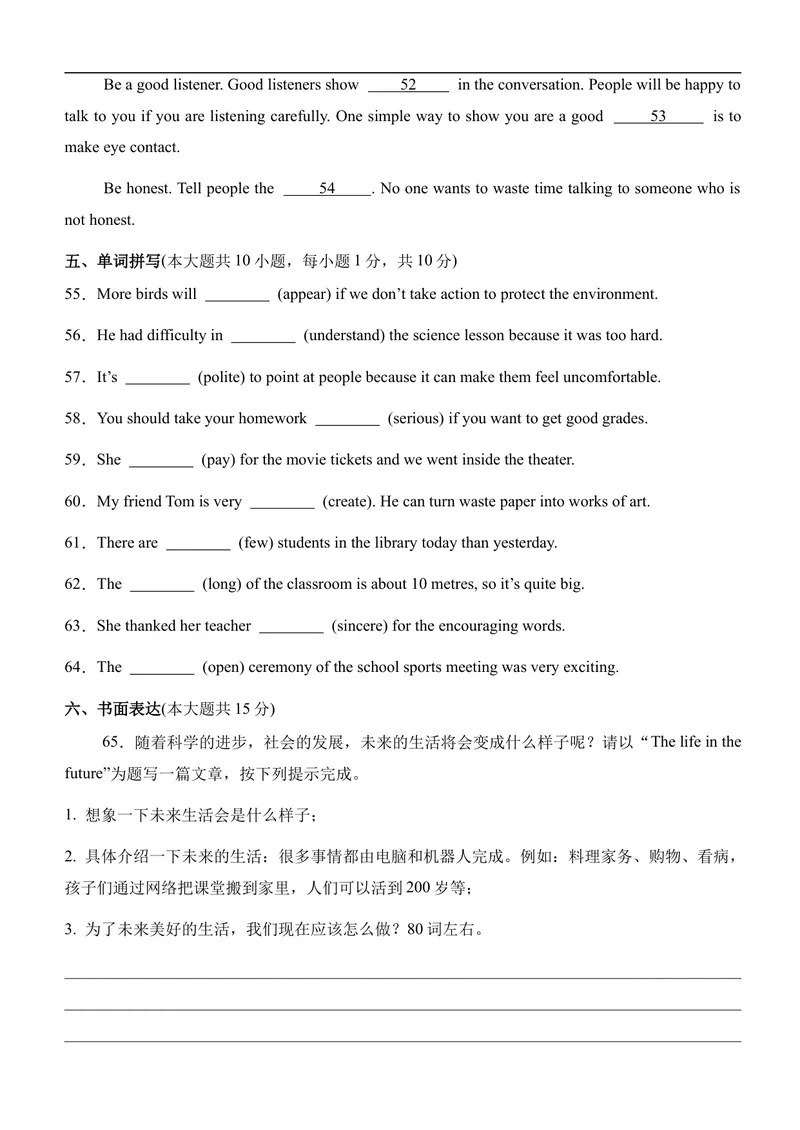
jokes. The main thing is to find a topic you are both interested in.Be a good listener. Good listeners show 52 in the conversation. People will be happy to
talk to you if you are listening carefully. One simple way to show you are a good 53 is to
make eye contact.
Be honest. Tell people the 54 . No one wants to waste time talking to someone who is
not honest.
五、单词拼写(本大题共10小题,每小题1分,共10分)
55.More birds will (appear) if we don’t take action to protect the environment.
56.He had difficulty in (understand) the science lesson because it was too hard.
57.It’s (polite) to point at people because it can make them feel uncomfortable.
58.You should take your homework (serious) if you want to get good grades.
59.She (pay) for the movie tickets and we went inside the theater.
60.My friend Tom is very (create). He can turn waste paper into works of art.
61.There are (few) students in the library today than yesterday.
62.The (long) of the classroom is about 10 metres, so it’s quite big.
63.She thanked her teacher (sincere) for the encouraging words.
64.The (open) ceremony of the school sports meeting was very exciting.
六、书面表达(本大题共15分)
65.随着科学的进步,社会的发展,未来的生活将会变成什么样子呢?请以“The life in the
future”为题写一篇文章,按下列提示完成。
1. 想象一下未来生活会是什么样子;
2. 具体介绍一下未来的生活:很多事情都由电脑和机器人完成。例如:料理家务、购物、看病,
孩子们通过网络把课堂搬到家里,人们可以活到200岁等;
3. 为了未来美好的生活,我们现在应该怎么做?80词左右。
____________________________________________________________________________________
____________________________________________________________________________________
________________________________________________________________________________________________________________________________________________________________________
____________________________________________________________________________________
____________________________________________________________________________________
____________________________________________________________________________________
____________________________________________________________________________________
参考答案
一、
1.A
【详解】句意:——我对明天的数学考试很紧张。我不确定自己是否能通过它。——别担心。你
这些天学习很努力。我相信你可以的。
考查动词辨析。pass通过;fail不及格;miss错过;take拿。根据“I’m so nervous about the math
exam”可知,说话人担忧的是考试能否“通过”。故选A。
2.D
【详解】句意:——这个周末你想和我一起去音乐会吗?——当然。我喜欢听音乐和看歌手表演。
考查名词辨析。cinema电影院;library图书馆;museum博物馆;concert音乐会。根据
“listening to music and watching the singers performing.”可知,既能听音乐又能看歌手表演的地方
是音乐会。故选D。
3.C
【详解】句意:——有一份给杰克的新工作,但他没有接受它。——也许他有自己的计划。
考查动词辨析。form形成;pass通过;accept接受;miss错过。根据“There is a new job for Jack,
but he doesn’t…it.”以及“Maybe he has his own plans.”可知,此处指杰克没有接受新工作。故选
C。
4.B
【详解】句意:——明天还有谁会来参加聚会?——弗雷德。考查词汇辨析。other其他的,后需接可数名词复数形式;else其他的、别的,常用于疑问词或
不定代词之后;another三者或三者以上的另一个,后接单数名词;others其他的人或物,相当于
“other+复数名词”。此处“who”是疑问代词,else放在其后表示“其他谁”,符合语境。故选
B。
5.D
【详解】句意:——我不知道怎么解这道数学题。我该怎么办?——你可以向老师求助。
考查疑问词+不定式。what什么;when什么时候;where在哪里;how怎样。根据“What can I
do?”以及“You can ask your teachers for help.”可知,此处指解决数学题的方式方法,how符合。
故选D。
6.B
【详解】句意:——你能告诉我一些关于你在美国的学校生活的事情吗?——当然。它和中国的
学校生活很不一样。
考查介词辨析。from来自;about关于;in在……里面;for为了。根据“something ... your
school life in the USA”可知,这里需要表达“关于……的事情”,因此about“关于”,符合语境。
故选B。
7.B
【详解】句意:——我们什么时候出发去参加聚会?——这取决于交通情况。如果交通拥堵,我
们可能需要早点出发。
考查动词短语辨析。waits for等待;depends on取决于,依赖;looks at看;thinks about考虑。根
据“If the traffic is heavy, we may need to leave earlier.”可知,出发时间由交通状况决定,depends
on“取决于,依赖”,符合语境。故选B。
8.C
【详解】句意:——我不确定能否通过英语考试。——要有信心!只要你每天努力学习,就能通
过。
考查连词短语辨析。as soon as一……就……;as well as也,和……一样好;as long as只要,引
导条件状语从句;as far as就……而言,远至。根据“You can pass it ... you study hard every day.”
可知,“每天努力学习”是“通过考试”的条件,as long as“只要”,引导条件状语从句,符合语境。故选C。
9.A
【详解】句意:——嘿,莉萨!你看起来不高兴。怎么了?——我数学考试又不及格。我不知道
该怎么办。
考查情境交际用语。What’s up怎么了,用于询问对方发生了什么事;What’s that那是什么,用
于询问事物;How are you你好吗,是常见的问候语;How’s the weather天气怎么样,用于询问
天气情况。根据“You look unhappy.”和回答可知,此处是询问对方不开心的原因,What’s up“怎
么了”,符合语境。故选A。
10.A
【详解】句意:——你认为世界会和平吗?——我希望如此。这是全人类的共同愿望。
考查情景交际。I hope so.我希望如此;I don’t think so.我不这么认为;I have no idea.我不知道;
That sounds great.那听起来很棒。根据“It’s the common wish of all humans.”可知,世界和平是全
人类的共同愿望,“I hope so.”表达了对“世界和平”的积极期望,符合语境。故选A。
11.B
【详解】句意:——你认为我们有机会赢得这场比赛吗?——当然。我们练习了很多。
考查名词词义辨析。difficulty困难;chance机会;choice选择;change改变。根据“Of course.
We practice a lot.”可知,应询问是不是有机会赢得比赛。故选B。
12.C
【详解】句意:如果你想和你的同学建立良好的关系,你应该信任他们,并和他们分享你的感受。
考查动词辨析。forget忘记;point指向;trust信任;leave离开。根据“build good relationships
with your classmates”和“share your feelings with them”可知,想要建立良好的同学关系,应该要
信任同学并分享感受。故选C。
13.D
【详解】句意:——在图书馆大声交谈是不礼貌的。——你说得对。我们应该保持安静。
考查形容词辨析。important重要的;useful有用的;possible可能的;impolite不礼貌的。根据
“It’s ... to talk loudly in the library.”和“We should keep quiet.”可知,在图书馆需要保持安静,大声交谈应该是不礼貌的。故选D。
14.C
【详解】句意:——你不应该和你的父母争吵。这是不礼貌的。——我知道。但有时候他们不理
解我。
考查介词辨析。from来自;for为了;with和……一起;about关于。根据“argue”和“your
parents”可知,句子表达的是“和父母争吵”的意思。“argue with sb.”是固定搭配,意为“和某
人争吵”。故选C。
15.A
【详解】句意:——你应该认真地做你的家庭作业,否则你会犯很多错误。——好的,我会的。
考查副词辨析。carefully认真地;quickly快速地;hopefully有希望地;clearly清晰地。根据“or
you’ll make a lot of mistakes”可知,为了避免犯错,应该认真地做作业。故选A。
16.D
【详解】句意:——你能帮我解数学题吗?——当然可以。我马上就去你家。
考查副词短语。just now刚才;for a while暂时;just then正在那时;right away马上。对话中,
第一个人请求帮助:“你能帮我解决数学问题吗?”,这里需要表示“立即行动”的含义,以体
现对请求的积极回应。故选D。
17.B
【详解】句意:为了保持健康,我们应该少吃垃圾食品,多运动。
考查情态动词。can’t不能;should应该;mustn’t禁止;might也许。根据“To keep healthy, we…
eat less junk food and take more exercise.”可知,为了保持健康,应该少吃垃圾食品,多运动。故
选B。
18.A
【详解】句意:——别担心你的英语。我可以帮你学英语。——非常感谢你。你真好。
考查动词短语。worry about担心;care about关心;think about考虑;talk about谈论。根据“I
can help you with it”可知,此处主动提出给予对方帮助,应是让对方别担心英语学习。故选A。
19.C【详解】句意:如果你对人友好,你会得到更多的回报。
考查时态。if条件状语从句遵循“主将从现”原则,从句要用一般将来时,结构为will do。故选
C。
20.B
【详解】句意:——腾飞,你犯错误了。我认为你应该跟妈妈说抱歉。——我想你是对的。她回
家后我会跟她谈的。
考查情景交际。I’m afraid not恐怕不行;I guess you’re right我想你是对的;That’s really too bad
那真的太糟糕了;I don’t agree with you我不同意你的看法。根据“I’ll talk to her when she gets
home.”可知,对方表示会跟妈妈谈一谈,此处应是对对方的观点表示赞同。故选B。
二、
21.D 22.B 23.C 24.A 25.B 26.C 27.D 28.A 29.B
30.D
【导语】本文讲述了作者参加了一个关于肢体语言的课程,通过课堂活动和老师的讲解,认识到
肢体语言在非言语交流中的重要性,并决定每天练习以提高自己的社交技能。
21.句意:老师告诉我们,肢体语言是一种我们不用语言交流的方式。
hands手;miles微笑;faces脸;words词语。根据常识,肢体语言是不通过话语来交流的方式,
故选D。
22.句意:在课堂上,我们做了一个只用身体来表达不同感受的活动。
eyes眼睛;bodies身体;mouths嘴;feet脚。 因为是关于肢体语言的活动,肢体语言主要通过
身体来表达,眼睛、嘴、脚都只是身体的一部分,整体是身体。故选B。
23.句意:例如,当我想表达我的快乐时,我微笑着跳上跳下。
sadness悲伤;kindness善良;happiness快乐;illness疾病。根据“I smiled and jumped up and
down”可知,微笑和跳起来通常是表达快乐的表现,而不是悲伤、善良或疾病。 故选C。
24.句意:不说话就能互相理解,这很有趣。
quickly快速地;sadly悲伤地;luckily幸运地;quietly安静地。根据前文“My classmates laughed
and joined in”可知,同学们加入并一起表达感受,说明大家能够快速地互相理解,故选A。25.句意:后来,老师解释说我们的肢体语言有时可能会传递错误的信息。
write写;send发送,传递;draw画;report报告。根据后文“the wrong messages”可知,此处指
的是肢体语言可能会传递错误的信息,故选B。
26.句意:例如,交叉双臂会让我们看起来生气或不友好,即使我们不是。
active积极的;lovely可爱的;angry生气的;hungry饥饿的。根据后文“or unfriendly”可知,此
处应填与“不友好”意思相近的形容词,故选C。
27.句意:在下课的时候,我意识到肢体语言很重要。
hoped希望;heard听到;doubted怀疑;realized意识到。根据后文“body language is very
important”可知,此处指的是作者意识到肢体语言的重要性,故选D。
28.句意:它可以帮助我们交朋友,提高我们的社交技能。
social社交的;musical音乐的;sports运动的;reading阅读的。根据前文“make friends”可知,
交朋友属于社交活动,故选A。
29.句意:现在,当我和别人说话时,我尽量保持开放的姿势,多微笑。
think of想起;talk to和……说话;dance with和……跳舞;stand with和……站在一起。根据后文
“my friends and teachers”可知,此处指的是和朋友、老师说话,故选B。
30.句意:我相信这将有助于我与朋友和老师更好地交流。
play玩;study学习;fight打架;communicate交流。根据前文“I try to keep an open posture (姿
势) and smile more”可知,保持开放的姿势和多微笑有助于交流,故选D。
三、
31.D 32.D 33.C 34.B 35.A
【导语】本文记录了四名学生课后关于未来的讨论,他们分别畅想了2050年及以后的生活。
31.主旨大意题。根据“Four students are talking about the future after class”及后文对2050年生活、
科技、环境等的畅想可知,四人讨论的是未来的生活。故选D。
32.推理判断题。根据“In 2050, China will be much richer tha n it is now. Shanghai will be ready for
the 40th Olympic Games in 2052. The sky will be bluer and cleaner and the air will be fresher.”可知,
第一段描述2050年中国更富裕、上海可能举办奥运会、环境更优(天空更蓝、空气更新鲜),空格处应延续“美好未来”的主题,选项D符合语境。故选D。
33.词义猜测题。根据“We might eat something like pills instead of today’s meals.”可知,我们可
能会吃类似药片的东西来代替现在的食物。“pills”意为“药片”,与“medicine”相近。故选
C。
34.理解理解题。根据第四段“cloning will be used in many ways. It will bring back animals... We’ll
live a much easier and better life”可知,张兰认为克隆技术会有很多用途。故选B。
35.观点态度题。学生们畅想未来中国更富裕、环境更好、科技进步(星际旅行、机器人、克隆
技术)、生活更美好,整体态度是积极乐观的。故选A。
36.B 37.D 38.C 39.A 40.D
【导语】本文主要为畅想未来的生活。
36.细节理解题。根据“We don’t know what our own lives will be like in a few years because things
are changing so quickly.”可知,人们不知道几年后他们的生活会是什么样子,因为现在情况变化
太快了。故选B。
37.细节理解题。根据“The car can go without a driver”可知,未来的汽车可以无人驾驶。故选
D。
38.细节理解题。根据“You asked for some food by computer.”可知,未来,可以通过电脑点一些
食物。故选C。
39.词句猜测题。根据“Thanks to your new computer, you don’t need to go to the office any more”
可知,可以不用再去办公室了,应是多亏了自己的新电脑,所以划线部分的含义是“多亏”。故
选A。
40.细节理解题。根据“You asked for some food by computer…You’ve already paid for food. You
can pay the money from your bank.”可知,通过电脑,你可以从银行付款。故选D。
41.C 42.B 43.A 44.C
【导语】本文主要讨论了面对面沟通和电话沟通的选择及其各自的优缺点。
41.细节理解题。根据“with the development of technology, we now have the phone, email, video
calls and so on. It has become easier and much cheaper to communicate or have a conversation.”可知,
科技的发展使得沟通变得更容易和更便宜。故选C。42.细节理解题。根据“Face-to-face communication includes direct personal interaction… leading to
more effective communication.”和“face-to-face communication is more effective in building trust and
making deeper connections.”可知,面对面沟通的优势包括建立信任、建立更深的联系和直接互动。
故选B。
43.词句猜测题。根据“The conversation varies depending on what relationship you have with the
caller. For example, it will be informal (非正式的) if you talk to your close friends or relatives. But if
you are having a professional telephone conversation, then it will be formal.”可知,谈话内容会随着与
来电者的关系而变化,可能是正式的,也可能是非正式的。varies在此处的意思是“变化”。故
选A。
44.最佳标题题。通读全文可知,文章主要讨论了面对面沟通和电话沟通的选择及其各自的优缺
点。故最佳标题为“Communication Choices: Face to face vs. Telephone”。故选C。
四、
45.when 46.tips 47.first 48.easily 49.shows 50.friendly 51.
Smiling 52.interest 53.listener 54.truth
【导语】本文主要介绍了一些如何交朋友以及与他人友好相处的建议。
45.句意:你是否觉得和他人交谈时很自在?根据“Do you feel comfortable ... talking to others”和
备选词可知,此处应指在和他人交谈这个情境下的感受,用when“当……时候”引导时间状语,
最符合语境。故填when。
46.句意:这里有一些良好沟通的建议。根据“Remember other people’s names ... Smile ... Find a
proper topic ...”和备选词可知,下文列举了多条建议,此处应指有一些建议,用tip“提示”最符合
语境,some后接可数名词复数,要用tip的复数形式tips。故填tips。
47.句意:当你第一次遇到新朋友时,试着这样做。根据“Try to do this when you ... meet
someone new.”和备选词可知,此处应指在第一次遇到新朋友的时候,尝试着记住对方名字,用
one的序数词first“第一次”,最符合语境。故填first。
48.句意:然后当你再次见面时,如果你记住他或她的名字,你将会很容易让那个人感到自在。
根据“you will ... make that person feel comfortable if you remember his or her name”和备选词可知,
当再次见面时,记住了对方名字,这应该是一件能轻易让对方感到自在的事情,用easy“容易
的”最符合语境,修饰动词要用副词,easy的副词形式为easily。故填easily。49.句意:这表明你在意。根据“if you remember his or her name”,“you care”和备选词可知,
此处应指记住名字这一行为能表明你在意对方,用show“表明”最符合语境,主语It是第三人称
单数,句子时态为一般现在时,要用show的三单形式shows。故填shows。
50.句意:确保你以一种友好的方式微笑并问候他人,尤其是你第一次见到他们时。根据
“Make sure you smile and greet others in a ... way”和备选词可知,此处强调问候的方式,应指要
以友好的方式微笑问候他人,用friend的形容词形式friendly“友好的”,最符合语境。故填
friendly。
51.句意:微笑可以成为良好沟通的通行证。根据“Smile.”和备选词可知,该段强调微笑的重
要性,此处应指微笑这个行为可以成为良好沟通的通行证,用smile的动名词smiling作主语,最
符合语境,注意句首单词首字母大写。故填Smiling。
52.句意:好的倾听者在对话中表现出兴趣。根据“People will be happy to talk to you if you are
listening carefully.”和备选词可知,认真倾听应该是对话题感兴趣的,用interest“兴趣”最符合语
境,不可数名词无单复数变化。故填interest。
53.句意:一个简单的表明你是个好的倾听者的方法是进行眼神交流。根据“Be a good listener”
和备选词可知,该段强调要做一个好的倾听者,此处应指进行眼神交流是表明你是个好的倾听者
的方法,用listen的名词形式listener“倾听者”,最符合语境,a后用可数名词单数。故填
listener。
54.句意:告诉人们真相。根据“No one wants to waste time talking to someone who is not honest.”
和备选词可知,没有人想浪费时间与不诚实的人交谈,此处应指要告诉人们真相,用true的名词
形式truth“真相”,最符合语境,tell the truth“说实话”,固定搭配。故填truth。
五、
55.disappear
【详解】句意:如果我们不采取行动保护环境,更多的鸟类将会消失。根据“if we don’t take
action to protect the environment”可知,如果不采取行动保护环境,更多的鸟类将会消失,此处填
动词appear“出现”的反义词disappear“消失”,will后接动词原形。故填disappear。
56.understanding
【详解】句意:他很难理解这节科学课,因为它太难了。have difficulty (in) doing sth“做某事有困
难”,空处用动名词作宾语。故填understanding。57.impolite
【详解】句意:指着别人是不礼貌的,因为这会让他们感到不舒服。根据下文“it can make them
feel uncomfortable”可知,指着别人会让他们感到不舒服;因此,指着别人是不礼貌的行为,应
用polite的反义词impolite“不礼貌的”,形容词,在句中作系动词“is”的表语。故填impolite。
58.seriously
【详解】句意:如果你想获得好的成绩,你应该认真地对待你的家庭作业。take sth. seriously“认
真对待某物”,副词seriously修饰动词take。故填seriously。
59.paid
【详解】句意:她买了电影票,我们随后进了影院。根据“we went”可知,句子时态是一般过去
时,动词用过去式paid。故填paid。
60.creative
【详解】句意:我的朋友汤姆非常有创造力。他可以把废纸变成艺术品。根据“He can turn
waste paper into works of art.”可知,他可以把废纸变成艺术品,说明他非常有创造力, 此处应用
形容词creative“有创造力的”作表语。故填creative。
61.fewer
【详解】句意:今天图书馆里的学生比昨天少。根据“than”可知,空处应是few的比较级形式,
故填fewer。
62.length
【详解】句意:教室的长度约为10米,所以相当大。此处在句中作主语,用名词length表示
“长度”,故填length。
63.sincerely
【详解】句意:她真诚地感谢她的老师说了鼓励的话。根据“thanked her teacher... for”可知,此
处需要副词修饰动词thanked,sincere的副词形式是sincerely。故填sincerely。
64.opening
【详解】句意:学校运动会的开幕式非常令人激动。open是动词,意为“打开;开启”;
opening ceremony是常用表达,意为“开幕式”,此处用open的动名词形式opening作定语修饰ceremony。故填opening。
六、
65.例文
The life in the future
In the future, life will be very different from what it is today. With the development of science and
society, many things will change for the better.
Imagine a world where computers and robots do most of the work. They will take care of our
houses, do the shopping, and even help us see doctors. Children won’t need to go to school. They can
study at home through the Internet. What’s more, because of medical advances, people may live to be
200 years old!
To enjoy such a wonderful life in the future, we need to work hard now. We should study science
and technology to make these dreams come true. At the same time, we must learn to use technology
wisely and protect our environment. Only in this way can we ensure a bright future for ourselves and
generations to come.