2021 届凉山州初三中考适应性考试
英语试卷
本试卷分为A卷(100分)、B卷(50分), 全卷共10页, 满分150分, 考试时间120分钟。
注意事项:
1. 答题前, 考生务必将自己的姓名、座位号、准考证号用0. 5毫米的黑色签字笔填写在答题卡
上, 并 检查条形码粘贴是否正确。
2. 选择题使用2B铅笔涂在答题卡对应题目标号的位置上;非选择题用0. 5毫米黑色签字笔书
写 在答题卡的对应框内, 超出答题区域书写的答案无效;在草稿纸、试卷上答题无效。
3. 考试结束后, 将答题卡收回。
A卷(选择题 共四部分 满分100分)
第一部分 听力(共三节, 满分25分)
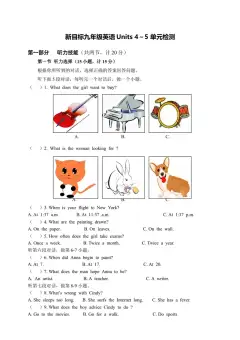
第一节:情景反应(共5小题, 每小题1分, 满分5分)
听下面五个句子, 每个句子后有一个小题, 请从题中所给的A、B、C三个选项中选出恰当的
应答语, 并涂在答题卡上相应的位置。听完每个句子后, 你都有10秒钟的时间来回答有关小题
和阅读下一小题。每个句子均读两遍。
1. A. You're welcome. B. The same to you. C. I'm fine.
2. A. By learning to forget. B. I have no problem. C. I'm feeling sorry.
3. A. Yes, please. B. Tea, please. C. A little, please.
4. A. I didn't use to live here. B. Yes, I did. C. Yes, I live there.
5. A. It must be Jack's. B. It must be Jack. C. They must belong to Jack.
第二节:短对话理解(共5小题, 每小题1分, 满分5分)
听下面五段对话, 每段对话后有一个小题, 请从题中所给的A、B、C三个选项中选出最佳答
案来回答问题, 并涂在答题卡上相应的位置。听完每段对话后, 你都有10秒钟的时间来回答有
关小题和阅读下一小题。每段对话和问题均读两遍。
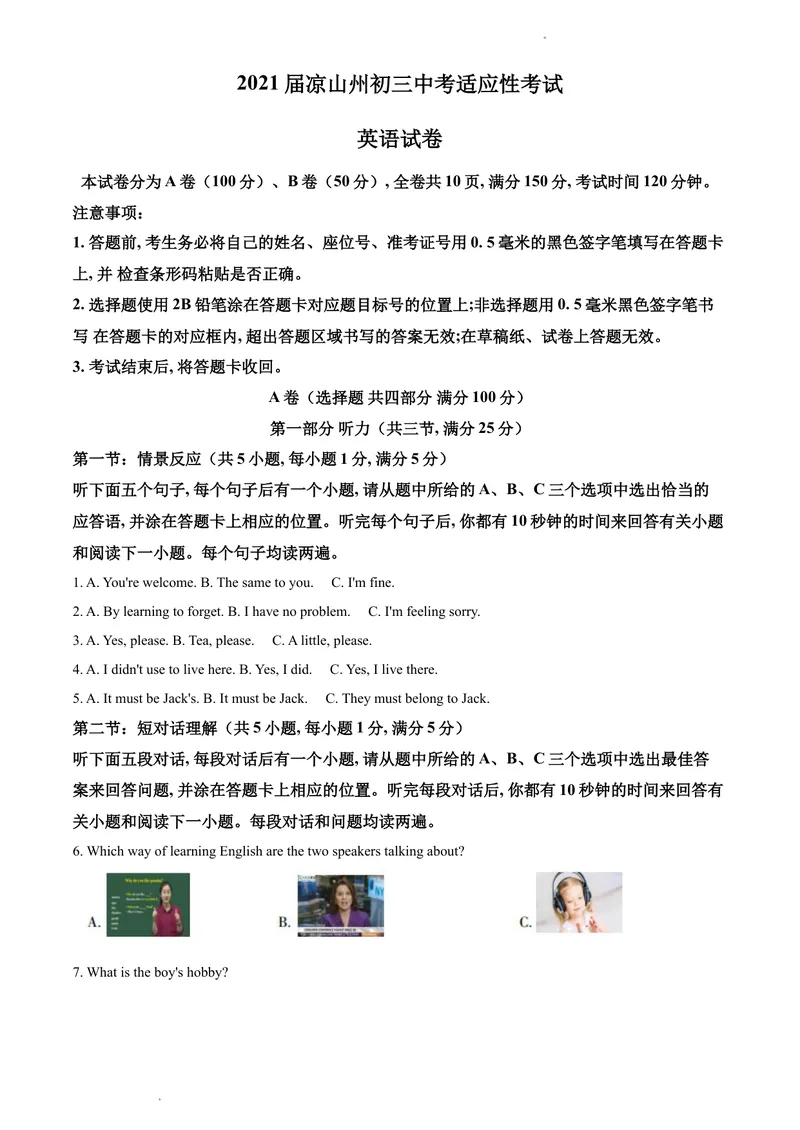
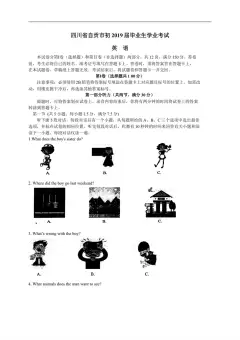
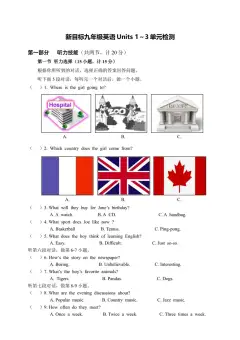
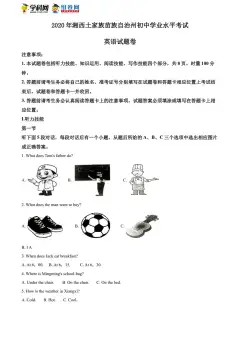
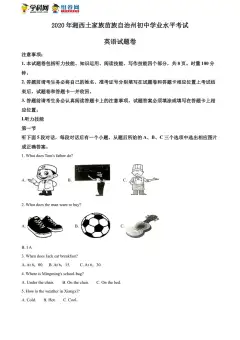
6. Which way of learning English are the two speakers talking about?
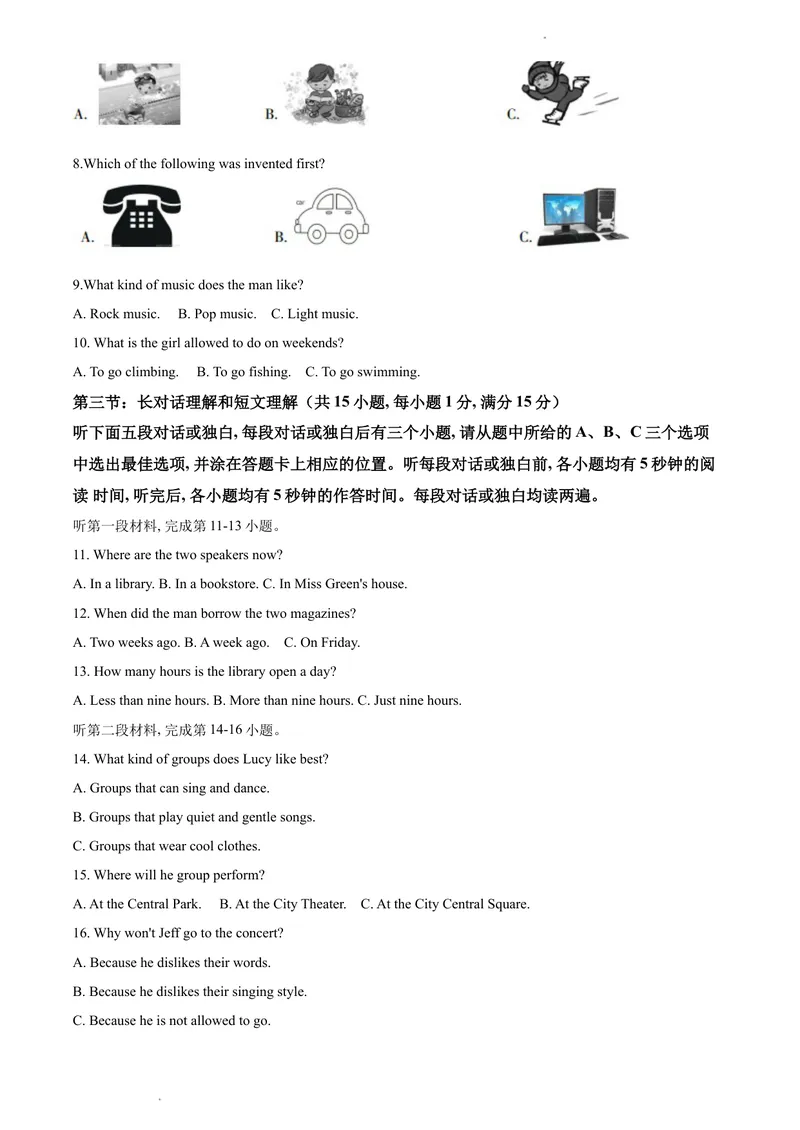
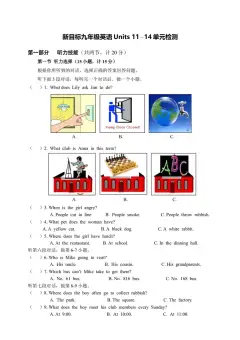
7. What is the boy's hobby?
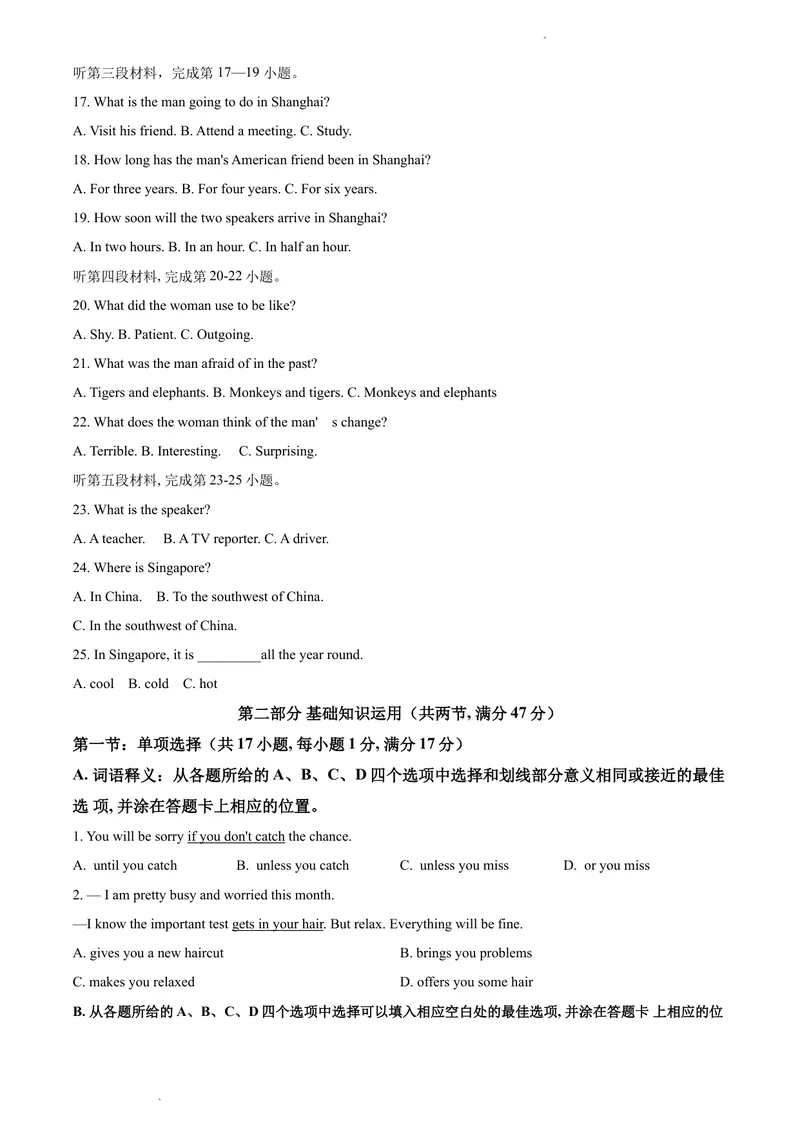
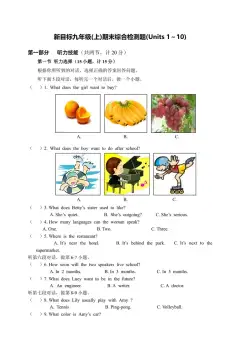
学科网(北京)股份有限公司8.Which of the following was invented first?
9.What kind of music does the man like?
A. Rock music. B. Pop music. C. Light music.
10. What is the girl allowed to do on weekends?
A. To go climbing. B. To go fishing. C. To go swimming.
第三节:长对话理解和短文理解(共15小题, 每小题1分, 满分15分)
听下面五段对话或独白, 每段对话或独白后有三个小题, 请从题中所给的A、B、C三个选项
中选出最佳选项, 并涂在答题卡上相应的位置。听每段对话或独白前, 各小题均有5秒钟的阅
读 时间, 听完后, 各小题均有5秒钟的作答时间。每段对话或独白均读两遍。
听第一段材料, 完成第11-13小题。
11. Where are the two speakers now?
A. In a library. B. In a bookstore. C. In Miss Green's house.
12. When did the man borrow the two magazines?
A. Two weeks ago. B. A week ago. C. On Friday.
13. How many hours is the library open a day?
A. Less than nine hours. B. More than nine hours. C. Just nine hours.
听第二段材料, 完成第14-16小题。
14. What kind of groups does Lucy like best?
A. Groups that can sing and dance.
B. Groups that play quiet and gentle songs.
C. Groups that wear cool clothes.
15. Where will he group perform?
A. At the Central Park. B. At the City Theater. C. At the City Central Square.
16. Why won't Jeff go to the concert?
A. Because he dislikes their words.
B. Because he dislikes their singing style.
C. Because he is not allowed to go.
学科网(北京)股份有限公司听第三段材料,完成第 17—19 小题。
17. What is the man going to do in Shanghai?
A. Visit his friend. B. Attend a meeting. C. Study.
18. How long has the man's American friend been in Shanghai?
A. For three years. B. For four years. C. For six years.
19. How soon will the two speakers arrive in Shanghai?
A. In two hours. B. In an hour. C. In half an hour.
听第四段材料, 完成第20-22小题。
20. What did the woman use to be like?
A. Shy. B. Patient. C. Outgoing.
21. What was the man afraid of in the past?
A. Tigers and elephants. B. Monkeys and tigers. C. Monkeys and elephants
22. What does the woman think of the man' s change?
A. Terrible. B. Interesting. C. Surprising.
听第五段材料, 完成第23-25小题。
23. What is the speaker?
A. A teacher. B. A TV reporter. C. A driver.
24. Where is Singapore?
A. In China. B. To the southwest of China.
C. In the southwest of China.
25. In Singapore, it is _________all the year round.
A. cool B. cold C. hot
第二部分 基础知识运用(共两节, 满分47分)
第一节:单项选择(共17小题, 每小题1分, 满分17分)
A. 词语释义:从各题所给的A、B、C、D四个选项中选择和划线部分意义相同或接近的最佳
选 项, 并涂在答题卡上相应的位置。
1. You will be sorry if you don't catch the chance.
A. until you catch B. unless you catch C. unless you miss D. or you miss
2. — I am pretty busy and worried this month.
—I know the important test gets in your hair. But relax. Everything will be fine.
A. gives you a new haircut B. brings you problems
C. makes you relaxed D. offers you some hair
B. 从各题所给的A、B、C、D四个选项中选择可以填入相应空白处的最佳选项, 并涂在答题卡 上相应的位
学科网(北京)股份有限公司置。
3. — GPS is _________ useful invention.
—Of course. It shows that there is _________ underground parking lot under the Moon Park.
A. /; an B. a; an C. an; an D. an; a
4. —The number of the people using Huawei _______ is getting larger and larger.
—Sure it is. More and more people like things made in China.
A. cultures B. customers C. products D. histories
5. — Anyone shouldn’t _________ use fire outdoors.
—Yeah, and we should pay attention to ________ our forests and grasslands.
A. be allowed to; protect B. allow to; protecting
C. be allowed to; protecting D. allow to; protected
6. — It is reported that so many people died from COVID-19.
—________ bad news it is! Make sure to wear face masks when going out.
A. What B. What an C. How D. How an
7. — There _________a park in this area.
— Yes, and I was used to ________here with my father in the morning.
A. used to; ran B. was used to; run
C. used to be; running D. was used to be; running
8. Although she has ________ close friends, she still doesn’t know ________.
A. many; who to talk with B. few; who to talk to
C. much; what to do D. little; how to do it
9. — __________ French book is this?
—It must belong to ________. She’s the only one that is studying French.
A. Who’s; Li Ying B. Who’s; Li Ying's C. Whose; Li Ying D. Whose; Li Ying’s
10. Jack, you look so ________. Stop working and go to bed now.
A. silent B. sleepy C. polite D. patient
11. — I have learned many useful sentences, _________ “It’s a piece of cake.” and “Practice makes perfect. ”.
—Great! It is a good way to _________ in a dictionary.
A. like; look them up B. as; look for them
C. with; look up to them D. like; look after them
12. — Could you tell me _________?
— Sure. Her alarm clock didn’t go off this morning.
A. when the bookstore closes today
学科网(北京)股份有限公司B. where the restrooms are
C. how life was different after she became famous
D. why she was late again
13. Mary ________ a camera from her friend, but she didn’t ________ because it was too expensive.
A. received; accept B. accepted; receive C. accepted; accepted D. received; receive
14. You walk on the wet hill path because you fall and hurt yourself.
A. must; might not B. mustn’t; might
C. needn’t; need D. must; must
15. The words on the blackboard are _________ small for me _________see without glasses.
A. so; that B. enough; to C. such; that D. too; to
16. — I think learning is a lifelong journey because every day brings something new.
— I agree. And we should learn _________ and learn well.
A. simply B. wisely C. politely D. nearly
17. — It’s so cold. Could you please close the window?
— ________. I’ll do it at once.
A. Pardon me B. No way C. With pleasure D. You’re welcome
第二节:完形填空(共15小题, 每小题2分, 满分30分)
先通读下面短文, 读懂大意, 然后从后面各题所给的A、B、C、D四个选项中选择可以填入相
应空白处的最佳选项, 并涂在答题卡上相应的位置。
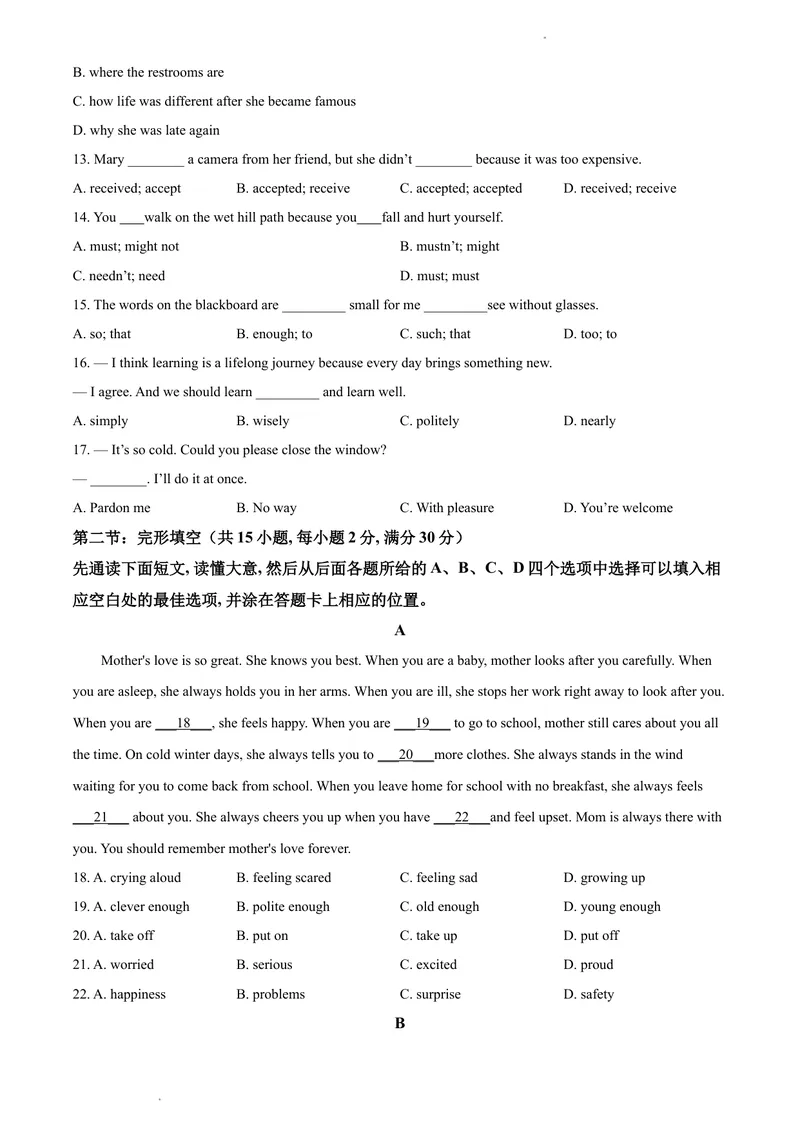
A
Mother's love is so great. She knows you best. When you are a baby, mother looks after you carefully. When
you are asleep, she always holds you in her arms. When you are ill, she stops her work right away to look after you.
When you are ___18___, she feels happy. When you are ___19___ to go to school, mother still cares about you all
the time. On cold winter days, she always tells you to ___20___more clothes. She always stands in the wind
waiting for you to come back from school. When you leave home for school with no breakfast, she always feels
___21___ about you. She always cheers you up when you have ___22___and feel upset. Mom is always there with
you. You should remember mother's love forever.
18. A. crying aloud B. feeling scared C. feeling sad D. growing up
19. A. clever enough B. polite enough C. old enough D. young enough
20. A. take off B. put on C. take up D. put off
21. A. worried B. serious C. excited D. proud
22. A. happiness B. problems C. surprise D. safety
B
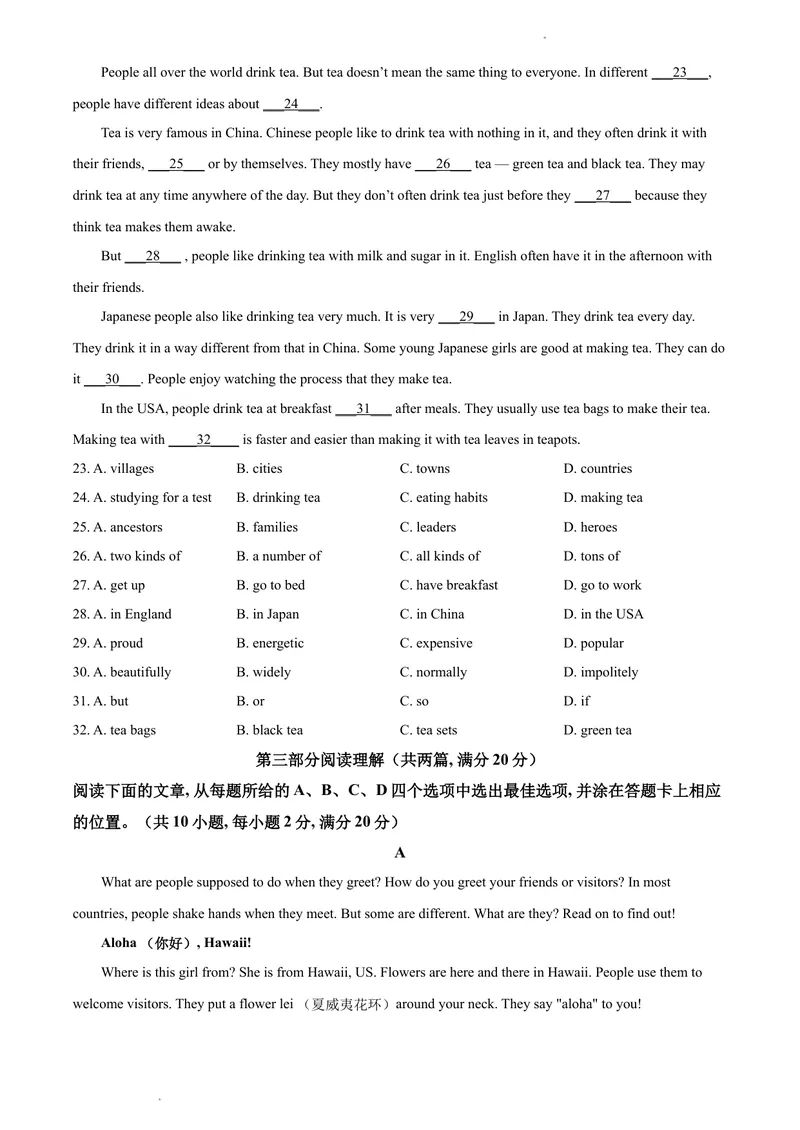
学科网(北京)股份有限公司People all over the world drink tea. But tea doesn’t mean the same thing to everyone. In different ___23___,
people have different ideas about ___24___.
Tea is very famous in China. Chinese people like to drink tea with nothing in it, and they often drink it with
their friends, ___25___ or by themselves. They mostly have ___26___ tea — green tea and black tea. They may
drink tea at any time anywhere of the day. But they don’t often drink tea just before they ___27___ because they
think tea makes them awake.
But ___28___ , people like drinking tea with milk and sugar in it. English often have it in the afternoon with
their friends.
Japanese people also like drinking tea very much. It is very ___29___ in Japan. They drink tea every day.
They drink it in a way different from that in China. Some young Japanese girls are good at making tea. They can do
it ___30___. People enjoy watching the process that they make tea.
In the USA, people drink tea at breakfast ___31___ after meals. They usually use tea bags to make their tea.
Making tea with ____32____ is faster and easier than making it with tea leaves in teapots.
23. A. villages B. cities C. towns D. countries
24. A. studying for a test B. drinking tea C. eating habits D. making tea
25. A. ancestors B. families C. leaders D. heroes
26. A. two kinds of B. a number of C. all kinds of D. tons of
27. A. get up B. go to bed C. have breakfast D. go to work
28. A. in England B. in Japan C. in China D. in the USA
29. A. proud B. energetic C. expensive D. popular
30. A. beautifully B. widely C. normally D. impolitely
31. A. but B. or C. so D. if
32. A. tea bags B. black tea C. tea sets D. green tea
第三部分阅读理解(共两篇, 满分20分)
阅读下面的文章, 从每题所给的A、B、C、D四个选项中选出最佳选项, 并涂在答题卡上相应
的位置。(共10小题, 每小题2分, 满分20分)
A
What are people supposed to do when they greet? How do you greet your friends or visitors? In most
countries, people shake hands when they meet. But some are different. What are they? Read on to find out!
Aloha (你好), Hawaii!
Where is this girl from? She is from Hawaii, US. Flowers are here and there in Hawaii. People use them to
welcome visitors. They put a flower lei (夏威夷花环)around your neck. They say "aloha" to you!
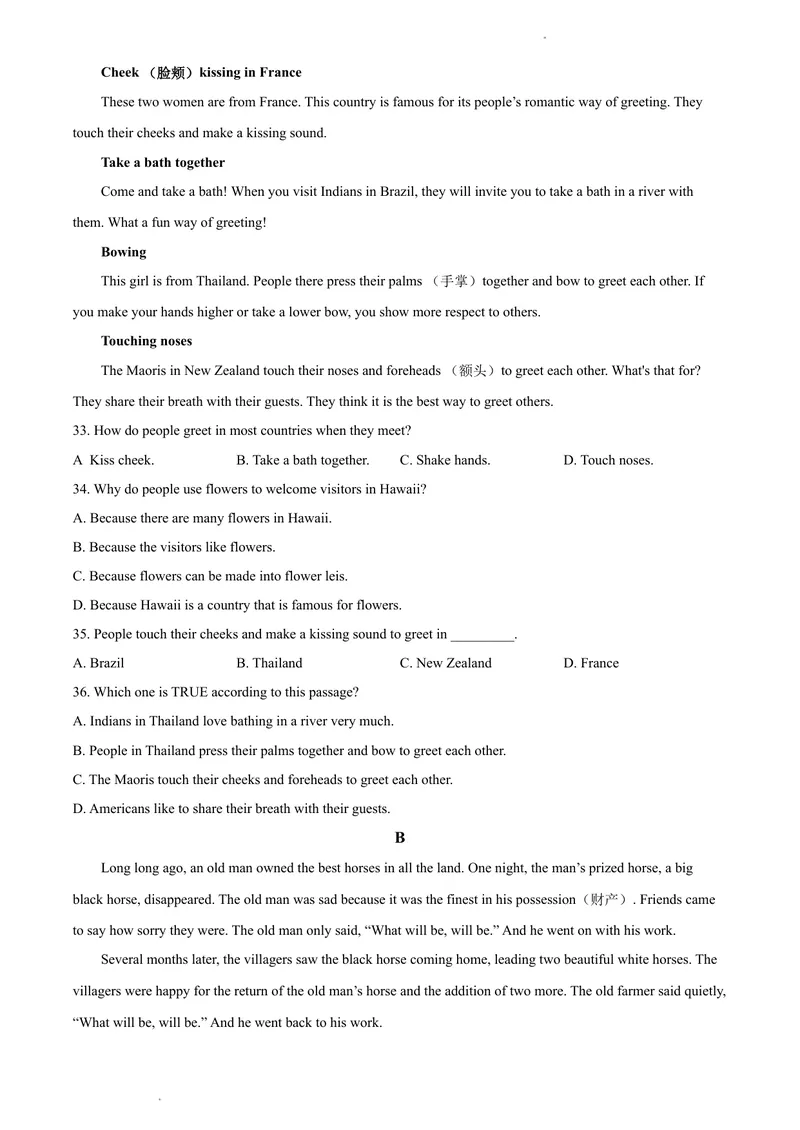
学科网(北京)股份有限公司Cheek (脸颊)kissing in France
These two women are from France. This country is famous for its people’s romantic way of greeting. They
touch their cheeks and make a kissing sound.
Take a bath together
Come and take a bath! When you visit Indians in Brazil, they will invite you to take a bath in a river with
them. What a fun way of greeting!
Bowing
This girl is from Thailand. People there press their palms (手掌)together and bow to greet each other. If
you make your hands higher or take a lower bow, you show more respect to others.
Touching noses
The Maoris in New Zealand touch their noses and foreheads (额头)to greet each other. What's that for?
They share their breath with their guests. They think it is the best way to greet others.
33. How do people greet in most countries when they meet?
.
A Kiss cheek. B. Take a bath together. C. Shake hands. D. Touch noses.
34. Why do people use flowers to welcome visitors in Hawaii?
A. Because there are many flowers in Hawaii.
B. Because the visitors like flowers.
C. Because flowers can be made into flower leis.
D. Because Hawaii is a country that is famous for flowers.
35. People touch their cheeks and make a kissing sound to greet in _________.
A. Brazil B. Thailand C. New Zealand D. France
36. Which one is TRUE according to this passage?
A. Indians in Thailand love bathing in a river very much.
B. People in Thailand press their palms together and bow to greet each other.
C. The Maoris touch their cheeks and foreheads to greet each other.
D. Americans like to share their breath with their guests.
B
Long long ago, an old man owned the best horses in all the land. One night, the man’s prized horse, a big
black horse, disappeared. The old man was sad because it was the finest in his possession(财产). Friends came
to say how sorry they were. The old man only said, “What will be, will be.” And he went on with his work.
Several months later, the villagers saw the black horse coming home, leading two beautiful white horses. The
villagers were happy for the return of the old man’s horse and the addition of two more. The old farmer said quietly,
“What will be, will be.” And he went back to his work.
学科网(北京)股份有限公司The old man’s only son loved horses, so the old man gave his son one of the white horses. And the old man
began to teach his son to ride. Unluckily, the boy fell from the horse and broke his leg. Everyone was sad and came
to tell the old man how sad they were. The old man just looked at them and said, “What will be, will be.” And he
returned to his work.
In a few weeks, another tribe(部落)from the far north invaded(入侵)the land. The king sent his officers
to enlist(征募)one male child from each family to fight against the invaders. The officers did not take the old
man’s son because of his disabled leg. As he watched those officers leaving, the old man said to himself. “What
will be, will be.” And he went on with his work.
37. According to the first paragraph, the old man was sad because _________.
A. one of his best friends died B. his black horse was stolen
C. his black horse disappeared D. his horse was hurt
38. What happened after several months?
A. The villagers found the black horse from other tribes.
B. The black horse came back with two beautiful white horses.
C. The old man killed the black horse.
D. The villagers were happy that the old man gave them his horse.
39. Which one is TRUE from the third paragraph?
A. The old man hurt his leg.
B. The old man’s son hurt his leg.
.
C The old man hit the horse heavily.
D. The old man’s son disliked the black horse.
40. What do you know about the old man according to the story?
A. He was a brave man. B. He was an unlucky father.
C. He was a humorous man. D. He knew every coin has two sides.
41. Which of the following can describe the story in Chinese?
A. 千里之堤溃于蚁穴 B. 塞翁失马焉知非福
C. 请蚌相争渔翁得利 D. 城门失火殃及池鱼
第四部分 口语应用(共两段, 满分8分)
选择适当的选项补全对话, 并涂在答题卡上相应的位置, 每个选项限用 一次。(共8个空, 每
空1分, 满分8分)
A
A: Hello! Winter holiday is coming. ____42____
学科网(北京)股份有限公司B: Sure. I’d like to go on with my English lesson this winter.
A: How was the lesson?
B: At first, it seemed difficult for me. ____43____
A: You are always hard-working.
.
B: Thank you Will you travel anywhere interesting?
A: Yes. ____44____ I can enjoy the beautiful sunshine and beaches there.
B: That must be very interesting. ___45___
A: Oh, thank you. Here comes the bus! Good-bye!
A. I will go to Australia.
B. Could you tell me your winter plan?
C. I hope you will have a good time!
D. But after a while it became easier.
B
A: Hi, Helen!
B: Hi, Peter. _____46_____
A: It’s a pair of chopsticks.
B: A pair of chopsticks? _____47_____
A: It is made of silver.
B: Really? It must be very expensive.
A: Yes, you are right.
B: ______48______
A: More than 100 dollars. I bought it online.
B: Online? That’s cool! _____49_____
A: Sure. You can come to my house to learn this Sunday afternoon.
B: Great! Thank you very much.
A. What is it made of?
B. What’s that in your hand?
C. Can you teach me to shop online?
D. How much is it?
B卷(非选择题满分50分)
第五部分 写(共四节, 满分50分)
第一节:单词拼写(共5小题, 每小题1分, 满分5分)
根据句意及所给的首字母或汉语提示, 用单词的正确形式填空, 并将其答案的完整形式写 在答
学科网(北京)股份有限公司题卡上相应的位置。每空一词。
50. The computer game was c_________ by a company. You have to pay for it if you play this game.
51. These old photos are v________ to my grandfather. They can remind him of his childhood.
.
52. He bought a _________ (领带)for his father as a birthday gift
53. Chang’e 5 lunar probe _________(着陆)successfully on the earth on December 17th, 2020.
54. In the speech competition, one of his facial _________(表情)showed that he was pretty nervous.
第二节:短文填空(共10个空, 每空1分, 满分10分)
阅读短文, 从方框中选择适当的词并用其正确形式填空, 使短文通顺、意思完整, 并将其答 案写在答题卡
上相应的位置。每空限填一词, 每词限用一次。
go, that, careful, kind, they, show, have, give, of, well
What will happen if you don’t have breakfast? A short time ago, a test was ___55___ in the USA. People of
different ages from 12 to 83 were asked to have a test. During the test, these people were provided all ___56___ of
breakfasts and sometimes they got no breakfast at all. Scientists wanted to see how well ___57___ bodies worked
when they had different kinds of breakfasts.
The results ___58___ that if a person eats a right breakfast, he or she will work ___59___ than if he or she has
no breakfast. If a student has fruit, eggs, bread and milk before ___60___ to school, he will learn more quickly and
listen more ___61___ in class.
The results also show that ___62___ no breakfast will not help you lose weight. This is because people
become so hungry at noon ___63___ they eat too much for lunch. So they will gain weight instead ___64___ losing
weight.
第三节:阅读表达(共两篇, 满分20分)
A
根据短文内容, 从方框中选出能填入空白处的最佳选项。并将代表选项的字母写在答题卡 上
相应的位置。其中有两项为多余选项。(共5个空, 每空2分, 满分10分)
Every school day, we use schoolbags to carry all of our things to school. ___65___ But have you ever thought
about the history of the schoolbag?
In the Han Dynasty, students in old-style private schools used bamboo boxes to carry books to school.
___66___ There were usually two or three layers (层)in the box. Kids put different things like books, brushes,
ink stones (砚)and paper in the boxes.
,
Hundreds of years later people developed a new kind of schoolbag called the budai, or the “hip-pocket”.
___67___ With the founding (成立)of the People’s Republic of China, military rucksacks (军用帆布包)
became popular. Many people carried them when they were in school. ___68___ Maybe they can tell you about
学科网(北京)股份有限公司their experiences of carrying them when they were in school.
A new style of schoolbags has appeared in recent years. ___69___ such as pictures of cartoons or pop stars.
And they are more comfortable to use. Some students pull wheeled bags filled with heavy textbooks and others
carry backpacks.
Schoolbags are still changing. Can you imagine what future schoolbags will be like?
A. The budai was lighter than the bamboo box.
B. People don't like colorful schoolbags at all.
C. Many of them have colorful and fashionable designs on them,
D. They are a big part of our lives.
E. Schoolbags were invented by accident.
F. People consider the bamboo boxes to be the earliest schoolbags.
G. Ask your grandparents or parents about these bags.
B
完成表格。阅读下面短文, 根据短文内容, 完成表格中所缺的信息, 并将其答案的完整形式 写
在答题卡上相应的位置。每空一词。(共10个空, 每空1分, 满分10分)
The traditional Chinese lunar calendar (农历)divides the year into 24 solar terms (节气). Major Cold is
the 24th solar term. In 2020, it began on Jan. 20. Major Cold is the last solar term in winter. In this period, snow,
rain and icy cold weather influence people' s lives. Here are four things you should know about Major Cold.
The first thing is the cold weather. During Major Cold, the cold current (气流) moves southward. The
weather is very cold in the solar term. The lowest temperatures of the whole year occur in Major Cold period in
some coastal areas.
The second thing is to eat rice cake. During Major Cold, people in Beijing have a habit of eating rice cake.
The rice cake contains more sugar than rice. It can make people feel warm all over their bodies. In Chinese the
word "rice cake "has the same pronunciation as the word uhigher in a new year", It means good luck and
continuous progress.
The third thing is drinking soup. People in Nanjing of Jiangsu Province like to drink soup during Major Cold.
It can make people feel the warmth from head to foot. They always cook hen soup with some kinds of vegetables.
The fourth thing is doing winter sports. There is a saying, "Dripping water freezes during Minor and Major
Cold. ' In various regions of China, Major Cold is the perfect time for winter sports such as skiing, ice skating and
sledding. Some people even like swimming in cold water in winter. But it is not easy for some people to stand such
cold water.
Title:The___70___ Chinese Solar Term— Major Cold
学科网(北京)股份有限公司Time Major Cold began on Jan. 20. It is the last solar term in ___71___ .
The cold current (气流)moves southward.
The cold weather
The ___73___ temperatures of the whole year happen in Major Cold period.
The rice cake has ___74___ sugar than rice.
To eat rice cake
in Beijing
___72___ In Chinese "rice cake "has the same pronunciation as "higher in a new year".
things It ___75___ good luck and continuous progress.
about
Major
People always cook hen soup with some different vegetables.
Drinking soup in
Cold
___76___
Province
The soup can make people feel ___77___ from head to foot.
___78___
winter Maior Cold is the perfect time for winter sports.
sports But it is ___79___ for some people to swim in such cold water.
第四节:书面表达(满分15分)
80. 中国各地都有自己独特的传统艺术形式。中国结是中国特有的传统艺术, 请根据以下提示, 以“A
Special Art of China—Chinese Knots”为题写一篇短文。
历史 世界著名;有数千年的历史;偶然被发明
制作 手工制成;颜色多而美;红色使用最广泛;象征好运和繁荣
过去用于记录事件;现在用于节日和其他庆典; 春节期间,
用途 人们在屋里悬挂;
平时, 女孩们喜欢把它和手机或钥匙系在一起
现状 在中国随处可见;在全世界越来越受欢迎
要求:
1. 条理清楚, 语言通畅。
2. 短文应包括以上要点, 可适当发挥。
3. 词数不少于80词。文章开头和结尾已给出, 不计入总词数。
参考词汇:Chinese knot n. 中国结, prosperity n. 繁荣, celebration n. 庆典,
record v. 记录, hang v. 悬挂, be famous, used to, a symbol of, be made of
Each different part of China has its own special forms of traditional art.
____________________________________________________________________________________________
学科网(北京)股份有限公司____________________________________________________________________________________________
____________________________________________________________________________________________
____________________________________________________________________________________________
____________________________________________________________________________________________
____________________________________________________________________________________________
____________________________________________________________________________________________
____________________________________________________________________________________
学科网(北京)股份有限公司学科网(北京)股份有限公司