Lecture
学习目标1
Part One 高频词汇易错考点
期末高频词汇易错考点巩固
Part Two 完形阅读巩固练习
完形填空高频话题练习
阅读理解解题方法和练习
2
模块1
Part One
高频词汇易错考点
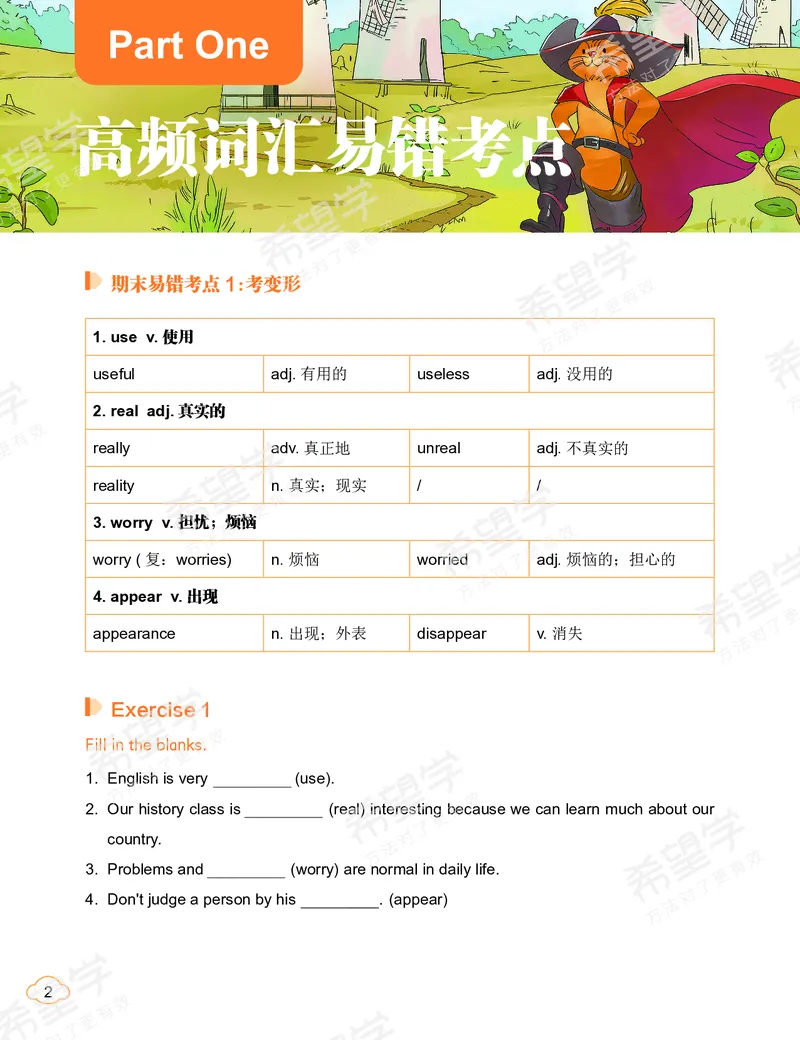
期末易错考点1:考变形
1. use  v. 使用
useful
adj. 有用的
useless
adj. 没用的
2. real  adj. 真实的
really
adv. 真正地
unreal
adj. 不真实的
reality
n. 真实;现实
/
/
3. worry  v. 担忧;烦恼
worry ( 复:worries)
n. 烦恼
worried
adj. 烦恼的;担心的
4. appear  v. 出现
appearance
n. 出现;外表
disappear
v. 消失
Exercise 1
Fill in the blanks.
1. English is very
(use).
2. Our history class is
(real) interesting because we can learn much about our
country.
3. Problems and
(worry) are normal in daily life.
4. Don't judge a person by his
. (appear)
3
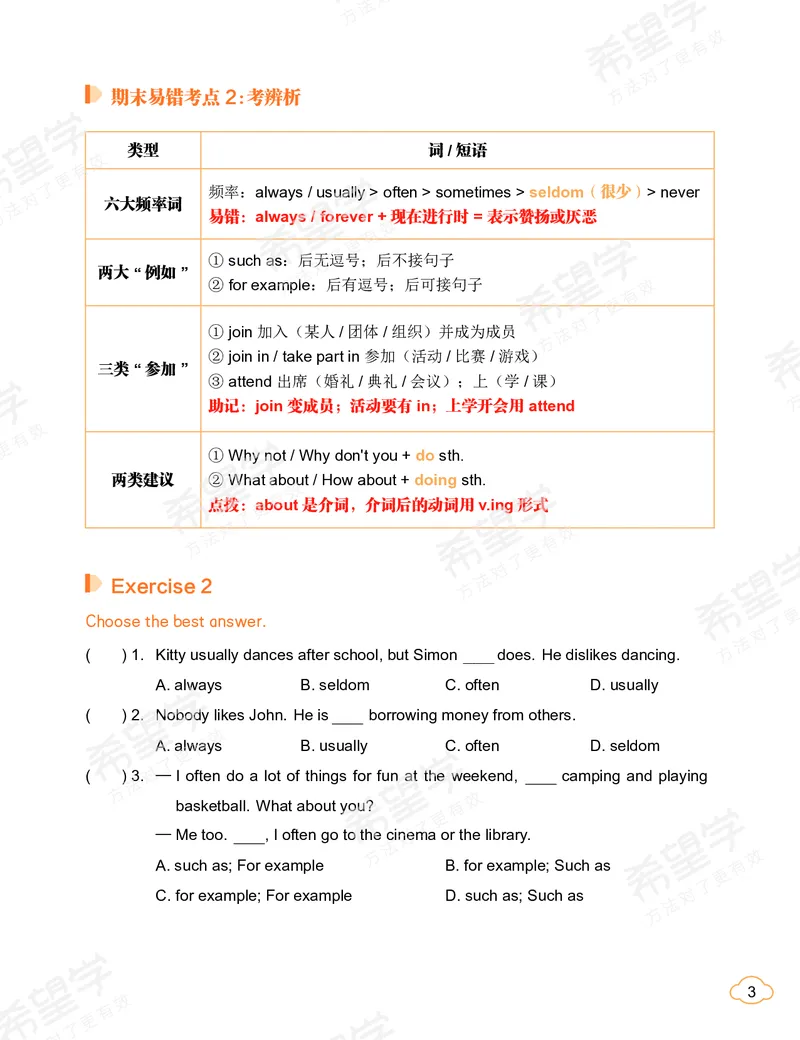
期末易错考点2:考辨析
类型
词/ 短语
六大频率词
频率:always / usually > often > sometimes > seldom(很少)> never
易错:always / forever + 现在进行时 = 表示赞扬或厌恶
两大“ 例如”
① such as:后无逗号;后不接句子
② for example:后有逗号;后可接句子
三类“ 参加”
① join 加入(某人/ 团体/ 组织)并成为成员
② join in / take part in 参加(活动/ 比赛/ 游戏)
③ attend 出席(婚礼/ 典礼/ 会议);上(学/ 课)
助记:join 变成员;活动要有in;上学开会用attend
两类建议
① Why not / Why don't you + do sth.
② What about / How about + doing sth.
点拨:about 是介词,介词后的动词用v.ing 形式
Exercise 2
Choose the best answer.
(  ) 1. Kitty usually dances after school, but Simon
does. He dislikes dancing.
A. always
B. seldom
C. often
D. usually
(  ) 2. Nobody likes John. He is
borrowing money from others.
A. always
B. usually
C. often
D. seldom
(  ) 3. — I often do a lot of things for fun at the weekend,
camping and playing
basketball. What about you?
— Me too.
, I often go to the cinema or the library.
A. such as; For example
B. for example; Such as
C. for example; For example
D. such as; Such as
4
(  ) 4. He'll
an important meeting tomorrow.
A. attend
B. join
C. take part in
D. join in
(  ) 5. — Why not go shopping with us this afternoon?
— Good idea!
A. What about
B. Why don't you
C. Why not you
期末易错考点3:考搭配
固定搭配
释义
固定搭配
释义
think about ...
考虑……
be crazy about ...
痴迷……
place(s) of interest
景点;名胜
放烟花
thanks to ...
多亏了……
thank sb. / thanks for ...
因……感谢某人……
on sale
特价;打折
at a high / low price
以高价/ 低价(售卖)
a sense of direction
方向感
lose one's direction
迷路
Exercise 3
I. Fill in the blanks.
1. 我的很多同学都对英语痴迷。
A number of my classmates are
English.
2. 广州有很多名胜。
There
many
in Guangzhou.
3. 孩子们喜欢放烟花来庆祝春节。
Children enjoy
fireworks to celebrate the Spring Festival.
II. Choose the best answer.
(  ) 1.
giving me so much help.
A. Thanks you for
B. Thank you to
C. Thank you for
D. Thanks to
5
(  ) 2. Look! These yellow skirts are on
for $12.
A. sell
B. buy
C. sale
D. borrow
(  ) 3. That store sells things
high prices — but they're really
.
A. in; boring
B. in; bad
C. at; good
D. at; difficult
(  ) 4. I have no sense of
, so I often get lost.
A. taste
B. beauty
C. direction
附录:其它期末必备搭配
固定搭配
释义
固定搭配
释义
share sth. with sb.
和某人分享某物
(人)start school at + 年纪
从几岁开始上学
hear from sb.
收到某人来信
look forward to (doing) sth.
期待……
traditional festival(s)
传统节日
as a treat
作为招待
What a shame!
真可惜/ 糟糕!
make a noise
发出声响 /
噪音
(人)in + 颜色
穿着某颜色的衣物
dress up as ...
扮作……
try ... on
试穿……
go / match well with ...
适合……
enjoy oneself
= have a good time
= have fun
玩得开心
too + adj. + to do sth.
太……而不能
……
enjoy doing sth.
喜欢做某事
make a big difference
产生很大的影响
look up
查(单词)
look down on sb.
看不起某人
look for
寻找……
look after
照顾……
turn on
打开(电器)
turn off
关闭(电器)
turn up
调高(音量)
turn down
降低(音量)
be the same as ...
和……相同
be different from ...
和……不同
6
模块2
Part Two
完形阅读巩固练习
完形填空
高频话题:哲理故事
  A man wanted to sell his donkey(驴)in a market. The market was far from his
house, so he started early in the morning with his   1   .
  On the way, the man was sitting on the donkey while his son was   2   near
it. Someone saw them. He said the father didn't love his son. After the man   3
this, he got down from the donkey and made his son sit on   4   . Then they
continued their journey.
  Soon, another man met them. He said it was not   5   for the son to make
his old father walk in the sun. What hot weather it was! Then   6   of them
decided to walk.
  After some time, a group of people saw them. They said the father and the son
were   7   . They had a donkey, but they didn't sit on it. Then both of them
  8   to sit on the donkey and then kept going.
  There came a woman. "You may   9   the little donkey by doing that!" she
shouted.
  So what should we do? Maybe we should just do what we think is right, because
we cannot follow everyone's   10   .
(  ) 1. A. daughter
B. son
C. father
D. wife
(  ) 2. A. walking
B. sitting
C. sleeping
D. lying
(  ) 3. A. saw
B. felt
C. heard
D. watched
7
(  ) 4. A. it
B. him
C. them
D. you
(  ) 5. A. bad
B. real
C. wrong
D. right
(  ) 6. A. any
B. some
C. both
D. none
(  ) 7. A. kind
B. foolish
C. strict
D. clever
(  ) 8. A. asked
B. forgot
C. learned
D. chose
(  ) 9. A. leave
B. kill
C. save
D. sell
(  ) 10. A. news
B. dream
C. advice
D. wish
阅读理解
题型
解题方法
细节理解题
划
读题干和选项,划出关键词
定
在原文中定位关键词所在句或上下句
找
比较选项和原文,选出意思一致的选项
词义猜测题
语境法
当无明显解题标志词时,借助上下文隐含信息猜测词义
主旨大意题
(含标题题)
寻找主旨
找主旨句:通常出现于文章的首段或尾段
找主旨词:通常在文章中多次出现,原词重现或同义、
同类词反复出现
高频话题:人与动物
Example
  A mental health hospital in Chengdu welcomes two dogs to work with
psychological assistance therapy(心理辅助治疗).
  The dogs are part of the animal-assisted therapy (AAT) in the treatment project(治
疗项目)for depressed(抑郁的)people. According to Chen Jiajia, who works with the
hospital, "AAT is a useful method for treating depression(抑郁), and it helps a lot in
8
treatment projects". The two dogs, "Lidabao" and "Xuegao", once worked in hospitals
for children.
  Chen said that earlier in January, a depressed boy called Jack, who didn't talk to
anyone and even tried to kill himself, took part in the project. When they met for the
first time, the dogs seemed to feel Jack's depression and sat next to him quietly. Jack
couldn't hide his surprise, and later shared his story about himself and his own pet.
  Staying with the dogs helped Jack a lot. Then the boy became better and left the
hospital with a new feeling of hope.
  Not all the dogs can help with depressed people. The dogs are carefully picked
from family pets. Then, the dogs have to take part in tests(测试). After passing the
tests, the dogs will get working certificates(就业证明)and then they can work to help
people in need.
  Doctors believe that with the help of dogs, we may find new ways to help with
depression problems.
(  ) 1. We can use the animal-assisted therapy (AAT) to help
.
A. the excited pets
B. the depressed pets
C. the excited people
D. the depressed people
(  ) 2. What does the underlined word "they" in Paragraph 3 mean?
A. Jack and his pet.
B. Jack, Lidabao and Xuegao.
C. Doctors in the hospital.
D. Depressed kids in the hospital.
(  ) 3. What do we know about the dogs from the passage?
A. They are from family pets.
B. They can only help depressed children.
C. They are helpful with all kinds of problems.
D. They get working certificates before passing the tests.
(  ) 4. Which is the best title for the passage?
A. Pet Dogs
B. Two Clever Dogs
C. Dogs Are Our Friends
D. Dogs Help with Depression
9
Exercise
  Do you know about bees? Mikaila Ulmer, a 19-year-old girl from Texas, USA,
knows them well.
  When Mikaila was just 4 years old, she was stung(蜇)by two bees in one week.
She was sad and scared, so her mother told her something about bees. "Bees are very
important to people, but they are in great danger and there are not too many bees," she
said.
  The news surprised Mikaila, and she started to think about bees differently. Later,
she got a gift—a book about how to make lemonade(柠檬汁). She couldn't wait to try
it out. She thought of putting natural honey(蜂蜜)in the drink to make it taste good.
To her surprise, it really did.
  Then Mikaila started to sell the lemonade outside her house and many people
loved it. With help from her mother, she started her lemonade brand Me & The Bees
Lemonade when she was just 11 years old.
  Now, the brand has hit big in the USA. More people know about it. Mikaila also
tries to tell people about the importance of bees. Her book about bees is helping many
beekeepers around the world. What's more, she often gives away money to save bees.
  Good job, Mikaila!
(  ) 1. Why did Mikaila start to think differently about bees?
A. She was stung by bees.
B. She liked selling honey.
C. She got a gift about bees.
D. Her mother told her bees were in danger.
(  ) 2. What did Mikaila put in her lemonade to make it taste good?
A. Bees.
B. Drink.
C. Honey.
D. Tea.
10
(  ) 3. What does the underlined part "has hit big" in Paragraph 5 mean?
A. It means "is bad".
B. It means "is friendly".
C. It means "is popular".
D. It means "is important".
(  ) 4. How does Mikaila help beekeepers around the world?
A. Her book about bees helps them.
B. She teaches people how to make lemonade.
C. She gives money to save bees.
D. She puts honey in her lemonade.