2026 年高考第一次模拟考试提分卷02(浙江专用)
高三英语
(考试时间:120 分钟  试卷满分:150 分)
注意事项:
1.答卷前,考生务必将自己的姓名、准考证号等填写在答题卡和试卷指定位置上。
2.回答选择题时,选出每小题答案后,用铅笔把答题卡上对应题目的答案标号涂黑。
如需改动,用橡皮擦干净后,再选涂其他答案标号。回答非选择题时,将答案写在答
题卡上。写在本试卷上无效。
3.考试结束后,将本试卷和答题卡一并交回
第一部分  听力(共两节,满分 30 分)
做题时,先将答案标在试卷上。录音内容结束后,你将有两分钟的时间将试卷上的答案
转涂到答题卡上。
第一节(共5 小题;每小题1.5 分,满分7.5 分)
听下面5 段对话。每段对话后有一个小题,从题中所给的A、B、C 三个选项中选出最
佳选项。听完每段对话后,你都有10 秒钟的时间来回答有关小题和阅读下一小题。每段对
话读两遍。
1.What does the woman do?
A.She is a student.
B.She is a lawyer.
C.She is the owner of a bakery.
2.When does the man finish his work?
A.At 7:30 a.m.
B.At 3: 30 p.m.
C.At 7:30p.m.
3.Where did the woman go before the meal?
A.To her home.
B.To a cinema.
C.To a cafe.
4.What does the man mean?
A.E-commerce is a double-edged sword.
B.Local specialties should be exported.
C.Commercials are of no use.
5.Why is the meeting rescheduled?
A.An incident occurred in Marketing.
B.The room is unavailable.
C.The CEO is occupied.
第二节(共15 小题;每小题1.5 分,满分22.5 分)
听下面5 段对话或独白。每段对话或独白后有几个小题,从题中所给的A、B、C 三个
选项中选出最佳选项。听每段对话或独白前,你将有时间阅读各个小题,每小题5 秒钟;
听完后,各小题将给出5 秒钟的作答时间。每段对话或独白读两遍。
听第6 段材料,回答第6、7 题。
6.Who could the man probably be?
A.A teacher.
B.A receptionist.
C.A tourist guide.
7.When does the woman suggest visiting the center?
A.On Tuesdays.
B.On Wednesdays.
C.On Thursdays.
听第7 段材料,回答第8 至10 题。
8.Where are most artists at the music festival from?
A.Canada.
B.The US.
C.Japan.
9.Why does the man plan to arrive at the festival early?
A.To buy T-shirts before they’re sold out.
B.To be in time for his favorite band.
C.To avoid waiting in line.
10.What is the man’s impression of the food at music festivals?
A.It’s expensive.
B.It always tastes bad.
C.It’s limited in variety.
听第8 段材料,回答第11 至13 题。
11.Where does the conversation take place?
A.At home.
B.In a pizza house.
C.Over the phone.
12.What ingredient does the woman dislike?
A.Onions.
B.Pepper.
C.Garlic.
13.Which pizzas will be ordered?
A.Sausage Deluxe and Seasonal Vegetable.
B.Grilled Vegetable and Spicy Chicken.
C.Meat Lovers and Seasonal Vegetable.
听第9 段材料,回答第14 至17 题。
14.How long will the course run this year?
A.Eight weeks.
B.Seven weeks.
C.Six weeks.
15.What was the woman surprised at?
A.The lack of assistants.
B.The condition of weather.
C.The number of children.
16.What new activities can the children have this year?
A.Adventure sports.
B.Fun programs.
C.Creative classes.
17.What is expected about the course this year?
A.It will run better.
B.It will last longer.
C.It will start earlier.
听第10 段材料,回答第18 至20 题。
18.What did the study show?
A.Less than half changed their emotion.
B.Only half were anxious.
C.85% handled anxiety well.
19.What may happen when you are under stress?
A.Planning your journey ahead.
B.Ignoring some important details.
C.Waiting to be called by friends.
20.What is the speaker’s last suggestion?
A.Focus on something else.
B.Skip your normal routine.
C.Avoid searching for symptoms online.
第二部分  阅读(共两节, 满分50 分)
第一节(共15 小题;每小题2.5 分, 满分37.5 分)
阅读下列短文, 从每题所给的A、B、C 和D 四个选项中选出最佳选项。
A
Sorry!
OBJECT
To be the first player to get all four of your pawns (棋子) from your color START to your
color HOME.
EQUIPMENT
●Sorry! Game Board
●Pack of Cards (no 6’s or 9’s)
●16 Pawns (4 each of 4 colors)
SETUP
●Choose four pawns of the same color. Put all four on that color START space.
●Mix the cards. Place them face down on“Place Pack Here” to form the Draw pile.
●Pick a player to go first. Movement is clockwise around the board (unless instructed
otherwise!) and play passes to the left.
GAME PLAY
Notes
● If it’s your first turn and you do not draw a card that lets you start a pawn out, you skip
your turn.
● On all turns, take the top card on the Draw pile and move accordingly if you can.Place
the card face up on“Drop Here.”
To Start a pawn
To move a pawn from your START out onto the track, you must draw either a 1 or a 2. If it
is a 2, do as it says, and then draw again and move if possible. You may not start a pawn out with
any other card!
Jumping and Bumping (碰撞)
You may jump over your own or another player’s pawn that is in your way, counting it as
one space. BUT if you land on a space that’s already occupied by an opponent’s pawn, BUMP that
pawn back to its own color START space.
Moving Backwards
4 and 10 cards move you backwards. If you have successfully moved a pawn backwards at
least two spaces beyond your own START space, you may, on a subsequent turn, move into your
own SAFETY ZONE without moving all the way around the board.
21.How many players can play the game at most?
A.2.
B.4.
C.6.
D.10.
22.Who normally plays next after you finish your turn?
A.The player on your left.
B.The player on your right.
C.The player sitting across.
D.The player getting bumped.
23.What may a player do under the rules?
A.Ski p a turn when drawing a 1 or 2.
B.Put used cards face down on Drop Here.
C.Defeat an opponent by jumping over his pawn.
D.Enter SAFETY ZONE after backing 2+ past START.
B
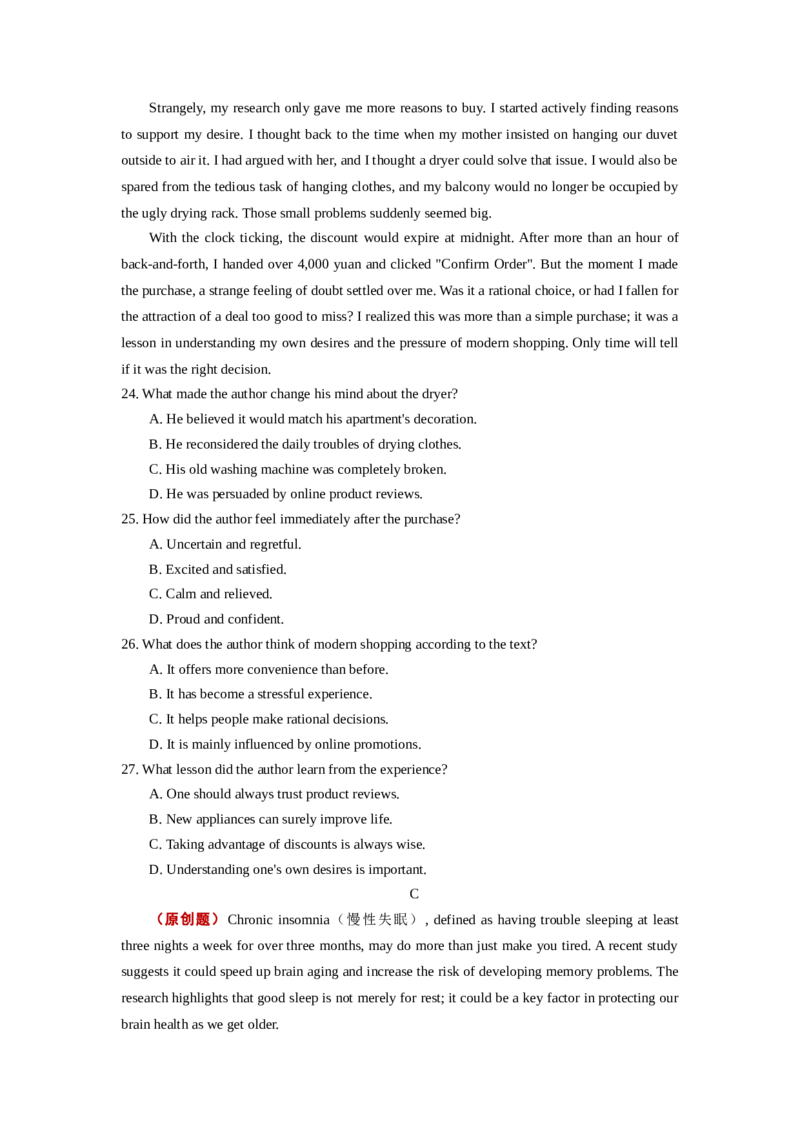
(原创题)It was 1 am, and I couldn't sleep. A battle was raging in my mind. I had made a
decision I regretted: browsing the online shopping platform Taobao right before bed. There was no
escape from the Double 11 (Nov 11) promotion, which immediately caught my eye and
challenged my better judgment.
I found myself drawn to a sleek wash-and-dry set. It was a perfect match for my apartment's
white decor and was heavily discounted. My old washing machine was still working, though it had
served me for about ten years. Why not replace it now? What could be a better time than this?
That thought launched me on a long and difficult process of making a decision.
Minutes later, I was lost in product research. I read through endless online reviews and
learned about dryers. For the next hour, I questioned everything: energy use, maintenance costs,
and the supposed convenience of owning one. But the more I learned, the less sure I became. Just
hours earlier, I had told my colleagues that dryers were unnecessary in the North. Yet here I was,
examining the model on sale, wondering if owning one might actually simplify my life.
Strangely, my research only gave me more reasons to buy. I started actively finding reasons
to support my desire. I thought back to the time when my mother insisted on hanging our duvet
outside to air it. I had argued with her, and I thought a dryer could solve that issue. I would also be
spared from the tedious task of hanging clothes, and my balcony would no longer be occupied by
the ugly drying rack. Those small problems suddenly seemed big.
With the clock ticking, the discount would expire at midnight. After more than an hour of
back-and-forth, I handed over 4,000 yuan and clicked "Confirm Order". But the moment I made
the purchase, a strange feeling of doubt settled over me. Was it a rational choice, or had I fallen for
the attraction of a deal too good to miss? I realized this was more than a simple purchase; it was a
lesson in understanding my own desires and the pressure of modern shopping. Only time will tell
if it was the right decision.
24. What made the author change his mind about the dryer?
A. He believed it would match his apartment's decoration.
B. He reconsidered the daily troubles of drying clothes.
C. His old washing machine was completely broken.
D. He was persuaded by online product reviews.
25. How did the author feel immediately after the purchase?
A. Uncertain and regretful.
B. Excited and satisfied.
C. Calm and relieved.
D. Proud and confident.
26. What does the author think of modern shopping according to the text?
A. It offers more convenience than before.
B. It has become a stressful experience.
C. It helps people make rational decisions.
D. It is mainly influenced by online promotions.
27. What lesson did the author learn from the experience?
A. One should always trust product reviews.
B. New appliances can surely improve life.
C. Taking advantage of discounts is always wise.
D. Understanding one's own desires is important.
C
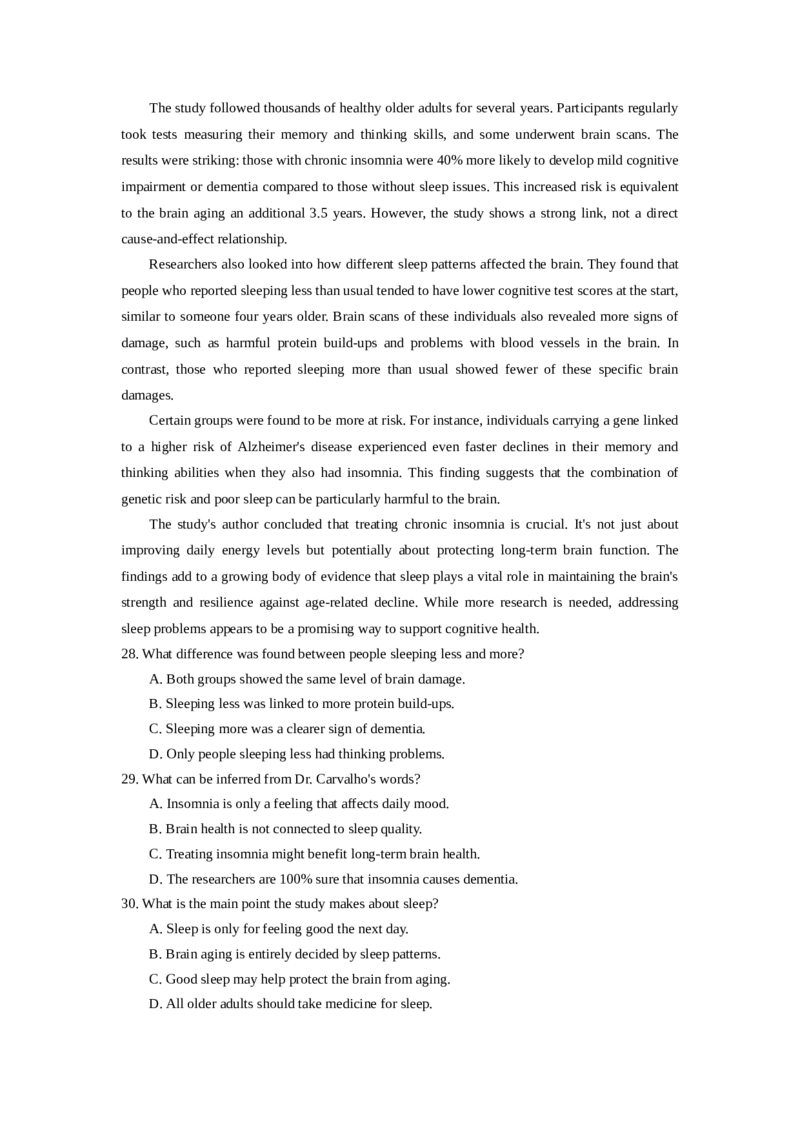
(原创题)Chronic insomnia(慢性失眠), defined as having trouble sleeping at least
three nights a week for over three months, may do more than just make you tired. A recent study
suggests it could speed up brain aging and increase the risk of developing memory problems. The
research highlights that good sleep is not merely for rest; it could be a key factor in protecting our
brain health as we get older.
The study followed thousands of healthy older adults for several years. Participants regularly
took tests measuring their memory and thinking skills, and some underwent brain scans. The
results were striking: those with chronic insomnia were 40% more likely to develop mild cognitive
impairment or dementia compared to those without sleep issues. This increased risk is equivalent
to the brain aging an additional 3.5 years. However, the study shows a strong link, not a direct
cause-and-effect relationship.
Researchers also looked into how different sleep patterns affected the brain. They found that
people who reported sleeping less than usual tended to have lower cognitive test scores at the start,
similar to someone four years older. Brain scans of these individuals also revealed more signs of
damage, such as harmful protein build-ups and problems with blood vessels in the brain. In
contrast, those who reported sleeping more than usual showed fewer of these specific brain
damages.
Certain groups were found to be more at risk. For instance, individuals carrying a gene linked
to a higher risk of Alzheimer's disease experienced even faster declines in their memory and
thinking abilities when they also had insomnia. This finding suggests that the combination of
genetic risk and poor sleep can be particularly harmful to the brain.
The study's author concluded that treating chronic insomnia is crucial. It's not just about
improving daily energy levels but potentially about protecting long-term brain function. The
findings add to a growing body of evidence that sleep plays a vital role in maintaining the brain's
strength and resilience against age-related decline. While more research is needed, addressing
sleep problems appears to be a promising way to support cognitive health.
28. What difference was found between people sleeping less and more?
A. Both groups showed the same level of brain damage.
B. Sleeping less was linked to more protein build-ups.
C. Sleeping more was a clearer sign of dementia.
D. Only people sleeping less had thinking problems.
29. What can be inferred from Dr. Carvalho's words?
A. Insomnia is only a feeling that affects daily mood.
B. Brain health is not connected to sleep quality.
C. Treating insomnia might benefit long-term brain health.
D. The researchers are 100% sure that insomnia causes dementia.
30. What is the main point the study makes about sleep?
A. Sleep is only for feeling good the next day.
B. Brain aging is entirely decided by sleep patterns.
C. Good sleep may help protect the brain from aging.
D. All older adults should take medicine for sleep.
31. Why does the author mention the study's limitation?
A. To prove the study’s findings are wrong.
B. To show that more research is necessary.
C. To explain why some people suffer from insomnia.
D. To emphasize the dangers of not sleeping enough.
D
(原创题)A recent scientific study has shed new light on a historical mystery. By analyzing
the DNA of soldiers from Napoleon's failed 1812 Russian campaign, researchers have confirmed
the presence of two deadly diseases: paratyphoid fever(副伤寒) and relapsing fever(回归
热). These findings match historical records of fevers sweeping through the army and help
explain the massive loss of life during the terrible retreat.
Scientists from the Institut Pasteur examined the remains of 13 French soldiers found in a
mass burial site in Vilnius, Lithuania. Using advanced DNA analysis techniques, they searched for
genetic traces of infectious organisms. The results were clear: several soldiers were infected with
the bacteria causing paratyphoid fever, while others had the pathogen responsible for relapsing
fever, a disease spread by lice that causes repeated high fevers. Both diseases lead to severe
weakness and digestive problems, which would have worsened the soldiers' suffering from cold,
hunger, and poor sanitation.
This discovery provides the first direct genetic proof of these specific diseases within
Napoleon's army. It supports earlier research that identified other illnesses like typhus. However,
the researchers caution that their sample size was very small. With over 3,000 bodies buried at the
site and hundreds of thousands of soldiers in the campaign, it is difficult to determine how
widespread these infections truly were. The exact impact of these diseases on the overall death toll
remains uncertain.
The study was not without its challenges. The DNA from the pathogens was extremely
damaged and existed in tiny amounts, making it hard to identify. To overcome this, the team
developed new methods to accurately detect these weak signals from the past. This innovative
approach allows scientists to explore the diversity of ancient diseases more effectively.
Ultimately, the research connects science with history, confirming that disease was a major
factor in Napoleon's defeat, alongside starvation and the brutal winter. More importantly, studying
old diseases helps us understand how they evolve and spread. This knowledge provides valuable
insights that can help us better understand and tackle infectious diseases today, protecting the
future by learning from the past.
32. What did the two diseases likely do together?
A. They were spread by the same insect.
B. They mainly caused digestive issues.
C. They were the only causes of death.
D. They made the soldiers' situation worse.
33. What can be inferred about the research findings?
A. They completely solve the mystery of Napoleon's defeat.
B. They may not represent the health of the entire army.
C. They prove that disease was a bigger problem than the cold.
D. They are the first scientific study on Napoleon's army.
34. What was a major challenge for the scientists?
A. The poor condition of the DNA samples.
B. The lack of written historical records.
C. The difficulty in locating the soldiers' remains.
D. The uncertainty about which diseases to find.
35. What is the main purpose of this research?
A. To blame Napoleon for his army's suffering.
B. To show the power of new DNA technology.
C. To learn from the past to manage present diseases.
D. To prove that historical accounts are often wrong.
第二节(共5 小题;每小题2. 5 分, 满分12. 5 分)
阅读下面短文, 从短文后的选项中选出可以填入空白处的最佳选项。选项中有两项为
多余选项。
How to Extend Your Smartphone Battery Life
Smartphone batteries naturally get worse over time, but good daily habits can slow this
process and lengthen daily usage. Small, regular changes — from charging routines to daily use
— effectively protect battery health. Below are four practical ways to maximize your battery’s
lifespan.
Stick to moderate charging ranges
Avoid extreme battery levels: don’t let it drop below 20% or stay at 100% for hours. Lithium-
ion batteries work best between 30% and 80%, so charge at 30% and stop at 80% instead of full
cycles.    36   , which caps overnight charging at 80% to prevent harmful overcharging.
Keep the battery cool
   37   . Never leave your phone in direct sunlight or hot cars, and keep it away from
laptops or heat sources. Shut down gaming or heavy apps that produce much heat, and take off the
case if the phone warms up while charging to release heat quickly.   38
Lower screen brightness or use auto-brightness, and set screen timeout to 30 seconds or 1
minute. Turn off Bluetooth, GPS, and Wi-Fi when unused, and limit background app refresh —
many apps consume power silently. It’s wise to skip high- performance modes unless necessary,
which make the battery run out fast.
Choose suitable charging devices
Use the original charger or certified third- party ones that match your phone’s voltage (电
压) and current.    39   , so reserve it for emergencies. Wireless charging is gentler but still
warms the device — ensure good cooling and avoid using the phone while charging wirelessly.
By following these practices, you can extend your phone’s battery life by 1-2 years.
Consistency is key, so make it a habit to protect the battery’s internal structure.    40   .
A.Adjust daily usage habits
B.Ignore background app refresh
C.Heat is a battery’s worst enemy
D.You’d better preserve your battery health
E.Turn on your phone’s battery enhancement tool
F.Fast charging is convenient but generates extra heat
G.Little daily efforts extend your phone’s charging ability and reliability
第三部分 语言运用(共两节,满分30 分)
第一节(共15 小题,每小题1 分,满分15 分)
阅读下面短文, 从每题所给的A、B、C 和D 四个选项中选出可以填入空白处的最佳选
项。
In Anaheim, California, two police officers patrolling a neighborhood discovered an elderly
man who seemed to be in much trouble. The 83 Lupe Robles was out in the 35-degree heat,    41
pushing his lawnmower (割草机) across his yard.
Recognizing the    42    health risks to someone at Robles' age working under such
conditions, officers decided they couldn't just drive by. Without    43   , they parked their
police car and approached Robles, offering their help. The elderly man was visibly    44    and
grateful for the assistance. He handed over the lawnmower to one of the officers, who immediately
took over the task.
The two officers worked    45   , turning what could have been an exhausting task for
Robles into a (n)    46    one. Their teamwork and dedication were clear indicators of their
commitment to    47    the community in more ways than just enforcing the law.
Robles expressed his heartfelt    48   . He explained that he was particularly tired that
day because he had been busy helping his neighbors with their lawns and gardens. For many
years, Robles had been a familiar    49    in the neighborhood, always ready to lend a hand to
those    50   . His selfless actions had not gone unnoticed, and the community held him in high
51   .
The officers, too, were moved by Robles' story. They    52    him for his hard work and
selflessness, acknowledging that his    53    were truly inspiring. This story of mutual kindness
serves as a powerful reminder of the    54    that helping others can have. It reminds us all that
there are still many who are    55    to go the extra mile to help others.
41.A.delightedly
B.regretfully
C.worriedly
D.helplessly
42.A.public
B.extra
C.constant
D.potential
43.A.hesitation
B.control
C.permission
D.discussion
44.A.confused
B.stressed
C.relieved
D.respected
45.A.hurriedly
B.efficiently
C.independently
D.steadily
46.A.beneficial
B.countable
C.influential
D.manageable
47.A.arranging
B.serving
C.reforming
D.shaping
48.A.gratitude
B.sorrow
C.regret
D.affection
49.A.vision
B.wonder
C.sight
D.proof
50.A.in charge
B.in need
C.in company
D.in peace
51.A.observation
B.light
C.sympathy
D.regard
52.A.praised
B.encouraged
C.awarded
D.directed
53.A.imaginations
B.decisions
C.ambitions
D.actions
54.A.effort
B.comfort
C.impact
D.practice
55.A.willing
B.suitable
C.proud
D.wise
第二节(共10 小题;每小题1.5 分 ,满分15 分)
阅读下面短文,在空白处填入1 个适当的单词或括号内单词的正确形式。
The Legend of the White Snake, one of China’s Four Great Folklores, has a 1,000-year-long
history. First     56     (write) down in the Tang Dynasty and evolving through the Ming and
Qing Dynasties, it’s delicately woven into the very fabric of Chinese culture and still makes a
profound impact in modern times.
Initially, the White Snake     57     (describe) as an evil monster, serving as a
cautionary tale to warn men about the dangers of being tempted by their desires. However, as time
went by, the story underwent     58     remarkable transformation. Its     59

(conclude) now gives the White Snake rich emotions, adding a distinct human-interest aspect and
a light-hearted comedic touch,     60     makes it far more appealing to young     61

(moviegoer), especially by vividly highlighting the     62     (center) part — deep-seated
friendship between Xiaoqing and Bai.
During the Year of the Snake, this age-old legend sparks numerous Spring Festival cultural
events. It represents mystery, undying love, and the struggle against oppression ( 压迫), nothing
short of a wonder, inspiring deep reflection     63     women’s rights to pursue free choices of
marriage. Plus, with advanced cinematic techniques, it     64     (dramatic) recreates the
dynamic Tang and Song urban scenes, significantly      65      (enhance) the visual
experience and audience immersion in this fascinating tale.
第四部分 写作(共两节, 满分40 分)
第一节(满分15 分)
    假定你是李华,外教Tom 计划于下周六到人民公园(People’s Park)进行春游活动(spring
outing),现面向全班同学征集活动内容建议。请你给他写一封邮件,内容包括:
1.具体活动;
2.你的理由。
注意:
(1)写作词数应为80 个左右;
(2)请按如下格式在答题卡的相应位置作答。
Dear Tom,
_______________________________________________________________________________
_______________________________________________________________________________
_______________________________________________________________________________
____________________________________________________
Yours sincerely,
Li Hua
第二节(满分25 分)
阅读下面材料,根据其内容和所给段落开头语续写两段,使之构成一篇完整的短文。
I’ve recently become interested in mountain climbing. It’s mainly due to my friend Tim, an
experienced hiker. Initially, I saw hiking as pointless — exhausting muscles under the burning
sun, carrying heavy loads, with no easy way back. Why endure (忍受) that?
Last month, Tim convinced me to join him in climbing a small hill. To my surprise, the
view from the top was breathtaking. I witnessed an amazing sunset over the sea. That humble peak
offered unexpected joy, awakening a desire for more — cloud seas, sunrises, and bird’s-eye views.
After a few more mountain climbing attempts, I declared, “I will challenge the Hero’s Route!” It
was a demanding 20-kilometer trail (小径) across several high peaks, a test of “heroes.”
But Tim tried to cool me down. “It’s not easy,” he warned. “It requires training, not just
enthusiasm.” But I believed “Nothing is impossible in front of a willing heart,” so the following
weekend I set off alone without telling Tim. I decided to give him a big surprise.
At the foot of the mountain, I saw some groups of climbers with walkie-talkies. I laughed
— real heroes journey alone. The first peak was rewarding, with cool winds and glimpses of the
sea. But as I pushed onward, the trail turned wild and rugged. Steep rocks forced me to crawl on
all fours. The sky darkened, threatening rain. Tiredness set in, and the other climbers had all
overtaken me, leaving me completely alone. The trail seemed endless. Rain soon poured and I was
wet through. The rocks became slippery, making every step a struggle. To make matters worse, my
phone had no signal. Desperation mounted in me.
Around 5:30 PM, there were still two peaks ahead. Exhausted and having barely
progressed, I found a weak signal on my phone and hurriedly called Tim. He was shocked, but
after checking my location, he calmly gave me instructions. “Stop going ahead. You’ve just passed
a side trail down to a village. It is marked with a blue ribbon (丝带). Find it and take the path —
I’ll meet you midway.”
注意:
1. 续写词数应为150 个左右;
2. 请按如下格式在答题卡的相应位置作答。
But now I hesitated, because taking the side trail meant failure.
_______________________________________________________________________________
_______________________________________________________________________________
_______________________________________________________________________________
_________________________________________________________
Climbing down the path to the village at night was still very challenging.
_______________________________________________________________________________
_______________________________________________________________________________
_______________________________________________________________________________
_________________________________________________________