2026 年高考第二次模拟考试(江苏专用)
高三英语·全解全析
(考试时间:120 分钟  试卷满分:150 分)
注意事项:
1.答卷前,考生务必将自己的姓名、准考证号等填写在答题卡和试卷指定位置上。
2.回答选择题时,选出每小题答案后,用铅笔把答题卡上对应题目的答案标号涂黑。如需
改动,用橡皮擦干净后,再选涂其他答案标号。回答非选择题时,将答案写在答题卡上。写
在本试卷上无效。
3.考试结束后,将本试卷和答题卡一并交回。
第一部分 听力(共两节,满分30 分)
做题时,先将答案标在试卷上,录音内容结束后,你有两分钟的时间将试卷上的答案转涂到
答题卡上。
第一节(共5 小题:每小题1.5 分,满分7.5 分)
听下面5 段对话。每段对话后有一个小题,从题中所给的A、B、C 三个选项中选出最佳选项。
听完每段对话后,你都有10 秒钟的时间来回答有关小题和阅读下一小题。每段对话读两遍。
1. How much will the man pay?
A. $10.
  B. $15.
 C. $25.
【答案】C
【解析】
【原文】M: How much will it cost to have this dress cleaned?
W: The regular rate is 10 dollars for one week. For a faster service, it’s 15 dollars for four days, or 25
dollars if you need it by tomorrow afternoon.
M: OK, my wife needs it as soon as possible.
2. Where are the speakers?
A. At the ticket office.
B. At a park.
C. In the car.
【答案】C
【解析】
【原文】
【原文】M: I’ll drop you off and you get in line to buy tickets for the amusement park. I’ll park the
car and then get us some drinking water.
W: That sounds good.
M: See you in a bit.
3. What is the article about?
A. A lifestyle.
B. A mobile phone.
C. An interesting story.
【答案】A
【解析】
【原文】W: I’ve just seen an article you might find interesting.
M: Really? What’s it about?
W: How to enjoy life without a mobile phone.
4. What does the woman want to do?
A. Turn on the TV.
B. Change channels.
C. Check the batteries.
【答案】B
【解析】
【原文】M: You press the up or down arrows.
W: I did, but nothing happened. The TV screen is frozen, still showing the same image.
M: Then check the batteries in the remote control.
5. What are the speakers talking about?
A. A stadium.
B. A concert hall.
C. A sports event.
【答案】A
【解析】
【原文】M: It is said to be the largest in Texas.
W: I hear it was made for multiple uses. It can be used for all types of athletic competitions. It is also
used for concerts.
M: Is it true that it can seat an audience of 50,000 at once?
W: That’s right.
第二节(共15 小题;每小题1.5 分,满分22.5 分)
听下面5 段对话或独白。每段对话或独白后有几个小题,从题中所给的A、B、C 三个选项中
选出最佳选项。听每段对话或独白前,你将有时间阅读各个小题,每小题5 秒钟;听完后,
各小题将给出5 秒钟的作答时间。每段对话或独白读两遍。
听第6 段材料,回答第6、7 题。
6. What does the woman think of the bookcase?
A. It is solid.
B. It is a great deal.
C. It is beautifully designed.
7. What will the speakers do next?
A. Find some tools.
B. Sort out the parts.
C. Read the instructions.
【答案】6. B    7. C
【解析】
【原文】M: What’s inside the cardboard box?
W: It’s a bookcase. I’ve got books piled everywhere and I need something to put them on.
M: But it’s in a flat pack! Oh, it looks nice in the picture. Was it expensive?
W: I got it in a sale at a really good price and I just couldn’t resist it.
M: Are you going to make it now?
W: I think I’d better. I hope I’ve got all the right parts and tools.
M: I can give you a hand if you want.
W: That’s very kind of you. Let’s have a look and see if we can understand the instructions.
听第7 段材料,回答第8 至9 题。
8. What is the relationship between the speakers?
A. Fellow workers.
B. Employer and employee.
C. Interviewer and interviewee.
9.When will the woman leave her present job?
A. In a week.
  B. In two weeks.
 C. In three weeks.
【答案】8. B    9. B
【解析】
【原文】M: Good morning, Tessa. I understand you want to have a quick word with me.
W: Thanks, Tom. I just wanted to let you know about the job I applied for. I got an email this
morning informing me that they want me to start at the end of this month.
M: Well, congratulations, but I really need you to stay on for three weeks. We’re coming up to the
busiest time of the year and I can’t possibly manage without a key worker.
W: But according to my contract, I only have to give you two weeks’ notice before leaving my job.
M: In that case, I’d better find someone to replace you before next week.
听第8 段材料,回答第10 至12 题。
10.What did the woman do?
A. She attended a lecture.
B. She signed up for a course.
C. She bought a piece of jewelry.
11.What do we know about the course?
A. It allows flexible study time.
B. It offers on-campus classes.
C. It provides all materials needed.
12. What level is the course?
A. Advanced.
  B. Middle.
 C. Introductory.
【答案】10. A    11. A    12. C
【解析】
【原文】W: I think jewelry’s fascinating, don’t you? I loved that talk on identifying precious stones.
M: I know. I’m going to sign up for that jewelry-making course.
W: Yeah, so am I. I was finding out more about it the other day. You do it all online, which means
going at your own pace and studying in your free time.
M: That sounds good — we can fit it around other stuff we’re doing.
W: Exactly. The site says we have to provide the course books ourselves. We will receive the tools
because they’re included in the fee.
M: Great! We’ll feel like real jewelers by the end of the course! Don’t you need some previous
experience to join, though?
W: Well, it’s for beginners like you and me, so qualifications or knowledge aren’t necessary — just
passion.
M: Well, we’ve certainly got that.
听第9 段材料,回答第13 至16 题。
13. What did Peter do before going to Antarctica?
A. He learned some skills.
B. He visited his friends.
C. He organized a training course.
14. How did Peter feel when he was leaving for Antarctica?
A. Excited.
  B. Relieved.
C. Depressed.
15. How did Peter keep warm at night?
A. By wearing lots of clothes.
B. By making hot food himself.
C. By doing some exercise.
16. What kind of life does Peter live in Antarctica?
A. Lonely.
  B. Boring.
 C. Stressful.
【答案】13. A    14. B    15. C    16. B
【解析】
【原文】W: Peter, what was it like leaving the U.K. to go to Antarctica?
M: Leaving my friends wasn’t easy. And before I left, I had to do several weeks’ training, which was
hard. When the plane took off, rather than the excitement I was expecting, I was just thinking, “At
last!”
W: Is it difficult to live in such a cold place?
M: It was certainly a shock to begin with! During the day, it was fine as you have loads of layers to
keep you warm, but it would be impossible to wear them to bed at night. I discovered that getting
under the covers after running up and down the hallway helped the most. Hot food before bedtime
was also an option, but you had to go outside in the cold to reach the restaurant.
W: What was day-to-day life like for you there?
M: Antarctica is such a huge continent with only around 4,000 people, but I was rarely alone! Lots of
the everyday maintenance work we did was pretty repetitive. Everyone tended to have long shifts,
but there was not much entertainment.
W: Thanks, Peter!
听第10 段材料,回答第17 至20 题。
17. What can students do at the Adjusting workshop?
A. Learn studying methods.  B. Tour around the college.
 C. Do leisure activities.
18. What is the key goal of the Getting Organized workshop?
A. To manage time effectively.
B. To adapt to a new academic system.
C. To improve social communication skills.
19. Which workshop is especially recommended to foreign students?
A. The Adjusting workshop.
B. The Communication workshop.
C. The Getting Organized workshop.
20. Who can attend the Motivation workshop?
A. All students.
  B. Newcomers.
 C. Research students.
【答案】17. A    18. A    19. B    20. C
【解析】
【原文】W: Now, everyone, I’d like to introduce the free workshops run by the school’s counseling
team. Each one lasts for two hours.The first workshop we offer is Adjusting. For some people,
college education is found to be a big challenge. It tends to be simple to get lost after the structured
learning surroundings of school. Therefore, in this workshop, we’ll share the essentials for academic
success. As you might expect, this workshop is aimed primarily at first-year students.
The second workshop is called Getting Organized, where we’ll actively help you break the habit of
putting things off. We will try to help you get the most out of your time and find the balance between
academic and leisure activities. This workshop is designed for a broader audience, from
undergraduates to postgraduates.The next one is a Communication workshop. If you’ve come from
overseas, the way people interact here may be quite different from what you’re used to. This
workshop will recommend some ways for foreign students to handle many situations.The last
workshop we have is the Motivation workshop. This workshop focuses on how to stay on track and
maintain motivation during long-term projects. It is only available for research students.
Well, that’s it. Thanks for listening.
第二部分  阅读(共两节, 满分50 分)
第一节(共15 小题;每小题2.5 分, 满分37.5 分)
阅读下列短文, 从每题所给的A、B、C 和D 四个选项中选出最佳选项。
A
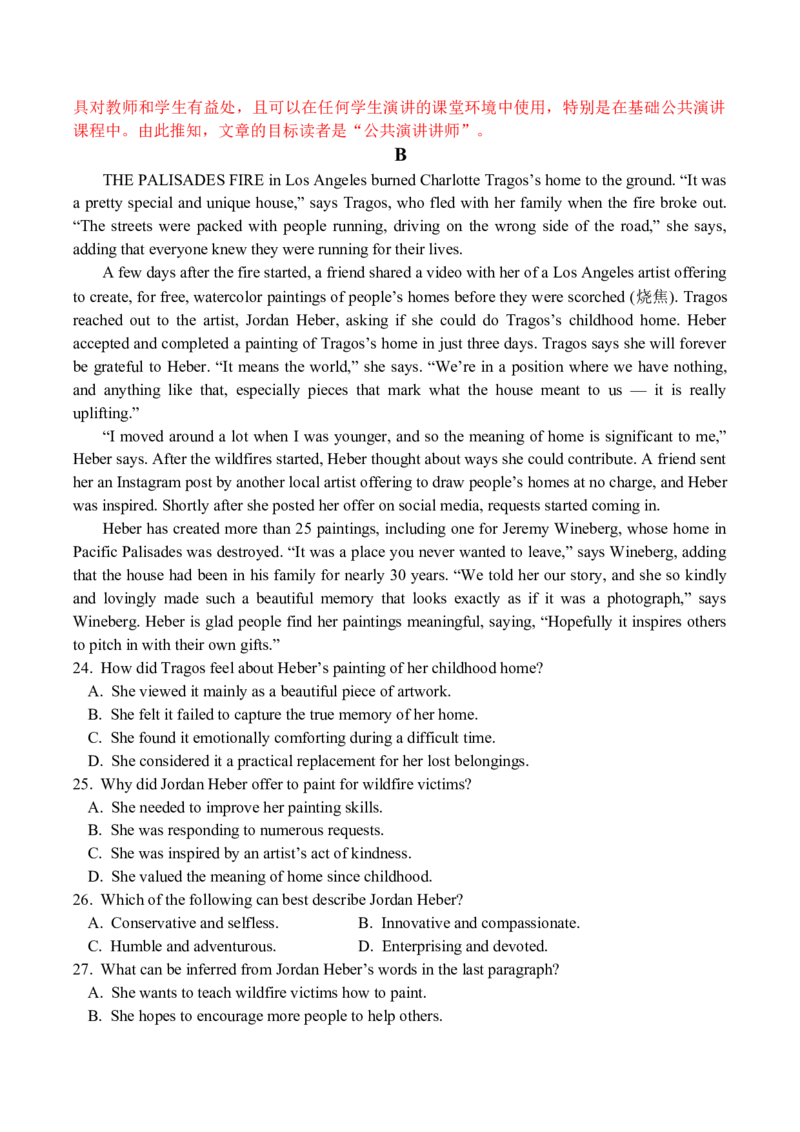
Power of Public Speaking has partnered with ASI Innovation Labs to integrate artificial
intelligence into the Pops Classroom platform for improving public speaking skills. The first project
is the Pops Advisor which provides an automatic evaluation of students’ video presentations with
visual feedback.
The Advisor offers on-demand comments to students practicing public speaking from anywhere.
This flexibility benefits instructors, who can be as hands-on or hands-off during practice. While
students can operate autonomously with the tool, instructors can also choose to keep track of
students’ progress.
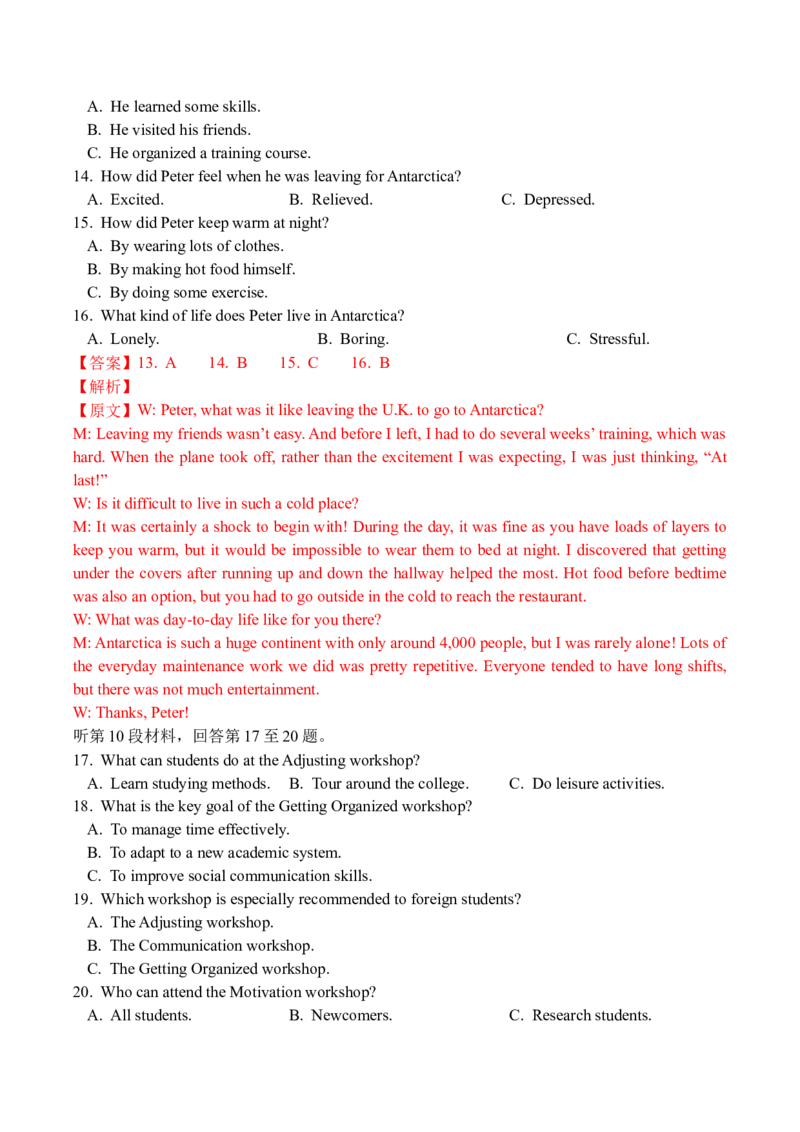
Criteria
Using machine learning models, the Pops Advisor analyzes the following criteria:
Delivery
Introduction
Body
Conclusion
Vocal Style
Vocal Quality
Vocal Filler
Eye Contact
Body Language
Credibility
Attention
Central Idea
Preview
Connective
Support
Language
Connective
Credibility
Organization
Signaling Ending
Summary
Memorable
Ending
Credibility
Feedback
The presenter receives feedback on the above four categories. And this feedback is given in the
following formats:
Recommendations
To provide presenters with valuable feedback for the next practice, recommendations focus on
specific aspects needing improvement. For instance, the recommendation can be “Your message is
clear, but be sure you are grabbing your audience’s attention in your introduction to ensure they are
listening.”
Speech Metrics (指标)
Useful speech metrics serve as quantitative descriptors on several aspects of the presentation
including number of words, total presentation time, speaking rate and vocal fillers percentage.
Pops Advisor can be used in any classroom setting where students are presenting, particularly in
the Basic Public Speaking Course. When you are considering what can be achieved by your students
toward skill development in a single school semester, Advisor increases the overall development.
21. What is the Pops Advisor?
A. An evaluation tool.
B. A time tracker.
B. A video player.
D. A voice assistant.
22. Which of the following categories provides feedback on facial expressions?
A. Body.
 B. Delivery.    C. Conclusion.   D. Introduction.
23. Who is the text intended for?
A. Lab technicians.
B. Foreign language learners.
C. Artificial Intelligence engineers.
D. Public speech instructors.
答案:21-23 ABD
话题:人工智能
文章大意:本文介绍Power of Public Speaking 与ASI Innovation Labs 合作开发的Pops Advisor
工具,阐述人工智能如何融入公共演讲教学平台。
【解析】
21.答案:A 细节理解题。
解析:根据第一段中的“ The first project is the Pops Advisor which provides an automatic
evaluation of students’ video presentations with visual feedback.”可知,Pops Advisor 的核心功能
是“自动评估演讲”,属于评估工具。
22.答案:B 推理判断题。
解析:根据“Criteria”部分,“Delivery (表达)”包含“Eye Contact (眼神交流)”,而眼神交流
属于面部表情相关的评估维度。
23.答案:D 推理判断题。
解析:根据第二段中的“This flexibility benefits instructors, who can be as hands-on or hands-off
during practice. While students can operate autonomously with the tool, instructors can also choose
to keep track of students’ progress.”和最后一段中的“Pops Advisor can be used in any classroom
setting where students are presenting, particularly in the Basic Public Speaking Course.”可知,该工
具对教师和学生有益处,且可以在任何学生演讲的课堂环境中使用,特别是在基础公共演讲
课程中。由此推知,文章的目标读者是“公共演讲讲师”。
B
THE PALISADES FIRE in Los Angeles burned Charlotte Tragos’s home to the ground. “It was
a pretty special and unique house,” says Tragos, who fled with her family when the fire broke out.
“The streets were packed with people running, driving on the wrong side of the road,” she says,
adding that everyone knew they were running for their lives.
A few days after the fire started, a friend shared a video with her of a Los Angeles artist offering
to create, for free, watercolor paintings of people’s homes before they were scorched (烧焦). Tragos
reached out to the artist, Jordan Heber, asking if she could do Tragos’s childhood home. Heber
accepted and completed a painting of Tragos’s home in just three days. Tragos says she will forever
be grateful to Heber. “It means the world,” she says. “We’re in a position where we have nothing,
and anything like that, especially pieces that mark what the house meant to us — it is really
uplifting.”
“I moved around a lot when I was younger, and so the meaning of home is significant to me,”
Heber says. After the wildfires started, Heber thought about ways she could contribute. A friend sent
her an Instagram post by another local artist offering to draw people’s homes at no charge, and Heber
was inspired. Shortly after she posted her offer on social media, requests started coming in.
Heber has created more than 25 paintings, including one for Jeremy Wineberg, whose home in
Pacific Palisades was destroyed. “It was a place you never wanted to leave,” says Wineberg, adding
that the house had been in his family for nearly 30 years. “We told her our story, and she so kindly
and lovingly made such a beautiful memory that looks exactly as if it was a photograph,” says
Wineberg. Heber is glad people find her paintings meaningful, saying, “Hopefully it inspires others
to pitch in with their own gifts.”
24. How did Tragos feel about Heber’s painting of her childhood home?
A. She viewed it mainly as a beautiful piece of artwork.
B. She felt it failed to capture the true memory of her home.
C. She found it emotionally comforting during a difficult time.
D. She considered it a practical replacement for her lost belongings.
25. Why did Jordan Heber offer to paint for wildfire victims?
A. She needed to improve her painting skills.
B. She was responding to numerous requests.
C. She was inspired by an artist’s act of kindness.
D. She valued the meaning of home since childhood.
26. Which of the following can best describe Jordan Heber?
A. Conservative and selfless.
B. Innovative and compassionate.
C. Humble and adventurous.
D. Enterprising and devoted.
27. What can be inferred from Jordan Heber’s words in the last paragraph?
A. She wants to teach wildfire victims how to paint.
B. She hopes to encourage more people to help others.
C. She regrets not being able to help more wildfire victims.
D. She plans to stop painting and focus on her full-time job..
答案:24-27 CCBB
话题:个人经历
【文章大意】: 洛杉矶火灾后艺术家无偿为灾民绘制故居水彩画,慰藉受灾者心灵的暖心故
事。
【解析】
24.答案:C 推理判断题。
解析:根据第二段中的“Tragos says she will forever be grateful to Heber. “It means the world,”
she says. “We’re in a position where we have nothing, and anything like that, especially pieces that
mark what the house meant to us — it is really uplifting.”可知,在失去家园的艰难时刻,这幅画
给特拉戈斯带来了情感上的慰藉。
25.答案:C 细节理解题。
解析:根据第三段中的“ After the wildfires started, Heber thought about ways she could
contribute. A friend sent her an Instagram post by another local artist offering to draw people’s
homes at no charge, and Heber was inspired.”可知,赫伯是受到另一位艺术家善举的启发,才决
定为灾民作画。
26.答案:B 推理判断题。
解析:根据第二段中的 “A few days after the fire started, a friend shared a video with her of a
Los Angeles artist offering to create, for free, watercolor paintings of people’s homes before they
were scorched ”,赫伯主动免费为灾民绘制故居,用画作承载他们对家的记忆,切实慰藉了受
灾者的心灵,是同情心的直接体现。根据第三段提到 “ After the wildfires started, Heber
thought about ways she could contribute,火灾发生后她主动寻求助力灾民的途径,体现出对受
灾者的关怀。根据第四段 “We told her our story, and she so kindly and lovingly made such a
beautiful memory that looks exactly as if it was a photograph, ” says Wineberg.”能看出,这种艺术
帮扶的方式新颖且有温度,区别于常规救灾手段,体现了创新性。
27.答案:B 推理判断题。
解析:根据最后一段中的“Heber is glad people find her paintings meaningful, saying, “Hopefully
it inspires others to pitch in with their own gifts. ””可知,赫伯希望自己的行为能鼓励更多人发挥
自身优势去帮助他人。
C
(原创) Music has long been recognized for its healing powers. Today, artificial intelligence is
making this ancient remedy more precise and accessible. A prime example is the AI music therapy
pod, premiered by the Shanghai Conservatory of Music, which offers a personalized, science-backed
healing experience.
Upon entering the pod, users complete a personal questionnaire. They then recline in a chair
equipped with monitoring devices such as EEG headsets and heart rate sensors. These tools collect
real-time physiological data, which is displayed on a screen. An AI model, processing this data along
with the user’s personal profile, generates a unique multisensory experience. Soothing ambient music
blended with natural sounds fills the space, while synchronized visuals appear on the screen. The
entire process is designed to enhance attention, promote relaxation, and stabilize vital signs.
The core innovation lies in AI’s data-processing power. Since the late 20th century, scientists
have explored converting unique brainwaves into sound. AI accelerates this by rapidly analyzing
personal trait patterns and real-time physiological indicators to create tailored soundscapes. As
explained by researchers, individual responses to sound involve complex factors like memory,
cultural background, and personal experience—all high-level cognitive processes. Handling such
complexity requires massive data computation, a task perfectly suited for AI.
The therapy pod represents a deep integration of technology and art. It is built upon years of
research from the conservatory’s laboratory, which has produced numerous scientific papers. After
each session, users receive a data report and a personalized “music prescription” for continued well-
being.
Looking ahead, developers aim to harness even more advanced computing, hoping to reach
quantum-level analysis. The goal remains clear: to use AI not to replace the human element of
healing, but to deepen and personalize the therapeutic power of music, making mental wellness more
attainable for all.
28.What is the first step for a user experiencing the AI music therapy pod?
A. Reclining in a special chair.
B. Filling out a questionnaire.
C. Putting on monitoring devices.
D. Listening to ambient music.
29. The term “electroencephalogram (EEG) headsets” in paragraph 2 most likely refers to devices
that ______.
A. monitor brain activity
B. measure heart rate changes
C. track muscle movement
D. detect skin responses
30.What can be inferred about the role of AI in the music therapy pod from the passage?
A. To create entertainment music.
B. To replace human therapists.
C. To process data for personalization.
D. To lower treatment costs.
31.What is the main purpose of the passage?
A. To advertise a new commercial product.
B. To explain AI's role in music therapy.
C. To prove AI's superiority over humans.
D. To detail music therapy's history.
答案:28-31 BACB
话题:人工智能在音乐治疗领域的创新应用
【文章大意】:介绍了由上海音乐学院研发的人工智能音乐治疗舱。文章阐述了该设备如何
通过采集用户生理数据(如脑电图、心率),结合人工智能技术,生成个性化的多感官音乐
体验,以达到放松身心、稳定体征的治疗目的。
【解析】
答案:B 本题考查对文章具体步骤和顺序的把握。文章第二段首句明确提到:“ Upon
entering the pod, users complete a personal questionnaire.”,随后才描述佩戴设备、体验音乐等
步骤。
28. 答案:A 词义猜测题。
解析:文章第三段进一步提供了核心解释线索:“converting unique brainwaves into sound”。
这里的“brainwaves”(脑电波)正是“electroencephalogram”一词描述的对象(electro-电的,
encephalo-脑的,-gram 图/记录)。因此,结合可以推断出“electroencephalogram headsets”是
用于“监测大脑活动”的设备。
30.答案:C 推理判断题。
解析:文章核心阐述了AI 通过处理个人问卷和实时生理数据,来生成个性化的(tailored)声
景与体验。其关键作用在于数据处理以实现个性化,而非娱乐、取代人类或节约成本。
31.答案:B 主旨大意题。
解析:全文以AI 音乐治疗舱为例,始终围绕“AI 如何使音乐治疗更精准、个性化”这一主
线展开,解释了其工作原理、技术基础与目标。
D
Nowadays, there are pet pampering (宠爱) packages at hotels, menus with dog-friendly roast
dinners and animal-friendly charter flights. This is the “pawprint ( 爪印) economy” — and it’s
booming. Pet travel isn’t just a trend, it’s something of a transformation. The benefits are real for
both parties: strengthened bonds, shared experiences and opportunities to build skills and confidence.
But there’s a growing gap between what the industry is offering and what people and pets need.
Here’s where the disconnect emerges. While providers advertise “pawsecco” and pet spas, research
has shown that people prioritize practical care over “extras”. Studies identify six key qualities that
people are looking for: service design, activity support, safety, pet-friendly staff, transparent policies
with fair fees, and lastly, amenities (便利设施). Crucially, green spaces drive pet travel planning,
boosting wellbeing for both human and animal. After all, this is the real reason why people choose to
travel with pets.
Yet many people with pets say they don’t believe any accommodation is truly pet friendly,
signalling a trust gap. Many properties advertise as “pet friendly” but place restrictions, surprise fees
or go no further than simply allowing pets to stay. Part of the problem seems to be one-size-fits-all
thinking. Research identifies three distinct groups of people travelling with dogs. There are those
seeking basic, convenience-focused accommodation. High-quality experience seekers are willing to
pay for luxury. And activity-loving travellers prioritize outdoor adventures. A chihuahua on a city
break has different needs to a labrador on a hiking trip, yet many providers offer generic ( 通用的)
packages that delight no one.
The evidence from both researchers and industry is clear: people will pay more to travel with
their pets. For tourism providers, the opportunities are significant. The travel industry faces a choice:
continue offering superficial “pet-friendly” experiences or genuinely adapt and ease the stress for
travellers and their pets. The evidence shows that pet-friendly facilities, support with activities, and
attentive service outweigh add-ons. Delivering this means providing transparent online information
so travellers can assess facilities and policies confidently, designing spaces that genuinely welcome
pets, and training staff to deliver a knowledgeable service.
32.What is the first paragraph intended to do?
A. Show the rise and advantages of pet travel.
B. Compare traditional and modern pet care.
C. Promote animal-friendly hotels and flights.
D. List reasons why pets travel with owners.
33. What is the real reason for pet travel planning according to paragraph 2?
A. Advertising extra services.
B. Construction of green spaces.
C. Enjoying extra services.
D. Access to green spaces.
34. What is the disadvantage of one-size-fits-all thinking?
A. It ignores pet safety rules.
B. It causes environmental pollution.
C. It fails to meet different needs.
D. It promotes irresponsible pet ownership.
35. How can the travel industry offer genuine pet-friendly experiences according to the evidence?
A. By reducing travel costs.
B. By advertising for good pet trainers.
C. By providing luxury facilities.
D. By offering satisfactory service.
答案:32-35 ADCD
话题: 爪印经济
文章大意: 本文介绍了宠物友好相关的爪印经济正蓬勃发展,但行业服务与养宠者需求存在
脱节,且存在信任和一刀切的问题,旅游业需优化服务打造真正的宠物友好体验。
解析
32 答案:A 推理判断题。
解析:根据第一段“Nowadays, there are pet pampering (宠爱) packages at hotels, menus with
dog-friendly roast dinners and animal-friendly charter flights. This is the “pawprint (爪印) economy”
— and it’s booming. Pet travel isn’t just a trend, it’s something of a transformation. The benefits are
real for both parties: strengthened bonds, shared experiences and opportunities to build skills and
confidence.”可知,第一段的目的是展示宠物旅行的兴起及其优势。
33.答案:D 细节理解题。
解析:根据第二段“Crucially, green spaces drive pet travel planning, boosting wellbeing for both
human and animal. After all, this is the real reason why people choose to travel with pets.”可知,宠
物旅行规划的真正原因是便于接触绿地。
34.答案:C 细节理解题。
解析:根据第三段“Part of the problem seems to be one-size-fits-all thinking. Research identifies
three distinct groups of people travelling with dogs. There are those seeking basic, convenience-
focused accommodation. High-quality experience seekers are willing to pay for luxury. And activity-
loving travellers prioritize outdoor adventures. A chihuahua on a city break has different needs to a
labrador on a hiking trip, yet many providers offer generic (通用的) packages that delight no one.”可
知,“一刀切”的思维方式无法满足不同的需求。
35.答案:D 细节理解题。
解析:根据最后一段可知,旅游业可以提供令人满意的服务。
第二节(共5 小题;每小题2. 5 分, 满分12. 5 分)
阅读下面短文, 从短文后的选项中选出可以填入空白处的最佳选项。选项中有两项为多余选
项。
(原创) Young Chinese travelers are discovering a clever way to save money on overseas trips.
36

    For example, one traveler took a high-speed train from Beijing to Datong and then caught a
direct flight to Bangkok. The total cost was much lower than a direct flight from Beijing.
   37

    This new travel style is possible thanks to newly opened international routes from
smaller city airports. This makes the overall journey surprisingly affordable. The airports in these
smaller cities offer another advantage: efficiency. With shorter walking distances and fewer crowds,
they provide a relaxed start to the trip compared to the often busy major hubs.
But for these young people, it’s not just about saving money.    38

    They prefer to spend their
budget on better food and experiences at their destination. An expert points out this reflects an
upgrade in cultural consumption, not simply cheaper travel.
How can these tickets be so cheap?    39

    To encourage local tourism and economic growth,
local governments often provide support for these new flight routes. This reduces airline costs,
allowing them to offer low ticket prices.
This trend is growing across China. More small and medium-sized cities are launching budget
international flights.    40


A. The main reason involves government support and market operations.
B. Therefore, the quality of their travel experience has significantly improved.
C. They combine a short train ride to a nearby city with a flight from its airport.
D. Instead, it represents a smarter choice aimed at gaining greater value.
E. These flights are often 30-50% cheaper than those from big cities.
F. Consequently, this has led to a decrease in international travel overall.
G. As a result, young travelers now have more attractive and cheaper flight options.
答案:36-40 CEDAG
话题:一种新兴的智慧出行方式
文章大意:文章主要介绍了当下年轻人流行的“从中小城市机场飞往海外”的新旅行模式,
通过“高铁+小机场航班”的组合节省成本,并分析了其背后的原因(政府补贴、市场运作)
和反映的消费观念升级(追求价值而非单纯低价)。
【解析】
36.答案:C
考点:段中句(细节解释)
解析:空前的首句提出了“聪明的省钱方法”这一总体概念,空后则用具体例子(北京-大
同-曼谷)进行说明。C 项“他们先将短途高铁和从小城市机场起飞的航班结合起来”恰是对
“这种方法”具体操作方式的解释说明,作为桥梁连接了抽象的“方法”概念和其后具体的
例子,使逻辑连贯。
37.答案:E
考点:段首句(段落主旨/现象阐述)
解析:第二段需要阐述此现象可行的客观条件。E 项“这些航线的票价通常比从大城市直飞
便宜30%-50%”概括了本段核心——价格优势。它作为段落主题句,直接引出了空后“这种
新旅行方式成为可能”的原因,并与段尾提到的“使整个旅程出奇地划算”形成首尾呼应,
统领全段。
38.答案:D
考点:段中句(观点递进/本质阐释)
解析:第三段旨在探讨现象背后的深层动机。空前句提出“这不只是图便宜”,将语意转向
更深层次。D 项“相反,它代表着一种旨在获取更高价值的更聪明选择”完美承接这一转折,
明确指出了其本质是“价值追求”,进而自然引出空后关于“将预算用于更好体验”和“消
费升级”的具体阐述,逻辑链条紧密。
39.答案:A
考点:段中句(原因总述)
解析:第四段以设问句开头,询问低价原因。A 项“主要原因与政府支持和市场运作有关”
直接、概括性地回答了该问题,是总起句。它随即引出了空后对“政府支持”如何具体运作
的详细解释(如提供补贴、降低风险),构成了“总-分”的逻辑关系。
40.答案:G
考点:段尾句(总结归纳/趋势影响)
解析:文章最后一段描述此趋势在全国蔓延的现象。空前句列举了多个城市开通低价国际航
线的实例。G 项“因此,年轻旅行者现在有了更多诱人且廉价的飞行选择”正是基于前文众
多实例得出的自然结论,总结了这一趋势对目标群体(年轻旅行者)产生的最终影响,有效
收束全文,符合段尾句的功能。
第三部分 语言运用(共两节,满分30 分)
第一节(共15 小题,每小题1 分,满分15 分)
阅读下面短文, 从每题所给的A、B、C 和D 四个选项中选出可以填入空白处的最佳选项。
My story in China began with a heartbeat of panic at Chengdu airport.    41

    and knowing no
Chinese, I entered a new world. That night, my    42

    came from a kind senior. He called a car and
opened a gate with his phone app for me. The first    43

    of digital life in China stayed in my
mind.
Soon, it became my daily routine. I used apps for bikes and meals. When winter came, I
44

    a jacket on the Internet. It reached me the next day! From then on, I shopped online a lot more,
and really enjoyed the    45

    it brought to me.
But not every day was easy. The language    46

    often felt like a wall. Once, I was looking for
eggs, but didn’t know the word. I    47

    like a chicken, flapping ( 拍打) my arms, but the
shopkeeper didn’t understand. Finally, I    48

    a translation app and it said “dan” then.
After that, the app became my friend. I used it for haircuts and shopping.    49

    , I picked up
simple Chinese words like “nihao” and “zaijian”. Technology was    50

    me to communicate with
locals.
My best moment was my friend Suiti’s wedding. Her husband was abroad, so the ceremony was
held    51

   . When Suiti saw her husband’s face on the screen, tears streamed down her cheeks. I
52

    a love that crossed continents, all enabled by    53

   .
Through it all, China’s digital “    54

    ” was my companion. But it’s the human    55


behind it — the smiles, the patience — that gave it real meaning.
41
A.Alone
B.Awake
C.Alike
D.Alive
42
A.invitation
B.chance
C.patience
D.rescue
43
A.generation
B.description
C.impression
D.innovation
44
A.designed
B.ordered
C.invented
D.returned
45
A.calmness
B.comfort
C.certainty
D.convenience
46
A.barrier
B.point
C.sense
D.diversity
47
A.sang
B.swam
C.acted
D.whispered
48
A.turned to
B.appealed to
C.applied to
D.stuck to
49
A.Suddenly
B.Luckily
C.Gradually
D.Usually
50
A.persuading
B.assisting
C.reminding
D.forcing
51
A.offline
B.secretly
C.online
D.publicly
52
A.expressed
B.missed
C.regretted
D.witnessed
53
A
.
psychology
B.technology
C.imagination
D.transportation
54
A.spirit
B.backbone
C.breath
D.heartbeat
55
A.warmth
B.wisdom
C.curiosity
D.intelligence
答案:41-45 ADCBD   46-50 ACACB  51-55 CDBDA
话题:个人经历
文章大意:作者讲述自己初到中国成都,在语言不通的情况下,借助数字科技和当地人的善
意,逐渐适应生活并见证跨国温情的经历。
41. A
形容词辨析。句意:孤身一人且一句中文也不会,我踏入了一个全新的世界。结合前
文“a heartbeat of panic”以及后文陌生的环境,可知作者此时是孤身一人的状态。
42. D
名词辨析。句意:那天晚上,一位善良的长者救了我。根据后文“He called a car and
opened a gate with his phone app for me”可知,长者帮了困境中的作者,对作者来说是一种救
助。
43. C 名词辨析。句意:中国数字生活的第一印象留在了我的脑海里根据前文“He called a
car and opened a gate with his phone app for me.”可知,长者用手机软件帮作者叫车、开门,这
是作者第一次接触中国的数字生活,留下了相关印象。
44. B 动词辨析。句意:冬天来临时,我在网上订购了一件夹克。根据后文“It reached me the
next day”以及“shopped online”可知,作者是在网上下单买的夹克。
45. D 名词辨析。句意:从那以后,我更频繁地网购,也真切喜欢上了它带来的便利。根据
前文“It reached me the next day!”可知,网购下单后第二天就能收到商品,体现的是数字生活
的便利。
46. A 名词辨析。句意:语言障碍常常像一堵墙。根据前文“knowing no Chinese”以及后文
“often felt like a wall”可知语言是作者和他人交流的障碍。
47. C 动词辨析。句意:我模仿鸡的样子,拍打着胳膊,但店主还是不明白。根据后文“like
a chicken, flapping (拍打) my arms”可知,作者不知道“鸡蛋”的中文说法,就通过模仿鸡的
动作来表达。
48. A 动词短语辨析。句意:最后,我求助于翻译软件,然后上面显示了“蛋”这个词。根
据后文“a translation app and it said “dan” then”可知,作者无法用动作让店主理解自己的需求,
于是借助翻译软件解决问题。
49. C 副词辨析。句意:渐渐地,我学会了一些简单的中文词汇,比如“你好”和“再见”
作者在日常使用翻译软件交流的过程中,慢慢积累学会了简单的中文单词。
50. B 动词辨析。句意:科技正在帮助我和当地人交流。根据前文“After that, the app became
my friend. I used it for haircuts and shopping.”可知,翻译软件等科技产品为作者和当地人的沟
通搭建了桥梁,起到了帮助作用。
51. C 副词辨析。句意:她的丈夫在国外,所以婚礼是在线上举办的。根据后文“When Suiti
saw her husband’s face on the screen”可知,婚礼是通过屏幕线上进行的。
52. D 动词辨析。句意:我见证了一场跨越大陆的爱情,这一切都是由科技促成的。根据后
文“a love that crossed continents”可知,作者出席了这场线上婚礼,亲眼看到了这场跨国爱情
的美好场景。
53. B 名词辨析。句意:我见证了一场跨越大陆的爱情,这一切都是由科技促成的根据前文
“Her husband was abroad, so the ceremony was held  ____”可知,线上婚礼的举办依靠的是网
络等科技手段,所以是科技促成了这场跨国婚礼。
54. D 名词辨析。句意:经历这一切之后,中国数字“心跳”一直陪伴着我。将数字生活比
作陪伴自己的“心跳”,让表述更具连贯性和感染力。
55. A 名词辨析。句意:但赋予它真正意义的,是其背后的人间温情——那些笑容,那些耐
心。结合前文分析可知,长者的帮助、店主的耐心等都体现了人与人之间的温情,这才是数
字生活更有意义的部分。
第二节(共10 小题;每小题1.5 分,满分15 分)
阅读下面短文,在空白处填入1 个适当的单词或括号内单词的正确形式。
(改编) China is widely recognized as   56   noodle paradise. Shanxi Province, in particular,
is known as the home of wheaten food in China. As an American exchange student, my first
encounter with noodles was in Shanxi. Everyone knows that noodles   5

 7
   (be) the king of
Shanxi cuisine. There are about 300 kinds of noodles, among   5

 8       my favorite is sliced noodles.
You can find a bowl of sliced noodles in almost every part of China.
Once, in a restaurant, I ordered sliced noodles and was lucky enough   5

 9
   (watch) the cook
make them     60
       the kitchen window. I was amazed to see the cook shave the noodles so quickly!
When I tasted them for the first time, I felt extremely happy.
Later, I tried to make sliced noodles     61
      (I). The more I practiced, the harder it seemed. But
when I got the angle right, it became much
  62

  (easy). In fact, cooking sliced noodles requires
many skills. The first step is the
  63

   (prepare) of the dough. After that, let it rest for 5 to 10
minutes. Then, you cut the noodles by     64
       (move) the knife up and down. Finally, cook them in
hot water for 5 minutes.
People love sliced noodles not only for their special taste
  65

   also because the making
process is an art form.
话题:刀削面
文章大意:本文以一位美国交换生的视角,介绍山西刀削面的地位、制作工艺及其独特魅力,
并融入作者亲身体验制作过程的经历。
56.答案:a
考点:冠词
解析:noodle paradise 为可数名词单数,此处首次提及且表示泛指,需用不定冠词。noodle 发
音以辅音开头。
57.答案:are
考点:谓语动词(主谓一致)
解析:主语 noodles 为复数,且本句描述客观事实,时态为一般现在时。
58.答案which
考点:定语从句(关系代词)
解析:非限制性定语从句,先行词为300 kinds of noodles(物),从句中需关系代词作among
的宾语,指代先行词。
59.答案:to watch
考点:非谓语动词(不定式)
解析:形容词短语lucky enough 后接不定式作结果状语,构成固定搭配be lucky enough to do
sth。
60.答案:through
考点:介词
解析:空格后为the kitchen window,表示“透过厨房窗户”观看,需用介词through 表示通过
某一介质或空间。
61.答案:myself
考点:代词(反身代词)
解析:主语为I,且句意强调“亲自尝试”,需用反身代词 myself 作同位语,加强语气。
62.答案:easier
考点:形容词(比较级)
解析:前文有The more…, the harder… 的对比结构,此处呼应“变得更容易”,且被a lot 修
饰,需用比较级easier。
63.答案:preparation
考点:词性转换(动词转名词)
解析:定冠词the 后需接名词,prepare 的名词形式为preparation,构成the preparation of the
dough。
64.答案:moving
考点:非谓语动词(动名词)
解析:介词by 后需接动名词,表示通过某种方式,故填moving。
65.答案:but
考点:连词(固定搭配)
解析:句中有not only,且下文有also,构成固定搭配not only…but also…,表示“不仅……
而且……”。
第四部分 写作(共两节, 满分40 分)
第一节(满分15 分)
假定你是李华,你校设立了Science Corner。请你为校英文网站写一篇宣传稿,内容包
括:
1.介绍科技角;
2.号召积极参与。
注意:1.写作词数应为80 左右;2.请按如下格式在答题卡的相应位置作答。
Join Our Science Corner!


高分范文
Join Our Science Corner!
A new “Science Corner” is set up in our school to fuel students’ passion for science. It provides
a fantastic platform for us to do interesting experiments, exchange creative science ideas and watch
popular science videos. We can also explore basic scientific principles and work with like-minded
classmates.
This is a great chance to discover the fun of science. Whether you are a science enthusiast or just
curious, come and take part in various activities. Let’s explore the amazing science world together at
the Science Corner!
话题:校园生活与科技素养
写作思路:本文为校园宣传稿,需遵循“开篇引入---核心介绍---呼吁行动”的典型结构。
命题解析:
1.主题聚焦:校园科技 + 校园宣传”,贴合高三英语写作 “贴近校园生活、侧重素养考
查” 的命题原则,聚焦科技探索与校园活动参与的主题,符合 “立德树人” 导向,引导学
生关注校园科技文化建设,同时考查学生对宣传稿文体功能的把握。
2.格式规范:考查英文校园宣传稿的基础格式,以简洁标题开篇,正文无繁琐格式要求,侧
重内容的吸引力和号召力,区别于书信体的格式要求,考查学生根据不同文体调整写作形式
的能力,符合江苏地区对英语写作 “文体适配” 的考查特点。
3.内容完整性:核心考查 “介绍事物 + 发出号召” 两大写作能力,需考生对科技角的功
能、活动形式进行合理细节补充(如实验、交流、看科普视频等),避免内容空洞;号召部
分需贴合学生身份,语气积极向上,同时控制词数在80 左右,考查语言的简洁性与准确性。
评分标准:
内容完整(5 分):涵盖所有必写要点(介绍科技角 + 号召积极参与),细节补充合理(对
科技角的活动形式、功能有具体描述),号召内容贴合校园场景,有吸引力。
语言表达(8 分):语法正确,句型多样(合理运用非谓语、定语从句、并列句等),词汇
恰当(如fuel、explore、like-minded 等贴合主题的词汇),无拼写、语法错误。
连贯流畅(2 分):使用恰当的连接词(如also、whether...or...等),逻辑连贯,语气贴合笔
友交流场景。
第二节(满分25 分)
阅读下面材料,根据其内容和所给段落开头语续写两段,使之构成一篇完整的短文。
注意:1.续写词数应为150 个左右;2.请按如下格式在答题纸的相应位置作答。
Batyr was a quiet 17-year-old boy from Kazakhstan who came to America as an exchange
student. His parents had told him many times before he left, “Be polite, be respectful, and never
cause trouble for others.” He was warmly welcomed by his host mother, Allison, who showed him a
new room and said with a big smile, “Make yourself at home, Batyr! This is your room now.” Batyr
smiled back happily but felt a little nervous. He was determined to be a good guest and follow his
parents’ advice carefully.
Weeks went by quickly as Batyr started his new school life. But from his very first night,he had
a small problem he didn't know how to solve. He saw a switch by the door, but when he used it, only
a ceiling fan started to turn above his head. “Where is the light switch?” he thought to himself. He
felt it was too silly and embarrassing to ask Allison about such a small thing. Not wanting to bother
anyone, he found his own clever ways to have light in the evening. For seven long weeks, he used
the bright light from his laptop screen to read and do his homework.
One rainy night, Allison came into his room to look for a book she had left there earlier. She
was quite surprised to see the room was lit only by the blue light from his laptop. “Batyr, why are
you sitting in the dark?” she asked with concern. Feeling a little shy and embarrassed, Batyr finally
decided to tell her the truth. “Well, the switch only works for the fan. I didn’t want to trouble you
about the light.” Allison’s eyes opened wide in surprise. Then she laughed kindly and explained,
“Oh, Batyr! The same switch controls the light! You just need to pull this small chain hanging from
the fan!” When she pulled the chain, the room was suddenly filled with warm, bright light. Batyr
blinked in amazement. “I... I really didn’t know that,” he said, feeling both happy and a little foolish.
The whole family thought it was a very kind and funny mistake, and they admired his good nature.
注意:1. 所续写短文的词数应为150 左右;
2.续写部分分为两段,每段的开头语已为你写好。
Paragraph 1:
Amused and touched by his incredible politeness, Allison asked if she could share the story
online.


Paragraph 2:
When Batyr saw so many positive responses, he was astonished.


高分范文
Paragraph 1
Amused and touched by his incredible politeness, Allison asked if she could share the story
online. Batyr, though slightly embarrassed, agreed with a nod. Allison posted the story that evening,
highlighting his considerate nature and the cultural misunderstanding. To their surprise, the post was
soon flooded with likes and comments. People shared similar experiences of adapting to new places,
praising Batyr’s patience and respect. Many were moved by his willingness to sit in the dark for
weeks just to avoid being a bother.
Paragraph 2
When Batyr saw so many positive responses, he was astonished. He hadn’t realized his small
struggle could resonate with so many. Reading the comments, he felt a warm connection to strangers
who understood. That night, Allison gave him a gentle hug. “Sometimes,” she said, “asking for help
is the most polite thing you can do. It lets people in.” Batyr finally understood. He smiled, feeling
lighter. The light in his room was now always on, bright and welcoming, just like his newfound
sense of belonging.
命题解析:
档次
分值区间
核心评分标准
一档
21-25 分
1. 情节:紧扣原文伏笔(Batyr 的礼貌、Allison 的友善、跨文化误会),
衔接自然,完整呈现 “故事上网—网友共鸣—Batyr 感悟成长” 的逻辑
链;两段内容呼应,情节真实感人,符合原文温情的叙事风格。
2. 语言:无考纲外词汇,用词精准,句型多样,语法零失误;动作、心
理、神态描写生动(如blink、astonished、gentle hug 等词的运用),画面
感强。
3. 主题:鲜明体现 “跨文化理解 + 礼貌与主动沟通的平衡”,情感真
挚,价值导向积极。
4. 字数:140-160 词,完全符合要求。
二档
16-20 分
情节:衔接基本合理,涵盖核心情节(故事上网获好评、Batyr 的感受与转
变),细节稍显单薄(缺少心理或神态的细致描写)。
2. 语言:用词准确,少量语法错误(不影响句意理解),有简单的描写手
法(如动作描写),句型有一定变化。
3. 主题:贴合题意,体现 “善意与沟通” 的核心,情感表达较真挚,无
偏离。
4. 字数:120-139 词或161-180 词。
三档
11-15 分
1. 情节:有基本续写内容,但与原文衔接生硬,逻辑存在漏洞(如未提及
网友回应的具体内容,直接写 Batyr 的转变;或情节脱离跨文化、礼貌的
主题)。
2. 语言:词汇使用有限,语法错误较多,缺乏描写元素,句式单一,多为
简单句。
3. 主题:基本扣题,但情感表达不鲜明,主题体现不突出。
4. 字数:90-119 词或181-200 词。
四档
6-10 分
1. 情节:内容碎片化,与原文主线脱节,无合理情节发展(如脱离Batyr
和 Allison 的故事,写无关的人物或事件;或未按照开头语展开情节)。
档次
分值区间
核心评分标准
2. 语言:大量语法错误,用词不当,表意模糊不清,无法准确表达情感,
基本无描写手法。
3. 主题:明显偏离 “跨文化交流 + 礼貌与沟通” 的核心。
4. 字数:50-89 词。
五档
0-5 分
1. 未续写、内容抄袭或与原文完全无关。
2. 字数不足50 词;字迹潦草无法辨认。